Chanticleer (part 3 of 3)

Finally!  The last part of my Chanticleer visit.  I suspect I might have gone on a little too long over my visit, but I really did enjoy the trip and the gardens are just the type of plantings I like to see at this time of year.  Lush healthy tropical plants putting on their last big hurrah before the first frost cuts them down.  Plus I like to use this blog as a photo record of the year, and I’m sure these images will come in handy during the icy days of winter.

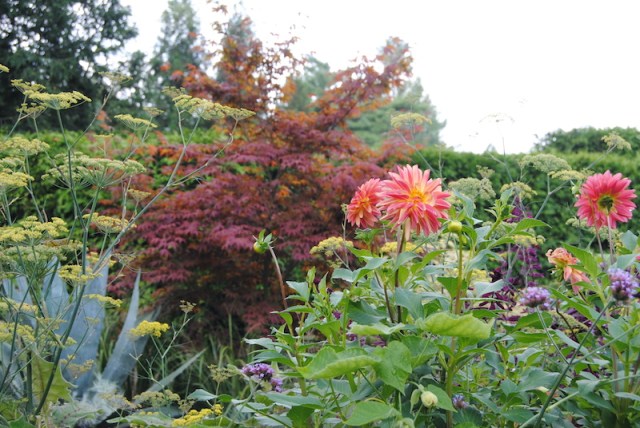
Here’s the last big stop of the tour, the terrace gardens surrounding the main Chanticleer house.  As usual it’s a dose of reality when I see plants from my own garden used to so much better effect.  The Japanese maple, variegated Pagoda dogwood “Golden Shadows”, blue ageratum and “limelight” four o’clock near the path…. all look a lot nicer here!

I’m sure a terrace of bluestone pathways and stone steps would help my garden design immensely, but even the bronze fennel, dahlias, and verbena bonariensis look dreamier and fresher here.  The blue of the spiky agave helps too…. hmmm I grow that as well.  It’s sitting under the deck in a broken clay pot, wishing it were at Chanticleer.

The boxwood hedge which I’ve planted around my vegetable garden still needs several years before it reaches this immaculately trimmed state.  I like a nice boxwood edging, I think it’s worth the extra work of frequent trimming, and adds a nice touch of control to a bed that might otherwise look to be on the verge of messy.

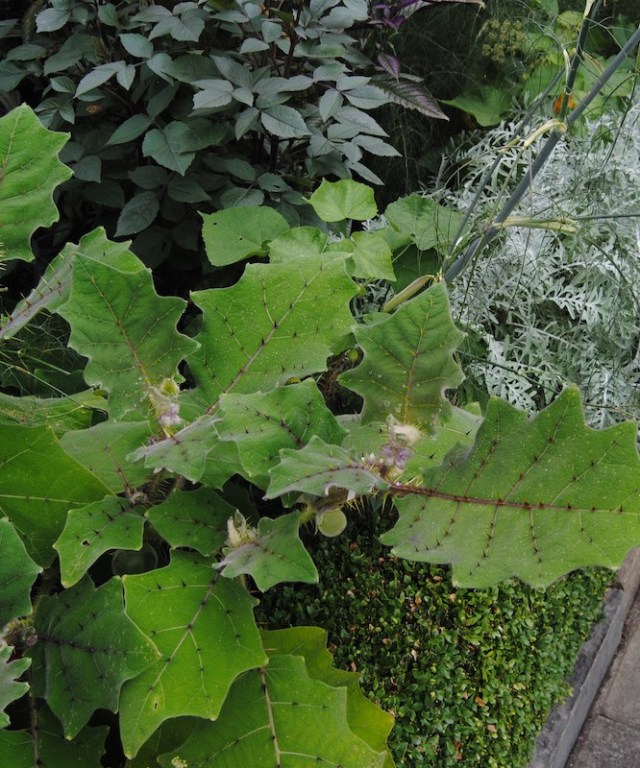
Once my own boxwoods turn into a neat hedge I might start to refer to the vegetable garden as a ‘potager’.  Sounds so much more refined 🙂 .  But I might opt out on planting the prickly ‘bed of nails plant’ (solanum quitoense) in the potager.  Although it’s a near relative of eggplants, tomatoes, peppers and potatoes, the spiny leaves might be better suited for a focal spot out front (I love the poky plants!)

‘Black Pearl’  ornamental peppers also look great right up against the hedge, and these could easily fit into my future potager.

If you’re interested in reading a little more about these plants and some of the thoughts behind the plantings, check out this link at the Hardy Plant Society.  Jonathan Wright, the horticulturalist in charge of this part of the garden, wrote a great article on this area and some of the practices used to keep it looking at its peak from March into November.

Still in the terrace garden was something new that I liked.  An area formerly kept as a cut lawn had been turned over to a flowery meadow of fluffy little red amilias, red dahlias, and violet verbena boanariensis.  I wonder if this section will hold over to next year,  the grass was boring, but it did give a bit of a calm amidst all the overflowing beds.

The area around the house is absolutely crammed with treasures and accents.  These huge baskets have more in them than most average gardens.

And of course there were plenty of seating areas surrounding the house.  A great place to stop for a needed break.

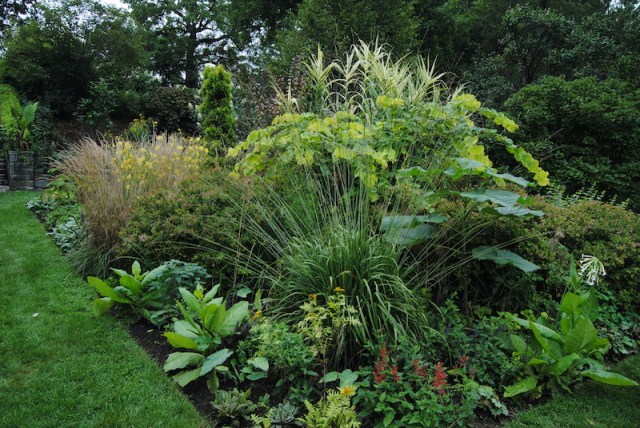
With reds and purples and bronzes dominating some of the other gardens, here the terrace garden leans towards yellows and yellow foliage.  I have a real weakness for this color lately and loved the mix.  Too bad I had no idea what half the plants were!  The best I can do is say the little vine here is probably canary creeper (Tropaeolum peregrinum) a relative of the nasturtiums.  It’s supposed to be easy from seed so maybe……

Back to red and purple.  The purplish upright dracaena is again one I have, and I will definitely copy this combo with the red leaved coleus.

I’m almost through my picture horde.

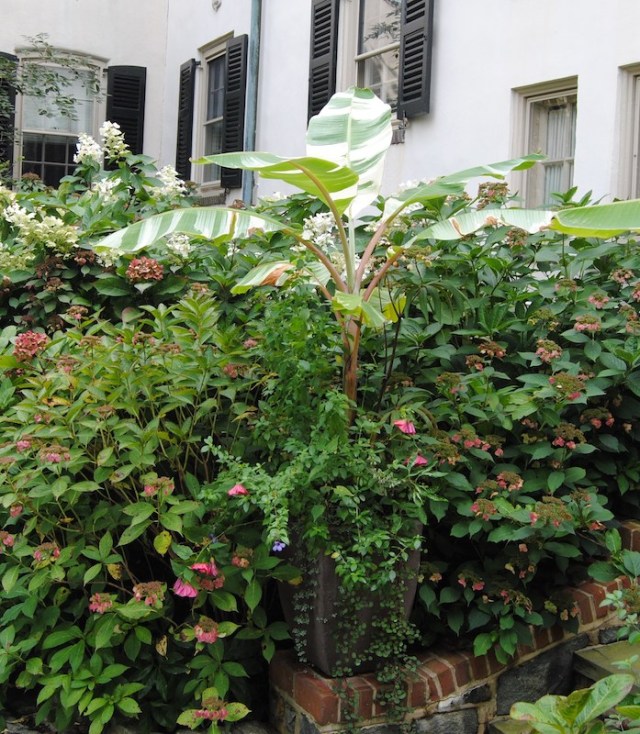
One more here for banana lovers.  I believe this is the infamous ‘Ae Ae’ variegated banana.  First found in Hawaii, it’s a little cranky to grow and therefore a little expensive to buy.  Established pups (offshoots of the mother plant) typically run $200-$300 and fraud runs rampant.  Don’t buy seeds and don’t buy from a shifty Georgia nursery is all I’ll say (not that I’ve ever considered it).  The leaves are really cool looking though and to have it flanking both sides of the main doorway…..

I’ll stick to my yellows and chartreuse.  Here’s a yellow leaved redbud, potted ‘mossy’ plants and a circle of raked gravel.  Very calming.

And so on to the exit.  No time to sit, but there was still ample color coordinated seating.

I bet someone has fun moving the seats about finding them the perfect spot, a good idea I think.  I should keep it in mind next time I’m moving stuff to bring the lawn mower through… not that my dead grass ever needs mowing.

Out the front gate.  It’s a beautiful locale and I wouldn’t mind living closer, but I have to question whether our housing budget can handle the zipcode.  A quick real estate search of Wayne, Pa shows it to be a tad out of our budget.  Even with the sale of our current house, just the down payment  for properties running in the 1-5 million range would be an issue.  I guess we could lower our expectations, but I want the hayfield too. 🙂

  Thanks for looking!

Chanticleer (pt 2 of 3)

It’s been longer than I planned, but here’s the continuation of my Chanticleer visit.  Part 2 of the visit picks up at the tennis courts, a part of the gardens who’s former function should be obvious!

The flat area that used to function as the court has been turned into a group of five beds filled with all sorts of interesting plants.  My favorite was this one which leans towards a yellow theme.  A redbud with yellowish foliage anchors the bed and a nice clump of the tall variegated arundo donax grass is peeking out from behind.  For a late season garden it still looks good.

There was plenty going on around the garden with cleanup and cutting back,  I don’t know how it is on other weekdays but during my visit the place was buzzing with garden staff.  Here’s another view with a nice banana, some of the annual purple perillia, and a couple of those dead looking brown sedges.  Grasses and sedges seem well used around Chanticleer and they do add long season airiness and texture.

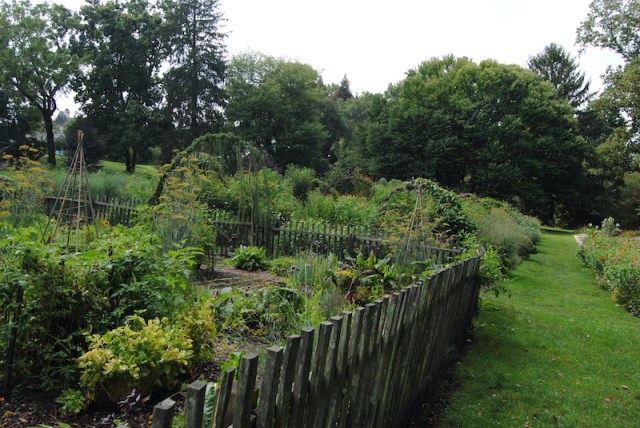
Beyond the courts is the cutting garden.  The Chanticleer interpretation is more like a wild ocean of frothy flowers, some of which top out at over 10 feet!  A cool garden to wander through since it comes in on you from all sides.  You can just make out the asparagus hedge that closes in the right side here.

A little structure in this garden is given by the archways.  I’m stealing this idea since it’s not tough to copy.  A rebar arch forms the basis while vines and branches are twisted around…. since I already have the rebar arch set up, no problem-o on twisting some twigs around!

The tall orange sunflower-ish plants are the annual tithonia.  It’s supposed to be easy from seed but I’ve never had much luck.  It sure did well here though.

This path leads to a small fenced in vegetable garden, a nice little spot to take a breather on one of the vegetable themed benches.  For as wild and bloomy as the cutting garden is, there were still a ton of late bloomers left to come, so I bet this garden comes to a peak in about another month…. in case you’re still considering a visit!

A relaxer next.  A woodland section called Bell’s Woods is a streamside collection of North American plantings.  Even though it probably peaks in the spring there were still plenty of cardinal flowers (lobelia cardinalis) in bloom.  It’s a nice soft stroll since the “wood path”  is actually a soft rubber mat that looks like wood chips…. or at least that’s what I read… even after being told, I still thought they looked like shredded bark!

Throughout the gardens are bits of functional art such as chairs, railings, and this metal “hollow log” bridge.

Even though Chanticleer is a relatively small garden and heavily planted, there are still plenty of restful areas, many of which have a nice seat and an excuse to linger.

And nearly all are somehow color coordinated!

Around the red chair you can see some clumps of prairie dropseed.  It’s a native grass used as a kind of lawn replacement for many of the open areas beyond Bell’s Wood.  It’s also probably my least favorite of the plantings here since I just can’t get past what Wikipedia refers to as a “vague scent of popcorn, cilantro, or sunflower seeds”.  I just call it stink, and forgive me if we skip this and the ruins garden and head straight to the gravel garden.

The gravel garden is a very un-Pennsylvania bit of sloped, well-draining garden that is filled with plants better suited to a more Mediterranean type environment.  It’s a bit of surprise to see hardy cacti, yuccas, and agaves this far north, but apparently they like the winter drainage.

The gravel garden tumbles down to the antithesis of good drainage, the pond garden.

 I love a nice pond (unlike my pathetic leaky pre-formed) and this one is just surrounded with a nearly wild planting of moisture loving growth.  Well fed Koi are always fun too.

I loved the pond gardens.  If I had more room a big waterlily pond would be near the top of the want list.  Waterlilies are just so saturated with color, so waxy and lush, that they just draw you in.  This one was nice and close to the pond edge.

My want list also got a new plant added.  This yellow hollyhock looking plant is abelmoschus manihot, an annual that I eliminated from a seed order last winter and now wish I hadn’t.  It’s sometimes referred to as sunset hibiscus, but it’s actually a close okra relative… that means nothing to a Yankee like myself, but southerners may weigh in on that!

I think I’m about to overdo the pictures here, but there was so much to see.  The bottom pond was given over nearly entirely to sacred lotus.  Lotus is so cool in the way the leaves stand up above the water, the oversize leaves and blooms, the water beading leaf surface, the shower head seed pods….  You know if I had the room I’d grow this one too!

Asian woods next.  Restful and green…. too many pictures already so I’ll move on!

I was a little thirsty and just had to stop at this.  Every little bit of this garden is thought out and then re-thought out and it shows up in all the little flourishes and details.

My last stop on the Chanticleer tour was a stroll around the terraces of the main house.  If you thought this post was picture overkill there’s still more to come.  The terraces contain all the stuff I really go for like bold colors, overplanted beds, fat container plantings, and tons of tropicals.  Hang in there, it’s the last Chanticleer post!

Chanticleer 2013

Last Thursday I made a trip down to Chanticleer Gardens, a “pleasure garden” located just West of Philadelphia PA.  I’m glossing over much of the history, but basically it’s the 1913 former summer estate turned full time home of Adolph Rosengarten and his wife Christine.  As family members passed away and moved on the Chanticleer Foundation was formed and the property became a public garden.  This year marked the 100th anniversary for the property, but the public incarnation is still relatively young, having been formed in 1993.  I don’t have many garden visits under my belt, but Chanticleer ranks as one of the best public gardens in the US and I could really see the reasons why.

Here we go!  After a drive of just under two hours, please excuse me for making the restrooms my first stop.

Even the restrooms are a plant lover’s treat with unique varieties, creative uses and just plain artistic furniture and pottery.  I had plenty of room for myself since the hot, muggy, overcast weekday didn’t really bring out a stampede of garden visitors.  Good thing too, since I made the trip alone and my stupid grin and plant touching probably would have had me escorted out on a crowded day.

The first official garden was the ‘teacup’ garden.  It fills the patio right off the house and I love all the gate and bench details leading into it.

The teacup garden is named for the central fountain.  Each year this garden is redone with a totally different feel and this year seems to be leaning towards an orange theme.

There are so many special plants here, and orange never looked better.  Many of these are tropicals and if you look closely you might notice the upright orange leaves producing a small pink pineapple near the front.

There’s so much texture and subtle color going on.  One of the many plants I loved was this melianthus (honeybush).  I feel a little foolish for letting my little 6 inch seed grown plant die outside last winter, had I seen the real thing first I probably would have found a winter home for it.

I don’t think I could have found a spot for this big pot of variegated New Zealand flax.

Few of the plants have labels in this ‘pleasure garden’, it really is meant to be enjoyed, but I did scare myself realizing how many things I recognized…. apparently I spend way too much time on the web looking at plants….

Check out the railing here -and the container plantings aren’t too shabby either.  The banana growing up alongside the house is the (I think) surprisingly hardy musa basjoo which even I can even overwinter in my much colder zone.  The tall white variegated grass (arundo donax) is also hardy.  I have both in my own garden, of course they look nowhere near as well grown or well placed 🙂

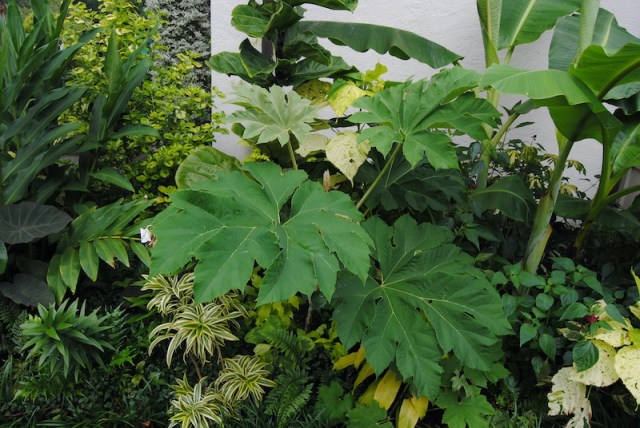
Continuing around the house are beds just flooded with cool tropicals and hardy perennials.  Here’s number two cool plant leaf that I want, it’s the rice paper plant (tetrapanax).  Big leaves that start out fuzzy, what’s not to love?

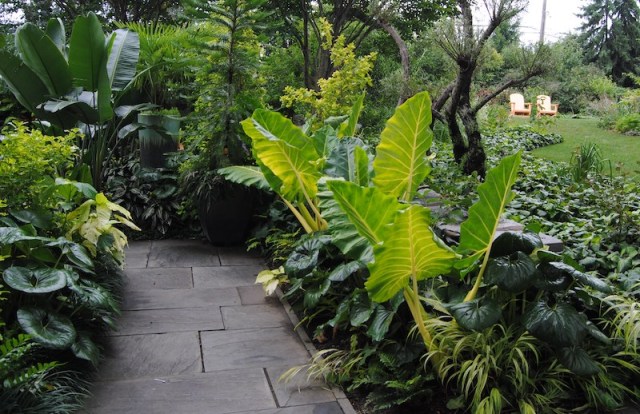
More foliage along the path.   I have no idea, but the yellow veins of it matched the ivy creeping along the ground.  Fancy.  You can also see some of the many seats scattered around the grounds.  In my opinion gardens are always best viewed from a comfortable seat!

Here’s another nice seating area.

I believe the three dark green plants along the walk are samples of the infamous breadfruit tree.  Maybe it’s just the result of a few too many childhood viewings of “Mutiny on the Bounty” (The 1962 Marlon Brando version) but I think this food staple of the Pacific is a fascinating plant.  This plant was the reason Captain Bligh was commissioned to sail to Tahiti in the first place, and this is also the plant thrown overboard when the mutiny takes place.  Besides Captain Bligh’s survival story, the story of the mutineers and their descendants on tiny Pitcairn island is also quite a tale.  They still live on today as a British territory.

Less contentious is the yellow-green underplanting of variegated boston fern, hakonechloa grass, and others.  I’ve heard people say you shouldn’t mix variegated plants, but here I think that theory expires.

Oh, and if all that’s not enough, the glass topped table is actually a terrarium 🙂

Ok, so that might be enough for today since WordPress has locked up twice and both times I had to redo what was lost.  Next stop is the former tennis courts….. tennis has never looked so good.

Dahlias

Dahlias are the one flower I always cut… that and gladiolus, but the glads were planted late, so who knows if they’ll ever bloom!?growing dahliasThe “Plum Pretty” are my favorites, I like the curly cactus petals and the dark color.  The creamy “moonlight” bloom nonstop and the violet “Ooh La La” are nice enough (ok so they’re not my favorite).  The peachy-yellow are an older one from one of those Sam’s club mixes.  The more you cut, the more blooms will come up, so there’s sure to be another post or two of gratuitous dahlia color!

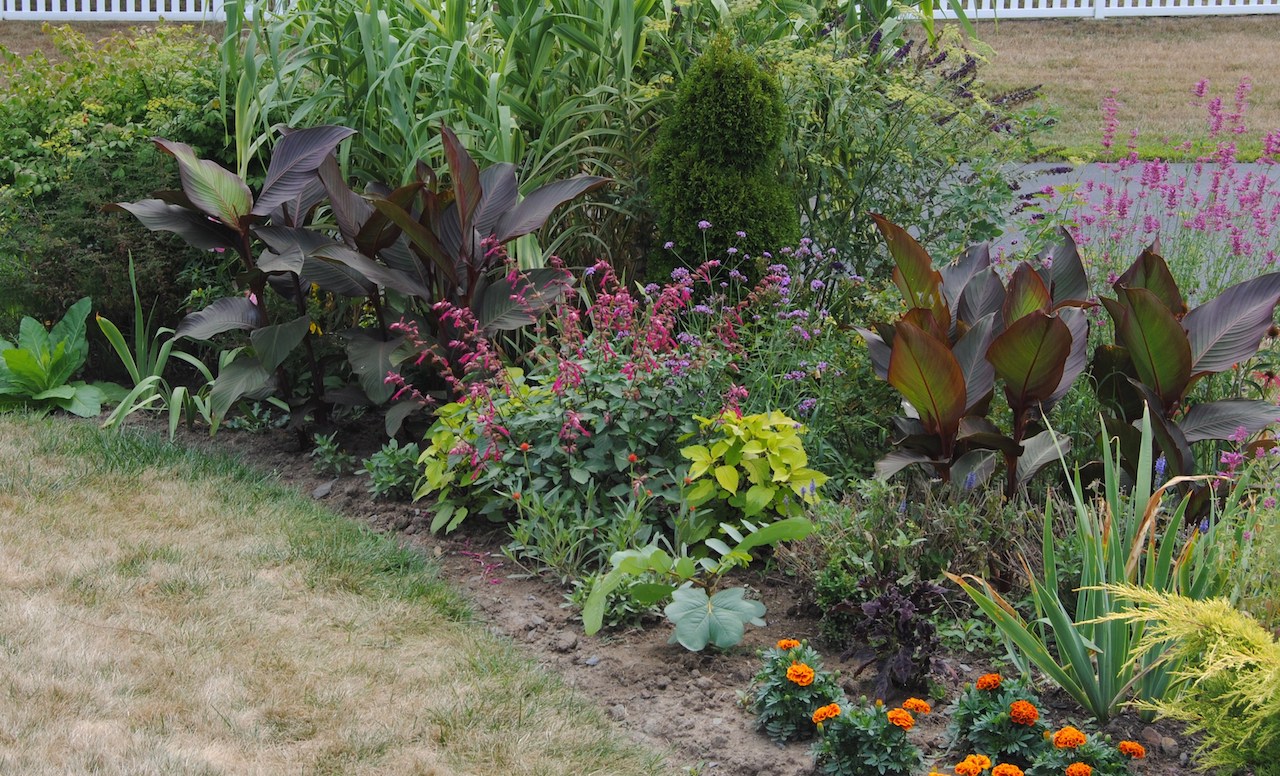
I made a trip down to Chanticleer this week.  It was beautiful and you can bet there will be MANY pictures posted.  Here’s a taste.  I was pleased to see this color combination, it’s similar to my salvia-verbena combo (that some people didn’t like) and I feel vindicated to see it used elsewhere… with a lot more green, I think the green calms it nicely.chanticleer I saw so many cool ideas and plants, it will be a long post or two… or three 🙂


A Hawaiian Shirt

Normally I try to give this flower bed a little respect, calling it the tropical bed instead of just “the mess”, but for whatever reason this year it really is a mess.  The usual tropicals went to fill up new bed space this spring and I didn’t save enough goodies for here, plus it was planted late too…. (more excuses)…. and about half the plants are volunteers that just came up on their own, so it’s a patchwork of screaming colors.

Red salvia is loved by the hummingbirds, but the color really asserts itself.  Some people have poo-pooed this pairing with the violet verbena as too “bleech”, but I think it could have been worse.red salvia splendens  The bigger view shows the weediness of the planting…..

tropicalismo garden

I suppose I could have ripped out the amaranthus plants that came up (they’re the tall leafy stalks) and the squirrel ravaged sunflower is no beauty…. and the white buddleia in front of the white fence…. I could go on and on….

But it’s bright and colorful and it was meant to be vibrant.  Next year I’m hoping to add a little green to calm it down and going back to more cannas to make it a little more “solid”.  The white will be moved out.tropicalismo garden

The “summer poinsettia”  is actually starting to grow on me, it’s the dark purple leaf which is developing the red tops.  I like its lushness and maybe if I can just find some good neighbors it will really make a statement…. not that it’s keeping quiet now 🙂

Pur Pur Purple

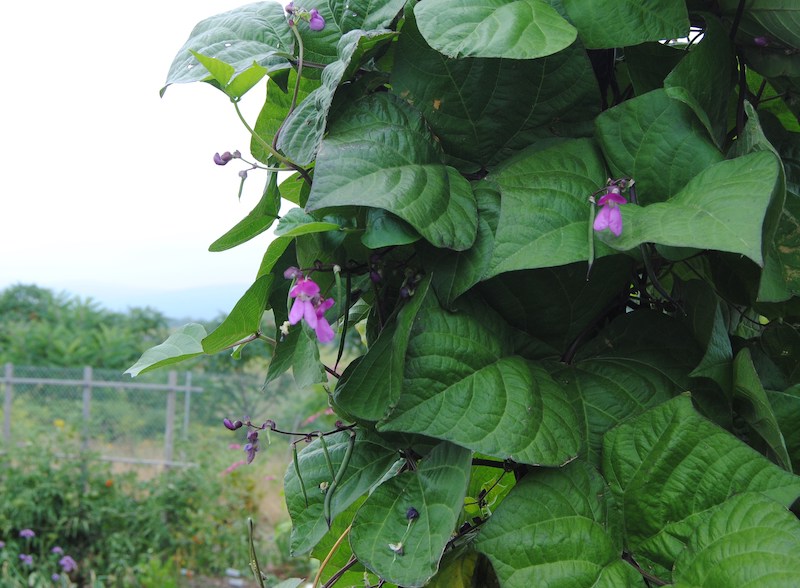
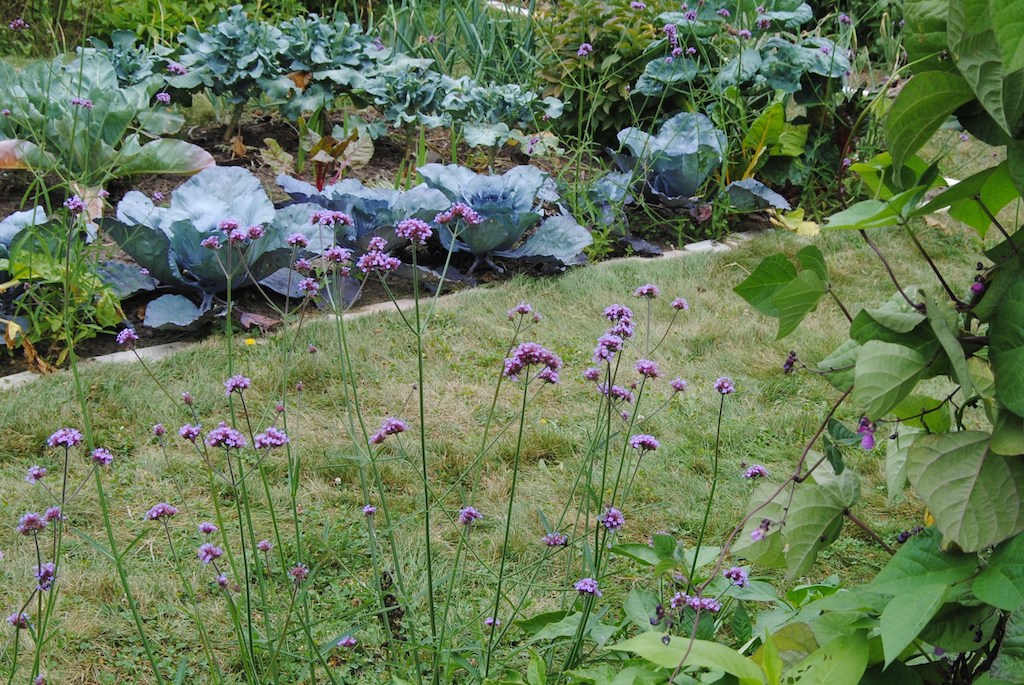
Something weird must have been going on last winter while I was picking out the veggie seeds for this summer… or maybe there’s something weird in the water…. in any case there’s a definite purple tinge to the vegetable garden this year.  I knew that these heirloom ‘Trionfo Violetto’ pole beans would be purple, but I chose them for the meaty, nutty flavored, stringless beans they produce.  They turned out great, but whether it was temperature or bird attacks, it took them a while before the blooms started setting little beans.purple vegetable gardenI rip out bucketfulls of the volunteer verbena bonariensis every year, but even after the carnage stops there are still plenty of their airy purple flowers throughout the garden.  They go good with the beans, but also match the ‘Ruby Perfection’ red cabbage on the other side of the path.  I never realized how purple red cabbage is until this year.purple vegetable garden

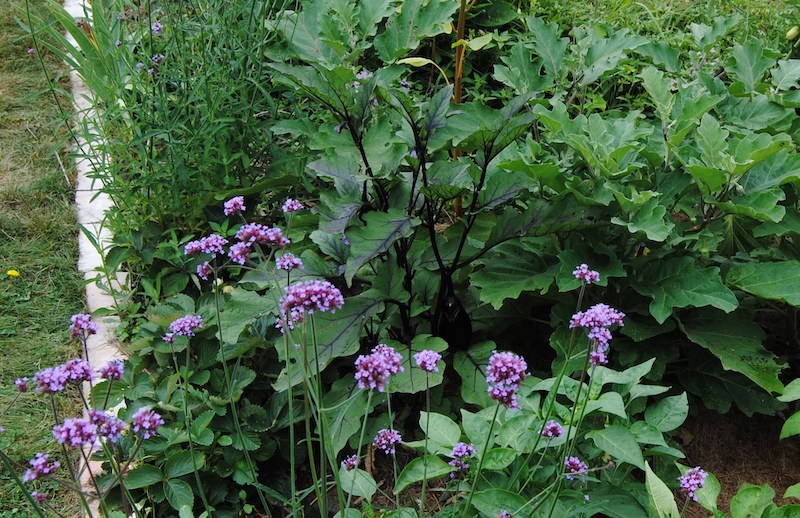
The verbena also picks up the black-purple of the ‘black egg’ eggplant.  Although the cold spring made for a slow start to the eggplant season, they’ve hit their stride now and are putting on decent sized fruit.  The ‘Black Egg’ is turning out to be productive and tasty even though I’d rather the fruits were a tad bigger.purple vegetable garden

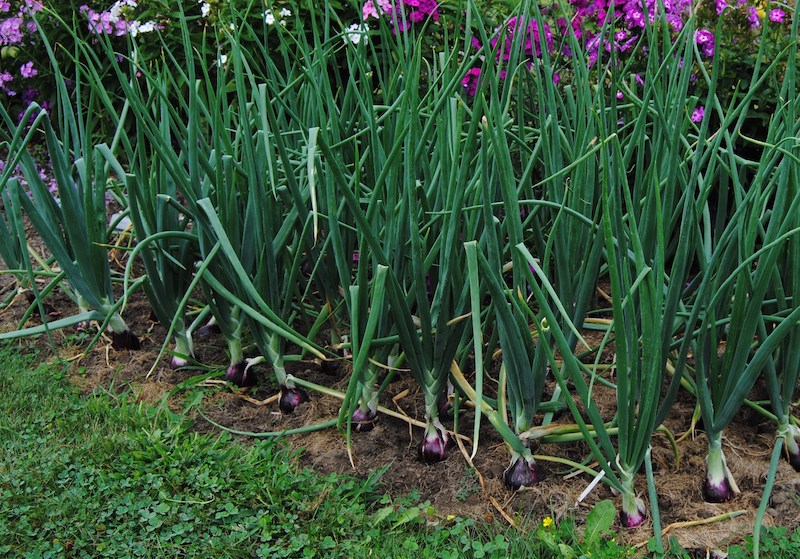
The ‘Red Wing’ onions are also doing great.  They’ve sized up more  since I took this picture and the purple flush of the bulbs matches up nicely with the purple phlox. purple vegetable garden

There are regular green beans and yellow onions, but for some reason they haven’t done nearly as well as the purple versions.  Go figure.  It makes me wonder if I could ever get organized and disciplined enough to have color coordinated vegetable garden.  In my case I doubt it, but it reminds me that vegetable gardens can look good too and if you ever want to give it a serious go check out some of the books by Rosalind Creasy.  She wrote the book on edible landscaping (plus a few others!) and her gardens really are amazing.

Hang in there Summer!

Cooler temperatures and earlier sunsets.  There’s no denying that summer is losing its grip, and with the kids starting school this week I guess it’s time to face reality.  Summer will not go on forever.  But delusion is a beautiful thing, and that’s what I’m sticking to, and for now at least I’ll focus on late August flowers….. not September.

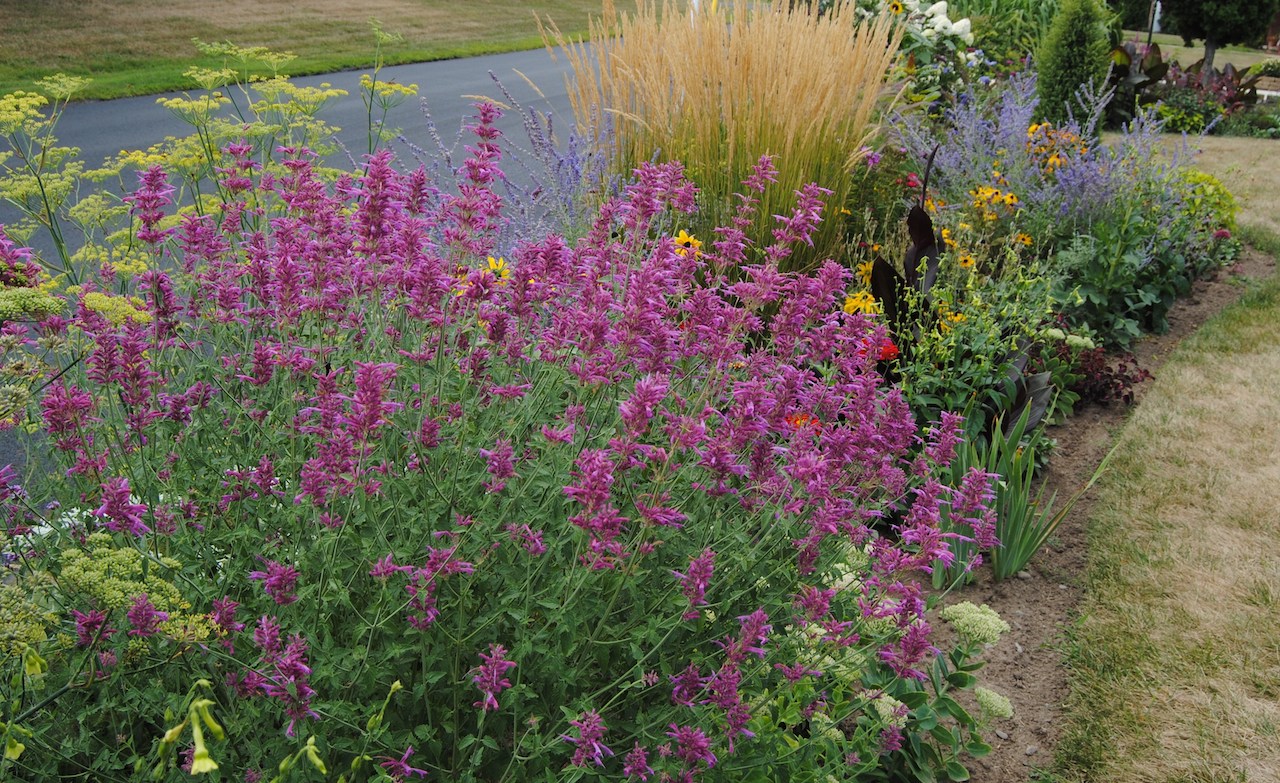
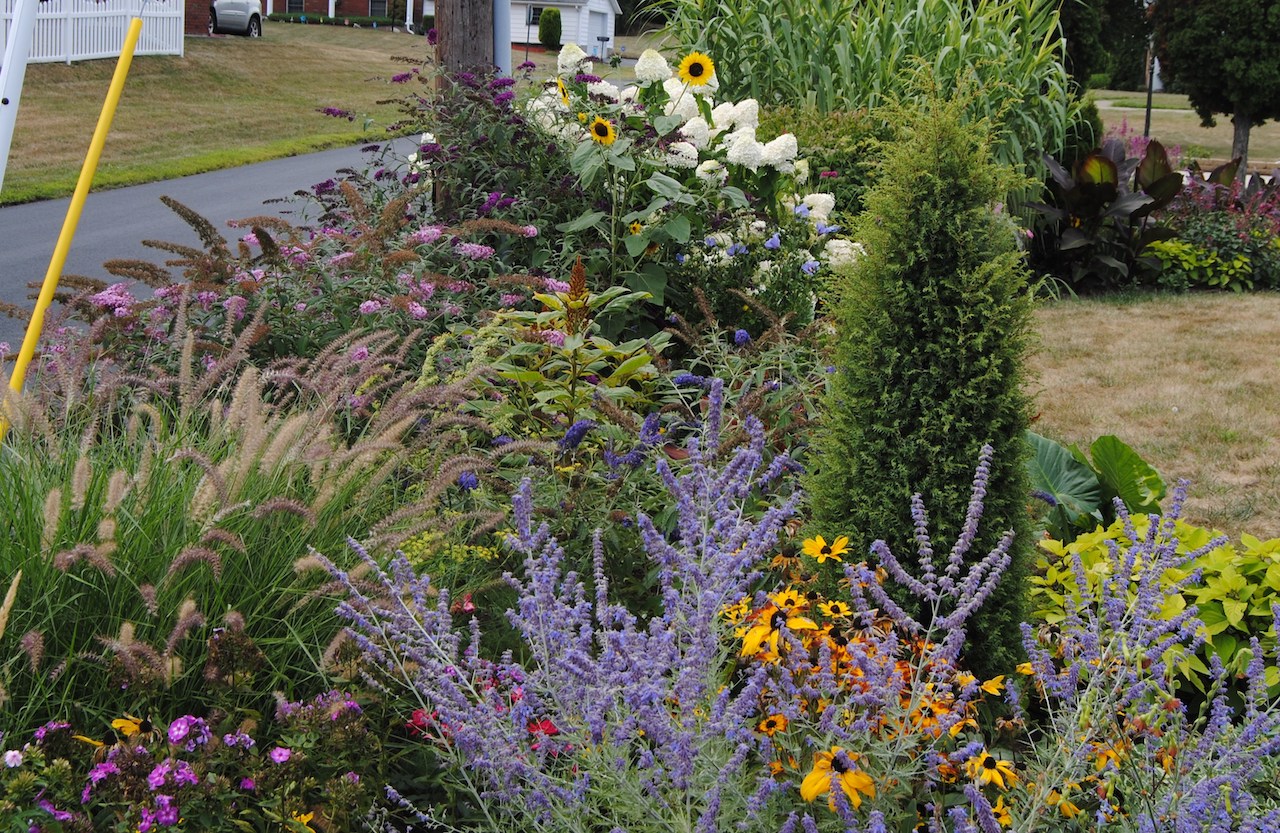
The front border is hanging in there in spite of the dry weather, and my half hearted watering seems enough to keep it this side of parched crispy.  Agastache “Tutti Fruitti” (I think), Russian sage, and the seedheads of “Karl Foerster” feather reed grass carry the show.

august perennials

Further into the bed it gets a little messy, and I bet deadheading the butterfly bush would help, but in the meantime it’s all almost one big wave of buzzing, fluttering color.  Lower left is “Karley Rose” pennisetum, basically carefree but not as sturdy as “Karl Foerster”.  The Russian sage and butterfly bushes just keep going….august perennials

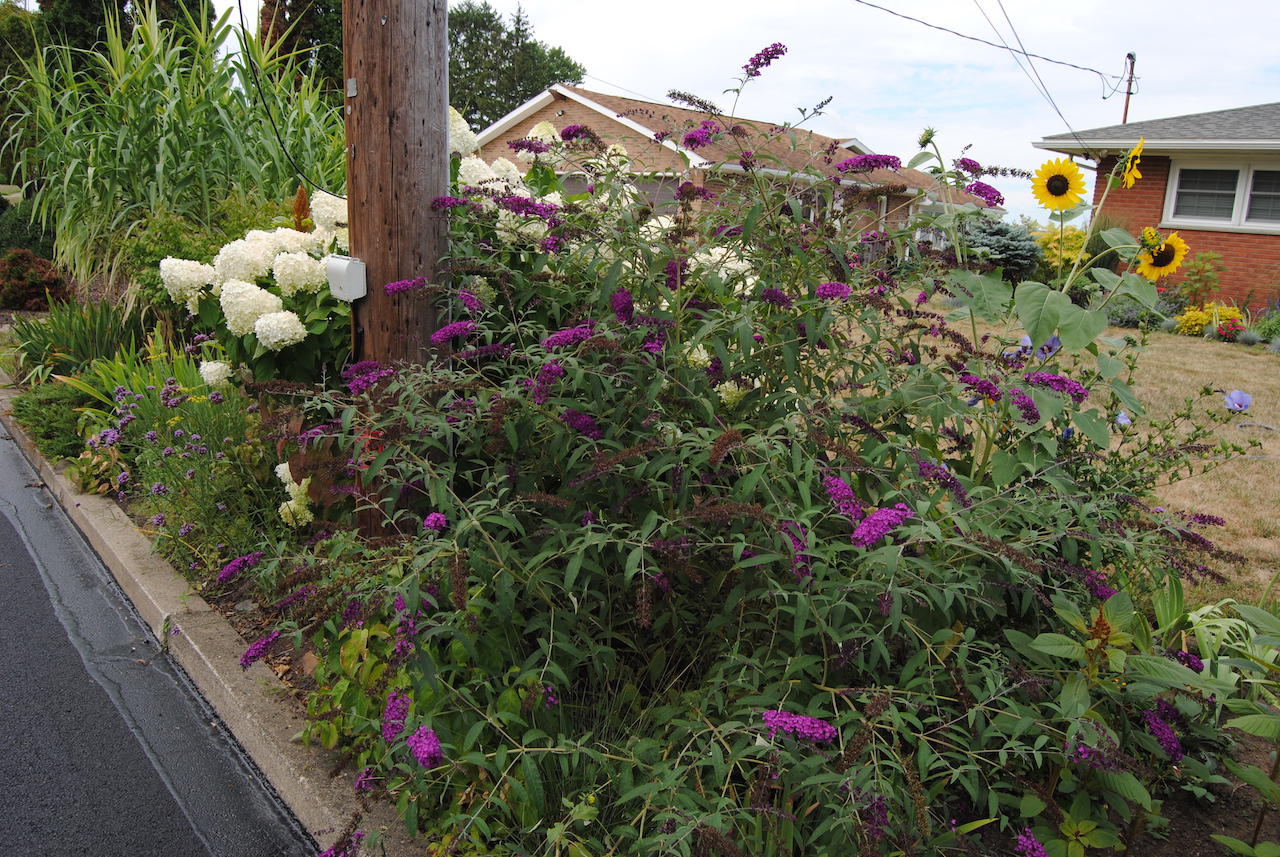
From the street it looks a bit messy, but maybe it distracts people from the dead grass…. here’s ‘Royal Red’ Butterfly bush (Buddleia).  It’s a little thin this year for some reason, but I’m sure it will be back to normal next year.

august perennials

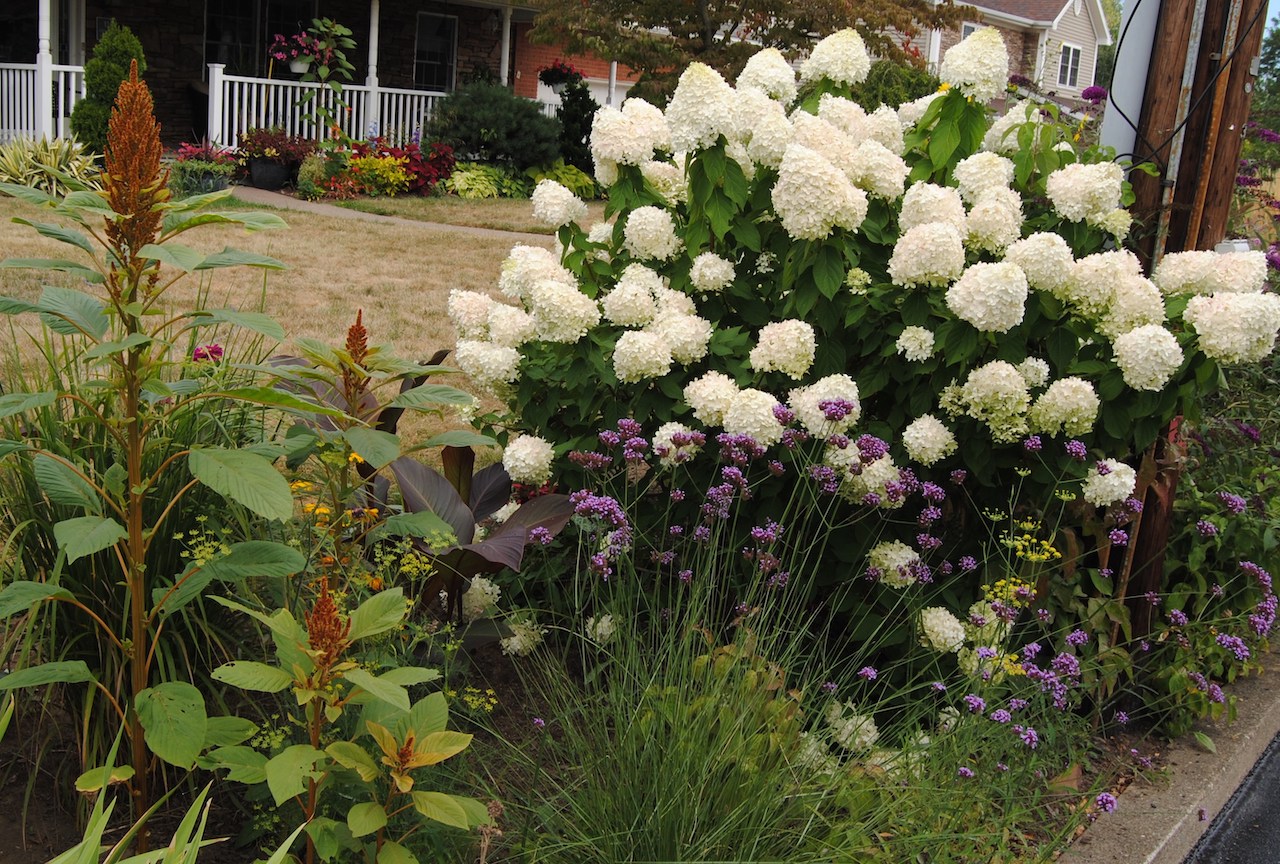
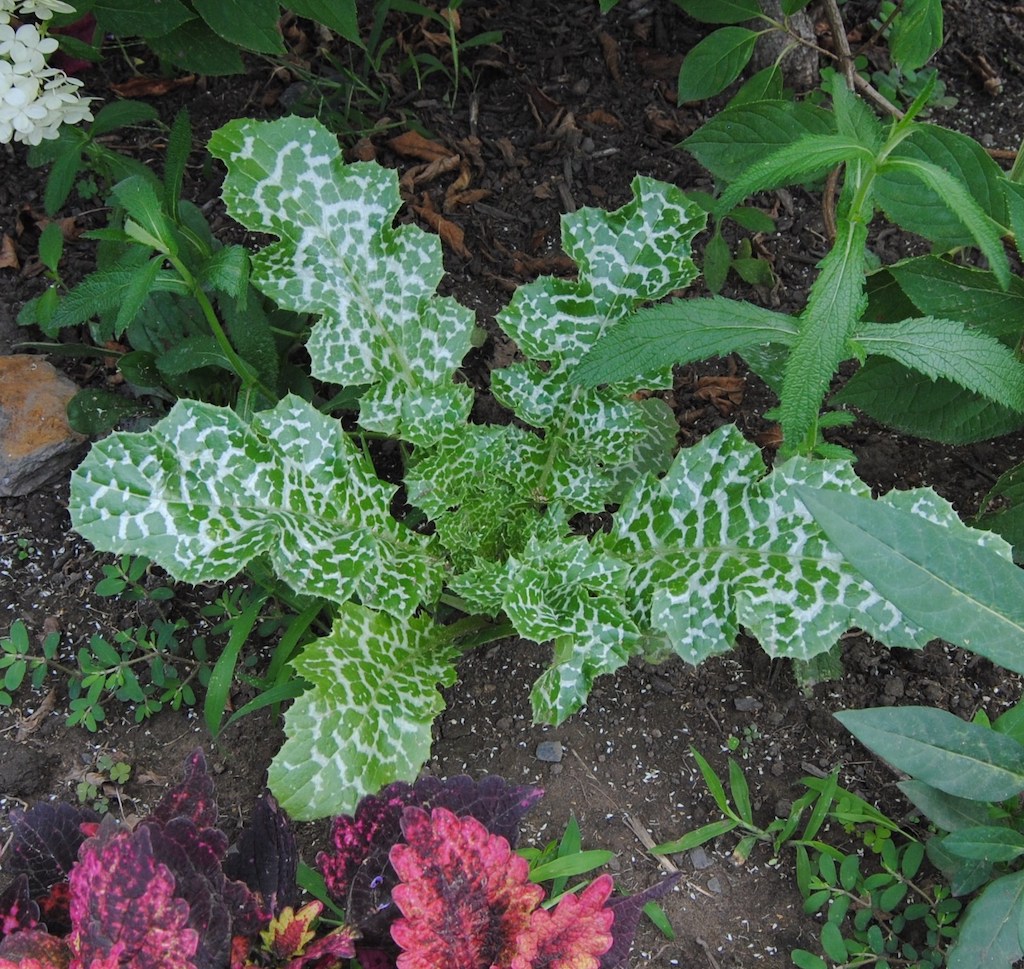
Also from the street, “Limelight” hydrangea paniculata.  Probably my favorite hydrangea, and it can get as big as it wants here.  The flowers start with a tinge of limey green, go white , and then blush with a bit of pink and red, and believe it or not the blooms are small this year (probably due to the dry summer).  Still there’s plenty of white flower overkill going on here!august perennialsThe extra water I give the hydrangea seems to be welcomed by its neighbors.  I love that this little milk thistle (Silybum marianumhas) sprouted up under the hydrangea.  august perennialsI don’t think it will amount to much this year, but maybe I’ll get lucky and have it overwinter and bloom.  Up till now I’ve only been successful with it as an annual.

If you’re bored, look up the history of milk thistle.  It’s been used medicinally for over 2,000 years and is still recommended today for the same liver disorders as it was in the middle ages.   Liver cancer, hepatitis, liver damage due to toxins…. mushroom poisioning….all this and it’s spiny with great foliage.  I love spiny!

The far end of the street border is still filling in.  I can always count on the no-name, purple leaved cannas to give a nice background, and the ‘Wendy’s Wish’ salvia looks good in front of them.  I tried a couple marigolds in here too this year, they’re still small, but are taking the dry heat without a single complaint.  One of the great things about annuals is the chance to do it all differently next year.  I’m not sure if the brown-orange color is one I’ll chose to repeat.august perennials

Enough with the bugs!

So I’m bored with the garden, ok?

Until we get some decent rain most things are at a standstill…. except for the bugs.  They’re going full tilt and doing what bugs do (which is eat and multiply).  The grasshoppers are moving in off the dead grass of the meadow and taking advantage of the lush, watered parts of the garden.  I can do without a plague of these suckers, and fortunately they don’t seem to do too much damage.  I just pick them off and toss them on their way.grasshopper eating flower

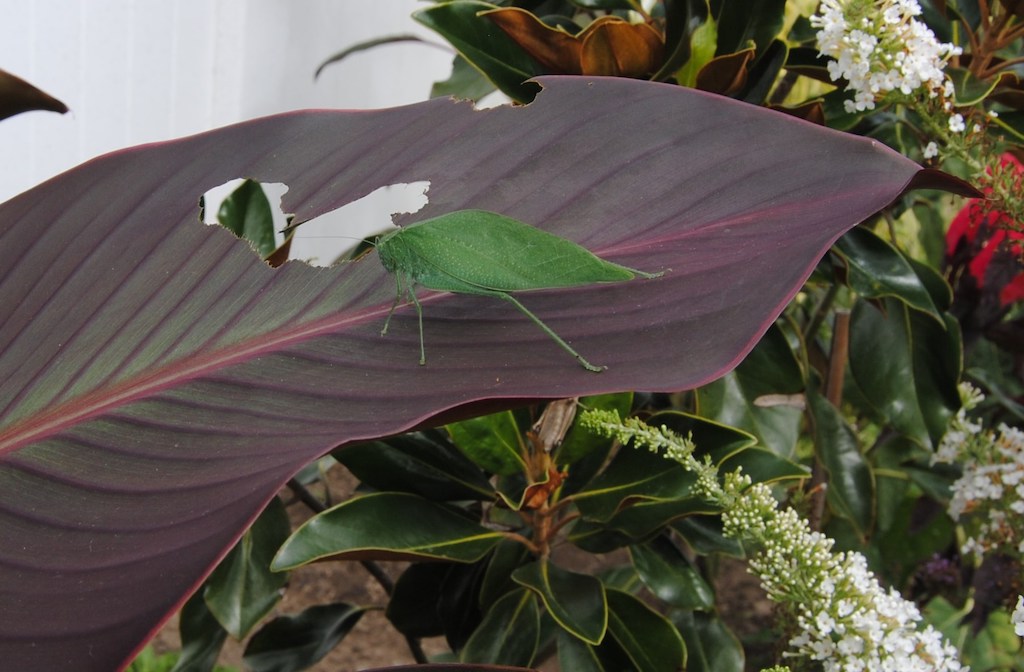
Katydids always show up on the purple leaved cannas.  I’m not sure if it’s just that the holes are more obvious on these big leaves, but I always seem to find one here.  If you look carefully you’ll see a second one further back, to the lower right.  These guys (actually this one might be a female) get their names from the “Ka-ty-did, she-didn’t, she-did” song they sing at night.  It’s one of the summer sounds I always look forward to.  If you want to see something even cooler, look up “pink katydid” and you’ll see some uncommon color forms of this already far too pettable insect.katydid eating canna

Believe it or not these things can fly too, and between their cool leaf shape, summertime song, and impressive size, I really don’t mind them eating as much canna leaves as they want.  Plus the kids love to play with these slow moving gentle giants.  I love having all this life going on in the garden and it’s the number one reason I avoid spraying whenever I can.katydid eating canna

The bugs don’t always have it that easy….. A big bug makes for a big meal and besides all the birds that search the garden each morning, these yellow garden spiders wouldn’t mind making a meal out of a fat bumble bee or grasshopper.  Judging by it’s plumpness I’d say the living is easy right now.  yellow writing orb spider

As you can see the phlox is still holding on, and I’ll try to show a couple flowers next time instead of continuing this parade of creepy crawlies.  But just look at the size of that spider!  Oh, and also notice the white zigzag “writing” on the web above and below the spider.  These orb spiders are sometimes called writing spiders, and I think the pattern is supposed to keep birds from flying into and ruining their webs…. Flowers next time, I promise.

Wild Kingdom

It’s confirmed.  Our little patch of Pennsylvania which hasn’t had decent rain since mid July, sits in the middle of a rain-garden of Eden.  In the last few weeks we’ve traveled out on each of the points of the compass and in each direction the lawns are lush and green and the roadsides are bursting with flowers.  But not here.  The lawn hasn’t needed mowing since the second week of July and the less popular plantings are dried and hanging with drought.  Such goes our summer.  Still I prefer this to the icy blast of winter, and I’ll take it.  I’ll just slow down the pace, stare at the brown lawn, and continue to drag around the hose.

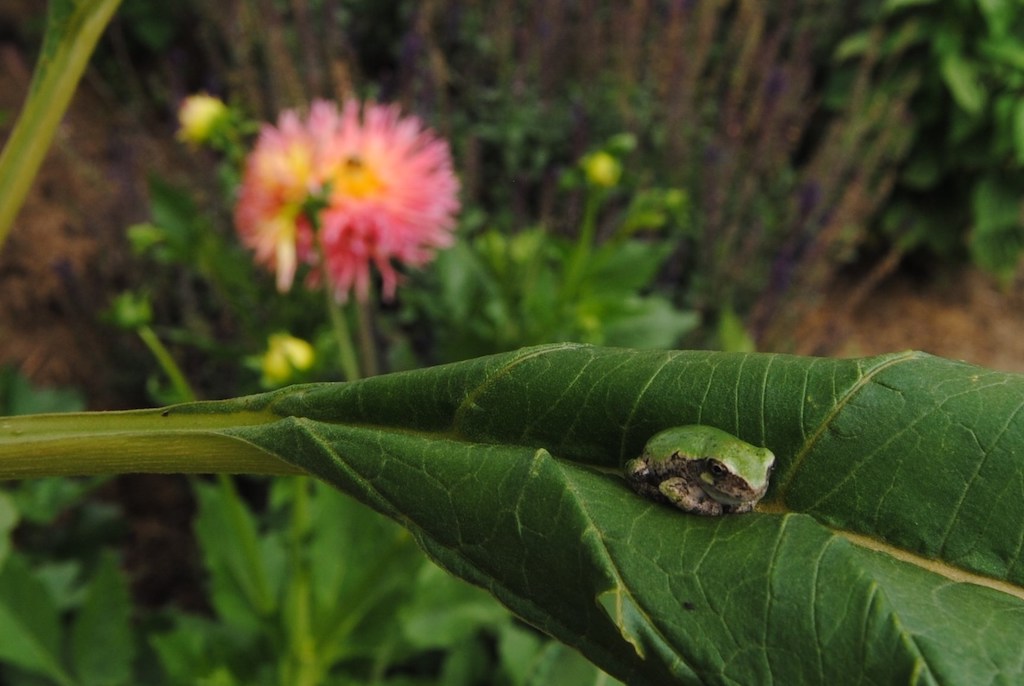
The watered areas of the yard seem to be drawing in more than their share of wildlife this summer.  Besides drought, we’re experiencing a plague of frogs this season.  Gray tree frogs both large and small are showing up all over, particularly around the house.gray tree frog

Before grilling the bbq gets a once over, and before moving furniture a quick look around helps prevent an ugly accident.  Raising the deck umbrella is always fun, since the plopping down of a frog or two on the table and umbrella-raiser is always a possibility and refreshing shock.gray tree frog

I like the frogs but never really thought I’d have to add “sweep frog-poop off deck” to the pre-party to-do list.

This year’s babies seem to prefer the large leaves of amaranthus  and corn, and in the baby-green phase they fit in pretty good.gray tree frog

Another surprise this year is the bumper crop of snakes showing up.  Our plague of snakes is fortunately of the garter snake variety and because of that, non-poisonous and small (two pluses), but there’s always a shock to seeing a snake slither away from the path or slide behind a step.  A different kind of shock than having a frog drop on your shoulder, but a surprise still.

Here’s a shaky shot of one that was calmly hunting through the plantings just off the front porch.  I didn’t know they were such good climbers of shrubbery, maybe I’d still rather not know that fact.garter snake

Drought, Frogs, snakes…. I think we’re still far clear of repeating the 10 plagues of Egypt, but we do have a lot of gnats this summer, and we did get a number of flies when a garbage bag stayed around too long.

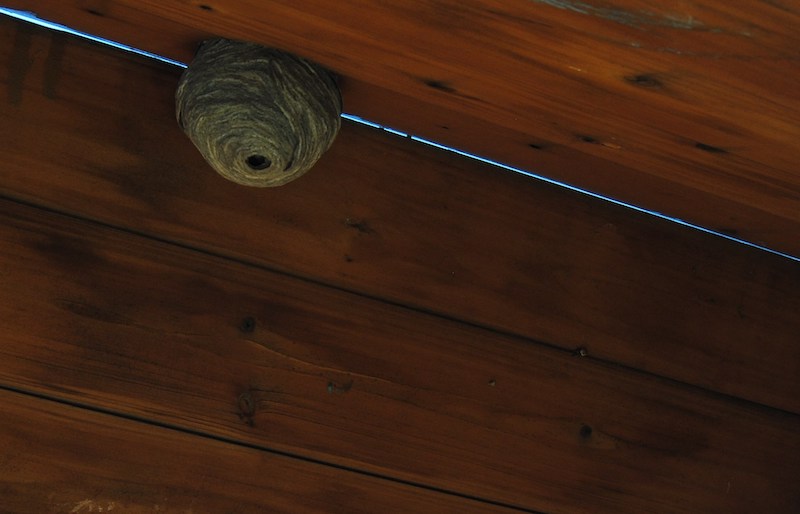
Next: bees and wasps.  This is paper wasp nest #3 on this year’s list of evicted wasp nests, it was brought to my attention one evening by the screaming of a stung five year old playing in the playhouse where they set up shop.  I’ve never had a large wasp nest in the garden until this year, so I’m not sure what’s brought on all these new neighbors, but at least I now know none of my kids nor the neighborhood kids are allergic.  They’ve all been tested as well as a few kids who were over for a birthday party last week.paper wasp nest

One day I’m going to try and figure out what all the bumblebees are.  The kids call them “fat bees” to group them away from “skinny bees” and “paper wasps”.  I still don’t follow their logic on the skinny bees, but it might be time for me to go a little more scientific and figure out all these black and yellow fatties.carpenter bee on phlox

bee on thistleThe bumblebees are interesting to watch.  On most of the flowers they “cheat” since their mouth parts are too “fat” to fit into the flower openings (hey, maybe the kids are on to something!)  On phlox for example, they stab a hole into the base and suck out the nectar without returning the favor of pollination to the bloom.  They seem to do this with a lot of plants such as butterfly bush, agastache, salvia… it’s actually a little annoying since on flowers such as the salvia and butterfly bush, they push in their mouths with enough force that they rip open the entire side.  The split flowers brown and fall off and I’m left with nothing colorful.  Oh well, at least they’re not stinging everyone.  I guess they’re more suited for open flowers such as hibiscus and sunflowers, or flat topped flowers like thistle.

Butterflies have been late to the party.  I’ve only just seen my first Monarch this week, and other types have been scarce all year.  But it looks like they’re working on it.  Here’s a Black Swallowtail on the potted parsley.  There’s something about these guys that I always like, and they’re more than welcome to a share of the herbs.black swallowtail larvae

Dahlias!

I’m a sucker for a nice dahlia.  There are a few I overwinter each year, but one cold night last winter I broke down and committed to some new ones.  Here are the first of them, cut and artfully (hah!) arranged on the kitchen table.

growing dahlias

The three peachy ones towards the front have been with me for years, but the others are all new.  I got my new ones from Swan Island Dahlias, but you can do the same (maybe cheaper) at any box store or general bulb seller in the spring.  Mine all appear to be exactly as labeled, cheaper sources are sometimes hit or miss….. but if you just want a couple beautiful flowers, is a name that important?  They also look great in the garden.  Here’s “Moonstruck” which is the best bloomer so far.growing dahlias

“Plum Pretty” is already a new favorite.  I love the pointy petals of the cactus type, and these have a lighter bottom that shows when the petals curl.growing dahlias

“Pink Petticoat” is a little girly for me in both name and color but if pushed I’ll admit I like the two toned color and the smooth wide petals.  It also has outer petals that curl back around to the stem, and I think this is important for show quality blooms, but mine rarely go further than the kitchen!growing dahlias

Ok.  So I really like Pink Petticoat too.

I find dahlias easy to grow.  Most of mine are in the vegetable garden since it’s easier to plant and dig there, and I don’t do anything special as far as care.  A full sun spot, a little compost when planting, a bit of miracle grow if they look pale, and a stake to keep them upright, and you should be good to go.  That reminds me, mine are still unstaked…  another do as I say, not as I do moment 🙂