Cathy at Words and Herbs takes a look at the same garden view each week and follows it as the year goes on. My post this week should be self explanatory 🙂
I think most gardeners will understand this next photo as well…
Have a great week!
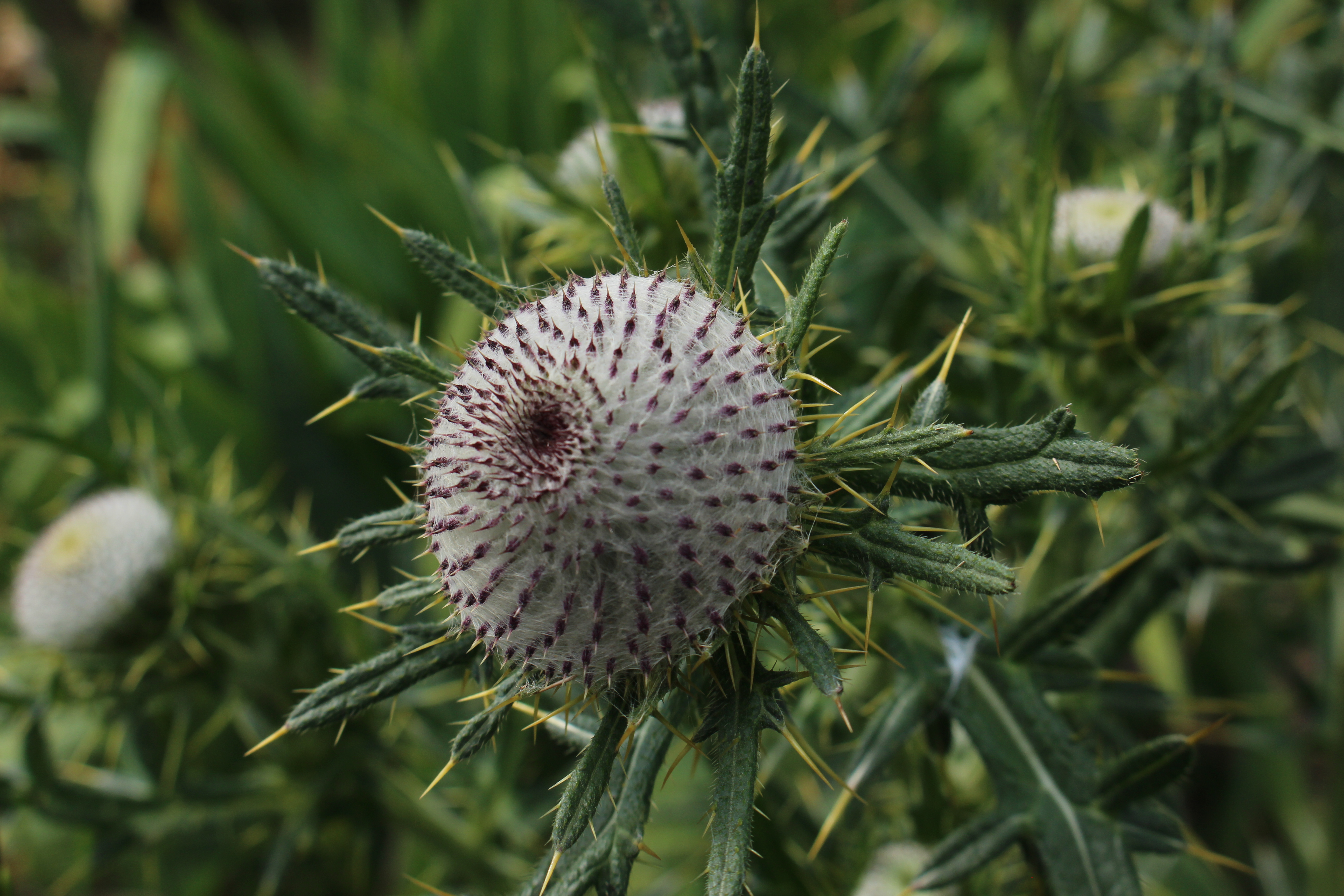
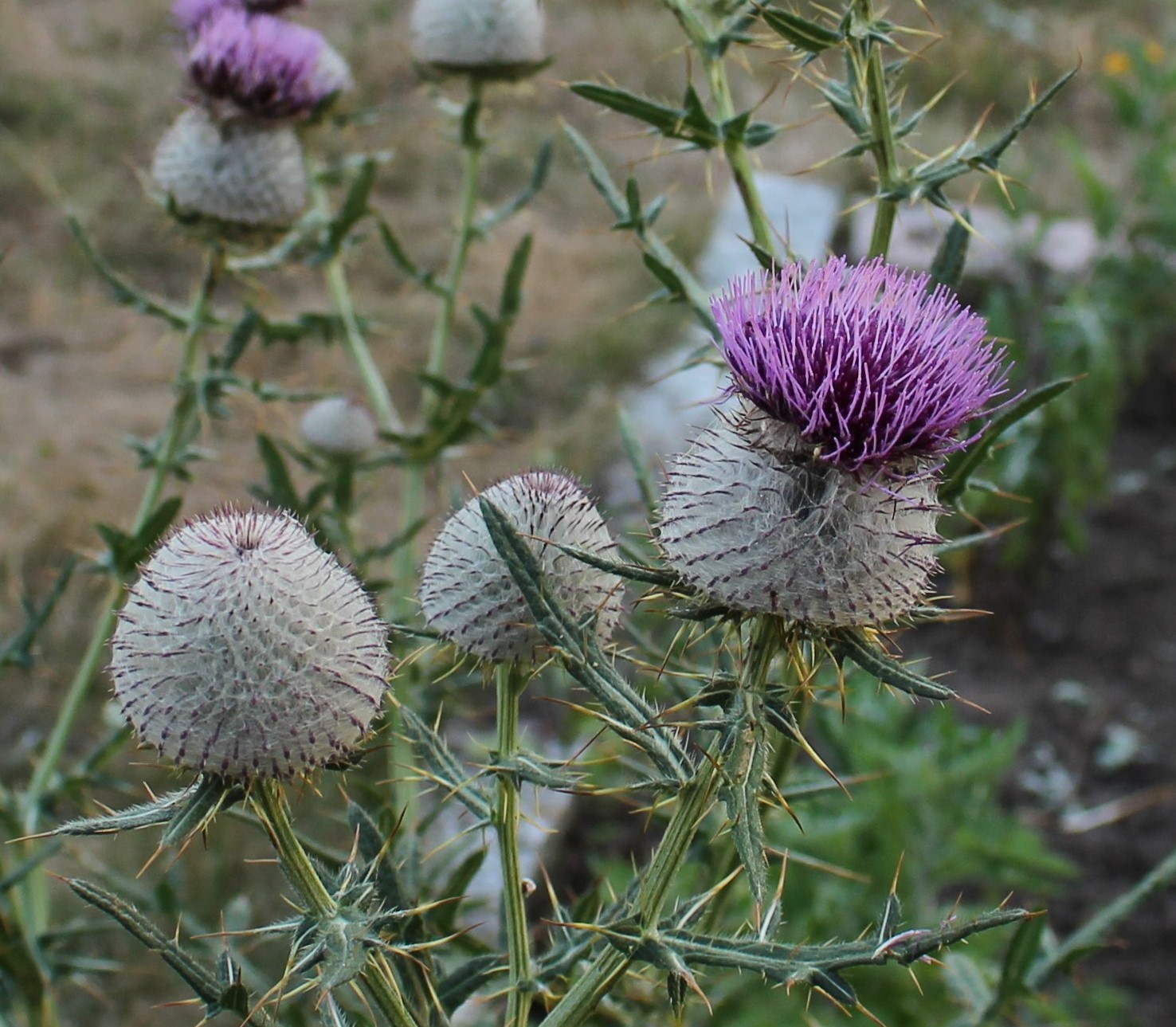
Each Thursday I like to join Kimberley at Cosmos and Cleome and single out a plant which has tickled my fancy that week. For the most part my choices have been on the respectable side but this week I’ve gone back to the dark side and chosen the wooly thistle (Cirsium eriophorum), a plant which if anything should be kept far, far away from your fancy since direct contact will definitely NOT tickle.
Despite its cute common name, the wooly thistle is probably cursed by many a gardener and farmer throughout its native Europe. I don’t think many a gardener here or there would go through the trouble of finding seeds through a seed exchange, sowing them and nursing the plant for three years, and then briefly enjoy it’s heavily armed flowers for a few weeks until it set seeds and died… but I think it’s absolutely fascinating!

A baby picture only a father could love. Wooliness studded with purple tips and all so nicely geometrical!
Who knows if I’ll replant the seeds once mama thistle is gone, she is a bit of a hostile presence after all, but she’s very welcoming to the bees and ants which swarm the flowers. She’s also very popular with a group of weevils which have poked their noses into the wool and I’m sure laid eggs while nibbling the flower buds. Weevil grubs eating thistle seeds is probably not the worst thing to have and even with them there will likely still be more than enough seeds produced.
I will completely understand a less than enthusiastic review to this week’s choice. Please feel free to just smile politely and then later shake your head, I’ll understand.
Please also feel free to visit Kimberly and enjoy what she’s selected for this week. I hear it’s a delightfully pure Shasta daisy, and I’m sure it’s far better suited for vases and placing behind the ear than this thing!
I’ve been neglecting my ongoing series regarding the stupid moves which I perpetrate in the garden, and trust me it hasn’t been because of a lack of material.
The blue poppy (Meconopsis species) is a nearly legendary sky blue flower from the heights of the Himalayas, and their amazingly perfect blooms have lured many a gardener (and photographer) into an awkwardly greedy and covetous state. The blue flowers are also well known for their difficult and fickle nature outside of any region where the thermometer rises above 80F (26.5C) and summers take on a more serious tone. Here in my Pennsylvania garden the thermometer has been going well over 90F this month, and I don’t know why I didn’t see this coming back in December when I ordered the seeds… or back in February when they were sown… or now when my last seedling is wasting away to nothing.
I briefly debated placing a window unit air conditioner into one of the workshop windows and seeing just how long I could drag this out but then finally came to my senses. I’m sure I can kill other plants just as easily with far less trouble, so until I move North or become insanely rich I think I’ll pass on the next seed offer. Fortunately this latest stupid move didn’t involve blood and from now on I suppose I’ll keep myself happy enjoying them via Pauline blogging about the ones in her Devon England garden (I believe they’re practically weeds for her) or just enjoying the ones Longwood Gardens forces into bloom each spring.
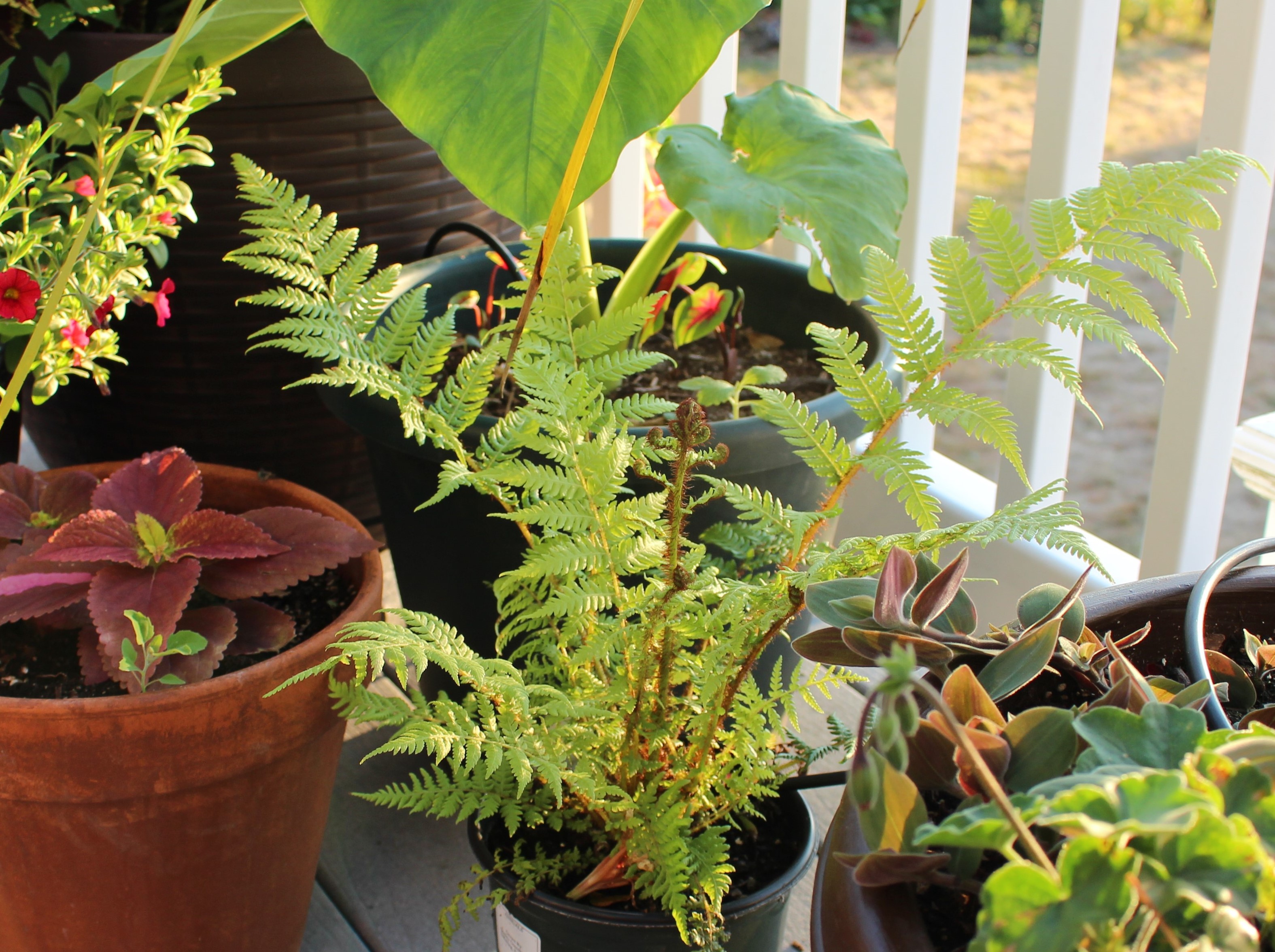
So a lesson learned is a lesson learned, and on today’s trip to the nursery I picked up something far more sensible. Under “Growing Conditions” it’s as easy as part sun, plant 24″ apart, so I’m sure my new Australian Tree Fern will be no problem at all. Later on I’ll just have to figure out what to do with the “reaches 20 feet tall, up to 10 foot long fronds”.
We will see where this goes, but in the meantime have a great week, and may all your decisions be sensible and well thought out 🙂
Two of my favorite bloggers are bringing back a meme which I’ve always enjoyed. Cathy of Words and Herbs and Kimberley of Cosmos and Cleome both highlight a longer view each Tuesday and we get to see it develop and change as the year passes. I’m no expert on the meme but I think Cathy sticks to a specific viewpoint and time while Kimberly varies the perspective and location depending on what’s going on in the garden. Myself on the other hand am barely capable of getting any post up in a given week, so to keep it simple I’m going to follow Cathy’s lead and go with one view, same bed, same point each week and see if I can handle that. Also since the tropical bed went in last week (about time since it’s already past the solstice and well into summer) I’m going to highlight this bed as my view, and (hopefully) watch as it grows up.

My fingers are crossed that over the next few weeks this bed will become an explosion of color and foliage and maybe bring a taste of the tropics to this end of NE Pennsylvania.
I’ll try to keep this short, since assuming things grow I want to save a little material for future posts, but besides the thrill of actually getting most of the plants in last week I always get a little excited checking this patch each day to see how quickly things progress. All season bloomers which sit as a lump of color and put out the same old flowers each week bore me a little, and even though I can appreciate someone wanting low maintenance, neat color, I want something that sneaks up on you and then overwhelms you, like a horticultural tsunami! Hence the tropical garden, and anything bright and big and leafy is more than welcome.

The papyrus was not happy last year and I suspect it didn’t get nearly as much water as it wanted so instead of planting it in the ground again I placed it in a pot submerged in a second pot full of water. Green water. So far the reviews of this planting have not been 100% favorable.
You can’t really tell from the tiny sprigs, twigs, and tubers, but this year’s theme is orange and purple. That’s not a solid theme, it’s more my mood when I’m out picking up annuals or choosing which dahlias to put here versus in other parts of the garden… or finding a flat of orange zinnias on sale and liking zinnias. So until the oranges fill in, hot pink and purple will have to do for a theme. Besides the annuals, perennials have a way of sneaking in everywhere, and although I pulled a wheelbarrow full of daisies and transplanted dozens of chrysanthemums, there are still a few things such as this knockout rose and purple ‘Caradonna’ salvia which are just too colorful to stand up to. Maybe next year will be the year I follow through on my threats to remove the salvias.

The ultra rare and uncommon ‘Knockout’ rose tastefully complimented with orange zinnias at its feet and scavenged lawn clippings as mulch. This Tuesday view already promises to reek of class each week 🙂
So there you have it. By next week I hope to have a few cannas sprouting and a few more zinnias assaulting your color senses and overall I really hope things don’t end up requiring a rototiller and a fresh start by August.
Think about joining in with the view and if you do leave a link at either Cathy‘s or Kimberley’s blog so we can find you. Not to put words in their mouths but I’m sure both will agree “the more the merrier” and I always enjoy watching another garden grow throughout the season… even if it does turn into a trashy mess of too much color and chaos!
I took full advantage of the cool, generally overcast weather this weekend, and put some solid workdays into the garden. The deck is cleaned, the pots are planted and the tomatoes are finally planted. It’s nothing to look at yet, but fortunately this rose is. It’s ‘Livin Easy’ and although it may not be the newest thing out there and it might not be a color everyone loves, I still think it’s a knockout.
Some people say it has a fragrance, but it’s not strong enough for my nose. Even with a lack of fragrance the disease resistant foliage and summer long bloom make up for this fault, and I do nothing other than trim off a few dead branches in the spring and off she goes. I’m sure fertilizer and more concerned care would do wonders, but I like the way it has become nearly overwhelmed in a sea of daisies. A real gardener would have probably ripped them out ages ago.
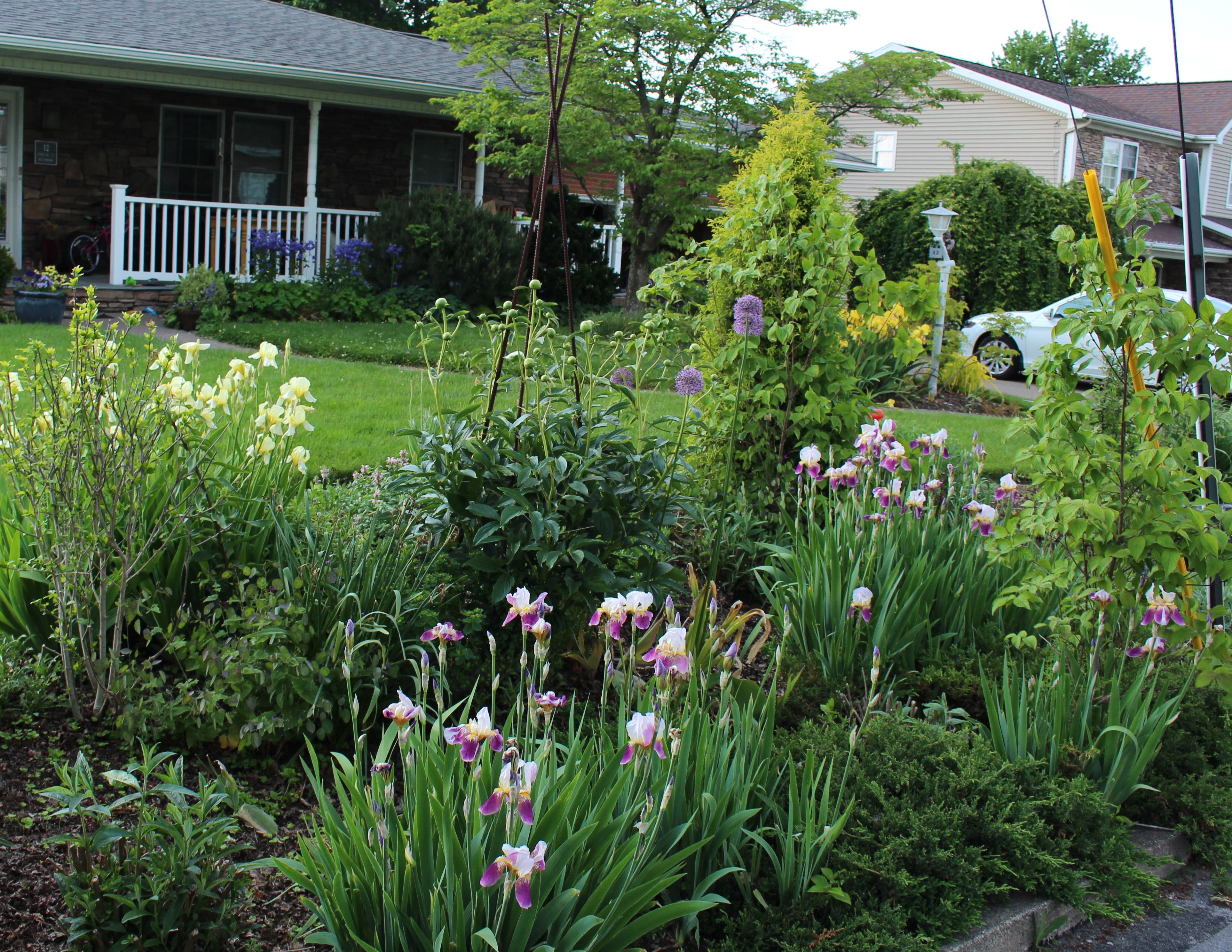
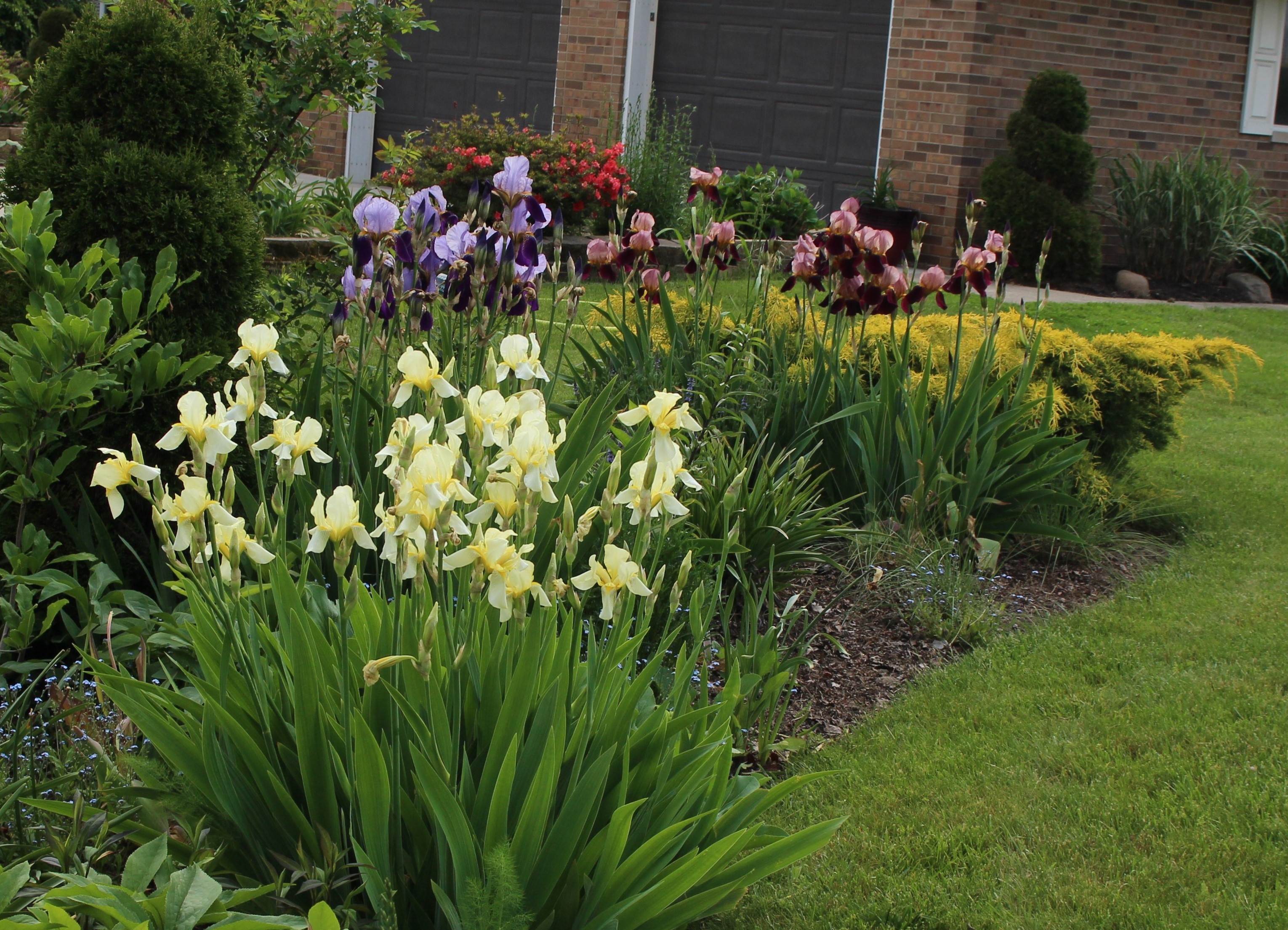
It’s time to face the reality of unsown seeds and unplanted vegetable beds. There… done. For the past few years I’ve been making a real effort tot get all kinds of annual seed growing, all kinds of cuttings started, and all kinds of summer bulbs planted, but this year something is off. Maybe I’ve been too busy with other things, but in all honesty I live a fairly lazy life and for me to say I don’t have the time or energy to start a few salvia seed or pot up a few coleus cuttings is just a bunch of excuses. My reality this year is I just don’t care to. I’m not a farmer after all, and the family won’t go hungry or broke if the potatoes fail, so I just keep enjoying what I’m doing and don’t stress it if this year I only start 10 or 20 coleus cuttings rather than 75. The iris are in bloom after all, and this year they are nearly perfect.

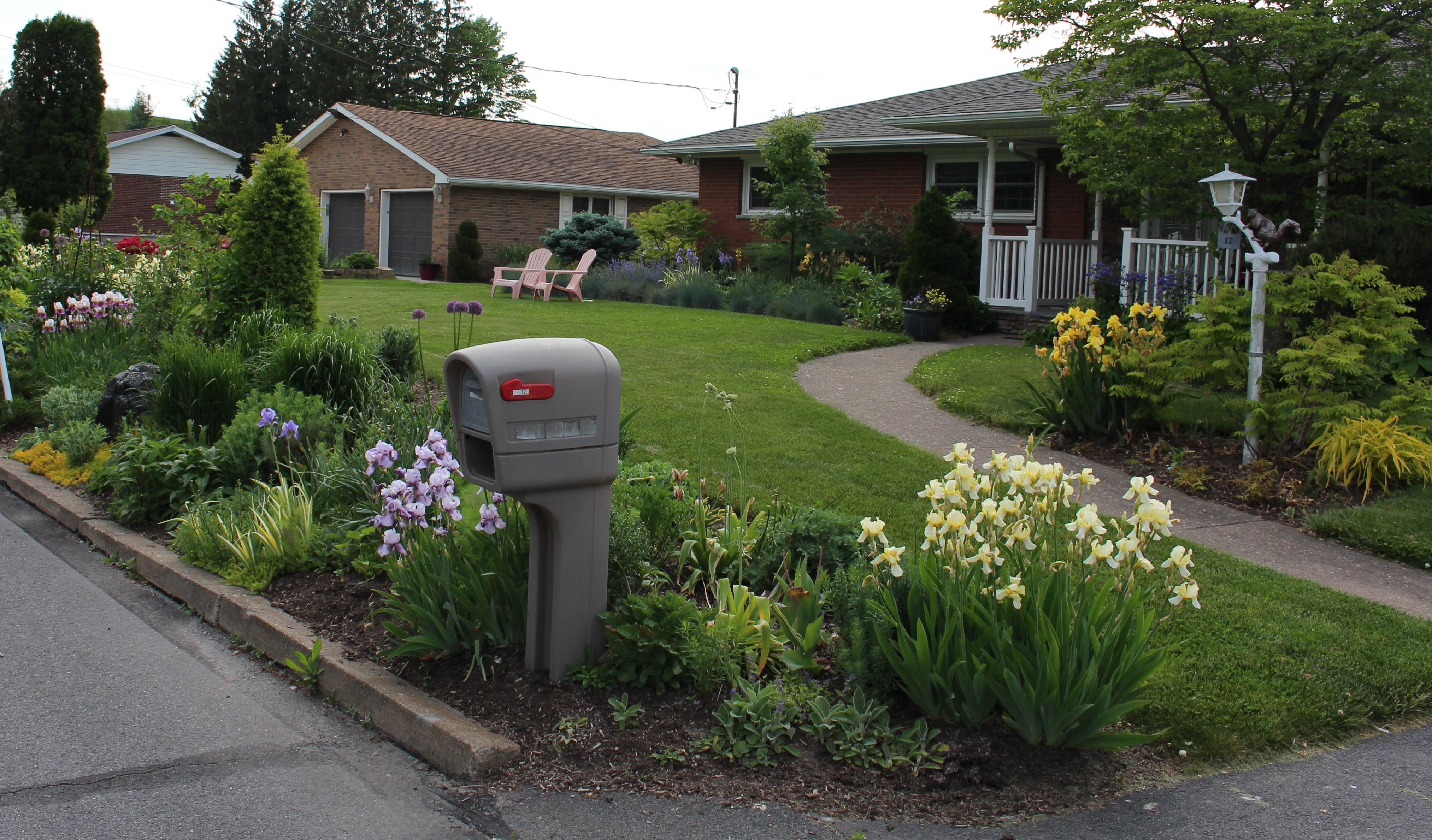
The view from the street is far nicer this spring with green grass and healthy spring growth. I forgot what it’s like to start the year with cool temperatures and ample rainfall rather than dry winds and drought.
I have a weakness for iris, and go back and forth between indifference and obsession depending on the season. This year it’s obsession.

Clumps of iris are scattered throughout the front border. They are mostly old cultivars (~100 years) and although they lack the ruffles and fluff of the modern iris, they’re very well suited to the rough and tumble of often neglected and often overgrown perennial beds.
The number of blooms, the colors, the fragrance, are conspire against me this season and I’ve been on and off iris websites far more than I should admit…. even though the majority of my iris are either pass-alongs or just plain found alongside the road and had nothing to do with a catalog order.
The jury is still out on any big iris orders since I should really take better care of what I have, but people say it doesn’t hurt to look and so far that’s all I’ve been doing.

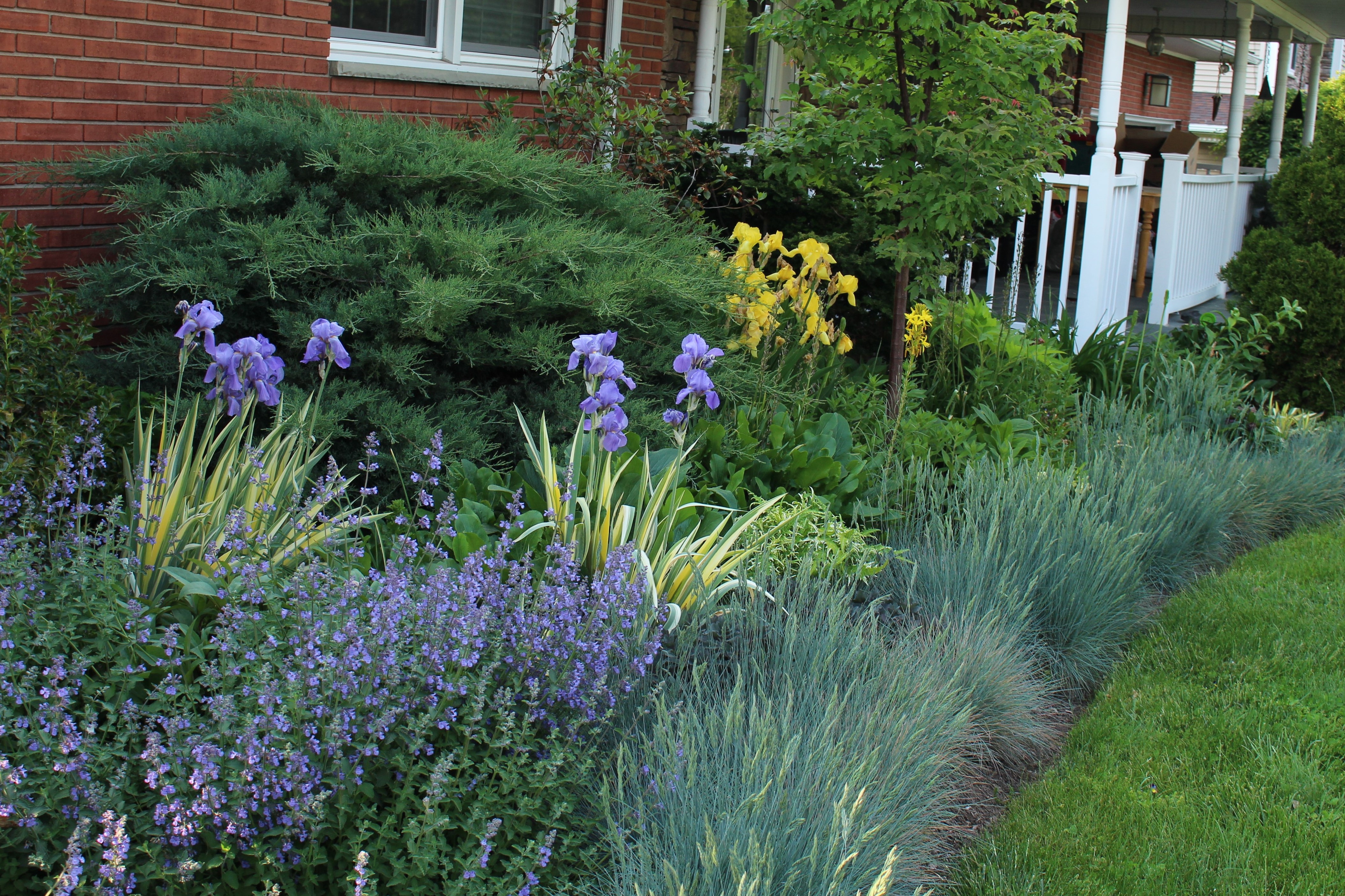
The striped leaves of Iris pallida ‘aureo-variegata’ accenting the front foundation plantings. You can count on this iris to scent the whole corner of a bed with that delicious grape scent which many of the older varieties put out.
It hasn’t been all sloth and idleness in the garden this spring. A few small projects are getting done in spite of my laziness, although I’m not promising they’ve all been done to the best of my ability or that they are the best value for my little effort. One interesting discovery I came across is that bearded iris are fairly resistant to Roundup type (glyphosphate) herbicides. That of course leads me to carelessness when spraying around the clumps next door, since the chances of iris damage are far outweighed by my ‘want to do as little free labor as possible especially when it includes pulling weeds out of monotonously boring mulch beds in someone else’s yard’.

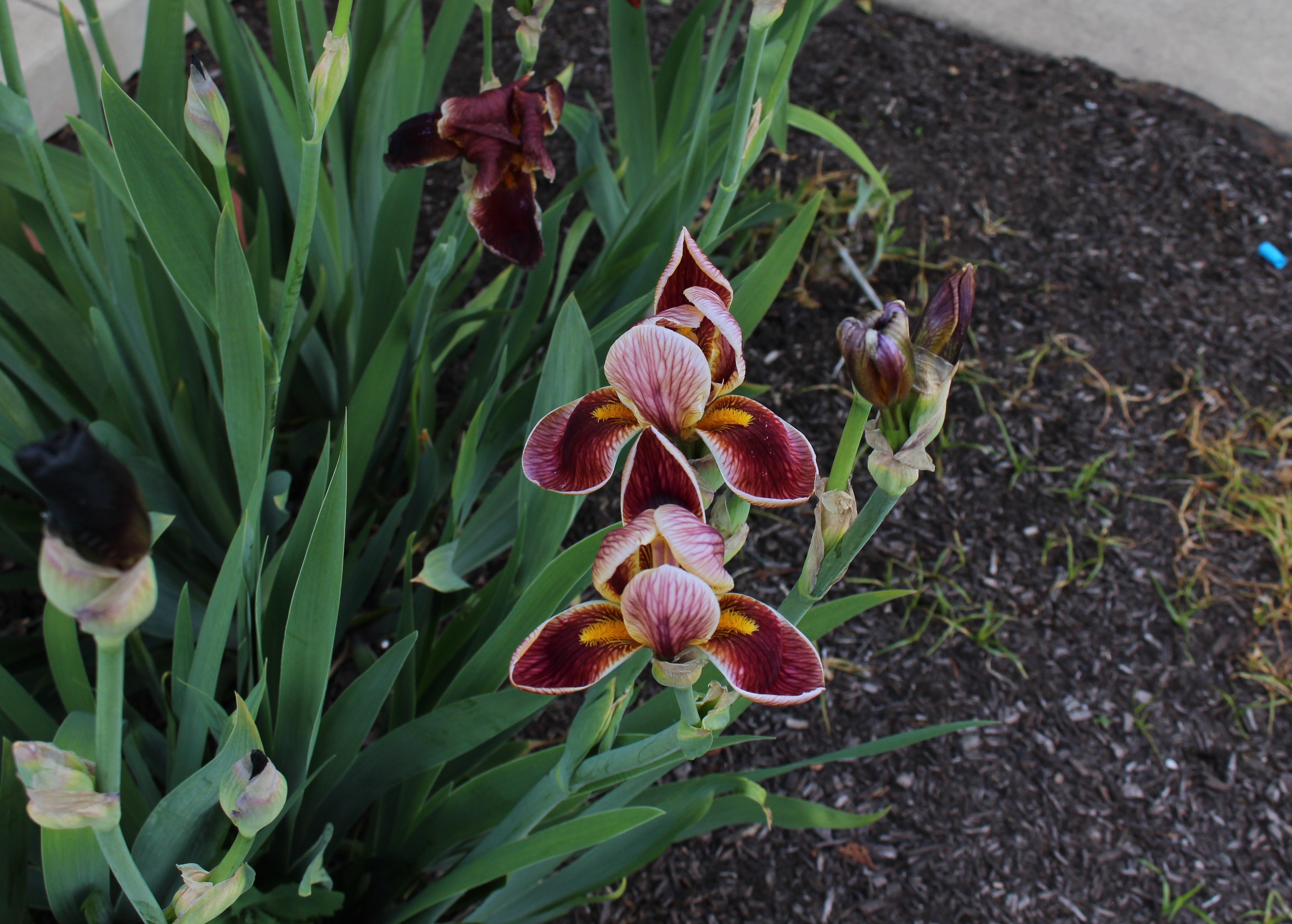
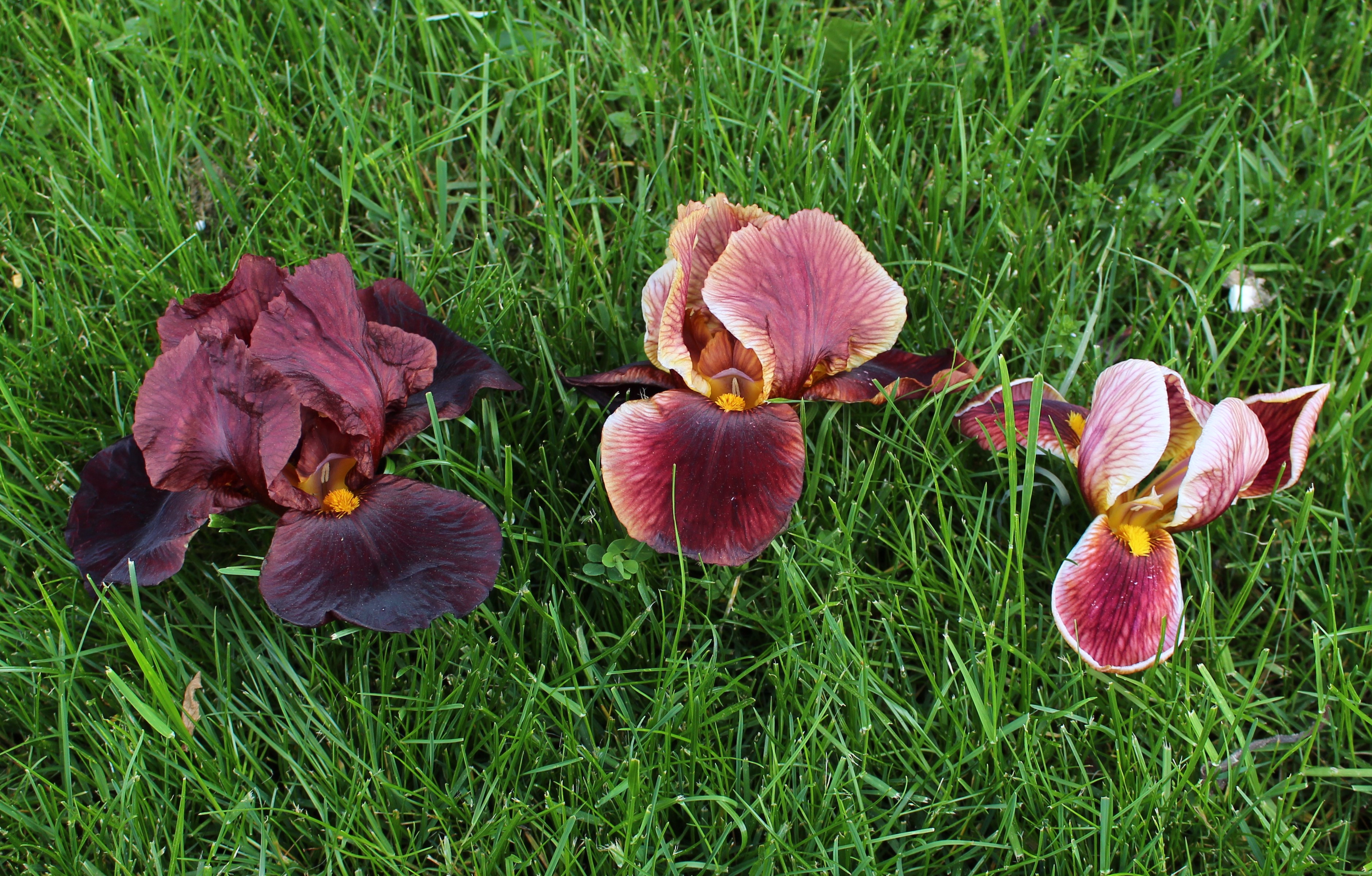
Iris foliage is fairly resistant to Roundup yet the flowers will discolor and stunt depending on how much of the poison they absorb. These flowers should be larger and a dark velvety red rather than small and anemic looking.
Before anyone gets too excited, I just want to say I really don’t use too many chemicals in the garden and although I like to appear as if I’m lazily spraying about I really am somewhat cautious, if only because I have too many more sensitive plants which I’d hate to lose. For what it’s worth my research shows that iris, vinca, and nut grass are pretty much the only plants which will not be outright killed by careless Roundup spraying…. although for the vinca and nut grass the spraying was very intentional.

Normal iris bloom to the left, increasing Roundup effects on the same plant to the right. A heavy dose will give a colorless cauliflower-like stalk which is entirely uninteresting.
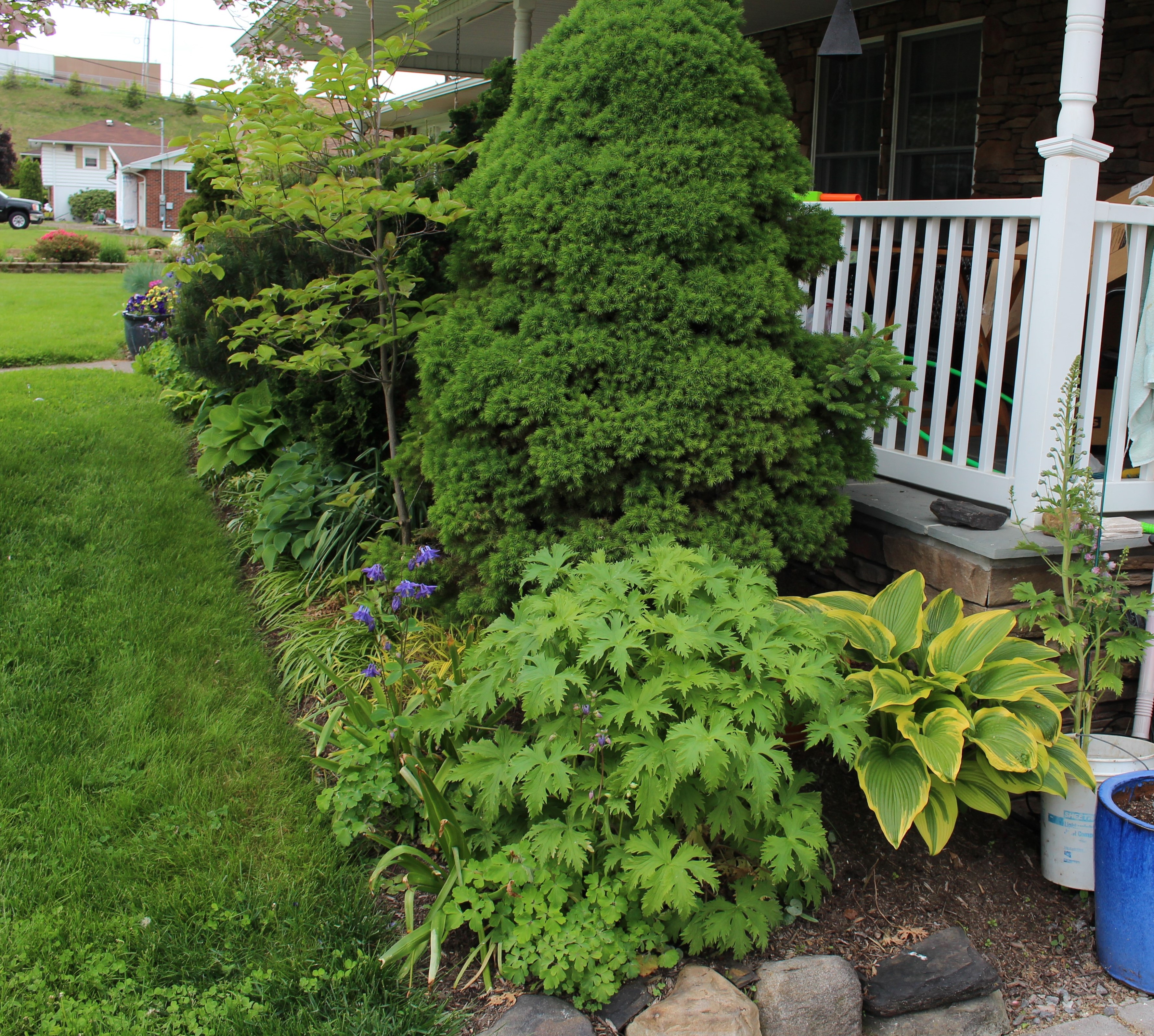
Besides chemical warfare on weeds, another questionable project started with my purchase of a Charlie Brown delphinium which needed a perfect spot in order to wow everyone with its amazing comeback. My single successful clump grows alongside the front porch so this was the most obvious spot to try another, except for the six foot Alberta spruce which already grows there.

The healthy delphinium clump is front and center with the spruce behind. The Charlie Brown delphinium sits soaking in the white bucket to the right.
Alberta spruce is a 365 days a year respectable plant, with an attractive form and many years of service in and many years of service to come. It would make no sense to pull it out in favor of a temperamental diva which needs fussing and fertilizing and timely staking to protect it from the high winds which strike each year (always two or three days into peak bloom season).

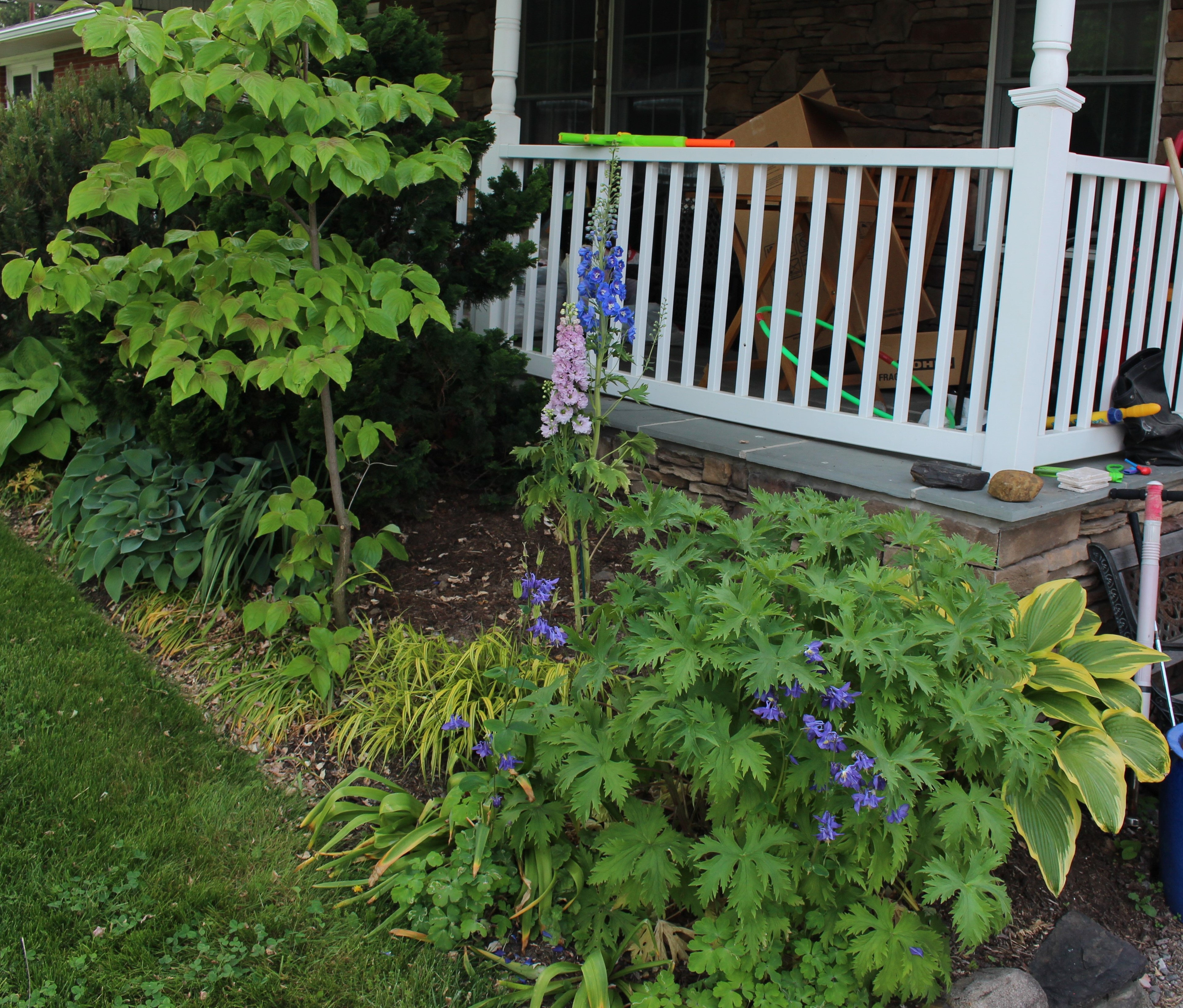
Spruce gone, delphinium in (one of the ‘New Millenium’ hybrids). Not the most logical decision I’ve ever made but in the garden I prefer to live guilt free and impulse happy. Also, if you could, please ignore all the trash and clutter on the porch beyond. I only got around to cleaning it up after this photo was taken.
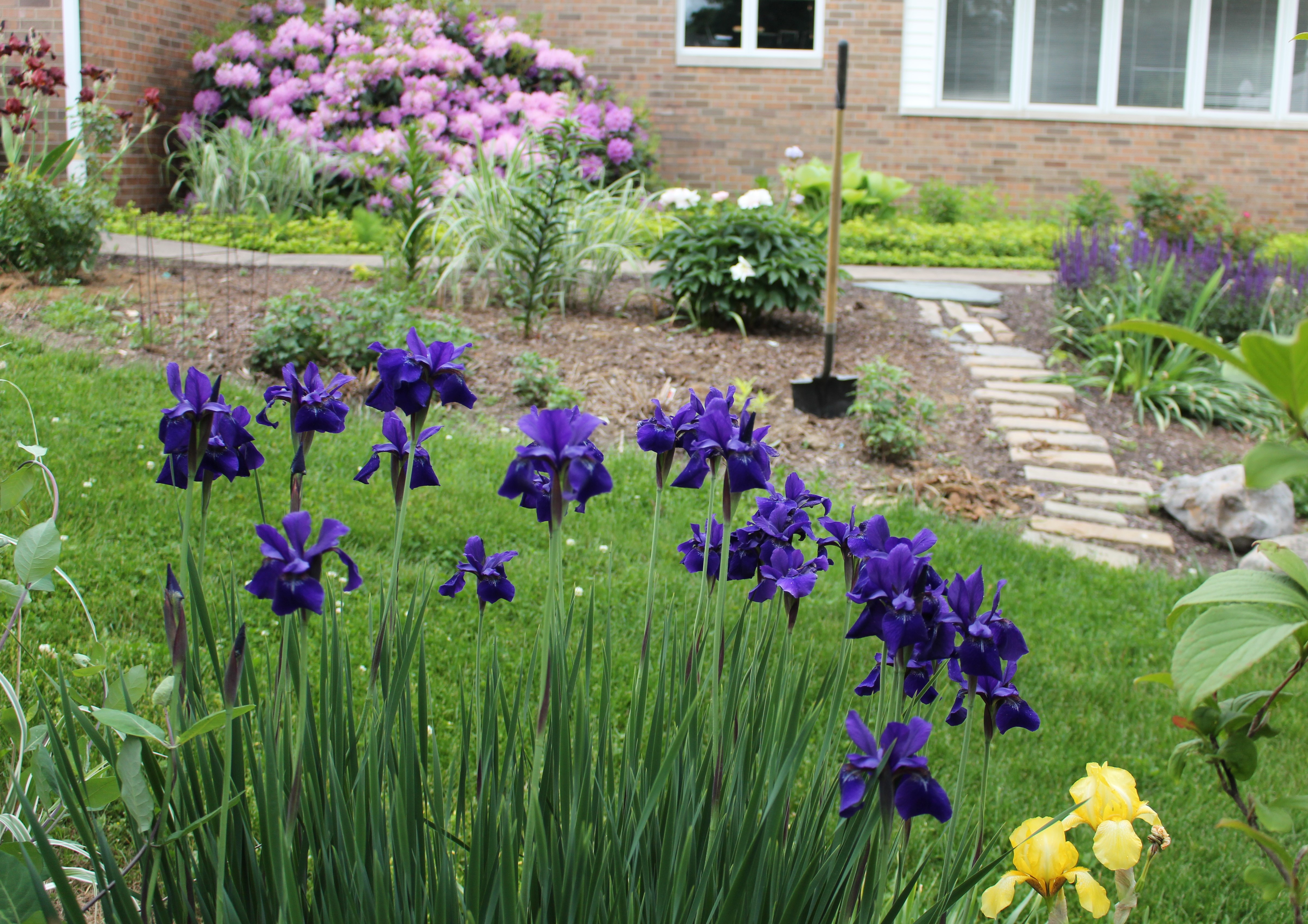
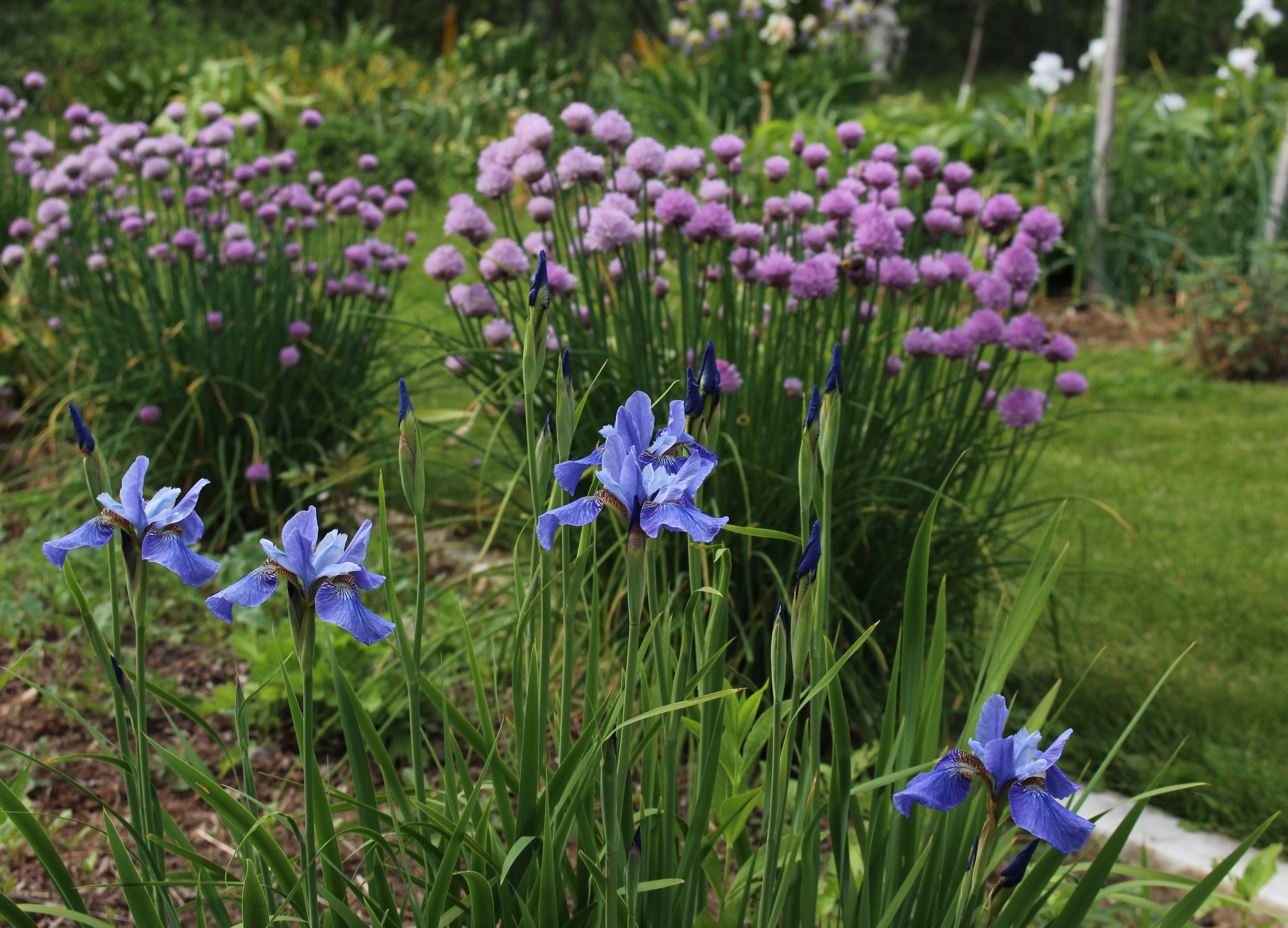
I’m distracted again, let me finish up iris season. The Siberian iris and Japanese iris might be some of the most beautiful flowers of the plant world, but I don’t grow many. They seem to flower for a total of one week and although the grassy foliage looks respectable all summer and they handle nearly any abuse which comes their way I try to limit any collecting urges.
One Siberian iris which I couldn’t walk away from was ‘Super Ego’. It’s not because it was in bloom when I saw it or that the color was unique or any other particular quality, it was because of a childhood dream which was set on fire by a random White Flower Farm catalog which showed up in my mailbox one winter. I think I’ve confessed to being a little odd as a child so the fact that I’d sit around spending hours reading through this catalog probably shouldn’t surprise anyone, but this 1980’s era catalog (which I probably still have somewhere in the basement) had ‘Super Ego’s glamor shot in it alongside a poetic description which convinced me that owning this plant would make me richer, smarter, and more popular. Unfortunately the WWF catalog was way beyond my 10th grade budget so the actual plant never left Connecticut and I was forced to go on without.
The actual experience of growing ‘Super Ego’, while pleasant enough, didn’t quite live up to my expectations. For what it’s worth, I guess I’m as smart, rich, and popular as I’m ever going to be.

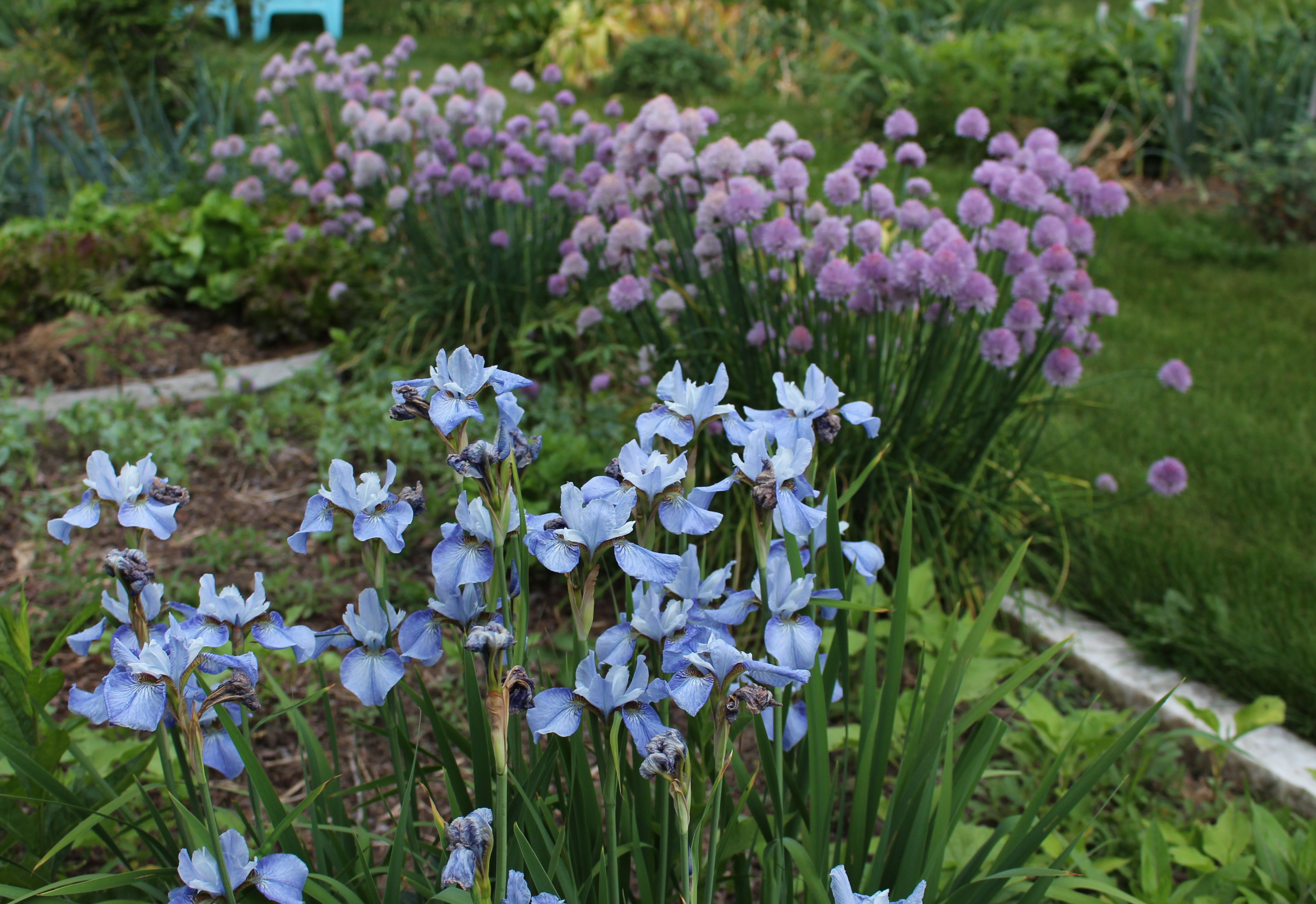
‘Super Ego’ five days later after a few 90F days bleached most of the darker blue color out. The chives in the back seem unfazed by the weather or passing time, although they are entirely less exotic in my opinion.
So as I wait for a new plant to come along and change my life I’ll continue weeding through the backyard iris beds. They are infinitely less photogenic with their hefty companion plantings of weeds, but the old iris continue to carry on and deserve more respect than their neglected planting spot gives. I even planted a few zinnia and marigold seeds last weekend. That may not speak of high class and taste nor earn me a spot in the White Flower Farms catalog but it does mean that things are starting to move on the seed front, and if it all works out July and August should still be full of flowery color.
As it is with most things here, the gardener is not exactly on schedule with his gardening. He’s not exactly on schedule with many things, but the late freeze and the discouraging damage it did to so many spring greens has left him slightly unmotivated. Then the relentless rain and cold damp brought on rot, and now dry weather is bringing spider mites to the phlox. So the gardener will restart his spring in mid May and deal with the mites. He’ll also accept that many projects will again not happen, and will just clear his conscience and move on. Iris are beginning to bloom after all, and once the iris start to fill the flowerbeds with color and perfume it’s hard to hold onto a black mood.

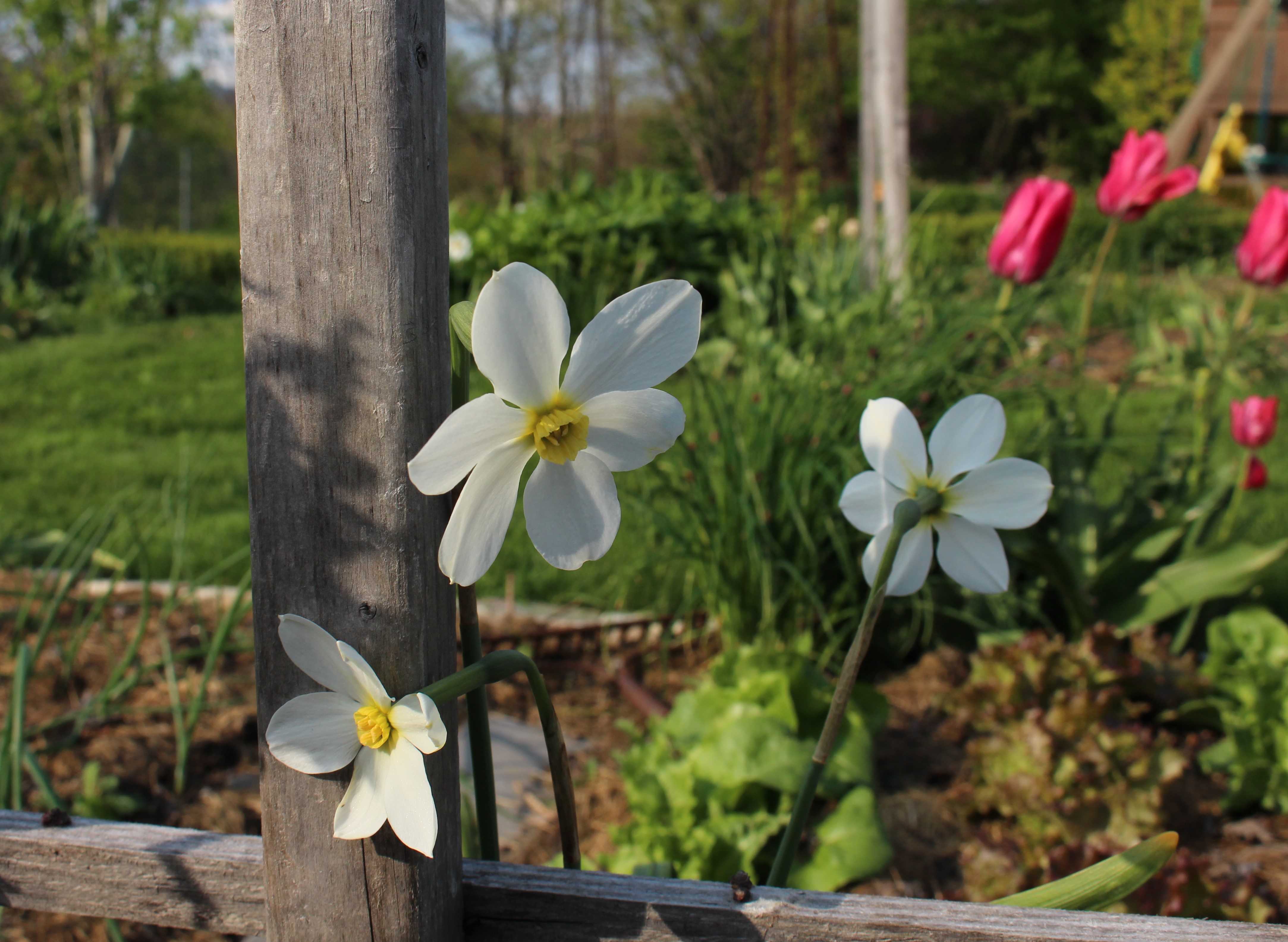
One of my last daffodils to open, narcissus ‘Keats’ was voted ‘ugliest thing to bloom’ by a more serious daffodil friend. I’m always one to love the underdog.
One minor project (which seems to be the only project type I’m capable of tackling this spring) which was finally taken care of was the long suffering heuchera plantings. A few summers ago I dipped my toes into the hybrid heuchera world and since then they’ve been suffering along in my garden. My planting beds get too dry, my shade isn’t as high and dappled as they’d like, and my soil is too heavy for their roots but I try nonetheless. They still have plenty of filling in to do but if you saw the before picture I’m sure you’d agree this is an improvement. Unfortunately the tan lawn clipping mulch doesn’t do much to set the foliage off, but it’s better than weeds I suppose.

The woody stems of the heuchera clumps were dug up, ripped apart and carelessly stuffed back in to the re-dug bed and the plants actually look much happier after their tough love treatment.
As summer heat settles down on the garden this holiday weekend, I just wanted to celebrate the meadow and a few of the newer plantings which did well this spring. Number one on the list were the tulip clusiana bulbs which planted into the turf. They looked perfect out there and I hope they return just as nicely next spring.

Tulip clusiana (I think they were a named variety but I’ll need to dig out the tag) were scattered around in the meadow garden. I will be extremely happy if they settle in here!
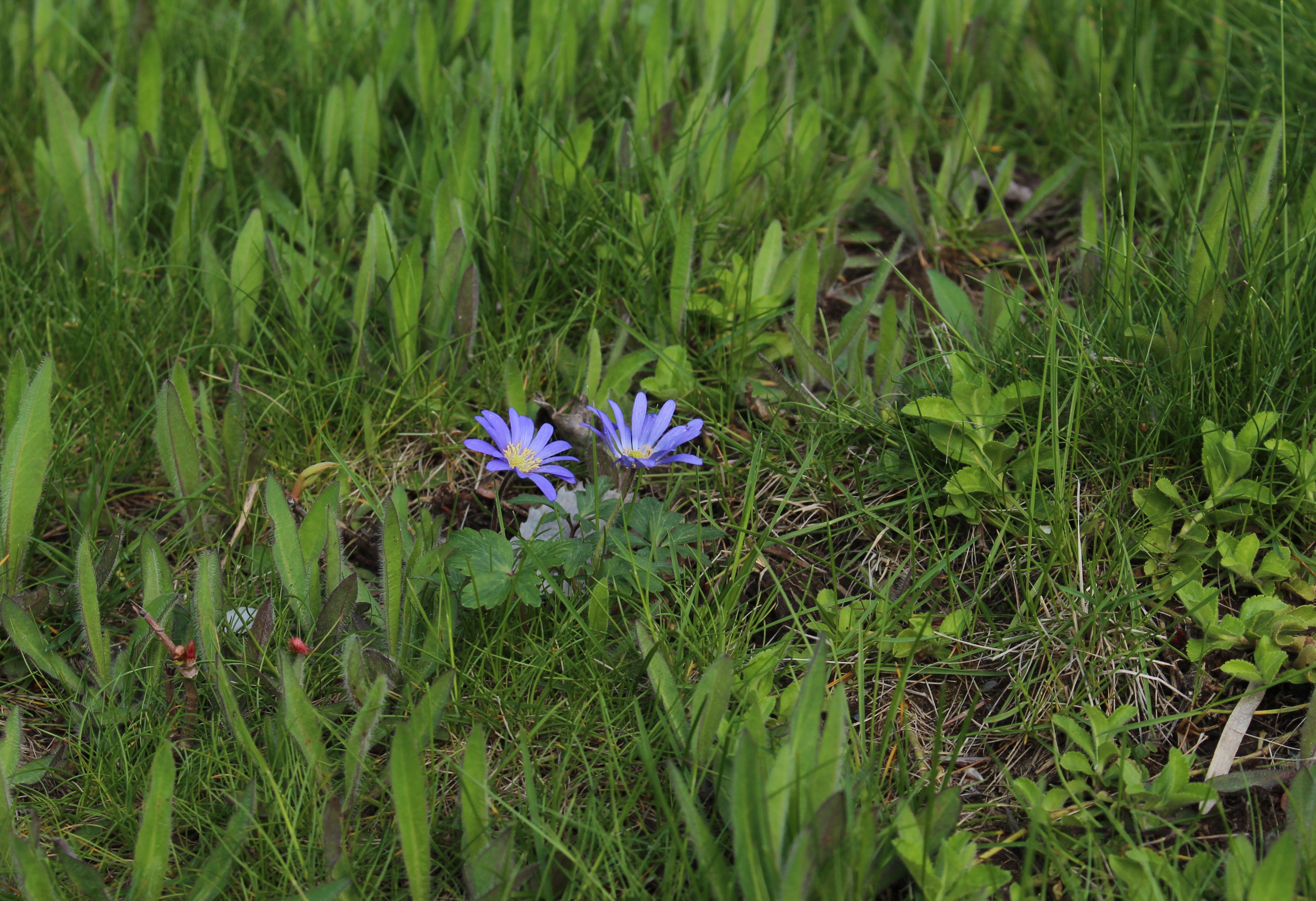
A few Anemone blanda look nice in the shadier parts of the lawn. I tried throwing them around in several of the outer edges of the garden and then promptly forgot until little sparkles of blue started showing up here and there. My goal for this one is to recreate the neglected show which used to pop up each spring around my first apartment in upstate NY. If this plant can naturalize around a ramshackle college boarding house I think it stands half a chance here.
Muscari is practically a weed everywhere so I added a few of those as well. The flowers on these grape hyacinths were nice enough but now I keep looking at the seed heads with their kind-of aqua tint. I wonder if it was the cooler temperatures or if they’ll always have this attractive look…. or is it just me that thinks they look cool?

Seed heads on the grape hyacinths (Muscari). In other parts of the garden I clip them off to limit their seeding around, but here I’ll risk it 🙂
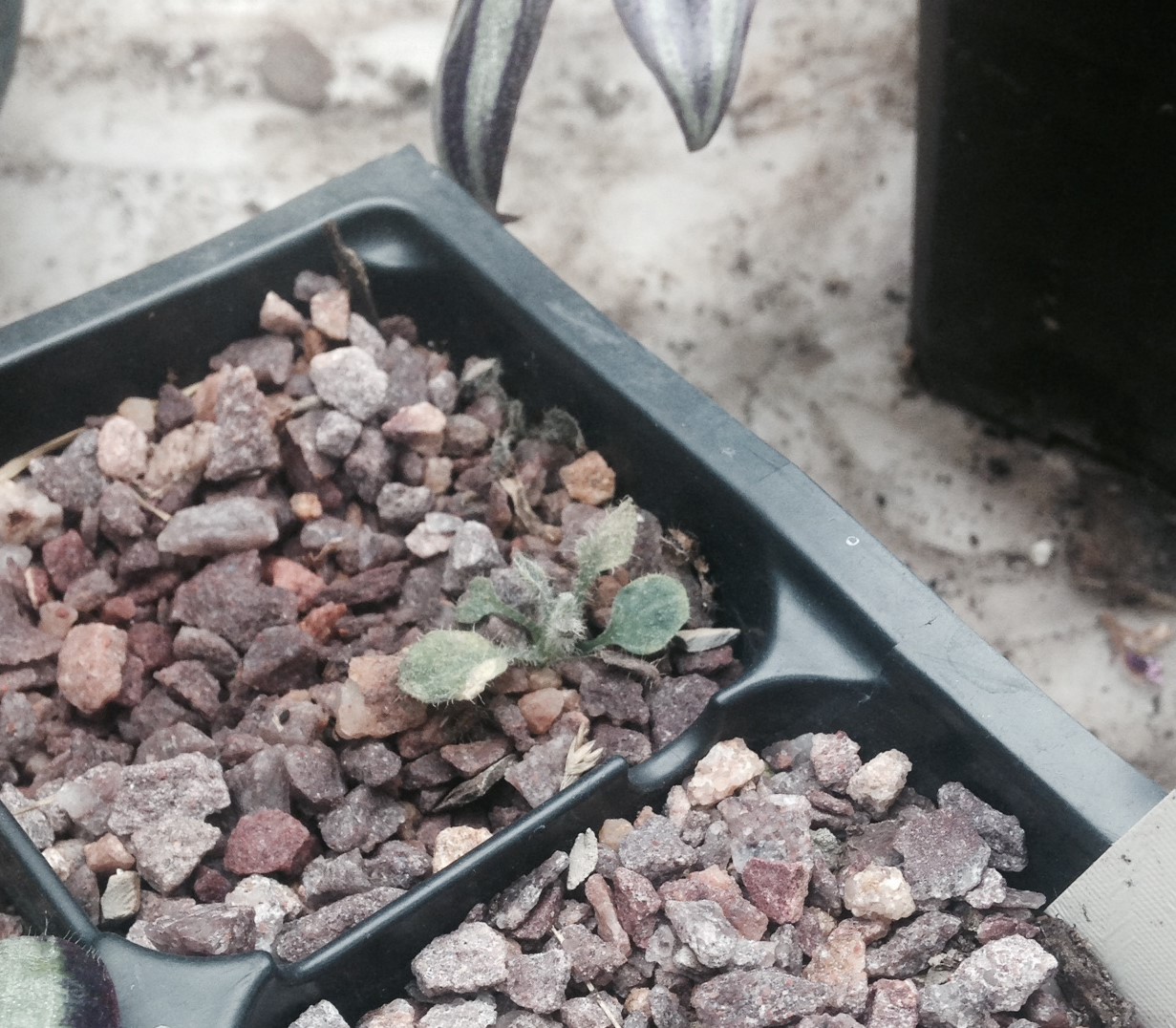
Most of the bulbs were brought in as bulbs, but if you know me you know there are a few seeds coming along as well. My little gravel covered pots are bursting with new plants this spring and even though the last freeze did a few things in the majority seemed to enjoy our mild winter. I’m always a bit surprised anything will grow up through gravel, but in some pots even the tiniest of seedlings make a crowded moss of new green sprouts…. which will soon desperately need thinning!

Hundreds of Hypericum ‘Albury Purple’ seedlings sprouting in the center pot. Realistically I need about two.
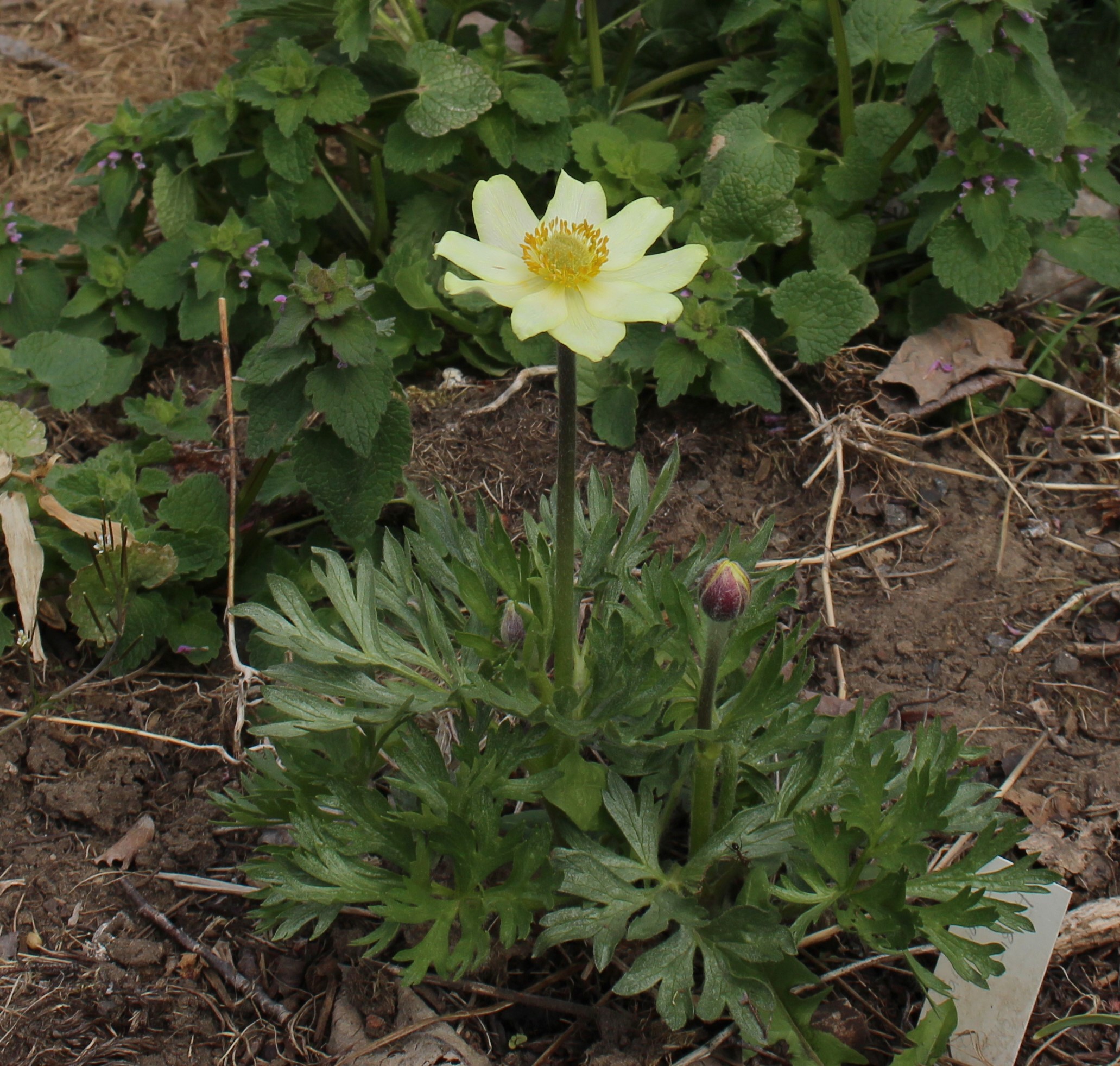
With new seedlings coming along each spring there are always new surprises as youngsters open their first blooms. A couple years ago I thought I’d dabble in a few species anemones and see how they do in the meadow, and although I’m not sure they’re all correctly labeled, for now I’m just enjoying them for whatever they are.

Not Anemone caroliniana? Pretty regardless, and it looks like it might be able to hold its own if I move it out into the thinner areas of grass.
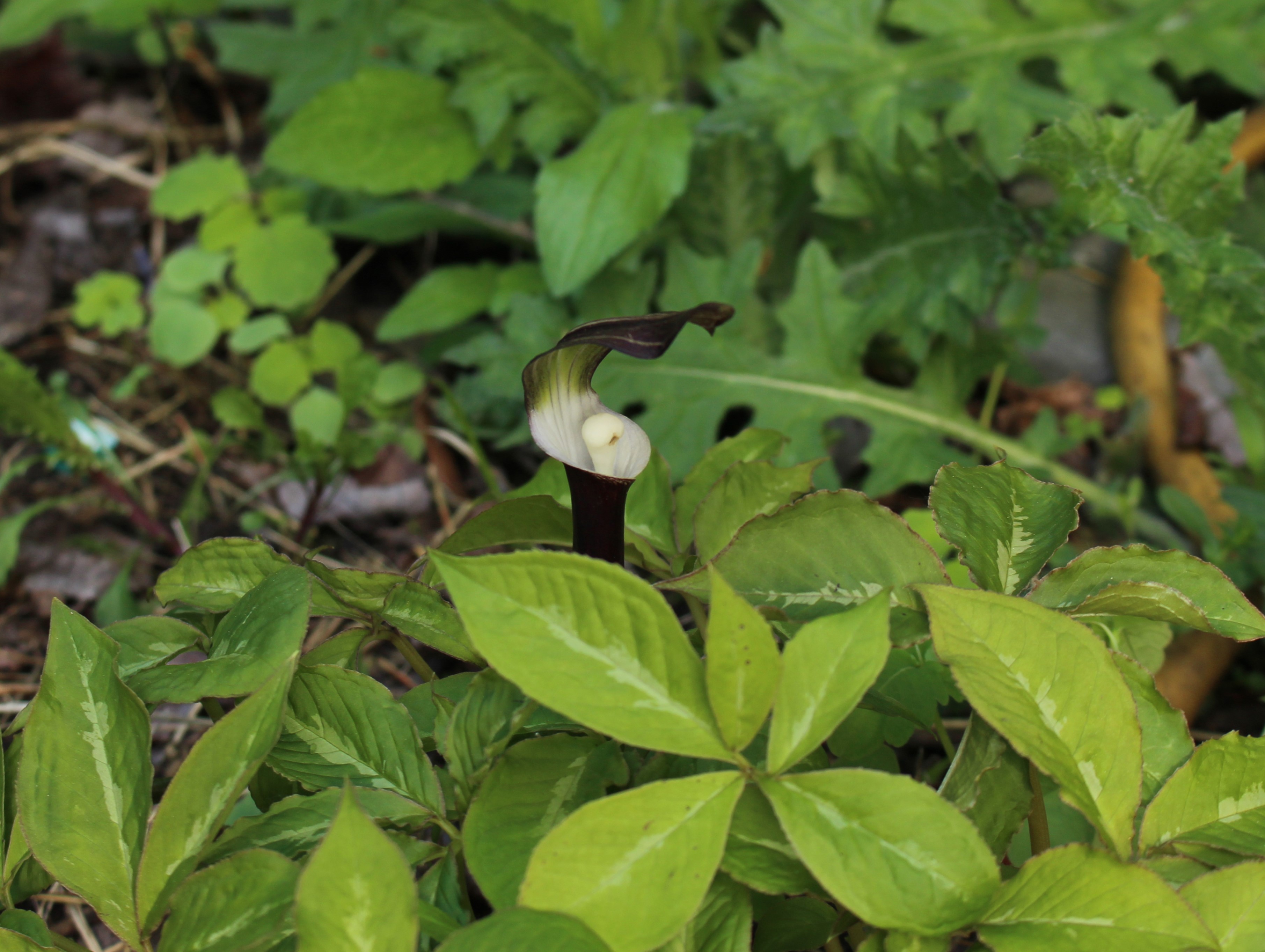
One seedling which has a positive ID is this cool little Japanese Jack-in-the-pulpit or snow rice-cake plant (Arisaema sikokianum). I was surprised to see any of these three year old seedlings flower, and although the actual flower is definitely on the small side for this species they say size doesn’t matter in these things and I’ll just keep admiring the fancy little bloom.

Arisaema sikokianum. Although my picture doesn’t do it justice, I hope you can appreciate the mottled foliage and bright contrasts of this flower.
So that’s the basic update. I promise this will be the last time I moan about freezes and such, but I can’t promise some other weather event won’t come along shortly to take its place. Whatever happens it’s a great iris weekend and I’m sure I’ll be going on about that next 🙂
Some complaints will never get you any sympathy, and to complain that tulips are coming up and blooming in all sorts of odd places probably ranks right up there. Truth be told it’s not a problem, but when every batch of compost seems to hold a new crop of bulbs, the spring planting in the parterre becomes a little more complicated.

Once again the vegetable garden is a complicated mess of far too many flowers and far too few edibles.
For all my failures in the garden, tulips seem to be one plant which enjoys the poorly draining, heavy soil of the flower beds. It’s a surprise to see this considering many references suggest a loamy, free draining soil for your best chances at success, and even then it’s a safer bet to treat tulips as one or two year treat. Fortunately no one has whispered this little secret into the ears of my bulbs and they keep coming back and multiplying.

Having a few tulips in the way is just the excuse I need to skip digging too deeply when it comes to planting the spring vegetables.
I think I do know the secret though. The soil may be heavy but it’s also thin and dries out relatively quickly once the heat of summer settles in, and if I do manage to drag my lazy self away from the pool to water it’s never a solid deep watering, it’s always a guilty stand around with a hose until things look less dead kind of triage. I can’t imagine much of the water ever penetrates deeper than two or three inches and for this the heavy soil works to an advantage. My tulips like a hot, dry summer similar to their ancestral haunts of Eastern Europe and Central Asia and most years (unfortunately) this is what my garden resembles.

Tulips in the onions, tulips in the lettuce. I try to replant stray bulbs closer to the edges, but there are always more little bulblets in the compost or stray bulbs dug around in the soil.
When I was more ambitious I used to fill several of the beds each fall and then dig them again in June after the foliage died down. It was a glorious spring explosion but one bad experience soured me to the whole deal and I ended up tossing hundreds of fat promising bulbs. They really do need a good drying out over the summer and when mine all molded up and rotted one damp August I put a stop to the project. But…. I can’t promise it won’t happen again some day 🙂

If all goes well this batch of tulip leaves should put out two or three blooms next year. Not bad for a weed, and if you notice there are more weeds in the lawn, in this case lettuce seedlings from last years neglected plantings.
So to sum it up my tulips don’t mind a nice heavy fertile soil while they’re growing, the just need to follow it up with a warm dry summer rest. Planting them in a spot which dries out and doesn’t get summertime irrigation is one option, actually digging them up and storing them in a hot, dry, ventilated area until fall planting is another. Just be prepared to have more tulips than you know what to do with since most tulips will at least double in number every growing season.

Leftover Easter flowers from two or three years ago. Let them bloom and grow as long as possible in their pot and then stick them into some out of the way spot, preferably one where they will not be overrun with bearded iris 🙂
Although most people recommend species tulips and Darwin types for the best chance at perennializing, I don’t notice that much of a difference between the types. Give them all a try is my advice, but for best results regardless of type you will have to dig and divide the bulbs every three or four years when they begin to get crowded.

A few stray tulips snuck in with the compost for this new snowdrop bed. With snowdrop season long gone I’m quite happy to see the tulips flowering in a carpet of my favorite annual weed, purple dead nettle (Lamium purpureum).
Alas, even plants relatively happy with their homes do not always lead perfect lives. The tulip season may be a little sparse next year for two reasons, both of which revolve around the weather. The first is our harsh April freeze which damaged many of the buds and much of the blooms for this year’s show. That in itself could be tolerable, but in the weeks since the weather has remained damp and cool, and many of the damaged plants are now falling victim to gray mold (Botrytis). Botrytis is bad news and seems to stick around for a few years even after better weather returns. I’m wondering how many of the affected plants will be going on to tulip heaven…

Not to go on and on about this late freeze, but here’s yet another example of damaged foliage and stunted blooms. To top it off I also suspect virus in the streaked blossoms of what should really be a solid colored flower.
All is not lost though. I still love tulips and would grow a few even if they only made it a year or so before falling victim to whatever tragedies visit my garden next.

Tulip ‘Marit’ is a favorite this year. I don’t remember such round flowers last year but the shape and color this year really won me over.
In the meantime I will keep my fingers crossed. I far prefer being spoiled for choice as far as tulips go, and if it means working around a few bulbs here and there that’s fine with me.

Tulip ‘pink impression’ in the front border. They’re huge and pink and although battered by the weather they’re still the crowning glory of the border.
Have a great Sunday and happy mother’s day to the moms!
Ignorance is bliss. As the garden shivers and crackles under a freezing blanket of cold the wise gardener will hunker down indoors and enjoy the luxury of a warmer, climate controlled gardening experience. Outdoors he can’t do anything but wait for the damage to show but indoors he can at least tweak the thermostat a little higher and take another sip of coffee… spiked or unspiked depending on the latest weather report.
I’ve been a little too excited about the new amaryllis I bought this winter and in my excitement ended up bringing the older bulbs out and giving them a little water too. In a normal year I just throw the dormant bulbs outside in April and let them bloom right alongside the tulips, but this year I thought ‘the more the merrier’ and as a result I’m ending the winter with an amaryllis (Hippeastrum) extravaganza. I’ve had these bulbs at least seven years now and if I remember to give them a little attention after flowering they reward me each spring with a fantastic color show.
It sounds slightly ungrateful but of all the colors, Christmas red and snowy white are not what I’m normally looking for come springtime. This of course was not what I was considering years ago when I picked the bulbs up for $1 a piece at some box-store clearance shelf… but please humor me as I shamelessly brag about how well they are doing now. Each pot is already showing at least four bloom stalks a piece, and the plants themselves are on the verge of nearly overwhelming the dining room table, even with less than half the flower stalks open. On the edge of the group you barely notice the last of the newbies, a delicate pink-flushed mini white named ‘Trentino’.
Once it warms up outside (assuming it ever does) new and old amaryllis will all go out into a semi-shaded spot, get hooked up to the same drip irrigation system that waters the summer annuals, and will be ignored until November. If I feel generous I’ll send some liquid fertilizer their way but for the most part they’re on their own. If there’s a trick to it all I guess it’s that they sit in a gritty, peat-free soil mix which drains well, and they have a nice solid terracotta pot which breathes well and holds down their heavy tops. Well drained, plenty of moisture, and a good feeding… mine enjoy that.

Geraniums blooming more than they should under the lights of the winter garden. A better gardener would probably remove the flowers for the sake of stronger growth and a healthier spring transplant.
You may notice the attractive plastic sheeting which forms a subtle backdrop to the amaryllis photos. The sheeting keeps the dust and debris of a kitchen remodel from drifting into the rest of the house, and also keeps us from enjoying the charms of a useable sink or stove. If I try hiding indoors too long from the brutality of our latest arctic blast, eventually I need a new place to hide from the mayhem a kitchen run out of the living room…. so I escape to the garage and the winter garden.

The scented leaved geraniums (Pelargonium) are also blooming under the lights. The flowers are a treat, but I love the lemony scents which come off the foliage each time I move a plant or water a neighbor.
For a while the winter garden was being ignored. Spring was early and I was back outside enjoying snowdrops, then crocus, and then daffodils… but now winter is back and I’m pretending it didn’t all happen and I’m just doing the regular sowing and repotting of late winter. Because I foolishly brought sprouting bulb seedlings in during a December freeze I’m now at the point where I can dig seedlings out and see what grew. Here’s a mixed potful of one and two year old Allium Christophii bulblets which just recently went dormant. I’m fascinated even though a less than polite reader might point out I could get a bagful of blooming sized bulbs for under $10 this fall.

A few Allium christophii seedlings all grown up into pea sized bulblets. I’ll plant them outside next year and hopefully see flowers in another two or three years. I’m sure at that point I’ll wonder where they came from, since I’ll definitely forget where I planted them!
I find it interesting that even though I sowed the seeds shallowly, most have migrated to the very bottom of their four inch pots. Readers of Ian Young’s Bulb Log at the Scottish Rock Garden Club will already know this since Mr. Young has observed this repeatedly, but for me to see it myself is of course more fun.

Second year for a tulip seedling. In the middle of the photo you can see the dried rice-sized husk of last year’s bulb, if you follow this year’s root to the right (which would have grown deeper into the pot) you will find the newly formed pea sized bulb from this season. Maybe by next year we’ll be up to kidney bean size 🙂
I was also happy to find one of my fall snowdrops has made a nice sized offset. I would have thought the double shoot from the top would have split the bulb into two, but instead it has just sprouted a new bulb off to the side. So I guess that means there will be three growing tips next fall!

One of my special snowdrops, a fall blooming Galanthus elwessi monosticus which a friend picked up for me at Nancy Goodwin’s Montrose Gardens in Hillsborough North Carolina.
Not all my escape gardening happens in seclusion. Occasionally I have a helper and this year that helper has been assisting in writing out some of the many plant labels which go along with all the odds and ends which get seeded out. She may actually do a neater job than I do, and her talent for labeling in Latin is impressive.

The cut up vinyl blinds which I use for plant labels. Plain old lead pencil seems to last for decades and I’ve found a few still readable in the garden, one going back to ’91 for a dogwood seedling which I apparently smuggled out of Longwood Gardens in a pocket…
Also impressive is one of my newest treasures. It’s a Cyclamen Rhodium seedling from my visit to John Lonsdale’s Edgewood Gardens, and it’s blooming in spite of having been dumped out of its pot not even three minutes after John handed it off to me. He was very forgiving of my clumsiness, but I never did mention that I dumped it over again a second time as I got into my car. Fortunately it survived, and although John suggested that I give this one a try outdoors in a sheltered spot (planted six or more inches deep once it goes dormant), I’m not sure if I’m brave enough to risk its health a third time.

A really cool Cyclamen rhodium from the Southern Peloponnese and island of Rhodes in Greece. Nice flower but look at that speckled foliage!
So that’s how things are going here in my own sheltered locations. I have some promising tomato seedlings sprouting as well as eggplant and peppers, but it will be a few days before the damage outside becomes definite. Already things such as roses, lilacs and daffodils look rough, but for as long as I can stay in denial I will. Maybe the hyacinth will bloom so much stronger next year now that their blooms have all been frozen off. A gardener can hope 🙂
How does such an awesome little spring blooming bulb (tuber if you want to get technical) fly under the radar for so long? Apparently a couple in-the-know gardeners have been growing these cool little spring bloomers for years, but I for one didn’t even know they existed until a few years ago. I believe I came across pictures via Ian Young’s bulb log (if you’ve never been, click here immediately to visit -it’s practically required reading for any bulb lovers out there) , and the impression was one which ate away at me until one fall I was finally able to get my dirty fingers on a few. Of course as my luck would have it these were promptly killed, but the following year a more determined try proved successful, and the next spring I was just as pleased as I thought I’d be when they bloomed.

One of the boldest reds, Corydalis “George Baker” blooms right alongside the blues of chiondoxa and Scilla siberica.
The Corydalis family is a large one with many highly collectible family members, but for me it’s the variations on Corydalis solida which excite me the most right now. This species ranges across Northern Europe into Asia and for the most part greyish mauves and blues dominate the color spectrum, but starting in the 1970’s and 80’s rich reds and purples began to find their way out of the woods and into the hands of collectors and growers. The Penza strain from Russia and the Prasil strain from Romania are the some of the best known groups for bold colors and many of the newest named varieties come from these collections.

A more common color of Corydalis solida, a smaller and slightly later flowering plant than the other Corydalis I grow.
As it is with many plants, once you get excited about one you get greedy and need more, so in addition to the “George Baker” and “Beth Evans” which were purchased from Brent and Becky’s bulbs, and the straight Corydalis solida from Van Engelen, I needed to add more. The blame for this shouldn’t lie entirely on my own shoulders though, since by now I had seen even more Corydalis glamour shots including the most enticing group shot which I found at Carolyn’s Shade Garden. Her tapestry of rich purple with pinks and reds would have to be imitated in my own garden and to that end I found Russell Stafford’s Odyssey bulbs.
The new plantings from Odyssey were a mix of successes and failures and based on the excellent condition of the tubers, I’m going to guess the fault again lies with me. Even as recently as this spring one of the clumps failed to even show, and I suppose there’s something else going on which I don’t entirely understand… but ignorance is bliss, and I enjoy the remaining two cultivars more than ever now… even though the addition of a pure white or pink would have made the planting even more perfect!

A more common color but on a sturdier plant, Corydalis ‘Harkov’ scared me by nearly dying last spring after I optimistically dug it up for dividing. It wasn’t ready and it wasn’t pleased, and promptly dried up and went dormant.
I suppose I should try and make this a more useful post by mentioning something other than the many ways in which I’ve killed these plants. They’re actually fairly carefree in the right woodland conditions, and although I should suggest a fertile, moist shaded site, mine grow quite happily in sites I would consider downright dry, and in locations shaded only by the overhanging perennials and annuals of the front street border. I guess they don’t know any better.
Another thing I should mention is they bloom early and fade away quickly. Plant them in a spot where other goodies such as hostas and hellebores or rudbeckias and buddleia fill in for the summer. My best patch disappears under a carpet of aquilegia (columbine) and ‘Blue Cadet’ hosta two weeks after blooming, and you wouldn’t even know it was there in June, which is good, but you should definitely try to avoid forgetting they’re there and running a shovel through while digging.

Corydalis, hyacinths and hellebores filling in now that the snowdrops and eranthis have gone over. In another month columbine, delphinium, hostas and hellebore foliage will take over for the summer.
A final note is that for the first year or two in my garden I was convinced they couldn’t possibly be making seeds since they yellowed and died down so quickly after blooming. I’ve since found out I’m wrong. Seedlings are spreading quickly and this year I have a few of the first starting to put out their own blooms. I’m thrilled that they are as red as the parents, and even happier there’s some variety to them as well.

Some of the first Corydalis solida seedlings to make it to blooming size. One’s nearly as red as the mother clump of ‘George Baker’, the other’s a completely different dusky mauve.
So now the question is should I just enjoy what I have or should I keep trying to expand the flock? If I could only remember where I planted them (I think I may have finally spotted one or two this afternoon) I would be able to enjoy a few new ‘Purple Bird’ flowers this spring, but is that enough? It should be, but history shows little attention to common sense in this garden and I’m already well on my way to picking out just a few more indispensables. You really shouldn’t show too much restraint in spring, it goes completely against the spirit of the season and even when ordering bulbs for fall planting it’s still a celebration of the end of winter!
A Creative Spirit
Gardening, Nature & Weather--slightly skewed
more than you ever wanted to know about my garden
Garden Thoughts from Florida's Treasure Coast
more than you ever wanted to know about my garden
Damp and in the middle of nowhere
more than you ever wanted to know about my garden
I have plans. BIG plans.
Cariboo-Grown & Cariboo-Hardy Perennials. Since 1991.
a suburban English garden through the seasons
gardening . home decor . online business
A garden oasis and cultural center overlooking the Hudson River
It don't come easy
Our garden, gardens visited, occasional thoughts and book reviews
Mark and Abbie Jury
more than you ever wanted to know about my garden
gardening in the North Carolina piedmont
learning, growing, and learning more -- life on the Olympic Peninsula
Gardening in East Tennessee
A Blog usually about plants and gardening in west-central Missouri...
My week to week gardening diary
more than you ever wanted to know about my garden
My Own Paradise: Life on Seven and a Half Acres
more than you ever wanted to know about my garden
Country gardener nurturing people, plants - and wildlife
more than you ever wanted to know about my garden
Birds, Bees, Flowers, Trees - Organic & Wildlife Friendly Gardening
more than you ever wanted to know about my garden
For all who appreciate the beauty of words, flowers and homecooking
Celebrating gardens, photography and a creative life
more than you ever wanted to know about my garden
Ideas from a Suffolk garden
adventures in my gardens
more than you ever wanted to know about my garden
Hardy plants for hardy souls
Notes from a wildlife-friendly cottage garden