Rose ‘Livin Easy’

I took full advantage of the cool, generally overcast weather this weekend, and put some solid workdays into the garden.  The deck is cleaned, the pots are planted and the tomatoes are finally planted.  It’s nothing to look at yet, but fortunately this rose is.  It’s ‘Livin Easy’ and although it may not be the newest thing out there and it might not be a color everyone loves, I still think it’s a knockout.

rose livin easy

Oxeye daisies and rose ‘Livin Easy’. Orange isn’t a color everyone loves, but I do.

Some people say it has a fragrance, but it’s not strong enough for my nose.  Even with a lack of fragrance the disease resistant foliage and summer long bloom make up for this fault, and I do nothing other than trim off a few dead branches in the spring and off she goes.  I’m sure fertilizer and more concerned care would do wonders, but I like the way it has become nearly overwhelmed in a sea of daisies.  A real gardener would have probably ripped them out ages ago.

Hello Susan

My intention this spring was to keep the front yard a little more organized and really put my foot down against the reseeders which took over last summer….. but then the rest of the world happened and just like many good intentions my organization theme fell to the wayside.  This year rudbeckias took over.

gloriosa daisies rudbeckia

Rudbeckias, black eyed Susans, gloriosa daisies, whatever you want to call them these rudbeckia hirta hybrids really bring gold to the front border.  Fyi this is as far along the bed as the edging and mulching got this spring.  You can see my spade handle just where I left it about two months ago 🙂 

For as much as I like the softer yellows, and for as summery a tint golden yellow is, bright gold is probably one of my least favorite flower colors.  The golden takeover of the front garden really goes against any design theory I have for this bed and I suppose if I were of the more controlling type it would cause me a little mental turmoil but I think I’m ok with the brightness.  It helps bring a little sun to what’s so far been a pretty wet and ‘pearly’ summer.

rudbeckia hirta gloriosa daisy perennial bed

The front border with plenty of rudbeckias.  I was firm with seedlings of amaranth, standing cypress, and oxeye daisies but this year the black eyed Susans slipped by.

A casual passerby might think things look well under control and maybe even close to well tended, but just inside the bed turmoil reigns.  Here the inner section was supposed to be a restful patch of dark leaves canna…. which it’s not… because too many ‘good enough’ plants came up and the gardener just didn’t have the heart to pull them out.  It worked out for the best though, the variety of green centered and brown eyed rudbeckia which grew is a nice tradeoff (as long as you can continue to ignore the unplanted cannas sitting on the driveway).

mixed annual rudbeckia plantings

Mixed shades of selfsown rudbeckia seedlings. 

There used to be a greater variety of darker shades mixed in with the straight gold daisies but over the last few years I’ve tended to pull the browned eyed versions.  They seem more prone to mildew in my garden and rather than look at that I just pull them and send them to the compost before their seed ripens.

mixed perennial border

A more ‘refined’ view of the border.  Less is surely more with these bright colors but to be honest the patches where the rudbeckia grows and blooms thickest are the patches which make me smile 🙂

A week or two ago would have been a good time to seed out a few zinnias to fill in for when I get tired of the fading rudbeckias but all the rain seems to have drowned my seedling tray, so we’ll see what happens now.  Fortunately there are always volunteers willing to step up.  Here are a few sunflowers coming along (in a totally inappropriate spot) and I know a few verbena bonariensis seedlings could be found elsewhere.

sunflower seedlings

The future sunflower patch.  Goldfinches have already been stopping by but they’ve got a few more weeks to wait before this seed factory starts up.

The entire border hasn’t been given over to gold.  Here’s a now classic combination of Perovskia, Echinacea, and ‘Karl Foerster” feather reed grass made famous back in the ’90s by the Washington DC based design team of Oehme, Van Sweden.  They were one of the pioneers in publicizing the ‘New American’ prairie style planting style which moved American design away from lawns and English style gardens to a more relaxed look filled with lower maintenance swaths of color and forms which sway in the summer breeze.

Oehme, van Sweden inspired planting

My Oehme, van Sweden inspired planting of ‘Karl Foerster’ grass, coneflowers, and Russian sage.

Coneflowers also anchor the far end of the bed, and the golden rudbeckias haven’t quite conquered this far down the line.

morning light perennial border

This end of the border is were my enthusiasm for weeding and maintenance always wears a little thin.  As long as the lawn stays mowed and the edges get trimmed I think the weeds and lack of deadheading aren’t quite so noticeable.

The black eyes Susans which grow in this front border are nearly all the tetraploid version of America’s native Rudbeckia hirta, and for plant geeks such as myself the history of these plants is one of those cool wintertime stories which make gardening just that much more interesting.  A version of the story can be found by clicking here, but the short summertime summary involves Dr. Blakeslee of Massachusetts’s Smith College treating seed of the native rudbeckia with the genetics altering chemical colchicine and doubling their chromosome count.  Eventually David Burpee got a hold of the new race of flowers and set his company to work refining and selecting for more colors and forms, and in 1957 introduced the plants as we know them today.  The tetraploid version is bright and big and bold, but the normal diploid Rudbeckia hirta still has its fans for its daintier, summertime wildflower look.

rudbeckia hirta quilled petals

A straight Rudbeckia hirta which showed up in the back garden.  I like the spoon shaped petals on this one and hopefully can save a few seeds.

Rudbeckia hirta comes in two basic forms, the regular and the larger tetraploid version.  They’re both short lived perennials which may bloom the first year or may die after blooming, depending on their mood, but they’re both far from troublesome.  Don’t get this Susan mixed up with the truly perennial, clump forming Rudbeckia fulgida which is just starting to come into bloom now.  This one (usually grown as the ‘Goldsturm’ version, another Oehm,Van Sweden favorite as well as Karl Foerster introduction) is another indestructible rudbeckia but for me it’s just too much of a perennial commitment to gold 🙂

rudbeckia hirta light yellow

Another wild rudbeckia hirta which I’m keeping an eye on out back.  It’s a lighter yellow shade with a spidery inward curl to the petals (which often shows up in the darker ones as well).  I like it! 

So there you have it, the glory of gloriosa daisies in the garden of a gardener who doesn’t like gold.  Some will surely point out that I’m in gold loving denial, but daisies and gold are completely common and unrefined and I’m going to try and claim it was against my will and better taste that they took over this summer.  Either that or I just don’t care what good taste and garden trends dictate!

Enjoy summer 🙂

At odds in the meadow

For as much enjoyment as the meadow garden brings one gardener here, there is another who despises the long grass and messy arrangement of color.  She’s also one who has no interest in snowdrops and can’t tell a zinnia from a marigold, but before the name calling starts lets just say the meadow garden is not as popular as one might expect.

seating in the meadow garden

The meadow garden in June with appropriate summer seating.

This “garden” amounts to little more than an area of the yard which has been left to fill in with whatever flowers and grasses can make it in the thin, poor soil.  In a normal year this 20×60 ft area is a sea of waving grass gone to seed, but coming off last summer’s drought and this spring’s dry spell the grass is a little threadbare and the rudbeckia and butterfly weed (Asclepias tuberosa) stand out more.  On a whim I allowed a few quaking aspen(?) and staghorn sumac (Rhus typhina) to grow up and screen the fence but now these sun hogs are under the protection of the non-gardener and I worry they will further suck the life out of the meadow.

Rhus typhina staghorn sumac

Pennsylvania is not a meadow state and the trees and shrubs are always making advances.  We’ll see how much longer the aspen and   staghorn sumac (Rhus Typina) are allowed to stay. 

I guess easy come easy go is the theme for this area and there will never be any regret for the time not wasted in mowing yet more lawn so we’ll see what happens.  It always gets a haircut by the end of summer but I suspect a few trees will need to go sometime soon.

rudbeckia hirta meadow

The far end of the meadow.  The ‘Annabelle’ hydrangea is not your typical meadow shrub, but I’m sure it is one plant which does enjoy the growing afternoon shade…. as well as all the rain we’ve had recently.

My apologies for a post which deals mainly in weeds.  As you know the garden needs more attention at this time of year than there are hours in the schedule so I’d like to leave you with the illusion that the rest of the garden is well under control.  That may or may not be the case, but hopefully with our upcoming holiday weekend a few things will get done.  Happy Independence Day and enjoy the weekend!

June. Rained out.

Don’t get me wrong,  I’m not complaining about the rain, but this kind of weather would have been much more welcome in April or May when things were going brown and shriveling up.  Still I love it.  It’s perfect for the procrastinating planter and the person who hates to lug the hose from plant to plant (that would be me), and by now even the grass has put on a green color once again!

gerbera daisies planter

Green grass makes any color look acceptable.   I’m finding that gerber daisies are one of my wife’s favorite plants, so on the rare occasion she comes to the nursery who am I to say no?

The rain is also not a problem bloom-destroying-wise since my garden seems to wade through a lull at this time of year.  There are plenty of blooms which could be gracing my beds right now but I just don’t have many of them in the ground.  My garden peaks closer to the midpoint of summer and beyond, and I’m fine with the extra wait since this time of year is when I always seem to be ironing out the last plantings and thinking through all the projects which may still happen… such as widening the front border (again).

mixed perennial border

Up near the house the blue of the ornamental fescue fills in an earlier expansion of the foundation bed, here closer to the street you can’t even make out the extra foot or so I added to this bed, so it barely counts as a project.

Sometimes with your nose to the wheel day in and day out you forget that there’s plenty of good coming together while you slave away at the not-so-good.  Here if the viewing angle is just right, the front street border looks fairly well put together.  A thick mulch of shredded leaves, a nice edge of shredded bark, and removal of nearly half of everything in the bed gives it an ‘under control’ look for at least one month this year.  A clean bed edging always helps,  but expanding another foot into the lawn really gave some breathing room… I should remember to enforce this rule next year as everything seeds and spreads out into the newly open space!

June perennial border

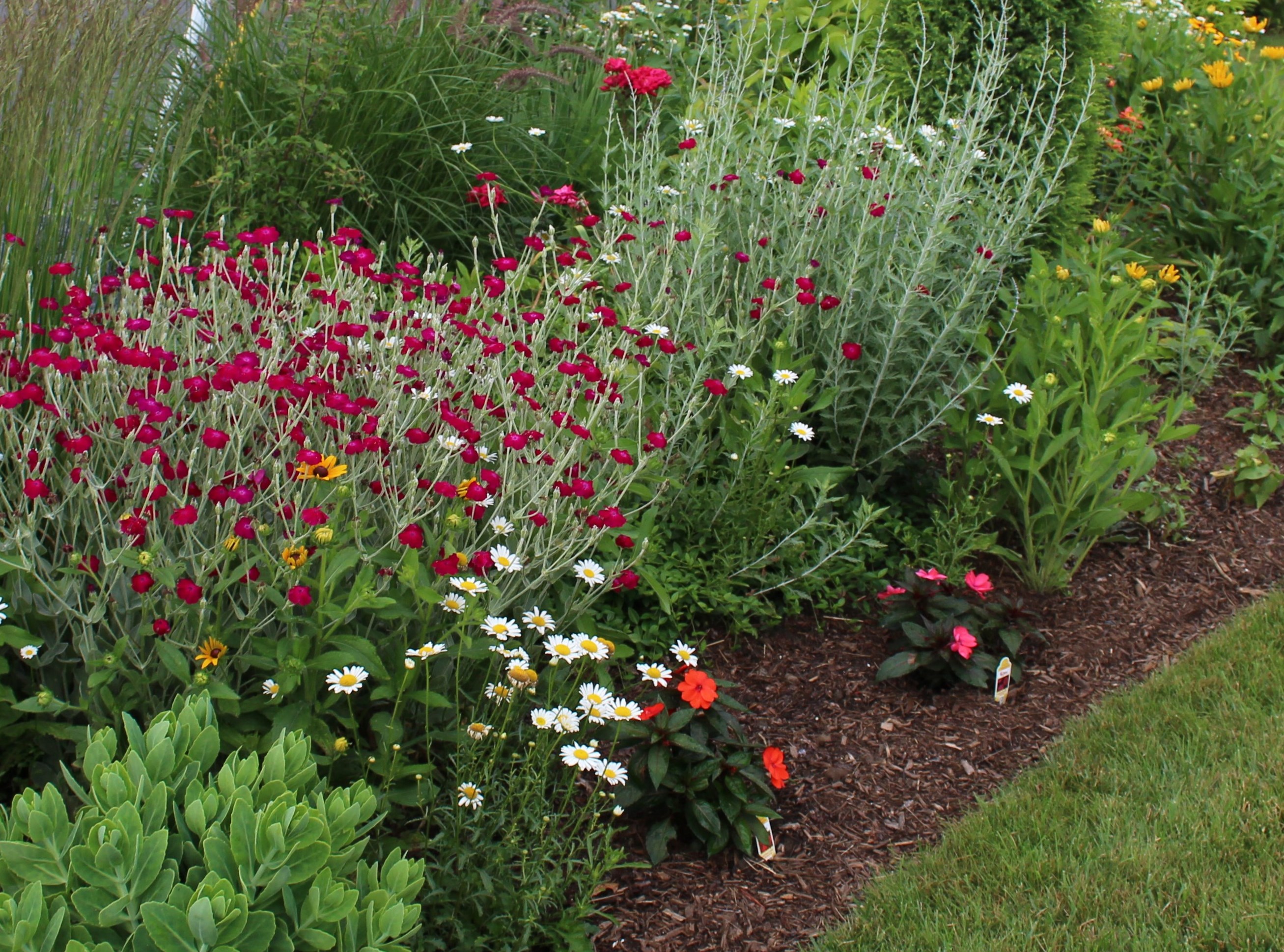
The front street border this morning.  The dark magenta lychnis coronaria and white oxeye daisies are essentially weeds, but if there are just a few I guess it’s socially acceptable.

A plant which spreads out wherever and whenever it wants is my trusty giant reed grass (Arundo Donax ‘variegata’).  I smile and make excuses for it when people comment about its possibly too-large size, but deep down I’m proud of it.  I won’t even bat an eye when it consumes the iris and other plantings around it 🙂

arundo donax variegata

Arundo donax ‘variegata’ overcoming the far end of the street border. 

Another spreader is the ‘Tiger eyes’ sumac which sits in a couple spots around the yard.  For me yellow leaved and chartreuse plants are an addiction and I am constantly in need of reminding of the fine line between a few accents and the way-too-much stage, but the tiger takes care of this on his own.  He (actually a she since this clone of cutleaf sumacs produces the colorful red female seed heads when mature) will pepper your beds with small yellow shoots here and there and I suppose someday take over the world, but for now I just pull the innocent little shoots.

drought tolerant perennials

Pennisetum ‘Karley Rose’ is putting up the first of many fluffy pink seedheads.  They’re always dancing about in the wind and keeping things lively.  Maybe a few clumps closer to the light pole would look nice next to the bright mess of ‘Tiger Eyes’ which surrounds it right now.

For some reason this spring the kids have been coming along on nursery runs.  I suspect they have some hidden agenda which includes a stop at the Dollar Store but regardless I’m going to enjoy their company while it lasts.  Both insist on helping pick their own plants and sometimes even want to plant.

lychnis coronaria

Bright magenta Lychnis coronaria faced down with a few sunpatients.  The girl insisted on putting labels front and center, I couldn’t quite get out the reason for it.  Also I couldn’t talk her out of the magenta-orange combo.  This might have to be replanted once she moves on to other things.

The front borders are looking pretty good right now but there are also a few nice surprises out back amongst the weeds.  One of my favorites is the first blooms on this strawberry foxglove (Digitalis x mertonensis).  It’s been a struggle getting this one to bloom since the harsh winters seem to do a number on the crowns, but this year a few made it, and I finally get to see the strawberry-ish blooms on the relatively short stalks.

digitalis mertonensis strawberry foxglove

A cross-species hybrid of two foxgloves, the strawberry foxglove should be slightly more perennial than the regular type, and hopefully come true from seed as well. 

Another spike out in the garden (I like my spiky bloomers) is this verbascum which hitch-hiked in with a gift plant.  You know a plant (in this case a shrub dogwood) is coming from a good garden when two special plants tag along on the root ball.  This verbascum (maybe V. chaixii?) is blooming nicely now, and follows up some nice scilla blooms which flowered in spring.  It was only the dogwood I wanted, but surprises are always fun as well!

verbascum chaixii

Verbascum blooming amongst the sunflower seedlings which I didn’t have the resolve to rip up….. and yes that’s a huge thistle in front of the fence.  I like them, please don’t judge me.

Some would call the uninvited sunflower seedlings weeds, many would call the verbascum the same, and many more would immediately rip out the thistle, but I have a more laissez faire approach to the less invasive of the volunteers.  I let plenty of things go, but oddly enough this year the beautiful purple campanula glomerata is what I’m ripping out.  I’m trying to reclaim the red border, and it’s the campanula which has made a takeover play.  Enough is enough so a few weeks ago roundup was sprayed and it’s only a few pretty stalks which remain.  I’ll hand pull these and hopefully with a little summertime vigilance will be able to clear this plant out.

campanula glomerata with clematis

Once the campanula was beaten back I realized there are a few really nice plants in this bed.  Clematis ‘Ville de Lyon’ is one of my favorites and it deserves much more than the hardscrabble life of a vine left to struggle along the ground…. but it does look even better with the campanula blooms :/ 

Another borderline weedy area is the meadow.  Last summer’s dry spell weakened the lawn turf so much that it barely had the strength to send up bloom stalks this spring.  That’s a shame since I love the look of the tall grass waving in the wind and enjoy watching the bunnies work their way through each morning filling up on seedheads.  But the lazy gardener needs to take these things in stride (I could have made the effort to water last year) and realize the daisies and butterfly weed show up much better in the more open meadow.
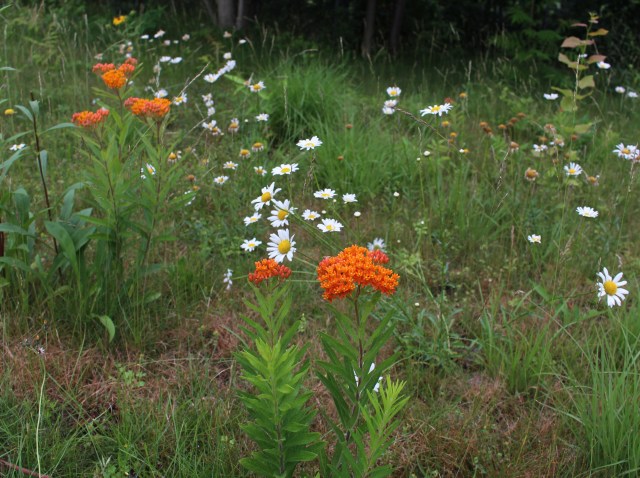
meadow planting asclepias tuberosa

The meadow garden with some particularly drought tolerant butterfly weed (Asclepias tuberosa).  Depending on my mood and the weather this area will be mown down in late summer to neaten things up keep the taller plants from dominating.

The butterflies are enjoying the meadow, but everything else is focused on the linden blooms (Tilia europaea I think).  The tree buzzes with honey and bumble bees, flies, beetles, wasps, and a load of other things which I can’t even identify, and the scent is fantastic and fills the yard with a soft flowery honey aroma.  It’s a decent size tree and I can’t even imagine the number of insects which fill its branches.  If only I could follow the bees home and get a cut of the honey they’re making from all this.

linden blooms tilia basswood

June is when the linden tree is in its glory. 

Another plant which does its own thing without me raising a finger is my trusty hydrangea ‘Annabelle’.  New hydrangeas will come and go, but I can’t think of a reason good enough to cut this one loose.  It can flop, but in the spring it’s cut back completely and between lean living and full sun it holds up well enough.  If I had the room I’d do a mass of these, maybe under a grove of white birches, but here all I have room for is a few scattered along the edge of the yard.  Obviously I love the chartreuse of the opening blooms best of all since the next best thing to chartreuse foliage is a chartreuse bloom!

hydrangea annabelle

Hydrangea ‘Annabelle’.  You can count on this one to bloom every year.

I’ve seen some photos of the newest ‘Annabelle’ siblings and they’re an amazing range or pinks to near reds in addition to the never out of style whites, so I would surely have to add one or two, but I think I’ll always have room for good old ‘Annabelle’.  Speaking of room, it’s still a never ending seed starting and cutting taking rollercoaster here and for some reason I still start more.  Hopefully I’ll be patting myself on the back when these late marigolds and amaranthus come into bloom and everything else is looking a bit tired!

seedlings sown in summer

Still sowing seeds and taking cuttings well into June.  They grow so fast at this time of year, I should have fresh flowers in no time at all!

I better get this posted, it’s been a work in progress since the weekend, not because there’s any amazing content in this post, but because I’m stealing minutes from birthday parties, baseball games, and pool time and would rather sneak in a trip to the nursery than sit at the computer 🙂  But lazy summer days are coming and things should ease up shortly, until then may you enjoy summer as much as I do!

The softer side

It’s not all prickles and barbs here, there are a few fluffy gobs of pink which have found their way into the garden and onto the kitchen table.

sarah bernhardt peony

Peony season is here and in my opinion the best place for them is a vase.

Nearly all the huge blooms end up being cut and brought into the house, they’re so heavy that even with strong stems the flowers end up down in the dirt.  Staking would be an option but cutting is far less work, and often they last longer in the house protected from the weather.

pink double peony

There’s no simple grace in a double peony, it’s all fat opulence and fluff. 

This anonymous peony was purchased as a single pink and it’s not even close, but I love it anyway.  A wild guess would say it’s ‘Sarah Bernhardt’ but the blooms barely have a fragrance and from what I read Sarah should have scent to spare.  No complaints though, fragrant blooms are not welcome in a house full of allergy cursed and fragrance sensitive noses.

peonies in a vase

Possibly ‘Sarah Bernhardt’ peony?

Even though the flowers do nothing for the nose, I love running my hands over the flowers and teasing the flowers open.  It’s a habit my grandmother would always complain about, saying it would ruin the flowers.  She was right of course, but peony season is so short might as well enjoy them, plus burying your nose in a peony is far safer than snuggling up to a thistle 🙂

Catching up with summer

I always admire other gardeners who seem to throw things together and they work out perfectly.  A list, a trip to a store or two,  a few hours of work, and voila!  You’re ready to relax and move on to something more entertaining.  My projects never, never,  ever work out like that.  I start something innocently enough and before you know it a budget is blown, there are walls missing from the house, or you’ve been for a visit to the emergency room.

refinishing a table

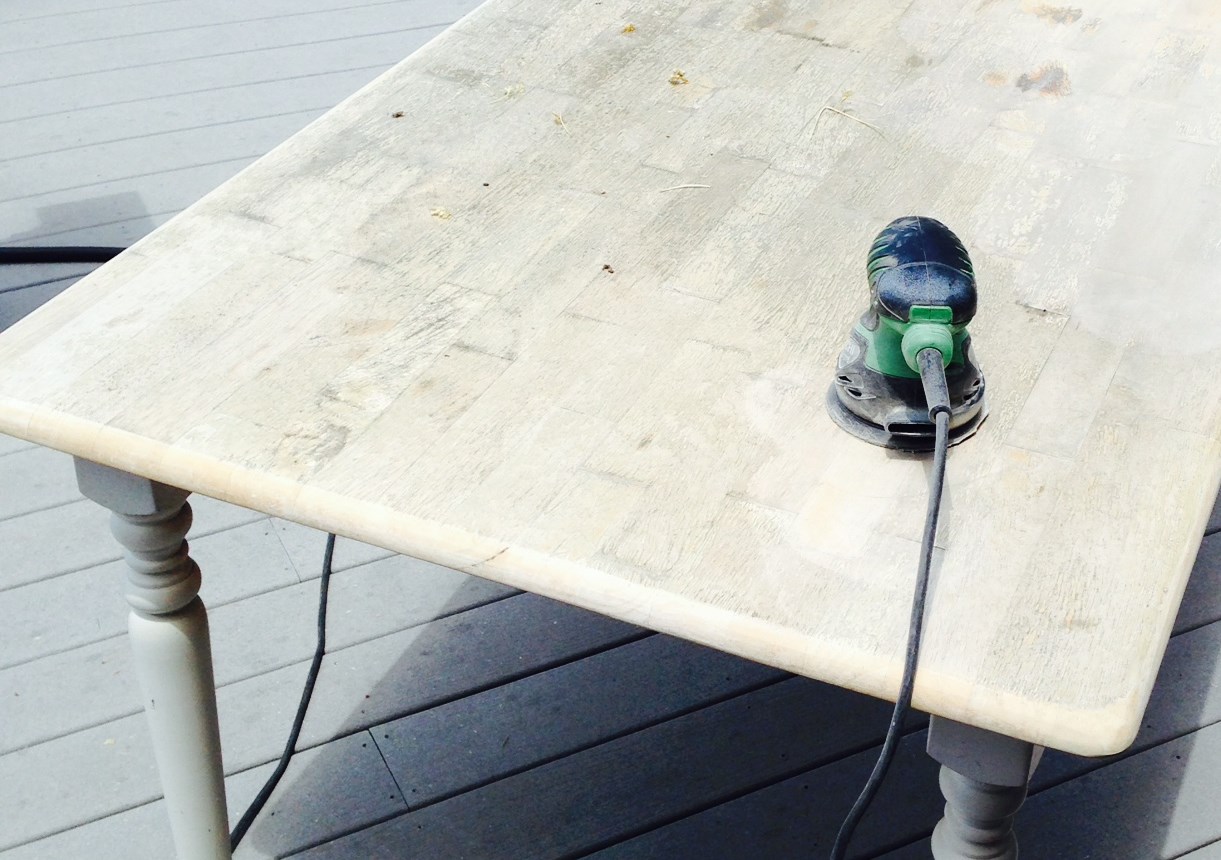
Wax on, wax off. This tabletop has seen better days.

So here’s this year’s deck saga.   You give it a good cleaning, plant up a few pots and warm up the grill for dinner, right?  Not in my lucky world.  As you get ready to pressure wash you notice the kid’s craft table is looking a bit worse for wear and really should be cleaned up before the next waterpaint session.  Out comes the sander and varnish.

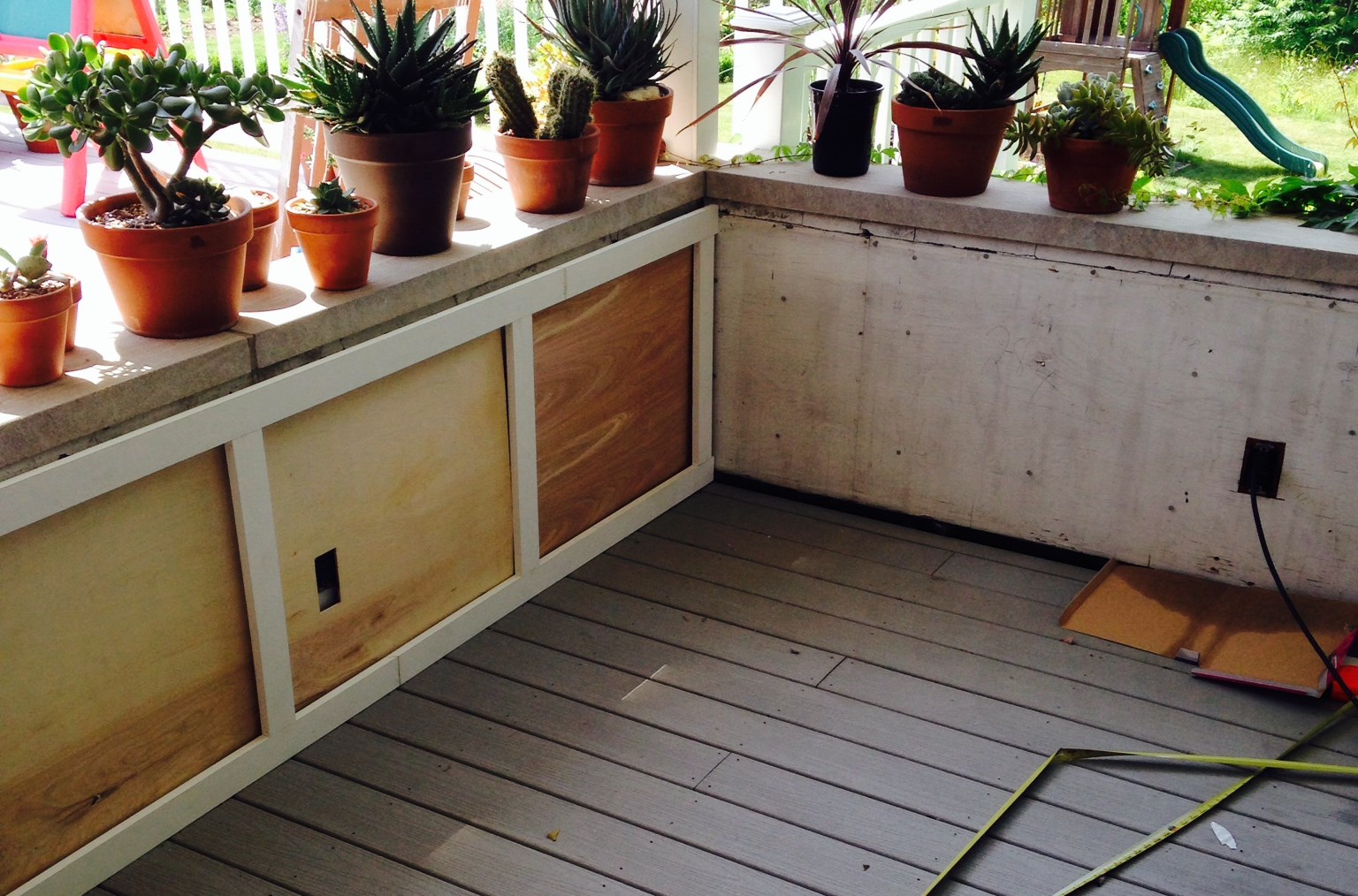
Once the table is all spiffy, the pressure washing commences.  The clean looks great, but it makes you realize how abused and dirty the vinyl siding is under the covered portion of the deck.  So off it comes.  You’ve been wanting to replace it with wood paneling and now that the table is looking nice again…..

wood paneling for a covered porch

The succulents will look so much better when this is done… and the wasp nest is removed from the outlet box… and the rusted broken light fixture replaced….

The woodwork should only take a few days, but then I might as well paint the rocking chairs saved from the dumpster, and I need to plant a few of the annuals so they don’t die waiting for their deck planters.

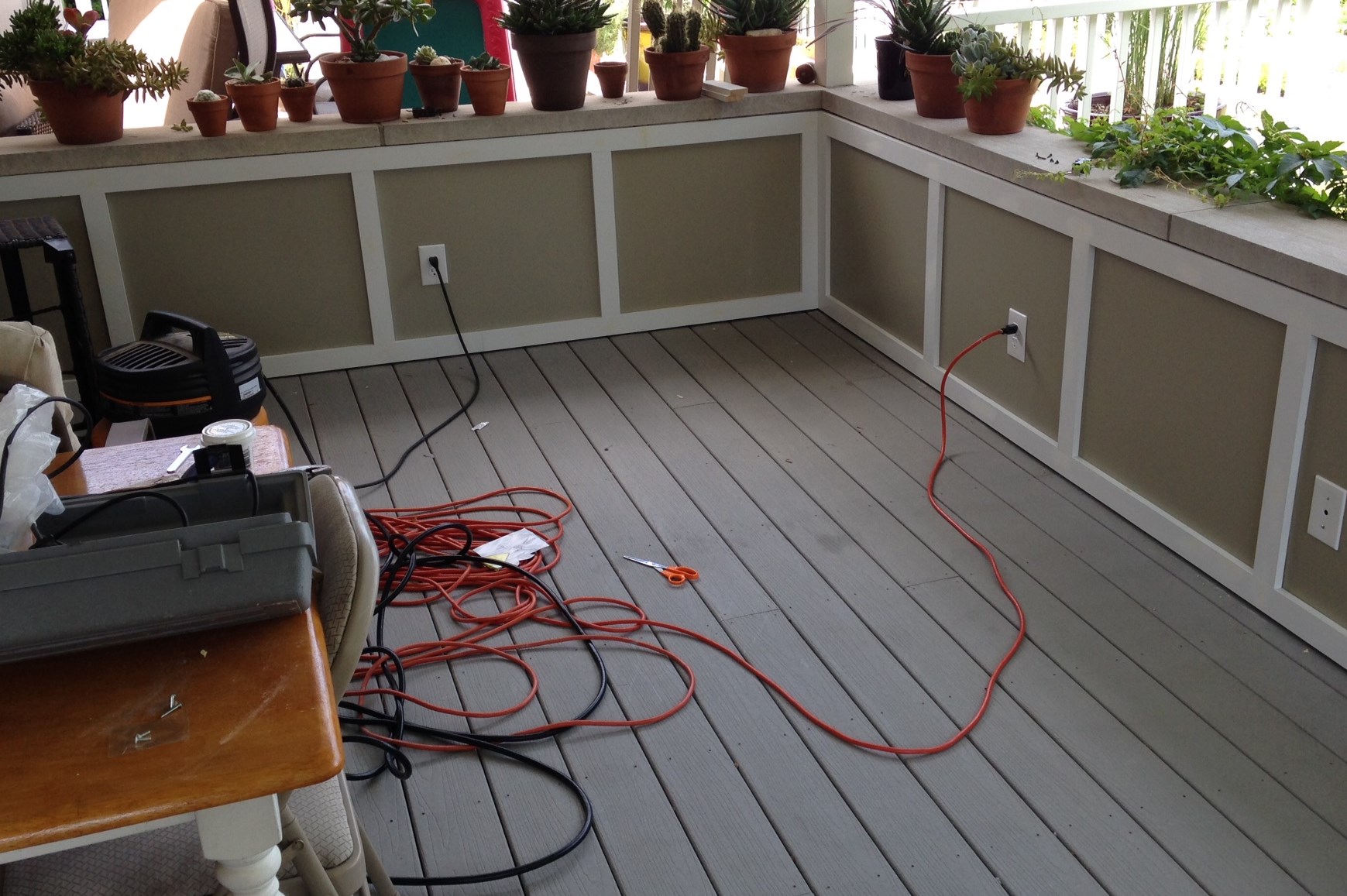
painted porch siding

As long as you’re redoing the siding, a pair of ceiling fans sure would be nice….

calibrachoa seedlings

A pot crowded with calibrachoa seedlings. I’ve never had reseeding with these before so I’m curious to see how they turn out… these are just four spoonfuls of seedlings out of the hundreds that came up!

Not to change the subject (as if I could stay focused long enough to finish something anyway), while the renovation is going on I still need to get the annuals planted in the deck pots.  Of course this is the year everything reseeded.  One pot is full of blue salvia seedlings, another is packed with red snapdragons, and a third has hundreds of baby calibrachoa.  They all need moving off to find new homes.

Once the planters are vacant (mostly) I decide I really need some tall miscanthus in the big planters.  Mine hasn’t quite recovered from the winter, but a quick phone call finds a friend across town who can spare a few wedges out of his clump.  So off for that.

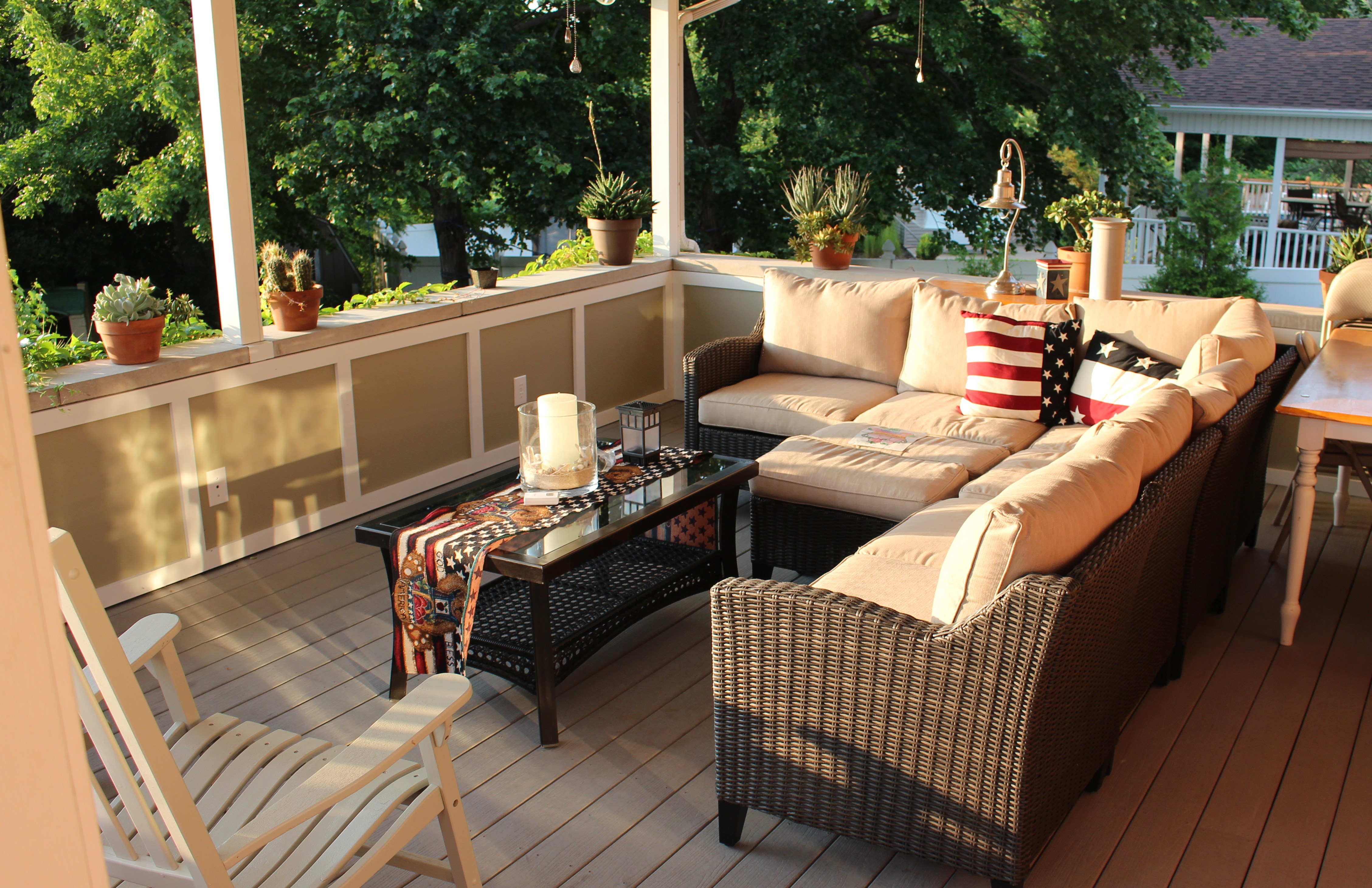
And the weeks go on.  Finally the porch and deck are finished and the new plantings are filling in.

covered porch with new wicker furniture

All set for fireworks viewing on the fourth of July, but all I could think about were the agaves and succulents in need of repotting.

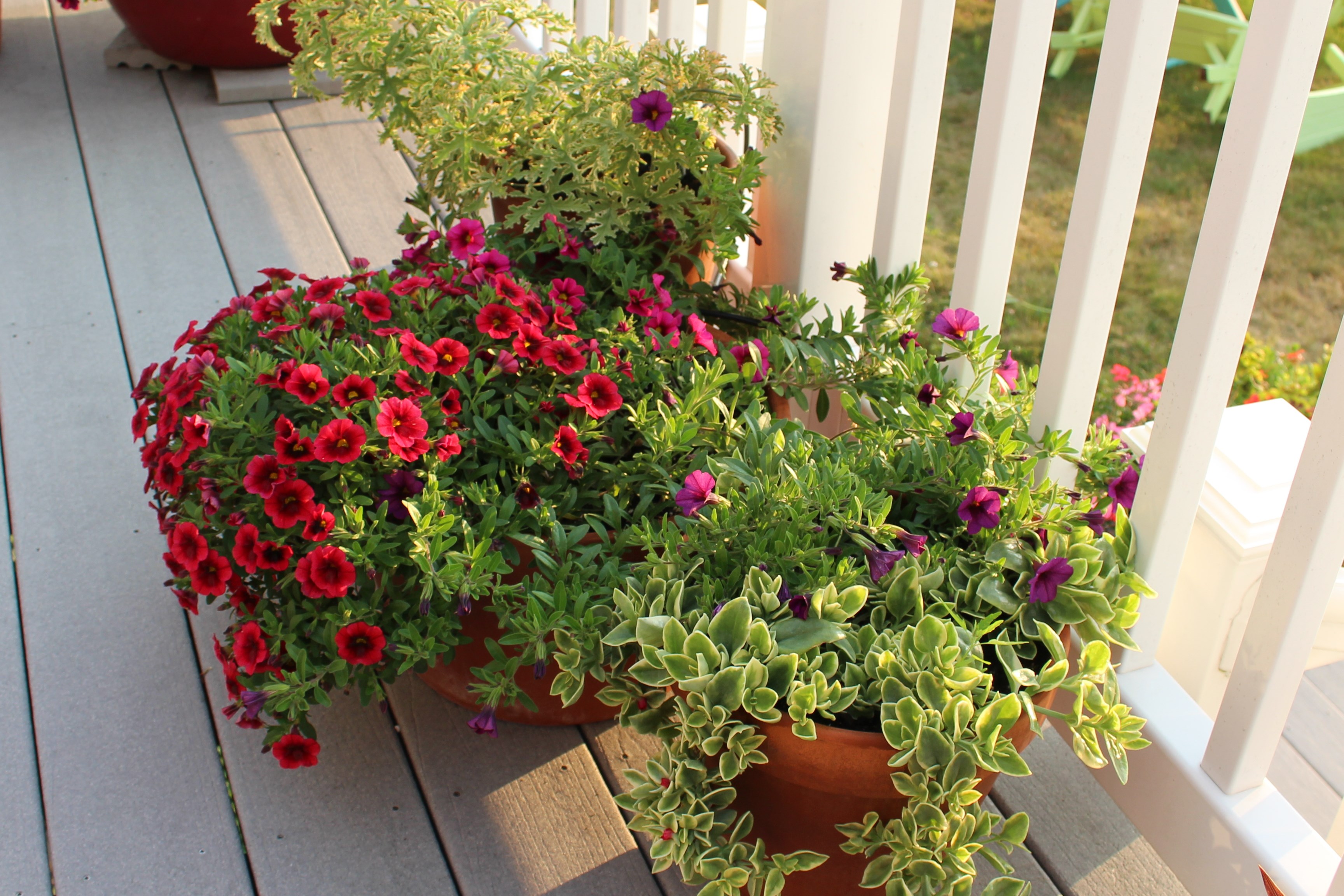
I really like calibrachoa on the deck.  They bloom constantly and don’t get the little inchworms in the blooms like petunias do.  These were all purchased plants, luckily by the time I got to the nursery it was so late in the season they were all marked down!

deck planters

Calibrachoas filling in a few of the deck pots.

This year I plunked down the money for a nice mandevilla.  It’s not my favorite “Alice DuPont”, but after complete failure with Alice last year, it was time for a change, and this one is filling in nicely.  I suspect last year’s vine (purchased from a box store) had been chemically treated to bloom nicely in the pot.  It produced blooms all summer but never grew an inch (which defeated the purpose of growing a vine), and I suspect it’s from the blooming hormone cocktail it received before it got to me.

mandevilla vine on bamboo stakes

Mandevilla growing up bamboo stakes on the deck. White vinyl fencing and construction out back complete the picture 🙂

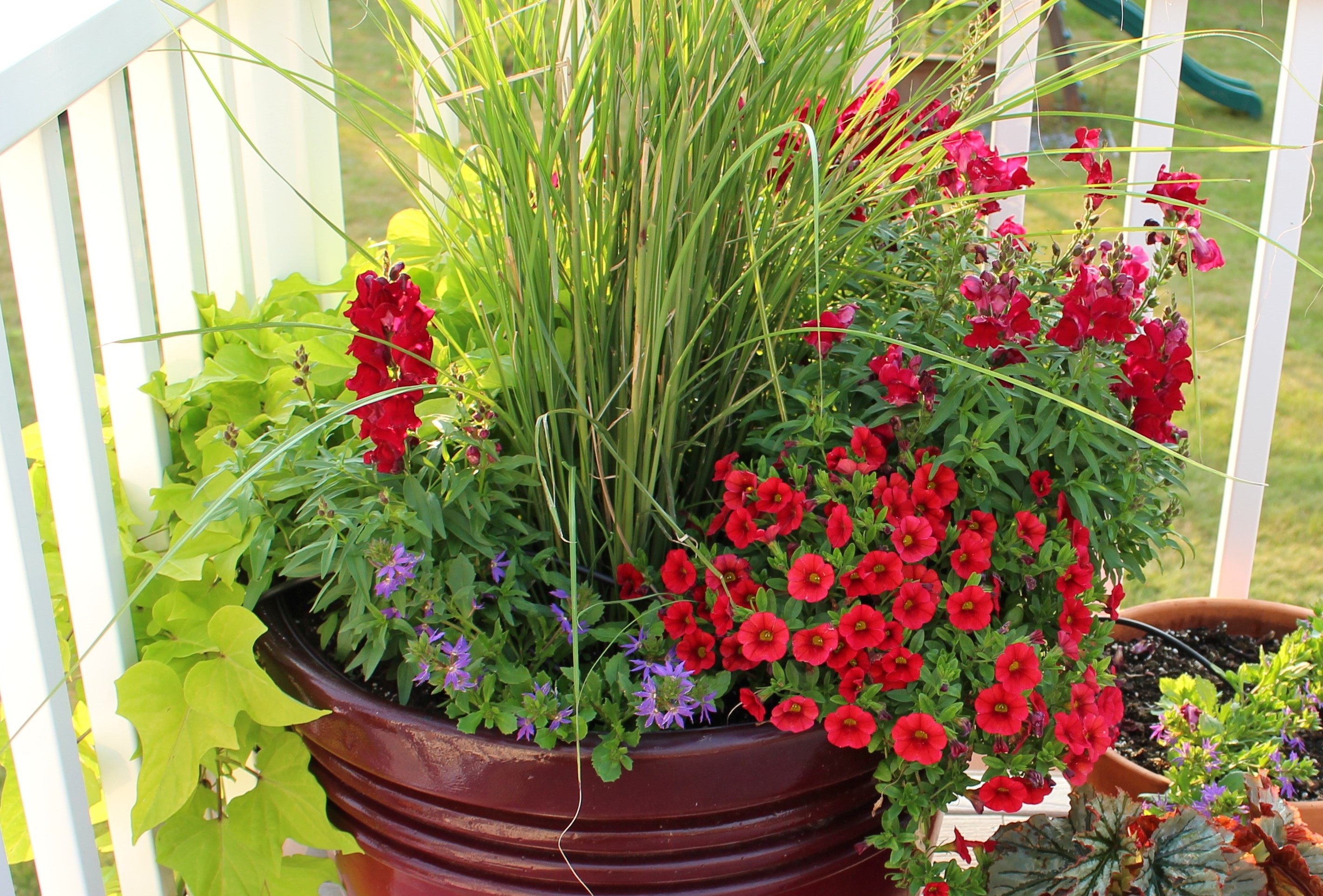
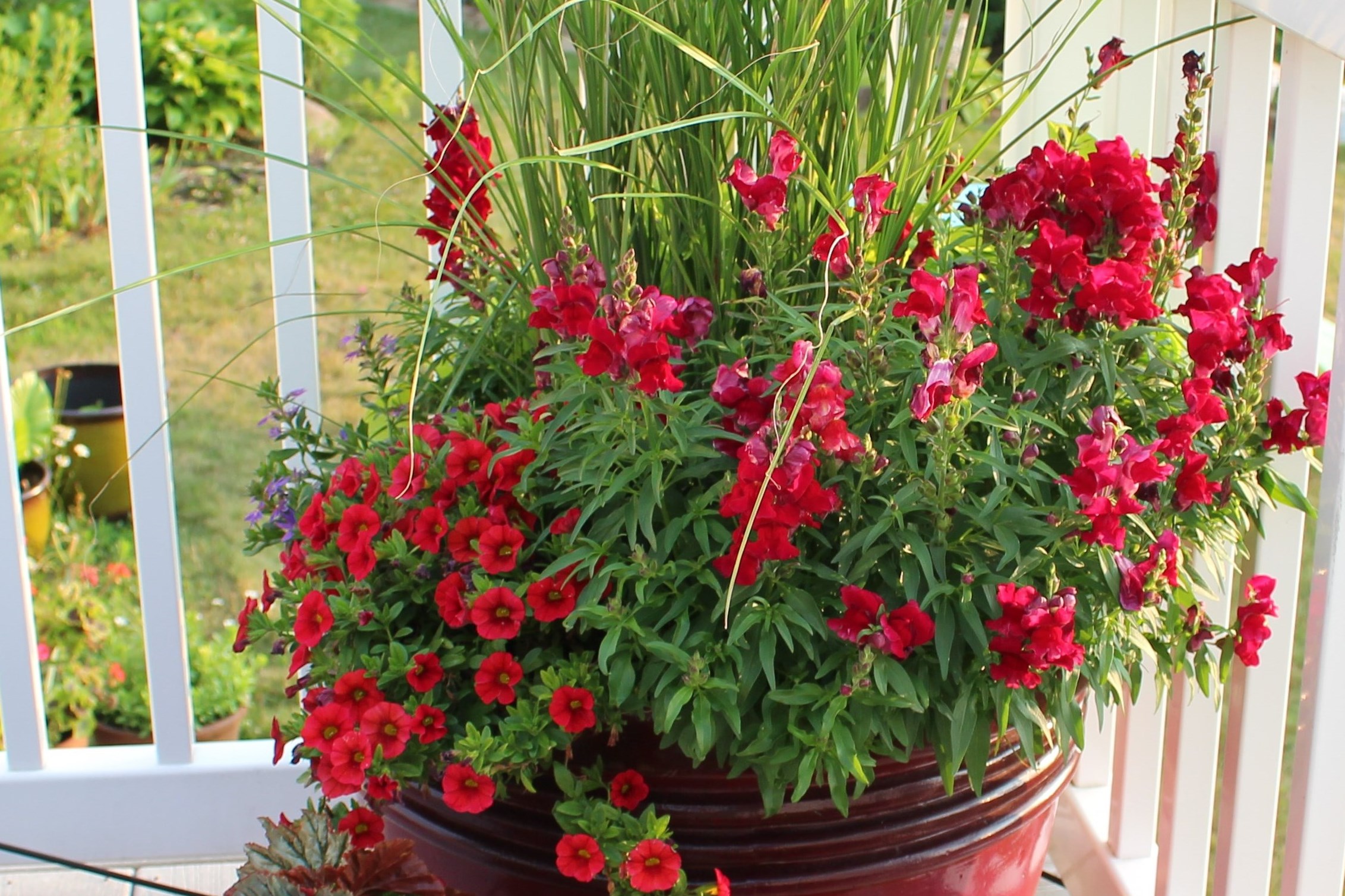
I managed to squeeze a bunch of the miscanthus into this pot, and although temperatures shot up to the 9o’s (32C) two days after its division the grass recovered nicely.  All the red was kind of a surprise though.   The snapdragons came in on their own (and all bloomed in reds) and the calibrachoa really clumped up, and the overall effect is growing on me.  I like it even more with the chartreuse leaves of the sweet potato.

red calibrachoa and snapdragons

Chartreuse sweet potato vine, red calibrachoa, miscanthus grass, and red snapdragons (with a little plug of blue scaveola).

I’m really glad I just left the snapdragon seedlings, they took off once the pots started getting regular water and feedings, and I love the color.   Now snapdragons are showing up in a second pot which was supposed to have just a single miscanthus in it.  I had pulled all the extra snapdragon seedlings out of it, but with determination like that I guess I’ll have to let them stay now.

red snapdragons in a container

Another gratuitous photo of red 🙂

Fortunately the succulent pots are more subdued.  They’re calming things down a bit as well as the other survivor from last summer, the rosemary.

pencil succulent on deck

I’m developing a little bit of a terracotta habit, I blame the cacti and succulents for it.

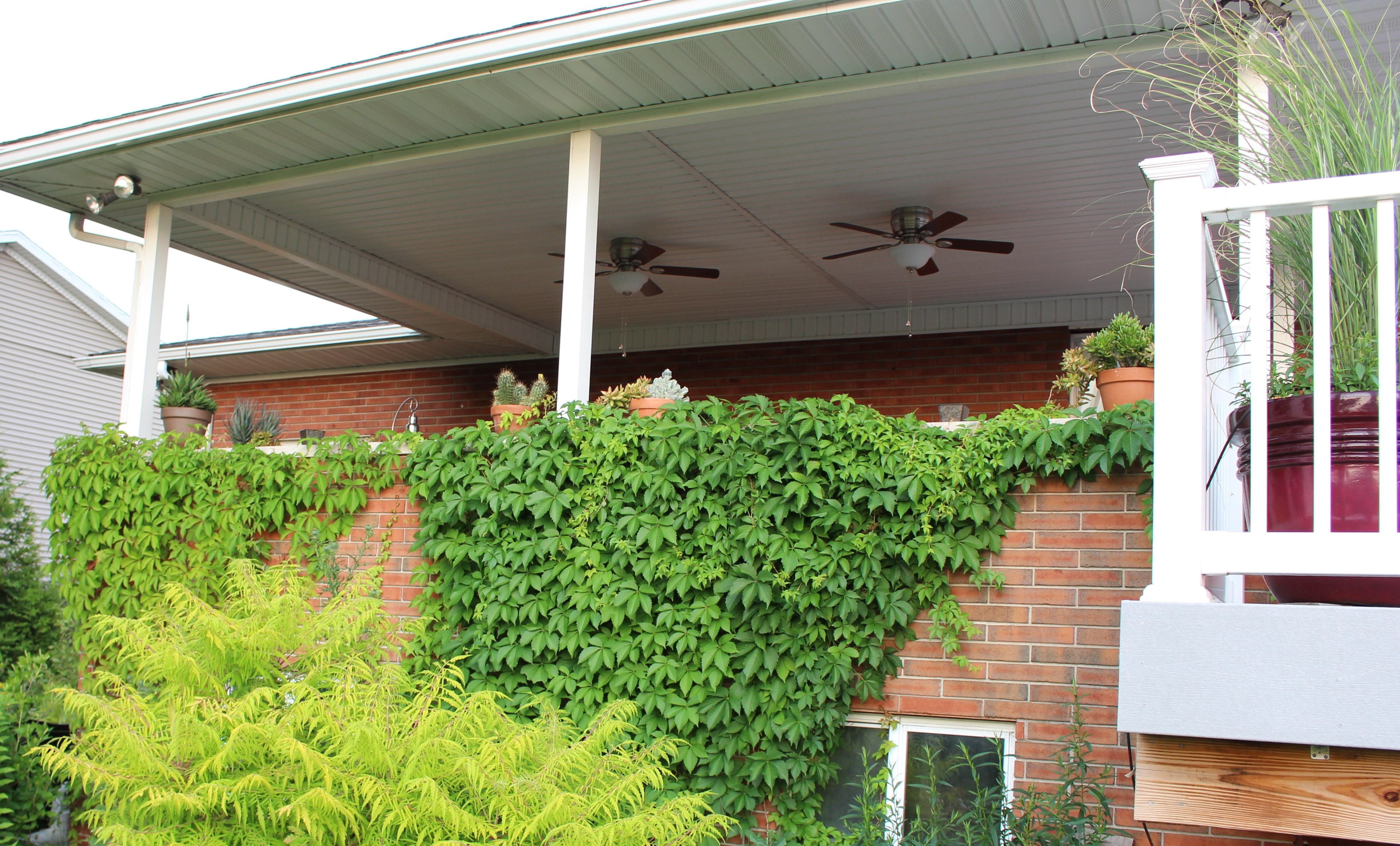
So finally I’m done cleaning the deck.  The covered part has become a nice little retreat made all the more cozy (in my opinion at least) by the Virginia creeper which has brought the garden up to the porch edges.  Maybe next year I’ll work out some kind of trellising system so that the creeper can climb higher and then hang down as a sort of curtain.  I like the idea, but that’s another project!


porch with virginia creper

The view o the porch from the garden. The creeper was never planned, but once it started growing up I welcomed it. With access from both the top and bottom it’s easy to keep an eye on it.

Now I just have to decide what to do with the geraniums.  All the time at the DIY store and I figured I might as well pick up a few new pots….. and then find some dark chocolate paint to tone down the orange…. and then divide up all the overwintered geraniums (and maybe add a new one or two) to fill the pots.  And come to think of it I should probably finish off those steps too, and the deck supports would look a lot nicer wrapped in brick…..

potted geraniums

Why am I collecting geraniums? They overwintered a bit too well from last year and who am I to hold that against them.

I hope your summer projects are coming along at a faster pace than mine do!  With the way they move I tend to think nothing gets finished around here, so as the temperatures rise I might take a break and do a few recaps to see where things are going.
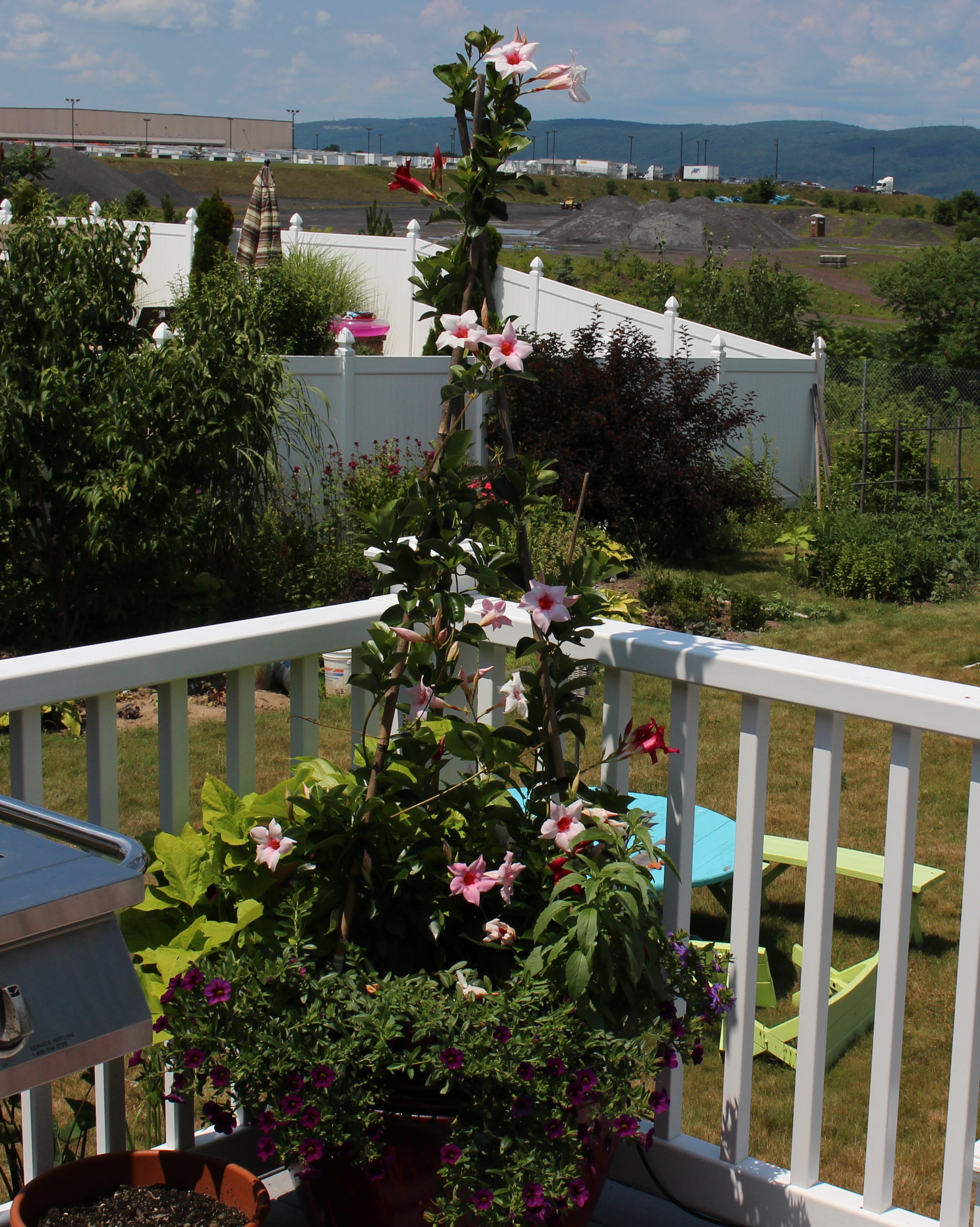
The meadow in June

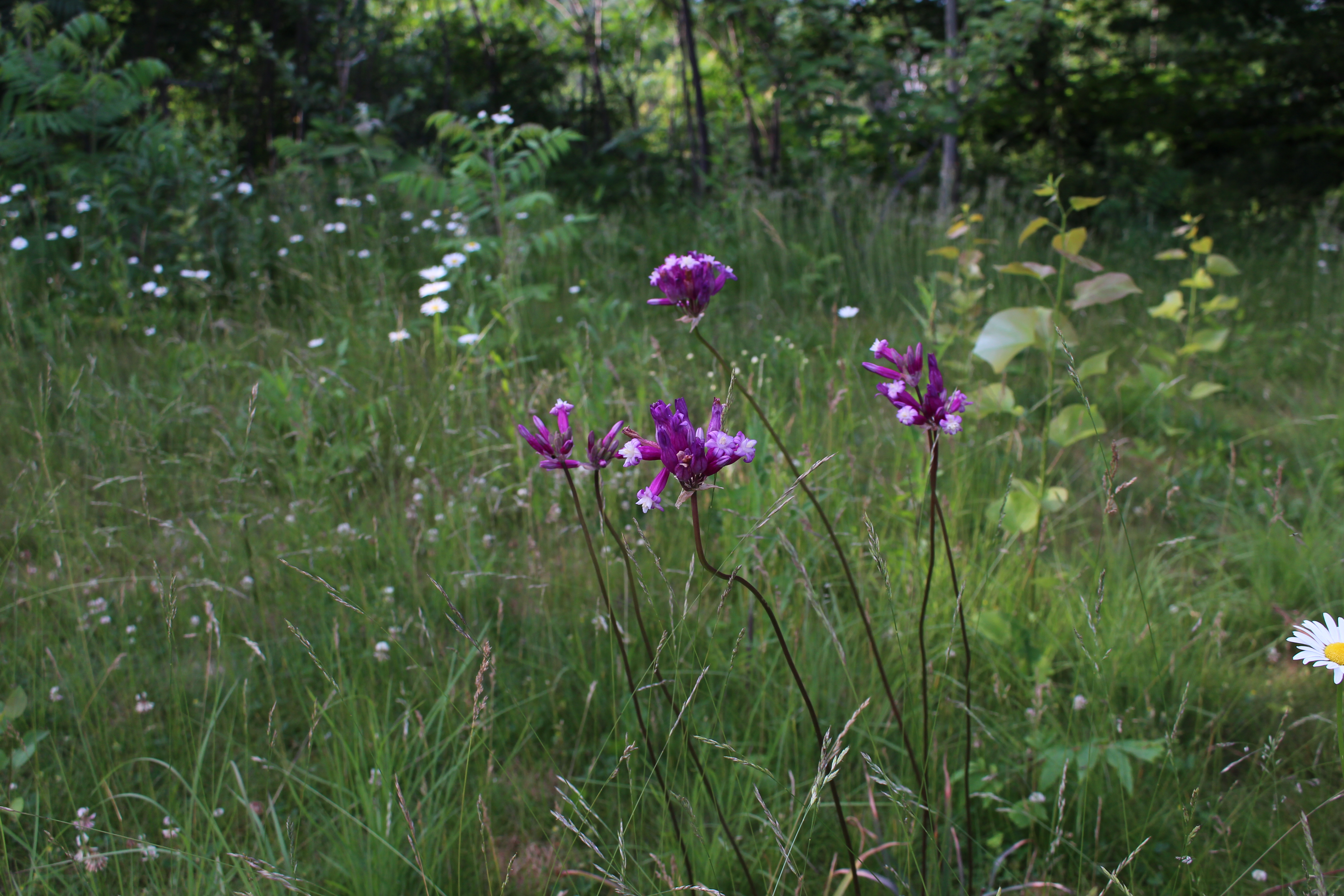
Last summer ended up being awfully dry in my neck of Pennsylvania, and as a result the grass in the meadow (or orchard if the apple tree ever takes off) took quite a beating.  Parts are so stunted this year you can barely tell it’s been uncut since spring.  This kind of defeats my dream of amber waves of grass rising and falling in the breeze, but it works out great for the new summer bulbs I dibbled around into the turf last fall.  I experimented with a few triteleia and dichelostemma, and although I didn’t expect much out of them after the cold and wet winter, they survived and are now showing off nicely amongst the sparse grass.

triteleia ixioides starlight

The thin grass leaves plenty of room for short bulbs such as triteleia ixioides “starlight”.  It’s not a great picture since it doesn’t show any of the soft yellow of this flower, but it’s the best I could manage!
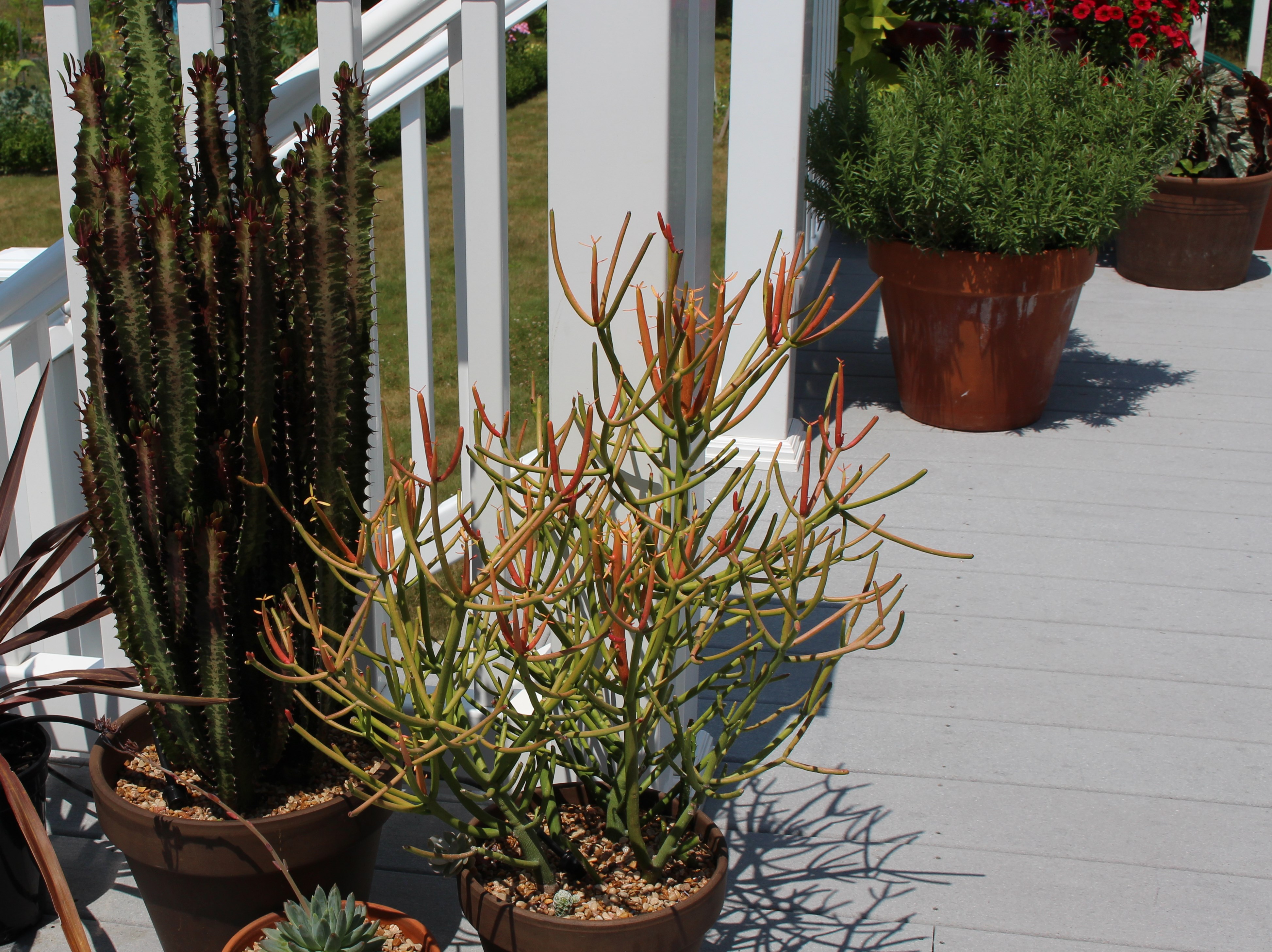
I needed some bulbs which the rabbits wouldn’t decimate (unlike the crocus) and these have worked out well so far.  I have my fingers crossed they’ll return next year, but for now I’m happy with them.  I think my favorite is this dichelostemma ‘pink diamond’ a natural hybrid from somewhere out of the western end of North America, and hopefully a good match for my dry-as-a-bone-in-summer meadow.

dichelostemma pink diamond

Dichelostemma “pink diamond”, the tubular pink blooms look almost waxy and rise up above the grass while the grass covers up its yellowing leaves.

Sumac and aspen are constantly making a bid to take over the meadow, so I need to get in there and snap them off.  Too bad the lazy little bunnies can’t do me a favor and chew these plants down.  It would finally give the blueberries a break.

dichelostemma pink diamond

The bright color of the “pink diamond” blooms really stand out in the meadow.  Good thing too since last year’s drought was also rough on rudbeckia and daisy seedlings.

Dichelostemma congestum was another treat.  It’s got a clear, bright blue color and also stands out well in the grass.  Hopefully this is another bulb that will settle in and call the meadow home.

dichelostemma congestum

Dichelostemma congestum looking nice up against the only patch of decent grass.

If I trust my seed skills I could try collecting a few and nursing them along for more of these little bulbs, but honestly I think they’re better off falling to the ground and fending for themselves.

dichelostemma congestum

If the butterfly weed was just a little quicker I could have a nice mix of bright orange to go with the daisies and dichelostemma. Summer’s the time for bright combos, right?

So that’s it for the meadow in June.  The butterfly weed is coming along and should make for a colorful intro into July and I’m glad to have a few interesting things back there.  Sure beats the half dead lawn I used to waste my time cutting each week!

Innocent until proven guilty

Last week the usual garden inspection turned up a massacre in the broccoli patch.  My luck had run out and the rabbits had finally found the tender lettuce and cole crops… just when they were finally settling in.  All the tender lush growth from the cool, damp weather has been nipped back, and I’m left with these leafless stalks.

deer damage on broccoli

The day before yesterday would have been the perfect time to fence off the vegetable garden….

What a setback!  Of course it’s my own fault since even with the local stray cats, rabbits are still in and out of the garden, but I like to think the bunnies won’t take advantage of me and a nibble here and there is no big deal….. so I didn’t bother with a fence.  That of course changed, and the fence is up again.

fence for vegetables

A little chicken wire to keep the bunnies out. Rabbits around here tend to be lazy, so a weak fence or even a few brushy twigs will keep them off my delicious ‘Matina Sweet’ lettuce.

Something was different though.  The onslaught of damage was pretty severe for a stray rabbit finding a tender bit of broccoli, and the lettuce and cauliflower were also sampled.  That’s a lot of nibbling for one or two rabbits on one or two nights.  I began to wonder if a groundhog had returned….. a little plant leveling, bulldozing, little garden pig, who eats everything in sight…. but no, the damage wasn’t that bad.

I found my answer the next morning.  Two young bucks were on the other side of the fence plotting their return.  I knew they were around -three weeks ago a doe bounded over the fence while the kids and I were playing back there- but now I know they’re moving in.  Deer are something I don’t want.  Where are all the hunters when you need them?

deer and the vegetable garden

Barbarians at the gate

Figures they would go straight for the broccoli and lettuce, they’re two of the only vegetables I actually eat.  Why couldn’t they start with the chard?

bright lights swiss chard

Rumor has it vegetables make for healthy eating. I like to think of these unpicked and uneaten ‘bright lights’ swiss chard as being good food for the soul.

We’re not exactly country around here, but we do have our share of wildlife drama.  Snakes and toads come and go, bugs abound, and all kinds of birds stop by to eat and drink and sometimes set up house.  I finally found the tiny field sparrow nest (or at least I think that’s what they are) in the small blue spruce by the sandbox.  Two chicks have hatched and it amuses me that they spring to life begging for food the second I tap the nest.

field sparrow nest

I’m not a good nest finder, and the only reason I found this one (after three tries -and the spruce is barely three feet around!) is that I noticed a female cowbird staking out the bush.  Cowbirds will sneak in and remove an egg from an unguarded nest and replace it with one of their own, and this is what they did here.  When I found the nest there were two white speckled eggs alongside the three blue speckled.  I may or may not have removed the cowbird eggs.

cowbird egg

Cowbirds are a native species and as such are protected under the Migratory Bird Act, so tampering with their eggs would be illegal…. but I also may at times roll through stop signs and push the speed limit, so I’m not sure where this puts me on the spectrum of criminal activity.  All I’ll add is that cowbird chicks will usually outgrow their nestmates and end up displacing them, so I’m glad these parents won’t be stuffing food into a chick which grows to be twice their size.

Another thing which borders on illegal is the number of weeds and out of control plantings in this wanna-be iris border.  It’s almost criminal how the campanula took over and the daisies moved in…. not to mention the clover.

iris with campanula and daisies

Still on the to-do list is the iris bed. I think it needs a complete overhaul to get rid of the beautiful purple campanula glomerata which has taken over. The only legitimate planting here is the yellow variegated iris which is still just barely hanging on.

The iris bed is just one of many yet-to-be-done projects.  I’m still getting the last of the seedling out from under the glow lights in the garage, and the overwintered geraniums are still sitting outside the garage, making quite the colorful accent on the driveway 🙂

overwintered geraniums and vegetable seedlings

All in due time they say, but I suspect due time might have passed along with the summer solstice.  Instead of humming along, the garden is still taking form.  Someday I hope to have things together but I suspect I just might not be that kind of gardener.  It would help if a simple planting up of the deck pots didn’t turn into a table refinishing, light fixture replacing, porch chair repainting, trim rebuilding… .kind of project, but such is life!

Enjoy the first days of summer 🙂

Early July update

I would have thought that by now my latest project would be complete.  I’m in the process of widening the flower bed that runs along the street, and even though it’s been humid, hot and rainy I still won’t admit it might have been a better idea to wait until fall.  So I’ll try to distract everyone from that thought with some pictures.

The phlox are here!  This picture is a week old, but it’s one of my newest colors so of course I’m excited about it.  The full name is phlox paniculata “Nicky” and it’s dark dark dark.  I had to prop it up a bit, but since this is year one I’m willing to give it another growing season before calling it a flopper.garden phlox paniculata

You’ll see more phlox soon since they’re a favorite, but first here’s an underrated summer bloomer, hosta “blue cadet”.  I only have a few hostas, but I’d rate this one highly.  It’s old but always respectable and easy in sun or shade.  I like it here under the porch plantings and it does a good job of shading all the spring bulbs and hiding their dying foliage.  Note the edge on that lawn!  You don’t see that too often in my yard.hosta blue cadet In the backyard the addition of bird netting has saved some blueberries for the slower berry lovers.  This morning’s pickings were enough for a whole blueberry pancake!  Who knows, maybe in another year or two we’ll be able to put together a couple muffins.blueberry net

I guess I can put in a couple front border pictures.  Here’s the newly dug section.  The cannas are sprouting in the heat and the sedum doesn’t seem to care about being moved and divided on a 92F afternoon.new flower bedI made it almost to the halfway point.  The grass is getting turned under and I’m putting in whatever annuals are still homeless.  A few perennials are moving around too but it’s mostly iris clumps getting ripped out and divided and sedums finding a new spot.new flower bedAt the rate I’m moving I should get to this end around Sept. 25th.  Then I’ll probably want to spread mulch over it all…. and weed first since by then I’m sure they will be all over.  Oh well, maybe someday I’ll get my act together.new flower bed

Projects are always fun but the zucchini are blooming and that can mean only one thing.  All work will stop as we try and get rid of the extras.  I always plant four hills and I always end up with about four times what I need.  Who would ever trust that the little seeds I put in the ground would ever amount to anything?  But they do and now I’ll pay the price.   For this one hill I can count at least four and they’ll be ready in another day or two…. so get the recipes ready.zucchini blossom

Paper wasps!

We were off on holiday weekend visits for three days but to look at things outside you would think we’ve been gone a week!  It was hot, there were seedling casualties, but most stuff survived and the heat made a couple things explode into growth.

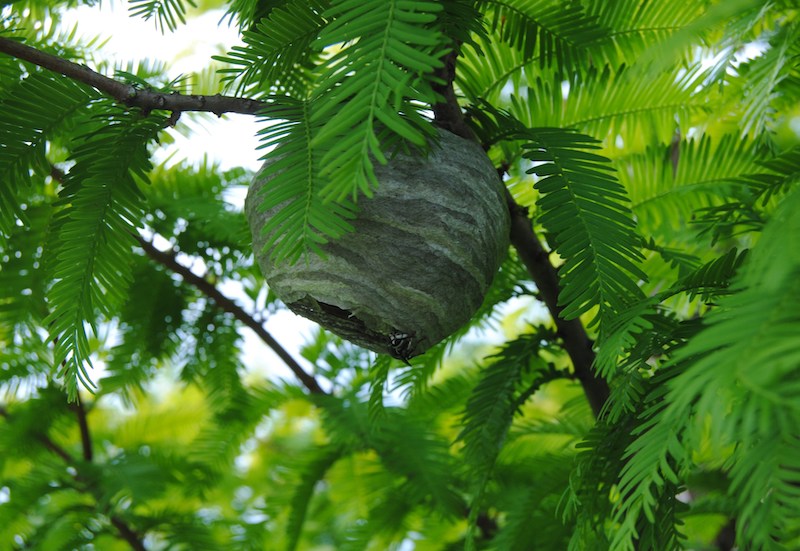
One thing that is growing is the paper wasp nest we found in the little dawn redwood. bald face paper waspI’d rather it wasn’t so close to the sandbox but the kids want it to stay and I’m willing to see how that works out.  The kids are old enough to know better than to antagonize them, but I’m not so sure how that will hold up when the boys get together and hit an “I’m bored” moment….. Obviously I wouldn’t be doing this if there were any known sting allergies around.

The nest is only about four feet up, and I’m curious as to how these guys chose their nest site.  Out of all the bushes and trees around the yard they pick this one.  The one closest to the play area.  Go figure.  But it is interesting to watch them working on the nest, doing what paper wasps do.bald face paper wasp

This can easily turn out to be one of those “that was stupid” posts…. time will tell.  Hopefully in the fall when this set of wasps die and they abandon the nest (they only use it one year) the next generation will pick a better spot.   In the meantime I hope they help themselves to as many caterpillars, bugs and spiders as they want, they can be a great beneficial insect, and I hope they’ll keep my kindness in mind when I absentmindedly bump the nest while mowing back there…. that should be funny to watch.