A Week of Flowers

Thanks to Cathy over at Words and Herbs for giving me the kick in the pants I needed to get a post up on this blog!  Actually there was no kick involved, not even a frowny face or mildly judgmental word from Cathy, just the thought of missing this year’s week of flowers was enough to motivate me off the sofa.  Cathy’s week of flowers is such a cheery reminder of the warmth and color of the growing season it was just what I needed to reset from the gray and cold which has become the norm.  Decorating for the holidays was fine and accomplished on schedule, but when I found myself moping around, cleaning a closet and eyeing the garage, I knew things were getting tricky.

So forget Monday through Saturday and let me start and end this week of flowers on the last day of the week with the first flowers of the year.  I’m sure many of you would guess we would start with snowdrops 😉

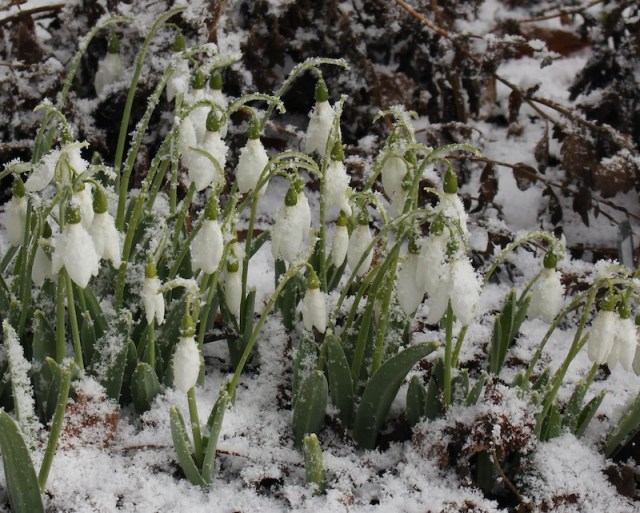
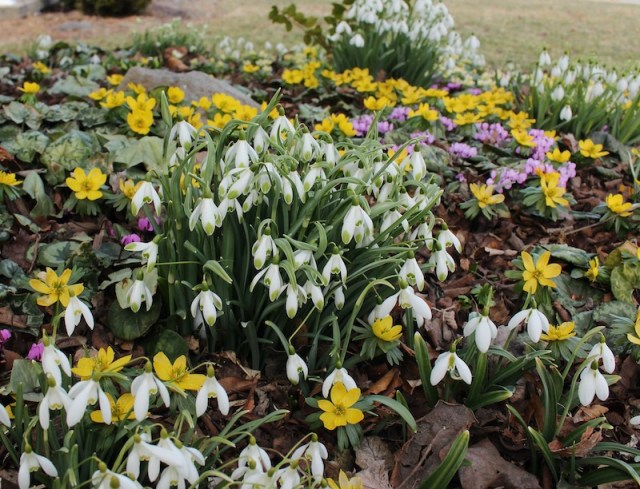
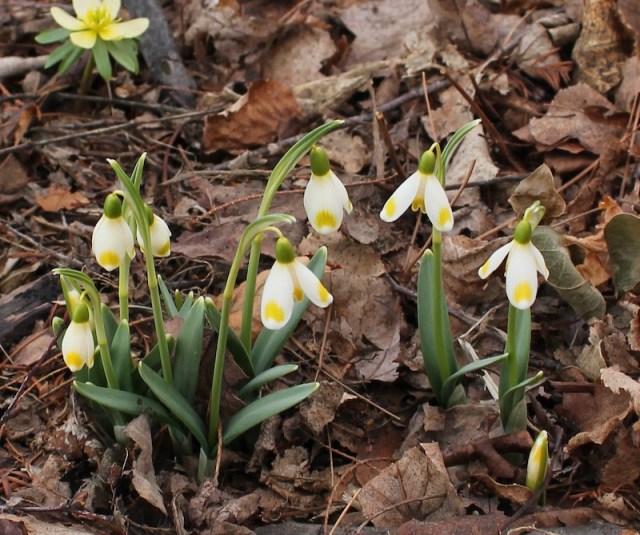
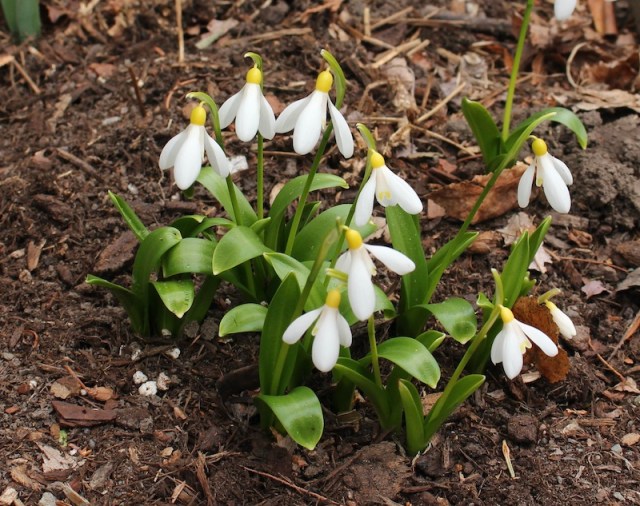
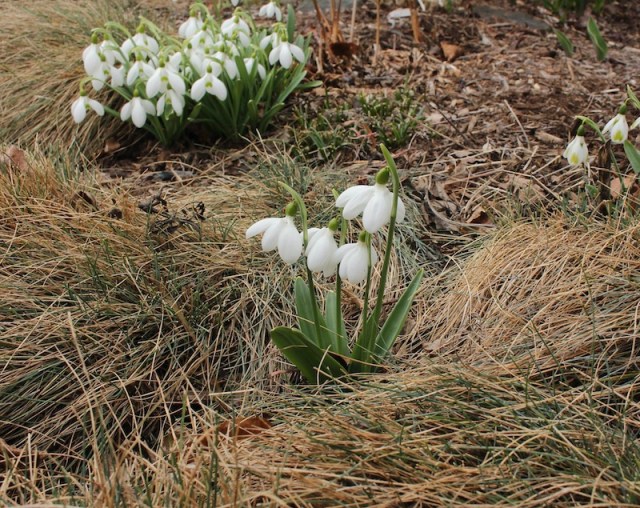
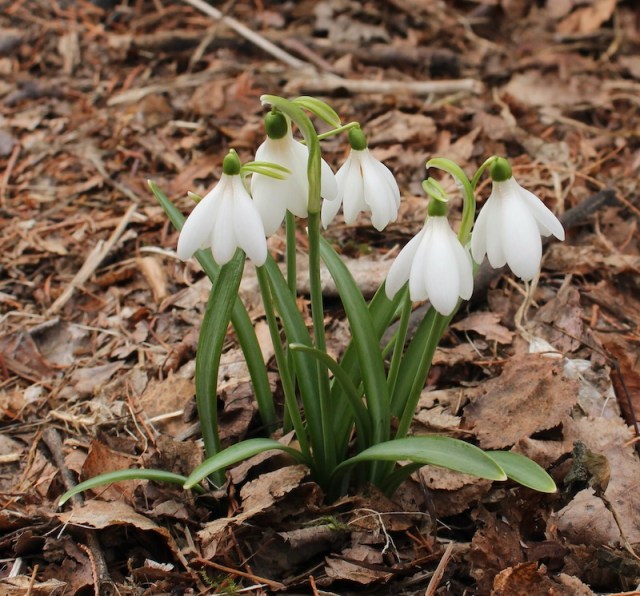
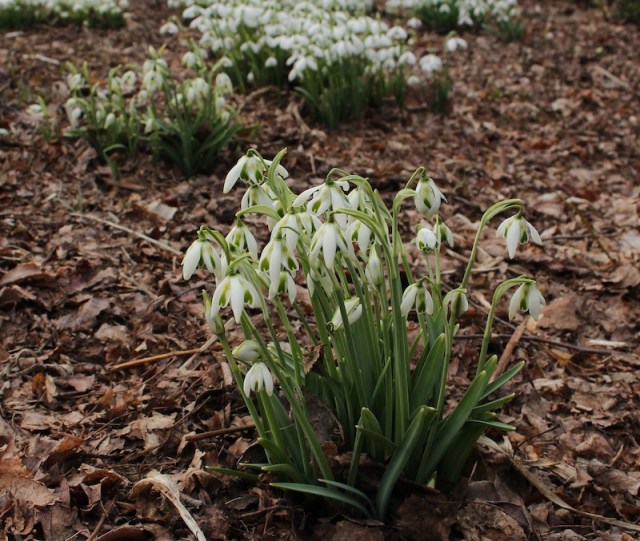
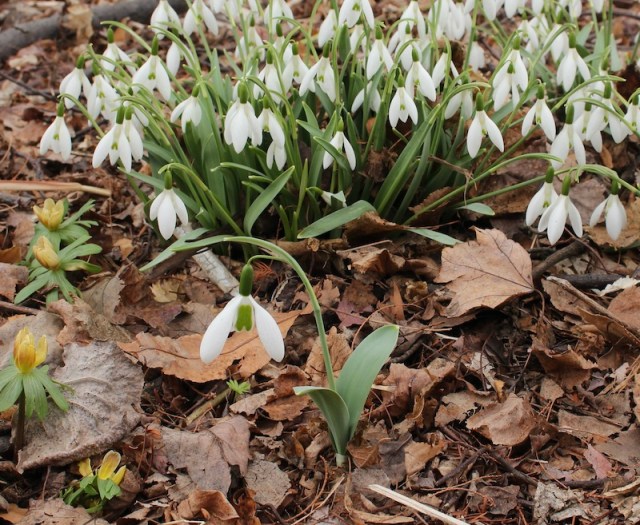
March still seems a world away but every single thaw between now and then will have me thinking of snowdrops. Here they are basking in the first warm sunshine of the new garden year.

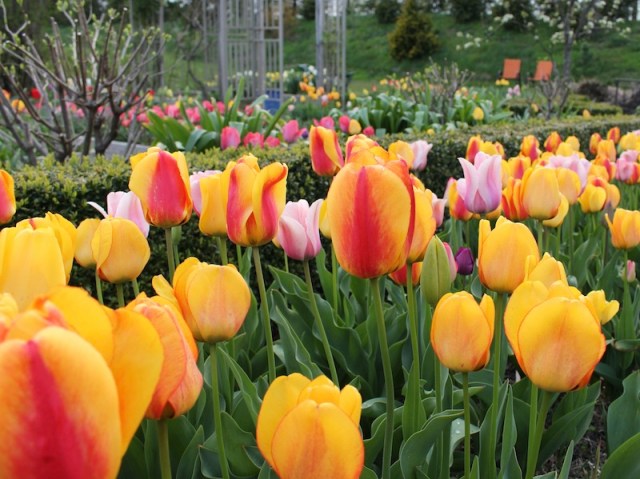
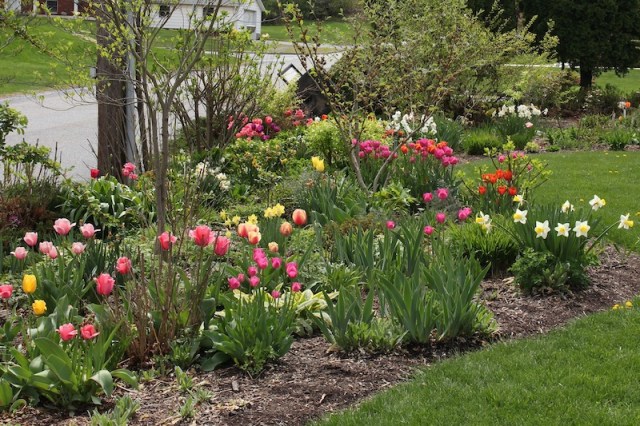
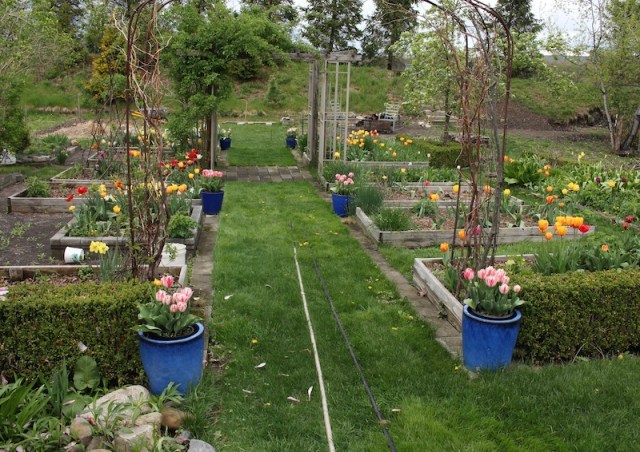
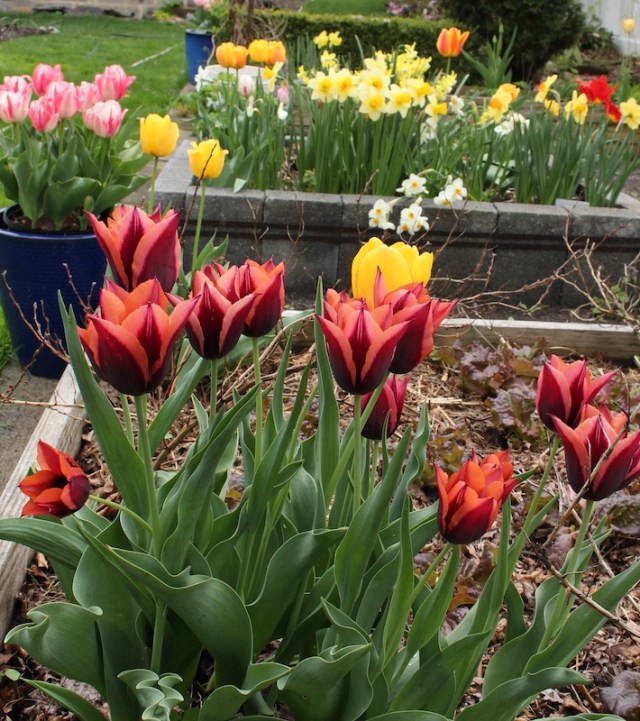
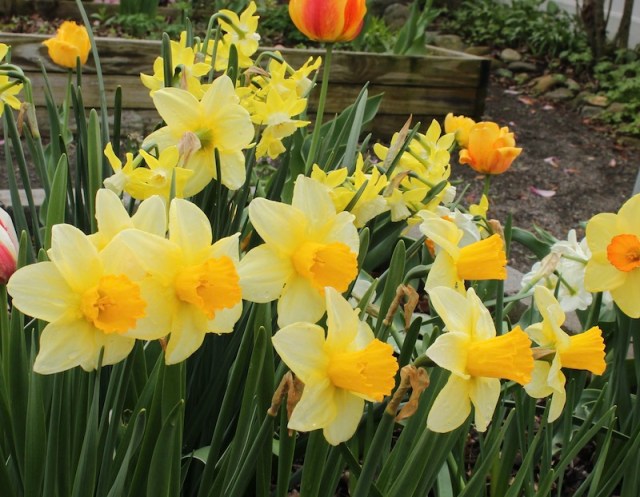
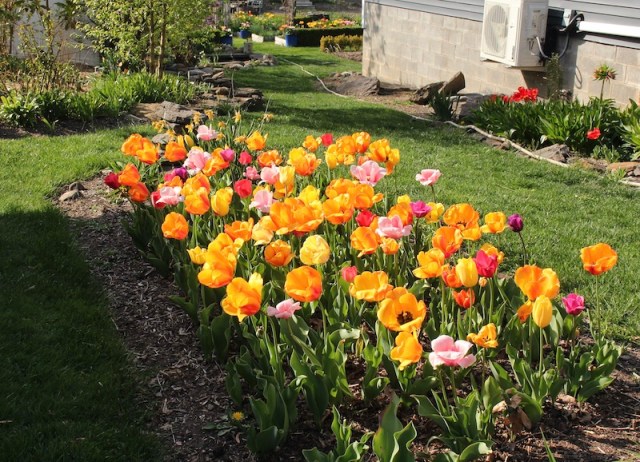
Once the first flowers arrive they’re followed by wave after wave of color.  A wave which I always look forward to is the flush of tulips and daffodils which fill April and run over into May.  This photo is from 2024 and I almost regret not digging and replanting all these beds again last year… well I do regret it but I don’t miss the work, and I also don’t miss the disease worries about tulip fire ruining the flowers here…  the new plantings out front and in more open locations have been fire-free so far.

tulip garden

Tulips filling the potager beds.  Many are still there, but not the masses of years past.

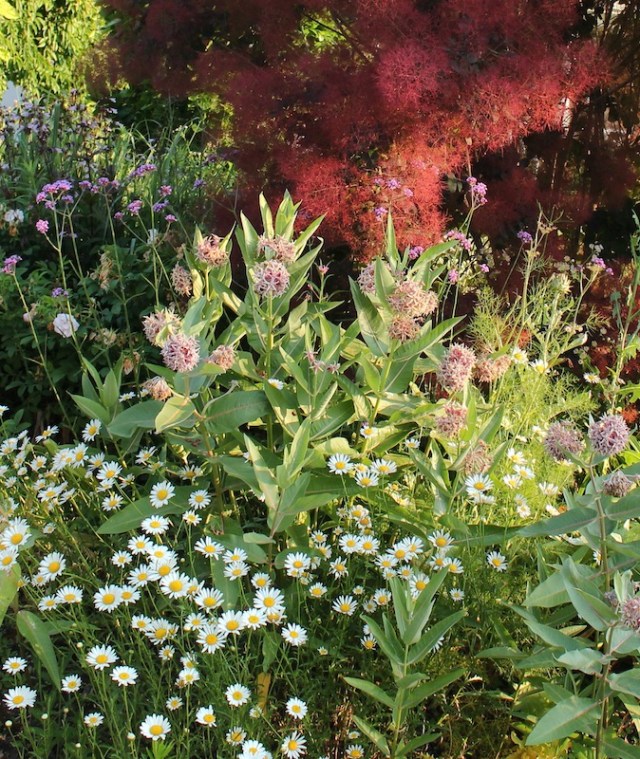
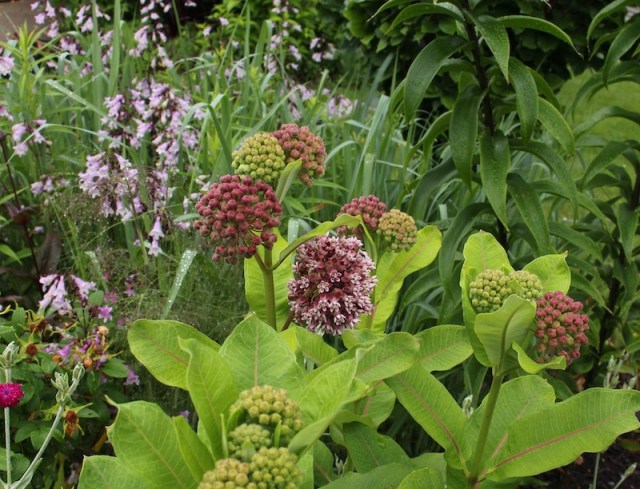
The waves of spring flowers end with an avalanche of early summer blooms.  Iris, clematis, peonies, roses, all the most amazing flowers of the year arrive in June and it would be nice to show them but perhaps I’ll show a weed instead.  Milkweed.  Not quite the same as a pergola smothered in roses, but I like them just as well and it’s something a little different.

An early summer border filled with milkweed and other colorful weeds, backed with the purple smoke of cotinus 'Royal Purple'.

An early summer border filled with milkweed and other colorful weeds, backed with the purple smoke of cotinus ‘Royal Purple’.

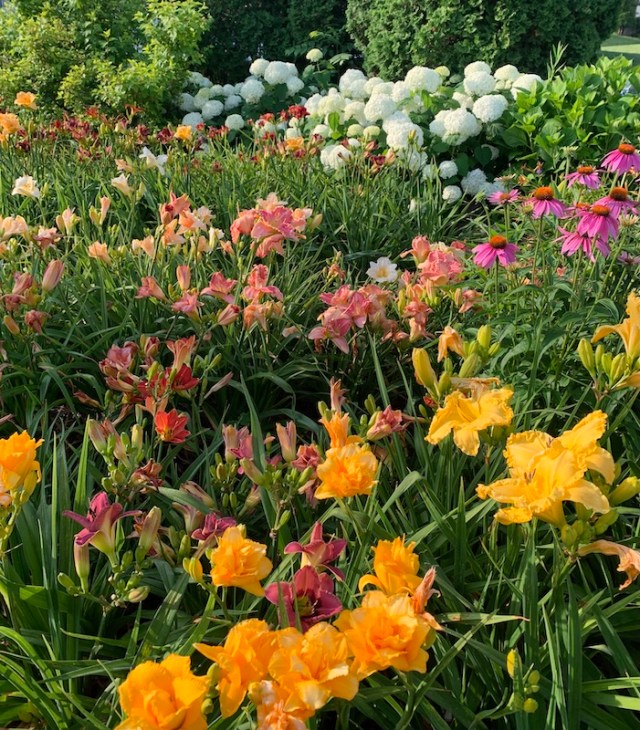
If you’re counting, this fourth photo in a week of flowers should coincide with Thursday already, and we are into July.  I’ve selected daylilies of course and these take me through some of the hottest days of summer, each day offering a fresh new bloom even as the gardener begins to fade in the heat.  Some people are not daylily-people and for years I tried to resist but once again I’ve fallen off the wagon and am collecting and growing far more than I should.

daylily garden

The daylily farm.  Color galore just days before the backhoe arrived.  

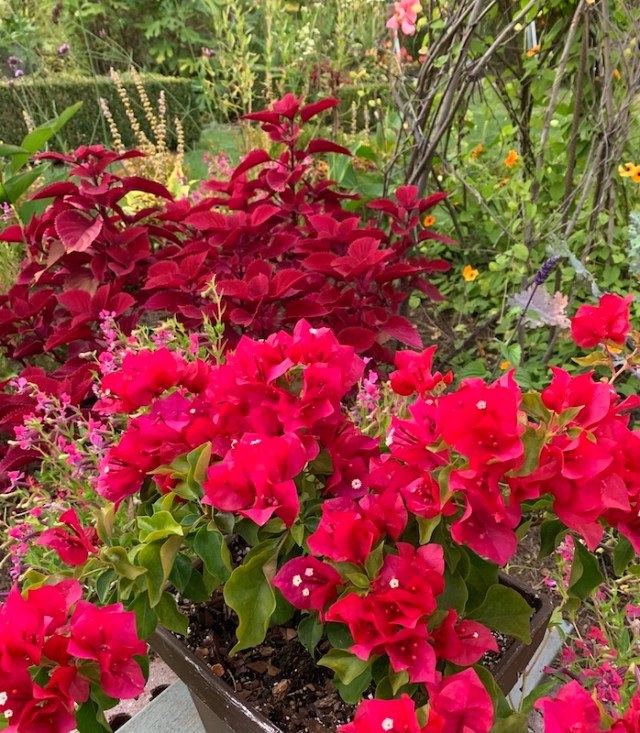
Perhaps you recall what happened to the daylily farm this past summer.  If not it involved a backhoe and sewer lines and a whole new garden to replant after the old garden was destroyed.  If the garden year were still just a week I’d say Friday, Saturday and Sunday were all spent repairing but that would just not be true.  Any small project can turn into an excuse to replant everything so I’ll say Friday is summer annuals.  They started strong with a relentlessly wet spring but then the clouds cleared and the sun and heat did their work.

potted bougainvillea

Coleus are always reliable annual color, but this year the bougainvillea also put on quite a bold show.  Don’t ask me what the secret is, all I know is it was appreciated!

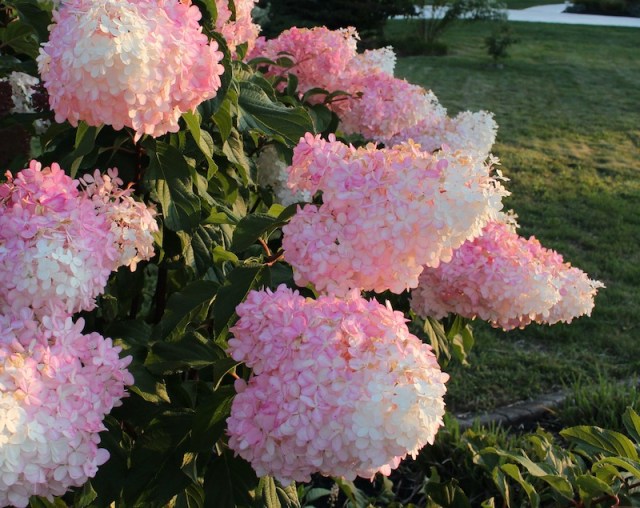
Annuals are work but Hydrangea paniculata is not.  Saturday is a celebration of the late summer show these shrubs put on faithfully every single year.  I like the ones which go pink as the flowers develop.  I took a bunch of cuttings.  We will see.  I don’t need any more but of course will take a few more.

vanilla strawberry hydrangea

Hydrangea ‘Vanilla Strawberry’ shows excellent color if the nights are cooler and the rains don’t completely abandon us all of August.  To counter this I give the bushes a light trim in May to delay some of the bloom, and usually this puts them beyond the most brutal weeks of the summer.

I have one day left.  It’s Sunday and I feel bad neglecting the asters, colchicum and chrysanthemums of Autumn but let me go around back to where we started.  The snowdrops are here again and should take this gardener through the shortest and darkest days of the year back into the next growing season.

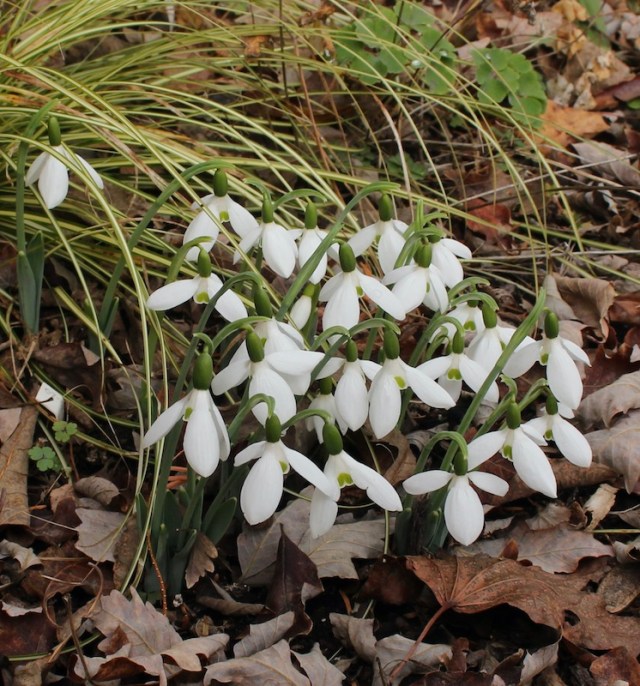
autumn snowdrops

One of the earlier fall-blooming snowdrops, ‘Barnes’ has been very reliable for me here in NE Pa, even when the winter weather takes a turn towards brutal.  They’re buried in snow right now but should thaw out just fine if we get a break in the cold.

So that’s my week of flowers which all happened in one day 😉  Thanks again to Cathy for breaking me out of my blogging slump and hopefully giving me the restart I needed!  The garden is covered in snow and the forecast looks cold, but maybe there’s something in the winter garden worth sharing so I’ll try and get to that.  In any case have a excellent week and I wish you many weeks of flowers 🙂

Okay. Summer is Over

Yes, I’m often really slow to pick up on things, especially when I’m really determined to hold on to my optimism or ignorance, but eventually the wrecking balls roll in and the troops hit the streets and you realize there’s a change in the weather and the freedom of summer is dying.  I’ll miss it.  Most people saw it coming and warned me to be prepared, but a few sunny days can fool you into thinking no big deal, there’s time, it can’t turn on you so fast… until suddenly it does and it’s your turn to face a killing frost.

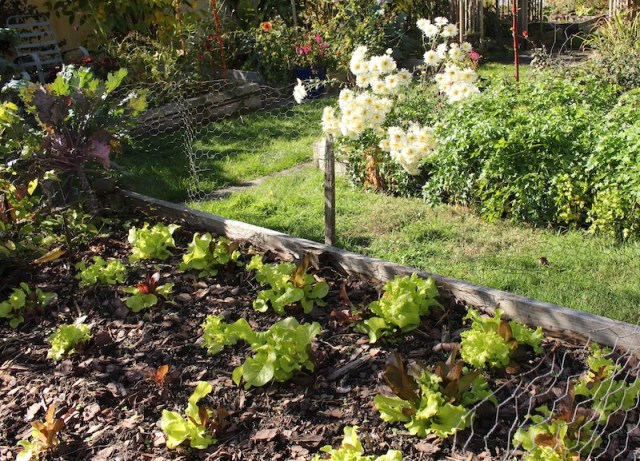
fall lettuce

An autumn crop of lettuce likely won’t amount to anything significant, but it does make things look better than they really are.  Someone will get a nice salad.  Probably not me, but…

Monday morning we woke up to a frosty morning.  It’s just a touch of ice and many of the natives are just fine, but tender stuff like dahlias and cannas from Mexico and points south got burnt, and will now need lifting and winter protection in order to make it through the approaching cold.

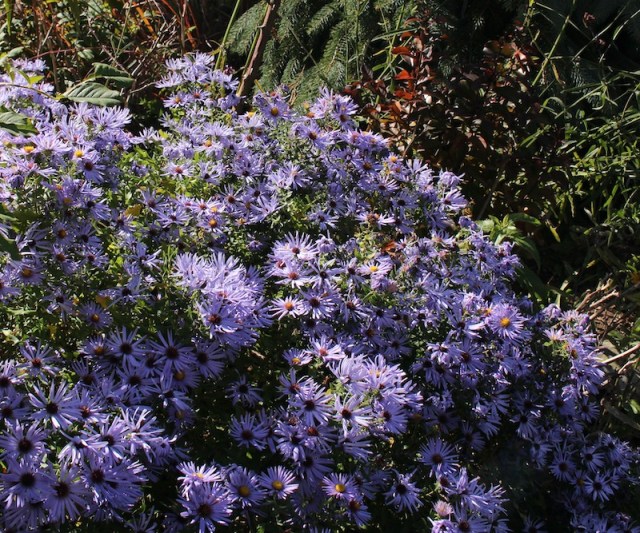
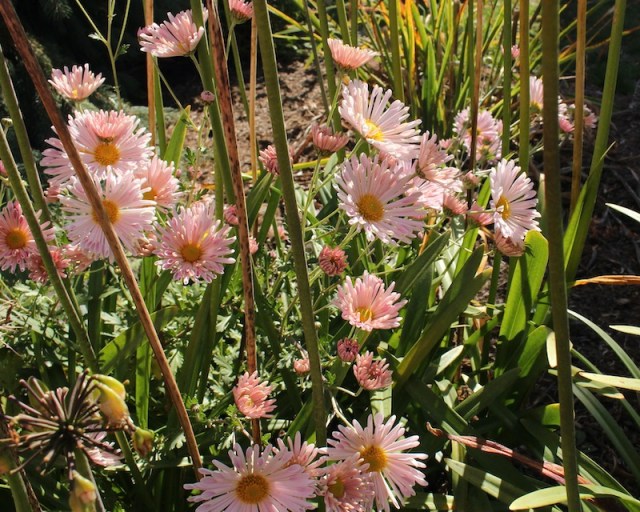
aster raydons favorite bluebird

Aromatic aster, either ‘Raydon’s Favorite’ or ‘Bluebird’, I forget… is still in full bloom and will go on into November.  It’s great doer.

Fortunately we’ve had plenty of rain to cover up all the stresses the garden faced this summer, and the asters and mums are as nice as ever and the fall color here in the lower elevations at least had enough time to color up rather than just give up.  As far as autumns go it wasn’t too bad I guess, but summer is still my preferred season and these last few weeks were more of a long hanging-on than any real admission that fall is here.

chrysanthemum seedling

A chrysanthemum seedling which a friend gave me a few years back.  Hardy and reliable and an excellent flower which more than makes up for her floppy form.

So I guess I’m admitting that fall is here.  The leaves have changed, the tender plants are under protective custody indoors and it’s moved on to all the little tasks which need doing before the cold and ice lock us all down for a winter.

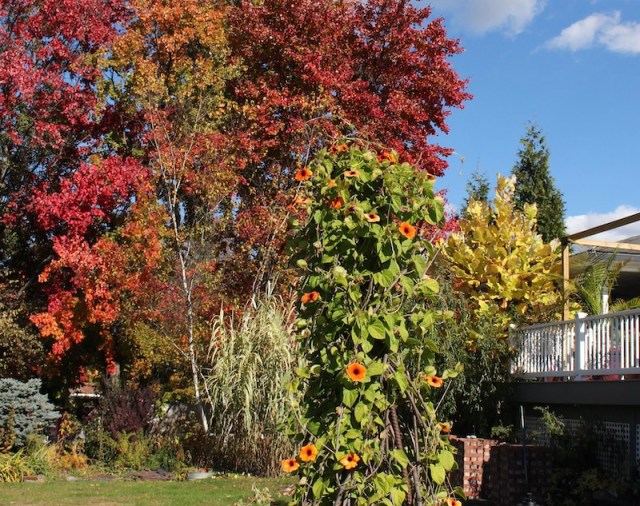
fall foliage color

Sunday foliage and flowers.  By Monday the orange thunbergia was a wilted memory.

For a few weeks more it’s still nice though.  The colors and light are superb, the lawn has recovered some of its spring lushness, and a shovel sinks into the soil rather than being rejected.  Time for replanting, mulching, protecting, maybe some pruning… all those last minute things which are fine as long as the weather holds, but just not fun when a cold front rolls through.

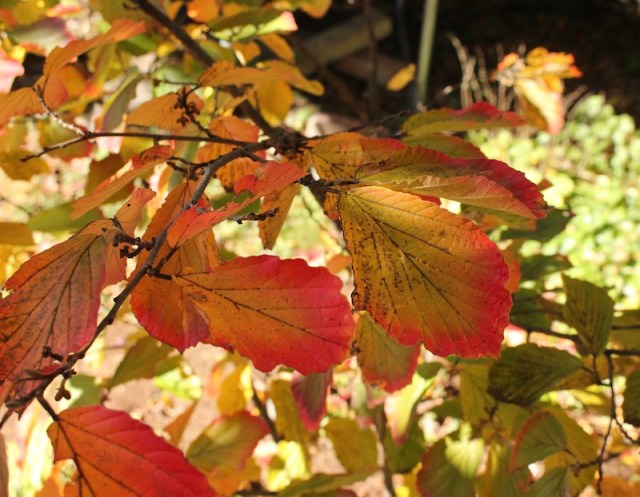
witch hazel fall color

This ‘Arnold’s Promise’ witch hazel always runs through rings of color as the leaves turn.  Witch hazels are awesome.

Hmmm.  Maybe I better end on a more cheerful note because the rain and Mellissa’s march through the Caribbean seem to have me in a gloomy mood.  Here are some promises for a wonderful winter starting with the hardy cyclamen which are popping up here and there throughout the beds.  Cyclamen hederifolium is probably the most varied and easiest and I’ll show just one picture with a few last flowers since there will be time all winter to show off the foliage on the rest of them.

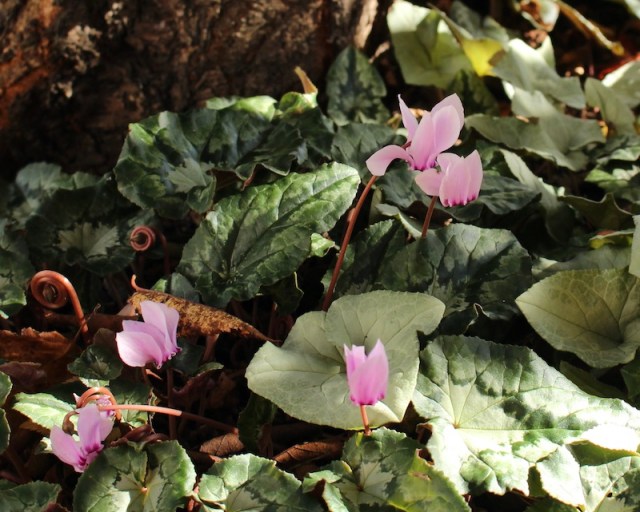
cyclamen hederifolium

A few last flowers wrapping up a month and a half of bloom on cyclamen hederifolium.  I’m always tempted to pot a few dozen up so I can admire them one by one… but under my care that’s a likely death sentence so in the garden they stay.

Oh and do you know what else is on the way?  Yeah, snowdrops.  The earliest fall bloomers are opening and they look great this year.

galanthus tilebarn jamie

The first fall bloomer in my garden is ‘Tilebarn Jamie’ and even at a later date this would be a beautiful and reliable snowdrop worth giving a try.

I know it’s been a while since I’ve mentioned snowdrops… maybe at least two weeks… but they’re on my mind again after what might have been overload this past spring.  Perhaps preparing a sales table for the Gala made it work, and maybe that work made it less fun, but I think this year I can organize a little better and get back to the fun I usually have.  Maybe I’m also itching to add a few new ones rather than faking “responsibility” and trying to say ‘no’ more than I’d like to.  Maybe this spring I’ll be saying ‘why not?’ Maybe I’ll start this fall.  More fall bloomers would be good and I know a guy and why not?

Have a great weekend 🙂

A One Month Update

Let me just prepare you ahead of time that there’s not much of an update, even though it’s been one day short of a full month since there’s been a blog post here.  That’s a long time I admit, but it’s been dry, I’ve been back to work, and it’s been dry.  The dry always gets me.  Crunchy grass, dusty raking, and stuff just sits there and slowly debates whether or not it will hold on or go to the light.  Watering would do magic, but for some reason I absolutely hate watering.  One kinked hose, knocked over pot, or a watering can that needs a refill rather than being enough for the whole porch and I’m cursing up a storm.  Plus I hate getting wet from watering.  I can stand out in the rain until hypothermia threatens, but gosh if I get a little water on my foot or a spray in my face… I digress.  I don’t like watering, it leaves an ugly taste in my mouth and maybe that’s my excuse for blog neglect.  But…. the colchicums are blooming, and to see something up and fresh in a brown and wilted garden is maybe not inspiring, but at least it’s hopeful.

garden colchicum

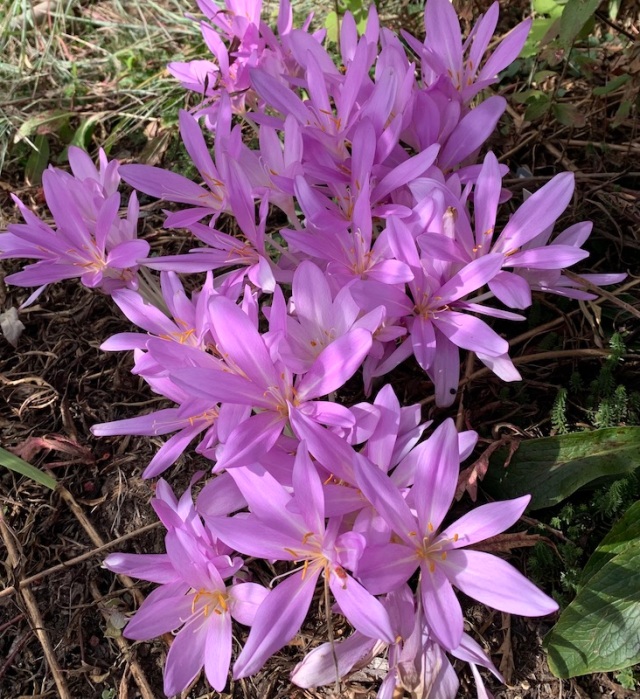
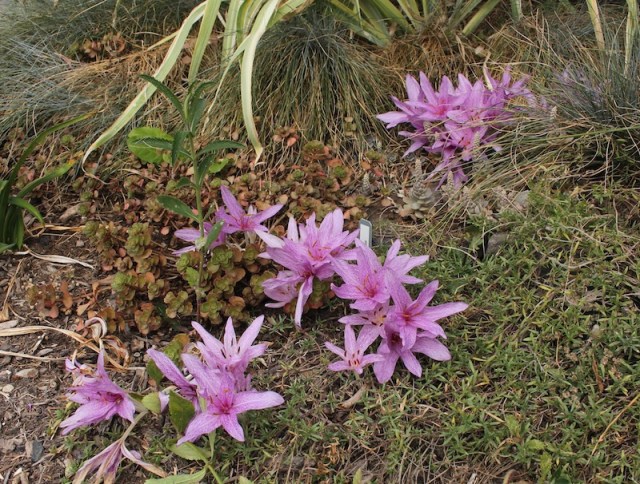
A nice bouquet of colchicum blooms braving the heat and drought. Some sort of C. speciosum, it came to me mislabeled.

Hopeful is also the rain which finally found us late last week.  I’m remarkably optimistic again so lets hope it’s not another month before this blog is revisited!

colchicums in the garden

‘Pink Star’ I believe, an excellent, long blooming cultivar that last for a few weeks even in the face of no water and glaring September sun.

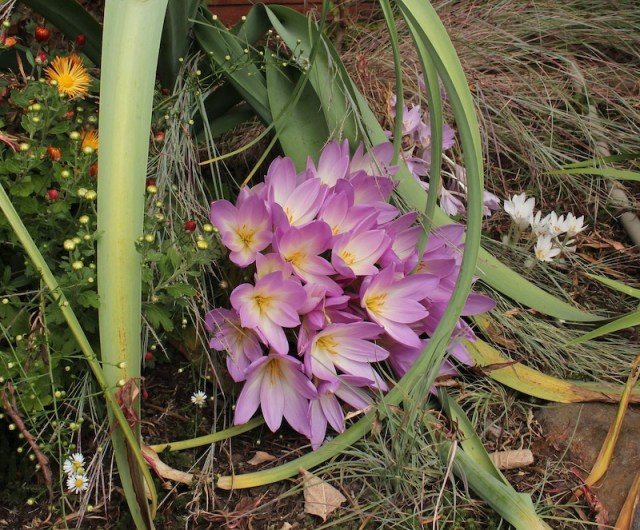
So colchicums.  I think you know the drill.  Poisonous so resist eating them, leafy spring foliage which dies back in June, Flowers which appear just as the rest of the garden is starting to give up.

colchicums in the garden

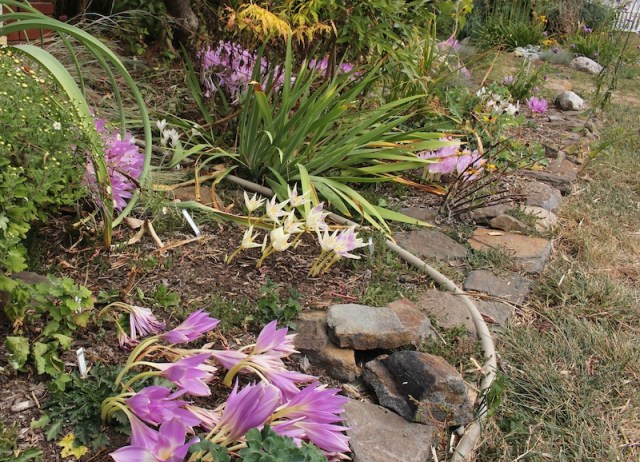
The tail end of the colchicum season in a crispy and dusty colchicum bed.

There are quite a few colchicum in this garden now.  Finding different forms takes a bit of searching, and sometimes finding a correctly named different form is a struggle, but it’s worth it.  To me at least.  I hear there are plenty of people out there who have just a single bunch or two and are very satisfied, and I even have a friend or two who don’t grow any… but I try to keep open minded in my friend group, and hope one day they’ll embrace the diversity.

colchicums in the garden

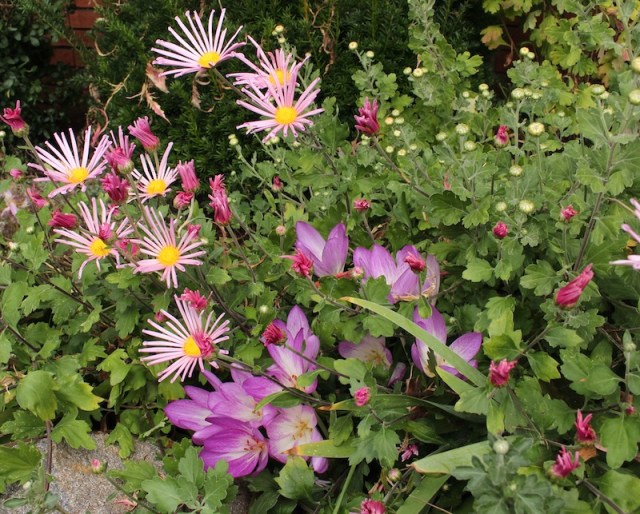
‘Glory of Heemstede’ trying to rise above a mess of chrysanthemum.  Finding a spot where the low blooms of colchicum display well, after everything else has grown up during the summer, is sometimes a struggle.

This year I’m maybe admitting that some colchicum are nicer than others, and by that I mean put on a better show and have a longer bloom season.  Keep in mind that shady practices and a questionable gardener and garden soil really influence my favorites, but this year I would say my longest blooming, best shows are from C. cilicium, x byzantinum, ‘Disraeli’, ‘Giant’, C. autumnale ‘album’, ‘alboplenum’, ‘Sparticus’, x agrippinum, and ‘Pink Star’.  Maybe I’ll add the floppy ‘Lilac Wonder’.  She flops so don’t expect anything else, but is so reliable I can’t leave her out.

colchicums in the garden

‘Sparticus’ has a smaller flower in a light shade of pink.  Always neat, and even after a week or two still fresh as ever.

By the way, if you’re in the US and struggling to find a few more unusual ones it might not hurt to contact Kathy Purdy at Cold Climate Gardening, or Facebook or Instagram… she doesn’t reeeaallly sell them, but if you’re really nice and sound desperate and she has spares you never know who might send you a price list next summer 😉

colchicums in the garden

x Agrippinum is a good one for smaller gardens.  The spring foliage is small and low and no trouble at all and the low flowers last for a while.  I plan to move a few into the new rock garden, I think it’s a perfect spot.

So do I have enough colchicums, or perhaps too many?  Hahahaha, of course not!  I still need bigger patches, even if there might be one or two who could do better.  I should be splitting clumps right now as they flower, it’s easy to find them and if you do it before the flowers fade it’s unlikely the roots have sprouted much yet, and you can see exactly where the good spots for more colchicum are!

colchicums in the garden

Colchicum here and there.  C. autumnale ‘album’ is a tiny white flower, but probably one of the longest bloomers, and it does well here.  Don’t be fooled by the petite blooms though, the spring foliage is regular sized.

And that’s all I’ve got.  The rain brought a tint of green to the lawn so I spent all day Saturday chopping down dead things, mowing up dried things, and going over the “lawn” to take the top off all the weeds.  I even edged and blew off the walks.  It looks so so so much better and even inspired me to dig up a bed in the potager and plant some lettuce seedling for the fall.

fall gardening

I found a $3 six pack of lettuce seedlings at my local farmstand, split them and it’s probably the best $3 I’ve spent in a while… although the $3 cauliflower I bought was a delicious monster!

Hope your autumn is off to a good start.  I’m mildly optimistic even if I have far fewer chrysanthemums than I need and there are still no fall blooming snowdrops up but you have to count the wins, and the rain was a definite win.  Maybe it will inspire me to manage a few replies to month-old comments and maybe another blog post some time sooner than later, but my history says otherwise.  I think you will have an excellent week regardless!

The Livin’ is Easy

This summer is going by way too fast and I am not liking that.  Just a day left in July and then it’s August and once August starts my summer days are numbered, and it seems particularly frantic because I still have tulips and daffodils and snowdrops which I’ve been meaning to dig since June as well as a bunch of potted things which I’ve been whispering apologies to all spring and summer as I keep putting off that job as well.  Don’t even ask me how the drip irrigation is going.  It’s been raining enough that watering has rarely come up on the to-do list, so of course repairing the drip setup keeps getting knocked off the top of the list, and I mention that one in particular because I had to go around this morning and save wilted things since of course I don’t water until it’s too late.  Have I mentioned in the last few breaths how much I hate watering?  Probably, but let me say it again.  I’d rather risk heatstroke weeding in the sun for a couple hours dripping sweat and covered in dirt rather than drag that stupid hose around.

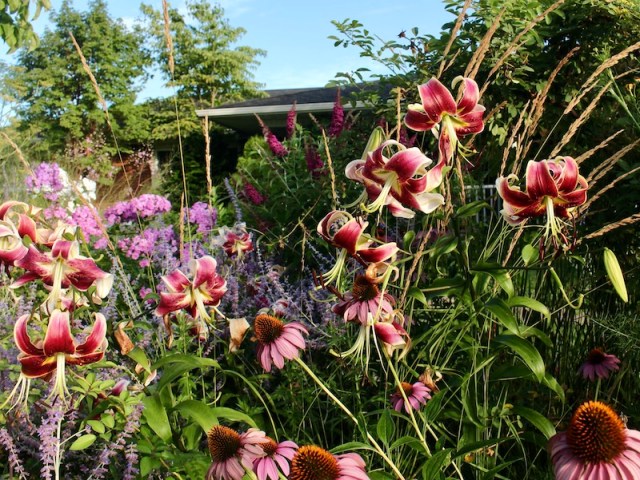
The front border is lush and overgrown due to this summer’s steady rains.  Even I think it might be a little “much” for along the street, but better too much than too little is what I say.  This is lilium “Scheherazade” doing well, and also not on the lily beetle menu (yet) so that’s also good.

Risking heatstroke and actual heatstroke aren’t separated by much, and with our third day over 90F (32+C) I’m trying to walk the line and avoid drifting over to the actual part.  Despite my love of lawn chairs and pool floats I’ve been far too busy outside feeding the gnats and losing water weight as I toil in the fields.  Maybe that’s not the worst training considering our potential future, but for now I do it for the fun of gardening and imagine Martha and Monty just as sweaty and disgusting in the heat of summer when they have their own daylily farms to rebuild.

summer lawn seeding

A daylily farm is rising from the ashes.  I’ve regraded and seeded the grass path, and as of today I’m happy to report a green shimmer as the seeds  begin to sprout.

My gosh, please skip ahead if you want to avoid the complaining, but it all started when I called the town a few days into staring at the bulldozed remains of my daylilies.  ‘So what’s the plan?’ I asked… and then entered into a discussion which became quite vigorous after I realized they thought I wanted to do all the repairs myself.  I did say that at the start when a hole at the street meant putting a few rocks back and maybe replanting a ninebark, but when the bulldozer and destruction moved twenty more feet into my yard and left a swath of raw shale and compacted topsoil, I assumed they might be able to spot me a little topsoil and mulch, even if they didn’t replace the farm or do any of the actual work.  A meeting was set up.  In the meantime I got to work.

First try to save a few things.  About half the daylilies were left with crowns so I uncovered them and gave them a little feed.  A few other things were uncovered along the street, and there might be hope for them over the next few weeks.  All my stones were buried, but one of the backhoe operators set aside a few new ones he found, and I got brave and split a bigger one to end up with two big stepping stones along the street.  The basketball hoop went back and then I regraded my little grass path.  In all I probably pickaxed and hauled off about 20 wheelbarrows of stony, shaley dirt to lower the grade and then tried to spread whatever topsoil they left into the beds.  That was awful, backbreaking work but then because I like a nice edge to a new lawn path, I dug up turf from in back and used it as sod to line the sides of the path.  Then the easy part of seed, topped with lawn clippings to keep the seed damp long enough to sprout, and then wait.  As of today, about a week later, the daylilies are sending up new growth, the grass seed is sprouting, and I’ve even popped in a few odds and ends like a new daylily or two, and some spare cannas and elephant ears to make it look less depressing.

daylily farm

There’s hope.

Since I took these photos, the town has come through with some mulch and topsoil, so more blood and sweat was shared for that, and we will see about the rest of the deal.  Hopefully the next farm report will be overwhelmingly amazing.  I have put some mulch down so I know at least that will be nice, and I’m in the process of picking daylilies to move in…. but enough of that… let’s look at where the rest of the garden is during these last days of July.

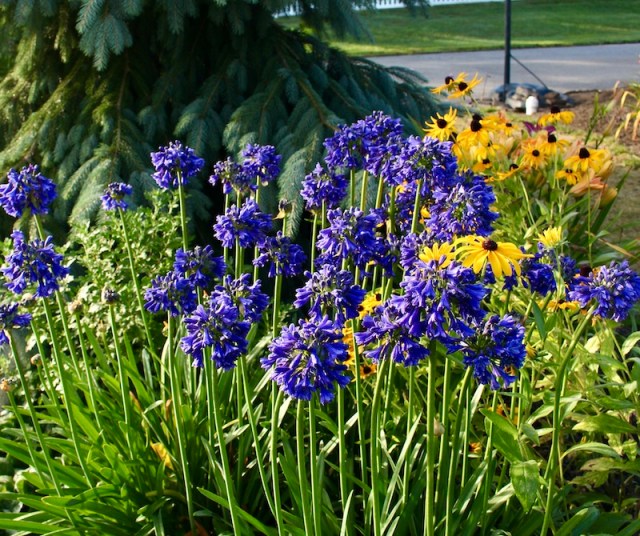
The agapanthus are blooming, and over the years ‘Blue Yonder’ has become a clump.  I love it.

I have nothing bad to say about the agapanthus this year.  They get no special attention yet are covered with blooms and have been perfectly hardy here for a number of years, with winter lows down to about zero and no protective mulch or sheltered location.  It looks like a few have enjoyed all this year’s rains, but even in dry years they haven’t seemed to complain too much.  I guess they’re as easy as daylilies, so I wonder if I can divide ‘Blue Yonder’ (my absolute favorite) and line out a row in the farm…. which would be awesome…

agapanthus campanulatus

Some agapanthus from seed.  These are A. campanulatus forms, the seeds of which were coincidentally saved from the bulldozers during the last sewer incident.

I guess I need to mention that not all agapanthus will be as hardy.  If you’re in a northern area, check up on the hardiness rating before you plant it, out in full sun of course and then never do another thing for it other than admire the blooms and bask in the compliments.

agapanthus hardy white

A dwarf white form given to me as seedlings from a white Seneca Hills Nursery(Ellen Hornig) selection.

Here’s one more look at ‘Blue Yonder’ 😉

agapanthus blue yonder

‘Blue Yonder’ has a richer color and flower heads packed with later flower buds, giving it a longer bloom time than some of the others.

I don’t know if I’d consider the agapanthus to be borderline hardy in my zone, I guess only a truly brutal winter would settle that, but I do consider some of the Crinum lilies I have planted to be borderline.  Two other forms are less than enthusiastic about life here in NePa but ‘Cecil Houdyshel’ increases in size and puts out a couple flower stalks each year so we shall only talk about that one.

crinum Cecil Houdyshel

Crinum ‘Cecil Houdyshel’ in front of the dark foliage of ‘Royal Purple’ smokebush, alongside the driveway.  Very elegant in my opinion.

As you would suspect, I don’t give this one any winter protection, and after our normal lows last year I was a little worried, but slowly he came back to life.  All the rain and humidity and heat must really have him feeling at home this summer, so hopefully there will be several more bloom stalks to come.

crinum Cecil Houdyshel

Cecil has a decent form, not as sloppy a mess as some crinum like to be but that’s just my opinion based on one plant and almost no other crinum experience.

Seems like we’ve left the daylily farm for a Southern excursion, so here’s another thing from down South.  Standing cypress (Ipomopsis rubra) is a native to Southeastern North America, or plain America as we in the US like to say, and it’s a cool thing.  The hummingbirds agree, and they’re aways buzzing this part of the garden when it’s blooming.  Two things though.  Everywhere I see it referred to as a biennial or short lived perennial and that’s fine, these plants are from a new seed source and they grew fuzzy rosettes last year with a five foot stalk erupting this summer, but the ones I grow from another source are strictly annuals and never form rosettes and never live beyond year one.  Who knows.  It’s above my pay grade to wonder if they are all the same species but these are the curiosities which live in my brain so I’m sorry to put it in yours now.

Ipomopsis rubra

Ipomopsis rubra, paired with the lovely neon green foliage of pokeweed (Phytolacca americana ‘Sunny Side Up’)

The potager is another curiosity.  I wonder if I can still call it a potager when 90% of the plantings are not-vegetables, but can’t quite bring myself to admit it’s become another flower farm.  Perhaps there’s an authoritative number listed somewhere in France for potager percentages but do supposedly-edible dahlia roots and figs-which-will-never-produce-figs count as veggies and fruit?

cannanova rose

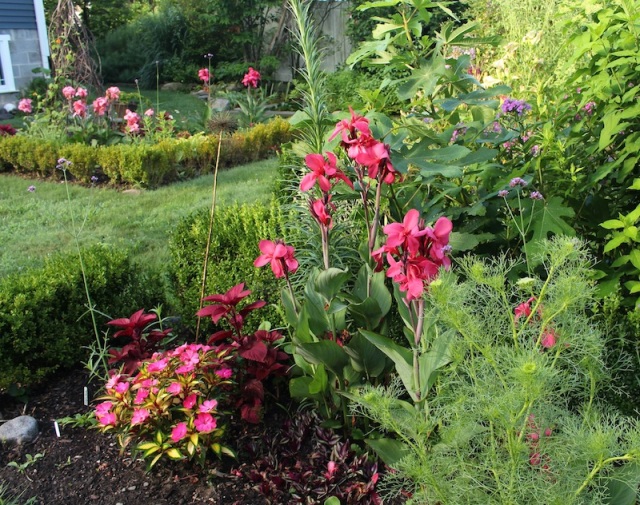
Cannas are blooming quite well in and around the potager.  This is ‘Cannanova Rose’, an easy, quick to bloom selection which even comes true from seed.

Whatever.  Potager it shall remain.  If I can get away with calling a couple rows of daylilies a farm than I can stick with potager for this.

potager

My little tropical hiding spot in the potager.  Bananas are totally edible and potager approved even if there’s next to no chance I’ll ever see fruit, but the foliage makes up for any missing banana harvest.

I refuse to share a photo of my pathetically anemic tomatoes or the deer-chewed pepper stubs but I will share a single phlox photo.  Only one because the rain-fueled hydrangeas have crowded nearly everything else out, but one should get the point across.

phlox paniculata

The garden phlox are a little late due to an early season deer pruning but they’re finally making a show.

Can I put in a good word for pears?  As of today the tree is overloaded with a heavy crop, and although the gardener should have thinned them out for better quality (and to save the tree from collapse) my hope is that a few escape the deer and squirrels and chipmunks and make it to the dinner table.  A bushel of Bartlett pears will really put the potager accounting into the black in a way that 3 raspberries, 7 gooseberries, and a half handful of blueberries will not.  Someone really should have netted the berry bushes rather than continuously hope the birds ‘miss a few’.

bartlett pear

This year’s Bartlett pear crop, heavier each day and hopefully not too heavy.

Maybe the berries didn’t go far in feeding the household, but they did contribute to a steady stream of fledglings coming out of the garden.  I don’t really mind the loss, and actually resist netting the fruits since the dopey youngsters tend to get tangled and I prefer a fruitless pancake over a traumatic bird un-netting.

baby robin

Yet another robin leaving the nest.

So that’s where we’re at.  A lot of rambling so I’m wondering if perhaps the heat got to me more than I care to admit but hopefully there was something of interest in there.  In spite of all the work summer is still quite excellent and so is the air conditioning when the heat gets to be too much so I really can’t complain.  Enjoy your week!

Still Inching to Summer

So there’s been a good amount of porch sitting this June and although that sounds good in theory it’s maybe not the ideal scenario due to the reasons for all this sitting around.  Reason number one is the rain.  Here in NE Pa it just keeps raining and then it rains some more.  Hmm.  I just looked it up and it appears we have had something close to ten inches of rain since the beginning of last month and maybe that’s not something I needed to know on top of the fact it’s been chilly as well.  Much of the porch sitting has included a blanket with a dog on top for additional comfort so to sum it up, wet and cold.

front street border

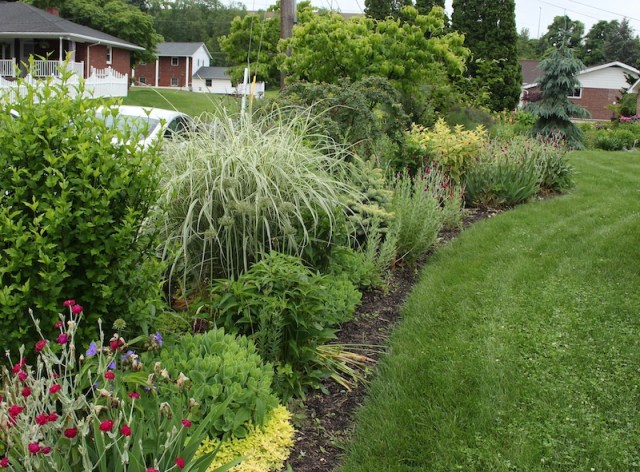
Along the street the daffodils, snowdrops and winter aconite have been covered by the lush, rain-fueled growth of summer perennials.  Luckily I mulched last summer.  I can’t imagine how many weeds I’d be looking at otherwise.

On the plus side I’ve done very little watering, but on the minus side I should have transplanted and divided more.  Oh well, no sense in dwelling on these things, it’s literally all just water under the bridge this year.

kniphofia caulescens

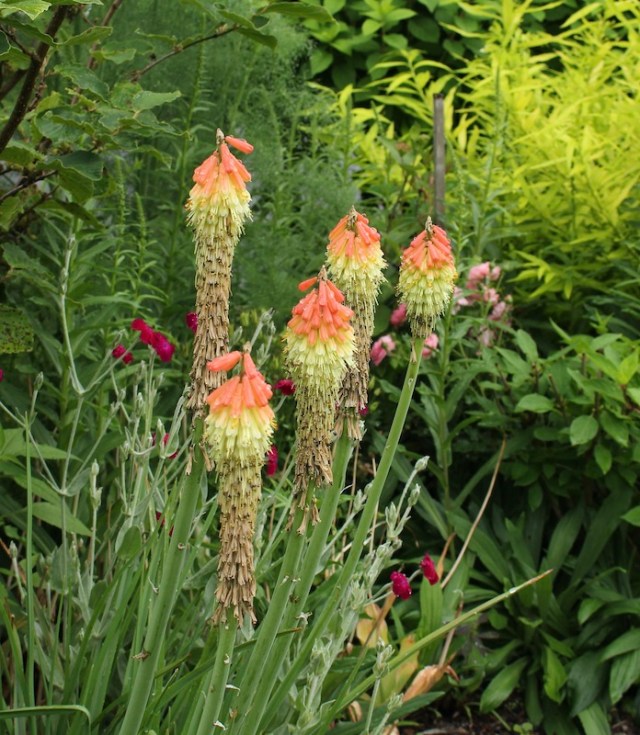
The earliest red hot pokers (Kniphofia caulescens) are bringing some warmer color to the garden although I think more sun would make them happier.

For all the complaining this gardener doesn’t mind the cool.  I can get through a garden day with just a shower before bed rather than repeated dips in the pool or hosing off every hour  to fight heatstroke.  Never fear though, the forecast says that’s on our way for the weekend plus a nice mix of severe weather and oppressive humidity to top it all off so it should be fun.  Sounds like someone will be opting for day drinking and cleaning out the basement rather than getting to all the neglected jobs which await outside in the swamp.

cotinus royal purple

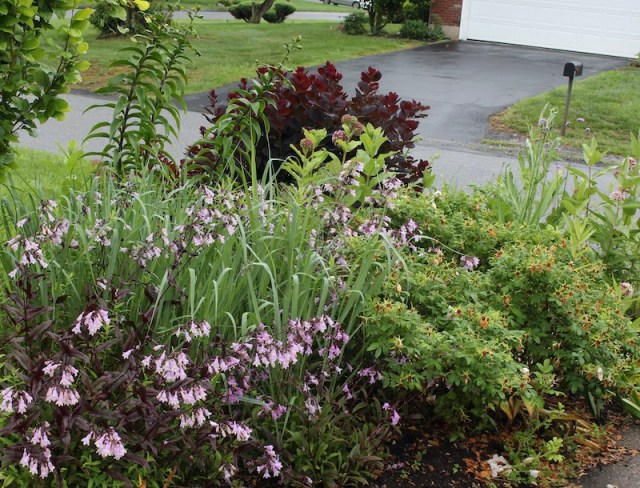
Alongside the driveway is one of my few attempts at a theme.  Purple foliage and whites and grays and I guess pink.  The smokebush (Cotinus ‘Royal Purple’) was cut to the ground this spring, so no “smoke”, but the foliage is lush and dark which is nice.

A weedy and lush garden means either closeups or from-a-distance photos so perhaps this post will use that as a theme today rather than relentless weather complaints.  Lets begin with weeds, specifically milkweeds.  I like them but can’t recommend everyone plant them because of the weed part of their name.  Why would you plant a weed is a very valid question, and I guess my only argument is don’t plant the weedy types, plant the clumping types and you won’t be dealing with mile-long runners and suckers coming up everywhere like I am.

showy milkweed asclepsias speciosa

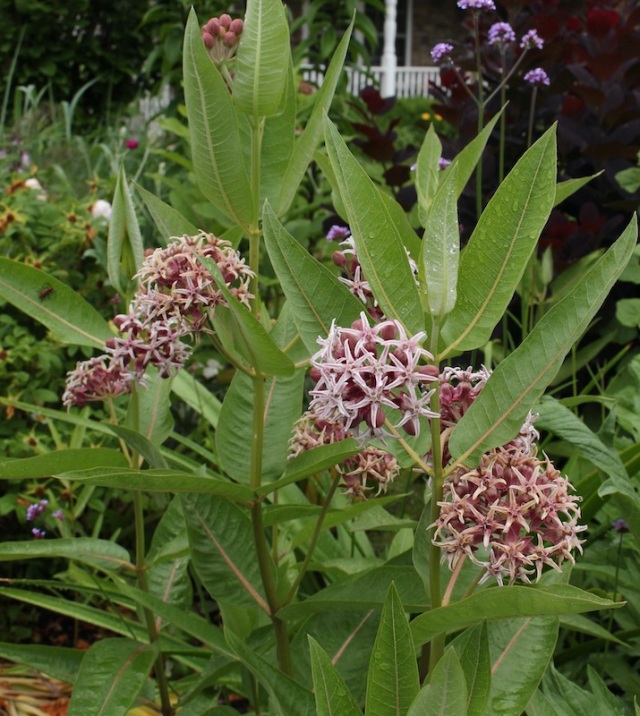
Showy milkweed (Asclepsias speciosa) is a nice enough weedy, spreading type, but I’d rather have a form with broader foliage and a good amount of silvery hairs covering the plant.  They’re out there, I just need to run one down.

Don’t plant the spreading milkweeds in a flower bed.  They will come up everywhere just like my golden cut-leaved sumac (Rhus typhina ‘Tiger Eyes’) does, and just like the sumac, I also love my weedy milkweeds.  I just pull them out when they get out of hand and don’t give a second though to the roots below.

common milkweed asclepsias syriaca

The common milkweed (Asclepsias syriaca) is very common here.  In my opinion there should be named forms of this.  I love the darker flowered ones and have seen white, and wouldn’t mind some darker color in the foliage, so if you could get on that please do so.

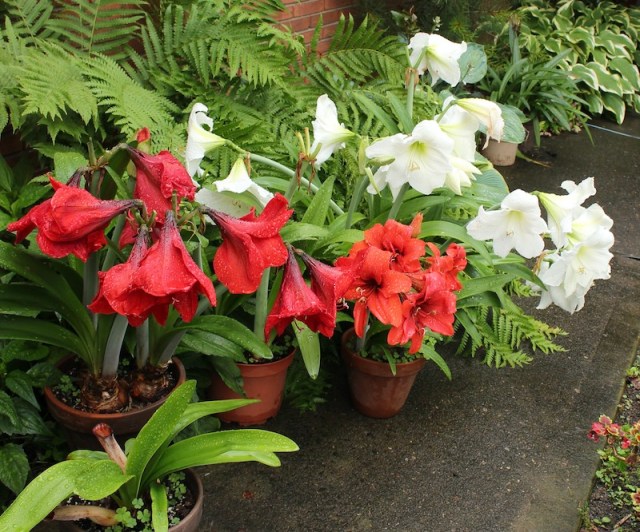
Again we are talking about weeds.  Lets stop there and move on to a more refined thing such as holiday amaryllis (Hippeastrum).  I have a few old pots in bloom now, and even through some heavy downpours they are looking nice.  Perhaps it’s not the season, but I didn’t feel like giving them space last winter under lights so they didn’t start into growth until April when they went outside.  I would tell you how long I’ve had these plants but it makes me feel old so let me just say over a decade and they have probably bloomed every year since so I can’t complain.  On the subject of blooming, I’m always a little surprised when otherwise excellent gardeners claim they have trouble getting them to rebloom.  Here’s my two cents… or maybe two nickels as the penny is phased out.  Plant them is a mix that has decent drainage and water and fertilize the crap out of them.  Ok, maybe not too much fertilizer, but go with a tomato or flower-focused fertilizer, and not one focused on nitrogen.  Give them plenty of sun, you want them actively growing all summer, and not just sitting there cramped in their holiday pot wishing they got as much attention as that mother’s day basket nearby.  The more leaves they put out the more flower stalks you will get, and if they still don’t succeed then just toss them.  Many are weakened by virus, and some just don’t grow well so stop trying to make a freeloader happy and just move on to your milkweed breeding program and buy a new amaryllis or two next winter.

rebloom amaryllis

My favorite is the white.  It needs dividing since there are at least a dozen bulbs in the pot but with multiple bloom stalks it looks good for weeks.

Let me shift to some more acceptable plants.  June is filled with some of the most beautiful flowers so rather than more weeds and out of season holiday flowers, here’s the view of ‘Wartburg’ in the potager.  ‘Wartburg’ is not the most glamorous name but I think it still outranks more nauseating things like ‘Pinky Winky’ and industrial names like ‘Bloomerang Dark Purple’, so keep that in mind.

rose wartburg 1910

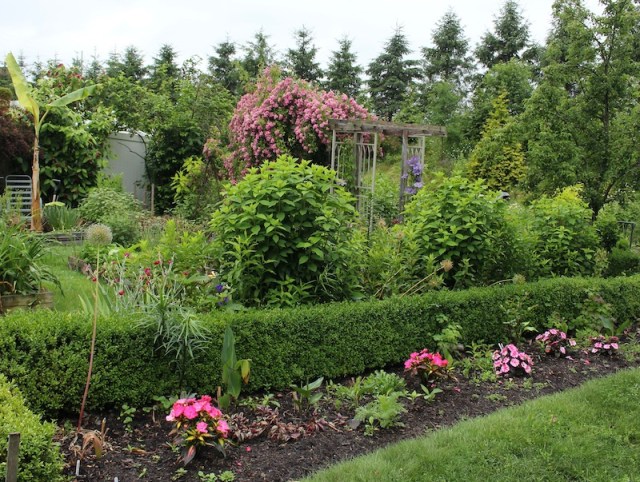
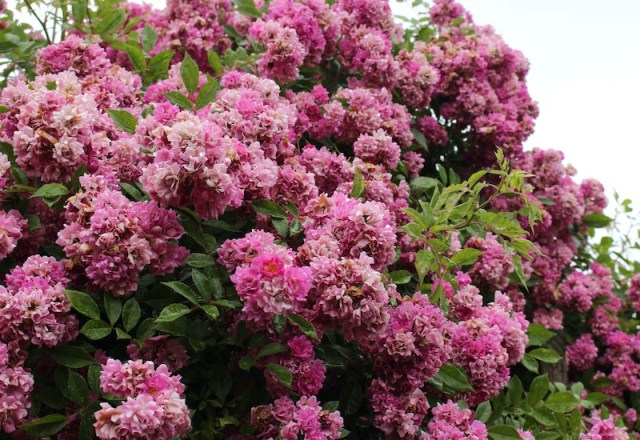
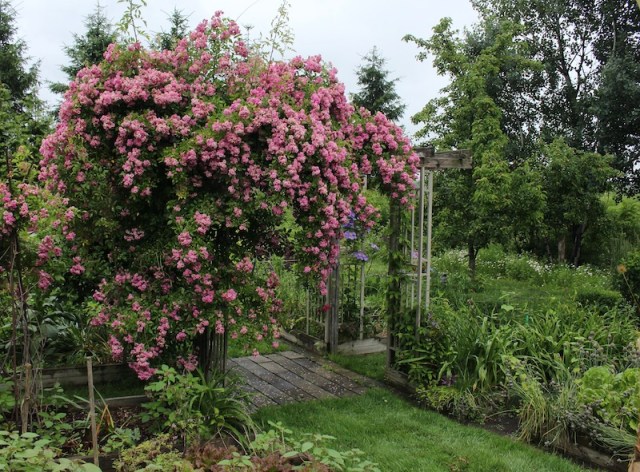
It might be a pink year.  Pink New Guinea impatiens are starting to fill in, with the rambling rose ‘Wartburg’ (1910) topping the pergola with a pink froth.

rose wartburg 1910

Wartburg is on the way out but still nice thanks to the cooler weather.  She’s also been darker this year.

rose wartburg 1910

Covering most of the support, I think this is the year I have to do a little more serious pruning before ‘Wartburg’ becomes a bird infested mess.  Maybe.  I like birds too.

I have other roses through the garden, but am perhaps a little too picky with them.  A great show, fragrance, and disease resistance are my main reasons for keeping or trashing a rose, and I’ve trashed a few more than I care to admit.  Maybe that sounds bad, but at least I’m not cluttering up my garden with plants I don’t care about.  Back in the day they would go into triage for a I’m sorry, let me fix you massive investment of time and effort, but now it’s more a thank-you, next approach.  I’ve been happier,  you should consider it as well.

clematis hf young

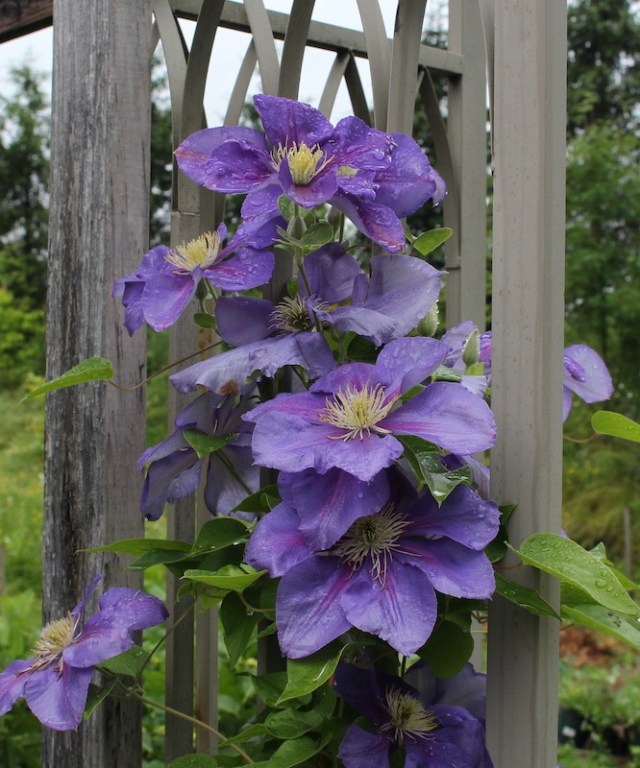
Clematis ‘HF Young’ also on the pergola with ‘Wartburg’.  Clematis are almost all worthy of growing, I think there have only been two that I lost patience with.

clematis ville de lyon

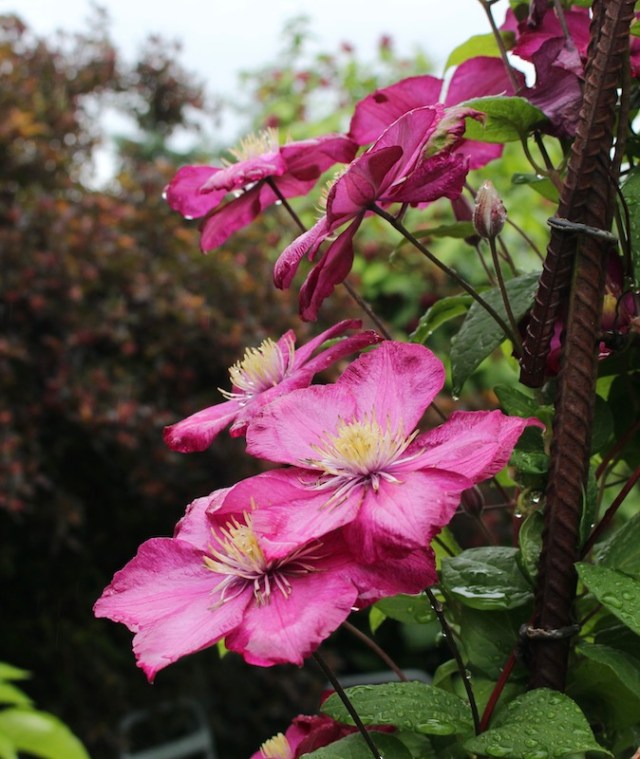
‘Ville de Lyon’ also lives in the potager.  She’s a favorite but could probably use a better spot to show off.

So I shall leave off on this thank-you, next theme.  June is fresh and promising and all the baggage of the season hasn’t been taken on yet, so don’t waste your time and effort devoting yourself to the neediest and most troubled plants.  You don’t want to reach September and realize you wasted your youth trying to fix him when all you really needed to do was sow a few zinnia seeds in the space.  Hmmmm, sounds like a pretty good policy in general.

Spring is Quite Awesome

Okay.  So if this blog post goes up in the next day or two it’s just a three week gap and not four, and I guess that’s better, even if I’m forcing myself to sit here right now and get something done while my heart is saying do nothing, crawl into bed, find a blanket, play mindless phone games….

spring violas

The violas of spring look great, they love the cool weather and frequent rains, and for once I like the color mix in this pot.  Too often I impulsively buy a celebratory mess of spring shades and hope for the best, and then act confused when the colors still look like a mess when planted!

With this week’s chilly and damp weather a blanket is definitely required even though a couple days prior the air conditioning had to go on to fight the heat and humidity.  Those temperatures, alongside regular rains and then a little too many rains, has the garden bursting with growth and color and fortunately not with fugus and blight yet, and I hope it stays that way.  I grabbed a bunch of pictures last weekend during a gap in the rain, and my favorite subject was the lovely rose ‘Aicha’.  I love her soft shade of yellow, the simplicity of her single flowers, and the arching shape to the bush.  She has a light fragrance, and right now I can forgive the leaf spot and only a few here-and-there sparse reblooming flowers in late summer.

rose aicha

The yellow of ‘Aicha’ ushers in the yellow/blue/purple phase of the front garden.

I picked up ‘Aicha’ at Der Rosenmeister nursery on a spring trip to Ithaca NY one year, and each summer since it has been a rose dream to make it up to their open garden party (June 13th this year btw) which Leon hosts each year.  It’s a party with music and fun, plus hundreds of full-bloom, cold-hardy rambling and climbing roses massed across the grounds of his home.  I would make a wish list of course.  It took me days of contemplating to fit in just three, so a list would be trouble which I don’t need but where’s the fun in that?

variegated iris

Somewhat fitting into the yellow/blue/purple phase is the variegated Iris pallida ‘Aureo Variegata’ which I love for foliage as much as the lemony scented flowers.

It’s actually still early for roses so lets bask in the show of the bearded iris first.  The iris don’t like the rain right now, but last summer’s drought was just what they do like, and this spring they’re showing their appreciation of the previous year’s rot-free dry weather.  I probably said I wanted more last summer and then did nothing to accomplish that, so this year I have a plan.  I think they would do very well on the berm.  I’m at a point where I want to plant something appropriate on the berm, and as long as nobody complains too vigorously about weeds in the iris I think this summer I’ll give it try.  Younger me would  aim for weeding after planting, but I’m starting to understand my limits as I get a bit more experience, and I can warn everyone right now that the iris on the berm will be weedy and I apologize ahead of time.

iris sunol

‘Sunol’ is an oddly colored iris which would probably do better on a weedy berm rather than the garden since it’s just as crowded, but less sunny here.  I believe the “dwarf” blue spruce is squeezing it out faster than I wanted to imagine.

I guess you can’t talk about the May garden without mentioning weeds.  One of this year’s goals was to eliminate a few from the garden and mostly from the lawn, and when a friend saw that post they mentioned the idea of a wildflower section in a corner of the lawn as a a safe-zone to balance the weedless-lawn effort.  Upon hearing this excellent suggestion I realized that what I wrote was really a bunch of misleading nonsense.  Such is often the case for this blog but in this case it gives a totally different picture than intended.  I forgot that the lawn purists consider a lawn as a place for grass and only grass, and oh my gosh that’s not what I’m aiming for since in my opinion a grass-only lawn is about as boring as boring can be.  My weeds are narrowleaf plantain and creeping charlie.  I hate the plantain and have grown tired of the creeping charlie so they are now the two weeds who’s numbers I am trying to reduce.  Violets as well but I hesitate to mention that since they’re so beloved, but they seed everywhere and are nearly impossible to get out of flower beds, so enough is enough.  My biggest problem in spraying to control these three weeds is that the clover and dandelions are also killed if spray get on them, so I have to be careful and precise to miss them.  Hawkweed is also a treasure in my lawn, and to be honest I’ve transplanted plugs to get it into new spots… actually in the older parts of town I’ve seen a lawn or two with a few shades of yellow which I’d love in my own lawn, but I’m not quite ready to knock on doors asking for weed samples.  So just to be clear, for me a weed-free lawn is only grass-based, and the green is well spangled with the blooms of a carefully curated blend of colors, just with less plantain mostly because I just don’t like the stuff… unless it’s the wide-leaf form in purple which I guess I do like…

iris elsinore

Bearded iris are not weeds in any sense of the term.  This is ‘Elsinore’, one of my favorites.

So rest assured this garden is quite safe from a turf obsession.  To lose finches picking through dandelion seedheads, bunnies grazing the clover patches, and bees working the birds foot trefoil would be sad.  Actually I feel a little concerned when I see a vast expanse of fertilizer-hyped, weed-killer soaked turf and think of the hours wasted keeping it that way and the dollars which could have been spent on better pursuits.  Those people obviously never grew a snowdrop nor jealously eyed a patch of English daisies growing in a garden they visited last weekend and then thought of their own pot of English daisies and then spent the next three days staring out at a rainy garden wondering where a good spot would be to plant them in the lawn… Hmmm.  You may see why little actual work happens here when the gardener wastes hours thinking about where in the lawn to plant new weeds.

Glaucium corniculatum blackspot or red horned-poppy

The colchicum bed with a few not-colchicums filling in the gaps.  The orange poppies are red horned-poppies (Glaucium corniculatum) and love a dry, poor soil which doesn’t speak well of the soil in this bed.

Enough about weeds.  May here is about flowers and the enthusiastic growth of plants, and besides the iris here are a few odds and ends of treasures and tasks.

Robin's PlantainErigeron pulchellus 'Lynnhaven Carpet

Matt Bricker will often bring a few non-galanthus goodies to the Galanthus Gala, and one year a pot of Robin’s Plantain (Erigeron pulchellus ‘Lynnhaven Carpet’) came home with me.  It’s a nice low groundcover with soft leaves and cheerful daisies in spring and is about as easy to grow as anything.

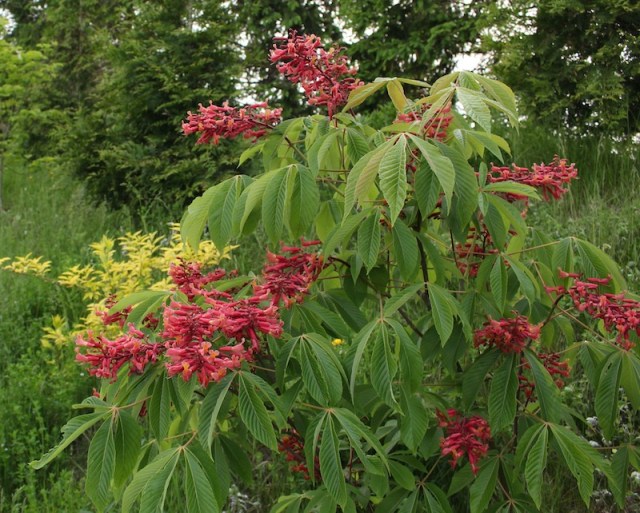
Not that I’m anything close to a purist but I just noticed the horned poppies and Robin’s Plantain (a daisy not to be confused with the previously mentioned plantain) are North American natives and to keep with a theme for more than a minute here’s one last shrubby, maybe someday small treeish native thing, the red buckeye (Aesculus pavia).  In a miserably hot and dry spot on the berm it carries on, growing inch by inch and blooming faithfully each spring.  It would like a better spot but carries on well enough with what it has, the show increasingly clashing with the pink and mauve rhododendrons which also suffer on the slope here.

Aesculus pavia red buckeye

Red buckeye (Aesculus pavia) is listed as a hummingbird magnet but as of yet… it’s just a pretty shrub on the berm.  I’m hiding buckeye seeds each year and maybe one day they’ll carpet the industrial park.

That was possibly a full minute of focus on how unfocused I am, but as I’m sure you know there are just so many other things going on it’s hard to stick to a task.  A gardener goes out with the ambition of transplanting a sedum but sees a branch to prune and a weed to pull and then gets lost looking for a trowel they remember using two days ago and before you know it the rain started again and you’re wondering why you spent twenty minutes deadheading hellebores instead of mucking leaves out of the pond.  There’s a mile long to-do list, which I’m sure is the same for every gardener (and if not and you are that rare exception please keep that an inside thought) and perhaps this weekend the list will get shorter before it gets even longer.  I don’t even know what my list says so here’s a guesstimate.  Most everything is out for the summer, most vegetables are coming along, a few new plants are here, but the summer bulbs and back porch have not yet been attended to.

bromeliads overwintering

The bromeliads are slightly pale but nearly as lush as when they came inside last fall.  They’re almost too easy and this gardener is only allowed to buy maybe one or (at most) two new ones this year since that’s ok and not a sign of addiction at all.

On a plus side the garage is still being used for vehicles rather than entering the annual contest to hold as many empty pots, wheelbarrows, boxes, bags of potting soil and tables full of drying bulbs and corms as possible, and to achieve that the driveway has stayed open enough to drive on.  It’s basic math since I am out numbered now.  Three out of the four drivers here agree that the driveway is better utilized for cars rather than as a makeshift summer nursery/pot ghetto/staging area for excessive plant additions to the garden, and now the gardener is forced to hide his compulsion just around the corner, alongside the garage 😉

golden ninebark seedling Physocarpus opulifolius

My friend Kathy Purdy warns that stray tree and shrub seedlings should be addressed when small and not allowed to sink their roots in and create a removal issue down the line, but… golden ninebark seedlings (Physocarpus opulifolius) are so cute and can’t possibly ever be in the wrong place… right?

That’s it from here.  It is now Saturday morning and once the last person asleep here wakes up we shall go to a coffee shop and the two children will make us breakfast… assuming we pay for it and tip them as well, and then after that I’m sure something will get done here even if your guess is as good as mine as to what it will be.  The lawn needs cutting, so I’ll probably head outside and start by planting petunias next door and then check the pool filter.  Maybe I’ll eventually find that trowel again, who knows, but in the meantime I hope you have a wonderful spring weekend!

Please Tiptoe

Oh my gosh, does this blog still even exist?   >insert excuses, apologies, delusional hopes for the future< Well I guess it does, and as you know spring moves fast and I don’t so here’s an update from last Saturday when I thought I could take a few photos and do a quick post before the sun sets on the Sunday… or Monday… or Wednesday…. or

perennial tulips

The front border was beautiful last weekend.  Individual blooms are a bit beat up, but from a distance nobody cares.

Believe it or not the gardener here has actually been somewhat useful, even if he’s not a good blogger.  The to-do list is still behind a few months and some things have already been quietly pushed onto the 2026 list, but overall there has been a mild sense of progress.  Hopefully it shows.  There’s a huge pile of branches and small tree trunks which shows less attractively than tulips but as always the garden is a work in progress.

perennial tulips

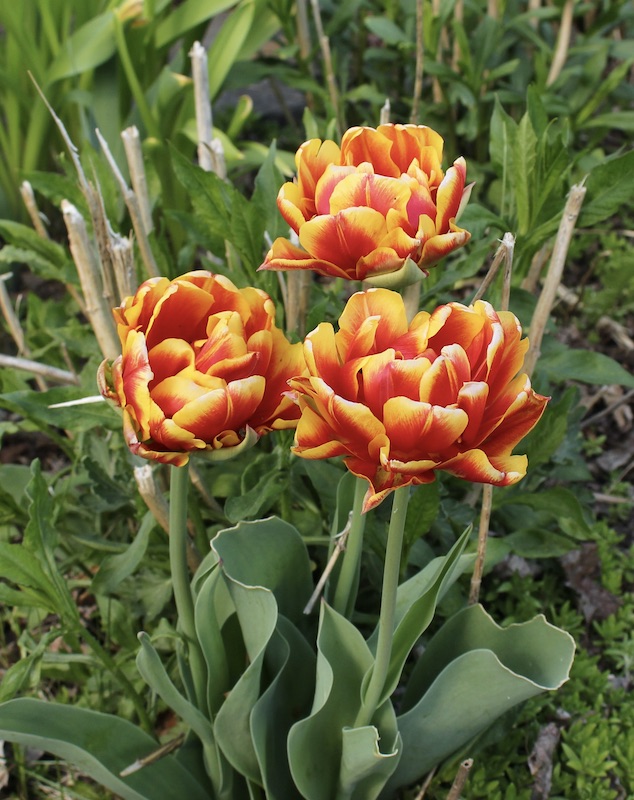
A double tulip from back in the day.  They were planted a decade or so ago yet still show up here and there depending on where a bulblet dropped or what other plant was moved or removed.

Maybe it’s best to just focus on the tulips.  For a week or so some hot weather brought them on too quickly and then wilted the edges, but then cool weather returned for the weekend and they were awesome.  Maybe not the best year but good enough, and even though many were missing you can’t complain too much during tulip season so lets focus on the good!

perennial tulips

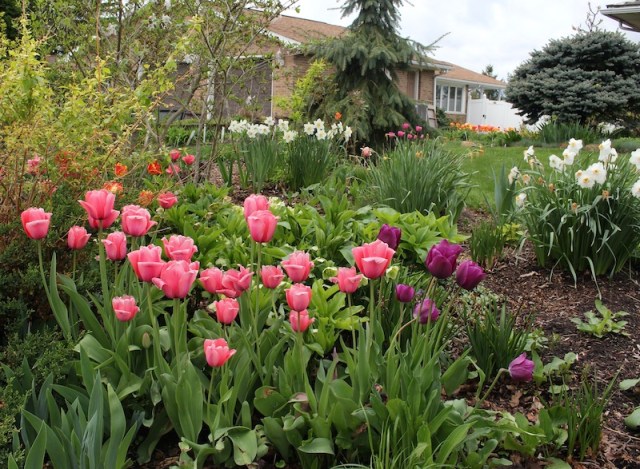
An exceptional crowd of ‘Pink Impression’ alongside some unknown purples.

Ok, maybe a clump of pink tulips is the bulk of the ‘good’.  The masses of flowers in the potager are missing this year and in spite of all the trouble and work they involve I really miss them.  I blame dry weather when they should have been growing last year, I blame too much wet when they should have been going dormant, and I blame a gardener who got discouraged and then let mice and squirrels have their way with the curing bulbs.  Whatever.  Gardener forgiven and let me say I really am enjoying the tulips this spring even if my mood this morning does not lend itself to expressing that emotion.

tulipa clusiana

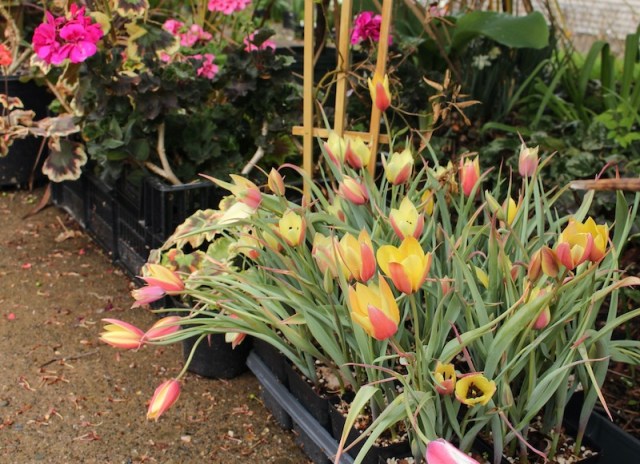
A tray of species tulips (Tulipa clusiana) which were meant to sell at the Gala but just weren’t looking like much that morning.  Two months later they’re highlighting the driveway and will be planted out once the blooms fade and I think they’ll do very well in a sunny spot.

Maybe I’m grumpy because I’m not attending the Sakonnet Plant Fair in Little Compton Rhode Island this morning.  Each year it grows into something even more tempting and each year I’m even more envious of all the plant nerds who are able to spend the day browsing.  Under the guiding hand of Ed and Taylor of the plant nursery Issima the event has grown and perhaps you’ll get an idea of the kind of treasures you’ll find at this sale if you take a look at their offerings.  These are exactly the kind of plants I like trying and buying, even if in my heart I know they won’t get the care they need in this garden to truly flourish.  But often times they do, and they turn into the “Oh!” plants which every gardener needs.

Not much ‘Oh!’, it’s sparse tulip year in the Potager.

Well look at that.  Just talking about the Fair has brightened my mood and I guess all I have to do now is promise to take better care of the spring bulbs and everything will be as it should 🙂

perennial tulips

As another plus, the few tulips which have returned look exceptionally healthy this spring.  As long as there’s enough sun to dry them out after each rain I think they’ll make excellent bulbs for next season.

So does better care mean more bulbs?  Yeah probably, because although the tulips are still excellent I think the daffodil situation could use some work, and by more work I mean dividing and replanting and maybe a few new ones this summer.  I’ve been good.  I think I earned them.

Many of the daffodils here are quite average but for whatever reason I love them more than I should. This is ‘Capitol Hill’ which is an absolute favorite even if it’s somewhat average, and too old to be new and too new to be old.

I still won’t buy more tulips though.  The species tulips didn’t count of course because they were for a sale, so with that out of the way I can still claim I haven’t bought any new tulips for a couple of years.  I don’t say this as something to be proud of, I just want to point out my restraint which to some people is a good thing.  Here’s my show of restraint in terms of the potager tulips, which are now in the daylily farm, which of course is not where they should be, and puts a bit of a damper on putting daylilies into the daylily farm.

perennial tulips

Somehow a couple hundred of the potager tulips went missing and these are all that’s left. They will multiply I’m sure, maybe not as fast as I’d like them to but that’s good since I still have to figure out how to grow daylilies and tulips and maybe cannas and dahlias all in the same daylily farm.

Enough about tulips and daffodils.  Let me just gloss over everything else so that I can claim to be up to date on this blog.

Syneilesis aconitifolia

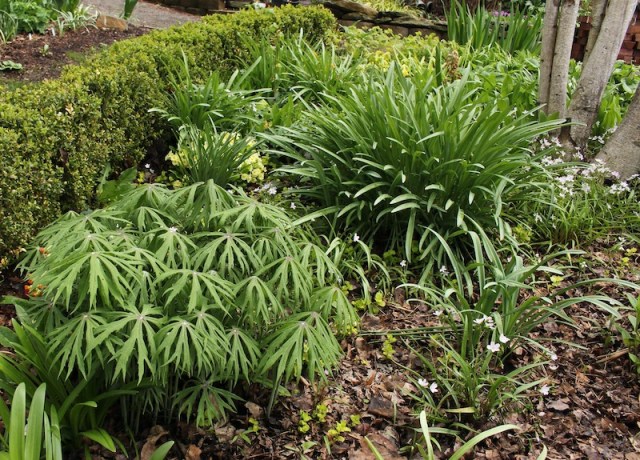
The woodland beds, aka snowdrop beds, are coming to life.  The shredded umbrella plant (Syneilesis aconitifolia) is cool and I wonder how much cooler a named form with variegation or a purple or yellow flush to the foliage would be.  Probably much much cooler.

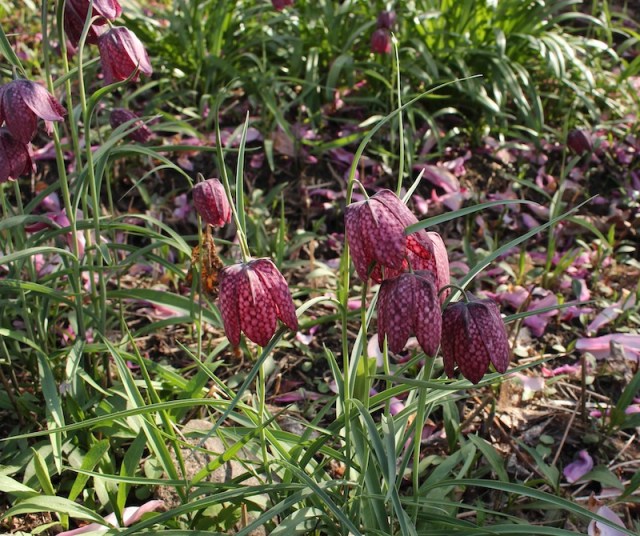
Fritillaria are one thing I do want to point out quickly.  They generally enjoy short lives here but two are at least trying and obviously I should show some appreciation for that effort.  Fritillaria mealegris likes the mucky side garden by the pond and is seeding around and clumping up and is ever so intricate with its checkered blooms and snake-head elegance.

fritillaria meleagris

Fritillaria meleagris (snake’s head fritillary) not showing up well amongst the fallen petals of a purple magnolia.

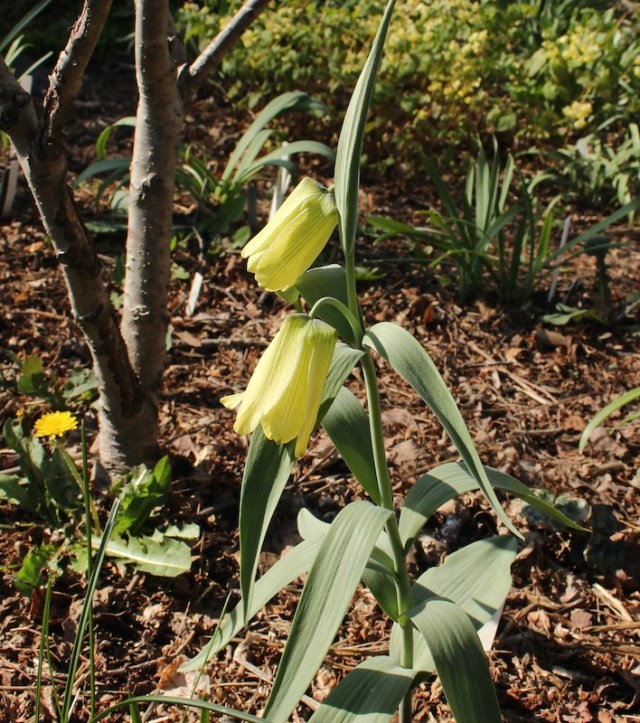
Fritillaria pallidiflora is the other frit which I’d like to mention, and in this case it really is to brag.  I grew it from seed you know, and it took years and even if you can buy 5 bulbs for like $5 online I think my years of patience in this one last seedling are a far better investment.  For reference, the week after I saw these first buds coming along a friend posted a photo of his ‘weedy’ clumps which seed all over the place, but I didn’t let that tarnish the joy of my two blooms at all.  Mine will come along I’m sure, even if it takes another 20 years.

fritillaria pallidiflora

Fritillaria pallidiflora in a shaded, woodlandy snowdrop bed.  It seems happy in this spot and I hope it stays that way.

You know what doesn’t require much fuss?  Epimediums.  I’ve been trying to avoid collecting yet another plant but these are so tolerant of abuse and independent in the face of neglect that even a random one by one planting starts to build up.  A better gardener would keep track of their names just in case they started to accumulate like this, because of course people appreciate a name when you share a piece, but so far that’s been hit or miss and hopefully nobody asks about names on the ‘other ones’.  I’m sure it will be fine, right?

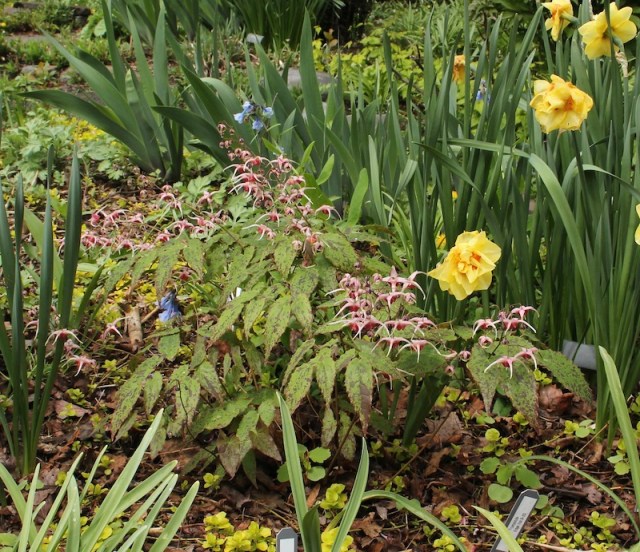
epimedium pink champagne

Epimedium ‘Pink Champagne’ is one which shows off more than a few of my others.  They’re all interesting things but not every one shows off at a distance greater than ten feet.

What else… The native Virginia bluebells are back and should be reseeding and slightly weedy even though they’re not.  I don’t think my garden is quite the fertile lowland woodland which they prefer and that’s fine I guess since a mass of them could be a floppy mess once they’re finished.

mertensia virginia bluebell

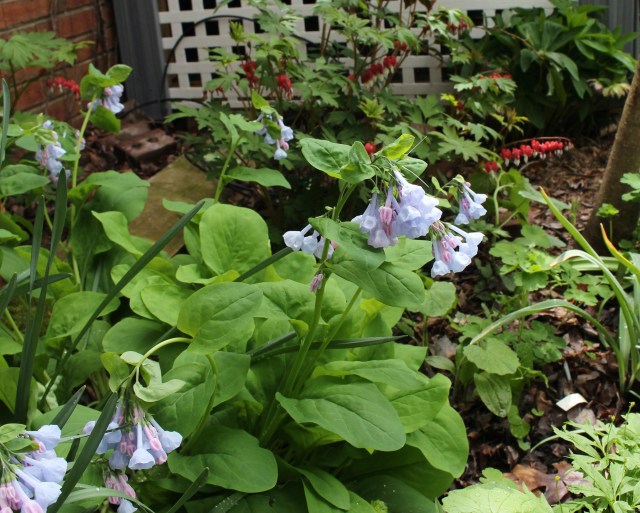
Mertensia virginica is a beautiful native bluebell which will go dormant once things get warm and it goes to seed.  This should fill a woodland, I should try convincing someone to do this in their garden since mine is a little too small for sheets of blue.

And that’s about it.  Besides chopping things down and just enjoying spring flowers there’s been an unusually suburban focus on the lawn this year.  I’m actually somewhat embarrassed to admit that the lawn was mowed twice this week to keep up with the rain and fertilizer and at one point I even sprayed for a few of the worst weeds.  Usually the lawn is a burden (and I’m not ruling that out come July) but so far this year I’m slightly obsessed.  Maybe this will give me a little more street credit in a way flowers and tiny bulbs do not and maybe that’s what I needed in my life even if I didn’t think it.  Never fear though.  Enough weeds remain that I am still safe from any Scott’s endorsements even if there might not be enough to keep the lawn haters satisfied.  Actually while I’m at it in confessing to untrendy things, I might as well mention the privet hedge I’m starting.  Yes, privet is invasive in the south so shouldn’t be planted, but here it’s been a standard for at least the last hundred years so I think I can sneak in under some kind of grandfather clause.  It’s not native, but neither am I, it’s overly formal to keep trimmed, but that’s what I want, it’s kind of boring and maybe a monoculture, but… we will see.  I have a weakness for formal hedging even though natural and native is more PC, so until this fever breaks we will see if a privet hedge was what I needed.

privet hedge planting

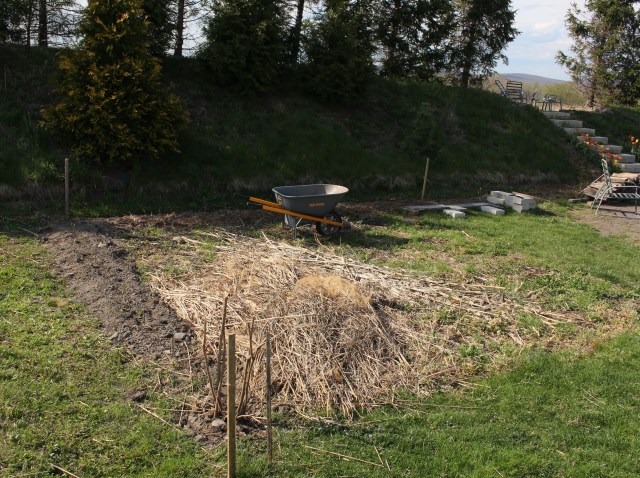
In the future a privet hedge will possibly surround last year’s pumpkin patch.  As with everything here it’s a work in progress.

In all honesty there’s a real strong chance this hedge thing will come to naught since when I say ‘planted a privet hedge’ I really mean I stuck in a few pieces of privet trimmings along a line where I’d like a hedge.  It’s probably too late in the year to do that.  I probably used the wrong pieces.  I did nothing to prep the soil or care for things afterwards.  Maybe it can’t even be done but I tried it anyway and in a nutshell this latest idea pretty much sums up how everything in this garden rolls.  Bad ideas, executed poorly and haphazardly and then put off for longer than they should be and then recognized as the work of an idiot but somehow enough things work out to make it all fun again.  At least it gives me something to ponder while sitting around, and in May a little sitting around is almost always a good thing.

I hope you can enjoy a little sitting around yourself, and that May is off to a good start.  Perhaps May is when this blog becomes more regular and this blogger rejoins friends in the blogging community but a reality check says August is probably more realistic.  The heat of summer has a way of rewriting and shortening the to do list and until that happens 😉


‘Tis the Season

Last weekend there was a snowdrop brunch here.  That sounds kind of fancy but in reality it wasn’t, even if we did use real plates instead of paper.  I owed my friend Kevin for helping out at the Gala, and thought breakfast would be a good start, but when he already had plans with another friend who just happens to be Kimberley of Cosmos and Cleome I thought let me invite them both.  I had been cleaning up the garden all week, and the lure of food might be my best chance at getting someone other than the dog to look at a few snowdrops with me, so the three of us made plans and another name was suggested, two more people were added, and when someone offered to bring a dessert I had to rename our breakfast to brunch since you know you can’t have a dessert after only eating a few scrambled eggs.  Plus I wanted to sleep in of course, and not everyone wants breakfast at 11.

snowdrop blonde inge

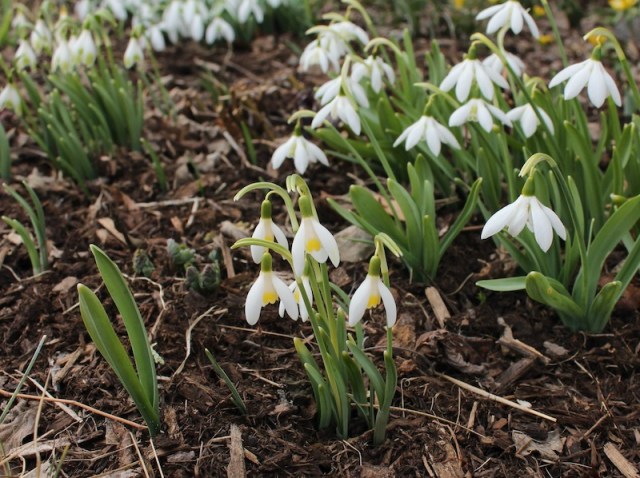
‘Blonde Inge’ is a dainty little snowdrop with the added touch of a yellow mark inside. Sometimes the inner glow makes the whole bloom shine but I’m sure that’s just my imagination.

The brunch went well.  I believe with the exception of a horribly weak second cup of coffee which I tried to pass off as drinkable, everyone found a bite to eat and something interesting to talk about and the time passed a little to quickly.  I got nervous.  What if all these people just came here to hang out and eat and no one wants to freeze outside, crawling from snowdrop to snowdrop admiring how different each and every one is and what kind of history it has and how tricky it is to grow and does it multiply well and where did I get it from and…

snowdrop seedlings

A ‘Blonde Inge’ seedling.  Very similar to mom, but oh so much more amazing because she was born here in this garden.

Eventually I passed out coats and people took the hint.  I had fun.  People looked cold.  Not everyone seemed to care about how ‘Wisley Magnet’ differed from ‘Foxgrove Magnet’, so I think pancakes will still be required to get them back again, but from my perspective it seemed so much healthier to finally be seen talking to other people in the garden rather than myself.  I hinted at food and another visit for daffodils and people seemed open to the idea so hopefully with any luck this wasn’t a one and done deal.

galanthus viridapice

Green tipped ‘Viridapice’ with a flush of yellow winter aconite.  I know I show these way too often but this is probably my favorite mix of late winter color.

My favorite comment of the day was something to the effect of ‘What the F*&k Frank, how do you have so much flowering!?’ and generally people had other nice things to say as well, but to my shock not everyone wanted to look at each and every clump, and it was more of a yellow vs green, that one is so much larger, and oh look a double, conversations.  So rather than find all new friends who will probably eat just as much I’ll just babble on to you about a few of my favorites for this year… and try and not repeat all the favorites which show up as my ‘maybe favorites’ every other year.  Key word there is “try”.

galanthus greenfields

A newer snowdrop for me, galanthus ‘Greenfields’ is completely boring and average, but perfectly formed and sturdy and crisply colored with dark green marks on a good sized and pristinely white flower.  

galanthus ivy cottage corporal

Several snowdrops have come up paler this year, including ‘Ivy Cottage Corporal’.  Before people began seeing faces in their snowdrops, the people at Ivy Cottage saw the insignia marks for the rank of corporal in this drop.

galanthus dick's early

‘Dick’s Early Yellow’ is just that, and an excellent grower as well.

galanthus midas

Last season ‘Midas’ barely bothered with yellow, choosing green instead but this year the color is closer to gold.  Brighter days perhaps?  

galanthus elizabeth harrison

I think of galanthus ‘Elizabeth Harrison’ as an aristocrat amongst snowdrops.  She’s a little delicate and can be fussy, but when everything is going her way the bright yellow and white against grass-green foliage strikes me as quite elegant.   

galanthus ea bowles

Galanthus ‘EA Bowles’ is amazingly beautiful but died off on me a few years ago.  Fortunately a friend was able to give me another start and now he’s settled back in and doing well.  Good thing, since my friend went on to lose her clump and now hopefully I can share a piece back again this summer.

galanthus carol simcoe

As American as a snowdrop can get, ‘Carol Simcoe’ was found in a wild population around Allentown Pa and was introduced by Gerald Simcoe and named after the artist’s mother.  

galanthus cordelia

In the 1940’s Heyrick Greatorex named a group of doubles which some people seek out.  My favorite is ‘Cordelia’ with her long-lasting, sturdy and upright flowers, but the others which I grow may or may not be the true forms, and may or may not be as favored.

snowdrop seedlings

For no reason other than my own curiosity, I’m excited about this entirely average snowdrop seedling.  The potential mom is behind and I thought she never sets seed but along comes a seedling which shares her long, narrow ovary but with bigger flowers and wider leaves.  I think they’re related and I think I like the mix.

So I think I did fairly well there with minimal babbling and maximum efficiency and I also think that summary reflects my whole snowdrop season in general this year.  It was too cold, then it became too warm, and for the last week too windy and too stormy.  The warmth pushed everything along in some spots but barely thawed the soil in others.  The wind made snowdrop viewing uncomfortable and some strong rain beat up a few things even more, but in between there were still a few perfect moments and that’s all I ask.

dutch crocus vernalis

The first flowers of the Dutch hybrid crocus always signals the downside of the snowdrop season.  The garden will be nonstop from now on! 

I hope your season is reving up and full of promise as well, and that it brings you joy.  For a few days yet everything seems under control and so well planned, but then the tidal wave of weeds, weather, and watering hits and there’s barely a moment to breath, and if you end up there stop.  Make sure you have time to breath and enjoy.  I shall be doing that today… unless of course I shovel and move a few tons of dirt to level some dips in the lawn next door which will then need seeding and watering and then perhaps I’ll get to my own back lawn which has plenty of spots which need to be a few inches higher and will also need a couple tons of dirt spread and then I probably have to run out for more grass seed and the first box of ordered plants is sitting on the porch steps… and well… *breath*

Here Comes the Sun

What a beautiful weekend.  A little windy, a little cold… actually if you went by the commentary which followed nearly everyone’s observation on me working outside you would say it was a frigid weekend… but it was perfect.  I cleaned up the front yard, it looks amazing in my opinion but others do not like all the autumn leaves which mulch the street bed.  Okay maybe it looks a bit messy and they could have been mulched a little more, but if that’s what’s distracting you after weeks of frozen soil and cold winds well then I can’t help you.  Color is back and I’m ready to enjoy.

snowdrop collections

Some of the first snowdrop plantings here have matured nicely.  This is a favorite spot along the front of the house and the shelter from the wind brings everything on a little earlier.

snowdrop collections

‘Straffan’ in front and ‘Brenda Troyle’ in back.  Also a sheltered spot, right up against the porch.  Normally ‘Straffan’ is a little later, but I guess this year everyone is anxious for spring.

crocus tatra shades

The rabbits have been caught off guard and didn’t realize the first crocus (‘Tatra Shades’) are ready and waiting.  They should find them by tomorrow.

hamamelis barmstedt gold

Hamamelis ‘Barmstedt Gold’ is amazing this spring.  I might need to collect even more witch hazels 🙂

eranthis winter aconite varieties

The driveway soaks up the sun’s warmth and keeps this bed warm enough to bring on a full flush of snowdrops and winter aconite.  Cyclamen coum are on the way as well!

eranthis winter aconite varieties

The winter aconite in this bed are a mix of the straight species Eranthis hiemalis, plus pale yellow ‘Lightning’ (which is already starting to look tired), and the faded yellow of ‘Schwefelglanz’.  I love them all.

snowdrop collections

The newer snowdrop plantings need to fight for their space.  This Dryad Gold snowdrop was planted a little too close to the giant reed grass patch, and I’ll need an axe and a pick to free up the delicate little thing. 

snowdrop collections

‘Bloomer’.  I’m showing this just because none of them sold at the gala and it’s one of my absolute favorites.  On the plus side I replanted the unsold ones as a second clump, and perhaps next year will be their year!

So that was a hit and run post.  I don’t think anyone will miss me prattling on about all kinds of nonsense and I wanted to get these photos up before I take another twenty or two hundred tomorrow!  Enjoy your week 🙂

The Recap

So what can I say?  David Culp’s Gala was fun.  Great seeing people excited about snowdrops, talking way too much about snowdrops, amazing lectures about snowdrops, and in general excited about the new gardening year.  Selling went well.  I was remarkably okay with seeing snowdrops leave my garden, somewhat insulted that a few favorites didn’t sell, and then just fine with bringing a bunch home for replanting.  But… I was unusually luke-warm to new purchases and plant shopping in general.  For the first time ever I tried to come back with more money in my pocket than when I went down, and in hindsight that was a terrible mindset since there were only 5 new snowdrops for the return trip and now I have to sit for months with only five new snowdrops when I really think all that work should have earned me dozens of new snowdrops!

And for the first year ever I didn’t treat myself to a new ‘Brandywine Hybrids’ hellebore.  They were perfect, and seeing the others in the garden starting to stir to life makes the regret even harsher.

brandywine hybrids hellebore

Each year the Gala hellebores are amazing.  After years of coveting doubles I’m back to singles and any of the picotees or the purple stained whites could have easily joined me for the ride home.

I was distracted though.  Maybe even stressed?  The day worked out perfectly, but to be honest I woke up at 1 that morning sick to my stomach and got to enjoy that feeling right up to the minutes before the doors opened.. .and then in typical fashion it lifted right as the excitement began.

david culps galanthus gala

A few seconds after the doors opened.  Tables are full, hands are empty, there’s little socializing but some real intense table scanning!  Fyi this is the Suburban Home Nursery table, manned by the always entertaining Kevin and my exceedingly competent cashier-daughter.

Also in typical fashion I took next to no pictures.  Just like every other year I’ll apologize and promise better but I think we know the truth, and it’s probably for the best too since 10 out of 10 family members will only use me as the last resort when it comes to any type of event photo.  “ugh, just delete them all.  Where’s mom?” should be a warning/reminder sticker on the back of my phone.

edgewood adonis amurensis

Edgewood Gardens warming up and coloring up with Adonis amurensis

I think it was mentioned that rather than work my own table, I had already committed to working the Edgewood table for the Gala, and a perk to this was a leisurely tour of Edgewood Gardens the day before.  The week of above freezing weather had paid off.  Things were embracing the weather and bursting out of the ground and starting off on that spring flush of color.  Hellebores, winter aconite, Adonis, witch hazels, crocus… and of course snowdrops were scattered throughout the garden.  At one point I was even unsupervised, and the low light, flowers, and bird song were enough to make me want to soak up the moment rather than consider what might fit into my pocket.

edgewood galanthus blewbury tart

The best clump of ‘Blewbury Tart’ I’ve ever seen.  How silly of me to have given this plant a lukewarm review years ago, I should have known it was more my growing skills and not the drop.

To round it out it was an excellent weekend.  I was almost tempted to return this weekend for the Bend to Bank lecture at Winterthur, and hear Anne Repnow give a talk, but alas it might be time to spend a weekend at home.  Trust me there’s plenty to do.

edgewood gardens

A coldframe inspection at Edgewood Gardens.  Quite a few treasures here, both inside and out!

Will I do what needs to be done?  Probably, if I can only get started.  Last night was spent browsing houseplants on some fraudulent website, and then this morning I had to spend time canceling my credit card and getting it re-issued, but honestly entertaining the dog and cleaning the kitchen took more time than that.  The garden is still waiting 🙂

snowdrops with winter aconite

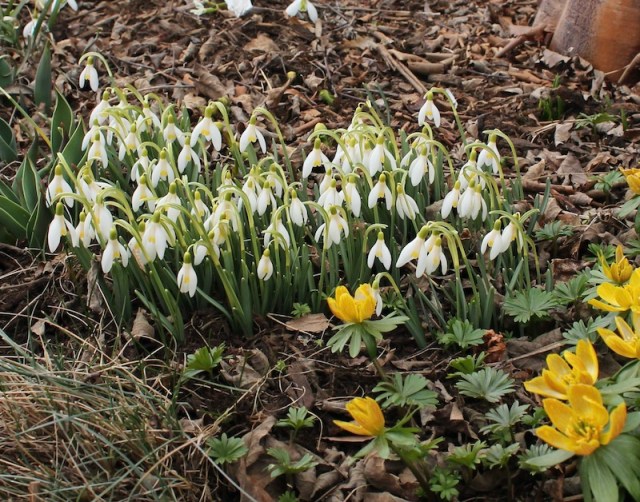
A terrible picture of winter aconite (Eranthis) opening up alongside the snowdrops.  I love these first cautious blooms.

So blog post done, maybe breakfast and a shower wouldn’t be the worst ideas either, and then maybe it’s time for a little work outside.  Just because I stayed home to get things done doesn’t mean it will happen!

Enjoy your weekend, and prepare for the onslaught of even more snowdrop photos while I second guess the witch hazel and primulas which I also did not buy last weekend.  Grrr.