GBFD August ’16

They say better late than never, but according to that theory just about everything I do should be better… and I know that’s not the case, so I’ll let you be the judge.

I’ve let a few too many of Christina’s Garden Blogger Foliage Days pass by without a decent post, and that’s a shame since I really enjoy her prodding us to take a monthly step back to look past all the flowers.  The flash of flowers often catches the eye and as a result foliage often fades into the periphery of subconscious thought, so on the 22nd of each month it’s not the worst idea to look around and consider what the leafiness of your garden is doing for the bigger picture.

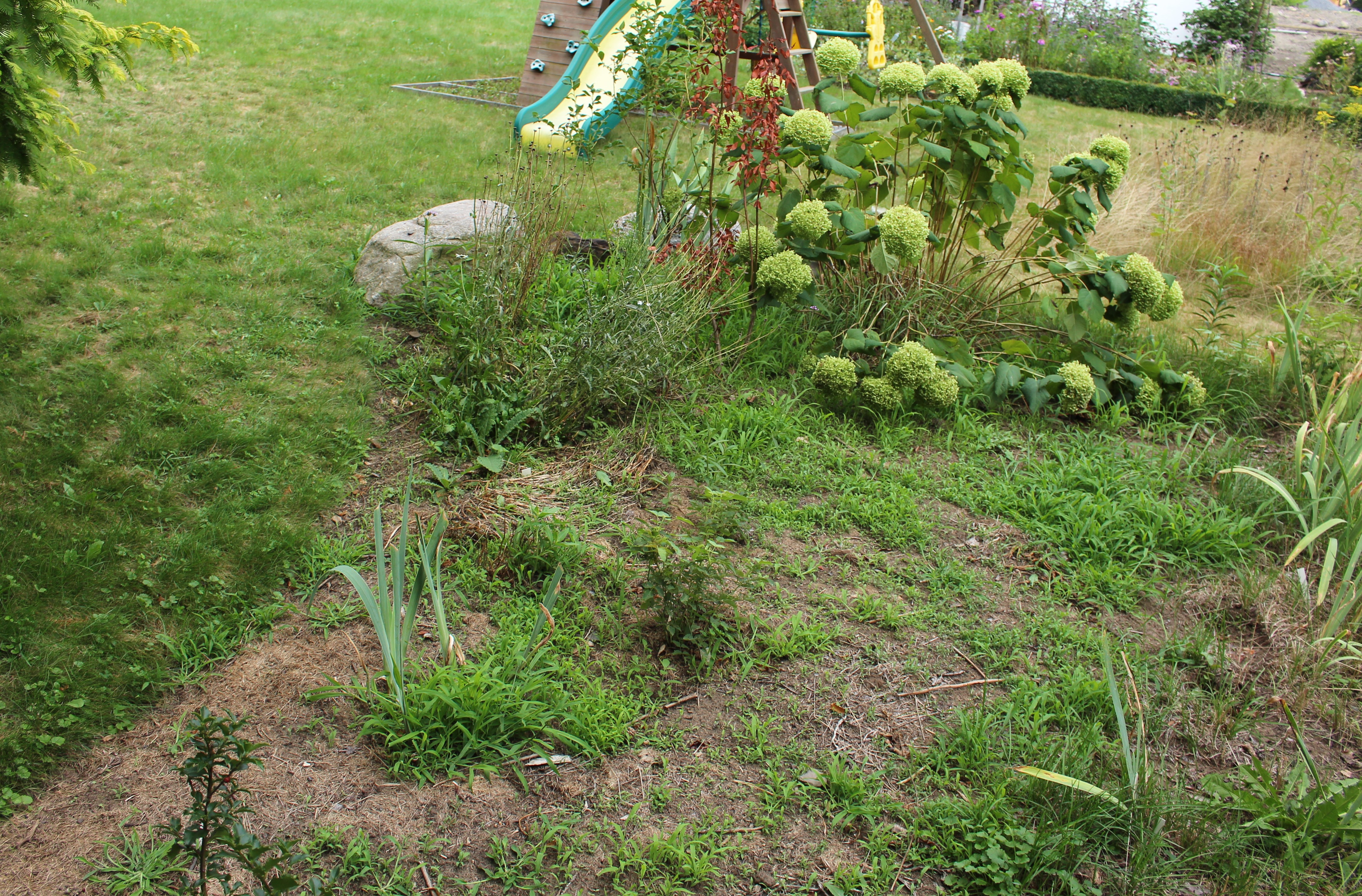
lasagna garden bed

The bed-which-I-can’t-decide-what-to-do-with just before we left on our camping trip.

I showed the above picture just a few days ago and although I knew there were a few weeds sprouting I just didn’t get to them before we left.  Let me just insert here that this is not going to be the “decent post” which GBFD deserved this month because it’s a post on only one type of foliage, and that’s the quick growing green of crabgrass and other uninvited leafy pests.

weedy flower bed crabgrass

The same bed exactly one week later.  A bounty of rain, heat, and sunshine plus a fertile soil (the dumping spot for our rabbit’s used bedding) have greened up everything.  Even the clover and creeping Charlie have filled in any last remaining dead patches in the “lawn”.

I spent a recent afternoon clearing out all the lush growth.  The bed is empty again but this time I stuck a few stray cuttings here and there and with a little luck perhaps I’ll have some more varied foliage for September’s GBFD.  At the very least it might give the weeds a little competition since apparently there’s not much slowing them down now.

Thanks for humoring me with this ‘foliage’ post and if you haven’t already been over please consider giving Christina a visit to see what others have done this month with their posts.  You won’t be disappointed.

Tuesday View: The Tropics 8.23.16

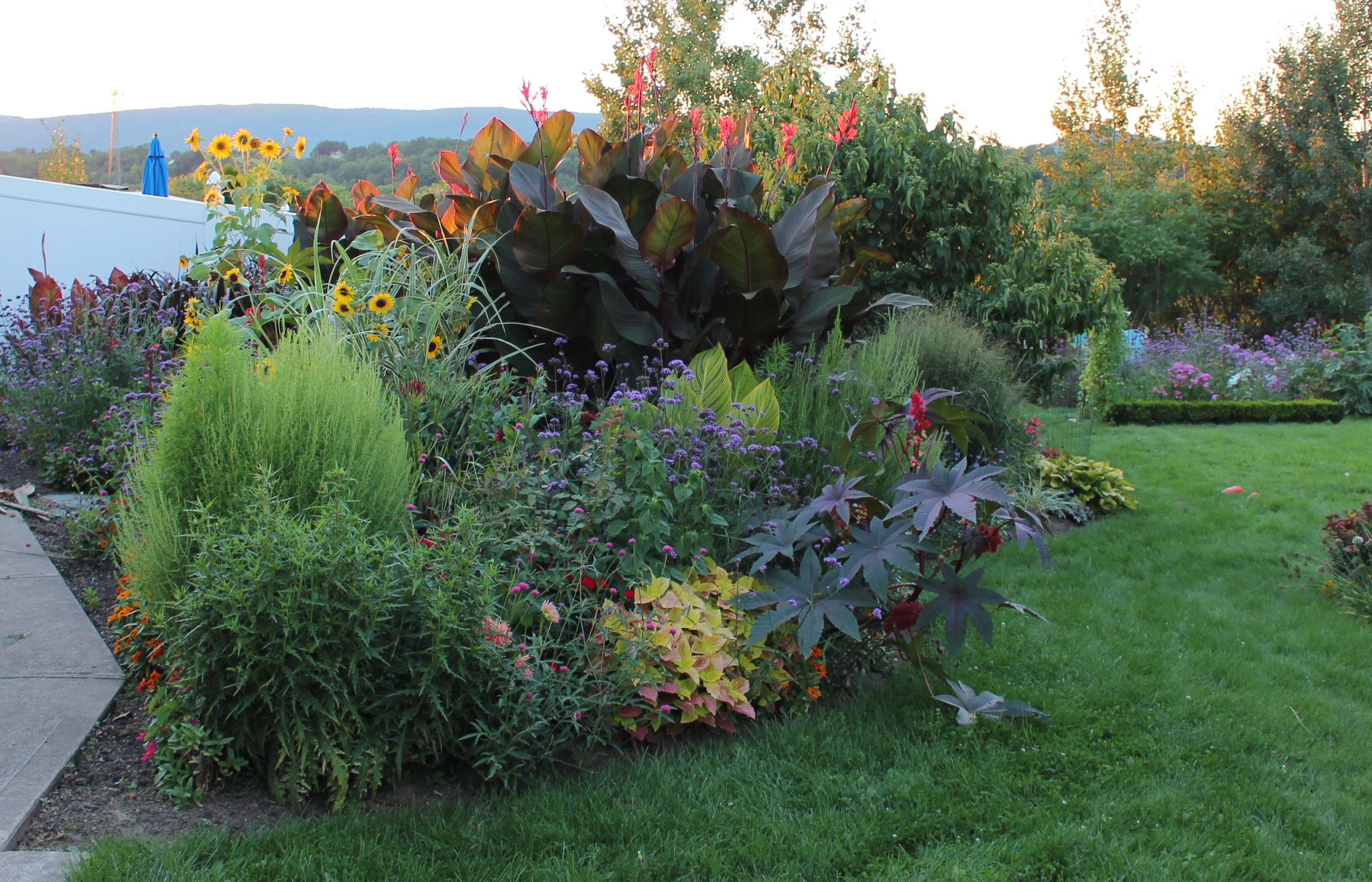
It’s another Tuesday and although I missed last week due to a quick summer jaunt up to the mountains of New Hampshire, this week I’m back to joining in with Cathy at Words and Herbs in order to look at the weekly progress of the tropical border.  Heat, humidity, regular rain showers, and strong summer sunshine in between have brought on an explosion of late summer growth and the purple leaved cannas now dominate the bed.

tuesday view

Purple leaved canna indica, maybe ‘purpurea’ or ‘red stripe’ or ‘Russian red’… I don’t really know since they were given to me years ago as just plain old canna… have now topped off at around 8-9 feet.

You’ll probably notice the small red blooms the cannas have put out.  They’re nice enough as a little decoration up top but hardly enough reason to grow these plants.  It’s all about the foliage and it’s looking particularly good on this deliciously cool and clear, breezy summer day.

canna indica purpurea Russian red

Canna indica ‘purpurea?’ blooms against the bright blue of a clear summer sky.  A very popular flower with the hummingbirds.

Have I referenced “summer” enough yet?  I’m hoping that if I keep saying the word it will hang on forever, and we’ll never have to deal with the cold little deaths called autumn and winter.  Surely it’s a part of life here in Pennsylvania, but I don’t mind if it holds off for another two months at least.

coleus Alabama sunset

I need to add more coleus to the bed next year.  As things grow so does the shade, and this coleus (maybe ‘Alabama Sunset’)  fills in nicely rather than fading away like some of the zinnias.

There’s a whole back half to the bed which has been blocked off by the main clump of canna.  It’s a little messy but hopefully in the next few weeks a dahlia or two can break through and add a little color as other things begin to fade out.

tropicalismo

Is ‘Tropical Weed Patch’ a look?  If I can only think of a better name maybe it will catch on but in the meantime you may notice the salvia ‘Caradonna’ which constantly annoys me is still exactly where its always been.  Sometimes things don’t move too fast around here 🙂 

With such a mess of randomness there’s bound to be a surprise here and there, and sometimes that surprise even turns out to be a nice one.  This week it was the salvia which has just come into bloom.  My favorite version of the stout, too-red, gas-station salvias (Salvia splendens) are the ones which don’t look like they’d end up in a gas station planting at all.   They’re the tall and lanky ones which are sometimes referred to as Salvia splendens ‘Van Houttii’ and up until now I’ve only succeeded with a peach colored one.  But last year I did have a short purple bedding type nearby, and apparently things happened at night and lo and behold this year one of their children is a tall, lanky purple.

purple salvia bloom

At about three feet tall this purple salvia bloom has all the grace and style which its shorter cousins lack.  Even better was that I found this as a self-sown seedling and was lucky enough to nurse it on to blooming size.  This makes me wonder as to what the other seedlings will look like.  

I’ve shown it before but have to show one more photo of the castor bean.  The bright seed pods look perfect amongst the purple foliage.

castor bean carmencita

The spiky red (and remember poisonous as well) seed heads of castor bean ‘carmencita’

This afternoon the sun hit the back corner of the bed perfectly.  You don’t even notice the weeds when the light is like this.

tropicalismo

Verbena bonariensis is the workhorse of this bed and although it threatens to swamp everything else here it’s still worth any bit of trouble it causes. 

At this time of year it’s easy to ignore any maintainence and just enjoy the plants as they slide on into autumn, but dahlias are yet to come and dahlias need staking.  Two weeks ago would have been the best time to do this but things happen and when things happen the dahlias fall over.  It will require twice as much time to carefully put them back up and some might just stay where they lie.  It will be more of a groundcover look, but with the way they are stretching away from the canna’s shadow nearly all the plants have verticality issues which might not be worth fighting.

panicum northwind

There are dahlias in them thar purple verbena, but for now lets just focus on the panicum ‘Northwind’ which is turning into a tight fountain of frothy seed-heads.

Dahlias will hopefully be staked tomorrow… or Thursday.  Weekend at the latest.  It’s so nice right now with green grass, butterflies, and flowers who wants to stake stuff?  Plus I needed to tackle a hedge of crabgrass which sprouted overnight in one of the other beds, it’s an embarrassing mess, but at least it’s green and green is so much nicer than the dead brown which surrounded me last month.

Mess or not I hope you enjoyed the view and if you’d like give Cathy a visit and see what this week has brought to her garden and others.  It’s  a nice way to keep tabs on things over the season and it’s also a great way to get things staked and weeded.  Shame is a great motivator and even if it means I have to stake with one hand and take pictures with the other, the job will get done long before I even consider publically admitting that the twine has defeated me 🙂

A quick August walkabout

Although the air practically drips humidity and the the nights are muggy it’s still nothing compared to summers South of the Mason Dixon line.  Plus it’s only been a few days, and it’s actually rained regularly for three weeks now and I do love a nice summer thunderstorm so I’m fine with all of it.  What a relief from the relentless dry which haunted me all of June and July (and still haunts much of the East Coast) and what a change the gardens have gone through as they try to get all the growing in which didn’t happen during the first half of summer.

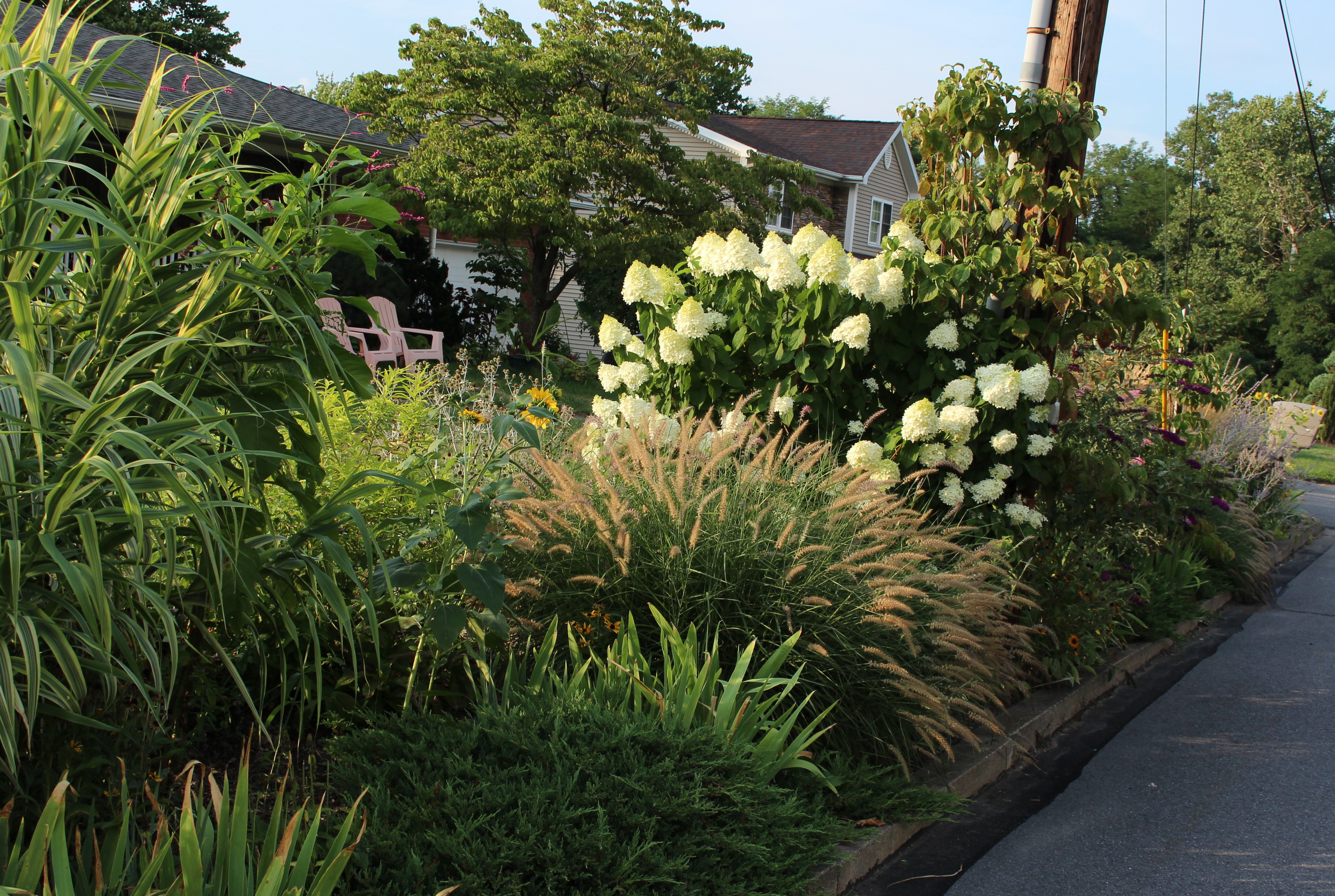
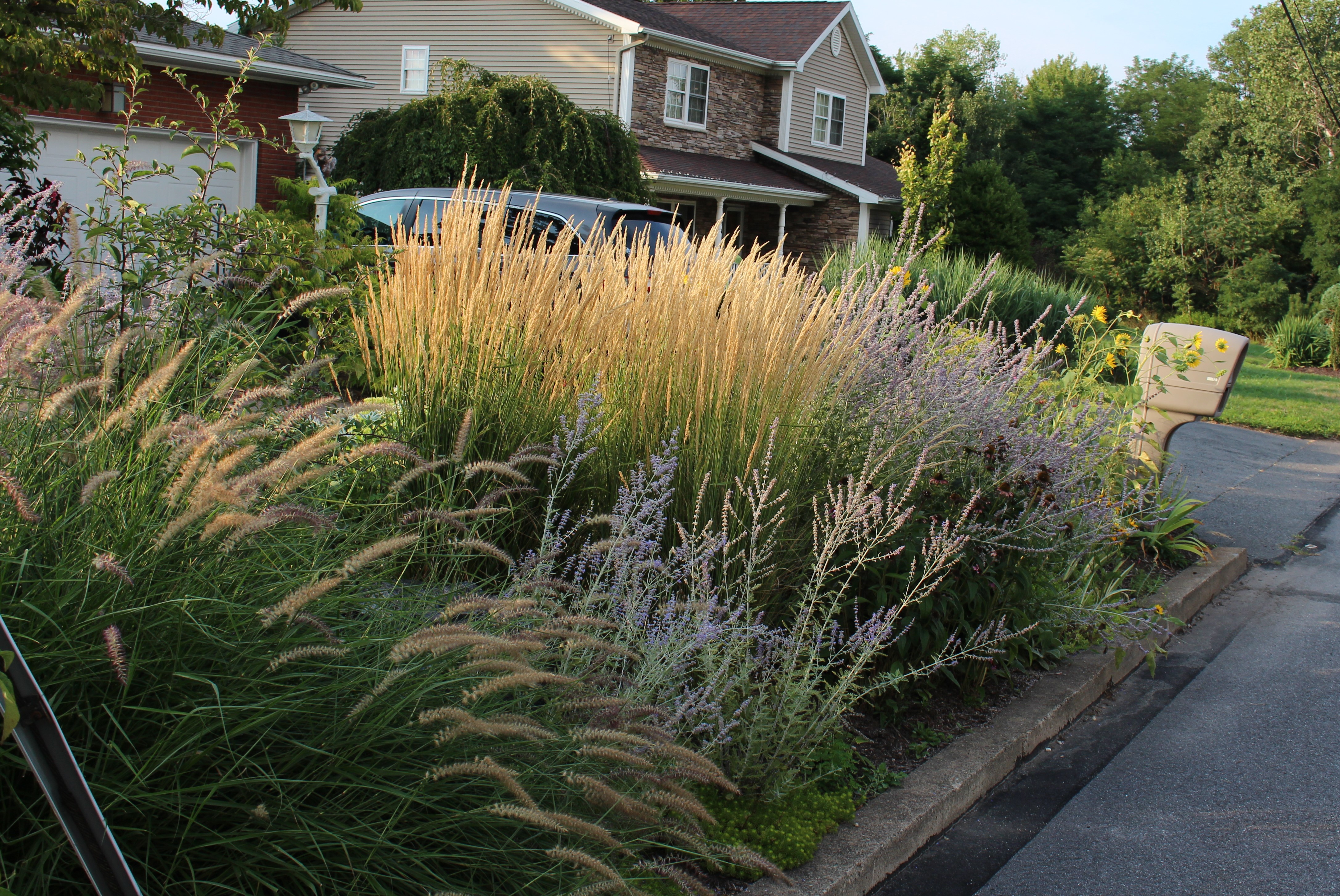
front street border

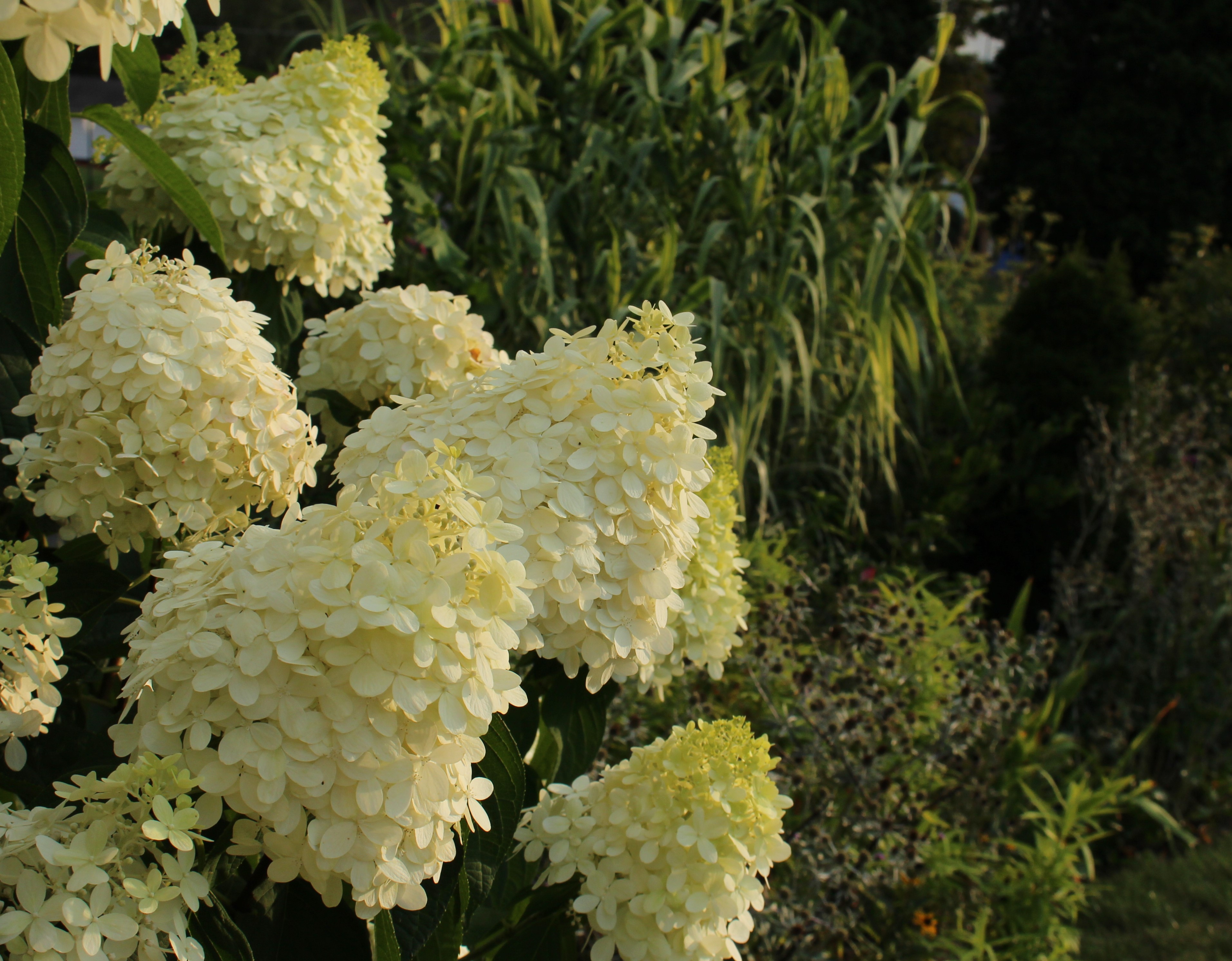
I think I show this view every summer as the ‘Limelight’ hydrangea comes into bloom along the street.  It’s an awesome plant.

Here’s a quick tour of the good and bad which summer has brought to the rest of the garden… and by ‘rest’ I mean the part which I practically gave up on when the rains stopped.

limelight hydrangea

Ok so I did give this bush some water when it began to wilt and yellow. How could I risk missing these blooms!
Along the street the plants are on their own and most handle drought with style.

front street border

‘Karley Rose’ fountain grass, ‘Karl Foerster’ feather reed grass and perovskia. The purple coneflowers didn’t make it this year and their blooms just dried up and wilted without extra watering.

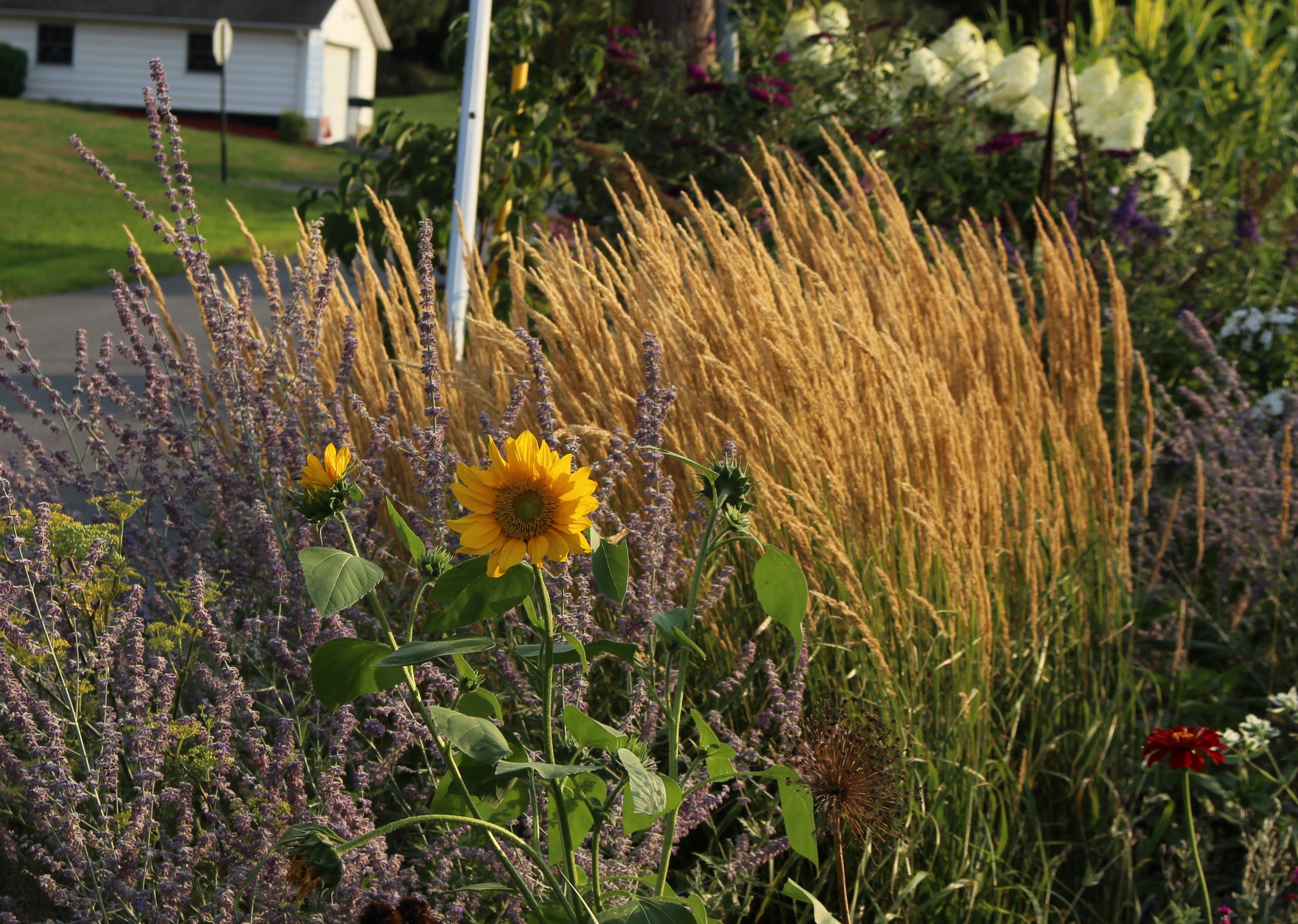
The grasses really are reliable, but without a doubt ‘Karl Foerster’ is my favorite.  I think I’ve gone on about it enough in the past but please excuse just one more picture.

sunflowers and feather reed grass

Sunflowers have a knack for putting themselves in just the right spot. If I could do a mass planting of this combo with sunflowers, perovskia and Karl I would do it without a second thought.

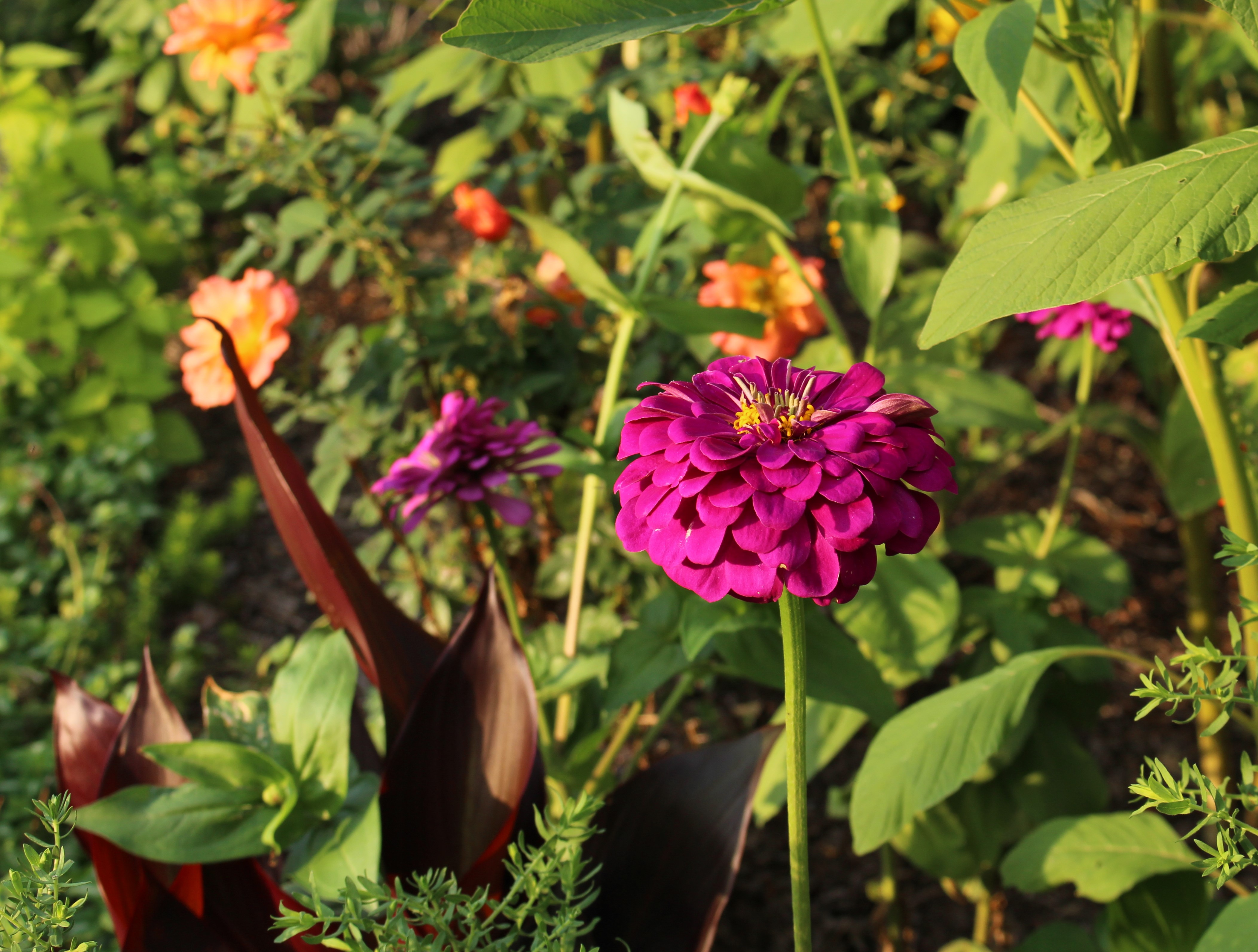
A few of the annuals planted in June have responded to the rain and are now looking like they want to live after all.

purple zinnia

Not sure if my color choices are really on point with the annuals this year, but a zinnia looks great anywhere.

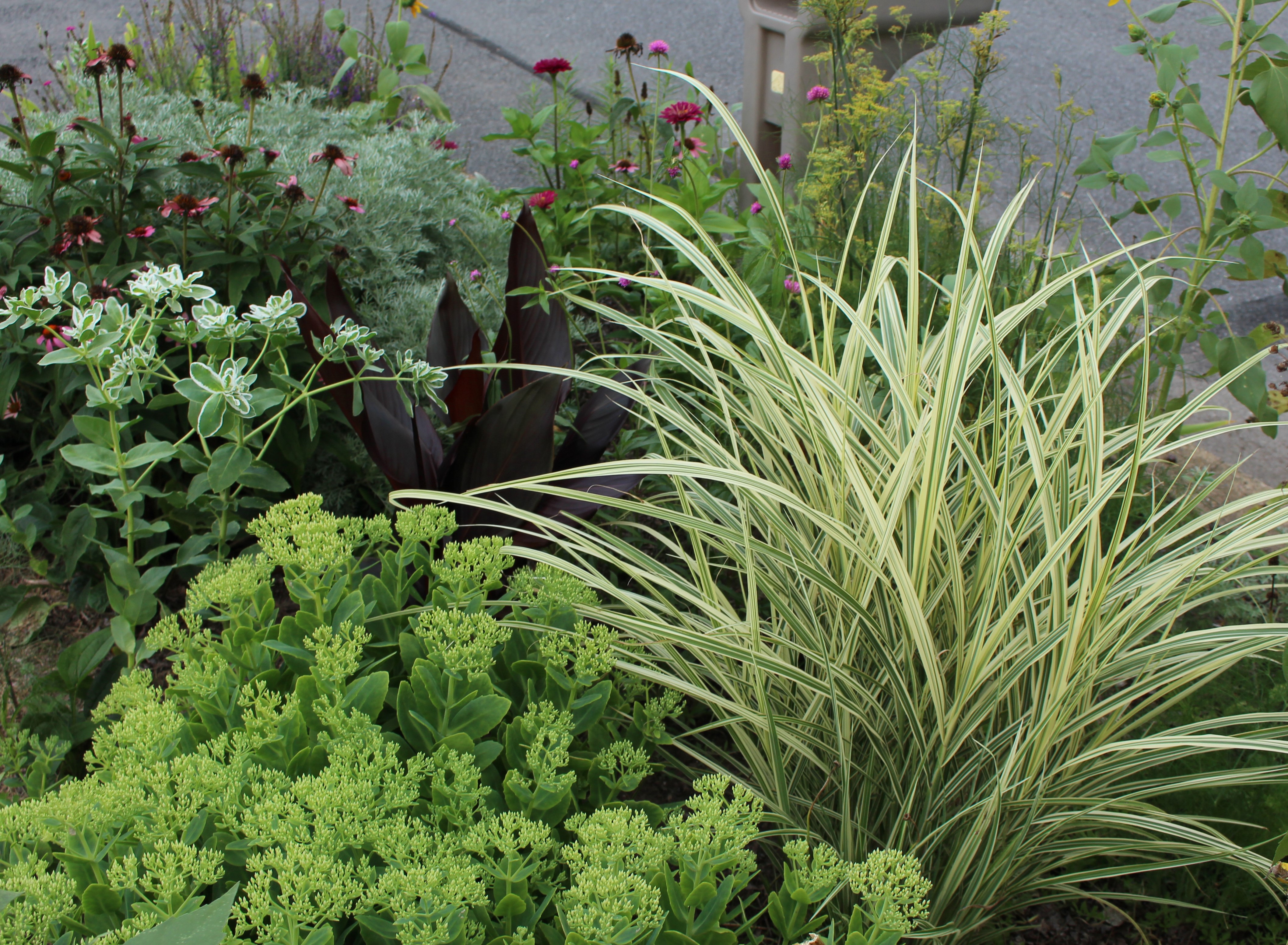
A three year old ‘Dixieland’ miscanthus has finally put its roots down and taken off.  Me and variegation are always friends so obviously there was a good chance the two of us would hit it off… and we have 🙂

sedum brilliant and dixieland miscanthus

‘Dixieland’ is a dwarf miscanthus which generally goes against my love of giant plants, but for this one I’ll be glad to avoid the floppiness of its variegated big brother, and for the mailman’s sake this size is far less intimidating.

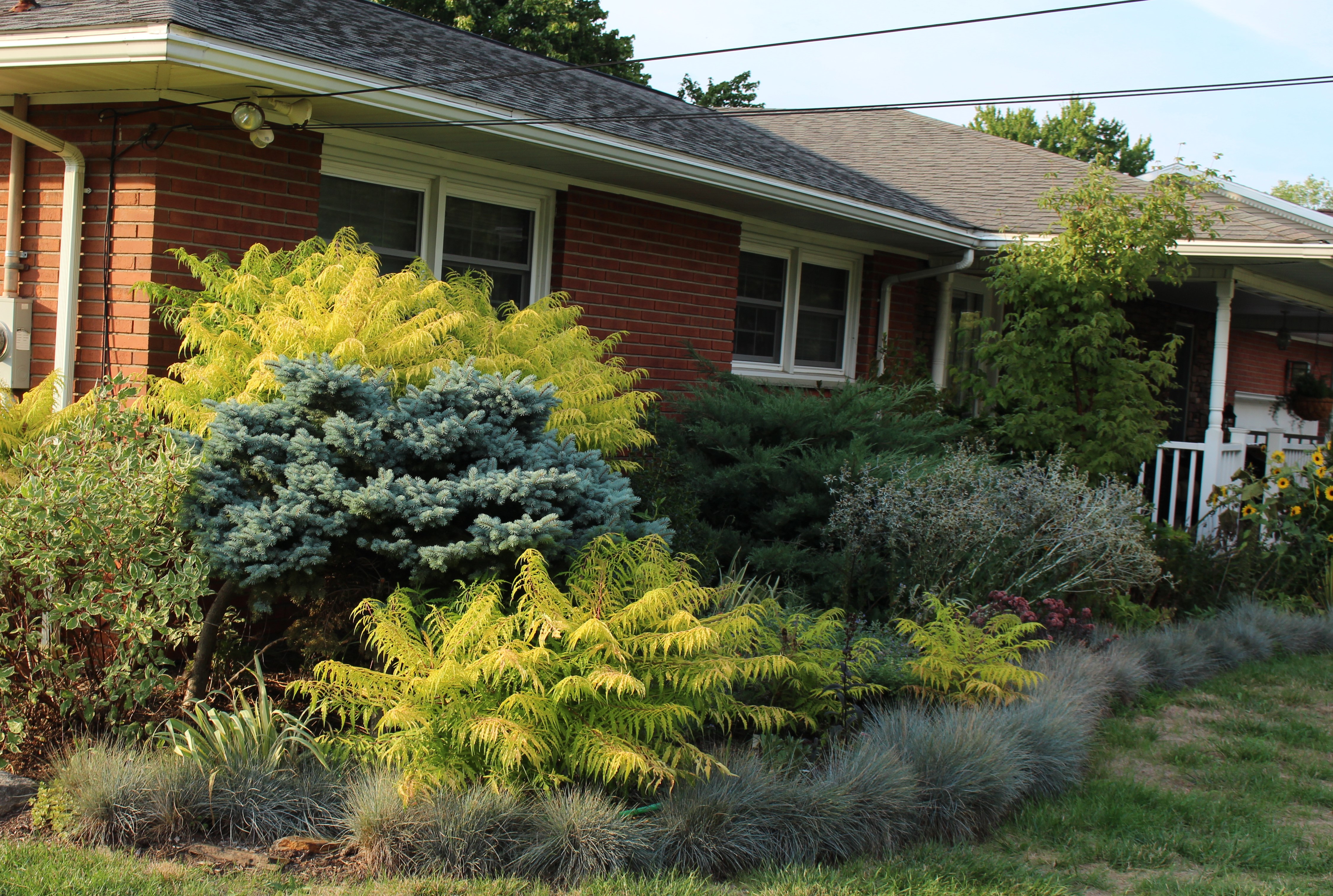
Things start to go downhill as you look to the house.

sumac tiger eyes

Someday I’ll grow up and realize ‘Tiger Eyes’ staghorn sumac is too aggressive a spreader for smaller planting areas and too informal a look for foundation plantings, but that realization may still be decades off.

Once you walk past the tropical bed and head out back it becomes project after project.

lasagna garden bed

Weeds are once again exploding in the bed-which-I-can’t-decide-what-to-do-with. Iris bed fell through, veggie bed fell through, dahlia bed fell through… and still it sits.

At least when it was dry the crabgrass wasn’t a problem.

crabgrass weed

Most of the iris and daffodils have been dug but just enough remain that I can’t really move on with this bed either.  Plus without a lawn worth mowing I don’t have any mulch to smother the crabgrass with and its spontaneous regeneration will make for a horrible mess in another week.  But on the bright side I do see the rabbits here all the time nibbling.

The return of rain has brought a sort of second spring to some parts of the garden.

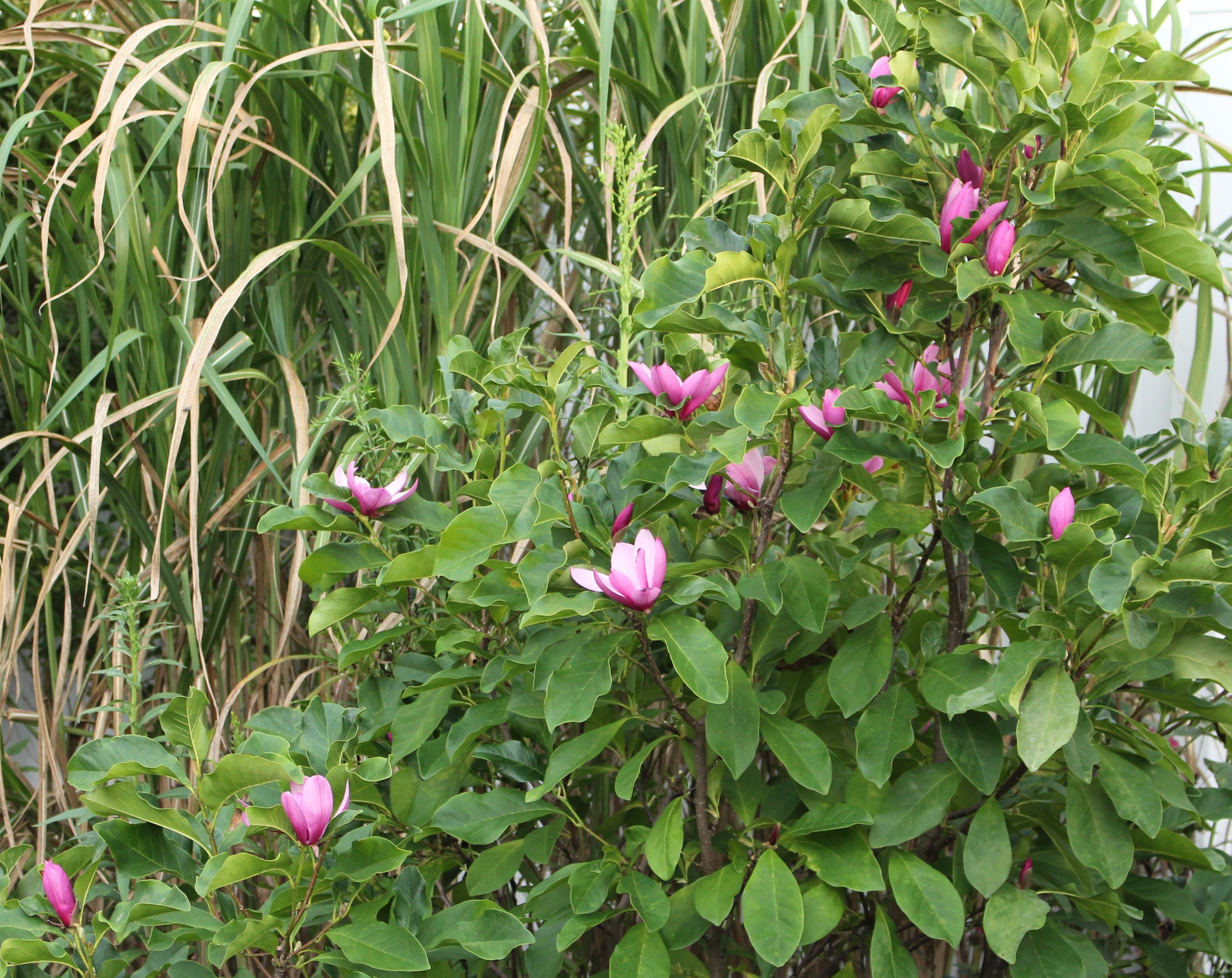
magnolia rebloom ann

Magnolia ‘Ann’ was yellowing, wilted and dropping leaves and must have been headed towards dormancy, but the rains brought on a flush of excitement in the form of summer blooms.

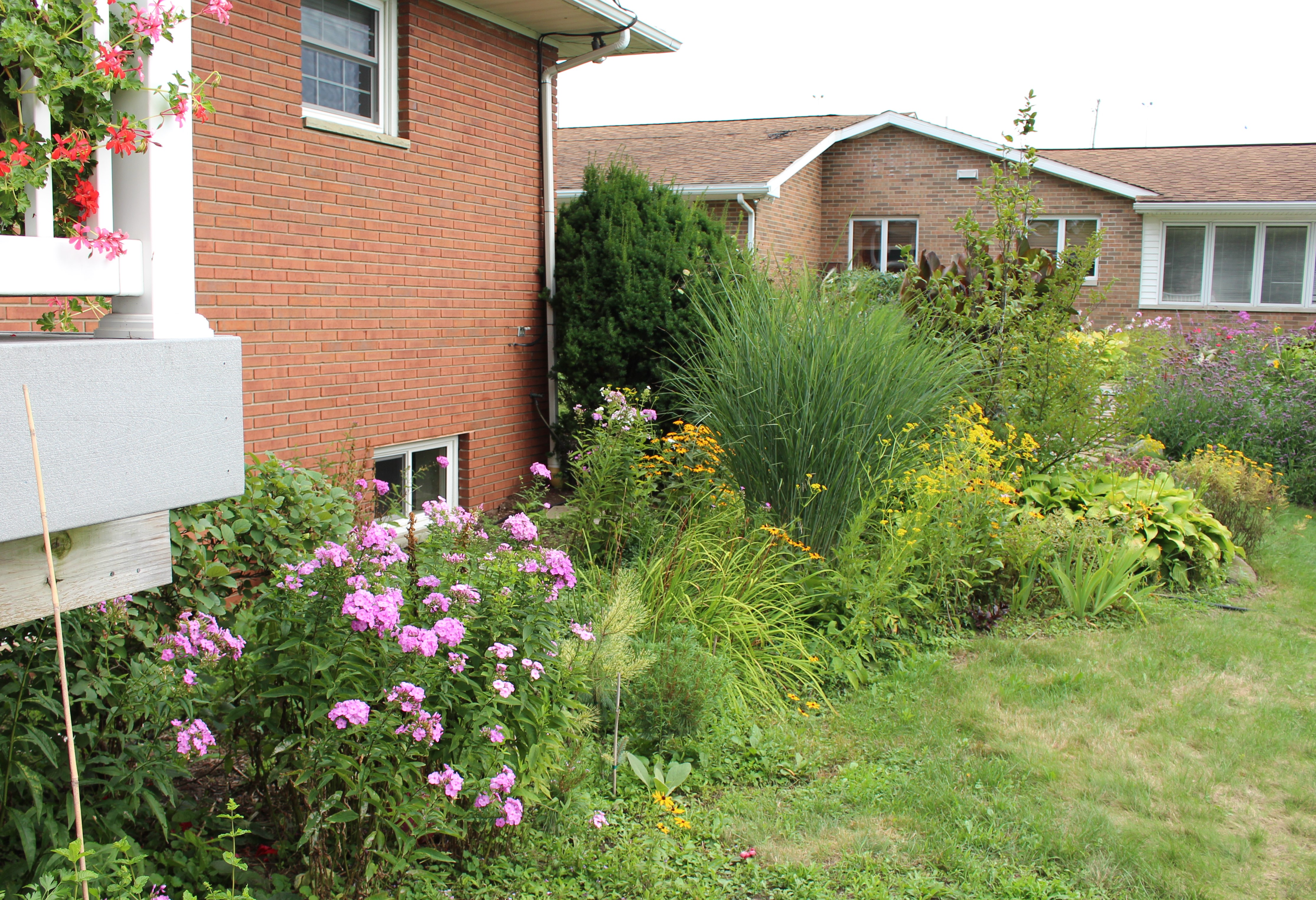
Even though all the fancier phlox in full sun fried, the phlox ‘weeds’ which I allowed to selfseed in this bed were saved by the shadow of the house.  There’s nothing which I like about this bed although my wife “loves!” the grassy clump of Panicum ‘cloud nine’ in the center.  I’ve tried mowing everything down and creating a dull bed o’mulch but the minute I turn my head it’s all back.

self seeded phlox

Blech. Golden yellow with washed out pink in front of the orangey brick of the house. Someone has plans to add a master bedroom to this end of the house and although someone else firmly disagrees, that opinion is usually crushed over time just like anything else which could be planted in the meantime.

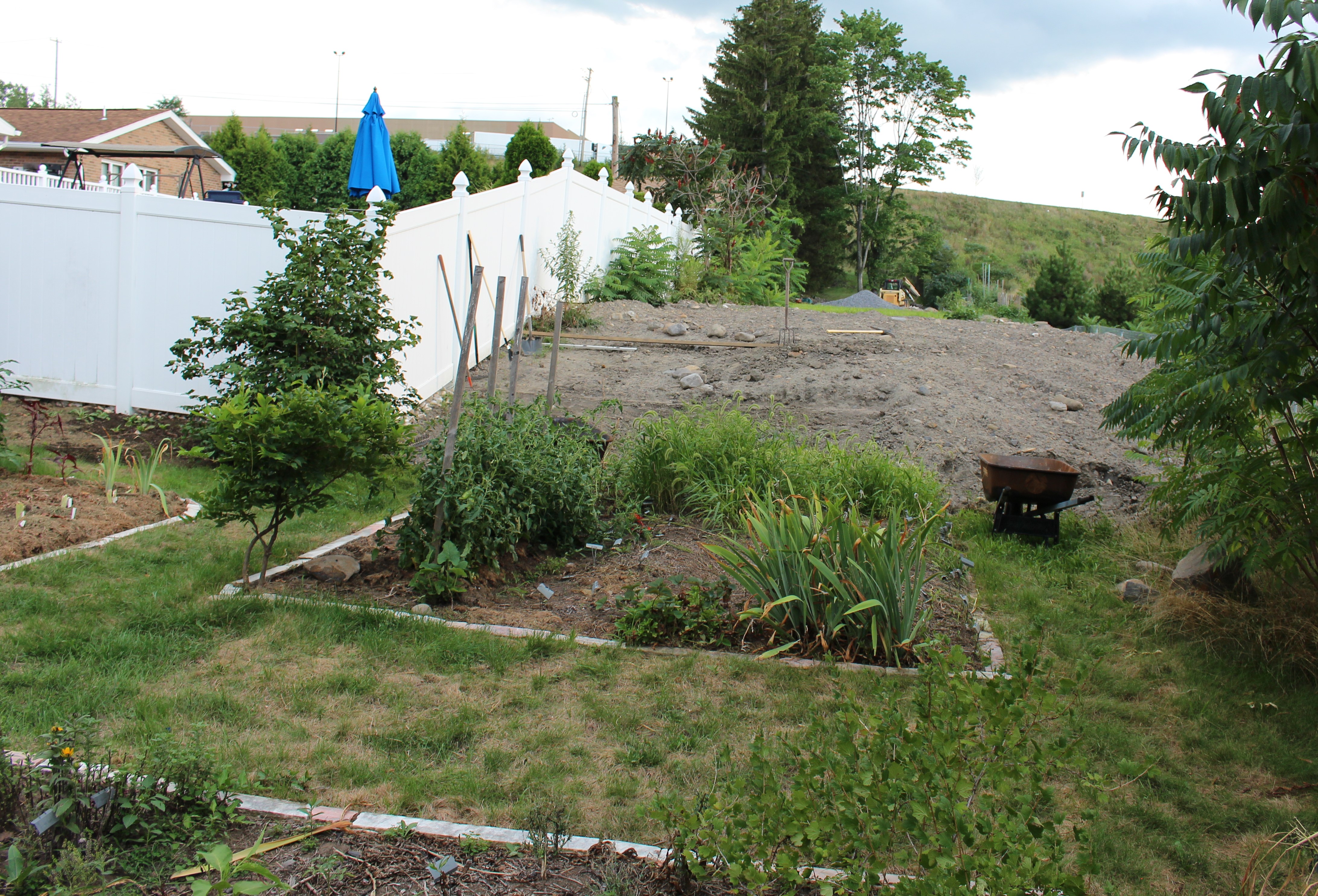
To give a final dose of reality to this mess of a post here’s a photo of the roughly graded fill which has been dumped next door and which has also been added to my project list.  It sounded like a good idea when my neighbor offered to just keep going with his own fill project, but now I’m faced with digging and raking and seeding.  The plan is for a new meadow garden but it sure is an inviting bit of real estate there behind the MIL’s house.  Sunflowers would do well there I’m sure, but for now I feel like I’m in a prison chain gang as I break up the fill with a pick so I can shovel it over into the low spots.

graded fill

My yard used to go across all at nearly the same level, but now the grade has been raised several feet. I wonder how much I could raise my own yard… hmmm.

So I guess if there’s any point to this post it’s that my garden looks much nicer in a cropped closeup rather than the big picture, and that your own garden is probably much nicer than you give it credit for.  Don’t feel bad for me though, I’m quite happy in my interesting mess and I (sometimes) do enjoy the journey more than the finished product.  Plus we’re off for a few days next week camping so that’s always fun 🙂

Have a great week!


The containers. Meh.

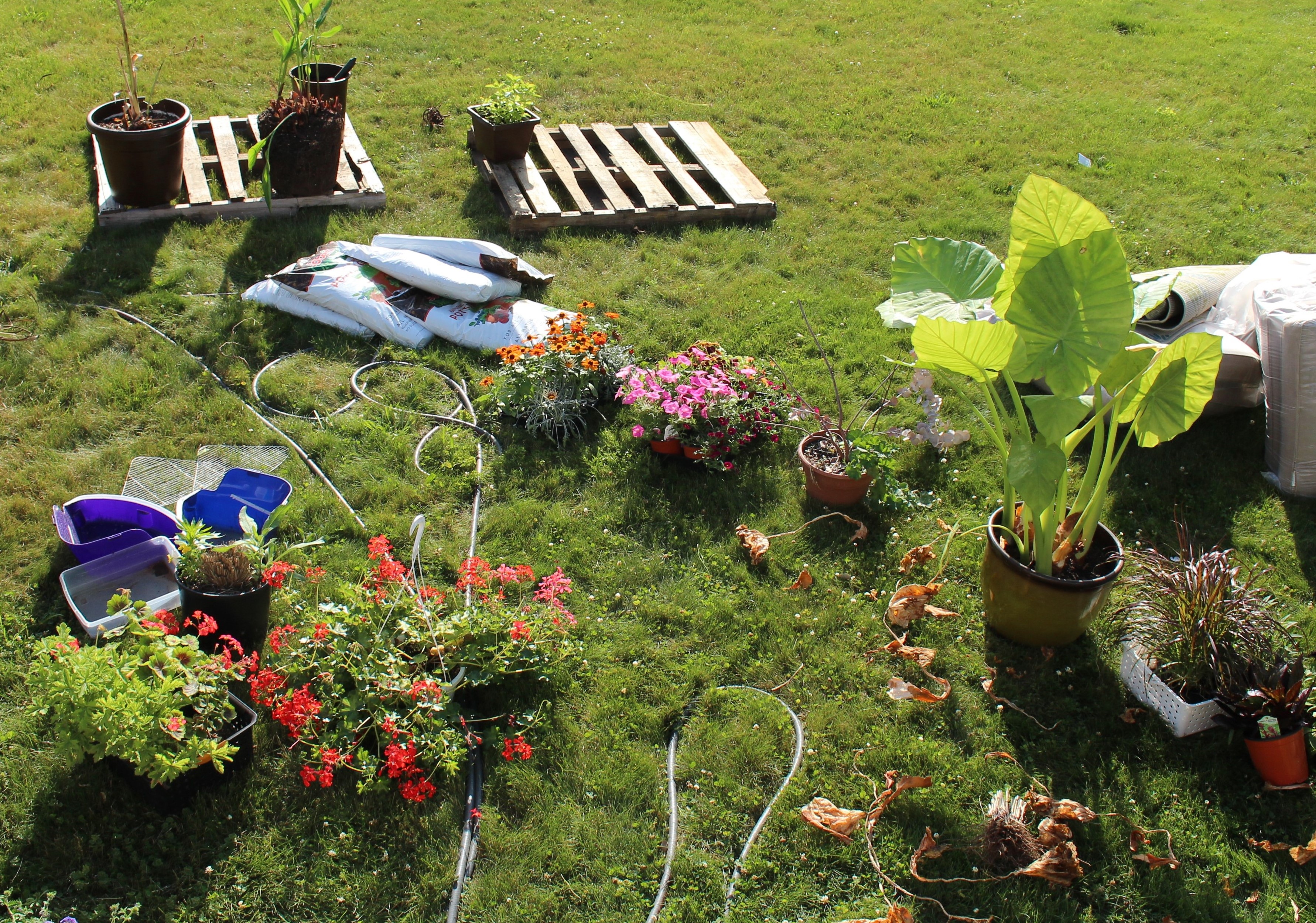
Planting the deck always starts out innocently enough but then degenerates into a huge project.  This year was no different in that respect, and to even get started with the ritual power washing all the winter debris of kid-play and kitchen remodel-scraps had to be dragged off first.

deck cleaning

The entire covered part of the deck is filled with debris and scaffolding in addition to the furniture and terracotta pots which need to be stored under cover for winter (they’ll crack if they freeze while still wet and filled with wet soil).  btw the dark gray object is the old kitchen sink, so even that is out here…

So hauling off trash is the first project, then the cleaning, then the decision that all the mishmash of geriatric plastic planters should match, so off for a paintbrush and some leftover paint.

painting plastic containers

No more black nursery pots, or old teal and faded gray, all the plastic was painted with my trusty mocha-tinted, all surface Sherwin Williams paint.

Our last frost date is around the 15th of May, but most planting jobs are usually procrastinated way beyond that.  This year the big deck planting was pushed off until June 8th, which meant a lot of sitting around for the earliest purchases but it also meant clearance sales were in full swing.

container planting

I tend to spread out while setting the deck up.  There’s a mess everywhere 🙂

So this is where the ‘meh’ comes in, and since the weather is kind of ‘meh’ today as well it might be the best day to discuss…  I usually go out with little to no idea or plan and as a result come home with whatever catches my eye.  Usually it works out, but this year I just feel like something’s missing.  Maybe I need yellow, maybe it’s the lack of sweet potato vines, maybe there’s too much red, maybe it’s the pink… I’m not much of a ‘pink’ person.

deck container plantings

One purple fountain grass is nice, three might have been overkill, still the rosemary enjoyed its division and replanting, and most other plantings are hanging in there.  You may notice my amaryllis bulbs tucked in here and there.  The strappy leaves don’t look half bad in my opinion.

I should be giving things a nice liquid feeding each week and part of the ‘meh’ might be that things are underfed.  A rich diet for these flashy annuals is what they thrive on, and upon thinking back it’s possible I’ve missed four out of the last five feedings.  As usual I’m my own worst enemy.

balcony flowers

I do like how the creepers, in this case cascading geraniums (pelargoniums), work their way through the railing.  They’re very popular with the hummingbirds even if the color might be a little too orangey for the companion plantings.

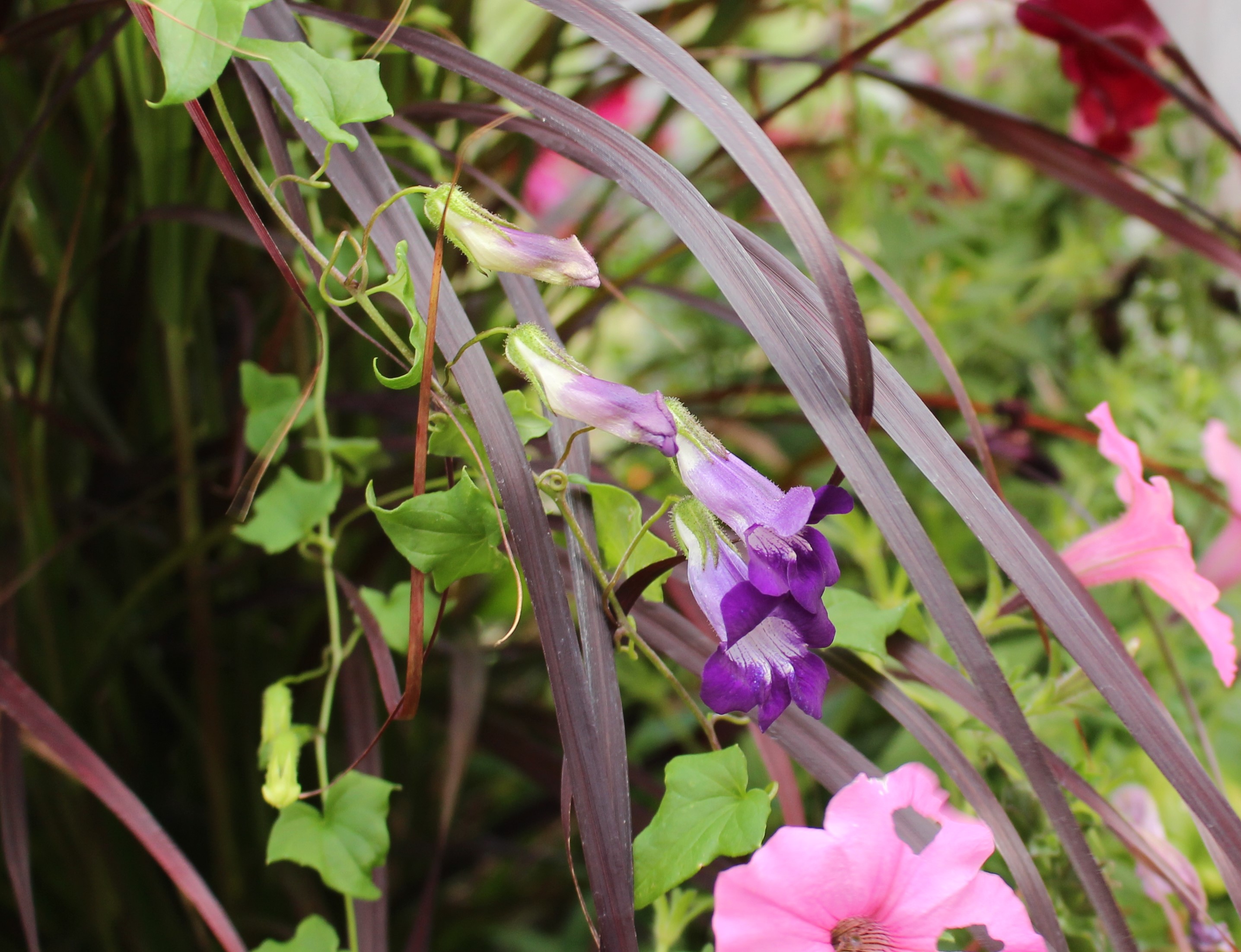
Some other disappointments have been the underperforming vines.  My three little babies, the Chilean Glory vines (Eccremocarpus scaber) did not take off as planned.  Apparently they are foolproof but this fool will challenge that label since my plants (nurtured along from tiny seedlings) made a go at it but then died off one by one.  I did get to see one single bloom cluster of amazing little orange lipstick tubes of color but that was it, and I think if I was brave enough to beat back the grasses, I would find my last glory vine has also passed over.  That’s too bad but I’m already excited to grow this plant again next year since I’m sure things will go differently even if I do everything exactly the same… but in the meantime at least my snapdragon vine (Asarina scandens) is coming along.

snapdragon vine Asarina Scandens

Snapdragon vine (Asarina Scandens) growing up into the purple fountain grass.  At least this one has been a forgiving grower and easy bloomer.

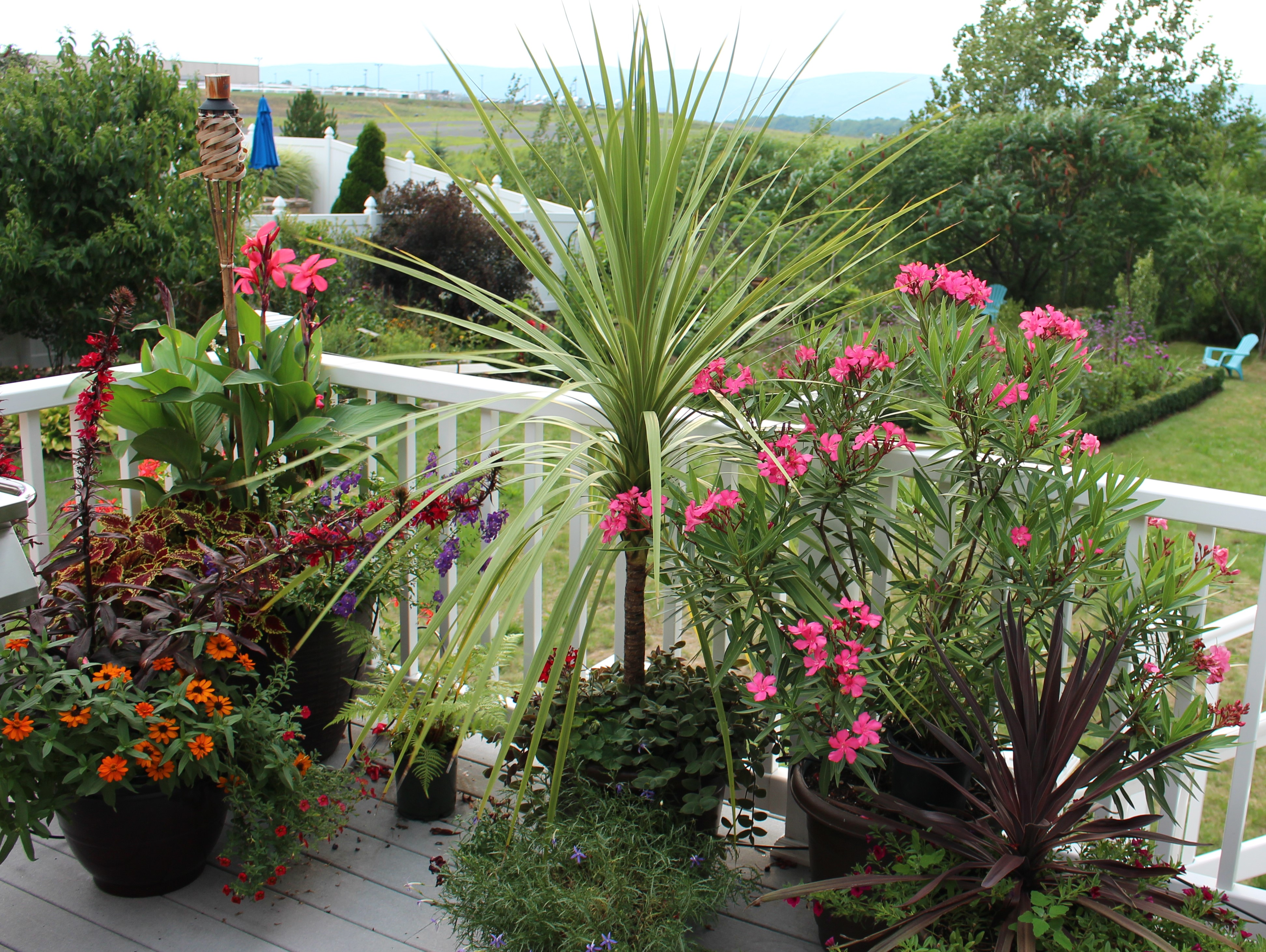
While many of the plantings leave me uninspired, a few things are doing great.  The oleander and overgrown spikes are back for another year and the canna ‘cannaova rose’ is again putting on a nice show.  The canna just hit a lull (probably lack of fertilizer induced) but I’m sure will return to glory shortly and I’ve divided last year’s roots up between a few spots so it’s likely you’ll see these showing up elsewhere as well.

dracenea spike

Those little dracaena spikes which show up in nearly every pre-made container planting seem to turn into something a little more interesting given a few years of growth.  My goal is to have a small grove of these some day soon 🙂

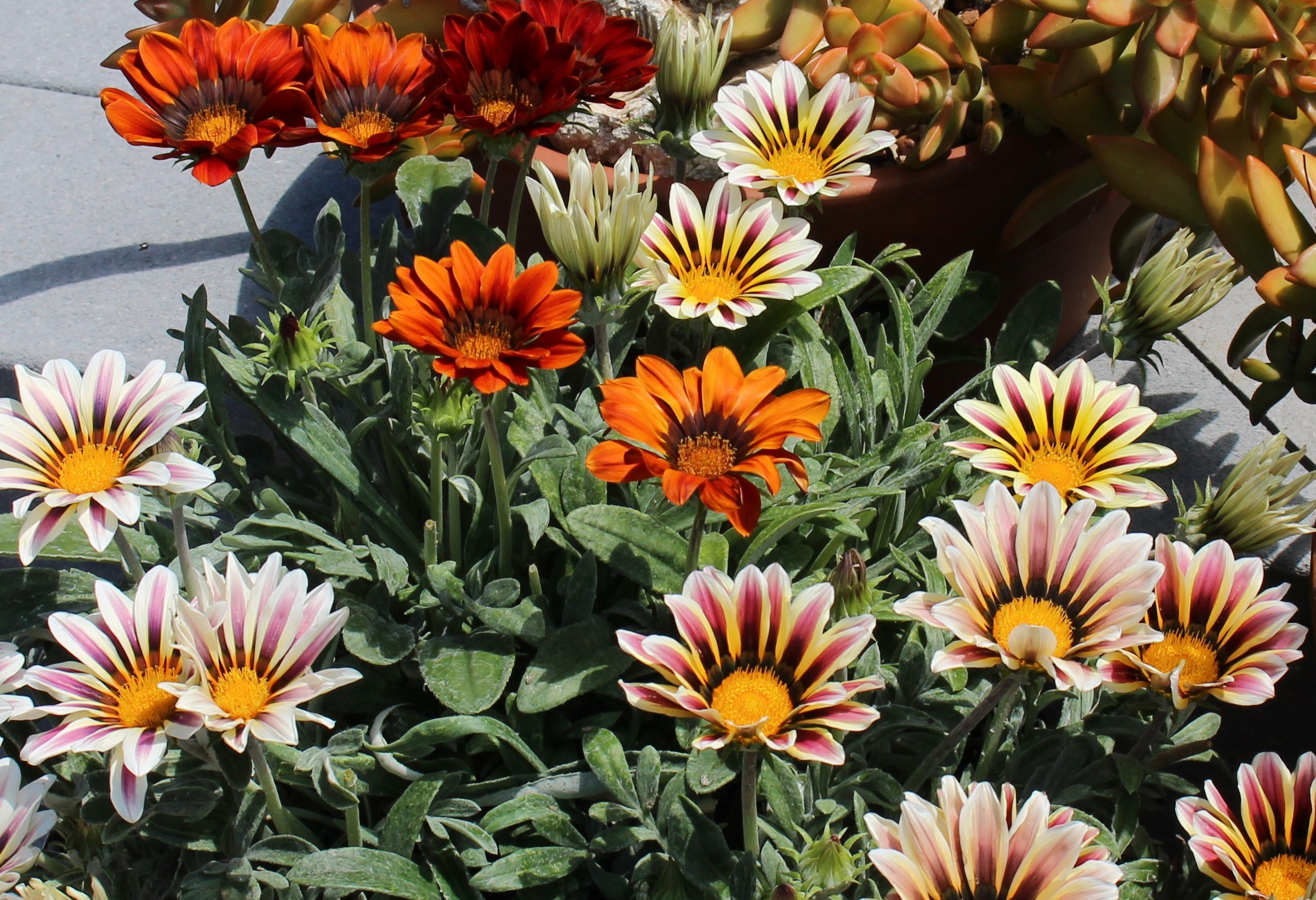
There are a few new things this year which did beat the ‘meh-ness’.  Gazania are a plant which although they don’t grow consistently for me, do look great when they feel like it.

annual gazania

The unusual colors of Gazania really don’t blend well with any look I’m going for but who cares, they just look cool when opened up for the sun. (just keep in mind that they close when the sun goes away…)

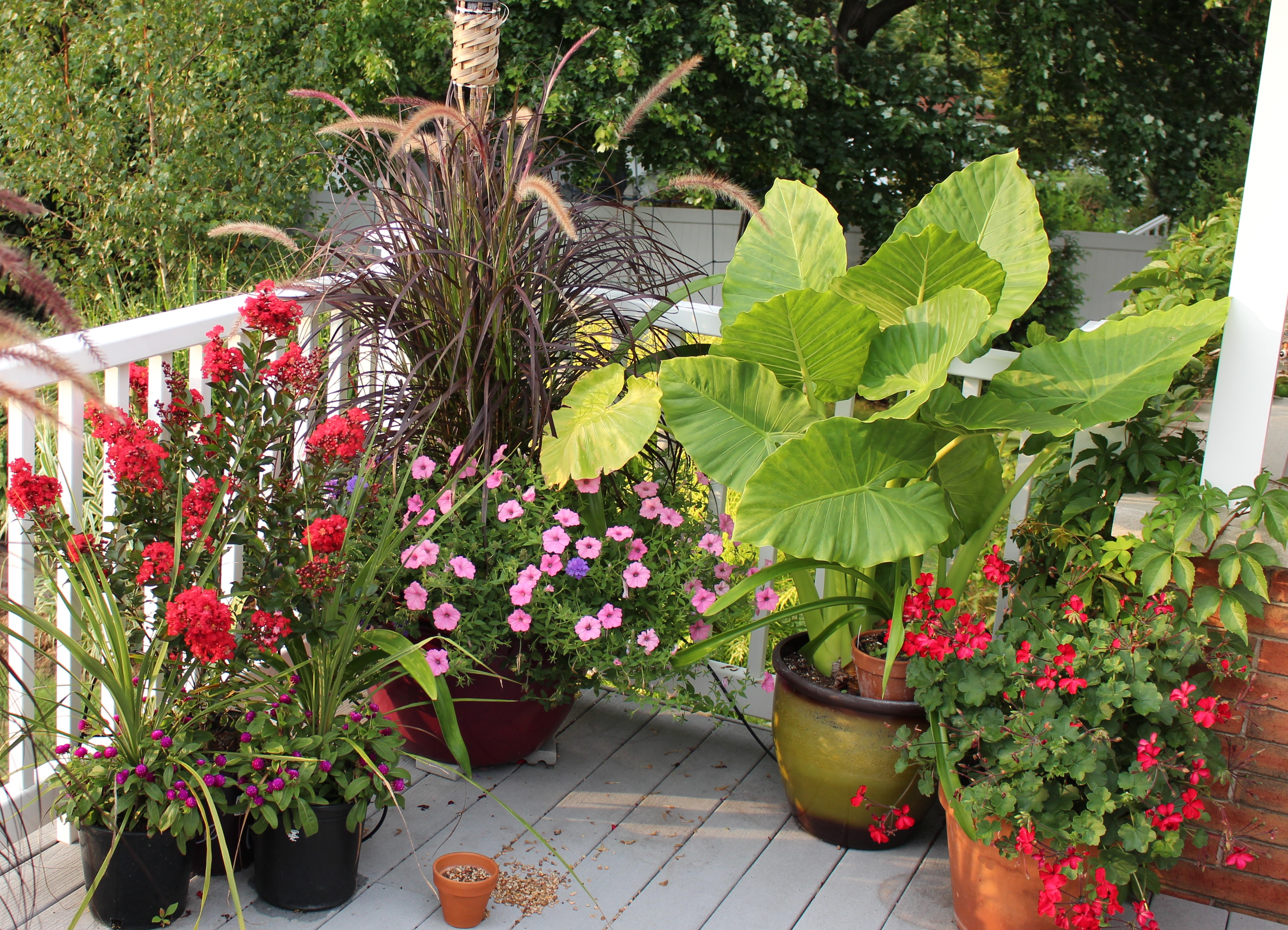
By the way I forgot about the elephant ears and the new crape myrtle, both of which are not ‘meh’.  The two are just soaking up the rain and heat and humidity and picking up where the petunias and million bells drop off, but before I begin to sound too positive let me point two things out.  First I have too much red, and since the obviously red myrtle was labeled purple I’m innocent there.  Second there’s a plant missing out of the small terra cotta pot in the front of the photo.  There’s a cute little b***ard chipmunk who decided it would be fun to end my three year relationship with a slowly growing clump of lithops (living stones).  After a few days searching I found the chewed up corpse under a nearby shrub.  Time will tell if the shriveled bits can recover, my only hope is that they were poisonous.

deck container plantings

Blood red crape myrtle and geraniums, pink ‘bubblegum’ petunias, elephant ear (Alocasia calidora?)… an ‘interesting’ look I suppose.

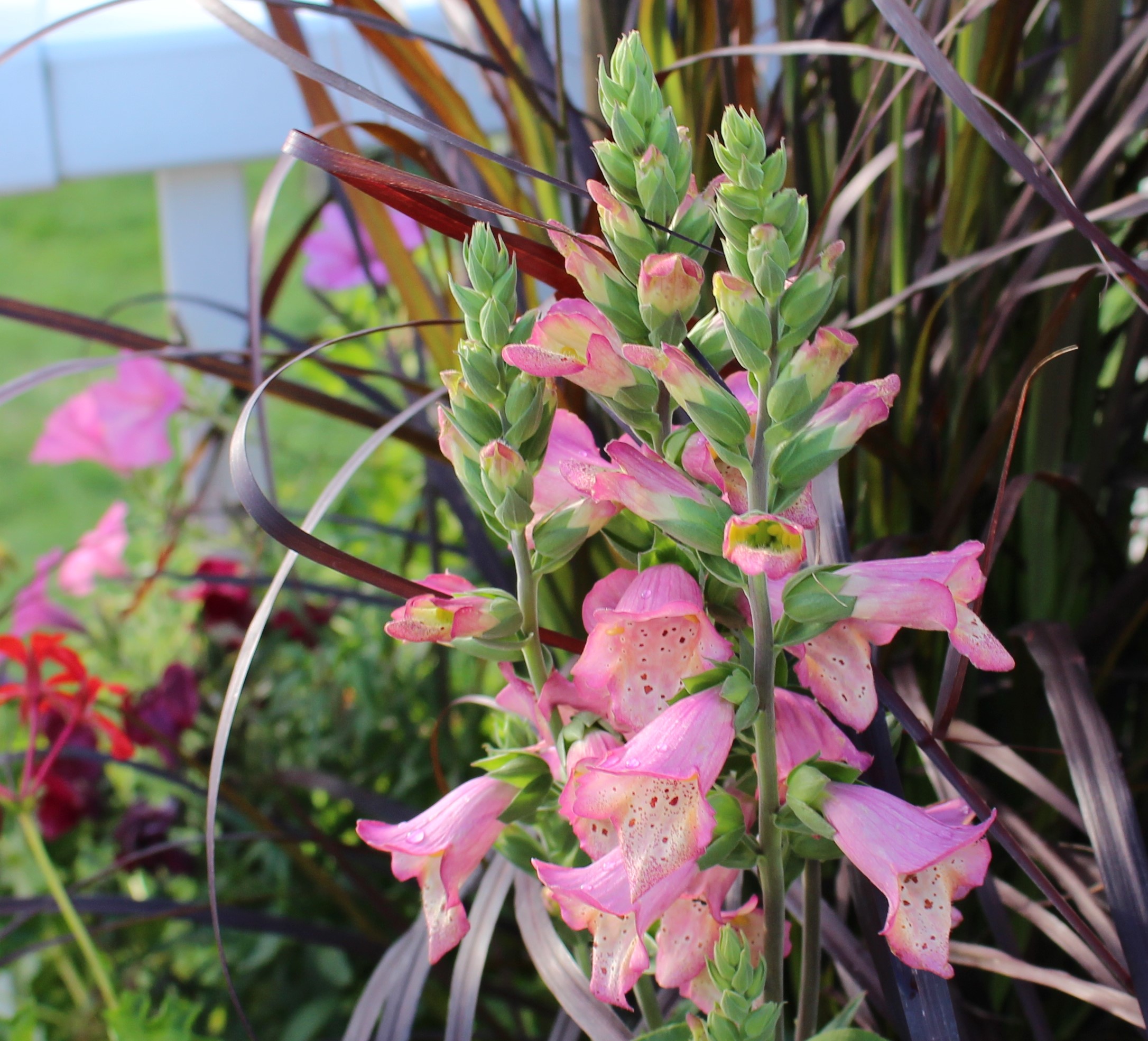
I still need to mention the digiplexis which just came into bloom this week.  It’s a inter-species cross between a foxglove (digitalis) and an Isoplexis (Canary Island foxglove) and when it first hit the market in 2012 it immediately went on to many ‘must have’ lists.  My must have list is always a few years behind but I was finally able to try it out this year when I found it for a reasonable price.

digiplexis

Digiplexis ‘Canary Berry?’.  It’s nice enough but I’m not overwhelmed yet.  It’s one of the foxgloves, and I love a nice foxglove, but this non-hardy version might be something left for those everything-grows-for-me San Francisco gardeners who have super mild winters and cool nights which bring on stronger colors.

So there’s good and not-so-good out there and to be honest no matter how it looks it always beats the deck in January.  January seems to keep all gardening outcomes in perspective and as I check things out every day and multiple times a day I’m still happy with it.  Now if only I could get out there and fertilize, but the lawn needs mowing too and I’m not doing both until things cool off a bit.

Thursday’s Feature: Eucomis ‘Freckles’

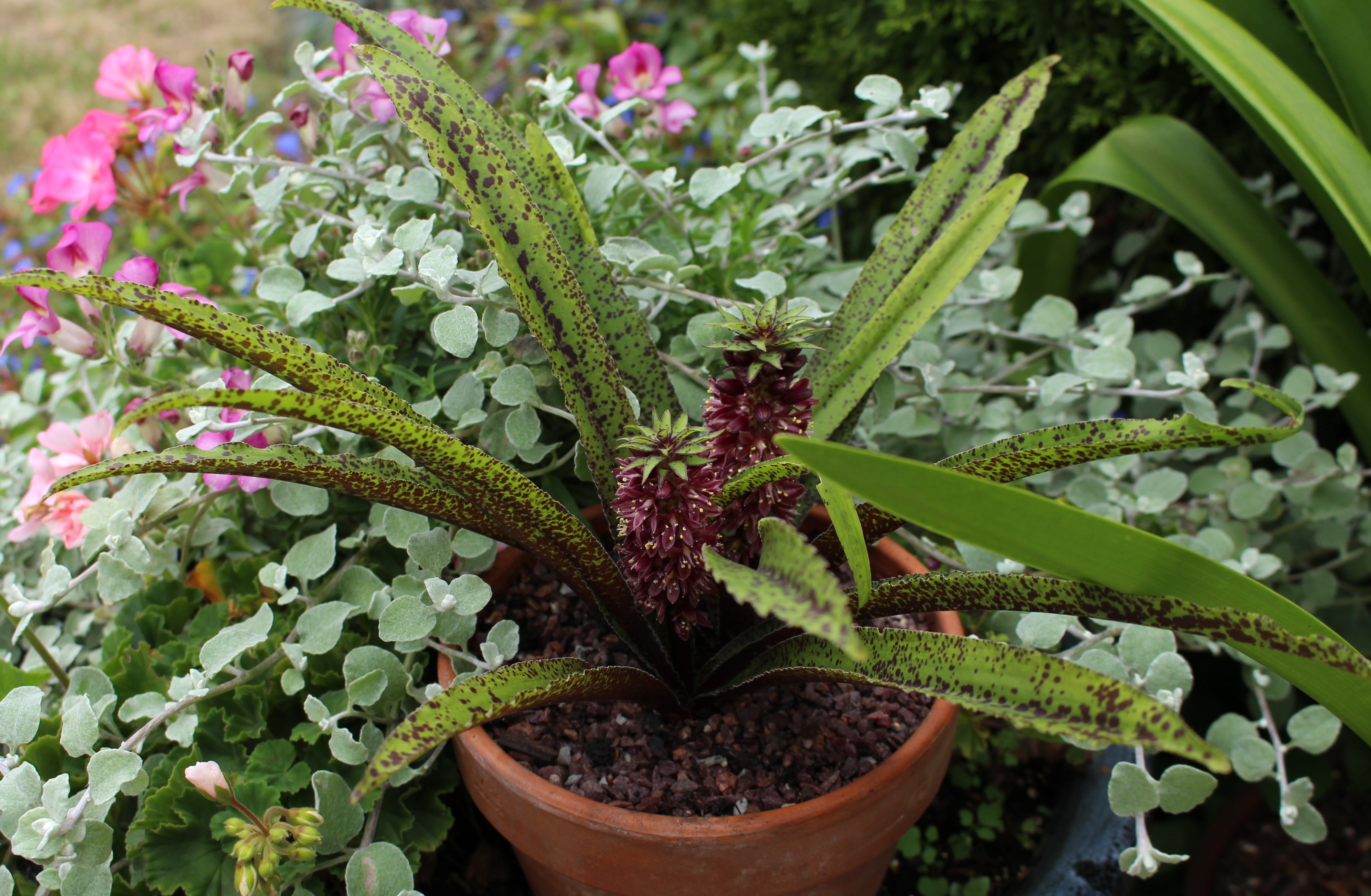
Eucomis ‘Freckles’ sounds more like a health condition than a cool plant, but I can assure you when it grows on you there’s no need for a doctor’s visit.  Mine was an impulse buy a few years ago and the fact it’s still with me should say something about its ease of growing.  Dormant and dry in a frost free spot for the winter, plant outside when it gets warm.  It forms a bulb, it likes it sunny, and it does just fine in regular garden soil.

Eucomis Freckles

Eucomis ‘Freckles’ in a pot on top of another pot. I can water both at the same time which is so much more efficient than single pots 🙂

I don’t think anyone can accuse me of overcomplicating this post with over-the-top growing instructions but it really is that easy to grow.  ‘Freckles’ is a hybrid version of the Eucomis species E. vandermerwei and as you might guess from the flower heads these plants are part of the group commonly referred to as pineapple lilies.  I keep mine potted, but you don’t have to, they grow just fine in the open garden.  ‘Freckles’ is a little on the small size and would likely get lost in the mess around here but someday the open garden might be worth a try, since rumor has it these are much hardier than you might think.  Some reports even have them overwintering with no problem up into zone 6.

As a regular reader might guess I’ve got a few seedlings coming along as well since they’re relatively easy from seed.  I’ll spare you the pictures but there’s a good chance you’ll see more and more pineapple lilies in the years to come 🙂

So there you have it, a short and sweet Thursday’s feature.  Kimberley at Cosmos and Cleome hosts each week and it’s always nice to focus on one of the plants making you happiest each week.

Tuesday View: The Tropics 8.9.16

Another Tuesday and another view!  My camera has traveled on to other destinations so this week we’re going to see how well the phone camera works.  Fortunately when I headed out to take the pictures a few clouds rolled in to filter the light, and things don’t look too harsh here.

tropical garden

Today’s view of the tropical garden.  A little dark, but look at that weird color which the lawn has developed… Green!


I’m going to admit to doing little more than admiring the garden this week.  There was another nice rainfall last Saturday and for the first time in months things look relatively happy.  I even went as far as to mow parts of the lawn short and throw some fertilizer around to help the lawn recover now that it’s making an attempt at coming back to green.

canna tropicana

There’s more to healthy growing than the color green.  Here’s my favorite offensively festive canna, ‘Tropicana”. 

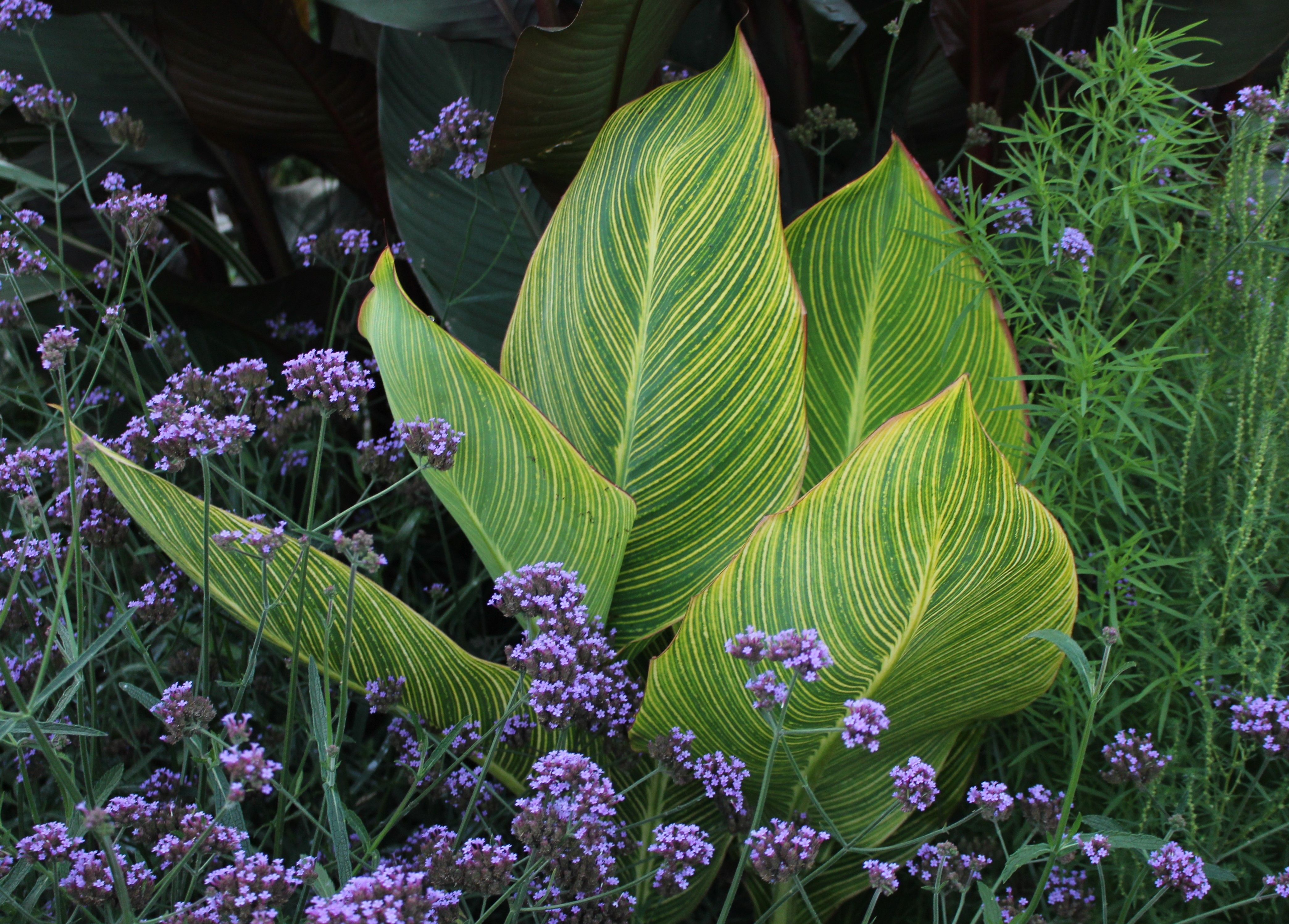
I do have a soft spot for the lushest of cannas.   The tall purple leaved ones are great, but ‘Tropicana’ and ‘Bengal Tiger’ both bring vivid variegation into the mix.  After years of trying to get a virus free plant of the later I think I’m finally there and hopefully it’s with me for a while again.

canna Bengal Tiger (Pretoria)

Still small but growing, canna Bengal Tiger (Pretoria) might be my very favorite canna. The yellow striping is amazing and I think when this becomes a big clump (fingers crossed) it will be quite a sight.

My Bengal Tiger has a way to go before it’s as inspiring as the ones I saw last year at Chanticleer but I have patience… sort of.  In the meantime the amazingly fast growth of the Kochia scoparia (burning bush or summer cypress) continues to impress me.  I love the fresh green color and soft fluffiness of the plants, and I hope it keeps looking good until (with luck) it lives up to its name and burns bright red this autumn.

kochia

Kochia with Verbena bonariensis and orange zahara zinnias.

So that’s where we are this week.  If you’d like to check in with a few other Tuesday views give Cathy at Words and Herbs a visit and if you’d like to join in feel free, I’m sure she’d be happy to have you!

Thursday’s Feature: Standing Cypress

It’s Thursday and that means joining up with Kimberley of Cosmos and Cleome to take a closer look at something which caught your eye in the garden this week.  Hopefully you’re ready for color because his week the bright red of standing cypress (Ipomopsis rubra) is our subject.

Ipomopsis Rubra

Ipomopsis rubra close up.  Love the speckles and the intense scarlet color.  Bright red is what you need this time of year to stand up to the strong summer sun.

Standing cypress is a showy wildflower native to southeastern North America and just one of many garden-worthy Ipomopsis which can be found across the Americas (at least they look garden worthy, this is the only one I’ve ever grown).  These members of the phlox family are tough, drought resistant, and easy to grow and I’m surprised they’re not seen more often.  This is one plant which didn’t even blink when the rain stopped and its neighbors curled up into a drought induced fetal position.

Ipomopsis Rubra

Ipomopsis Rubra has a habit which I would call “lax”.  At anywhere from two to five feet tall they don’t typically flop, but they lean and stretch and carry so many blooms and seed pods that understandably it can get heavy for a little plant.

It took me years to finally find seed but admittedly I wasn’t out there every week trying to run down new sources.  I received my seed via the Mid Atlantic Hardy Plant Society seed exchange but now I’ve been seeing them more frequently sold in wildflower mixes or for hummingbird plantings.  The mix I planted was supposed to show a blend of red to oranges to yellows, but the speckled scarlet color is the only one I’ve seen come up.

Ipomopsis Rubra

The tubular flower shape and bright red color of these blooms has ‘hummingbird flower’ written all over it, and sure enough I often see hummers flying by for a meal.

It’s my suspicion that the natural variation across this species makes for different growing habits based on where one gets their seed from.  My plants which have been selfseeding around for several years now seem to be strictly annuals but from what I found they also grow as biennials and short lived perennials in areas across the United States as far up as zone 4.  Since mine have never overwintered I’m thinking it’s an annual form I’m growing.

Other confusing comments on this plant include it having a taproot (mine don’t) and it needing sandy or gravelly, well drained soil (mine tolerate heavier soil) in order to do well.  I suspect some of this is from people who’s knowledge is based less on experience and more on internet searches, but since I’m not a botanist either I’ll let you decide.

Ipomopsis Rubra

The ferny basal rosettes of standing cypress will pop up in any barren, neglected area which grows weeds well.  They do not compete against more perennial plantings, but in disturbed soil they can make a quick show before other opportunists jump in.

The hummingbirds and I will enjoy the blooms of this wildflower for several weeks now and when things slow down I’ll just trim off the upper end of the stalk and the smaller side shoots should carry on for a few more weeks.

Standing cypress.  Consider it.  If your garden can handle a shot of red I think you’ll enjoy it, and I also think you’ll enjoy giving Cosmos and Cleome a visit to see what Kimberley and others bloggers are featuring this week.  Enjoy!

Tuesday View: The Tropics 8.2.16

Finally I’m back for a real visit with Kathy’s Tuesday View meme.  After two weeks away the tropics have taken off here and the heat (and now rain!) have really brought everything to life.

cannas and verbena bonariensis

In the view today is damp soil, overcast skies and plenty of humidity.  The cannas have exploded along with just about everything else and exuberance is the word of the day.  How do you like the ferny green lump of kochia (summer cypress) just in front and to the left of the olive-green planter? I love it btw

My biggest fear when I left was that my new bananas and precious castor beans would just pine away waiting for rain, so two days before we left I added an extra line to the drip irrigation system and set up a few drip emitters to some of the most precious plants.  Good thing I did since this bed was the only part of the garden where lush greenery welcomed me back from our midsummer vacation.

castor bean carmencita

I have blooms on my ‘Carmencita’ castor bean plant.  I love the bright red seed pods and I hope they stay that way for a while… and the leaves aren’t too shabby either!

I’ll try not to go on too much about every single plant.  Here’s an overview of the farther side of the bed, beyond the path to grandma’s pool 🙂

cannas and verbena bonariensis

The purple of Verbena bonariensis has nearly taken over large swaths of the bed.  I’m fine with that but the old flower stalks on the salvia ‘Caradonna’ just irritate me to no end.  I’m sure no one but myself notices them, but there’s a good chance I snap this week and pull them all out!

The old red leaved cannas are nearly as tall as me now and will likely break the six foot mark by next week and I love that.  In no time this will be a garden you look up to 🙂

fennel with verbena bonariensis

My poor planning skills are often saved by horticultural volunteers.  Here the chartreuse froth of blooming fennel mixes in with a pale green nicotina and of course more Verbena bonariensis.  You can’t even see the dahlias which are supposed to fill this space.

You may have noticed a few of the sunflowers which peek out of the far corners of the border.  After relentlessly weeding them out through the spring I finally let a few of the latest sprouts in the hard to reach spots go on with their lives.  I love them of course, and I’ve already seen the goldfinches stopping by to check on the seeds.

sunflower and long horned bee

Sunflower with a few long-horned bees making themselves at home.

New to me this year are the bees which can be found on each sunflower bloom.  I’m sure they’ve been there every year but after I found the long antenna interesting I realized they’re not the regular honeybees.  According to this face book group >click here< they are either a type of sunflower bee or most likely a type of long-horned bee, both of which belong to the solitary bee group which includes some of the hardest working and most effective pollinators out there.

sunflower and long horned bee

I’m leaning towards long-horned bee for these two, since they both share the almost comically long antenna, but I have no clue as to which species.  Apparently there are more than a few! 

Something new to me which I came across while investigating bees is that these solitary bees are much less aggressive than their colony-forming cousins due to the fact they have no hive to defend.  They only sting when handled roughly and are considered more docile… although I’m not sure who did this investigation of insect manhandling.  I’ll take their word for it though and skip starting my own investigative bee-bullying program.

Oh and one more thing.  Solitary bees are fine feeding on nectar from a wide range of flowers but the individual bee species is much more specific in where its pollen comes from.  It’s called oligolecty, and if you want to add that one to the vocab list it describes bees which specialize in collecting pollen from a limited palette of flowers, often only one species.

A usual I’m as surprised as to where this Tuesday view went but it’s been an interesting ride for me and I hope it’s at least been somewhat interesting to you as well.  If you’d like to expand on the visit stop over at Words and Herbs and check in with Cathy to see what the other Tuesday views are up to.  There’s always plenty to explore!

That wasn’t smart 6.0, 6.1, 6.2, and 6.3

Well I really racked them up this weekend.  My favorite nursery, Perennial Point, was having a customer appreciation weekend and all plants were on sale for 30% off.  A dead garden will make you weak in the face of temptation and I guess I blinked.

Not smart version 6.0:  The garden was bone dry and I couldn’t even take care of what I had.  Weeds are having a field day, the lawn is dead and other plants are dying left and right.  I just bought home several delicate, nursery-perfect plants which probably haven’t even broken a sweat their whole lives and I’m planning to throw them into this nightmare.

daylily bubblegum pie

Three big ticket items followed me home, ‘Plum Magic’ crape myrtle, hypericum ‘Red Fame’, and daylily ‘Bubblegum Pie’.

Not smart 6.1:  I don’t like daylilies, don’t ask me why I would buy one.  The leaves look horrible in late summer, the old blooms look like soggy tissue messes which need daily cleanup, and the name ‘Bubblegum Pie’ is insanely dumb.  The flower on this one is fat and fleshy and overdone with way too many ruffles.  There’s nothing graceful or elegant in the flower but I’ll plant it near the one daylily which came with the house (and resprouted after I thought I sent it to the compost pile) and the other species daylily which I grew from seed (Hemerocallis atissima, a tall and graceful night bloomer).  We will see how it does.

Hypericum inodorum 'Red Fame

Look at the fruits on Hypericum inodorum ‘Red Fame’!  I’ve seen these used in flower arrangements and never thought it might do well in the garden, so we’ll see if it does.  btw the crystalline glisten on the leaves is something called raindrops, yeah it took me a few minutes to recognize it as well, apparently we used to get a lot of it back in the day.

Not smart 6.2:  I bought a Hypericum ‘Red Fame’ which I think is cool with its juicy looking bright red fruits and according to what I’ve read may tolerate drought just fine, but I also bought a crape myrtle.  Crape myrtle are not hardy here and even at 30% off this one still wasn’t exactly cheap but somewhere deep down inside I seem to think someday a miracle will happen and one will survive.  Maybe fourth time’s the charm….

caladium

Three new caladiums and a new coleus.  Buy one get one free on annuals since no one bothers to buy annuals on the last weekend of July… no one except me apparently.

Not smart 6.3:  I bought more annuals.  Tomorrow is August 1st and the days for annuals are numbered and I should be focusing on limping through the summer and getting ready for fall gardening rather than wishing for another June and July.  Plus I seem to remember telling myself (you wouldn’t remember since Iwas talking solely to myself) that I had too many coleus last year and I should let some meet their maker when frost came.  Now I’m adding more?

caladium pink splash

Caladium ‘Pink Splash’ which I managed to overwinter from tubers purchased last year.  At least that was smart.  Also smart is the healthy, dark-leaved Eucomis (pineapple lily) grown from seed supplied by Nan Ondra.  I’m hoping it will be big enough to bloom next year!

Not smart 6.4:  I already have too many caladiums for a reasonable Pennsylvania garden, but if you hang on for another minute I’ll tell a quick caladium story.  It used to be I could overwinter them with ease and even had some survive for more than 5 years, but then my luck changed.  Dead tubers would greet me each spring and I wasn’t sure what was wrong.  Short story even shorter last winter I tried keeping them completely dry in their pots and in a warmer spot and lo and behold they made it through perfectly.  Logical next step is to take advantage of any good caladium deal which you come across and then be immensely disappointed when they go back to dying next winter…

caladium

White caladiums and a pot of mixed tubers which I found on clearance.  The spotted one is my absolute favorite.

Pristine white caladiums filling a terra cotta planter in the high shade of a southern garden is tasteful.  My mixed, gaudy plantings in reused plastic nursery pots are not.  But I digress, and will leave you with one last glimpse of my new daylily.

daylily bubblegum pie

The disgusting daylily ‘Bubblegum Pie’ with all its offensive frills and flounce.  It really is too much of everything and I’m positive this will be the one and only daylily I ever purchase for this garden.  Since I have it I might as well plant it, and I might as well even spare a few shovelfuls of my precious compost on it.  The pot has three fans already and I can only imagine three or four deliciously overdone stalks next year filled with more of these flowers!

Not that smart 6.5?  A few days ago I ordered some iris through the Historic Iris Preservation Society’s annual fund raiser.  That’s innocent enough, but now that the sale has wound down I noticed a posting on Facebook looking for volunteers to take in leftover rhizomes and grow them on for a year before sending them back for next year’s sale.  I’m wondering where I would put 10 or 20 more iris 🙂

It rained by the way.  An absolutely amazing soaking rain which stretched out for hours and got into many of the driest nooks and crannies of the garden.  I’m quite pleased and know it will be a good week and wish all the best for yours as well.

Thursday’s Feature: Cyclamen purpurascens

It’s time to get back into the saddle.  I’ve enjoyed telling the woeful tales of drought and loss in my garden and appreciated the kind words, but it’s time to stop the shameless pandering for sympathy and suck it up.  I’m sure most gardeners will agree that there’s nothing better for a poor attitude than a new plant, so I ordered a couple iris, planned a trip to the nursery, and I think I’m good 🙂

So first things first I’m joining Kimberley at Cosmos and Cleome for her Thursday’s Feature and highlighting one of the little treasures which don’t seem to care much about a few sunny days and a bit of heat.  This week’s plant is that hardiest of hardy cyclamen, Cylamen purpurascens.

IMG_2101

Blooming this week in the dry shade beneath the weeping cherry is Cyclamen purpurascens. I like the slight streaking and chunky flowers of this one.

Besides being a hardy plant ((the cyclamen society’s website lists this plant as tolerant of temperatures down to -4F… and my own plants have easily endured -9F without significant snow cover) this plant also has the distinction of retaining foliage year round.  Even now during he worst of summer the beautifully marked and mottled foliage lights up the gloomiest of dry shade locations.

hardy cyclamen purpurascens foliage

Cyclamen purpurascens has the typically beautiful foliage shared by many of the cyclamen family, and the range of patterns is always amazing.

It also has the distinction of blooming now.  The flowers won’t blow you away until they come by the hundreds (which I’m hoping for someday), but for now the little splashes of color are a welcome relief for summer weary shade gardens.

cyclamen purpurascens

A more typical Cyclamen purpurascens flower with pink color and open, twisted petals. 

For more expert information and growing requirements I’d recommend the cyclamen society’s website, but from my own experience I find this cyclamen to be a little fussier and much slower growing than the others and also a plant which actually seems to welcome a good freeze in the winter.  Seedlings which I protected indoors really sulked until I threw them outside for the coldest months.

Mine were raised from seed, but honestly this is one cyclamen I’d have no problem buying as a plant.  Germination takes a year, it’s another year before they do any serious growing, another two or so years for a bloom if you’re not the most attentive grower, and then even the seeds take over a year to ripen before you can try for the next batch.  We’re not getting any younger, so save yourself a few years and buy a couple plants from John Lonsdale at Edgewood gardens.  For a plant which you probably won’t find anywhere else $12 a pop seems like a bargain to me and I’m a relatively cheap guy.

When you’re done with that give Kimberley a visit and see what else is on the radar this Thursday (or practically Friday as I look at the clock).  There’s always something interesting to be had and I know you won’t regret it!