Colors of Summer

Unlike many parts of the world our area has been getting rain this summer, and if I can just review my mental records of last year’s weather, the pattern hasn’t been much different than this year.  Last year we had cold, crap, crap, crap, a nice day, too dry, dry, too dry, rain, crap, and then rain, and I think this year is similar.  Maybe more humid but I don’t keep as accurate records for the humidity.  In any case the plants, both good and not-so-good, are enjoying this summer growing weather, and the gardener is sick of mowing.  He loves the green sward of lush turf when freshly mown but that lasts two days out of six, and on the seventh day he can’t rest because he’s mowing again.  But green is a nice setting for lush and colorful flowers, much nicer than straw is.
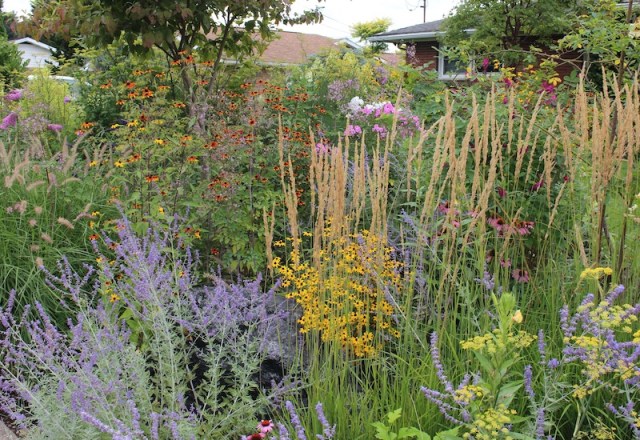
summer perennial border

The border along the street is wild and buggy and probably messier than a border along the street ought to be.  Maybe it should be shorter with more mulch.  One out of one teenagers will agree.

With all the focus this year on getting the garden to a point where it looks nice, plus rain helping with the annuals and a decent mulching last year to keep the weeds at bay, I have to say the garden looks nice and sometimes on a cooler, bug-free afternoon with the light just right it looks amazing, but that’s one biased viewpoint.  That same person can ignore a bunch of messy spots and unfinished projects, but as long as the sun hits the rudbeckia at just the right angle and gives them a summertime glow… that’s amazing.

rudbeckia prairie glow

Brown and orange are not my go-to colors,and this might not be the perfect lighting, but when they show up in these comfortably warm temperatures I’m 100% on board.  Rudbeckia triloba ‘Prairie Glow’ is currently in the lead for orangy, although I do need to pull out some of the plain yellows, particularly the shorter-petaled, rounder flowered ones… which I do not like…

There is plenty of color this week, in multiple shades, on plants which are not wilting and browning, but even in a normal summer there are some plants which I’m always happy to see rolling into August.  Agapanthus are on that list.  If you’ve followed this blog you might be tired of the bragging but here they are one more time.  My growing clump of agapanthus ‘Blue Yonder’, fully hardy with no protection down to winter lows around zero F (-18C), and carefree in a full sun spot with decent soil.
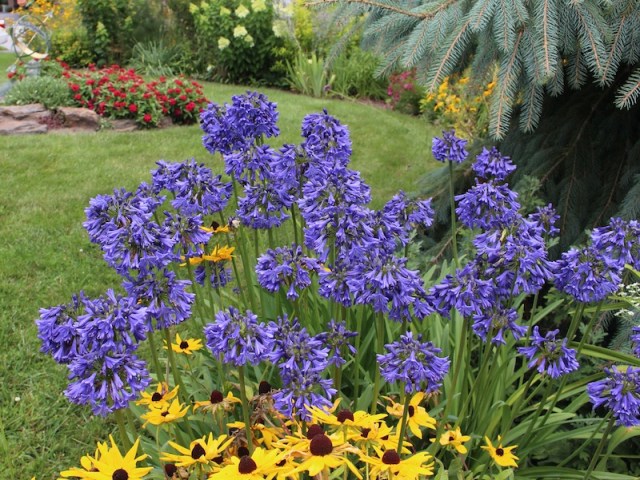
hardy agapanthus blue yonder

Agapanthus ‘Blue Yonder’ in full bloom with another week or two to go.  A deep color and plentiful secondary buds to extend the show, but not as fertile as some of the other hardy agapanthus and as a result I haven’t had any seedlings from this one… yet…

There’s a good chance I’m just lucky with this agapanthus, but I’m seeing a few more of these around as more cultivars have been introduced.  A gas station had two huge clumps of probably ‘Galaxy Blue’ and ‘Galaxy White’ planted along the street and based on nothing else remaining of the rest of the landscaping, I think these are pretty carefree… until they’re not, and I’ve heard of others having mixed results so…
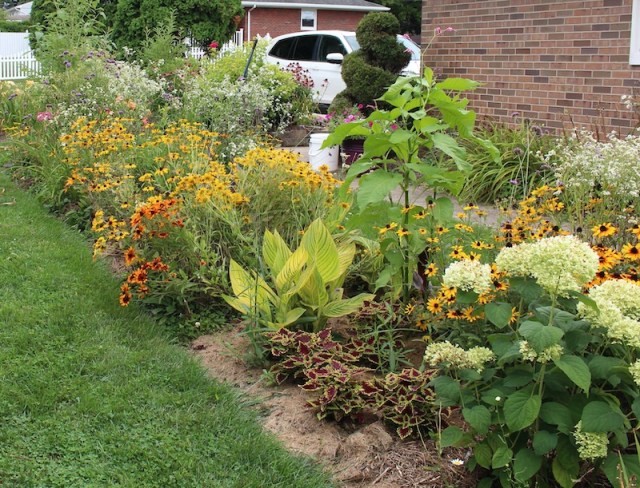
summer perennial border

Windblown black eyed susans and the cannas and coleus I planted just before heading out to Buffalo.  Not impressive but I think in another month they will add to the list of AMAZING 😉 -apologies for the trashy mulch of lawn clippings.

Speaking of mixed results, border phlox (P. paniculata) were a favorite here until they decided they hated me, so since then I’ve been through anger, denial, acceptance, and some serious self-reflection as I try my best to figure out how it’s my fault.  I don’t know.  All I know is they’re relatively awesome again this year even if I lost most of the heirloom named sorts which I had spent years collecting.  I did rip out two of the three ‘Limelight’ hydrangea which were taking the bed over, and I did toss some fertilizer their way this spring.  I think, because like many things here they’re done by the seat of my pants.

summer phlox border

Phlox paniculata seedlings taking their rightful place in the summer border.  Better gardeners may scoff at the unimproved colors but I’m pleased.

Since I’ve lost most of the named forms, what I’m left with are the terrible inferior forms which garden books, and probably the internet too as AI steals mankind’s knowledge base, warn you about.  “Muddy colors” and “magenta” are what you get and apparently that’s my taste.
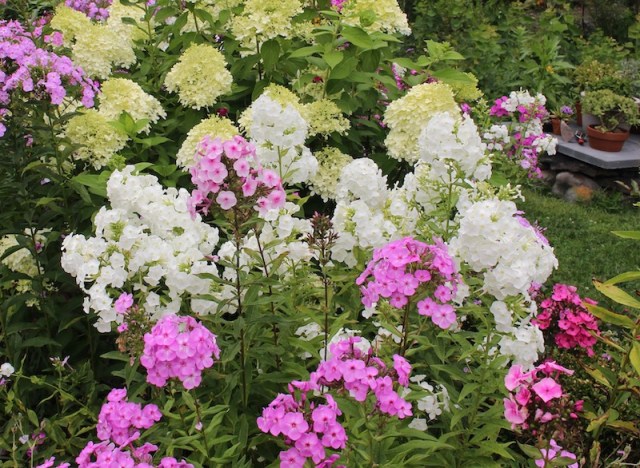
summer phlox border

Muddy and magenta phlox seedlings, plus the last ‘Limelight’ hydrangea since I need at least one in here.  The darker-eyed and anything which veers towards reddish are favorite phlox seedling colors here.

Don’t get me wrong, I covet the dark purple and saturated reds of modern phlox cultivars, but they don’t hang on forever in my garden like these survivors do.  Also the modern hybrids seem to be bred with a shelf-life in mind and a height which works well in a gallon pot on a big-box nursery bench, and I like phlox you can walk through, so strong stems and up to five or even six feet height are more my taste.  Okay 3-4 feet tall is probably more sensible but I don’t mind higher.  What I do mind is mildew and anything under 2 feet.  I rarely have any mildew on these, and toss the ones which show signs.
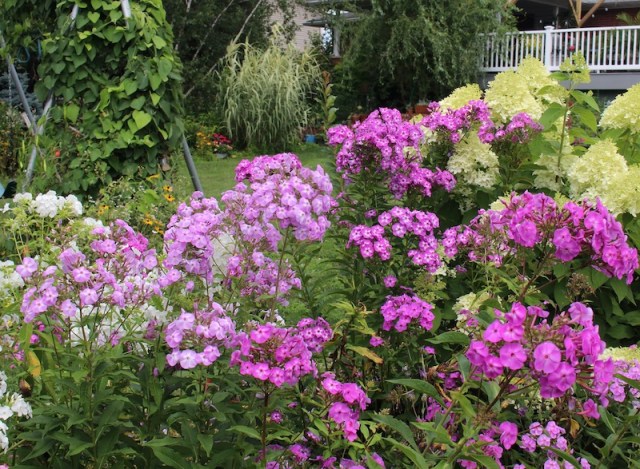
summer phlox border

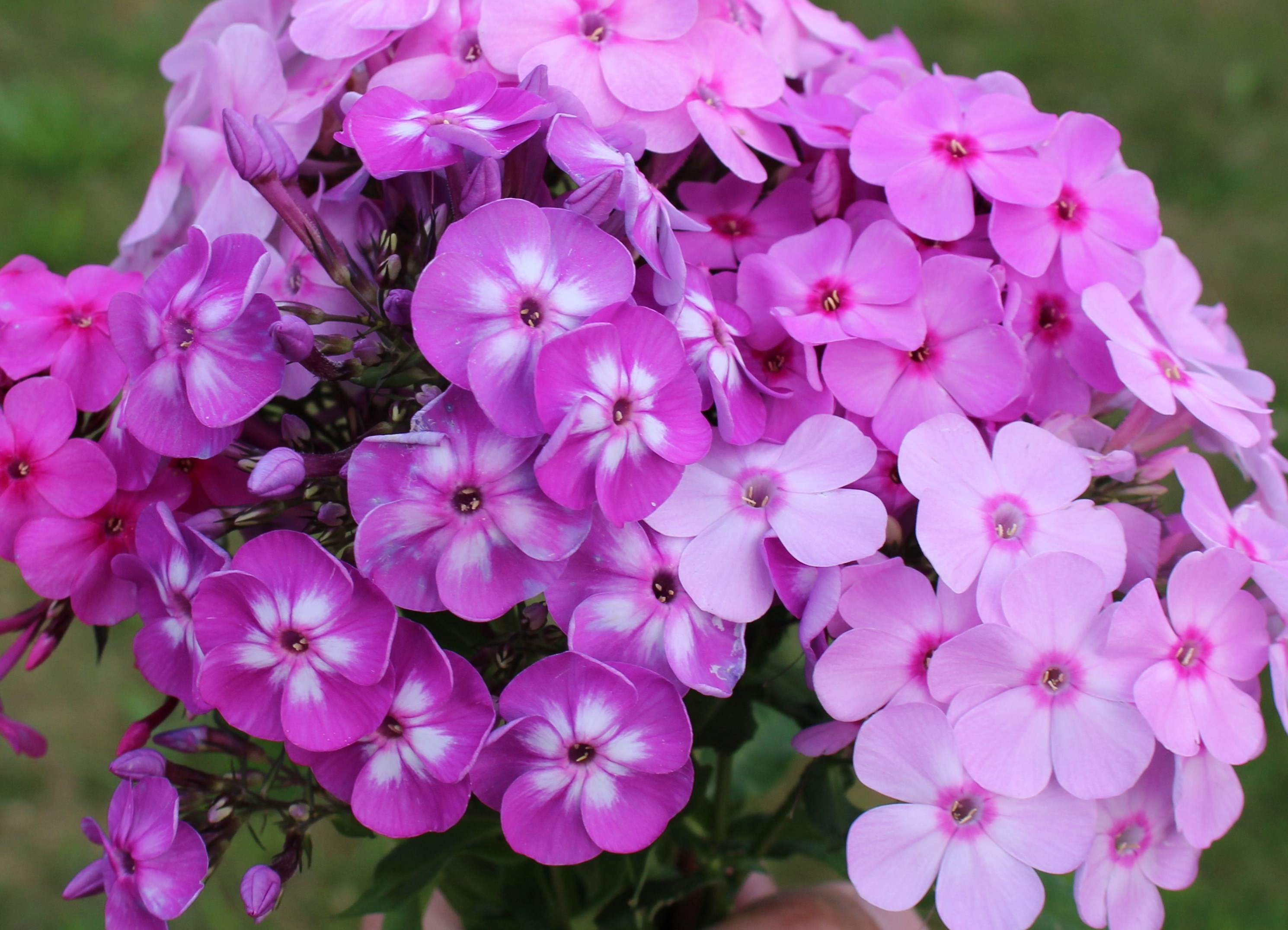
Phlox with a nice white star in the center are also popular in this garden.  We had a few cool nights recently and that makes the white more distinct, they seem to fade in warmer weather.

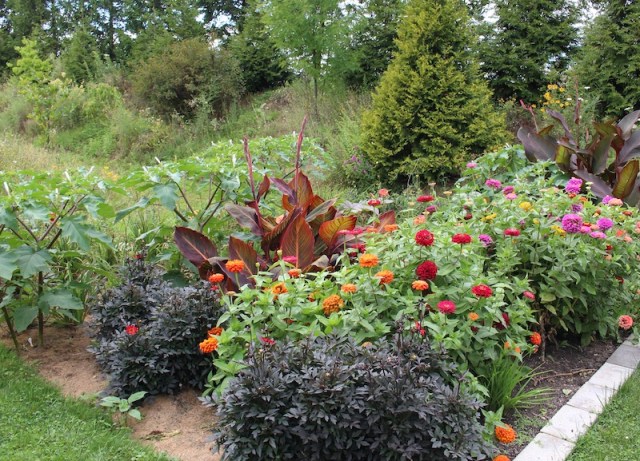
If you’re still reading it probably means you have some tolerance or at least a curiosity in gardeners with poor taste so we might as well take a look at the waste area in the far back.  I did plant things and throw down topsoil but the “things” were daylilies and cannas, and with the exception of some classic zinnas, the area still leans towards weeds…. especially after the rain.  It also didn’t help when I allowed Jimsonweed (Datura stramoniom) to come up and flourish, but it looked so lush and healthy and I kind of like it for some odd reason, in spite of its stink when brushed up against and the millions of seeds it will produce if allowed.  I did pull dozens, but enough remain and I enjoy the white and purple flowers which open each evening and fade each morning.  If you have a little time to kill it’s a fascinating plant with its medicinal and spiritual uses (<-click for the Wikipedia entry) and you might already know that the common name derives from Jamestown weed, where soldiers sent to Jamestown Virgina to quell a colonial rebellion, ended up high for over a week after “consuming” the weed.  Another fun-fact is that even in colonial times growing Jimsonweed in the garden was considered inappropriate.  It was used for incantations, and the European witches were using it for their witch’s flying ointment, so I can only assume those colonial witches were doing the same.  All this makes me wonder what the neighbors really think about whats growing in this garden and what the gardener is really up to.
summer flowers

Super-tasteful dahlias and cannas alongside the zinnia patch, with Jimsonweed beginning to tower over the daylily beds on the left.

So before we spend too much time going on about getting high off weeds and AI starts recommending Jimsonweed plantings for medicinal and hallucinogenic properties, lets finish off this post.  I shall highlight only one daylily.  ‘Jersey Spider’ is an unexceptional gold color with large flowers but is an excellent plant.  A long season with plenty of rebloom on additional stalks makes it a favorite.

daylily jersey spider

The daylily ‘Jersey Spider’ looked great 24 hours ago with even more rebloom stalks plus seed pods to play with for next year… except a deer or two wandered by last night and beheaded the plant.  It’s amazing how they sense my favorite plants just to destroy them.

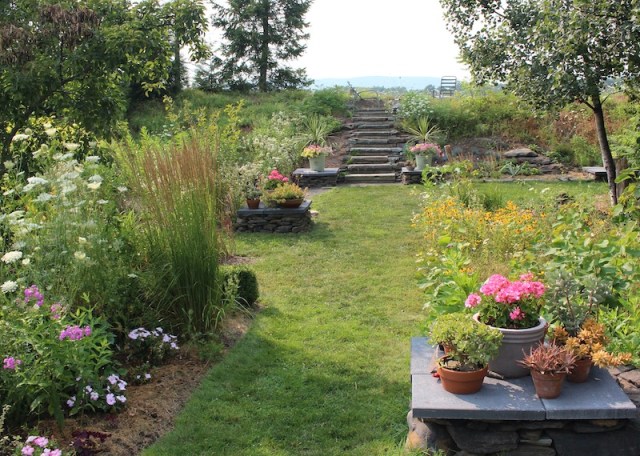
So you got off easy with only one daylily photo.  Let me end with a longer shot which still looks nice even though I haven’t yet added to the berm plantings.
summer perennial border

The pots were looking nice yesterday as well.  The deer also grazed some of the succulents so it looks worse today but whatever, at least they haven’t shown any interest in the petunias.

So a pretty upbeat post in spite of the deer assault last night.  Things look nice and most of the worst of the work is done… which should be good but it also gets me antsy.  What should I be doing with my time?  The houseplants love the heat and humidity and maybe I should take cuttings and divide things.  Do I have enough annuals?  I set up the drip irrigation in spots, and adding more containers really doesn’t add any more work so maybe I need more pots?

I would order mulch but every time I think about it, the tuition bills yell at me.  Hopefully the beds can handle a skipped year or two while we work through this.  Maybe a GoFund me is a good idea.  Not for college bills but for mulch of course, and if it takes off I’ll add a water garden and greenhouse… never mind.  Stay cool, hope you get the rain you need, and hopefully August brings you all the enjoyment and relaxation you need.

Not a bad morning.

It’s beautiful out this morning and I can’t even see problems in the garden.  The lawn is relatively under control, some staking and weeding was done yesterday, the soil is damp enough that watering is not an issue, and other than some chipmunk issues the wildlife of the garden is behaving in an entirely picturesque and harmless manner.  This feeling may fade quickly but while it lasts I’ll just sip my coffee quietly and hope the kids don’t find me.

datura metel

Datura metel.  I expected an annual but this one re-appeared out of nowhere once the rains came and the soil heated up.  It’s doing so much better than last year.

The light is often perfect in my garden but my photos rarely show this.  Even with a better half who loves expensive electronics and insisted on a fancy camera there’s still a skill component missing and I often look at what shows up on the computer screen and wonder what happened.  Fortunately this morning things just came together and it’s as good as it’s going to get.

IMG_2548

Light and shadows on a Datura flower. Even a few dew drops to make it glisten.

Last fall a friend gave me a few seedheads of what is probably Gomphrena ‘fireworks’.  It’s supposed to be in the same species as the regular globe gomphrena (G. globosa) but I don’t see it, and even though it loves the same heat and full sun, the flowers are more like yellow tipped pink brushes rather than tight globes.

gomphrena fireworks

Gomphrena ‘fireworks?’ in the morning light.  Easy from seed (needs warmth and bright light) and loves the heat.

Another annual which catches the light perfectly is amaranthus ‘Hot Biscuits’.  Practically a weed, it just shot up when the rain started falling and the humidity shot up.  This is another one which came via friend…. thanks Paula!

amaranthus hot biscuits

Amaranthus ‘hot biscuits’ in the front border.

I would have laughed if you told me I’d ever grow (and like) a brown flower but here it is.

amaranthus hot biscuits

A nice late summer show of amaranthus coming up among the butterfly bushes (Buddleia)

I do buy a few seeds here and there and zinnias are one which I like to keep in good supply.  Brenary’s Giants ‘Lime’ does NOT show well in the garden but it’s just too interesting to leave out.

Benary’s Giants lime zinnia

Benary’s Giants ‘lime’ zinnia from Fedco Seed.  I bet a good designer could do great things with this color… but me, not so much.  I think it’s cool regardless.

The birds and bees get the credit for this sunflower as well as whatever religious deity you believe protected it from my weed bucket.  I swore up and down I would not allow sunflowers in the tropical bed but there you have it.

double sunflower

A little doubling and a darkly rich center, I’m quite pleased to have this sunflower sharing space with the cannas and bananas.

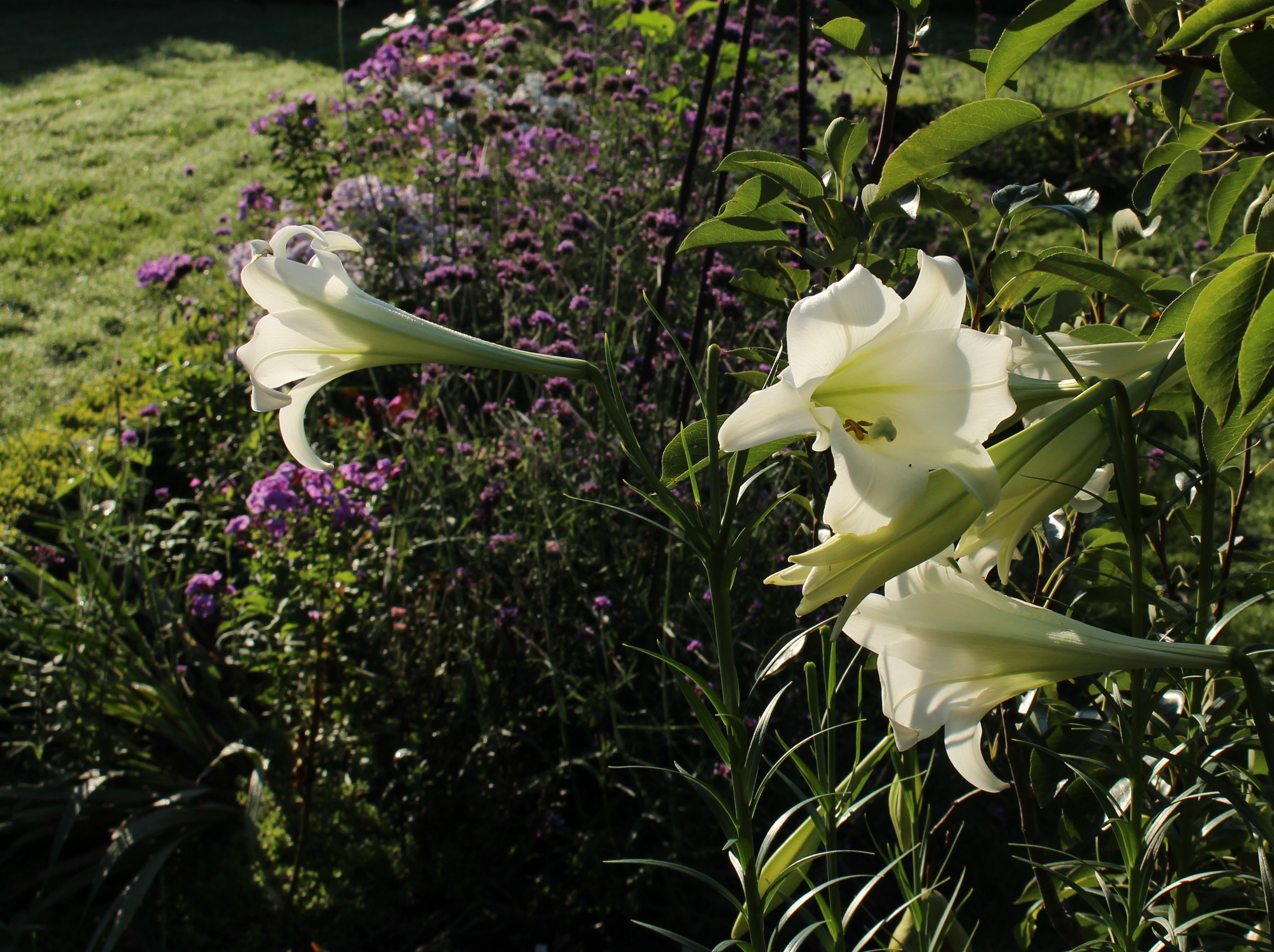
The Formosa lilies (Lilium formosum) were stunted by weeks of drought back in the no-man’s land which I tend to ignore, but are still forgiving enough to fill the garden with their sweet summer perfume.

lilium formosum

Lilium formosum.  For some reason I thought planting them where they’d grow up into the branches of a pear tree would be a good idea… but then again why would I think my little seedlings would ever amount to anything?

The meadow got its mowing just in time.  The first colchicum blooms were beheaded, but now the others can come up nicely in the short (and for once green) grass.

cochicum in lawn

cochicum in lawn

Back in July we didn’t even remember what rain looked like.  Then something happened.  August was warm and humid with perfectly spaced rain showers and this blessing from above even resurrected (most) of the phlox bed.  If you look closely the damage is still there, but on a beautiful Sunday morning it’s easy to see past that.

garden phlox paniculata

Phlox paniculata in the late August light.

Please click on “I hate gardening” to see what this bed looked like a month ago.  You could call the change miraculous and I don’t think that’s an exaggeration.

garden phlox paniculata

Just in time for Monarch migration, the garden phlox and Verbena bonariensis are again filled with flowers and this bed is a very busy place.

I do love my phlox.

garden phlox paniculata

Back from the dead, random phlox paniculata seedlings.

Have a great Sunday and all the best for the upcoming week.  I’m going back outside now and suspect nothing will get done other than a second cup of coffee.

(Almost) In a Vase on Monday

This afternoon I dutifully plucked my choices, prepared to plunk them in a vase, and was told in no uncertain terms to remove the flowers from the house.  Who is this woman I married who cannot tolerate the scent of garden phlox!?  Allergies and a lack of any thoughtfulness were brought up but by that time I had already scurried back outside.  So with camera in one hand and bouquet in the other, my vase is quite open to interpretation this week.

tall phlox seedlings

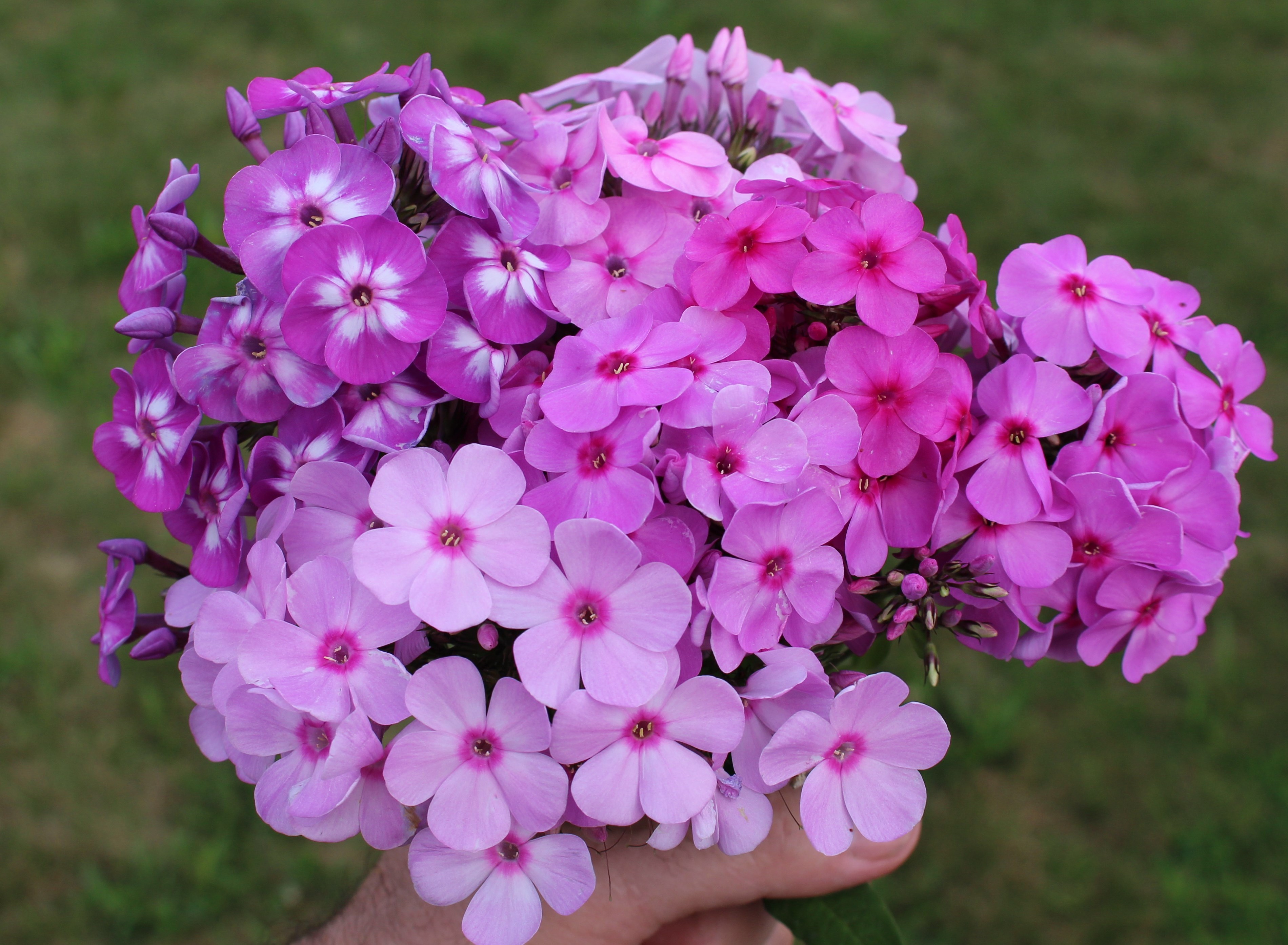
Late blooming garden phlox, all seedlings found scattered here and there throughout the garden beds.

I hope it’s not considered offensive to have a Monday vase without a vase, but Cathy over at Rambling in the Garden who hosts this weekly effort seems to be all for stepping outside the box now and then, so I don’t think there will be any hard feelings.  Plus, when you consider my arranging efforts are usually not far removed from throwing everything down on a table anyway, even with a vase it’s not likely things would have improved much!

self sown phlox

I actually ripped out the two plants on the right a year ago, but apparently they came back from the roots. I’m glad they did, and I should show them a little more respect from now on.

Hopefully the flowers speak for themselves.  These are all unnamed garden phlox seedlings (phlox paniculata) that were looking nice scattered around the garden.  So often I read the repeated advice that phlox should be deadheaded, don’t allow seedlings to grow, and if you do all sorts of chaos will ensue… but I suspect this is yet another bit of garden advice regurgitated yet never tested by the speaker.   Sure if you grow your own phlox seedlings, the plants may not be as excellent as the parents, but I just want to say mine have reseeded, the original plants are fine, many of the seedlings are attractive, and no zombie apocalypse has descended down upon my garden.  If you only have room for one phlox, by all means get a guaranteed color, but if you have a little room to experiment, give it a go.  The surprise can be nice and if not there’s always the compost pile.

Have a great week, and if you’re interested in seeing what other gardeners are doing with real vases give Cathy a visit over at her blog!

Tending the Phlox

The tall garden phlox (phlox paniculata) is coming into full bloom around here and I’m pleased.  This smugness comes from the fact that last year I replanted several favorites into a new bed which had been dug over properly, composted, mulched, and then protected from bunnies in the spring.  Sometimes effort is rewarded and this time it was, in the form of healthy, strong blooming phlox.garden phlox paniculata

A better gardener would have blended them into a well thought out perennial border, mixing the colors with interesting foliage and varied forms…. but I’m not there yet.  Plus I like my phlox in heavy doses.  Overkill some might say.

Barsixty (coral flame is the trademarked name) is first in line.  I really shouldn’t not like it but there are a few little annoying things that get to me.  I think it’s too short, this is the first year it looks nice (after a couple dud years), and the edges of the blooms curl up a bit.  For many gardens, the ~16inch height is perfect and the curling adds interest, so it’s got a place in my garden… but I’m just saying I like other phlox more!garden phlox paniculata

I love “Laura”, it’s about two feet tall (which I still think is on the short side) but she always puts on a great show and looks good for weeks.  Here Laura is in the front with phlox “Nicky” towards the back.  Nicky is a little darker and booms a few days earlier.  (This section has been picked over by the kids, the big dark flowers are too tempting for little flower pluckers.)garden phlox paniculata

I’m kind of a snob with other plants but not with phlox.  Having named phlox is great for knowing what you have (and not buying the same plant twice!) but it doesn’t guarantee a nice plant in the garden.  I think this white is great, but it’s just a stray seedling that came up a couple years ago.  It’s about three feet tall and although pure white is always perfect, I like the way this one has small dots of red at the bloom center and a reddish blush on each bloom stem. garden phlox paniculata

I took this picture yesterday when the clump really hit full bloom.garden phlox paniculata

This one I don’t know the name for,  I think it might be “starfire” but can’t say for sure.  The color is great (if you like the reds!) and I like how the foliage and stems have a darker tint to them.  It’s a little floppy though….. garden phlox paniculata

I need more of the clear pinks.  Here is “Bright Eyes” which I got just last fall, it came as a rootbound 4″ potted plant and will probably need one more growing season before it takes off.  I love the packed flower heads but they tend to hold onto dead flowers.  “Franz Schubert” is just starting to the left.  It’s another one in need of more settling in time.garden phlox paniculata

This white seedling may still earn itself a spot in the phlox bed.  It’s a short early blooming seedling which opens with a pink flush and later fades to pure white.  We’ll see if it gets moved in the fall…..garden phlox paniculataPhlox do well in pretty much the same conditions as any other garden flower.  Even moisture, fertile soil, sun to light shade and you should be able to make them happy.  In the spring I do nothing more than cut the old stems down and then come summer the only other thing I do is admire the flowers.  For many gardeners powdery mildew is a problem, and I wish I had some brilliant solution but I don’t.  Mildew is just not much of a problem in my yard, probably because it’s a real open, breezy location near the top of a hill.  The air movement likely helps but I can’t say for sure since as we speak the monarda plants are covered in mildew and they’re just a few feet away.

My most annoying phlox growing problem is the spider mite attacks.  They build up under the leaves and suck and suck until the leaves start to look speckled and yellow.  Spraying the undersides of the leaves seems to help wash them away but the best defense seems to be consistent moisture and plenty of compost and fertilizer.  Dry spring weather, warm breezes (which keeps away the mildew) and stressed plants seem to just call the mites in from all around.

Another problem I’ve had (which made me leave all the phlox behind the last time I moved) are eelworms.  They’re tiny worms which live in the stems and buds of infected plants.  They cause the stems to distort and ruin the nice big flower heads of a healthy plant.  The only solution I’ve heard of is to grow new plants from root cuttings, destroy all the old ones and find a new spot to grow phlox….. or move.

I just want to end by saying I need more phlox.  I think I’ve kind of run through all the local sources and have what most mailorder sources offer, but I know there are more great phlox out there!  I may have found a source at Perennial Pleasures, a Vermont nursery that specializes in heirloom plants and also has dozens of phlox varieties available.  I’ve heard good things about them and it’s very likely an autumn order will show up at my doorstep.