April, May and June, all in one week

I’ve been hiding.  Our temperatures spiked up to 92F (33C) last week and watching the wilted daffodils and tulips being thrashed by the dry wind was just too depressing.  In a few hot days three weeks of bloom flew by and it’s now mostly over.  The temperatures finally dropped today but I still wish we would get some rain before the grass completely yellows.  I don’t like a dry spring.

Fortunately May is still May, and regardless of the weather there’s still plenty to be happy about!

growing perennials from seed

At least my winter seed sowing is paying off. This year I have my first frittilarias and tulips from seed, and it’s endlessly entertaining to search the pots for the latest sprouts.

Between NARGS, HPS, and American Primrose Society seed exchanges I have plenty of pots of little goodies to experiment with, and as long as nobody mentions the fact I have no room for most of these, I think we’ll all just enjoy the enthusiasm of the newest little sprouts in my garden 🙂

lilium martagon seedlings

Martagon lily seedlings going on to their third year.  At this rate there’s not much rush to find more room.

In addition to bringing on the seedlings the heat brought the wisteria from buds to blooms in barely four days.  Last spring was a total loss due to a harsh winter and late freeze, but this year about half the buds survived.  I don’t even miss the lost buds, it’s still full of flowers.

standard wisteria tree

Japanese wisteria planted out in the meadow.  Without anything nearby to grab onto and climb I think it’s invasive tendencies can be kept under wraps.

Maybe you noticed my sad little fritillaria imperialis blooming behind the wisteria.  The hot wind wilted the flowers quickly but I managed to get a photo of the interesting inside of the hanging blooms.

fritillaria imperalis nectaries

The nectar drops at the inner base of the fritillaria imperalis blooms.  A cool thing to look at, but it’s just a bit too “glandular” in appearance for my tastes!

The fritillaria will be something to keep my fingers crossed for in order for it to survive, but the japanese wisteria cannot be mentioned without a warning about it’s invasiveness.  Killing it would be far more work than the neglect which keeps it alive, and to turn your back on this plant runs the risk of having it take over.  I keep it in the middle of a lawn area were it cannot grab onto anything, to grow it as a vine and keep it on anything less than a massive arbor would be more work than I want to consider.
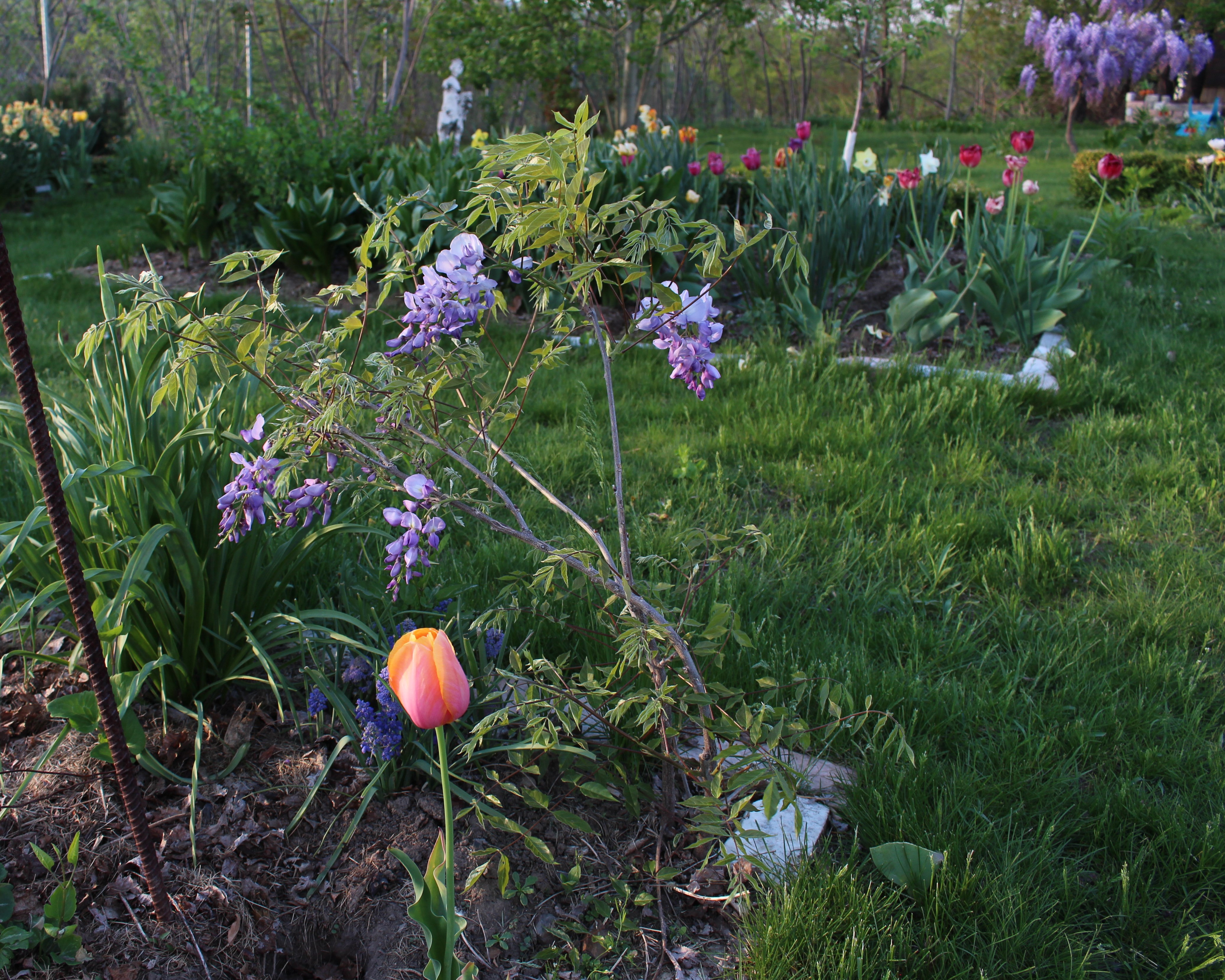
wisteria that doesn't refuse to bloom

Some seed grown wisteria may take decades before they finally decide to bloom, mine is a cutting off my parent’s plant which has always put on a heavy show of flowers.  Even this sucker which came up last year after I moved the mother plant already has a few blooms on it.  A smart person only needs one wisteria, I’m not sure why I’m going to keep this second one 🙂

Speaking of plants which wouldn’t mind taking over the world, I think I’ve finally decided against keeping this darker purple vinca minor.  I like it well enough but without a border or wall to hold it back it’s spreading out just a little to enthusiastically.  This plant (and my wayward campanula glomerata) are officially on the elimination list.  I might put some of it next door in one of the boring mulch beds around my mother in law’s house.  It’s not that hard to rip out, improves the look of an empty mulch bed immensely, and between the house and lawn it shouldn’t get into too much trouble.

vinca minor atropurpurea

Vinca minor ‘atropurpurea’.  A good groundcover in the right place, but a little to aggressive for my beds, and I wouldn’t want to let it escape into the wild. 

Before the heat struck I did manage to finish up a little hard labor.  The front house bed has had a once over, been expanded and topped with new mulch.  I forgot who gave me the idea, but I divided up the blue fescue clumps and spread them far and wide across the front of the border.  I like it, which isn’t something I could say the last time I redid this foundation planting.

mixed border foundation planting

The front foundation planting looking all springy.  Any opinions on the pink rhododendron in front of the brick?  I have mine, and it involves a shovel 🙂

The bed along the front of the house has been one of my favorites this spring.  The shelter of the house gives a little protection from the drying wind and my mulching has kept down many of the most annoying weeds.  Some would say my thistles are weeds but I think they’re fantastic.  You’re not going to want to touch them though….

Ptilostemon diacantha

Ptilostemon diacantha.  I can’t wait to see this one bloom (even though the blooms may be slightly anti-climactic) and will surely collect seeds if I get that far… using gloves of course 🙂

Something a little more suburbia-friendly are the tulips and camassia.  It looks nice enough here but I may remove a bunch of the camassia.  In the heat I don’t think they’ll last more than six days, a little too short of a bloom period for my tastes although I can’t complain about how carefree they are.  Maybe I’ll try them somewhere less prominent.

tulips and camassia

Tulips and camassia highlighting the front foundation planting.  The blue fescue has been divided up and spread all along the front now and I think it looks better than the gappy line which was there before.  Funny to think these are all the descendants of a single moth-eaten clump which I rescued from a neighbor’s yard. 

Close up the camassia are an airy, beautiful flower, and I think to see it growing en-mass in its native Western North American haunts would be great.  Maybe someday.

camassia leichtlinii caerulea or 'blue danube'

Camassia leichtlinii caerulea or ‘blue danube’, I’m not sure which since I planted both but they all look identical to me.

Iris season is next.  The stalks are shooting up all over and it makes the rapid passing of the daffodils feel a little less painful.  I’m sure it will be a fantastic year for iris…. unless that’s the exact point when the rain decides to come.

iris pallida 'variegata' in a mixed border

I always forget to divide the awesome iris pallida ‘variegata’.  It’s one of my favorites but seems to like more frequent division and better soil than some of the others.

So that’s it from here.  I have to apologize for not responding to comments or leaving any on the blogs I visit,  I’ve been keeping up with the reading but for the most part have been just too grumpy and unmotivated to add any productive comments.  But there’s hope.  The first irises are opening today and I’m already feeling better.  This sounds good, but unfortunately the weekend is already filled to capacity with field trips, birthday parties, dance recitals, sports banquets and baseball games and I’ll be lucky to even step foot in the garden for a few days.

But it’s almost Friday, and I hope a great weekend is had by all!

Glass Gem Corn

The title explains it all.  After nearly giving up on the watering a few times, and feeling guilty for the curled up/droughty leaves nearly all of the time, the Glass Gem corn has finally limped on in to the finish line.  It’s not a huge harvest but I love it all the same.

glass gem corn

Just in time for all the harvest displays, ‘Glass Gem’ corn looks just as you would imagine…. glassy.

“Glass Gem” is a popcorn type who’s origins trace back to the corns grown by the Native Americans.  This of course doesn’t seem a far stretch since all corn originates out of the fields of the earliest American farmers, but “Glass Gem” is a strain reselected by an Oklahoman farmer out of several of the oldest of corn strains available.  That’s the short version of the story.  There’s much more to it and if you’re interested check it out by clicking here.

I hope I don’t do the history of this corn a disservice by just hanging it around the house for decoration, but I think it’s just too cool to pop or grind (plus I only have a few kernels!)  I’ll have to grow it again next year and see if I can improve the harvest.  Having a couple real ears and not the tiny little deformed things I picked should really up the wow factor!

The long road home

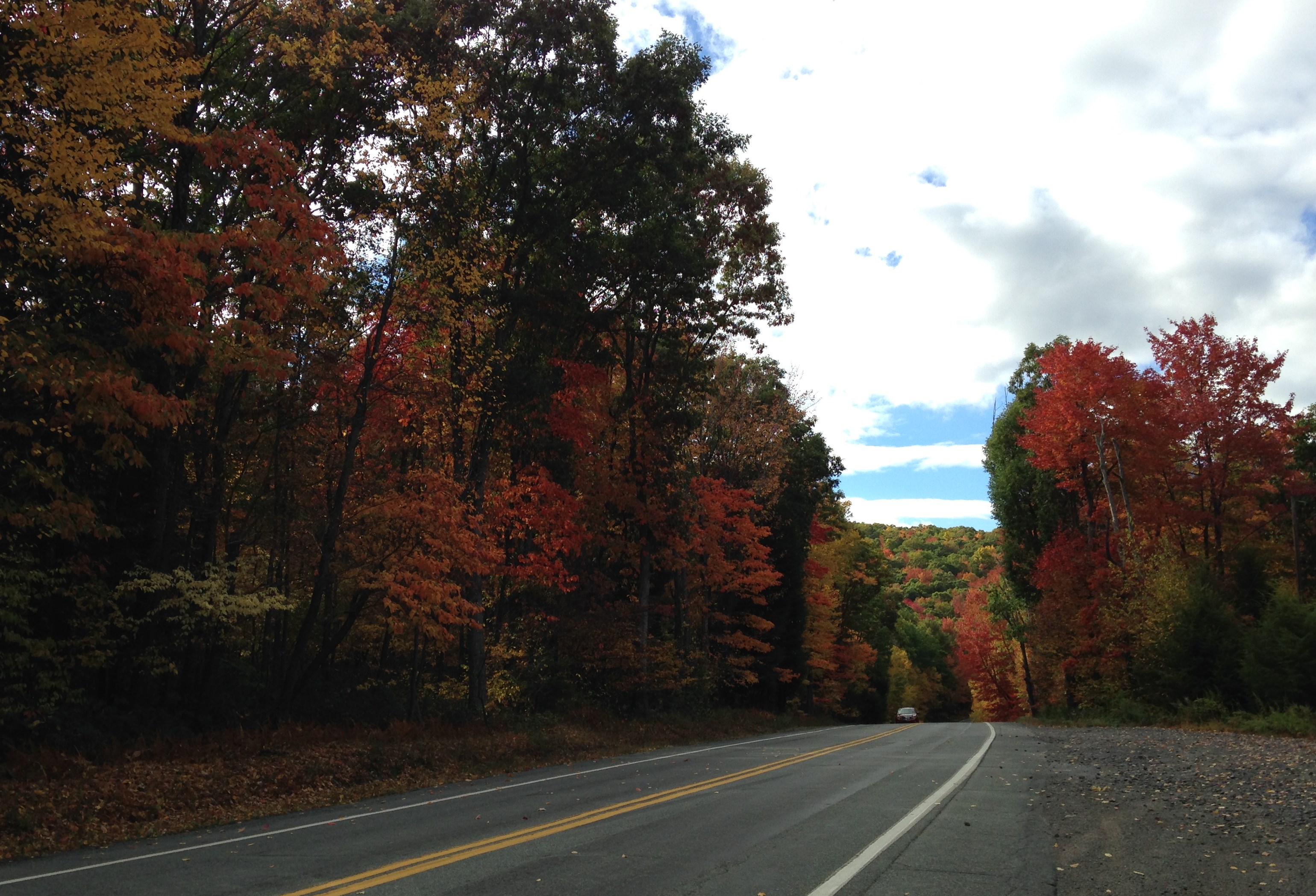
The title of this post sounds a lot more deep and spiritual than it should.  Don’t worry.  Deep I am not, it’s just I really do tackle a long road home each afternoon.  My commute takes about 50 minutes each way and fortunately this week it’s been a much more pleasant drive with the colors of fall lighting the way.

autumn road

Red maples and birch coloring up across the mountains of Pennsylvania.

This fall the cool nights and warm days seem to have brought on some spectacular colors.  I’m usually not a fan of these last death rattles which summer goes through, but even I have to admit it looks nice enough this year.  Nice enough that I pulled over a few times today for a quick phone pic or two.

fall colors

The death of summer and a cemetery just seem right together…. or is it my fall-hating showing through again?

A few spots up in the mountains are already hosting a rain of autumn leaves after every wind gust.  The shower of autumn colors is nice enough in itself but I’m not looking forward to the gray of the next six months.  There’s a lot to be said for evergreens.

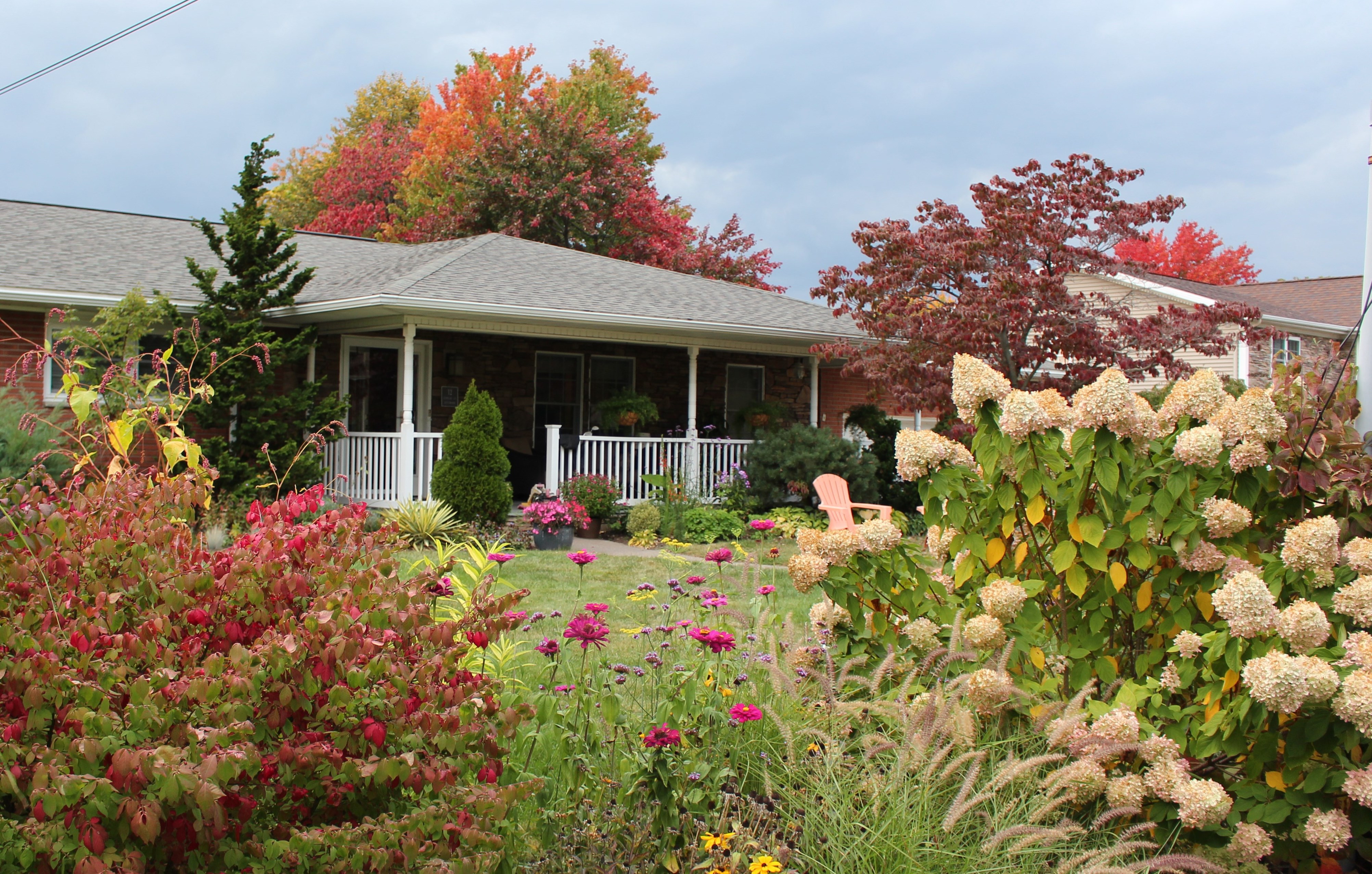
front of the house in fall

Back at home again and the trees are starting here too. For a couple days the maple trees behind the house will be worth all the trouble their dark shade and greedy roots cause.

Time to think about the nice leaf mulch that the mower will pick up off the back lawn.  It’s the perfect blanket for daffodil beds and tulip plantings and all the other late fall plantings which I still hope to accomplish before things cool off too much.  That and a little rain too.  Fall leaves look so much better on green grass rather than a parched bed of straw 🙂

In a vase on Monday: Goldenrod

In celebration of Labor Day and a Monday away from work, I’m once again making a contribution to the ‘In a Vase on Monday’ movement.  It may not exactly be a world changing movement, but it’s fun and does motivate me to bring a few flowers into the house so look at how it’s changing lives!

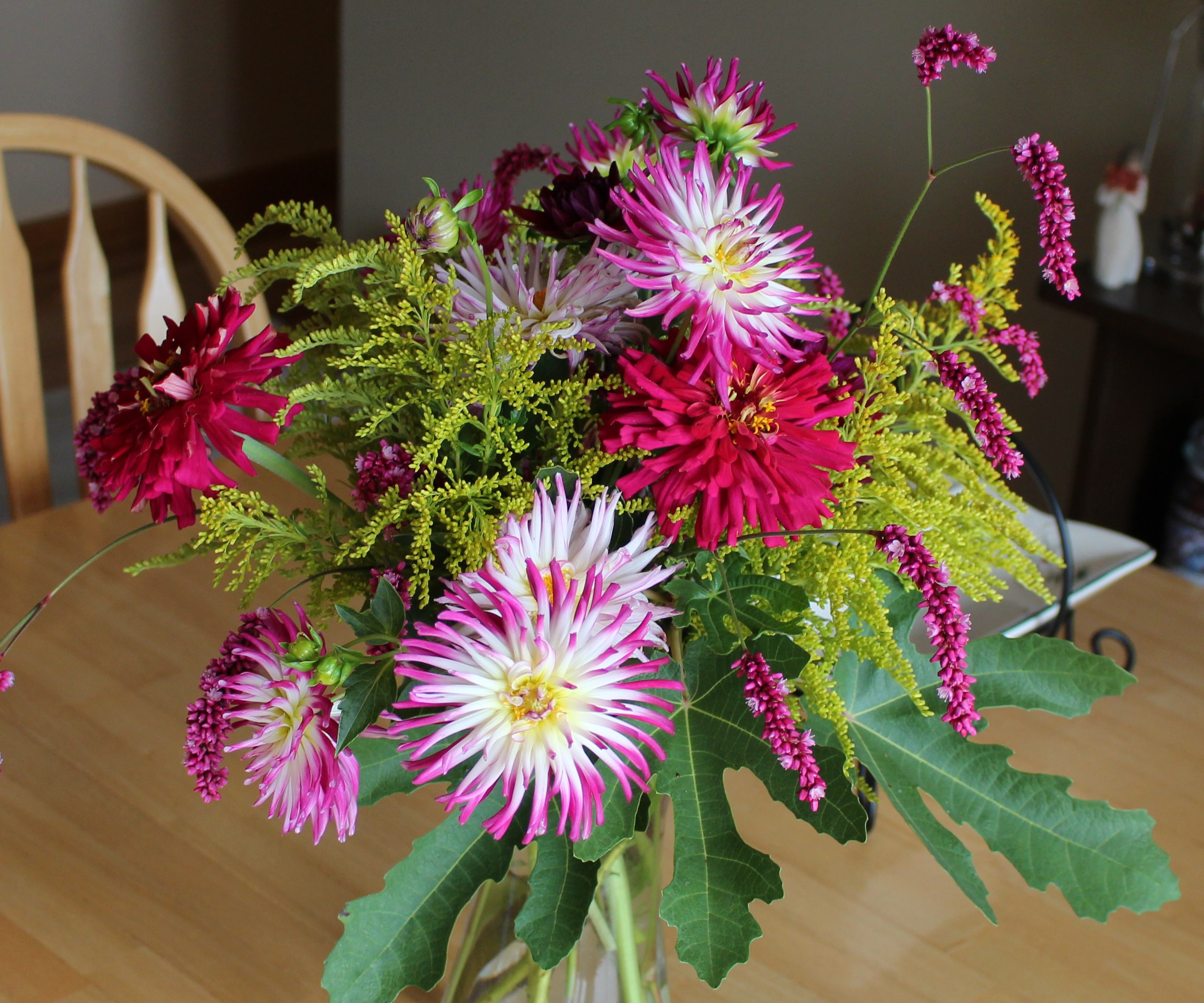
arrangement with goldenrod and dahlias

Another pluck and plunk arrangement. I didn’t realize how unbalanced it was until after I looked at the photos!

This week’s arrangement was inspired by Kimberley at Cosmos and Cleome.  In a recent vase Kimberley had the good sense to add a few sprays of goldenrod in to fill things up, and it took that vase to make me realize I have a ton of the stuff growing all over the place and should do the same!

goldenrod and dahlia

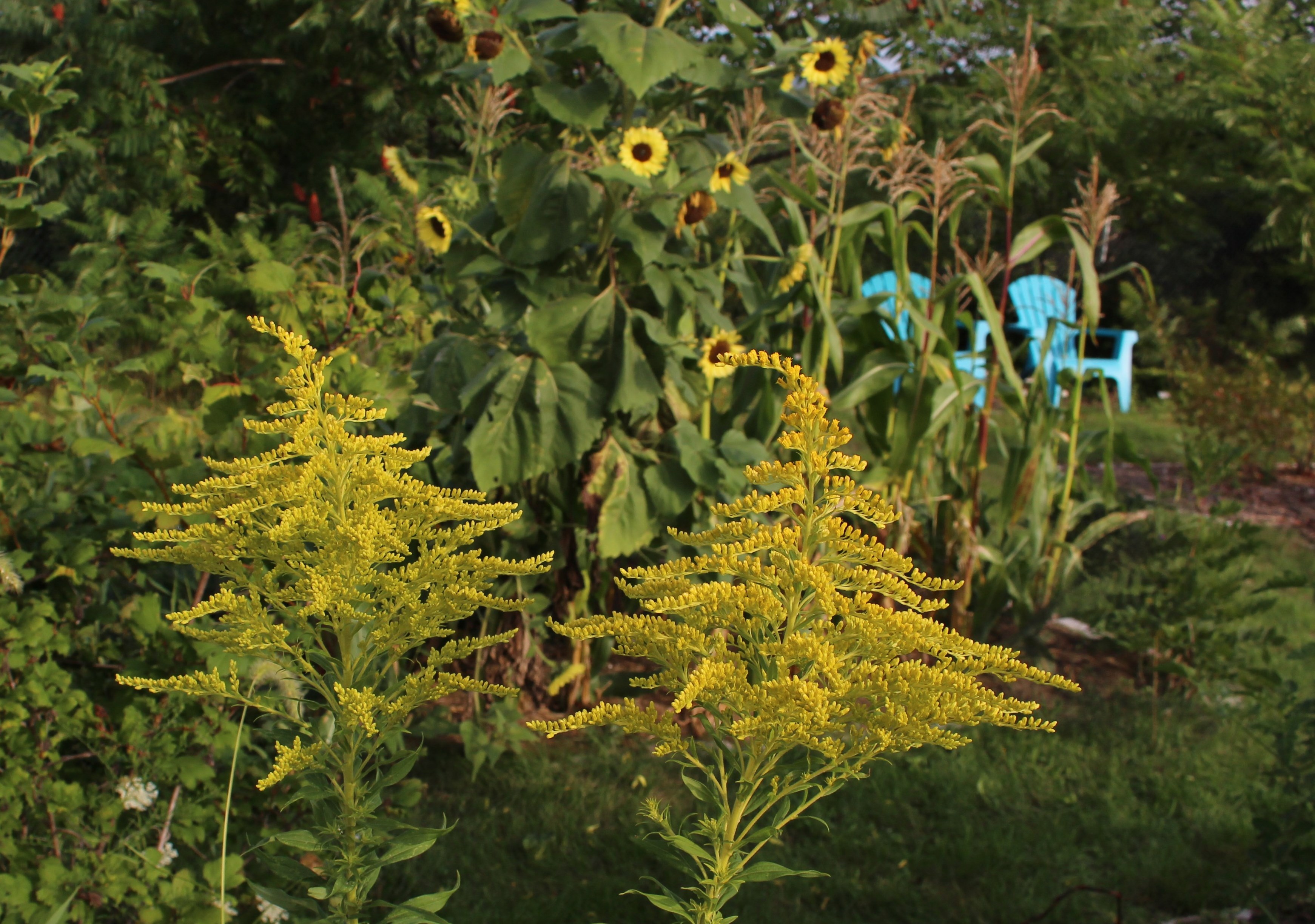
The just barely blooming goldenrod has a nice soft color and fills in well. It’s like a redneck version of baby’s breath plucked from the roadside.

Besides the goldenrod, this vase has the pink tipped blossoms of dahlia ‘Tanjoh’, a purplish red dahlia (maybe ‘Plum Pretty’?), a few zinnias, a couple pink sprays of ‘kiss me over the garden gate’ (persicaria orientalis), and a few fig leaves which were in the way of my boxwood trimming.  I like it 🙂

dahlia 'Tanjoh' with goldenrod

The goldenrod makes up nearly half of the arrangement yet you really just notice the larger blooms. Such is the curse of a ‘filler’…

With all the goldenrod coming into bloom I may have to admit to myself that autumn is approaching.  On the road to college I was always disgusted by the mass of goldenrod yellow filling the fields along the highway, and it’s always been a mental marker for the end of summer and the return to work.  I guess that’s my bias against the plant, but because of its native status I tolerate it when a seedling shows up.

goldenrod for cutting

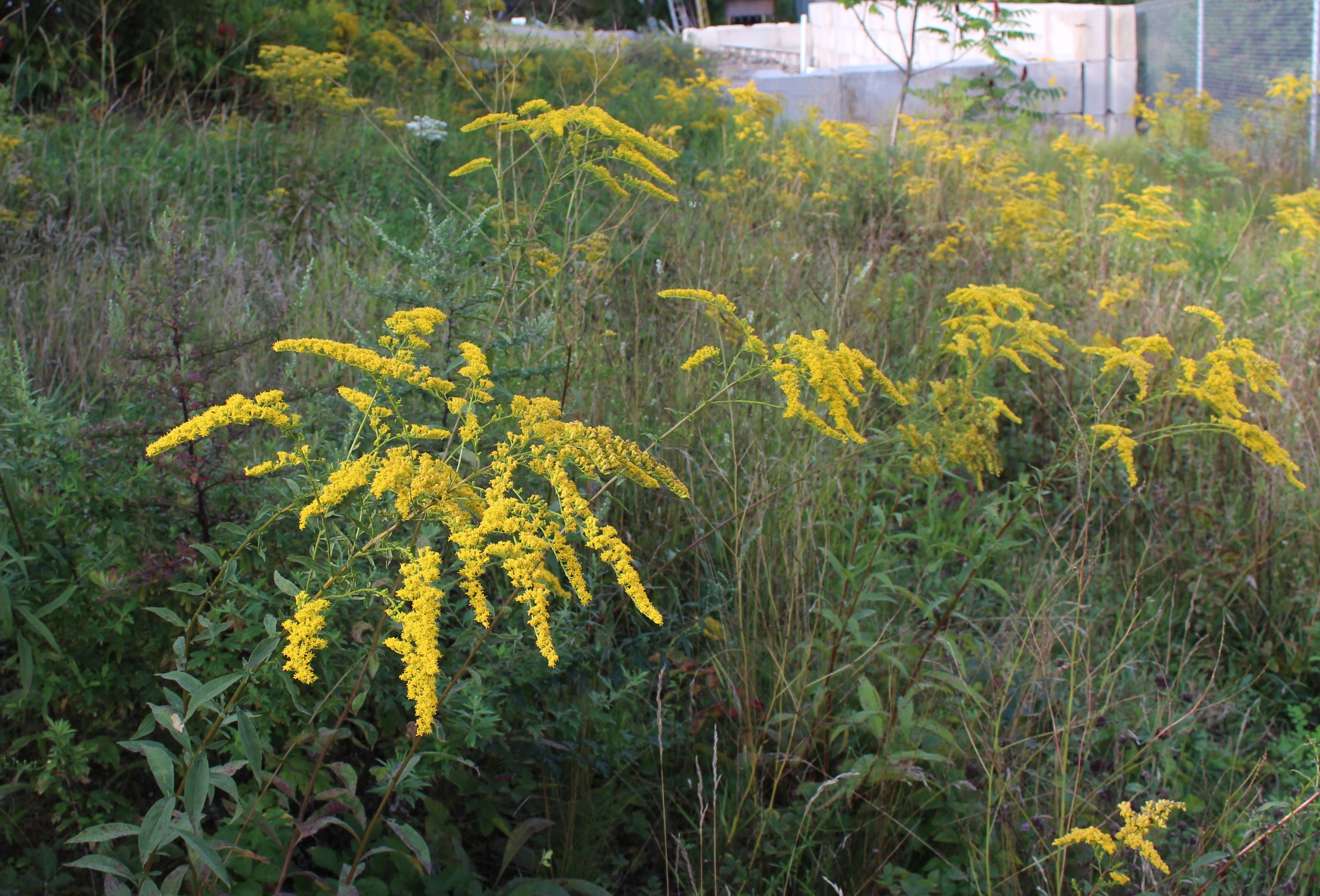
There are more than enough wayward areas around the garden for goldenrod to sneak in a rod or two.

Not to stray too far from my Monday vase, but I guess some goldenrod annoys me less than others.  One of the species is only just starting to color, and I think it’s my current favorite.

goldenrod and sumac

Goldenrod just coming into flower along with some staghorn sumac which the starlings and robins will enjoy this winter.

This floppy one is not a favorite.  Once it’s finished blooming I’ll run back here and mow things down to give the grass a chance.

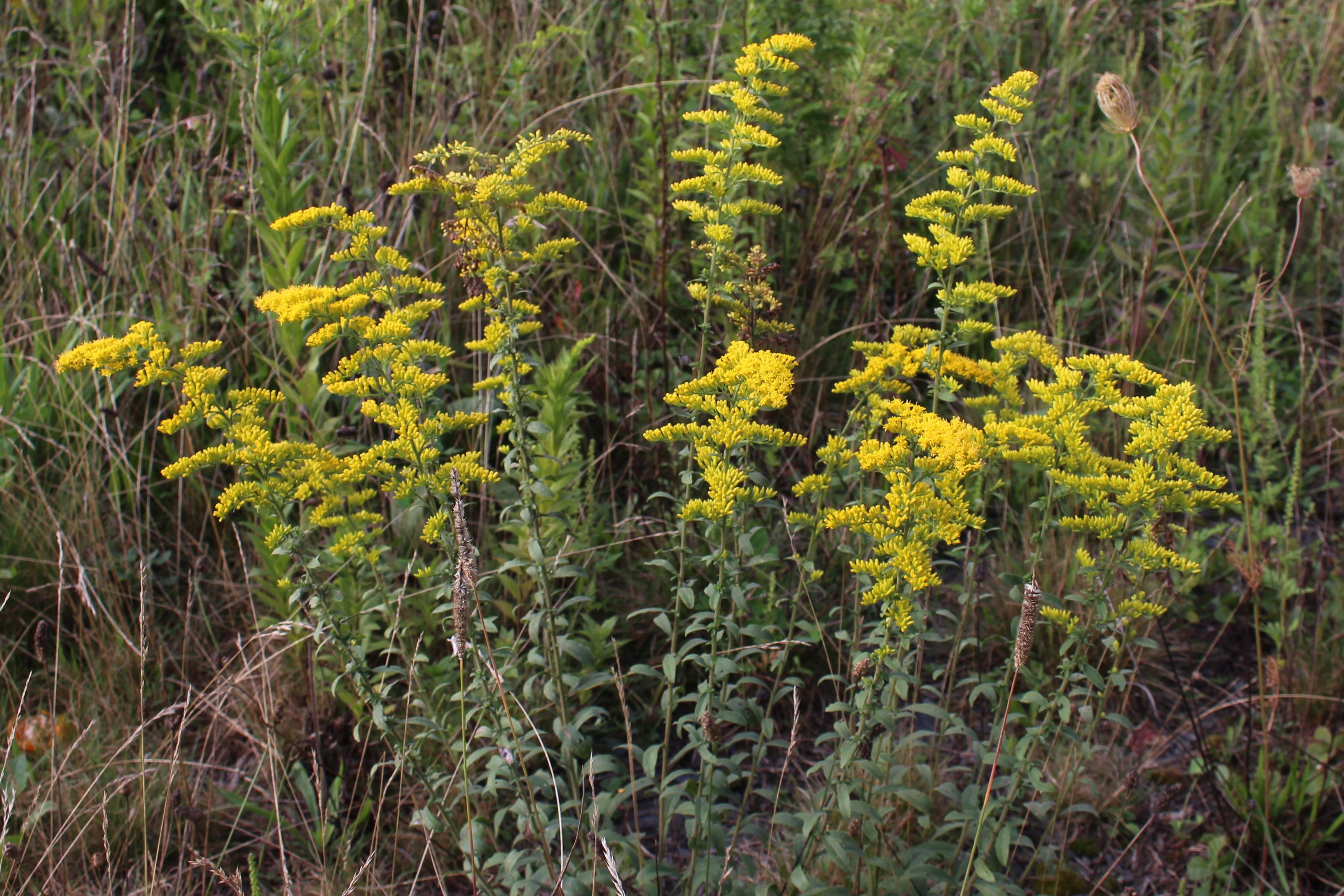
wild goldenrod

Not a bad goldenrod, there’s just too much and I’d rather leave a little room for some of the asters which are yet to come.

Here’s my last goldenrod.  I don’t know any of the species but this one’s a smaller, leaner version.  I would almost say I like it.

wild goldenrod

Unknown goldenrod…. any ideas? This one’s about two feet tall and like the others doesn’t need a thing from me.

Thanks for staying with me for my little segue from cut flowers to roadside weeds.  They’re wildflowers of course, and if I can just get past my stereotyping I may be able to call them all cutflowers someday.

If you’d like to see other cutflowers more artfully arranged I’d encourage you to visit Cathy over at Rambling in the Garden.  You can check out what she and other bloggers around the world are doing for their own “In a Vase on Monday”.   Have a great week!

Midsummer night’s dream

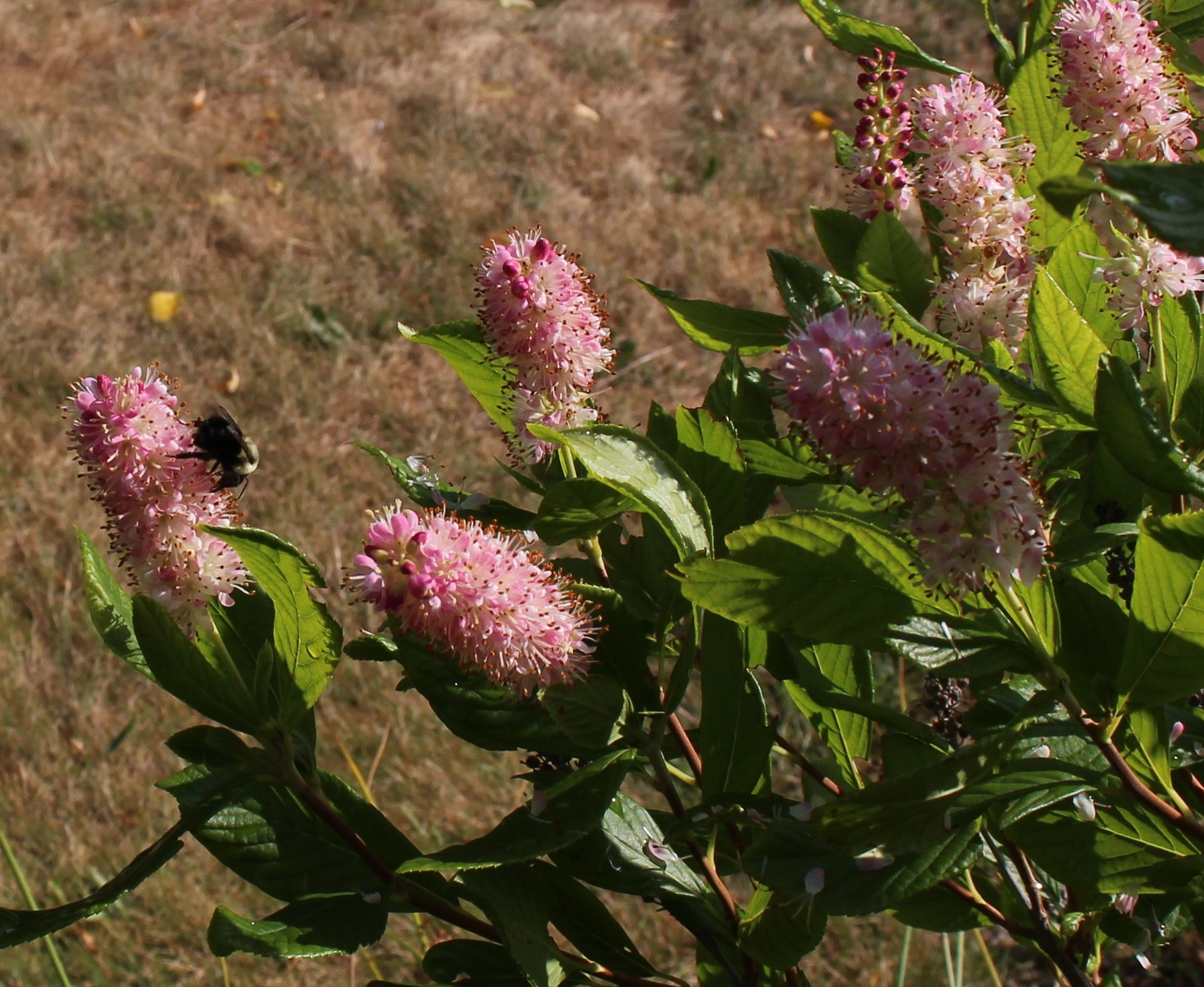
There’s a “pink spires” summersweet (Clethra alnifolia) growing just below the covered porch, and since we’re using the porch much more this year it’s blooming has not gone unnoticed.  In the warm summer afternoons and evenings the heavy, sweet scent drifts up and around the garden and brings in dozens of bumblebees and honeybees to the pink bottlebrush flowers.

Clethra alnifolia "pink spires"

Clethra alnifolia “pink spires” is a pink version of the normally white summersweet.

Summersweet is a good name for this fragrant native shrub, but having it planted so close to the porch might be a little too strong and sweet a scent for my taste.  Coming across a patch in bloom while hiking the woodst is a pleasant surprise, but drowsy afternoons spent out on the porch border on naps, and who knows what kind of dreams will be experienced with this perfume wafting through the air?  Or in the words of a less fragrance-friendly member of this household, “one of your flowers really smells out there, it’s giving me a headache”.

Clethra alnifolia

Very popular with the bees, Clethra alnifolia likes a nice moist spot. The only reason it’s surviving in my dried up garden is that it’s planted right at the downspout from the roof.

I may have to move it, but where to?  Right now it’s exactly where water from the roof comes down and it would likely die out in the drier parts of the garden, so my options are limited.  We’ll see what happens.  I’d like to redo this area within the next two years so I have time to think about it.

Am I the only person who thinks some fragrances are just too much?