The deck planters are starting to look good. The tropicals love the heat and the annuals have settled in. Last year I had some big grasses in the three main planters, but the winter was too much and they didn’t make it, so this year I returned to my roots and stuffed the pots full with my favorite all summer plantings.
‘Tropicana’ canna, black sweet potatoes, million bells, and a New Guinea impatient fill this pot. Some ‘red rocket’ snapdragons fill in the back. I’ve never done the snapdragons before but right now they look great….. We’ll see how they last in the heat.

For some reason red was the color of choice this year. Usually I don’t buy most of the plantings and just use over wintered stuff, but this year I treated myself to a nursery run. 33% off helps and if you buy it all on one day I guess a red mood will give you red plantings.
This one has similar plants with the cannas replaced by a nice new coleus and burgundy fountain grass in the center.

The aloe pot here was overwintered, but the red blooms on the dipladenia are new. Not to rub it in but I think I found it for about $2 at a local greenhouse clearance and I hope to overwinter it for next year.

Here’s a new coleus, overwintered geranium, and a pot of blue fanflower/red celosia combo. The celosia is ‘new look’ celosia and I really like the bright flowers and dark foliage.

Herbs have a spot too; parsley, rosemary and a pot of annual vinca for color.

Here’s one pot that I’m not yet thrilled with. It should have a pink ‘Alice Dupont’ mandevilla climbing up the bamboo stakes, but for some reason she won’t grow…. She blooms well, but won’t grow. It was an impulse buy at a box store and looked great, but is no bigger today than it was the day I brought it home. I can’t help but wonder if it was treated with something to trigger blooming at the expense of new growth. Does anyone have an opinion on that?
There’s a chartreuse sweet potato that may step up and take over, and also an ‘Australia’ canna coming in…. But I really like mandevillas 🙂
Oh and a big basil that’s just about worn out its welcome. I never thought it would take off like that.

So that’s the news from the deck. I’ve been away for about a week so things have hopefully grown some since, but I’m pleased with the results so far. Yes, a little yellow might have brightened things up a bit, but my planting are always a little impulsive, so each year turns out a little different. Who knows, maybe next year all the grass will be back, or cannas will take over, we’ll see!
Monthly Archives: July 2013
Viva la Tropicalismo!
“Tropicalismo” is so very ’90s but being in style was never my strong point. I still love the tropical look with big leaves and bright colors and lush happy growth right during the months when everything else looks a little tired and faded. Too big elephant ears, too bright cannas and just a little too tall grasses always make me smile when the bleeding hearts are dying in the heat. I even like the bright red salvia that is normally reserved for gas stations and trailer parks. Feel free to judge me, here’s a picture of the tropical bed last year.

This was a new area that was the perfect match of big space, full sun, and no planting budget, so I pulled together the leftover canna roots, popped in a couple sweet potato cuttings, and scattered some annual seedlings and with plenty of water and fertilizer it all came together.
As usual this year I’ve fallen behind, and the tropical bed is still a weed infested patch of leftover perennials, a few nice salvias, and an appropriately bright knockout rose.

I finally got around to weeding, mulching, and planting. It may seem like all is lost with such a late planting date, but the experience of a chronic procrastinator has taught me things will still work out fine. Also the late planting allowed several self sown red salvias and amaranth to make themselves known. All good things since I used up all the spare annuals when I expanded the front yard border.
So here it sits, still a little sparse, but ready to take on all the drought and heat summer throws its way.

With any luck I’ll still have the same tastelessly colorful display as last year, minus a few of the exceptionally colorful and tacky tropicana cannas.

Tending the Phlox
The tall garden phlox (phlox paniculata) is coming into full bloom around here and I’m pleased. This smugness comes from the fact that last year I replanted several favorites into a new bed which had been dug over properly, composted, mulched, and then protected from bunnies in the spring. Sometimes effort is rewarded and this time it was, in the form of healthy, strong blooming phlox.
A better gardener would have blended them into a well thought out perennial border, mixing the colors with interesting foliage and varied forms…. but I’m not there yet. Plus I like my phlox in heavy doses. Overkill some might say.
Barsixty (coral flame is the trademarked name) is first in line. I really shouldn’t not like it but there are a few little annoying things that get to me. I think it’s too short, this is the first year it looks nice (after a couple dud years), and the edges of the blooms curl up a bit. For many gardens, the ~16inch height is perfect and the curling adds interest, so it’s got a place in my garden… but I’m just saying I like other phlox more!
I love “Laura”, it’s about two feet tall (which I still think is on the short side) but she always puts on a great show and looks good for weeks. Here Laura is in the front with phlox “Nicky” towards the back. Nicky is a little darker and booms a few days earlier. (This section has been picked over by the kids, the big dark flowers are too tempting for little flower pluckers.)
I’m kind of a snob with other plants but not with phlox. Having named phlox is great for knowing what you have (and not buying the same plant twice!) but it doesn’t guarantee a nice plant in the garden. I think this white is great, but it’s just a stray seedling that came up a couple years ago. It’s about three feet tall and although pure white is always perfect, I like the way this one has small dots of red at the bloom center and a reddish blush on each bloom stem. 
I took this picture yesterday when the clump really hit full bloom.
This one I don’t know the name for, I think it might be “starfire” but can’t say for sure. The color is great (if you like the reds!) and I like how the foliage and stems have a darker tint to them. It’s a little floppy though….. 
I need more of the clear pinks. Here is “Bright Eyes” which I got just last fall, it came as a rootbound 4″ potted plant and will probably need one more growing season before it takes off. I love the packed flower heads but they tend to hold onto dead flowers. “Franz Schubert” is just starting to the left. It’s another one in need of more settling in time.
This white seedling may still earn itself a spot in the phlox bed. It’s a short early blooming seedling which opens with a pink flush and later fades to pure white. We’ll see if it gets moved in the fall….. Phlox do well in pretty much the same conditions as any other garden flower. Even moisture, fertile soil, sun to light shade and you should be able to make them happy. In the spring I do nothing more than cut the old stems down and then come summer the only other thing I do is admire the flowers. For many gardeners powdery mildew is a problem, and I wish I had some brilliant solution but I don’t. Mildew is just not much of a problem in my yard, probably because it’s a real open, breezy location near the top of a hill. The air movement likely helps but I can’t say for sure since as we speak the monarda plants are covered in mildew and they’re just a few feet away.
My most annoying phlox growing problem is the spider mite attacks. They build up under the leaves and suck and suck until the leaves start to look speckled and yellow. Spraying the undersides of the leaves seems to help wash them away but the best defense seems to be consistent moisture and plenty of compost and fertilizer. Dry spring weather, warm breezes (which keeps away the mildew) and stressed plants seem to just call the mites in from all around.
Another problem I’ve had (which made me leave all the phlox behind the last time I moved) are eelworms. They’re tiny worms which live in the stems and buds of infected plants. They cause the stems to distort and ruin the nice big flower heads of a healthy plant. The only solution I’ve heard of is to grow new plants from root cuttings, destroy all the old ones and find a new spot to grow phlox….. or move.
I just want to end by saying I need more phlox. I think I’ve kind of run through all the local sources and have what most mailorder sources offer, but I know there are more great phlox out there! I may have found a source at Perennial Pleasures, a Vermont nursery that specializes in heirloom plants and also has dozens of phlox varieties available. I’ve heard good things about them and it’s very likely an autumn order will show up at my doorstep.
Early July update
I would have thought that by now my latest project would be complete. I’m in the process of widening the flower bed that runs along the street, and even though it’s been humid, hot and rainy I still won’t admit it might have been a better idea to wait until fall. So I’ll try to distract everyone from that thought with some pictures.
The phlox are here! This picture is a week old, but it’s one of my newest colors so of course I’m excited about it. The full name is phlox paniculata “Nicky” and it’s dark dark dark. I had to prop it up a bit, but since this is year one I’m willing to give it another growing season before calling it a flopper.
You’ll see more phlox soon since they’re a favorite, but first here’s an underrated summer bloomer, hosta “blue cadet”. I only have a few hostas, but I’d rate this one highly. It’s old but always respectable and easy in sun or shade. I like it here under the porch plantings and it does a good job of shading all the spring bulbs and hiding their dying foliage. Note the edge on that lawn! You don’t see that too often in my yard. In the backyard the addition of bird netting has saved some blueberries for the slower berry lovers. This morning’s pickings were enough for a whole blueberry pancake! Who knows, maybe in another year or two we’ll be able to put together a couple muffins.
I guess I can put in a couple front border pictures. Here’s the newly dug section. The cannas are sprouting in the heat and the sedum doesn’t seem to care about being moved and divided on a 92F afternoon. I made it almost to the halfway point. The grass is getting turned under and I’m putting in whatever annuals are still homeless. A few perennials are moving around too but it’s mostly iris clumps getting ripped out and divided and sedums finding a new spot.
 At the rate I’m moving I should get to this end around Sept. 25th. Then I’ll probably want to spread mulch over it all…. and weed first since by then I’m sure they will be all over. Oh well, maybe someday I’ll get my act together.
Projects are always fun but the zucchini are blooming and that can mean only one thing. All work will stop as we try and get rid of the extras. I always plant four hills and I always end up with about four times what I need. Who would ever trust that the little seeds I put in the ground would ever amount to anything? But they do and now I’ll pay the price. For this one hill I can count at least four and they’ll be ready in another day or two…. so get the recipes ready.
Paper wasps!
We were off on holiday weekend visits for three days but to look at things outside you would think we’ve been gone a week! It was hot, there were seedling casualties, but most stuff survived and the heat made a couple things explode into growth.
One thing that is growing is the paper wasp nest we found in the little dawn redwood. 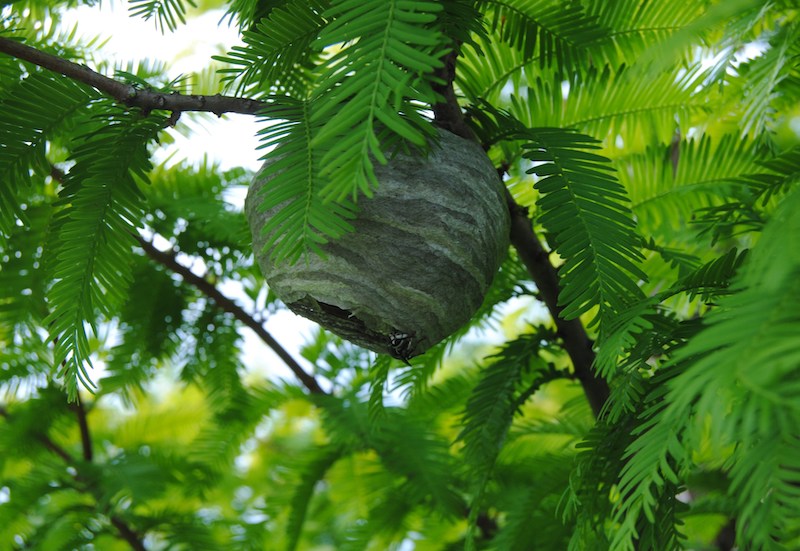 I’d rather it wasn’t so close to the sandbox but the kids want it to stay and I’m willing to see how that works out. The kids are old enough to know better than to antagonize them, but I’m not so sure how that will hold up when the boys get together and hit an “I’m bored” moment….. Obviously I wouldn’t be doing this if there were any known sting allergies around.
The nest is only about four feet up, and I’m curious as to how these guys chose their nest site. Out of all the bushes and trees around the yard they pick this one. The one closest to the play area. Go figure. But it is interesting to watch them working on the nest, doing what paper wasps do.
This can easily turn out to be one of those “that was stupid” posts…. time will tell. Hopefully in the fall when this set of wasps die and they abandon the nest (they only use it one year) the next generation will pick a better spot. In the meantime I hope they help themselves to as many caterpillars, bugs and spiders as they want, they can be a great beneficial insect, and I hope they’ll keep my kindness in mind when I absentmindedly bump the nest while mowing back there…. that should be funny to watch.
Life on the Prairie
I’m still working on the street border cleanup and expansion. Normally I would have called it quits as far as digging and transplanting go but with all the rain and overcast days I’m just trying to get a little more done before the lazy days of summer kick in. Today the humidity almost killed me but I did manage to push myself and got a little further. An update is on its way but in the meantime here are a few pictures of another part of the yard.
The far reaches of the yard are left to themselves for most of the year. I love the wild look but that opinion is not held by everyone who lives here or who peers over the fence. It will get a rough mowing around the end of July but for now it’s full of wildflowers and bugs and butterflies and bunnies. I was so pleased with myself for getting all the paths mown I figured I’d take a couple pictures.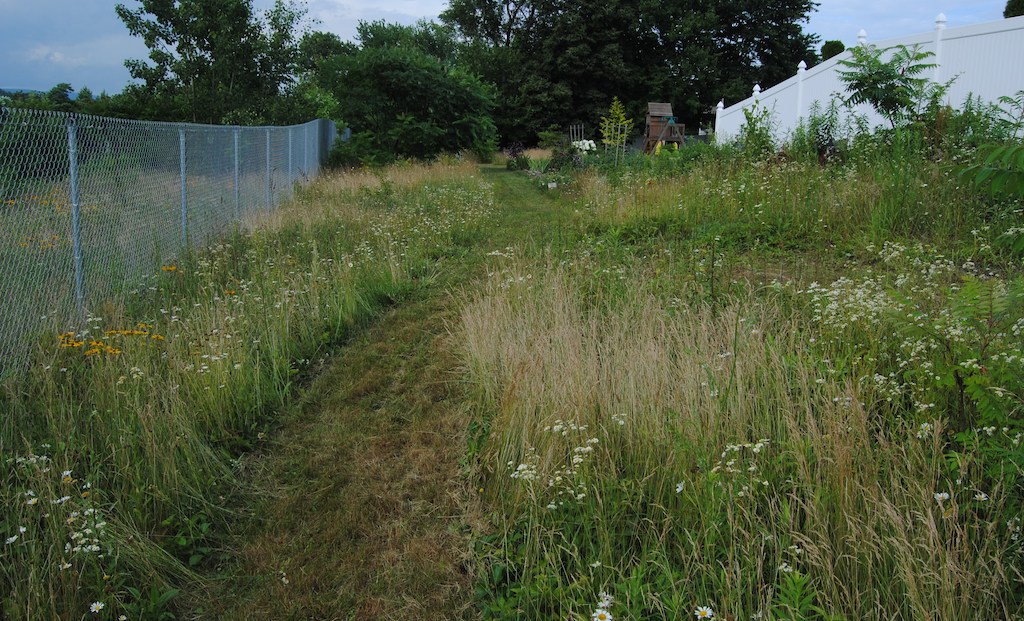
This is the area behind my mother in Law’s house. It’s a no-man’s land between her fence and the new fence surrounding the new industrial park. About five years ago this was just bare earth but over the years I’ve seeded in some grass, thrown down some daisy and rudbeckia seed and just kept it mowed (early spring and mid summer) to keep the worst of the weeds from taking over. Here’s the five year picture. In the front you can see where I spread the lawn clippings I collected from another part of lawn that had gone to seed. 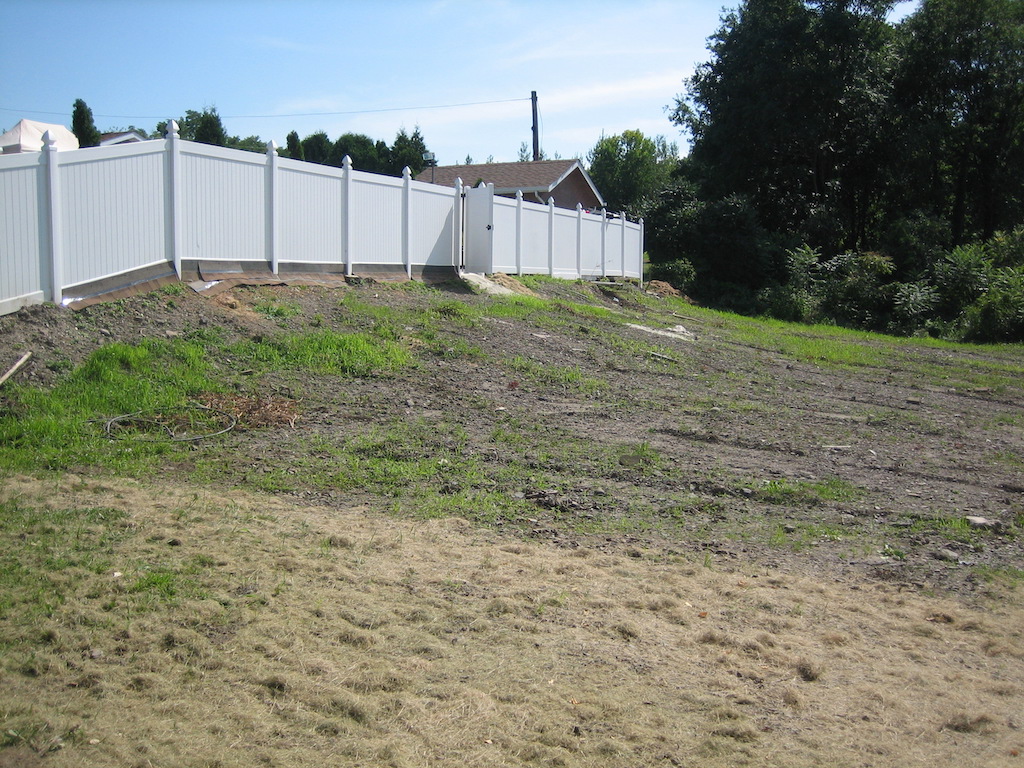
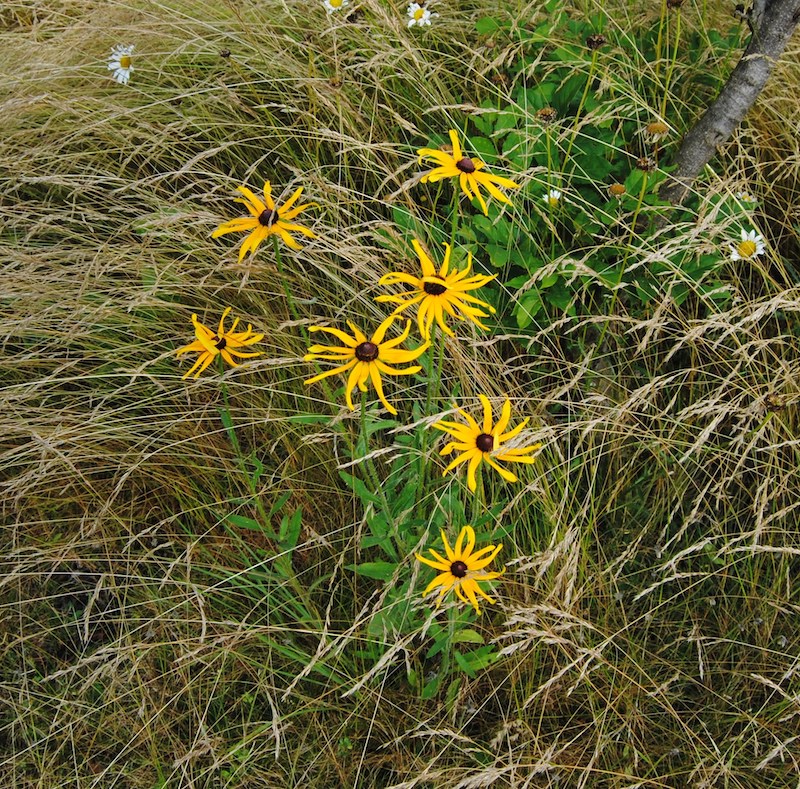 The worst weeds back there are creeping blackberries, Canada goldenrod, and queen anne’s lace. I think I pulled most of the QA Lace (too invasive) but the blackberries are giving me trouble. The kids call them “pokies” and I hate the way the runners grab your leg and razor wire a cut right in the sensitive part of your ankle. I hate them and remember hating them myself as a kid when one got me out in the woods.
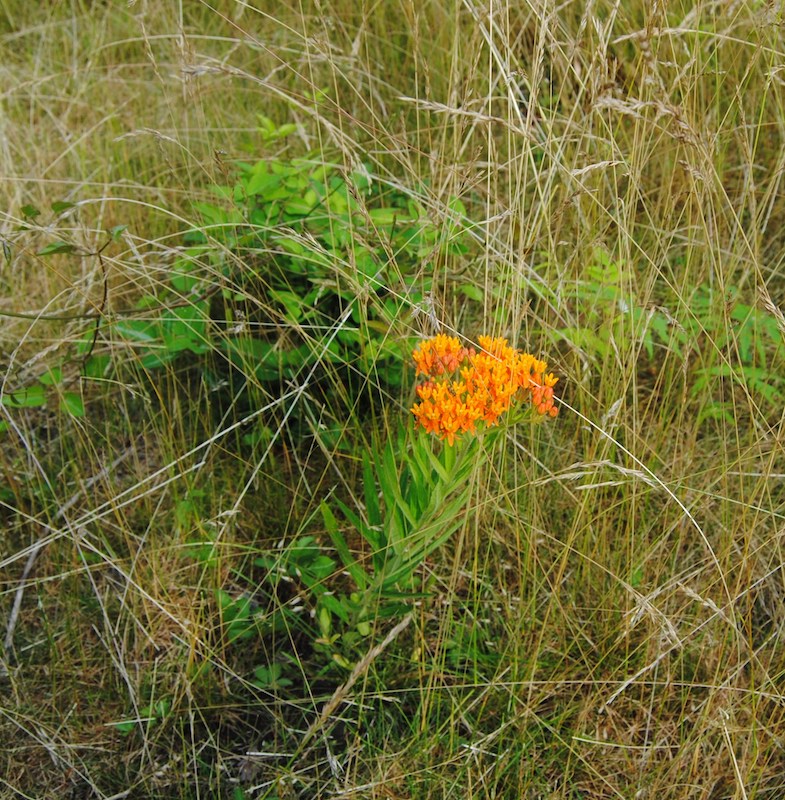 The wild black eyed susans are blooming now as well as some late oxeye daisies. Both of these are welcome and I’ve been trying to add some other interesting stuff to keep them company. The late summer mowing should encourage the early blooming grass to fill in, but I’ve been planting out some butterfly weed seedlings (Asclepsias tuberosa). The first to reach blooming size is flowering this year, I hope others follow.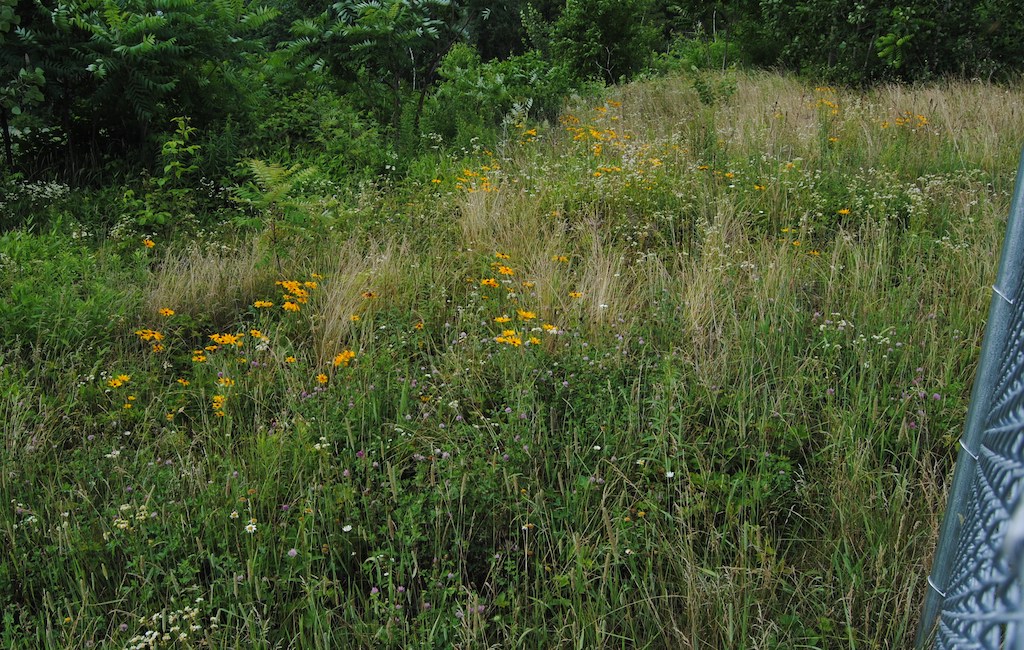
The chainlink fence went up last year and has cut me off from half the meadow. There’s a possibility a gate will magically appear in the fence and I’ll again be able to give this a mow. I’d like to be able to control what grows in back here and don’t want trees too big and too close to the fence.
Back on our side of the fence there’s a second half of the meadow called the ‘orchard’. I planted an apple tree there this spring, hence the lofty renaming. The grass in this section is thicker since part was already turfgrass before I started letting in all the daisies.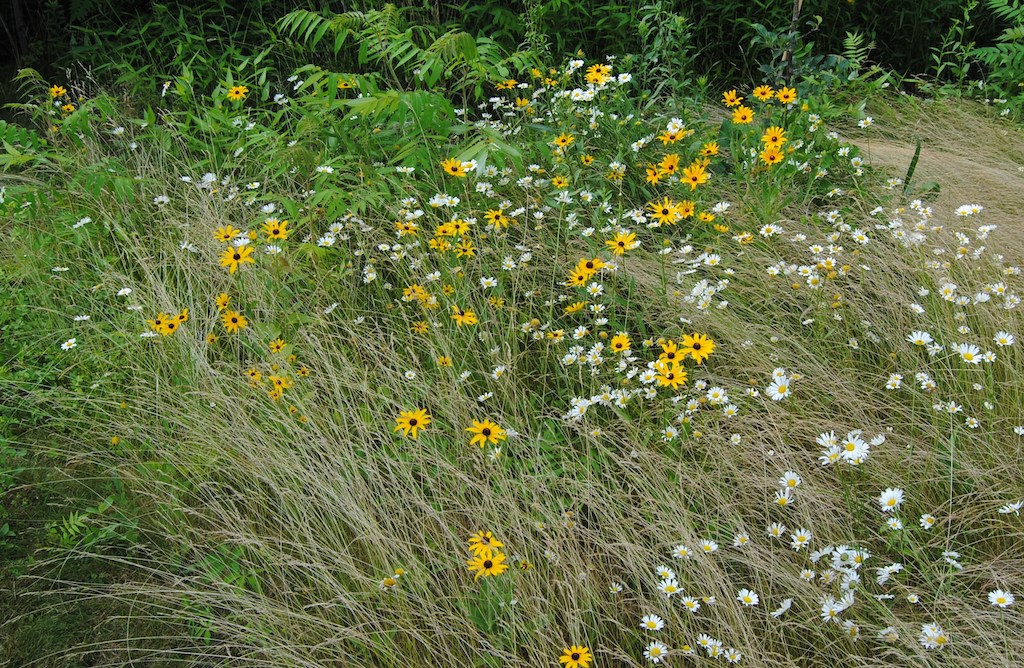
With the paths mowed and the edges neat I think the meadow has a nice look. It’s popular with the younger crowd for important activities such as daisy collecting and grasshopper catching. It’s also a great place for firefly chasing, and since July is firefly season there was a lot of path running as the kids tried to catch as many as they could.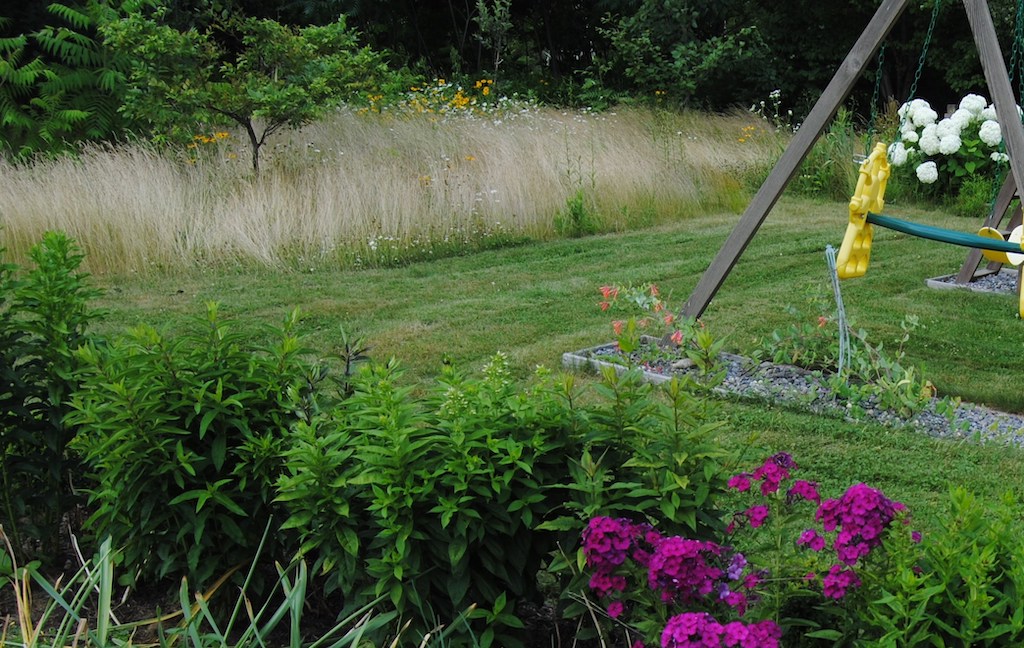
I’ll end with a look across from the vegetable garden to the meadow…. I mean orchard…… If you look carefully through the crooked tomato trellis you might catch a glimpse of ‘the queen of the prairie’. She guards the entrance to the orchard and admires the overgrown lawn. Some say she’s just an old plaster statue that wouldn’t sell at an estate sale. I say she’s our queen.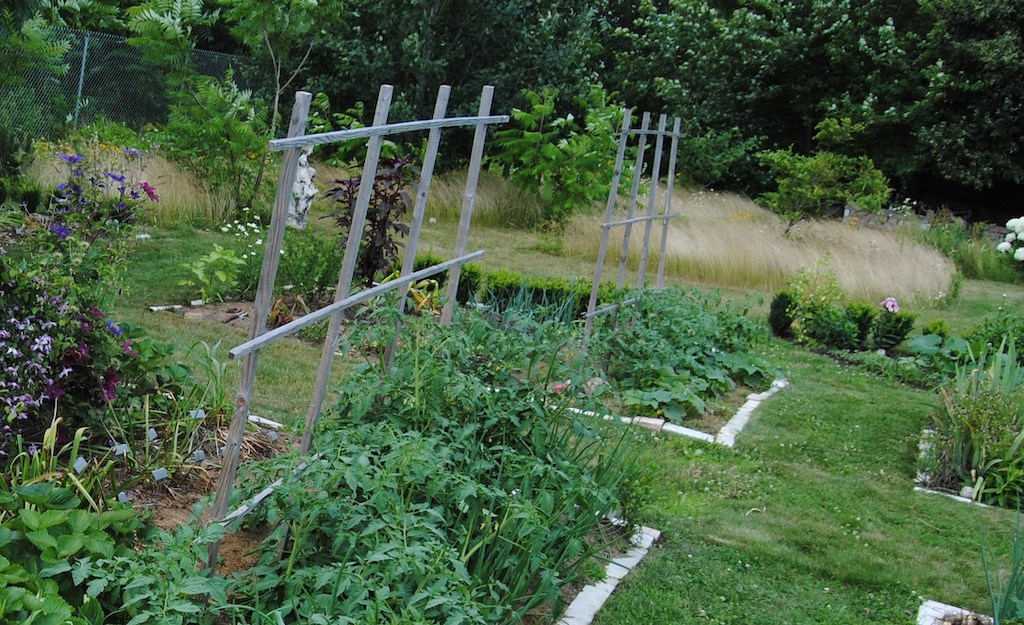
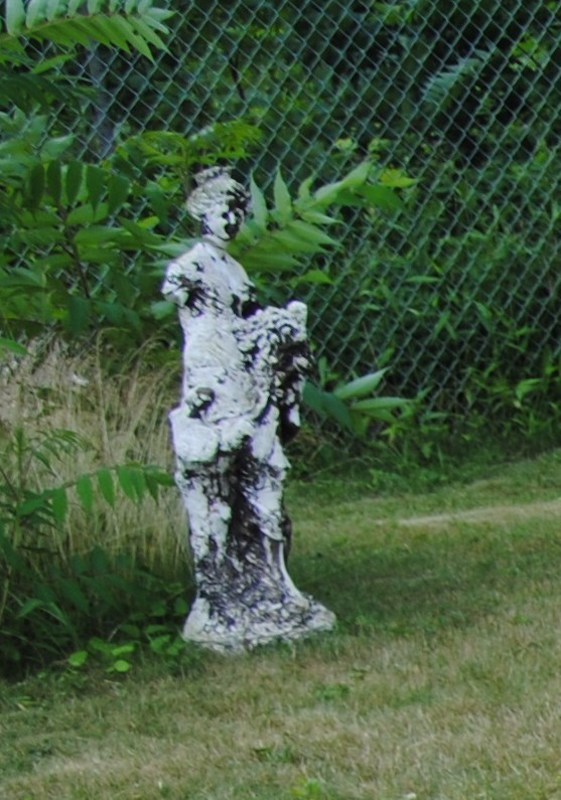 Now back to digging says the queen.
Annabelle
It was a dry spring, but based on the weather pattern we’re in now it won’t be a dry summer. That’s fine with me since I hate watering, but others with different summer plans will disagree. I took advantage of a break in the rain today and finally cut the grass. Pretty much everything is lush and thick due to the extra water and the hydrangeas are no exception.
I grow “Annabelle” in a couple places around the yard but here at the edge of the orchard is the plant that seems happiest.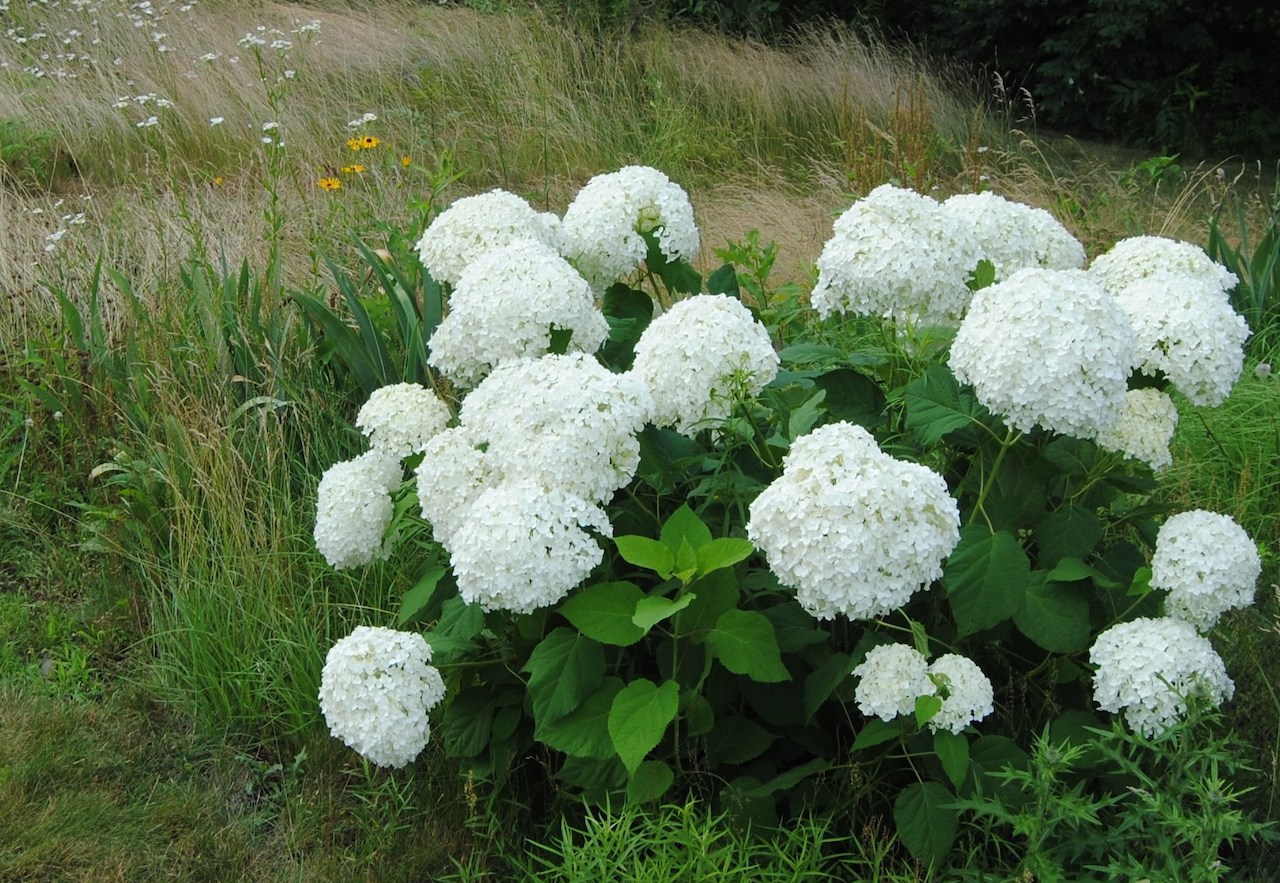
I think this plant came from a small shoot I felt bad for and stuck into the ground while planting daffodils. It does well amongst the weeds and always puts on a great show with these volleyball sized bloom clusters. “Annabelle” is one of the arborescens type hydrangeas. Hydrangea arborescens is the species and it’s a different species than the less hardy florist hydrangeas (the blue/pink or purple ones), oakleaf hydrangeas, and the late summer h. paniculata (the big white or pinkish late summer bloomers). They’re native around here and are commonly found along creeks and streams, just in a little more modest bloom form. 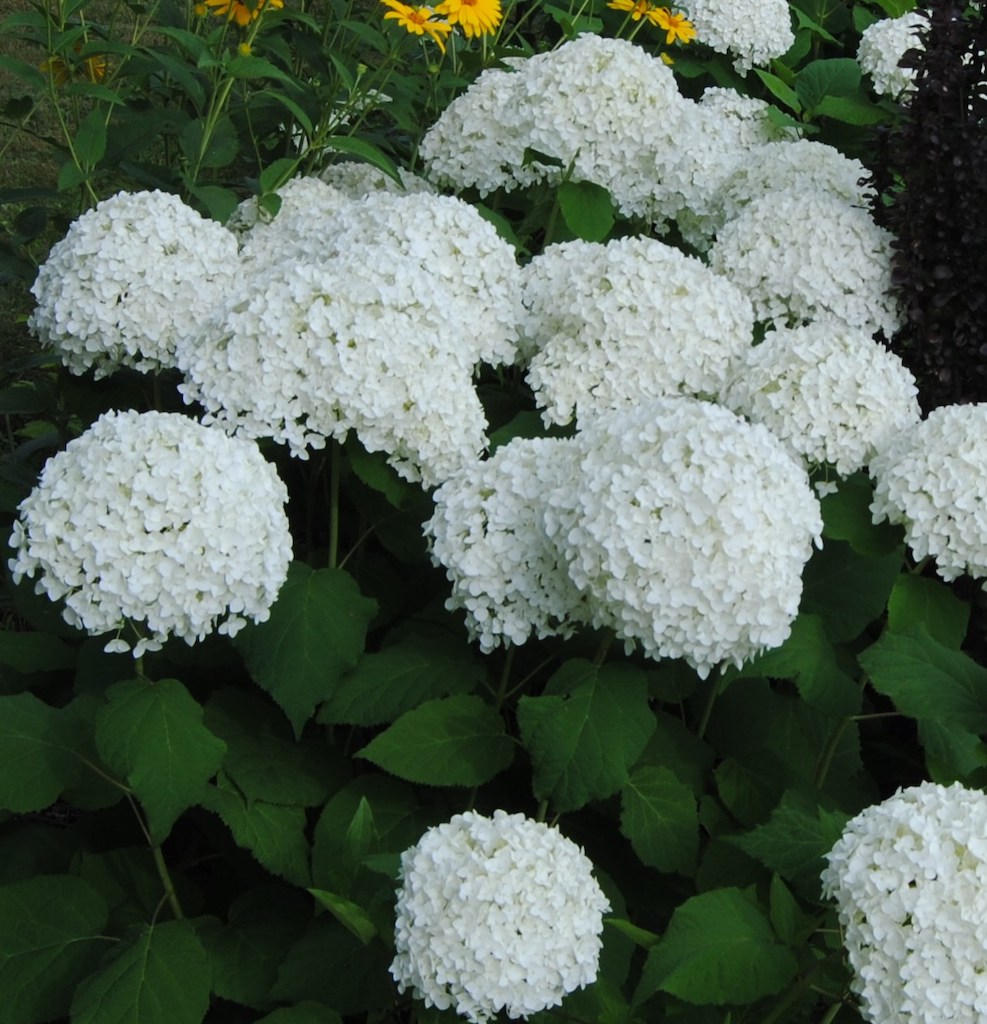 “Invincibelle spirit” (pink) and “incrediball” are also arborescens types that have recently come out, but the first has a pink color that I’m not crazy over and the second just hasn’t found its way into my garden yet (it’s supposed to be less floppy). Arborescens hydrangeas are easy and reliable bloomers. I cut mine back completely in the spring and that’s about all I do and still get a great show. Water is about the only thing they might ask for. Mine are in full sun and in years of less regular rain the plants wilt, die back, and the blooms get crispy edges due to my neglect.
“Annabelle” has been around for a while. She was found back in 1910 in the wilds outside of Anna Illinois by Harriet Kirkpatrick, and it was her and her sister Amy that brought the original plant into their garden. After decades of passing along from gardener to gardener “Annabelle” hit the big time in 1962 when she was introduced to the nursery trade. She’s still a great garden plant. This is a larger clump that slowly spreads a bit each year via short runners. If I had a big yard with a little shade I think I’d have to spread these out to fill in a huge swath of white.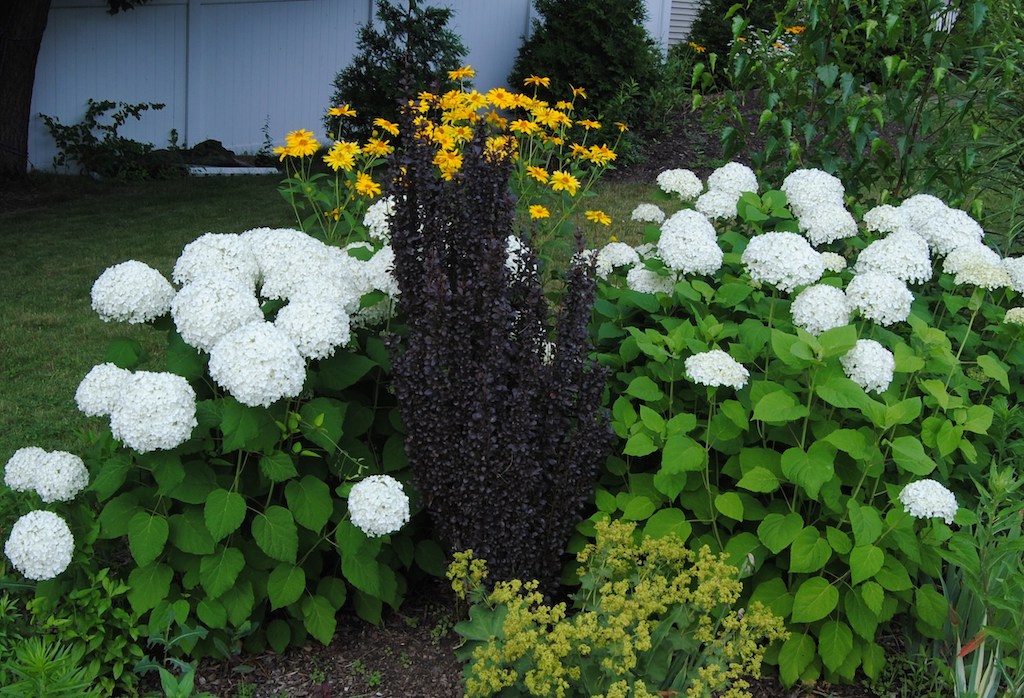
 sorta like suburbia