A quick August walkabout

Although the air practically drips humidity and the the nights are muggy it’s still nothing compared to summers South of the Mason Dixon line.  Plus it’s only been a few days, and it’s actually rained regularly for three weeks now and I do love a nice summer thunderstorm so I’m fine with all of it.  What a relief from the relentless dry which haunted me all of June and July (and still haunts much of the East Coast) and what a change the gardens have gone through as they try to get all the growing in which didn’t happen during the first half of summer.
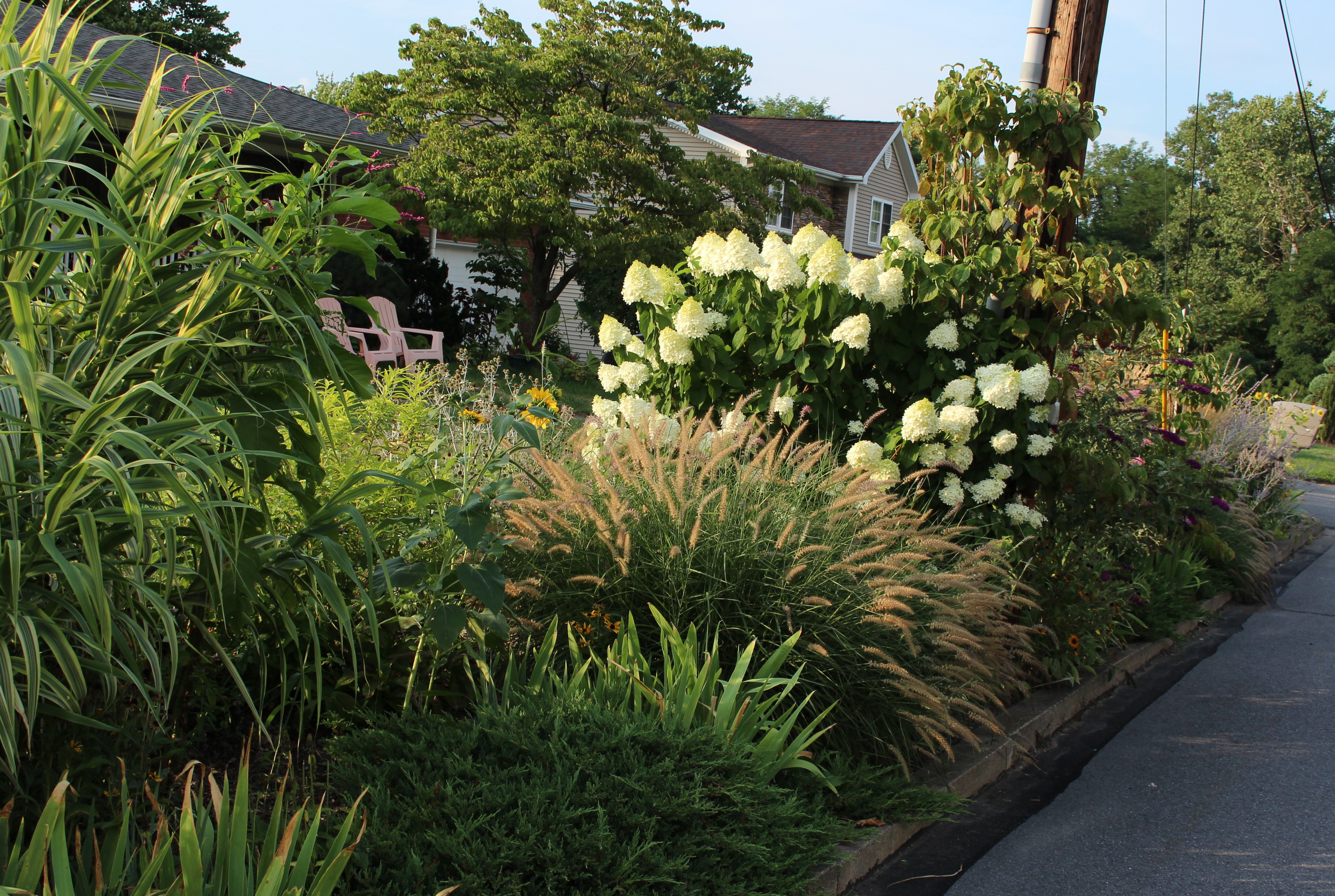
front street border

I think I show this view every summer as the ‘Limelight’ hydrangea comes into bloom along the street.  It’s an awesome plant.

Here’s a quick tour of the good and bad which summer has brought to the rest of the garden… and by ‘rest’ I mean the part which I practically gave up on when the rains stopped.
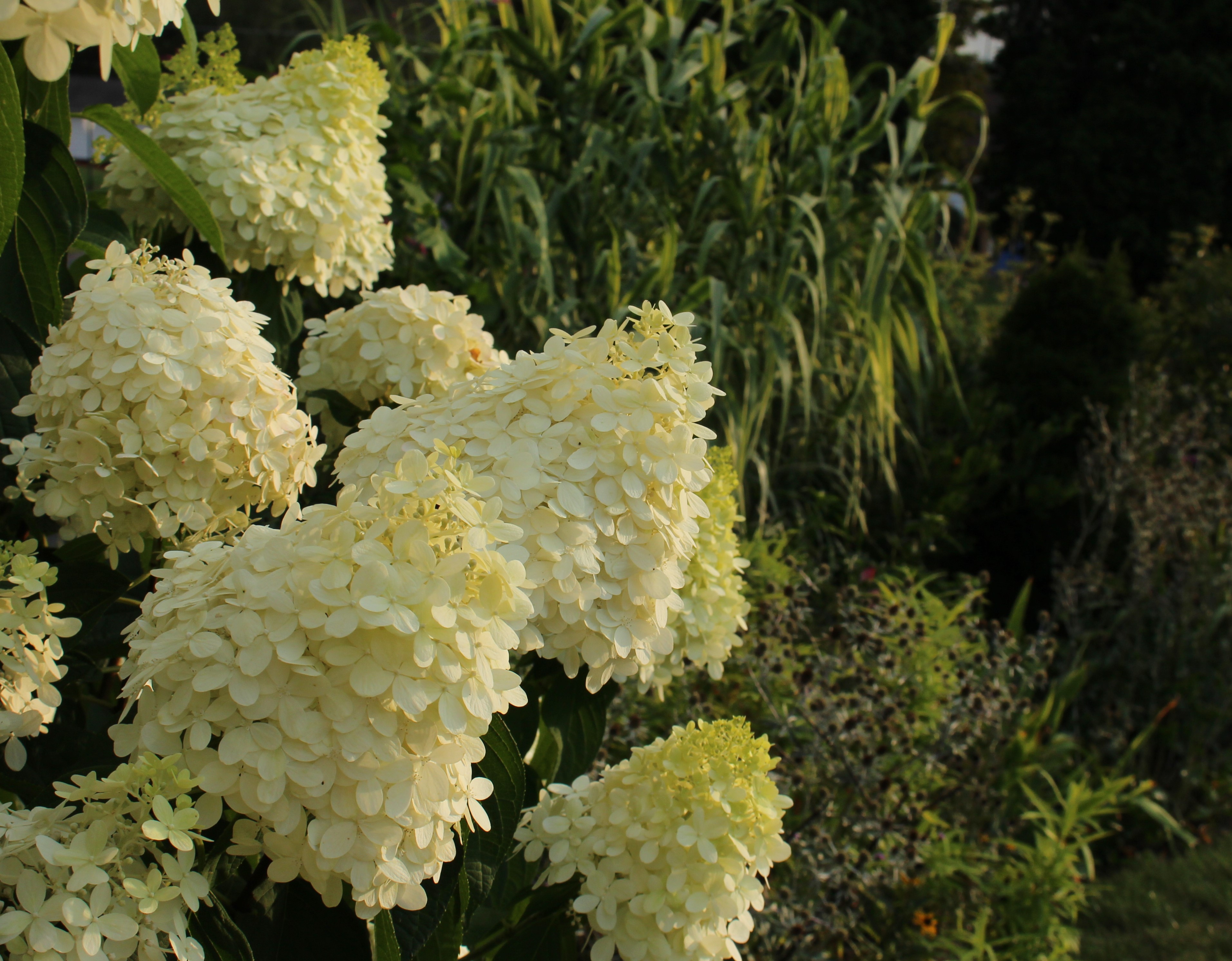
limelight hydrangea

Ok so I did give this bush some water when it began to wilt and yellow. How could I risk missing these blooms!

Along the street the plants are on their own and most handle drought with style.
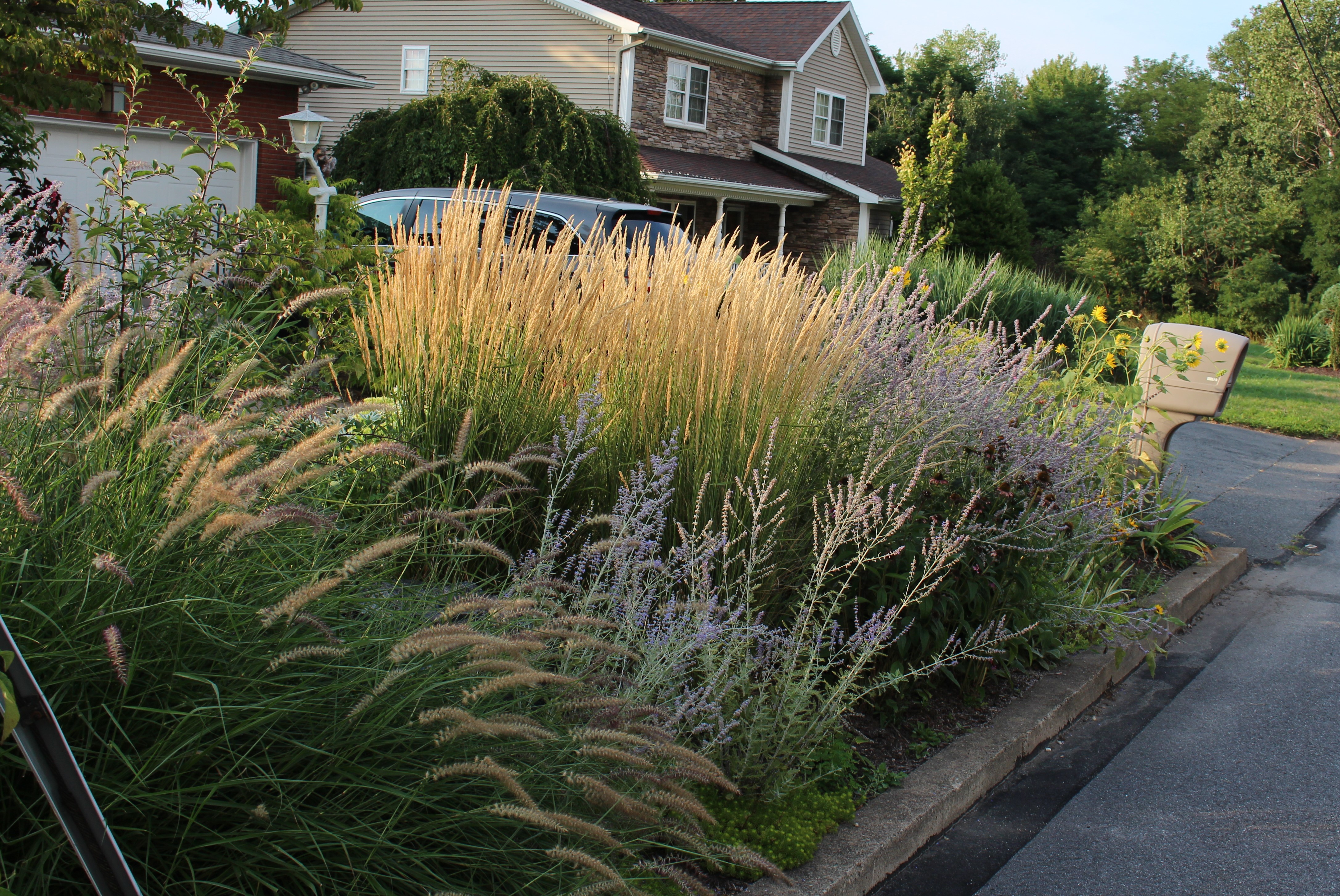
front street border

‘Karley Rose’ fountain grass, ‘Karl Foerster’ feather reed grass and perovskia. The purple coneflowers didn’t make it this year and their blooms just dried up and wilted without extra watering.

The grasses really are reliable, but without a doubt ‘Karl Foerster’ is my favorite.  I think I’ve gone on about it enough in the past but please excuse just one more picture.
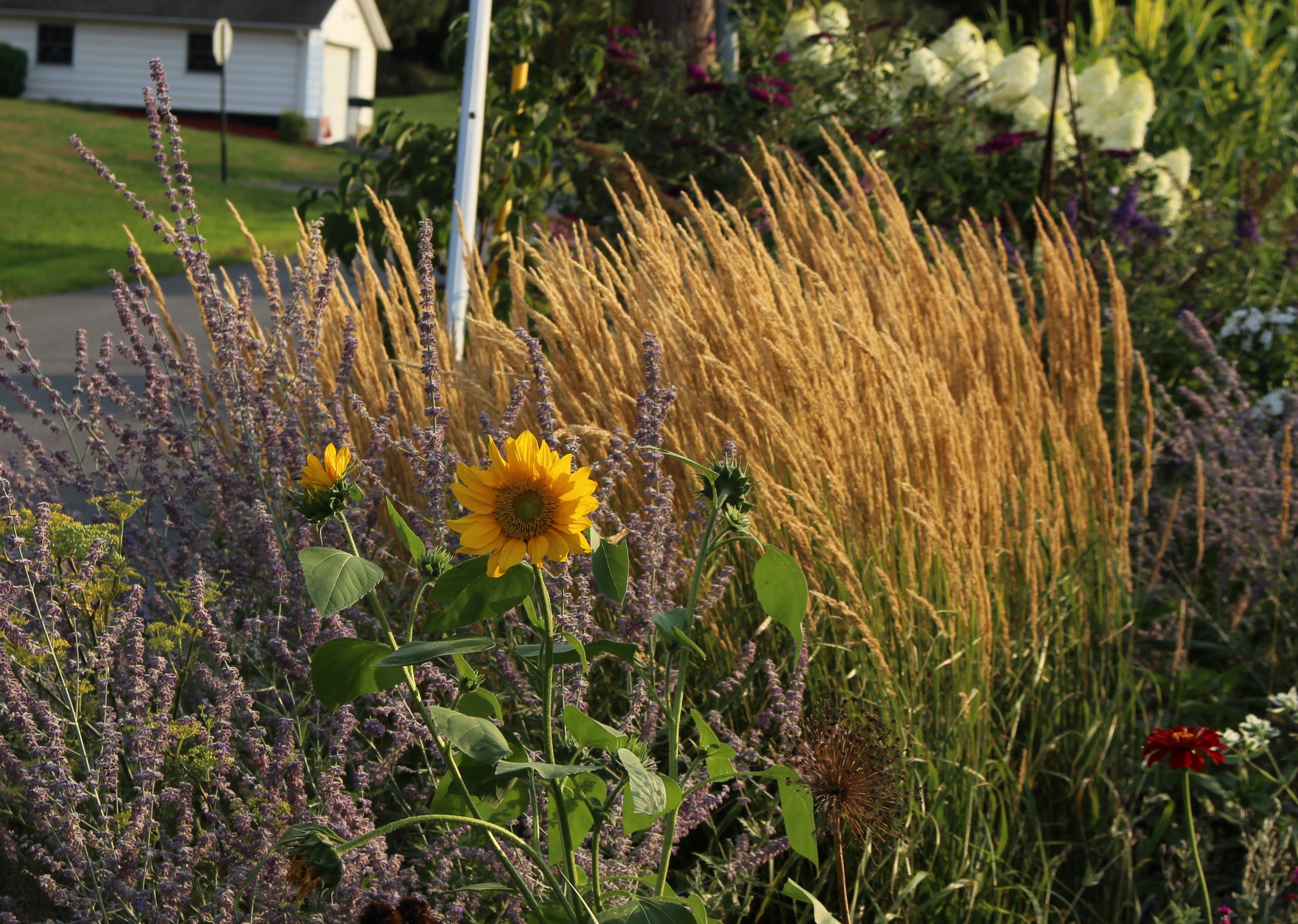
sunflowers and feather reed grass

Sunflowers have a knack for putting themselves in just the right spot. If I could do a mass planting of this combo with sunflowers, perovskia and Karl I would do it without a second thought.

A few of the annuals planted in June have responded to the rain and are now looking like they want to live after all.
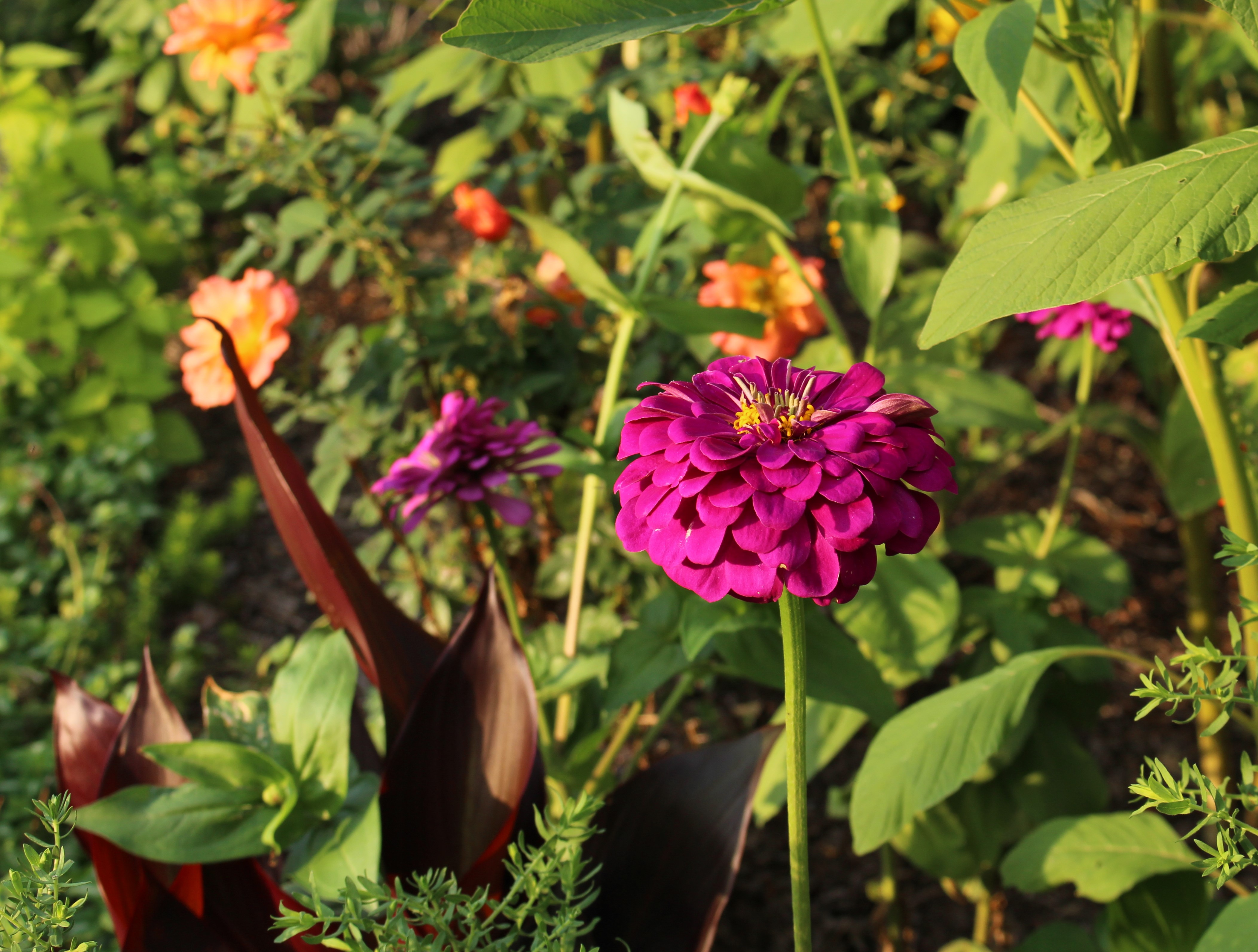
purple zinnia

Not sure if my color choices are really on point with the annuals this year, but a zinnia looks great anywhere.

A three year old ‘Dixieland’ miscanthus has finally put its roots down and taken off.  Me and variegation are always friends so obviously there was a good chance the two of us would hit it off… and we have 🙂
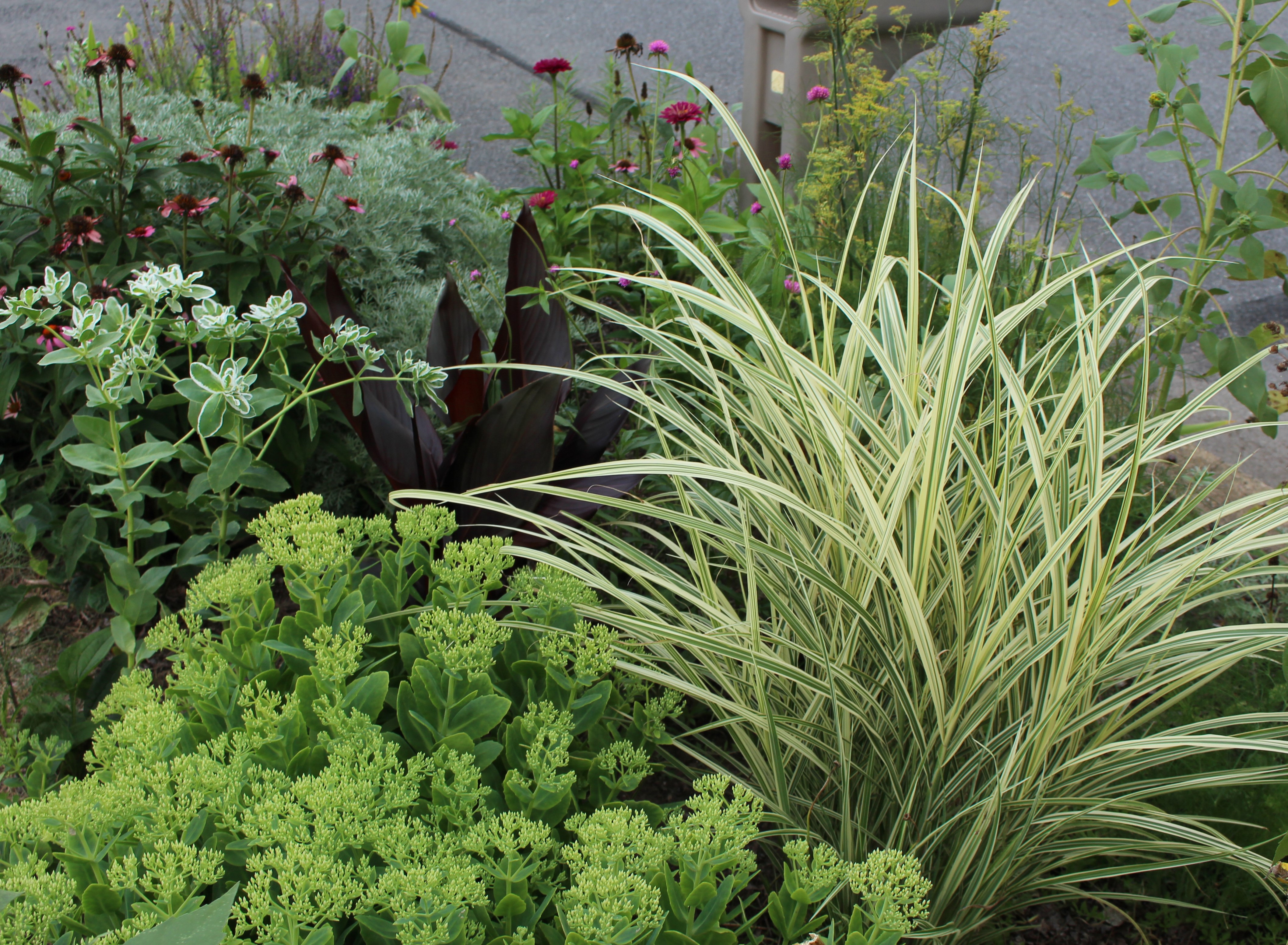
sedum brilliant and dixieland miscanthus

‘Dixieland’ is a dwarf miscanthus which generally goes against my love of giant plants, but for this one I’ll be glad to avoid the floppiness of its variegated big brother, and for the mailman’s sake this size is far less intimidating.

Things start to go downhill as you look to the house.
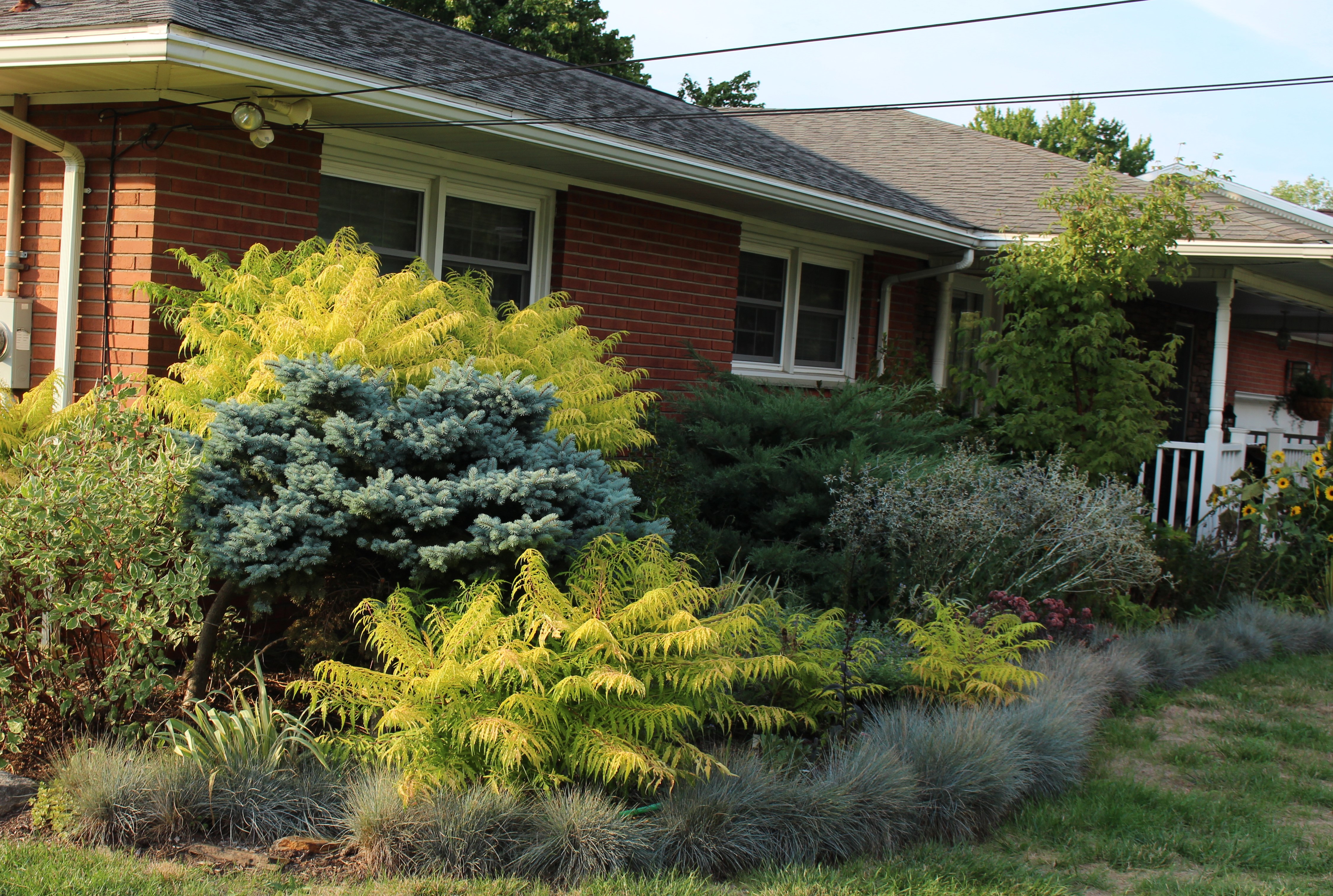
sumac tiger eyes

Someday I’ll grow up and realize ‘Tiger Eyes’ staghorn sumac is too aggressive a spreader for smaller planting areas and too informal a look for foundation plantings, but that realization may still be decades off.

Once you walk past the tropical bed and head out back it becomes project after project.

lasagna garden bed

Weeds are once again exploding in the bed-which-I-can’t-decide-what-to-do-with. Iris bed fell through, veggie bed fell through, dahlia bed fell through… and still it sits.

At least when it was dry the crabgrass wasn’t a problem.
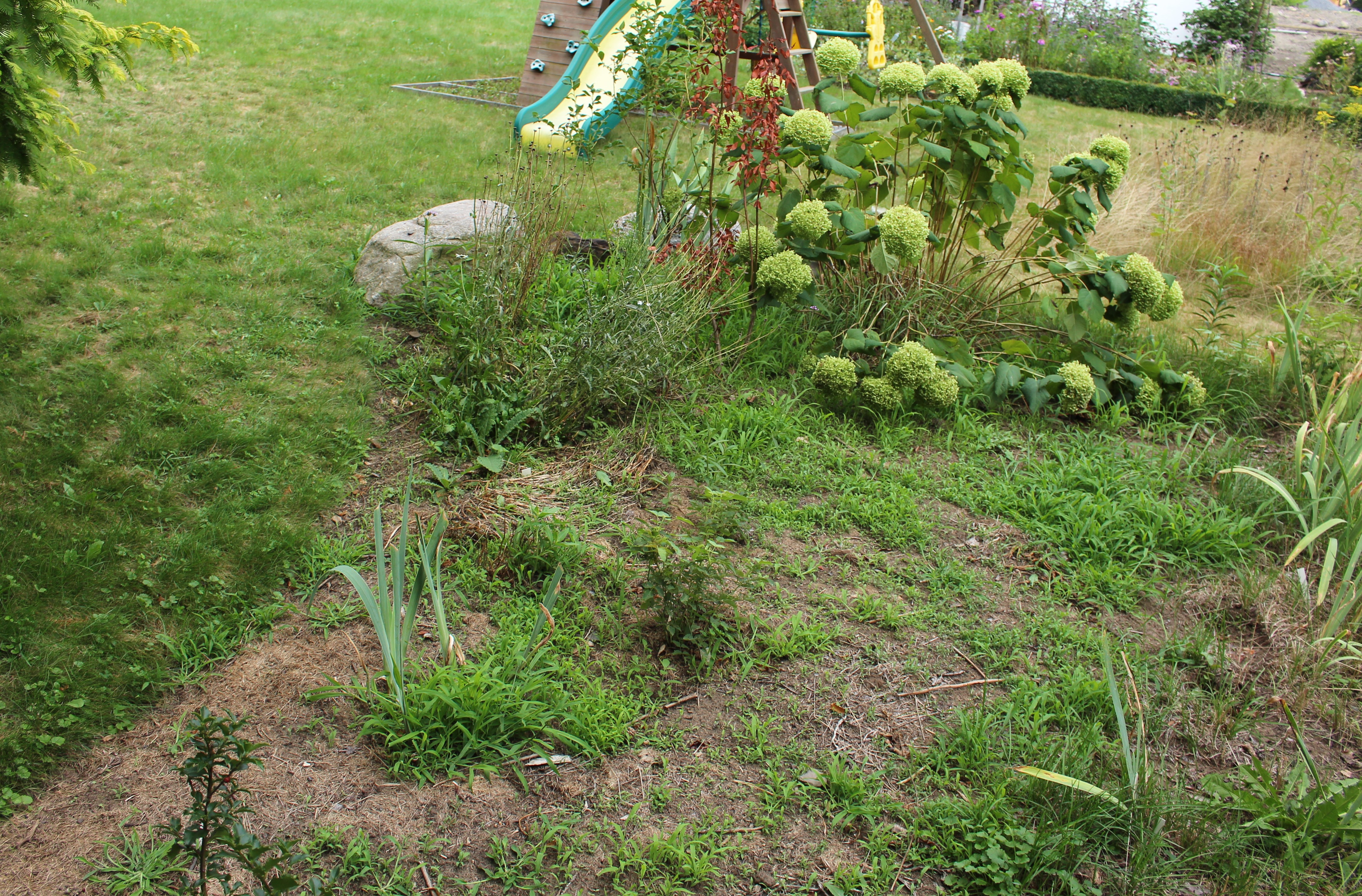
crabgrass weed

Most of the iris and daffodils have been dug but just enough remain that I can’t really move on with this bed either.  Plus without a lawn worth mowing I don’t have any mulch to smother the crabgrass with and its spontaneous regeneration will make for a horrible mess in another week.  But on the bright side I do see the rabbits here all the time nibbling.

The return of rain has brought a sort of second spring to some parts of the garden.
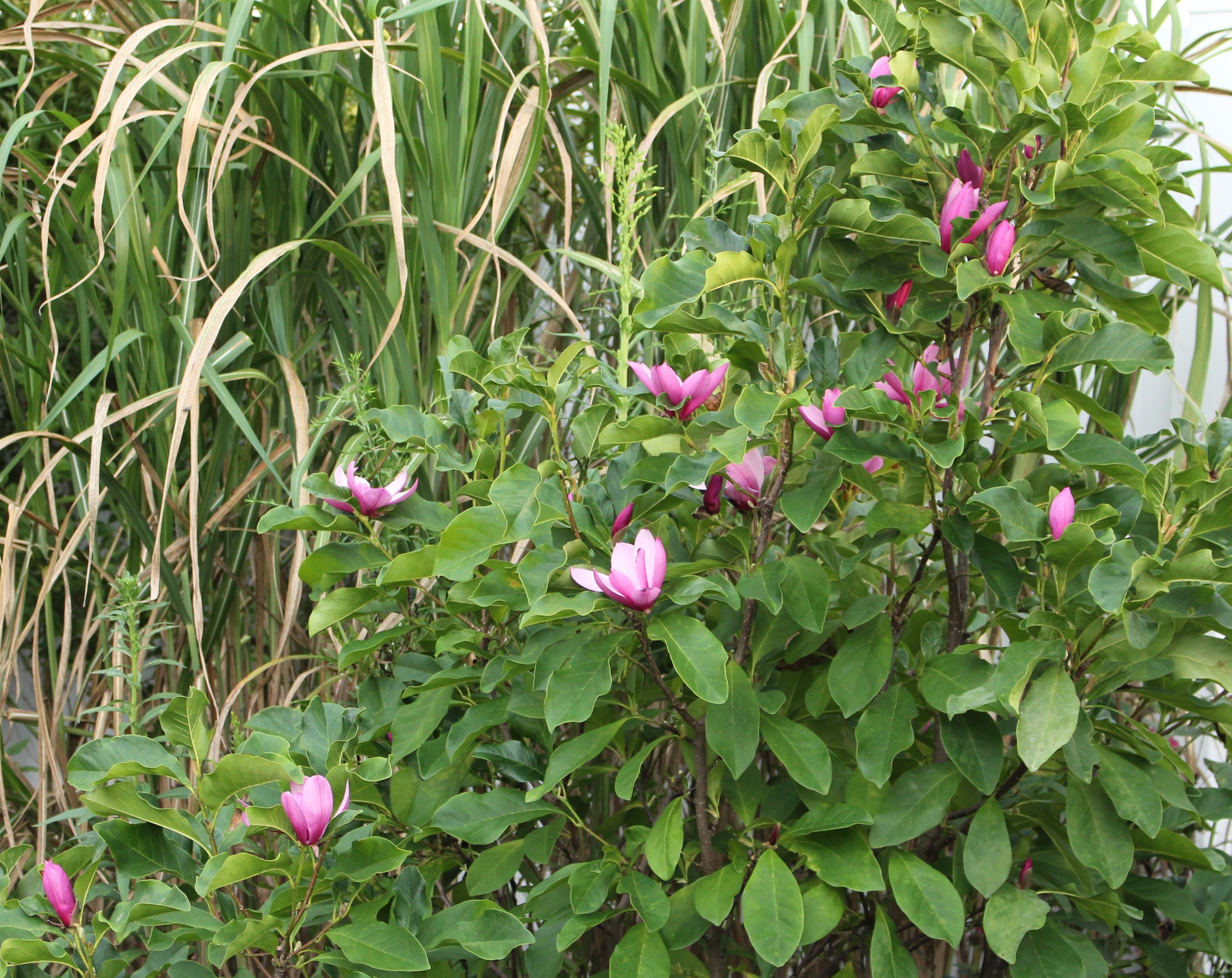
magnolia rebloom ann

Magnolia ‘Ann’ was yellowing, wilted and dropping leaves and must have been headed towards dormancy, but the rains brought on a flush of excitement in the form of summer blooms.

Even though all the fancier phlox in full sun fried, the phlox ‘weeds’ which I allowed to selfseed in this bed were saved by the shadow of the house.  There’s nothing which I like about this bed although my wife “loves!” the grassy clump of Panicum ‘cloud nine’ in the center.  I’ve tried mowing everything down and creating a dull bed o’mulch but the minute I turn my head it’s all back.
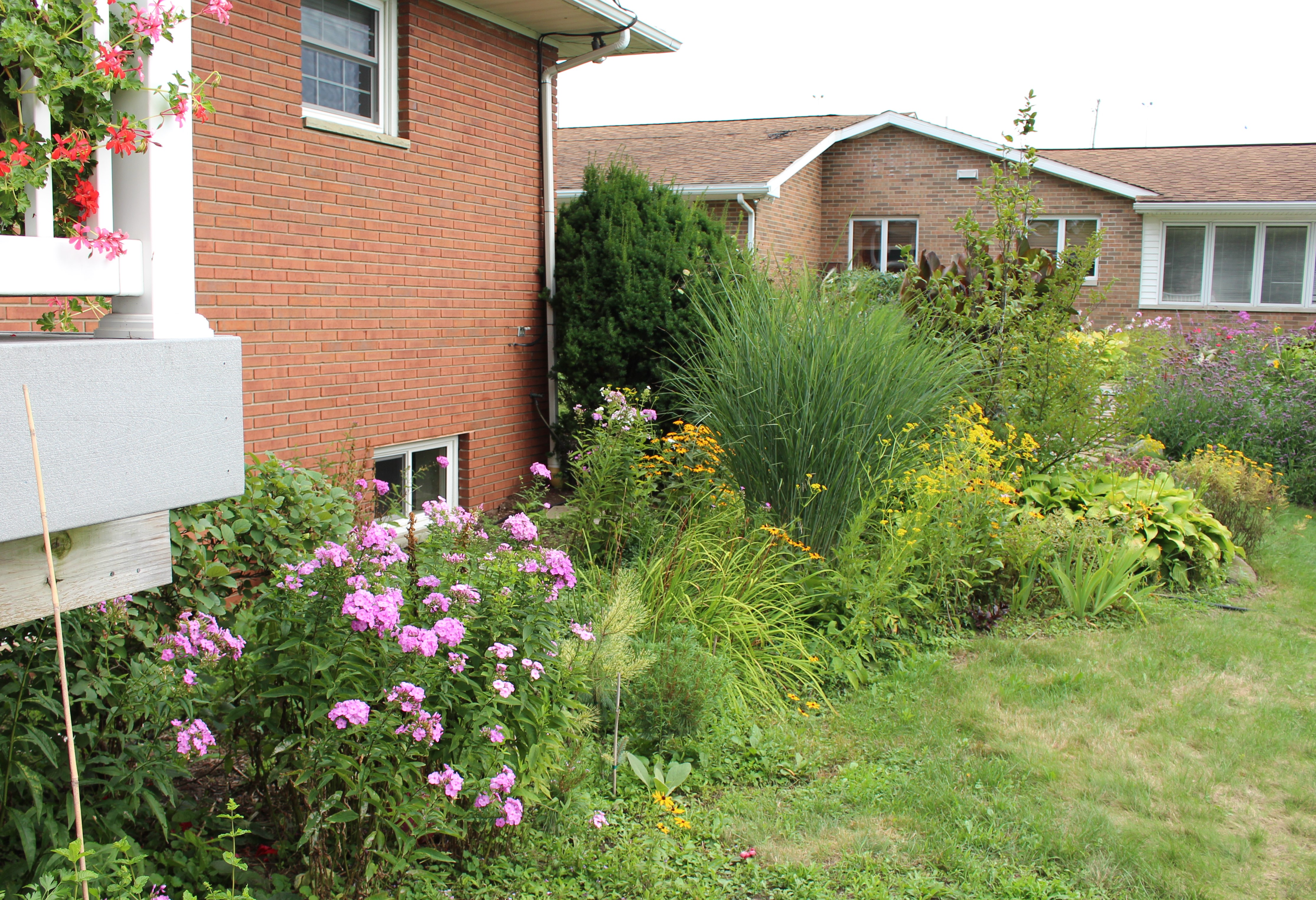
self seeded phlox

Blech. Golden yellow with washed out pink in front of the orangey brick of the house. Someone has plans to add a master bedroom to this end of the house and although someone else firmly disagrees, that opinion is usually crushed over time just like anything else which could be planted in the meantime.

To give a final dose of reality to this mess of a post here’s a photo of the roughly graded fill which has been dumped next door and which has also been added to my project list.  It sounded like a good idea when my neighbor offered to just keep going with his own fill project, but now I’m faced with digging and raking and seeding.  The plan is for a new meadow garden but it sure is an inviting bit of real estate there behind the MIL’s house.  Sunflowers would do well there I’m sure, but for now I feel like I’m in a prison chain gang as I break up the fill with a pick so I can shovel it over into the low spots.
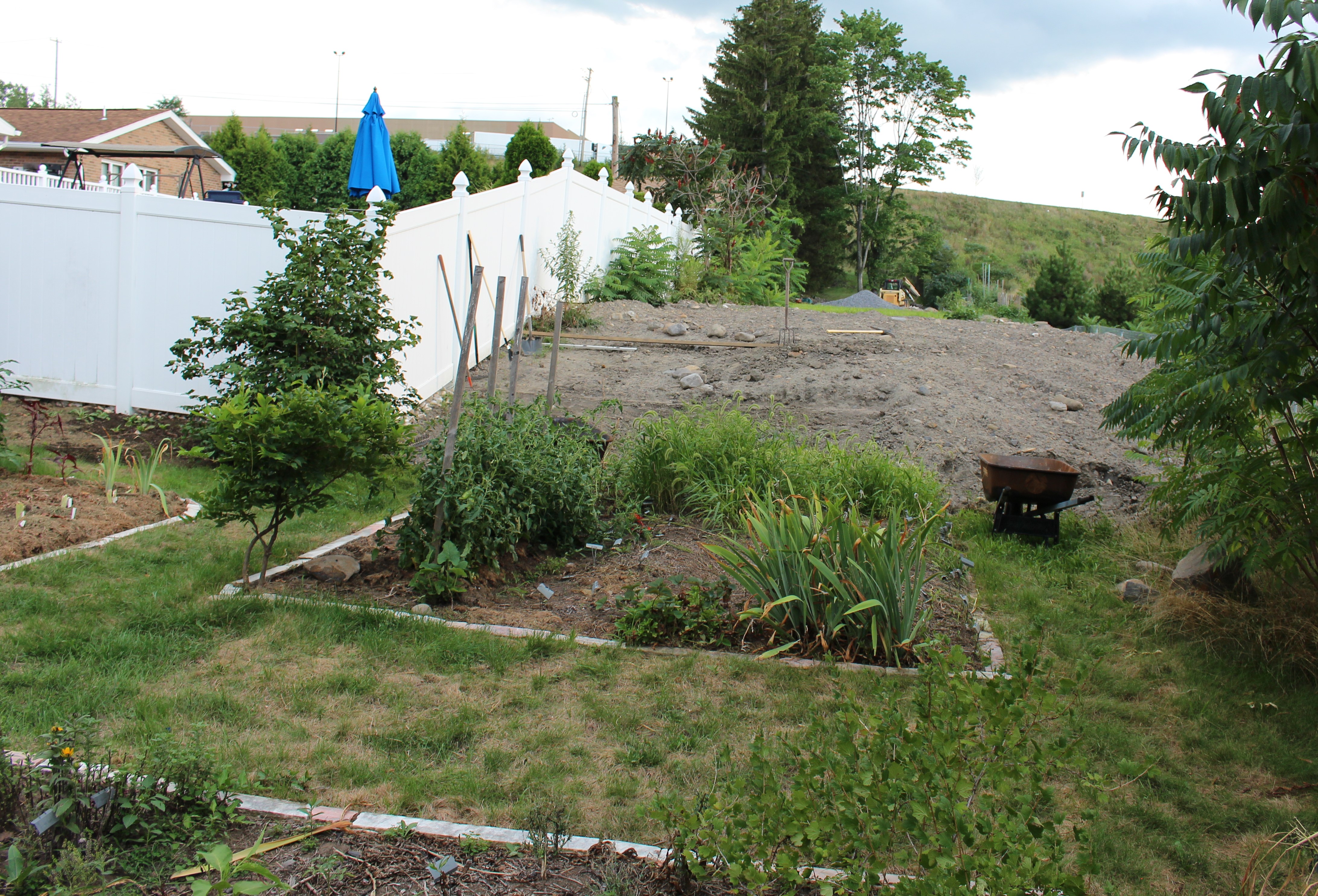
graded fill

My yard used to go across all at nearly the same level, but now the grade has been raised several feet. I wonder how much I could raise my own yard… hmmm.

So I guess if there’s any point to this post it’s that my garden looks much nicer in a cropped closeup rather than the big picture, and that your own garden is probably much nicer than you give it credit for.  Don’t feel bad for me though, I’m quite happy in my interesting mess and I (sometimes) do enjoy the journey more than the finished product.  Plus we’re off for a few days next week camping so that’s always fun 🙂

Have a great week!


Tuesday View: The Tropics 8.9.16

Another Tuesday and another view!  My camera has traveled on to other destinations so this week we’re going to see how well the phone camera works.  Fortunately when I headed out to take the pictures a few clouds rolled in to filter the light, and things don’t look too harsh here.
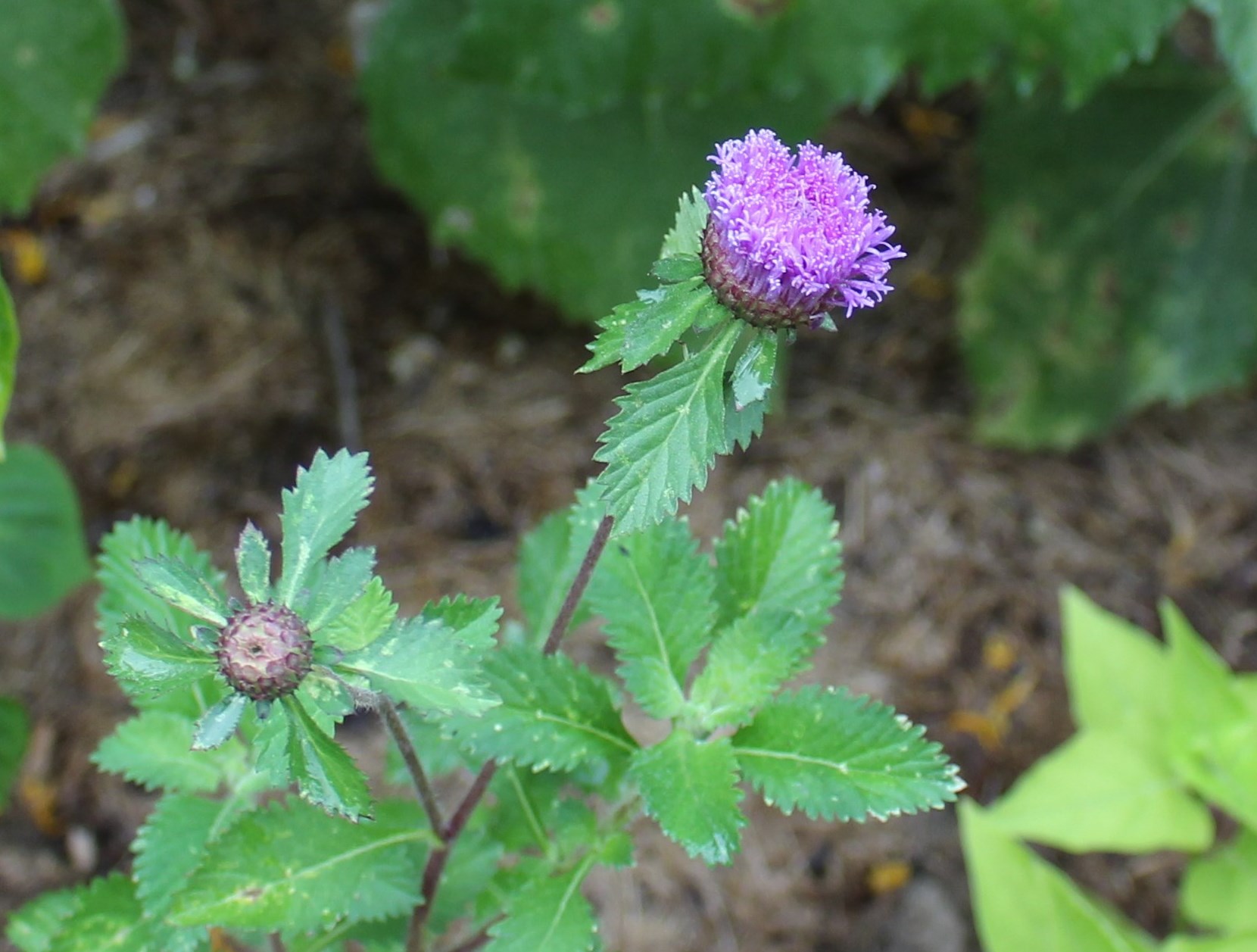
tropical garden

Today’s view of the tropical garden.  A little dark, but look at that weird color which the lawn has developed… Green!


I’m going to admit to doing little more than admiring the garden this week.  There was another nice rainfall last Saturday and for the first time in months things look relatively happy.  I even went as far as to mow parts of the lawn short and throw some fertilizer around to help the lawn recover now that it’s making an attempt at coming back to green.

canna tropicana

There’s more to healthy growing than the color green.  Here’s my favorite offensively festive canna, ‘Tropicana”. 

I do have a soft spot for the lushest of cannas.   The tall purple leaved ones are great, but ‘Tropicana’ and ‘Bengal Tiger’ both bring vivid variegation into the mix.  After years of trying to get a virus free plant of the later I think I’m finally there and hopefully it’s with me for a while again.

canna Bengal Tiger (Pretoria)

Still small but growing, canna Bengal Tiger (Pretoria) might be my very favorite canna. The yellow striping is amazing and I think when this becomes a big clump (fingers crossed) it will be quite a sight.

My Bengal Tiger has a way to go before it’s as inspiring as the ones I saw last year at Chanticleer but I have patience… sort of.  In the meantime the amazingly fast growth of the Kochia scoparia (burning bush or summer cypress) continues to impress me.  I love the fresh green color and soft fluffiness of the plants, and I hope it keeps looking good until (with luck) it lives up to its name and burns bright red this autumn.

kochia

Kochia with Verbena bonariensis and orange zahara zinnias.

So that’s where we are this week.  If you’d like to check in with a few other Tuesday views give Cathy at Words and Herbs a visit and if you’d like to join in feel free, I’m sure she’d be happy to have you!

Gratuitous phlox

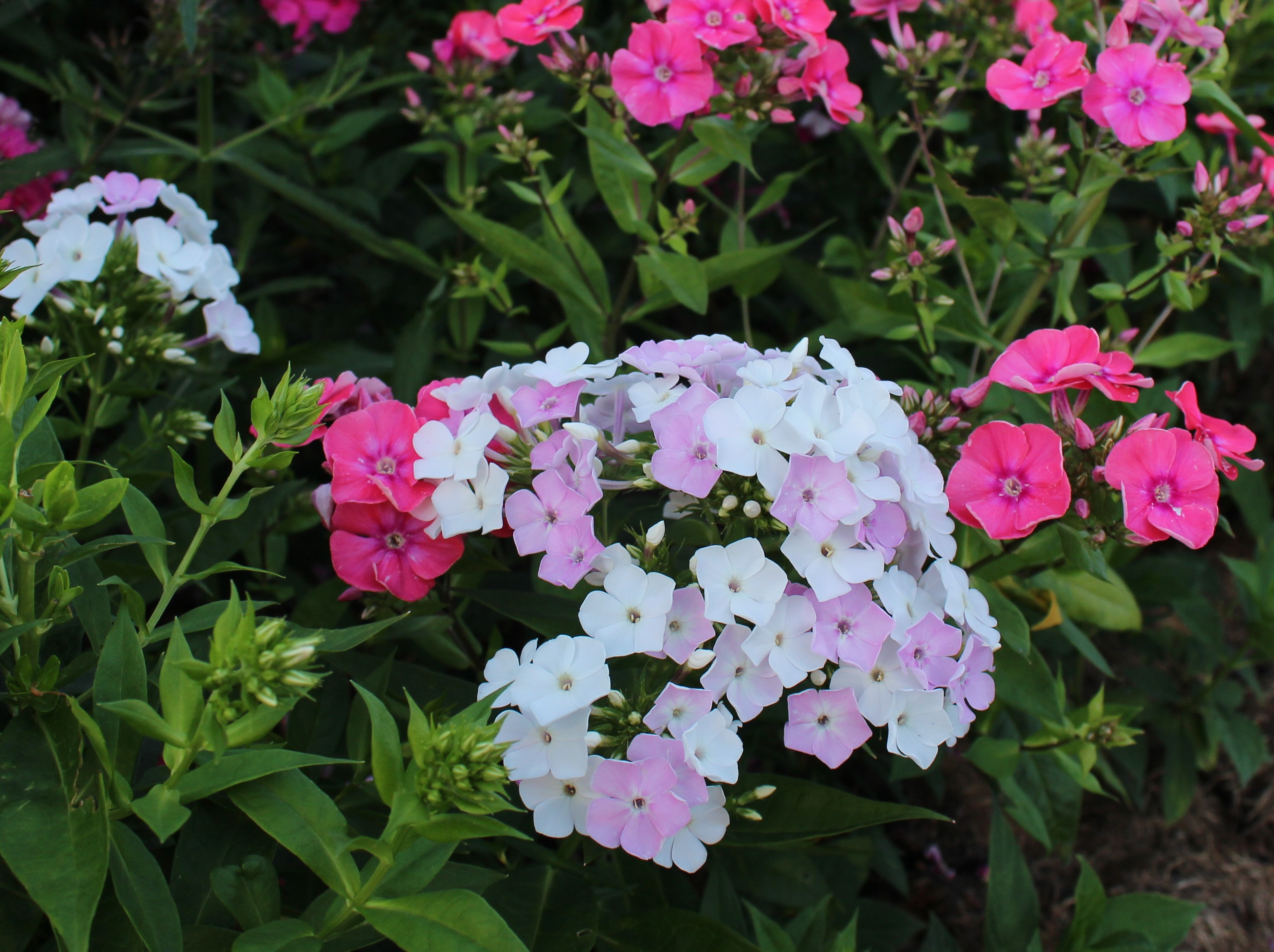
I don’t have nearly as many of the tall garden phlox (Phlox paniculata) as I’d like.  The photos are misleading without the big picture so here’s the big picture with a wider view of the potager (complete with freshly trimmed hedge).  A couple (4) in the front bed, and a dozen or so in the back bed is not a lot of phlox.

garden phlox

Mid July and most of the garden phlox are nearing their peak.  Can I call them a favorite flower?  I feel like I do that to something new every other week.

We’re just going from one phlox to the next here.  No commitment.

phlox dorffreude

Phlox ‘dorffreude’… I think that roughly translates to town’s joy?

A few cooler nights have deepened some of the colors and although I don’t know the names for several of these it doesn’t matter as far as enjoying them goes.

phlox paniculata seedling

This random seedling gets a pink tint when the temperatures drop.

But the dry weather has them all a little miserable, and unless they get watered every few days the leaves and flowers wilt and the spider mites procreate.

phlox paniculata seedling

Another random seedling which opens pink and then fades.  Note how bushy the plants are… that’s thanks to this year’s frequent deer, woodchuck, and rabbit nibbling.

The next few days promise more dry, clear skies with temperatures into the 90’s (32+C) and the garden will be on its own as we go off traveling.

phlox nicky laura

The dark purple ‘Nicky’, starry eyed ‘Laura’ and an unknown salmony red passed on from a friend.  A threesome of color.

Of course there’s always the pretty yet troubled one.  Phlox ‘Brigadier’ has a great reddish color yet doesn’t bloom well, is losing stems, is a magnet for mites, and resents every dry spell… but I can usually just get her a drink and she’s ready to go.

phlox brigadier cabots pink

Phlox ‘Brigadier’ with ‘Cabot’s Pink’ in the back.

I guess when you’re jumping from one phlox to the next you’re bound to run into problems but I’ll admit I’m a phlox addict and don’t really want to change.  When I was out at the nursery last week there were about six new ones which I had a chance at and they all looked like a fun time (even if I already have a few waiting at home) but I said no.  It will be a hard enough time staying faithful this winter when it’s just me and the computer and the great online phlox source, Perennial Pleasures.  They’re like a Craigslist for hooking up with new phlox and I’m sure I’ll click on something I shouldn’t.

Thursday’s Feature: Delphinium

This Thursday it’s all about flowers.  For as much as I love throwing in questionable photos of borderline weedy plants or offensively tacky color clashes, even I have to brag a little now and then when something goes right.  The tall hybrid delphiniums don’t like my garden or me but this one seems to have resigned itself to its fate and has come to an agreement with my garden.  It’s beautiful and although I can take little credit for that at least the pictures are pretty.

purple delphinium

Purple delphinium

Four years ago it was love at first sight when I came across a little pot with a fat plant and a solid stem just starting to sprout up into a bloom stalk.  I thought to myself “even I can’t screw this up, and it’s going to be amazing”, so onto the cart it went and the rest is history.

purple delphinium

Another view 🙂

These tall delphinium hybrids love a perfectly rich soil in a sheltered spot with steady moisture and shelter from the worst of the weather.  They do better in cooler, fairer climates and don’t like drought, heat, humidity, storms, drying winds, children playing, large pets, neglect, stray hoses, clumsy gardeners… essentially everything that my garden represents… but this one carries on.  2016 has been a lean year for it since I’m trying something new (less fertilizer and no staking) but the show is still nice enough.

purple delphinium

A wider view of the clump shows smaller bloom heads and yellowing lower leaves which resulted from a leaner diet, but I also haven’t staked the flowers and they are holding up reasonably well to the wind.

But you don’t care about lean, anemic delphinium plants.  A Thursday feature is fun so here are photos from last year when the fertilizer was flowing and the party really took off!

purple delphinium

Sorry about the bicycle in the background….

This one clump which survives (trust me I’ve killed my fair share of these) is on a slope in morning sun near the hose… which means it gets a sprinkle whenever the water goes on.

purple delphinium

…and oops about the sign.

-but prepare yourself for heartbreak if you give these a try.  Three out of four years a storm cell will pummel your garden just as the delphinium reaches its peak, and little in the way of staking will help the heavy blooms.  On the plus side they make an excellent cut flower (if you have room for two to three foot flower stalks in your arrangement), but on the down side it’s depressing to say the least.

purple delphinium

Delphiniums after the storm.

Few things are fun without a little effort and risk, so give them a try and see where you end up.  While I go on to ponder the possibilities of growing these in a classy walled garden with the perfect soil, you may want to check out a few other feature plants to fill your Thursday.  Kimberley of Cosmos and Cleome hosts each week so give her blog a visit to see what she and others have featured this week.

Enjoy!


Rose ‘Livin Easy’

I took full advantage of the cool, generally overcast weather this weekend, and put some solid workdays into the garden.  The deck is cleaned, the pots are planted and the tomatoes are finally planted.  It’s nothing to look at yet, but fortunately this rose is.  It’s ‘Livin Easy’ and although it may not be the newest thing out there and it might not be a color everyone loves, I still think it’s a knockout.

rose livin easy

Oxeye daisies and rose ‘Livin Easy’. Orange isn’t a color everyone loves, but I do.

Some people say it has a fragrance, but it’s not strong enough for my nose.  Even with a lack of fragrance the disease resistant foliage and summer long bloom make up for this fault, and I do nothing other than trim off a few dead branches in the spring and off she goes.  I’m sure fertilizer and more concerned care would do wonders, but I like the way it has become nearly overwhelmed in a sea of daisies.  A real gardener would have probably ripped them out ages ago.

Time for a haircut

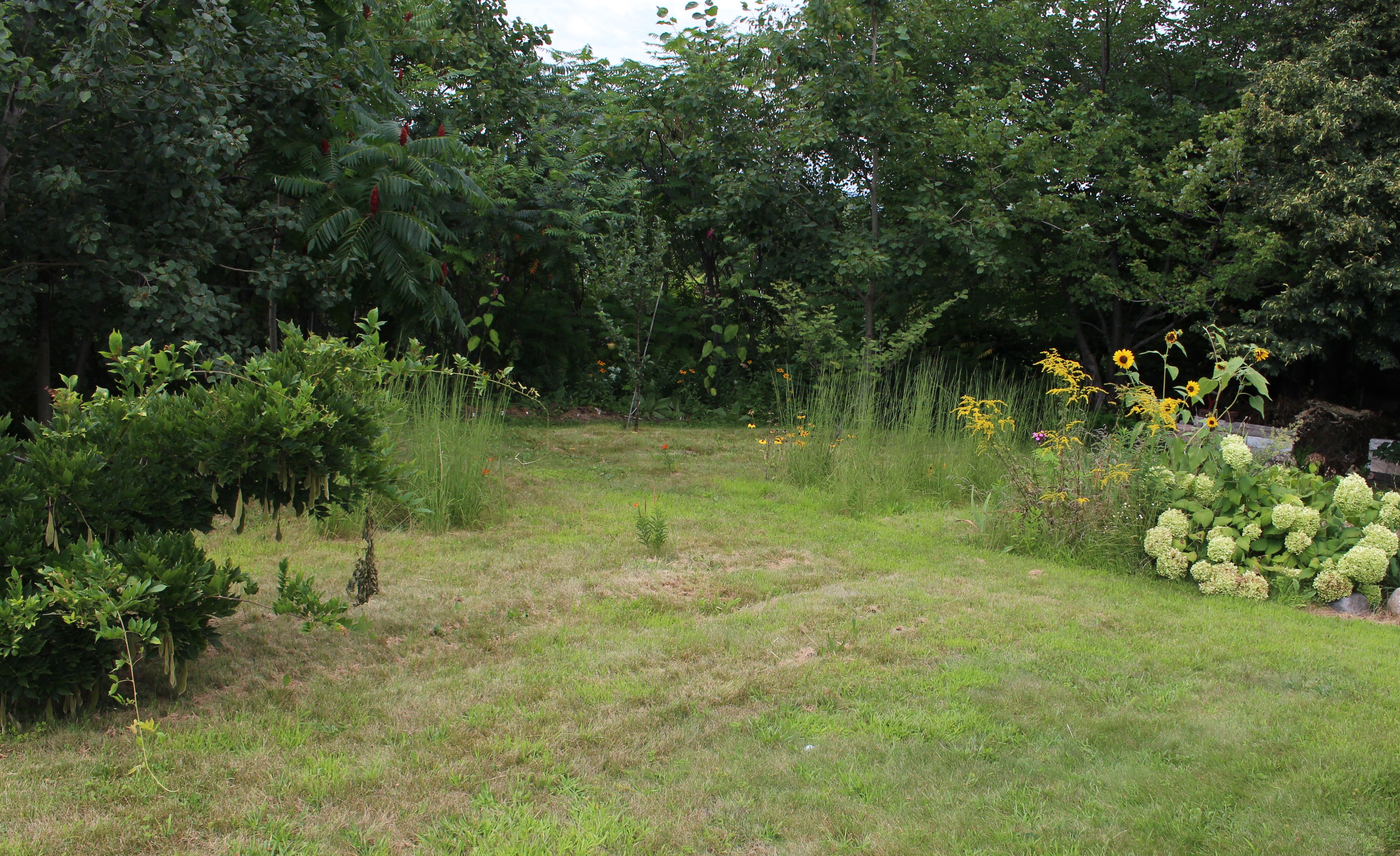
As you may know there’s a small section of lawn out back which I let go over the summer.  It’s what I call the meadow, and the goal is to have a spot where I can play around with a few bulbs in the lawn and also give the crickets and bunnies a spot to kick back in.

meadow garden

Over the last six years wildflowers such as rudbeckias and goldenrod have moved in and (to me at least) the meadow is an interesting place.

I love the meadow in early summer when the grasses go to seed and daisies spot the amber waves, but now it’s starting to look tired, and I have to remember what the plan is here.  Although the native little bluestem (Schizachyrium scoparium) is beginning to invade and I like it elsewhere in the yard, it’s not a prairie I want here so in late August I finally mow.

meadow garden

Little bluestem with a mix of rudbeckia and other wildflowers (weeds?).  I love the look, but it’s time to move on.

Tuesday evening I went through.  The crickets dug into the turf and hid, the rabbits ran off, and the katydids and mantis were old enough to fly to safety.  I’m not completely committed though, I left a few patches of bluestem and mowed around some butterfly weed (Asclepias tuberosa) since I was too weak to enforce my “it all just gets mowed” program.  Maybe next year.

cutting a meadow

The meadow returned to respectability…. and boredom.

It looks neat again which is a relief to the better half, and the midyear trim actually seems to encourage the earlier bloomers such as daisies and rudbeckia, and discourages the goldenrod.

cutting a meadow

I don’t know if it looks better cut, but tall grass is a no-no in suburbia, so I’m sure the neighbors are somewhat relieved.  They’re probably itching to finish things off with a string trim and weed-b-gone 🙂

So I’m back to the mowing routine for this area, but only for another two or so weeks until the colchicums begin to sprout.  They look better blooming in shorter grass, and if truth be told I do have a bias towards doing what it takes to keep them happy.

Have a great weekend!

Down on the farm

Late August is bathing us in heat this year and the steady rains have brought on the harvest.  We modestly refer to our garden as “the farm” or “potager” and this is the time of year when it shines.  Produce begins to trickle in and suddenly there’s a little more interest in the backyard.

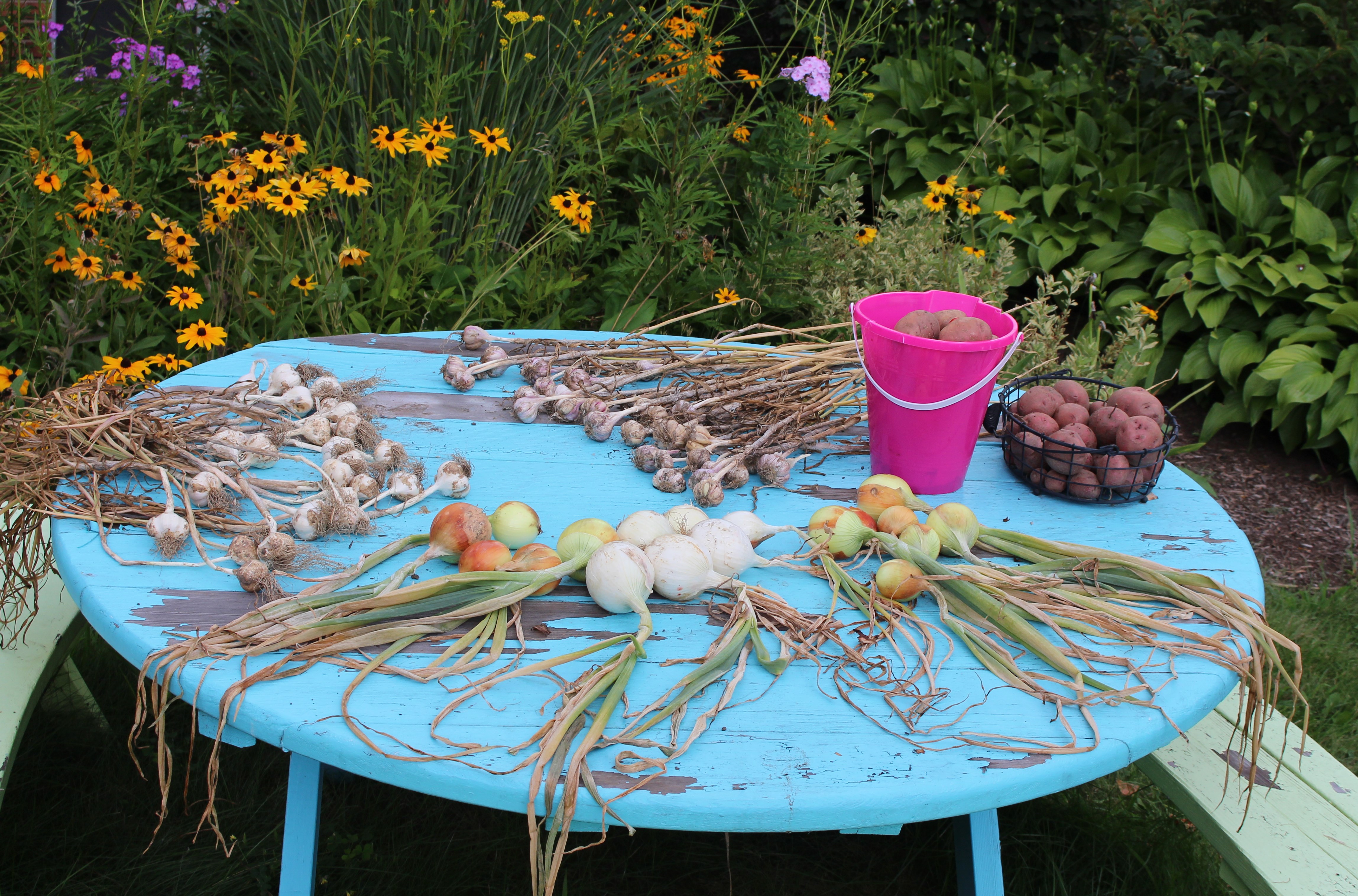
harvest from the garden

The picnic table is the place to be for drying off and cleaning up before the kitchen.  Garlic, potatoes, and the first of the onions started the month off.

Eggplant and peppers have been going out, onions are always popular, tomatoes are on their way, and beans are yet to come.  The harvest is late due to planter’s procrastination but who out there hasn’t ever fallen behind?  At this time of year even I fix up a plate of veggies, and they aren’t even deep fried 🙂

IMG_8425

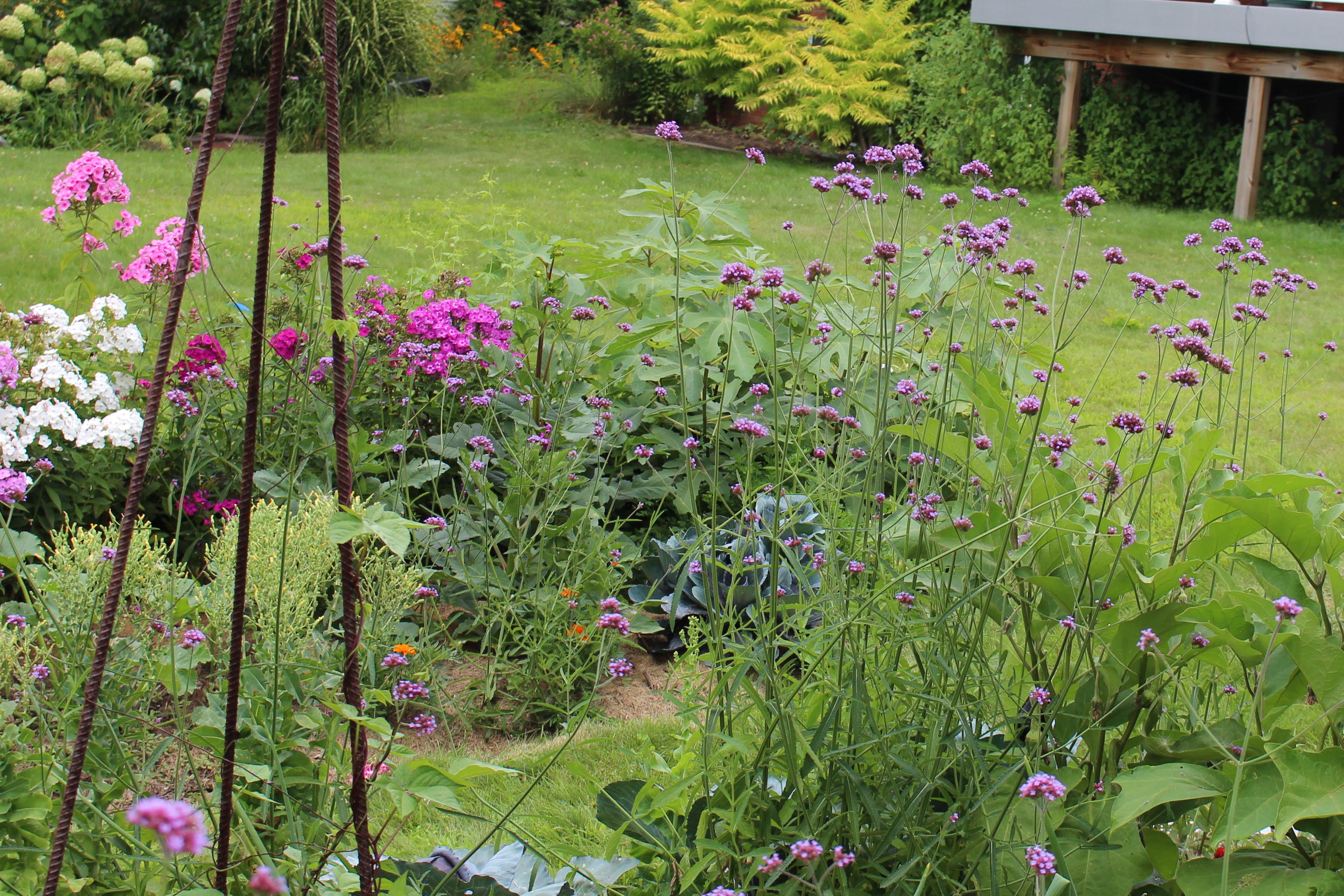
I grow red cabbage just for the looks, but there’s a good chance these heads will disappear soon and show up again later as rotkraut.  Fine by me, but in the meantime they look nice with the verbena, eggplant, and marigolds.

I admire a neat garden with raised, raked beds and straight rows of perfect plantings, but that’s nowhere even close to my garden.  The potager is tumbledown mix of flowers, crops, and all kinds of odds and ends that found an open spot of soil and made it their home.  Phlox are never turned away, and earlier in the month they started their summertime concerto and the music still plays on through the heat.  For this I consider myself lucky,  since earlier in the spring between spidermites and drought I got the feeling it would be a down year for the tall garden phlox (Phlox paniculata).

phlox paniculata dorffreude

Phlox paniculata ‘Dorffreude’ (Karl Foerster introduction, 1939) making a good argument that newer isn’t always better.

The phlox make me happy, but the other flowers which add to the non-agricultural chaos also make me smile, and the tall Verbena bonariensis leads the way with their bee and butterfly attracting bloom heads.

IMG_8305

Now’s the time when the verbena becomes too attractive to pull.  It’s a fair trade-off since the flowers draw in nearly every passing butterfly.

One area of responsible neatness is the boxwood hedge which edges the two forward sides of the garden.  After three years the small plants have finally begun to look nearly respectable.  To celebrate this milestone I spent way too much money on what I hope will be a set of premium hedge shears.  The electric trimmer has been shelved and I took the quieter, more contemplative path of manual trimming.  For me it’s relaxing and I think I’m one of the few who actually enjoys this job.

training boxwood hedge

Slowly the boxwood hedge fills in.  I can still remember the summer day way back when me, a bucket of boxwood clippings,  a few trays of potting mix, and a couple beers started this all.

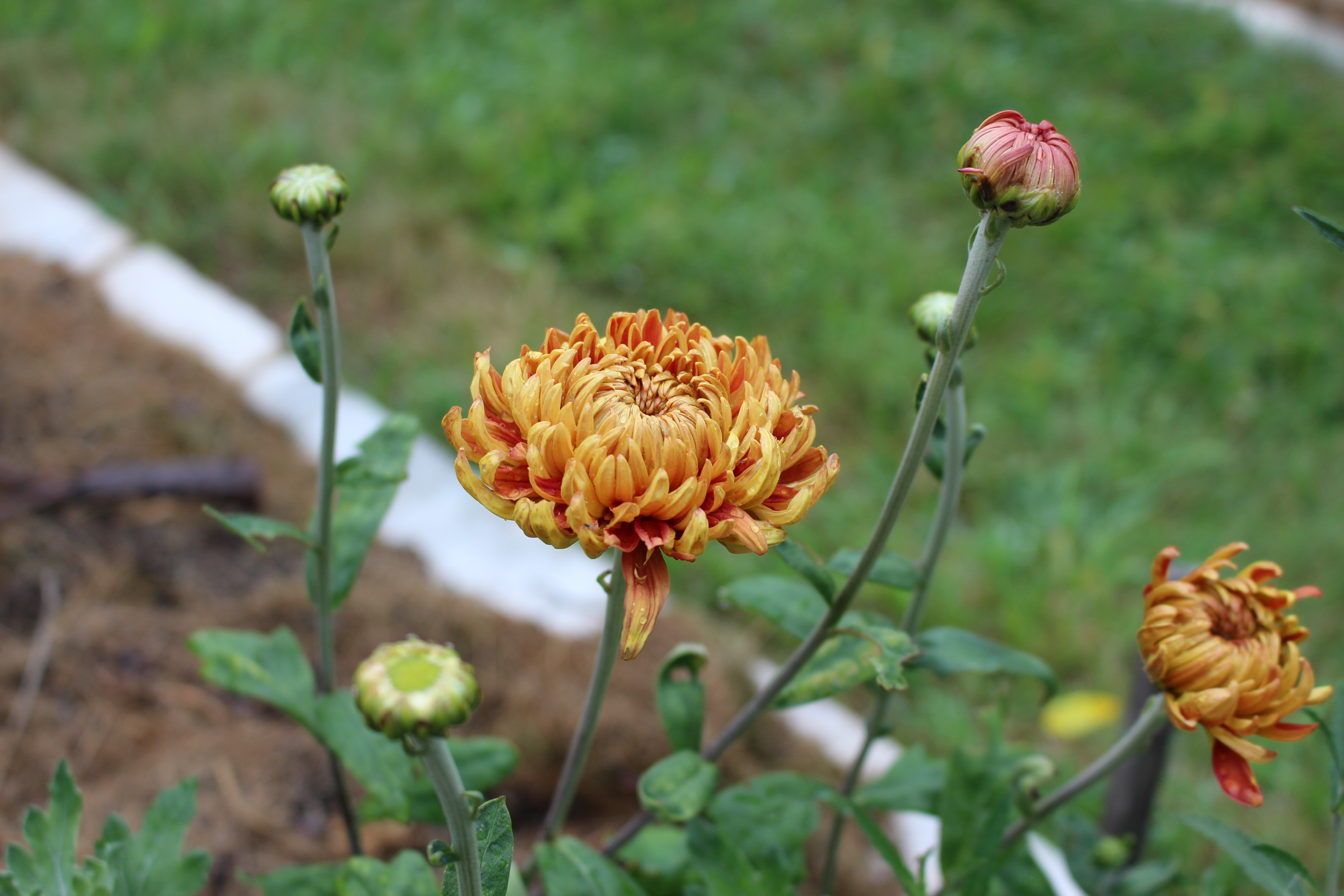
Besides boxwood and phlox, chrysanthemums (ok, new name dendranthema) are starting to make a serious play for potager real estate.  This spring I added even more of the larger flowered football types, trying to stick with anything which might be hardy through the winter.  I’d try to explain this growing obsession with mums but honestly after just admitting I enjoy hedge trimming I’m not sure there’s much I can say to defend this last quirk.

hardy football mum

Hardy (hopefully) football mum.  If the mood strikes next year I may even try disbudding a few of these to see if I can force all the plant’s energy into one single, perfectly large, perfectly perfect, bloom.

Dahlias.  I like dahlias.  I think I’ve already confessed to that.  Of course a late planting gives late flowers, and you know me and late.

moonlight dahlia

Dahlia ‘Moonstruck’.  This is its third year and it has yet to let me down, although I suspect it carries a virus which causes the leaves to yellow and die way too early in the season.

Sometimes late isn’t anyone’s fault.  For the second year in a row I’ve had these gladiolus bulbs overwinter in the open garden.  Against better advice I even transplanted them in June and look at that, the clump still managed to send up two bloom stalks.  If this keeps up I’ll need to divide the clumps next year since the other clump is up to 8 flower stalks!

winter hardy gladiolus

Just your average hellebore-gladiolus-rudbeckia-tomato planting.  I don’t think you’ll find this combo anywhere else… probably for good reason 🙂

But procrastination does have its down side.  Although the persicaria and rudbeckia have never looked better next to the potager, the light green ‘turf’ in the bed is 100% weeds…. and this is still supposed to be a red border, which rudbeckia is not.  Also the trellis never received a solid footing, and was never officially planted.  I guess that’s what the plans for next season are made of!

persicaria red border

persicaria red border

Enjoy your own harvest, whether it be fruits or flowers, contentment or excitement.  The season is here and as long as the heat doesn’t kill you first you can shelve these moments away in your mind for those dark days in January.


Spare the rod

My nemesis the sunflower.

bird seed sunflowers

Self sown sunflowers from birdseed backed up by variegated giant reed grass (Arundo donax ‘gold chain’).

Harmless and full of promise is how they appear in the spring, now two months later they’re acting more like closing time at the bar.  Sloppy drunks hang all over one another, sprawl across the beds, and smother the other sober little plants which have yet to grow.  If it weren’t for their summertime good looks and the goldfinches they pull in I would compost them all!

sunflower bloom birdseed

Future birdfood.

It doesn’t take many sunflower seedlings to overtake a bed and between the extra mulching and copious rainfall they’ve had everything they needed to explode.  It’s like a lovely tsunami of sun looming over the plantings.

flower border sunflowers

The sunflowers do look pretty with the purple verbena bonariensis, striped leaves of ‘tropicanna’ canna, and the first of the peach colored salvia splendens.

From the top of the bed it still looks pretty but only after I cut down two of the sunflower trees and chopped the rest back in order to clear the pool path again.

tropicals with annuals border

The tropical border looking colorful, but as usual not very tropical.

The inner depths of the tropical bed are beyond reach, I’ll have to wait for frost before I can get in there again.  Fortunately it’s well mulched and doesn’t need much of anything for most of the summer, so as long as the cannas and reed grass don’t get completely swamped I guess I can turn the other cheek and let chaos rule.

arundo donax gold chain with sunflowers

There’s a giant thistle in there as well, I see a steady trail of goldfinches flying in and out feasting on the seed.

Really.  Next year will be the year when this whole mess gets back under control.  The sunflowers will have to go as well as the chrysanthemums which never did get moved like they were supposed to.  In spite of the overwhelming agricultural look of the sunflowers (and I have to admit I really love the show right now) there are a few tropical highlights which have flickered on.  The cannas may not be as big as in years past, but I would never go without them.

healthy canna tropicana

Healthy ‘Tropicanna’ canna leaves in a sea of green with only a touch of gold.

They’ve still got a good two months of growing before frost threatens and hopefully everything will still have plenty of time to fill in.  While other parts of the garden might be taking on a weary look this time of year, these tropicals are just going from good to better, and it’s not just the cannas.  The dahlias are beginning to come on as well.  The flowers are what I’m waiting for, but on a few the foliage show is even better.

dahlia happy single flame

Dahlia ‘happy single flame’ with the dark purple spires of ‘Lighthouse purple’ salvia behind.  I wish those salvia were just a tiny bit taller, right now this low planting looks closer to Victorian bedding than tropicalismo!

Although the foliage is fantastic, I wish I could say the same for the blooms of dahlia ‘happy single flame’.  They  don’t last long and never really make the ‘wow’ impression most of the other dahlias do.  The color is great though and I’ll try to hold on to this one for another year or two, even as the others bloom their heads off in comparison.

dahlia happy single flame

Peak bloom on dahlia ‘happy single flame’.

One plant which I had high hopes for but is now slightly underwhelming is the Brazilian button.  New this year from the HPS Mid Atlantic seed exchange, the buttons are nice enough but there could be more flowering at one time and most importantly have a color less like the verbena which I already have filling in all over.  You just don’t notice them in the mix.

Centratherum punctatum Brazilian button

Brazilian button (Centratherum punctatum)

But I’m being too negative.  The sunflowers are awesome and the patch is full of flowery interest, and whenever I get the chance I sit (with a drink preferably) and watch the comings and goings of the goldfinches, hummingbirds, and bees.

pink salvia splendens

The pink salvia splendens are only now starting to flower having spent most of the summer putting on weight.  The large leafy bushes should put on a great show for me and the hummingbirds.

I’m sure there will be more to come from the tropical garden, and if I can only keep a firm hand next year it might even look tropical-ish as well.  Right now I’m just happy enough it’s mulched and weeded from the topside all the way down to the low end.  Last year the low end was pathetic with its drought crisped annuals and struggling heucheras (is that the correct plural for heuchera?)  This year it’s much improved and I can see this becoming a nice transition to the pond garden…. once I get a non-leaky pond in!

panicum northwind in garden

Next year the new divisions will fill in and there should be a wall of panicum ‘northwind’  separating the tropics on the left from the heucheras and pond garden on the right.  

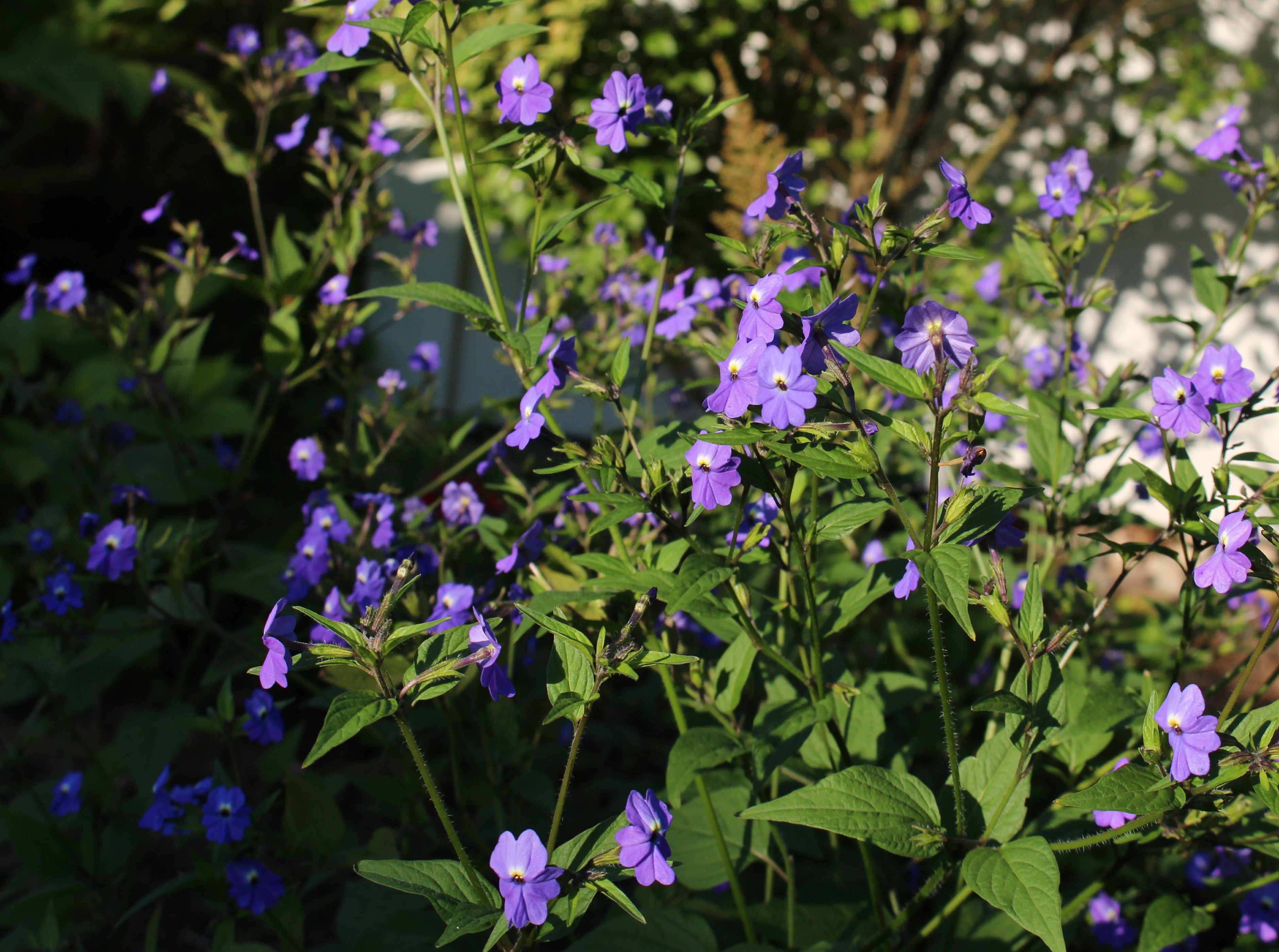
In the photo above you can barely make out the blue mist of Browallia Americana hovering above the hosta.  It’s an easy enough annual (native to Central and South America and across the Caribbean isles) and each year I like it’s nearly true-blue flowers even more.  Too bad I can’t get the camera to agree on the color, it always washes it out to a violet.

browallia americana

Browallia americana

So summer is still in full swing here, and for someone who prefers to ignore the calendar there’s not even a hint of the season winding down yet.  I like this sense of denial and will hang on to it for as long as I can…. but if pushed I will admit to thinking about next year already.  Ok, so I don’t even need a push.  I stumbled upon a summer sale at the nursery and took home a cool little banana plant.  It’s been a couple years since my banana growing days but I can feel the itch again and who knows what this means for next year’s plantings 🙂

Hello Susan

My intention this spring was to keep the front yard a little more organized and really put my foot down against the reseeders which took over last summer….. but then the rest of the world happened and just like many good intentions my organization theme fell to the wayside.  This year rudbeckias took over.

gloriosa daisies rudbeckia

Rudbeckias, black eyed Susans, gloriosa daisies, whatever you want to call them these rudbeckia hirta hybrids really bring gold to the front border.  Fyi this is as far along the bed as the edging and mulching got this spring.  You can see my spade handle just where I left it about two months ago 🙂 

For as much as I like the softer yellows, and for as summery a tint golden yellow is, bright gold is probably one of my least favorite flower colors.  The golden takeover of the front garden really goes against any design theory I have for this bed and I suppose if I were of the more controlling type it would cause me a little mental turmoil but I think I’m ok with the brightness.  It helps bring a little sun to what’s so far been a pretty wet and ‘pearly’ summer.

rudbeckia hirta gloriosa daisy perennial bed

The front border with plenty of rudbeckias.  I was firm with seedlings of amaranth, standing cypress, and oxeye daisies but this year the black eyed Susans slipped by.

A casual passerby might think things look well under control and maybe even close to well tended, but just inside the bed turmoil reigns.  Here the inner section was supposed to be a restful patch of dark leaves canna…. which it’s not… because too many ‘good enough’ plants came up and the gardener just didn’t have the heart to pull them out.  It worked out for the best though, the variety of green centered and brown eyed rudbeckia which grew is a nice tradeoff (as long as you can continue to ignore the unplanted cannas sitting on the driveway).

mixed annual rudbeckia plantings

Mixed shades of selfsown rudbeckia seedlings. 

There used to be a greater variety of darker shades mixed in with the straight gold daisies but over the last few years I’ve tended to pull the browned eyed versions.  They seem more prone to mildew in my garden and rather than look at that I just pull them and send them to the compost before their seed ripens.

mixed perennial border

A more ‘refined’ view of the border.  Less is surely more with these bright colors but to be honest the patches where the rudbeckia grows and blooms thickest are the patches which make me smile 🙂

A week or two ago would have been a good time to seed out a few zinnias to fill in for when I get tired of the fading rudbeckias but all the rain seems to have drowned my seedling tray, so we’ll see what happens now.  Fortunately there are always volunteers willing to step up.  Here are a few sunflowers coming along (in a totally inappropriate spot) and I know a few verbena bonariensis seedlings could be found elsewhere.

sunflower seedlings

The future sunflower patch.  Goldfinches have already been stopping by but they’ve got a few more weeks to wait before this seed factory starts up.

The entire border hasn’t been given over to gold.  Here’s a now classic combination of Perovskia, Echinacea, and ‘Karl Foerster” feather reed grass made famous back in the ’90s by the Washington DC based design team of Oehme, Van Sweden.  They were one of the pioneers in publicizing the ‘New American’ prairie style planting style which moved American design away from lawns and English style gardens to a more relaxed look filled with lower maintenance swaths of color and forms which sway in the summer breeze.

Oehme, van Sweden inspired planting

My Oehme, van Sweden inspired planting of ‘Karl Foerster’ grass, coneflowers, and Russian sage.

Coneflowers also anchor the far end of the bed, and the golden rudbeckias haven’t quite conquered this far down the line.

morning light perennial border

This end of the border is were my enthusiasm for weeding and maintenance always wears a little thin.  As long as the lawn stays mowed and the edges get trimmed I think the weeds and lack of deadheading aren’t quite so noticeable.

The black eyes Susans which grow in this front border are nearly all the tetraploid version of America’s native Rudbeckia hirta, and for plant geeks such as myself the history of these plants is one of those cool wintertime stories which make gardening just that much more interesting.  A version of the story can be found by clicking here, but the short summertime summary involves Dr. Blakeslee of Massachusetts’s Smith College treating seed of the native rudbeckia with the genetics altering chemical colchicine and doubling their chromosome count.  Eventually David Burpee got a hold of the new race of flowers and set his company to work refining and selecting for more colors and forms, and in 1957 introduced the plants as we know them today.  The tetraploid version is bright and big and bold, but the normal diploid Rudbeckia hirta still has its fans for its daintier, summertime wildflower look.

rudbeckia hirta quilled petals

A straight Rudbeckia hirta which showed up in the back garden.  I like the spoon shaped petals on this one and hopefully can save a few seeds.

Rudbeckia hirta comes in two basic forms, the regular and the larger tetraploid version.  They’re both short lived perennials which may bloom the first year or may die after blooming, depending on their mood, but they’re both far from troublesome.  Don’t get this Susan mixed up with the truly perennial, clump forming Rudbeckia fulgida which is just starting to come into bloom now.  This one (usually grown as the ‘Goldsturm’ version, another Oehm,Van Sweden favorite as well as Karl Foerster introduction) is another indestructible rudbeckia but for me it’s just too much of a perennial commitment to gold 🙂

rudbeckia hirta light yellow

Another wild rudbeckia hirta which I’m keeping an eye on out back.  It’s a lighter yellow shade with a spidery inward curl to the petals (which often shows up in the darker ones as well).  I like it! 

So there you have it, the glory of gloriosa daisies in the garden of a gardener who doesn’t like gold.  Some will surely point out that I’m in gold loving denial, but daisies and gold are completely common and unrefined and I’m going to try and claim it was against my will and better taste that they took over this summer.  Either that or I just don’t care what good taste and garden trends dictate!

Enjoy summer 🙂

June. Rained out.

Don’t get me wrong,  I’m not complaining about the rain, but this kind of weather would have been much more welcome in April or May when things were going brown and shriveling up.  Still I love it.  It’s perfect for the procrastinating planter and the person who hates to lug the hose from plant to plant (that would be me), and by now even the grass has put on a green color once again!

gerbera daisies planter

Green grass makes any color look acceptable.   I’m finding that gerber daisies are one of my wife’s favorite plants, so on the rare occasion she comes to the nursery who am I to say no?

The rain is also not a problem bloom-destroying-wise since my garden seems to wade through a lull at this time of year.  There are plenty of blooms which could be gracing my beds right now but I just don’t have many of them in the ground.  My garden peaks closer to the midpoint of summer and beyond, and I’m fine with the extra wait since this time of year is when I always seem to be ironing out the last plantings and thinking through all the projects which may still happen… such as widening the front border (again).

mixed perennial border

Up near the house the blue of the ornamental fescue fills in an earlier expansion of the foundation bed, here closer to the street you can’t even make out the extra foot or so I added to this bed, so it barely counts as a project.

Sometimes with your nose to the wheel day in and day out you forget that there’s plenty of good coming together while you slave away at the not-so-good.  Here if the viewing angle is just right, the front street border looks fairly well put together.  A thick mulch of shredded leaves, a nice edge of shredded bark, and removal of nearly half of everything in the bed gives it an ‘under control’ look for at least one month this year.  A clean bed edging always helps,  but expanding another foot into the lawn really gave some breathing room… I should remember to enforce this rule next year as everything seeds and spreads out into the newly open space!

June perennial border

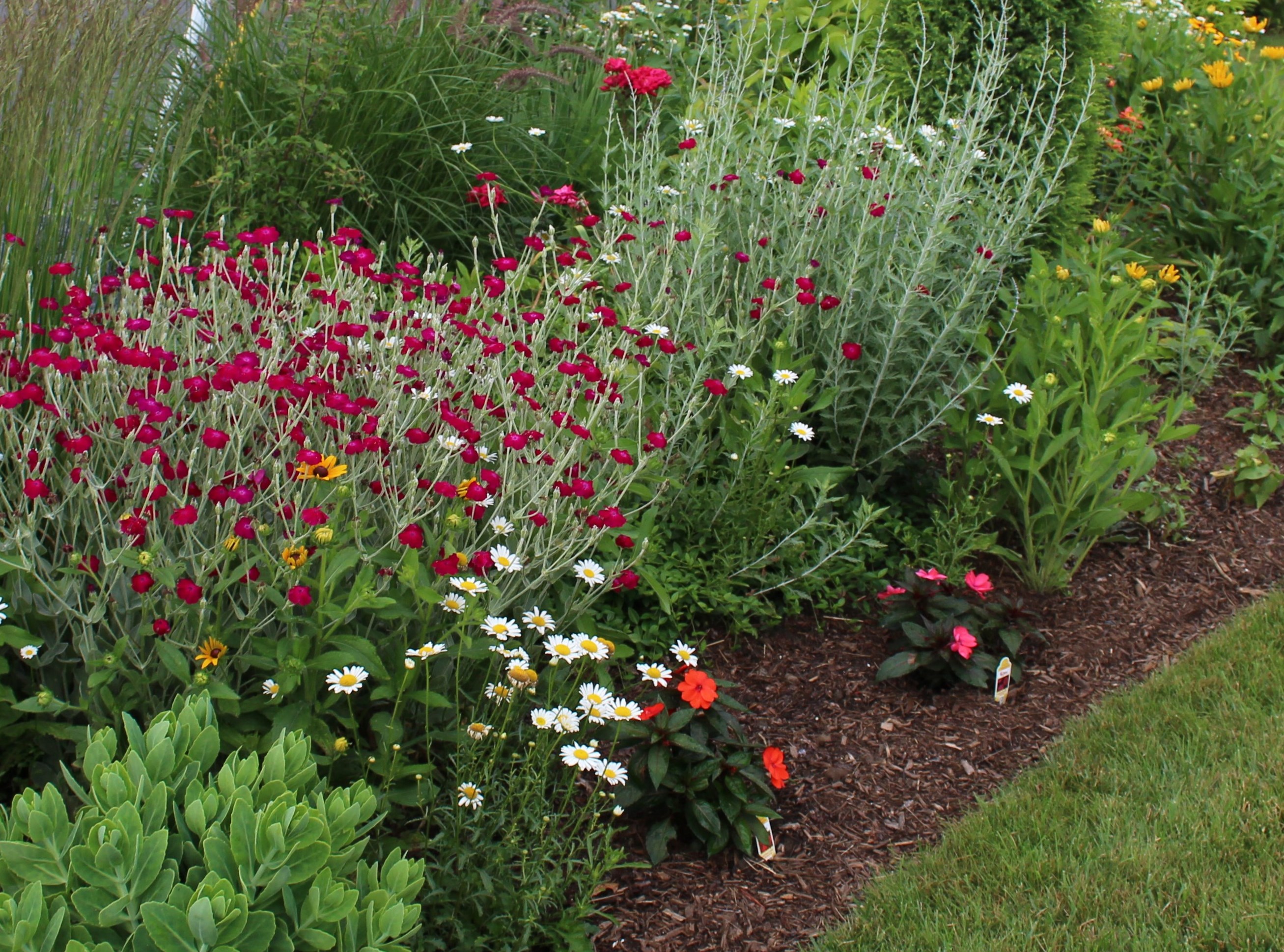
The front street border this morning.  The dark magenta lychnis coronaria and white oxeye daisies are essentially weeds, but if there are just a few I guess it’s socially acceptable.

A plant which spreads out wherever and whenever it wants is my trusty giant reed grass (Arundo Donax ‘variegata’).  I smile and make excuses for it when people comment about its possibly too-large size, but deep down I’m proud of it.  I won’t even bat an eye when it consumes the iris and other plantings around it 🙂

arundo donax variegata

Arundo donax ‘variegata’ overcoming the far end of the street border. 

Another spreader is the ‘Tiger eyes’ sumac which sits in a couple spots around the yard.  For me yellow leaved and chartreuse plants are an addiction and I am constantly in need of reminding of the fine line between a few accents and the way-too-much stage, but the tiger takes care of this on his own.  He (actually a she since this clone of cutleaf sumacs produces the colorful red female seed heads when mature) will pepper your beds with small yellow shoots here and there and I suppose someday take over the world, but for now I just pull the innocent little shoots.

drought tolerant perennials

Pennisetum ‘Karley Rose’ is putting up the first of many fluffy pink seedheads.  They’re always dancing about in the wind and keeping things lively.  Maybe a few clumps closer to the light pole would look nice next to the bright mess of ‘Tiger Eyes’ which surrounds it right now.

For some reason this spring the kids have been coming along on nursery runs.  I suspect they have some hidden agenda which includes a stop at the Dollar Store but regardless I’m going to enjoy their company while it lasts.  Both insist on helping pick their own plants and sometimes even want to plant.

lychnis coronaria

Bright magenta Lychnis coronaria faced down with a few sunpatients.  The girl insisted on putting labels front and center, I couldn’t quite get out the reason for it.  Also I couldn’t talk her out of the magenta-orange combo.  This might have to be replanted once she moves on to other things.

The front borders are looking pretty good right now but there are also a few nice surprises out back amongst the weeds.  One of my favorites is the first blooms on this strawberry foxglove (Digitalis x mertonensis).  It’s been a struggle getting this one to bloom since the harsh winters seem to do a number on the crowns, but this year a few made it, and I finally get to see the strawberry-ish blooms on the relatively short stalks.

digitalis mertonensis strawberry foxglove

A cross-species hybrid of two foxgloves, the strawberry foxglove should be slightly more perennial than the regular type, and hopefully come true from seed as well. 

Another spike out in the garden (I like my spiky bloomers) is this verbascum which hitch-hiked in with a gift plant.  You know a plant (in this case a shrub dogwood) is coming from a good garden when two special plants tag along on the root ball.  This verbascum (maybe V. chaixii?) is blooming nicely now, and follows up some nice scilla blooms which flowered in spring.  It was only the dogwood I wanted, but surprises are always fun as well!

verbascum chaixii

Verbascum blooming amongst the sunflower seedlings which I didn’t have the resolve to rip up….. and yes that’s a huge thistle in front of the fence.  I like them, please don’t judge me.

Some would call the uninvited sunflower seedlings weeds, many would call the verbascum the same, and many more would immediately rip out the thistle, but I have a more laissez faire approach to the less invasive of the volunteers.  I let plenty of things go, but oddly enough this year the beautiful purple campanula glomerata is what I’m ripping out.  I’m trying to reclaim the red border, and it’s the campanula which has made a takeover play.  Enough is enough so a few weeks ago roundup was sprayed and it’s only a few pretty stalks which remain.  I’ll hand pull these and hopefully with a little summertime vigilance will be able to clear this plant out.

campanula glomerata with clematis

Once the campanula was beaten back I realized there are a few really nice plants in this bed.  Clematis ‘Ville de Lyon’ is one of my favorites and it deserves much more than the hardscrabble life of a vine left to struggle along the ground…. but it does look even better with the campanula blooms :/ 

Another borderline weedy area is the meadow.  Last summer’s dry spell weakened the lawn turf so much that it barely had the strength to send up bloom stalks this spring.  That’s a shame since I love the look of the tall grass waving in the wind and enjoy watching the bunnies work their way through each morning filling up on seedheads.  But the lazy gardener needs to take these things in stride (I could have made the effort to water last year) and realize the daisies and butterfly weed show up much better in the more open meadow.

meadow planting asclepias tuberosa

The meadow garden with some particularly drought tolerant butterfly weed (Asclepias tuberosa).  Depending on my mood and the weather this area will be mown down in late summer to neaten things up keep the taller plants from dominating.

The butterflies are enjoying the meadow, but everything else is focused on the linden blooms (Tilia europaea I think).  The tree buzzes with honey and bumble bees, flies, beetles, wasps, and a load of other things which I can’t even identify, and the scent is fantastic and fills the yard with a soft flowery honey aroma.  It’s a decent size tree and I can’t even imagine the number of insects which fill its branches.  If only I could follow the bees home and get a cut of the honey they’re making from all this.

linden blooms tilia basswood

June is when the linden tree is in its glory. 

Another plant which does its own thing without me raising a finger is my trusty hydrangea ‘Annabelle’.  New hydrangeas will come and go, but I can’t think of a reason good enough to cut this one loose.  It can flop, but in the spring it’s cut back completely and between lean living and full sun it holds up well enough.  If I had the room I’d do a mass of these, maybe under a grove of white birches, but here all I have room for is a few scattered along the edge of the yard.  Obviously I love the chartreuse of the opening blooms best of all since the next best thing to chartreuse foliage is a chartreuse bloom!

hydrangea annabelle

Hydrangea ‘Annabelle’.  You can count on this one to bloom every year.

I’ve seen some photos of the newest ‘Annabelle’ siblings and they’re an amazing range or pinks to near reds in addition to the never out of style whites, so I would surely have to add one or two, but I think I’ll always have room for good old ‘Annabelle’.  Speaking of room, it’s still a never ending seed starting and cutting taking rollercoaster here and for some reason I still start more.  Hopefully I’ll be patting myself on the back when these late marigolds and amaranthus come into bloom and everything else is looking a bit tired!

seedlings sown in summer

Still sowing seeds and taking cuttings well into June.  They grow so fast at this time of year, I should have fresh flowers in no time at all!

I better get this posted, it’s been a work in progress since the weekend, not because there’s any amazing content in this post, but because I’m stealing minutes from birthday parties, baseball games, and pool time and would rather sneak in a trip to the nursery than sit at the computer 🙂  But lazy summer days are coming and things should ease up shortly, until then may you enjoy summer as much as I do!