GBFD April ’16

Imagine my embarrassment when I saw it’s been nearly two weeks since my last post.  I know the exact reason for the pause but right now just  don’t want to get into the ugly truths about mixing brutal cold fronts with fresh spring growth.  Instead I’ll focus on the beautiful sunshine of a cool spring morning and join in for a very quick visit to celebrate Garden Bloggers Foliage Day with Christina from ‘Creating my own garden of the Hesperides’.

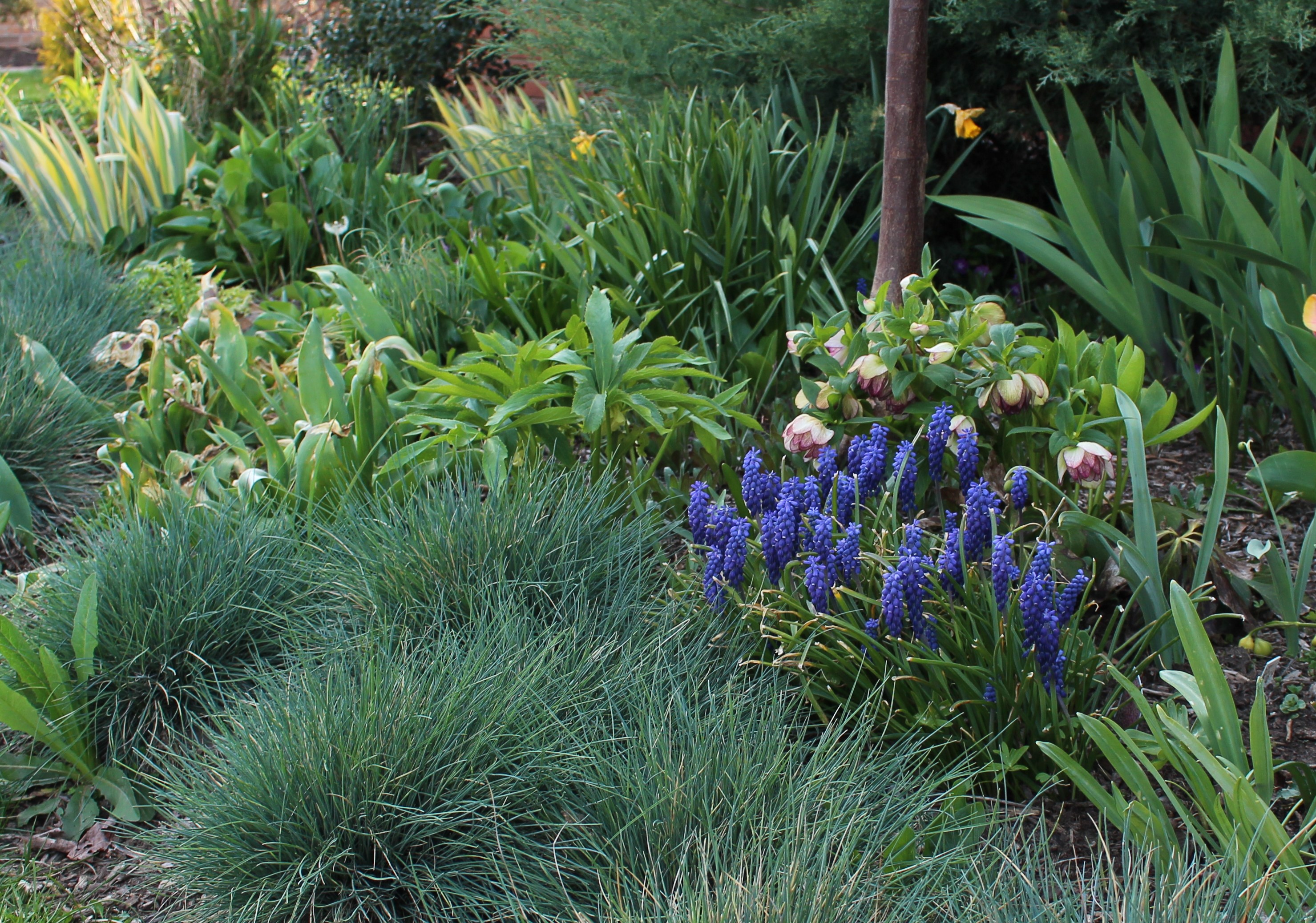
muscari and blue fescue

The grayish leaves of blue fescue (Festuca glauca) alongside the blue flowers of grape hyacinths (Muscari).  Please ignore the freeze burned tulips to the left of the photo…

Thanks to Christina for the monthly reminder to reexamine the contributions foliage makes to the overall look and feel of the garden, and this month it’s a border of blue fescue which has me most pleased with foliage effect.  This border was switched up last spring when I divided and spread a few clumps all along the foundation plantings, and this spring it has filled in with a lush vigor which really shows off the bed.  Now that the fescue is making me happy I’m fixated on a clump of blue muscari growing just behind the grass clumps.  There’s a strong possibility this will be divided and spread along as well since I like the combination.

The fescue and muscari are extremely common plants and both were free shovel-fuls from other gardens.  It kind of makes me reconsider that bucket of plant labels which no longer match living partners… but not enough to cure that plant lust for all the new goodies 🙂

See?  I promised it would be quick.  Please visit Christina’s blog as well, it’s always a pleasure to see and hear about the foliage others across the globe are enjoying in their own gardens, and have a great weekend!

Stop it with the autumn talk

Many people enjoy and claim they welcome the coming of autumn.   I want to make it clear that I do not, and although the last few days have been a little too hot and dry for my taste, I would much prefer the relief of a summertime cloudburst rather than any farewell to summer eulogy.  So I guess what I want is just a few more days of denial before I’m forced to admit the season is breaking down.

hardy chrysanthemums

The tomatoes of summer are still going strong even with their new neighbors the fall chrysanthemums.

After a promising start to the summer August went dry and for the past forty days we’ve barely cracked the 1/4 inch mark for rainfall.  With high temperatures, thin soil, drying winds, and full sun the life was sucked out of a garden which had been almost carefree at the start of the summer.  With a nice rain today we’ll see how fast things bounce back.  My guess is it will be a much faster turnaround than the last two summers when things REALLY dried out to a crisp.

fall vegetable gardening

One patch of watered soil ready for fall planting. Hopefully cool weather will soon allow for a few broccoli and cauliflower transplants.

In spite of the heat a few things still look nice.  The tropical garden got a few minutes with the hose, and that seems to have been enough to keep it from death.  I love the colors right now with the purple verbena bonariensis, dark red dahlias, and peach colored salvia splendens filling the bed.

salvia splendens van houttei peach

A little orange from ‘Tropicanna’ canna goes a long way in brightening up the late summer salvia, verbena and dahlias.

With the grass dried up to a crispy beige the stronger reds, oranges, and purples really stand out.  I don’t think a bed full of lavenders, whites, and pale pinks would be as eye catching…. which I’m going to say is a good thing, since in this world of gray and tan I can use as much eye catching and hold-on-to-life color as I can get!

dahlia mathew alan

End of summer color from dahlia ‘Mathew Alan’.  As usual the dahlias could use some dead heading.

Even up front a little bold color is a nice thing.  The border along the house foundation has a few spots of color from the ‘Masquerade’ peppers I planted out this spring.  The true type has purple peppers changing to yellow, orange, and red while a few oddball plants started right off with pale yellow and are now going through the same sunset effect.

pepper masquerade

‘Masquerade’ peppers from seed with all the fescue clumps I divided up this spring.  I finally like this bed… but we’ll see how I can mess it up next year 🙂

Along the street is another story.  Even with a few emergency waterings things look end of summer tired.

dry perennial border

To water or not to water, that is the question.  Obviously I chose the latter, but the ‘Karl Forster’ feather reed grass, sedums, and perovskia are still holding on.

I did give the ‘Limelight’ hydrangea a little soaking, but a few water lovers such as the ‘Golden sunshine’ willow will need a good bit of water before they look anything close to happy again.

dry perennial border

I think this border will need a little trimming out of dead things once the rains soak in.  No big deal though, a little fall cleanup will carry it on through the next few months.

There are still a few bright spots.  Even in the harsh midday sun kniphofia ‘Ember Glow’ looks nice.  It could be a little taller but the size actually works well with the peppers and coleus (please ignore the dead rudbeckias and dying zinnias).

kniphofia

Red hot poker (Kniphofia) with peppers and a surprisingly sun and drought resistant coleus.  I wasn’t sure if the poker would ever bloom this year but I guess it’s a later cultivar. 

Until the garden bounces back the best thing to do is spend more time in the shade, seated with cold beverage in hand.  I can ignore the weeds and dead lawn quite successfully on the back deck.

summer planters on the deck

This is a late summer view, not autumn.  I’ll keep that delusion up until the first frosts threaten!

Even with a good soaking the lawnmower will still likely be on vacation for another week or two.  I’m ok with that.  I hope the soil takes in the rain, the plants come back, and I can finally use something other than a pickaxe to dig a hole.  Maybe then I’ll start thinking about things like fall while I’m taking care of a little late summer transplanting and bulb planting 🙂

Check one corner off

There were a few cool days last week and I was able to drag myself out into the garden and give the vegetable beds a once over (in spite of the dry soil and high pollen counts).  I think it looks as good as it gets, and with all the unintentional flowers it may be fancy enough to call a “potager”, as Annette from Annette’s Garden once called it.  I like the name and it’s stuck.  It has just enough Continental refinement to make me laugh a little when I look at the plastic fencing, weedy sumacs, chainlink and neighboring industrial park!

the potager vegetable garden

The potager with neatly edged beds and way too much disorganization.  By now the warm weather vegetables should already be in but with last week’s frost I’m kind of grateful for my procrastination.

The work always goes faster with a good helper or two, but studies have shown that nine year old boys don’t typically fall into that category.  Still the company is welcome.

kids in the garden

A few edible things are starting to fill the beds but I’m always proudest of the fancy pink marble edging which line the plots.  In a former life the stone accented the front of the house, but now it helps edge the beds.  The look has been called “deep south cemetery” and I’m sure that’s a compliment. 

Ok, so even freshly weeded it’s still kind of messy, but I’m far too proud of the crisp edge along the lawn and the freshly mulched boxwood to let that keep me from posting a photo.  Our little Queen of the Prairie” must agree.  She overlooks the potager but has seen better days as the weather continues to eat away at her plaster self.  Might be time to start hitting the estate sales to find a successor.

boxwood edging vegetable beds

A very rarefied boxwood edging lines the outer perimeter and I think it really elevates the standing of my hodgepodge of plants.  Hopefully I can enjoy it for a few years now that it’s finally growing in, especially since  so many European and New England gardeners are facing multiple boxwood problems … blight, caterpillars, ugh.

The iris are at their peak.  I should really evict them but never do.

iris in the vegetable beds

Seems like for every iris clump I remove a few new ones pop up.  The compost usually brings in a few but the gardener also tends to feel bad for spare plants and ends up putting the innocent little fans in here and there.

I don’t know what to say about this clump.  Two years ago I dumped them here when I needed their real estate for a tomato planting.  I never replanted them but apparently they don’t care.  Two years in an iris bed with no bloom, two years of being tossed to the side and they look great.  Go figure.

historic bearded iris

Their identities are probably lost, but I think the apricot-pink to the right is ‘Jean Guymer’.

It’s not all flowers, there are a few cool weather vegetables braving the up and down temperatures.  Broccoli, lettuce, potatoes, and garlic all look promising, but here the tomato seedlings still all need to be weeded out.  If I knew what they were I’d keep them, but I already have more than enough.  They’ll stay for a few days longer to keep the ground covered since I don’t want mud splattering up into the yummy little lettuce rosettes when I water.

lettuce mervielle quatre seasons matina sweet

Two favorite lettuces, the never bitter ‘Matina Sweet’ and the darker ‘Mervielle de Quatre Saisons’… which should get a delicious tender green heart in a few more days.

The heat was too much for the arugula.  The flowers are nice enough though, and I won’t mind weeding this one out for salads if it goes to seed.

arugula bolting to seed

Chives in bloom and arugula bolting as the weather gets warm.  Time to plant the summer crops!

Even with the weeding and watering there’s still a ton to do.  Some tulips and daffodils will hopefully start coming out this weekend and that should open up room for beans and squash.  It may still be May but I’m going to say summer is here, and the next big project will be summer annuals.  Even though the plantlets are anxious to get out from under the growlights, I hope to tackle one last big weed patch adjacent to the potager before all my energy is lost.  It’s the on again off again red border/ pond bed, and hopefully in the next few weeks there will be some progress there as well.

eliminating weeds from perennial bed

All kinds of weeds filling the red border.  I resorted to roundup along the fence and that’s the only reason it’s not a sea of campanula glomerata.

Wish me luck.  We had a good rainstorm come through this afternoon and everything seems to be letting out a big sigh of relieve (including my water meter).  Facing next week’s high temperatures with a still-dry garden was not something I was looking forward to, so I’m thrilled!

The Foundation Planting

Our latest arctic blast has got me going through old pictures, and I found a few that have been sitting around for a while.  They’re all about the bed along the front of the house, and they all relate to a redesign I attempted this past spring.  Let me know what you think!

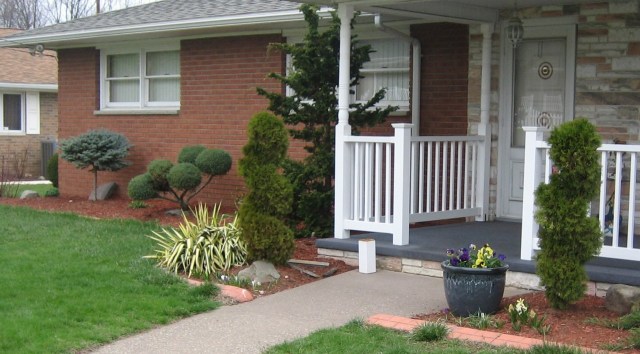
The house we live in now was built by my wife’s grandparents in the late 1950’s, and is probably still considered stylish by many.  Unfortunately we don’t share that retro-Italianate taste in ranches and set about to change things up while remodeling.  This was our front view circa spring 2009, not long after we moved in.retro landscapingThe combination of toddler, new baby, and home renovations is a fun mix, and outside changes were mostly put onto the back burner,  but that summer I did manage to get out the salmon colored edging and covered the colorful red bark mulch with a more natural shade.  I’m not saying it looked better, but at least it’s a little less sterile looking.Summer 2009If I was forced to give an answer I would probably say I hate the orangey color of our brick.  We’re stuck with it though, and since there’s not much of a design flair in me the collector gene took over, and all the cuttings and divisions I collected easily found a home in the vacant mulch beds.  By 2011 the mess was spreading and in an attempt to reign in the disorder I consulted with the ‘can’t beat em join em” theory.  I tried to embrace the orange by entering into a red phase.  I figured if I planted an even brighter scarlet then perhaps it would be bright enough to distract viewers from the orange brick…. or maybe I was trying to offend the neighbors, I don’t know- but I would like to challenge anyone out there to show me an example of red salvia used tastefully 🙂Late August 2011

Maybe Secretly I delighted in reds and chartreuse, and I think I still do….. just not in the front bed highlighting the orange brick.  This lovely combo has been saved and moved to the tropical bed to face down the already-overwhelmingly tasteful white vinyl privacy fencing there…. I’m not sure it looks much better there, but at least I’m sparing the neighbors from this assault of color. (fyi the hummingbirds loved it)the landscape's red phase

Now what to do?  The next year I had no enthusiasm for the bed without my lovely coleus and salvia.  A few perennials filled in to give it a fuller look, but it still lacks something.  The blue spruce was getting too big for under the window, and the Chamaecyparis too tall….. and I was getting tired of trimming the silly pompom juniper. Fall 2012So late that fall I laid out a bed expansion.  Truth be told I over estimated the space available for tulips, so after lining out the new border I dug tulips in all around in the lawn and then left the grass for spring removal.  Dec 2012That spring as the tulips came up through the overturned sod, I finished digging under the rest of the grass.digging under the turf

Moving the spruce was no picnic, and I almost thought it would die (considering how many roots I cut) but I think it will be much better off in the new position, and give a nice anchor to the end of the bed.  Fortunately for me, just when the shrub moving started to get too back-breaking, a buddy stopped by to help.a friend stops by

Soooo, here’s the finished product.  I moved a small paperbark maple over a few feet to be included in the bed, lined it with blues fescue divisions, and placed three tiny holly bushes where the spruce was.  Against all other urges I tried to limit the plant choices and plant in groups.  The curve is a little odd, but I’ll work on that during the next expansion 😉the "finished" product

With mulch applied and tulips blooming, it didn’t look half bad, but to be honest I still didn’t like it.  (one of the reasons you rarely see pictures of this border)foundation planting with tulips

I do like the yucca “color guard”.  It and the blue fescue seem to be a nice fit for this border.yucca colorguard with blue fescueBlues, yellows , and greens seem to complement the house better than all the loud mixed up flower colors.  For a couple weeks I didn’t mind this look, even as the tulip foliage yellowed and died off.  But then boredom and excess plants struck, and I was back to my old ways of sneaking in a few new plants here and there. dying foliage of tulips

Red cabbage wasn’t the worst color to add, but maybe it was just a little inappropriate for a front yard foundation planting.  Coleus crept in again, and the sunflower seedlings looked so innocent in the early summer…. but the lavender with the yucca and blue fescue kept it respectable.red cabbage in the border

Sunflower explosion.  Still better than my red experiment, but not yet the look I was going for.  midsummer abundance

Maybe annuals are just not a good choice for this bed.  I’ll rethink it next year and maybe skip the dahlias too 🙂   For now I’ll use the excuse that they distract you from the too-small hollies planted under the window…. better to be distracted than to be downright bored I think….  By the way those hollies better get growing, I want them nice and big and prickly by the time my little daughter starts to consider things like sneaking out a window or meeting some Romeo who comes by throwing pebbles.too much color again

The border last month (before winter and winter boredom hit).December 2013

Four things:  bigger plants, get rid of the grasses, remove the tall evergreen, and stick to a mellow color palette…. and of course expand the bed just a few more feet 🙂  Any other suggestions?  I know there will be some good ones and I’m looking forward to hearing them as well as hearing some more criticism.  I can take it, and I’m hoping it will get me back on the path that leads to me finally liking this bed!

Thinking of next year yet?

I’m still in denial that summer is winding down.  Every sunny day and higher temperature reading gives me hope the warmth is still holding on, but eventually I’ll need to come to terms with winter’s approach.  My least favorite season is just about here and it’s time to shake off that summertime laziness and start making plans.

By least favorite season I mean fall.  I dread the fall shutdown that plants go through and the first frost.  Even  the fall foliage looks to me like death warmed over.  The best thing about fall is all the planting, and for hardy bulbs fall is the number one planting season.  Although I was lost in tulips this spring, it’s daffodils that I really like, and in order to convince you to get more too I dredged up a couple pictures from the good old days of spring.

‘Accent “(1960- the year this daff was registered) is a great daffodil, it has a medium pink cup (corona) surrounded by pure white petals (perianth).  The color is reliable, the plant is reliable, and it’s not too hard to find.  I like fancy things too, but reliable fills a garden every spring with beautiful blooms, and in this next (over exposed) picture “accent” is paired with another great, reliable one (and one of my real favorites) “Tahiti”(1956).

There are thousands of named daffodils out there and thousands of ways to pick the best ones for your garden.  Picking up a bag at the box store is fine and inexpensive and a good starting point but if you begin to get serious take a look at the Wister Award winners.  It’s an American Daffodil Society award for outstanding garden daffodils and will give you a shopping list of the best daffodils for your garden.

Another good pink is “Pink Charm” (1977)

It’s a little newer than “accent” and only just a bit different with more white in the cup, but for two years I’ve been impressed with the opening color and then the later blend of pink fading to white in the center.

“Passionale”(1956) is a strong growing older pink.  The flowers open with a yellowish tint to the cup which is common for these older varieties.  In daffodils, pink is a relatively new color for breeders, and it’s been a long journey to separate the color and strengthen it to a ‘real’ pink color.

Daffodil breeders are always tinkering with their favorites but they generally fall into 13 divisions.  To take a look at some of the fanciest and newest examples of each division click here“Palmaries”(1973) falls into the split cup category.  It’s frillier and flouncier than what I usually like, but it has been doing well in my garden.

“Newcomer”(1992) has the saturated darker pink of a newer introduction.  It won’t be an easy daff to find but does show the long lasting pure colors of a modern daffodil.

“Sagitta”(2007) shows one of the newest combinations, yellow-pink.  This one will likely be a very popular daffodil, so far it’s been a great grower, multiplier, and bloomer for me and I love it.

But there’s nothing wrong with a yellow trumpet daffodil.  Since “King Alfred” was registered in 1899 new yellow daffodils continue to come out with stronger blooms, colors, and growth habits.  The true King Alfred is tough to find today since years of slapping the name onto any yellow daffodil has muddied the water, but with so many solid yellows such as “Primeur”(1978), how can you go wrong?

My favorite group of daffodils are the cyclamineus types.  Daffodils in this group all share the reflexed petals and long trumpets of the original narcissus cyclamineus species.  “Peeping Tom” (1948) is on the top of my list, it’s an oldie but I love the long trumpet, wide flare and early bloom season.

Another one in this group that’s doing well for me is “Jetfire” (1966).  It’s a good grower with a little orange in the trumpet (more so in cooler springs) but it’s a little stubbier and shorter than “Peeping Tom”.

If you can’t find “Peeping Tom” (I don’t see it in many catalogs any more) you could try out one of it’s children.  “Wisley”(2004) comes from the seeds of a Peeping Tom cross.  It’s new for me, but the flowers have a love-it or hate-it look that I’m still trying to figure out.

If you’re ever looking for daffodil info, Daff Seek pretty much has it all.  It’s the searchable database of the American Daffodil Society and has photos and information on most registered daffodils…. plus interesting tidbits such as daffodil lineage and breeding info.

My latest color craze has been the yellow red combo.  “Serola”(1986) is a great one that multiplies well, doesn’t fade in the sun, and is bright!

“Montego” (1968) has the same colors in a smaller rim of red.  I might have gone overboard with this color range in the last few years but I really do like them.

If you’re unsure where to start with your own daffodil quest, but ready to move past the generic offerings, start with  Brent and Becky’s.  Even if you end up ordering elsewhere, they probably offer the best selection of good varieties and don’t carry the duds.  Some of the best sources for bulk daffodils are Van Engelen and Colorblends.  Just be careful, before you know it you’ll be looking up the specialists such as Mitsch’s and Cherry Creek and really killing your gardening budget.

Ok one more yellow-red.  “Molten Lava” (1987) has slightly more subtle coloring, but still rich tones.

White never goes out of style and “Misty Glen” (1976) is a great daffodil in white.  Over 40 other registered daffodils trace their roots to this variety and it’s won many awards.  It’s one of the best daffodils.

If you still don’t feel the need to add more daffodils, here’s another try.  The small cupped daffodils such as “excitement” (2001) also come in all kinds of color combos just like the big guys.

Beyond the big and little cups and the trumpets there are still thousands of “other” daffodils out there.  They’re all just different expressions of the genus Narcissus.  The name daffodil is just a common name most people apply to the bigger trumpet sorts but it works for all of them.

Some of the other types have unique traits that can be traced back to one of the original narcissus species. “Geranium” (pre 1930) is a reliable, hardy tazetta type which shows the clustered blooms and fragrance of this of this group.  I might put this one on my top 10 best daffodil list, but with so many new types to distract me, I sometimes forget about the multiple award winners like Geranium.

Paperwhites are a well known member of the tazetta group, they’re just not hardy enough to grow up in this part of Pennsylvania.  One that does suffer through is “Erlicheer” (pre 1951), it’s listed as a double but tazetta blood runs through it’s veins.  The problem for me with Erlicheer is its early sprouting habit anytime there’s a break in winter temperatures.  You can see how all the leaf tips have been burnt by cold snaps that came along after growth started.  Too much cold combined with too active growth will eventually kill these.  Sometimes erlicheer is sold as a “summer daffodil” because they don’t need the deep freeze of winter in order to bloom.  You can plant them in the spring, have summer flowers, but they’ll be back to normal spring flowering the following year.

I never meant for this to be such a long post, but daffodils are so easy to grow…… and I admit I’m slightly addicted.

Here’s an example of one of the poeticus types.  “Pentucket” (pre 1946) might be hard to find, but there are several look alikes out there.  Poeticus daffodils (the Poet narcissus) have been grown since ancient times and are most likely the daffodil referenced in Greek poetry and myth.  Today they are grown by the perfume industry for the narcissus oil they produce and apparently it’s one of the most popular fragrances…. oddly enough I don’t pick up much scent in these.

So plan ahead for spring and get some more daffodils in the ground!  Even if it’s a dainty non-daff like “Baby Boomer” (pre 2008) they’re all equally easy to plant.

I find the easiest method to plant daffodils is to take out the big shovel, scoop out one or two shovel-fulls of dirt, dump the bulbs in, and cover.  You don’t need to set the bulbs correctly (although I usually do put them pointy side up) and your regular soil should be fine without improvements, just get them in the ground!

Good luck, and I’d love to hear how your bulb ordering and planting is going:)