Stop it with the autumn talk

Many people enjoy and claim they welcome the coming of autumn.   I want to make it clear that I do not, and although the last few days have been a little too hot and dry for my taste, I would much prefer the relief of a summertime cloudburst rather than any farewell to summer eulogy.  So I guess what I want is just a few more days of denial before I’m forced to admit the season is breaking down.

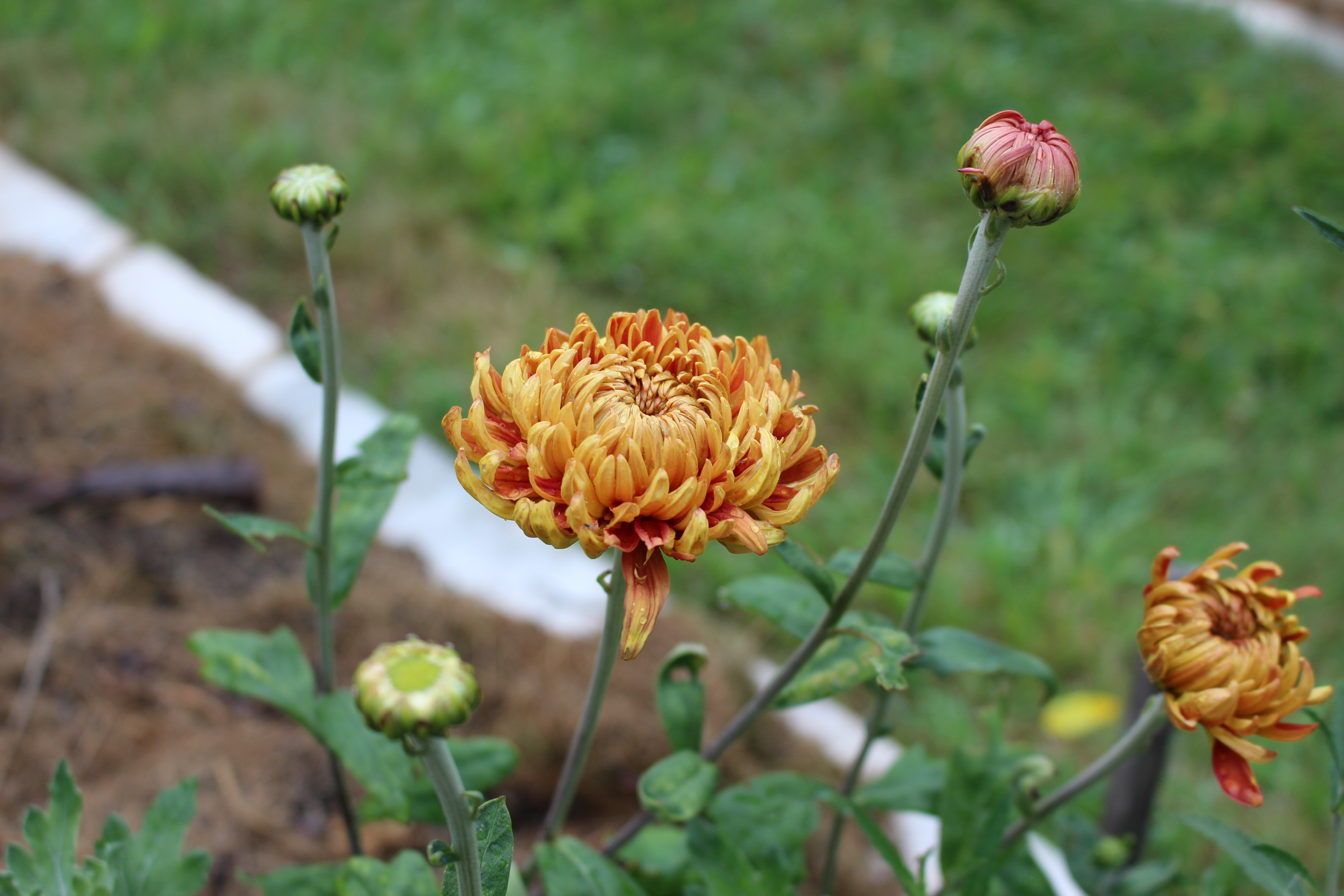
hardy chrysanthemums

The tomatoes of summer are still going strong even with their new neighbors the fall chrysanthemums.

After a promising start to the summer August went dry and for the past forty days we’ve barely cracked the 1/4 inch mark for rainfall.  With high temperatures, thin soil, drying winds, and full sun the life was sucked out of a garden which had been almost carefree at the start of the summer.  With a nice rain today we’ll see how fast things bounce back.  My guess is it will be a much faster turnaround than the last two summers when things REALLY dried out to a crisp.

fall vegetable gardening

One patch of watered soil ready for fall planting. Hopefully cool weather will soon allow for a few broccoli and cauliflower transplants.

In spite of the heat a few things still look nice.  The tropical garden got a few minutes with the hose, and that seems to have been enough to keep it from death.  I love the colors right now with the purple verbena bonariensis, dark red dahlias, and peach colored salvia splendens filling the bed.

salvia splendens van houttei peach

A little orange from ‘Tropicanna’ canna goes a long way in brightening up the late summer salvia, verbena and dahlias.

With the grass dried up to a crispy beige the stronger reds, oranges, and purples really stand out.  I don’t think a bed full of lavenders, whites, and pale pinks would be as eye catching…. which I’m going to say is a good thing, since in this world of gray and tan I can use as much eye catching and hold-on-to-life color as I can get!

dahlia mathew alan

End of summer color from dahlia ‘Mathew Alan’.  As usual the dahlias could use some dead heading.

Even up front a little bold color is a nice thing.  The border along the house foundation has a few spots of color from the ‘Masquerade’ peppers I planted out this spring.  The true type has purple peppers changing to yellow, orange, and red while a few oddball plants started right off with pale yellow and are now going through the same sunset effect.

pepper masquerade

‘Masquerade’ peppers from seed with all the fescue clumps I divided up this spring.  I finally like this bed… but we’ll see how I can mess it up next year 🙂

Along the street is another story.  Even with a few emergency waterings things look end of summer tired.

dry perennial border

To water or not to water, that is the question.  Obviously I chose the latter, but the ‘Karl Forster’ feather reed grass, sedums, and perovskia are still holding on.

I did give the ‘Limelight’ hydrangea a little soaking, but a few water lovers such as the ‘Golden sunshine’ willow will need a good bit of water before they look anything close to happy again.

dry perennial border

I think this border will need a little trimming out of dead things once the rains soak in.  No big deal though, a little fall cleanup will carry it on through the next few months.

There are still a few bright spots.  Even in the harsh midday sun kniphofia ‘Ember Glow’ looks nice.  It could be a little taller but the size actually works well with the peppers and coleus (please ignore the dead rudbeckias and dying zinnias).

kniphofia

Red hot poker (Kniphofia) with peppers and a surprisingly sun and drought resistant coleus.  I wasn’t sure if the poker would ever bloom this year but I guess it’s a later cultivar. 

Until the garden bounces back the best thing to do is spend more time in the shade, seated with cold beverage in hand.  I can ignore the weeds and dead lawn quite successfully on the back deck.

summer planters on the deck

This is a late summer view, not autumn.  I’ll keep that delusion up until the first frosts threaten!

Even with a good soaking the lawnmower will still likely be on vacation for another week or two.  I’m ok with that.  I hope the soil takes in the rain, the plants come back, and I can finally use something other than a pickaxe to dig a hole.  Maybe then I’ll start thinking about things like fall while I’m taking care of a little late summer transplanting and bulb planting 🙂

GBFD Finishing August

Yesterday was the 22nd, today the 23rd, and by the time this post is finished the date will probably flip on to the 24th, which will make me two full days late in joining Christina in the celebration of Garden Blogger’s Foliage Day.  I’m sure she’s fine with my tardiness but I’m also sure I didn’t want to miss this month’s opportunity to look past flowers and recognize all the contributions foliage makes in the garden.

squash climbing in garden

In the vegetable garden the broad leaves of late planted summer squash threaten to swamp their less edible neighbors. I love how fast they grow in the heat.

I’m a big fan of large leaves and whether they’re squash or cannas or elephant ears, the more enthusiastic a grower the better!  While some plants did not enjoy the recent spell of hot weather, a newer resident of the garden did.

Alocasia Borneo Giant

One of the larger elephant ears, Alocasia ‘Borneo Giant’, is finally putting out some more enthusiastic growth. The leaf is still barely larger than my hand but the giant part of the name gives me hope for the future!

Summer is when I really enjoy the potted plants on the deck.  Not only can they be enjoyed from the window, they can be enjoyed as you walk by, as you sit in a comfy seat, or from below.  It’s as if you’re multitasking your enjoyment!

coleus in deck planters

The rich foliage pattern of this coleus sometimes gets lost in a planting, but against the white railings the colors really come through.

Besides showcasing my favorite plants close up, the deck is also a great place to show off the little things which get lost out in the garden.

potted succulents

Little cacti and succulents which don’t mind a few missed waterings or weekend road trips.  They’re all foliage and make great deck plants… which look even better if the gardener finally repots them into roomier quarters (as I did this spring, although one of this bunch already needs a bigger home).

As I was walking about trying to focus on foliage, I realized this collection at the end of the deck steps doesn’t rely on a single flower to bring in the color.

deck planters

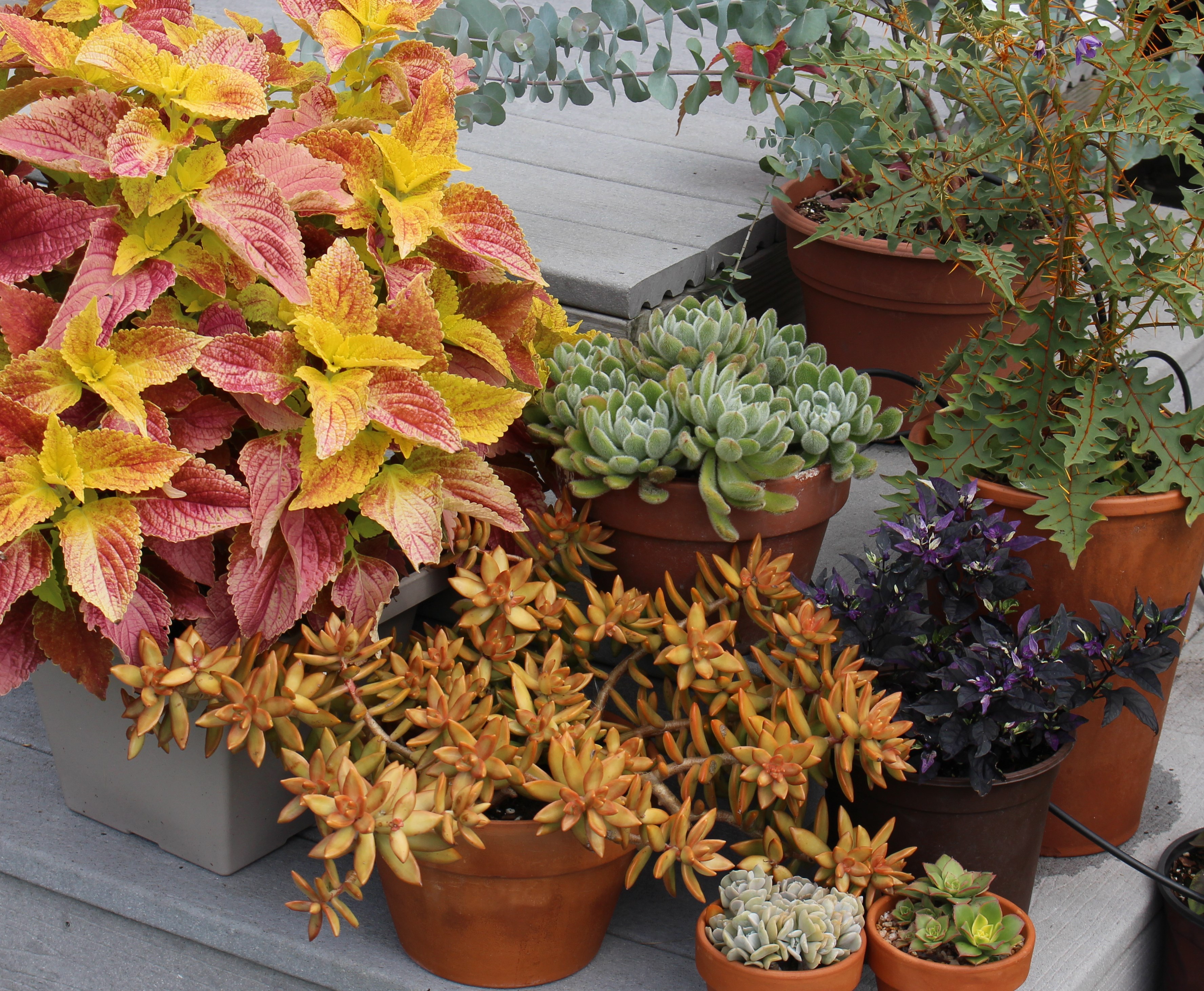
More succulents as well as ‘Alabama Sunset’ coleus, ‘purple flash’ pepper, and my belovedly spiny porcupine tomato.

It’s really way past time to do a catch-up post on this year’s deck planters (and hopefully I can come clean soon) but there’s only so much time tonight, and there’s still plenty of other foliage to consider in the garden.  For as exciting as flowers and color are, sometimes the eye needs to rest on a little green.  For me chrysanthemums are a nearly indestructible planting for some of the hotter, dryer, tougher-to-fill spots which could use a soft mound of green.

chrysanthemum foliage

Usually the iris in the back has nothing but sad, browning and yellowing leaves, but this year the rain has been enough to keep it growing strong.  The chrysanthemum on the other hand looks respectable for the entire summer, even when the crabgrass gives up.

Dry sun is bad, but dry shade is worse, and this year I’ve been surprised at how well variegated obedient plant, (Physostegia virginiana ‘Variegata’) has done.  In moist soil it may spread a little too enthusiastically, but here it seems downright demure, and I wonder if the straight green type would be as restrained.

Physostegia virginiana 'Variegata'

Physostegia virginiana ‘Variegata’ lighting up the shade.  It’s a dry spot full of maple roots, but the foliage on this plant still looks great.

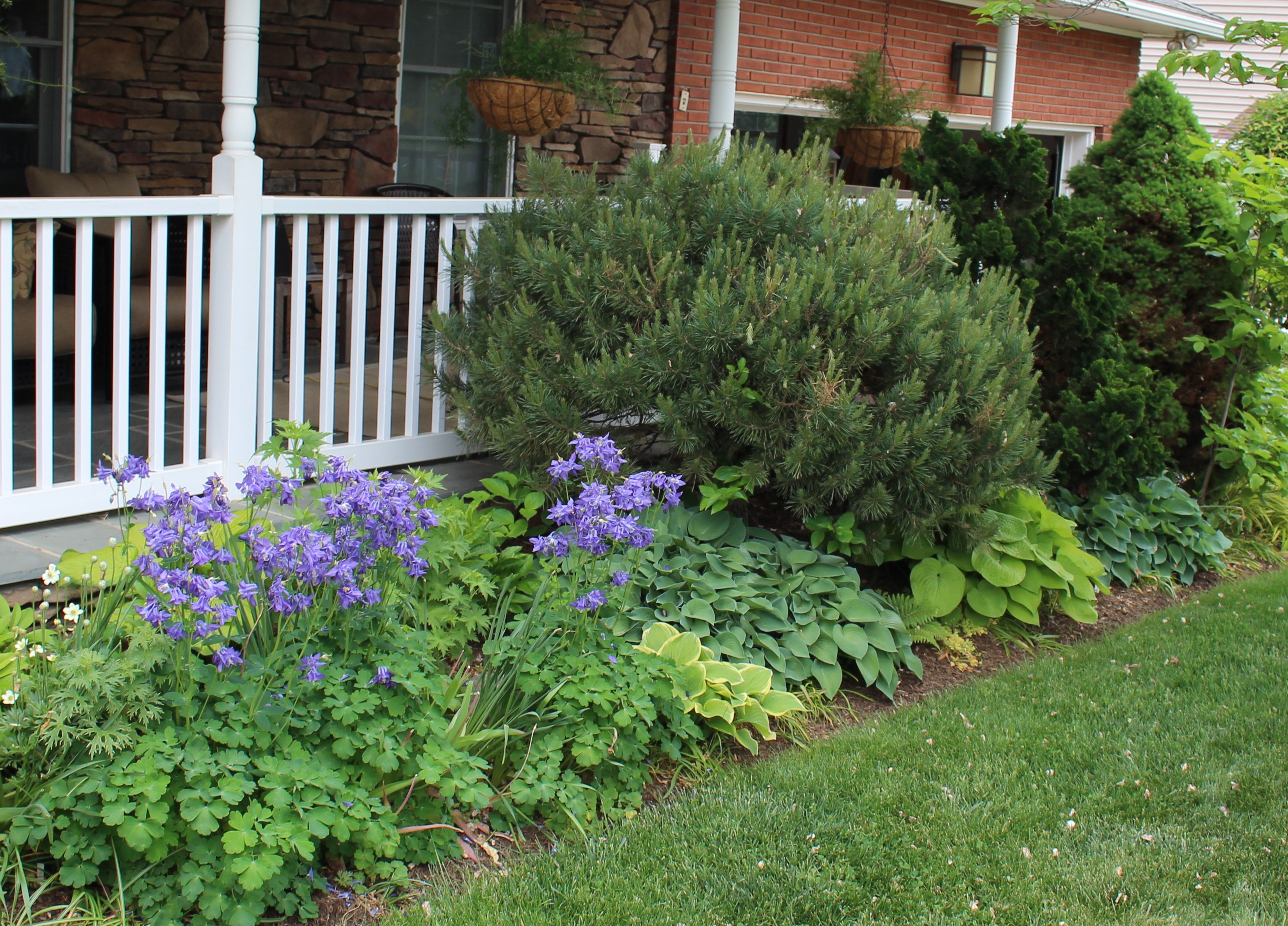
In my only bit of non-rooty shade I can always count on the calm contrasts of foliage form and color via evergreens and hostas.  Although things are beginning to get crowded here, I won’t mess with this planting until it starts to look desperate.

shade foliage border

Along the porch the hostas cover the spring bulb plantings and dwarf conifers shelter the porch without overwhelming it.  They’re all slow growing plants, but not too long ago I remember being able to easily plant between these shrubs.

The calm of the shade garden is always appreciated in summer, but in sunnier spots August means flowers, and I do try for plenty of that as well.  Even with all the flowers though, a good foliage background can make a world of difference.

cannas and dahlias

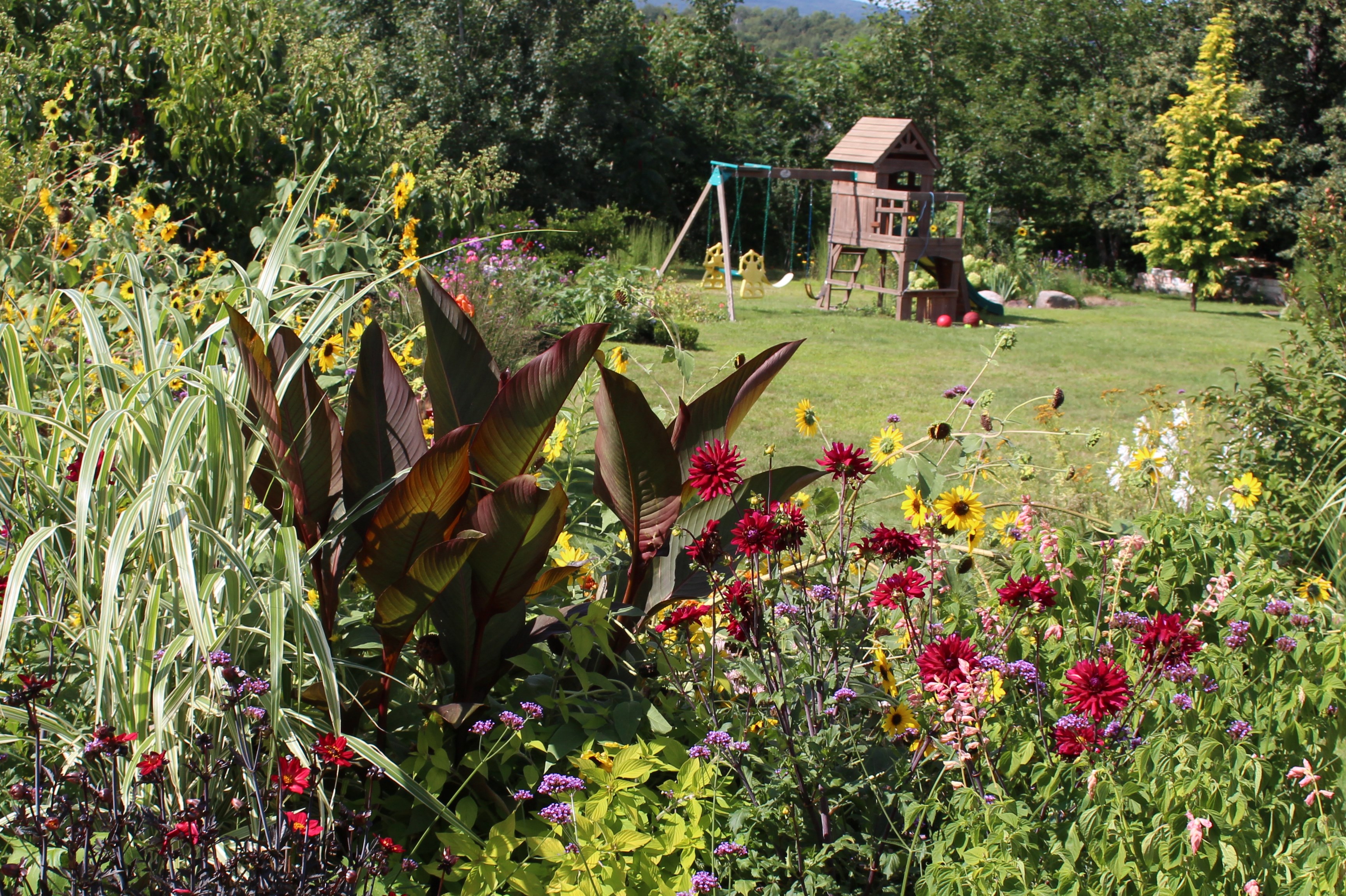
The rich red flowers of dahlia ‘Mathew Allen’ set off even brighter next to the solid mass of the red-leaved cannas.   

I’m all for the masses of flowers but you sometimes need a rest here and there and a mass of foliage can be just the ticket.  For next year I’m already nursing along a few new bananas and elephant ears and I think things will look a little different in this border.  If worse comes to worse though I can always replant sunflowers 🙂

cannas and sunflowers

More cannas trying to keep their chin up against the tide of sunflowers which still swirls around the tropical garden.  In my opinion this bed could have used a few more masses of foliage to balance out all the bloom. 

So there are some August musings on foliage from my neck of the woods.  If you’d like to dabble a little deeper give Creating my own garden of the Hesperides a visit.  Each month on the 22nd Christina provides the platform there to host a foliage review, and I’m sure you won’t be disappointed by the foliage musings of bloggers from around the world!

Down on the farm

Late August is bathing us in heat this year and the steady rains have brought on the harvest.  We modestly refer to our garden as “the farm” or “potager” and this is the time of year when it shines.  Produce begins to trickle in and suddenly there’s a little more interest in the backyard.

harvest from the garden

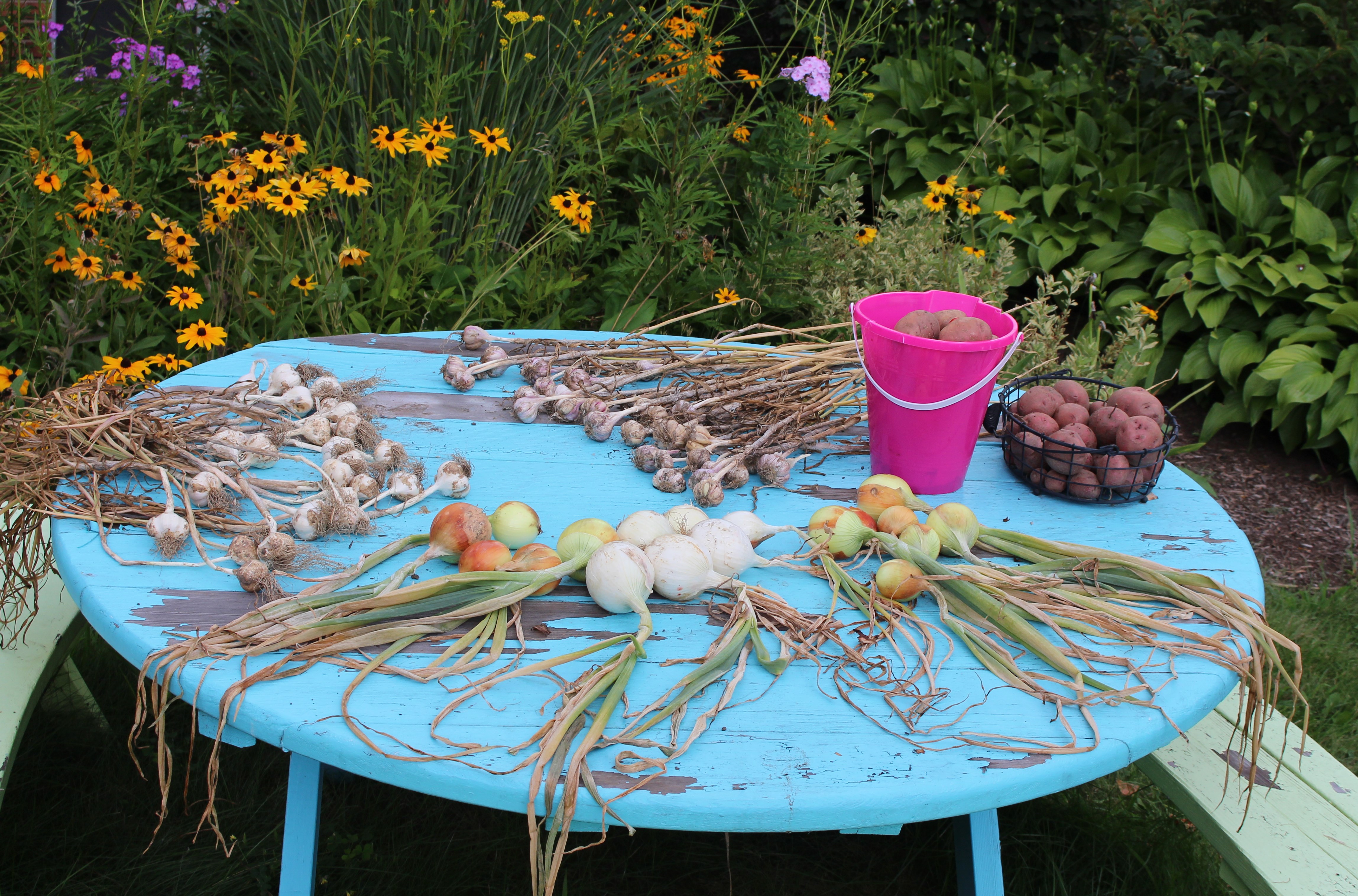
The picnic table is the place to be for drying off and cleaning up before the kitchen.  Garlic, potatoes, and the first of the onions started the month off.

Eggplant and peppers have been going out, onions are always popular, tomatoes are on their way, and beans are yet to come.  The harvest is late due to planter’s procrastination but who out there hasn’t ever fallen behind?  At this time of year even I fix up a plate of veggies, and they aren’t even deep fried 🙂

IMG_8425

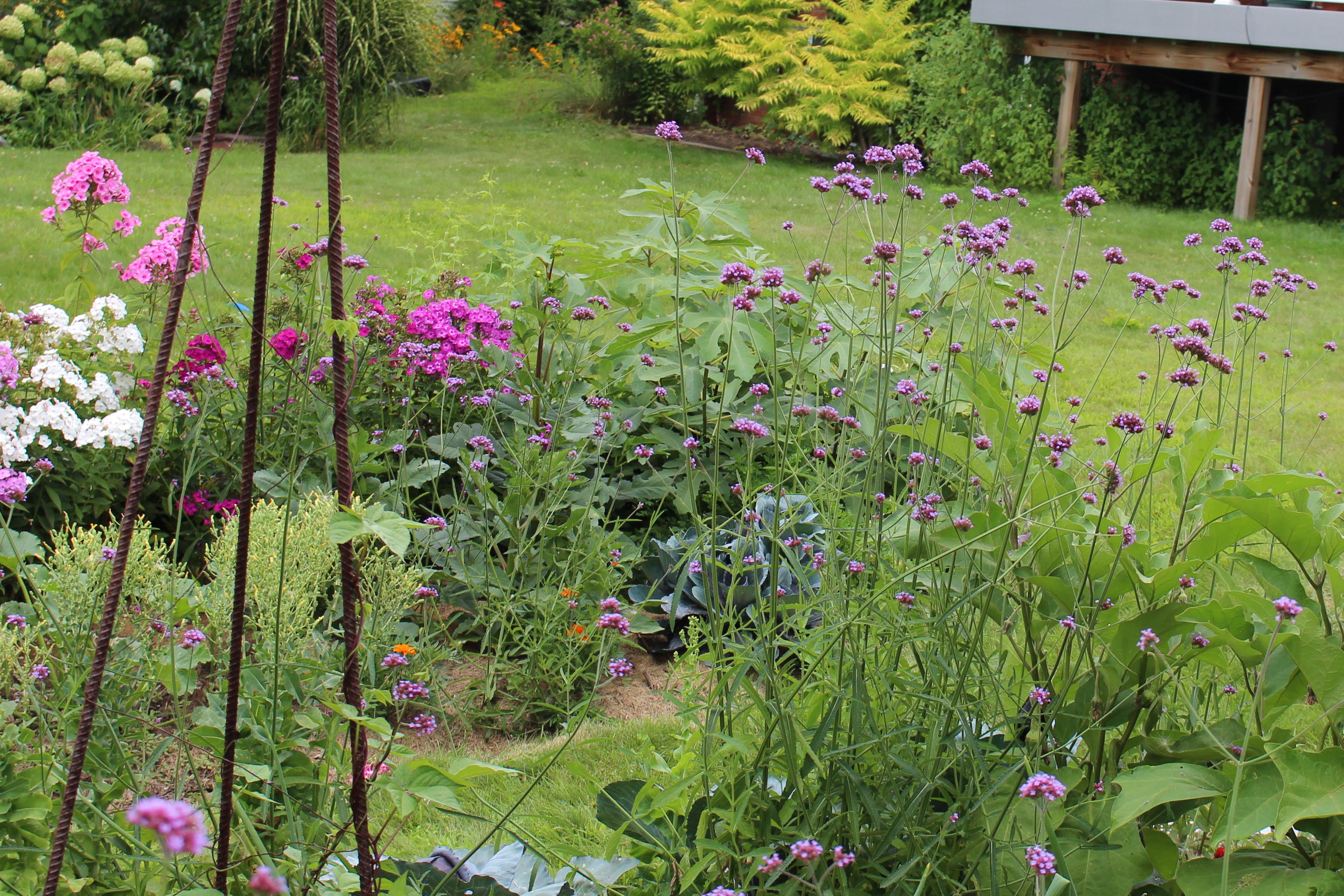
I grow red cabbage just for the looks, but there’s a good chance these heads will disappear soon and show up again later as rotkraut.  Fine by me, but in the meantime they look nice with the verbena, eggplant, and marigolds.

I admire a neat garden with raised, raked beds and straight rows of perfect plantings, but that’s nowhere even close to my garden.  The potager is tumbledown mix of flowers, crops, and all kinds of odds and ends that found an open spot of soil and made it their home.  Phlox are never turned away, and earlier in the month they started their summertime concerto and the music still plays on through the heat.  For this I consider myself lucky,  since earlier in the spring between spidermites and drought I got the feeling it would be a down year for the tall garden phlox (Phlox paniculata).

phlox paniculata dorffreude

Phlox paniculata ‘Dorffreude’ (Karl Foerster introduction, 1939) making a good argument that newer isn’t always better.

The phlox make me happy, but the other flowers which add to the non-agricultural chaos also make me smile, and the tall Verbena bonariensis leads the way with their bee and butterfly attracting bloom heads.

IMG_8305

Now’s the time when the verbena becomes too attractive to pull.  It’s a fair trade-off since the flowers draw in nearly every passing butterfly.

One area of responsible neatness is the boxwood hedge which edges the two forward sides of the garden.  After three years the small plants have finally begun to look nearly respectable.  To celebrate this milestone I spent way too much money on what I hope will be a set of premium hedge shears.  The electric trimmer has been shelved and I took the quieter, more contemplative path of manual trimming.  For me it’s relaxing and I think I’m one of the few who actually enjoys this job.

training boxwood hedge

Slowly the boxwood hedge fills in.  I can still remember the summer day way back when me, a bucket of boxwood clippings,  a few trays of potting mix, and a couple beers started this all.

Besides boxwood and phlox, chrysanthemums (ok, new name dendranthema) are starting to make a serious play for potager real estate.  This spring I added even more of the larger flowered football types, trying to stick with anything which might be hardy through the winter.  I’d try to explain this growing obsession with mums but honestly after just admitting I enjoy hedge trimming I’m not sure there’s much I can say to defend this last quirk.

hardy football mum

Hardy (hopefully) football mum.  If the mood strikes next year I may even try disbudding a few of these to see if I can force all the plant’s energy into one single, perfectly large, perfectly perfect, bloom.

Dahlias.  I like dahlias.  I think I’ve already confessed to that.  Of course a late planting gives late flowers, and you know me and late.

moonlight dahlia

Dahlia ‘Moonstruck’.  This is its third year and it has yet to let me down, although I suspect it carries a virus which causes the leaves to yellow and die way too early in the season.

Sometimes late isn’t anyone’s fault.  For the second year in a row I’ve had these gladiolus bulbs overwinter in the open garden.  Against better advice I even transplanted them in June and look at that, the clump still managed to send up two bloom stalks.  If this keeps up I’ll need to divide the clumps next year since the other clump is up to 8 flower stalks!

winter hardy gladiolus

Just your average hellebore-gladiolus-rudbeckia-tomato planting.  I don’t think you’ll find this combo anywhere else… probably for good reason 🙂

But procrastination does have its down side.  Although the persicaria and rudbeckia have never looked better next to the potager, the light green ‘turf’ in the bed is 100% weeds…. and this is still supposed to be a red border, which rudbeckia is not.  Also the trellis never received a solid footing, and was never officially planted.  I guess that’s what the plans for next season are made of!

persicaria red border

persicaria red border

Enjoy your own harvest, whether it be fruits or flowers, contentment or excitement.  The season is here and as long as the heat doesn’t kill you first you can shelve these moments away in your mind for those dark days in January.


The sputtering tropics

Again I’m trying to recapture the tropical gardens of years past, but again I’m falling short.  The fault is entirely my own though and I know that, but in NE Pennsylvania tropical plantings mean around six months of empty planting area and I just don’t have enough self control to keep them perennial and bulb-free.  Really… in October how bad can it be to slip in an extra daffodil or lily?

liberty hyde bailey lily

First year blooms on ‘Liberty Hyde Bailey’.  Photo credits for this artistic shot go to the wife,  to tell the truth I wasn’t so sure she even knew where the garden was, let alone was interested in taking any pictures 😉

To my credit serious mulching with every scrap of mulched leaves and any garden debris I could send through the mower has substantially reduced last year’s problem.  The problem was that this bed was overrun with sunflowers, and if we ignore the fact that the gardener himself was responsible with planting them we can pretend that only having a half dozen or so of the plants this year is an improvement.  Still a few self seeded anyway and hopefully this more manageable patch won’t again overshadow the ‘tropical’ look with ‘overgrown agricultural’.  -and for the record I did rip out at least another dozen healthy sunflower seedlings, and nearly drove myself to drink over the guilt (but after a hard day of work what gardener doesn’t deserve a cool drink?)

saving money on mulch

A few sunflowers coming up but hopefully enough bright color and big leaves to make it look tropical.  I only had enough bark mulch for the outer edge, the rest is lawn clippings.

Mulching has been an obsession lately.  I raided the neighborhood woods again and brought home a few wheelbarrows of stinky dumped grass clippings which I used to cover the inner reaches of the bed.  It was just in time to smother tons of baby weeds but most importantly the rotting grass was a solid dose of fertilizer for all the little goodies coming up.  Within a few days everything turned a lush green and started putting out new growth.  It was amazing what a difference the grass made and I’m sure the earthworms are pleased as well.  In order to keep it more presentable I robbed some leftover wood mulch from next door and tidied up the edges of the bed with a few shovelfuls of that.  It’s the dyed mulch which I’m not crazy about, but it being free really appealed to my budget sense.

mulch and paver pathway

I also leveled and set the mismatched stone and paver bits which pave the shortcut between our yard and grandma’s pool.  It looks halfway decent now and is much less of an ankle twister.

Even with plants in and mulch applied, the bed is still not out of the woods.  There’s always a problem child or two.  First it’s the chrysanthemums which I planted and meant to transplant once spring rolled around.  That didn’t happen and to add insult to injury they are coming into bloom now…. just when I don’t need fall color.

mammoth yellow quill chrysanthemum

‘Mammoth yellow quill’ chrysanthemum looking good in July.  I guess next year I’ll pinch in May and try to delay bloom, mums in September would have been nicer!

Another problem are the two cannas I bought.  They were from a reputable online nursery and were listed as showing no signs of virus, but the first leaves tell a different story.  A refund is already on my account but I really wanted to add a healthy canna ‘Musifolia’ and ‘Pretoria’ to the bed.  the leaf streaking and yellowing/browning patches are sure signs of canna virus so these have regrettably been thrown to the trash.

canna virus

These leaves should have a lush, solid green, but instead are showing the streaks and mottling of canna virus.

As usual the third problem child is me.  How could I pull out this lusty little bull thistle?

bull thistle in garden

An excellent example of a weed.  The goldfinches will appreciate the seed heads of this thistle, and surprisingly enough I don’t get many seedlings even when I let them grow.  They seem to need open soil to sprout which is not easy to find around here.

As the tropical garden puts on some weight and gets ready for August I’m going to see if my tidying and weeding streak can finally extend next door to the not-so-red-border.  It needs the help, but so far all I’ve managed is the start of an access path which will circle around through the back of the border.  I’ve been eliminating the weedy campanulas and moving out other plants but still have a long way to go.

a new path into the flower beds

The start of a new path through the back of the red border.  Unfortunately that was as far as my free mulch would take me….

What is summer without a few projects?  Hopefully my neighbors will oblige me with more grass clippings, maybe temperatures will stay low, and maybe I can blaze a path through the thicket which is beginning to take over.  I won’t even mention the water filled hole which has formed where the pond used to be.  All the rain we had has made this area into a soggy mess!

hemerocallis altisima and raspberry wine monarda

Topping out at around 5 and a half feet, this daylily (hemerocallis altisima) looks cool with the dark blooms of ‘Raspberry Wine’ monarda and a few other leftovers from back when this bed was loved.  The tall grass (Miscanthus giganteus) is thriving on all the extra rain and is at least two feet over the neighbor’s six foot privacy fence. 

I guess it’s a start, and time will tell if it’s also an end.  With two weeks of vacation coming up and plenty of weekend trips in between, I may just sit back and enjoy summer rather than sweat out another bed re-do.  The wooliness doesn’t seem to bother anyone other than myself and digging is always more pleasant in September!

At odds in the meadow

For as much enjoyment as the meadow garden brings one gardener here, there is another who despises the long grass and messy arrangement of color.  She’s also one who has no interest in snowdrops and can’t tell a zinnia from a marigold, but before the name calling starts lets just say the meadow garden is not as popular as one might expect.

seating in the meadow garden

The meadow garden in June with appropriate summer seating.

This “garden” amounts to little more than an area of the yard which has been left to fill in with whatever flowers and grasses can make it in the thin, poor soil.  In a normal year this 20×60 ft area is a sea of waving grass gone to seed, but coming off last summer’s drought and this spring’s dry spell the grass is a little threadbare and the rudbeckia and butterfly weed (Asclepias tuberosa) stand out more.  On a whim I allowed a few quaking aspen(?) and staghorn sumac (Rhus typhina) to grow up and screen the fence but now these sun hogs are under the protection of the non-gardener and I worry they will further suck the life out of the meadow.

Rhus typhina staghorn sumac

Pennsylvania is not a meadow state and the trees and shrubs are always making advances.  We’ll see how much longer the aspen and   staghorn sumac (Rhus Typina) are allowed to stay. 

I guess easy come easy go is the theme for this area and there will never be any regret for the time not wasted in mowing yet more lawn so we’ll see what happens.  It always gets a haircut by the end of summer but I suspect a few trees will need to go sometime soon.

rudbeckia hirta meadow

The far end of the meadow.  The ‘Annabelle’ hydrangea is not your typical meadow shrub, but I’m sure it is one plant which does enjoy the growing afternoon shade…. as well as all the rain we’ve had recently.

My apologies for a post which deals mainly in weeds.  As you know the garden needs more attention at this time of year than there are hours in the schedule so I’d like to leave you with the illusion that the rest of the garden is well under control.  That may or may not be the case, but hopefully with our upcoming holiday weekend a few things will get done.  Happy Independence Day and enjoy the weekend!

The softer side

It’s not all prickles and barbs here, there are a few fluffy gobs of pink which have found their way into the garden and onto the kitchen table.

sarah bernhardt peony

Peony season is here and in my opinion the best place for them is a vase.

Nearly all the huge blooms end up being cut and brought into the house, they’re so heavy that even with strong stems the flowers end up down in the dirt.  Staking would be an option but cutting is far less work, and often they last longer in the house protected from the weather.

pink double peony

There’s no simple grace in a double peony, it’s all fat opulence and fluff. 

This anonymous peony was purchased as a single pink and it’s not even close, but I love it anyway.  A wild guess would say it’s ‘Sarah Bernhardt’ but the blooms barely have a fragrance and from what I read Sarah should have scent to spare.  No complaints though, fragrant blooms are not welcome in a house full of allergy cursed and fragrance sensitive noses.

peonies in a vase

Possibly ‘Sarah Bernhardt’ peony?

Even though the flowers do nothing for the nose, I love running my hands over the flowers and teasing the flowers open.  It’s a habit my grandmother would always complain about, saying it would ruin the flowers.  She was right of course, but peony season is so short might as well enjoy them, plus burying your nose in a peony is far safer than snuggling up to a thistle 🙂

Check one corner off

There were a few cool days last week and I was able to drag myself out into the garden and give the vegetable beds a once over (in spite of the dry soil and high pollen counts).  I think it looks as good as it gets, and with all the unintentional flowers it may be fancy enough to call a “potager”, as Annette from Annette’s Garden once called it.  I like the name and it’s stuck.  It has just enough Continental refinement to make me laugh a little when I look at the plastic fencing, weedy sumacs, chainlink and neighboring industrial park!

the potager vegetable garden

The potager with neatly edged beds and way too much disorganization.  By now the warm weather vegetables should already be in but with last week’s frost I’m kind of grateful for my procrastination.

The work always goes faster with a good helper or two, but studies have shown that nine year old boys don’t typically fall into that category.  Still the company is welcome.

kids in the garden

A few edible things are starting to fill the beds but I’m always proudest of the fancy pink marble edging which line the plots.  In a former life the stone accented the front of the house, but now it helps edge the beds.  The look has been called “deep south cemetery” and I’m sure that’s a compliment. 

Ok, so even freshly weeded it’s still kind of messy, but I’m far too proud of the crisp edge along the lawn and the freshly mulched boxwood to let that keep me from posting a photo.  Our little Queen of the Prairie” must agree.  She overlooks the potager but has seen better days as the weather continues to eat away at her plaster self.  Might be time to start hitting the estate sales to find a successor.

boxwood edging vegetable beds

A very rarefied boxwood edging lines the outer perimeter and I think it really elevates the standing of my hodgepodge of plants.  Hopefully I can enjoy it for a few years now that it’s finally growing in, especially since  so many European and New England gardeners are facing multiple boxwood problems … blight, caterpillars, ugh.

The iris are at their peak.  I should really evict them but never do.

iris in the vegetable beds

Seems like for every iris clump I remove a few new ones pop up.  The compost usually brings in a few but the gardener also tends to feel bad for spare plants and ends up putting the innocent little fans in here and there.

I don’t know what to say about this clump.  Two years ago I dumped them here when I needed their real estate for a tomato planting.  I never replanted them but apparently they don’t care.  Two years in an iris bed with no bloom, two years of being tossed to the side and they look great.  Go figure.

historic bearded iris

Their identities are probably lost, but I think the apricot-pink to the right is ‘Jean Guymer’.

It’s not all flowers, there are a few cool weather vegetables braving the up and down temperatures.  Broccoli, lettuce, potatoes, and garlic all look promising, but here the tomato seedlings still all need to be weeded out.  If I knew what they were I’d keep them, but I already have more than enough.  They’ll stay for a few days longer to keep the ground covered since I don’t want mud splattering up into the yummy little lettuce rosettes when I water.

lettuce mervielle quatre seasons matina sweet

Two favorite lettuces, the never bitter ‘Matina Sweet’ and the darker ‘Mervielle de Quatre Saisons’… which should get a delicious tender green heart in a few more days.

The heat was too much for the arugula.  The flowers are nice enough though, and I won’t mind weeding this one out for salads if it goes to seed.

arugula bolting to seed

Chives in bloom and arugula bolting as the weather gets warm.  Time to plant the summer crops!

Even with the weeding and watering there’s still a ton to do.  Some tulips and daffodils will hopefully start coming out this weekend and that should open up room for beans and squash.  It may still be May but I’m going to say summer is here, and the next big project will be summer annuals.  Even though the plantlets are anxious to get out from under the growlights, I hope to tackle one last big weed patch adjacent to the potager before all my energy is lost.  It’s the on again off again red border/ pond bed, and hopefully in the next few weeks there will be some progress there as well.

eliminating weeds from perennial bed

All kinds of weeds filling the red border.  I resorted to roundup along the fence and that’s the only reason it’s not a sea of campanula glomerata.

Wish me luck.  We had a good rainstorm come through this afternoon and everything seems to be letting out a big sigh of relieve (including my water meter).  Facing next week’s high temperatures with a still-dry garden was not something I was looking forward to, so I’m thrilled!

GBFD The Promise of May

On the 22nd of each month Christina at Creating my own garden of the Hesperides encourages us to look past all the flowers and blooms of the garden and take a second look at what foliage does to support it all.  I’m happy to once again take part in the fun, and what better month to do it in than May, the month where my garden really starts to overflow with the promise of the new season.  Lets start with the front beds where hosta and self sown columbine have now sprouted up and covered the snowdrop and corydalis beds of early spring.

blue columbine with hosta

These blue columbine were originally found in the woods behind the house prior to its clearing for industrial park.  They’re just escaped or dumped aquilegia vulgaris, nothing rare or unusual, but I like to keep them around as a reminder.  Plus they’re carefree.

This will be our seventh year here and after a slow, cash strapped and baby filled start I think things are finally beginning to look like something.  The colors and shapes of the front foundation plantings are still a work in progress but for now the look is finally something I’m no longer bored or annoyed by. – Cathy here are the variegated iris in bloom, they have a fantastic fragrance 🙂

mixed perennial bed as foundation planting

The just recently mulched, expanded and divided plantings of the front foundation planting.

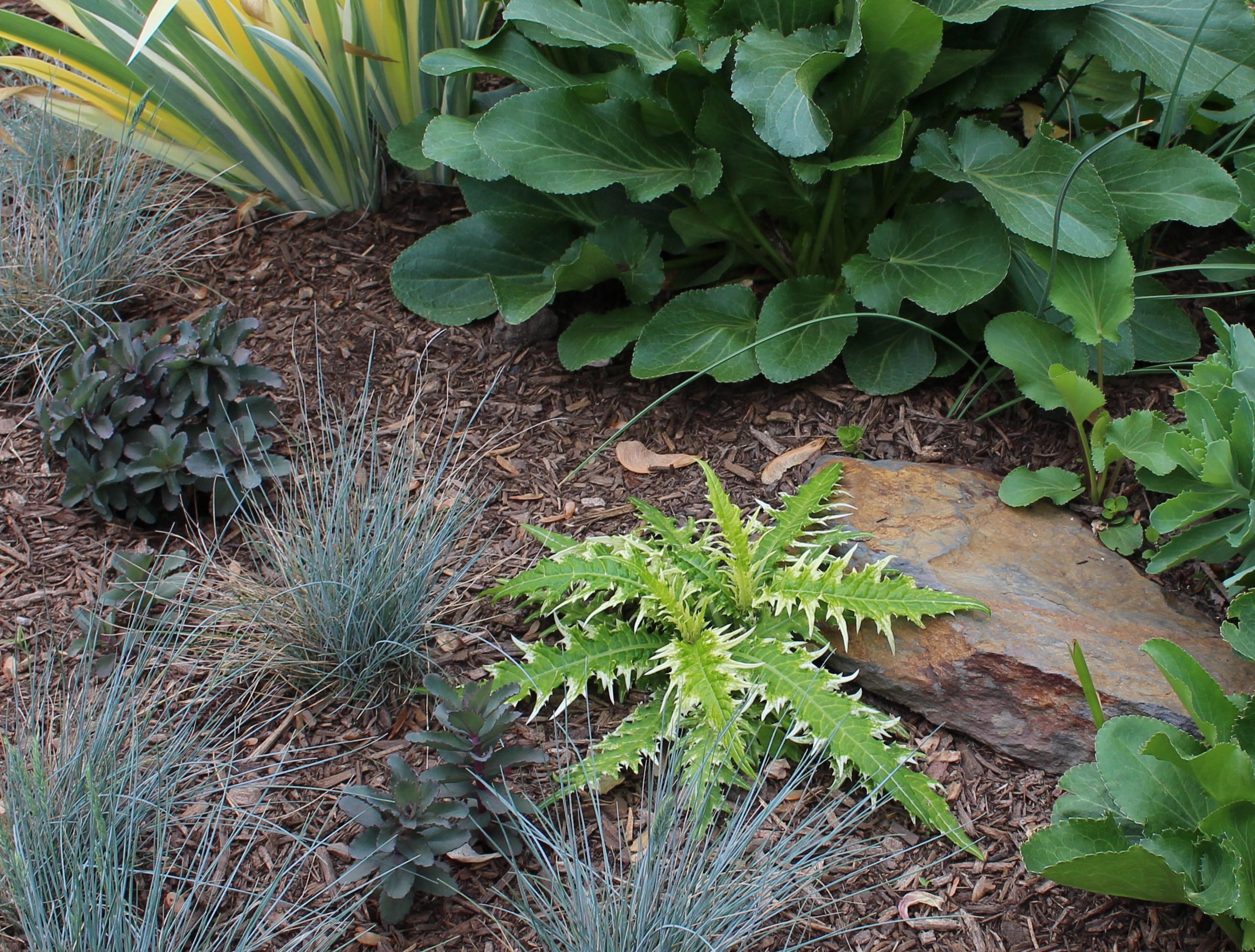
I love the different colors and textures out here at the moment, but my absolute favorite is the “white frosted” Japanese thistle (Cirsium japonicum).  I know I’m in a lonely position here, but the prickly thistles always fascinate me, and in my opinion variegation is almost always a plus!

Cirsium japonicum 'White Frosted' Japanese thistle

Cirsium japonicum ‘White Frosted’ with blue fescue and some just divided sedum ‘Bon Bon’.

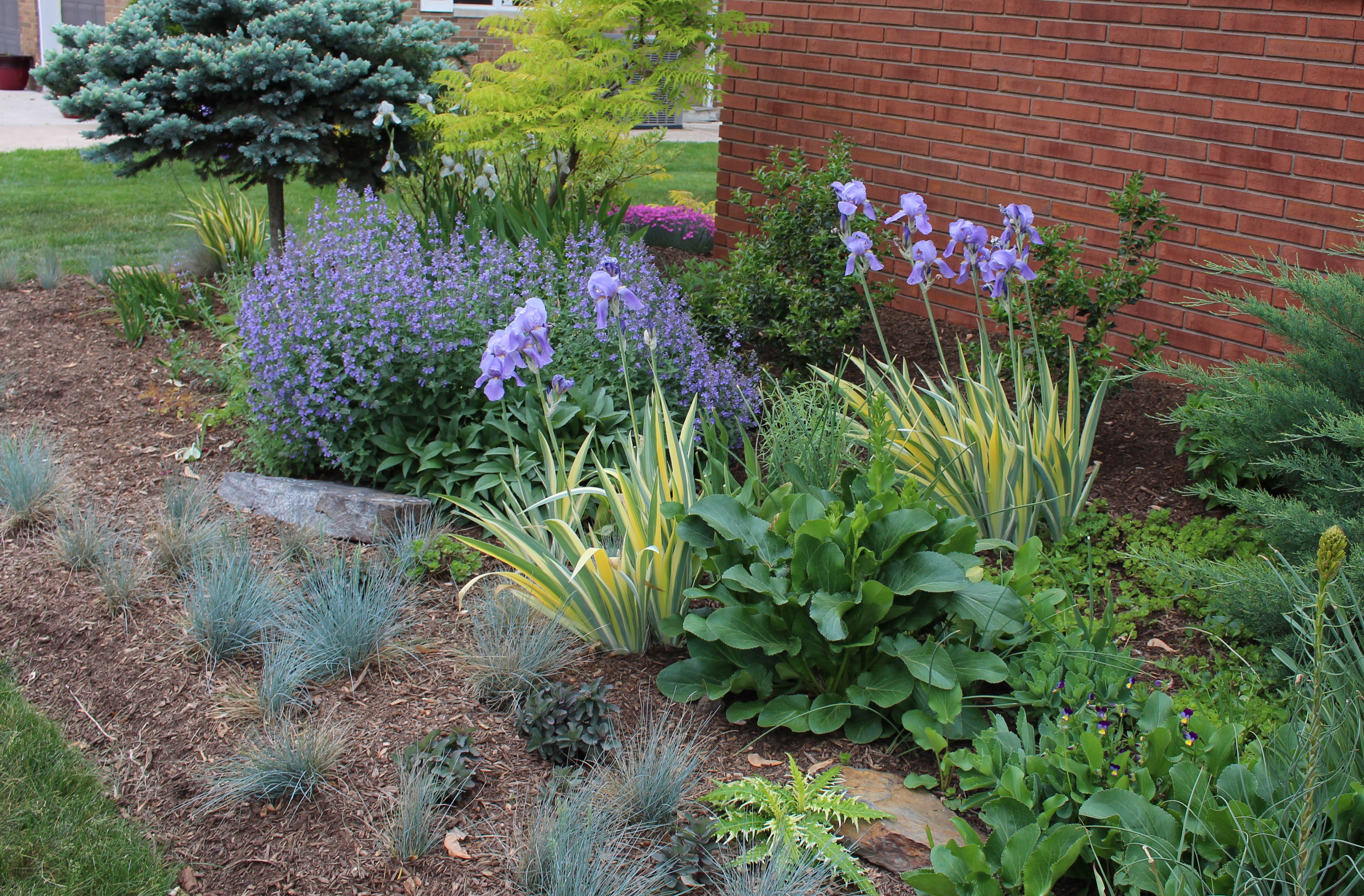
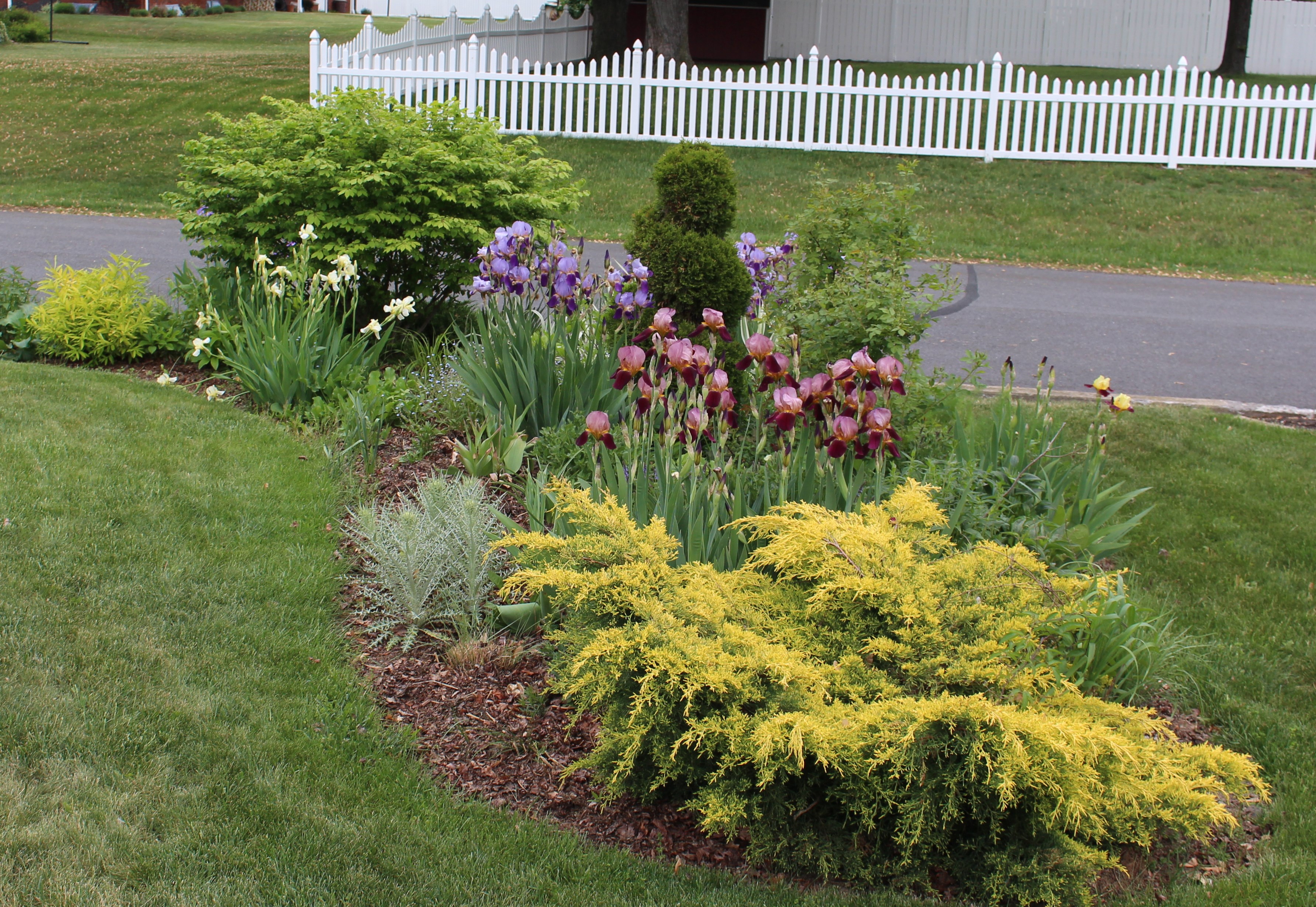
Even with the iris coming into peak bloom along the street border (it’s a good year for iris here), my favorite plant in this mix is the Ptilostemon diacantha.  Some see a spiny weed in need of pulling, I see some of the coolest foliage in the garden.

mixed border with historic bearded iris

Historic iris like the poor soil and hot, dry and sunny front border, and even though the pale yellow iris “flavescens” does not like the wind, the reddish ‘Indian Chief’ and lavender ‘Ambassedeur’ stand strong.

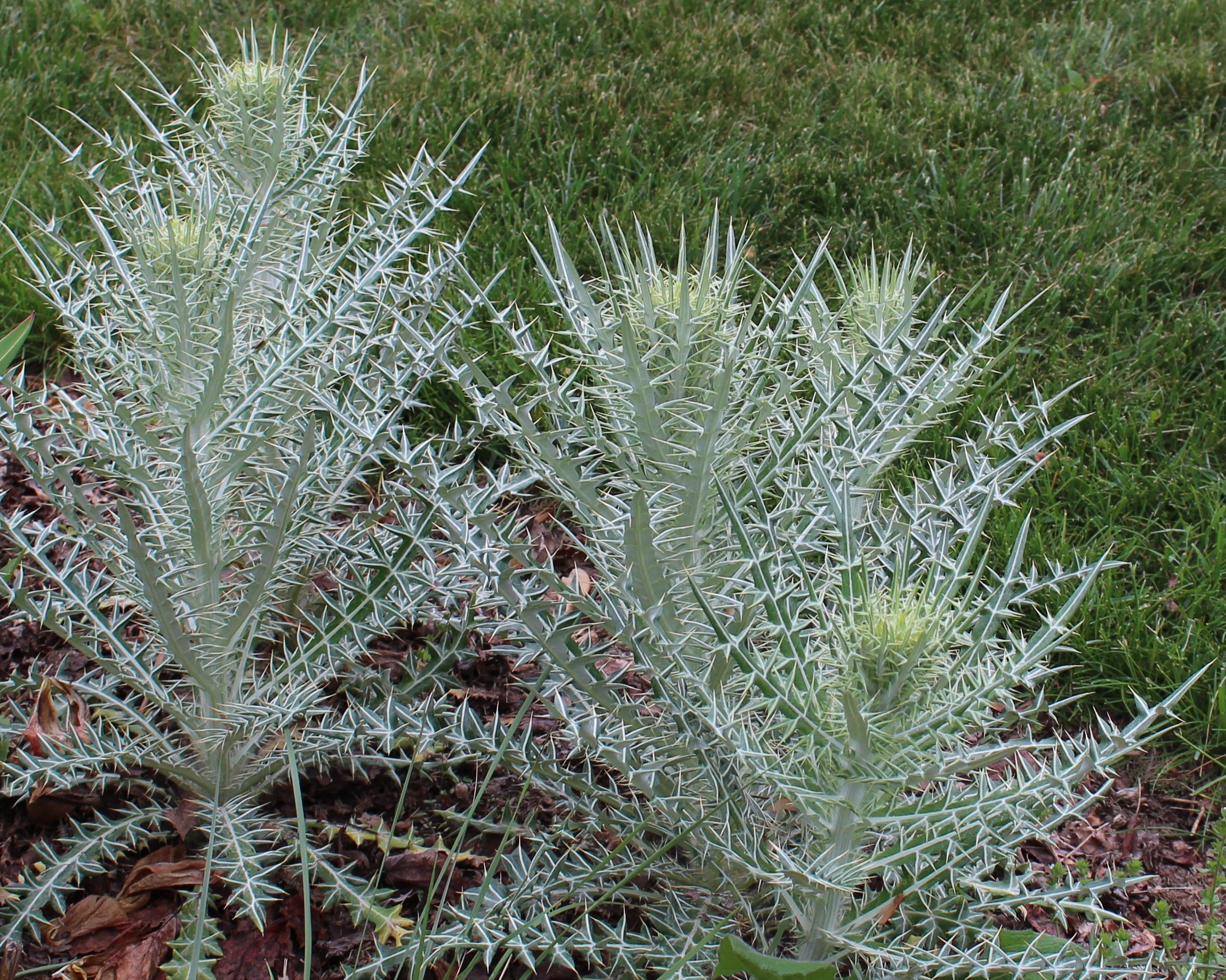
I know I’ve already shown this weed a couple times, but I’ve never seen it looking better…. not a difficult feat since this is its first time growing here!  I suspect the actual blooms will be a letdown, but the fine texture and pattern of the leaves…. 🙂

Ptilostemon diacantha

Foliage closeup of Ptilostemon diacantha.  A biennial thistle from the Balklands/Turkey region in need of a common name.  ‘Ivory thistle’ is the only one I came across and that one kind of bores me…. and with blooms of mauve I don’t see the connection.

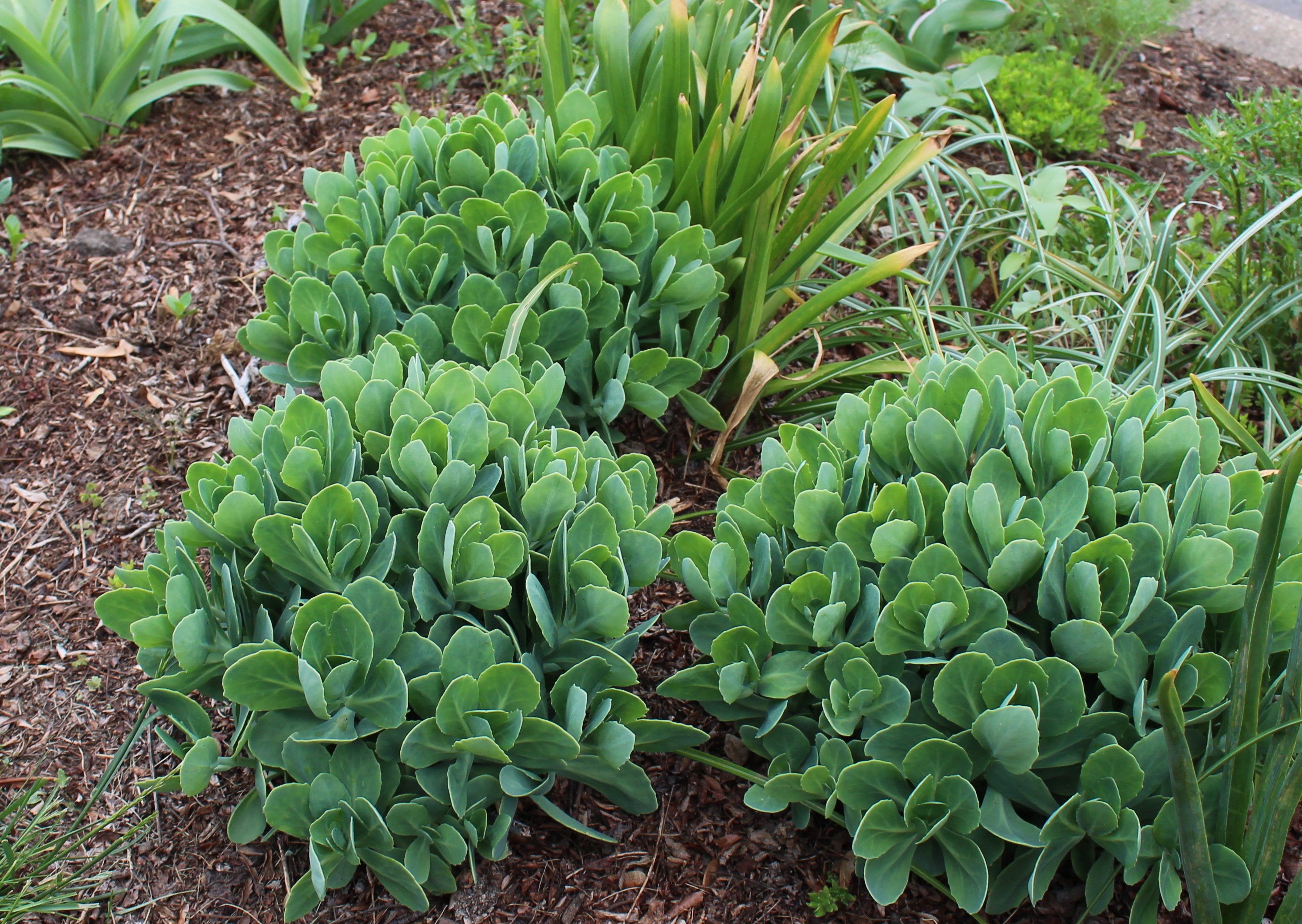
There are some friendlier foliages as well.  The juicy fat clumps of this unnamed sedum spectabile (apparently Hylotelephium spectabile is its new name) always make me smile, no matter how common they might be.

spring clumps of sedum spectabile

Spring clumps of sedum spectabile.  The common types are unkillable, and one plant survived for two years after I put the clump down on a stone step after being distracted while transplanting.

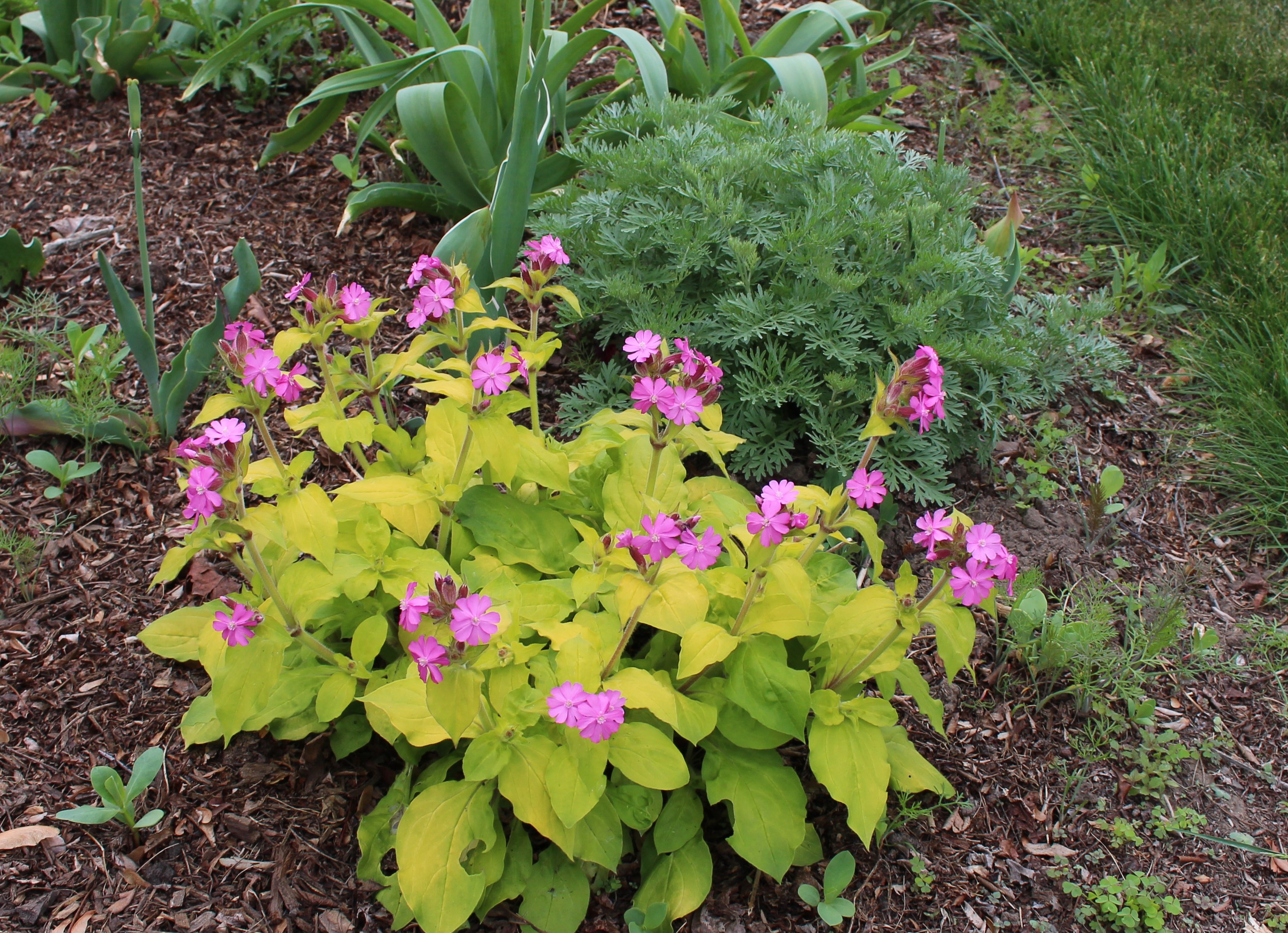
Another foliage favorite which I’m happy to have again is this plant of Silene dioica ‘Ray’s Golden’ Campion, which comes via seed from the talented Nan Ondra of Hayefield.  It’s short lived in my garden but easy to grow once you get the seeds planted.  Just rouge out the plain green seedlings.

Silene dioica 'Ray's Golden' campion

Silene dioica ‘Ray’s Golden’ campion with Artemisia ‘Powis Castle’ coming up behind.  This section of bed is still in need of weeding, fortunately the shredded leaf mulch has kept most of the little guys from sprouting.

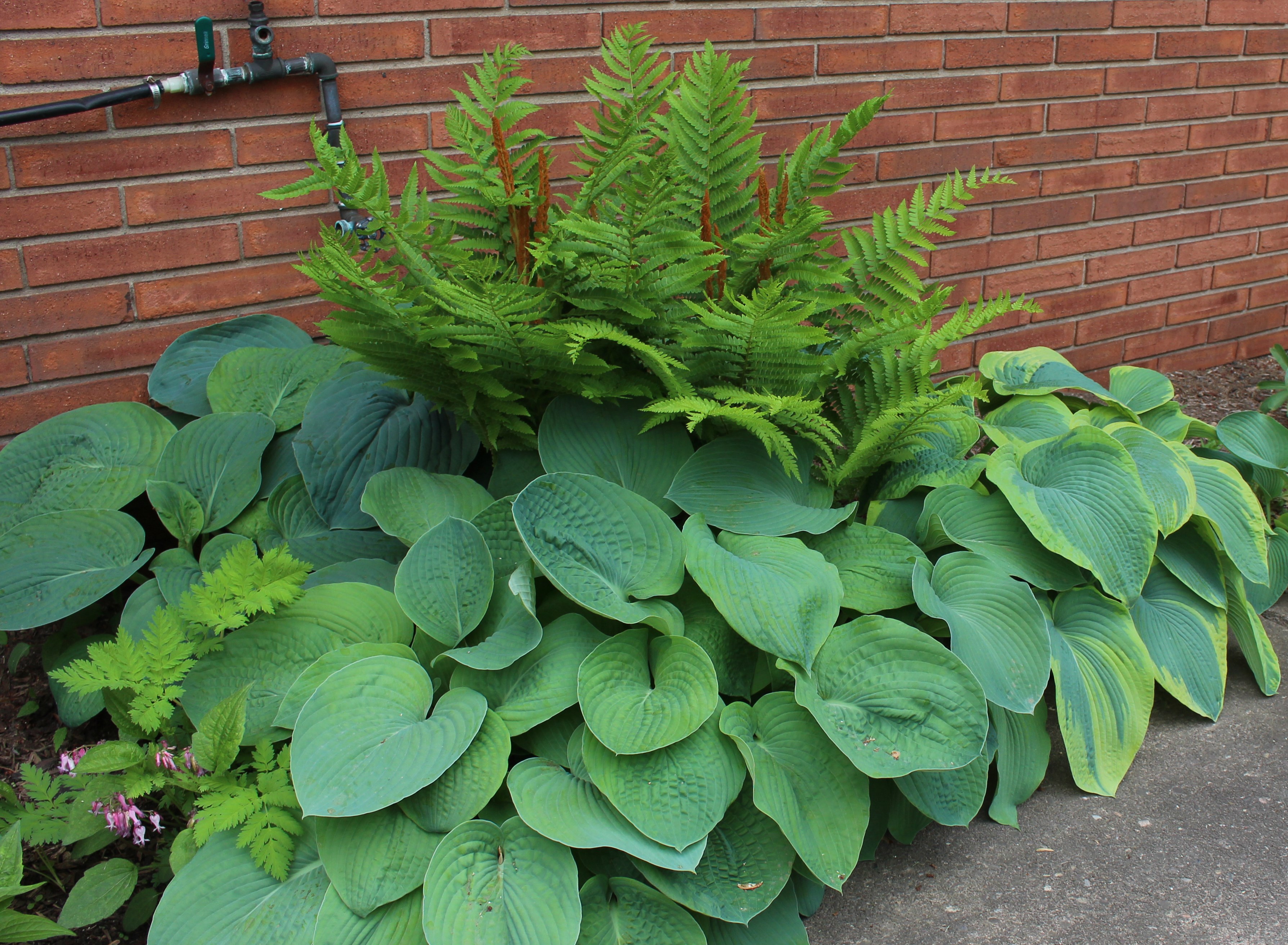
When you circle the house to get out back, you pass what comes closest to a shade bed in this mostly sun-baked garden.  A leaky faucet (left intentionally so for the plants… and laziness) keeps these ostrich ferns and hosta happy here under the dry overhang of the house eaves.

hosta frances Williams seedlings

Hosta ‘Frances Williams’ (just barely noticeable to the right) is the mother to all of these hosta seedlings.  I was curious to see if any would pick up mom’s variegation, but no luck.  All have a similar bluish tint free of any color streaks, a plain look but still beautiful.

The rest of this month’s foliage celebration are also a celebration of wintertime seed sowing.  Lets begin with the seed trays.

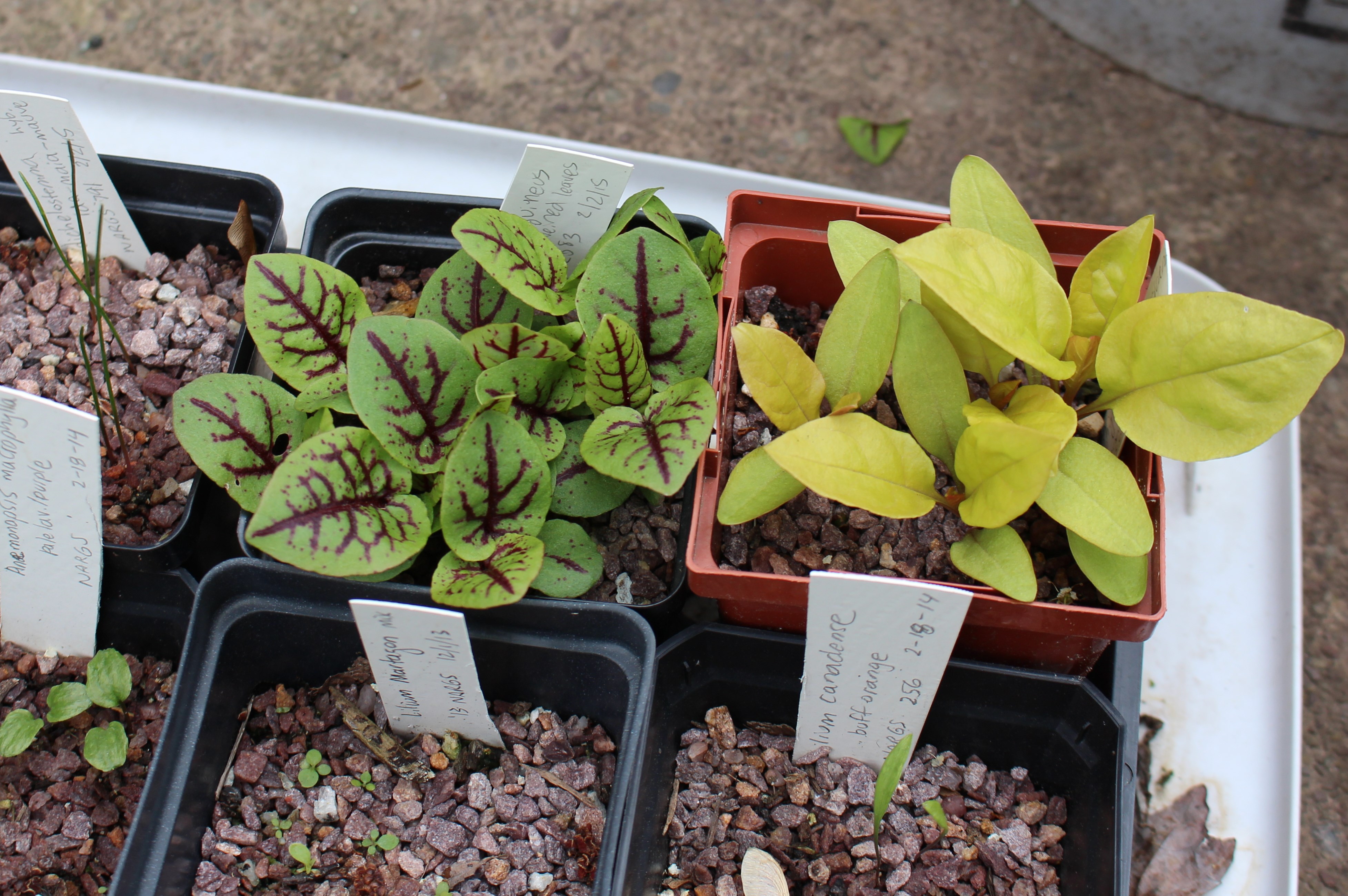
rumex sanguineus seedlings with 'sunny side up' pokeweed

My obsession with weeds continues.  Here the baby pictures of Rumex sanguineus seedlings with ‘sunny side up’ Phytolacca Americana next door make for a pretty combination.  Their common names of bloody dock and pokeweed sound much less special 🙂

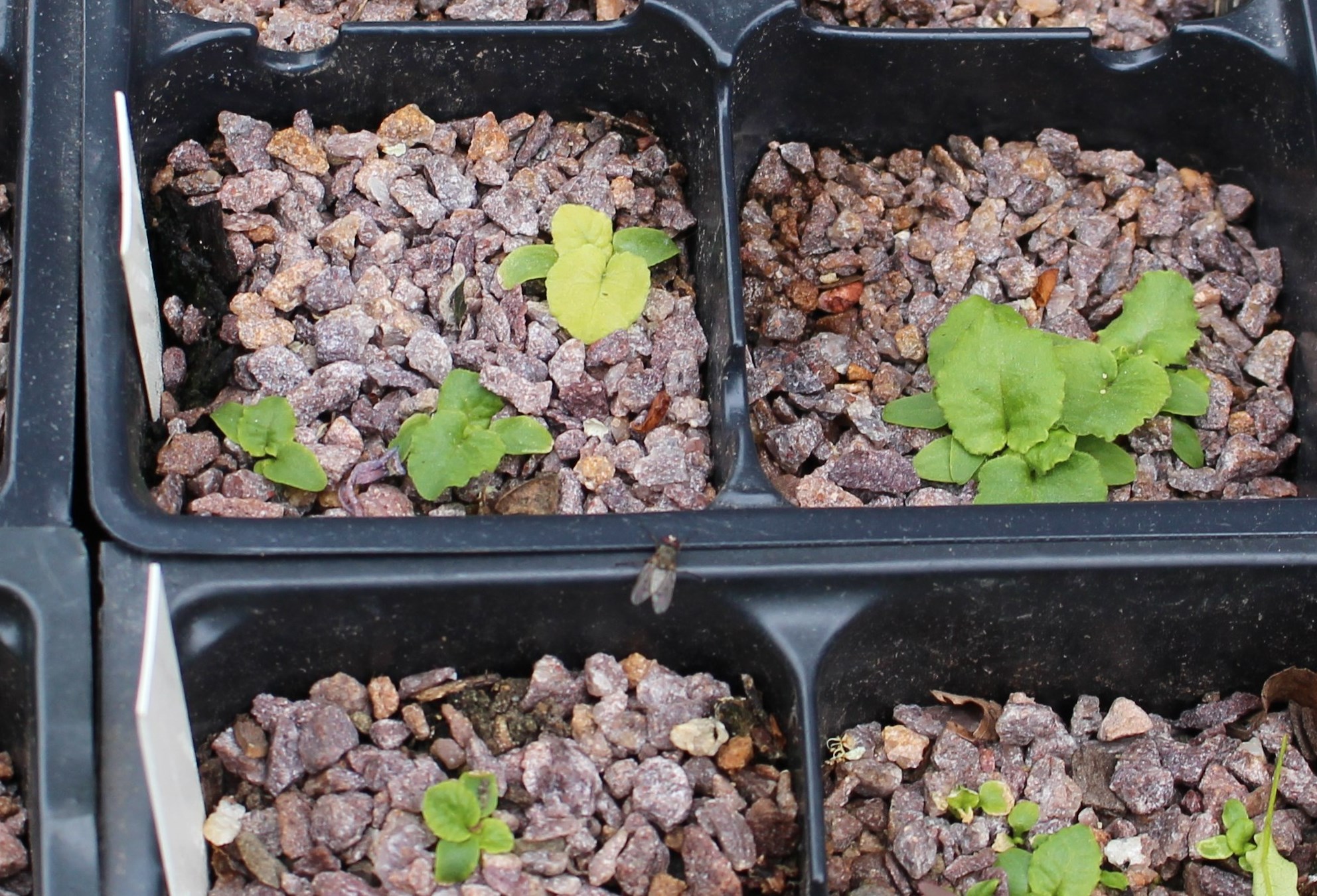
Any yellow leaved seedling is right up my alley.  Out of my American Primrose Society seeds comes this one little oddball.  My fingers are crossed I can nurse it along to adulthood.

primula polyanthus seedlings

Primula polyanthus seedlings with one yellow leaved sister.  I hope it stays this way and manages to limp through my on again off again care/abuse.  -don’t know why the fly had to photobomb the center of this photo.

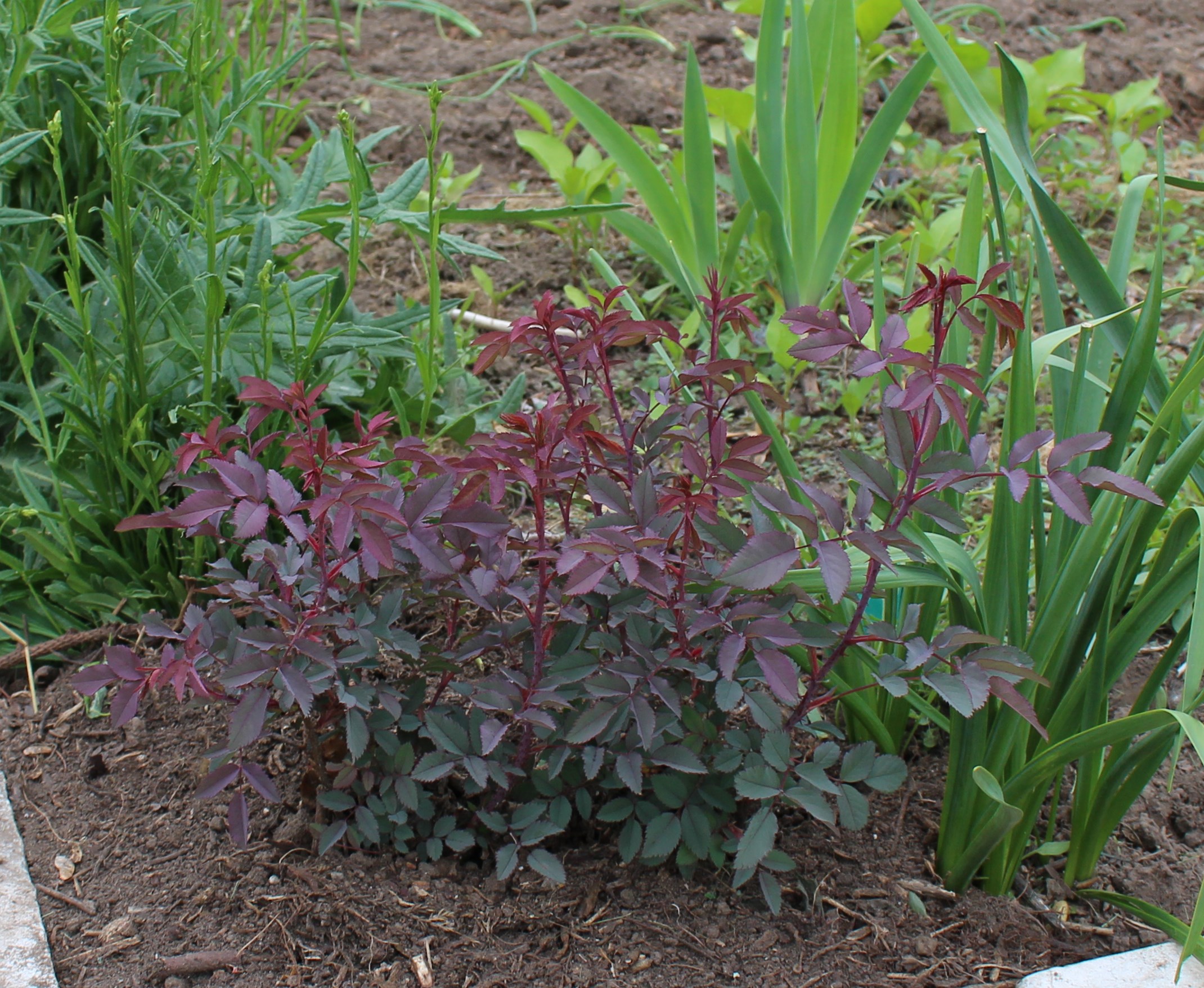
Another seedling which has somehow escaped neglect and abuse is this third year Rosa glauca.  I’m looking forward to seeing this one take off, it just needs to go somewhere other than the tomato bed.  Or not.  Maybe it would look nice next to a couple golden cherry tomatoes 🙂

rosa glauca seedling

Rosa glauca freshly mulched with a shovel full of compost.

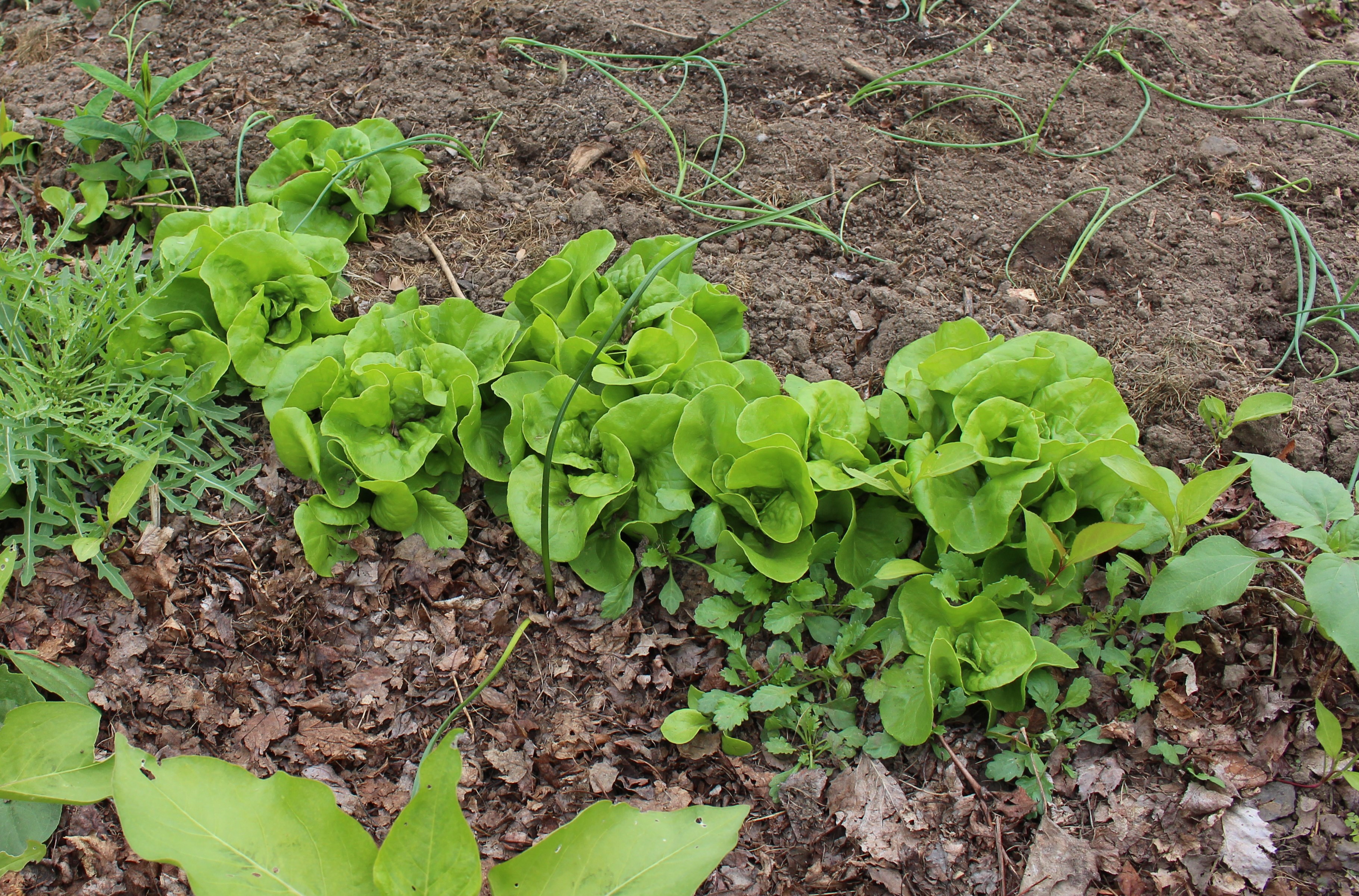
Sometimes neglect pays off.  The lovely leaves of this lettuce crop are the result of not removing last year’s leftovers until they had bolted and gone to seed.  They’ve even come up in a row as this was a ridge of soil where the mulch was blown off during some winter storm.  Dare I say this planting is nearly as nice as the seedlings I fussed over for weeks indoors and then carefully transplanted and nursed along?

self sown lettuce seedlings

The quality of my weeds is really coming along.  In this photo there’s lettuce, a nice bunch of arugula, phlox, daisies, a daffodil and sunflower.  I must stay strong and remove them all… this really is the only spot left where there’s any chance of fitting in a pepper.

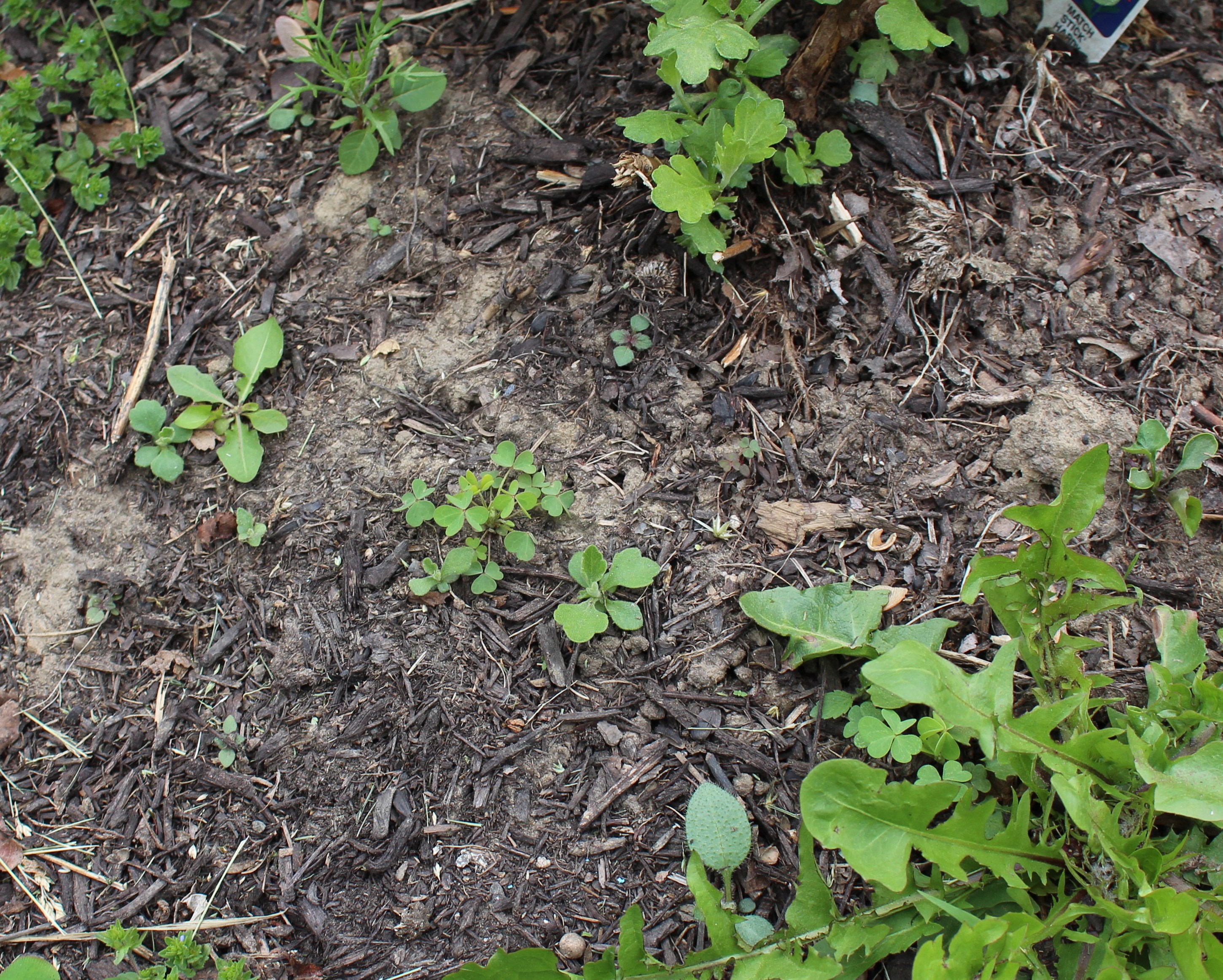
Another weed problem are the many chrysanthemum seedlings sprouting around last year’s plantings.  I must rip them out as well, I have no room for more mums… says he who has a dozen more new little pots in need of planting.

chrysanthemum seedlings

Not sure why I’m posting weed pictures, but you can make out the tiny leaves of chrysanthemum seedlings here amongst the dandelions and clover.

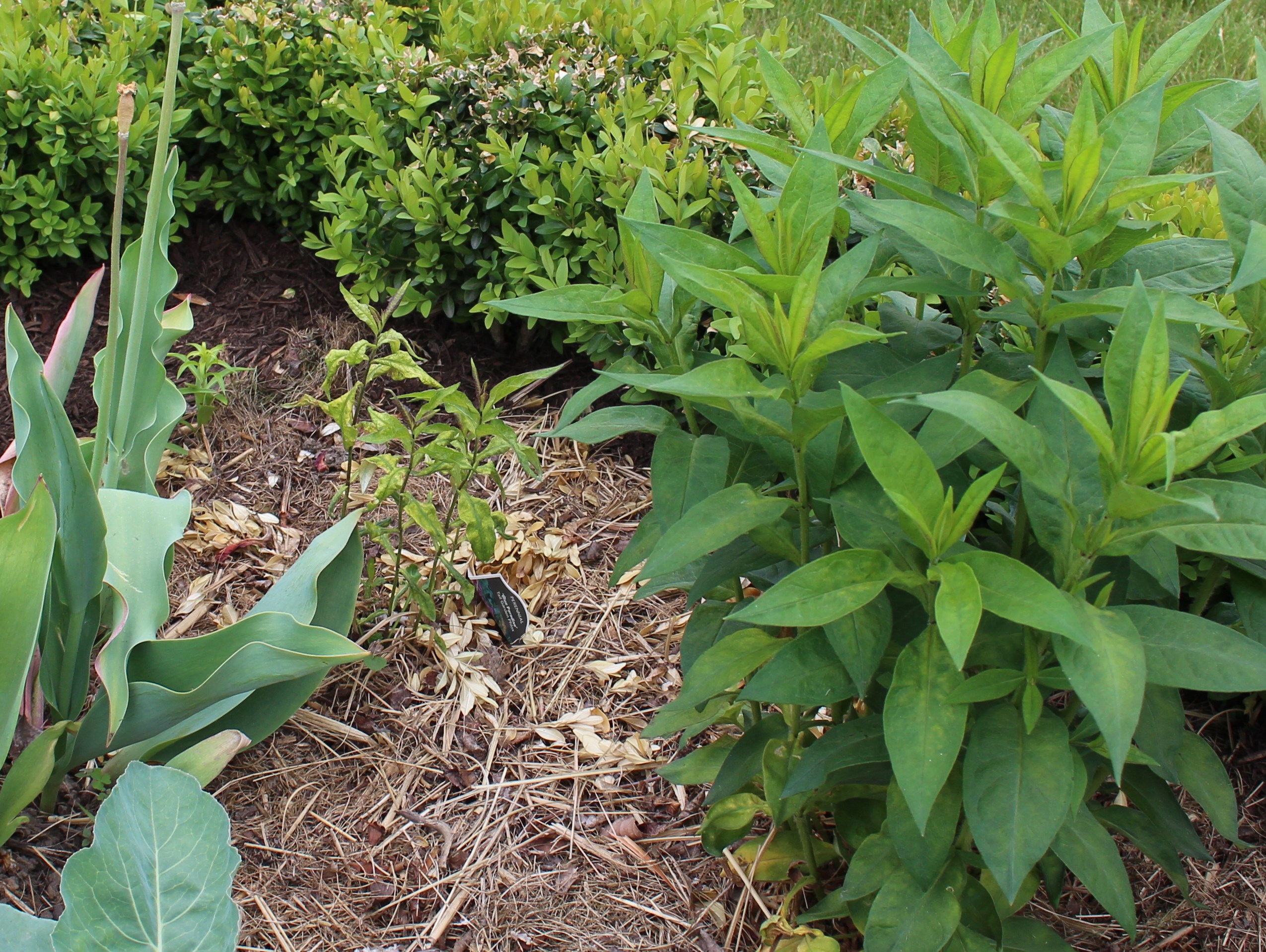
Weeds aren’t the only issue this spring.  The phlox hate the extended dry winds and droughty soil, it brings on the spider mites and I have no interest in spraying for anything.  I’ll make an effort though and spray the foliage off with the water hose while watering (just watering in the first place is probably  good start), then give them a dose of liquid fertilizer.  That and a few more sprays with the water hose might be enough of a shot of goodness to help them outgrow these annoying pests and save this year’s bloom season.  I can’t even imagine a phlox-free summer…

garden phlox with spider mites

What a difference.  Phlox ‘Blue Paradise’ on the left has nearly given up under the spider mite attack, while his neighbor to the right only shows a few yellow leaves and yellowed stippling from the spider mites.  I may just trim him back completely and hope for the best with any new growth which manages to come up. 

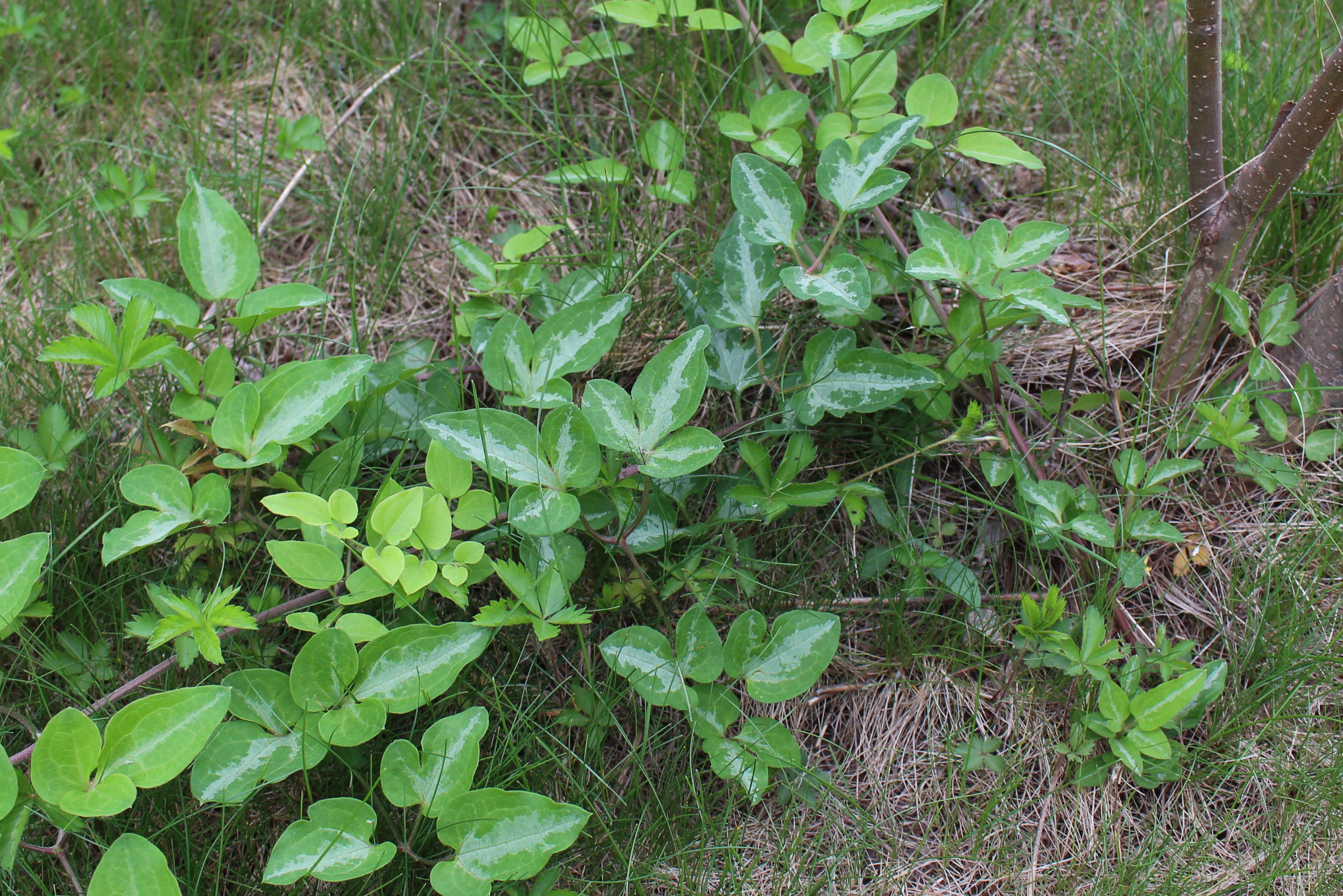
One more bad foliage visit.  Sweet autumn clematis (Clematis terniflora) is a pest in my meadow garden and each spring I battle the legacy of the single vine planted along the fence next door.  I suppose I could spray the clumps and eventually do them in, but I have to admit liking their patterned foliage and late season blooms…. even though I promptly rip the vines off before seed is set.

Japanese clematis Clematis terniflora foliage

Japanese sweet autumn clematis (Clematis terniflora) foliage.  I wish this wasn’t such an invasive thug. 

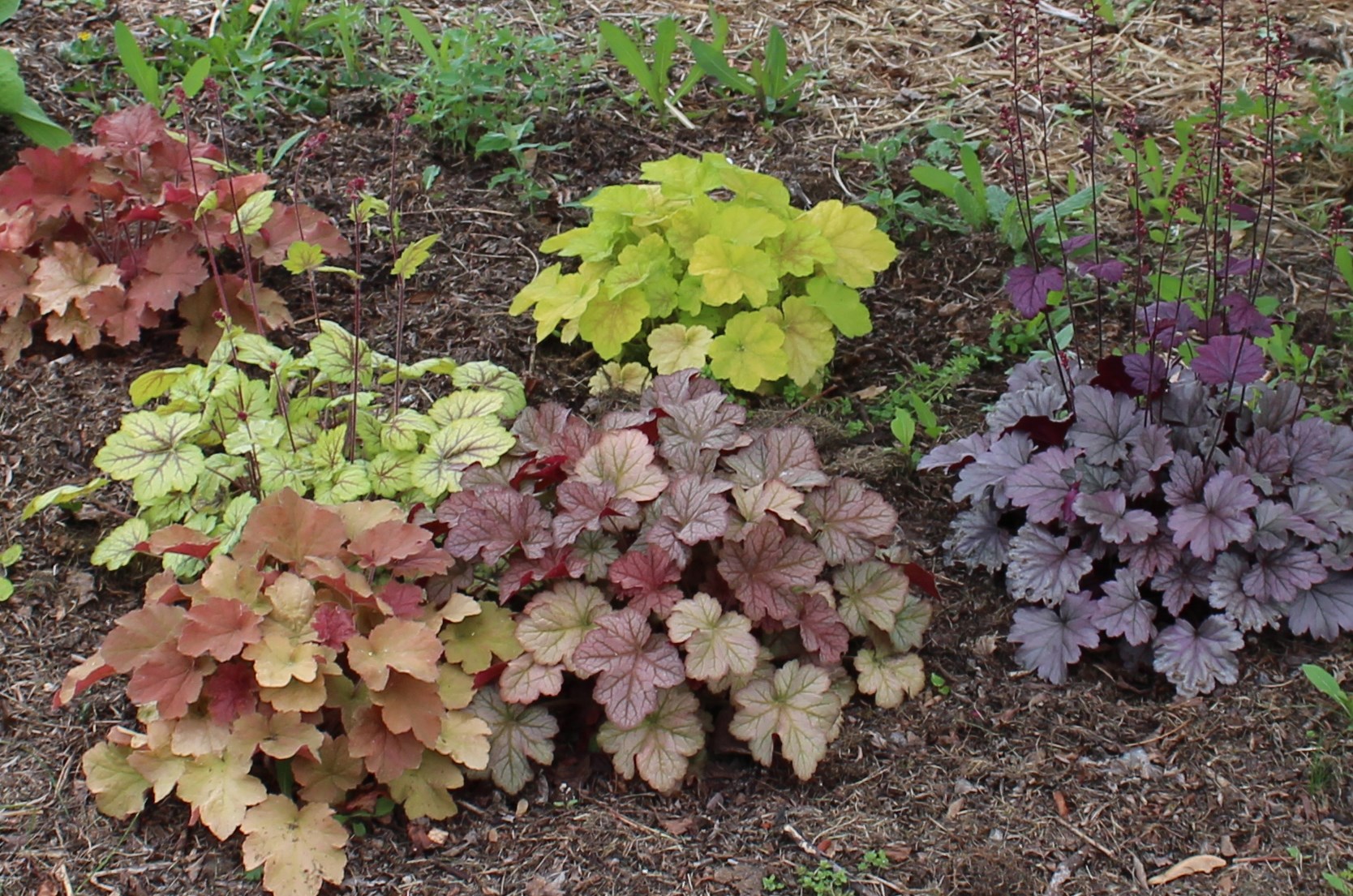
To wrap things up I’ll leave you with something a little cheerier.  With the exception of a few rabbit decimated plants, the bulk of last years clearance heuchera have overwintered nicely and are showing off their fresh spring foliage (as well as their bland and boring flower stalks).  Honestly I don’t like them all together in one big mess, but as plants grow (or die off) I’ll divide the survivors and see if I can work a few clumps into the rest of the garden and make some nicer foliage vignettes.

mixed heuchera planting

Mixed heuchera from last year’s Santa Rosa Gardens purchase.  Yes this bed also needs weeding and more mulch…

So those are the foliage highlights from this end of Pennsylvania.  If you’d like to see what others are up to please visit Christina’s blog to see what people across the world are seeing in their gardens.  It’s always inspiring!

Have a great weekend, here we have three days to observe Memorial Day and in addition to the usual holiday activities I hope to catch up on all things blogging.  Enjoy 🙂

April, May and June, all in one week

I’ve been hiding.  Our temperatures spiked up to 92F (33C) last week and watching the wilted daffodils and tulips being thrashed by the dry wind was just too depressing.  In a few hot days three weeks of bloom flew by and it’s now mostly over.  The temperatures finally dropped today but I still wish we would get some rain before the grass completely yellows.  I don’t like a dry spring.

Fortunately May is still May, and regardless of the weather there’s still plenty to be happy about!

growing perennials from seed

At least my winter seed sowing is paying off. This year I have my first frittilarias and tulips from seed, and it’s endlessly entertaining to search the pots for the latest sprouts.

Between NARGS, HPS, and American Primrose Society seed exchanges I have plenty of pots of little goodies to experiment with, and as long as nobody mentions the fact I have no room for most of these, I think we’ll all just enjoy the enthusiasm of the newest little sprouts in my garden 🙂

lilium martagon seedlings

Martagon lily seedlings going on to their third year.  At this rate there’s not much rush to find more room.

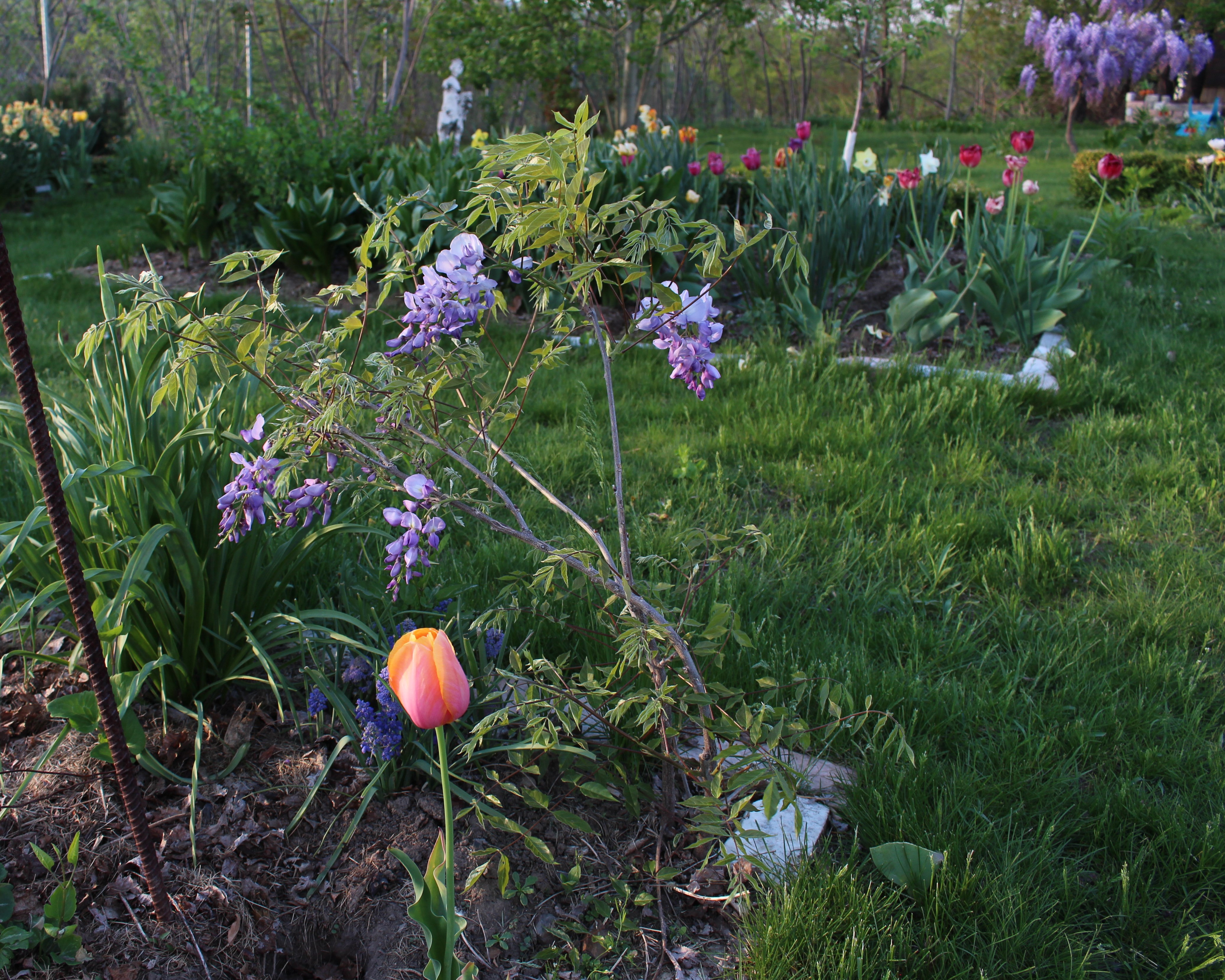
In addition to bringing on the seedlings the heat brought the wisteria from buds to blooms in barely four days.  Last spring was a total loss due to a harsh winter and late freeze, but this year about half the buds survived.  I don’t even miss the lost buds, it’s still full of flowers.

standard wisteria tree

Japanese wisteria planted out in the meadow.  Without anything nearby to grab onto and climb I think it’s invasive tendencies can be kept under wraps.

Maybe you noticed my sad little fritillaria imperialis blooming behind the wisteria.  The hot wind wilted the flowers quickly but I managed to get a photo of the interesting inside of the hanging blooms.

fritillaria imperalis nectaries

The nectar drops at the inner base of the fritillaria imperalis blooms.  A cool thing to look at, but it’s just a bit too “glandular” in appearance for my tastes!

The fritillaria will be something to keep my fingers crossed for in order for it to survive, but the japanese wisteria cannot be mentioned without a warning about it’s invasiveness.  Killing it would be far more work than the neglect which keeps it alive, and to turn your back on this plant runs the risk of having it take over.  I keep it in the middle of a lawn area were it cannot grab onto anything, to grow it as a vine and keep it on anything less than a massive arbor would be more work than I want to consider.

wisteria that doesn't refuse to bloom

Some seed grown wisteria may take decades before they finally decide to bloom, mine is a cutting off my parent’s plant which has always put on a heavy show of flowers.  Even this sucker which came up last year after I moved the mother plant already has a few blooms on it.  A smart person only needs one wisteria, I’m not sure why I’m going to keep this second one 🙂

Speaking of plants which wouldn’t mind taking over the world, I think I’ve finally decided against keeping this darker purple vinca minor.  I like it well enough but without a border or wall to hold it back it’s spreading out just a little to enthusiastically.  This plant (and my wayward campanula glomerata) are officially on the elimination list.  I might put some of it next door in one of the boring mulch beds around my mother in law’s house.  It’s not that hard to rip out, improves the look of an empty mulch bed immensely, and between the house and lawn it shouldn’t get into too much trouble.

vinca minor atropurpurea

Vinca minor ‘atropurpurea’.  A good groundcover in the right place, but a little to aggressive for my beds, and I wouldn’t want to let it escape into the wild. 

Before the heat struck I did manage to finish up a little hard labor.  The front house bed has had a once over, been expanded and topped with new mulch.  I forgot who gave me the idea, but I divided up the blue fescue clumps and spread them far and wide across the front of the border.  I like it, which isn’t something I could say the last time I redid this foundation planting.

mixed border foundation planting

The front foundation planting looking all springy.  Any opinions on the pink rhododendron in front of the brick?  I have mine, and it involves a shovel 🙂

The bed along the front of the house has been one of my favorites this spring.  The shelter of the house gives a little protection from the drying wind and my mulching has kept down many of the most annoying weeds.  Some would say my thistles are weeds but I think they’re fantastic.  You’re not going to want to touch them though….

Ptilostemon diacantha

Ptilostemon diacantha.  I can’t wait to see this one bloom (even though the blooms may be slightly anti-climactic) and will surely collect seeds if I get that far… using gloves of course 🙂

Something a little more suburbia-friendly are the tulips and camassia.  It looks nice enough here but I may remove a bunch of the camassia.  In the heat I don’t think they’ll last more than six days, a little too short of a bloom period for my tastes although I can’t complain about how carefree they are.  Maybe I’ll try them somewhere less prominent.

tulips and camassia

Tulips and camassia highlighting the front foundation planting.  The blue fescue has been divided up and spread all along the front now and I think it looks better than the gappy line which was there before.  Funny to think these are all the descendants of a single moth-eaten clump which I rescued from a neighbor’s yard. 

Close up the camassia are an airy, beautiful flower, and I think to see it growing en-mass in its native Western North American haunts would be great.  Maybe someday.

camassia leichtlinii caerulea or 'blue danube'

Camassia leichtlinii caerulea or ‘blue danube’, I’m not sure which since I planted both but they all look identical to me.

Iris season is next.  The stalks are shooting up all over and it makes the rapid passing of the daffodils feel a little less painful.  I’m sure it will be a fantastic year for iris…. unless that’s the exact point when the rain decides to come.

iris pallida 'variegata' in a mixed border

I always forget to divide the awesome iris pallida ‘variegata’.  It’s one of my favorites but seems to like more frequent division and better soil than some of the others.

So that’s it from here.  I have to apologize for not responding to comments or leaving any on the blogs I visit,  I’ve been keeping up with the reading but for the most part have been just too grumpy and unmotivated to add any productive comments.  But there’s hope.  The first irises are opening today and I’m already feeling better.  This sounds good, but unfortunately the weekend is already filled to capacity with field trips, birthday parties, dance recitals, sports banquets and baseball games and I’ll be lucky to even step foot in the garden for a few days.

But it’s almost Friday, and I hope a great weekend is had by all!

mumble mumble mulch

Spring is here and I love it.  It means work of course, and for me it’s hard to hit just the right balance of sitting around and actually doing something, but I try my best.  One problem which always haunts me is that I’m the type who (again while sitting around) usually gets tons of unnecessary projects in his head, starts them, and then moves on before they’re done.  Fortunately I’m not much bothered by this, but someone else here is, and sometimes decides to be helpful and remind me of the obvious…. but most of the time that person doesn’t notice unplanted chrysanthemum collections or realize it’s been years since the boxwood cuttings should have been planted out, so it all works out fine.  How can it not when rain and rainbows and warm sunshine have brought out the daffodils?

double rainbow over the garden

Double rainbow over the ‘potager’.  A beautiful sight if you can tune out the industrial park and white vinylrama next door 🙂

I’ve been relentlessly mulching.  It started innocently enough with a load of mulched leaves hauled out of the woods, but then exploded from there.  My neighbors were so generous last autumn with several heaps of nicely chopped leaves and grass clippings that I couldn’t stop lugging them back to the garden.  The entire front bed got a nice layer and I would have kept going but of course ran through all the available bounty.

cheap leaf mulched perennial beds

The front perennial bed all nestled in with a nice mulch of chopped leaves.  The earthworms will munch them all down by the end of  summer but for now they should go a long way in keeping the weed seedlings down.  Did I mention it was all free?

As if that wasn’t enough, for some reason when finished I got it in my head to crack open the wallet and order a load of shredded bark mulch to finish off the yard.  With most of the front already covered I felt finishing with a little purchased mulch might be something the budget could handle, so $290 later I was mulling over another new heap in the driveway.  It seemed a steep price to me but judging from the other $1,000 plus order slips hanging next to mine I guess I’m being downright frugal.  Also, mulch is a gardening expense the boss never criticizes, so now it just needs to be spread.  More on that later, daffodils first!

narcissus tahiti daffodil

Always a favorite, ‘Tahiti’ is an awesome daffodil.  Sorry if you’re not a fan of doubles, but this one never fails, and the yellow petals seem to glow with an orange shade which I love.

I’m stuck on orange lately.  The daffodil ‘Serola’ tops the list this year.

daffodil narcissus serola

Narcissus ‘Serola’ with the first of the tulips opening behind.  When I divide this bed (hopefully this June) I’ll need to put these out in the front garden to brighten things up even more!

My whining about space in the vegetable garden is entirely due to my weakness for spring bulbs and the abundance of open space left when vegetables finally give up the ghost in September.  It’s so easy to just pop a few bulbs in here and there 🙂

daffodils in the vegetable garden

It’s so much easier to line a few daffs out in the vegetable patch than it is to decide on a spot in the open garden!  I’ll just plant a few pumpkins or squash over them in July to make it look respectable again. (fyi it’s bouncy house season so please ignore the deflated mess in the background) 

One more orange.  ‘Kedron’ has a color which stands out very well…. if you’re into colors that stand out very well 🙂

daffodil narcissus kedron

Narcissus ‘Kedron’.  Notice the empty spaces nearby.  Not everyone does well here and I just don’t have the patience to nurse unhappy plants along, so while ‘Kedron’ takes off the others just fade away…

Although the vegetables complain, bulbs in general seem to like my lazy (or complete lack) of an efficient watering ethic.  Tulips in particular like the open, sunny, fertile soil, and unless I weed them out (which I could never do) most clump up and bloom.  Even if I do pull a few of the smaller bulbs they just end up in the compost anyway so get spread throughout the garden a few months later when I take and spread the barely rotted goodness.

tulips and double hellebore

Yet another plant which needs to find a permanent home outside of the vegetable patch.  This double hellebore seedling is taking up prime bean and pepper real estate.

Believe it or not I’m making progress with my bulb issues.  When I was younger and carefree I used to plant out patches of whatever tulips I had on hand and then dig them up again in June just in time to clear the beds for tomato planting.  It was insanely beautiful (to me at least) and I can’t rule out this happening again.

mixed darwin tulips

Tulips blooming in the vegetable garden (spring 2013). These would all be dug, dried, and stored while the warm season veggies occupied the same beds.

Maybe my bulbaholism isn’t getting any better.  Maybe it’s just migrating.  I planted these fritillaria imperialis bulbs out in the meadow late last fall (clearance bulbs) and can’t wait to see how they do.  If I get one decent spring out of them I’ll be thrilled, but in my heart I want them to settle in… even if they do look slightly out of place in the short turf.  Hopefully they enjoy the dry summertime baking this spot receives, and the grass should come up soon enough to hide the yellowing foliage.

growing fritillaria imperialis

My ‘meadow’ is in danger of becoming a bulb field.  The fritillaria imperialis don’t look entirely happy yet, but I have my fingers crossed they’ll at least bloom and then maybe return next spring?

Out front I may have a few bulbs as well.  Early spring is when I love the front beds the most.

spring bulbs front entry

Tulips and daffodils where snowdrops ruled just a few weeks ago.  I should have taken this picture today since I mulched yesterday afternoon, but after all the work I was ready to just sit and relax!

I better wrap this post up.  Now that mulch sits in the middle of the driveway I’ve got plenty to do even from the non-gardening viewpoint.  And it’s not the fastest process since mulch needs to be worked in between sprouts and edges need to be tidied up…. and actually a bigger problem is that I’m coming up with all kinds of bed enlargements and side projects while I dilly-dally on finishing the main project.  I promised to trim back the yews along the side of the house, and this golden arborvitae just happened to show up in the lawn between us and the neighbor.  As long as I’m mulching, might as well create a nice big bed around it 😉

new perennial bed

new perennial bed

Let me get out there then.  Good luck on all your own spring projects, may they progress more quickly than my own!