Agriculture in Suburbia

This post was mostly finished last weekend but for some reason I never got around to publishing.  I wish I had a good excuse, but it might have just been one of those Sunday evening get ready for the workweek make lunches and clean the kids off from the weekend kind of things.  In any case here it is and to be honest I have little idea what I was talking about back then with all the design comments and self reflection.  Sometimes I really wonder where this stuff comes from, but regardless the pictures have me thinking of last June when the garden looked ready to die so let me just start off with a photo from then 🙂

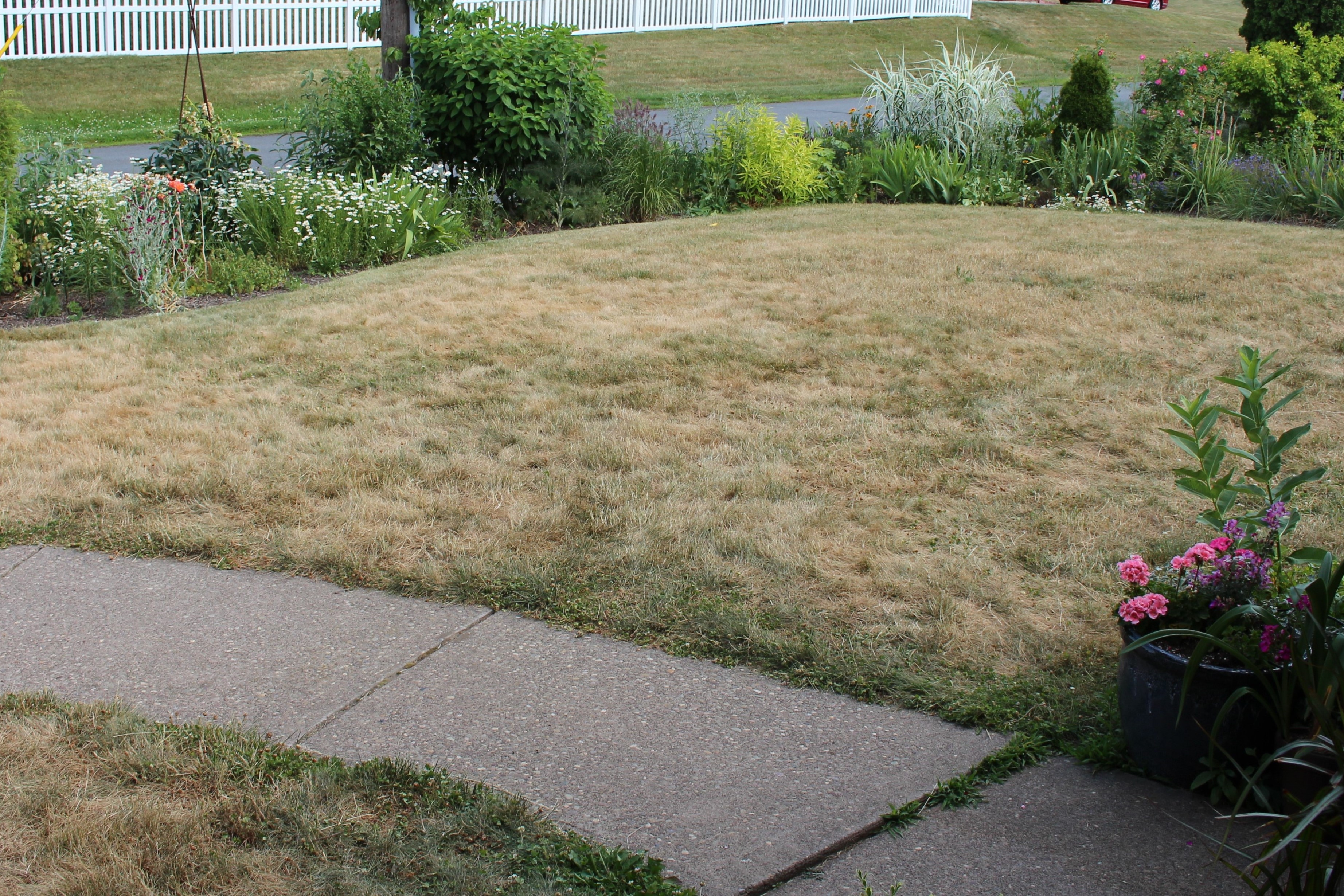
dormant lawn

The beauty of the  garden in June.  Roadside daisies and dead grass.  Fortunately the rains came back in August, but not until all July passed and I reached the “wordless Wednesday: I hate gardening” stage.

It’s always nice to hear compliments about your garden, and I am one who by reflex nearly always shrugs them off or dismisses them.  I’m sure there’s some childhood trauma involved which has long been forgotten, but it’s my way and it’s a rare day when I can just accept with a thank you.  Now I’m not saying I get a lot of compliments, but I do get a comment every now and then about a nice design touch or a combination which actually worked out.  Those are the compliments I always downplay since I rarely (unless I’m doing it subconsciously) put a whole lot of thought into what goes where.  With few exceptions my design process revolves around having a new favorite plant in hand and then desperately needing a spot in which to cram it.  Sometimes it works sometimes it doesn’t.

front street border

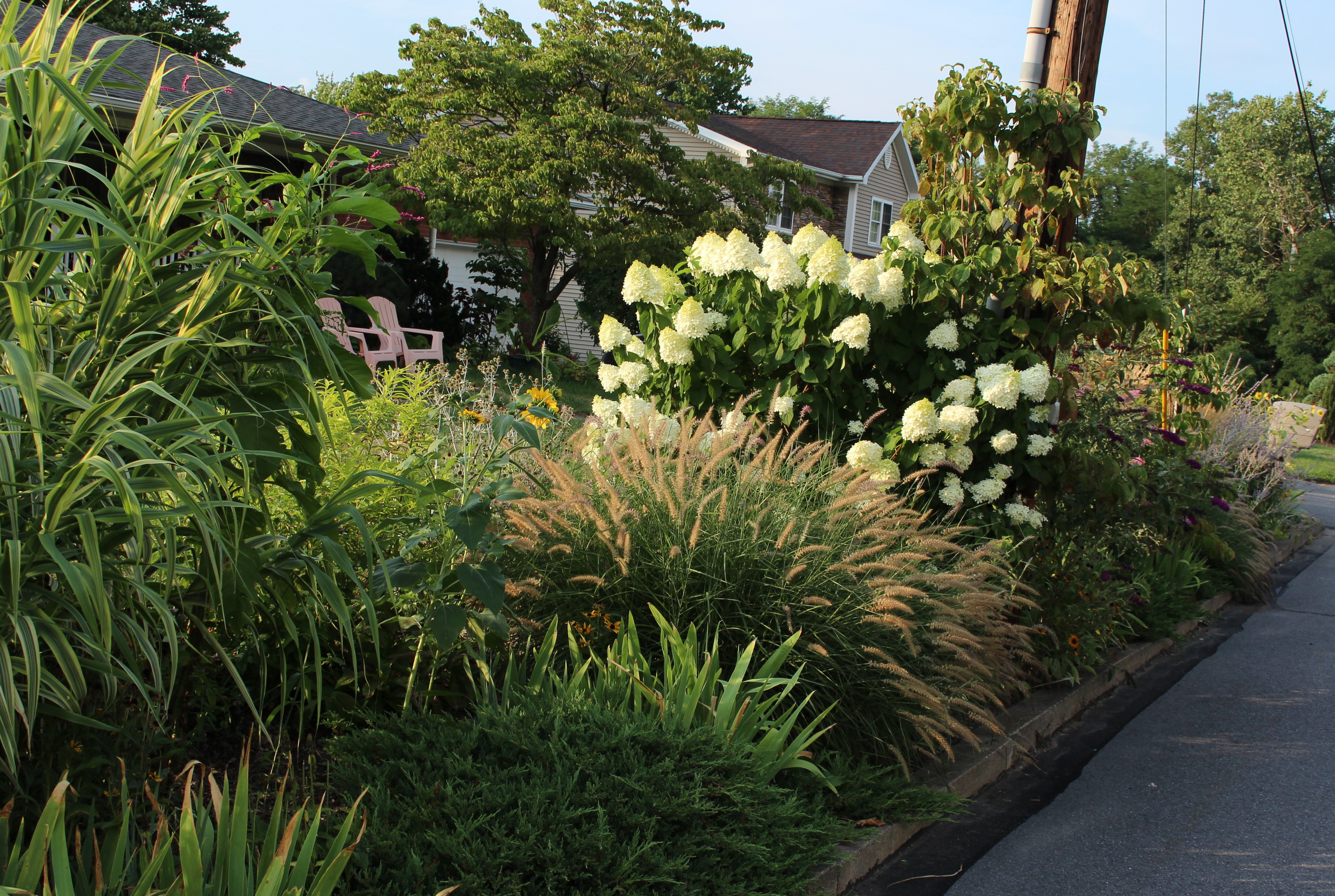
The front border in mid September.  If I had to put a name to this year’s design theory it might be something like ‘neglected agricultural’.

The front border along the street may not look brilliant, but it does look colorful, and with five months of winter breathing down my neck colorful is perfect.  Colorful and agricultural I suppose, since this years feature plant seems to be ‘Hot Biscuits’ amaranthus and in my opinion it either looks sort of farmyard weedy or like a particularly bright sorghum crop.  Ornamental or not I just can’t look away.  It’s big and bright and grainy and between it and the wheat-like feather reed grass (Calamagrostis x acutiflora ‘Karl Foerster’) and the sugarcane-like giant reed (Arundo Donax) I feel like it’s almost harvest time out there.

front street border

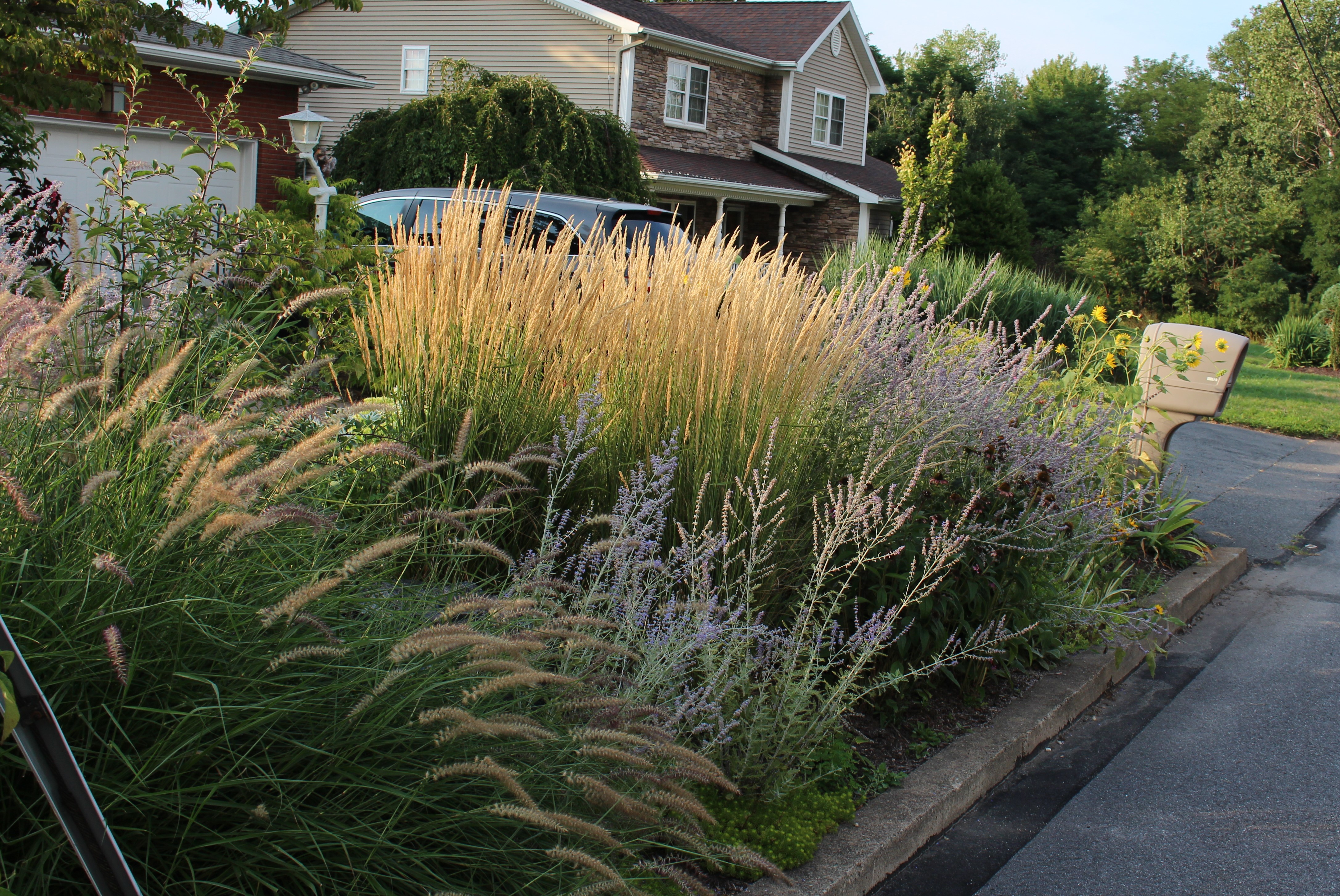
The view from the street side.  The purple perovskia has seeded around a bit and put out a few runners, the purple coneflowers as well, but I’ve done essentially nothing here since March and I kind of like that.

I owe this year’s crop of ‘Hot Biscuits’ to my friend Paula who surprised me one afternoon with a packet of seeds in the mailbox.  I had grown it before and ended up losing it, but fortunately she had a few seeds to spare and sent them my way.  That was last year, and I efficiently killed all the seedlings which sprouted, but this year was a different story and I ended up with a few clumps of healthy seedlings.

hot biscuits amaranthus

Just the first of many amaranthus close-ups which will pepper this post.  No one could plan this combo since I’m sure it violates numerous design principles, but I just love it.

The amaranthus shows up here and there all along the border, which is probably a good thing since even the simplest design theorist will tell you it repeats and unifies a theme.  Repetition is important since this bed frequently suffers from “I always start from the driveway end and use up all the best plants there” syndrome.  The far end of the bed gets less weeding, less watering, less tending… it basically gets less of everything, so carrying the amaranthus theme all the way through helps hide the sparseness of the neglected end.

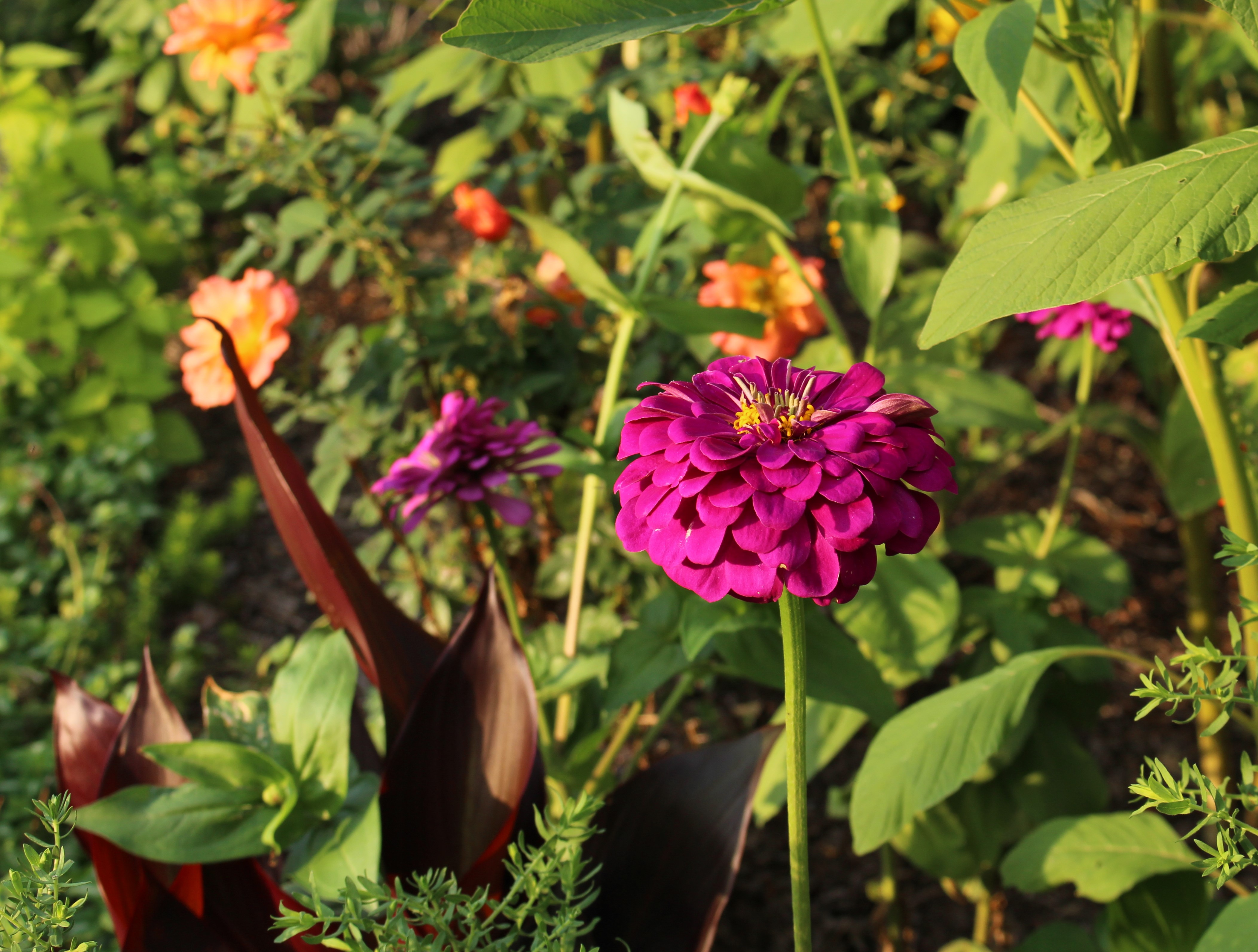
wine zinnia

Here in the preferred end of the bed are well tended seedlings of Benary’s Giant wine zinnias and the pink gomphrena ‘fireworks’.  These were the seedlings I was most excited about this year, so in they went first 🙂

I did have a few too many zinnias this spring so was pretty generous about placing them in the border, but when the Brenary’s Giant scarlet began to open next to the pink gomphrena I immediately cringed.  For about a week I thought it looked awful but now I quite like it.  It reminded me of the first time I saw pictures of some of the late Christopher Lloyd’s magenta and pink plantings at Great Dixter.  They also bothered me at first and I think my first thought was “grow up Chris and plant some lavender and white and pink instead of that mess”… but look at me now.

scarlet zinnia fireworks gomphrena

Scarlet zinnia with ‘fireworks’ gomphrena.  Am I suffering from retinal fatigue or does it actually look nice together?

Maybe the green lawn and the parchment color of the feather reed grass tames it a bit but between this and the orange of the amaranthus I’m just plain pleased.

scarlet zinnia karl forester grass

A very technicolor look with the yellow of the ‘Tiger Eyes’ sumac across the lawn.

Here’s another amaranthus photo-bomb.

hot biscuits amaranthus

Looking down towards the ‘less interesting’ end of the border.

Ok. One last amaranthus photo.

hot biscuits amaranthus

From the neglected, far end of the border, more amaranthus 🙂

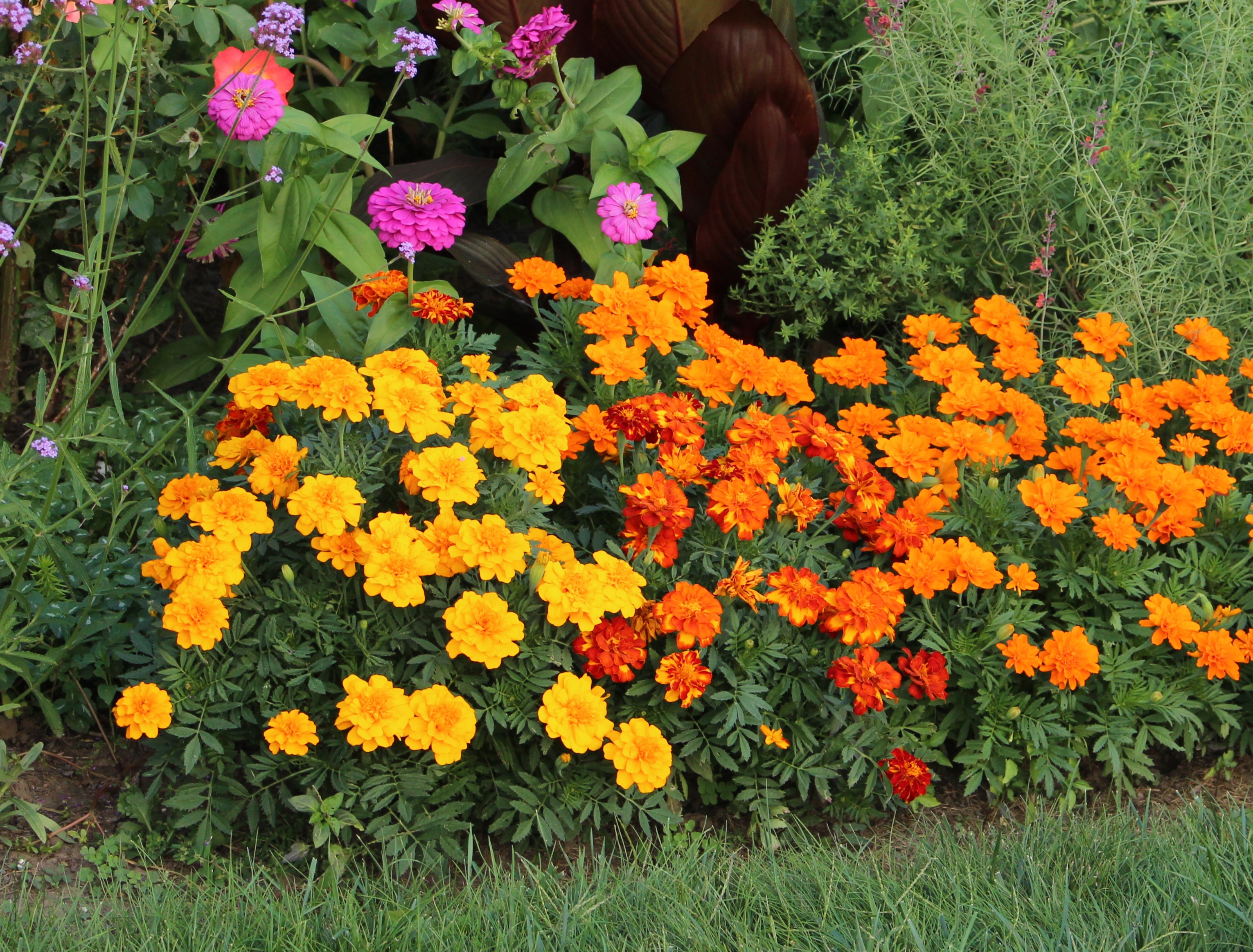
You may have noticed a bright golden patch of marigolds in the border.  The fall smack dab in the middle of my newfound love for the most offensively bright colors and I’m not sure I can resist planting a whole border of them next year.  I had to smuggle these seeds out of my stingy older brother’s garden last year and was lucky that a few sprouted and survived July’s dry spell.  He’s been letting them reseed for a couple years now and they still come up in a good range of colors on relatively short and large flowered plants.

marigolds tagetes

A few marigolds putting on a nice end of summer show.  More might be nicer, and by more I mean a whole border.

What to plant them with?  I think they’ll go at the far end of the border, alongside the bright gold of a juniper, but other than that I have no plans.  Should I back them up with some darker foliage plants?

img_3082

Korean feather grass (Calamagrostis brachytricha) in front and pennisetum ‘Karley Rose’ towards the back. With the ‘Limelight’ hydrangea it all looks very calm and refined, but I think a nice border of marigolds will give it a good jolt of color!

We will see what happens.  There’s a good chance it will all come down to whatever seeds sprout the best next spring, but in the meantime it’s nice to dream about having a more plan-comes-together kind of garden.  That is until the snowdrops bloom.  Once that happens my brain goes to mush and I’m lucky if I get anything planted 😉

Tuesday View: The Tropics 09.27.16

Of course it’s late, and of course I’ve left this to the last minute, but I’d really like to join in with Cathy at Words and Herbs and get my Tuesday view up on time.  I can’t be a day late with everything 🙂

tuesday view tropical plants

The last Tuesday view of September

Cathy’s view has hints of autumn this week and I believe the same is happening here.  The last two nights have been into the chilly zone, and friends North of here have had their first frosts.  In the mountains, the maples are beginning to show color this week and if I can hope for anything it’s that there will be for another two or three weeks before the first frost hits here.  It’s been a good run though, and I really can’t complain.

canna x ehemanii

My little Canna x ehemanii surprised me with a bloom this summer, hopefully I can overwinter it and have twice as big a plant next year.

Color is at a peak this week and most everything is doing its best to flower and seed out before the final axe of winter falls.  It’s a tropical garden after all, and there’s no long kiss goodnight.  The first frost means it’s over.

roses and dahlias

My unknown peachy dahlia with ‘Black Forest’ rose, ‘fireworks’ gomphrena, and peach colored salvia splendens.  Even though the light wasn’t too good for this photo the colors still just explode. 

So I’ll just keep my fingers crossed and enjoy each day.  Winter is too long to not soak up every last minute of summer (and this borrowed summer) while we still can.  Have a great week!

GBFD September ’16

Garden Bloggers’ Foliage Day always sneaks up on me, it hits exactly at that point of the month where I start wondering where the month went and start panicking over the thoughts of yet another turn of the calendar page.  But I get over that pretty fast and although my posts are frequently late, Christina at Creating my own Garden of the Hesperides is always understanding, and so this month when she suggested that in spite of my tardiness I might still be able to sneak in even more tropical garden photos, I of course jumped at the idea.  The tropical plants really keep the garden fresh at this time of year, and their bold foliage looks big and unblemished and makes an excellent contrast to the seedheads and dying foliage of much of the rest of the garden.

canna indica pupurea

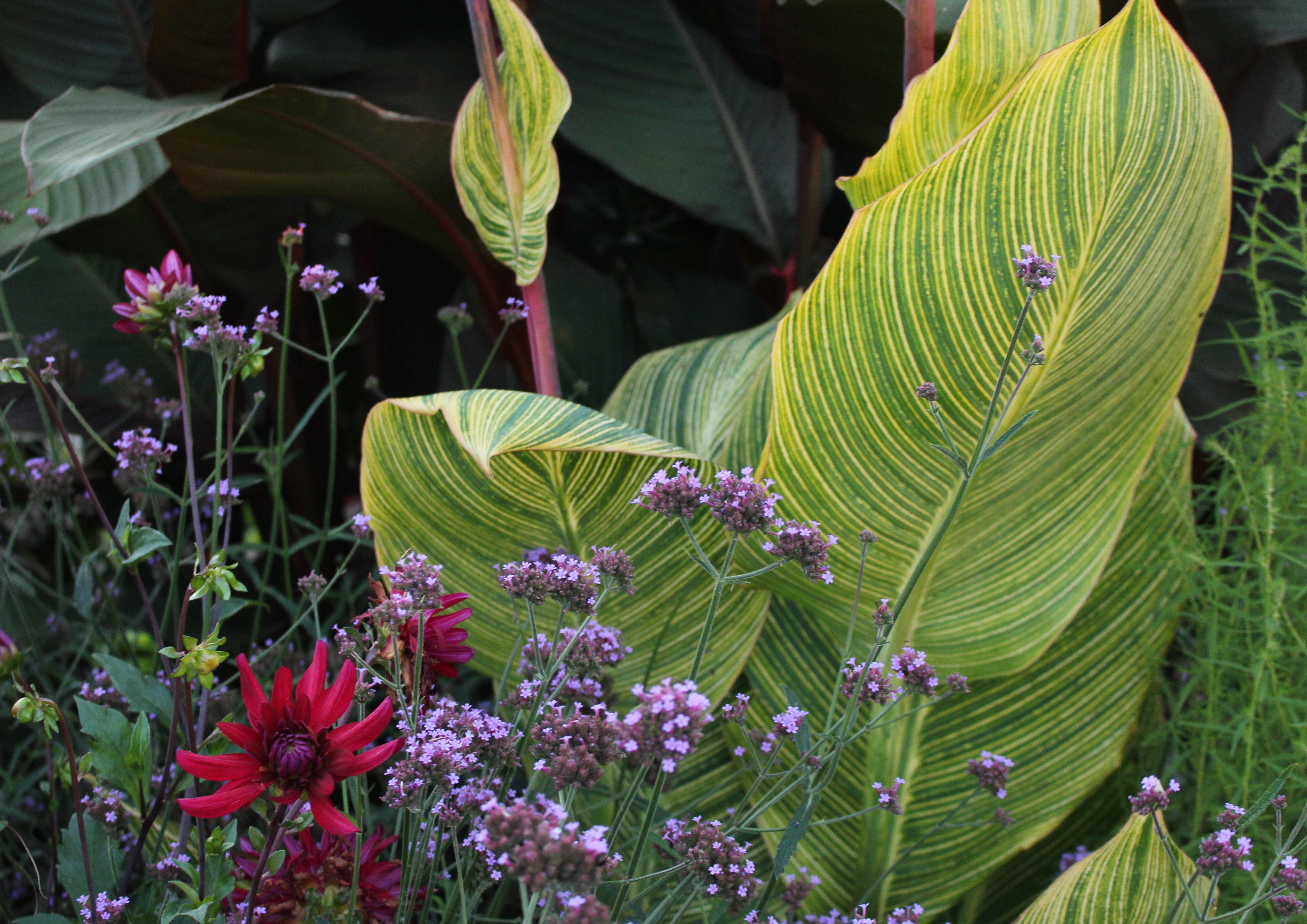
The purple cannas of the tropical garden (Canna indica pupurea?) look great as they catch the light.  I promise to not show them any more, but how bout this one last time 🙂

So this post was just going to be a pat on the back for foliage in the tropical garden, but then just like Christina suggests I started looking a little closer at how much foliage brings to the table as far as the overall garden picture…. but before that one more canna…

canna Bengal tiger

I might have talked to this Canna ‘Bengal tiger’ at some point, it’s like a close friend, and there’s nothing I don’t like about it.

So the canna foliage was a no-brainer, but there’s something else brewing in the tropics.  The Kochia continues to ignite as the season winds down.  Not exactly a contrast, this plant is starting to take center stage as an eye-jarring punch of color.  It was a lacy pale green all summer but now as it goes to seed the magenta capsules turn color and are soon followed by red tints in the foliage.

kochia scoparia

Kochia scoparia, the old-fashioned annual burning bush, creating a nice backdrop to pink gomphrena ‘fireworks’ and a just-opened autumn flush of flowers on the red rose ‘Black Forest’. 

A few tropical ‘fakers’ are also in the mix.  An unknown fig which defied all my neglect and poor caretaking just put out a nice new flush of large, lobed, leaves.  No figs of course, but the large leaves balance out all the seediness around them.

hardy fig

A hardy fig which was never supposed to make it (hence my losing the ID tag) now fills too much space in the vegetable garden.   

Besides the tropical ‘fakers’ there are also a few actual tropicals which end up outside of their main bed.  I have a habit of sticking cuttings in here and there and every now and then they take off to good effect.  Coleus are one of the easiest to just stick in here and there.

coleus redhead

Coleus ‘redhead’ is one of the best. Carefree, colorful, and I have yet to have it bloom and go to seed. It’s also a nice offset to the lacy cypress vine behind it and the bright marigolds in front.

I could probably put together a post made up entirely of bits and pieces which were stuck in around the garden, but as usual I’m going on to long.  Lets wrap it up with more coleus up on the deck.

coleus

If you need to know which one this is I’ll look it up, but for now I don’t have the patience to dig through my bucket o’ labels for the tag.  Needless to say it’s a good grower, bright, and also not overly anxious to send up flower stalks (and end the foliage show).

Other foliage on the deck includes my pet spikes.  They’re a great accent and just plain old cool looking as they keep getting bigger.  Some day they’ll wear out their welcome as far as being dragged indoors, but this winter they’re still A-list.

deck planters

Overgrown spikes in green and purple plus a potted oleander.  Not many flowers, but still a nice mix if you ask me.

Rosemary is also one of our must-haves for the deck.  It’s scented, always looks neat, and gets used quite a bit by our chef.

deck planters

Foliage on the deck includes the rosemary plus others such as the strappy leaves of vacationing amaryllis bulbs (hippeastrum) and other future spikes.  In the background you might notice the elephant ear sprouting up out of the geranium pot.  That’s what you get for reusing potting soil… elephant ears, caladiums, and reseeding million bells become your weeds 🙂

Finally as temperatures cool, the back porch becomes a perfect spot to soak up the last rays of the day.  The temperatures out back are comfortable this time of year and the low autumn light backlights the grasses and summer foliage.

deck planters

Upright elephant ears (Alocasia portora?) looking great in the afternoon light, and offsetting the airier grasses and geraniums nicely.

So I’m glad Christina convinced me to take a look around this month and keep an eye out for foliage.  It’s easy to forget how important it is to the garden’s overall presence, and paying attention is even more important when you’re so distracted by this and that flower coming into bloom and then fading away.  If I might suggest, why not give Christina a visit and see what else has come up this foliage day, with gardeners from across the globe checking in it’s always a nice time.


Thursday’s Feature: The Three Cousins

The story of the three sisters of native American agriculture (corn-squash-beans) is a story which goes hand in hand with almost any elementary school lesson on the Pilgrims or Thanksgiving.  Northeastern tribes of Native Americans commonly grew the three crops together in the same mound, and as the corn grew up and the stalks provided support for the twining beans, the squash filled in along the ground and together the three crops coexisted peacefully, each filling their own niche.

This spring I rebuilt the rebar arbor which marks the entrance to the vegetable garden and this summer three vines are working their way up and over the arch.  They don’t coexist quite as peacefully as the three sisters and they’re far less useful in the kitchen, but I like them well enough anyway and even if they never make an appearance on the back of a Sacagawea coin I guess we can say they’re close enough to be called cousins at least.  The three cousins are Cypress vine, Love in a Puff, and Red Noodle bean, and all I can think of is how great common names can be 🙂

rebar arbor

After struggling for four years with an arbor that fell over each spring, I finally put in the effort to set the base in concrete.  The jury is still out on whether it will survive this spring thaw or not any better, but since the jury is still also going back and forth between rustic and ugly, survival may not matter either way.  

There are many a more floriferous trio for a trellis, but for some reason I love the mixes of foliage, flowers, and fruit of these three cousins.  The bright scarlet flowers of the cypress vine (Ipomoea quamoclit) sparkle alongside its soft ferny foliage and contrast nicely with the puffy green globes of love in a puff (Cardiospermum halicacabum)  and the dark red pods of the red noodle beans (Vigna unguiculata… aka asparagus bean… aka yardlong beans).

red noodle bean flower

The pale lavender flowers of the red noodle bean only open in the morning but they look just right mixed in with the ferny cypress vine foliage.

I wish I could take credit for this combo, but in all honesty I saw it a few years ago on Nan Ondra’s blog.  As it is with these things a single picture got stuck in my head and then over the next several years the radar stayed tuned in to find seed for the three components.

cypress vine, red noodle bean

The red “noodles” of the asparagus bean stretch anywhere from a foot and a half to nearly two feet.  The arbor is starting to look pretty cool with all these red beans dangling down.

Right now I think it’s the noodle beans stealing the show and I wish I had a few better photos, but the ones from this afternoon just didn’t make the cut and then the daylight called it quits on me.

red noodle bean

I think the beans are cool, but the hummingbirds much prefer the cypress vine flowers.

As I think further on it each of the three cousins also provides something more than just looking pretty.  The beans are edible (and some say have an excellent taste if picked small), the hummingbirds love the cypress vine, and the kids love picking and popping the puffs.  It is a useful trio and it’s likely they’ll show up here for many a year to come… if only because (with the exception of the beans) I haven’t planted a thing on this trellis for three years and there are still more than enough seedlings each spring to fill the ranks.

So there they are, the three cousins as my feature for Kimberley’s Thursday Feature meme, and although they are technically three entries it’s nearly impossible to separate them so I think I’m good to go.  If you think you’re good to go might I suggest a visit to Kimberley’s blog?  She encourages us to look around each week and find something which grabs our attention in the garden and it’s always interesting whether you’re just visiting or joining right in.

Not a bad morning.

It’s beautiful out this morning and I can’t even see problems in the garden.  The lawn is relatively under control, some staking and weeding was done yesterday, the soil is damp enough that watering is not an issue, and other than some chipmunk issues the wildlife of the garden is behaving in an entirely picturesque and harmless manner.  This feeling may fade quickly but while it lasts I’ll just sip my coffee quietly and hope the kids don’t find me.

datura metel

Datura metel.  I expected an annual but this one re-appeared out of nowhere once the rains came and the soil heated up.  It’s doing so much better than last year.

The light is often perfect in my garden but my photos rarely show this.  Even with a better half who loves expensive electronics and insisted on a fancy camera there’s still a skill component missing and I often look at what shows up on the computer screen and wonder what happened.  Fortunately this morning things just came together and it’s as good as it’s going to get.

IMG_2548

Light and shadows on a Datura flower. Even a few dew drops to make it glisten.

Last fall a friend gave me a few seedheads of what is probably Gomphrena ‘fireworks’.  It’s supposed to be in the same species as the regular globe gomphrena (G. globosa) but I don’t see it, and even though it loves the same heat and full sun, the flowers are more like yellow tipped pink brushes rather than tight globes.

gomphrena fireworks

Gomphrena ‘fireworks?’ in the morning light.  Easy from seed (needs warmth and bright light) and loves the heat.

Another annual which catches the light perfectly is amaranthus ‘Hot Biscuits’.  Practically a weed, it just shot up when the rain started falling and the humidity shot up.  This is another one which came via friend…. thanks Paula!

amaranthus hot biscuits

Amaranthus ‘hot biscuits’ in the front border.

I would have laughed if you told me I’d ever grow (and like) a brown flower but here it is.

amaranthus hot biscuits

A nice late summer show of amaranthus coming up among the butterfly bushes (Buddleia)

I do buy a few seeds here and there and zinnias are one which I like to keep in good supply.  Brenary’s Giants ‘Lime’ does NOT show well in the garden but it’s just too interesting to leave out.

Benary’s Giants lime zinnia

Benary’s Giants ‘lime’ zinnia from Fedco Seed.  I bet a good designer could do great things with this color… but me, not so much.  I think it’s cool regardless.

The birds and bees get the credit for this sunflower as well as whatever religious deity you believe protected it from my weed bucket.  I swore up and down I would not allow sunflowers in the tropical bed but there you have it.

double sunflower

A little doubling and a darkly rich center, I’m quite pleased to have this sunflower sharing space with the cannas and bananas.

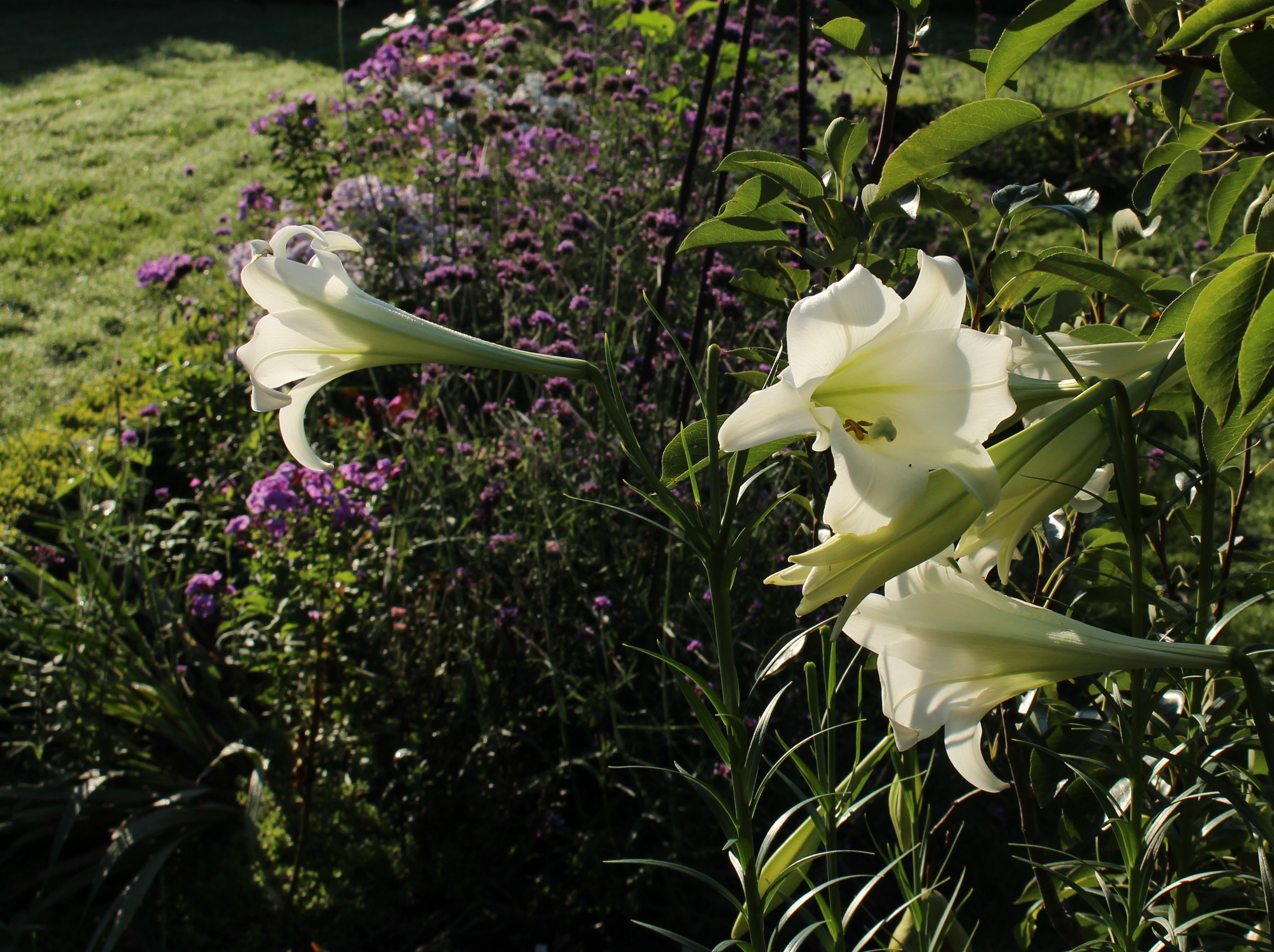
The Formosa lilies (Lilium formosum) were stunted by weeks of drought back in the no-man’s land which I tend to ignore, but are still forgiving enough to fill the garden with their sweet summer perfume.

lilium formosum

Lilium formosum.  For some reason I thought planting them where they’d grow up into the branches of a pear tree would be a good idea… but then again why would I think my little seedlings would ever amount to anything?

The meadow got its mowing just in time.  The first colchicum blooms were beheaded, but now the others can come up nicely in the short (and for once green) grass.

cochicum in lawn

cochicum in lawn

Back in July we didn’t even remember what rain looked like.  Then something happened.  August was warm and humid with perfectly spaced rain showers and this blessing from above even resurrected (most) of the phlox bed.  If you look closely the damage is still there, but on a beautiful Sunday morning it’s easy to see past that.

garden phlox paniculata

Phlox paniculata in the late August light.

Please click on “I hate gardening” to see what this bed looked like a month ago.  You could call the change miraculous and I don’t think that’s an exaggeration.

garden phlox paniculata

Just in time for Monarch migration, the garden phlox and Verbena bonariensis are again filled with flowers and this bed is a very busy place.

I do love my phlox.

garden phlox paniculata

Back from the dead, random phlox paniculata seedlings.

Have a great Sunday and all the best for the upcoming week.  I’m going back outside now and suspect nothing will get done other than a second cup of coffee.

A quick August walkabout

Although the air practically drips humidity and the the nights are muggy it’s still nothing compared to summers South of the Mason Dixon line.  Plus it’s only been a few days, and it’s actually rained regularly for three weeks now and I do love a nice summer thunderstorm so I’m fine with all of it.  What a relief from the relentless dry which haunted me all of June and July (and still haunts much of the East Coast) and what a change the gardens have gone through as they try to get all the growing in which didn’t happen during the first half of summer.

front street border

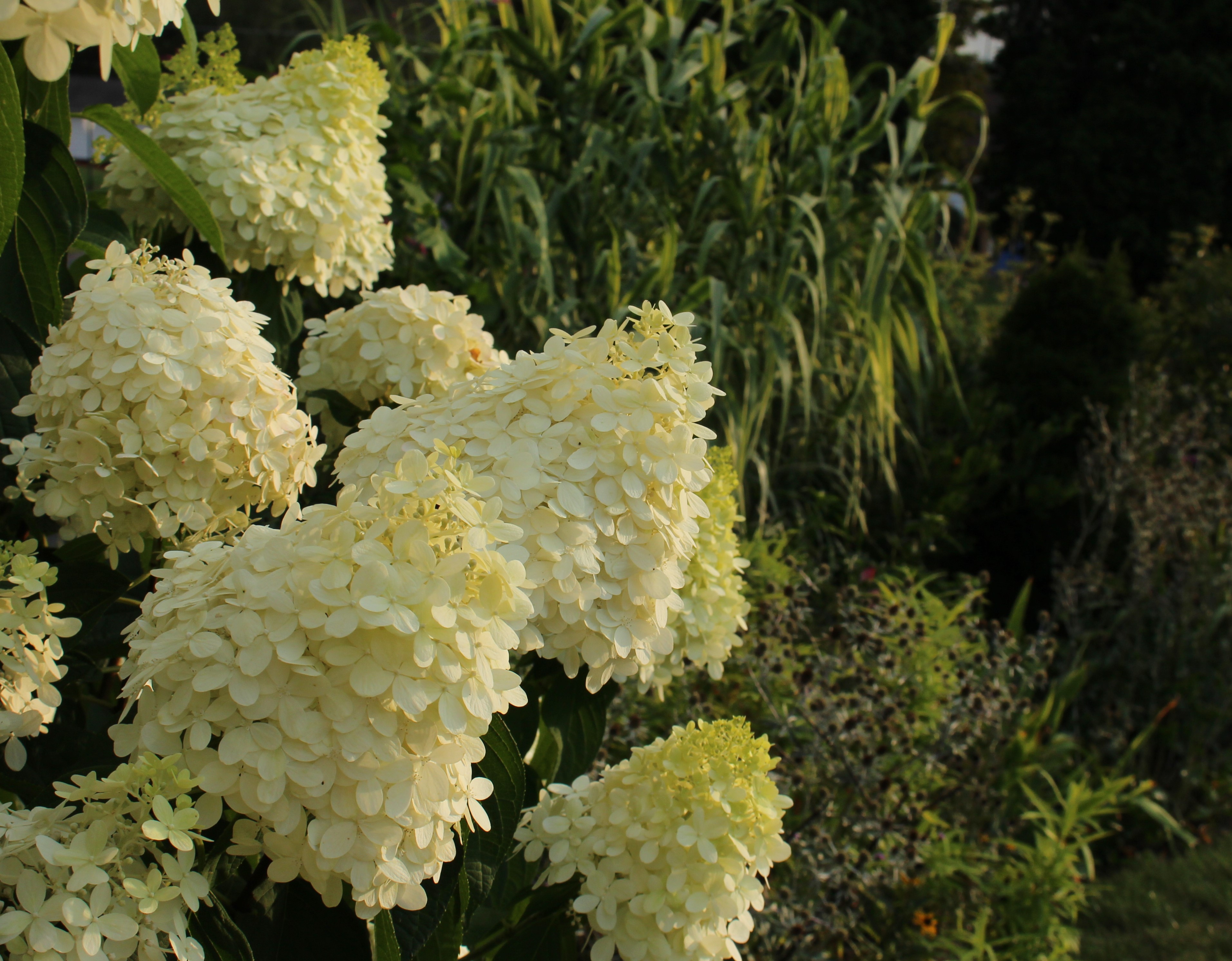
I think I show this view every summer as the ‘Limelight’ hydrangea comes into bloom along the street.  It’s an awesome plant.

Here’s a quick tour of the good and bad which summer has brought to the rest of the garden… and by ‘rest’ I mean the part which I practically gave up on when the rains stopped.

limelight hydrangea

Ok so I did give this bush some water when it began to wilt and yellow. How could I risk missing these blooms!

Along the street the plants are on their own and most handle drought with style.

front street border

‘Karley Rose’ fountain grass, ‘Karl Foerster’ feather reed grass and perovskia. The purple coneflowers didn’t make it this year and their blooms just dried up and wilted without extra watering.

The grasses really are reliable, but without a doubt ‘Karl Foerster’ is my favorite.  I think I’ve gone on about it enough in the past but please excuse just one more picture.

sunflowers and feather reed grass

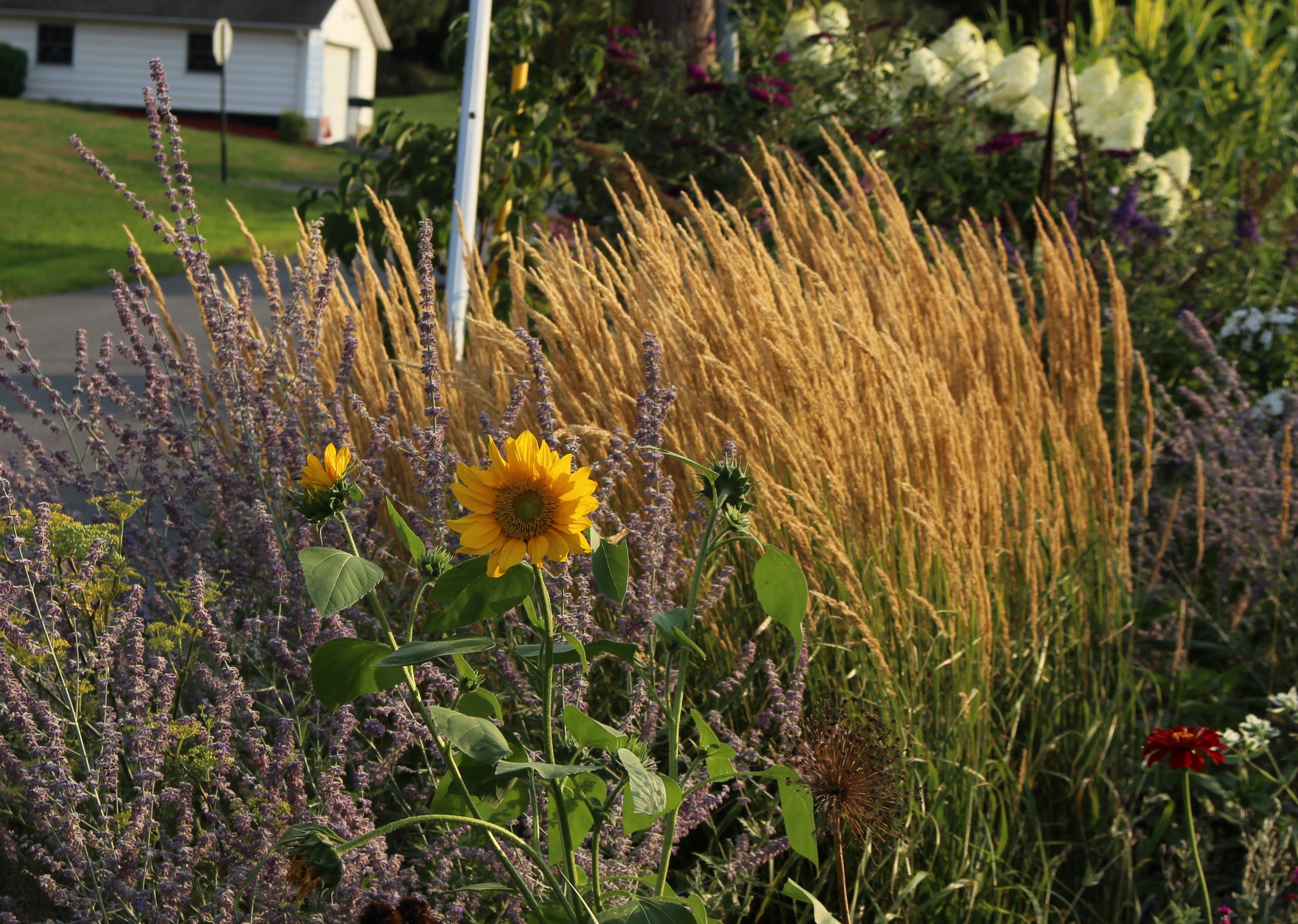
Sunflowers have a knack for putting themselves in just the right spot. If I could do a mass planting of this combo with sunflowers, perovskia and Karl I would do it without a second thought.

A few of the annuals planted in June have responded to the rain and are now looking like they want to live after all.

purple zinnia

Not sure if my color choices are really on point with the annuals this year, but a zinnia looks great anywhere.

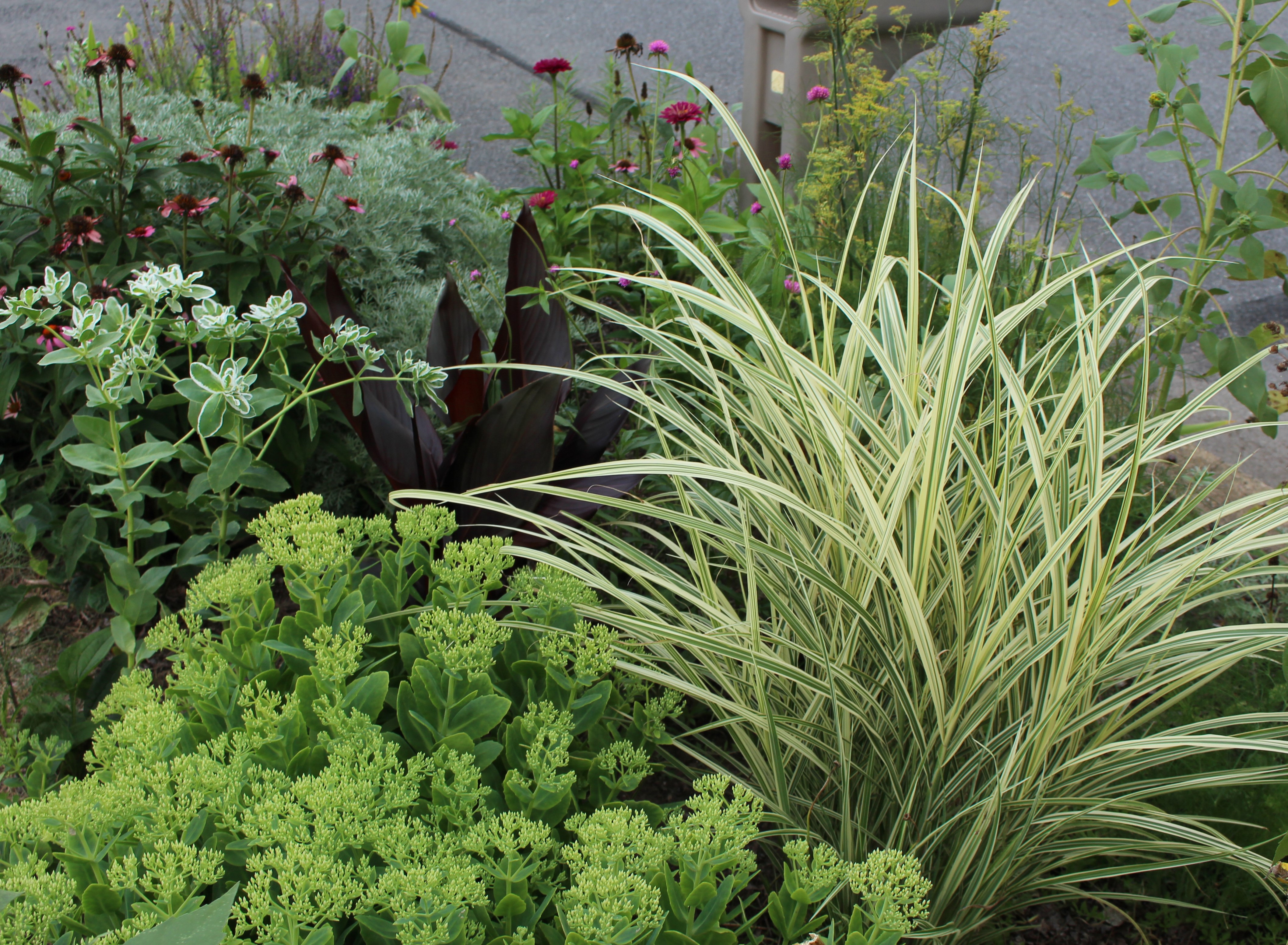
A three year old ‘Dixieland’ miscanthus has finally put its roots down and taken off.  Me and variegation are always friends so obviously there was a good chance the two of us would hit it off… and we have 🙂

sedum brilliant and dixieland miscanthus

‘Dixieland’ is a dwarf miscanthus which generally goes against my love of giant plants, but for this one I’ll be glad to avoid the floppiness of its variegated big brother, and for the mailman’s sake this size is far less intimidating.

Things start to go downhill as you look to the house.

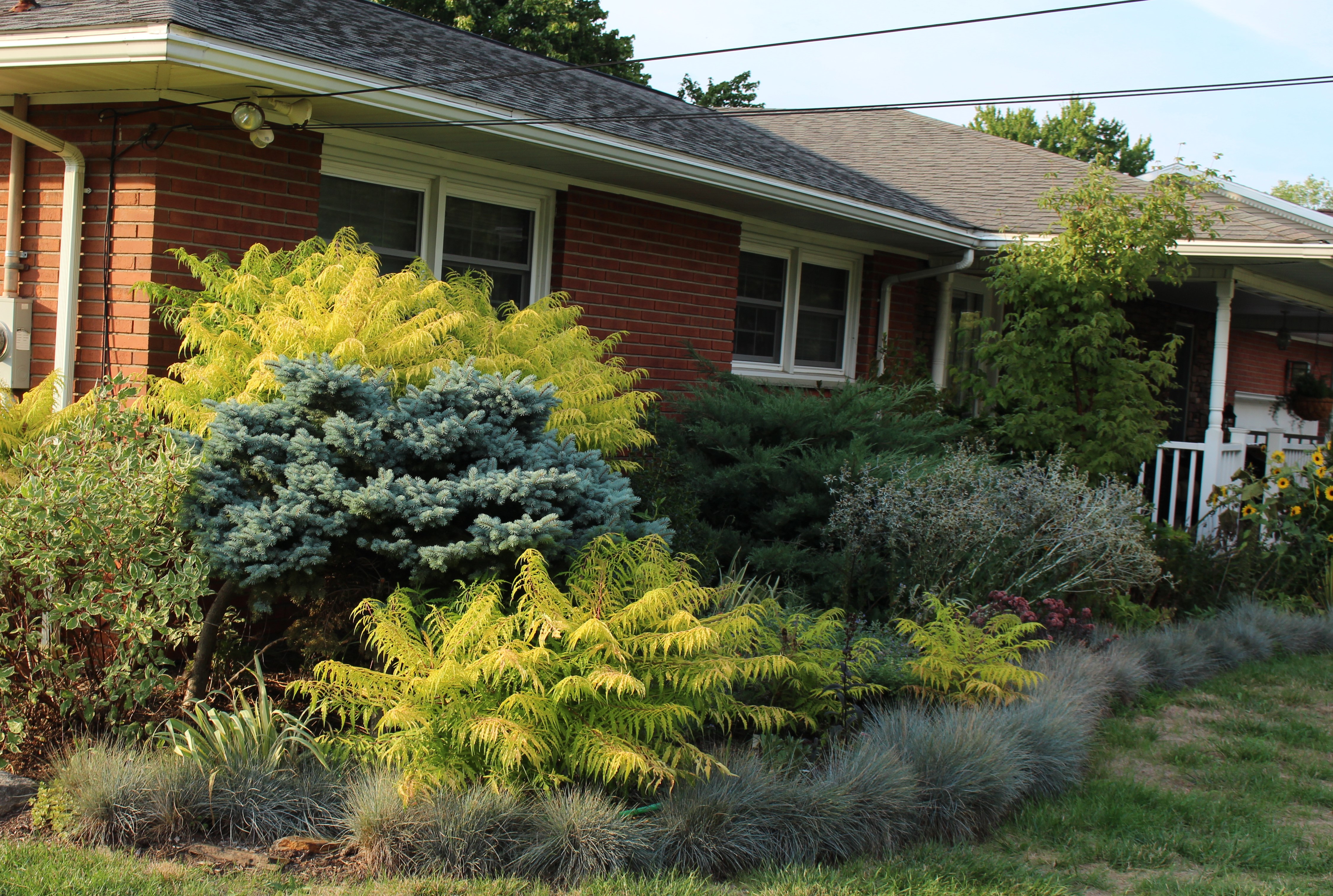
sumac tiger eyes

Someday I’ll grow up and realize ‘Tiger Eyes’ staghorn sumac is too aggressive a spreader for smaller planting areas and too informal a look for foundation plantings, but that realization may still be decades off.

Once you walk past the tropical bed and head out back it becomes project after project.

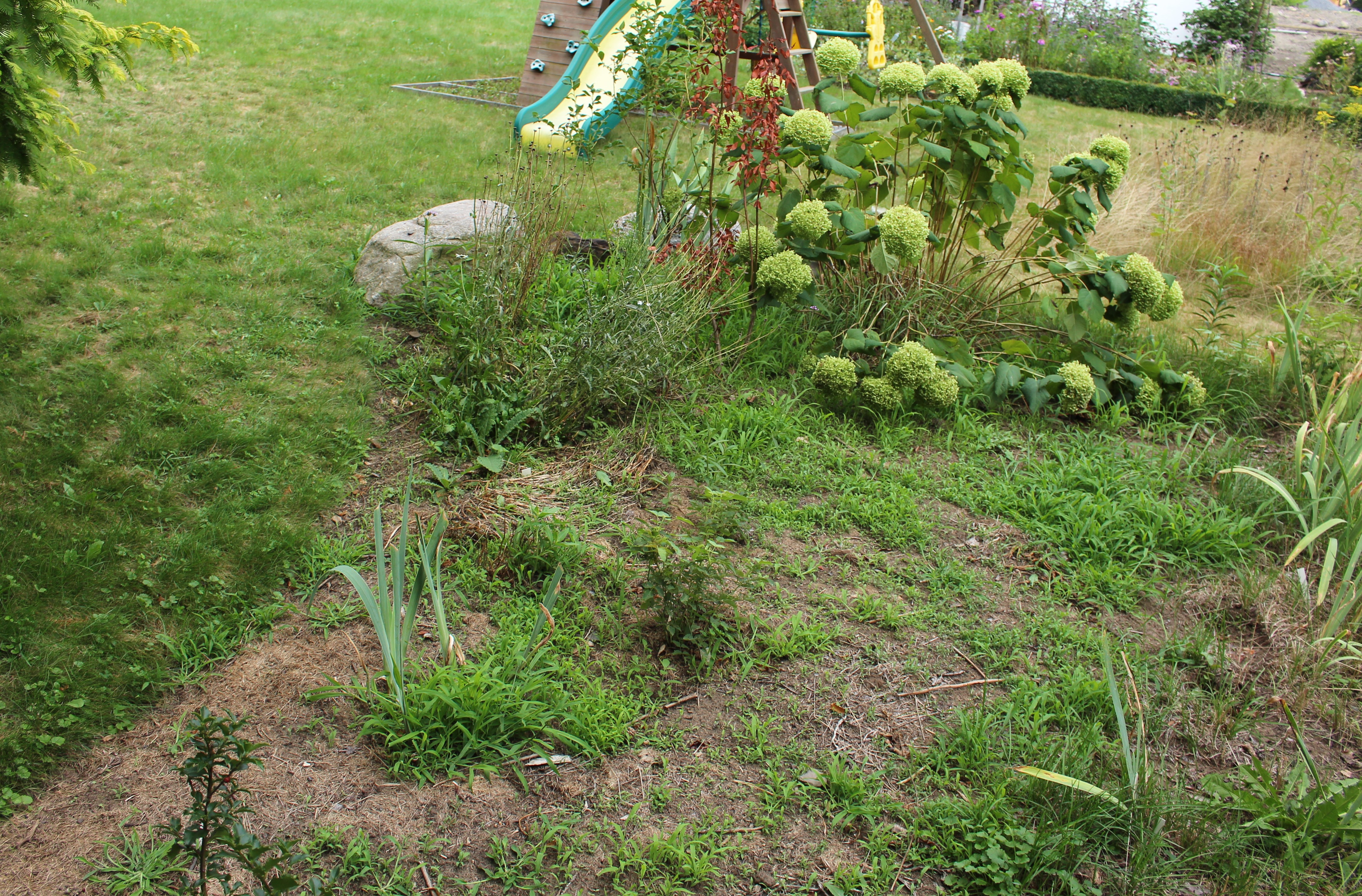
lasagna garden bed

Weeds are once again exploding in the bed-which-I-can’t-decide-what-to-do-with. Iris bed fell through, veggie bed fell through, dahlia bed fell through… and still it sits.

At least when it was dry the crabgrass wasn’t a problem.

crabgrass weed

Most of the iris and daffodils have been dug but just enough remain that I can’t really move on with this bed either.  Plus without a lawn worth mowing I don’t have any mulch to smother the crabgrass with and its spontaneous regeneration will make for a horrible mess in another week.  But on the bright side I do see the rabbits here all the time nibbling.

The return of rain has brought a sort of second spring to some parts of the garden.

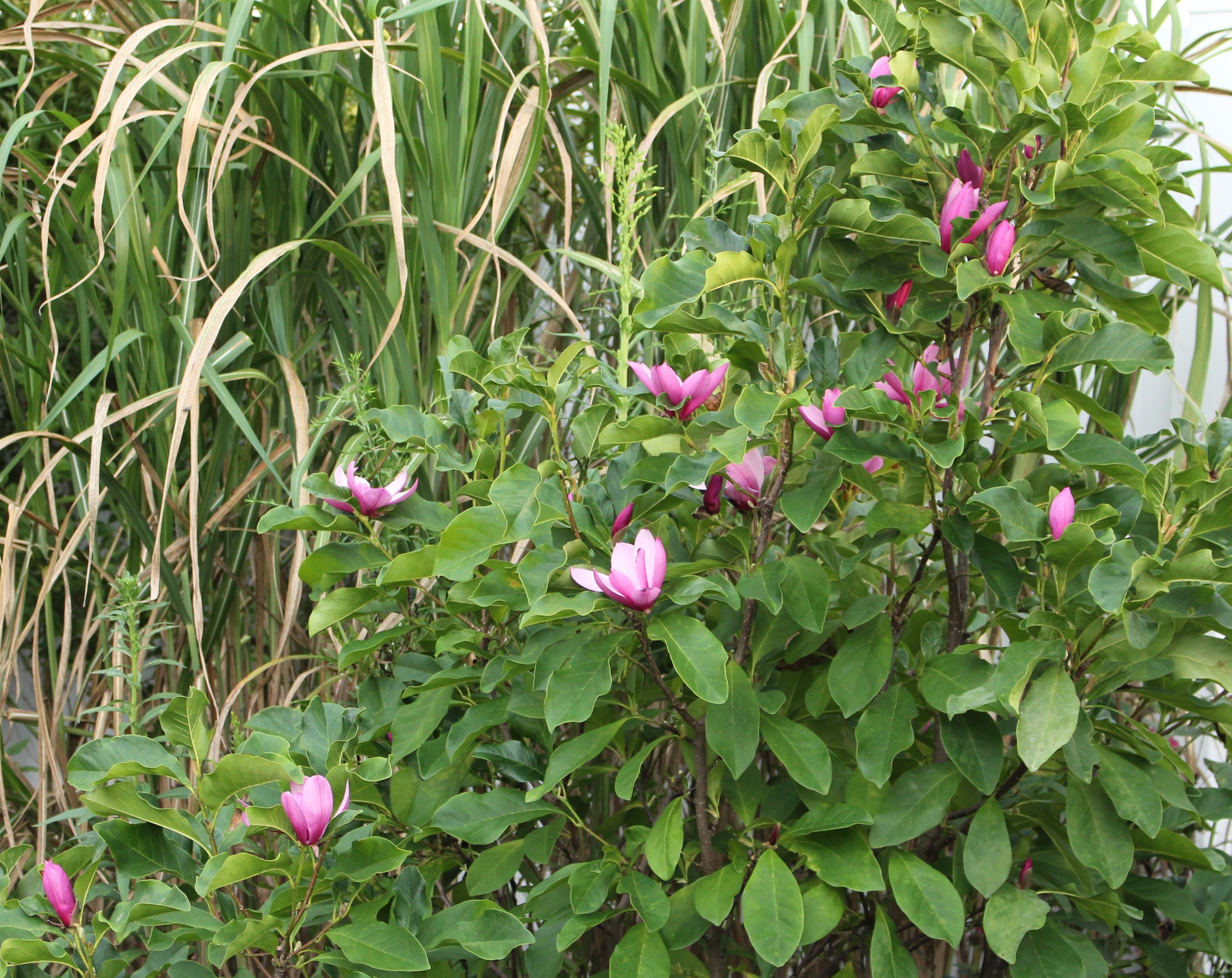
magnolia rebloom ann

Magnolia ‘Ann’ was yellowing, wilted and dropping leaves and must have been headed towards dormancy, but the rains brought on a flush of excitement in the form of summer blooms.

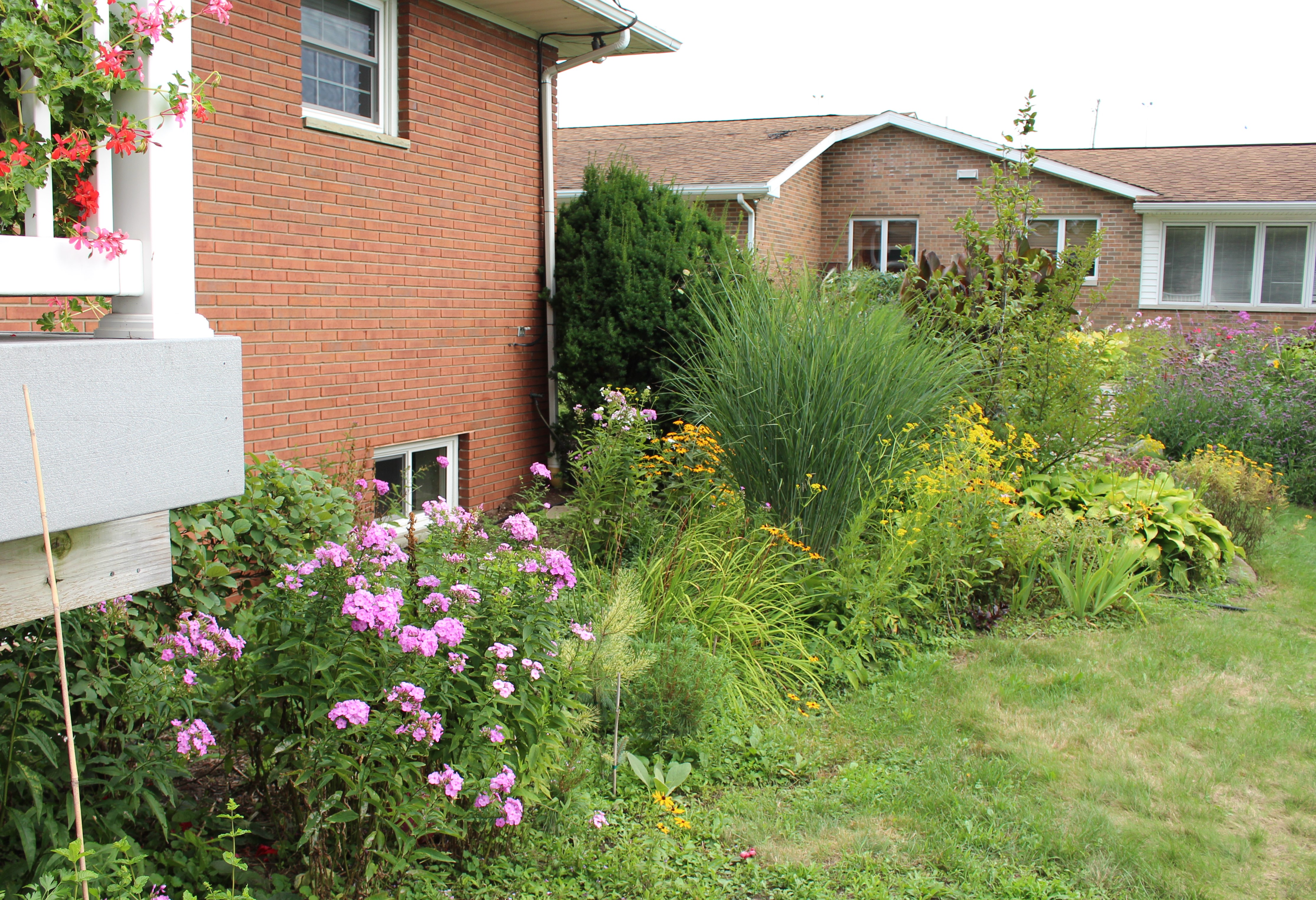
Even though all the fancier phlox in full sun fried, the phlox ‘weeds’ which I allowed to selfseed in this bed were saved by the shadow of the house.  There’s nothing which I like about this bed although my wife “loves!” the grassy clump of Panicum ‘cloud nine’ in the center.  I’ve tried mowing everything down and creating a dull bed o’mulch but the minute I turn my head it’s all back.

self seeded phlox

Blech. Golden yellow with washed out pink in front of the orangey brick of the house. Someone has plans to add a master bedroom to this end of the house and although someone else firmly disagrees, that opinion is usually crushed over time just like anything else which could be planted in the meantime.

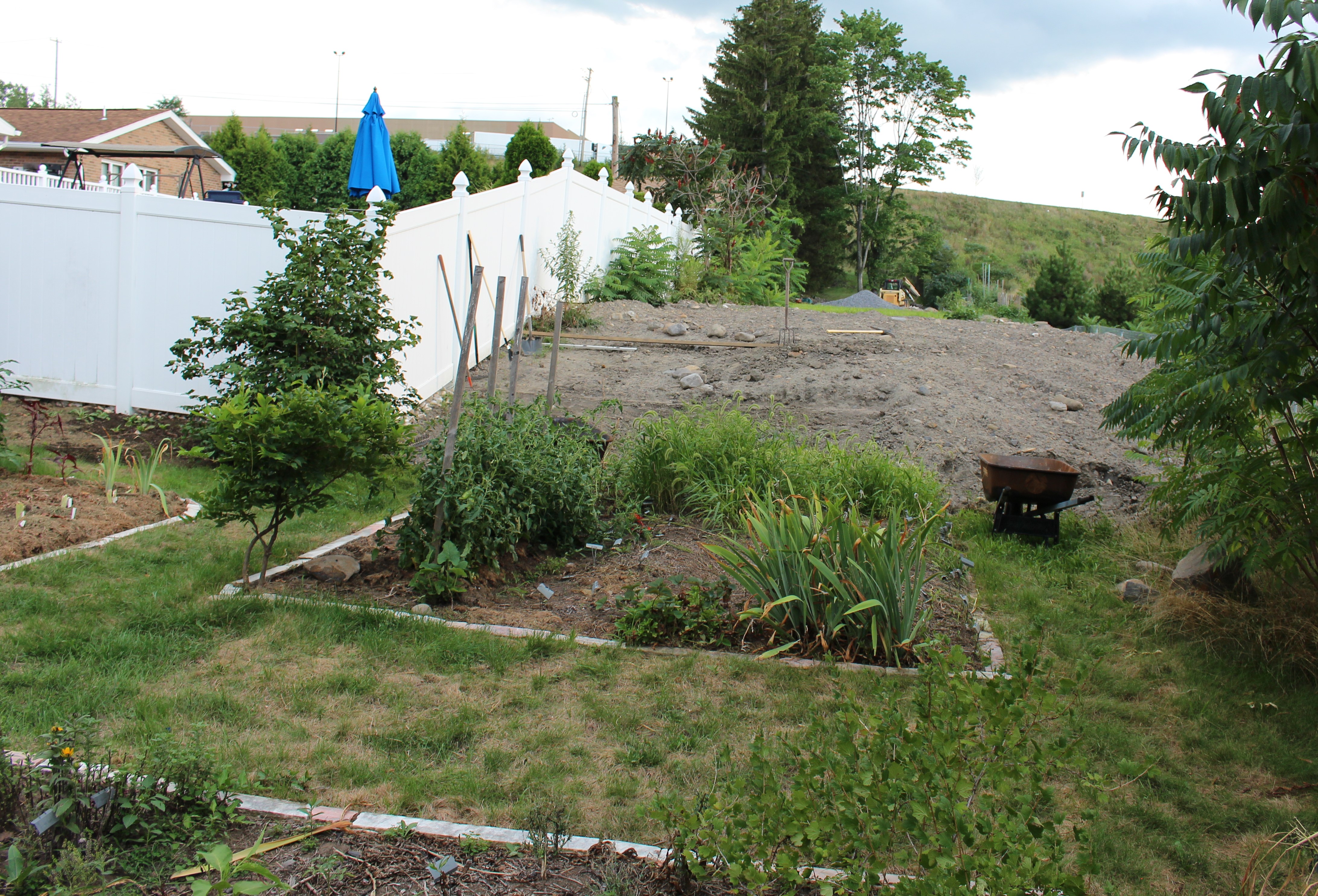
To give a final dose of reality to this mess of a post here’s a photo of the roughly graded fill which has been dumped next door and which has also been added to my project list.  It sounded like a good idea when my neighbor offered to just keep going with his own fill project, but now I’m faced with digging and raking and seeding.  The plan is for a new meadow garden but it sure is an inviting bit of real estate there behind the MIL’s house.  Sunflowers would do well there I’m sure, but for now I feel like I’m in a prison chain gang as I break up the fill with a pick so I can shovel it over into the low spots.

graded fill

My yard used to go across all at nearly the same level, but now the grade has been raised several feet. I wonder how much I could raise my own yard… hmmm.

So I guess if there’s any point to this post it’s that my garden looks much nicer in a cropped closeup rather than the big picture, and that your own garden is probably much nicer than you give it credit for.  Don’t feel bad for me though, I’m quite happy in my interesting mess and I (sometimes) do enjoy the journey more than the finished product.  Plus we’re off for a few days next week camping so that’s always fun 🙂

Have a great week!


That wasn’t smart 6.0, 6.1, 6.2, and 6.3

Well I really racked them up this weekend.  My favorite nursery, Perennial Point, was having a customer appreciation weekend and all plants were on sale for 30% off.  A dead garden will make you weak in the face of temptation and I guess I blinked.

Not smart version 6.0:  The garden was bone dry and I couldn’t even take care of what I had.  Weeds are having a field day, the lawn is dead and other plants are dying left and right.  I just bought home several delicate, nursery-perfect plants which probably haven’t even broken a sweat their whole lives and I’m planning to throw them into this nightmare.

daylily bubblegum pie

Three big ticket items followed me home, ‘Plum Magic’ crape myrtle, hypericum ‘Red Fame’, and daylily ‘Bubblegum Pie’.

Not smart 6.1:  I don’t like daylilies, don’t ask me why I would buy one.  The leaves look horrible in late summer, the old blooms look like soggy tissue messes which need daily cleanup, and the name ‘Bubblegum Pie’ is insanely dumb.  The flower on this one is fat and fleshy and overdone with way too many ruffles.  There’s nothing graceful or elegant in the flower but I’ll plant it near the one daylily which came with the house (and resprouted after I thought I sent it to the compost pile) and the other species daylily which I grew from seed (Hemerocallis atissima, a tall and graceful night bloomer).  We will see how it does.

Hypericum inodorum 'Red Fame

Look at the fruits on Hypericum inodorum ‘Red Fame’!  I’ve seen these used in flower arrangements and never thought it might do well in the garden, so we’ll see if it does.  btw the crystalline glisten on the leaves is something called raindrops, yeah it took me a few minutes to recognize it as well, apparently we used to get a lot of it back in the day.

Not smart 6.2:  I bought a Hypericum ‘Red Fame’ which I think is cool with its juicy looking bright red fruits and according to what I’ve read may tolerate drought just fine, but I also bought a crape myrtle.  Crape myrtle are not hardy here and even at 30% off this one still wasn’t exactly cheap but somewhere deep down inside I seem to think someday a miracle will happen and one will survive.  Maybe fourth time’s the charm….

caladium

Three new caladiums and a new coleus.  Buy one get one free on annuals since no one bothers to buy annuals on the last weekend of July… no one except me apparently.

Not smart 6.3:  I bought more annuals.  Tomorrow is August 1st and the days for annuals are numbered and I should be focusing on limping through the summer and getting ready for fall gardening rather than wishing for another June and July.  Plus I seem to remember telling myself (you wouldn’t remember since Iwas talking solely to myself) that I had too many coleus last year and I should let some meet their maker when frost came.  Now I’m adding more?

caladium pink splash

Caladium ‘Pink Splash’ which I managed to overwinter from tubers purchased last year.  At least that was smart.  Also smart is the healthy, dark-leaved Eucomis (pineapple lily) grown from seed supplied by Nan Ondra.  I’m hoping it will be big enough to bloom next year!

Not smart 6.4:  I already have too many caladiums for a reasonable Pennsylvania garden, but if you hang on for another minute I’ll tell a quick caladium story.  It used to be I could overwinter them with ease and even had some survive for more than 5 years, but then my luck changed.  Dead tubers would greet me each spring and I wasn’t sure what was wrong.  Short story even shorter last winter I tried keeping them completely dry in their pots and in a warmer spot and lo and behold they made it through perfectly.  Logical next step is to take advantage of any good caladium deal which you come across and then be immensely disappointed when they go back to dying next winter…

caladium

White caladiums and a pot of mixed tubers which I found on clearance.  The spotted one is my absolute favorite.

Pristine white caladiums filling a terra cotta planter in the high shade of a southern garden is tasteful.  My mixed, gaudy plantings in reused plastic nursery pots are not.  But I digress, and will leave you with one last glimpse of my new daylily.

daylily bubblegum pie

The disgusting daylily ‘Bubblegum Pie’ with all its offensive frills and flounce.  It really is too much of everything and I’m positive this will be the one and only daylily I ever purchase for this garden.  Since I have it I might as well plant it, and I might as well even spare a few shovelfuls of my precious compost on it.  The pot has three fans already and I can only imagine three or four deliciously overdone stalks next year filled with more of these flowers!

Not that smart 6.5?  A few days ago I ordered some iris through the Historic Iris Preservation Society’s annual fund raiser.  That’s innocent enough, but now that the sale has wound down I noticed a posting on Facebook looking for volunteers to take in leftover rhizomes and grow them on for a year before sending them back for next year’s sale.  I’m wondering where I would put 10 or 20 more iris 🙂

It rained by the way.  An absolutely amazing soaking rain which stretched out for hours and got into many of the driest nooks and crannies of the garden.  I’m quite pleased and know it will be a good week and wish all the best for yours as well.

Thursday’s Feature: The Wooly Thistle

Each Thursday I like to join Kimberley at Cosmos and Cleome and single out a plant which has tickled my fancy that week.  For the most part my choices have been on the respectable side but this week I’ve gone back to the dark side and chosen the wooly thistle (Cirsium eriophorum), a plant which if anything should be kept far, far away from your fancy since direct contact will definitely NOT tickle.

Cirsium eriophorum, wooly thistle

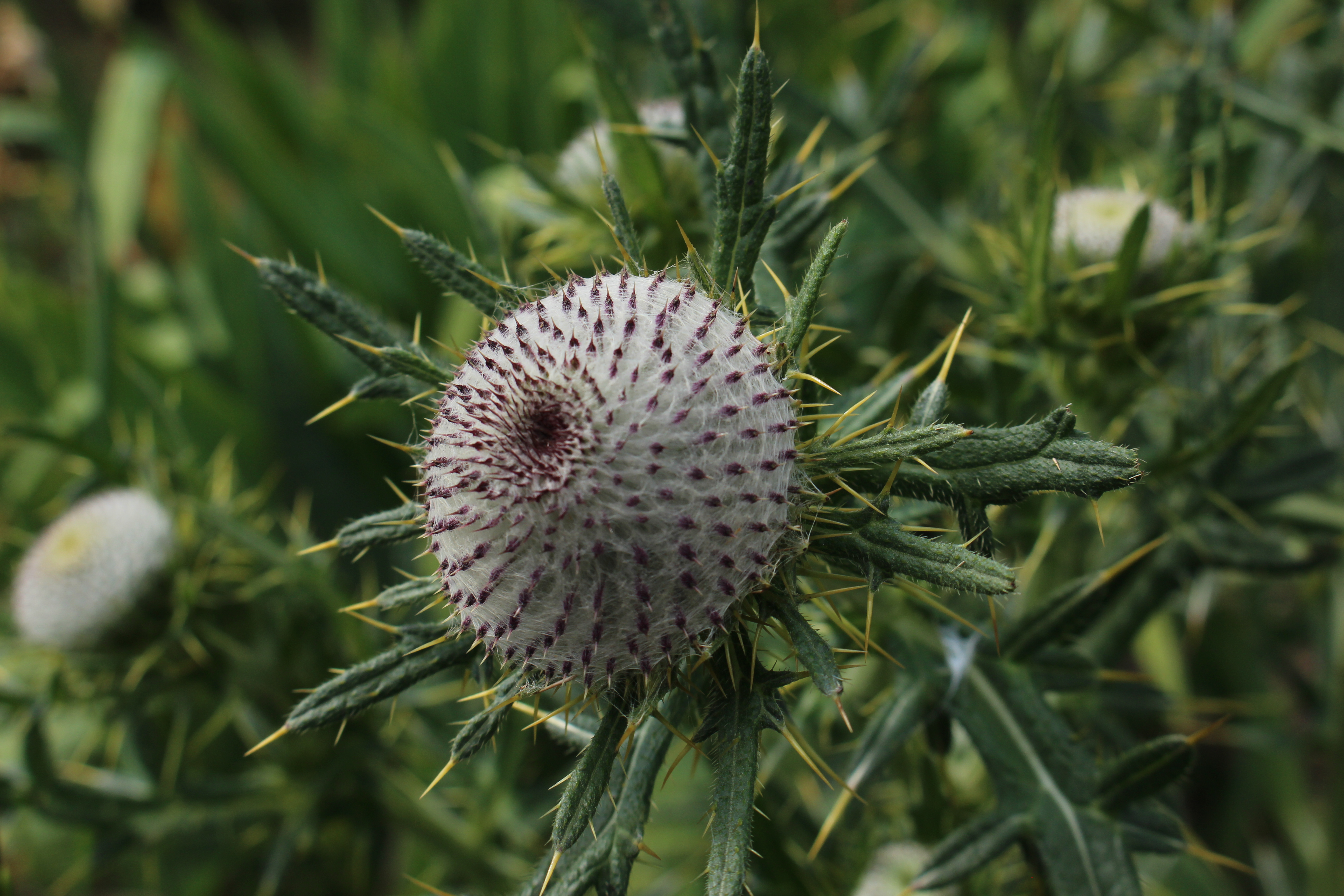
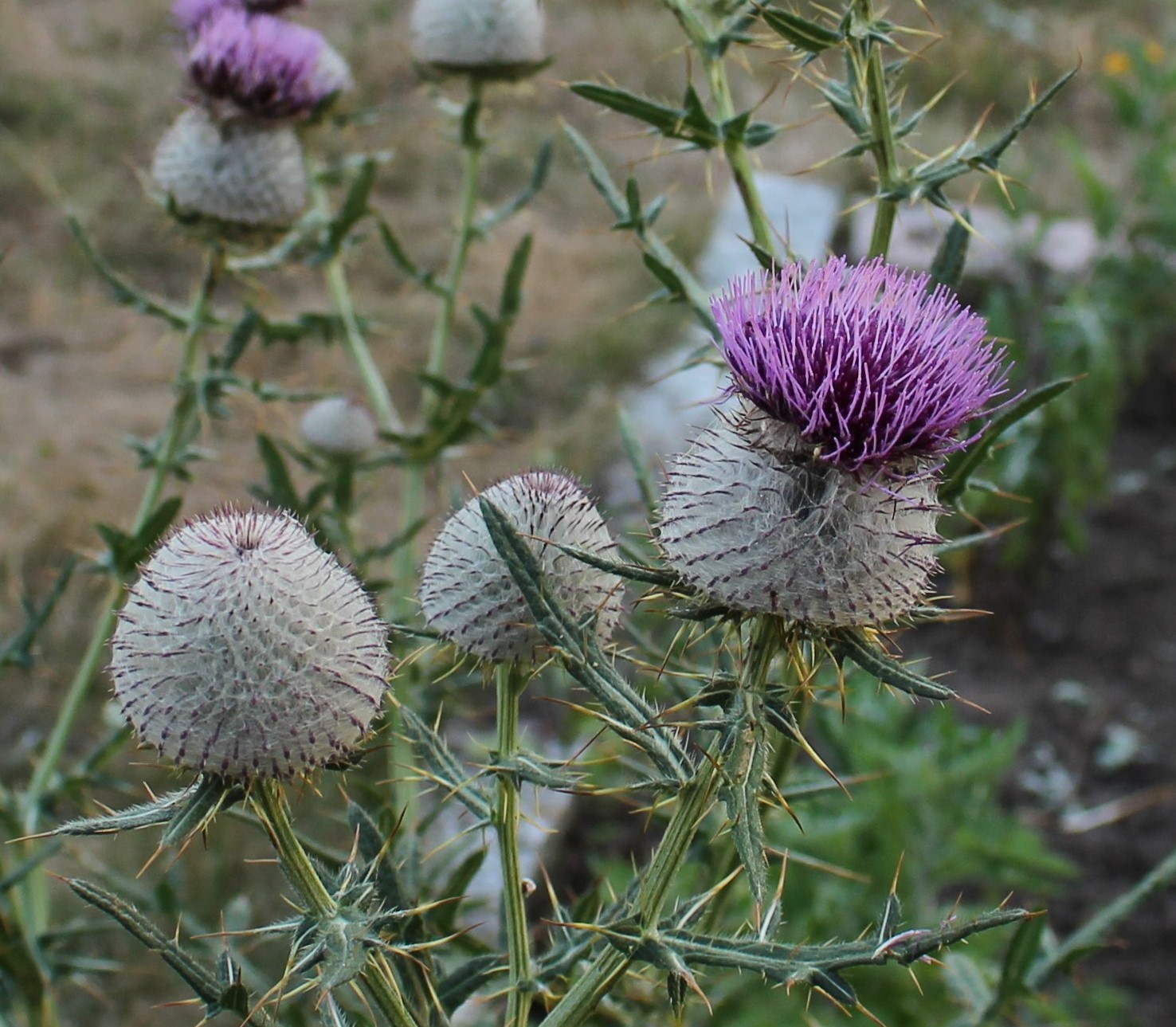
Cirsium eriophorum, the wooly thistle, with its first bloom opening in late June.

Despite its cute common name, the wooly thistle is probably cursed by many a gardener and farmer throughout its native Europe.  I don’t think many a gardener here or there would go through the trouble of finding seeds through a seed exchange, sowing them and nursing the plant for three years, and then briefly enjoy it’s heavily armed flowers for a few weeks until it set seeds and died… but I think it’s absolutely fascinating!

Cirsium eriophorum, wooly thistle

A baby picture only a father could love.  Wooliness studded with purple tips and all so nicely geometrical!

Who knows if I’ll replant the seeds once mama thistle is gone, she is a bit of a hostile presence after all, but she’s very welcoming to the bees and ants which swarm the flowers.  She’s also very popular with a group of weevils which have poked their noses into the wool and I’m sure laid eggs while nibbling the flower buds.  Weevil grubs eating thistle seeds is probably not the worst thing to have and even with them there will likely still be more than enough seeds produced.

Cirsium eriophorum, wooly thistle

The spines are just as vicious as they look 🙂

I will completely understand a less than enthusiastic review to this week’s choice.  Please feel free to just smile politely and then later shake your head, I’ll understand.

Cirsium eriophorum, wooly thistle

Cirsium eriophorum today with its fat wooly flower heads.

Please also feel free to visit Kimberly and enjoy what she’s selected for this week.  I hear it’s a delightfully pure Shasta daisy, and I’m sure it’s far better suited for vases and placing behind the ear than this thing!

Tuesday View: The Tropics 7.11.16

This week I was a little late in the day with my photo so it’s full of artsy backlighting.  A good effect for soft lighting, but not the best to see what’s going on in a Tuesday view.

tropicalismo

The tropical garden at about 7 in the afternoon.

One thing which you will likely notice is the pile of grass trimmings and the wheelbarrow.  It was a busy afternoon in the bed and much of this was the result of the bed’s new designation as the Tuesday view.  Who would have suspected joining in with this meme would be the motivation needed to buckle down and make some of the changes I’ve been thinking about for the past few years?

rose 'black forest'

Not exactly tropical, but the color of the rose ‘black forest’ is hot enough to fit right in.  This is already its second flush of bloom and other than a few holes chewed into the leaves (most likely from some annoying beetle) it’s almost perfect.  Last year this plant was potted on the deck, still great but much younger and smaller.

Change one: The variegated miscanthus ‘Cosmopolitan’ had too much of a head start on the new plantings so I went ahead and cut it down to about a foot high.  We will see how this works out since I’ve never tried it before, but it’s grass right?  I suspect just like a scalped lawn it will send up plenty of new shoots, and in the meantime the cannas and dahlias will be able to grow upwards in peace and lay claim to their own airspace.

newly planted musa basjoo

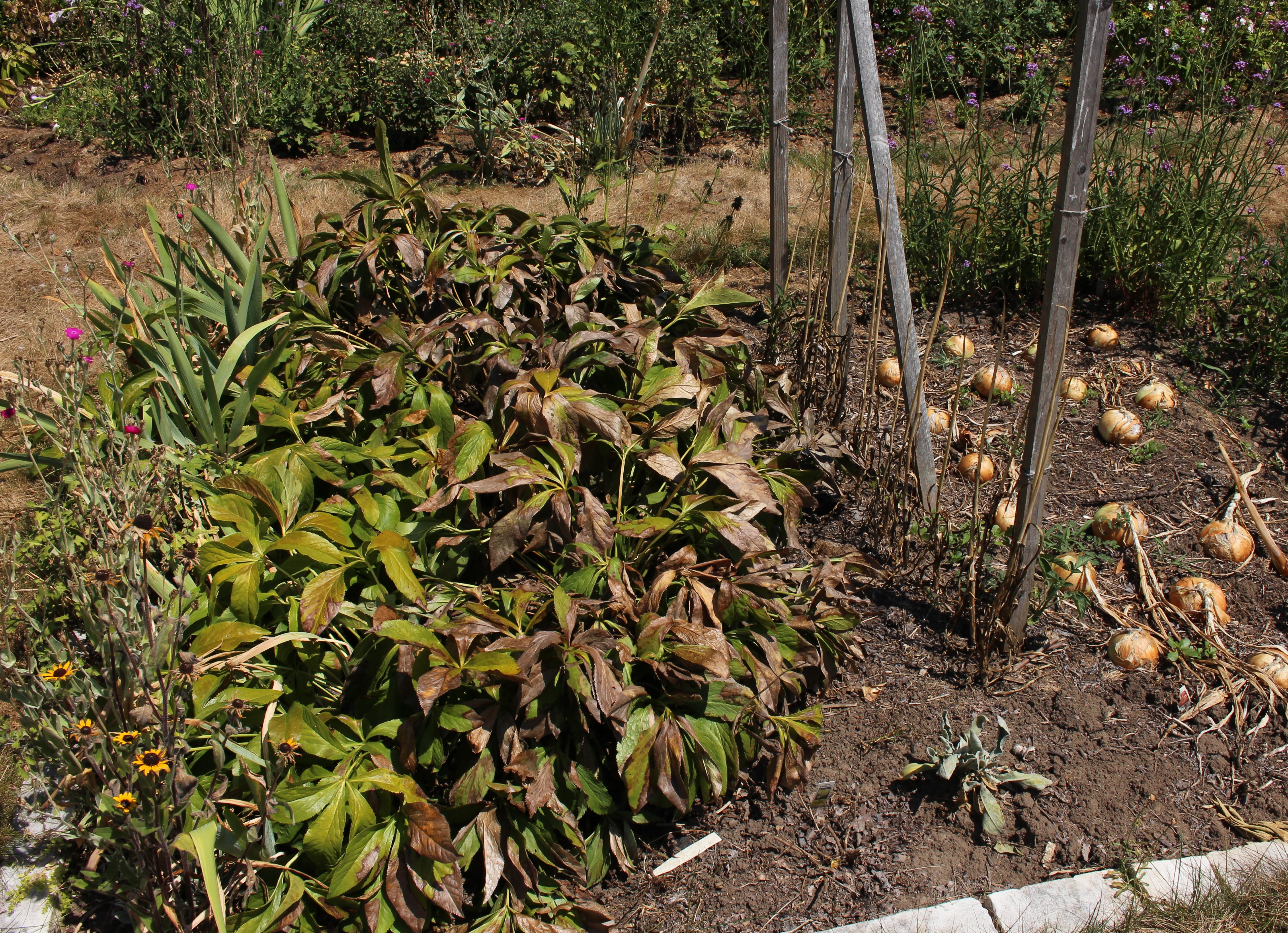
Change two:  A newly planted banana (Musa basjoo) has replaced the peony which was just taking up space here… and mildewing.  When sunflowers grew up and covered it in years past there was no reason for it to bother me, but now it does so out it went.  I’ve never composted a peony, it seems absolutely criminal and I’m not sure I should be confessing, but there you go.  I yanked a few salvia as well.

We were gone for four days last week and the garden nearly dried out and died due to the heat.  Rumor has it rain fell, but of course all the big storms avoided us.  When I returned to see the pathetic state of my plants I first cursed, then cursed some more, and then decided to mow everything down and give up for the year, but after watering that evening and then the next day visiting my favorite nursery (Perennial Point), things seemed less bleak.  They had awesome bananas and elephant ears and a bunch of other stuff and in my weakened state two new bananas came home with me (plus a new fern and red hot poker).

Kochia Scoparia

Kochia Scoparia is a new one for me.  The common names are burning bush and summer cypress and I suspect I will like it, but for now keep in mind it’s listed as a noxious weed in several Midwestern states.

I didn’t need the bananas, but I did need the bananas, especially after seeing how well they have done for my brother in his zone 7 LI, NY garden.  In case you’re wondering, Musa basjoo is likely the hardiest banana, and although I won’t get into all the logistics of me being the one to give him the plants in the first place, and him being completely deaf to all hints at how much I wanted one and which one could he spare… I now have one again and promise to mulch it well EVERY winter so it doesn’t die off again.

long term weed killer

The rest of the zinnias are doing well, but I suspect my MIL was again a little heavy-handed with the weed killer here since it’s a dead spot which seems to stunt all life.  She has an unexplained attraction to any herbicide which says ‘controls weeds for months’, and this in turn stunts and kills anything planted in the treated area or anything planted near the runoff area… for months.

So here we are again, all over the place on what should be a simple post.  I promise to get less wordy once we get through this planting and intro phase but for now I can’t help it.  Just be grateful you’re not stuck here on a visit and I’m really going on and on!

lythrum salicaria purple loosestrife

Now what do I do with this?  The flower stalks of a Lythrum salicaria (purple loosestrife) have appeared in the back part of this bed and I like it.  The problem is it’s a terrible invasive in this part of the country, but only in wetlands and my garden is far from being a wetland.

If you’d like to join in the Tuesday view, Cathy at Words and Herbs follows her own view each week and I’m sure she’d welcome the company.  It’s a great way to track changes through the season and apparently it can even motivate some of the less motivated gardeners into tackling a few things on the to-do list!