A freeze and the daffodils

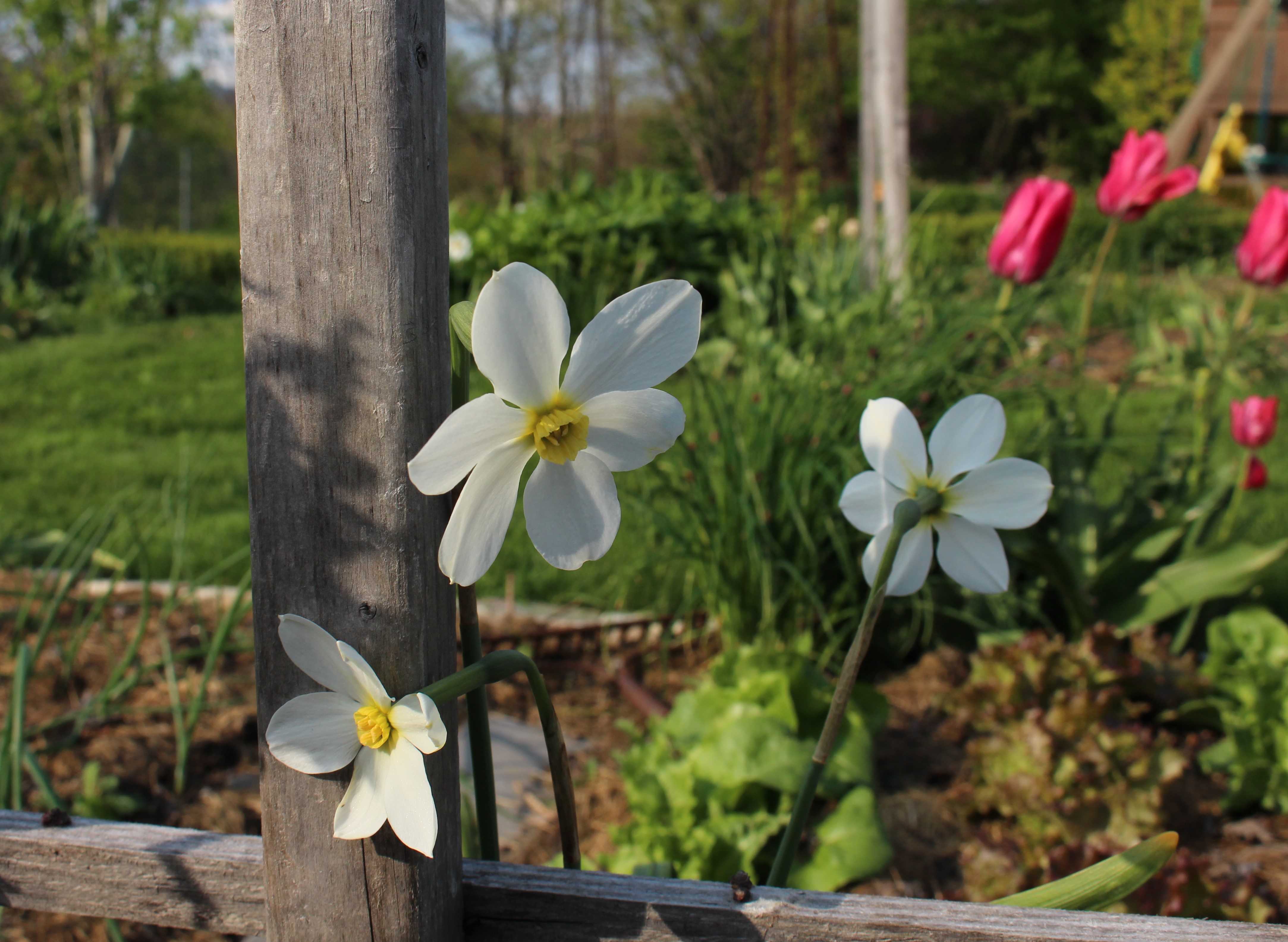
I can’t really hold the weather against them, but I do.  Again and again I told them not to get such an early jump on the season but they ignored me and sure enough one final blast of winter came through and taught them all a lesson.  Three weeks later and I’m still mourning the daffodil season which never was.

cold damage daffodil

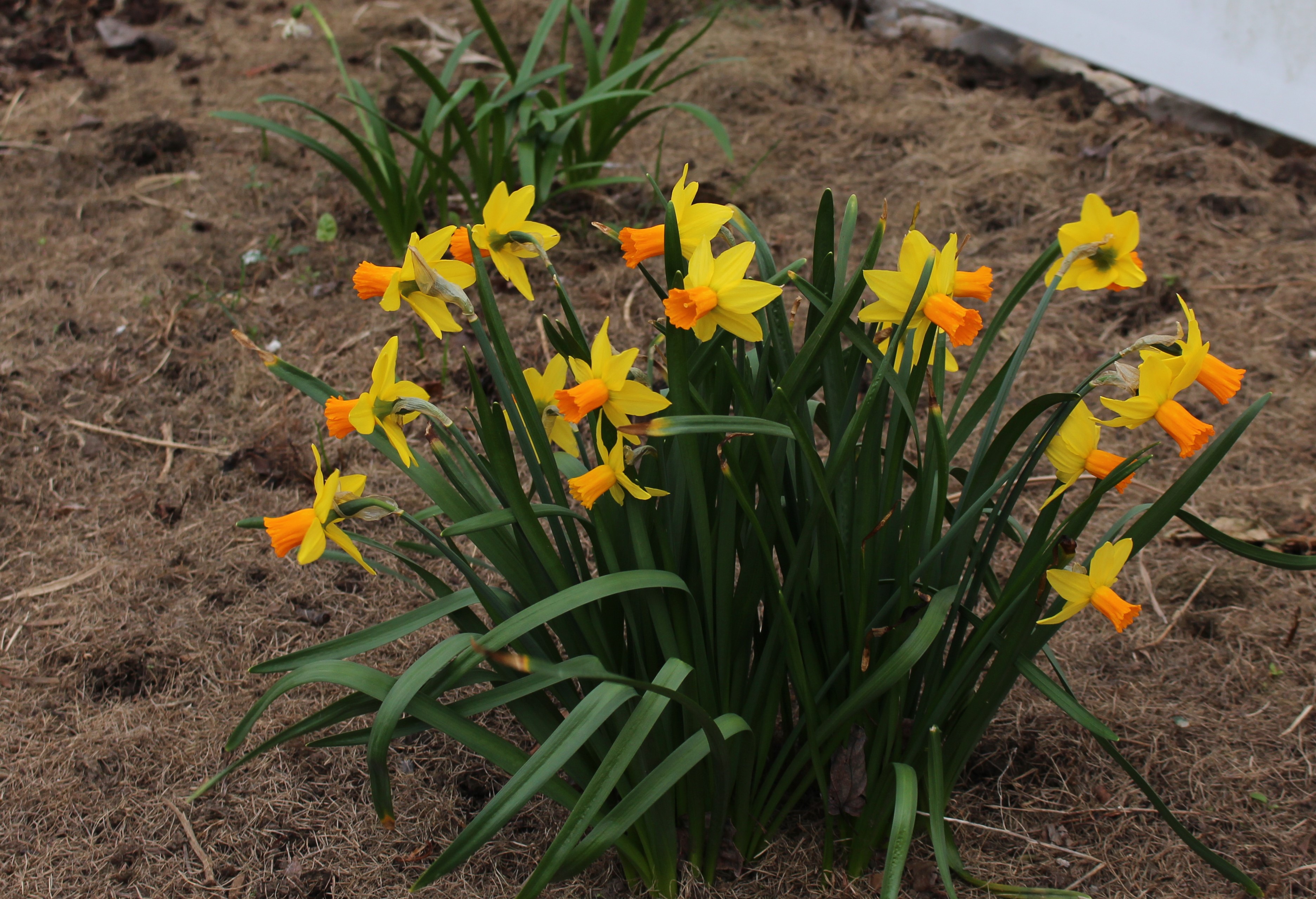
Can you guess the prevailing wind direction?  Like a windswept bonsai this daffodil ‘Actea’ still managed to pull through and open a few blooms in spite of the 20F winds which blew through. 

I shouldn’t say the whole season was a wash but if I had to guess I would say about half the daffodils lost their buds and blooms completely and only about a quarter opened up nicely.  A quarter goes a long way though and I’m still grateful to have what I do, plus the weather has been very accommodating since so I suspect the surviving daffodils will put on an extra special show next year.

Isn’t that typical of a gardener?  It’s always “wait until you see this next week” or “imagine next year”…. or the apologetic “you should have seen it a few days ago”. 🙂

narcissus daffodil stepchild

One of my many favorites, narcissus ‘stepchild’ is later and in a spot sheltered from the wind, and although neighboring clumps were still de-flowered by the cold, she seems as pretty as ever. 

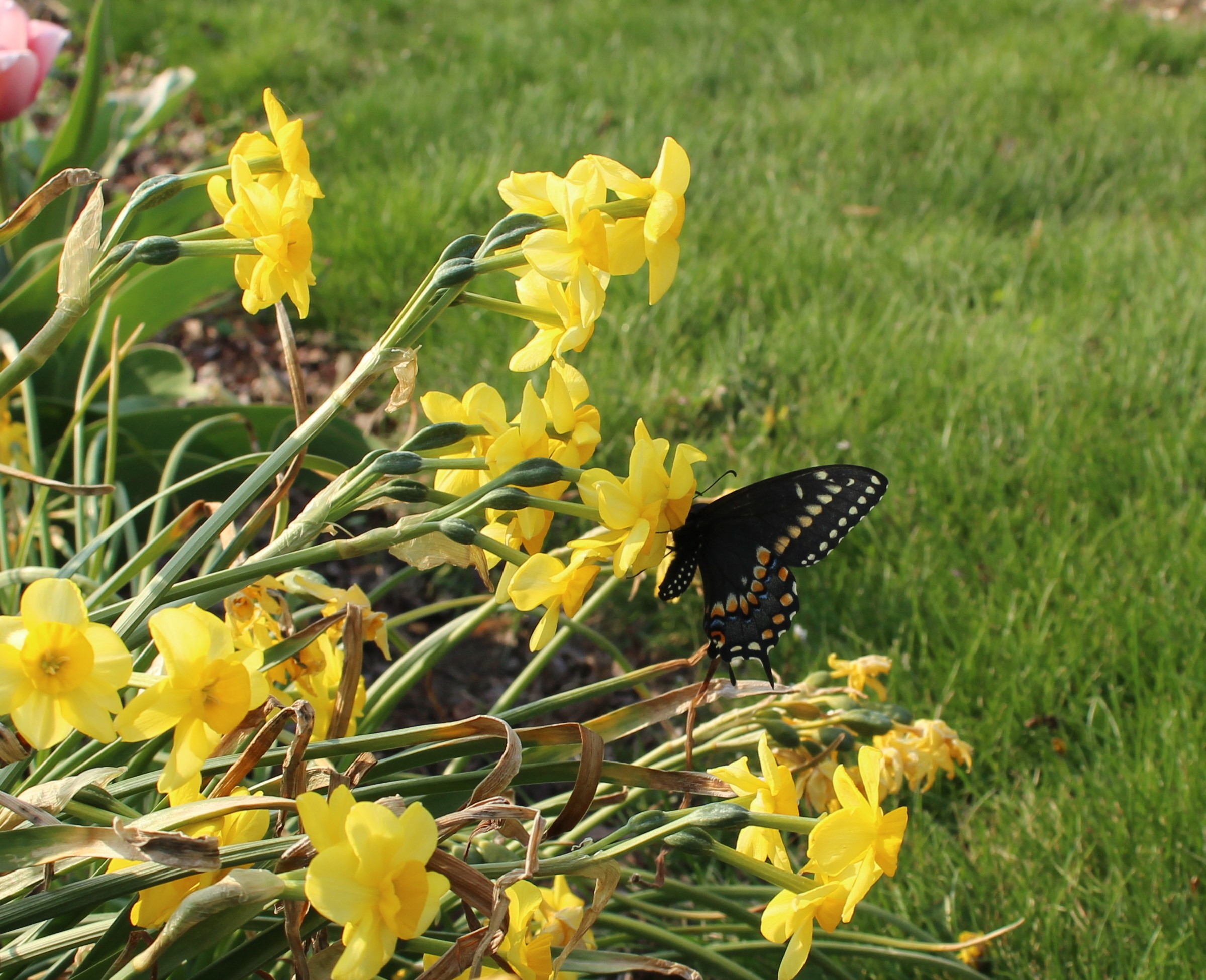
In spite of the wild swings in temperature the various butterflies of the garden seem unfazed and continue to shake off the cold and go about their business as soon as the weather warms enough.  Perhaps I hadn’t noticed in previous years, or perhaps there were other non-freeze burned sources of food available, but this year the daffodils have been very popular with several types of butterflies.

butterfly on daffodil black swallowtail

A black swallowtail feeding off the windblown and weather-beaten flowers of narcissus ‘kokopelli’. 

I hope my wallowing in self pity hasn’t made it seem like all is lost in my end of the woods.  Spring is a fantastic relief even with its frequent ups and downs and if one looks past the blackened cherries and mushy primrose blooms and perennial shoots there’s still more good than sad.

daffodil newcomer narcissus

Later is better this spring, and because a late replanting last fall set daffodil ‘Newcomer’ back a few days, its blooms missed the worst of the weather.  The tulips as well, the shelter of the garden’s tiny boxwood hedge seems to have helped them avoid the full brunt of the winds.

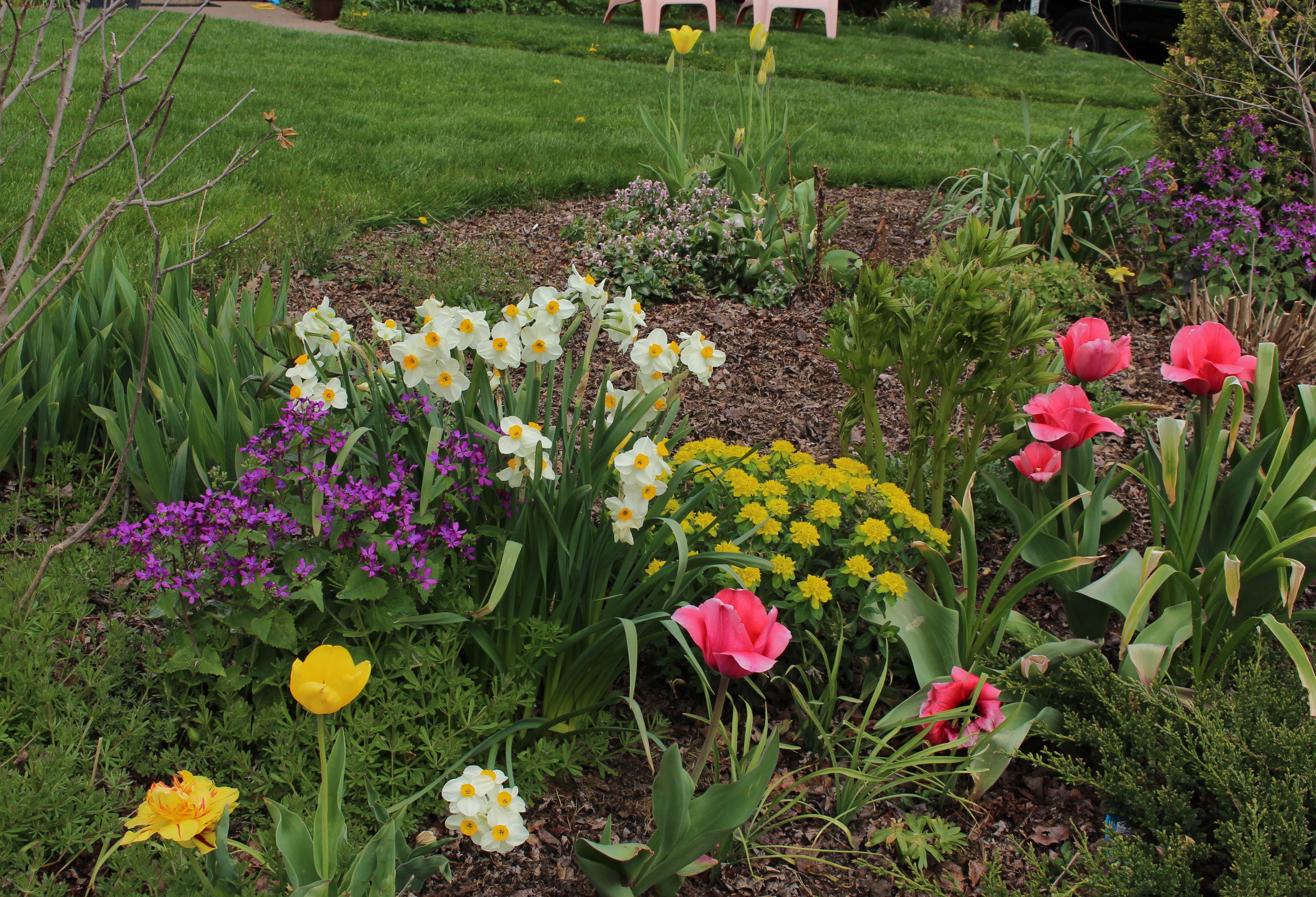
In the lee of the house the front garden missed the full force of the wind.  Here if I ignore all the mushy, blackened hyacinth blooms, and wilted early daffodils I can still find plenty to enjoy.

narcissus geranium daffodil

Blooms of the good old reliable daffodil ‘geranium’ set off by ‘pink impression’ tulips, yellow Euphorbia polychrome, and the purple flowers of ‘Rosemary Verey’ Lunaria annua (moneyplant).  I was hoping for darker foliage on the Lunaria but maybe having all the old leaves frozen off a few weeks ago left me with only fresh new green ones.

Maybe this freeze was a warning to diversify.  I admit to having way too many daffodils and maybe adding more supporting players isn’t the worst idea (as if I need a reason for adding more plants!)

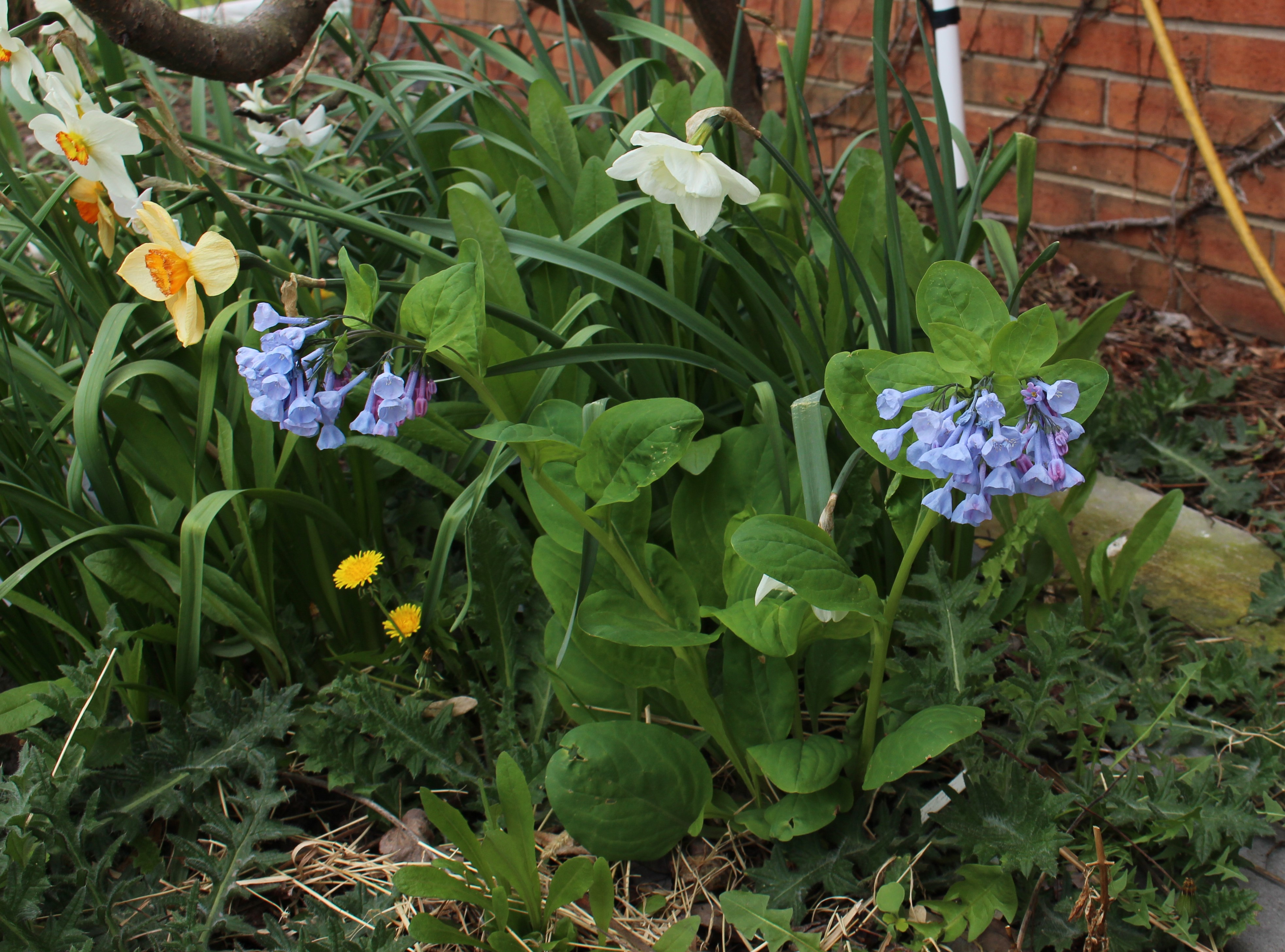
mertensia Virginia bluebell from seed

Finally!  After several failed attempts and then a three year wait for my only sprouted seedling to grow up, the first Virginia bluebell (Mertensia Virginica) is in bloom.  Others claim it to be nearly weedy in its ways, but I managed to kill the first one I bought and then never found it in the garden center again.

I’m kidding of course.  Although I do need to find new homes for many of the most promiscuous daffodils (please let me know if you can take any in), there are billions of new plants on the way regardless, as seeds sown last fall and winter begin to sprout.  I always love these new surprises as much as I love the warmer up sides to this spring’s manic mood swings.  Even a bright yellow dandelion makes me grin when the sun is out!

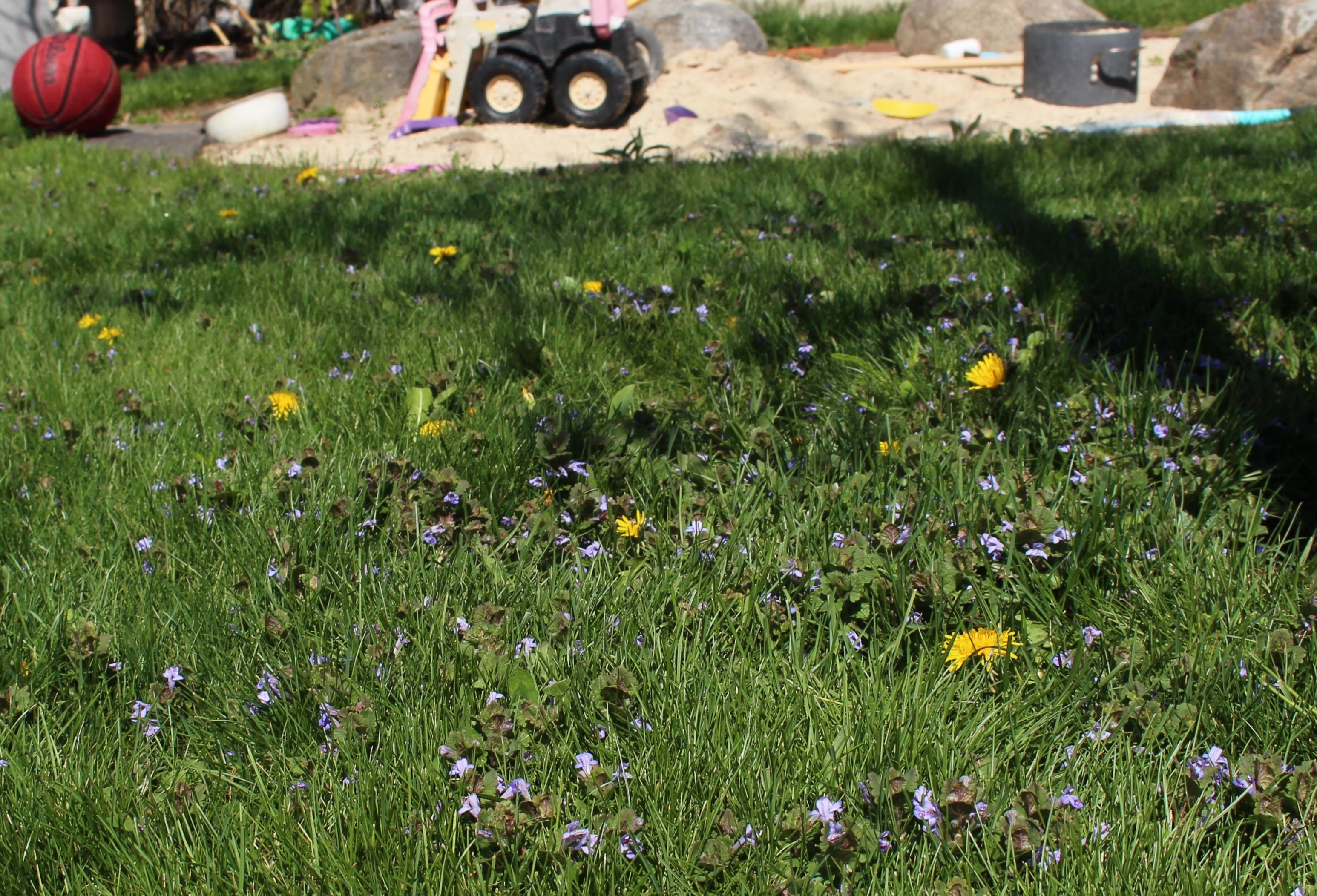
creeping Charlie dandelions

Creeping Charlie and dandelions on a sunny day.  A beautiful lawn in my opinion…. even if Charlie does get on my nerves later in the season.

I have one more gloomy post as I complain about the assault which the cold made against the tulips, but after that things should return to a happier tone which more accurately reflects the joy of the season.   Have a great weekend, I’ve spent far too long on the computer and need to get out there and dig a little before the first Little League game drags me elsewhere 🙂

GBFD April ’16

Imagine my embarrassment when I saw it’s been nearly two weeks since my last post.  I know the exact reason for the pause but right now just  don’t want to get into the ugly truths about mixing brutal cold fronts with fresh spring growth.  Instead I’ll focus on the beautiful sunshine of a cool spring morning and join in for a very quick visit to celebrate Garden Bloggers Foliage Day with Christina from ‘Creating my own garden of the Hesperides’.

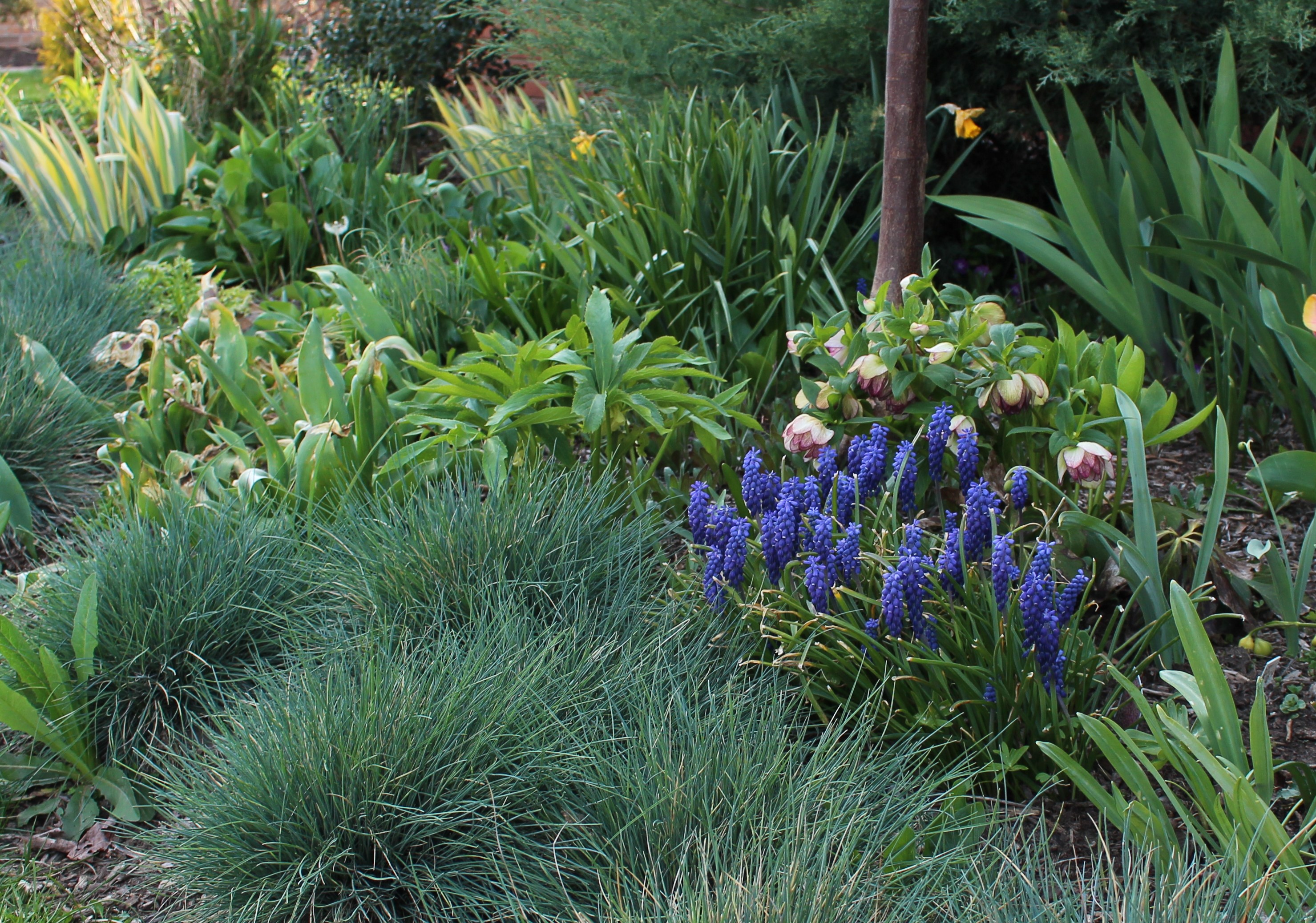
muscari and blue fescue

The grayish leaves of blue fescue (Festuca glauca) alongside the blue flowers of grape hyacinths (Muscari).  Please ignore the freeze burned tulips to the left of the photo…

Thanks to Christina for the monthly reminder to reexamine the contributions foliage makes to the overall look and feel of the garden, and this month it’s a border of blue fescue which has me most pleased with foliage effect.  This border was switched up last spring when I divided and spread a few clumps all along the foundation plantings, and this spring it has filled in with a lush vigor which really shows off the bed.  Now that the fescue is making me happy I’m fixated on a clump of blue muscari growing just behind the grass clumps.  There’s a strong possibility this will be divided and spread along as well since I like the combination.

The fescue and muscari are extremely common plants and both were free shovel-fuls from other gardens.  It kind of makes me reconsider that bucket of plant labels which no longer match living partners… but not enough to cure that plant lust for all the new goodies 🙂

See?  I promised it would be quick.  Please visit Christina’s blog as well, it’s always a pleasure to see and hear about the foliage others across the globe are enjoying in their own gardens, and have a great weekend!

Bury your head in the sand

Ignorance is bliss.  As the garden shivers and crackles under a freezing blanket of cold the wise gardener will hunker down indoors and enjoy the luxury of a warmer, climate controlled gardening experience.  Outdoors he can’t do anything but wait for the damage to show but indoors he can at least tweak the thermostat a little higher and take another sip of coffee… spiked or unspiked depending on the latest weather report.

rebloom amaryllis

Leftover Easter flowers and a few too many amaryllis blooms.

I’ve been a little too excited about the new amaryllis I bought this winter and in my excitement ended up bringing the older bulbs out and giving them a little water too.  In a normal year I just throw the dormant bulbs outside in April and let them bloom right alongside the tulips, but this year I thought ‘the more the merrier’ and as a result I’m ending the winter with an amaryllis (Hippeastrum) extravaganza.  I’ve had these bulbs at least seven years now and if I remember to give them a little attention after flowering they reward me each spring with a fantastic color show.

red amaryllis

The bright red and pure white are perfect for Christmas… or I guess Easter 🙂

It sounds slightly ungrateful but of all the colors, Christmas red and snowy white are not what I’m normally looking for come springtime.  This of course was not what I was considering years ago when I picked the bulbs up for $1 a piece at some box-store clearance shelf… but please humor me as I shamelessly brag about how well they are doing now.  Each pot is already showing at least four bloom stalks a piece, and the plants themselves are on the verge of nearly overwhelming the dining room table, even with less than half the flower stalks open.  On the edge of the group you barely notice the last of the newbies, a delicate pink-flushed mini white named ‘Trentino’.

amaryllis trentino

Bigger may not necessarily be better as in the case of this ‘mini’ amaryllis ‘Trentino’.

Once it warms up outside (assuming it ever does) new and old amaryllis will all go out into a semi-shaded spot, get hooked up to the same drip irrigation system that waters the summer annuals, and will be ignored until November.  If I feel generous I’ll send some liquid fertilizer their way but for the most part they’re on their own.  If there’s a trick to it all I guess it’s that they sit in a gritty, peat-free soil mix which drains well, and they have a nice solid terracotta pot which breathes well and holds down their heavy tops.  Well drained, plenty of moisture, and a good feeding… mine enjoy that.

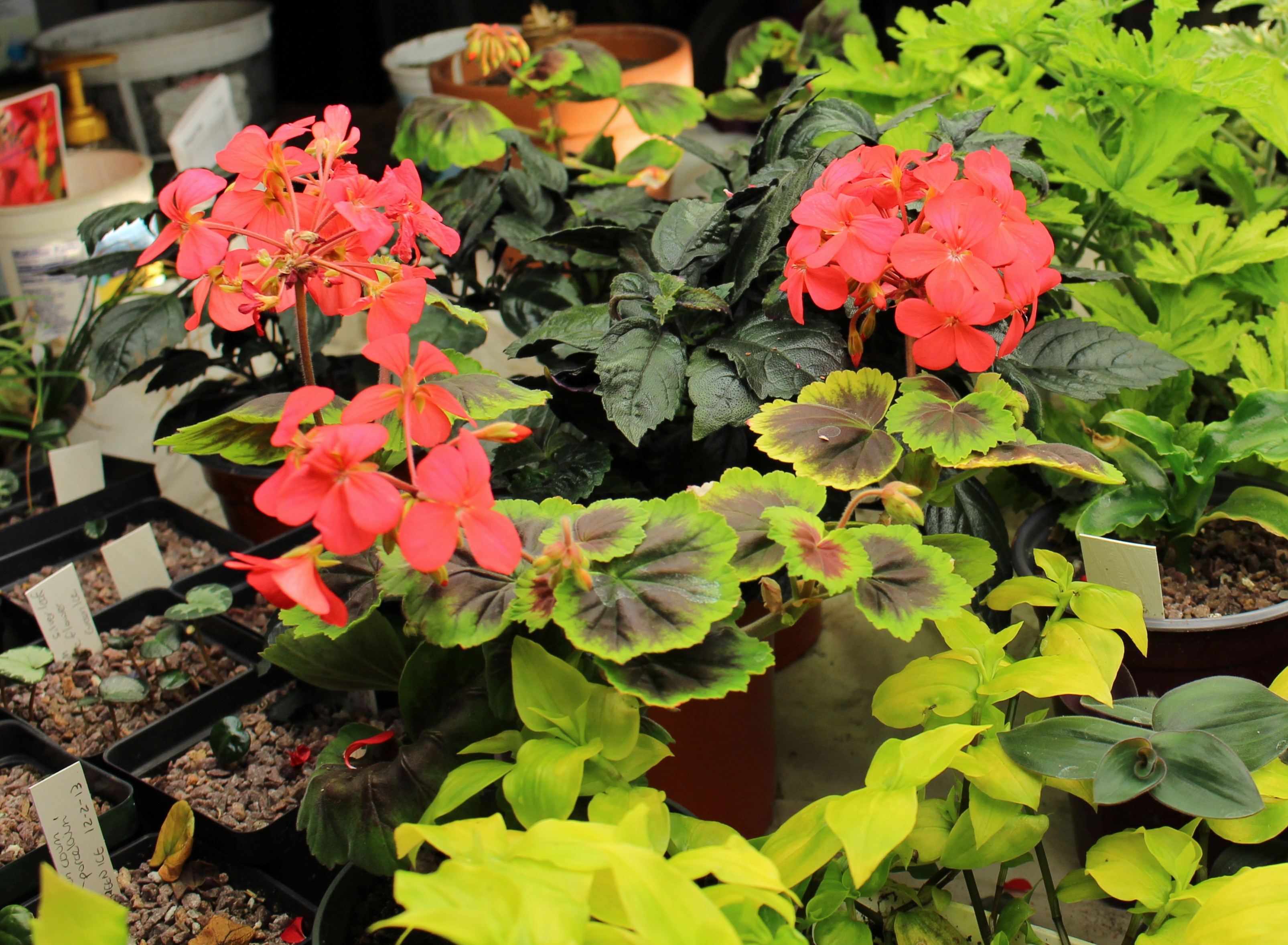
fancy leaf geranium

Geraniums blooming more than they should under the lights of the winter garden.  A better gardener would probably remove the flowers for the sake of stronger growth and a healthier spring transplant.

You may notice the attractive plastic sheeting which forms a subtle backdrop to the amaryllis photos.  The sheeting keeps the dust and debris of a kitchen remodel from drifting into the rest of the house, and also keeps us from enjoying the charms of a useable sink or stove.  If I try hiding indoors too long from the brutality of our latest arctic blast, eventually I need a new place to hide from the mayhem a kitchen run out of the living room…. so I escape to the garage and the winter garden.

scented geranium flower

The scented leaved geraniums (Pelargonium) are also blooming under the lights.  The flowers are a treat, but I love the lemony scents which come off the foliage each time I move a plant or water a neighbor.

For a while the winter garden was being ignored.  Spring was early and I was back outside enjoying snowdrops, then crocus, and then daffodils… but now winter is back and I’m pretending it didn’t all happen and I’m just doing the regular sowing and repotting of late winter.  Because I foolishly brought sprouting bulb seedlings in during a December freeze I’m now at the point where I can dig seedlings out and see what grew.  Here’s a mixed potful of one and two year old Allium Christophii bulblets which just recently went dormant.  I’m fascinated even though a less than polite reader might point out I could get a bagful of blooming sized bulbs for under $10 this fall.

allium christophii seedlings

A few Allium christophii seedlings all grown up into pea sized bulblets.  I’ll plant them outside next year and hopefully see flowers in another two or three years.  I’m sure at that point I’ll wonder where they came from, since I’ll definitely forget where I planted them!

I find it interesting that even though I sowed the seeds shallowly, most have migrated to the very bottom of their four inch pots.  Readers of Ian Young’s Bulb Log at the Scottish Rock Garden Club will already know this since Mr. Young has observed this repeatedly, but for me to see it myself is of course more fun.

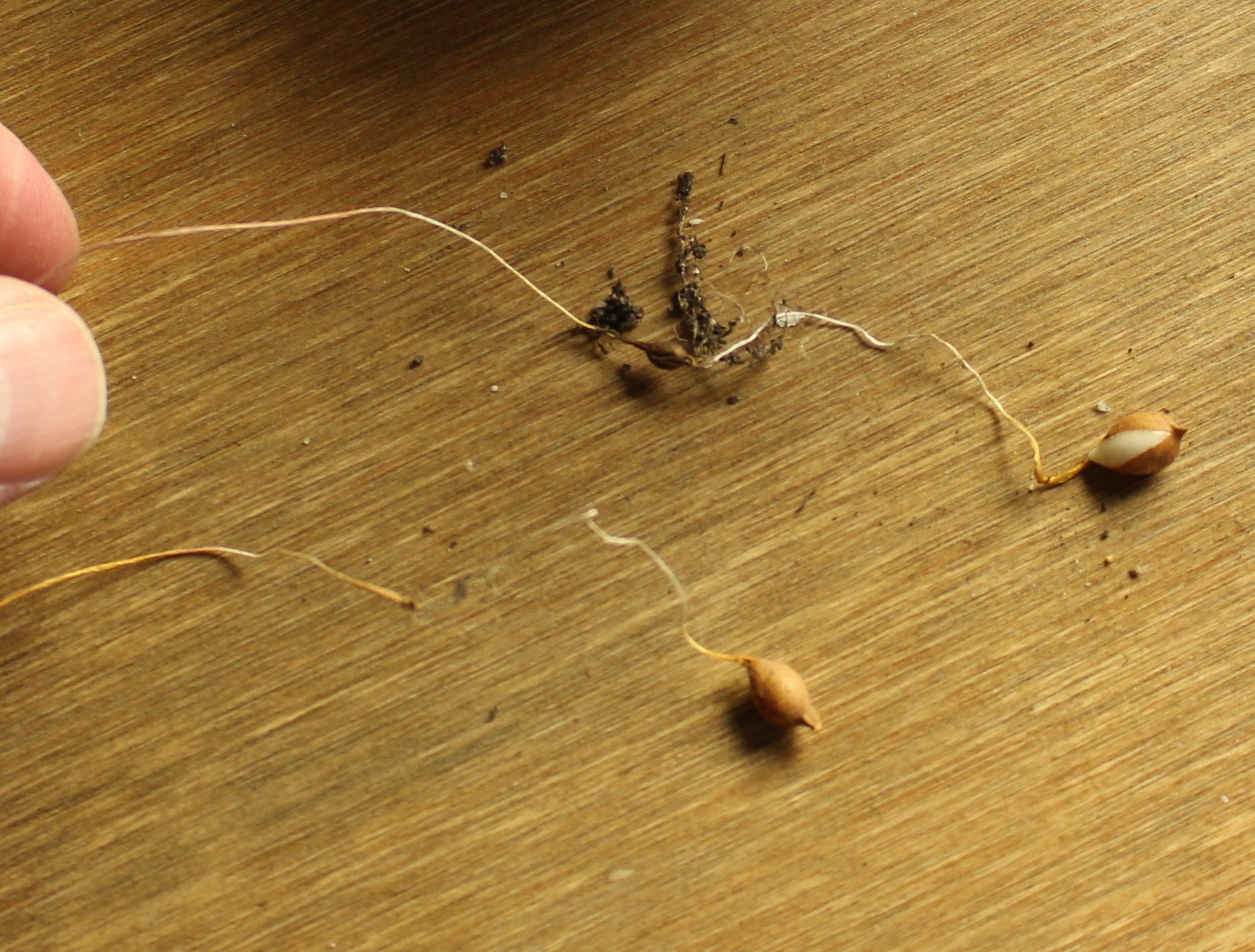
tulip from seed

Second year for a tulip seedling.  In the middle of the photo you can see the dried rice-sized husk of last year’s bulb, if you follow this year’s root to the right (which would have grown deeper into the pot) you will find the newly formed pea sized bulb from this season.  Maybe by next year we’ll be up to kidney bean size 🙂 

I was also happy to find one of my fall snowdrops has made a nice sized offset.  I would have thought the double shoot from the top would have split the bulb into two, but instead it has just sprouted a new bulb off to the side.  So I guess that means there will be three growing tips next fall!

galanthus monosticus

One of my special snowdrops, a fall blooming Galanthus elwessi monosticus which a friend picked up for me at Nancy Goodwin’s Montrose Gardens in Hillsborough North Carolina.

Not all my escape gardening happens in seclusion.  Occasionally I have a helper and this year that helper has been assisting in writing out some of the many plant labels which go along with all the odds and ends which get seeded out.  She may actually do a neater job than I do, and her talent for labeling in Latin is impressive.

dyi plant label

The cut up vinyl blinds which I use for plant labels.  Plain old lead pencil seems to last for decades and I’ve found a few still readable in the garden, one going back to ’91 for a dogwood seedling which I apparently smuggled out of Longwood Gardens in a pocket…

Also impressive is one of my newest treasures.  It’s a Cyclamen Rhodium seedling from my visit to John Lonsdale’s Edgewood Gardens, and it’s blooming in spite of having been dumped out of its pot not even three minutes after John handed it off to me.  He was very forgiving of my clumsiness, but I never did mention that I dumped it over again a second time as I got into my car.  Fortunately it survived, and although John suggested that I give this one a try outdoors in a sheltered spot (planted six or more inches deep once it goes dormant), I’m not sure if I’m brave enough to risk its health a third time.

cyclamen rhodium

A really cool Cyclamen rhodium from the Southern Peloponnese and island of Rhodes in Greece.  Nice flower but look at that speckled foliage! 

So that’s how things are going here in my own sheltered locations.  I have some promising tomato seedlings sprouting as well as eggplant and peppers, but it will be a few days before the damage outside becomes definite.  Already things such as roses, lilacs and daffodils look rough, but for as long as I can stay in denial I will.  Maybe the hyacinth will bloom so much stronger next year now that their blooms have all been frozen off.  A gardener can hope 🙂

The Iceman Cometh

I made a point of getting the lawn mowed Saturday.  I wanted to have things nice and neat for when the snow comes.

mixed perennial border

Bright yellow daffodils, blue hyacinths and a freshly cut lawn.  The front border is looking very spring-ish with its mix of sprouting perennials and flowering spring bulbs.  Please ignore the upended chairs which the nasty wind has blown over. 

Although things are way too early this year, all my efforts to convince them to slow down have gone unheeded.  The plants just don’t know what to do with this rollercoaster ride of highs and lows and as a result it’s been a kind of crappy spring with snowdrops peaking and then wilting in a few days of heat, hailstorms knocking everything down, cold weather keeping the depressing wreckage at a standstill, another warm spell to snap things back into high speed, and then now this latest arctic blast.  Here’s the front border six days prior when only a few weather beaten crocus were up.  At least I had enough time to raid the neighborhood dump and mulch the border with plenty of nicely chopped leaves.

mixed perennial border mulched with leaves

A nice mulch of shredded leaves will do wonders smothering the weeds this summer and feeding the soil all spring.  I wish I had more!

In less than a week we’ve jumped ahead to the peak of the daffodil season.  Last fall I wanted to mix in a few more of the bright yellows so I snapped up a batch of 50 from Van Engelen and haphazardly spread them throughout the border.  I tend to enjoy a more natural look and the scattered planting combined with the wildflowery long noses on this cultivar makes them appear as if they’ve been there much longer than a few months.  I don’t know if I’ve ever mentioned this or if I’ve repeated it a dozen times, but daffodils which hold on to the long trumpets and backswept petals of the original N. cyclamineus species are by far my favorite types 🙂

daffodil tweety bird

Daffodil ‘Tweety Bird’, a product of Brent and Becky Heath’s breeding program, filling in where I pulled out an invasive burning bush last fall.

One, and possibly the only, thing good about frequent cold spells is that some of the daffodils are showing their deepest, glamour shot colors without the fading which normally occurs in the warmer weather.  Here in a cool bed which is shaded by a fence, ‘Jetfire’ is looking almost fluorescent with its orange cup.  I’ve never seen it this bright before, and hopefully this is a good start for this bed since I’m still into the months long process of killing the most persistent weeds here with a double shot of thick mulch and weed killing spray.  Maybe by the start of this summer I can finally refill this open land with all kinds of new goodies!

daffodil narcissus jetstar

Narcissus (or daffodil if you prefer) ‘Jetstar’ blooming with some unusually bright color this spring.  This is one of  my most reliable daffs 🙂

Another thing you may or may not know is that I tend to have a lot of favorite daffodils, and that’s because I grow a good assortment to choose from, and I challenge anyone to stick to just one favorite!  Narcissus ‘Rapture’ is an award winning, American bred daffodil with just the kind of cyclamineus genes I love.  Look at those cute little reflexed petals and long trumpet!  As you can see by the neighboring empty spots, not all daffodils have done as well in this location, since at one time this bed was fully planted.

daffodil narcissus rapture

A nice fat clump of Narcissus ‘Rapture’.  If I didn’t already have so much yellow out front I’d surely spread this one around the mixed border along the street.

But of course the up and down weather is even beginning to wear on the daffodils.  Arctic blasts of cold burnt the early tips of many of the more trusting varieties.

freeze damage on daffodil

The jonquil types of daffodil sprout just a little too early for our zone.  This is probably ‘Pipit’ or ‘Hillstar’ and even in a good year the tips of the foliage get singed by too cold weather extremes. 

It’s all or nothing for some of these daffodils which carry the genes of the more southern N. jonquilla.  If it’s a cold winter they hunker down and don’t poke up their heads until the weather has settled, but in an unsettled winter they keep on trying to get started during every warm spell.

narcissus daffodil tiny bubbles

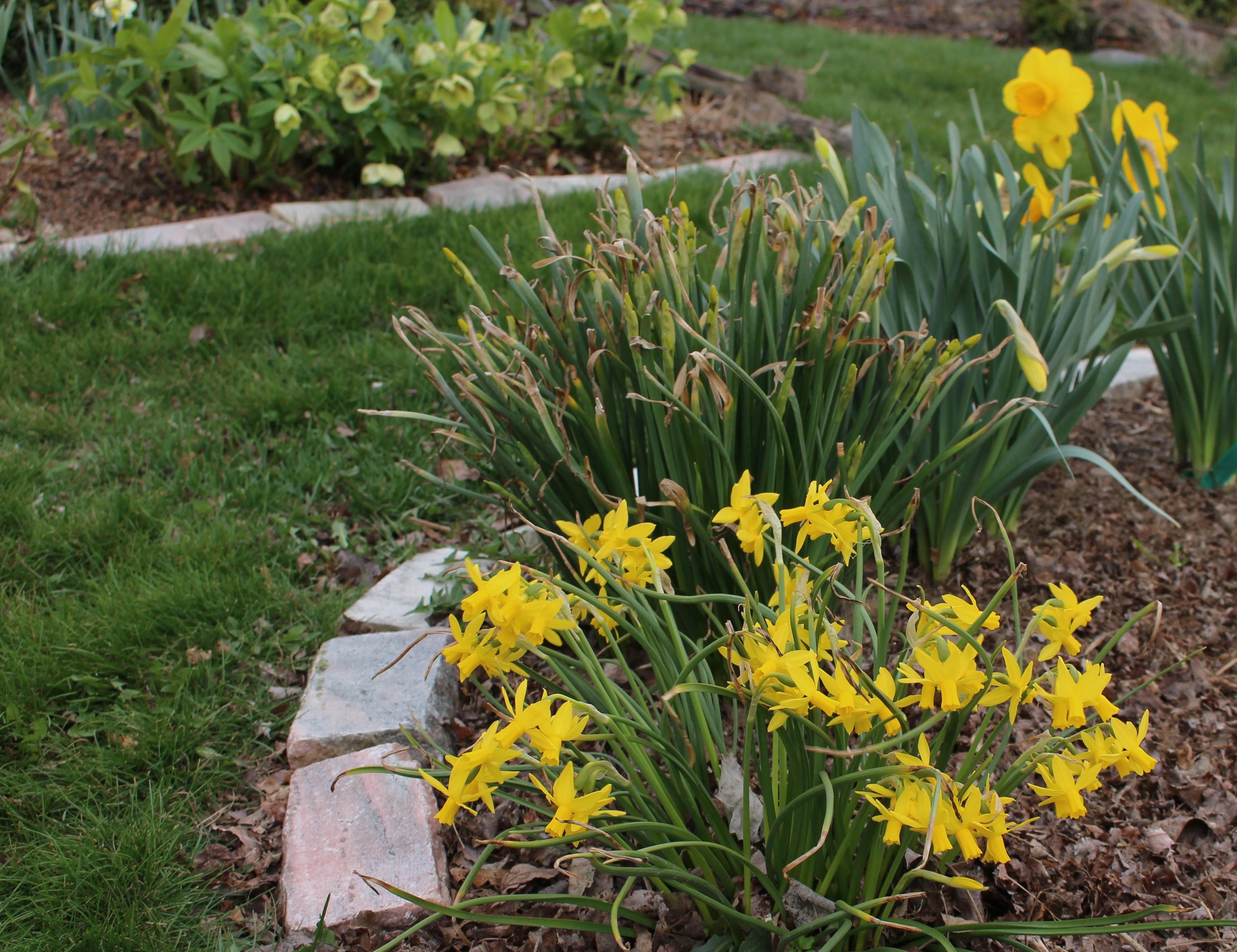
Narcissus ‘Tiny Bubbles’ with a freeze damaged ‘Kokopelli’ behind it.  I like the dainty flowers on ‘Tiny Bubbles’ but I wish either the foliage was shorter or the blooms up a little higher. 

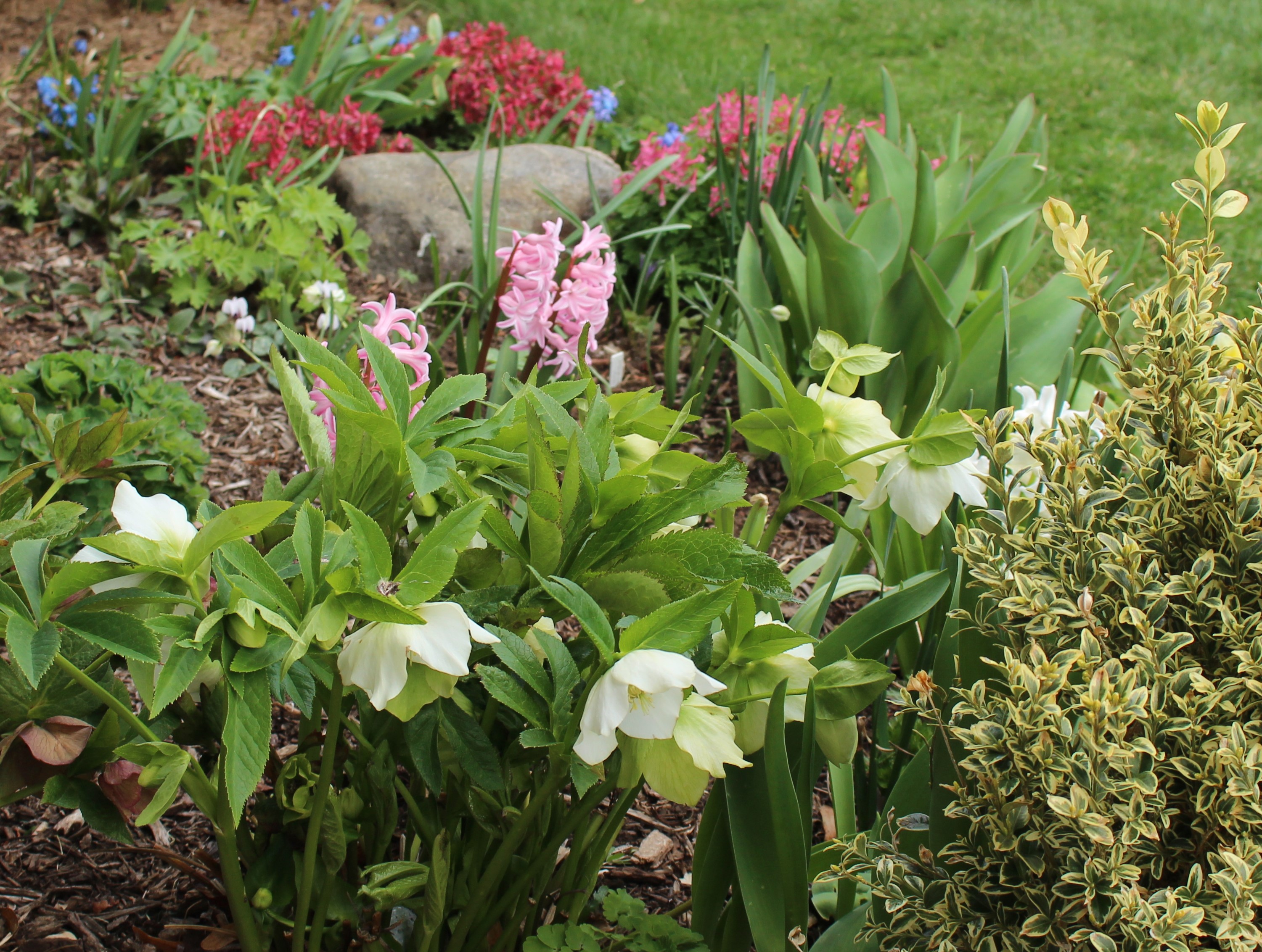
The unsettled winter crushed this year’s hellebore show.  I should have seen that coming since last fall they looked better than ever and were poised to bloom their heads off.  So much for that.

picotee hellebore

Here’s one which managed to come out and open perfectly between the frigid blasts of cold.  There are singed and damaged flowers all around but this one with its dark centers and perfectly veined blooms is enough to make me smile. 

Of course I have my favorites among the hellebores as well.

yellow hellebore

Even with a few damaged centers and singed outers the buttery yellow of this hellebore keeps it on my best-of-the-hellebores list 🙂

Any opinions on this picotee hellebore growing in the front border?  It’s doing very well in spite of the fact nearly all its neighbors were frozen back to their crowns…

picotee hellebore

Would you call this a yellow picotee hellebore?  I like the red shading and subtle color, but suspect it might not jump out at everyone.

I guess it’s time for a reality check.  Here are the daffodils this morning as the cold wind howls outside.

daffodil frozen in snow

The front foundation border once again covered in snow. 

To be honest I hope the snow predicted for tonight also comes through.  The garden can use a little bit of extra cover to help it out when the low temperatures drop to 19F (-7C) for both Monday and Tuesday.  Whatever.

frozen hyacinth

All the early bulbs flattened and frozen by a late cold snap.  You can bet my fingers are crossed they make it through this….

It’s normal for everything to wilt as it freezes, and that’s a good thing since too much water in the stems will cause them to burst as the water expands, but I’m not sure exactly what else will survive the upcoming deep freeze.  I’m writing off the wisteria, even the barely expanded buds will most likely die off, and the hyacinths will be mush, but I’m most worried about the tulips and daffodils.  A few years ago a one night cold snap permanently ‘did in’ a bunch of tulips, this longer spell has me more worried, and I have many more now than I did back then.

C’est la vie.  Maybe I’ll order a few new cannas today, and dream of a beautiful June garden.  April and May are kind of iffy right now, but as long as the birds sing and the sun is warm we’ll be fine…. tulips or not.

Corydalis… The next big thing

How does such an awesome little spring blooming bulb (tuber if you want to get technical) fly under the radar for so long?  Apparently a couple in-the-know gardeners have been growing these cool little spring bloomers for years, but I for one didn’t even know they existed until a few years ago.  I believe I came across pictures via Ian Young’s bulb log (if you’ve never been, click here immediately to visit -it’s practically required reading for any bulb lovers out there) , and the impression was one which ate away at me until one fall I was finally able to get my dirty fingers on a few.  Of course as my luck would have it these were promptly killed, but the following year a more determined try proved successful, and the next spring I was just as pleased as I thought I’d be when they bloomed.

corydalis George baker

One of the boldest reds, Corydalis “George Baker” blooms right alongside the blues of chiondoxa and Scilla siberica.

The Corydalis family is a large one with many highly collectible family members, but for me it’s the variations on Corydalis solida which excite me the most right now.  This species ranges across Northern Europe into Asia and for the most part greyish mauves and blues dominate the color spectrum, but starting in the 1970’s and 80’s rich reds and purples began to find their way out of the woods and into the hands of collectors and growers.  The Penza strain from Russia and the Prasil strain from Romania are the some of the best known groups for bold colors and many of the newest named varieties come from these collections.

corydalis solida

A more common color of Corydalis solida, a smaller and slightly later flowering plant than the other Corydalis I grow.

As it is with many plants, once you get excited about one you get greedy and need more, so in addition to the “George Baker” and “Beth Evans” which were purchased from Brent and Becky’s bulbs, and the straight Corydalis solida from Van Engelen, I needed to add more.  The blame for this shouldn’t lie entirely on my own shoulders though, since by now I had seen even more Corydalis glamour shots including the most enticing group shot which I found at Carolyn’s Shade Garden.  Her tapestry of rich purple with pinks and reds would have to be imitated in my own garden and to that end I found Russell Stafford’s Odyssey bulbs.

corydalis rosula

The warm wine red of Corydalis ‘Rosula’, complemented by a nice underplanting of random weeds 😉

The new plantings from Odyssey were a mix of successes and failures and based on the excellent condition of the tubers, I’m going to guess the fault again lies with me.  Even as recently as this spring one of the clumps failed to even show, and I suppose there’s something else going on which I don’t entirely understand… but ignorance is bliss, and I enjoy the remaining two cultivars more than ever now…  even though the addition of a pure white or pink would have made the planting even more perfect!

IMG_0376

A more common color but on a sturdier plant, Corydalis ‘Harkov’ scared me by nearly dying last spring after I optimistically dug it up for dividing. It wasn’t ready and it wasn’t pleased, and promptly dried up and went dormant.

I suppose I should try and make this a more useful post by mentioning something other than the many ways in which I’ve killed these plants.  They’re actually fairly carefree in the right woodland conditions, and although I should suggest a fertile, moist shaded site, mine grow quite happily in sites I would consider downright dry, and in locations shaded only by the overhanging perennials and annuals of the front street border.  I guess they don’t know any better.

Another thing I should mention is they bloom early and fade away quickly.  Plant them in a spot where other goodies such as hostas and hellebores or rudbeckias and buddleia fill in for the summer.  My best patch disappears under a carpet of aquilegia (columbine) and ‘Blue Cadet’ hosta two weeks after blooming, and you wouldn’t even know it was there in June, which is good, but you should definitely try to avoid forgetting they’re there and running a shovel through while digging.

corydalis and hellebores

Corydalis, hyacinths and hellebores filling in now that the snowdrops and eranthis have gone over.  In another month columbine, delphinium, hostas and hellebore foliage will take over for the summer.    

A final note is that for the first year or two in my garden I was convinced they couldn’t possibly be making seeds since they yellowed and died down so quickly after blooming.  I’ve since found out I’m wrong.  Seedlings are spreading quickly and this year I have a few of the first starting to put out their own blooms.  I’m thrilled that they are as red as the parents, and even happier there’s some variety to them as well.

corydalis solida seedlings

Some of the first Corydalis solida seedlings to make it to blooming size. One’s nearly as red as the mother clump of ‘George Baker’, the other’s a completely different dusky mauve.

So now the question is should I just enjoy what I have or should I keep trying to expand the flock?  If I could only remember where I planted them (I think I may have finally spotted one or two this afternoon) I would be able to enjoy a few new ‘Purple Bird’ flowers this spring, but is that enough?  It should be, but history shows little attention to common sense in this garden and I’m already well on my way to picking out just a few more indispensables.  You really shouldn’t show too much restraint in spring, it goes completely against the spirit of the season and even when ordering bulbs for fall planting it’s still a celebration of the end of winter!

The Temple Nursery 2016

I’m not exactly sure how many years it takes before something becomes a tradition but I’m going with two, and since this year marks my fourth springtime visit to the Temple Nursery’s open garden day I guess it is now a tradition, and tradition shouldn’t be tampered with.  I say that because up until the morning of the visit I wasn’t entirely sure I would actually make the drive up to Ithaca NY and beyond since this season’s early warmth had me pretty sure there wouldn’t be much left to look at as far as the garden’s snowdrop (Galanthus) collection goes.  To a certain extent that turned out to be true, but at the end I realized a day visiting a garden in the (almost) spring is never a bad idea, and even if the weather’s not perfect it’s always fun to get out once winter starts retreating.

hitch lyman garden

Side view of Hitch Lyman’s upstate NY garden.  The nursery’s namesake ‘temple’ is visible in the back.

If this visit has become tradition, imperfect weather has also become a tradition, and after weeks of above freezing, almost balmy weather, the bottom dropped out of the weather system two nights before.  Light snow for Saturday and then a low of 17F (-8C) the next morning did in many of the remaining snowdrops and wilted many of the emerging perennials.  We’re used to freezing our kazzoies off on these visits though, so by the time the temperature rose into the 40’s it felt downright balmy.  No wind either and not a single snow squall during the visit… unheard of!

galanthus ex. highdown

The Lyman garden is known for its snowdrop collection, and only a few remained in bloom after all the ups and downs of the weather.  Here is a Galanthus labeled ‘ex. highdown’ which has held up remarkably well to the cold.

The majority of the snowdrops were past, which is somewhat surprising considering The Garden Conservancy had already moved the open date forward two weeks and the date was nearly a full month earlier than last year, but what can you do at such an unsettled time of the year?  I just felt a little bad for others who had traveled much further to see what is normally an exciting collection of hundreds of different snowdrop varieties growing happily in the garden’s small woodland area.

eranthis hyemalis noel ayres

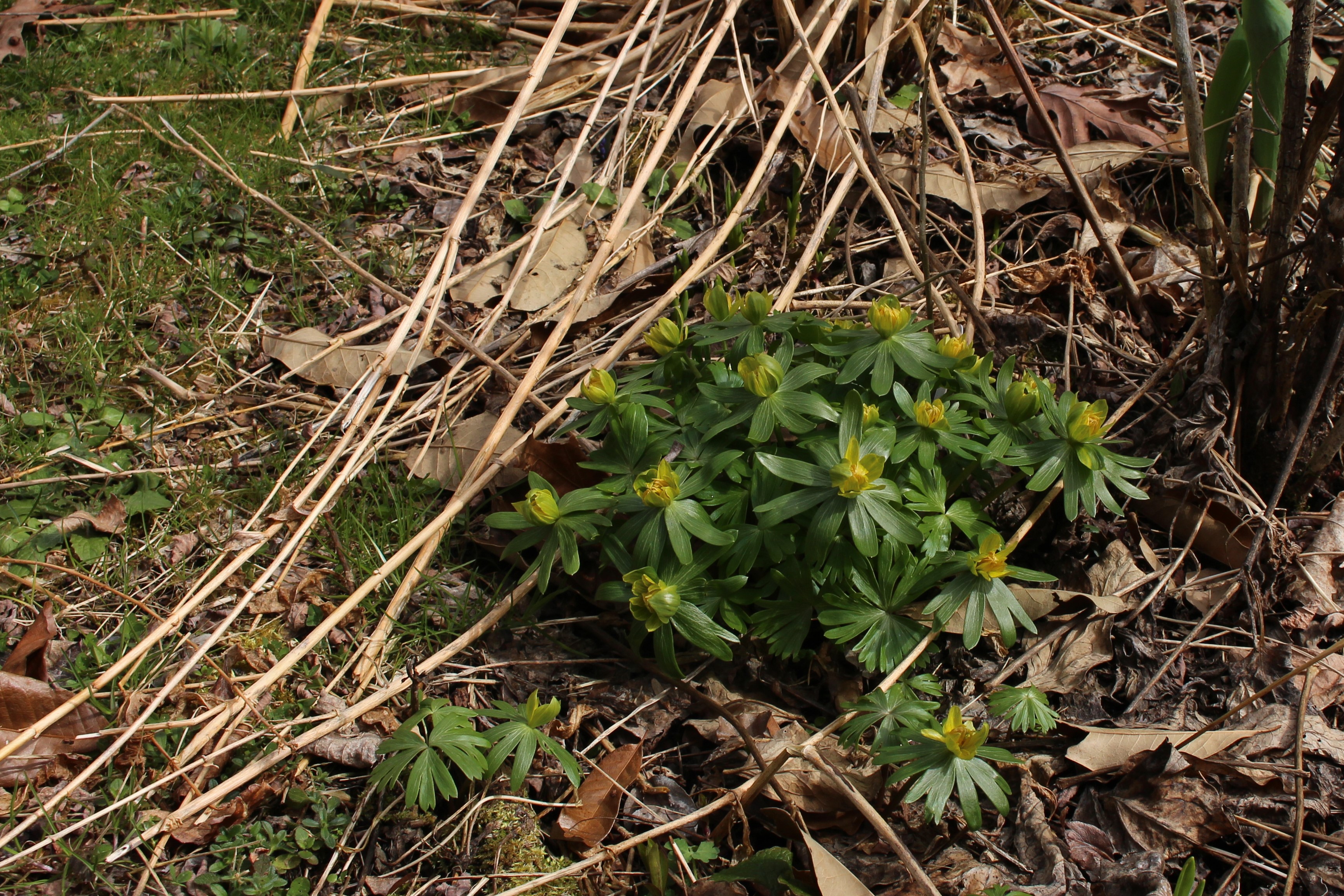
Just a few late blooming winter aconite remained.  This might be Eranthis hyemalis ‘Noel Ayres’ or something similar.  Compared to the bright yellow blooms of the species, this might be an Eranthis only a collector could love. 

I also felt bad for the plants.  The majority of the snowdrops were flat on the ground from the previous night’s cold, and overall the garden did not show well for someone expecting swaths of snowdrops and early flowers.  They’ll recover I’m sure, but frozen plants are never fun.

freeze damage primula

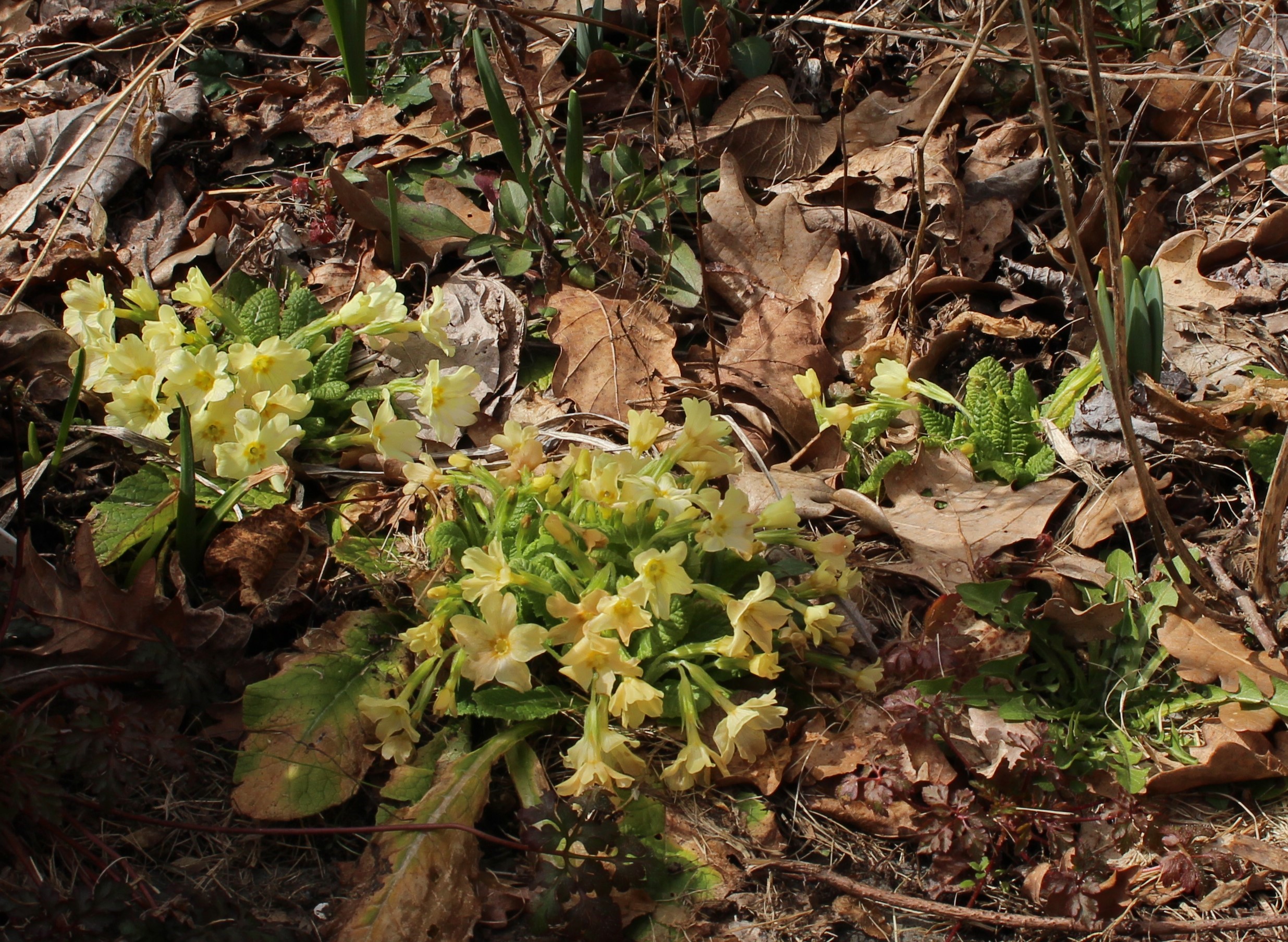
Early primroses wilting as the warm sun hits them.  This would have been a much cheerier sight just a few days ago.

Still I found plenty to keep me entertained, and I enjoyed the company of the garden’s owner, Conservancy volunteers, and several other entertaining guests.  Hanging out… is that too common a term for a Conservancy event?… outdoors with other like minded gardeners on a not-too-cold March afternoon is something I don’t get to enjoy too often in my neck of the woods, so I was quite pleased for making the drive up.

galanthus dr dress

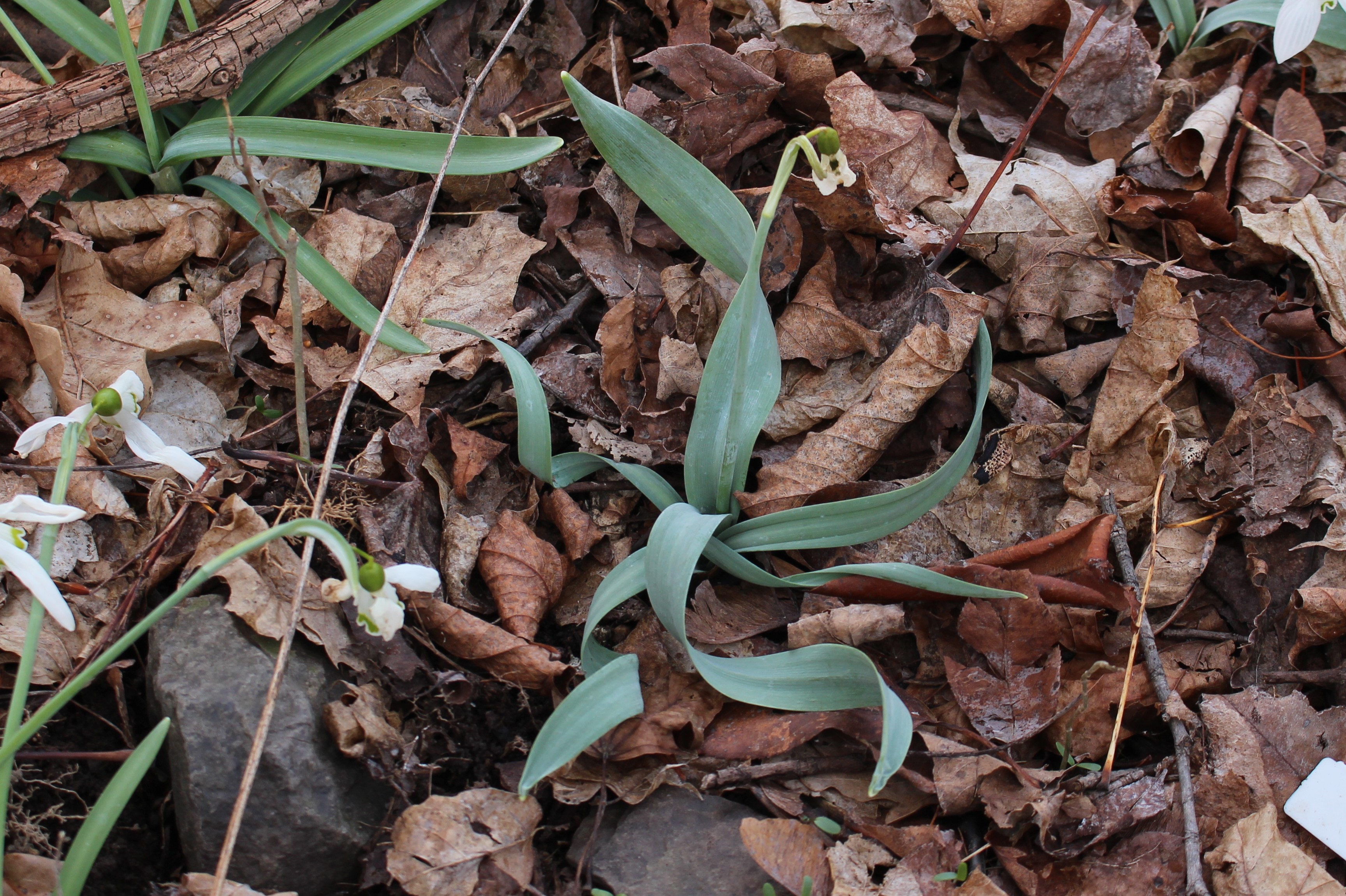
It looked like some kind of sea creature to me, but it’s a Galanthus labeled ‘Dr Dress’ which I believe is the source of this unusually curly leaved snowdrop.

Of course there were blooming snowdrops as well.  I was pleased with some of the later blooming varieties such as the daintily named ‘Dumpy Green’

galanthus dumpy green

Galanthus ‘Dumpy Green’

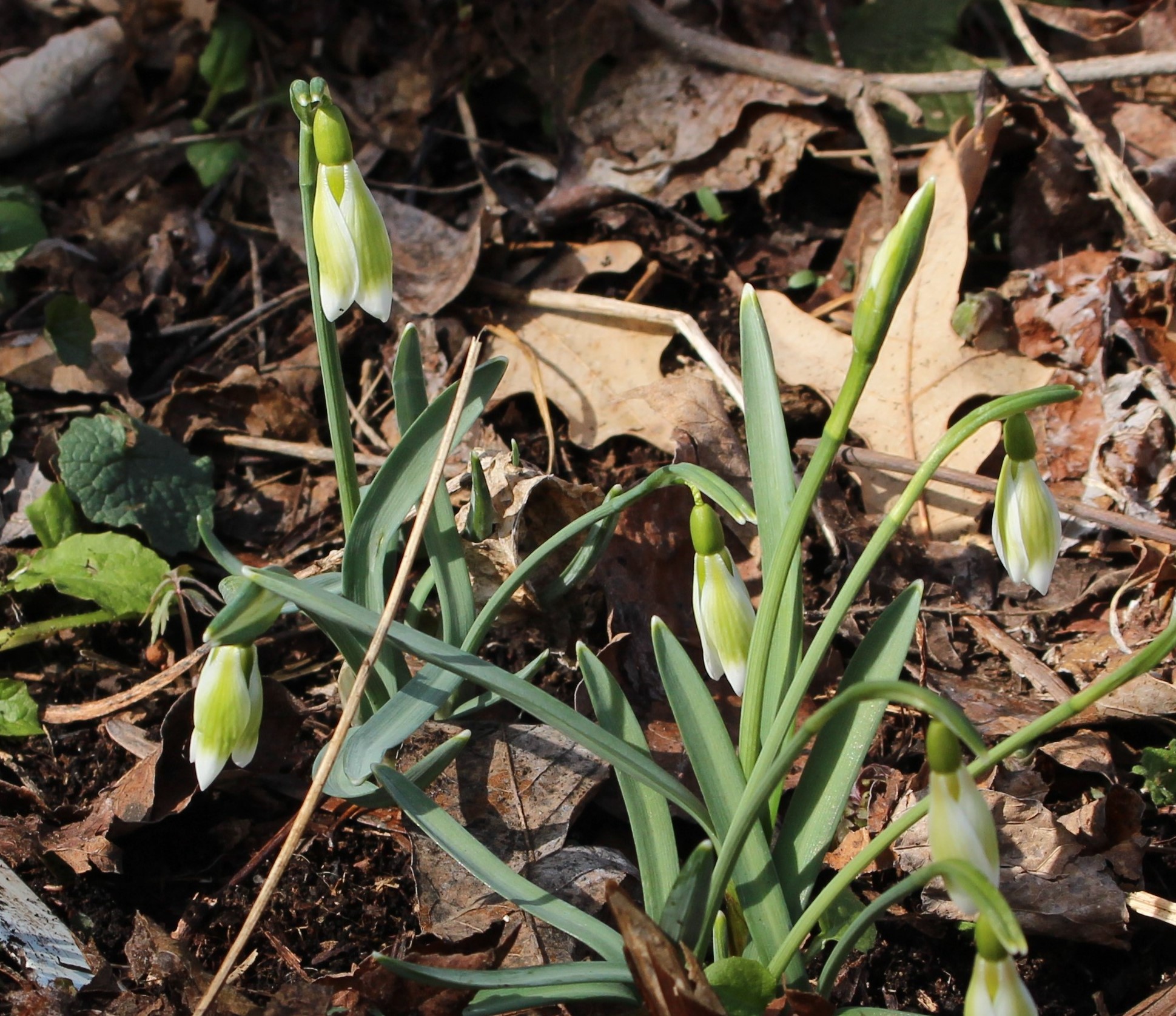
and the very attractive late 19th century snowdrop, Galanthus ‘Virescens’.

galanthus virescens

The classic green snowdrop, Galanthus ‘Virescens’.

Luckily for me one of my favorites was still in bloom.  It’s been divided since my last visit and is still doing well, Galanthus ‘RD Nutt’ is one that always catches my eye, even though it’s no more white or green or fancy than any other of Mr. Lyman’s many other snowdrops.

galanthus rd nutt

I’ve asked and then forgotten if ‘RD Nutt’ is the name or source of this snowdrop.  It always seems such a neat and heavy bloomer, and appears to be holding up well to the weather.

So I’m glad my schedule cleared up enough to make the trip again this year, and it was a treat to finally see the gardens with a few traces of blue in the background sky.  We will see what next year brings but I’m sure as usual we will make the best of it!

hitch lyman garden

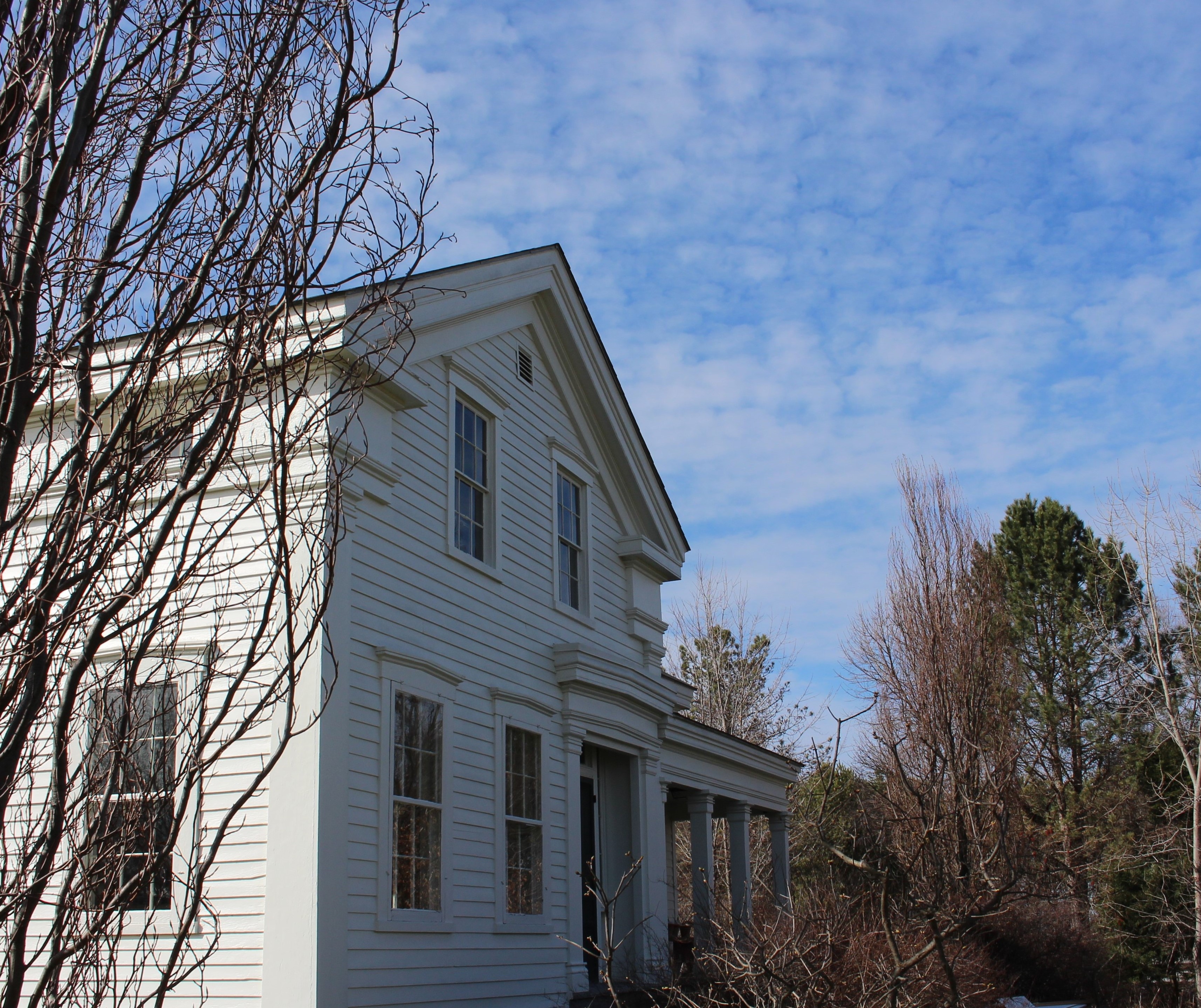
Hitch Lyman’s home, moved to the spot in the 90’s and restored back to it’s original grandeur.

One final note though.  I was a little insulted by how well the hardy cyclamen were doing considering the sad state of my own plantings.  My own Cyclamen coum were killed back to the roots and failed to put on much of a show this spring.  I’m going to blame a lack of mulch and see if I can’t do something about that next year.  We just didn’t have the protection of a snow cover last year, and it looks like these did.

cyclamen coum upstate ny

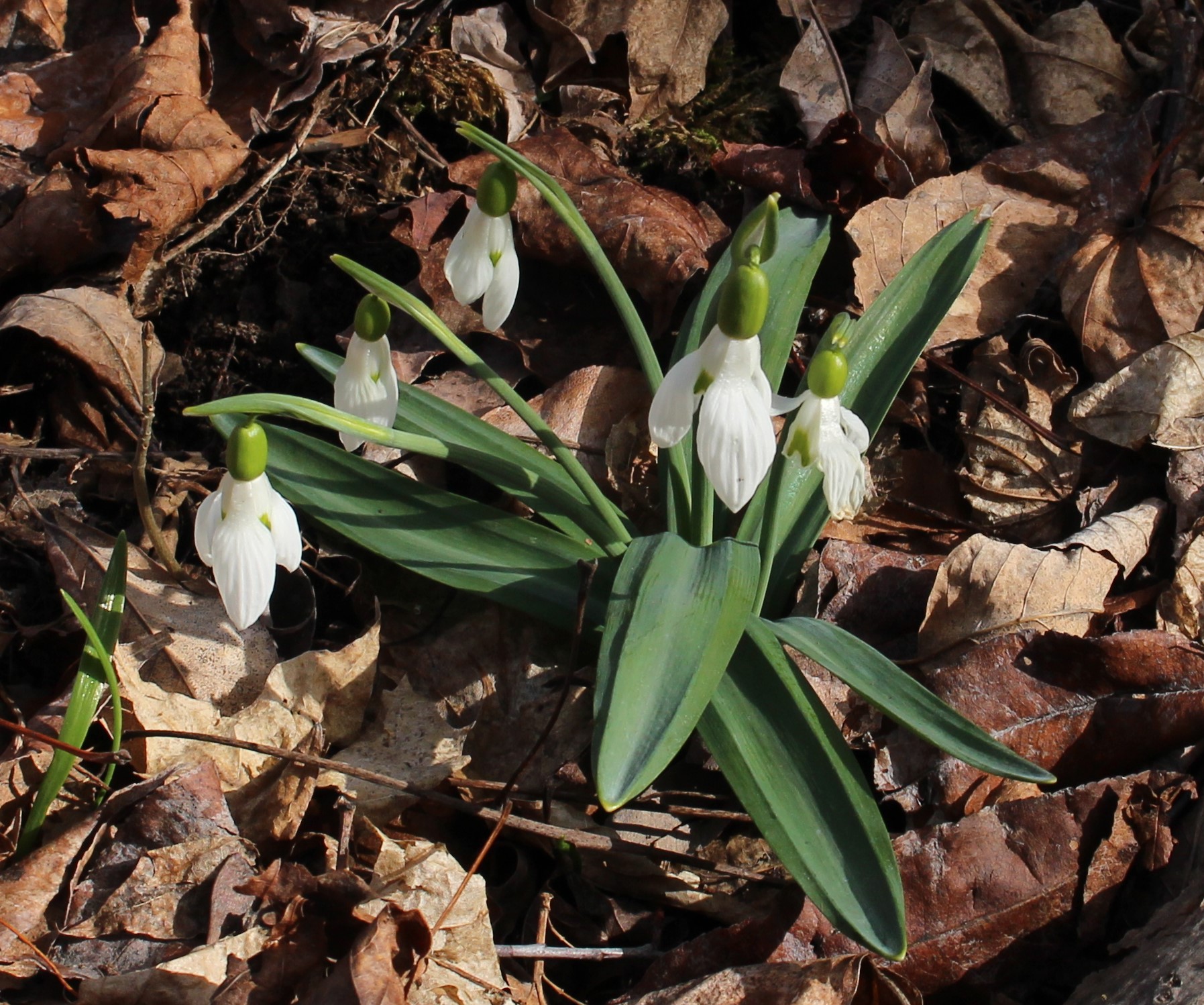
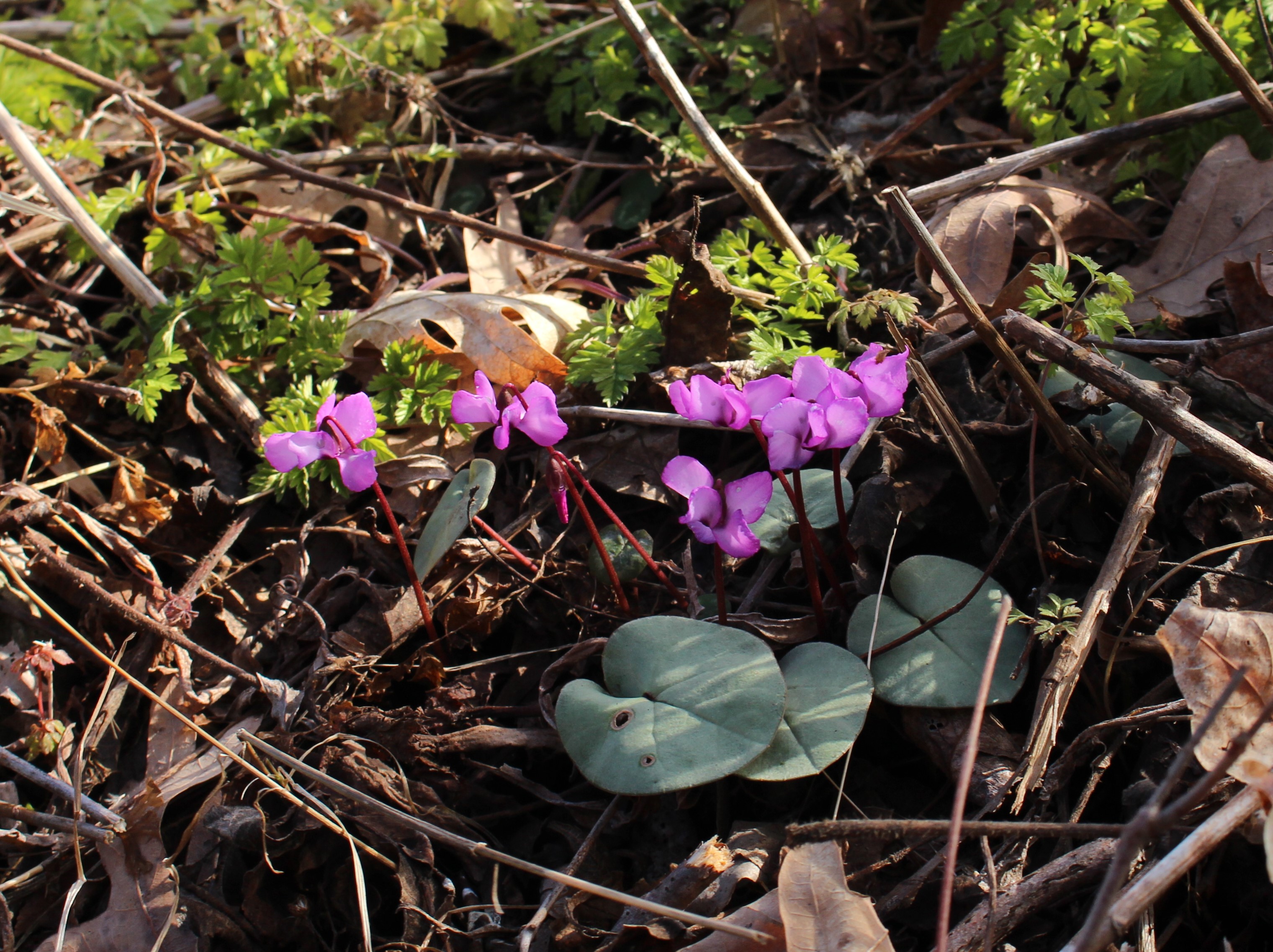
Some Cyclamen coum looking quite happy in their upstate New York home.  A nice woodland mulch and most likely a protective blanket of snow have them blooming happily with nearly perfect foliage.

Thanks again to the Conservancy and Mr. Lyman for another enjoyable visit, and in case you are interested the Temple Nursery sells snowdrops as well as growing them.   To get on his mailing list (there is no online available) send three or four dollars to the following address: Temple Nursery (H Lyman) Box 591 Trumansburg, NY 14886 and you should receive a listing in January.  Act fast, they sell out in just a few weeks 🙂

Have a great Easter!

Snowdrops part II

By now I’m going to guess several of you know I have a “thing” for snowdrops.  It’s a lonely thing since my nearest fellow snowdrop lover lives miles and miles away, but it’s a thing and like all things you just have to deal with it.  With that said I will forgive anyone who glosses over this post since not everyone will ‘get’ this thing, and many will not even want to appear as encouraging this thing, but that’s fine.  Once the daffodils open I’ll move on and we can again comfortably ignore my little secret until next year.

Luckily for you the season is practically over in my garden (so this will not drag on for the weeks which it normally does)  and here’s only just the briefest summary of a few of my favorites from this year’s snowdrop season.  We will begin with a new one, ‘Daphne’s Scissors’, which came via Carolyn’s Shade Gardens last spring.

galanthus daphnes scissors

Galanthus ‘Daphnes Scissors’, an early bloomer with me and early enough to open at the same time as the winter aconite (Eranthis Hyemalis).

‘Blonde Inge’ sometimes gives trouble as far as her blonde highlights go, but this year there’s a nice touch of yellow to the insides of her flowers.  This is her third year in the garden and she seems to be settling in nicely.

galanthus blonde inge

Galanthus ‘Blonde Inge’, the covergirl for Naomi Slade’s great little book “The Plant Lover’s Guide to Snowdrops” which I had the pleasure of reading this winter.

I’m trying to stick to snowdrops which don’t all fall under the same old same old category… this is still a stretch since green-white-yellow is the slightly limiting range which we’re always working with, but to the obsessed even the plain old white and green can be something special 🙂

galanthus straffan

Galanthus ‘Straffan’, an oldie but goodie which has been gracing the gardens of snowdrop lovers since 1858.  This is year three for my plant and I’m quite pleased to see its graceful upright blooms multiplying.  Maybe someday I’ll be up to the hundreds you see in other gardens 🙂

Galanthus ‘MoretonMills’ was the first expensive snowdrop I splurged on.  I won’t say how much I paid but it was a ridiculous amount for such a tiny little thing and each spring I hold my breath until it sprouts.  Fortunately it’s one of my favorites and is also beginning to multiply.

galanthus moreton mills

Galanthus ‘Moreton Mills’, a poculiform snowdrop where the three inner petals are as long as the three outer petals.  If this plant breaks the four inch barrier I’d call it a growth spurt.

As a variation on the green and white theme, here’s one which is more green and green and white 🙂

galanthus kildare

I love this one, it’s Galanthus ‘Kildare’ doing very well in its second year in the garden.  The blooms are huge. (relatively speaking of course!)

Another of my very favorites is ‘Primrose Warburg’.  It’s been doing very well here and is actually becoming what I could optimistically call a clump.  The downside to collecting unusual little bulbs is that you must often start with just one and to be completely honest a single snowdrop, no matter how special, does not exactly put on a major show in the garden.

galanthus primrose warburg

Galanthus ‘Primrose Warburg’.  Even those who yawn at the sight of snowdrops will acknowledge the bright yellow differences on this one 🙂

I’ll leave you with my lovely little golden snowdrop patch, and repeat that the snowdrop season is essentially over here.  It was a weird one, and for me it was a lame one with harsh late freezes damaging many of the blooms followed by a warm couple days which wilted the rest.  Add a few days out of town for work and snowdrops which came up before my schedule allowed me to fully admire them…. well enough said.  At least I was able to enjoy a few crocus.

natuaralized crocus

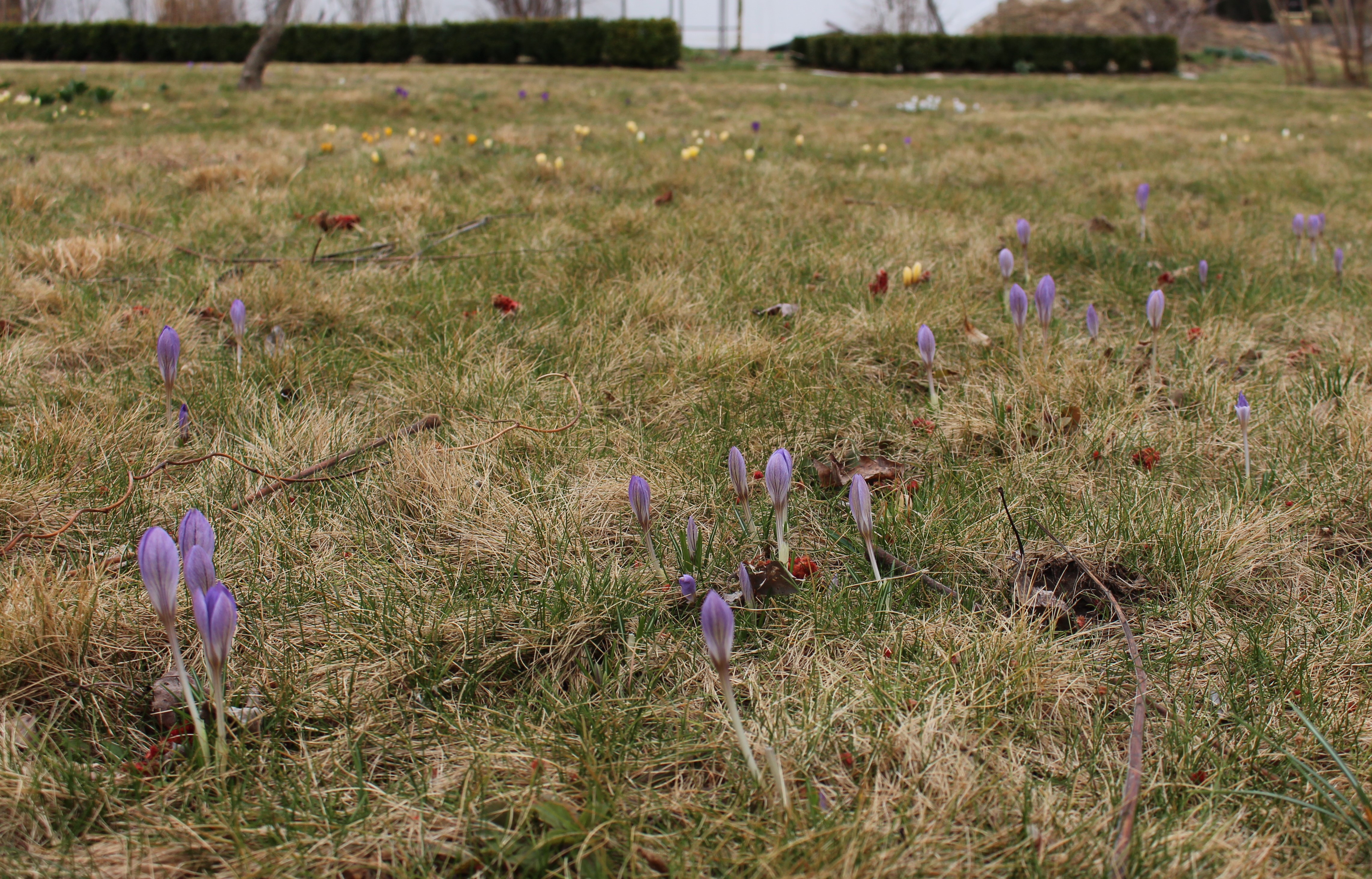
All the crocus came up nicely in the meadow garden and even the rabbits couldn’t keep up with them all.  Luckily mother nature and global warming stepped in and wiped them all out with back to back hailstorms.  Oh El Nino, you’re really having your fun this year.

The crocus season felt like it lasted three days.  They burst up and bloomed and then the weather did them in.

dutch crocus

A few of those fat hybrid Dutch crocus growing by the front steps.  To get really nice clumps it helps to dig them up and spread them around every three of four years.  Forgetting where they are and accidently digging them up in June is my method of choice.    

Fortunately there’s still plenty of spring left since it’s only just the end of March.  A cold spell last week slowed everything right back down, but the first weeks of April look remarkably mild and I’m sure there will be plenty of things sprouting up and blooming and helping me ease my snowdrop hangover.  Don’t get your hopes up too much though, I did visit another snowdrop garden last weekend and have one more white and green post yet to come.

If I don’t speak with you before Sunday, have a great Easter!

Snowdropping 2016

*ok so I’m trying to get back onto the blogging ball.  With a schedule finally cleared up I have a bunch of catching up to do here as well as on other blogs… so flashback to something I began writing about two weeks ago!*

Spring doesn’t normally roll around to this end of Pennsylvania until the end of March,  but this year on the tail end of El Nino it looks as if winter has just thrown in the towel and let spring walk right in a few weeks early.  “Sit down and stay a while” I say, and although I should speak glowingly about my own spring treasures in bloom right now, my first panicked thought was I might miss the snowdrop season down south.  I promptly sent out a few emails, jumped in a car and met up with my friend Paula at a park near her home for our second annual Philly snowdrop adventure.

naturalized snowdrops united states

Snowdrops naturalized on the grounds of a former Philadelphia estate.

Last year our snowdrop adventure was a response to the miserably long winter, this year it was a desperate attempt to catch the season before it flashed by.  We made the trip on March 8th and even though we were nearly a month earlier than last year many of the earlier bloomers were already past.

leucojum vernus yellow

A nice yellow tipped spring snowflake (Leucojum vernum) blooming amidst the rubble.

In spite of the advanced season we did manage to catch plenty of snowdrops still in bloom, and it was fun wandering from patch to patch searching for those little “specials”.  Maybe someday after a hundred years of abandonment and years of gentle woodland protection my own garden will produce something different but for now I’ll have to rely on these hidden treasures.

naturalized snowdrops galanthus nivalis

We saw plenty of patches of four petalled snowdrops, but also a wonderful range of larger and smaller, thinner, longer, taller…. all the tiny variations on white and green which may make some gardeners yawn, but which make me smile.

But there was only so much time we could spend sweating our way through the underbrush.  We had bigger fish to fry this morning and for us it was a visit to John Lonsdale’s Edgewood Gardens.  John grows and sells (but more just grows and grows) about a billion plants in his suburban landscape and the plantings range from high desert cactus to mountain to woodland to everything in between.  I was lost on much of it but I’m going to try my best and show a few favorites even if the names are lacking.  If you are more cat-like and on the verge of death due to some unsatisfied identity curiosity then I would absolutely suggest contacting John directly via his website.  He will surely have an ID for you, as well as cultural conditions, related cultivars, the exact source of his plant…. and to top it all off he probably grew it himself from wild collected seed!

iris and hardy cactus

A beautiful species iris right alongside hardy cacti.  Did I mention the cactus?  There were beds planted full of them as well as agaves and yucca, all surviving the Pennsylvania snow and ice without any additional winter protection.

I need to just move on here.  I love growing bulbs and there were more here than I’ve ever even considered so here are just the highlights of our visit.  Keep in mind the calendar is still saying winter for a few more weeks and the real show is still at least two months off!

eranthis guinea gold

Winter aconite (Eranthis species)  galore in the Lonsdale garden.  We missed the peak for many of the Eranthis hyemalis types but these crosses with Eranthis cilicica (similar to the ‘Guinea Gold’ cross) were just opening…. don’t let the label throw you off, that’s for something else yet to come right in front of this patch of gold.

At nearly 80F (26C) and sunny even a few of the first primula were opening.

pale yellow hardy primula

The winter may have been short, but even here a sudden drop to around 0F (-17C) did its damage to winter foliage and early sprouts.  Still bright and beautiful though, and its location on what looked to be a dry shaded slope has me rethinking how tough primroses can be.

Hellebores were everywhere.

speckled hellebore

Just a plain old hellebore which caught my eye.  a little winter damage but I love the speckling.

John said he was in the process of working through the hellebores, getting rid of many older and self seeded plants, and ‘upgrading’ some of the hybrids… and I wish him luck.  There were hundreds, if not thousands, and it would take a more critical eye than mine to thin the herd.

hellebore anna's red

One of the newer, cross-species hellebore cultivars.  I forgot what it was, but maybe it’s ‘Anna’s Red’?

Plenty of hellebore species as well.  All over the garden were bits and shoots coming up from seed collected throughout the hellebore world.

green hellebore

A cool green species hellebore.  Green may not be the showiest flower color but they sure look great close up.

hellebore tibetanus

Hailing from China is Helleborus thibetanus. This plant was only just brought into cultivation in the 1990’s and if you can believe it John says this plant plant produced only one flower last year. What a difference a single year can make!

Trilliums were also everywhere.  John kept naming species, naming ranges and ecotypes, naming seed sources, describing how many were yet to come…. it was all a little overwhelming.  I think to return in May and see patches and patches of trilliums blooming across the hillside would be quite the sight.

trillium foliage

One of the earliest trilliums already up.  The foliage is just amazing and there were hundreds more sprouting or just waiting to burst out of the ground.

There were tons of early trout lilies (Erythronium) coming up as well.  More cool foliage, exquisite flowers 🙂

trout lilies erythronium

Just a few of the earliest of the trout lilies coming up.  I love the fine markings on these and the fancy purple pollen just as much as the silvery speckling on the leaves.

I’ve never seen blooming Hepatica (liverwort) in person but recognized the little jewels the minute I saw them.  Maybe this will finally be the spring I venture out into the woods and find a few blooms of my own in the wild.  I’ll be excited to find anything, but suspect they won’t hold a candle to some of the selections and hybrids which we saw springing up out of the leafmould.

red hepatica

What color on such a tiny bloom.

violet hepatica

The detail on these flowers is amazing in all its intricate perfection.

It was also well into Adonis season.  Several cultivars were spotted throughout the beds and each one seemed better than the last and we hit them perfectly with their flowers open wide in the warm winter sun.  The saturated colors were almost too bright for an early March afternoon.

double yellow adonis

Double yellow Adonis Amurensis

I’ve heard that this native of NE Asia isn’t all that hard to grow it’s just a little slow to start and a little pricey to get a hold of.  Spring sun and a sheltered woodland location for the summer seem to work well for it, just know that the ferny foliage dies back and the plant disappears once the weather warms for summer.

orange adonis cultivar

An orange Adonis cultivar with a nice bunch of hardy cyclamen leaves.  Cyclamen were nearly everywhere, I began to not notice them unless I had to step over a particularly nice one seeded into the path 🙂

fringed orange adonis

Dark ferny foliage, a fringed pale orange flower…. what’s not to like about this Adonis?

We spent way too much time at John’s but it wasn’t until we checked our watches that we realized how much we had actually imposed on his day!  The poor guy had just finished up about ten days of on the road and had been through more states in a week than I hit in a year and here we were not even giving him enough time to enjoy his first day back.  So we tried to get a move on it, thanked him again for his hospitality and time, and then rushed through the last hordes of snowdrops, cyclamen, and cacti between us and the exit… did I mention the cacti?  I could easily fill a second visit with just the cacti (not that I’m really hinting).

Off to Paula’s!

snowdrops galanthus in garden beds

Snowdrops (Galanthus nivalis mostly) scattered throughout the garden beds.

Paula has really put in some work into collecting and dividing and spreading snowdrops throughout her garden, and it’s really an inspiration to see the possibilities of what a few years hard work can produce.  It makes me wonder when and if my own garden will ever start to show a similar effect of late winter interest.  There were goodies everywhere and of course it was the snowdrops which I really honed in on.

galanthus elwesii

Nice established clumps of Galanthus elwesii (the ‘giant snowdrop’) with it’s bigger blooms and grayer foliage.

Paula really has a great winter garden going with snowdrops galore and plenty of color from the earliest bloomers.  It’s here where we wound down from our latest snowdrop adventure.

double snowdrops galanthus and hellebores

Double snowdrops (Galanthus ‘flore pleno’) and hellebores fill in a shaded slope.

There were hellebores, winter aconite, snowdrops, snowflakes, witch hazels, crocus, all kinds of flowers coming out to brave the last few weeks of winter.

raspberry veined hellebore

A real nice raspberry veined hellebore.  I really need to do a little ‘upgrading’ of my own!

Of course we got bogged down in examining every tiniest bloom and discussed every growing nuance.  That’s what makes these garden visits so special.

galanthus gloria

Galanthus ‘Gloria’, a perfect flower with such long inners with just the smallest touch of white.  I really like these ‘pocs’ where the inner petals nearly match the long white outers.

By this point my winter knees were starting to complain about all the kneeling and bending which I’d been putting them through all day.  Maybe I should have started getting back into gardening shape a few weeks earlier, but in spite of the little aches and slower pace we carried on for a few more closeups.

galanthus doncasters double charmer

You almost wouldn’t guess this were a snowdrop, but it’s Galanthus ‘doncasters double charmer’ in all its crazy, spiky, greenness.

And a final snowdrop….

galanthus big boy

Galanthus ‘big boy’, just coming up and already big even before it expands to its full size.  The green tips are a nice touch and I think I like it!

And then the day was over.  Time to hop in the car and head back North.

orange witch hazel jelena

An orange witch hazel (Hamamelis ‘Jelena’ ) in full bloom as the day ends.

A special thanks to John Lonsdale for a great visit, and thanks of course to Paula for putting up with me for the whole day.  It wouldn’t have been half as much fun without her, and when we were pulled over and asking a stranger if they’d mind us traipsing around in their side yard looking at the snowdrops I knew I had the right travel buddy.  Until next year!

A primrose path

I don’t mean to brag but my expertise in the genus primula is really growing by leaps and bounds.  Vulgaris and veris were strangers a few months ago but now they’re names I can put a face to and to be completely honest I’m feeling a bit smug…  I do grow them from seed you know.

So I thought maybe it was time to officially rename a few misnamed seedlings and hit the computer for a little looking around online.  My bliss was shattered when I discovered there are more than a few primula species out there.  In the interest of keeping my self confidence up and my ignorance intact I’m not planning on finding an exact number, but my less than indepth research has discovered at least a primula for every letter of the alphabet from P. advena to P. zambalensis, and at least 30 species in just the ‘a’ section alone.  India has over 100 species… who knew?

Well apparently plenty of people knew, so I’m going to just return to my humble garage and enjoy a few of the flowers showing up under my growlight this winter.  Did I mention I grew a primrose from seed?  They’re probably a self-sowing weed in your garden but I’ll be the first to admit that even after a number of years it’s still the simplest of things that make me happy.

primrose belarina pink tartan red

The ‘Tartan Reds’ are indeed from seed, but the double pink ‘belarina pink ice’ was given to me by a friend last spring.  It’s much darker than it should be but I love the color.

I think I mentioned my primrose exploits in an earlier post and warned about more photos of the mealy eyed yellow auricula which was blooming…. and here it is again 🙂

primula aucalis

I think the white flour-like farina which coats the center of the flowers make these blooms really cool.  Notice how much smaller the other P. auricula seedlings are in the pot to the left, I really got lucky with how well this one plant grew!

The other seedlings from last year’s American Primrose Society seed exchange are also pulling their weight.  I’m still surprised that the neglected little things are doing anything at all but they are and I’m grateful for it.  Here’s my next big thing and also the reason I went searching through primrose species lists.  The large pale yellow sounds ok as a P. aucalis, but I am now calling the smaller blooms around it P. veris ‘sunset shades’ and not another aucalis.  I’m surprised by how much I like them, small droopy flowers and all!

primrose from seed

primrose from seed

Many new primula seed were sown last week and I’m sure I’ll go on and on about them some day too, but for now primrose are a nice diversion from my snowdrop mania.  Snowdrops are a problem and I promise to go on far too long about them as well since there’s the promise of warm weather again this weekend 🙂

GBFD February

Each month on the 22nd Christina of Creating My Own Garden of the Hesperides invites us to join in on a consideration of foliage in the garden.  Foliage effects in the winter months can seem to drag on and February may have its pleasant moments in Christina’s Italian landscape, but here in Pennsylvania February is the month when the relentless assault of winter begins to wear down even the toughest greenery.  Imagine my surprise when a beautiful February weekend comes along and gets me thinking about outdoor things other than snow.  It felt great to get outside again, do a few spring-like tasks, and consider what was holding the garden together.

pelargonium foliage color

Even a nice February day needs some warmup time, so while waiting for the thermometer what better thing to do than enjoy the foliage of geraniums (Pelargonium) and other tender plants indoors under the growlights.
One task I did tackle was a little front garden cleanup.  The snowdrops are coming up here in the front foundation bed, and dead sunflower trunks do not add to ambiance of the scene.  Blue fescue (Festuca glauca, cultivar unknown) does though, and I’m enjoying the edging of faded blue which lines the front.  A nice solid swath of one plant helps tie this bed together but I’m not entirely convinced I can give up my collecting habits in favor of better (notice I won’t say good) design.  My single mass planting of little fescues is a starting point though and even if I can’t add more solid pools elsewhere maybe I can at least repeat a few nice patches of similar foliage here and there for the sake of continuity.

Festuca glauca winter color

Cute tufts of Festuca glauca in their winter finery…. which looks remarkably like their spring summer and fall finery, but every garden needs a few reliable doers.

Another grass which has lasted well throughout the winter are the native little bluestem clumps (Schizachyrium scoparium) which dot the back meadow area.  They will be cut down shortly as crocus blooms begin to fill the meadow, but for now they’re a nice backdrop to my weakly flowering witch hazel (Hamamelis mollis ‘Pallida’).  It’s too dry and exposed here for the witch hazel to do well in this location, but it hangs on and every now and then has a good spring.

witch hazel pallida

The crinkled blooms of ‘Pallida’ Chinese witch hazel are always a nice winter surprise and I feel like the russet foliage of the little bluestem grass in the background complements the flower color well.

It may have felt like spring for a few hours but it’s still surely winter around here.  El Nino has thrown things for a loop and by my wildly inaccurate guess we are about three weeks ahead of a ‘normal’ winter.  Not a problem I say, and I’ll take the early snowdrops and deal with future wild temperature fluctuations as they come.

snowdrops and eranthis aconite

Cyclamen hederifolium foliage and a mulch of dried autumn leaves looks so much more comfortable than bare mud.  I guess even last year’s dead foliage counts on a February foliage day 🙂

So even in the dead of winter there is foliage making a contribution and there is hope for the upcoming year.  Hope is always a good thing, and what better way to breed more hope than to look at other inspiring foliage effects from around the world.  Give Christina’s blog a visit and as always have a great week!