Thursday’s Feature: Delphinium

This Thursday it’s all about flowers.  For as much as I love throwing in questionable photos of borderline weedy plants or offensively tacky color clashes, even I have to brag a little now and then when something goes right.  The tall hybrid delphiniums don’t like my garden or me but this one seems to have resigned itself to its fate and has come to an agreement with my garden.  It’s beautiful and although I can take little credit for that at least the pictures are pretty.

purple delphinium

Purple delphinium

Four years ago it was love at first sight when I came across a little pot with a fat plant and a solid stem just starting to sprout up into a bloom stalk.  I thought to myself “even I can’t screw this up, and it’s going to be amazing”, so onto the cart it went and the rest is history.

purple delphinium

Another view 🙂

These tall delphinium hybrids love a perfectly rich soil in a sheltered spot with steady moisture and shelter from the worst of the weather.  They do better in cooler, fairer climates and don’t like drought, heat, humidity, storms, drying winds, children playing, large pets, neglect, stray hoses, clumsy gardeners… essentially everything that my garden represents… but this one carries on.  2016 has been a lean year for it since I’m trying something new (less fertilizer and no staking) but the show is still nice enough.

purple delphinium

A wider view of the clump shows smaller bloom heads and yellowing lower leaves which resulted from a leaner diet, but I also haven’t staked the flowers and they are holding up reasonably well to the wind.

But you don’t care about lean, anemic delphinium plants.  A Thursday feature is fun so here are photos from last year when the fertilizer was flowing and the party really took off!

purple delphinium

Sorry about the bicycle in the background….

This one clump which survives (trust me I’ve killed my fair share of these) is on a slope in morning sun near the hose… which means it gets a sprinkle whenever the water goes on.

purple delphinium

…and oops about the sign.

-but prepare yourself for heartbreak if you give these a try.  Three out of four years a storm cell will pummel your garden just as the delphinium reaches its peak, and little in the way of staking will help the heavy blooms.  On the plus side they make an excellent cut flower (if you have room for two to three foot flower stalks in your arrangement), but on the down side it’s depressing to say the least.

purple delphinium

Delphiniums after the storm.

Few things are fun without a little effort and risk, so give them a try and see where you end up.  While I go on to ponder the possibilities of growing these in a classy walled garden with the perfect soil, you may want to check out a few other feature plants to fill your Thursday.  Kimberley of Cosmos and Cleome hosts each week so give her blog a visit to see what she and others have featured this week.

Enjoy!


The front border among other things

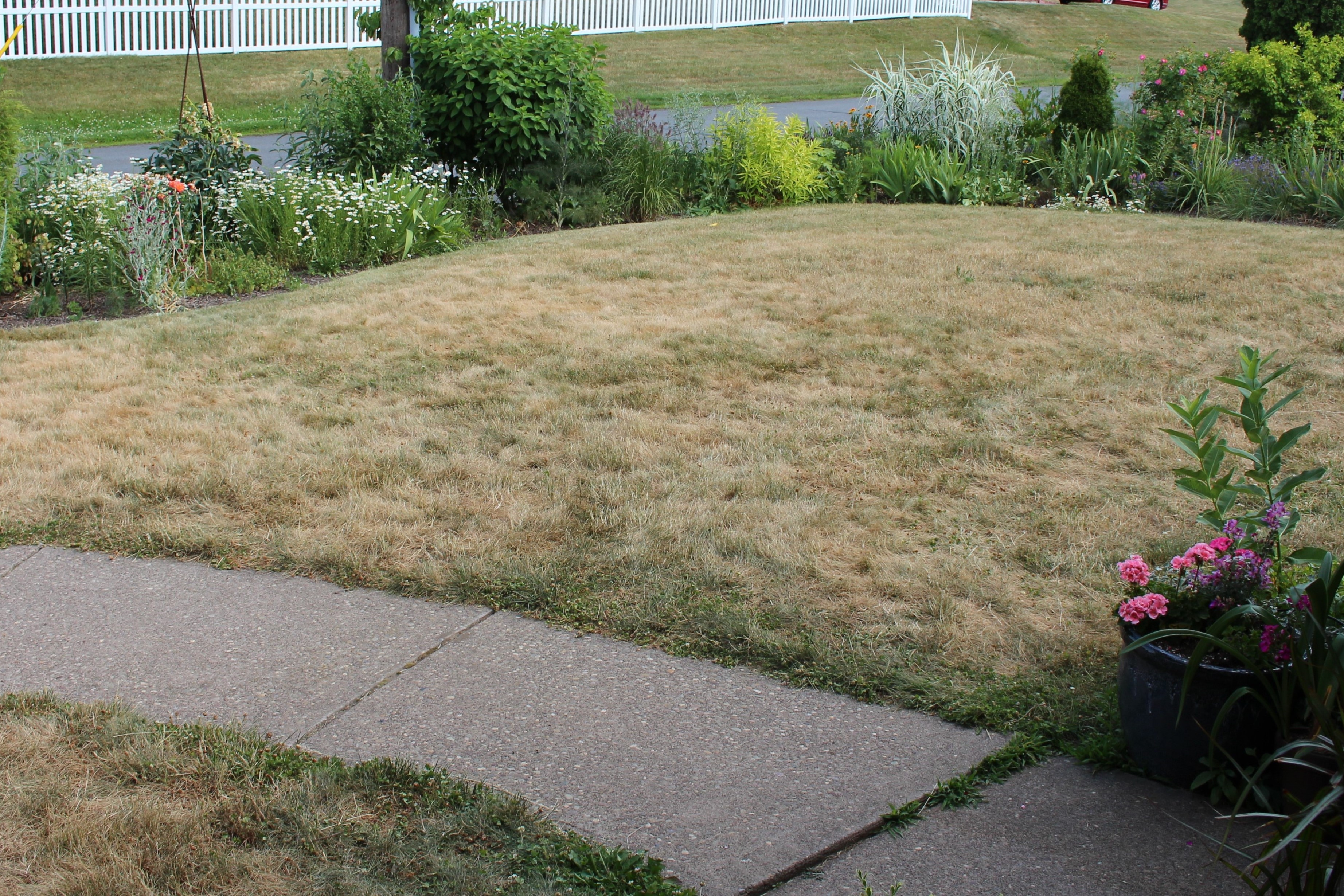
It stopped raining long enough this afternoon for me to get out there and do some watering.  The deluge of nearly 1/10 of an inch did little more than dampen the top layer of mulch and cancel a Little League game, but it was enough to cool things down at least.  Maybe it also gave the pestering hordes of gnats a nice drink as well, God only knows they must be getting tired of sipping my blood and sweat all month.  Here’s how the lawn out front looked yesterday morning.

dormant lawn

Needless to say I don’t bother watering the lawn.  I feel like watering the lawn is a gateway drug to bagging clippings, spraying for weeds, thatching, aerating, spraying for grubs… all those tedious chores which would ruin this vacation from mowing.  On the down side it looks like crap until the rains come back.

I hope my crabbiness about the weather doesn’t come on too thick.   Weatherwise I feel like I’m riding one of those shoddy, barely-passed-inspection carnival rides where you get thrown back and forth between burning and freezing, drought and flood, and all you want is Dramamine and a Tylenol when it comes to a stop.  Maybe today’s misting and this week’s milder temperatures will improve my outlook.  I think it will, especially when there are flowers toughing it out and cheering me up.

linaria purpurea

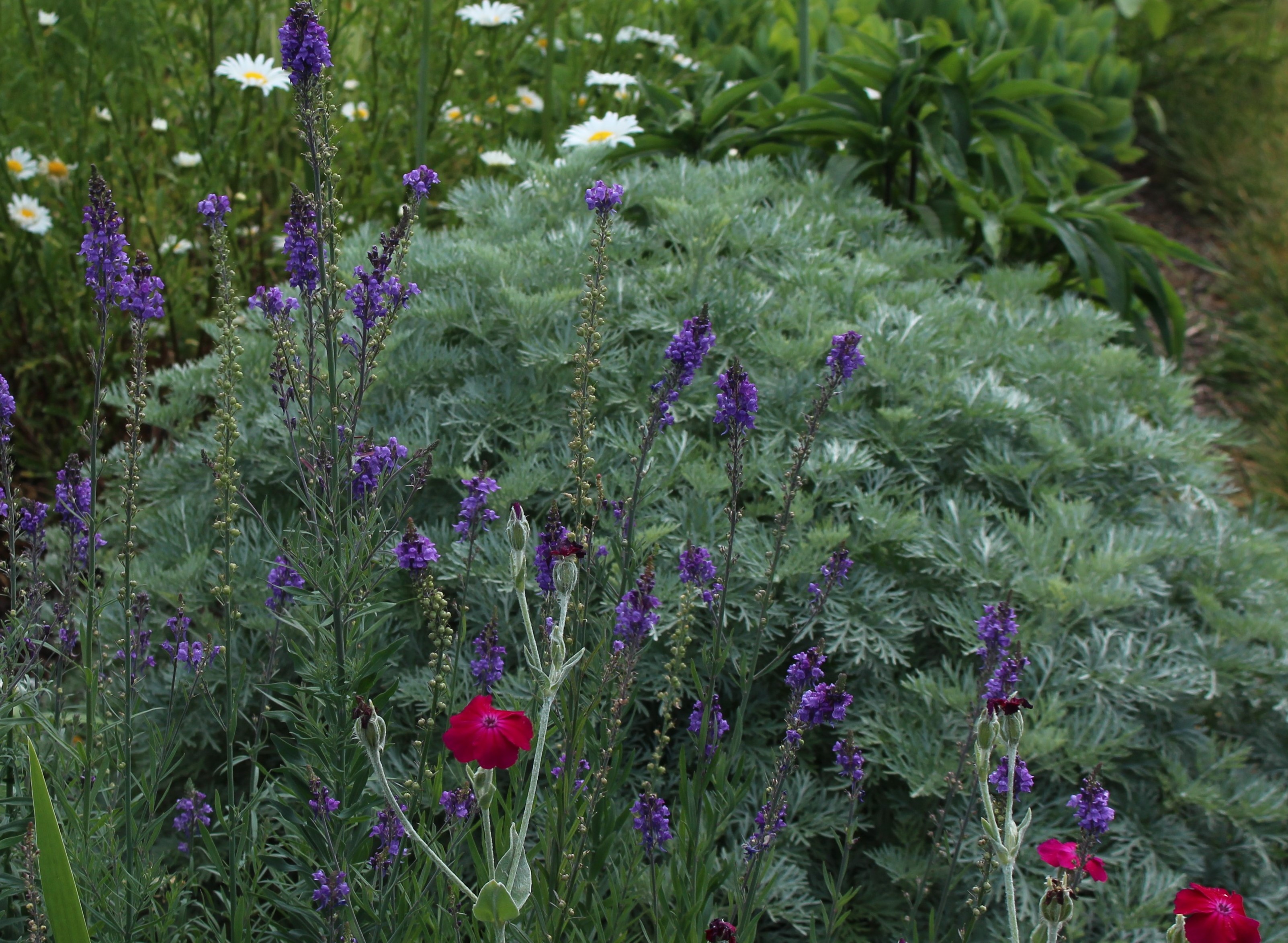
A new one this year is Linaria purpurea (toadflax), a hopefully hardy and long blooming airy perennial which was seeded out last year. The seed was supposed to be for ‘Canon Went’, a pink version, but only one or two stalks came true. No big deal as I like it just fine in the regular lilac-blue color.

I’ve done next to nothing on the front border since mulching it with shredded leaves in March… and weeding and deadheading once in May.  That’s great because it still looks decent enough, but not so great since I like to add a few patches of hard working annuals and tropicals in there to brighten up the summer months.  This pattern of neglect isn’t way out of the ordinary though, so even if it’s getting late for annuals I’m 99% sure that if I finally get it planted there will still be a decent show… but I’m not doing the same for the foundation bed.  It’s so dry the majority of the perennials are wilted and dying and I have no desire to even look at it long enough to even consider carving out a few watered spots for annuals.  The blue fescue border was de-seeded last weekend and in general it looks good enough, so I’ll leave it at that.
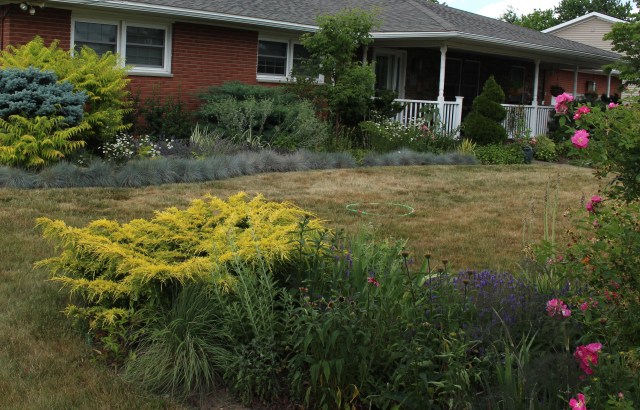
blue fescue border

I pulled off all the fescue seed heads and the foundation planting will just have to stay like this for the summer… although I may have to airlift out a few hellebores.  They look terrible all flat and yellowing and it may be time to find them a spot in the backyard with a little shade.

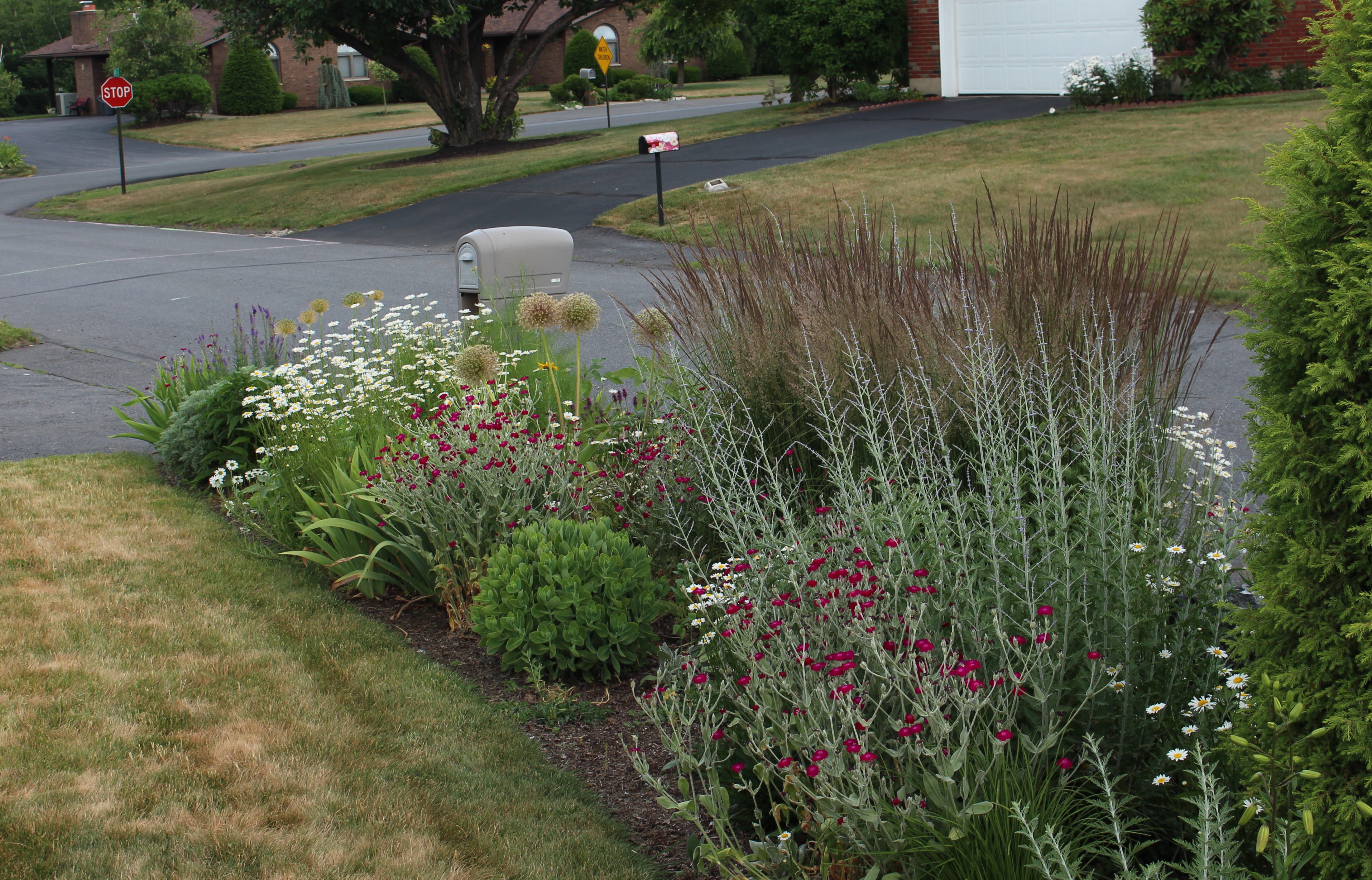
It’s curious to me how some years an odd balance tips and suddenly your most reliable standards vanish.  This year the front border is missing the hordes of rudbeckia which dominated last summer and in their place is a nice wash of rose campion (Lychnis coronaria).  Many people look down on this old fashioned, reseeding, short-lived perennial, but I love it for its tolerance of droughty soils, its soft gray foliage, and its cheerfully bright flowers.  It’s a perfect compliment to the nearly-a-weed white of the oxeye daisies.

allium seedheads

The front border from the near end.  This perspective is perfect for avoiding all the gaps and holes which become apparent when the border is admired head on 🙂

My absolute favorite right now isn’t even a flower though, its the dried round seedheads of allium ‘Pinball Wizard’.  Big fluffy spheres which seem to float above the border are just perfect this year and I’m planning on lifting the bulbs this week to spread them out a bit (the original single bulb has split into four now and I don’t want it to have any overcrowding issues.

lychnis coronaria rose campion

Rose campion, oxeye daisies, and another view of my lovely allium seed heads.  Might as well enjoy the dried stalks since everything else seems to be on its way to drying up completely as well.

Once you move towards the far end of the border things go downhill fast.  Everything in this border gets done from the near end to the far, and unless I’m making a strong effort to be fair, all the good plants, best mulch, nicest compost, most delicate pampering…. all that happens at the one end and rarely carries all the way through to the other side.  I’m pretty sure that the most obvious solution to this problem is to make the border wider again.  More room, more plants, more excitement… the natural choice when faced with a border which might already be a little too much work 🙂
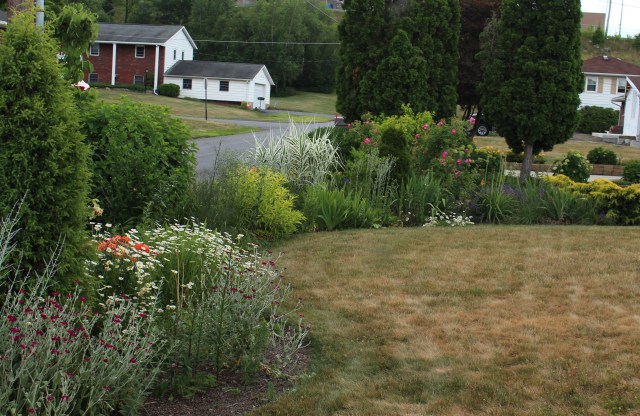
late June perennial border

If I can get a shovel down into the rock hard lawn I could easily bring this border out another foot or two without interfering with third base (which is usually located right next to the chartreuse leaves of the ‘Golden Sunshine’ willow).  I’ll just need to plant something which can handle a few missed kickballs and base overruns.  

Digging will have to wait until August at earliest.  Who knows what there will be left to plant in August, but we’re approaching phlox season and no bed digging is worth the risk of interfering with flowering phlox enjoyment.  Just today one of my new ones opened and it is so amazing I’m sure you’ll see it here shortly.  Wow is all I can say, and to be honest I haven’t been this completely excited about a new flower since at least last week.

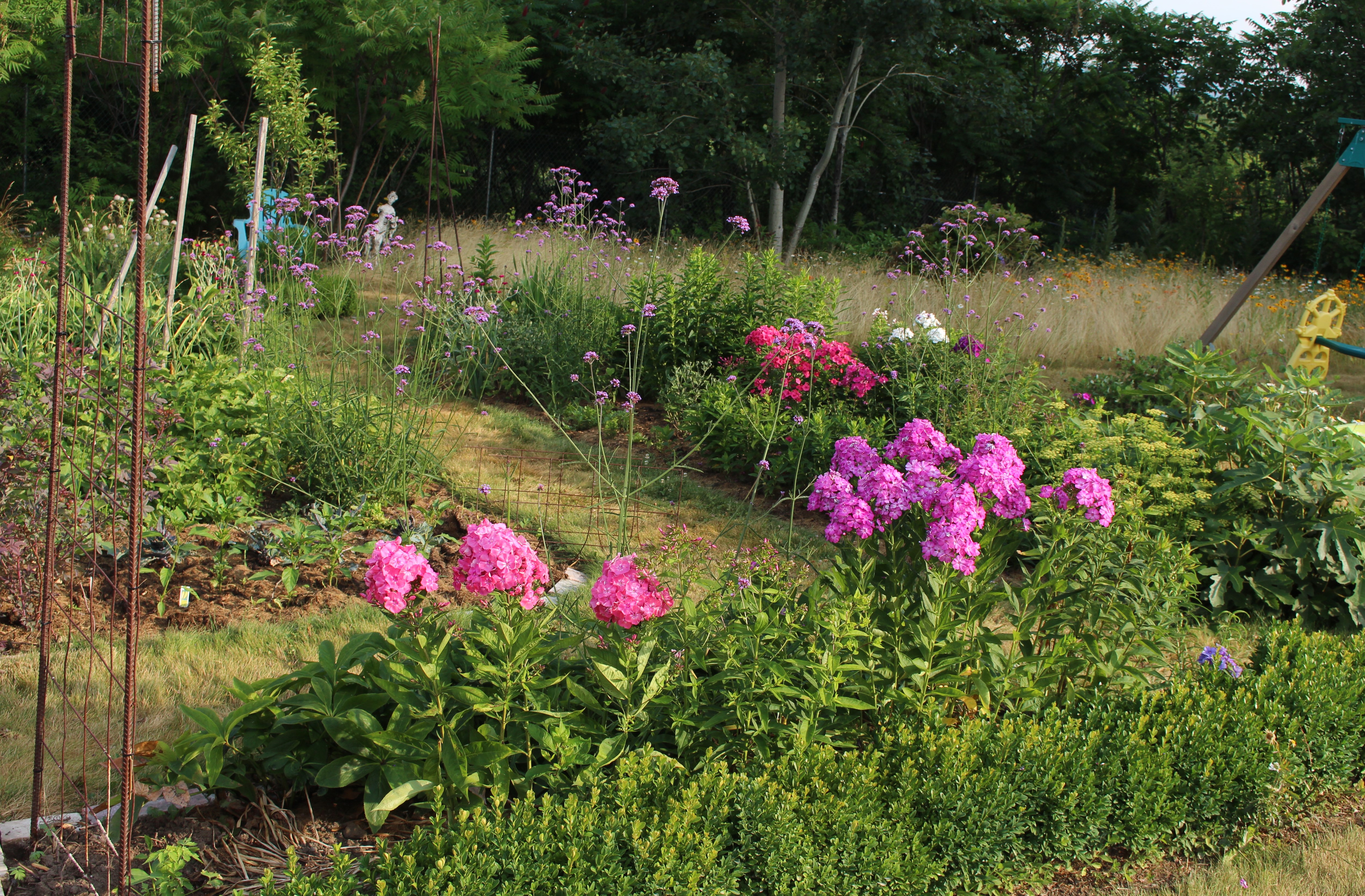
the potager in June

The potager in June with its freshly mulched beds, newly concrete-reinforced rebar archway, and the first bright reds and pinks of tall garden phlox (Phlox paniculata).  There are even a few vegetables planted (although the boxwood still needs trimming).

With all the work I’ve done recently in weeding and trimming you might be able to tell I’m now trying to catch up on the blogging.  Well, blogging and watering of course… but please bear with me as sore muscles recover indoors and I throw out a bunch of posts in what might be too little time, and please feel free to skip commenting or even ‘liking’ since I’d hate to wear out my welcome!

Enjoy your week and I’ll be back Thursday to join up with Kimberley at Cosmos and Cleome for her Thursday Feature.  Maybe I’ll even feature the new phlox, although saying that pretty much guarantees a woodchuck or deer attack tonight…

Tuesday View: The Tropics 6.28.16

Two of my favorite bloggers are bringing back a meme which I’ve always enjoyed.  Cathy of Words and Herbs and Kimberley of Cosmos and Cleome both highlight a longer view each Tuesday and we get to see it develop and change as the year passes.  I’m no expert on the meme but I think Cathy sticks to a specific viewpoint and time while Kimberly varies the perspective and location depending on what’s going on in the garden.  Myself on the other hand am barely capable of getting any post up in a given week, so to keep it simple I’m going to follow Cathy’s lead and go with one view, same bed, same point each week and see if I can handle that.  Also since the tropical bed went in last week (about time since it’s already past the solstice and well into summer) I’m going to highlight this bed as my view, and (hopefully) watch as it grows up. 

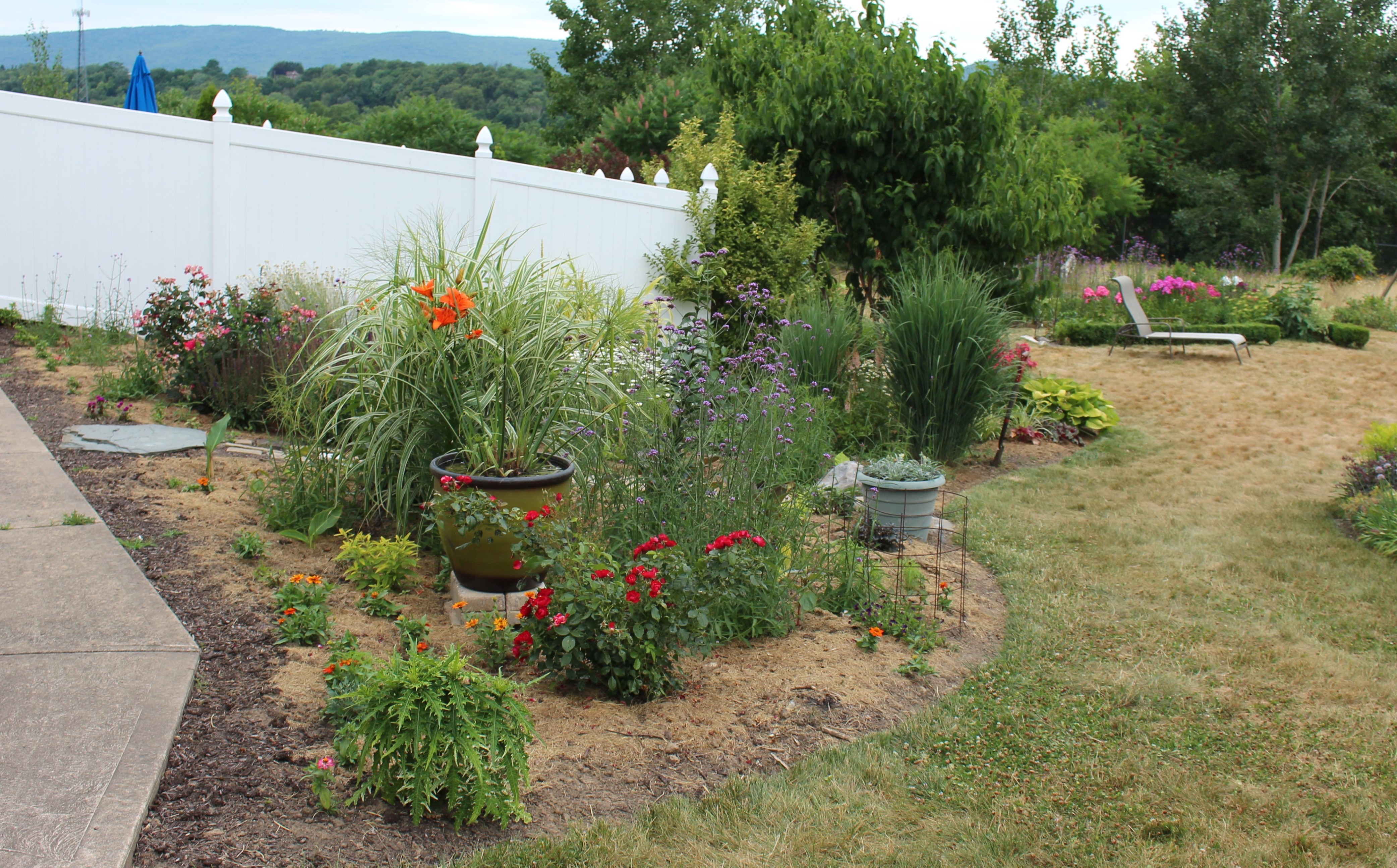
Tropical garden

My fingers are crossed that over the next few weeks this bed will become an explosion of color and foliage and maybe bring a taste of the tropics to this end of NE Pennsylvania.

I’ll try to keep this short, since assuming things grow I want to save a little material for future posts, but besides the thrill of actually getting most of the plants in last week I always get a little excited checking this patch each day to see how quickly things progress.  All season bloomers which sit as a lump of color and put out the same old flowers each week bore me a little, and even though I can appreciate someone wanting low maintenance, neat color, I want something that sneaks up on you and then overwhelms you, like a horticultural tsunami!  Hence the tropical garden, and anything bright and big and leafy is more than welcome.

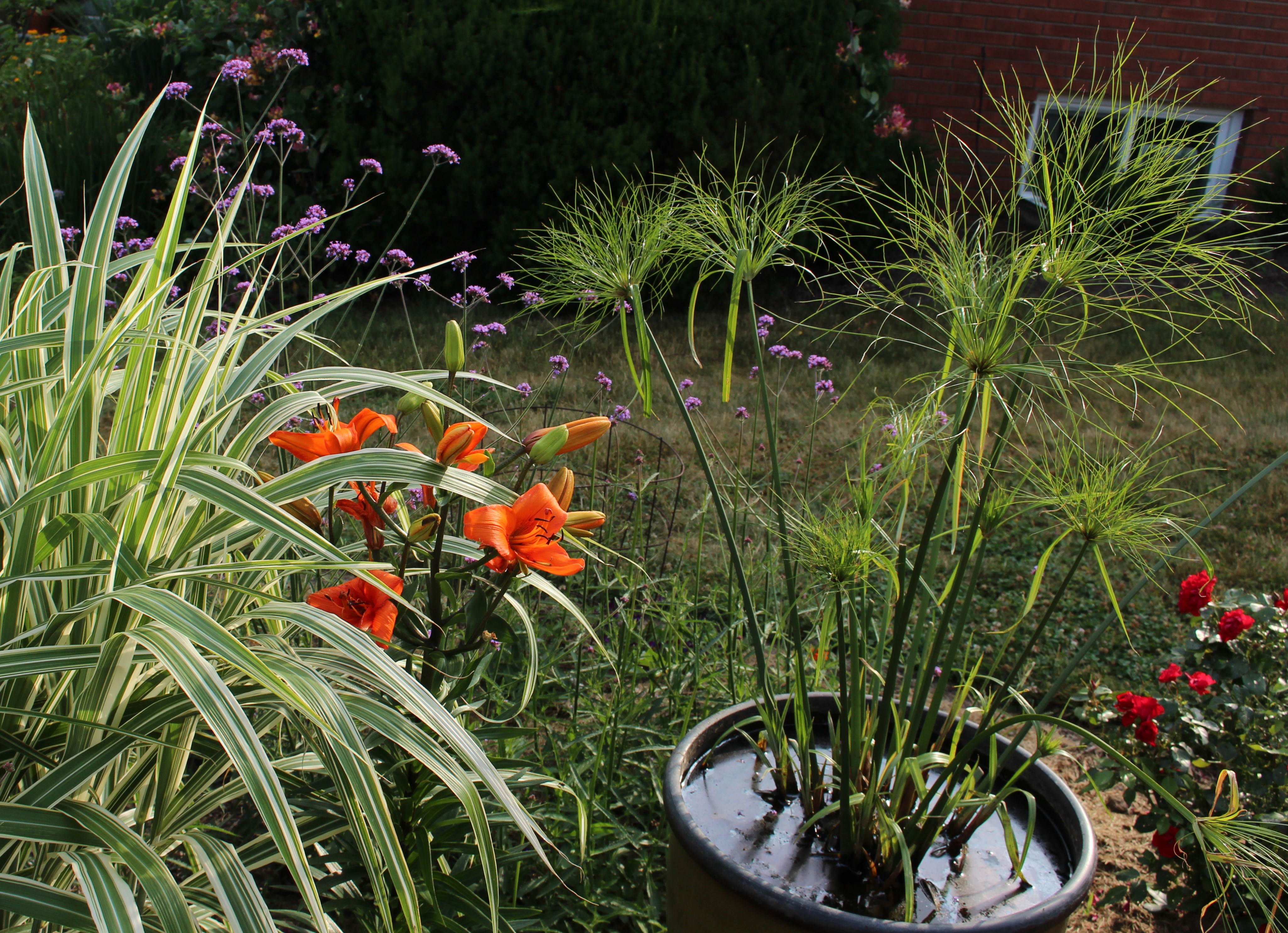
papyrus with black forest rose

The papyrus was not happy last year and I suspect it didn’t get nearly as much water as it wanted so instead of planting it in the ground again I placed it in a pot submerged in a second pot full of water.  Green water.  So far the reviews of this planting have not been 100% favorable.

You can’t really tell from the tiny sprigs, twigs, and tubers, but this year’s theme is orange and purple.  That’s not a solid theme, it’s more my mood when I’m out picking up annuals or choosing which dahlias to put here versus in other parts of the garden… or finding a flat of orange zinnias on sale and liking zinnias.  So until the oranges fill in, hot pink and purple will have to do for a theme.  Besides the annuals, perennials have a way of sneaking in everywhere, and although I pulled a wheelbarrow full of daisies and transplanted dozens of chrysanthemums, there are still a few things such as this knockout rose and purple ‘Caradonna’ salvia which are just too colorful to stand up to.  Maybe next year will be the year I follow through on my threats to remove the salvias.
knockout rose with caradonna salvia

The ultra rare and uncommon ‘Knockout’ rose tastefully complimented with orange zinnias at its feet and scavenged lawn clippings as mulch.  This Tuesday view already promises to reek of class each week 🙂

So there you have it.  By next week I hope to have a few cannas sprouting and a few more zinnias assaulting your color senses and overall I really hope things don’t end up requiring a rototiller and a fresh start by August.

Think about joining in with the view and if you do leave a link at either Cathy‘s or Kimberley’s blog so we can find you.  Not to put words in their mouths but I’m sure both will agree “the more the merrier” and I always enjoy watching another garden grow throughout the season… even if it does turn into a trashy mess of too much color and chaos!

June’s GBFD and Thursday’s feature: Arundo Donax

I feel like I’m cheating with this double post, but between Christina’s Garden Bloggers Foliage Day and Kimberley’s Thursday Feature I didn’t have the strength to choose just one… and ran out of time to do both.  So here’s the best I can muster, a feature plant which highlights foliage!

arundo donax variegata

A patch of Arundo donax ‘variegata’ in the street border.  The bold white variegated foliage accents the corner and contrasts the different foliage colors and forms of its neighbors.

Arundo Donax is not a plant for the meek or overly sensible.  It’s a large vigorous grass which overwhelms its neighbors and requires a backhoe or moving van for the owner who tires of it.  It’s listed as invasive in a few more Southerly regions but here on the Northern edge of its hardiness range it just comes across as enthusiastic.  There is a plain green form, but the ‘variegata’ is just straight cooler with it’s crisply bright color and its almost-as-vigorous growth.  13 feet tall (4 meters) is not unusual here in zone 5/6 NE Pennsylvania.

Arundo (giant reed grass) appreciates plenty of moisture but can also handle a considerable amount of drought.  It does NOT enjoy a late freeze.  Half of my patch surprised me by actually dying back this spring when a late freeze came just as the roots were emerging from winter dormancy.  Heat is what this grass prefers but just keep in mind that in the ‘Variegata’ form the bright white will fade to yellow and green when the thermometer goes above 90F, and if that bothers you chose the slightly less vigorous ‘Peppermint Stick’  which keeps the white all summer.

arundo donax variegata in perennial border

Arundo donax ‘variegata’ later in the season (August).  A relatively cool summer kept the variegation from fading completely.

You’re either going to love this grass or hate it and I won’t judge you regardless.  Arundo is not a plant for everyone just as Great Danes are not a dog for all households, but it does make a statement and I’ll leave it to you to decide whether that statement is a bold splash of color front and center or if it’s a rude, overwhelming haystack.  In either case I think you’ll agree it’s both foliage and a feature and if you’d like to explore other (possibly more tasteful) uses of foliage please visit Christina at Creating My Own Garden of the Hesperides on the 22nd of each month and if you’d like to see what plant features best this week visit Kimberley at Cosmos and Cleome each Thursday.  If you have the time you may want to consider joining in, there’s always room for one more and it’s always fun!

One word…. Dichelostemma

I inherited my mother’s habit of randomly picking up and trying out just about any odd, looks-like-it-might-be-nice bulb that shows up in the garden center’s bins.  Together we’ve failed at freesia, ranunculus, ixia… but every now and then something gives a surprise, and lately it’s been Dichelostemma.

dichelostemma pink diamond

Dichelostemma ‘Pink Diamond’ out in the meadow garden

The first one which made its way into the garden was a selected form of the naturally occurring hybrid ‘Pink Diamond’.  I love the totally tubular pink flowers and the waxy thickness of the blooms and was surprised it actually grew since the bulbs came via a November closeout sale, and late planting into a cold, wet clayish soil is typically not a recipe for success for drought tolerant bulbs from the western reaches of North America.  But they came up fine the next spring and when the wiry flower stalks matured to bright pink clusters of bloom in June I was hooked.

dichelostemma pink diamond

Daisies and Dichelostemma in front of a worse for wear Queen of the Prairie.  The Queen still presides over the back forty, but between acidic rainfall and wayward groundhog nibbling her reign may soon be coming to an end.

‘Pink Diamond’ may or may not become a permanent resident in the meadow.  The first planting returned to bloom the second year but has not put up flowers in the third.  I blame rabbits for nibbling too much of the spring foliage, but we will see what happens next year, as this spring with all the new crocus flowers to chose from the rabbits didn’t quite get to the Dichelostemma foliage before moving on to freshly planted lettuce and broccoli in the vegetable garden.

The ‘other’ Dichelostemma (D. congestum) has been going strong though, putting up its beautiful lilac-purple flower clusters for three years now… in spite of also being nibbled.

dichelostemma congestum

Dichelostemma congestum has the common name of fork toothed Ookow.  When you get tired of introducing guests to your dichelostemma I’m sure switching to the common name will clear things up. 

I love how these plants look among the weeds and grass of the meadow.  I can imagine this isn’t entirely unlike their native habitat in the Western edges of the continent and from a gardeners point of view the yellowing foliage is completely disguised by the surrounding greenery.  Not to get distracted, but I wonder how alliums would work out back here since many of those also share the trick of letting their foliage go to pot just as the blooms reach their peak.

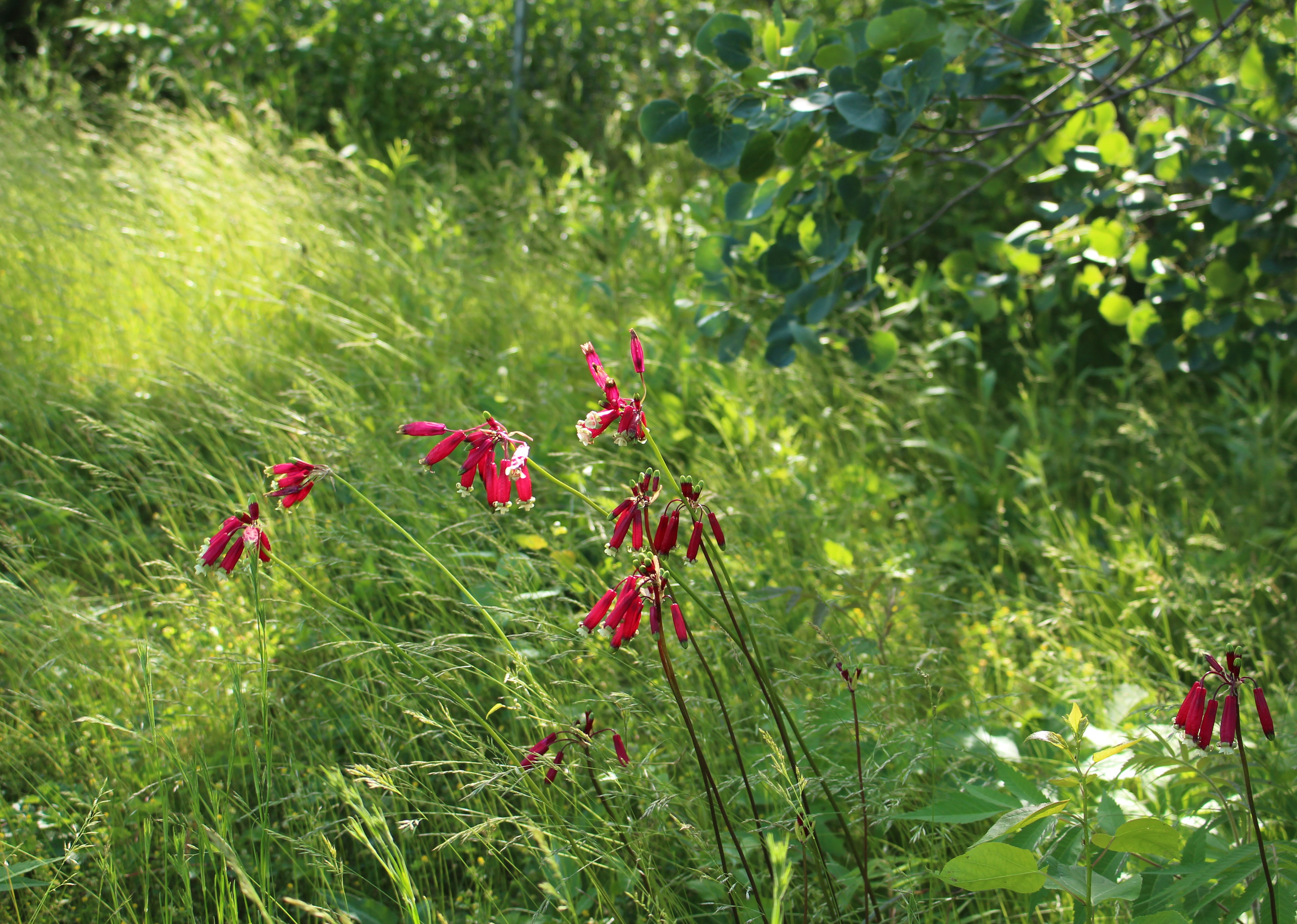
Dichelostemma ida-maia is my last of the D’s and I suppose ‘firecracker plant’ is a decent common name for this one…. although it’s no Ookow.

dichelostemma ida-maia

Dichelostemma ida-maia.  The shape and color of this flower has ‘hummingbird plant’ written all over it.

Besides adding more ‘Pink Diamond’ last fall, I also put in a few D. ida-maia… in spite of my thoughts that I wouldn’t like them.  I was completely wrong in my lack of enthusiasm.  The sad anemic version I saw a few years ago is nothing like the group I now have swaying in the dappled light amongst the grass.  I’m far too greedy a collector to commit large spaces to a single plant but I would have no problem adding another hundred or two (versus the 10 I started with) to this end of the meadow, which is entirely do-able since these small bulb are relatively cheap even when not on clearance.

dichelostemma ida-maia

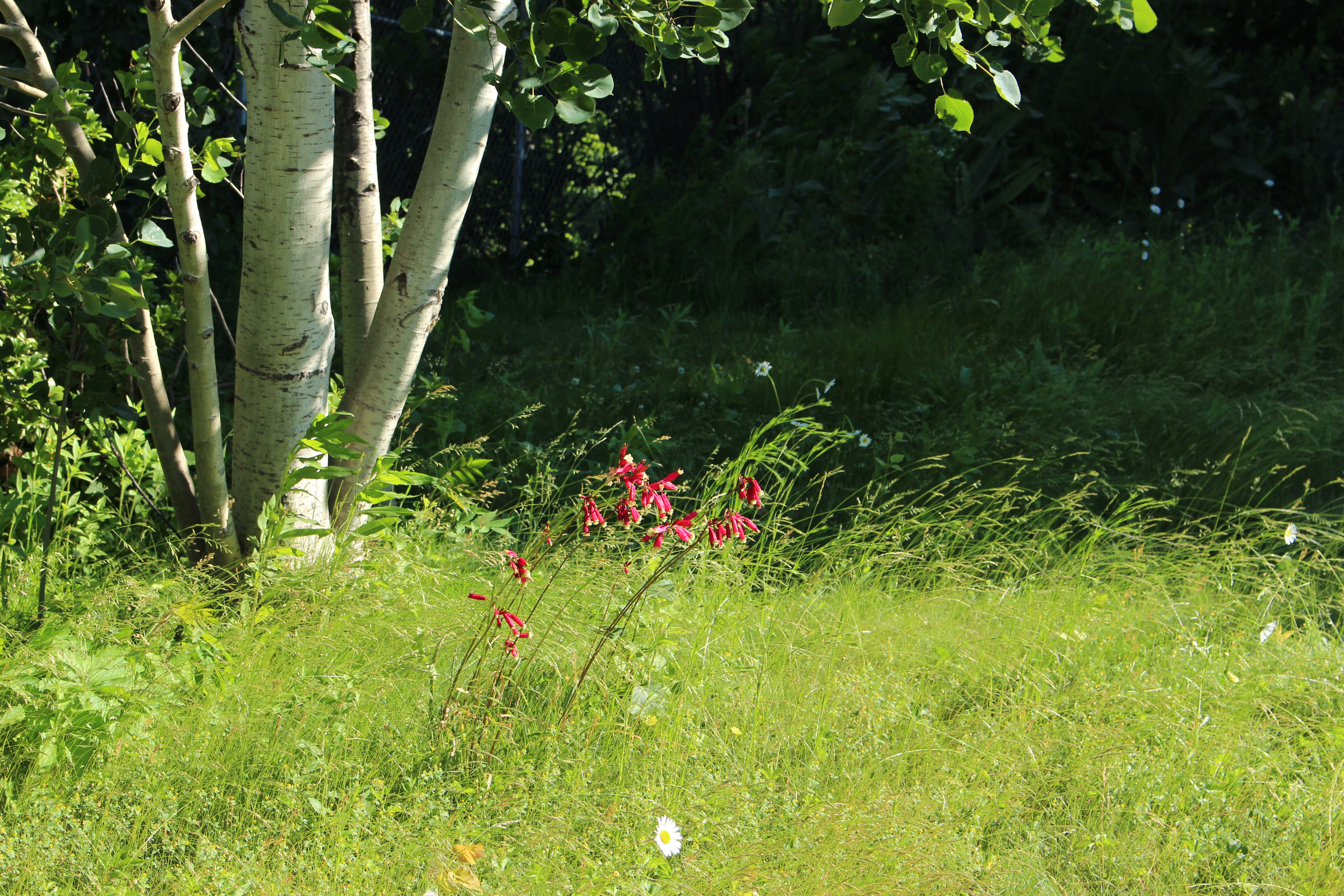
I trimmed up the lower limbs of the aspen and love the Rocky Mountain glade effect it has given.  Add a Western NA native Dichelostemma ida-maia and we may be on to something here 😉

I’m not sure what the hardiness on these plants (both species and their hybrid daughter) is.  To be honest I didn’t think they would make it through their first careless planting (really careless… cold November fingers so one shovel swipe into the turf, dump bag contents into hole and stomp sod clod down again on top), but they did survive, and it was a winter where our lows reached -6F (-21C) with a solidly frozen soil for months.  So they’re at least that hardy, and I think the extreme summer dryness of the meadow also helps them return in spite of any issues with poorly drained, wet winter soils.

Dichelostemma.  Think about it.  I think they’re pretty cool.

Thursday’s Feature: Digitalis x mertonensis

I’ve said it before that I’m not much of a joiner and I’m far too disorganized to keep up with most weekly or monthly memes, but I’m going to give this one a try.  Kimberley over at Cosmos and Cleome has brought back the “Thursday feature” and it’s a chance to highlight any one particular plant which caught your fancy in the past week.  This week among all the wonders of June a foxglove has caught my eye and it’s just a little bit different than your average foxglove.

digitalis mertonensis

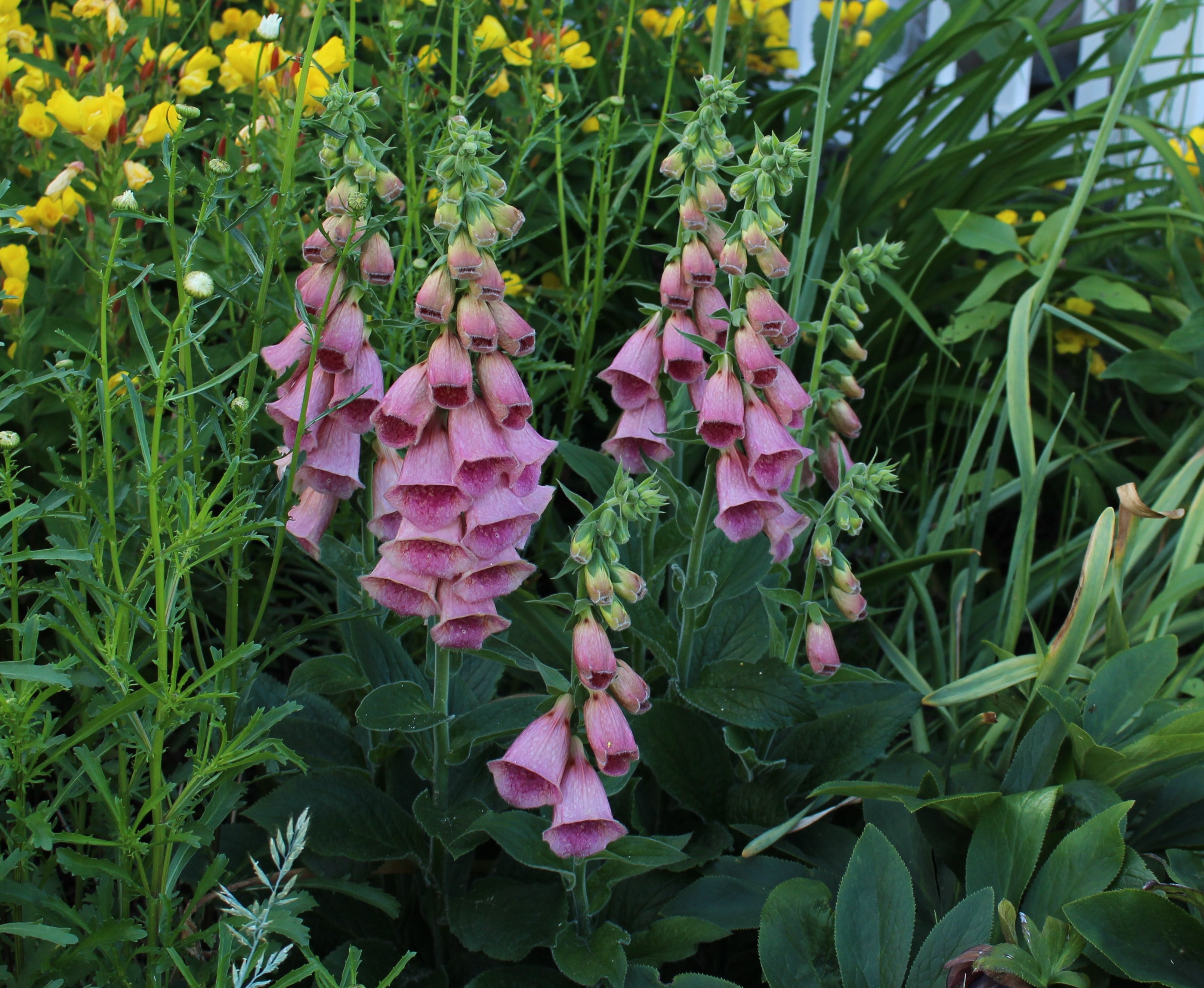
Fuzzy leaves, a strawberry color, and a 3-4 foot bloom height are trademarks of Merton’s foxglove and/or the strawberry foxglove (Digitalis mertonensis).

The strawberry foxglove (Digitalis x mertonensis) is a hybrid formed by the joining of your regular tall, purple (biennial) Digitalis purpurea and your shorter, mellow yellow (perennial) Digitalis grandiflora.  The offspring was a tetraploid child with perennial-ish tendencies, larger flowers, and a rose color that holds just a little bit of yellow (you can always count on me for these vague made up color descriptions!)  They come true from seed, and although most sources recommend moist, fertile, well-drained, soil in part shade, mine suffer along just fine in a dry sunny spot which also grows sunflowers well enough.

I noticed a few seedlings earlier in the year and should really round them up for a more suitable home.  This foxglove is one which seems to do well enough in my garden (unlike the common foxglove, D. purpurea which rots away in our winters) and deserves more respect than I give it.  Maybe this summer I’ll finally start up some of those other Digitalis seeds which are sitting in the seedbox, and we could have a family reunion with all the foxglove cousins and kin.  I think I’d like that.

As I’m sure you know foxgloves (Digitalis) are extremely poisonous and their heart slowing toxin was the inspiration for the digitalin drug group.  I’m not the one to go on about medicinal uses, but if your concerns lie in the area of its toxicity please put that one to rest.  Apparently some brave soul has found it to be extremely bitter, and a side effect of ingestion is vomiting which conveniently removes the poisons.  Give this one a try I say, and also give Kimberley’s site a visit to see what other gardeners are finding interesting this week.  Enjoy!

Rose ‘Livin Easy’

I took full advantage of the cool, generally overcast weather this weekend, and put some solid workdays into the garden.  The deck is cleaned, the pots are planted and the tomatoes are finally planted.  It’s nothing to look at yet, but fortunately this rose is.  It’s ‘Livin Easy’ and although it may not be the newest thing out there and it might not be a color everyone loves, I still think it’s a knockout.

rose livin easy

Oxeye daisies and rose ‘Livin Easy’. Orange isn’t a color everyone loves, but I do.

Some people say it has a fragrance, but it’s not strong enough for my nose.  Even with a lack of fragrance the disease resistant foliage and summer long bloom make up for this fault, and I do nothing other than trim off a few dead branches in the spring and off she goes.  I’m sure fertilizer and more concerned care would do wonders, but I like the way it has become nearly overwhelmed in a sea of daisies.  A real gardener would have probably ripped them out ages ago.

An old familiar itch

It’s time to face the reality of unsown seeds and unplanted vegetable beds.  There… done.  For the past few years I’ve been making a real effort tot get all kinds of annual seed growing, all kinds of cuttings started, and all kinds of summer bulbs planted, but this year something is off.  Maybe I’ve been too busy with other things, but in all honesty I live a fairly lazy life and for me to say I don’t have the time or energy to start a few salvia seed or pot up a few coleus cuttings is just a bunch of excuses.  My reality this year is I just don’t care to.  I’m not a farmer after all, and the family won’t go hungry or broke if the potatoes fail, so I just keep enjoying what I’m doing and don’t stress it if this year I only start 10 or 20 coleus cuttings rather than 75.  The iris are in bloom after all, and this year they are nearly perfect.

historic bearded iris

The view from the street is far nicer this spring with green grass and healthy spring growth.  I forgot what it’s like to start the year with cool temperatures and ample rainfall rather than dry winds and drought.

I have a weakness for iris, and go back and forth between indifference and obsession depending on the season.  This year it’s obsession.

historic bearded iris

Clumps of iris are scattered throughout the front border.  They are mostly old cultivars (~100 years) and although they lack the ruffles and fluff of the modern iris, they’re very well suited to the rough and tumble of often neglected and often overgrown perennial beds.

The number of blooms, the colors, the fragrance, are conspire against me this season and I’ve been on and off iris websites far more than I should admit…. even though the majority of my iris are either pass-alongs or just plain found alongside the road and had nothing to do with a catalog order.

historic bearded iris

From left to right, Flavescens (pre 1813), Ambassadeur (1920), and Indian Chief (1929).

The jury is still out on any big iris orders since I should really take better care of what I have, but people say it doesn’t hurt to look and so far that’s all I’ve been doing.

blue foundation planting

The striped leaves of Iris pallida ‘aureo-variegata’ accenting the front foundation plantings.  You can count on this iris to scent the whole corner of a bed with that delicious grape scent which many of the older varieties put out.

It hasn’t been all sloth and idleness in the garden this spring.  A few small projects are getting done in spite of my laziness, although I’m not promising they’ve all been done to the best of my ability or that they are the best value for my little effort.  One interesting discovery I came across is that bearded iris are fairly resistant to Roundup type (glyphosphate) herbicides.  That of course leads me to carelessness when spraying around the clumps next door, since the chances of iris damage are far outweighed by my ‘want to do as little free labor as possible especially when it includes pulling weeds out of monotonously boring mulch beds in someone else’s yard’.

roundup on iris

Iris foliage is fairly resistant to Roundup yet the flowers will discolor and stunt depending on how much of the poison they absorb.  These flowers should be larger and a dark velvety red rather than small and anemic looking.   

Before anyone gets too excited, I just want to say I really don’t use too many chemicals in the garden and although I like to appear as if I’m lazily spraying about I really am somewhat cautious, if only because I have too many more sensitive plants which I’d hate to lose.  For what it’s worth my research shows that iris, vinca, and nut grass are pretty much the only plants which will not be outright killed by careless Roundup spraying…. although for the vinca and nut grass the spraying was very intentional.

roundup on iris

Normal iris bloom to the left, increasing Roundup effects on the same plant to the right.  A heavy dose will give a colorless cauliflower-like stalk which is entirely uninteresting.

Besides chemical warfare on weeds, another questionable project started with my purchase of a Charlie Brown delphinium which needed a perfect spot in order to wow everyone with its amazing comeback.  My single successful clump grows alongside the front porch so this was the most obvious spot to try another, except for the six foot Alberta spruce which already grows there.

delphinium foundation planting

The healthy delphinium clump is front and center with the spruce behind.  The Charlie Brown delphinium sits soaking in the white bucket to the right.

Alberta spruce is a 365 days a year respectable plant, with an attractive form and many years of service in and many years of service to come.  It would make no sense to pull it out in favor of a temperamental diva which needs fussing and fertilizing and timely staking to protect it from the high winds which strike each year (always two or three days into peak bloom season).

delphinium foundation planting

Spruce gone, delphinium in (one of the ‘New Millenium’ hybrids).  Not the most logical decision I’ve ever made but in the garden I prefer to live guilt free and impulse happy.  Also, if you could, please ignore all the trash and clutter on the porch beyond.  I only got around to cleaning it up after this photo was taken.

I’m distracted again, let me finish up iris season.  The Siberian iris and Japanese iris might be some of the most beautiful flowers of the plant world, but I don’t grow many.  They seem to flower for a total of one week and although the grassy foliage looks respectable all summer and they handle nearly any abuse which comes their way I try to limit any collecting urges.

purple siberian iris

An unknown purple siberian iris with a still unplanted tropical border behind it.

One Siberian iris which I couldn’t walk away from was ‘Super Ego’.  It’s not because it was in bloom when I saw it or that the color was unique or any other particular quality, it was because of a childhood dream which was set on fire by a random White Flower Farm catalog which showed up in my mailbox one winter.  I think I’ve confessed to being a little odd as a child so the fact that I’d sit around spending hours reading through this catalog probably shouldn’t surprise anyone, but this 1980’s era catalog (which I probably still have somewhere in the basement) had ‘Super Ego’s glamor shot in it alongside a poetic description which convinced me that owning this plant would make me richer, smarter, and more popular.  Unfortunately the WWF catalog was way beyond my 10th grade budget so the actual plant never left Connecticut and I was forced to go on without.

Siberian iris super ego

Siberian iris ‘Super Ego’ just starting to open on a Thursday. 

The actual experience of growing ‘Super Ego’, while pleasant enough, didn’t quite live up to my expectations.  For what it’s worth, I guess I’m as smart, rich, and popular as I’m ever going to be.

Siberian iris super ego

‘Super Ego’ five days later after a few 90F days bleached most of the darker blue color out.  The chives in the back seem unfazed by the weather or passing time, although they are entirely less exotic in my opinion.

So as I wait for a new plant to come along and change my life I’ll continue weeding through the backyard iris beds.  They are infinitely less photogenic with their hefty companion plantings of weeds, but the old iris continue to carry on and deserve more respect than their neglected planting spot gives.  I even planted a few zinnia and marigold seeds last weekend.  That may not speak of high class and taste nor earn me a spot in the White Flower Farms catalog but it does mean that things are starting to move on the seed front, and if it all works out July and August should still be full of flowery color.

Spring keeps rolling along

As it is with most things here, the gardener is not exactly on schedule with his gardening.  He’s not exactly on schedule with many things, but the late freeze and the discouraging damage it did to so many spring greens has left him slightly unmotivated.  Then the relentless rain and cold damp brought on rot, and now dry weather is bringing spider mites to the phlox.  So the gardener will restart his spring in mid May and deal with the mites.  He’ll also accept that many projects will again not happen, and will just clear his conscience and move on.  Iris are beginning to bloom after all, and once the iris start to fill the flowerbeds with color and perfume it’s hard to hold onto a black mood.

narcissus keats

One of my last daffodils to open, narcissus ‘Keats’ was voted ‘ugliest thing to bloom’ by a more serious daffodil friend.  I’m always one to love the underdog. 

One minor project (which seems to be the only project type I’m capable of tackling this spring) which was finally taken care of was the long suffering heuchera plantings.  A few summers ago I dipped my toes into the hybrid heuchera world and since then they’ve been suffering along in my garden.  My planting beds get too dry, my shade isn’t as high and dappled as they’d like, and my soil is too heavy for their roots but I try nonetheless.  They still have plenty of filling in to do but if you saw the before picture I’m sure you’d agree this is an improvement.  Unfortunately the tan lawn clipping mulch doesn’t do much to set the foliage off, but it’s better than weeds I suppose.

transplant and divide heuchera

The woody stems of the heuchera clumps were dug up, ripped apart and carelessly stuffed back in to the re-dug bed and the plants actually look much happier after their tough love treatment.    

As summer heat settles down on the garden this holiday weekend, I just wanted to celebrate the meadow and a few of the newer plantings which did well this spring.  Number one on the list were the tulip clusiana bulbs which planted into the turf.  They looked perfect out there and I hope they return just as nicely next spring.

tulipa clusiana

Tulip clusiana (I think they were a named variety but I’ll need to dig out the tag) were scattered around in the meadow garden.  I will be extremely happy if they settle in here!

A few Anemone blanda look nice in the shadier parts of the lawn.  I tried throwing them around in several of the outer edges of the garden and then promptly forgot until little sparkles of blue started showing up here and there.  My goal for this one is to recreate the neglected show which used to pop up each spring around my first apartment in upstate NY.  If this plant can naturalize around a ramshackle college boarding house I think it stands half a chance here.

blue anemone blanda

Blue Anemone blanda in the “lawn”. 

Muscari is practically a weed everywhere so I added a few of those as well.  The flowers on these grape hyacinths were nice enough but now I keep looking at the seed heads with their kind-of aqua tint.  I wonder if it was the cooler temperatures or if they’ll always have this attractive look…. or is it just me that thinks they look cool?

muscari seed pods

Seed heads on the grape hyacinths (Muscari).  In other parts of the garden I clip them off to limit their seeding around, but here I’ll risk it 🙂

Most of the bulbs were brought in as bulbs, but if you know me you know there are a few seeds coming along as well.  My little gravel covered pots are bursting with new plants this spring and even though the last freeze did a few things in the majority seemed to enjoy our mild winter.  I’m always a bit surprised anything will grow up through gravel, but in some pots even the tiniest of seedlings make a crowded moss of new green sprouts…. which will soon desperately need thinning!

hypericum albury purple

Hundreds of Hypericum ‘Albury Purple’ seedlings sprouting in the center pot. Realistically I need about two.

With new seedlings coming along each spring there are always new surprises as youngsters open their first blooms.  A couple years ago I thought I’d dabble in a few species anemones and see how they do in the meadow, and although I’m not sure they’re all correctly labeled, for now I’m just enjoying them for whatever they are.

aneomone caroliniana

Not Anemone caroliniana?  Pretty regardless, and it looks like it might be able to hold its own if I move it out into the thinner areas of grass.  

One seedling which has a positive ID is this cool little Japanese Jack-in-the-pulpit or snow rice-cake plant (Arisaema sikokianum).  I was surprised to see any of these three year old seedlings flower, and although the actual flower is definitely on the small side for this species they say size doesn’t matter in these things and I’ll just keep admiring the fancy little bloom.

arisaema sikokianum

Arisaema sikokianum.  Although my picture doesn’t do it justice, I hope you can appreciate the mottled foliage and bright contrasts of this flower. 

So that’s the basic update.  I promise this will be the last time I moan about freezes and such, but I can’t promise some other weather event won’t come along shortly to take its place.  Whatever happens it’s a great iris weekend and I’m sure I’ll be going on about that next 🙂

Too much money

Some complaints will never get you any sympathy, and to complain that tulips are coming up and blooming in all sorts of odd places probably ranks right up there.  Truth be told it’s not a problem, but when every batch of compost seems to hold a new crop of bulbs, the spring planting in the parterre becomes a little more complicated.

tulips in the vegetable garden

Once again the vegetable garden is a complicated mess of far too many flowers and far too few edibles.

For all my failures in the garden, tulips seem to be one plant which enjoys the poorly draining, heavy soil of the flower beds.  It’s a surprise to see this considering many references suggest a loamy, free draining soil for your best chances at success, and even then it’s a safer bet to treat tulips as one or two year treat.  Fortunately no one has whispered this little secret into the ears of my bulbs and they keep coming back and multiplying.

tulips in the vegetable garden

Having a few tulips in the way is just the excuse I need to skip digging too deeply when it comes to planting the spring vegetables. 

I think I do know the secret though.  The soil may be heavy but it’s also thin and dries out relatively quickly once the heat of summer settles in, and if I do manage to drag my lazy self away from the pool to water it’s never a solid deep watering, it’s always a guilty stand around with a hose until things look less dead kind of triage.  I can’t imagine much of the water ever penetrates deeper than two or three inches and for this the heavy soil works to an advantage.  My tulips like a hot, dry summer similar to their ancestral haunts of Eastern Europe and Central Asia and most years (unfortunately) this is what my garden resembles.

tulips in the vegetable garden

Tulips in the onions, tulips in the lettuce.  I try to replant stray bulbs closer to the edges, but there are always more little bulblets in the compost or stray bulbs dug around in the soil.

When I was more ambitious I used to fill several of the beds each fall and then dig them again in June after the foliage died down.  It was a glorious spring explosion but one bad experience soured me to the whole deal and I ended up tossing hundreds of fat promising bulbs.  They really do need a good drying out over the summer and when mine all molded up and rotted one damp August I put a stop to the project.  But…. I can’t promise it won’t happen again some day 🙂

lettuce self sown seedlings

If all goes well this batch of tulip leaves should put out two or three blooms next year.  Not bad for a weed, and if you notice there are more weeds in the lawn, in this case lettuce seedlings from last years neglected plantings.

So to sum it up my tulips don’t mind a nice heavy fertile soil while they’re growing, the just need to follow it up with a warm dry summer rest.  Planting them in a spot which dries out and doesn’t get summertime irrigation is one option, actually digging them up and storing them in a hot, dry, ventilated area until fall planting is another.  Just be prepared to have more tulips than you know what to do with since most tulips will at least double in number every growing season.

double early tulip

Leftover Easter flowers from two or three years ago.  Let them bloom and grow as long as possible in their pot and then stick them into some out of the way spot, preferably one where they will not be overrun with bearded iris 🙂

Although most people recommend species tulips and Darwin types for the best chance at perennializing,  I don’t notice that much of a difference between the types.  Give them all a try is my advice, but for best results regardless of type you will have to dig and divide the bulbs every three or four years  when they begin to get crowded.

perennial Darwin hybrid tulips

A few stray tulips snuck in with the compost for this new snowdrop bed.  With snowdrop season long gone I’m quite happy to see the tulips flowering in a carpet of my favorite annual weed, purple dead nettle (Lamium purpureum). 

Alas, even plants relatively happy with their homes do not always lead perfect lives.  The tulip season may be a little sparse next year for two reasons, both of which revolve around the weather.  The first is our harsh April freeze which damaged many of the buds and much of the blooms for this year’s show.  That in itself could be tolerable, but in the weeks since the weather has remained damp and cool, and many of the damaged plants are now falling victim to gray mold (Botrytis).  Botrytis is bad news and seems to stick around for a few years even after better weather returns.  I’m wondering how many of the affected plants will be going on to tulip heaven…

tulip virus candy apple

Not to go on and on about this late freeze, but here’s yet another example of damaged foliage and stunted blooms.  To top it off I also suspect virus in the streaked blossoms of what should really be a solid colored flower. 

All is not lost though.   I still love tulips and would grow a few even if they only made it a year or so before falling victim to whatever tragedies visit my garden next.

tulip marit

Tulip ‘Marit’ is a favorite this year.  I don’t remember such round flowers last year but the shape and color this year really won me over. 

In the meantime I will keep my fingers crossed.  I far prefer being spoiled for choice as far as tulips go, and if it means working around a few bulbs here and there that’s fine with me.

tulip pink impression

Tulip ‘pink impression’ in the front border.  They’re huge and pink and although battered by the weather they’re still the crowning glory of the border.

Have a great Sunday and happy mother’s day to the moms!