GBFD summer sunshine

Each month at this time Christina of ‘Creating my own Garden of the Hesperides‘ leads off on a meme which asks us to look past flowers and consider the important contributions foliage makes in the garden.  I’ve been lax so far this summer but was determined not to miss out again this month so here’s my small contribution.

Last week before we went away I took a few photos of the front border and this section really seems to have come together.  The bright leaves of the willow ‘golden sunshine’ are nicely set off by the darker green euonymus behind and complement the gold of (what else) more rudbeckia!

Willow salix 'golden sunshine'

‘Golden sunshine’ willow and gloriosa daisies brightening up the agastache, ‘Karley Rose’ fountain grass, and unknown eryngium.

Not much of a contribution I understand, but the willow is carefree and really brings this corner to life.  Hard to imagine just a few weeks ago the rabbits had nibbled it down to just a few inches but this was probably for the best since like most willows it’s a fast grower and I probably would have done it myself just to keep the plant from becoming a huge shrub or tree!

Go ahead and visit a few of the other bloggers who are joining Christina this week.  It’s always fun seeing foliage from around the world and I’m sure you’ll find many a ‘meatier’ post as well !

The sputtering tropics

Again I’m trying to recapture the tropical gardens of years past, but again I’m falling short.  The fault is entirely my own though and I know that, but in NE Pennsylvania tropical plantings mean around six months of empty planting area and I just don’t have enough self control to keep them perennial and bulb-free.  Really… in October how bad can it be to slip in an extra daffodil or lily?

liberty hyde bailey lily

First year blooms on ‘Liberty Hyde Bailey’.  Photo credits for this artistic shot go to the wife,  to tell the truth I wasn’t so sure she even knew where the garden was, let alone was interested in taking any pictures 😉

To my credit serious mulching with every scrap of mulched leaves and any garden debris I could send through the mower has substantially reduced last year’s problem.  The problem was that this bed was overrun with sunflowers, and if we ignore the fact that the gardener himself was responsible with planting them we can pretend that only having a half dozen or so of the plants this year is an improvement.  Still a few self seeded anyway and hopefully this more manageable patch won’t again overshadow the ‘tropical’ look with ‘overgrown agricultural’.  -and for the record I did rip out at least another dozen healthy sunflower seedlings, and nearly drove myself to drink over the guilt (but after a hard day of work what gardener doesn’t deserve a cool drink?)

saving money on mulch

A few sunflowers coming up but hopefully enough bright color and big leaves to make it look tropical.  I only had enough bark mulch for the outer edge, the rest is lawn clippings.

Mulching has been an obsession lately.  I raided the neighborhood woods again and brought home a few wheelbarrows of stinky dumped grass clippings which I used to cover the inner reaches of the bed.  It was just in time to smother tons of baby weeds but most importantly the rotting grass was a solid dose of fertilizer for all the little goodies coming up.  Within a few days everything turned a lush green and started putting out new growth.  It was amazing what a difference the grass made and I’m sure the earthworms are pleased as well.  In order to keep it more presentable I robbed some leftover wood mulch from next door and tidied up the edges of the bed with a few shovelfuls of that.  It’s the dyed mulch which I’m not crazy about, but it being free really appealed to my budget sense.

mulch and paver pathway

I also leveled and set the mismatched stone and paver bits which pave the shortcut between our yard and grandma’s pool.  It looks halfway decent now and is much less of an ankle twister.

Even with plants in and mulch applied, the bed is still not out of the woods.  There’s always a problem child or two.  First it’s the chrysanthemums which I planted and meant to transplant once spring rolled around.  That didn’t happen and to add insult to injury they are coming into bloom now…. just when I don’t need fall color.

mammoth yellow quill chrysanthemum

‘Mammoth yellow quill’ chrysanthemum looking good in July.  I guess next year I’ll pinch in May and try to delay bloom, mums in September would have been nicer!

Another problem are the two cannas I bought.  They were from a reputable online nursery and were listed as showing no signs of virus, but the first leaves tell a different story.  A refund is already on my account but I really wanted to add a healthy canna ‘Musifolia’ and ‘Pretoria’ to the bed.  the leaf streaking and yellowing/browning patches are sure signs of canna virus so these have regrettably been thrown to the trash.

canna virus

These leaves should have a lush, solid green, but instead are showing the streaks and mottling of canna virus.

As usual the third problem child is me.  How could I pull out this lusty little bull thistle?

bull thistle in garden

An excellent example of a weed.  The goldfinches will appreciate the seed heads of this thistle, and surprisingly enough I don’t get many seedlings even when I let them grow.  They seem to need open soil to sprout which is not easy to find around here.

As the tropical garden puts on some weight and gets ready for August I’m going to see if my tidying and weeding streak can finally extend next door to the not-so-red-border.  It needs the help, but so far all I’ve managed is the start of an access path which will circle around through the back of the border.  I’ve been eliminating the weedy campanulas and moving out other plants but still have a long way to go.

a new path into the flower beds

The start of a new path through the back of the red border.  Unfortunately that was as far as my free mulch would take me….

What is summer without a few projects?  Hopefully my neighbors will oblige me with more grass clippings, maybe temperatures will stay low, and maybe I can blaze a path through the thicket which is beginning to take over.  I won’t even mention the water filled hole which has formed where the pond used to be.  All the rain we had has made this area into a soggy mess!

hemerocallis altisima and raspberry wine monarda

Topping out at around 5 and a half feet, this daylily (hemerocallis altisima) looks cool with the dark blooms of ‘Raspberry Wine’ monarda and a few other leftovers from back when this bed was loved.  The tall grass (Miscanthus giganteus) is thriving on all the extra rain and is at least two feet over the neighbor’s six foot privacy fence. 

I guess it’s a start, and time will tell if it’s also an end.  With two weeks of vacation coming up and plenty of weekend trips in between, I may just sit back and enjoy summer rather than sweat out another bed re-do.  The wooliness doesn’t seem to bother anyone other than myself and digging is always more pleasant in September!

GBFD The Promise of May

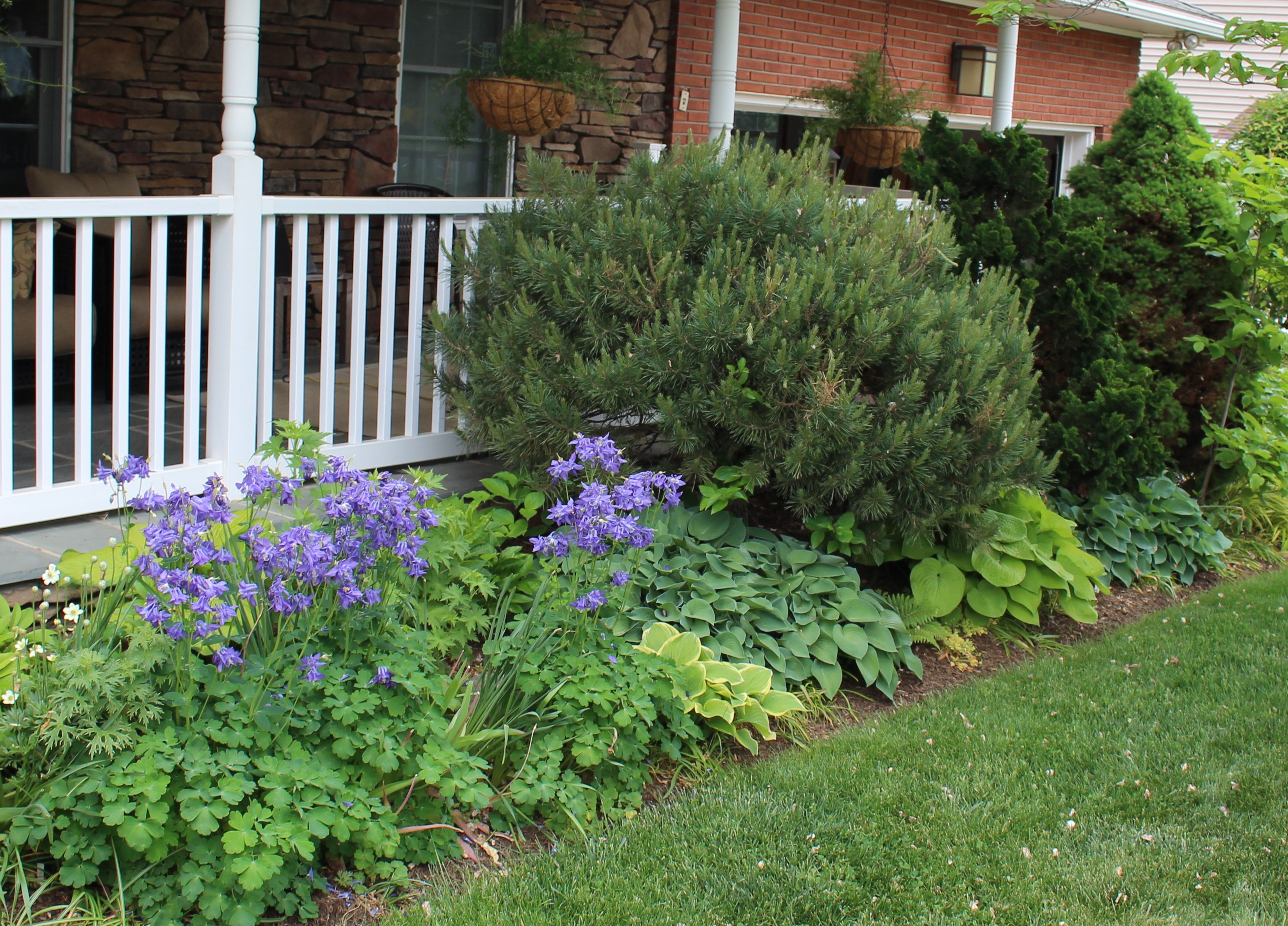
On the 22nd of each month Christina at Creating my own garden of the Hesperides encourages us to look past all the flowers and blooms of the garden and take a second look at what foliage does to support it all.  I’m happy to once again take part in the fun, and what better month to do it in than May, the month where my garden really starts to overflow with the promise of the new season.  Lets start with the front beds where hosta and self sown columbine have now sprouted up and covered the snowdrop and corydalis beds of early spring.

blue columbine with hosta

These blue columbine were originally found in the woods behind the house prior to its clearing for industrial park.  They’re just escaped or dumped aquilegia vulgaris, nothing rare or unusual, but I like to keep them around as a reminder.  Plus they’re carefree.

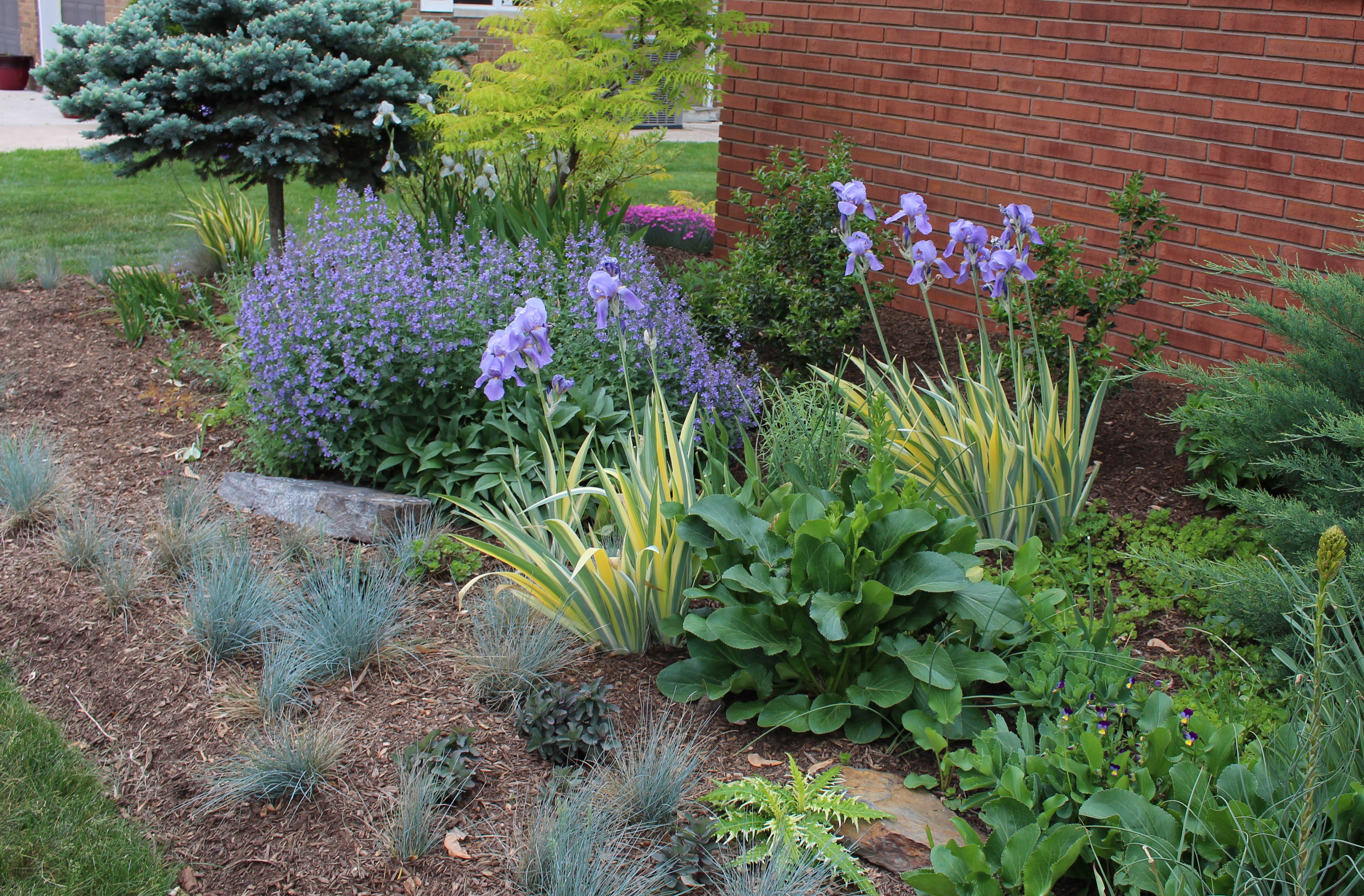
This will be our seventh year here and after a slow, cash strapped and baby filled start I think things are finally beginning to look like something.  The colors and shapes of the front foundation plantings are still a work in progress but for now the look is finally something I’m no longer bored or annoyed by. – Cathy here are the variegated iris in bloom, they have a fantastic fragrance 🙂

mixed perennial bed as foundation planting

The just recently mulched, expanded and divided plantings of the front foundation planting.

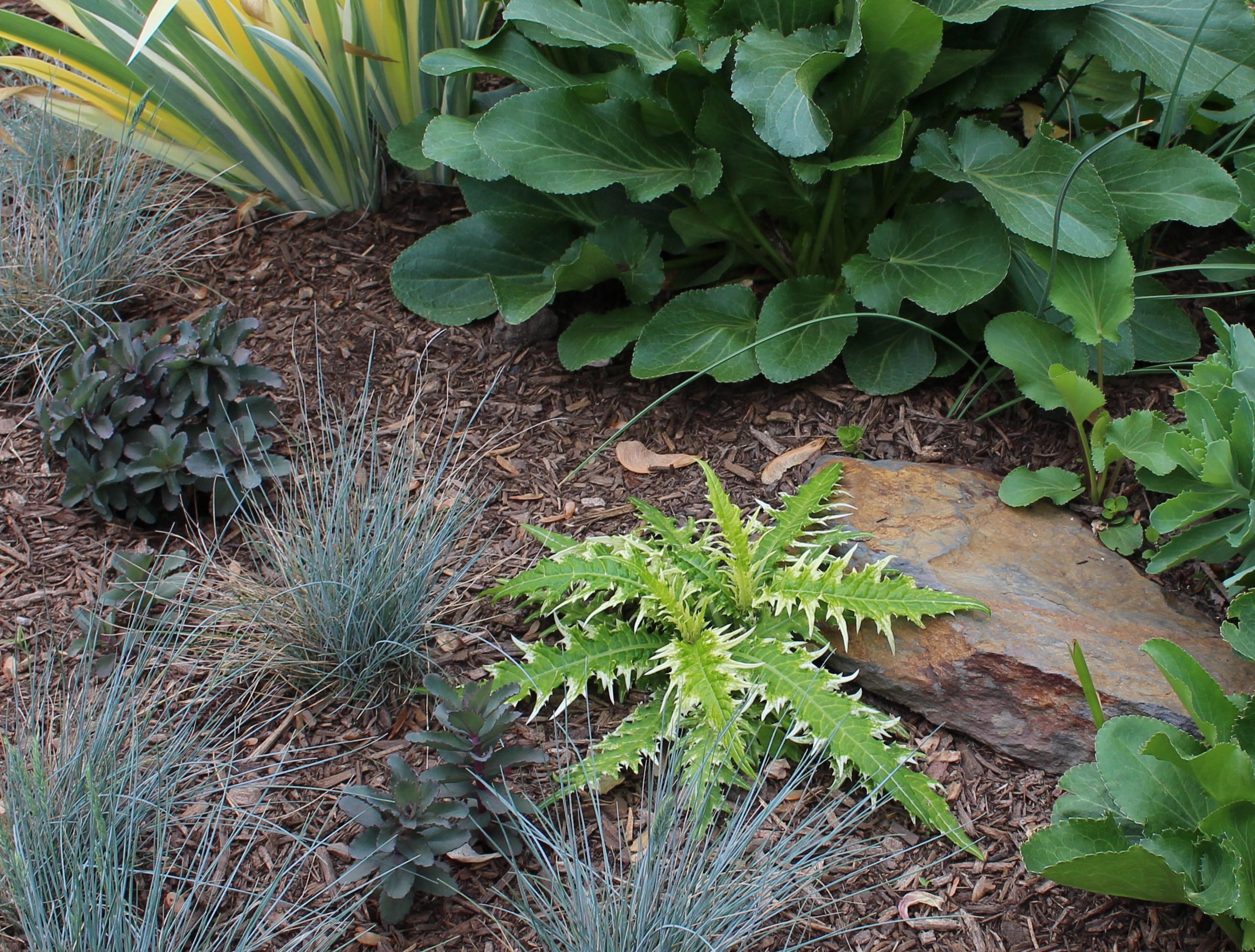
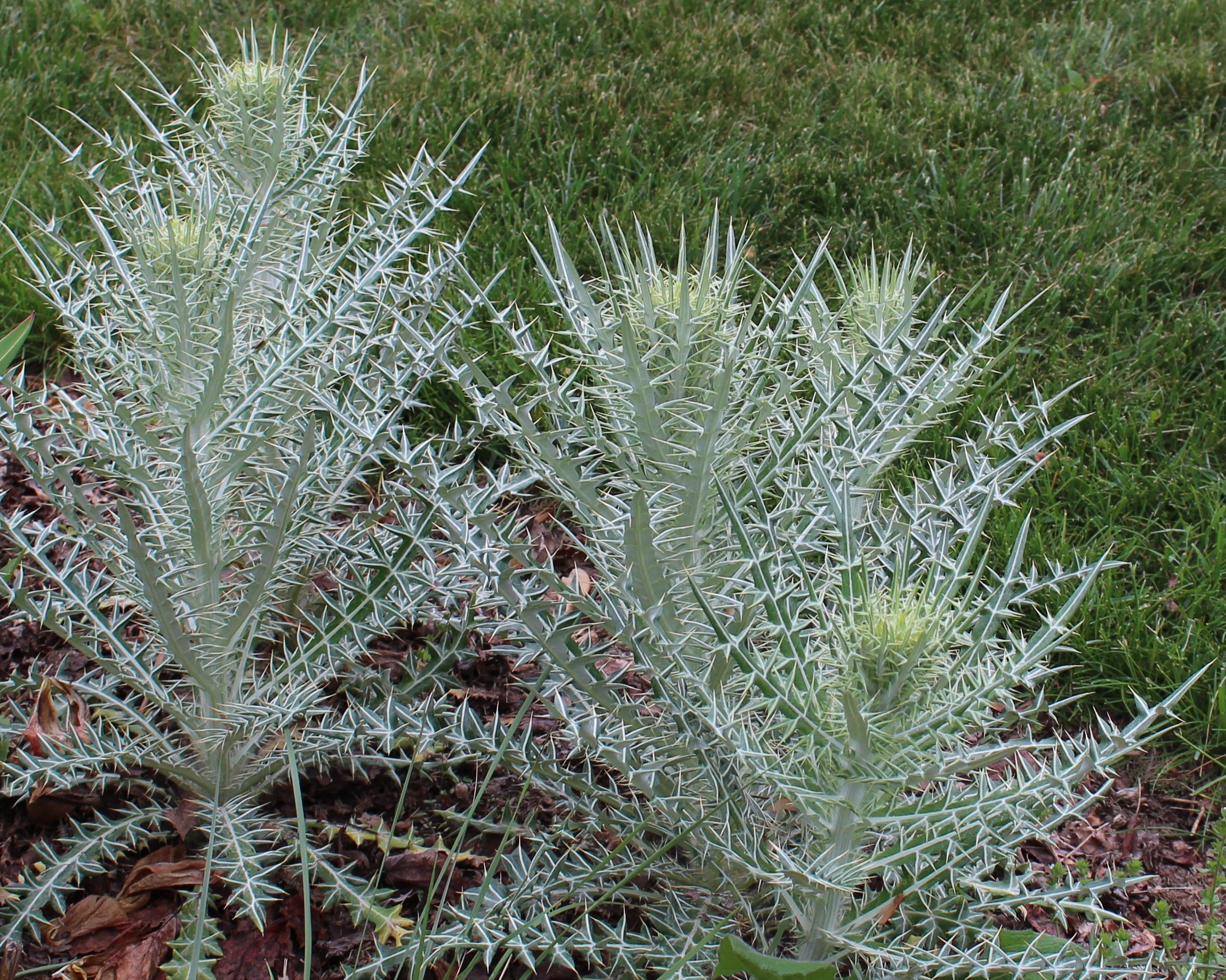
I love the different colors and textures out here at the moment, but my absolute favorite is the “white frosted” Japanese thistle (Cirsium japonicum).  I know I’m in a lonely position here, but the prickly thistles always fascinate me, and in my opinion variegation is almost always a plus!

Cirsium japonicum 'White Frosted' Japanese thistle

Cirsium japonicum ‘White Frosted’ with blue fescue and some just divided sedum ‘Bon Bon’.

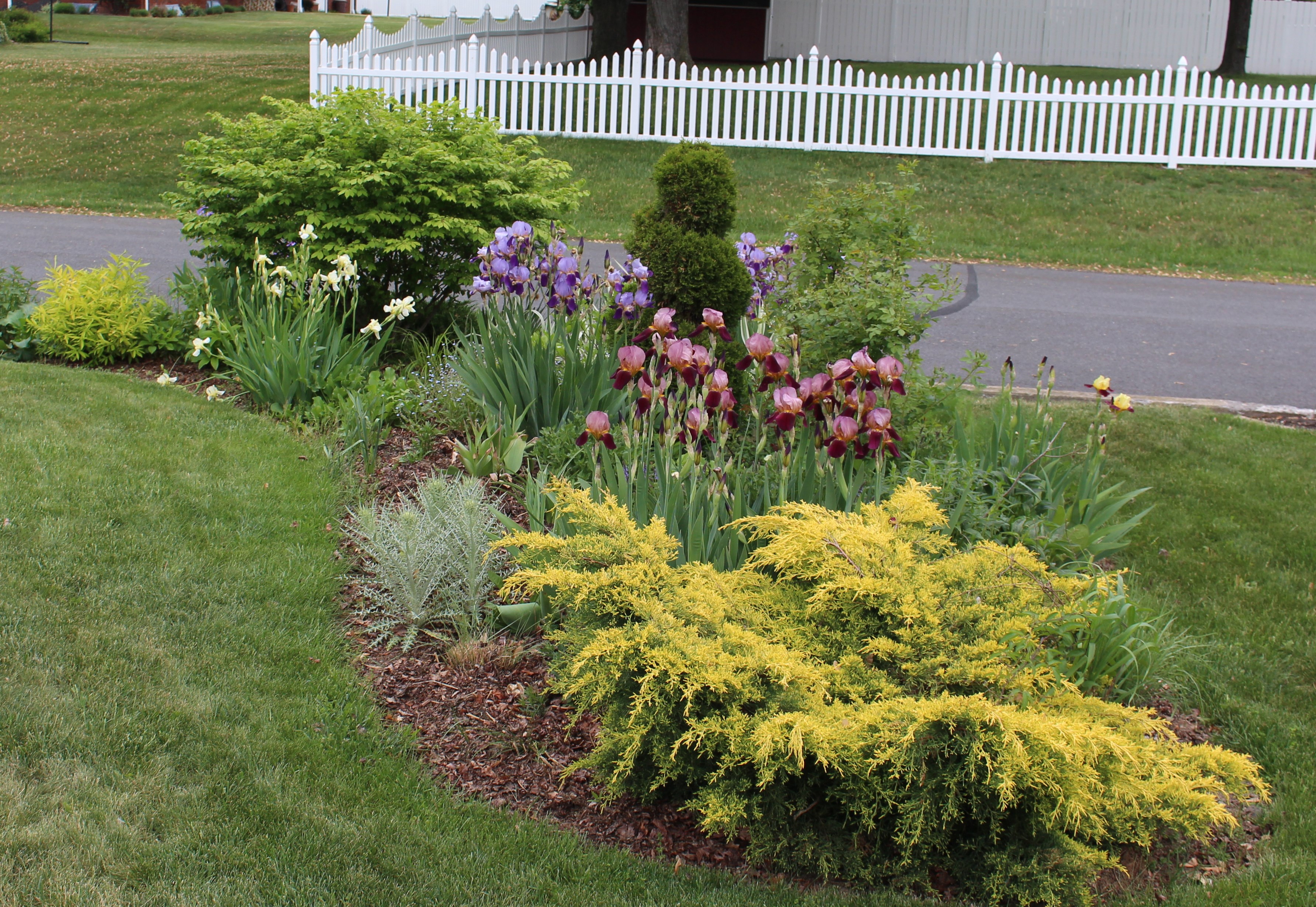
Even with the iris coming into peak bloom along the street border (it’s a good year for iris here), my favorite plant in this mix is the Ptilostemon diacantha.  Some see a spiny weed in need of pulling, I see some of the coolest foliage in the garden.

mixed border with historic bearded iris

Historic iris like the poor soil and hot, dry and sunny front border, and even though the pale yellow iris “flavescens” does not like the wind, the reddish ‘Indian Chief’ and lavender ‘Ambassedeur’ stand strong.

I know I’ve already shown this weed a couple times, but I’ve never seen it looking better…. not a difficult feat since this is its first time growing here!  I suspect the actual blooms will be a letdown, but the fine texture and pattern of the leaves…. 🙂

Ptilostemon diacantha

Foliage closeup of Ptilostemon diacantha.  A biennial thistle from the Balklands/Turkey region in need of a common name.  ‘Ivory thistle’ is the only one I came across and that one kind of bores me…. and with blooms of mauve I don’t see the connection.

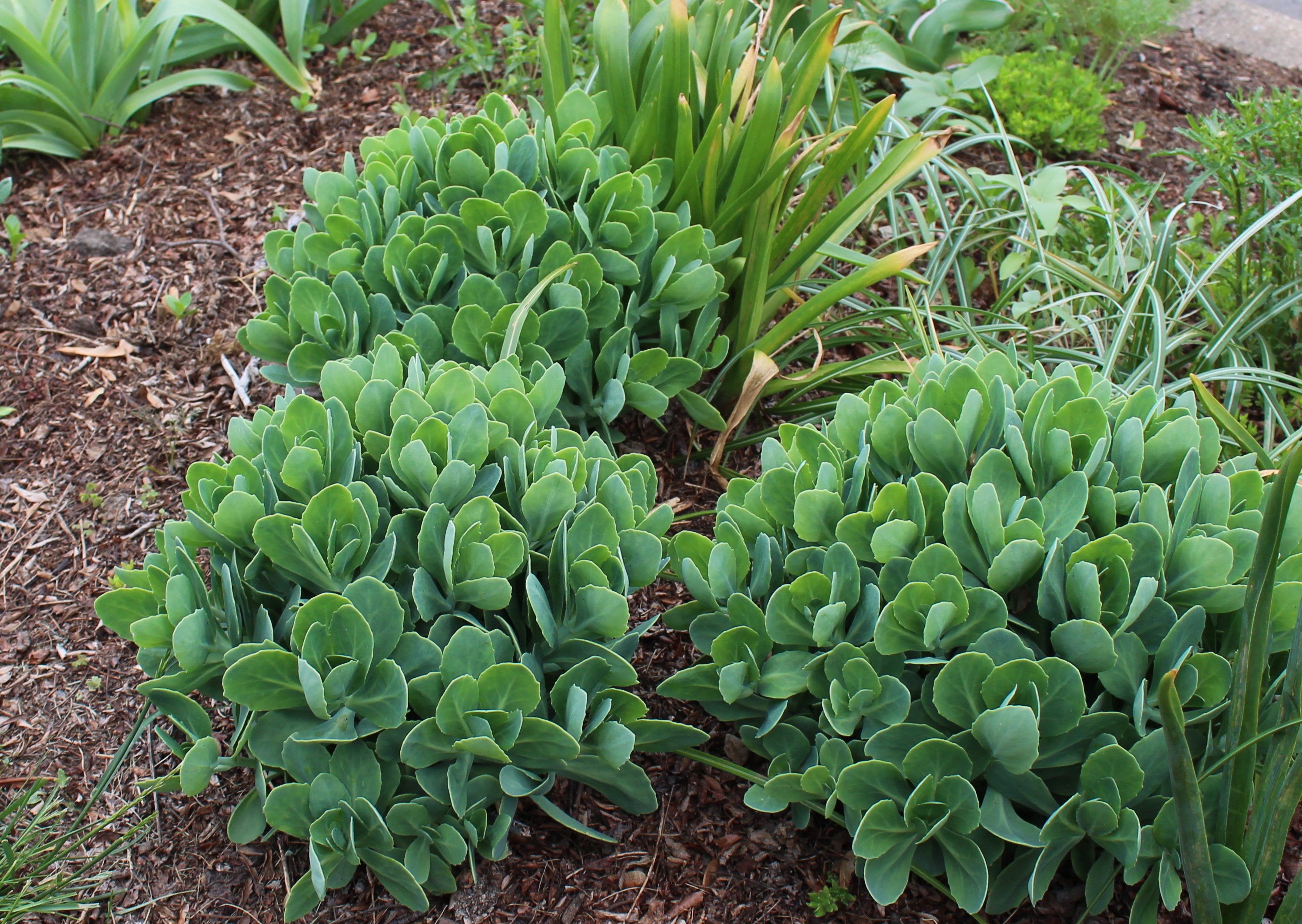
There are some friendlier foliages as well.  The juicy fat clumps of this unnamed sedum spectabile (apparently Hylotelephium spectabile is its new name) always make me smile, no matter how common they might be.

spring clumps of sedum spectabile

Spring clumps of sedum spectabile.  The common types are unkillable, and one plant survived for two years after I put the clump down on a stone step after being distracted while transplanting.

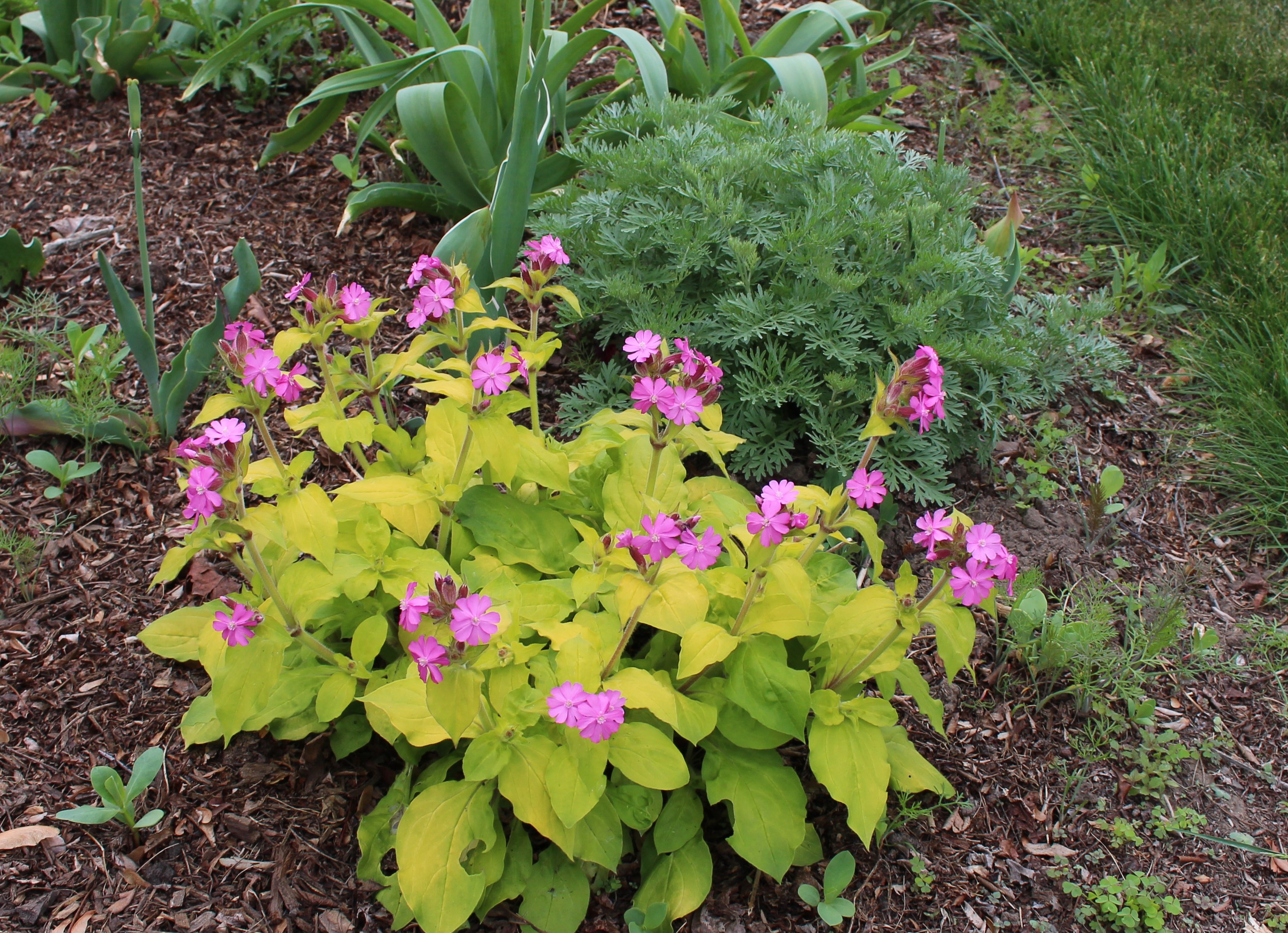
Another foliage favorite which I’m happy to have again is this plant of Silene dioica ‘Ray’s Golden’ Campion, which comes via seed from the talented Nan Ondra of Hayefield.  It’s short lived in my garden but easy to grow once you get the seeds planted.  Just rouge out the plain green seedlings.

Silene dioica 'Ray's Golden' campion

Silene dioica ‘Ray’s Golden’ campion with Artemisia ‘Powis Castle’ coming up behind.  This section of bed is still in need of weeding, fortunately the shredded leaf mulch has kept most of the little guys from sprouting.

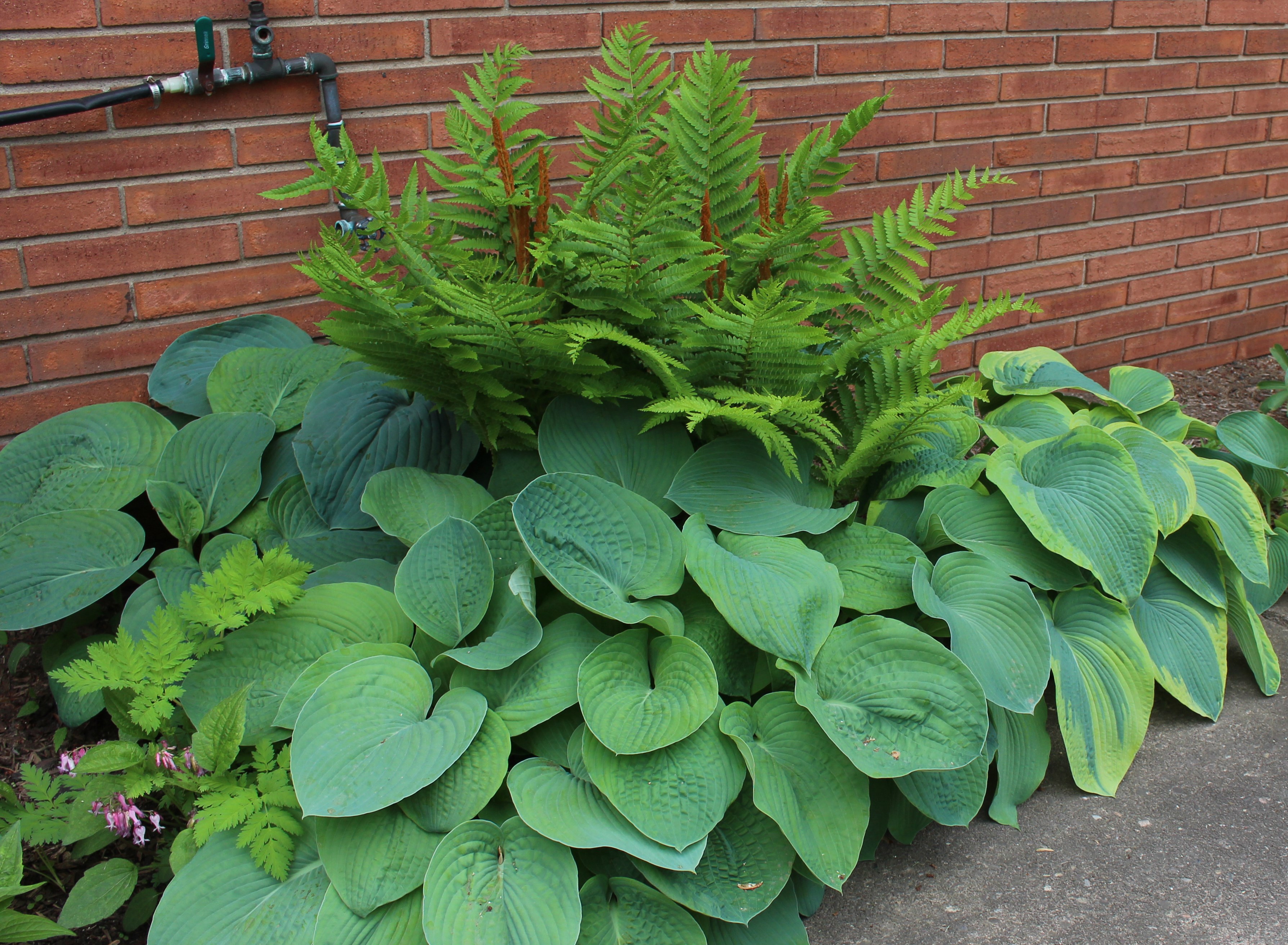
When you circle the house to get out back, you pass what comes closest to a shade bed in this mostly sun-baked garden.  A leaky faucet (left intentionally so for the plants… and laziness) keeps these ostrich ferns and hosta happy here under the dry overhang of the house eaves.

hosta frances Williams seedlings

Hosta ‘Frances Williams’ (just barely noticeable to the right) is the mother to all of these hosta seedlings.  I was curious to see if any would pick up mom’s variegation, but no luck.  All have a similar bluish tint free of any color streaks, a plain look but still beautiful.

The rest of this month’s foliage celebration are also a celebration of wintertime seed sowing.  Lets begin with the seed trays.

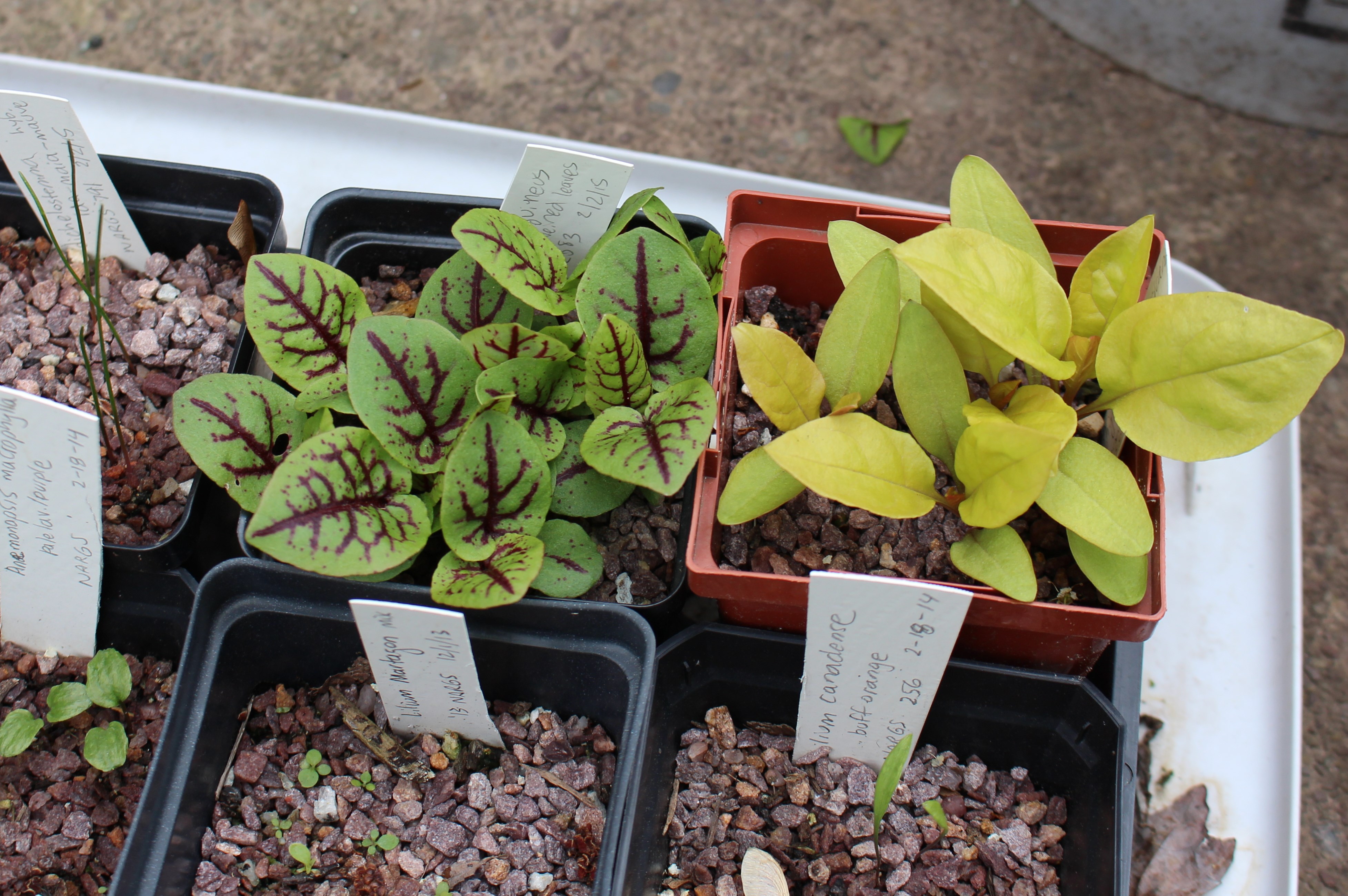
rumex sanguineus seedlings with 'sunny side up' pokeweed

My obsession with weeds continues.  Here the baby pictures of Rumex sanguineus seedlings with ‘sunny side up’ Phytolacca Americana next door make for a pretty combination.  Their common names of bloody dock and pokeweed sound much less special 🙂

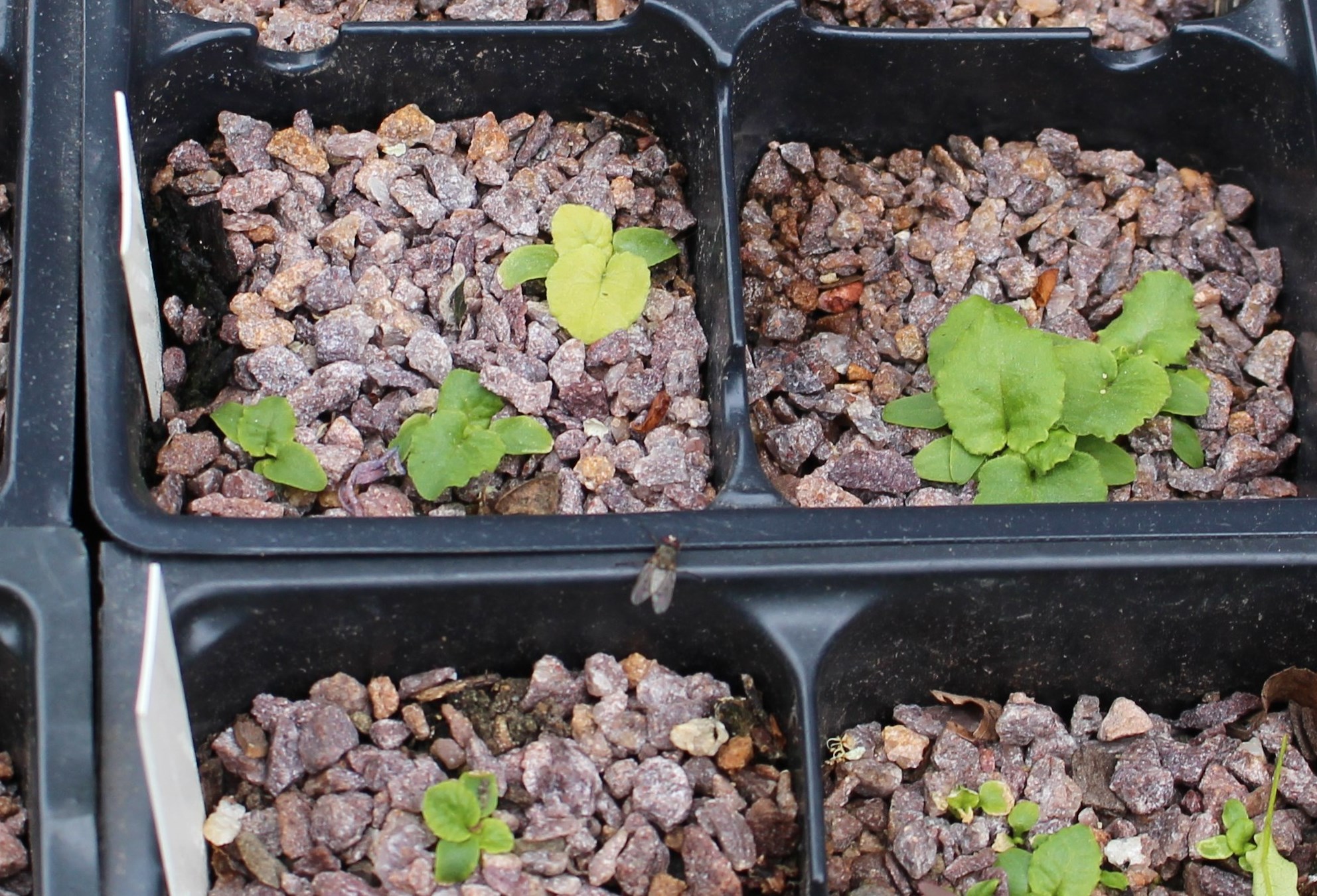
Any yellow leaved seedling is right up my alley.  Out of my American Primrose Society seeds comes this one little oddball.  My fingers are crossed I can nurse it along to adulthood.

primula polyanthus seedlings

Primula polyanthus seedlings with one yellow leaved sister.  I hope it stays this way and manages to limp through my on again off again care/abuse.  -don’t know why the fly had to photobomb the center of this photo.

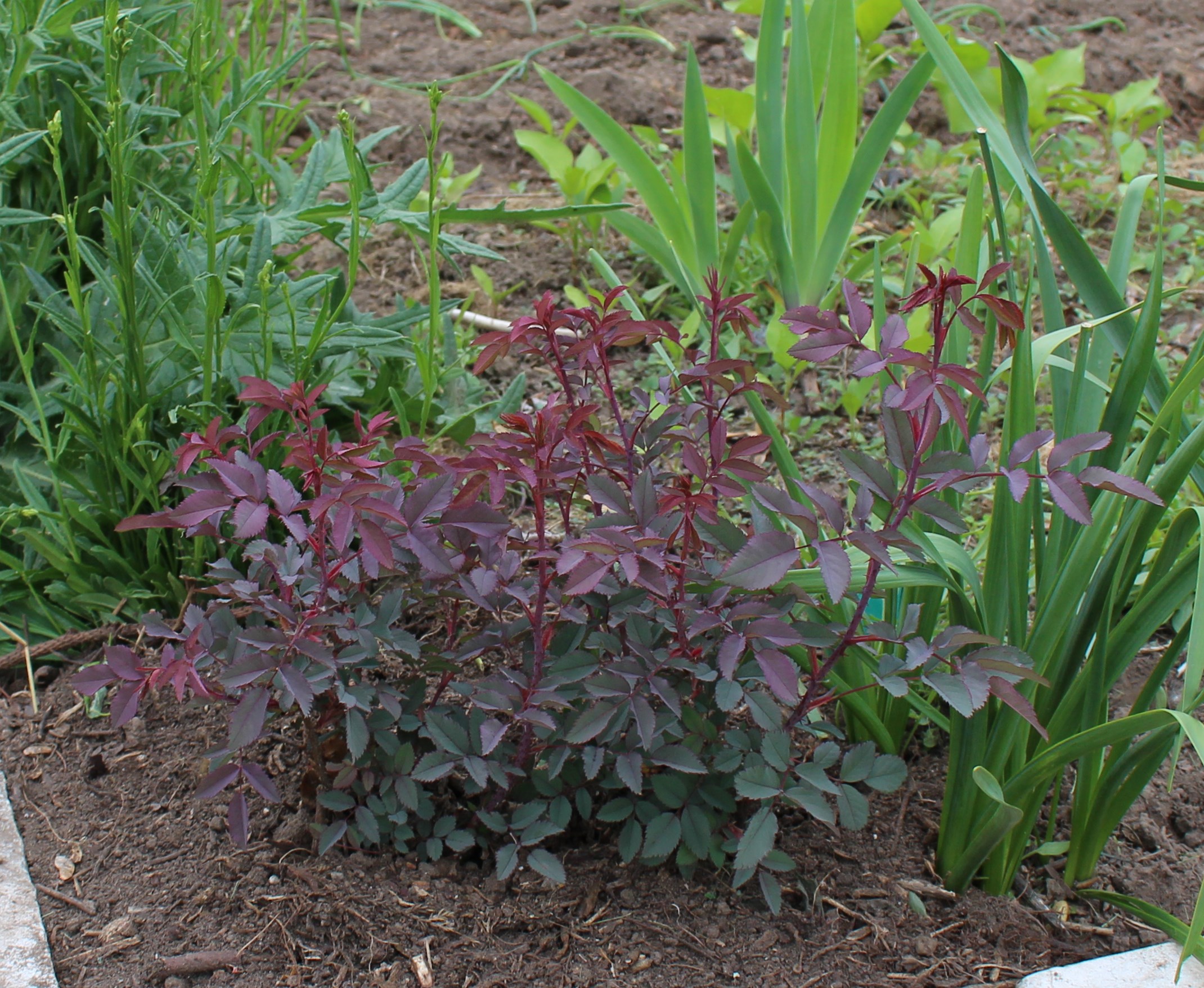
Another seedling which has somehow escaped neglect and abuse is this third year Rosa glauca.  I’m looking forward to seeing this one take off, it just needs to go somewhere other than the tomato bed.  Or not.  Maybe it would look nice next to a couple golden cherry tomatoes 🙂

rosa glauca seedling

Rosa glauca freshly mulched with a shovel full of compost.

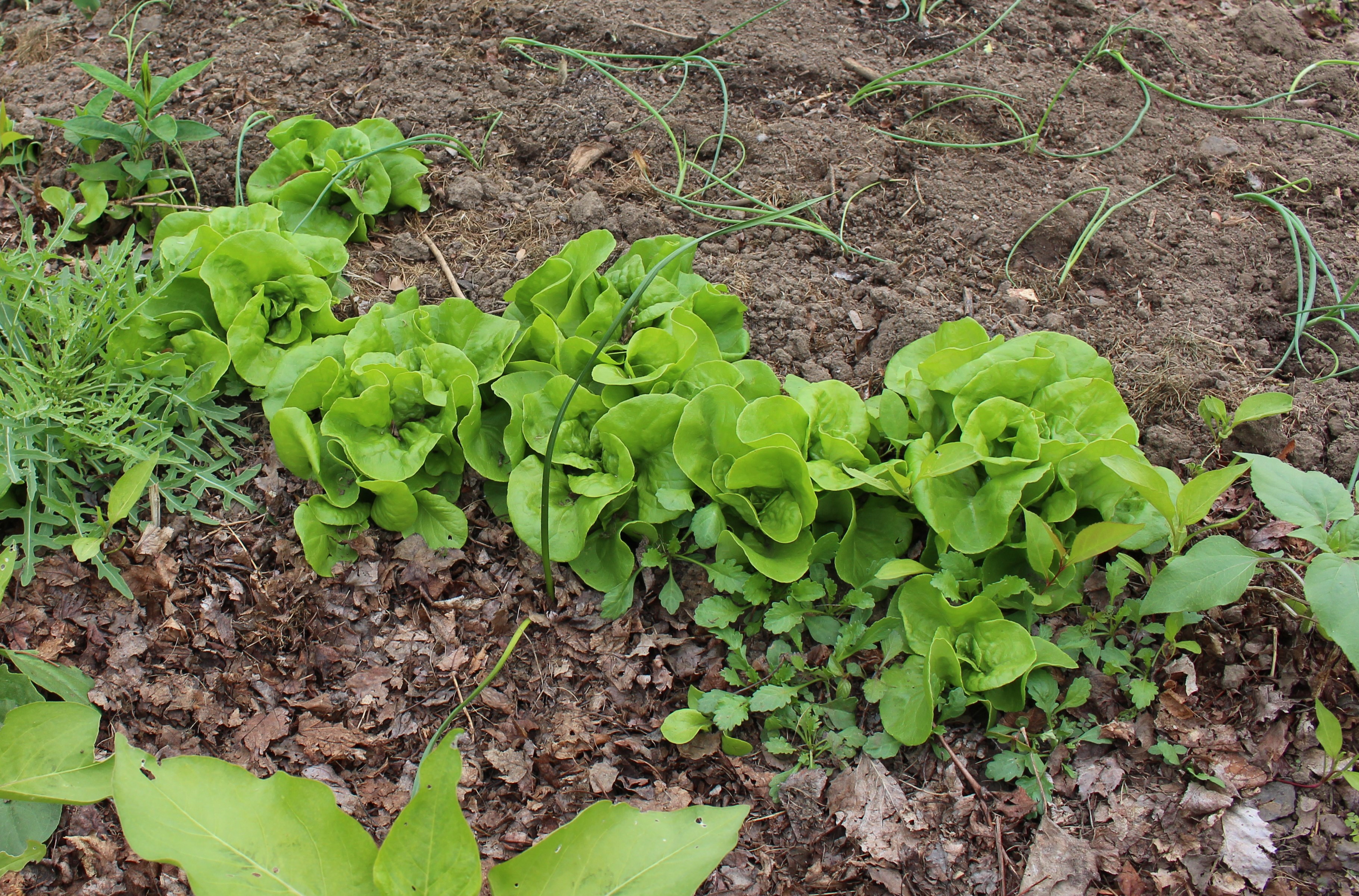
Sometimes neglect pays off.  The lovely leaves of this lettuce crop are the result of not removing last year’s leftovers until they had bolted and gone to seed.  They’ve even come up in a row as this was a ridge of soil where the mulch was blown off during some winter storm.  Dare I say this planting is nearly as nice as the seedlings I fussed over for weeks indoors and then carefully transplanted and nursed along?

self sown lettuce seedlings

The quality of my weeds is really coming along.  In this photo there’s lettuce, a nice bunch of arugula, phlox, daisies, a daffodil and sunflower.  I must stay strong and remove them all… this really is the only spot left where there’s any chance of fitting in a pepper.

Another weed problem are the many chrysanthemum seedlings sprouting around last year’s plantings.  I must rip them out as well, I have no room for more mums… says he who has a dozen more new little pots in need of planting.

chrysanthemum seedlings

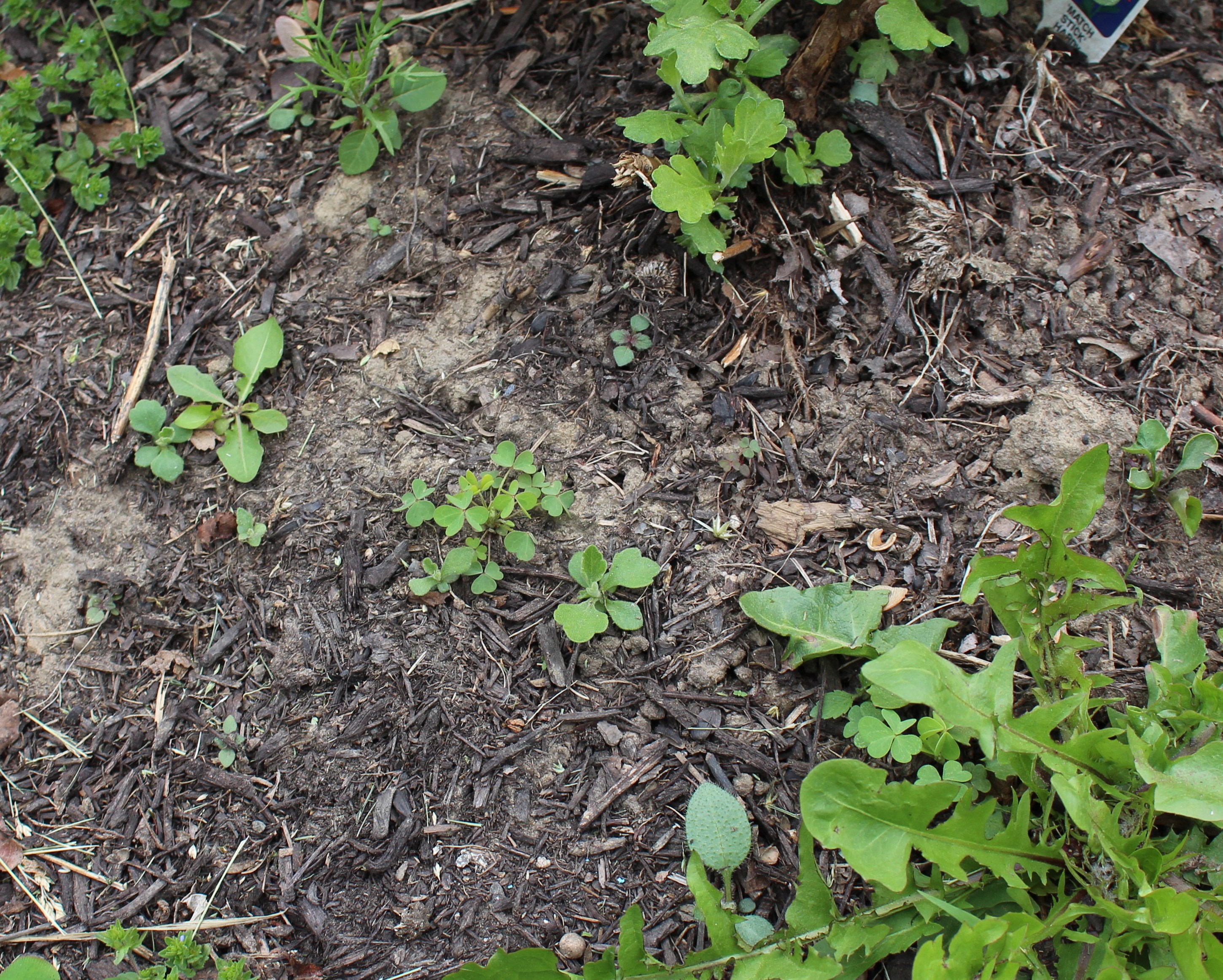
Not sure why I’m posting weed pictures, but you can make out the tiny leaves of chrysanthemum seedlings here amongst the dandelions and clover.

Weeds aren’t the only issue this spring.  The phlox hate the extended dry winds and droughty soil, it brings on the spider mites and I have no interest in spraying for anything.  I’ll make an effort though and spray the foliage off with the water hose while watering (just watering in the first place is probably  good start), then give them a dose of liquid fertilizer.  That and a few more sprays with the water hose might be enough of a shot of goodness to help them outgrow these annoying pests and save this year’s bloom season.  I can’t even imagine a phlox-free summer…

garden phlox with spider mites

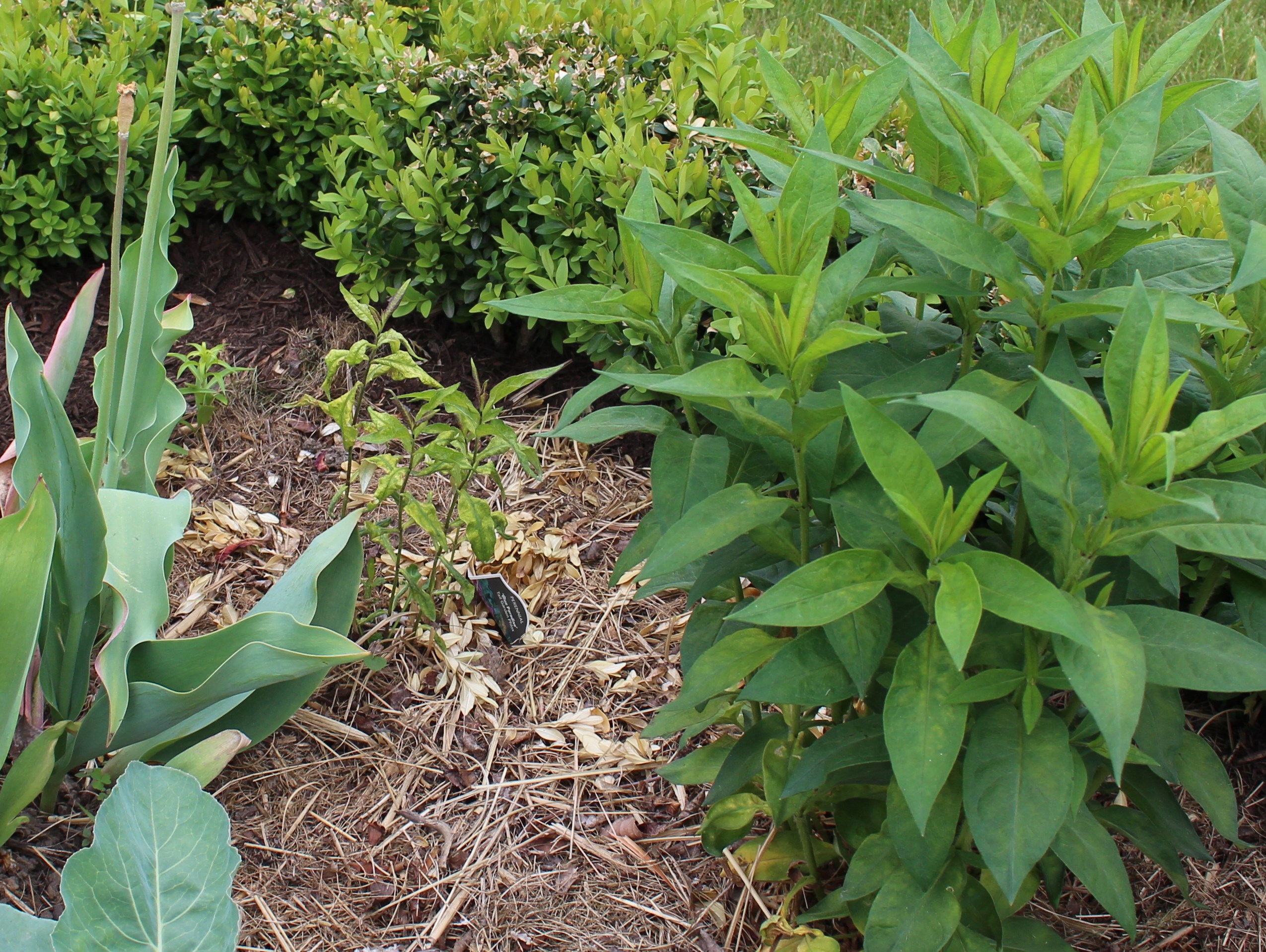
What a difference.  Phlox ‘Blue Paradise’ on the left has nearly given up under the spider mite attack, while his neighbor to the right only shows a few yellow leaves and yellowed stippling from the spider mites.  I may just trim him back completely and hope for the best with any new growth which manages to come up. 

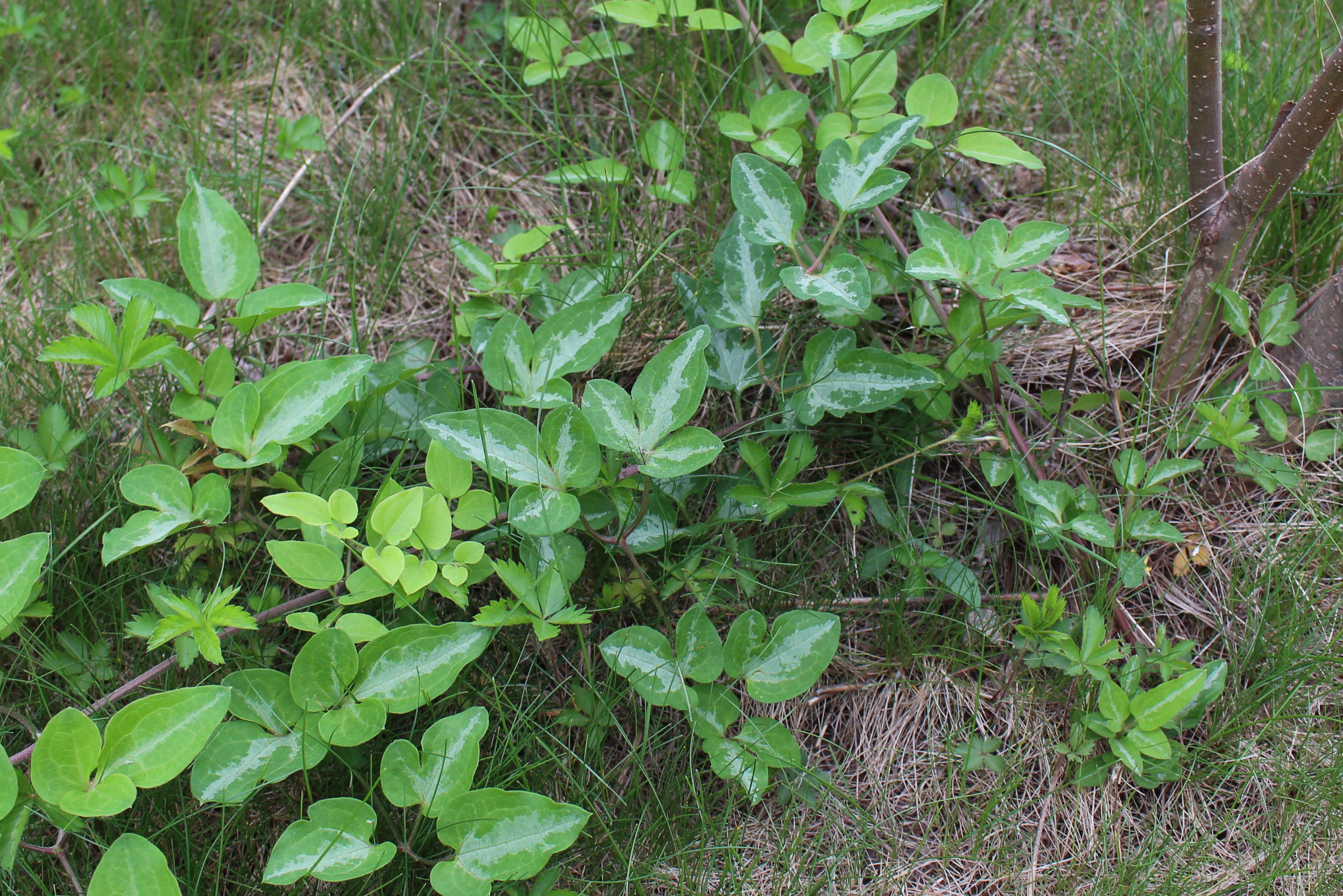
One more bad foliage visit.  Sweet autumn clematis (Clematis terniflora) is a pest in my meadow garden and each spring I battle the legacy of the single vine planted along the fence next door.  I suppose I could spray the clumps and eventually do them in, but I have to admit liking their patterned foliage and late season blooms…. even though I promptly rip the vines off before seed is set.

Japanese clematis Clematis terniflora foliage

Japanese sweet autumn clematis (Clematis terniflora) foliage.  I wish this wasn’t such an invasive thug. 

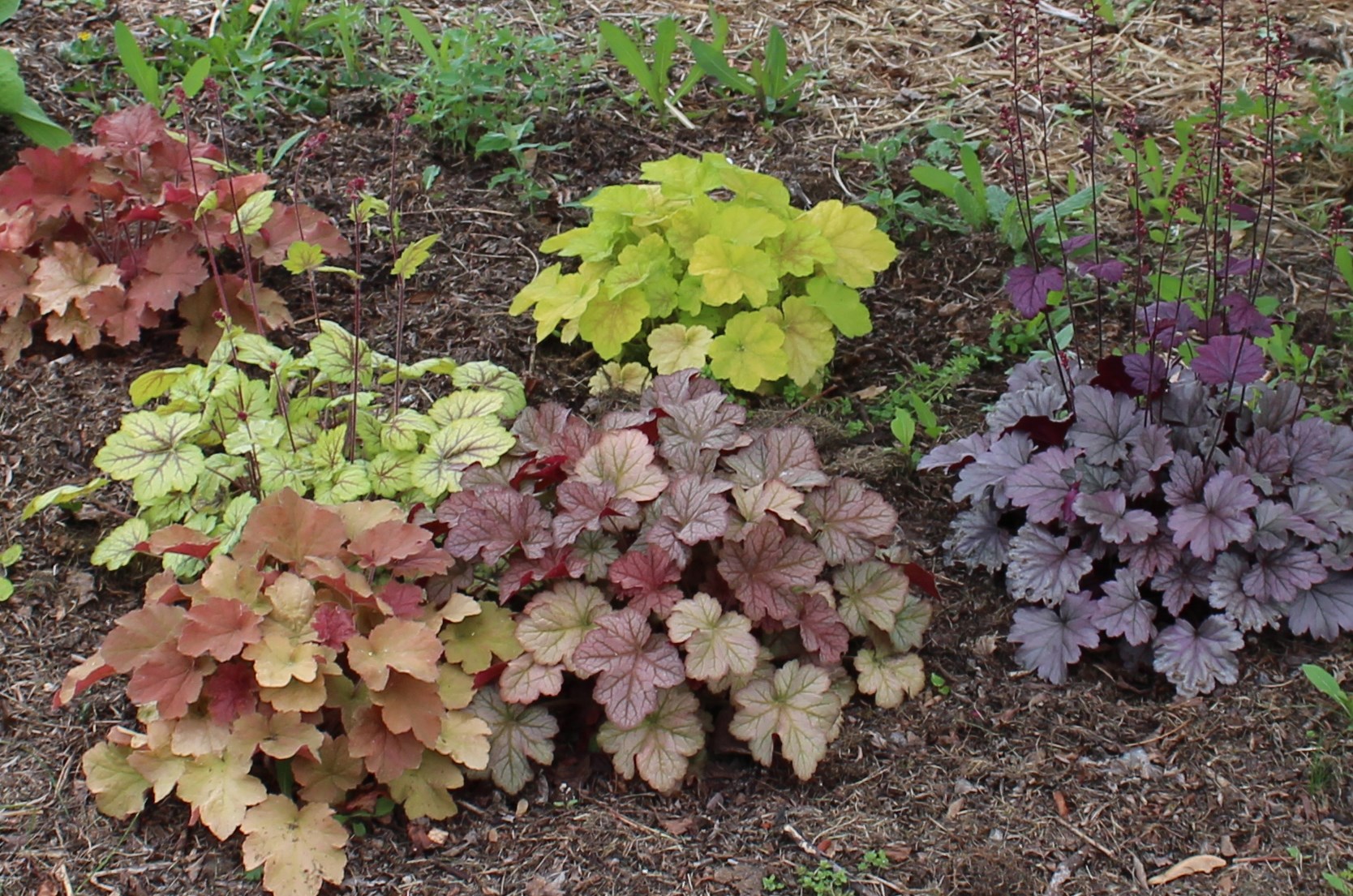
To wrap things up I’ll leave you with something a little cheerier.  With the exception of a few rabbit decimated plants, the bulk of last years clearance heuchera have overwintered nicely and are showing off their fresh spring foliage (as well as their bland and boring flower stalks).  Honestly I don’t like them all together in one big mess, but as plants grow (or die off) I’ll divide the survivors and see if I can work a few clumps into the rest of the garden and make some nicer foliage vignettes.

mixed heuchera planting

Mixed heuchera from last year’s Santa Rosa Gardens purchase.  Yes this bed also needs weeding and more mulch…

So those are the foliage highlights from this end of Pennsylvania.  If you’d like to see what others are up to please visit Christina’s blog to see what people across the world are seeing in their gardens.  It’s always inspiring!

Have a great weekend, here we have three days to observe Memorial Day and in addition to the usual holiday activities I hope to catch up on all things blogging.  Enjoy 🙂

April, May and June, all in one week

I’ve been hiding.  Our temperatures spiked up to 92F (33C) last week and watching the wilted daffodils and tulips being thrashed by the dry wind was just too depressing.  In a few hot days three weeks of bloom flew by and it’s now mostly over.  The temperatures finally dropped today but I still wish we would get some rain before the grass completely yellows.  I don’t like a dry spring.

Fortunately May is still May, and regardless of the weather there’s still plenty to be happy about!

growing perennials from seed

At least my winter seed sowing is paying off. This year I have my first frittilarias and tulips from seed, and it’s endlessly entertaining to search the pots for the latest sprouts.

Between NARGS, HPS, and American Primrose Society seed exchanges I have plenty of pots of little goodies to experiment with, and as long as nobody mentions the fact I have no room for most of these, I think we’ll all just enjoy the enthusiasm of the newest little sprouts in my garden 🙂

lilium martagon seedlings

Martagon lily seedlings going on to their third year.  At this rate there’s not much rush to find more room.

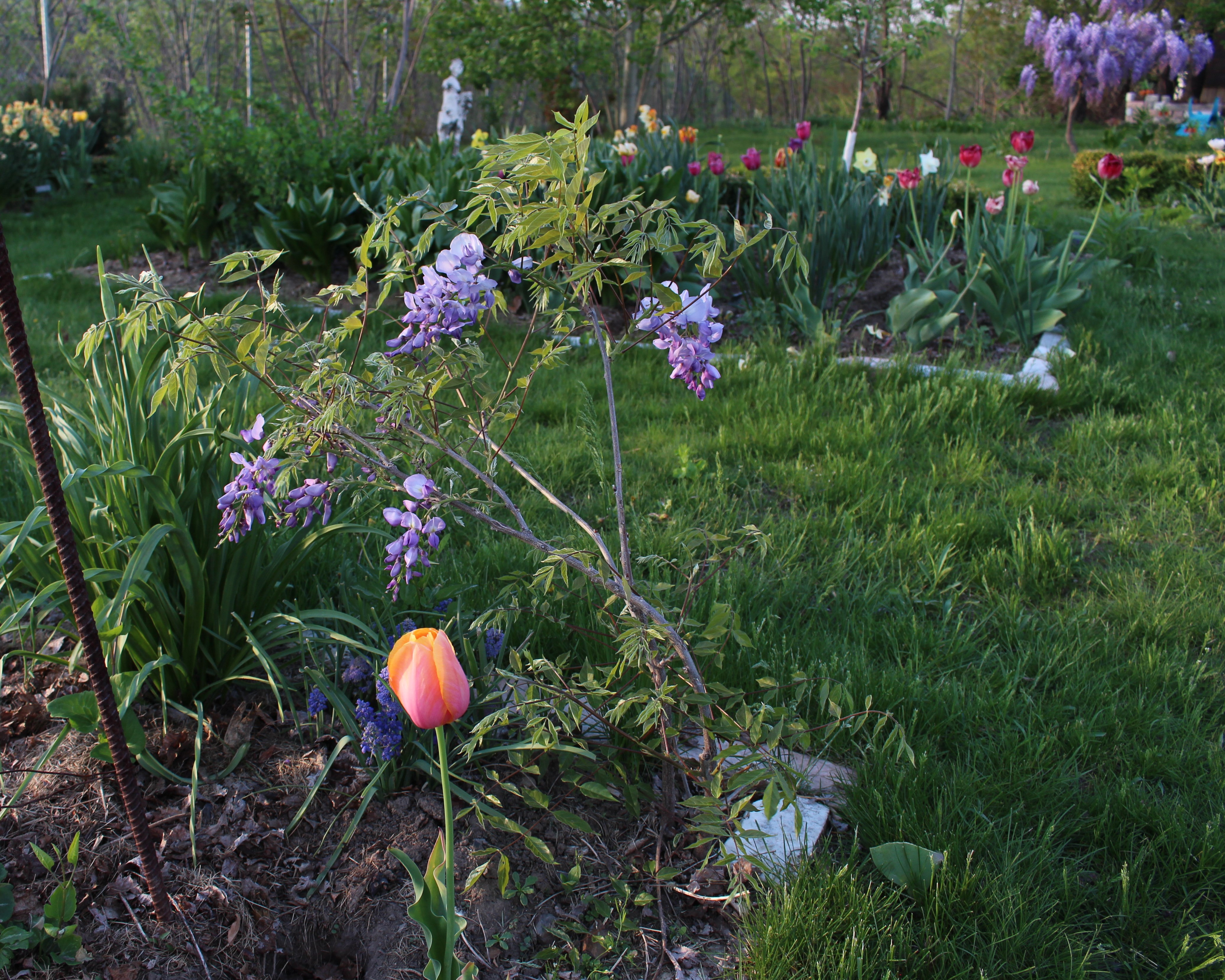
In addition to bringing on the seedlings the heat brought the wisteria from buds to blooms in barely four days.  Last spring was a total loss due to a harsh winter and late freeze, but this year about half the buds survived.  I don’t even miss the lost buds, it’s still full of flowers.

standard wisteria tree

Japanese wisteria planted out in the meadow.  Without anything nearby to grab onto and climb I think it’s invasive tendencies can be kept under wraps.

Maybe you noticed my sad little fritillaria imperialis blooming behind the wisteria.  The hot wind wilted the flowers quickly but I managed to get a photo of the interesting inside of the hanging blooms.

fritillaria imperalis nectaries

The nectar drops at the inner base of the fritillaria imperalis blooms.  A cool thing to look at, but it’s just a bit too “glandular” in appearance for my tastes!

The fritillaria will be something to keep my fingers crossed for in order for it to survive, but the japanese wisteria cannot be mentioned without a warning about it’s invasiveness.  Killing it would be far more work than the neglect which keeps it alive, and to turn your back on this plant runs the risk of having it take over.  I keep it in the middle of a lawn area were it cannot grab onto anything, to grow it as a vine and keep it on anything less than a massive arbor would be more work than I want to consider.

wisteria that doesn't refuse to bloom

Some seed grown wisteria may take decades before they finally decide to bloom, mine is a cutting off my parent’s plant which has always put on a heavy show of flowers.  Even this sucker which came up last year after I moved the mother plant already has a few blooms on it.  A smart person only needs one wisteria, I’m not sure why I’m going to keep this second one 🙂

Speaking of plants which wouldn’t mind taking over the world, I think I’ve finally decided against keeping this darker purple vinca minor.  I like it well enough but without a border or wall to hold it back it’s spreading out just a little to enthusiastically.  This plant (and my wayward campanula glomerata) are officially on the elimination list.  I might put some of it next door in one of the boring mulch beds around my mother in law’s house.  It’s not that hard to rip out, improves the look of an empty mulch bed immensely, and between the house and lawn it shouldn’t get into too much trouble.

vinca minor atropurpurea

Vinca minor ‘atropurpurea’.  A good groundcover in the right place, but a little to aggressive for my beds, and I wouldn’t want to let it escape into the wild. 

Before the heat struck I did manage to finish up a little hard labor.  The front house bed has had a once over, been expanded and topped with new mulch.  I forgot who gave me the idea, but I divided up the blue fescue clumps and spread them far and wide across the front of the border.  I like it, which isn’t something I could say the last time I redid this foundation planting.

mixed border foundation planting

The front foundation planting looking all springy.  Any opinions on the pink rhododendron in front of the brick?  I have mine, and it involves a shovel 🙂

The bed along the front of the house has been one of my favorites this spring.  The shelter of the house gives a little protection from the drying wind and my mulching has kept down many of the most annoying weeds.  Some would say my thistles are weeds but I think they’re fantastic.  You’re not going to want to touch them though….

Ptilostemon diacantha

Ptilostemon diacantha.  I can’t wait to see this one bloom (even though the blooms may be slightly anti-climactic) and will surely collect seeds if I get that far… using gloves of course 🙂

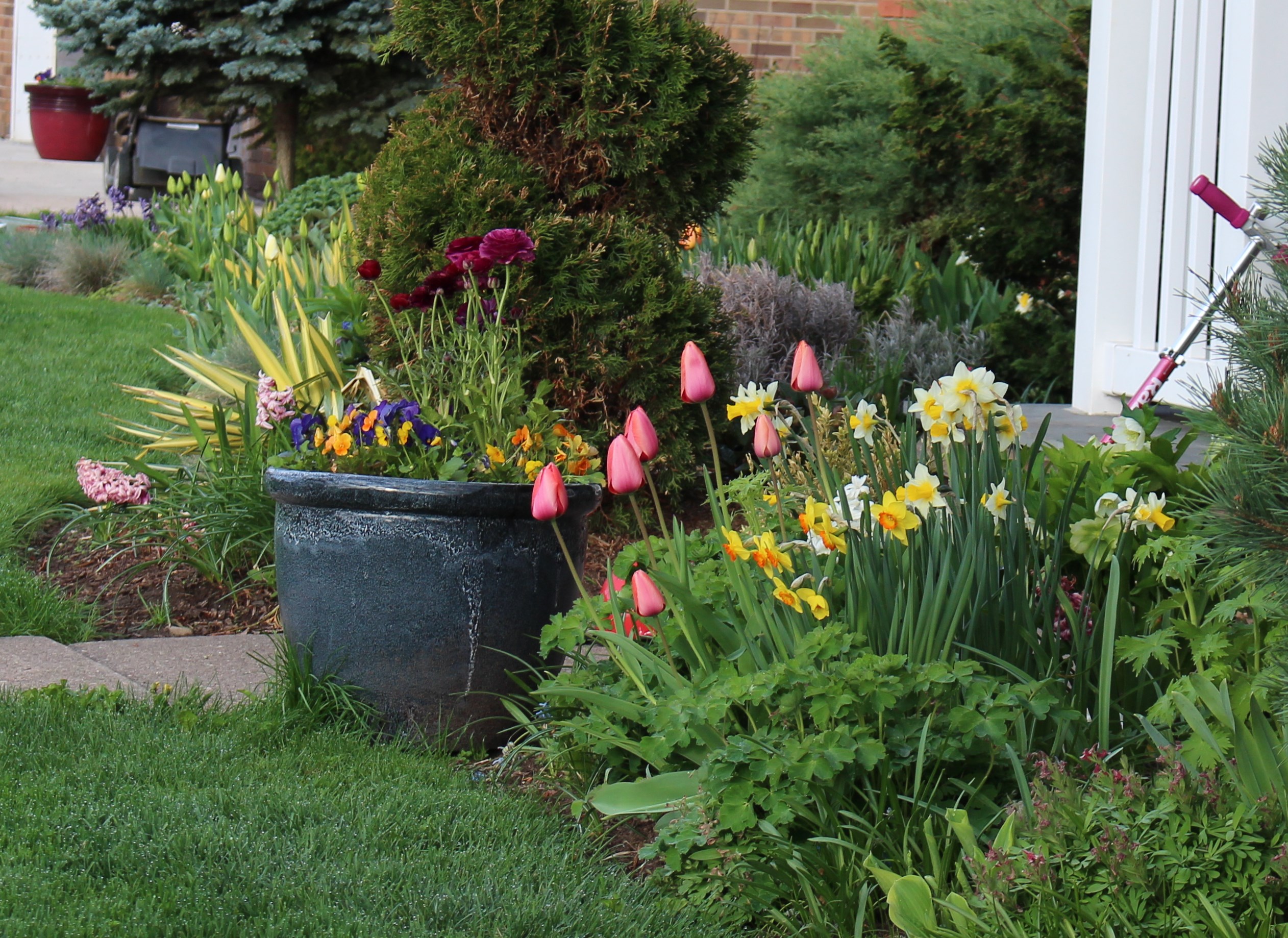
Something a little more suburbia-friendly are the tulips and camassia.  It looks nice enough here but I may remove a bunch of the camassia.  In the heat I don’t think they’ll last more than six days, a little too short of a bloom period for my tastes although I can’t complain about how carefree they are.  Maybe I’ll try them somewhere less prominent.

tulips and camassia

Tulips and camassia highlighting the front foundation planting.  The blue fescue has been divided up and spread all along the front now and I think it looks better than the gappy line which was there before.  Funny to think these are all the descendants of a single moth-eaten clump which I rescued from a neighbor’s yard. 

Close up the camassia are an airy, beautiful flower, and I think to see it growing en-mass in its native Western North American haunts would be great.  Maybe someday.

camassia leichtlinii caerulea or 'blue danube'

Camassia leichtlinii caerulea or ‘blue danube’, I’m not sure which since I planted both but they all look identical to me.

Iris season is next.  The stalks are shooting up all over and it makes the rapid passing of the daffodils feel a little less painful.  I’m sure it will be a fantastic year for iris…. unless that’s the exact point when the rain decides to come.

iris pallida 'variegata' in a mixed border

I always forget to divide the awesome iris pallida ‘variegata’.  It’s one of my favorites but seems to like more frequent division and better soil than some of the others.

So that’s it from here.  I have to apologize for not responding to comments or leaving any on the blogs I visit,  I’ve been keeping up with the reading but for the most part have been just too grumpy and unmotivated to add any productive comments.  But there’s hope.  The first irises are opening today and I’m already feeling better.  This sounds good, but unfortunately the weekend is already filled to capacity with field trips, birthday parties, dance recitals, sports banquets and baseball games and I’ll be lucky to even step foot in the garden for a few days.

But it’s almost Friday, and I hope a great weekend is had by all!

mumble mumble mulch

Spring is here and I love it.  It means work of course, and for me it’s hard to hit just the right balance of sitting around and actually doing something, but I try my best.  One problem which always haunts me is that I’m the type who (again while sitting around) usually gets tons of unnecessary projects in his head, starts them, and then moves on before they’re done.  Fortunately I’m not much bothered by this, but someone else here is, and sometimes decides to be helpful and remind me of the obvious…. but most of the time that person doesn’t notice unplanted chrysanthemum collections or realize it’s been years since the boxwood cuttings should have been planted out, so it all works out fine.  How can it not when rain and rainbows and warm sunshine have brought out the daffodils?

double rainbow over the garden

Double rainbow over the ‘potager’.  A beautiful sight if you can tune out the industrial park and white vinylrama next door 🙂

I’ve been relentlessly mulching.  It started innocently enough with a load of mulched leaves hauled out of the woods, but then exploded from there.  My neighbors were so generous last autumn with several heaps of nicely chopped leaves and grass clippings that I couldn’t stop lugging them back to the garden.  The entire front bed got a nice layer and I would have kept going but of course ran through all the available bounty.

cheap leaf mulched perennial beds

The front perennial bed all nestled in with a nice mulch of chopped leaves.  The earthworms will munch them all down by the end of  summer but for now they should go a long way in keeping the weed seedlings down.  Did I mention it was all free?

As if that wasn’t enough, for some reason when finished I got it in my head to crack open the wallet and order a load of shredded bark mulch to finish off the yard.  With most of the front already covered I felt finishing with a little purchased mulch might be something the budget could handle, so $290 later I was mulling over another new heap in the driveway.  It seemed a steep price to me but judging from the other $1,000 plus order slips hanging next to mine I guess I’m being downright frugal.  Also, mulch is a gardening expense the boss never criticizes, so now it just needs to be spread.  More on that later, daffodils first!

narcissus tahiti daffodil

Always a favorite, ‘Tahiti’ is an awesome daffodil.  Sorry if you’re not a fan of doubles, but this one never fails, and the yellow petals seem to glow with an orange shade which I love.

I’m stuck on orange lately.  The daffodil ‘Serola’ tops the list this year.

daffodil narcissus serola

Narcissus ‘Serola’ with the first of the tulips opening behind.  When I divide this bed (hopefully this June) I’ll need to put these out in the front garden to brighten things up even more!

My whining about space in the vegetable garden is entirely due to my weakness for spring bulbs and the abundance of open space left when vegetables finally give up the ghost in September.  It’s so easy to just pop a few bulbs in here and there 🙂

daffodils in the vegetable garden

It’s so much easier to line a few daffs out in the vegetable patch than it is to decide on a spot in the open garden!  I’ll just plant a few pumpkins or squash over them in July to make it look respectable again. (fyi it’s bouncy house season so please ignore the deflated mess in the background) 

One more orange.  ‘Kedron’ has a color which stands out very well…. if you’re into colors that stand out very well 🙂

daffodil narcissus kedron

Narcissus ‘Kedron’.  Notice the empty spaces nearby.  Not everyone does well here and I just don’t have the patience to nurse unhappy plants along, so while ‘Kedron’ takes off the others just fade away…

Although the vegetables complain, bulbs in general seem to like my lazy (or complete lack) of an efficient watering ethic.  Tulips in particular like the open, sunny, fertile soil, and unless I weed them out (which I could never do) most clump up and bloom.  Even if I do pull a few of the smaller bulbs they just end up in the compost anyway so get spread throughout the garden a few months later when I take and spread the barely rotted goodness.

tulips and double hellebore

Yet another plant which needs to find a permanent home outside of the vegetable patch.  This double hellebore seedling is taking up prime bean and pepper real estate.

Believe it or not I’m making progress with my bulb issues.  When I was younger and carefree I used to plant out patches of whatever tulips I had on hand and then dig them up again in June just in time to clear the beds for tomato planting.  It was insanely beautiful (to me at least) and I can’t rule out this happening again.

mixed darwin tulips

Tulips blooming in the vegetable garden (spring 2013). These would all be dug, dried, and stored while the warm season veggies occupied the same beds.

Maybe my bulbaholism isn’t getting any better.  Maybe it’s just migrating.  I planted these fritillaria imperialis bulbs out in the meadow late last fall (clearance bulbs) and can’t wait to see how they do.  If I get one decent spring out of them I’ll be thrilled, but in my heart I want them to settle in… even if they do look slightly out of place in the short turf.  Hopefully they enjoy the dry summertime baking this spot receives, and the grass should come up soon enough to hide the yellowing foliage.

growing fritillaria imperialis

My ‘meadow’ is in danger of becoming a bulb field.  The fritillaria imperialis don’t look entirely happy yet, but I have my fingers crossed they’ll at least bloom and then maybe return next spring?

Out front I may have a few bulbs as well.  Early spring is when I love the front beds the most.

spring bulbs front entry

Tulips and daffodils where snowdrops ruled just a few weeks ago.  I should have taken this picture today since I mulched yesterday afternoon, but after all the work I was ready to just sit and relax!

I better wrap this post up.  Now that mulch sits in the middle of the driveway I’ve got plenty to do even from the non-gardening viewpoint.  And it’s not the fastest process since mulch needs to be worked in between sprouts and edges need to be tidied up…. and actually a bigger problem is that I’m coming up with all kinds of bed enlargements and side projects while I dilly-dally on finishing the main project.  I promised to trim back the yews along the side of the house, and this golden arborvitae just happened to show up in the lawn between us and the neighbor.  As long as I’m mulching, might as well create a nice big bed around it 😉

new perennial bed

new perennial bed

Let me get out there then.  Good luck on all your own spring projects, may they progress more quickly than my own!

Were those snowdrops all just a dream?

It’s hard to believe that just over a week ago this gardener was completely consumed by snowdrops.  Today the grass is green and people are nursing sunburns but just seven days ago we braved the usual snow squalls and windchills to pay Trumansburg NY and Hitch Lyman’s Temple Nursery a visit.

snowdrops temple nursery

The garden’s namesake reflected in the overflowing waters of the garden’s pond. There had been plenty of rain in the days previous… good for melting the last of the snow.

This was our third visit to the gardens and for a snowdrop lover it’s always a treat.  Mr. Lyman opens his garden through the Garden Conservancy, an organization committed to opening gates and preserving gardens across North America, and although this one’s early spring drabness might not appeal to everyone, it’s a treasure chest for those interested in seeing what is likely North America’s most diverse collection of galanthus (snowdrop) cultivars.  But perhaps your interests lie in the warmer seasons and silly things such as sunshine and butterflies.  If so check out the other garden open days listings, and you may be surprised at what’s open in your neck of the woods!

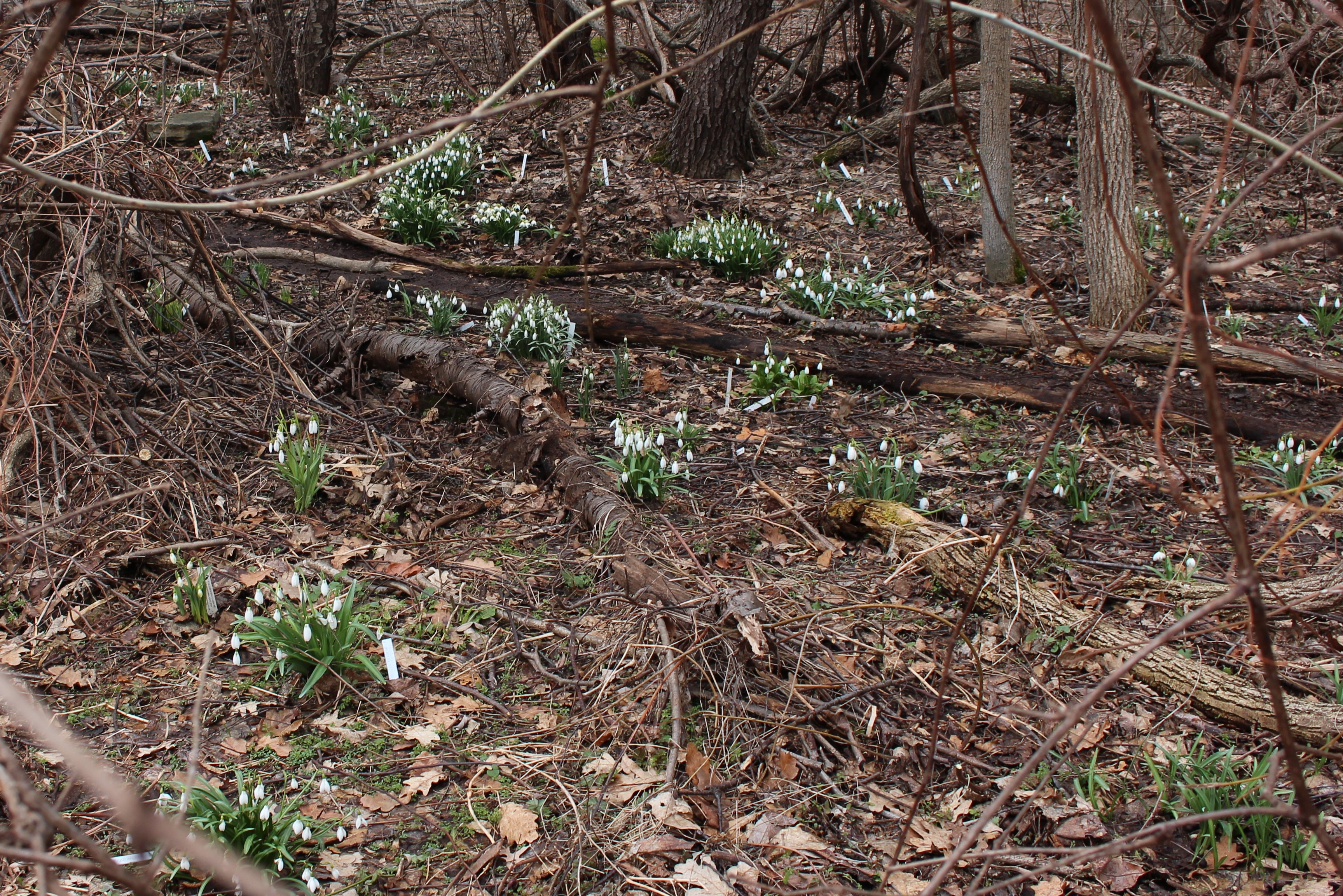
snowdrops at hitch lyman garden

Snowdrops along the woodland path of Hitch Lyman’s Temple Gardens.

Since most of the rest of the world is well beyond snowdrop season I’ll try to keep this quick.  Interest in little white flowers dims quickly once the tulips start to open and I want to list this year’s favorites so I have something to look back on next January when the fever starts up again.

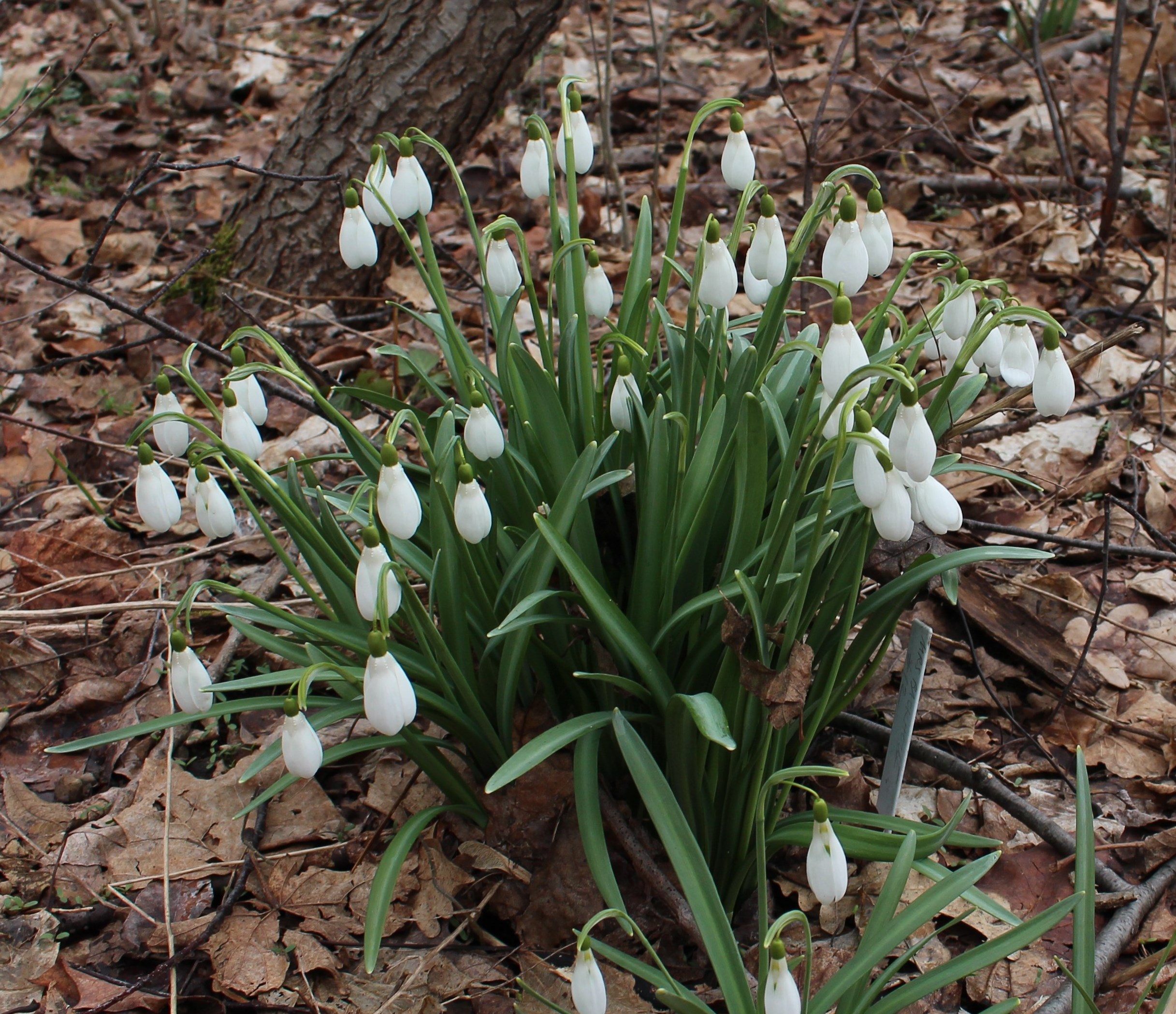
galanthus mrs backhouse #12

You can’t go wrong with the clean and simple. This is an old classic, galanthus “Mrs. Backhouse #12”.

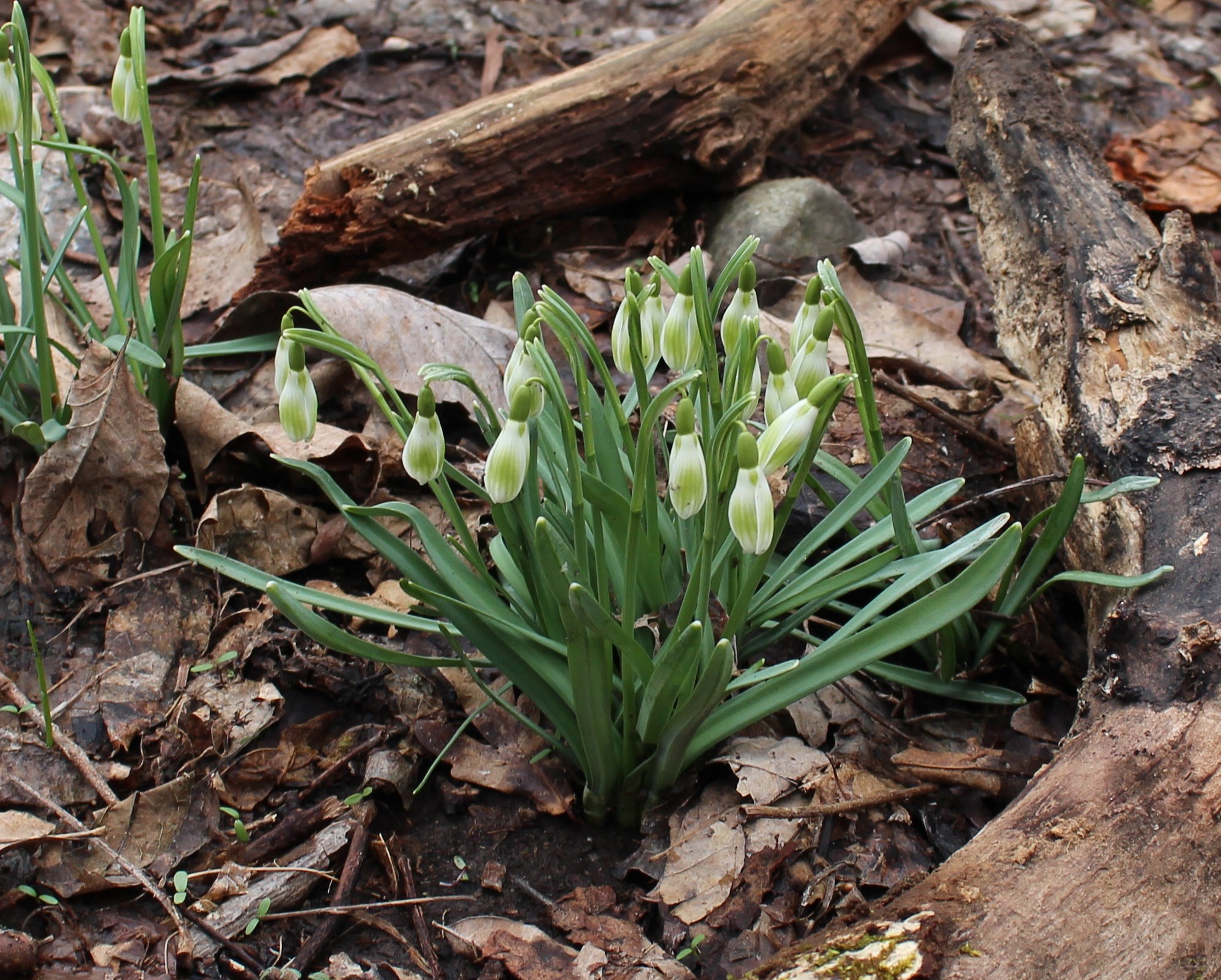
Since I’ll be the first to admit that nearly all small white snowdrops look remarkably identical I’ll try to focus on a few that stand out.  The ‘greens’ caught my eye this year, and galanthus ‘Greenish’ was looking perfectly different this spring and really makes a nice clump among the whites.

galanthus greenish

Galanthus “Greenish”

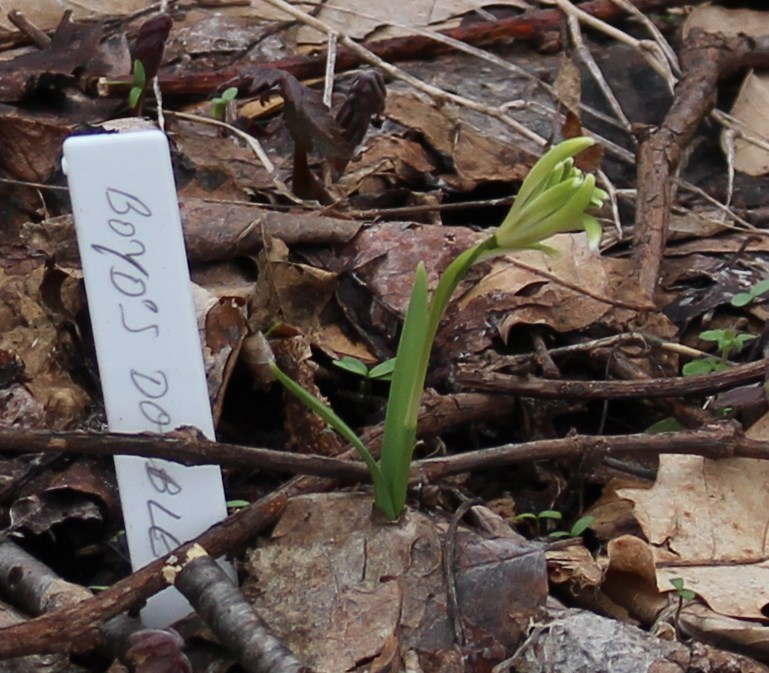
Green is different, but a green ‘spikey’ is even more different.  I’m not sure if this tiny burst of flower is to everyone’s taste but it is definitely what I’d call ‘interesting’….

galanthus boyd's double

Galanthus “Boyd’s double”

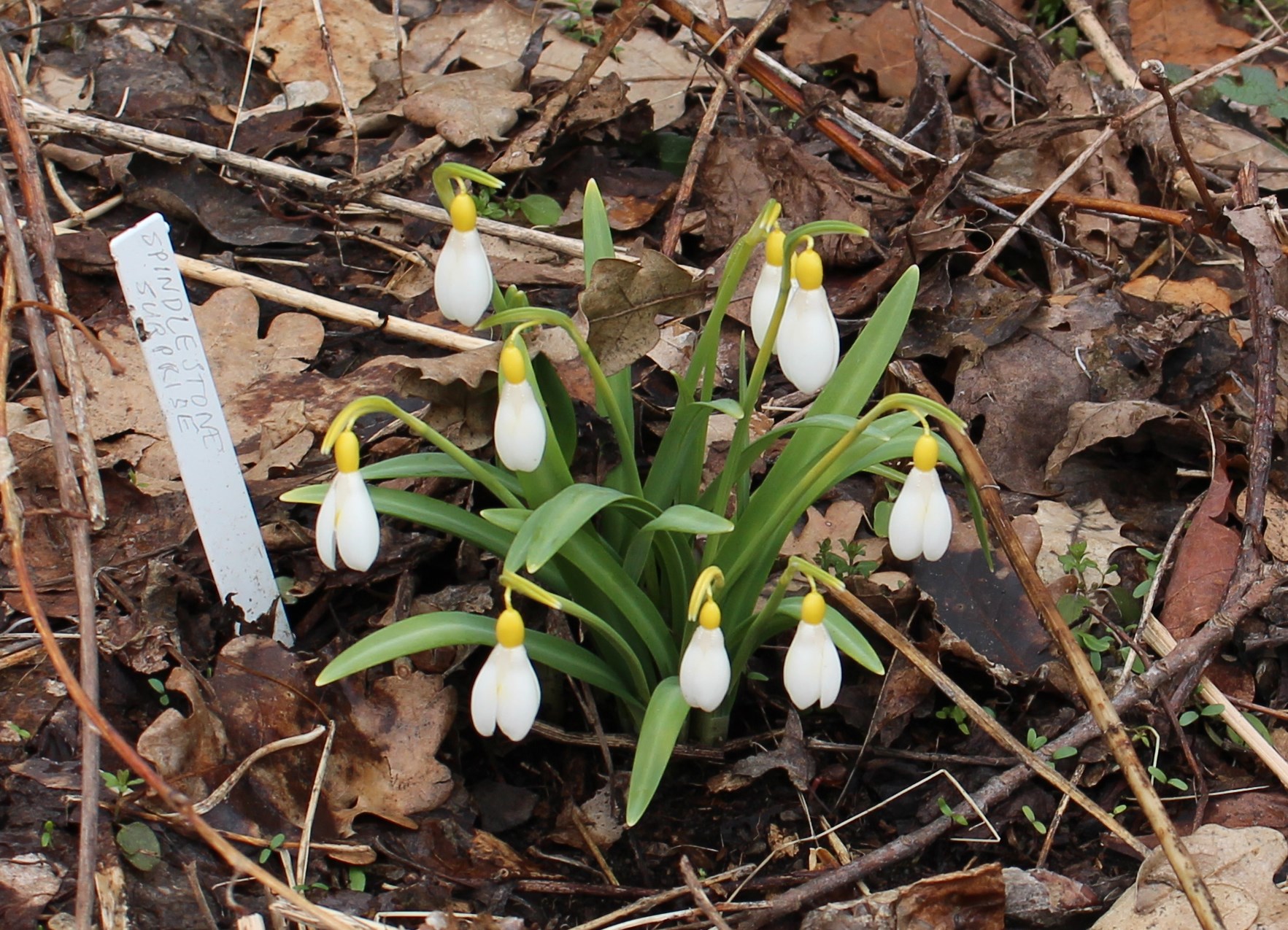
Yellow is also different, but on a flower like “Spindlestone Surprise” it looks just great.  This was one of several nice clumps of yellow drops.

galanthus spindlestone surprise

Galanthus “Spindlestone Surprise”

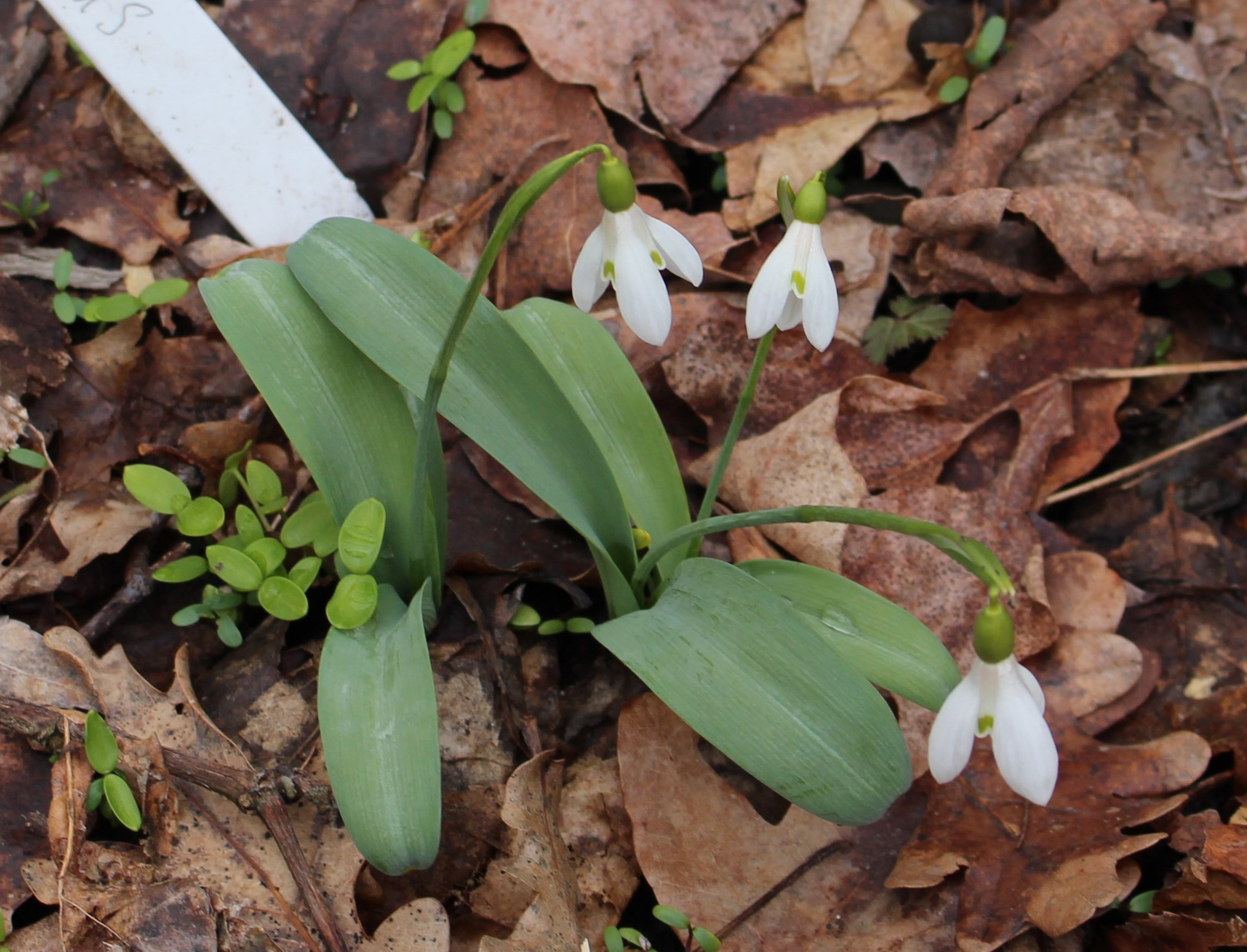
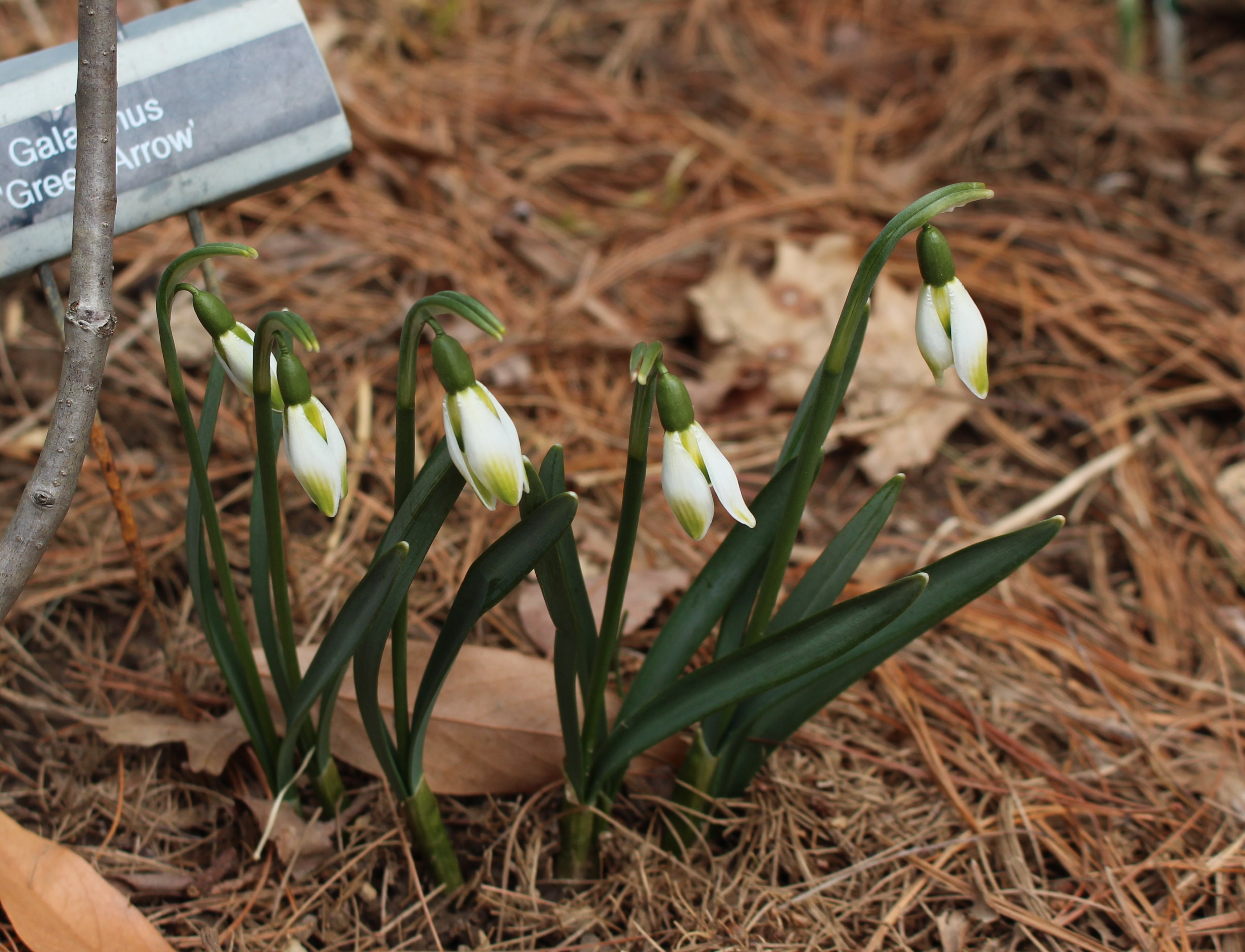
Ok, so one more picture of an interesting green.

galanthus green arrow

Galanthus “Green Arrow”

I hear that when temperatures rise enough above 40F (5C) the flowers in this garden will actually open wide and show off their inner markings.  I have yet to experience that since we always seem to be at the garden the day before the sun comes out and the air temperatures rise.  This year was par for the course since the Sunday forecast called for a calm and sunny 60F.

galanthus augustus

Even when still closed, the puckered petals and grass green foliage of galanthus “Augustus” still make for a great show.

I hate to admit that over the years I’ve added quite a few snowdrops to my garden, and with each new one I somehow tell myself it’s exactly the drop to complete some final empty void in my collection.  To publically admit I have a collection is a bad sign in itself, but to admit I NEED even species snowdrops is probably another bad omen.  They’re all white and green, just like every other snowdrop, but each one is just so much more special than the last 🙂

Galanthus koenenianus

Galanthus koenenianus. How can you not love those fat grey leaves? This was just one of several interesting little species snowdrops Mr. Lyman grows.

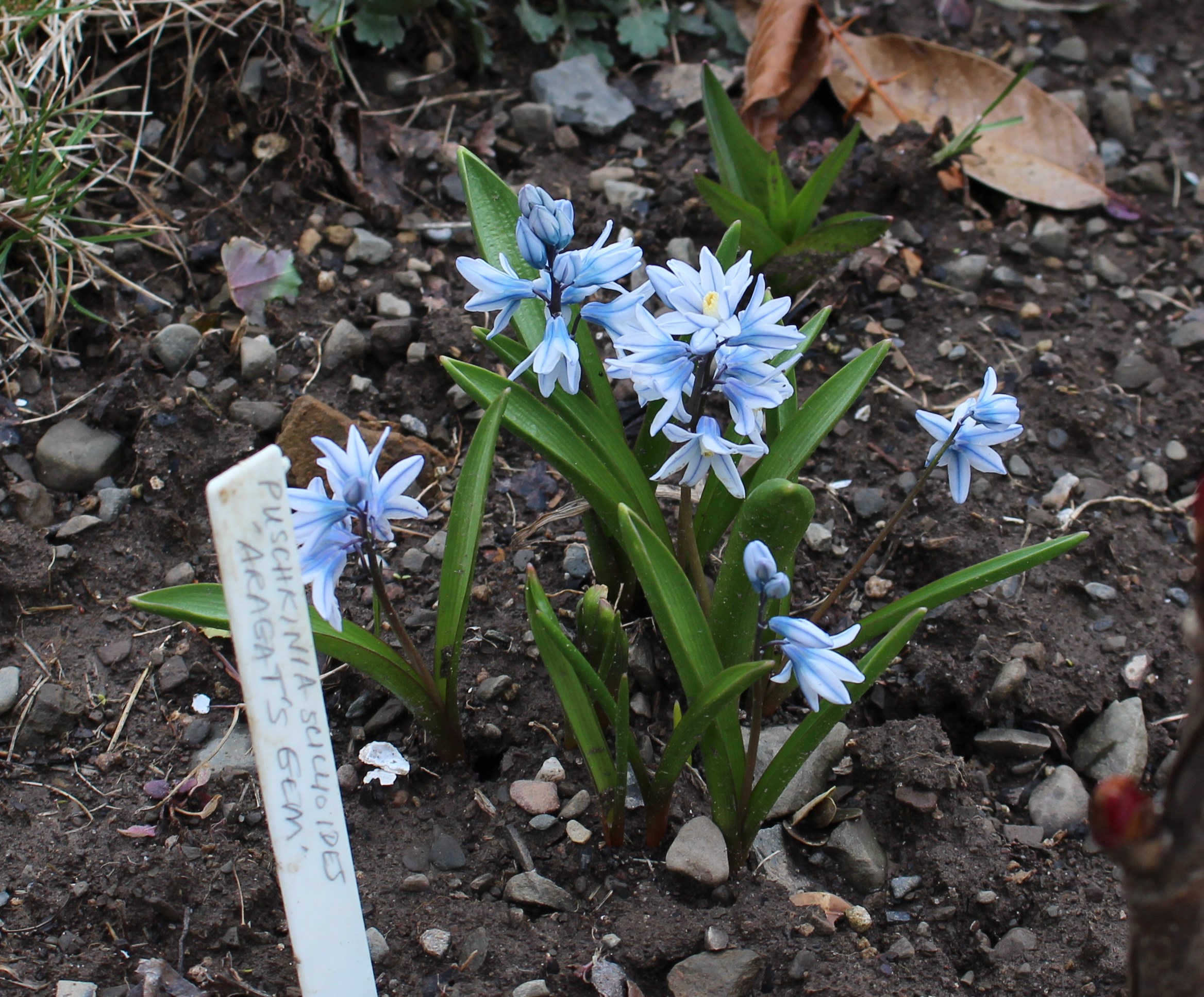
Now that we’re getting into special little things which make your fulfilling life seem just a tiny bit lacking lets look at this early blooming scilla relative which goes by the name of puschkinia.  This strain is supposed to have more rounded heads with darker lines of color and since I don’t grow it (yet) I’ll take their word for it.

Puschkinia scilloides 'Aragats Gem'

Puschkinia scilloides ‘Aragats Gem’

…and what gardener goes on a garden visit without adding something to the wishlist?  These last two will surely remain on the list for a while since even I can’t justify the pricetags which usually accompany them.

galanthus phillip andre meyer

Galanthus “Phillip Andre Meyer”.  I think of these as pagoda shaped although they’re usually referred to as inverse poculiforms (ipocs, or inpocs if you fear the wrath of Apple’s trademark police).  The flowers are reversed (inverted) with the green inner petals on the outside, and all six petals nearly similar in length.

“A. E. Bowles” will not likely visit my garden anytime soon but I’m going to put it as number one on the wishlist.  How exciting (for me at least) to be able to see it in bloom, and what a great way to commemorate such a talented plantsman and author.  Actually the snowdrop “Augustus” is another drop which is named after him, as well as dozens of other cultivars of plants.  Not a bad legacy in my opinion.

galanthus e a bowles

Galanthus “E.A.Bowles”

Of course it’s not all about pedigreed names and high pricetags.  There were plenty of clumps who’s names were known only to Mr. Lyman yet were still fantastic first signs of spring.

double snowdrop galanthus elwesii

No obvious label on this one, but its fat, rounded blooms made me happy to see it. Nice foliage as well.

After a long visit we were finally on the road again and made a quick pit stop at Ithaca’s Cornell Plantation.  The plantation is part of Cornell University and we wanted to stop in quickly for a look at their gardens, in particular their winter garden.

cornell plantation winter garden

Cornell Plantation’s winter garden.  Bright conifers, colorful bark, and a few winter bloomers all just recently released from underneath a cold blanket of snow.

The winter garden was a nice stop but since our fingers were still tingling from the cold we didn’t exactly linger much.  I don’t think I’d mind coming back in another few weeks when things really explode, but on this particular day the conifers and bare twigs, for as colorful as they were, just couldn’t keep us away from the heated car seats.

cornell plantation winter garden

More gardens at Ithaca’s Cornell University. The arboretum and other parts called but we wanted to get home before dark!

In spite of the weather we always end up enjoying our visit up to Trumansburg, Ithaca, and the Temple Gardens and are grateful that Mr. Lyman opens them up each spring.  In case you’re unaware Mr. Lyman also sells snowdrops so if you’re interested the process is to send three or four dollars to the following address: Temple Nursery (H Lyman) Box 591 Trumansburg, NY 14886.  Catalogs go out in January and the drops are usually sold out within a few weeks so you need to be quick!

Enjoy spring and your very own garden visits 🙂

Happy Easter! (almost)

Another warm day and we jump ahead a week (and I’m sure we’ll take three steps back tommorow).  Generally I prefer a long drawn out spring, but at this point I’ll take anything we can get, even if it means fast-forwarding through the season.  Five days ago the bunny buffet officially opened with its first crocus bloom and now a second sunny day has brought out the rest of the snow crocus (mostly crocus chrysanthus types).

crocus lawn of dreams

Van Egelen’s “lawn of dreams” crocus mix just starting to bloom. 200 snow crocus barely make a splash, but it’s enough to bring me out to sit in this part of the garden on a sunny day.

These are what remains of a fall 2012 planting <for more planting details click here> of about 200 snow crocus and maybe 150 tommies (crocus tommasinianus).  The tommies are not yet up but are supposed to be better spreaders and less tasty to all things which love crocus as much as I do.  Unfortunately Pennsylvania rabbits must be a less refined bunch since in my experience they mow down all crocus equally.

snow crocus naturalized lawn

They sure would look nicer spotted about in a velvety green carpet of lawn, but this is the Pennsylvania tundra so you get what you get!

I don’t mow this patch of thin grass until late, so waiting for the crocus foliage to die off naturally is no problem, but if you are a mower keep in mind that the crocus need to grow for five or so weeks after blooming in order to build up next year’s blooms.  Because the rabbits were so brutal on both bloom and foliage last year I didn’t think I’d see any flowers this year, but fortunately they came through even if a little weaker.  Luckily the snowdrops are not at all tasty to bunnies.

first snowdrops galanthus

The first snowdrops opening in the backyard.  They’ve multiplied but not so much that I can’t still count every last bloom to compare to 2014’s show…. sad and desperate, I know.

I of course did not follow the rules of common sense last year and ended up adding more new and expensive snowdrops to my garden.  They’re just as white and drop-shaped as my free snowdrops and all the other ones I have, but they’re much much better 🙂

galanthus lapwing

Galanthus ‘lapwing’

Another new bulb added last fall is iris “Katherine Hodgkin”.  Everyone loves Katherine for her subtle colors and intricate patterns…. except me.  I have a lower class of taste and of course prefer the brightest colors, and this one doesn’t show up as well as I’d like.  My mother of course will like it, and my wife too if she ever happens out into the garden before May, but I on the other hand say “meh.”  Hopefully our children will not inherit their taste from me but will instead be the perfect blend of well rounded, refined, garden loving young adults.  Optimism is one of the highlights of spring.

iris Katherine hodgkin

Iris “Katherine Hodgkin”.  Makes me think of dirty snakes.  I bet it’s virused too, I can see darker blue streaks in the blooms on the left and believe this is a sign…. 

A couple more warm days and all the early bulbs will be blooming.  Crocus are a favorite and along the warm south side of the house the first of the plump and bright dutch hybrids are opening.  I wish they lasted longer, but nothing lasts forever and when spring turns warm and sunny I always make a point of getting out to see them.

first dutch crocus blooms

Dutch crocus just starting to bloom in the warmest parts of the garden. The bees will be happy, the bunnies too.

Yesterday was beautiful, today not so much.  I want to get out there and clean up but don’t want the neighbors judging me for gardening in the cold, gray drizzle.  Looking at the forecast, Easter Sunday is supposed to be the most promising day, but Godless and crazy is probably a worse label than just plain old crazy so maybe I’ll try and get a few things cut back and cleaned up before then.   Fortunately I was out there last weekend for a start (the backyard snow melted briefly before the latest batch came down, so I rushed out to do some raking and trimming!)

vegetable beds ready for spring

The vegetable beds cleaned, straightened up, and ready to go. I even went over the lawn with the mower to give it a springtime “vacuum” of twigs and other debris.

It’s going to be a lazy cleanup this year, I can feel it already.  Electric hedge trimmer to cut everything back, mower to go over it once to chop, mower bag emptied on the beds to cover up all the leaves and bits which I didn’t bother raking out.  Done.  I need more time to transplant and divide, and gift plants with shovelfuls of compost.  Plus the mulched debris will keep down many of the self sowers, and I think last year’s “riot” of volunteers was a little messier than I want this year.  Always have to keep things changing!

Best springtime and Easter wishes to all, enjoy the weekend!

When the going gets tough….

The tough go elsewhere…..  like south a hardiness zone or two!

Leaving the below freezing temperatures behind for a couple hours doesn’t make me a quitter, right?  It was only a day, and when a friend and I worked out the details some cold, snowy, January night, the idea sounded like a great one.  It was, and the adventure started off with a two hour drive south to her place.

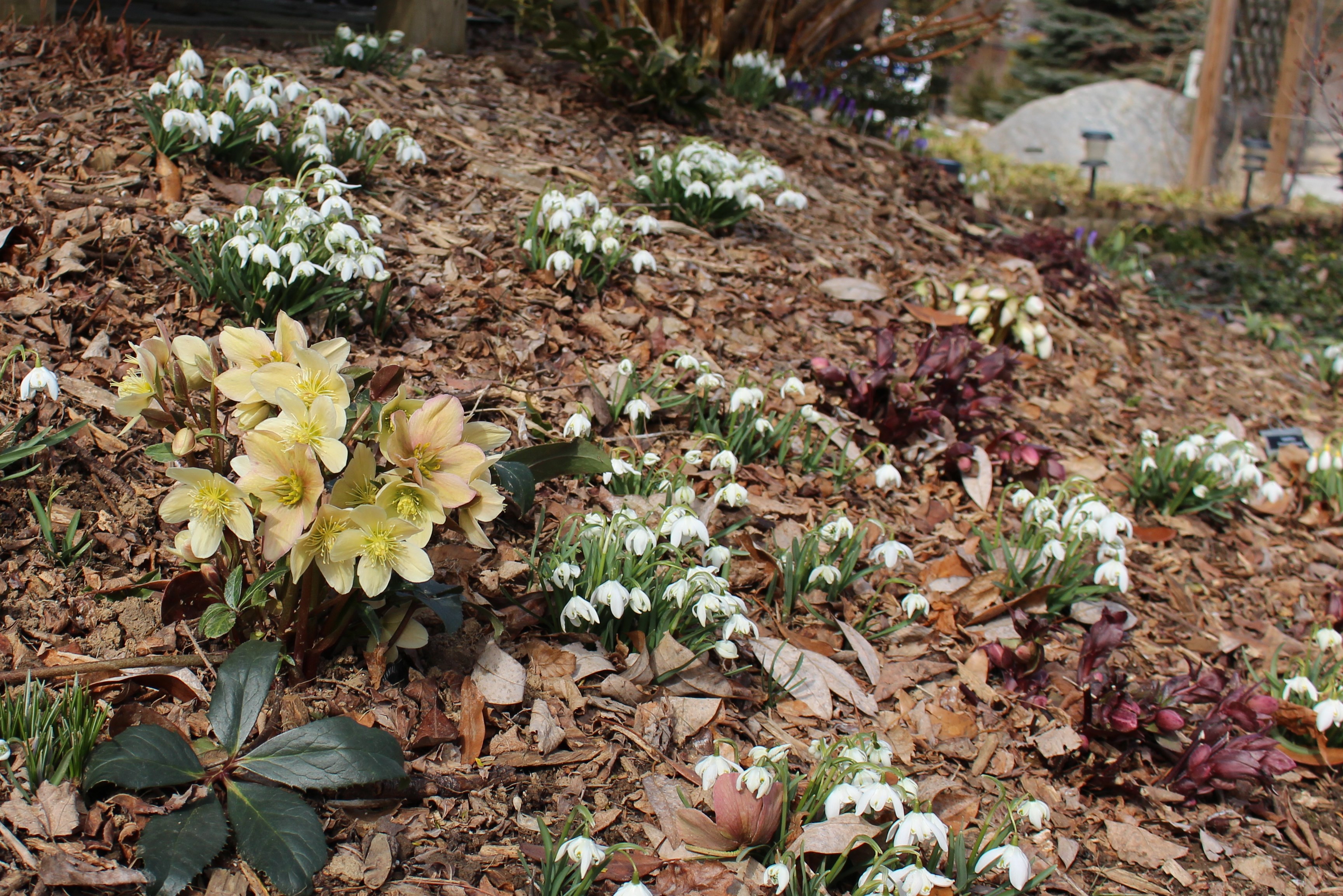
hellebores and snowdrops in the garden

An early hellebore (didn’t get the name) highlighting the early blooming snowdrops (flore pleno) and darker leaved hellebore sprouts.

My friend admits to being a galanthophile and since I might also be drifting in that direction I suppose it’s only fair I warn you ahead of time.  There will be plenty of snowdrop pictures.
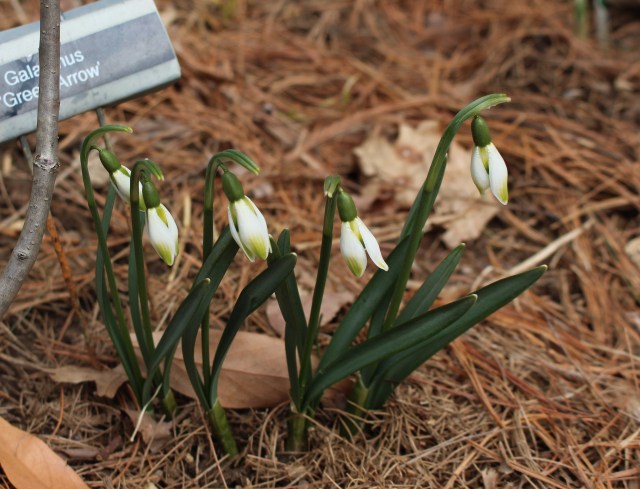
galanthus green arrow

Snowdrops with a touch of green on the bloom are always a little different. Galanthus ‘green arrow’ looks nice enough, but I of course am still in my big-and-fat-is-better stage.

I tried to resist hinting too much that I wouldn’t mind one of nearly all of them!
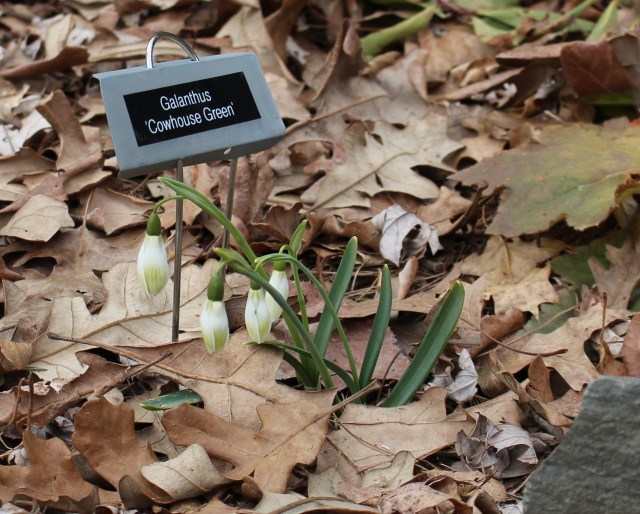
galanthus cowhouse green

Here is a snowdrop with a green blush, which is how I like my greens best.  A good guess on the name would be galanthus ‘cowhouse green’.

What can I say about a fantastic clump of yellow?

galanthus primrose warburg

Galanthus ‘Primrose Warburg”. Wow!

This was a long garden tour.  We talked about the different varieties, where they were growing well, what seemed to be doing best, and what we still dreamed of getting our dirty little fingers on!  It was a great visit, and it’s not that often I can mention snowdrops in every sentence and not get some kind of sideways glance or a poorly concealed eye roll.

galanthus flore plena

We came to the conclusion that the common double snowdrop, galanthus ‘flore plena’, is among the best drops for making a nice display in your garden beds.

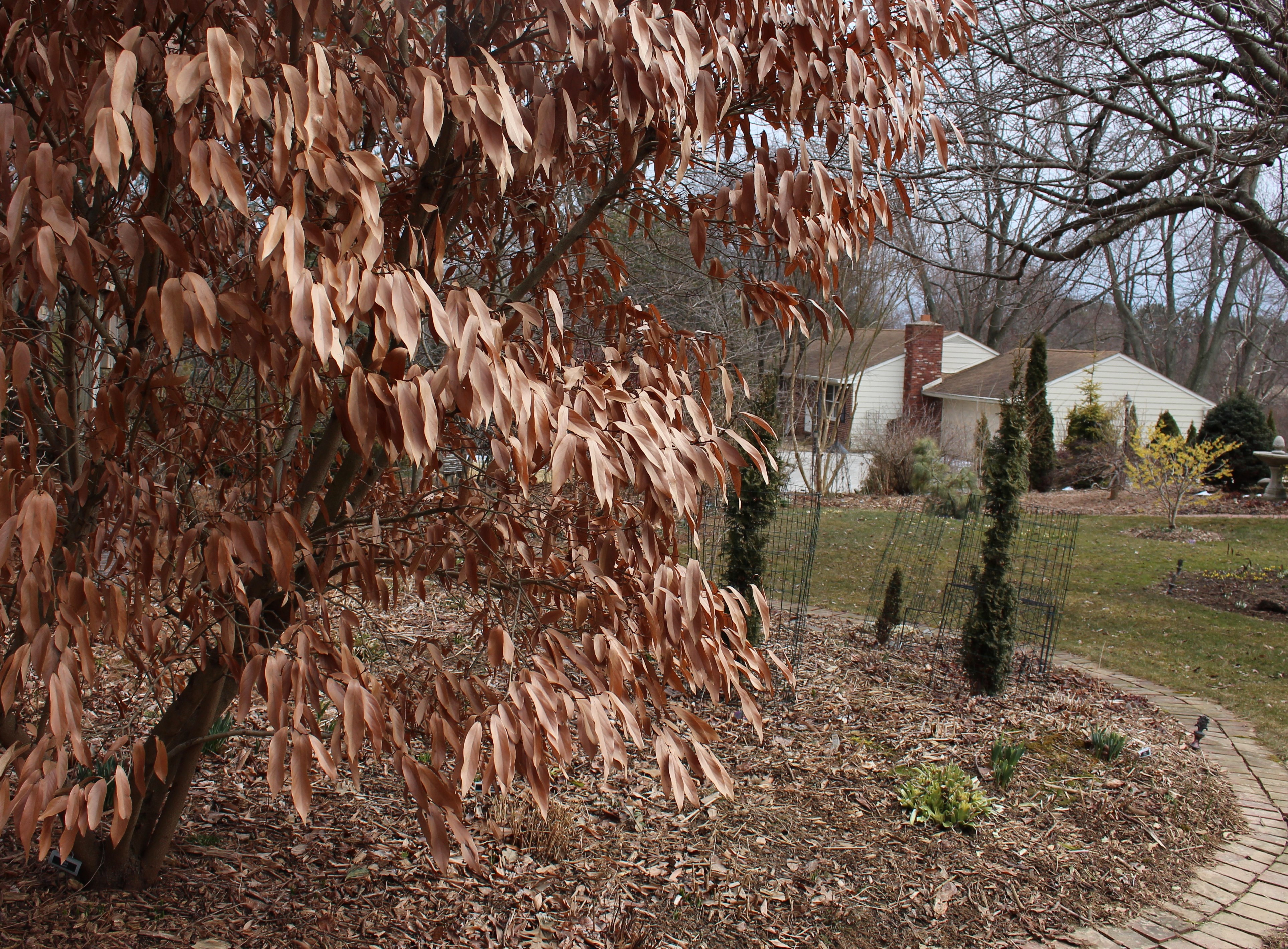
Of course one cannot live on galanthus alone, so the supporting trees and shrubs also called out for attention.  Here’s one which caught my eye and caused a little bit of inner conflict at the same time.  It’s the willow-leaf spicebush, and after a bright show of autumn color the leaves hang on throughout the winter.  I thought I despised trees and shrubs which play the trick of holding on to their dead leaves (fancy term for this being marcesence), and would never have considered adding it as contrast and winter interest, but I found it oddly appealing and might have hinted towards a few seeds or a cutting or two someday.  What do you think of it?

lindera glauca winter foliage

Not the best picture, but it shows lindera glauca’s smooth khaki winter foliage. According to my host it will all drop off (making a mess?) once the buds break.  Hardiness is zones 5-7 according to what I found, so it should be ok in my frigid garden.

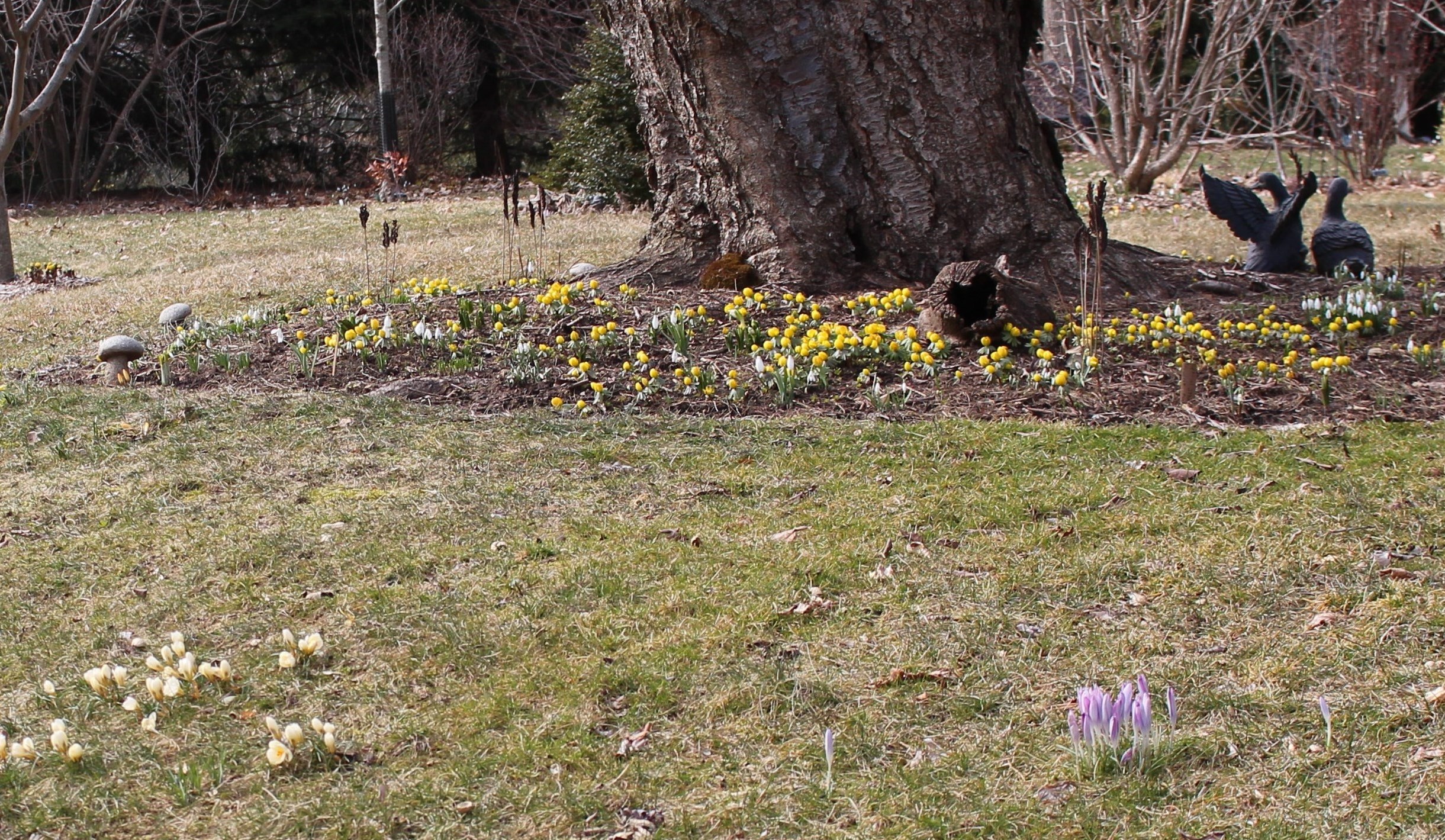
How can you resist a late winter carpet of blooms with crocus studding the lawn?
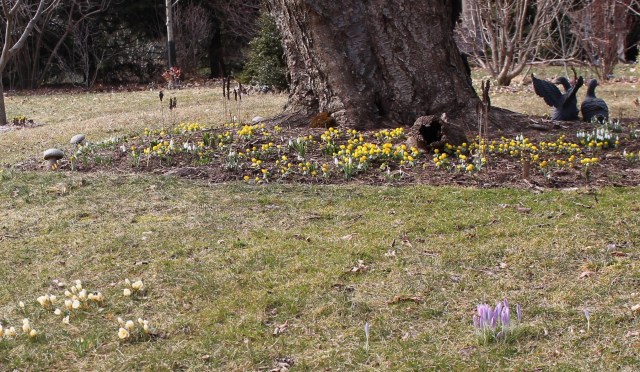
naturalized bulbs in lawn

I loved this old cherry tree underplanted with a carpet of late winter bulbs and snow crocus naturalized in the lawn. A perfect view for right outside a window.

The garden tour (and lunch of course!) were only the start of our adventure.  We jumped into the car next and set off to a nearby abandoned farmstead to check out the naturalized drops there.  Clearly a different setting than my friend’s garden!

abandoned stone farmhouse

Your standard abandoned Pennsylvania farmhouse, all grown up and over with invasives like locust, bittersweet, and multiflora roses.  General decay all over but I was impressed by how well the chimney brickwork was holding up.

Back in the day I’m sure this was a completely different place, and while investigating the property my friend found she actually knew one of the former occupants.  It was a different place back then, one where children were being raised, lives were being led, and someone planted a garden.  A garden which likely contained a small patch of snowdrops at the doorstep, a patch which during the years of abandonment has spread.

naturalized snowdrops

Filling in between the house and street, naturalized snowdrops between the weed trees and vinca. They look cold because they were, and even with warmer air temperatures the ground was still frozen solid.

Naturalized snowdrops spreading over the years look even better when paired with a few decades worth of winter aconite (eranthis hyemalis).  Throw a few cyclamen in and you’d think you were at one of the great estates!

galanthus and winter aconite

Galanthus and winter aconite

There was little variation amongst the plants (all galanthus nivalis), but how can you beat the pure white flowers and fresh healthy clumps.  Special or not I admit I “liberated” a bunch found growing in a rubble pile next to the foundation.  Maybe they’ll start their own sheet of white at my own house, and live on after these drops are likely erased in some future redevelopment plan.
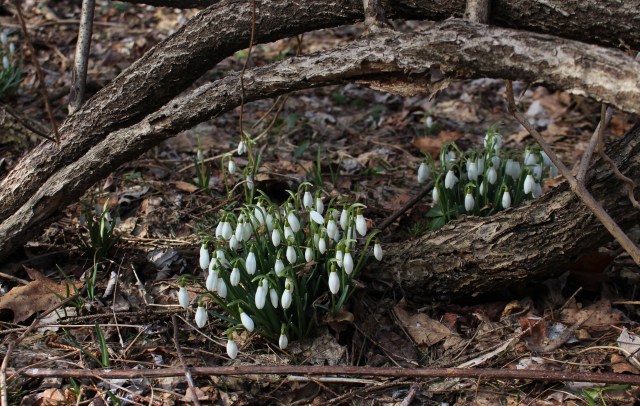
wild galanthus

Galanthus nivalis filling in and doing its thing before the oriental bittersweet leafs out again and refreshes its chokehold on this woodland.

Abandoned house=spooky, and no matter how blue the sky or how nice the sun was coming out it still wasn’t a place we wanted to open the picnic basket at, so we wrapped things up, jumped back in the car, and headed on to our next spot.

abandoned farmhouse pennsylvania

I sure didn’t want to enter the building even if the walls still look solid… but even if I was feeling brave, those dark, empty windows still give me the creeps.

We are such slow, lingering adventurers that by the time we made it to our final stop the light was already at that low springtime evening angle which gives everything a nice glow.  Perfect for a real photographer, but even my point and shoot method gave me a few decent pictures.
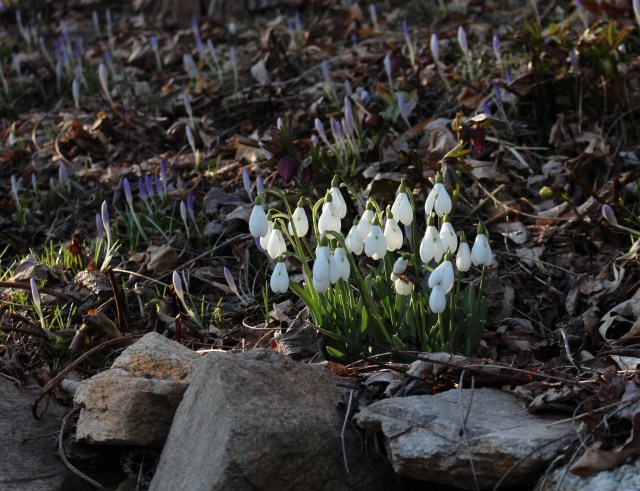
galanthus sam arnott

Galanthus ‘Sam Arnott’.  Seeing this makes me forget all the snow and ice back home.

When we first pulled into our friend’s driveway I just let out a hushed wow.  I’ve never been anywhere that has clumps of special snowdrops lining the driveway, and to tell the truth I was so distracted I forgot to take pictures.
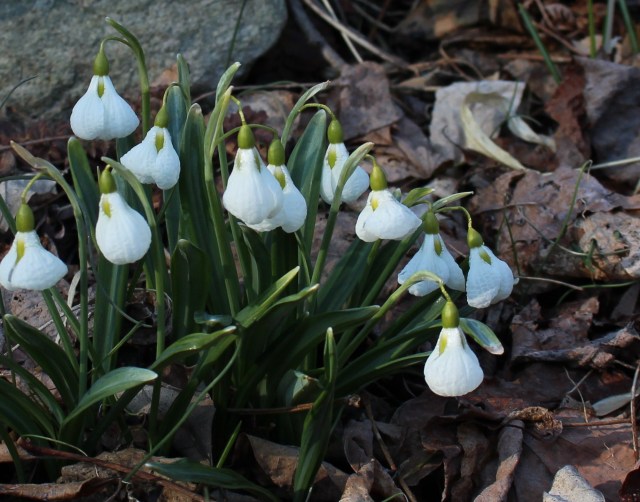
galanthus diggory

This clump of galanthus ‘diggory’ makes me understand why it’s such a coveted snowdrop. Those fat little pantaloons of white would look great in any garden and I’m excited to think I might have one lined up for this summer 🙂

We spent the rest of the day here of course, talking, exploring, and just plain old soaking up the time with snowdrop friends.  Of course there were other plants too but I think all involved were just a little obsessed with one plant group right now 😉
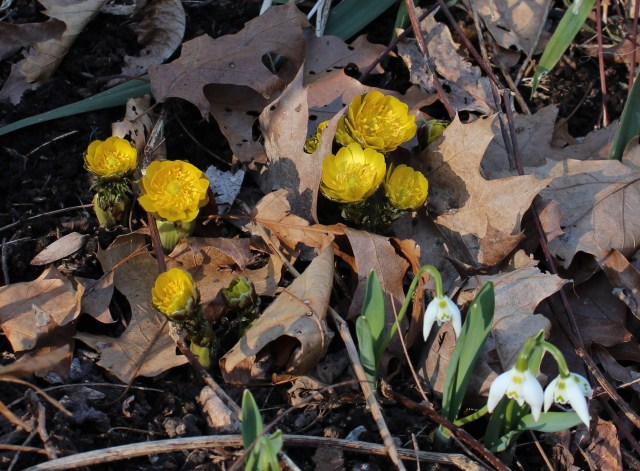
adonis amurensis fukujukai

Yellow adonis amurensis ‘fukujukai?’ with what else but a snowdrop.

This friend likes to bulk the clumps up before putting them out in the open garden.  This was another wow moment looking at the drops which I only knew by name until today.

named galanthus with mrs thompson

Along the back are a few ‘Trym’ types with their green outer patches and the lovely ‘Mrs Thompson’ is in the front.  This is the kind of planting which makes me glad I wasn’t left alone with only my conscience to guide me.

There were plenty of things for the wishlist on this trip, but gardeners if anything are sometimes generous to a fault.  I couldn’t believe the haul which filled my trunk on the way home, a mix of purchased plants which my friend had picked up for me on an earlier trip, plus some other goodies which she knew I wanted.  I felt guilty as we walked from spot to spot with a shovel, but to look at them now just makes me even more excited about spring.

galanthus and eranthis for sale

This tub of galanthus and eranthis could be its own garden.

Spring has got to be close now, and the fact that it rained today made me realize just how long it’s been since something non-frozen has fallen from the sky.  I wasn’t thrilled to be out there, but it was perfect weather for planting new snowdrops from our trip, plus two new ones which I found in the mailbox today from Carolyn’s Shade Gardens! Bring it on I say 🙂

The Winter Garden 2014/15

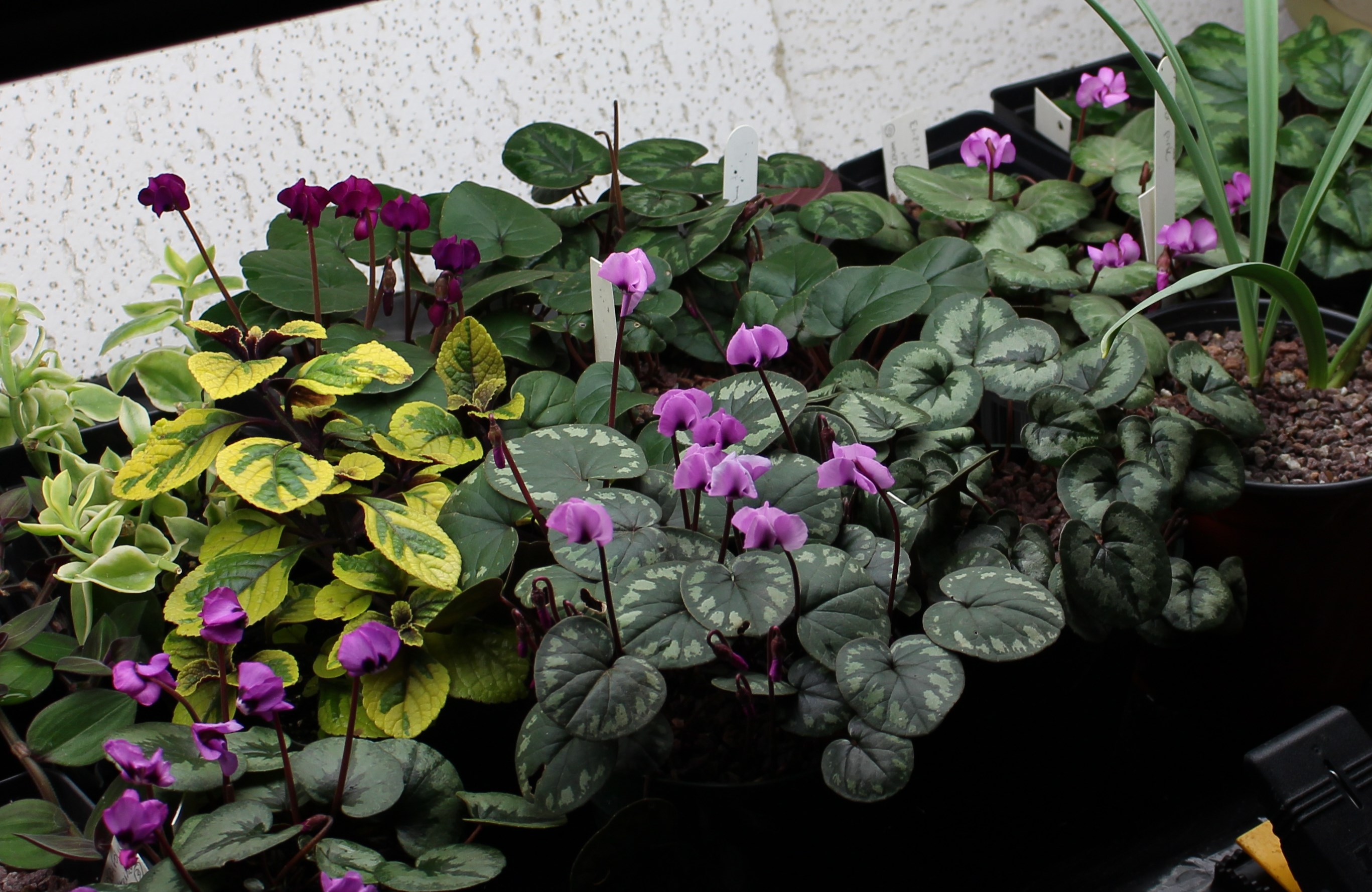
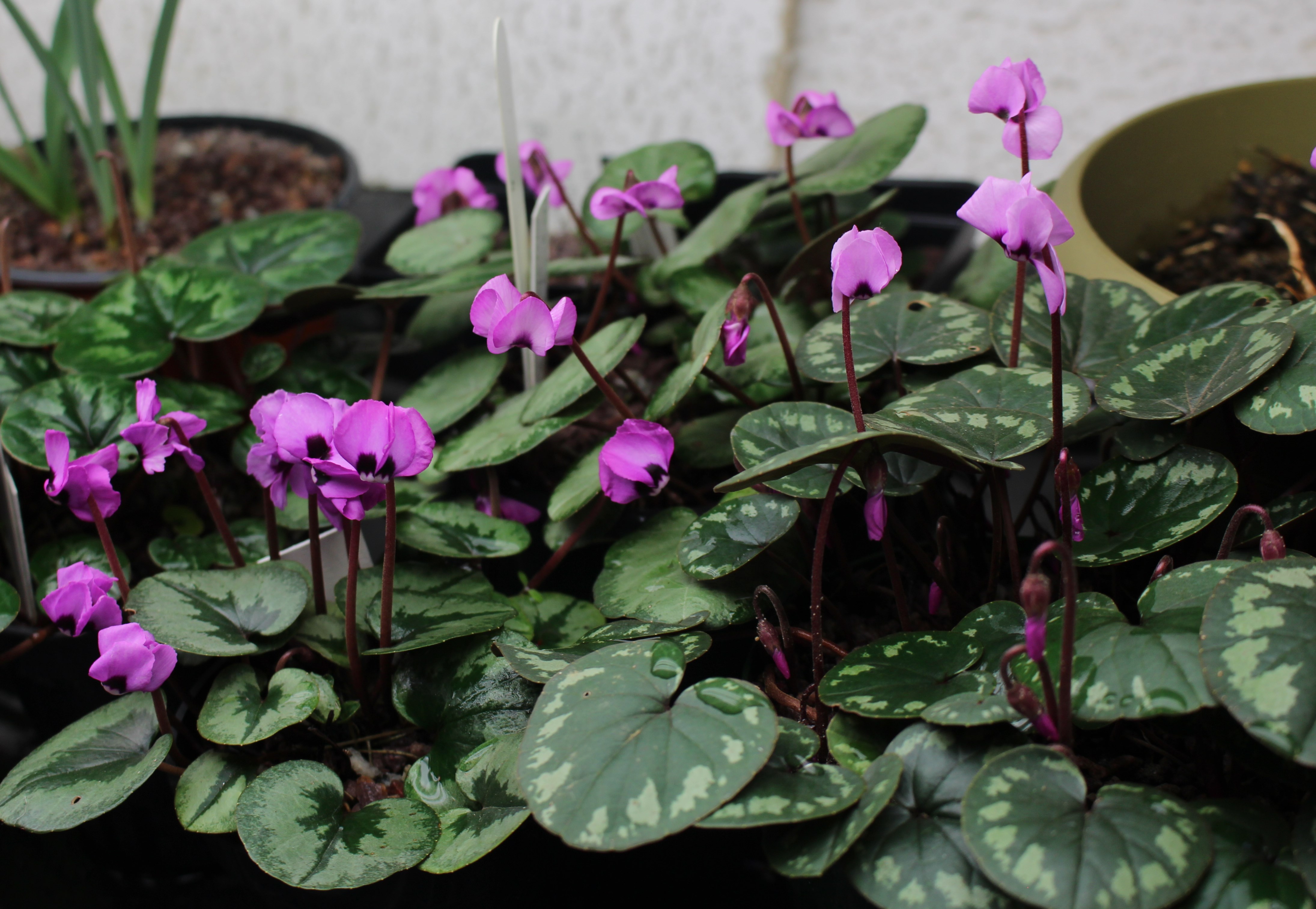
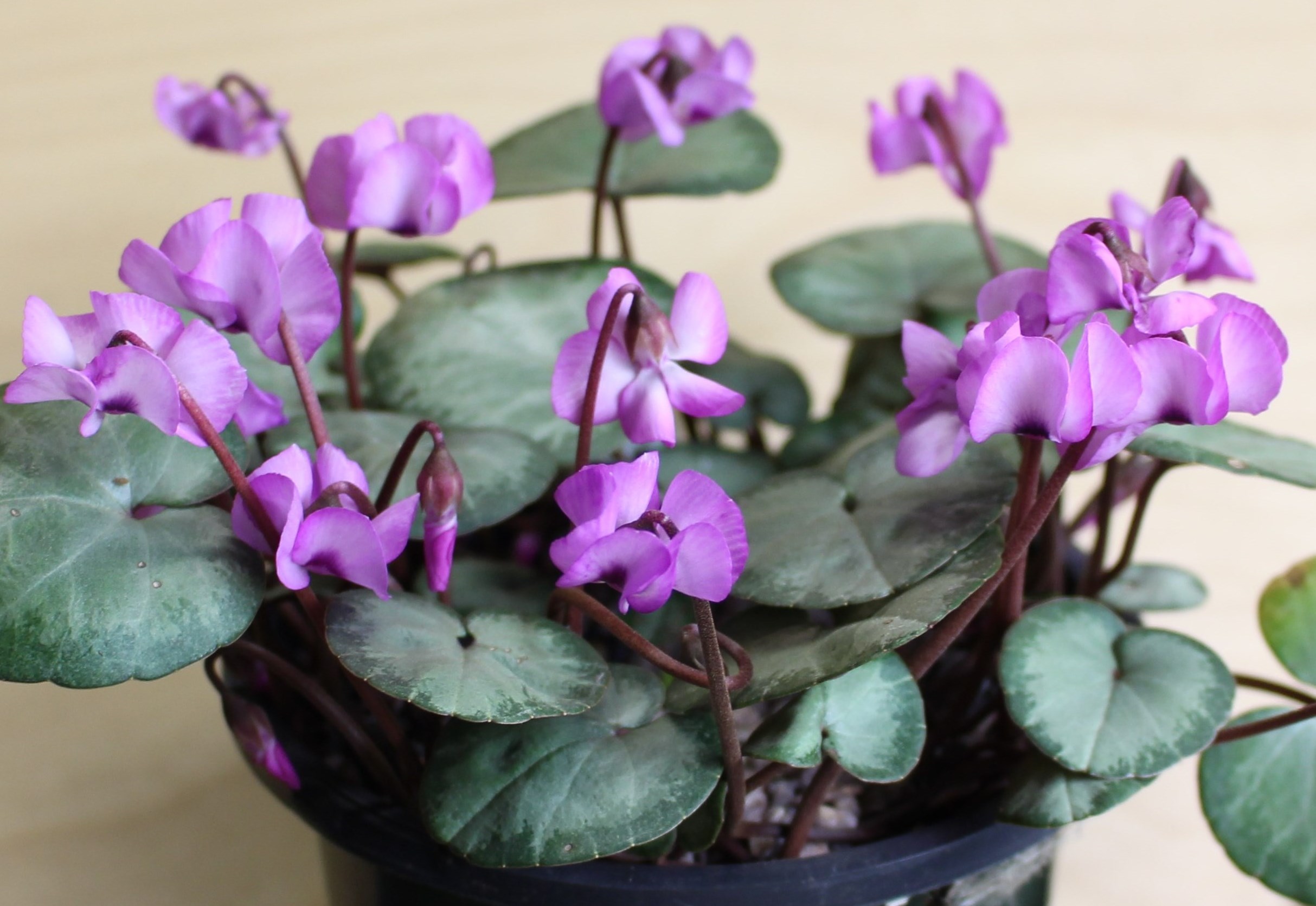
My winter garden is having a good season so far.  Usually I don’t bother setting things up until around New Year’s but this season the shop lights went on in October for some special cuttings, and things have been humming along since.  The hardy cyclamen coum which I keep potted up are just starting to put on a show, and now that I’ve dispatched Mr. Mouse the blooms can open in peace.

winter garden under lights

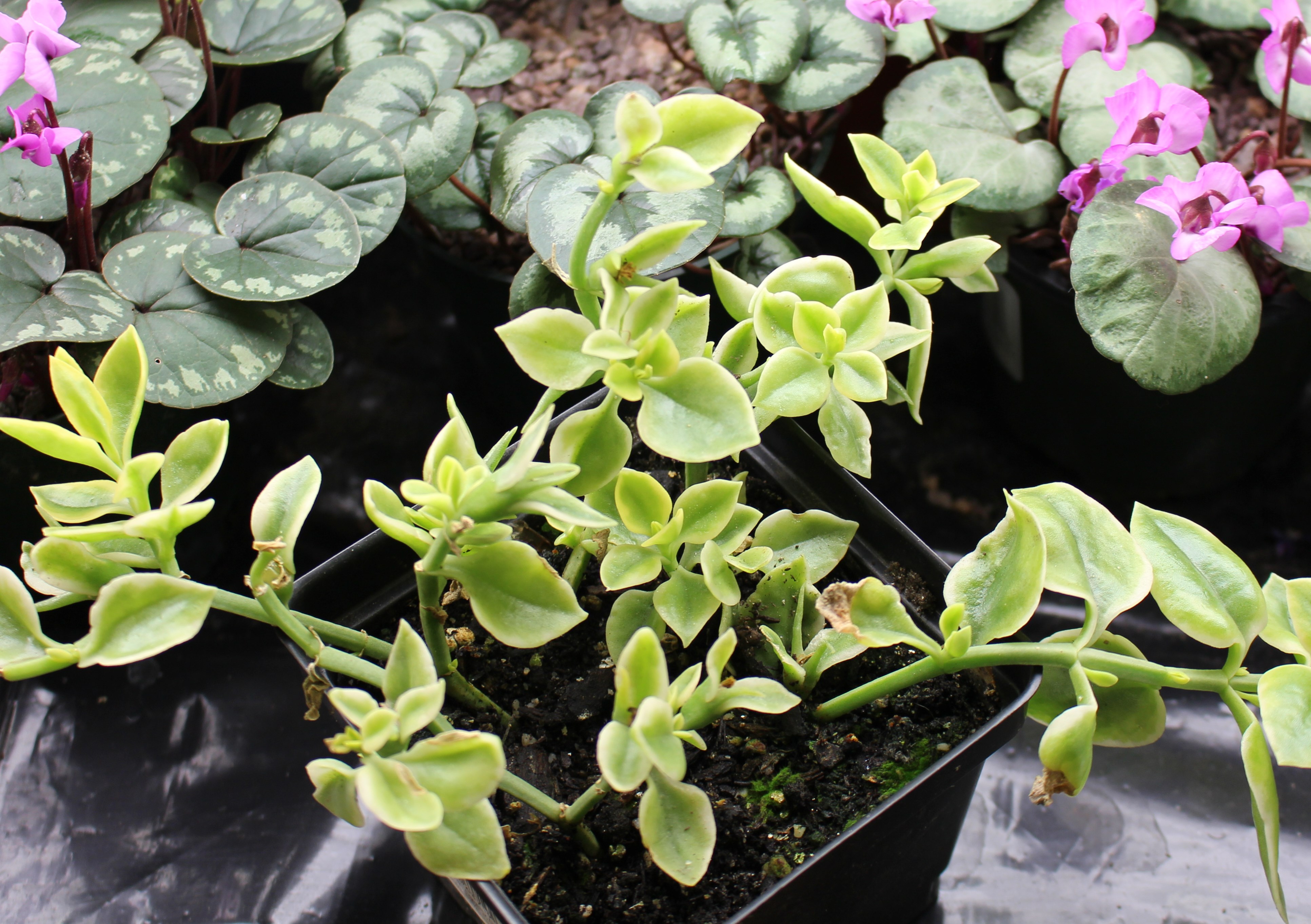
The “Winter Garden” with cyclamen coum in bloom. I love the flowers alongside the bright variegated leaves of the plectranthus (probably ‘Troy’s Gold’).

For those of you who might not be as up to date with my garden as you’d like 🙂 here are a few statistics on the tiny little patch of plants which serves as my winter garden.  Basically it’s a four tube fluorescent shop light set up in an unheated workshop just off the back of the cool (never freezing) garage.  The bulbs are a generic T-8 type, usually in the ‘daylight’ or ‘natural light’ category but it really just depends on what I grab the day I’m shopping for lights.  That’s it.  Not quite a citrus filled orangerie or a warm, sunny conservatory, but it does the trick on a dark January evening.  I’m considering buying a few more and lining the side of the room with them in order to grow something bigger and fragrant.  A little goldfish pool back there wouldn’t bother me much either, might as well put a fountain in while I’m at it.

hardy cyclamen growing indoors under lights

Another two or so weeks and the cyclamen should really put on a nice show.

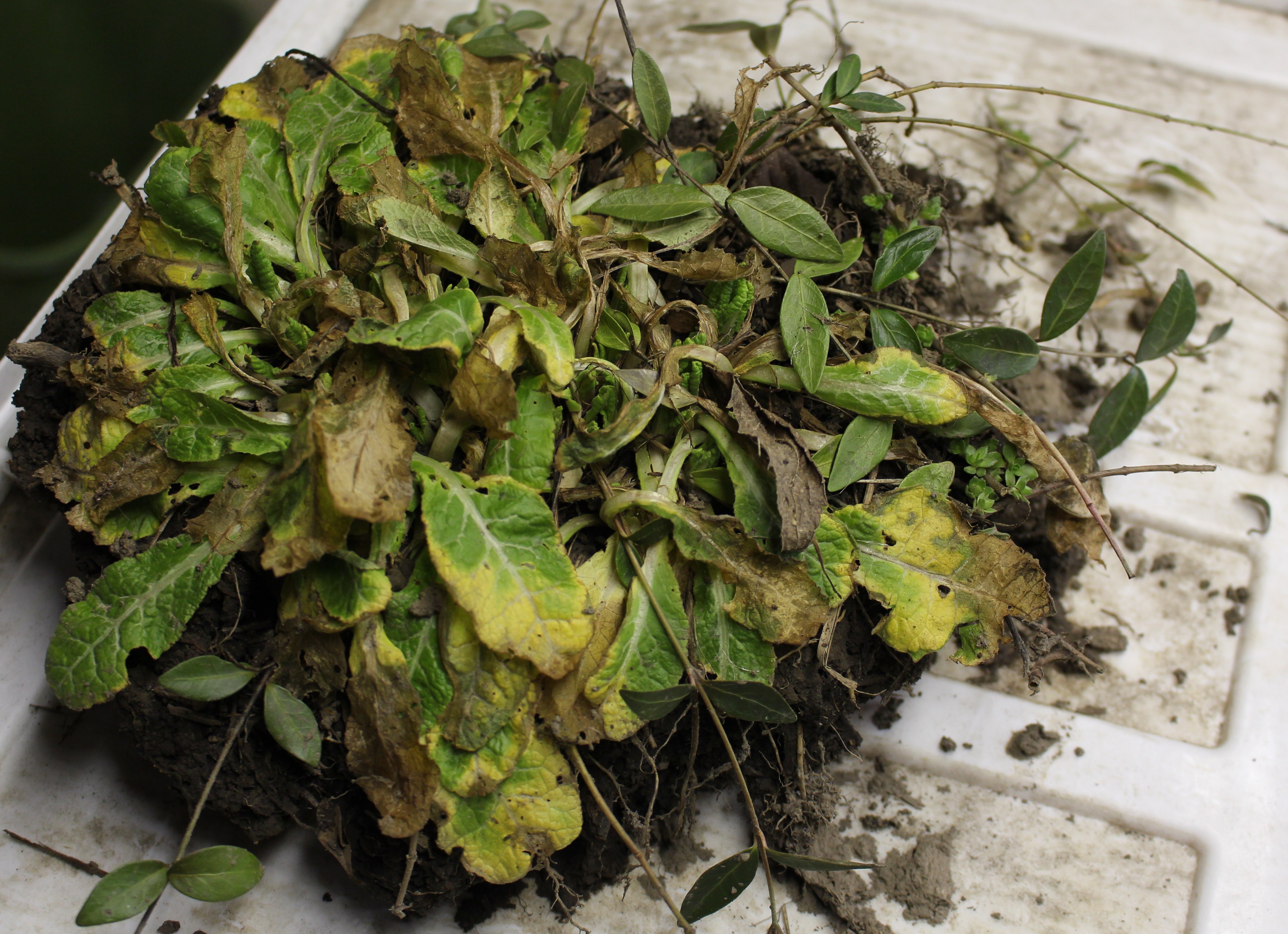
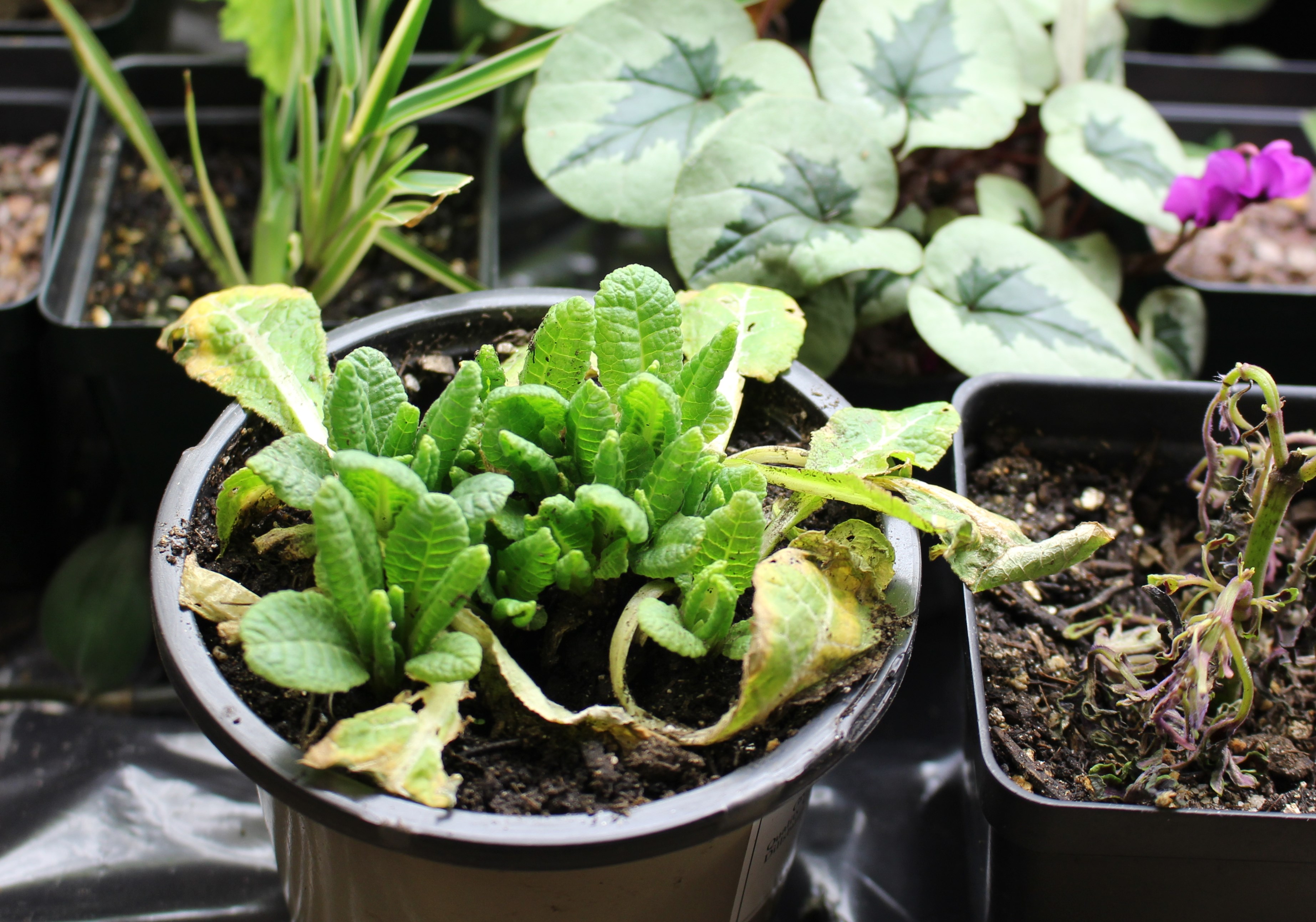
Last year I had a bunch of snowdrops and some early spring blooming perennial purchases from Far Reaches Farm.  They were awesome but this year I spent my winter treat money a few months too early and had to improvise, so on a warm December afternoon I went out and dug up a clump of almost completely frozen primula vulgaris for forcing.

forcing primrose

They needed dividing anyway, which eventually I did…. after letting them thaw out and sit in the dark for a week or so (not a recommended of course, but you know how things can get away from you during the holidays!)

A month later and they’re starting to wake up.  They probably won’t have as long a bloom season as some of the newer hybrid types, but I love their soft yellow color and big clumps of blooms.

primula vulgaris forced

One of the primula divisions coming along.  Fingers crossed for a good show!  (please ignore the dying coleus next to it.  Cold weather, overwatering and coleus are not a good mix)

I have a new favorite celebration.  As any Northern hemisphere gardener will know, the winter solstice marks the shortest day of the year and the point beyond which days lengthen and the march into spring begins.  But gardeners also know we don’t rush out in January and start planting.  It takes a while for the sun to catch up, shake off winter, and get things going again.  According to the ever interesting blog at MacGardens, the turning point for this is the January 21st celebration of ‘post-solstice’.  One month after winter solstice and the sun is starting to turn the tide of winter, bringing soil temperatures back from their lowest point (happening somewhere around Jan 21st) back up into the civilized range.  Speaking of civilized, check out MacGardens for a special treat of cool plants, exotic alpines, and just plain old interesting gardening.

cyclamen coum potted

I’m always trying to get out of the ‘average’ category of photography. Here’s one of my favorite cyclamen coum which I attempted to set up for a nice portrait.

Until post-solstice kicks in and we can again search for signs of life outdoors I’ll stick to the indoor garden.  With more snow on the way tonight I think that’s the best plan.  Here’s another plant making me happy sheltering from the storm under lights, it’s a variegated ice plant (dorotheanthus bellidiformis, probably ‘mezoo trailing red’).  Not to ‘out’ my slacker gardening, but the cuttings might have been hastily thrown on a workbench back in November when the first hard frost hit.  They sat there unplanted for at least a month until I got around to potting them up and don’t seem to have minded at all.  Surviving rootless on a table for over a month ranks well on my plant-o-meter.

dorotheanthus bellidiformis 'mezoo trailing red'

Variegated ice plant finally living the good life with soil and water (and plenty of roots- I checked)

A few snowdrops weren’t stolen out of their pots or had their heads nibbled off by the late Mr. Mouse, so February should be off to a good, post-solstice, start.  In either case I’m just happy that there’s already a bit of light on the horizon when I pull into work, and a rosy glow to the sky when I walk out!

GB Foliage day -winter greens

I’m a day late minimum with just about everything lately and this post is no exception, but I wanted to squeak in one more Garden Bloggers Foliage Day post with Christina for the 2014 season, since who knows if we’ll have anything other than snow next month… so here goes!

juniper 'old gold'

Even after a few days of shockingly cold days and nights the grass is still green and juniper ‘old gold’ still fresh.

With the autumn leaves gone, foliage is down to the evergreen plantings.  Evergreens are more expensive than perennials and don’t grow well from seed… hence do not match up well with my frugal gardening 🙂  I’ve been doing my best though, and some such as juniper “Old Gold” are finally showing off  -finally- after five years in the ground from a $4 rooted cutting!

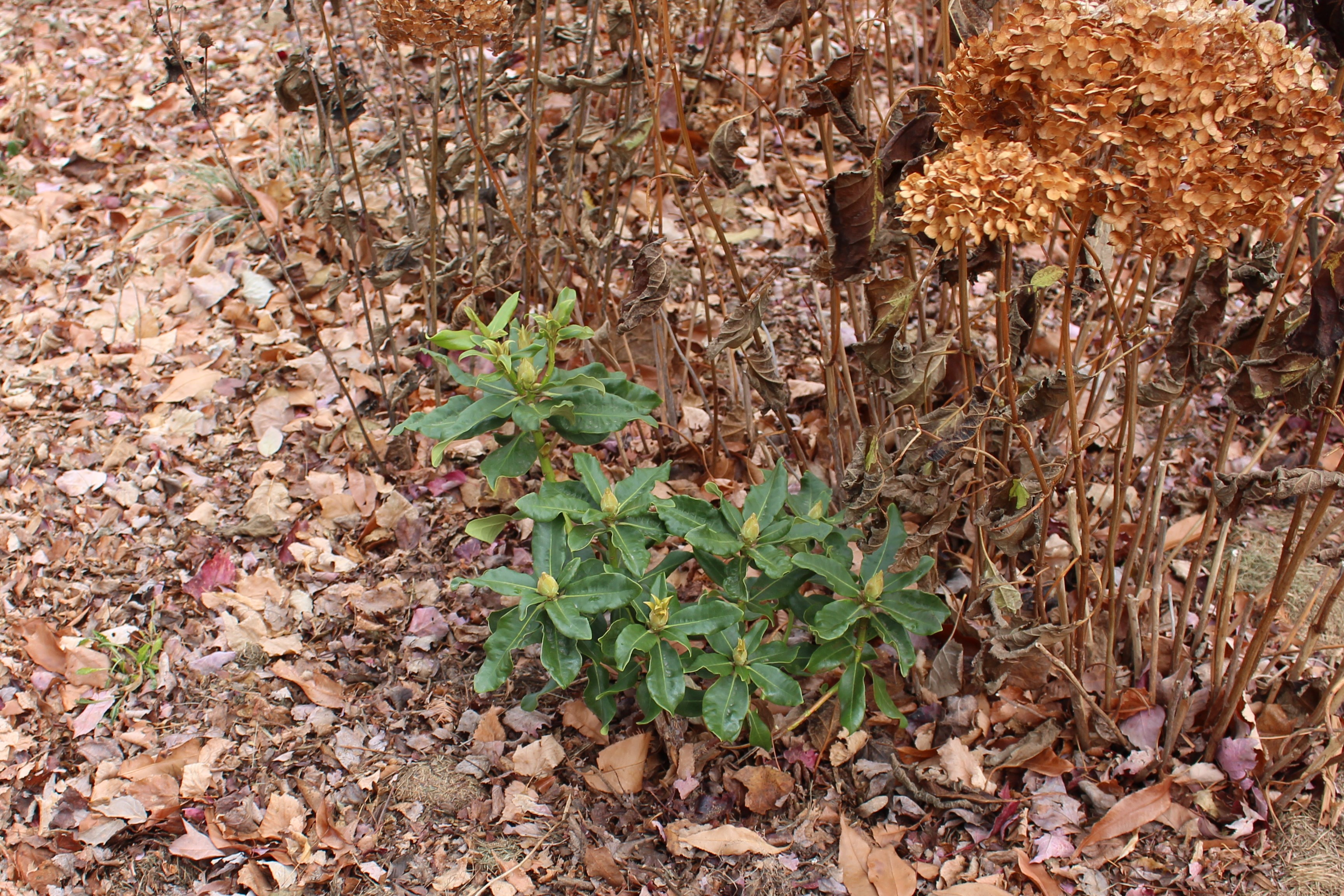
A more recent addition are three new rhododendrons which look absolutely overgrown and lush considering the $12 I spent on the bunch.  This purchase went absolutely unnoticed when I mixed it in with a cartload of mortar and tile from the Depot.  You could almost say they were free with purchase, right?

planting rhododendron

Look at the buds on this $4 rhododendron! The plant and price make me understand how hard a nurseryman’s business must be, I’m sure he made no money off this purchase…..

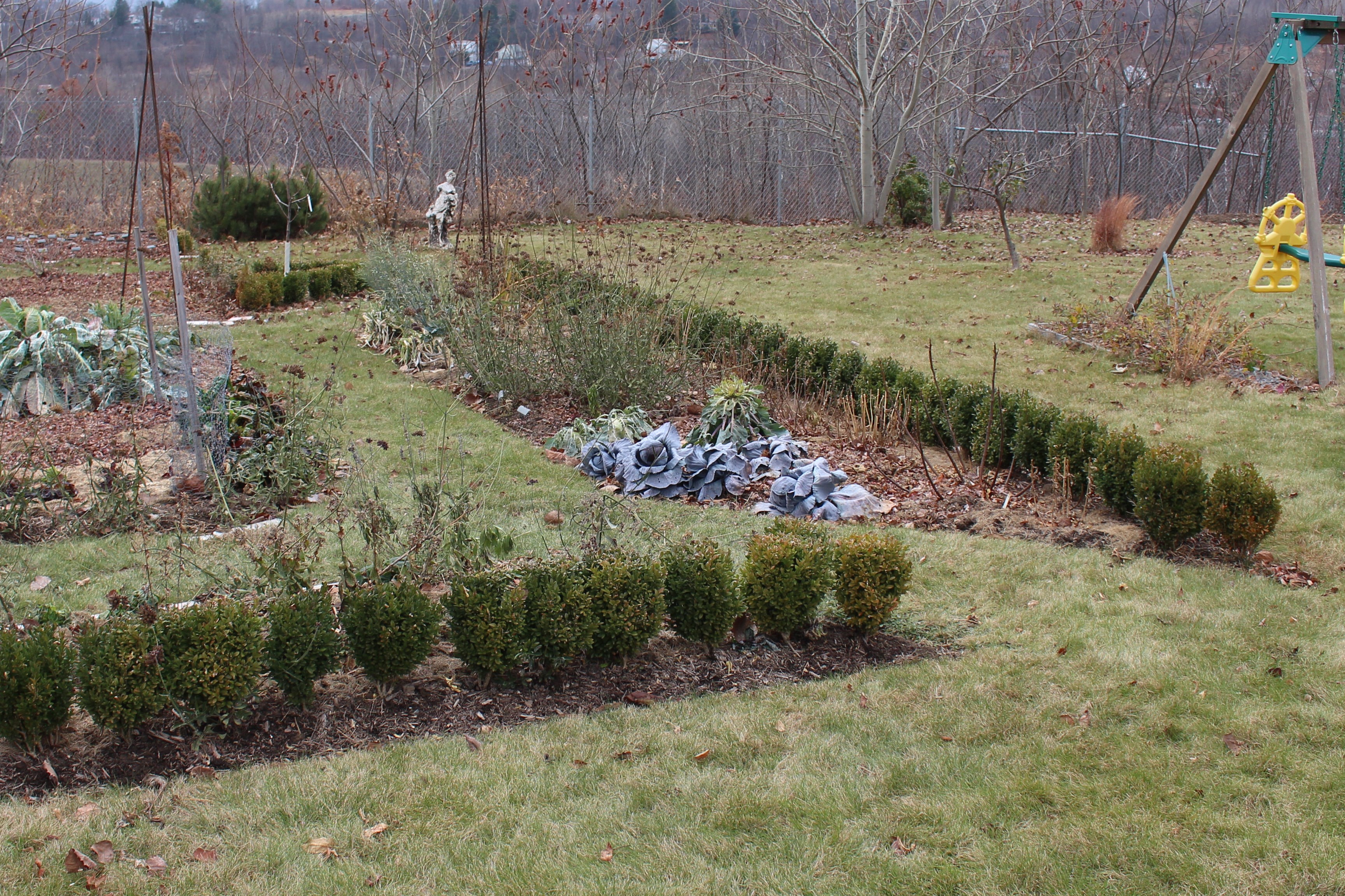
Small patches of winter color are beginning to show up in the backyard too.  This is the first year my boxwood cuttings are big enough to look even remotely like a hedge, and when the grass goes completely brown these bits of green foliage will at least look slightly hopeful.

boxwood cuttings hedge around vegetable garden

My design makes little sense, but hopefully in a few years the vegetable garden will at least look “interesting” even if it never makes it to beautiful.

The only winter color here when we purchased the house were a few foundation plantings along the front, and a line of meatball yews along the south facing side.  After three years of sweaty summertime hedgetrimmering I said ‘screw this’ and let them do their own thing and break away from their tight ballism.  Now I have to chose between the abandoned house look and the bare look of a brutal trim-back.  Any suggestions?  I probably wouldn’t mind trimming them back for a straight hedge along the side,  I could remove them completely, or I could leave just one between the windows and let it get even bigger….. I need a plan though, eyebrows are already being raised here in my end of suburbia and the MIL will soon question my motives since it faces her house 😉

overgrown yew hedge

overgrown yew hedge

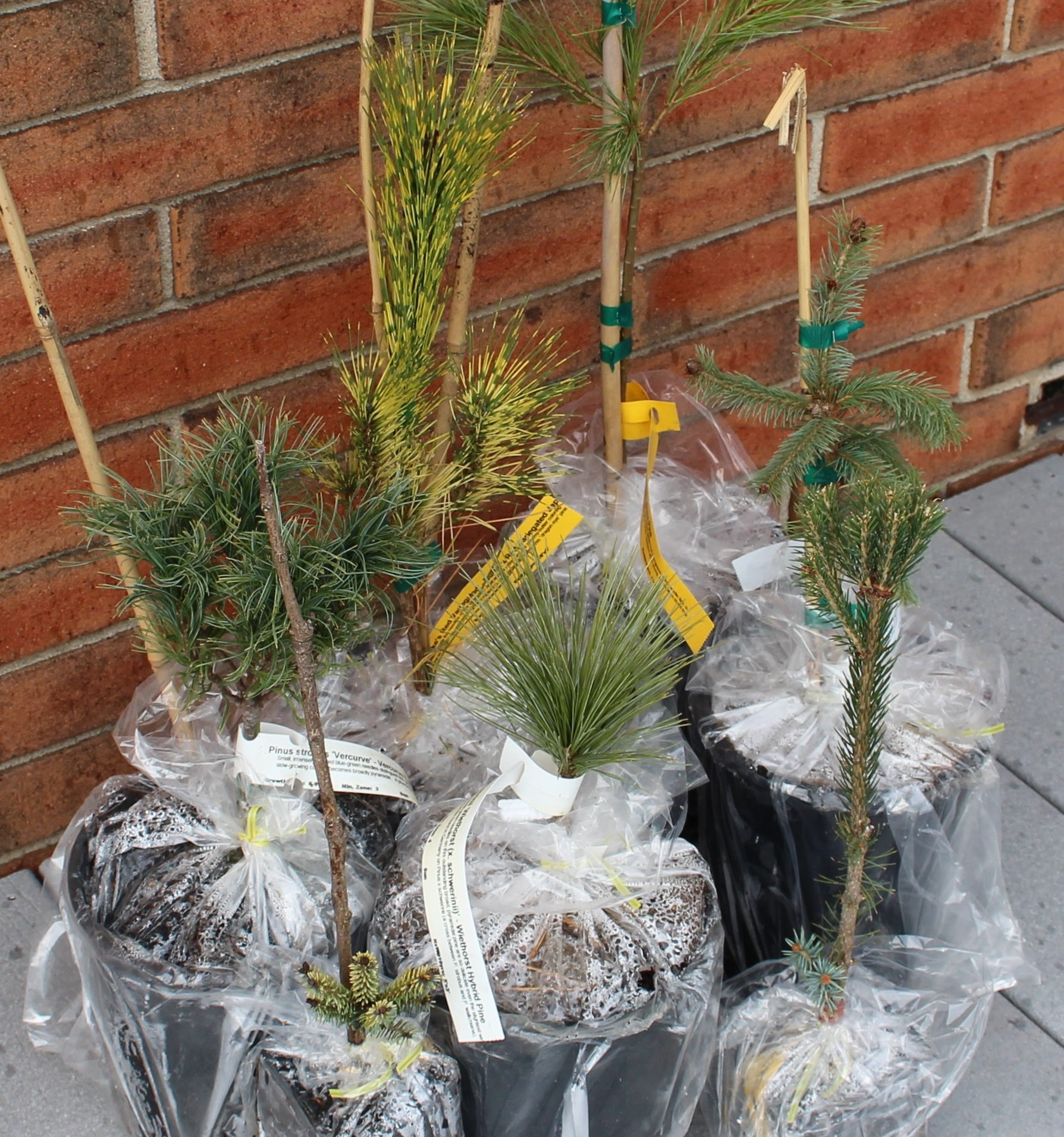
Man cannot live on green alone (even with a little yellow) so I foolishly placed an order for some last minute winter foliage via Conifer Kingdom.  God must love either procrastinators or he loves winter garden interest because although Pennsylvania froze the week after I ordered, the box full of evergreens showed up the minute the thermometer went back over freezing.  Today will hopefully top off at 50F (10C), the gale force winds have died off, and it should be perfect for getting these guys in the ground.

Not to overstep my boundaries, but I smell a 50% off sale on fall bulbs at Brent and Becky’s for the day after Thanksgiving.  I will not be able to resist, so I guess we’re going to see how God feels about late bulb orders.

conifer kingdom purchase

My Conifer Kingdom purchase made me happier than a cat in catnip. In a few years I hope to really ‘up’ the level of my garden’s winter interest.  Just look at the needles on that pine! ( Pinus densiflora ‘Burke’s Red Variegated’)

Premium conifers might be as cheap as marigolds in your neck of the woods, but not so much here, so mailorder is my weapon of choice.  For those interested, here’s the breakdown on my order…. $127 total including $25 shipping and $20 discount via a Facebook coupon code (fyi code expired 😦 Nov 21st).

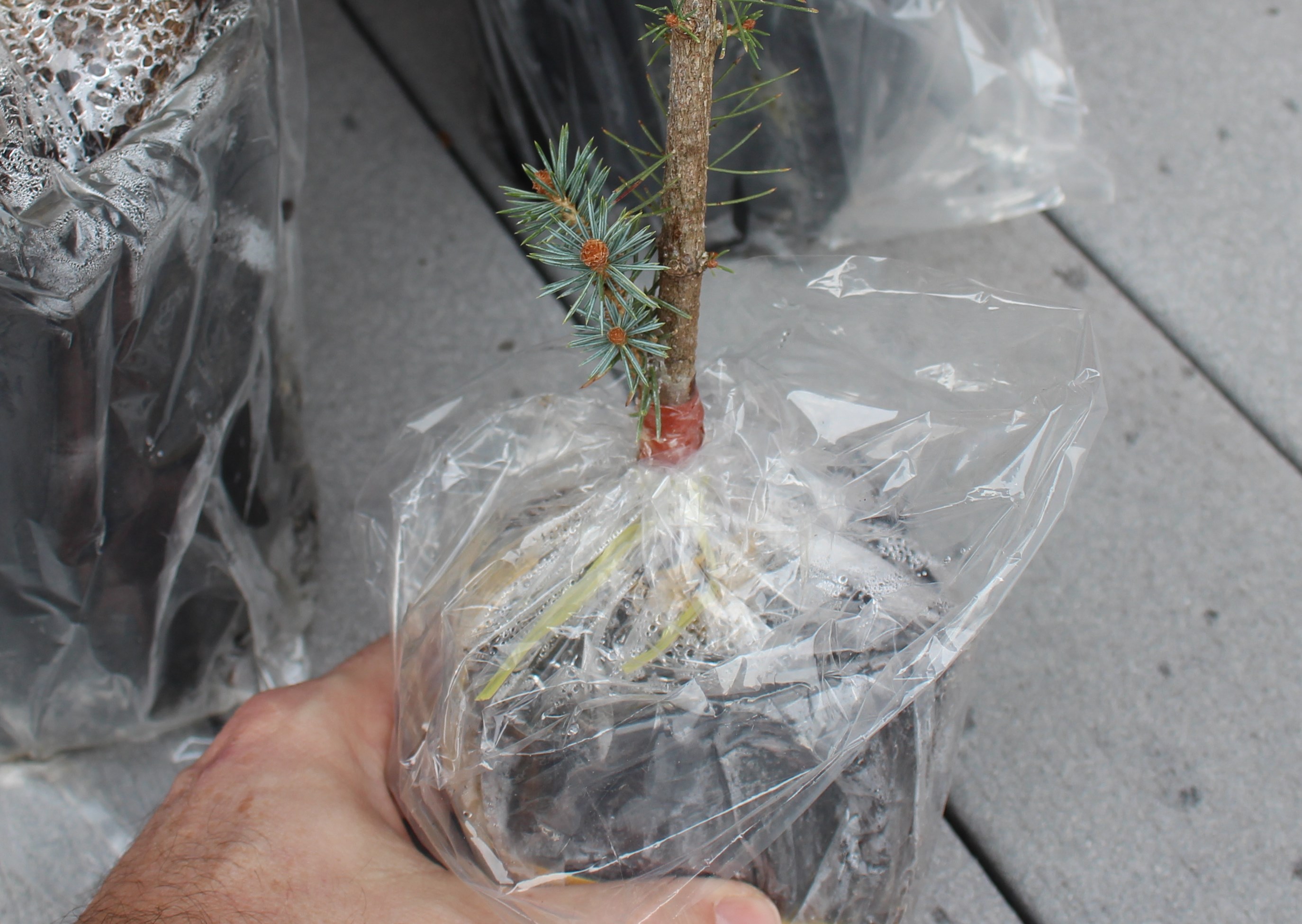
purchase Picea omorika 'Peve Tijn' graft

A free gift included in the order, you can easily see where this dwarf Picea omorika ‘Peve Tijn’ (Serbian spruce) was grafted onto the rootstock.

There’s a reason you can pay through the nose for many of these treasures.  Two of my purchases are 1 year old grafts and really don’t look like much yet,  but that’s because they start life as run of the mill conifer seedlings grown on for a few seasons and then a small bit of the desired cultivar is grafted onto the stem.  Once the graft puts on some size (a slow process at an inch or so of growth each year), the original seedling is cut off and the new plant takes over.

purchase Picea pungens 'Walnut Glen' graft

Dare I say I spent nearly $30 on this little spit of conifer? It’s picea pungens ‘Walnut Glen’, a blue spruce which develops a yellow tinge in the winter. I expect great things form this little guy!

So how’s that for a foliage post?  A November report which speaks of excitement, hope, and anticipation for the future!  Not bad considering the weather, I just have my fingers crossed that I don’t have to re-title this to “That Was Stupid” in another year 🙂
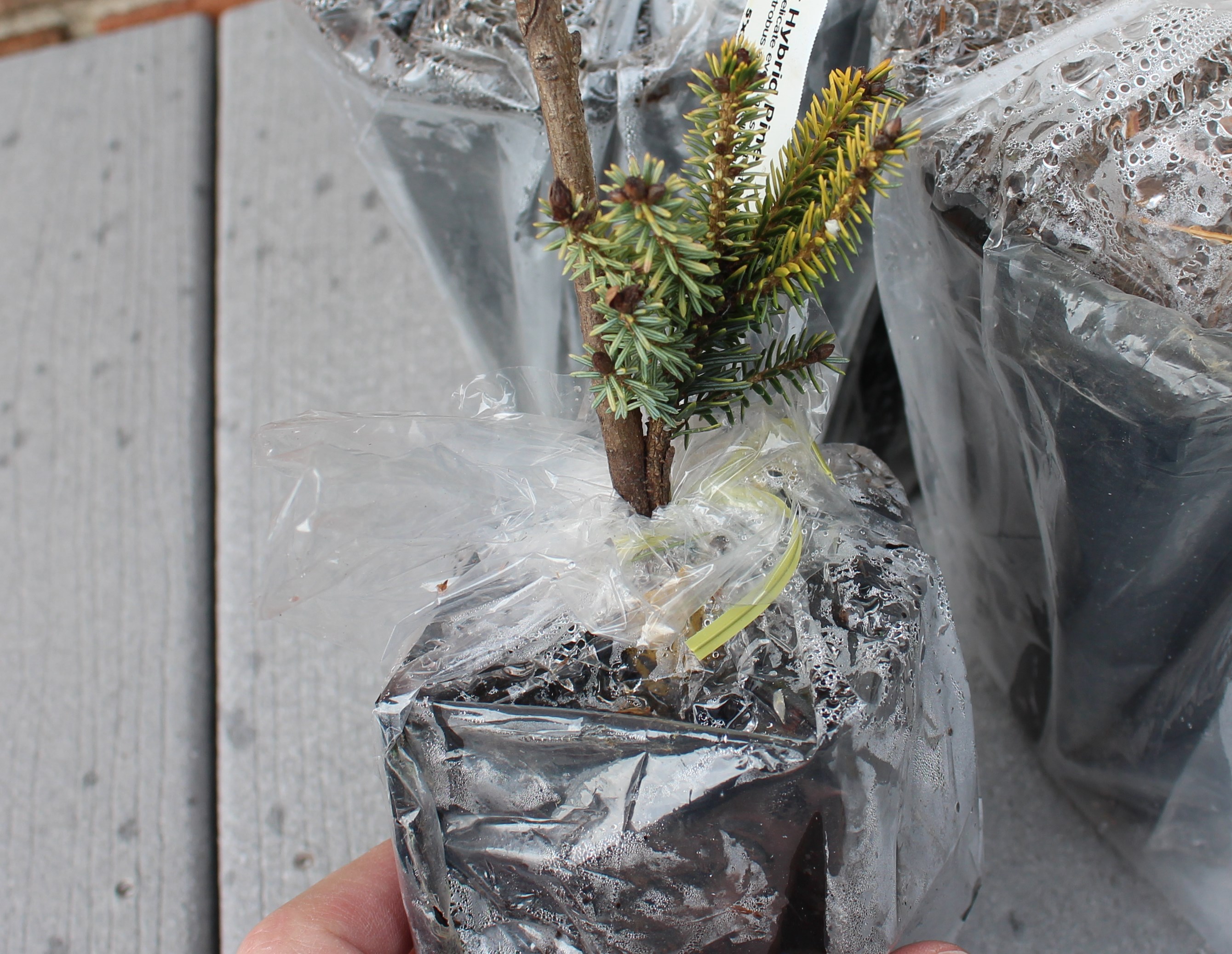
If you’d like to see what foliage is contributing to other gardens across the globe pay a visit to Christina’s blog “Creating My Own Garden of the Hesperides“.  I believe you’ll find some bloggers who are enjoying good foliage now, and not just in their dreams for the future!