Planting Fields in March

I took a quick trip out to Long Island NY last weekend and since it was just me in the car it was a very brief back and forth before the decision was made to sneak in a garden visit.  Planting Fields Arboretum in Oyster Bay, NY was the choice.

florist cineraria pericallis bedding

I didn’t know florist cineraria (apparently called pericallis these days) would be hardy enough to go outside already, but they were and they looked great in front of the annex building to the main greenhouses.  Dark centered daisies are a favorite of mine btw.  

I used to work ten minutes from this NY historical state park and obviously because of the greenhouses, plant collections, hundreds of acres of open land, plus a manor house, you know it was a favorite pitstop along the way to and from work, but I had already been visiting for a few years before that.  Over the years the visits have settled in to follow a traditional path, and that path nearly always begins in the main greenhouse.

planting fields main greenhouse

The Main Greenhouse at Planting Fields.  

What shows up in the main greenhouse depends on the season or the year.  Sometimes the beds are filled with delphinium or foxgloves, poinsettias, chrysanthemum, orchids… wherever the mood of the planting staff has gone.  This March it was overwhelmingly tropical.

planting fields main greenhouse

When you follow the outer path your way is completely enclosed by tropical shrubs, palms, trees… oranges overhang and starfruit grow alongside bunches of bananas.  I believe in this photo we are looking up into a Bismarck palm. 

Radiating off the Main Greenhouse are several grow houses which back in the day served to supply the estate’s cut flower supply.

planting fields orchids phalaenopsis

Several greenhouses are devoted to orchids.  On this bench part of the phalaenopsis collection was still putting on their late winter show.

Back a few years ago, more of the greenhouses were accessible but today there are still at least six of the side greenhouses open for visitors, and you can always find plenty to see.

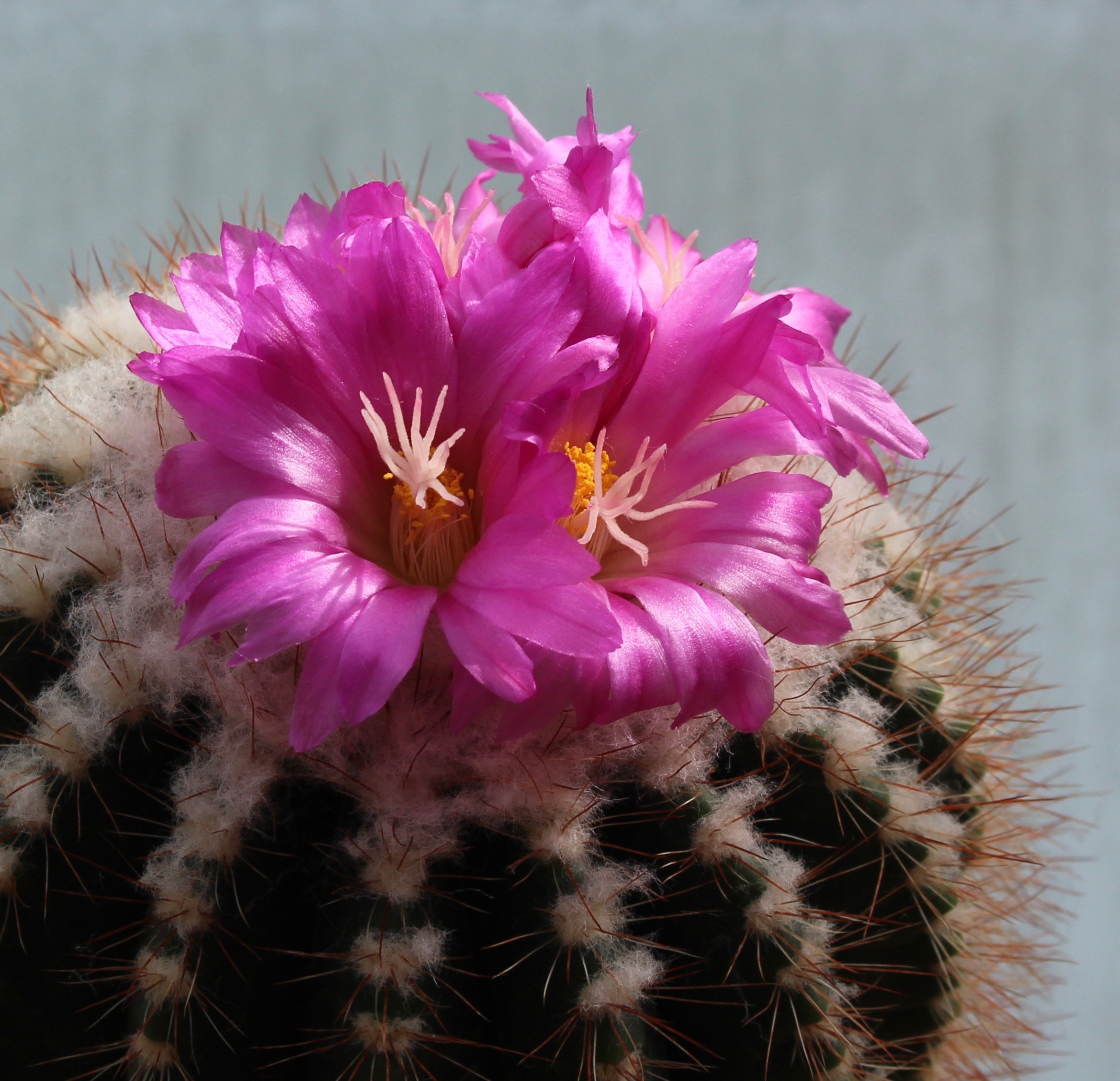
planting fields cactus

Agave are always cool.  Not so much fun to touch, but to see them growing in someone else’s warm, dry greenhouse just as we’re breaking out of winter… 🙂  
planting fields cactus

There’s always something special in the cactus house.

I seem to remember one of the greenhouses being a fern house.  Imagine my surprise when these bright, tropical rhododendron greeted me through the next doorway instead.

planting fields rhododendron vireya

A few vireya rhododendrons in peak bloom.

Vireya rhododendron represent a section of rhododendron which hail from the tropics of Southeast Asia.  As you can see, out of the couple hundred species there have been quite a few exceptionally showy selections and hybrids.

planting fields rhododendron vireya

Just a touch of golden yellow.  It’s so bright it almost overwhelms the smaller species to the right.  Also, in case you’re wondering, my nose detected no scent although some say they’re remarkably fragrant.

planting fields rhododendron vireya

The spring sunshine made everything even better, but notice the mossy root ball behind those extravagantly ruffled ivory flowers.  Many vireya are epiphytes, and grow up amongst the branches of the tropical canopy.   

Sorry but I thought the vireyas were exceptional 😉   Next on the agenda was a short stroll over to the camellia house.

planting fields camellia house

Side view of the Planting Fields Camellia House.  This used to be shaded and blocked by massive beech and pines, but disease and storms can take a toll.

The camellia house (1917) shelters the largest collection under glass in the Northeast.  I believe I once read that Mr. Coe got a really good deal on a bunch of imported camellias and only later discovered that they likely wouldn’t be hardy in his new garden.  Build a new glasshouse was the solution!  In any case, this year I managed to catch the tail end of the show.

planting fields camellia house

Camellia ‘Captain Rawes’.  A small arching tree which used to be matched by another equally large tree on the other side of the walk.  I wonder how long its partner has been missing, they were always my favorites. 

Here’s a little 1996 NY Times article on the camellia house.

planting fields clivia

Although many of the camellia were over, the clivia were coming on strong.

The camellia house is another place which comes and goes.  Some years it’s a thicket of bloom and bush, other years it’s recovering from the occasional massive pruning these big plants need.  I guess this year was somewhere in between, still excellent of course.

planting fields camellia house

Southerners would probably pass right by this one, but here in the cold north these huge flowers made me smile.  Plus the brickwork and greenhouse doors aren’t all that shabby either.

A brief run through the grounds was the next requirement.

planting fields pool

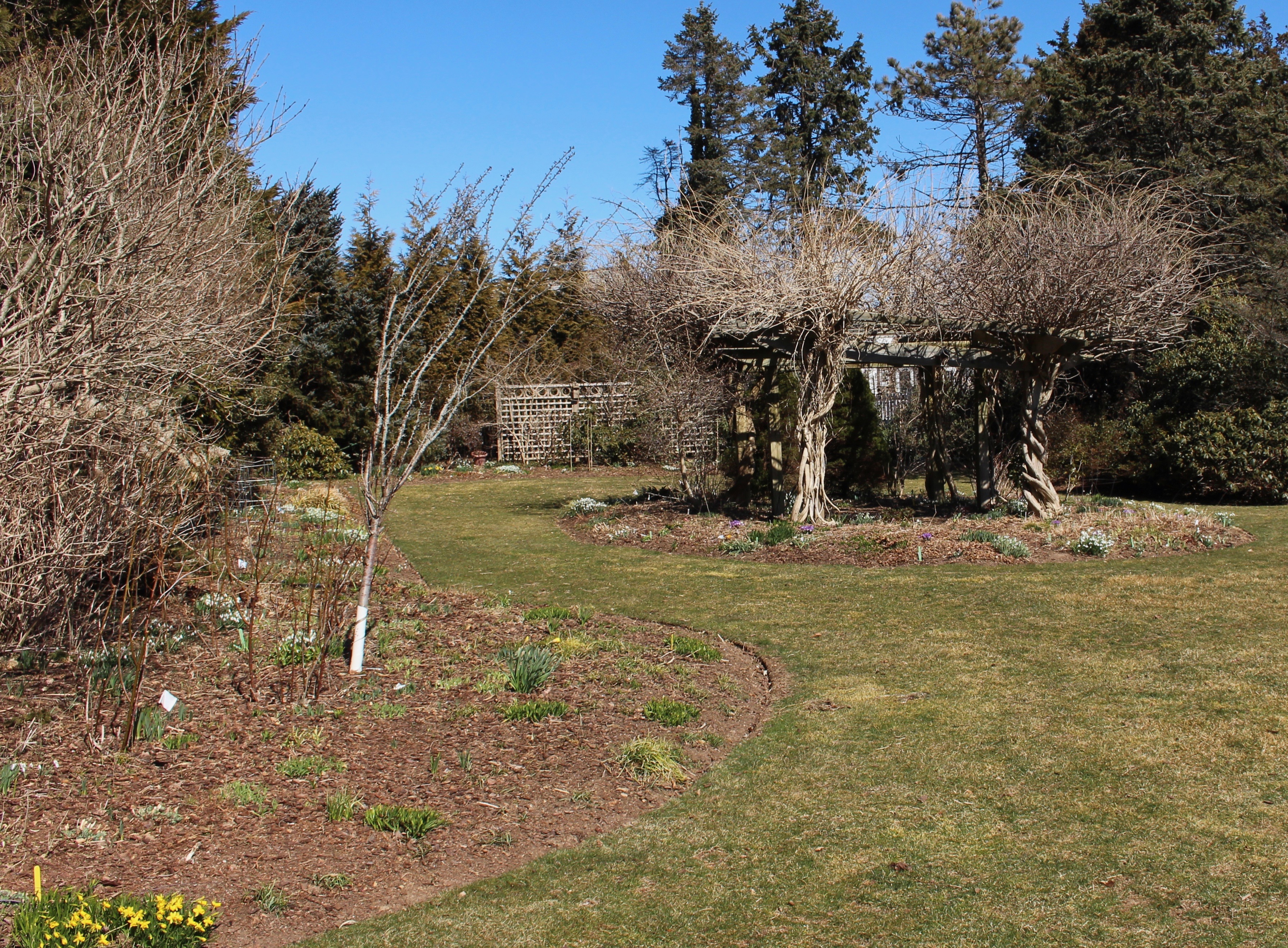
The mixed perennial borders surrounding the pool were still 100% sure spring had not yet arrived.

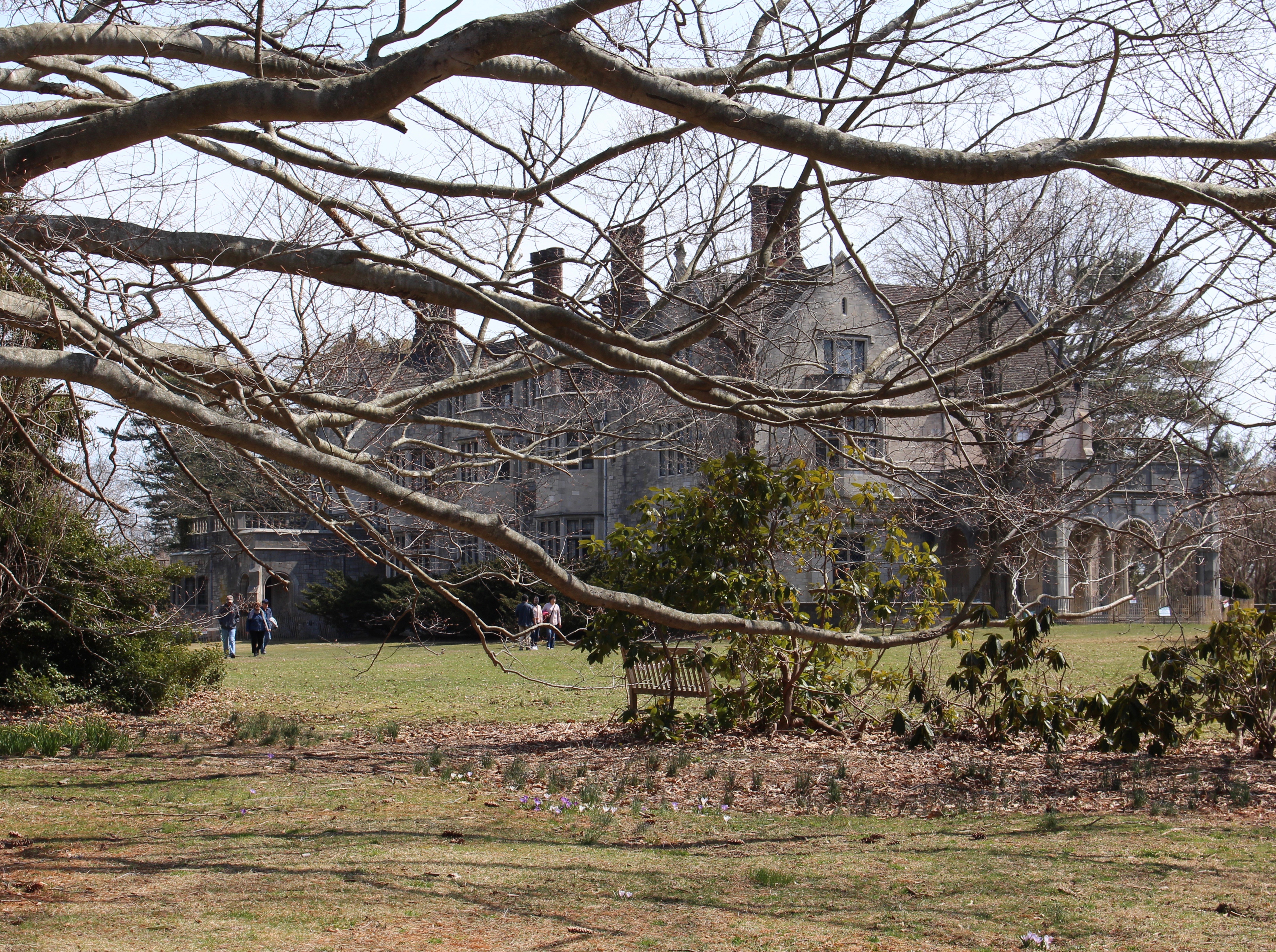
William Coe built Coe Hall as a residence, but his botanical collections and interest in horticulture had this former gold coast estate donated as a school of horticulture, and then preserved as an arboretum.  As such it’s filled with interesting things, and whether you’re just strolling or looking for specific plant goodies you can’t go wrong on a beautifully sunny March morning.
planting fields coe estate

Coe Hall beyond the branches of one of the remaining mature beech trees.  

I tried to get a quick visit in with all my favorites.  The giant sequoia trees were looking sad, as it appears fungus has finally caught up with them, but I was happy to see the odd monkey puzzle trees were still up to their usual monkey business.

planting fields monkey puzzle tree

Monkey puzzle tree (Araucaria araucana) in the sheltered high shade of the North rhododendron garden.  

The monkey puzzle is an exceptionally curious thing, and ranks as one of those living fossil trees which still keep chugging along as if the dinosaurs were still around to graze them.  Nowadays they’re confined to the Southern tip of South America but eons ago ranged across continents.

planting fields monkey puzzle tree

Spiny, sharp, and a puzzle for any monkey to climb, Araucaria araucana is not for everyone.  The foliage is cool though, and individual leaves can stay on the plant for decades.  Trees over 1,000 years old are not unknown.  

How can people not get excited about plants?  Beats me…

planting fields snowdrops

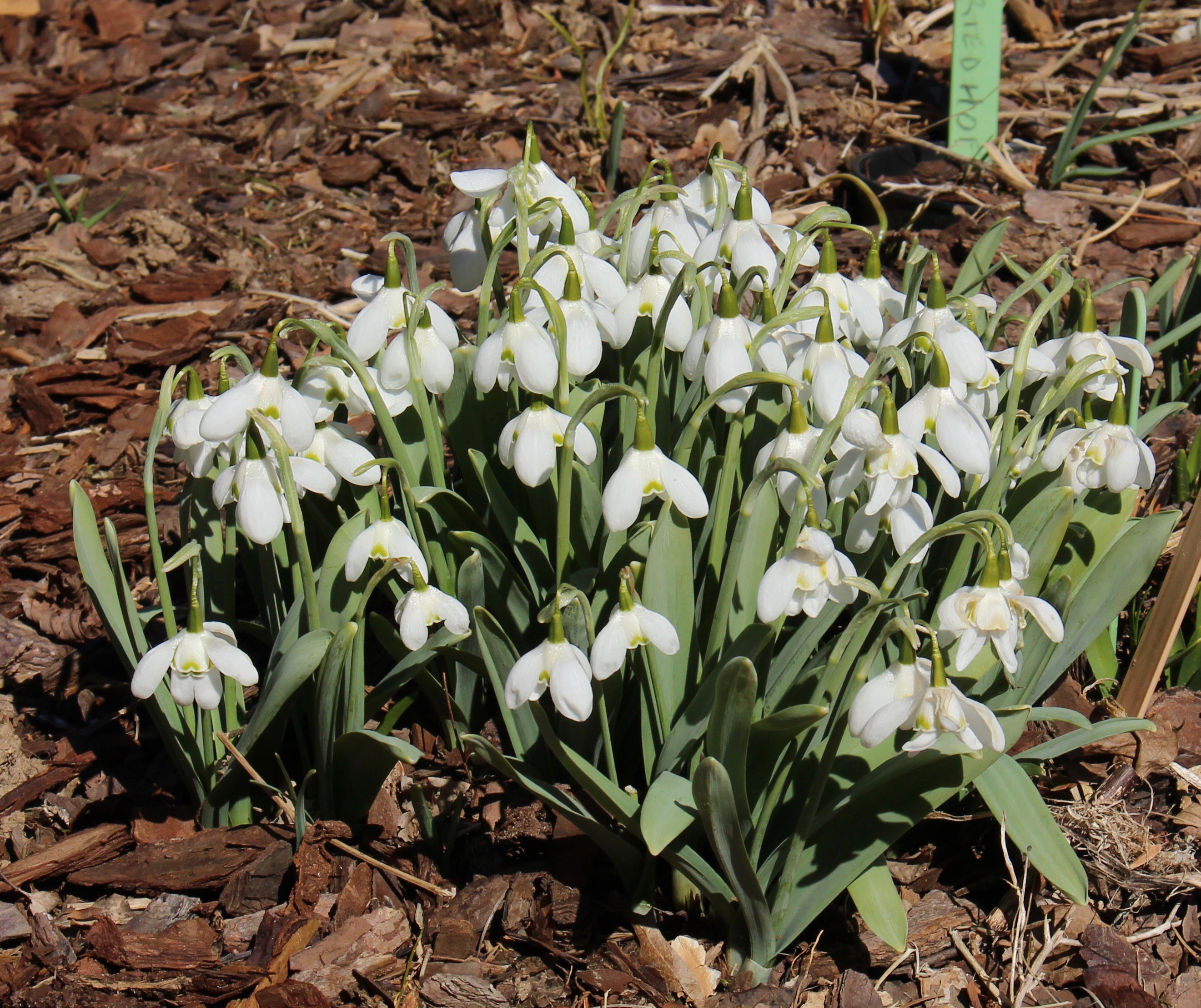
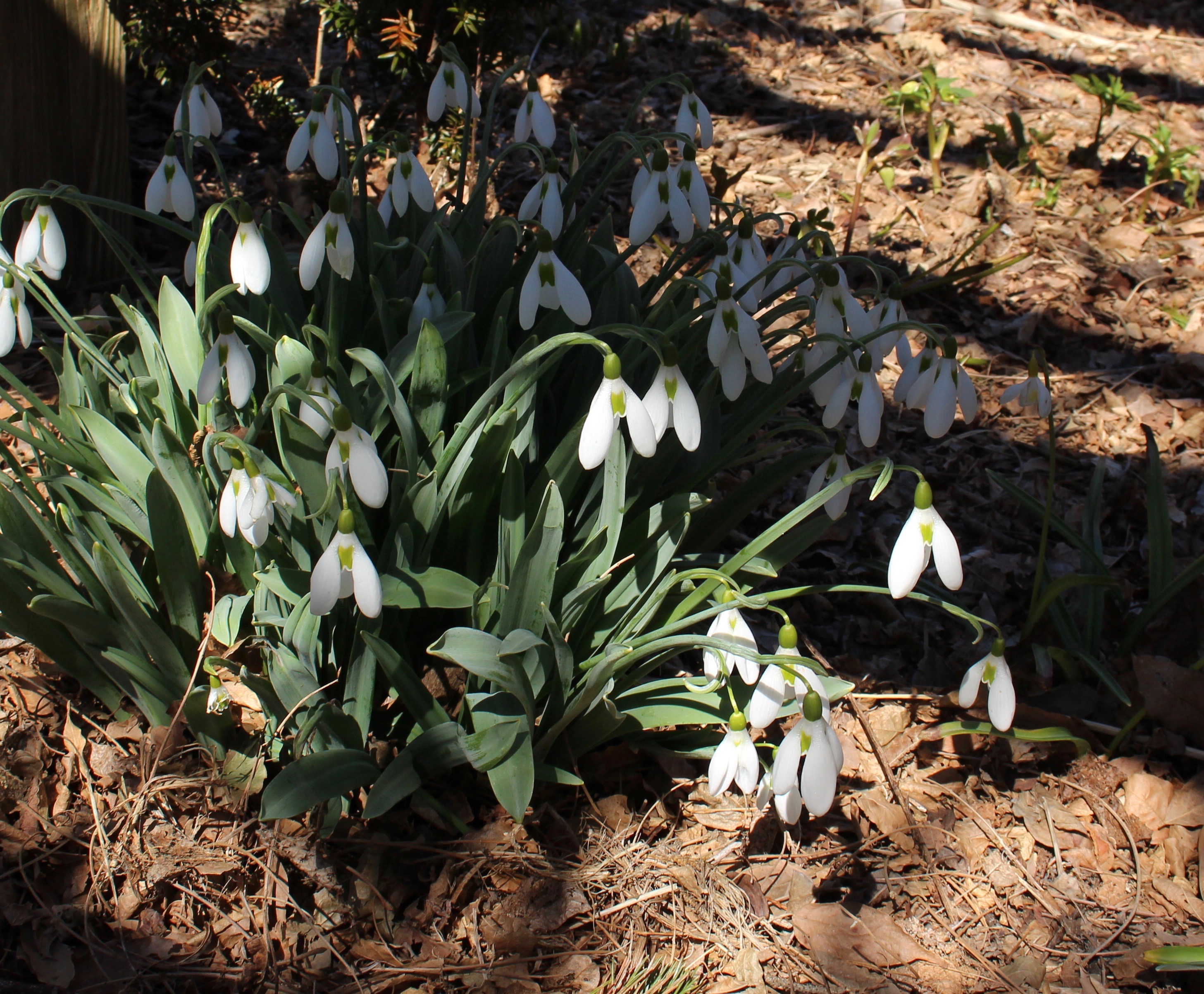
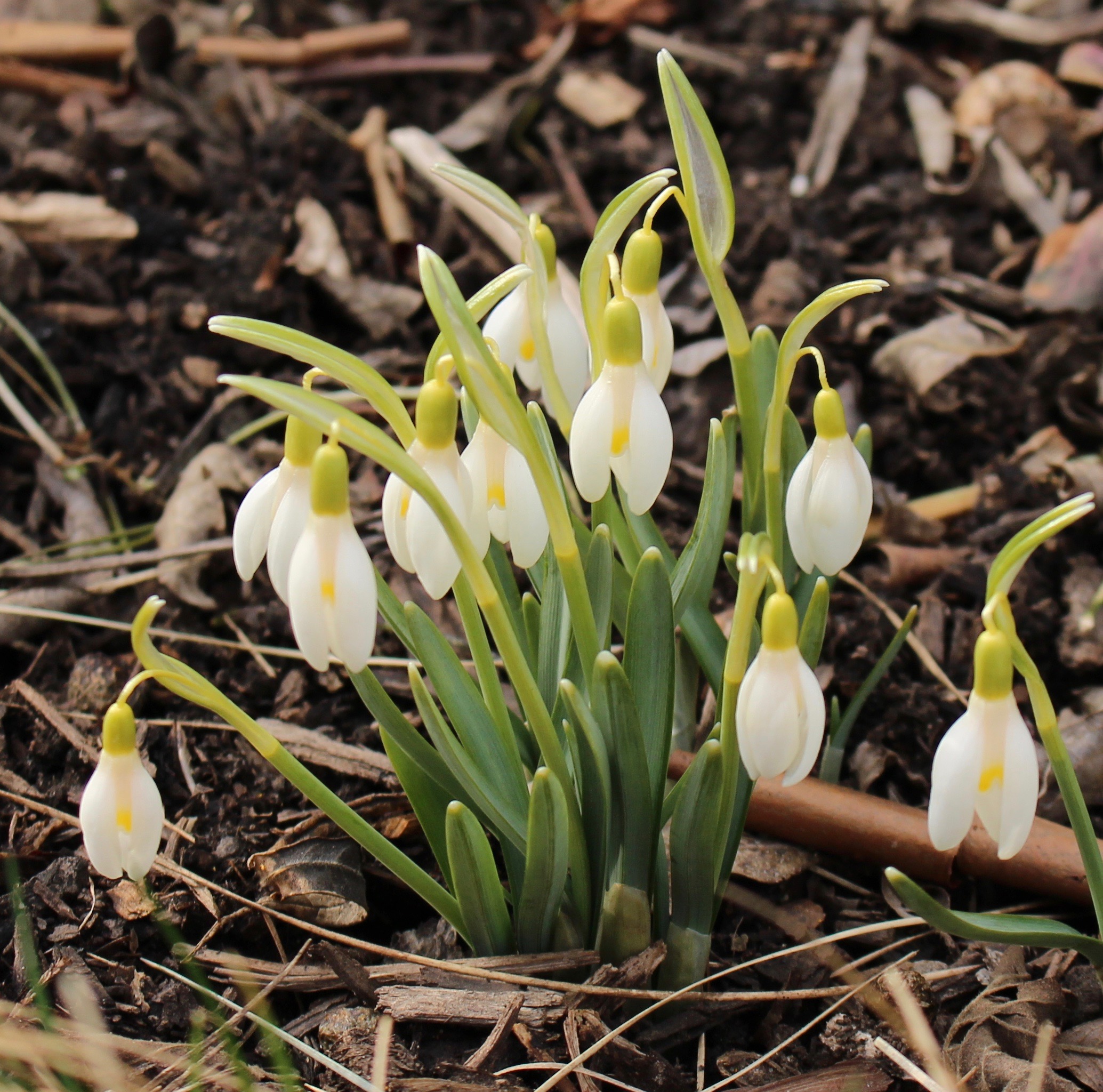
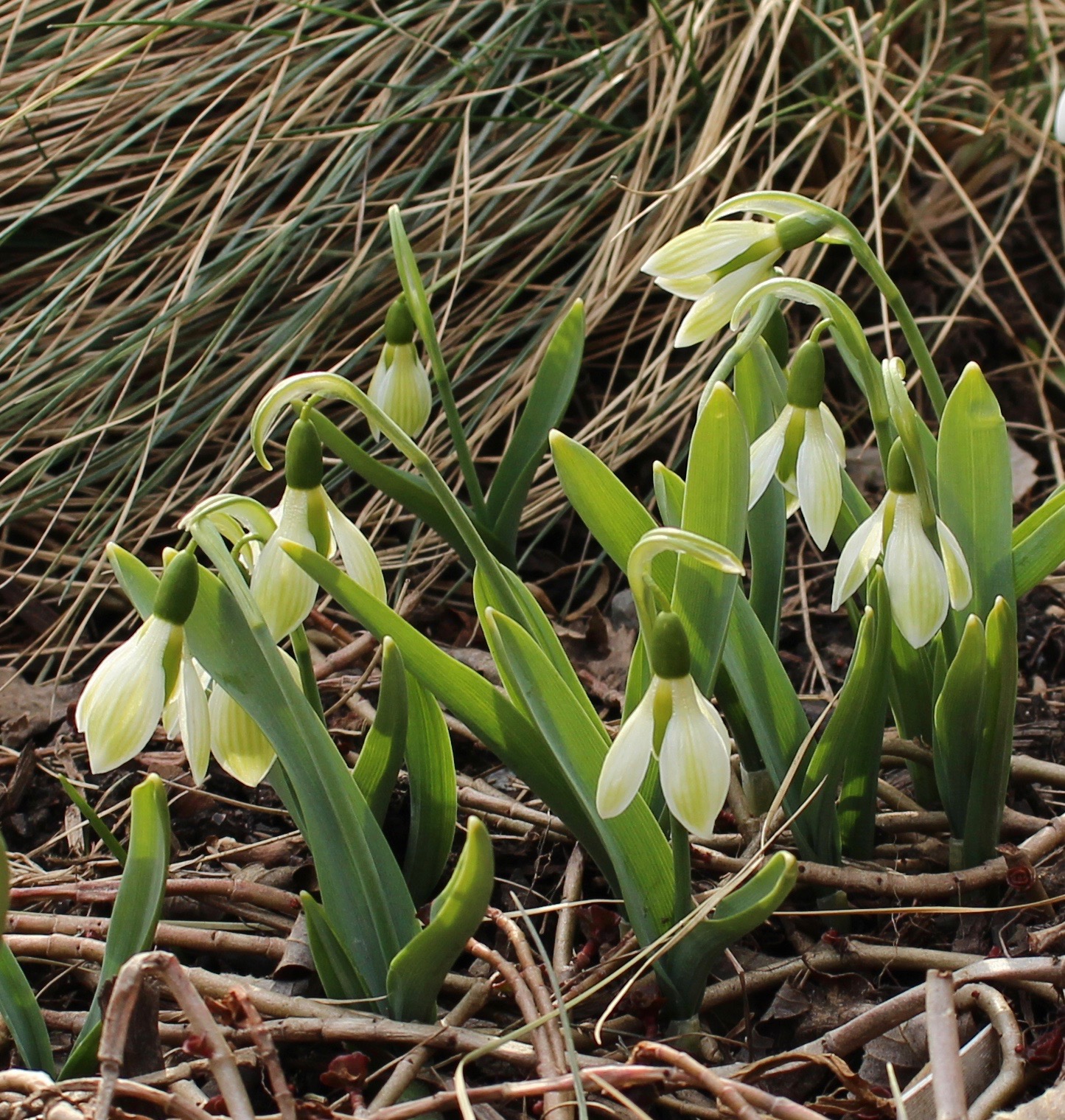
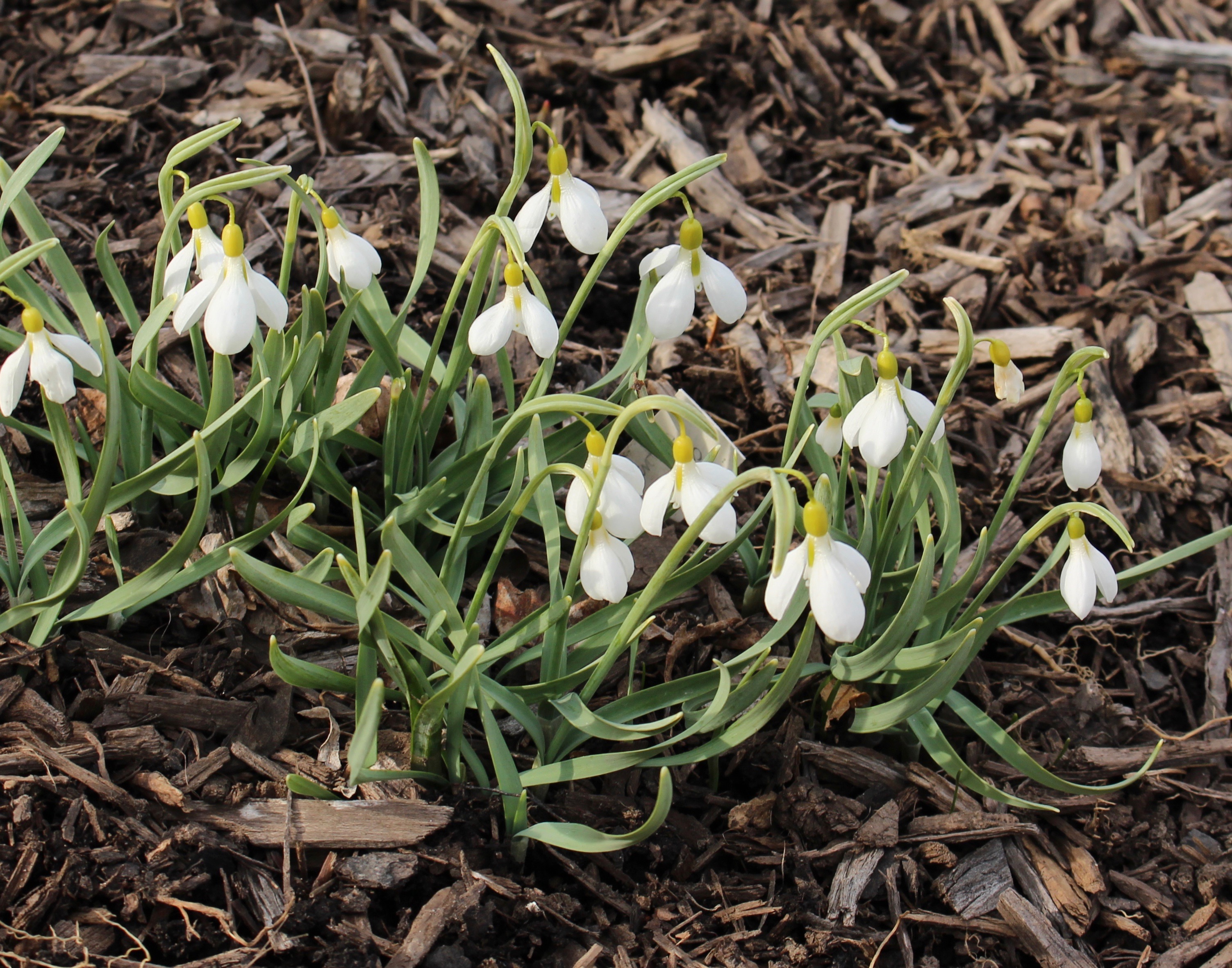
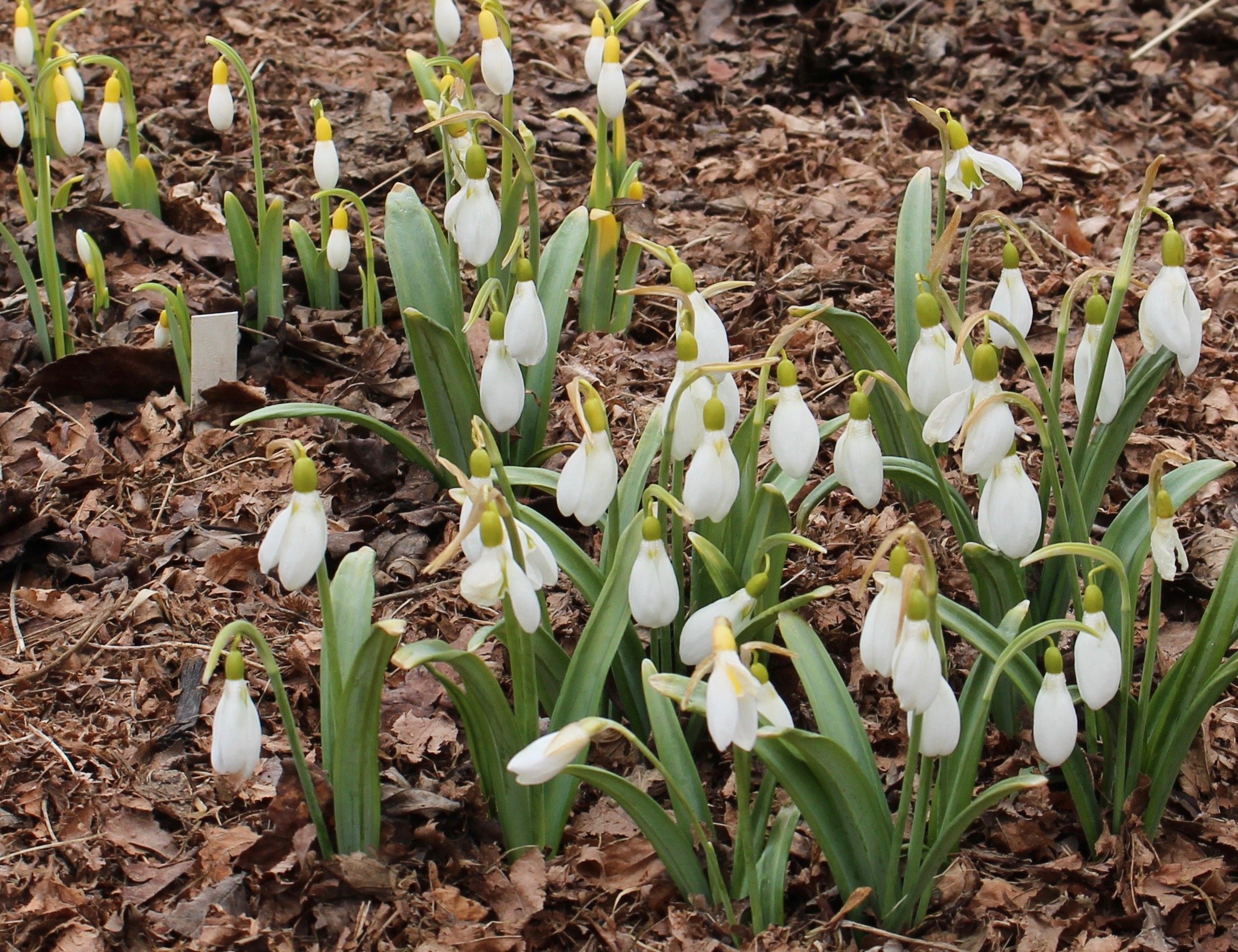
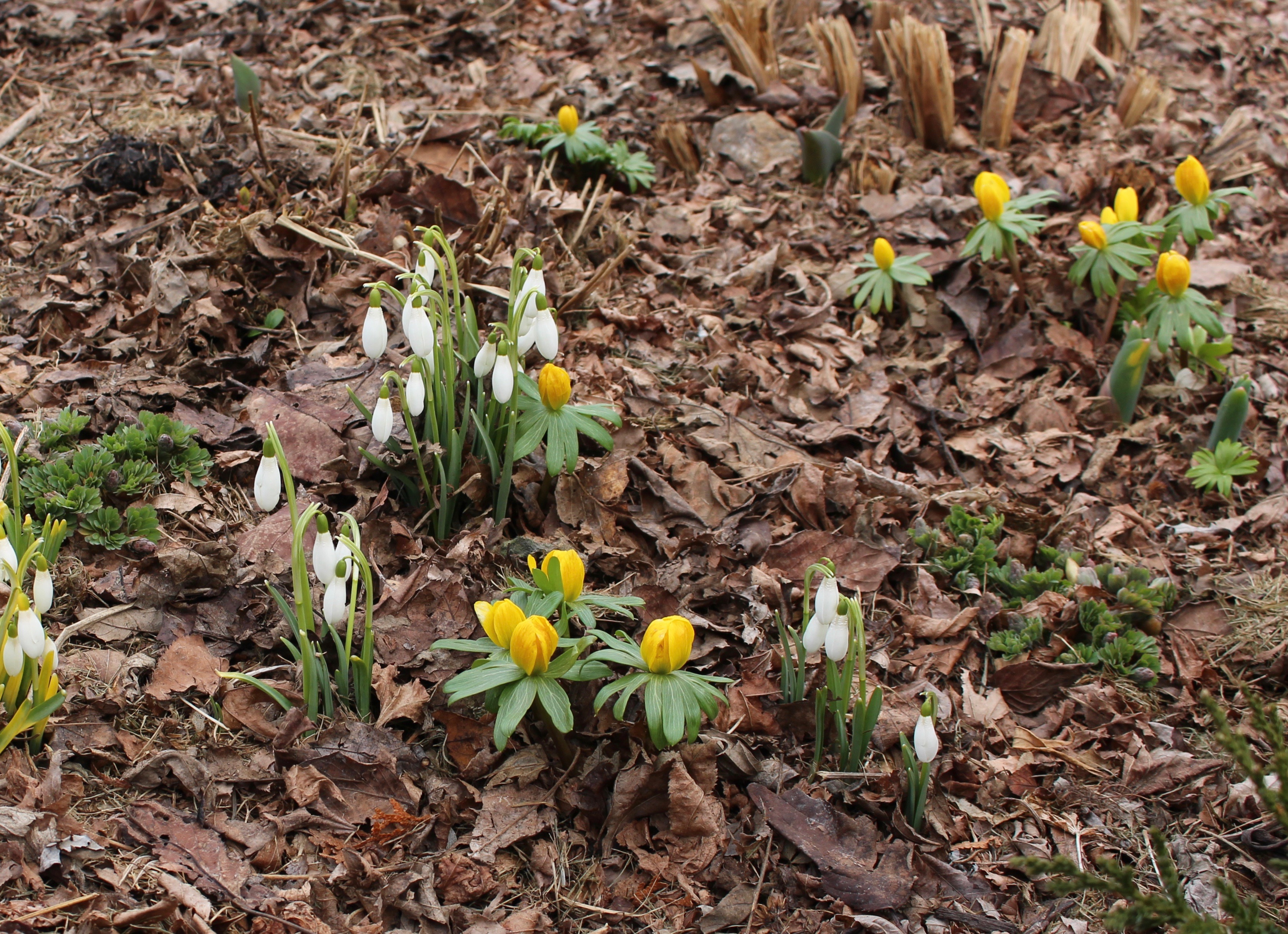
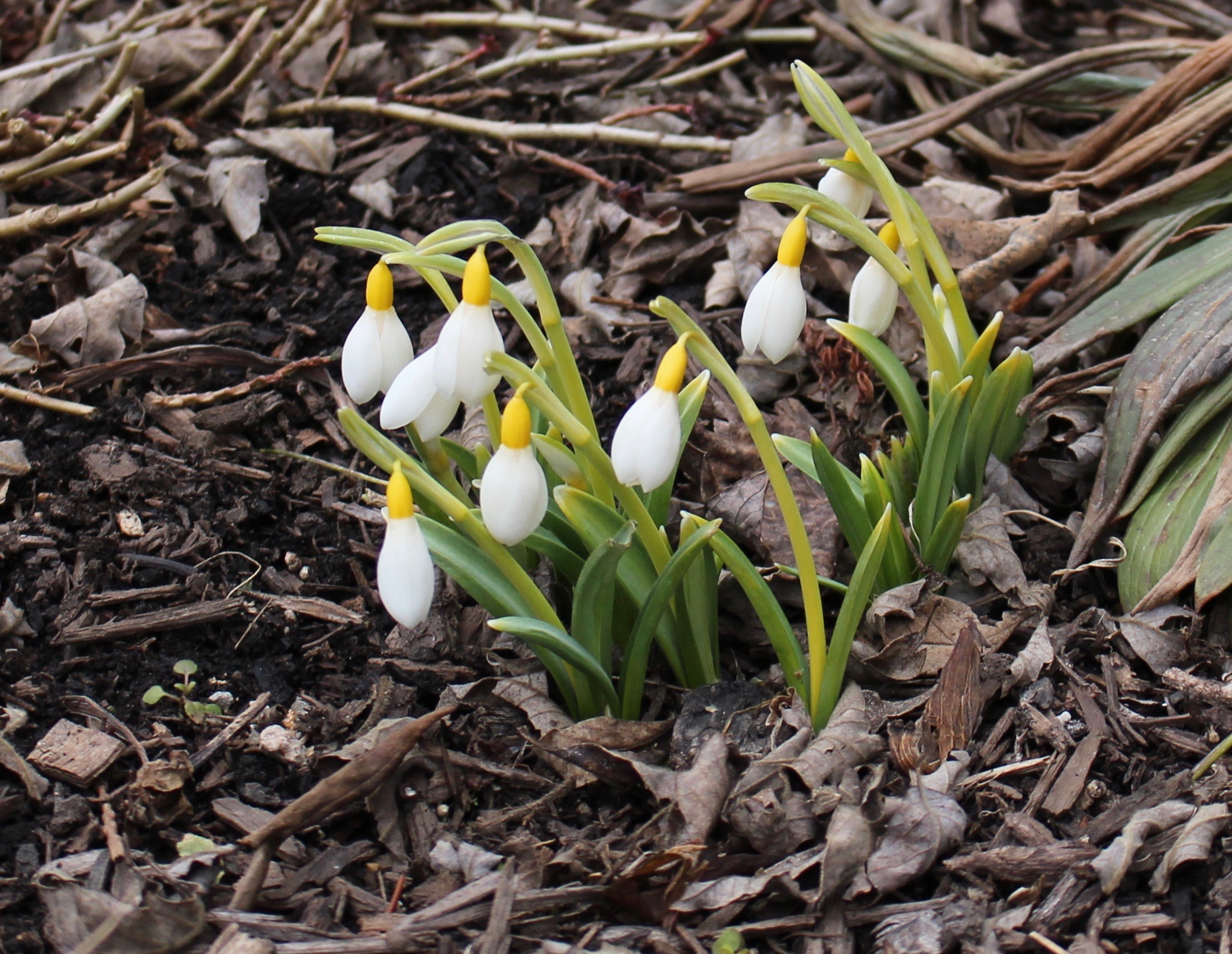
Of course I still found plenty of late season snowdrops.

So that was last weekend.  Maybe you can guess that in the week since I’ve been busy and/or lazy again, and if that’s a bad thing well at least on the good side it spares you from much of the rest of our snowdrop season.  It was an ok year in case you’re curious.  Too much wind, a lot of temperature ups and downs, and last year’s monsoons seemed to have been too much for many of the plantings, but hopefully the snowdrops which did come up  will be enough to last until next year.

We’ll see.  Have a great week regardless 🙂

Snowdropping 2019

Better late than never… and although Paula and I did meet up for a February greenhouse tour of snowdrops, that visit was a far cry from our traditional all-day snowdrop adventure.  Fortunately we were able to get one in.  This trip was a check off the bucket list, and it involved a four hour drive in a completely different direction,  with us getting out of the car just short of the Eastern tip of Long Island, NY.  Understandably my wife told us several times we were crazy (although she did use slightly different terms).

galanthus david baker

Treasures tucked in under the shade of a southern magnolia.  Galanthus ‘David Baker’ sits next to what I think is a golden variegated sweet flag (Acoris gramineus ‘Ogon’).

We had been hoping to visit this garden for a few years now, and the more sane version started with me heading East for a visit with my parents, Paula driving out the night before, a one hour ride to the garden in the morning, and then wherever the weekend leads after that.  Of course other obligations interfered and once again the plan didn’t work out, but our host was exceptionally accommodating and so was the weather, so tally-ho!

snowdrop garden

Snowdrops were peppered everywhere in this mostly sunny garden.  Our host kind of confessed he’s pushing several hundred cultivars, so ‘everywhere’ does end up being a necessity!

This was the garden of a true galanthomaniac but still remarkably balanced.  Roses, perennials, evergreen plantings, interest for all seasons but still space for tons of galanthus!

galanthus green tip richard ayres

Not the best photo, but I do like galanthus ‘Green Tip Richard Ayres’.  I like it a lot.

This is a garden where the majority of snowdrops were planted in pond pots, a plastic mesh pot used for aquatic plants, but also embraced by serious snowdrop growers as a way to cram tons of cultivars into a small plot yet still be able to lift and divide and find bulbs easily.  Even when the dormant bulbs show nothing above ground.  It makes a lot of sense and the results do speak for themselves.

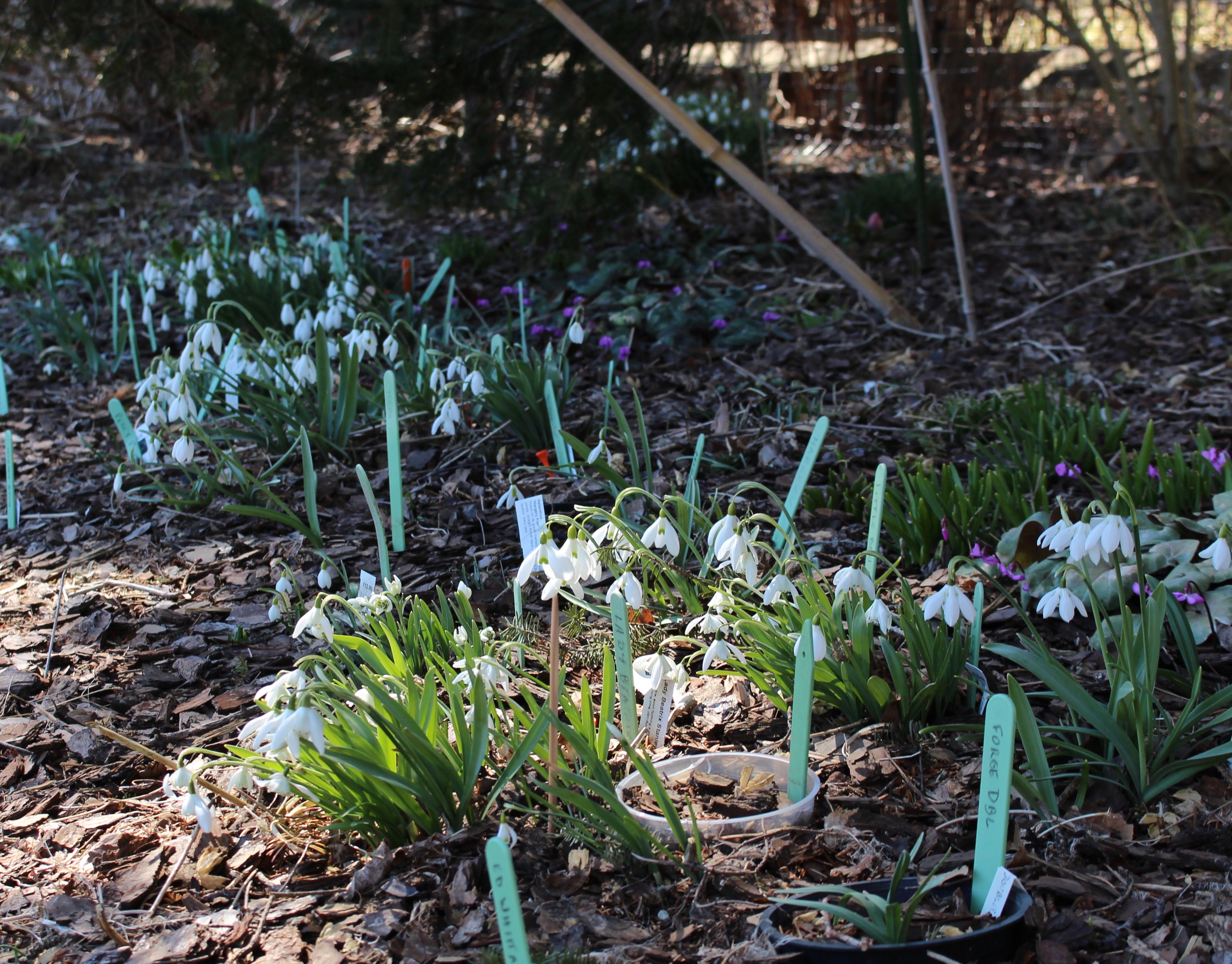
galanthus godfrey owen lady beatrix stanley little ben

The shade of conifers is usually not good at all for spring bulbs, but on the edge of a sunny lawn with just a few sheltering boughs above, galanthus ‘Godfrey Owen’, ‘Lady Beatrix Stanley’, ‘Little Ben’ and others, are all quite happy.

Although I won’t use the word obsessive, this is absolutely a collector’s garden with a careful inventory and organized labeling and placing.  You kind of need that when the numbers start adding up.  The plantings may appear to spread casually throughout the garden but you will notice (even faster when your host points it out) that there’s another brilliant quirk of order.  From one area to the next, all the plantings are organized alphabetically.  ‘Dodo Norton’ follows ‘Danube Star’ while ‘Dracott Greentip’ sits just to the right.  It would make an OCD heart sing 🙂

galanthus natalie garton chris sanders

Galanthus ‘Natalie Garton’ (aka ‘Chris Sanders’) soaking up the March sun at the edge of the rose garden.  Note the brown label off to the right, that’s our host’s sign that this clump is marked for digging, dividing, and sale(!) this summer.

I’m going to guess that years ago this gardener realized that when collecting, you can only really hold on to so many of any given cultivar.  You can also only trade and give away so many, so for several years our host has taken to offering a few (actually quite a few) each year for sale.  I’m going to foolishly direct you to >my snowdrop page< for contact information (scroll down about halfway to ‘snowdrop sources’ and you’ll see him listed by name)… although the selfish side of me is hoping you don’t beat me out to my favorites, and leave me with the leftovers since it sells out fast.  While you’re requesting a list you may also wish to ask him about getting email updates from his annual UK trip each spring.  It’s a fun narrative of an A list of snowdrop events and personalities from overseas, and will help you steel through the last few weeks until our own season takes off.

snowdrop garden

Round the house another garden filled with snowdrops 😉

I’m sparing you from most of the endless stream of individual photos, but there was one more snowdrop which really stood out for me.  Under the pergola a monster clump of elwesii caught my eye even from across the garden.  Well over a foot high, with wonderfully large flowers that still held a classic grace, this was one more snowdrop for my growing list of favorites.  I don’t know what the plans are for this one, but I made sure to drop plenty of hints that I’d like to be on the waiting list!

Galanthus elwesii under the pergola. Sorry about the lighting, but as you know I’m more enthusiastic than skilled.

I hope I pre-warned our host sufficiently that we would surely overstay our welcome, but even after two hours plus of garden wandering he still graciously extended us an invitation for tea.

snowdrop garden

Our host wisely excused himself midway to get some inventorying done while we photographed, but we found him anyway and the warm shelter of the juniper hedge made for a perfect spot to enjoy snowdrops and sun while talking galanthus.

I love a late winter garden visit where the sun is strong and the lawn is dry, and it’s ok to just sit there and take it all in.  Of course the close up quarters to so many snowdrops added a few more favorites to the list, but what I really enjoy is hearing the stories and getting the advice and coming up with new plans.  We were really spoiled on this trip 🙂

galanthus bernard rohlich

Ok.  One more, Galanthus ‘Bernard Rohlich’.  Note the brown label, hopefully my budget can handle this one!

So finally it was inside for tea, which we probably overstayed as well, and then out the door.  Our host was still kind enough to offer us more garden-wandering time but a long drive home was hanging over our heads.  We headed out to the car but not before one last pause to admire all the galanthus ‘viridapice’ clumping throughout the garden.  If I remember correctly these were the drops which started most of the obsession in this garden.  A pack of bulbs simply marked ‘snowdrops’, and thirty years later (and a lot of luck to get such a nice form of viradapice in that pack!) and the garden has drops all over.

galanthus viridapice

Just one of many, many healthy clumps of galanthus ‘viridapice’ growing throughout the hedges and woodland plantings of the garden.

After we said our goodbyes we began the journey back west.  Of course there was a side-trip.  With 40 minutes to go till closing we popped into the Bayard Cutting Arboretum for a quick run through the snowdrop highlights of this former estate, present day NY State park.  It’s an old manor house property which dates back to the late 1880’s and recalls Long Island’s history as an escape for the rich and famous of NYC.

bayard cutting arboretum

“Westbrook” overlooking the Connetquot river and estuary as it leads out to the Great South Bay on Long Island’s South Shore.

This arboretum was one of my favorite off season destinations while growing up.  The coastal air and sun would usually keep the walkways clear of snow and ice, and the pinetum plantings and many paths and trails were always a nice outing.  Since I’ve already mentioned I was a little weird as a child, I don’t think it will surprise anyone that I knew where many a snowdrop patch was located.

naturalized snowdrops galanthus

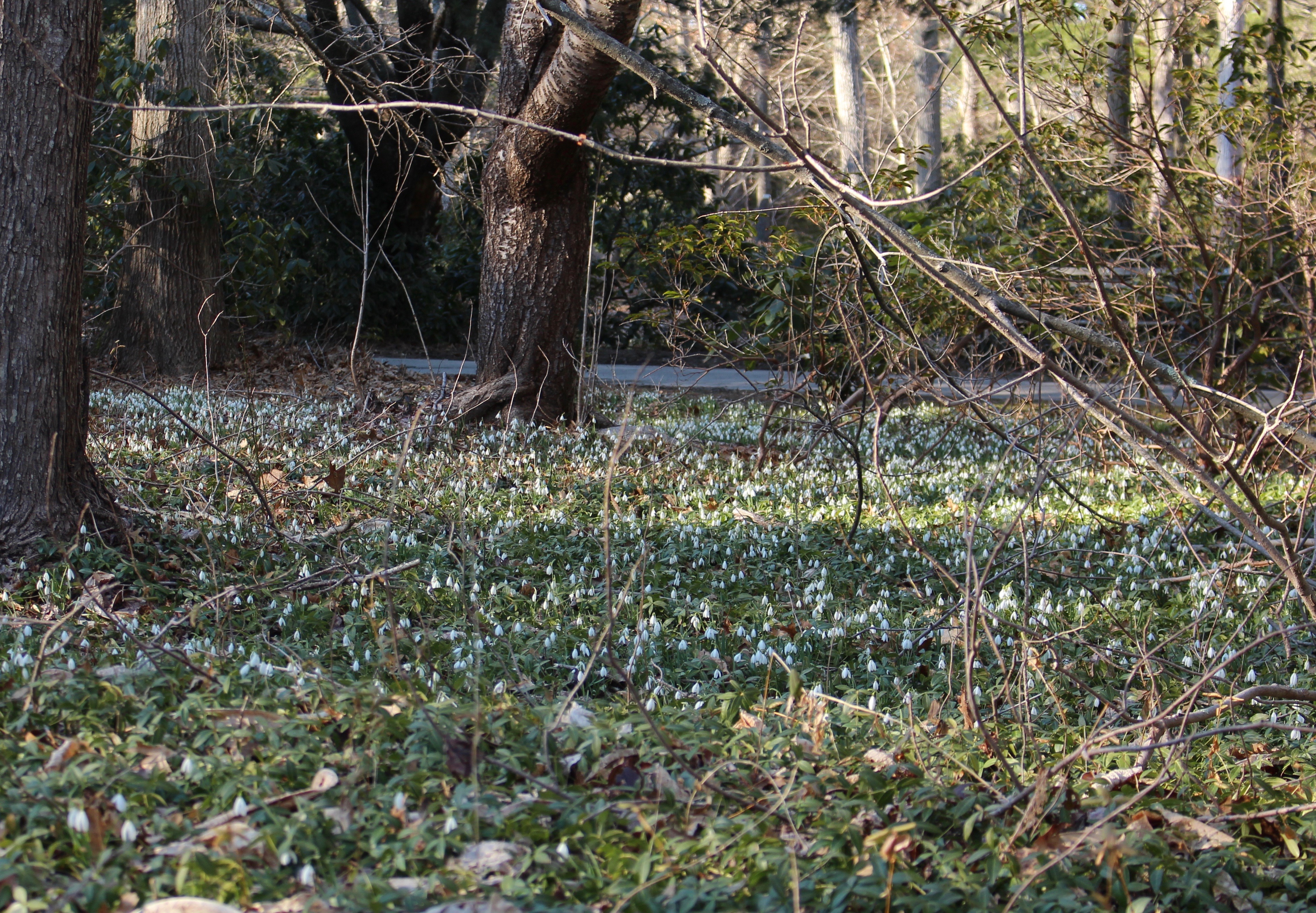
Naturalized snowdrops (galanthus nivalis) filling in amongst the vinca minor.

We were quite satisfied with this stop.  Not to date myself but over the decades many a change has come through here.  Hurricane Gloria in ’85 was probably the worst when it wiped out an awesome hundred year old conifer collection and closed the park for months, but saltwater flooding from Sandy in 2012 seems to have done in my favorite patch of giant snowdrops (g.elwesii).  Still it’s a wonderful spot which I’m happy to see protected and accessible.

bayard cutting arboretum

A maintenance moneypit I’m sure, but the Tudor style with awesome shingling and crazy chimneys puts the approaching worm supermoon to shame.

But even our epic adventures have to heed reality, so back on the road to drop Paula off at her car and then part our ways.  I still got a couple hours in with my parents (and of course a garden tour!) before hitting the road but it was still a satisfyingly long day even with the late night drive home.  I will recommend it to all crazy galanthoholics 😉

Thanks again to our host for a very enjoyable visit, thanks Paula, and here’s to hoping our latest drop of snow (the real thing, not flowery kind) melts quickly and I can get out again and enjoy the snowdrops here.  Have a great weekend!

Snowdrops, Quickly.

Of course my life gets stupidly busy just when the local snowdrop season starts, but how can I complain when each day brings new blooms?  Thursday and Friday were warm and that’s just what these snowdrops were waiting for.

galanthus blonde inge

Galanthus ‘Blonde Inge’ on her first day out in the sun.  She’s still a little pale but her yellow inners just glow in the afternoon light.

For those who yawn at the sight of more mostly white, always tiny flowers I apologize.  I’m in a rush, but I’ll still take the time to be that guy at the party who goes on way too much about something he’s already told you a million times before.  I can’t help myself and even the half hearted ‘uh-huhs’ and sideways glances won’t be enough.  Such is the curse of the galanthaholic.

galanthus rosemary burnham

Galanthus ‘Rosemary Burnham’ starts out tiny, but gets a little bigger as each warmish day passes.  For some reason I don’t think she’s as green as usual this spring but still a beauty.

For the next few days the weather looks perfect for bringing on the main season of snowdrops.  Here in my part of America, snowdrop season is often a real up and down thing, with none of the gentle transitions which mark more moderate climes.  Some types take it all in stride, such as this Galanthus gracilis which a friend brought back for me after a spring visit to Nancy Goodwin’s Montrose Gardens.  It comes up early and for the most part shrugs off even the worst ice and cold.

galanthus gracilis

Galanthus gracilis with its trademark twisted foliage.  It’s growing like a weed here in this dry, sunny spot alongside the front walk, but the exposed spot does seem to yellow the flowers a bit.

Not everyone takes the weather in stride.  Just a week ago temperatures dropped down into the single digits,  snow and ice were all over again, and some of the more exposed drops took a hit.  I’ll spare you those pictures but here’s one that’s not too bad, of ‘Gerard Parker’ growing in the front border.

galanthus gerard parker

‘Gerard Parker’ with a few singed blooms and burnt tips.  Still nice enough, but notice ‘Primrose Warburg’ coming up in back with perfect flowers.  Primrose is just a little later and missed the worst of the weather, and Gerald might have to go back to a more sheltered position.

As I work out which drops get to fill in the front street border the yellow winter aconite (Eranthis hyemalis) are working hard to fill in on their own.  It may take more time than I have, but someday I hope to have sheets of yellow and white filling this part of the yard.

snowdrops and winter aconite

Year by year the snowdrops (G. nivalis) and winter aconite fill in.  Hopefully I didn’t put too much mulch down for this year’s crop of seedlings to come up through.

‘Nothing Special’ might be a good choice for the front border.  It’s a strong growing beauty which seeds out a bit as well and I’m sure as a taller snowdrop it might compete better with the winter aconite than the little Galanthus nivalis which are there now.

galanthus nothing special

Galanthus ‘Nothing Special’

So much for quickly, eh?  Speaking of snowdrops and how some are not good competitors here’s ‘Norfolk Blonde’, a tiny pale thing which might be my favorite thing this minute.  I’m just so pleased that it came back a second year and didn’t fade away into the growing heap of snowdrops I regret losing.

galanthus norfolk blonde

The petite ‘Norfolk Blonde’.  I had to prune a few leaves off the cyclamen to keep it from overwhelming my little darling.  You’d judge me if I said how much I paid for this one, especially considering she’s easily doubled in size from last year!

I’ll leave off on an amazingly vigorous drop which a friend gave me two years ago.  It’s considered a cross between two species (elwesii x nivalis) and in its second year it’s already forming little clumps.  I love the foliage and it’s a heavy bloomer as well.

galanthus elwesii x nivalis

Another contender for drift status, this Galanthus elwesii x nivalis hybrid will hopefully continue to multiply and flower strongly over the next few years.

As you know I could go on and on, but it’s bed time and I’ve got a snowdrop adventure planned for tomorrow morning.  Fair warning that there will be more pictures and way more snowdrop talk, so feel free to tune me out until April if need be.

Like the Little Train That Could

I have faith in March this year.  I think he’s a changed month and there will be none of the shenanigans he usually throws our way in terms of weather extremes and spring crushing snow loads.  I think.

snowdrops and winter aconite

Up by the shelter of the front porch, this clump of snowdrops and winter aconite are always first in bloom… even if for only a few hours between snow melts…

It’s only just the first week of course, and this optimism is based entirely on the few hours between Saturday’s snowfall melting off, the sun coming out, above freezing temperatures for just three or so hours, and then the next snowstorm rolling in Sunday afternoon.  I was quick to run out though and take a few pictures while the flowers were also feeling optimistic.

hamamelis diane

I went ahead (perhaps foolishly) and planted out the new witch hazels in whatever decent, unfrozen, spots I could find.  This is ‘Diane’ crammed into a spot close to the street.

Most of the garden is still fully winter, but if I crop out the patches of snow and focus on the few patches of early snowdrops, winter aconite (Eranthis hyemalis), and witch hazels, well I guess you can have a little hope for spring.

hamamelis barmstedt gold

Hamamelis ‘Barmstedt Gold’ a little further down the border with the earliest snowdrops to appear in the open garden.  ‘Gerard Parker’ is the name of the snowdrop in case you’re wondering, and yes, I still need to do a little cleanup here…

This is the time of year which consists of me shuffling back and forth between the same few spots and poking and prodding every last shoot in an attempt to get them to sprout faster.  I doubt it helps, but on a “warmer” day I’m out there way more than the weather deserves and I’m sure it rolls some eyes.  My neighbor refers to it as ‘you’re out taking pictures of dirt again, aren’t you’ season, and that always reminds me that I should really find a more private spot in the backyard to raise these plants.

galanthus diggory wendys gold

Also in front amongst the shelter of the foundation plantings, galanthus ‘Diggory’ is just coming in to  bloom with ‘Wendy’s Gold’ behind.

The thrill was short-lived.  We ended up with about six inches and although it’s pretty and not all that cold I won’t be sharing any of those pictures.  Im huddling indoors and for my plant-fix it’s back to the snow-free, yet underwhelming winter garden in the rear of the garage.

growing under lights

The last of the woodshop nonsense is finally out of this area and I’m making it 100% plants.  Nothing too exciting going on, but new seeds and cuttings are exciting enough for me, and I’ll show more of that in time. 

So just a couple more days and I’m sure March will be showing his more personable side.  I don’t think I’m asking for too much, just no hailstorms or blizzards this year please.

On a side note, this upcoming weekend (Saturday, March 9th) marks the third annual Galanthus Gala, hosted by David Culp of Downingtown Pennsylvania.  This event is sure to thrill snowdrop lovers and plant lovers in general, and is normally one of the highlights of my late winter snowdrop-a-thon.  Alas this year I cannot attend, and the thoughts of missing out on seeing friends and browsing sales tables and talking gardens would have me depressed if I happened to dwell on it too long, so I won’t.  I will just recommend that you should go if you can, stop by, rub elbows with the garden obsessed from the US and beyond, sit in for a few talks, and maybe leave with a few new goodies.  I hear that besides a healthy supply of snowdrops and such, there will be even more hellebores and also a nice haul of witch hazels this year.  Perhaps my wallet will appreciate missing out on more witch hazels but I’m going to be a little crabby about that for a while.

In any case, all the best for March and have a great week!

Desperate Times, Desperate Measures.

Earlier in the week the weather was halfway decent with warmer daytime temperatures, random bits of sunshine, and some hope for spring….

galanthus wendys gold

Galanthus ‘Wendy’s Gold’ is the first snowdrop to escape her shroud of ice and brighten up the bleakness.

But then things turned messy, with snow and ice and a return to regularly scheduled winter temperatures.  By the time Friday rolled around I knew I was in need of escape, so Saturday morning jumped in the car and made the journey down to RareFind Nursery for their Hamamellis festival.  I was pleased to see I wasn’t the only one ready for a plant day.

rare finds nursery hamamelis

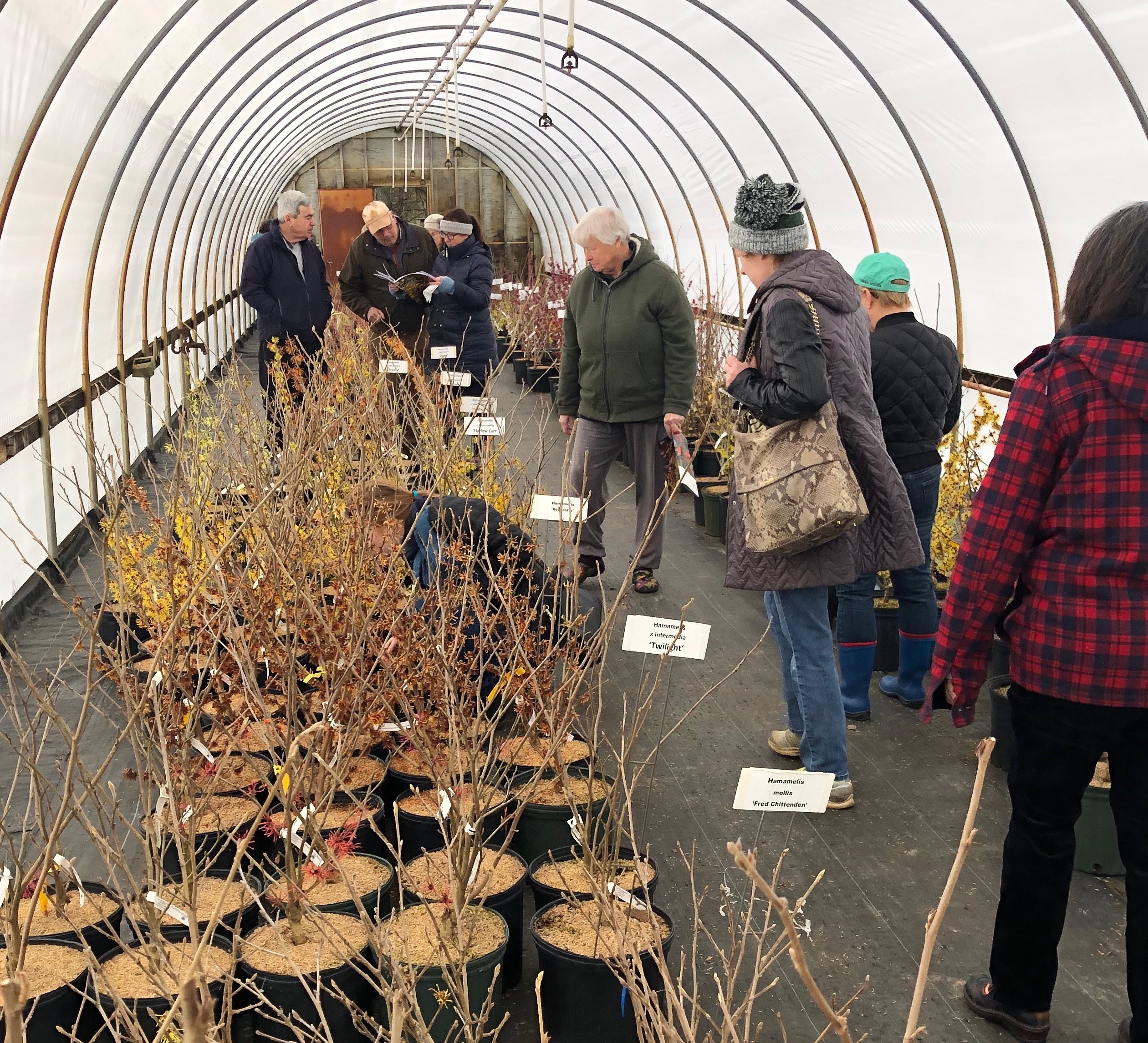
Hoophouse #4.  Ground zero for the 50 or so witch hazel (Hamamellis) varieties on sale.  There was a steady stream of people and plants, and I’m glad I was early enough to get the ones I wanted.

In case you’re wondering, Hamamellis are the witch hazels, and you need witch hazels.  Their winter-defying flowers bring color to a garden still very much in grey mode, and for more northern gardeners there just isn’t much else that even comes close.  At this year’s hamamellis festival Steven Kristoph gave an interesting talk on the range and specifics of this plant family, but my lazy take-away was pay attention to bloom time when selecting, plant in decent soil with a little shade from the fiercest sun and they should be trouble free and bring late-winter joy for years to come… even when the crumbling of winter drags on longer than it should.

rare finds nursery hamamelis

Distracted driving.  My passengers for the return trip might not have done a good job keeping up their end of the conversation, but they did offer excellent color and a soft fragrance.

Was the 300 mile round-trip to New Jersey worth it?  Your results may vary, but I say absolutely, and I’m entirely pleased with the goodies which followed me home.  There is a week of lows in the teens and just about no days above freezing next week, so I’m between temporarily digging them in pot-and-all outside along the foundation of the house, or bringing them in to the garage for winter garden enjoyment, but that’s a decision for later today.  In the meantime I’m avoiding the gloom outside and I hope there’s a little more sunshine and warmth where you are.  Have a great week!

A Return to Edgewood

In hindsight the weather could have been better for the two hour plus drive down there, but when you’re matching up three busy calendars you sometimes just get what you get.  Fortunately for the most mountainous part of the drive the bulk of the snow hadn’t yet arrived, and for the flatter portions the thermometer was beginning to rise.  At least it was pretty to look at…. I guess…

witch hazel diane

A slow, careful walk up the icy drive gave plenty of time to admire the witch hazels.  I believe this is Hamamelis x intermedia ‘Diane’.

We really had to squeeze this visit in because John Lonsdale, Edgewood Garden’s proprietor, was busy loading up trays and packing the truck for the Pine Knot Hellebore festival in Virginia which kicks off this weekend and then runs for the next three.  Lucky you if you’re close enough to visit, but for now the seven and a half hour drive is more than I’m willing to consider… you never know though.  It’s on the bucket list.  >click here< for exact dates and locations of this and other Edgewood sales events.

hardy cyclamen foliage

Cyclamen ready to hit the road.  Such awesome foliage you almost forget they also cover themselves with bloom, C. maritimum on the left wouldn’t be hardy for me, but I could easily pick out at least four or five of the C. hederifolium to the right and they’d do just fine here in the mountains 🙂

My friend Paula met up with us and we had a great morning looking at and talking about just about any and all snowdrop nuances you could think of.  Then we talked about cyclamen.  As usual I overstayed my welcome.

John lonsdale Paula Squitiere

John and Paula working their way through the G. plicatus section of snowdrops.

I honestly intended to take pictures of some of the latest and greatest hybrids and named sorts and share the photos here, but I really do get a little overwhelmed when hit with the variety of species John grows.  If you’d like a more focused report I’d recommend clicking >here< to read the recent Washington Post article on Edgewood Gardens and some of John’s work with several of the rarest snowdrop sorts.

galanthus gracilis

Just one of the many pots which made me say “oh look at this one, I like that too”.  I believe these were all G. gracilis seedlings.

Of course I like galanthus for the flowers as much as anyone else, but for some reason the varied foliage of the snowdrops had me distracted on this visit.

galanthus gracilis

Curly thin foliage, flat wide foliage with a grey tint, wide apple green…  This photo shows some of the range in Galanthus foliage.  G. gracilis mostly but also a few other species such as G. plicatus and G. ikariae subsp. snogerupii…. a name which I can never resist saying 🙂
I think it’s a bad sign that I now know the names of more than three or four snowdrop species…

galanthus ikarie

Various pots of Galanthus ikarie seedlings.  Such nice foliage, some big flowers here and there, and even one with a nice flush of green on the petal tips.

There weren’t just a few species.  I asked which ones in particular he had growing in the greenhouses and his response was just “all of them”.  It was very cool to see, but even that was overshadowed by the thousands of snowdrop seedlings coming up on nearly every spare shelf or extra rack.

galanthus seedlings

Future snowdrop flowers.

The incredible diversity of species coming along is staggering but before I was even able to get myself grounded again it was off to the next greenhouse to check in on some hardy cyclamen.

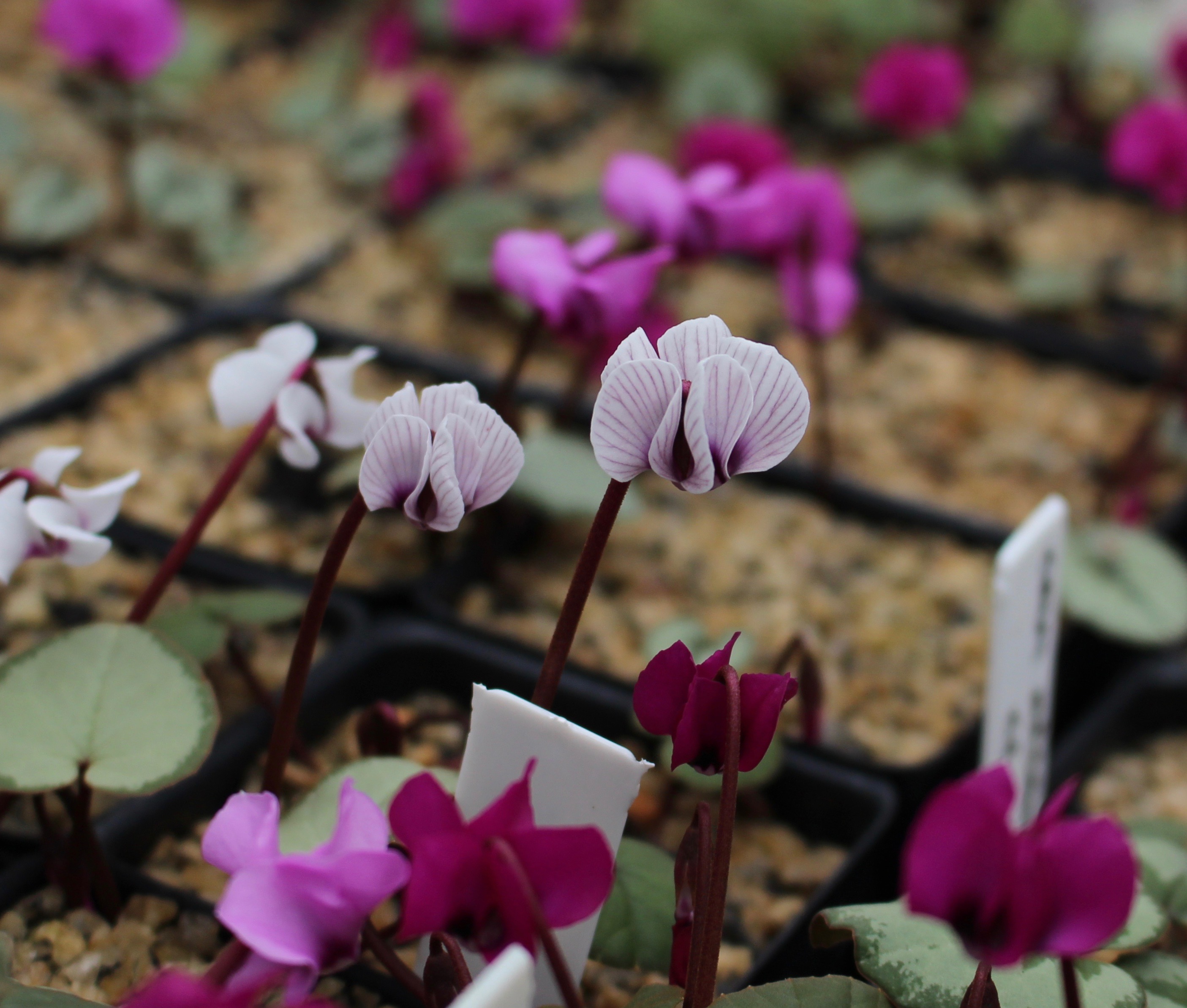
cyclamen coum

Cyclamen coum filling the bench with an exceptional range of forms and colors.

I took this visit as an opportunity to correct the severe lack of cyclamen coum which my indoor garden is dealing with this winter.  For those who need to know, my budget only allowed me to pick four new ones, so you needn’t worry that I made a huge dent in his offerings.

cyclamen coum porcelain

Cyclamen coum ‘Porcelain’, a nicely striped special strain he had coming along, as well as a particularly dark form below it.

Speaking of budgets, since last year was such a success in restraint and control, I’ve decided to leave off on a good note and never mention tracking my gardening costs again.  It seems almost pointless to worry about a few dollars here and there when I’m faced each month with writing the checks to put a ten year old girl through gymnastics.  All my gardening budget is now officially part of my health care budget, and that would be mental health specifically.  Spending money on the garden will hopefully distract me from the endless drain of money going towards filling birthday cards and financing icecream shoppes and filling the belly of a twelve year old boy who always seems inches from famine.

eranthis orange glow

Another Edgewood offering this year, ‘Orange Glow’ winter aconite (Eranthis hiemalis).  I could have easily added a few of these to my order, but have to keep faith that my little seedling from a previous year is still just waiting to show itself.

As long as we’re talking about the budget I wasn’t going to talk about, I might as well admit this visit wasn’t all just the usual me inviting myself over to look at plants.  John has put out a spring listing of plants and I may have needed to pick up a few snowdrops as well as my new cyclamen.  It can be found >here< and although I did save on shipping by picking up directly, you may choose to avoid a five hour roundtrip through snow and icy roads, and just have them mailed to your doorstep.

galanthus plicatus

A large flowered Galanthus plicatus seedling.  The rule of thumb here is about one inch for that particularly fat digit, and that puts this well endowed snowdrop at over two inches!

As always it was a great time, and even though the walk out went even more slowly with precious cargo in hand, we still took a few more minutes to again admire the optimistic witch hazels lining the drive.

hamamelis witch hazel

Icy witch hazel (Hamamelis × intermedia ‘Barmstedt Gold’) in full bloom despite the sub-freezing temperatures.  Everyone should have a few of these.

Thanks all around, and since this post is starting to sound like a shameless plug for Edgewood gardens (which it is) I guess I should say I received no compensation for it, and as a matter of fact it was actually a little costly even if you don’t count the stop at IKEA on the way home.  Well on second thought that’s not completely true.  On a previous visit John gave me an ‘unsellable’ cyclamen which had a few yellow leaves.  It’s now growing and blooming beautifully in its new home, so maybe that cyclamen was all just part of some elaborate master plan 😉

Have a great week, and judging by the strength of the sun this morning you can probably guess what my next post will feature heavily!

Happy Thanksgiving

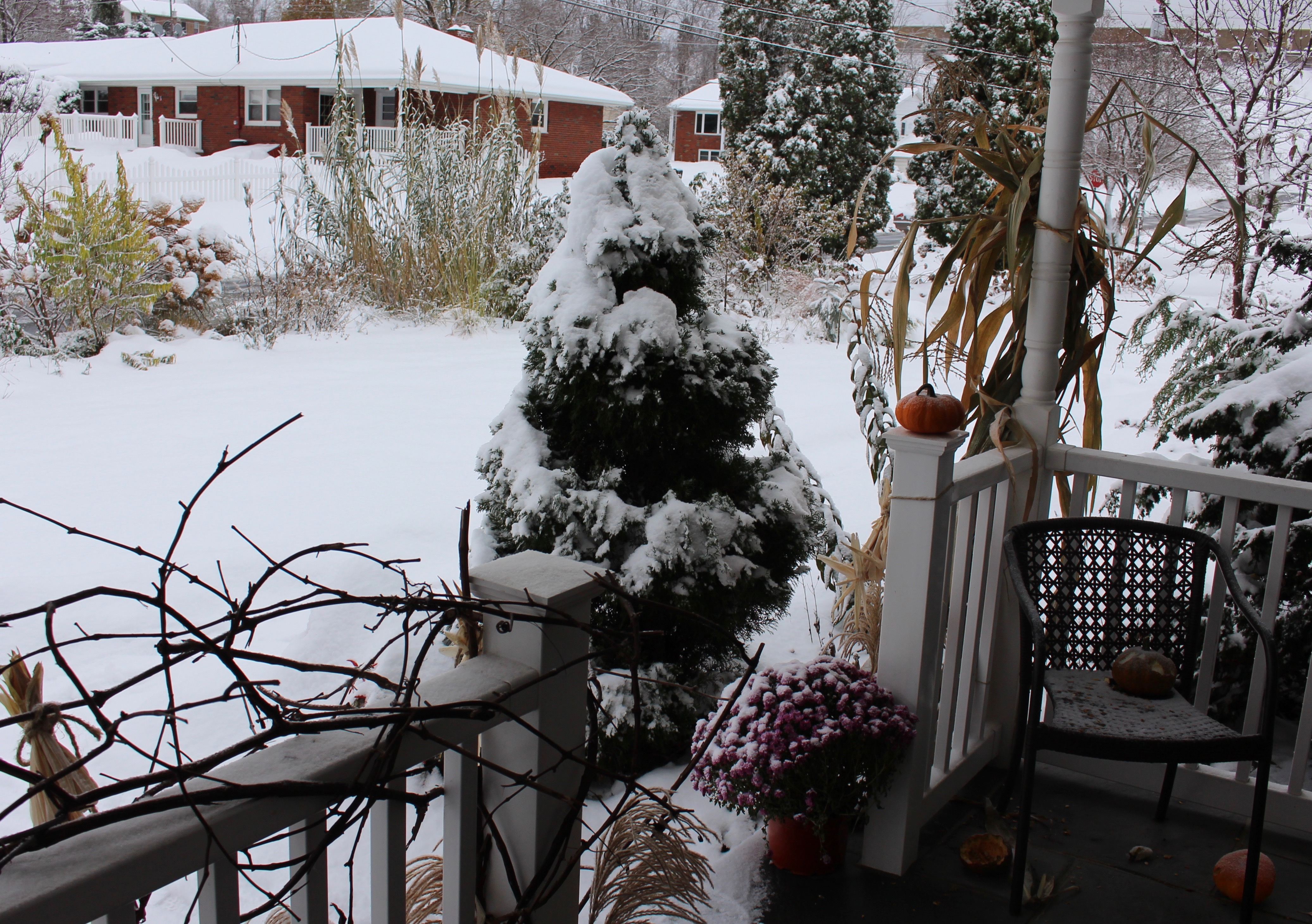
The thermometer sits at 13F (-10C) this morning and the low for tonight is forecast to be 7F(-14C).  Of course it’s much warmer on this side of the windowpane, and even if I took off my cozy sweatshirt I’d still be comfortable so I guess there’s plenty of reasons to be thankful.  Even last weekend’s snowfall was just a minor inconvenience, although it came as a surprise and the fall decorations look a little out of place now.

October snowfall

Admiring the mums one week, shoveling snow the next.  So much for gardening!

All garden projects are on hold, and things like cleaning playrooms and painting bedrooms and moving furniture are back on the list, for which I’m 100% excited for.  It would be a shame for the weather to just keep me inside, stuck on a couch and eating and drinking all day…

October snowfall

The snowdrop walk next to the unshoveled driveway.  If you look closely you’ll notice the neighbors have cleared driveways and walks.  This year the kids discovered that other people will give them money in exchange for snow shoveling, unlike their father who thinks he should get an ‘all those times I took you to the Chinese buffet’ discount.

For those of you celebrating Thanksgiving today I wish you all the best for a wonderful day.  In spite of all the complaining about weather and time, pests and circumstance, I realized I’ve been blessed with more than I deserve.   Fire, famine, war and walls are in the news each morning and today I’m Thankful my biggest complaint is the temperature.


Bits and Pieces

There’s a forecast for snow tomorrow, and in this little slice of near-suburbia things are absolutely not ready.  The gardener has been in more of a Netflix mood rather than a slaving out in the elements mood and as a result things are more behind than usual.  ‘No big deal’ he says as he dips his hand in yet another vat of overly buttered popcorn, and that pretty much sums up the last few days… except for the weekend.  It was sunny yet cold, and after weeks of gloom the sun was a nice change.

ranch house landscape

Just a few more days and out with the pumpkins and in with the boughs of holly.  Fyi I’m thinking of moving the arborvitae… any thoughts on that?

In between re-acquainting myself with a rain-free garden and doing all the fall cleanup in just two days I did a little poking around and tried to find a few things of interest in an otherwise dying garden.

Polystichum polyblepharum 'Japanese Tassel Fern'

Evergreen ferns look even nicer set off by the yellowed hosta foliage.  This is the Japanese Tassel fern, Polystichum polyblepharum, and one of my favorites.  Thick brown fur covers the newly emerging fronds, and the plant as a whole is much sturdier than you might think.

There are a few last flowers, but many didn’t hold up well to the relentless rain.  The chrysanthemums are mostly washed out with the exception of a single stray seedling which snuggles up against the porch.  I tolerate its sloppiness all year and then finally reap the rewards in November when its flowers open to signal the end of the season.

late blooming chrysanthemum

My last chrysanthemum.  

Out along the street the front border got a clearing out so that the earliest spring flowers can have an open stage for whenever the first warm spell hits.  Of course that’s code for ‘I planted more snowdrops here’, but snowdrop season comes on fast and I want to be sure I’m prepared for that at least!

leaf mulch perennial bed

The interior of the bed has been cleared out and a Rolls Royce layer of leaf mulch put down.  They’re the shredded Japanese maple leaves from next door, mixed up with a good amount of lawn clippings which should be delicious for the earthworms.  

Although I did do some clearing out, the bulk of my fall cleanup is just removing anything which looks overly messy, and then running the leaves over with the mower and tossing the shreddings into select beds.  Whatever is left I can just refer to as winter interest and eventually get it come springtime.

abelmoschus seed pod

Although it was one of the first plants to go when temperatures dropped, the dead stalks of the abelmoschus still look great with their fuzzy seedpods.

Honestly if I had the opportunity I would want about double the amount of leaves that I collect each fall off the lawns.  Some would go into the compost, but most just gets thrown back as a winter blanket for empty vegetable beds and sleeping perennial plantings.  As it is I still end up volunteering to clean out my Bil’s backyard and then robbing the woods for whatever’s been dumped back there.  It’s sad how I covet my neighbor’s fallen leaves.

Lindera glauca var. salicifolia

An Asian spicebush, Lindera glauca var. salicifolia was named as my friend’s favorite shrub and I’d have to agree.  The seedlings she shared with me are finally coming along and I love the late season glow of their foliage.

It’s not all about dead leaves though.  Snowdrop talk will come up more and more now that the weather is turning cold.  This season I am eagerly awaiting the opening of my new snowdrop walk, and based on all the buzz already surrounding it I’m sure it will be an excellent new springtime adventure.

snowdrop walk

Just in case it’s not obvious the new snowdrop walk enters between the chrysanthemums and carries you across the bed.  Most people will need to crawl if they wish to avoid a cherry branch to the forehead, but you’ll be down low looking at them anyway so why bother with a whole bunch of head-room?

In the meantime, a few hardy cyclamen line the snowdrop walk.  Cyclamen hederifolium is sending up its winter foliage now and the last flowers look even better against the beautifully patterned leaves.

cyclamen hederifolium

It appears I’ve lost a few older cyclamen plants this summer, most likely due to all the rain, but there are still plenty left surviving and multiplying.

With the snowdrop walk all prepped and waiting, it’s time to turn towards the next on again off again project.

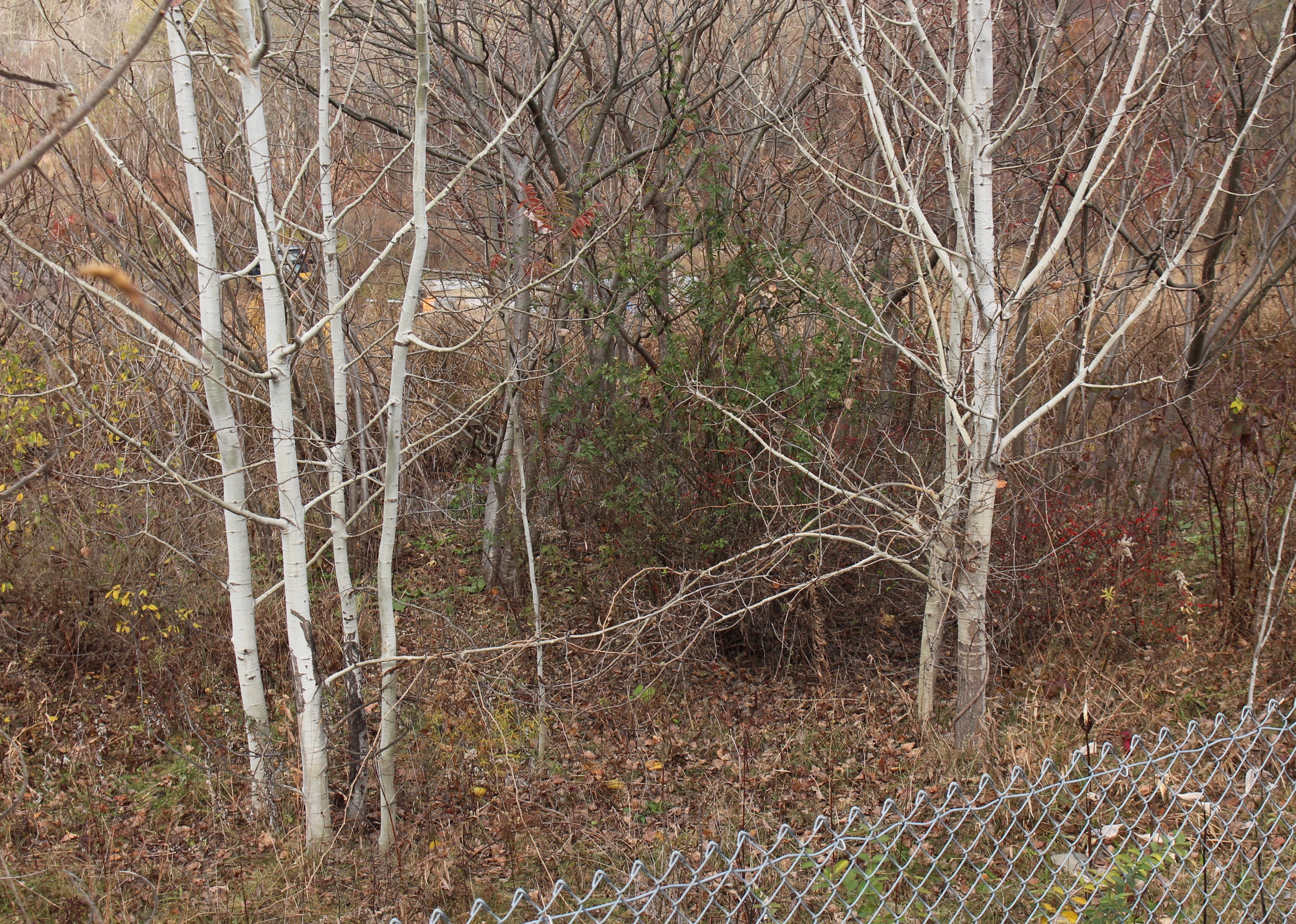
quaking aspen bark

The land beyond the fence.  Years back, before the fence went up, I used to mow around a few little quaking aspen sprouts.  They’ve grown since, and are now sporting some attractively bright bark color.  

You may remember that my MiL lives next door, and that a few years back I was able to get a bunch of fill dumped behind her house.  In the years since, I’ve managed to level and plant the half closest to her fence, but the other half still needs grading and moving.  After losing all hope of someone coming and doing the job in a day or two with all the right machinery, I’ve finally decided it will be me who digs and grades and moves all the dirt that remains.  My guess is that the rest of my life will be spent digging back here, but I already have a shovel and the dirt is free, so what have I got to lose?

grading fill

Left side graded and planted to grass, right side still to be done.  While I’m at it someone’s mentioned they’d like a screen of evergreens planted, so why not add that to the list as well….

I’ll be using the dirt to fill in some of the low spots in my own yard.  It’s terrible soil and a ridiculous amount of work but I find I can only watch Netflix for so long before boredom sets in, and I do like earthmoving projects.  S we’ll see how it goes.  Maybe I can just rename this part of the yard ‘the gym’ and spend all the saved money on other more exciting things.  Now what would that be….  snowdrops perhaps?  😉

Annual is Not a Bad Word

Change for the changing seasons always brings an antsy-ness to this gardener, and autumn is one of the big ones.  An avalanche of pumpkin spice covers nearly everything and so many people are just done with the summer garden and all its weather-worn tiredness and spent seediness.  I’m with you.  I keep eyeing the mess and think I might just be better off wacking it all down and calling it a year.  It’s been months since the garden had that clean and controlled look when plants were bristling with anticipation, and I miss that, but still won’t give in just yet.  Obviously laziness plays a part, but others with more enthusiasm might want to hold off as well.  The waning garden has a purpose, and between the full seedheads providing food for birds, and the dried stalks protecting next year’s buds, there’s still something of interest out there.  Frost and snow sit more attractively on waving stalks than on dull mulch, and honestly as far as cleanup goes it’s easier to crunch dried stalks in March than it is to wrestle with sloppy, soggy, heavy messes in October.

But it looks dull.  and messy.  and like you gave up… Unless you planned for it of course, and planted something that carries on until the pumpkin spice gets shoved over by cranberries, and a more relaxed season begins.   For me annuals do the trick.

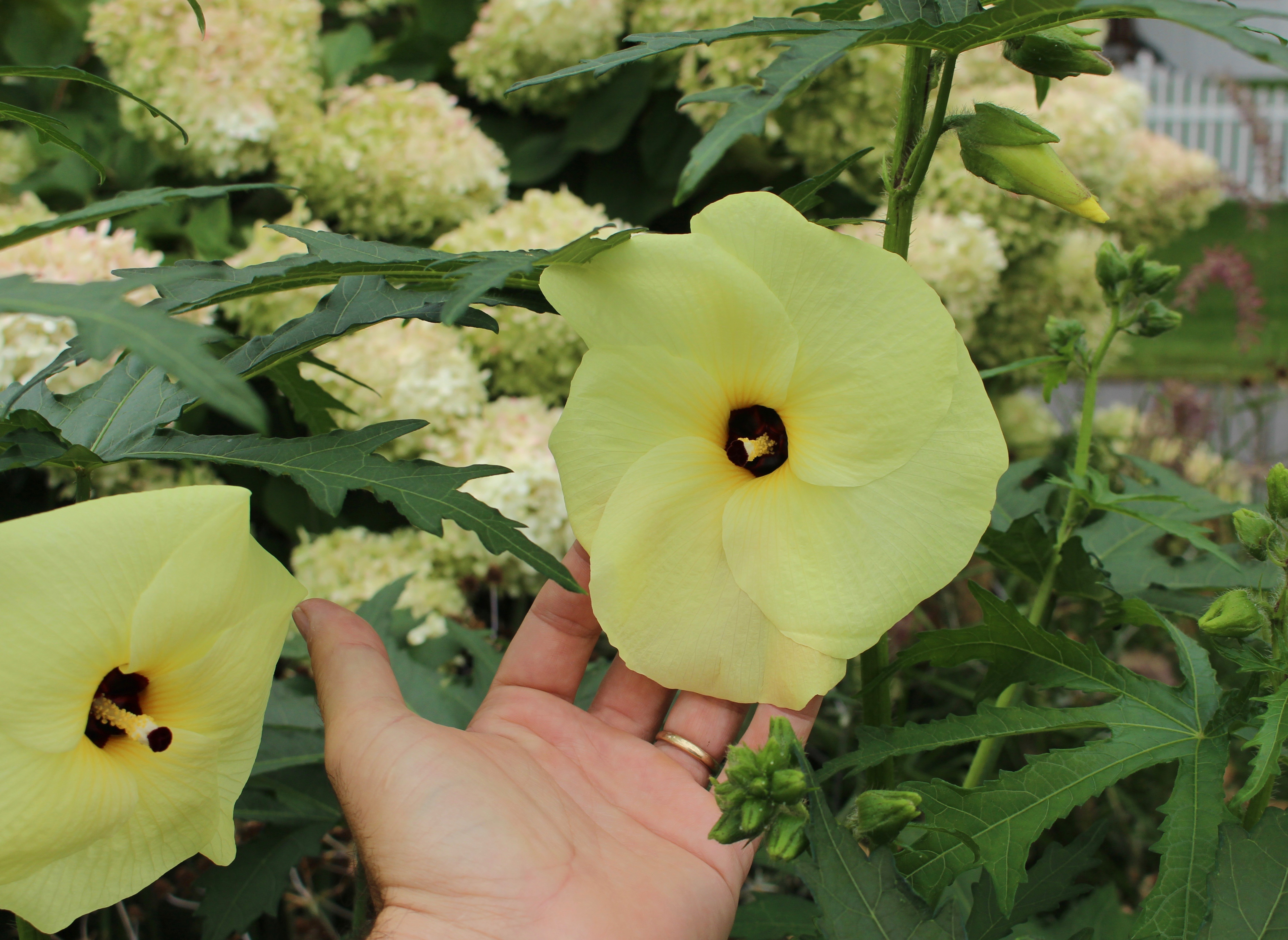
abelmoschus manihot

Abelmoschus manihot, an okra relative, soaked up the rain and humidity this summer and has never done better.  These first flowers in late August were just the start of the show.

Ok I said it.  I plant annuals.  Yes, they’re more work, but the right annuals can pretty much take care of themselves, and they don’t have to be the same dull mat of color all year that even the bees get bored with.  By their nature these plants just want to grow up and seize the day, filling as much space as possible with growth and flowers until whenever.  They don’t care about next year, just flowering and seeding.

abelmoschus manihot seedpod

The fuzzy okra-like seedpods on the abelmoschatus (aka sunset hibiscus) are cool as well.  Sure beats looking at spotty, diseased iris foliage (which is actually hidden behind the planting).

Late season annuals are my favorites.  Something like the sunset hibiscus (Abelmoschatus manihot) comes up strong in the heat and humidity and quickly becomes a 4-6 foot presence if it gets enough water and warmth.  Just as the perennial garden hits a late summer slump, the sunset hibiscus becomes a star, distracting you from the tired foliage of the June bloomers.  This plant was also one of the stars of the book Annuals for Connoisseurs, by Wayne Winterrrowd… which by the way is a fantastic bargain at under $5 used…

coleus in a border

Coleus, zinnias, salvia and Abelmoschatus in the front border

Ok, enough of me trying to sound intelligent and write coherently in what could be a useful post.  Here are some other annual plantings from around the garden which are distracting me from all the gloomy skies and ever shortening days of really late summer.  Coleus feature strongly.  Nearly all come from a handful of cuttings I stuck in a glass of water and kept on the windowsill all winter.  They look terribly pale and leggy by March but that’s when I pot them up and start growing them on under lights in the basement.  By May I have dozens to fill in around the garden.

annual flower bed

There were even enough leftovers this spring to branch out next door and fill in my neighbor’s mulch bed.  Coleus, cannas, and a nice little single marigold I call “stole a seed head while visiting Kimberley last summer”.

I guess technically a lot of what I’m calling annuals can actually be grown as perennials in warmer climates, so I don’t want to upset anyone who lives and dies by those definitions, but in my garden these plants identify as annuals so I’m going to respect that.

potted caladiums

The dogwood may be giving up and putting on some autumn color, but the potted caladiums are holding on a little longer until nighttime temperatures consistently drop below 60F.  That’s when their sadly limp selves get thrown pot and all into a warm, dry corner of the furnace room and sit there dry and dormant until next year.

A real annual which has come up well this year is Browallia americana.  In well watered spots of bare earth, close to where it grew last year, I keep an eye out for seedlings.  All that’s required is take care and not pull them out as weeds, and by late summer the reward is a 1-2 foot bush speckled with flowers a little bit towards the amethyst side of blue.

browillia americana

Browallia americana with just a few tasteful selected marigolds.

A sort-of annual for me which sometimes returns from the roots is the borderline weedy Datura metel (aka moonflower).  In good fertile soil it makes a large shrub which in the evening sports pure white, upward facing trumpet flowers.  Some people call them angel trumpets, but that’s incorrect.  Angels trumpet come from on high with downward facing blooms and are a different group of flowers (Brugmansia).  These flowers always come from below and Devil’s trumpet is more accurate.  You would think the more heavenly version would be more innocent, but both are extremely poisonous and there are deaths from this plant each year.  I remember my mother evicting them from the garden one summer when she found out.  I know she told us all how poisonous they were but still I was disappointed to lose them from the garden.  I’m surprised she hasn’t questioned my parenting skills since seeing it in bloom here, but I guess there are always plenty of other questionable goings on which take precedence.

datura metel

Devil’s trumpet (Datura metel) announcing an unwelcome arrival in the vegetable garden.

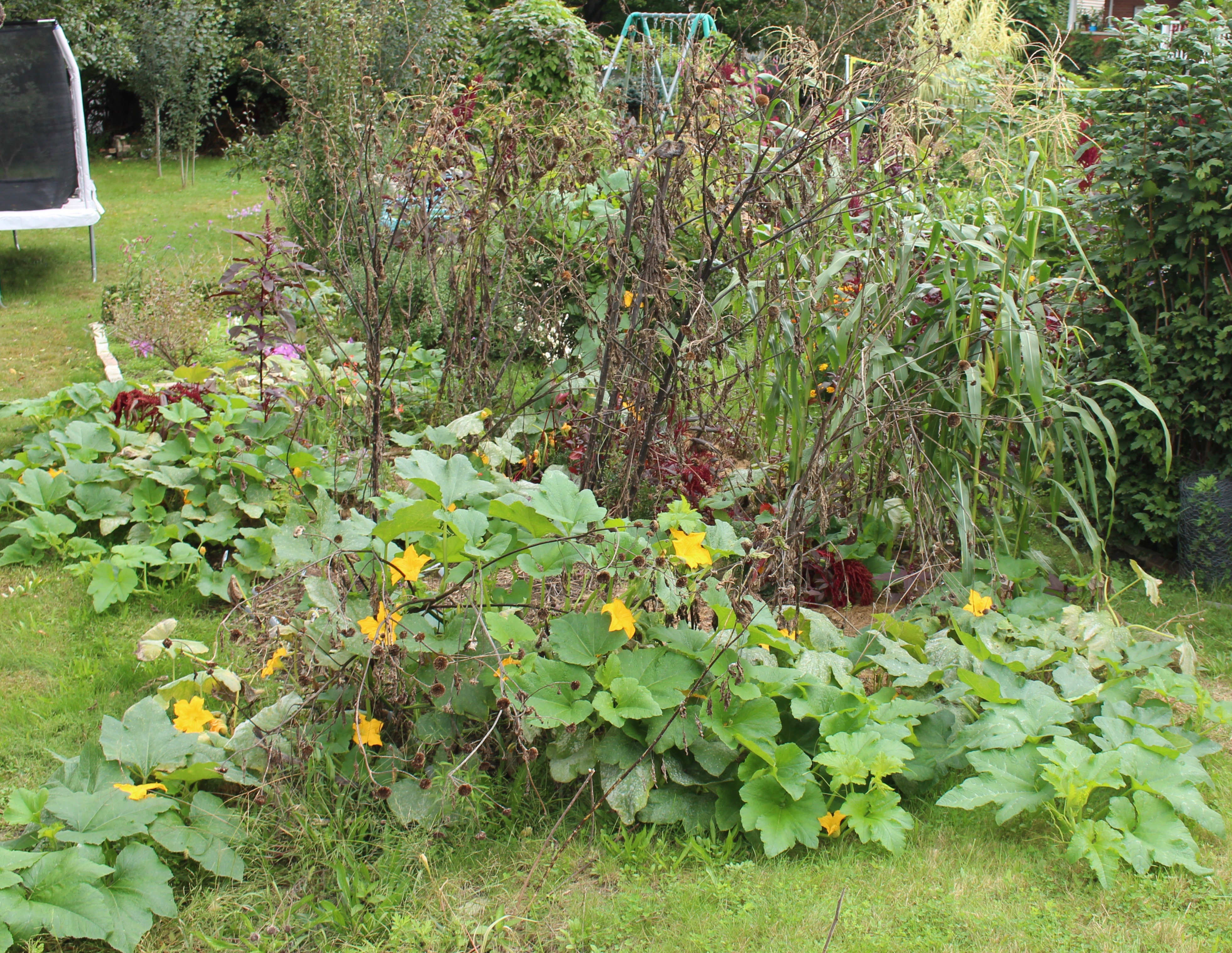
But there I go babbling again.  As long as we’re in the vegetable garden, let me celebrate the pumpkins which have come on strong now that the sunflower thicket has died off from some likely disease.  All this took were a handful of seeds ripped from the heart of last year’s halloween decorations.

pumpkin patch

Now that the sunflowers have died off it looks like the backup plan of pumpkins and glass gem corn might just work out.  I love pumpkins and gourds, maybe that’s all I’ll grow next year.

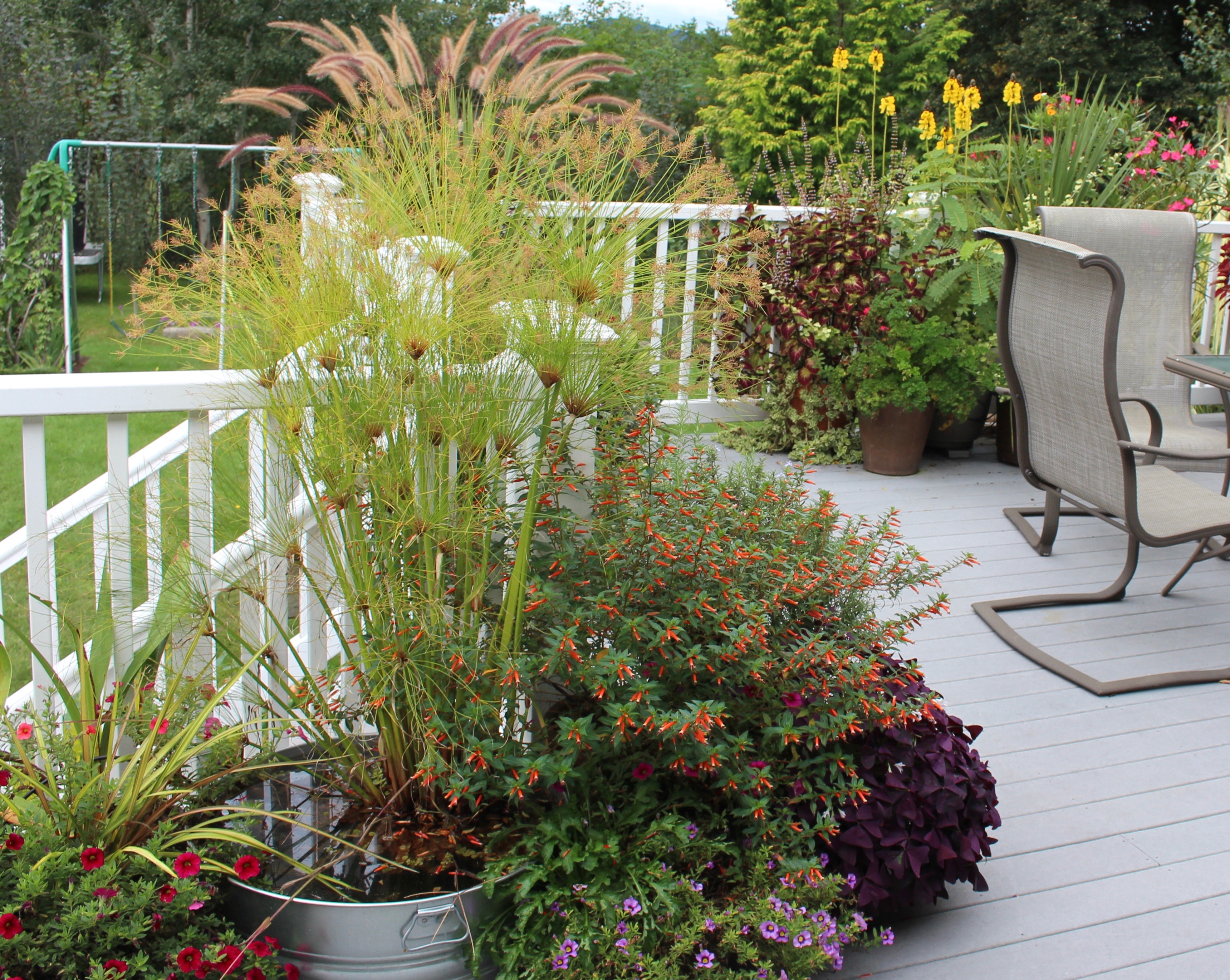
The deck plantings are almost all just annual plantings which aim for all season interest.  A drip irrigation system on a timer, a handful of slow release fertilizer, and this becomes one of my least-labor intensive parts of the garden… once it’s planted and set up of course…

prince tut papyrus

The ‘Prince Tut’ water garden is ok.  Goldfish have hopefully made a meal of any mosquitos, but a lack of fertilizer has left the papyrus healthy but a little yellowish in my opinion.

I tried for more foliage color this year but still ended up with a few curious flowers here and there.  The firecracker plant (cuphea) was a Proven Winners thing that I’ve heard good things about, and here it is three months later still looking good.

cuphea firecracker plant

Cuphea (firecracker plant) and some purple leaved oxalis.  Both have been nonstop color and trouble-free from the day they were planted.  

My popcorn plant (Senna… Cassia…  corymbosa)?  Still awesome 🙂  I was even able to get a few seeds to set, although it did seem to interfere with the flowering for a few weeks.

cassia popcorn plant

The yellow popcorn plant, coleus, purple fountain grass (pennesutum), oleander, and a bunch of other non-hardy stuff.

I’ve had that pink oleander for a few years now and was sure I killed it in the garage last winter.  It eventually managed to come back, but the sparse branches were just calling out for a vine to cover them up.  Black-eyed Susan vine (Thunbergia alata) to the rescue!

black eyed susan vine thunbergia

Black eyed Susan vine on the oleander.  I would agree with the label “cringe-worthy color combo”, so don’t go thinking I have some undiagnosed color blindness that you need to tiptoe around…

The containers at the back end of the deck have officially taken over.  The yellow coleus is my one new one for this year, the rest of the mess were just little overwintered sprigs and roots which I put out in May.

deck plantings coleus

The coleus really should have been pinched back a few more times.  They’re bushy enough, but even I can see they’re just a little too big.

Oh yeah.  The tropical garden.  Almost all just annual plantings, and almost all only just a little past peak now 🙂

elephant ears and canna

I didn’t think elephant ears could reach six feet tall but between nonstop rain and a good mulch of grass clippings they and the cannas do seem happy.  

So thankfully the garden is still filled with a few exciting things other than the new snowdrops I’ve been planting… oops, there I go mentioning snowdrops again…

Hope your weekend is filled with plenty of more interesting things to do rather than hauling off the tired remains of last summer.  If it is, next summer suck it up, plant some decent annuals, and enjoy the slow crumbling of summer into winter which others fondly refer to as autumn.  “Friends don’t let friends plant annuals” is only a guideline, I’m sure it refers to flats of wax begonias in one or two insipid colors and not to the range of much more exciting late season things that you have to remember next year.  I’ll try to remind you  😉

General Seediness

The humidity and heat are gone, only to be replaced by on again off again sunshine alongside a repeating dose of rain.  Yay.  I won’t even try and convince myself summer is holding on.  The calendar says fall and I guess the garden is saying it as well this year.

weedy vegetable garden

The potager is now an overgrown seedy mess of lingering flowers and floppy overgrowth.

We had company for a week and then I had the pleasure of entertaining a head cold for the following weekend, so if the general decay of the season wasn’t enough then the two weeks of neglect probably did the trick.  A few things did happen though, so I guess any attempt by the gardener to keep his head above water is a plus.

amaranthus hopi dye

The hedge was trimmed.  As usual I love it, and of course it’s inspired me to edge and mulch as well.

Before I get too rushed in putting this post out, I suppose some mention of this years budget ambitions should be noted.  Weeding was becoming torture so a few bags of mulch were purchased.  I find mulching to be slightly addicting so the first load was followed by another, and then another.  All said approximately $44 dollars of very cheap and questionably dyed hardwood mulch was purchased, and to be honest I feel really good about my broken resolve.

mulched snowdrop bed

A weeded, edged and mulched snowdrop bed.  Grass clippings cover the interior, purchased mulch rings the edge.  The left side is still a work in progress…

While mulching I came across a few colchicum corms and remembered offering extras to some friends last fall.  As it is with these things a quick online search for proper names and spellings led me to distraction and also to a few coveted colchicums which I’d been hoping to get elsewhere.  For just $63 and a mouse click I didn’t have to worry about elsewhere anymore.

colchicum nancy lindsay

A good example of general neglect.  Colchicum ‘Nancy Lindsay’ bravely flowering over a carpet of weedy sedum and other sprouting nasties.

While I’m baring my plant buying soul (with the exception of snowdrop purchases of course) I might as well admit that general colchicum excitement led me to a second purchase, this time  from Daffodils and More.  I have sworn off new daffodils this fall, but obviously the “More” part was a problem, and in this case it amounted to $65 more.

limelight hydrangea fall color

Nice pink highlights on ‘Limelight’ hydrangea this fall.  They may be floppy from all the rain, but at least they’re not heat blasted and brown.

I haven’t been entirely innocent in the plant department either.  Most of the summer passed far too quickly to spend time at the nursery, but my foggy memory does recall going over on a gift certificate (the amount of which does NOT count) by about $38 and then returning a few days later to spend another $18.  Those plants may or may not have all been planted, but I have to say it would be stupid to buy them and HAVE to have them and then let them sit next to the garage for weeks unplanted.

mammoth mum seedlings

Each fall I’m fascinated by the variety of mum seedlings which have arisen from the double red ‘Mammoth’ mum towards the back.  Each spring I forget about mums and never get around to separating these out.

If I do admit to neglecting full price purchases on the driveway for weeks, I probably shouldn’t suggest that I went back for a 40% off sale and spent another $49.  Just in case that happened though I’m going to add it to this year’s tally and not mention that more pots have joined the driveway crew.

tropical border in fall

The overflowing tropical border.  The Seven Sons Tree (Heptacodium) is in full bloom and has put on quite some height over the last few years.

Speaking of pots I bought a nice ceramic one on clearance for $15.  Like everything else I didn’t need it but maybe I will, so better to just bring it home.

migrating monarchs

The Monarchs have surprised me with an early appearance.  They’re enjoying the flowers of the Seven Sons Tree, you can almost make out the namesake flower buds which have a number one son bud surrounded by six more sons.

That might be it on budget confessions.  Over the last few weeks I’ve probably forgotten a few receipts here and there, but in my opinion a quickly fading memory is one of the greatest benefits of the aging process.  Perhaps in hindsight writing it all down wan’t the best thought out of plans.  Better to throw in a distraction such as one of my fantastically edited cinematic masterpieces which I call “All the Monarchs which swarmed the Heptacodium last week”.

I loved watching all the Monarchs.  My parents were in and marveled at all the bugs and butterflies which they just don’t see any more in their more suburban lot.  I hope it’s just a one season anomaly for them, but when you hear the stories of disappearing bees and bugs, and vanishing bird populations, and crashing amphibian numbers, you can really worry.  As the afternoon rolled into an amazing sunset, we watched the lingering insects wander off and several bats move in to swoop and ambush the careless, while all the nighttime crickets and katydids started to ratchet up their chorus.  It wasn’t bad at all.

sunset in PA

September sunset on the deck.

The Monarchs have been just like the weather.  They swarmed the yard and then disappeared.  A few came back.  More came back.  They disappeared.  Today there are dozens again and the temperatures and humidity make it feel like we’re in the South again.  Who knows?  At least it keeps me off the streets 😉

$63 for a questionable colchicum purchase
$65 for a quality colchicum purchase
$38 for additional unnecessary plants
$18 for two more unnecessary plants
$49 for clearance plants which also unnecessary, yet irresistible
$15 for a ceramic pot which made the trip to the box store worth it

$992 total so far for the 2018 gardening year.