A Day of Rock Gardening

Last weekend my friend Kathy of Cold Climate Gardening talked me into a plant sale.  No offense to her salesmanship, but it wasn’t the toughest sell considering I’ve been itching to get back to town ever since my first ‘Ithaca Spring Garden Fair and Plant Sale’ two years ago.  Covid you know… so I’ve been saying pass, but then Kathy told me about the spring plant sale of the Adirondack Chapter of the North American Rock Garden Society.  It’s a members only thing, just a few people donating, buying and selling, but it sounded perfect.  Big deal that I wasn’t a member(yet) and it’s an over two hour drive, plus it’s a whole Saturday away from a garden which I should be weeding… and I already had plenty of unplanted things… but you know as well as I do that once the gardening gauntlet is thrown down it must be accepted, so of course I said yes.

It was a beautiful morning and the drive was a perfect trip up the Susquehanna river valley and then across the rolling dairy hills East of Cayuga lake to the plant sale.  The sale was fun.  Members (which now included me) were given numbers and each person had a chance to visit the sale tables and pick up a favorite.  After a couple rounds of this the tables were opened to everyone, and one by one they emptied.  There was more of course.  While this was going on plant talk was every where, an auction was lined up, a free table was filled and cleaned out… members introduced their favorite plants which they thought ought to be selling better, and at one point someone just stood on a bench and invited everyone over to visit their garden afterwards 🙂 I like these people, and this also brings me to one of the big selling points for me doing the drive and joining the chapter.  Garden visits.  I had heard that a local rock gardener had offered to open their garden after the sale, for members to visit.  It’s a garden I had read about and seen pictures of, and I knew it was a must-see garden.  Wow, was that the truth!

ithaca rock garden

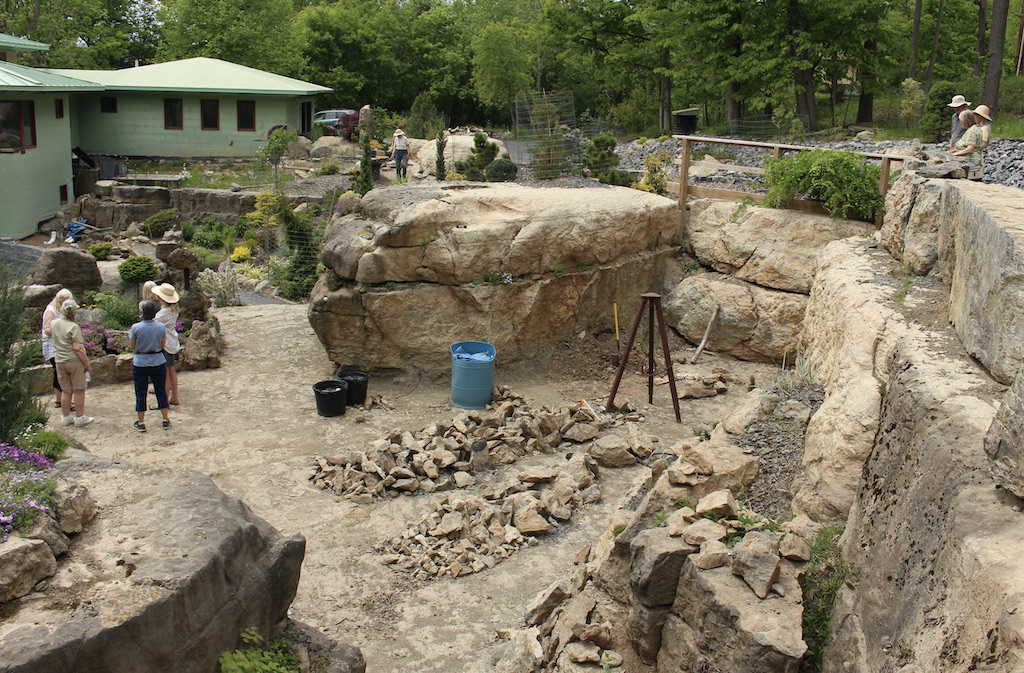
A hillside was being excavated to expose the bedrock

Some of the epic rock gardens of Europe are heaps of stone built up to create mini-Matterhorns out of flat cow pasture.  This garden is not that.  Here a pair of inspired gardeners found a plot of land where they knew they could carve the earth down to bedrock, and then build a rock garden up that follows the natural cut of the ravine.  It’s actually quite a crazy idea, but awesome to see.

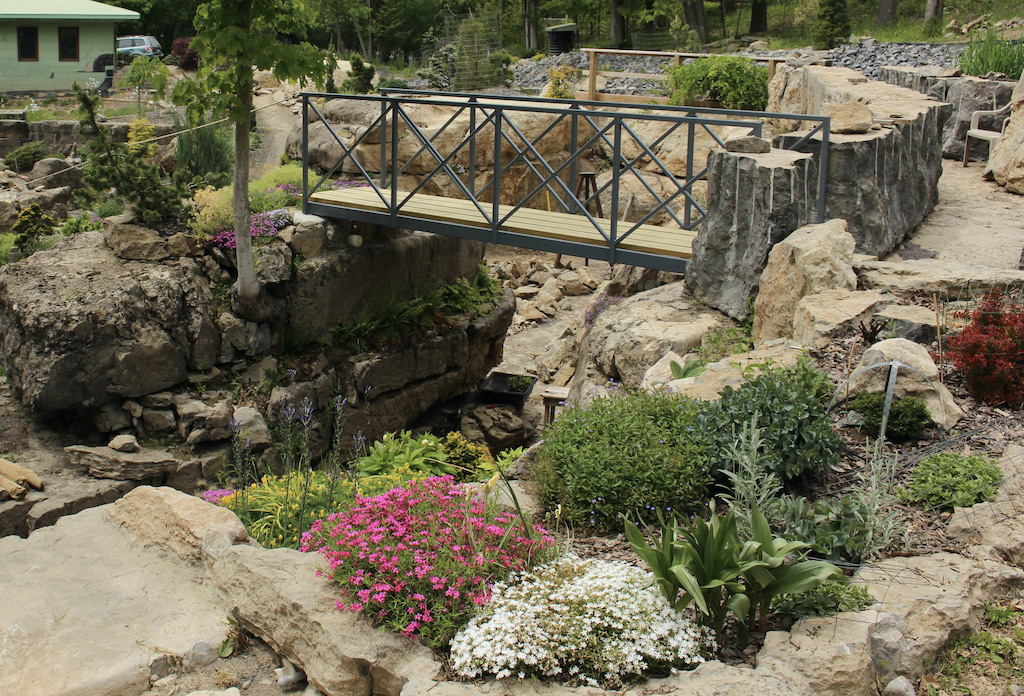
ithaca rock garden

One of the newest additions, a bridge now spans the gap between rocky outcroppings.

Of course these pictures don’t do the scale of the garden justice.  Massive boulders were being moved and placed in a way which looked as if the glaciers did all the heavy lifting thousands of years back.  Unearthing the bedrock sounds easier with the help of heavy machinery, but then consider the care which has to be taken to not gouge the naturally weathered walls and boulders as they’re being uncovered.  All the fine uncovering had to be done with hand… and then moved by hand…

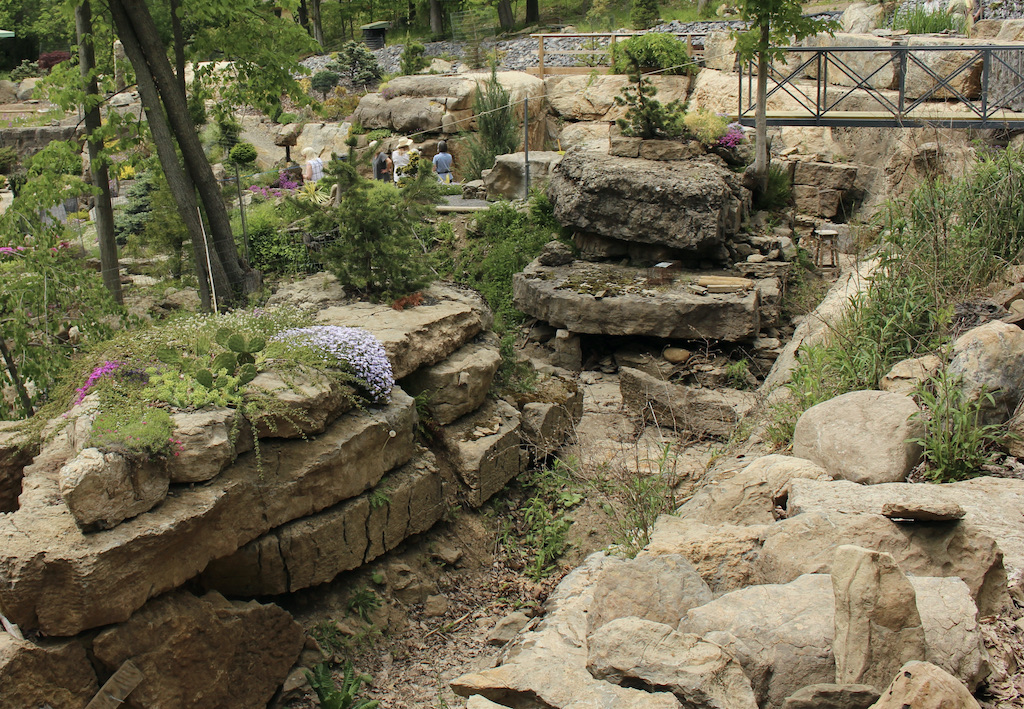
ithaca rock garden

The earthworks from even further back.  All of this was uncovered, and much of it moved into a more effective place or position, even the larger slabs of stone.  Behind where this photo was taken there’s even more excavation.

One of the chapter members mentioned that the owners were back and forth about opening the garden.  ‘It’s not a garden, it’s a construction site’ is more or less what I got as the reasoning, but only half of that is true.  It’s an awesome construction site, but it’s also an amazing garden, and I think it’s even more amazing when you can see what went in to all the plantings.

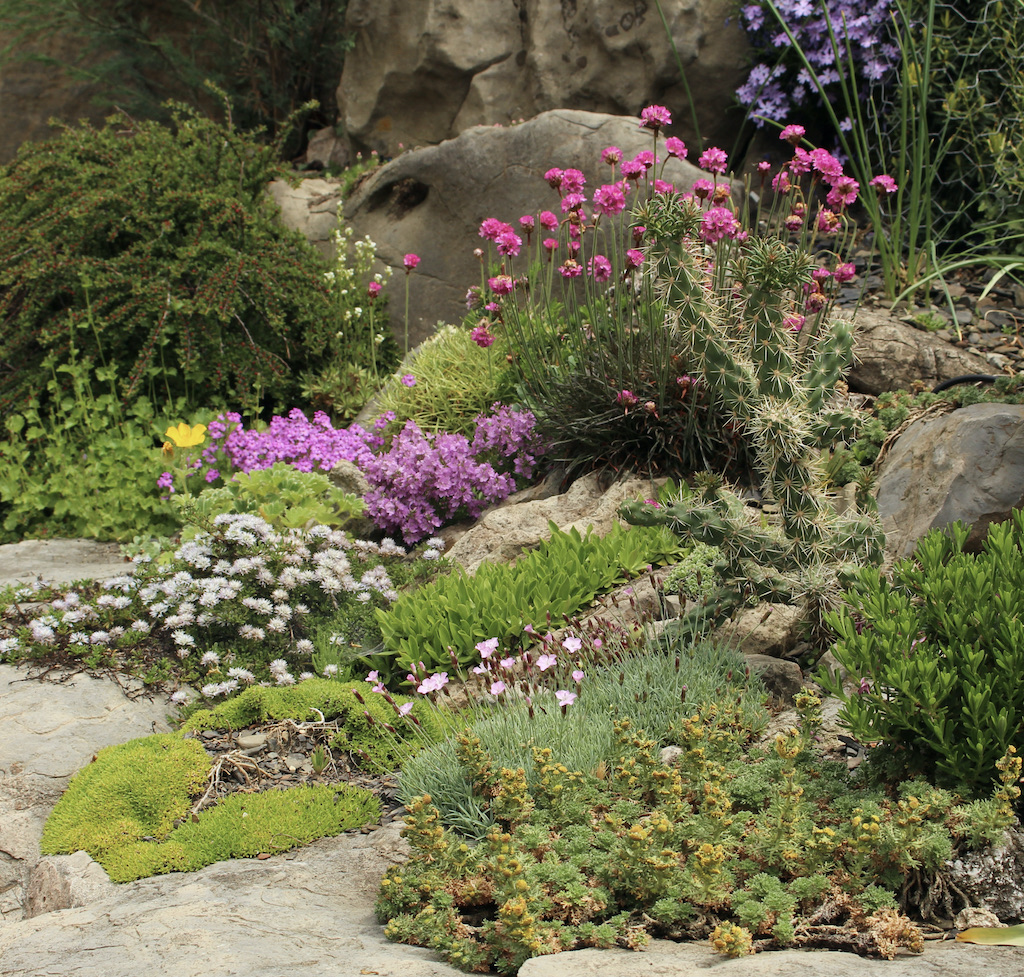
ithaca rock garden

Plantings tumble down the slope, this one built up with tufa stone, a porous rock light and airy enough to allow plant roots to penetrate.

This is the first real rock garden I’ve ever visited so I can’t say much about the plants other than they looked perfectly happy.

ithaca rock garden

Rocks overhanging a small pool.  Tufa stone allows for plants to be ‘set’ directly into drilled holes.  Eventually the plants spread out on their own as the roots find their own paths into the rock.

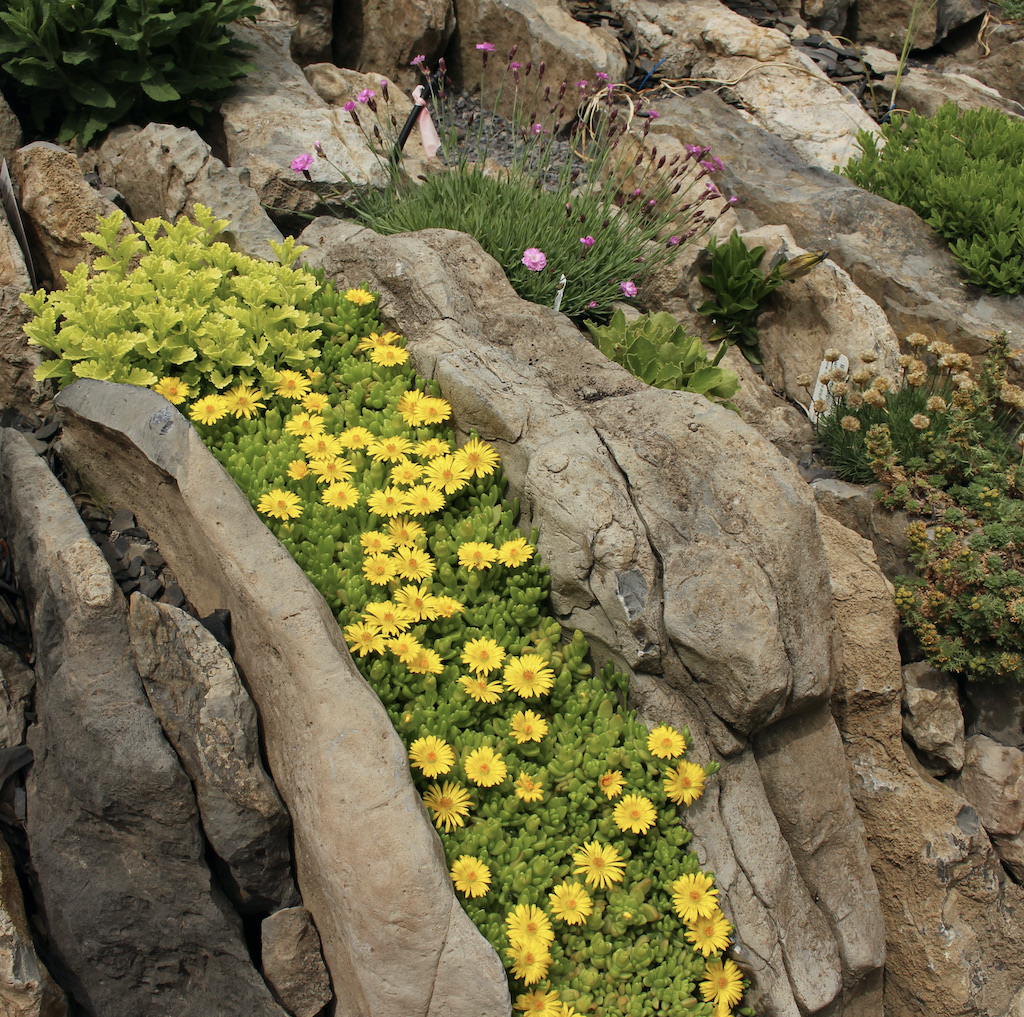
ithaca rock garden

Oh, and just a big crevice garden for all those things which love a deep root run between stones.  Yellow delosperma and a yellow leaved teucrium (which I just happened to pick up at the plant sale!)

ithaca rock garden

Some of the plantings were really amazing

ithaca rock garden

Even a hosta!  -but I really love the yellow leaved saxifrage (maybe saxifraga ‘Cloth of Gold’?)

As I worked my way down the paths through the rock gardens, and headed closer to the house, I reached the patio area.  Here the garden hosts had set up a dining area with snacks and beverages and plenty of wine.  From what I hear this generosity was all part of a master plan to “loosen lips” and get the honest impressions of their visitors with an eye towards improvements and new ideas.  Sadly, I believe the wine was just wasted on me 🙂

ithaca rock garden

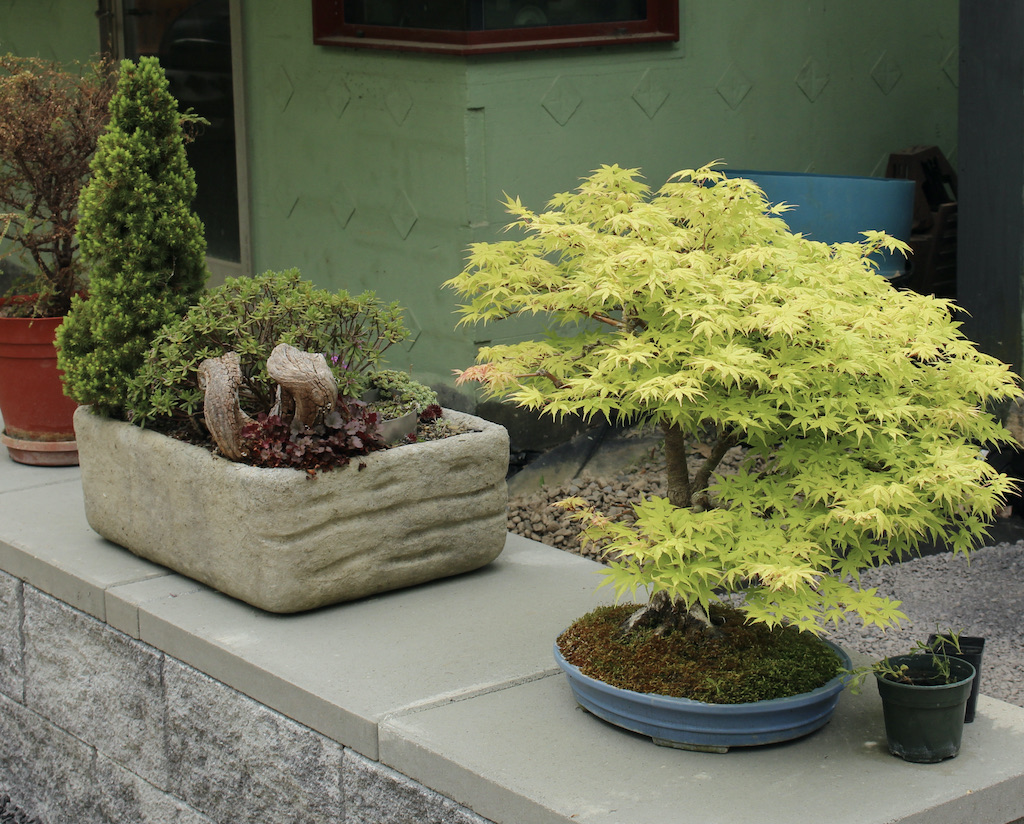
Bonsai and trough gardens.

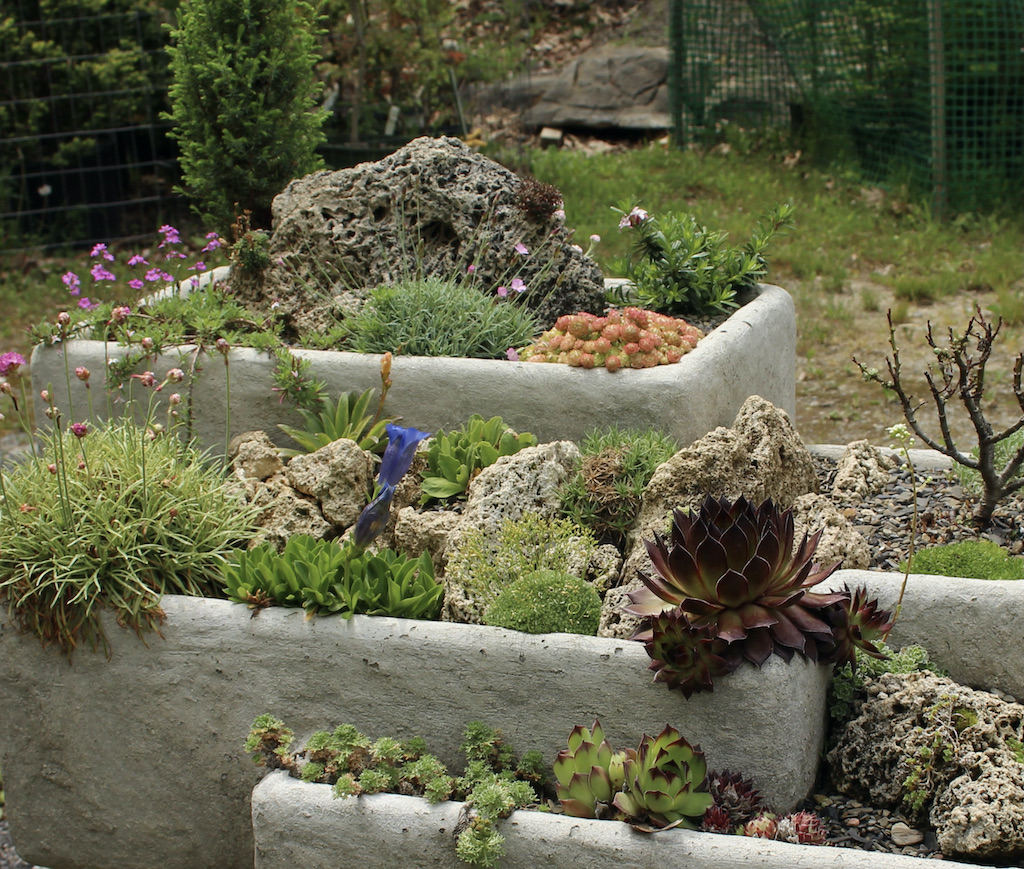
The trough gardens were particularly interesting, and not just because of the mini landscapes planted in them.  In the past these gardeners have hosted trough making workshops in the garden as well as publishing articles on the process, and I was excited to see that the troughs look excellent in person.  Excellent enough that I think I’ll give one a go this summer and see how it turns out!

ithaca rock garden

Some of the troughs were quite complex.

Wine and snacks have a way of gathering people, so at the patio I stopped and took in a few of the conversations.  Someone asked me how I liked the top part of the gardens and I said ‘Top?  There’s also a bottom?’ …and yes, there’s a whole other part to the garden.

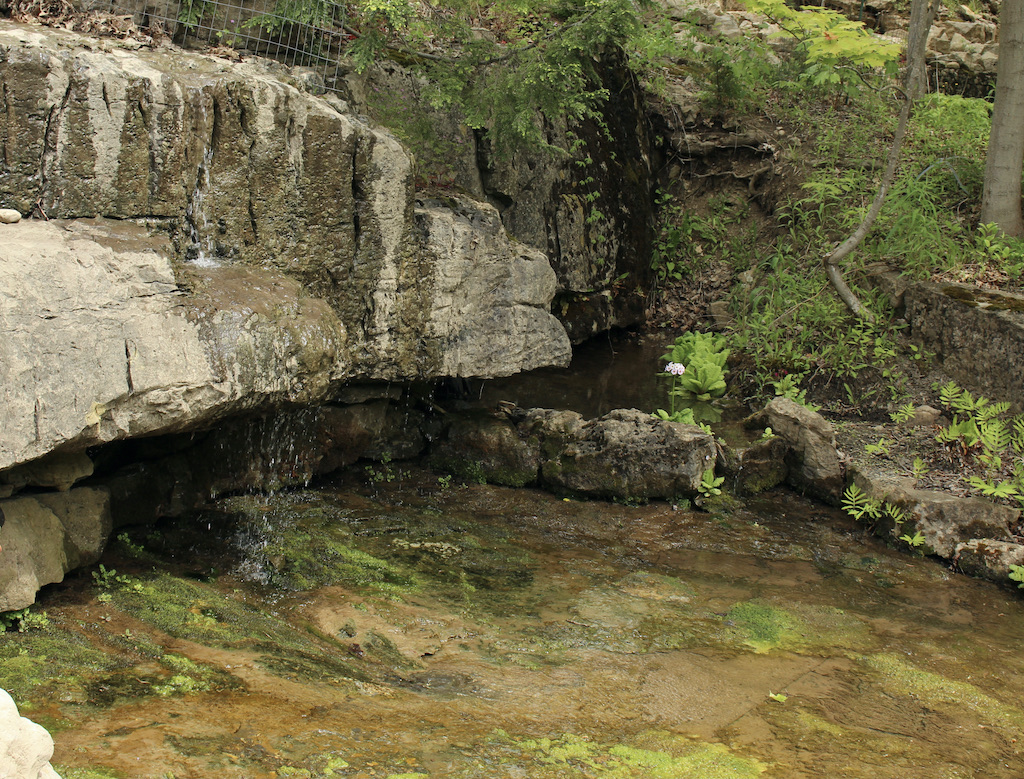
ithaca rock garden

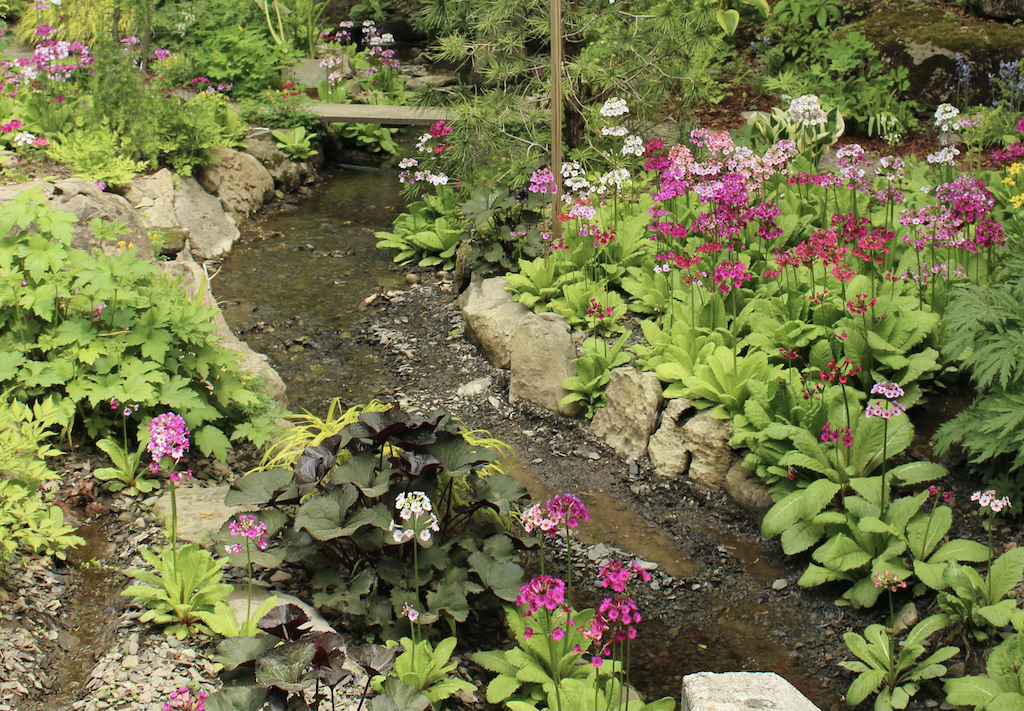
Below the rock garden a natural seep provides flowing water for the bottom part of the gardens.

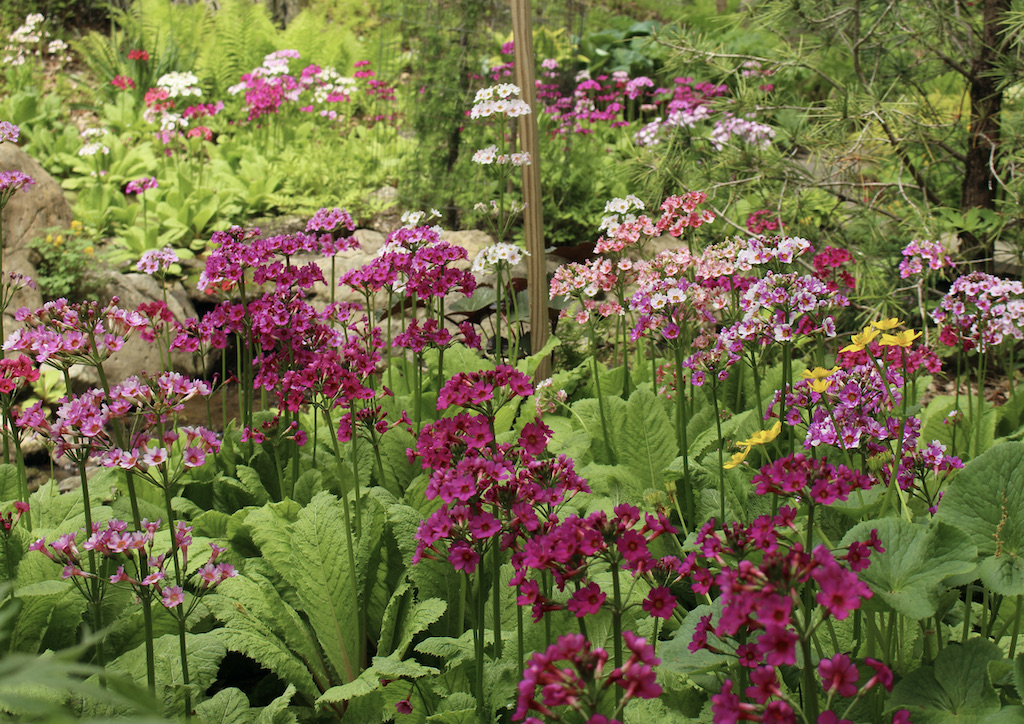
As you come around a few more boulders you find yourself at the bottom of the ravine, where a mass of Primula japonica fill the low spots.  They were just starting their peak bloom, it was excellent.

ithaca rock garden

A path runs back and forth along the stream.

ithaca rock garden

Masses of Primula japonica

ithaca rock garden

The stream heads out to the lake.  You would never guess a downpour had this garden nearly flooded a few days prior to the opening.

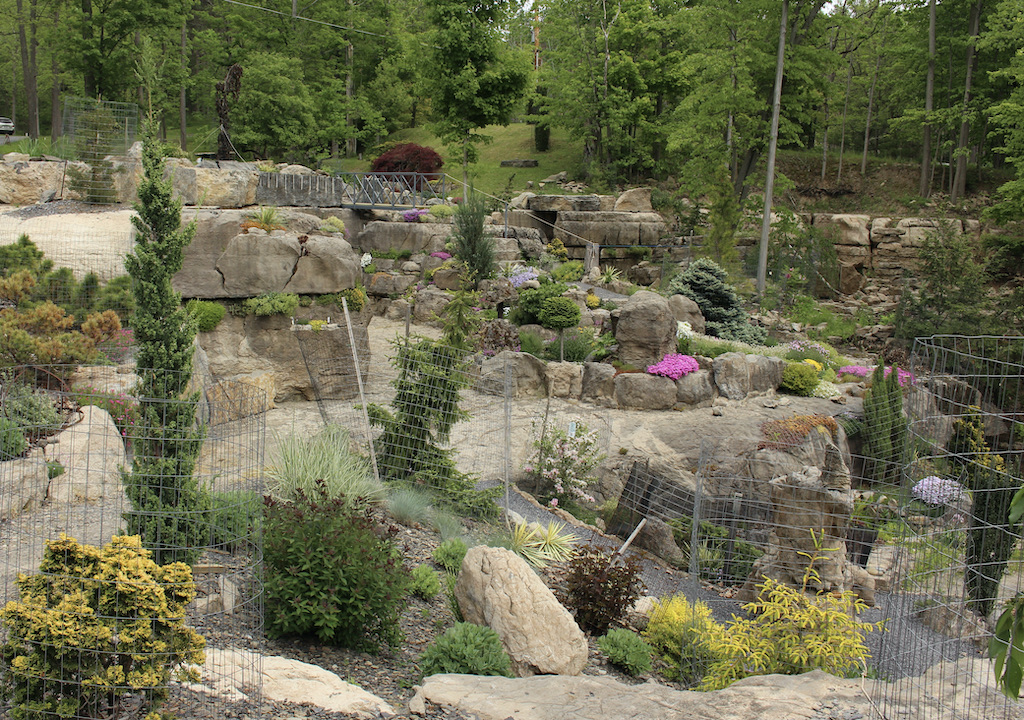
There were more woodland plants, azaleas, rhododendrons, and tree peonies but of course I can’t show everything, so I’ll leave off with one last overview of the upper garden as viewed from the house.  As you can see ‘dwarf’ conifers are also an interest.

ithaca rock garden

A view from the other side.  You can see some of the deer fencing, obviously the hooved beasts have no respect for such a special place.

So this garden was amazing, but who would I be if I turned down another garden tour invite?  I headed a few miles further to the impromptu open garden which had been announced at the sale, and here I was able to enjoy huge beds filled with lush perennials all grown to perfection.  I’m afraid I derailed plenty of my host’s Saturday afternoon gardening plans since it was already kind of late, but she still gave me the full tour!

ithaca rock garden

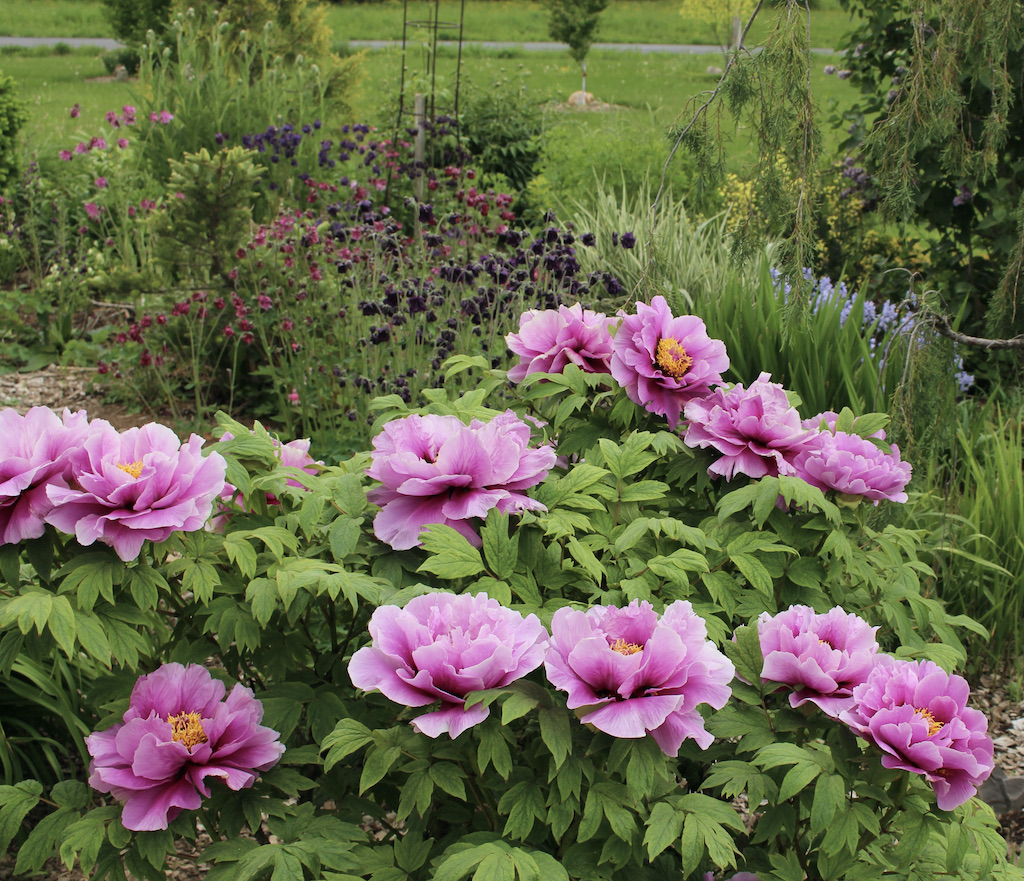
Tree peonies were at their moment of perfection.

There were cool plants everywhere, and they were all so well grown that I tried to avoid all honesty about my own garden when asked.  My big regret though is that I didn’t take more pictures.  It’s almost criminal that there are no photos of the red horse chestnut (Aesculus x carnea ‘Ft. McNair’) which was in full flower over one of the back beds.

ithaca rock garden

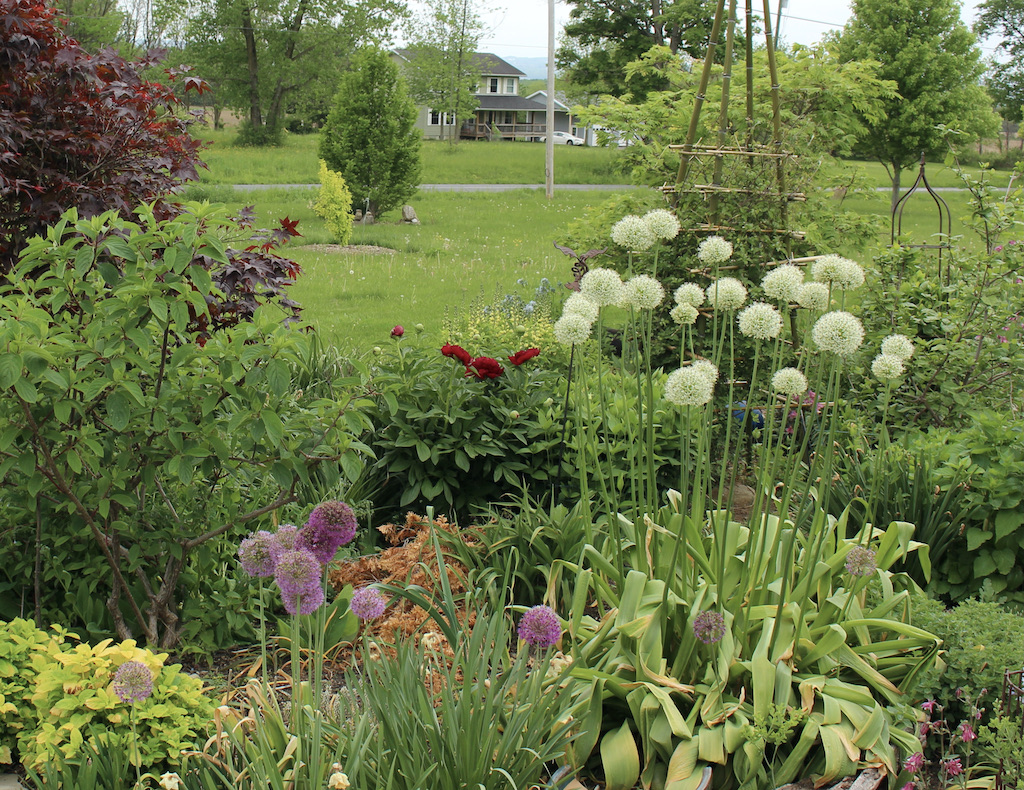
Alliums, Aquilegia, and peony were at their peak but I could see that the show had started months ago with spring bulbs, and will continue for months more with all the other later perennials.

ithaca rock garden

Wow.

So I’m also not even mentioning the shade gardens, the small arboretum of special trees, the field of dahlia tubers I was preventing her from planting… It was another fascinating garden and I have to say that the best thing about this day was meeting person after person who were so crazy about plants that it made me feel entirely sane.  What a group!

I rushed out of this stop with a new friend (and even more plants in my hands) and headed for my last stop.  It was already about dinnertime when I rolled into my friend Leon’s driveway but he didn’t seem too annoyed with me.  He knew I’d be late and still led me around the grounds of Der Rosenmeister Nursery and tolerated question after question.  I didn’t have time for a single picture.  I bought three roses.  I’m going back in a few weeks to see the hundreds of roses in full bloom, and it is guaranteed to be another great trip and I’m sure you’ll hear all about it 🙂

Hope you enjoyed this adventure !

Start Your Engines!

Something odd got into me last week.  After what has probably been months of the usual laziness I started a few tasks.  Then I went on to new ones.  Before I knew it I was being productive, and although I feel more sore than accomplished, I do feel like I finally made a little headway.

front border rose aicha

I took a break on Sunday from porch cleaning to get a few photos.  Here’s the front border with the pale yellow, single blooms of the rose ‘Aicha’ mixed in with the blue of colombine (aquilegia)

This weekend I spent Friday digging trade plants and opening the pool, Saturday traveled on a gardening adventure, and then Sunday tried to make the yard more summer-friendly since it was awfully hot and that seemed the right thing to do.  Monday it was lawn mowing, trimming, watering… and I even started to pickaxe a few holes into the berm for more arborvitae plantings.  Finally today I finished the planting (just four bushes) but it felt like a major accomplishment since the hard-packed, rocky “soil” fought me all the way.

rose Aicha

‘Aicha’ is a beauty.  I hope she gets just a little taller so I can thread a small clematis through her for the ‘off’ season.

Tomorrow I’m home for a “Dr’s appointment”.  I’d also like to spend some time outside and see if I can get the vegetable garden moving, but we will see if new ambition beats the forecast heat.  In theory I could spend the day by the pool with just a few breaks to admire the iris, but for now I’m hoping ambition wins, since wouldn’t that be just terrible to waste a day off swimming and doing next to nothing?

iris historic sunol

The historic iris ‘Sunol’ (1933) growing in the foundation beds.  Usually it has a bronze flush to the falls, but perhaps that faded this year in the heat.  

Speaking of the lure of sloth, last summer I had hoped to reclaim some of the front border for more iris plantings but once things filled in it was a struggle to find open spots and as usual I resorted to edge planting.  Edge planting lets me shoehorn in a couple more plants along the outer fringes even if the outer fringe looks better empty.  If never looks that great having plants hanging off the edge of the bed like that, but when the place is filled that’s as good as it gets.

historic iris romeo

Historic iris ‘Romeo’ (1912) has a cool look to the falls which is different from the others I grow.  

So (again) the plan is to clear a few swathes where iris can go.  It’s been dry, which is good for bearded iris, but if the summer turns wet this gardener might be tempted to fill in with all kinds of annuals and various other showier things which are great in the fall… but are not iris.

historic iris elsinore

‘Elsinore’ (1932) is another somewhat unique historic iris which I like very much 🙂 

Regardless, I have faith that a few iris will again fill a sizeable chunk of the border.  I may have to resort to a few of the hardier ones which don’t mind some summer shade, but it needs to be done since a May without an overload of beaded iris is completely unacceptable.

historic iris indian chief

‘Indian Chief’ (1929) is not my favorite color, but the plants handle competition and some shade quite well, so of course it gets an invite.

So iris are on the to-do list… somewhere… and in the meantime I need to focus on planting and watering…. and weeding of course, but I think you know how I feel about a strong commitment to weed-free beds vs saving a few of the more interesting ones 🙂

scotch thistle

A big Scotch thistle(Onopordum acanthium) has come up in a spot reserved for phlox and snowdrops.  It’s as prickly as it looks and of course I love this (listed as noxious in several western states) weed.   

Even if the weeding doesn’t happen, hopefully I can at least show off a respectable vegetable-filled potager in another week or two.

perennial border

From a distance of greater than 20 feet, much of the garden doesn’t look bad.  I just wish it passed the five foot rule!

Wish me luck.  I’m already thinking that the best plan is to head to the nursery in the AM and start the day with new vegetable transplants… and likely a few more flowers…  Obviously deep down inside I know buying more plants doesn’t help the four new rose bushes, various overwintered tropicals, trays of sprouted seedlings, and the haul from last weekend’s rock garden society sale that are sitting on the driveway, but it’s more fun and I’m always up for that.

Hope you have a fun week 🙂

A May Lull

A cool and rainy week with a busy schedule have kept me out of the garden for a few days.  By that I mean there were enough weather and work excuses to avoid any real work, since even a rainy day does not cancel the daily garden tour.  In other gardens the lilacs overhang azaleas, with dogwoods and redbuds shading the lawn, and banks of rhododendrons exploding in color… but I’ve only a few dogwoods and little of the others, so here the spring crescendo of tulips is followed by a slight lull of green.

foundation perennials

The blue camassia are a flash in the pan here and only seem to flower for a week or so.  It’s a nice show, but the blue columbine (Aquilegia vulgaris) is just as nice and lasts longer so I may (again) try and dig all the camassia to get rid of them.  This time I’ll try and get all the bulbs…

Right now there may be a lull in the flowering, but after several months of white and brown, green is still an excellent color, and with its various shades and shapes, and the surprise of variegation and chartreuse or purple tints, even a green lull makes for a nice show and it should really be enough.

aquilegia vulgaris

Blue columbine (Aquilegia vulgaris) was originally found in the woods behind the house, and rescued when the bulldozers came.  It’s not native and fancier colors and forms exist, but I like it well enough.

Most people can stick with well enough, but I admit to a short attention span and fickleness so of course I want other things to follow up as the tulips fade and the bearded iris are yet to come.  The columbine is good, and usually moneyplant (Lunaria annua) fills in with a nice purple, but I think I need more alliums.

perennial bed

Tulips and daffs have all been deadheaded and are disappearing under the next wave of growth but just the columbine and a few moneyplants  (it’s a down year for this biennial) are in bloom.  The blue is nice, but note the bold little ‘Candy Corn’ spirea in front.   I can’t believe I planted it, usually spirea disgust me, but this one is so offensively bright there was no resisting.

Back in the day the budget was much tighter, and a few flowering onions always seemed to be just too much when a big bag of tulips could be had for the same price.  Today it’s a different story.  A couple new alliums are just pennies once you’ve paid off the monthly gymnastics bill and bought a couple pricey snowdrops.

allium gladiator

Allium ‘Gladiator’ was my first big allium.  I was hoping for bigger, but tall is good too!  Over the last 15 years one bulb has become many.

So I will see what happens.  The problem is settling on just two or three rather than a dozen, and I of course will be looking for suggestions from my friends.  I already have a few leads 😉

allium gladiator

‘Gladiator’ is also doing well in the potager.  Phlox and other perennials are coming up just in time to (mostly)cover the allium’s yellowing leaves.

Yeah, the yellowing leaves.  Just as the flowers open and draw a little attention, the foliage starts dying back to compete with the show.  Trimming them back or hiding them in a border are two options for better gardeners.

allium gladiator

The green centers are cool.

The yellowing allium foliage can be a deal breaker for some, but here it barely registers.  I run a messy garden and fortunately some delusion of diamond in the rough or some bizarrely inflated ego syndrome allows me to still share photos online.  I should be embarrassed most of the time, but luckily it’s a rare day that I see some perfect garden photo and suddenly question my entire gardening hobby (as well as the public settings on this blog).

raised bed vegetable

The mountain of snowball bush (Viburnum opulus ‘Roseum’) is probably the only perfect thing about the potager right now.  It should be weeded.  And planted.  And tended.  One of these days…

Ah, whatever.  Let’s finish with a disclaimer on the potager.  The raised beds are excellent, the sand paths are perfect, the whole idea of the potager is much better than the usual mess, but it’s still just a mess.  “It’s not you, it’s me” I tell the garden and I suspect the garden understands.  My weaknesses is a love of interesting, and it’s just too interesting to see if the resprouting cabbage stumps from last year will form heads or if the missed potatoes from last year will amount to anything.  Good thing no one expects this garden to feed a family.

raised bed vegetable

A few parsley seedlings went into this bed, but I’m still working myself up to weeding out all the rest.  Besides obvious weeds there’s a nice clump of lettuce, many tomato seedlings… random hellebores…

So what did I do today?  Clear a bed and plant beans?  No, of course not.  I was working in the front border dividing tulip clumps.  Just for the record, it’s too early to divide tulips.  The foliage should be yellowing and it’s not but whatever.  Dig up a clump, shake and pick out the smaller bulbs, and replant.  No careful soil improvement, no watering in and I guess we will see what comes of it.  Smarter gardeners would have pulled them all and tossed them after flowering, it’s just a few dollars to replace them, but I don’t think it will surprise anyone if I admit my gardening is more of an ADD drifting through ideas rather than a focused plan with a to-do list.  Reinventing the wheel has always been a passion of mine.

Have a great week, and I hope it includes plenty of plant-time 🙂

The Perfect Lawn

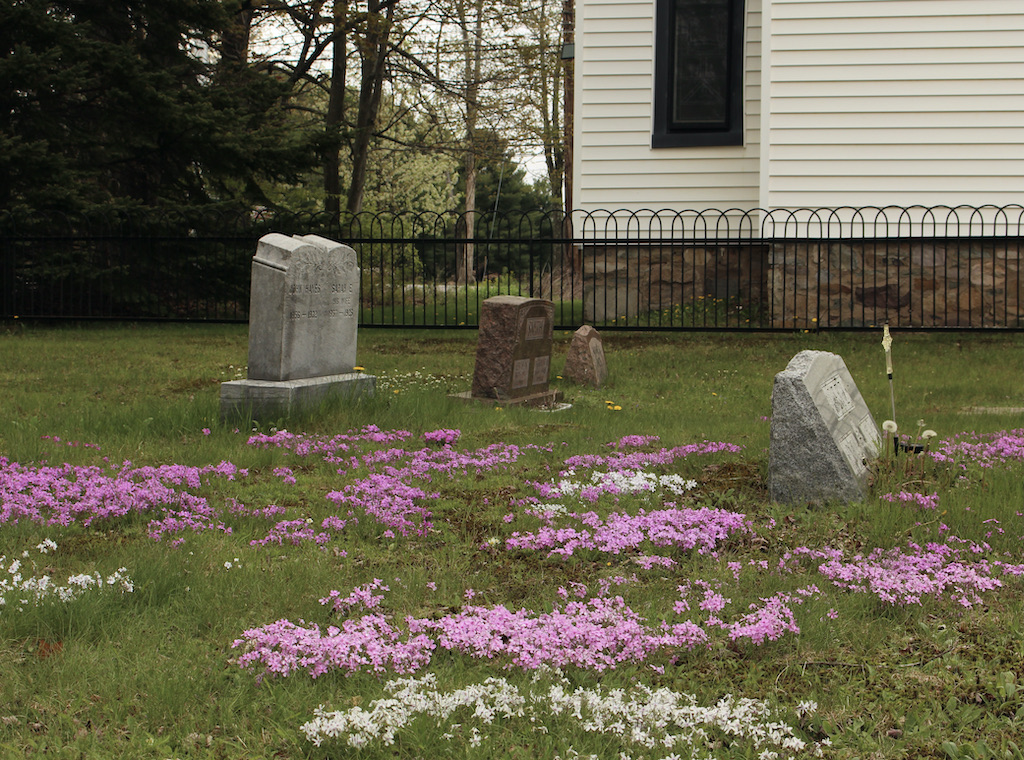
The rain outside is knocking the last petals off the tulips and surely bringing new life to weed seedlings all over, but I won’t let that bother me… yet… Instead I’d like to show you around a cemetery which I like to swing by on the way home from work.  Don’t be concerned, it’s not a fascination with death which brings me here, it’s the naturalized blanket of creeping phlox (Phlox subulata) which weaves through the grass and flowers at this time of year.

naturalized phlox subulata

Phlox subulata (I’m assuming) seeding and creeping through the cemetery grounds.

I have no idea if the phlox here were planted originally or came in on their own, but the church financed lawn care hasn’t been intense enough to wipe out the spread of wildflowers between the gravestones.  I also believe a kind soul is in charge of the mowing since I saw signs of a recent cut, but only a few patches of the thicker grass were mown and the best flower patches were spared the blade.

naturalized phlox subulata

I’m just guessing, but suspect the churchyard has been in place here for around 150 years.

Over the decades ‘mildly maintained’ graveyards have a way of picking up flowers and when I have the chance I often give them a looking over for spring flowers, iris plantings, and the occasional rose bush.  Someday I hope to find that snowdrop filled meadow, but so far…

naturalized phlox subulata

The phlox were probably planted originally, but since then have seeded about to form an interesting mix of colors and flower forms.

Phlox subulata is a plant native to the Northeastern part of this country, and occasionally I also see it growing in rocky outcroppings or gravely roadsides, but never as thickly as it does in graveyards.  It’s not a shade plant, so probably as the East coast has grown up in trees or been improved with bluegrass turf, cut and sprayed to golf course quality, this sun loving phlox has been squeezed out and into much smaller locales.

naturalized phlox subulata

A paler section of the colony.

Of course creeping phlox is still growing all over, in foundations plantings and mulch beds everywhere, and in my own childhood garden I’m pretty sure a big chunk of every summer was spent weeding grass blades out of my mother’s phlox planting.  As you know though, a grass-free planting of creeping phlox is pretty much impossible.

naturalized phlox subulata

Phlox mixing it up with pussytoes (Antennaria sp), another short wildflower which used to keep lawns everywhere from becoming yawns.

Why fight it then?  Just plant your phlox right in the grass 🙂

Easier said than done though.  Most lawns are too fertile and the grass and other more common weeds like creeping charlie, dandelions, and white clover will dominate.  *My own lawn is an excellent example of this…

naturalized phlox subulata

Phlox with a few bluet (Houstonia) alongside.  There were a couple more patches of bluets and various violets as well, but the phlox seemed much happier here.

I think more lawns used to be like this.  If you travel the older parts of town the lawns are often flecked with all kinds of flowers, both native and introduced, and I think it’s a much more interesting look than the hyped-up green swards which dominate suburbia.

naturalized phlox subulata

Naturalized Phlox subulata

So I hope this little trip to the churchyard was enjoyable.  Benign neglect can be a great thing and I may keep this in mind as I consider the ‘wildflowers’ which the rain has brought up throughout my own garden.

Have a great week, and a happy mother’s day to all the moms!

Out of the Blue

Seriously.  If anyone has ever considered abducting me, all it would take is a white van and the promise of a plant inside.  What!?  You have a variegated clematis in there?  Move over, let me see…

Within days of starting a conversation about bulbs with a new online friend, I was convinced Crinum lilies were missing from my life and I needed a few.  A week later a (quite heavy) box from Jenks Farmer shows up on my porch and I’m tearing up the garden making room for a bulb or three.

Jenks Farmer crinum

The Crinum bulbs which showed up were huge.  I was so excited I made sure every vaguely disinterested family member had an opportunity to admire them and hear a little about them.  They seemed very grateful.

It’s not easy just squeezing a cantaloupe sized bulb which needs several square foot of space, into a fairly full perennial border, but I no longer even pretend to worry about it.

foundation perennials

Realistically, four square feet of space would be a good start for planting a small crinum.  Obviously this bed has quite a few four foot gaps which need filling 😉

I worry about stupid things instead.  There were a few grassy threads of something which looked like allium seedlings in the spot where the one crinum should have gone.  I’d really like them to be allium seedlings, but they’re too small to risk moving so of course I planted the $40 crinum in a second best spot crammed between a hellebore and penstemon in a spot which was unavailable until I moved the 90 pound “landscape” stone out of the way.  I thought this was the best option rather than risk anything happening to the six or seven tiny weeds which maybe have a 15% chance of become amazing alliums in another half decade or so…

foundation perennials

Crinum powellii album nestled into its new home.  It might be an expensive annual this far North, but the bulb is huge and if all goes well maybe a single flower stalk will grace the garden before winter smashes all my dreams of global warming granted hardiness.

Let me just mention the alliums quickly. They’re three bulbs of Allium karataviense ‘red and pink hybrids’, and even at 50% off during a late November clearance sale, they were still kind of costly.  Not snowdrop-costly but still kind of pricey when you consider they’re basically just onions with an ego.  Of course they’re too self-important to bother splitting and multiplying, but maybe those seedlings are a start.

allium karataviense red

I think their broad, water-repelling foliage is very cool in itself, but the flowers aren’t too shabby either.  I suspect these are hybrids based on Allium karataviense ssp henrikii, but that’s only if you really want to make your onions sound fancy.

I’m going to apologize now for going on and on about tulips again.  A short post mentioning some new crinum bulbs was the plan, but then I got tulips on my brain again, and well…

tulips and dogwood

The hot colored tulips mark the last stage of the front border’s spring flush.  It will face a short lull now as (I hope) the summer bloomers come along, but for now it’s awesome.  Also please note it’s been an excellent dogwood year 🙂

In case you haven’t noticed, my garden follows manias, and I’m sensing another tulip mania coming on.  Bulbs will be dug, moved, stored, replanted… and hopefully next year there will be even more tulip excitement!  Unless of course some epimedium thing or bearded iris obsession develops, you never know.  Sometimes I like to consider how nice this garden could look if the gardener would only focus and organize, but obviously that hasn’t happened and instead I always opt for “interesting”, even if it’s only interesting for me 🙂

black tulip

I think black tulips are interesting.  The gray leaves of Scotch thistle are also interesting, as well as the weedy yellow roadside mustard behind them.  I think I should let the mustard go to seed and check those out for spiciness, that might also be pretty interesting!

Awesome is also a good option.  Some of the tulips rate pretty high on the awesomeness index.

tulip happy generation

No idea on the name of these luscious cherry with orange flowers, but they rate awesome.  The white with red flames behind aren’t too bad either, they came in a mix and I believe they’re the tulip ‘Happy Generation’.

The one new tulip purchase for this year were the antique ‘broken’ tulips purchased through Old House Gardens.  If they return next year I’m sure you’ll see too much of them, but for this year the five single bulbs I planted are more of an obsession rather than an amazing landscape show.  An obsession because of the beautiful, virus-induced patterning and its connection to the raging tulipmania of the 17th century, and just plain interesting because of the great age of these cultivars.  The ones planted this year range in age from one to three hundred years old!

virus broken tulips

The solid color of these tulips has been ‘broken’ by a virus they carry.  I shall keep them away from other tulips (and true lilies) and hope for the best.

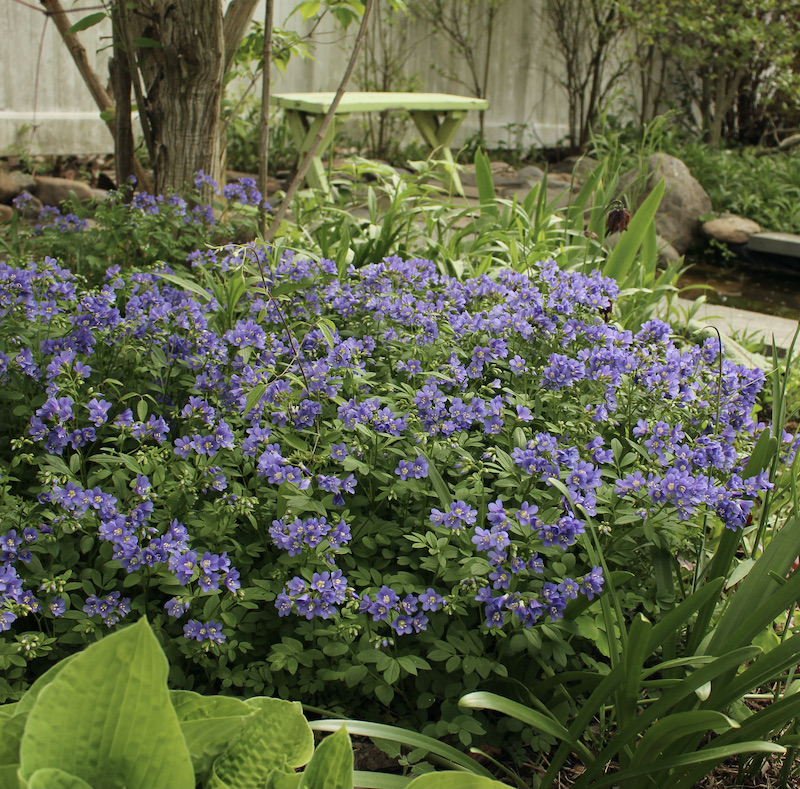
As I was considering how old the tulips were I kinda felt a little old myself.  There I was admiring the nice blue mat of what I think is Polemonium reptans and I realized I’ve been tending this plant in some way or another for over forty years.  It was growing in the garden of my parent’s house 51 years ago when they bought it and it’s one of the first things I realized I could move and divide and not end up killing.

polemonium reptans

I don’t know if this is plain old Polemonium reptans or some selection or some other species or hybrid, but it just keeps chugging along year after year.  Never sets a single seed, but slowly creeps along.

Things that I can’t kill are good to have.  They say Crinum lilies are next to impossible to kill so that’s promising, but any idiot knows that winters here are cold, and considering that I know winters here are cold, that may explain my decision to plant them…

primula sieboldii

It’s been pouring rain today.  I made a point of photographing the primula sieboldii yesterday as a memory of what they looked like before they drowned.

So as usual we will see where these questionable decisions lead.  Container crinums would likely be a smarter choice but then I would have to find a big enough container and that might be even more trouble than dealing with the loss of yet another borderline plant.  In any case if I hedge my bets with a bunch more tulip plantings this fall I’ll have plenty to keep me happy in case the other stuff fails, so obviously my apparent madness is actually a well devised plan of attack.

Hahahaha, sure it is. Have a great week, and remember to stay away from those white vans, even if they say they’re full of rare violets and hosta  😉

Spring!!!

This is the time of year when I like to complain about how terrible my allergies are.  The burning eyes and runny nose and sneezing… they’re really not all that bad but it’s the only season when I have something to blame my general laziness on.  It’s not aimless sloth, it’s dust and pollen.  I’m a victim I shout but then someone suggests I come in out of the polleny wind and clean the basement.  As if.

spring shade garden

A few primrose have not only survived, but have even prospered in the dry shade which has suddenly appeared in parts of the garden.  I swear I just planted those trees a year or two ago.

Saturday was actually a pretty busy day around here and things were weeded, mowed, pruned, and a few things were actually transplanted.  That’s good but in the sprit of easing into ‘hard labor season’ the gardener took Sunday off and photographed a few things.  The photo shoot was followed by much sitting around, and then the week since has been much of the same.

lathyrus vernus

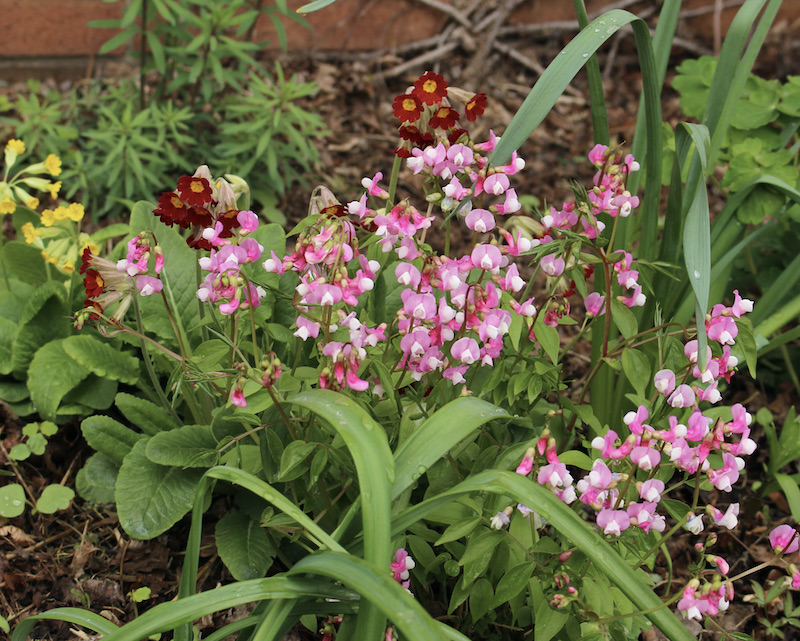
More shade treasures, Lathyrus vernus was mowed by rabbits in March, but fenced in April.  This spring vetchling could have been nicer but at least a few flower buds survived.

My excuse the past two days has been heat.  79F yesterday and 84F today.  The warmth was such a shock today I almost started an inside cleaning frenzy before coming to my senses.  Fortunately things didn’t have to go that far since the house is again super neat with both kids home all day in a return to online learning.  I’m sure every parent recognizes the sarcasm dripping off every word in that last sentence.

lathyrus vernus

The pink form of Lathyrus vernus, ‘alboroseus’, was fenced before the rabbits got to it.  Anyone else would recognize that fencing should be done each spring but I like to surprise myself anew each year.

So now I’m trying to burst on past this wall of laziness and at least get a blog post up.  My garden has a springtime peak as the tulips and dogwoods come into bloom, and I’m absolutely ready to devote hours to just wandering around admiring bloom after bloom.  It’s similar to snowdrop season except there’s more than one color and I don’t have to crawl around on my hands and knees.

double daffodil

Some of last years divided and replanted daffodils, this one a nameless double which looks similar to ‘Tahiti’ but just a bit more yellow and slightly smaller.

The daffodils are really in full swing and the Darwin tulips and other early season tulips are opening to join them.  I know I brag about it all the time but this mostly exposed and summer-dry garden seems to be just what these tulips enjoy.

spring bulb garden

This is what the snowdrop bed degenerates into as other things come up.  The daffodils are intentional but only the reddish ‘Spryng Break’ tulips were planted, the rest came in via compost or squirrels.

The vegetable garden had been a major tulip stronghold, since every batch of compost and every turning of the beds seemed to spread them a little further, but last year’s raised bed project cleaned that up a little.  Many bulbs were collected, flowering plants potted up, and some were just lifted to new spots, but I did try to reduce the numbers…

growing tulips

The front bed is filled with bulbs collected during construction.  For some reason I hate the color mix and every day I am just minutes away from pulling the short purple and white tulips and tossing them…  it may still happen.   The back bed just needs emptying out… way too much yellow 🙂

Once the flowers are over and the foliage yellows, the bed above will be lifted, dried, stored, and replanted in the fall.  The flowers are sparse and small this year, but next year they’ll be fine again having spent the whole spring growing rather than suffering a mid April move.  I just need to get a few more pinks into the mix and get rid of the dumpy little purples.

growing tulips

I probably planted these tulips as well.  I probably even thought it was a good spot and I wouldn’t need the room for more brocolli and lettuce tranplants.

Although the raised beds… I mean ‘Potager’… is having a down tulip year I still think tulips are a far better idea than just planting more cabbage.  More leftover and stray bulbs were planted in the concrete bed and (1) they did fine in a kinda exposed bed and (2) prove I need more red as well!  I can honestly see a day when the entire potager is filled with tulips 🙂

growing tulips

I gave away some ‘Spryng Break’ bulbs but these were deemed “too small” to pawn off on unsuspecting gardeners so they were replanted.  Now of course I’ll have even more and still not know what to do with them all… but I do know they’ll have to be planted next to something other than the short and moody burgundy ‘Muvato’ now behind it.  

Yes.  I do like tulips.  Tulips and only the occasional deer make for a wonderful spring and I don’t know what I’ll do if the deer start making a habit of visiting.

growing tulips

The fine red outline of this Darwin hybrid will slowly bleed into the flower until it becomes completely orange.  I love it but have just too many of this one.

A lack of deer does not mean complete bliss.  Some parts of the garden are plagued by tulip fire, which infects the foliage and blooms and makes overcrowded and damp bunches turn to mush.  Th potager re-dig helped immeasurably as did mulch and thinning, and this year I’ve been spraying with Neem oil and between that and a drier spring it all seems to be helping.  A better gardener would destroy the infected plants and not replant for five or so years but…

growing tulips

Some tulips seem more susceptible to tulip fire.  This orange late tulip has practically melted away while ‘Pretty Princess’ seems untouched.  

I could really go on and on about tulips but I’m just about blogged out for the night and I’m sure you’ll be fine without my babbling.  I’ll just leave you with some tulipomania from the front yard.

spring bulb garden

Tulip ‘Pink Impression’ on the left, and a few not-pink impression on the right.  All are excellent.

tulip burning heart

Tulip ‘Burning Heart’.  A big beauty who keeps coming back just as huge as they were in year one.

spring bulb garden

The star magnolia is finished but I think this end of the front border still looks decent.  It could use a few more tulips of course, and more daffodils won’t hurt either!

spring bulb garden

Tulip ‘Beauty of Spring’ anchors the other end of the front bed.  The red on this one will also spread as the flower ages.  With all the yellow daffodils I don’t know why I needed more yellow tulips, but there they are.

Fun fact.  As I was double checking the name on ‘Spring Beauty’ I came across an online site using an older picture of my clump to sell their wares.  I wonder if this entitles me to some kind of site discount…

Anyway it’s bedtime, so I hope these past few days also have you out enjoying the garden and reveling in the explosion of color called spring.  Perhaps it’s not spring in your neck of the woods, and in that case I hope there’s plenty of other joys to discover this week, in any case the key word is ‘enjoy’ 🙂

Untitled

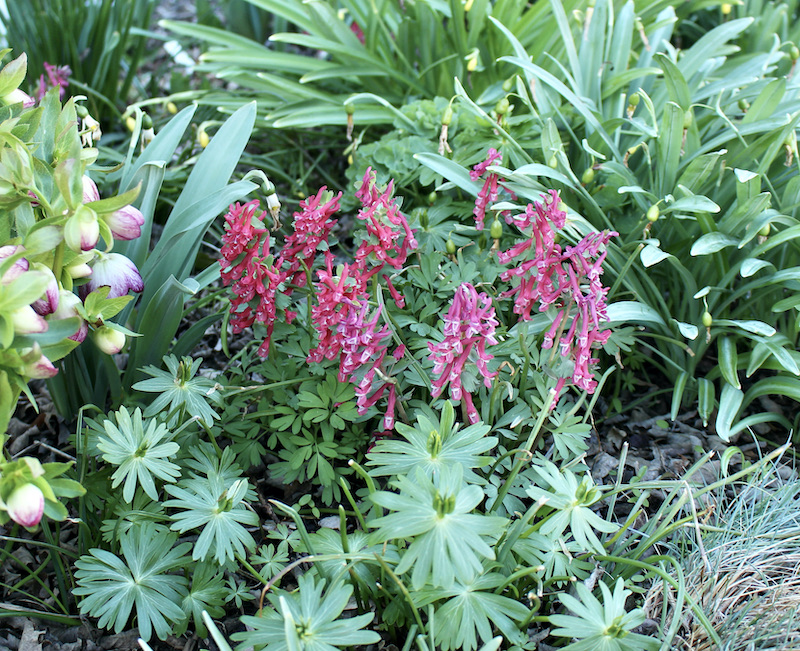
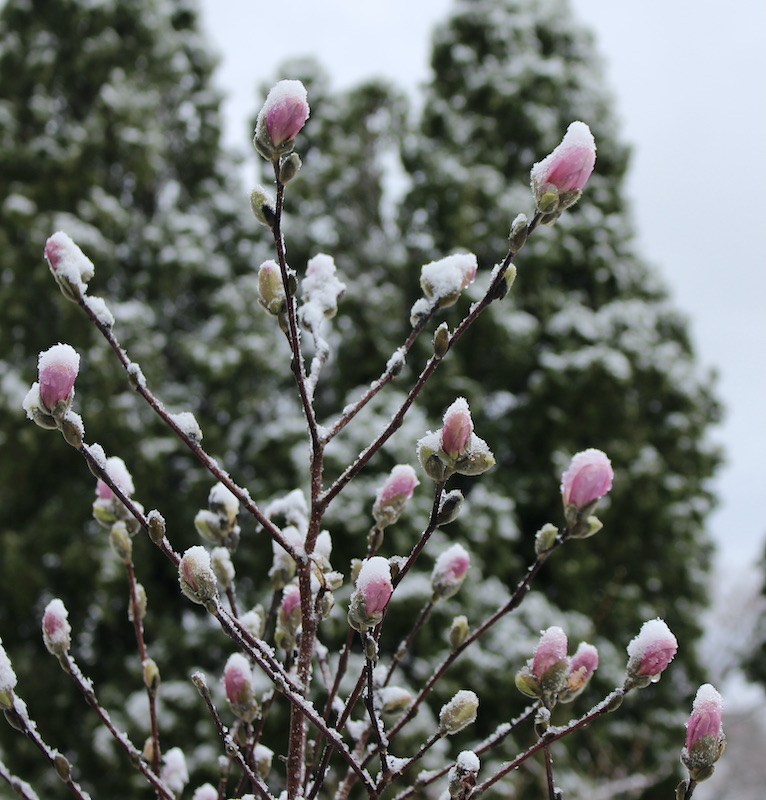
Spring has taken an odd turn here.  The weather has been fantastic and there’s been time to spend in the garden but I have absolutely no interest in doing anything.  Maybe it’s the lull effect.  Snowdrop season come on so fast and was over so quickly, it was hard to keep that high going.  Then the warm days were followed by two nights of hard freeze which singed the corydalis and melted half the hyacinths, but oddly spared the magnolia buds.  This has become the norm lately, but for some reason the freeze-damaged flowers have me a little bored, and the return to warm days has me hesitant about starting too much transplanting.  Fortunately the front garden looks ok with some spring daffodils, and my little twig of a magnolia cutting has grown into something which finally shows off.

magnolia stellata

Magnolia stellata, probably ‘Royal Star’ anchoring the far end of the front border.  You can see the mother plant from which this plant came from to the right of the neighbor’s house.  

I’m 87% sure last week’s freeze again killed all the barely pea-sized wisteria buds, but the almost open magnolias are fine.  Go figure.

magnolia stellata

This year the flowers have a flush of pink to them, but that will fade to white in a couple days.

Right now, with a nice cover of shredded leaves, the front border seems optimistically weed-free, so even if there is transplanting and thinning to do I can still pretend it’s all under control for a few weeks longer.  A gardener with more foresight and enthusiasm would probably scuffle through the mulch with a hoe now, before the onslaught of seedlings put down roots, but…

daffodil tweety bird

The daffodil ‘Tweety Bird’ flopped a little for the 21F night but has bounced back without a second thought.  I’d say it’s one of my absolute favorites.

As I said, the hyacinths are probably the one bulb which took the biggest freeze-hit.  Some are fine, but many either melted or suffered freeze damage to the flowers.  Of course with all this pessimism running through my veins all I see are frosted flowers, even though I know I’m the only one to see it.

freeze damage hyacinth

It saddens me to see the damage on ‘Woodstock’, but maybe a lost year of flowering will just mean a bigger show next year!

The hyacinths usually lead the garden into full daffodil season, which is also normally a big thing, but last year’s purge of the narcissus beds has left a noticeably smaller show in the back yard.  Again, I’m the only one who notices these things, but I do miss them.

hellebore hgc silvermoon

Maybe “MORE!!!” is the solution I’m looking for.  I could divide up the hellebore ‘HGC Silvermoon’ and spread hyacinths all over… and then wonder how I ended up with so much pink 🙂

Actually the daffodils will be back next year, they just need a year to settle in and bulk up, but what I still want to celebrate is my first self-sown daffodil!

daffodil seedling

‘Holland Sensation'(supposedly) on the left, and a nearly identical seedling to the right.

I had been watching the daffodil seedlings for a few years and of course had all these amazing possibilities in my head, so it was a little bit of a surprise to see a nearly identical child show up.  It’s going to be interesting to see what the others turn out to be since there are quite a few ringing the mother clump… all about a daffodil stem’s length away from the seed source.

tulip bed

Tulips will be next.

Honestly there are still plenty of daffodils to come.  They’re later than normal from the digging and drying and storing process, but there will still be enough.  Tulips on the other hand, there are never enough tulips!  I replanted some of the ones I dug last year, but they were stunted from the ‘in the green’ transplanting process so only about half will bloom this year.  But that’s not a bad thing since the transplanted tulips are showing perfect foliage, and that’s not been the case recently.  The foliage is usually scarred with the pocks and streaks of the tulip fire fungus, and the tulips I didn’t get around to moving are again showing this kind of damage.  I considered fungal sprays, but they all sounded so toxic I was going to just try digging these as well until I saw Neem oil spray.  An organic option which doesn’t sound too eco-toxic so I’m going to give that a try on top of moving them.  I’m not 100% sure when is best to spray, and I’ve never used it before, so please let me know if you have any suggestions.

garden pond

Cleaning up the pond.  Of course the pump broke halfway through.  

Since we ended up on the repulsive subject of tulip fire, let me just stay with the theme and say that pond cleanup is also repulsive and probably the most disgusting part of spring cleanup.  There was a slimy layer of rotten leaves coating everything, with a robust algae population and who-knows-what-else ecosystem of muck.  Even with gloves it would be super-gross, but of course I was too lazy to go find them, so into the unknown my fingers went.  The best part though was when the dog found something delicious in all that muck to chew on.  What a disgusting little beast.  Yuck.

So sorry about that segway into grossness.  It’s probably just a symptom of my dark mood which will evaporate just as quickly as the first tulips open.  In the meantime I wish you all a wonderful and safe week!


A Bit of a Chill

The low last night was 23F (-5C) and tonight promises more of the same, although possibly a little warmer… as if that matters… so I’m going to dwell on the warmer days from earlier this week.  To the relief of many snowdrop season here has ended and we are hurtling forward through corydalis season but not yet fully into daffodil season.  After the highs of the snowdrops it’s almost a lull, but then I looked at the photos.  Not bad at all I thought, although a few more days of snowdrops would have been nicer.

front street border spring

‘Tweety Bird’ is my first daffodil to open making a ‘bold’ contrast to the pinks of the corydalis solida ‘Beth Evans’.  

Weird how the sun and warmth melted the galanthus yet hasn’t really brought on much of the other stuff yet.  I suspect it has something to do with the weeks of snow cover and some things growing up through the snow yet others waiting for the melt to happen first.

scilla mischtschenkoana

Scilla mischtschenkoana picks up right after the snowdrops finish, but even in a good year barely flowers for more than a week or two.  One rough week of work sometimes means missing the whole thing!  

It might sound like complaining when I lament how short a bloom season might seem but honestly I bore quickly, so this (with the exception of a quick snowdrop season) actually works in my favor.  There’s always the excitement of a next wave approaching and as long as a hard freeze doesn’t ruin things… hmmmmm…. maybe I shouldn’t yet discount late hard freezes…

pasque flower

Pasque flower (Pulsatilla vulgaris) is one of the first perennials to bloom, right alongside the hellebores. 

Pasque (Pulsatilla vulgaris, formerly Anemone pulsatilla) flowers are a full-sun perennial  which I don’t think I’ve ever seen for sale on a nursery bench.  Of course they flower too early for Mother’s Day and don’t last long, and in this age of “does it flower all summer?” the answer is no, and some people just don’t want to hear that.  Actually many sensible gardeners aren’t crawling around their perennial beds yet, and the pasque flower’s early blooms pass perfection so quickly I don’t blame them for not bothering with this plant, but I of course love their fuzziness and optimism against cold and ice and always end up thrilled to see their blooms catching the springtime sun.

pasque flower

Same pasque flower, other side while a cloud passes.

I bet a few early, miniature daffodils in cooling lemon and white tones would be perfect alongside even more pasque flowers.  Other species come in reds and pale yellows and whites, and they’re easy from freshly sown seed and… well I digress again.   

galanthus peardrop

Galanthus ‘Peardrop’ is one of the latest to bloom here.

Sorry for throwing in two last snowdrops. -I was doing so good!

galanthus galadriel

‘Galadriel’ is an elegant beauty with a fitting name.  I should move it to a more open spot where it can be a focal point… hahaha, as if any of those spots are still empty 😉

That’s it for snowdrops.  I hope there’s something equally exciting on the horizon, and I think I have it here with this next sprout.

cold hardy cardoon

A plate-sized eruption of foliage means the cardoon (Cynara cardunculus) really is as hardy a sort as promised.  Cardoons have always died away over winter here, so this is mega-exciting.  I guarantee you’ll hear more about it in a month or two! (please ignore the sea of allium seedlings in the background)

Maybe the promise of a year filled with cardoon photographs wasn’t what you were hoping for, but at least I didn’t sneak in another snowdrop.  Here.  Corydalis are also not snowdrops, and after a few years here they’re also not as formally named as the latter.

corydalis george baker

Maybe Corydalis ‘George Baker’.  The plant on the left looks rightish, but the other side of the clump looks a little different.

Honestly I can’t keep my corydalis straight.  Besides being promiscuous they must somehow resent how I try to pamper named cultivars while overlooking equally attractive stray seedlings.  Out of spite the $15 named corm disappears while a sea of seedlings comes up to surround the lonely label.

red corydalis seedlings

Last year the final named form in this bed opted out on renewing for another year.  Maybe it was the weeds, but everyone else seems relatively happy.  

I don’t mind.  They come up, flower, seed, and are gone before I even think about the other perennials and annuals which share this same space later in the year.  Maybe native plant purists and lovers of bare mulch beds will complain about weediness, but just come here I’d say, and I’ll show you some weeds you can complain about.

red corydalis seedlings

Ugh.  One has even jumped across into the next bed.  When I dig a few of the daffodils I’ll try and remember to weed out this corydalis.

I’d like to move a few of the nicest forms into a bed where they can clump up, but so far my clumsy attempts at moving them in bloom has caused more casualties than it has attractive corydalis plantings, but eventually I think I’ll get it.

red corydalis seedlings

Everyone here admires the corydalis.  I’ve been informed this little guy lives under the porch and often comes out to sun himself on bits of trash while admiring the flowers.  Word is he is really looking forward to meeting my friend Kimberley 🙂

So then this….

magnolia in snow

Magnolia are well known for how bravely they endure the ups and downs of early spring…

The weather started to “shift” yesterday.

forsythia in snow

Forsythia ‘Show Off’ which I planted next door.  I’d show you mine but it appears the soil on my side of the property line produces more rabbaliscious growth and as a result it hasn’t broken the four inch mark because of its annual pruning.

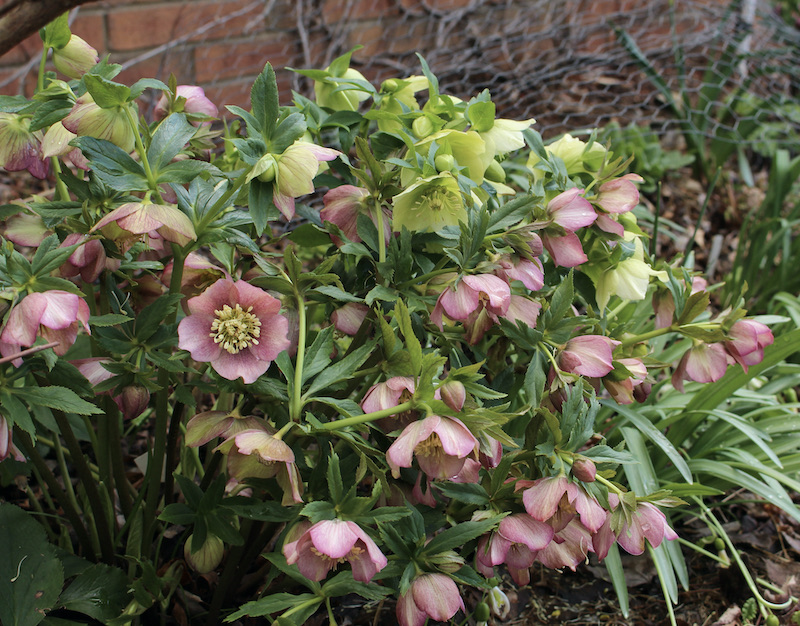
And now for a few hellebores.  I dug up a few as giveaways last week and have to say it’s a much nicer way to clear space for even more hellebores than sending them to the compost pile would be.  It would be nice to think I’m “upgrading” but since the new ones are unflowered seedlings, who knows but at least it’s much more exciting to see something new next spring!

double pink hellebore

I think this was supposed to be ‘Pink Fizz’, a single pink, but sadly I ended up with this very un-single flower 😉

I have a little thing for growing hellebores from seed.  A few get planted every fall, and eventually the pipeline is full enough that each spring there are new surprises from the years past.

hellebore seedlings

I believe these were supposed to be a ‘slatey’ mix of seeds.  Kind of average, and not really slate-ish, but still nice for a few springs.

hellebore seedlings

Someone was too lazy to separate this pot of seedlings when planting.  I like the effect!

double pink hellebore

I might have too many of these… a double pink hellebore, maybe ‘Nellie’ from seed I ordered 8 years ago from Australia.  They’ve finally gotten some room and are looking great, but 6 plants of it!?

The hellebores will be fine with the cold.  Most everything will be fine until it’s not, and even then it will likely recover for next year. *yes I’m talking about last year’s lost lily season*

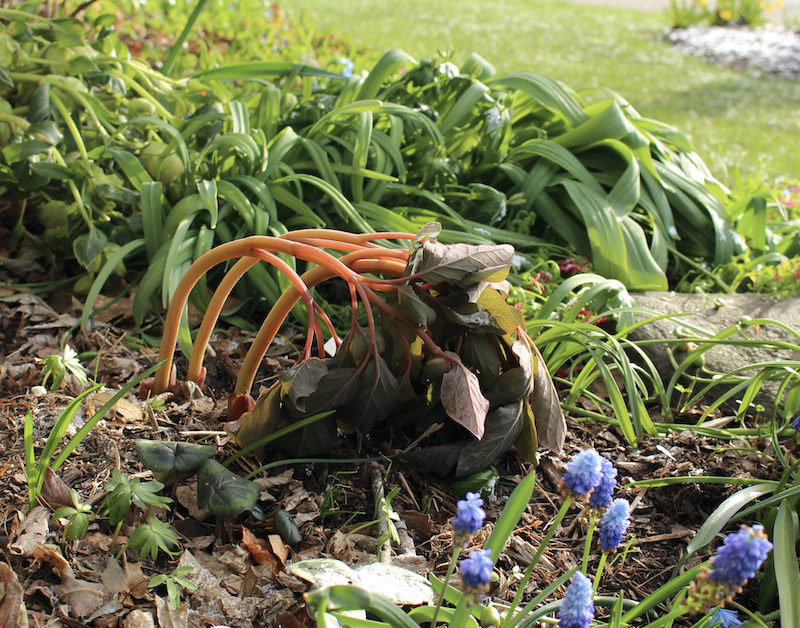
frozen peony

A frozen peony (Paeonia daurica) this morning with other frozen stuff….  all recovered by 2pm.    

I just noticed that the melting peony is back to almost normal.  Maybe now it’s okay to take a stroll and see how everything else has made out, and briefly consider the wind and how likely it is that I’ll do any gardening today.  I actually want to work out there, but with low 20’s tonight maybe I’ll wait one more day before transplanting a few little white bulbs around.  They probably wouldn’t care either way, but choosing patience would make me feel a tiny bit better considering tonight’s cold will likely kill most of the flower buds on the wisteria (again).

Oh well.  It’s always something and if worse comes to worse I know where the Easter chocolate is.

Have a great holiday weekend!

The Second Week Data Dump

I can barely call this a post.  It’s a rambling aimless overload of this year’s snowdrop season, and it’s a basic confession of how far out of control things here have become.  For years this blogger has tried to play coy about an above-normal interest in snowdrops, and casually deflected comments suggesting a developing case of galanthomania, but there’s no escaping it now.  I have fallen deep, deep into a pit of snowdrop obsession.  Sorry.  On the plus side two days of temperatures in the mid 70’s (23C) and a day and night of rain, has pushed many of the midseason drops over and we’re now looking at the tail end of the show.  A few photos from earlier in the week, and a quick review of the garden today tells me you’ll be free of this soon enough.

crocus vernus

Overnight the crocus have arrived.  They finish so quickly but I love them anyway, even when the rabbits finish them off even faster than they fade.

galanthus wendy's gold

Wendy’s Gold is in surprisingly good shape considering she’s one of the earliest to come up and started blooming under the snow this year.

galanthus viridipice

‘Viridipice’ is probably one of the cheapest and best named snowdrops you can plant.  

galanthus bertram anderson

This spring I came to the conclusion I have more than enough regular white and green snowdrops.  Going back at least four years I bet I’ve said the same thing every year, but then still can’t turn down a few more.  Galanthus ‘Bertram Anderson’ is a big and stout drop, very plain and very excellent, and I’m thrilled to have her!

galanthus chris sanders natalie garton

Of course even regular white and green can surprise, and in the case of Galanthus ‘Natalie Garton’ (aka ‘Chris Sanders’) the surprise is underneath with a doubled inner and usually some extra “tusks” poking out as well.  Even in a terrible spot this is a vigorous one.

galanthus ding dong

More regular green and white.  ‘Ding Dong’ has an elegant, long form with a nicely marked inner.  

galanthus merlin

…and ‘Merlin’ also has a nicely marked inner, nearly completely green…

galanthus abington green

…and ‘Abington Green’ also has a nicely marked inner which is almost completely green.  Why do I need them all?  That’s not important, it’s because I just do!

galanthus kermode bear

A drop with a difference is one of Calvor Palmateer’s poculiform selections from the far West of Canada.  ‘Kermode Bear’ with his double set of outers replacing the green marked inners (known as a poculiform) is flowering for the first time here, and I love the form.

galanthus L.P. Short

Just like there are too many plain white drops here, there are also now too many doubles.  Doubles rarely thrill me like the yellows or poculiforms, but I guess they’ve got their admirers.  Galanthus ‘L.P. Short’ is a sturdy thing with a nice look to it….

galanthus rodmarton

…but Galanthus ‘Rodmarton’ has such a dark and neat inner that even I think it’s somewhat amazing this year.   

galanthus cordelia

The Greatorex doubles such as ‘Cordelia’ were bred in the middle of the last century and are possibly a confused bunch, but this one mostly matches the description.  They do ok here, but often suffer bud blast when warmer weather or a lack of enthusiasm leave a flower bud or two which don’t bother opening.  

galanthus lady elphinstone

The legendary ‘Lady Elphinstone’ is the only commonly available double yellow, and for many gardeners she’s actually a double lime, or a double green.  People say there’s a more yellow form, and plenty of less yellow ones out there, but I don’t know.  Fortunately mine come up a sweet cool yellow each spring, and if I flop down into the mud and roll over onto my side to peek up into the blooms it’s a beautiful show.   

galanthus richard ayres

‘Richard Ayres’ is not yellow nor neat but he does do well here and I have way more of Richard than a garden needs.  Still he’s been excellent this year and I’m thrilled even if he’s a little on the floppy side.  

galanthus lady beatrix stanley

Speaking of floppy, the good ‘Lady Beatrix Stanley’ likes to hang all over her neighbors and get by on just her good looks alone.  Fun story about her days in this garden… She’s doing really well now but  sulked in this same spot for about three years prior.  I didn’t give in though, and one year a bloom came, the next a couple, and now she’s come around. 

galanthus magnet with crocus

‘Magnet’ came up all dainty and neat but now two weeks later is a floppy, drunken mess.  I should probably divide him and weed out all those purple flowers that have invaded this bed, but studies show there’s only about a 9% chance this will happen any time soon.

galanthus sophie north

The flip side to floppy is short and stout.  Not many of my snowdrops are successful in defeating gravity but ‘Sophie North’ does.  Even now with yellowing, almost past flowers, she’s still as dignified and poised as the day she sprouted.  

galanthus curly

Galanthus ‘Curly’ is another one who stands up well.  He’s just come up and can hopefully hold up to the warmth, rain, and wind well enough so that I can still enjoy perfect flowers for a few more days.

galanthus blonde inge

Let’s visit with some yellows next.  ‘Blonde Inge’ is looking a little tired this year but still showing off her yellow inners.  Usually she’s more upright and fresher looking but I think the sun, wind  and warmth were more than she wanted.  

galanthus primrose warburg

‘Primrose Warburg’ is always excellent here.  Compared to other drops her flowers might seem to be on the small side, but she clumps up so well and blooms so heavily for me I will never complain.  

galanthus primrose warburg seedling

This spring there’s even a seedling in flower.  She’s nearly a carbon copy of her mom but much more special of course.  I have to make sure this one goes off into a seedling bed somewhere so that the gardener doesn’t someday forget she’s not identical to the ‘Primrose Warburg’ parent bunch in the background.

galanthus norfolk blonde

Of course not everyone’s as happy here.  ‘Norfolk Blonde’ has a record as follows:  Didn’t die.  Didn’t die.  Didn’t sprout.  Didn’t flower, but came up again.  I always doubted people who claimed a bulb didn’t sprout but then came up a year or two later, but doubt no more.  Last spring I went as far as to dig the bulb and verify it was still there (and still completely dormant) but found no reason why it took a year off.  I suspect an overly wet fall, but who knows.  Regardless it’s still trying and hopefully I can add another ‘Didn’t die’ to the list next year.

galanthus nivalis

Fickle blondes are another reason why entirely plain, green and white, Galanthus nivalis are still exceptional.  This clump has been ignored for years as being “too average” yet even overcrowded and overshadowed by an also ignored juniper seedling, it’s still holding strong.  I refer to this one as “abandoned house” and may actually divide and transplant this spring. 

galanthus nivalis

This plain old nivalis is one of my most anticipated flowerings of the 2021 season.  I call it “Kathy Purdy” and it’s out of a basketful of snowdrops she brought down to last year’s gala to give away.  These drops lined the path to her secret garden at her last house, and now line the woodland walk as a “river of snowdrops” at the new house.  One trowel, bulb by bulb, clump by clump, these are the snowdrops which reassure me that someday sooner or later perseverance pays off and anyone can have their own river (or maybe sheets? of snowdrops.

american snowdrop garden

My own fledgling “sheets” of snowdrops and winter aconite in the front border along the street.  Each year a few more are added or divided, and finally this is the first year it is actually looking like something intentional 🙂

galanthus elwesii

To me the nivalis are nicest for sheets because they’re so consistent.  Galanthus elwesii on the other hand are a varied group, and something like this planting just about drives me nuts.  Tall, short, rounded, longer, fat ovary, thin, heavily marked, faintly marked… I planted them too close and they’re just a mess.  Seedlings are coming up now as well and there’s a good chance I’ll waste a whole afternoon trying to tease them out into clumps of single clones.  Good grief you must have anything better to do, but…  

galanthus elwesii

In a moment of brilliance I decided the best place to separate out a different elwesii planting was to spread the bulbs out in my nice new (empty) sand paths.  Who needs all that room for walking anyway?  and I’m sure this is just a temporary thing anyway…   

american snowdrop garden

While we’re on the subject of beds completely given over to snowdrops, this one still has to be shown if only to showcase the nicely power washed birch clump.  I might go around every autumn and power wash the birches, it’s very satisfying.  Now if I could only manage an equally attractive background…

galanthus modern art

I think I’m about done, and I suspect you are as well so here are a few last pictures to round things out.  Galanthus ‘Modern Art’ was named with the implication that not everyone “gets” modern art, and you either love it or hate it.  In case you’re wondering I’m starting to develop an appreciation. 

hellebore niger

As the snowdrops fade the hellebores begin.  I’m thrilled that the first year bloom on this hellebore niger seedling has blushed to such a nice shade of pink.  Thanks again Timothy!

hellebore spanish flare

Hellebore ‘Spanish Flare’ is the first xhybridus hellebore to open here.  Since you’ve been so good with the snowdrops, I’ll try to not overdo the hellebores this year… or the corydalis… or the daffodils or tulips or… 

galanthus greenish

Finally.  Last one to flower here and last snowdrop photo today, Galanthus ‘Greenish’.  Purchased on a visit to Hitch Lyman’s open garden in upstate NY, it’s a souvenir from one of our last Temple Garden visits. 

Congratulations on making it this far, even if it involved a good amount of skimming 🙂  I’ll try to return to normal photo limits with the next post, but with all the usual spring excitement bubbling up it’s going to be tough.  Fortunately once I get working outside the blog takes a back seat but in this lingering, odd Covid world I still have far more home time than I’m used to so we will see what that leads to.

Hope spring is finding its way to you as well, and all the best for a gardening weekend!

Snowdropping 2021

I’ve heard them say it’s the bad trips, not the good, that you remember best, and over the years they become some of your best memories… so maybe someday this trip will rank more highly, but for now its chilly wetness ranks it closer to the bottom.  At one point my snowdropping buddy stated the day reminded her of the windy, frigid visits to upstate NY and the Temple Gardens open day, and she could be right.  In my defense our local forecast was decent, but I foolishly assumed it would be even milder and just as dry 100 miles South.  Silly me.

naturalized snowdrops

I would guess snowdrop adventures in the UK and EU are far less gritty than our adventures.  Tea and cake from what I’ve heard.  To satisfy that question, we didn’t find either.

As I was driving down my better sense knew this trip was too short-notice and not up to or normal standards, so I dropped the hint that I would be fine doing our traditional park visit alone, and Paula must have looked at the thermometer and thought ‘hallelujah!’

“Yes” she said, “That’s fine, maybe I’ll go next week”.

naturalized snowdflakes

The yellow of the winter aconite (Eranthis hiemalis) was fading, but the snowflakes (Leucojum vernum) were just coming up.

The park we visit hasn’t changed in years, but this year I noticed some cleanup.  Brush removed, new paths, general cleaning up.  I’m glad to see some love going in, but also have to admit a little sadness.  Paths of bare earth cut through swathes of snowdrops and winter aconite means many bulbs were destroyed.  Decades of neglect built the show, I just hope a cleaner and neater future leaves a place for them and remembers the history of this plot.

eranthis

Bulbs are tenacious though.  A tree disaster happens, a scar opens, and still the yellow of winter aconite manages to sprout and bloom amongst the debris.

Ok so I really wasn’t all that sad and I did spend a good hour or so examining hundreds of flowers looking for something special so it was still an excellent visit, but the real star of my trip was Paula’s garden.  I swear there were twice as many blooms as I remembered.  I love when I pull up somewhere and get that stupid grin and start talking to myself about how cool it looks.  Sometimes I even do that with passengers onboard, and probably get concerned looks, but with each passing year I notice less and less, and care?  Not even 🙂

american snowdrop garden

The glow of ‘Jelena’ (Hamamelis ‘Jelena’) lights up and perfumes the highs while snowdrops and heucheras fill the lows.

It was so refreshing to see all the color filling a garden.  On the ride over I was desperately scanning the neighborhoods looking for anything but it was never much more than desolately neat lawns and mulch, or way more evergreens than even a cemetery would want.  Occasionally there were some snowdrops or a hellebore, so I guess there’s hope, but inspiring?  No…

american snowdrop garden

Paula has reached the point where nearly all the beds have snowdrops wedged in between the dormant perennials and mix of shrubbery.  She complained about too many seedlings.  I pretended to understand.

As usual we stood out in the cold examining every drop, commenting on how well it grew and where it was from.  There were also witch hazels, winter aconite, and snowflakes to discuss.  It’s great seeing a garden which comes alive while the rest of the neighborhood sits brown and dead.

american snowdrop garden

One of many hellebores.  The color stood out better in real life, I’m sure I yet again had some camera setting mis-adjusted.

By the time we slowly shuffled around the far end of the garden the icy drizzle had switched over to a rainy drizzle, and when I suggested it might be more polite to skip the other garden we had scheduled, Paula seemed fine with that.  We were both ready to warm up and dry out.  I even passed on an offer to dig one or two trades… tell me that’s not a sign!

american snowdrop garden

The last couple years of plantings line the side garden, each special variety socially distanced with only the occasional seedling breaking quarantine.

I guess I’m not as feverishly desperate as I used to be.  It’s still a thrill to go visiting but it’s more and more about the people, and then coming home is less and less of a let-down.  There are still a few (actually plenty) of snowdrop treasures I covet, but give me a sunny winter day with bunches of average white ones surrounding me really makes me feel as if I’ve arrived…. at least in MY mind 🙂

Have a great weekend, and let this be your **last warning** that pictures from my own garden are up next!