Love hurts

My prickly eryngiums are finally blooming, and to be honest I was a little disappointed by how underwhelming they were.  They gave me the longest wait ever, recently started to color up, and are finally looking cool.  Pollinators of all kinds love them, and these black and white wasps in particular swarm the plants from sunup to sundown.

pollinators on eryngium

The eryngium is very popular with the pollinators small and large.

They’re not as poky as you might think (although falling into a bed of lettuce would be the wiser choice), the more painful thing these plants offer is a nice wasp bite.  Most of the seedlings are a pale silvery color, but a few patches are showing an attractive blue tint.

eryngium

A few of the eryngium plants are showing off a nice blue tint. I like them, but will be on the lookout for too many seedlings.

Being a lover of all plants which walk the border between spiny farmyard weed and interesting garden plant, I of course love these, but my disappointment comes from the expectation that these would be the famous “Miss Willmott’s Ghost”.  Miss Ellen Willmott was a fascinating gardener, and the strain of eryngium that bears her name should be a stouter plant with wider silvery bracts.  Mine are thinner and tall enough to risk flopping.

small flowered eryngium

These plants are biennials and although they’ll need replacing each year you shouldn’t complain about a plant that blooms itself to death.

While I was struggling to get a decent picture I came to the conclusion this is a real photographer’s plant, with it’s airy blooms, subtle coloring, and busy bug guests. A real photographer could do wonders with it!

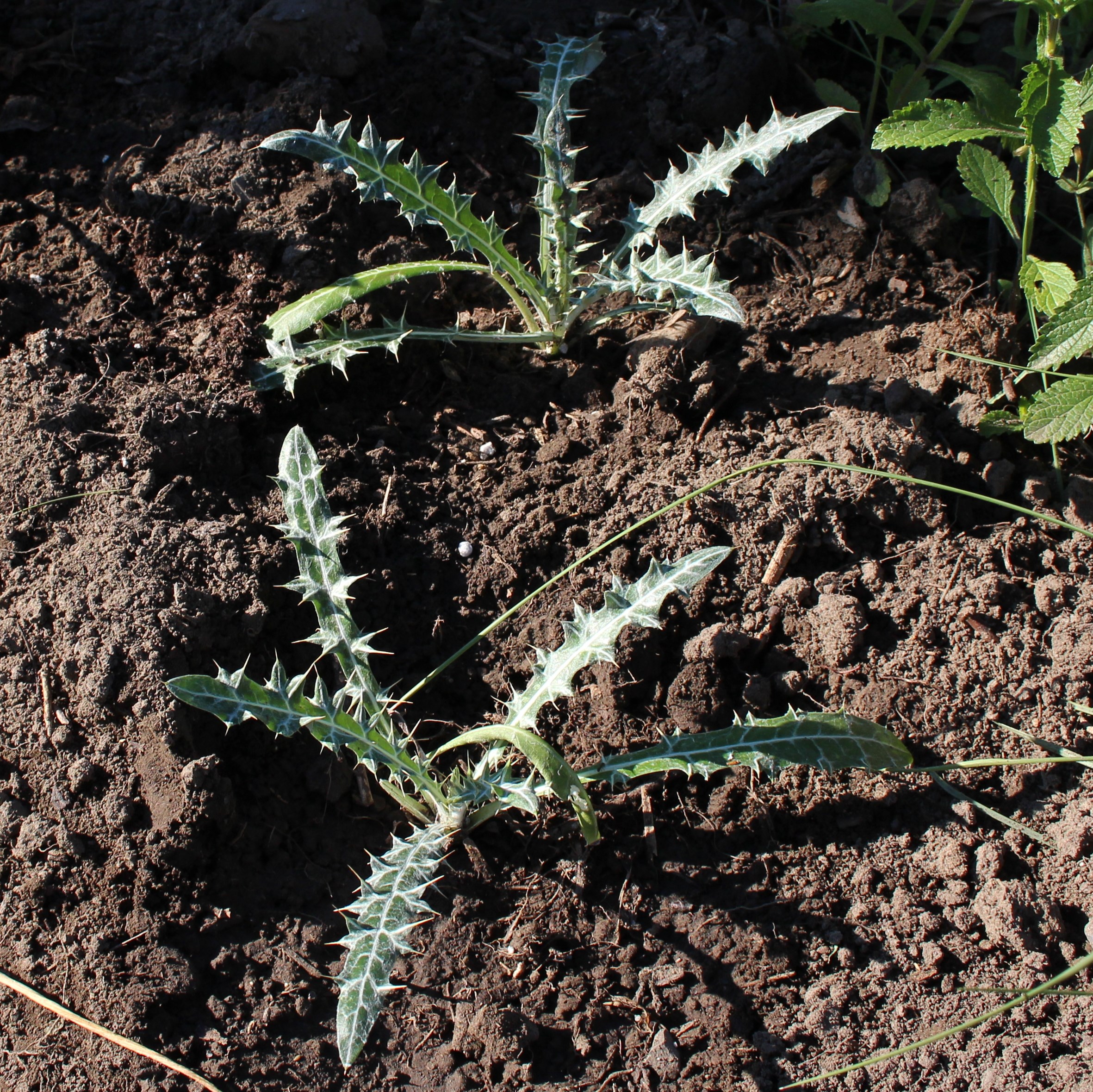
I’m sure I’ll get the real ghost someday, but in the meantime there’s no shortage of spiny, dangerous plants in the flowerbeds.  Ptilostemon diacantha is another biennial thistle which I’m totally in love with.  This one’s a real killer though with sharp spines that don’t give up tennis balls easily.
ptilostemon diacantha

Ptilostemon diacantha with nicely lined leaves and spines that feel as sharp as they look.

Sure the spines keep you on your toes, but there are plenty of other thorns out there in the garden.  Can you say rosebush?  Find me a rose grower who never sat down with a box of bandages after wrestling with a wayward climber and I’ll show you a gardener who has a checkbook healthy enough to hire out all the crappy jobs 😉

rose livin' easy

Gratuitous rose photo from earlier in the month. It’s “Livin’ Easy” and I never see blackspot or fungus on it. If it weren’t for the “Knockout” tidal wave sweeping the country I’m sure this would be a much more popular rose…. even with all those nasty sharp thorns 🙂

Here’s my newest little baby.  I finally had success with the cirsium japonicum “white frosted” seeds which I’ve been trying each winter.  They’re everything I love in a plant, variegated foliage, mild spine-age, bold colored thistle blooms (I hope)….. it’s even a perennial (hopefully not an invasive one).  There will surely be plenty of gushingly over the top praise put onto this little plant in the future!

cirsium japonicum white frosted

One of the cutest baby pictures ever of cirsium japonicum “white frosted”.  I hope it grows up to be just as attractive an adult.

The wild bull thistles are blooming around the fringes of the garden and I’ll spare you from those photos.  Weeding will be a gloved affair, but can I just say the pollinators love them and the goldfinches will be thrilled?  Have a great end of the week 🙂

Innocent until proven guilty

Last week the usual garden inspection turned up a massacre in the broccoli patch.  My luck had run out and the rabbits had finally found the tender lettuce and cole crops… just when they were finally settling in.  All the tender lush growth from the cool, damp weather has been nipped back, and I’m left with these leafless stalks.

deer damage on broccoli

The day before yesterday would have been the perfect time to fence off the vegetable garden….

What a setback!  Of course it’s my own fault since even with the local stray cats, rabbits are still in and out of the garden, but I like to think the bunnies won’t take advantage of me and a nibble here and there is no big deal….. so I didn’t bother with a fence.  That of course changed, and the fence is up again.

fence for vegetables

A little chicken wire to keep the bunnies out. Rabbits around here tend to be lazy, so a weak fence or even a few brushy twigs will keep them off my delicious ‘Matina Sweet’ lettuce.

Something was different though.  The onslaught of damage was pretty severe for a stray rabbit finding a tender bit of broccoli, and the lettuce and cauliflower were also sampled.  That’s a lot of nibbling for one or two rabbits on one or two nights.  I began to wonder if a groundhog had returned….. a little plant leveling, bulldozing, little garden pig, who eats everything in sight…. but no, the damage wasn’t that bad.

I found my answer the next morning.  Two young bucks were on the other side of the fence plotting their return.  I knew they were around -three weeks ago a doe bounded over the fence while the kids and I were playing back there- but now I know they’re moving in.  Deer are something I don’t want.  Where are all the hunters when you need them?

deer and the vegetable garden

Barbarians at the gate

Figures they would go straight for the broccoli and lettuce, they’re two of the only vegetables I actually eat.  Why couldn’t they start with the chard?

bright lights swiss chard

Rumor has it vegetables make for healthy eating. I like to think of these unpicked and uneaten ‘bright lights’ swiss chard as being good food for the soul.

We’re not exactly country around here, but we do have our share of wildlife drama.  Snakes and toads come and go, bugs abound, and all kinds of birds stop by to eat and drink and sometimes set up house.  I finally found the tiny field sparrow nest (or at least I think that’s what they are) in the small blue spruce by the sandbox.  Two chicks have hatched and it amuses me that they spring to life begging for food the second I tap the nest.

field sparrow nest

I’m not a good nest finder, and the only reason I found this one (after three tries -and the spruce is barely three feet around!) is that I noticed a female cowbird staking out the bush.  Cowbirds will sneak in and remove an egg from an unguarded nest and replace it with one of their own, and this is what they did here.  When I found the nest there were two white speckled eggs alongside the three blue speckled.  I may or may not have removed the cowbird eggs.

cowbird egg

Cowbirds are a native species and as such are protected under the Migratory Bird Act, so tampering with their eggs would be illegal…. but I also may at times roll through stop signs and push the speed limit, so I’m not sure where this puts me on the spectrum of criminal activity.  All I’ll add is that cowbird chicks will usually outgrow their nestmates and end up displacing them, so I’m glad these parents won’t be stuffing food into a chick which grows to be twice their size.

Another thing which borders on illegal is the number of weeds and out of control plantings in this wanna-be iris border.  It’s almost criminal how the campanula took over and the daisies moved in…. not to mention the clover.

iris with campanula and daisies

Still on the to-do list is the iris bed. I think it needs a complete overhaul to get rid of the beautiful purple campanula glomerata which has taken over. The only legitimate planting here is the yellow variegated iris which is still just barely hanging on.

The iris bed is just one of many yet-to-be-done projects.  I’m still getting the last of the seedling out from under the glow lights in the garage, and the overwintered geraniums are still sitting outside the garage, making quite the colorful accent on the driveway 🙂

overwintered geraniums and vegetable seedlings

All in due time they say, but I suspect due time might have passed along with the summer solstice.  Instead of humming along, the garden is still taking form.  Someday I hope to have things together but I suspect I just might not be that kind of gardener.  It would help if a simple planting up of the deck pots didn’t turn into a table refinishing, light fixture replacing, porch chair repainting, trim rebuilding… .kind of project, but such is life!

Enjoy the first days of summer 🙂

All work and no play….

There comes a time each spring when the rush and excitement of the new growing season wears off and the realities from the previous year come back to haunt you.  There will be bugs, there will be snapped stems, the rabbits will eat the lettuce, and you will get hot and sweaty mowing the lawn.  It all seems like a lot of work and all the while the weeds keep growing.  But there’s plenty of magic.  Onions have been entertaining me lately and I’ll start with allium moly “Jeannine”.

allium moly "jeannine"

allium moly “Jeannine” with sedum “Angelina” and a few perovskia seedlings. I like how the one perovskia has much fernier leaves than the other.

For some reason I used to dislike most of the flowering onions and only just recently let a few into the garden.  They seemed kind of weedy and never wowed me…. but I’ve been dabbling.  The big purple ones are a no brainer, and last fall I cracked open the wallet for this one (who’s name I can’t recall at the moment).  Surely a half dozen would have been nicer but gardening funds were short after snowdrop ‘dabbling’.

allium "pinball wizard"

The front border is just coming out of a lull as the daisies and roses fire up.  Allium “Pinball Wizard” (I looked it up) has large blooms on short stems, all out of what I consider the “globemaster” family since they all seem similar to me.

Also new this year is allium nigrum, a ridiculously cheap white allium with good sized blooms on nice stems.  I like it!  The only complaint I have is the season falls right into oxeye daisy season, and the allium blooms are lost among the ‘common’ daisies.

allium nigrumLess impressive is my neglected allium karataviense “ivory queen”.  I like the foliage as much as the actual flowers since they have a cool pleated gray look that reminds me of some fancy South African bulb.

allium karataviense "ivory queen"

You’ll have to trust me on the foliage, it looks better in the weeks coming up to flowering. Plus this little “ivory queen” is just praying for someone to take it away from all this weedy mess.

Not an allium anymore (it’s been reclassified as nectaroscordum siculum) the Sicilian honey garlic is a bit of a floppy mess in my yard.  The stems twist around and then put up these ‘interesting’ blooms for a week or so before dropping back down into flopdom.

nectaroscordium siculum -Sicilian honey garlic

nectaroscordium siculum -Sicilian honey garlic- this glamour shot pulls out many of the subtle highlights of the blooms. The actual garden presence might be a little less than overwhelming…

Can I finish off with an onion from the vegetable patch?  This is allium fistulosum, nebuka evergreen bunching onion.  Supposedly it’s a tasty onion, but I have yet to give it a try.  Instead I’m enjoying the long lasting, fat bloom heads.

nebuka onion

Nebuka onion, another subtle effect but it’s carefree, edible, and fuzzy!

There are a few more onions yet to come, but the lawn still needs mowing and it’s now or never, so off I go.  So much to do, so little time…. and sometimes so little energy 🙂

Just a few more iris

Iris season is in full force here and although I’d rather report back that projects are getting done and plants are getting planted, they’re not.  I spend a considerable amount of time relaxing in a shady spot just enjoying spring.  I like to think we deserve it after last winter, but things would probably be the same had it been warm and rainy all February.

siberian iris

Siberian iris. Hard to believe patches of these grow wild somewhere, to me it might be one of the most beautiful flowers. I’d grow more but they are over so quickly and the letdown might be too much 🙂

While I continue my hard labour in the vegetable patch, digging and prepping planting beds, I worry that bearded iris might make a play towards taking over more broccoli acreage.  They grow so well there and the open spots would look so much nicer blooming blue instead of pushing out another potato.

iris snowbrook

Bearded iris “snowbrook” putting on a beautiful show… but lacking something….. maybe it’s just a little too short and congested to have all the grace I expect from my iris plantings.

One iris which will stay on the edges of the vegetable beds for a few more years yet is the bearded iris “ominous stranger”.  It’s not the heaviest bloomer, it doesn’t show up well amongst the brighter colors, but it does have a graceful subtlety which calls for closer inspection.

iris ominous stranger

I need to stay away from the ruffly, overblown, modern bearded iris. I could loose the entire vegetable patch if I start dabbling in these. This is iris “ominous stranger”.

I did try to start a dedicated iris bed when deck building displaced some of the old patch, but it’s at an end of the garden where a mulching mistake resulted in too many seedlings of little bluestem prairie grass.  Grass seedlings and an iris bed don’t mix well, and then throw in a little giving-up and you’ve just added another project on to the to-do list.  Still it’s impressive to see which iris continue to thrive amongst the neglect.

iris honorabile

Iris “honorabile” carrying on in spite of the uninvited grass and blue columbines which have moved in next door. A clump of the late blooming daffodil “baby boomer” also needs an escape plan from this bed.

My favorite this week in the weed bed is this sport of iris “honorabile” called “darius”.  Just one little genetic oops happens and the tint of the falls changes from maroon to more of a violet purple? (please forgive my lack of any color accuracy beyond red and blue).

historic iris darius

Historic iris “darius”, a sport of honorabile with a nice blend of yellow-lemon-purple(?) on small graceful plants.

Here’s another impossible-for-me-to-describe color.  An unknown modern iris is doing quite well in the weed bed, throwing up a healthy stalk of some ruffled murky unknown blend of pink.

unknwn iris

Any guesses on the ID of this one? It was a surprise slipped into a trade box from a great gardener in upstate NY. (note healthy weeds in background)

Idleness and plant neglect seems to be a theme this week, so I might as well stick with it.  This unknown historic was traded to me and to date hadn’t bloomed.  Last summer while debating a spot to replant it in I set it down between some tomatoes and succeeded in ignoring it for the entire growing season.  Maybe it got scared, maybe it enjoyed the company of tomatoes, either way it finally sent up a stalk of these nicely patterned blooms.

unknown historic iris

Guilt is sometimes a good enough reason to keep a plant. This unknown iris will stay just because of the abuse it’s endured…. that and I like the veined falls… it just can’t stand next to one of the fancy modern iris or it will be completely ignored.

There’s plenty to enjoy in the garden as it turns the page into summer and June.  The first rose opened today and the sun is shining bright, but I spend way to much time overseeing things from a seated position.  The queen of the prairie and I sit in the shade of weedy sumacs and contemplate things.

garden seating

Every garden needs a good vantage point from which to keep an eye on things, and although this might be more trailer park than Downtown Abbey, it suits me just fine 🙂

I would claim big plans for today, but it’s Sunday, and the day of rest must be observed.  Spring goes by way too fast to begin with so in my book there’s nothing wrong with trying to enjoy every minute of every beautiful day.

A May Day walkabout

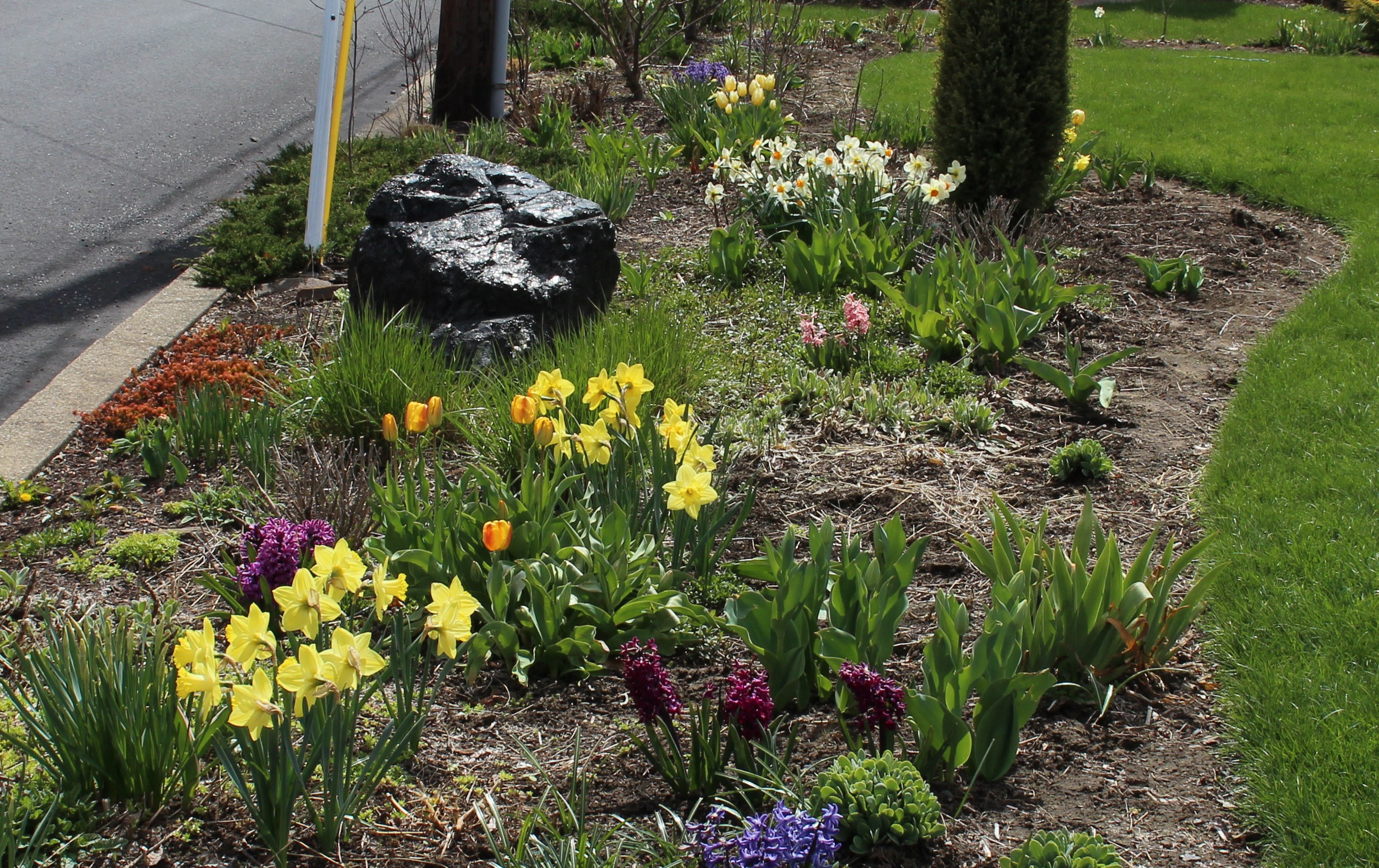
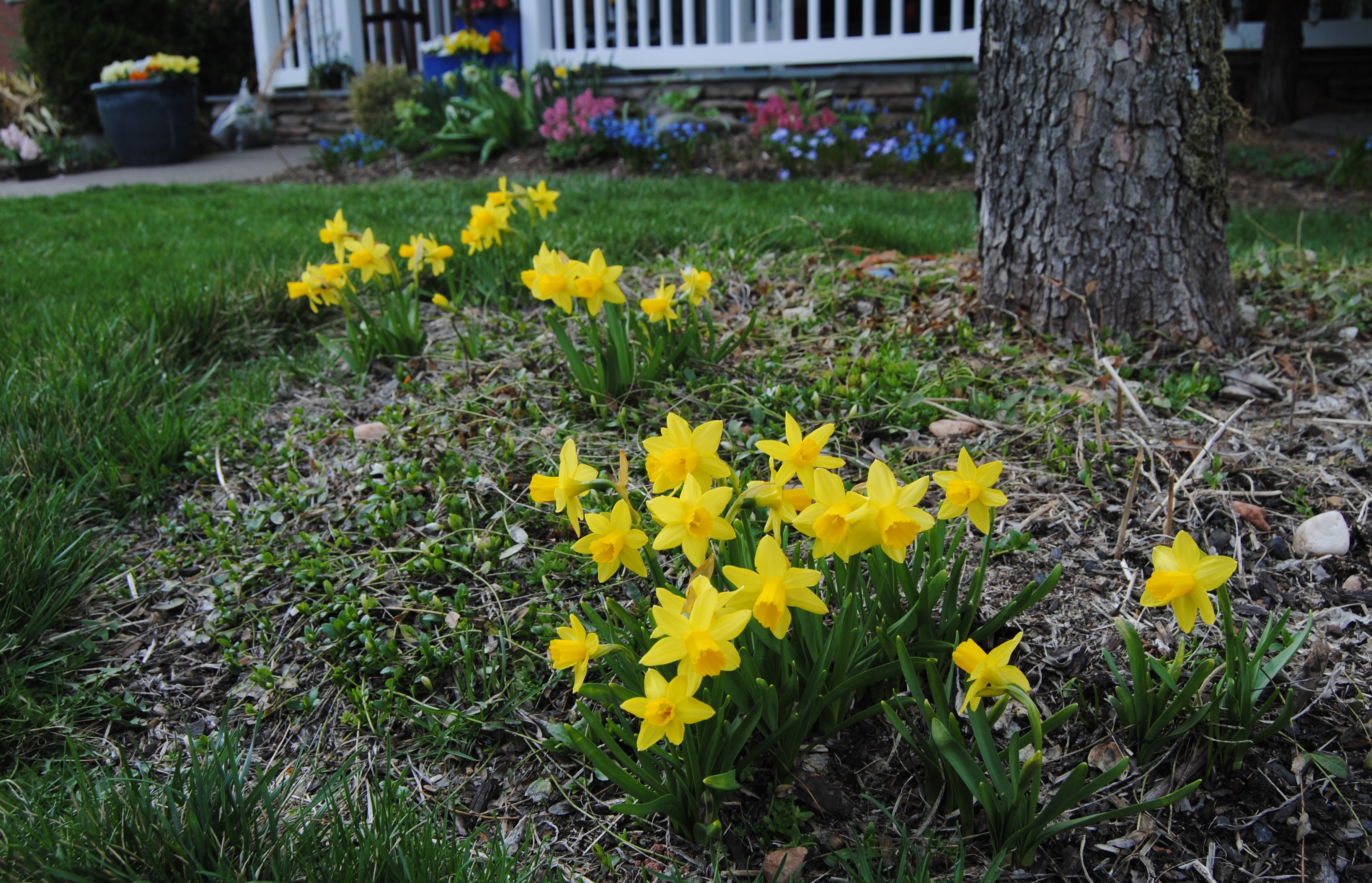
The start of May is always an exciting time because for us it’s that part of spring when everything just explodes into growth.  We might be a little behind this year, but you still can’t beat the first of May.  The biggie bulbs like daffodils and tulips are taking off now and the front bed has finally been resurrected from its winter drabness.

spring bulbs in a mixed border

Early daffodils and a few of the first tulips opening up along the front border.

I’m trying to get things moved around while it’s still cool but life always interferes with colds, work, and T ball games so I’m already way behind.  Last Saturday all I wanted to do was move seven rooted privet cuttings into place to start a nice little hedge along the back fence, instead it turned into an hour long project and I ended up digging out a good sized boulder.  At least I got this magnolia transplanted before it leafed out.

white magnolia

Magnolia in position near the street. I wish I knew the variety but it’s a layered cutting stolen from my brother in Law’s yard….. yes, it needs some pruning.

If I had more land there’s a good chance I’d find room for a number of magnolias.  But I don’t, so I try to stick with some of the smaller types… even though a nice big one would make for a good shade garden once you trim it up.  Here’s magnolia “Ann”, one of the smaller bush/tree sized ones, finally big enough to bloom after several years of rabbit attacks.

magnolia ann

Magnolia “Ann”. A smaller, later blooming cultivar that should grow into a nice sized bush here in front of the fence.

winter buned foliage on southern magnolia "little gem"

“Little Gem” magnolia still looking worse for wear after the winter.

While on the subject of magnolias, the freezer burned “Little Gem” is still looking sad and brown and dead, but I’m still pretty sure it will recover just fine once warm weather hits.  As soon as these brown leaves start to drop off I’ll know the plant is starting to think about putting on new leaves.  It will look worse before it gets better, but hopefully by June will look as good as new.

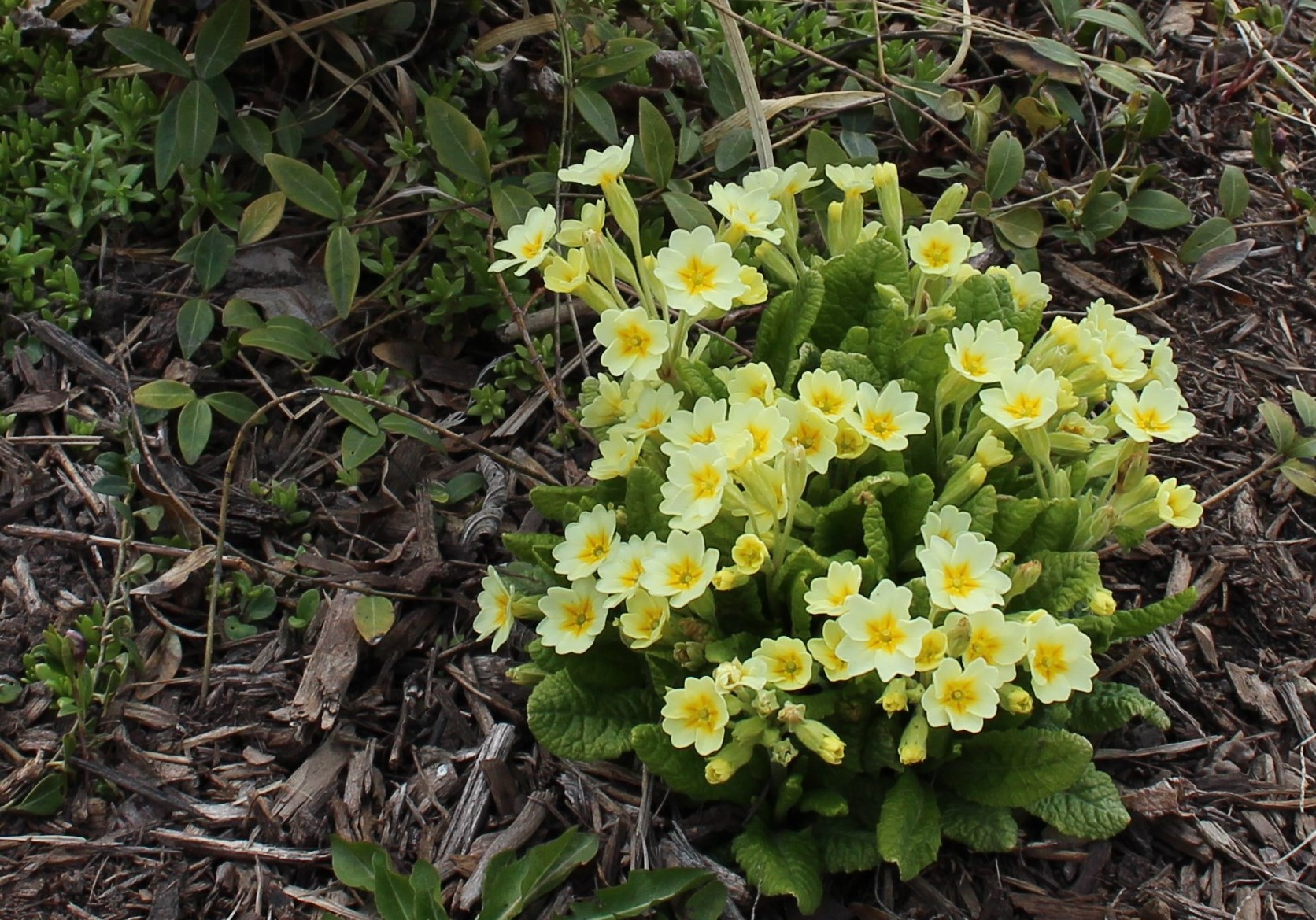
Luckily other parts of the garden look good enough to distract you from the first aid beds.  Yellow primrose has clumped up nicely in the damper parts of the yard.  In the next few days I’m going to try separating this clump, and hopefully this really is the right time of year to tackle this.  My track record on primula is not too good, so wish me luck.

yellow primrose primula vulgaris

A yellow primrose (primula vulgaris?), one of the few primula to survive any amount of time in my care.

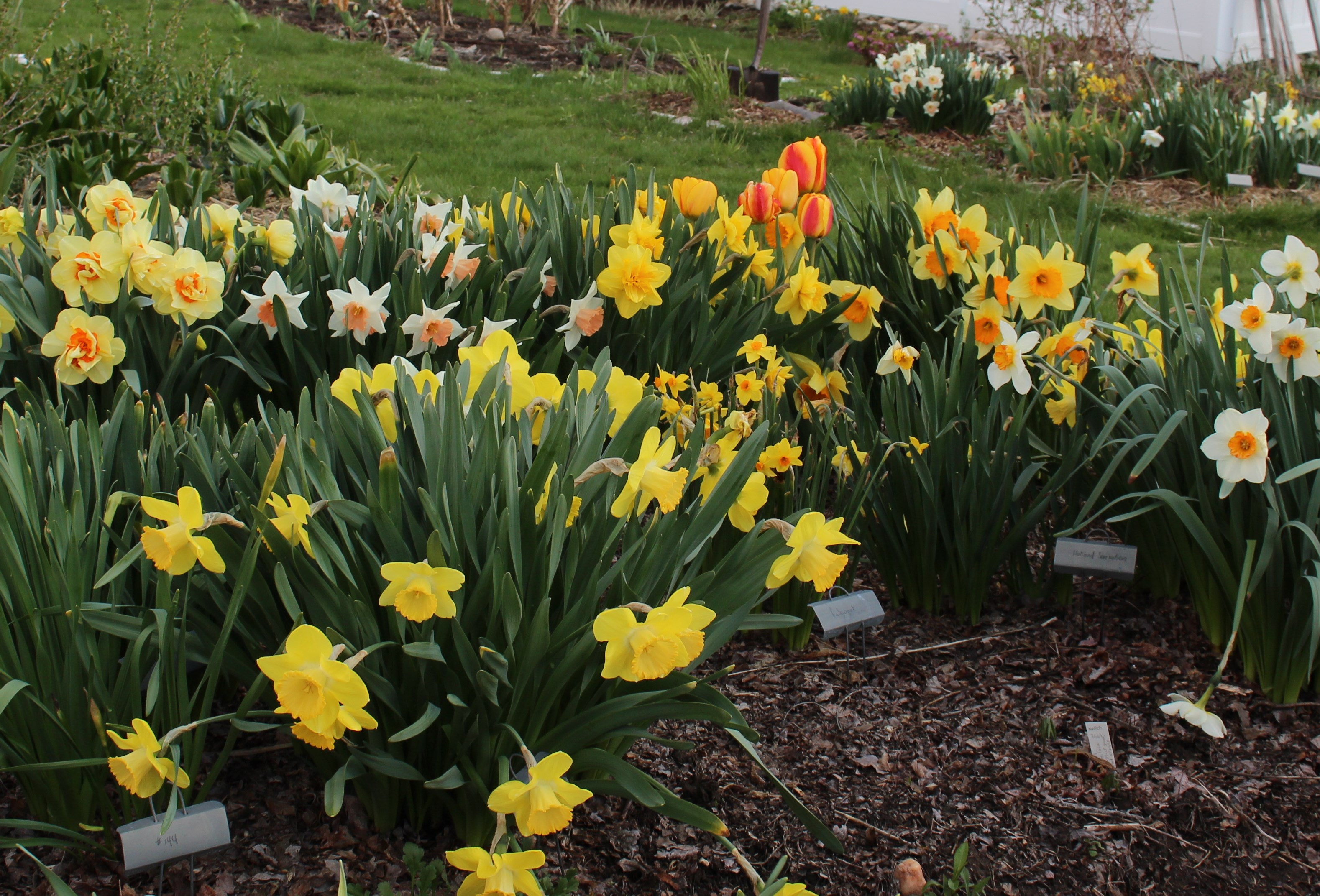
I guess I might as well bore you with a few daffodils too 🙂  I have quite a few and really do need to give them some attention this summer in terms of division and moving and “thinning the herd”.

daffodils and tulips

Some of my favorite daffodils…. with a few tulips sneaking in.

A friend of mine lured me in to the daffodil world a few years ago.  While she succumbed to  the dark world of show daffodils, I’ve held strong and try to keep myself satisfied with just a few good garden varieties…. actually it’s hard to go wrong with daffodils, and it’s also hard to stop at just a hundred or two!

mixed pink and white daffodils

Left to right- narcissus “golden echo”, “passionale”, and “serola”

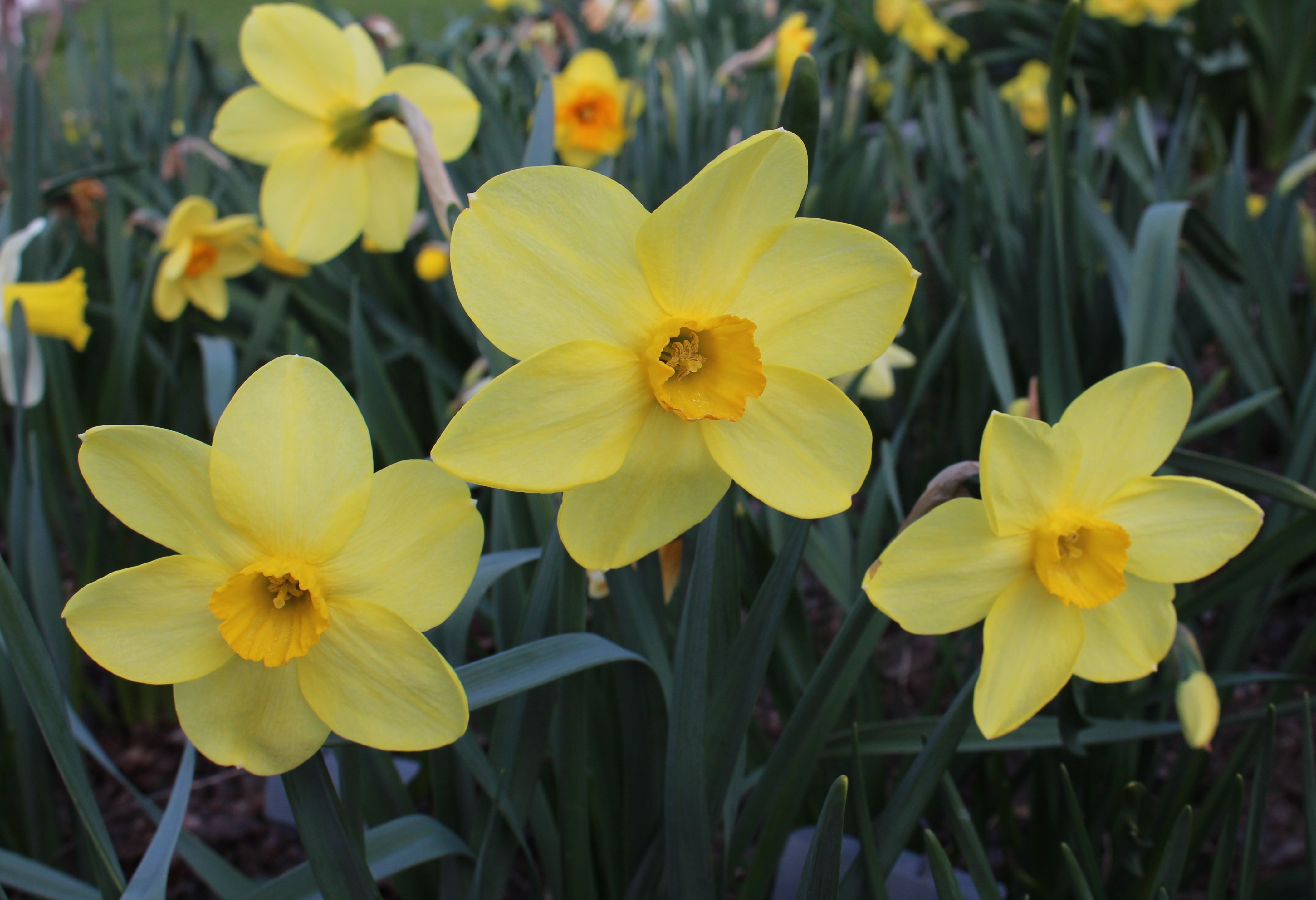
Maybe I’ll admit to having just a few show quality daffodils.  As far as I know something like this one, with a nice strong (not tissue papery) flower substance, nice flat petals, clean unmarked, and no nicks or anything around the edge…. that’s what makes for a flower you could bring to a show (that and a few years practice and you might bring home a bunch of ribbons!)

narcissus "new penny"

Narcissus “New Penny” looking nice in the garden and maybe worthy a spot on the show bench?

It’s still a little early here for tulips, they’re only just starting to color up around the beds and add in a little contrasting pinks and reds, but the muscari always brings in a nice blue to go along with the yellows and whites of the daffodils.  These can be a pest in some gardens, but I guess I’m still young enough or dumb enough to not mind them spreading a bit…. or I’ve been conscientious enough to behead them after blooming to stop their seed spreading ways.

blue muscari

Regular old blue muscari given to me by a friend. I need to remember to spice up this planting with a few of the pale blue “Valerie Finnis” which still need planting out.

A plant I wouldn’t mind seeing spread a little is this nice double hellebore that’s blooming for the first time this spring.  It’s another seedling from the now closed Elizabethtown nursery and I believe it was supposed to be a double pink cross.  Double it is but pink it’s not, and I’m quite happy with this genetic mix up.  The newest blooms open a pale chartreuse and then darken to a limey green.  I can’t wait to see what it looks like next year!

green double hellebore from elizabeth town seed

First year’s bloom of a lime green double hellebore from Elizabethtown seed.

And that just about does it.  After the subtle rarefication of a lime green hellebore I leave you with a final view of bright tulips and a photo bombing tacky orange plastic Adirondack chair.  It was a gift from my mother in law and I’m really quite pleased with it.  I guess my endless whining about wanting a couple for the back yard didn’t fall on deaf ears.

tulips and daffodils in a mixed border

What better front yard art is there than brightly colored plastic lawn furniture?

I wonder how long it can stay out there before the Hillbilly comments start and people again loudly question my design sense?  Maybe a pair of these chairs would be twice as good?  I might have to test that this weekend, since I eventually will retire these to the back.  In the meantime I’m beginning to think this could be the new millennium’s version of the pink flamingo.


Making up for lost time

The first few weeks of spring all happened in four days, four gloriously warm and sunny days!  I prefer a drawn out cool season with no big shocks but I don’t think that will be the case this year.  Last Saturday went up to just over 80F (27C) and the drab gray garden exploded into color.

narcissus tete a tete

Narcissus “Tete a Tete” one of the best small, early daffodils for the garden and also for forcing in pots.

Just a few days ago we were freezing our kazooies off looking at snowdrops, now I’m rushing to admire the last spring snowflake (leucojum vernum) before the warm weather fries its delicate bloom.  It’s hanging on in a cold spot which only just thawed out last week.

leucojum vernum

Leucojum vernum the spring snowflake, that’s a flake, not a drop, even though snowdrops are a close relative.

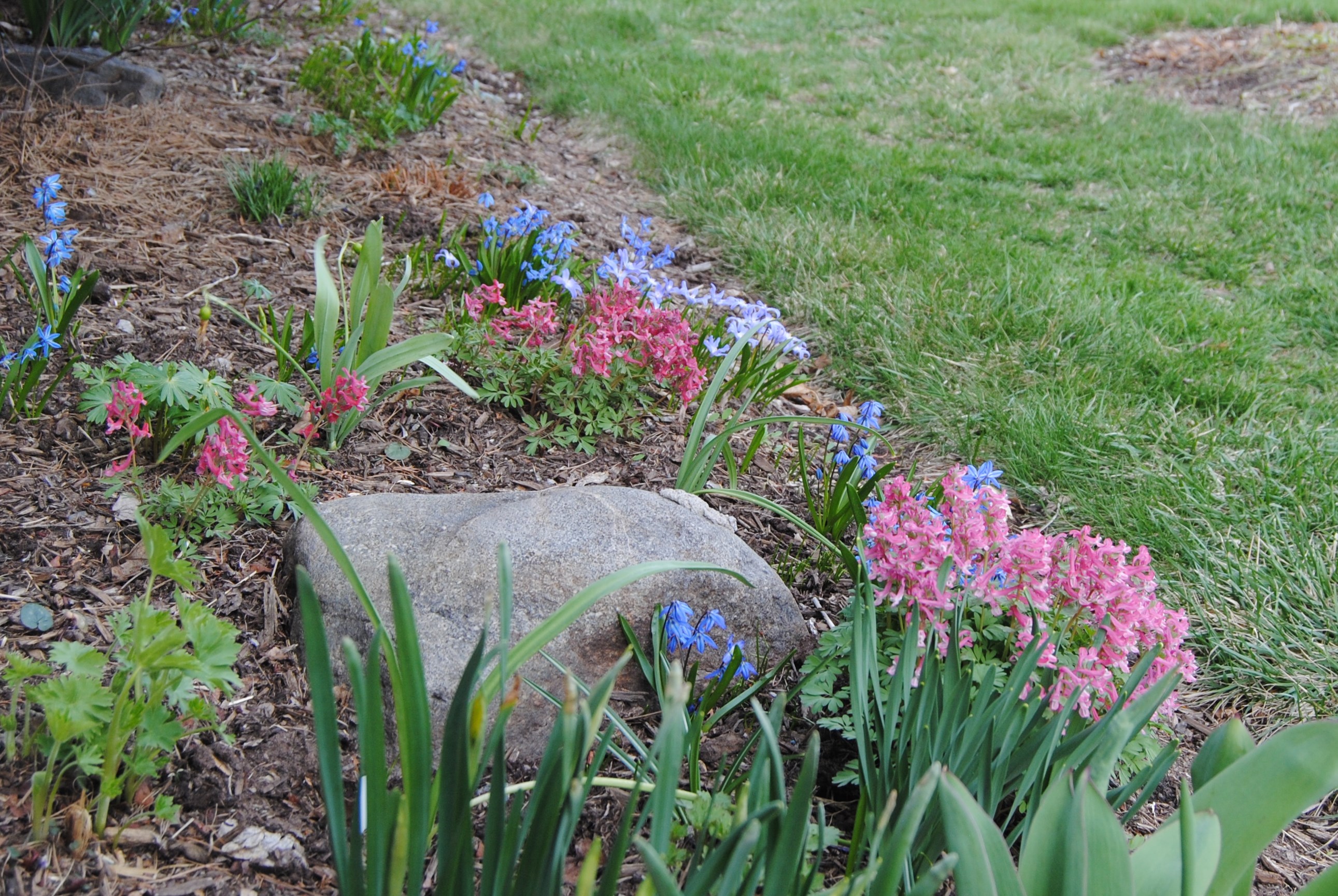
Around front, the shelter of the house has things popping up even faster.  Corydalis “George Baker?” and the hellebores opened in two days, the hyacinth was a fat bud Sunday and then full bloom on Monday when I took this picture.

hellebores and corydalis

I have good luck with hyacinths.  In fact the blooms get so big and heavy they end up flopping when fully open.  This little piglet has been in the same spot for five years and has a bloom bigger than ever, plus two secondary stalks.  If only the yucca “colorguard” behind wasn’t so beat up by the winter….

how I like all my hyacinths to grow

The hard winter may have been good for something though.  This is the first spring I’ve ever seen corydalis seedlings, and Carolyn over at Carolyn’s Shade Garden said she notices an abundance of seedlings around her plants after a snowier winter.  Maybe the snow cover helps moderate the soil moisture or temperature and aids in germination or maybe after all the snow we’re just looking more desperately and notice every single green sprout!

corydalis solida seedlings

Corydalis seedlings, I first thought they were some odd one-leafed clover that needed weeding out!

Corydalis are one of my new favorites, and the most confusing thing about the seedlings is I never even noticed the seed pods forming… and trust me I was looking!  I have it in my head to nurture nice swaths of corydalis color similar to the showcase found in Carolyn’s garden.  The ones I have here (“George Baker and “Beth Evans”) were originally ordered from Brent and Becky’s and are exactly the bold colors I’m looking for.  I also added some straight species corydalis solida from Van Engelen’s,  but they’re just a little too pale and small and actually seem to be dying out.

corydalis and scilla "spring beauty"

Corydalis solida with blue scilla siberica “Spring Beauty” and Chiondoxas…. and finally some greening grass.

Corydalis really appreciate division and replanting, and this single bulb moved the year before last is already a nice little clump.  You just have to get to them quick though, they die down fast after blooming and it’s hard to remember where they were.

corydalis george baker

Corydalis “George Baker” with some hyacinths in need of division and replanting.

My focus for the last few days has been getting the cleanup done so everything can sprout up all nice and fresh.  Some people are concerned that early cleanups leave the little sprouts exposed to late frosts, but I never have a problem.  Actually I feel that mulched areas warm up in the sun more quickly than damp exposed earth, but overall it’s the mid May freezes that kill my plants, not the cold blasts in March and April, so I clean up as soon as I can get out there.  It lets me see all the weeds such as this campanula that has taken over most of what was supposed to be an iris bed.

kids in the garden

Cleanup includes taking the seeds out from under the deck.  What was I thinking when I started all these!?  Even if I get rid of all the campanula plus some more lawn, there still might not be enough room for planting out all these seedlings.  A few pots already show sprouts btw.

seeds sown in winter

Seed pots sown throughout fall and winter and left to stratify (exposed to the elements) under the deck.

Daffodils will also need some attention this summer.  The first are opening and I’d like to divide several of these clumps after they die back.  Here’s the early yellow “Peeping Tom” and some unknown bicolor that I’d love to put a name to.

daffodil peeping tom

Some of the daffodil beds got a nice mulch of mowed up maple leaves last fall, but they only go so far.  As I clean out the flower beds everything from leaves to perennial stalks to shrub trimmings to ornamental grass tops, all gets run over by the mower and bagged up to either mulch beds or feed the compost.  The warm weather brought up this clump of narcissus “Rapture” so fast, I barely had time to get the mulch around it before the blooms opened.

narcissus rapture

Narcissus “Rapture” opening so fast in the warm weather the blooms barely had time to make it up out of the ground.

I really should use some of these early daffodils out in the front beds along with a few of these blue chiondoxas.  This clump was actually just a weed which hitchhiked in on some scilla mischtschenkoana bulbs which share this same spot.  Six days prior the scilla was in full bloom and there wasn’t a sign of the chiondoxa.  Now look at it!

chiondoxa forbesii

A clump of what might be chiondoxa forbesii… don’t know for sure since I never really planted it 🙂

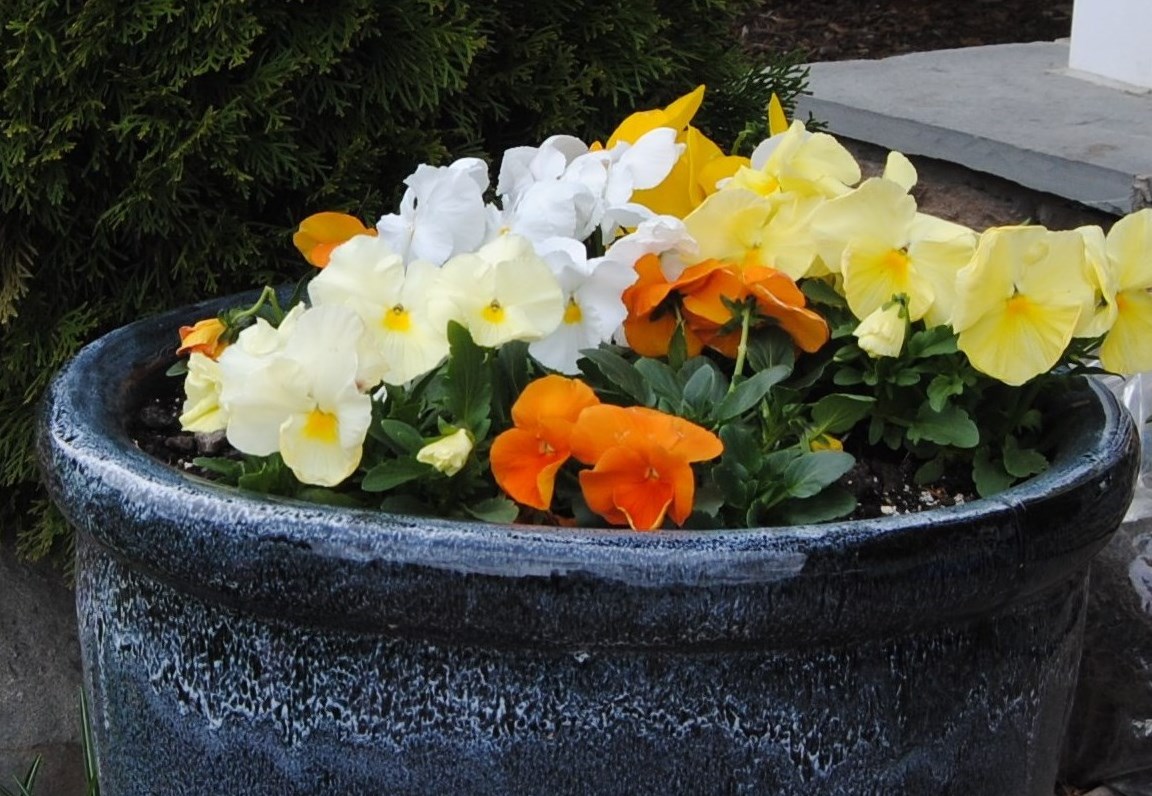
There’s nothing subtle about spring in my garden.  Besides yard cleanup I planted these pansies out in pots by the front door, and although these are in a more subtle grayish pot, the rest were planted in a bright cobalt pot!  Planter choices aside,  I may be on to something with the pansy mix.  Christina over at Creating my own garden of the Hesperides used a similar color mix for an arrangement of Gerber daisies, and I’m going to be on the lookout for my own daisies in these colors too.

matrix daffodil mix pansies

‘daffodil mix’ Matrix pansies

So that brings us to the next flush of color.  The hellebores are also starting to open up in the exposed parts of the garden.  Here’s “HGC Silvermoon” still looking kind of greenish.  The foliage on this one is great and I’m jealous of gardeners who are able to get it through the winter with leaves worth looking at.

hgc silvermoon

Hellebore “HGC Silvermoon” just starting to open up. Too bad the nice foliage on this one was burnt up by the cold.

And one of the first Elizabethtown seedlings just starting to come up.

pink hellebore

A nice freckled hellebore from Elizabethtown seed.

So spring is finally here in full force, just in time for Easter.  There are still a few bumps in the road …..such as last night’s snowfall and low of 21F (-6C) but I think we’ll make it.  I just have to find the time to catch up on all the things that were on hold because of the weather.  It’s way too early to fall behind!

Still hiding indoors

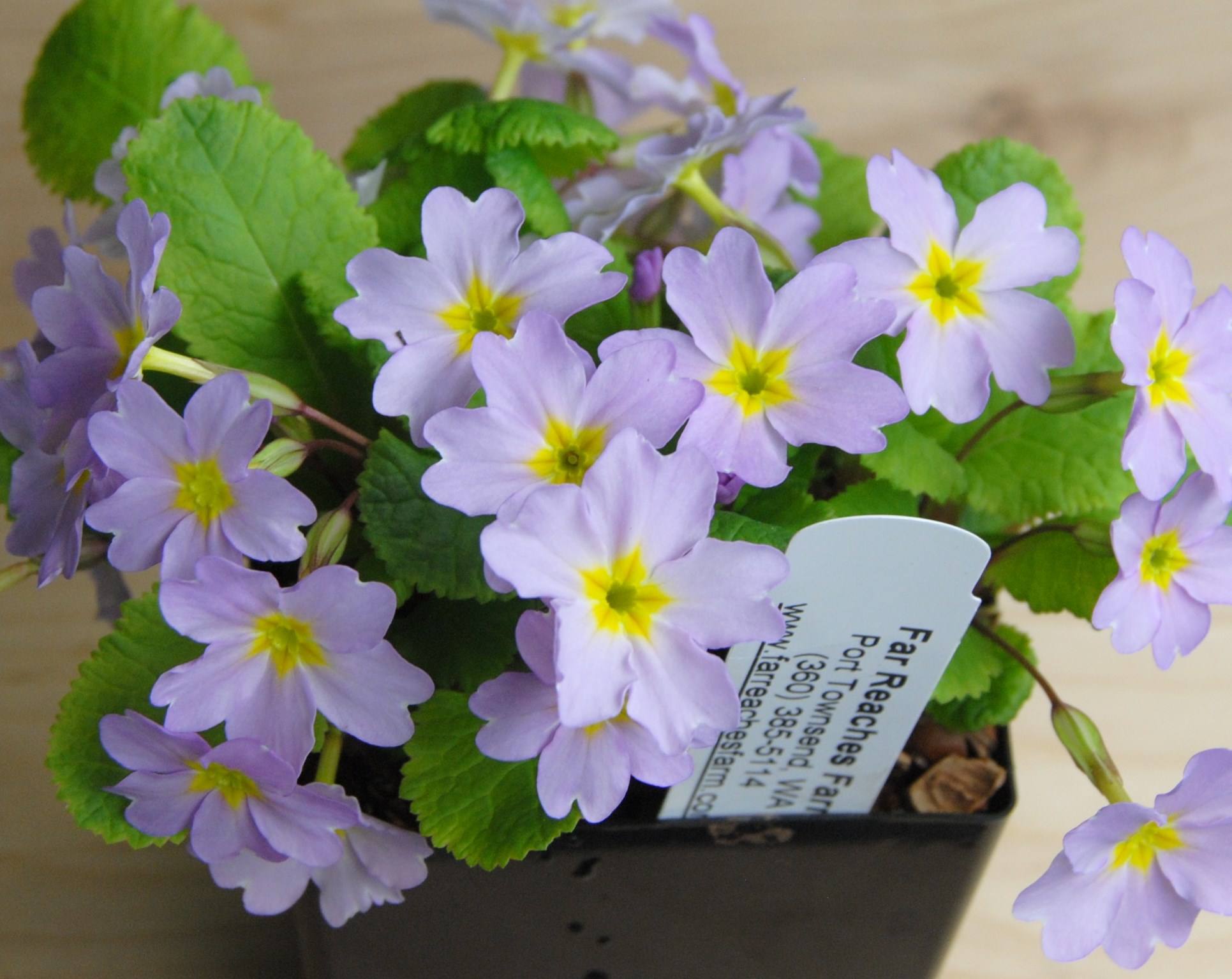
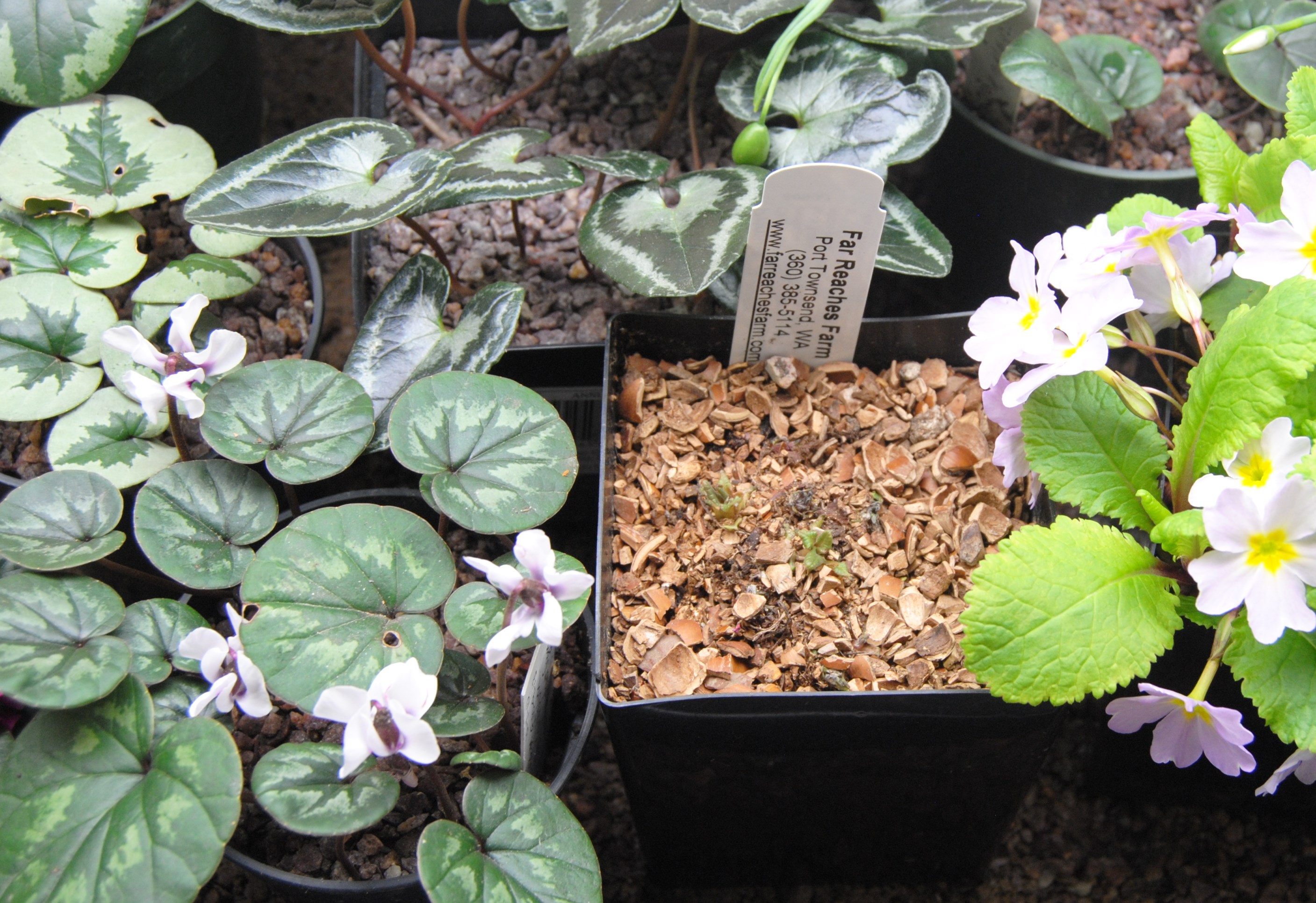
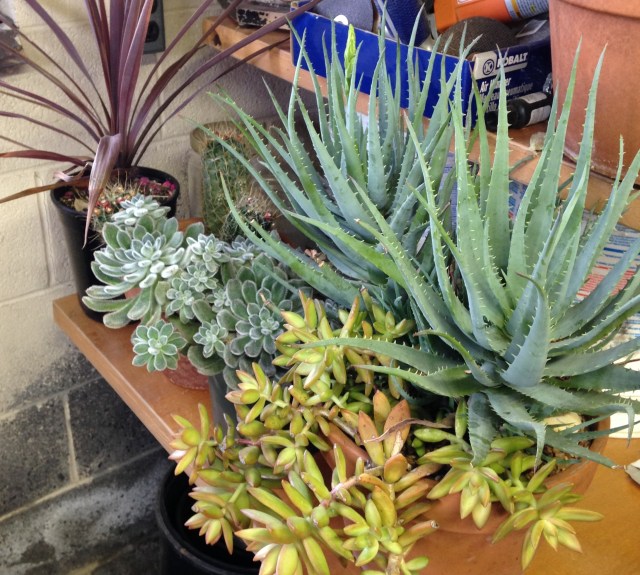
We’re into another warm spell, with temperatures predicted to peak at a balmy 50F (10C) this afternoon.  I would pull out the shorts and T shirts, but the weather forecast also has a low of 5F (-15C) listed for Wednesday, so maybe I’ll wait another week.  For now the indoor garden will have to do while we wait for the snow to melt.  Cyclamen coum are at their peak.hardy cyclamen coum indoors under lightsSure they would be hardy outdoors under the snow, but to see them blooming now is twice as nice, even though they have suffered more than ever this winter under my neglectful care.  Most are unnamed mixed seed, but the darker, smaller bloom is from the Meaden’s Crimson seed strain.meadens crimson cyclamen coumI have some whites outdoors, but only this one under lights.  It’s got nice foliage, a decent sized flower, and a nice blackberry smudge on the nose.  Also, according to the original listing this seed comes from a wild collected plant of cyclamen coum ssp. causasium, which to me means its mom comes straight from the wilds at the edge of the Black Sea near Turkey and Western Russia (and may also be slightly less hardy than other c. coum).  A cool pedigree as far as I’m concerned, but based on the mixed variety of colors and forms that came from this seed batch I’m guessing dad was a local.white cyclamen coum with blackberry centerThis one is still my favorite.  No fancy reason, just like the color.pink hardy cyclamen coumThe snowdrops (galanthus elwesii) which I potted up in December from a late Van Engelen order are doing fine, but just not as well as last years order.  There’s just not as much variety in bloom shapes and markings this year, and to me this says it might be time to move on from my bulk snowdrop purchasing days.  I’m sure I’ll still pick a couple up here and there, but no more bags of hundreds.  Just the other day a friend suggested I try Brent and Becky’s since they usually supply a higher quality and larger bulb…. (so maybe I’ll still have to try one more year of bulk orders) forced snowdropsEventually I hope to bring in a pot or two of my own garden’s clumps and force them indoors, but for now my clumps of just one bulb aren’t ready for that.  So until then I’ll have to take what I can get.galanthus and primulaYou might recognize the pinkish primula vulgaris ssp. sibthorpii from my Far Reaches Farm order in January.  It’s lookin’ good!  I can’t really take any credit for this since all I did was keep it warm and under lights, but it’s a nice treat here amongst the permafrost.  Rumor has it that sibthorpii should have a white ring around the yellow center star or else it’s a mixed hybrid, but since mine has been grown under artificial lighting, it may not yet be showing it’s true colors. primula vulgaris sibthorpiiTo save on indoor light space I placed another dormant primrose in a cold spot near the door to keep it asleep…. then the polar vortex and little vortices came through and before I knew it the poor thing was a block of ice.  After a slow thaw I have it under the light too, and other than a few freezer burned rosettes of new growth, I believe it will be fine.frozen perennial primroseAnother objet d’hope  is this group of overwintered geraniums I potted up last week.  I had a free afternoon and the strangely bright sunshine made me antsy to get something growing, so after another 25 pots of seeds were sown and placed outside to get a taste of winter, I took pity on the stray geranium cuttings sitting in the dark garage, repotted them and set up the second shoplight.overwintered geraniumsI had been of the opinion that my tropicals under a shoplight experiment was a waste of lighting, but last year’s hanging pots of geraniums look much better for having been under the light.  I suspect this will be the year of the geranium (pelargonium) since I now have room for nothing else (other than this sad looking cane begonia- which believe it or not will recover very quickly from this wintertime abuse).overwintered geraniumsThe succulents are much less bother.  Dim lighting, a cup of water in January, and they look as good today as when I brought them in.  As long as they only get enough water to hold off death, they’ll be fine until May.overwintered aloe

May sounds good right now, but I’ll be happy enough when March gets here.  It’s scheduled to come in like a lion, but hopefully by the end we’ll see some signs of life outside.  Onion seeds were planted last week so even if the ice outside says winter, the calendar will soon start to argue that…. I hope.

Get those seeds planted!

Not that she was bragging, but Amy over at MissingHenryMitchell posted about having her new cyclamen seeds planted at least a full week or two before things finally kicked into gear over here…. (and she even got them a few days later than me!)  But peer pressure finally did its magic and I got my own cyclamen going.  My five selections from Green Ice Nursery in the Netherlands went into water filled baby food containers (fyi it doesn’t come in glass jars anymore) with a tiny bit of dish soap mixed in to help break the surface tension and wet the seed.cyclamen seed

A body in motion tends to stay in motion, so while the seeds sat for their overnight soak, I kept going and decided to plant as many spare seeds as were in my little seed box.  Most everything is fair game, the only exceptions being some hot weather annuals who’s seed would freeze to death, some biennials which would be better sown in mid summer (why bother earlier, they won’t bloom till the following year anyway), and some plants which I’ll start indoors early for a head start.  Today’s seeds (mostly perennials) are going outside to brave the winter and then hopefully sprout in the spring.  My first step is line up pots and shove a scrap of newspaper into the bottom to keep the soil from falling out the drain holes. starting seeds

I’m not a serious seed sower, I don’t scrub the pots clean with a 10% bleach solution, I’m careless with my soil mix, and I don’t research the exact germination needs of my seeds (all good ideas).  If you have some special seeds or want to take a dip in the waters of serious seed starting science, I’d suggest this post by Nancy Ondra over at Hayefield blog.  The stuff on the Deno method is really interesting and I was pleased last spring when I tried it out myself.

Soil and labels are the next step.  I use a mix of 3 parts whatever potting soil I have with about 1 part sharp (sandbox) sand.  Labels are cut out of the old vinyl vertical blinds that came with the house.  I’ve heard many people like cutting up the slats from mini blinds…. another good idea- but this is what I have 🙂cheap plant labelsWriting out the labels probably takes the most time.  Name, notes, date, and source written with a plain old pencil.perennials from seedI fuss a bit over seed depth, but not as much as I should.  According to my highly non-technical methods, seeds are just dropped in and covered with chicken grit(crushed granite).  Larger rounded seed are planted as deep as 3/4 inch(~2cm), flat, light seed such as lily and fritillaria covered lightly, and anything fluffy (think dandelion seedheads) are barely covered and often still exposed.winter sown seeds Once the seed are laid out at their sorta proper depth, grit goes on.  Anyone who has ever tried to keep a gravel walk weed-free knows that gravel walks and patios make a perfect seed bed, the grit protects the surface and seeds from splashing around over winter and keeps the seed moist.  In fact if I have any really fine seed I’ll just start with a thin layer of grit first and then sprinkle seed on top.perennials from seedAnd that’s it.  I planted the cyclamen seed the same way (deeply) the next day, and although I’ll overwinter them in the cool garage (and hope for some germination), the rest will go outside sometime next week.  In a perfect world I would have done this in November and given them a patch of warm weather before they freeze, but this will have to do.  We’ll see what shows up next spring 🙂

Winter Grasses

Here’s a disclaimer:  These pictures are from over a week ago, back when a few leaves still clung to the trees and I was considering late season bulb sales and a final mowing of the lawn.  Things have changed though, and this morning the temperature sits at 16F (-9C) and a dusting of snow is frosting the green and uncut grass.  Don’t get me wrong, there’s still an extremely strong possibility I will breakdown and order more bulbs (and not be able to plant them), what I’m saying is there’s no chance of me going out there and taking more current pictures!

So fall grasses it is!  Here’s Panicum ‘Dallas Blues’, probably one of the top 5 grasses I grow, and also the panicum responsible for changing my low opinion on these native grasses.  These clumps have a cool blue tint all summer, don’t flop, don’t seed, and will now keep this orange tint all winter while the surroundings go tan and grey.  They even bounce back up after a snow. fall color on panicum 'dallas blues'

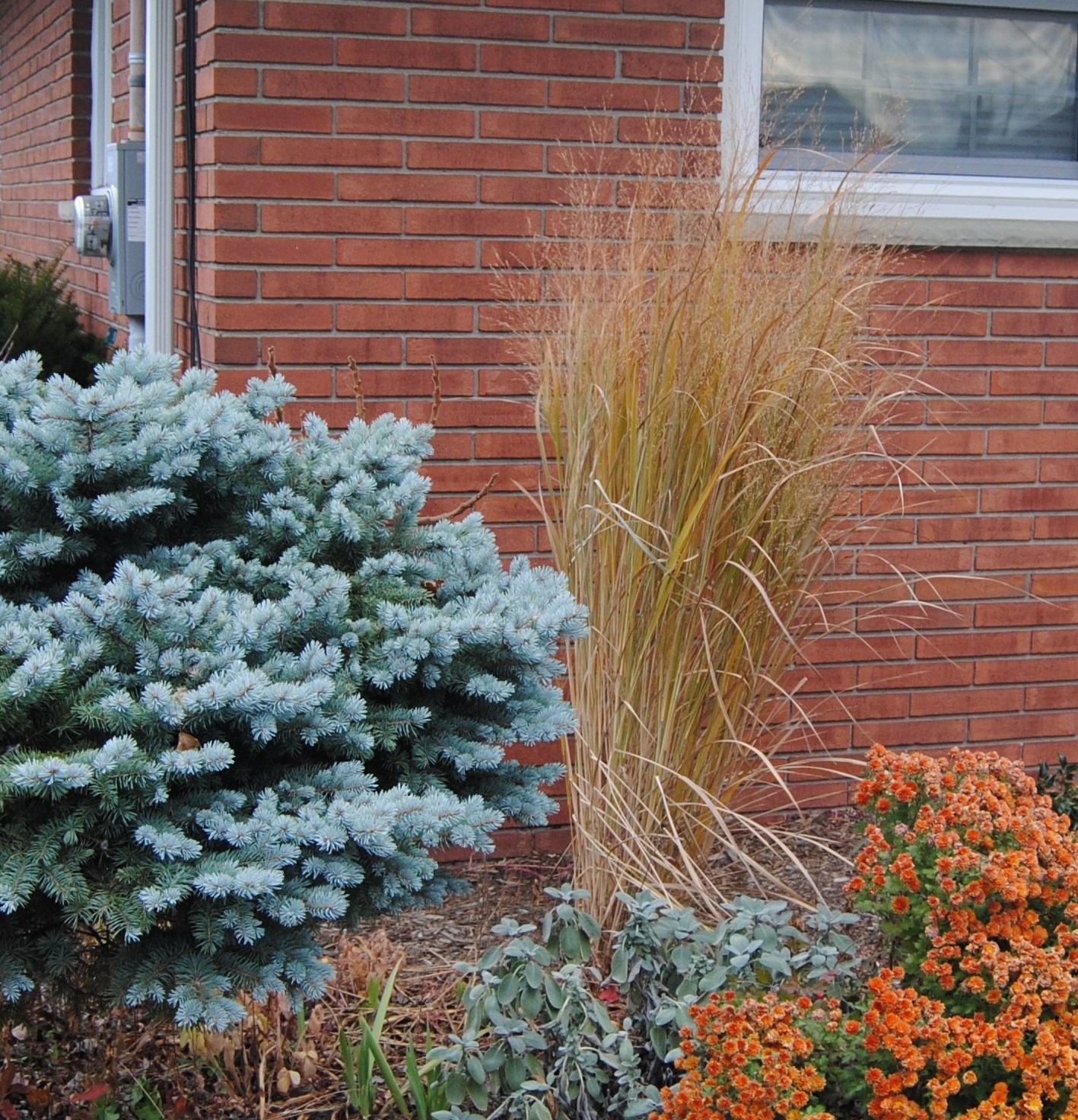
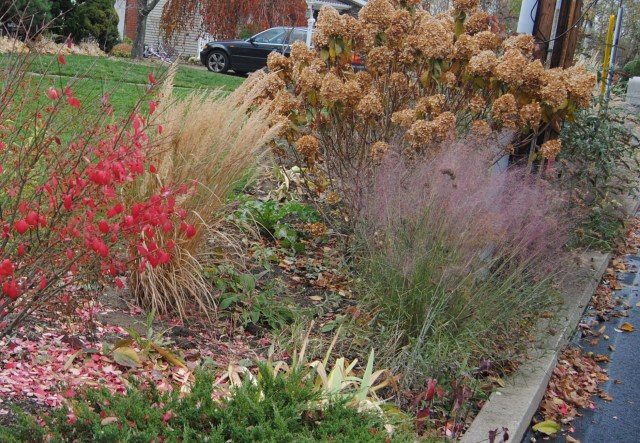
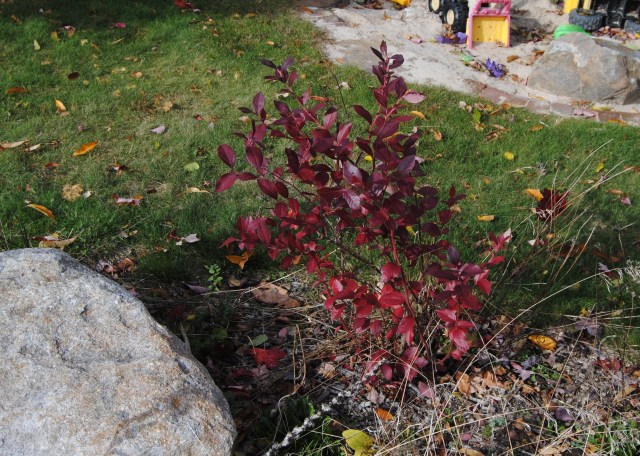
‘Dallas Blues’ convinced me to try a few other panicums.  I don’t like them as much, but will definitely keep them since they also have their special traits (and they are a PAIN to dig up).  Here’s ‘northwind’, a selection that is unique for its tight upright growth habit.  ‘Northwind’ is also a grass that will stay up all winter and is what I would call an architectural grass.  It’s form makes a nice accent in the landscape…. maybe not in mine, but I’m sure you can do better!miscanthus 'northwind' with blue spruce and mums‘Cloud Nine’ is a big panicum, but I do tend to like my big grasses 😉  This young plant made it up to 7 feet and was a nice explosion of flower heads this fall (a cloud one might say), but I’m not loving the absolutely dead tan winter color.  panicum 'cloud nine'This combo also might be a little too heavy on the dead tan colors.  The Korean feather grass (Calamagrostis brachytricha) to the left looks like it might be dead (I’m hoping it’s not) but the pink muly grass (Muhlenbergia capillaris) still holds a bit of color.  I’ve heard of the Korean feather grass reseeding, but I don’t think my own plant has started yet (year 3).  The pink muly doesn’t seed at all for me, since this southeast native grass waits so late to bloom.late fall border with grassesThe red color in the last picture is a burning bush (euonymus alata) and its days may be numbered.  Even though they show up in many local landscapes they’re very invasive.  I haven’t seen any seedlings yet, but don’t doubt they’re out there, so next spring I may move one of the blueberries into its spot.  The color is not as intense and the shape is less tight but you get delicious blueberries!blueberry fall foliage‘Skyracer’ purple moor grass (Molinia caerulea subsp. arundinacea) is a top 5 grass.  Up to 6 foot tall seed heads come up out of a neat 2 ft fountain of foliage.  It’s tall yet airy and light, and the yellow fall color hangs on for a while.  If winter comes late and seeds ripen there might be a seedling or two next spring but hardly anything to worry about.  The plant practically falls apart over the winter and is an easy cleanup.
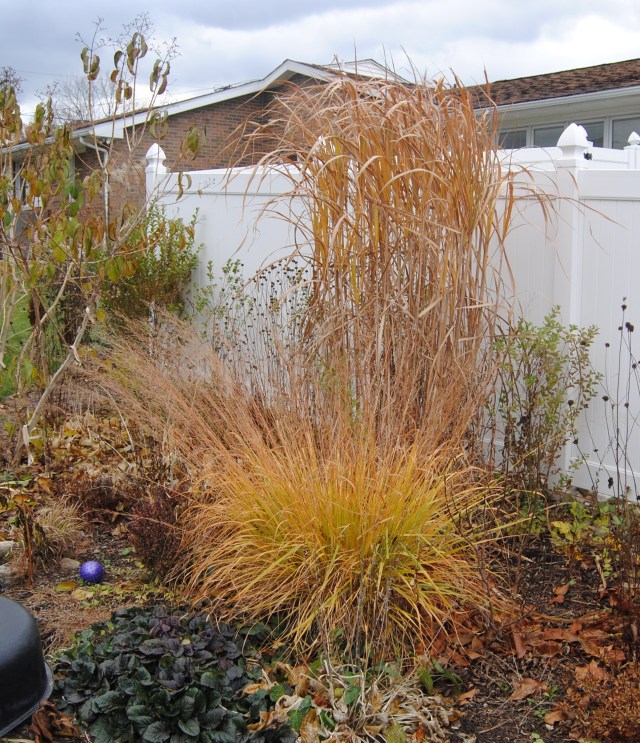
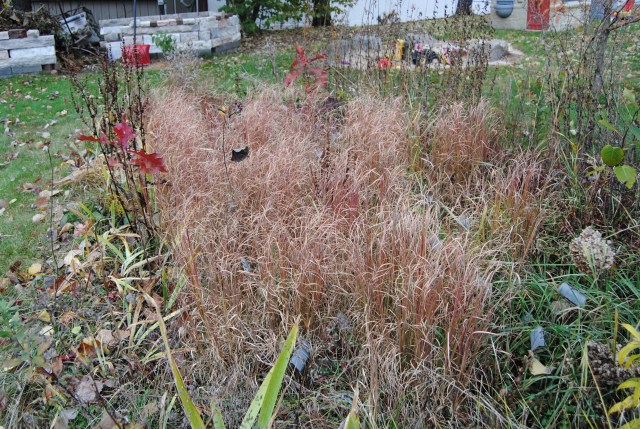
Not so easy to clean up is the miscanthus giganteus growing up against the fence.  It’s a 6 foot fence so this grass is tall even with the drought.  The lower foliage dies off when water is short but I of course like the height.  It will be a pain to remove when it’s novelty wears off, considering this is a 3 yr plant from a quart pot…..molina skyracer and miscanthus giganteusMiscanthus in general are losing their hold on me.  The springtime cleanup is a pain with their tight clumps and I’m starting to think of them as industrial park plants.  They look great there, but might be too much work in my own garden.   I still have a few variegated kinds and who knows what next year will bring, since my fickle crabby self might divide up this porcupine grass (miscanthus sinensis ‘Strictus’) next spring and plant it all over the place.porcupine grass (miscanthus sinensis strictus) late fallPlanting grasses is easy, it’s removing ornamental grasses that’s the problem.  My only advice is sharpen your shovel beforehand, you need a nice blade-sharp tip to make the job almost easy, but even then you really have to put your back into it.  Also watch the seeders.  I’ve evicted the taller Pennisetum alopecuroides because of their reseeding (the real dwarf ones seem to be sterile) and I’m keeping my eye on the Korean feather grass.  Most of the trimmings can be composted, but don’t mulch your daffodil bed with fresh little bluestem mulch, it makes a great grass seedbed and will make you hate your daffodils and weeding them.little bluestem selfsown
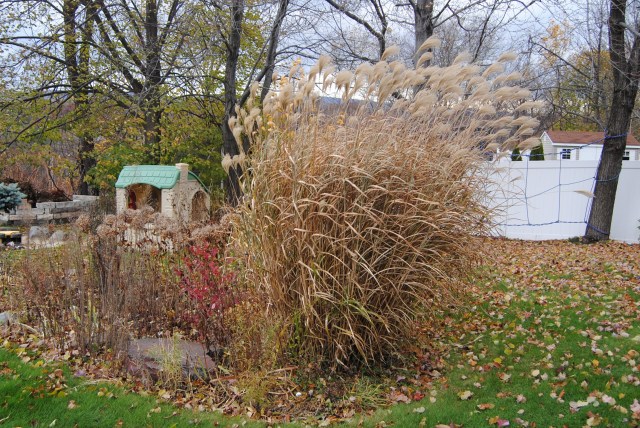
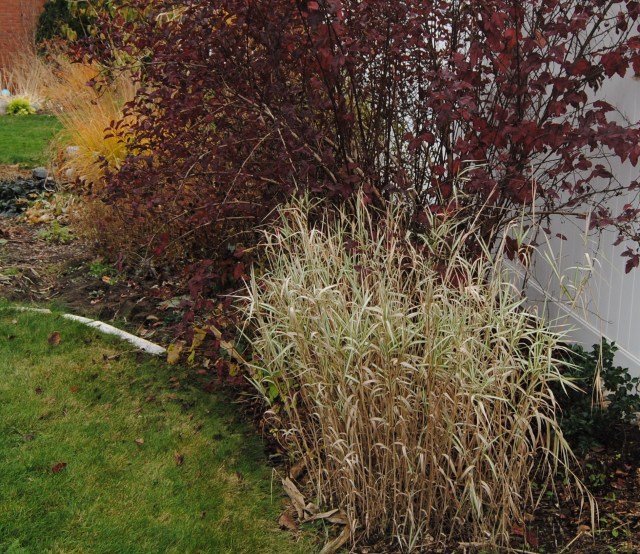
Grasses that spread by runners are also something to watch out for.  Despite all the warnings against planting gardener’s garters or ribbon grass (phalaris arundinacea) I did it anyway.  Mine is the supposed-to-be-less-invasive ‘Strawberries & Cream’ but I know that won’t be the case.  Just because I do stupid things doesn’t mean you have to, I’m just a sucker for variegated plants.  -by the way it’s more of a summer grass so by fall it’s fading fast.Phalaris arundinacea 'Feesey's Form' in fall

So did I miss any of your favorites?  ‘Karl Foerster’ feather reed grass is probably my number one, but with all the pictures I’ve already shown through the year I figured I’d give it a rest…. which is what I’m planning to do too now, since the outdoor temperature is still under 20F (-7C) 🙂

The last bits

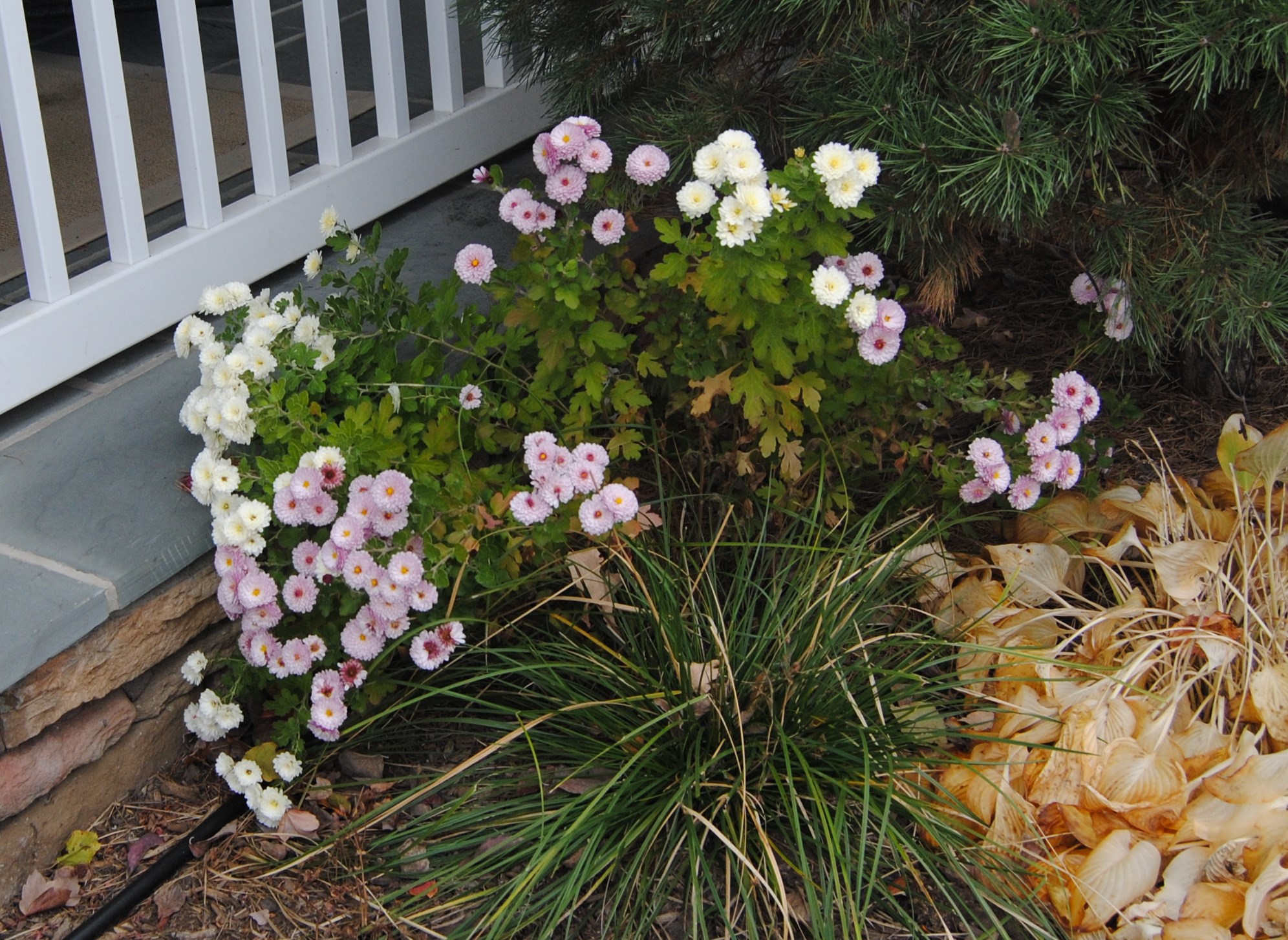
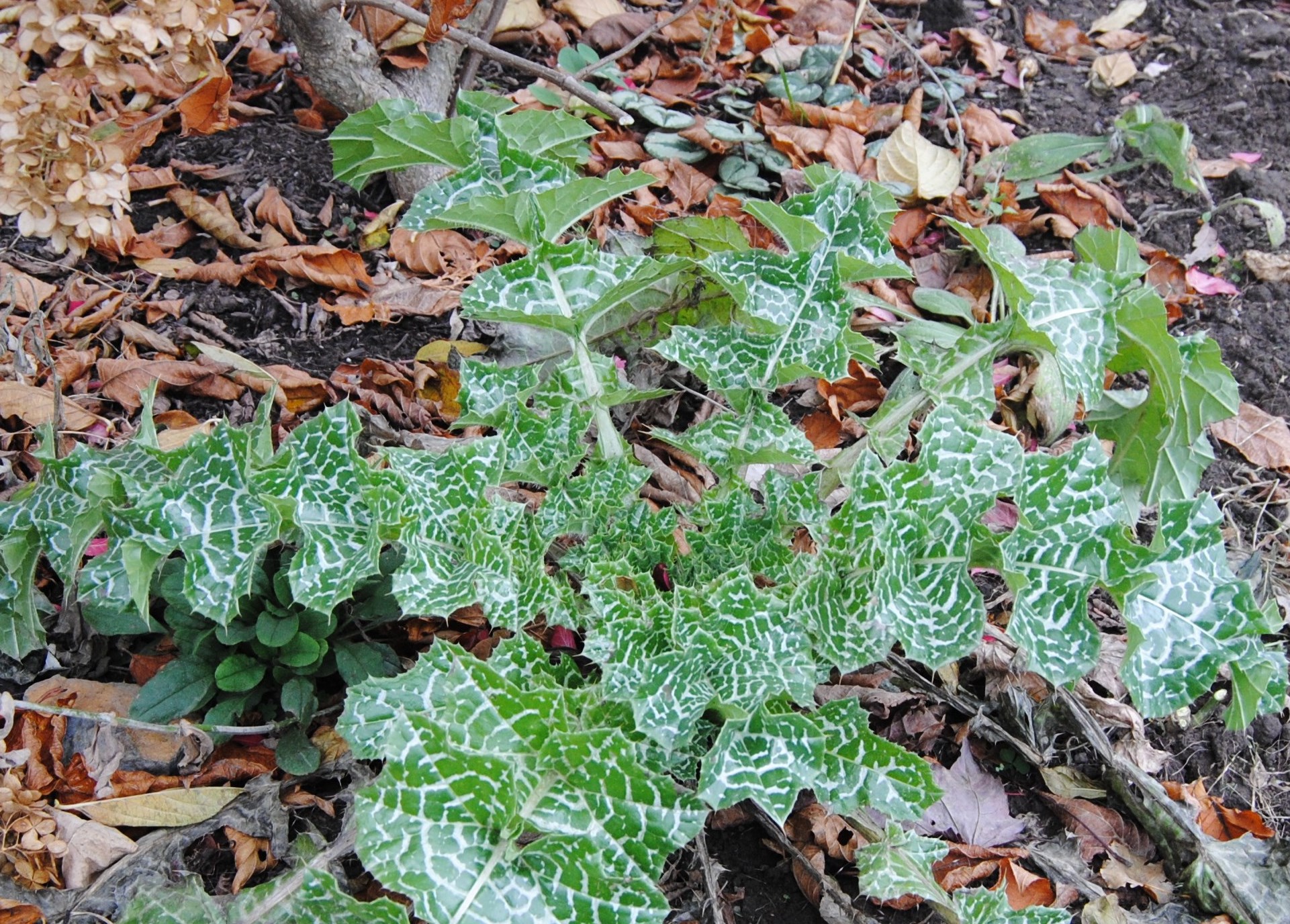
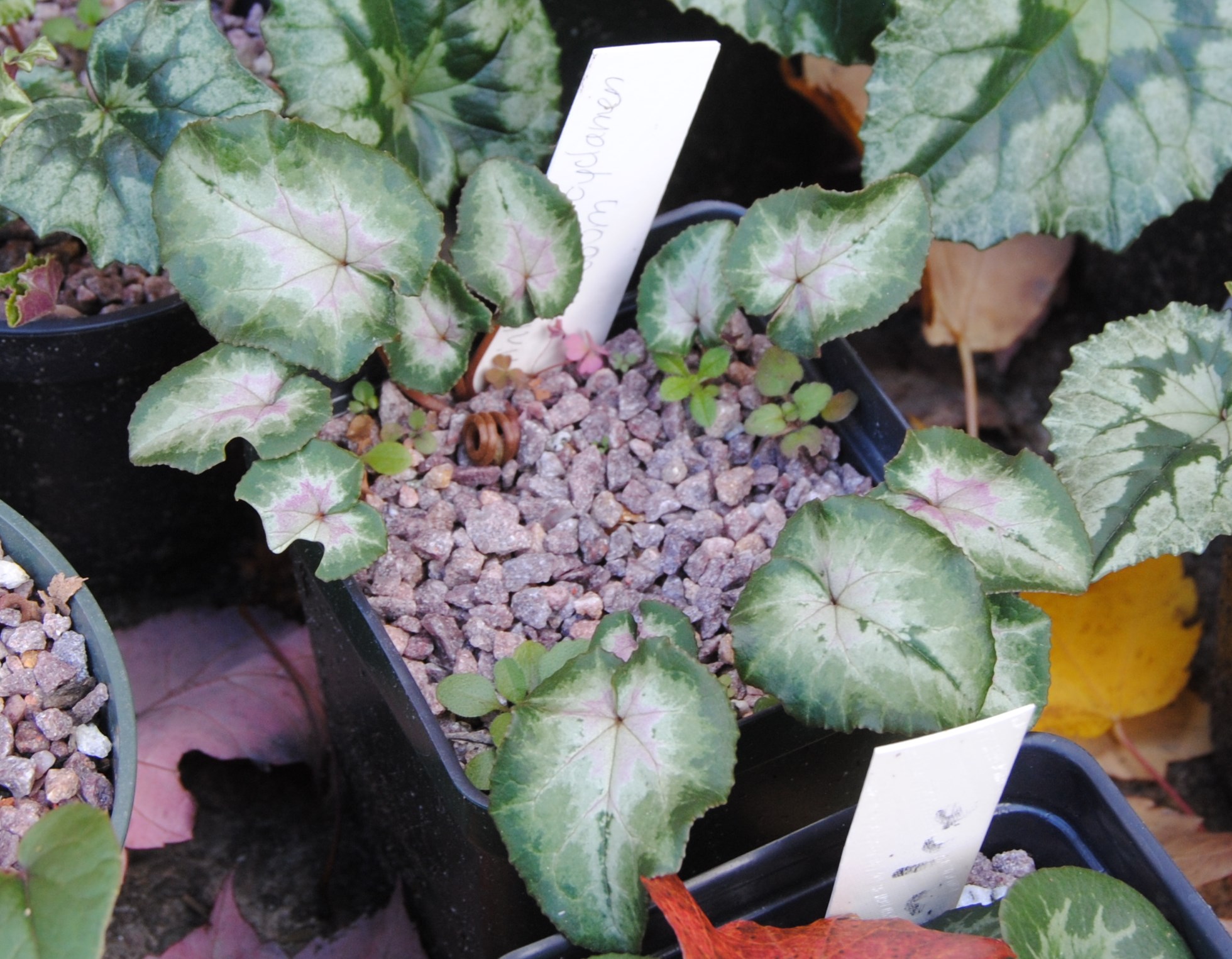
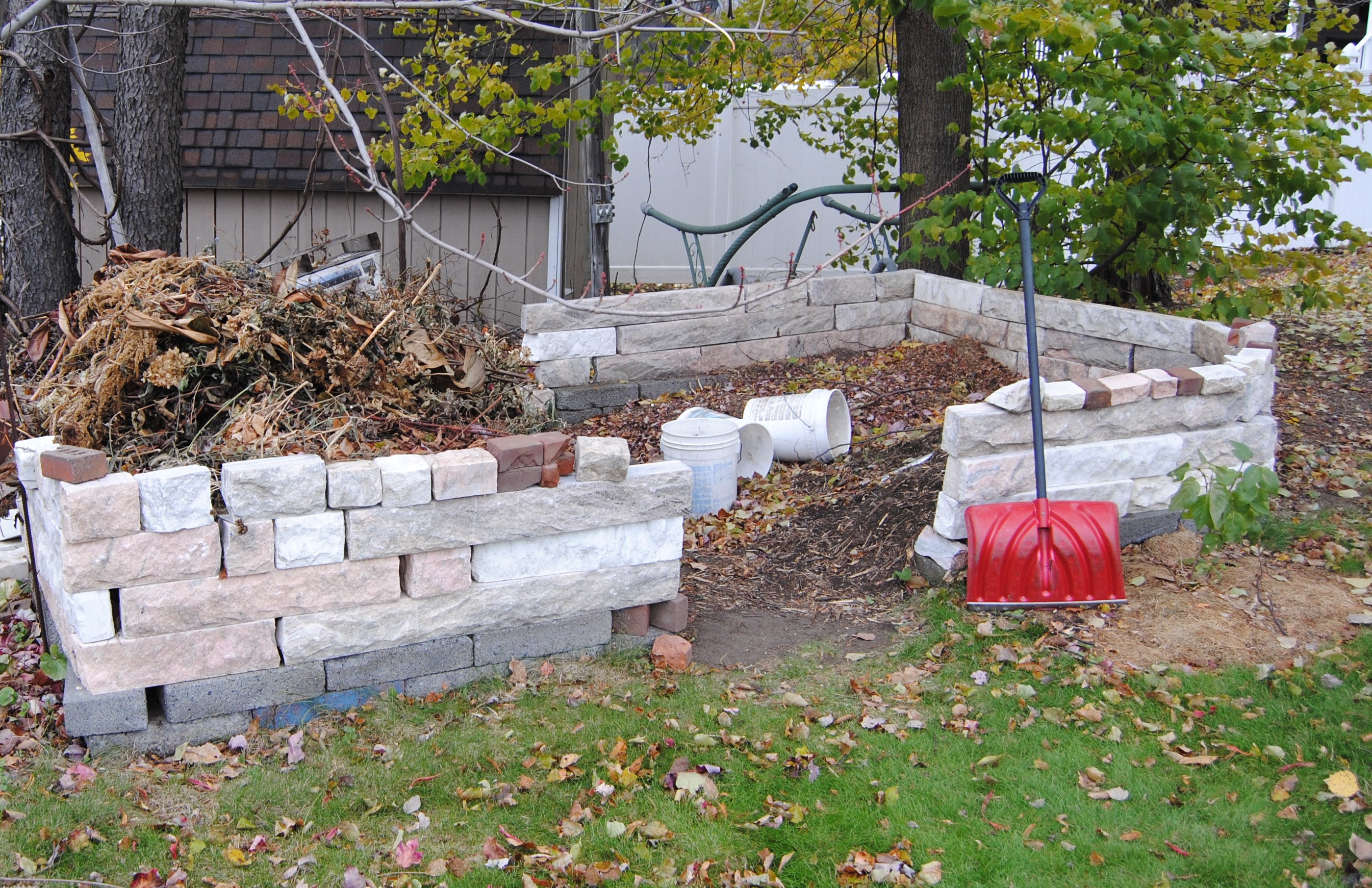
Between working late every day and changing the clocks, my enthusiasm for the garden has dropped off the edge of a cliff.  The leaves are down and the soil is still on the dry side so that’s not helping either.  I guess winter is the perfect time to hibernate, but before I shut down completely here are some last pictures.  Some selfsown mums are still blooming.  I’m not crazy about the colors, but the timing is a welcome last call.seed grown chrysanthemumsThe milk thistle seedling still fascinates me with its cool mottled foliage, but I still have my doubts about it overwintering.  So far I’ve only ever managed to grow it as an annual, not a biennial (which I think is what it prefers)milk thistle foliageMy one cyclamen hederifolium seedling which gets a pink tinge is coloring up for the winter.  Now that temps are dropping into the 20’s I brought it into the garage for safekeeping even though I’m sure it’s hardy enough to overwinter in the ground (but I would miss it out there!)cyclamen hederifolium with pink foliageOne job which I did get done before free time dissapeared was the tidying up of the compost pile.  Not everyone has this much room surrounded by a fancy pink marble block wall, so I’m kind of grateful for that…. but I still wish I had more leaves and such to fill it up with.diy compost pile So that’s the story from here.  Things are shutting down and I just don’t have any motivation, but that could change at any time.  Just last week I noticed a bunch of seeds I wanted to plant this fall, and bulb clearance sales typically start on thanksgiving.  It’s hard to be unmotivated when a couple hundred bulbs are shipping your way 🙂

Hope your end of season plans are going better than mine!