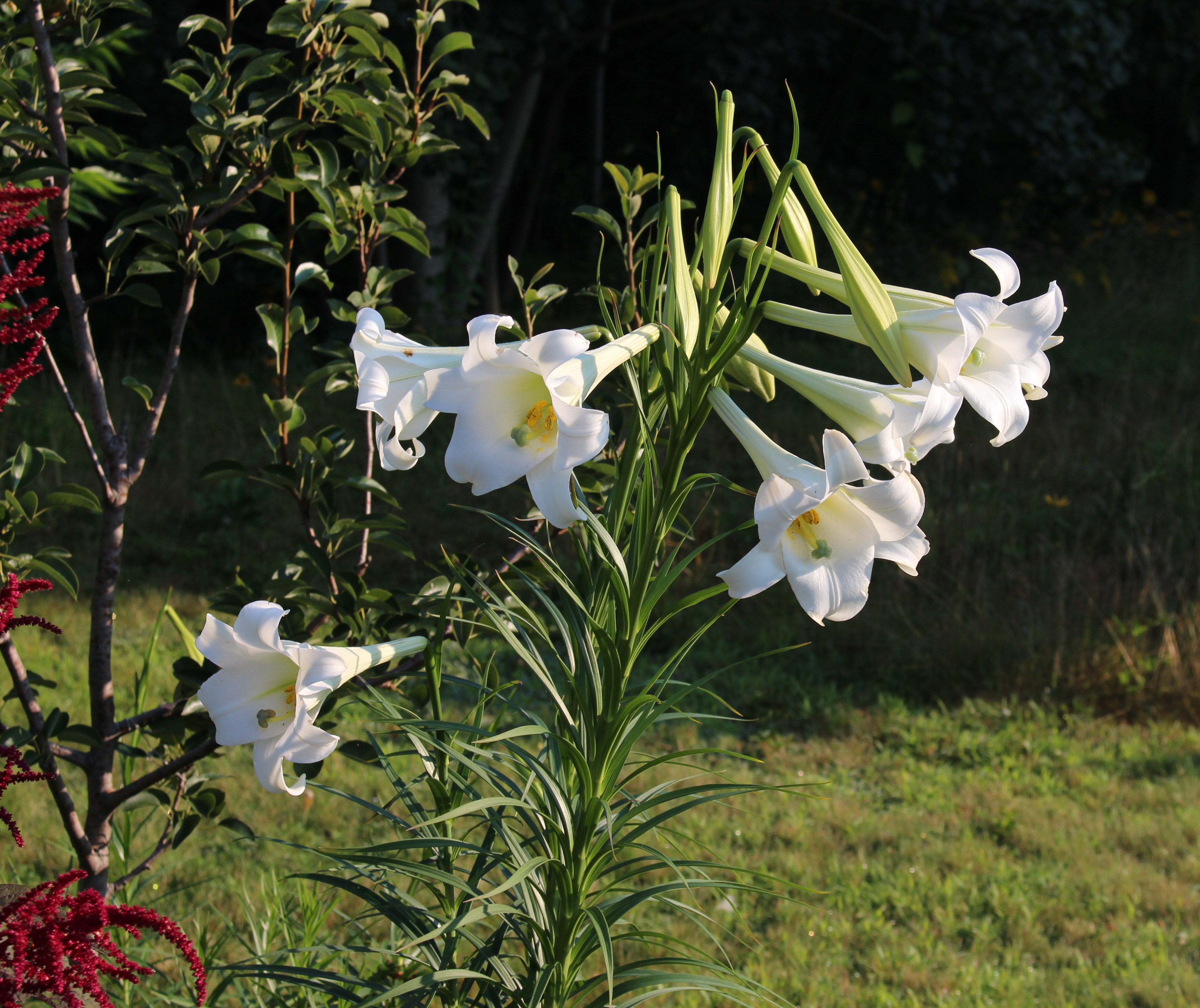
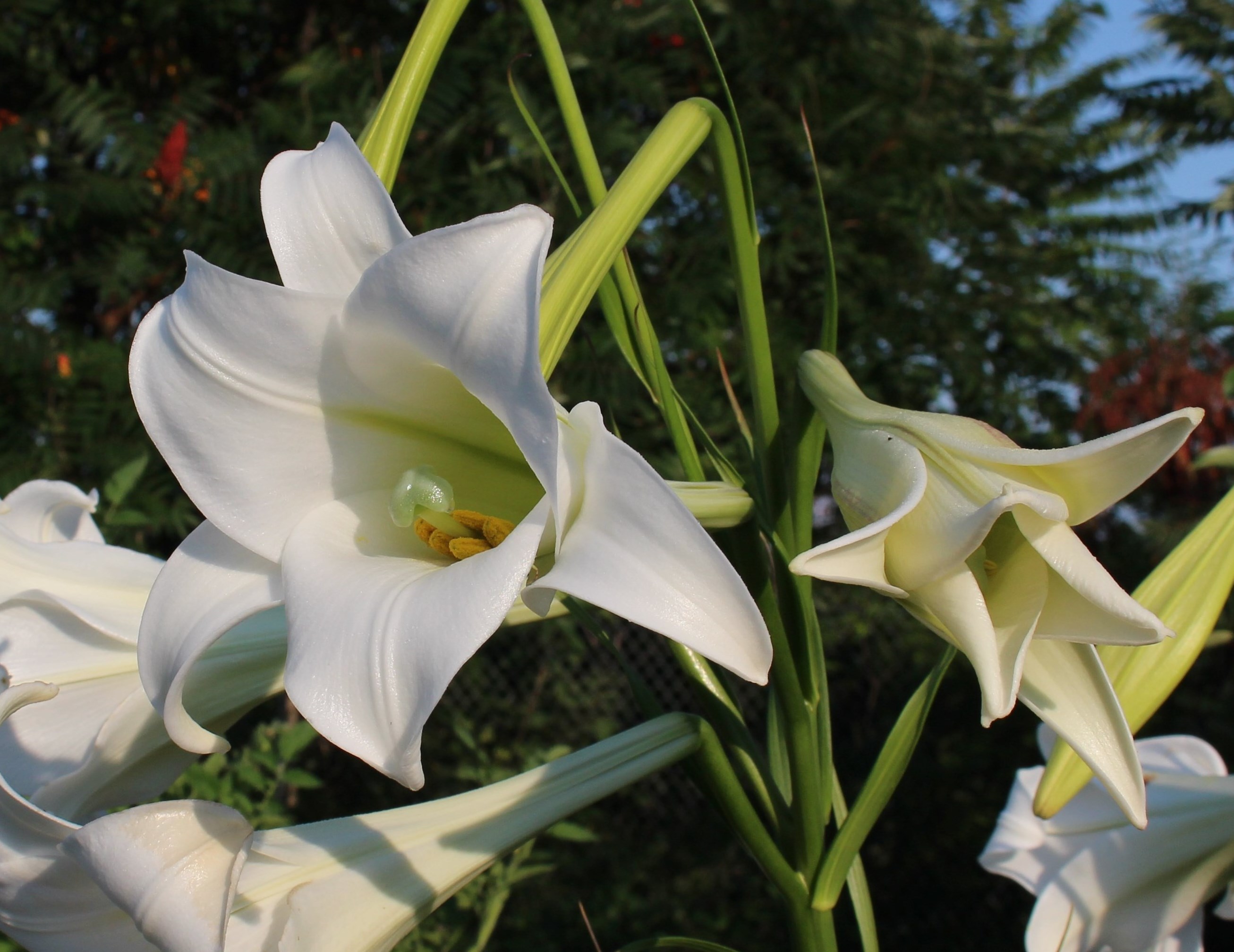
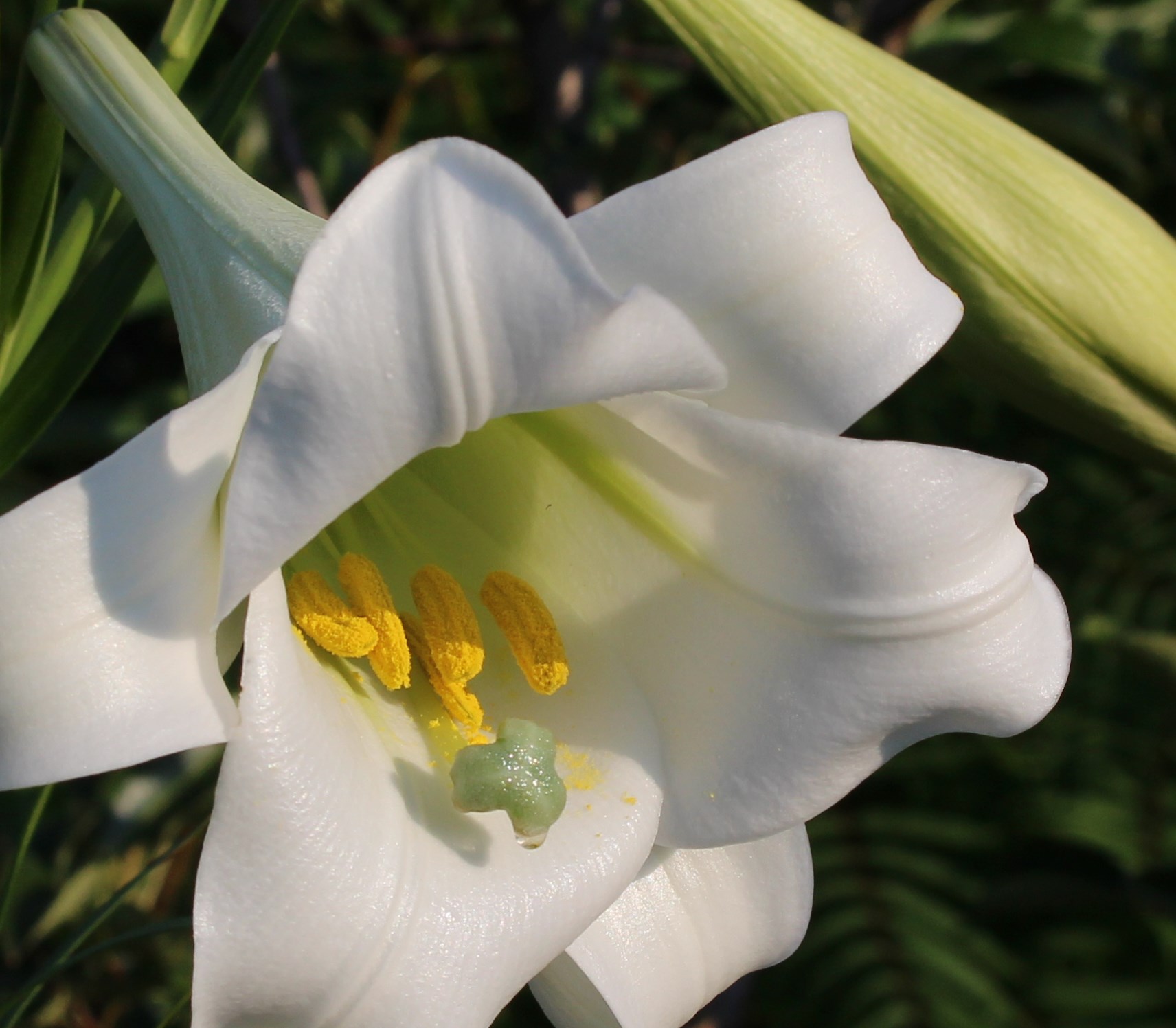
Late August is bathing us in heat this year and the steady rains have brought on the harvest. We modestly refer to our garden as “the farm” or “potager” and this is the time of year when it shines. Produce begins to trickle in and suddenly there’s a little more interest in the backyard.
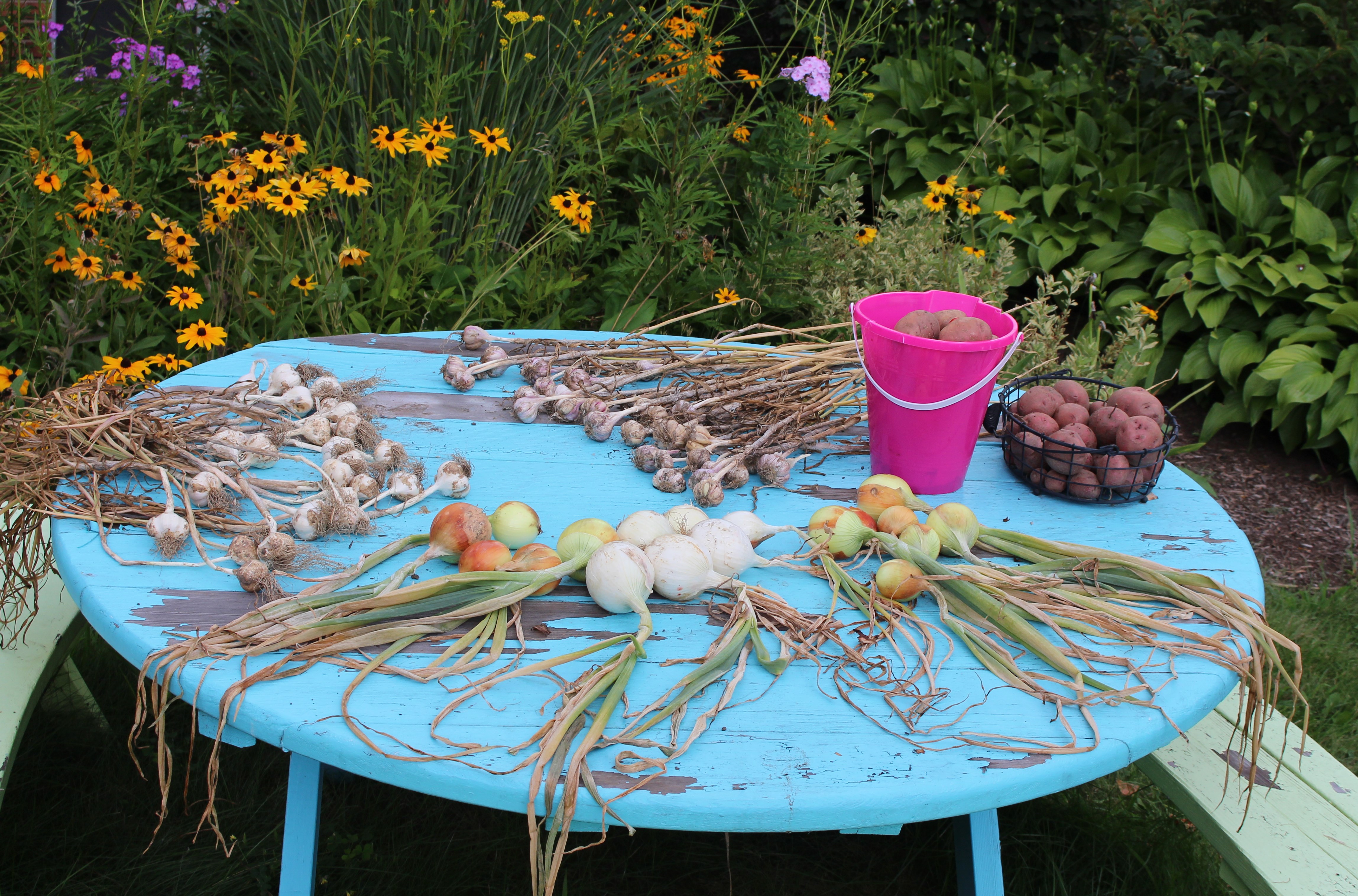
The picnic table is the place to be for drying off and cleaning up before the kitchen. Garlic, potatoes, and the first of the onions started the month off.
Eggplant and peppers have been going out, onions are always popular, tomatoes are on their way, and beans are yet to come. The harvest is late due to planter’s procrastination but who out there hasn’t ever fallen behind? At this time of year even I fix up a plate of veggies, and they aren’t even deep fried 🙂

I grow red cabbage just for the looks, but there’s a good chance these heads will disappear soon and show up again later as rotkraut. Fine by me, but in the meantime they look nice with the verbena, eggplant, and marigolds.
I admire a neat garden with raised, raked beds and straight rows of perfect plantings, but that’s nowhere even close to my garden. The potager is tumbledown mix of flowers, crops, and all kinds of odds and ends that found an open spot of soil and made it their home. Phlox are never turned away, and earlier in the month they started their summertime concerto and the music still plays on through the heat. For this I consider myself lucky, since earlier in the spring between spidermites and drought I got the feeling it would be a down year for the tall garden phlox (Phlox paniculata).

Phlox paniculata ‘Dorffreude’ (Karl Foerster introduction, 1939) making a good argument that newer isn’t always better.
The phlox make me happy, but the other flowers which add to the non-agricultural chaos also make me smile, and the tall Verbena bonariensis leads the way with their bee and butterfly attracting bloom heads.
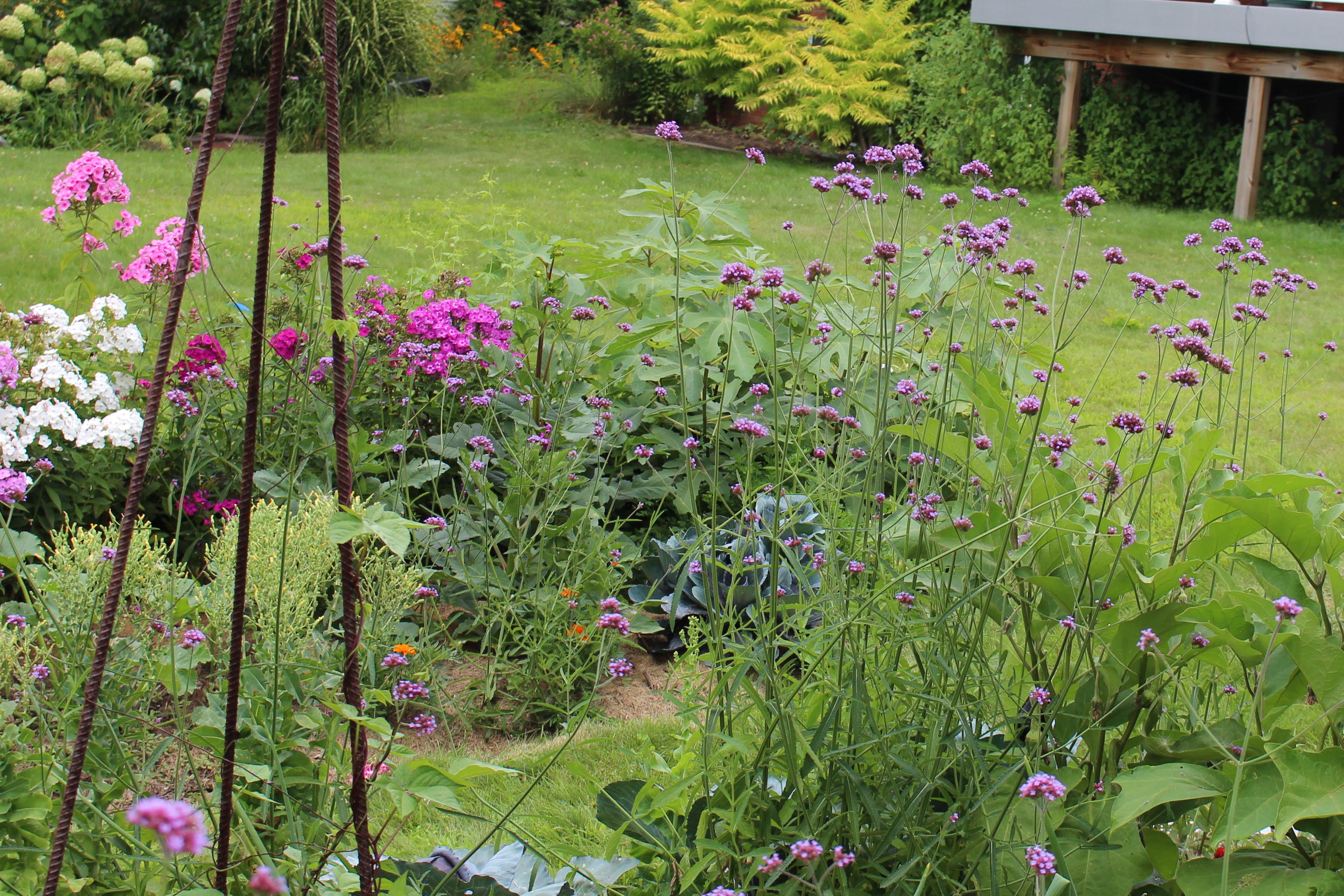
Now’s the time when the verbena becomes too attractive to pull. It’s a fair trade-off since the flowers draw in nearly every passing butterfly.
One area of responsible neatness is the boxwood hedge which edges the two forward sides of the garden. After three years the small plants have finally begun to look nearly respectable. To celebrate this milestone I spent way too much money on what I hope will be a set of premium hedge shears. The electric trimmer has been shelved and I took the quieter, more contemplative path of manual trimming. For me it’s relaxing and I think I’m one of the few who actually enjoys this job.

Slowly the boxwood hedge fills in. I can still remember the summer day way back when me, a bucket of boxwood clippings, a few trays of potting mix, and a couple beers started this all.
Besides boxwood and phlox, chrysanthemums (ok, new name dendranthema) are starting to make a serious play for potager real estate. This spring I added even more of the larger flowered football types, trying to stick with anything which might be hardy through the winter. I’d try to explain this growing obsession with mums but honestly after just admitting I enjoy hedge trimming I’m not sure there’s much I can say to defend this last quirk.
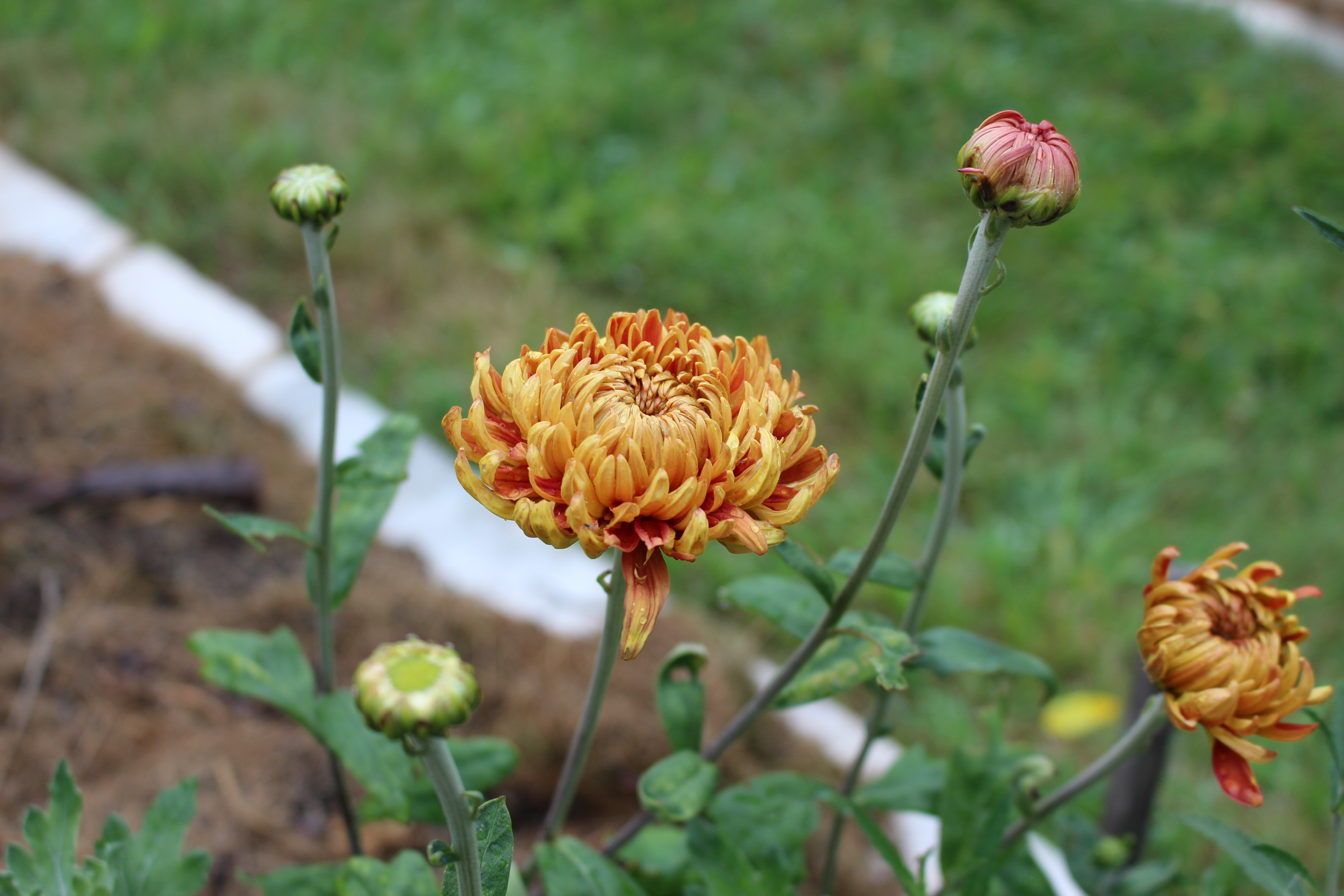
Hardy (hopefully) football mum. If the mood strikes next year I may even try disbudding a few of these to see if I can force all the plant’s energy into one single, perfectly large, perfectly perfect, bloom.
Dahlias. I like dahlias. I think I’ve already confessed to that. Of course a late planting gives late flowers, and you know me and late.

Dahlia ‘Moonstruck’. This is its third year and it has yet to let me down, although I suspect it carries a virus which causes the leaves to yellow and die way too early in the season.
Sometimes late isn’t anyone’s fault. For the second year in a row I’ve had these gladiolus bulbs overwinter in the open garden. Against better advice I even transplanted them in June and look at that, the clump still managed to send up two bloom stalks. If this keeps up I’ll need to divide the clumps next year since the other clump is up to 8 flower stalks!

Just your average hellebore-gladiolus-rudbeckia-tomato planting. I don’t think you’ll find this combo anywhere else… probably for good reason 🙂
But procrastination does have its down side. Although the persicaria and rudbeckia have never looked better next to the potager, the light green ‘turf’ in the bed is 100% weeds…. and this is still supposed to be a red border, which rudbeckia is not. Also the trellis never received a solid footing, and was never officially planted. I guess that’s what the plans for next season are made of!

persicaria red border
Enjoy your own harvest, whether it be fruits or flowers, contentment or excitement. The season is here and as long as the heat doesn’t kill you first you can shelve these moments away in your mind for those dark days in January.
Normally pictures of the front foundation border are avoided. This area qualifies as one of my least favorite views probably because the plantings do little to set off or relate to the house. They’re kind of a mess come to think of it, but believe it or not they’ve come a long way <click here to see>. Our visit starts with a stroll up the front walk past the welcome squirrel and edging by the ‘Tiger Eyes’ cutleaf sumac, which threatens to engulf all visitors.

Which is too much? The overwhelming yellow, the tacky lamp décor, or the too-red petunias?
The right side of the house is fronted by the porch, and in front of the porch is a pretty generic planting of evergreens and hostas. They do a great job of being green and covering up the beds which house my favorite snowdrops and corydalis earlier in the year.

Of course a rudbeckia would show up here as well. This is one of the completely perennial and later blooming R. fulgens types, and I make an effort each spring of ripping it out only to have a few stray shoots survive anyway. btw, The pink of the phlox ‘Laura’ with the gold of the rudbeckia is one of my least favorite color combos.
The left side of the house is my problem bed. I tried ironing out a few of its problems earlier this year but it still makes me raise an eyebrow each time I pass. My first after-vacation task was to pull up all the massive crabgrass plants which were taking over, and while doing this I couldn’t help but wonder why I can’t show this same resolve against the inappropriately large sunflowers which sprout up each year (in my defense I did rip most out… but once they get past a certain size it just seems wrong to yank them).

Weeding crabgrass in August. What gardener doesn’t know this story?
If I could only get visitors to crawl around on their hands and knees I think the impression this bed makes would be infinitely improved.

The low view: Larger evergreen would probably do a better job of connecting the house to these beds, but a couple agastache, a verbascum, stray sumac suckers and a bunch of other stuff are a lot more interesting 🙂
I like how the blue fescue is filling in along the edge, it goes well enough with everything and seems to be doing ok. I wish it would do better, but I haven’t yet cracked the fescue code on what really makes it clump up and fill in.

For some reason peppers seemed like a good candidate for a foundation planting this year. Last summer I bought a single ‘Masquerade’ ornamental pepper and these are its seedlings. The purple fruits should go to yellow then orange then red as they mature, but a few plants are starting out yellow, and I don’t know what they have planned.
My unknown biennial eryngium turned out to be a perennial and is back for another show this summer. If you can avoid the masses of wasps and bees the flowers attract it’s really a pleasant all summer cloud of blue-grey.
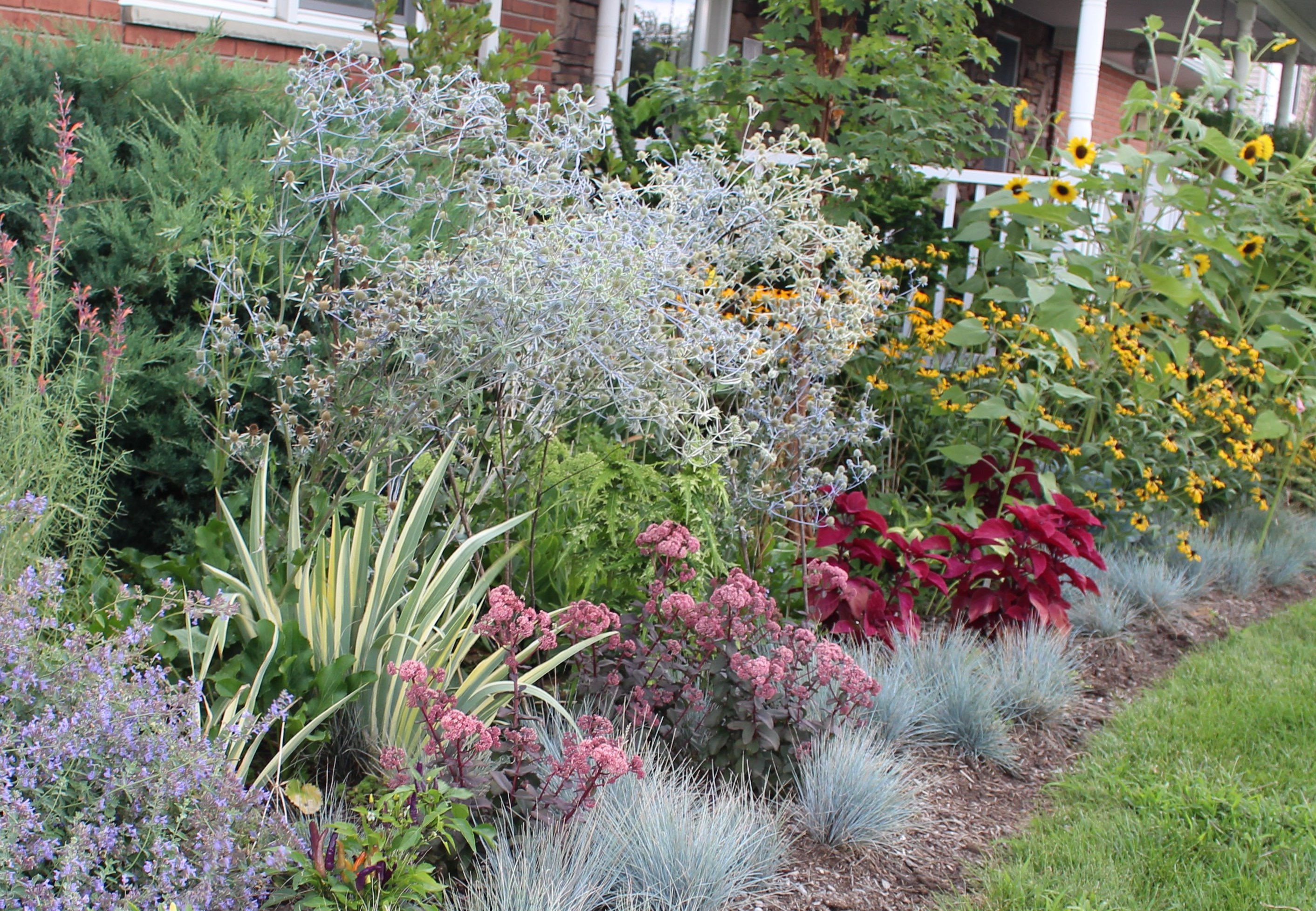
The mix of colors at this end of the border almost looks tasteful if you ignore the sunflowers peeking in on the right.
Most of the plantings here are haphazard and either work or fail by luck, but the pairing of the blue fescue and pinkish ‘bon bon’ sedum was intentional. I’m pleased with the contrast of the sedum coming up out of the fescue and it’s just what I was hoping for… as long as you overlook the sorta sparseness of the fescue.

Sedum ‘bon bon’ with blue fescue and iris pallida aureo-variegata.
Things which didn’t work out quite as well were the cobweb thistles which drowned in our rainy July and the variegated St. Augustine grass which looks just a little too weedy. I know it’s me though since I’ve seen it growing awesomely elsewhere and as a result I’m considering digging it up and trying it elsewhere, like in a pot… maybe even scissor trimming it for a neat little pot o’lawn 🙂
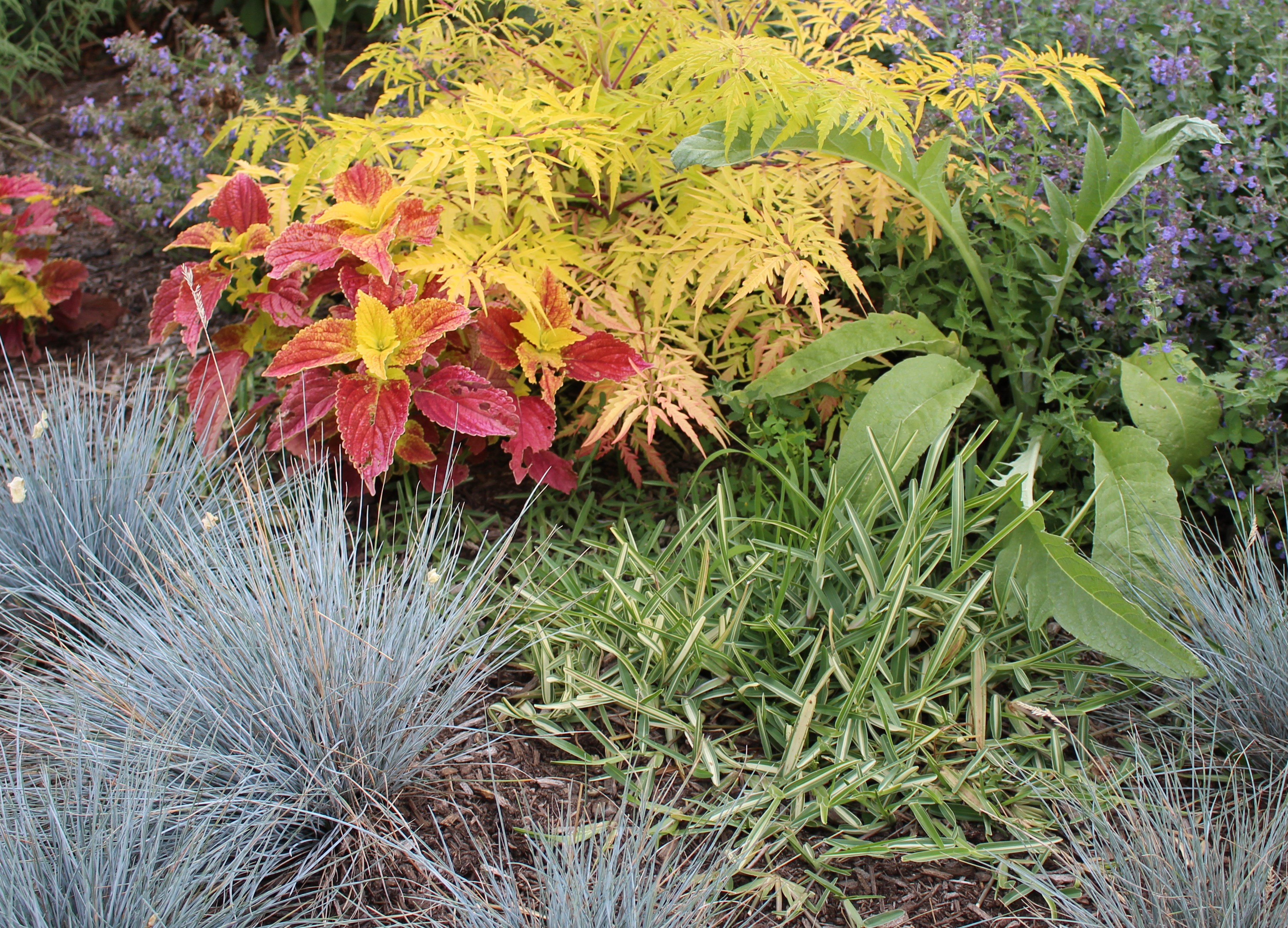
Variegated st Augustine grass, ‘Alabama sunset’ coleus, more sumac, and an up and coming cardoon seedling.
Now off to the backyard! My fingers are crossed we can get around the whole house by September 😉
It’s a small slice of suburbia in which I live. There’s nothing I consider a city nearby, yet faced by the acres of surrounding forest I guess we do huddle a bit on the outskirts of a sorta urban area in a sorta subdivision…. but even with the lack of a hustle bustle and heavy traffic, I do like to have a little shelter from the street and a little color for the neighbors. Not exactly ‘curb appeal’, a term which makes me cringe when applied to any property not listed for sale, but it’s definitely colorful and whether the neighbors like it or not (they never really say, although I’m sure they talk) it does liven the block up for the half dozen neighbors and dog walkers which actually come by this way.

Butterfly bush (buddleia ‘Royal Red’ and ‘Pink Delight’) are now joining the black eyed Susans which have taken over the border. The bearded iris which dominated in June are all nearly overgrown by this time of year!
Usually this border holds a lot more late summer and autumn color. Annuals such as zinnias castor beans, and tender perennials such as cannas and dahlias, pick up at the end of the year just as the summer perennials are beginning to look a little tired. It’s a different story this year though, as things got away from the gardener and the rudbeckias took over.

There’s nothing subtle about golden rudbeckias, but they do match the brightness of the sun. At this point of the year I don’t even mind the formerly ‘too bright’ orange and pink sunpatients my daughter planted along the front.
And again I won’t complain. I love the color, it looks great from the front porch, and I’ll deal with the ‘going to seed’ phase when its time comes. Right now I’m just amazed we’ve had enough rain to keep the grass green all summer (although the actual work of mowing all this green grass is less than amazing).

The beds do look better framed by green grass. Not bad considering the last two years were both marked by hot, dry, completely dormant (surely dead looking) turf patches…. for three entire months…
You may remember I mulched this bed completely with barely decayed, shredded leaves this spring. It’s worked wonders for the soil quality and number of weeds, but it also greatly reduced the number of self seeders which normally fill the bed. Purple Verbena bonarensis and the brilliant red Ipomopsis rubra (standing cypress) are sparse this year, but Euphorbia marginata (snow on the mountain) has not missed a beat. Even after ruthless weeding there are still plenty of the cool white bracts showing up throughout the border and I can see how this native of the west has naturalized itself all across most of the US and Canada.

The white streaked leaves of snow on the mountain form around the tiny flowers and eventually form a large ‘tree’ of white.
The snow on the mountain will look good until fall, but several of the earlier bloomers might not. The bright magenta blooms of Lychnis Coronaria are long gone, but I can’t bring myself to pull up the nicely branched gray spent flower stalks. I like them and as far as I’m concerned they can stay as long as they want.

Even gone to seed some things still look good. I’ll never get tired of ‘Karl Foerster’ feather reed grass in the seedy stage, but this year even the Lychnis coronaria plants in front still look good. Must be all the rain.
A backup plan isn’t the worst idea. In my head these leftover cannas were going to go into carefully prepared spots throughout the front border. They’ve been sitting on the driveway unplanted since April and just go to show how hardy some plants can be.
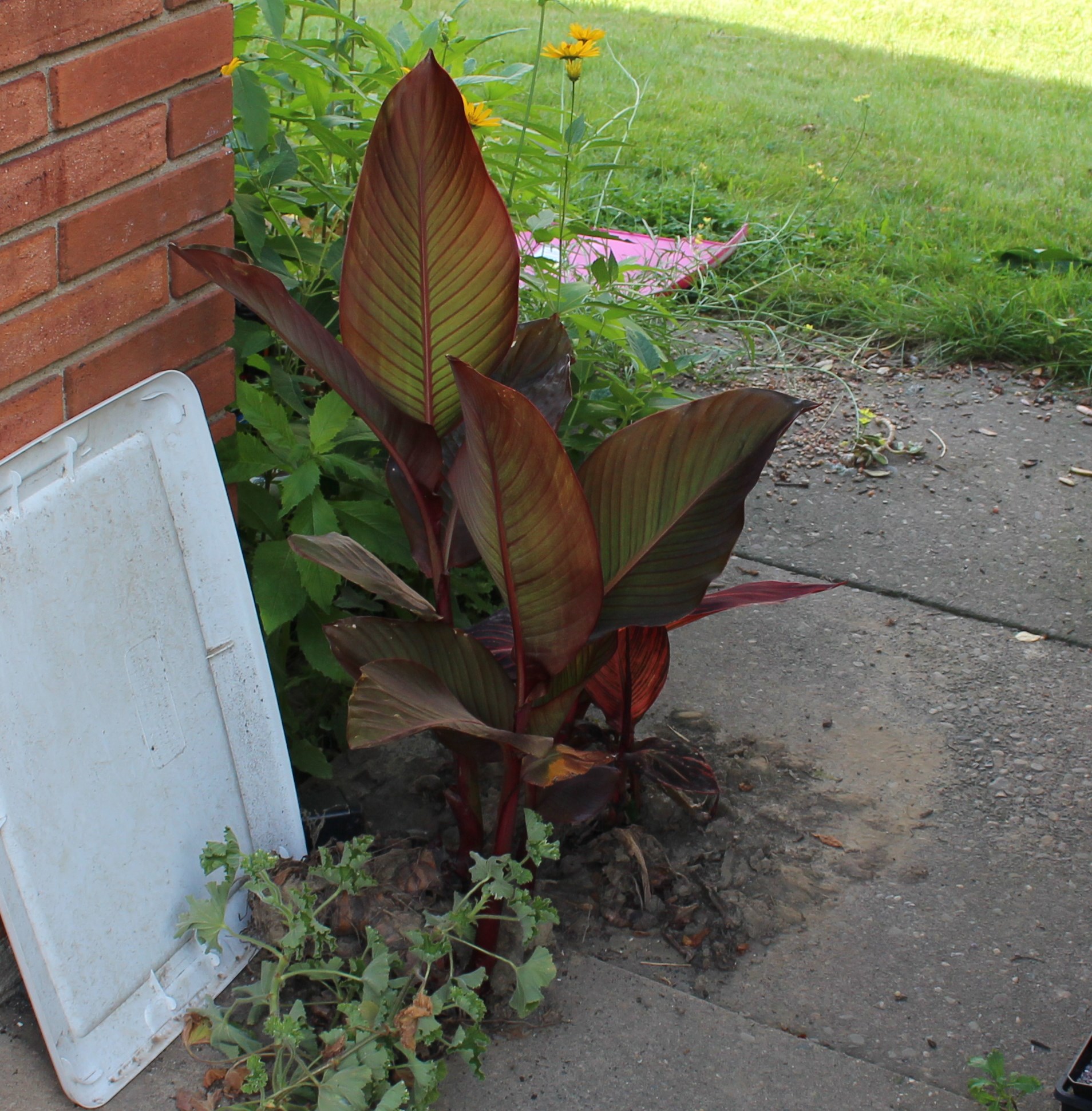
A clump of roots dumped on the concrete and still managing to grow. A better gardener would cut their losses and move on… I’m still imagining they’ll get planted before frost 🙂
The canna were intended as a replacement for this ‘Blue Bird’ rose of Sharon. I’ve come to the conclusion I just don’t like it and want it out…. no real reason, just something about it bugs me…

The blue flowers are the original ‘Blue Bird’ Rose of Sharon plant, the pink are up and coming seedlings. My question of whether or not they come true from seeds was answered by a no, and I’m glad to now know for sure! btw- the big leaf in front is Angelica gigas, a plant which I’m hoping will be *very* cool!
A plant which does NOT bug me is hydrangea ‘Limelight’. Right now it’s just going from lime to pure white and it’s a mountain of soft flower heads and I admire it every day. Personally I feel like the plant doesn’t like me, since it always seems just a little short of water and lacking just a little bit of fertilizer but apparently it doesn’t hold that against me and blooms reliably each summer. The bush is up to about six feet now and I should really take a few cuttings to try it in a better location and see what it’s really capable of!

Hydrangea ‘limelight’ hanging over into the street.
Something that didn’t need a better location are all the sunflowers which returned. Here’s a 5+ foot tall plant which somehow managed to grow out of a less than 1/2 inch crack in the concrete edging along the street.

Sometimes you can’t hold a good plant down.
The hydrangea isn’t all for the benefit of the neighbors, I see plenty of it from the house as well and its mature size does a good job in balancing out the masses of gold and the large clump of variegated giant reed grass (arundo) at the border’s end. Have I mentioned my love for this grass? It’s listed as invasive in the deep south, but up here in the cold North its vigor is just enough to make it exciting.

The street border from the far end. Golden rudbeckias still dominate but I’m fine with that 🙂
You may have noticed the fluffy white seedheads of one of this years favorite plants (although I may be alone in my favor for this spiny, poky almost-weed). The lackluster mauve, bottlebrush blooms of the Ptilostemon diacantha were nothing to go ga-ga over, but the seed heads are interesting enough and you can still make out some of that awesome foliage as it slowly dies off. I’m going to make a point of collecting these in a few days since the thistle seedheads look suspiciously weedy.
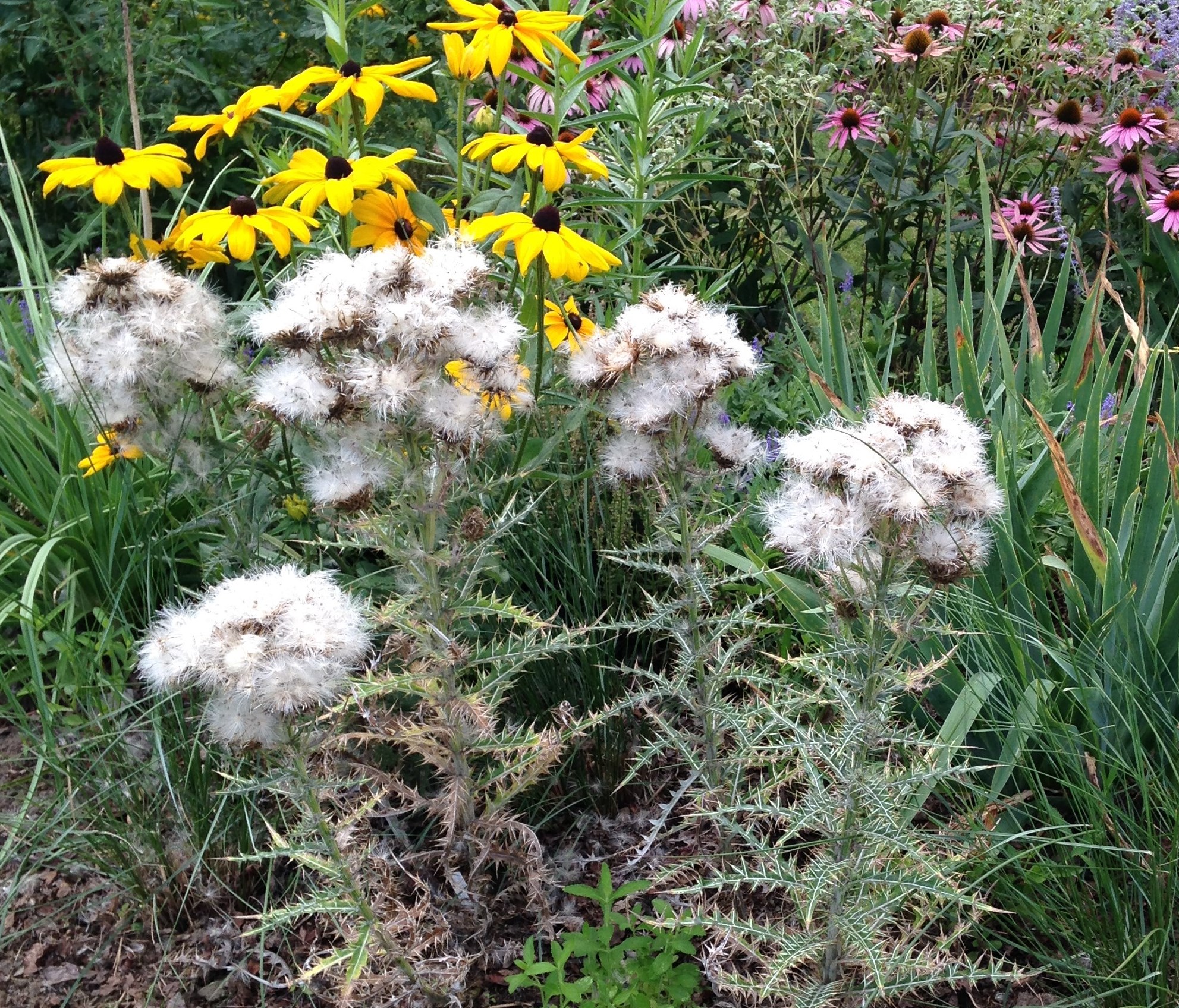
Ptilostemon diacantha. The name is a mouthful and I far prefer the name suggested by Linda B. “Ghost thistle” sounds almost friendly!
So that’s the front border. It takes a little bit of work to get it cleaned up in the spring, I’m always looking for ways to ‘tweek’ the plantings, but for the most part when the perennials take over (like they did this year) it’s one of the lower maintainence areas in the yard. A smarter person would stick with this plan, but I’m already considering removals and bulking up the annuals again. Annuals are a lot of work 🙂
One “maybe” problem could be in the colors. My weakness for yellow foliage is really showing and adding a few darker shades might not be the worst idea. Hmmm, maybe I can replace the invasive burning bush with a nice purple smokebush? Something to consider….

Lots of yellow. I think all the best gardens are avoiding yellow these days….
From the front border we’ll go to the foundation plantings. They’ve taken off a bit as well!
My intention this spring was to keep the front yard a little more organized and really put my foot down against the reseeders which took over last summer….. but then the rest of the world happened and just like many good intentions my organization theme fell to the wayside. This year rudbeckias took over.

Rudbeckias, black eyed Susans, gloriosa daisies, whatever you want to call them these rudbeckia hirta hybrids really bring gold to the front border. Fyi this is as far along the bed as the edging and mulching got this spring. You can see my spade handle just where I left it about two months ago 🙂
For as much as I like the softer yellows, and for as summery a tint golden yellow is, bright gold is probably one of my least favorite flower colors. The golden takeover of the front garden really goes against any design theory I have for this bed and I suppose if I were of the more controlling type it would cause me a little mental turmoil but I think I’m ok with the brightness. It helps bring a little sun to what’s so far been a pretty wet and ‘pearly’ summer.

The front border with plenty of rudbeckias. I was firm with seedlings of amaranth, standing cypress, and oxeye daisies but this year the black eyed Susans slipped by.
A casual passerby might think things look well under control and maybe even close to well tended, but just inside the bed turmoil reigns. Here the inner section was supposed to be a restful patch of dark leaves canna…. which it’s not… because too many ‘good enough’ plants came up and the gardener just didn’t have the heart to pull them out. It worked out for the best though, the variety of green centered and brown eyed rudbeckia which grew is a nice tradeoff (as long as you can continue to ignore the unplanted cannas sitting on the driveway).

Mixed shades of selfsown rudbeckia seedlings.
There used to be a greater variety of darker shades mixed in with the straight gold daisies but over the last few years I’ve tended to pull the browned eyed versions. They seem more prone to mildew in my garden and rather than look at that I just pull them and send them to the compost before their seed ripens.

A more ‘refined’ view of the border. Less is surely more with these bright colors but to be honest the patches where the rudbeckia grows and blooms thickest are the patches which make me smile 🙂
A week or two ago would have been a good time to seed out a few zinnias to fill in for when I get tired of the fading rudbeckias but all the rain seems to have drowned my seedling tray, so we’ll see what happens now. Fortunately there are always volunteers willing to step up. Here are a few sunflowers coming along (in a totally inappropriate spot) and I know a few verbena bonariensis seedlings could be found elsewhere.

The future sunflower patch. Goldfinches have already been stopping by but they’ve got a few more weeks to wait before this seed factory starts up.
The entire border hasn’t been given over to gold. Here’s a now classic combination of Perovskia, Echinacea, and ‘Karl Foerster” feather reed grass made famous back in the ’90s by the Washington DC based design team of Oehme, Van Sweden. They were one of the pioneers in publicizing the ‘New American’ prairie style planting style which moved American design away from lawns and English style gardens to a more relaxed look filled with lower maintenance swaths of color and forms which sway in the summer breeze.

My Oehme, van Sweden inspired planting of ‘Karl Foerster’ grass, coneflowers, and Russian sage.
Coneflowers also anchor the far end of the bed, and the golden rudbeckias haven’t quite conquered this far down the line.

This end of the border is were my enthusiasm for weeding and maintenance always wears a little thin. As long as the lawn stays mowed and the edges get trimmed I think the weeds and lack of deadheading aren’t quite so noticeable.
The black eyes Susans which grow in this front border are nearly all the tetraploid version of America’s native Rudbeckia hirta, and for plant geeks such as myself the history of these plants is one of those cool wintertime stories which make gardening just that much more interesting. A version of the story can be found by clicking here, but the short summertime summary involves Dr. Blakeslee of Massachusetts’s Smith College treating seed of the native rudbeckia with the genetics altering chemical colchicine and doubling their chromosome count. Eventually David Burpee got a hold of the new race of flowers and set his company to work refining and selecting for more colors and forms, and in 1957 introduced the plants as we know them today. The tetraploid version is bright and big and bold, but the normal diploid Rudbeckia hirta still has its fans for its daintier, summertime wildflower look.

A straight Rudbeckia hirta which showed up in the back garden. I like the spoon shaped petals on this one and hopefully can save a few seeds.
Rudbeckia hirta comes in two basic forms, the regular and the larger tetraploid version. They’re both short lived perennials which may bloom the first year or may die after blooming, depending on their mood, but they’re both far from troublesome. Don’t get this Susan mixed up with the truly perennial, clump forming Rudbeckia fulgida which is just starting to come into bloom now. This one (usually grown as the ‘Goldsturm’ version, another Oehm,Van Sweden favorite as well as Karl Foerster introduction) is another indestructible rudbeckia but for me it’s just too much of a perennial commitment to gold 🙂

Another wild rudbeckia hirta which I’m keeping an eye on out back. It’s a lighter yellow shade with a spidery inward curl to the petals (which often shows up in the darker ones as well). I like it!
So there you have it, the glory of gloriosa daisies in the garden of a gardener who doesn’t like gold. Some will surely point out that I’m in gold loving denial, but daisies and gold are completely common and unrefined and I’m going to try and claim it was against my will and better taste that they took over this summer. Either that or I just don’t care what good taste and garden trends dictate!
Enjoy summer 🙂
Don’t get me wrong, I’m not complaining about the rain, but this kind of weather would have been much more welcome in April or May when things were going brown and shriveling up. Still I love it. It’s perfect for the procrastinating planter and the person who hates to lug the hose from plant to plant (that would be me), and by now even the grass has put on a green color once again!

Green grass makes any color look acceptable. I’m finding that gerber daisies are one of my wife’s favorite plants, so on the rare occasion she comes to the nursery who am I to say no?
The rain is also not a problem bloom-destroying-wise since my garden seems to wade through a lull at this time of year. There are plenty of blooms which could be gracing my beds right now but I just don’t have many of them in the ground. My garden peaks closer to the midpoint of summer and beyond, and I’m fine with the extra wait since this time of year is when I always seem to be ironing out the last plantings and thinking through all the projects which may still happen… such as widening the front border (again).

Up near the house the blue of the ornamental fescue fills in an earlier expansion of the foundation bed, here closer to the street you can’t even make out the extra foot or so I added to this bed, so it barely counts as a project.
Sometimes with your nose to the wheel day in and day out you forget that there’s plenty of good coming together while you slave away at the not-so-good. Here if the viewing angle is just right, the front street border looks fairly well put together. A thick mulch of shredded leaves, a nice edge of shredded bark, and removal of nearly half of everything in the bed gives it an ‘under control’ look for at least one month this year. A clean bed edging always helps, but expanding another foot into the lawn really gave some breathing room… I should remember to enforce this rule next year as everything seeds and spreads out into the newly open space!

The front street border this morning. The dark magenta lychnis coronaria and white oxeye daisies are essentially weeds, but if there are just a few I guess it’s socially acceptable.
A plant which spreads out wherever and whenever it wants is my trusty giant reed grass (Arundo Donax ‘variegata’). I smile and make excuses for it when people comment about its possibly too-large size, but deep down I’m proud of it. I won’t even bat an eye when it consumes the iris and other plantings around it 🙂

Arundo donax ‘variegata’ overcoming the far end of the street border.
Another spreader is the ‘Tiger eyes’ sumac which sits in a couple spots around the yard. For me yellow leaved and chartreuse plants are an addiction and I am constantly in need of reminding of the fine line between a few accents and the way-too-much stage, but the tiger takes care of this on his own. He (actually a she since this clone of cutleaf sumacs produces the colorful red female seed heads when mature) will pepper your beds with small yellow shoots here and there and I suppose someday take over the world, but for now I just pull the innocent little shoots.

Pennisetum ‘Karley Rose’ is putting up the first of many fluffy pink seedheads. They’re always dancing about in the wind and keeping things lively. Maybe a few clumps closer to the light pole would look nice next to the bright mess of ‘Tiger Eyes’ which surrounds it right now.
For some reason this spring the kids have been coming along on nursery runs. I suspect they have some hidden agenda which includes a stop at the Dollar Store but regardless I’m going to enjoy their company while it lasts. Both insist on helping pick their own plants and sometimes even want to plant.
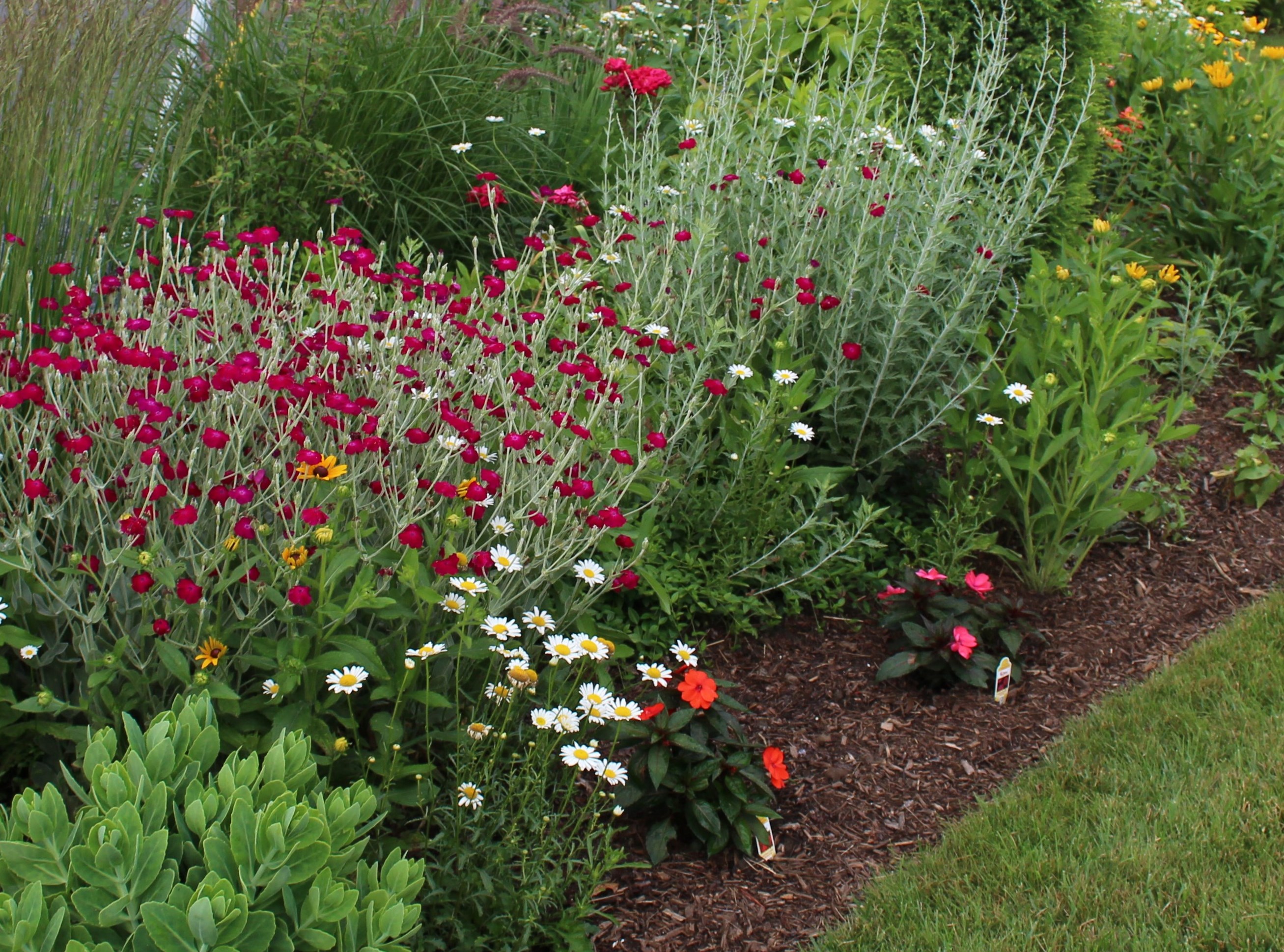
Bright magenta Lychnis coronaria faced down with a few sunpatients. The girl insisted on putting labels front and center, I couldn’t quite get out the reason for it. Also I couldn’t talk her out of the magenta-orange combo. This might have to be replanted once she moves on to other things.
The front borders are looking pretty good right now but there are also a few nice surprises out back amongst the weeds. One of my favorites is the first blooms on this strawberry foxglove (Digitalis x mertonensis). It’s been a struggle getting this one to bloom since the harsh winters seem to do a number on the crowns, but this year a few made it, and I finally get to see the strawberry-ish blooms on the relatively short stalks.

A cross-species hybrid of two foxgloves, the strawberry foxglove should be slightly more perennial than the regular type, and hopefully come true from seed as well.
Another spike out in the garden (I like my spiky bloomers) is this verbascum which hitch-hiked in with a gift plant. You know a plant (in this case a shrub dogwood) is coming from a good garden when two special plants tag along on the root ball. This verbascum (maybe V. chaixii?) is blooming nicely now, and follows up some nice scilla blooms which flowered in spring. It was only the dogwood I wanted, but surprises are always fun as well!

Verbascum blooming amongst the sunflower seedlings which I didn’t have the resolve to rip up….. and yes that’s a huge thistle in front of the fence. I like them, please don’t judge me.
Some would call the uninvited sunflower seedlings weeds, many would call the verbascum the same, and many more would immediately rip out the thistle, but I have a more laissez faire approach to the less invasive of the volunteers. I let plenty of things go, but oddly enough this year the beautiful purple campanula glomerata is what I’m ripping out. I’m trying to reclaim the red border, and it’s the campanula which has made a takeover play. Enough is enough so a few weeks ago roundup was sprayed and it’s only a few pretty stalks which remain. I’ll hand pull these and hopefully with a little summertime vigilance will be able to clear this plant out.

Once the campanula was beaten back I realized there are a few really nice plants in this bed. Clematis ‘Ville de Lyon’ is one of my favorites and it deserves much more than the hardscrabble life of a vine left to struggle along the ground…. but it does look even better with the campanula blooms 
Another borderline weedy area is the meadow. Last summer’s dry spell weakened the lawn turf so much that it barely had the strength to send up bloom stalks this spring. That’s a shame since I love the look of the tall grass waving in the wind and enjoy watching the bunnies work their way through each morning filling up on seedheads. But the lazy gardener needs to take these things in stride (I could have made the effort to water last year) and realize the daisies and butterfly weed show up much better in the more open meadow.

The meadow garden with some particularly drought tolerant butterfly weed (Asclepias tuberosa). Depending on my mood and the weather this area will be mown down in late summer to neaten things up keep the taller plants from dominating.
The butterflies are enjoying the meadow, but everything else is focused on the linden blooms (Tilia europaea I think). The tree buzzes with honey and bumble bees, flies, beetles, wasps, and a load of other things which I can’t even identify, and the scent is fantastic and fills the yard with a soft flowery honey aroma. It’s a decent size tree and I can’t even imagine the number of insects which fill its branches. If only I could follow the bees home and get a cut of the honey they’re making from all this.

June is when the linden tree is in its glory.
Another plant which does its own thing without me raising a finger is my trusty hydrangea ‘Annabelle’. New hydrangeas will come and go, but I can’t think of a reason good enough to cut this one loose. It can flop, but in the spring it’s cut back completely and between lean living and full sun it holds up well enough. If I had the room I’d do a mass of these, maybe under a grove of white birches, but here all I have room for is a few scattered along the edge of the yard. Obviously I love the chartreuse of the opening blooms best of all since the next best thing to chartreuse foliage is a chartreuse bloom!

Hydrangea ‘Annabelle’. You can count on this one to bloom every year.
I’ve seen some photos of the newest ‘Annabelle’ siblings and they’re an amazing range or pinks to near reds in addition to the never out of style whites, so I would surely have to add one or two, but I think I’ll always have room for good old ‘Annabelle’. Speaking of room, it’s still a never ending seed starting and cutting taking rollercoaster here and for some reason I still start more. Hopefully I’ll be patting myself on the back when these late marigolds and amaranthus come into bloom and everything else is looking a bit tired!

Still sowing seeds and taking cuttings well into June. They grow so fast at this time of year, I should have fresh flowers in no time at all!
I better get this posted, it’s been a work in progress since the weekend, not because there’s any amazing content in this post, but because I’m stealing minutes from birthday parties, baseball games, and pool time and would rather sneak in a trip to the nursery than sit at the computer 🙂 But lazy summer days are coming and things should ease up shortly, until then may you enjoy summer as much as I do!
It’s not all prickles and barbs here, there are a few fluffy gobs of pink which have found their way into the garden and onto the kitchen table.

Peony season is here and in my opinion the best place for them is a vase.
Nearly all the huge blooms end up being cut and brought into the house, they’re so heavy that even with strong stems the flowers end up down in the dirt. Staking would be an option but cutting is far less work, and often they last longer in the house protected from the weather.

There’s no simple grace in a double peony, it’s all fat opulence and fluff.
This anonymous peony was purchased as a single pink and it’s not even close, but I love it anyway. A wild guess would say it’s ‘Sarah Bernhardt’ but the blooms barely have a fragrance and from what I read Sarah should have scent to spare. No complaints though, fragrant blooms are not welcome in a house full of allergy cursed and fragrance sensitive noses.

Possibly ‘Sarah Bernhardt’ peony?
Even though the flowers do nothing for the nose, I love running my hands over the flowers and teasing the flowers open. It’s a habit my grandmother would always complain about, saying it would ruin the flowers. She was right of course, but peony season is so short might as well enjoy them, plus burying your nose in a peony is far safer than snuggling up to a thistle 🙂
Seed starting isn’t the worst thing to do in the winter, but having your May seedlings sprouting in February is definitely not a good idea. It all started with last year’s massive seed starting failure. As usual I filled a few dozen pots and set them out in the cold to wait for spring, but the results were far from good, and only a few things sprouted. I thought it might be the weather, but now I’m leaning more towards a bad batch of soil. So this year for a bunch of seeds I figured I’d skip the soil and go back to the Deno method (click here to see how that works) of sprouting seeds in plastic bags. I set up a bunch of seeds which I thought would benefit from a nice bit of cold before sprouting, but also thought it might be a good idea to give them a week or so of warmth first. You can guess what happened.

Just five days later and I have a mess of sprouting seeds to deal with. After having failed twice already with these Californian thistle seeds it looks like they didn’t need a cold treatment after all!
So now I’m faced with a bunch of seedlings which will somehow have to survive my care under lights for at least 2 more months. Even with the cool temperatures out in the winter garden slowing down their growth it will still be a long haul. Another not so smart thing was finding a baggie of needle palm seeds which I must have given up on two years ago. Apparently there was a (now brittle and cracked) outer shell which I didn’t know about and which probably should have been removed prior to sowing. It will be a true testament to the lives of seeds if these go ahead and sprout now.

Seeds of the hardy needle palm. Stored moist for a year, bone dry for another, cracked out of their shells, rubbed along the file and replanted this month. Not likely to lead to success but you never know 🙂
I’m much more optimistic about seeds I received from this year’s HPS seed exchange. I potted up this happily sprouting red buckeye (aesculus pavia) seed yesterday and will try and find a cool spot for it until things warm up outside. Also arriving pre-sprouted are two packets filled with Southern Magnolia (m. grandiflora) seeds…. don’t ask about that, I don’t need one borderline hardy southern magnolia let alone two dozen, but I should have plenty of time to think that one over since I’m hoping they’ll be slow growing.

Some seed need to be planted immediately, so it helps that the donor of this seed ‘moist packed’ the seeds in damp peat when collected and then sent them in to the exchange. Sure beats receiving a dried out seed that will never sprout (such as my palm seeds became)
The rest of my seed exploits should also be in better shape. I did go traditional and put out two trays of little pots to suffer through the rest of winter under the deck, and they will hopefully not run into problems this year, but the rest of my perennial seeds went into baggies and are sitting in a box in the fridge. It all feels pretty promising to me. Even the ones that had already sprouted in their baggies are coming along nicely after a few days under the growlights.

Carefully planted into soil the little seedlings greened up and sprouted normally. I’m pretty sure I’m the only person in my end of Pennsylvania who has half-hardy Californian cobweb thistles (cirsium occidentale) growing along indoors under lights. That must mean something, I’m not sure what.
My little primrose continues to make me happy, and I’m sure you’ll also welcome seeing yet another picture! 😉

The first yellow primula polyanthus in full bloom. A little sparse, but still perfect….. and the cyclamen aren’t too shabby either!
Never fear, I also have a few onions sprouting so not everything is odd and nearly useless flowers…. but I also have to warn you there are two more primrose divisions on the cool windowsill which are only now starting to put up buds. If the weather keeps going as cold as it is you might be stuck looking at them all through March!
Does anyone else have a bucket list for mailorder nurseries?
I do, and each year I’m trying to check one or two off. Nurseries make the list for random reasons often more because of specialized and quirky offerings rather than for being part of some magic top ten for mailorder, so while the snow flies let me offer up my February to-do list 🙂

Everything is cold and frozen here. I used my phone and didn’t even have the motivation to open the back door for this.
In no particular order (well actually it has to start off with snowdrops since that’s all that’s on my mind 🙂
I could go on of course. I’ve been dabbling in grafted conifers recently, plus have some strange need to add lady slipper orchids to my garden, so there will always be a to-do list, but for now I’ll keep this one. Don’t get me wrong, I’m still faithful to Santa Rosa Gardens for perennials, Brent and Becky for bulbs, and Pinetree garden seeds, but a boy’s got to dream and I need something to get through what’s been the coldest weather since last winter.

-7F (-22C) on a recent drive to work. Please congratulate me for actually stopping before taking a picture.
More snow is on its way tonight so winter is still in full swing, but yesterday temperatures edged above freezing for a few hours and I swear I heard a little bit of joy in the birdsong. Maybe it’s just me. In any case I think I’ll start a pot or two of onion seeds today and see if a few of the overwintering geraniums are worth saving. That and maybe I’ll look at some more mums that might need ordering 🙂
Let me know if I missed any great nurseries, I’m always more than happy to add a few new or forgotten ones!
Congratulations are in order for Cathy at Rambling in the Garden for reaching the one year milestone of her weekly “In a Vase on Monday” meme. Each week for the last 52 she’s been encouraging people to fill a vase with whatever strikes their fancy in the garden or in the local meadows and woods. I’m always amazed by the creativity and depth of the creations, and although my own contributions never manage to get outside the ‘pluck and plunk’ category they’re always well received and the whole process is fun. This week I’m joining in again and just in time too. The last of the autumn flowers are limping into winter, and the weather forecast doesn’t look good for them this weekend.

The last of the chrysanthemums.
Three of the latest chrysanthemums are still hanging on; an unknown white which has been blushed pink by the cold nights, the spooned frosty violet flowers of “Carousel”, and the neat pink pom-poms of a self seeded volunteer. It’s nice to still having some flowers out there even after the trees have lost their leaves and most other perennials have died back.
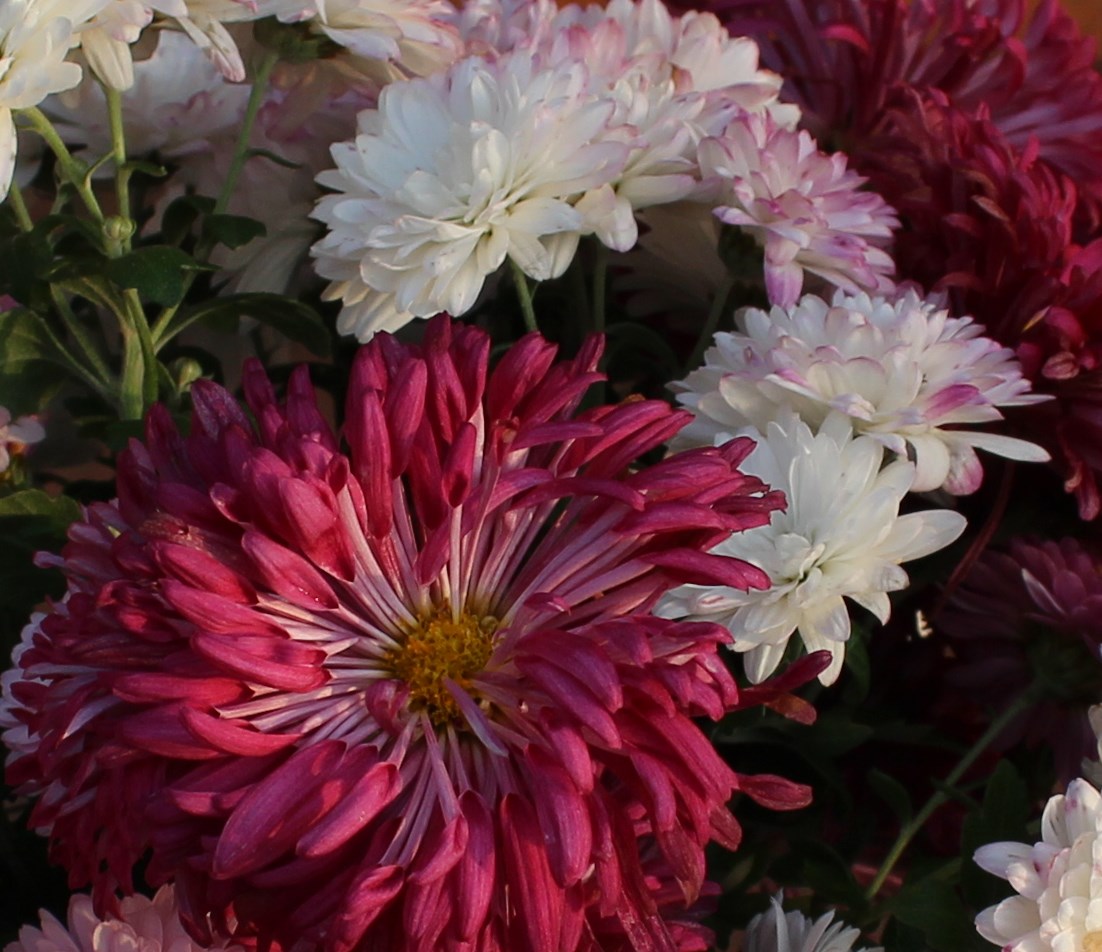
Chrysanthemum “Carousel”
There’s nothing fancy about the vase, again it’s just my favorite flowers in a simple clear glass.

Score another victory for laziness. A couple years ago I missed weeding out some self seeded chrysanthemums. This small pink was my reward.
This might be the last flower filled vase of my gardening year, but it’s the first for Cathy’s 2014/15 season. Congratulations!
A Creative Spirit
Gardening, Nature & Weather--slightly skewed
more than you ever wanted to know about my garden
more than you ever wanted to know about my garden
more than you ever wanted to know about my garden
Garden Thoughts from Florida's Treasure Coast
more than you ever wanted to know about my garden
Damp and in the middle of nowhere
more than you ever wanted to know about my garden
I have plans. BIG plans.
Cariboo-Grown & Cariboo-Hardy Perennials. Since 1991.
a suburban English garden through the seasons
gardening . home decor . online business
A garden oasis and cultural center overlooking the Hudson River
It don't come easy
Our garden, gardens visited, occasional thoughts and book reviews
Mark and Abbie Jury
more than you ever wanted to know about my garden
more than you ever wanted to know about my garden
more than you ever wanted to know about my garden
gardening in the North Carolina piedmont
learning, growing, and learning more -- life on the Olympic Peninsula
Gardening in East Tennessee
A Blog usually about plants and gardening in west-central Missouri...
My week to week gardening diary
more than you ever wanted to know about my garden
My Own Paradise: Life on Seven and a Half Acres
more than you ever wanted to know about my garden
Country gardener nurturing people, plants - and wildlife
more than you ever wanted to know about my garden
more than you ever wanted to know about my garden
more than you ever wanted to know about my garden
Birds, Bees, Flowers, Trees - Organic & Wildlife Friendly Gardening
more than you ever wanted to know about my garden
more than you ever wanted to know about my garden
For all who appreciate the beauty of words, flowers and homecooking
Celebrating gardens, photography and a creative life
more than you ever wanted to know about my garden
more than you ever wanted to know about my garden
Ideas from a Suffolk garden
adventures in my gardens
more than you ever wanted to know about my garden
Hardy plants for hardy souls
Notes from a wildlife-friendly cottage garden
 sorta like suburbia