Spring keeps rolling along

As it is with most things here, the gardener is not exactly on schedule with his gardening.  He’s not exactly on schedule with many things, but the late freeze and the discouraging damage it did to so many spring greens has left him slightly unmotivated.  Then the relentless rain and cold damp brought on rot, and now dry weather is bringing spider mites to the phlox.  So the gardener will restart his spring in mid May and deal with the mites.  He’ll also accept that many projects will again not happen, and will just clear his conscience and move on.  Iris are beginning to bloom after all, and once the iris start to fill the flowerbeds with color and perfume it’s hard to hold onto a black mood.
narcissus keats

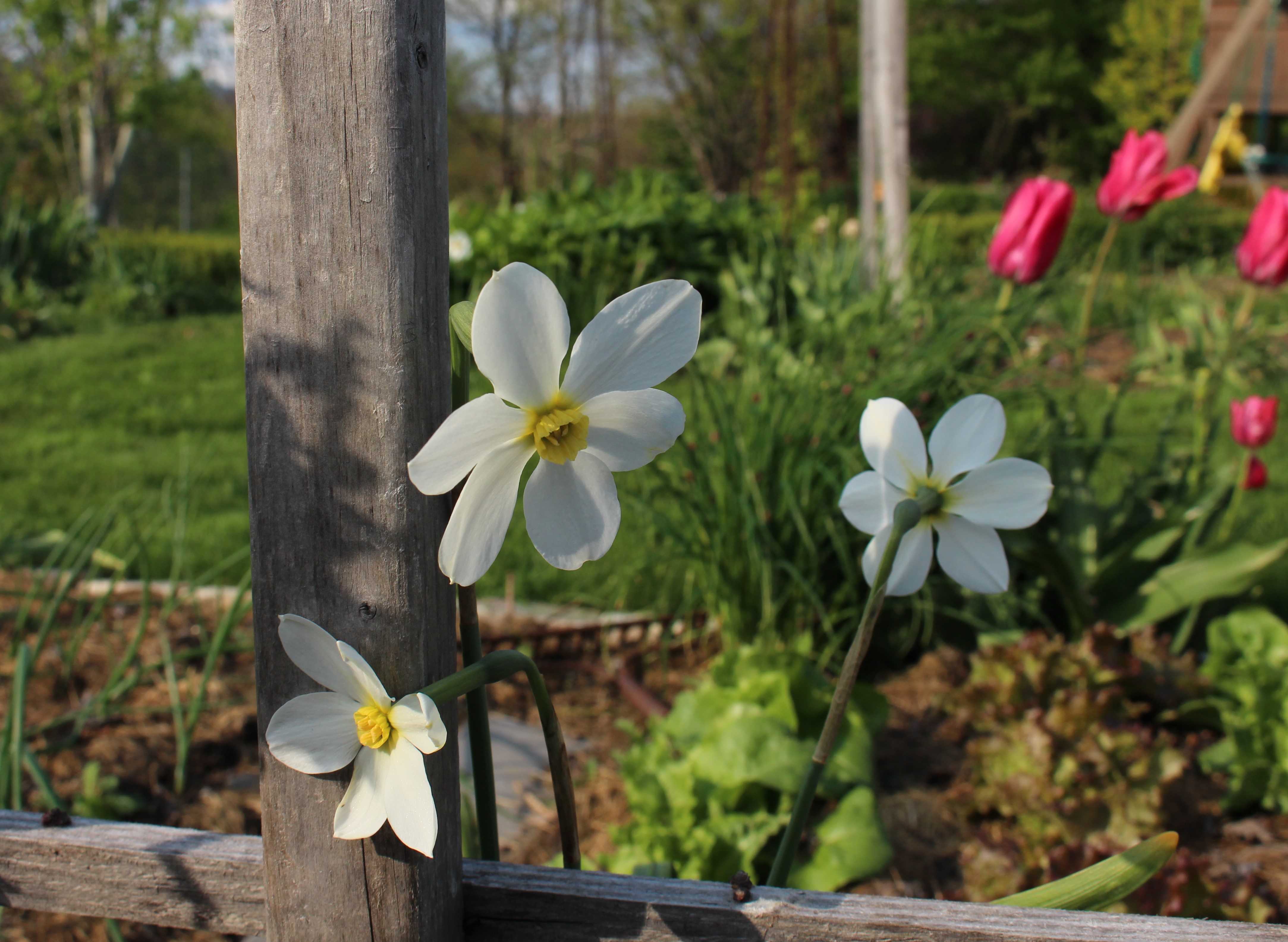
One of my last daffodils to open, narcissus ‘Keats’ was voted ‘ugliest thing to bloom’ by a more serious daffodil friend.  I’m always one to love the underdog. 

One minor project (which seems to be the only project type I’m capable of tackling this spring) which was finally taken care of was the long suffering heuchera plantings.  A few summers ago I dipped my toes into the hybrid heuchera world and since then they’ve been suffering along in my garden.  My planting beds get too dry, my shade isn’t as high and dappled as they’d like, and my soil is too heavy for their roots but I try nonetheless.  They still have plenty of filling in to do but if you saw the before picture I’m sure you’d agree this is an improvement.  Unfortunately the tan lawn clipping mulch doesn’t do much to set the foliage off, but it’s better than weeds I suppose.

transplant and divide heuchera

The woody stems of the heuchera clumps were dug up, ripped apart and carelessly stuffed back in to the re-dug bed and the plants actually look much happier after their tough love treatment.    

As summer heat settles down on the garden this holiday weekend, I just wanted to celebrate the meadow and a few of the newer plantings which did well this spring.  Number one on the list were the tulip clusiana bulbs which planted into the turf.  They looked perfect out there and I hope they return just as nicely next spring.

tulipa clusiana

Tulip clusiana (I think they were a named variety but I’ll need to dig out the tag) were scattered around in the meadow garden.  I will be extremely happy if they settle in here!

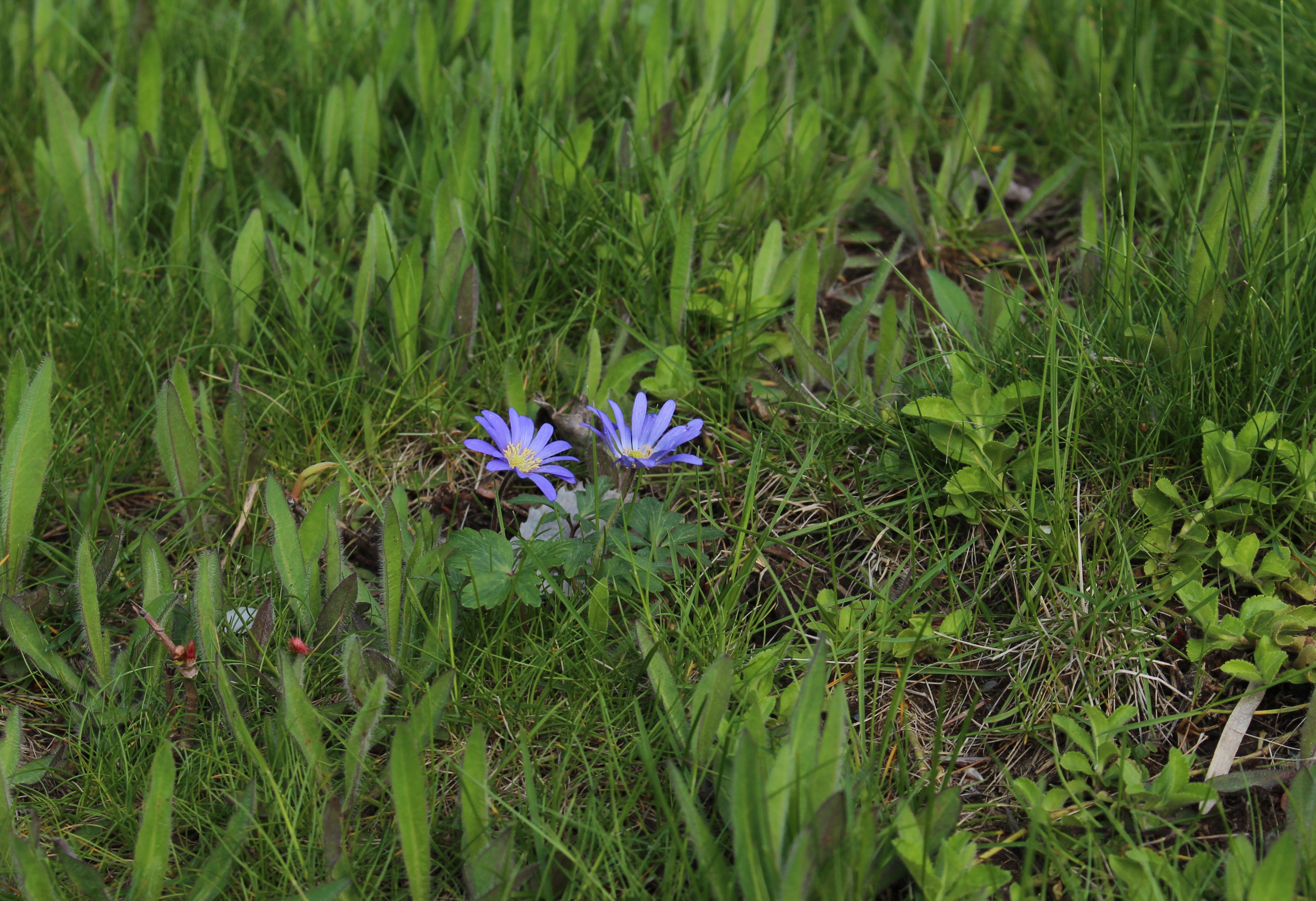
A few Anemone blanda look nice in the shadier parts of the lawn.  I tried throwing them around in several of the outer edges of the garden and then promptly forgot until little sparkles of blue started showing up here and there.  My goal for this one is to recreate the neglected show which used to pop up each spring around my first apartment in upstate NY.  If this plant can naturalize around a ramshackle college boarding house I think it stands half a chance here.
blue anemone blanda

Blue Anemone blanda in the “lawn”. 

Muscari is practically a weed everywhere so I added a few of those as well.  The flowers on these grape hyacinths were nice enough but now I keep looking at the seed heads with their kind-of aqua tint.  I wonder if it was the cooler temperatures or if they’ll always have this attractive look…. or is it just me that thinks they look cool?

muscari seed pods

Seed heads on the grape hyacinths (Muscari).  In other parts of the garden I clip them off to limit their seeding around, but here I’ll risk it 🙂

Most of the bulbs were brought in as bulbs, but if you know me you know there are a few seeds coming along as well.  My little gravel covered pots are bursting with new plants this spring and even though the last freeze did a few things in the majority seemed to enjoy our mild winter.  I’m always a bit surprised anything will grow up through gravel, but in some pots even the tiniest of seedlings make a crowded moss of new green sprouts…. which will soon desperately need thinning!

hypericum albury purple

Hundreds of Hypericum ‘Albury Purple’ seedlings sprouting in the center pot. Realistically I need about two.

With new seedlings coming along each spring there are always new surprises as youngsters open their first blooms.  A couple years ago I thought I’d dabble in a few species anemones and see how they do in the meadow, and although I’m not sure they’re all correctly labeled, for now I’m just enjoying them for whatever they are.
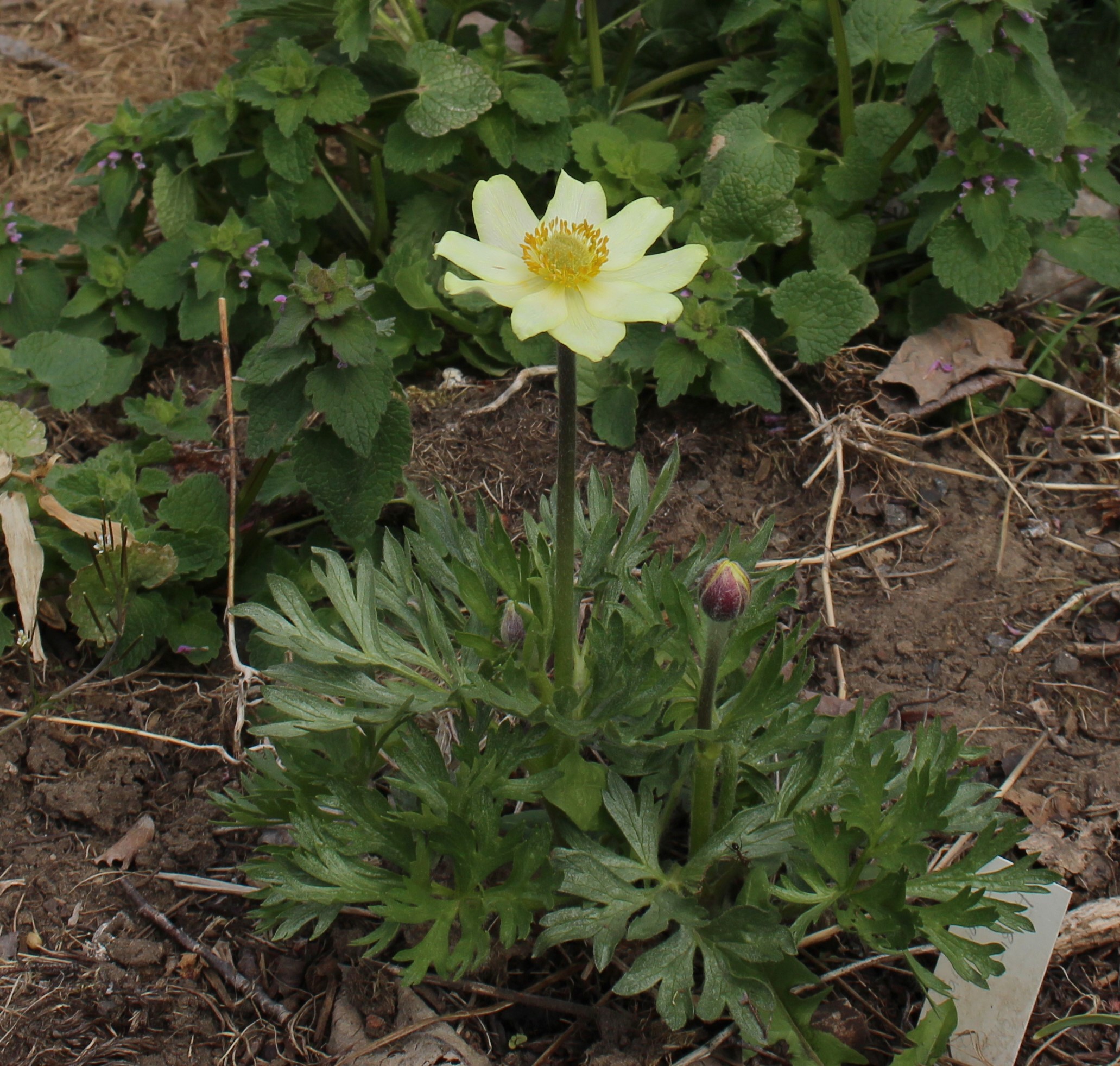
aneomone caroliniana

Not Anemone caroliniana?  Pretty regardless, and it looks like it might be able to hold its own if I move it out into the thinner areas of grass.  

One seedling which has a positive ID is this cool little Japanese Jack-in-the-pulpit or snow rice-cake plant (Arisaema sikokianum).  I was surprised to see any of these three year old seedlings flower, and although the actual flower is definitely on the small side for this species they say size doesn’t matter in these things and I’ll just keep admiring the fancy little bloom.
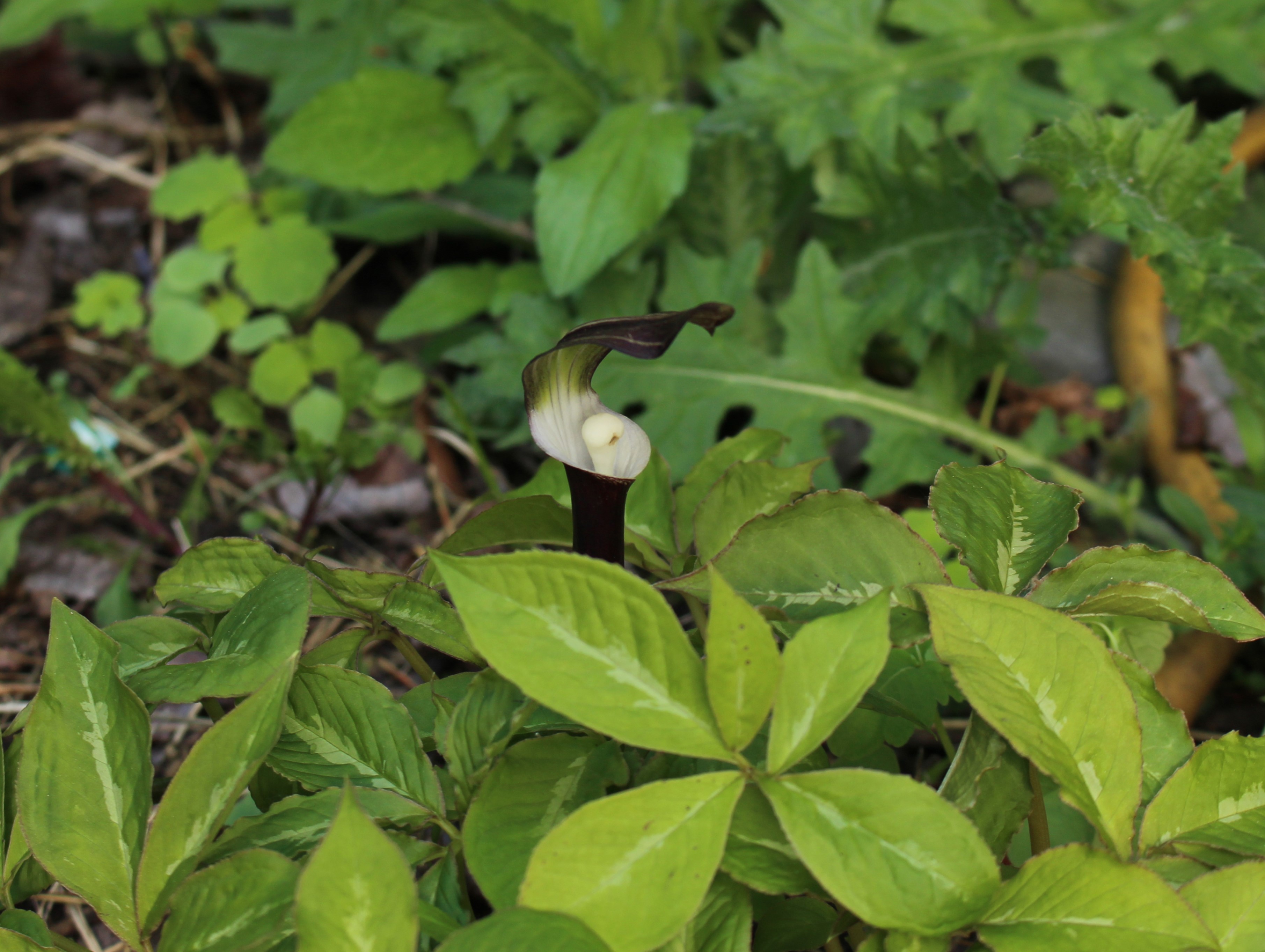
arisaema sikokianum

Arisaema sikokianum.  Although my picture doesn’t do it justice, I hope you can appreciate the mottled foliage and bright contrasts of this flower. 

So that’s the basic update.  I promise this will be the last time I moan about freezes and such, but I can’t promise some other weather event won’t come along shortly to take its place.  Whatever happens it’s a great iris weekend and I’m sure I’ll be going on about that next 🙂

Snowdrops part II

By now I’m going to guess several of you know I have a “thing” for snowdrops.  It’s a lonely thing since my nearest fellow snowdrop lover lives miles and miles away, but it’s a thing and like all things you just have to deal with it.  With that said I will forgive anyone who glosses over this post since not everyone will ‘get’ this thing, and many will not even want to appear as encouraging this thing, but that’s fine.  Once the daffodils open I’ll move on and we can again comfortably ignore my little secret until next year.

Luckily for you the season is practically over in my garden (so this will not drag on for the weeks which it normally does)  and here’s only just the briefest summary of a few of my favorites from this year’s snowdrop season.  We will begin with a new one, ‘Daphne’s Scissors’, which came via Carolyn’s Shade Gardens last spring.

galanthus daphnes scissors

Galanthus ‘Daphnes Scissors’, an early bloomer with me and early enough to open at the same time as the winter aconite (Eranthis Hyemalis).

‘Blonde Inge’ sometimes gives trouble as far as her blonde highlights go, but this year there’s a nice touch of yellow to the insides of her flowers.  This is her third year in the garden and she seems to be settling in nicely.

galanthus blonde inge

Galanthus ‘Blonde Inge’, the covergirl for Naomi Slade’s great little book “The Plant Lover’s Guide to Snowdrops” which I had the pleasure of reading this winter.

I’m trying to stick to snowdrops which don’t all fall under the same old same old category… this is still a stretch since green-white-yellow is the slightly limiting range which we’re always working with, but to the obsessed even the plain old white and green can be something special 🙂
galanthus straffan

Galanthus ‘Straffan’, an oldie but goodie which has been gracing the gardens of snowdrop lovers since 1858.  This is year three for my plant and I’m quite pleased to see its graceful upright blooms multiplying.  Maybe someday I’ll be up to the hundreds you see in other gardens 🙂

Galanthus ‘MoretonMills’ was the first expensive snowdrop I splurged on.  I won’t say how much I paid but it was a ridiculous amount for such a tiny little thing and each spring I hold my breath until it sprouts.  Fortunately it’s one of my favorites and is also beginning to multiply.

galanthus moreton mills

Galanthus ‘Moreton Mills’, a poculiform snowdrop where the three inner petals are as long as the three outer petals.  If this plant breaks the four inch barrier I’d call it a growth spurt.

As a variation on the green and white theme, here’s one which is more green and green and white 🙂

galanthus kildare

I love this one, it’s Galanthus ‘Kildare’ doing very well in its second year in the garden.  The blooms are huge. (relatively speaking of course!)

Another of my very favorites is ‘Primrose Warburg’.  It’s been doing very well here and is actually becoming what I could optimistically call a clump.  The downside to collecting unusual little bulbs is that you must often start with just one and to be completely honest a single snowdrop, no matter how special, does not exactly put on a major show in the garden.

galanthus primrose warburg

Galanthus ‘Primrose Warburg’.  Even those who yawn at the sight of snowdrops will acknowledge the bright yellow differences on this one 🙂

I’ll leave you with my lovely little golden snowdrop patch, and repeat that the snowdrop season is essentially over here.  It was a weird one, and for me it was a lame one with harsh late freezes damaging many of the blooms followed by a warm couple days which wilted the rest.  Add a few days out of town for work and snowdrops which came up before my schedule allowed me to fully admire them…. well enough said.  At least I was able to enjoy a few crocus.

natuaralized crocus

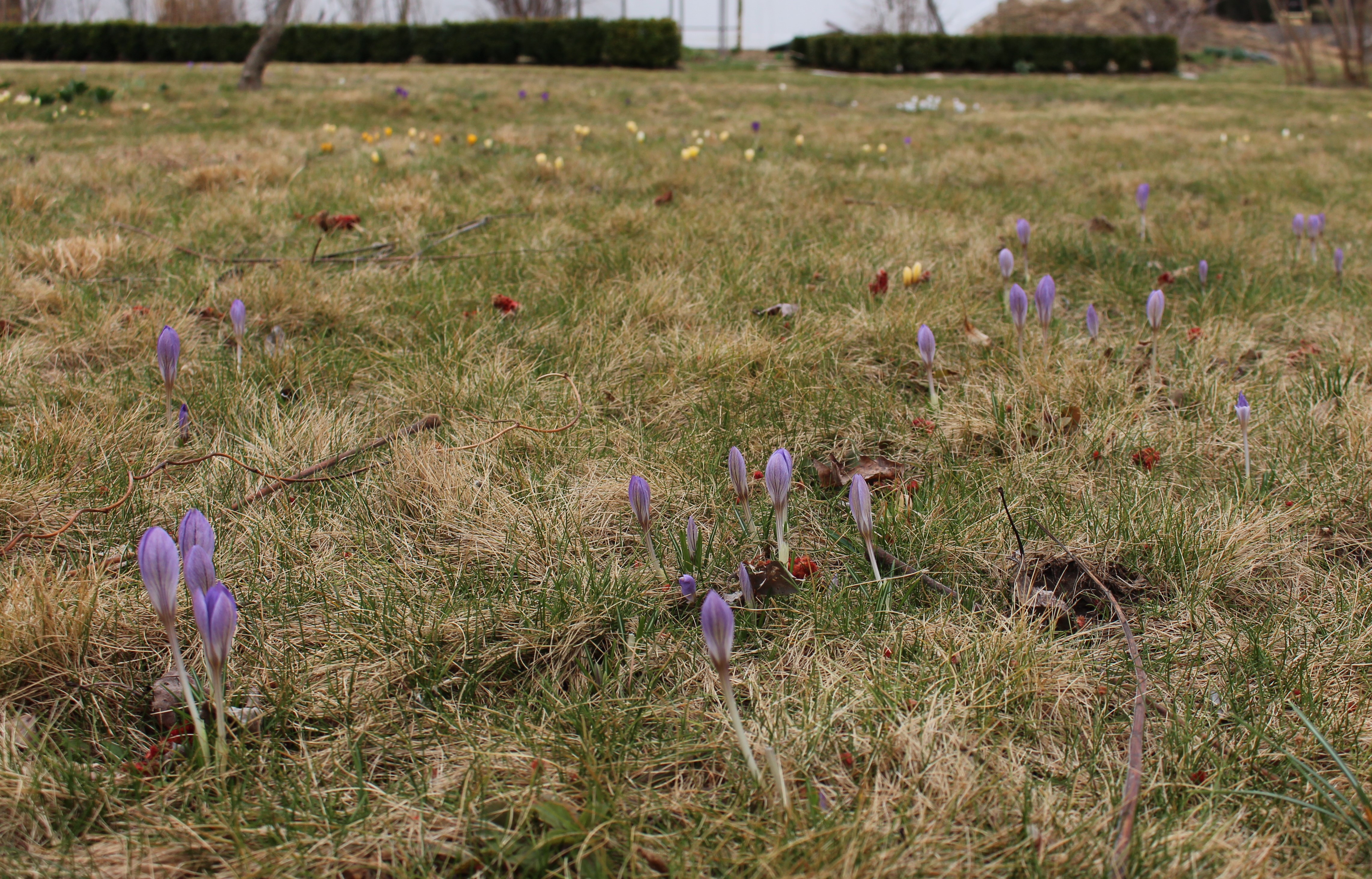
All the crocus came up nicely in the meadow garden and even the rabbits couldn’t keep up with them all.  Luckily mother nature and global warming stepped in and wiped them all out with back to back hailstorms.  Oh El Nino, you’re really having your fun this year.

The crocus season felt like it lasted three days.  They burst up and bloomed and then the weather did them in.

dutch crocus

A few of those fat hybrid Dutch crocus growing by the front steps.  To get really nice clumps it helps to dig them up and spread them around every three of four years.  Forgetting where they are and accidently digging them up in June is my method of choice.    

Fortunately there’s still plenty of spring left since it’s only just the end of March.  A cold spell last week slowed everything right back down, but the first weeks of April look remarkably mild and I’m sure there will be plenty of things sprouting up and blooming and helping me ease my snowdrop hangover.  Don’t get your hopes up too much though, I did visit another snowdrop garden last weekend and have one more white and green post yet to come.

If I don’t speak with you before Sunday, have a great Easter!

Plant those bulbs deep

It might be optimism, it might be delusion, it might be weakness, but whatever it is around here there always seems to be an unreasonable amount of bulbs in need of planting….  or there might not be enough.  No one is ever really sure but one thing is definite.  I have never regretted planting too many bulbs, so until I do it’s always better to err on the side of caution and overdo it if possible.

planting spring bulbs

Last weekend I tried to put everything out in order to see exactly what still needs planting.  Tiny bulbs add up, and this innocent collection is well over 1,100 bulbs.

There’s no denying that I’m a bulboholic and I think if you keep up with this blog you already know that fact.  They’re my favorite plant type and for good reason.  Each spring they just explode into growth, bloom like there’s no tomorrow, and then politely fade away, all within a few weeks.  They’re like a spring fling which burns hot and then ends on good terms.

Somehow the bulbs just find me during the summer.  I dig a clump of daffodils to thin them, find a clump of tulips when moving something else, more daffodils come out when I move a bed… before you know it there are bulbs in saucers, bags, and boxes all over the garage, plus a few I pick up at the nursery.  This year an early clearance sale at Van Engelen’s added a few hundred more crocus and muscari.  You can’t overdo crocus and muscari, so obviously those needed to be purchased as well.  Since I don’t enjoy planting bulbs, 850 new crocus corms can border on autumn torture so I try to deal with them as efficiently and quickly as possible.  Here’s a trick I read online which I now love that really moves things along when planting larger numbers of small bulbs.

naturalizing crocus bulbs

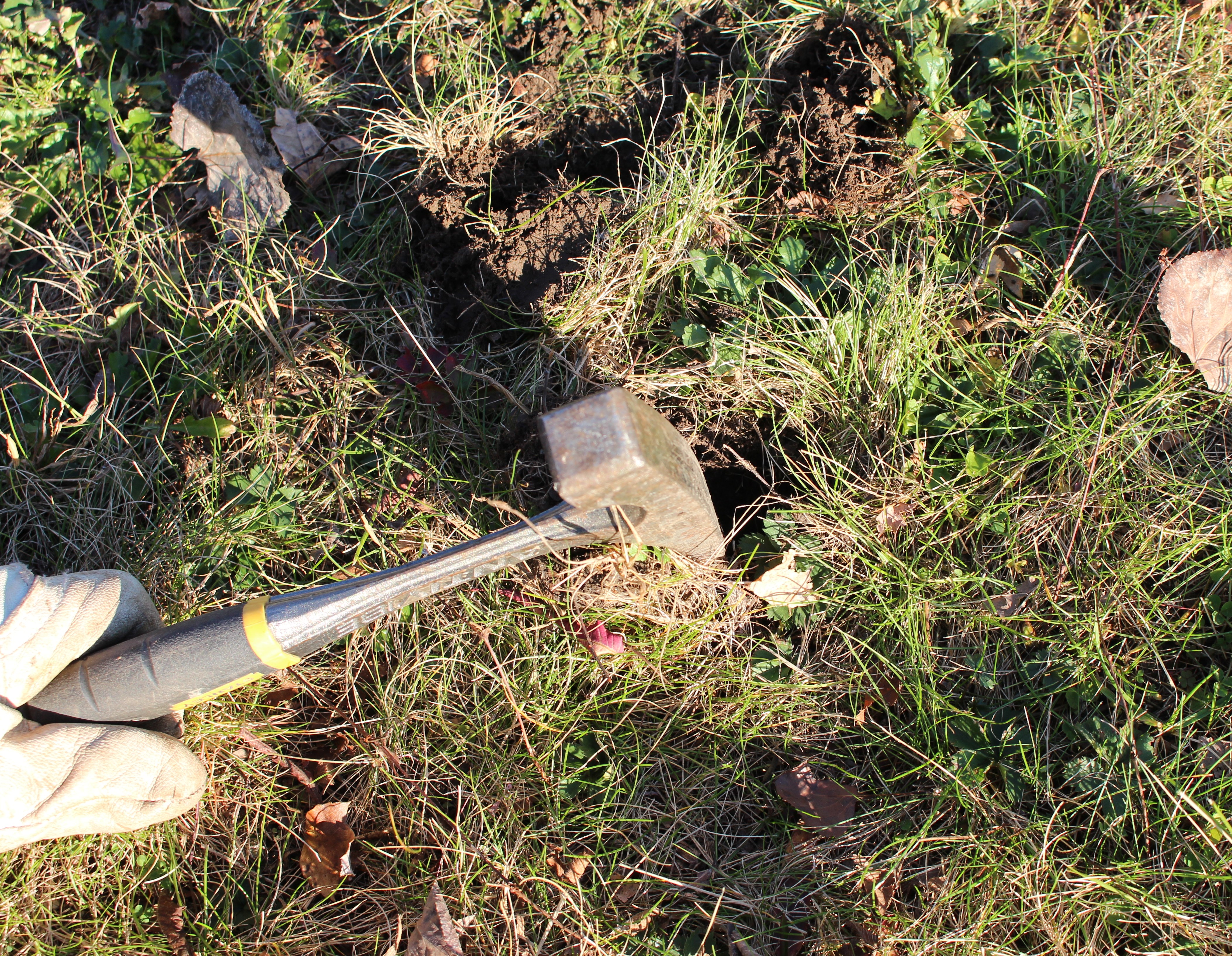
Tools of the trade for naturalizing larger numbers of small bulbs in turf.  Gloves, masonry hammer and small bucket stolen from the children.

A masonry hammer seemed necessary at some point for chipping stones and breaking cinderblocks, but it’s now become invaluable for planting small bulbs in the turf of the meadow garden.  Using a shovel is much more work than I’m willing to do and when you’re trying to naturalize bulbs, or make them look like they just seeded out into your lawn on their own, then digging large sections of turf up is just out of the question.  I find the hammer much easier to use.  One swing and it’s into the ground, a pivot back and you have just the hole you need for a tiny bulb or two.

naturalizing crocus and small bulbs

One down, 849 to go.

I start off carefully, trying to get the sprouting end up and the bulb gently eased down into the hole, but after the first 100 they’re getting dropped in and jammed down whichever way works.  A quick swipe with the hammer also closes the hole.  After about an hour and a half (including two 20 minute breaks to unlock my knees and back) all the bulbs were in.  People talk about the joys of gardening but for me I far prefer sitting back after the job’s done and visualizing the results.  I have plenty of other things which need doing in and out of the house, so the less time spent prepping cute little holes and overdoing a job the better.  If one had to sum up my entire bulb planting philosophy I think ‘shallow graves’ might not be the worst term to apply.  For larger tulips and daffodils I’m not above digging out a shovelful or two of dirt, throwing in a handful of bulbs and carelessly kicking the dirt back over them without bothering to prep the soil or put the bulbs right side up again.  In the vegetable garden some bulbs go into trenches so shallow that by the time the compost rots away from above them the tops of the bulbs are actually at the soil surface…. although this has just as much to do with thin soil and poor drainage as it does with a lack of enthusiasm for digging.

shallow tulip bulbs

These tulips might be on the shallow side. The original bulbs have split in two and both appear to be healthy blooming size bulbs, but if left uncovered mice and rabbits will likely find them and have a nibble.

I often read that in order to have bulbs such as tulips last longer and re-bloom reliably they should be planted as deep as possible, sometimes up to a foot deep.  This sounds like a lot of unnecessary work and I’m completely against it.  Perhaps a shallow bulb is more likely to split due to stress such as drought, but for the most part mine come back best when the spring is long and cool, tulips are deadheaded (daffs and hyacinths don’t seem to care), and tulips are either dug up for the summer or not watered in a spot which is nice and dry.  Planting depth, as long as it’s at least a couple inches down, doesn’t seem to factor in much at all and unless someone shows me actual research to prove otherwise I’m going to say deep planting is one of those often repeated bits of advice which don’t really do much here or there.

pink impression tulips

I planted these ‘Pink Impression’ tulips a few years ago and finally got around to getting more this fall. The new bulbs are from a good nursery and huge, so I know they’ll add to an even more awesome show next spring!

So we’ll see this spring if my lazy planting methods pay off again.  Good soil prep and proper planting depth are always a great thing, but I prefer to not overthink gardening.  If a squirrel can successfully plant sunflowers and oak trees throughout my flower beds, and the best iris can survive a year under the compost pile, I think I can pop a few bulbs into the ground without a PhD and still get good results.  I’m already looking forward to seeing the ‘bulked up’  meadow plantings next spring.

crocus lawn of dreams

The crocus plantings in the meadow garden began with approximately 500 bulbs,  this fall I’ve more than doubled that number 🙂

Two issues may still stand in my way.  Rabbits have huge appetites once they discover fresh crocus flowers, so I may have to do something about that come springtime.  The second worry is that the mixed crocus were irresistibly cheap when compared to the single color varieties I had been planting in the past.  Hopefully the Technicolor patches look as nice as the solid color patches I have now.  I did try to keep the single colors closer together and the mixed ones more spread out but who knows how this naturalizing theory will work out in the real garden.  If worse comes to worse the bunnies will make quick work of any mistakes.

Have a great weekend and I’d love to hear which bulbs have made the cut for you this year.  One request though,  please don’t rub it in too much that you’ve already completed your planting 🙂

A lull in the storm

I promise this is the last time I will complain about the brutal freeze which ended our growing season.  I’ll also not mention the weeks of warm weather which followed, and I won’t show a picture of the dahlias which are resprouting due to some misguided notion that winter came and went.  Instead I’ll focus on the mellow colors of autumn which are slowly winding the year down, and I’ll just enjoy the warm lull we’ve been having until winter returns again in earnest.

the front border in autumn

The front border is about as tidy as it will get prior to winter.  Whatever’s left will hopefully hold the snow nicely and keep things interesting until spring returns.  The golfinches approve of the leftover coneflower and sunflower stalks.  

Last weekend I finished up the last of the leaves and tried to wrap up the last of the fall planting and weeding.  I have to admit I like the way the gardens open up and empty out this time of year, and I love the way the fall rains have left a lush green lawn to set off the emptying flower beds.

Muhlenbergia capillaris pink backlight

Earlier in October the pink muhly grass (Muhlenbergia capillaris)  finally came through and put out the airy pink flowerheads which look so nice in the low autumn light.

Three years after transplanting, my pink muhly grass has finally bothered to bloom.  I’ve come to accept that I’m just too far North to enjoy this plant.  It looked pathetic until August, finally put out enough leaves to look alive by September, and then for 12 days in October it impressed with it’s pink seedheads…. and then was promptly browned out by the first freeze.  The effect is still nice enough, but I wouldn’t have minded a few more weeks of the pink.

pink muhly grass after a freeze

Pink muhly grass after a freeze.  Still nice, but not the amazing, glowing pink you look for in this plant.   

I’m going to give the cultivar ‘Fast Forward’ a try next year.  It’s supposed to be a good month or so earlier than the straight species and also shorter and more compact… although for me the larger size would have been preferable.  I’ve actually already got my hands on one but since it was a small plant and just planted last week I’m not too confident it will make it through the winter.  Fall is not the time to plant anything borderline hardy or more of a warm season grower…. speaking of probably not making it through the winter, my cardoon seedling is really starting to put out some nice leaves.  The freeze didn’t bother it, but as a zone 7 plant I’m really hoping for some serious El Nino luck in getting this thing through the winter.  Any protection suggestions are more than welcome!

young cardoon plant

If this cardoon plant makes it until next year I’ll be thrilled.  Bigger leaves with artichoke-like fluorescent purple flowers would be the highlight of 2016 I’m sure 🙂

Something which will have no problems this winter is the Virginia creeper.  This year brought on a good crop of the grape-like fruits, and I’m sure they’ll be sprouting up all over as a gift from the birds…. just like this plant was.

Parthenocissus quinquefolia berries Virginia creeper

Virginia creeper (Parthenocissus quinquefolia) minus it’s bright red fall color, but still interesting with its raisin like fruit.

The rest of the garden is clearing out.  Leaves are mulched, the vegetable garden is tucked in, and there’s already interest in spring flowers.  I love how good hellebores look at this time of year, they love the cool temperatures and extra moisture and if all goes well this spring I may have my best hellebore show yet.

hellebores ready for winter

Hellebore seedlings showing promise for next year.  Hopefully we’ll see a few blooms next year since these are supposedly yellow seedlings and haven’t yet shown their true colors.

Back towards the meadow garden things are just waiting for snow.  I’m glad I left a bunch of the little bluestem since it’s gone through such a nice color change from green to yellows to reds to tans now.  With the rest of the yard mowed, it keeps things somewhat interesting back there.  Something I’m not too glad I left is the littleleaf linden (Tilia cordata) seedling which showed up among the phlox.  I’ve been ignoring it for years, but at six feet I think it’s time to make a decision.  The mother plant is so popular with the bees and so fragrant I just hate to weed it out…. but a second linden is one more than this yard needs.

autumn cleanup in the vegetable garden

Mid November in the vegetable garden.  Yet again the phlox have not been divided, and there’s a huge linden tree weed, but at least I’m getting some mulched leaves down to save on next year’s bed prep.

There’s little chance of dealing with the linden this fall.  It would do fine with a transplant at this time of year, but with 14 pounds of crocus and daffodils sitting in the living room I have other things calling for my attention.  I should have no problem getting a few in tomorrow… unless I first deal with the dozens of daffodils and tulips which I already had from this summer’s bed renovation.

Whoever said November was a time for gardeners to kick back and relax obviously didn’t procrastinate planting spring bulbs nor succumb to early clearance sales.  Hopefully your autumn is much more relaxing 🙂

Time for a haircut

As you may know there’s a small section of lawn out back which I let go over the summer.  It’s what I call the meadow, and the goal is to have a spot where I can play around with a few bulbs in the lawn and also give the crickets and bunnies a spot to kick back in.

meadow garden

Over the last six years wildflowers such as rudbeckias and goldenrod have moved in and (to me at least) the meadow is an interesting place.

I love the meadow in early summer when the grasses go to seed and daisies spot the amber waves, but now it’s starting to look tired, and I have to remember what the plan is here.  Although the native little bluestem (Schizachyrium scoparium) is beginning to invade and I like it elsewhere in the yard, it’s not a prairie I want here so in late August I finally mow.

meadow garden

Little bluestem with a mix of rudbeckia and other wildflowers (weeds?).  I love the look, but it’s time to move on.

Tuesday evening I went through.  The crickets dug into the turf and hid, the rabbits ran off, and the katydids and mantis were old enough to fly to safety.  I’m not completely committed though, I left a few patches of bluestem and mowed around some butterfly weed (Asclepias tuberosa) since I was too weak to enforce my “it all just gets mowed” program.  Maybe next year.

cutting a meadow

The meadow returned to respectability…. and boredom.

It looks neat again which is a relief to the better half, and the midyear trim actually seems to encourage the earlier bloomers such as daisies and rudbeckia, and discourages the goldenrod.

cutting a meadow

I don’t know if it looks better cut, but tall grass is a no-no in suburbia, so I’m sure the neighbors are somewhat relieved.  They’re probably itching to finish things off with a string trim and weed-b-gone 🙂

So I’m back to the mowing routine for this area, but only for another two or so weeks until the colchicums begin to sprout.  They look better blooming in shorter grass, and if truth be told I do have a bias towards doing what it takes to keep them happy.

Have a great weekend!

At odds in the meadow

For as much enjoyment as the meadow garden brings one gardener here, there is another who despises the long grass and messy arrangement of color.  She’s also one who has no interest in snowdrops and can’t tell a zinnia from a marigold, but before the name calling starts lets just say the meadow garden is not as popular as one might expect.

seating in the meadow garden

The meadow garden in June with appropriate summer seating.

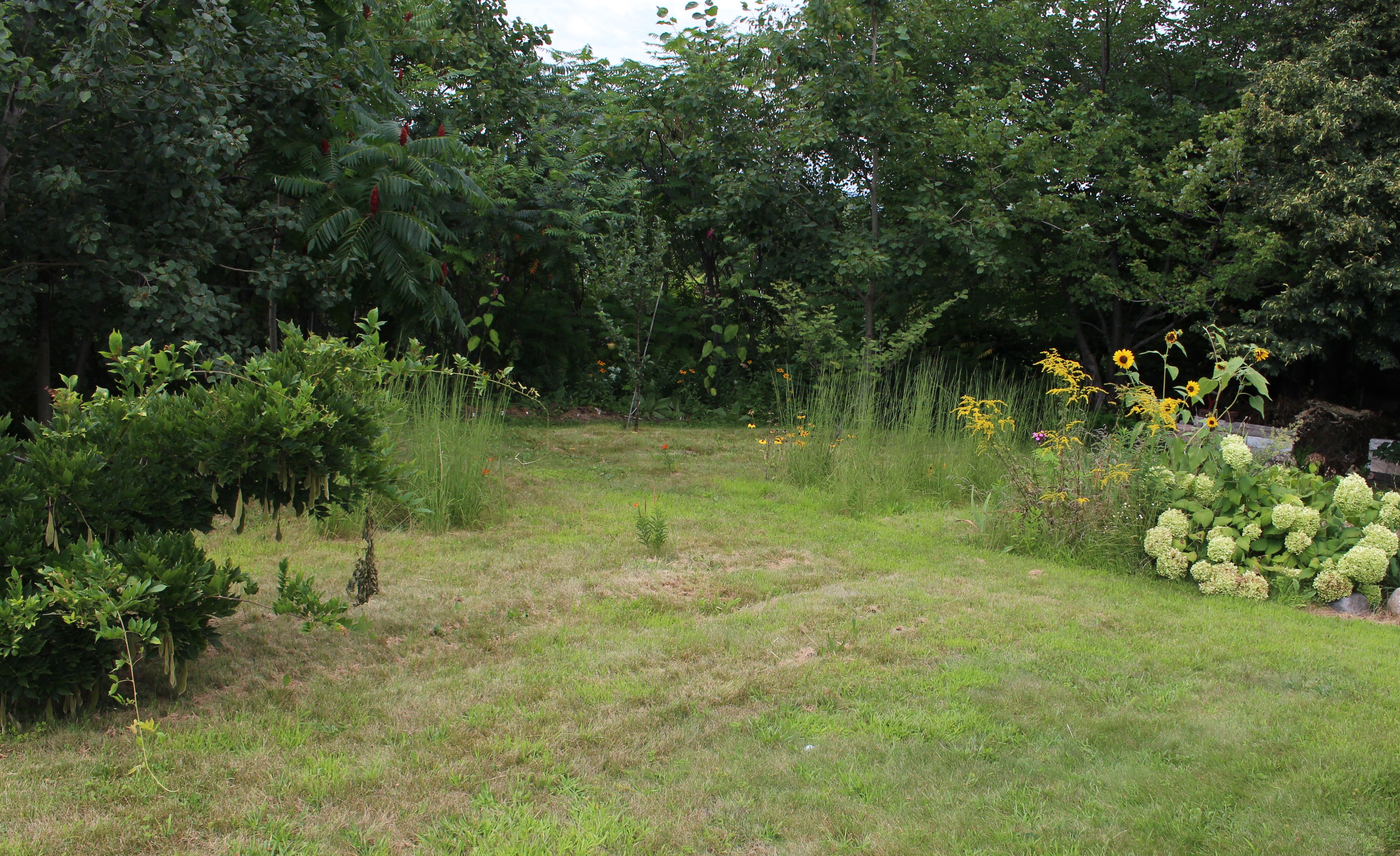
This “garden” amounts to little more than an area of the yard which has been left to fill in with whatever flowers and grasses can make it in the thin, poor soil.  In a normal year this 20×60 ft area is a sea of waving grass gone to seed, but coming off last summer’s drought and this spring’s dry spell the grass is a little threadbare and the rudbeckia and butterfly weed (Asclepias tuberosa) stand out more.  On a whim I allowed a few quaking aspen(?) and staghorn sumac (Rhus typhina) to grow up and screen the fence but now these sun hogs are under the protection of the non-gardener and I worry they will further suck the life out of the meadow.

Rhus typhina staghorn sumac

Pennsylvania is not a meadow state and the trees and shrubs are always making advances.  We’ll see how much longer the aspen and   staghorn sumac (Rhus Typina) are allowed to stay. 

I guess easy come easy go is the theme for this area and there will never be any regret for the time not wasted in mowing yet more lawn so we’ll see what happens.  It always gets a haircut by the end of summer but I suspect a few trees will need to go sometime soon.

rudbeckia hirta meadow

The far end of the meadow.  The ‘Annabelle’ hydrangea is not your typical meadow shrub, but I’m sure it is one plant which does enjoy the growing afternoon shade…. as well as all the rain we’ve had recently.

My apologies for a post which deals mainly in weeds.  As you know the garden needs more attention at this time of year than there are hours in the schedule so I’d like to leave you with the illusion that the rest of the garden is well under control.  That may or may not be the case, but hopefully with our upcoming holiday weekend a few things will get done.  Happy Independence Day and enjoy the weekend!

mumble mumble mulch

Spring is here and I love it.  It means work of course, and for me it’s hard to hit just the right balance of sitting around and actually doing something, but I try my best.  One problem which always haunts me is that I’m the type who (again while sitting around) usually gets tons of unnecessary projects in his head, starts them, and then moves on before they’re done.  Fortunately I’m not much bothered by this, but someone else here is, and sometimes decides to be helpful and remind me of the obvious…. but most of the time that person doesn’t notice unplanted chrysanthemum collections or realize it’s been years since the boxwood cuttings should have been planted out, so it all works out fine.  How can it not when rain and rainbows and warm sunshine have brought out the daffodils?

double rainbow over the garden

Double rainbow over the ‘potager’.  A beautiful sight if you can tune out the industrial park and white vinylrama next door 🙂

I’ve been relentlessly mulching.  It started innocently enough with a load of mulched leaves hauled out of the woods, but then exploded from there.  My neighbors were so generous last autumn with several heaps of nicely chopped leaves and grass clippings that I couldn’t stop lugging them back to the garden.  The entire front bed got a nice layer and I would have kept going but of course ran through all the available bounty.

cheap leaf mulched perennial beds

The front perennial bed all nestled in with a nice mulch of chopped leaves.  The earthworms will munch them all down by the end of  summer but for now they should go a long way in keeping the weed seedlings down.  Did I mention it was all free?

As if that wasn’t enough, for some reason when finished I got it in my head to crack open the wallet and order a load of shredded bark mulch to finish off the yard.  With most of the front already covered I felt finishing with a little purchased mulch might be something the budget could handle, so $290 later I was mulling over another new heap in the driveway.  It seemed a steep price to me but judging from the other $1,000 plus order slips hanging next to mine I guess I’m being downright frugal.  Also, mulch is a gardening expense the boss never criticizes, so now it just needs to be spread.  More on that later, daffodils first!

narcissus tahiti daffodil

Always a favorite, ‘Tahiti’ is an awesome daffodil.  Sorry if you’re not a fan of doubles, but this one never fails, and the yellow petals seem to glow with an orange shade which I love.

I’m stuck on orange lately.  The daffodil ‘Serola’ tops the list this year.

daffodil narcissus serola

Narcissus ‘Serola’ with the first of the tulips opening behind.  When I divide this bed (hopefully this June) I’ll need to put these out in the front garden to brighten things up even more!

My whining about space in the vegetable garden is entirely due to my weakness for spring bulbs and the abundance of open space left when vegetables finally give up the ghost in September.  It’s so easy to just pop a few bulbs in here and there 🙂

daffodils in the vegetable garden

It’s so much easier to line a few daffs out in the vegetable patch than it is to decide on a spot in the open garden!  I’ll just plant a few pumpkins or squash over them in July to make it look respectable again. (fyi it’s bouncy house season so please ignore the deflated mess in the background) 

One more orange.  ‘Kedron’ has a color which stands out very well…. if you’re into colors that stand out very well 🙂

daffodil narcissus kedron

Narcissus ‘Kedron’.  Notice the empty spaces nearby.  Not everyone does well here and I just don’t have the patience to nurse unhappy plants along, so while ‘Kedron’ takes off the others just fade away…

Although the vegetables complain, bulbs in general seem to like my lazy (or complete lack) of an efficient watering ethic.  Tulips in particular like the open, sunny, fertile soil, and unless I weed them out (which I could never do) most clump up and bloom.  Even if I do pull a few of the smaller bulbs they just end up in the compost anyway so get spread throughout the garden a few months later when I take and spread the barely rotted goodness.

tulips and double hellebore

Yet another plant which needs to find a permanent home outside of the vegetable patch.  This double hellebore seedling is taking up prime bean and pepper real estate.

Believe it or not I’m making progress with my bulb issues.  When I was younger and carefree I used to plant out patches of whatever tulips I had on hand and then dig them up again in June just in time to clear the beds for tomato planting.  It was insanely beautiful (to me at least) and I can’t rule out this happening again.

mixed darwin tulips

Tulips blooming in the vegetable garden (spring 2013). These would all be dug, dried, and stored while the warm season veggies occupied the same beds.

Maybe my bulbaholism isn’t getting any better.  Maybe it’s just migrating.  I planted these fritillaria imperialis bulbs out in the meadow late last fall (clearance bulbs) and can’t wait to see how they do.  If I get one decent spring out of them I’ll be thrilled, but in my heart I want them to settle in… even if they do look slightly out of place in the short turf.  Hopefully they enjoy the dry summertime baking this spot receives, and the grass should come up soon enough to hide the yellowing foliage.

growing fritillaria imperialis

My ‘meadow’ is in danger of becoming a bulb field.  The fritillaria imperialis don’t look entirely happy yet, but I have my fingers crossed they’ll at least bloom and then maybe return next spring?

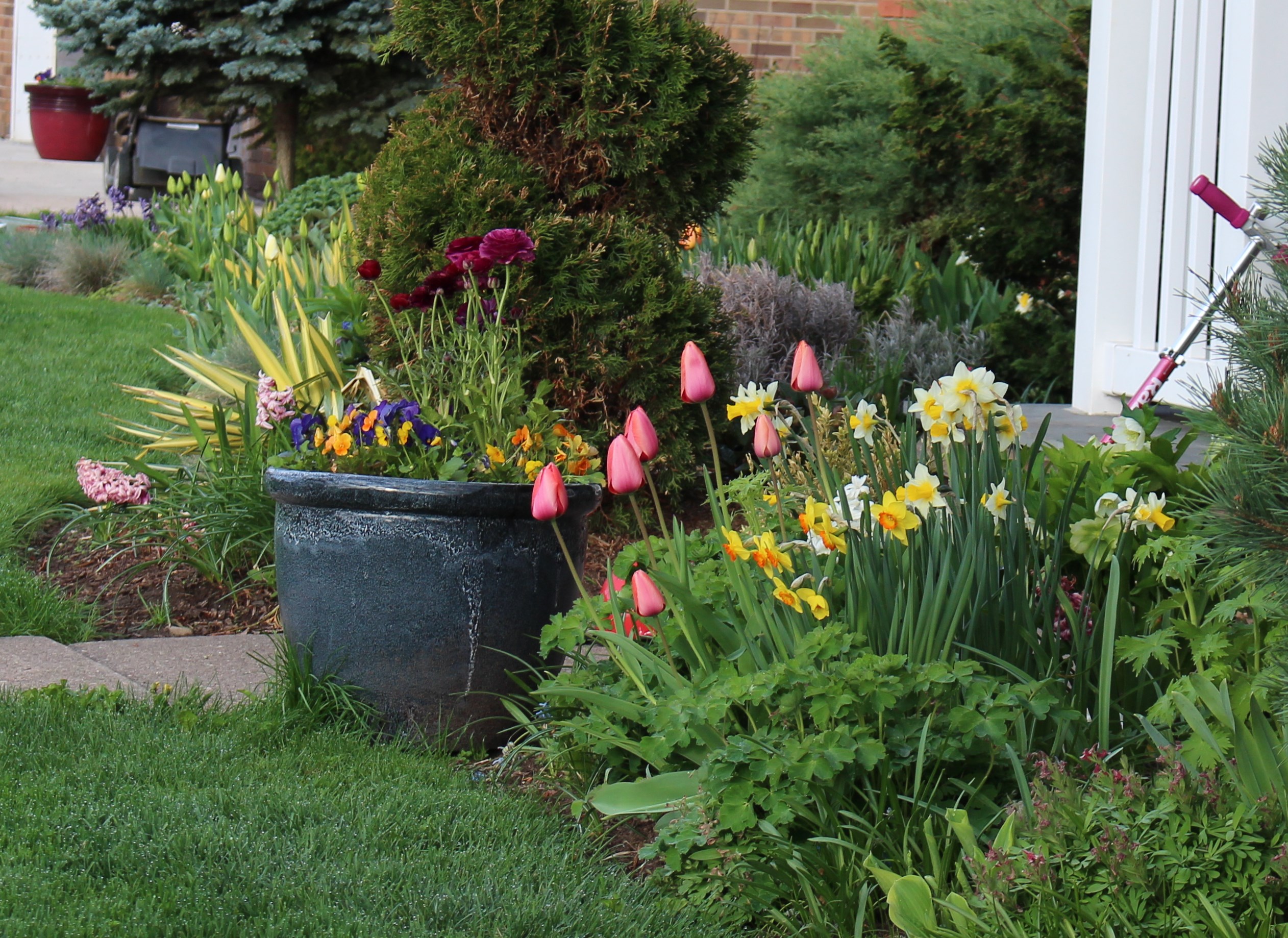
Out front I may have a few bulbs as well.  Early spring is when I love the front beds the most.

spring bulbs front entry

Tulips and daffodils where snowdrops ruled just a few weeks ago.  I should have taken this picture today since I mulched yesterday afternoon, but after all the work I was ready to just sit and relax!

I better wrap this post up.  Now that mulch sits in the middle of the driveway I’ve got plenty to do even from the non-gardening viewpoint.  And it’s not the fastest process since mulch needs to be worked in between sprouts and edges need to be tidied up…. and actually a bigger problem is that I’m coming up with all kinds of bed enlargements and side projects while I dilly-dally on finishing the main project.  I promised to trim back the yews along the side of the house, and this golden arborvitae just happened to show up in the lawn between us and the neighbor.  As long as I’m mulching, might as well create a nice big bed around it 😉

new perennial bed

new perennial bed

Let me get out there then.  Good luck on all your own spring projects, may they progress more quickly than my own!

Happy Easter! (almost)

Another warm day and we jump ahead a week (and I’m sure we’ll take three steps back tommorow).  Generally I prefer a long drawn out spring, but at this point I’ll take anything we can get, even if it means fast-forwarding through the season.  Five days ago the bunny buffet officially opened with its first crocus bloom and now a second sunny day has brought out the rest of the snow crocus (mostly crocus chrysanthus types).

crocus lawn of dreams

Van Egelen’s “lawn of dreams” crocus mix just starting to bloom. 200 snow crocus barely make a splash, but it’s enough to bring me out to sit in this part of the garden on a sunny day.

These are what remains of a fall 2012 planting <for more planting details click here> of about 200 snow crocus and maybe 150 tommies (crocus tommasinianus).  The tommies are not yet up but are supposed to be better spreaders and less tasty to all things which love crocus as much as I do.  Unfortunately Pennsylvania rabbits must be a less refined bunch since in my experience they mow down all crocus equally.

snow crocus naturalized lawn

They sure would look nicer spotted about in a velvety green carpet of lawn, but this is the Pennsylvania tundra so you get what you get!

I don’t mow this patch of thin grass until late, so waiting for the crocus foliage to die off naturally is no problem, but if you are a mower keep in mind that the crocus need to grow for five or so weeks after blooming in order to build up next year’s blooms.  Because the rabbits were so brutal on both bloom and foliage last year I didn’t think I’d see any flowers this year, but fortunately they came through even if a little weaker.  Luckily the snowdrops are not at all tasty to bunnies.

first snowdrops galanthus

The first snowdrops opening in the backyard.  They’ve multiplied but not so much that I can’t still count every last bloom to compare to 2014’s show…. sad and desperate, I know.

I of course did not follow the rules of common sense last year and ended up adding more new and expensive snowdrops to my garden.  They’re just as white and drop-shaped as my free snowdrops and all the other ones I have, but they’re much much better 🙂

galanthus lapwing

Galanthus ‘lapwing’

Another new bulb added last fall is iris “Katherine Hodgkin”.  Everyone loves Katherine for her subtle colors and intricate patterns…. except me.  I have a lower class of taste and of course prefer the brightest colors, and this one doesn’t show up as well as I’d like.  My mother of course will like it, and my wife too if she ever happens out into the garden before May, but I on the other hand say “meh.”  Hopefully our children will not inherit their taste from me but will instead be the perfect blend of well rounded, refined, garden loving young adults.  Optimism is one of the highlights of spring.

iris Katherine hodgkin

Iris “Katherine Hodgkin”.  Makes me think of dirty snakes.  I bet it’s virused too, I can see darker blue streaks in the blooms on the left and believe this is a sign…. 

A couple more warm days and all the early bulbs will be blooming.  Crocus are a favorite and along the warm south side of the house the first of the plump and bright dutch hybrids are opening.  I wish they lasted longer, but nothing lasts forever and when spring turns warm and sunny I always make a point of getting out to see them.

first dutch crocus blooms

Dutch crocus just starting to bloom in the warmest parts of the garden. The bees will be happy, the bunnies too.

Yesterday was beautiful, today not so much.  I want to get out there and clean up but don’t want the neighbors judging me for gardening in the cold, gray drizzle.  Looking at the forecast, Easter Sunday is supposed to be the most promising day, but Godless and crazy is probably a worse label than just plain old crazy so maybe I’ll try and get a few things cut back and cleaned up before then.   Fortunately I was out there last weekend for a start (the backyard snow melted briefly before the latest batch came down, so I rushed out to do some raking and trimming!)

vegetable beds ready for spring

The vegetable beds cleaned, straightened up, and ready to go. I even went over the lawn with the mower to give it a springtime “vacuum” of twigs and other debris.

It’s going to be a lazy cleanup this year, I can feel it already.  Electric hedge trimmer to cut everything back, mower to go over it once to chop, mower bag emptied on the beds to cover up all the leaves and bits which I didn’t bother raking out.  Done.  I need more time to transplant and divide, and gift plants with shovelfuls of compost.  Plus the mulched debris will keep down many of the self sowers, and I think last year’s “riot” of volunteers was a little messier than I want this year.  Always have to keep things changing!

Best springtime and Easter wishes to all, enjoy the weekend!

Why wait for spring?

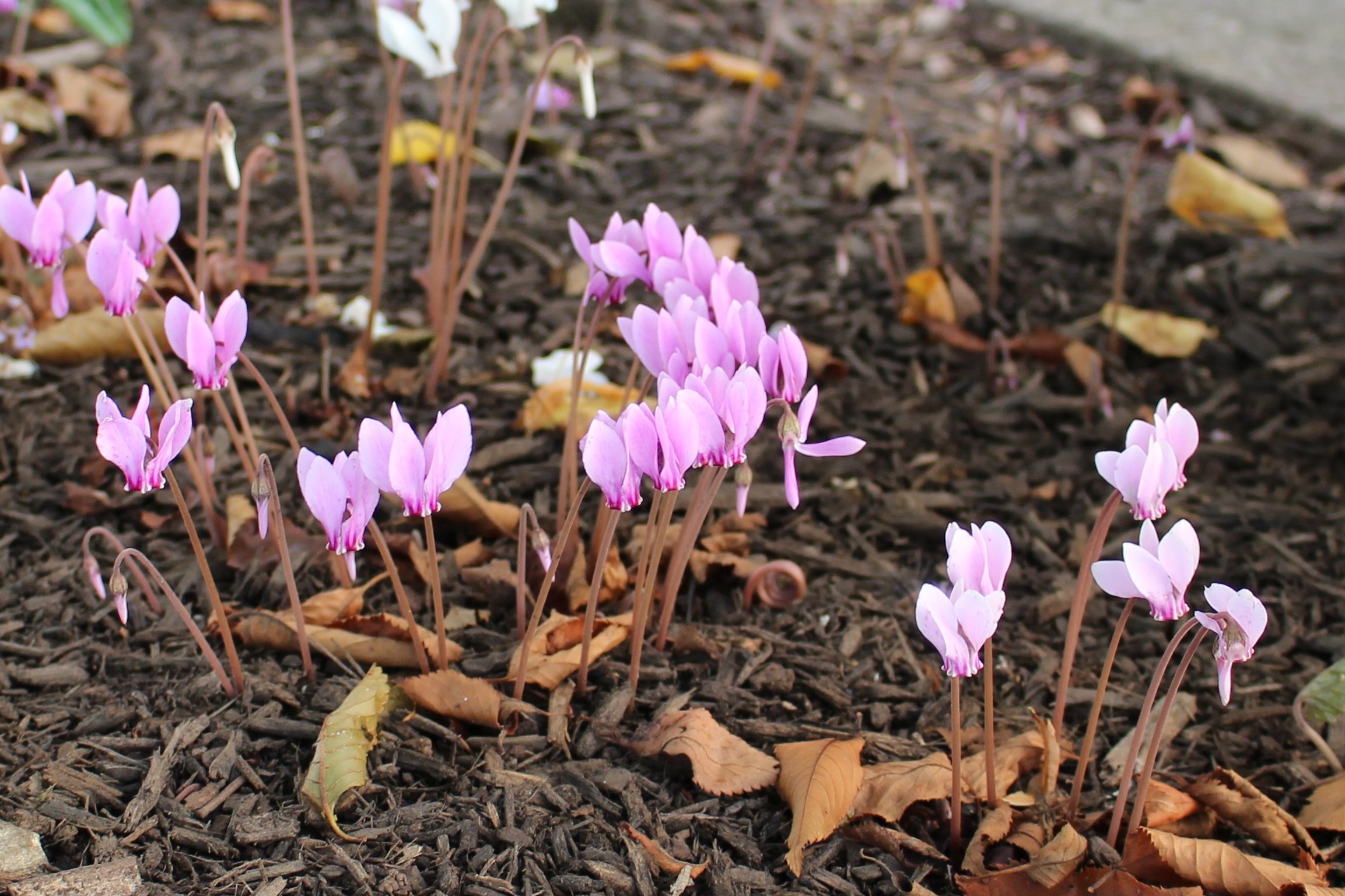
I’m halfway enjoying fall this year.  Yes, everything is dying, it’s too dry, and we face months of snowy gloom, but right now the fall bulbs are blooming and it’s a little bit of rebirth right before *the end* (sorry but I will never actually look forward to the arrival of winter).  The hardy cyclamen, in this case cyclamen hederifolium, have been blooming for several weeks now.

naturalized cyclamen

I was ambitious this year and spread a little shredded wood mulch around the cyclamen bed. For a while it looked immaculate under the cherry….. but within minutes the dirty little tree resumed its leaf dropping….

Last winter the polar vortex was brutal on these little guys.  Fortunately they’ve shrugged off the foliage loss and act as if nothing at all happened.  I wish I had clearer photos, but out of the dozens of cyclamen pictures I took, these were the only two which came out halfway in focus.  I need a photo mentor who can begin to point out some of my worst mistakes 🙂

hardy cyclamen hederifolium

For me the best thing about these hardy cyclamen hederifolium are the leaf patterns, but the flowers aren’t too shabby either….

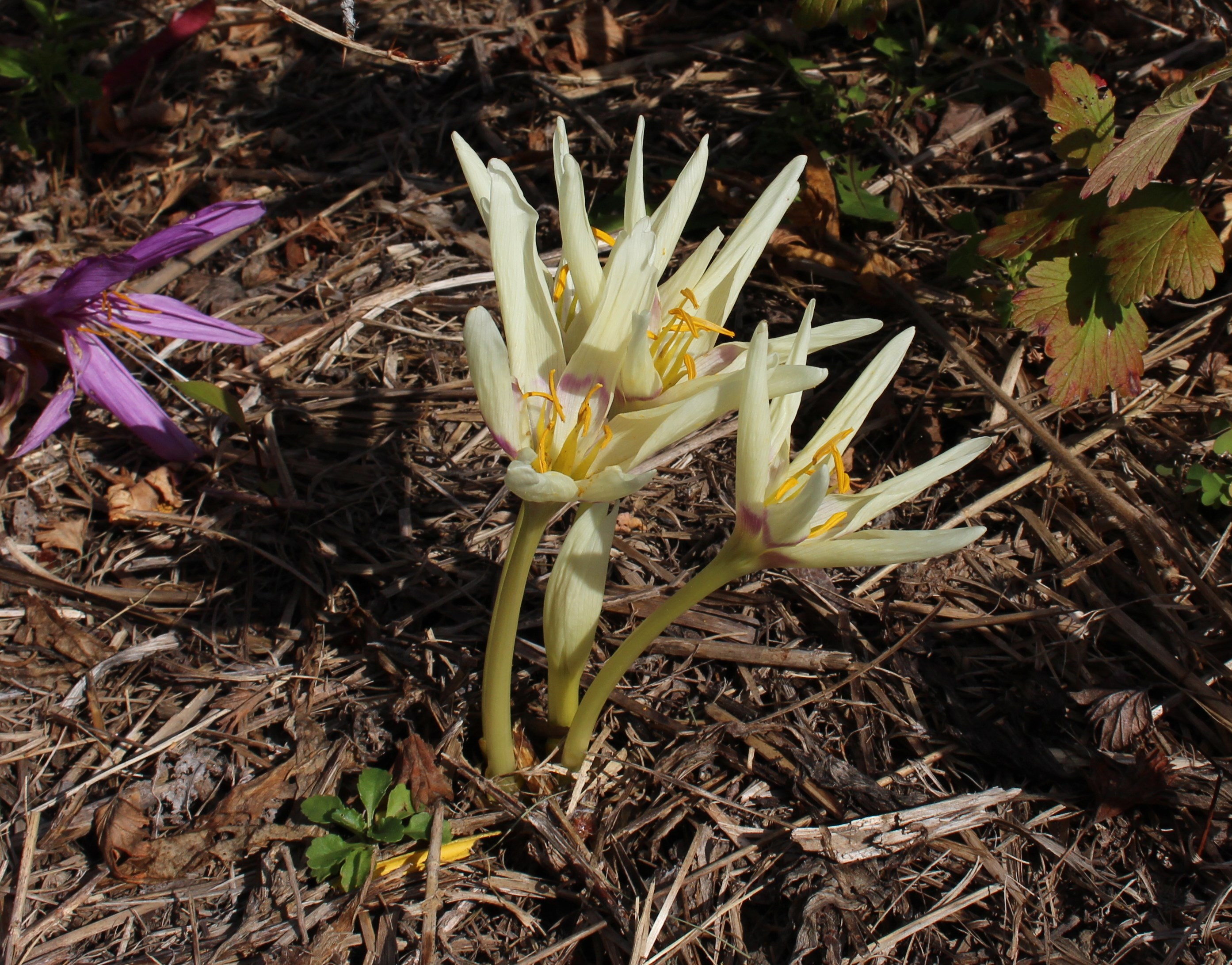
Cyclamen are the best, but colchicums follow at a close second.  Actually the colchicums do put on a more impressive show, but it’s all or nothing with these ladies, and ends more quickly than the slow and steady cyclamen display.

colchicum flower bed

Most of my favorite colchicums are together in this bed. It’s bone dry (the third gooseberry bush actually died this summer) but the bulbs seem right at home.

I’ve devoted the way-too-dry-for-vegetables end of the veggie patch to colchicums and daffodils, and they seem happy enough here, but as the garden grows I’m thinking there might be something better to do with this spot for the other 11 months of the year.  Amaranthus once filled the bed, but the soil was too dry for them to survive this summer.

colchicum '‘Harlekijn’ 'Harlequin'

New this year, colchicum ‘‘Harlekijn’ is what I’d call “interesting”. Most pictures show more pink to the bloom, but that might change from year to year. Overall I like the curious rolled (or quilled) petals and they do make for something ‘different’ 🙂

The few colchicums I have planted in the meadow seem just as happy and to my eye look a little more comfortable growing amongst the barely green grass.  In fact the only bulb of colchicum autumnale ‘Pleniflorum’ to bloom for me is this one planted in the lawn.

colchicum autumnale 'Pleniflorum'

The colchicum autumnale ‘Pleniflorum’ planted in the official colchicum bed don’t bother blooming. This one in the lawn seems marginally more happy and is even gracing us with the sprouting of a second flower bud.

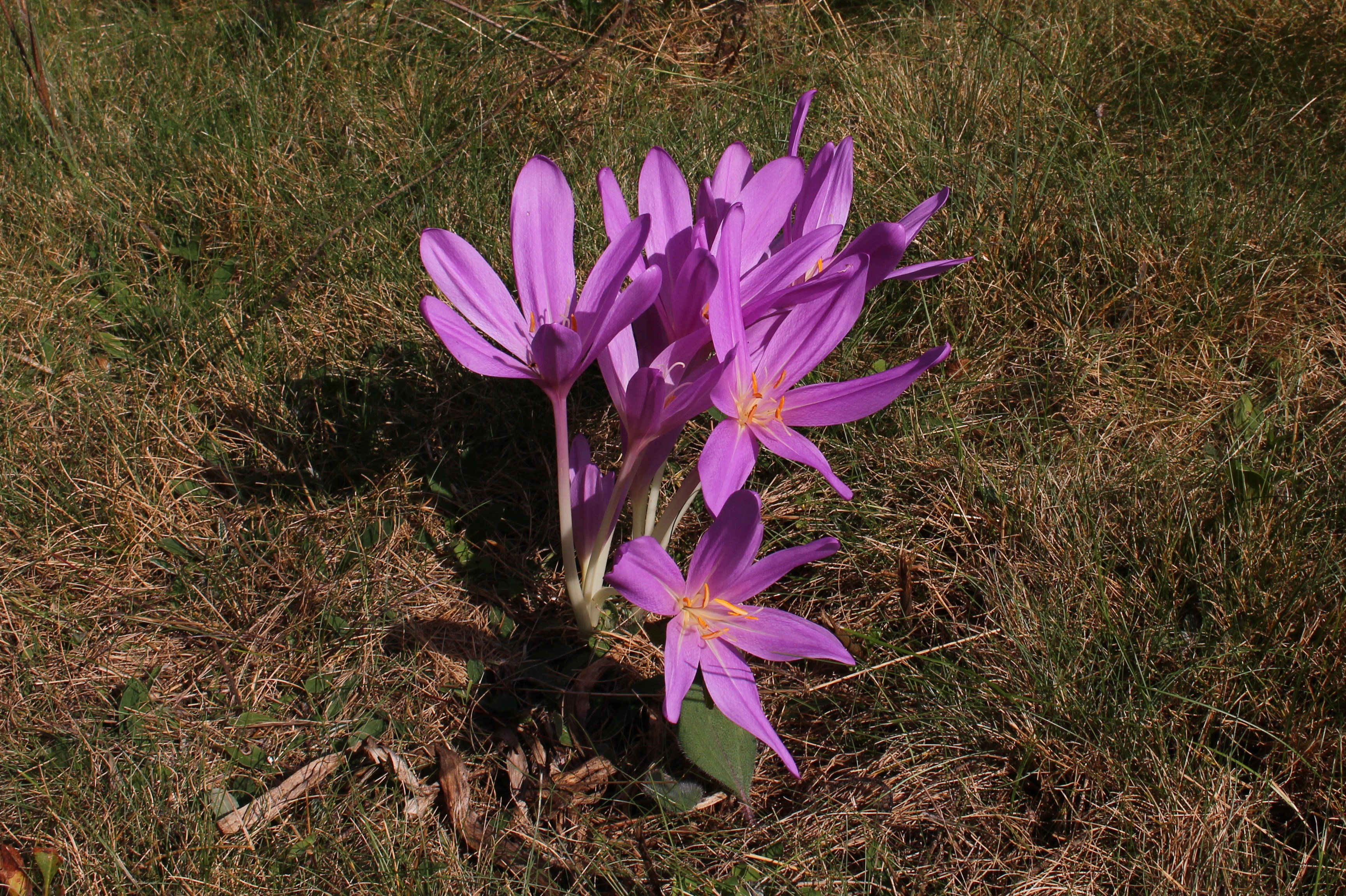
The (I think ) ‘Lilac Wonder’ planted in the lawn is possibly my favorite colchicum.  It blooms long, large, and heavily and makes quite the pool of color.  I’m thinking next summer might see a lot of these moving around, since they’ve multiplied like rabbits and are ready for dividing, but it’s not something I want to tackle this fall.

colchicum 'lilac wonder' in lawn

Colchicum ‘Lilac Wonder’ growing happily in the (now mowed) meadow.

You might be wondering why I’m even talking about moving flowering bulbs in the fall.  According to what I’ve read and heard (and done) colchicums are ok to move while in bloom.  It’s probably better to wait till the foliage dies in the summer and the bulbs are dormant, but I’m more of a do it while you remember kind of guy, and it’s much easier (and more fun) to move them while in bloom.  You can’t always be a slave to your plants you know, and every now and then they have to just suck it up and deal with things at a less than perfect time.

tranplanting colchicum in bloom

This unknown clump of colchicums which I call “not the giant” comes from a single stray bulb left behind from the last digging. It’s in full bloom and the roots have just begun to sprout from the base of the corm…. even in soil so dry I could have used a dust mask while digging.

Obviously you want to take a little care with the roots while planting, but to be honest I was more concerned about snapping off the blooms.  Instant gardening is what I call this, and the bulbs were planted individually right under the turf without any soil prep.

naturalized colchicum in lawn

Two days later the blooms look as fresh as the day I dug them. After being planted into more bone dry soil… and not even watered while transplanting… this will be a true test of how well colchicum handle autumn transplanting. We’ll revisit next fall!

Kathy at Cold Climate Gardening is a truly addicted colchicum lover (I’m just a dabbler), and her recent post on how colchicums know when to bloom asks a lot of the same questions I have.  They’re growing in soil so hard and dry I don’t even know how the roots penetrate the soil, yet they do, and cyclamen perform a similar trick.  Somehow these bulbs seem to have an odd internal clock that just goes off one day and they start growing.  Maybe it’s better I just ignore this heavy thinking and stick to enjoying the blooms, so here’s one last flower to end the post.  Not hardy, it’s one of those odd things that find their way into your online cart and then surprise you when you’ve forgotten all about that weak moment with a gift certificate.

bessera elegans flower

A fascinating flower shape, bessera elegans also comes in a rare deep purple. Mine are just blooming and I love it. Keep in mind though that the foliage is a floppy mess of green. Imagine thin dark green daffodil leaves so spineless they can’t lift themselves up off the ground and you have an accurate picture.

So fall flowers are off to a strong start.  I wish I had an autumn snowdrop to go with them, but I fear I’ve killed off my one bulb.  Obviously I don’t want to talk about it :/


Taking a bite out of Crime

Since moving here six-ish years ago the garden has been growing by fits and starts.  There wasn’t much more than grass and foundation plantings here  -so beds were promptly carved out of lawn- but it’s possible I bit off a little more than I could chew.  Now don’t get me wrong, in my opinion restraint is something better saved for the day after your funeral (and for plant orders edited after you review your checkbook balance), and I don’t regret anything…. but I think it is time to finish chewing.

So here comes the story.

my backyard is a meadow

Spring 2008 was when we moved in. I really couldn’t see the point of cutting all that grass, so to the joy of my new neighbors (also inlaws btw) I left it to grow as meadow.  The uncut grass  went over really well (I think).  This was when ‘the queen of the prairie’ got her name, she was in the house as an estate sale leftover, but now you can barely make her out in the grass to the left.

After 40 years of wooded seclusion, the company owning the land behind our house chose the year after we moved in to begin construction on a new industrial park.  Trees were promptly cut down and bulldozers moved in.

kids love bulldozers

Kids love bulldozers. The previous fall was when I dumped dirt, planted daffodils, and the bed in question was born.

Don’t get teary eyed over the trees and earthmoving, bulldozers weren’t the worst thing that could happen to this land.  We’re talking about mine scarred land covered with tailings from the coal mines and a massive culm bank.  Industrial decay can be cool in photos, but less so in your own backyard.

construction site as my view

Another good thing about construction were the nice rocks salvaged from the site. Too bad my back gave out before I could lug up even more.

Fast forward to this summer and things have grown back up… too bad weeds have also grown up, and it’s downright criminal what the bed has become.

Annabelle hydrangea

The “Annabelle” hydrangea was just a homeless cutting. Four years later and it’s too nice to remove, but as for everything else?

Now is probably a good time to remind you of my blog’s subtitle “More than you ever wanted to know about my garden”.  I think we’ve reached that point, and to keep it short and sum it up;  July -about 50 clumps of daffodils dug, sunflower seeds planted, heavy grass clipping mulch applied.

sunflower seedlings

Better late than never, a planting of sunflower seedlings coming along on August 11th. Some rain would help since I hate dragging the hose out to this bed.

Finally to wrap things up the sunflowers are blooming and I’m trying to keep on top of the weeds.  A smarter person would have covered the whole bed with newspaper or cardboard, mulched over that, or sprayed for the weeds but I’m going to try and pull them as they show up.  Wish me luck.

late summer sunflower patch

It’s not the worst thing to have a few late season annuals. They seem to know enough to get a move on it and are blooming at a shorter height (a mere five feet)

The bees may not be impressed by them, but a few fully double sunflowers give it a nice Van Gogh feel.

double sunflower

This double sunflower looks fluffy enough to use as a pillow.

I just need to resist planting things here until the last of the weeds are killed off.  That won’t happen, but maybe I can at least keep it to a minimum 🙂