A hot day in Philly

The calendar is beginning to insist that all things summer will soon come to an end, so when a free day presented itself I made my best to take advantage of the last weeks of warmth.  A quick call to a friend near Phillidelphia and I was on my way to one of my favorite gardens, Chanticleer.  As usual the visit did not disappoint, and despite a mental note to just enjoy the visit I did break down at the end and went a little camera happy.  Hopefully I can show some restraint with the length of this post even if I couldn’t with the camera.

chanticleer red border

Red and purple as you come around the house. Coleus ‘redhead’ and the awesome canna x ehemanii… rounded out with a few random bananas.

I like to stroll around pretending this is my own estate, and if by chance if I do win millions (I’ve given up on earning them through hard work, marriage, or genius) I feel like this is the kind of garden I’d create.

chanticleer container plantings

Many exotic and unusual container plants are scattered around the house and terraces. All appear perfectly grown and cared for.

The tropical plantings around the house are some of my favorite plantings, although even away from the house a random banana or elephant ear may turn up (Chanticleer refers to itself as a ‘pleasure garden’… so I guess anything goes!)

teacup garden chanticleer

This year’s teacup garden plantings. Fiddlehead figs and canna ‘Ermine?’, plus many others.

I’m guessing on almost all the IDs since the gardens are for enjoyment and inspirations and not so much for the down to earth realities of botanical labeling, but there are plant lists available both in the gardens and online.  I apologize for being too distracted to look while there and far too lazy now to look them up online.

papyrus chanticleer

Potted dwarf giant papyrus. I love the pot in pot planting with a ‘groundcover’ of duckweed, and I’d love to imitate, but… no pot and no dwarf giant papyrus.  Maybe the plain old giant papyrus will work,  at least that’s finally become easy to find in the spring.

I can feel the banana itch coming back.  I was given one and bought another this summer….

chanticleer tropicalismo

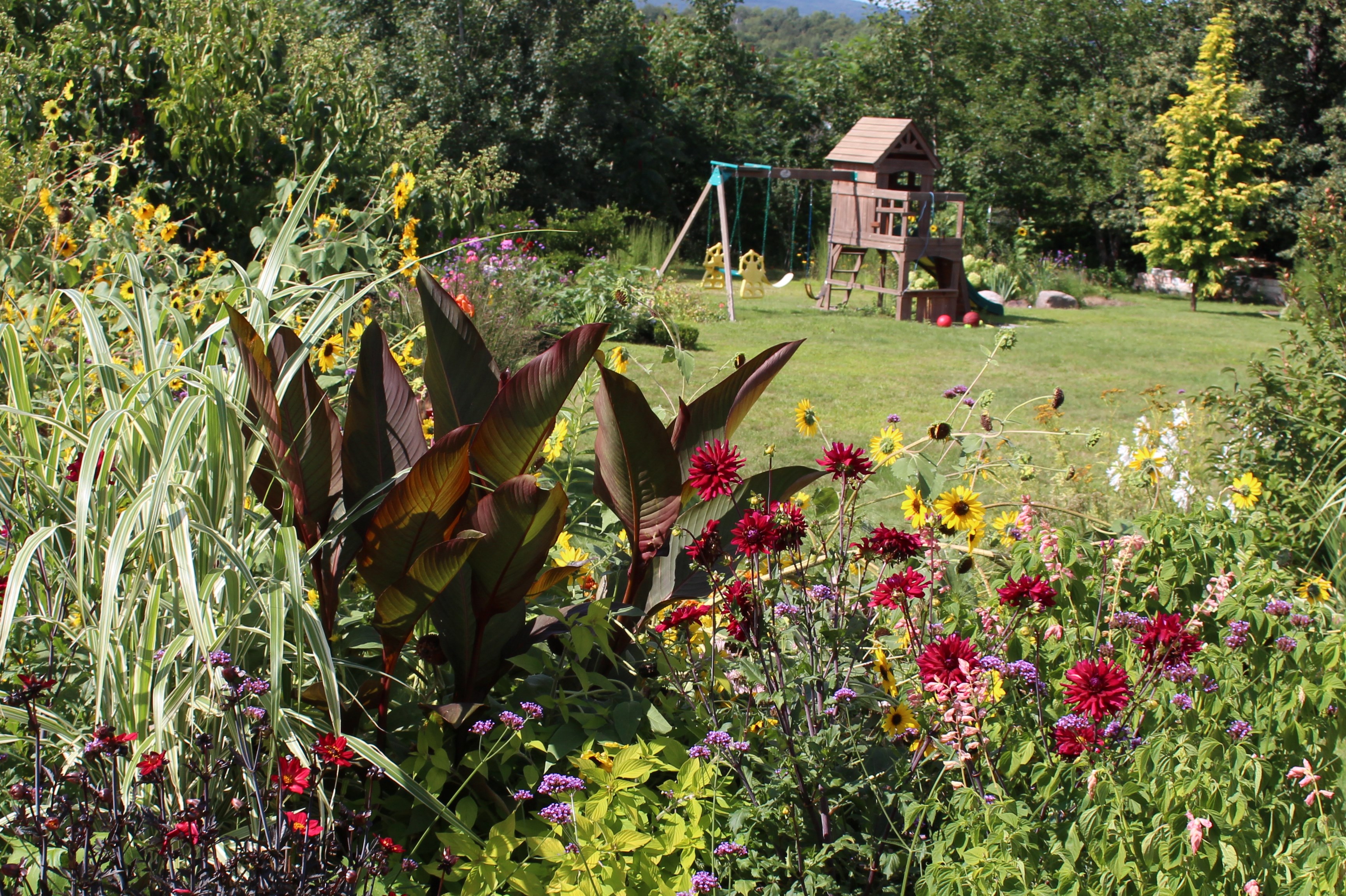
Canna x ehemanii, various bananas, red and purple dahlias, and a few tall salvia splendens varieties.

…and how can you not like dahlias at this time of year.

chanticleer mixed border

A respectable boxwood border holding back a wave of visitors from the south.

On a hot day the dry, full sun, gravel garden was not the place to linger… but we did, and while sweat beaded we enjoyed the waterwise plantings and the mix of dryland perennials and tropical cactus and succulents.

chanticleer gravel garden

I think the yucca rostrada (hardiest of the trunk forming yuccas) stays here year round, but I’m not sure of the agave.  I do know I wouldn’t want to be the one to lift it come autumn.

All the rain earlier in the year probably helped most things, but some I’m sure didn’t appreciate the reminder they were in Pennsylvania and not Southern California.

artichoke bloom

Artichoke blooms?  Not the best leaf-wise, but the color of the flowers almost glowed in the heat.

Or South Africa…

chanticleer kniphofia

Kniphofia (a species I’m guessing) along the dry slope.  I love this plant family, but never get decent flowers on the ones I’m growing.

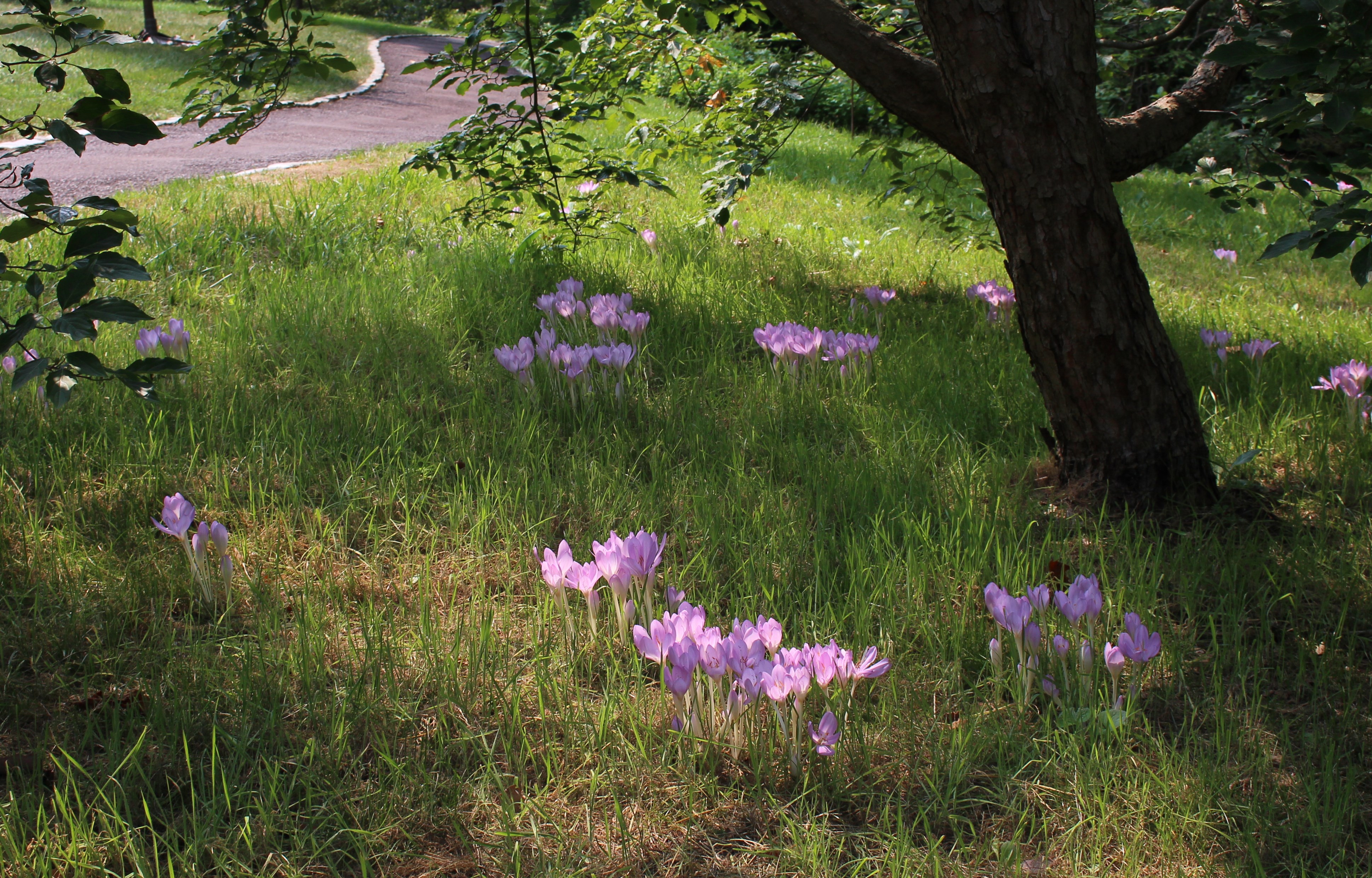
The bulk of the grounds around the house are open grass and trees, and this was the beginning of the colchicum season.
chanticleer naturalized colchicums

Some of the colchicums just beginning to bloom in the lawn at Chanticleer.  Form what I’ve heard there are many more to come.

And then there were the pond gardens…

chanticleer koi

Chanticleer koi

With lotus and water lilies.

chanticleer lotus bud

One of many lotus flowers.  My photos never do the blooms justice.

And then there was the cutting garden.  My favorite canna ‘Bengal Tiger’ (Pretoria) was the star, and in my opinion everything looks better when it’s next to this beauty.

chanticleer canna pretoria

The cutting garden.  Summer annuals, dahlias and cannas were at their peak.

It’s just pictures from here on.

chanticleer cosmos

Cosmos and dahlias with canna leaves.

chanticleer cutting garden

The beds threaten to swamp you in a tsunami of plants.  Still to come were all the hardy sunflowers and other native prairie plants which filled the inner portions of the bed.

dahlias chanticleer

Dahlia with gomphrena ‘fireworks’ (I think)

dahlias chanticleer

Dahlias again (it’s the season!) plus more awesome canna leaves. I think the ferny foliage belongs to the SE native dog fennel (Eupatorium capillifolium).

dahlias chanticleer

Nice right?

chanticleer summer flowers

Summer zinnas and cosmos. Who says fall is near?

I didn’t realize it’s been two years since I last visited (click here to see that very pintrest-popular post), and I’m glad to have had the chance to do it again.  The gardens are on a scale that really seems approachable, yet aren’t filled with how-to beds or dull bedding.  It’s really a place where you can enjoy the art of gardening,  and if you get the chance I would absolutely recommend a visit, but for those further afield there’s also hope.  September 23rd marks the release date for a new Timber Press book on the gardens and I for one am looking forward to it.  It has an excellent pedigree across publisher, author, and photographer and what I’m most looking forward to are the interviews with each area gardener.  I saw them at work during our visit but was a little too shy to bother them with an endless gushing of praise or question after question.  Hopefully the new book will pacify me. 🙂

Thanks for meeting me there Paula, and I wish everyone a great week!

Time for a haircut

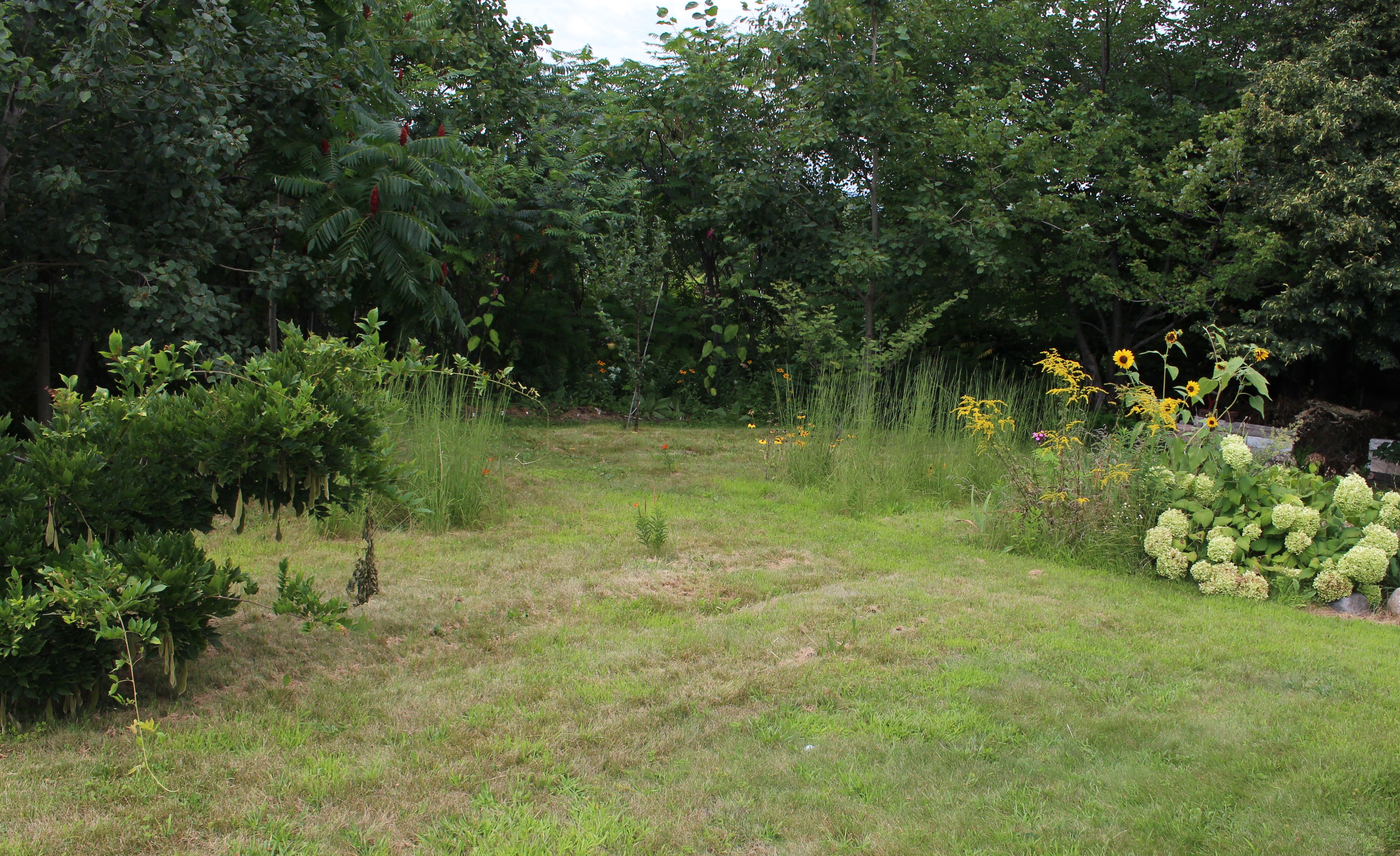
As you may know there’s a small section of lawn out back which I let go over the summer.  It’s what I call the meadow, and the goal is to have a spot where I can play around with a few bulbs in the lawn and also give the crickets and bunnies a spot to kick back in.

meadow garden

Over the last six years wildflowers such as rudbeckias and goldenrod have moved in and (to me at least) the meadow is an interesting place.

I love the meadow in early summer when the grasses go to seed and daisies spot the amber waves, but now it’s starting to look tired, and I have to remember what the plan is here.  Although the native little bluestem (Schizachyrium scoparium) is beginning to invade and I like it elsewhere in the yard, it’s not a prairie I want here so in late August I finally mow.

meadow garden

Little bluestem with a mix of rudbeckia and other wildflowers (weeds?).  I love the look, but it’s time to move on.

Tuesday evening I went through.  The crickets dug into the turf and hid, the rabbits ran off, and the katydids and mantis were old enough to fly to safety.  I’m not completely committed though, I left a few patches of bluestem and mowed around some butterfly weed (Asclepias tuberosa) since I was too weak to enforce my “it all just gets mowed” program.  Maybe next year.

cutting a meadow

The meadow returned to respectability…. and boredom.

It looks neat again which is a relief to the better half, and the midyear trim actually seems to encourage the earlier bloomers such as daisies and rudbeckia, and discourages the goldenrod.

cutting a meadow

I don’t know if it looks better cut, but tall grass is a no-no in suburbia, so I’m sure the neighbors are somewhat relieved.  They’re probably itching to finish things off with a string trim and weed-b-gone 🙂

So I’m back to the mowing routine for this area, but only for another two or so weeks until the colchicums begin to sprout.  They look better blooming in shorter grass, and if truth be told I do have a bias towards doing what it takes to keep them happy.

Have a great weekend!

Legalizing pots

In hindsight I may have gone a bit too far, but last year when my better half suggested we could use a few more plants out on the deck I ran with it.  She’s not known for her appreciation of things chlorophyll so this was unprecedented, and I’m sure you could understand my enthusiasm for encouraging an interest.  For her I thought potted plants were a big no-no, and I’ve found this becomes an even stronger no-no when their planting and repotting takes place on the kitchen table… which is kind of close to the deck table… so perhaps this new interest in the deck plantings was the first step in easing the household ban on pots.

deck container plantings

A few of the planters which were put into service this year on the deck.  This photo might be two weeks old and it’s interesting to see where all the golf balls which I picked up out of the lawn today came from…

Before this garden I used to have quite a pot habit.  The small balcony of my apartment was filled and overflowing with any container I could find and any plant which I thought would be interesting to grow out there, and at one point I was a little worried all the extra weight on my second floor balcony might one day come crashing down.  But it didn’t, and I kept on happily planting until finally purchasing my first home.

wendys wish salvia

Coleus are perfect for containers, but I far prefer the sun-tolerant, slow to bloom, cutting grown plants rather than any strains from seed.  The salvia (Wendy’s Wish) is also doing well enough, but I suspect she would prefer a roomier root-run and not sit in a cramped pot.

When the deck was opened up to planting I scoured all corners of the yard and garage for any container which might still be able to hold a plant.  Many of the old plastic pots from my balcony days came out of retirement and were slid right in next to my pretentious Italian terra cotta and glazed ceramic.  I’ll see if I can do something about that next year, but this year most of the budget went to new potting soil.  Potting soil has been a sticky subject around here since most of them stink, but I found Jobe’s Organics Potting mix and love its price and quality.  It’s made with quality ingredients, it’s airy and loose, and it’s just what I wanted for filling large planters.

Ipomoea lobata

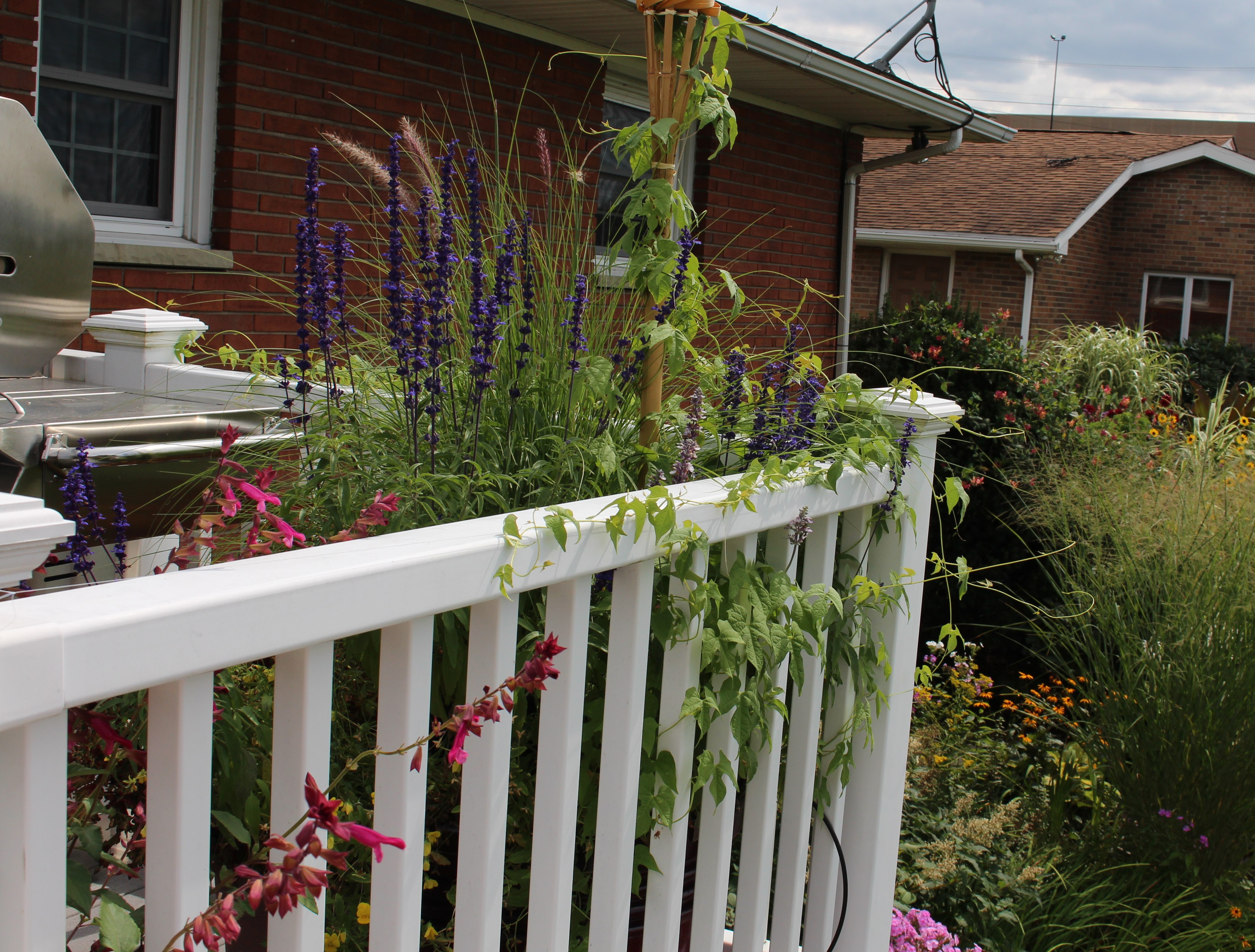
Slowly but surely the Spanish Flag vine (Ipomoea lobata) is beginning to drape the railing.  It had a late start since this was first a spring pansy planter, and they had to bloom out before I was allowed to squeeze in the vine and grass plant.  The blue salvia self sowed in from last year… thanks mother nature!

I have plenty of favorites which I either overwinter or buy, but this year’s big treat was the Cannova Rose canna which I bought already in bloom and already nearly bursting out of the pot it came in.  It’s only done better since, and if you ignore some leaf damage from Japanese beetles and a few sloppy spent blooms dropped on the deck, it’s my idea of a perfect summer container plant.  This canna is a seed strain and because of that should be virus free, also the breeder claims these plants have been selected to thrive in cooler temperatures, which is another plus for Northerners such as myself.

deck container plantings

Cannova Rose canna.  It keeps sending up new stalks and they keep on blooming.  Between it and its overgrown spike neighbor I don’t know which I like more… although I do like the spikes!

I lost a few of my older spikes (dracaena) last year to a surprise late freeze but I’ve got a few new ones growing along.  The little ones are all over in the spring but what I really like is when they put on a few year’s worth of growth and become these big grassy exclamation points.  They’re relatively easy to overwinter and my goal is a whole patch of them towering over the other plantings 🙂

lantana in container

I need to dig out the label for this lantana.  My daughter picked it out and I reluctantly added it to the cart as I thought about lantana failures in my past.  This one keeps blooming though and never looks bad.  I wish I could say the same for the ‘Troy’s Gold’ plectranthus on the right, it apparently does not like full sun here.

The one pink and gold and lavender corner is dominated by another favorite which I nearly left to die last fall.  In the late spring last year I picked up a clearance oleander, and this summer  it’s really come into its own.  Nonstop bloom on the single pink, but there’s a double in there as well, and that one is always a mess with few blooms open and always a few brown soggy spent flowers hanging from the branches.  I try to ignore it.

oleander in container

Oleander on the deck.  It’s been in bloom since June and I love the bright pink in front of the white railing.

As we go around the deck there’s another favorite which I always end up buying new each spring.  The purple fountain grass (Pennisetum setaceum ‘Rubrum’) is a pain to overwinter but worth adding new every year for its dark leaves and light airiness of the seedheads.  This year I put it with a new rose and although I paid way too much for the rose, and really questioned the decision to plant it on the deck (mostly due to all the blood it drew while planting), I love the effect.

grass in container with rose

Purple fountain grass with rose ‘Black Forest’, ‘zahara sunburst’ zinnias, and ‘double hot cherry’ zinnia.

Not to name too many favorites but sweet potato vines always show up in my planters.  Some years they cover the deck, some years they hang through the railing, regardless of where they grow I like them and I like them large.  There are dwarf types but for me I far prefer the far-ranging ones like chartreuse ‘Margarita’ or the dark purple ‘Blackie’.

deck container plantings

A scented geranium growing up, a ‘Margarita’ sweet potato hanging down, and New Guinea impatiens filling the pot.  Also making a showing is my newest banana ‘Bordelon’, two weeks in the pot and hopefully on the verge of some nice new leaves and rapid end of summer growth 🙂

I apologize for going on so long,  I’m going to try and be a little less wordy as we go around to the front door plantings.  They’re much less floral, but still a mess of color.

mixed foliage planting

The hellebore and variegated boxwood are in the ground, but everything else is potted…. not that you would know since the planters disappeared a few weeks ago.

I wish I could explain my thinking out front, but it was really just a matter of using up stray coleus cuttings and overwintered tropicals.

mixed foliage planting

This pink coleus is my problem child.  While all the rest are happy growing colorful foliage the pink one insists on forming flowers.  I just keep pinching them out, hoping someday the plant gets the message. 

This unknown to me creeping houseplant threatens to take over the pot as well as the porch.  I’ve had it for a few years now and love the way it bleaches to a bright yellow wherever the sun hits.  Unfortunately if the sun hits it too hard the leaves burn…

cane begonia

Every couple days the begonia needs to be dug out of a yellow landslide.  I suspect there’s at least three pots buried under all this.

The other side of the front entry is also a horticultural tsunami.  Vacationing amaryllis (hippeastrum), a few geraniums, and some on again off again gerber daisies are trying to fend off the looming sunflowers and an uninvited pumpkin.  Serves me right for letting the pumpkins rot on the front steps all last winter, but the new pumpkin forming is almost like a self renewing Halloween decoration!

container plants

The left side of the front entrance walk.  Nothing pretentious about this entry, it’s all a comfortable hodgepodge of color and texture (including mildewed pumpkin leaves).  The lighter, divided leaf is the old (1800) scented geranium ‘Lady Plymouth’.  Obviously I haven’t had it that long…

So after all of the mess at the entry our hanging porch planters are fairly plain.  The asparagus fern gets thrown in the garage each winter, nearly dies by April, and then springs to life once regular watering resumes.  It doesn’t drop faded flowers on the porch, doesn’t mind a week or two of forgotten waterings, and cost me about $1 a piece several years ago.  I appreciate all these strengths yet she who judges doesn’t like these pots at all.  Flowers would be nicer she says.

easy plants for hanging baskets

Asparagus fern, just the kind of hard to kill plant which survives under the shade of the porch, out of the reach of any saving drops of rain.

Now if I replaced the ferns what would I put there?  Maybe she means add more pots all around the porch, that’s probably what was implied, and that might be a good starting point for next year.  Come to think of it she did say she wouldn’t mind even more potted plants out back, and contrary to what I thought, she said it’s not too much back there on the deck.  This of course kind of encourages me to find out what too much is, and it’s these kinds of challenges which fuel your imagination in February.  I did still want to add a small eucalyptus tree after all, just a small one.

GBFD Finishing August

Yesterday was the 22nd, today the 23rd, and by the time this post is finished the date will probably flip on to the 24th, which will make me two full days late in joining Christina in the celebration of Garden Blogger’s Foliage Day.  I’m sure she’s fine with my tardiness but I’m also sure I didn’t want to miss this month’s opportunity to look past flowers and recognize all the contributions foliage makes in the garden.

squash climbing in garden

In the vegetable garden the broad leaves of late planted summer squash threaten to swamp their less edible neighbors. I love how fast they grow in the heat.

I’m a big fan of large leaves and whether they’re squash or cannas or elephant ears, the more enthusiastic a grower the better!  While some plants did not enjoy the recent spell of hot weather, a newer resident of the garden did.

Alocasia Borneo Giant

One of the larger elephant ears, Alocasia ‘Borneo Giant’, is finally putting out some more enthusiastic growth. The leaf is still barely larger than my hand but the giant part of the name gives me hope for the future!

Summer is when I really enjoy the potted plants on the deck.  Not only can they be enjoyed from the window, they can be enjoyed as you walk by, as you sit in a comfy seat, or from below.  It’s as if you’re multitasking your enjoyment!

coleus in deck planters

The rich foliage pattern of this coleus sometimes gets lost in a planting, but against the white railings the colors really come through.

Besides showcasing my favorite plants close up, the deck is also a great place to show off the little things which get lost out in the garden.

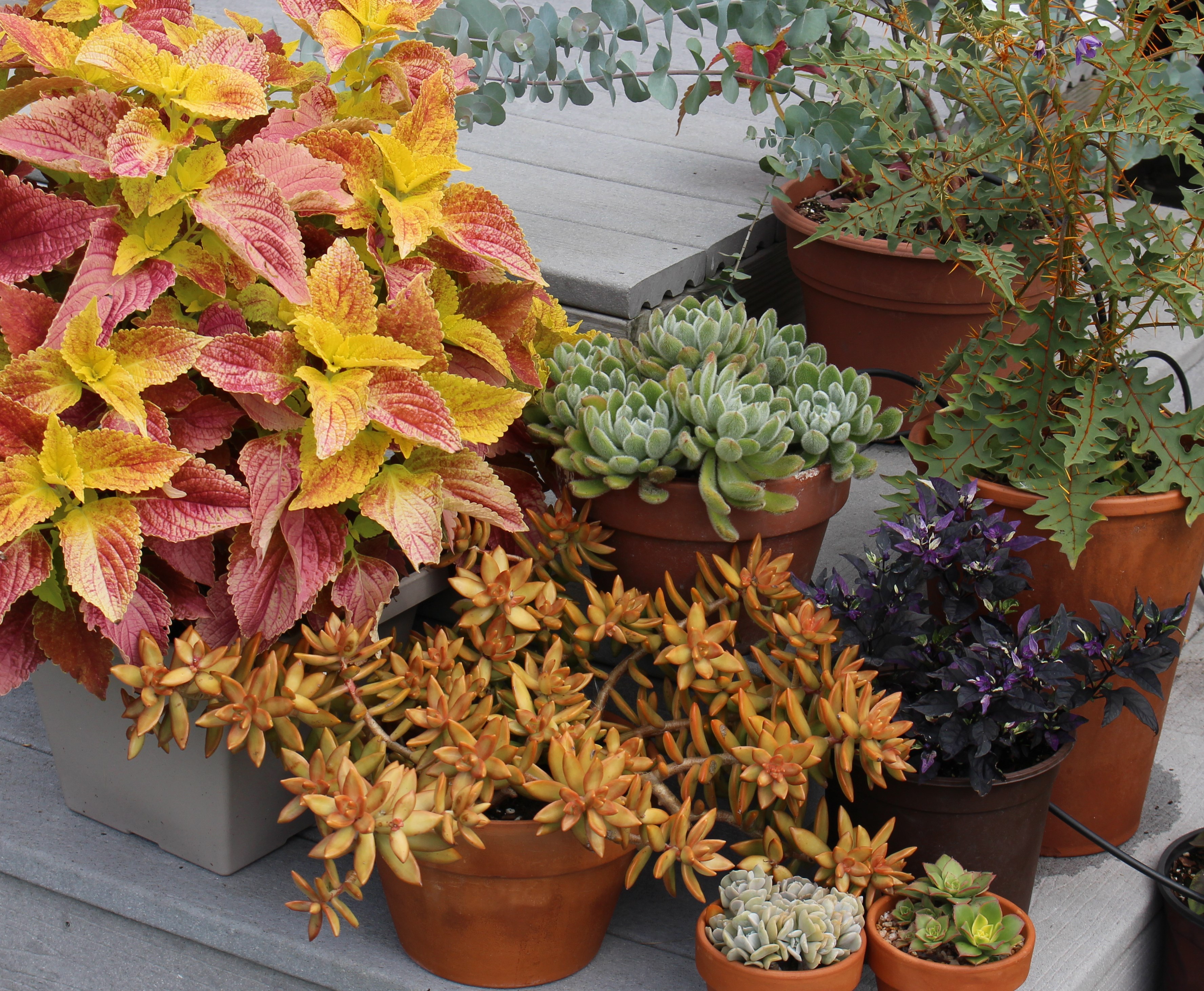
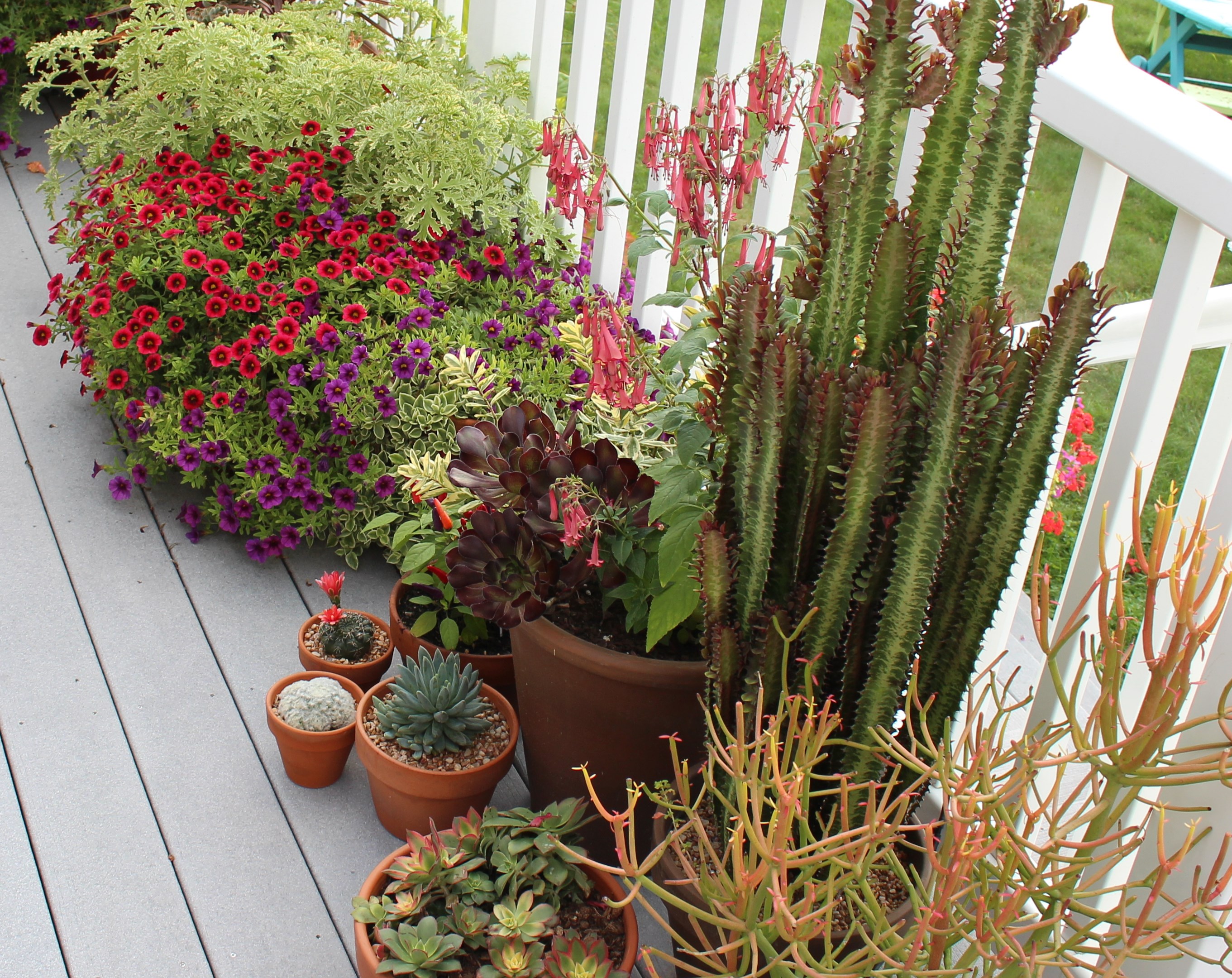
potted succulents

Little cacti and succulents which don’t mind a few missed waterings or weekend road trips.  They’re all foliage and make great deck plants… which look even better if the gardener finally repots them into roomier quarters (as I did this spring, although one of this bunch already needs a bigger home).

As I was walking about trying to focus on foliage, I realized this collection at the end of the deck steps doesn’t rely on a single flower to bring in the color.

deck planters

More succulents as well as ‘Alabama Sunset’ coleus, ‘purple flash’ pepper, and my belovedly spiny porcupine tomato.

It’s really way past time to do a catch-up post on this year’s deck planters (and hopefully I can come clean soon) but there’s only so much time tonight, and there’s still plenty of other foliage to consider in the garden.  For as exciting as flowers and color are, sometimes the eye needs to rest on a little green.  For me chrysanthemums are a nearly indestructible planting for some of the hotter, dryer, tougher-to-fill spots which could use a soft mound of green.

chrysanthemum foliage

Usually the iris in the back has nothing but sad, browning and yellowing leaves, but this year the rain has been enough to keep it growing strong.  The chrysanthemum on the other hand looks respectable for the entire summer, even when the crabgrass gives up.

Dry sun is bad, but dry shade is worse, and this year I’ve been surprised at how well variegated obedient plant, (Physostegia virginiana ‘Variegata’) has done.  In moist soil it may spread a little too enthusiastically, but here it seems downright demure, and I wonder if the straight green type would be as restrained.

Physostegia virginiana 'Variegata'

Physostegia virginiana ‘Variegata’ lighting up the shade.  It’s a dry spot full of maple roots, but the foliage on this plant still looks great.

In my only bit of non-rooty shade I can always count on the calm contrasts of foliage form and color via evergreens and hostas.  Although things are beginning to get crowded here, I won’t mess with this planting until it starts to look desperate.

shade foliage border

Along the porch the hostas cover the spring bulb plantings and dwarf conifers shelter the porch without overwhelming it.  They’re all slow growing plants, but not too long ago I remember being able to easily plant between these shrubs.

The calm of the shade garden is always appreciated in summer, but in sunnier spots August means flowers, and I do try for plenty of that as well.  Even with all the flowers though, a good foliage background can make a world of difference.

cannas and dahlias

The rich red flowers of dahlia ‘Mathew Allen’ set off even brighter next to the solid mass of the red-leaved cannas.   

I’m all for the masses of flowers but you sometimes need a rest here and there and a mass of foliage can be just the ticket.  For next year I’m already nursing along a few new bananas and elephant ears and I think things will look a little different in this border.  If worse comes to worse though I can always replant sunflowers 🙂

cannas and sunflowers

More cannas trying to keep their chin up against the tide of sunflowers which still swirls around the tropical garden.  In my opinion this bed could have used a few more masses of foliage to balance out all the bloom. 

So there are some August musings on foliage from my neck of the woods.  If you’d like to dabble a little deeper give Creating my own garden of the Hesperides a visit.  Each month on the 22nd Christina provides the platform there to host a foliage review, and I’m sure you won’t be disappointed by the foliage musings of bloggers from around the world!

Cook’s Treat!

A friend of mine likes to use the term “Cook’s Treat”.  I think he picked it up from Nigella Lawson’s cooking show, and likes to call out the phrase whenever he snaps up a particularly tasty leftover trimming or yummy browned crust.  The cook’s the one doing all the work, shouldn’t they get a break now and then?

Now my interpretation of “Cook’s Treat” is more like taking a swig of wine when I pass it to my wife for the shrimp scampi pan, so my version is a little different….. but why not try using it all over the place?  I’ve been tiling in the basement this summer, so how about a “tiler’s treat”?

new chocolate colored terra cotta pots

“Cook’s Treat” was called a few times on trips to the DIY store. Clearance sales, new pots, and irresistible plants all helped make lugging 75lb boxes of tile tolerable.

On yet another trip for mortar and grout I stopped in at a local store which specializes in liquidating odds and ends from other retailers.  Last year this store got in a load of pottery which included some chocolatey colored Italian terra cotta.  I carefully (and frugally) bought only two pots at that time.  On this visit I had my fingers crossed for an end of year sale, and almost let out an un-manly squeal when I saw 40% off.  Four more nice sized pots for just under $7 each and some $2.50 bags of potting soil came home.  The money I saved went towards an emergency nursery stop, and I picked up a dusty pink cape fuchsia (phygelius), purple aeonium, and a variegated hebe.  They were not on sale, but still a bargain compared to all the time and money spent on the stupid tile.

container plants for deck

You see deck flowers here, I see pots from last year and about five new pots which will all either have to come indoors or find some other safe spot for the winter.

New pots are becoming a problem.  The terra cotta and glazed ceramic that I hated when younger are now irresistible and I’m always bringing home another one or two.  I wish I had access to fancier ones (and could afford them) but for now the Depot and Lowes are nice and convenient.

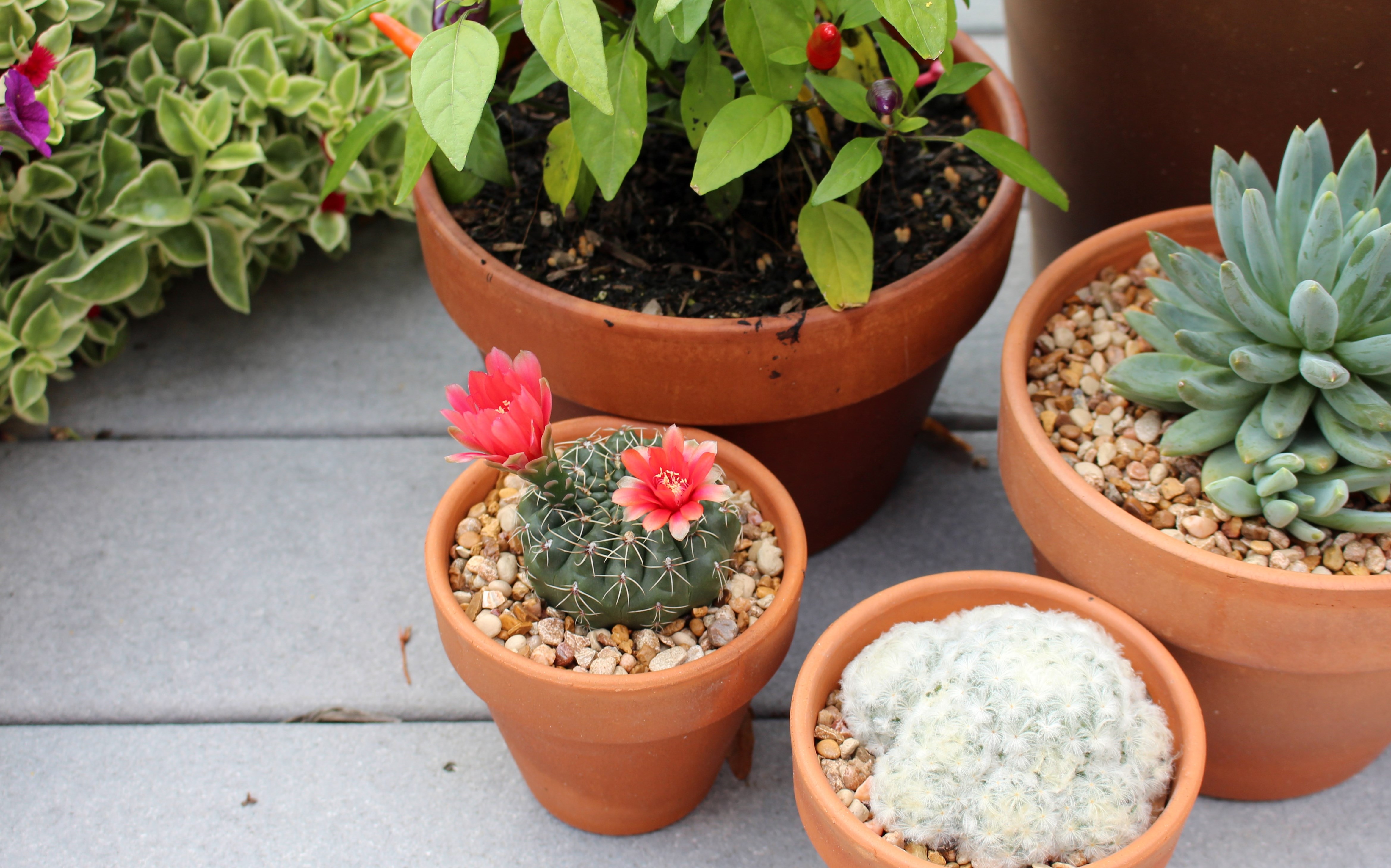
blooming cactus

The cactus and succulent need a nice heavy pot to keep from tipping over, plus unlike plastic the terra cotta breathes, and even when overwatered the roots still get enough air to not mind.

Just how bad it’s become will only really show up in another few weeks when I need to find wintering spots for them all.  Even if I don’t bother and let the plants freeze and die, the clay pots can’t.  They’re porous and absorb water and when that water freezes and expands inside the clay it will likely crack the pots.

miscanthus in pots

The miscanthus divisions from this spring have grown huge, and although they are planted in red plastic pots which can be left out all winter without being damaged, the plants will die when winter hits.  In pots, exposed out on a deck, plants generally lose about two hardiness zones.

Not everything is in fancy terra cotta.  This pot features a struggling pitcher plant which is the focal point of my exciting new bog garden.  Although there were a lot of complaints when certain family members discovered their ‘favorite popcorn tub’ was the only container I could find without drain holes, I think it’s working out fine.  I just wanted to add that things would be much greener if it didn’t dry out completely when I took the kids on a long weekend visit to my parents.  Apparently someone here thought the weak rain we had would be enough to keep it alive…. regardless of the explicit watering instructions I left for this one little pot!

container bog with pitcher plant

Rather than bear the label of “too cheap to buy a real pot” I’d like to think of this as recycling, or upcycling one of the many disposable plastic things children generate.

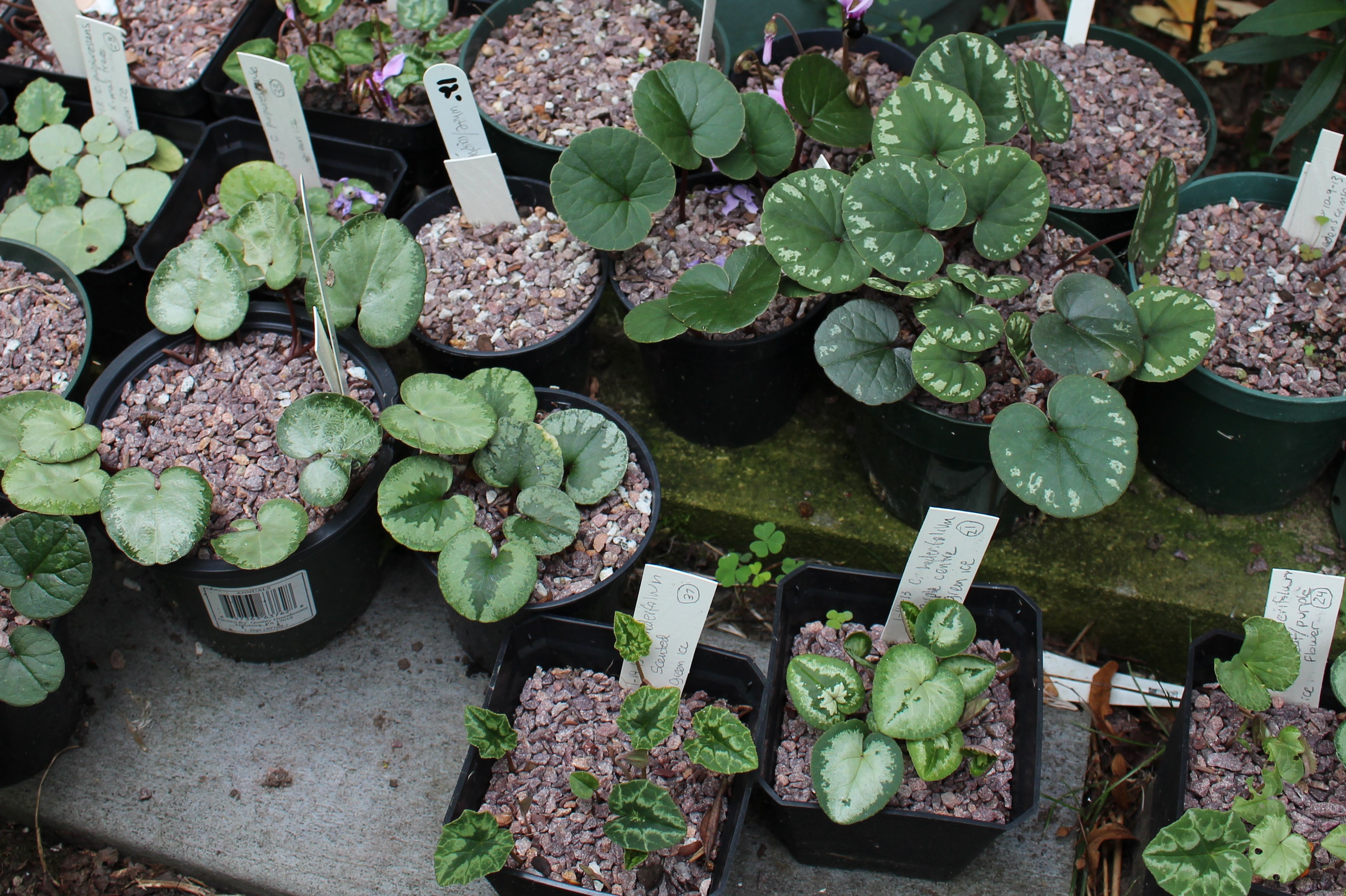
….and there are still plenty of cyclamen in pots.  For as much as I try, new ones keep showing up!

hardy cyclamen sprouting in the fall

Aren’t they the coolest little things? The cyclamen in pots always seem to sprout earlier than the ones in the ground….. and no, I didn’t spend $12 dollars on the empty pot, it’s just a second label to remind me this one comes back in under lights for the winter.

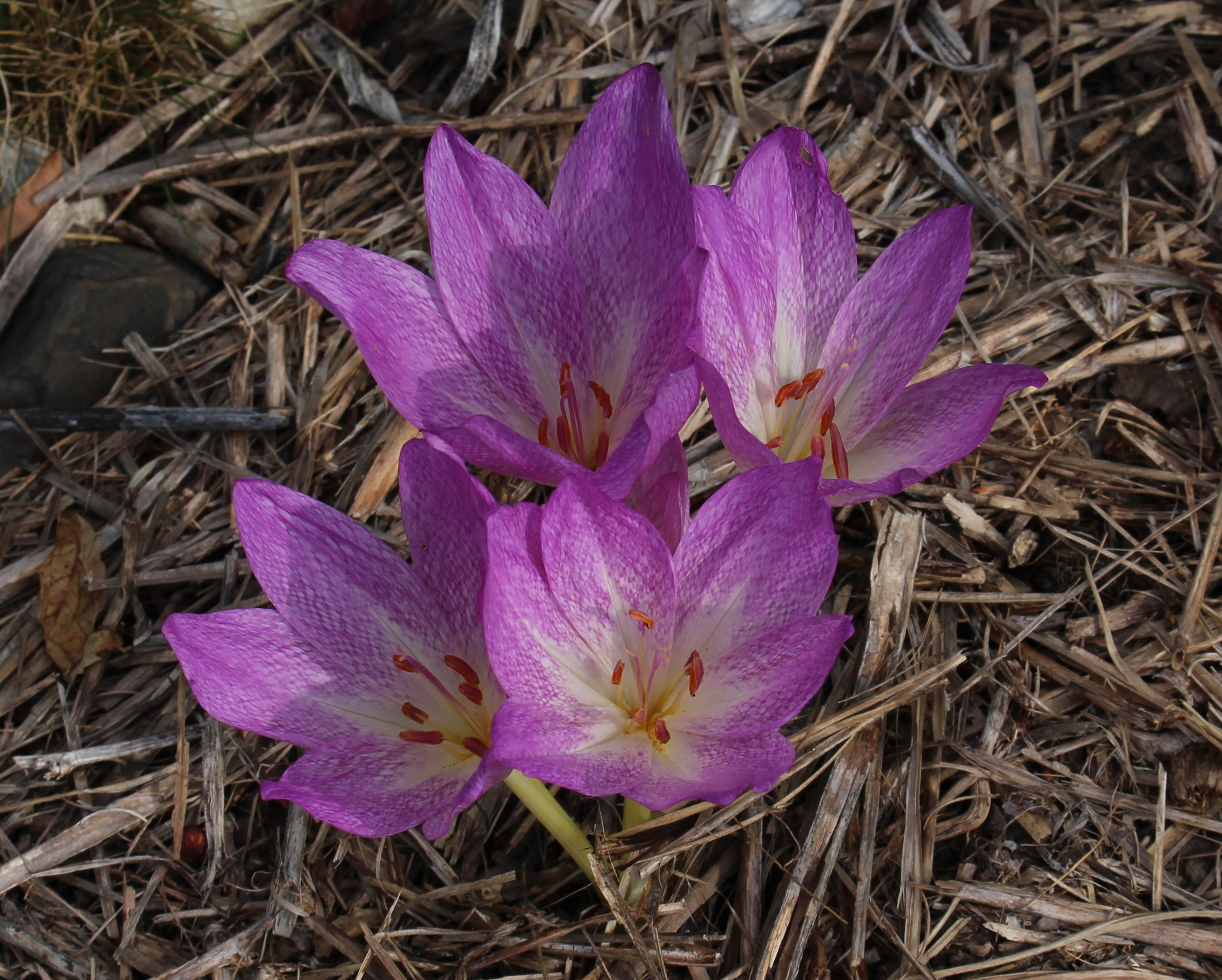
Thankfully I don’t grow any colchicums in pots.  This is a new favorite from ‘Daffodils and More’ and makes a nice start to the season.

colchicum "Disraeli"

colchicum “Disraeli”

I’ll probably have to make a full disclosure of pot purchases soon enough.  This is only the tip of the iceberg.  Things will look much worse when I start staging them all together to bring them inside 🙂

Same old story, dry again…..

The rains came, the grass greened, and all was well for a few weeks, but now it’s dry again.  I shouldn’t complain though since it hasn’t been hot enough to kill off anything, just a few wilting annuals and sad looking, dry dahlias.  Fortunately the perennials have deep enough roots to carry on, and overall the front yard doesn’t look too bad.

zinnias in a mixed border

The front border may be dry, but there’s still enough color and texture to keep things interesting.  I watered a little after taking these pictures…. the guilt of wilting zinnias and coleus was too much of a weight on my conscience.

When things go dry I start to lose interest.  The plants look sad and I hate watering, so my daily inspections just turn into bored sighs and a quick return to the porch furniture or air conditioning.  It’s a shame since so many things are still peaking and a little water would do a world of good for my thin quick-to-dry “topsoil”.

sedum spectabile brilliant

The sedums (maybe sedum spectabile “Brilliant”?) are in full bloom with bees galore, and help give some nice solid color to what otherwise might be too busy a planting.

I don’t like a planting that limps into autumn in a half dead state of decay.  I want something that hangs on until the last hard freeze forces things to come crashing down to an end.  In the front yard that means a mix of long season “lingerers”, late perennials, grasses of course, and plenty of planted and self sown annuals.

late season flower border

It’s mostly green in this border in June, but the color really revs up in September.   The yellow rudbeckias in bloom now came up as seedlings in June (when I finally got around to weeding and dividing and planting my way through this bed).

Occasionally some of the earlier perennials take a second bow.  This clump of delphiniums was great in June (for a few days before strong winds flattened them all), but now they’re back for some late season color.

rebloom on delphinium

Green grass, full borders, and rebloom on the delphinium.  The next storm will surely flatten them (again) but for now this corner by the garage is a nice welcome home.  This picture is looking out from the garage, across the walk to the front door, and on to the front border along the street.

The beds along the house are ok too, but much calmer.  This year I tried to limit the usual “too much color” look and stick with more gray and blue tones with some yellow of course.  The red coleus just happened…. you know I can’t go cold turkey when there is open soil and a few extra plants in my hands 🙂

ranch house foundation planting

The plants are a little spotty, but the overall effect is much calmer than last year…. even with a couple clumps of orange mums coming along 🙂

I guess a bright accent by the front door is sorta acceptable.  This almost became the year of the geranium considering how two pots overwintered became eight big plants when divided.  I really shouldn’t, but maybe I can just roll this pot into the garage and hope for the best when winter kicks in.  I’ve already got nearly a billion plants coming in so what’s one more pot?

potted geraniums

Potted geraniums, a perfect container plant for gardeners with a less than perfect watering record. Seeing the blue leadwort (ceratostigma) blooming reminds me that I wanted to try a few colchicums here.

So the front garden is aging gracefully and as long as a little rain comes our way it should still be a nice, colorful fall.  Seeing the pot full of geraniums reminds me of some developments this year which could now become an ugly problem.  My containers have been multiplying and it might be time for some plant confessions.

I’m pretty sure there’s fiber in icecream

Many people wax poetic on the joys of homegrown produce.  The flavor, the nutrients, the connection with the earth…. all good things and all good for you (and deep down inside I agree) but on the shallow outside I’d still rather reach for a donut or chocolate bar rather than a carrot stick.  Vegetables just don’t make my heart go pitter pat.

Because of that the vegetable garden always walks a fine line between productivity and extinction.  I love the look of vegetables bursting from the soil, but the newly dug beds and open ground are just too tempting to keep free of flowers.  At this time of year it’s more of a flower harvest.

volunteer sunflower

Oddly enough a sunflower has come up in exactly the same spot as one grew last year. It’s the perfect spot actually, and I’m glad to have it!

The season starts innocently enough, and with a strong will I turn under all the persicaria and daisies and whatever else tries to sneak in.  I need room for delicious lettuce seedlings and broccoli transplants and the flowers just throw off my industrially neat rows.  Things go downhill from there.

dahlia tanjoh

Dahlias always seem to grow best in a vegetable plot and when you’ve got one or two extra roots it seems perfectly logical to sneak them in between the chard. This is dahlia “Tanjoh” which I barely noticed last year as it suffered under the shade of a wayward sunflower.

Harvest time is always a problem.  If the broccoli is ready it needs to be picked, and there are only so many broccoli-cheese omelets you can reasonably fit into a weekend.  Things go to seed and I’m strangely amused to see weeds such as lettuce, pumpkins, and chard popping up the next year.

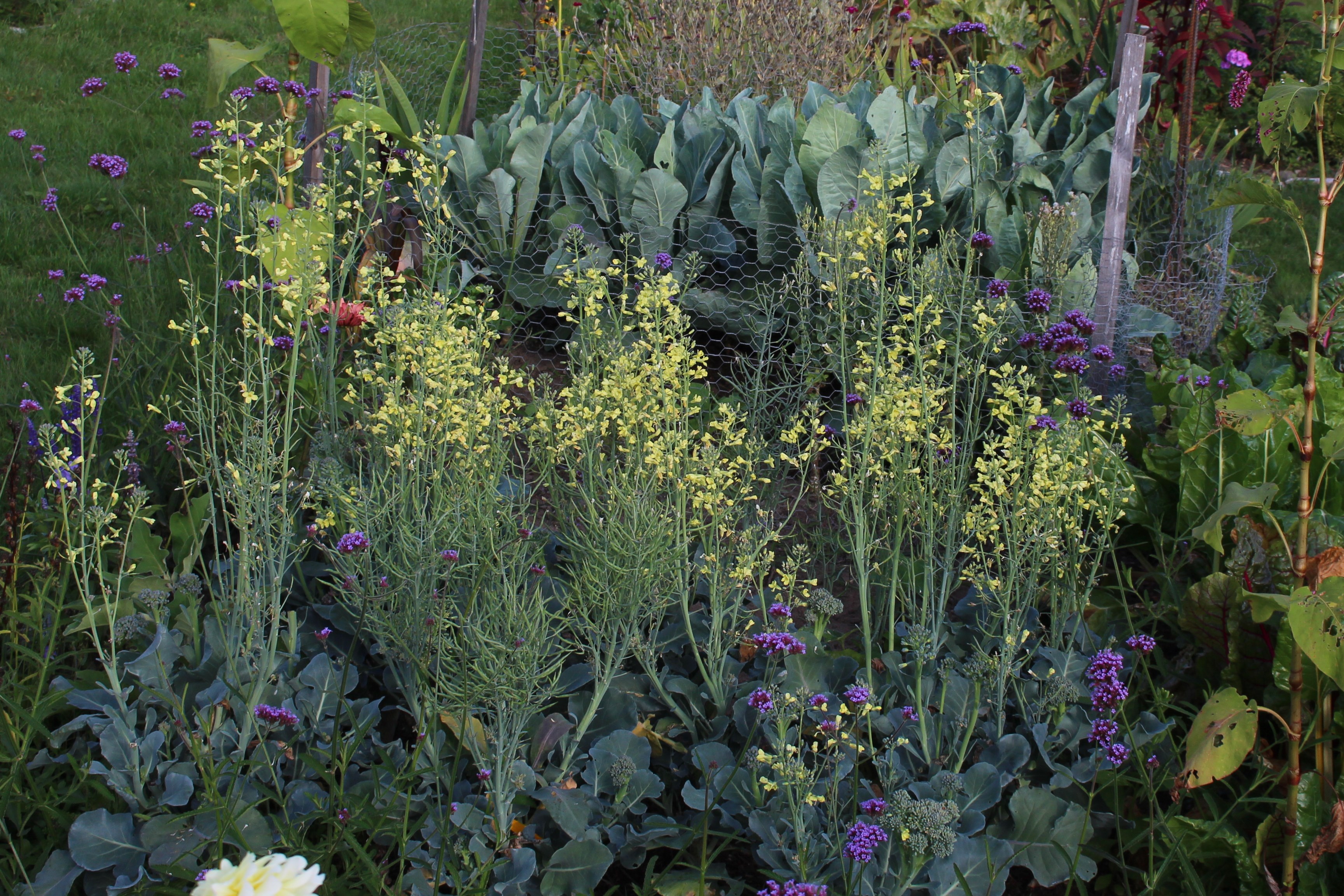
broccoli bolting

When you lose control the broccoli turns into a froth of yellow blooms and green rattail seedpods. Several of these plants were self-sown seedlings which just showed up from last year’s patch.

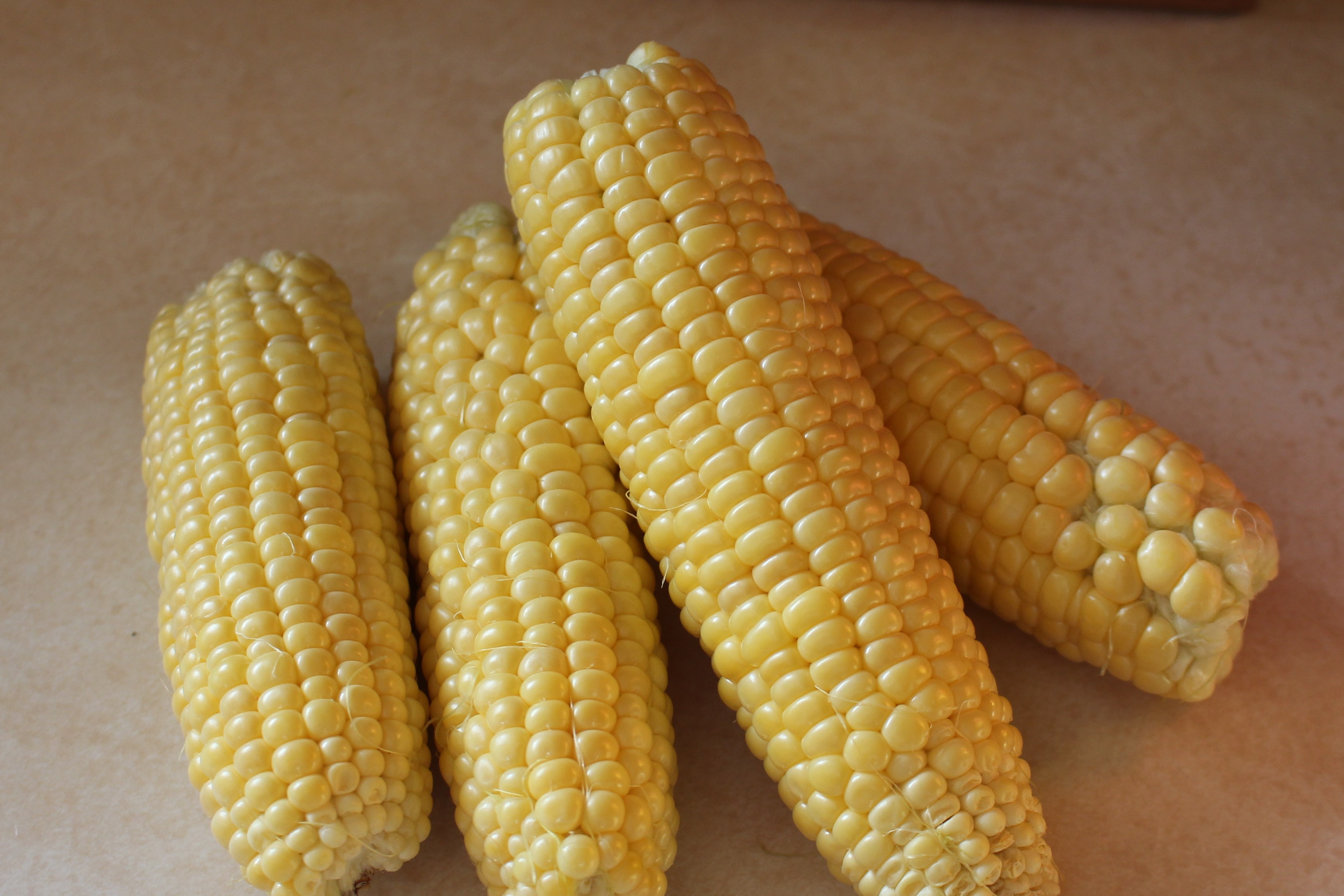
One of the sore points this summer was how often the sweet corn needed watering in our pancake-thin topsoil.  It seemed like every other day I’d look out there and see dry curled leaves begging for a little moisture.  Shockingly enough even after giving up in disgust the patch managed to produce a few deliciously sweet and flavorful ears.

freshly picked sweet corn

A space, water and fertilizer hog, freshly picked sweet corn is still worth the trouble (I guess). But it’s a tough argument when the supermarket has 6 perfect ears for $2.50 and mine probably cost me that much just for the seeds!

Another producer was a trellis of pole beans (which called it a year after being blown over in August).  Beans are nice on a trellis, but the kids appreciate “love in a Puffs” much more than bean salad.

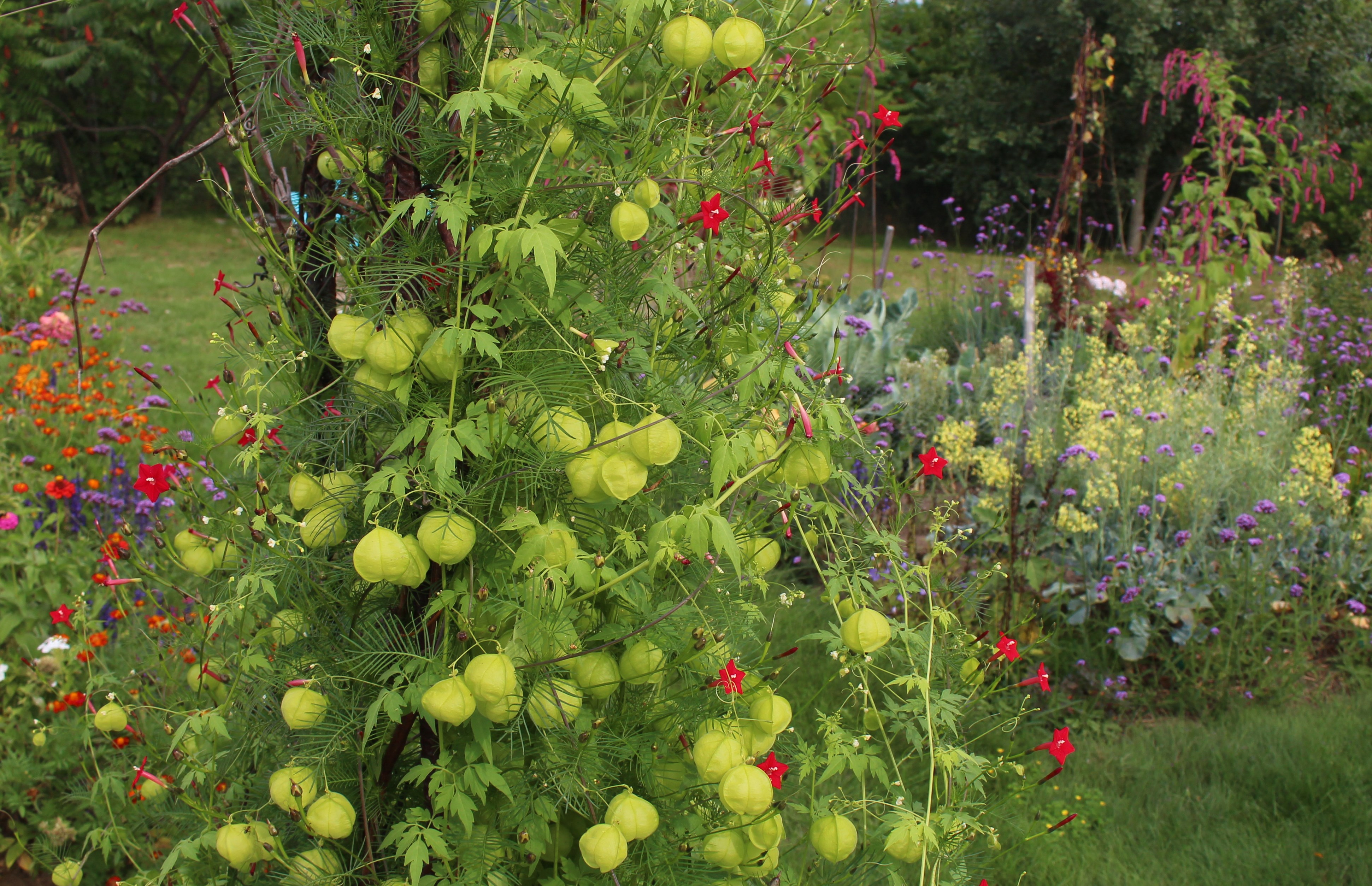
love in a puff and cypress vine

The pale green balloons of love in a puff (Cardiospermum halicacabum) with the ferny green leaves and red flowers of cypress vine (Ipomoea quamoclit). Both conveniently reseeded here at the base of the trellis from last year, something to keep in mind if you don’t like volunteer plants.

The kids share the love by picking the puffs and having a puff-fight but the real reason behind the name is found inside the puff on each of the vine’s black seeds.

love in a puff seeds

A white heart forms on each seed, a kind of ‘belly button’ from where the seed was attached to the plant. Glad my hands were clean for this one 🙂

There is plenty of ‘real’ harvest that comes from the patch.  Tomatoes never fail, even the fussier heirlooms, and here is a huge cluster of “Kellogg’s Breakfast”.  In a rare second appearance in a single blog post (I hate having myself show up in any pictures), I left my hand in there to show just how big the fruits are.  2 lbs, 14 oz for the pair in case you’re interested.

Kellogg's Breakfast tomato

Kellogg’s Breakfast tomato

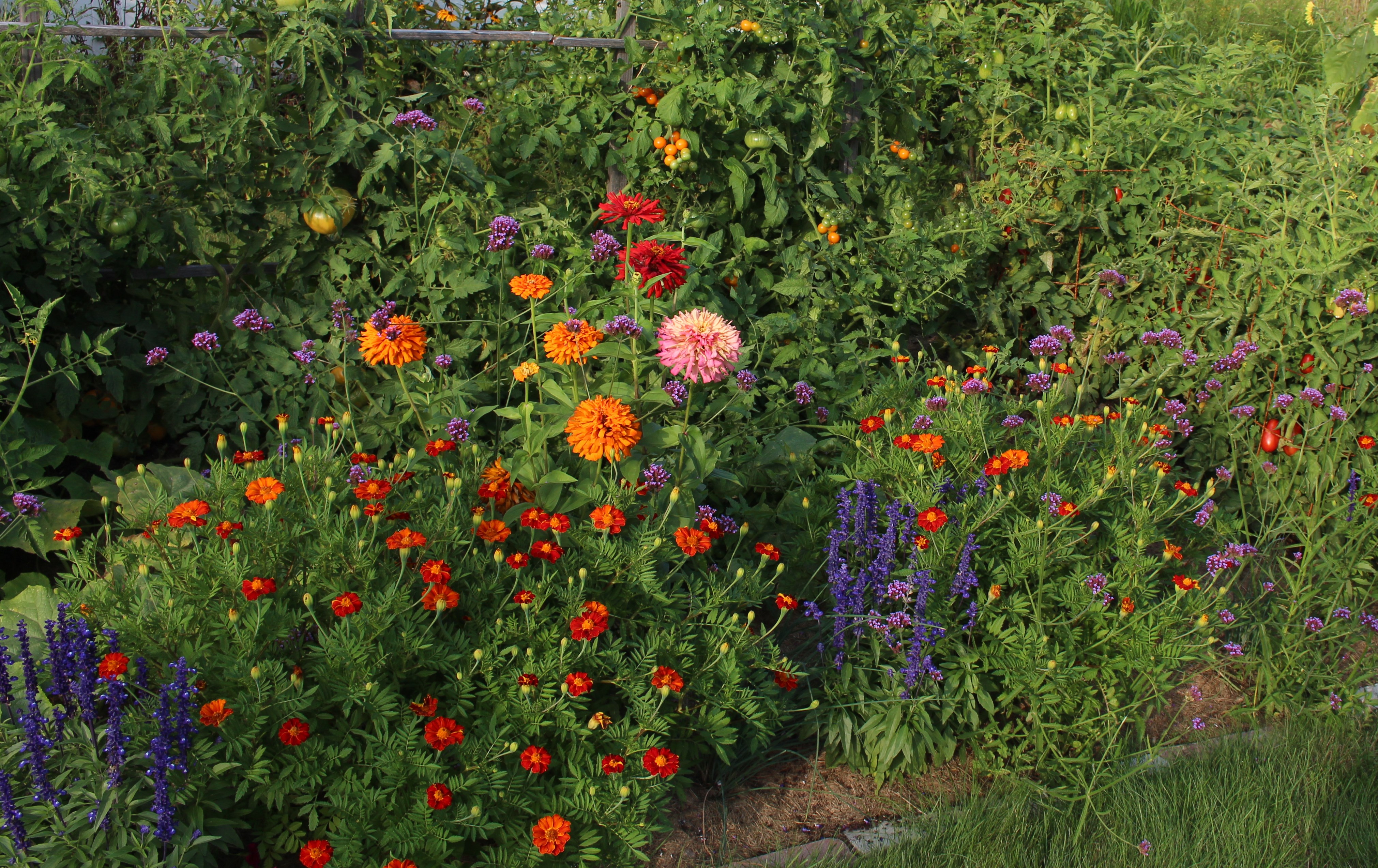
When I finished planting the tomatoes I couldn’t resist adding a border of “Moldavian” marigolds (from Nan at Hayefield) and a few stray salvia and leftover zinnia seedlings.  Might as well since the other side of the bed is edged in hellebore seedlings.

zinnias, marigolds, and blue salvia

A vegetable garden is the perfect place for bunches of annuals that might not find a place in the rest of the garden. The brownish orange of these “Moldova” marigolds might be hard to fit in somewhere else.

And did I mention I like phlox?  When you’re faced with a few new ones to plant and you’ve given absolutely no forethought to where they’ll go the vegetable garden makes everything better again.

phlox kirmeslander

Just coming into bloom now, phlox “Kirmeslander” seems almost too summery a color for the autumn-golds and yellows which are starting to appear.

With the season winding down one would think the vegetable patch would be safe, but fall is actually the most dangerous time of year for vegetable space.  After you pull up a dead, mildewed patch of zucchini the vacant spot almost begs for a few tulips or daffodils which you can’t find a space for elsewhere.  No worries though, I’m sure they’ll die down before I need the room for peppers!

Oh and I think the colchicums look nice blooming between the sweet corn stalks 🙂

In a vase on Monday: Goldenrod

In celebration of Labor Day and a Monday away from work, I’m once again making a contribution to the ‘In a Vase on Monday’ movement.  It may not exactly be a world changing movement, but it’s fun and does motivate me to bring a few flowers into the house so look at how it’s changing lives!

arrangement with goldenrod and dahlias

Another pluck and plunk arrangement. I didn’t realize how unbalanced it was until after I looked at the photos!

This week’s arrangement was inspired by Kimberley at Cosmos and Cleome.  In a recent vase Kimberley had the good sense to add a few sprays of goldenrod in to fill things up, and it took that vase to make me realize I have a ton of the stuff growing all over the place and should do the same!

goldenrod and dahlia

The just barely blooming goldenrod has a nice soft color and fills in well. It’s like a redneck version of baby’s breath plucked from the roadside.

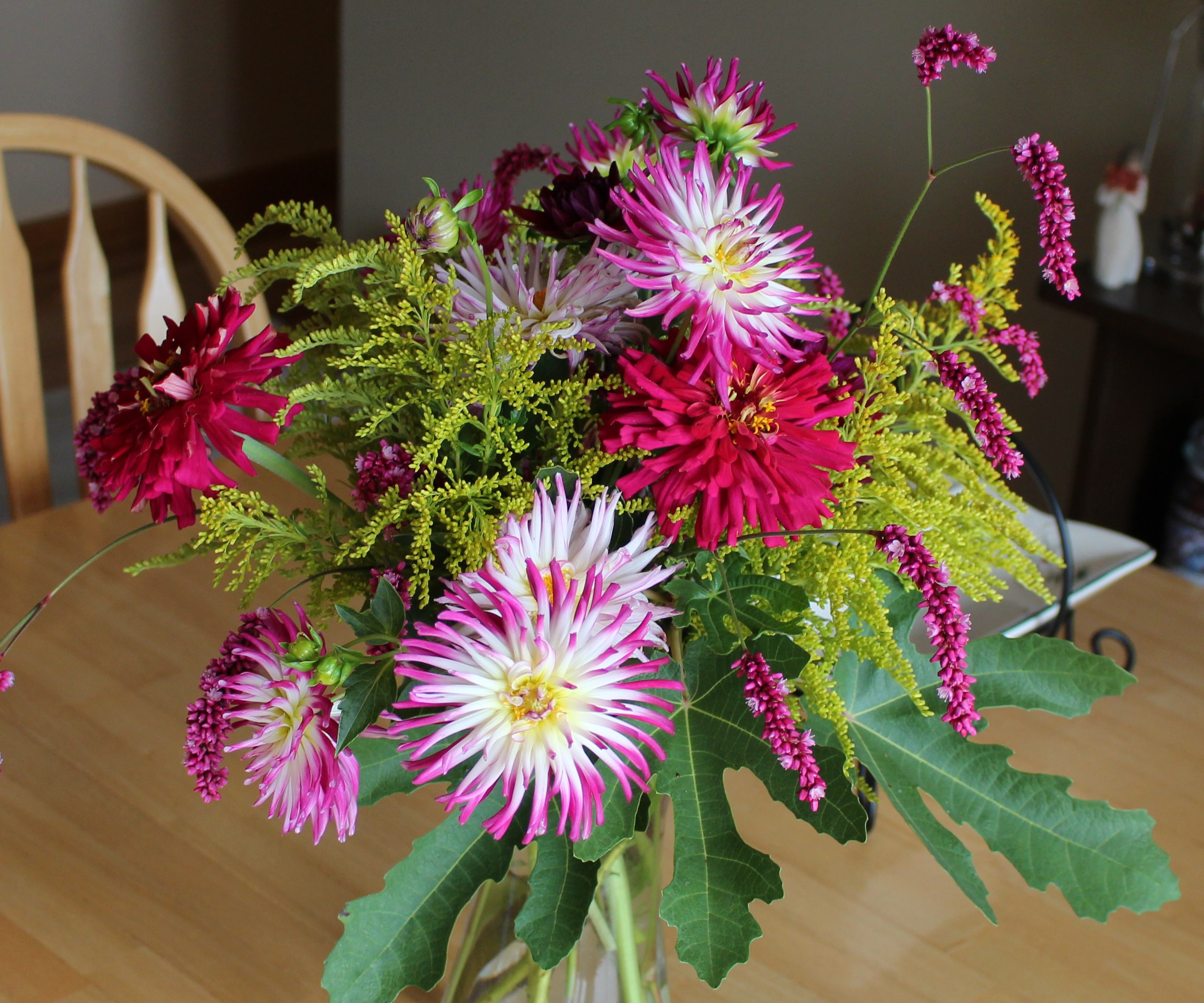
Besides the goldenrod, this vase has the pink tipped blossoms of dahlia ‘Tanjoh’, a purplish red dahlia (maybe ‘Plum Pretty’?), a few zinnias, a couple pink sprays of ‘kiss me over the garden gate’ (persicaria orientalis), and a few fig leaves which were in the way of my boxwood trimming.  I like it 🙂

dahlia 'Tanjoh' with goldenrod

The goldenrod makes up nearly half of the arrangement yet you really just notice the larger blooms. Such is the curse of a ‘filler’…

With all the goldenrod coming into bloom I may have to admit to myself that autumn is approaching.  On the road to college I was always disgusted by the mass of goldenrod yellow filling the fields along the highway, and it’s always been a mental marker for the end of summer and the return to work.  I guess that’s my bias against the plant, but because of its native status I tolerate it when a seedling shows up.

goldenrod for cutting

There are more than enough wayward areas around the garden for goldenrod to sneak in a rod or two.

Not to stray too far from my Monday vase, but I guess some goldenrod annoys me less than others.  One of the species is only just starting to color, and I think it’s my current favorite.

goldenrod and sumac

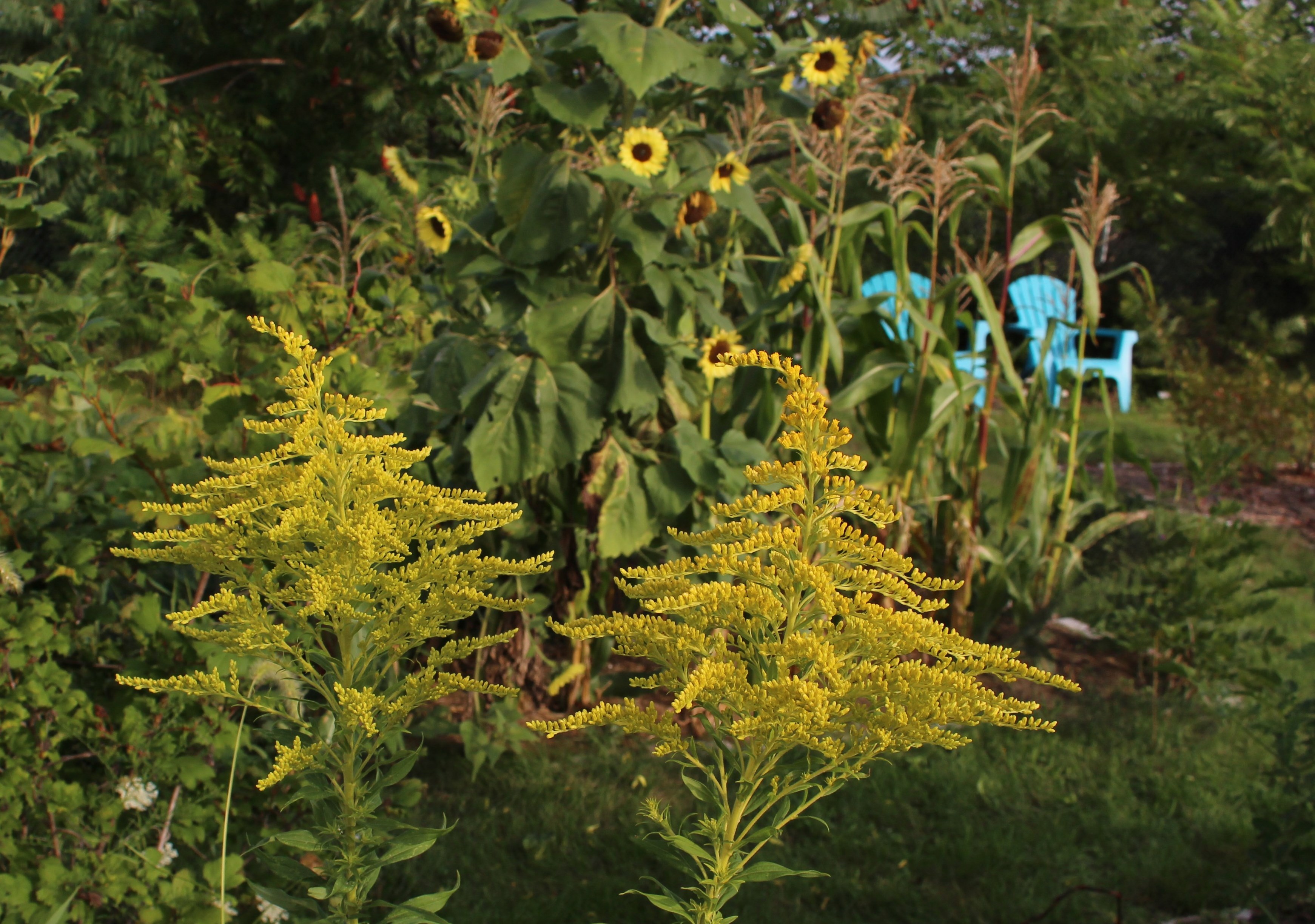
Goldenrod just coming into flower along with some staghorn sumac which the starlings and robins will enjoy this winter.

This floppy one is not a favorite.  Once it’s finished blooming I’ll run back here and mow things down to give the grass a chance.

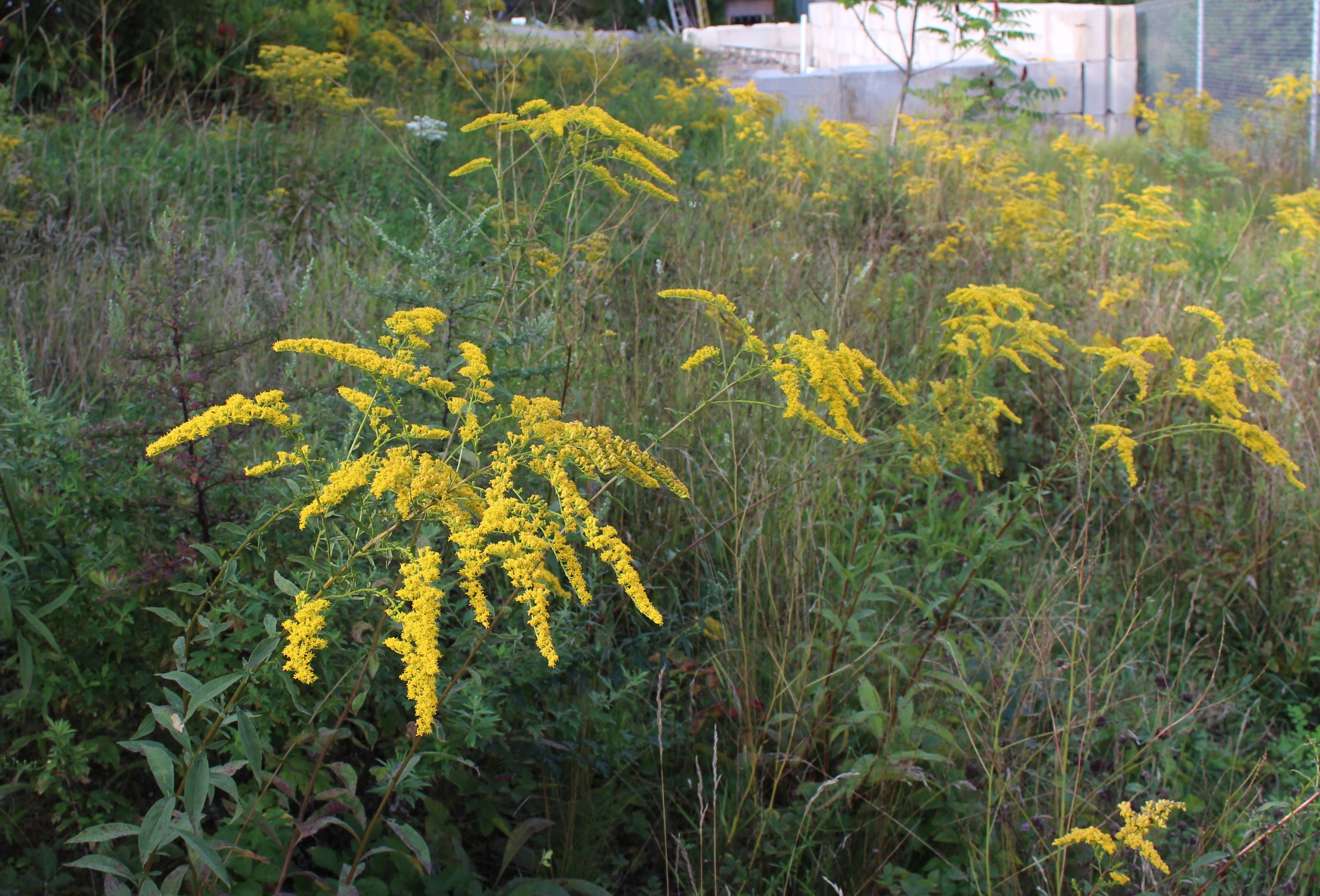
wild goldenrod

Not a bad goldenrod, there’s just too much and I’d rather leave a little room for some of the asters which are yet to come.

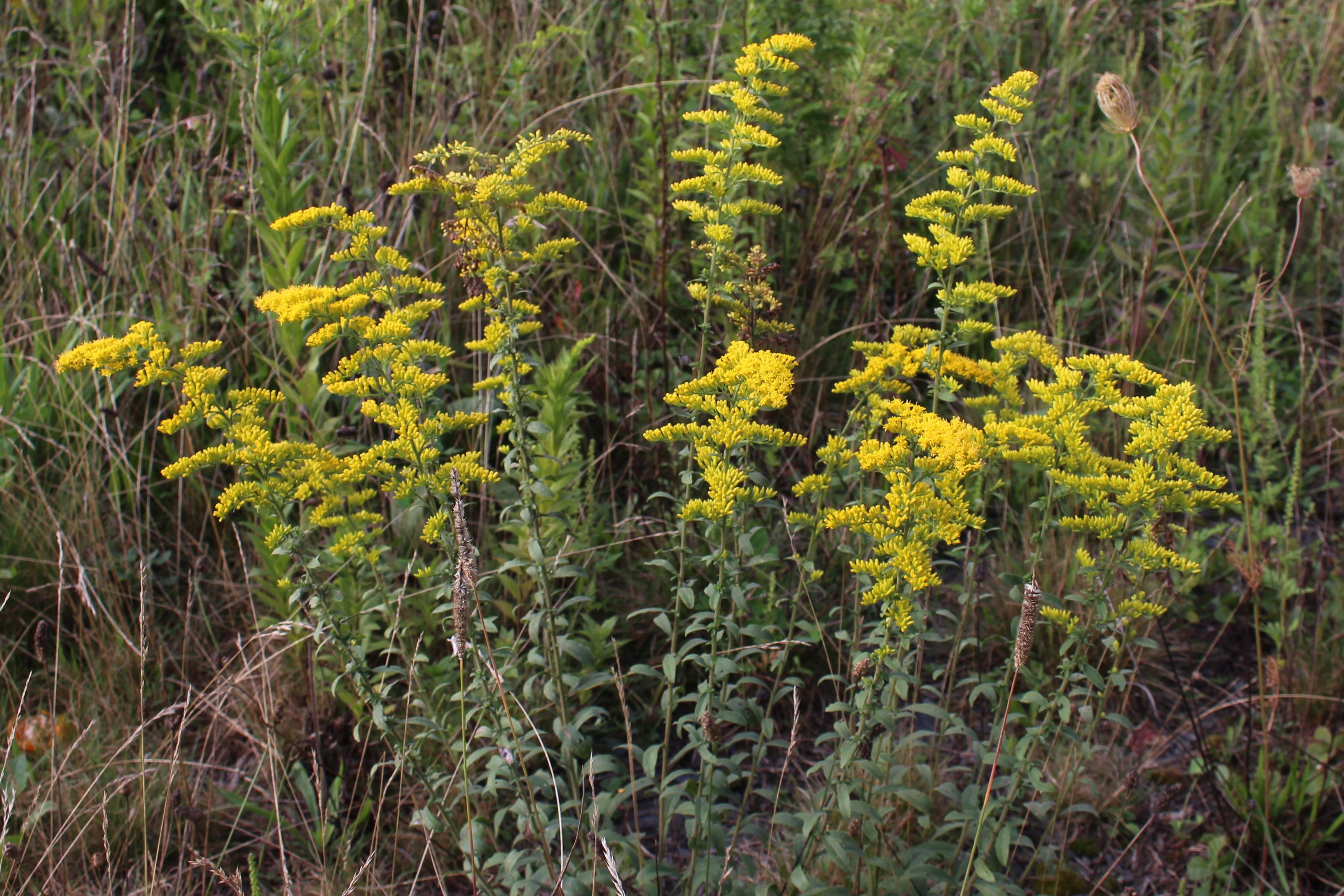
Here’s my last goldenrod.  I don’t know any of the species but this one’s a smaller, leaner version.  I would almost say I like it.

wild goldenrod

Unknown goldenrod…. any ideas? This one’s about two feet tall and like the others doesn’t need a thing from me.

Thanks for staying with me for my little segue from cut flowers to roadside weeds.  They’re wildflowers of course, and if I can just get past my stereotyping I may be able to call them all cutflowers someday.

If you’d like to see other cutflowers more artfully arranged I’d encourage you to visit Cathy over at Rambling in the Garden.  You can check out what she and other bloggers around the world are doing for their own “In a Vase on Monday”.   Have a great week!

Fluttering into September

Keeping a monthly summary of what kind of butterflies are flying in and out of the garden is a good idea, and Cathy over at Words and Herbs already does just that.  Each month she documents a summary of the regulars, the newcomers, and the rare surprises.  This month I tried, and although neither my patience nor my camera skills match hers it’s still nice to give it a try!

monarch on buddleia

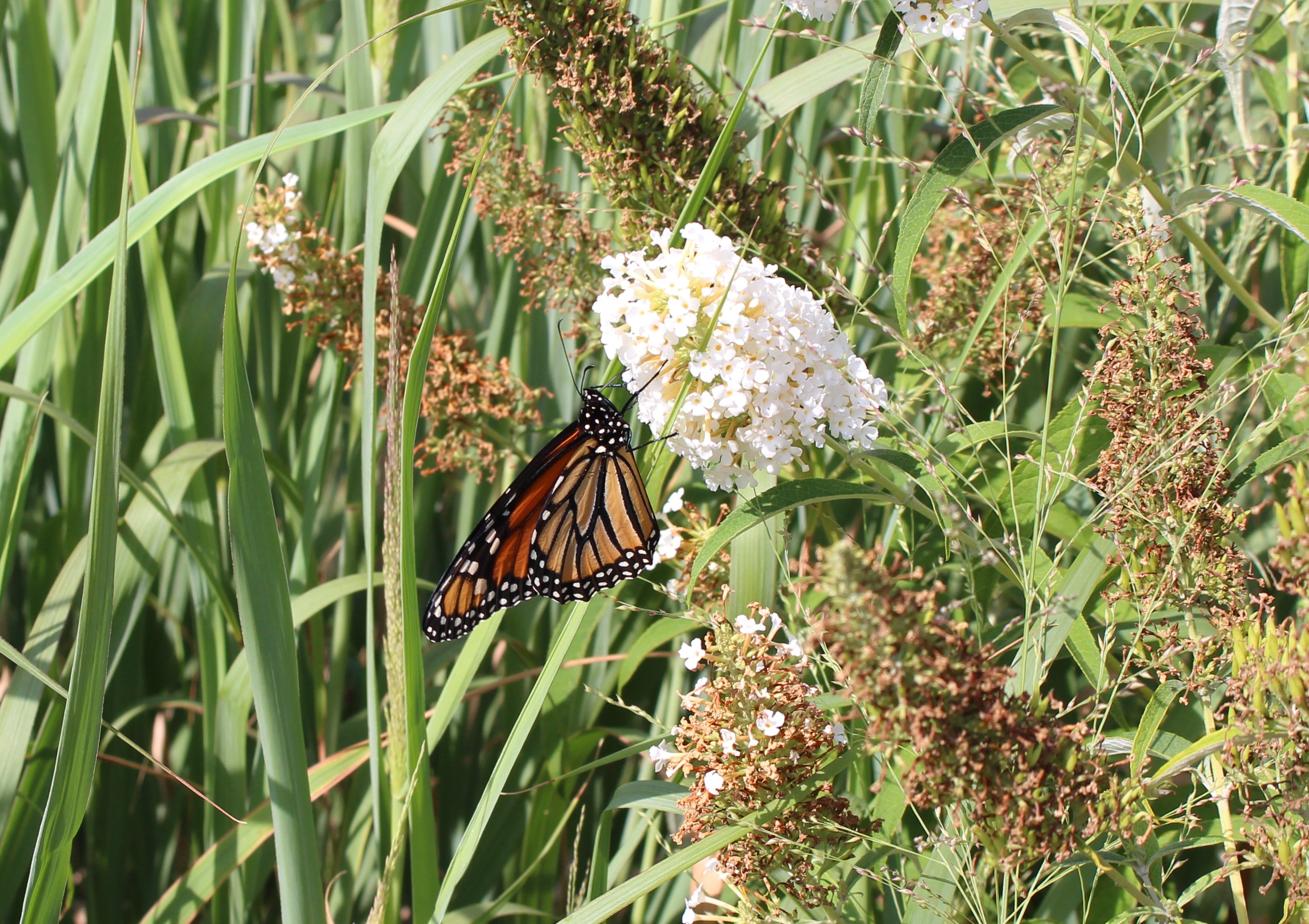
I would bet the Monarch butterfly is North America’s favorite. Here it is catching the last of the white buddleia.

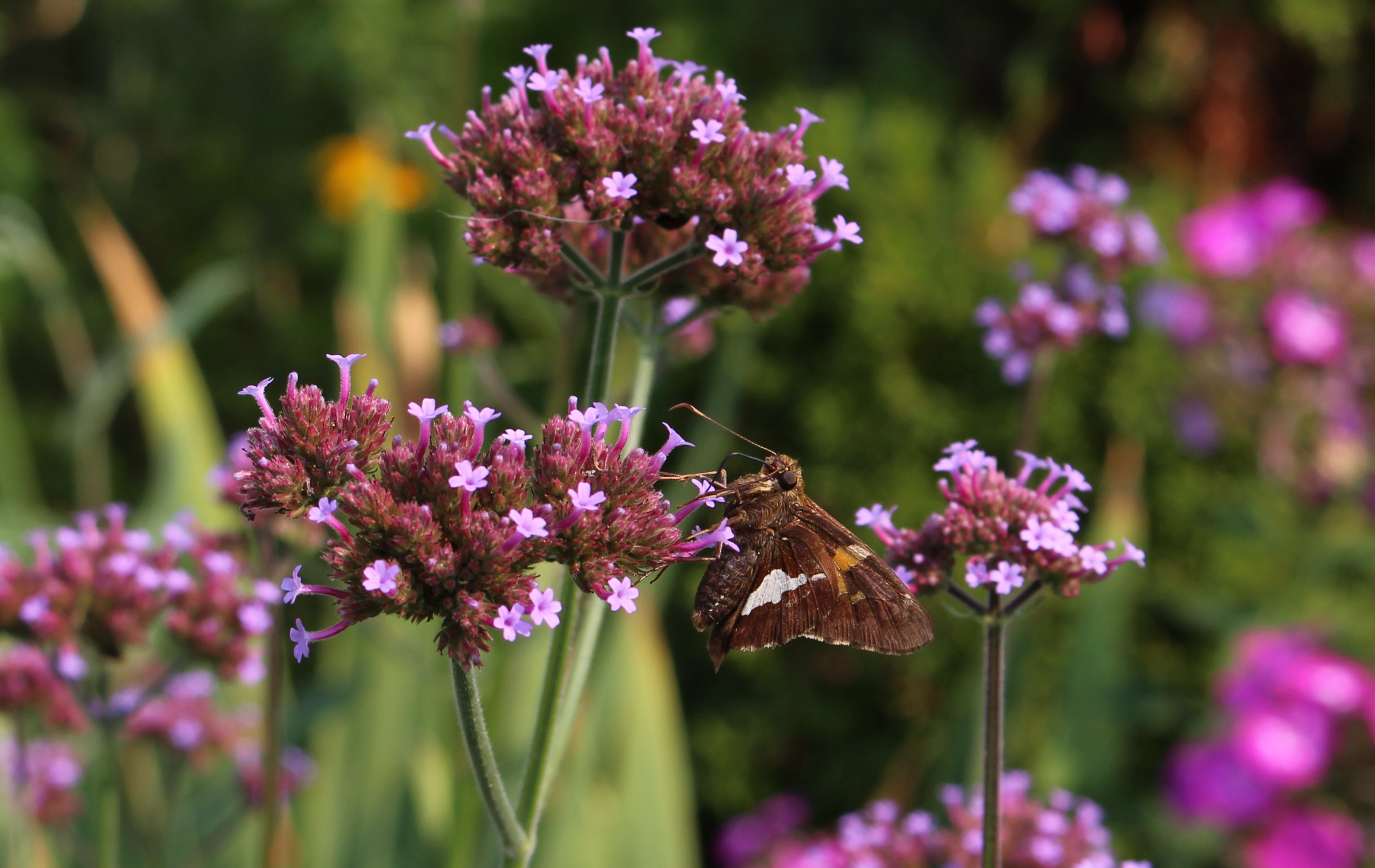
The one butterfly which swarmed this year were the skippers.  There were dozens flitting around the front garden, and although they may not be the flashiest they do seem to have a character all their own.

skipper butterfly on verbena

Skipper butterfly (I have no idea which kind) sipping nectar in the verbena patch.

I like to think my garden is relatively butterfly friendly with plenty of nectar plants and plenty of host plants to raise caterpillars on, but the whole idea of gardening with butterflies in mind always struck me as going against every other plant growing principle.  Butterflies are one of the freeloaders of the insect world.  If they weren’t so pretty and entertaining I’m sure most gardeners would focus on getting rid of them rather than putting out the welcome mat.  As youngsters they chew up your plants, and then as adults steal nectar away from the more industrious bees.  Bees at least spread pollen around, but most butterflies (less so moths) have delicate legs and strawlike mouths that just don’t pick up or transfer pollen well.  They fill their bellies up with nectar but the flower still has to sit and wait for a better pollinator to come along.

pair of butterflies

A table for two. I watched this skipper cozying up to quite a few single butterflies. No luck though, as each bloom went dry he left the nectar bar alone.

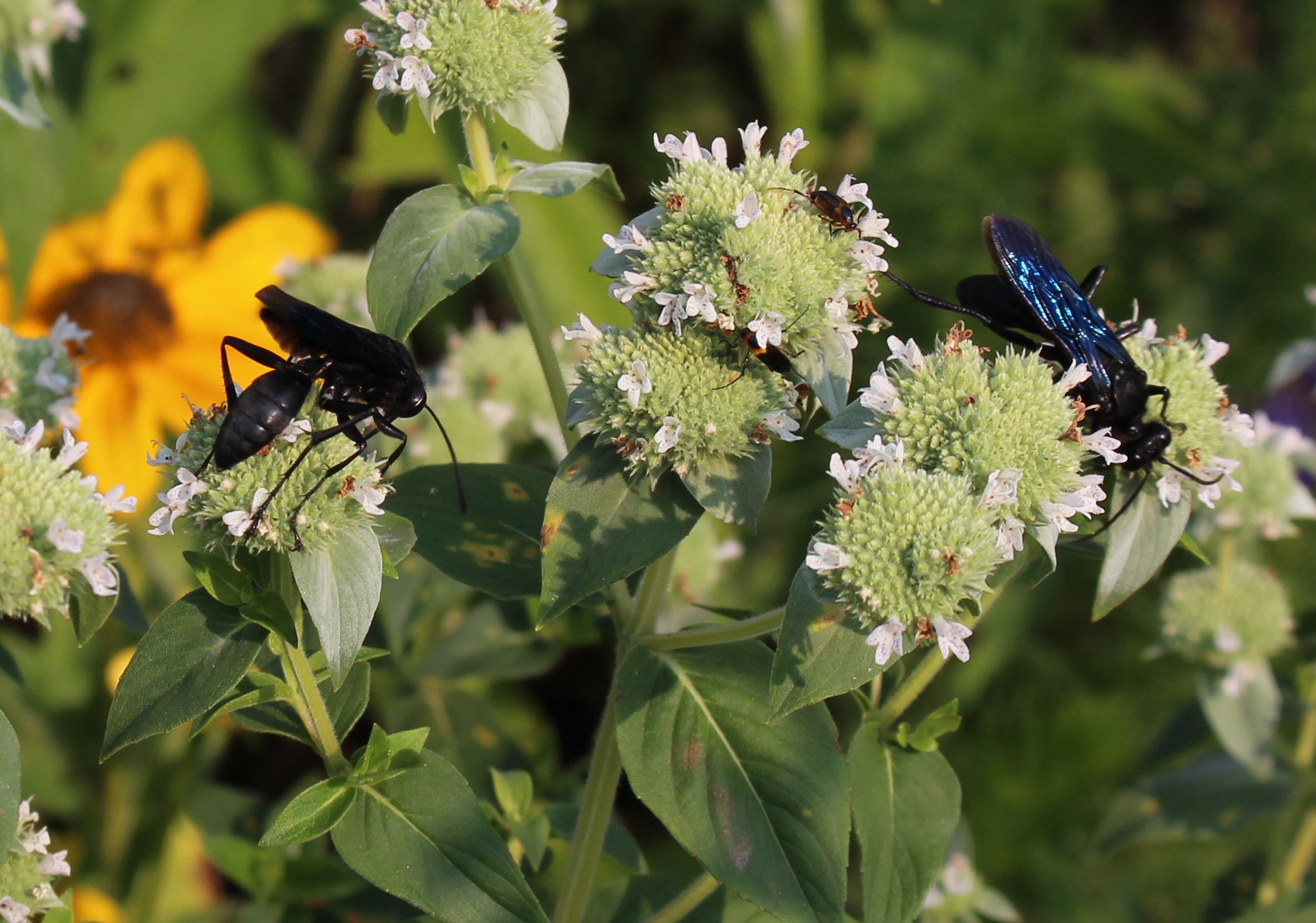
Freeloaders or not, butterflies are welcome here.  Actually with all the bees and wasps and birds in my garden it’s amazing any make it to adulthood to begin with.  Birds and wasps are always looking for a tasty caterpillar morsel to bring home… although I believe these blue dauber wasps are spider hunters.

giant swallowtail on buddleia

Blue dauber wasps, I think these are one of those creepy predators which immobilize their spider prey, pack them away in a tube with a little wasp egg, and then when the egg hatches the paralyzed spiders are nibbled up alive… yikes.

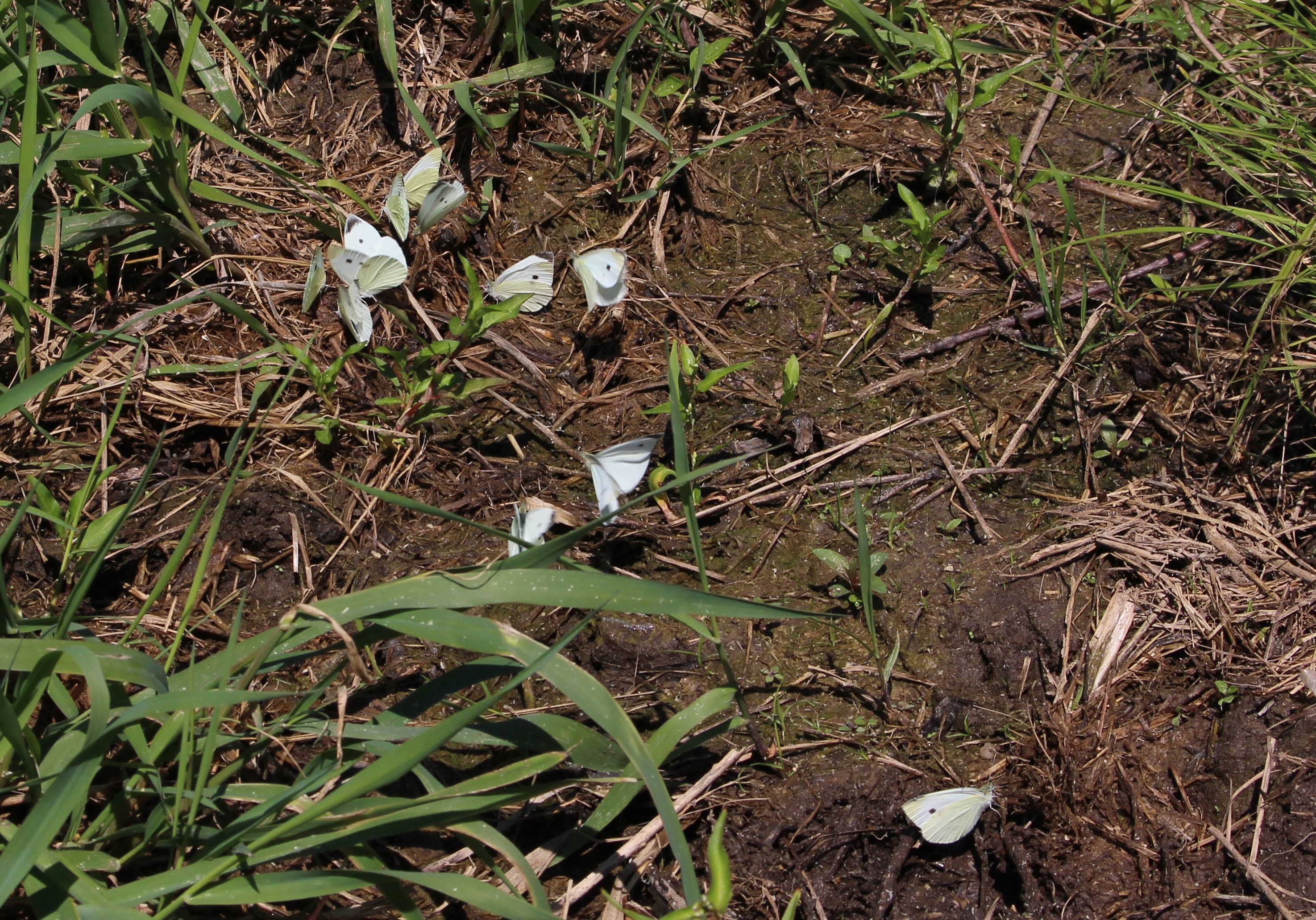
Butterfly cannot live by nectar alone, and while walking in a local state park I came across these cabbage whites “puddling”.  The damp spot where the butterflies were drinking was suspiciously downhill from the restrooms and their aging plumbing, and I suspect this seepage was rich in the salts and minerals that are otherwise missing from a nectar diet.  Not to paint the butterflies in too gross a light, but rotting fruit and urine are two yummies for a nice puddling party.  To each his own I say.

butterflies puddling

Cabbage White butterflies “puddling” at a damp spot, drinking in salts and minerals.

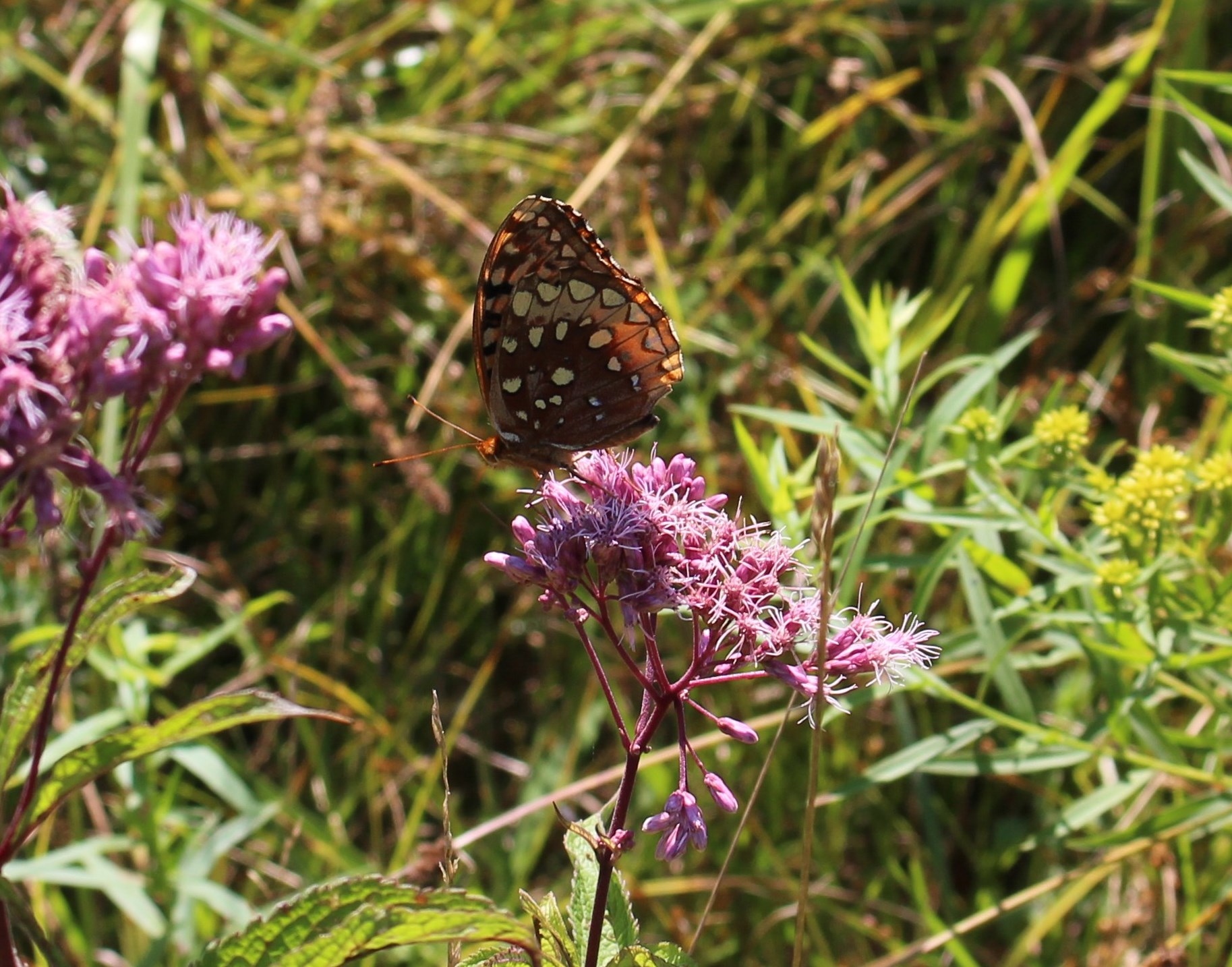
Also seen at the state park was this one.

butterfly on joe pye weed

Maybe an Aphrodite Fritillary(?) on joe pye weed? This one was also at the park although I’ve seen them in my garden too.

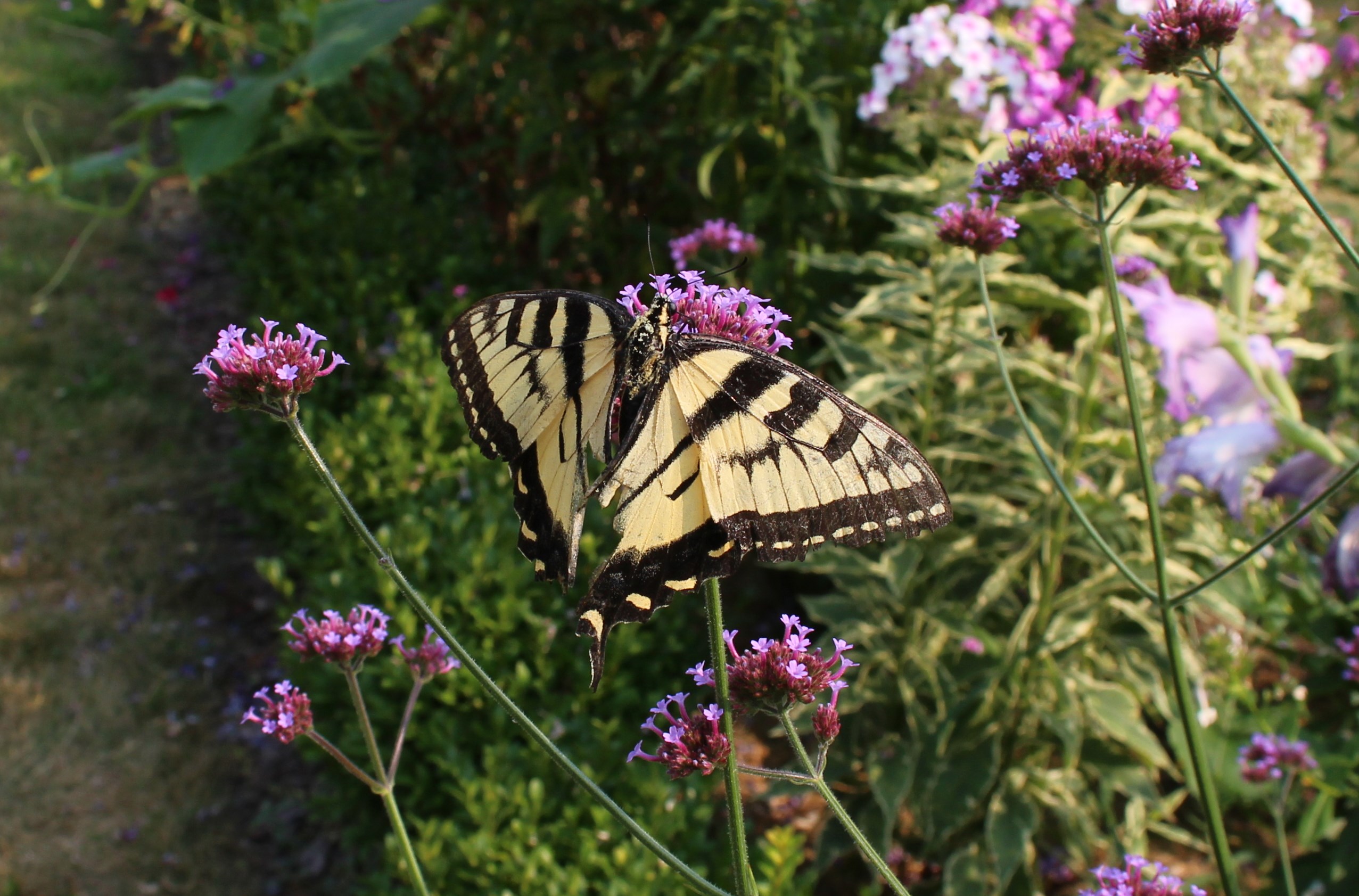
Everyone knows the Monarch, but the swallowtails are my favorites.  In the spring there were a few black swallowtails on the fennel, but the real fancy pants is the yellow Tiger Swallowtail.  This one seems to have run into one too many bird beaks.

tiger swallowtail

I don’t know how long they live, but this tiger swallowtail looks a little worn and ragged. Hopefully he found some energy in the verbena blossoms.

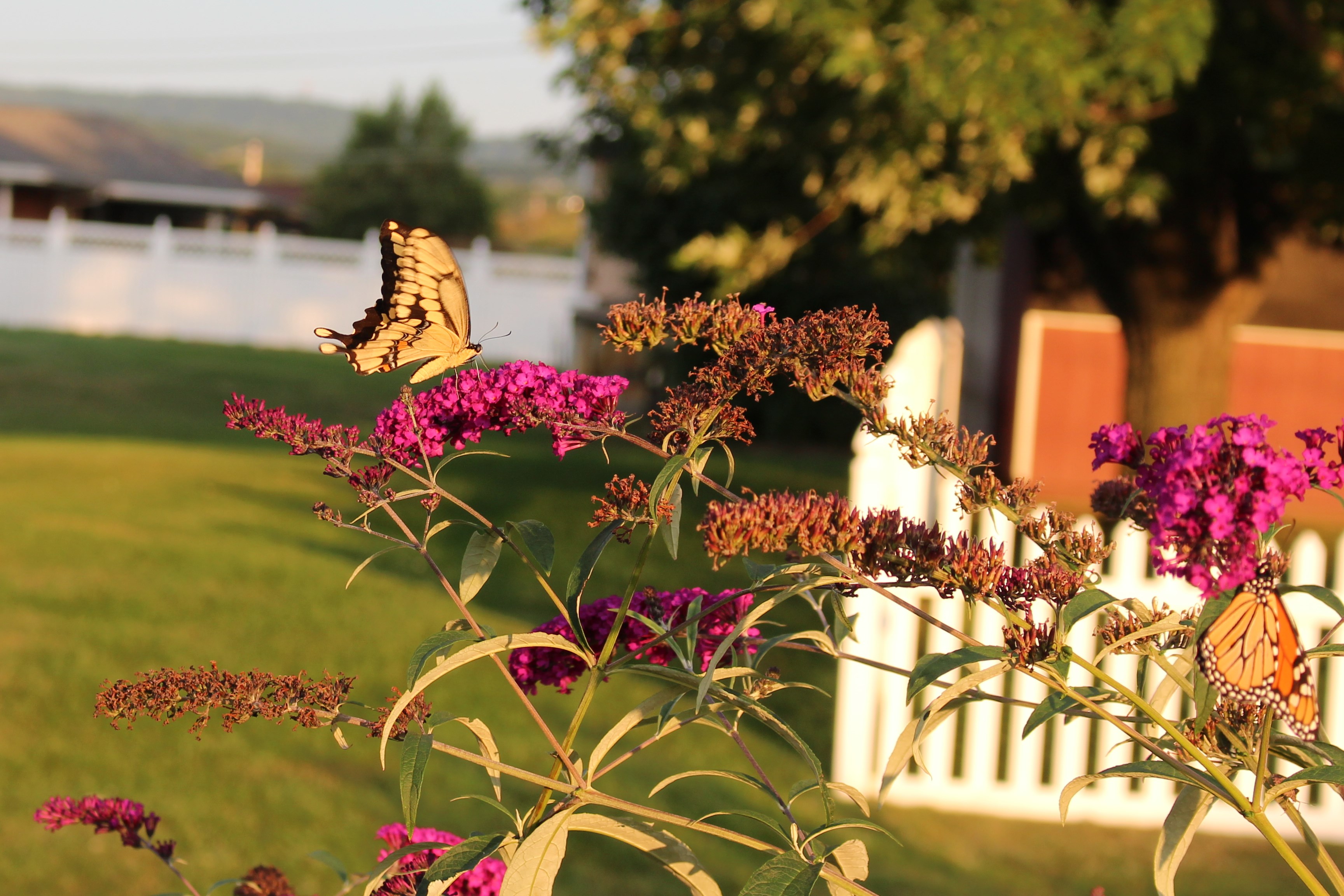
A not-quite-as-yellow as a normal Tiger Swallowtail turned out to actually be a Giant Swallowtail and I was quite pleased.  On the first visit I didn’t get the camera, but when he was back the next day I gave it a go.

giant swallowtail

A Giant Swallowtail, not much different than the Tiger when the wings are up.

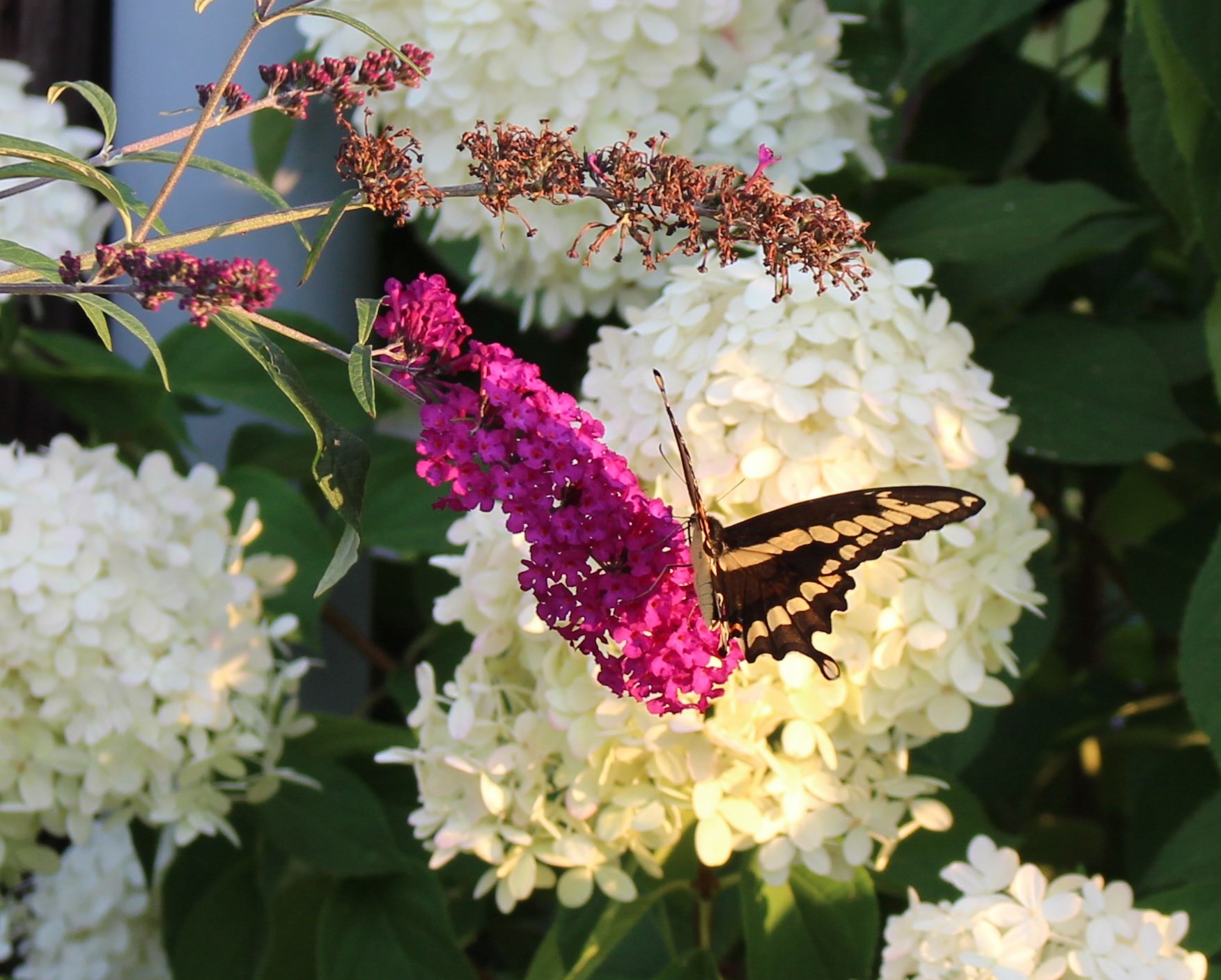
If only the breeze would have calmed, maybe I could have had a clear shot, but as it was he kept on fluttering to keep his balance.  I wanted to get a shot of the darker backside to the wings.

giant swallowtail butterfly

This Giant Swallowtail wasn’t much larger than the Tiger, but in much better shape. Too bad he wouldn’t sit still for his closeup.

So there it is, an August summary of some of the fluttering butter which has been passing through.  Wish the shots could have been clearer but I’m just grateful I was able to get the ones I did!  Hope you enjoyed.