October.


To be honest these photos are about a week old, and when I say “about” you could probably add another week on to that if you’re really dotting all your i’s and crossing your t’s but… *edit* Okay so still trying to be honest (which becomes rarer each day that AI creeps further and further into our lives) just editing a few pictures and writing one sentence appears to add another week onto the timeline, so now rather than an update on the autumn garden this is probably closer to a retrospective.  Let’s call it a retrospective on fall and hope the next post doesn’t become a retrospective on winter.
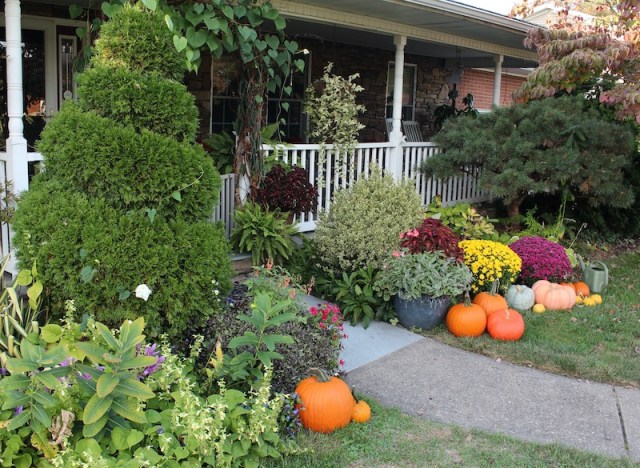
autumn porch decoration

The autumn porch decorations.  A little more than usual this year with three purchased mums and a couple pumpkins and squash to boost the home-grown display.

As usual no excuses for the delays.  The only one I can really put a finger on is the morning when a child asked if anyone was coming with her to a college visit she had set up.  Oh really?  As the parent who drew the short straw I had fifteen minutes to prepare for a day on campus rather than a day bringing in houseplants and that’s probably sounding worse than it really was since much of my life involves fifteen minutes to prepare for something I either put off too long or forgot about, but it’s an excuse for one of the days at least.

potager garden

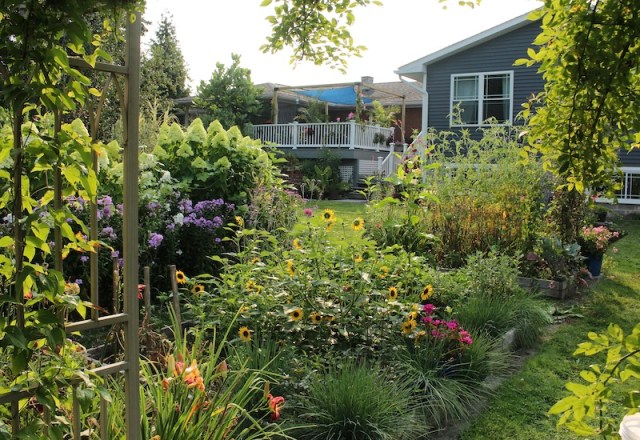
With the return of rainfall the potager is at least green even if it’s not lush and productive.  Perhaps it’s time for some potager-love, and next year this area will hopefully get some well deserved attention to weeding, watering, and planting.

Maybe it’s time for a what-you-did last summer retrospective since a true update might need to go back that far.  Going all the way back to June the summer was off to a ‘let me just quickly build a shade structure for the deck it will only take a weekend’ start, and news flash *it did not take only a weekend* but it did start off a tropical revival on the deck.  Some corner braces for a 4×4 frame with a shade cloth hung between them and voila!  an excuse to spend the next two weeks re-painting porch furniture, repotting tropicals for the planters, dragging tables and furniture and a tv out to the covered porch, mosquito netting… way too much, but it was all because I saw the corner braces online and between that and two $15 palms which were too amazing to leave at the store things escalated.

tropical deck plantings

The deck was more foliage than flowers this year and now I’m faced with how to overwinter a pair of palms which were probably cheap enough to leave outside, but I could never do that.

So the deck was an innocent start but then as you may recall there was the bulldozing of the daylily farm which happened as June rolled into July.  Things were set into motion.  Rather than replant a few daylilies, three unearthed stones became a rock garden and you know about that, but the rock garden needed a coating of sand and of course I got too much because sand is always useful around here.  Some of the extra sand was used to level out an area where the kid’s old playhouse, aka ‘spider house’, could be placed.  We have no use for a kid’s playhouse currently yet no one to give it to but what if it was repainted and accessorized?  Enter a rebranding of spider house to ‘Begonia House’ since perhaps this area provides just the right filtered shade which the begonias seem to enjoy, and “I think pink would be nice for my house” became the color theme.  A green roof?  We shall try.  The results straddle the line between garish, spray-painted plastic garden trash and elite garden whimsy but I like to pretend that it’s whimsy.  Several great gardening estates have whimsical garden playhouses for children so there you are.  Whimsy in the garden, except my visitors like to over-pronounce the ‘Wh’ as in Cool Whip and I guess referring to it as whhhhhimmmmsy is as classy as we will ever get.

whimsical playhouse

Begonia House’s first year in the Northern corner of the estate.  I’m sure the nearby coldframe and leftover lumber pile only add to the ambiance, but the begonias appreciate the new setting.  I was able to easily gather multiple large overwintered begonias from around the estate but I’m sure that’s not a problem.

So with some of the sand taken care of it was time to address another bit of daylily farm repercussions.  When it happened I lost a lot of plants.  I was angry.  No I didn’t want the town to replace them but here’s a deal which I could get behind.  I have concrete blocks as steps going up the berm which separates us from the industrial park.  They’re kind of ugly but they save me from many a twisted ankle and tumble down the bank as I weed wack or do other maintenance.  If you can get me stone steps to go up the berm I will stop complaining about the lost daylily farm and even worse, the snowdrops which were destroyed.  So there I was for another couple weeks manhandling 300 pound stone treads into the yard and up the slope and then why not add a bunch more stones to the berm and then mulch it all.  Extra stones?  How about some more square stacks of rocks at the base to put potted succulents on.

stone steps

I think it looks better.  Eventually new plantings should tie the steps into the berm a little better but for now I’m waiting to see all the weeds which return before I go putting too many things in there.

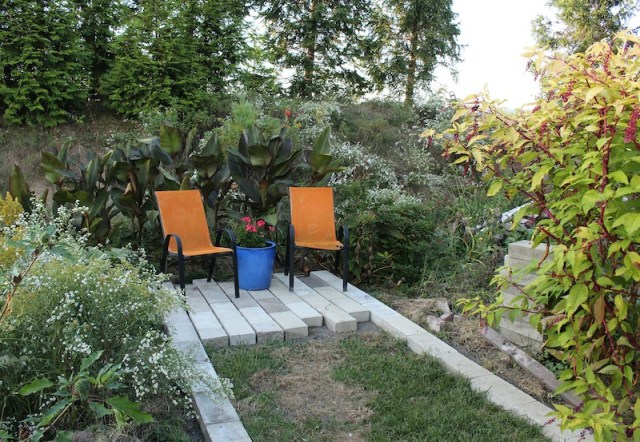
Seems like we’re covering a lot of ground here and I guess we are but remember this is the whole summer we’re looking at so don’t be too impressed.  Plenty of time was spent sitting around and doing nothing which is more par for the course, but one more thing before I get back to that.  A course of concrete blocks was pulled off the berm steps in order to put in the stone steps so why not make a little sitting area in the ‘waste area’ with the extra blocks.  It looks raised but that’s only because the fill here has settled and the area needs just a little more soil to level it up before I’ll be happy with it, so I tried to look ahead a little and prep for that.  I’m probably sharing more than you care to hear but the blocks just add on to the leftover soil and mulch from the daylily farm re-do which also ended up in the ‘waste area’.  Actually the ‘waste area’ isn’t really much of a thing any more but I’m not ready to post the pictures which prove it so you’ll just have to trust me that daylilies are being rowed out and hopefully it will look nice by next summer…
potager garden

It doesn’t look like much but the last of the sand was just enough to bring the blocks up to a level which I like.  A few more blocks cut in half to square off the patio, some more dirt to level the lawn, dirt to create beds on the sides, mulch, plants…. ok it’s a start at least.

Now it’s autumn though.  We had a touch of frost a few days ago and that was just what this gardener needed to remind him that a bunch of stuff needs to come inside and under shelter before the cold becomes more serious.  He tried for one night to claim he didn’t care and maybe a serious frost could save him from a bunch of work, but that proved to be false and now we’re at the two hundred pots and counting phase of winter protection.  It sounds excessive but most of them are tiny little things which shouldn’t even count but for dramatic effect they were counted and it’s really the one or two or ten bigger things which should come with a warning label.  I can’t even speak coherently when I talk about the two most exciting bigger things which I had to go back for since there wasn’t enough room in the car when I first saw them.  The might be Kentia palms and they’re too big for my house but I don’t care and have them now anyway.

clearance kentia palms

I love my new palms and they’re totally unreasonable and unnecessary but for $7 each they had to come home with me.  I will rearrange my life to make them happy.

As you can see all my projects and decisions are entirely reasonable and well thought out.  I hope you’re having the same luck and not wondering how three potted ferns turned into seven even though you gave a couple away in spite of the fear that you might “need” them all after all.  I did give a few away and we should highlight these successes as progress and be glad over it rather than worry about some weird fern obsession developing.  Actually the speed at which the gardener killed a new maidenhair fern probably did more to nip this possible obsession in the frond than any call for self-control could, but again let me claim it as a success.  January is when we splurge on houseplants and I shall wait for that.

Enjoy your autumn!  I am days away from the first snowdrop in bloom and any plants not under protection by then might have to fend for themselves since reasonable decisions become even more unlikely once snowdrop season starts.  Today I can still search for a windowsill for the new lemon, next week I will probably just lose myself to complaining about needing MORE fall blooming snowdrops 😉
 

Why Not.

You wouldn’t be wrong to assume that because things are quiet here on this blog that I’ve been dull-eyed lazy and nothing at all has been accomplished here all summer.  My YouTube brush with fame did kind of go to my head, but when the movie deals still didn’t come through eventually I came back down to earth and sort of got back to work.  Life as a daylily farmer is a gritty life and this farmer here had a whole farm to rebuild, so from my hair and makeup days…. or maybe just a shower… it was back to the dirty, sweaty, buggy grind of digging and then sitting around wondering what I’d done.  That happens more than I care to admit and it becomes somewhat obvious when you look around the place.  I’m a grown man with little to no adult supervision, so when a few rocks sit around for a few days obviously that’s reason enough to build a rock garden even if the world would be better served with a nicely washed car or a painted basement.

making a rock garden

When the daylily farm was dug up I asked them to save any cool rocks they came across.  Naturally the middle of the front lawn was a good place to throw them.

There was a little concern about the rocks on the lawn.  Concern and suspicion which I guess is justified, and when I said they’re for a rock garden that didn’t exactly smooth things over.  A plan was requested.  I just nodded because she knows as well as I do that there’s never really a plan, it’s usually more of a rock on a slope which starts sliding and dislodging more rocks and before you know it there’s a landslide.  So I went and ordered plants instead.

petal pusher sepervivum

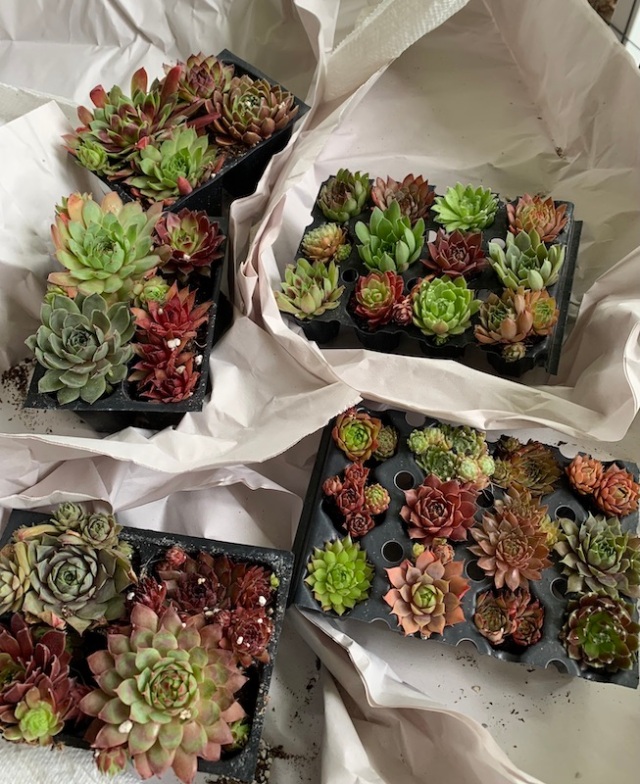
An online order of mixed hens and chicks (sepervivum) from Petal Pusher Nursery might have been one of the top five highlights of the summer.  They’re awesome.  They deserve their own garden.

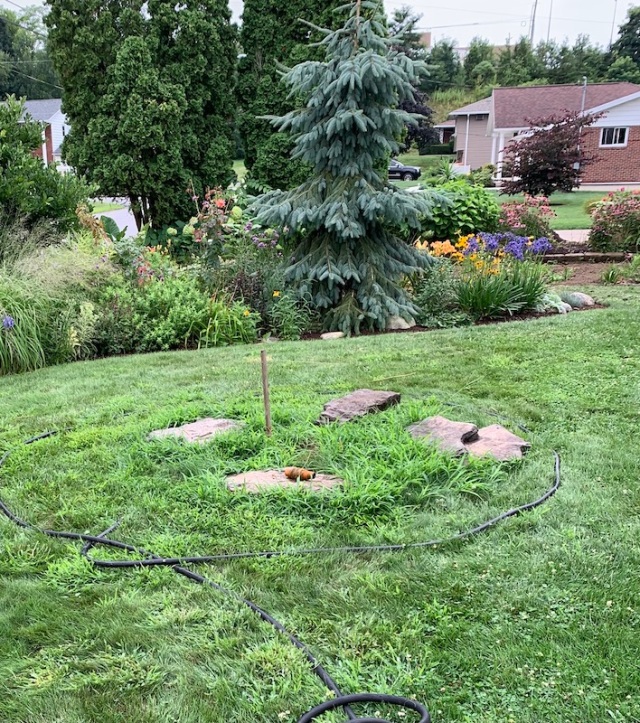
So 36 sepervivum, four rocks and then the township finally dumped some topsoil to rebuild the farm.  It was more than enough for the farm plus something, so clearly that something was another reason to build a rock garden.

making a rock garden

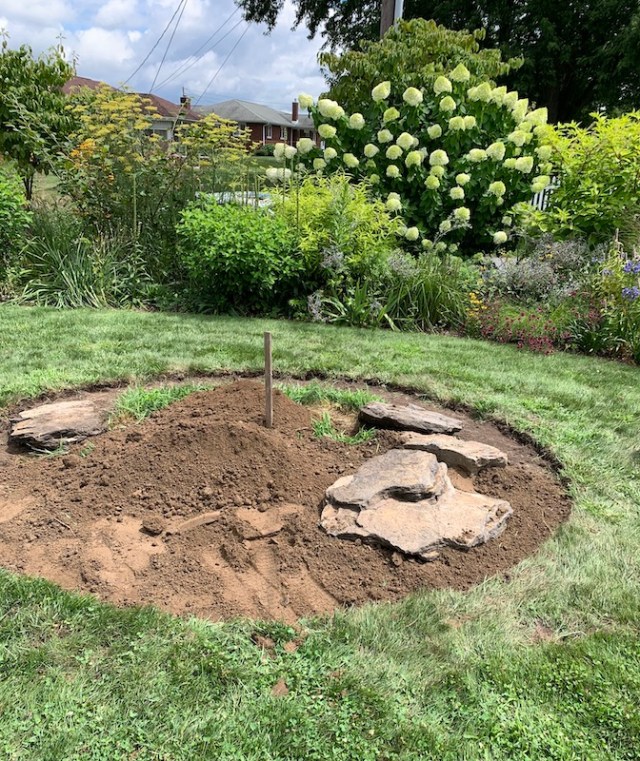
Cut a circle, lift the sod along the edges, bury the lawn and crabgrass with topsoil… move all the rocks again because they probably shouldn’t be in the way like that… 

A funny thing which happened a few weeks before this was that a friend said to me “at least you’re not into rock gardening” while we were touring her garden.  Apparently rock gardeners are not just a little nuts but a lot and are some of the worst plant growers and killers and collectors out there but I digress, and just laughed off her comment since I knew plenty of people who were far crazier yet don’t even have a rockery, and I for one also was lacking.

making a rock garden

Dirt mounded, rocks in position, a few random ‘not rockgarden’ plants in there just because.  

Just for transparency, I may have been collecting rock garden plants for a while but just killing most of them because the other beds here are just too rough and tumble, and poorly drained, to please most of the tiny things which shine in a rockery.  Actually, not to spotlight my own stupidity again, but one of the plants I’ve been really successful in killing have been the same hens and chicks which I built this garden around.  Friends have gifted me them.  They die.  I give spares to someone else.  They thrive.  Whatever, maybe fifth time is the charm and they’ll explode into growth and reach even higher levels of amazing!

making a rock garden

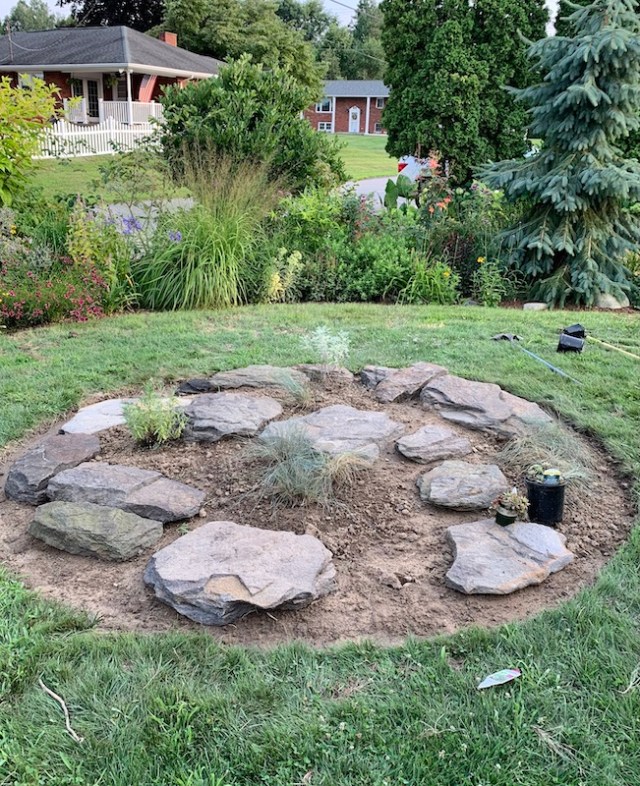
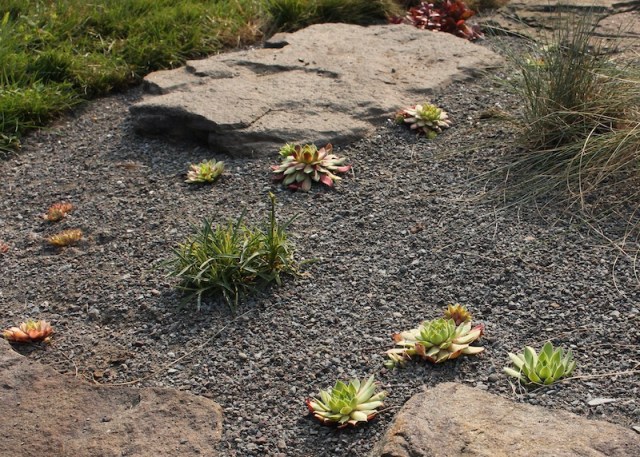
The topsoil has been covered in about two to three inches of sand, in this case a coarse concrete sand, which will hopefully drain well enough to keep things happy.  

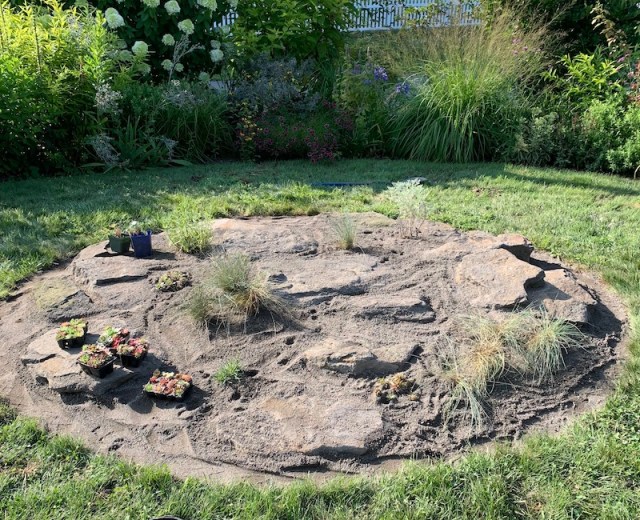
Just like every other new garden bed here, it’s somewhat disturbing how fast it fills up.  The sempervivums are tiny compared to the size of the bed and didn’t take up much room at all, but every walk around the yard had me returning with yet another little thing in hand which was supposed to be for the rock garden that I didn’t have.  Also there were a few little things in pots which I grew ‘just in case’ or brought home on a ‘maybe’…  I always say better safe than sorry.

making a rock garden

Happily planted.  Everything doubled in size when watered, except for the dianthus which was immediately mowed down to numbs by the rabbits.  It had been safe covered in weeds elsewhere, here out in the open it must look more like a buffet offering.

And then my friends intervened.  Off to Longwood we went to check out the finally re-opened waterlily garden.

longwood gardens

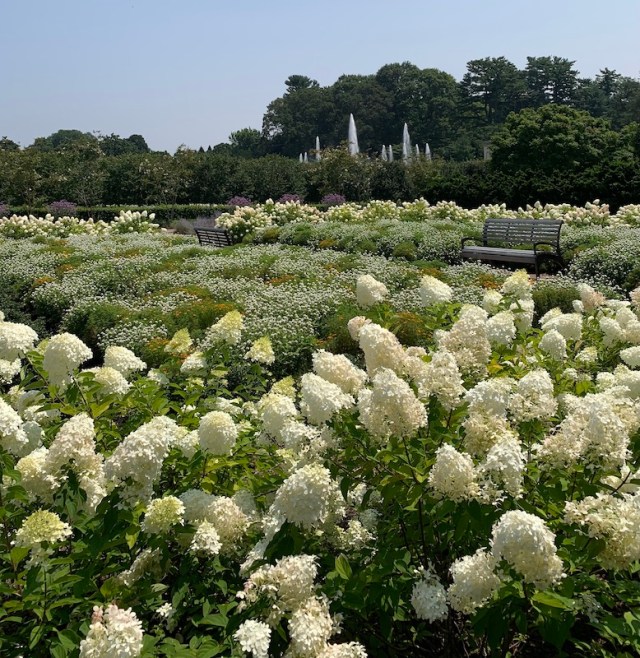
One of the newly replanted areas near the fountains has been filled with hydrangeas and white annuals.  Quite a statement. 

longwood gardens

The waterlilies were amazing.  This has always been my favorite part of the gardens and I’m happy to see its return as a focal point of the conservatory rebuild.  

longwood gardens

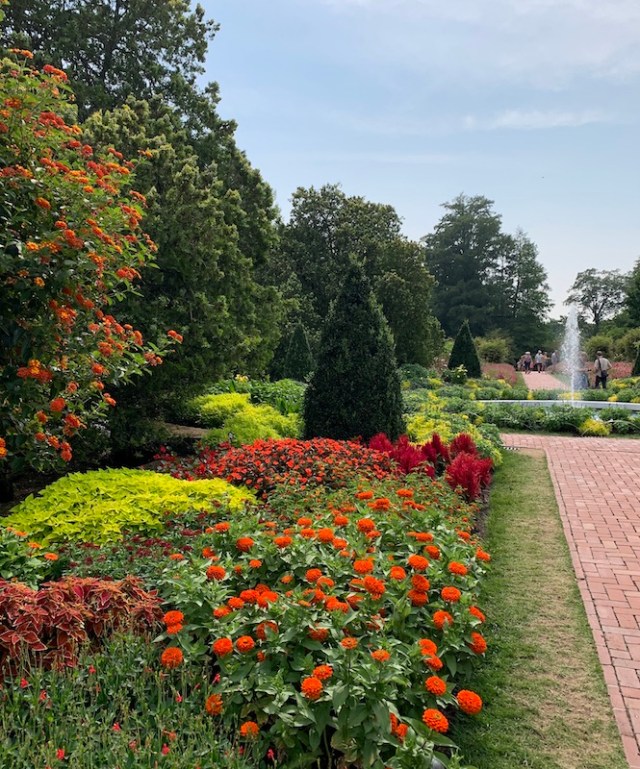
The color borders are always fun even on a hot day and it makes me realize that annuals are worth the work.

longwood gardens

The rose garden might be my new second favorite part of the gardens.  It’s interesting and more subtle than the masses of color in other parts of the garden.  Less grand, but I like it!

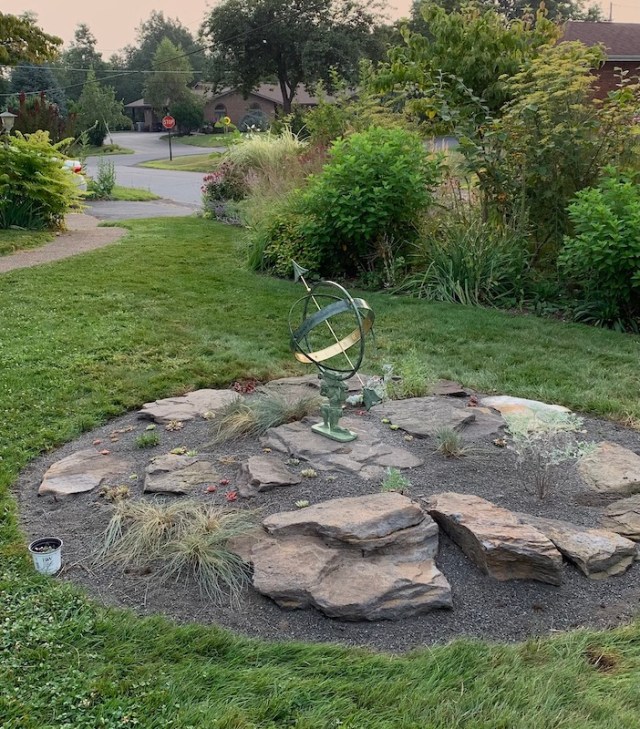
Okay back to the home garden.  The crowning glory of the new rock garden arrived in the mail and for about $150 and a little assembly I have this pretentious armillary with Atlas holding up the globe.  Atlas is a little flat, but I won’t complain.  I love it out there but don’t love that his price appears to have gone up at least $40 since the summer… even though it’s made in Massachusetts… but apparently the metal was not…

making a rock garden

The finished rock garden on a smoky summer morning.  I still need to set the time, and Atlas could really use a more formal pedestal but that may be a next year thing.

So for now the rock garden is as complete as anything in this garden.  Several plants will become too large for the space but I can easily put off that tomorrow problem, and tomorrow may come faster than you’d think since last weekend’s trip to the NA Rock Garden Society’s Adirondack chapter plant sale may have added even more plants to the garden.  There’s even a daphne.  I’m overly excited about that one and I hope it settles in since I can already picture a super fancy and refined mound of shrub that covers itself in bloom and drifts fragrance across the garden.

the waste area

Other parts of the garden.  The waste area looking more refined this year although the 7 foot shrub behind the fire pit is actually just pokeweed (Phytolacca americana ‘Sunny Side Up’), but the privet cuttings are beginning to make an enclosing hedge and that should fancy things up.

While I dream of lazy days surrounded by fragrance here’s some other summertime summaries before summer officially ends.  The waste area is becoming daylily beds, the deck has become a tropical oasis, and the potager is still in need of first aid.  Houseplants have all multiplied.  Someday I hope to add more and perhaps share pictures but I think you know how that will go.

the potager

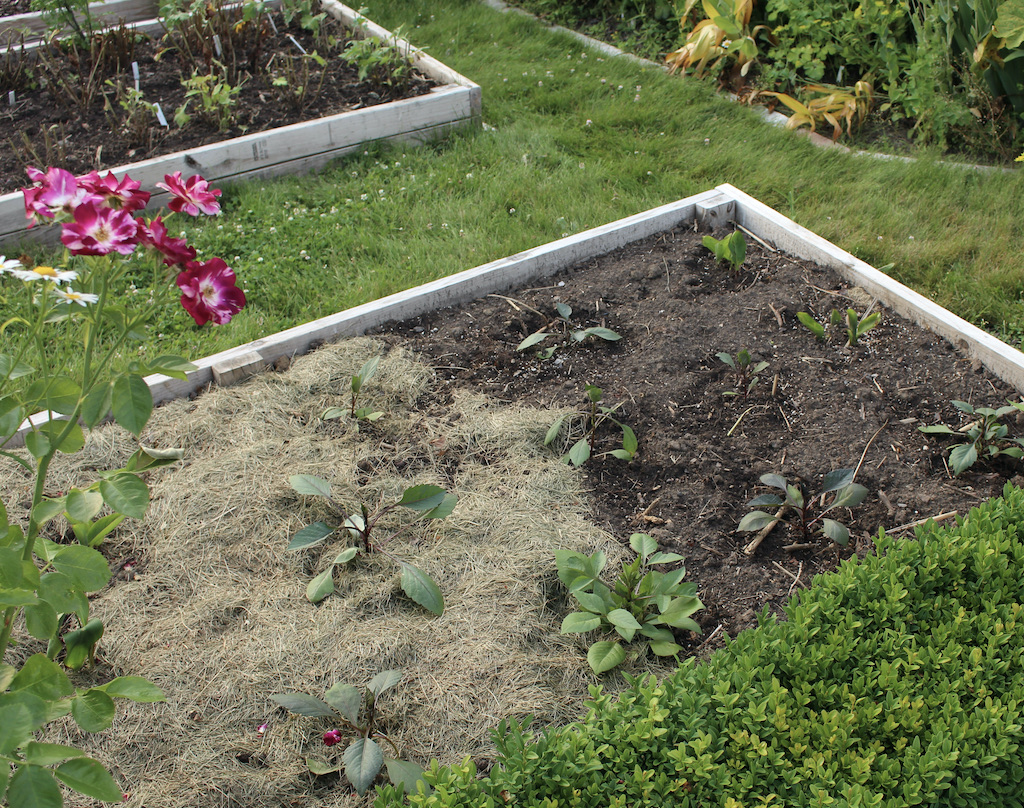
It has not been the year of the potager.  The beds need organic material and fertile goodness and my autumn covering of chopped leaves just isn’t enough.  Fortunately a sunflower fell over onto everything and has covered many a sin.  

Actually, speaking of going I don’t know where 90% of the summer went.  I need a do-over but that’s unlikely especially when a week of September cool at the end of August hits and reminds you that this is in fact a temperate climate and there’s a new season on the way.  Maybe this holiday weekend will be the turning point.  Two big projects await and even if they didn’t happen in the last three weeks, maybe the next two days will be what was needed?

cardinal flower lobelia

Red lobelia and a project on the horizon.  Maybe this will be the weekend the kid’s old plastic playhouse finally metamorphisizes into its destiny as “Begonia House”.

Don’t let my gloom of undone projects and a fading summer get you down, there’s still a weekend in the garden on the way and whether it’s productive or not it should still be better than a week at work and I’m looking forward to it.  We could use rain, we could use less bugs, we could use lower prices but sometimes you get what you get and sometimes you get a new rock garden and a visit from Atlas.

Enjoy!

The Daylily Farm

Summer is going swimmingly, and although it’s been hot we’ve been fairly lucky with rain so the plants are holding up well and the gardener is glad he doesn’t have to drag a hose around any more than he has to.  Not that he would, since our gardener tends more towards lazy than to ‘an ounce of prevention is worth a pound of cure’, but he does feel guilty every now and then when the same plant cries out for help each time he passes and he has to mumble a “sorry, I know this wasn’t part of the deal when I brought you home”…

the daylily farm

The daylily farm

One plant which does seem to take all the neglect in stride is the daylily (Hemerocallis).  Like dahlias and cannas, they’re not everyone’s cup of tea, but since the gardener is a coffee drinker anyway, it was just a matter of time until problems developed.  A visit to a real daylily farm two years ago triggered the problem and of course with no friends willing to step in and squash it, things escalated.  Actually friends suggested more visits,  friends dropped daylilies off,  friends invited the gardener over to ‘dig a few’…

the daylily farm

Some goodies in the beds of the daylily farm

A few friends shook their heads and recommended counseling, or more finishing up of home improvement projects, but the gardener enjoyed visiting these daylily farms and with new plants rolling in left and right it seemed only logical to start his own.  Sensible people pointed out there’s no room for a farm.  The gardener laughed.

daylily hawkswoman

A friend gave me ‘Hawkwoman’ and she’s a star.  A heavy bloomer with flowers nearly a foot across!

So now I have a daylily farm.  A friend implied madness when confronted with several beds of daylilies filled with dozens of varieties in a garden which recently held only three, and I had to somewhat agree although he’s not one to talk with his house full of thrift store finds.  Mine is clearly a business venture, so it’s ok.  Small businesses are ok and so are entrepreneurs, and although the flow of daylilies is still only a one way stream into the garden I’m sure it will be turning a profit in no time.  Think of how many farmers you know buzzing around in expensive sports cars and sipping lattes all summer.  That could easily be me.

the daylily farm

‘Nona’s Garnet Spider’ in one of the production (not sales) beds.

But until I decide to sell something the ‘sales beds’ are still just an excuse to line out daylilies in big blocks just because it’s cool as well as the other big plus.  Having a daylily farm in your very own yard also keeps the gardener in the garden, since apparently it’s frowned upon for him to be off visiting other daylily farms every weekend in July.

daylily cosmic struggle

‘Cosmic Struggle’ is another reliable, heavy bloomer who reblooms later in the season.

Maybe I will have a sale day this summer.  Even after just two years they’re multiplying and maybe I don’t love every one as much as the next or I don’t need a row of ten plants of the same variety.  It would be nice to have visitors at least since they do look nice this year and I think other plant nuts would enjoy it.  In the meantime here are some more pictures of the madness.  Not to single anyone out, but a blogger in Germany who might be named Cathy may have said they would welcome photos of daylilies a bit more than snowdrops and I didn’t know how to take that.  How can you compare the diversity of shapes and colors and inherent grace of the snowdrop to that of the daylily?  I don’t get it but here are a few more daylily photos with a little less babbling.

daylily brookside mystery date

From a local breeder, ‘Brookside Mystery Date’ is a good growing, shorter plant with deliciously colored and textured blooms.  I begged a friend to stop by the grower on their last open weekend to grab it for me since I was tortured by regret over not buying it earlier in the year.

daylily brookside beauty hybrid

Also from a local breeder, one of the unnamed Brookside Beauties which the farm offers.  They’re seedlings they chose to leave unnamed, but couldn’t bear to toss out onto the compost pile.

For local people, the Brookside hybrids are the work of June and Dick Lambertson of Lambertson’s Daylilies.  They were the farm which (unknown to them) started this all, and as they move into full retirement,  Joann and Brad Lamberton (a coincidentally similar name but not related to the Lambertsons) of Garrett Hill Daylilies are picking up the legacy.  And just to support my main supplier and dealer, I’m glad Garrett Hill has taken this on.  They are building a beautiful spot and although I’m sure they question jumping in with both feet like this (on top of their day jobs!), a visit to their farm outside Honesdale Pa is a treat worth the trip.

daylily seedlings

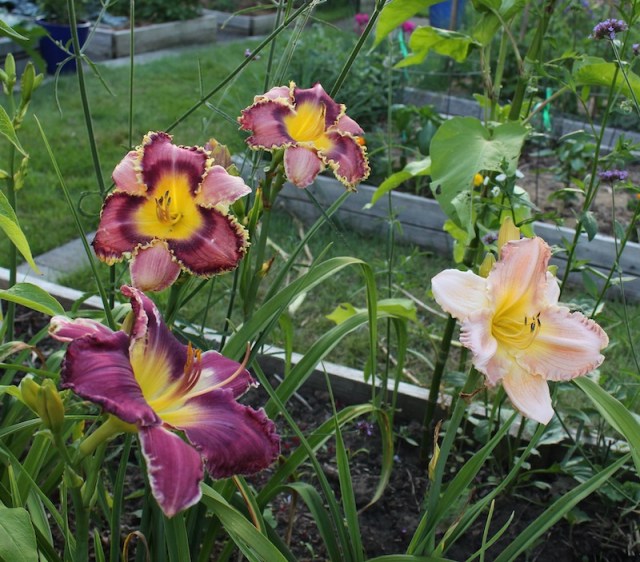
Unnamed daylily seedlings purchased mailorder from Petal Pusher Daylilies in Fort Wayne Indiana.  Some really cool forms came in my mixed box!

daylily seedlings

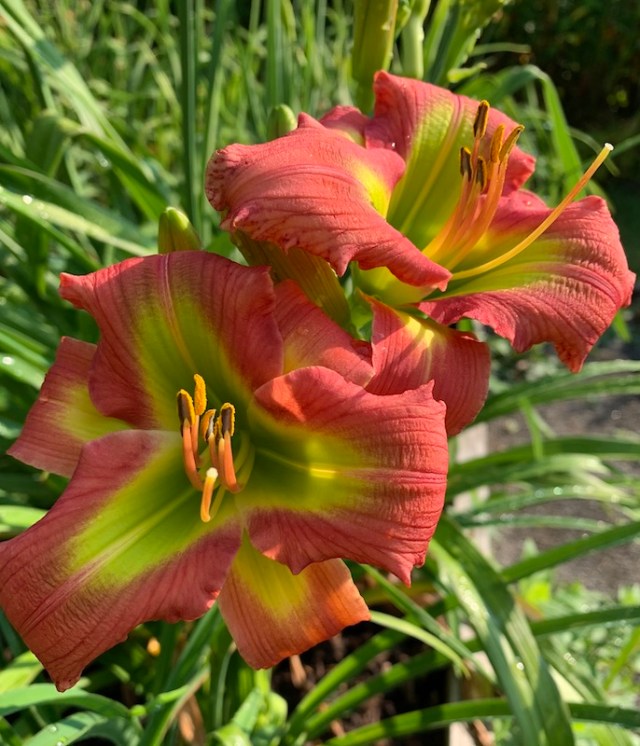
Green throated flowers are always interesting.  Also an unnamed Petal Pusher seedling.

daylily seedlings

And “blue”?  I’m not sure how I feel about this type since the color varies so much depending on the weather, but on this morning I was a fan!

daylily seedlings

One last unnamed seedling, possibly my favorite from Petal Pushers.

I could go on but I shall not.  Just two final daylily confessions, the first being the Facebook page which was created to pollute the internet with even more daylily photos straight out of the farm here, and the second being the fact I’ve grown a few of my own seedlings here just to see if I could.  You’re more than welcome to ‘like’ the Facebook page but the seedlings thing is a shady endeavor.  With just a small patch of seedlings in bloom I realize I lack the vision and passion to produce anything which amazes anyone but myself, and of course I’m pleased with them, but they’re nothing special.  Good news for the farm I guess, since it lacks the room for rows of seedlings, but on the down side it doesn’t stop me.  I have dozens of new seedlings which need planting out this summer and I’m already eyeing pods forming on this year’s stalks 😉

daylily seedlings

One of the Sorta Suburbia seedlings

Gosh did I go on this morning, and still the house is quiet and breakfast has not been served so here’s the rest of the garden:

the potager

The potager is looking inviting and even a little under control.  Vegetable plantings are sparse this summer, but you know something is always brewing 😉

clematis radar love

The entry arch has clematis ‘Sweet Summer Love’ in full bloom.  I was lukewarm the first year, but now that it’s hit its stride I’m a fan

nigella love in a mist

I’ve finally managed to get a few nigella (aka love in a mist) seedling going, I don’t know why it took so long but I’m liking the airy look and the interesting seed pods which follow the bloom.  It should be an easy reseeder now.

hydrangea tuff stuff

Blue hydrangeas are in bloom everywhere this year, since the non-winter failed to kill them back and a lack of late frosts spared the flower buds,  This is hydrangea ‘Tuff Stuff’ which claims hardiness but has never bloomed like this before.  I wouldn’t mind if this happened again some time.

meadow garden

The meadow garden is too shady now that the Aspen suckers have grown, but the rudbeckia is having a good year regardless.  This area will be mown in August and kept cut until the fall.

kniphofia high roller

I’ve been dabbling in red hot pokers and finally have a few which bloom reliably and for more than a week or two.  Kniphofia ‘High Roller’ is just starting with several later buds still to come for an extended show.

oxeye daisy removal

The oxeye daisy season is getting a little messy and floppy, so out they come.  The mower will take care of this mess, and hopefully the lawn can overwhelm the seedlings which this mess shall produce.

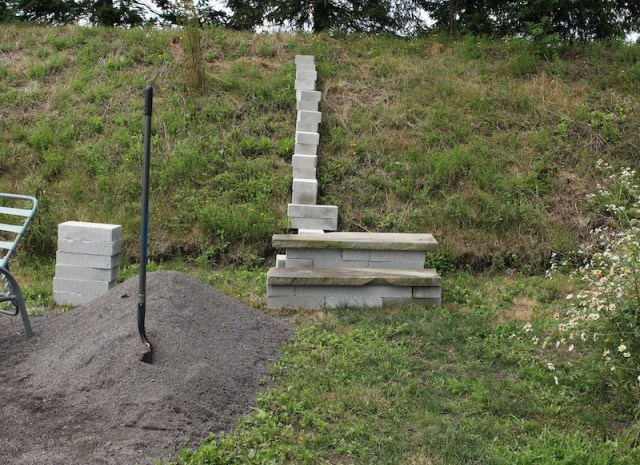
Still no sounds in this house, so I’ll end with just one more photo.  The gardener added a few concrete blocks to the deck supply delivery and now it looks like there will be no new raised beds, rather a set of steps leading up the berm.  That of course will involve more blocks, more leveling, more digging, and far more work than the gardener will consider on a day of rest but it’s going to sit in the back of his mind as a new source of guilt over an unfinished project which wasn’t even a project the week before.  I’m sure it will be an excellent way to reach the top of the hill for weed control purposes.

garden step project

That hill isn’t even safe.  You almost broke your ankle last time you were strimming it.

So that’s pretty much the update from here.  I shall now make some noise so someone feeds me and then spend the rest of the day either immersed in cooling water, hidden in the shade, or comfortable in the embrace of an air conditioning vent.  Summer is pretty good and I wish it didn’t race by.

Enjoy your week!

Flying Through November

I swear Halloween was yesterday yet here we are already two weeks into the next month.  Usually autumn is the season of painfully slow decay and death, a ‘stick season’, but over the past few years I’ve been developing a new appreciation for all the optimistic plants which take the cooler temperatures and run with them.  Cyclamen come to mind, Cyclamen hederifolium in particular, and when cyclamen come to mind Edgewood Gardens also comes to mind, and when you’re that far into it what better than to hop in the car for an early November visit the see the gardens in person and visit with Dr Lonsdale?

edgewood cyclamen

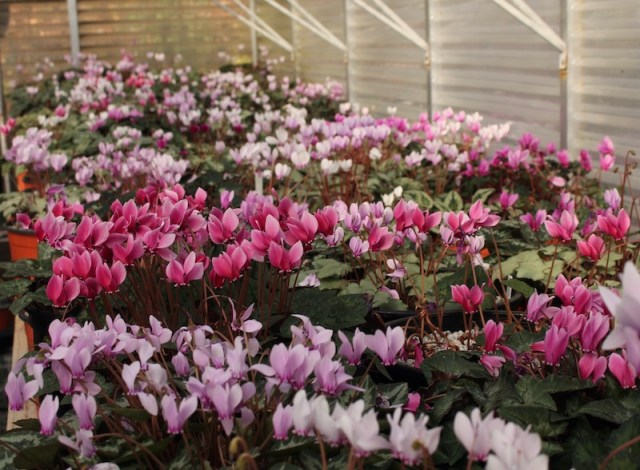
Outside the cyclamen were wrapping things up, but in the greenhouse the show was still going full throttle.  What a rich range of colors in these potted Cyclamen hederifolium.

This Edgewood cyclamen visit was under the guise of meeting up with snowdrop crazies and spending an afternoon admiring the full-bloom show of thousands of autumn snowdrops, and that was exciting, but I forgot how nice the cyclamen can be.  My mind was again buzzing with the idea of keeping even more cyclamen potted up and under cover, able to be appreciated in any kind of weather and easily rearranged and admired at eye level rather than on your knees.  My own are doing well in a coldframe, but maybe a second or bigger coldframe is something to consider…

edgewood cyclamen

The flowers are a floral spectacle but the foliage patterns and shapes also hold their own.  Narrow, marbled, purple-veined, pink-flushed… the variety is amazing.

I guess to be somewhat helpful I should mention that there are four fairly hardy cyclamen species which are somewhat easy to get a hold of and experiment with outdoors in the more Northerly zones.  These are nearly all the fall-blooming Cyclamen hederifolium, but there is another fall-bloomer, C. cilicium, and there’s the early spring blooming C. coum, and the attractively evergreen, summer-blooming C. purpurascens.  Of the four I believe C. purpurascens might be the hardiest with a zone 5 rating, but as with most plants, location and snow cover probably play a huge part in how well hardiness really plays out.

edgewood cyclamen

Only the best forms end up in pots in the greenhouse.  Besides looking even better that way they also serve as mother-plants, hopefully setting seeds for the next generation of even better varieties.

Did I crack and add a new cyclamen?  Of course, but strangely enough it was a non-hardy Cyclamen graecum which ended up in my hand.  Why add any more carefree, outdoor varieties when you can add one which needs a frost-free spot all winter and protection from rain all summer and will quickly die if you mess up?  Message me if you know the answer…

And did I mention there would also be snowdrops?

edgewood galanthus

The greenhouse benches were packed with autumn-flowering snowdrops.

Okay, so maybe I was also excited about other things.  There was excellent company for the afternoon and more snowdrops than one would think would flower in November.  We spent quite some time looking and talking about snowdrops and plants in general.  Not bad at all.

edgewood galanthus

Even more snowdrops, this time in the afternoon glow of a lowering sun.  Days like this always end much too quickly.

So again, in a weak attempt to be useful, most people are familiar with the early spring blooming types of snowdrops (Galanthus), but other species and forms exist.  For this visit we were catching the down side of the Glanthus reginae-olgae season, but the peak of the G. bursanus season.  From what I know they are both strictly fall-blooming species (ok, r-o does have a spring blooming subspecies…) but there are others which straddle the line.  Galanthus elwesii is mostly spring-blooming, but there are a bunch which begin in the fall or early winter and quite a few of them were also showing on this visit…. plus some G. peshmenii and quite a few G. cilicius (which may not be hardy enough for most Northerners) and I guess that’s about it and I apologize for going on again.

edgewood cyclamen

The next generation of cyclamen.  Just imagine the joy of potting up every. single. last. one. of these.

Did I crack and buy a new snowdrop?  Strangely no.  I’m just that responsible and frugal that I resisted completely.  That and college visits have been happening, and apparently prices have gone up and between that and a home remodel I have decided I’m broke… or rather my wallet told me and I’ve only just now recently received the message.

edgewood cyclamen

Be fruitful and multiply!  That’s what I whispered to this amazing combination of dark flowers and silvery foliage.

The reality of my own autumn snowdrop successes is another thing which poured cold water on my delusions of pregaming the winter snowdrop show.  For as much as the hardiness and tenacity of fall blooming snowdrops has impressed me, the frequency of failure in these fall wonders has kept me from diving in too deep.  A case in point is my amazing little clump of G. peshmenii (but probably really G reginae olgae) which over maybe six years had gone from a single bulb to at least nine flowers last year.  This year it’s nothing.  “going back” is the term I’ve heard for clumps which go from excellent to nearly dead in the span of a year, and I’m going to guess some bacteria or fungus got in there this summer and that’s why.  Fortunately there are a few bits of foliage finally coming up, and I hope in another six years I might be back to 7 or eight blooms… unless these weak leaves are one last show just to say goodbye… in which case I hope they get a move on it because I’m not getting any younger.

struggling galanthus reginae olgae

A struggling Galanthus reginae olgae clump.  Maybe there’s a rotted flower stalk visible which would indicate some kind of botrytis or stagonospora infection, but of course that doesn’t matter since I’m not ready to douse my plants with fungicides and will just hope for the best.

So my best clump has almost died out and to be honest every other snowdrop up already has been chewed to the ground by slugs.   Silly me, I didn’t put slug pellets down, right?  Well that’s because slugs are rarely a problem here so who would think to do that?  At first I thought some ignorant bunny or bird was snipping off blooms, but after the fourth or fifth clump was wiped out I finally figured it out, and now I own my first box of slug pellets and I’m not afraid to use them.

fall galanthus barnes

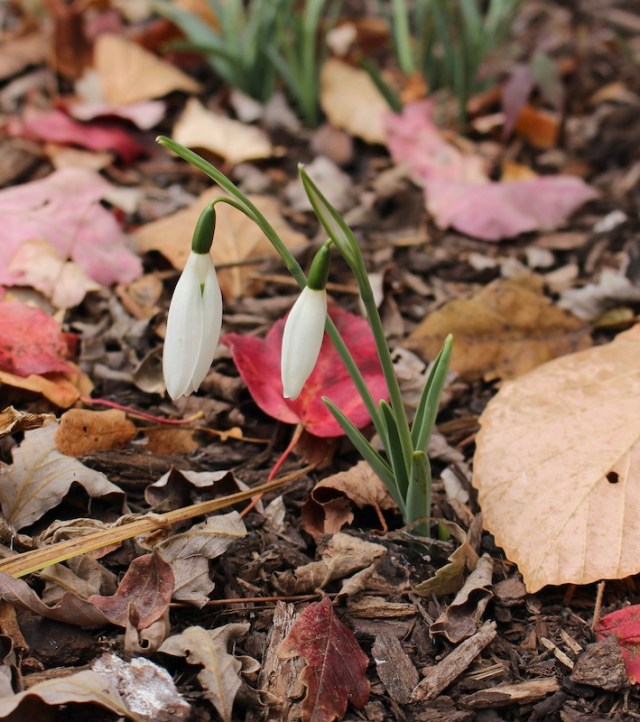
Perhaps the giant deciduous leaves of Magnolia macrophylla aren’t a good pairing for fall snowdrops but G. elwesii ‘Barnes’ found a big enough gap to come up through.  

So maybe the later fall snowdrops will have more success.  The fall Galanthus elwesii are starting, and although they often suffer terribly from sudden blasts of arctic weather, they also seem to forgive and forget, unlike the G. reginae olgae which seem to hold a grudge and enjoy being spiteful.  Even rotten, mushy leaves in January don’t necessarily mean death for the G. elwesii, they sometimes pop up the next fall as if they were just kidding about the being dead thing.

fall galanthus hoggets narrow

‘Hoggets Narrow’ is probably my favorite fall blooming Galanthus elwesii.  I love the long form and the grace of the blooms, and even if he likes to die dramatically each year from some hard mid-winter freeze, he still comes up again in the fall.  I’m pleased there are two blooms this year.

Sorry.  This is probably all too much snowdrops for November so here’s the rest of the garden.

ajania pacifica chrysanthemum

My first year with Ajania pacifica, a chrysanthemum relative from Eastern Asia.  I’m looking forward to seeing it grow into a nice big clump of neat foliage and bright yellow November buttons.

Last blooms, changing foliage colors, and a billion end of year chores.  We had our killing frost, and although it’s warmer again and will likely stay that way for a while I’ll probably need all that time to get even somewhere close to everything done.

november garden

I suddenly have evergreen structure for the winter.  Tiny little nubbins have gained presence and with the grass still green it’s a nice view as everything else goes into hiding.

I did manage to finish the dirt moving.  The dream was a November finish line and I was as shocked as anyone to see it really worked out.  Things are too late to do much planting, but I’m dumping grass clippings over the bare soil and throwing down some grass seed to mix in and hopefully something comes up first thing next spring.  If it does, it does, and I have too much cleanup to do to overthink it too much other than to remember how much grass I’ve weeded out of flower beds.  Grass is my worst weed, so I can’t imagine having to try too hard to get it to grow on purpose.

new garden bed tulips

Remember the tulips I dug?  In a moment of revelation I realized planting tulips was more satisfying than seeding grass so why not just call it a new bed and stick the bulbs there?

Moving dirt is hard work and requires many rest breaks.  During some of the rest breaks stupid ideas germinate, and before you know it you’re digging up a sad little boxwood hedge and framing out a new tulip bed and then you might as well frame up a new tropical bed or daylily farm while you’re at it.  A useful fact is that November is pretty late to be carelessly ripping up boxwood and popping it in elsewhere but I’m sure you knew that just like I do, and I also know I shouldn’t still trim the boxwood since it will likely freezer-burn the fresh cuts when it gets cold, but how can I stand looking at a rollercoaster top of the hedge when it should be level?  I guess it settled very unevenly after I replanted it last spring.

new garden bed

Here’s the question… the bare soil will become yet another bed, and I want to line it on one or two sides with boxwood.  Too much?  Or just a nice try at more winter interest?

So when is too much boxwood too much?  Boxwood blights and boxwood caterpillars are going to reach this garden someday, but not today, and perhaps I should just have my fun while I can, but someday I can see regretting not being more proactive.  To be clear, I’m really not adding anything, just moving hedge I already have but maybe I’m missing a chance to try something new.

Maybe crushing all these decisions into the last un-frozen weeks of 2023 is also not the best process, but I really need to clear out my spring calendar for snowdrops, so better to get this out of the way now.  Oops, there’s that snowdrop thing again, sorry.  I shall try to make it longer next time without mentioning them.  Have a great week 😉

Still Dull

Here in the sorta mountains of Eastern Pennsylvania, summer has taken a turn for the wet.  I always prefer wet to dry, but others are complaining about bad pool weather and an endless train of cloudy weather that seems to be tracking here.  Honestly I’m not sure what they really want though, because yesterday when it was over 90F (33C) and humid they complained about the heat, so maybe they shouldn’t talk about their dream of moving to Florida.

Fortunately the garden doesn’t go on and on with complaints.  A once-over to remove the browned stems and shriveled dreams of a dry spring and we’re back in business, with lush flowers and even lusher weeds.

july flower border

The front border is at a summertime peak with the yellow lily ‘Conca d’Or’ taking center stage.

I will also try not to dwell on complaints.  Summer is going too fast, not enough is getting done, and I don’t have enough space for my daylily farm, but at least I’ve finished clearing the dirt away from the side of the house.

graded side yard

All the dirt has been removed, now it’s on to doing something with all the stone, and then figuring out the grass path which will lead around the corner.

To celebrate this dirt moving milestone I decided to tackle the mass of concrete down by the street and finish cleaning up the front of the yard as well.  It was as much fun as you can imagine.  At first I thought I was overdoing it by bringing the jackhammer back, but when the concrete turned out to be a foot thick in spots I guess the pickaxe wouldn’t have been enough.

breaking up concrete

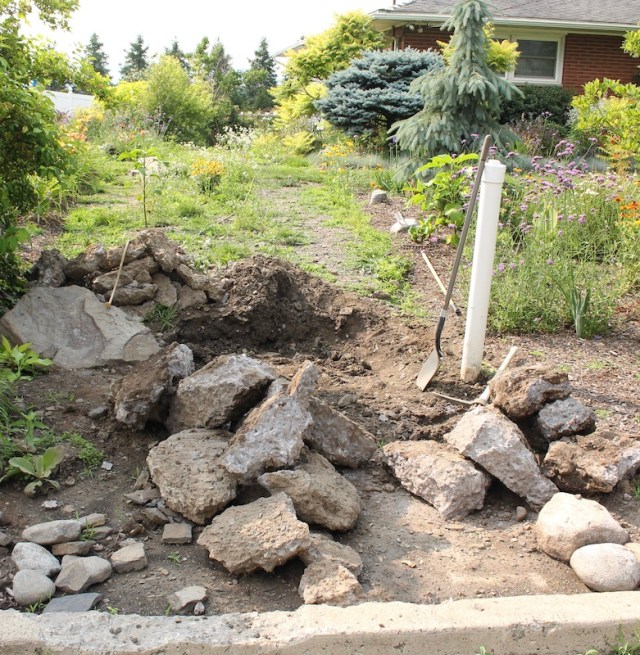
All the concrete has been broken up and the chunks are ready for hauling away. They’re bigger (and heavier) than the photo suggests…

Don’t let the pictures scare you.  Last week I not only moved the concrete out of the way, I also graded the path, but in a few stones, seeded grass, and planted out a tray or two of coleus cuttings.  It looks much nicer and I hope to share those photos as soon as I get out there and take them…

Enjoy the weekend!  I’m hoping for enough of a break in the rain today to fit in a garden visit and a daylily farm trip with friends.  I guess it’s not all work and no play in spite of what I like to pretend 😉
Spring?

Last Sunday was fantastic.  There was sunshine and warmth, and coffee on the porch, and then here was a nice stroll to look at plants.  Then there was more looking and some sitting and then a little more looking.  I believe things were actually growing as I watched and that’s a nice change from the chilly standstill that the last few days have had us at… and the snow… but nearly all of that melted when the warmer weather rolled in.  Eventually I even did a little work!

garden hellebores

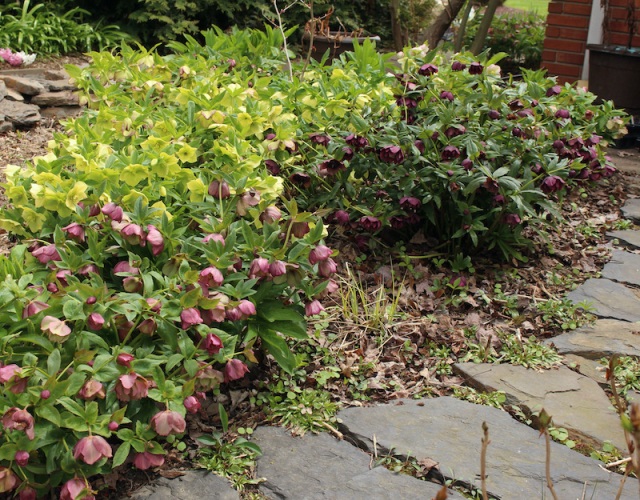
This spring has been good for the hellebores… except I probably have too many and I probably have even more seedlings coming along so I probably should open up a few new spots and not plant other things there since I’m opening them up for future hellebore seedlings…  

I’ve been a little down on the garden due to gloomy weather and construction debris, but just a couple hours of short sleeve gardening with spring flowers opening had me flying high again.  My weedy, disheveled potager with a few tulips close to opening had me imagining the grandeur of Keukenhof right here in my own backyard, but now the reality of another gloomy day has brought me back down to earth.  I think it will be nice enough, but things could still use a bit of work here.

anemone x lipsiensis

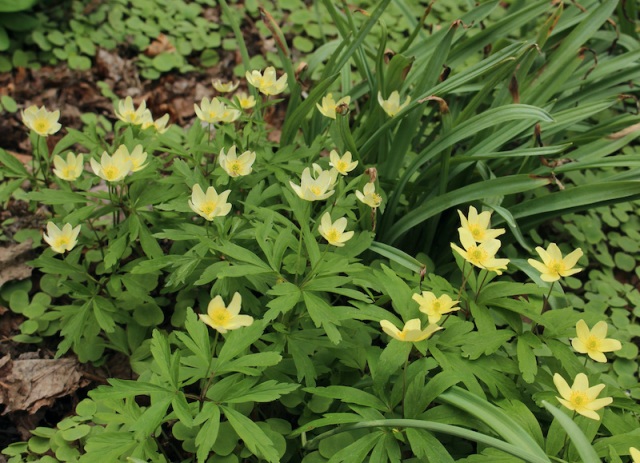
Anemone x lipsiensis is a cute little spring bloomer.  I bought a little root the same year a friend gave me a piece and I assumed they’d be the same thing but they’re not.  Now I need to decide if the smaller, paler clone on the left is different enough from the one on the right to bother separating.  

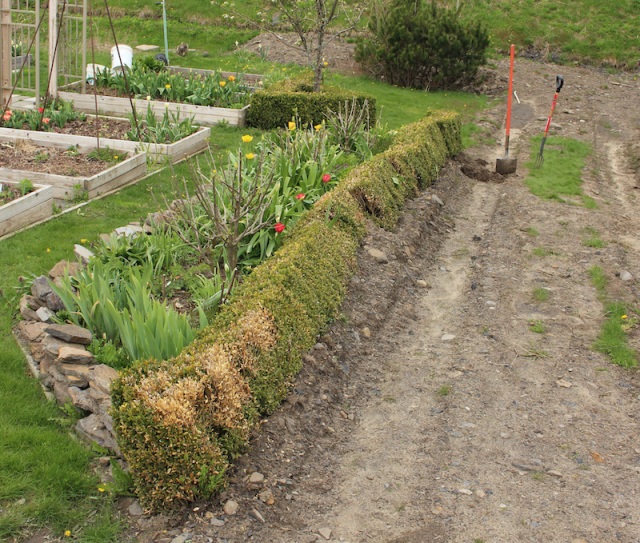
I think a breakthrough was finally making a move on the poor little boxwood hedge which was upended when construction fill had to be shuttled from the foundation hole to the low spot in the back of the yard.  My jelly ‘topsoil’ was squeezed to the side by the weight of the backhoe, and when it squished over it took the hedge with it.  Part of me wanted to rip it out and rethink things but then the other part decided it would be worth digging out and straightening up.  So… the hedge along the potager will be dug and returned to its upright position.

boxwood hedge

My sad and abused boxwood hedge.  All winter it’s been nearly pushed over and I’ve been back and forth on what to do.

The hedge across from it is a different story.  It’s also riding a wave of squishy topsoil and I think that wave is about to crash.

boxwood hedge

The even sadder and more abused neighboring boxwood hedge.  Maybe it’s time to say goodbye.

Come to think of it I’m not all that happy with the swingset in the middle of the yard anymore either.  The kids don’t use it all that much and when they do they’re not toddlers I need to keep an eye on, rather they’re teens who wouldn’t mind hiding with their friends somewhere off to the side.  Hmmmm.  And don’t even get me started on the trampoline.

garden pond

Construction has not been kind to the pond.  It’s a muddy mess which fills with runoff, but the waterlily is returning and I see duckweed bits floating about so all is not dead.

Maybe changes are afoot.  It’s not surprising that poorly planned projects of five and ten years ago need updating, and the sad truth will be that their replacements will likely be just as hasty and poorly planned.  Obviously I’m one of those people who needs to learn everything the hard way.

build stone wall

A pile of rocks might as well become a wall so as to not look so much like a pile of save-them-somewhere rocks.

Don’t think that my whole beautiful weekend was filled with the joys of stone moving and hedge lifting, there was also the fun moment when a small jackhammer showed up so that “if I wanted to start taking out the concrete patio section and digging out new basement stairs” I could.  Lucky me!

double daffodil mertensis bluebell

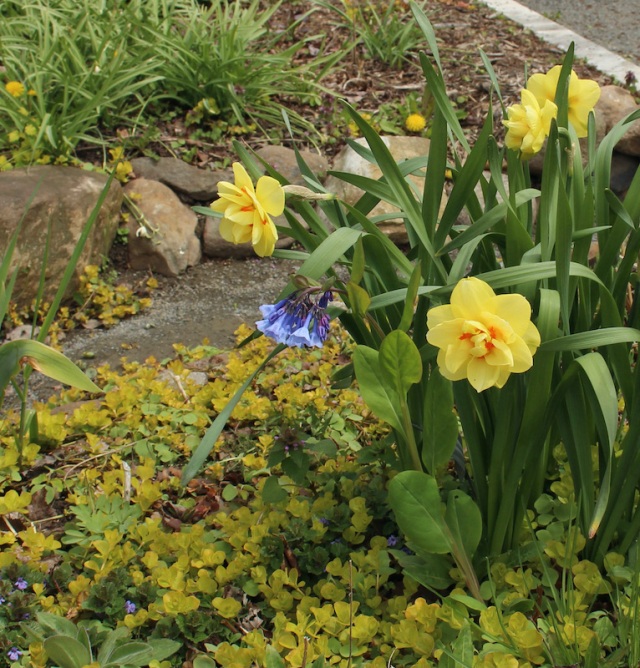
Virginia bluebells (Mertensia virginica) can be floppy and messy and rapidly die down when the weather gets warm, but I’m determined to get a few settled into the garden.    

So even when my day of rest was topped off with three hours of jack hammering and digging I still thought it was a fantastic weekend.  The weather was beautiful and I even snuck in a quick hike and garden center run with the daughter.  She got it into her head to trim Grandma’s spiral evergreens, pull weeds, and also wanted to plant a few flowers, so needless to say I was thrilled to hear her speaking my language and found the time to look at plants with her 😉
daffodil jetfire

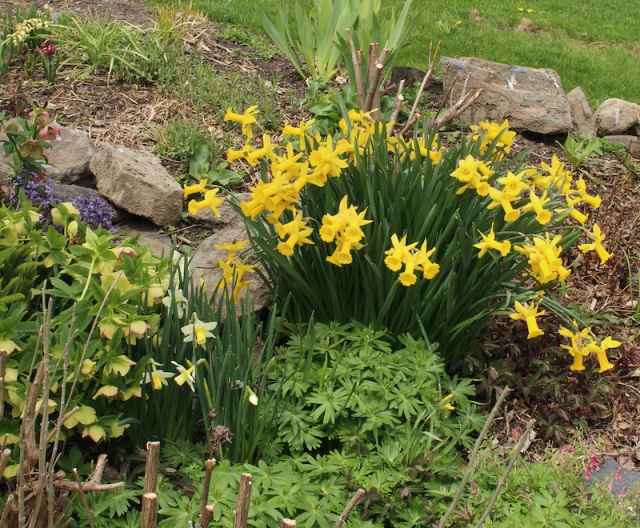
‘Jetfire’ is a nice little daffodil that looks all yellow most years… until a cold spring comes our way.  Then the trumpet burns orange just like it likely does every year in more reliably dismal climates.

All this is still a lot of raw construction talk and torn up earth, so hopefully the next batch of photos will be more pleasing and flowerful.  I think it will be.  The daffodils are beginning and with tulips right behind them I’ll be thrilled, even if the sun is lost and gloomy weather returns.  You can’t hold spring back forever.

daffodil tweety bird

This year the yellow trumpet daffodil ‘Tweety Bird’ holds the record for longest bloom.  A full month after first opening, it still looks exceptional, and it doesn’t hurt that this small trumpet flower form might be my very favorite daffodil form.

daffodil high society

‘High Society’ just barely missed the bulldozer blade.  It’s such a highly regarded, good grower, and I can’t think of a single reason to justify my luke-warm opinion of this plant. 

Hope the garden did well for you this weekend.  I feel recharged and can’t wait to get back out there, especially if it’s heavier on the sit and look side than it is jack hammering and stone hauling 😉

Have a great week!

White is a Cooling Color

A friend of mine seems able to pick a color of the day any day and then post a collage of blooms right out of the garden to celebrate.  Me on the other hand, I’m far from there but on a day like today when the garden bakes under a hot sun, anything which might lower the temperature is fair game.  They say adding white flowers to a garden can cool a hot palette but as I trudged around the garden in 97F(36C) afternoon sun I’m not sure it mattered.  We’ll give it a try though since the only truly cool white would have been snow, and it will take months of heat before I wish that on anyone 😉

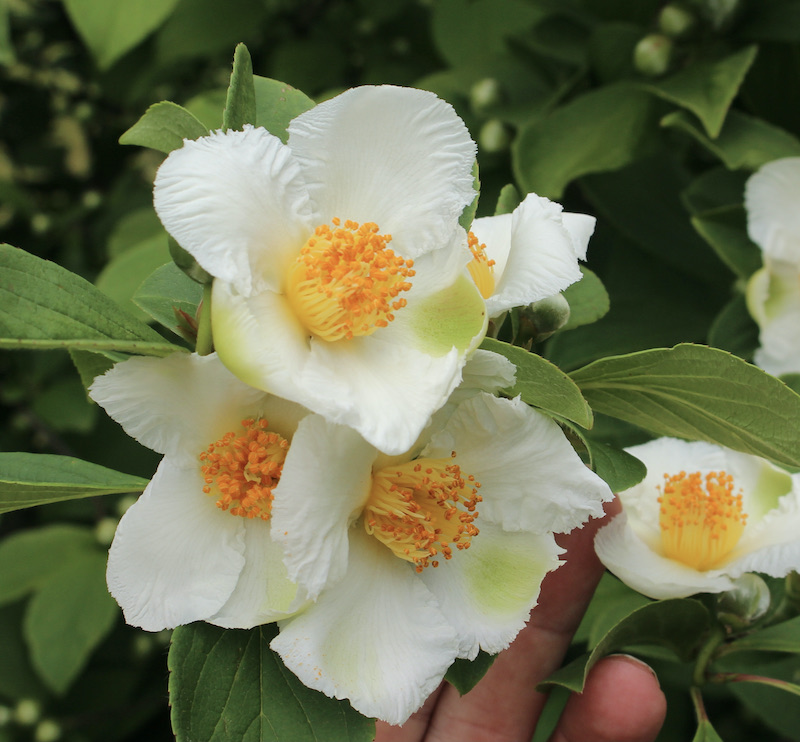
stewartia flower

**full disclosure I took this photo a week ago and the blooms on the Stewartia are no longer this fresh looking, but to look at it now?  Ahhhhhhh 🙂

Heat and cicadas, that would have been a nicely mid-Atlantic June day, but as of yet I haven’t seen more than a few wings and munched torsos.  Maybe a road trip is due?  The younger child (now nearly a full month into her teens) says yes, and the first flowers of the Regal lily “smell like Longwood”.

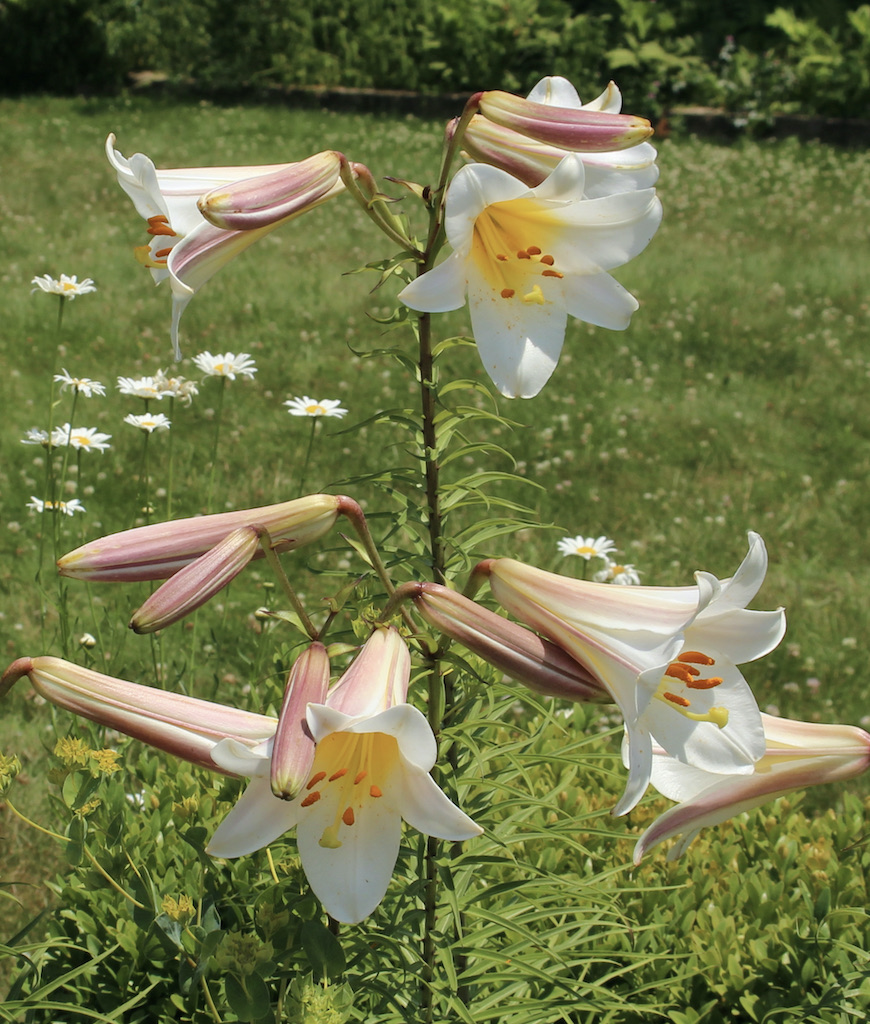
lilium regale

These Regal lilies (Lilium regale) were mush from a late frost last year, and sat dormant from April on… but guess who returned from the dead this year!

I’d be happy with just a break from lawn mowing, and this heat should do the trick.  My neighbors are looking at mostly brown already since they’re more gung-ho about their grass knowing its place and it’s height, but here I give it a little more freedom as the temperatures rise and the sun beats down.  Longer grass withstands both the heat and drought better and recovers faster when the weather breaks, and I’m sure when that break comes and temperature drop with a rain shower or two there will be plenty of time for me to catch up on my love of lawn maintenance.

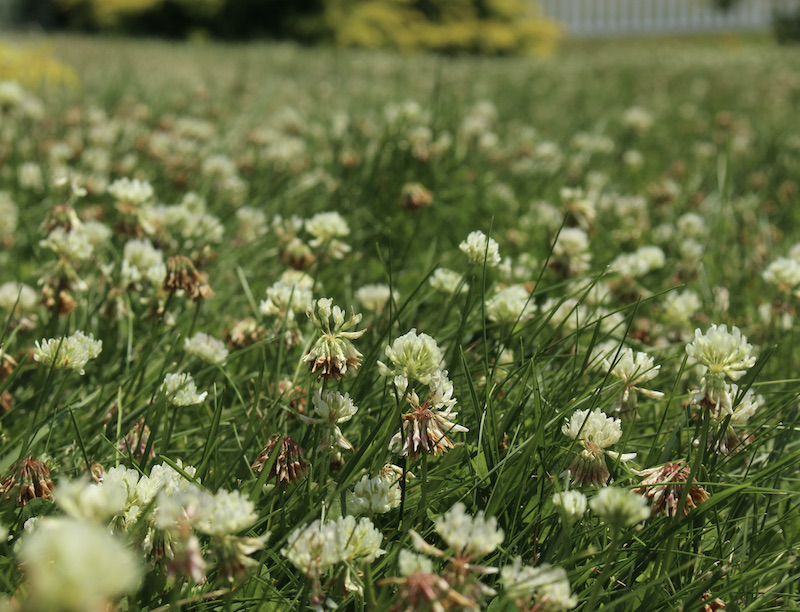
white clover lawn

A flurry of white across the lawn, thanks to the liberal growth of white clover.  A good bee plant most will say, but honestly there’s plenty of other stuff around which they also seem quite thrilled over.

I think cooling white counts even if it’s on the gray side.

mammillaria plumosa

I believe this is Mammillaria plumosa.  Each year it stretches a little further and now another pot will be required.  Any bigger and it won’t fit on the porch steps anymore.  

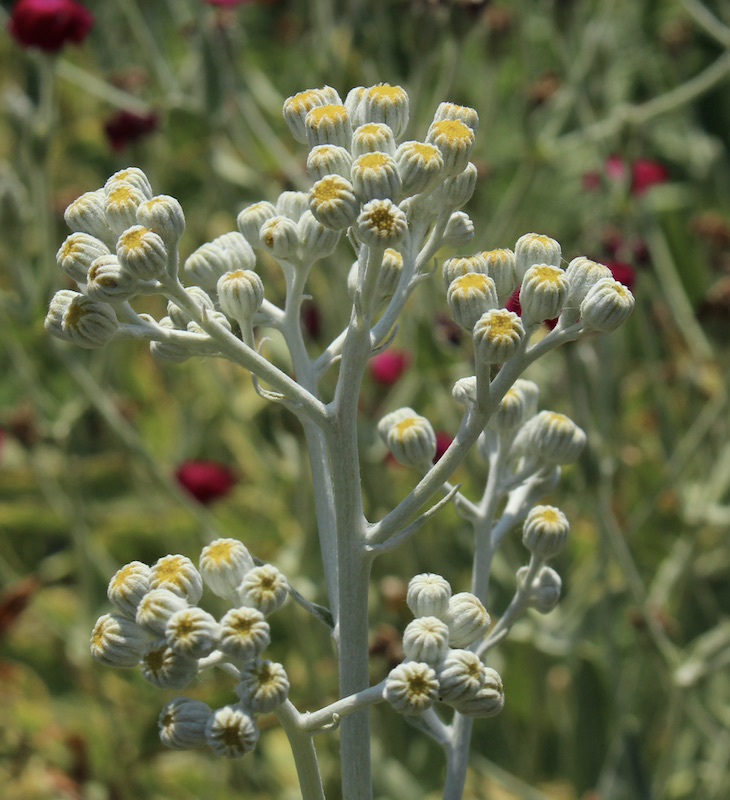
I was lukewarm to the dusty miller(Jacobaea maritima) which went in as an annual last summer but I quite like the bushier perennial version which returned this spring.  If the summer stays dry and the border doesn’t get too lush and crowded I think it will do well all season.

dusty miller flower

Unimpressive flowers on the dusty miller.  

Gray foliage but on a much less soft and felty side would be the Scotch thistle.  This will probably be the last photo of this weed which I subject you to, but fair warning: the Cardoon has yet to bloom, and that’s another weedy thistle which I think is just wonderful and I can’t hide my excitement over 🙂

scotch thistle

Scotch thistle against a cloudless sky.  I had to point up since this plant is well over my head by now.

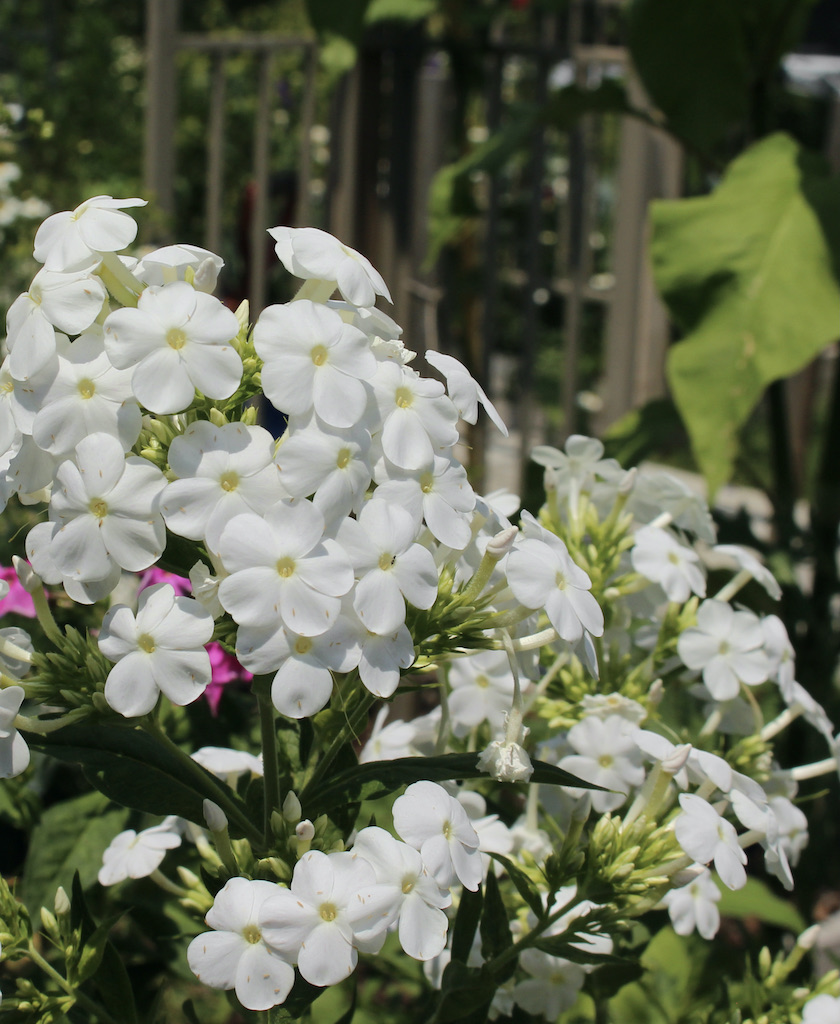
Gray foliage doesn’t have much in the way of scent, but the Phlox paniculata is starting and that has an excellent summer fragrance.  I will avoid complaining about how ungrateful they seem this year, as they’re growing poorly enough that you wouldn’t suspect I transplanted and fertilized, but sometimes you have to give a favorite plant some leeway… unless of course it gets demoted to a former-favorite plant… that would be something which such an ungrateful plant might deserve but then who knows what July will bring.

midsummer white phlox

‘Midsummer White’ garden phlox (Phlox paniculata) is the garden’s first tall phlox to flower.

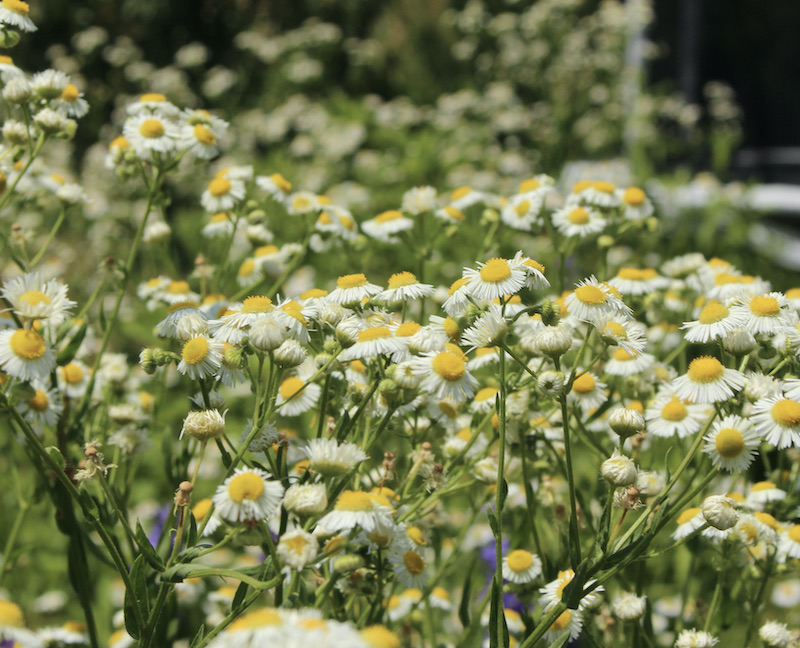
Weeds and wildflowers are never ungrateful.  Overly enthusiastic maybe but you never have to beg them to grow.

erigeron annuus daisy fleabane

A favorite weed, daisy fleabane (Erigeron annuus) can usually be counted on to sprout up when needed. 

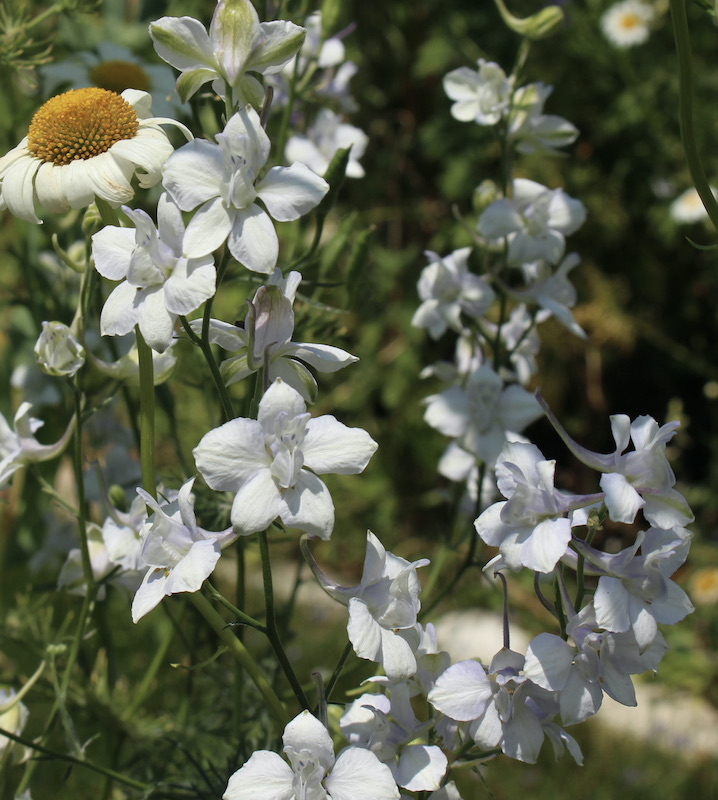
Sometimes you don’t even have to water them.  Actually watering weeds is a crazy idea… unless it’s fleabane or larkspur.  Both might be worth a little spray to get them over a hump.

white larkspur

It looks white, but here the larkspurs all tend to be an icy white with a drop of blue or gray in it.  Kind of a skim milk shade of white rather than titanium white.

Here I go talking about weeds again.  One more though.  Common yarrow has shown up in a few spots in the meadow and I wonder how these seeds find their way.

achillea millefolium common yarrow

Common yarrow (Achillea millefolium) laughs at heat and drought.  I think everything around it will shrivel up and die before you see anything more than a few leaves wilt.

White flowers in a dry meadow won’t cool anyone, but maybe the patch of variegated giant reed grass out front can help.  For months I’ve been saying someone ought to chop out some of the clump, since it really is too big, but it appears the message fell on deaf ears and it’s just as big (actually bigger) than last year.  Probably too big.  Alas.

verbena arundo donax

I’m not saying I judge my neighbors for not asking if I can spare a division, but the giant reed grass (Arundo donax ‘variegata’) is pretty awesome and only gets better as it climbs to 10 feet and more by the end of the season.

It’s way too hot to be out there in the blazing sun hacking inch thick, strong as steel grass rhizomes so that’s one more year for the grass to root in deeper and spread further.  Maybe next year, right?  Shade is a much better option.  White hydrangeas in a dappled shade both looks and sounds cool.

annabelle hydrangea

‘Annabelle’ Hydrangea arborescens is the hydrangea to grow if you want a foolproof every-year-its-a-show kind of hydrangea.  Newer hybrids?  Other species?  Help yourself, I’m just fine with this.

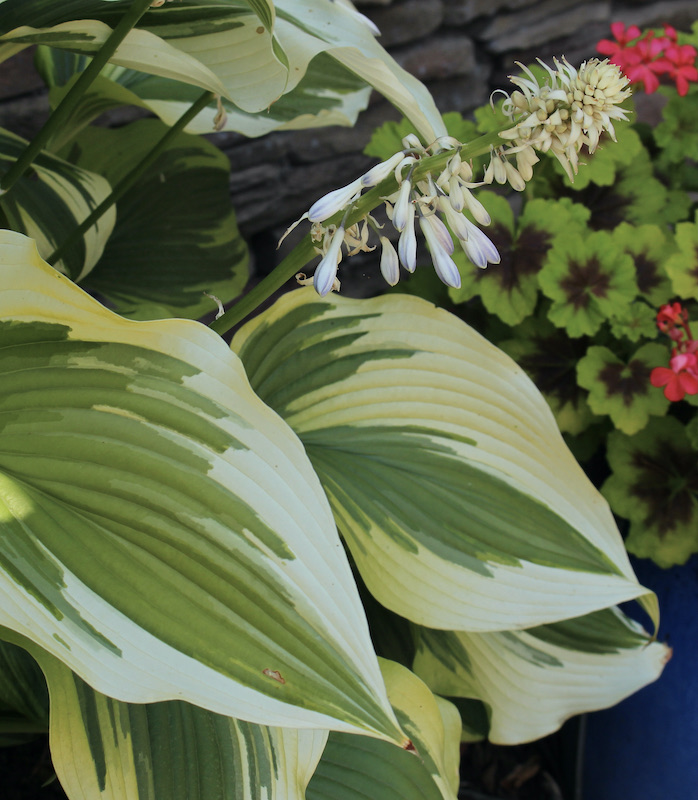
Hostas also make the shade even cooler and many people know this.  Some go to extremes.  I only dabble.

hosta montana aureomarginata

Hosta montana aureomarginata, an oldie but goodie in my opinion.  

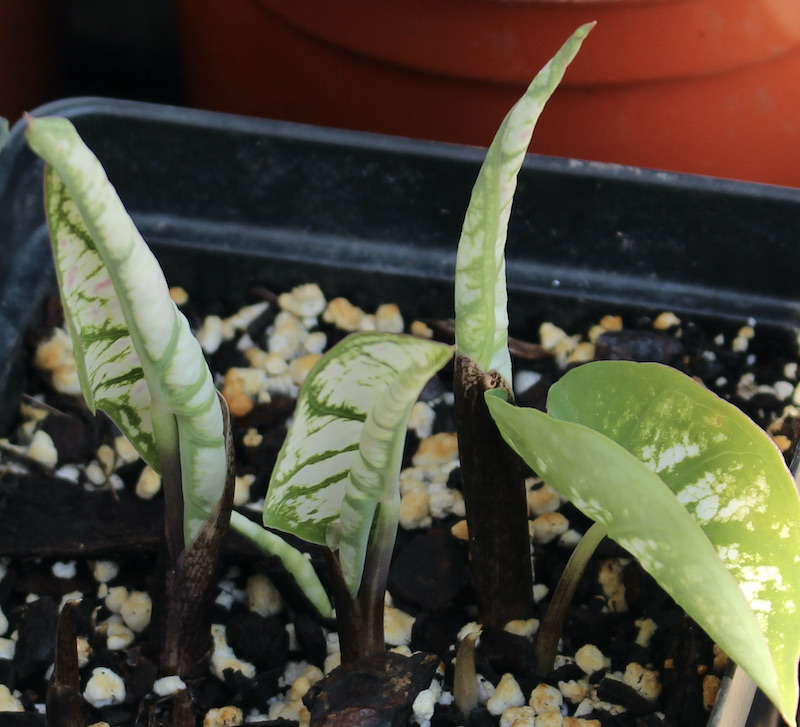
There’s another kind of foliage plant which I plan on going overboard with this year.  Caladiums.  I forget how much I’ve already revealed about ‘2021 the year of the caladium’ but it’s going to be big.  Not the empty kind of ‘big’ or ‘huge’ or ‘better than you can imagine’ that politicians have promised in the past, but a big five pound box of mixed tubers which was potted up weeks ago and is now soaking up the heat and starting to grow.  As you know, it’s not often I get excited about a new plant, but waiting for each leaf to unfurl is like waiting for a new plant to unfurl a new leaf and I just can’t think of anything more exciting than that.

sprouting caladium

White… with a hint of pink… not that I’m counting but there are 79 caladiums potted up separately and sitting on the driveway waiting to take off into growth.  Summer garage access is overrated if you ask me and I’m sure it will be entirely worth it. 

So there you have it, the cooling effect of white.  I’m all excited about caladiums now but maybe the white helped calm someone else and take the edge off the heat for a minute and that’s a good thing.  That and air conditioning.  Or ice cream.  Or a tub of cool water… whatever it takes to get through this because as you may remember, something called July and August are still on the way and I don’t think you’re going to hear much of ‘boy it’s looking cool next month’ or ‘golly did that temperature drop’ as much as you’re going to hear ‘relentless’ and ‘not a break in sight’.

Or I’m just being pessimistic.  Order some caladium bulbs.  There’s still plenty of time and at least they love the heat even if you don’t.  And even if you’re anti-caladium I hope you have a great week 🙂

Taming the Potager

Reading broadens the mind, and I’ve read too many gardening books to remain satisfied with a plain old vegetable garden.  I of course have a potager, which (from what I’ve heard) is a vegetable garden but fancier, with vegetables but designed and mixed with flowers and supposedly a nicer place to sit around in than the dirt paths and rows of beans of your common vegetable garden.  Plus it’s a French word, and here in America anything with a french name is fancier.  Case in point: baguette vs ‘long loaf of bread’… fancier… and now I rest my case with just one argument, since neither my argument nor the fanciness of my potager will likely stand up to any in depth scrutiny 🙂

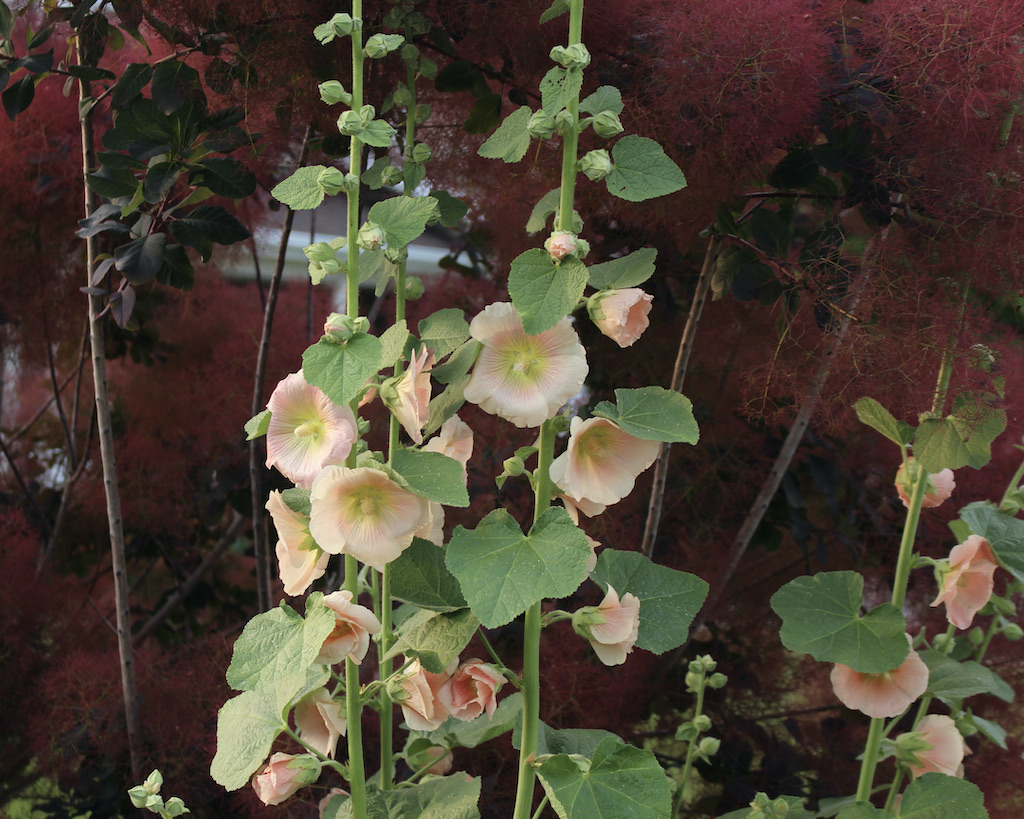
hollyhock rust

A stray hollyhock seedling in front of ‘Royal Purple’ smokebush (Cotinus).  Normally the bush is cut back but this year was left unpruned in order to smoke (bloom).

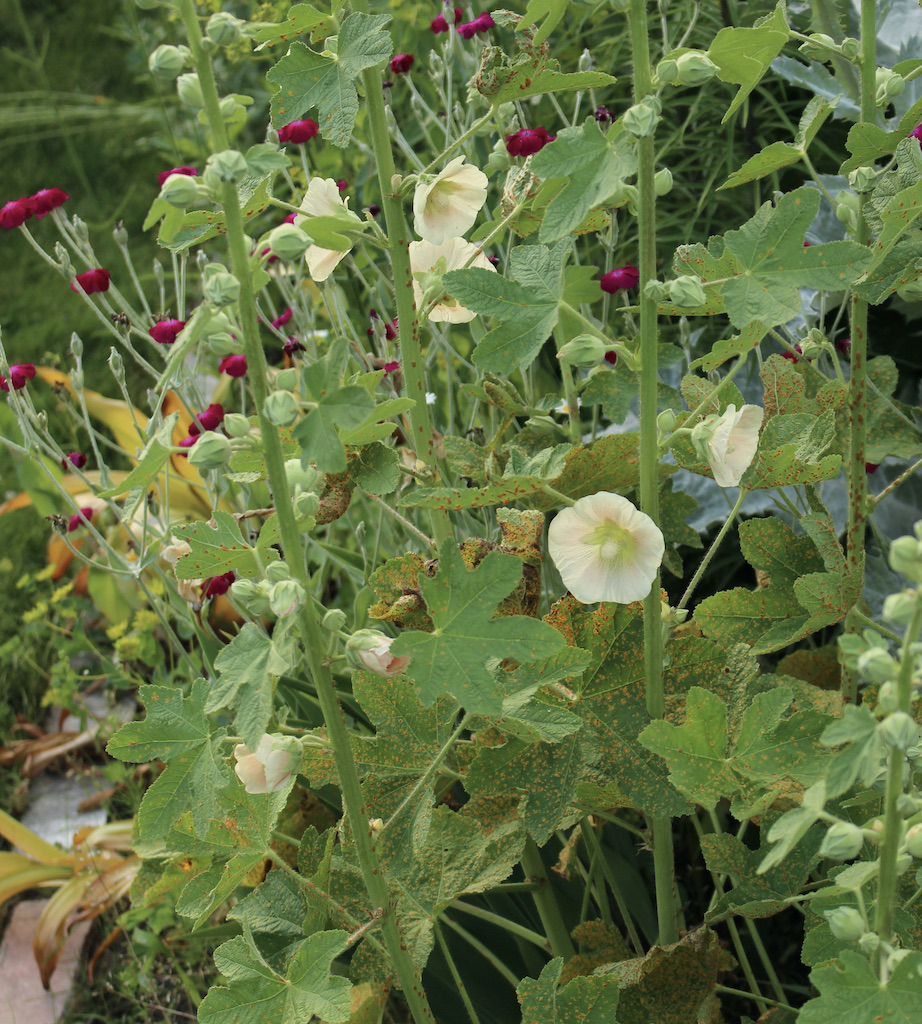
Just a few thoughts on Hollyhocks(Alcea) before we go to the potager.  I was hoping a few rust-resistant plants might show up as I try to mix in a few “rust-resistant” species, but so far no luck.  Rust is not a good look and of course I’m far too lazy to spray.

hollyhock rust

I thought this might be a yellow Alcea rugosa, and possibly less rusty, but the pink tint in the flowers and all the spotting and rusty lesions says otherwise.  I should rip it out now, but…

So I’m 99% sure that starting off with me sharing my disease problems is not the path to fancy, but I’m going to try and save this.  The best thing in the potager this week are the larkspur and oxeye daisies.

larkspur and daisies

Larkspur and daisies.  Not really fancy, but maybe ‘shabby chic’, and chic is right out of Paris.

Some people might point out that Larkspur and daisies are more abandoned farm field than they are high style, but right now I love them, and I’m not even going to mention they’re actually the result of not weeding rather than any planned style initiative.

larkspur and daisies

I meant to dig the alliums and tulips, but never quite got around to it.  Fortunately the largest prickly lettuce and mugwort were weeded out a few weeks ago 🙂

The actual efforts at design are much less impressive.  Roses and clematis to climb the ‘structure’ are still two or three years from breathtaking.

rose chevy chase

I suppose this will be a patriotic design, with the bright red ‘Chevy Chase'(a 1939 rambler rose) joining the misslabeled blue clematis and white daisies.  I’m expecting ten feet or more from Chevy, he should be a strong grower but sadly lacks any fragrance.

Any real potager needs a few vegetables, and so far lettuce and cole crops are the only things looking productive since the tomatoes and squash have only just gone in.

summer cabbage

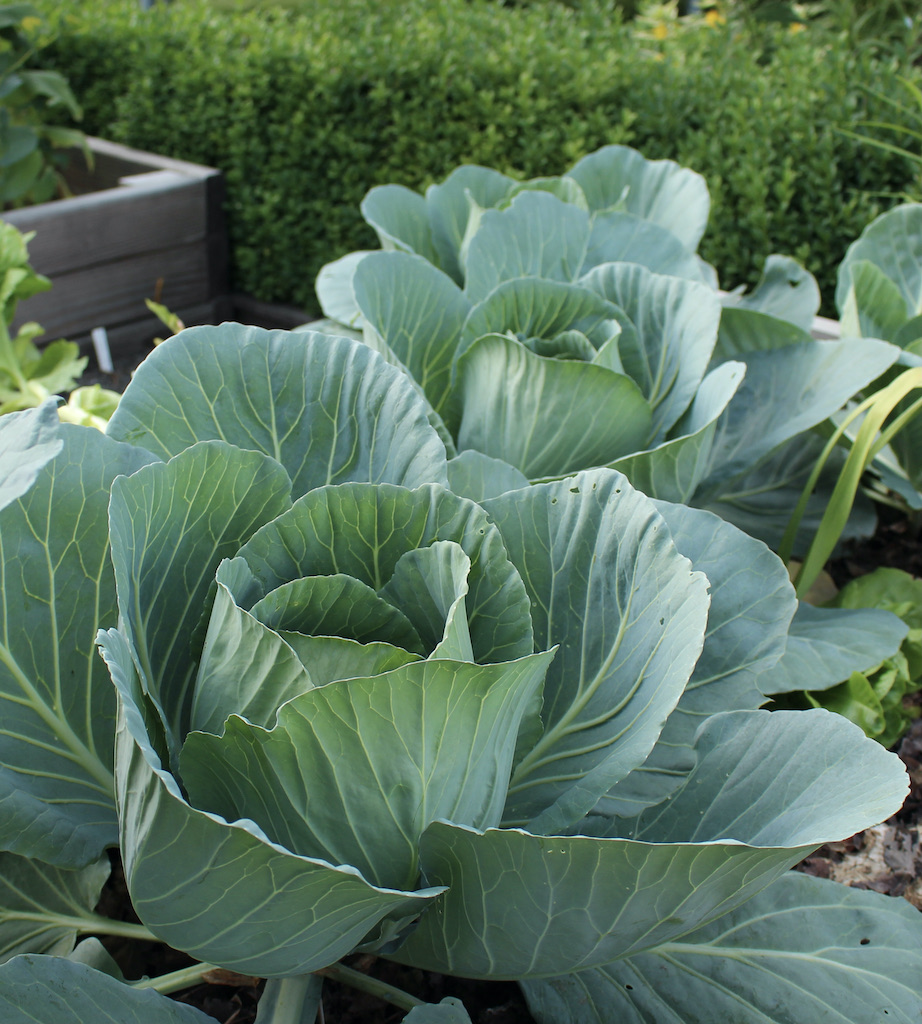
I love cabbages and all their kin.  Earlier in the year the cabbage worms attacked, but after a little picking off, the worms have stayed away or found other hosts.  Un-nibbled leaves really look much better than the usual worm-riddled foliage.

So as usual I have an excuse for being late.  Rabbits made their nest in the middle of the tulip patch.  Somehow six cottontails had to grow up before I could dig the tulips.  I couldn’t transplant the chrysanthemums until the tulips were out, and then dahlias had to go into the bed where the chrysanthemums were.  I think following chrysanthemums with a dahlia planting is called crop rotation, and all the fanciest gardeners practice crop rotation.

dahlia seedlings

Nine ‘Bishop’s Children’ dahlia seedlings are all I got out of a packet of thirty seeds.  That’s a good thing, what would I do with thirty dahlia seedlings?

Some of the other tulip plantings were followed by tomatoes, and I’ll show them as well but they need a few weeks before they and the rest of the new potager plantings begin to look nice.  In the meantime I need pear advice.  Last year a late freeze killed off nearly every flower save three, this year every flower made it.  I have dozens and dozens of little pears and I need to know if I should drag out the ladder and thin them, or if they will naturally thin themselves.  To me the answer is already pretty obvious, but of course I’d love for someone with more experience to tell me I don’t have to thin them.

thinning pears

Little pears.  I already thinned the lower branches to just a few fruits.

It doesn’t look like a few French words will fool anyone, and those are pretty much all the highlights of the potager in mid June.  With the bubble burst, I might as well take you around the rest of the even less fancy parts of the back garden.

wildflower meadow

Weeds along the berm.  Year 1 was smartweed, year 2 was some mustard, year 3 is birds foot trefoil, daisies, and grass.  I think it looks best this year and I think some rose campion seed needs to be sprinkled in as well 🙂

Weeds along the back of the property and now an overgrown snowdrop bed.  Finally after years of tinkering this bed is becoming more stable and I think (a little)less weedy.

rain garden

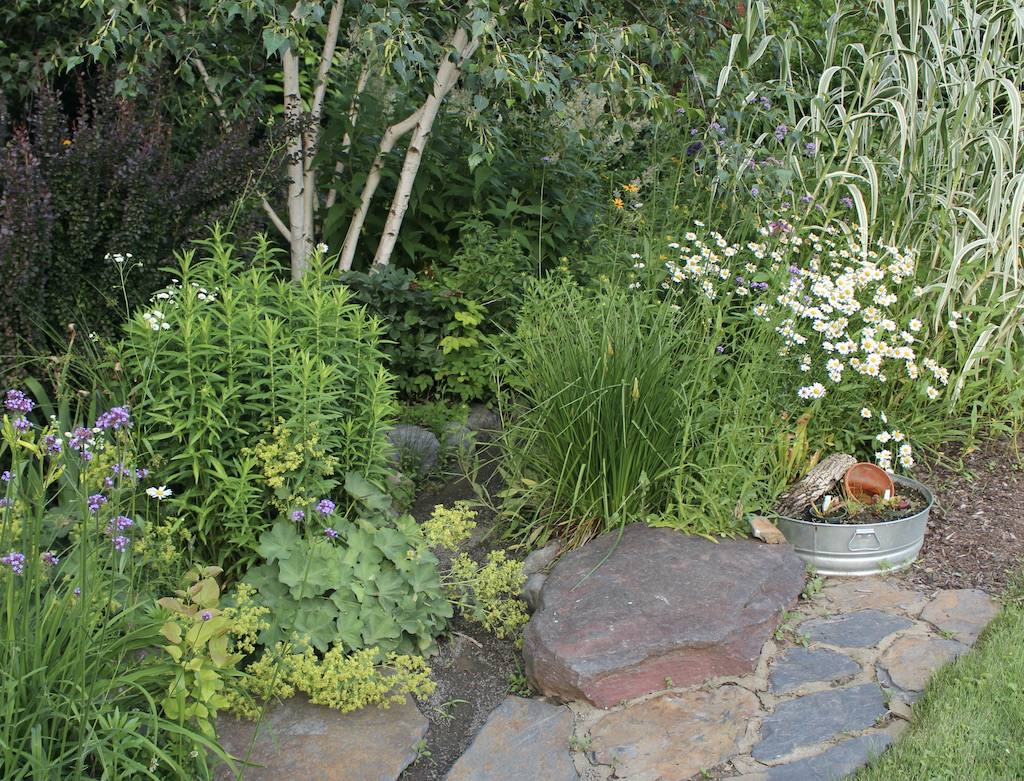
Snowdrop bed, aka rain garden.  The roof runoff washes down the sand path and keeps this bed a little wetter than it used to be.  The plants seem to love it.

There’s so little design and zero fancy to this side of the yard.  As the years pass it’s becoming more of a snowdrop garden and the other plantings have to take second billing, even if they do occupy the ground for about 11 months compared to the 1 month of white.  Of course I cannot explain myself on this addiction.

blueberry

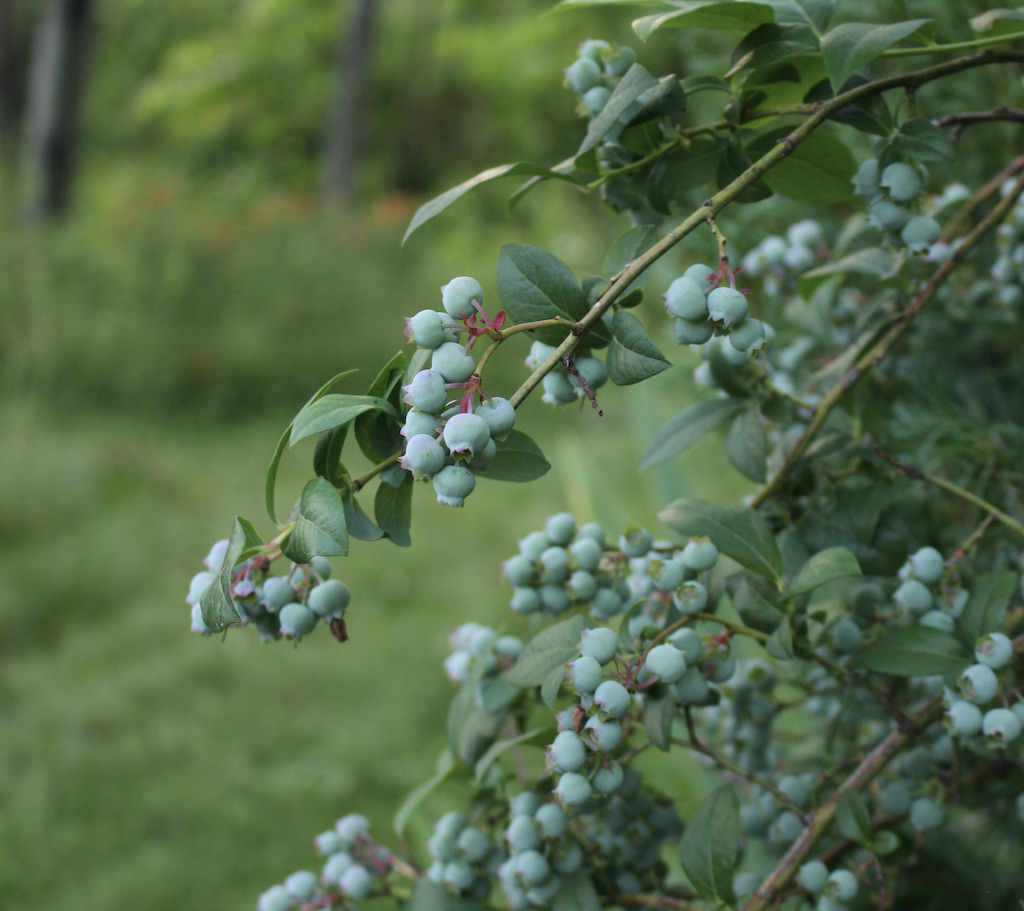
This year the blueberries will be protected.  I have netting, but all the fledgling birds who flock to the bushes are just too clumsy to avoid getting trapped, and I can’t untangle another body.  I’ll try some floating row cover material and hope that out of sight will save enough for pancakes at least.

Hopefully this end of the garden gets some attention this weekend.  It’s always the last job, and for as ‘finishing’ as that sounds it really only means I go right back to the start and begin it all again, this time with more weeding and less planting…

japanese iris

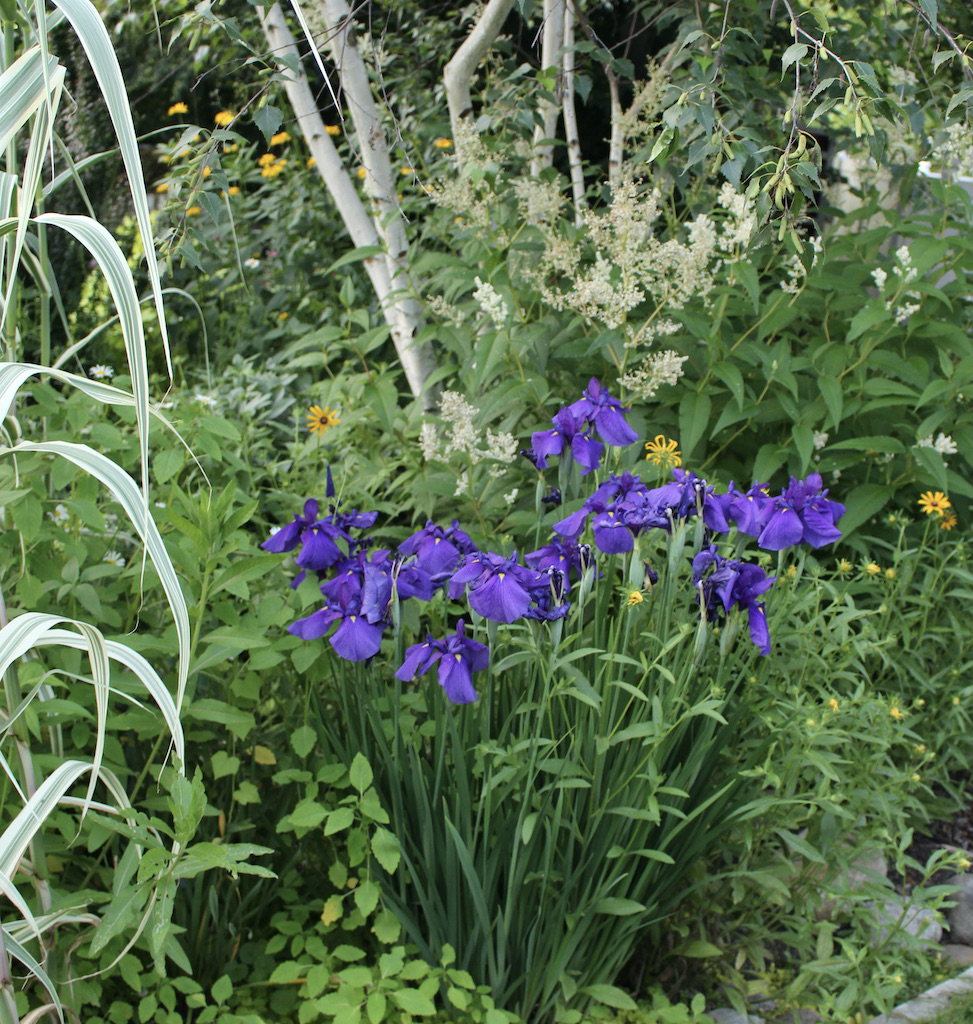
Even in a thicket of weeds this Japanese iris looks fancy.

Maybe on the next go around things will change.  All the weeds will go out, some thoughtful design will go in, some rough edges cleaned up?  I think not.  It’s firefly season and they love all the rough edges and I love having them light up the evening garden, and for as much as I’m tempted to weed-whack the berm or mow the meadow it’s not happening this month.  I’m sure I’ll get over it and it also wouldn’t hurt if I found something better to do 😉

Bonjour, and I hope you have a fancy week!


A Day of Rock Gardening

Last weekend my friend Kathy of Cold Climate Gardening talked me into a plant sale.  No offense to her salesmanship, but it wasn’t the toughest sell considering I’ve been itching to get back to town ever since my first ‘Ithaca Spring Garden Fair and Plant Sale’ two years ago.  Covid you know… so I’ve been saying pass, but then Kathy told me about the spring plant sale of the Adirondack Chapter of the North American Rock Garden Society.  It’s a members only thing, just a few people donating, buying and selling, but it sounded perfect.  Big deal that I wasn’t a member(yet) and it’s an over two hour drive, plus it’s a whole Saturday away from a garden which I should be weeding… and I already had plenty of unplanted things… but you know as well as I do that once the gardening gauntlet is thrown down it must be accepted, so of course I said yes.

It was a beautiful morning and the drive was a perfect trip up the Susquehanna river valley and then across the rolling dairy hills East of Cayuga lake to the plant sale.  The sale was fun.  Members (which now included me) were given numbers and each person had a chance to visit the sale tables and pick up a favorite.  After a couple rounds of this the tables were opened to everyone, and one by one they emptied.  There was more of course.  While this was going on plant talk was every where, an auction was lined up, a free table was filled and cleaned out… members introduced their favorite plants which they thought ought to be selling better, and at one point someone just stood on a bench and invited everyone over to visit their garden afterwards 🙂 I like these people, and this also brings me to one of the big selling points for me doing the drive and joining the chapter.  Garden visits.  I had heard that a local rock gardener had offered to open their garden after the sale, for members to visit.  It’s a garden I had read about and seen pictures of, and I knew it was a must-see garden.  Wow, was that the truth!

ithaca rock garden

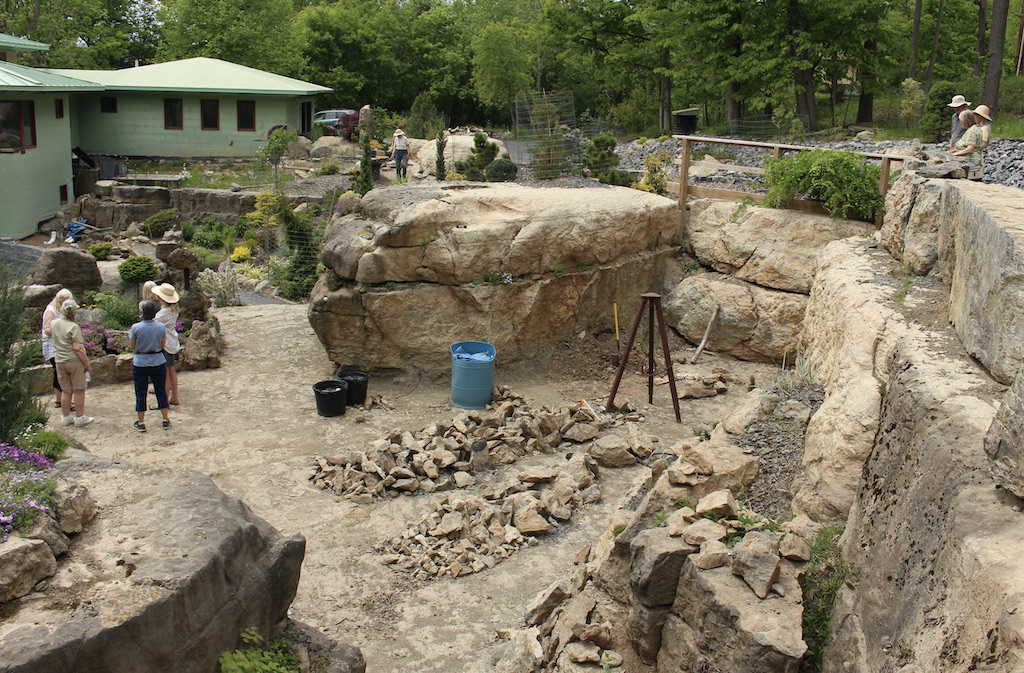
A hillside was being excavated to expose the bedrock

Some of the epic rock gardens of Europe are heaps of stone built up to create mini-Matterhorns out of flat cow pasture.  This garden is not that.  Here a pair of inspired gardeners found a plot of land where they knew they could carve the earth down to bedrock, and then build a rock garden up that follows the natural cut of the ravine.  It’s actually quite a crazy idea, but awesome to see.

ithaca rock garden

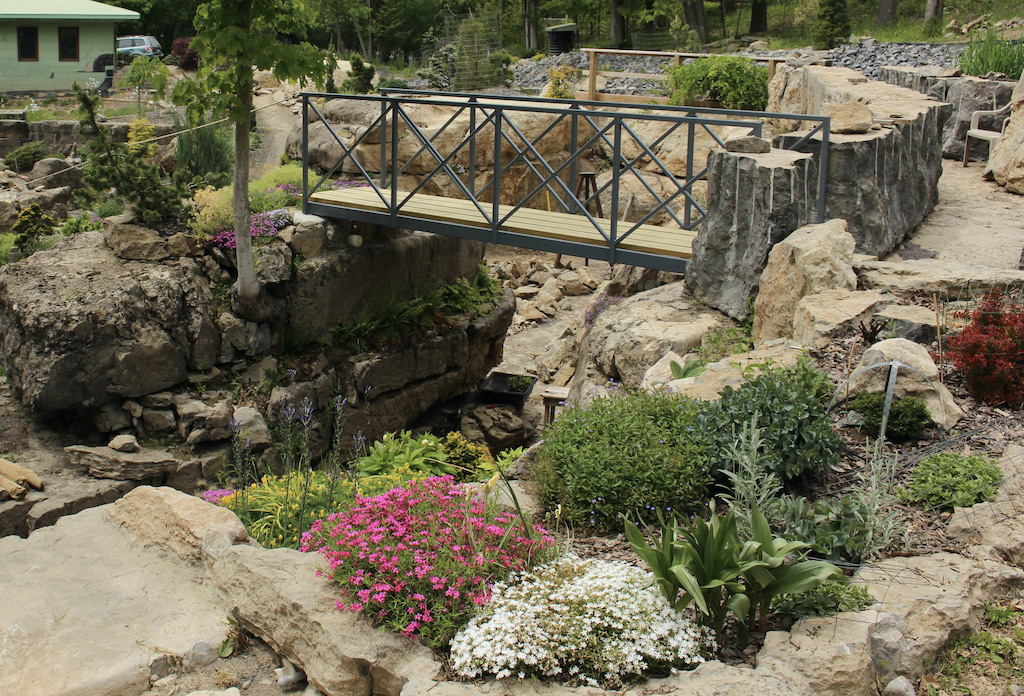
One of the newest additions, a bridge now spans the gap between rocky outcroppings.

Of course these pictures don’t do the scale of the garden justice.  Massive boulders were being moved and placed in a way which looked as if the glaciers did all the heavy lifting thousands of years back.  Unearthing the bedrock sounds easier with the help of heavy machinery, but then consider the care which has to be taken to not gouge the naturally weathered walls and boulders as they’re being uncovered.  All the fine uncovering had to be done with hand… and then moved by hand…

ithaca rock garden

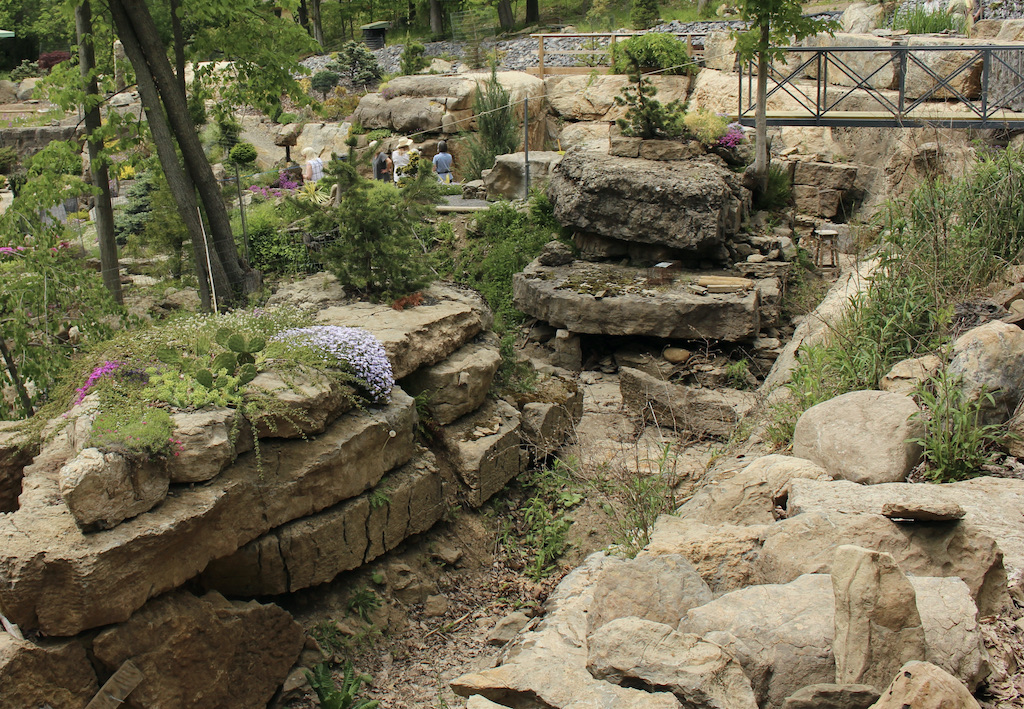
The earthworks from even further back.  All of this was uncovered, and much of it moved into a more effective place or position, even the larger slabs of stone.  Behind where this photo was taken there’s even more excavation.

One of the chapter members mentioned that the owners were back and forth about opening the garden.  ‘It’s not a garden, it’s a construction site’ is more or less what I got as the reasoning, but only half of that is true.  It’s an awesome construction site, but it’s also an amazing garden, and I think it’s even more amazing when you can see what went in to all the plantings.

ithaca rock garden

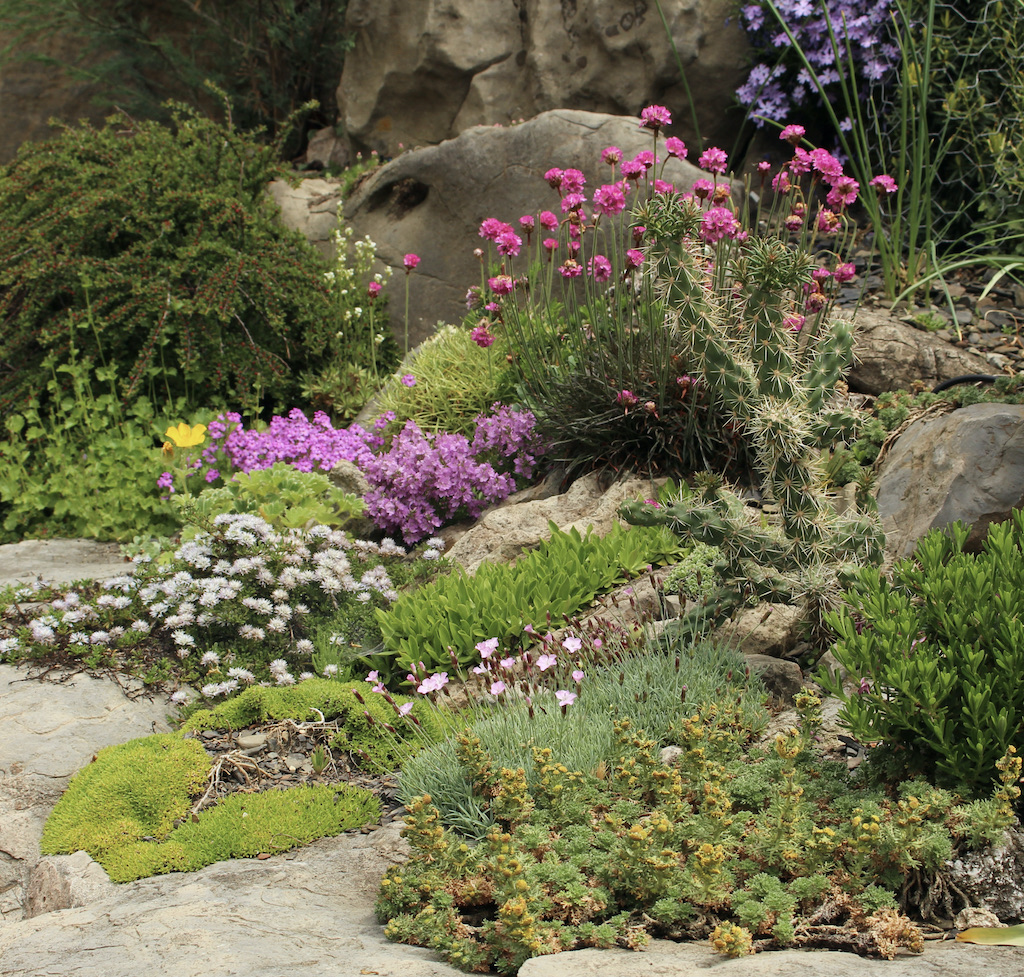
Plantings tumble down the slope, this one built up with tufa stone, a porous rock light and airy enough to allow plant roots to penetrate.

This is the first real rock garden I’ve ever visited so I can’t say much about the plants other than they looked perfectly happy.

ithaca rock garden

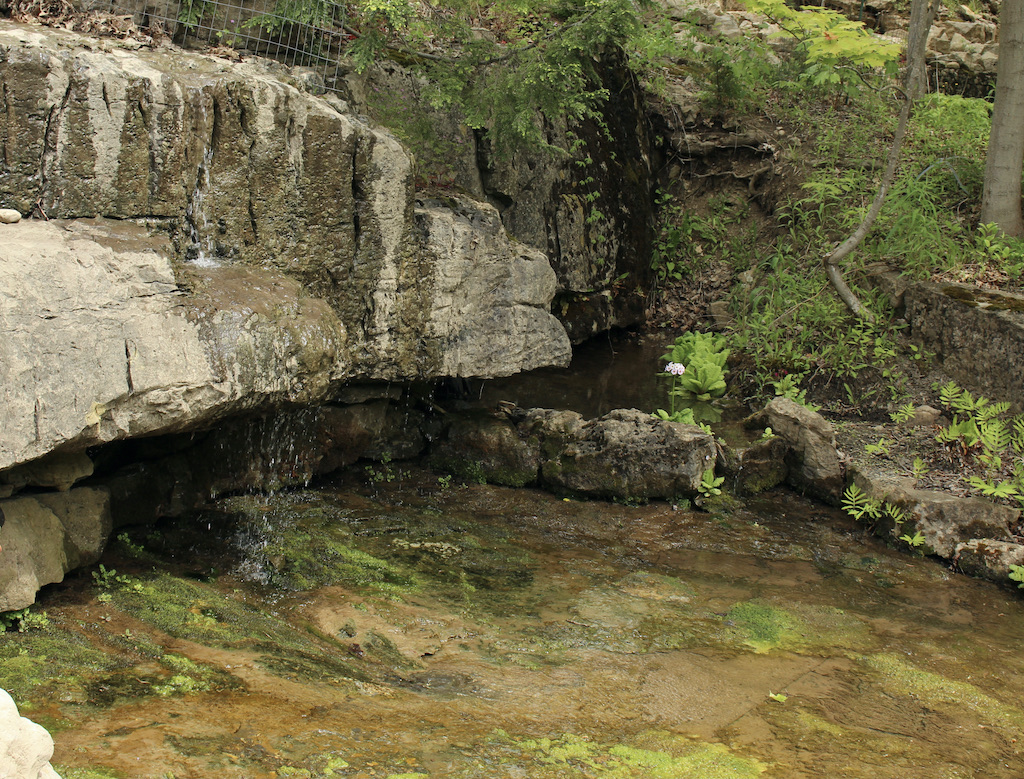
Rocks overhanging a small pool.  Tufa stone allows for plants to be ‘set’ directly into drilled holes.  Eventually the plants spread out on their own as the roots find their own paths into the rock.

ithaca rock garden

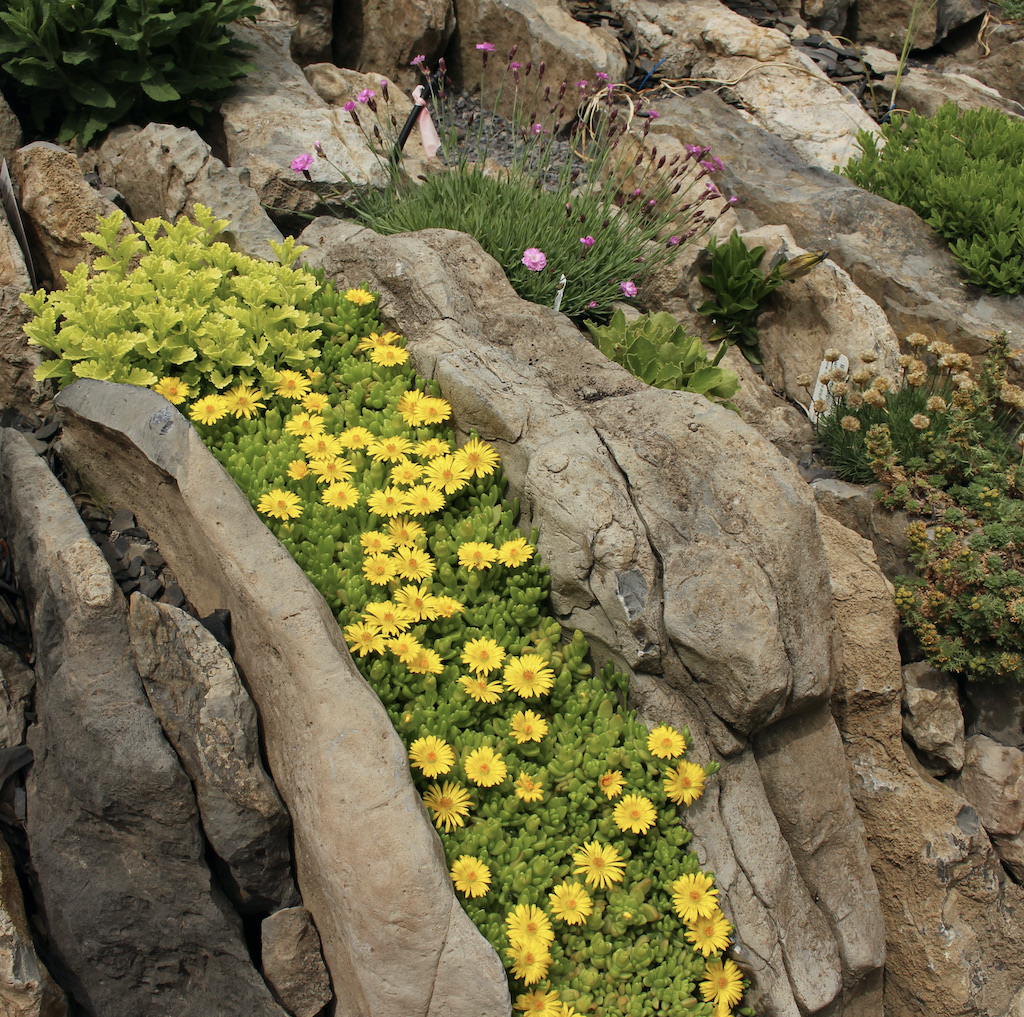
Oh, and just a big crevice garden for all those things which love a deep root run between stones.  Yellow delosperma and a yellow leaved teucrium (which I just happened to pick up at the plant sale!)

ithaca rock garden

Some of the plantings were really amazing

ithaca rock garden

Even a hosta!  -but I really love the yellow leaved saxifrage (maybe saxifraga ‘Cloth of Gold’?)

As I worked my way down the paths through the rock gardens, and headed closer to the house, I reached the patio area.  Here the garden hosts had set up a dining area with snacks and beverages and plenty of wine.  From what I hear this generosity was all part of a master plan to “loosen lips” and get the honest impressions of their visitors with an eye towards improvements and new ideas.  Sadly, I believe the wine was just wasted on me 🙂

ithaca rock garden

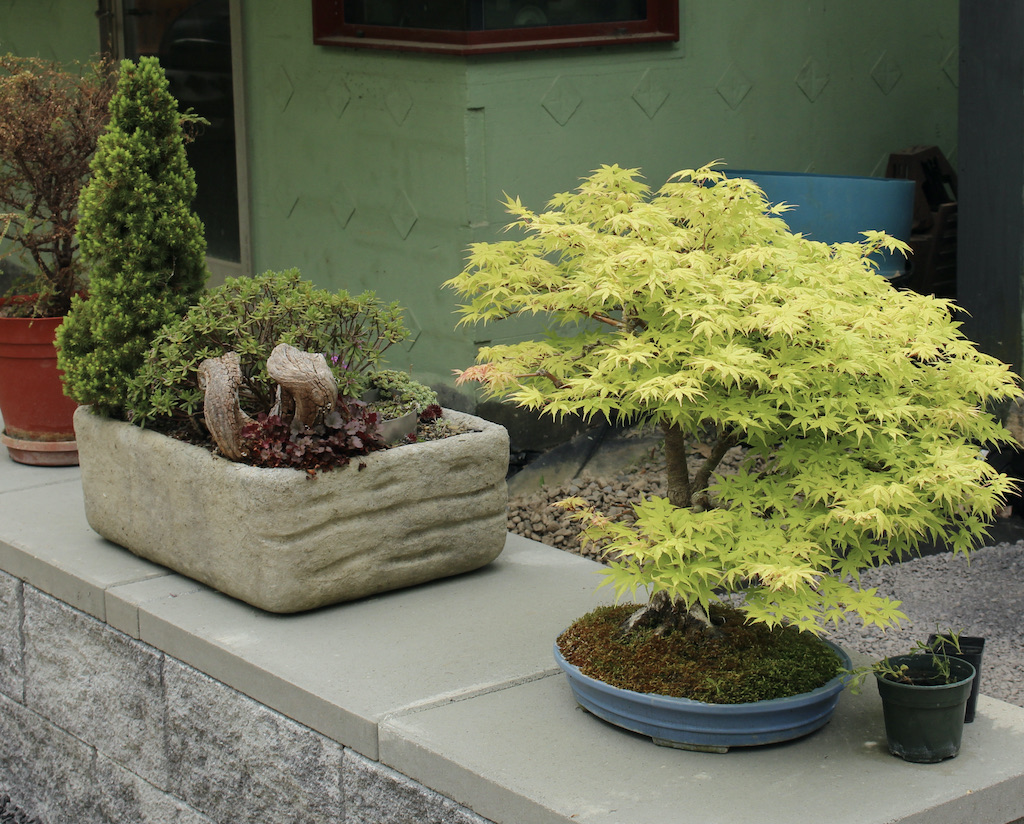
Bonsai and trough gardens.

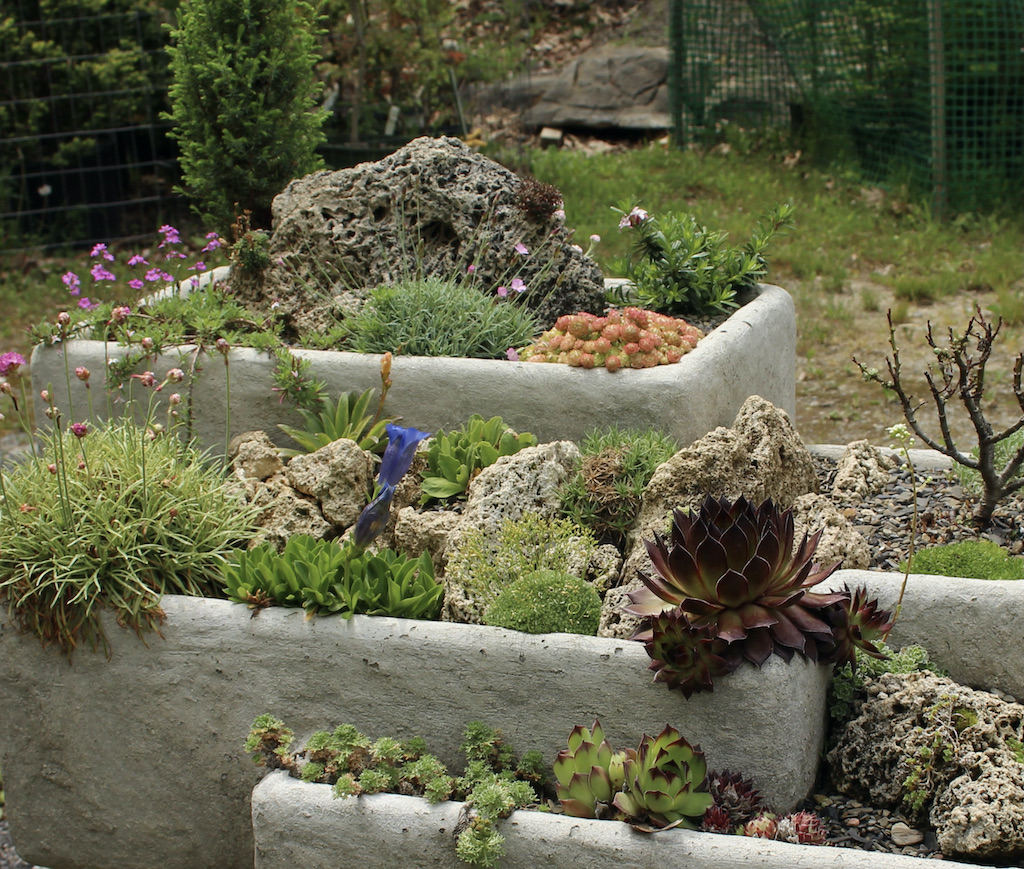
The trough gardens were particularly interesting, and not just because of the mini landscapes planted in them.  In the past these gardeners have hosted trough making workshops in the garden as well as publishing articles on the process, and I was excited to see that the troughs look excellent in person.  Excellent enough that I think I’ll give one a go this summer and see how it turns out!

ithaca rock garden

Some of the troughs were quite complex.

Wine and snacks have a way of gathering people, so at the patio I stopped and took in a few of the conversations.  Someone asked me how I liked the top part of the gardens and I said ‘Top?  There’s also a bottom?’ …and yes, there’s a whole other part to the garden.

ithaca rock garden

Below the rock garden a natural seep provides flowing water for the bottom part of the gardens.

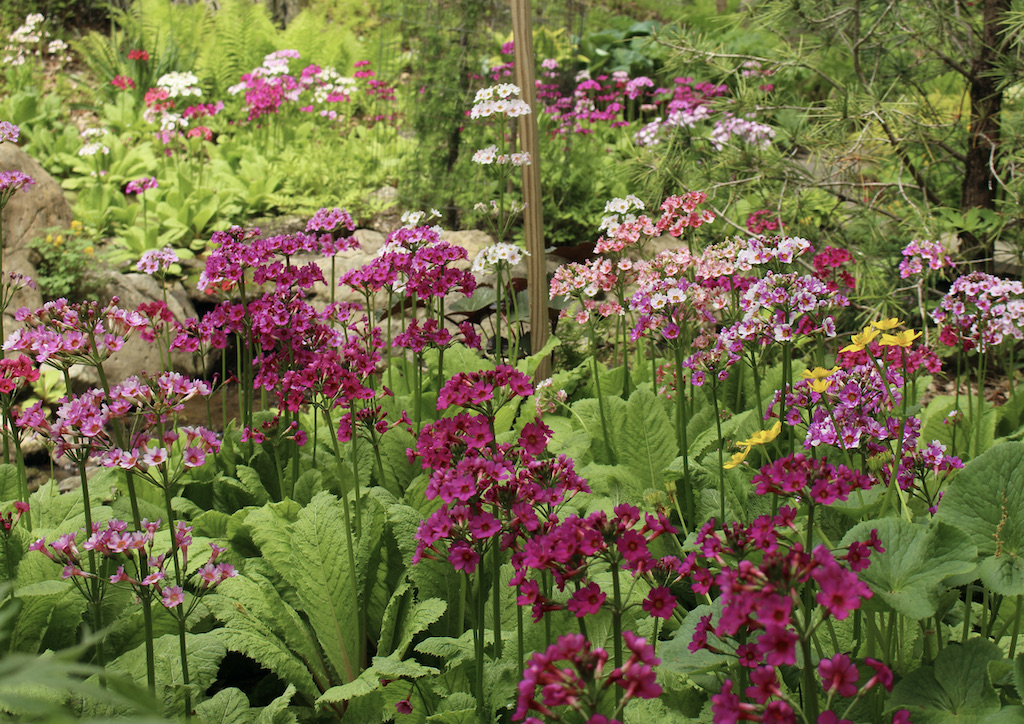
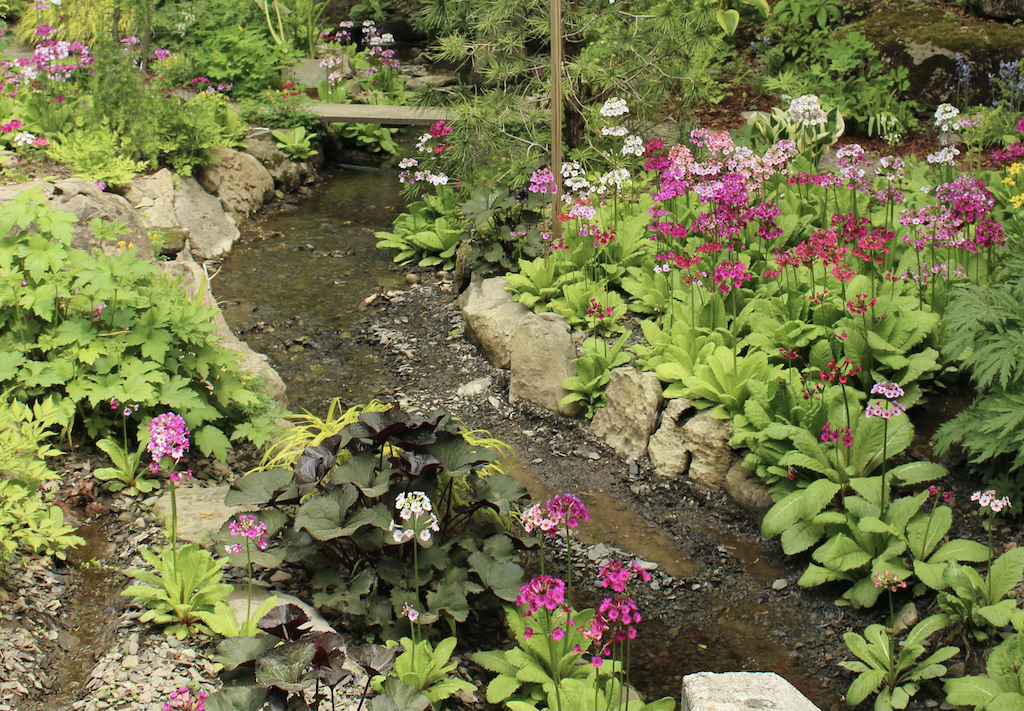
As you come around a few more boulders you find yourself at the bottom of the ravine, where a mass of Primula japonica fill the low spots.  They were just starting their peak bloom, it was excellent.

ithaca rock garden

A path runs back and forth along the stream.

ithaca rock garden

Masses of Primula japonica

ithaca rock garden

The stream heads out to the lake.  You would never guess a downpour had this garden nearly flooded a few days prior to the opening.

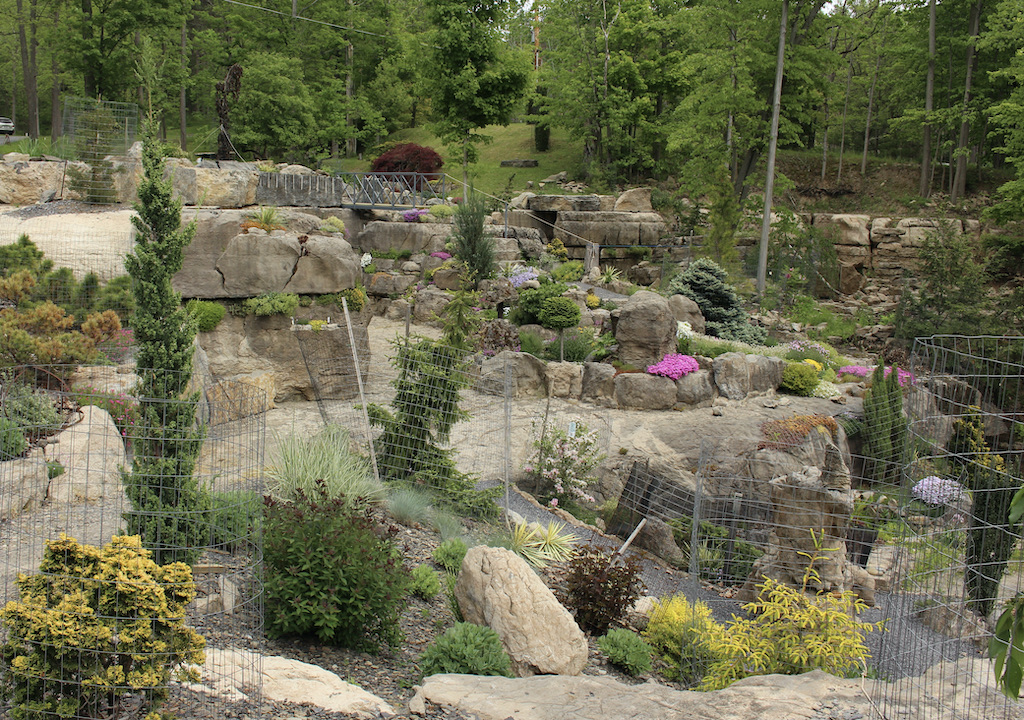
There were more woodland plants, azaleas, rhododendrons, and tree peonies but of course I can’t show everything, so I’ll leave off with one last overview of the upper garden as viewed from the house.  As you can see ‘dwarf’ conifers are also an interest.

ithaca rock garden

A view from the other side.  You can see some of the deer fencing, obviously the hooved beasts have no respect for such a special place.

So this garden was amazing, but who would I be if I turned down another garden tour invite?  I headed a few miles further to the impromptu open garden which had been announced at the sale, and here I was able to enjoy huge beds filled with lush perennials all grown to perfection.  I’m afraid I derailed plenty of my host’s Saturday afternoon gardening plans since it was already kind of late, but she still gave me the full tour!

ithaca rock garden

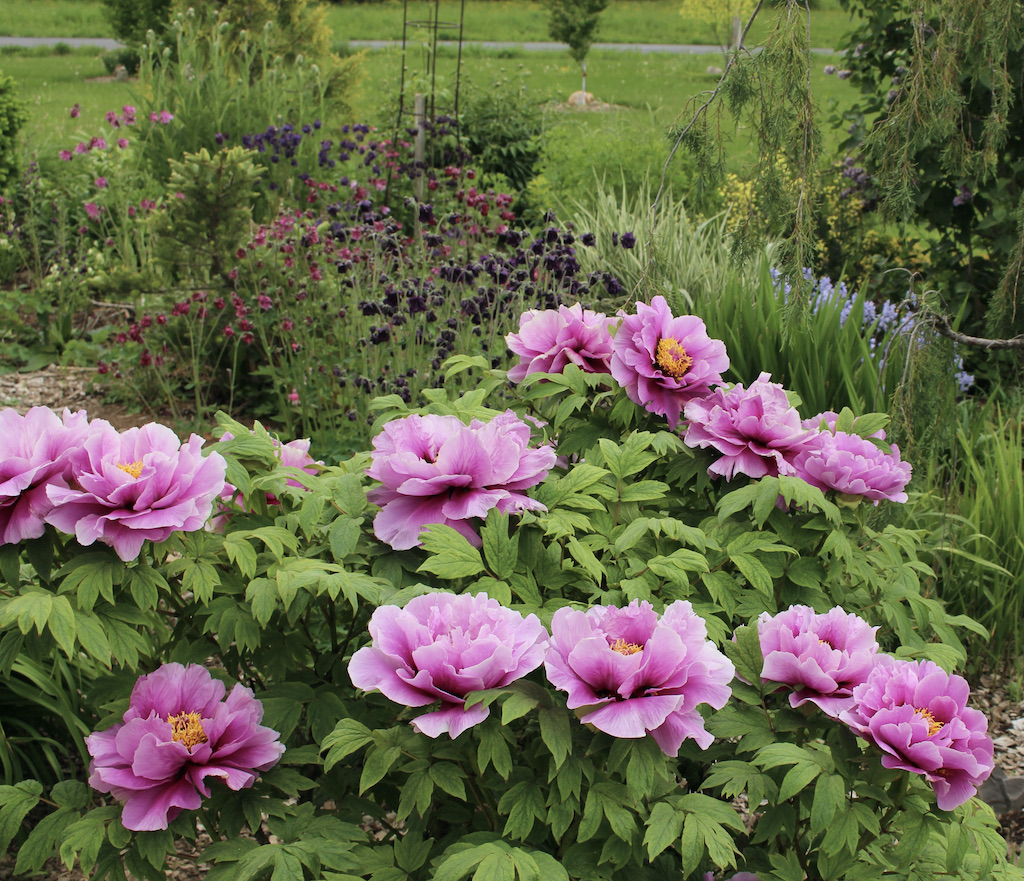
Tree peonies were at their moment of perfection.

There were cool plants everywhere, and they were all so well grown that I tried to avoid all honesty about my own garden when asked.  My big regret though is that I didn’t take more pictures.  It’s almost criminal that there are no photos of the red horse chestnut (Aesculus x carnea ‘Ft. McNair’) which was in full flower over one of the back beds.

ithaca rock garden

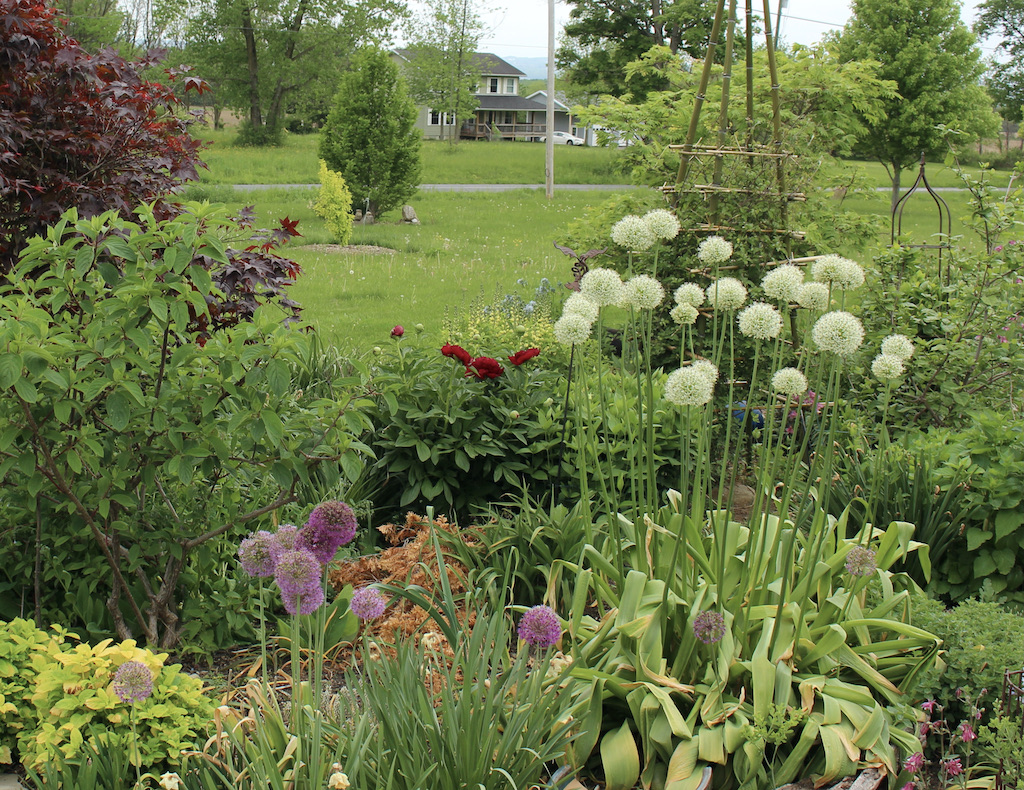
Alliums, Aquilegia, and peony were at their peak but I could see that the show had started months ago with spring bulbs, and will continue for months more with all the other later perennials.

ithaca rock garden

Wow.

So I’m also not even mentioning the shade gardens, the small arboretum of special trees, the field of dahlia tubers I was preventing her from planting… It was another fascinating garden and I have to say that the best thing about this day was meeting person after person who were so crazy about plants that it made me feel entirely sane.  What a group!

I rushed out of this stop with a new friend (and even more plants in my hands) and headed for my last stop.  It was already about dinnertime when I rolled into my friend Leon’s driveway but he didn’t seem too annoyed with me.  He knew I’d be late and still led me around the grounds of Der Rosenmeister Nursery and tolerated question after question.  I didn’t have time for a single picture.  I bought three roses.  I’m going back in a few weeks to see the hundreds of roses in full bloom, and it is guaranteed to be another great trip and I’m sure you’ll hear all about it 🙂

Hope you enjoyed this adventure !

The Potager 2.0

When the pandemic first came to our shores and we were faced with a surprise vacation and then a transition to work at home, the non-commuting lifestyle left me with what seemed like a mountain of extra time to spend in the garden.  ‘Let me get some building materials delivered’ I said, and ‘build a few raised beds’ I thought.  The boss gave her approval and things began to move.  Slowly.  A thousand things had to be moved first, plans needed to come together, but I think it’s finally at a point where I can show it off a bit, if only to get it over with rather than build some unwarranted, over-blown hype.

raised beds

The front entrance to the potager.  A slight downward slope ends at the pergola, the beds are leveled into the slope, and the blocks will hopefully help with keeping the lawn edge neat just in case we get enough rain for it to grow again.

The first dilemma was choosing lumber.  As usual I went with cheap and selected eight foot pressure treated 2x4s, but it wasn’t all that easy. Naturally rot resistant cedar or redwood would have been nice, larger boards would have been nicer, but the costs were way higher than I was comfortable with so it was a compromise between expensive all natural, or cheaper with a vague possibility of copper leaching… well I say that but actually the compromise was lower the cost or it’s not going to happen…

Overall I hope to get at least ten years out of the wood because although it’s pressure treated it’s not rated for ground contact.  Eventually it will rot, but the treatment should give at least a few years more than untreated, and funny story… the pandemic caused a pressure treated lumber shortage, so we will see exactly how much faster au naturel rots, since all I could find for the last two beds was untreated wood.

raised beds

The view from the trampoline.  We are into the annual zucchini tsunami and each morning a few more line up on the counter.  Someday I hope to level this bottom part of the garden.  The beds are built level but the grass paths still need some fill to bring them up. 

Besides being cheap with materials,  I also got a little greedy with the bed space vs path width.  Between beds is about two feet, and even if it were wider there was still no way (add laziness to the growing list of personal faults) that I was going to wrestle a lawnmower between each bed.  Enter the wonderfully gritty sand pile.  I knew I didn’t want lawn, wood chips need replacing (and why add organic matter to your paths when it should be going onto your beds?), bare landscape fabric is ugly (and violates my no new plastic policy), so I wanted it to be something inorganic and long lasting (and yet again, cheap).  So I grabbed my face mask and was off to the quarry to look at stone dust, crusher run, and sand.  Surprisingly the sand looked perfect.  It was sharp enough to pack down well for a solid footing, and coarse enough (up to about 1/8″ particles) to not wash away in a heavy rain.  So far I love it, and in the future I might even get sand to top off beds rather than buying ‘topsoil’ that turns to rock the minute it dries.

raised beds

I removed the grass from a few of the pathways and used the turf to fill the beds.  Sand paths will hopefully be low maintenance with great drainage, and if worse comes to worse I can just dig them over and replant grass.

Cinder blocks are also cheap, and at about $1.20 a piece I lugged a few carloads home to use as edging and to form a little paved area under the pergola.  So far I like it.  It’s an honest concrete look rather than concrete pavers trying to pass off as something fancier.  Of course stone would have been another nice permanent edging but again spending a bunch of money was not part of my pandemic response.

With the beds built and the lawn edged and sand down on the paths I was super surprised to see that I still had leftover sand.  I tried to calculate for extra sand for an additional pathway up alongside the fence, but to actually have a plan that worked out was a little bit of a surprise.  After years of collecting and lugging random stones I could finally use them to line a sand trail that gives access to the back of the pond.

garden pond

Finishing the pond is still on the to-do list but for now I think it looks good enough.  The shallow end is in constant use as a birdbath, so it’s really more of a watering hole than a pond…

The pond path is surprisingly popular with the kids and our little garden bunny.  I’ve caught both zipping back and forth, and in the morning there are all kinds of footprints in the sand.

sand path

Pond path’s entrance.  Yes those are mostly weeds.  Weeding went onto the back burner as I lugged load after load of lumber, blocks, and sand.  

To sum it all up I love the new beds and I feel like there’s so much more useable space with it set up this way.  I have a total of eleven 4×8 beds and for now it’s all vegetables and I’m trying not to give in to the temptation of planting flowers… except for the one bed which I gave over to chrysanthemums… but my resolve may dissolve since I still need room for phlox and tulips.  At least I’m trying to be firm with the usual sunflowers and verbena bonariensis seedlings.  -for the record I’m not sure why I needed a bed of chrysanthemum, but after years of neglecting them and abusing them in horribly weedy, infertile, and dry sites, I thought it was about time to do them right.  We will see.

rain garden

Yes, more weeds.  The weeds exploded with last week’s rain and this bed was the next one to need attention.

With everything under control in the potager, there was still enough sand to upgrade the dirt ditch of the rain garden with another nice, stone-lined, sand path.  If you recall, last summer this area received a small paved area and path with all the leftover flat stones liberated from the industrial park construction.  It was nice, but I didn’t like the dirt gully which channeled the runoff, and when I don’t like something I kind of neglect it, and when you neglect a garden the weeds send out an alert, and when they all show up to answer the call things go downhill fast.  The weeds are out now, the sand is down, and although I’m short on rocks along the one side, the other doesn’t look bad at all.  We will see how it holds up.  If you look closely at the paving joints you might notice the joints are neatly filled with sand rather than dirt, and both of those are a pain to keep weed free when all you have is this narrow joint that the roots can hold onto.  Truth is I threw some leftover polymeric sand in there, and when you wet the sand the polymer sets up and solidifies it.  I don’t know how it will hold up but hopefully I’ll get at least a few years of no-weeds-in-the joints enjoyment.  The weeds will be fine elsewhere though, so if you’re worried don’t be.

rain garden

Another step forward I hope.  Mulch would be nice now.

That’s where we’re at going into the weekend.  The weather forecast is promising another heat wave so I’m not worried about mowing, but watering will be on my mind.  I don’t like watering but it does beat lugging cinderblocks and digging turf so I’ll keep the complaining to a minimum.

Traditionally I usually meet the hottest days of summer with a pile of mulch in the driveway.  Hmmm.  I hope you have a more relaxing weekend 😉