Tuesday View: The Front Border 6.13.17

Welcome back!  That’s what I’m saying to myself as I get back to posting Cathy’s weekly view… after an *ahem* three week absence…
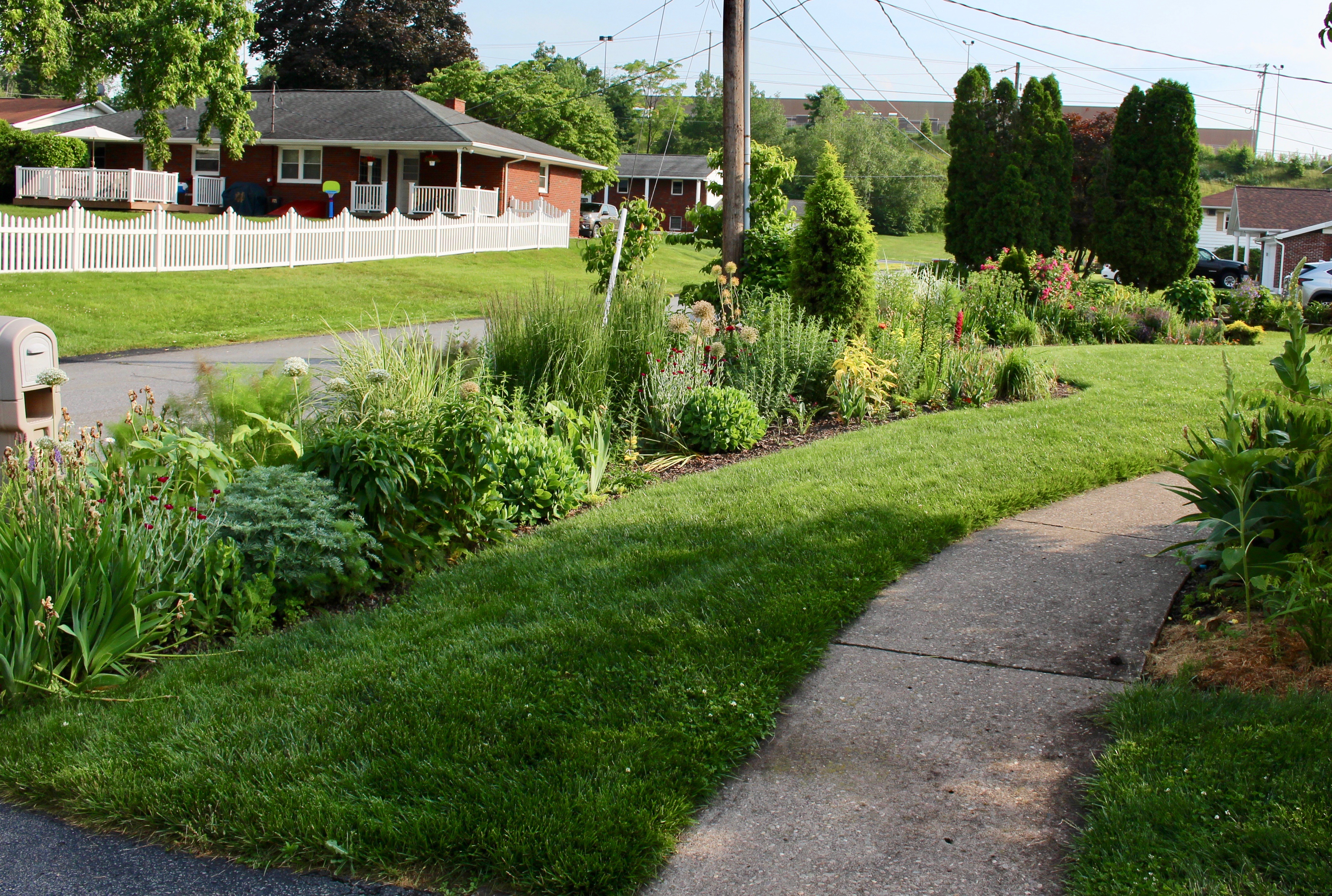
street border

This afternoon’s hot and muggy Tuesday view.  The iris are faded, summer has arrived, but the border is looking slightly less than interesting.

There are the usual being busy excuses, the typical computer broke problems, and of course home improvement projects which take on a life of their own, but today I’m more interested in letting you in on a little secret.  For as much as this might shock you, this blog is not as highly trafficked as the witty dialog and artistic photos might indicate.  Posts over the last few weeks have been down, and to be honest there’s not much pressure to post when your daily view count averages in the low 20’s.  As I think on it and ponder the reasons I’m starting to wonder if it’s the raw realness which is turning people off.
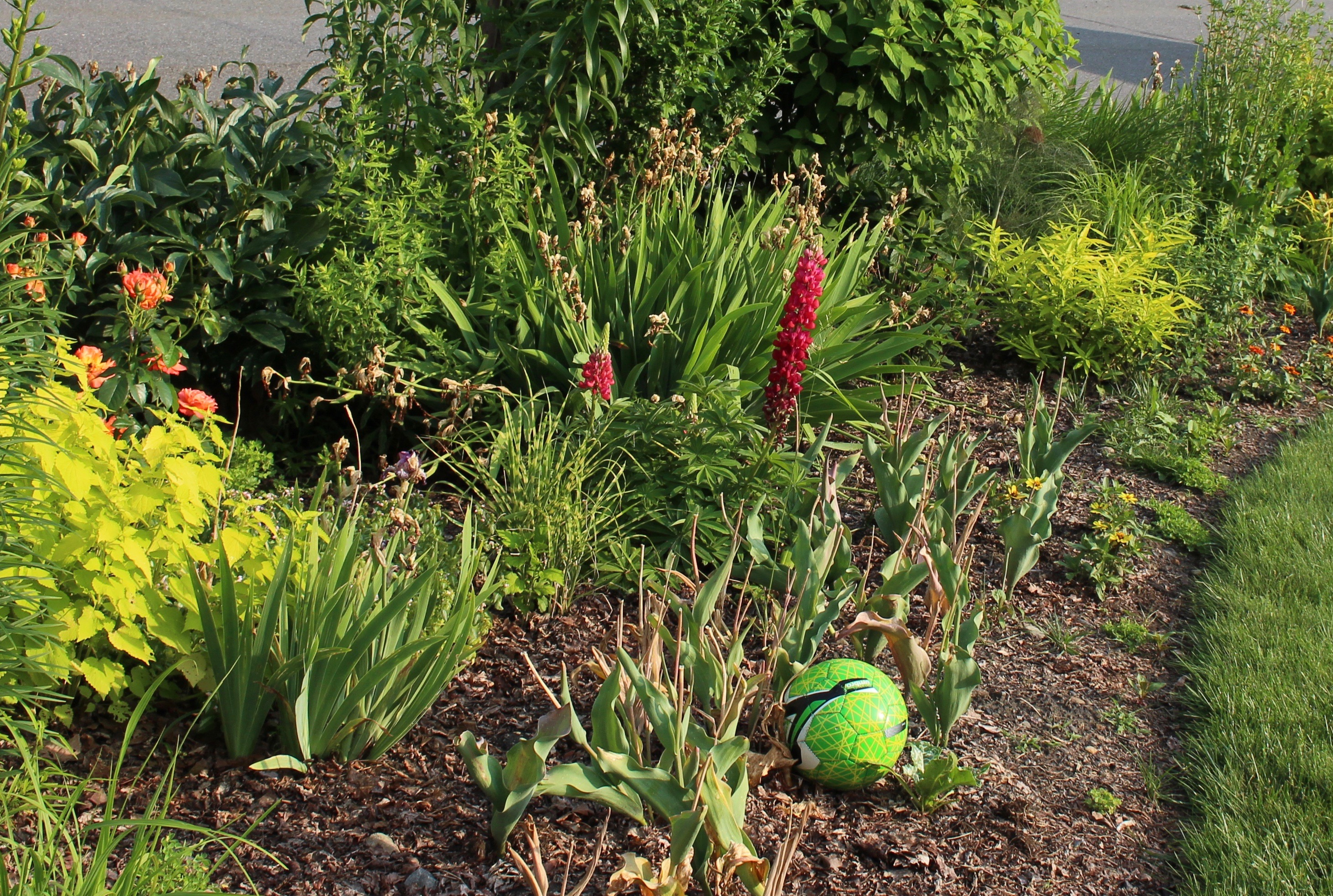
fading tulips

Although I’m completely distracted by the second, third, and fourth bloom stalks rising up from my precious red lupine, others might see faded iris stalks, yellowing tulips, overly vigorous weeds, and stray play equipment… I guess in an attempt to mend fences I should apologize for the mess 🙂

Maybe this upcoming week I can pretty things up and polish up on the blog’s readability.  Zinnia seedlings are just a seed packet away and the unusually reliable rains this spring should be very forgiving to late plantings.  In the meantime looking at the far end of the border should cheer someone up.

red hot poker kniphofia

I forgot which red hot poker (kniphofia) this is but I have yet to find one I don’t like.  Sure this one is over in something like two weeks, but I keep holding out hope I’ll find one with a longer season.  The rose is ‘William Baffin’ by the way.

‘William Baffin’ is taking over the end of the border and I’m just fine with that.  No disease problems, absolute hardiness, a nice 6 foot height, and even a little rebloom makes it a decent rose… but stronger fragrance would make it an awesome rose.  I bet all the better blogs have fragrant roses.
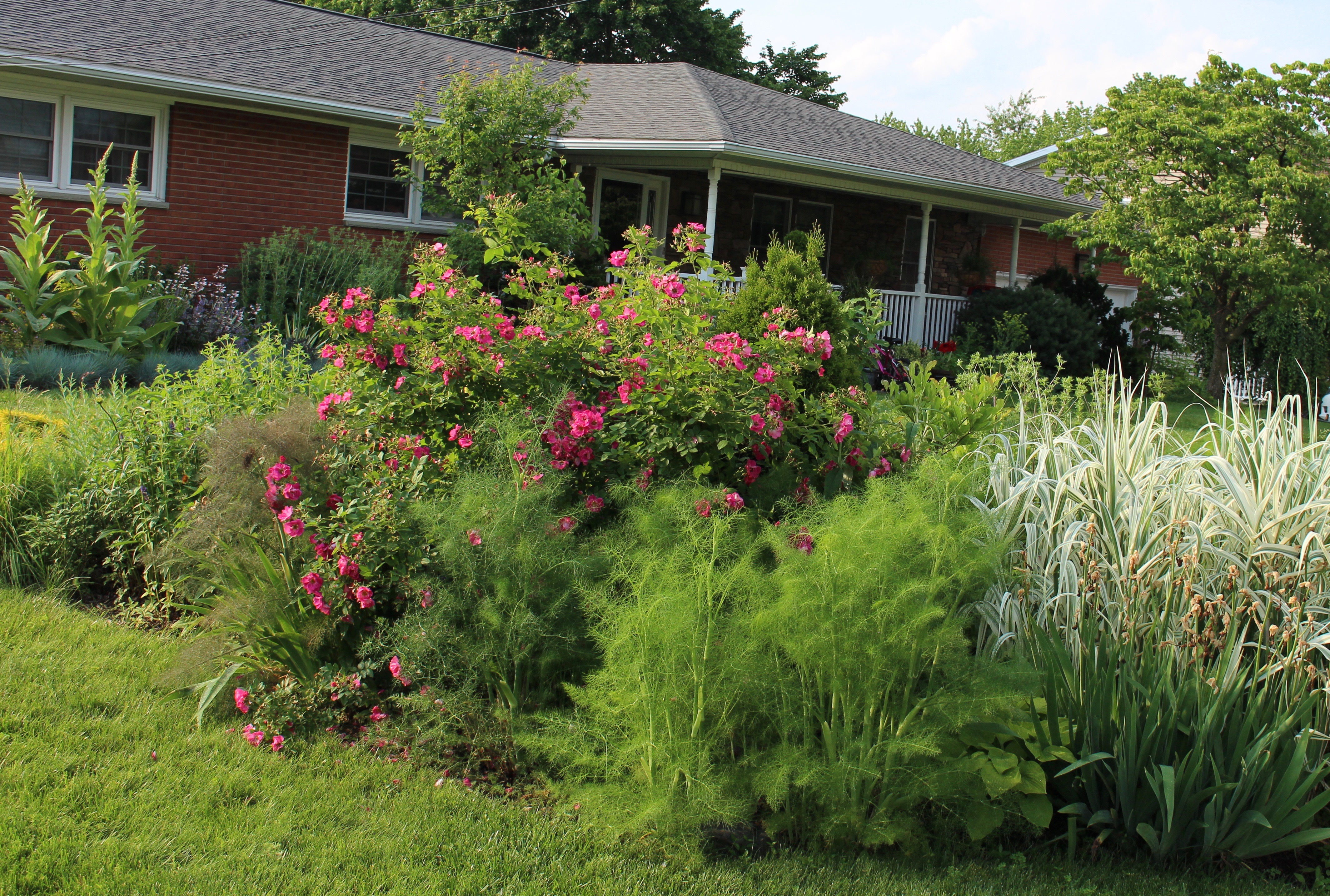
William baffin rose

‘William Baffin’ rose, hordes of fennel, and the first blades of the variegated Arundo donax grass coming up and swamping what used to be an iris patch back in May.

Who am I kidding?  Summer is finally here, the grass is a color other than its typical June brown, and there’s always a ton of new things to admire.  Maybe a little less admiring on my part and a little more work, but I’m quite pleased with (most of) the garden and even though I can’t go around the table asking cabinet members to tell me how amazing I am, at least I can look through older posts and hear myself remind myself how amazing I am.
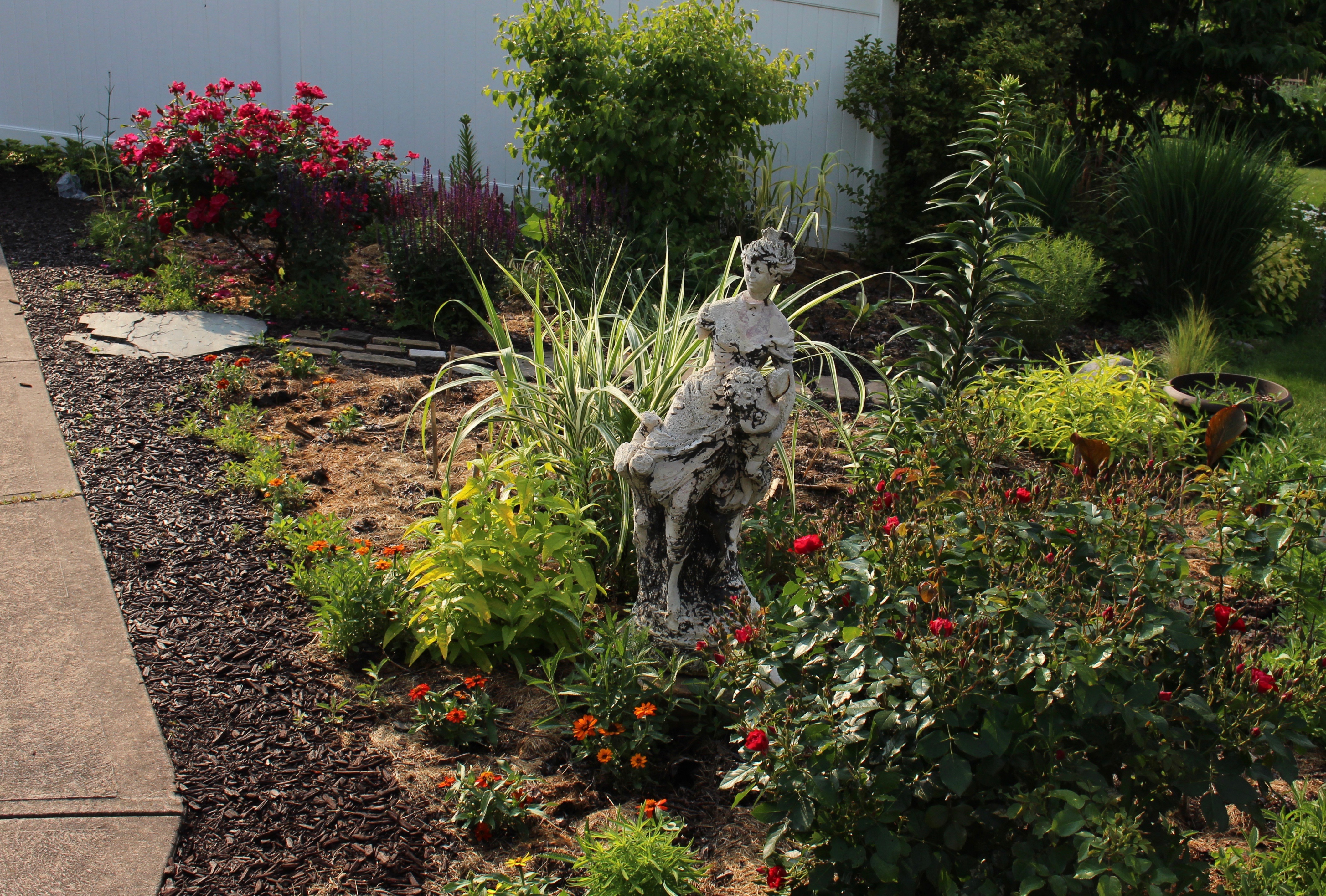
The roses are coming on in the tropical bed as well. Plus three days of heat and humidity have done more for the cannas than three weeks of sitting in the cool dirt. Finally they’re sprouting.

So it’s an optimistic Tuesday view, and as long as I don’t dwell too long on all the other even more excellent blogs out there, I should be able to make it through the week without regretting the $3 a month which “Sorta Suburbia” demands.

Speaking of other more excellent blogs I’d like to mention and thank Cathy at Words and Herbs for her continued support of the Tuesday view.  She and other more excellent bloggers can be found there each week and come Tuesday it’s always a pleasure to see the seasons have progressed another week.  Enjoy!

Thursday’s Feature: Allium flavum ssp. tauricum

This week’s feature is a mouthful, one unlikely to be spoken while browsing the plant racks at Home Depot or even on the tables of your better nurseries.  It’s not particularly showy or amazing, but all the same it’s showy and amazing and I’m glad to have it here in the garden.

allium flavum ssp tauricum

Allium flavum ssp tauricum, a range of pastel flower colors as well as a range of foliage colors, from straight green to blue-gray.

This small, summer blooming allium is one of those onions which may surprise gardeners who typically think of flowering onions as mostly purple, and mostly late spring bloomers, but here it is in all its early summer, pastel tones.  Mine came via the North American Rock Garden Society seed exchange (another mouthful) and were labeled “ex McDonough”.  For those of you not in the onion know,  Mark McDonough is the onion man, essentially a global authority on all things allium and if you’re interested he hosts a website called PlantBuzz to which I heartily recommend a visit.  If you can’t find anything interesting on his site I’m going to guess you stopped reading my post after the first few sentences, but if you’re still with me give it a click… if only to look at wonder upon the different forms of even something as simple as chives!

allium flavum ssp tauricum

Another view, same clump…. Allium flavum ssp tauricum ex McDonough.  I feel like my onions have quite the pedigree 🙂

Regular plain old Allium flavum (yellow onion) doesn’t have the range of pale, pink, and rusty tones which the subspecies tauricum shows, but I think they’re both equally easy to grow.  Mine were planted in February of 2013, the pot went outdoors and the seeds came up that spring.  The first flowers showed the year after and other than digging and spreading the clump out a bit two years ago they’ve been plugging along in a full sun spot ever since with no help from me.

allium flavum ssp tauricum

Last year’s seedlings blooming for the first time… less diverse, but still nice!

For as easy to grow as they are you would think they could be a pest, but I have yet to see a single seedling come up on its own.  They just politely do their thing and all I do is clean up a few dead leaves and flower stems once flowering is finished… they are an evergreen onion, so there’s some foliage all year even after things die down a bit in August.

Keep your eyes open for A. flavum ssp tauricum and grab it if you have the chance.  Also if you have the chance, give Cosmos and Cleome a visit to see what Kimberly and other bloggers are featuring this Thursday.  Each week she encourages us to focus on a single plant and it’s fun seeing which favorites show up on other gardener’s blogs  You’re more than welcome to join, and if you do leave a link on Kimberley’s blog so we can come find you!

Tuesday View: The Tropics 7.5.16

Between you an me this is the Monday afternoon view, but to get anything online before Tuesday night I may have to cheat a little here and there 🙂

I started planting all the true tropicals and annuals about two weeks ago, and although they’re beginning to put on some weight it’s still the scattering of perennials which give all the color.  As you can guess from looking at the lawn we still haven’t had any decent rain.

annual flower bed

The tropical garden in the first week of July.  The red of the rose ‘Black Forest’ carries over from last week and the orange lily has opened up.

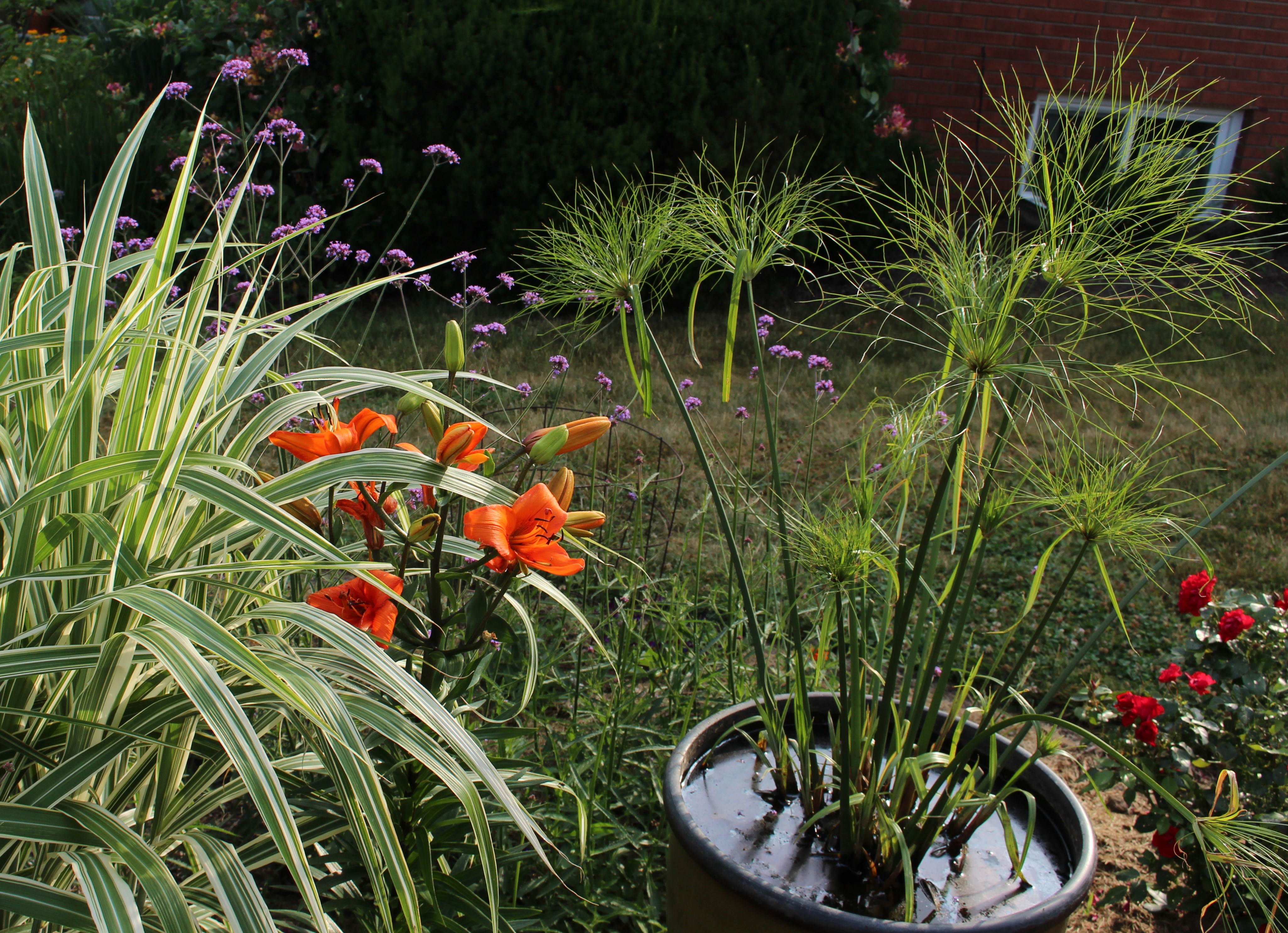
Water is not an issue for the papyrus though since it’s sitting submerged in a planter which lacks a drainage hole.  The green algae has passed its peak and the water looks much less stagnant.  I may even throw a few fish in this week to keep the mosquitos from breeding.

papyrus in pot

The orange lily ‘Liberty Hyde Bailey’ should have been fantastic this year, but I suspect my MIL may have hit it with a bit of stray weedkiller this spring.  The flowers don’t open properly, are a little on the small side, and look stunted in general.  Fortunately the bright color makes up for the stunted-ness.

You may have noticed the purple haze of Verbena bonariensis which is beginning to develop over the bed.  Because of the mild winter several plants of this borderline hardy perennial survived and are already beginning to put on an early show.

castor bean seedling

One of the castor bean seedlings (Ricinus communis) beginning to pick up speed.  If all goes well a few leaves should reach a foot or more across.

This isn’t the first year I’ve had a late start to planting the tropical bed.  There are so many other jobs to attend to before this reaches the top of the list, plus there’s always procrastination and general laziness on my part.  Fortunately I’m a quick learner and have picked up a few tricks along the way, one of which is “The lazy man’s canna and dahlia pre-starting method”.  Rather than potting roots and tubers up and getting them going in a greenhouse or other gardening luxury, I drag the storage tubs out onto the (full, hot-sun) driveway, open tubs and bags, try to orient growing point up, and spray a little water on them all.  Less water is better than too much, and over a week (or three) the shoots begin to grow and the break out of dormancy in a way which I feel is quicker than planting them straight into the cooler ground.  I’d show you pictures but the mess of trays and tubs and bags spread out in front of the garage is a bit embarrassing.

sprouting canna leaves

A few of the cannas are already over a foot tall just maybe ten days after planting.

While we wait for the tropicals, the perennials continue to have their moment.  The purple salvia ‘Caradonna’ is already fading, but there’s an interesting Verbascum showing off behind it.  Normally this would pass unnoticed as a sea of sunflower seedlings takes over this end of the bed and overwhelms everything in it, but this year I’ve manned up and stood up to the little thugs.  One by one I pulled sunflower seedlings out and although it was nearly sinful composting such healthy volunteer plants, it was also a bit cleansing.  I’m ready for something different here.

July perennial border

I was hard on the sunflowers but apparently still let a clump of daisies pass through… oh well.  A sharp eye can make out the yellow spikes of the Verbascum just slightly left of center in this photo.

I’m pretty sure it’s Verbascum nigrum, the black mullein.  It came here uninvited as a hitchhiker in the root ball of a red -stemmed dogwood.  The dogwood in turn was one of those gifts from a better gardener who heard me (how could you not) whining about how nice her dogwoods were, and how I can’t seem to find the same kind anywhere around here.  Sure enough on her next visit a bag came out of the car and inside were the roots of a nearly full sized division off her own plant.  That’s awesome, but even better was the clump of scilla and the healthy verbascum plant which also came up the next spring from the root ball.  I judge a gardener by the weeds they battle, and her scillas and verbascum almost embarrassed me when I thought of the crabgrass and bitter cress which probably followed her home.  Paula was smart to only accept bulbs…. they’re usually weed free 🙂

verbascum nigrum

A closeup of the flowers is an almost unnatural mix of yellow, orange pollen, and purple stamens (I think that’s what the part is called).   I almost wonder if the orange pollen tastes different, since it looks more like Cheetos dust than any kind of bee food…

So that’s where we are this week.  Both Kimberley at Cosmos and Cleome and Cathy at Words and Herbs are also following views each Tuesday and it’s a great way to follow the changes which happen throughout the season.  Give Cathy a visit to see what others are up to , and if you happen to join in please leave a link at Cathy’s blog so we can find you.  Have a great week!

Introducing ‘Blue Spot’

In a brutal world where a person were limited to growing just two plants, I’d chose snowdrops and phlox.  Snowdrops have an awfully long ‘down’ season, but phlox carry on through the summer and if you can assume that this cruel two-plants-only world doesn’t have any other issues going on, I think phlox season would keep me pretty happy.  The phlox family is an attractive family to begin with, but today I’m talking tall garden phlox, Phlox paniculata.  Purists would call them North American native plants, but native flower is not something I think of when they burst into bloom, and as phlox season ramps up around here I can’t picture these hybrids fooling anyone into adding them into their patriotic natives only planting schemes.

phlox paniculata

phlox paniculata in the ‘Potager’… formerly known as the vegetable garden.

I’m stretching things with the native part as I know most people are not putting these plants in as part of a program to make America great again, and are rather planting natives for their attractions and benefits to native pollinators and wildlife, so I guess if I have a point here (since as usual I’m all over the place this morning) it’s that these were once wildflowers but now fit right in with the fancy delphiniums and chrysanthemums.

phlox salmon beauty

Phlox ‘Salmon Beauty’ (1940’s intro).  Sorry about the dried up grass in the background, but this phlox is just glowing today.  

There’s a real risk that the phlox will slowly take over the potager completely and leave me with zero space for actual vegetables, but that’s a chance I’ll take.  It’s not the idea spot for them since the relentless sun and drying winds invite pests such as spider mites in, but as long as I keep them fairly well watered and make sure their diet is complete (they enjoy a rich soil), the phlox do well enough.

phlox cabot pink

Phlox ‘Cabot Pink’.  Several of the phlox I grow are heirlooms from the pre-WWII era when Europe (which included England back then) was putting out some of the best phlox varieties yet seen.  “Cabot Pink’ may or may not be one of these as its name d after the Cabot Vermont town in which it’s been passed around, and may or may not be the original name. 

Like I said, although “the phlox do well enough” here, not everyone is completely happy.  The 1990 Piet Oudolf introduction ‘Blue Paradise’ has yet to take off.  Flowering is no problem with even the most pathetic stalk blooming, but it’s been floppy and mildewy and just plain miserable in its spot (everything which it’s supposed to not be).  Of course I’m to blame since it seems to take off for everyone else, but maybe this fall I can move it and find just the right location to cheer him up.

phlox blue paradise

The “blue” morning color of phlox ‘Blue Paradise’.  The color changes with time of day and temperature which is cool, but so far I haven’t been able to change his slumping nature and unenthusiastic growth rate.  Here he is flopped over onto the boxwood hedge, which is the only thing keeping him up out of the dirt.  

Ok, so here’s my latest favorite phlox.  It’s ‘Blue Spot’, a newer introduction which for some reason I can’t seem to find any information on just now.  For some reason 2008 introduction by way of a Connecticut nursery comes to mind, but I’ll likely have to update that when I figure it out.  This plant came to my garden last fall by way of Perennial Pleasures Nursery, a Vermont nursery which has the best phlox offerings I’ve seen, and fortunately also does mailorder!

phlox blue spot

Phlox ‘Blue Spot’

My plant still needs some growing to do, but in spite of multiple woodchuck grazings, it’s managed to put up a few flower stalks.  I love the bluish swirls and I think it gets this pattern from another favorite, ‘Blushing Shortwood’ which may or may not be a parent (again… top of my head).

phlox blue spot

A closeup.  In my mixed up world of color naming, I’m calling this a blueberry stain on a white background.

I look forward to seeing this one clump up and hopefully avoid another run-in with the local wildlife.  So far my theory of letting weeds grow up around it to hide it from attack has been working, but that has its downsides as well… we will see, just like you will likely see plenty more phlox photos as the season rolls on.  We still have all of July and August you know!

Have a great weekend, and a happy and safe Fourth of July.

Thursday’s Feature: Delphinium

This Thursday it’s all about flowers.  For as much as I love throwing in questionable photos of borderline weedy plants or offensively tacky color clashes, even I have to brag a little now and then when something goes right.  The tall hybrid delphiniums don’t like my garden or me but this one seems to have resigned itself to its fate and has come to an agreement with my garden.  It’s beautiful and although I can take little credit for that at least the pictures are pretty.

purple delphinium

Purple delphinium

Four years ago it was love at first sight when I came across a little pot with a fat plant and a solid stem just starting to sprout up into a bloom stalk.  I thought to myself “even I can’t screw this up, and it’s going to be amazing”, so onto the cart it went and the rest is history.

purple delphinium

Another view 🙂

These tall delphinium hybrids love a perfectly rich soil in a sheltered spot with steady moisture and shelter from the worst of the weather.  They do better in cooler, fairer climates and don’t like drought, heat, humidity, storms, drying winds, children playing, large pets, neglect, stray hoses, clumsy gardeners… essentially everything that my garden represents… but this one carries on.  2016 has been a lean year for it since I’m trying something new (less fertilizer and no staking) but the show is still nice enough.

purple delphinium

A wider view of the clump shows smaller bloom heads and yellowing lower leaves which resulted from a leaner diet, but I also haven’t staked the flowers and they are holding up reasonably well to the wind.

But you don’t care about lean, anemic delphinium plants.  A Thursday feature is fun so here are photos from last year when the fertilizer was flowing and the party really took off!

purple delphinium

Sorry about the bicycle in the background….

This one clump which survives (trust me I’ve killed my fair share of these) is on a slope in morning sun near the hose… which means it gets a sprinkle whenever the water goes on.

purple delphinium

…and oops about the sign.

-but prepare yourself for heartbreak if you give these a try.  Three out of four years a storm cell will pummel your garden just as the delphinium reaches its peak, and little in the way of staking will help the heavy blooms.  On the plus side they make an excellent cut flower (if you have room for two to three foot flower stalks in your arrangement), but on the down side it’s depressing to say the least.

purple delphinium

Delphiniums after the storm.

Few things are fun without a little effort and risk, so give them a try and see where you end up.  While I go on to ponder the possibilities of growing these in a classy walled garden with the perfect soil, you may want to check out a few other feature plants to fill your Thursday.  Kimberley of Cosmos and Cleome hosts each week so give her blog a visit to see what she and others have featured this week.

Enjoy!


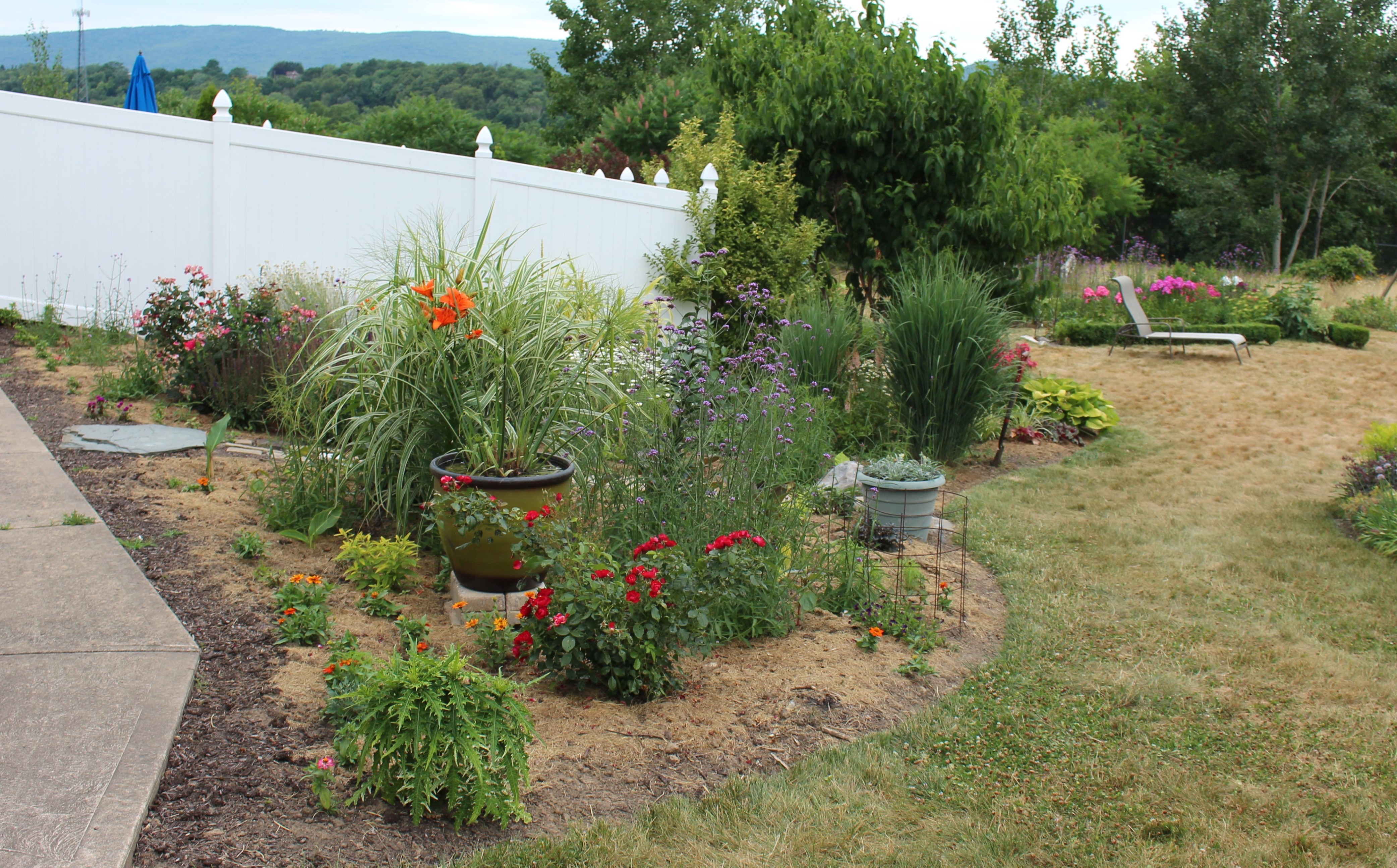
The front border among other things

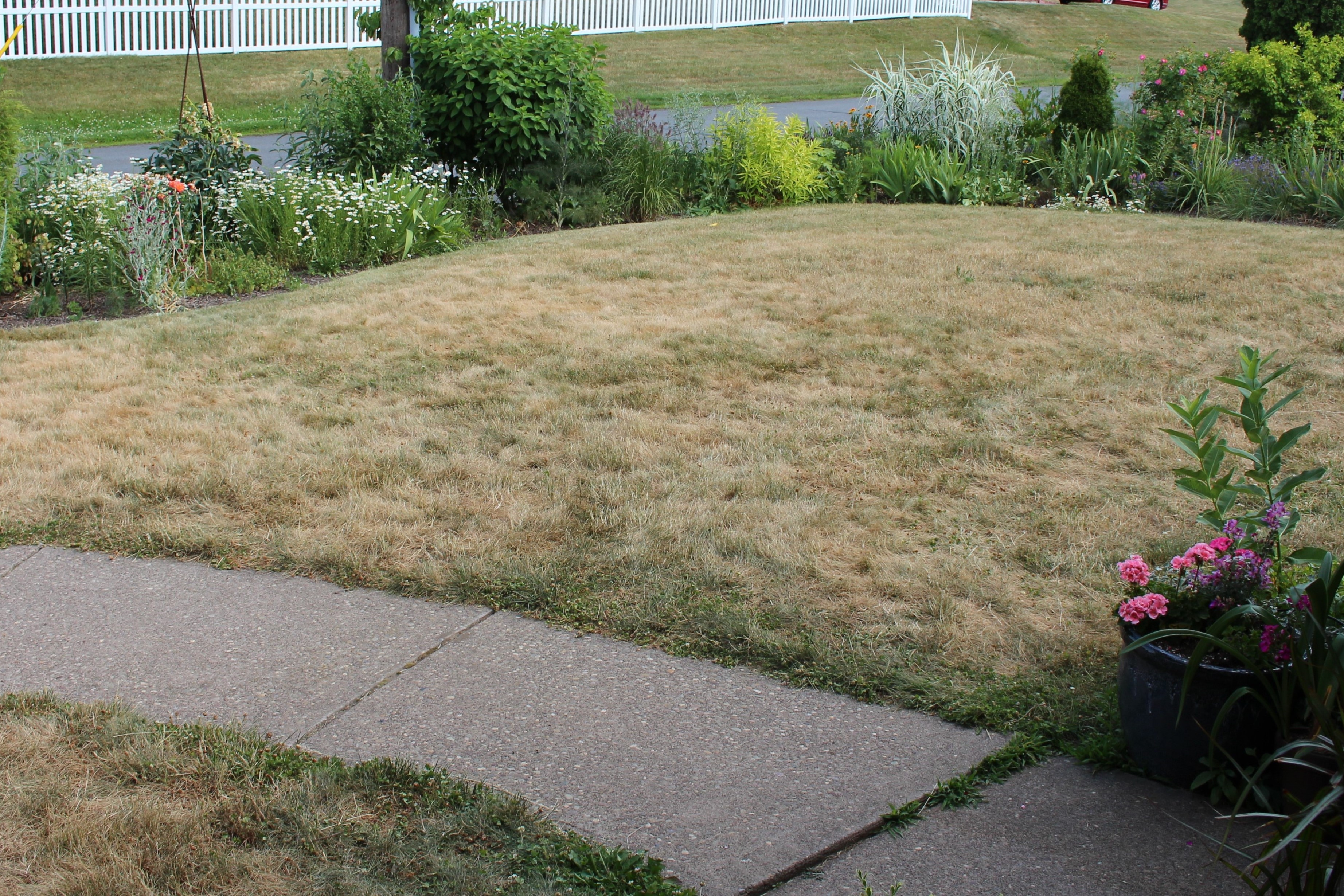
It stopped raining long enough this afternoon for me to get out there and do some watering.  The deluge of nearly 1/10 of an inch did little more than dampen the top layer of mulch and cancel a Little League game, but it was enough to cool things down at least.  Maybe it also gave the pestering hordes of gnats a nice drink as well, God only knows they must be getting tired of sipping my blood and sweat all month.  Here’s how the lawn out front looked yesterday morning.

dormant lawn

Needless to say I don’t bother watering the lawn.  I feel like watering the lawn is a gateway drug to bagging clippings, spraying for weeds, thatching, aerating, spraying for grubs… all those tedious chores which would ruin this vacation from mowing.  On the down side it looks like crap until the rains come back.

I hope my crabbiness about the weather doesn’t come on too thick.   Weatherwise I feel like I’m riding one of those shoddy, barely-passed-inspection carnival rides where you get thrown back and forth between burning and freezing, drought and flood, and all you want is Dramamine and a Tylenol when it comes to a stop.  Maybe today’s misting and this week’s milder temperatures will improve my outlook.  I think it will, especially when there are flowers toughing it out and cheering me up.

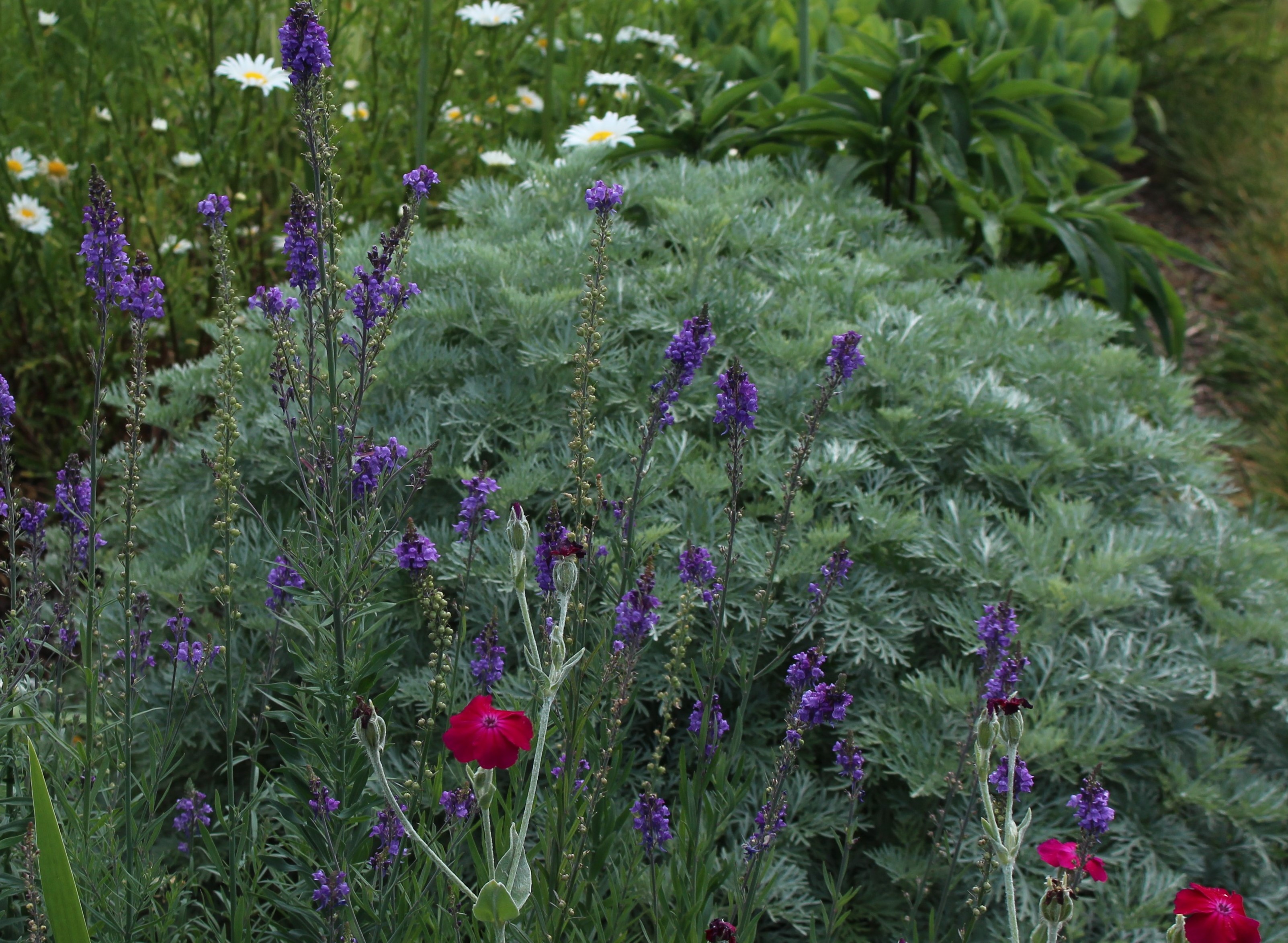
linaria purpurea

A new one this year is Linaria purpurea (toadflax), a hopefully hardy and long blooming airy perennial which was seeded out last year. The seed was supposed to be for ‘Canon Went’, a pink version, but only one or two stalks came true. No big deal as I like it just fine in the regular lilac-blue color.

I’ve done next to nothing on the front border since mulching it with shredded leaves in March… and weeding and deadheading once in May.  That’s great because it still looks decent enough, but not so great since I like to add a few patches of hard working annuals and tropicals in there to brighten up the summer months.  This pattern of neglect isn’t way out of the ordinary though, so even if it’s getting late for annuals I’m 99% sure that if I finally get it planted there will still be a decent show… but I’m not doing the same for the foundation bed.  It’s so dry the majority of the perennials are wilted and dying and I have no desire to even look at it long enough to even consider carving out a few watered spots for annuals.  The blue fescue border was de-seeded last weekend and in general it looks good enough, so I’ll leave it at that.

blue fescue border

I pulled off all the fescue seed heads and the foundation planting will just have to stay like this for the summer… although I may have to airlift out a few hellebores.  They look terrible all flat and yellowing and it may be time to find them a spot in the backyard with a little shade.

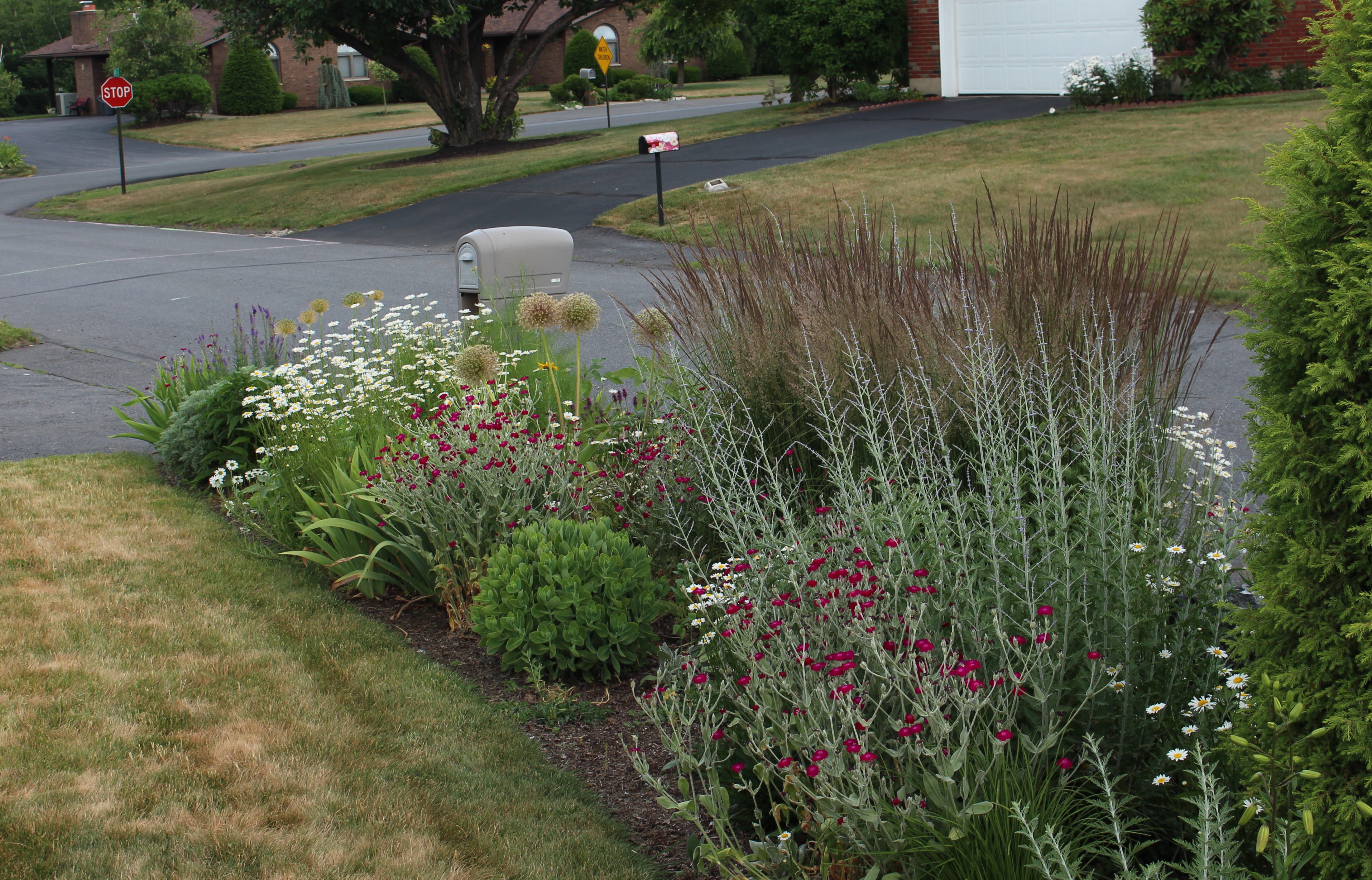
It’s curious to me how some years an odd balance tips and suddenly your most reliable standards vanish.  This year the front border is missing the hordes of rudbeckia which dominated last summer and in their place is a nice wash of rose campion (Lychnis coronaria).  Many people look down on this old fashioned, reseeding, short-lived perennial, but I love it for its tolerance of droughty soils, its soft gray foliage, and its cheerfully bright flowers.  It’s a perfect compliment to the nearly-a-weed white of the oxeye daisies.

allium seedheads

The front border from the near end.  This perspective is perfect for avoiding all the gaps and holes which become apparent when the border is admired head on 🙂

My absolute favorite right now isn’t even a flower though, its the dried round seedheads of allium ‘Pinball Wizard’.  Big fluffy spheres which seem to float above the border are just perfect this year and I’m planning on lifting the bulbs this week to spread them out a bit (the original single bulb has split into four now and I don’t want it to have any overcrowding issues.

lychnis coronaria rose campion

Rose campion, oxeye daisies, and another view of my lovely allium seed heads.  Might as well enjoy the dried stalks since everything else seems to be on its way to drying up completely as well.

Once you move towards the far end of the border things go downhill fast.  Everything in this border gets done from the near end to the far, and unless I’m making a strong effort to be fair, all the good plants, best mulch, nicest compost, most delicate pampering…. all that happens at the one end and rarely carries all the way through to the other side.  I’m pretty sure that the most obvious solution to this problem is to make the border wider again.  More room, more plants, more excitement… the natural choice when faced with a border which might already be a little too much work 🙂

late June perennial border

If I can get a shovel down into the rock hard lawn I could easily bring this border out another foot or two without interfering with third base (which is usually located right next to the chartreuse leaves of the ‘Golden Sunshine’ willow).  I’ll just need to plant something which can handle a few missed kickballs and base overruns.  

Digging will have to wait until August at earliest.  Who knows what there will be left to plant in August, but we’re approaching phlox season and no bed digging is worth the risk of interfering with flowering phlox enjoyment.  Just today one of my new ones opened and it is so amazing I’m sure you’ll see it here shortly.  Wow is all I can say, and to be honest I haven’t been this completely excited about a new flower since at least last week.

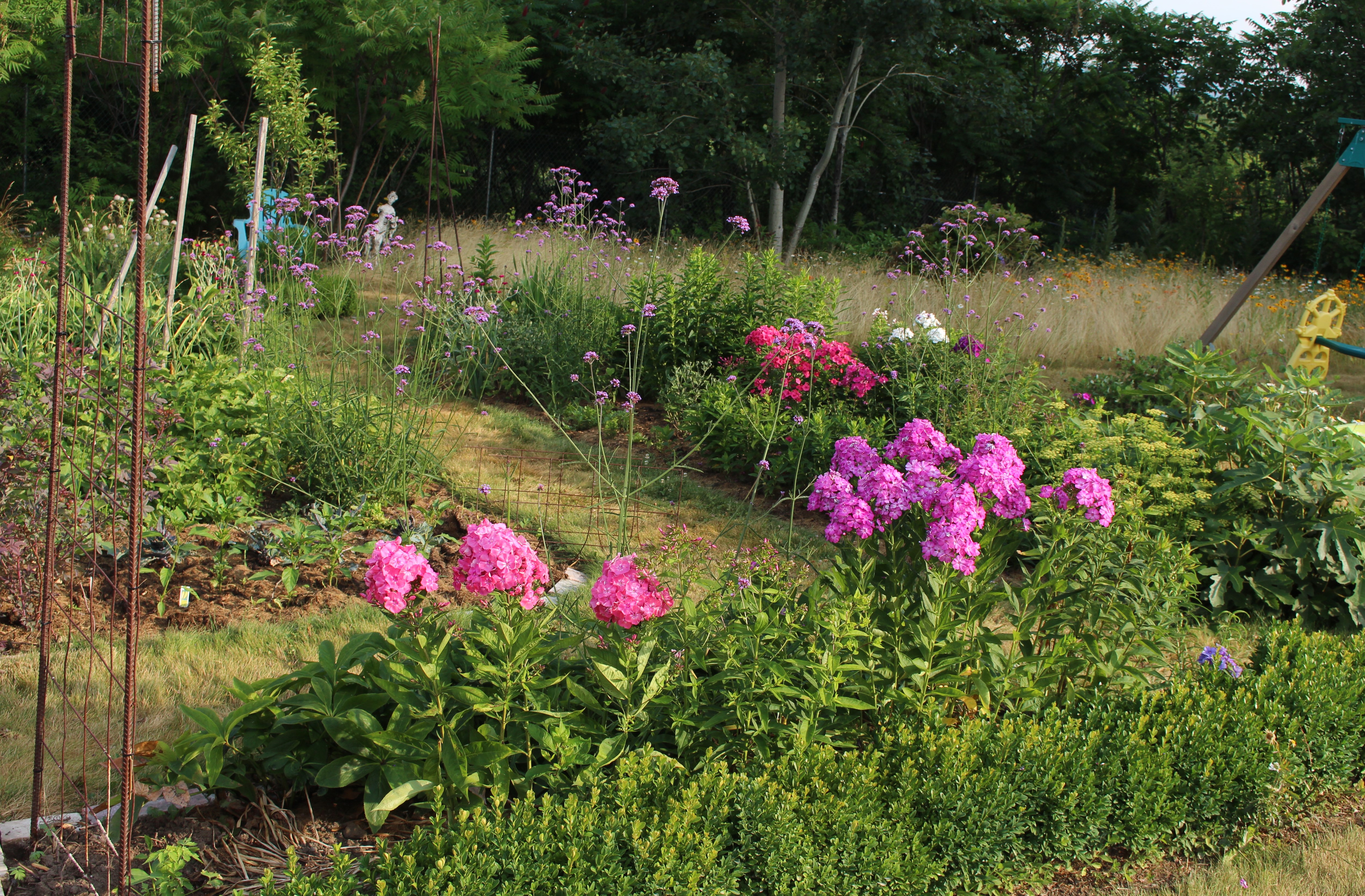
the potager in June

The potager in June with its freshly mulched beds, newly concrete-reinforced rebar archway, and the first bright reds and pinks of tall garden phlox (Phlox paniculata).  There are even a few vegetables planted (although the boxwood still needs trimming).

With all the work I’ve done recently in weeding and trimming you might be able to tell I’m now trying to catch up on the blogging.  Well, blogging and watering of course… but please bear with me as sore muscles recover indoors and I throw out a bunch of posts in what might be too little time, and please feel free to skip commenting or even ‘liking’ since I’d hate to wear out my welcome!
Enjoy your week and I’ll be back Thursday to join up with Kimberley at Cosmos and Cleome for her Thursday Feature.  Maybe I’ll even feature the new phlox, although saying that pretty much guarantees a woodchuck or deer attack tonight…

Tuesday View: The Tropics 6.28.16

Two of my favorite bloggers are bringing back a meme which I’ve always enjoyed.  Cathy of Words and Herbs and Kimberley of Cosmos and Cleome both highlight a longer view each Tuesday and we get to see it develop and change as the year passes.  I’m no expert on the meme but I think Cathy sticks to a specific viewpoint and time while Kimberly varies the perspective and location depending on what’s going on in the garden.  Myself on the other hand am barely capable of getting any post up in a given week, so to keep it simple I’m going to follow Cathy’s lead and go with one view, same bed, same point each week and see if I can handle that.  Also since the tropical bed went in last week (about time since it’s already past the solstice and well into summer) I’m going to highlight this bed as my view, and (hopefully) watch as it grows up. 

Tropical garden

My fingers are crossed that over the next few weeks this bed will become an explosion of color and foliage and maybe bring a taste of the tropics to this end of NE Pennsylvania.

I’ll try to keep this short, since assuming things grow I want to save a little material for future posts, but besides the thrill of actually getting most of the plants in last week I always get a little excited checking this patch each day to see how quickly things progress.  All season bloomers which sit as a lump of color and put out the same old flowers each week bore me a little, and even though I can appreciate someone wanting low maintenance, neat color, I want something that sneaks up on you and then overwhelms you, like a horticultural tsunami!  Hence the tropical garden, and anything bright and big and leafy is more than welcome.

papyrus with black forest rose

The papyrus was not happy last year and I suspect it didn’t get nearly as much water as it wanted so instead of planting it in the ground again I placed it in a pot submerged in a second pot full of water.  Green water.  So far the reviews of this planting have not been 100% favorable.

You can’t really tell from the tiny sprigs, twigs, and tubers, but this year’s theme is orange and purple.  That’s not a solid theme, it’s more my mood when I’m out picking up annuals or choosing which dahlias to put here versus in other parts of the garden… or finding a flat of orange zinnias on sale and liking zinnias.  So until the oranges fill in, hot pink and purple will have to do for a theme.  Besides the annuals, perennials have a way of sneaking in everywhere, and although I pulled a wheelbarrow full of daisies and transplanted dozens of chrysanthemums, there are still a few things such as this knockout rose and purple ‘Caradonna’ salvia which are just too colorful to stand up to.  Maybe next year will be the year I follow through on my threats to remove the salvias.

knockout rose with caradonna salvia

The ultra rare and uncommon ‘Knockout’ rose tastefully complimented with orange zinnias at its feet and scavenged lawn clippings as mulch.  This Tuesday view already promises to reek of class each week 🙂

So there you have it.  By next week I hope to have a few cannas sprouting and a few more zinnias assaulting your color senses and overall I really hope things don’t end up requiring a rototiller and a fresh start by August.

Think about joining in with the view and if you do leave a link at either Cathy‘s or Kimberley’s blog so we can find you.  Not to put words in their mouths but I’m sure both will agree “the more the merrier” and I always enjoy watching another garden grow throughout the season… even if it does turn into a trashy mess of too much color and chaos!

June’s GBFD and Thursday’s feature: Arundo Donax

I feel like I’m cheating with this double post, but between Christina’s Garden Bloggers Foliage Day and Kimberley’s Thursday Feature I didn’t have the strength to choose just one… and ran out of time to do both.  So here’s the best I can muster, a feature plant which highlights foliage!

arundo donax variegata

A patch of Arundo donax ‘variegata’ in the street border.  The bold white variegated foliage accents the corner and contrasts the different foliage colors and forms of its neighbors.

Arundo Donax is not a plant for the meek or overly sensible.  It’s a large vigorous grass which overwhelms its neighbors and requires a backhoe or moving van for the owner who tires of it.  It’s listed as invasive in a few more Southerly regions but here on the Northern edge of its hardiness range it just comes across as enthusiastic.  There is a plain green form, but the ‘variegata’ is just straight cooler with it’s crisply bright color and its almost-as-vigorous growth.  13 feet tall (4 meters) is not unusual here in zone 5/6 NE Pennsylvania.

Arundo (giant reed grass) appreciates plenty of moisture but can also handle a considerable amount of drought.  It does NOT enjoy a late freeze.  Half of my patch surprised me by actually dying back this spring when a late freeze came just as the roots were emerging from winter dormancy.  Heat is what this grass prefers but just keep in mind that in the ‘Variegata’ form the bright white will fade to yellow and green when the thermometer goes above 90F, and if that bothers you chose the slightly less vigorous ‘Peppermint Stick’  which keeps the white all summer.

arundo donax variegata in perennial border

Arundo donax ‘variegata’ later in the season (August).  A relatively cool summer kept the variegation from fading completely.

You’re either going to love this grass or hate it and I won’t judge you regardless.  Arundo is not a plant for everyone just as Great Danes are not a dog for all households, but it does make a statement and I’ll leave it to you to decide whether that statement is a bold splash of color front and center or if it’s a rude, overwhelming haystack.  In either case I think you’ll agree it’s both foliage and a feature and if you’d like to explore other (possibly more tasteful) uses of foliage please visit Christina at Creating My Own Garden of the Hesperides on the 22nd of each month and if you’d like to see what plant features best this week visit Kimberley at Cosmos and Cleome each Thursday.  If you have the time you may want to consider joining in, there’s always room for one more and it’s always fun!

One word…. Dichelostemma

I inherited my mother’s habit of randomly picking up and trying out just about any odd, looks-like-it-might-be-nice bulb that shows up in the garden center’s bins.  Together we’ve failed at freesia, ranunculus, ixia… but every now and then something gives a surprise, and lately it’s been Dichelostemma.

dichelostemma pink diamond

Dichelostemma ‘Pink Diamond’ out in the meadow garden

The first one which made its way into the garden was a selected form of the naturally occurring hybrid ‘Pink Diamond’.  I love the totally tubular pink flowers and the waxy thickness of the blooms and was surprised it actually grew since the bulbs came via a November closeout sale, and late planting into a cold, wet clayish soil is typically not a recipe for success for drought tolerant bulbs from the western reaches of North America.  But they came up fine the next spring and when the wiry flower stalks matured to bright pink clusters of bloom in June I was hooked.

dichelostemma pink diamond

Daisies and Dichelostemma in front of a worse for wear Queen of the Prairie.  The Queen still presides over the back forty, but between acidic rainfall and wayward groundhog nibbling her reign may soon be coming to an end.

‘Pink Diamond’ may or may not become a permanent resident in the meadow.  The first planting returned to bloom the second year but has not put up flowers in the third.  I blame rabbits for nibbling too much of the spring foliage, but we will see what happens next year, as this spring with all the new crocus flowers to chose from the rabbits didn’t quite get to the Dichelostemma foliage before moving on to freshly planted lettuce and broccoli in the vegetable garden.

The ‘other’ Dichelostemma (D. congestum) has been going strong though, putting up its beautiful lilac-purple flower clusters for three years now… in spite of also being nibbled.

dichelostemma congestum

Dichelostemma congestum has the common name of fork toothed Ookow.  When you get tired of introducing guests to your dichelostemma I’m sure switching to the common name will clear things up. 

I love how these plants look among the weeds and grass of the meadow.  I can imagine this isn’t entirely unlike their native habitat in the Western edges of the continent and from a gardeners point of view the yellowing foliage is completely disguised by the surrounding greenery.  Not to get distracted, but I wonder how alliums would work out back here since many of those also share the trick of letting their foliage go to pot just as the blooms reach their peak.

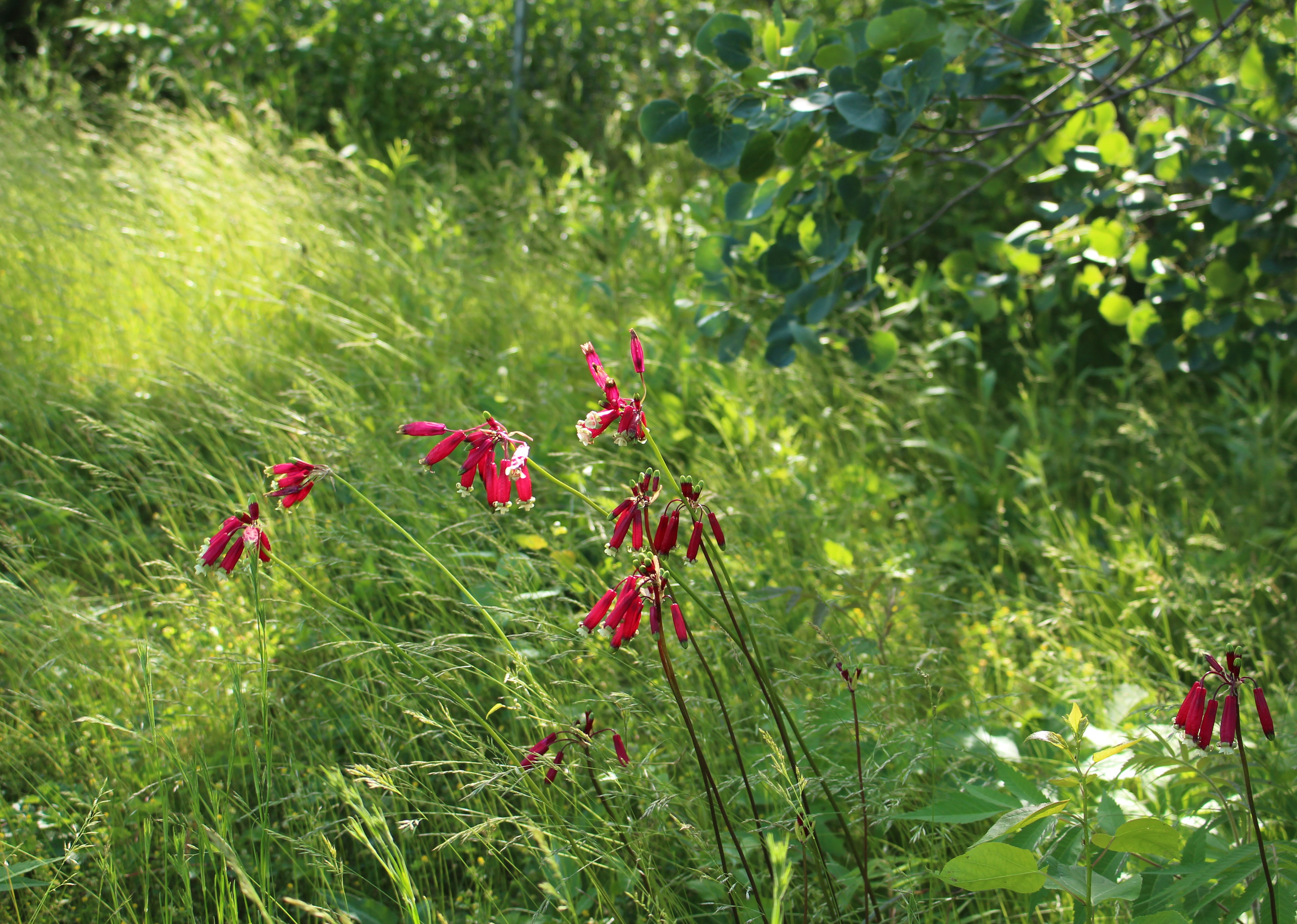
Dichelostemma ida-maia is my last of the D’s and I suppose ‘firecracker plant’ is a decent common name for this one…. although it’s no Ookow.

dichelostemma ida-maia

Dichelostemma ida-maia.  The shape and color of this flower has ‘hummingbird plant’ written all over it.

Besides adding more ‘Pink Diamond’ last fall, I also put in a few D. ida-maia… in spite of my thoughts that I wouldn’t like them.  I was completely wrong in my lack of enthusiasm.  The sad anemic version I saw a few years ago is nothing like the group I now have swaying in the dappled light amongst the grass.  I’m far too greedy a collector to commit large spaces to a single plant but I would have no problem adding another hundred or two (versus the 10 I started with) to this end of the meadow, which is entirely do-able since these small bulb are relatively cheap even when not on clearance.

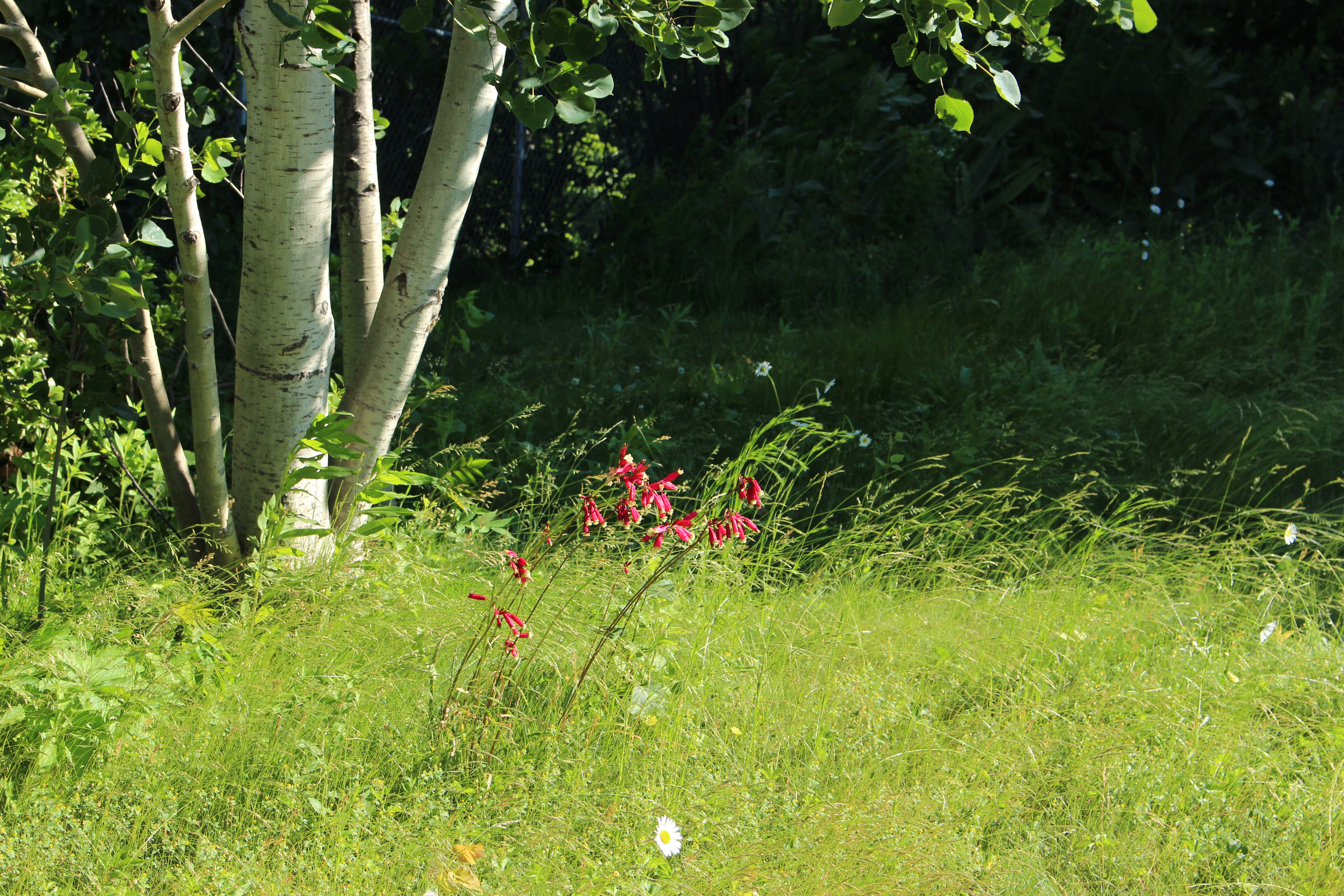
dichelostemma ida-maia

I trimmed up the lower limbs of the aspen and love the Rocky Mountain glade effect it has given.  Add a Western NA native Dichelostemma ida-maia and we may be on to something here 😉

I’m not sure what the hardiness on these plants (both species and their hybrid daughter) is.  To be honest I didn’t think they would make it through their first careless planting (really careless… cold November fingers so one shovel swipe into the turf, dump bag contents into hole and stomp sod clod down again on top), but they did survive, and it was a winter where our lows reached -6F (-21C) with a solidly frozen soil for months.  So they’re at least that hardy, and I think the extreme summer dryness of the meadow also helps them return in spite of any issues with poorly drained, wet winter soils.

Dichelostemma.  Think about it.  I think they’re pretty cool.

Thursday’s Feature: Digitalis x mertonensis

I’ve said it before that I’m not much of a joiner and I’m far too disorganized to keep up with most weekly or monthly memes, but I’m going to give this one a try.  Kimberley over at Cosmos and Cleome has brought back the “Thursday feature” and it’s a chance to highlight any one particular plant which caught your fancy in the past week.  This week among all the wonders of June a foxglove has caught my eye and it’s just a little bit different than your average foxglove.

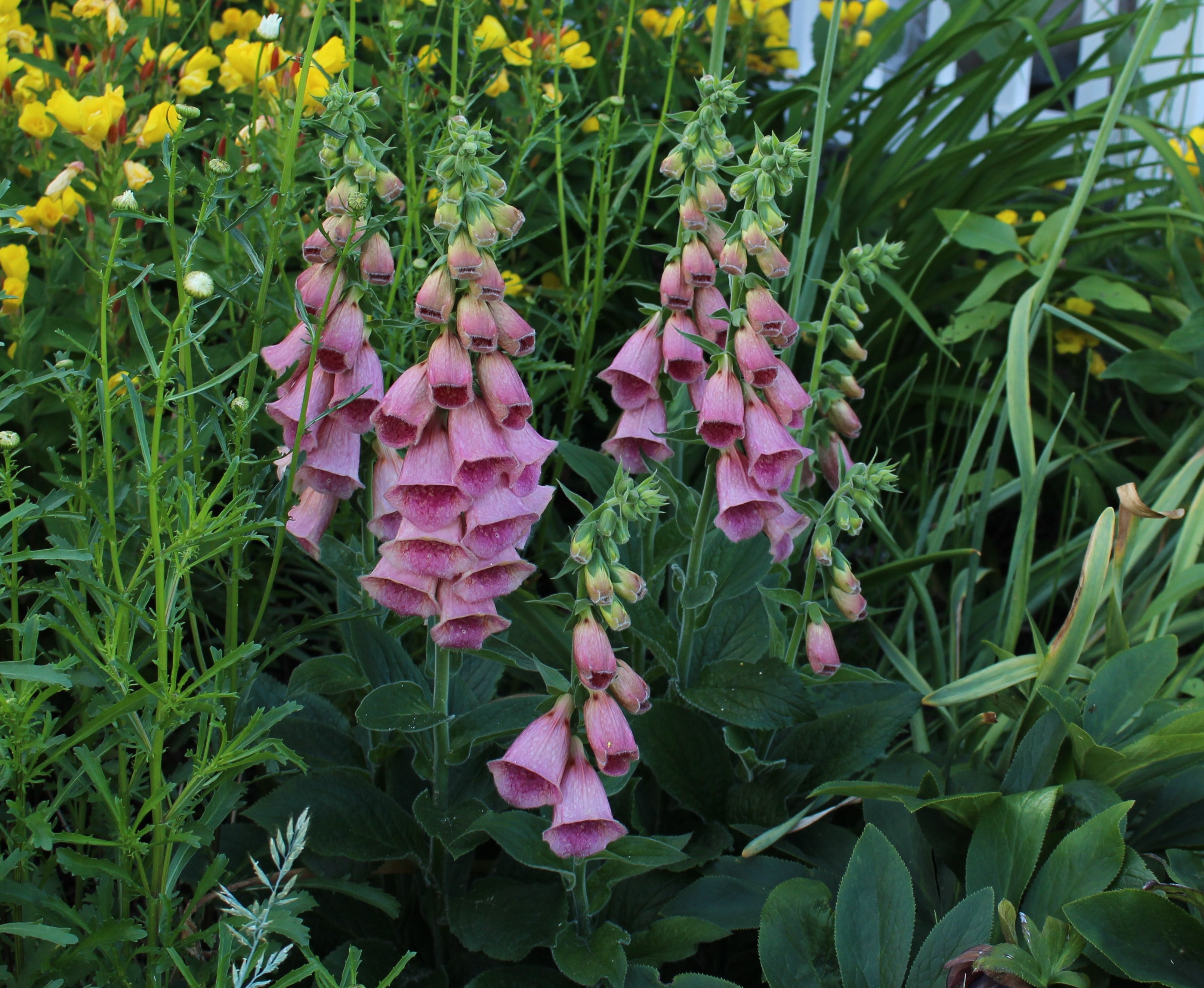
digitalis mertonensis

Fuzzy leaves, a strawberry color, and a 3-4 foot bloom height are trademarks of Merton’s foxglove and/or the strawberry foxglove (Digitalis mertonensis).

The strawberry foxglove (Digitalis x mertonensis) is a hybrid formed by the joining of your regular tall, purple (biennial) Digitalis purpurea and your shorter, mellow yellow (perennial) Digitalis grandiflora.  The offspring was a tetraploid child with perennial-ish tendencies, larger flowers, and a rose color that holds just a little bit of yellow (you can always count on me for these vague made up color descriptions!)  They come true from seed, and although most sources recommend moist, fertile, well-drained, soil in part shade, mine suffer along just fine in a dry sunny spot which also grows sunflowers well enough.

I noticed a few seedlings earlier in the year and should really round them up for a more suitable home.  This foxglove is one which seems to do well enough in my garden (unlike the common foxglove, D. purpurea which rots away in our winters) and deserves more respect than I give it.  Maybe this summer I’ll finally start up some of those other Digitalis seeds which are sitting in the seedbox, and we could have a family reunion with all the foxglove cousins and kin.  I think I’d like that.

As I’m sure you know foxgloves (Digitalis) are extremely poisonous and their heart slowing toxin was the inspiration for the digitalin drug group.  I’m not the one to go on about medicinal uses, but if your concerns lie in the area of its toxicity please put that one to rest.  Apparently some brave soul has found it to be extremely bitter, and a side effect of ingestion is vomiting which conveniently removes the poisons.  Give this one a try I say, and also give Kimberley’s site a visit to see what other gardeners are finding interesting this week.  Enjoy!