Legalizing pots

In hindsight I may have gone a bit too far, but last year when my better half suggested we could use a few more plants out on the deck I ran with it.  She’s not known for her appreciation of things chlorophyll so this was unprecedented, and I’m sure you could understand my enthusiasm for encouraging an interest.  For her I thought potted plants were a big no-no, and I’ve found this becomes an even stronger no-no when their planting and repotting takes place on the kitchen table… which is kind of close to the deck table… so perhaps this new interest in the deck plantings was the first step in easing the household ban on pots.

deck container plantings

A few of the planters which were put into service this year on the deck.  This photo might be two weeks old and it’s interesting to see where all the golf balls which I picked up out of the lawn today came from…

Before this garden I used to have quite a pot habit.  The small balcony of my apartment was filled and overflowing with any container I could find and any plant which I thought would be interesting to grow out there, and at one point I was a little worried all the extra weight on my second floor balcony might one day come crashing down.  But it didn’t, and I kept on happily planting until finally purchasing my first home.

wendys wish salvia

Coleus are perfect for containers, but I far prefer the sun-tolerant, slow to bloom, cutting grown plants rather than any strains from seed.  The salvia (Wendy’s Wish) is also doing well enough, but I suspect she would prefer a roomier root-run and not sit in a cramped pot.

When the deck was opened up to planting I scoured all corners of the yard and garage for any container which might still be able to hold a plant.  Many of the old plastic pots from my balcony days came out of retirement and were slid right in next to my pretentious Italian terra cotta and glazed ceramic.  I’ll see if I can do something about that next year, but this year most of the budget went to new potting soil.  Potting soil has been a sticky subject around here since most of them stink, but I found Jobe’s Organics Potting mix and love its price and quality.  It’s made with quality ingredients, it’s airy and loose, and it’s just what I wanted for filling large planters.
Ipomoea lobata

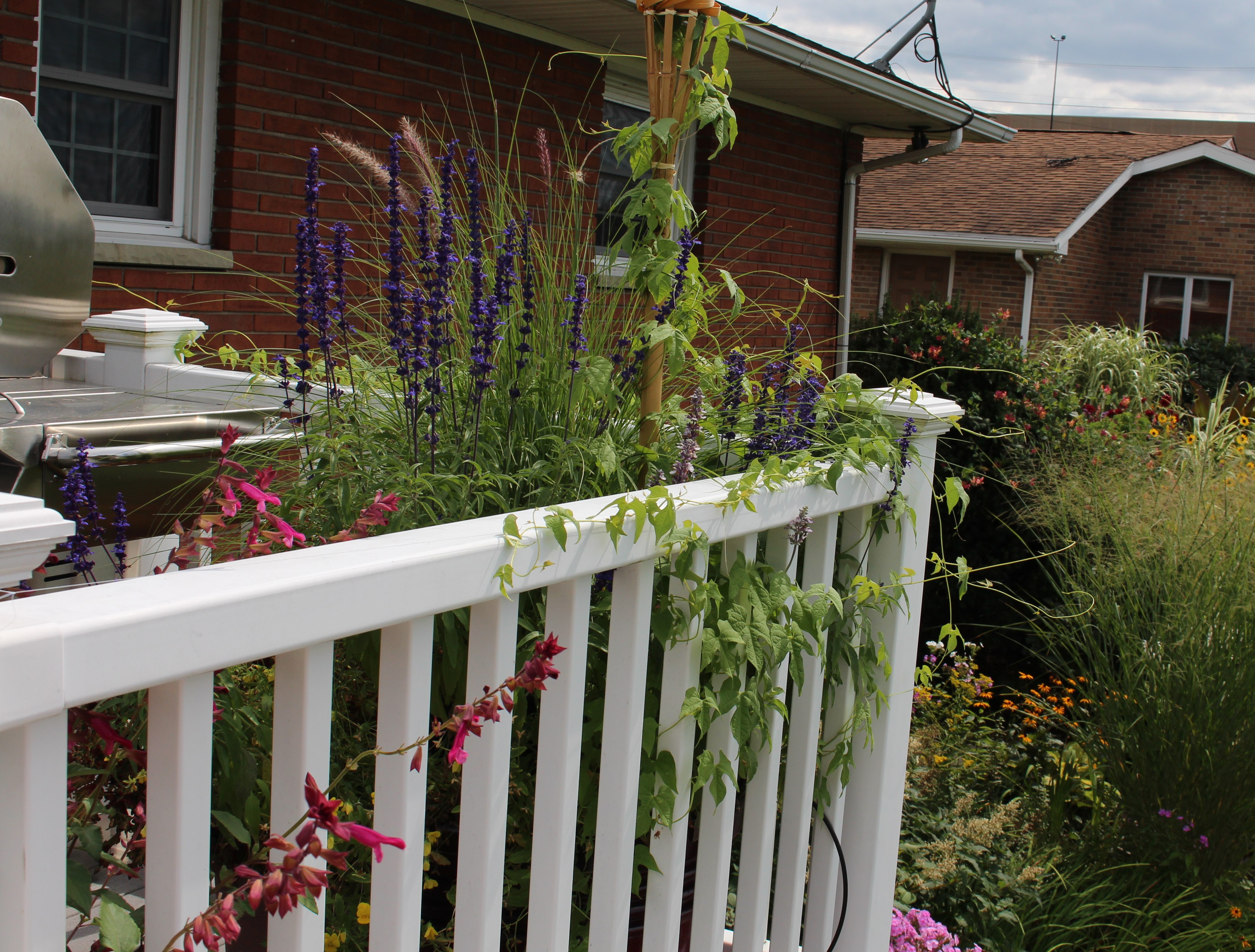
Slowly but surely the Spanish Flag vine (Ipomoea lobata) is beginning to drape the railing.  It had a late start since this was first a spring pansy planter, and they had to bloom out before I was allowed to squeeze in the vine and grass plant.  The blue salvia self sowed in from last year… thanks mother nature!

I have plenty of favorites which I either overwinter or buy, but this year’s big treat was the Cannova Rose canna which I bought already in bloom and already nearly bursting out of the pot it came in.  It’s only done better since, and if you ignore some leaf damage from Japanese beetles and a few sloppy spent blooms dropped on the deck, it’s my idea of a perfect summer container plant.  This canna is a seed strain and because of that should be virus free, also the breeder claims these plants have been selected to thrive in cooler temperatures, which is another plus for Northerners such as myself.

deck container plantings

Cannova Rose canna.  It keeps sending up new stalks and they keep on blooming.  Between it and its overgrown spike neighbor I don’t know which I like more… although I do like the spikes!

I lost a few of my older spikes (dracaena) last year to a surprise late freeze but I’ve got a few new ones growing along.  The little ones are all over in the spring but what I really like is when they put on a few year’s worth of growth and become these big grassy exclamation points.  They’re relatively easy to overwinter and my goal is a whole patch of them towering over the other plantings 🙂

lantana in container

I need to dig out the label for this lantana.  My daughter picked it out and I reluctantly added it to the cart as I thought about lantana failures in my past.  This one keeps blooming though and never looks bad.  I wish I could say the same for the ‘Troy’s Gold’ plectranthus on the right, it apparently does not like full sun here.

The one pink and gold and lavender corner is dominated by another favorite which I nearly left to die last fall.  In the late spring last year I picked up a clearance oleander, and this summer  it’s really come into its own.  Nonstop bloom on the single pink, but there’s a double in there as well, and that one is always a mess with few blooms open and always a few brown soggy spent flowers hanging from the branches.  I try to ignore it.

oleander in container

Oleander on the deck.  It’s been in bloom since June and I love the bright pink in front of the white railing.

As we go around the deck there’s another favorite which I always end up buying new each spring.  The purple fountain grass (Pennisetum setaceum ‘Rubrum’) is a pain to overwinter but worth adding new every year for its dark leaves and light airiness of the seedheads.  This year I put it with a new rose and although I paid way too much for the rose, and really questioned the decision to plant it on the deck (mostly due to all the blood it drew while planting), I love the effect.

grass in container with rose

Purple fountain grass with rose ‘Black Forest’, ‘zahara sunburst’ zinnias, and ‘double hot cherry’ zinnia.

Not to name too many favorites but sweet potato vines always show up in my planters.  Some years they cover the deck, some years they hang through the railing, regardless of where they grow I like them and I like them large.  There are dwarf types but for me I far prefer the far-ranging ones like chartreuse ‘Margarita’ or the dark purple ‘Blackie’.

deck container plantings

A scented geranium growing up, a ‘Margarita’ sweet potato hanging down, and New Guinea impatiens filling the pot.  Also making a showing is my newest banana ‘Bordelon’, two weeks in the pot and hopefully on the verge of some nice new leaves and rapid end of summer growth 🙂

I apologize for going on so long,  I’m going to try and be a little less wordy as we go around to the front door plantings.  They’re much less floral, but still a mess of color.

mixed foliage planting

The hellebore and variegated boxwood are in the ground, but everything else is potted…. not that you would know since the planters disappeared a few weeks ago.

I wish I could explain my thinking out front, but it was really just a matter of using up stray coleus cuttings and overwintered tropicals.

mixed foliage planting

This pink coleus is my problem child.  While all the rest are happy growing colorful foliage the pink one insists on forming flowers.  I just keep pinching them out, hoping someday the plant gets the message. 

This unknown to me creeping houseplant threatens to take over the pot as well as the porch.  I’ve had it for a few years now and love the way it bleaches to a bright yellow wherever the sun hits.  Unfortunately if the sun hits it too hard the leaves burn…

cane begonia

Every couple days the begonia needs to be dug out of a yellow landslide.  I suspect there’s at least three pots buried under all this.

The other side of the front entry is also a horticultural tsunami.  Vacationing amaryllis (hippeastrum), a few geraniums, and some on again off again gerber daisies are trying to fend off the looming sunflowers and an uninvited pumpkin.  Serves me right for letting the pumpkins rot on the front steps all last winter, but the new pumpkin forming is almost like a self renewing Halloween decoration!

container plants

The left side of the front entrance walk.  Nothing pretentious about this entry, it’s all a comfortable hodgepodge of color and texture (including mildewed pumpkin leaves).  The lighter, divided leaf is the old (1800) scented geranium ‘Lady Plymouth’.  Obviously I haven’t had it that long…

So after all of the mess at the entry our hanging porch planters are fairly plain.  The asparagus fern gets thrown in the garage each winter, nearly dies by April, and then springs to life once regular watering resumes.  It doesn’t drop faded flowers on the porch, doesn’t mind a week or two of forgotten waterings, and cost me about $1 a piece several years ago.  I appreciate all these strengths yet she who judges doesn’t like these pots at all.  Flowers would be nicer she says.

easy plants for hanging baskets

Asparagus fern, just the kind of hard to kill plant which survives under the shade of the porch, out of the reach of any saving drops of rain.

Now if I replaced the ferns what would I put there?  Maybe she means add more pots all around the porch, that’s probably what was implied, and that might be a good starting point for next year.  Come to think of it she did say she wouldn’t mind even more potted plants out back, and contrary to what I thought, she said it’s not too much back there on the deck.  This of course kind of encourages me to find out what too much is, and it’s these kinds of challenges which fuel your imagination in February.  I did still want to add a small eucalyptus tree after all, just a small one.

GBFD Finishing August

Yesterday was the 22nd, today the 23rd, and by the time this post is finished the date will probably flip on to the 24th, which will make me two full days late in joining Christina in the celebration of Garden Blogger’s Foliage Day.  I’m sure she’s fine with my tardiness but I’m also sure I didn’t want to miss this month’s opportunity to look past flowers and recognize all the contributions foliage makes in the garden.

squash climbing in garden

In the vegetable garden the broad leaves of late planted summer squash threaten to swamp their less edible neighbors. I love how fast they grow in the heat.

I’m a big fan of large leaves and whether they’re squash or cannas or elephant ears, the more enthusiastic a grower the better!  While some plants did not enjoy the recent spell of hot weather, a newer resident of the garden did.

Alocasia Borneo Giant

One of the larger elephant ears, Alocasia ‘Borneo Giant’, is finally putting out some more enthusiastic growth. The leaf is still barely larger than my hand but the giant part of the name gives me hope for the future!

Summer is when I really enjoy the potted plants on the deck.  Not only can they be enjoyed from the window, they can be enjoyed as you walk by, as you sit in a comfy seat, or from below.  It’s as if you’re multitasking your enjoyment!

coleus in deck planters

The rich foliage pattern of this coleus sometimes gets lost in a planting, but against the white railings the colors really come through.

Besides showcasing my favorite plants close up, the deck is also a great place to show off the little things which get lost out in the garden.

potted succulents

Little cacti and succulents which don’t mind a few missed waterings or weekend road trips.  They’re all foliage and make great deck plants… which look even better if the gardener finally repots them into roomier quarters (as I did this spring, although one of this bunch already needs a bigger home).

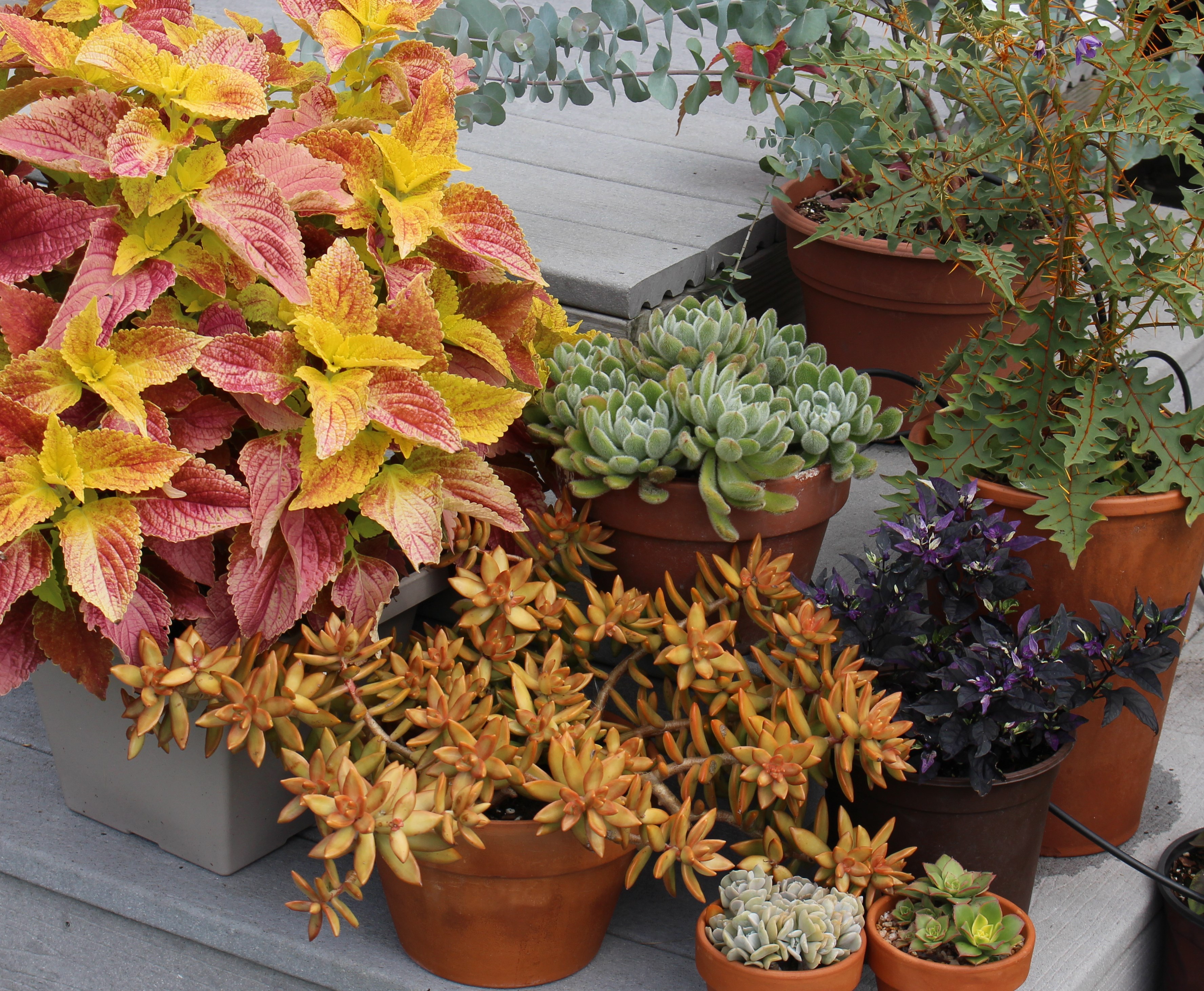
As I was walking about trying to focus on foliage, I realized this collection at the end of the deck steps doesn’t rely on a single flower to bring in the color.

deck planters

More succulents as well as ‘Alabama Sunset’ coleus, ‘purple flash’ pepper, and my belovedly spiny porcupine tomato.

It’s really way past time to do a catch-up post on this year’s deck planters (and hopefully I can come clean soon) but there’s only so much time tonight, and there’s still plenty of other foliage to consider in the garden.  For as exciting as flowers and color are, sometimes the eye needs to rest on a little green.  For me chrysanthemums are a nearly indestructible planting for some of the hotter, dryer, tougher-to-fill spots which could use a soft mound of green.

chrysanthemum foliage

Usually the iris in the back has nothing but sad, browning and yellowing leaves, but this year the rain has been enough to keep it growing strong.  The chrysanthemum on the other hand looks respectable for the entire summer, even when the crabgrass gives up.

Dry sun is bad, but dry shade is worse, and this year I’ve been surprised at how well variegated obedient plant, (Physostegia virginiana ‘Variegata’) has done.  In moist soil it may spread a little too enthusiastically, but here it seems downright demure, and I wonder if the straight green type would be as restrained.

Physostegia virginiana 'Variegata'

Physostegia virginiana ‘Variegata’ lighting up the shade.  It’s a dry spot full of maple roots, but the foliage on this plant still looks great.

In my only bit of non-rooty shade I can always count on the calm contrasts of foliage form and color via evergreens and hostas.  Although things are beginning to get crowded here, I won’t mess with this planting until it starts to look desperate.

shade foliage border

Along the porch the hostas cover the spring bulb plantings and dwarf conifers shelter the porch without overwhelming it.  They’re all slow growing plants, but not too long ago I remember being able to easily plant between these shrubs.

The calm of the shade garden is always appreciated in summer, but in sunnier spots August means flowers, and I do try for plenty of that as well.  Even with all the flowers though, a good foliage background can make a world of difference.

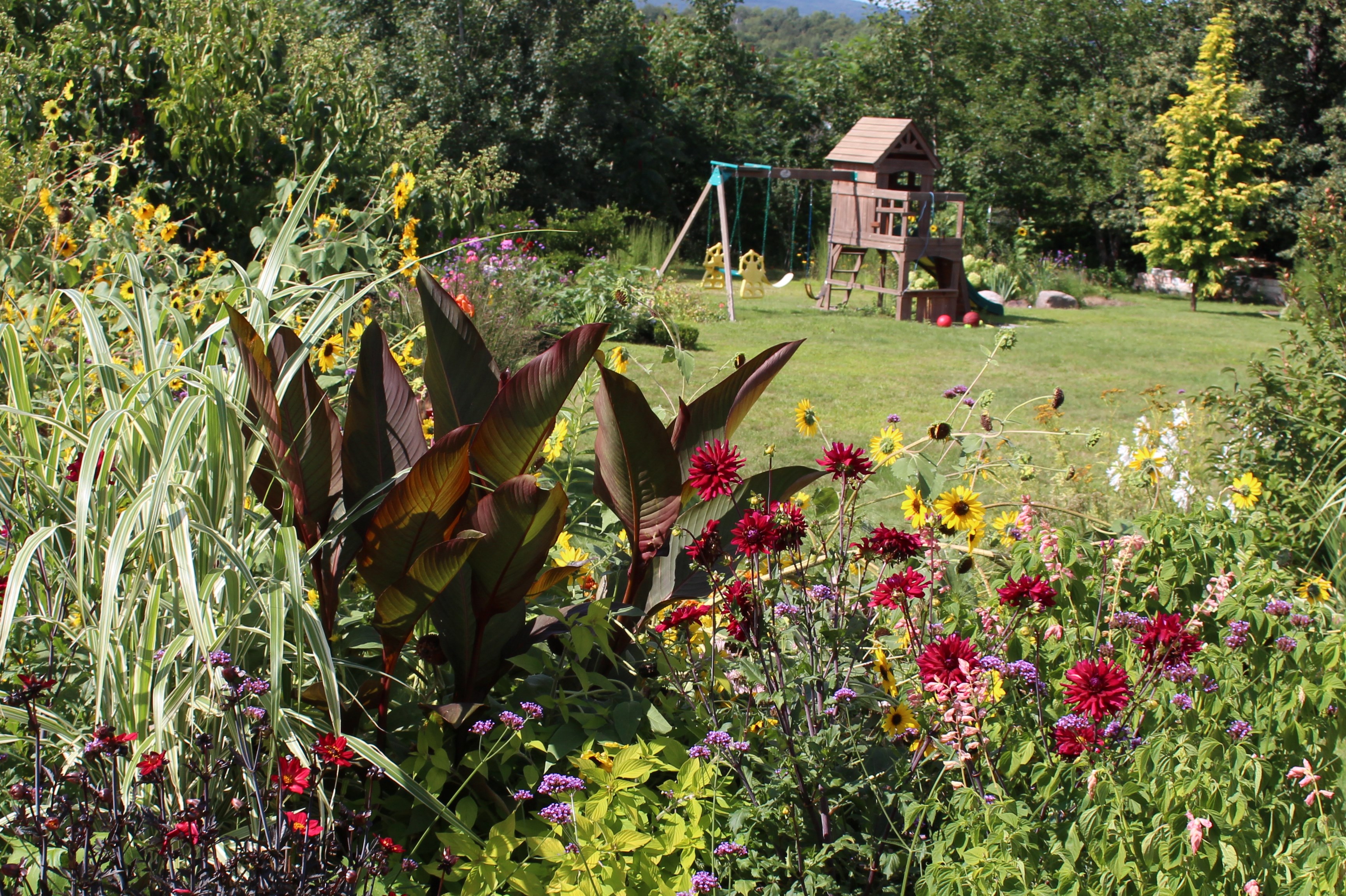
cannas and dahlias

The rich red flowers of dahlia ‘Mathew Allen’ set off even brighter next to the solid mass of the red-leaved cannas.   

I’m all for the masses of flowers but you sometimes need a rest here and there and a mass of foliage can be just the ticket.  For next year I’m already nursing along a few new bananas and elephant ears and I think things will look a little different in this border.  If worse comes to worse though I can always replant sunflowers 🙂

cannas and sunflowers

More cannas trying to keep their chin up against the tide of sunflowers which still swirls around the tropical garden.  In my opinion this bed could have used a few more masses of foliage to balance out all the bloom. 

So there are some August musings on foliage from my neck of the woods.  If you’d like to dabble a little deeper give Creating my own garden of the Hesperides a visit.  Each month on the 22nd Christina provides the platform there to host a foliage review, and I’m sure you won’t be disappointed by the foliage musings of bloggers from around the world!

Spare the rod

My nemesis the sunflower.

bird seed sunflowers

Self sown sunflowers from birdseed backed up by variegated giant reed grass (Arundo donax ‘gold chain’).

Harmless and full of promise is how they appear in the spring, now two months later they’re acting more like closing time at the bar.  Sloppy drunks hang all over one another, sprawl across the beds, and smother the other sober little plants which have yet to grow.  If it weren’t for their summertime good looks and the goldfinches they pull in I would compost them all!

sunflower bloom birdseed

Future birdfood.

It doesn’t take many sunflower seedlings to overtake a bed and between the extra mulching and copious rainfall they’ve had everything they needed to explode.  It’s like a lovely tsunami of sun looming over the plantings.

flower border sunflowers

The sunflowers do look pretty with the purple verbena bonariensis, striped leaves of ‘tropicanna’ canna, and the first of the peach colored salvia splendens.

From the top of the bed it still looks pretty but only after I cut down two of the sunflower trees and chopped the rest back in order to clear the pool path again.

tropicals with annuals border

The tropical border looking colorful, but as usual not very tropical.

The inner depths of the tropical bed are beyond reach, I’ll have to wait for frost before I can get in there again.  Fortunately it’s well mulched and doesn’t need much of anything for most of the summer, so as long as the cannas and reed grass don’t get completely swamped I guess I can turn the other cheek and let chaos rule.

arundo donax gold chain with sunflowers

There’s a giant thistle in there as well, I see a steady trail of goldfinches flying in and out feasting on the seed.

Really.  Next year will be the year when this whole mess gets back under control.  The sunflowers will have to go as well as the chrysanthemums which never did get moved like they were supposed to.  In spite of the overwhelming agricultural look of the sunflowers (and I have to admit I really love the show right now) there are a few tropical highlights which have flickered on.  The cannas may not be as big as in years past, but I would never go without them.

healthy canna tropicana

Healthy ‘Tropicanna’ canna leaves in a sea of green with only a touch of gold.

They’ve still got a good two months of growing before frost threatens and hopefully everything will still have plenty of time to fill in.  While other parts of the garden might be taking on a weary look this time of year, these tropicals are just going from good to better, and it’s not just the cannas.  The dahlias are beginning to come on as well.  The flowers are what I’m waiting for, but on a few the foliage show is even better.

dahlia happy single flame

Dahlia ‘happy single flame’ with the dark purple spires of ‘Lighthouse purple’ salvia behind.  I wish those salvia were just a tiny bit taller, right now this low planting looks closer to Victorian bedding than tropicalismo!

Although the foliage is fantastic, I wish I could say the same for the blooms of dahlia ‘happy single flame’.  They  don’t last long and never really make the ‘wow’ impression most of the other dahlias do.  The color is great though and I’ll try to hold on to this one for another year or two, even as the others bloom their heads off in comparison.

dahlia happy single flame

Peak bloom on dahlia ‘happy single flame’.

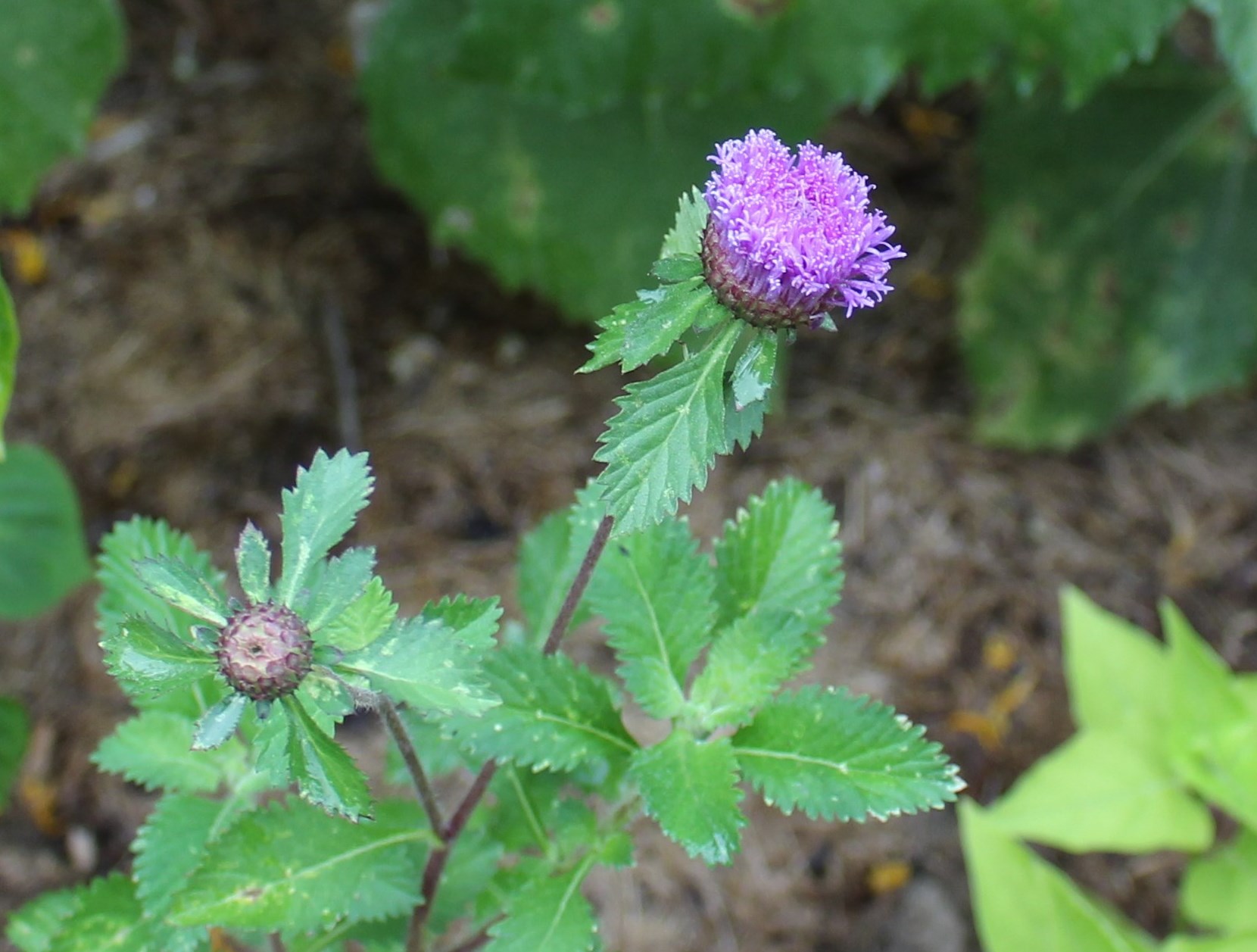
One plant which I had high hopes for but is now slightly underwhelming is the Brazilian button.  New this year from the HPS Mid Atlantic seed exchange, the buttons are nice enough but there could be more flowering at one time and most importantly have a color less like the verbena which I already have filling in all over.  You just don’t notice them in the mix.

Centratherum punctatum Brazilian button

Brazilian button (Centratherum punctatum)

But I’m being too negative.  The sunflowers are awesome and the patch is full of flowery interest, and whenever I get the chance I sit (with a drink preferably) and watch the comings and goings of the goldfinches, hummingbirds, and bees.

pink salvia splendens

The pink salvia splendens are only now starting to flower having spent most of the summer putting on weight.  The large leafy bushes should put on a great show for me and the hummingbirds.

I’m sure there will be more to come from the tropical garden, and if I can only keep a firm hand next year it might even look tropical-ish as well.  Right now I’m just happy enough it’s mulched and weeded from the topside all the way down to the low end.  Last year the low end was pathetic with its drought crisped annuals and struggling heucheras (is that the correct plural for heuchera?)  This year it’s much improved and I can see this becoming a nice transition to the pond garden…. once I get a non-leaky pond in!

panicum northwind in garden

Next year the new divisions will fill in and there should be a wall of panicum ‘northwind’  separating the tropics on the left from the heucheras and pond garden on the right.  

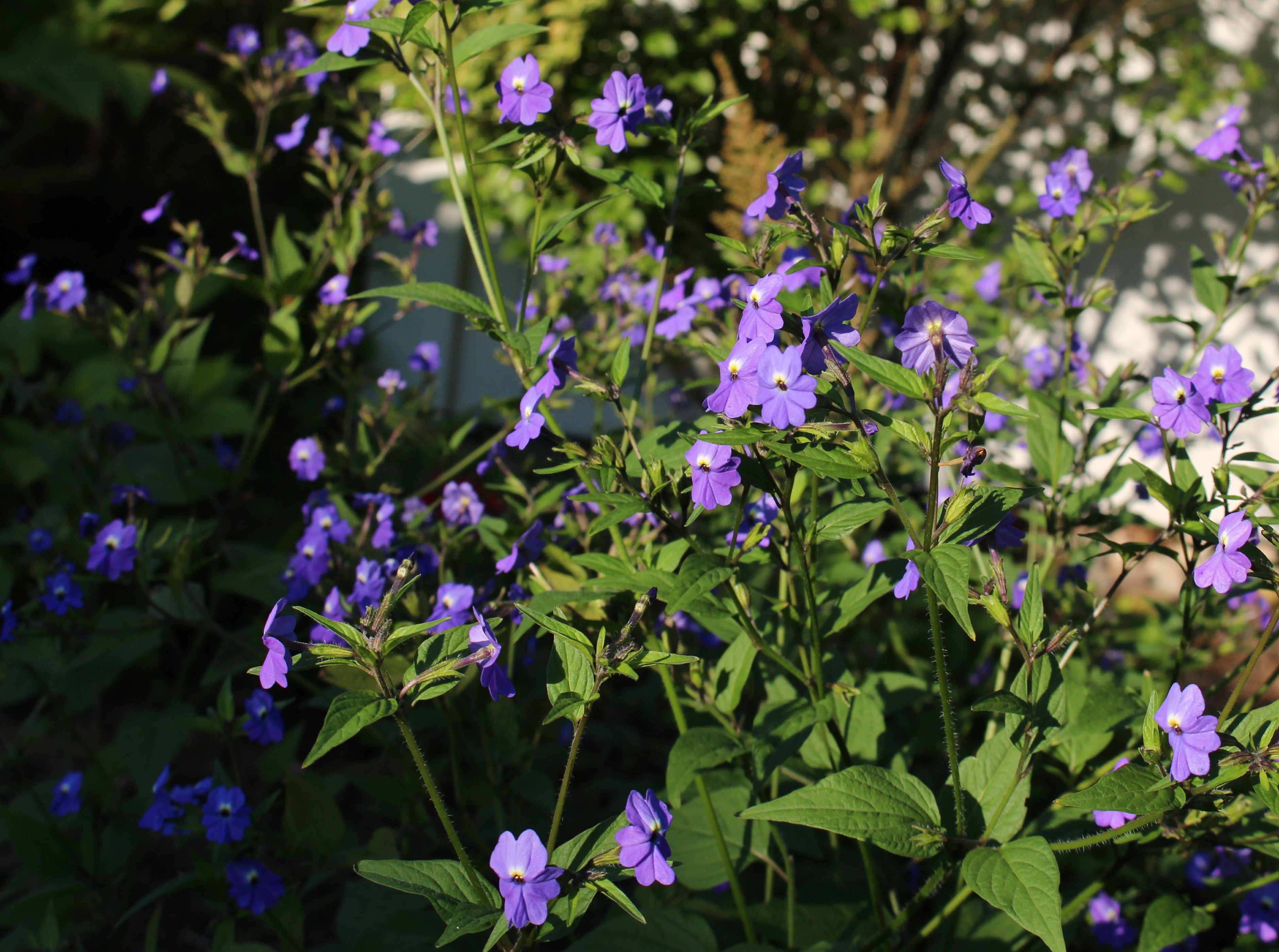
In the photo above you can barely make out the blue mist of Browallia Americana hovering above the hosta.  It’s an easy enough annual (native to Central and South America and across the Caribbean isles) and each year I like it’s nearly true-blue flowers even more.  Too bad I can’t get the camera to agree on the color, it always washes it out to a violet.

browallia americana

Browallia americana

So summer is still in full swing here, and for someone who prefers to ignore the calendar there’s not even a hint of the season winding down yet.  I like this sense of denial and will hang on to it for as long as I can…. but if pushed I will admit to thinking about next year already.  Ok, so I don’t even need a push.  I stumbled upon a summer sale at the nursery and took home a cool little banana plant.  It’s been a couple years since my banana growing days but I can feel the itch again and who knows what this means for next year’s plantings 🙂

A good foundation

Normally pictures of the front foundation border are avoided.  This area qualifies as one of my least favorite views probably because the plantings do little to set off or relate to the house.  They’re kind of a mess come to think of it, but believe it or not they’ve come a long way <click here to see>.  Our visit starts with a stroll up the front walk past the welcome squirrel and edging by the ‘Tiger Eyes’ cutleaf sumac, which threatens to engulf all visitors.

tiger eyes cutleaf sumac

Which is too much?  The overwhelming yellow, the tacky lamp décor, or the too-red petunias?

The right side of the house is fronted by the porch, and in front of the porch is a pretty generic planting of evergreens and hostas.  They do a great job of being green and covering up the beds which house my favorite snowdrops and corydalis earlier in the year.

phlox and rudbeckia

Of course a rudbeckia would show up here as well.  This is one of the completely perennial and later blooming R. fulgens types, and I make an effort each spring of ripping it out only to have a few stray shoots  survive anyway.  btw, The pink of the phlox ‘Laura’ with the gold of the rudbeckia is one of my least favorite color combos.

The left side of the house is my problem bed.  I tried ironing out a few of its problems earlier this year but it still makes me raise an eyebrow each time I pass.  My first after-vacation task was to pull up all the massive crabgrass plants which were taking over, and while doing this I couldn’t help but wonder why I can’t show this same resolve against the inappropriately large sunflowers which sprout up each year (in my defense I did rip most out… but once they get past a certain size it just seems wrong to yank them).

weeding crabgrass

Weeding crabgrass in August.  What gardener doesn’t know this story?

If I could only get visitors to crawl around on their hands and knees I think the impression this bed makes would be infinitely improved.

gray and red in a mixed border

The low view: Larger evergreen would probably do a better job of connecting the house to these beds, but a couple agastache, a verbascum, stray sumac suckers and a bunch of other stuff are a lot more interesting 🙂

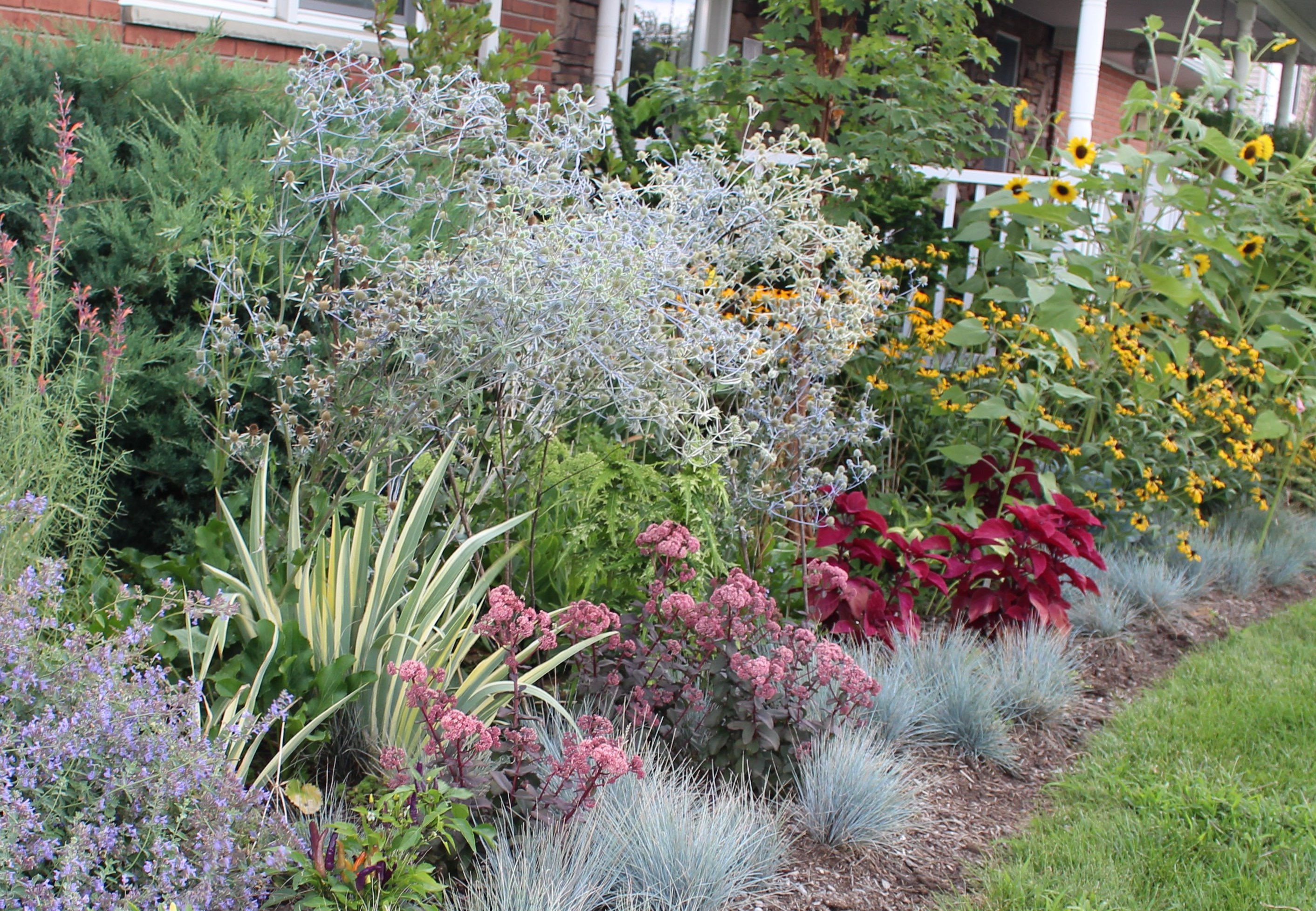
I like how the blue fescue is filling in along the edge, it goes well enough with everything and seems to be doing ok.  I wish it would do better, but I haven’t yet cracked the fescue code on what really makes it clump up and fill in.

pepper masquerade seedlings

For some reason peppers seemed like a good  candidate for a foundation planting this year.  Last summer I bought a single ‘Masquerade’ ornamental pepper and these are its seedlings.  The purple fruits should go to yellow then orange then red as they mature, but a few plants are starting out yellow, and I don’t know what they have planned. 

My unknown biennial eryngium turned out to be a perennial and is back for another show this summer.  If you can avoid the masses of wasps and bees the flowers attract it’s really a pleasant all summer cloud of blue-grey.

water wise plants

The mix of colors at this end of the border almost looks tasteful if you ignore the sunflowers peeking in on the right. 

Most of the plantings here are haphazard and either work or fail by luck, but the pairing of the blue fescue and pinkish ‘bon bon’ sedum was intentional.  I’m pleased with the contrast of the sedum coming up out of the fescue and it’s just what I was hoping for… as long as you overlook the sorta sparseness of the fescue.

sedum 'bon bon' with blue fescue

Sedum ‘bon bon’ with blue fescue and iris pallida aureo-variegata.

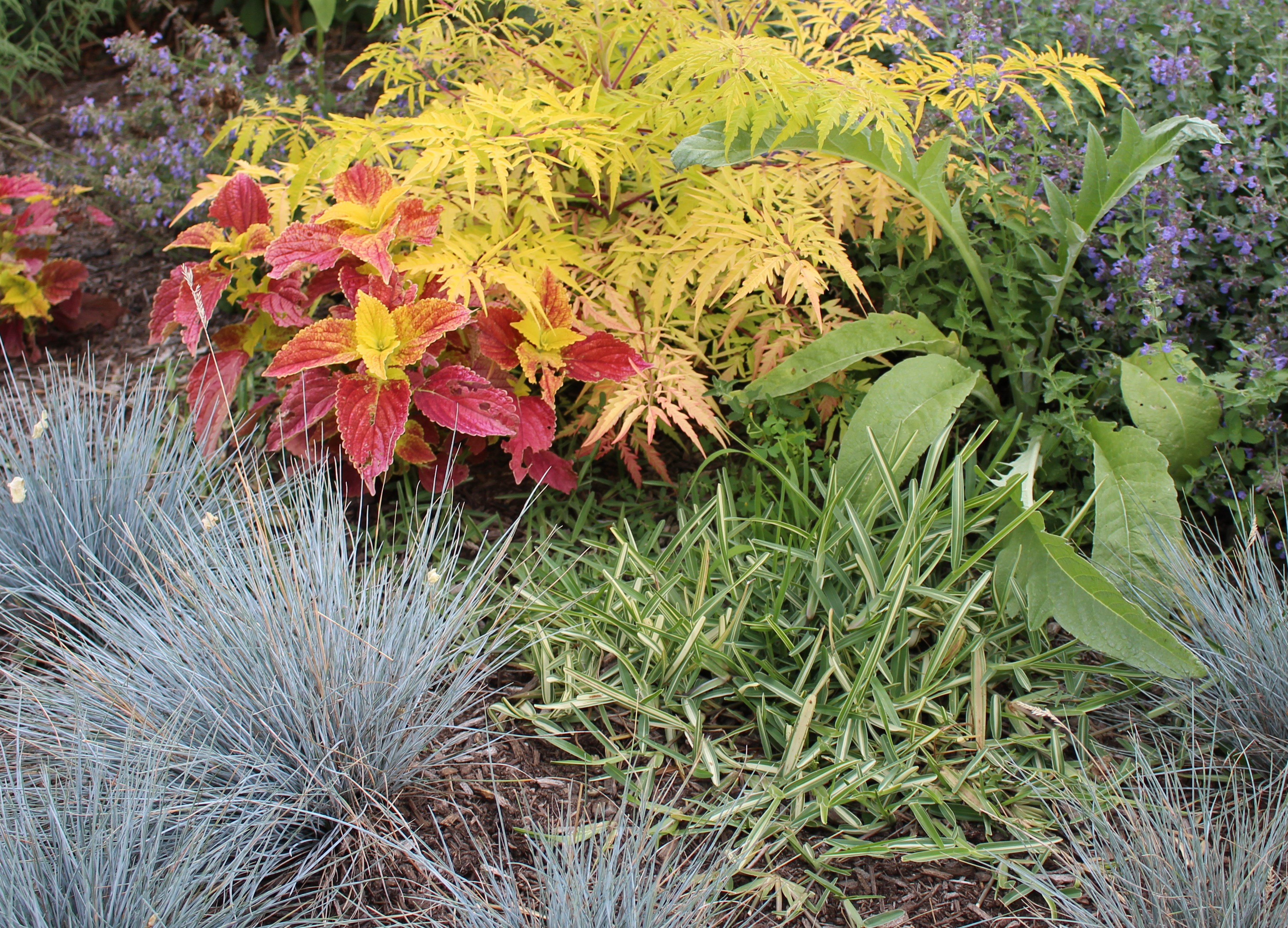
Things which didn’t work out quite as well were the cobweb thistles which drowned in our rainy July and the variegated St. Augustine grass which looks just a little too weedy.  I know it’s me though since I’ve seen it growing awesomely elsewhere and as a result I’m considering digging it up and trying it elsewhere, like in a pot… maybe even scissor trimming it for a neat little pot o’lawn 🙂

variegated st Augustine grass

Variegated st Augustine grass, ‘Alabama sunset’ coleus, more sumac, and an up and coming cardoon seedling.

Now off to the backyard!  My fingers are crossed we can get around the whole house by September 😉

The sputtering tropics

Again I’m trying to recapture the tropical gardens of years past, but again I’m falling short.  The fault is entirely my own though and I know that, but in NE Pennsylvania tropical plantings mean around six months of empty planting area and I just don’t have enough self control to keep them perennial and bulb-free.  Really… in October how bad can it be to slip in an extra daffodil or lily?

liberty hyde bailey lily

First year blooms on ‘Liberty Hyde Bailey’.  Photo credits for this artistic shot go to the wife,  to tell the truth I wasn’t so sure she even knew where the garden was, let alone was interested in taking any pictures 😉

To my credit serious mulching with every scrap of mulched leaves and any garden debris I could send through the mower has substantially reduced last year’s problem.  The problem was that this bed was overrun with sunflowers, and if we ignore the fact that the gardener himself was responsible with planting them we can pretend that only having a half dozen or so of the plants this year is an improvement.  Still a few self seeded anyway and hopefully this more manageable patch won’t again overshadow the ‘tropical’ look with ‘overgrown agricultural’.  -and for the record I did rip out at least another dozen healthy sunflower seedlings, and nearly drove myself to drink over the guilt (but after a hard day of work what gardener doesn’t deserve a cool drink?)

saving money on mulch

A few sunflowers coming up but hopefully enough bright color and big leaves to make it look tropical.  I only had enough bark mulch for the outer edge, the rest is lawn clippings.

Mulching has been an obsession lately.  I raided the neighborhood woods again and brought home a few wheelbarrows of stinky dumped grass clippings which I used to cover the inner reaches of the bed.  It was just in time to smother tons of baby weeds but most importantly the rotting grass was a solid dose of fertilizer for all the little goodies coming up.  Within a few days everything turned a lush green and started putting out new growth.  It was amazing what a difference the grass made and I’m sure the earthworms are pleased as well.  In order to keep it more presentable I robbed some leftover wood mulch from next door and tidied up the edges of the bed with a few shovelfuls of that.  It’s the dyed mulch which I’m not crazy about, but it being free really appealed to my budget sense.

mulch and paver pathway

I also leveled and set the mismatched stone and paver bits which pave the shortcut between our yard and grandma’s pool.  It looks halfway decent now and is much less of an ankle twister.

Even with plants in and mulch applied, the bed is still not out of the woods.  There’s always a problem child or two.  First it’s the chrysanthemums which I planted and meant to transplant once spring rolled around.  That didn’t happen and to add insult to injury they are coming into bloom now…. just when I don’t need fall color.

mammoth yellow quill chrysanthemum

‘Mammoth yellow quill’ chrysanthemum looking good in July.  I guess next year I’ll pinch in May and try to delay bloom, mums in September would have been nicer!

Another problem are the two cannas I bought.  They were from a reputable online nursery and were listed as showing no signs of virus, but the first leaves tell a different story.  A refund is already on my account but I really wanted to add a healthy canna ‘Musifolia’ and ‘Pretoria’ to the bed.  the leaf streaking and yellowing/browning patches are sure signs of canna virus so these have regrettably been thrown to the trash.

canna virus

These leaves should have a lush, solid green, but instead are showing the streaks and mottling of canna virus.

As usual the third problem child is me.  How could I pull out this lusty little bull thistle?

bull thistle in garden

An excellent example of a weed.  The goldfinches will appreciate the seed heads of this thistle, and surprisingly enough I don’t get many seedlings even when I let them grow.  They seem to need open soil to sprout which is not easy to find around here.

As the tropical garden puts on some weight and gets ready for August I’m going to see if my tidying and weeding streak can finally extend next door to the not-so-red-border.  It needs the help, but so far all I’ve managed is the start of an access path which will circle around through the back of the border.  I’ve been eliminating the weedy campanulas and moving out other plants but still have a long way to go.

a new path into the flower beds

The start of a new path through the back of the red border.  Unfortunately that was as far as my free mulch would take me….

What is summer without a few projects?  Hopefully my neighbors will oblige me with more grass clippings, maybe temperatures will stay low, and maybe I can blaze a path through the thicket which is beginning to take over.  I won’t even mention the water filled hole which has formed where the pond used to be.  All the rain we had has made this area into a soggy mess!

hemerocallis altisima and raspberry wine monarda

Topping out at around 5 and a half feet, this daylily (hemerocallis altisima) looks cool with the dark blooms of ‘Raspberry Wine’ monarda and a few other leftovers from back when this bed was loved.  The tall grass (Miscanthus giganteus) is thriving on all the extra rain and is at least two feet over the neighbor’s six foot privacy fence. 

I guess it’s a start, and time will tell if it’s also an end.  With two weeks of vacation coming up and plenty of weekend trips in between, I may just sit back and enjoy summer rather than sweat out another bed re-do.  The wooliness doesn’t seem to bother anyone other than myself and digging is always more pleasant in September!

Baby’s first spines

I am a completely proud parent.  On a garden visit last summer I came across a plant I’ve been wanting for a few years now, and with the permission of the owner I was able to swipe a few seeds.  This spring they were planted and I can’t be happier with my little babies.

Solanum pyracantha porcupine tomato

Solanum pyracantha, aka the porcupine tomato, showing the first signs of it’s prickly personality.

If all goes well this bizarrely beautiful and offensively spiny young plant will grow up to be covered with grayish leaves studded all over with orange spines.  It’s not a plant for everyone but it sure fits right into my misguided obsession with sharp and thorny weeds.

What is it about Madagascar that makes this relative of our own docile tomato so dangerously spiny?  This small island seems to have more than it’s share of viciously thorned plants and based on what I’ve seen it isn’t exactly the place for flip flopping, shorts wearing tourists.  But I have to say I’m looking forward to seeing this guy grow up, I think the kids will love it!

Idle hands and the devil

Two more snow days for the kids, another below zero (-18C) forecast, and one sunny day.  I was fine with the first two but the sunny day set off my spring fever.  Of course with snow everywhere and no other gardening options to be had I ordered more seeds.  I had to.  There’s nothing else to do and even the winter garden has me bored.

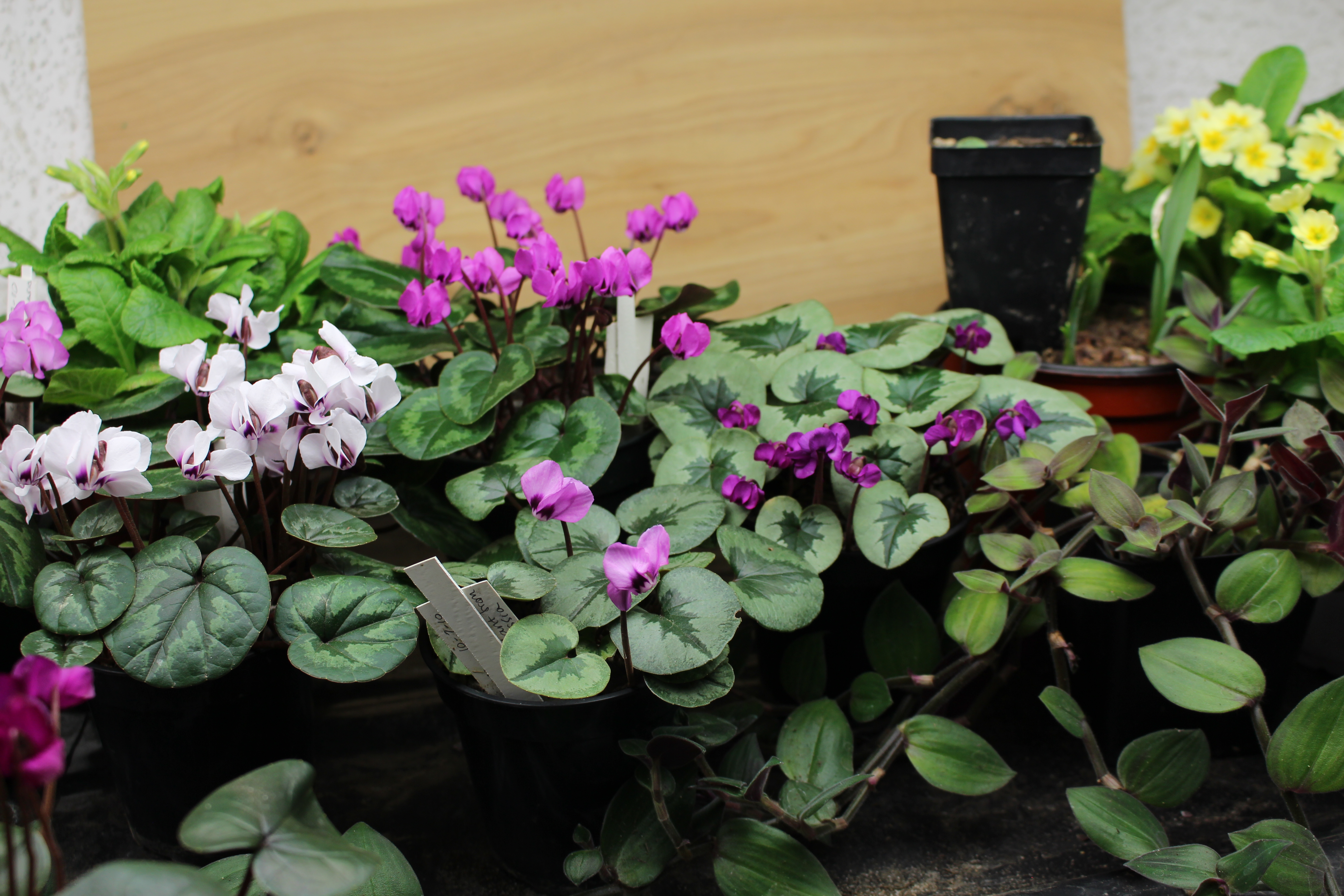
cyclamen coum in pots

Under lights the cyclamen coum are still going strong. I love the large flowers on the white with their blackberry noses, I wish a few of the others had blooms as large.

Who knows what I’ll do with all the new seeds.  They’re surplus from the N. American Rock Garden Society’s seed exchange so at 20 packets for $5 they’re what I consider practically free.  Even better when you consider the non-profit nature of NARGS, in that case 40 packets at $10 makes more sense, and when you add on the 20 packets from the American Primula Society which just arrived last week well then you might get a sense of the trouble I’m in.  I already have enough seeds stratifying in the cold to fill my beds once over, so I’m not sure where these will go.

growing seedlings under lights

The second growlight in a warmer part of the garage is in business now. A few cane begonias have been watered and potted up and two pots of plain old onion seedlings are on their way.

I still have to deal with the Annie’s Annuals catalog sitting in the kitchen.  I have it in my head that I need an eucalyptus tree for the deck this summer plus a few non-hardy yucca and some succulents.  I’m afraid that if I don’t get some snowdrops blooming soon I may yet stumble into that mess.  -I would add some delphiniums too even though each year they’re crushed by winds just as they reach their majestic peak…..  but some plants are worth a little heartbreak.

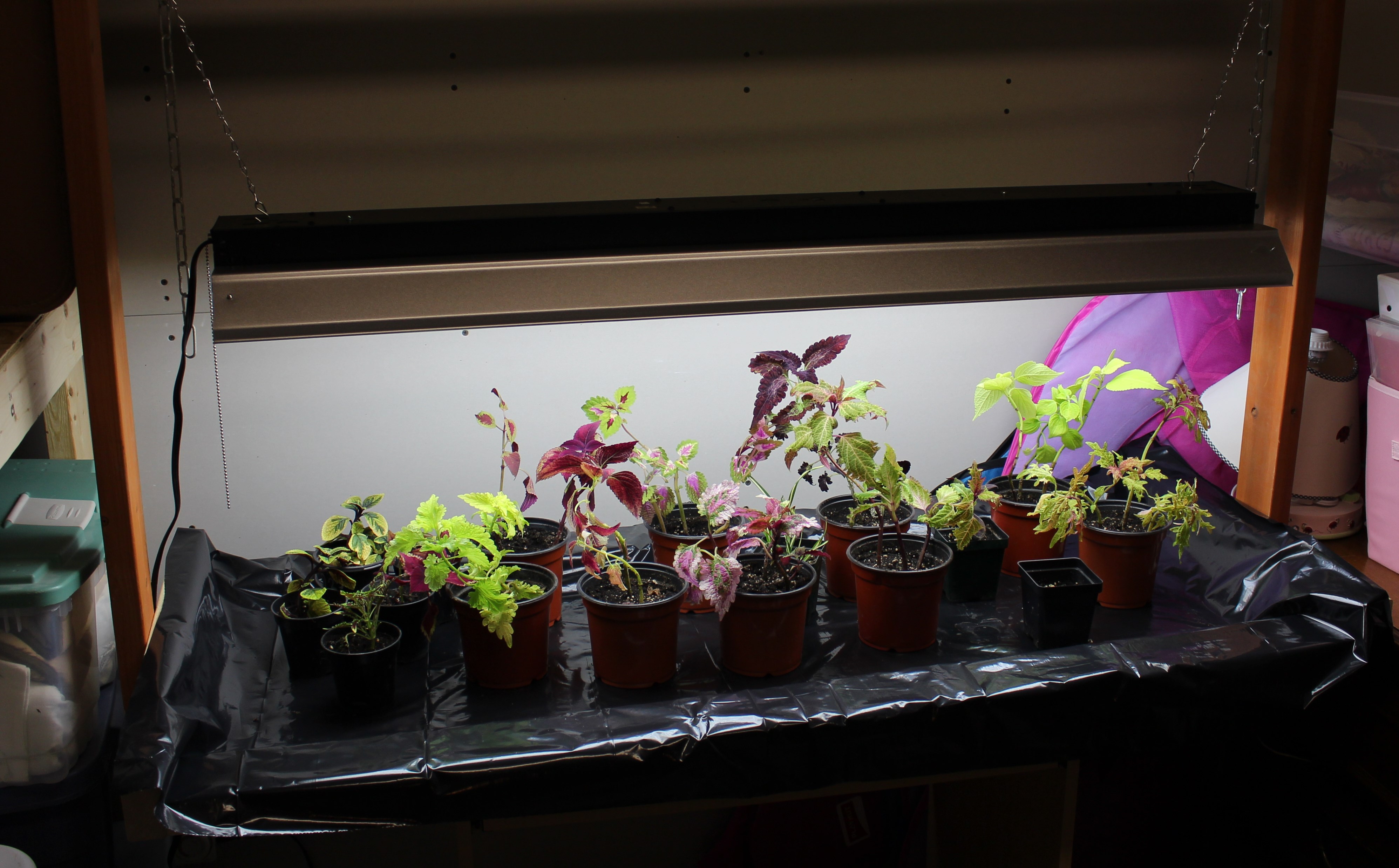
rooting coleus cuttings

Happy birthday to me. A returned gift and $40 credit at Lowes meant a new shoplight for a new spot. This one went in a warm corner of the basement and is perfect for giving new life to the sad little overwintered cuttings which have been sitting in a water filled coffee cup since October.

I should be responsible.  I already spent way too much money on snowdrops and ordered way too many irresponsible tropical bulbs from Brent and Becky’s.  Odd choice considering how much I complained about digging them up last fall.

overwintering succulents and tropicals

Overwintering succulents and tropicals fill the far corner of the barely-heated workshop/winter garden area. Dry and cool keeps them mostly dormant until warmer weather returns.

I hope an end is in sight.  Next week shows five days straight with daytime highs above the freezing point and one day when there’s even the possibility nighttime lows stay just above 32F.  Come to think of it I better start some lettuce and broccoli seedlings, in a few weeks they’ll be perfect to go out into that cold frame I never built.

oleander flower bud

A sign of promise, a flower cluster forming on the overwintering  oleander.   I think it formed last fall and hopefully will grow and develop as soon as the pot gets some water and goes outside.

So I’ll keep my fingers crossed…. if only to keep them from clicking on an ‘order now’ tab since I was looking at geraniums (pelargoniums) this afternoon and thinking a few scented and heirloom ones would be a good idea.   I need a first crocus or snowdrop bloom to get me out of this and back to my senses!  (we all know how reliable snowdrop blooms are for bringing a person back to their senses).  I’ll let you know how it goes 🙂

Blech.

A frigid blast of winter is rolling across the Northern States and we got our share this morning.  The car thermometer saw a 9F (-12.5C) during the ride to work, and it feels more like early February rather than the week before Thanksgiving.  Strangely enough I’m somewhat prepared, and after a weekend of digging bulbs and clearing the garage I’m now able to shelter inside sorting and cleaning seeds rather than risking frostbite outside.

collecting seeds from the garden

The diversity of seeds is a cool thing. The range of shapes and sizes and colors and patterns make you wonder exactly how all this just evolved.

My seed cleaning is not an exact process.  Sifting, blowing, shaking, and picking all work to separate out the bits and pieces mixed in with the seed and I really don’t mind the job at all.  There are just two new things I learned this year.  The first is that castor bean seeds look disgustingly like obesely engorged dog ticks, and the second is that when cleaning ornamental pepper seeds don’t touch your eyes, mouth, nose or even inhale too close to the things.  Also don’t do all the above even after you’ve washed your hands a few times.  In fact don’t even take a shower, your hands are still dangerous and you may burn in all the areas your health teacher told you shouldn’t ever burn….

  castor bean seeds

I’m torn between cool and gross when I look at these tick-like castor bean seeds.

The hot pepper effect eventually wears off and you’re back to freezing.  With the harshness of this cold snap I’m glad I snuck out last Friday and dug up my fall blooming snowdrop before it was annihilated by freezer burn.  I have my fingers crossed it will be better off indoors, but looking back at my track record with watering I’m not 100% sure this will be the case.  It seems to have done well enough last winter though.  In addition to sending up a bloom this fall, it’s splitting in two and has an offset coming up the side.  Sure beats my previous diagnosis of dead.

snowdrop indoors

Just another gratuitous snowdrop picture -you’re welcome!

With the cold settled in and the ground freezing up a more sensible person would snuggle on in and start the long winter break from gardening, but I guess I’m not as sensible as I like to think.  Fall bulb clearance sales are starting and they’re soooooo tempting.  So what if I ended up planting over 200 bulbs in pots last winter after not getting things planted outside in time?  I’m sure this winter things will work out differently 🙂

What is this!?

This could be a problem.  I’m obsessing about my little cuttings rooting under the shoplight in the garage.  They’re the goodies I snipped from Michael Bowell’s garden in early October, and as the outside garden dies back and bores me the indoor garden takes over.  This is supposed to be my “winter garden”, not my “overwintering cuttings garden”.

overwintering cuttings under shoplight

I fired up the indoor garden early this year to give the cuttings a good chance at surviving. Don’t they look promising?

Maybe Santa will bring me another shoplight.

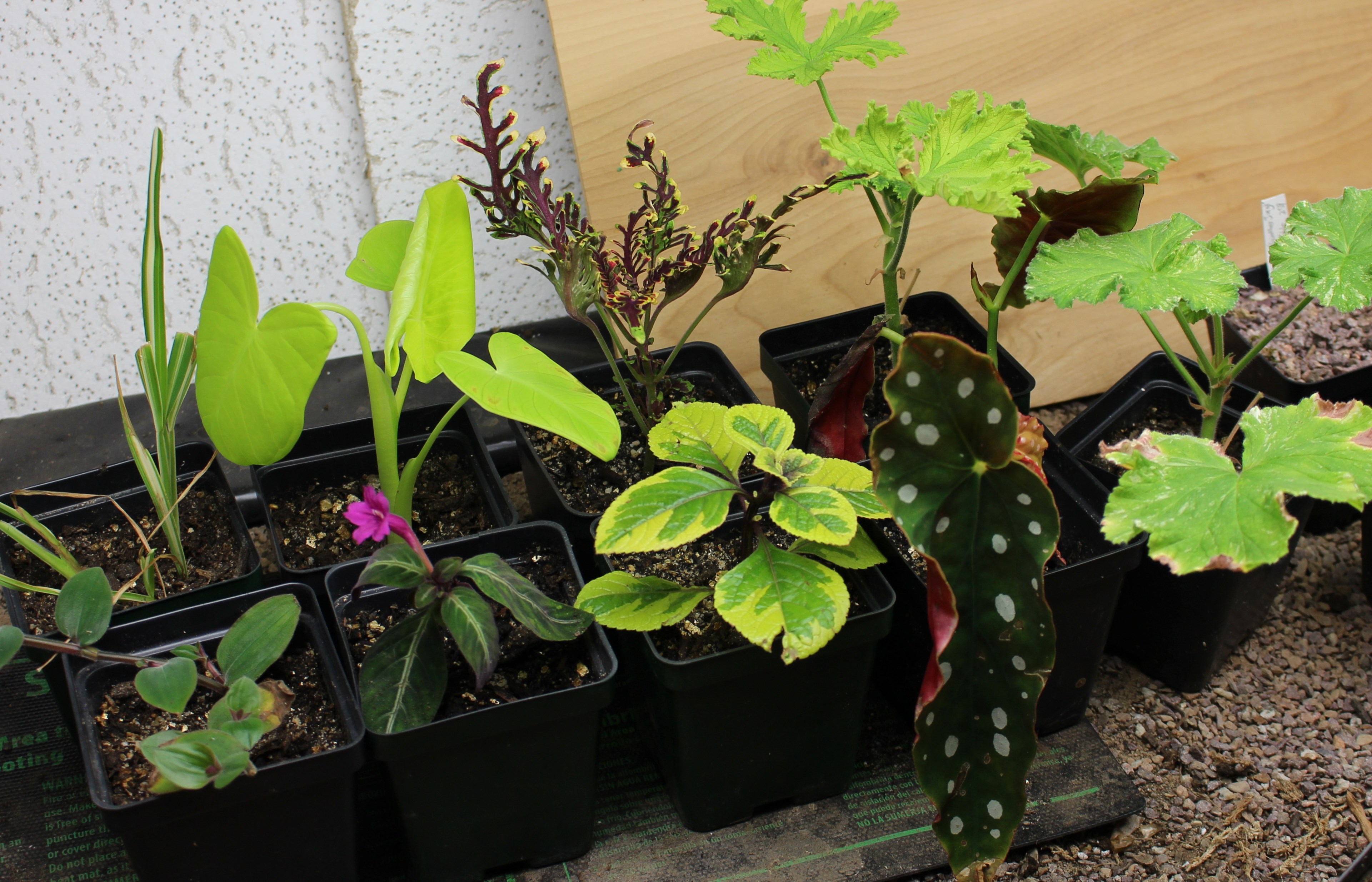
The cuttings went into a tiny bit of rooting powder, a loose sandy potting soil, and then sat on the cozy warm heating mat which I got last winter.  They seem to like it, I just have to figure out when I can remove the mat.  The spotted begonia leaf and the yellow elephant ear are favorites.  The elephant ear was just a tiny root nub which had a little bud on it, I hope by next year it’s a couple feet tall!

Oh the optimism of a new season 🙂