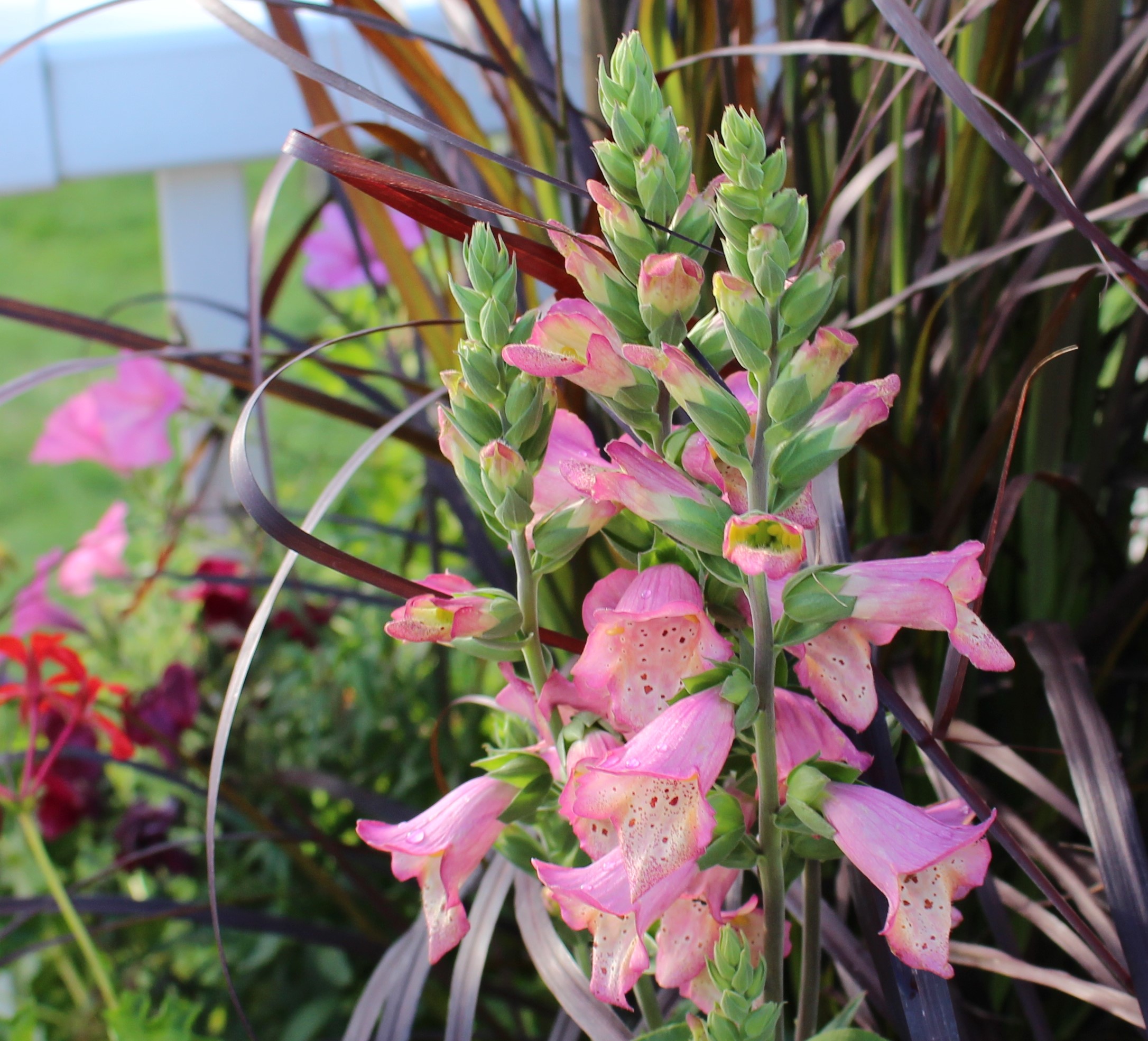
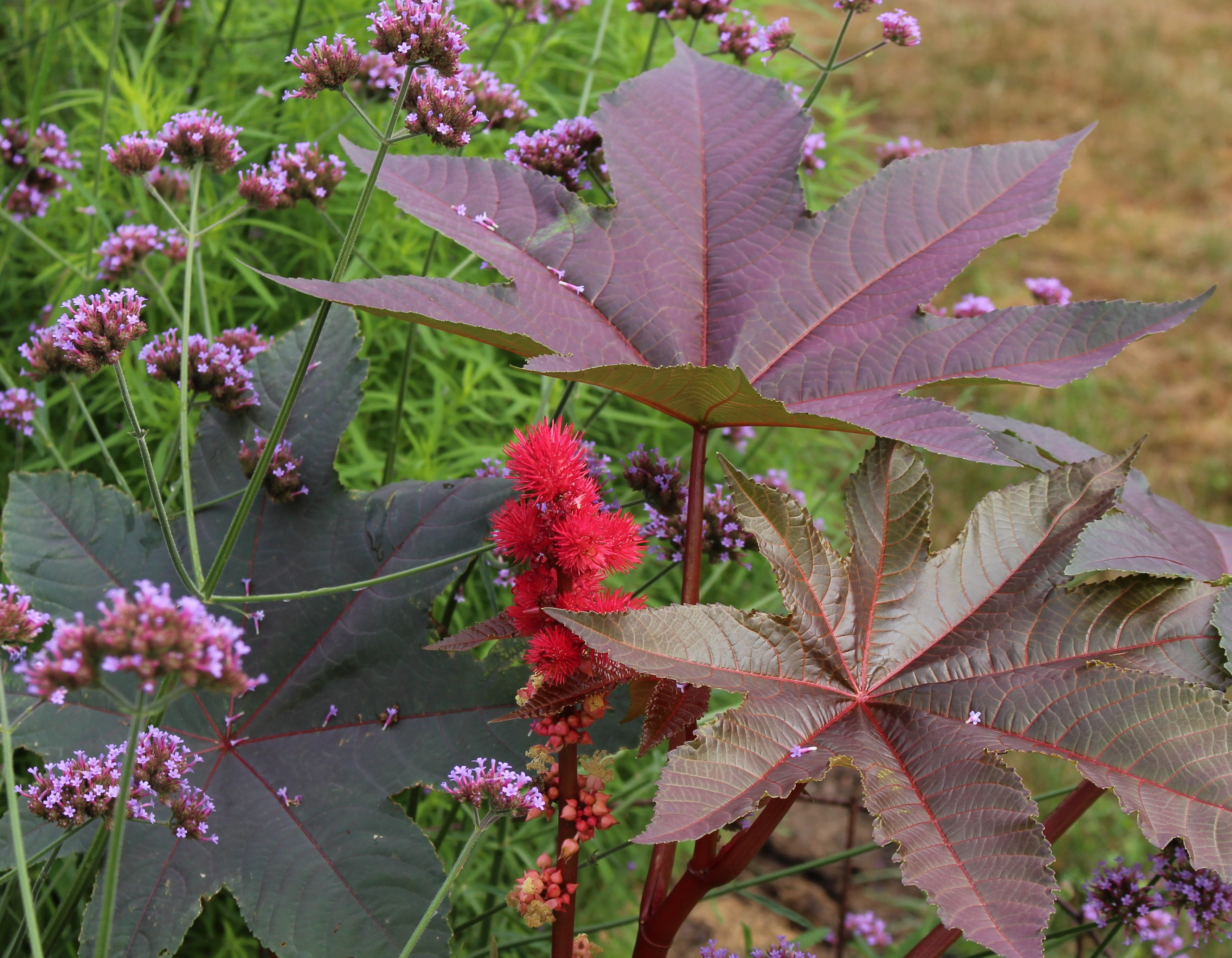
GBFD September ’16

Garden Bloggers’ Foliage Day always sneaks up on me, it hits exactly at that point of the month where I start wondering where the month went and start panicking over the thoughts of yet another turn of the calendar page.  But I get over that pretty fast and although my posts are frequently late, Christina at Creating my own Garden of the Hesperides is always understanding, and so this month when she suggested that in spite of my tardiness I might still be able to sneak in even more tropical garden photos, I of course jumped at the idea.  The tropical plants really keep the garden fresh at this time of year, and their bold foliage looks big and unblemished and makes an excellent contrast to the seedheads and dying foliage of much of the rest of the garden.

canna indica pupurea

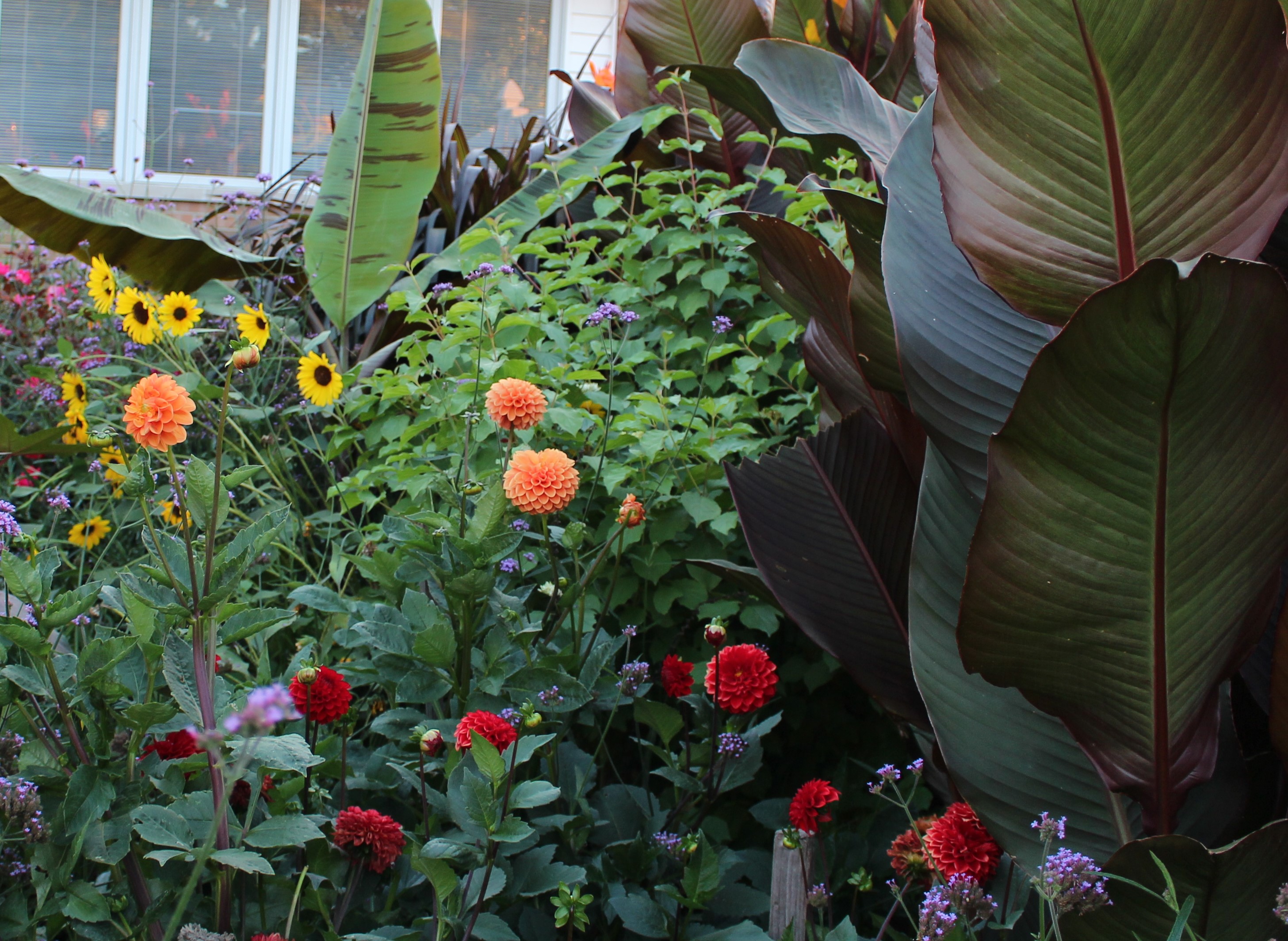
The purple cannas of the tropical garden (Canna indica pupurea?) look great as they catch the light.  I promise to not show them any more, but how bout this one last time 🙂

So this post was just going to be a pat on the back for foliage in the tropical garden, but then just like Christina suggests I started looking a little closer at how much foliage brings to the table as far as the overall garden picture…. but before that one more canna…
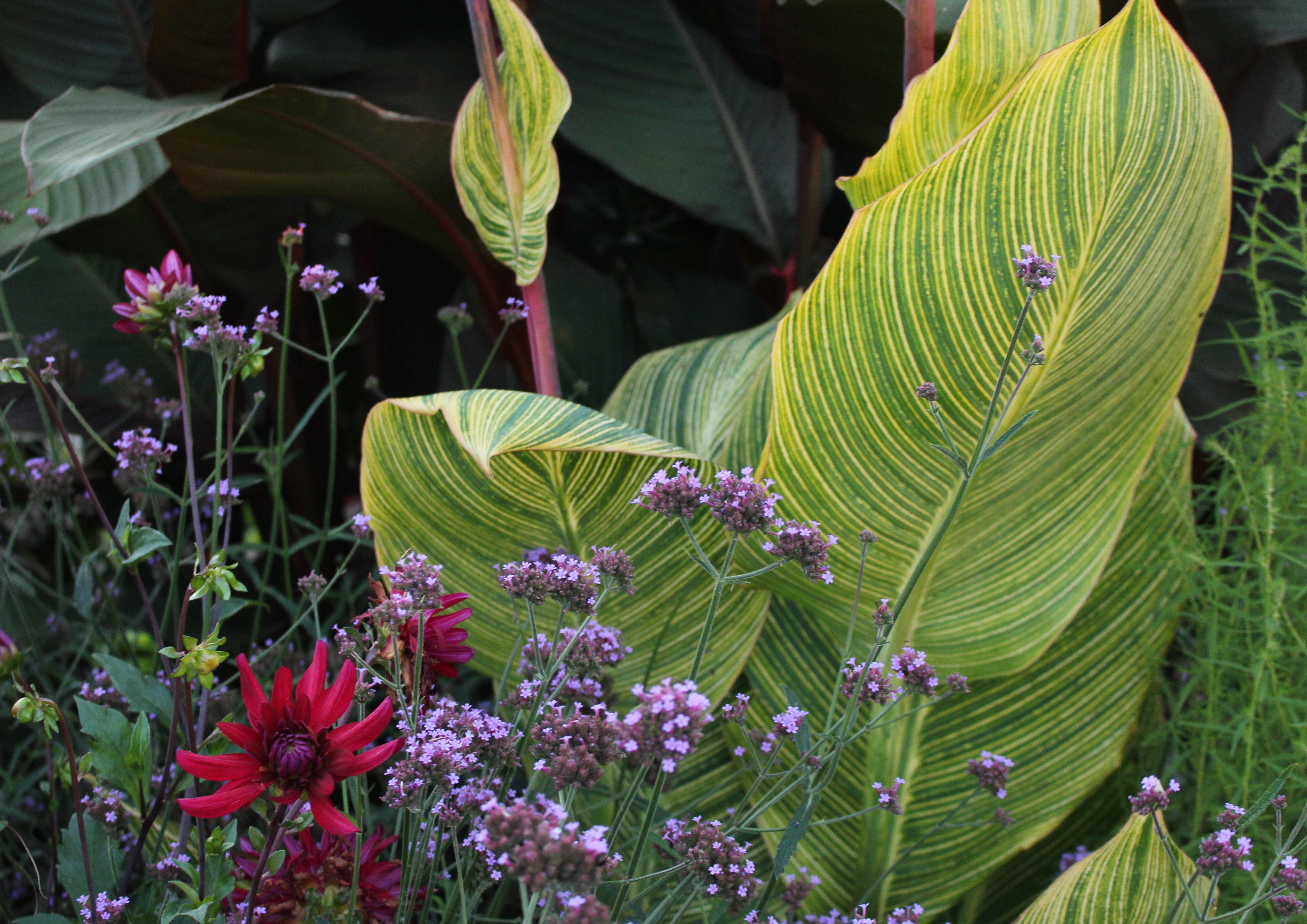
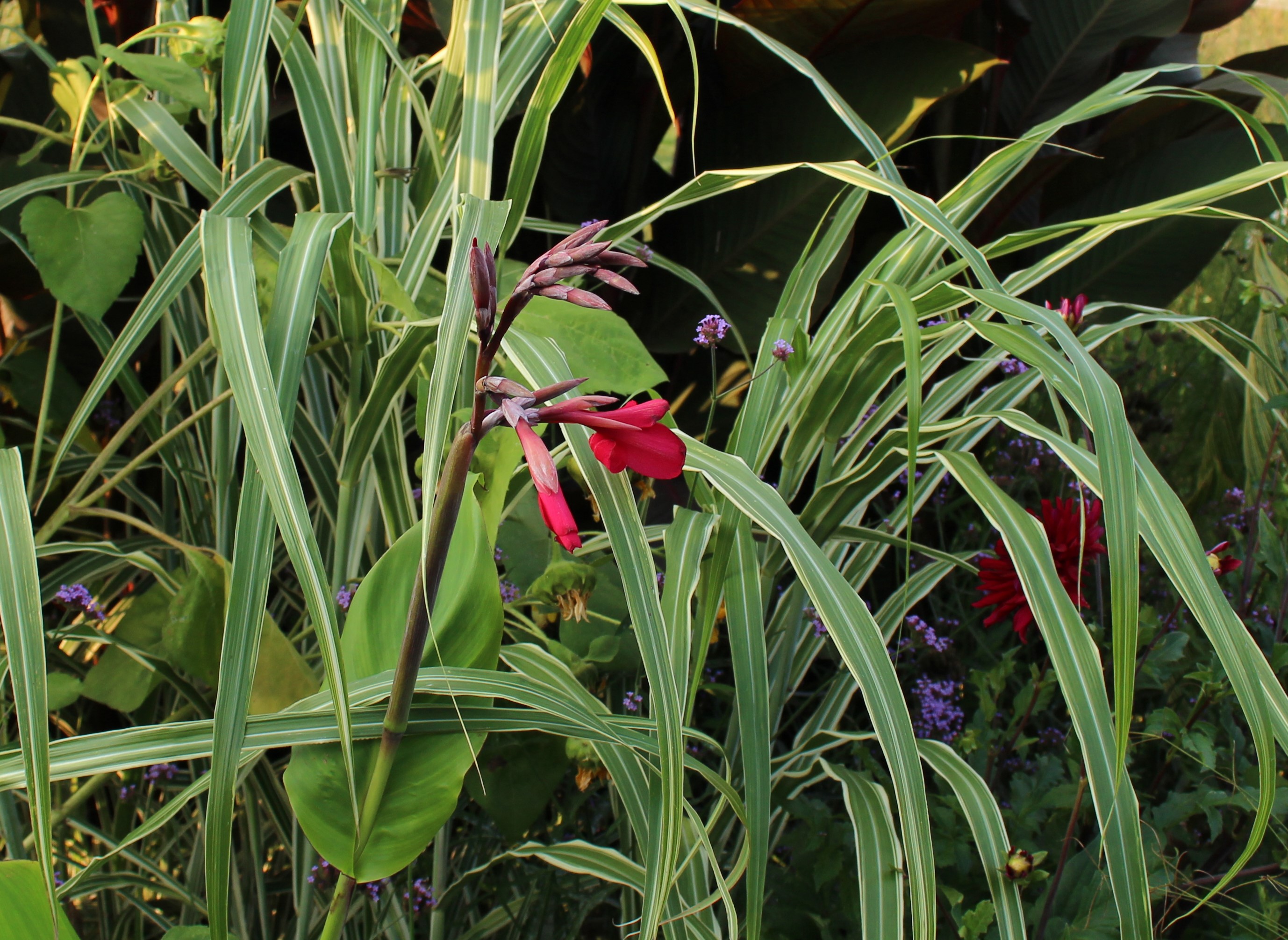
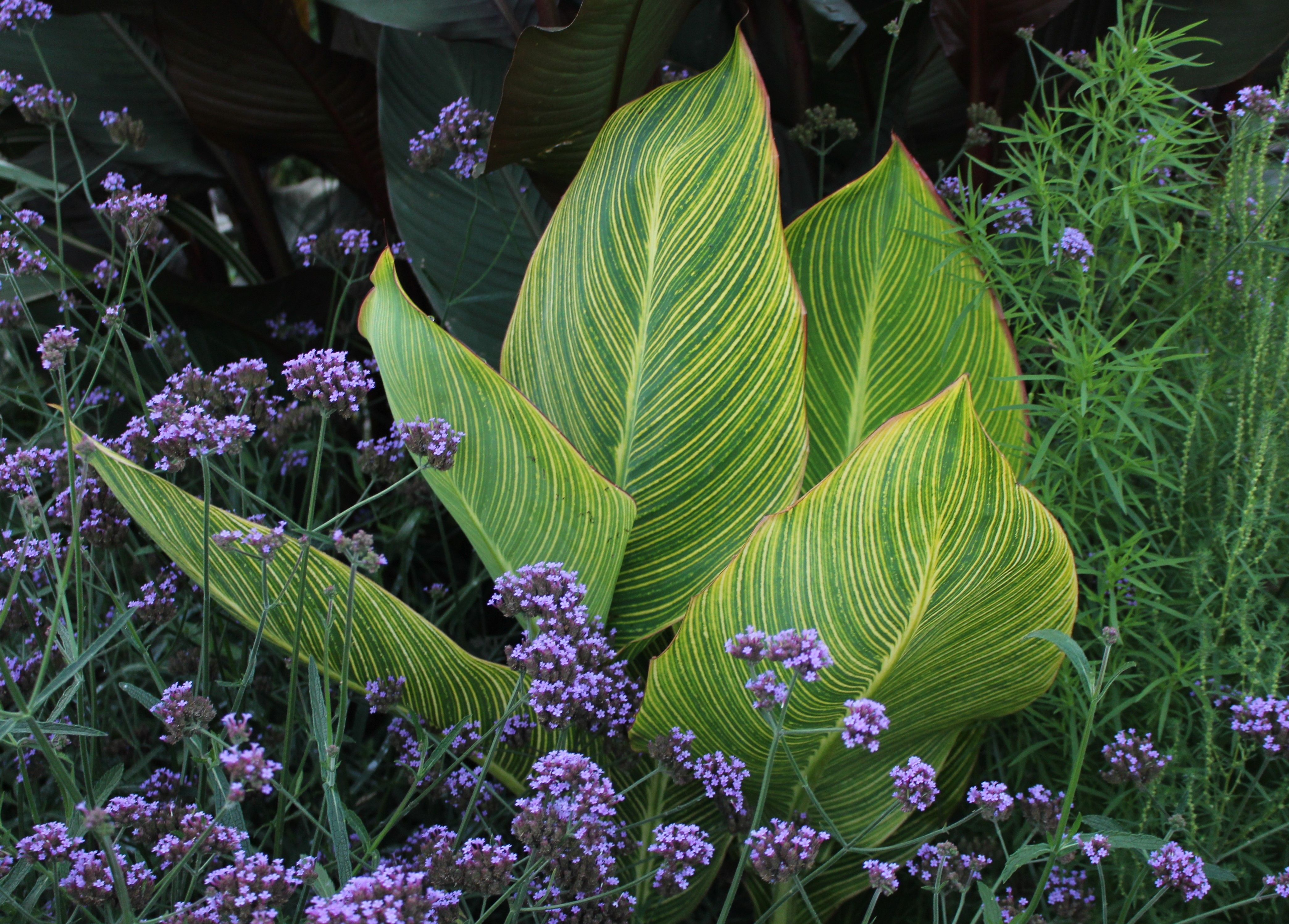
canna Bengal tiger

I might have talked to this Canna ‘Bengal tiger’ at some point, it’s like a close friend, and there’s nothing I don’t like about it.

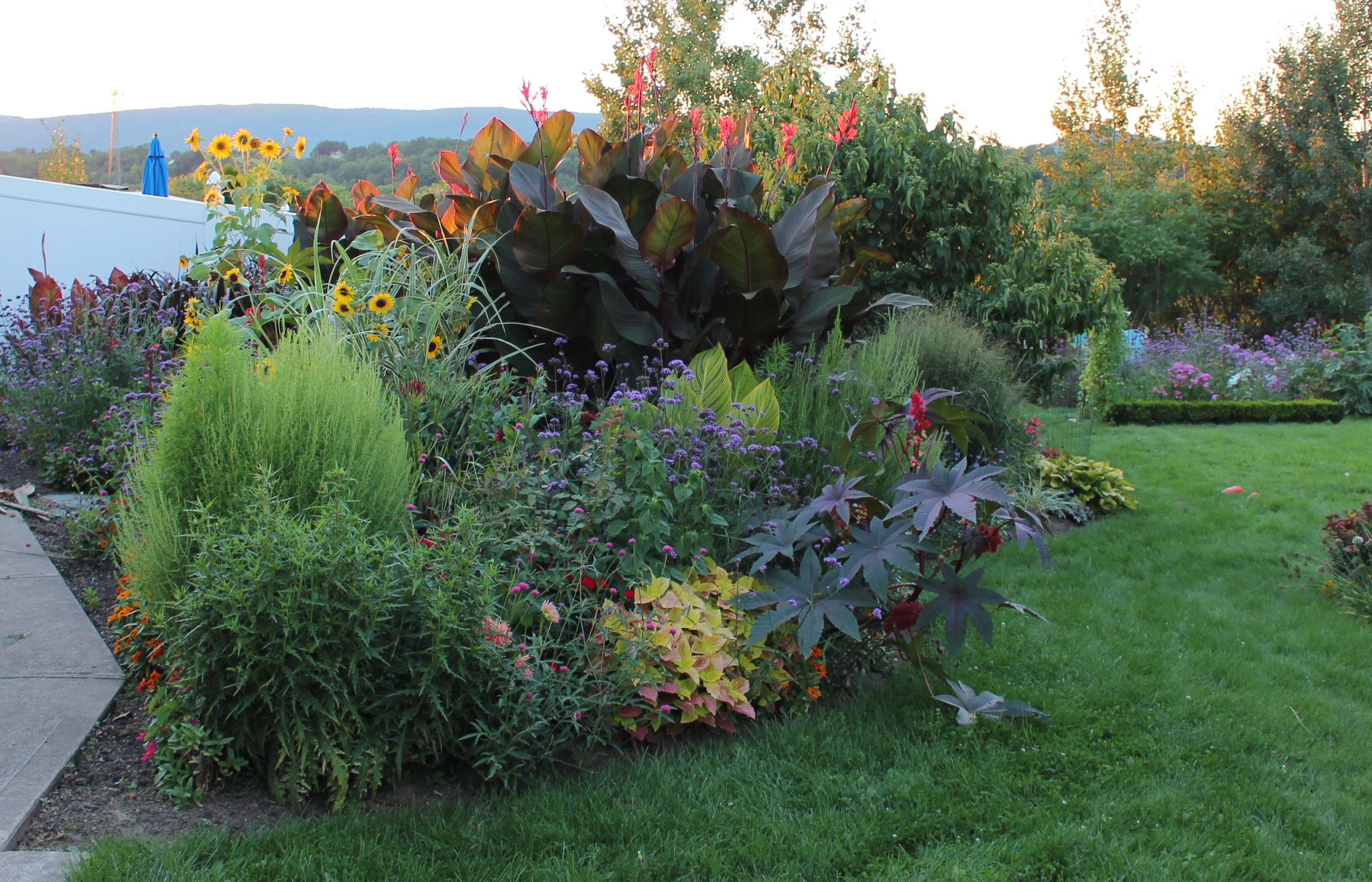
So the canna foliage was a no-brainer, but there’s something else brewing in the tropics.  The Kochia continues to ignite as the season winds down.  Not exactly a contrast, this plant is starting to take center stage as an eye-jarring punch of color.  It was a lacy pale green all summer but now as it goes to seed the magenta capsules turn color and are soon followed by red tints in the foliage.

kochia scoparia

Kochia scoparia, the old-fashioned annual burning bush, creating a nice backdrop to pink gomphrena ‘fireworks’ and a just-opened autumn flush of flowers on the red rose ‘Black Forest’. 

A few tropical ‘fakers’ are also in the mix.  An unknown fig which defied all my neglect and poor caretaking just put out a nice new flush of large, lobed, leaves.  No figs of course, but the large leaves balance out all the seediness around them.

hardy fig

A hardy fig which was never supposed to make it (hence my losing the ID tag) now fills too much space in the vegetable garden.   

Besides the tropical ‘fakers’ there are also a few actual tropicals which end up outside of their main bed.  I have a habit of sticking cuttings in here and there and every now and then they take off to good effect.  Coleus are one of the easiest to just stick in here and there.

coleus redhead

Coleus ‘redhead’ is one of the best. Carefree, colorful, and I have yet to have it bloom and go to seed. It’s also a nice offset to the lacy cypress vine behind it and the bright marigolds in front.

I could probably put together a post made up entirely of bits and pieces which were stuck in around the garden, but as usual I’m going on to long.  Lets wrap it up with more coleus up on the deck.

coleus

If you need to know which one this is I’ll look it up, but for now I don’t have the patience to dig through my bucket o’ labels for the tag.  Needless to say it’s a good grower, bright, and also not overly anxious to send up flower stalks (and end the foliage show).

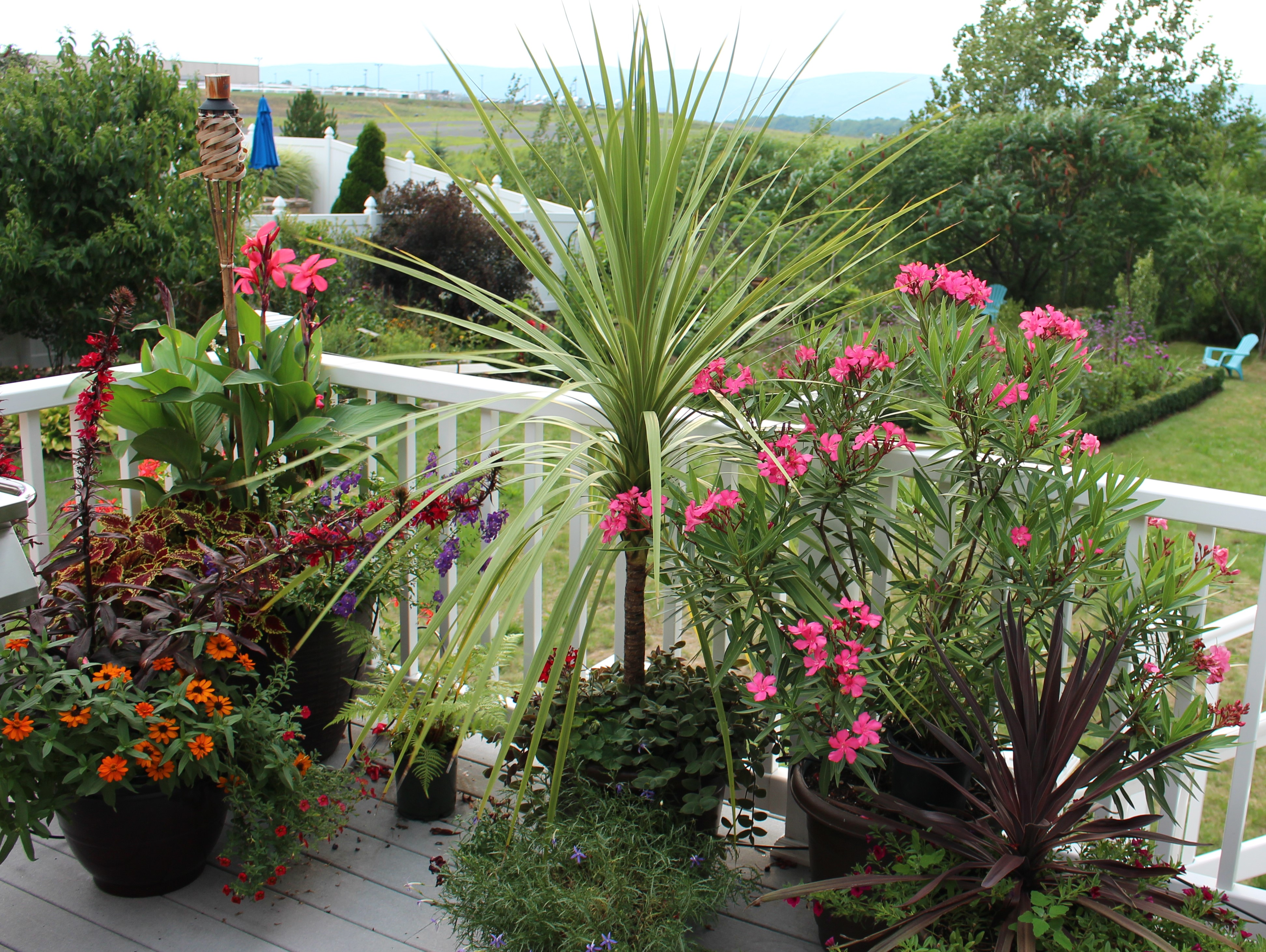
Other foliage on the deck includes my pet spikes.  They’re a great accent and just plain old cool looking as they keep getting bigger.  Some day they’ll wear out their welcome as far as being dragged indoors, but this winter they’re still A-list.

deck planters

Overgrown spikes in green and purple plus a potted oleander.  Not many flowers, but still a nice mix if you ask me.

Rosemary is also one of our must-haves for the deck.  It’s scented, always looks neat, and gets used quite a bit by our chef.

deck planters

Foliage on the deck includes the rosemary plus others such as the strappy leaves of vacationing amaryllis bulbs (hippeastrum) and other future spikes.  In the background you might notice the elephant ear sprouting up out of the geranium pot.  That’s what you get for reusing potting soil… elephant ears, caladiums, and reseeding million bells become your weeds 🙂

Finally as temperatures cool, the back porch becomes a perfect spot to soak up the last rays of the day.  The temperatures out back are comfortable this time of year and the low autumn light backlights the grasses and summer foliage.

deck planters

Upright elephant ears (Alocasia portora?) looking great in the afternoon light, and offsetting the airier grasses and geraniums nicely.

So I’m glad Christina convinced me to take a look around this month and keep an eye out for foliage.  It’s easy to forget how important it is to the garden’s overall presence, and paying attention is even more important when you’re so distracted by this and that flower coming into bloom and then fading away.  If I might suggest, why not give Christina a visit and see what else has come up this foliage day, with gardeners from across the globe checking in it’s always a nice time.


Tuesday View: The Tropics 09.13.16

Cathy at Words and Herbs has been following a weekly view of her garden throughout the season, and each Tuesday I’ve been trying to join in and keep track of my own weekly view in order to catalog the changes.  This week the roofers are next door and this afternoon they’ve made their way to the side where the tropical garden grows.

tropical garden

This afternoon’s view of the tropical garden.

Other than a few stray roof shingles and tar paper strips the garden has escaped damage, and that’s great because now is the time of year when every day is a celebration of summer and every night is a reminder that colder weather is on the horizon.  As nighttime temperatures cool off I’m beginning to notice a tint of red in some of the clumps of annual burning bush (Kochia scoparia).  Me thinks in a few weeks the ‘will it burn or will it snuff out’ question will finally be answered.

kochia burning bush

The clumps of burning bush (Kochia) are actually several seedlings all planted into the same hole. Most of the season they’ve appeared to be one big bush, but now a few here and there are going their own way and beginning to show color.

I can’t imagine these plantings will be as successfully bright as some of the photos I’ve seen online but if they’re halfway interesting I will be happy enough.  As it is their fluffy green mass has been a welcome green rest in an otherwise overloaded bed of color.

tall purple salvia splendens

One of the less-than-bright kochia seedlings.  More of a tan in my opinion, but things are all under a little stress here in the shadow of the canna clump…. with the exception of the tall purple salvia splendens seedling, it’s still doing just fine!

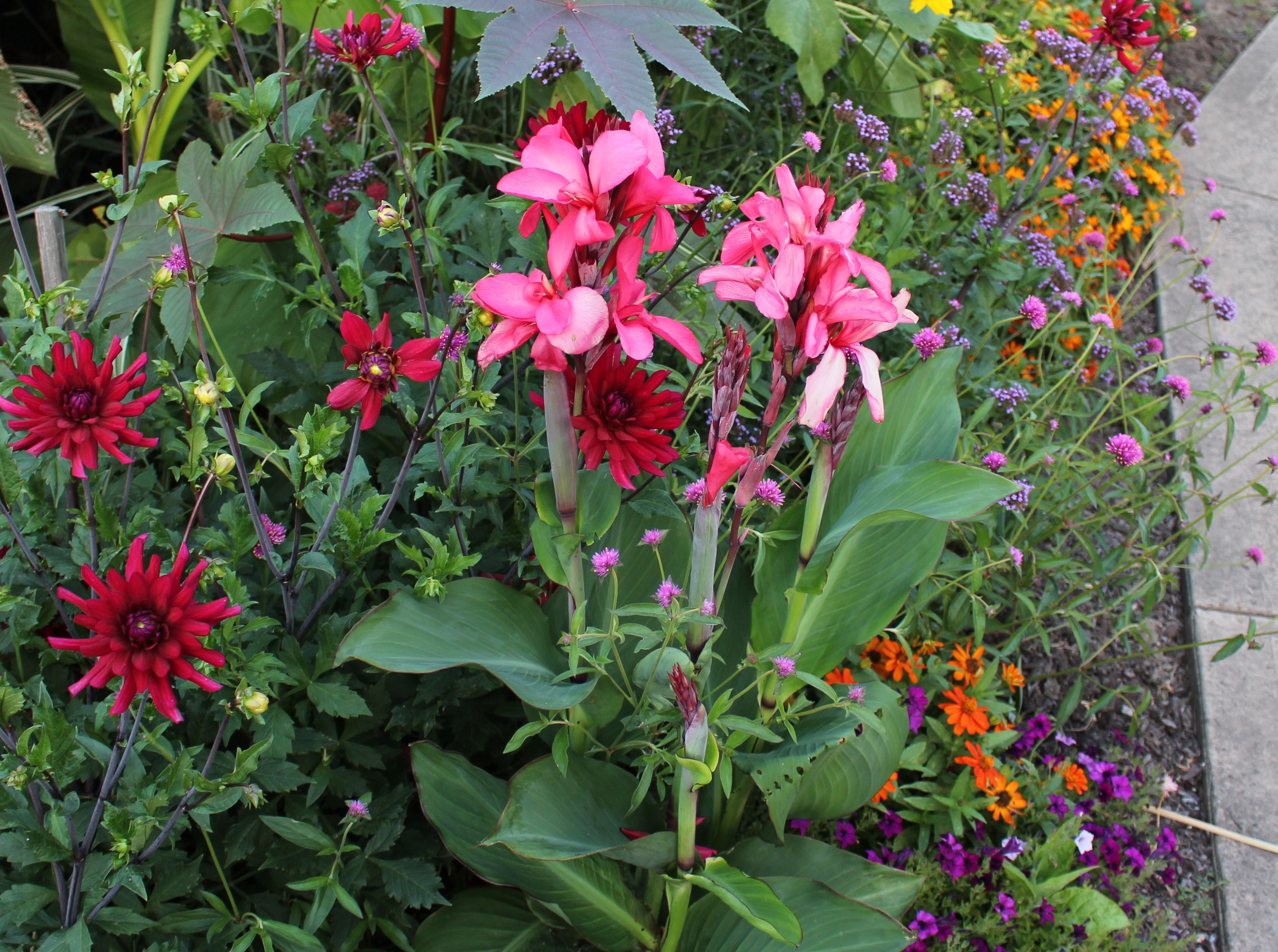
The rest of this post is gratuitous canna color.  I posted canna ‘Cannova Rose’ last week, but it’s still outstanding, and deserves another mention.

canna cannova rose

Cannas and dahlias with an orange zinnia and purple petunias.  The petunias were planted as petunia intergrifolia but I bet there’s something else in there as well, and that’s just fine since I like the bold mini-flowered purple groundcover it’s become.

Canna ‘Tropicana’ is always over the top.  I think you either love it or turn away in disgust, but either way it’s a bright tropical show.

canna tropicanna

Canna ‘Tropicanna’ in a bed of verbena and backed by one of those dark leaved, huge, grow-it-as-an-annual, Napier grasses (Pennisetum purpureum).  Hard to see in the picture, but the grass is just over five feet, so probably much bigger than you’d guess.

I know I’ve called Canna ‘Bengal Tiger’ my absolute favorite canna, but there’s a new kid on the block this year.  Canna x ehemanii is an old hybrid which tops nearly every other canna in the gracefulness category.  I did not suspect my small plant would bloom this year but here it is opening its first flower.  A little short for this variety, but much easier to admire when it’s down here amongst us mortals 🙂

canna x ehemanii

I saw Canna x ehemanii growing in a corner of Chanticleer a few years back and have been looking for my own plant for years.  Once open its flowers will arch and hang with an amazing tropical grace that you’ll have to trust me on right now, but I’m sure more pictures will follow as it develops. 

We are into the one month countdown.  First frost typically hits around mid-October in these parts, and for as much heat and drought and storm this garden can take, it can’t take a hard freeze.  That’s a Tuesday view I’m not looking forward to.

In the meantime please give Cathy a visit and find out what she and other bloggers are seeing this Tuesday.  It’s a great way to keep up with the changes and really see just how much goes on in your garden!

Tuesday View: The Tropics 09.06.16

One of the benefits of regularly joining Cathy for the Tuesday view has been that little push each week to actually follow up on the observations made the week before.  The fear of confessing laziness and sloth publicly has been great for keeping on top of the weeding, deadheading, staking, and planting and it’s also a great regime for someone who goes through bouts of couldn’t-care-less and stretches of I’m-bored-with-this-garden-thing.   Now might be one of those bouts, and as the days grow shorter and our latest dry stretch begins to stress plants out again, I look at the water hose and then look at the recliner and typically chose the recliner.  So I apologize ahead of time if my mood comes through,  I’m sure colchicum season will come along soon enough and snap me back out of it.

Tuesday view

A quick picture taken this evening. I find the low sun angles to be absolutely disgusting and far prefer June.

The cannas keep going from strength to strength and I’m glad to see this bit of ‘Cannova Rose’ finally showing off.  It went through a rough spot which I suspect were the aftereffects of stray weed killer, but the latest bloom stalks look mostly normal… unless you’re really neurotic and notice that one stalk still has thinner petals and is quicker to fade…

canna cannova rose

Canna ‘Cannova Rose’, a newer seed strain which grows without complaint (even in cooler weather) but has been pointed out to have somewhat boring foliage. It looks nice with the first flowers of dahlia ‘Mathew Alen’… throw in a few orange zinnias and some purple petunia and you’ve got a nice patch of color.   

The dahlias are slowly starting up.  They seem late, but that would be because I planted them late, and there’s no sense in complaining about that now.  An earlier show would have been nicer is all I’m saying and of course next year none of this will be a problem since as of now next year is still perfect 😉

ball dahlias

Had they been staked properly this patch of ‘Sylvia’ and ‘Red Cap’ dahlias would have risen just perfectly amongst the cannas and verbena.  Who knows, maybe the red will still rise up a bit, but if it doesn’t serves me right for slacking.

I’m kind of at a loss as to why I’m down to just three or four dahlia varieties.  I’m sure in June I had a brilliant plan as to where they were placed and who their neighbors were, but now it seems to all be ‘Mathew Alen’.  Vaguely I remember thinking I was bored with a few and felt all empowered when I tossed them onto the compost pile, but naturally I just assumed things would come together later and there would still be a good bit of variety.  So much for that.  I guess it doesn’t help that several were swamped by other plants… but oh well, another serves me right moment.

colocasia esculenta tropical storm

Something for the future.  If this Colocasia esculenta ‘Tropical Storm’ can get through a serious spider mite infestation I’m sure it will be worth the $2 I spent.  My icecream cone was actually more expensive than this soon to be amazing plant 🙂

There’s only about another month and a half left in the tropical garden and it’s absolutely not the time of year to get into a ho-hum mood about things.  I really need to treasure every shortened day and to that end will keep reminding myself as I self medicate on fried foods, baked goods and chocolate.  Give me another week and I’m sure I’ll have come to terms with the waning season and maybe just maybe I can look forward to autumn.  Many people claim to enjoy that season and I guess it’s only fair I give it a try as well.

Have a great week!

Thursday’s Feature: The Three Cousins

The story of the three sisters of native American agriculture (corn-squash-beans) is a story which goes hand in hand with almost any elementary school lesson on the Pilgrims or Thanksgiving.  Northeastern tribes of Native Americans commonly grew the three crops together in the same mound, and as the corn grew up and the stalks provided support for the twining beans, the squash filled in along the ground and together the three crops coexisted peacefully, each filling their own niche.

This spring I rebuilt the rebar arbor which marks the entrance to the vegetable garden and this summer three vines are working their way up and over the arch.  They don’t coexist quite as peacefully as the three sisters and they’re far less useful in the kitchen, but I like them well enough anyway and even if they never make an appearance on the back of a Sacagawea coin I guess we can say they’re close enough to be called cousins at least.  The three cousins are Cypress vine, Love in a Puff, and Red Noodle bean, and all I can think of is how great common names can be 🙂

rebar arbor

After struggling for four years with an arbor that fell over each spring, I finally put in the effort to set the base in concrete.  The jury is still out on whether it will survive this spring thaw or not any better, but since the jury is still also going back and forth between rustic and ugly, survival may not matter either way.  

There are many a more floriferous trio for a trellis, but for some reason I love the mixes of foliage, flowers, and fruit of these three cousins.  The bright scarlet flowers of the cypress vine (Ipomoea quamoclit) sparkle alongside its soft ferny foliage and contrast nicely with the puffy green globes of love in a puff (Cardiospermum halicacabum)  and the dark red pods of the red noodle beans (Vigna unguiculata… aka asparagus bean… aka yardlong beans).

red noodle bean flower

The pale lavender flowers of the red noodle bean only open in the morning but they look just right mixed in with the ferny cypress vine foliage.

I wish I could take credit for this combo, but in all honesty I saw it a few years ago on Nan Ondra’s blog.  As it is with these things a single picture got stuck in my head and then over the next several years the radar stayed tuned in to find seed for the three components.

cypress vine, red noodle bean

The red “noodles” of the asparagus bean stretch anywhere from a foot and a half to nearly two feet.  The arbor is starting to look pretty cool with all these red beans dangling down.

Right now I think it’s the noodle beans stealing the show and I wish I had a few better photos, but the ones from this afternoon just didn’t make the cut and then the daylight called it quits on me.

red noodle bean

I think the beans are cool, but the hummingbirds much prefer the cypress vine flowers.

As I think further on it each of the three cousins also provides something more than just looking pretty.  The beans are edible (and some say have an excellent taste if picked small), the hummingbirds love the cypress vine, and the kids love picking and popping the puffs.  It is a useful trio and it’s likely they’ll show up here for many a year to come… if only because (with the exception of the beans) I haven’t planted a thing on this trellis for three years and there are still more than enough seedlings each spring to fill the ranks.

So there they are, the three cousins as my feature for Kimberley’s Thursday Feature meme, and although they are technically three entries it’s nearly impossible to separate them so I think I’m good to go.  If you think you’re good to go might I suggest a visit to Kimberley’s blog?  She encourages us to look around each week and find something which grabs our attention in the garden and it’s always interesting whether you’re just visiting or joining right in.

Tuesday View: The Tropics 08.30.16

It’s Tuesday again and time to join up with Cathy at Words and Herbs to take a look at the Tuesday view.  I’m going to guess that the purple leaved cannas are at full height and full bloom now and things are about as close to a peak as I can imagine 🙂

tropicalismo

The Tuesday view this evening.  I managed to get the pictures just before dusk, and finally for once the photos didn’t come out all blurry and overexposed.  I can see why photographers enjoy this time of day and may have to reconsider my strong commitment to doing nothing at these closing hours of the day.

I’m not thrilled about the sun being lower and lower in the sky each week, but the low evening light hitting the canna tops really highlights their bright little blooms.

tropicalismo

The garden has become very popular with the hummingbirds as they go from verbena to canna to salvia to everywhere in between. I wonder if they are local youngsters or just birds starting to work their way south.

In case you’re wondering most of the dahlias have been staked.  It was a struggle but since the spool of twine has been sitting on the walkway for days now I figured it was time.  Hopefully the dahlias can bloom in peace and sway gently in the wind with their reassuring support system… although now it’s the overhanging canna leaves which threaten their happiness…

sunflower

I can’t help but put in another photo of the sunflower which came up near the fence. It’s got some doubling in there but I think the dark anthers poking through around the center are what really make it stand out for me. 

As long as I’m just putting in gratuitous plant pictures I might as well show my absolutely favorite canna ‘Bengal Tiger’ again.  It’s practically stunted in comparison to the others but gardeners all know that the show is always going to be better next year.  I’ll just have to get something taller to go with it since right now it matches perfectly with the verbena bonariensis… but that won’t be the case net year if it sprouts up to six feet (which it should have no problem doing).

canna Bengal tiger

Canna ‘Bengal Tiger’ with the purple of Verbena bonariensis.

Speaking of plants which are sprouting up, the banana ‘Bordelon’, which spent last summer potted on the deck, has finally recovered from a neglectful winter in the garage and a tough spring with a rough crowd in the back of the bed.  I hope this winter I can do better with its care and avoid this setback since I used to be able to just throw the stem with a few roots into a basement and they would survive just fine.  Something’s changed though since lately they’ve been just plain struggling.

tropicalismo

Banana ‘Bordeleon’ rising up above the verbena and knock out rose.  It’s still got a few more weeks before being dug up, so I hope it keeps going strong.

Actually I don’t even want to think about overwintering anything yet, so before I go I just want to point out one of the most enjoyable late summer events which occurs around the tropical bed this time of year.   Just across the grass path you’ll find a nice patch of hosta in bloom.  I received it years ago as an incorrectly labeled plant but I believe it’s hosta ‘Royal Standard’ and it completely fills the evening and nighttime air with a sweet tropical fragrance which reminds me of gardenias minus the mustiness I sometimes get from them.  I love the scent and the plants are indestructible and even if they’re as old as dirt compared to all the new, fancy hybrids I would never consider getting rid of them.

hosta royal standard

Hosta ‘Royal Standard'(maybe).  Full sun and drought fried the tansy to the right of it, but the hosta just trudged along with a small bit of leaf scorch and yellowing. 

That’s about it for the view.  I was beginning to think there wasn’t much new going on anymore but once you start poking around there are always a few surprises.  Hopefully I can keep it up a few more weeks.  As usual thanks to Cathy for hosting!

Not a bad morning.

It’s beautiful out this morning and I can’t even see problems in the garden.  The lawn is relatively under control, some staking and weeding was done yesterday, the soil is damp enough that watering is not an issue, and other than some chipmunk issues the wildlife of the garden is behaving in an entirely picturesque and harmless manner.  This feeling may fade quickly but while it lasts I’ll just sip my coffee quietly and hope the kids don’t find me.

datura metel

Datura metel.  I expected an annual but this one re-appeared out of nowhere once the rains came and the soil heated up.  It’s doing so much better than last year.

The light is often perfect in my garden but my photos rarely show this.  Even with a better half who loves expensive electronics and insisted on a fancy camera there’s still a skill component missing and I often look at what shows up on the computer screen and wonder what happened.  Fortunately this morning things just came together and it’s as good as it’s going to get.

IMG_2548

Light and shadows on a Datura flower. Even a few dew drops to make it glisten.

Last fall a friend gave me a few seedheads of what is probably Gomphrena ‘fireworks’.  It’s supposed to be in the same species as the regular globe gomphrena (G. globosa) but I don’t see it, and even though it loves the same heat and full sun, the flowers are more like yellow tipped pink brushes rather than tight globes.

gomphrena fireworks

Gomphrena ‘fireworks?’ in the morning light.  Easy from seed (needs warmth and bright light) and loves the heat.

Another annual which catches the light perfectly is amaranthus ‘Hot Biscuits’.  Practically a weed, it just shot up when the rain started falling and the humidity shot up.  This is another one which came via friend…. thanks Paula!

amaranthus hot biscuits

Amaranthus ‘hot biscuits’ in the front border.

I would have laughed if you told me I’d ever grow (and like) a brown flower but here it is.

amaranthus hot biscuits

A nice late summer show of amaranthus coming up among the butterfly bushes (Buddleia)

I do buy a few seeds here and there and zinnias are one which I like to keep in good supply.  Brenary’s Giants ‘Lime’ does NOT show well in the garden but it’s just too interesting to leave out.

Benary’s Giants lime zinnia

Benary’s Giants ‘lime’ zinnia from Fedco Seed.  I bet a good designer could do great things with this color… but me, not so much.  I think it’s cool regardless.

The birds and bees get the credit for this sunflower as well as whatever religious deity you believe protected it from my weed bucket.  I swore up and down I would not allow sunflowers in the tropical bed but there you have it.

double sunflower

A little doubling and a darkly rich center, I’m quite pleased to have this sunflower sharing space with the cannas and bananas.

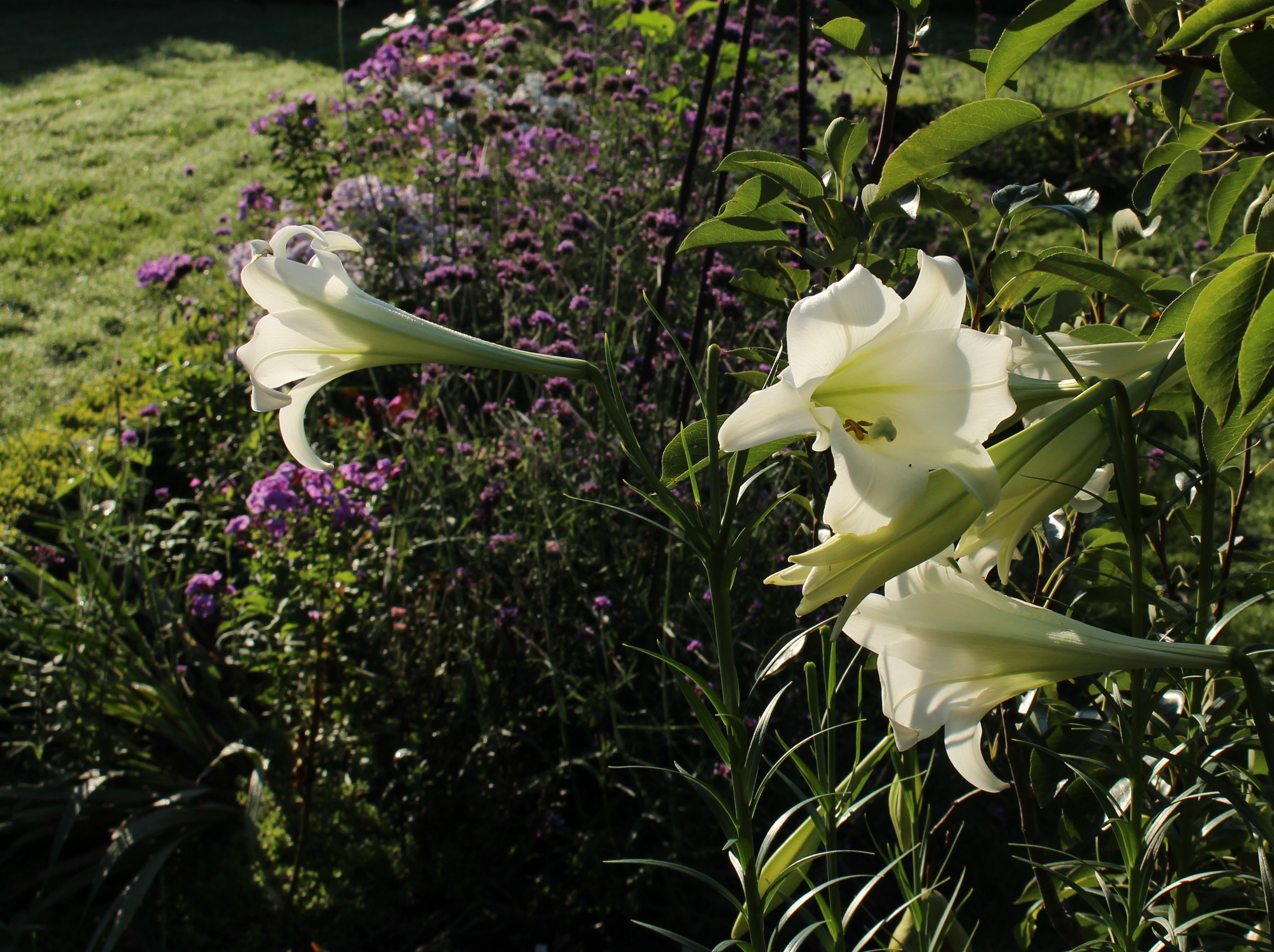
The Formosa lilies (Lilium formosum) were stunted by weeks of drought back in the no-man’s land which I tend to ignore, but are still forgiving enough to fill the garden with their sweet summer perfume.

lilium formosum

Lilium formosum.  For some reason I thought planting them where they’d grow up into the branches of a pear tree would be a good idea… but then again why would I think my little seedlings would ever amount to anything?

The meadow got its mowing just in time.  The first colchicum blooms were beheaded, but now the others can come up nicely in the short (and for once green) grass.
cochicum in lawn

cochicum in lawn

Back in July we didn’t even remember what rain looked like.  Then something happened.  August was warm and humid with perfectly spaced rain showers and this blessing from above even resurrected (most) of the phlox bed.  If you look closely the damage is still there, but on a beautiful Sunday morning it’s easy to see past that.

garden phlox paniculata

Phlox paniculata in the late August light.

Please click on “I hate gardening” to see what this bed looked like a month ago.  You could call the change miraculous and I don’t think that’s an exaggeration.

garden phlox paniculata

Just in time for Monarch migration, the garden phlox and Verbena bonariensis are again filled with flowers and this bed is a very busy place.

I do love my phlox.

garden phlox paniculata

Back from the dead, random phlox paniculata seedlings.

Have a great Sunday and all the best for the upcoming week.  I’m going back outside now and suspect nothing will get done other than a second cup of coffee.

The containers. Meh.

Planting the deck always starts out innocently enough but then degenerates into a huge project.  This year was no different in that respect, and to even get started with the ritual power washing all the winter debris of kid-play and kitchen remodel-scraps had to be dragged off first.

deck cleaning

The entire covered part of the deck is filled with debris and scaffolding in addition to the furniture and terracotta pots which need to be stored under cover for winter (they’ll crack if they freeze while still wet and filled with wet soil).  btw the dark gray object is the old kitchen sink, so even that is out here…

So hauling off trash is the first project, then the cleaning, then the decision that all the mishmash of geriatric plastic planters should match, so off for a paintbrush and some leftover paint.

painting plastic containers

No more black nursery pots, or old teal and faded gray, all the plastic was painted with my trusty mocha-tinted, all surface Sherwin Williams paint.

Our last frost date is around the 15th of May, but most planting jobs are usually procrastinated way beyond that.  This year the big deck planting was pushed off until June 8th, which meant a lot of sitting around for the earliest purchases but it also meant clearance sales were in full swing.

container planting

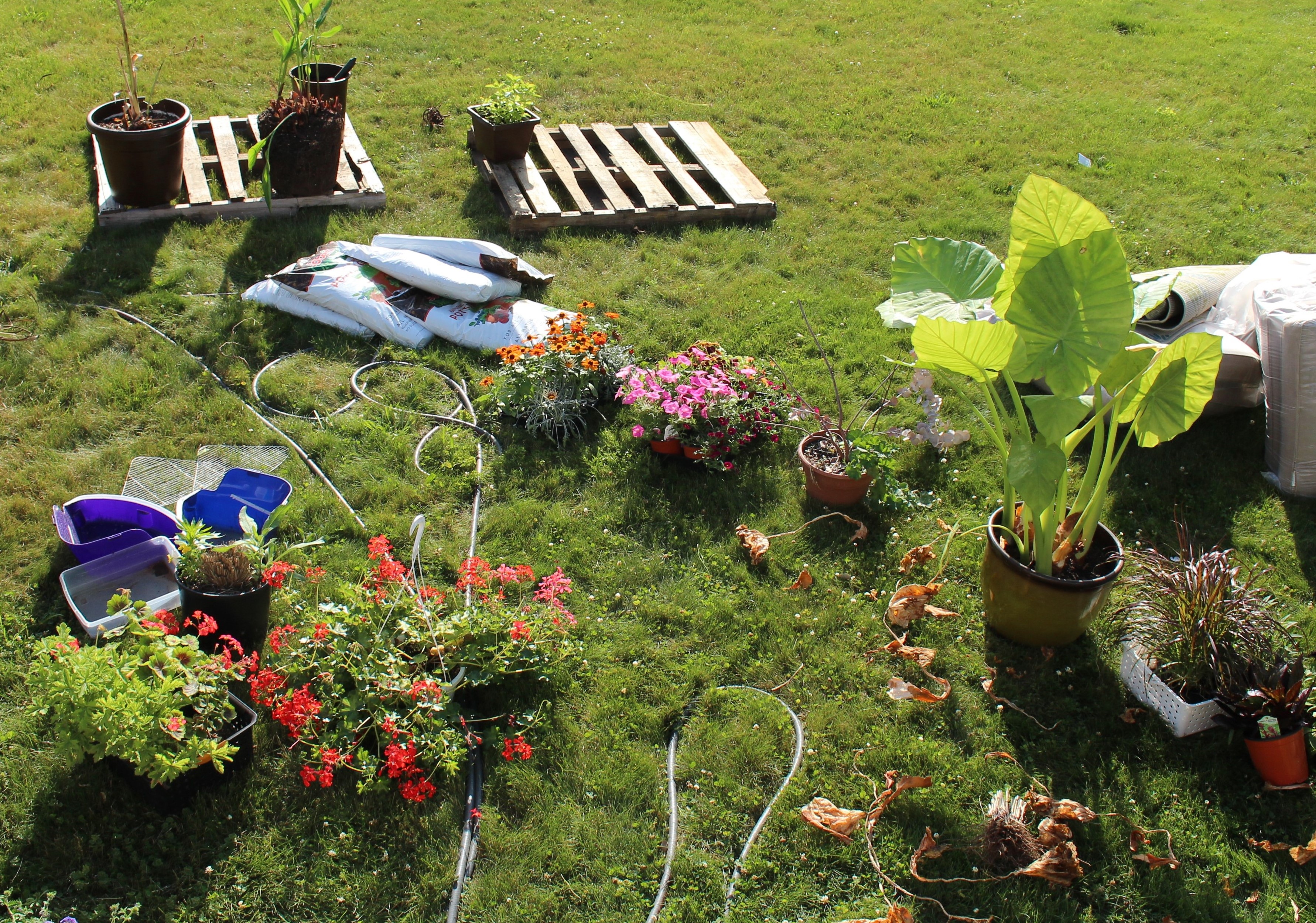
I tend to spread out while setting the deck up.  There’s a mess everywhere 🙂

So this is where the ‘meh’ comes in, and since the weather is kind of ‘meh’ today as well it might be the best day to discuss…  I usually go out with little to no idea or plan and as a result come home with whatever catches my eye.  Usually it works out, but this year I just feel like something’s missing.  Maybe I need yellow, maybe it’s the lack of sweet potato vines, maybe there’s too much red, maybe it’s the pink… I’m not much of a ‘pink’ person.

deck container plantings

One purple fountain grass is nice, three might have been overkill, still the rosemary enjoyed its division and replanting, and most other plantings are hanging in there.  You may notice my amaryllis bulbs tucked in here and there.  The strappy leaves don’t look half bad in my opinion.

I should be giving things a nice liquid feeding each week and part of the ‘meh’ might be that things are underfed.  A rich diet for these flashy annuals is what they thrive on, and upon thinking back it’s possible I’ve missed four out of the last five feedings.  As usual I’m my own worst enemy.

balcony flowers

I do like how the creepers, in this case cascading geraniums (pelargoniums), work their way through the railing.  They’re very popular with the hummingbirds even if the color might be a little too orangey for the companion plantings.

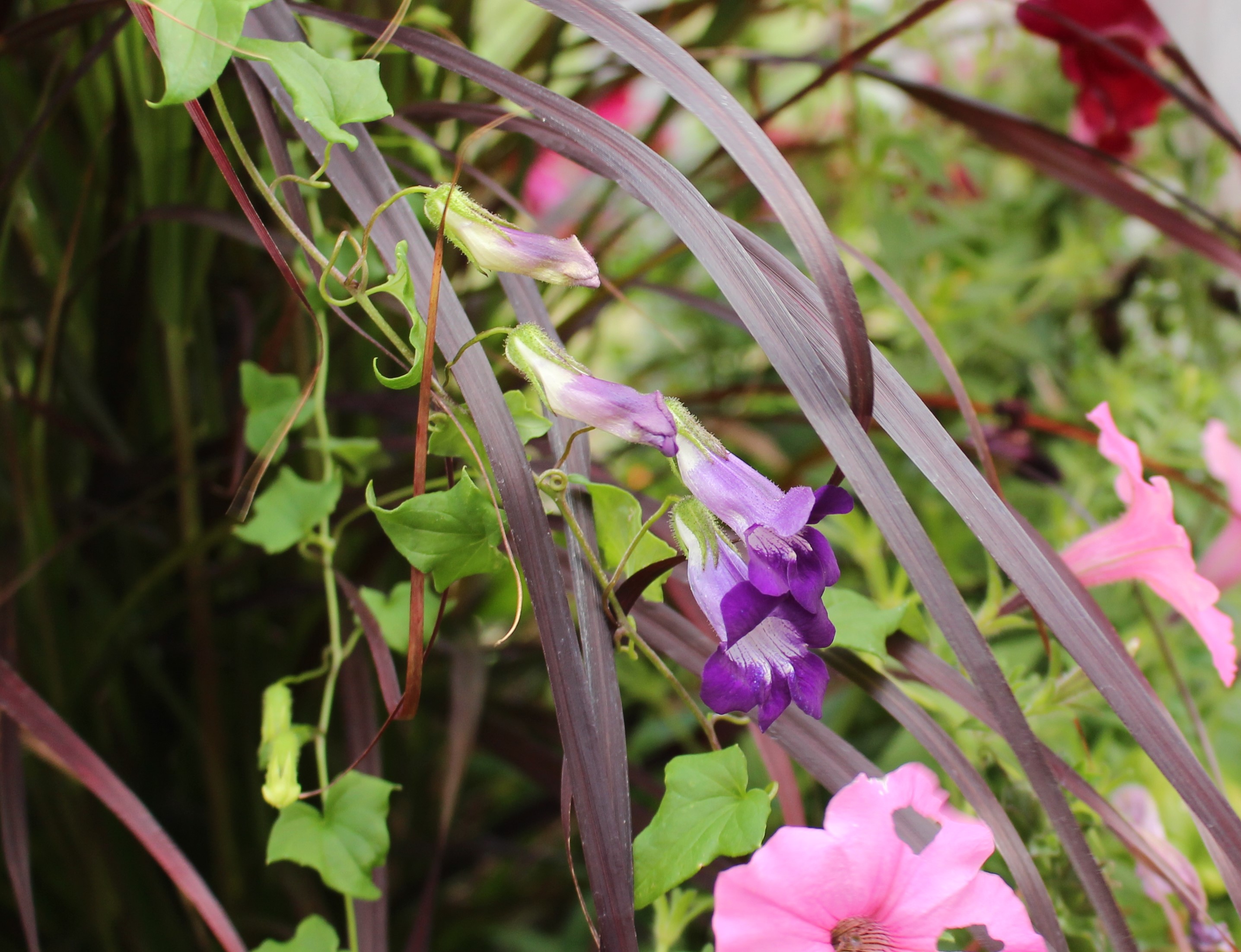
Some other disappointments have been the underperforming vines.  My three little babies, the Chilean Glory vines (Eccremocarpus scaber) did not take off as planned.  Apparently they are foolproof but this fool will challenge that label since my plants (nurtured along from tiny seedlings) made a go at it but then died off one by one.  I did get to see one single bloom cluster of amazing little orange lipstick tubes of color but that was it, and I think if I was brave enough to beat back the grasses, I would find my last glory vine has also passed over.  That’s too bad but I’m already excited to grow this plant again next year since I’m sure things will go differently even if I do everything exactly the same… but in the meantime at least my snapdragon vine (Asarina scandens) is coming along.

snapdragon vine Asarina Scandens

Snapdragon vine (Asarina Scandens) growing up into the purple fountain grass.  At least this one has been a forgiving grower and easy bloomer.

While many of the plantings leave me uninspired, a few things are doing great.  The oleander and overgrown spikes are back for another year and the canna ‘cannaova rose’ is again putting on a nice show.  The canna just hit a lull (probably lack of fertilizer induced) but I’m sure will return to glory shortly and I’ve divided last year’s roots up between a few spots so it’s likely you’ll see these showing up elsewhere as well.

dracenea spike

Those little dracaena spikes which show up in nearly every pre-made container planting seem to turn into something a little more interesting given a few years of growth.  My goal is to have a small grove of these some day soon 🙂

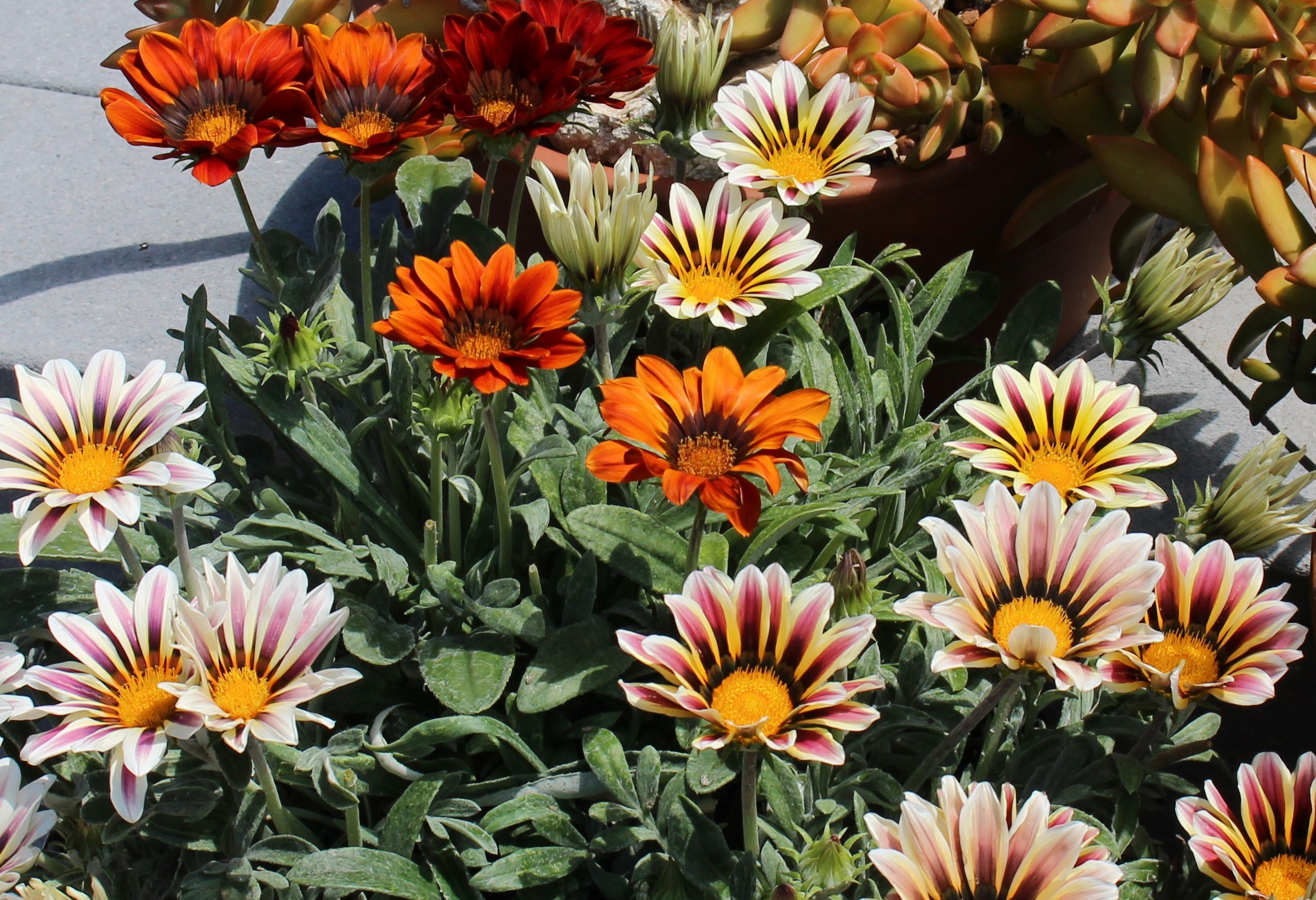
There are a few new things this year which did beat the ‘meh-ness’.  Gazania are a plant which although they don’t grow consistently for me, do look great when they feel like it.

annual gazania

The unusual colors of Gazania really don’t blend well with any look I’m going for but who cares, they just look cool when opened up for the sun. (just keep in mind that they close when the sun goes away…)

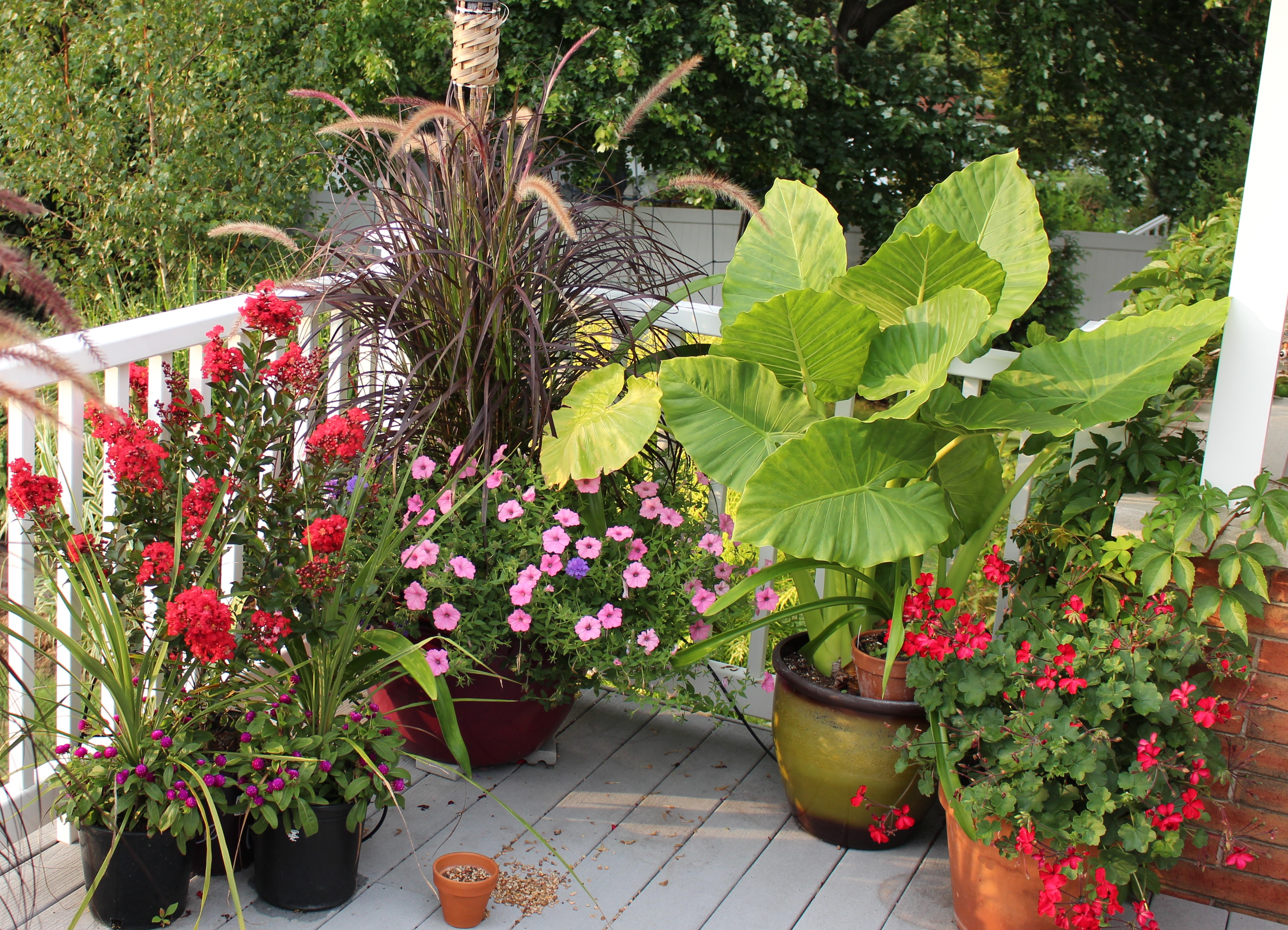
By the way I forgot about the elephant ears and the new crape myrtle, both of which are not ‘meh’.  The two are just soaking up the rain and heat and humidity and picking up where the petunias and million bells drop off, but before I begin to sound too positive let me point two things out.  First I have too much red, and since the obviously red myrtle was labeled purple I’m innocent there.  Second there’s a plant missing out of the small terra cotta pot in the front of the photo.  There’s a cute little b***ard chipmunk who decided it would be fun to end my three year relationship with a slowly growing clump of lithops (living stones).  After a few days searching I found the chewed up corpse under a nearby shrub.  Time will tell if the shriveled bits can recover, my only hope is that they were poisonous.

deck container plantings

Blood red crape myrtle and geraniums, pink ‘bubblegum’ petunias, elephant ear (Alocasia calidora?)… an ‘interesting’ look I suppose.

I still need to mention the digiplexis which just came into bloom this week.  It’s a inter-species cross between a foxglove (digitalis) and an Isoplexis (Canary Island foxglove) and when it first hit the market in 2012 it immediately went on to many ‘must have’ lists.  My must have list is always a few years behind but I was finally able to try it out this year when I found it for a reasonable price.

digiplexis

Digiplexis ‘Canary Berry?’.  It’s nice enough but I’m not overwhelmed yet.  It’s one of the foxgloves, and I love a nice foxglove, but this non-hardy version might be something left for those everything-grows-for-me San Francisco gardeners who have super mild winters and cool nights which bring on stronger colors.

So there’s good and not-so-good out there and to be honest no matter how it looks it always beats the deck in January.  January seems to keep all gardening outcomes in perspective and as I check things out every day and multiple times a day I’m still happy with it.  Now if only I could get out there and fertilize, but the lawn needs mowing too and I’m not doing both until things cool off a bit.

Tuesday View: The Tropics 8.9.16

Another Tuesday and another view!  My camera has traveled on to other destinations so this week we’re going to see how well the phone camera works.  Fortunately when I headed out to take the pictures a few clouds rolled in to filter the light, and things don’t look too harsh here.

tropical garden

Today’s view of the tropical garden.  A little dark, but look at that weird color which the lawn has developed… Green!


I’m going to admit to doing little more than admiring the garden this week.  There was another nice rainfall last Saturday and for the first time in months things look relatively happy.  I even went as far as to mow parts of the lawn short and throw some fertilizer around to help the lawn recover now that it’s making an attempt at coming back to green.

canna tropicana

There’s more to healthy growing than the color green.  Here’s my favorite offensively festive canna, ‘Tropicana”. 

I do have a soft spot for the lushest of cannas.   The tall purple leaved ones are great, but ‘Tropicana’ and ‘Bengal Tiger’ both bring vivid variegation into the mix.  After years of trying to get a virus free plant of the later I think I’m finally there and hopefully it’s with me for a while again.

canna Bengal Tiger (Pretoria)

Still small but growing, canna Bengal Tiger (Pretoria) might be my very favorite canna. The yellow striping is amazing and I think when this becomes a big clump (fingers crossed) it will be quite a sight.

My Bengal Tiger has a way to go before it’s as inspiring as the ones I saw last year at Chanticleer but I have patience… sort of.  In the meantime the amazingly fast growth of the Kochia scoparia (burning bush or summer cypress) continues to impress me.  I love the fresh green color and soft fluffiness of the plants, and I hope it keeps looking good until (with luck) it lives up to its name and burns bright red this autumn.

kochia

Kochia with Verbena bonariensis and orange zahara zinnias.

So that’s where we are this week.  If you’d like to check in with a few other Tuesday views give Cathy at Words and Herbs a visit and if you’d like to join in feel free, I’m sure she’d be happy to have you!

Thursday’s Feature: Standing Cypress

It’s Thursday and that means joining up with Kimberley of Cosmos and Cleome to take a closer look at something which caught your eye in the garden this week.  Hopefully you’re ready for color because his week the bright red of standing cypress (Ipomopsis rubra) is our subject.

Ipomopsis Rubra

Ipomopsis rubra close up.  Love the speckles and the intense scarlet color.  Bright red is what you need this time of year to stand up to the strong summer sun.

Standing cypress is a showy wildflower native to southeastern North America and just one of many garden-worthy Ipomopsis which can be found across the Americas (at least they look garden worthy, this is the only one I’ve ever grown).  These members of the phlox family are tough, drought resistant, and easy to grow and I’m surprised they’re not seen more often.  This is one plant which didn’t even blink when the rain stopped and its neighbors curled up into a drought induced fetal position.

Ipomopsis Rubra

Ipomopsis Rubra has a habit which I would call “lax”.  At anywhere from two to five feet tall they don’t typically flop, but they lean and stretch and carry so many blooms and seed pods that understandably it can get heavy for a little plant.

It took me years to finally find seed but admittedly I wasn’t out there every week trying to run down new sources.  I received my seed via the Mid Atlantic Hardy Plant Society seed exchange but now I’ve been seeing them more frequently sold in wildflower mixes or for hummingbird plantings.  The mix I planted was supposed to show a blend of red to oranges to yellows, but the speckled scarlet color is the only one I’ve seen come up.

Ipomopsis Rubra

The tubular flower shape and bright red color of these blooms has ‘hummingbird flower’ written all over it, and sure enough I often see hummers flying by for a meal.

It’s my suspicion that the natural variation across this species makes for different growing habits based on where one gets their seed from.  My plants which have been selfseeding around for several years now seem to be strictly annuals but from what I found they also grow as biennials and short lived perennials in areas across the United States as far up as zone 4.  Since mine have never overwintered I’m thinking it’s an annual form I’m growing.

Other confusing comments on this plant include it having a taproot (mine don’t) and it needing sandy or gravelly, well drained soil (mine tolerate heavier soil) in order to do well.  I suspect some of this is from people who’s knowledge is based less on experience and more on internet searches, but since I’m not a botanist either I’ll let you decide.
Ipomopsis Rubra

The ferny basal rosettes of standing cypress will pop up in any barren, neglected area which grows weeds well.  They do not compete against more perennial plantings, but in disturbed soil they can make a quick show before other opportunists jump in.
The hummingbirds and I will enjoy the blooms of this wildflower for several weeks now and when things slow down I’ll just trim off the upper end of the stalk and the smaller side shoots should carry on for a few more weeks.

Standing cypress.  Consider it.  If your garden can handle a shot of red I think you’ll enjoy it, and I also think you’ll enjoy giving Cosmos and Cleome a visit to see what Kimberley and others bloggers are featuring this week.  Enjoy!

Tuesday View: The Tropics 8.2.16

Finally I’m back for a real visit with Kathy’s Tuesday View meme.  After two weeks away the tropics have taken off here and the heat (and now rain!) have really brought everything to life.

cannas and verbena bonariensis

In the view today is damp soil, overcast skies and plenty of humidity.  The cannas have exploded along with just about everything else and exuberance is the word of the day.  How do you like the ferny green lump of kochia (summer cypress) just in front and to the left of the olive-green planter? I love it btw

My biggest fear when I left was that my new bananas and precious castor beans would just pine away waiting for rain, so two days before we left I added an extra line to the drip irrigation system and set up a few drip emitters to some of the most precious plants.  Good thing I did since this bed was the only part of the garden where lush greenery welcomed me back from our midsummer vacation.

castor bean carmencita

I have blooms on my ‘Carmencita’ castor bean plant.  I love the bright red seed pods and I hope they stay that way for a while… and the leaves aren’t too shabby either!

I’ll try not to go on too much about every single plant.  Here’s an overview of the farther side of the bed, beyond the path to grandma’s pool 🙂

cannas and verbena bonariensis

The purple of Verbena bonariensis has nearly taken over large swaths of the bed.  I’m fine with that but the old flower stalks on the salvia ‘Caradonna’ just irritate me to no end.  I’m sure no one but myself notices them, but there’s a good chance I snap this week and pull them all out!

The old red leaved cannas are nearly as tall as me now and will likely break the six foot mark by next week and I love that.  In no time this will be a garden you look up to 🙂

fennel with verbena bonariensis

My poor planning skills are often saved by horticultural volunteers.  Here the chartreuse froth of blooming fennel mixes in with a pale green nicotina and of course more Verbena bonariensis.  You can’t even see the dahlias which are supposed to fill this space.

You may have noticed a few of the sunflowers which peek out of the far corners of the border.  After relentlessly weeding them out through the spring I finally let a few of the latest sprouts in the hard to reach spots go on with their lives.  I love them of course, and I’ve already seen the goldfinches stopping by to check on the seeds.

sunflower and long horned bee

Sunflower with a few long-horned bees making themselves at home.

New to me this year are the bees which can be found on each sunflower bloom.  I’m sure they’ve been there every year but after I found the long antenna interesting I realized they’re not the regular honeybees.  According to this face book group >click here< they are either a type of sunflower bee or most likely a type of long-horned bee, both of which belong to the solitary bee group which includes some of the hardest working and most effective pollinators out there.

sunflower and long horned bee

I’m leaning towards long-horned bee for these two, since they both share the almost comically long antenna, but I have no clue as to which species.  Apparently there are more than a few! 

Something new to me which I came across while investigating bees is that these solitary bees are much less aggressive than their colony-forming cousins due to the fact they have no hive to defend.  They only sting when handled roughly and are considered more docile… although I’m not sure who did this investigation of insect manhandling.  I’ll take their word for it though and skip starting my own investigative bee-bullying program.

Oh and one more thing.  Solitary bees are fine feeding on nectar from a wide range of flowers but the individual bee species is much more specific in where its pollen comes from.  It’s called oligolecty, and if you want to add that one to the vocab list it describes bees which specialize in collecting pollen from a limited palette of flowers, often only one species.

A usual I’m as surprised as to where this Tuesday view went but it’s been an interesting ride for me and I hope it’s at least been somewhat interesting to you as well.  If you’d like to expand on the visit stop over at Words and Herbs and check in with Cathy to see what the other Tuesday views are up to.  There’s always plenty to explore!