And it Begins…

February seems to be on its way to becoming the new March with the way these warm spells sneak in.  Today the afternoon high hit 75F (24C) and it was actually a bit unsettling to break a sweat in the garden knowing that the thermometer will drop down to freezing within the next few hours.  That could have been a serious concern, but obviously my thoughts on global warming vanished the minute I saw how much the snowdrops had come along.  I spent the entire afternoon trimming things, poking around for shoots, and admiring the early birds which had already come into bloom.

galanthus elwesii

Galanthus elwesii, the giant snowdrop.  One of the earliest to rear its head in my garden.

There are a lot of snowdrop favorites in this garden and one near the top is Galanthus ‘Godfrey Owen’.  He’s a handsome snowdrop, and of course he’s looking exceptional this spring.

galanthus godfrey owen

Galanthus ‘Godfrey Owen’, rising up fresh and clean amongst the winter wreckage of last season.

Godfrey is special for his doubled outer petals which make a brilliant star when fully open and looked at from above… this is how most sane people admire these tiny little late winter flowers.

galanthus godfrey owen

‘Godfrey Owen’ from above.

Another snowdrop which also shows some variation from the standard three outer petals, three inners, is ‘Natalie Garton’.  She’s a new one to the garden this spring but I wanted to show the interesting inner ‘extras’ which hang down from the middle of some of the flowers.  New is always special, so we’ll have to wait for time to tell if this strange inner remains just interesting or slowly becomes a classic.  (fyi for the snowdrop nerds, word is that this snowdrop is the same as a similar one named ‘Chris Sanders’.  Natalie G is now the accepted name).

galanthus natalie garton

Galanthus ‘Natalie Garton’ with her extra inner petals.  

Green snowdrops are also a thing.  ‘Rosemary Burnham’ is one of the classics and today she was looking fantastic.  She’s a Canadian originally and as such is one of a limited number of named North American snowdrops, but her true specialness lies in the solid green wash to her outer petals.  The flowers don’t jump out in the garden and are a little on the small size but I think they’re amazing.

galanthus rosemary burnham

Galanthus ‘Rosemary Burnham’ looking great on her first day open.

The majority of the other snowdrops are yet to come, but here’s one last plain old white one.

galanthus bill bishop

Galanthus ‘Bill Bishop’ has extra grande flowers on a short plant.  Of course it’s one of the favorites.

Keep your fingers crossed for a gentle ride into real spring.  The last few years have been on the harsh side as far as late winter flowers go, so I promise that even if 2018 is the most exceptional snowdrop season I’ll try to control myself.  I kind of recognize that not everyone is as obsessed with these short little plants and hopefully you won’t have to resort to praying for another tornado to save you from my snowdrop overkill!
Indoors, For Now…

After a late start, it looked like winter was actually going to make an effort this year.  We had some cold spells, some snow, lots of ice, and the usual January thaw, but now it’s just losing steam.  A February thaw is in the works, and the freeze out there this morning is the one exception in a ten day forecast that doesn’t even dip much below freezing.  To be honest I’d be thrilled to see this in March or April… not so much February.

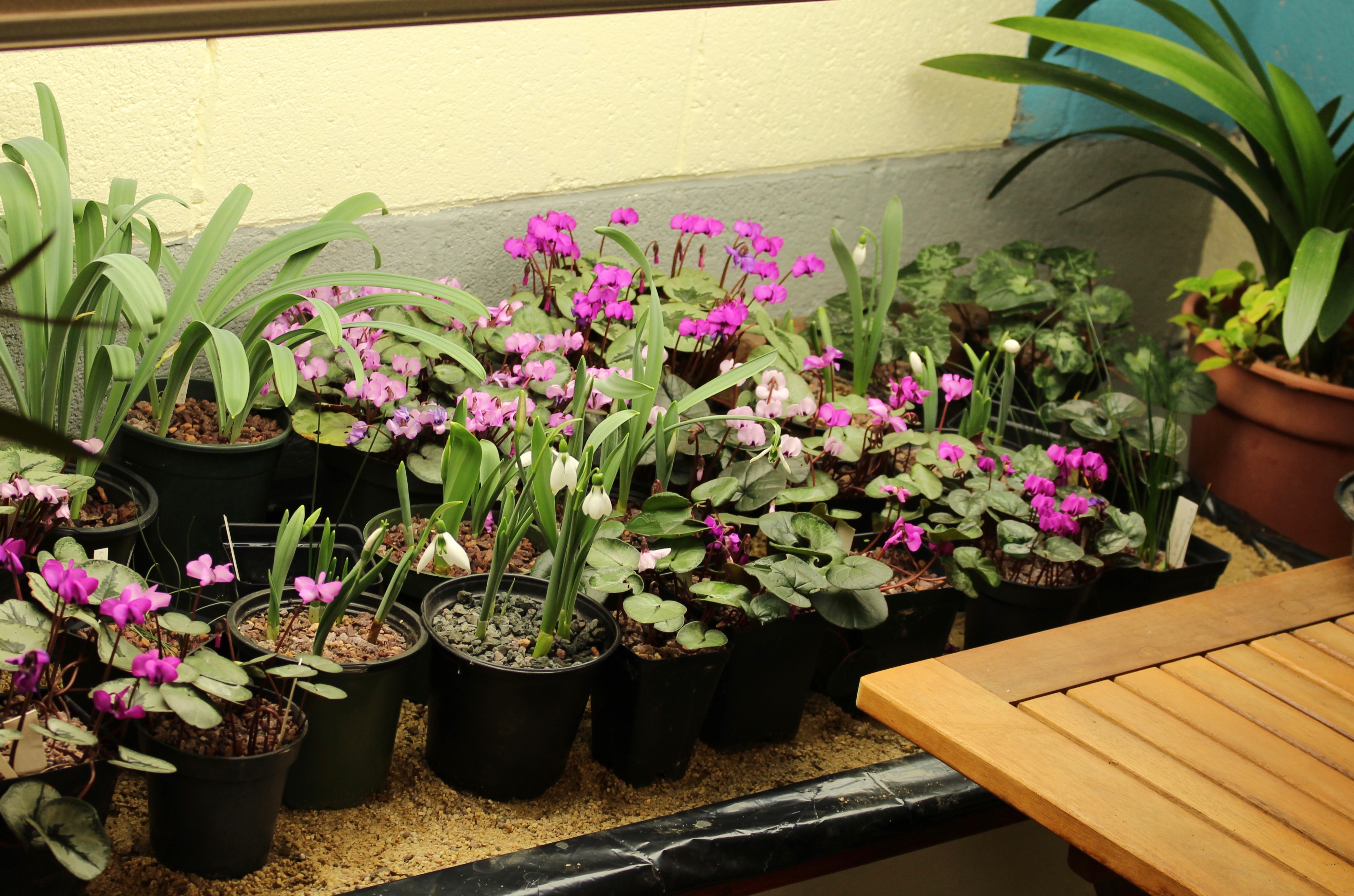
hardy cyclamen

I was expecting to spend most of February in the garage, hiding from the cold, and admiring the winter garden which has now officially replaced the workshop.

This weather will quickly bring on the snowdrops and winter aconite, and once that happens I’ll waste every minute of daylight wandering and poking around the garden imagining just how nice everything is going to be this year.  In the meantime though, I’ve come to a decision on a real winter greenhouse, one which involves glass and benches and expensive heating.  Before you get excited for me (doesn’t everyone get excited for people who get new greenhouses?) I want to make it clear it’s not going to happen.  Our local climate is relatively extreme and although that in itself is an excellent reason to get a greenhouse, I just can’t commit myself to worrying about extreme low temperatures, brutal hailstorms and blizzards, heating system failures… and most importantly the extra heating bill.

hardy cyclamen

The hardy cyclamen (C. coum) are at their peak under the winter garden grow lights.  For the second year in a row I’m wondering why I don’t have more in here.

But wait!  Don’t get the wrong impression here.  I’m not having some budget-wise revelation that includes spending less and denying myself things in order to save for our retirement or the children’s education.  I just came to the conclusion that with only a few more grow lights I can change the whole workshop over into a very satisfying pseudo-conservatory.  So I did a little searching and found three more light fixtures on clearance.  $39 a piece, about $120 total… so much better than their $52 normal price.

sowing fern spores

A first time for me.  Fern spores.  You’ll have to trust me on this but there’s a tiny bit of black dust on that silver foil, and hopefully with it and an old baby food tub I can recreate what ferns have been doing for millions of years.

$120 is an amazing bargain compared to buying an actual greenhouse, so in reflecting on how much money I just saved I don’t think I’d be way off in subtracting it from the budget rather than adding, but on second thought a visit to the accountant taught me a new word which might come in handy here.  Depreciation.  From what I gathered (and often what I gather is more what I want to hear rather than real facts) I can take this long-range purchase and pretend it’s really money which has been spent over a couple years.  So for the 2018 budget I’m going to pretend I only spent $30 and we’ll see if I remember the remaining $30s in 2019, 2020, and 2021.

winter sow stratification

Seed starting is well under way.  These will go outside today and spend the rest of the winter on the side of the house under a layer of garden fleece (aka Reemay, or spun row cover) until warmer weather encourages them to sprout. 

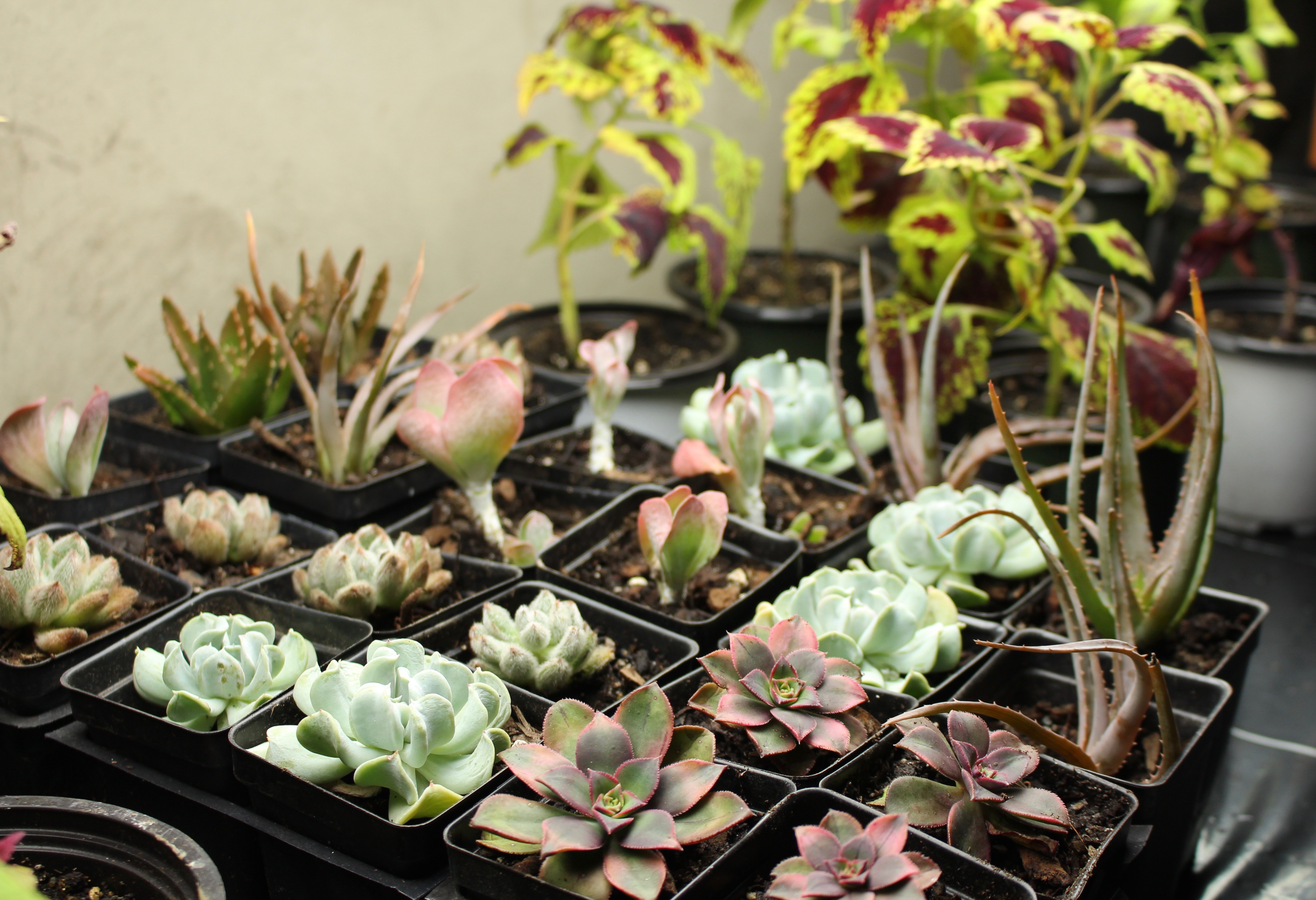
The lights are more of a next winter plan, but you never know.  In a fit of boredom a week or so ago (apparently you can’t spend forever sipping beer and staring at cyclamen) someone got it in their head to pot up the coleus cuttings and start a few succulent cuttings.  They’re in the very back of the workshop, in a room with the furnace, and hopefully will stay warm enough there to get shoots growing and roots forming.   We will see.

succulent cuttings

Rootless succulent cuttings newly potted up and coleus cuttings slowly recovering from the last few months on a windowsill in water.

I don’t need more succulents in February, let alone May.  It’s another one of those #becauseIcan moments, but I’m just itching with a compulsion to start more.  Another 25 or 50 more isn’t out of the question and I’m sure something can be done with them in the spring.

In the meantime have a great weekend!

$30 for new growlights

$318 total so far for the 2018 gardening year

The Plasticine Era

Don’t bother searching the title.  It’s not the first time this blog has contained made up words and I’m sure it won’t be the last, but it’s just I’ve been thinking about plastic lately since it seems to be the material of the day.  It started with some comment I read, that all the plastic humankind has ever made is still in existence.  I know of course that’s not true since I can personally vouch for having thrown a plastic cup or two into a campfire somewhere along the line, but the main idea is that plastic doesn’t break down anytime soon.  My compost pile will attest to that fact.  I throw nearly every scrap of yard waste onto it and as the organic materials break down into a deliciously rich soil amendment I’m left with a constant peppering of plastic trash bits picked up by the mower or left behind by the kids.

garden plastic

I keep a (plastic of course) bucket back there to hold all the plastic scraps I pick out of the finished compost.  I’m always amazed by how quickly it fills.

I never catch all the trash and much of it gets dug into the soil with the compost.  I’m pretty sure that in a couple million years future archeologists will be able to identify this era of time based on the layer of plastic remains which we’re laying down each year…  assuming we make it that far of course.

So in addition to keeping some weak kind of transparency to my gardening budget this year I’m also going to try and reduce the amount of plastic I use.  I’d aim for recycling too but I’m just not convinced that’s a good solution, so the goal is just less of it.  Maybe I can start with the awful plastic based fleece and clingy ‘performance’ fabrics that just breed static and just don’t breath (as opposed to cotton of course).  Better late than never since people have been onto this movement for years, but I guess everyone makes their changes according to their own timetable.  …Now about that budget.

I love tall garden phlox (Phlox paniculata). I should take better care of the ones I already have, but I’m sure a few new ones wouldn’t hurt either.

I’m going to confess to a few plant purchases and I’m actually going to count them this time.  For the record I recently celebrated a birthday and in all honesty I should be counting these as birthday presents to myself (and not apply them against the gardening budget) but a few comments have questioned the accuracy of my accounting and have implied that I play it a little too fast and easy with the numbers.  So just to keep things on the up and up I’ll admit to a $68 phlox purchase from Perennial Pleasures in Vermont and a $65 order of cold hardy cactus from The Cactus Man out in Colorado.

hardy cactus

Hardy opuntia seedlings in the rock garden last week before the latest snow.  Brutally spiny and unforgiving, kind of dull in the winter, and painfully torturous to weed around… obviously I need more.

Seriously this really shouldn’t count against the budget.  I don’t need any new phlox and I kind of hate the nasty little cactus I already have, but there they are, new plants pointed to and clicked on and now destined for this little patch of suburbia.  Of course I’m excited 🙂

$68 for six must-have new (and heirloom) phlox
$65 for several super spiny, wildly colored, completely exotic hardy cacti

$288 total so far for the 2018 gardening year

Happy Post-Solstice

A few years ago I was introduced to an excellent new holiday.  Maybe holiday is a bit strong but January’s a pretty dull month and coming off of a three day warming spell has me optimistic that winter might not go on forever… even if it does feel that way most of the time.

I first heard about ‘Post-Solstice’ over at the always inspiring macgardens.org, and it’s described as that unofficial point where the earth has tilted back towards the sun just enough to start warming this hemisphere back up again.  It takes a while to get things moving on this big old planet of ours, and although December 21st was the shortest day with the least amount of solar warmth hitting the Northern half, it’s not until one month later around January 21st that we start turning the tide back to warmer days.  To help with the celebrations this year there was a special treat.  The first snowdrop is up, popping out just hours after the rain melted the last snow and ice away from this spot.

winter snowdrop

A surprise in our January thaw, the first of this winter’s snowdrops.  Galanthus ‘Three Ships’ in case you’re wondering.

A lone snowdrop doesn’t make spring, and I’m sure I’ll be out there covering it up during the next arctic blast, but for now it sure does give a little bit of hope.  There are other sprouts as well but I’ll only bore you with one more photo.

winter snowdrop

More snowdrops showing signs of life.  I wish I could say the same for the winter-burned hellebore foliage but I’ve long given up on worrying about things like that. 

It’s nice to see things as anxious as I am to start the new gardening year.  We have already added just over thirty minutes of daylight to each day and that goes higher with every sunset and before we know it the whole adventure will start anew!

Enjoy your weekend 🙂

Into the Woods 2017

I happen to be one of those people who loves looking at vacation pictures.  Since I know that’s not the case with everyone (and this is still just a garden blog) I’ll try to keep it quick.  Last August we headed out for the annual camping trip and although our base camp was in the woods, we spent nearly all our time exploring the beautiful maritime region where Maine ends and Canada begins.

campobello

On the lookout for whales at Head Harbour Lightstation, at the very Northern tip of Campobello Island.

Campobello Island, New Brunswick was our home, and besides the scenic coastline and cool northern air (and water!) the island is also the site of the Roosevelt Campobello International Park, a joint operation between Canada and the US which operates the park and curates the summer cottage of Franklin D. Roosevelt.

My first visit to Campobello was over 30 years ago but one of the things I remember best were the immaculate flower beds which decorated the FDR visitor center and cottage grounds.  They’re still there and they still contain all the bright annuals which seem to do best where summer temperatures rarely break the 80F (27C) barrier, and ocean fog is a weekly occurrence.

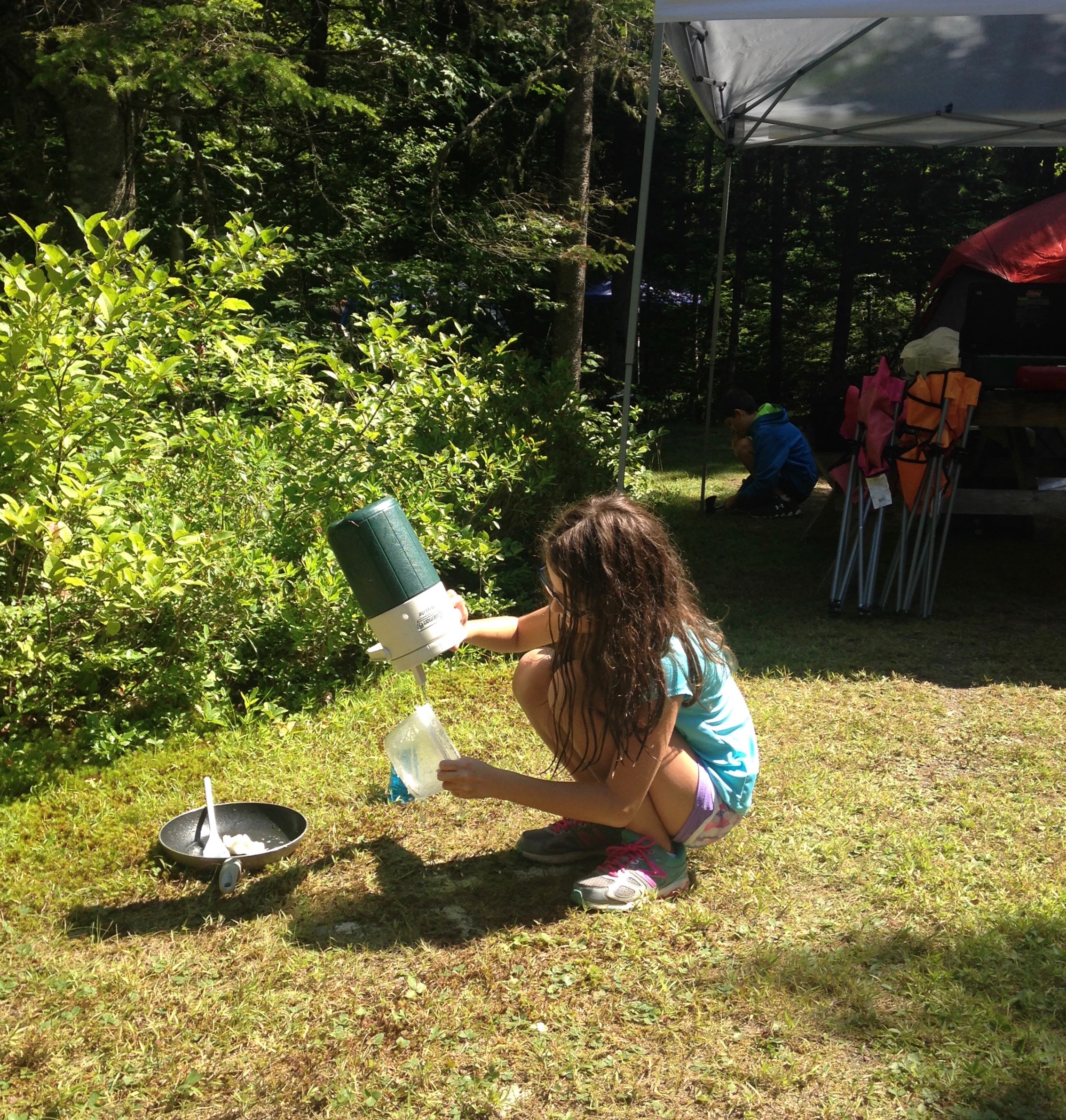
The kids are still young enough to enjoy just about everything about roughing it.

campobello

In charge of the breakfast dishes.

Herring Cove Provincial Park Campground was our base camp and in addition to an exceptionally friendly and thoughtful camp staff, it’s also just a short walk from the beach.  The cold Atlantic water is only for the most desperate or daring of swimmers, but there’s always a whole outdoor world to explore and plenty to do along the coastline.

Another memory is the exceptionally collectable stones of Herring Cove beach.  They’re all so perfectly polished and there’s such a range of colors and types.

campobello

Herring Cove beach

Although Campobello is part of Canada the only bridge to and from the Island connects to the US mainland.  To avoid crossing the border and making the two hour roadtrip to the next border crossing, the locals travel back and forth via ferry.  Just for fun one of our days was spent riding the ferries between Campobello, Deer Island, and then the Canadian mainland, and of course it’s an extremely scenic trip this island hopping through the wildlife rich waters of Passamaquoddy Bay.

We had exceptionally warm and sunny weather for the first part of visit, but a trip to Campobello wouldn’t be complete without fog.

campobello

Back in the US at West Quoddy Head lighthouse.  West Quoddy is the easternmost point on the continental US and an excellent site for some of the easternmost calisthenics in the United States.

Lubec Maine’s harbor is as scenic as Maine gets with its lobster boats and fog shrouded islands, and the rapid tidal currents swarmed with gray and harbor seals as bald eagles cruised the air.  Of course there were plenty of seagulls as well!
campobello

The docks just off commercial street in Lubec Maine.

Hopefully we made a few memories on this trip, ones which are strong enough to hold up to a return to wifi, but if anything the kids were just excited to visit their first foreign country… and collect what seemed like hundreds of dollars worth of ‘souvenir’ Canadian change.

campobello

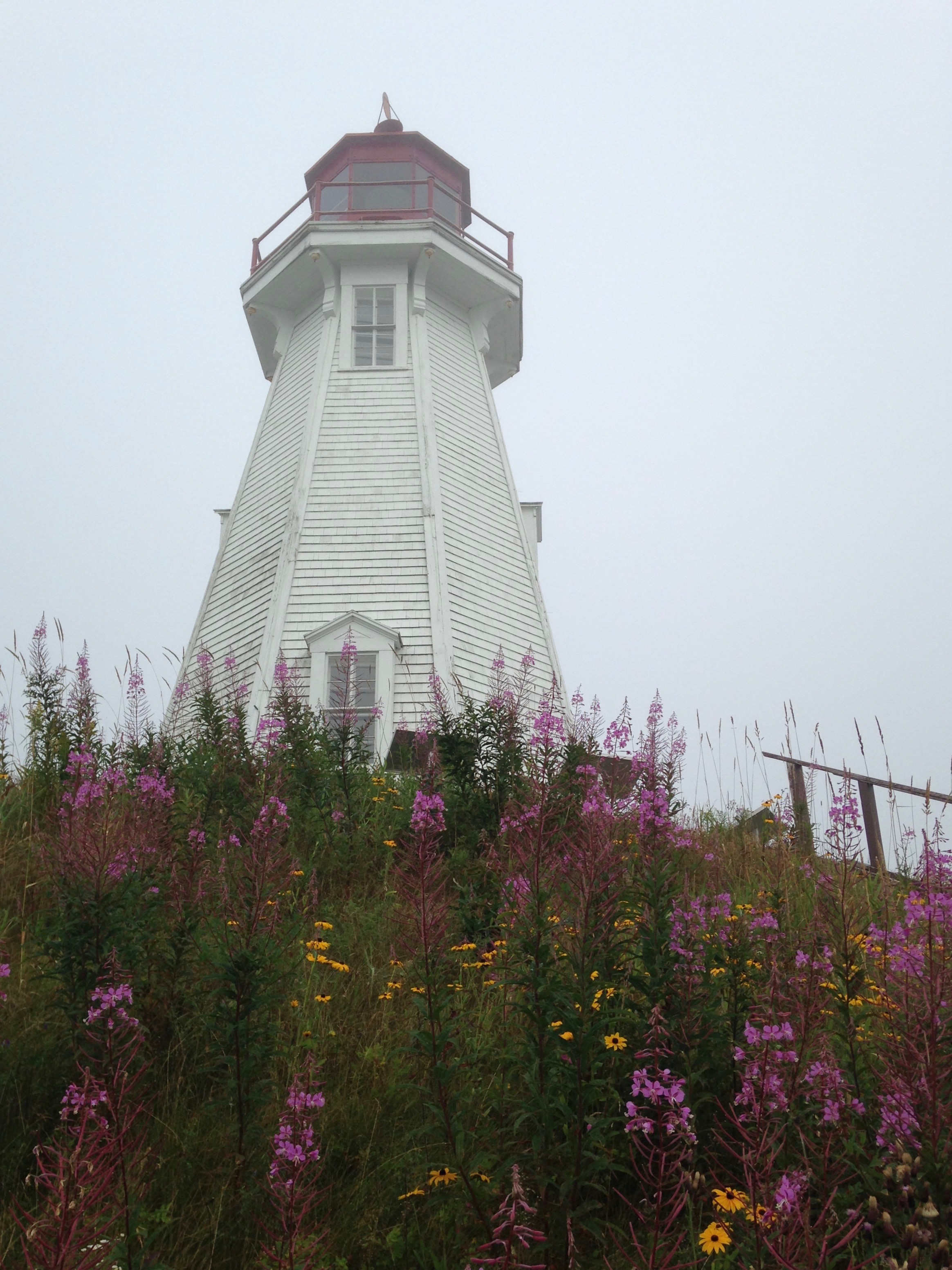
A foggy Mulholland Point Light with pink fireweed and yellow rudbeckia.

We will see where we drag ourselves off to next summer!
Spending Money (or so it seems)

With snow and ice and freezing temperatures outside, the winter garden has again become my refuge from the cold.  For those who aren’t in the know, the winter garden is a workshop just off the garage which is slowly becoming less and less workshop and more and more a potting and growing area.  I was back there a week ago (which is typical for this time of year) and decided it again needed some sprucing up.  The walls in particular stood out as less than hygienic and as I sat there with an appropriate beverage, pondering the situation, I remembered all the leftover paint taking up space in the garage proper.  It’s that little bit which you keep for ‘touchups’ but then never actually use, so why not put it to use on the walls of the winter garden?

Of course in order to paint the walls I needed to see the walls, so away came all the years of stored plastic pots, and out came the the ledge which was buried underneath.  “Not bad”  I thought (as I briefly considered how every one of the empty pots most likely contained a three or four dollar plant at one time).  The ledge would probably make an excellent spot for a fourth growlight setup, and for a fourth light we might have to dip into the gardening budget… or not.  It depends on how shady the accounting gets.

potted snowdrop

The first of the wintergarden winter-flowers are starting to open up.  Here’s an unnamed giant snowdrop (G. elwesii) with a few Cyclamen coum behind. 

On the way back from work I stopped by the DIY store and spent about $63 for the odds and ends which I might need for a fourth light in the winter garden.  That may seem like a straight forward gardening charge, but it’s not and let me explain why.  I didn’t need a fourth light.  I already had one which had been evicted from the house, so it was actually a surprise that a fifth one ended up in my cart.  They were on clearance of course so better to get one and save $10 in the process and who knows, maybe some day I’ll use it to illuminate a work area so it’s clearly not a gardening expense.  The screws weren’t either.  I only needed to buy them because the boy got off with all the ones we had in order to build some boy project last summer.  That was just the cost of having children.  I bought a chain which could hang the light but that’s structural, just like the scrap wood which makes up the shelf and hangers.  All in all I guess for now I’ll just count the $6 worth of S hooks which I bought to hang the actual light.

winter garden

Still not a winter paradise but at least things are cleaner and there’s more growing space.  Please ignore the pumpkins, they and a few gourds have been waiting since Thanksgiving to have their seeds removed and cleaned for next summer.  

Once the light was up I ended up using leftover chain links to hang the lights, so I’m going to cut that last $6 charge right back off the budget.  You will probably agree that at zero dollars this was a very economical upgrade.

But I will add a $2.50 charge to the tally.  A child was given a fish tank for Christmas.  A trip to the store and $70 worth of fish, aquarium decorations (and mostly snacks and food items) left me with a mostly unused, yet already-opened, bag of aquarium gravel.  Aquarium gravel makes an excellent soil covering for potted cacti and succulents so I’ve made an executive decision to accept the gravel into the gardening inventory… although I’ll have to discount the 5$ bag by 50% for already being opened. 🙂

$2.50 for aquarium gravel

$155 total so far for the 2018 gardening year.

Everything According to Plan

Someone here has accused my side of the family as being carriers of the gene for hoarding.  I disagree.  We do like to hold onto things, but we’re not big spenders and the things which come our way are either still eventually used, or have some other end in mind.  A further defense point is that if something sits for more than seven years we’re more than willing to get rid of it… although it still hurts putting it to the curb and I far prefer giving it away.

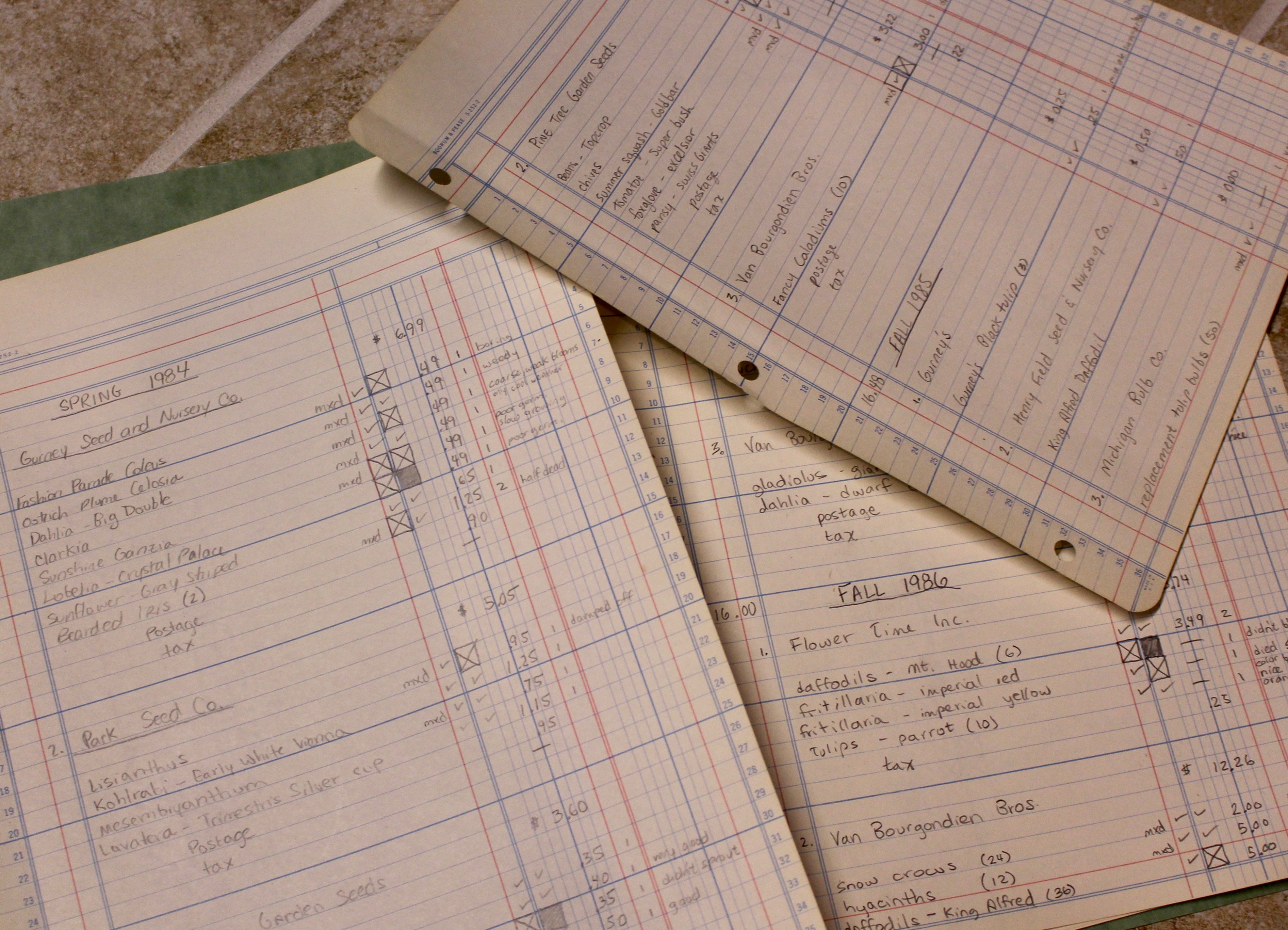
My parents must be at the giving away stage.  For the last few years they’ve been making a serious effort at putting their affairs in order and working their way through the mountain of things which a lifetime will accumulate.  I’m in complete denial as to why they’d want to do this, so it’s been fun seeing all these memories come back to life and having a chance to look back on the tender beginnings of this world famous garden blogger.

garden records

The early gardening records.  I’m guessing I had to stick to a budget of about $20, an easier task when shipping was under $1 and seed packets sat in the same price range.

I always thought they wanted to hold onto this stuff for when they open the museum, but apparently even they didn’t realize what real treasures they were holding on to.  I’ll stick to the ordering side for now but maybe some day I’ll bore you with some of the detailed flowering and growth records I kept for years and the tedious development plans I had for most every corner of the yard.  Obviously my obsession started early and rather than throw around terms such as ‘just like Thomas Jefferson’ and ‘coulda been president’, today we’ll just stick with that winter treat of all gardeners, the catalogs.

vintage garden catalog

I’d call it vintage, but I’m afraid that would date me more than it does the catalog.  A 30 year old White Flower Farm catalog is still a pleasure to read but was way outside the budget of a certain 17 year old.

So maybe I do horde favorite gardening catalogs and magazines.  I could have worse faults I think and as I look out at blowing snow and bitter windchills it’s got me thinking about this year’s plant budget.  Steve over at Glebe House Garden has a weekly running tab of hours spent working in the garden and it gives an eyeopening look at how much work a perfectly maintained garden can take.  My garden is neither perfectly maintained nor do my hours in the garden accurately reflect any amount of real work being done.  I think if I attempted the same I’d just be embarrassed by any attempt to explain why it took me two hours to plant six tomato seedlings… even if I only spent half that time staring at the clouds or pondering an iris flower.  I won’t try that.

What I will try is to keep a tab of how much I spend on the garden, and before you get all fine print on me I’d like to say up front I’ll be excluding several gray area costs from the tally.  Gas prices don’t count even if I drive two hours one way for a plant.  Gardening magazine subscriptions don’t count.  Garden construction projects probably won’t count.  Postage on a plant trade doesn’t count even if it’s an eight pound box of lilies from Utah.  Of course snowdrops don’t count, that’s still just my midlife crisis.

Here’s where 2018 is at.  Plant society memberships do count since they give me access to bunches of excellent seeds, and those are our first yearly expenses.

$40  membership renewal for the NA Rock Gardening Society
$15  for 25 packets of seed exchange seeds
$25  membership renewal for the American Primrose Society
$18  for 18 packets of seed exchange seeds
$35  membership renewal for the Mid Atlantic Hardy Plant Society
$20  for 35 packets of seed exchange seeds -10 extra for being a donor 🙂

$ 153 so far.  Off to a rocky start and I haven’t even made a definite decision on the Historic Iris and American Daffodil Societies…

Welcome 2018!

Another year is upon us, and here in the Northeast it’s off to a slow and frigid start.  On the day before Christmas I was poking around looking for snowdrop shoots, now just a little more than a week later I’m watching the birds huddle around the feeder while the rivers and lakes freeze over.  It’s a bit of a shock to have actual winter weather after years of lackluster cold, but I’m pretty confident it won’t last.  The weather is still all over, and when I randomly checked the Nome Alaska forecast it looks like just outside the arctic circle they’re enjoying high temperatures just below freezing while we’re developing our own permafrost here to the south.  My best bet in scenarios like this is to head for the warmth of a decent conservatory to enjoy a little warm indoor gardening stability 😉

planting fields arboretum

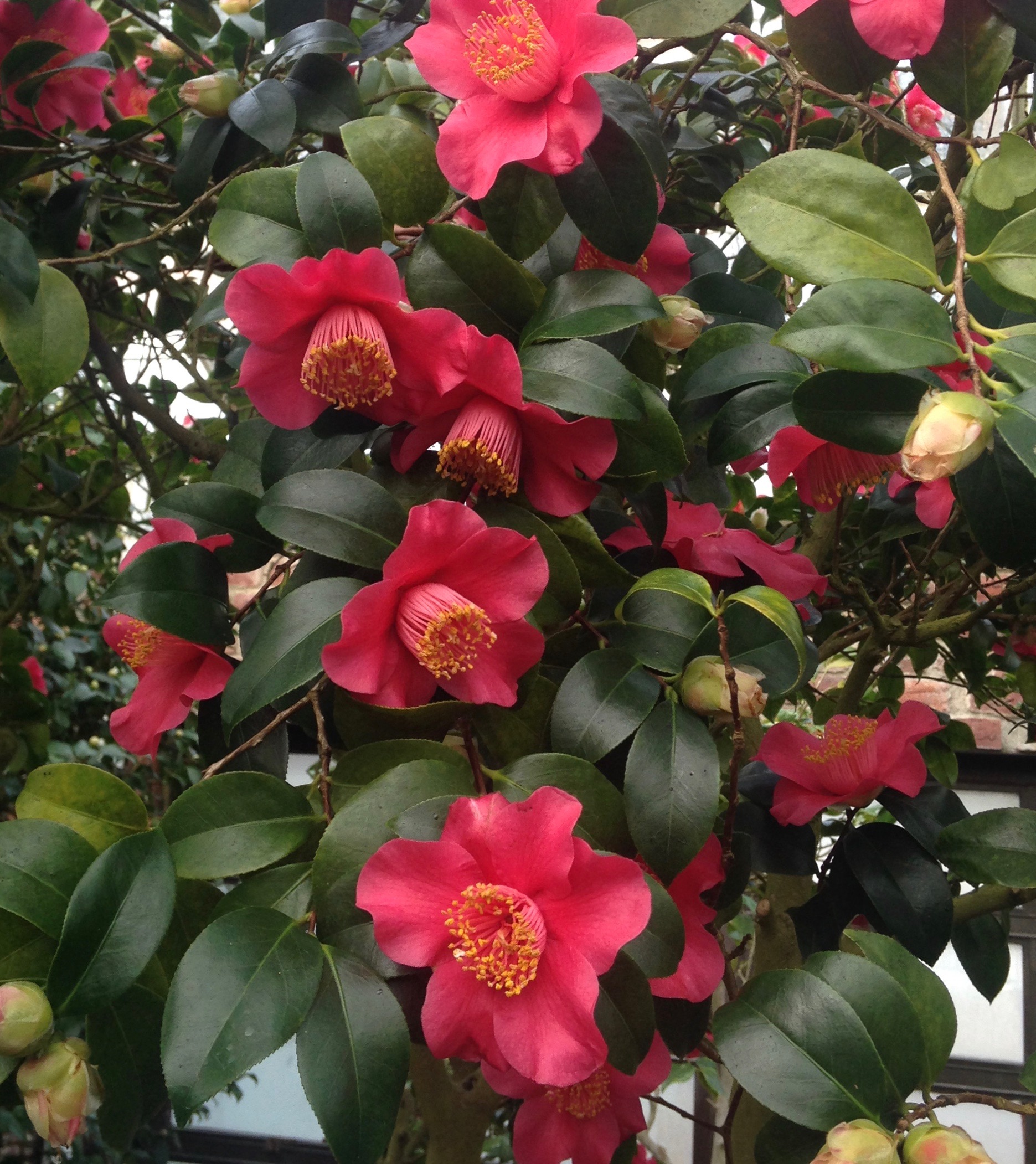
Camellias flowering under glass, safely sheltered from the single digit weather outside.

My choice was the glass houses of Planting Fields Arboretum, located just east of NYC on Long Island.  Built in the 1920’s it’s the former Coe Estate, an old Gatsby era Gold Coast mansions which rather than face the wrecking ball or subdivision like so many others, was donated to the state of NY which has cared for it ever since.

planting fields arboretum

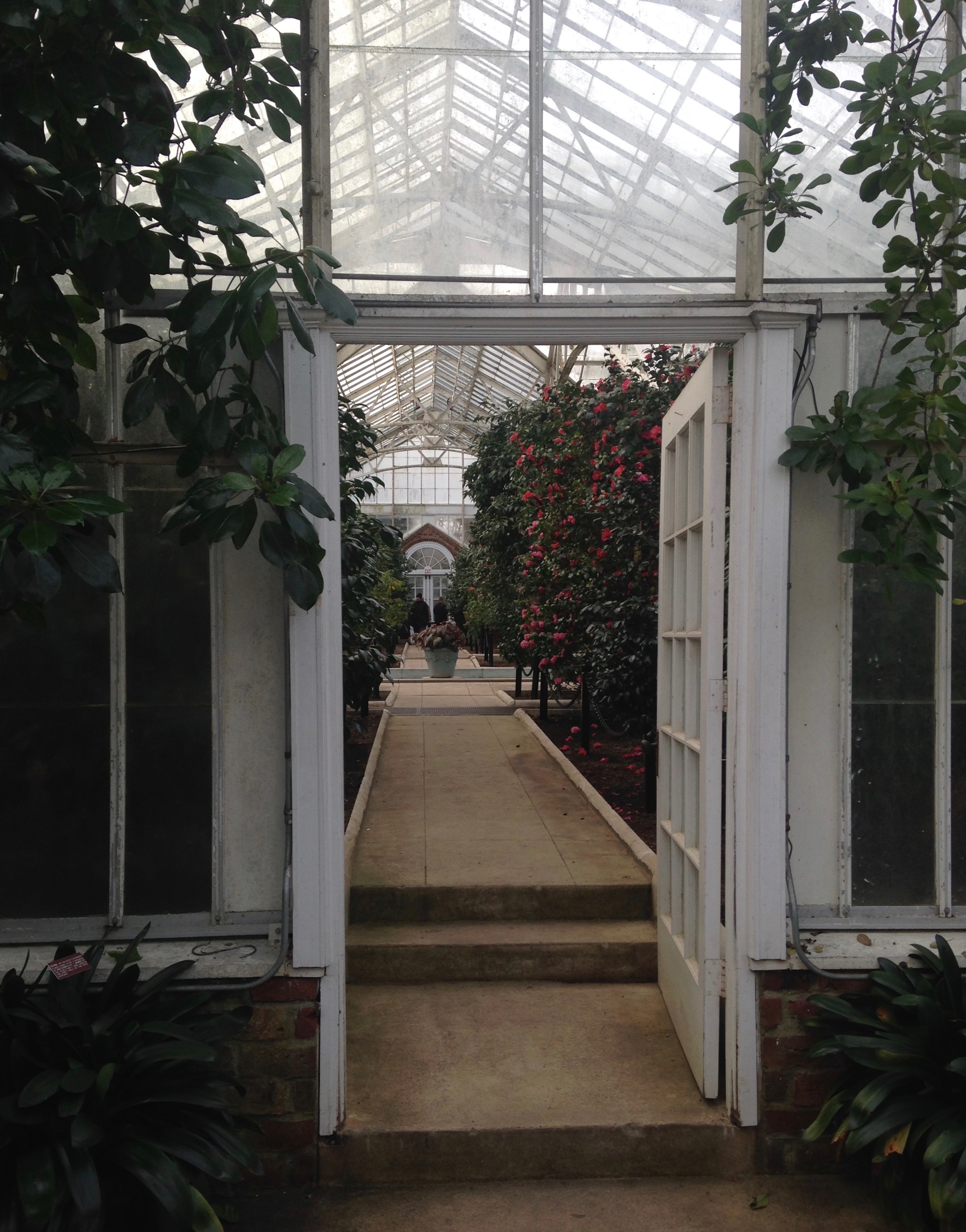
Looking through the Camellia house.

My pictures really don’t do the estate credit, I was working with an older cell phone camera and the cold outside caused the battery to shut down for most of the visit (thanks Apple)… so only a few photos… but hopefully someday soon I’ll be back for better.  The not-yet-full-of-flowers camellia house is where I did get a few pictures, and although the peak is still two or so months off (late February/early March) the contrast between this and  icy walks with cold-curled leaves of rhododendron was perfect.

planting fields arboretum

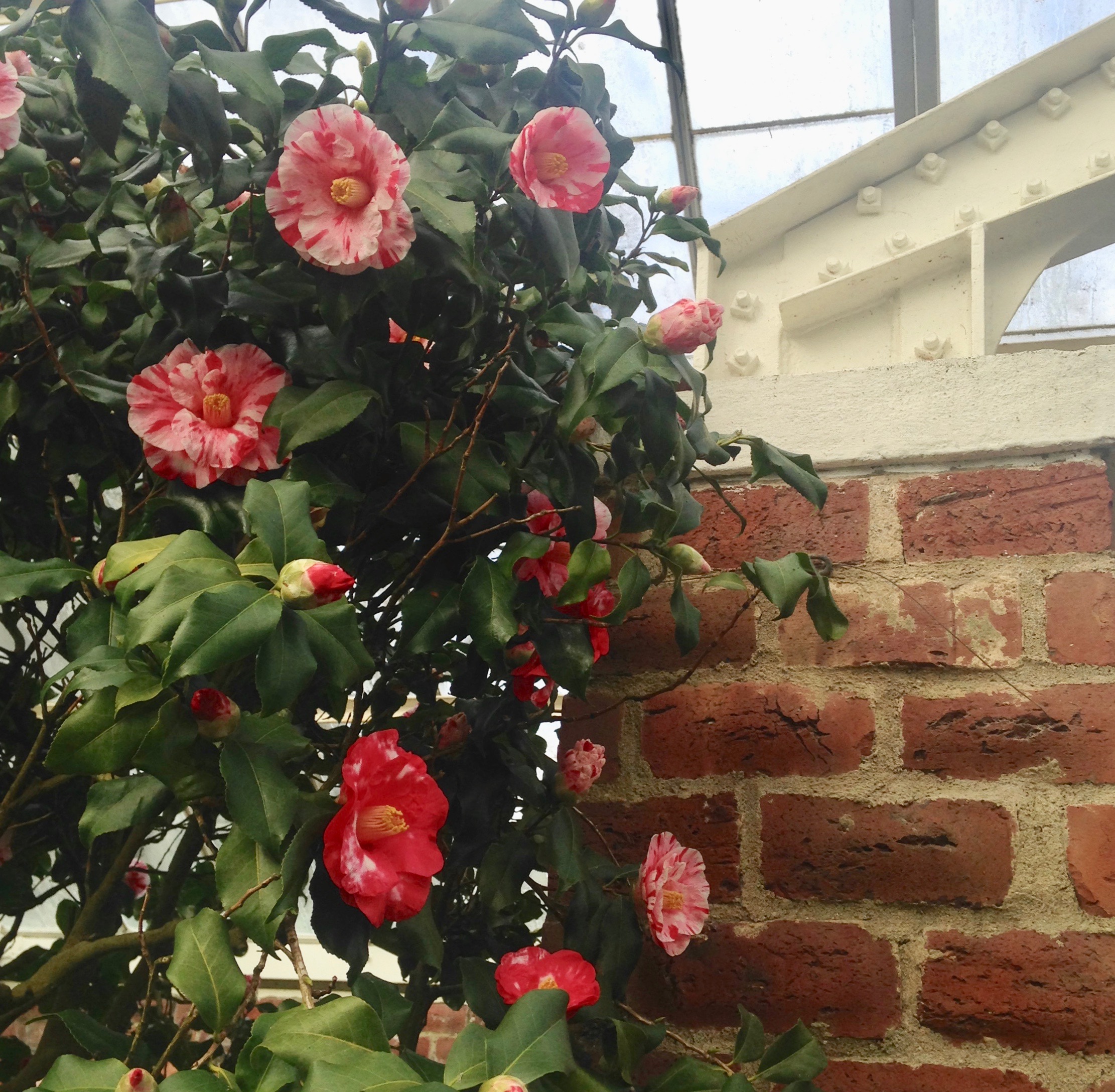
Get a deal on a couple hundred camellias, build a massive greenhouse to protect them, enjoy the blooms each winter.

I seem to recall reading that this camellia house is the largest under-glass collection of camellias in the Northeast, but there are even more extensive greenhouses on other parts of the estate.  They’re full of holiday poinsettia displays, tropical fruit and blooms, cacti, orchids, bromeliads… but of course camera issues will spare you from all those photos today.  We did manage to make a quick tour around Coe Hall before our noses froze completely (and the phone shut down).

planting fields arboretum

The front door and approach to Coe Hall.

It was a shame to skip the holly and conifer collections, but we weren’t up for a long walk and didn’t have the time regardless.  Better to linger during magnolia season or when the azaleas are in bloom, or the rose arches, peonies, perennial borders, annual displays, lilies, dahlias….. 😉

planting fields arboretum

Round back.

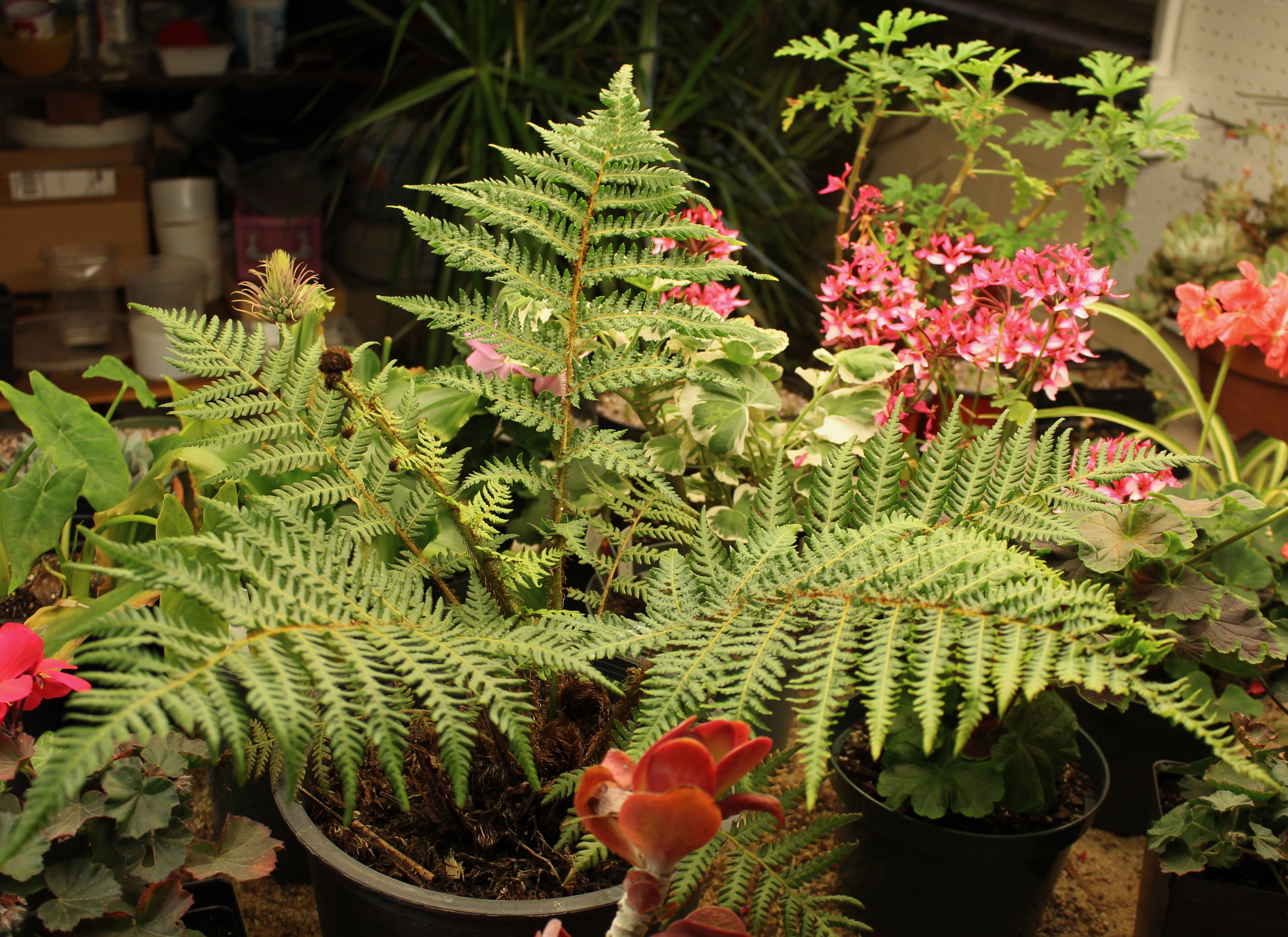
Since the camera died at that point, and in retrospect the photos aren’t all that great in the first place, I’ll move on to another more local winter conservatory… my own winter garden of fluorescent shoplights and workshop benches.  It may not have overhanging boughs of fruiting citrus, or banks of multicolored poinsettias (the variety of which rivaled much larger gardens) but it does have my absolute favorite plant, a returned from the dead Australian Tree Fern.

overwintered tree fern

After three months of ‘will it live?’ the Australian tree fern has said ‘yes!’ and has earned itself pride of place under the winter growlights.

Don’t ask me why but I’m this excited about a stupid fern.  As you know they just sit there being green, but there’s something extra special about it, maybe it’s the accent.

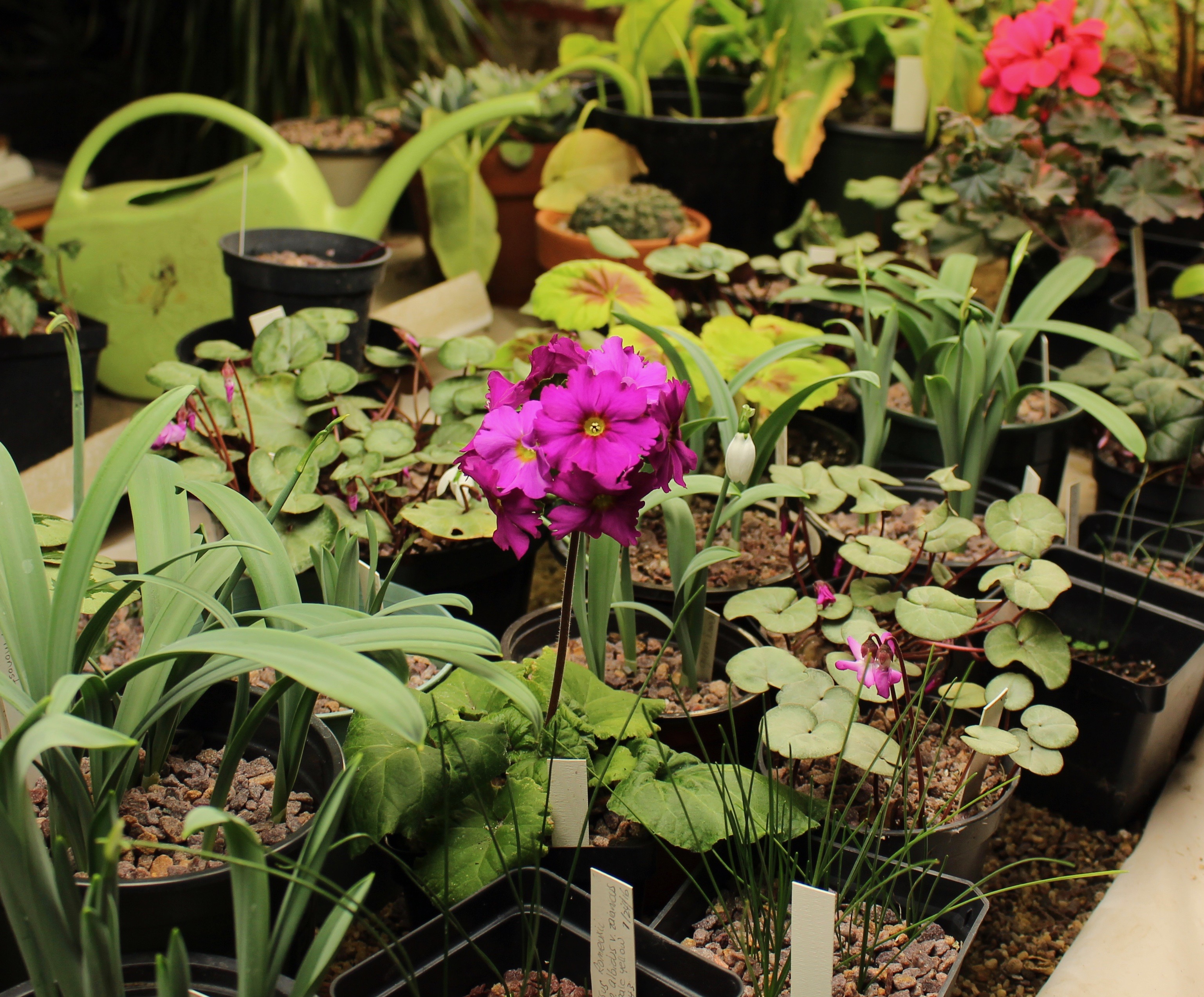
primula obconica

The other end of the growing bench.  My only primrose this year, Primula obconica, is in full bloom.  It’s a sad, malnourished example of this non-hardy species, but it’s all mine and of course I’m overly proud of it.

It’s still another week or two before snowdrops and cyclamen show up under the lights, but rather than go outside again to take pictures of frosty dead things, I’ll leave you with a bright reminder of the hot colors of summer.

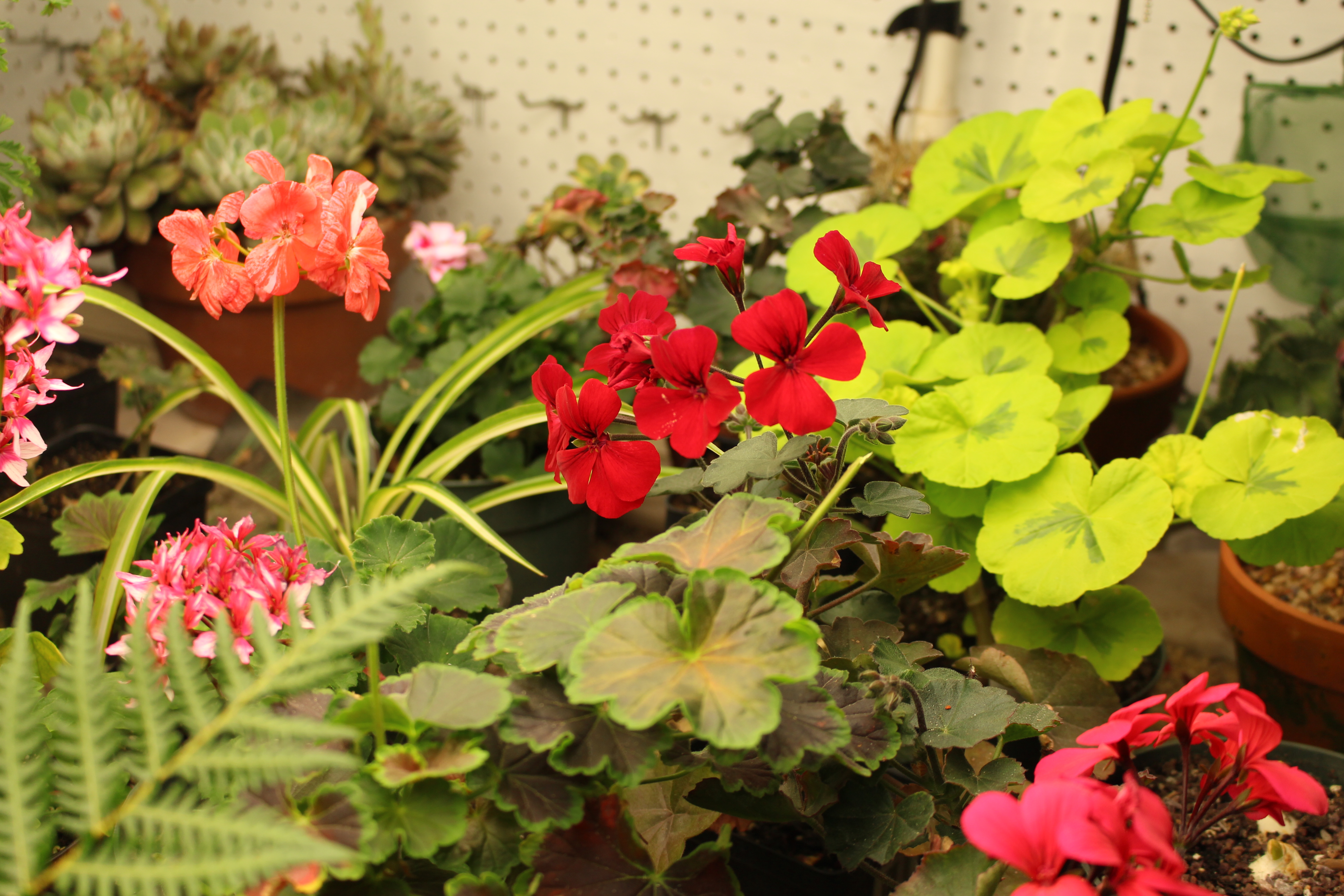
overwinter geranium

The geraniums (pelargoniums) are still blooming well in spite of the cooler temperatures.  I believe this dark red is ‘Caliente Fire’.

May your 2018 be filled with joy, friendship, and success, and thanks to all who take the time to visit this blog and entertain my ramblings.  All the best!

That Wasn’t Smart 8.0

In hindsight this is the time of year when winter interest should take center stage, and the addition of conifers to the winter garden is probably the best way to keep the yard attractive during the bleakest of winter months.  I’ve heard that and have seen it in print as well, and even the most reluctant gardener will throw a few evergreens around the house as the first step in crafting an attractive landscape.   The message is out, and the majority of houses around here have a sensible foundation planting filled with neatly trimmed yews and junipers and whatever else can snuggle up to the house for year round appeal.

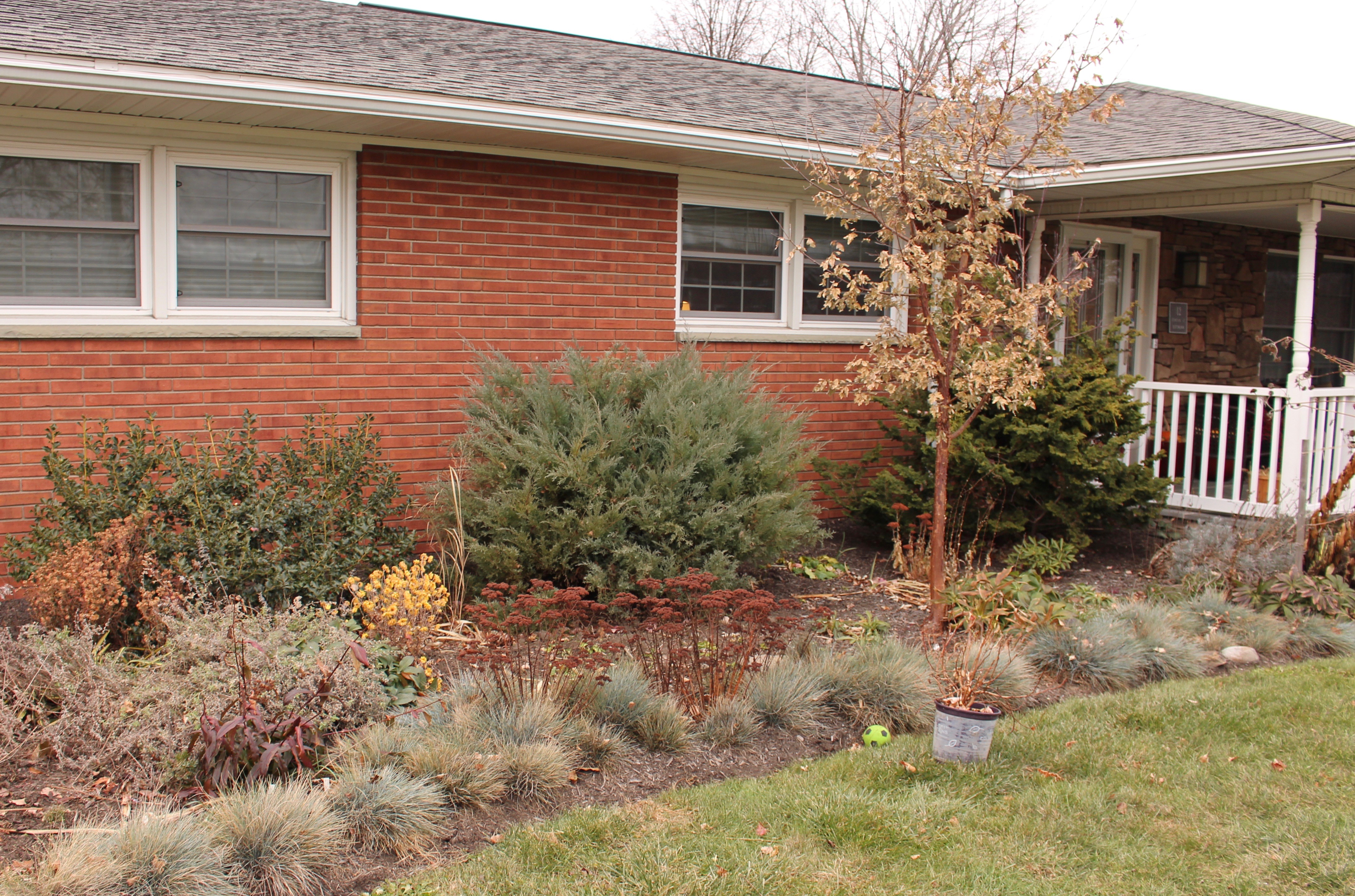
foundation border

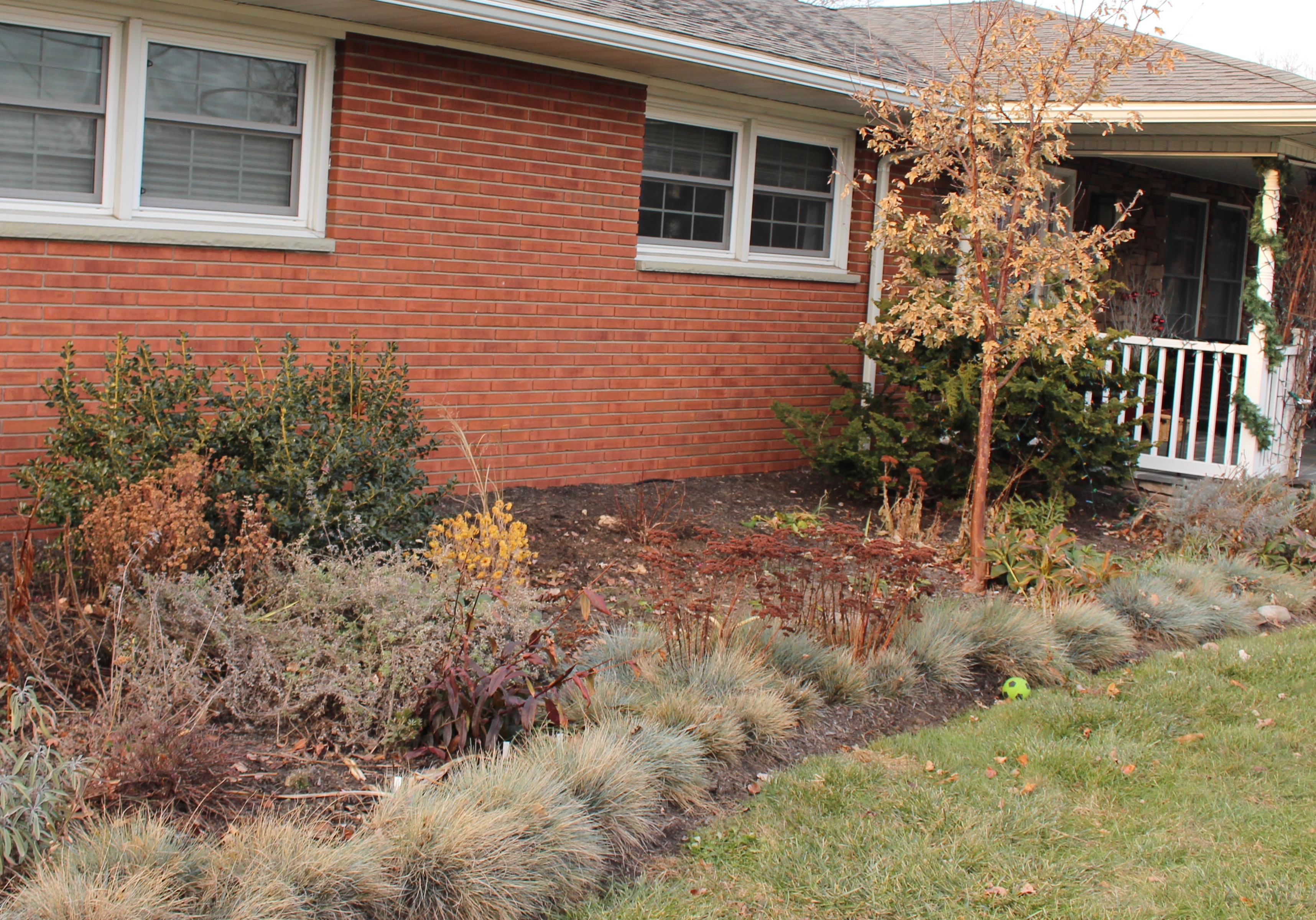
Our own slightly less neat foundation plantings, with respectable holly, juniper, and chamaecyparis plantings lined up along the foundation. 

Why this gardener would chose December to remove a large juniper from a prominent front-of-the-house location is foolish enough, but to replace it with a small ninebark (Physocarpus opulifolius ‘Amber Jubilee) is over into the not so smart category.  Reliable evergreen replaced with small clump of deciduous twigs… maybe you can understand that ‘uh-oh’ feeling I had as I stood there holding the saw and staring at a pile of juniper branches.

foundation border

If you look closely you might be able to see the newest addition to this foundation planting.  It’s right there at the center of the gaping hole which was created when the juniper was removed. 

In all honesty I never liked the juniper.  It made me itch and bored me and even though there were a thousand better things which I could be doing I suddenly needed to plant that ninebark at that minute even though I was right in the middle of putting up the Christmas lights.  As long as we’re opening up here, the Christmas lights were turning into a whole other project in themselves.

Christmas porch decoration

A Longwood inspired twig archway with lights.  Lots of lights.  

The reason I had the saw out in the first place was because I needed to take a walk in the woods and cut down and drag back enough birch trees to make a decent arch leading onto the porch.  I’m pretty sure a twig archway was what our holiday decorations have been lacking.

Speaking of things lacking, this blog has been lacking a snowdrop photo for months and since so many of you have been asking how the snowdrops are doing I guess it’s time to jump back into that world.  Here’s a batch of fall bloomers which my friend Paula shared with me a couple years ago.  They’re out on the driveway for this photo but have since moved into the garage in anticipation for the approaching cold… lows for next week show numbers around 10F (-12C) and that’s just not appropriate for such an innocent little flower… or for the box of tulip bulbs which just showed up on the doorstep this afternoon.

fall snowdrops

Fall blooming giant snowdrops (Galanthus elwesii) with a nice green pattern to the inners.  

If pushed I’d have to admit that no one has actually asked about the snowdrops, but I’m sure they were wondering and I didn’t want to rudely ignore that.

Now I’m off to check out something I can’t even ignore for a minute.  Pamela at Pam’s English Garden has put up the post detailing her own recent visit to Longwood Gardens.  I knew she was there within a few days of my own visit and I’ve been looking forward to seeing her own impressions of the decorations.  I hope she doesn’t point out a bunch of cool things which I missed!

A Longwood Christmas

A few years ago we almost gave up on holiday visits to Longwood Gardens.  We’re lingerers after all and the crowds and hustle bustle of hundreds of visitors can put a lot of pressure on ‘that guy’ who’s holding up the line because he wants to give all the gardenia flowers a sniff.  We kept at it though because for as nice as Christmas and good cheer are, a few whiffs of the tropics can also go a long way bringing some jolly to a cold winter night… and these are the long nights and stressful days which can really use some tropical relief.

longwood christmas

The orangery decked out for the holidays.  Warmth, humidity, and sunshine made the display even better.

Who would have thought the answer to our crowded visits could be as simple as going on a less crowded day?  For the second year in a row we visited on the Sunday after Thanksgiving, and for Christmas diehards that might be inappropriately early, but for us it’s been working perfectly.  The weather was beautiful and we nearly had the place to ourselves (relatively speaking of course).

longwood christmas

This year the apples are back, this time keeping company with thousands of floating red cranberries.

The conservatories are always perfectly decorated with the colors and sounds of the season.  I think my favorite part this year was the bright sunshine streaming in through the glass when we first arrived.  Walking through the doors and into the sunny, humid warmth was an instant escape from weeks of static and dry skin.

longwood christmas

Walls of windows, tree ferns, and fountains… I could get used to this 🙂

Flowers, greenery, and holiday decorations.  You can imagine I took plenty of pictures but since they’re not snowdrop photos I’ll spare you from the bulk of it.  Click >here< for last Christmas or >here< for last summer if you need more, or better yet visit the Longwood website for the real stuff!

longwood christmas

My favorite view this year, a courtyard scene off the back of the music room.

Since the kids ditched us this year there was plenty of time to admire the boring flowers without anyone tugging a coat sleeve.  Longwood always has orchids and I suddenly had the time to admire them… although I’m still far from being an orchid person (mostly due to their habit of dying on me).

I won’t go on and on about every conservatory flower but I did find something which I thought was even more special than their regular.  In one of the back greenhouse passages was a display of a few of their ‘on trial’ poinsettia, and I thought is was an interesting glimpse into some of the variety which this humble plant from Central America has been bred into.  This is also where I met some of the ‘golden’ poinsettias which carry names such as ‘Autumn Leaves, and ‘Gold Rush’, and came in colors more traditionally associated with the end of summer.  What do you think?  At least there’s no blue dye or glitter in sight!

…and then night fell.  We grabbed a bite to eat, toured the grounds, enjoyed the fountains (not the main fountains, they’re off for the winter), took in some Christmas songs around the organ, warmed up around the fire, and then closed the place down with one last tour of the conservatory.  It was holiday-magical in the late evening, with most visitors having already headed to the exit.

longwood christmas

A Longwood Christmas with a French feel.  The symmetry and apple-cranberry patterns surrounded by box are chateau parterre inspired.

Then we were the ones headed to the exit.

longwood christmas

The stroll back out to the car.  A two hour drive home awaits 😉

As usual we enjoyed our visit, and it must have been somewhat inspiring since I spent a few hours this weekend out in the cold putting up our own lights.  So far the reviews have been less than flattering, and there’s no talk of admission tickets, but you’ve got to start somewhere.

If you decide to make your way to Longwood this year for the displays be sure to buy your tickets online before you go, just to make sure they’re available.  Also if you want to take in a quieter visit, try to avoid Saturdays and the week between Christmas and New Year’s.  Those might be the nights when you’re better off hitting the eggnog at home.