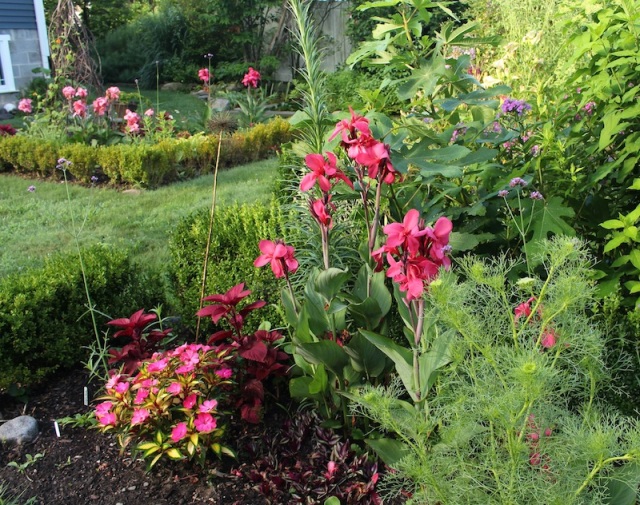
Flock Finger Lakes Visits

Given the choice I will always turn down the stage and hide on the sidelines, but not everyone thinks that way, and where  I naturally hate speaking in front of people, they do not.  It amazes me to see this and to see people on stage, out front, capturing people’s attention and engaging an audience with ease and doing things like creating YouTube channels and traveling all over the world exploring places and talking to people.  I met two of these people a few weeks ago, Summer Rayne who you’ll meet and Sander behind the camera, and they put together a video which I think is pretty cool.  I’m sharing it here in spite of the fact I really prefer to feature plants instead of myself but I guess it’s one of those moments when I have to pull up the pants and be a big boy.  Not bad for someone who not so long ago thought having a hand as part of a picture on this blog was too revealing… now there’s a whole ‘me’ on this blog, talking as well, complete with ratty t-shirt, who-knows-what hair and an old man scowl but whatever… I’ve already overthought this too much.   >here’s a link<

So there you go.  I hope you enjoyed the video as much as I did, they did an amazing job directing and keeping me on track, and Summer Rayne’s interest and enthusiasm really keeps the video fun.  Biscuit helps as well, he’s got quite the stage presence and I hope he remembers us when Hollywood comes calling.  In all I’m surprised at how well it turned out, the garden looks much better and more interesting than I see it on the daily, and at one point I turned to my daughter (we had a viewing party) and told her I wished I could visit that place.  It was magical.  Surprise and magic, that’s my attempt to turn things back around to plants, because late August is the start of Surprise aka magic lilies season…. also known as hurricane lilies or naked ladies but perhaps those are two things we shall not bring in to today’s post.

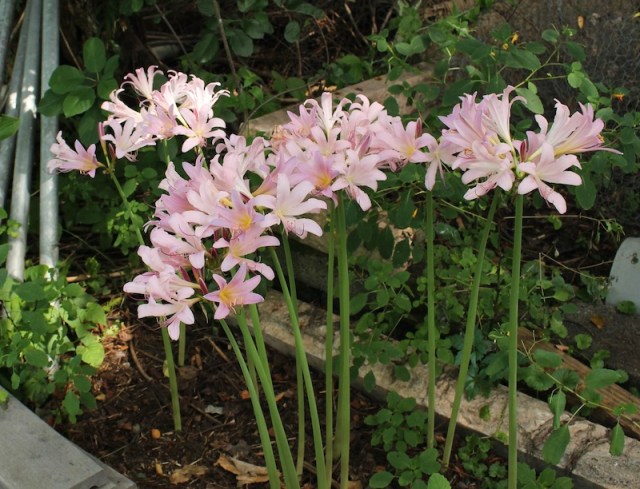
lycoris squamigera

Pink magic lilies (Lycoris squamigera) are probably the most common magic lily to show up in the north.  They seem to do best when abandoned and neglected so here they are amongst the trash and stored debris of the compost pile.

Things can get a little tedious mid August, as the heat and rain/not-rain drag on, but magic lilies can break that up nicely.  Out of nowhere stalks shoot up and burst into bloom all in a matter of days, and it really can be a surprise to see them out and blooming… unless they’re not.  The not-part is where the disclaimer comes in.  These plants can be jerks.  They can sulk, fade away, take a year off, they’re not like Biscuit, all excited and anxious to please, they’re more like cats and don’t really care about what you want.  Sun? Not that sun, I want shade until it’s too much shade.  Feed me but not that food, but I know I’m hungry… Here are more flowers than you can imagine, no wait… I’m not feeling it this year…

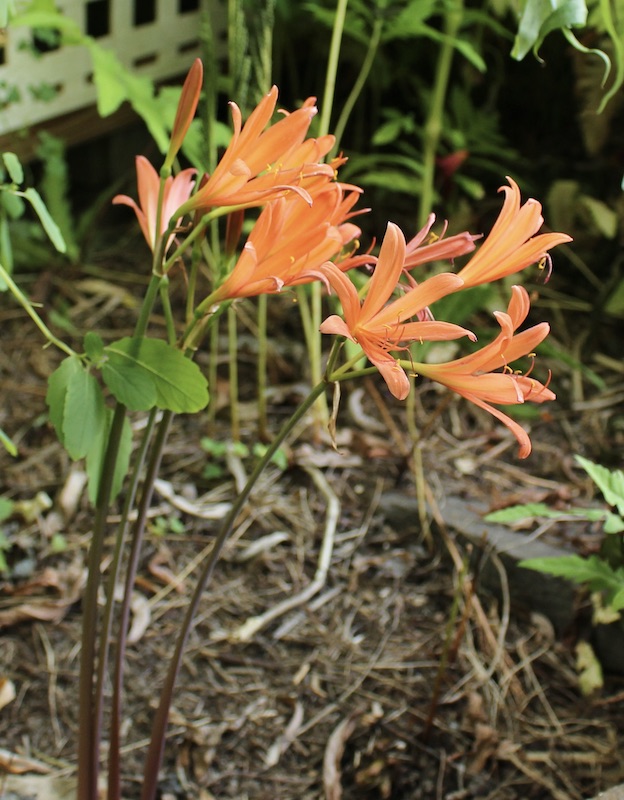
lycoris sanguinea

Lycoris sanguinea, the orange surprise lily is apparently feeling it this year.  It’s in a terrible spot but I don’t dare move it since there may be another four year gap in blooms as it works through whatever insult it feels.

The magic lilies don’t last all that long, but there are (hopefully) a few more later varieties yet to bloom.  If you can drag yourself out through the humidity and bugs at least they give something new and exciting to see each morning before the heat drives you back inside.  Magic lilies aren’t really true lilies, but there is a true lily I’d like to add in here as another reason to brave the outdoors.  The Formosan lily (Lilium formosanum) blooms now as well, and this flower is Biscuit-approved.  Not for eating of course since I think they might be toxic, but for something cool to admire in mid August this lily is… dare I say, easy?  There is a dwarf form, but the ones growing here are the tall form and usually manage five feet but this year with all the rain seven plus feet is not unheard of.  Fragrant, perfectly formed, like a giant easter lily (which some people don’t like, so if that’s the case skip this one) the Formosan lily can grow to blooming size in its first year from seed.  I of course could never care for a plant that well, but even here they’re in flower the second year and they do seed around the garden if their seed can ripen before the first real freeze.

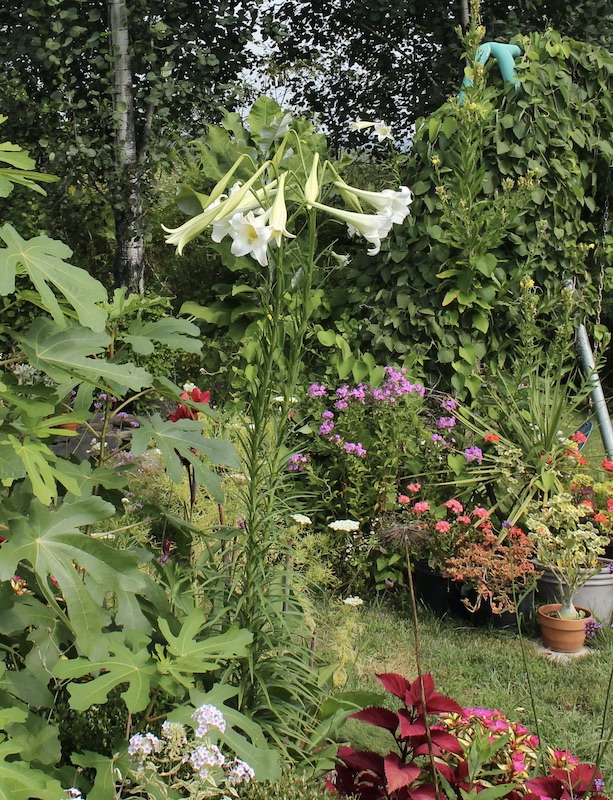
Lilium formosanum

Pure white, fragrant flowers is what Lilium formosanum offers.  Just watch out for those disgusting red lily beetles since they’re about the only thing which can bring this giant down.

I think you’ve heard enough from me today so I’ll just add one more thing.  A trumpet flower, but not a lily, Brugmansia suaveolens is hitting its summer stride.  This angel trumpet is a tropical shrub so I have my favorite local nursery to thank for a decent-sized plant, but I hope to overwinter it and have an even better show next year.  They’re another easy to grow thing but just ask for endless water and fertilizer in order to look happy, and usually I slack in this regard but since I paid for this plant I’m really making an effort.  It’s possible someone has already given me a cutting for a pink version, and perhaps I can round up a white and yellow cutting before next year and perhaps this means I’m obsessing about angel trumpets again but who’s really keeping track.  It’s basically a zucchini, if you can grow that you can grow these, just without the fear of missing a harvest and ending up with a caveman club in your veggie bed.  I guess I should mention that although I’m replacing zucchini plants with brugmansia in the potager, don’t nibble it during the garden tour since it’s quite poisonous.

Brugmansia suaveolens

Brugmansia suaveolens with canna ‘Bengal Tiger’ planted too closely.  As long as it feels like the tropics here we might as well enjoy the look as well, and the fragrance too since the brugmansia is very fragrant once night falls.

So that’s a somewhat rushed summary of the garden.  There’s more going on here and I’d like to go on about it but I’ll guess that this rambling on and a pretty long video are plenty so perhaps next post.  Obviously that could be a while, this appears to be the ‘keep up with nothing’ summer and not the ‘finally post regularly, visit all my blogging friends, keep the weeds back, finish the projects’ summer which I always imagine but it’s still pretty good, even with someone needing senior pictures this afternoon rather than help with her scooter and I don’t know how that came around so fast either.

Hope you enjoy the video and the upcoming week.

The Livin’ is Easy

This summer is going by way too fast and I am not liking that.  Just a day left in July and then it’s August and once August starts my summer days are numbered, and it seems particularly frantic because I still have tulips and daffodils and snowdrops which I’ve been meaning to dig since June as well as a bunch of potted things which I’ve been whispering apologies to all spring and summer as I keep putting off that job as well.  Don’t even ask me how the drip irrigation is going.  It’s been raining enough that watering has rarely come up on the to-do list, so of course repairing the drip setup keeps getting knocked off the top of the list, and I mention that one in particular because I had to go around this morning and save wilted things since of course I don’t water until it’s too late.  Have I mentioned in the last few breaths how much I hate watering?  Probably, but let me say it again.  I’d rather risk heatstroke weeding in the sun for a couple hours dripping sweat and covered in dirt rather than drag that stupid hose around.

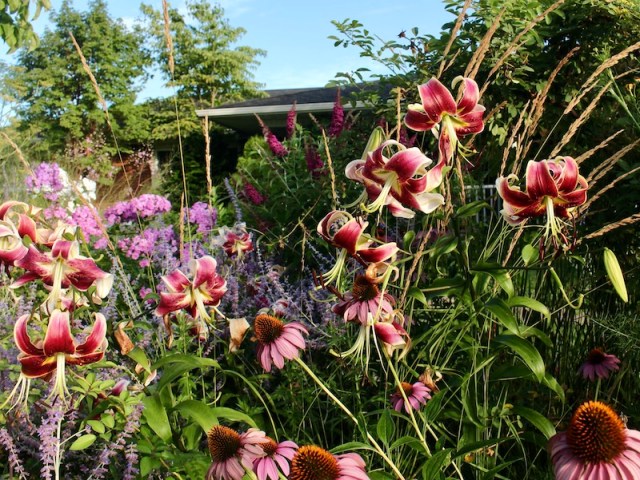
The front border is lush and overgrown due to this summer’s steady rains.  Even I think it might be a little “much” for along the street, but better too much than too little is what I say.  This is lilium “Scheherazade” doing well, and also not on the lily beetle menu (yet) so that’s also good.

Risking heatstroke and actual heatstroke aren’t separated by much, and with our third day over 90F (32+C) I’m trying to walk the line and avoid drifting over to the actual part.  Despite my love of lawn chairs and pool floats I’ve been far too busy outside feeding the gnats and losing water weight as I toil in the fields.  Maybe that’s not the worst training considering our potential future, but for now I do it for the fun of gardening and imagine Martha and Monty just as sweaty and disgusting in the heat of summer when they have their own daylily farms to rebuild.

summer lawn seeding

A daylily farm is rising from the ashes.  I’ve regraded and seeded the grass path, and as of today I’m happy to report a green shimmer as the seeds  begin to sprout.

My gosh, please skip ahead if you want to avoid the complaining, but it all started when I called the town a few days into staring at the bulldozed remains of my daylilies.  ‘So what’s the plan?’ I asked… and then entered into a discussion which became quite vigorous after I realized they thought I wanted to do all the repairs myself.  I did say that at the start when a hole at the street meant putting a few rocks back and maybe replanting a ninebark, but when the bulldozer and destruction moved twenty more feet into my yard and left a swath of raw shale and compacted topsoil, I assumed they might be able to spot me a little topsoil and mulch, even if they didn’t replace the farm or do any of the actual work.  A meeting was set up.  In the meantime I got to work.

First try to save a few things.  About half the daylilies were left with crowns so I uncovered them and gave them a little feed.  A few other things were uncovered along the street, and there might be hope for them over the next few weeks.  All my stones were buried, but one of the backhoe operators set aside a few new ones he found, and I got brave and split a bigger one to end up with two big stepping stones along the street.  The basketball hoop went back and then I regraded my little grass path.  In all I probably pickaxed and hauled off about 20 wheelbarrows of stony, shaley dirt to lower the grade and then tried to spread whatever topsoil they left into the beds.  That was awful, backbreaking work but then because I like a nice edge to a new lawn path, I dug up turf from in back and used it as sod to line the sides of the path.  Then the easy part of seed, topped with lawn clippings to keep the seed damp long enough to sprout, and then wait.  As of today, about a week later, the daylilies are sending up new growth, the grass seed is sprouting, and I’ve even popped in a few odds and ends like a new daylily or two, and some spare cannas and elephant ears to make it look less depressing.

daylily farm

There’s hope.

Since I took these photos, the town has come through with some mulch and topsoil, so more blood and sweat was shared for that, and we will see about the rest of the deal.  Hopefully the next farm report will be overwhelmingly amazing.  I have put some mulch down so I know at least that will be nice, and I’m in the process of picking daylilies to move in…. but enough of that… let’s look at where the rest of the garden is during these last days of July.

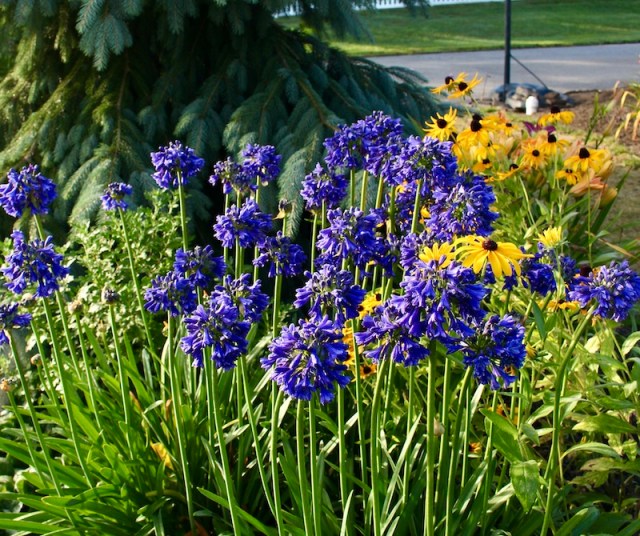
The agapanthus are blooming, and over the years ‘Blue Yonder’ has become a clump.  I love it.

I have nothing bad to say about the agapanthus this year.  They get no special attention yet are covered with blooms and have been perfectly hardy here for a number of years, with winter lows down to about zero and no protective mulch or sheltered location.  It looks like a few have enjoyed all this year’s rains, but even in dry years they haven’t seemed to complain too much.  I guess they’re as easy as daylilies, so I wonder if I can divide ‘Blue Yonder’ (my absolute favorite) and line out a row in the farm…. which would be awesome…

agapanthus campanulatus

Some agapanthus from seed.  These are A. campanulatus forms, the seeds of which were coincidentally saved from the bulldozers during the last sewer incident.

I guess I need to mention that not all agapanthus will be as hardy.  If you’re in a northern area, check up on the hardiness rating before you plant it, out in full sun of course and then never do another thing for it other than admire the blooms and bask in the compliments.

agapanthus hardy white

A dwarf white form given to me as seedlings from a white Seneca Hills Nursery(Ellen Hornig) selection.

Here’s one more look at ‘Blue Yonder’ 😉

agapanthus blue yonder

‘Blue Yonder’ has a richer color and flower heads packed with later flower buds, giving it a longer bloom time than some of the others.

I don’t know if I’d consider the agapanthus to be borderline hardy in my zone, I guess only a truly brutal winter would settle that, but I do consider some of the Crinum lilies I have planted to be borderline.  Two other forms are less than enthusiastic about life here in NePa but ‘Cecil Houdyshel’ increases in size and puts out a couple flower stalks each year so we shall only talk about that one.

crinum Cecil Houdyshel

Crinum ‘Cecil Houdyshel’ in front of the dark foliage of ‘Royal Purple’ smokebush, alongside the driveway.  Very elegant in my opinion.

As you would suspect, I don’t give this one any winter protection, and after our normal lows last year I was a little worried, but slowly he came back to life.  All the rain and humidity and heat must really have him feeling at home this summer, so hopefully there will be several more bloom stalks to come.

crinum Cecil Houdyshel

Cecil has a decent form, not as sloppy a mess as some crinum like to be but that’s just my opinion based on one plant and almost no other crinum experience.

Seems like we’ve left the daylily farm for a Southern excursion, so here’s another thing from down South.  Standing cypress (Ipomopsis rubra) is a native to Southeastern North America, or plain America as we in the US like to say, and it’s a cool thing.  The hummingbirds agree, and they’re aways buzzing this part of the garden when it’s blooming.  Two things though.  Everywhere I see it referred to as a biennial or short lived perennial and that’s fine, these plants are from a new seed source and they grew fuzzy rosettes last year with a five foot stalk erupting this summer, but the ones I grow from another source are strictly annuals and never form rosettes and never live beyond year one.  Who knows.  It’s above my pay grade to wonder if they are all the same species but these are the curiosities which live in my brain so I’m sorry to put it in yours now.

Ipomopsis rubra

Ipomopsis rubra, paired with the lovely neon green foliage of pokeweed (Phytolacca americana ‘Sunny Side Up’)

The potager is another curiosity.  I wonder if I can still call it a potager when 90% of the plantings are not-vegetables, but can’t quite bring myself to admit it’s become another flower farm.  Perhaps there’s an authoritative number listed somewhere in France for potager percentages but do supposedly-edible dahlia roots and figs-which-will-never-produce-figs count as veggies and fruit?

cannanova rose

Cannas are blooming quite well in and around the potager.  This is ‘Cannanova Rose’, an easy, quick to bloom selection which even comes true from seed.

Whatever.  Potager it shall remain.  If I can get away with calling a couple rows of daylilies a farm than I can stick with potager for this.

potager

My little tropical hiding spot in the potager.  Bananas are totally edible and potager approved even if there’s next to no chance I’ll ever see fruit, but the foliage makes up for any missing banana harvest.

I refuse to share a photo of my pathetically anemic tomatoes or the deer-chewed pepper stubs but I will share a single phlox photo.  Only one because the rain-fueled hydrangeas have crowded nearly everything else out, but one should get the point across.

phlox paniculata

The garden phlox are a little late due to an early season deer pruning but they’re finally making a show.

Can I put in a good word for pears?  As of today the tree is overloaded with a heavy crop, and although the gardener should have thinned them out for better quality (and to save the tree from collapse) my hope is that a few escape the deer and squirrels and chipmunks and make it to the dinner table.  A bushel of Bartlett pears will really put the potager accounting into the black in a way that 3 raspberries, 7 gooseberries, and a half handful of blueberries will not.  Someone really should have netted the berry bushes rather than continuously hope the birds ‘miss a few’.

bartlett pear

This year’s Bartlett pear crop, heavier each day and hopefully not too heavy.

Maybe the berries didn’t go far in feeding the household, but they did contribute to a steady stream of fledglings coming out of the garden.  I don’t really mind the loss, and actually resist netting the fruits since the dopey youngsters tend to get tangled and I prefer a fruitless pancake over a traumatic bird un-netting.

baby robin

Yet another robin leaving the nest.

So that’s where we’re at.  A lot of rambling so I’m wondering if perhaps the heat got to me more than I care to admit but hopefully there was something of interest in there.  In spite of all the work summer is still quite excellent and so is the air conditioning when the heat gets to be too much so I really can’t complain.  Enjoy your week!

A Clean Slate

Well here’s a first.  I had photos and a post started, with the usual apologies about the delay and how the pictures were already outdated, and promises to do better next time, and how this would still be the year things turn around completely and I bringing timely posts and amazing content, and then I deleted it.  Not through some silly mistake, but because things changed here so much that none of it mattered anymore, and all that anticipation for the daylily farm season became pointless.  I liked my daylily farm.  It was fun.  You may have already noticed the past tense.

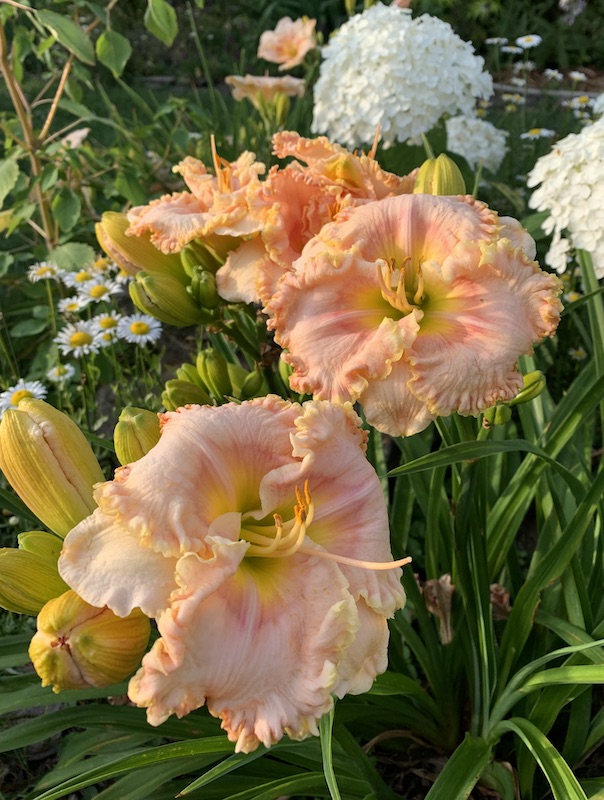
growing daylilies

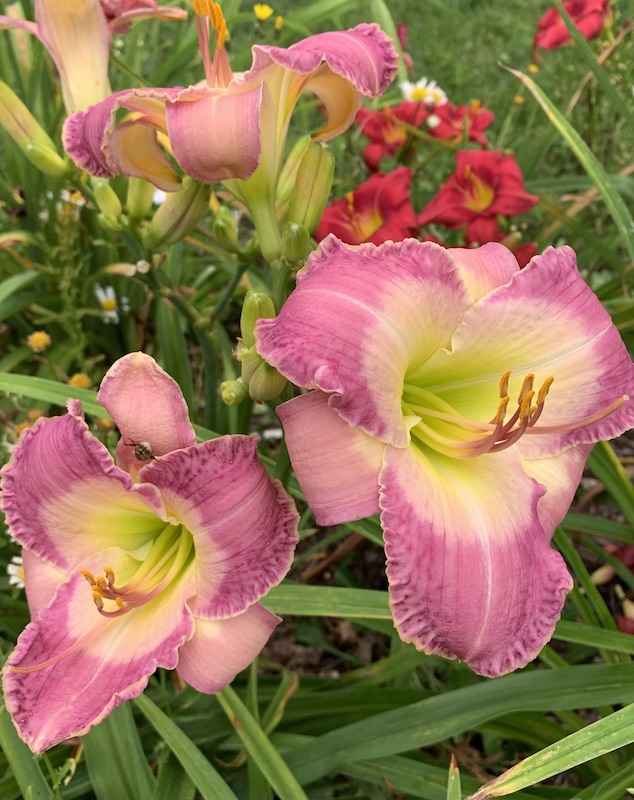
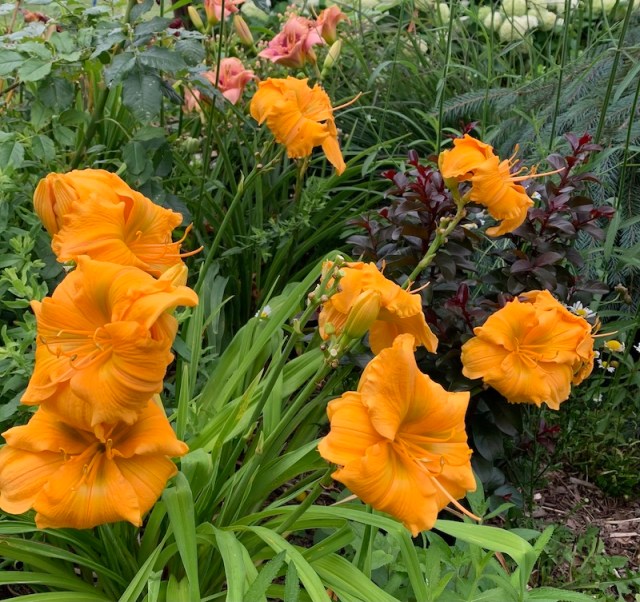
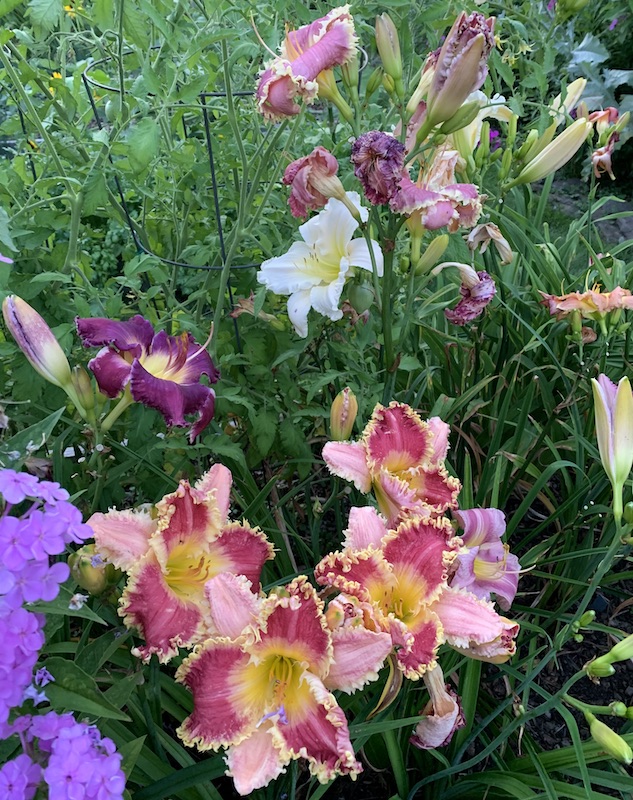
I shouldn’t like all the soft colors and fancy ruffles on this Brookside Beauty seedling but I do.

So let me start the story by saying the farm was amazing a week ago with overcrowded plants blooming at their peak with more buds than ever before.  It was a garden filled to capacity and I was almost willing to say it looked perfect… except what gardener ever thinks their garden looks perfect… but it was closer than I usually get so things were quite pleasing.  I could almost finish the entire morning coffee in the daylily farm alone, and outside the dog becoming bored stuck in one place so long it was the place to be.

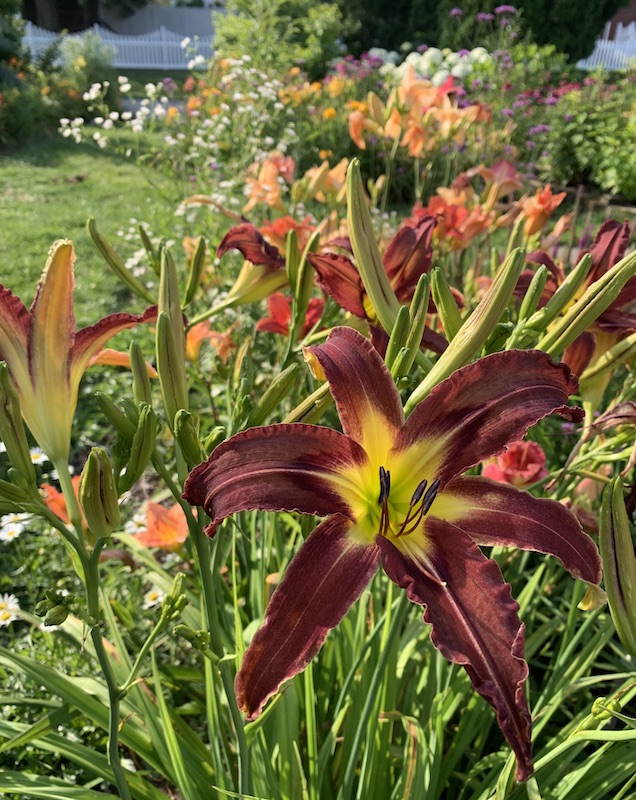
growing daylilies

I’m starting to like the browns and smoky colors as well.  They’re not as showy but…

I even reached the point were I said I really have to do something here, they’re getting crowded and it’s time for a few to move on.  Some pictures were taken.  A marketing and sales plan was put together.  The daylily farm was about to become a cash cow I’m sure 😉

growing daylilies

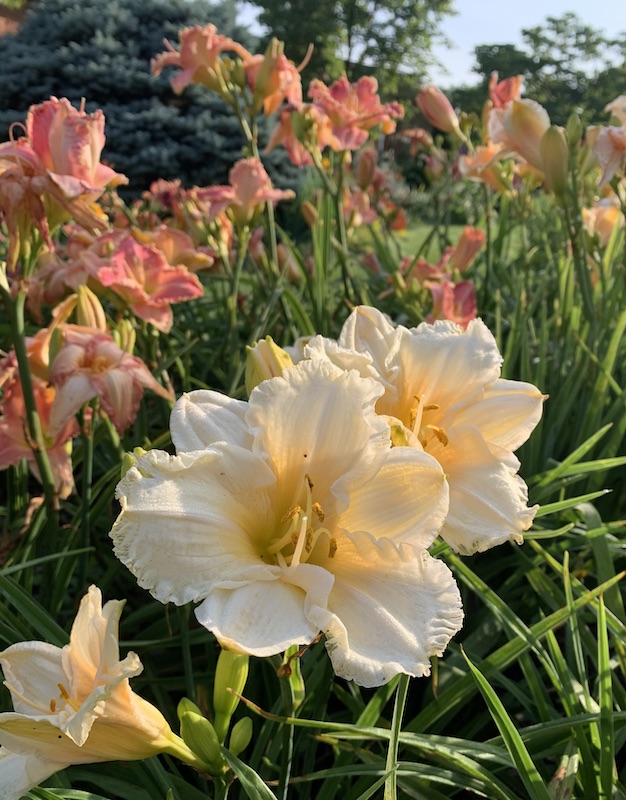
Another pale, yet simpler bloom, ‘Bus Stop’ calms the morning sun on a day which breaks humid and hot.

growing daylilies

‘Lake Lurie’ has a paler eye zone and guess what?  I’m really starting to like these as well

Here’s one last picture of the daylily farm.  I took it with the intentions of posting a sale for anyone local who was interested in helping me clear the fields.  Notice the backhoe near the street.

growing daylilies

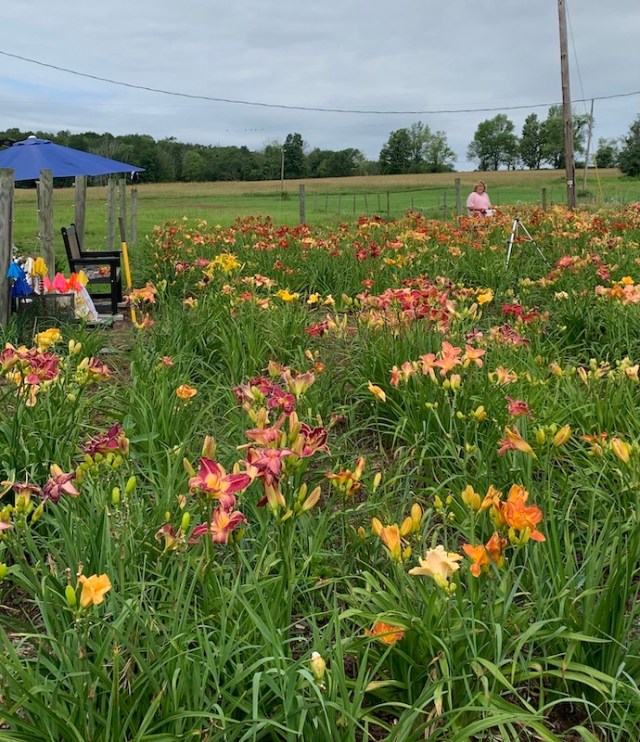
One last farm picture.  Peak bloom.  The grim reaper sits at the street, slightly hidden by the golden ninebark.

That photo became the before picture for when I needed to show the township just how much was lost.  A sewer issue for the house next door warranted a hole near the street for repairs.  They told me what needed to be done and I said no problem.  “We’ll fix it back as good or better” was the promise, and there was the possibility they’d go as far as five feet in from the street and I might possibly lose the yellow ninebark which blocks some of the excavator from sight in the before picture.

garden destruction

Destruction.  The whole daylily farm is bulldozed as well as the lawn and some of the front border.

I was home at the time and had checked in after they dug down to the sewer line.  I saw the ninebark go and was a little sad but that’s fine, I was warned.  Of course the air conditioning broke that same day so when the repairman came by and we walked out there to check on the unit I almost went into shock when I saw how far things went.  Some of the line was damaged during digging, some of the hole collapsed in from under the street, the holes go down at least ten feet and we needed a bigger hole and that’s a lot of dirt and it had to go somewhere.  The destroyed daylilies were one thing but snowdrops were also in the area, and it’s not promising to imagine a tiny bulb an inch or two down in the soil being able to stand its ground against a four ton excavator.  The daylilies I can replace but the snowdrops not so much.  Of course there were a few real expensive ones planted on the edges of the farm beds and around the weeping spruce.

growing daylilies

Welcome to Garret Hill Daylilies, a real daylily farm.  Where better to go when you’ve lost nearly 100 large, blooming clumps!?

Fortunately the trials of this garden are all manageable.  Things could be much worse and most importantly my mom was able to visit just the week before when everything was much cheerier.  I’ve already started the repairs, and no, they’re not doing them I am because I want it just so and their version of landscaped might not match mine.  I can’t really fault them.  Things happen, they could have let me know when they were coming so far onto my property, but when you’re ten feet down in a hole which could collapse around you I understand that’s a little more important.  We’re still working out the details of what will make it right again.

growing daylilies

The dust is still settling and I’ve already picked up three new clumps to ease the pain!  Money can’t buy happiness but it can buy daylilies at least and that’s a start.

So I visited my local daylily farm, Garret Hill Daylilies in Honesdale Pa and started the unnecessary task of finding replacements.  Yes I need replacements and they have so many cool varieties available but who among you thought I wouldn’t have a few backups around my own garden?  I do and they need moving and more room but I think the healing process should include daylily farms and even more new daylilies 🙂

growing daylilies

This one could be divided and for some reason I really like the wide open flowers even if I can’t remember the name at this moment.

The one downside is I’m repairing the damage and creating nearly the same garden as I had before and that’s totally not how I like to roll.  Deja vu should be a mysterious feeling, not the realization that I did this all two years ago when my own sewer line was dug for different reasons.  I’m building back better which is good, but I wouldn’t be doing this if I had the choice.

growing daylilies

Daylilies in with the tomatoes?  A good excuse to not plant as many vegetables, but these guys really deserve more room and their own space.

So that’s where I’m at.  I get new plants and just have to ignore bulldozer tracks, crushed plants, deer visits, lanternfly plagues, gnat swarms, too much lawn mowing, too much container plant watering, and all the other surprises which a gardener deals with each year.  It’s what we sign up for so please don’t feel bad for me, I’m really not upset about it anymore and the only thing still annoying me is the mud and waiting for mulch to arrive.

Hope your July is far less dramatic and you’re enjoying summer as much as I am!  …hmmm, reading that back it sounds mildly sarcastic, but summer really is pretty excellent even when you’re losing shoes in the mud and the sweat is running down your face.  There’s always the pool and a drink followed by lightning bugs and a fragrant night blooming daylily and you can’t get that in November.  Have a great week 🙂

Love and Hate

We went on a little trip a few days ago and were gone for barely two days and the garden fell apart.  It was mostly the fault of the weather as temperatures sat in the mid 90’s each day (35C) but it didn’t reflect well on my plantings and I was generally disgusted to see them all go to pieces in such a short time.  This post would have had a much more one-sided title had I put it together that next day, but fortunately things move slowly here and I’ve had a few days to reflect and recover before putting things into words (and pictures).  Plus it rained.  A summer rain storm can change everything, and between that and some directed culling and chopping and fertilizing, there’s a slight air of positive vibes drifting through the yard again.

succulent garden

Pots of succulents can withstand quite some abuse, so are perfect for the roadtripping gardener.  Tools scattered about can also make things look busier than they really are… until someone asks when the last time they were used was…

As usual much of the problem is the gardener’s fault.  Normally drip lines on a timer nurse nearly all the potted plantings throughout the summer, but “I think I’ll just rip them all out since I should probably re-think the layout” happened when the deck was worked on, and re-thinking doesn’t really get water to plants as well as a drip line does.  So once the gardener chose to continue gardening for the year, the first thing on the list was watering containers.  It should have been repair the drip lines, but it wasn’t, and it also wasn’t the second thing.  The second thing was to either cleanup, repot, or toss any of the succulents which weren’t already out on the summering wall.  I’d been holding quite a few back because they weren’t quite display-ready, but after seeing how they were the only things not complaining about summer I decided to reward them with a little attention.  It worked, and things look better, and best of all anything which looked sad or filled with complaints was tossed.  My theory on the last succulent pots was the same as what normal people apply to their wardrobe.  Anything you don’t use or love or haven’t worn yet this season goes on to the ‘goodwill pile’ and gets recycled as compost 🙂

succulent garden

The sloppy little stone wall is again topped with various potted succulents and somehow I’m short on pots again.  That could be an easy fix but the gardener is not allowed to visit the terracotta isle any more.

Purging the pots was a relief, and then trimming the box hedge and mowing the lawn were also excellent jobs for improving the gardener’s outlook.  The lawn doesn’t really need mowing, but the weeds in it do, and trimmed up they look so much better.

Then I looked at the flower beds and purged them as well.  Mid summer should be a lush highlight for the garden, but the heat has taken a toll and in the mood I was in there was no room for tired plants.  So now I have empty spots and need mulch, but who doesn’t like spreading mulch in the middle of summer?  Fortunately that same day we also opened the envelope containing the bill for the boy’s first year of college, and seeing that ‘realigned’ how much of the budget was going into mulch purchases!

coleus planting

Tulips (and plenty of weeds) finally came out of this bed early in the month and all the leftover cuttings and roots and tubers from the garage went in.  There is a new crape myrtle, and it’s so full of buds I don’t even care if it’s hardy or not!

Summary so far:  Most of the garden has been composted, but at least it looks neat.  A good rain has helped.

toothy daylilies

A few of the ‘toothy’ daylily seedlings which have been added to the garden.  They’re interesting and I think I like them, but I’m more of a craftsman style, and less Louis XVI.

The gardener should stop complaining.  Flowers abound, the pool is perfect, the agapanthus are starting, and nearly every evening is filled with fireflies.

hardy agapanthus seedling

A few seeds were collected off the hardy agapanthus a few weeks before they were bulldozed into oblivion and now two years later we again have blooms.  I’m quite happy with them.

Maybe now we will finally get to the stupid drip irrigation.  It’s not hard at all to set up, but the gardener hates crouching under the deck to run the lines, and he knows he has to do a nice job this time since everything else looks halfway decent and a bunch of lines thrown around would not show well.

Have a great week and I hope your summer garden is doing well.  If not I suggest a purge, a little mulch, and maybe a new succulent and things may improve immeasurably 🙂

Fast Forward

I’m not quite sure what happened to August, but I just looked at a calendar and it’s practically over.  I like August, and I’m not thrilled at all with this time warp.

January has the same number of days, and January never seems to fly by as quickly… even though the days are so much shorter… so maybe some weird time continuum thing is what happened.  Or maybe it’s a simpler explanation like ‘time flies when you’re having fun’.  Maybe not out-all-night, the-neighbors-called-the-police fun, more like stretching morning coffee time on the porch or going in the pool before bed just because you can fun, but it’s still fun and I feel like these days are numbered.

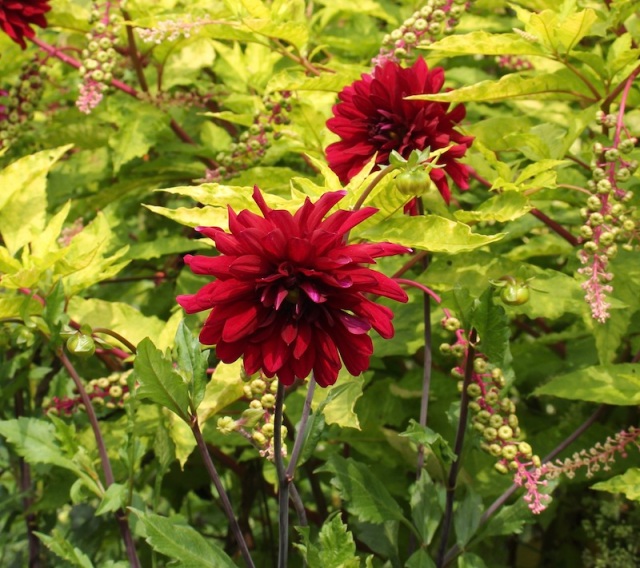
rudbeckia prairie glow

By June nearly all the Rudbeckia triloba ‘Prairie Glow’ in the front border was dried up and dead, but in July and August a steady lifeline of rainstorms pulled them through.  I’m happy for that, they look great now.

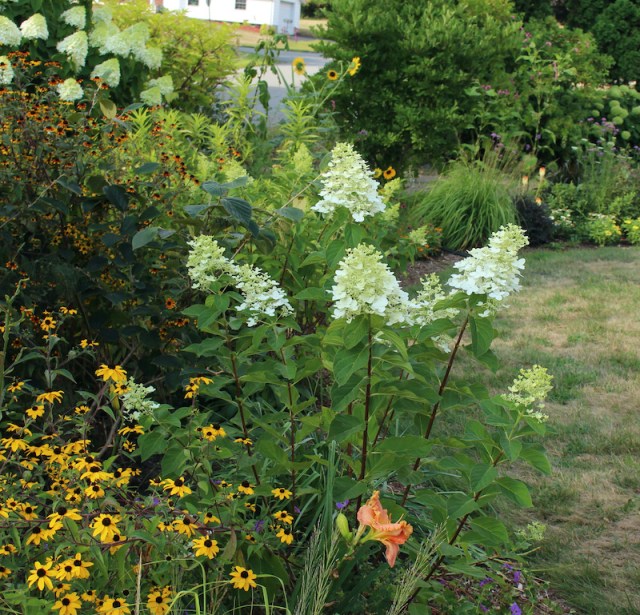
Maybe August flew by because the pressure here really eases off in late summer.  Things are either done or they’re not and there’s much less to worry or even care about.  With ample rain things here look good, and most days I just wander about admiring plants like rudbeckias and hydrangeas.  The Hydrangea paniculatas are at their peak now, and they’re always kinda awesome.

hydrangea limelight seedling

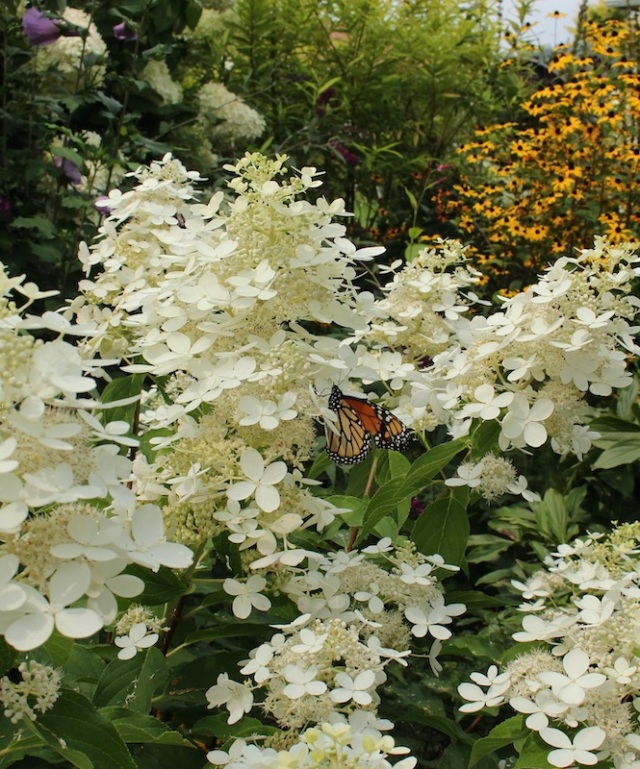
This lacier hydrangea was just buzzing with all the bumble bees and wasps, but even a Monarch butterfly stopped by for a drink.

In my opinion you can’t go wrong with one of these late season hydrangeas.  They’re hardy and always bloom here (unlike their blue cousins) and all they ask from me is a late winter pruning to thin out the stems and keep them from getting too out of hand.

hydrangea limelight seedling

A strong pruning in spring keeps the ones on the edge from getting too big, the ones further back are allowed a bit more freedom.

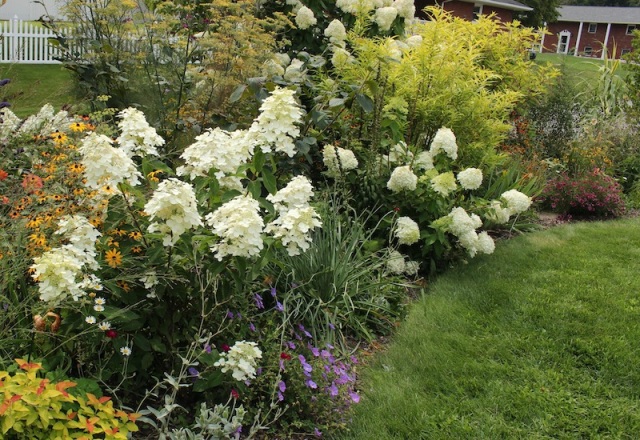
All these hydrangeas are either H. paniculata ‘Limelight’ or seedlings from her.  The seedlings have been remarkably nice, and I might try another batch just to have more of them since why not?  They’re all a little different and I enjoy the variations along the street border.  They’re all a little greenish to start, and I actually moved out my one pinkish ‘Vanilla Strawberry’ because it seemed too white and then too pink alongside all the limey tones.

hydrangea limelight seedling

Seedlings of Hydrangea ‘Limelight’ carrying the front border through August.

I don’t think I’m kidding anyone when I talk about setting color themes and working out an organized display in this garden.  The history of this place is closer to planting whatever is at hand in whatever space is open and hope that something works out well.  I guess for late August these hydrangeas worked out well.

cannanova and verbena bonariensis

Cannas and Verbena bonariensis also work well.  The cannas were rudely dumped here and the verbena came up on its own.  Actually only the yucca on the left was planted here on purpose, and even that was a rescue from the trash.  Not bad, but I did weed out a bunch of less lovely things as well.

The rest of this post is just heres and theres and updates.  Less is more, right?  And based on how little I’ve been posting lately maybe it’s better to just get anything up rather than some overly wordy thing which gets tedious after a while, plus I’d like to get to bed early so that’s another incentive for brevity 🙂

dahlia matthew allen

Dahlia ‘Matthew Allen’ amongst the pokeweed.

garden stone wall

The stones are all “organized” along the slope and the grass seed is sprouting.  Finally it looks less like a excavating playground and more like a spot which just needs a little foundation work and a nice bed along the house with anything other than crabgrass.

As usual the potager is a mess of overgrown vegetables and aggressive vines.  Of course I like it, but I’ll have to confess that it only took two years for the 100% vegetable beds to turn into 25% vegetable beds plus bulbs, tree seedlings, shrub cuttings, small transplants, phlox beds, daylily beds…. a bare patch of soil is rarely planted to lettuce, coleus cuttings and canna seedlings are much more likely.

garden potager

At least the lawn is mowed.  Studies show that any disaster garden looks 78% better with a mowed and edged lawn area.

garden potager

Beans and a few diseased tomatoes are the only legitimate vegetables still growing here.  Now if I could only motivate myself to pick them.

lycoris sprengeri

Of course any decent potager has a few Lycoris in it.  This ‘magic lily’ from a mixed batch of Lycoris bulbs has produced some nicely colored blooms.  I’m guessing it’s a form of Lycoris sprengeri and I’m guessing it will now take three years off from blooming, just because…

A weedy vegetable garden is one thing, but a weedy waste area is an even better thing.  Here’s an Instagram-ready photo of the lovely waste area which is now filled with blooming canola, sunflowers, and a new lawn infested with Verbena bonariensis seedlings.  It’s an interesting place, and while I stopped mowing the newly seeded section of lawn so the Verbena can grow into a purple mass of flowers, it’s the cannola patch which demands the most attention.  Hundred of honeybees (and a few others) make this corner of the yard buzz on a still afternoon.  I can’t believe how many there are.

garden waste area

The ‘waste area’ where all the construction fill was dumped and leveled.  It’s a weed factory and probably my favorite part of the yard right now.

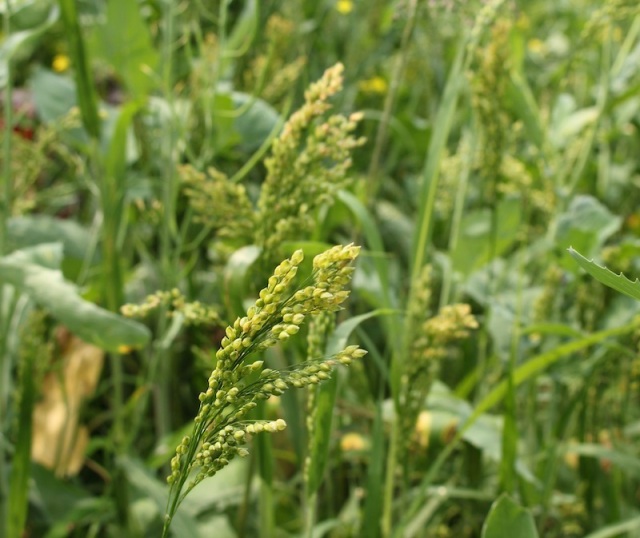
I’m still on the fence as to whether or not the birds will appreciate the cannola seed as much as the bees appreciate the flowers.  There will be plenty, but as of today I haven’t seen a single seed pod attacked for its contents.  That’s in stark contrast to the millet seed which is beginning to ripen in the shadow of the cannola.  Chipping sparrows and song sparrows attack the seedheads, and there are always a few in the area to entertain me.

millet bird seed

Millet seed heads beginning to ripen.

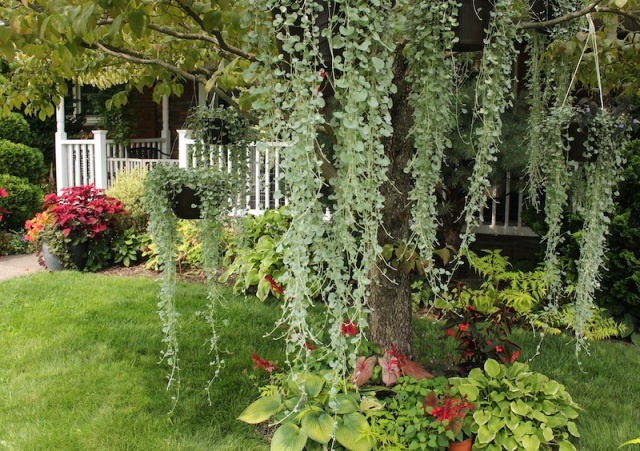
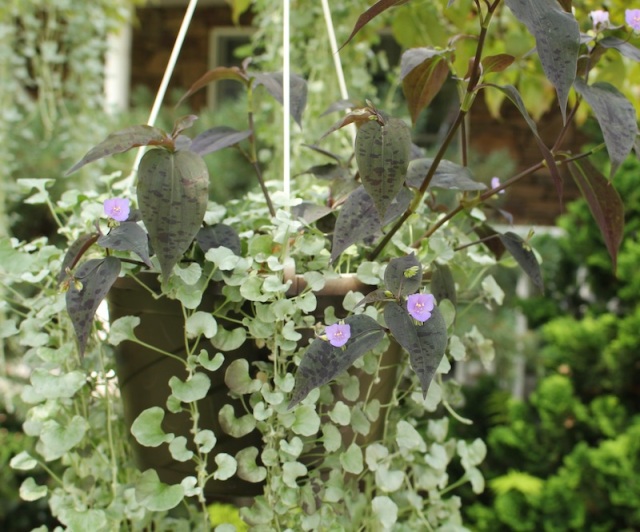
Besides an area of the yard dubbed ‘the waste area’ my garden also boast a slice of Savannah  this summer.  ‘The Old South’ is where all the hanging pots of Dichondra ‘Silver Falls’ ended up, and my boring old pink dogwood has been elevated to the role of sprawling live oak with the Dichondra playing tendrils of Spanish moss weeping down from the branches.  I’m entirely amazed with myself and smile at it every time I pass, even if the local review is closer to a polite ‘I don’t understand why’.

dichondra silver falls

It grows like a weed, and probably is a weed in warmer climates, but here Dichondra ‘Silver Falls’ is just a nice little plant which eats up the endless rain and humidity and turns it into curtains of gray.

Surprisingly the gardener has yet to smack his head on one of the hanging pots, and still smiles when he weaves through the pseudo-moss, not really moss but pseudo-bromeliad veil.

dichondra silver falls

There are even a few nice surprise weeds (spotted widows tears, Tinantia pringlei) in the pots of intentionally planted weeds.

I’m just excited to think how much more this will develop over the next month, and of course this winter I’ll foolishly try and winter them all over and see how much bigger and thicker they can get next year.  Obviously I’ll need more caladiums underneath and honestly I think a few Boston ferns would only add to the effect.  Maybe I can wire the ferns onto the dogwood trunk and tuck a few more into the branch crooks and bends.  My whole next year can revolve around this silly idea and I’m sure sitting inside this winter stewing on it will only help 😉

dichondra silver falls

No one really says anything about the tree but I’m pretty sure they all think it’s amazing.  If only I could find one of those ‘Midnight in the Garden of Good and Evil’ statues to complete the theme.  That would probably be much more tasteful than trying to re-create some marble mausoleum or deep South cemetery vibe on my front lawn.

In the meantime as this design concept matures, I’ve gone ahead and given two more crape myrtles a chance at life (but more likely death) in this garden.  This will be attempt four, and usually three is a respectable place to stop, but I’m gambling on science and planting for an increasingly warm climate here.  I saw crape myrtles (Lagerstroemia) in bloom all over Long Island on my last visit, and it’s only been a few decades since they would regularly freeze to the ground or outright die over winter in my parent’s garden.  Not to be greedy, but I’d like a large tree in purple and one in a bright cherry or red, and I’ll be on the lookout for a cheap starter to experiment with.  In the meantime the ones I’ve added are two dwarf forms which should easily sprout from the roots and bloom even when frozen to the ground.  From tiny plants this spring, they’re both forming buds and blooming this summer.

crape myrtle barista series

From the Barista series of dwarf crape myrtles, this small plant will hopefully develop into a mound of dark foliage studded with brilliant blooms.

So there it is.  The closest I came to a vacation this summer, a trip to fake-Savannah with it’s fake moss and a little token Mc Crape myrtle.  I hope to do better next year, but in the meantime even the weediest waste areas of the garden are entertaining me at this time of year, and I’m hoping to ease into colchicum season without the usual whining about fall and autumnal gloom.  It’s all good 🙂

Welcome August

After a rough start to the year the garden is about where it’s usually at.  I’m glad for that since in June it looked like a year of brown lawn and wilted flowers was ahead, but now things are mostly ok.  I’d say totally ok, but when things dry out so much it takes a couple days straight of rain to really get into the soil, and in spite of frequent storms there are plenty of sloped and harder-soiled areas where things are back to wilting.  Regardless, things look good enough and I’m happy with that.
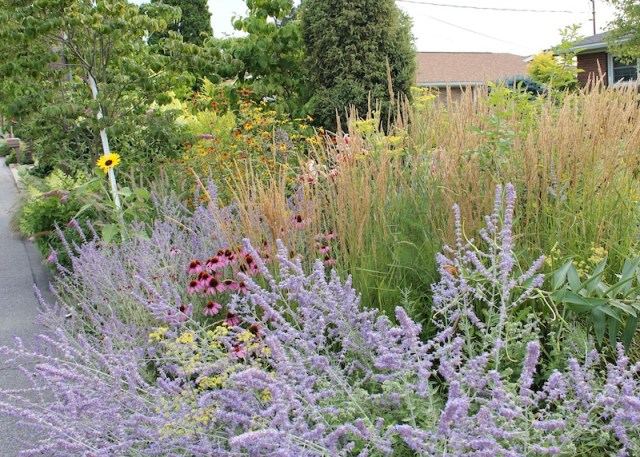
the front perennial border

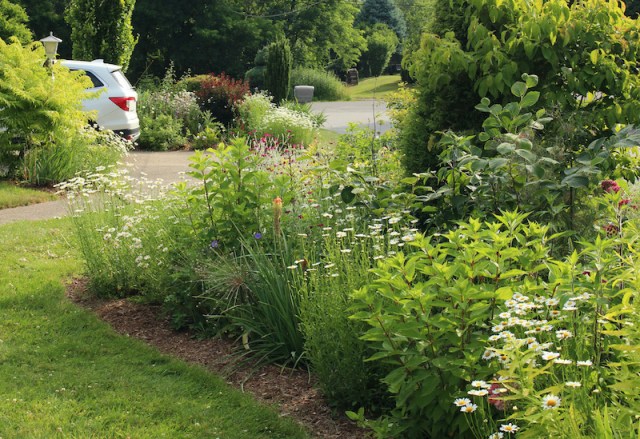
The front border along the street is reveling in a full-summer show of perovskia and coneflowers, but sunflowers haven’t seeded in like they normally do.  I blame the dry spring.

I’m also happy I put off planting annuals this spring.  First of all there’s barely any room in the front border where I normally plant them, and second of all even with the rain here and there I’d still be watering them.  One less job fits into my schedule perfectly!
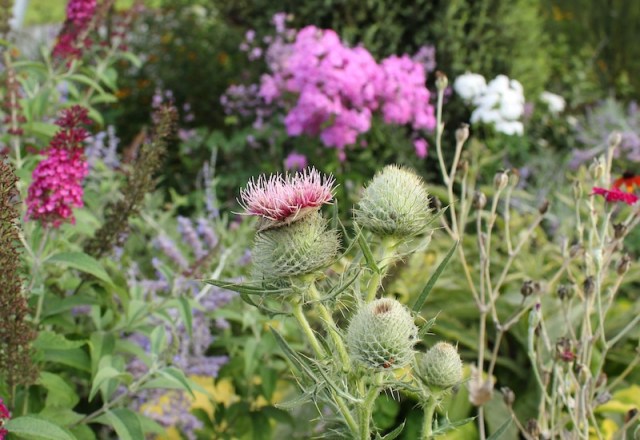
cirsium eriophorum woolly thistle

I do like a woolly thistle (Cirsium eriophorum) here and there in the garden.   Most visitors would accuse me of letting a weed grow, but I’m sure they’d understand when told it was planted here on purpose.

Maybe someone at some point said a dry summer would be the perfect time to ‘thin the flock’, create some space for mulch, spread some iris around, create a generally less cluttered and wild planting… but I think you know where that idea has landed.

klasea bulgarica

Klasea bulgarica suffering along in a less-fertile and less-watered spot in the border than it would like, but it’s still a cool thing, even at five feet rather than seven.

It would be fun to complain endlessly about jobs not done and tasked shelved for the future, but let me first share a somewhat finished photo of the former construction road alongside the house.  Something did get done this summer, and even with its lack of mulch (still hoping to get to that this fall), the emerging grass makes for a more inviting path than an uneven landscape of dumped concrete and roadside weeds.

garden entrance

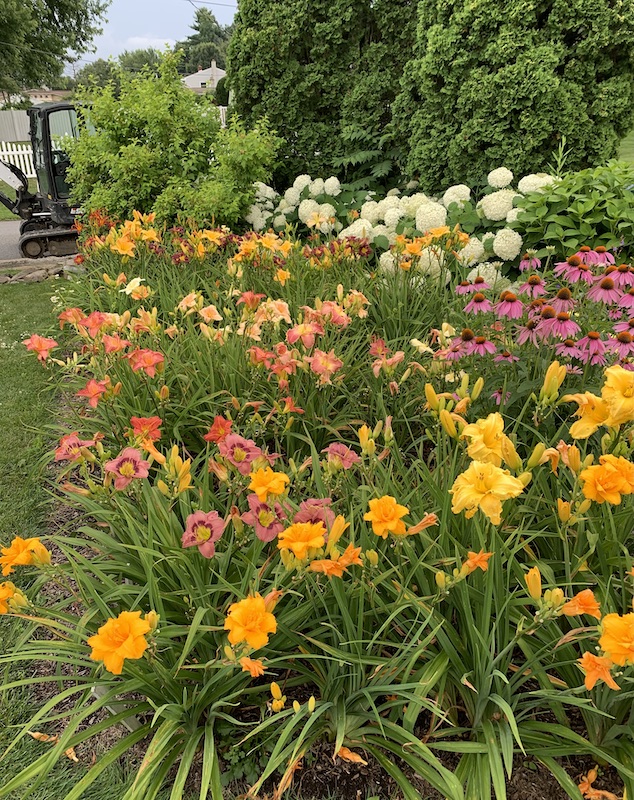
I’m not sure anymore what the arc of stones was supposed to convey but it’s done and will likely stay this way for years, but at least the new grass makes sense, and will lead visitors up past the new daylily border, and allow them to oooh and ahhhh on their way to the daylily farm fields.

Since I think I heard someone ask why I wasn’t posting enough daylily photos, here are a few still in bloom this weekend.  Late bloomers and rebloomers is how it is since the bulk of them wrapped up the show a week or two ago.
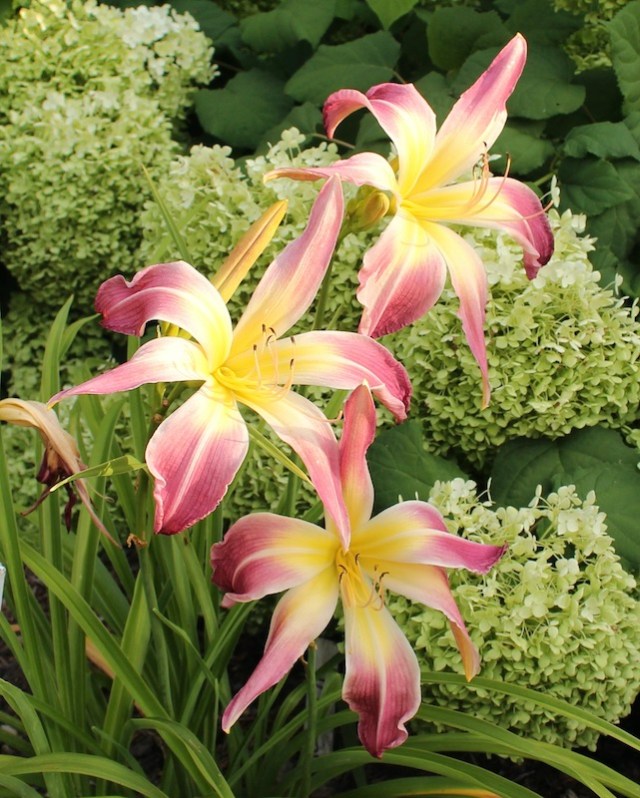
daylily websters pink wonder

One of the nicest ones is this gift from my friend Paula.  In theory I should divide it for the farm, but ‘Websters Pink Wonder’ might be something I need to hold on to for “evaluation” until I have a huge, huge, huge clump of it!

daylily apricot peace

Also a gift, from another friend, is ‘Apricot Peace’.  As other parts of the garden look a little worn out from the summer, this flower is as refreshing and delicious as any sun-riped summer fruit.

Since daylilies aren’t everyone’s cup of tea, here’s a break to look at the tropical garden.  This end of the yard suffered through a lot of neglect as the gardener raced past this construction-ravaged part of the estate to go stick his head in the sand elsewhere, but after some time, rain, and lots of weeding, trimming, and rock-picking it’s at least less than a complete disaster.  Actually it was Verbena bonariensis which saved the day.  Its pollinator-filled haze of lavender-purple flowers covers up many of the sins of this season even if it does obscure the daylily flowers more than I’d like.

the tropical border

The tropical border.  You may notice that the huge mound of yellow pokeweed (Phytolacca americana ‘Sunny Side Up’) is way to big for its space and way too much yellow, but I just don’t have the heart to trim it.  You may also notice a lack of tropicals…

If I had to summarize for a sure-fire way of saving the late summer (full sun)garden, I’d say Verbena bonariensis, Hydrangea paniculata, and cannas.  The three of them just ask for a little water and maybe some fertilizer, and BAM you’re a gardening rock star.  Sadly I didn’t take a photo of the hydrangea this week, but how about this color from the cannas?
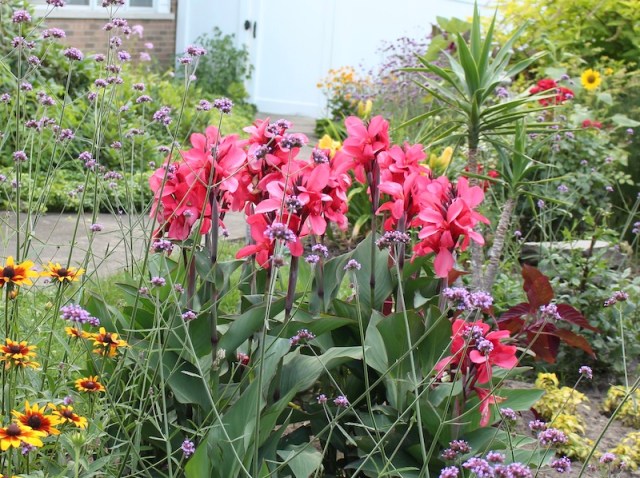
cannanova rose

‘Cannanova Rose’, one of the newer seed strains of cannas, is disease free and flowers all summer and into fall if you just keep snapping off the seed pods.  A plus for growing it in the North is the lack of canna roller caterpillars destroying the foliage, since they (and the cannas as well) can’t handle our winter cold.

What?  More daylilies?  You’ve got it.
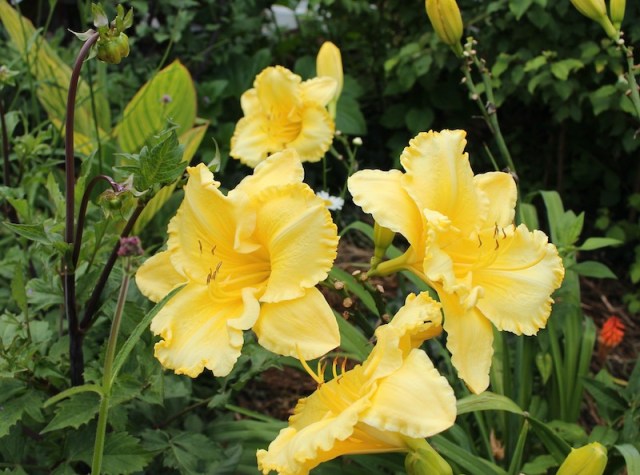
daylily chama

‘Chama’ is a later daylily with a long season and big flowers.  I’d say seek it out but with all the hundreds of other yellows out there I’m sure you could find something similar which is just as nice.
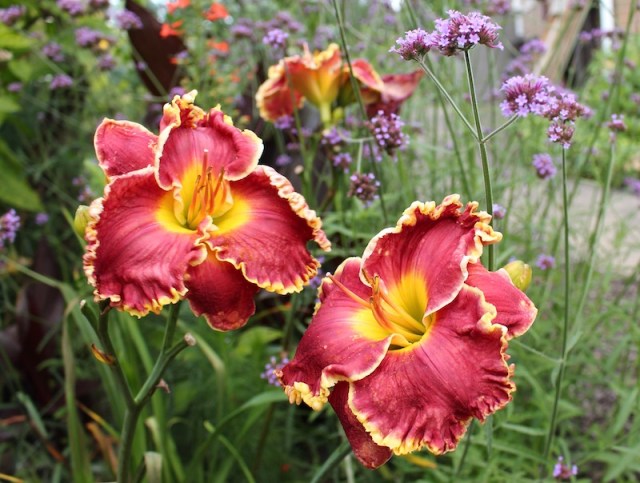
Brookside Beauty seedling

This Brookside Beauty seedling is not quite as average as a yellow.  I picked it up this summer at my new favorite local daylily farm, Garrett Hill Daylilies, and maybe it’s too much of a lot of things but I’m quite happy with it.
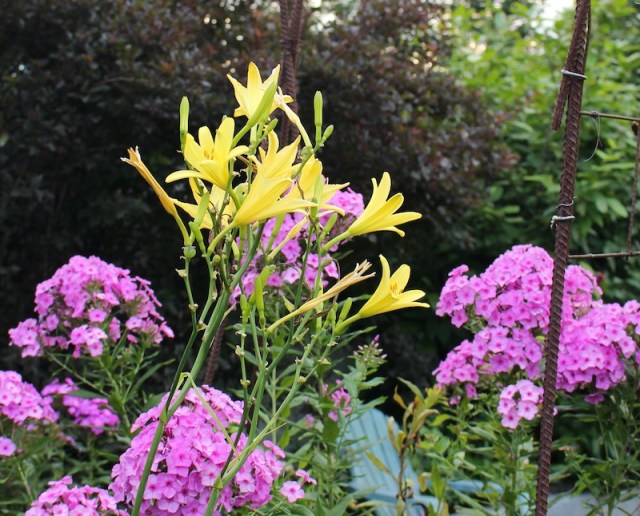
daylily hemerocallis altissima

It’s not all rippled edges and intense color.  Here’s the more simple flower of a species daylily, Hemerocallis altissima (probably).  Fragrant, tall, elegant, opens in the evening and then closes for the heat of the day, this daylily has a lot to offer as well.

Ok, let’s keep moving.  The potager is beans, tomatoes and… daylilies now… I was fairly good for three years with my vegetables only policy (plus a few tulips), but that ship has left the pier.  The beds are now filling with things like witch hazels and marigolds, cannas and phlox, and quite a few daylilies as well.  It was a valiant fight but vegetables really are a lot of work, and the farm stand does it much, much better, so…. maybe we don’t need to grow our own cucumbers just in case we feel like eating a cucumber or twenty.

sunflower

One of the few sunflowers to seed out this year… and a little short and small… but I’ll take it, as will the goldfinches I’m sure.

Right over the boxwood hedge of the potager is the stone wall which I went on and on about last year.  It’s still there and it’s still the summer home for a few succulents, except for as hard as I tried there seem to be even more this summer.  Someone will point out that I bought a few more .99 cent treasures on a summer plant trip, as well as a tiny box of cuttings and living stones last winter, but these aren’t even out there (they’re just too cool to put so far away), and all of these are just repots and divisions and cuttings.  Someone needs to stop this ‘let me just take a few cuttings’ thing, just like the rabbits stopped the living stones thing.  Had I known that the rabbits would consider the pots of living stones to be tasty little green jellybeans perfect for nibbling, I would have put them somewhere out of reach, but I didn’t and now they’re gone.  Hmmmm, come to think of it my last living stone was the victim of a chipmunk attack.  I guess they’re tasty little things and I should have known better.
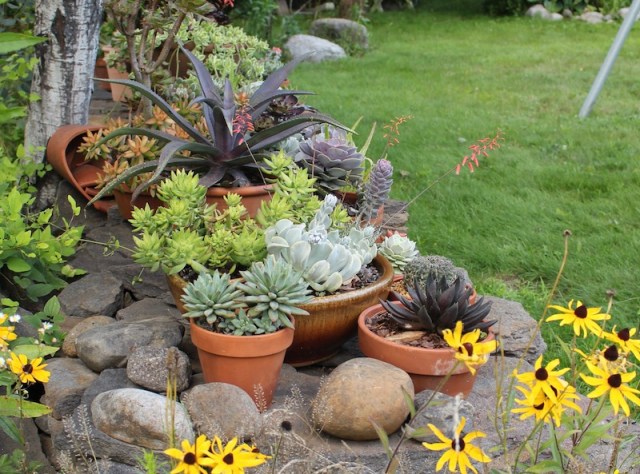
succulent display

Some of the old standbys which are apparently less tasty than living stones (Lithops).

So I guess I killed off the living stones through my own mistake.  Actually the bunnies pulled a “propeller plant” off the wall and destroyed that, as well as a “lobster claw” which was also apparently too tasy to resist, so they’re not as cute and innocent as I like to think.  Maybe I’ll just accept that and reconsider my succulent vetting process to include ‘easy to overwinter’, ‘thrives on neglect’, and ‘is not yummy for bunnies’ and move on.  Trust me that any roadblock to the succulent collection growing is probably a good thing, especially when fall turns to winter and all those clay pots need lugging in.
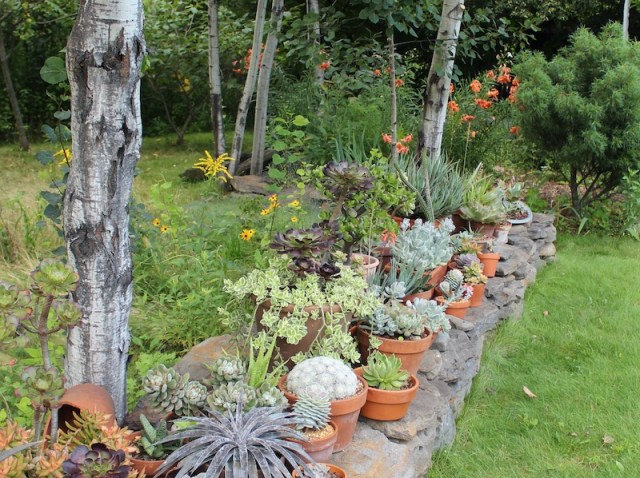
succulent display

Further down the wall.  It doesn’t look too bad until you do a pot count, and it’s pretty much every last terracotta pot I own so another roadblock I set up is ‘no more terracotta pots’… unless it’s a really good sale… or they’re free… or it’s a really amazing pot…

Maybe you noticed the tiger lilies back past the succulent wall?  They’re the double kind (Lilium lancifolium ‘Flore Pleno”) and I suppose I do like them in spite of their messiness, but what I don’t like is the arrival of those bright red lily beetles which eat more lily foliage than they should and produce entirely disgusting young who hide underneath a slimy, wet, bubble of poop as they also overeat their share of lily foliage.  Because of the lily beetles I’m phasing out some of the clumps and trying to figure out which ones I can’t live without, and so far it’s the Asiatics, Martagon, and a few of the Regal lilies… only because they don’t handle late freezes well  and have died back two of the last five years.
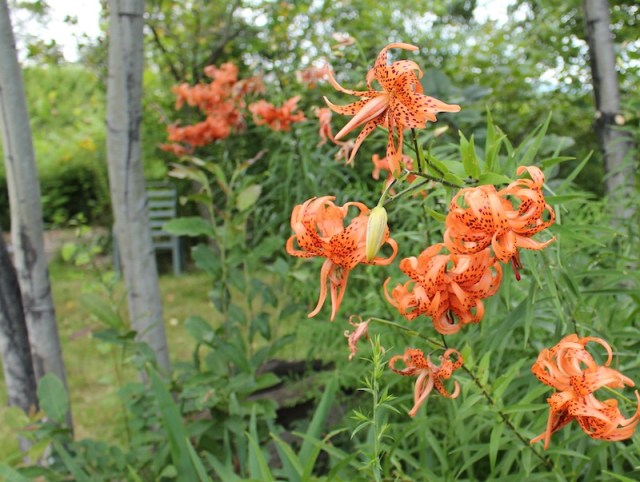
double tiger lily

Lilium lancifolium ‘Flore Pleno’ spreading quite well in spite of the beetles and a good amount of shade.

Speaking of supporting more wildlife than I’d like, our ‘Liberty’ apple tree has set a decent crop of fruit this year and just about everyone seems to want a taste.  When people ask questions like what to plant for wildlife I always think of things like apple trees, which seem to be under attack from every insect, disease, bird, mammal… it’s amazing they can survive from one year to the next.  I wanted to try one though, and in an effort towards compromise chose a variety which was supposed to give the gardener “Freedom” from endless fussing and spraying.  I guess nothing but bad taste will keep the animals away, but I think my photo does a good job at representing the cost of freedom.

freedom apple

Not spraying or putting in much effort at all does not produce the best foliage or fruit on an apple tree.  How do they say it?  Freedom does not come free?  Definitely true in the case of this tree, but I think I’m fine with a handful of wormy apples to cut up and eaten outside versus bushels of fruit to deal with.

With an image of a diseased, nearly leafless apple tree I guess it’s not a stretch to go back behind the potager into the waste area.  The grass which was seeded for new paths is coming up but only the weeds in the grass need mowing since for some reason the microgreens of the lawn are just one more thing which the rabbits cannot resist.  They mow down the grass and leave the weeds.  This isn’t how it was supposed to work but whatever, most of the weeds are Verbena seedlings and recent studies have shown there’s a 99.9% chance the gardener would rather have impassable paths of flowering verbena than neat grass.
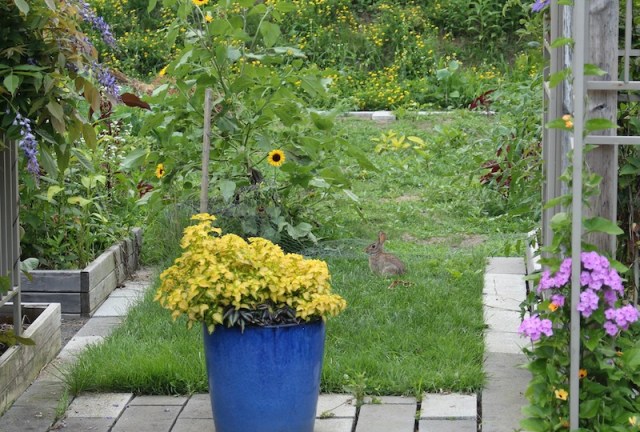
the waste space

Entering the waste space.  Yeah that sunflower also came up where the path is supposed to be…

Change in plan is more the rule than the exception here, so besides grass paths turning into verbena fields you may recall there was a $3 box of canary seed thrown around back here in order to start a millet patch.  Apparently what looked like millet wasn’t actually all millet and when some cabbagey stuff started growing I did some investigating and found out canola is also a seed birds will eat… and if anyone actually read the label they’d see canola right there after millet.  So now there’s a millet and cannola patch in the waste space.  Two fun facts I discovered about canola when I did my after-the-fact investigating were that 1. ‘Canola’ is short for ‘Canada oil, low acid’, a relatively recent Canadian plant creation of low acid rapeseed which became suitable for edible oil uses rather than industrial, and 2. Canola greens are much sought after by deer… which does not help at all as far as making my yard less-deer friendly.
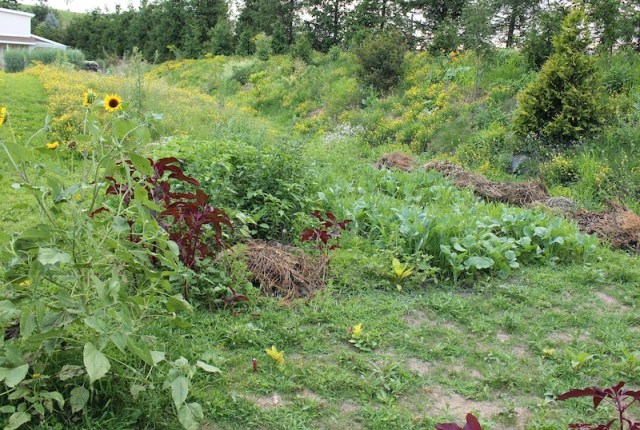
the waste space

The waste space has filled in quite quickly with weeds, canola, and millet, plus a bunch of barrow fulls of yard waste which were easier to dump here than on the compost pile.  I guess it’s all about bringing life to the sterile fill, and sometimes life is messy.

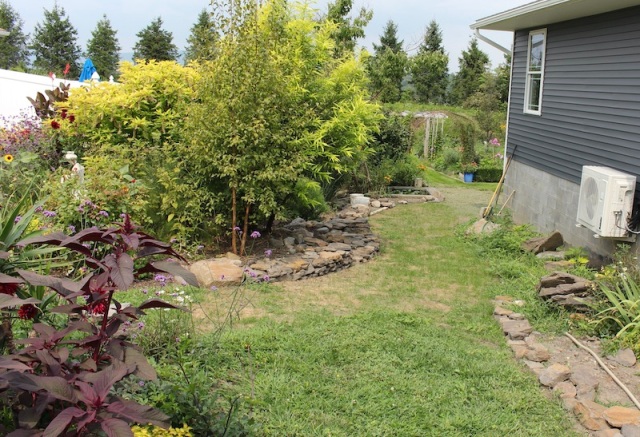
So here I am talking about growing weeds intentionally again when I really should focus on my garden-rebuilding.  Someday I’ll get it.  Maybe.  At least the waste area takes care of itself, which allows me to return to stone moving and construction repairs.  Finally the pond area has been cleaned out, the path behind it returned to passable, and all those stones picked out of the earth-moving process are being put to use… for better or worse…

garden stone wall construction

Shoddily stacked garbage stones line the arc of the curve which will take a grass path around the side of the new addition.  I think it looks good enough and hopefully the freeze and thaws of winter don’t rip it apart before it has a chance to settle.  More larger stones would have made it more weather-stable I think but you get what you get.

My fingertips are aching from all the stone grabbing and wedging and twisting and I’m glad to say the wall is as done as it’s going to get and only about ten stones remained as extras.   These walls soak up a lot of rock so hopefully I have enough left for a few more questionably interesting constructions around the yard 😉
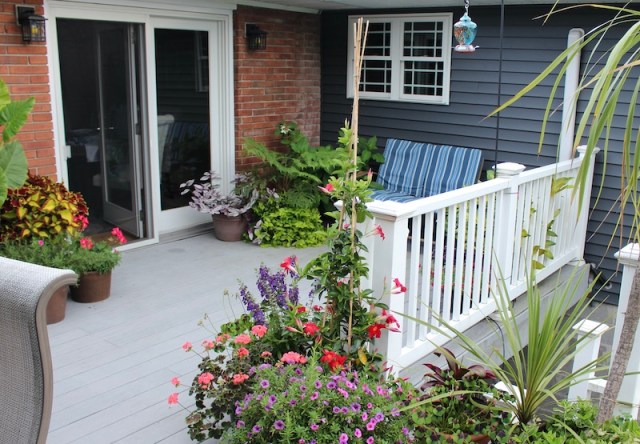
deck planters

The back deck refuge from it all.  I try to give the pots a little liquid feed once a week (and I never manage to keep to that schedule) but other than feeding, the drip lines and a timer take care of all the watering and leave me with nothing more to do than a little puttering when everything else seems like so much work.

I feel like I should be further along with everything but now that we’re into August I’m declaring a pause on projects and a rescheduling of fun.  A few gardens have been visited, children have enjoyed day-trips, some lazy pool days are scheduled, and tomorrow myself and my plant squad (or more officially the Plant Posse… a possibly eye-rolling name given by a member’s daughter) are off for a day at Longwood.  Severe weather alerts blanket our travel zone for the day but thoughts and prayers will guide us, and hopefully between the four of us the more reasonable will herd us out of the way of tornados, find shelter from strong winds, and a safe spot against hail, lightning , and thunder!  Any day with the Posse is usually an adventure 😉

Hope you have a great week with an aggressive scheduling of fun!
Still Going…

That last rain really tricked me.  It tricked the lawn as well, a green shimmer appeared and of course I thought it would be extremely generous to run the mower over to pick up some of the dead leaves and trash and then spray some liquid feed.  Silly me.  The rains stopped and things are back to wilting, and I’m back to watering, but at least it’s been cool the last few days as a respite to our usual baking.

ipomoea nils fuji no murasaki

Slowly the Japanese morning glories are coming into bloom.  Ipomoea nils ‘Fuji no Murasaki’ is amazing and hasn’t been as invasive a seeder as other morning glories tend to be… unless you’re someone I gave seeds to and recently cursed me for giving you such a weed… so your results may vary.

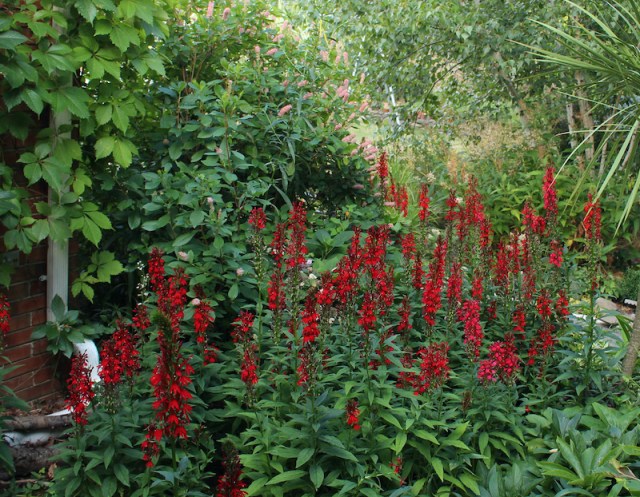
Despite the return to dry, it’s still not as bad as it was, and still not as brutal as it could be.  I think I just like complaining, plus on top of that it’s just boring.  Super boring since just about everything is just sitting there waiting for water.  There are three things though, which could count as somewhat interesting.  First are the container plantings, which thanks to the drip irrigation are doing fairly well… in spite of a haphazard fertilization schedule, and the second is the patch of cardinal flower (Lobelia cardinalis) which looks great, but causes nonstop hummingbird conflict as one sneaks in for a sip just as another one or two come down in a screeching dive bomb to fight them off.  People love hummingbirds but all I see are little featherpuffs of rage, and when one comes up and gives me the hovering stare-down of death for sitting too close to their lunch, I stare right back… but don’t dare say a word lest it triggers a torrent of anger from the little monster.

lobelia cardinalis flower

The Lobelia cardinalis does really well here in the shade of the house, far enough away from the life-sucking red maple roots.  I did water a bit but not as much as you’d think.  

So that’s two things, and for the third I’ll nominate the paniculata hydrangeas.  They get a drink of water once things get bad enough to wilt, but other than that they just look awesome and make me seem like a gardening genius.  Never mind the zinnias which are struggling and the surprise lilies which only surprise me by not dying, these hydrangeas are full of fat, fresh, flower-packed trusses of bloom.

hydrangea paniculata seedling

The worst of the dried up rudbeckia triloba has been cropped out, leaving only the joy of budding hydrangea blooms.  ‘Limelight’ is in the background, this is just a seedling which somehow managed to evade my super vigilant weeding long enough to look like something.

I’m considering adding a variety which fades to pink.  ‘Vanilla Strawberry’ was in here but had to be moved for the construction, and for some reason I didn’t like the way it looked around ‘Limelight’ anyway.  The pure white of V. Strawberry seemed just too white for all the yellows and chartreuse and then it was in a bad spot anyway, where the heat and dry would brown the blooms, rather than let them go pink.  It’s been replanted next door and to be honest I want it back even if it doesn’t fit in.  Maybe I’ll take some cuttings today, my mother in law loves it so there’s no way I’m getting the original plant back.

hydrangea limelight

Limelight in the back yard around the potager.  Obviously the phlox which was supposed to be moved years ago is still there and still doesn’t look nice alongside the hydrangea, but at least the boxwood is on its way to recovery after last winter’s run in with the bulldozer.

So three things are ignoring the dry and marching right through August in beautiful shape.  There are more bits and pieces looking good but as I said they’re mostly waiting for rain and I also just like to complain.  Now for example I shall complain that the dentist’s office still hasn’t called back to schedule my root canal and the gray skies have not produced anything more than a sneeze of useless mist.  Oh well.

Have a great week regardless.  These will be the sweet memories that come up in February when the only thing growing are the icicles off the gutter.

A Few Things

I’m watching the weather radar with my fingers crossed for some rain tonight.  Its the typical summertime story for gardeners, where everyone else is hoping for another day of blue skies, while we’re sitting here hoping for a completely washed out day (or if it’s not too greedy, night, followed by a day perfect for weeding and planting but…).  Things are’t too bad, but there’s some heat on the way and without a little rain the garden will start complaining.  As it is the lushness has been sapped out of the lawn and the shade plantings are wilted, but to be honest I blame greedy maple roots for most of that.

summer garden flowers

It’s an oxeye daisy year in the front border.  Winter killed off much of the fennel, and the daisies appreciate the open real estate.  It’s not a fancy look, but still better than more yawn to mow.  

A few plants don’t mind, in fact prefer, the drier soils.  Here are a few of the more interesting things popping into bloom and looking quite good while they do it.  Thing one is this red Echium.

echium amoenum

Last year at the NARGS Ithaca plant sale I picked up an Echium russicum seedling and was a little unimpressed as it tried to flower amidst the lush chaos.  This year I’m loving its look in the sparseness of a drier flower bed.

The milkweeds always put on a decent show, and I wouldn’t complain if more show up, although one clump of the common milkweed is plenty… which of course doesn’t explain clumps two and three and four throughout the garden.

asclepias syriaca milkweed

Common milkweed (Asclepias syriaca) is a weed not suitable for the cultivated garden.  I like the fragrance though, and don’t mind pulling up every sucker which pops up in a 20 foot radius… every week… After bloom finishes I’ll cut them back to about 1.5 feet and the new growth will attract the Monarch butterflies.

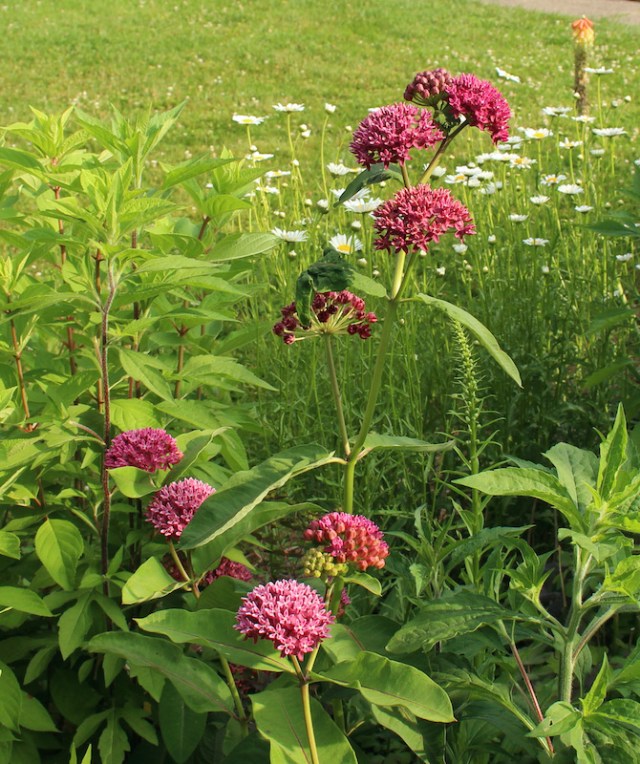
The purple milkweed (Asclepias purpurescens) is quite showy and quite a responsible flower border inhabitant.  This one hasn’t run around for me like it’s common cousin, and I actually may have to dig and divide it in order to spread it around.  That will be a new one for me and it makes me a little nervous since to get this one going took a few failed seed attempts and then quite some nursing along before the clump flowered for the first time.  Sadly I have yet to get a seedpod on this one.

asclepias purpurascens milkweed

Asclepias purpurascens, the purple milkweed.  Nice form and foliage and doesn’t mind a little bit of a dry spell, unlike it’s similarly colored swamp milkweed relative.

Another cool new thing in the purple color family is this knapweed.  I don’t like the most aggressive roadside-weedy ones, but this well-behaved perennial with the purple topped knobby buds is worth growing.  I was so excited to find it through Nan Ondra’s Hayefield Seeds.  If you haven’t already visited her site you should, the summer seeds are ripening and going on her list, and now is a great time to scatter them about for when the summer rains come  (they will either sprout now or wait until cooler weather returns).

centaurea atropurpurea

Centaurea atropurpurea, the purple knapweed.  Purple flowers poke up from scaly flower buds, and they’re quite popular with the bumble bees.

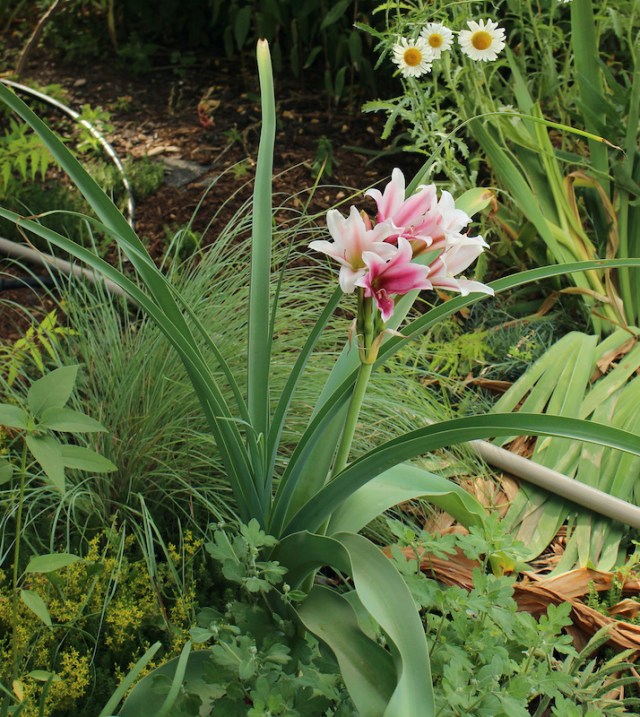
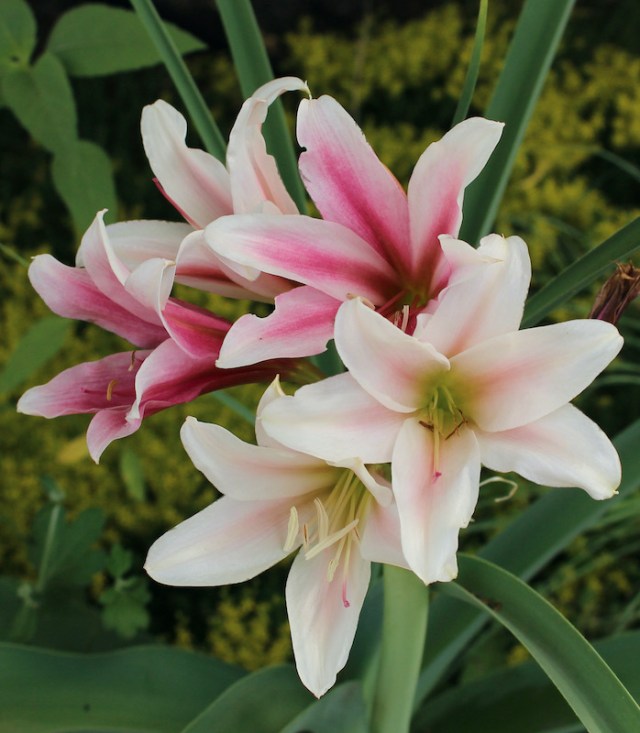
The knapweed seed was sown last summer and is blooming now, but the next plant has been inching along for at least 6 years.  Three small bulblets came in a ziplock bag with a note that they should be hardy for me, but I’ve heard that song before.  They were planted in a couple spots, one died the first winter but the rest slowly grew and grew until suddenly this week I had a flower stalk appear.  Honestly I was only just last week cursing the bulbs, because seriously I know it’s not the nicest garden but how long are we going to drag this out, and then all of a sudden a stalk and flower were there.  It’s my first blooming of the Orange River lily (Crinum Bulbispermum) and I’m not at all annoyed that it was the smaller bulb which bloomed and the larger bulb is still just sitting there pretending to be exotic.

crinum bulbispermum

Crinum bulbispermum, a plant which may need to be beaten with a water hose to induce blooming since that’s what our contractor did to it… and the un-beaten plant is still just foliage.  

Someone might remember I planted a few other, less-hardy Crinum lilies last summer, and shockingly they all survived with only some pitiful attempts at additional winter protection (I threw a bucket over them in January one cold night when I was feeling guilty about spending a bunch of money and not protecting them better).  Those bulbs are far less-likely to flower this summer since they all appear to have lost much of their bulbs to the cold, but maybe next winter will be different?  Maybe I’ll mulch and cover them and give them what they deserve?  Maybe…

crinum bulbispermum

The lighter blooms darkened up by the end of the day to the typical Crinum bulbispermum color.  I like them, even though I suspect they’ll be finished flowering by the end of the week.  These bulbs by the way receive no winter protection and have been perfectly hardy to just under zero Farenheit.

So is three as far as interesting things go here?  On to more mundane things.  I think I will give up and rip out the tomatoes poisoned by the herbicide-laced grass clippings mulch from next door.  They are all still sending up stunted, curled and twisted foliage and one plant is beginning to brown and die so I don’t think there’s much of a chance for any miraculous recovery.  New plants are in the next bed over and although I nervously mulched them with grass clippings from my own yard, they’re still doing fine, so I guess eventually there will be tomatoes for sauce this summer.

tomatoes herbicide damage

The sad, stunted tomatoes.  I haven’t noticed any damage in other plants, although some of the larkspur in this bed might be stunted, and thankfully the cabbage/cauliflower bed also looks fine in spite of getting the same mulch. 

I’m wondering if it would be weird to fertilize the lawn and water it just so I can mow it and bag the clippings to put down as mulch in the vegetable garden?  I guess it wouldn’t be much different than a hayfield that gets cut, and it’s still better than bagging the clippings to dump them in the trash, but maybe I should just work a little to keep the weeds down.  Nahhh.  Mulch is better, plus it conserves moisture and the earthworms eat it up and produce worm-manure all while aerating the beds with their worm-tunnels.  It would just mean more lawn mowing, which in theory I am against 😉

meadow garden

The meadow garden where mowing is still a no-no.  It’s drying out so tans are starting to show up.  There’s some rudbeckia opening, but the white is nearly all Erigeron anuus, the annual fleabane.  It’s an awesome weed for me and I let it grow wherever it wants, and I don’t think it’s greedy to hope for a blue or pink seedling to show up.

Tomorrow I’m repairing brickwork so that new siding for the addition can come right up to the old construction, where the bricks were pulled down.  I’m not a mason, so hopefully it turns out good enough that nobody notices my mistakes, but the reason I’m doing it is so I can move on to powerwashing the deck and moving deck pots into position.  Then I can re-do the drip lines and then hopefully no more hand watering the pots this summer.  It will be nice finally getting the deck clean and ready for summer since it’s been somewhat neglected with all the debris out there and the mess.  I sat out there on one of the chairs this afternoon and finally moved because a stupid wasp kept buzzing in my ear.  That’s when I noticed the other wasps and turned the pillow over to find the nest I was sitting on.  Hmmm.

It’s still not raining.  There are downpours to the East and downpours to the West but nothing here so I hope tonight’s not a bust.  In any case it’s still better than a February polar vortex 🙂

Summer Heats Up

Our cool, extended spring is only a memory today as another hot and humid day gets added to the list of hot and humid days.  Southerners will laugh at our complaints over what we call humidity and the Southwest will laugh at what we call hot, but we’re a little delicate here in the Northeast and if you can just give us our moment…

lilium canadense

Lilium canadense in bloom.  A North American native which used to be more common, back when deer were fewer and lily beetles were still across the sea.

The Canada lilies are having their moment.  They’re shorter than in previous years but they’re also sturdier, and I think the leaner living of a dry spring has really paid off, since the flowering is just as heavy and even more prolific than last year.  They’re officially my favorite lily, and I may need to start a few more seedlings, preferably in some dark red shades!

lilium canadense

Morning shade and a downspout keeps this bed damp enough to please the lilies.  I watered as well since I think they’re worth it.

The heat is one thing but it’s the dry weather that slowly wears me down.  I find watering to be a tediously boring job and the blackflies buzzing around my head and diving into my ears and nostrils immediately defeats the zen of sprinkling water.

yellow spider daylily

It’s daylily season as well.  Daylilies lack the distinction of snowdrops so I just can’t tell which are which.  This one I just call “the yellow spider” although I’m sure if pressed I could dig a label up somewhere.

The baked flower beds go a long way in making me feel guilty.  Hardened soil is no fun to weed… so I don’t… and I can only tell the wilted flowers relief is coming so many times before I even stop believing.  Fortunately the wilder parts of the garden are still doing fine.  The meadow is actually fairly green thanks to the shade cast by the aspen sprouts which have now become small saplings, and that’s a fair tradeoff for all the sun they steal from what should be a full-sun meadow.

the meadow

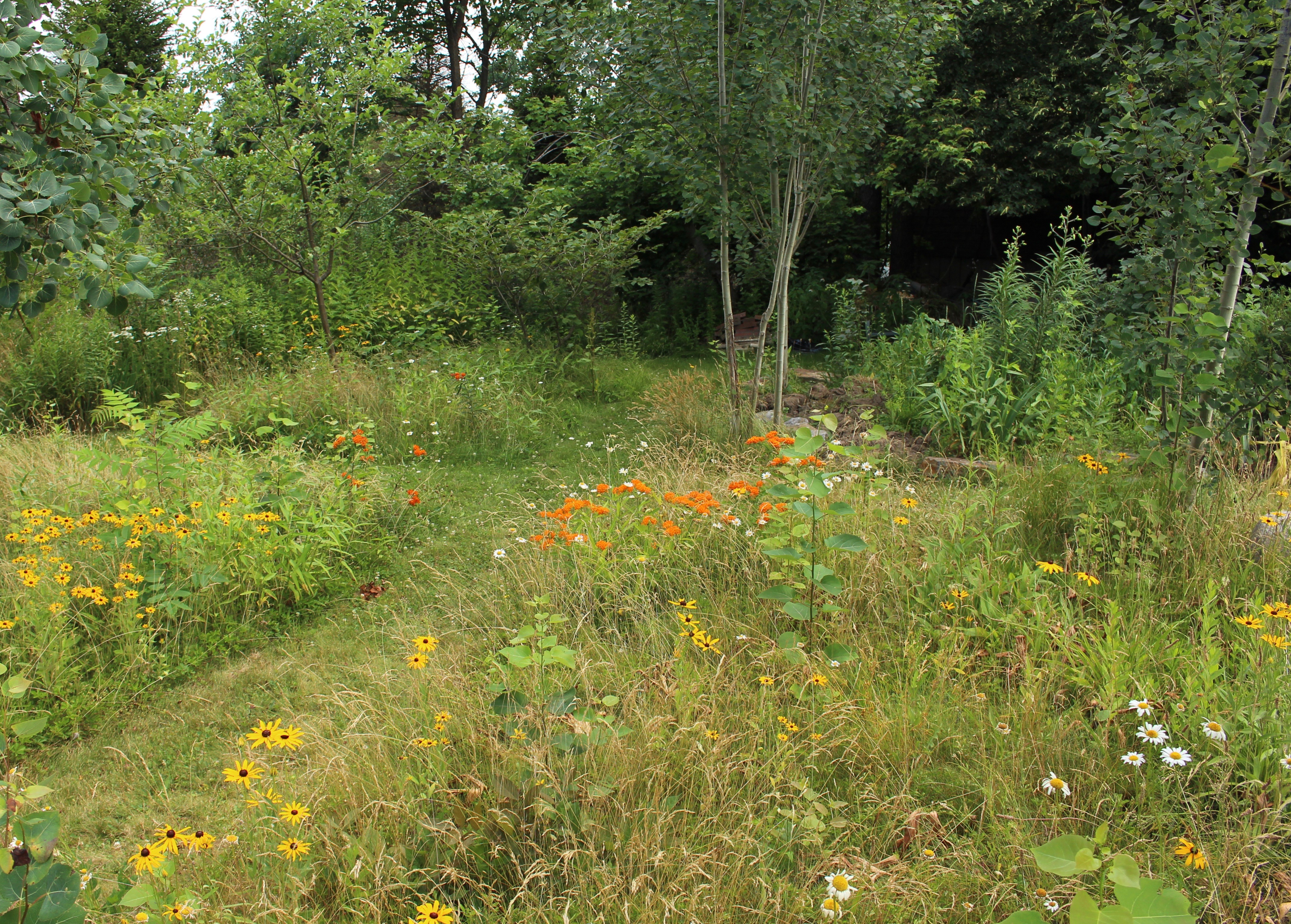
Butterfly weed and rudbeckia have taken over for the fading daisies.

Even though the meadow looks halfway decent I might go ahead and give it an early mowing this year.  My wife will be thrilled, she hates it this year just as much as she does every year but her happiness aside what I really want are the seedheads.  The berm could use some better grass and more daisy seeds, and if I bag the mowings they’ll be perfect for spreading around.

digitalis ferruginea gigantea

Digitalis ferruginea gigantea… I think… all my different foxgloves seem to look alike, but this one stands out as excellent, and it shrugs off drought, and I wonder how a few seeds of this would do on the berm.

The mowing of the meadow may still be weeks off.  Summer weather has a way of dragging things out and in all honesty weeding and mulching should happen first.  Maybe I’ll just rip a bunch of stuff out just so I don’t have to see it wilting, and then sit around all summer considering what new things could go there in the fall.  I could do a good part of my considering from either the pool or the porch, so that’s another plus.

kniphofia

One of the new kniphofia I planted last summer.  wilted or not I love it, and it has me wondering if I can divide it this fall and have an even bigger patch next year!

Don’t let my complaining fool you, it’s not all bad.  I haven’t had to mow the lawn in weeks and last weekend the remains of the sand pile has finally left the driveway.  Some progress has been made and maybe it’s about time I formally introduce the new potager.  It’s very neat and tidy and my wife just loves it, but I’m missing some of the weedy overload of the old beds.  July has just started and August is yet to come so it’s still early, and August has a way of encouraging weedy overload and tropical storms, so all is not lost.

Have a great weekend!

Rollin, Rollin

So now it’s August.  August fourth to be exact, and I’m not sure how we started into the month already when I only just realized July was ending, but here we are.  Weeding continues and with the front yard relatively under control it’s time to give the back some attention.  The potager is always ground zero for mayhem.

potager

The view from the potager up to the house.

From the right angle and with some nice morning light the potager looks like a flowery wonderland, but an actual visit would show plenty of weeds and needs.  Staking, deadheading, dividing… they’re all on the list somewhere, but weeding is all I really manage to get to.  In my new lower-the-maintenance kick I’m trying to think of better edging and maybe some raised beds and trellises but that’s a whole ‘nother lever and I don’t know if I can pull it off without someone else noticing that the closets still need new shelves and back in June in a moment of clarity that was chosen as the real summer project.

potager

Full disclosure.  The back garden really isn’t as flower-filled as you may think, and the berm is just too steep and too boring to mow… just so I can have more to mow.  So it sits covered in weeds (actually struggling and dried out smartweed for those who need to know) until I commit to planting something better there.

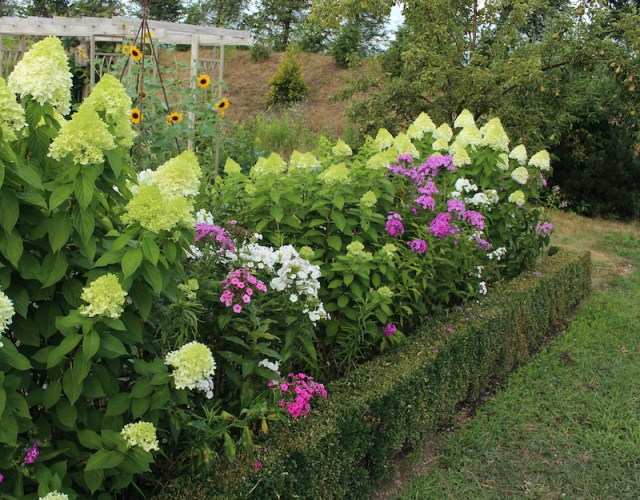
I was kind of inspired by how well the phlox were flowering and didn’t really mind all the hard labor out back.  There are a few seedlings which are nicely fragrant which I always appreciate, and in general quite a few have decided to flower instead of die, and for me and my phlox that’s a big step.

phlox paniculata

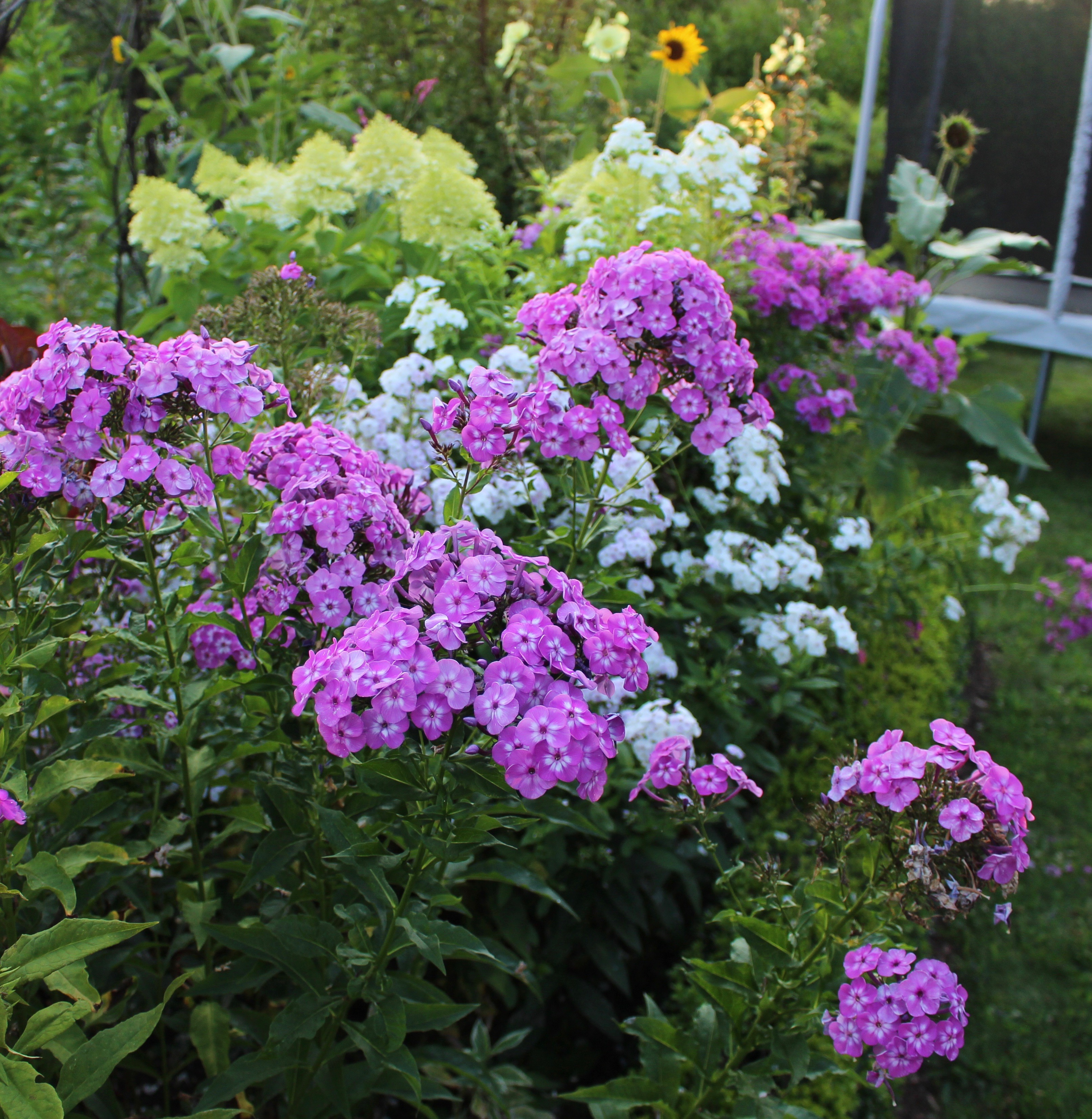
Phlox paniculata with some hydrangea ‘Limelight’ in the back.  The hydrangea have grown faster than I thought they would, and this bed might need some rethinking.

I don’t grow the phlox well.  There’s always something they don’t like and I would guess that in any given year for the half that do well there’s another good half that look downright miserable.  I think they’d like a looser, more fertile soil with even moisture levels but that’s just not going to happen and they’ll just have to deal.

phlox paniculata

This pink seedling is my favorite this year.  It’s a pretty average color but up close I love the streaking… which of course doesn’t show too well in this photo.

I made it all the way to the ‘forgotten’ beds in the far back, which are less flower beds than they are just planted areas which I don’t mow.  The double tiger lily (Lilium lancifolium ‘Flore Pleno’) is back there and has finally opened up its congested and twisted blooms.  I never know for sure if I really like it or if it’s just too interesting to not grow, but I’m beginning to think I actually like it 😉

double tiger lily

The double tiger lily has been around since 1870 so of course I’ll need to keep it around.

I was about to tackle one of the worst of the ‘forgotten’ beds when I noticed someone else had moved in before me.  I treasure yellow garden spiders (Agriope aurantia) so when I saw this darling sitting in her web I decided enough was enough with the weeding and frost can level these things just as well as I can.

yellow garden spider

Yellow garden spider down in the weeds.  I can’t leave this darling exposed and homeless, so for the rest of the season this bed is officially a spider refuge.

I’ll regret letting this messy plot go to seed but in the long run I always opt for interesting over pretty so each afternoon I check out how well she’s respun her nest and weather she’s looking a little thin.  Every now and then a Japanese beetle gets flicked into her trap just to make sure she’s plenty plump by autumn.

cardinal flower lobelia

A few of my weeds turned into cardinal flowers (Lobelia cardinalis).  They kind of make up for all the endless rain which gave them the soggy ground they enjoy.

Opting out of any more weeding really gave me a new lease on gardening.  Weeding the whole garden only to start weeding again is about as rewarding as mowing the lawn every time the lawn needs mowing, and it makes me feel like a dog chasing its tail except I’m not that into tails.  These never ending tasks just wear me down.  So the lawn is getting tall and the less noxious weeds are enjoying summer and I’m moving on to projects.  I finally decided to address the pile of flat rocks I had collected last fall and had been mowing around ever since.

building a bog garden

I don’t know how I moved that big rock back in the day, but last week with a lot of sweat and levering I finally moved it out from behind the grass.  Then I bulked up the stepping stone walk and settled on a spot for the bog garden.

For me projects make you feel like you’re actually making headway.  I want my garden to grow from year to year as well as season to season so changes always make me feel like that’s the case.  The reality is that the photos sometimes say it looked better in the before state, but where’s the fun in that?  Also I bought four new pitcher plants for like $15 on clearance so obviously I needed to invest hours of time and at least twice that much money in peat and sand just so they had a comfortable place to live.

hellebore garden

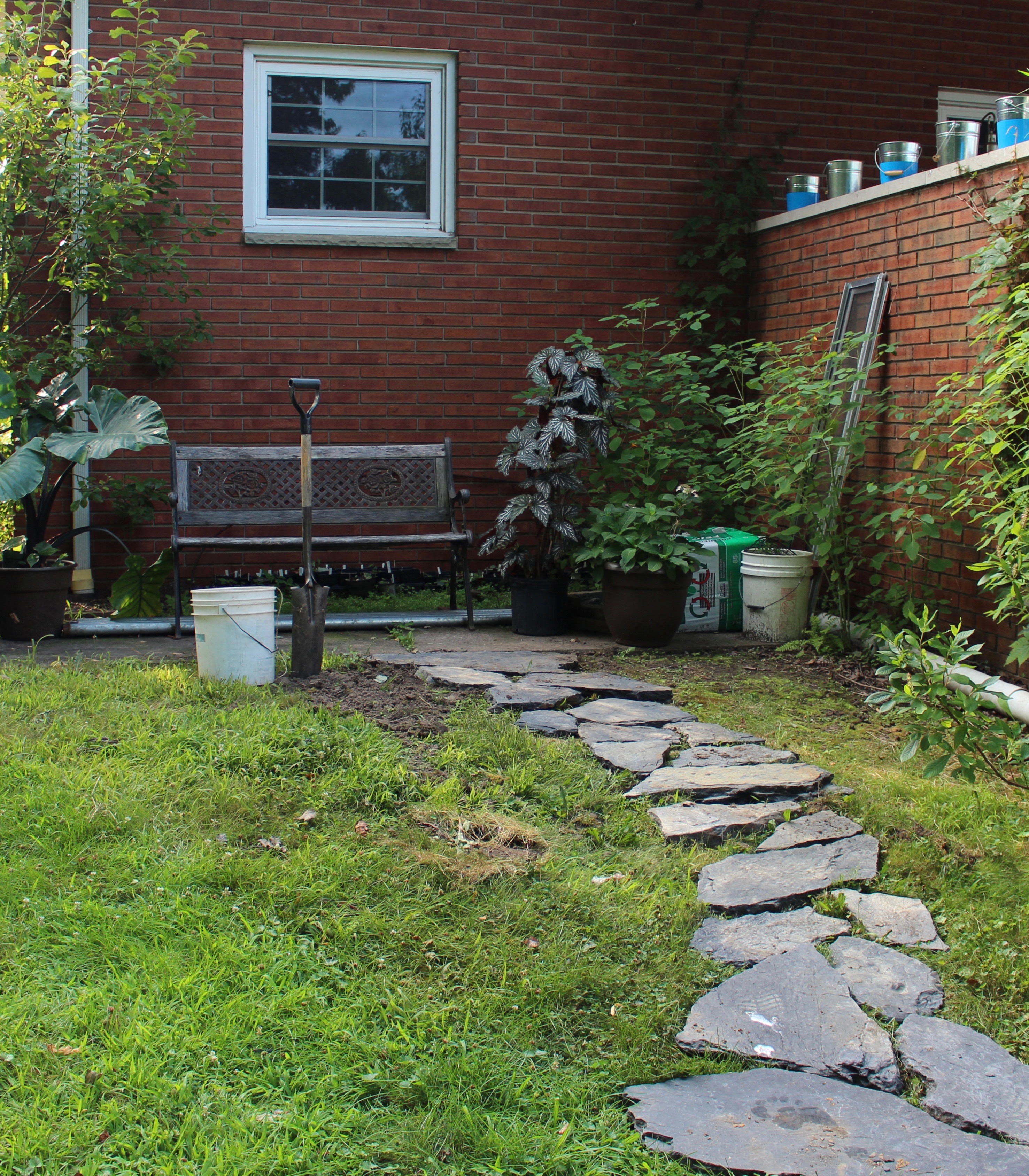
Leftover stones and a neighbor’s discarded bench were all the excuse needed to make a second new bed while the first new bed was happening.  Why not?

Someone might notice that adding beds to a garden that may already be too much might possibly be a move in the wrong direction but of course I don’t care.  Hobbies should be fun and you’d be amazed at how quickly a weed whacker and a pile of mulch can tame just about any mess.

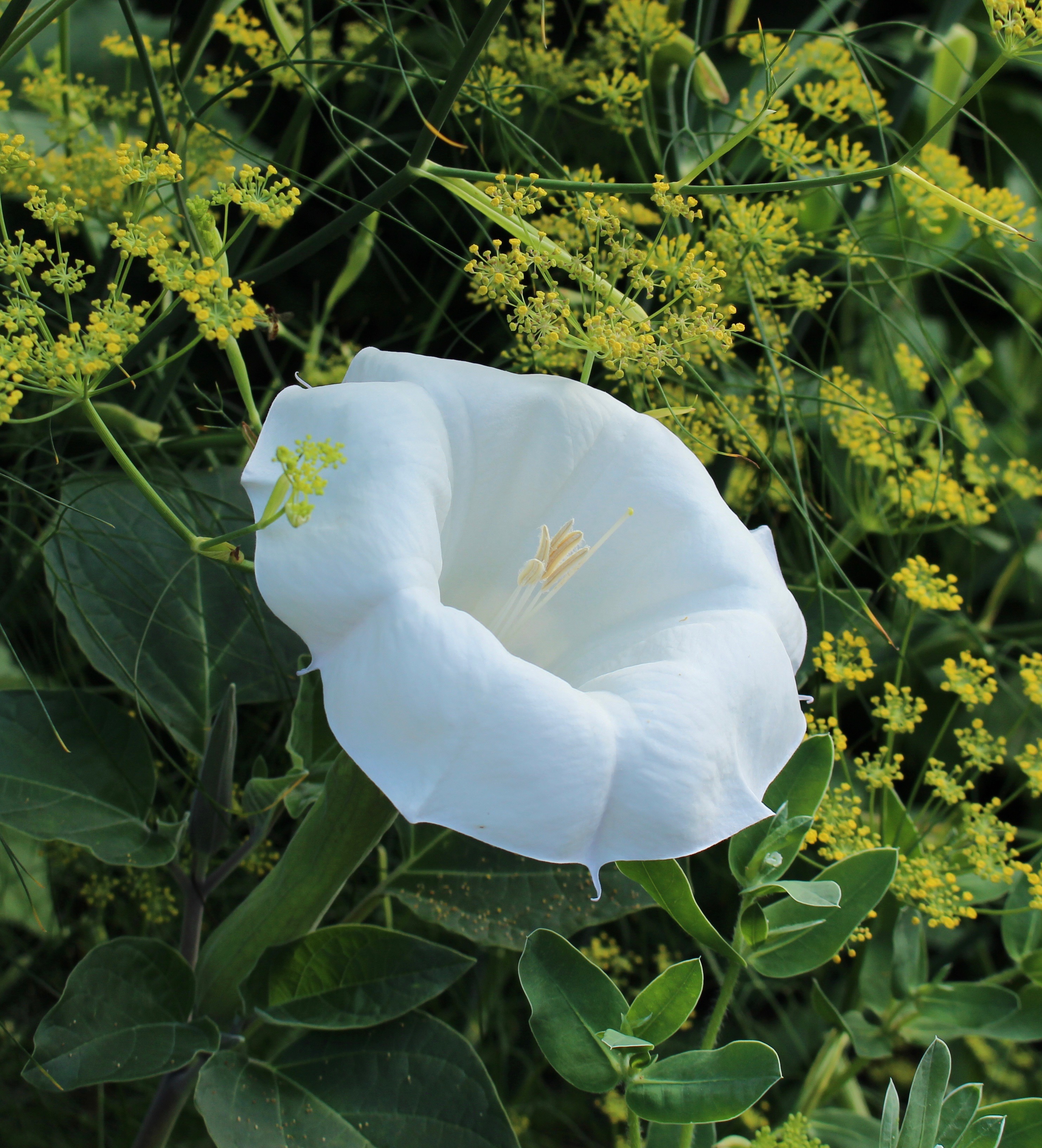
devils trumpet datura

The rewards of messiness.  Devils trumpet seeded out in a cloud of volunteer fennel.  Not bad for a weedy snowdrop bed.

The bog is settling in and the bench now overlooks a patch of hellebores which have finally been moved out of the vegetable garden.  I would have taken and posted a photo but was so sweaty and disgusting the mosquitos even avoided me.  So much for the fun part of the hobby 😉