Slow Learner

I’m not very good at saying no to volunteer plants.  Volunteer plants of course are the ones which just step forward to fill spots that you didn’t even know were spots until they volunteered to fill them.  I guess they’re generous little things which just want to give…  plus they’re free… and require no labor or attention… and that’s probably also a big plus in my book.  Some people might say the word ‘weeds’ right now, and I say bite your tongue.  If you can call sunflowers and foxgloves weeds, well then you’re probably a little higher class than this blog usually attracts and I suggest clicking on your way before you hold me liable for the time I’m about to waste.

galanthus bed

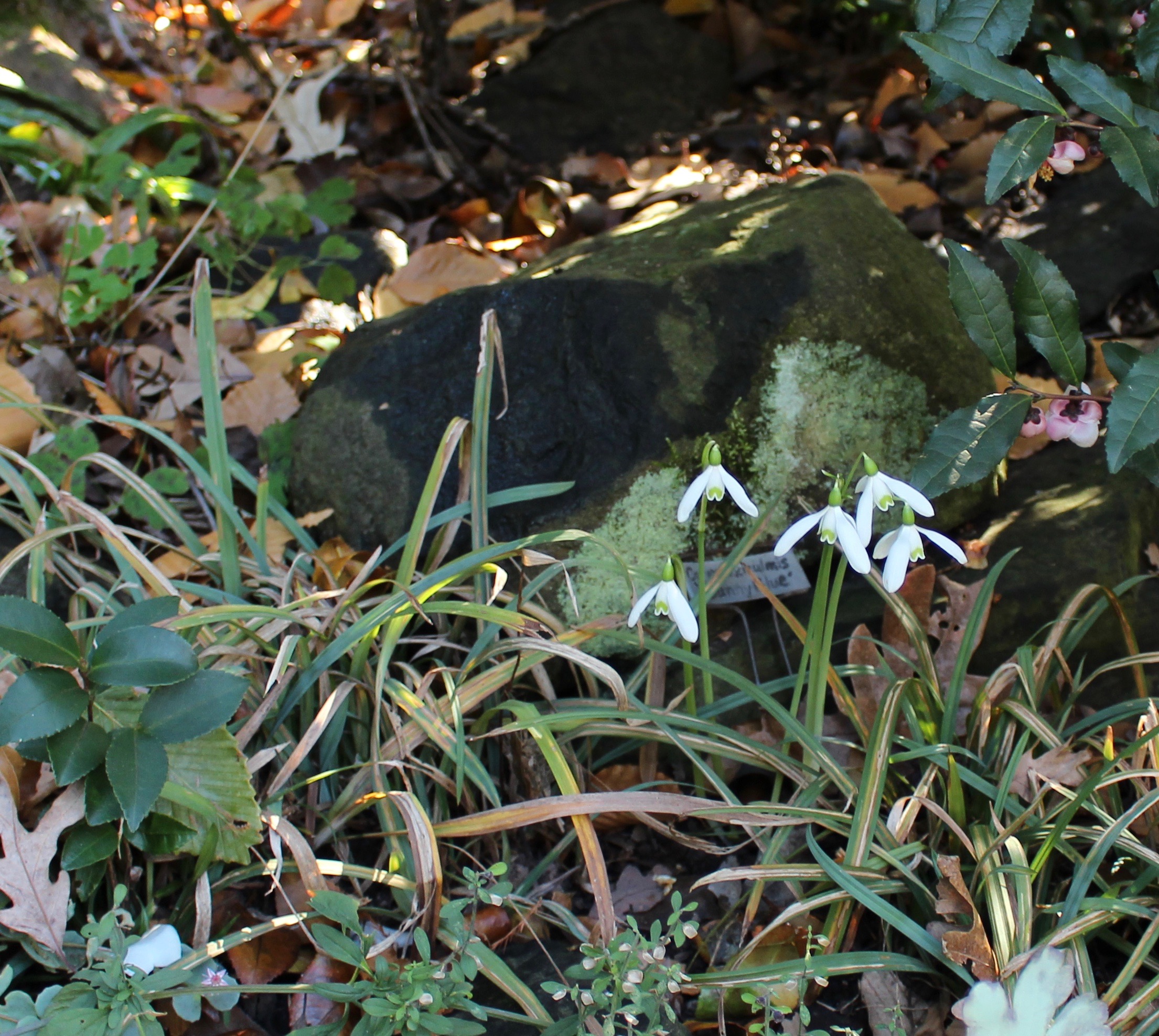
A clump of snowdrops (Bill Bishop if you really have to know) in a photo from last January. Note the tiny rounded leaves in the center of the sprouts. Soooooo innocent looking….

galanthus bed

One year later. A big fat rosette of foxglove foliage right where a snowdrop clump wishes to emerge. Please let’s overlook the many autumn leaves scattered about, and the as-yet untrimmed muscari foliage.

Ok, good.  Now  that  we’ve ‘weeded out’  a certain  type  of  reader, I  just want  to reassure anyone who’s left that you’re entirely high class, but of the type who just is and not the type who only thinks they are.  I suspect you all have soft spots for foxgloves and that brings me to today’s dilemma.  It’s not just any foxglove, it’s the especially special strawberry foxglove (Digitalis x mertonensis) and of course it’s right on top of ‘Bill Bishop’ and we all know that’s not going to work out.

galanthus bed

There he is. Bill is happily sprouting up right exactly where he should be.

Normally  a few  stray  foxgloves  don’t  even come close to causing a problem.  Any other year they’re just a crumbly mess of winter killed foliage by the time the snowdrops arrive, and with just a little brushing aside all is well.  This year things are different, and I might have to try a midwinter transplant because obviously I can’t just rip out this trooper, no matter how free she is.

It goes without saying that had I been attentive and moved the seedling last summer none of this would have been a problem.  Sort of like had I been more attentive and less lazy for the last seven years maybe my WordPress disk space wouldn’t have reached 99% full with only just the few photos which I’ve uploaded over the years.  Hmmm.  I should have read the memo a few years ago when I first reached my limit and had to purchase a blogger plan rather than enjoy free access, but noooo, let me put it off a little more.  Apparently re-sizing photos is a kind of important thing, which I’m sure everyone else knows but it just seemed like so much extra work at the time… and obviously I’m not one to embrace extra work.

So with a nice snow squall covering up the ground and ending any thoughts of transplanting, I’ve headed indoors and have committed to shrinking my digital footprint.  So far I’ve spent hours editing posts, reloading re-sized photos and then deleting the old.  Of course it’s my own fault.  Ignorance is bliss, but what kind of stupid thinks a 4.2MB (4200KB) cabbage photo would be necessary when a 143KB  will do?  I’m up to September 2013 in case anyone is wondering.

cyclamen coum

While on the subject of time-wasting, I reorganized my Cyclamen coum seedlings to see how close seedlings from the mother plant resemble each other. These were all from a purple with mostly green leaves in case you’re wondering.

Every now and then even the most committed data processor needs a break, so with short days, early nights, and plenty of here and there snow, the winter garden has again become my man cave and  I’m obsessing about Cyclamen again.

Cyclamen rhodium ssp peloponnesiacum

Cyclamen rhodium ssp. peloponnesiacum is a treasure I picked up at last year’s Galanthus Gala. It might be hardy, but that would mean not seeing these awesome leaves all winter, and why risk that!?

I thought I was good, and all last summer I was fully impressed with myself for having more cyclamen than ever before, but then the cold weather hit and maybe I do need more.  I would have had more, but some stinkin’ mouse family robbed me of nearly all last year’s ripening seed pods, in a way that I didn’t even know the pods were hollowed out until I turned one and saw the bottoms all nibbled out.  “Stinkin’ mouse” isn’t really the term I used, but since only the classiest readers remain I’ll try to keep it civil.

Fortunately I know a guy.  A little back and forth with Dr. Lonsdale over at Edgewood Gardens and two new and extremely exciting cyclamen have found their way here.  Plus a hellebore!

purple flush cyclamen

Two Cyclamen hederifolium with a faint flush of pink towards the center. Also hard to see is the variegation in the Hellebore niger seedling to the right, but it has it and I can’t wait for it to settle in to the garden this spring.

Another area I need to make more effort in is my indoor fertilizing regime.  The new additions from Edgewood are so well rooted they put all my plants to shame.  Dr Lonsdale has told me before to switch to something more specialized like a tomato fertilizer or anything with a lower first number (Nitrogen) but this blockhead will need a little more hammering, so one step at a time.

In the meantime, again let me say I’m pretty excited about the new additions.  The cyclamen are cool, but the hellebore will probably rank as one of the rarest things in my garden.  Take a look at a picture or two of >mature plants< and I think you’ll agree this little year old seedling is going to grow into something special.

Not as special as re-sizing thousands of photos and editing hundreds of posts, but close I’m sure.  Have a great week!

Happy Solstice

It’s a rare day that snow pictures end up on this blog, but some people seem to be into this kind of stuff so I figured what the heck, they are kind of pretty, sort of like microscopic virus photos or the closeup of a horsefly’s eye… so here they are.  As we enter the longest night of the year it’s a taste of cold sunshine from Saturday morning.

frosty winter morning

 I love Pinus densiflora ‘Burke’s Red Variegated’.  It’s supposed to resist winter browning, but here it is with some winter browning.

frosty winter morning

The polished buds of European beech surrounded by the russet glow of Panicum ‘Dallas Blues’ seedheads.

frosty winter morning

More Panicum virgatum ‘Dallas Blues’, a switch grass who’s bluish summer foliage is followed by a winter long reddish foliage which holds up fairly well to lighter snow loads and winter winds.   

frosty winter morning

Silly rose it’s winter, and you’re deciduous.

frosty winter morning

We ended up with about a foot of snow.  Faced with cyber school the kids didn’t even get a day off.

frosty winter morning

It’s been a good year for Amsonia hubrichtii.  The yellow in autumn was better than ever and now there’s even some color left for the first few weeks of winter. 

frosty winter morning

A gentle snowfall marks off the hedges and beds of the potager.

frosty winter morning

The bright sunshine and cold clear air brings sparkle to just about everything.

frosty winter morning

I had been itching to strimmer the stray weeds and wild asters on the berm, who would have thought the juncos would flock in to enjoy the tiny aster seedheads. 

frosty winter morning

It’s always hit or miss as to how the Southern magnolia seedlings make it through the ups and downs of a NEPa winter.  

Now it’s a slow wobble back to summer as the days again increase in length and the ground slowly soaks the heat back up.  Eventually, towards the end of January, our average temperatures should start to rise again and if this winter is anything like the last couple a few witch hazels and winter aconite might dare open a flower or two.  It’s a fun ride.

All the best for a nice, long and cozy solstice night 🙂

Off To A Good Start

As far as I’m concerned the 2021 gardening season is now up and running.  The few winter growers which I dare grow outside are starting to show signs of life, nudged along by a fall that gave us plenty of warm enough days and above freezing nights, and it’s nice to see things sprouting up all fresh and full of promise.  Back in the day a lot of these things waited until February or March to do anything, but lately they’ve come on earlier and earlier, and I won’t complain.  Actually who am I kidding?  Of course I’ll complain.  A brutal polar vortex in February, a foot of snow in March, hail in April… I can’t think of a single gardener who just smiles and shrugs these things off.

fall galanthus elwesii

Galanthus elwesii ‘Potter’s Prelude’ is finally open, oddly late since many of the other fall and winter bloomers were earlier this season.

These earliest of snowdrops were always an issue of discontent for me.  For years I would buy bulk bags of elwesii and then grumble as more southern gardeners would gloat over the random fall bloomers which would show up in their mix.  They didn’t actually gloat, but when year after year I got nothing it started to seem like it.  Then one year we had a long fall and a lackluster start to winter, and suddenly there were snowdrops up in December rather than March.  It’s always the same few, and they unfortunately don’t hold up well when the cold does settle in, but it’s fun to see them and I do feel a little better about my luck again.

fall galanthus elwesii

An early snowdrop (Galanthus elwesii), one of just a few which try to beat winter rather than patiently wait it out.  

As you probably already know, our lackluster winter is finally making an effort.  It’s about time I guess, so what better way to celebrate than to finally plant the daffodils, tuck in the last few perennials, and then set up the winter garden for some indoors enjoyment.  Fingers crossed the daffodils survive their hasty planting, but it’s not the first time they’ve suffered this kind of abuse so they should be used to it by now.

winter garden

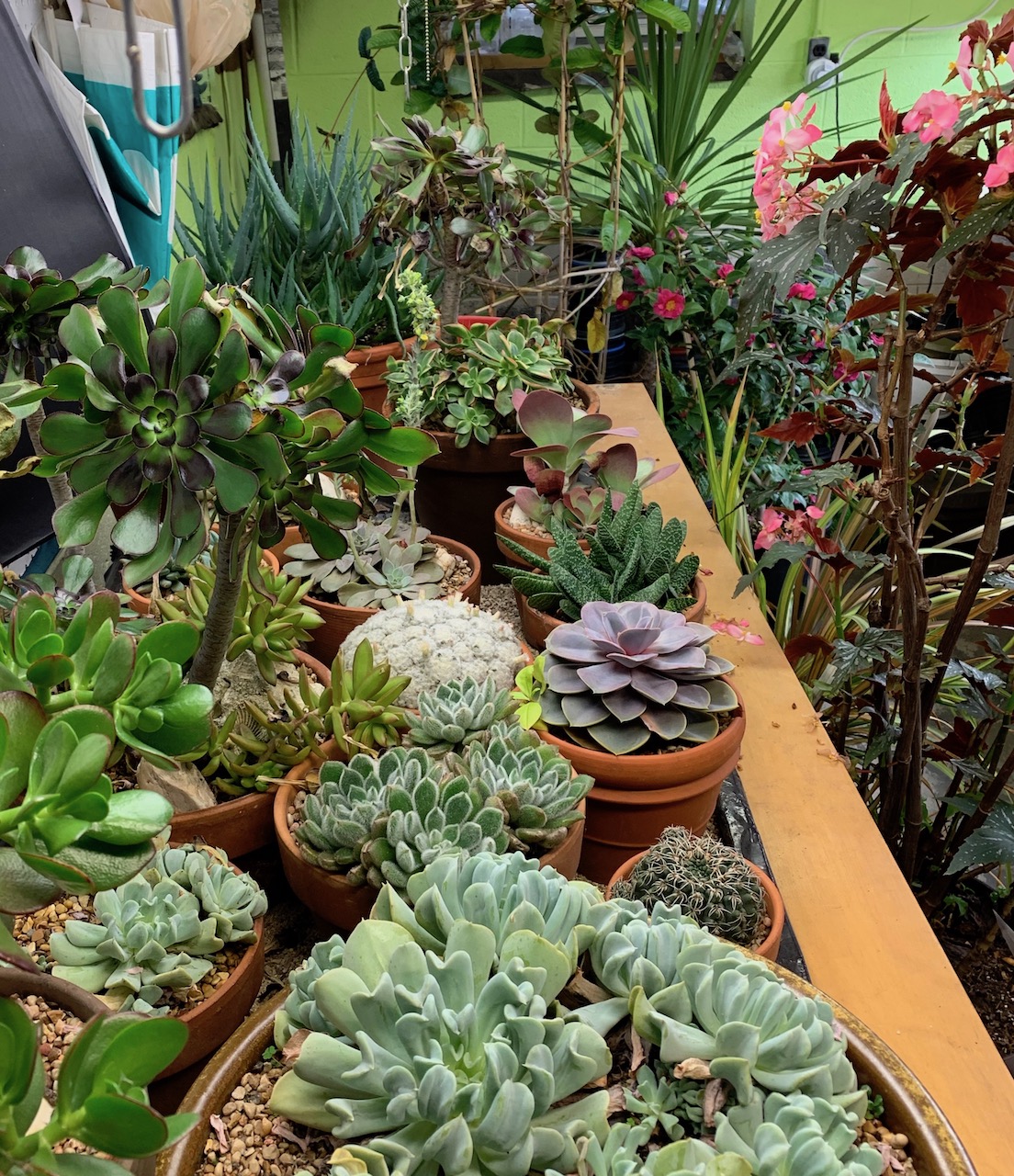
Dry and cool is how I keep all the succulents.  Without watering they don’t grow much, and if they’re not growing much they don’t get all stretched out and spindly, even under less than perfect lighting.

The winter garden in the old workshop in the back of the garage only has about half the shop lights going so far.  As more plants magically appear and seedlings start and bulbs sprout I may add to that, but at the moment there’s no real plan, and it’s just a nice place to putter around in with a few things growing while snow falls outside.

winter garden

This year there are more Cyclamen coum and fewer other cyclamen species and snowdrops.    

My current favorites are the cyclamen coum.  Even though they do just fine outside in the open garden, indoors they’ll flower for a month or two during the bleakest months of January and February, and make for an excellent show that can be thoroughly enjoyed after dark during the week or with a nice morning coffee on the weekend.  I do enjoy announcing that I’ll be in the winter garden with drinks, and that I need to sweep up the camellia petals or water the tree fern.  It all sound pretty fancy if you ask me… even if others in this household seem less than impressed.

winter garden

The reality of the winter garden is a bit more gritty than an actual sun filled conservatory, but until a glasshouse moves up and becomes a budget priority it will have to do.

Re-opening the winter garden came just in time.  It’s been snowing since later this afternoon and by tomorrow morning we could have anywhere from a foot to a foot and a half.

winter snow

It’s going to be a white Christmas 🙂 with snow this week and cold next, this won’t be going anywhere soon.  

Hope all is well and you’re staying safe.  I’ve got the shovels ready, gas for the snow blower, and the snowdrops are covered with buckets, so I think we’re ok.  Tomorrow will hopefully be a nice snowday with a late breakfast, and just maybe I’ll be able to sneak the coffee out to the winter garden and admire cyclamen before the kids and dog want to “help” with the snow.

November Gardening Tasks

Every now and then it occurs to me that this blog should be more…. useful?… and as I was sitting there with a nice cozy blanket watching Gardener’s World I noticed the weekly ‘things to do in the garden’ segment, and thought to myself what an easy idea to steal.  So let me start by saying you’re welcome and just jump right in.

november perennial border

Not much to see along the street anymore but I try to leave a few things uncut to keep it from looking too desolate.

My first thoughts in the morning went to the dozens of unplanted daffodils and perennial seedlings which have been sitting around for weeks, so…

1.  Stand by the back door with a cup of coffee and imagine how nice it will all look someday when things finally grow or plants finally get moved.  After 20 minutes you may prefer to lean on the other side of the door and imagine changes to the other side of the view.  Keep in mind you might want to do this first thing in the morning since it’s easier to ignore a messy room and far less possible to be “redirected” when there’s no one else there.

amsonia autumn color

Most of the fall colors have faded to blah, but the Amsonia is finally showing some of the yellow it’s supposed to show each year.  Fyi mine rarely does this.

2.  Sit down at the computer since it’s still not all that warm out and look up plants on the internet.  Look up other plants, look at other people’s plants, think about how those plants would look in your garden, think how you can fit them all in and then search out who has them for sale.  Stop just short of ordering them, there’s plenty of time for that in January…. unless it’s a clearance sale on bulbs of course.  Order those and don’t even think about the unplanted ones in the garage.

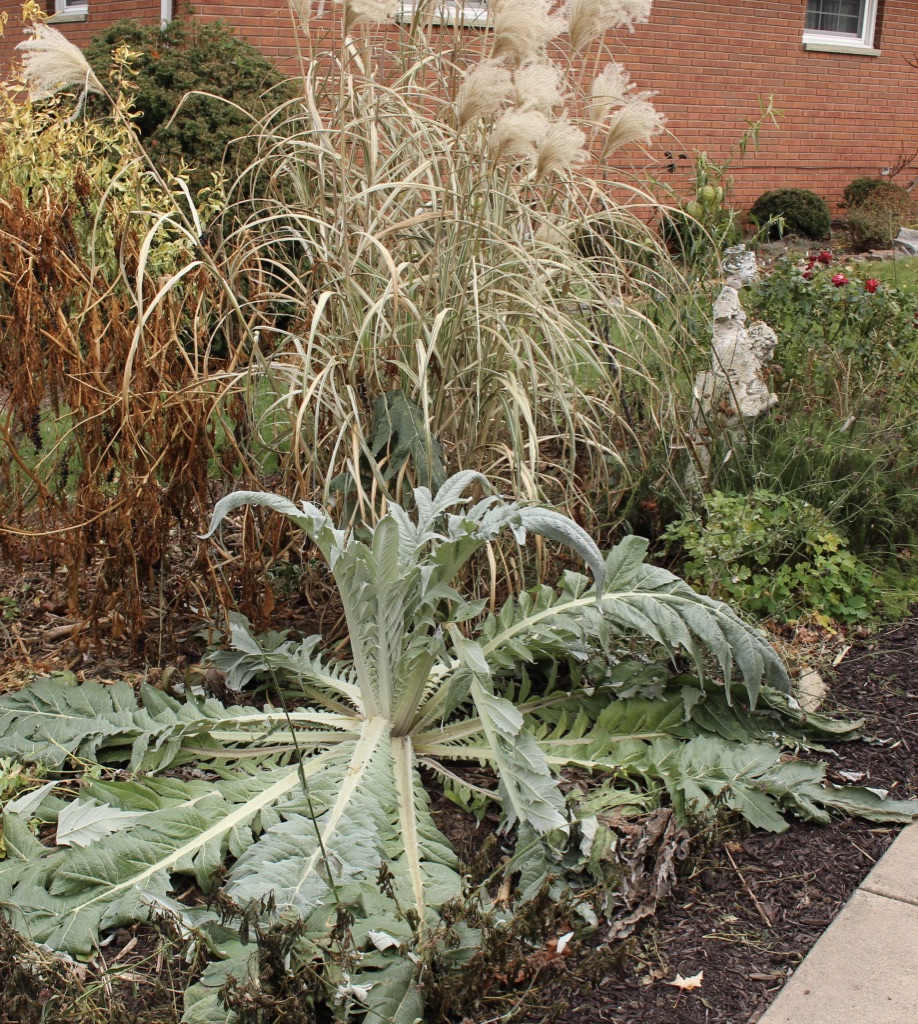
zone 6 hardy cardoon

My best cardoon did not appreciate the recent 24F night.  I’m still hoping it proves hardy this winter. 

3.  Make a second cup of coffee and go outside.  If it’s warm enough in the sun make sure you take advantage with a little more sitting, otherwise shuffle around the garden and look at every single plant especially the ones which look the same as yesterday.  Don’t put your coffee down to do anything, you’ll forget where you left it.

potager

The potager is looking quite neat with mulched beds and some of the frosted veggies removed.  Just looking at it hurts my lazy bone, and I’m honestly not sure who did all this work.

4.  Return the empty coffee cup to the kitchen.  When you do remember to cross these tasks off your list since having a list and crossing things off is super important when organizing.  Sometimes I do more than just cross out, I completely black out the task since it’s done and over.  No one needs to judge your past, just make sure they see you’re accomplishing things and then redirect them to the future.

fall crop cabbage

A few cabbages yet to be harvested.  Don’t lose your nerve and rush out in the dark to pick the biggest one after everything’s been freezing for the last day and a half, since frozen cabbage stems are dangerously hard to cut while holding a flashlight and watching a dog.

5.  Grab the planting trowel and head out to plant some bulbs.  As you pass the witch hazel, stop and spend at least half an hour picking off the yellowed leaves so that they don’t sit on it all winter and then interfere with the flowers as they open in January.  When you’re almost done give up and wander off to look for the trowel.

lycoris in zone 6

Lycoris radiata and Lycoris houdyshelii, both not likely to do more than just survive in this zone (if I’m lucky) and both kind of expensive to experiment with but there they are.

6.  Forget you were looking for the trowel when you pass the camellia.  See if the buds have grown any (they haven’t) since the last time you looked and then check the 10 day forecast to see when you next have to drag the pot into the garage for the night.  Pull a few other things out of the garage again since the weather looks nice and they can use a few more days of sun before the long, dark winter.

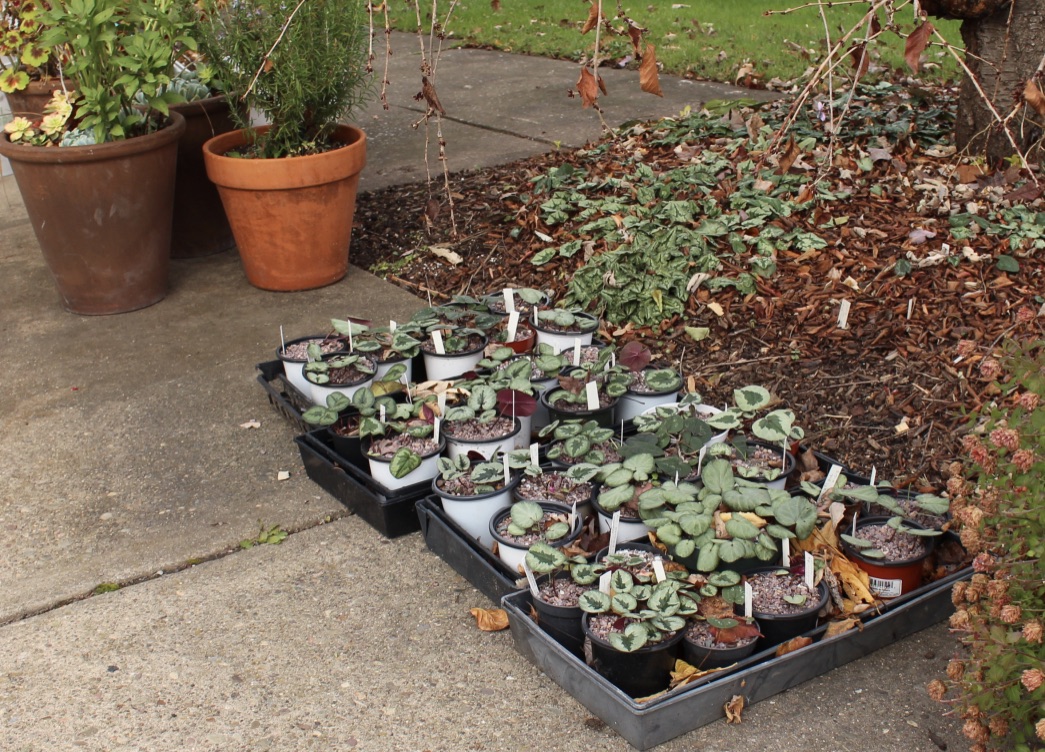
cyclamen coum in pots

In and out the Cyclamen coum go as I try to get them as much sun and fresh air before committing them permanently to the winter garden.  Hmmmmm.  I thought I had so many, but now I see it’s not nearly enough.

7.  Look at the unplanted bulbs and then decide to mow the lawn.  Sure with a self-propelling mower it’s basically the same as the back and forth wandering you were doing before, but no one accuses you of doing nothing when you’re mowing the lawn, plus there were a few new leaves on it and better to capture them for mulch before they blow off to the neighbor’s.

8.  Clean out the garage.  Just kidding.  It’s far too late in the day and you should always have something left on the list for next time.  Plus something really ambitious like this as a leftover will really make all the darkened out ‘finished’ tasks even more impressive.

So there you have it.  Hopefully this was amazingly useful and helped organize your time somewhat and gets you ready for the upcoming week and approaching holiday.  Follow me for more awesome tips but don’t expect those bulbs to get in the ground anytime soon.  I suspect there will be demands for Christmas lights and absolutely no one wants to hear about unplanted daffodils after returning from  a Longwood Christmas so Christmas lights it is.  Have a great week.

A Festival of Mums

Well I do feel guilty overposting when I don’t even take the time to respond to comments or visit other blogs, but there was a second part to my recent garden-day-out which just doesn’t fit into that post, and it’s just too good to not share (as opposed to some of the things I put on about my own garden!).  Our beautiful morning in the private garden of Charles Cresson was followed by an equally beautiful afternoon at the very public Longwood Gardens.  Of course we were late, so there were a few seconds of nervousness when we saw the crowded parking lot and the well-past admission time on our timed tickets, but all was well.  We cruised through a perfectly distanced and contact-free admission process and were exploring the grounds just minutes later.

longwood bell tower

Longwood’s  bell tower with fall color and some late afternoon sunshine.

The weather was still perfect, the grounds were perfect, the fall colors were perfect, the water was clear, fresh sod was laid, the paths were raked.  Longwood is an excellent autumn strolling garden, but to be honest I sometimes get a tiny bit bored.  I wasn’t in the mood to hike the meadow, I had seen miles and miles of autumn color on the drive down, and all the summer plantings were already out and replaced with uber-neat animal netting to protect the recent tulip plantings, or super tidy raked soil.  It all made me feel somewhat guilty for the unplanted bulbs and general mess at home, so our stroll was actually kinda short.

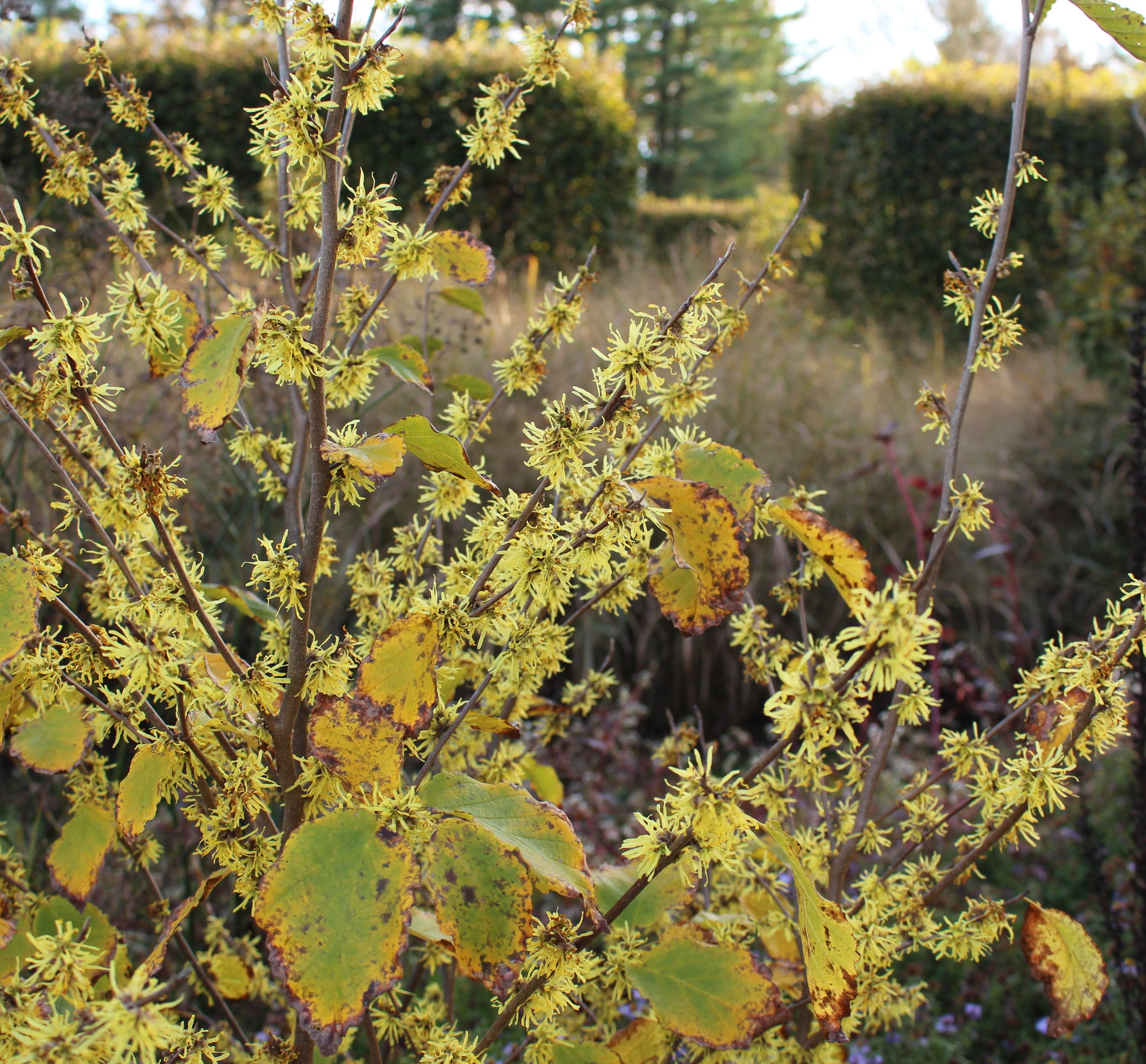
hamamelis virginiana 'Harvest Moon'

Hamamelis virginiana ‘Harvest Moon’ looking exceptional amongst late bloomers and autumn grasses.  It’s in full sun by the way, and I’ve noticed that even the wild ones which line my path to work bloom much heavier when in full sun.

My friend Paula was with me, and we both agreed that next year Longwood should call us and let us pick through their trash pile of discarded annuals and tropicals and help them get rid of some of that mess.  I’m sure my better half would have no problem with me coming home with a trunk full of things to pot up and keep inside all winter 🙂

Tetrapanax papyrifer

In the gardens behind the bell tower I saw a few big clumps of ricepaper plant (Tetrapanax papyrifer) which looked as if they had overwintered in the spot.  I love the leaf on this thing and have been trying to get one for years, even if it is a terrible spreader and some people are allergic to the fine hairs…

yellow ilex opaca

A very well-planned combination of yellow Amsonia hubrichtii foliage backed by a ripening crop of yellow berried American holly (Ilex opaca)

Of course you can’t judge me for thinking I have either the room or time to take in dozens of high maintenance and tender plants which are totally unreasonable for my garden.  It’s a much cheaper addiction than fancy shoes that don’t fit comfortably or a flat screen tv which is just too big for a room which sits you six feet away.  But I’m digressing.  We actually came to see the mums, and as we approached the conservatory things started to look promising.

longwood chrysanthemums

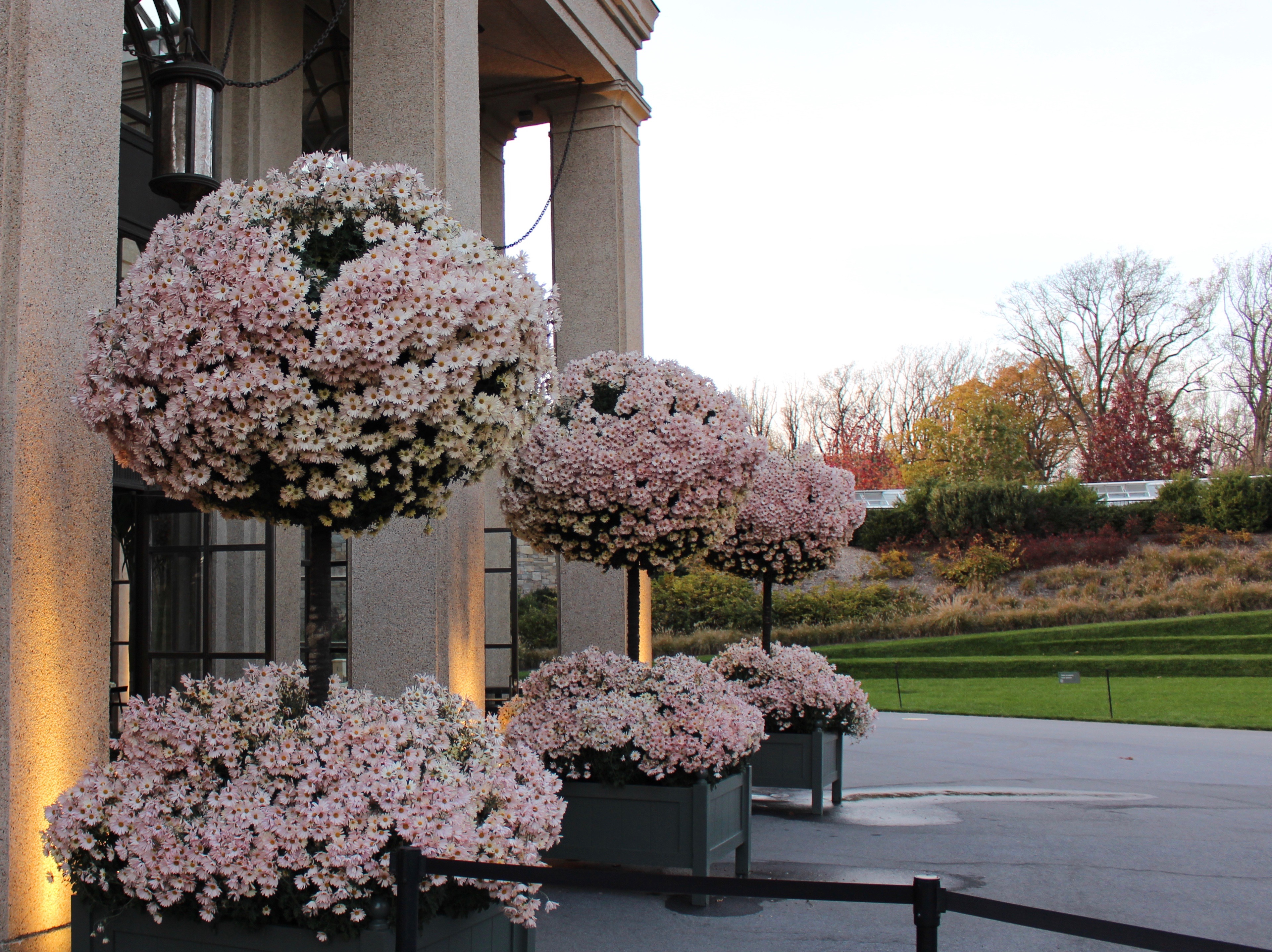
Wow 🙂 Hardy chrysanthemums grown as a basket on top (I think) raised high over a planter of the same.

Last year I visited the NY Botanical Garden to see their display and I loved it, but for all their variety and diverse forms and traditional training techniques, Longwood had less but more and went straight for the Wow.

longwood chrysanthemums

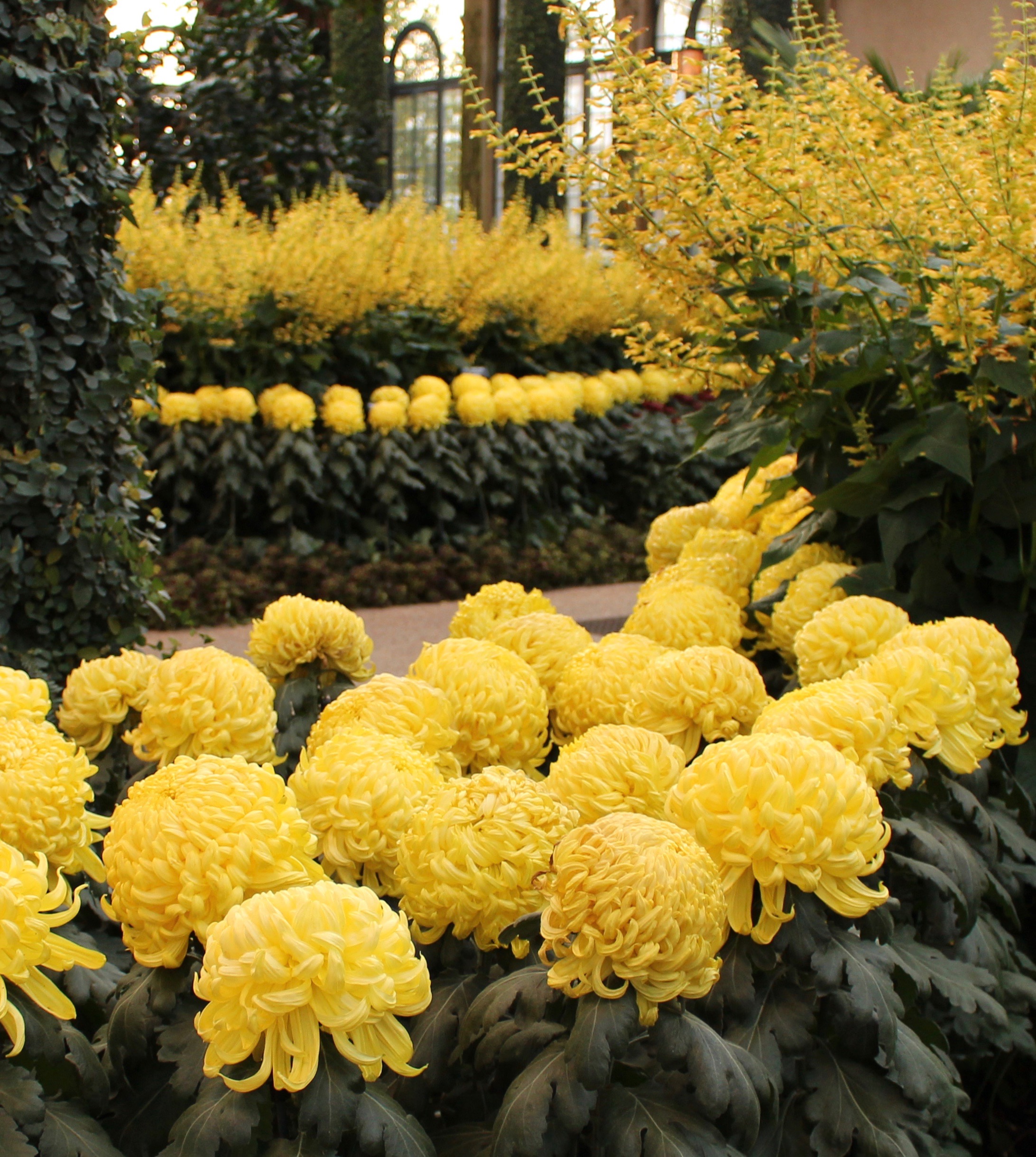
My favorite part, the explosion of yellow lining the path across the orangery.  Giant yellow chrysanthemums and a wall of yellow Salvia madrensis.   

If you’re still with me you may be wondering just how exactly you can “have less but more”, so let me try and explain myself.  There were fewer total varieties and forms, but hundreds of each.  I don’t know how you plan or find the room to grow and train hundreds (or even thousands!?) of mums to football size perfection, but apparently Longwood does.

longwood chrysanthemums

There was so much yellow here I wanted to roll in it.

The rest of the conservatories were just more wow.  I think the less I write the better, so here it is.

longwood fern conservatory

The exhibition hall, flooded with a film of reflective water and shaded by tree ferns.  The topiary are begonias and I don’t think I’ve ever liked begonias more.

longwood chrysanthemums

The ‘thousand bloom’ chrysanthemums.  A single plant grown and trained for a meticulously perfect show.  The one in back is absolutely huge.

longwood chrysanthemums

Maybe these were all the leftovers?  A merciful Longwood employee opened the one-way barrier and let me through when she saw me standing there mumbling ‘I need to go there, I need to go there’.  I loved it.  Maybe this was my favorite…

longwood chrysanthemums

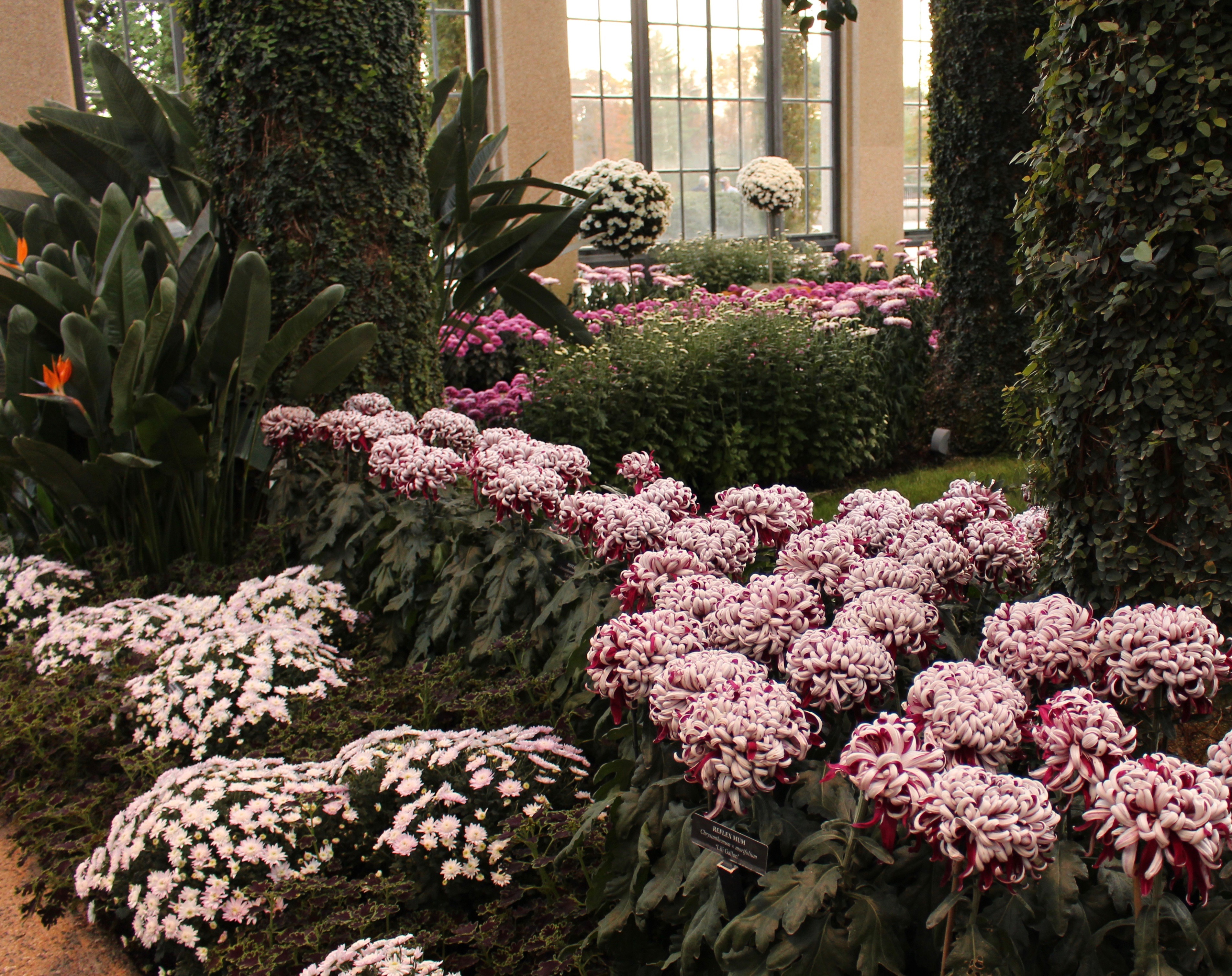
If the yellow was too much there were plenty of yellow-free zones.

longwood chrysanthemums

Yeah there were a lot.  ‘Chrysanthemum Festival’ is a worthy title.

longwood chrysanthemums

And every single, last one was perfectly grown.  I suspect there’s still half a greenhouse worth of backups somewhere!

I enjoyed it.  If you’ve never been I recommend giving it a try, just know that the display comes down this weekend and the conservatories close until after Thanksgiving as they prep for Christmas, so that someday visit might have to wait until next year.

Keep your fingers crossed and faces masked in the meantime.  The kids are annoyed I didn’t take them along, and are anxious to see this year’s Christmas decorations, but with record COVID cases and rising deaths across the country and with rising numbers in Pennsylvania I don’t know how that will work out.  I’d say we can hope and pray for the best but seriously…  just wear the stupid mask and avoid the party at the bar and that will probably get us much further than some false hopes and empty prayers.

But I’m probably preaching to the choir here.  Stay healthy and have an excellent weekend and wish me luck as I finally consider my own messy garden and unplanted bulbs 🙂

Hedgleigh Spring

Garden visits have been sparse this year, but being outdoors in the warm sunshine with a fresh breeze is probably one of the safer pursuits these days, and as we approach the more confining months of winter it might be best to stretch the legs one more time before the season of long nights settles in.  I had heard that hardy, autumn blooming camellias were a thing down in the suburbs of Philly, so when a stretch of beautiful autumn weather presented itself I knew I needed to check it out.  An offer had been made last spring and my fingers were crossed that offer still stood.  It did, and the offer was just as gracious as before and a few days later I was heading South to one of the most highly regarded private gardens of the Philadelphia area.

hedleigh spring

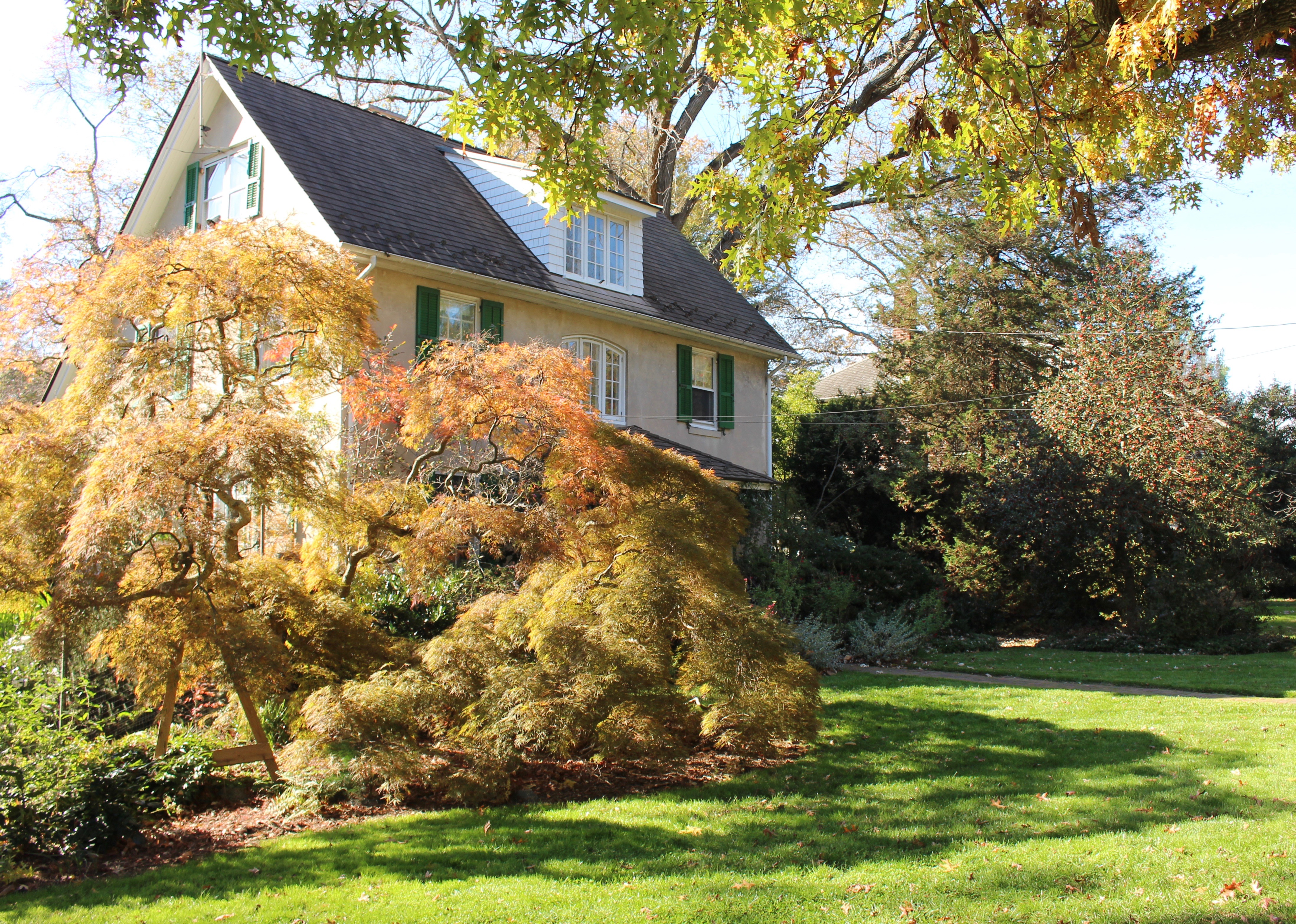
Cressons have been tending the land of Hedgleigh Spring since before Charles’ grandfather built the house over 100 years ago.  I’m going to guess the mountain of ‘dwarf’ cutleaf maple alongside the house probably dates just as far back.

November is not typically a month reserved for garden visits, but this beautifully orchestrated collector’s garden has something for every month of the year.  While other gardens are down to a pot of mums alongside the front door, Hedgleigh Spring offers decades worth of collecting, growing and hybridizing fall(and spring) blooming camellias, and melding them into a landscape already full of exceptional autumn interest.  Beautiful weather helped as well.  Blue skies, balmy temperatures and dozens of fall blooming camellias at their peak made for an excellent garden tour.

needle palm

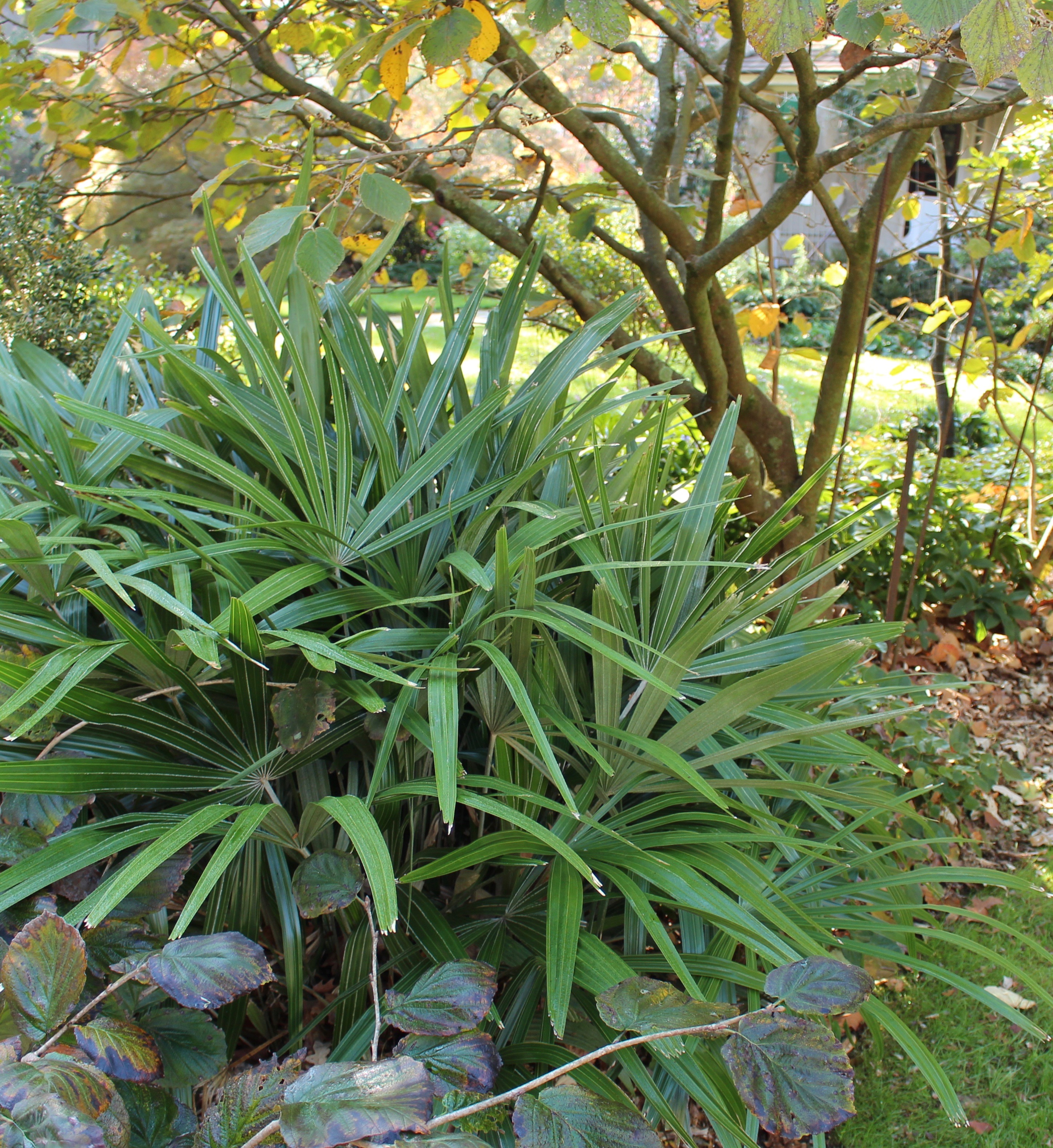
It’s a good sign when mature needle palms and witch hazels grace the streetside plantings.

We started out front of course, and for as hard as I tried (and I really thought I was doing great) I missed the names of most of what I was really interested in.  My apologies, but if you really need more info I’m sure I can find it out for you.  One of the highlights of the tour was the extensive background information for each plant, each cross, the typical growth habit, care, pruning hints… and names… everything had a name, but you can blame this visitor for losing it.

ackerman hybrid camellia

‘Winter’s Rose’.  A beautiful flower on a dwarf plant,  but I do remember Charles warning me that it’s usually too late a bloomer to put on a good show, and all those unopened buds will probably freeze off during the winter.

I did make a special effort to keep my ears open for anything which might possibly have the magical combination of early fall bloom and enough hardiness to possibly offer a show in my much colder garden.  It’s a foolish idea since decades later I can still remember how all the “hardy” camellias I saw planted around a much warmer Long Island faded away, but…. whatever.  Charles put it in a much more promising tone.  He said it would be interesting to see someone “trialing” these crosses in a much colder climate.  I’ll keep that in mind for when a brutal winter comes along and crushes my delusions with a zone 6a reality.

hedleigh spring

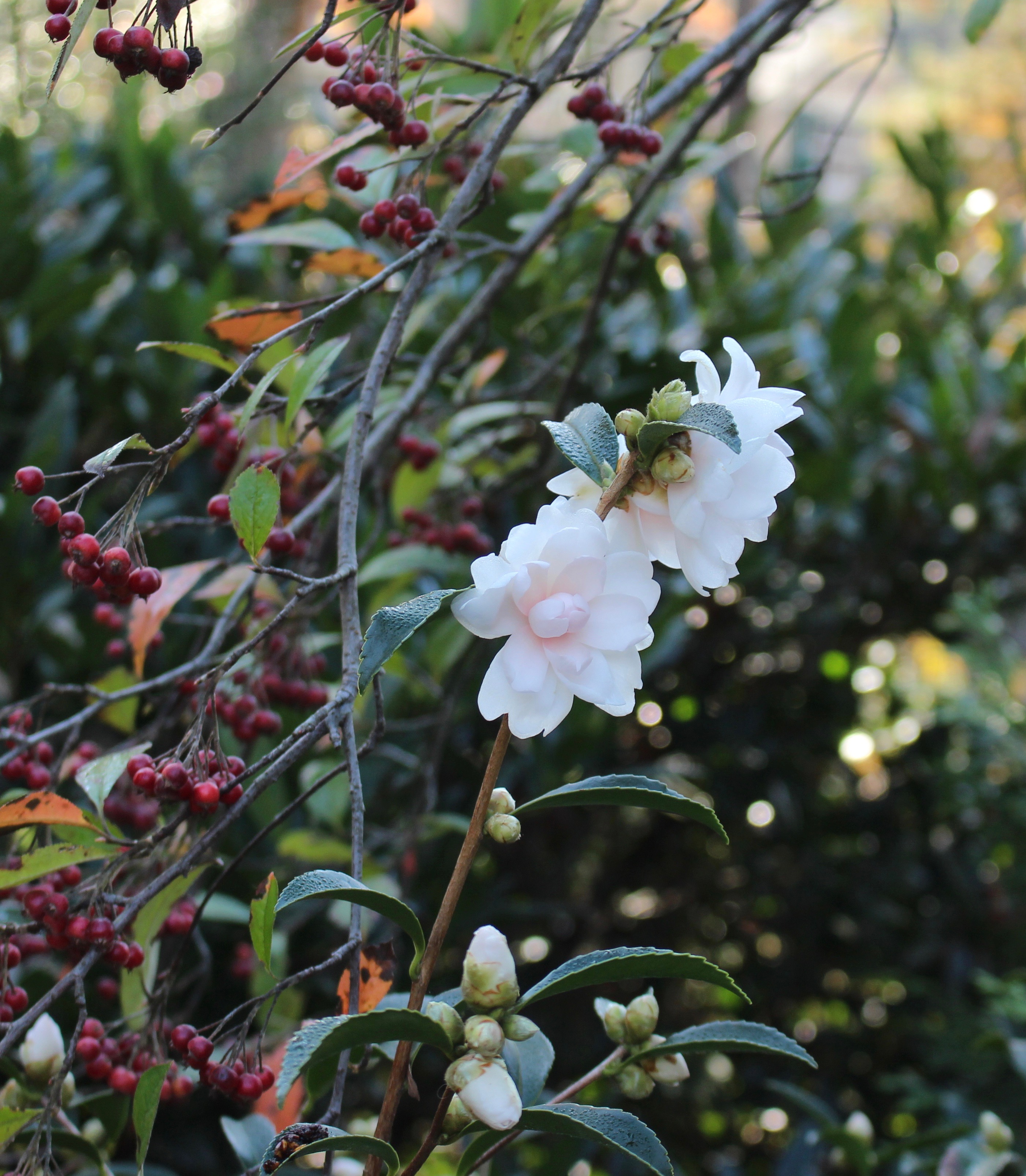
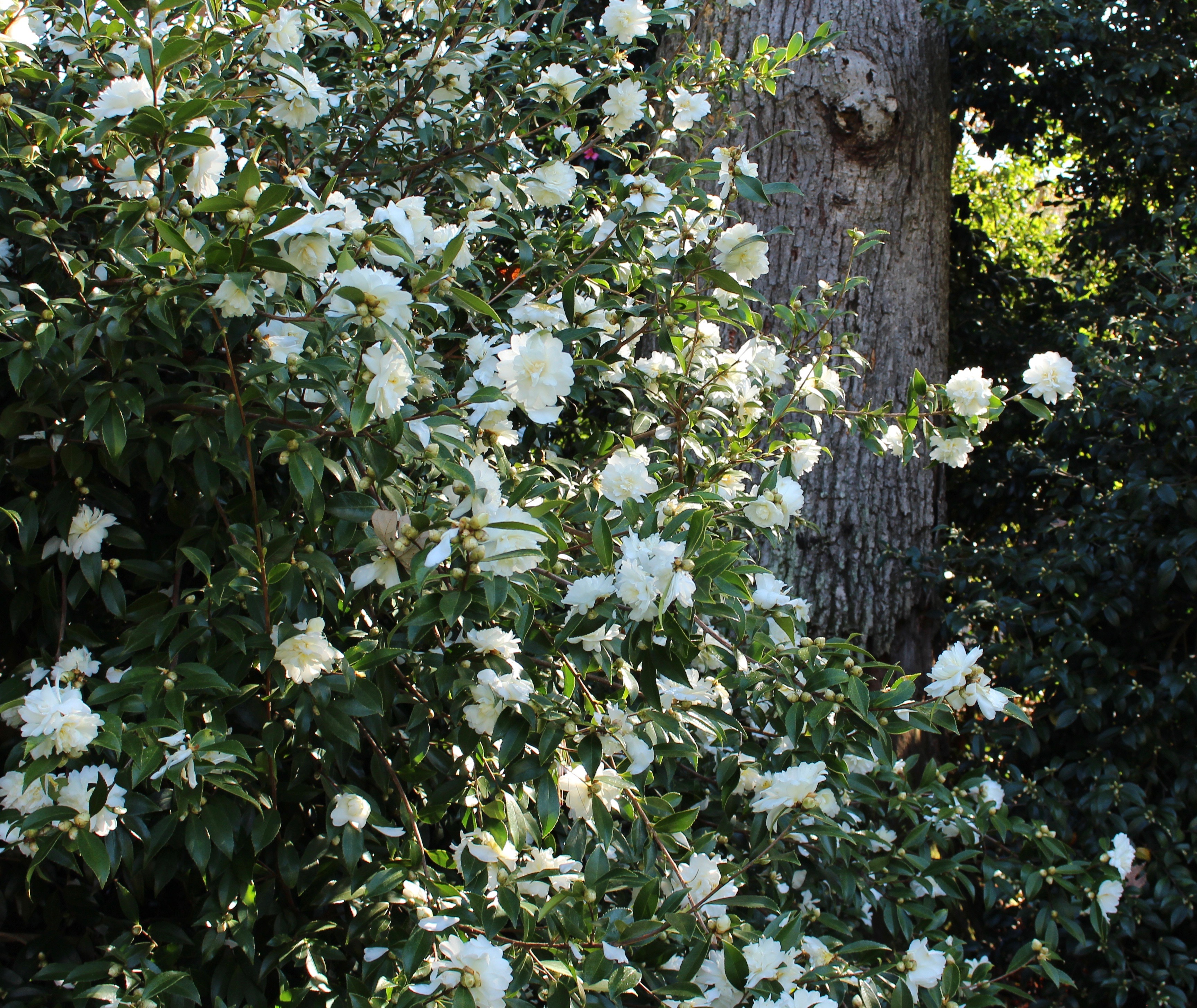
An un-named tall, fast growing C. oleifera x C. sasanqua ‘Cleopatra’ cross with plenty of buds and a long bloom season that starts early enough to beat the cold.

Although I saw many which I’d like to try I was reminded that most fall bloomers are not bud hardy and once winter sets in, any unopened buds will be lost.  For my zone, a well thought out selection would be something not only hardy, but a plant which starts blooming early, has plenty of buds, and doesn’t show damage too strongly even if it does get hit with a few early freezes.

hardy camellia

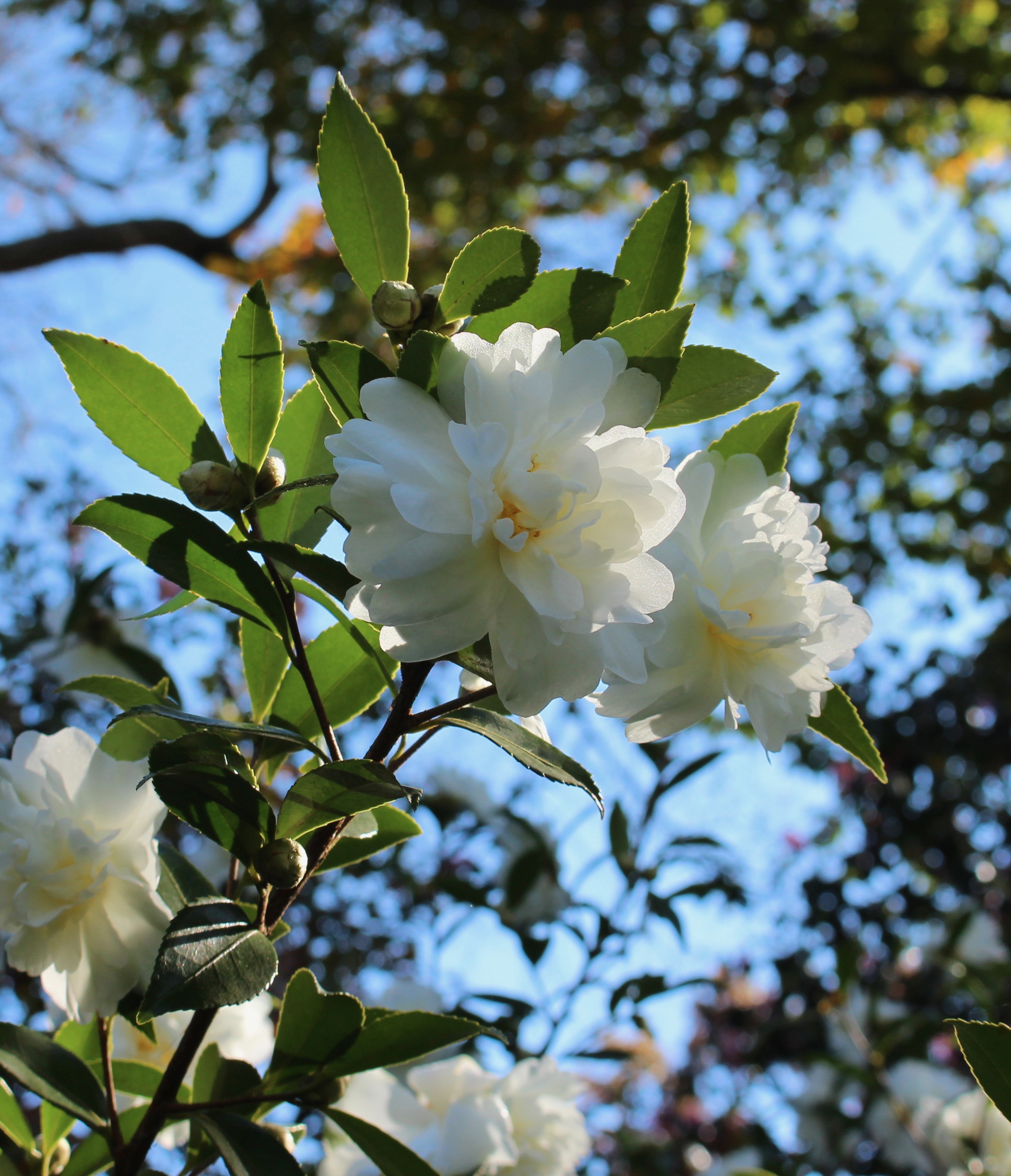
A beautiful large-flowered semi double which was just too nice to leave out.  It’s one of Charles’ un-named hybrids, a ‘Snowflurry’ x ‘Moon Festival’ cross, which has been hardy, but perhaps not unique enough to name?  It looked perfect for our visit, but Charles warned that it would be a less-promising choice since the blooms are usually later.

Some siting ideas which were shared involved avoiding the sunny warm spot which you would think is a good idea for borderline hardy plants.  I’m told full winter sun on cold, frozen leaves will dehydrate and kill.  Better to site in a winter shaded or afternoon sunny spot.

hedleigh spring

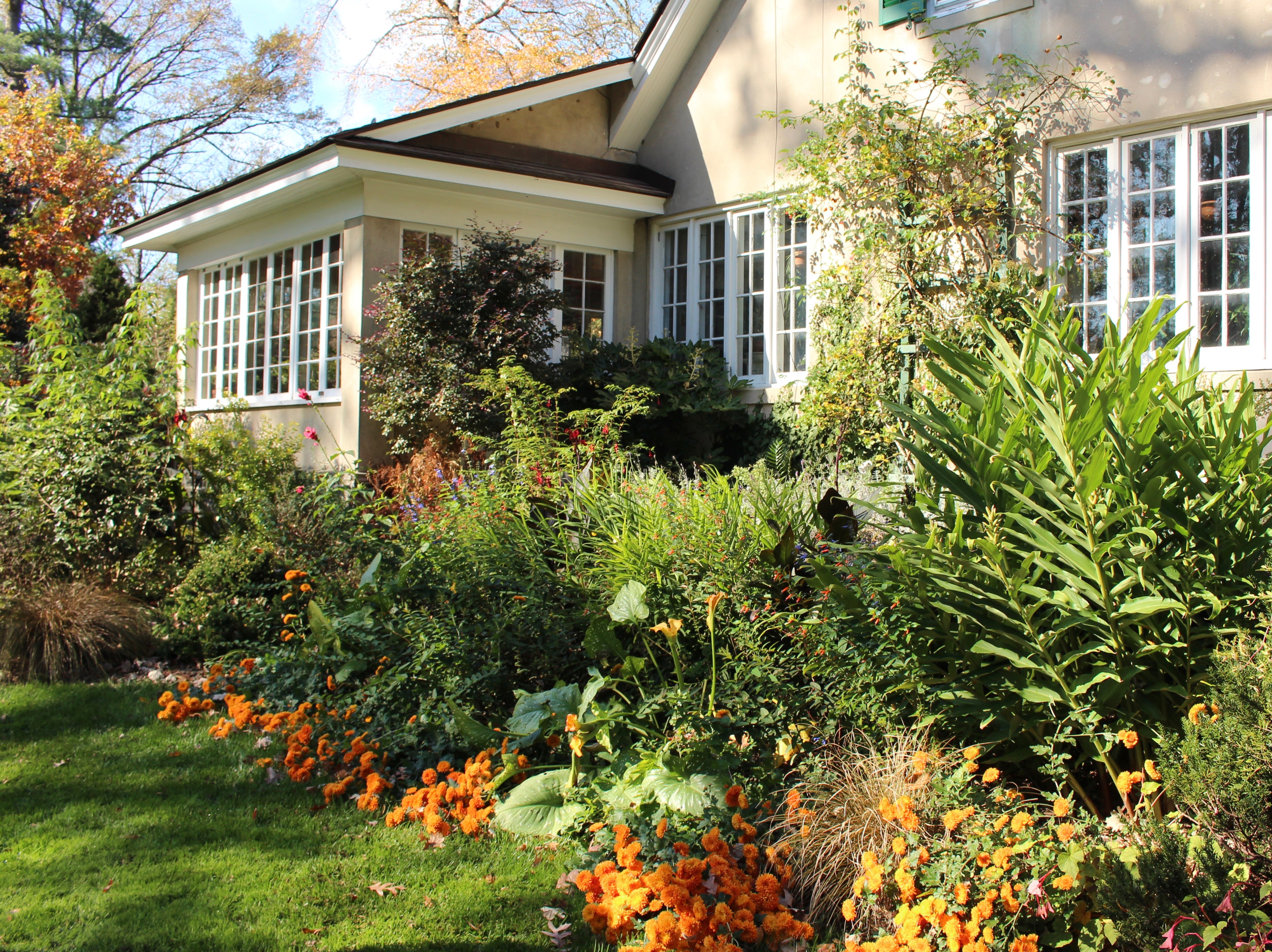
The warm nook of a Southern exposure can keep other borderline hardy plants quite happy.  Flowering gingers in need of division, loropetalum, Fatsia, and plenty of southern bulbs.  Plus orange mums, ‘Dixter Orange’ if you’re curious.

Or just hope for the best.  Creeping fig is something I’ve only seen on inside walls, and never imagined it would survive for decades on the outside, but there it was.

hedleigh spring

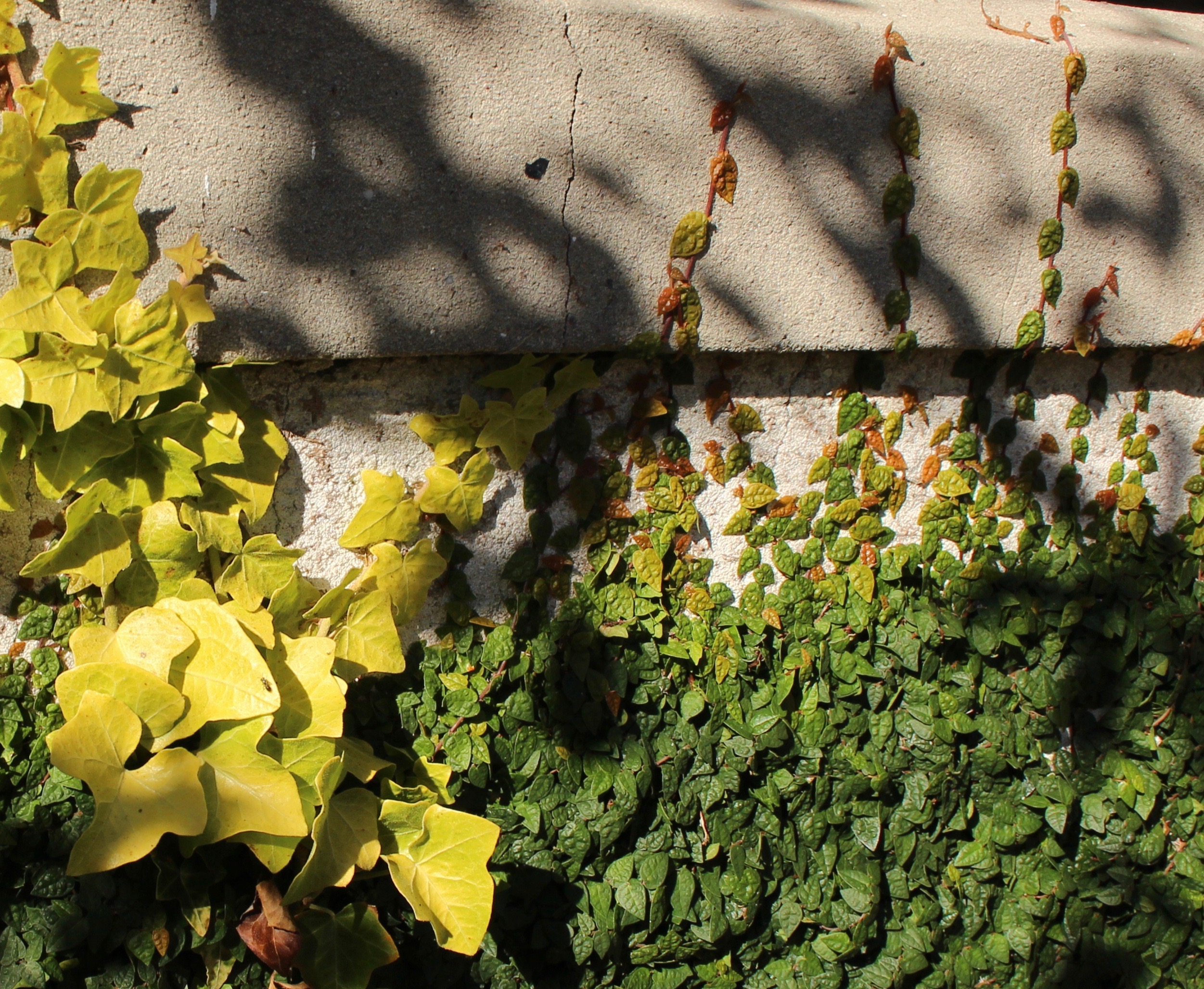
Creeping fig (Ficus pumila ‘minima’) alongside ‘Buttercup’ english ivy.  The fig gets frozen back each winter which is probably a good thing, but each summer it’s back.

Obviously not everything can be hardy so it was no surprise there were plenty of potted treasures which come in each winter.  One of them, a zone 8 ‘Moon Festival’ camellia, was just opening its 6 inch crepe textured blooms right on time for our visit.  The cool thing about this one is that years back it had been crossed with a hardier plant and only now two of the seedlings of the cross were showing their first flowers.  One in particular held on to the large form and wrinkled texture, so of course it will be something interesting to watch as it grows and develops.

camellia moon festival

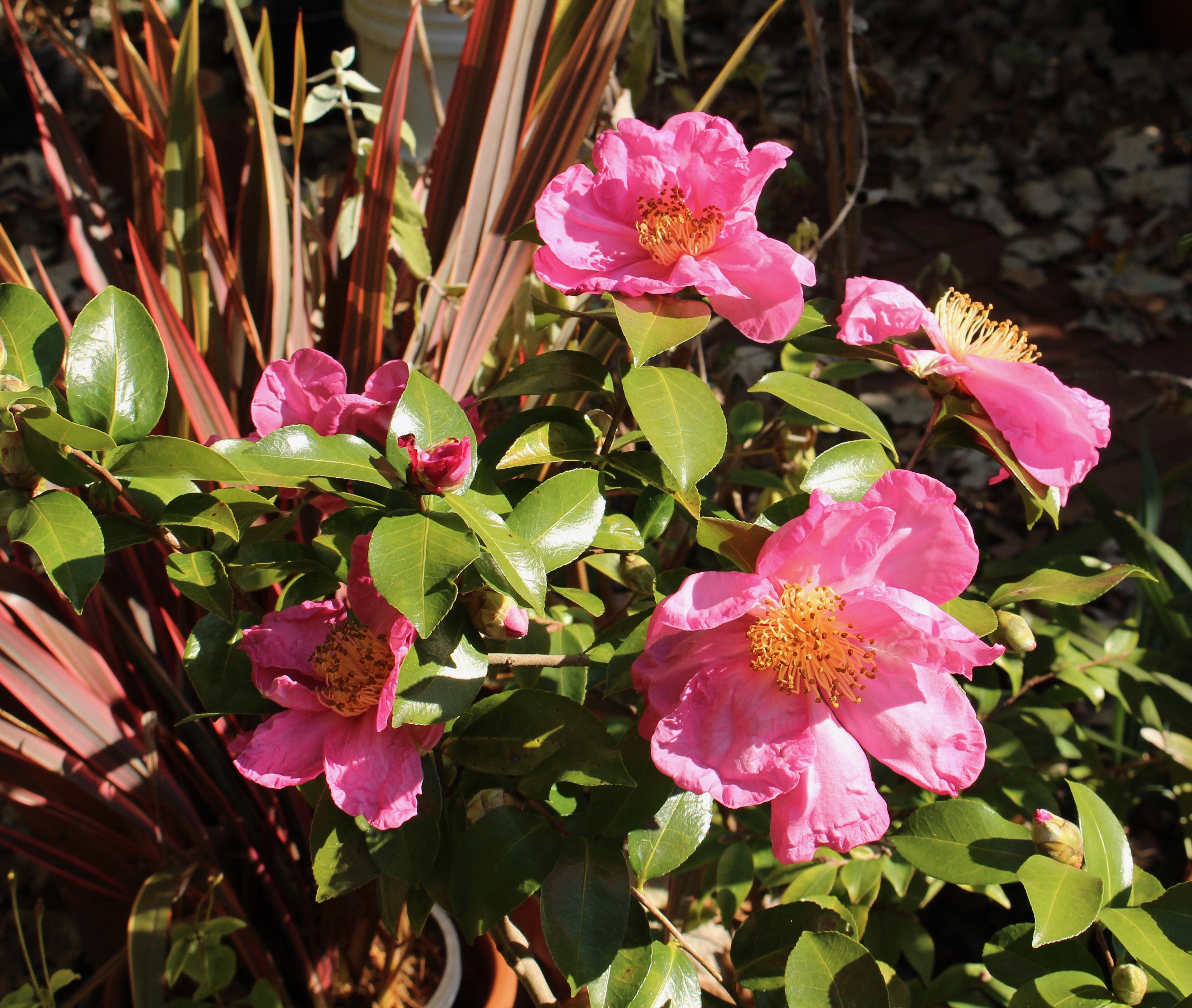
Camellia ‘Moon Festival’ in a pot on the back patio.

And there were more.  A particular standout was ‘Autumn Spirit’ with a deep pink color and a fairly formal double form.  Out in the open in full bloom with the blue skies and changing foliage colors around it, it was quite the show.  This might be one I risk up here in the tundra, it would be worth it.

camellia autumn spirit

Camellia ‘Autumn Spirit’

Hardiness isn’t the only hurdle.  Bad gardening also has to be dealt with, and when I saw this beautiful bank of ‘Snow Flurry’ I had to confess I’d killed mine this spring when we flipped into drought and I flipped into late spring apathy and didn’t water in time.  I may need to try again.

camellia snow flurry

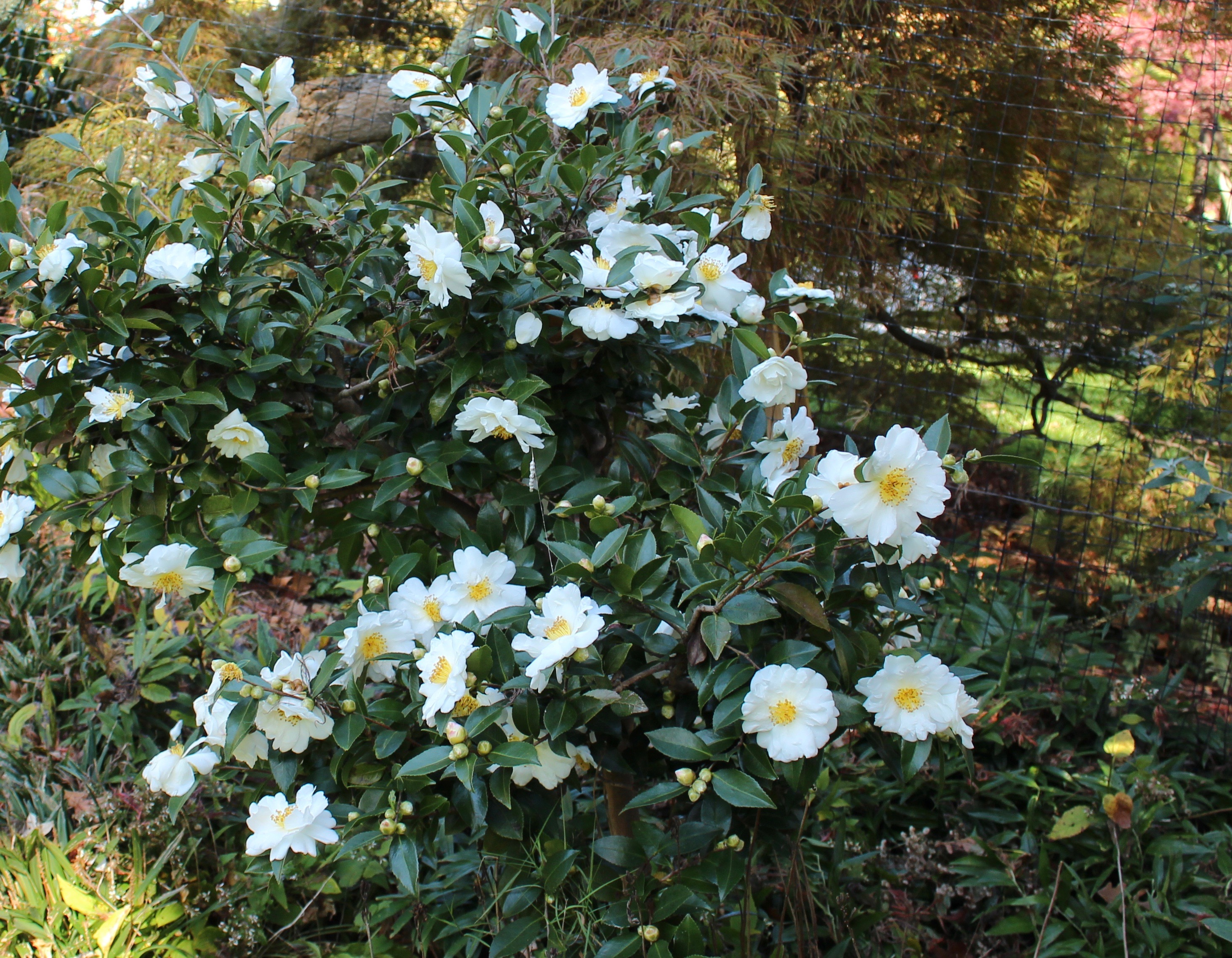
More like a whiteout, camellia ‘Snow Flurry’ was at its peak, covered in flowers from top to bottom and ringed in a puddle of spent petals.

camellia snow flurry

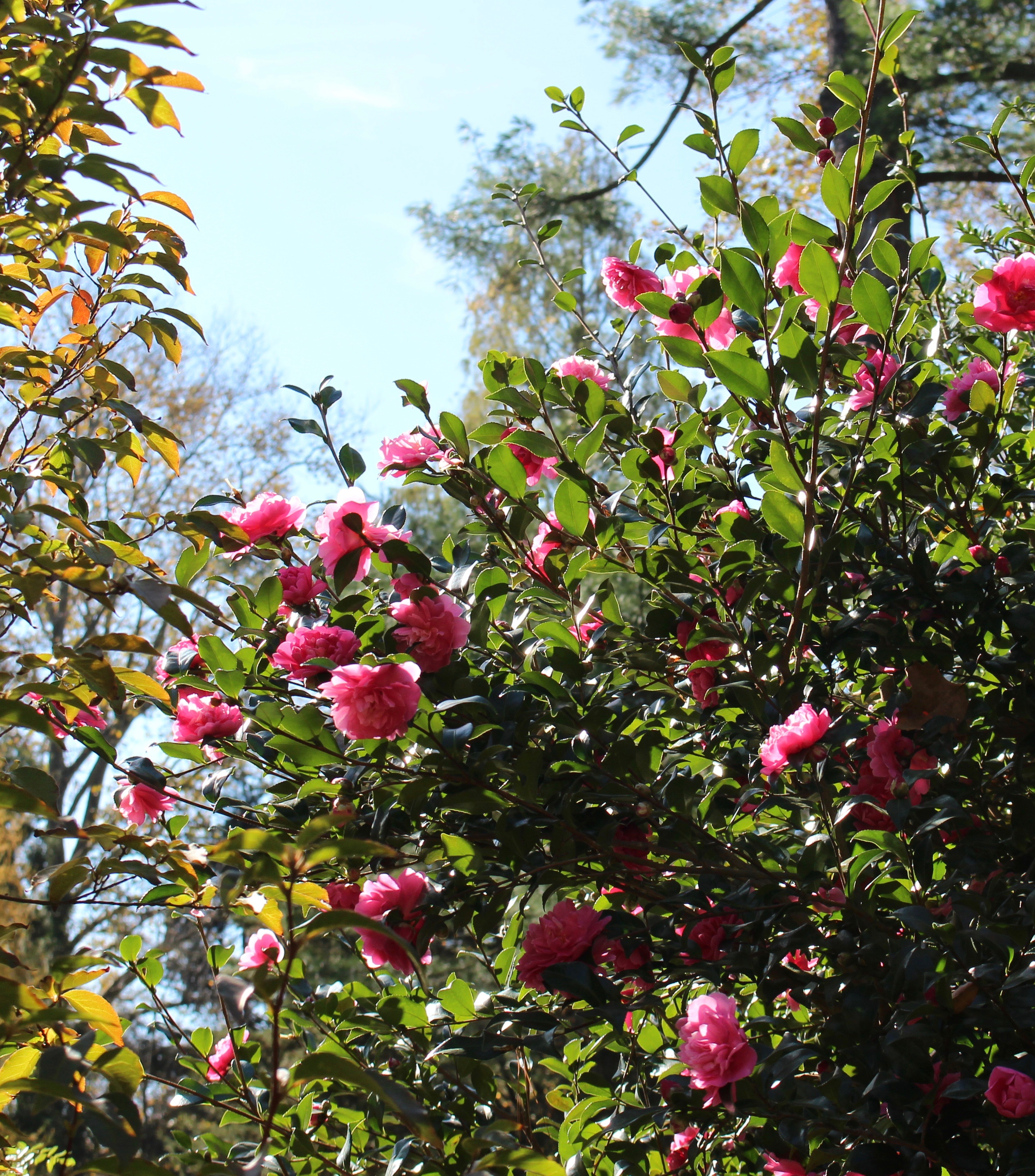
Camellia ‘Snow Flurry’ against the autumn sky.

Before I go on too long, I want to point out again that there was so much more to see than just dozens and dozens of camellias.  There were beautifully mature oak and bald cypress trees, banks of azaleas and hollies, southern and deciduous magnolias, perennial borders, fern gardens, woodland plantings, a vegetable and berry garden, rock garden, pond, and lots of bulbs.  Over the years Charles has made a name for himself in the bulb world and often gives talks and leads classes at Longwood and other locales in the area.

hedleigh spring

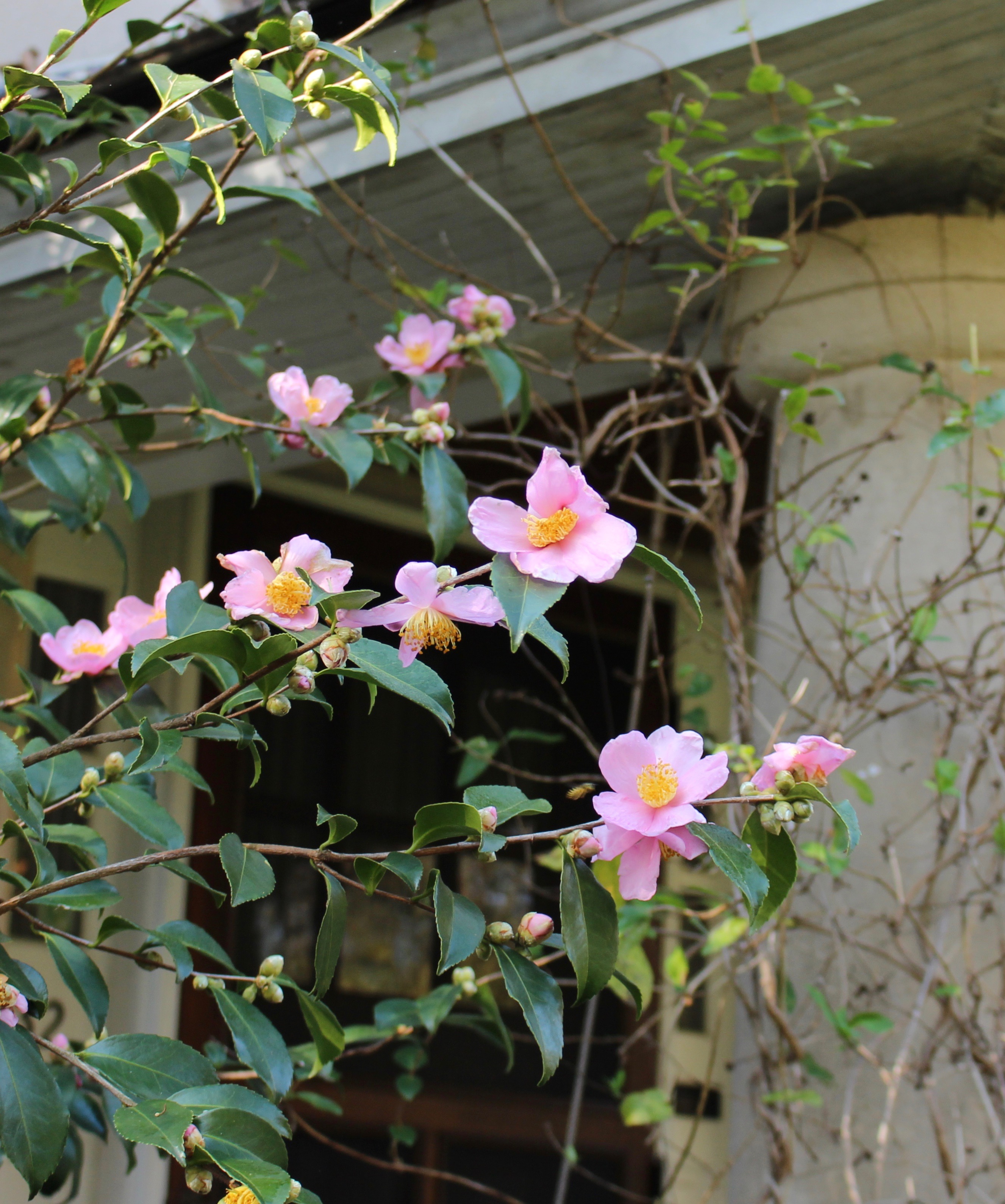
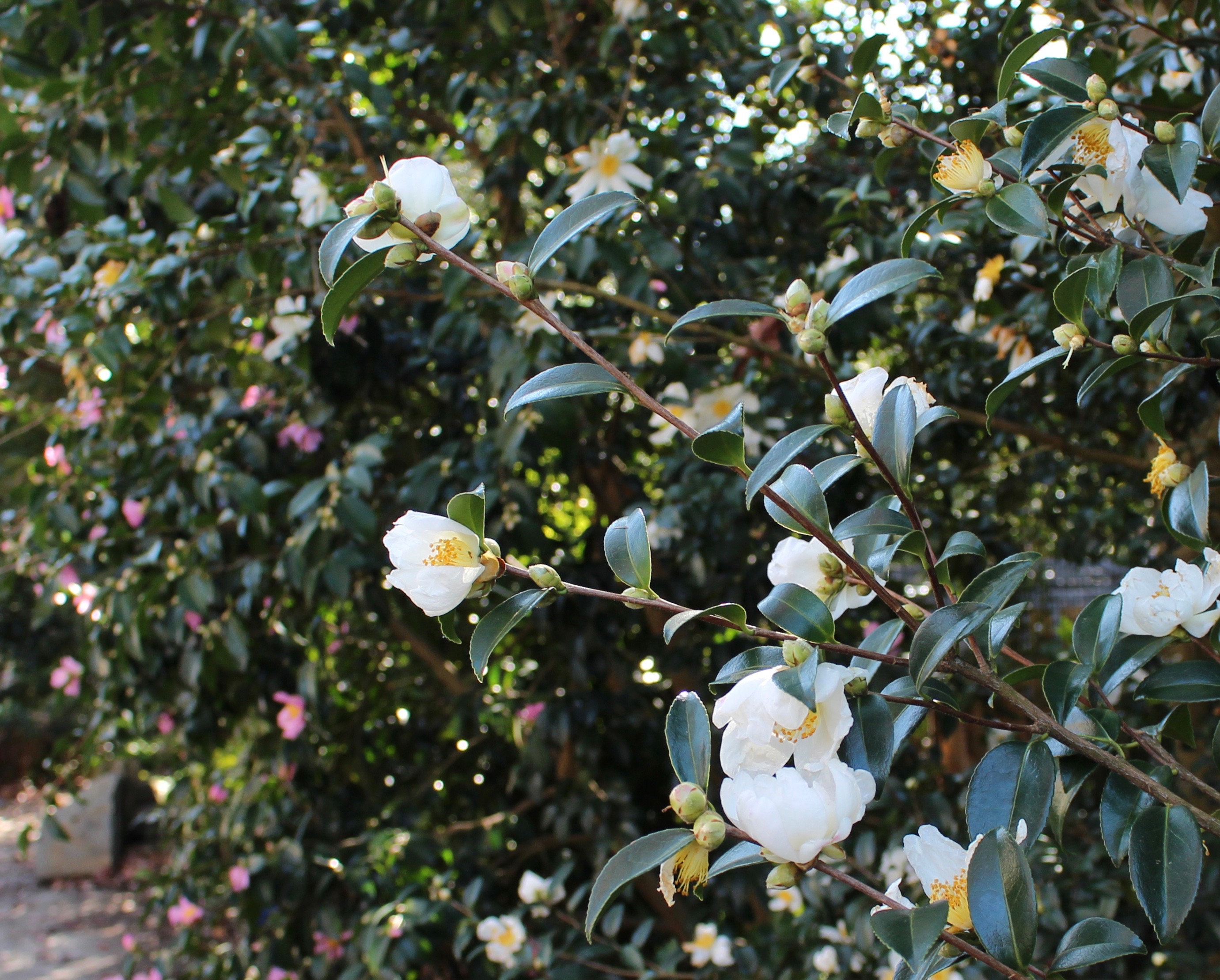
Of course fall blooming (Galanthus regiae-olgae) would catch my eye, but also notice the self sown camellia seedling and the pink flowering form of tea (Camellia sinensis) just off to the right.

My fingers are crossed that someday I can make it back for the spring bulbs, but on this visit it was all about a garden that looks good in its fall colors.

hedleigh spring

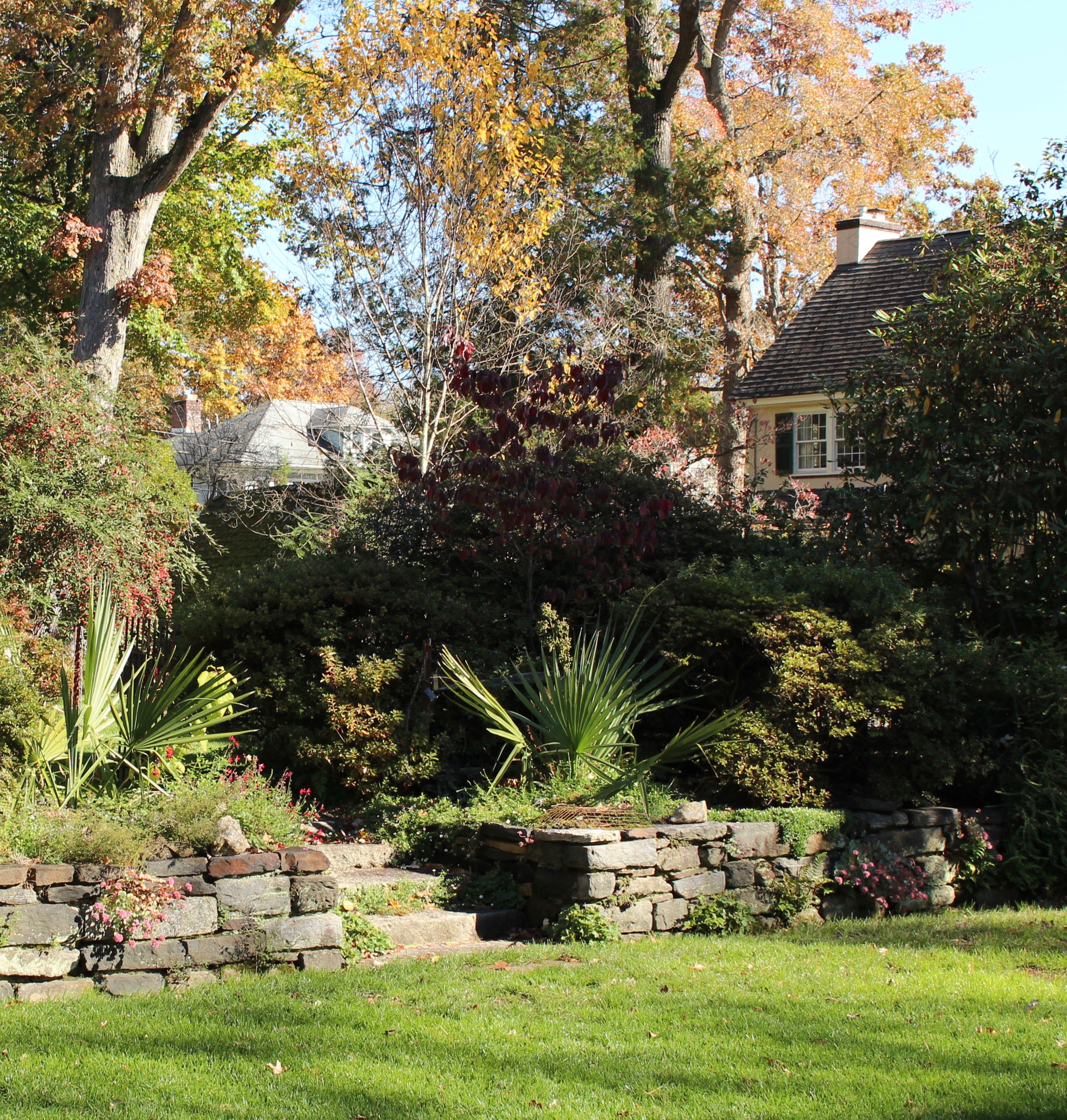
Mature trees surround the property, and of course I loved the hardy palms (Sabal minor ‘McCurtain).

Besides all the plants, the nerd in me was particularly excited to finally see the signature curved picket fence (91 ft long in case you’re wondering) which backs  a similarly curved perennial border, which blends in to mirrored rose beds on each side, and which finishes up with raised borders banked with stone (shown above with the palms).  For as much a collection of plants this garden is, it’s still focused on landscape design and plant combinations, with each one growing in a spot that shows it off well.

hedleigh spring

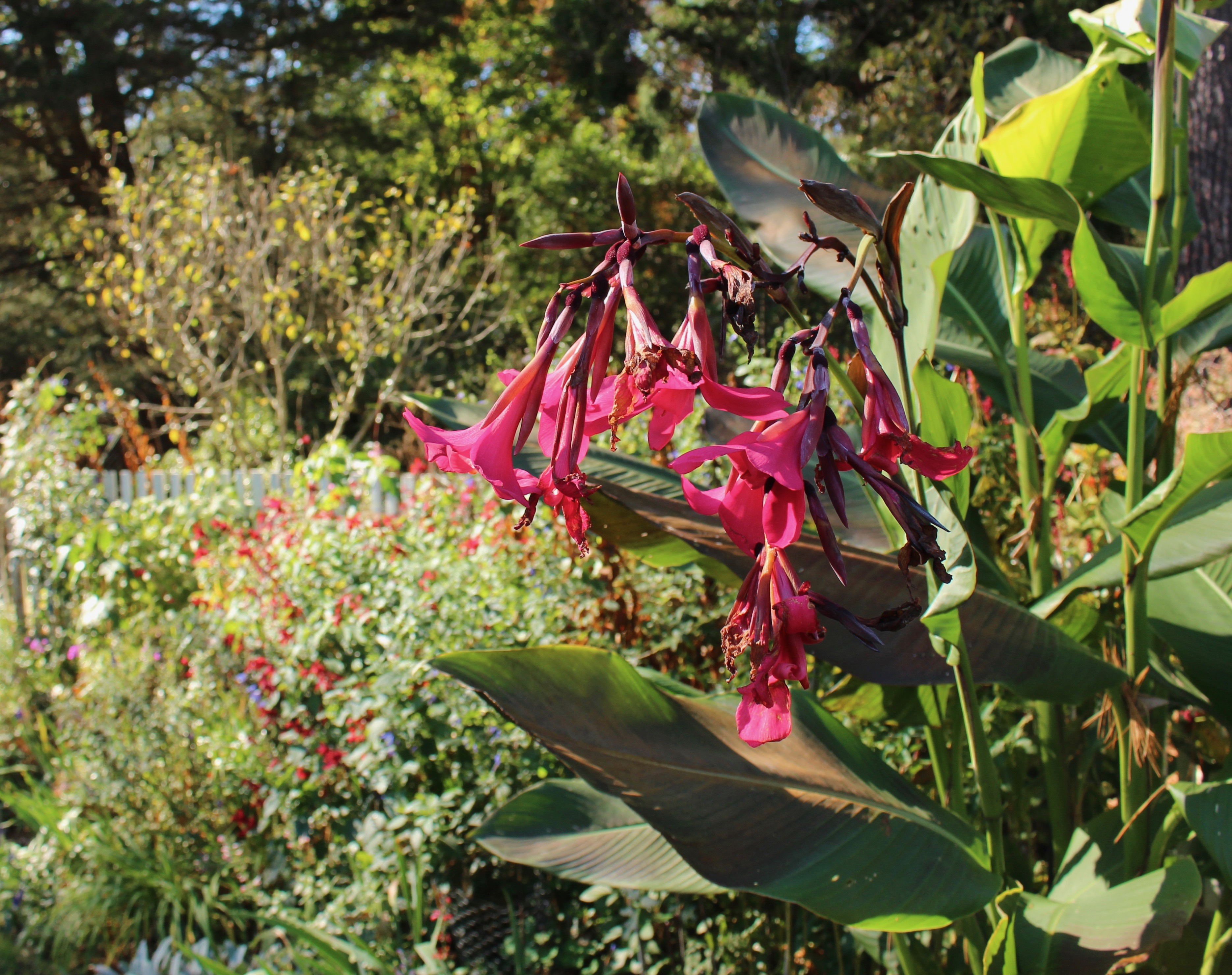
With foliage slightly singed by frost, Canna x ehemanii adds hot pink and tropical foliage to a border heavy on the warm colors of salvia and other bold summer plantings.

Actually things showed off well throughout the garden.

chrysanthemum gethsemane moonlight

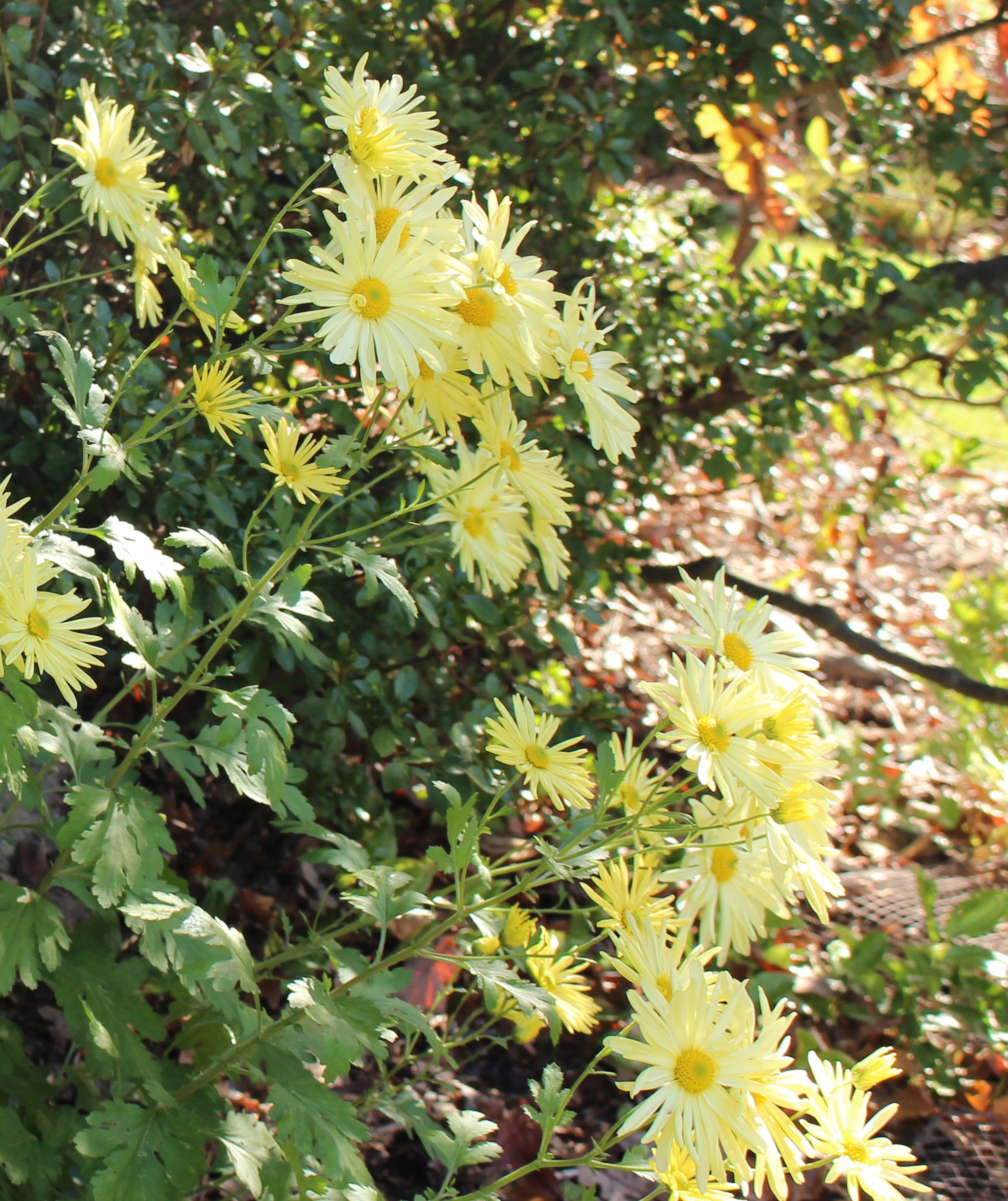
Chrysanthemum ‘Gethsemane Moonlight’

Sorry but I do have to mention one more camellia.  Charles donates dozens and dozens of seed varieties each year to (among other places) the Hardy Plant Society, Mid Atlantic group seed exchange.  Over the years I’ve tried quite a few, and as we wandered the gardens it was fun to see the parents of many of my plants.  Camellia ‘Survivor’ was named after surviving a cold snap which many others did not, and it’s one of the parents of seedlings here in my own garden.  Hopefully the now 18 inch seedling growing here will someday also show off those hardy genes, and give this gardener a fall flower or two.

hardy camellia survivor

Camellia ‘Survivor’.  Charles actually encouraged me to reach up into the small tree and take a few ripe seed pods.  I tried to act like it was no big deal and even shared a few with the others.

And then the tour started to wrap up.  We heard car doors slamming as another group arrived, but fortunately there were still a few minutes for one last dash out back to the creek which runs through the back end of the property.  Yes, there’s even a creek… and a small wet meadow area…

hedleigh spring

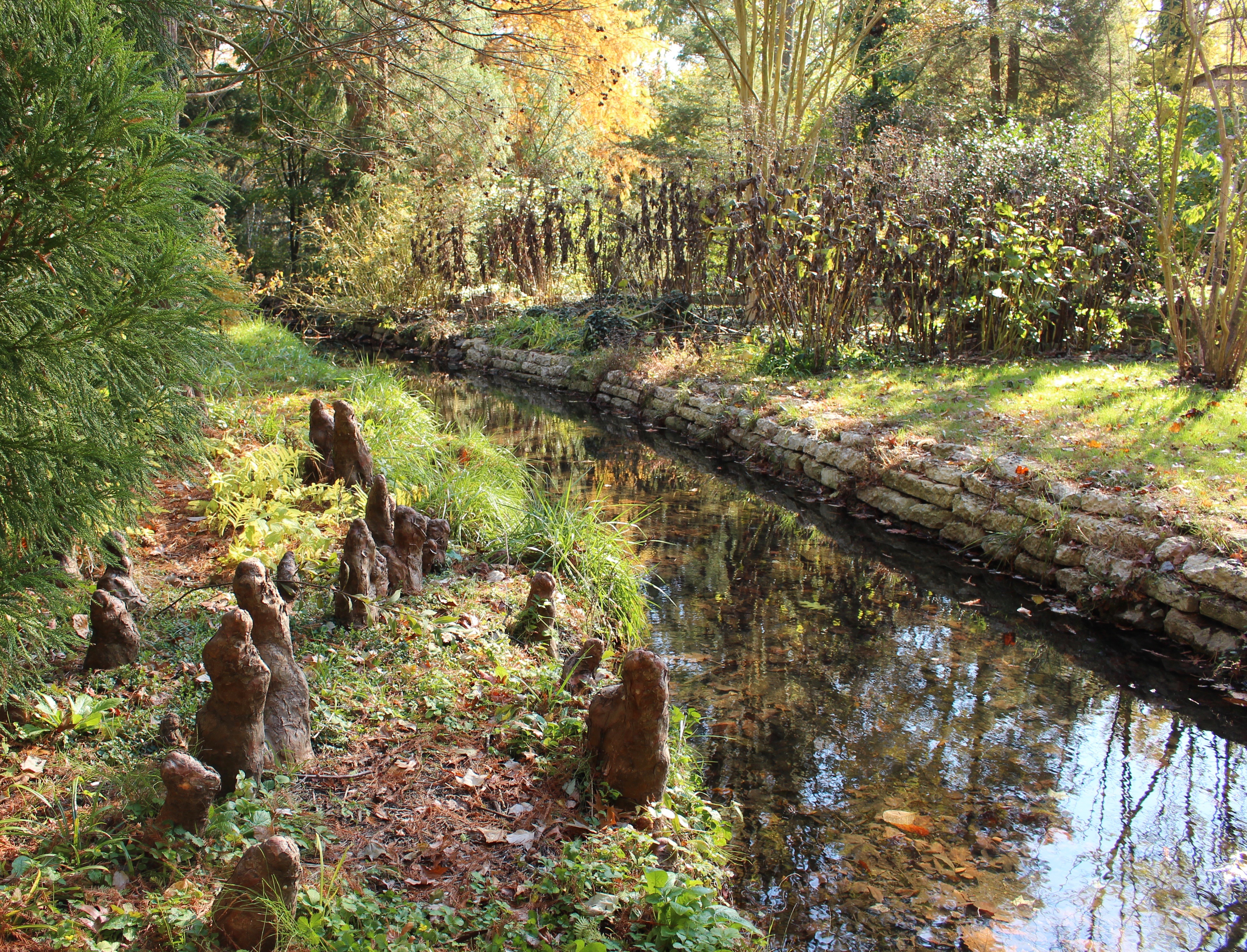
Cypress knees holding one bank while recycled concrete from a sidewalk redo hems in the other side.  I was surprised to hear that this innocently clear and calm creek can burst up over its banks by several feet in a good storm.

So that was it.  We had already stayed way too long but even on the way back to our cars there were things we had somehow missed the first time through.

crocus speciosus

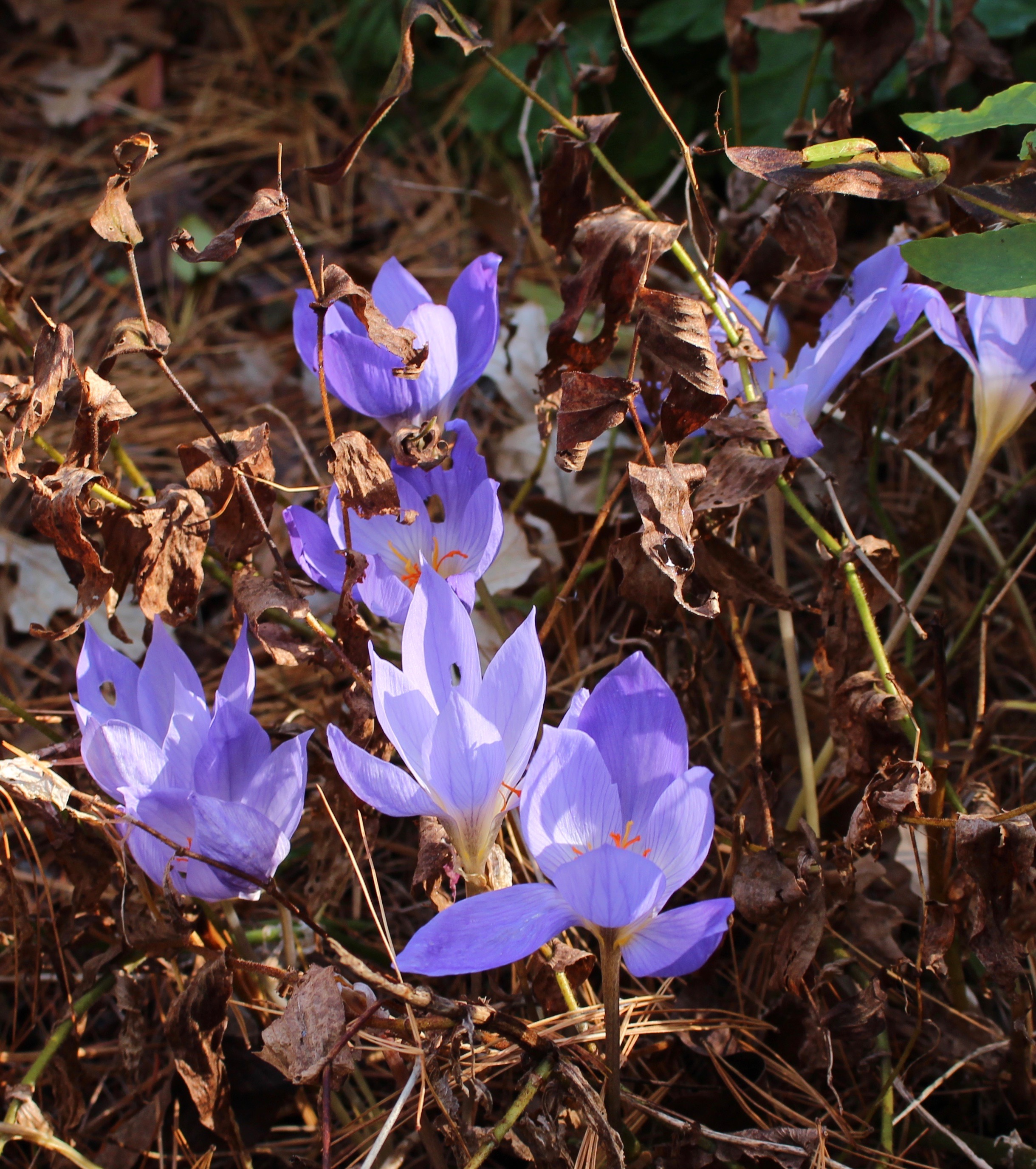
There were hundreds of Crocus speciosus in the front yard, but a surprise bunch in back caught the light perfectly.  I have to try this one again, mine were never this nice.

It was a great morning and besides seeing a lot, I also learned quite a bit.  Thanks again to Charles for all the time he spent with us, if we were pests in any way he never let on, and hopefully when he mentioned how the meadow along the creek was just filled with early bloomers he meant that we should see it some day!

More Fall

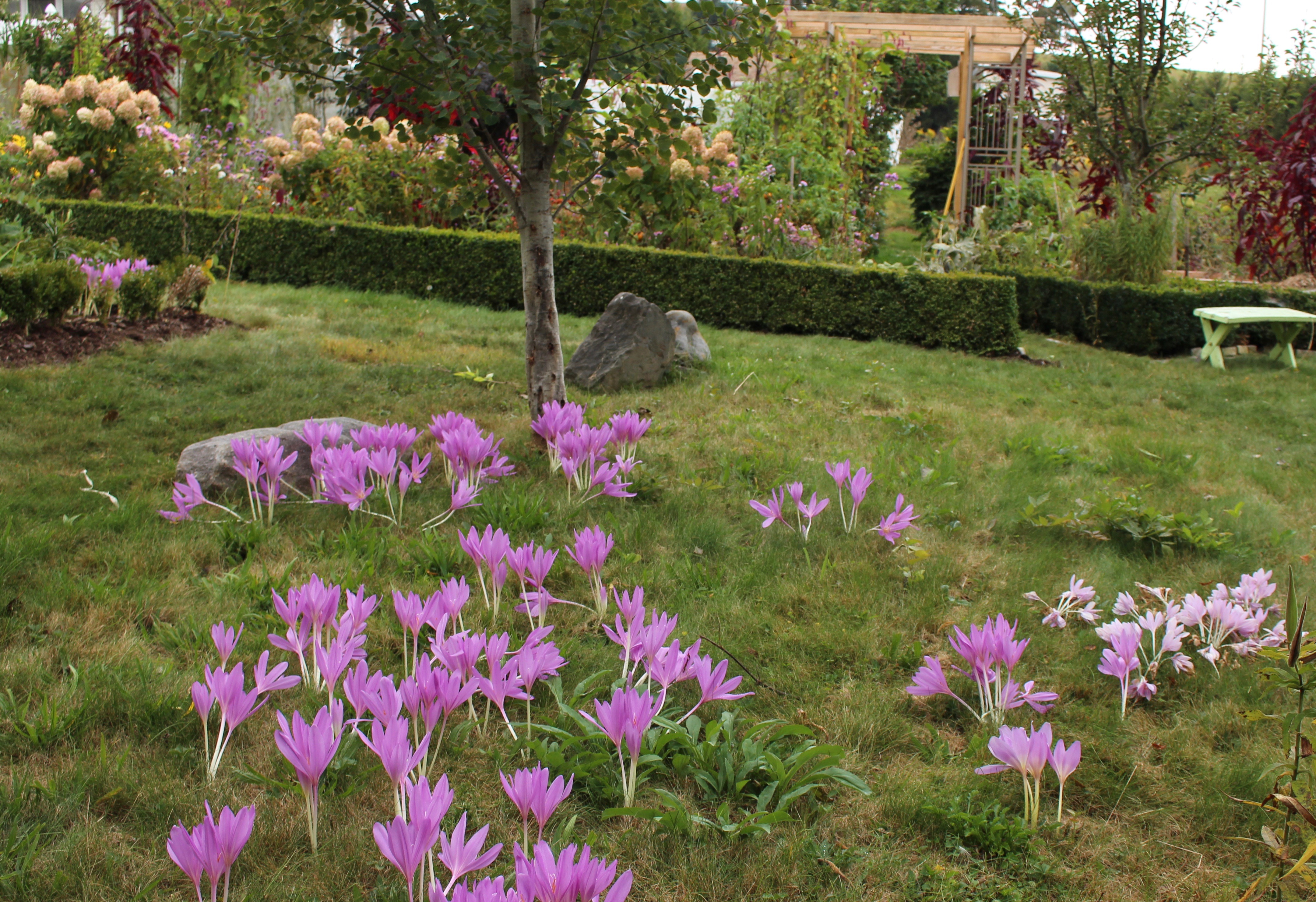
Who would have thought but this autumn continues to be a somewhat pleasant experience (pandemics notwithstanding), and we are enjoying a fairly warm October.  Warmth in October is nice.  People like warm fall days.  I on the other hand wouldn’t mind a little more cold.

autumn gourds

A hanging baskets was emptied to provide a spot for some of the gourd harvest.

Dried leaves and dead stalks, with pollen and fluff and dust blowing all over are not doing my sinuses any favors so my latest excuse for sleepy laziness is my allergies.  Even with a congested head and squinty eyes though, out in the garden is where I’d like to be and in spite of it all I did manage to get a few things done.  First of all I power washed.  When I told my mom how I’d power washed the birch trees, at first she couldn’t make sense of what I was saying, so I explained how they were looking a little dingy and algae-coated  and in need of a wash but that didn’t help.  ” I think I could have thought of better things to do” was her response, so I told her I washed the car afterwards and left out how I first cleaned the stone sides of the new coldframe and then we moved on to other topics.

whitespire birch

I apologize to every weekend warrior who will now feel the need to power wash their birch clumps, but they do look much nicer.

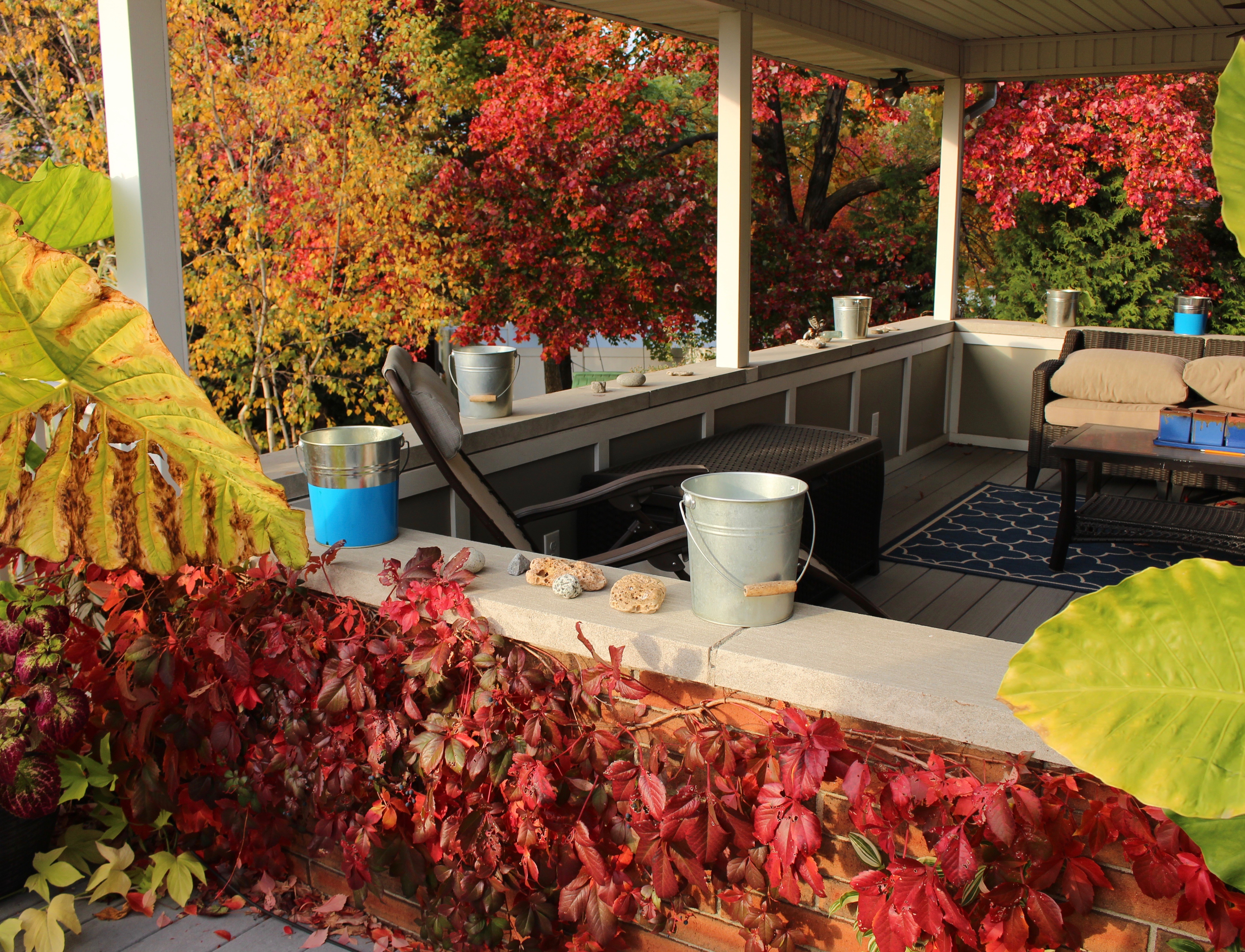
That took a lot out of me so I spent the rest of the afternoon sitting around enjoying the glow of the fall foliage.

autumn foliage

From the right angle I can enjoy the fall color without seeing the dozens of potted plants which still need to come in…

The next few days didn’t see much more in the way of questionable productivity.  I’ve been obsessing about chrysanthemums after all, and how can you think of overwintering potted porch plants when there are mums in full autumnal splendor!?

hardy chrysanthemums

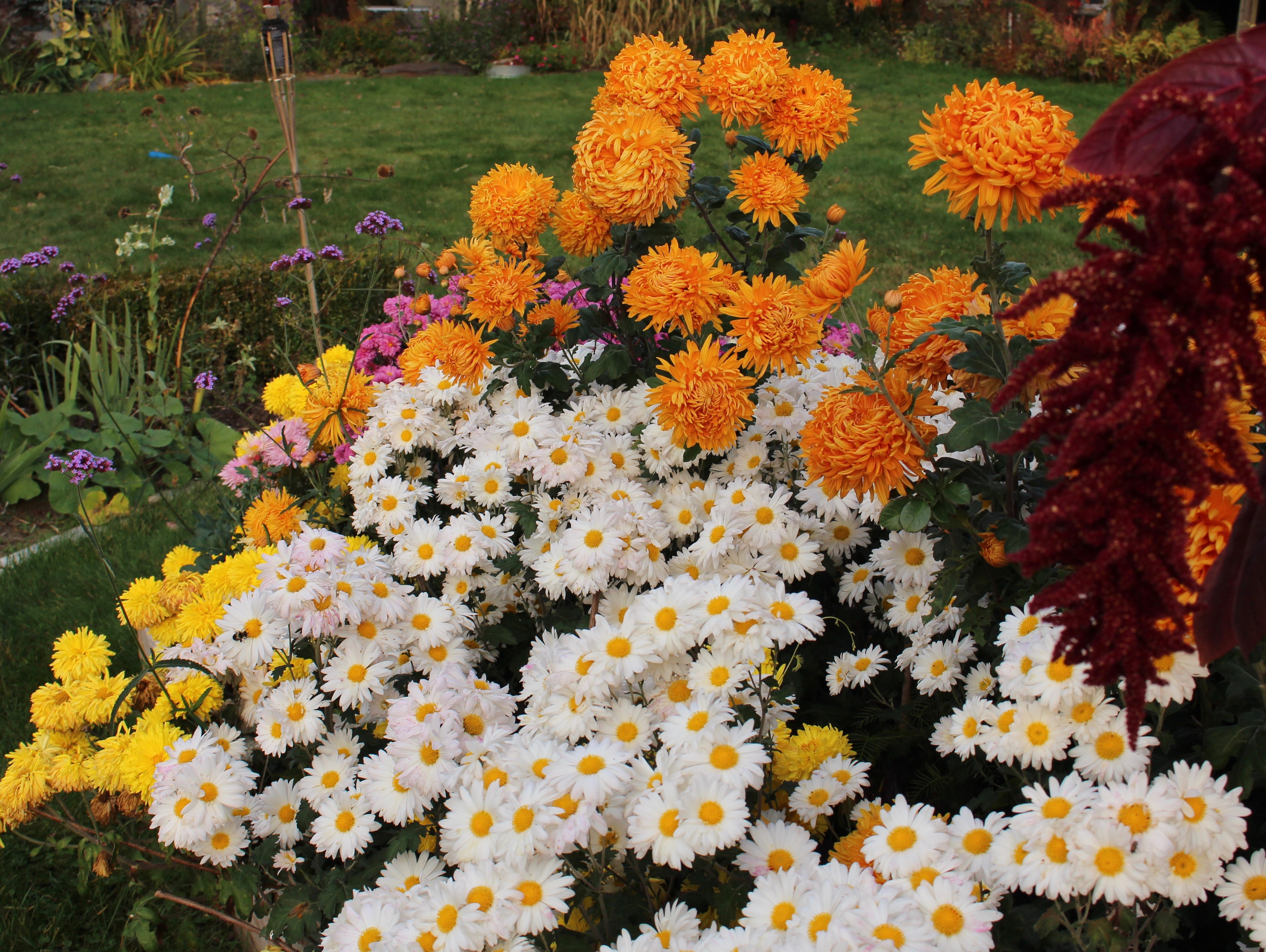
The chrysanthemum bed is now officially in full bloom.  Two beds would be nicer, but even one looks quite extravagant.

I don’t care about mums in May, but fortunately this year I still managed to plant these out and even added in a few seedlings which survived my springtime neglect.

hardy chrysanthemums

This pink seedling will be nice if it proves hardy.  Unfortunately the rest of this year’s crop is kinda boring.

The seedlings are fun, but the staking and fussing that went into caring for my last surviving football mum has really paid off.  All I do is stare at it and wish I had more.

hardy chrysanthemums

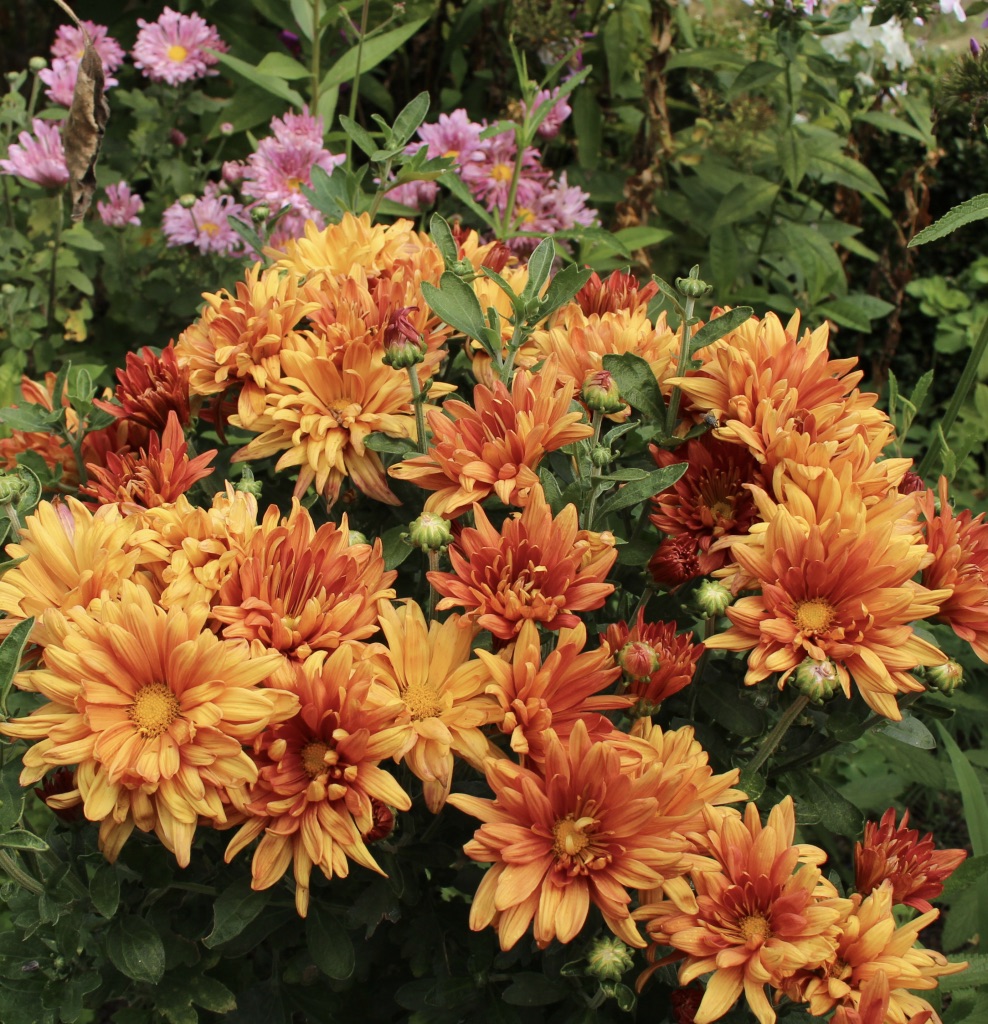
The amazing orange blooms of ‘Cheerleader’ tower over the others.

‘Cheerleader’ is about 3 or four feet tall even after an early spring pinching.  She requires strong wooden stakes and I even went as far as to disbud a few stems to see if the main flower would turn out nicer.  I think they did.  Hopefully next year I can repeat this.

chrysanthemum cheerleader

I did manage to cut a few for the house, but most are being enjoyed in situ.

While I contemplate a new career in raising fancy show chrysanthemums, and consider a roadtrip down to the Longwood chrysanthemum show (which goes until Nov 22),  I do want to point out a small project I did manage to finish up this week.  It’s a new raised bed, one made out of cement blocks and hopefully one which outlasts the wooden ones.

cinder block raised bed diy

Concrete blocks on end, the whole thing held together with metal strapping.  

Honestly I should have just stuck with the wooden theme, but I had an idea and that idea might be worth a try if it meant not having to replace every last bed in a dozen years.  In the meantime I just hope no one looks too closely at my credit card receipts and questions just how much was spent  on a 1/2″ steel strapping kit.  Let’s run a quick distraction with some nice photos of wonderful fall bulbs.

bessera elegans

A surprise flower on the non hardy Bessera elegans.  It’s just one more potful which has to still come in for the winter.

Just the fact the Bessera is alive is amazing and that it’s still sending up a bloom or two after flowering earlier in the summer is also a shock since I had given them up for dead months ago.  Actually it wasn’t so much giving up than it was throwing them into the furnace room back in the fall of 2018 and then just being too lazy to pull them out the next spring.  So they sat.  Bone dry.  For six months.  Then ten…. then twelve… then sixteen… Finally a year and a half later I went back there looking for emergency potting soil and found the pot.  I was shocked (and a little annoyed, since I really needed more potting soil) to find a pot full of perfectly healthy corms, no worse than the day I put them back there.  Out onto the sidewalk they went, and one April shower later they were all sprouting.

galanthus bursanus

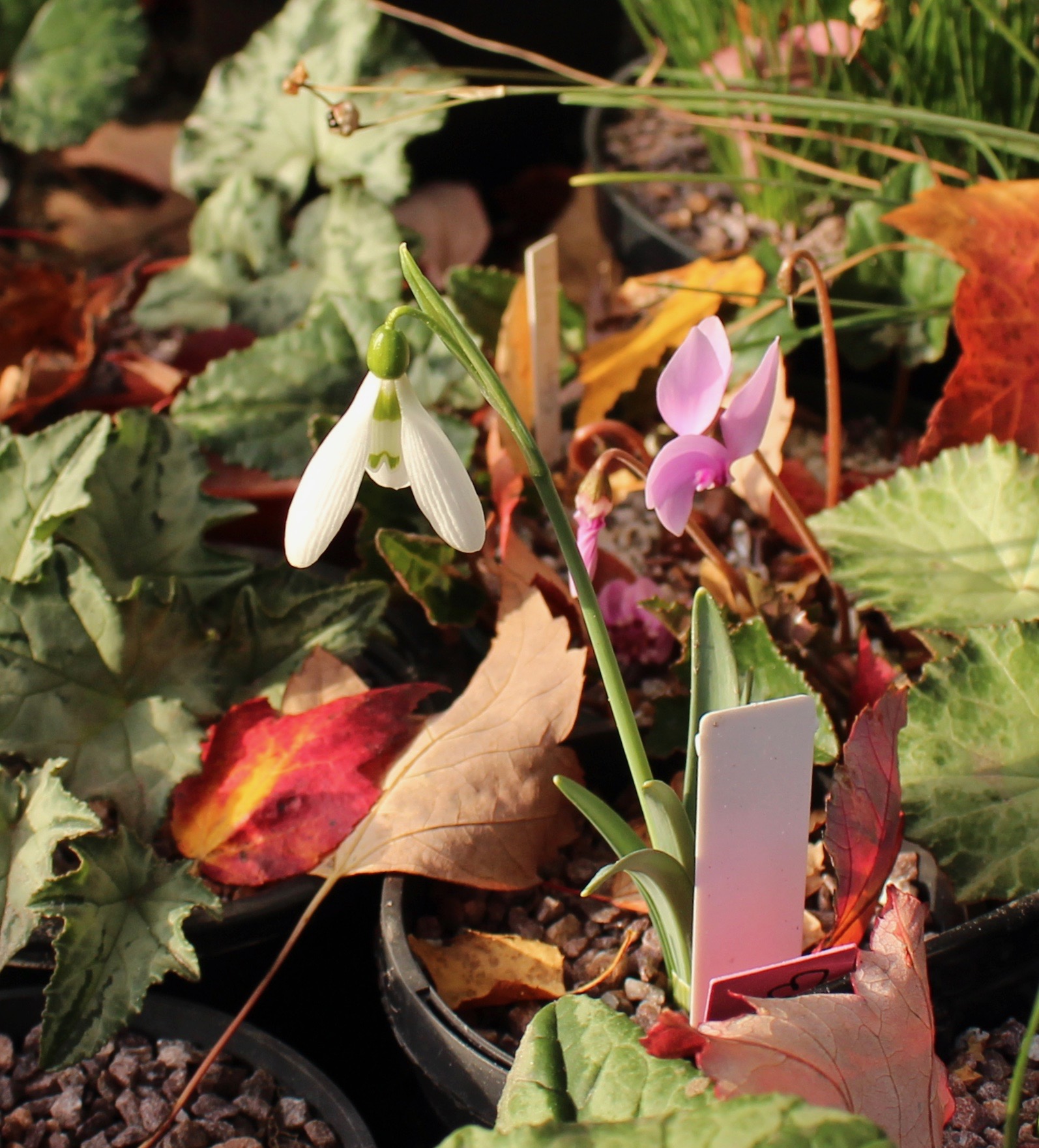
A very elegant autumn blooming snowdrop (Galanthus bursanus). You can probably guess just how often I check on this newest pet.

The bessera is a summer bulb, but autumn snowdrops represent a new season, and by that I mean winter.  I love seeing them coming up and from now until next March it’s snowdrop season.  Sure it slows down a bit in January, but for the last few years that slowdown is only a few days and not the usual months long lockdown of cold and ice that we used to endure.  I guess a global climate disaster can have a bright side if you look hard enough.

galanthus peshmenii

Galanthus peshmenii? I believe not, if only because the “are you sure?” backup peshmenii I bought is living up to its reputation and slowly fading away while this one gets better each year.

Did I mention how much I paid for the latest snowdrops?  Of course not, and I won’t.  By now I know better than to put things like snowdrops on anything which produces a receipt.  Explaining away a 1/2″ steel strapping kit produces a bored look but when I try to justify the excitement over an expensive little bulb, all I get is that judgemental eye roll.

Have a great weekend, and for those who are curious I followed some tips for finding a backdoor to the old WordPress editor, and it’s made my blogging life tolerable once again.

A Case of the Lazies

You would think that with all the hand sanitizer, distancing, staying at home, and hand washing, that there would have a sterile cloud surrounding me, but somehow I’ve still managed to catch a case of the lazies.  What a surprise, right?  I’ve never really shown much immunity, so all it really takes is a cloud across the sun, a temperature slightly too cool, or a day with a nice breeze to trigger a relapse.  I guess that happened.  My wife will tell me I should have worn a coat.  My son will ask if I want another donut.  It’s easy to see the struggle.

autumn perennial border

The front border as we roll into October. Heterotheca villosa ‘Ruth Baumgardner’ is the yellow daisy in front.  

A coffee and a donut make for a nice morning stroll around the garden.  Fancy people do scones and jam, but scones are crumbly, and I’d hate to waste a trail of jammy crumbles behind me as I take in the dewy garden.  As I walk, the dew and change to fall colors make it really obvious summer is over and I’m surprisingly ok with that.  The garden right now is a mix of summer lingerers and autumn bloomers, and although I spent last weekend leveling my mother inlaw’s garden and putting nails in the coffin of her 2020 season, here it’s a different story.  Cool things like the Heterotheca villosa are only now just coming into full flower.  This plant was shared with me a few years back by Kathy Purdy of Cold Climate Gardening fame, and it’s a native daisy which I cut back by half each June to keep bushy.  From what I’ve heard, ‘Ruth Baumgardner’ is named after a past president of the Perennial Plant Association, and was selected as a shorter form of the species, but that’s still relatively tall, hence the early summer chop.

red hot poker

Lingering rebloom on the red hot poker.  The bright color looks as good now as it did in July

If I weren’t so under the weather with my laziness I would be taking advantage of the more relaxed pace of pre-October and building that coldframe I’ve been mulling over for the last three weekends.  Unlike the last four years that I’ve been thinking about it,  this is the year it has to happen.  I’ve already lined up a few plants to go in (all my projects are usually the result of me painting myself into a corner plantwise), pulled out materials, piled them into the garage (where the car can’t go until this in done…), and now I just have to commit to a design.  ***spoiler alert** it’s based on an old shower door and leftover 2x4s so don’t set your hopes too high…

colchicum lilac wonder

Admiring colchicums is an excellent lazy day activity.  Here’s ‘Lilac Wonder’ flopping its way through the blue of leadwort.

Even just talking about a future coldframe has me exhausted, so let’s take one more look around the garden. The mums are coming, the colchicum are here, and in spite of a slight touch of disgustingly early frost, the garden still looks nice.

colchicum border

The former rock garden turned colchicum bed has been overrun with chrysanthemum seedlings.  Not for the worse though.  Colchicum ‘Innocence’ still found enough of an opening to show off.

A few early chrysanthemums.  I’ve killed off many (honestly it’s closer to most) of the larger flowered ones, but they’re my favorites.  Someday I dream of fussing and nurturing them enough to have those big show-worthy blooms, but this year just getting them staked them was a big first step.

chrysanthemum cheerleader

I believe this is ‘Cheerleader’.  Even under less than perfect conditions he tops out at 3+feet and requires some kind of support.

With the chrysanthemums starting in the potager I was happy to see that even with all the new beds and strict paths, there was still a nice crescendo of late summer chaos.  Verbena bonariensis and ‘Hopi Red Dye’ amaranthus still found their loopholes and there’s more than just dried tomato vines and over the hill zucchini filling the beds.

autumn potager

An overgrown mess is what I expect in October.  Fall veggies would be nice too, but there’s always the farmstand for that.

One veggie which I do want to show off is the sword bean (Canavalia gladiata) which has managed to grow up the pergola and put out a few pods in spite of the shortening days.  I admit to checking it every day as the foot long pods get fatter and fatter, and if anyone gets even remotely close to the potager I insist on showing them off.  At the suggestion of a friend I usually do it with a little “argh, these be my sword beans, argh”, but the magic of my humor is often met with an uncomfortably  blank stare.

sword bean

The sword bean.  It’s grown as a vegetable through India and SE Asia but I’m not sure if it’s edible here in Umrika.  

Now colchicums.  I looked and saw only three pictures were posted on this blog last year, so you’re welcome, but even after I killed half the ones I transplanted during the potager construction (leaving them out to dry in 97F full sun was not really as good an idea as I thought), there are still a few nice ones to show.

colchicum the giant

Colchicum ‘The Giant’.  I think this is the real thing, and it’s worth it to find.

The cooler, dry weather has made for an excellent season.

colchicum sparticus

Colchicum ‘Sparticus’ was too pale for me at first, but as the single bulb has turned into a bunching of blooms I’ve become a fan

colchicum harlekijn

Colchicum ‘Harlekijn’.  Love it or hate it you have to admit it’s unusual.

colchicum zephyr

Colchicum ‘Zephyr’.  The nerd in me enjoys this gathering of Cotinus, Colchicum, and Cardoon (Cynara cardunculus).  That’s a lot of Cs.

colchicum cilicium

Colchicum cilicium.  Maybe Colchicum cilicium ‘Purpureum’ according to the most recent buzz, but regardless I really like this little guy. 

colchicum giganteum

Colchicum giganteum… another one which might be getting a more correct naming of Colchicum speciosum giganteum group.

colchicum lawn

‘Lilac Wonder’ in the lawn between the swingset and trampoline.  I wonder if the kids will ever question why there were so many poisonous plants so close to their play areas…. although I like to think of the whole garden as their play area. 

colchicum speciosum

Colchicum speciosum (I don’t think it’s ‘The Giant’) in need of dividing.  A whole border filled with these might not be a terrible idea… hmmmm…

I’m surprised by how many colchicums this garden has acquired.  I blame thoughtful friends and the evils of social networking, but seriously if a yard full of colchicum is the worst viral pictures bring on then I’m all for it.  Unfortunately that’s not always the case.  In the meantime I’m looking for more, and I’m also obsessing about a new book.  Colchicum: The Complete Guide has recently come out as the definitive guide on species and many cultivars and I keep thinking what’s a full on obsession without a guidebook to follow?  It’s item number one on the Christmas list 😉

Keep it Classy

You may think that a couple raised beds and an obsession for snowdrops would practically guarantee refined taste and a Martha Stewart garden visit, but as of this evening both have yet to happen.  Sometimes I think neither will happen and then I start wondering if maybe it’s just a problem with the gardener, and his complete lack of class and good taste.  So be it.  I like orange, I like cannas and dahlias,  I like marigolds, and above all I love too much when a little less would have been much more respectable.

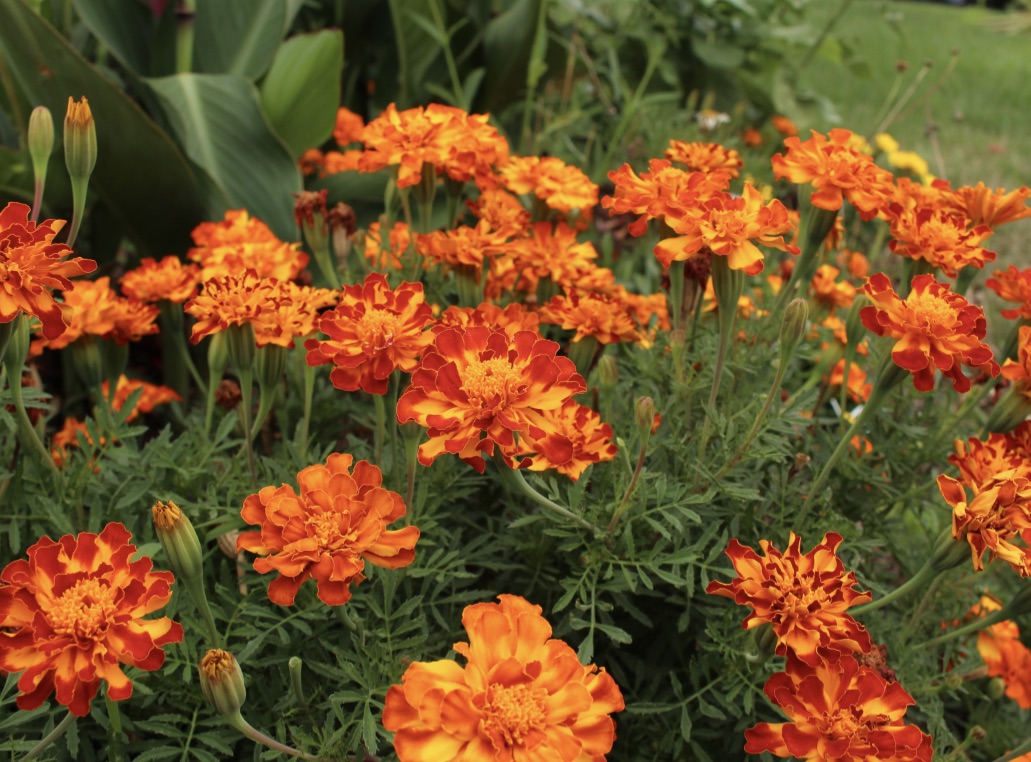
french marigold

French marigolds reseeded from last year.  I hear they’re less ‘out’ than they used to be but ‘classy’?  Maybe not yet.

I don’t have the patience or writing skills to really go into why one flower is classy while another is crass, but over the years I’ve picked up on the judgements of my betters and at this highpoint of summer realize that my garden definitely veers towards the trailer park style rather than waterfront estate.

chrysanthemum

Chrysanthemums can be fancy I suppose, just look at the formal displays in the far East style, but as flowers go I think of them as a modern carnation, the flower bouquet you buy when roses and lilies are too expensive.  btw I hate this color, but a friend loves it, so I trust her taste and keep it!

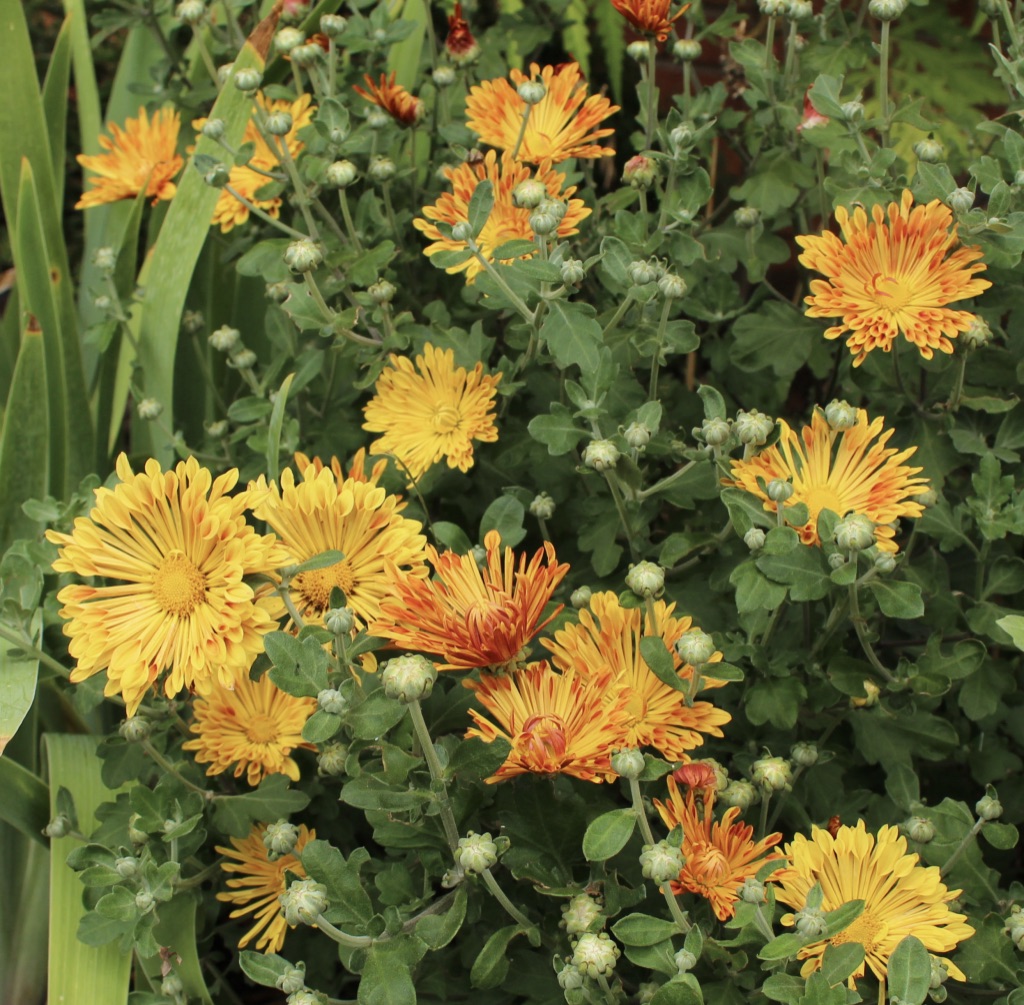
I suppose if you decorate your estate with gobs of full flower chrysanthemums in themed color displays they’re fancy, or if you stick with the truly perennial types which put out sprays of color in late fall you’re good, but my chrysanthemums are mostly the feral offspring of whomever managed to survive the winter.   To me they’re an interesting bunch though, even if the colors aren’t anything extraordinary.  The earliest ones are starting to bloom now, which is far too early and reeks of autumn, but I hope they’re just enthusiastic and can keep this going at least through September.

chrysanthemum

A larger flowered chrysanthemum which showed up under a rosebush one summer.  I’m looking forward to seeing what its seedlings look like in bloom in another two or three weeks.

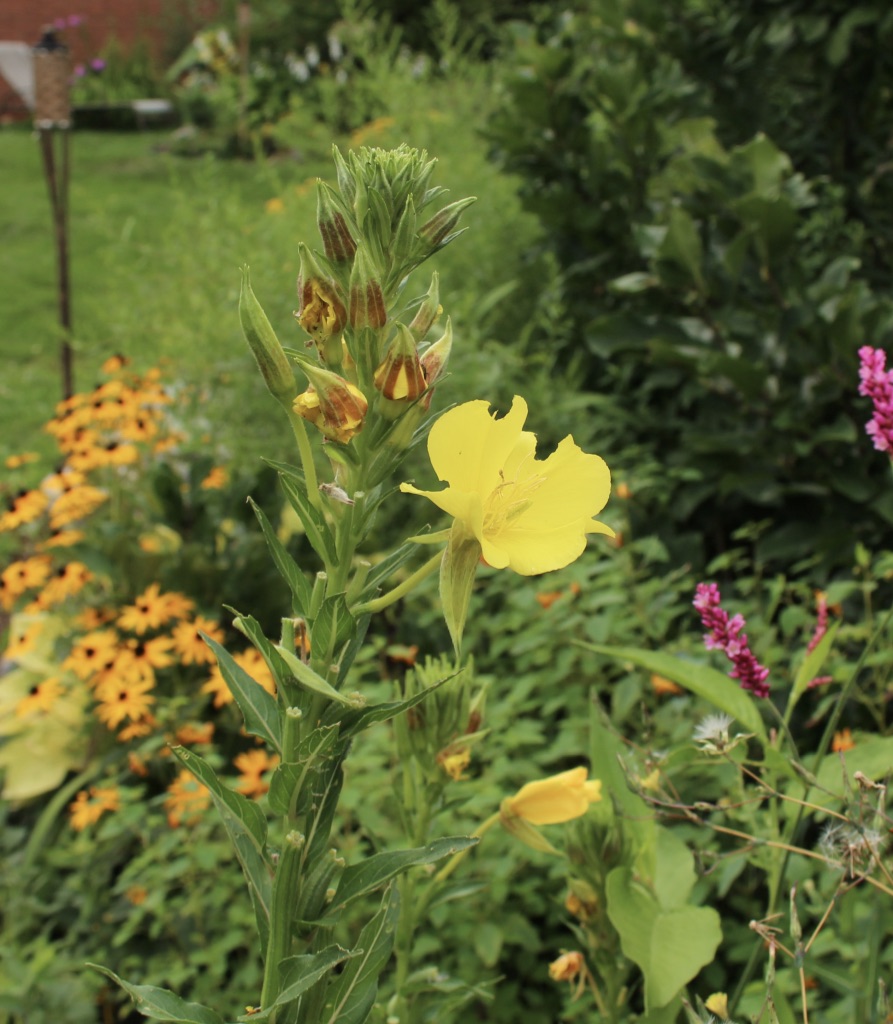
Evening primrose (Oenothera biennis) is a weed of waste places and abandoned gardens.  Obviously it does well here and obviously it’s not high class, so I always leave a few to grow and flower.  Birds are supposed to like the seeds (although I’ve never seen a bird on it) and I like the way the flowers pop open each day, so this native biennial is ok in my book.  Now if only I could motivate myself to seed out the fancier versions I found last winter.  Oenothera versicolor ‘Sunset Boulevard’ offers dark stems with tangerine flowers overlaid in rose, while the large yellow blooms of Oenothera glazioviana pop open in under a minute as the sun goes down… it’s worth a party, or so I’ve been told.

evening primrose

Oenothera biennis, the common primrose, with a few other classy weeds such as Persicaria orientalis and the golden, too-loud, Rudbeckia fulgens.

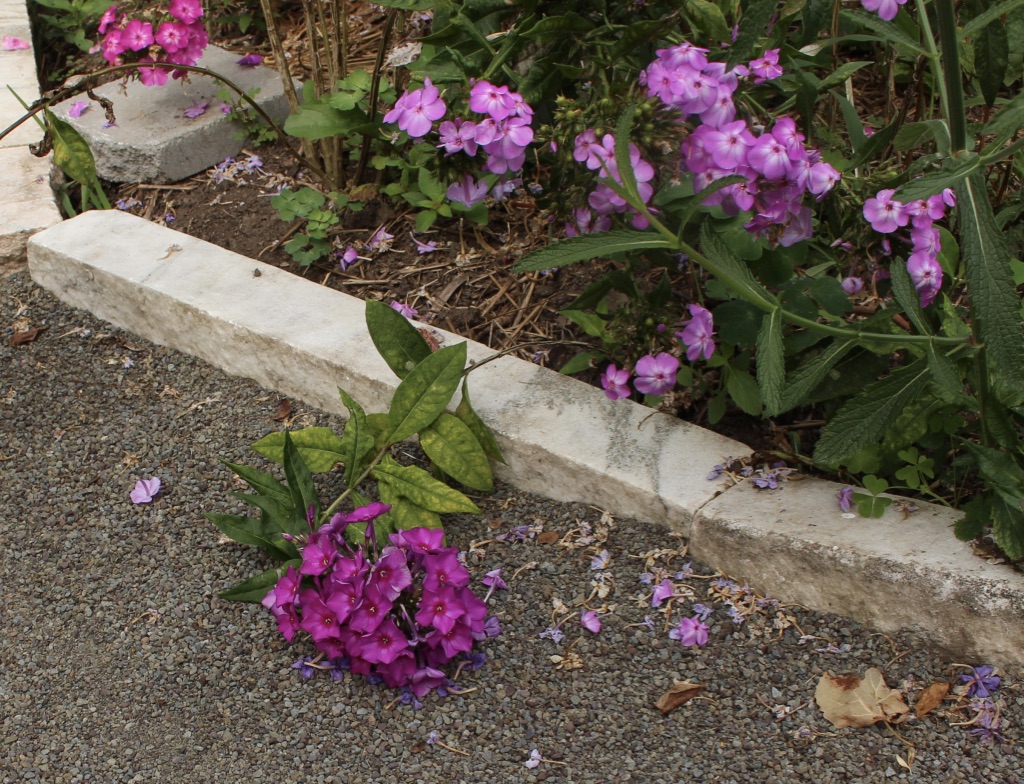
Phlox come with an excellent pedigree and are grown in some of the best gardens.  And then they get here.  A few years back I decided to treat my self to a few selections from the ‘Sweet Summer’ series, and a few years forward they’re all dead except for two.  Actually make that one.  ‘Sweet Summer Festival’ would never fully open her blooms and was yanked a few weeks ago and sent to the compost pile.  She came with excellent references, and I thought she would grow out of it but maybe it was some weird tissue culture issue… or she just hated it here and couldn’t be bothered with hiding her disgust.

phlox sweet summer fantasy

Phlox ‘Sweet Summer Fantasy’ looking slightly less fabulous than the pictures had lead me to believe.  “Large flowers, strong upright habit with clean foliage and good branching”…

I was looking at the trash I call a phlox bed today and really gave some consideration to offering up my garden as an extreme test location for new phlox varieties.  I think a new plant would really have to jump through some hoops to do well here, and if anyone out there wants to send me a bunch of free plants for evaluation I’m completely on board… and just to throw it out there even if the plant doesn’t do completely well it doesn’t mean I can’t write a glowing review… I mean integrity is kind of a vague concept these days, and free plants really do hold a lot of sway in this garden.

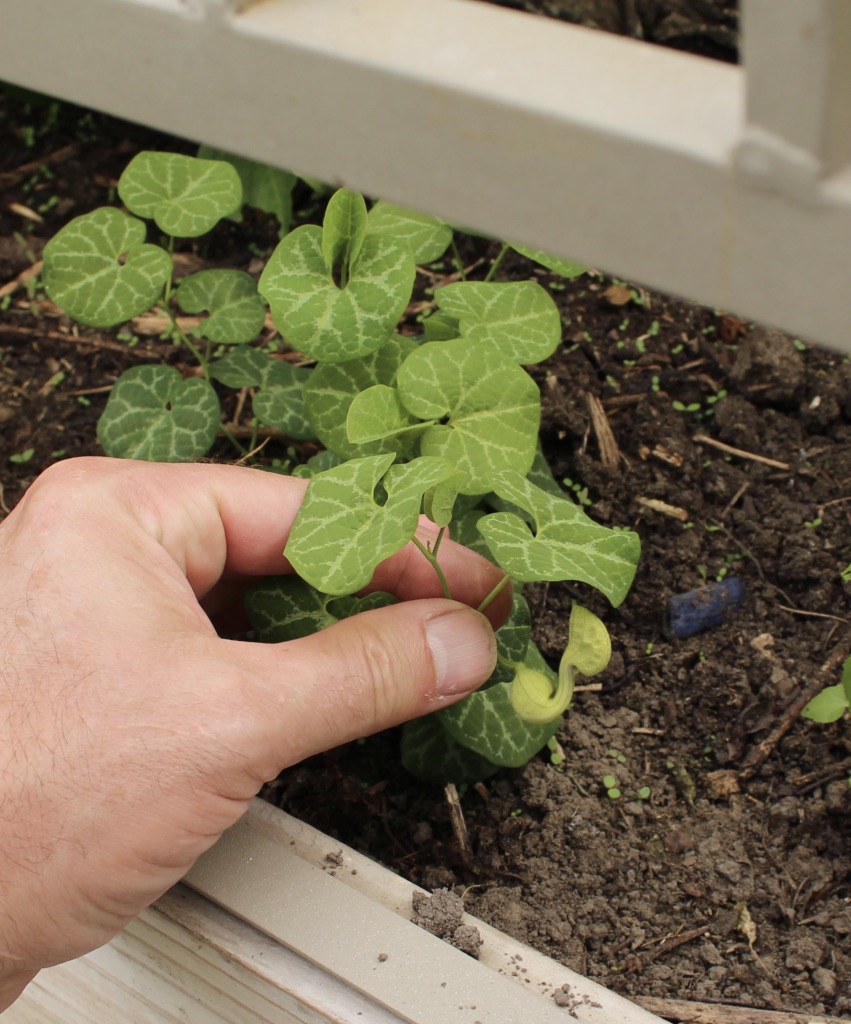
Aristolochia fimbriata

Aristolochia fimbriata (the white veined Dutchman’s pipe) is actually a very classy little treasure, and look at the little pipe it’s putting out!  downside though, perhaps I should have looked at its mature height and spread before planting it at the base of a six foot trellis.

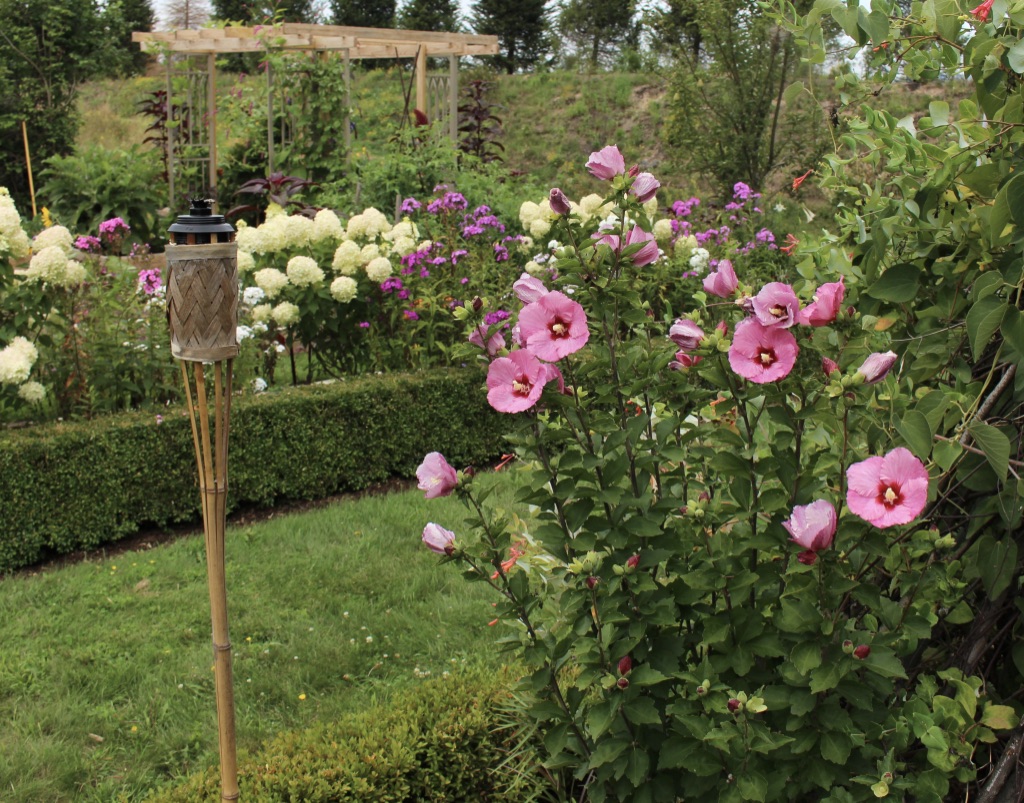
I always thought of Rose of Sharon (Hibiscus syriacus) as a trashy plant.  We had it round the garden growing up and my mother would always complain over its leafless stems in May when everything else had already sprung to life, and then I would always complain about the carpet of seedlings which would fill the weed bucket under every bush.  Should I even mention the slimy faded flowers which would litter the ground for two months in late summer?  They were always guaranteed to squish up between your toes, and even better if a slug had come out to take a bite before your foot landed on it all.

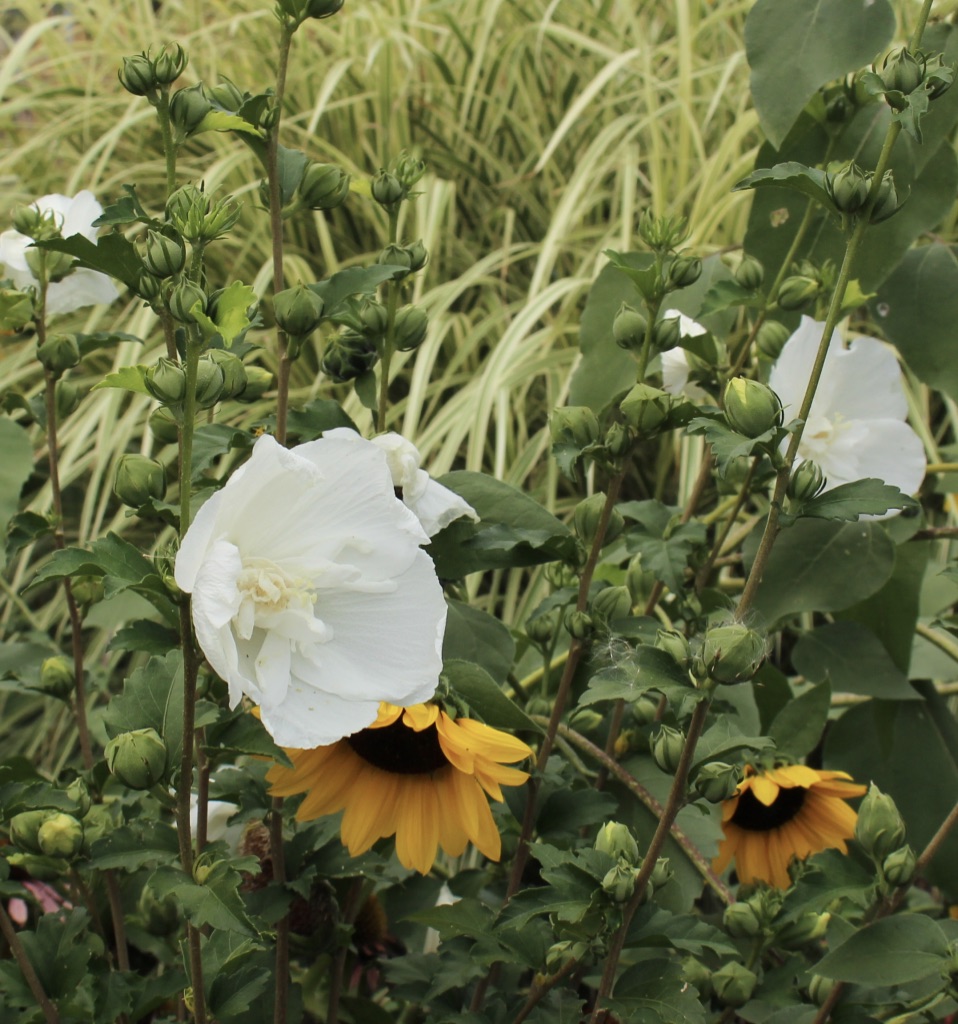
rose of sharon white chiffon

‘White Chiffon’ rose of sharon hasn’t reseeded too badly, and when all else fails white flowers always add distinction.

I have to say I like the new rose of sharons.  ‘White Chiffon’ is a smaller version of ‘Diana’ with a little extra fluff in the center of each flower (I still prefer the single ‘Diana’), and if for once I can refrain from accidentally cutting down the bush during spring cleanup I think she’ll be an excellent addition to the garden… unlike the amazingly colored but prolifically seeding ‘Bluebird’ who was shovel pruned.

rose of sharon ruffled satin

Rose of sharon ‘Ruffled Satin’.  I have not seen a single seedling under this one, and to my eye you might even get away with saying this plant looks refined?

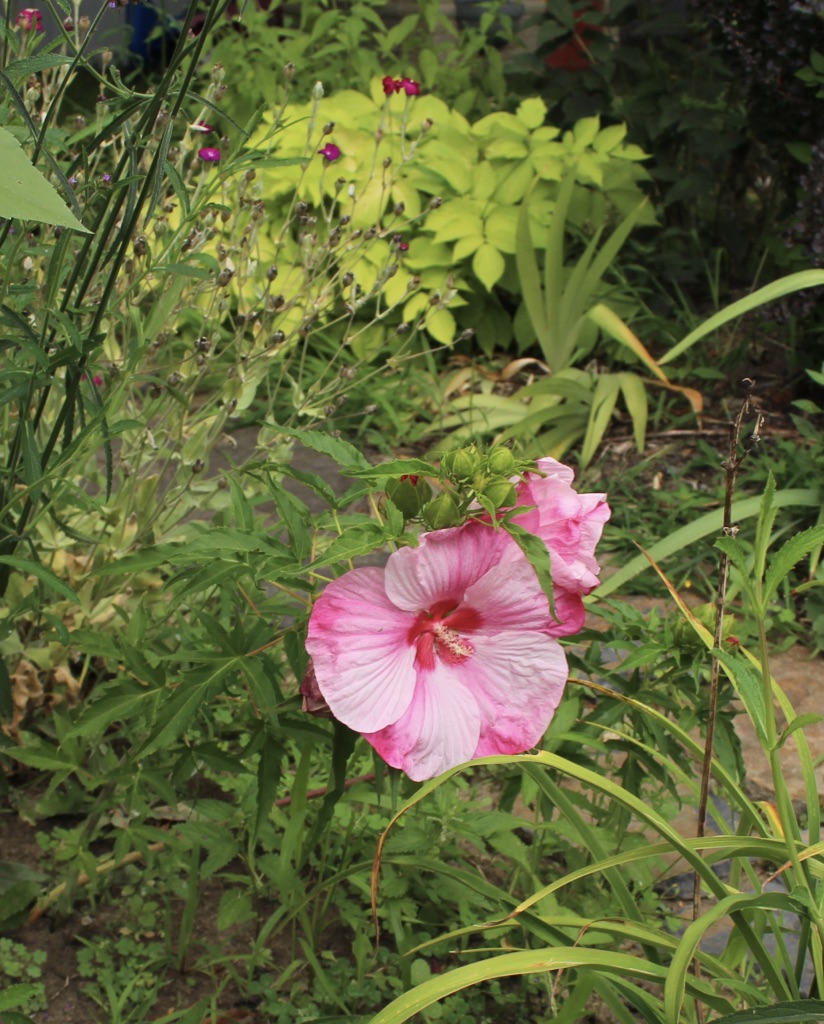
I guess the mallow family is often pointed at for weediness and gaudiness, and I’m not sure where the latest court ruling stands at for classiness, but if you move away from shrubby hibiscus to the perennial version it’s really got to be a gray area.  Some of the newest forms are just amazing, but they have all the oversized flowers and inappropriately bright colors of something less refined.  I would grow all of them, but just can’t deal with the ravages of the hibiscus sawfly which eat their foliage to shreds each summer so there’s only one left, and some years he does ok, and other years I just turn away.

hibiscus turn of the century

An ok year for hibiscus ‘Turn of the Century’.  I love it, but it’s a far cry from the five foot shrub covered with blooms which this plant is capable of.

Ok, enough with all this concern over tackiness.  If you look at the last hibiscus photo you might notice a classier plant in the backgound, the chartreuse leaved, 2020 Perennial Plant Association’s plant of the year, Aralia cordata ‘Sun King’.  This cool thing doesn’t seem to mind a crushing late freeze, mid summer drought, and rooty shade, and although its two foot height in my garden does not compare well to the 4-6 feet it is typically quoted as, it’s still a wonderful presence.  The plant is a great introduction by plantsman/hunter/explorer Barry Yinger who spotted it atop a Japanese department store in the garden center.  So much easier than bushwacking up a Chinese river valley and climbing cliffsides looking for new plants, but I’m sure that was on the list as well.

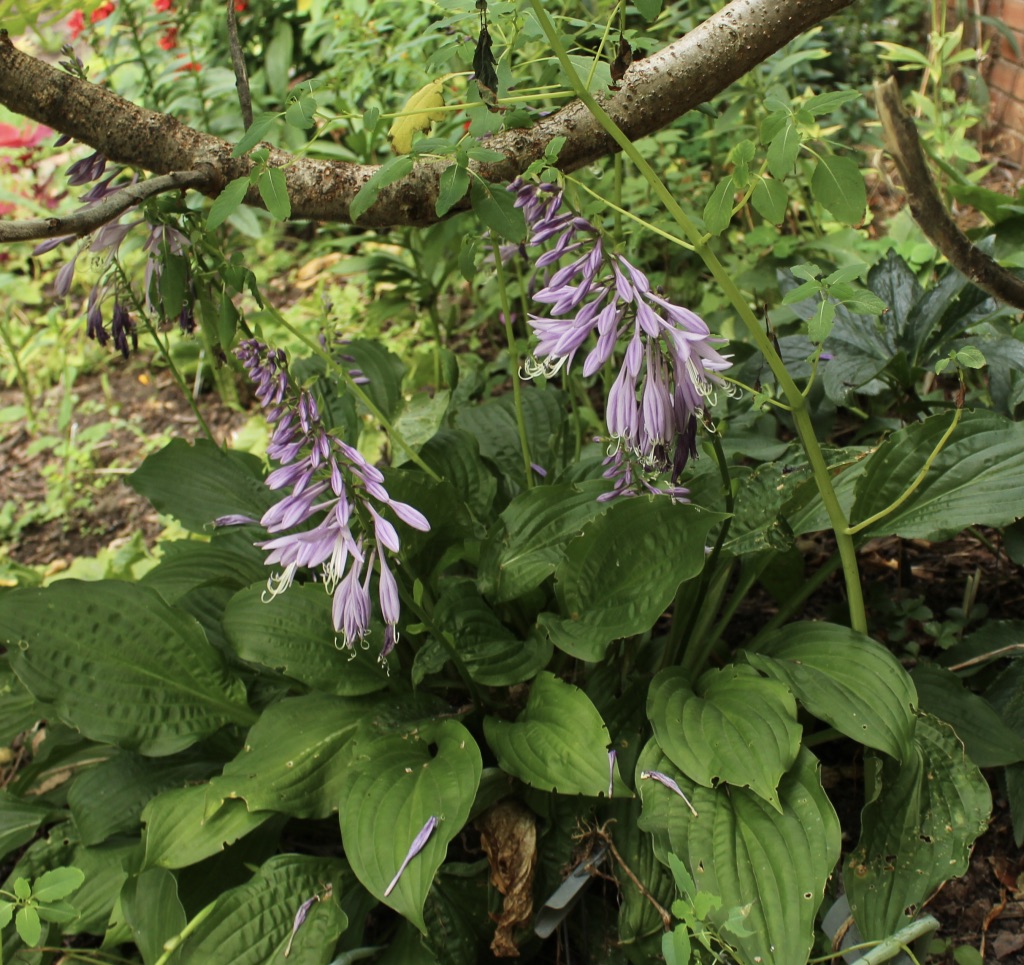
Hosta yingerii

Of course when I saw the name I knew I had to try the seeds for Hosta yingerii, and here they are several years later.  

Plant nuts will remember Barry Yinger’s Asiatica Nursery which was an outlet for introducing hundreds of exotic and obscure plants into the American horticultural world, and even if you don’t know it, your garden is probably richer for it.  Even my little plot has a few (hopefully) hardy camellias which are just a few degrees of separation from Mr Yinger collecting seeds under armed escort within sight of the North Korean mainland.  A cool connection me thinks.

Not to swing this around and make it all about me, but I did meet Barry Yinger once.  Not to brag but it was at one of the first Galanthus Galas, and he was off in a side room breaking for lunch when I decided to take my chance.  “Is this where the restrooms are?” was my icebreaker, “No, they’re the next doorway” was his response, and I was on my way.  I don’t think he remembers.

Obviously my classiness is only eclipsed by my social skills, so let me abruptly end this post and wish you all a great week!

Into Summer

This might be the driest this garden has been in about four years and that’s ok.  Warm and dry means the lawn stops growing, and unless I’m being really obsessive about clover flowers,  I can just leave it unmown for a week or two and it doesn’t look much worse for the neglect.  Obviously my vote is always for less work, and the few bees which forage the lawn seem happy with this arrangement as well, but I do notice that none of the other lawns look as nicely “decorated” with flowers.  Again, that’s ok.  It’s dry, but not too dry, and although a few wilted things here and there tug at my conscience as I walk by, it’s not enough to bring me down.  When things go crispy that’s when I start mumbling and luckily we’re not there yet.

front border

The front border is again being dominated by the more drought tolerant plants.  No jungle this year.

Weeding has been a breeze with less water around.  I just hit the sheets of verbena and fennel with the hoe once and most dried up in the sun the next day.  The prickly lettuce is stunted, the crabgrass is anemic.  It’s kind of quiet out there.

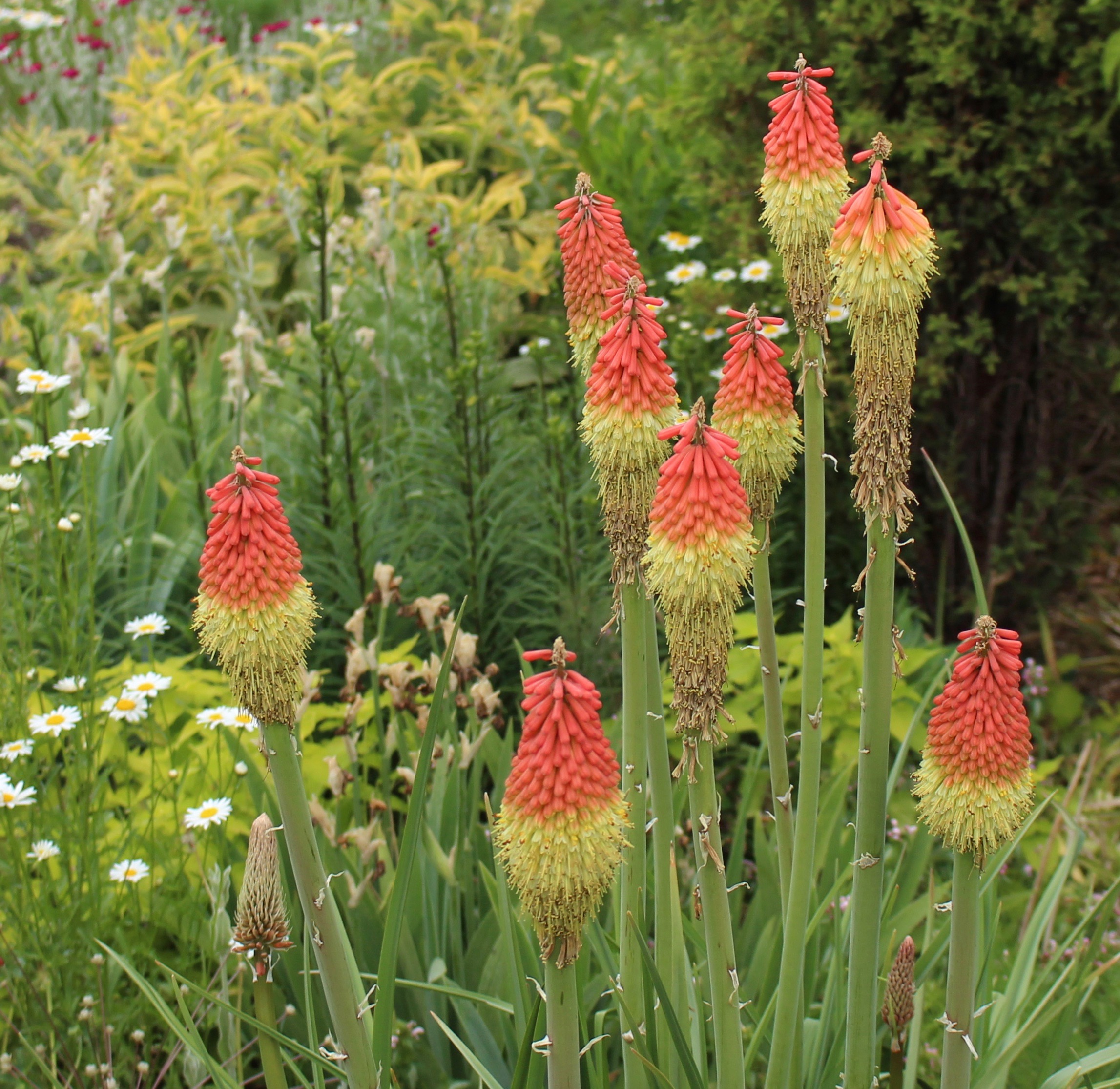
kniphofia caulescens

A few years old from seed, kniphofia caulescens is finally putting on a nice show this year.  I love the color and shape, but they pass so quickly so I’m pleased there are still a few more stalks on the way.

There was a decent scattering of clouds yesterday morning so I hurried out to see if I could get a few photos before the glare of the sun returned.  My photo skills are like that and I don’t think I’ll ever amount to anything more than a point and shooter, so I just wait for overcast moments and then take as many as I can.  Funny how I always seem to end up admiring the weeds more than anything else.

scotch thistle

Yes, I still love thistles.  These approve of the drier soil and the stunted sunflowers. (Scotch thistle, Onopordum acanthium

So I’ve recently gone on and on about my mullein and I’ll spare you from that for a few more days, but there are some nice thistles around the yard and I’m thinking I need more again.  Obviously they’re easy to grow, so a good choice for me, but other weeds are also doing well.

sunny side up pokeweed

The fresh chartreuse of ‘Sunny Side Up’ pokeweed (Phytolacca americana) coming up strong in the front border.  I apologize to those of you who are tired of seeing this amazing plant yet again.

Just for liability reasons, let it be known milkweed should never be planted in a perennial border.  It will spread all over and you’ll regret it.

milkweed perennial

Common milkweed (Asclepias syriaca) spreading throughout the border and welcoming guests to the front porch.  It’s a few days away from blooming and I’m looking forward to enjoying the scent as it drifts through the air.  Maybe I’ll pull a few shoots after the bloom ends… maybe…

I wonder if any of my neighbors realize just how many of the plants here are considered weeds.  A parent came by to pick up a child and said the yard looked nice and it seemed like I had quite a few unusual things growing.  That could be good or bad, but I chose good, and hoped she didn’t notice afterwards that the daisies are remarkably similar to the ones all along the highway and filling every vacant lot along the way.  I suspect nothing was noticed.  Actually my mother in law asked me later that day if she should plant a few in a problem spot behind the house.  Not a bad idea I said, but then shot myself in the foot when I pointed out the dried remains of all the daisies she sprayed with roundup the week before.  She told me to forget it, she’ll see what they have at Lowes…

sand garden paths

Something else.  Sand.  A couple tons of it.

Having several tons of sand sitting in your driveway can go a long way towards distracting people from the fact you’re growing a lot of weeds.  It’s a big pile and that hasn’t changed much since it was delivered Monday, but I’m quite happy about it, and the sand has me feeling rich because (1) there’s so much of it and (2) it’s soooo nice and clean and gritty, and (3) it’s part of the finishing touches for the potager reboot.

potager

Here’s where we’re at.  It looks terrible but I’m blessed with the gift of seeing things how I want them to be rather than what they really look like.  Give me another week or two and maybe I can explain my “vision” 🙂

In spite of how it looks, the potager has been on the receiving end of most of the attention and fussing that the gardener has been passing out this year.  Everything else has been forced to tough it out sans water, but the veggies are  weedfree and irrigated, and I even had to drag in seating so I could just sit and admire the new space.  Sadly this enthusiasm doesn’t extend past the raised beds, and if you look just two feet over, all the promise of a bed filled with poppies and garden phlox is yellowing as it awaits moisture.

breadseed poppies

A little water would have gone a long way towards making this bed a showplace…. but it didn’t happen and the ‘Patty’s Plum’ poppies are starting to dry up just when they should be covered in flowers.

Sorry poppies, you’ll have to set your seeds and hope for better year in 2021.  I hear that’s a common sentiment.  In the meantime, other plants are ahead of the game and have already gone through some funny business in regards to seed setting.  The yellow foxgloves (Digitalis grandiflora) took advantage of some lazy deadheading and then some lazy weeding and have formed a nice patch of seedlings where there was but one yellow foxglove last year.  A curious thing happened though.  I believe Mrs. Yellow Foxglove has not been faithful to Mr. Yellow Foxglove and instead has been entertaining Mr. Rusty Foxglove (Digitalis ferruginea) from down the street.  The proof is in the shading, and I’m sure the delivery room was quite the agitated place as Mrs. F tried to explained all the rusty children to her equally pale husband.

digitalis grandiflora ferruginea

Yellow foxglove in the back with various hybrids in front.  I don’t think it’s uncommon for foxgloves to cross like this and of course I like the diversity it adds to the garden. 

Another blooming surprise is taking place on the swingset.  The native Dutchman’s pipe (Aristochola macrophylla) has taken off this spring and is full of the curious little pipes which this vine family is named for.  They’re not the showiest things and I think the only reason my attention was drawn that way was through the overheard conversation between my daughter and a friend about the plant taking over her playset.  I think it’s just fine but apparently they think it’s a little too much, so I guess some day soon I’ll be giving it a trim.  Maybe.  Probably later rather than sooner since right now I’m quite pleased with all the big felty leaves hanging all over the place.  No surprise there since the species name macrophylla means just that, big leaves.

aristolochia macrophylla

The oddly shaped flowers of the Dutchman’s Pipe (Aristolochia macrophylla)

The Dutchman’s Pipe family is quite the group with annual and tropical members and even more bizarre flowers being the rule rather than the exception.  The tropical Pelican flower (Aristolochia gigantea) is the gigantea version, complete with face-sized fleshy looking flowers.  Very cool to see… and look at that, it’s available online for a click… but let’s stop there before I get into trouble.  There’s another native macrophylla in the yard this year, a magnolia in this case.

magnolia macrophylla

Magnolia macrophylla, the Southeast US ‘bigleaf’ magnolia… planted way too close to the house of course.

Three or four years from a seed, this magnolia has recovered from a late spring freeze and is now enthusiastically putting out a few of the huge leaves this species is famous for.  Famous might be an overstatement, but I love it, and right now while it’s still below eye level and looking all cool I’m not even thinking about its mature height or its very inappropriate placement.

magnolia macrophylla

Big hand on big leaf.  The underside of these leaves also have a cool fuzz, and in the fall they dry and curl and the fuzz is even better, and they’re still big, and….

There’s a more dwarf form of the bigleaf magnolia (Magnolia macrophylla ssp. Ashei) that would surely have been a more sensible choice for this garden, but again I digress.  Let’s just abruptly end here since after all these photos were taken the sky became even darker, thunder began to rumble, and we enjoyed a nice summer downpour… which oddly enough was just a few days too early to destroy the delphinium show.

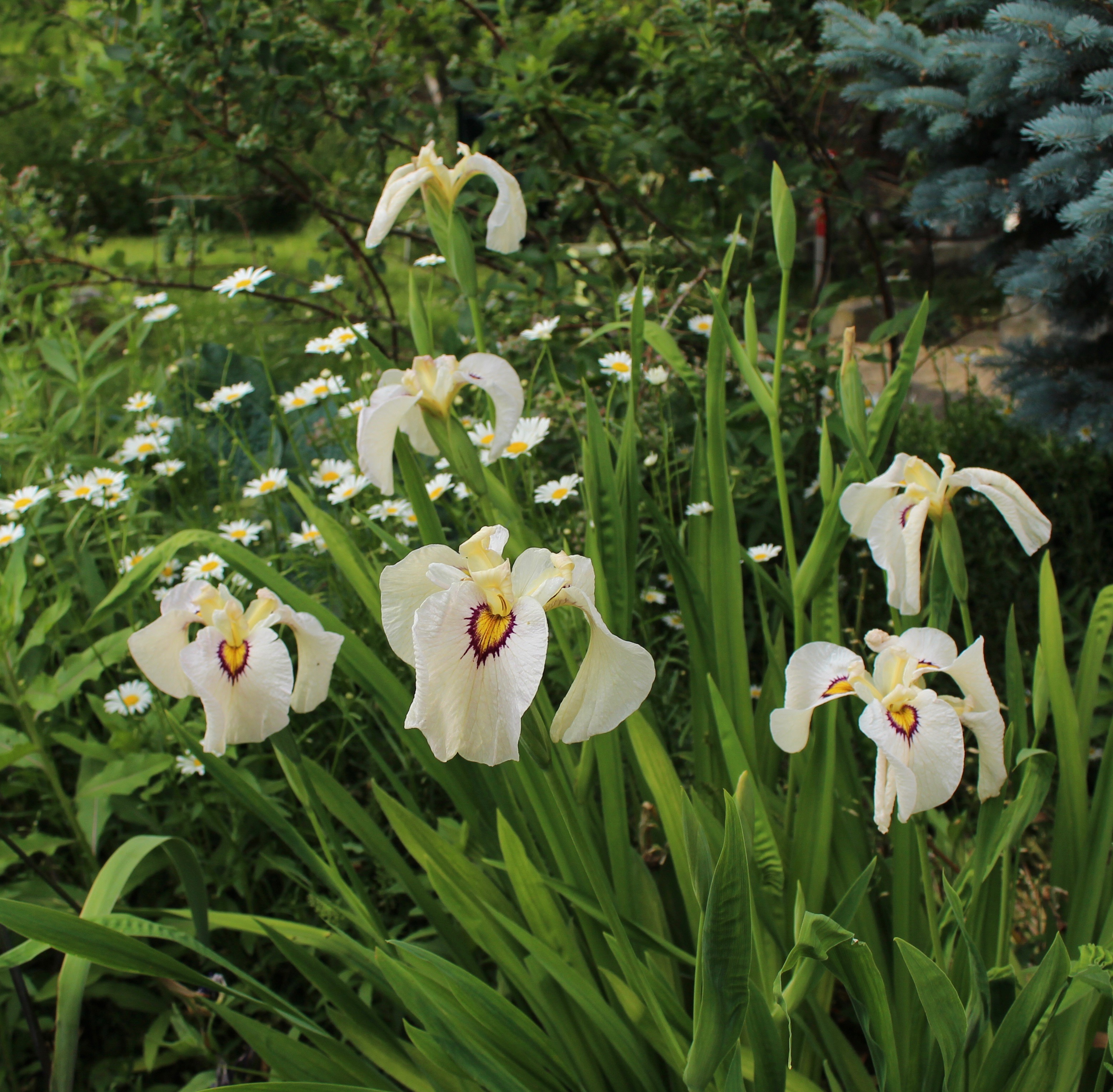
pseudata okagami

Also unaffected by the storm were the pseudata iris (Iris pseudacorus x ensata ‘Okagami’).

So the ground is refreshed and now the lawn needs mowing, vines needs trimming, the weeds will erupt, the sand is heavier, and the bugs have been energized.  Actually it’s pretty awesome even with all the additional work, so let me go and get busy out there before the sunshine and pool distract.  Hope it’s a beautiful weekend where you’re at as well.