This summer is going by way too fast and I am not liking that. Just a day left in July and then it’s August and once August starts my summer days are numbered, and it seems particularly frantic because I still have tulips and daffodils and snowdrops which I’ve been meaning to dig since June as well as a bunch of potted things which I’ve been whispering apologies to all spring and summer as I keep putting off that job as well. Don’t even ask me how the drip irrigation is going. It’s been raining enough that watering has rarely come up on the to-do list, so of course repairing the drip setup keeps getting knocked off the top of the list, and I mention that one in particular because I had to go around this morning and save wilted things since of course I don’t water until it’s too late. Have I mentioned in the last few breaths how much I hate watering? Probably, but let me say it again. I’d rather risk heatstroke weeding in the sun for a couple hours dripping sweat and covered in dirt rather than drag that stupid hose around.
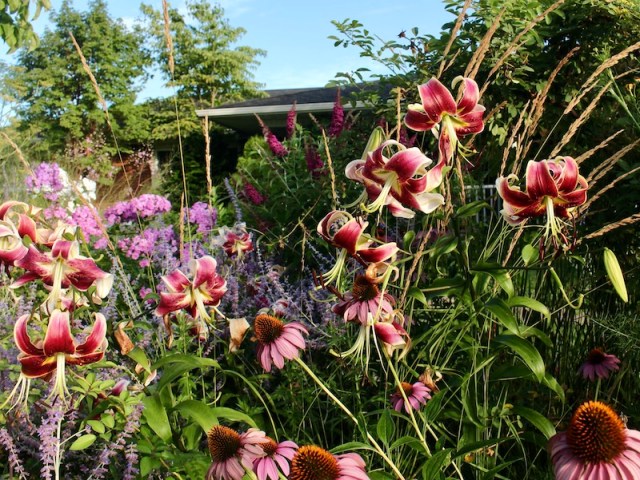
The front border is lush and overgrown due to this summer’s steady rains. Even I think it might be a little “much” for along the street, but better too much than too little is what I say. This is lilium “Scheherazade” doing well, and also not on the lily beetle menu (yet) so that’s also good.
Risking heatstroke and actual heatstroke aren’t separated by much, and with our third day over 90F (32+C) I’m trying to walk the line and avoid drifting over to the actual part. Despite my love of lawn chairs and pool floats I’ve been far too busy outside feeding the gnats and losing water weight as I toil in the fields. Maybe that’s not the worst training considering our potential future, but for now I do it for the fun of gardening and imagine Martha and Monty just as sweaty and disgusting in the heat of summer when they have their own daylily farms to rebuild.

A daylily farm is rising from the ashes. I’ve regraded and seeded the grass path, and as of today I’m happy to report a green shimmer as the seeds begin to sprout.
My gosh, please skip ahead if you want to avoid the complaining, but it all started when I called the town a few days into staring at the bulldozed remains of my daylilies. ‘So what’s the plan?’ I asked… and then entered into a discussion which became quite vigorous after I realized they thought I wanted to do all the repairs myself. I did say that at the start when a hole at the street meant putting a few rocks back and maybe replanting a ninebark, but when the bulldozer and destruction moved twenty more feet into my yard and left a swath of raw shale and compacted topsoil, I assumed they might be able to spot me a little topsoil and mulch, even if they didn’t replace the farm or do any of the actual work. A meeting was set up. In the meantime I got to work.
First try to save a few things. About half the daylilies were left with crowns so I uncovered them and gave them a little feed. A few other things were uncovered along the street, and there might be hope for them over the next few weeks. All my stones were buried, but one of the backhoe operators set aside a few new ones he found, and I got brave and split a bigger one to end up with two big stepping stones along the street. The basketball hoop went back and then I regraded my little grass path. In all I probably pickaxed and hauled off about 20 wheelbarrows of stony, shaley dirt to lower the grade and then tried to spread whatever topsoil they left into the beds. That was awful, backbreaking work but then because I like a nice edge to a new lawn path, I dug up turf from in back and used it as sod to line the sides of the path. Then the easy part of seed, topped with lawn clippings to keep the seed damp long enough to sprout, and then wait. As of today, about a week later, the daylilies are sending up new growth, the grass seed is sprouting, and I’ve even popped in a few odds and ends like a new daylily or two, and some spare cannas and elephant ears to make it look less depressing.

There’s hope.
Since I took these photos, the town has come through with some mulch and topsoil, so more blood and sweat was shared for that, and we will see about the rest of the deal. Hopefully the next farm report will be overwhelmingly amazing. I have put some mulch down so I know at least that will be nice, and I’m in the process of picking daylilies to move in…. but enough of that… let’s look at where the rest of the garden is during these last days of July.
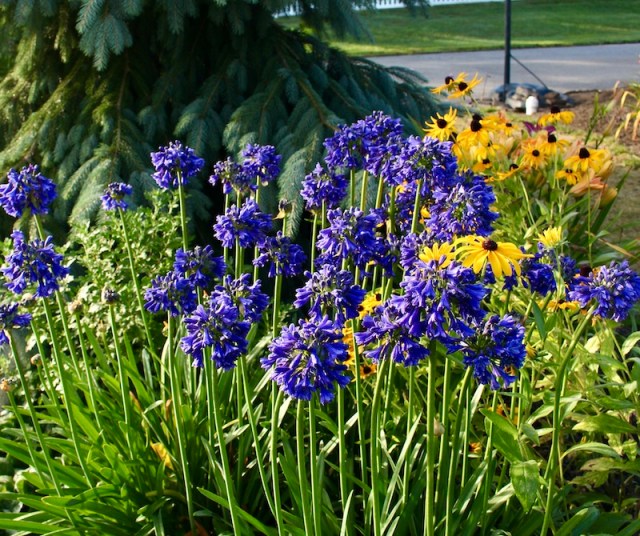
The agapanthus are blooming, and over the years ‘Blue Yonder’ has become a clump. I love it.
I have nothing bad to say about the agapanthus this year. They get no special attention yet are covered with blooms and have been perfectly hardy here for a number of years, with winter lows down to about zero and no protective mulch or sheltered location. It looks like a few have enjoyed all this year’s rains, but even in dry years they haven’t seemed to complain too much. I guess they’re as easy as daylilies, so I wonder if I can divide ‘Blue Yonder’ (my absolute favorite) and line out a row in the farm…. which would be awesome…

Some agapanthus from seed. These are A. campanulatus forms, the seeds of which were coincidentally saved from the bulldozers during the last sewer incident.
I guess I need to mention that not all agapanthus will be as hardy. If you’re in a northern area, check up on the hardiness rating before you plant it, out in full sun of course and then never do another thing for it other than admire the blooms and bask in the compliments.

A dwarf white form given to me as seedlings from a white Seneca Hills Nursery(Ellen Hornig) selection.
Here’s one more look at ‘Blue Yonder’ 😉

‘Blue Yonder’ has a richer color and flower heads packed with later flower buds, giving it a longer bloom time than some of the others.
I don’t know if I’d consider the agapanthus to be borderline hardy in my zone, I guess only a truly brutal winter would settle that, but I do consider some of the Crinum lilies I have planted to be borderline. Two other forms are less than enthusiastic about life here in NePa but ‘Cecil Houdyshel’ increases in size and puts out a couple flower stalks each year so we shall only talk about that one.

Crinum ‘Cecil Houdyshel’ in front of the dark foliage of ‘Royal Purple’ smokebush, alongside the driveway. Very elegant in my opinion.
As you would suspect, I don’t give this one any winter protection, and after our normal lows last year I was a little worried, but slowly he came back to life. All the rain and humidity and heat must really have him feeling at home this summer, so hopefully there will be several more bloom stalks to come.

Cecil has a decent form, not as sloppy a mess as some crinum like to be but that’s just my opinion based on one plant and almost no other crinum experience.
Seems like we’ve left the daylily farm for a Southern excursion, so here’s another thing from down South. Standing cypress (Ipomopsis rubra) is a native to Southeastern North America, or plain America as we in the US like to say, and it’s a cool thing. The hummingbirds agree, and they’re aways buzzing this part of the garden when it’s blooming. Two things though. Everywhere I see it referred to as a biennial or short lived perennial and that’s fine, these plants are from a new seed source and they grew fuzzy rosettes last year with a five foot stalk erupting this summer, but the ones I grow from another source are strictly annuals and never form rosettes and never live beyond year one. Who knows. It’s above my pay grade to wonder if they are all the same species but these are the curiosities which live in my brain so I’m sorry to put it in yours now.

Ipomopsis rubra, paired with the lovely neon green foliage of pokeweed (Phytolacca americana ‘Sunny Side Up’)
The potager is another curiosity. I wonder if I can still call it a potager when 90% of the plantings are not-vegetables, but can’t quite bring myself to admit it’s become another flower farm. Perhaps there’s an authoritative number listed somewhere in France for potager percentages but do supposedly-edible dahlia roots and figs-which-will-never-produce-figs count as veggies and fruit?
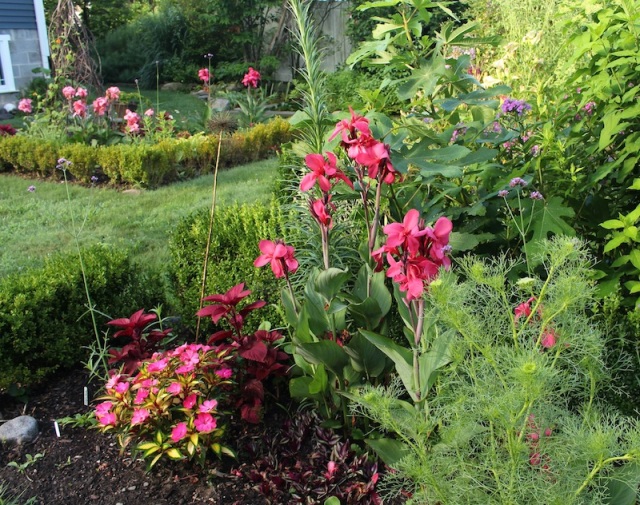
Cannas are blooming quite well in and around the potager. This is ‘Cannanova Rose’, an easy, quick to bloom selection which even comes true from seed.
Whatever. Potager it shall remain. If I can get away with calling a couple rows of daylilies a farm than I can stick with potager for this.

My little tropical hiding spot in the potager. Bananas are totally edible and potager approved even if there’s next to no chance I’ll ever see fruit, but the foliage makes up for any missing banana harvest.
I refuse to share a photo of my pathetically anemic tomatoes or the deer-chewed pepper stubs but I will share a single phlox photo. Only one because the rain-fueled hydrangeas have crowded nearly everything else out, but one should get the point across.

The garden phlox are a little late due to an early season deer pruning but they’re finally making a show.
Can I put in a good word for pears? As of today the tree is overloaded with a heavy crop, and although the gardener should have thinned them out for better quality (and to save the tree from collapse) my hope is that a few escape the deer and squirrels and chipmunks and make it to the dinner table. A bushel of Bartlett pears will really put the potager accounting into the black in a way that 3 raspberries, 7 gooseberries, and a half handful of blueberries will not. Someone really should have netted the berry bushes rather than continuously hope the birds ‘miss a few’.

This year’s Bartlett pear crop, heavier each day and hopefully not too heavy.
Maybe the berries didn’t go far in feeding the household, but they did contribute to a steady stream of fledglings coming out of the garden. I don’t really mind the loss, and actually resist netting the fruits since the dopey youngsters tend to get tangled and I prefer a fruitless pancake over a traumatic bird un-netting.

Yet another robin leaving the nest.
So that’s where we’re at. A lot of rambling so I’m wondering if perhaps the heat got to me more than I care to admit but hopefully there was something of interest in there. In spite of all the work summer is still quite excellent and so is the air conditioning when the heat gets to be too much so I really can’t complain. Enjoy your week!



 sorta like suburbia