Chanticleer (pt 2 of 3)

It’s been longer than I planned, but here’s the continuation of my Chanticleer visit.  Part 2 of the visit picks up at the tennis courts, a part of the gardens who’s former function should be obvious!

The flat area that used to function as the court has been turned into a group of five beds filled with all sorts of interesting plants.  My favorite was this one which leans towards a yellow theme.  A redbud with yellowish foliage anchors the bed and a nice clump of the tall variegated arundo donax grass is peeking out from behind.  For a late season garden it still looks good.
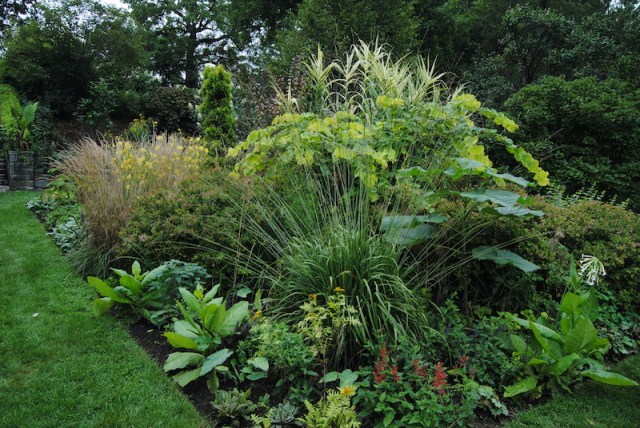
There was plenty going on around the garden with cleanup and cutting back,  I don’t know how it is on other weekdays but during my visit the place was buzzing with garden staff.  Here’s another view with a nice banana, some of the annual purple perillia, and a couple of those dead looking brown sedges.  Grasses and sedges seem well used around Chanticleer and they do add long season airiness and texture.

Beyond the courts is the cutting garden.  The Chanticleer interpretation is more like a wild ocean of frothy flowers, some of which top out at over 10 feet!  A cool garden to wander through since it comes in on you from all sides.  You can just make out the asparagus hedge that closes in the right side here.

A little structure in this garden is given by the archways.  I’m stealing this idea since it’s not tough to copy.  A rebar arch forms the basis while vines and branches are twisted around…. since I already have the rebar arch set up, no problem-o on twisting some twigs around!

The tall orange sunflower-ish plants are the annual tithonia.  It’s supposed to be easy from seed but I’ve never had much luck.  It sure did well here though.

This path leads to a small fenced in vegetable garden, a nice little spot to take a breather on one of the vegetable themed benches.  For as wild and bloomy as the cutting garden is, there were still a ton of late bloomers left to come, so I bet this garden comes to a peak in about another month…. in case you’re still considering a visit!

A relaxer next.  A woodland section called Bell’s Woods is a streamside collection of North American plantings.  Even though it probably peaks in the spring there were still plenty of cardinal flowers (lobelia cardinalis) in bloom.  It’s a nice soft stroll since the “wood path”  is actually a soft rubber mat that looks like wood chips…. or at least that’s what I read… even after being told, I still thought they looked like shredded bark!

Throughout the gardens are bits of functional art such as chairs, railings, and this metal “hollow log” bridge.

Even though Chanticleer is a relatively small garden and heavily planted, there are still plenty of restful areas, many of which have a nice seat and an excuse to linger.

And nearly all are somehow color coordinated!

Around the red chair you can see some clumps of prairie dropseed.  It’s a native grass used as a kind of lawn replacement for many of the open areas beyond Bell’s Wood.  It’s also probably my least favorite of the plantings here since I just can’t get past what Wikipedia refers to as a “vague scent of popcorn, cilantro, or sunflower seeds”.  I just call it stink, and forgive me if we skip this and the ruins garden and head straight to the gravel garden.

The gravel garden is a very un-Pennsylvania bit of sloped, well-draining garden that is filled with plants better suited to a more Mediterranean type environment.  It’s a bit of surprise to see hardy cacti, yuccas, and agaves this far north, but apparently they like the winter drainage.

The gravel garden tumbles down to the antithesis of good drainage, the pond garden.

 I love a nice pond (unlike my pathetic leaky pre-formed) and this one is just surrounded with a nearly wild planting of moisture loving growth.  Well fed Koi are always fun too.

I loved the pond gardens.  If I had more room a big waterlily pond would be near the top of the want list.  Waterlilies are just so saturated with color, so waxy and lush, that they just draw you in.  This one was nice and close to the pond edge.

My want list also got a new plant added.  This yellow hollyhock looking plant is abelmoschus manihot, an annual that I eliminated from a seed order last winter and now wish I hadn’t.  It’s sometimes referred to as sunset hibiscus, but it’s actually a close okra relative… that means nothing to a Yankee like myself, but southerners may weigh in on that!

I think I’m about to overdo the pictures here, but there was so much to see.  The bottom pond was given over nearly entirely to sacred lotus.  Lotus is so cool in the way the leaves stand up above the water, the oversize leaves and blooms, the water beading leaf surface, the shower head seed pods….  You know if I had the room I’d grow this one too!

Asian woods next.  Restful and green…. too many pictures already so I’ll move on!

I was a little thirsty and just had to stop at this.  Every little bit of this garden is thought out and then re-thought out and it shows up in all the little flourishes and details.

My last stop on the Chanticleer tour was a stroll around the terraces of the main house.  If you thought this post was picture overkill there’s still more to come.  The terraces contain all the stuff I really go for like bold colors, overplanted beds, fat container plantings, and tons of tropicals.  Hang in there, it’s the last Chanticleer post!

Chanticleer 2013

Last Thursday I made a trip down to Chanticleer Gardens, a “pleasure garden” located just West of Philadelphia PA.  I’m glossing over much of the history, but basically it’s the 1913 former summer estate turned full time home of Adolph Rosengarten and his wife Christine.  As family members passed away and moved on the Chanticleer Foundation was formed and the property became a public garden.  This year marked the 100th anniversary for the property, but the public incarnation is still relatively young, having been formed in 1993.  I don’t have many garden visits under my belt, but Chanticleer ranks as one of the best public gardens in the US and I could really see the reasons why.

Here we go!  After a drive of just under two hours, please excuse me for making the restrooms my first stop.

Even the restrooms are a plant lover’s treat with unique varieties, creative uses and just plain artistic furniture and pottery.  I had plenty of room for myself since the hot, muggy, overcast weekday didn’t really bring out a stampede of garden visitors.  Good thing too, since I made the trip alone and my stupid grin and plant touching probably would have had me escorted out on a crowded day.

The first official garden was the ‘teacup’ garden.  It fills the patio right off the house and I love all the gate and bench details leading into it.

The teacup garden is named for the central fountain.  Each year this garden is redone with a totally different feel and this year seems to be leaning towards an orange theme.

There are so many special plants here, and orange never looked better.  Many of these are tropicals and if you look closely you might notice the upright orange leaves producing a small pink pineapple near the front.

There’s so much texture and subtle color going on.  One of the many plants I loved was this melianthus (honeybush).  I feel a little foolish for letting my little 6 inch seed grown plant die outside last winter, had I seen the real thing first I probably would have found a winter home for it.

I don’t think I could have found a spot for this big pot of variegated New Zealand flax.

Few of the plants have labels in this ‘pleasure garden’, it really is meant to be enjoyed, but I did scare myself realizing how many things I recognized…. apparently I spend way too much time on the web looking at plants….

Check out the railing here -and the container plantings aren’t too shabby either.  The banana growing up alongside the house is the (I think) surprisingly hardy musa basjoo which even I can even overwinter in my much colder zone.  The tall white variegated grass (arundo donax) is also hardy.  I have both in my own garden, of course they look nowhere near as well grown or well placed 🙂

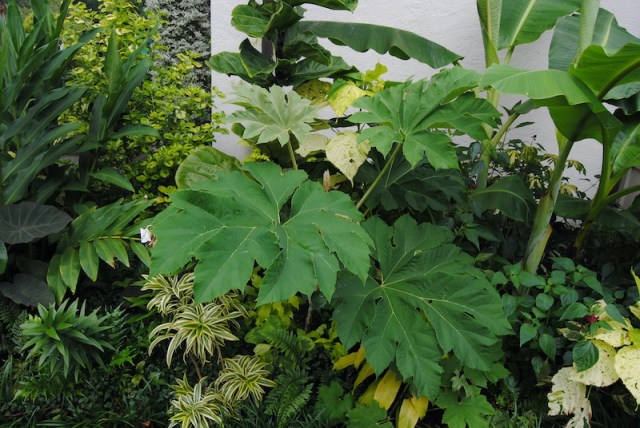
Continuing around the house are beds just flooded with cool tropicals and hardy perennials.  Here’s number two cool plant leaf that I want, it’s the rice paper plant (tetrapanax).  Big leaves that start out fuzzy, what’s not to love?

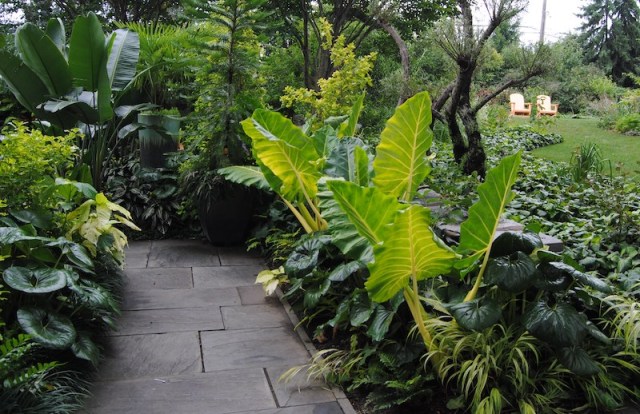
More foliage along the path.   I have no idea, but the yellow veins of it matched the ivy creeping along the ground.  Fancy.  You can also see some of the many seats scattered around the grounds.  In my opinion gardens are always best viewed from a comfortable seat!
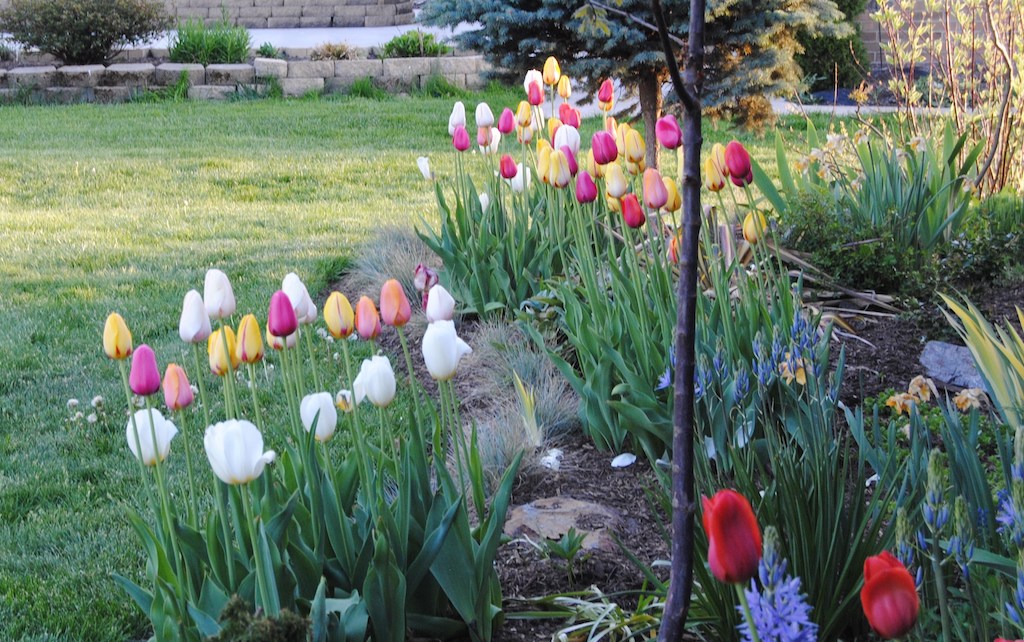
Here’s another nice seating area.

I believe the three dark green plants along the walk are samples of the infamous breadfruit tree.  Maybe it’s just the result of a few too many childhood viewings of “Mutiny on the Bounty” (The 1962 Marlon Brando version) but I think this food staple of the Pacific is a fascinating plant.  This plant was the reason Captain Bligh was commissioned to sail to Tahiti in the first place, and this is also the plant thrown overboard when the mutiny takes place.  Besides Captain Bligh’s survival story, the story of the mutineers and their descendants on tiny Pitcairn island is also quite a tale.  They still live on today as a British territory.

Less contentious is the yellow-green underplanting of variegated boston fern, hakonechloa grass, and others.  I’ve heard people say you shouldn’t mix variegated plants, but here I think that theory expires.

Oh, and if all that’s not enough, the glass topped table is actually a terrarium 🙂

Ok, so that might be enough for today since WordPress has locked up twice and both times I had to redo what was lost.  Next stop is the former tennis courts….. tennis has never looked so good.

Pur Pur Purple

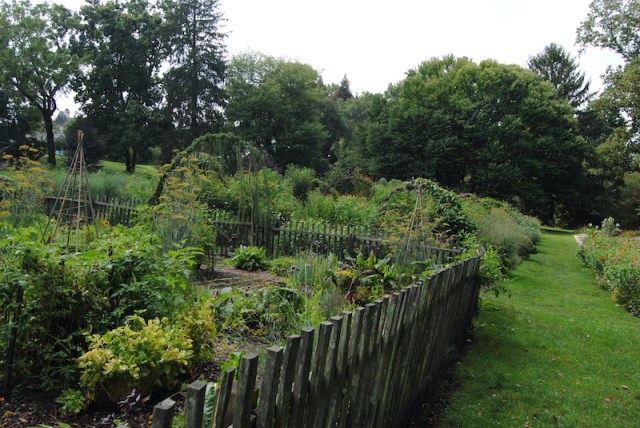
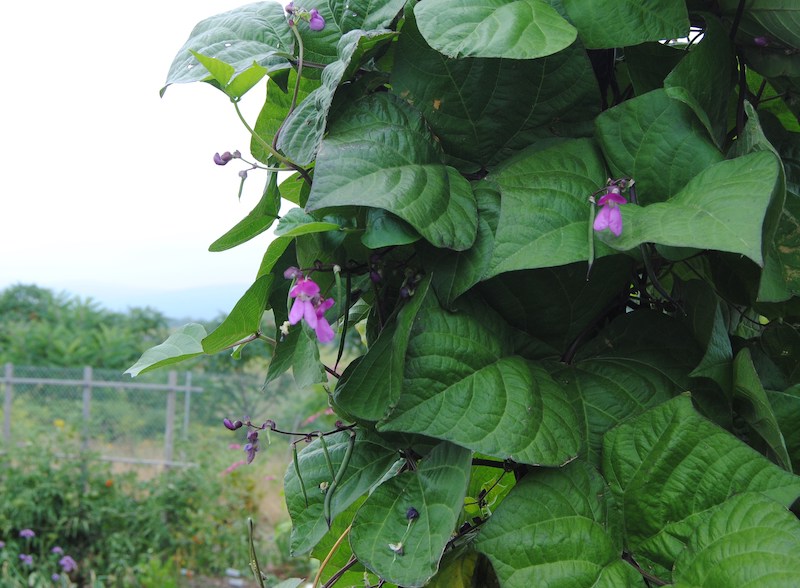
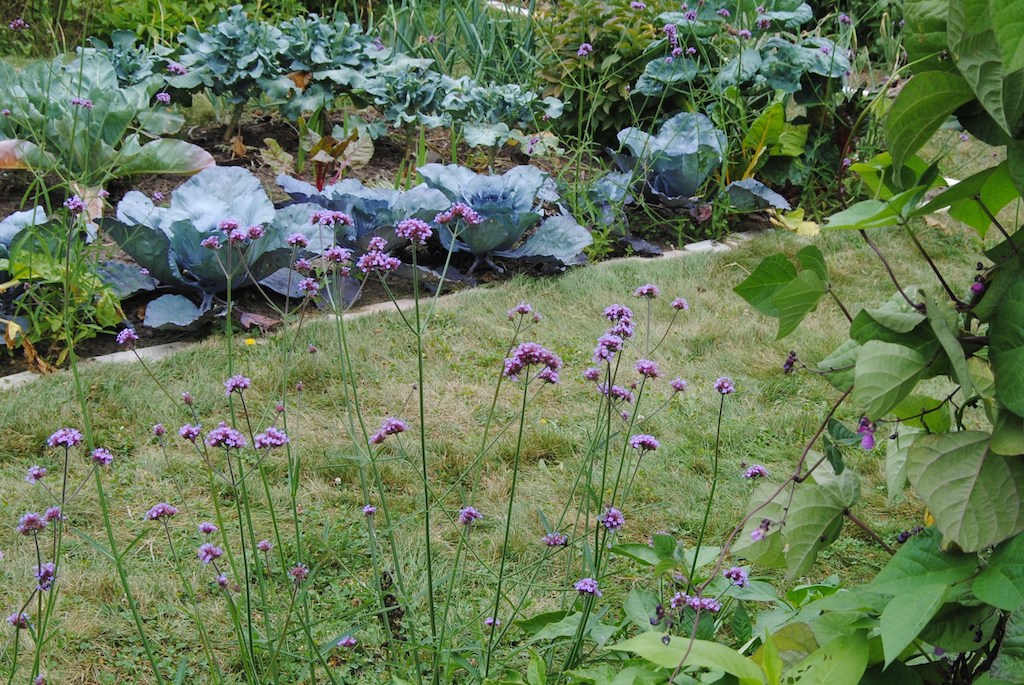
Something weird must have been going on last winter while I was picking out the veggie seeds for this summer… or maybe there’s something weird in the water…. in any case there’s a definite purple tinge to the vegetable garden this year.  I knew that these heirloom ‘Trionfo Violetto’ pole beans would be purple, but I chose them for the meaty, nutty flavored, stringless beans they produce.  They turned out great, but whether it was temperature or bird attacks, it took them a while before the blooms started setting little beans.purple vegetable gardenI rip out bucketfulls of the volunteer verbena bonariensis every year, but even after the carnage stops there are still plenty of their airy purple flowers throughout the garden.  They go good with the beans, but also match the ‘Ruby Perfection’ red cabbage on the other side of the path.  I never realized how purple red cabbage is until this year.purple vegetable garden

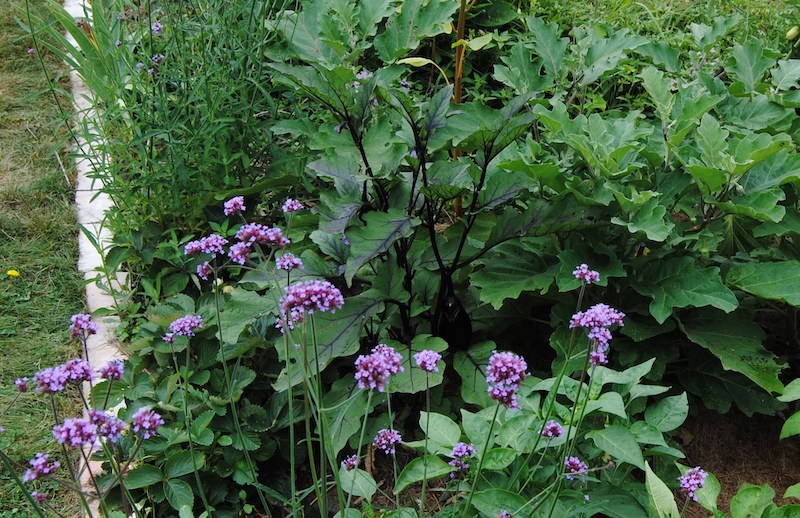
The verbena also picks up the black-purple of the ‘black egg’ eggplant.  Although the cold spring made for a slow start to the eggplant season, they’ve hit their stride now and are putting on decent sized fruit.  The ‘Black Egg’ is turning out to be productive and tasty even though I’d rather the fruits were a tad bigger.purple vegetable garden

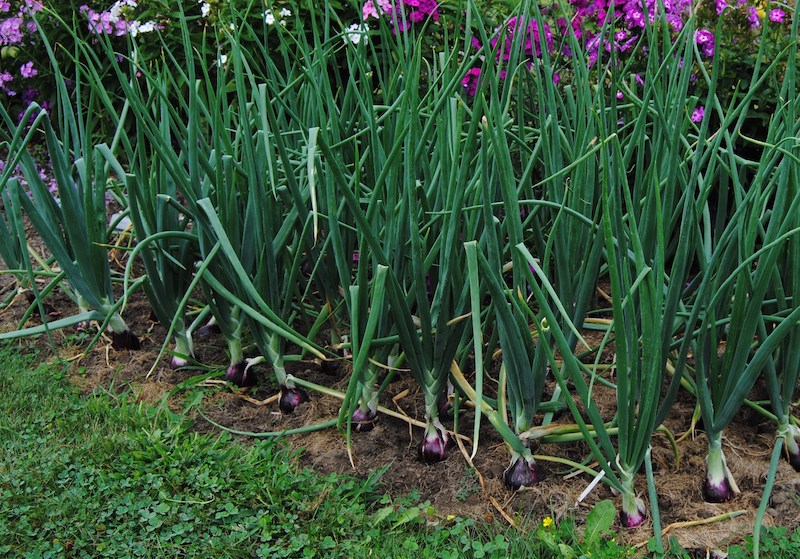
The ‘Red Wing’ onions are also doing great.  They’ve sized up more  since I took this picture and the purple flush of the bulbs matches up nicely with the purple phlox. purple vegetable garden

There are regular green beans and yellow onions, but for some reason they haven’t done nearly as well as the purple versions.  Go figure.  It makes me wonder if I could ever get organized and disciplined enough to have color coordinated vegetable garden.  In my case I doubt it, but it reminds me that vegetable gardens can look good too and if you ever want to give it a serious go check out some of the books by Rosalind Creasy.  She wrote the book on edible landscaping (plus a few others!) and her gardens really are amazing.

Hang in there Summer!
Cooler temperatures and earlier sunsets.  There’s no denying that summer is losing its grip, and with the kids starting school this week I guess it’s time to face reality.  Summer will not go on forever.  But delusion is a beautiful thing, and that’s what I’m sticking to, and for now at least I’ll focus on late August flowers….. not September.

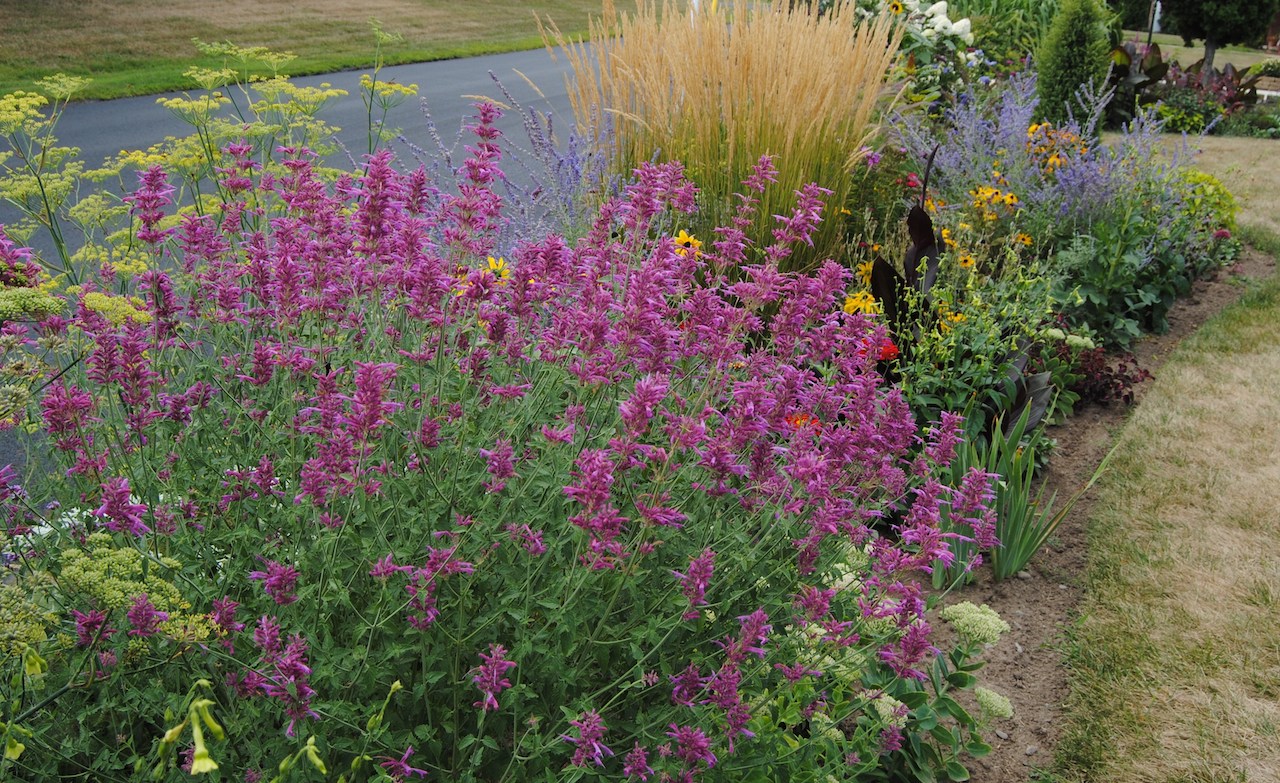
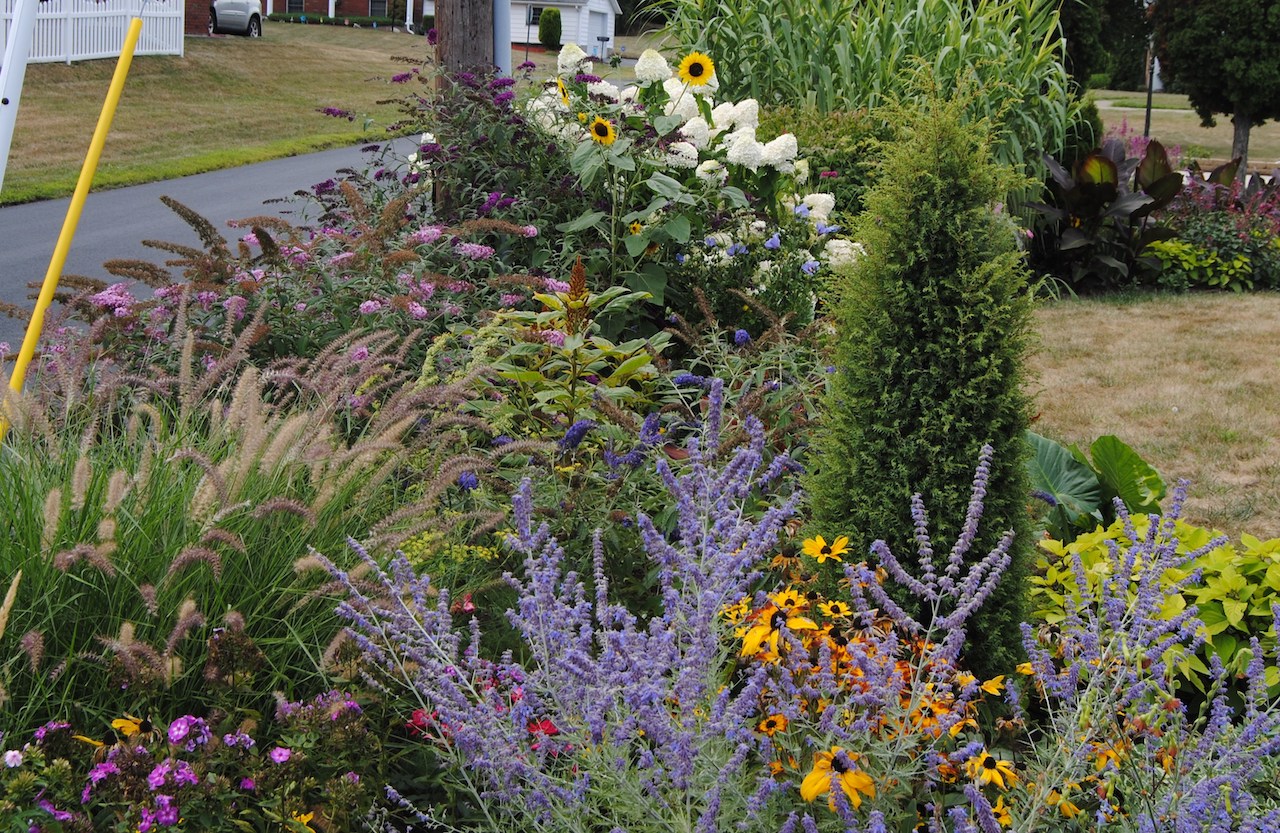
The front border is hanging in there in spite of the dry weather, and my half hearted watering seems enough to keep it this side of parched crispy.  Agastache “Tutti Fruitti” (I think), Russian sage, and the seedheads of “Karl Foerster” feather reed grass carry the show.

august perennials

Further into the bed it gets a little messy, and I bet deadheading the butterfly bush would help, but in the meantime it’s all almost one big wave of buzzing, fluttering color.  Lower left is “Karley Rose” pennisetum, basically carefree but not as sturdy as “Karl Foerster”.  The Russian sage and butterfly bushes just keep going….august perennials

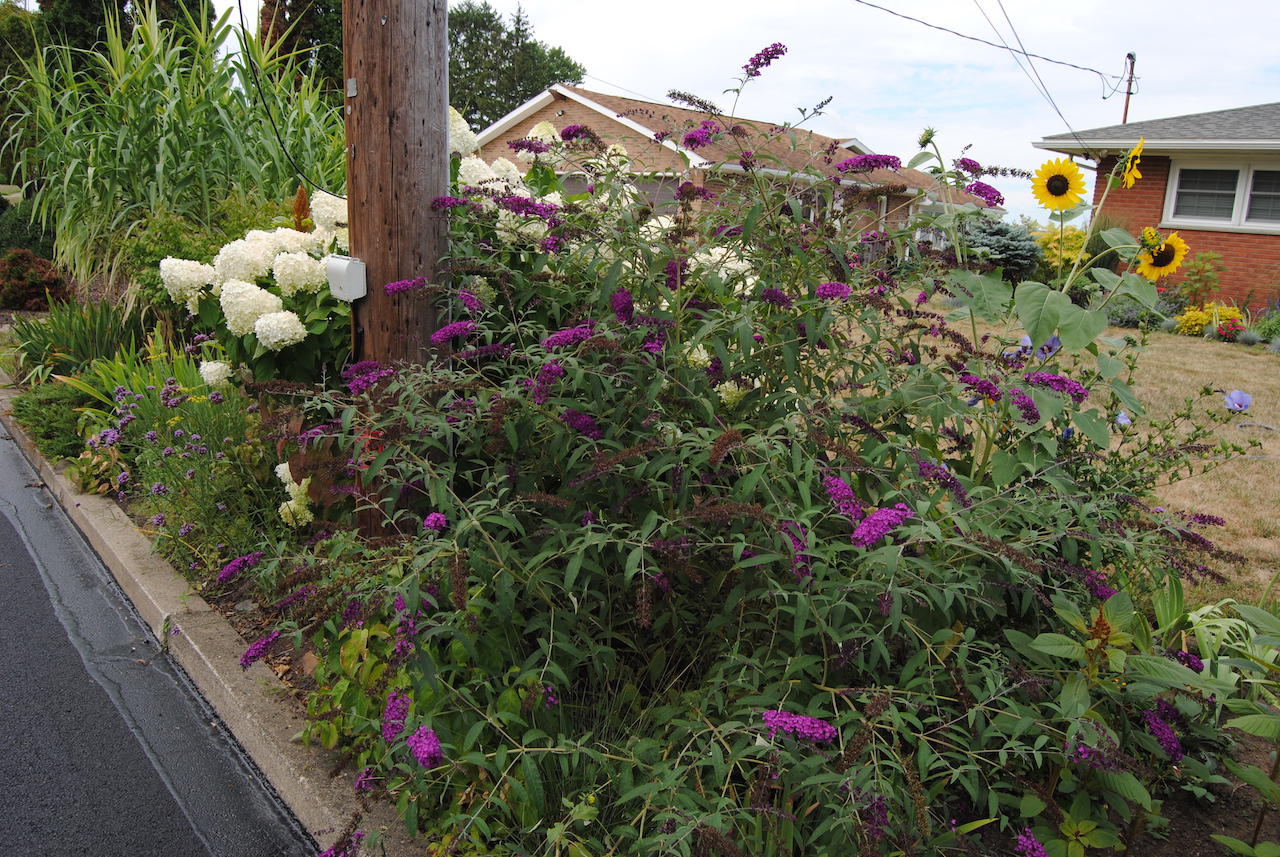
From the street it looks a bit messy, but maybe it distracts people from the dead grass…. here’s ‘Royal Red’ Butterfly bush (Buddleia).  It’s a little thin this year for some reason, but I’m sure it will be back to normal next year.

august perennials

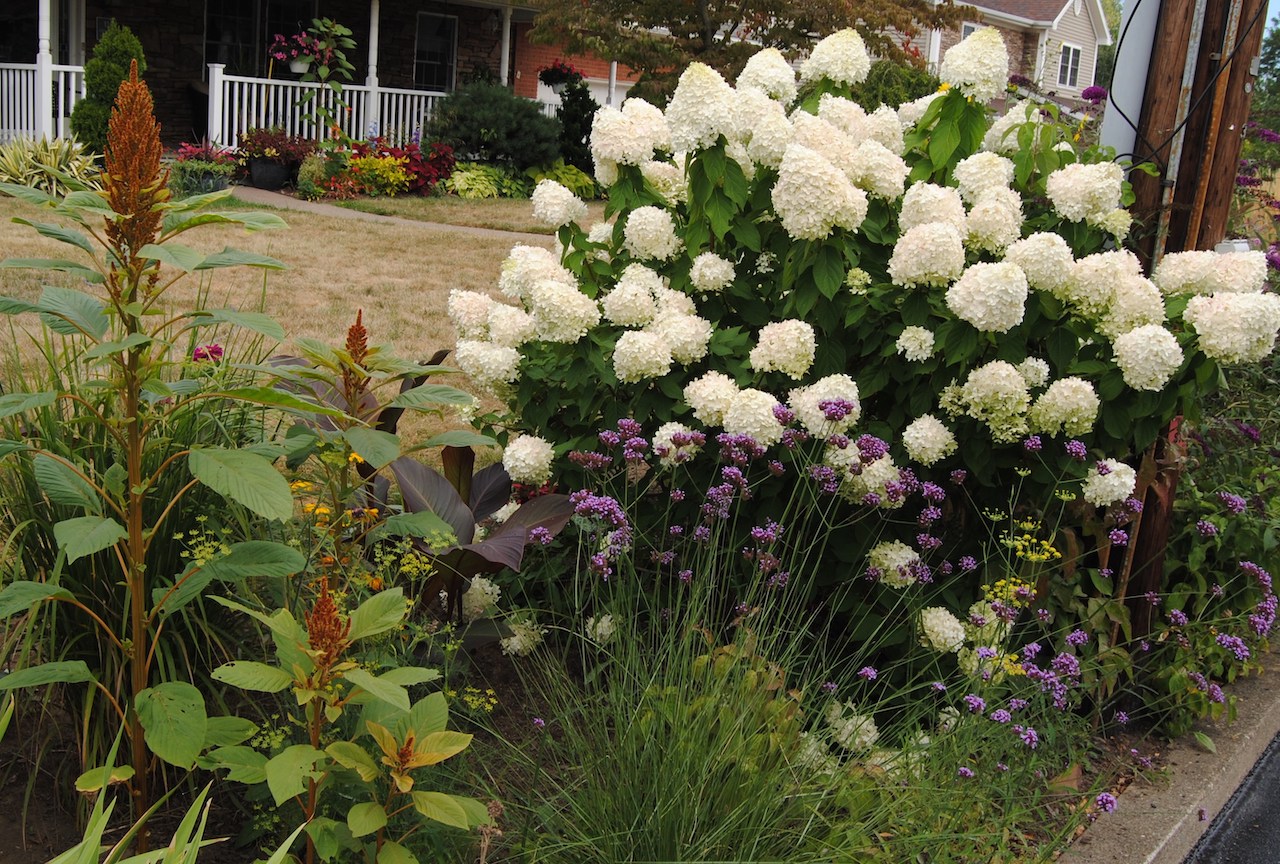
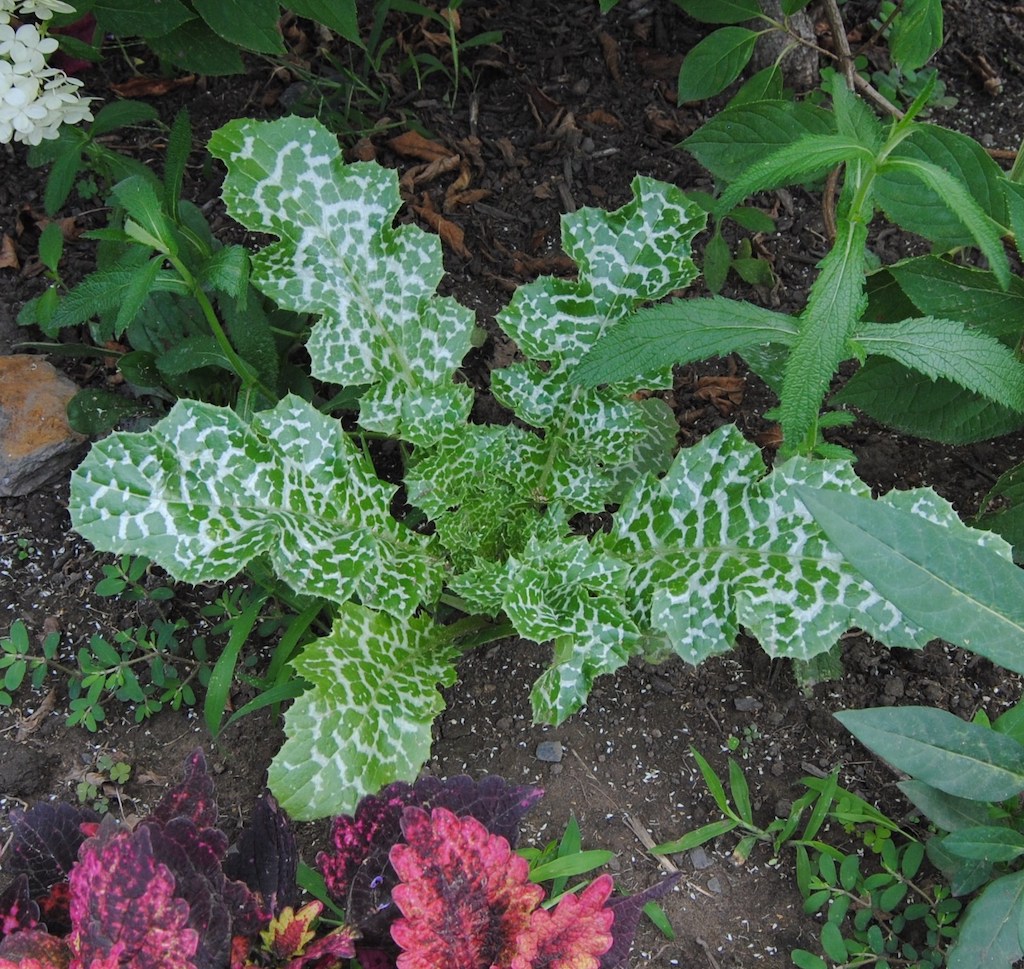
Also from the street, “Limelight” hydrangea paniculata.  Probably my favorite hydrangea, and it can get as big as it wants here.  The flowers start with a tinge of limey green, go white , and then blush with a bit of pink and red, and believe it or not the blooms are small this year (probably due to the dry summer).  Still there’s plenty of white flower overkill going on here!august perennialsThe extra water I give the hydrangea seems to be welcomed by its neighbors.  I love that this little milk thistle (Silybum marianumhas) sprouted up under the hydrangea.  august perennialsI don’t think it will amount to much this year, but maybe I’ll get lucky and have it overwinter and bloom.  Up till now I’ve only been successful with it as an annual.

If you’re bored, look up the history of milk thistle.  It’s been used medicinally for over 2,000 years and is still recommended today for the same liver disorders as it was in the middle ages.   Liver cancer, hepatitis, liver damage due to toxins…. mushroom poisioning….all this and it’s spiny with great foliage.  I love spiny!

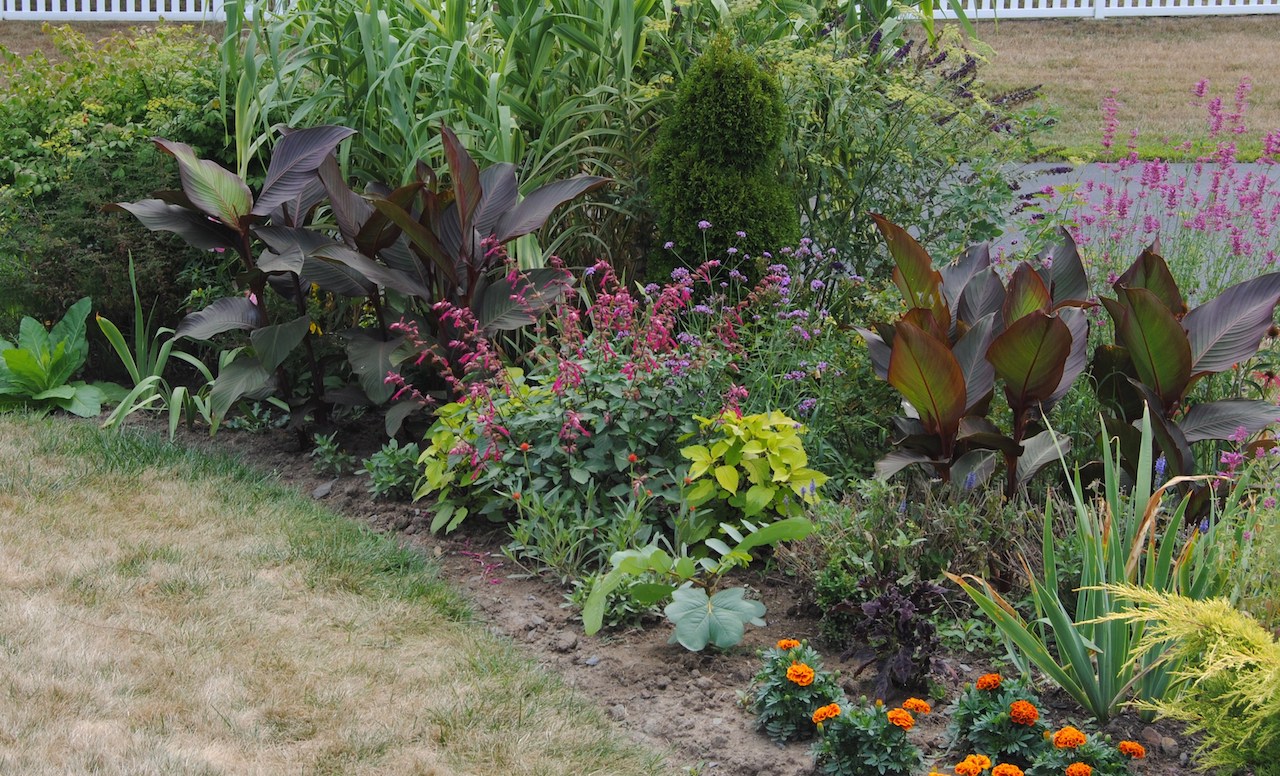
The far end of the street border is still filling in.  I can always count on the no-name, purple leaved cannas to give a nice background, and the ‘Wendy’s Wish’ salvia looks good in front of them.  I tried a couple marigolds in here too this year, they’re still small, but are taking the dry heat without a single complaint.  One of the great things about annuals is the chance to do it all differently next year.  I’m not sure if the brown-orange color is one I’ll chose to repeat.august perennials

Plant of the Year 2013

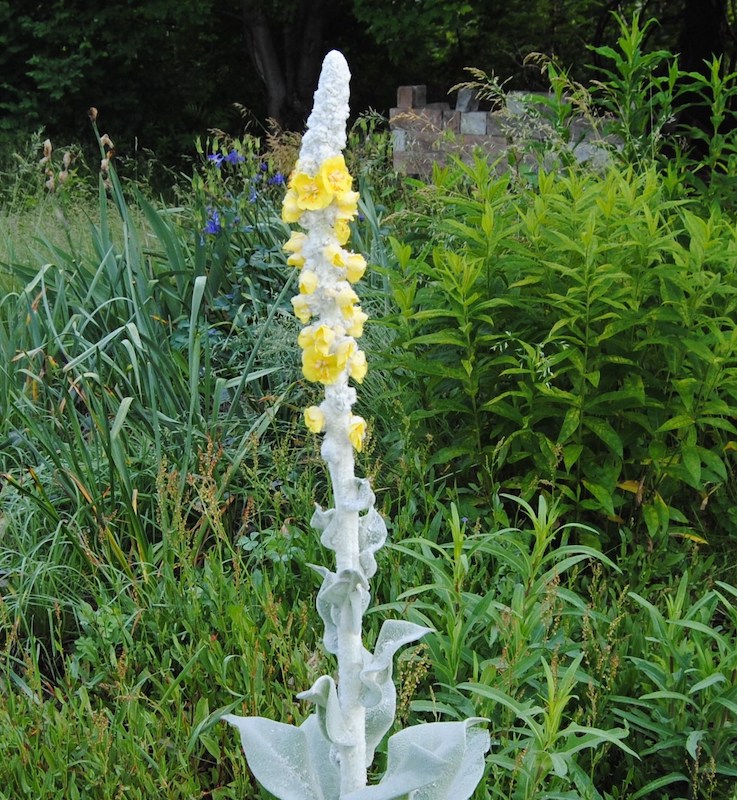
So what if it’s just June, I’m calling verbascum bombyciferum my plant of the year.  This means nothing as far as fancy decals or mass marketing campaigns go but it means I’m smitten with this plant.  It’s tall, it’s pet-able, it’s cheery yellow, it grows like it doesn’t care, and it’s always good looking. verbascum bombyciferum

Verbascum haters will point out it’s a biennial and will die after blooming but I say “be gone” and enjoy it for what it is…..  and I could list a bunch of perennials that never made it past year two for me and had much less interest.  They were started from seed last year and suffered the entire summer in a four pack.  While their brethren died from drought and neglect these two managed to root into the soil and survive.  Around September I desperately ripped up the plants, pulled them out of the four pack and shoved them into a poorly prepared garden bed.  They survived an autumn of stomping and whacking courtesy of the children and still came through for me.  What’s not to love about that?

verbascum bombyciferumI think my abuse was rooted in the doubt of their identity, I thought again these would grow up to be the common roadside mullein… which has happened three times already…. but apparently fourth time’s the charm.  You can bet I’ll be starting a more respected batch of seedlings this summer.  I’m hoping to top six feet with a better, less weedy and neglected upbringing.

I’m already looking forward to my seedlings and their fat fuzzy rosettes of pale grey winter foliage… kind of like a lambs ear on steroids…. now if I could only get rid of the rich purple weed that’s invaded the bed behind them.  Campanula glomerata, the clustered bellflower.  Nice but it really spreads.

Adios Spring

It always gives me a sense of sadness when spring rolls into summer.  All the anticipation, the return of growing things, and the new life makes spring my favorite season, but it goes too fast.  One after another things rush into bloom, have their day in the sun (or freezing drizzle) and then are gone for another 11 months.  It’s definitely a “gather ye rosebuds while ye may” season and it comes and goes in a rush as we hurry to get everything done before the heat and humidity settle in…..

When the first rose opens I call it summer and I face the fact that not all the projects are going to happen like they were supposed to.  So time to regroup, sit back, and get into porch and pool mode.  A couple 90 degree days push it along and before you know it spring is a memory and you’re into the lazy, hazy, crazy days of summer.

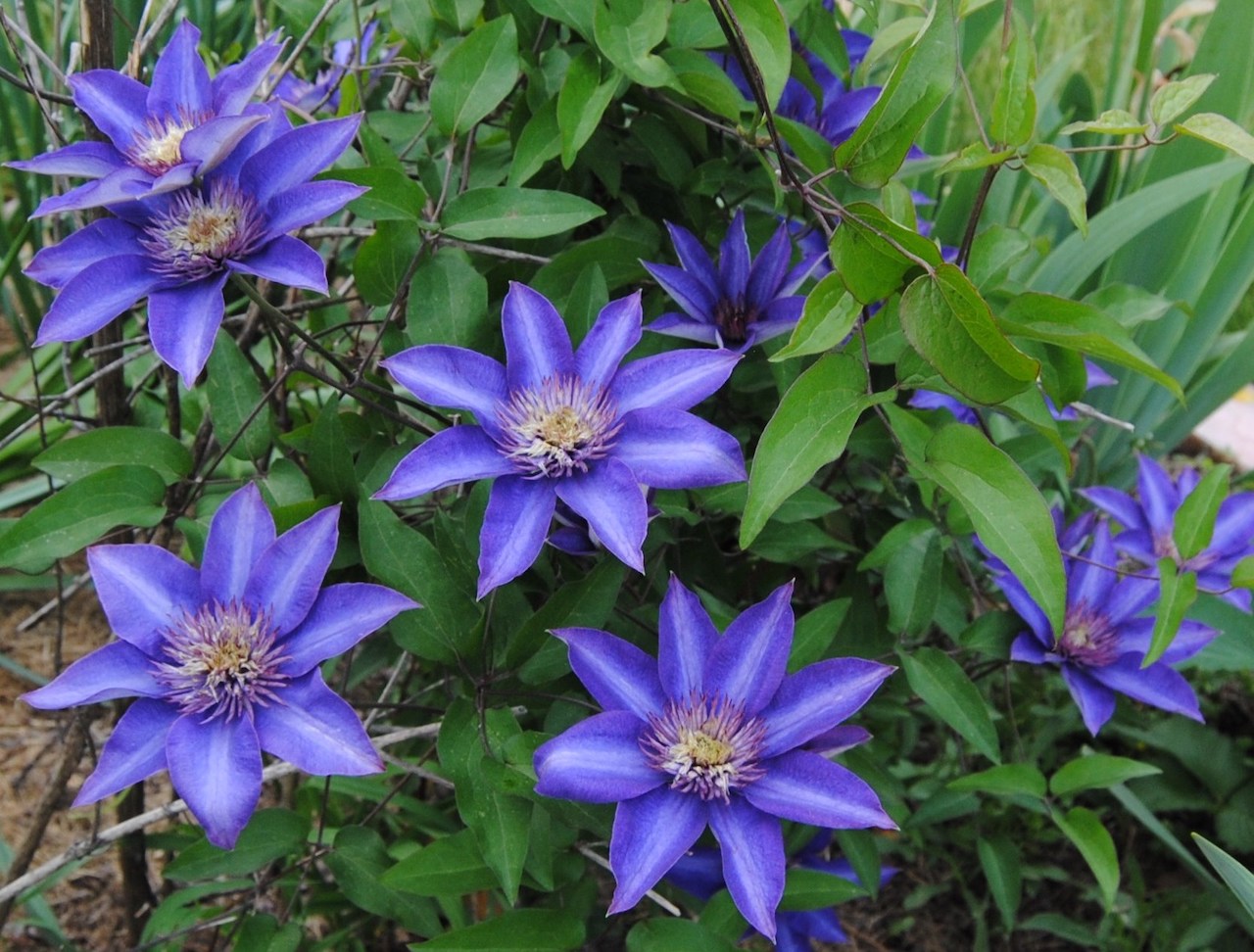
Clematis “multiblue” is carrying over from spring.  I bought it as something else and got this overfluffed flower.  Not something I would pick for myself but its become a favorite.  A “didn’t happen” project from spring was moving it out of the veggie garden and getting a real structure for it to grow on instead of bush trimmings…..clematis multiblue

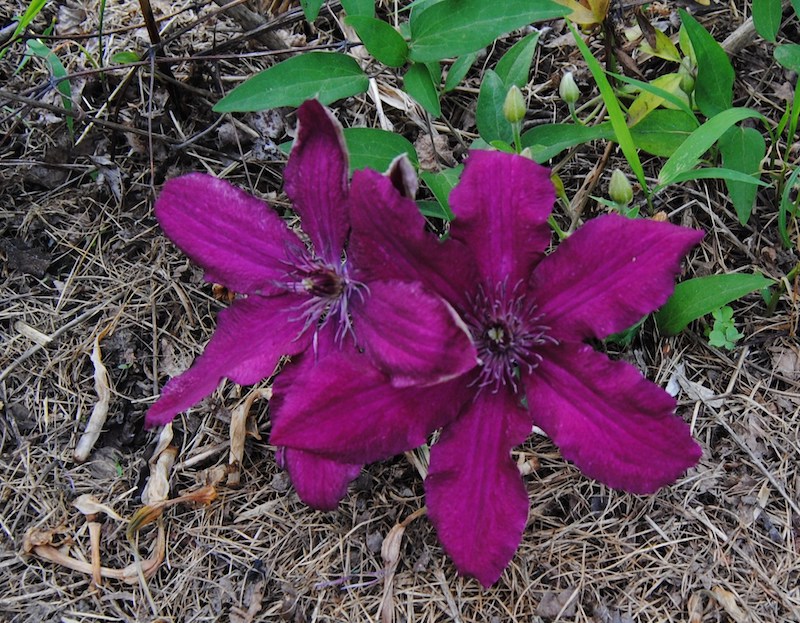
Clematis “Ruutel”  is also struggling along in a less than deserving position.  I have trouble finding spots for clematis,  I think I prefer them growing up small shrubs but never manage to get a good pairing.clematis ruutel

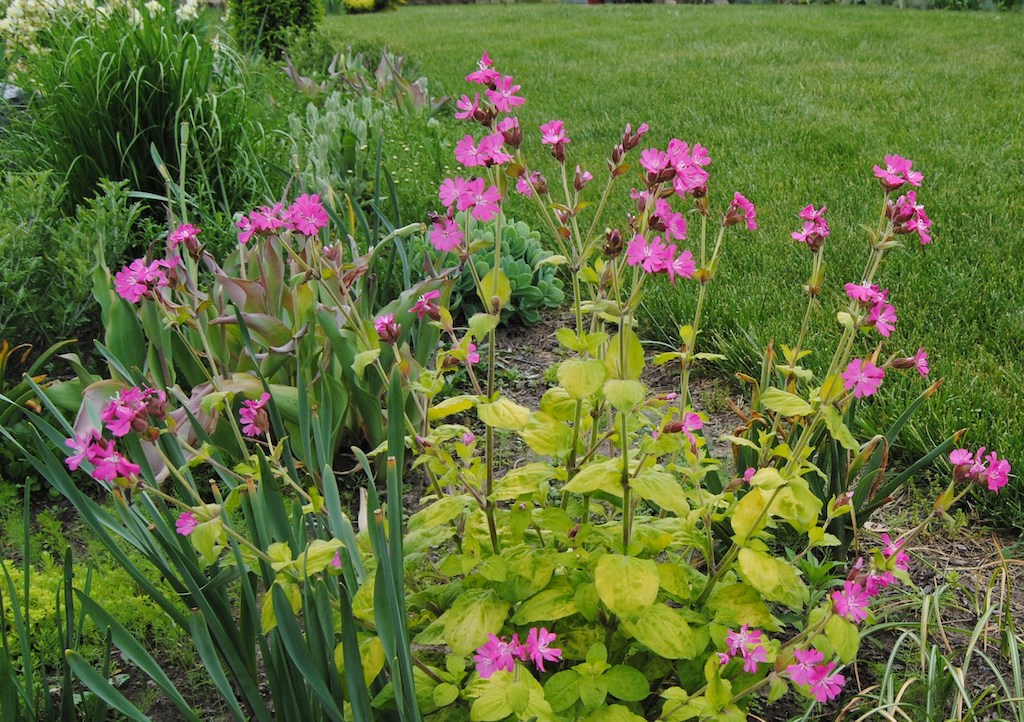
A new favorite for this time of year is “Ray’s Golden Campion”.  It flowers during my spring lull and does a good job covering dying spring bulb foliage.  I have some seed left and will be starting a few more this summer, they were a gift from Nan Ondra at Hayefield and I couldn’t be happier with the color of bloom and yellow leaves…. it’s another plant that could use better companions though.rays golden campion silene

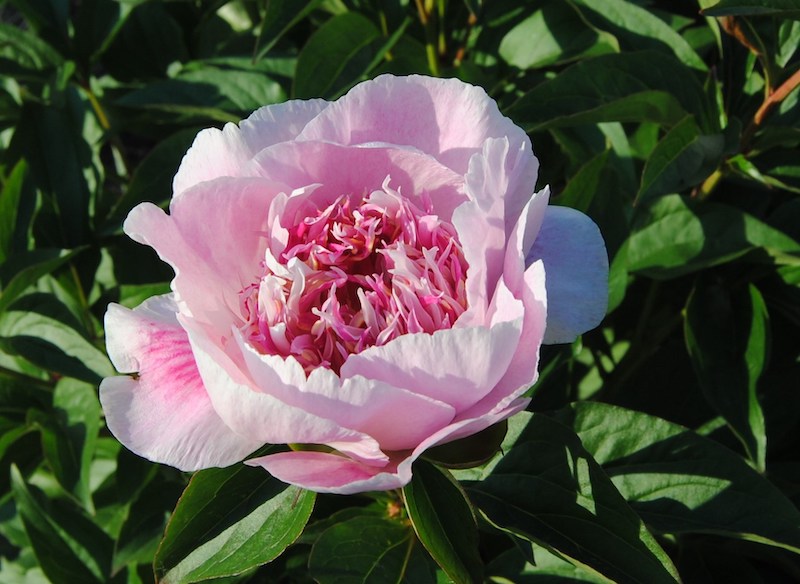
I think this is peony “Do Tell”.  It’s blooming happily in the middle of the vegetable garden.  The reason I’m not sure of its identity is because out of a bag of three this is the only one matching the description.  Now I’ve never seen an ugly peony (yet) so it’s not the worst thing to have happen, but I guess it falls under the ‘get what you pay for’ heading…. they were clearance Van Engelen and the other one (the third hasn’t bloomed yet) is a big fat fragrant double pink so it’s win-win so far.peony do tell

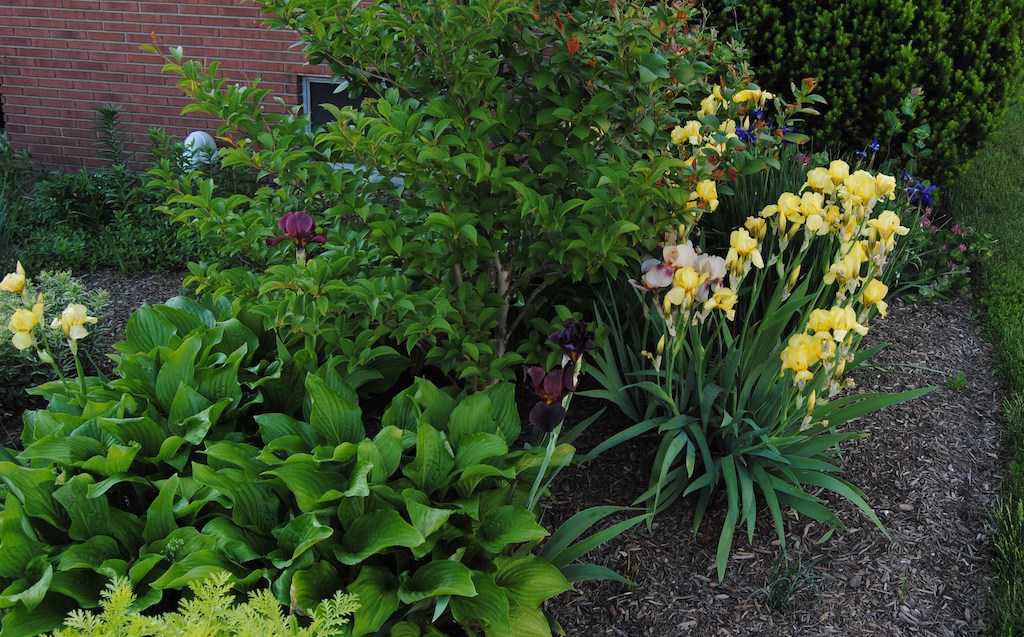
Just about all my plantings are on the redo list.  Sometimes it’s not entirely my fault, but I guess it depends on how you assign blame.  By definition I never really “planted” any of these iris, they’re the result of using not-quite-ready compost as a top dressing before putting down shredded wood mulch.  It speaks of the hardiness of bearded iris that the rhizomes could survive a couple of months in the rotting compost pile and then still come back to life but I guess it also speaks of my laziness.  I never actually prepped the soil in this bed, just planted the stewartia and hostas right into the turf, covered the in between grass areas with a couple of layers of newspaper to smother it, covered the paper with compost and then topped off with mulch.  No one seems to mind and maybe when I plant better things here I’ll do soil prep.historic bearded iris

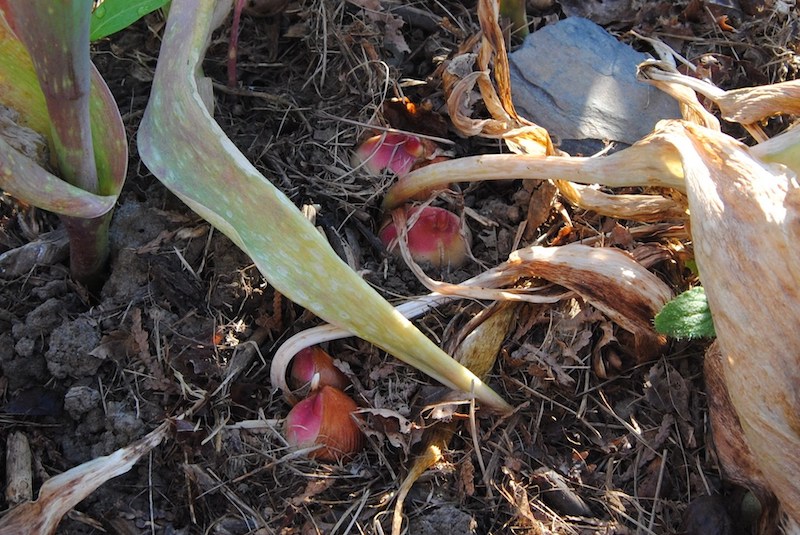
I did do soil prep for the tulips but in the vegetable beds it’s easy.  They’re starting to die down now which means bulb digging and then bean and squash planting.  Even though I did go through the effort of soil prep, I may have done some shallow planting last fall.  I don’t think they’re supposed to be this close to the surface and showing signs of sunburn.  It will be interesting to see if shallow planting effects bulb size since usually deep planting is recommended in order to keep tulips from splitting.  A real problem is that bunnies like to eat the exposed bulbs.  It’s possible this isn’t the first shallow planting of tulips and bunnies may have attacked last year.  But they need their vitamins too.tulips shallow too deep


Just another day at the salt mines

I can sorta relate to the people looking for low maintenance plants and landscaping.  I for one love being outside, watching things grow, tending plants, dividing, staking, deadheading…. even weeding.  About the only thing I really don’t care for is watering, so when it’s spring and I have a list of projects to work on and halfway through start to think it’s more trouble than it’s worth….. well it might be time to hit the lawnchair with a drink.  In a sick way I sometimes look around at my fellow suburbanites and think their yards look just as good as mine, but then I remember it’s unlikely they have a couple dozen different iris coming along into bloom, and they probably don’t even have any more than one or two snowdrops.  That helps my mood and I go through and finish the day with a smug grin, quite pleased with myself all over again.

The late tulips are still holding out, these (probably “Dordogne”) mixed in with all the others keep the patch colorful even after the rest are over.  Unless Sunday’s high winds beat them silly, they should last another week.tulip dordogne

I think what beats me down is the lawn maintenance.  If you want to talk high maintenance a lawn is right there on top.  Part of that is my fault, I’m stubborn and insist on using a corded electric mower instead of something bigger, stronger, and faster.  It’s not the most manly mower, but from someone who’s always wandering the yard looking at his flowers….. well, the mower doesn’t help.

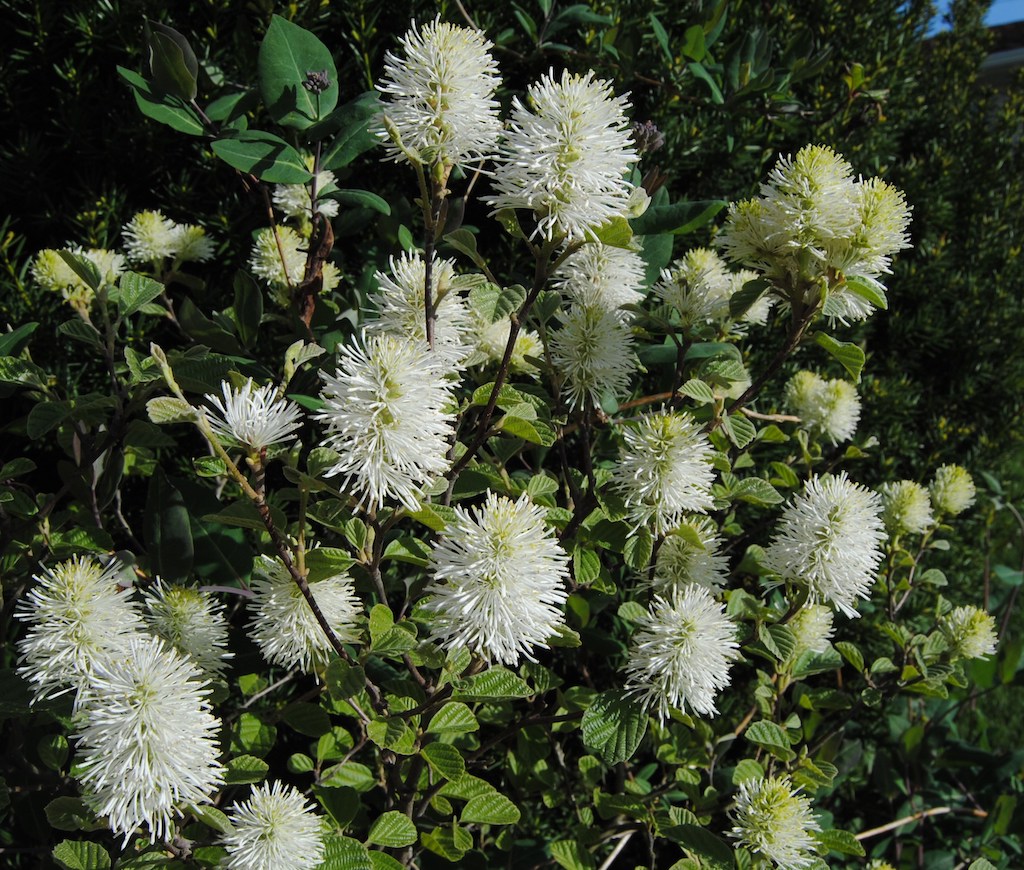
fothergillaSomething that’s mostly no-maintenance is fothergilla.  It doesn’t need pruning, blooms with these nice white bottlebrush flowers, is presentable all summer, and come fall puts on a nice show of glowing reds, yellows and oranges.  The blooms don’t last long for me, somewhere around two weeks, but that’s plenty.  You miss it when it’s gone, which in my opinion is better than a plant that wears out its welcome.

Round around July the lawn starts wearing out its welcome.  Mowing in the heat stinks and I look forward to the summer sun and drought sucking the green out of its blades.  As long as I mow on the long side it just goes dormant, and the summer vacation from mowing is much welcomed, since mowing clearly cuts into pool time.  But right now I need the flush of green clippings since they’re my number one mulch for the vegetable garden.   I use them and some leftover chopped maple leaves to smother the grass and weeds that are buried in this new bed.lasagna bedMost of the weeds and grass will die, and hopefully by the time tomato planting weather rolls around (2 more weeks?) I can carefully dig down to soil level, plant the seedlings, top the bed with new clippings, and admire my avoidance of actually digging up this patch of hardpacked gravely “soil”.

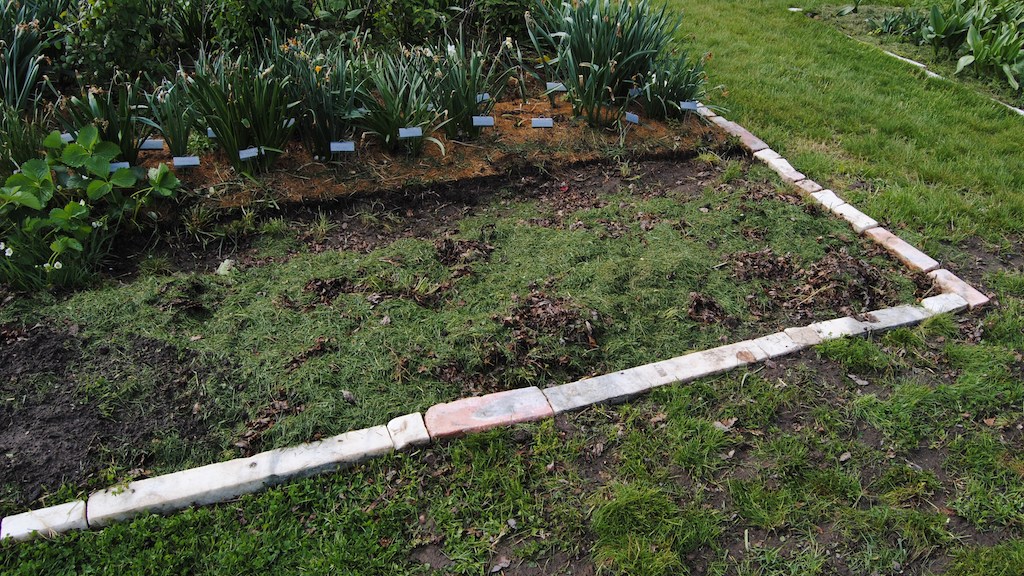
Since I don’t have enough better things to do I actually transplanted some of the grass from the new bed into the former bed-turned-new-pathway (lower right of the picture).  I’m a big sod mover.  I hate waiting for grass seed to sprout.  People will disagree, but I like grass paths through the garden.  If you noticed, mine are edged with fancy pink marble sections.  Some people have compared the look to “deep south cemetery”, but it’s the best use I could think of for the stone we pulled off the house front.  Maybe it’s the second best…. we also have a pink marble compost bin.

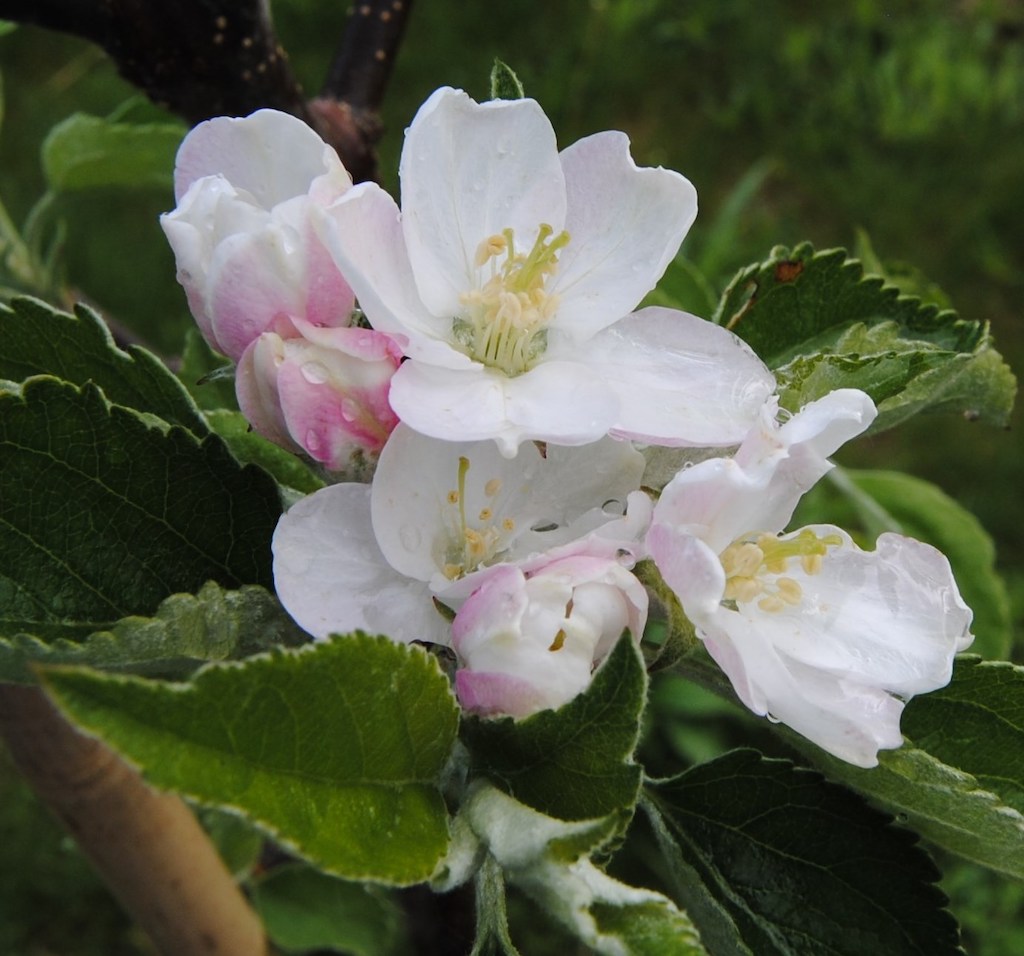
apple blossom In the orchard our new “Freedom” apple has even put out a few blossom clusters.  I should of course nip them off so the tree has more energy to establish, but I don’t care.  For all I know the tree could die tomorrow, so I’ll enjoy the blooms today.

vegetable transplantsSpeaking of dying tomorrow, we have a frost predicted for tonight.  I brought in a few succulents and four or five early summer plant purchases.  The rest of the stuff is on its own.  Planning for low maintenance gardening means not sweating the small stuff like late frosts.  The cold weather veggie seedlings will tough it out (strong sun would damage them more than cool weather).

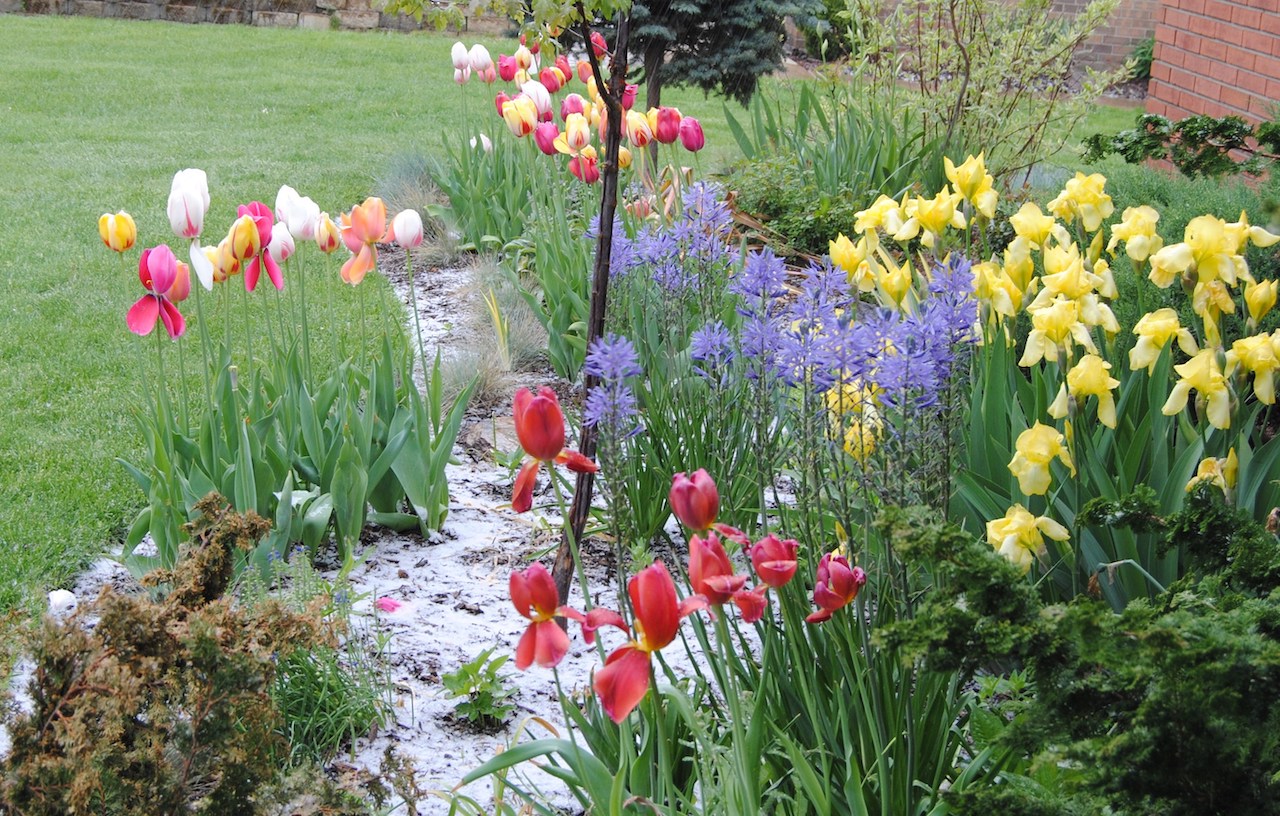
So we will see where the weather takes us.  I figure if the tulips and iris don’t mind this afternoon’s snow, they shouldn’t mind a slight frost.tulips in snow


Finally…. mulch is down

It might take normal people a weekend to get their mulch spread, but I went for the one week plan.  The biggest time drain was sprinkling the mulch down in between emerging  clumps and working the wheel barrow back into a bed that was filled with soft sprouts.  On top of that I was trying to stretch every mulch dollar by walking the fine line between too thin and too thick and trying to figure out just where exactly my limited mulch supply would go.  Oh, and did I mention the allergies and sinus infection?

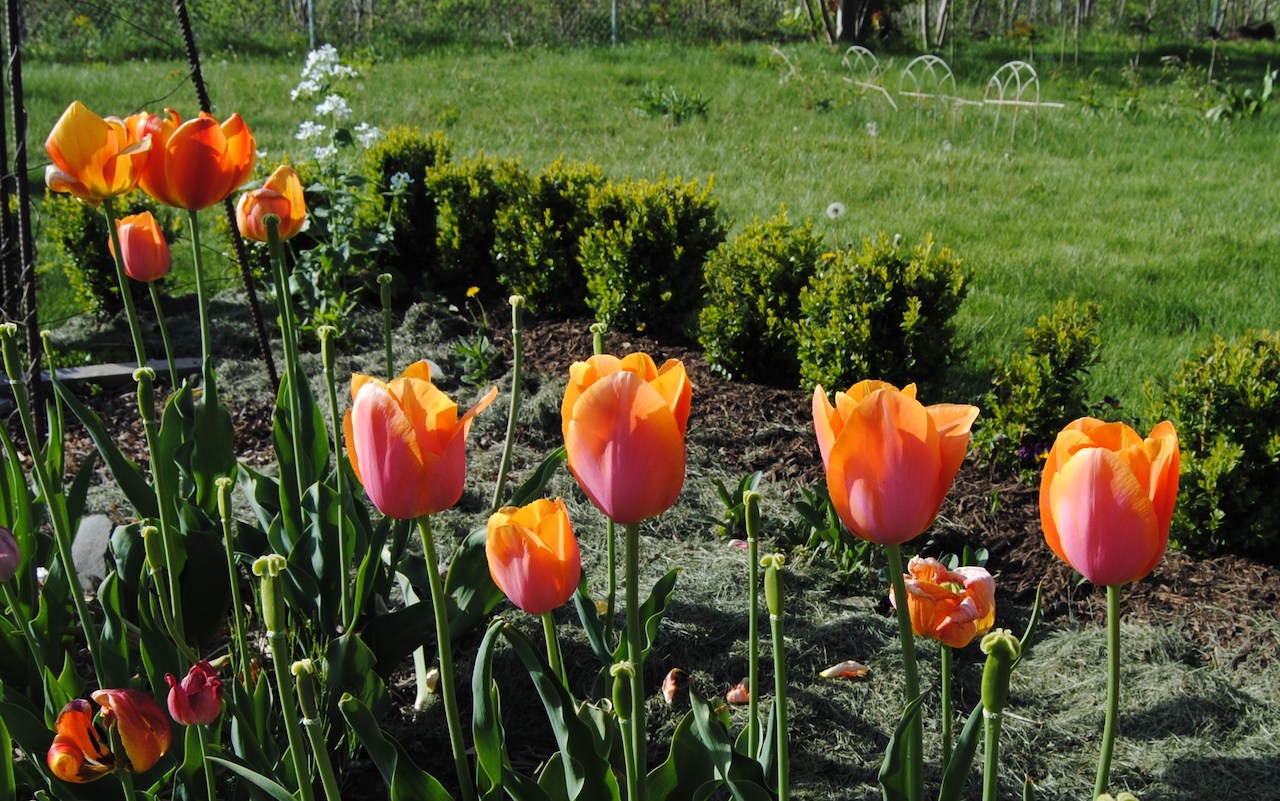
The newly renovated front bed got a nice top coat, showing off the mix of tulips I put in last fall.  This is what a weak moment during Van Egelen’s fall clearance sale will get you. It’s the Scheeper’s mix, made up of all Scheeper hybrids.  Not sure if the color is a good choice for in front of the orange brick….. but oh well, colors don’t clash in May   🙂scheepers tulip hybrids

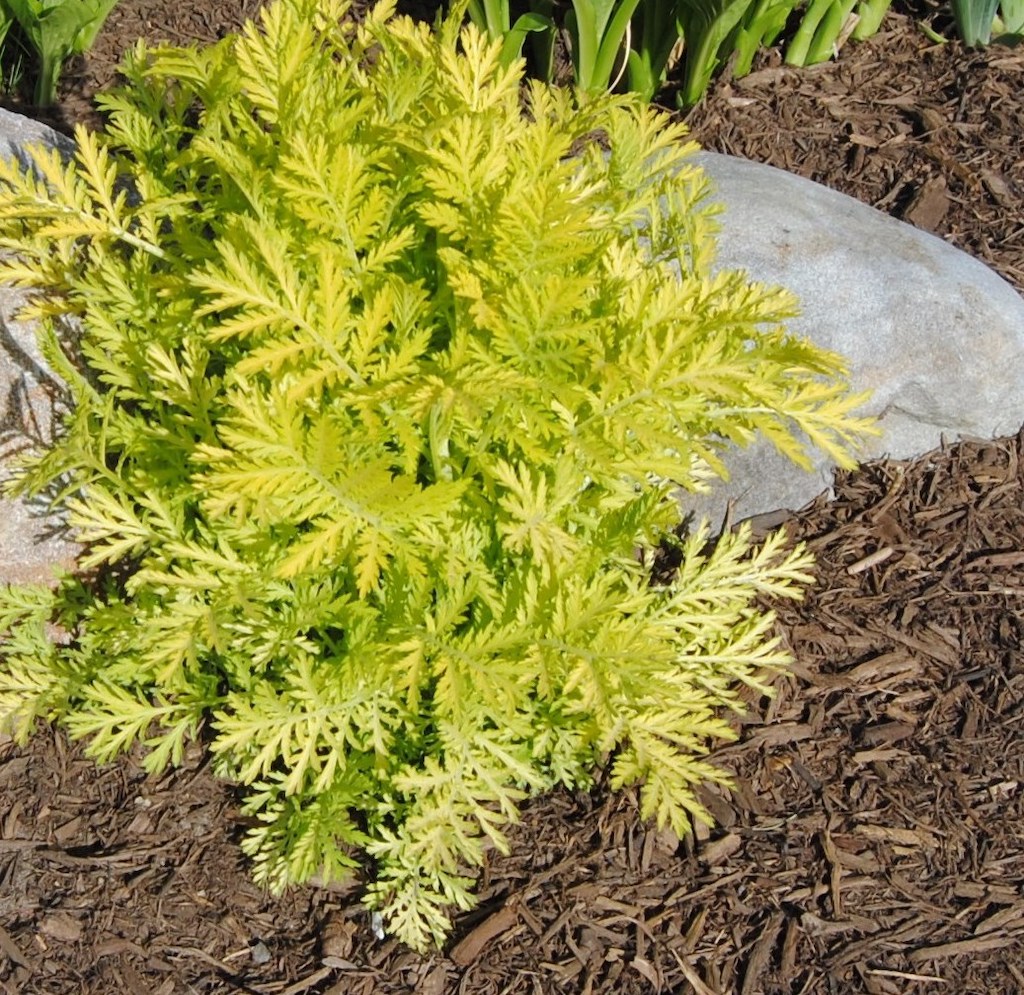
isla gold tansyThe mulch looks so neat and tidy, and it does look better than before when dirt was splashing everywhere and weeds were popping up by the thousands.  Look how it sets off this “Isla Gold” Tansy.

The tansy is one of my favorites right now.  I’ll be the first to admit I’m going through an I-need-everything-with yellow-foliage phase, but the lacy foliage, the fresh color, and the fact it keeps this color all season are just a couple reasons for my smitten-ness.  Did I mention it even has little buttons of yellow blooms in late summer?  I bet it would look great then with a blue salvia.

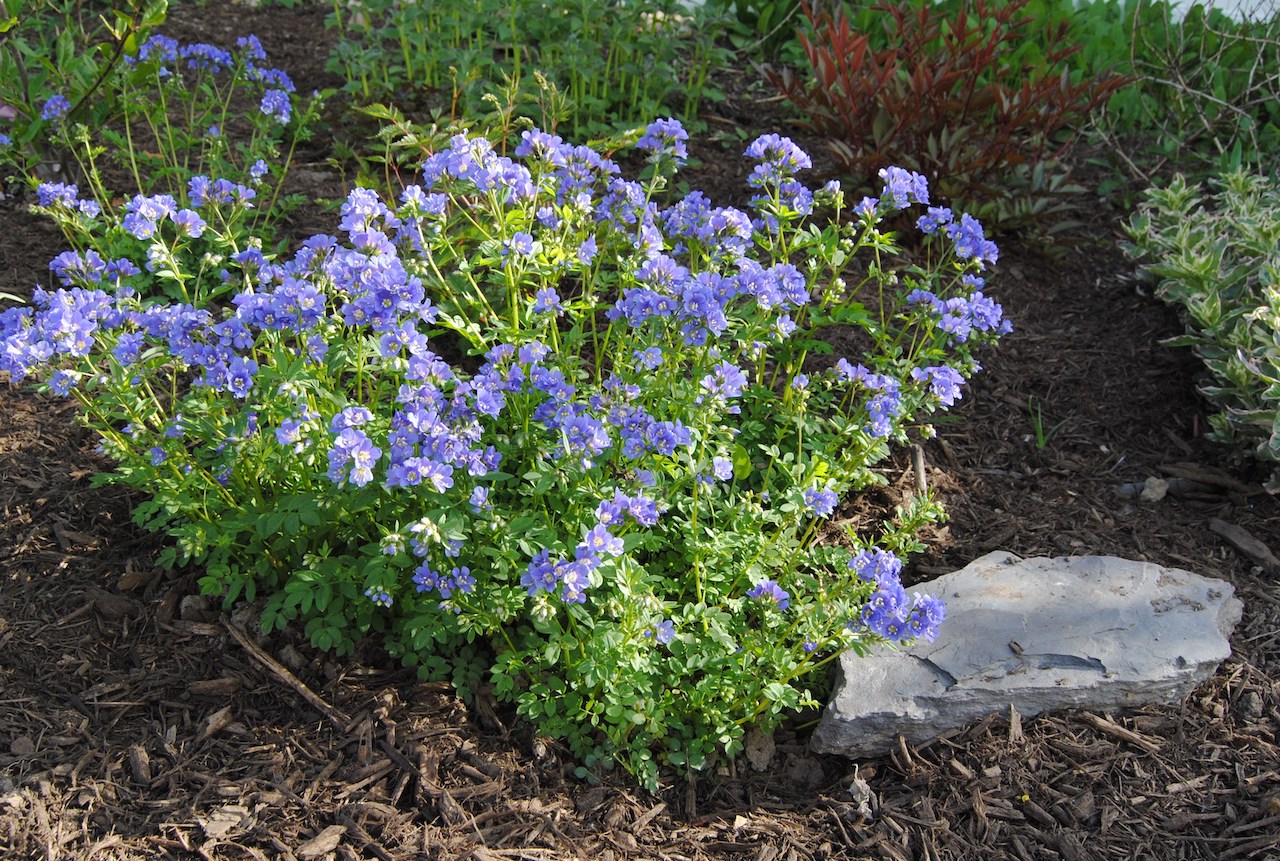
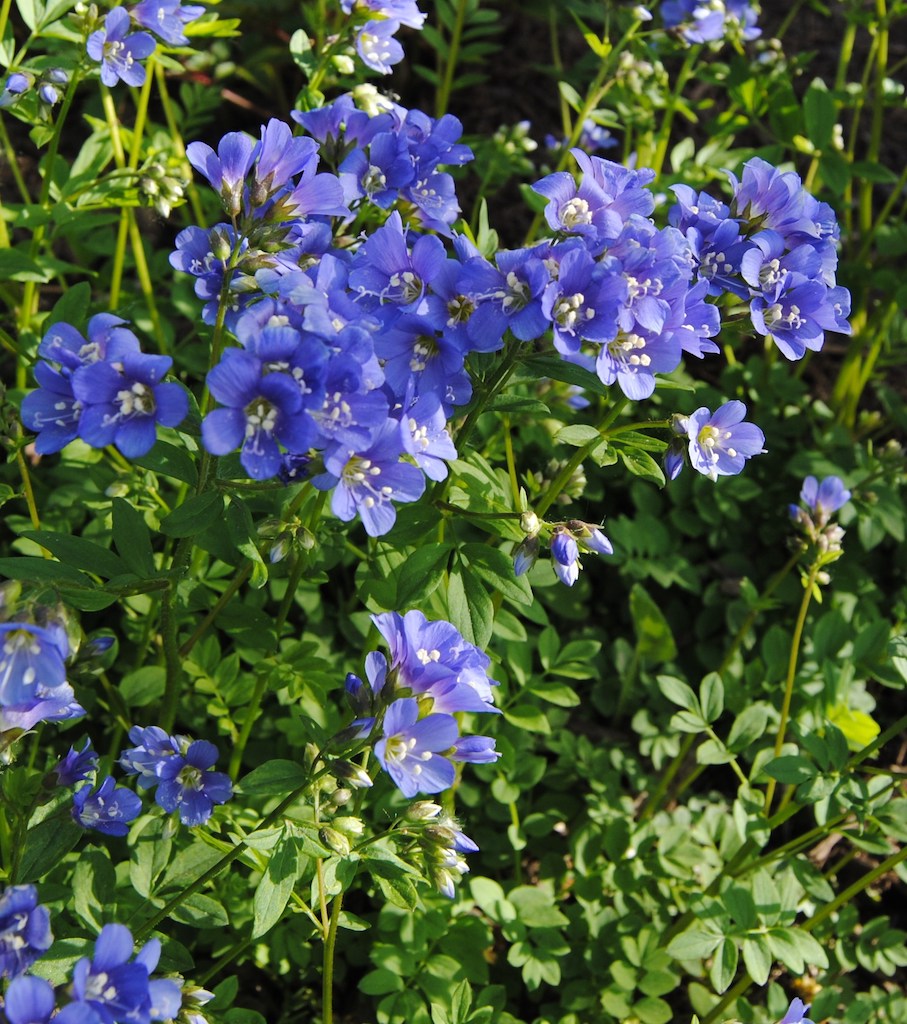
Right now I could pair it with polemonium reptans which is in bloom.polemonium reptans

polemonium reptansThe polemonium comes from my parent’s house.  The original planting was there when they first purchased the house over 40 years ago and has been going strong ever since, without dividing or anything.  You could trim it back after blooming if you want but I never get around to it.

Probably about half the beds are now covered, but in order to complete the job I’m guessing it will take another load.  Together the two loads will run about $660.  That really kills my garden budget for the year, but mulch costs are easy to pass by the boss.  I sometimes think that if our yard was just mulch beds, lawn expanses and a few rounded yews she’d be happy.

It’s May and tulips and daffodils are blooming all over the place.  There’s more to do than time to do it but I need to post a few tulip pictures.  They really rule the yard right now, and here’s a well mulched batch of “apricot impression” and some mixed lily flowered tulips.  After the tulips fade this bed will hit a lull for a couple weeks,  and I’m working on that, but usually hostas take over and a couple coleus find their way in.  So it all works out well enough.lily flowered tulips

There are more tulip pictures.  A lot more.  I’ll be catching up on those next.


How not to do a project, part deux

Sunday rolls around and I’m not even sure what the weekend project is…. or was.  I think it had something to do with that box of bareroot apple tree that’s been sitting on the porch for two days now.  Bareroot plantings should be taken care of asap, first step is to plump up the roots again by sitting them in a bucket overnight, I think 24 hours is sorta the max for soaking, you don’t want to drown them.  When planting, the only special thing to remember is to spread out the roots and work the soil back in between.  A little dirt, water it in, a little more dirt, water in.  It’s better to keep the root flare high rather than deep, you can always add soil or mulch around the base later if needed.  Don’t bother mixing anything into the planting hole, if your soil is horrible, plant even higher and mulch well with compost and those nutrients will work their way down to the roots, just like they do in every forest on the planet.  You may think it’s cruel not to try and improve the soil for your baby, but look around.  If you can see other trees growing then your tree should be fine too…. unless those other trees are swamp cypress… you might have a drainage issue then.

spring seedlingsSo with a sense of urgency to get my tree (and 3 gooseberries too!) into the ground I got the coffe brewed and sat down at the computer….. breakfast followed and then some Lego villages had to be built.  Then a friend stopped by.  Six hours later, a run to the local nursery (to drop off $40), and this is where I’m at.  It’s pansy season after all and buying pansies, shaking off winter, and supporting my local nursery are tradition in these parts.  The apple tree is still not planted but it’s Sunday after all, and things shouldn’t happen too fast on a day of rest.

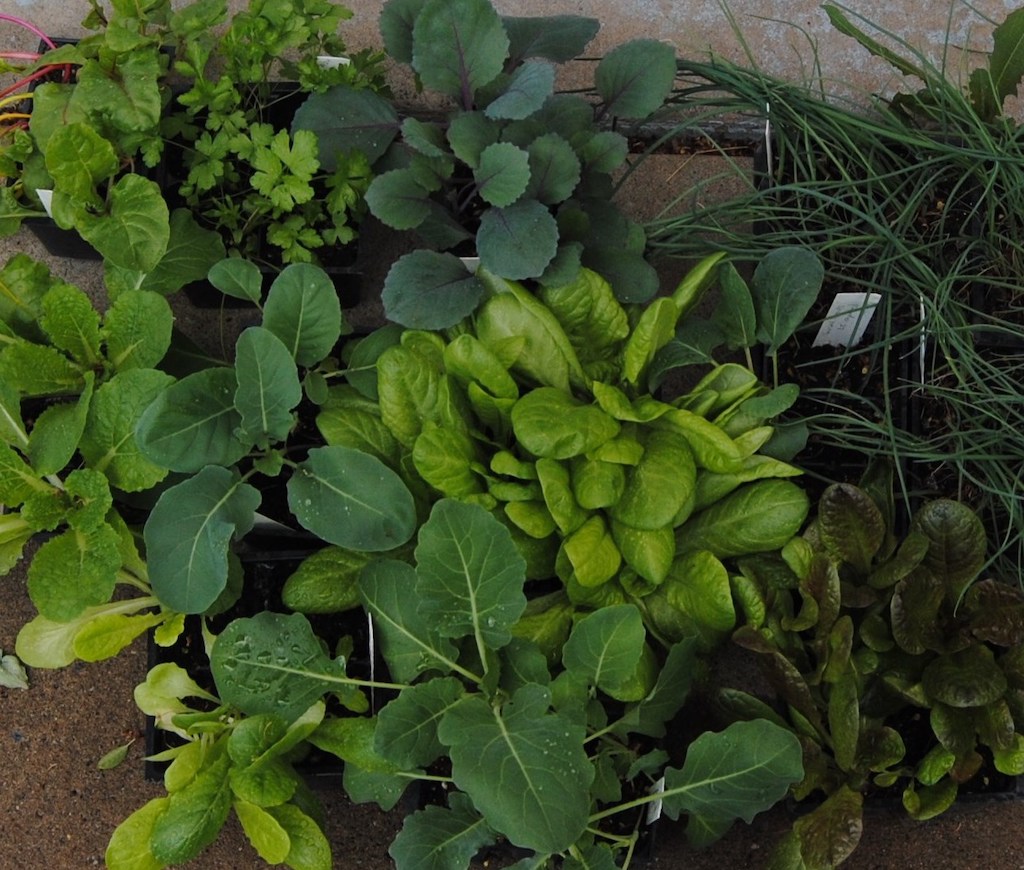
spring pansiesIt’s more fun to plant pansies than dig holes for dormant apple trees, and you shouldn’t pick-axe pond holes on a day of rest, so I drug out the planters for my new purchases and got them planted.  Again it’s not that easy.  All the fancy pots already have stuff in them.  It’s stuff like rubber trees and fig bushes that need repotting too, so that all came out to make room for the pansies.  Did I mention I bought lettuce?  I was embarrased to  even think of my own seedlings when I saw the lettuce plants for sale.  My reasoning was if I can get at least 215 servings of salad off these plants, they should pay for themselves.

spring pansiesThe back deck got a little spring too.  I should have powerwashed off last year’s stains first, but that’s another project and right now I’m too busy planting trees.

Tomorrow maybe I can actually get one in the ground.  The rest of Sunday was spent taking the kids (my two plus another three) for a walk in the woods and down to the railroad tracks.  They then insisted on seeing the drug house that burned down on Saturday.  Funny how these things never get mentioned in most tree planting tutorials.

Around 9pm I snuck out and opened the tree box.  Everything is soaking and has to be planted Monday before it drowns.  I should have no problem getting to it since the only other thing going on is repairing the pond hole.

Regarding the pond hole, I made the mistake of leaving the shovels out next to the dirt piles,  and after two hours of worm hunts, “climbing the pile”, and playing with the pick-axe, most of the dirt is back in the hole or thrown into the pond liner.  A little more work for me, but at least most of the local earthworms (and a couple of grubs) have been given names.

Snowdrops and snow

First days of spring come and go but for me a major turning point is the first garden tour.  Saturday was the day, and a friend and I headed up to Trumansburg NY to visit Hitch Lyman’s garden and his collection of snowdrops and other early bloomers.  I won’t bore you with the details of the “should be a 2hr drive” but the clock put it at closer to 4 hours and I’m sure that was due in a large part to not having a map, not really paying attention to directions, and having a co-pilot with a lot of new stories to share.  So we got there a bit later than planned, got to see a little more of the country side, and got to see a few more cities than we should have.  At least we didn’t end up in Canada is all I’ll add.

A snowdrop visit to upstate New York in below freezing weather and amidst snow qualls isn’t everyone’s idea of a good time.  Most of the garden is still asleep and when you pull up it’s more the house you notice, and less so the gardens.

The house at Temple gardens

The house at Temple Gardens

This open day was organized by the Garden Conservancy and according to their description the 1848 farmhouse was moved to the site in 1990.  What a job that must have been, and I’m going to guess it needed a bit of restoration when it got here.  On our side trip to reach Trumansburg, we came down rte 414 from Geneva Falls and experienced first-hand some other “in need of renovating” historical houses.  Some fascinating buildings, almost kind of ghost-towny in spots, and I’m going to make another guess that the local economy can’t support the upkeep on these grand old houses.  So they sit and slowly decay.

Back to the garden.  As you can see from the house photo most of the front acreage is naturalized fields with a few specimen plantings here and there.  The drive up to the house is also a mix of naturalized shrubs and trees, but along both sides are banks of earth spotted with all kinds of treasures.

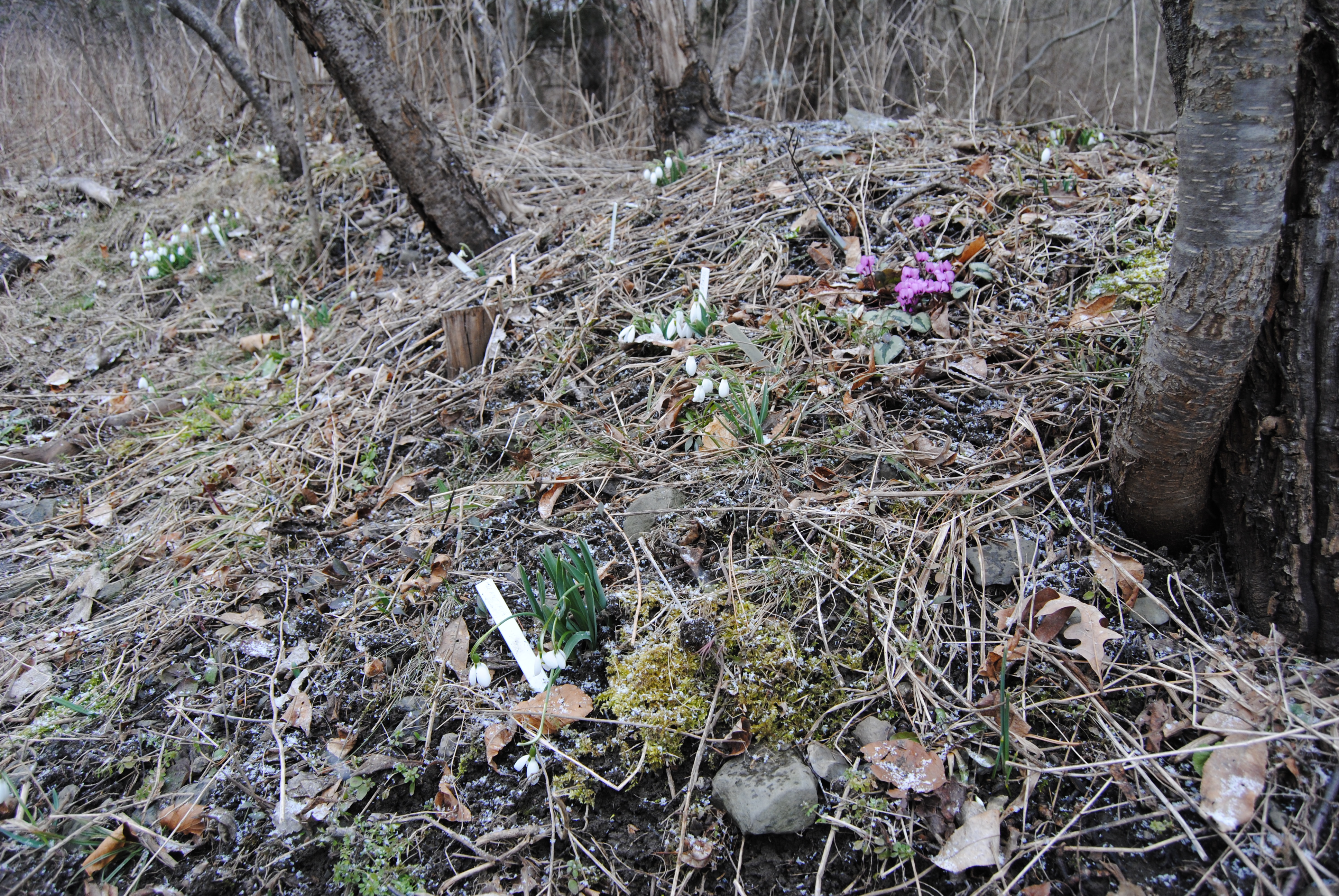
hardy cyclamen and snowdrops

A sloped bank of hardy cyclamen and various snowdrops

The snow and cold had many of them lying down but there was still plenty to see.  We checked in for our visit and headed around the house.  Plantings close to the building were pretty subdued and actually the direct opposite of what most gardeners do.  I put all the little stuff right up around the house, but here the only plantings were a raised terrace with a planted fieldstone sitting area.

winter aconite terrace

The terrace out back

I’ve seen springtime pictures from this vantage point, and the white wisteria and crabapples make for a much more lush view than the current frozen winter aconite among the paving.

temple gardens

Around back is the namesake temple for Mr. Lyman’s Temple Nursery…. snowdrops are the specialty in case you missed that.

Behind the temple you can make out the dark green of the yew and boxwood that surround the formal garden.  I didn’t get any pictures inside the garden, but it’s a formal layout of geometric planting beds filled with lilac, peonies, colchicums, hellebores, and of course snowdrops and other spring bulbs.

yew formal garden

The formal garden entrance

Deer seemed to be a problem outside the hedge and protective fence, with plenty of nibbled and buck rubbed shrubs, but once inside there were many signs of spring… in spite of my freezing fingers and cold toes.

helleborus niger

Some early Lenten roses (Helleborus niger) in the formal garden beds

galanthus jade

Galanthus ‘Jade’

Of course there were snowdrops(here’s “Jade”), but the bulk of the snowdrops were in the next (and last) section of the garden.  The woodland garden was furthest from the house and consisted of a narrow path that wound its way through the secondary growth of trees and shrubs that lined the back field.

Here’s how the path looked.

woodland path

The carefully marked woodland path, lined with snowdrops.

There were small clumps of drops everywhere and I was nervous to even use the outer edges of the trail since many clumps edged up to the path.  For a snowdrop fan there was interest galore…. for a non-snowdrop person I suspect they would want someone to widen the path, throw down some mulch, and pick up a few of the fallen twigs.

snowdrop woodland

An authentic snowdrop woodland peppered with clumps of named snowdrop varieties

Here are a few clump closeups from the woodland area.

galanthus nivalis sandersii

Galanthus nivalis sandersii

galanthus diggory

Galanthus ‘Diggory’

galanthus lapwing

Galanthus ‘Lapwing’

galanthus R D Nutt

Galanthus ‘R D Nutt’


double snowdrop

Unlabeled double snowdrop


I’ve got a few more pictures taken of the bank along the driveway but I think I’ll save them for another post.  For now I’ll leave you with some interior shots of the temple (it’s not just for show!).  After losing all sensation in my fingertips, we allowed ourselves a break inside by the temple fire.

Hitch Lyman garden

Warming up in front of the fireplace at the Lyman garden.

I hope we weren’t crossing any poor-garden-conduct boundaries by going inside, but the door was slightly ajar and the fire was so inviting.  Plus by then we were freezing, and a passing snow squall wasn’t helping matters much.  As we were looking around and considering building our own garden temples, I saw this above the door and had the feeling we were just as welcome here as we had been in the rest of the garden.

lyman temple garden

Inside details of the temple

Thanks for having us Mr. Lyman.