mumble mumble mulch

Spring is here and I love it.  It means work of course, and for me it’s hard to hit just the right balance of sitting around and actually doing something, but I try my best.  One problem which always haunts me is that I’m the type who (again while sitting around) usually gets tons of unnecessary projects in his head, starts them, and then moves on before they’re done.  Fortunately I’m not much bothered by this, but someone else here is, and sometimes decides to be helpful and remind me of the obvious…. but most of the time that person doesn’t notice unplanted chrysanthemum collections or realize it’s been years since the boxwood cuttings should have been planted out, so it all works out fine.  How can it not when rain and rainbows and warm sunshine have brought out the daffodils?

double rainbow over the garden

Double rainbow over the ‘potager’.  A beautiful sight if you can tune out the industrial park and white vinylrama next door 🙂

I’ve been relentlessly mulching.  It started innocently enough with a load of mulched leaves hauled out of the woods, but then exploded from there.  My neighbors were so generous last autumn with several heaps of nicely chopped leaves and grass clippings that I couldn’t stop lugging them back to the garden.  The entire front bed got a nice layer and I would have kept going but of course ran through all the available bounty.

cheap leaf mulched perennial beds

The front perennial bed all nestled in with a nice mulch of chopped leaves.  The earthworms will munch them all down by the end of  summer but for now they should go a long way in keeping the weed seedlings down.  Did I mention it was all free?

As if that wasn’t enough, for some reason when finished I got it in my head to crack open the wallet and order a load of shredded bark mulch to finish off the yard.  With most of the front already covered I felt finishing with a little purchased mulch might be something the budget could handle, so $290 later I was mulling over another new heap in the driveway.  It seemed a steep price to me but judging from the other $1,000 plus order slips hanging next to mine I guess I’m being downright frugal.  Also, mulch is a gardening expense the boss never criticizes, so now it just needs to be spread.  More on that later, daffodils first!

narcissus tahiti daffodil

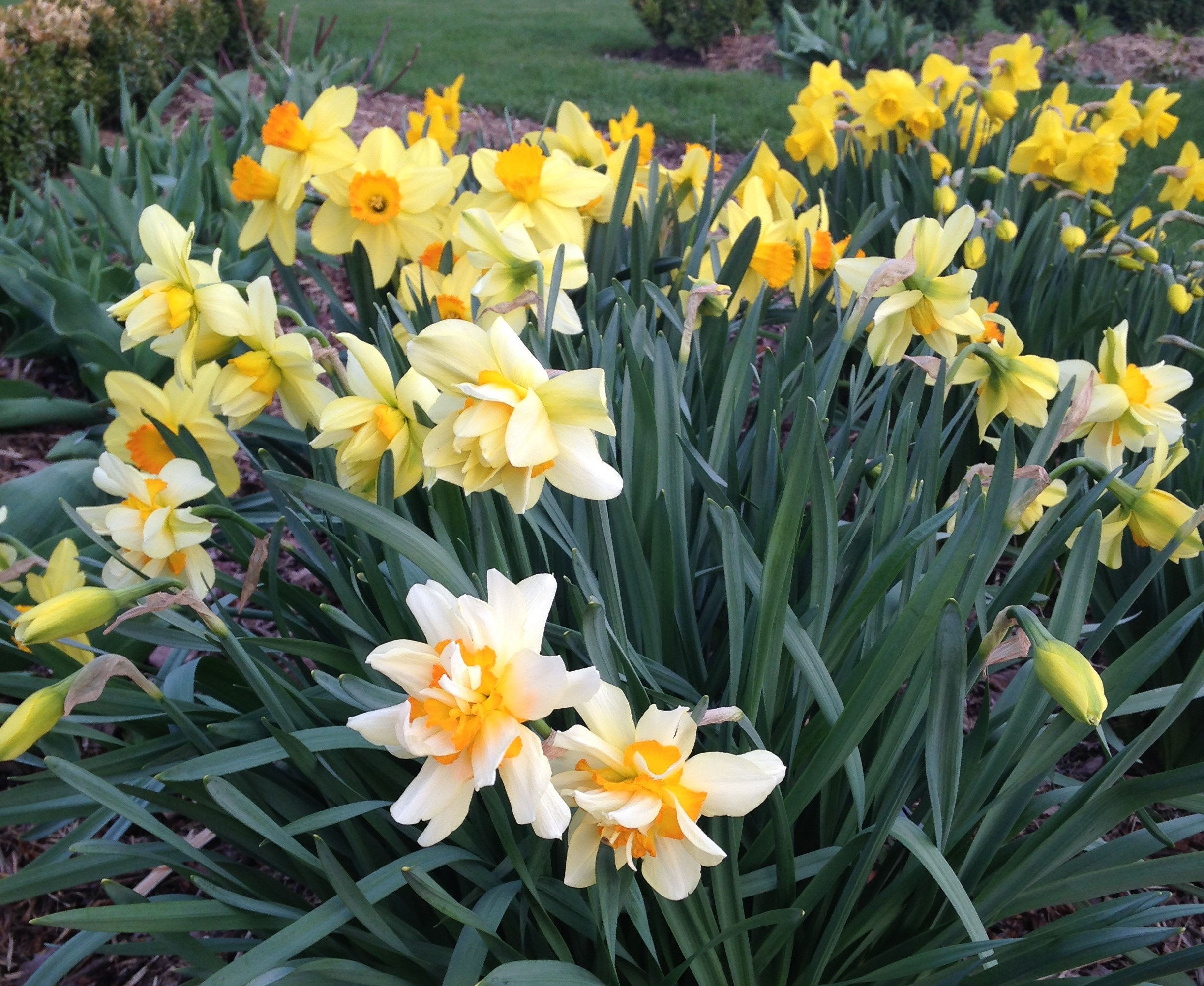
Always a favorite, ‘Tahiti’ is an awesome daffodil.  Sorry if you’re not a fan of doubles, but this one never fails, and the yellow petals seem to glow with an orange shade which I love.

I’m stuck on orange lately.  The daffodil ‘Serola’ tops the list this year.

daffodil narcissus serola

Narcissus ‘Serola’ with the first of the tulips opening behind.  When I divide this bed (hopefully this June) I’ll need to put these out in the front garden to brighten things up even more!

My whining about space in the vegetable garden is entirely due to my weakness for spring bulbs and the abundance of open space left when vegetables finally give up the ghost in September.  It’s so easy to just pop a few bulbs in here and there 🙂

daffodils in the vegetable garden

It’s so much easier to line a few daffs out in the vegetable patch than it is to decide on a spot in the open garden!  I’ll just plant a few pumpkins or squash over them in July to make it look respectable again. (fyi it’s bouncy house season so please ignore the deflated mess in the background) 

One more orange.  ‘Kedron’ has a color which stands out very well…. if you’re into colors that stand out very well 🙂

daffodil narcissus kedron

Narcissus ‘Kedron’.  Notice the empty spaces nearby.  Not everyone does well here and I just don’t have the patience to nurse unhappy plants along, so while ‘Kedron’ takes off the others just fade away…

Although the vegetables complain, bulbs in general seem to like my lazy (or complete lack) of an efficient watering ethic.  Tulips in particular like the open, sunny, fertile soil, and unless I weed them out (which I could never do) most clump up and bloom.  Even if I do pull a few of the smaller bulbs they just end up in the compost anyway so get spread throughout the garden a few months later when I take and spread the barely rotted goodness.

tulips and double hellebore

Yet another plant which needs to find a permanent home outside of the vegetable patch.  This double hellebore seedling is taking up prime bean and pepper real estate.

Believe it or not I’m making progress with my bulb issues.  When I was younger and carefree I used to plant out patches of whatever tulips I had on hand and then dig them up again in June just in time to clear the beds for tomato planting.  It was insanely beautiful (to me at least) and I can’t rule out this happening again.

mixed darwin tulips

Tulips blooming in the vegetable garden (spring 2013). These would all be dug, dried, and stored while the warm season veggies occupied the same beds.

Maybe my bulbaholism isn’t getting any better.  Maybe it’s just migrating.  I planted these fritillaria imperialis bulbs out in the meadow late last fall (clearance bulbs) and can’t wait to see how they do.  If I get one decent spring out of them I’ll be thrilled, but in my heart I want them to settle in… even if they do look slightly out of place in the short turf.  Hopefully they enjoy the dry summertime baking this spot receives, and the grass should come up soon enough to hide the yellowing foliage.

growing fritillaria imperialis

My ‘meadow’ is in danger of becoming a bulb field.  The fritillaria imperialis don’t look entirely happy yet, but I have my fingers crossed they’ll at least bloom and then maybe return next spring?

Out front I may have a few bulbs as well.  Early spring is when I love the front beds the most.
spring bulbs front entry

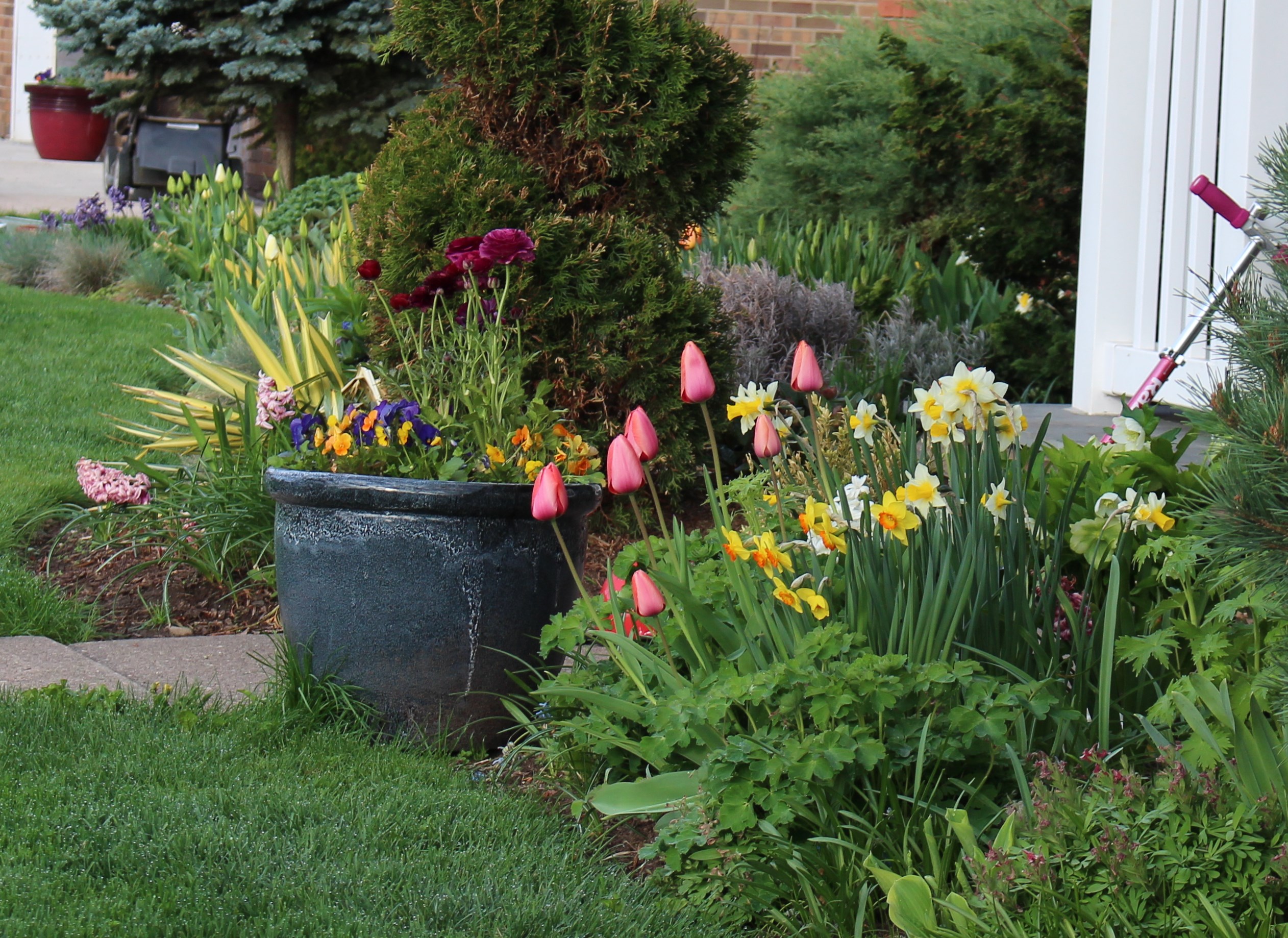
Tulips and daffodils where snowdrops ruled just a few weeks ago.  I should have taken this picture today since I mulched yesterday afternoon, but after all the work I was ready to just sit and relax!

I better wrap this post up.  Now that mulch sits in the middle of the driveway I’ve got plenty to do even from the non-gardening viewpoint.  And it’s not the fastest process since mulch needs to be worked in between sprouts and edges need to be tidied up…. and actually a bigger problem is that I’m coming up with all kinds of bed enlargements and side projects while I dilly-dally on finishing the main project.  I promised to trim back the yews along the side of the house, and this golden arborvitae just happened to show up in the lawn between us and the neighbor.  As long as I’m mulching, might as well create a nice big bed around it 😉

new perennial bed

new perennial bed

Let me get out there then.  Good luck on all your own spring projects, may they progress more quickly than my own!
Snow keeps plugging my lawnmower.

I’m sure you can guess what happened last night.  That which should not be named came down again and it’s been seen on and off all day.  Thankfully it’s been confined to the higher elevations but I suspect tonight we will lose the magnolias to even stronger cold.  Spring is on the calendar though, and after an explosion of growth last weekend this cooler weather has brought things back down to a more considerate rate.

daffodils and hyacinths  spring bulbs

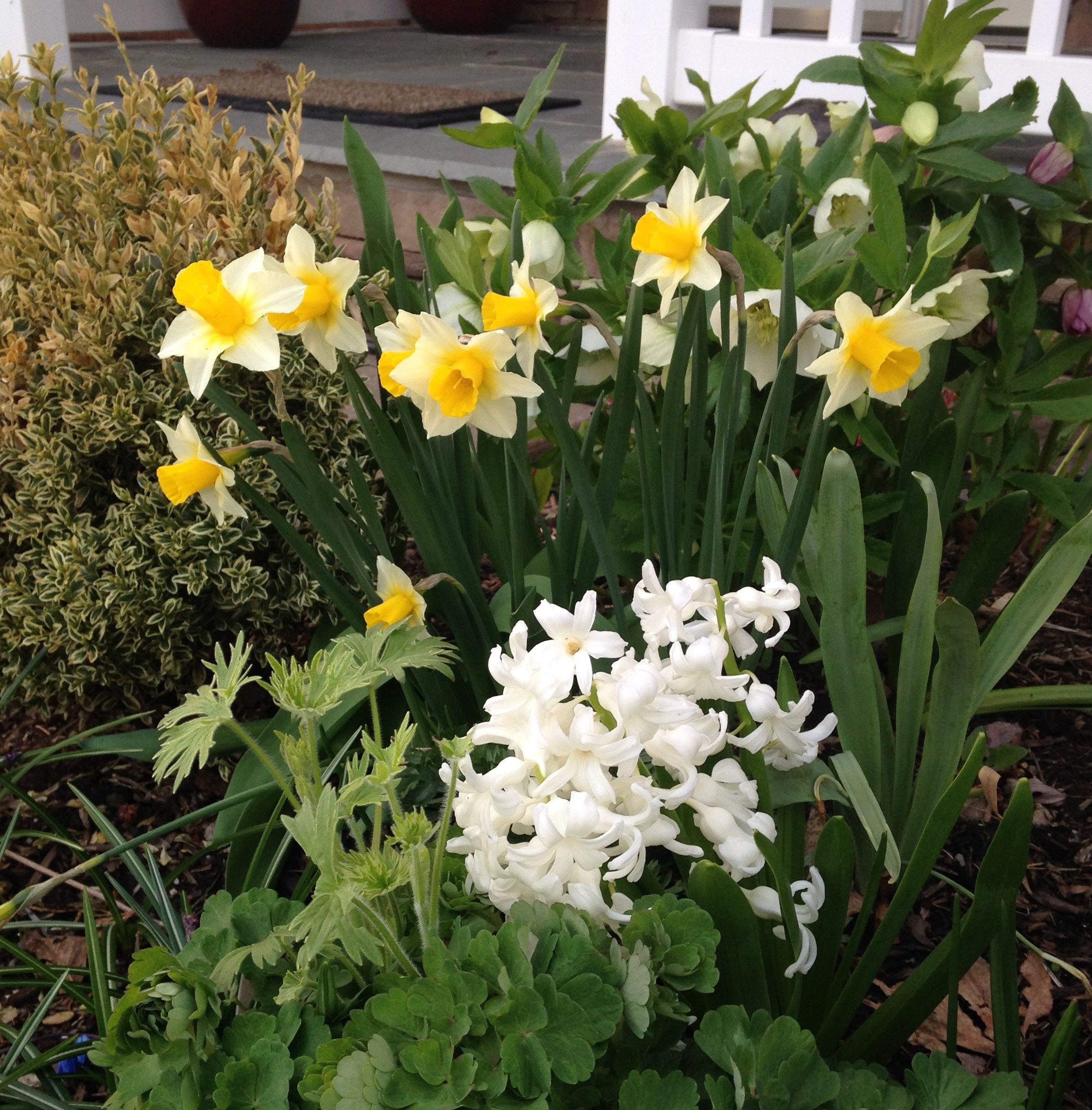
Daffodil ‘Golden Echo’, white hyacinths, and a winter-burned variegated boxwood make for an unusually (for my garden) subtle combination.

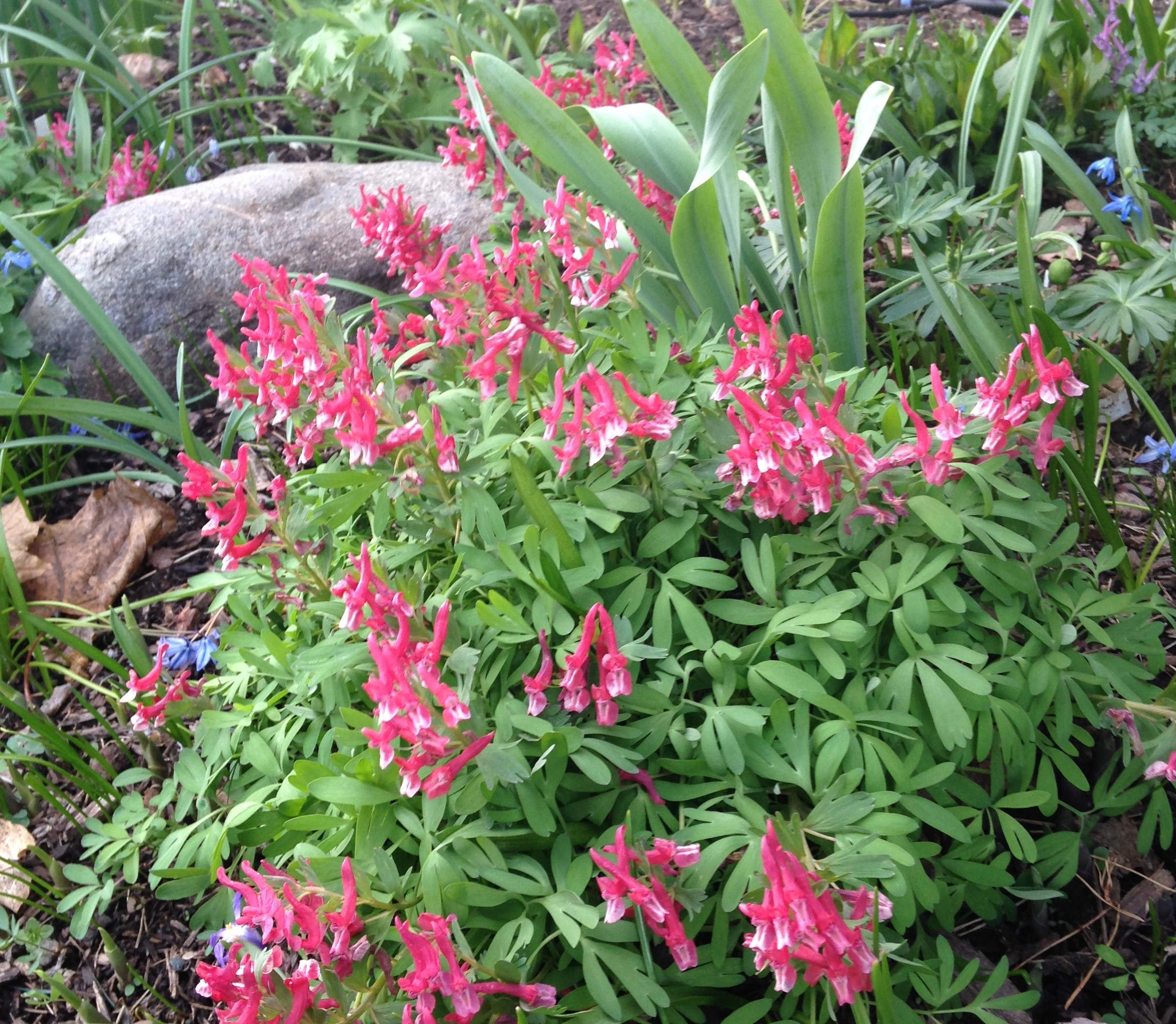
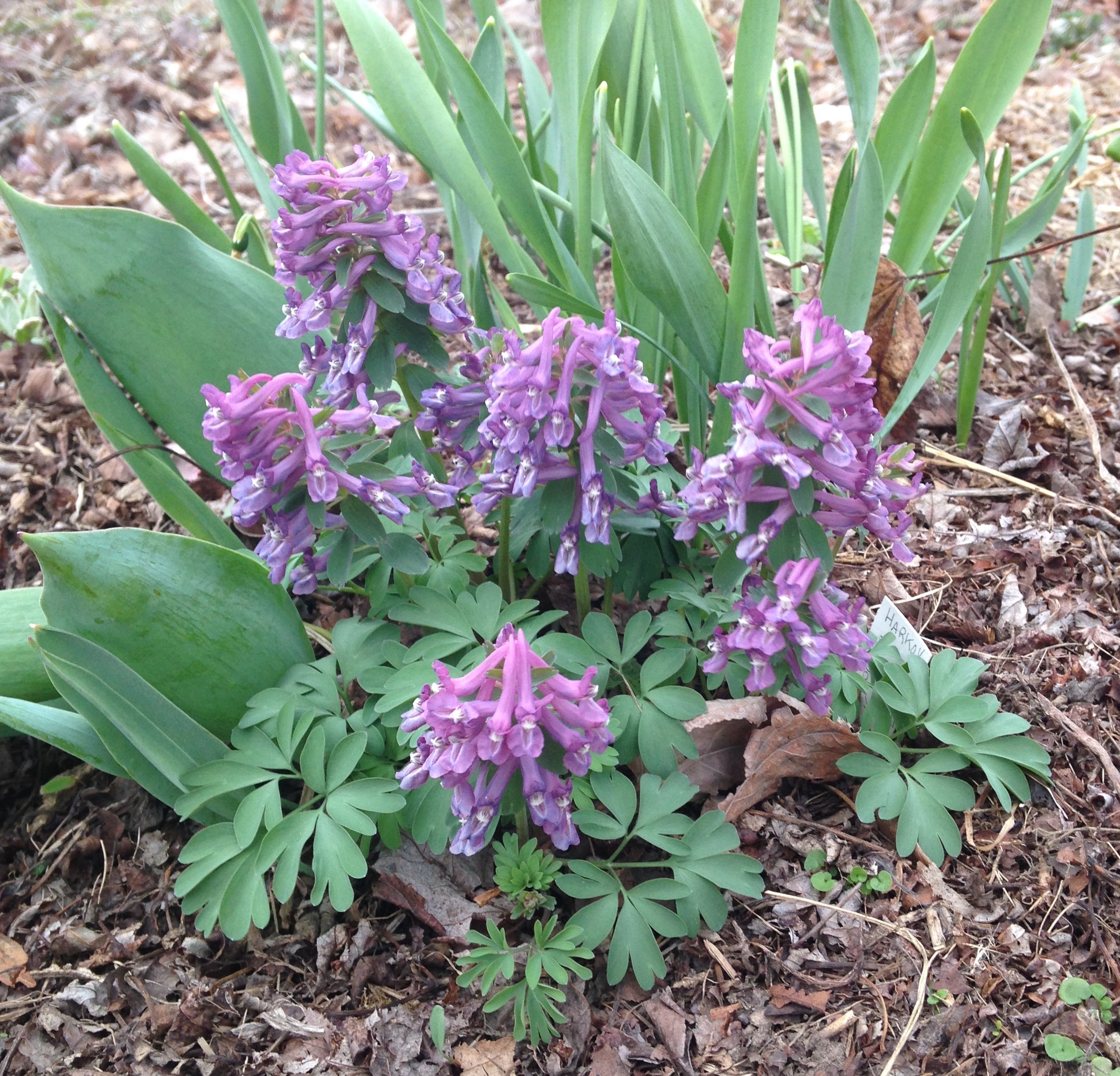
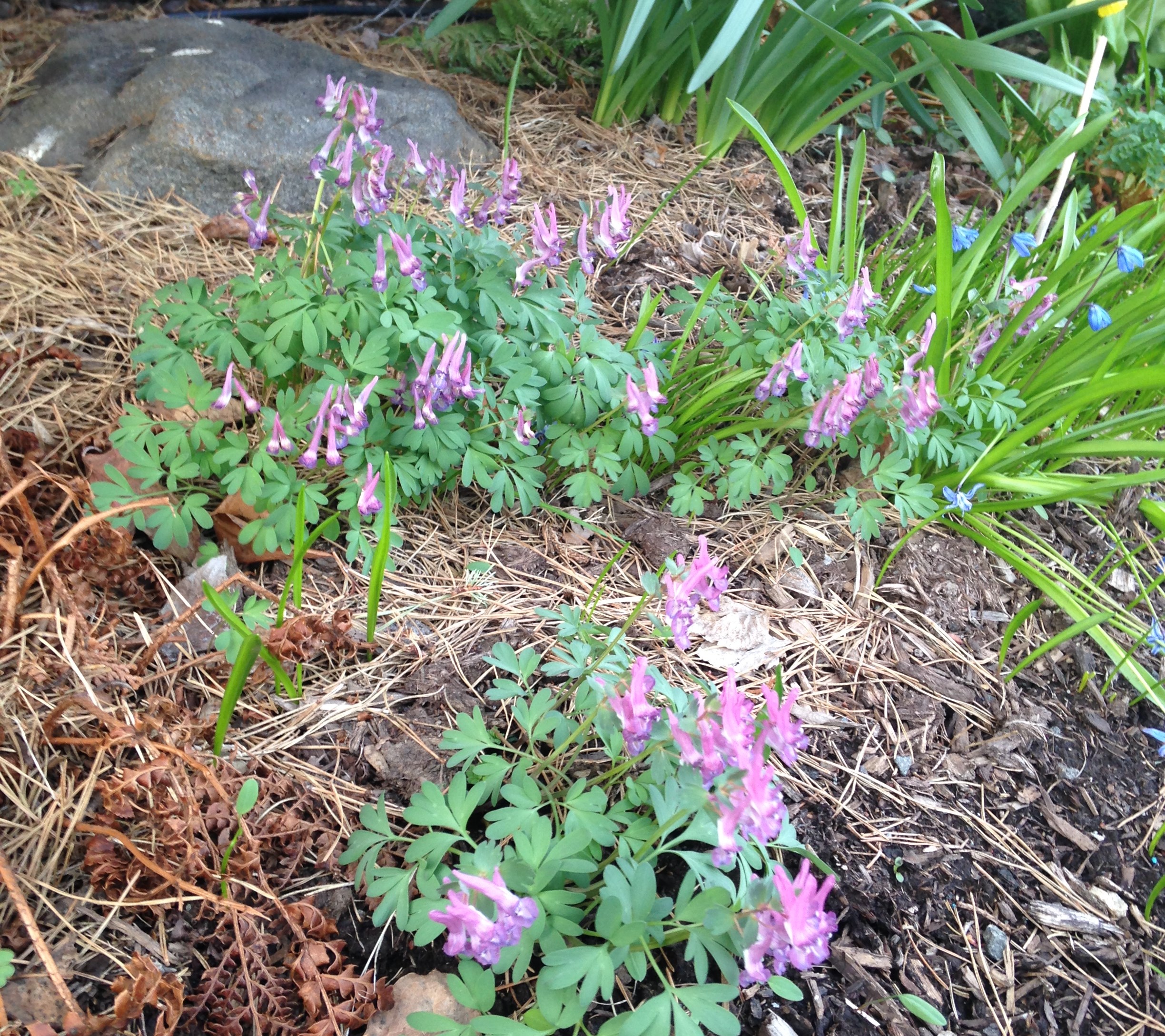
Please excuse the photography this week, my camera is on vacation to sunny and warm Florida and I had to resort to the lens on my phone.  To be honest they’re not much worse than what I normally take, it’s just I don’t have as many to chose from with the phone, so you get what you get.  I wanted to post a few anyway, the corydalis are flowering and even if the pictures are blurry and overexposed I’ll still enjoy looking back on them when everything’s gray next winter 🙂

corydalis George Baker

Corydalis ‘George Baker’ still looking good in spite of downpour, heat, cold, and frost.  This clump is overdue for division and thanks to Facebook and trading I’m pleased to say I know exactly what to do with all the extras!

A newer to me corydalis is ‘Harkov’ which has a dusky purple color which I’m not terribly crazy about yet.  It will be a nice contrast to the pinks and reds but I’m still holding out for a darker, clearer purple before I let out that sigh of ooh-la-lah.  (is it just me who does these things?)

corydalis solida harkov

Corydalis solida ‘Harkov’.  Nice enough, but maybe too subtle for me.

To its credit ‘Harkov’ does have decent sized bloom heads and seems to be growing fine, but the color reminds me of a previously poo-pooed bunch of what I bought as straight corydalis solida.  The species has been a bit of a weak grower for me with small blooms and a color I first thought of as washed out, but this year I kind of like it.  I kind of like all my corydalis this spring and maybe it would be a good idea to get many more.  This patch could easily use some white blooming friends, no?

corydalis solida

Corydalis solida in need of companion colors.  Maybe a few of the native white blooming dicentra Canadensis (squirrel corn) would fit the bill.

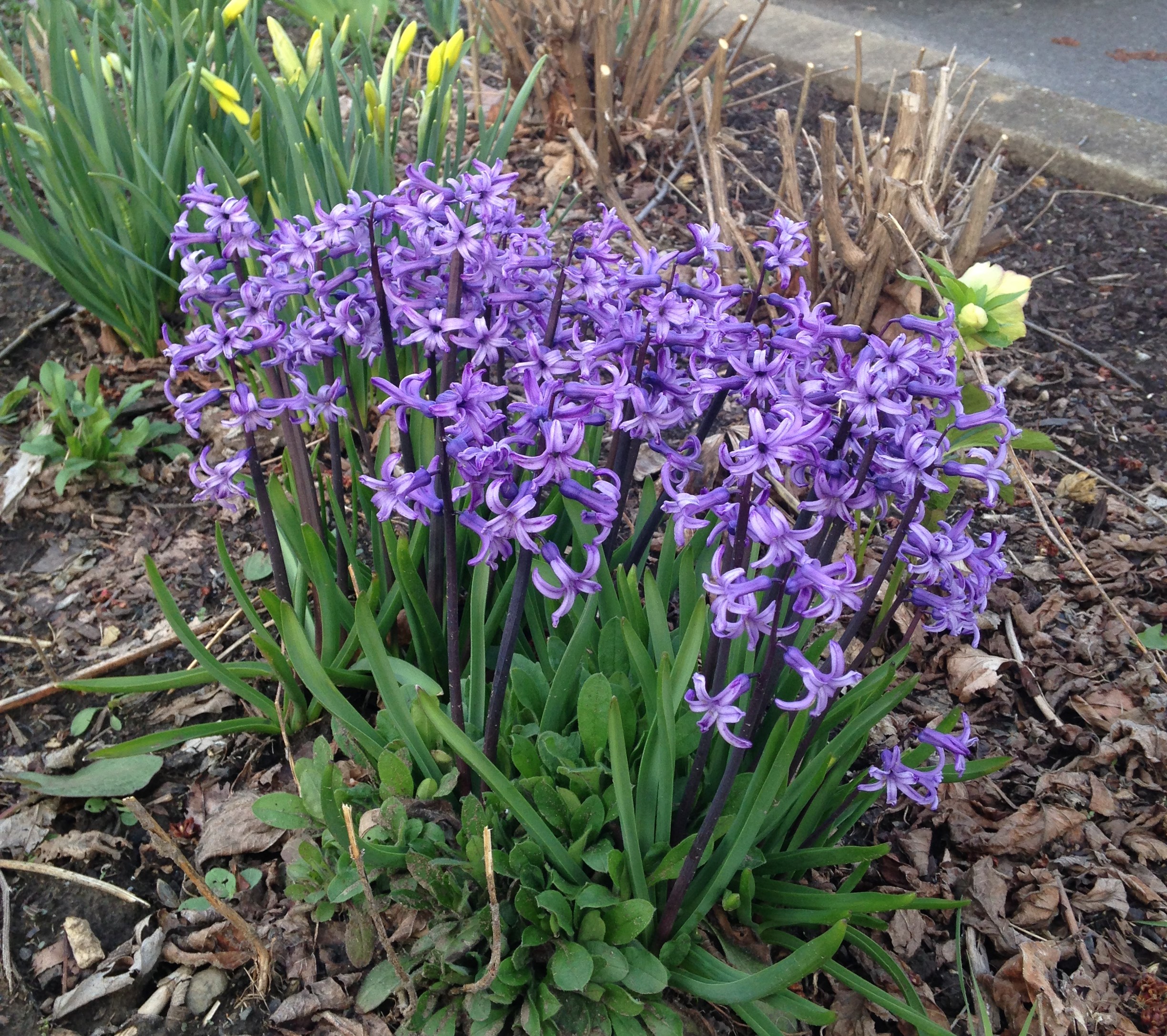
The corydalis are such an easy grower, anywhere they can rest in peace during their summer dormancy seems to suit them just fine (although they are said to prefer a woodland setting).  Another easy grower which I’ve really taken a liking to are these multiflowering ‘Anastacia’ hyacinths.  They get transplanted and divided frequently as I accidentally dig up the bulbs, but other than that nothing much gets done.  I suspect the summer dryness of this bed goes a long way in keeping them happy.

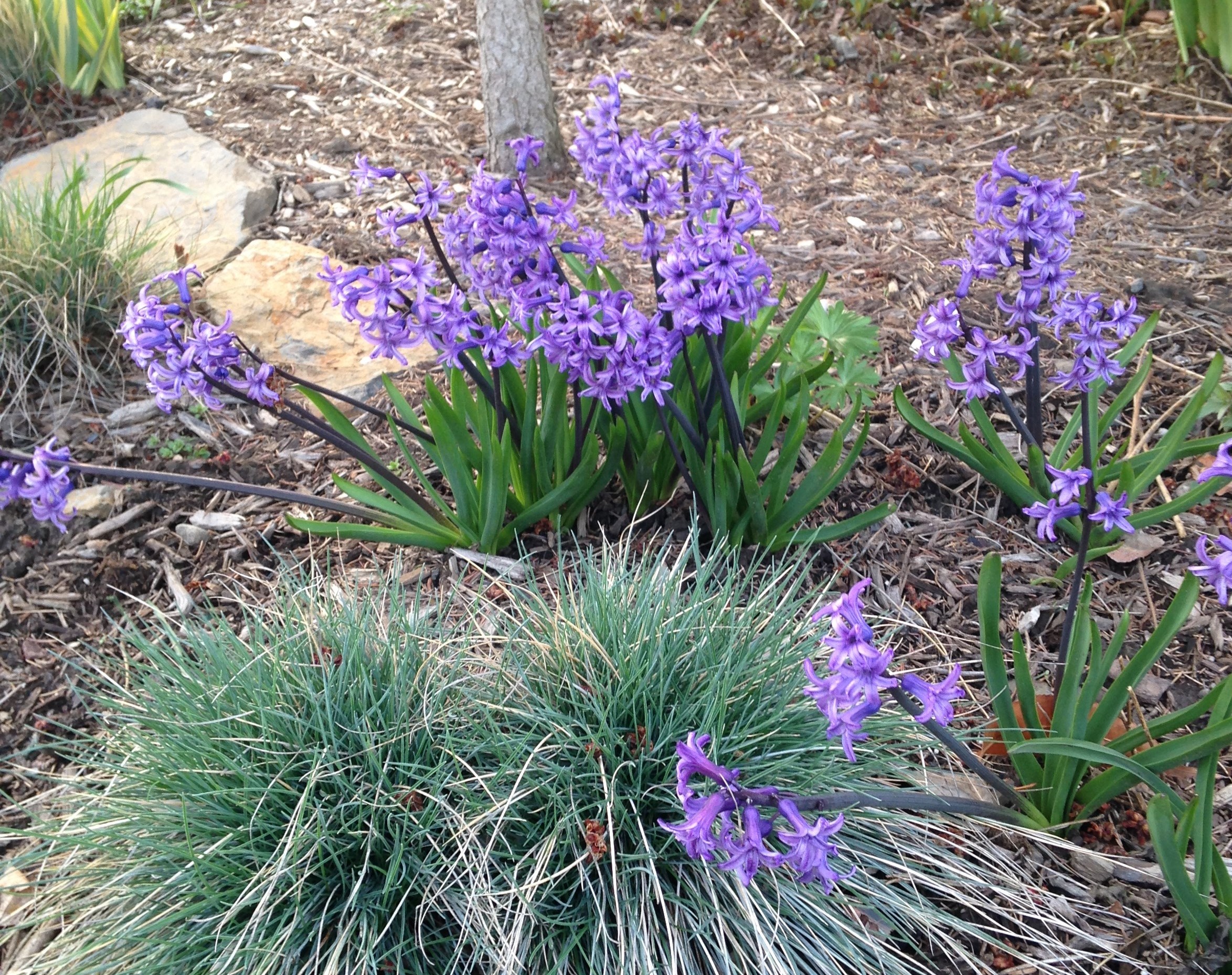
blue multiflowering hyacinth anastacia

‘Anastacia’ is from a strain of Dutch hyacinth which naturally produce multiple, looser flowerheads than the big fat, single stalk Dutch hyacinths one typically sees.  The color is great, but the dark stems seal the deal for me. 

I like how the hyacinths combine with the blue fescue.  Just recently I was considering evicting the fescue completely, but this week I’ve flip-flopped, and might just divide it all up and put an even wider border of it all along this bed!

blue hyacinth anastacia

Blue hyacinths with a pair of ready-to-divide fescue clumps.  I see dozens of divisions here, enough to fill in a whole new edging scheme!

There’s plenty more going on in the garden, but between work, baseball games, dance and spring cleanup (and all those garden strolls) I don’t get on the computer as much as I’d like or snap as many garden pictures as I should.  Posting and keeping up with the other blogs which I enjoy will have to wait, but I’m sure any gardener will understand.  Muddy and tired are the sign of the season!

narcissus feu de joi daffodil

The early narcissus are starting.  This old double (pre 1927) is narcissus ‘Feu de Joie’.

So I’ll keep plodding along.  Hopefully the snow will leave for the season, the lawn will dry out enough to mow, and the gardener will have a good weekend.  Scratch that.  It’s April and I know I’ll have a good weekend.  Hopefully you will as well!

End of Summer for the (not quite)Tropical Bed

Today surprised me with a completely free afternoon.  There was plenty I should have done, but nothing I had to do, so I spent all afternoon in the garden.  I actually worked too!  Usually when it’s dry and it’s warm I tend to just sit around, but the grass was due for a cutting and one thing lead to another and before I knew it I was sore and sweaty and satisfied.  The following pictures have little to do with anything that got done, but they’re more interesting than edged lawn and mulched beds!

heptacodium blooming

At the very end of the former tropical garden the heptacodium is actually looking good for once with a decent shape and nice blooms.

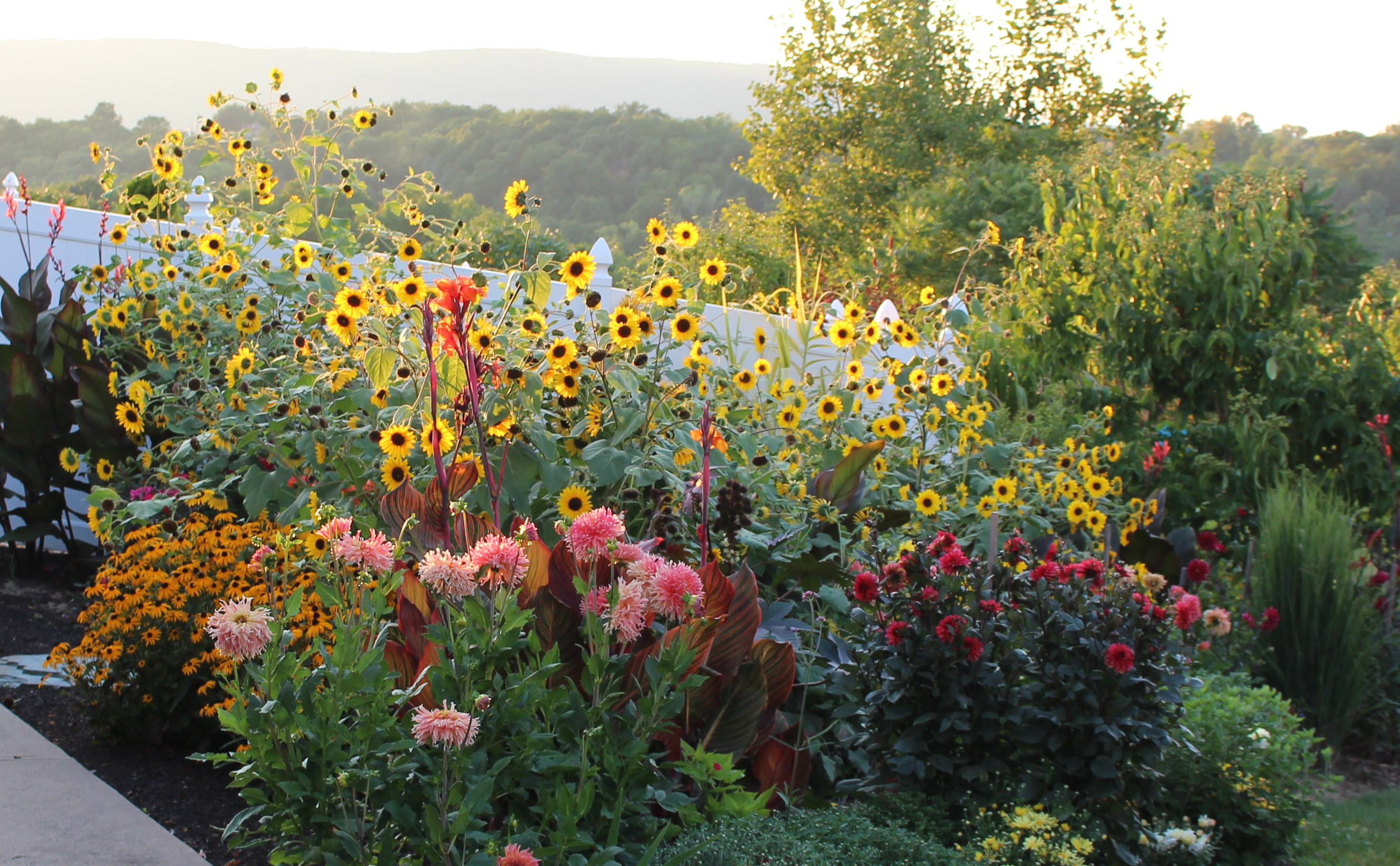
The sunflowers which took over the tropical bed are looking a little worse for wear but I’ll leave them till spring since they’re visited daily by several families of goldfinches and other songbirds.  Dahlias, cannas and now mums are picking up the slack, and if I get just the right angle without the dying sunflowers everything still looks fresh and lush.

mammoth mums

At the top end of the tropical bed this clump of ‘mammoth mums’ adds to the already-too-much-color theme. L-R the mums are bronze, pink, coral, red, and yellow quill. They’re colorful and great growers, but nothing exciting.

I broke down and ran the sprinkler out front again.  The grass was curling up and I can’t deal with brown lawn in September.  I’m letting the vegetables dry up but the lawn and perennials out front need to stay green for a little while longer or it will all be too depressing.  I also watered some in the back, the tropical beds are so dry most of the water just runs off, but I hope it’s enough for a few of the surviving treasures.

pink salvia splendens

I would call this one of 2014’s treasures. It’s a pink salvia splendens grown from seed. The only one to sprout and the first one I’ve grown that didn’t turn out to be another red when it bloomed. I have my fingers crossed for seed!

One of the happiest finds of the day (and one that only a gardener could even come close to understanding) was that I found where a neighbor’s been dumping lawn clippings in the woods.  I lugged back about four wheelbarrows full of clippings and spread them out around the bed I’m slowly reclaiming from bellflower and other weeds.  This should go a long way in bringing in the earthworms and smothering the last sprouts, and my fingers are crossed that this same neighbor will also dump nicely shredded autumn leaves in the same spot.  What a bonanza that would be 🙂

red zinnias with ninebark

Red zinnias are bright enough to distract you from the other tired perennials and vigorous weeds. This area is just past the tropical bed and I cling to the hope that someday it will be a red garden. So far these zinnias are the only plant which has worked out -even though I almost quit the watering this week!

With all the new mulch and (I hope) smothered weeds I feel like for once things are almost under control in the garden.  I still hope there will be at least one more nice load of grass clippings to feed  the tropical border but the fact that there are no four foot weeds is a first here for this time of year.  Now if we could just get some rain then maybe I could get some transplanting started!

sun sugar tomatoes

The tomatoes are one thing that did get away from me. I froze a bunch of nicely prepared San Marzanos last week, but these “Sun Sugar” tomatoes are too much of a good thing. They look nice though.

While taking the tomato picture I was surprised to find a cicada clinging to the trellis.  I love cicadas and this closeup was a treat for someone who usually only hears them.

cicada

cicada

With all these beds under control the smart thing would be to regroup….. but Santa Rosa Gardens has a great fall sale (plus 10% more off with the code FALL10), I want to place a Lily Garden order for lilies, there are a few shrubs which are tempting me at Lazy S’s Farms, and my favorite local nursery has an open house (and sales I’m sure) this Saturday.  Plus I have a snowdrop order to pay.  My checkbook is saying no but I keep disagreeing with it. Oh what to do, what to do…..

Same old story, dry again…..

The rains came, the grass greened, and all was well for a few weeks, but now it’s dry again.  I shouldn’t complain though since it hasn’t been hot enough to kill off anything, just a few wilting annuals and sad looking, dry dahlias.  Fortunately the perennials have deep enough roots to carry on, and overall the front yard doesn’t look too bad.

zinnias in a mixed border

The front border may be dry, but there’s still enough color and texture to keep things interesting.  I watered a little after taking these pictures…. the guilt of wilting zinnias and coleus was too much of a weight on my conscience.

When things go dry I start to lose interest.  The plants look sad and I hate watering, so my daily inspections just turn into bored sighs and a quick return to the porch furniture or air conditioning.  It’s a shame since so many things are still peaking and a little water would do a world of good for my thin quick-to-dry “topsoil”.

sedum spectabile brilliant

The sedums (maybe sedum spectabile “Brilliant”?) are in full bloom with bees galore, and help give some nice solid color to what otherwise might be too busy a planting.

I don’t like a planting that limps into autumn in a half dead state of decay.  I want something that hangs on until the last hard freeze forces things to come crashing down to an end.  In the front yard that means a mix of long season “lingerers”, late perennials, grasses of course, and plenty of planted and self sown annuals.

late season flower border

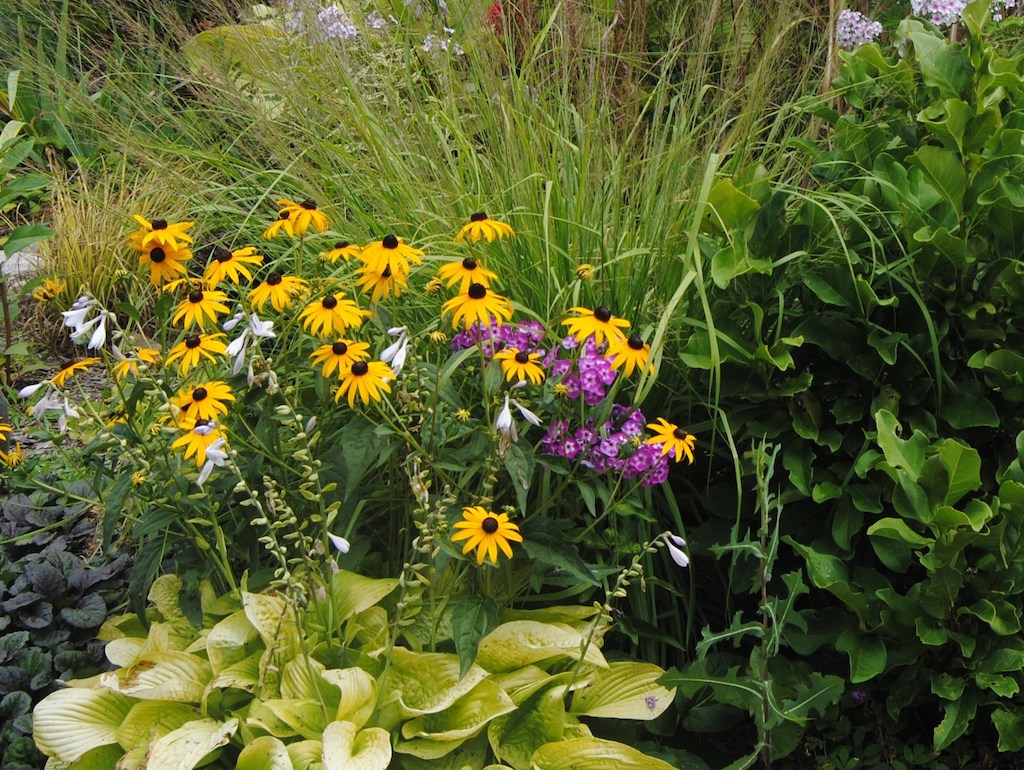
It’s mostly green in this border in June, but the color really revs up in September.   The yellow rudbeckias in bloom now came up as seedlings in June (when I finally got around to weeding and dividing and planting my way through this bed).

Occasionally some of the earlier perennials take a second bow.  This clump of delphiniums was great in June (for a few days before strong winds flattened them all), but now they’re back for some late season color.

rebloom on delphinium

Green grass, full borders, and rebloom on the delphinium.  The next storm will surely flatten them (again) but for now this corner by the garage is a nice welcome home.  This picture is looking out from the garage, across the walk to the front door, and on to the front border along the street.

The beds along the house are ok too, but much calmer.  This year I tried to limit the usual “too much color” look and stick with more gray and blue tones with some yellow of course.  The red coleus just happened…. you know I can’t go cold turkey when there is open soil and a few extra plants in my hands 🙂

ranch house foundation planting

The plants are a little spotty, but the overall effect is much calmer than last year…. even with a couple clumps of orange mums coming along 🙂

I guess a bright accent by the front door is sorta acceptable.  This almost became the year of the geranium considering how two pots overwintered became eight big plants when divided.  I really shouldn’t, but maybe I can just roll this pot into the garage and hope for the best when winter kicks in.  I’ve already got nearly a billion plants coming in so what’s one more pot?

potted geraniums

Potted geraniums, a perfect container plant for gardeners with a less than perfect watering record. Seeing the blue leadwort (ceratostigma) blooming reminds me that I wanted to try a few colchicums here.

So the front garden is aging gracefully and as long as a little rain comes our way it should still be a nice, colorful fall.  Seeing the pot full of geraniums reminds me of some developments this year which could now become an ugly problem.  My containers have been multiplying and it might be time for some plant confessions.

I’m pretty sure there’s fiber in icecream

Many people wax poetic on the joys of homegrown produce.  The flavor, the nutrients, the connection with the earth…. all good things and all good for you (and deep down inside I agree) but on the shallow outside I’d still rather reach for a donut or chocolate bar rather than a carrot stick.  Vegetables just don’t make my heart go pitter pat.

Because of that the vegetable garden always walks a fine line between productivity and extinction.  I love the look of vegetables bursting from the soil, but the newly dug beds and open ground are just too tempting to keep free of flowers.  At this time of year it’s more of a flower harvest.

volunteer sunflower

Oddly enough a sunflower has come up in exactly the same spot as one grew last year. It’s the perfect spot actually, and I’m glad to have it!

The season starts innocently enough, and with a strong will I turn under all the persicaria and daisies and whatever else tries to sneak in.  I need room for delicious lettuce seedlings and broccoli transplants and the flowers just throw off my industrially neat rows.  Things go downhill from there.

dahlia tanjoh

Dahlias always seem to grow best in a vegetable plot and when you’ve got one or two extra roots it seems perfectly logical to sneak them in between the chard. This is dahlia “Tanjoh” which I barely noticed last year as it suffered under the shade of a wayward sunflower.

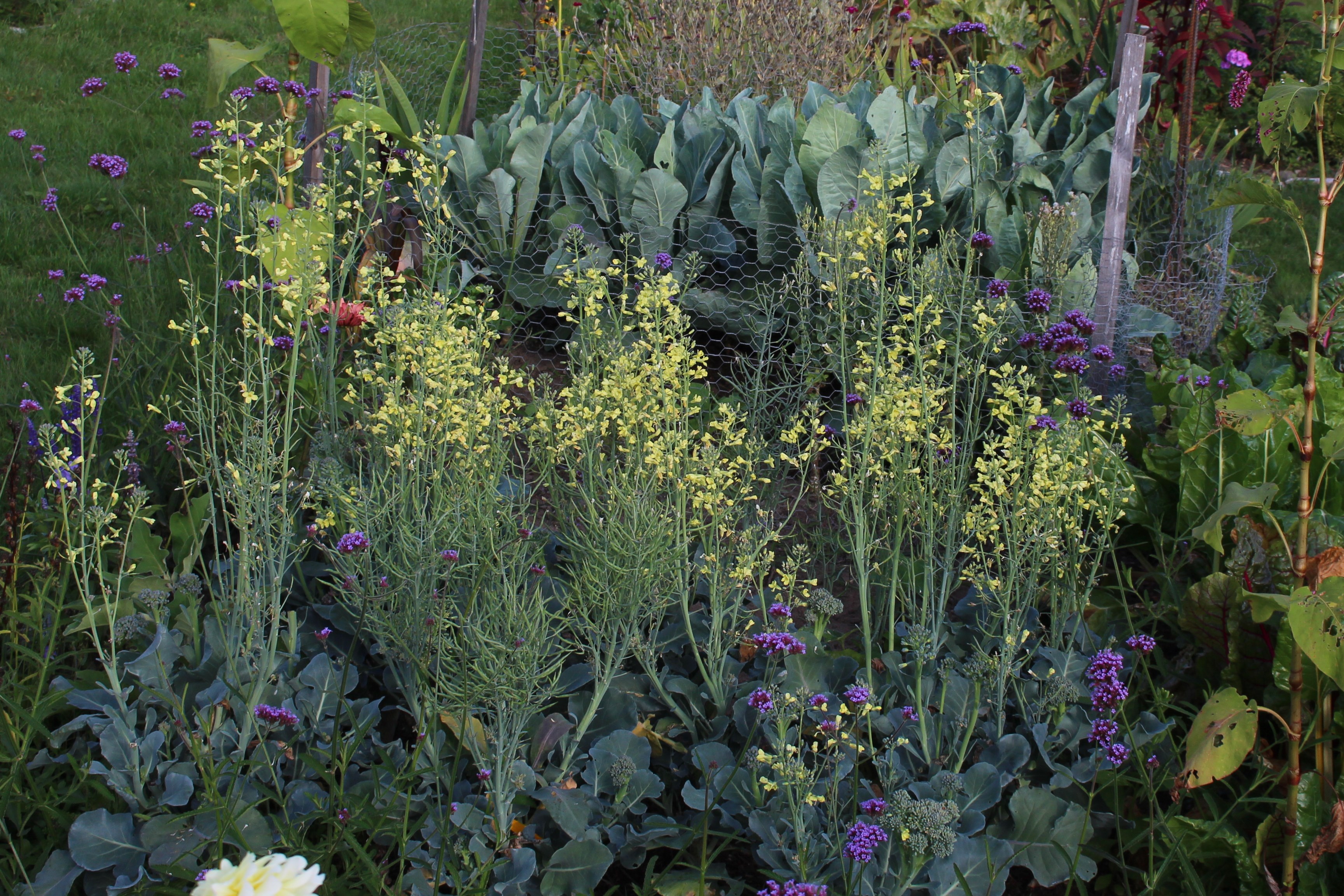
Harvest time is always a problem.  If the broccoli is ready it needs to be picked, and there are only so many broccoli-cheese omelets you can reasonably fit into a weekend.  Things go to seed and I’m strangely amused to see weeds such as lettuce, pumpkins, and chard popping up the next year.

broccoli bolting

When you lose control the broccoli turns into a froth of yellow blooms and green rattail seedpods. Several of these plants were self-sown seedlings which just showed up from last year’s patch.

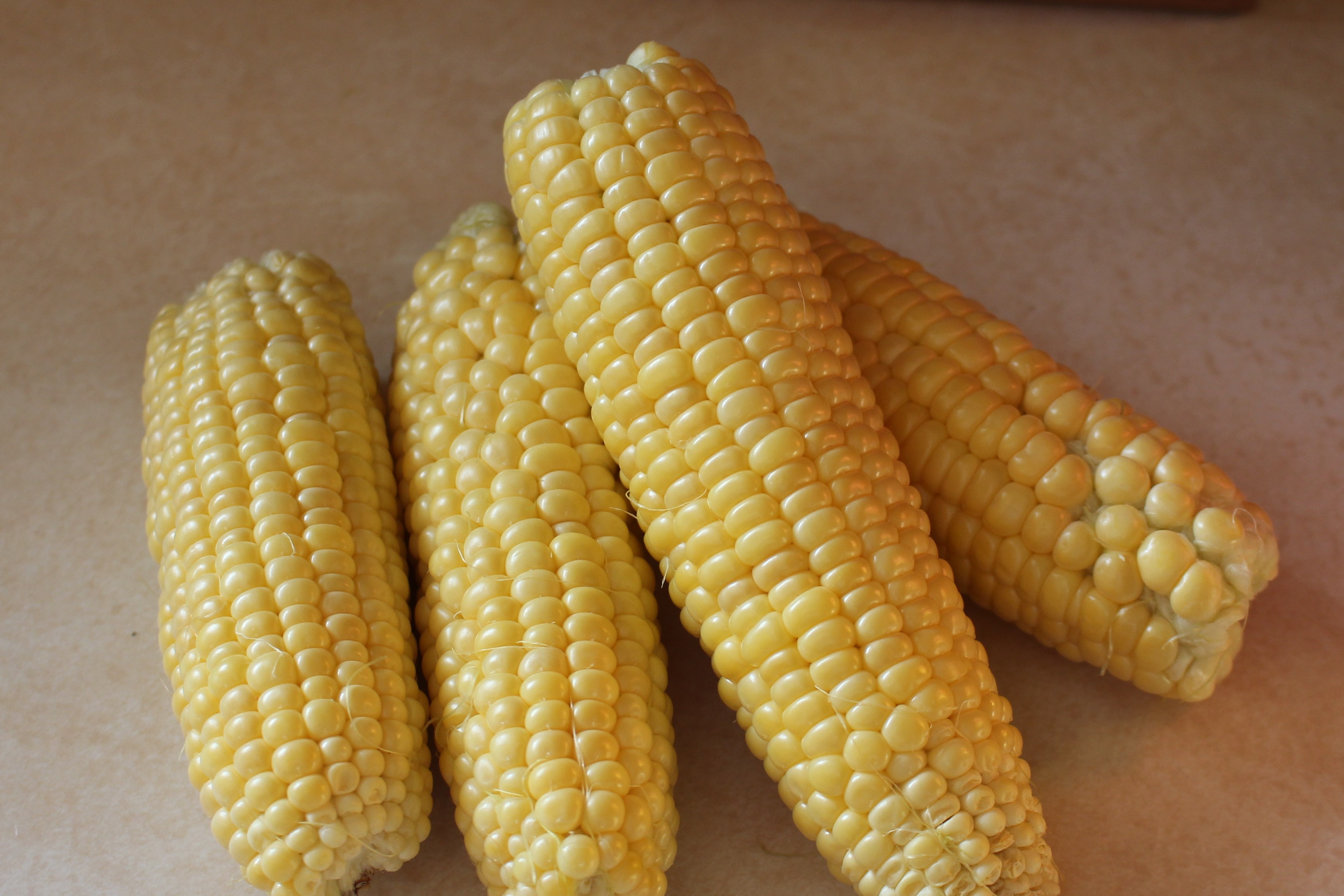
One of the sore points this summer was how often the sweet corn needed watering in our pancake-thin topsoil.  It seemed like every other day I’d look out there and see dry curled leaves begging for a little moisture.  Shockingly enough even after giving up in disgust the patch managed to produce a few deliciously sweet and flavorful ears.

freshly picked sweet corn

A space, water and fertilizer hog, freshly picked sweet corn is still worth the trouble (I guess). But it’s a tough argument when the supermarket has 6 perfect ears for $2.50 and mine probably cost me that much just for the seeds!

Another producer was a trellis of pole beans (which called it a year after being blown over in August).  Beans are nice on a trellis, but the kids appreciate “love in a Puffs” much more than bean salad.

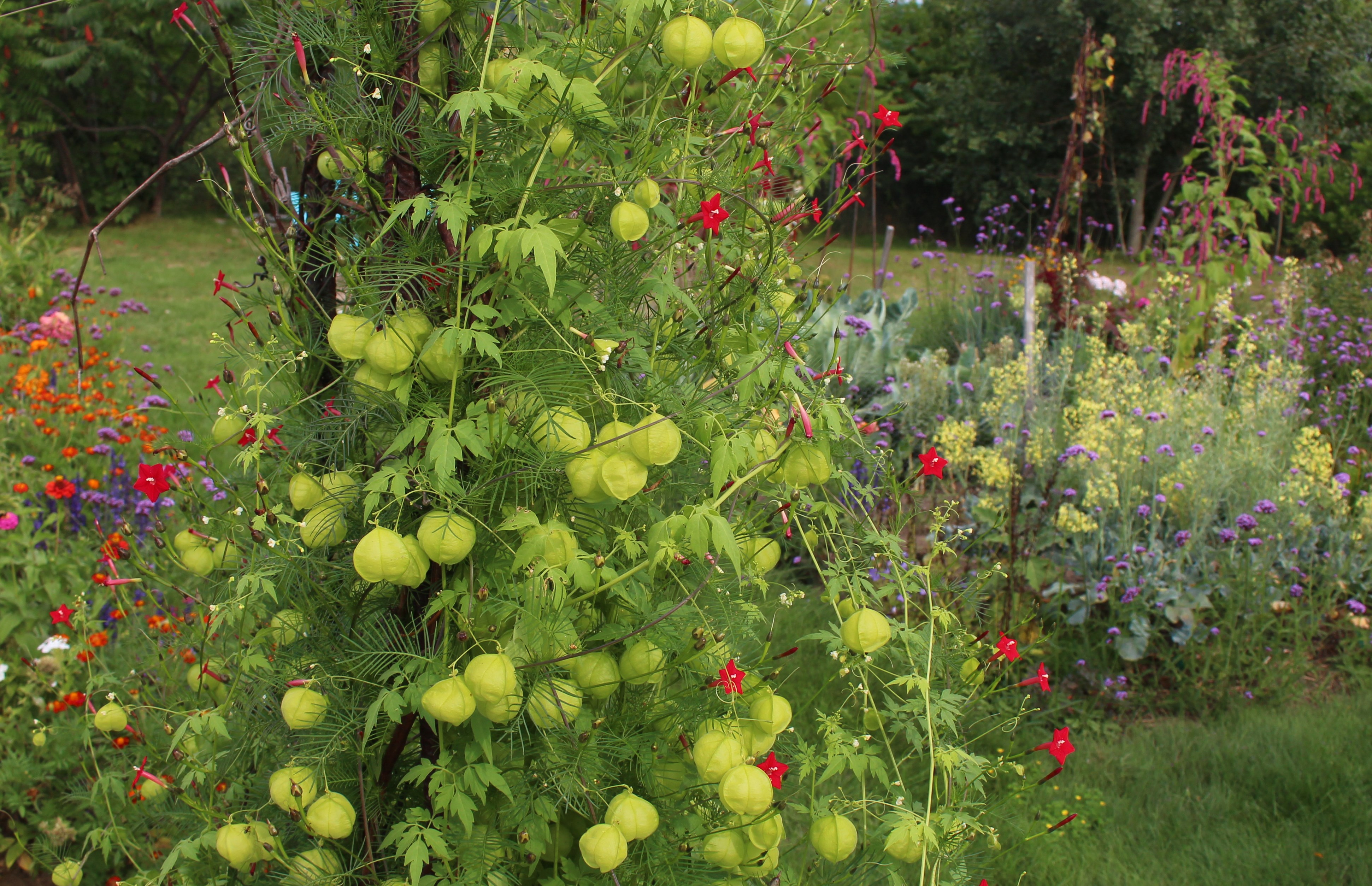
love in a puff and cypress vine

The pale green balloons of love in a puff (Cardiospermum halicacabum) with the ferny green leaves and red flowers of cypress vine (Ipomoea quamoclit). Both conveniently reseeded here at the base of the trellis from last year, something to keep in mind if you don’t like volunteer plants.

The kids share the love by picking the puffs and having a puff-fight but the real reason behind the name is found inside the puff on each of the vine’s black seeds.

love in a puff seeds

A white heart forms on each seed, a kind of ‘belly button’ from where the seed was attached to the plant. Glad my hands were clean for this one 🙂

There is plenty of ‘real’ harvest that comes from the patch.  Tomatoes never fail, even the fussier heirlooms, and here is a huge cluster of “Kellogg’s Breakfast”.  In a rare second appearance in a single blog post (I hate having myself show up in any pictures), I left my hand in there to show just how big the fruits are.  2 lbs, 14 oz for the pair in case you’re interested.

Kellogg's Breakfast tomato

Kellogg’s Breakfast tomato

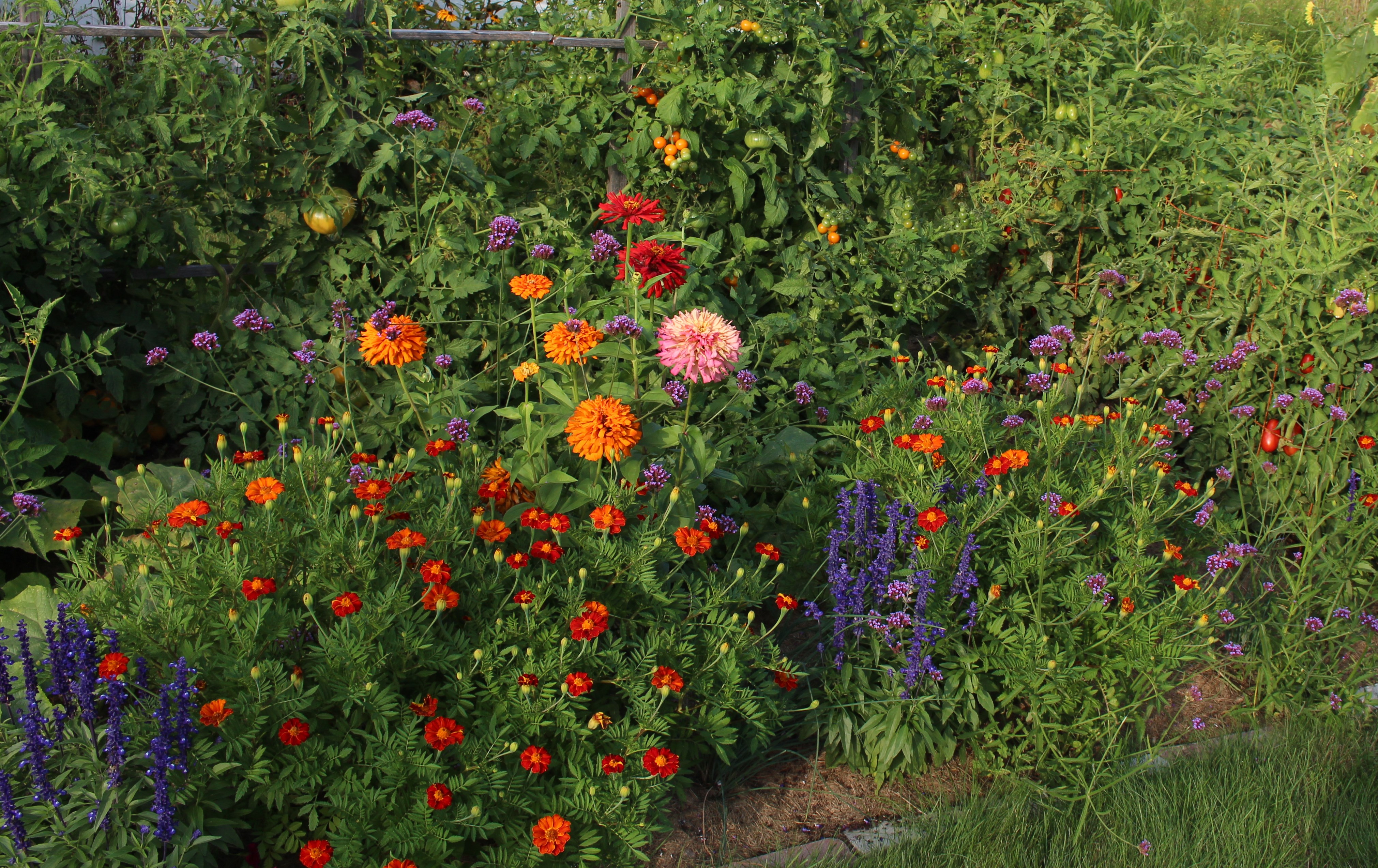
When I finished planting the tomatoes I couldn’t resist adding a border of “Moldavian” marigolds (from Nan at Hayefield) and a few stray salvia and leftover zinnia seedlings.  Might as well since the other side of the bed is edged in hellebore seedlings.

zinnias, marigolds, and blue salvia

A vegetable garden is the perfect place for bunches of annuals that might not find a place in the rest of the garden. The brownish orange of these “Moldova” marigolds might be hard to fit in somewhere else.

And did I mention I like phlox?  When you’re faced with a few new ones to plant and you’ve given absolutely no forethought to where they’ll go the vegetable garden makes everything better again.

phlox kirmeslander

Just coming into bloom now, phlox “Kirmeslander” seems almost too summery a color for the autumn-golds and yellows which are starting to appear.

With the season winding down one would think the vegetable patch would be safe, but fall is actually the most dangerous time of year for vegetable space.  After you pull up a dead, mildewed patch of zucchini the vacant spot almost begs for a few tulips or daffodils which you can’t find a space for elsewhere.  No worries though, I’m sure they’ll die down before I need the room for peppers!

Oh and I think the colchicums look nice blooming between the sweet corn stalks 🙂

In a vase on Monday

Surprisingly enough I’ve made the Monday vase twice in a row, unheard of!

sunflowers from birdseed

Not a bad group of sunflowers, all volunteers from the birdfeeder.

The sunflowers inspired me, and their carefree summer spirit made it easy as pie to put this arrangement together.  After they were in place I was told they needed some other vase, and the red didn’t look good, but “don’t push me” is what I said!  I added the blue wine bottle,  I guess I was feeling very primary with all the sunflower yellow.

I didn’t do much fussing over them and I think they look fine, but I noticed this evening they had done a little of their own arranging, and heads were lifted and there was less of the droopy down facing that you see here.  It’s kind of like a vase of tulips in that they keep growing and twisting to get into a better position.  This should have come as no surprise from a flower that keeps turning its head to face the sun.

sunflower bloom

The birds have been enjoying the seedheads outside for weeks, I guess it’s time for me to enjoy a few myself indoors.

You would think a bunch of volunteer sunflowers grown from seed out of the feeder would all just run the range of yellow, yellow, yellow, but there is some variation in these.  They’re taller and shorter, branched higher and lower, longer petals, shorter, quilled petals, darker centers, pale yellow, splash of brown, deep golden… it’s quite the surprise.

sunflowers in a vase

Different colors and sizes, nothing real fancy, but nice surprises none the less.

I feel like I splurged in cutting these all for a few days in the house, but I’m sure more will come.  The patch still has plenty to look forward to and even a steady stream of goldfinches can’t eat them all.

black oil sunflowers

Sunflowers at sunset. They’ve officially taken over.

So that’s my Monday vase.  I may jump back in here and there to fill a vase, but work is gearing up again and the shorter days really kill my gardening vibe.  The vases are fun though and if you’re interested in joining I’m sure Cathy at Rambling in the Garden would be happy to have you.  Thanks for hosting Cathy!

A summertime stroll with a couple surprises

I think I’ve been pretty good this summer keeping up with the garden.  Usually I have so many more weed patches and unplanted pots, but this year  things look a little better.  I know, I know…. prep soil first, have a plan, buy new plant with a spot in mind, don’t plant more than you can take care of, keep low maintainence in mind….  but that’s not how I roll 🙂

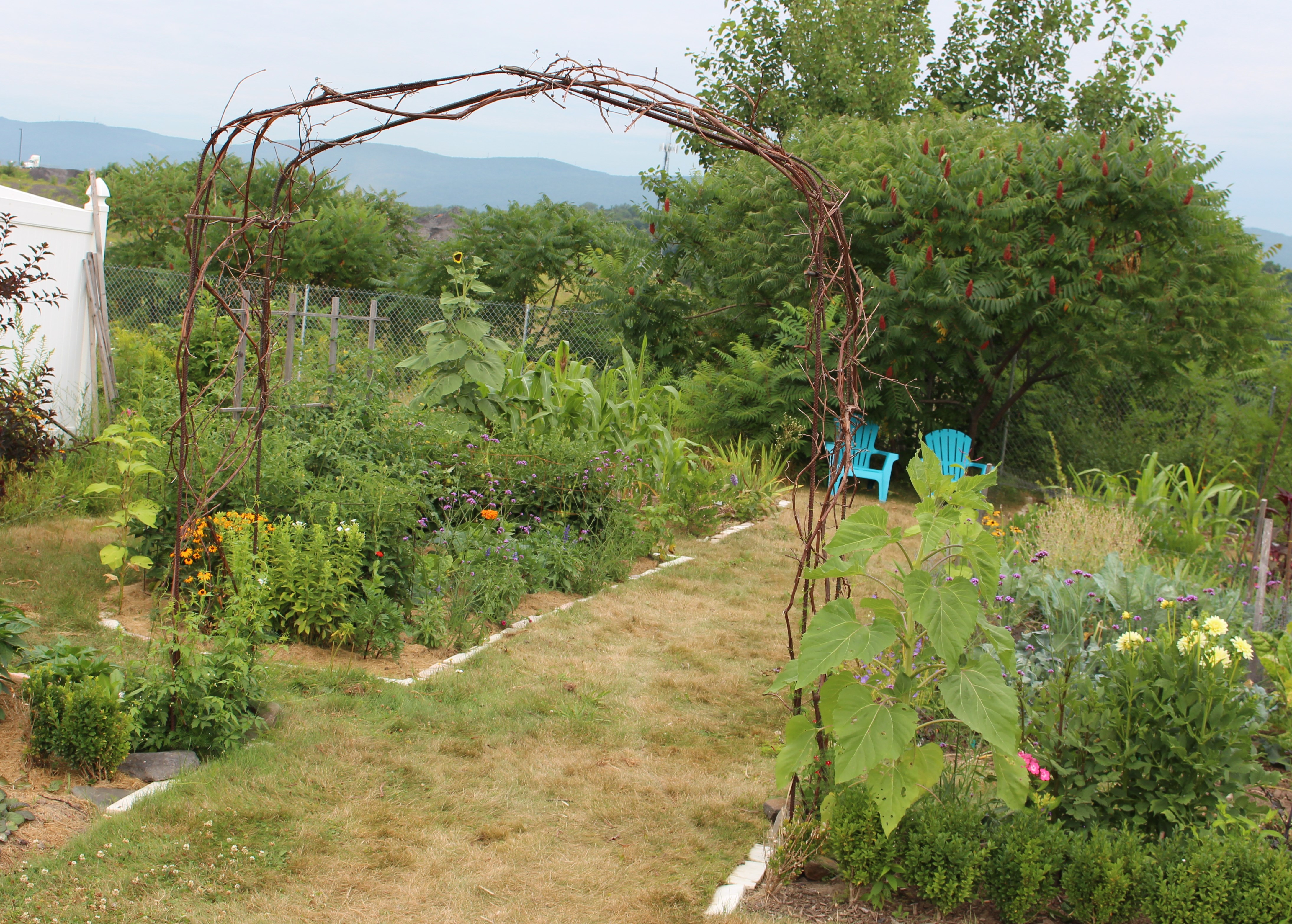
I finally cut, bent, and put together the rebar arbor I’ve pictured in my head for the last two years.  Last summer it was a single span, this year I doubled it for more stability and wired in a few cross braces.  I really should throw a little concrete around the base…. but I’ll wait till it blows over this autumn before I learn that lesson (again).

rebar garden arbor

Arbor going into the vegetable garden. The rebar alone looked a little bare, so I went out back and ripped down a few grape vines to bulk it up, and give the vines a little something to hold on to.

Since we’re in the vegetable garden, here’s the early garlic harvest.  This is the first year I managed to plant it properly (in October), and I’m pleased.  I’m even more pleased since these were stray, sprouting cloves I found in the bottom of the vegetable crisper which were planted out rather than thrown away.

garlic harvest

Garlic harvest. The ones I actually bought from the garden center specifically for planting are a later variety and yet to be harvested.

Last winter was one of the coldest, snowiest ones I’ve experienced living here, so you can imagine my surprise to find some gladiolus overwintered.  I vaguely remember there being a few thin little wisps of gladiolus leaves here last summer (I must have missed some of the tiny cormlets when the mother bulbs were lifted) but never gave them much thought.  This year they’re back, and voila, the little things surprised me even more by blooming!

phlox 'bright eyes'

Not only was the gladiolus a surprise, but the color coordination with the phlox, verbena and pole bean blooms is better than anything I could plan!

I only finished laying out and digging up the vegetable garden last summer, prior to that it was lawn and a holding bed for some of the plants brought up from the old house.  One of those plants was a wisteria vine, and when I moved it the remaining roots put up a couple suckers.  Surprise again when one of the suckers actually put out a bloom!

wisteria summer bloom

Not many gardeners are avant-garde enough to combine sweet corn with wisteria, and the fact that I’m considering building another arbor or tuteur in order for this guy to stay here says a lot about the haphazard design of my garden.

It surprises me that I would actually post a photo of this mess.  It’s the unfinished steps to the deck, and it’s were I like to sit with a drink thinking about all the tasks I should be finishing up instead.

tropicals in containers

Tropicals in pots, geraniums on the steps, and plenty of weeds. I actually did trim them all back yesterday but I’m sure they’ll have rebounded by the time I take another picture.

From the steps I get a good view of the vegetable patch -I like to call it the farm 🙂 , and the sunflower patch.  Last week I noticed this quilled version in with the others.  The rolled up petals are different enough to be interesting.

quilled sunflower blooms

In the center is the quilled version of the regular sunflowers. The flowers are nice enough, but it’s the coming and going of the goldfinches and sparrows that keeps things busy around here… as well as the angry little hummingbird who tries to chase everyone away.

I’m getting the feeling yellow is a little passé as far as being a fashionable color -if it ever was- but I clearly have a problem with “acquiring” yellow leaved plants.  “Isla Gold” Tansy is one of my favorites with its finely cut foliage and drought tolerance.

isla gold tansy with bon bon sedum

‘Isla Gold’ Tansy (Tanacetum vulgare) in front of ‘Bon Bon’ sedum. Don’t let the stupid name throw you off, the sedum is also a great plant.

Around the house in the front yard I finally gave up on the way-too-dry-and-hard-to-water spot by the lamppost.  I trimmed the ‘Tiger Eyes’ staghorn sumac back to the ground and let it and its suckers fill in the bed.  Too much yellow?  I don’t think so, and I no longer have to water this spot.

tiger eye sumac

I hope the plant police don’t find me. ‘Tiger Eyes’ cutleaf sumac (Rhus typhina “Bailtiger”) is a patent protected plant, and here it is propagating itself without corporate approval.

Another weedy spot has been the front street border.  I should probably do something about this since it’s a slightly prominent location which everyone who passes sees… but I’m a little bored with it right now.  Maybe once this bright red standing cypress (Ipomopsis rubra) blooms and some of the other annuals take off I’ll like it again.  I wish I had some nice mulch for it though.  I’m constantly jealous of compost rich gardeners and the ones who flaunt their piles of aged leaf mould,  and I think I’m close to breaking down and raiding the yard waste dumped by my neighbors in the nearby woods.  I’m sure my mother in law will be horribly embarrassed.

selfseeding annuals

More golden yellow in the form of rudbeckias, this time tastefully paired with red standing cypress -which almost has a touch of orange in the blooms. If people complain I’ll remind them the ipomopsis is a southeast native plant and hummingbird friendly, hopefully that will distract them from judging my trailer park color combos too harshly.

“Blue Satin” -or maybe ‘Blue Bird’, I forget- rose of sharon (hibiscus syriacus) always looks a little out of place or a little weedy to me, but the color is interesting and it just laughs off drought and abuse.  The white variety “Diana” (a sterile variety) still needs to be acquired, I keep forgetting to take a cutting of my mother’s bush in NY.

blue satin hibiscus

As close to blue as you get in rose of Sharon, “Blue Satin” is a cool color but reseeds freely, and the seedlings though nice enough are all more purplish.

You can’t help but notice the big clump of arundo donax ‘variegata’ (variegated giant reed) growing at the end of the bed.  Wow,  I love it.  It will easily reach 10+ feet by autumn and if frost holds off we’ll even see the seed plumes.  This variety will begin the season with a crisp white/green variegation, mellow to yellow around now, and then go green as soon as temperatures peak for the summer.  It’s invasive down south, so keep that in mind, but the huge clumps I used to see down in Texas were quite impressive.

arundo donax variegata

Still bright, this clump should ‘green out’ in the next few weeks if temps go up… the cool summer has kept it brighter for longer than usual.

A few pennisetum “Karley Rose” divisions (also patented, so please don’t tell anyone I split my clump) are still gaining momentum here amongst the black eyed susans.  They would have done better without all the company but I just couldn’t rip out the daisies.  I’m sure by next year the grass will just muscle it’s way through and form a big clump to hopefully balance out the big hydrangea.

karley rose pennisetum with black eyed susans

Pennesitum ‘Karley Rose’, rudbeckia hirta seedlings, and erynginum in the shadow of the almost blooming ‘Limelight’ hydrangea.

I’ll end with a non yellow.  Verbena bonariensis is starting to open up all over the borders and I wish I had more!  Serves me right for having ripped so much out this spring.

verbena bonariensis

Finally something to balance out all the yellow, but is that a prickly thistle coming up through the middle of the clump!? Who missed that weed?

You might notice in the last picture that there’s a mild green tint to the lawn.  I’m afraid I’ve gone over to the dark side, and have begun to water the lawn.  The brown straw mat I looked at all last July and August was just too depressing, and if I can just get it to the next thunderstorm (tonight I hope), things should stay green for at least another week or two.  Honestly I only ran the sprinkler one day, and the back lawn is responsibly dead….. but I may or may not have also fertilized the day before I watered…. sometimes even good people stray.

Have a great week!

The cyclamen are back

It’s raining this evening and I hope this finally takes us out of the summer long drought we’ve been limping through.  The rain will hopefully soften the rock hard soil and usher in a nice gentle season of planting and transplanting.  Somehow the cyclamen knew the calendar had turned to fall, in spite of the heat and drought they’ve been sprouting up amongst the dry, dead leaves and giving fresh hope for fall.

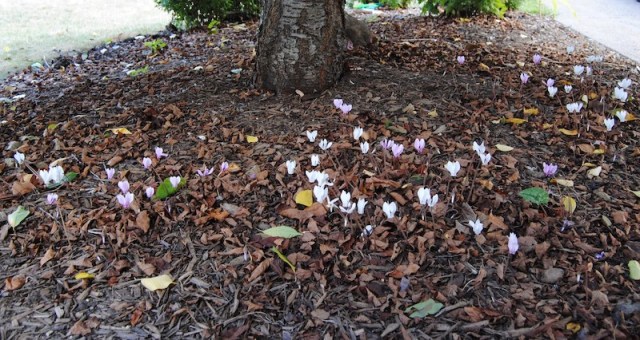
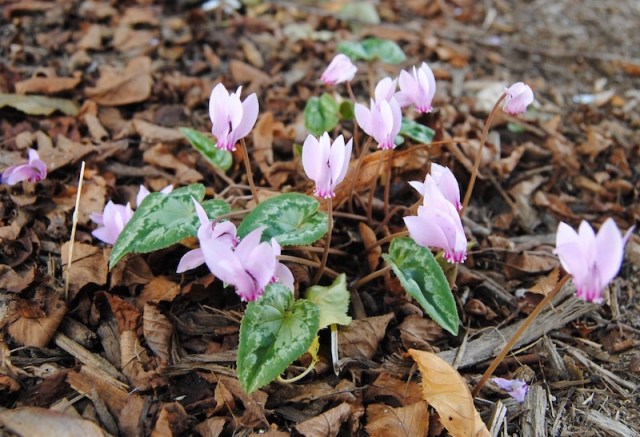
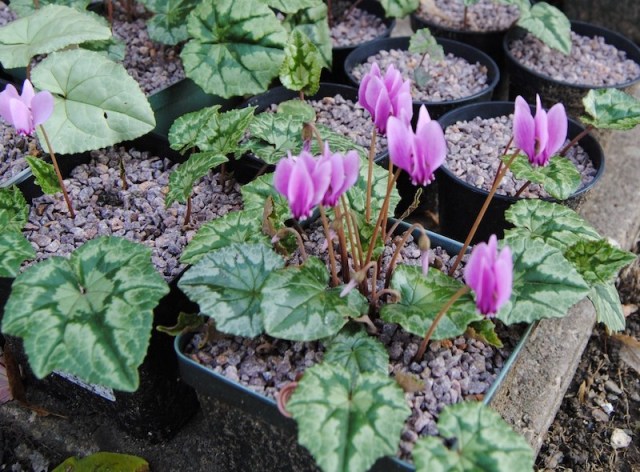
Nothing else grows in the dry shade of this weeping cherry, but the cyclamen don’t seem to mind.  The cyclamen hederifolium  normally come into bloom now, some years earlier, some later, but they always seem to know summer is winding down.  Usually the flowers come up before the leaves even show, but I like it when the two appear at the same time.

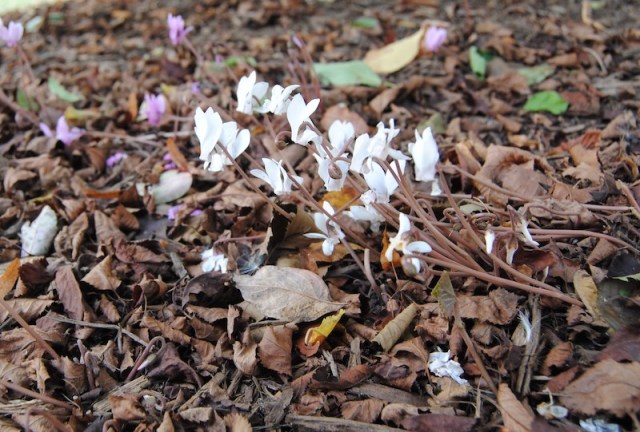
The colors range from white to dark purple and this planting was really starting to look good until some kind of basketball/wagon/quad/bicycle incident at dusk.

There might be some recovery but right now most are crushed or have a ‘windswept’ look.

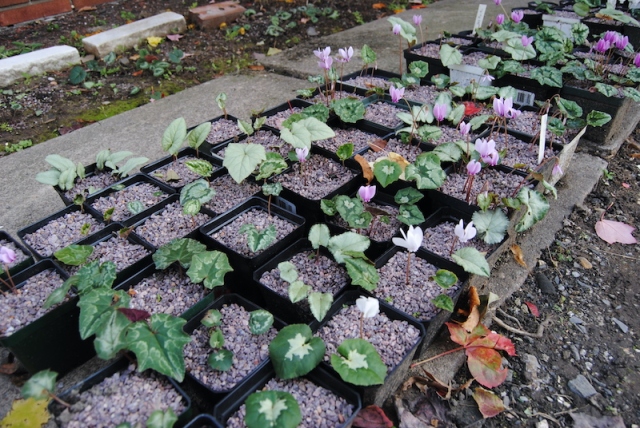
All of these are from seed.  My introduction to these plants came from a friend who sent me a mixed packet to try out.  I planted them in the fall and was amazed to see them sprout during the winter on a cold windowsill and start showing off their fancy little leaves…. until I killed most of them when I left the pot out during a hard freeze.

But gardeners are nothing if not resilient, so next fall I planted a whole new batch of seeds from Green Ice Nursery in the Netherlands.  They were more than amazing.  I grew them under lights in the cool of the basement, repotted them for the next year, put them out for the summer and even enjoyed some flowers that fall.  Another winter indoors and I was starting to recover from the pain of killing off my first batch.

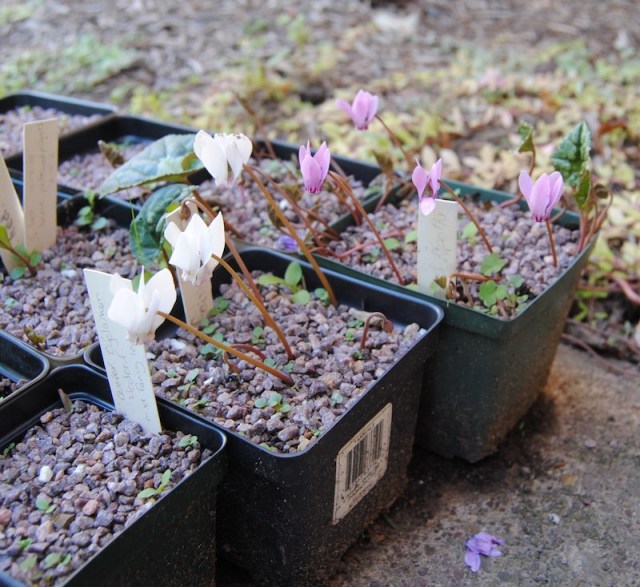
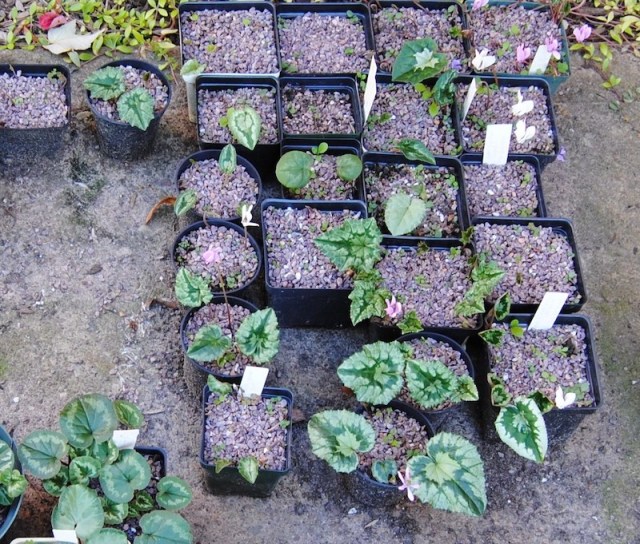
That summer I potted up the best looking ones into individual pots to really get the full effect.  I could admire the individual plants and their cool leaves this way.  (by the way, chicken grit -available at feed stores- makes the perfect pot topper for these guys)

A few really stood out.  This one was a nicely colored, heavy bloomer that sent up plenty of foliage as a backdrop for the two toned flowers.

,

Things were going really well until it came time to move them in.  I couldn’t find enough room for what was now about 80 pots in all kinds of sizes.  So I crossed my fingers, dug them in for the winter in a sheltered spot, and hoped for the best.

While hope may spring eternal, its got to make it through winter first.  Between January and August I again lost most of my little cyclamen, and as of today this is what remains.  Maybe 15 of the original 80 plants still survive.

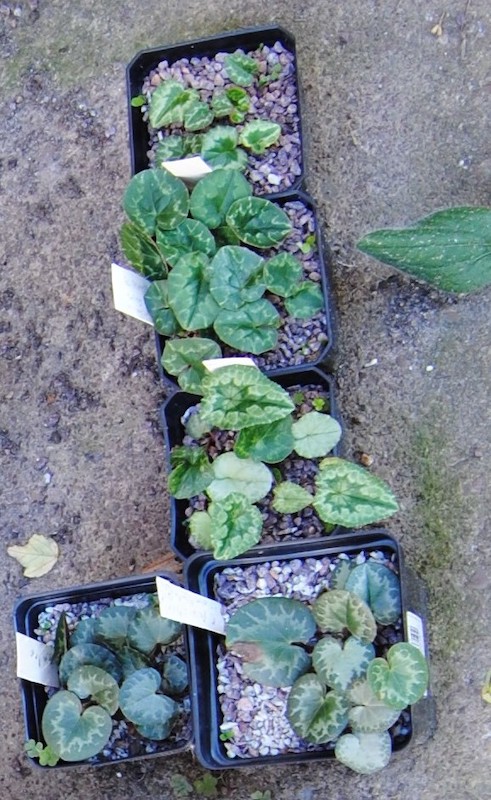
But never fear, any healthy new obsession involves overkill, and you can bet that even though I’ve lost so many there are also so many more coming along.  Here are last winter’s new seedlings growing happily.  They are courtesy the N. American Rock Gardens Society’s annual seed exchange.  Members donate seeds in the fall and other members such as myself reap the rewards during the winter exchange.  For a pittance to cover postage you can pick up all kinds of new and unusual plant seeds, many of which are just not available elsewhere.

Besides the exchange, there’s also the possibility I broke down last winter and ordered even more seeds from Green Ice.  Jan Bravenboer of Green Ice must have a great eye for cyclamen, so many of his strains seem to be one in a million plants picked out from here and there across Europe.  I had to get just a few more which are sprouting now, and I’m glad I did.  Changes in the inspection policies of the EU have made the certificates on small orders such as mine way too expensive for honest buyers/sellers.

The seeds in themselves are cool too.  When cyclamen blooms are pollinated, the flower stalk curls up and the growing seed pod is snuggled down into the mulch next to the plant.  There they sit safely tucked in until the seeds ripen.

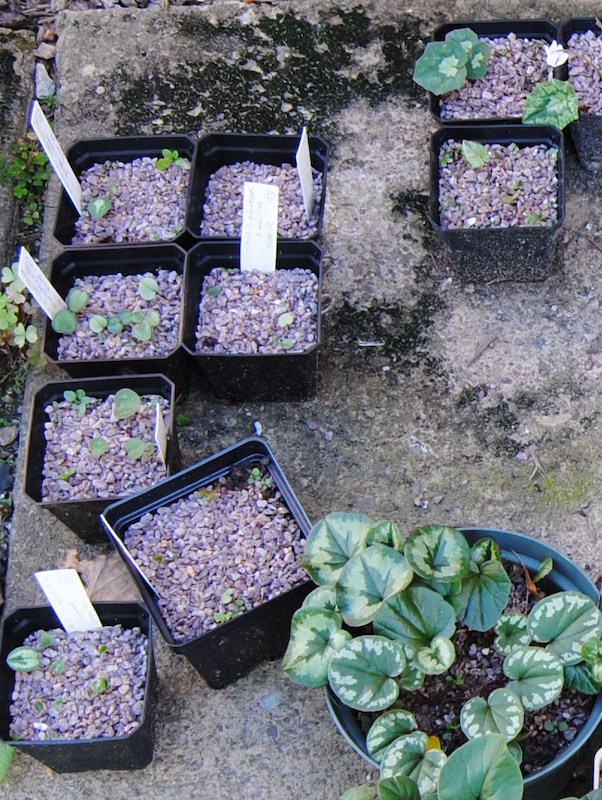
There are other cyclamen that overwinter just fine (when planted properly) in my zone 5/6ish garden.  The patterned waterlily shaped leaves below belong to cyclamen coum, which is setting buds for Feb/March blooming, and the smaller silvery leaves bottom right belong to cyclamen purpurescens.

The summer blooming C. Purpurescens might be the hardiest of them all.  I’m having a little trouble making it happy but I think once established it will settle into a zone 4 garden without trouble, and you can enjoy the leaves all year as they don’t die back like many of the other types.

I’m afraid I’ve gone on too long again.  It’s Sunday morning and the rain is finished and the birds are all over the place.  Time to head out there and check things out.  I’ll bore you with many more cyclamen in the future, trust me.

Thinking of next year yet?

I’m still in denial that summer is winding down.  Every sunny day and higher temperature reading gives me hope the warmth is still holding on, but eventually I’ll need to come to terms with winter’s approach.  My least favorite season is just about here and it’s time to shake off that summertime laziness and start making plans.

By least favorite season I mean fall.  I dread the fall shutdown that plants go through and the first frost.  Even  the fall foliage looks to me like death warmed over.  The best thing about fall is all the planting, and for hardy bulbs fall is the number one planting season.  Although I was lost in tulips this spring, it’s daffodils that I really like, and in order to convince you to get more too I dredged up a couple pictures from the good old days of spring.

‘Accent “(1960- the year this daff was registered) is a great daffodil, it has a medium pink cup (corona) surrounded by pure white petals (perianth).  The color is reliable, the plant is reliable, and it’s not too hard to find.  I like fancy things too, but reliable fills a garden every spring with beautiful blooms, and in this next (over exposed) picture “accent” is paired with another great, reliable one (and one of my real favorites) “Tahiti”(1956).

There are thousands of named daffodils out there and thousands of ways to pick the best ones for your garden.  Picking up a bag at the box store is fine and inexpensive and a good starting point but if you begin to get serious take a look at the Wister Award winners.  It’s an American Daffodil Society award for outstanding garden daffodils and will give you a shopping list of the best daffodils for your garden.

Another good pink is “Pink Charm” (1977)

It’s a little newer than “accent” and only just a bit different with more white in the cup, but for two years I’ve been impressed with the opening color and then the later blend of pink fading to white in the center.

“Passionale”(1956) is a strong growing older pink.  The flowers open with a yellowish tint to the cup which is common for these older varieties.  In daffodils, pink is a relatively new color for breeders, and it’s been a long journey to separate the color and strengthen it to a ‘real’ pink color.

Daffodil breeders are always tinkering with their favorites but they generally fall into 13 divisions.  To take a look at some of the fanciest and newest examples of each division click here“Palmaries”(1973) falls into the split cup category.  It’s frillier and flouncier than what I usually like, but it has been doing well in my garden.

“Newcomer”(1992) has the saturated darker pink of a newer introduction.  It won’t be an easy daff to find but does show the long lasting pure colors of a modern daffodil.

“Sagitta”(2007) shows one of the newest combinations, yellow-pink.  This one will likely be a very popular daffodil, so far it’s been a great grower, multiplier, and bloomer for me and I love it.

But there’s nothing wrong with a yellow trumpet daffodil.  Since “King Alfred” was registered in 1899 new yellow daffodils continue to come out with stronger blooms, colors, and growth habits.  The true King Alfred is tough to find today since years of slapping the name onto any yellow daffodil has muddied the water, but with so many solid yellows such as “Primeur”(1978), how can you go wrong?

My favorite group of daffodils are the cyclamineus types.  Daffodils in this group all share the reflexed petals and long trumpets of the original narcissus cyclamineus species.  “Peeping Tom” (1948) is on the top of my list, it’s an oldie but I love the long trumpet, wide flare and early bloom season.

Another one in this group that’s doing well for me is “Jetfire” (1966).  It’s a good grower with a little orange in the trumpet (more so in cooler springs) but it’s a little stubbier and shorter than “Peeping Tom”.

If you can’t find “Peeping Tom” (I don’t see it in many catalogs any more) you could try out one of it’s children.  “Wisley”(2004) comes from the seeds of a Peeping Tom cross.  It’s new for me, but the flowers have a love-it or hate-it look that I’m still trying to figure out.

If you’re ever looking for daffodil info, Daff Seek pretty much has it all.  It’s the searchable database of the American Daffodil Society and has photos and information on most registered daffodils…. plus interesting tidbits such as daffodil lineage and breeding info.

My latest color craze has been the yellow red combo.  “Serola”(1986) is a great one that multiplies well, doesn’t fade in the sun, and is bright!

“Montego” (1968) has the same colors in a smaller rim of red.  I might have gone overboard with this color range in the last few years but I really do like them.

If you’re unsure where to start with your own daffodil quest, but ready to move past the generic offerings, start with  Brent and Becky’s.  Even if you end up ordering elsewhere, they probably offer the best selection of good varieties and don’t carry the duds.  Some of the best sources for bulk daffodils are Van Engelen and Colorblends.  Just be careful, before you know it you’ll be looking up the specialists such as Mitsch’s and Cherry Creek and really killing your gardening budget.

Ok one more yellow-red.  “Molten Lava” (1987) has slightly more subtle coloring, but still rich tones.

White never goes out of style and “Misty Glen” (1976) is a great daffodil in white.  Over 40 other registered daffodils trace their roots to this variety and it’s won many awards.  It’s one of the best daffodils.

If you still don’t feel the need to add more daffodils, here’s another try.  The small cupped daffodils such as “excitement” (2001) also come in all kinds of color combos just like the big guys.

Beyond the big and little cups and the trumpets there are still thousands of “other” daffodils out there.  They’re all just different expressions of the genus Narcissus.  The name daffodil is just a common name most people apply to the bigger trumpet sorts but it works for all of them.

Some of the other types have unique traits that can be traced back to one of the original narcissus species. “Geranium” (pre 1930) is a reliable, hardy tazetta type which shows the clustered blooms and fragrance of this of this group.  I might put this one on my top 10 best daffodil list, but with so many new types to distract me, I sometimes forget about the multiple award winners like Geranium.

Paperwhites are a well known member of the tazetta group, they’re just not hardy enough to grow up in this part of Pennsylvania.  One that does suffer through is “Erlicheer” (pre 1951), it’s listed as a double but tazetta blood runs through it’s veins.  The problem for me with Erlicheer is its early sprouting habit anytime there’s a break in winter temperatures.  You can see how all the leaf tips have been burnt by cold snaps that came along after growth started.  Too much cold combined with too active growth will eventually kill these.  Sometimes erlicheer is sold as a “summer daffodil” because they don’t need the deep freeze of winter in order to bloom.  You can plant them in the spring, have summer flowers, but they’ll be back to normal spring flowering the following year.

I never meant for this to be such a long post, but daffodils are so easy to grow…… and I admit I’m slightly addicted.

Here’s an example of one of the poeticus types.  “Pentucket” (pre 1946) might be hard to find, but there are several look alikes out there.  Poeticus daffodils (the Poet narcissus) have been grown since ancient times and are most likely the daffodil referenced in Greek poetry and myth.  Today they are grown by the perfume industry for the narcissus oil they produce and apparently it’s one of the most popular fragrances…. oddly enough I don’t pick up much scent in these.

So plan ahead for spring and get some more daffodils in the ground!  Even if it’s a dainty non-daff like “Baby Boomer” (pre 2008) they’re all equally easy to plant.

I find the easiest method to plant daffodils is to take out the big shovel, scoop out one or two shovel-fulls of dirt, dump the bulbs in, and cover.  You don’t need to set the bulbs correctly (although I usually do put them pointy side up) and your regular soil should be fine without improvements, just get them in the ground!

Good luck, and I’d love to hear how your bulb ordering and planting is going:)

A sad little Border

When we first moved here one of the priorities (among many others!) was to try and downplay the bright white vinyl fences which dominated either side of the yard.  Vinyl has its place, but to me a 6ft solid white wall just screams FENCE HERE! and I’d rather have a calmer yard.  So I started to screen.ugly white vinyl fence

For some reason I wanted a red garden in this spot, so I planted the closest thing I had which were reddish leaved and could possibly cover the fence, those being tall cannas and the ‘coppertina’ ninebark.  (The scarecrow of a plant toward the left is a seven sons tree  -Heptacodium miconioides- more on that later).  Over the last four years its become a dumping ground of red plants which refuse to flourish and other plants which needed homes.  This is what my “red” garden looks like today.rudbeckia goldsturmThe first thing you might notice is the mess.  The second thing might be the lack of red.  I plan on working on both of these in the somewhat near future, but for now the stupid leaking preformed pond is just hanging over my head.  It disgusts me, so what better to do than ignore it and hope it learns its lesson.garden remodelWhile I wait for the pond to heal itself, the kids have take advantage of the neglect and frequently throw things in, stir the water, and use it to add magic to whatever messy dirt project they have going on.  It’s not helping but at least its motivated me to pull the pond shell out and set it aside until I can get myself moving.
My inspiration may have arrived.  Last fall while scrambling to find homes for a number of random seedling, I stuck in what I thought was a species foxglove (with yellow flowers) into the ‘used to be’ red border.  Unlike many of the other plants here, these seedlings did well, and to my surprise put out a bloom this week.  Look at what it turned out to be!lobelia cardinalis

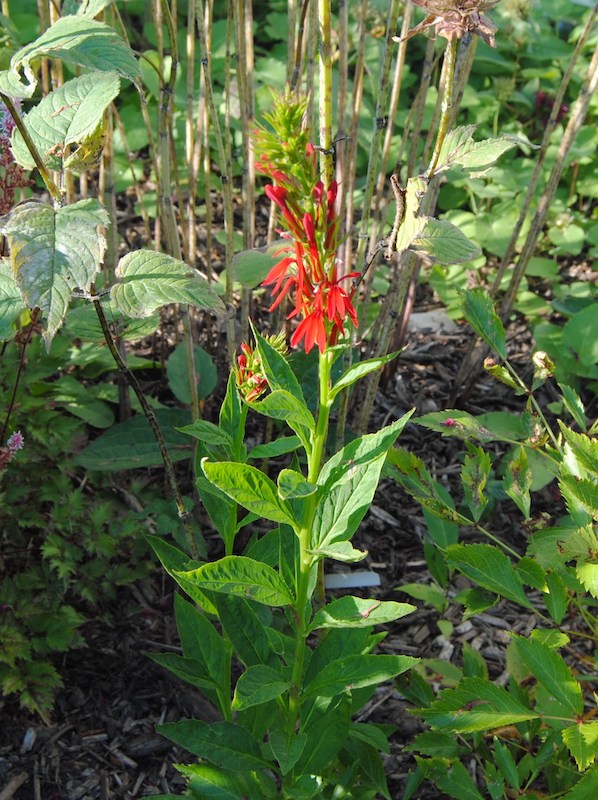
Cardinal flower (lobelia cardinalis)!  I’ve been trying for years to get a few going but the seed is like dust and my aftercare just doesn’t cut it.  This random mix up of seed has reminded me of my dream to have a red garden and refocused my vision!….. not really…. but how can I deny this brightest red of native wildflowers?  It’s time to get moving, before the golden rudbeckia ‘goldsturm’ take over. (btw none of these were planted, they all invited themselves in)rudbeckia goldsturmTwo things I should start with.  The first is to add more dark leaved plants.  Ideally a dark hedge along the fence would be a nice backdrop, but I can’t think of anything better than the struggling variegated privet which is there now.  A darker background seems to really highlight the red and gold.rudbeckia goldsturm

So the plan is to fix the pond, remove a few of the pinks and golds, think of a better background, and do some soil improvement/replanting so the red flowers already there really reach their potential….. in a spot with fewer washed out lavender flowers…garden phlox paniculata

This blurry picture is a new-for-me annual/biennial/perennial which might have a place in the revamped border.  It’s standing cypress (Ipomopsis rubra), a southeastern native perennial which will likely be an annual here.  This looks like a perfect hummingbird plant and of course I love the color and the fluffy leaves.  I hope it reseeds, but if not there may be a few leftover seeds just in case.

Am I the last person to hear about this plant?  I’ve been looking for it for a couple years but had some trouble finding it.  Maybe now that it’s here it will stick around.standing cypress annual