Plant of the year 2014

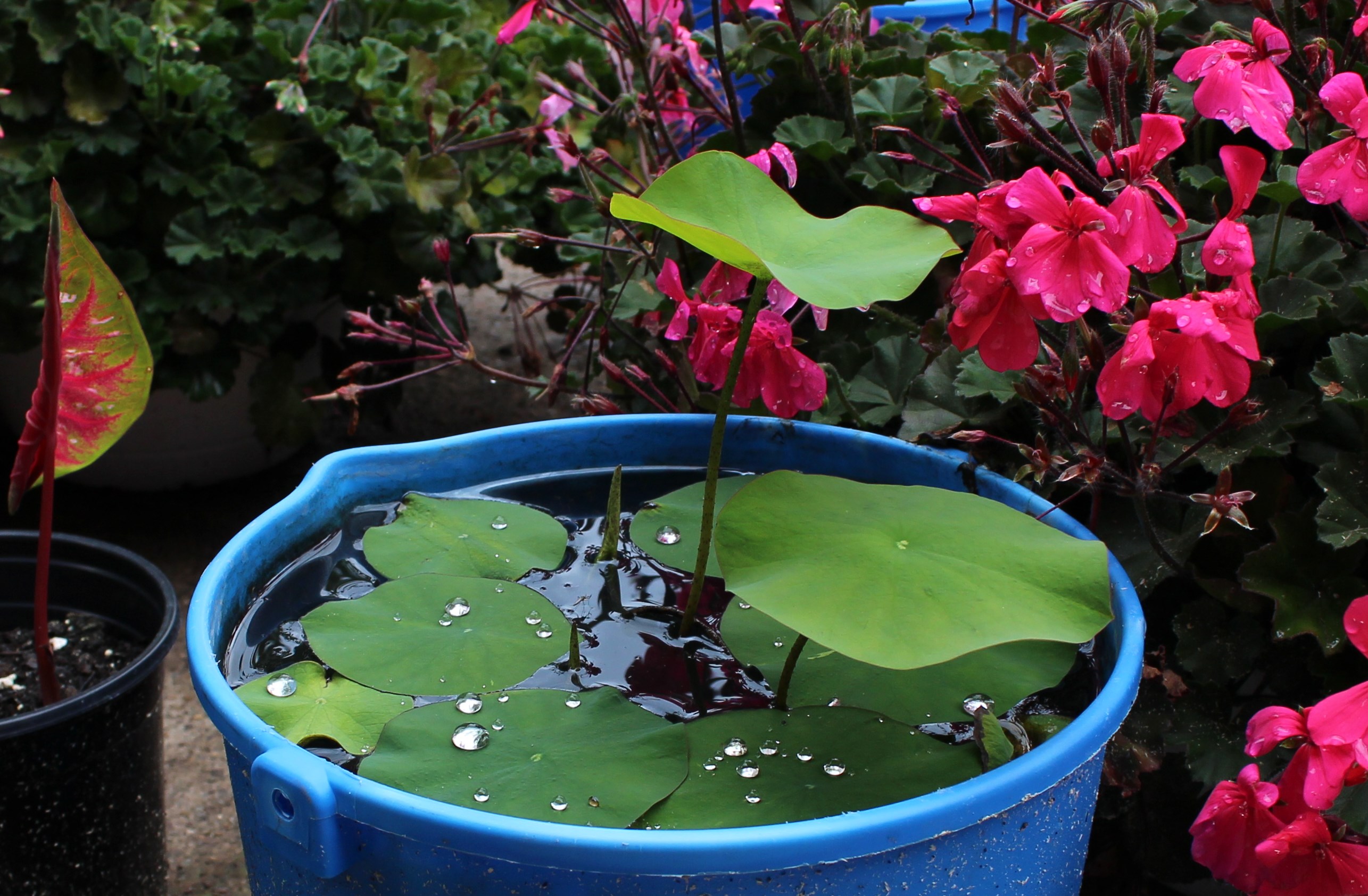
I know people have been on the edge of their seats waiting for this post, so to end the secrecy, stop the speculation, and quell the rumors I’m finally pulling back the curtain and reveling this year’s number one plant.  Bearing the title of “Plant of the year” is not an accolade to be taken lightly, and although last year’s winner promptly died after receiving this distinction (from overwatering, a common curse for too fast and furious a rise in fame), I’m hoping the 2014 champion carries the torch a little longer.  Without further ado, the co-winners for 2014 are my little lotus seedlings from way back in April.

4/27 Lotus seeds sprouting

4/27 Like some creepy alien stretching after being awoken from inside its space pod, the seed sends out a green shoot.

The seeds were one of those random things hastily tacked onto a HPS seed exchange order.  “I can pick as many as twenty packets” is dangerous in December, and while the snow was flying, the irresistible tagline of “Flower color is a surprise! Worshipped by people around the world, the sacred lotus is a true showstopper” overcomes all lack of experience and lack of suitable growing conditions.

Three large marble sized seeds came, sat around, and on 4/15 were planted unceremonially onto some sand at the bottom of an empty margarine tub.    Before going in, the seeds were scarified by rubbing against a file just enough to break through the dark outer coating.  Two inches of water on top and then under the lights and onto the heat mat they went.

“Grower must have patience” was the other thing I glossed over on the listing, and although this is usually code for guaranteed failure, things moved fast this time, and in just over a week the seed shell split and a little green arm started to reach out of the pod.  The margarine tub was already too small, so sprouting seeds were potted up into regular potting soil, covered with grit (to keep everything from floating away) and their new and improved water bucket went back under the grow light.

5/1Lotus seeds potted up

5/1 Thirty days after seeds were sown the Lotus seedlings already needed more room and deeper water.

I’m still surprised anything sprouted in the first place, let alone grew.  Lotus seed can sit for a loooooong time without doing a thing.  According to Wikipedia, they are the third oldest viable seed ever found, with seed recovered from a dry lakebed in China sprouting after 1,300 years of dormancy.  I’m glad I didn’t have to wait that long.  They sprouted fast and then grew fast.  A leaf came first, which for a water plant makes sense since who needs roots to search out water when you’re surrounded by it?  The stem looked ready to reach up through a couple of feet of water to reach a surface, but in my little bucket it was forced to twist and kink as it adapted to the cramped quarters.

5/23 first leaves on lotus seedlings

5/23 Four weeks after sowing, the bucket went outside onto the cold driveway.  The first leaf was quickly followed by a second and now the seeds were also sending out roots and a small rhizome began creeping out of the seed shell.

Once things outside heated up, the lotus (along with algae) really took off.  In just a week leaves expanded, new shoots came up and the plants really seemed excited to have some actual sunlight.

6/4 young lotus seedlings

6/4 The lotus seedlings are soaking up the warmth and sun.

As the seedlings kept growing, my lack of even the smallest water garden was starting to become apparent.  No matter and no worries, there’s a sizeable pot ghetto that forms on the driveway each spring, and what’s one more plant in need of a home?

6/25 Lotus growing in a bucket

6/25 Three weeks later and we reach a milestone with the first two aerial leaves. All lotus leaves shed water, and even the least plant-interested child loves playing with drops on the green pads.

Just recently I finally did my little lotus proud by plugging up an unused planter and moving them on up to a bigger apartment on the east side.  They had been sulking for most of July since I think they used up the nutrients in their little starter pots, but after visiting four stores I finally found the plant tabs I wanted and in they went.  Growth is back on track!

8/12 Lotus in a container

8/12 The little guys in a tub on the “patio”.  They don’t look much bigger here, but their former home was about half the size of the nearby blue planter.

So my lotus plants are now officially the plant of the year, and although the pressures of marketing, plant appearances and market demand which come with this distinction could be overwhelming, I think my seedlings can handle it.  I just hope they can handle winter when it comes….. we’ll see.

Hope you’re enjoying your own plant of the year, and special thanks to Aquascapes Unlimited, a Pennsylvania aquatic plant nursery and consulting firm (who have a great website with an exceptional aquatic plant database), for donating seeds last winter to the Mid Atlantic HPS seed exchange and through them to me!

In a vase on Monday

Surprisingly enough I’ve made the Monday vase twice in a row, unheard of!

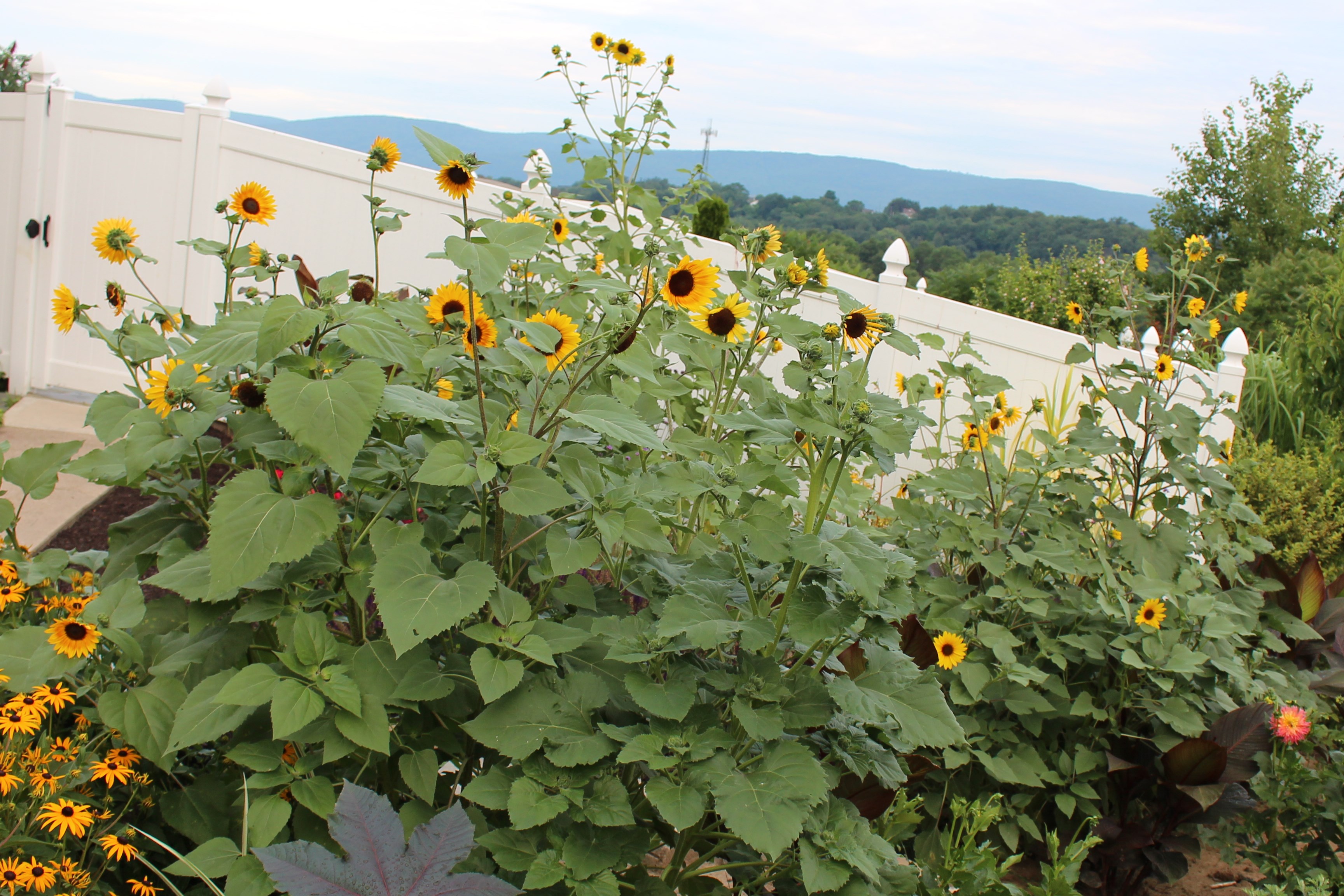
sunflowers from birdseed

Not a bad group of sunflowers, all volunteers from the birdfeeder.

The sunflowers inspired me, and their carefree summer spirit made it easy as pie to put this arrangement together.  After they were in place I was told they needed some other vase, and the red didn’t look good, but “don’t push me” is what I said!  I added the blue wine bottle,  I guess I was feeling very primary with all the sunflower yellow.

I didn’t do much fussing over them and I think they look fine, but I noticed this evening they had done a little of their own arranging, and heads were lifted and there was less of the droopy down facing that you see here.  It’s kind of like a vase of tulips in that they keep growing and twisting to get into a better position.  This should have come as no surprise from a flower that keeps turning its head to face the sun.

sunflower bloom

The birds have been enjoying the seedheads outside for weeks, I guess it’s time for me to enjoy a few myself indoors.

You would think a bunch of volunteer sunflowers grown from seed out of the feeder would all just run the range of yellow, yellow, yellow, but there is some variation in these.  They’re taller and shorter, branched higher and lower, longer petals, shorter, quilled petals, darker centers, pale yellow, splash of brown, deep golden… it’s quite the surprise.

sunflowers in a vase

Different colors and sizes, nothing real fancy, but nice surprises none the less.

I feel like I splurged in cutting these all for a few days in the house, but I’m sure more will come.  The patch still has plenty to look forward to and even a steady stream of goldfinches can’t eat them all.

black oil sunflowers

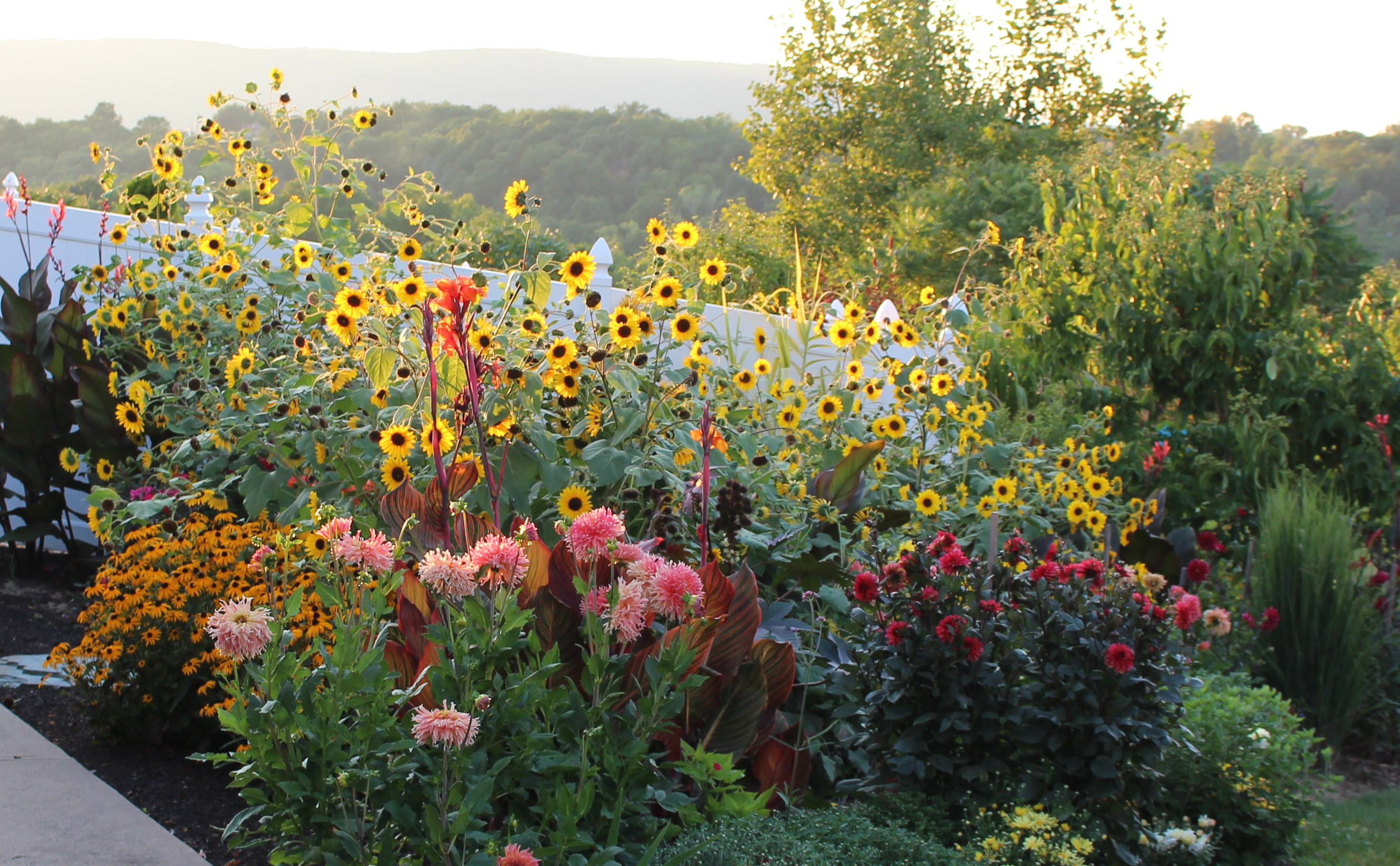
Sunflowers at sunset. They’ve officially taken over.

So that’s my Monday vase.  I may jump back in here and there to fill a vase, but work is gearing up again and the shorter days really kill my gardening vibe.  The vases are fun though and if you’re interested in joining I’m sure Cathy at Rambling in the Garden would be happy to have you.  Thanks for hosting Cathy!

And the clouds opened

For some reason my little valley has been missing all the rains again, and up until last week it’s just been dry, dry, dry…. until Tuesday.  The cold front came through and we enjoyed two days of on and off rain, and the garden just soaked it all up.  It reminded me of one of those nature specials out of the Serengeti.

heucheras in dry shade

You can’t even weed this rock hard “topsoil”. My new heucheras are toughing it out, but this bed sure won’t make it onto a postcard any time soon!

The grass dried up, the trees started dropping leaves, the waterhole pulled in all the wildlife, and animals were on the move.  Anything not within hose range shriveled up, but at least the temperatures were low.  Last year we had a hot baking which killed off the weak, this year I think everyone should recover.

asclepias tuberosa during drought

Asclepias tuberosa is a tough one. I planted these seedlings out last summer and after a few weeks they shriveled up and died due to neglect. Spring resurrected them and they are now trying so hard…. but they’re not cacti!

It looks horrible though.  The front yard had two sprinkler days and just looks dry, the back looks dead!  Here’s the director of cinematography following me around getting the shots that I missed.

lawn dead from drought

I would call this dormant. The weeds even gave up.

But just like in the nature specials, when the rains return the landscape springs back into life.  I took a couple pictures at the end of the two days and although a few things look a bit battered, even the dead back lawn is giving out a sigh of relief.

front border with hydrangea

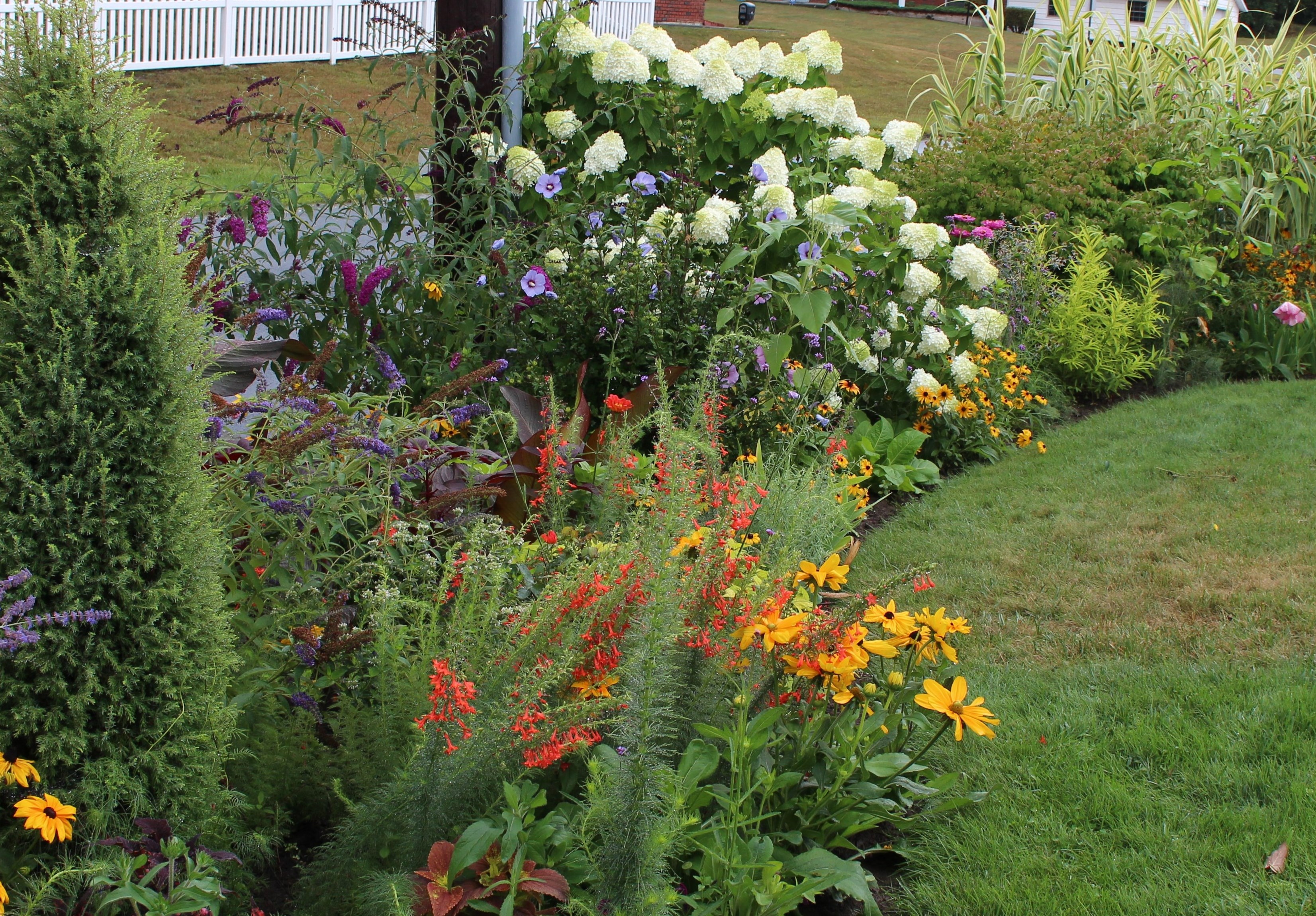
The front street border starts to put on its best show at this time of year, and although polite people would refer to its plantings as “a riot of color” others would call it a mess. Suits me just fine though!

The front foundation bed is a much calmer mix this year.  No bright oranges or over-bright coleus, but all my good intentions from last year of removing the overgrown evergreen and NOT letting any sunflowers grow up kinda fell to the wayside.

foundation planting

I don’t think I can physically pull and compost a sunflower, it’s just unethical to me…. sunflowers and dogwood seedlings, can’t pull either one.

I spend way too much time admiring the “Limelight” hydrangea.  It’s just about at full bloom now and I love its green going into white phase and the way its heavy flower heads are held up on strong stems.  It’s the only white plant out there, and it does stick out, but each spring I look proudly at its buds and imagine how much bigger the show will be!

limelight hydrangea

“Limelight” hydrangea nearly overwhelming the border….More of a purple-yellow theme going on here, but none of my planting plans are ever set in stone.

For some reason prior to the rain the yard was overrun with birds.  Flocks of starlings, catbirds, sparrows, house finches, hummingbirds, goldfinches, cardinals, doves, robins and mockingbirds would swarm each morning.  A large cherry and staghorn sumac berries brought in the fruit eaters, but the others were just all milling about looking for what-nots.  With all those hungry eyes it’s no wonder I’ve seen so few butterflies.

holes in lawn from birds feeding

The day after the rain the back lawn was riddled with all these bill holes. I don’t know what they found in the freshly wetted grass, but there was a flock of around 50 who kept milling around going from lawn to cherry to sumac to lawn.

Strangely enough since the rains came there seem to be far fewer birds.  I need to get out there and explain why their straying from script is throwing off the documentary.  On TV the return of the rains always brings on the migrating hordes!

sunflowers, dahlias and cannas

The rains were just in time for the former tropical bed. Leaves were starting to wilt and I just didn’t have it in me to add another bed to the water-triage list.

So we are back in business.  I hate drought and I hate watering and between the two of them dry spells always get ugly.  Now if it can only get a little warmer again this could have the makings of a great end of summer rally.

Ipomoea quamoclit

Maybe the birds can stop pecking off the tips of the cypress vine (Ipomoea quamoclit) long enough for it to scale the arbor. It’s heading for the top but the birds are relentless. Good thing it’s not a bunny though, the other side for some reason is abused daily by our single resident baby bunny, and can’t even start climbing.

I should be thinking fall garden but I’m going to hide behind denial for a few more days.  The cool weather is supposed to warm up again and hopefully summer will stay strong for another couple weeks.  It’s hard to deny though as the cyclamen sprout and the corn ripens.  Go away autumn, I’m not a fall person!

Hello dahlias :)

I’ve always dabbled a little in dahlias, but last year I treated myself to a few named ones from Swan Island Dahlias.  Last year they did great, this year even better!

dahlia moonstruck

Dahlia “moonstruck” would look great in a border, it’s got a nice height and really puts out the flowers.

I did lose a couple (my overwintering technique is sloppy at best) but I like to think of it as natural selection.  Eventually I’ll be left with only the dahlias that can tolerate my abuse!  Right now if I can only keep them watered and possibly fertilized once more they should put on a great show until frost cuts them down.

dahlia tanjoh

Dahlia “Tanjoh” barely bloomed last year, this year it’s in a much better spot and is really starting to put on a nice show.

I consider dahlias to be as easy to grow as a cabbage.  Maybe that’s why some people look down on them, they grow so lush and showy that there’s little room for subtlety and finesse…. which is just fine with me.  I grow them best amongst the vegetables where they can be fussed over and freely cut for the house, and they relish the easy life amongst the tomatoes and beans.

dahlia 'mathew alan'

This was supposed to be my favorite from last year “Plum Pretty”, but apparently it’s dahlia “Mathew Alan’. He’s a nice enough dahlia, but this means it was the plum that died over winter and went onto the compost pile….

I love all kinds of dahlias, but seem to be stuck on the quilled ‘cactus’ types.  A six inch wide cactus bloom and a height of about four feet seem just right for my taste, but a look through any dahlia offering will show plants from a half a foot to six with blooms from one inch to twelve…. and daisies, pom poms, dinnerplates, waterlilies, collarettes and more and more in the way of bloom types.

dahlia 'bride to be'

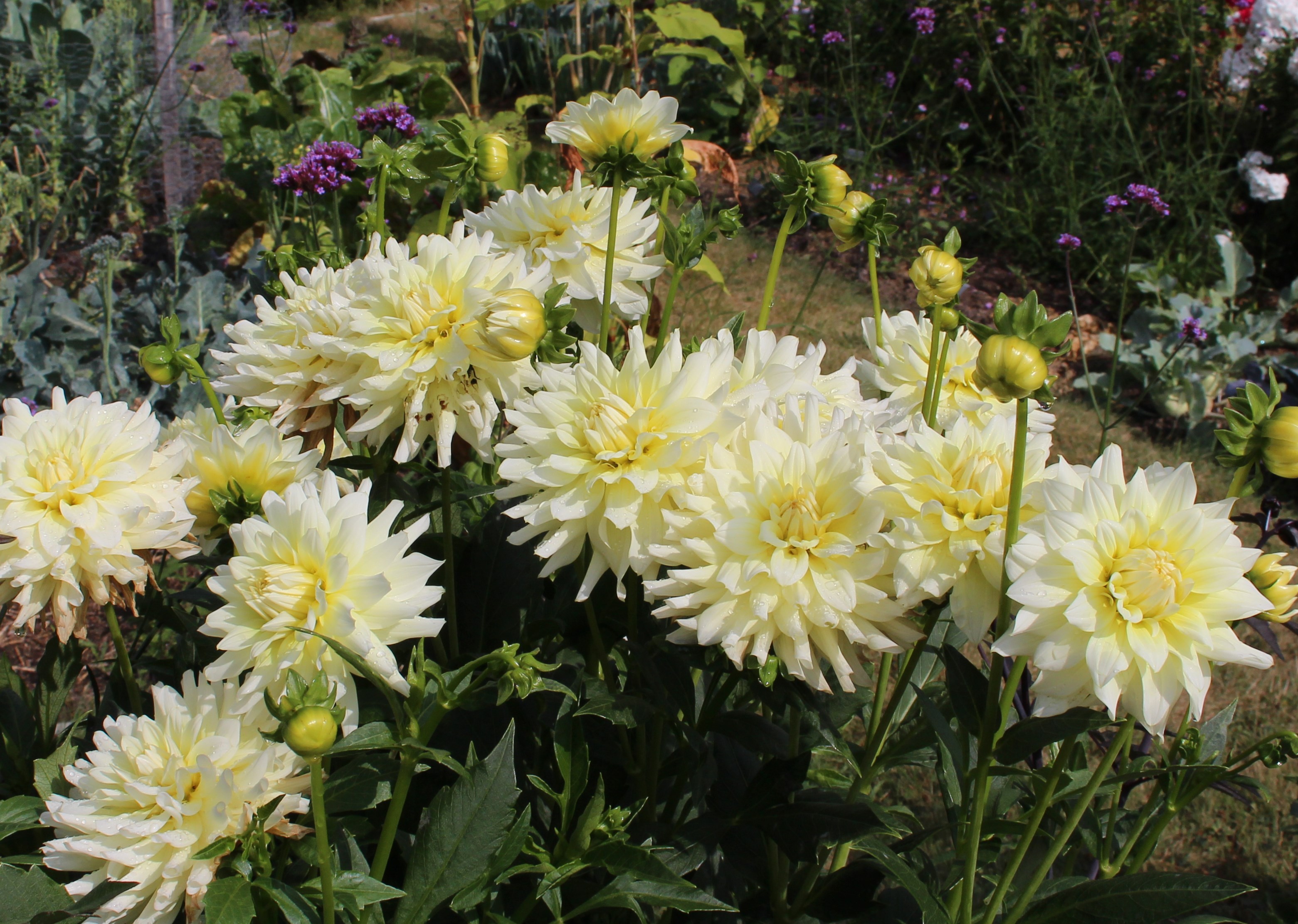
With a generic white flower name such as ‘Bride to Be’ I would guess this one would be perfect for a wedding arrangement. It’s a waterlily type, with broad, perfectly arranged, rounded petals.

Water, rich soil, and full sun are all these ask of me.  They should be staked, but I’m the sort who waits until a storm knocks them all down before I do anything….. I should really reconsider that plan, especially since I just picked up some suitable wood at the DIY store (no excuses!)

dahlia "goovy" with japanese beetles

Slugs, earwigs and Japanese beetles are the only troublemakers I get in the dahlia patch. They’re never much of a problem, I just dispense punishment, clip the bloom, and wait for a new one to come up in its place. This is dahlia “Groovy”, a darker leaved variety.

I’ve been through dahlia phases before and usually after a couple seasons of digging and replanting I either get bored or end up losing them all to bad winter storage.  We’ll see.  This latest phase is still burning hot and fierce, and I’m tempted to turn over the entire vegetable patch and fill it with dahlias!

peach dahlia

My oldest dahlia. This unidentified one from the box store has been surviving the in and outs of winter storage for at least 9 years…. practically a record in responsibility for me! (If it was taller it could be the 1963 dahlia “Alfred Grille”, but named or nameless still a nice one)

So we’ll see what happens.  Dahlia season is just starting and there are more to come, but opinions may change when the temperatures drop.  Digging soggy dahlia roots on a cold windy October weekend can really kill a plant lust and I’m far too frugal to just buy new tubers each spring.

Do you bother with dahlias?

Phantastic Flox

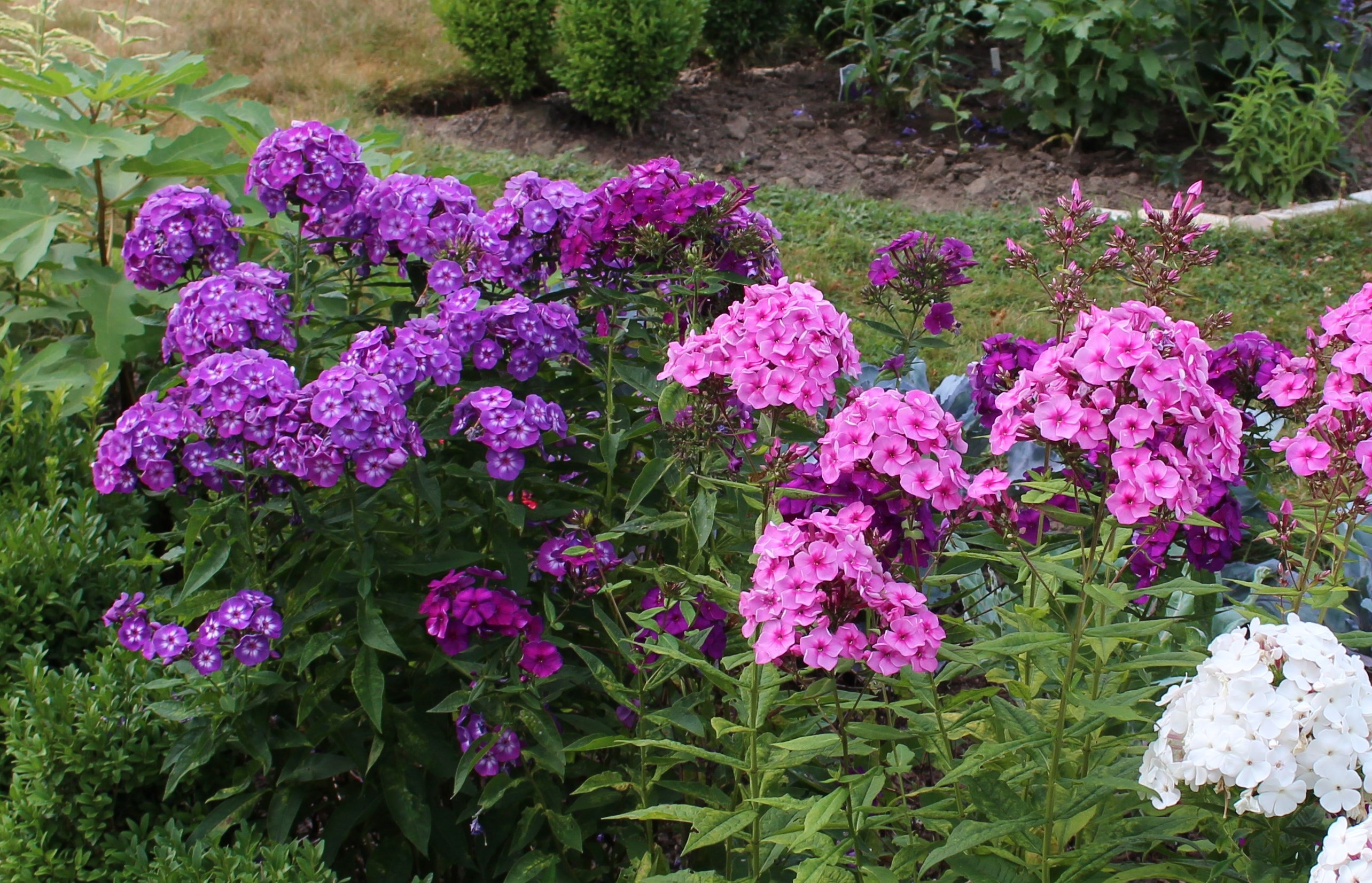
I’ll try not to go on too long.  Phlox paniculata is one of my favorite flowers and it’s blooming now, and although my garden doesn’t give the best conditions for amazing phlox (rich soil, even moisture, maybe some afternoon shade) it gives me good enough phlox.  Phlox (along with snowdrops and cyclamen)  have always been among my favorites, and now that I have the room I might as well indulge myself.  Here are a couple that are making me happy right now 🙂

phlox nicky and laura

From the left it’s ‘Laura’, darker ‘Nicky’, and random pink and white seedlings.

I will grow just about any phlox I can get my hands on but should really start to show a little self control…. or not.  I love working in the vegetable patch when the breeze has that nice spicy phlox perfume on it.  The hummingbirds and butterflies seem to appreciate it too.

phlox seedling

This white phlox seedling is one of my favorites, nothing really special, but it’s so reliable. The pink is also a seedling and I like the color but it doesn’t bloom as long as some of the others. I keep it mostly for the odd darker centered leaves… which look slightly diseased when I think on it, but it’s all mine so it’s special.

I know all the books say to deadhead and rip out stray seedlings which sprout since they will overrun your better named phlox, but I’m a little funny about just accepting what people tell me…. plus I’m curious to see if they’ll really all turn out as ugly as the books say (I do still read books btw).  Last year this one was a little congested and washed out,  I almost tossed it and now I’m glad I didn’t.  The cooler weather this summer has brought out some nicer color, and a leaner diet has left it with neater flower heads and I’m again seeing some of the qualities that made me single it out in the first place.  I love the height too, it’s close to five feet.

tall garden phlox

No-name phlox, still nice with it’s white centers and a color that just about matches the verbena bonariensis behind it.

Nearly all my phlox look a little sickly due to a dry spring and summer which really brought on the spider mites.  Spraying them off with the water hose and a little fertilizer seems to have discouraged the mites but the damage remains in the form of yellowed and spotty leaves.  Strangely enough my variegated ‘Nora Leigh’ has the nicest leaves of all, which surprises me since variegated plants are always supposed to be a little weaker compared to the regular version.

phlox nora leigh

Green grass would be a nicer backdrop for the foliage of ‘Nora Leigh’ but I guess the neighboring fig leaves will have to do.

I’ve been obsessing a bit on the darker colored varieties.  ‘Starfire’ is supposed to be especially bright and I think that’s what this is.  I don’t know how the mite damaged leaves can support all the bloom it has but they do and I’m glad for it.

phlox paniculata seedlings

‘Starfire’ (maybe?) is definitely bright and probably shouldn’t be right next to white, but it happens. I’m thinking next year it deserves an extra serving of compost for this wonderful performance in the face of adversity.

I’ve been adding new ones here and there.  This spring I ordered a nice batch from Perennial Pleasures up in Vermont and was generally pleased with the plants I received.  One died a few days after I got it, but I didn’t even bother complaining since I was so happy to have finally found a place which has such an awesome selection of phlox online.  Hmmm, I wonder if another order this fall would be too soon 🙂

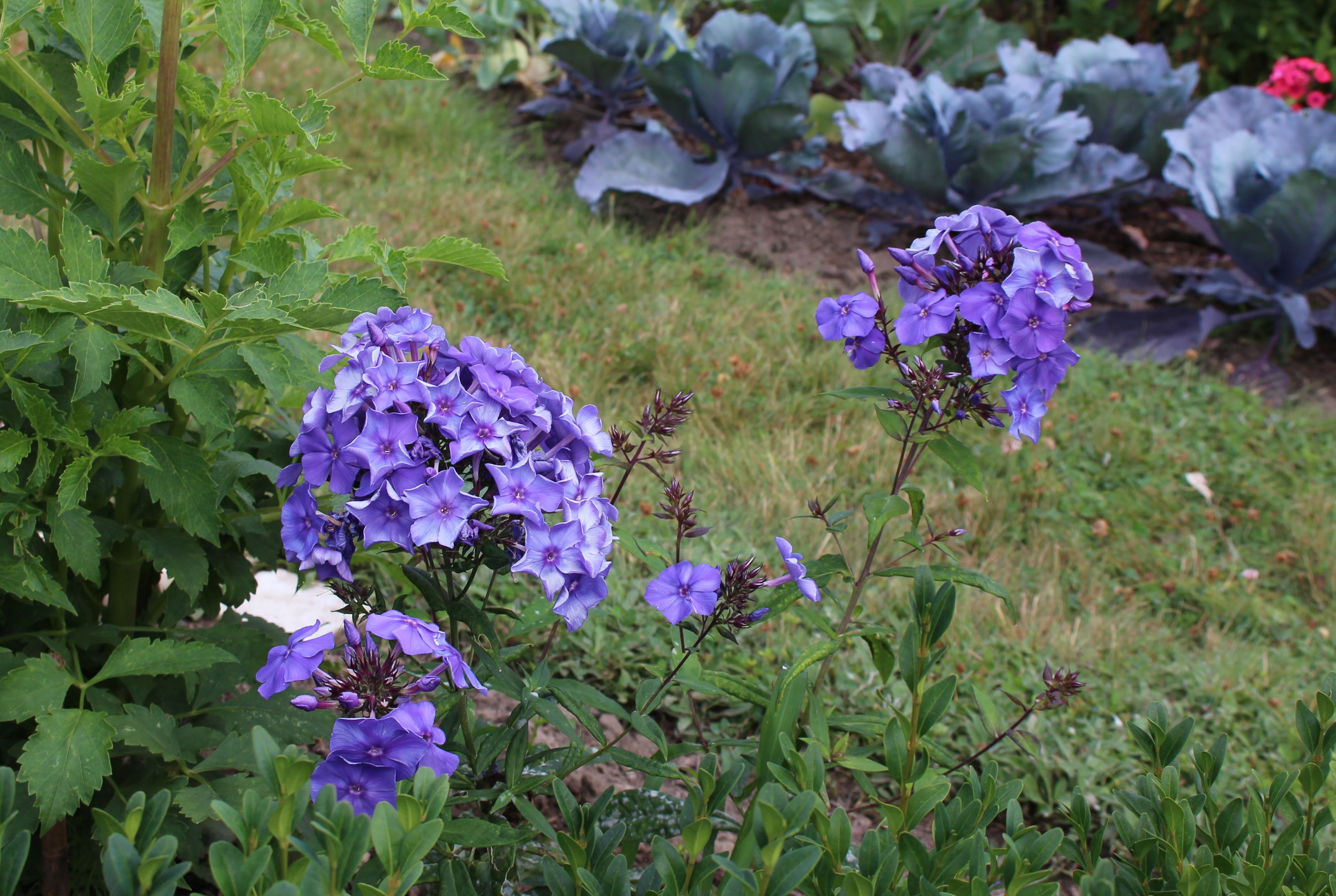
phlox blue paradise

Phlox ‘blue paradise’ is a new one and it’s of the kind that change their color throughout the day. Cool mornings give a rich blue shade which fades to violet as the day heats up.

My local nursery is pretty good about having a few new phlox each year so they tend to follow me home whenever I make a visit.  Here’s ‘Blushing Shortwood’ which joined me last summer… and then spent most of the year sitting in its pot on the driveway.  I’m glad to see it hasn’t held this against me.

phlox blushing shortwood

Phlox ‘blushing shortwood’ with it’s nicely bicolored blooms. The pink seems to fade as the thermometer rises but it’s still a nice flower.

I have a few others but don’t want to overdo it so I’ll stop here.  There’s always next year to do it again, and maybe by then I will have turned the entire tropical garden into a phlox field.  Now there’s an idea 🙂

Have a great week!

A summertime stroll with a couple surprises

I think I’ve been pretty good this summer keeping up with the garden.  Usually I have so many more weed patches and unplanted pots, but this year  things look a little better.  I know, I know…. prep soil first, have a plan, buy new plant with a spot in mind, don’t plant more than you can take care of, keep low maintainence in mind….  but that’s not how I roll 🙂

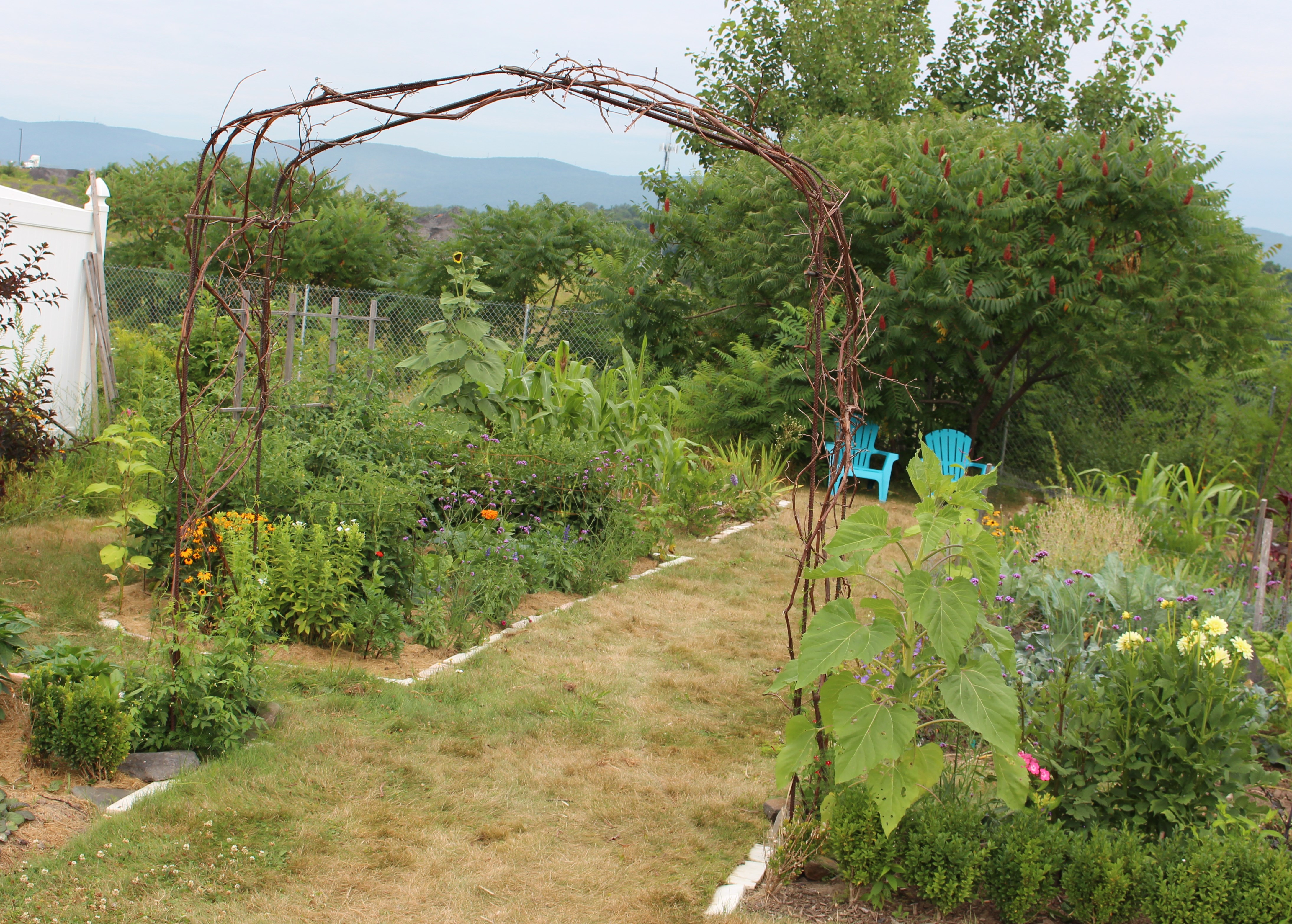
I finally cut, bent, and put together the rebar arbor I’ve pictured in my head for the last two years.  Last summer it was a single span, this year I doubled it for more stability and wired in a few cross braces.  I really should throw a little concrete around the base…. but I’ll wait till it blows over this autumn before I learn that lesson (again).

rebar garden arbor

Arbor going into the vegetable garden. The rebar alone looked a little bare, so I went out back and ripped down a few grape vines to bulk it up, and give the vines a little something to hold on to.

Since we’re in the vegetable garden, here’s the early garlic harvest.  This is the first year I managed to plant it properly (in October), and I’m pleased.  I’m even more pleased since these were stray, sprouting cloves I found in the bottom of the vegetable crisper which were planted out rather than thrown away.

garlic harvest

Garlic harvest. The ones I actually bought from the garden center specifically for planting are a later variety and yet to be harvested.

Last winter was one of the coldest, snowiest ones I’ve experienced living here, so you can imagine my surprise to find some gladiolus overwintered.  I vaguely remember there being a few thin little wisps of gladiolus leaves here last summer (I must have missed some of the tiny cormlets when the mother bulbs were lifted) but never gave them much thought.  This year they’re back, and voila, the little things surprised me even more by blooming!

phlox 'bright eyes'

Not only was the gladiolus a surprise, but the color coordination with the phlox, verbena and pole bean blooms is better than anything I could plan!

I only finished laying out and digging up the vegetable garden last summer, prior to that it was lawn and a holding bed for some of the plants brought up from the old house.  One of those plants was a wisteria vine, and when I moved it the remaining roots put up a couple suckers.  Surprise again when one of the suckers actually put out a bloom!

wisteria summer bloom

Not many gardeners are avant-garde enough to combine sweet corn with wisteria, and the fact that I’m considering building another arbor or tuteur in order for this guy to stay here says a lot about the haphazard design of my garden.

It surprises me that I would actually post a photo of this mess.  It’s the unfinished steps to the deck, and it’s were I like to sit with a drink thinking about all the tasks I should be finishing up instead.

tropicals in containers

Tropicals in pots, geraniums on the steps, and plenty of weeds. I actually did trim them all back yesterday but I’m sure they’ll have rebounded by the time I take another picture.

From the steps I get a good view of the vegetable patch -I like to call it the farm 🙂 , and the sunflower patch.  Last week I noticed this quilled version in with the others.  The rolled up petals are different enough to be interesting.

quilled sunflower blooms

In the center is the quilled version of the regular sunflowers. The flowers are nice enough, but it’s the coming and going of the goldfinches and sparrows that keeps things busy around here… as well as the angry little hummingbird who tries to chase everyone away.

I’m getting the feeling yellow is a little passé as far as being a fashionable color -if it ever was- but I clearly have a problem with “acquiring” yellow leaved plants.  “Isla Gold” Tansy is one of my favorites with its finely cut foliage and drought tolerance.

isla gold tansy with bon bon sedum

‘Isla Gold’ Tansy (Tanacetum vulgare) in front of ‘Bon Bon’ sedum. Don’t let the stupid name throw you off, the sedum is also a great plant.

Around the house in the front yard I finally gave up on the way-too-dry-and-hard-to-water spot by the lamppost.  I trimmed the ‘Tiger Eyes’ staghorn sumac back to the ground and let it and its suckers fill in the bed.  Too much yellow?  I don’t think so, and I no longer have to water this spot.

tiger eye sumac

I hope the plant police don’t find me. ‘Tiger Eyes’ cutleaf sumac (Rhus typhina “Bailtiger”) is a patent protected plant, and here it is propagating itself without corporate approval.

Another weedy spot has been the front street border.  I should probably do something about this since it’s a slightly prominent location which everyone who passes sees… but I’m a little bored with it right now.  Maybe once this bright red standing cypress (Ipomopsis rubra) blooms and some of the other annuals take off I’ll like it again.  I wish I had some nice mulch for it though.  I’m constantly jealous of compost rich gardeners and the ones who flaunt their piles of aged leaf mould,  and I think I’m close to breaking down and raiding the yard waste dumped by my neighbors in the nearby woods.  I’m sure my mother in law will be horribly embarrassed.

selfseeding annuals

More golden yellow in the form of rudbeckias, this time tastefully paired with red standing cypress -which almost has a touch of orange in the blooms. If people complain I’ll remind them the ipomopsis is a southeast native plant and hummingbird friendly, hopefully that will distract them from judging my trailer park color combos too harshly.

“Blue Satin” -or maybe ‘Blue Bird’, I forget- rose of sharon (hibiscus syriacus) always looks a little out of place or a little weedy to me, but the color is interesting and it just laughs off drought and abuse.  The white variety “Diana” (a sterile variety) still needs to be acquired, I keep forgetting to take a cutting of my mother’s bush in NY.

blue satin hibiscus

As close to blue as you get in rose of Sharon, “Blue Satin” is a cool color but reseeds freely, and the seedlings though nice enough are all more purplish.

You can’t help but notice the big clump of arundo donax ‘variegata’ (variegated giant reed) growing at the end of the bed.  Wow,  I love it.  It will easily reach 10+ feet by autumn and if frost holds off we’ll even see the seed plumes.  This variety will begin the season with a crisp white/green variegation, mellow to yellow around now, and then go green as soon as temperatures peak for the summer.  It’s invasive down south, so keep that in mind, but the huge clumps I used to see down in Texas were quite impressive.

arundo donax variegata

Still bright, this clump should ‘green out’ in the next few weeks if temps go up… the cool summer has kept it brighter for longer than usual.

A few pennisetum “Karley Rose” divisions (also patented, so please don’t tell anyone I split my clump) are still gaining momentum here amongst the black eyed susans.  They would have done better without all the company but I just couldn’t rip out the daisies.  I’m sure by next year the grass will just muscle it’s way through and form a big clump to hopefully balance out the big hydrangea.

karley rose pennisetum with black eyed susans

Pennesitum ‘Karley Rose’, rudbeckia hirta seedlings, and erynginum in the shadow of the almost blooming ‘Limelight’ hydrangea.

I’ll end with a non yellow.  Verbena bonariensis is starting to open up all over the borders and I wish I had more!  Serves me right for having ripped so much out this spring.

verbena bonariensis

Finally something to balance out all the yellow, but is that a prickly thistle coming up through the middle of the clump!? Who missed that weed?

You might notice in the last picture that there’s a mild green tint to the lawn.  I’m afraid I’ve gone over to the dark side, and have begun to water the lawn.  The brown straw mat I looked at all last July and August was just too depressing, and if I can just get it to the next thunderstorm (tonight I hope), things should stay green for at least another week or two.  Honestly I only ran the sprinkler one day, and the back lawn is responsibly dead….. but I may or may not have also fertilized the day before I watered…. sometimes even good people stray.

Have a great week!

Resist temptation

Summertime DIY projects are an awful thing, and not just for their interference with pool time.  This beautiful time of year with its warmth and sunshine is also the time when nurseries and box stores try and clear out their inventory, and as long as I’m at the store picking up lumber and sandpaper I might as well take a stroll through the plants to see what’s going on.  So far an oleander and golden arborvitae have joined the screw and hinge purchases, and under the relentless strain of repeated returns to the store it’s no surprise my resistance wears thin and a small eucalyptus or succulent falls in the cart too.  Some people buy chocolate, I buy plants, and at a midsummer 50% off sale I run the risk of getting fat.

The DIY store is not a nursery.  The plants are not well cared for and are right in there with washing machines, pipe, and soda coolers…… but sometimes you get lucky.  Sometimes you don’t though, and it bothers me that they sell diseased and dying plants such as these ‘Tropicana’ cannas.

virus in canna leaf

Canna ‘Tropicana’ should be a gaudy blend of yellow, pink, and red stripes on a purple leaf, without breaks and mottling of color. You’re looking at canna virus.

I would guess the store doesn’t know and doesn’t much care to know but the grower should, and to send out plants looking this bad (and to then sell them for nearly $15!) seems irresponsible.  Reputation must not matter much as long as the bottom line keeps looking good.

diseased cannas

Back in the day people went crazy over the wild colors which would show up in virused tulips….. but they learned the lesson and dumped the plants. ‘Tropicana’ growers didn’t get the memo, and each year I see these deformed offerings.

I would think if it’s your business you would want to send out the healthiest plants possible, and I’ve seen several online sources openly discuss the canna virus struggle, but some don’t seem to care.  ‘Tropicana’ can be a really cool plant…. if not entirely tasteful 🙂

healthy tropicana canna

Tropicana out by the mailbox last year. Maybe not virus-free (I’m back and forth on whether or not it’s clean) but it sure looks better than the store version.

I like my cannas and try to toss anything that looks suspicious, but I hate to see the pros doing a worse job than me.

I’d also hate to leave on a down note so here’s another lapse in judgment that you might enjoy.  Santa Rosa is an excellent online source for plants, and they run some amazing sales, here are the goodies which arrived last month after I fell victim to their online summer clearance.

plants from Santa Rosa gardens

I wasn’t even aware of my heuchera addiction until this showed up. My collection of one plant just increased by a dozen more….

The sale is still going on by the way, and if you use the coupon code of JULY10 when checking out, another $10 will come off your $35 minimum order… that’s practically giving plants away and I’m not going to go there (but I would never judge others who lack my amazing will power!)


The garden formerly known as tropical

There’s a spot in my yard (actually most of it inches over into my Mother in Law’s yard) where I like to indulge in a little of the tropics.  Last year it was full of cannas, sweet potatoes, and other warm weather friends, but this year it seems to have lost some of that bold tropical flair.  As usual it’s my own fault, and as usual it’s a long story, so I’ll try to keep it short.  It all begins in April when mulch was purchased for next door, and a willing volunteer was needed to spread it.  I foolishly agreed, but the deal was to add a couple tons of topsoil (I said I needed it to fill in along a sidewalk).  “I’ll spread all your mulch if you buy me even more stuff which needs spreading”.  Let me just say I run a hard bargain.

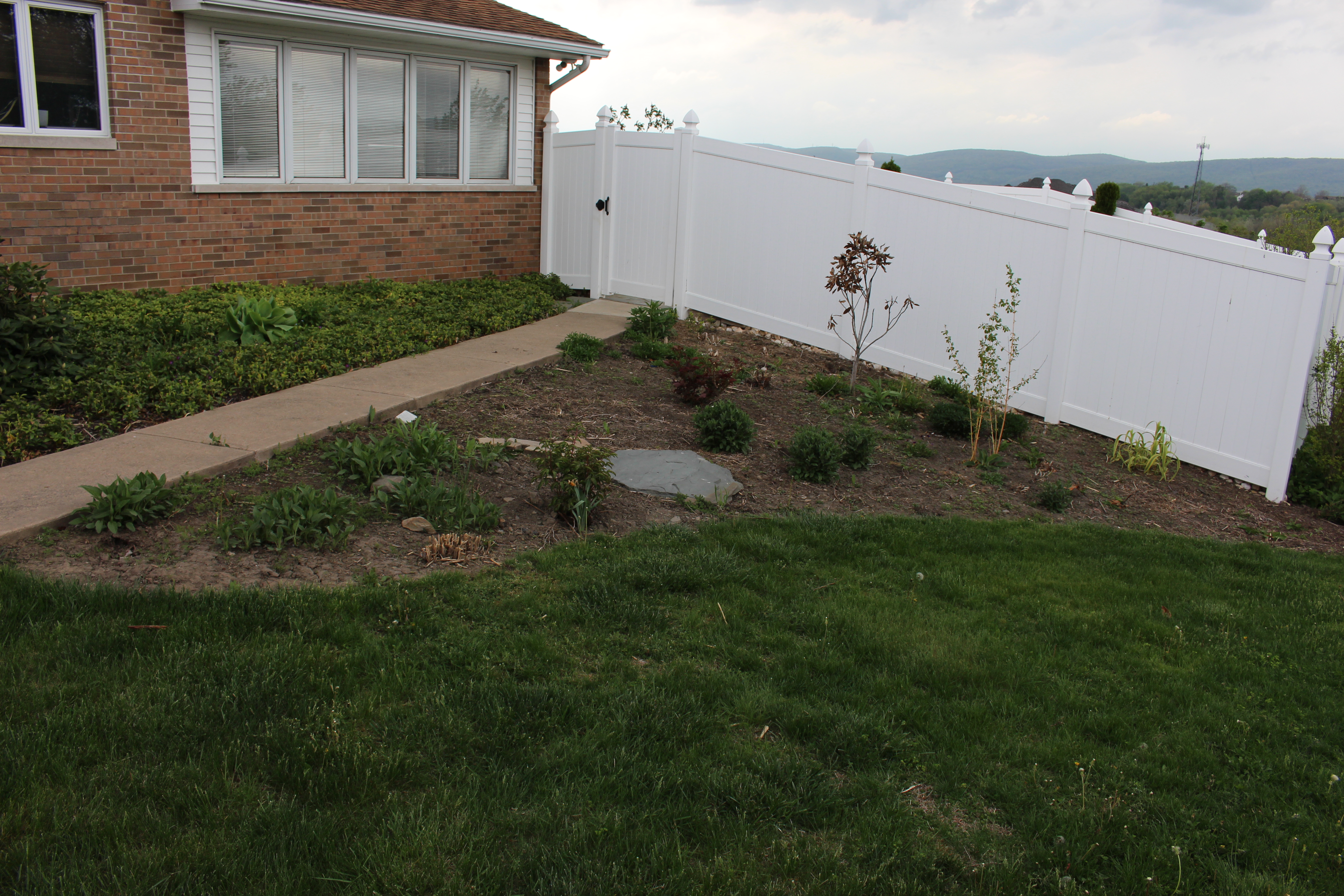
new flower bed

Look at that three inch drop from the sidewalk into the tropical bed. Clearly an ankle twisting lawsuit in the making!

So the mulch was spread, perennials divided, shrubs trimmed, weeds pulled…. the deal kept getting better and better it seems, but then it came down to the heap of topsoil sitting in the driveway.  I used a few wheelbarrows to raise the soil along the walk and was still left with plenty.  Finally my plan was coming together hah hah hah.  I’m pretty sure I mentioned I might use the topsoil to expand the bed a bit, so that’s what I went ahead and did 🙂

digging a new perennial bed

Line the edge with a hose, cut in and dig out the edge, smother the grass with about two inches of topsoil… wow did I hate mowing this sloped little patch of sickly grass!

No one said a word about the tripled in size, very empty bed.  I think people around here may be a little wary about asking questions for fear I will plant up a field of dandelions or something.  Some people have said I’m stubborn and criticism may tend to encourage me even more.  I like to think of it as proving a point 😉

fresh soil in flower bed

A huge empty garden bed in May. What could possibly make a gardener happier (other than a few loads of compost mixed in)?

The last bits of mulch made the bed a little more suburban-friendly and a few paver scraps thrown down along the center made an acceptable shortcut for the kids.  Then on to the real fun!  Canna and dahlia roots were lugged out and planted, and that was well enough, but then trouble started brewing.  A box filled with a dozen or so rooted chrysanthemum cuttings showed up at the door.  I can check on them constantly if they’re right along the edge of the new bed, so that’s where they went.  Don’t ask me why I needed a box of chrysanthemums, February is a tough month.

new flower bed

Somehow random perennials invaded the tropical border, that and chrysanthemums….

Then of course I tried to make the front yard more respectable by not having sunflowers all throughout the foundation plantings.  Out they came and into the new bed they went.  I have a serious problem in trying to show any kind of resolve against sunflower seedlings, they’re all summer and sunshine and it seems borderline criminal to pull them as weeds.

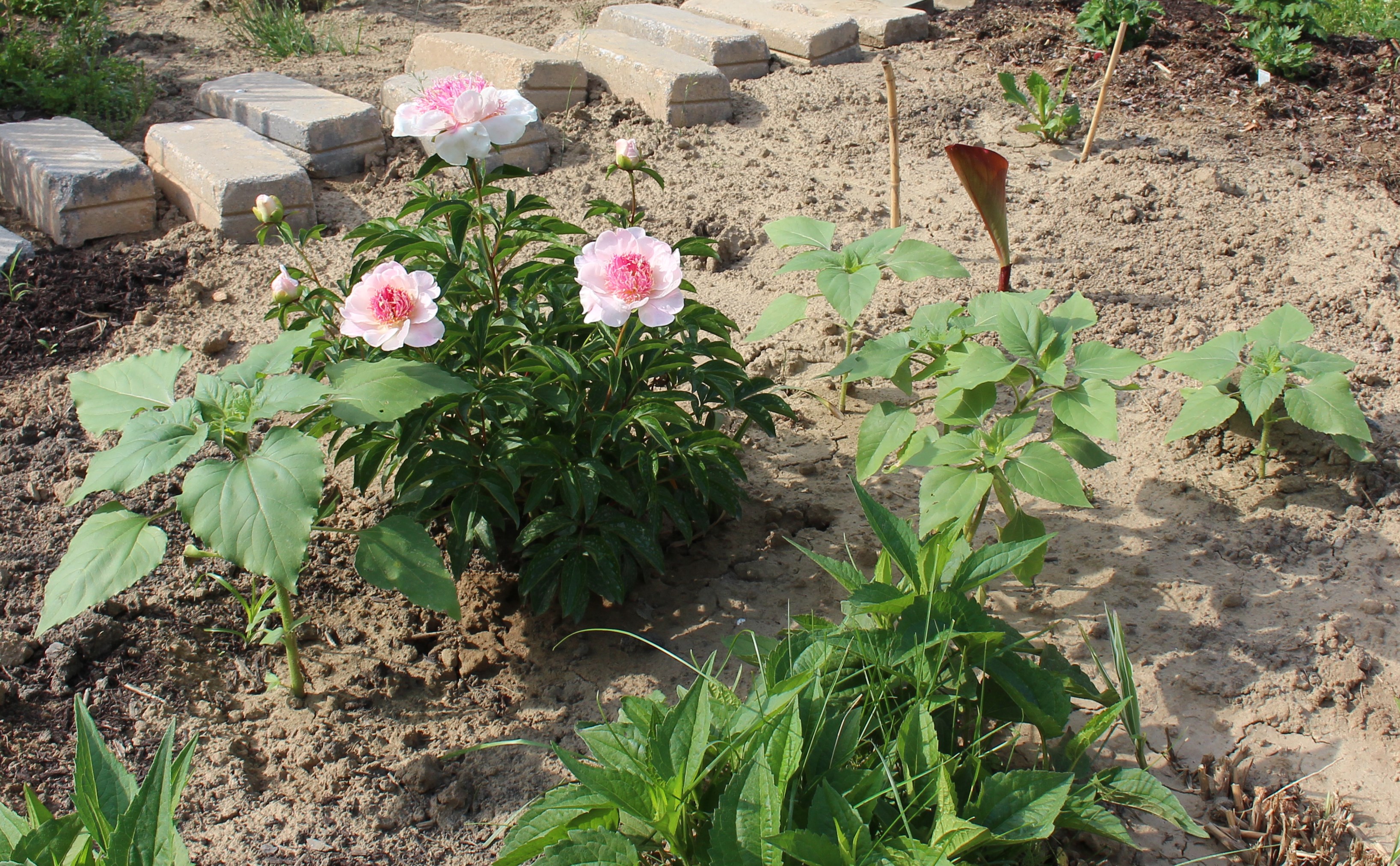
peony "do Tell"

Peony “Do Tell” can’t seriously expect to be the only plant using this spot of sun all year. The sunflowers should take over by July and the peony will just hang out in their shade until next year…. that’s the theory at least.

Things still look awfully barren but until the heat of summer hits it’s all kind of just biding its time.  Looking over from my yard you can see the bit of slope which made me hate mowing this spot.  Plus I’m not all that crazy about lawn to begin with *yawn* ….. it’s only really good for walking around on while checking the plants out!

side view

Year two of “I should give the table another coat of pain” -June 10th

My grass just doesn’t have the strength to come up through the soil (southerners may have a different experience), and even without soil improvement the new plants are still doing well as they feed off the decaying lawn underneath.  A month later and things are looking better.  The cannas still give a tropical look, but all the sunflowers are giving more of a neglected-agriculture vibe!

cannas, grasses, and sunflowers

July 13th, about a month later and the cannas are up, the sunflowers are growing, and I still keep looking at the bare dirt wishing for some compost or mulch to cover it up with.

As the sunflowers come into bloom they’re pretty and cheerful… but they’re not the tropics.

sunflower bed

It looks lush and green, so I should be happy. Also it’s not the color disaster I grew here last year, another reason to be pleased!

Besides it being a non-tropical border, a few other problems are coming to light.  The first is that some of the chrysanthemums relentlessly insist on setting buds and blooming for summer instead of fall.  I think I failed to pinch them back enough when planting them out in the spring, but I just don’t have the heart to do it now.

mums blooming too early

Chrysanthemums blooming in July, hopefully they’ll be on the correct schedule next year…. but they’ll need dividing by then, so I have no idea where to put them all!

To me a more insidious problem is the sunflower blooms.  When the first flower opened I cringed.  They’re completely pollen free, and because of that they don’t offer much to pollinators, and even worse they don’t set seed as well as the normal types.  I thought for sure since they were selfsown from last year’s plants that they should be normal functioning sunflowers but that’s not the case.  These all appear to carry the pollen-free gene, a gene which I’m sure came from the birdfeed seed.  I’m not big on all the seed conspiracies, but this looks like a genetic insurance policy that keeps farmers coming back to the seed supplier each year, and keeps them from replanting their own crop.  Good for a seed seller but not so good for me and all my now genetically tainted sunflowers.

pollen free sunflower with bee

Not much here for the bees.

Luckily there’s a small patch of sunflowers out front which still grow normally.  Once these started blooming I noticed a few seeds starting to form in the other patch (I guess a little pollen goes a long way throughout the garden!).  I need to make sure I get my seedlings from this area next year.

wild sunflower

This sunflower looks like it’s full of tasty seeds, not full of empty husks like over in the other patch.

The sunflowers look pretty enough, but all I see are the black soulless eyes of the walking dead…. ok maybe not that bad, but they lack the busy bees and bugs that usually do laps around the big open pollen filled flowers.  The goldfinches have also been very insulting as they touch down to check on the seed supply and come up empty.  Hopefully pollen from the front yard will work it’s way back here to at least make the birds happy.  Just in case, I planted a patch of heirloom sunflowers in the now completely dug up daffodil patch.  They’ll be late, but they’ll have pollen, and I think they’ll still make it before frost.

selfsown sunflowers

Sunflowers coming on strong.

I’m still holding out for a few tropical effects.  One castor bean seed came up and is now taking off, and “tropicanna” canna is looking healthy.  Also if I have nothing better to do this week, a few coleus and sweet potato cuttings can fill in one or two of the still empty spots, and maybe by late August ‘tropicalismo’ will revisit this bed once again.

castor bean with tropicanna canna

Castor bean “carmencita” and a few over-fed “Tropicana” cannas. The cannas seem to get much brighter colors when grown on the lean side, or with just a little 10-10-10 fertilizer. This batch has a lot of green in them due to higher nitrogen, probably from some miracle grow.

I don’t know if they say tropical to everyone, but dahlias never fail to bring brightness.  This peachy pink with yellow cactus flower makes me think of some overdone tropical drink.  Yummy!

pink and yellow cactus dahlia

Unknown dahlia which I keep saving from year to year. This spring I tried to show some restraint with them since last season planting a dozen or so might have been overkill 🙂

One plant I still need to plant out more of is verbena bonariensis.  In almost all my other beds it can be counted on to show up and make a play for taking over any open spot, here in the new soil it hasn’t had a chance to seed in yet.  Any transplants made this time of year will shrug off the shock of moving quickly and should be blooming up a purple storm in no time at all so I better get moving.

arundo donax "gold chain"

The grassy tropicalish leaves of arundo donax “gold chain” make a great mix with the sunflowers and verbena. I might have to plant this combo on purpose next year to make sure it happens again!

The tall old fashioned red leaved cannas always make me happy.  They’re super easy to overwinter, never look ratty, and always grow as fast as the fertilizer and water will take them.  The small reddish blooms which come later in the season aren’t much to talk about, but the hummingbirds love them.
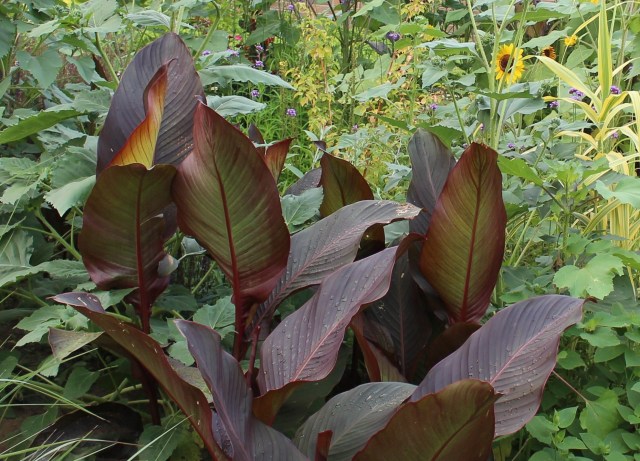
red russian canna

Maybe canna “red Russian”? We call them Polish cannas after the old Polish woman who years ago gave the first ones to a friend of mine.

So that’s the latest from the ex-tropical bed.   It may still heat up as the season progresses, but for now it’s decidedly temperate and might remain so for a while.  No amaranthus or salvia seedlings showed, and this spring was a bust as far as all the seeds I started, so many of the brightest colors from last year are hushed.  For now I’ll have to keep satisfied with my little bit of the tropics in containers.

tropicals in containers

A couple real tropicals planted in containers where I can best keep an eye on them.

Not to go on any longer than I already have, but those weak little pots of tropicalismo surrounded by weeds and dead grass aren’t just a bad planter arrangement.  To me they’re the accent on a new gavel terrace backed by a low stone wall.  Maybe a fire pit.  I think one of the reasons my garden looks the way it does is because I have a bit too much vision, but we’ll see.  I do tend to work backwards and always find the plants first…. who cares if the seating area is still a little “in development”?

Love hurts

My prickly eryngiums are finally blooming, and to be honest I was a little disappointed by how underwhelming they were.  They gave me the longest wait ever, recently started to color up, and are finally looking cool.  Pollinators of all kinds love them, and these black and white wasps in particular swarm the plants from sunup to sundown.

pollinators on eryngium

The eryngium is very popular with the pollinators small and large.

They’re not as poky as you might think (although falling into a bed of lettuce would be the wiser choice), the more painful thing these plants offer is a nice wasp bite.  Most of the seedlings are a pale silvery color, but a few patches are showing an attractive blue tint.

eryngium

A few of the eryngium plants are showing off a nice blue tint. I like them, but will be on the lookout for too many seedlings.

Being a lover of all plants which walk the border between spiny farmyard weed and interesting garden plant, I of course love these, but my disappointment comes from the expectation that these would be the famous “Miss Willmott’s Ghost”.  Miss Ellen Willmott was a fascinating gardener, and the strain of eryngium that bears her name should be a stouter plant with wider silvery bracts.  Mine are thinner and tall enough to risk flopping.

small flowered eryngium

These plants are biennials and although they’ll need replacing each year you shouldn’t complain about a plant that blooms itself to death.

While I was struggling to get a decent picture I came to the conclusion this is a real photographer’s plant, with it’s airy blooms, subtle coloring, and busy bug guests. A real photographer could do wonders with it!

I’m sure I’ll get the real ghost someday, but in the meantime there’s no shortage of spiny, dangerous plants in the flowerbeds.  Ptilostemon diacantha is another biennial thistle which I’m totally in love with.  This one’s a real killer though with sharp spines that don’t give up tennis balls easily.

ptilostemon diacantha

Ptilostemon diacantha with nicely lined leaves and spines that feel as sharp as they look.

Sure the spines keep you on your toes, but there are plenty of other thorns out there in the garden.  Can you say rosebush?  Find me a rose grower who never sat down with a box of bandages after wrestling with a wayward climber and I’ll show you a gardener who has a checkbook healthy enough to hire out all the crappy jobs 😉

rose livin' easy

Gratuitous rose photo from earlier in the month. It’s “Livin’ Easy” and I never see blackspot or fungus on it. If it weren’t for the “Knockout” tidal wave sweeping the country I’m sure this would be a much more popular rose…. even with all those nasty sharp thorns 🙂

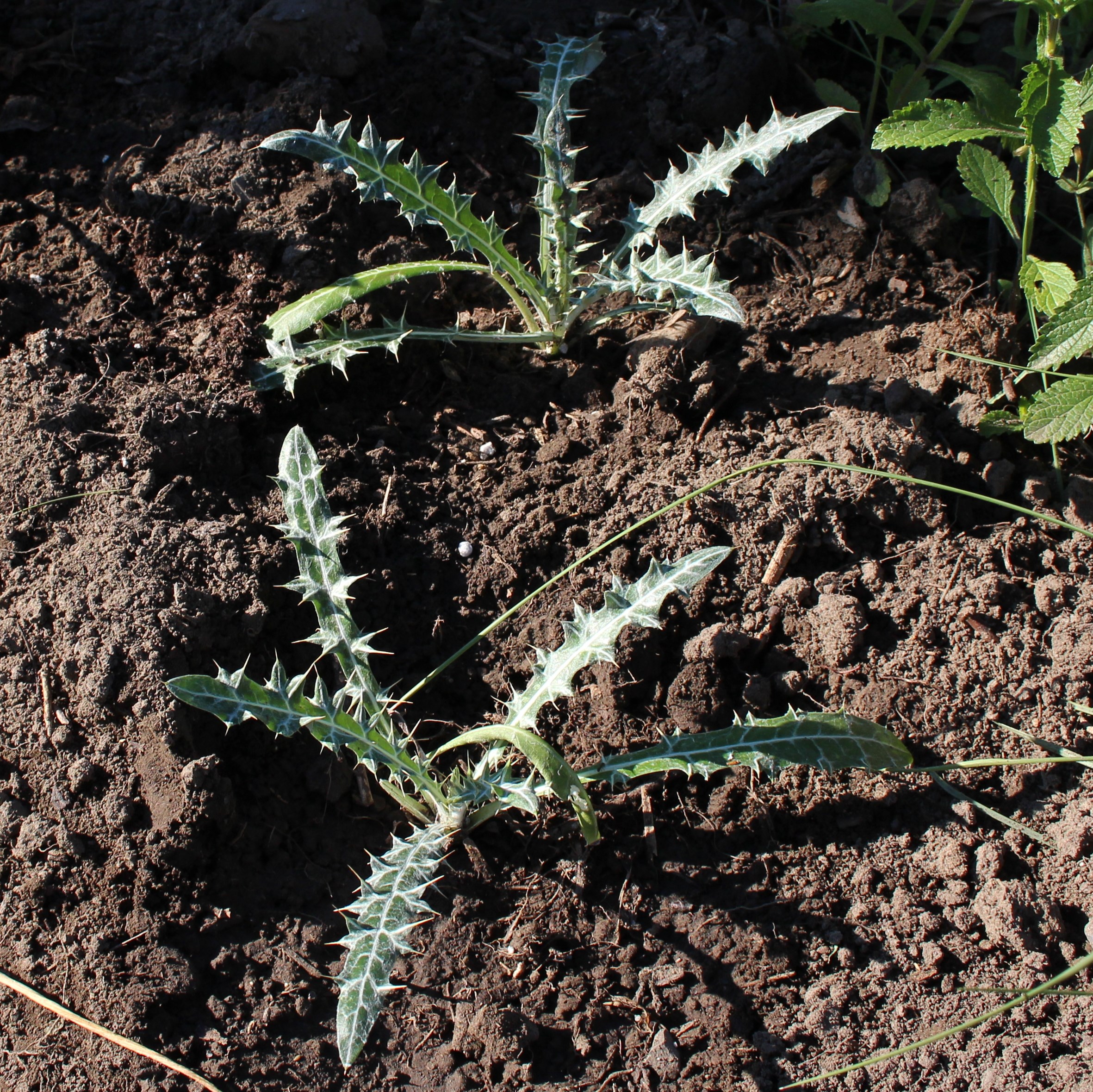
Here’s my newest little baby.  I finally had success with the cirsium japonicum “white frosted” seeds which I’ve been trying each winter.  They’re everything I love in a plant, variegated foliage, mild spine-age, bold colored thistle blooms (I hope)….. it’s even a perennial (hopefully not an invasive one).  There will surely be plenty of gushingly over the top praise put onto this little plant in the future!

cirsium japonicum white frosted

One of the cutest baby pictures ever of cirsium japonicum “white frosted”.  I hope it grows up to be just as attractive an adult.

The wild bull thistles are blooming around the fringes of the garden and I’ll spare you from those photos.  Weeding will be a gloved affair, but can I just say the pollinators love them and the goldfinches will be thrilled?  Have a great end of the week 🙂

The Dinosaur Tree

I don’t commit easily to large trees since I’m awfully greedy about the sunshine in my yard, but there’s one tree I had to have.  It was bought for the old house but I couldn’t leave it behind when we moved, so out of the ground it came again and up to the new house.  After twelve months in a temporary spot I moved it again to what hopefully will become its permanent location.  It glows in the back of the yard, and although I can’t get a decent picture of all its bright yellowness, I’ll post this picture anyway.

dawn redwood in the yard

My favorite tree, Metasequoia glyptostroboides ‘Ogon’ (Goldrush) growing in the backyard.

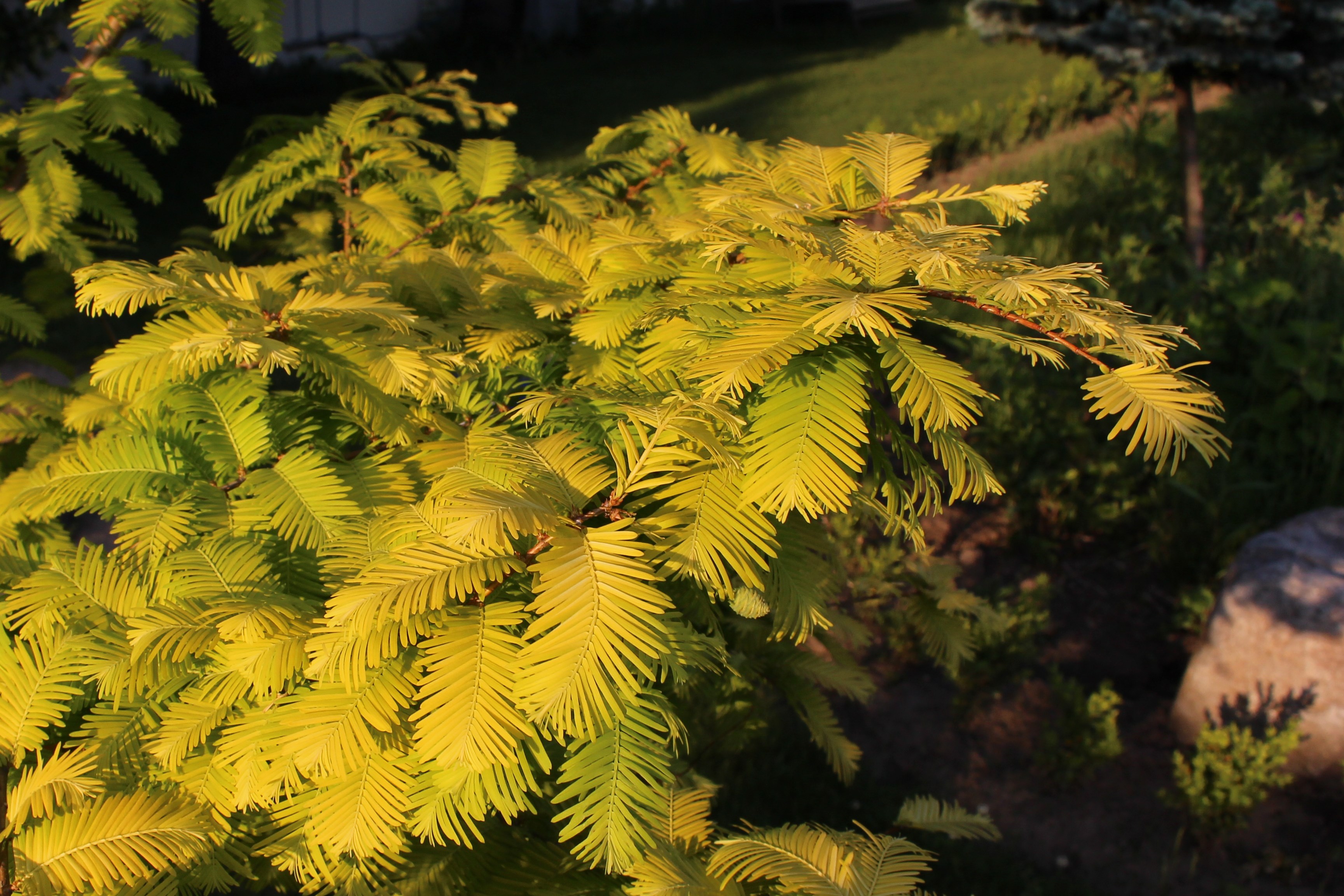
This tree is easy to grow in normal to damp soils, has few pests, and grows relatively fast.  It’s one of those weird ducks of the tree world, mainly a conifer that drops its needles every fall.  Metasequoia glyptostroboides is the full name and as the sequoia part indicates it’s a distant relative to the giant sequoias and redwoods of the west coast of N. America.  It’s common name is dawn redwood, and the cultivar I have is the golden needled “Ogon” which is usually sold under the name of “Goldrush”.  Butter-yellow is what I would call the needle color.

Metasequoia glyptostroboides ogon goldrush

In full sun Ogon’s needles take on a bright yellow, while interior needles keep a fresh chartreuse color.

I love the color.  The straight species is a cool tree too, but the yellow on this one wins me over completely (but I admit I’m a yellow-leaf-anything lover).  ‘Ogon’ is a Japanese selection and I think it means gold.  The original plant was selected from a batch of seedlings grown from irradiated seed… I guess that explains the glow 😉

goldrush dawn redwood

Looks great against the blue sky too 🙂

The species has an interesting history too.  It’s been called a dinosaur tree since for years it was believed extinct and only known through fossil records dating back to the age of the dinosaurs.  Living trees were only “discovered” in the 1940’s growing at Chinese temples and then later as wild groves in a few isolated areas.  Seeds and cuttings were collected, plants were grown, and now the tree is known throughout the globe (at least among tree lovers).

ogon metasequoia

On younger trees the bright yellow may fade to white in full sun, and then end up browning on the edges. My tree is doing fine in a dry spot, but they grow better with more water.

I think if I had more room, a nice grove of these would be about right.  My single tree has so much character and brightness I feel almost like it’s more of a pet than a plant, and I may or may not have talked to it at times.  If you ever get the chance to see older trees they develop a cool buttress at the base with deep ridges and fissures.  I think this only happens if you leave the lower branches on, and since mine will need to be limbed up (for more planting areas of course) I think I’ll end up with a smoother trunk.  Still nice in my opinion!

This post has me thinking about other cool trees.  If I could only get rid of the annoying red maples along the North property line I could put something nicer along there….. hmmm.   Any suggestions?