Too much money

Some complaints will never get you any sympathy, and to complain that tulips are coming up and blooming in all sorts of odd places probably ranks right up there.  Truth be told it’s not a problem, but when every batch of compost seems to hold a new crop of bulbs, the spring planting in the parterre becomes a little more complicated.

tulips in the vegetable garden

Once again the vegetable garden is a complicated mess of far too many flowers and far too few edibles.

For all my failures in the garden, tulips seem to be one plant which enjoys the poorly draining, heavy soil of the flower beds.  It’s a surprise to see this considering many references suggest a loamy, free draining soil for your best chances at success, and even then it’s a safer bet to treat tulips as one or two year treat.  Fortunately no one has whispered this little secret into the ears of my bulbs and they keep coming back and multiplying.

tulips in the vegetable garden

Having a few tulips in the way is just the excuse I need to skip digging too deeply when it comes to planting the spring vegetables. 

I think I do know the secret though.  The soil may be heavy but it’s also thin and dries out relatively quickly once the heat of summer settles in, and if I do manage to drag my lazy self away from the pool to water it’s never a solid deep watering, it’s always a guilty stand around with a hose until things look less dead kind of triage.  I can’t imagine much of the water ever penetrates deeper than two or three inches and for this the heavy soil works to an advantage.  My tulips like a hot, dry summer similar to their ancestral haunts of Eastern Europe and Central Asia and most years (unfortunately) this is what my garden resembles.

tulips in the vegetable garden

Tulips in the onions, tulips in the lettuce.  I try to replant stray bulbs closer to the edges, but there are always more little bulblets in the compost or stray bulbs dug around in the soil.

When I was more ambitious I used to fill several of the beds each fall and then dig them again in June after the foliage died down.  It was a glorious spring explosion but one bad experience soured me to the whole deal and I ended up tossing hundreds of fat promising bulbs.  They really do need a good drying out over the summer and when mine all molded up and rotted one damp August I put a stop to the project.  But…. I can’t promise it won’t happen again some day 🙂

lettuce self sown seedlings

If all goes well this batch of tulip leaves should put out two or three blooms next year.  Not bad for a weed, and if you notice there are more weeds in the lawn, in this case lettuce seedlings from last years neglected plantings.

So to sum it up my tulips don’t mind a nice heavy fertile soil while they’re growing, the just need to follow it up with a warm dry summer rest.  Planting them in a spot which dries out and doesn’t get summertime irrigation is one option, actually digging them up and storing them in a hot, dry, ventilated area until fall planting is another.  Just be prepared to have more tulips than you know what to do with since most tulips will at least double in number every growing season.

double early tulip

Leftover Easter flowers from two or three years ago.  Let them bloom and grow as long as possible in their pot and then stick them into some out of the way spot, preferably one where they will not be overrun with bearded iris 🙂

Although most people recommend species tulips and Darwin types for the best chance at perennializing,  I don’t notice that much of a difference between the types.  Give them all a try is my advice, but for best results regardless of type you will have to dig and divide the bulbs every three or four years  when they begin to get crowded.

perennial Darwin hybrid tulips

A few stray tulips snuck in with the compost for this new snowdrop bed.  With snowdrop season long gone I’m quite happy to see the tulips flowering in a carpet of my favorite annual weed, purple dead nettle (Lamium purpureum). 

Alas, even plants relatively happy with their homes do not always lead perfect lives.  The tulip season may be a little sparse next year for two reasons, both of which revolve around the weather.  The first is our harsh April freeze which damaged many of the buds and much of the blooms for this year’s show.  That in itself could be tolerable, but in the weeks since the weather has remained damp and cool, and many of the damaged plants are now falling victim to gray mold (Botrytis).  Botrytis is bad news and seems to stick around for a few years even after better weather returns.  I’m wondering how many of the affected plants will be going on to tulip heaven…

tulip virus candy apple

Not to go on and on about this late freeze, but here’s yet another example of damaged foliage and stunted blooms.  To top it off I also suspect virus in the streaked blossoms of what should really be a solid colored flower. 

All is not lost though.   I still love tulips and would grow a few even if they only made it a year or so before falling victim to whatever tragedies visit my garden next.

tulip marit

Tulip ‘Marit’ is a favorite this year.  I don’t remember such round flowers last year but the shape and color this year really won me over. 

In the meantime I will keep my fingers crossed.  I far prefer being spoiled for choice as far as tulips go, and if it means working around a few bulbs here and there that’s fine with me.

tulip pink impression

Tulip ‘pink impression’ in the front border.  They’re huge and pink and although battered by the weather they’re still the crowning glory of the border.

Have a great Sunday and happy mother’s day to the moms!

Bury your head in the sand

Ignorance is bliss.  As the garden shivers and crackles under a freezing blanket of cold the wise gardener will hunker down indoors and enjoy the luxury of a warmer, climate controlled gardening experience.  Outdoors he can’t do anything but wait for the damage to show but indoors he can at least tweak the thermostat a little higher and take another sip of coffee… spiked or unspiked depending on the latest weather report.

rebloom amaryllis

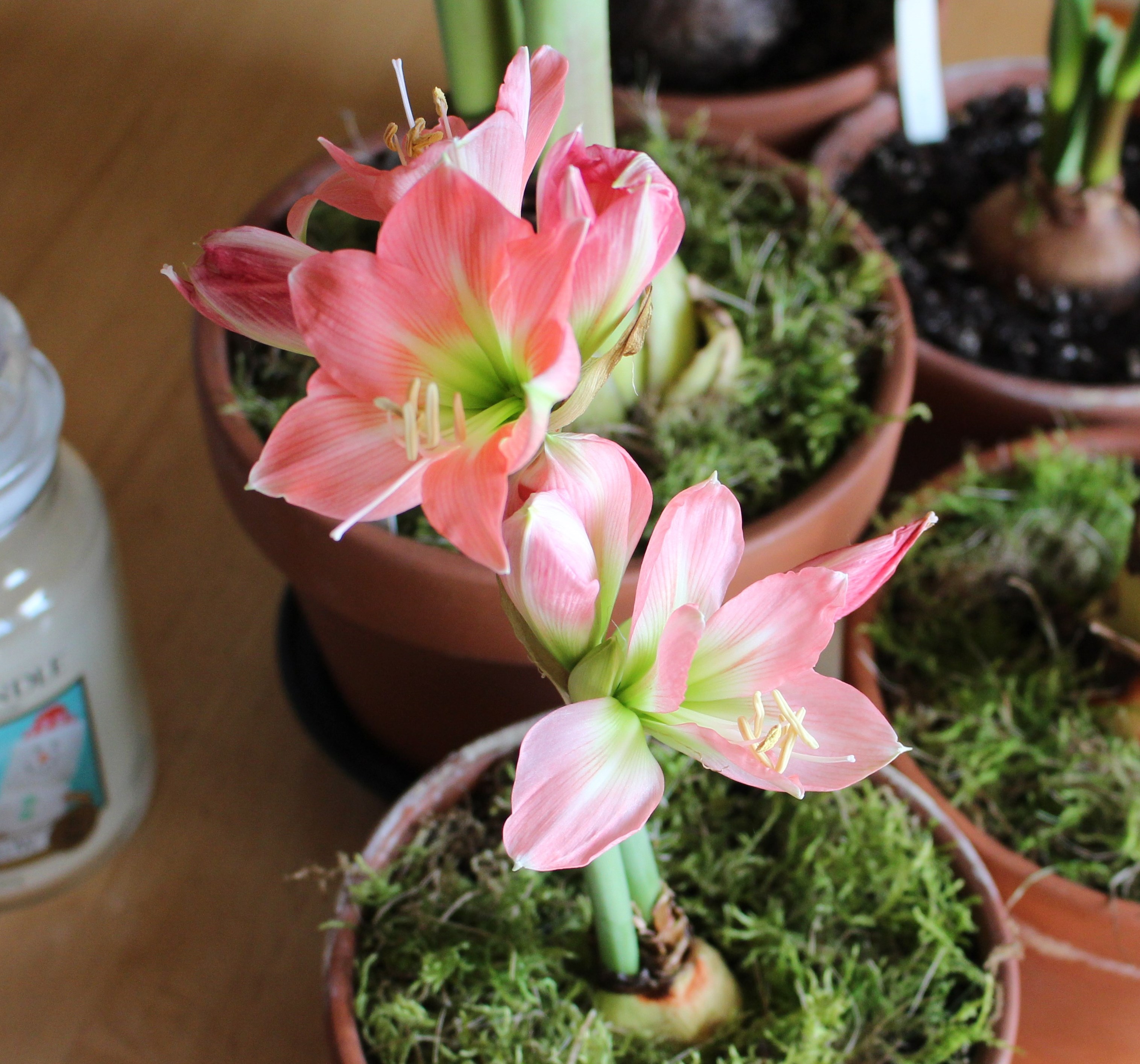
Leftover Easter flowers and a few too many amaryllis blooms.

I’ve been a little too excited about the new amaryllis I bought this winter and in my excitement ended up bringing the older bulbs out and giving them a little water too.  In a normal year I just throw the dormant bulbs outside in April and let them bloom right alongside the tulips, but this year I thought ‘the more the merrier’ and as a result I’m ending the winter with an amaryllis (Hippeastrum) extravaganza.  I’ve had these bulbs at least seven years now and if I remember to give them a little attention after flowering they reward me each spring with a fantastic color show.

red amaryllis

The bright red and pure white are perfect for Christmas… or I guess Easter 🙂

It sounds slightly ungrateful but of all the colors, Christmas red and snowy white are not what I’m normally looking for come springtime.  This of course was not what I was considering years ago when I picked the bulbs up for $1 a piece at some box-store clearance shelf… but please humor me as I shamelessly brag about how well they are doing now.  Each pot is already showing at least four bloom stalks a piece, and the plants themselves are on the verge of nearly overwhelming the dining room table, even with less than half the flower stalks open.  On the edge of the group you barely notice the last of the newbies, a delicate pink-flushed mini white named ‘Trentino’.

amaryllis trentino

Bigger may not necessarily be better as in the case of this ‘mini’ amaryllis ‘Trentino’.

Once it warms up outside (assuming it ever does) new and old amaryllis will all go out into a semi-shaded spot, get hooked up to the same drip irrigation system that waters the summer annuals, and will be ignored until November.  If I feel generous I’ll send some liquid fertilizer their way but for the most part they’re on their own.  If there’s a trick to it all I guess it’s that they sit in a gritty, peat-free soil mix which drains well, and they have a nice solid terracotta pot which breathes well and holds down their heavy tops.  Well drained, plenty of moisture, and a good feeding… mine enjoy that.

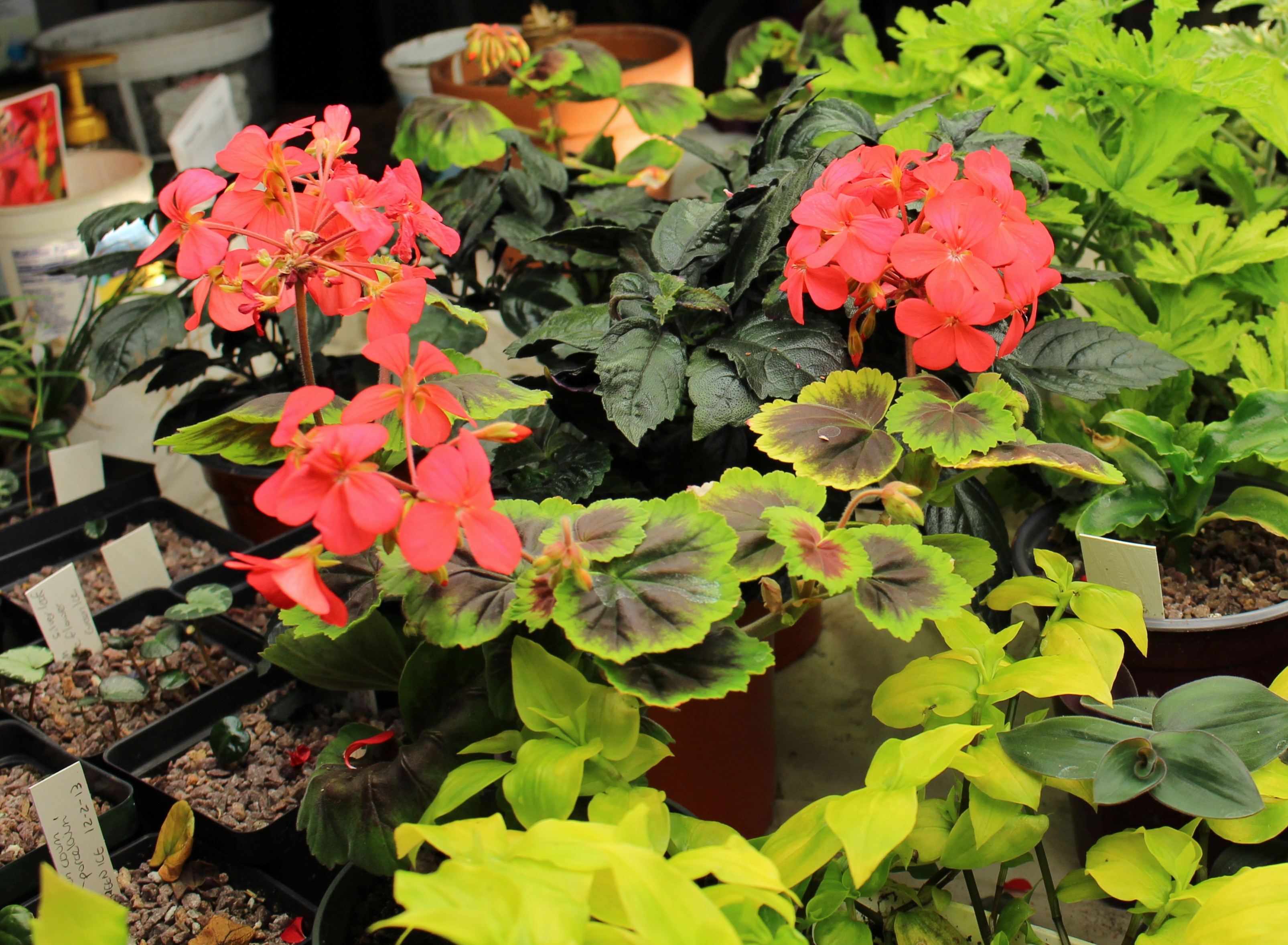
fancy leaf geranium

Geraniums blooming more than they should under the lights of the winter garden.  A better gardener would probably remove the flowers for the sake of stronger growth and a healthier spring transplant.

You may notice the attractive plastic sheeting which forms a subtle backdrop to the amaryllis photos.  The sheeting keeps the dust and debris of a kitchen remodel from drifting into the rest of the house, and also keeps us from enjoying the charms of a useable sink or stove.  If I try hiding indoors too long from the brutality of our latest arctic blast, eventually I need a new place to hide from the mayhem a kitchen run out of the living room…. so I escape to the garage and the winter garden.

scented geranium flower

The scented leaved geraniums (Pelargonium) are also blooming under the lights.  The flowers are a treat, but I love the lemony scents which come off the foliage each time I move a plant or water a neighbor.

For a while the winter garden was being ignored.  Spring was early and I was back outside enjoying snowdrops, then crocus, and then daffodils… but now winter is back and I’m pretending it didn’t all happen and I’m just doing the regular sowing and repotting of late winter.  Because I foolishly brought sprouting bulb seedlings in during a December freeze I’m now at the point where I can dig seedlings out and see what grew.  Here’s a mixed potful of one and two year old Allium Christophii bulblets which just recently went dormant.  I’m fascinated even though a less than polite reader might point out I could get a bagful of blooming sized bulbs for under $10 this fall.

allium christophii seedlings

A few Allium christophii seedlings all grown up into pea sized bulblets.  I’ll plant them outside next year and hopefully see flowers in another two or three years.  I’m sure at that point I’ll wonder where they came from, since I’ll definitely forget where I planted them!

I find it interesting that even though I sowed the seeds shallowly, most have migrated to the very bottom of their four inch pots.  Readers of Ian Young’s Bulb Log at the Scottish Rock Garden Club will already know this since Mr. Young has observed this repeatedly, but for me to see it myself is of course more fun.

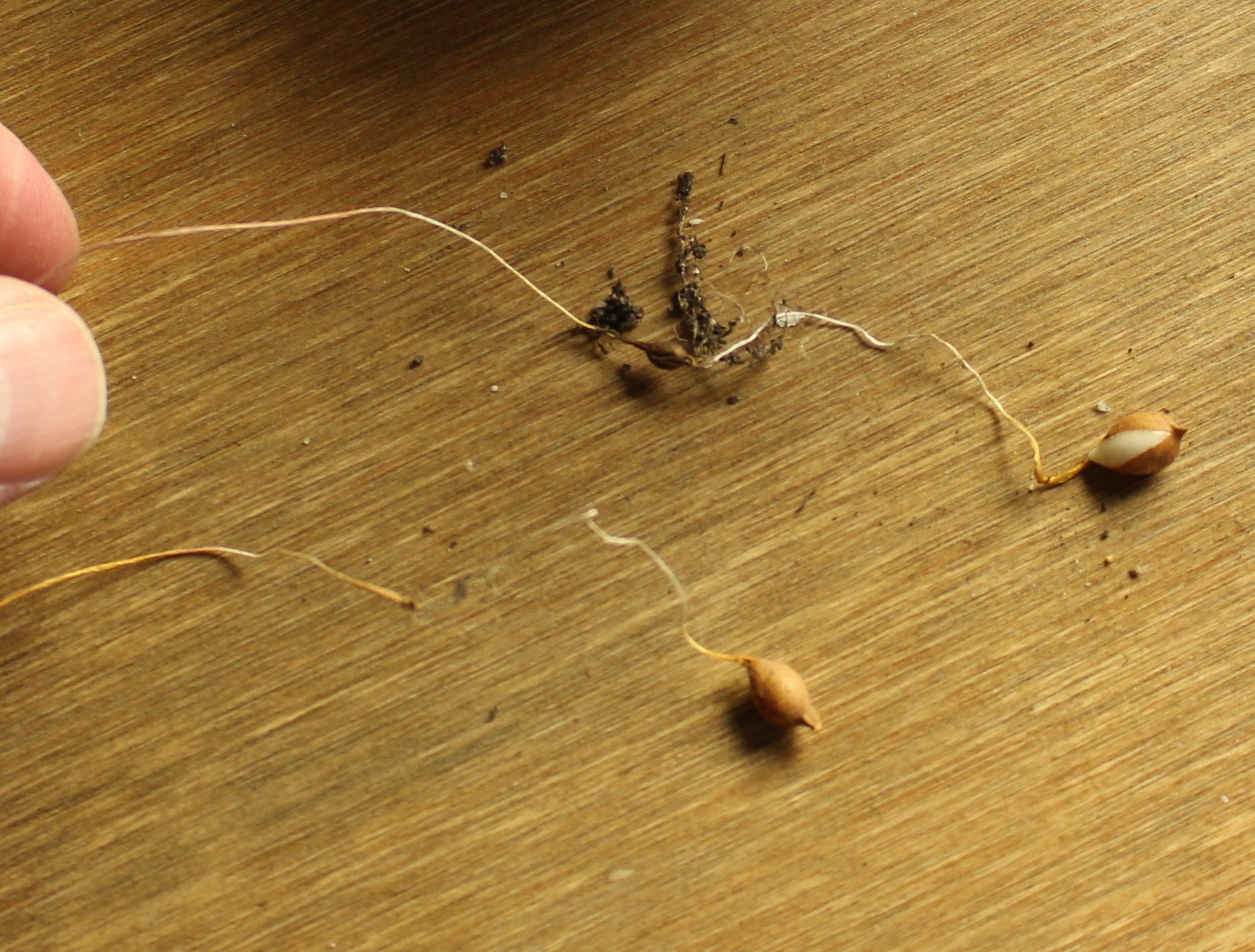
tulip from seed

Second year for a tulip seedling.  In the middle of the photo you can see the dried rice-sized husk of last year’s bulb, if you follow this year’s root to the right (which would have grown deeper into the pot) you will find the newly formed pea sized bulb from this season.  Maybe by next year we’ll be up to kidney bean size 🙂 

I was also happy to find one of my fall snowdrops has made a nice sized offset.  I would have thought the double shoot from the top would have split the bulb into two, but instead it has just sprouted a new bulb off to the side.  So I guess that means there will be three growing tips next fall!

galanthus monosticus

One of my special snowdrops, a fall blooming Galanthus elwessi monosticus which a friend picked up for me at Nancy Goodwin’s Montrose Gardens in Hillsborough North Carolina.

Not all my escape gardening happens in seclusion.  Occasionally I have a helper and this year that helper has been assisting in writing out some of the many plant labels which go along with all the odds and ends which get seeded out.  She may actually do a neater job than I do, and her talent for labeling in Latin is impressive.

dyi plant label

The cut up vinyl blinds which I use for plant labels.  Plain old lead pencil seems to last for decades and I’ve found a few still readable in the garden, one going back to ’91 for a dogwood seedling which I apparently smuggled out of Longwood Gardens in a pocket…

Also impressive is one of my newest treasures.  It’s a Cyclamen Rhodium seedling from my visit to John Lonsdale’s Edgewood Gardens, and it’s blooming in spite of having been dumped out of its pot not even three minutes after John handed it off to me.  He was very forgiving of my clumsiness, but I never did mention that I dumped it over again a second time as I got into my car.  Fortunately it survived, and although John suggested that I give this one a try outdoors in a sheltered spot (planted six or more inches deep once it goes dormant), I’m not sure if I’m brave enough to risk its health a third time.

cyclamen rhodium

A really cool Cyclamen rhodium from the Southern Peloponnese and island of Rhodes in Greece.  Nice flower but look at that speckled foliage! 

So that’s how things are going here in my own sheltered locations.  I have some promising tomato seedlings sprouting as well as eggplant and peppers, but it will be a few days before the damage outside becomes definite.  Already things such as roses, lilacs and daffodils look rough, but for as long as I can stay in denial I will.  Maybe the hyacinth will bloom so much stronger next year now that their blooms have all been frozen off.  A gardener can hope 🙂

Corydalis… The next big thing

How does such an awesome little spring blooming bulb (tuber if you want to get technical) fly under the radar for so long?  Apparently a couple in-the-know gardeners have been growing these cool little spring bloomers for years, but I for one didn’t even know they existed until a few years ago.  I believe I came across pictures via Ian Young’s bulb log (if you’ve never been, click here immediately to visit -it’s practically required reading for any bulb lovers out there) , and the impression was one which ate away at me until one fall I was finally able to get my dirty fingers on a few.  Of course as my luck would have it these were promptly killed, but the following year a more determined try proved successful, and the next spring I was just as pleased as I thought I’d be when they bloomed.

corydalis George baker

One of the boldest reds, Corydalis “George Baker” blooms right alongside the blues of chiondoxa and Scilla siberica.

The Corydalis family is a large one with many highly collectible family members, but for me it’s the variations on Corydalis solida which excite me the most right now.  This species ranges across Northern Europe into Asia and for the most part greyish mauves and blues dominate the color spectrum, but starting in the 1970’s and 80’s rich reds and purples began to find their way out of the woods and into the hands of collectors and growers.  The Penza strain from Russia and the Prasil strain from Romania are the some of the best known groups for bold colors and many of the newest named varieties come from these collections.

corydalis solida

A more common color of Corydalis solida, a smaller and slightly later flowering plant than the other Corydalis I grow.

As it is with many plants, once you get excited about one you get greedy and need more, so in addition to the “George Baker” and “Beth Evans” which were purchased from Brent and Becky’s bulbs, and the straight Corydalis solida from Van Engelen, I needed to add more.  The blame for this shouldn’t lie entirely on my own shoulders though, since by now I had seen even more Corydalis glamour shots including the most enticing group shot which I found at Carolyn’s Shade Garden.  Her tapestry of rich purple with pinks and reds would have to be imitated in my own garden and to that end I found Russell Stafford’s Odyssey bulbs.

corydalis rosula

The warm wine red of Corydalis ‘Rosula’, complemented by a nice underplanting of random weeds 😉

The new plantings from Odyssey were a mix of successes and failures and based on the excellent condition of the tubers, I’m going to guess the fault again lies with me.  Even as recently as this spring one of the clumps failed to even show, and I suppose there’s something else going on which I don’t entirely understand… but ignorance is bliss, and I enjoy the remaining two cultivars more than ever now…  even though the addition of a pure white or pink would have made the planting even more perfect!

IMG_0376

A more common color but on a sturdier plant, Corydalis ‘Harkov’ scared me by nearly dying last spring after I optimistically dug it up for dividing. It wasn’t ready and it wasn’t pleased, and promptly dried up and went dormant.

I suppose I should try and make this a more useful post by mentioning something other than the many ways in which I’ve killed these plants.  They’re actually fairly carefree in the right woodland conditions, and although I should suggest a fertile, moist shaded site, mine grow quite happily in sites I would consider downright dry, and in locations shaded only by the overhanging perennials and annuals of the front street border.  I guess they don’t know any better.

Another thing I should mention is they bloom early and fade away quickly.  Plant them in a spot where other goodies such as hostas and hellebores or rudbeckias and buddleia fill in for the summer.  My best patch disappears under a carpet of aquilegia (columbine) and ‘Blue Cadet’ hosta two weeks after blooming, and you wouldn’t even know it was there in June, which is good, but you should definitely try to avoid forgetting they’re there and running a shovel through while digging.

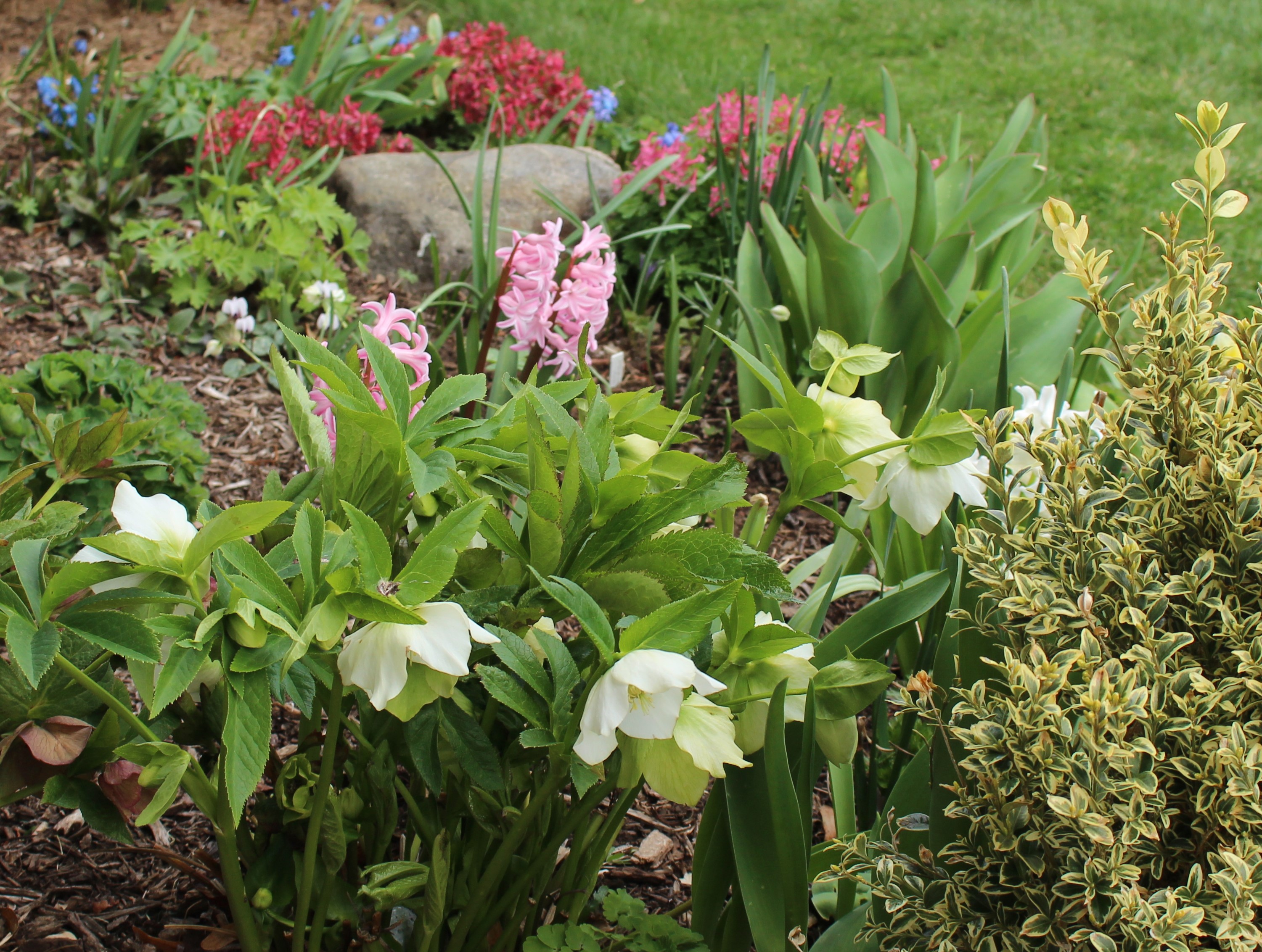
corydalis and hellebores

Corydalis, hyacinths and hellebores filling in now that the snowdrops and eranthis have gone over.  In another month columbine, delphinium, hostas and hellebore foliage will take over for the summer.    

A final note is that for the first year or two in my garden I was convinced they couldn’t possibly be making seeds since they yellowed and died down so quickly after blooming.  I’ve since found out I’m wrong.  Seedlings are spreading quickly and this year I have a few of the first starting to put out their own blooms.  I’m thrilled that they are as red as the parents, and even happier there’s some variety to them as well.

corydalis solida seedlings

Some of the first Corydalis solida seedlings to make it to blooming size. One’s nearly as red as the mother clump of ‘George Baker’, the other’s a completely different dusky mauve.

So now the question is should I just enjoy what I have or should I keep trying to expand the flock?  If I could only remember where I planted them (I think I may have finally spotted one or two this afternoon) I would be able to enjoy a few new ‘Purple Bird’ flowers this spring, but is that enough?  It should be, but history shows little attention to common sense in this garden and I’m already well on my way to picking out just a few more indispensables.  You really shouldn’t show too much restraint in spring, it goes completely against the spirit of the season and even when ordering bulbs for fall planting it’s still a celebration of the end of winter!

Snowdropping 2016

*ok so I’m trying to get back onto the blogging ball.  With a schedule finally cleared up I have a bunch of catching up to do here as well as on other blogs… so flashback to something I began writing about two weeks ago!*

Spring doesn’t normally roll around to this end of Pennsylvania until the end of March,  but this year on the tail end of El Nino it looks as if winter has just thrown in the towel and let spring walk right in a few weeks early.  “Sit down and stay a while” I say, and although I should speak glowingly about my own spring treasures in bloom right now, my first panicked thought was I might miss the snowdrop season down south.  I promptly sent out a few emails, jumped in a car and met up with my friend Paula at a park near her home for our second annual Philly snowdrop adventure.

naturalized snowdrops united states

Snowdrops naturalized on the grounds of a former Philadelphia estate.

Last year our snowdrop adventure was a response to the miserably long winter, this year it was a desperate attempt to catch the season before it flashed by.  We made the trip on March 8th and even though we were nearly a month earlier than last year many of the earlier bloomers were already past.

leucojum vernus yellow

A nice yellow tipped spring snowflake (Leucojum vernum) blooming amidst the rubble.

In spite of the advanced season we did manage to catch plenty of snowdrops still in bloom, and it was fun wandering from patch to patch searching for those little “specials”.  Maybe someday after a hundred years of abandonment and years of gentle woodland protection my own garden will produce something different but for now I’ll have to rely on these hidden treasures.

naturalized snowdrops galanthus nivalis

We saw plenty of patches of four petalled snowdrops, but also a wonderful range of larger and smaller, thinner, longer, taller…. all the tiny variations on white and green which may make some gardeners yawn, but which make me smile.

But there was only so much time we could spend sweating our way through the underbrush.  We had bigger fish to fry this morning and for us it was a visit to John Lonsdale’s Edgewood Gardens.  John grows and sells (but more just grows and grows) about a billion plants in his suburban landscape and the plantings range from high desert cactus to mountain to woodland to everything in between.  I was lost on much of it but I’m going to try my best and show a few favorites even if the names are lacking.  If you are more cat-like and on the verge of death due to some unsatisfied identity curiosity then I would absolutely suggest contacting John directly via his website.  He will surely have an ID for you, as well as cultural conditions, related cultivars, the exact source of his plant…. and to top it all off he probably grew it himself from wild collected seed!

iris and hardy cactus

A beautiful species iris right alongside hardy cacti.  Did I mention the cactus?  There were beds planted full of them as well as agaves and yucca, all surviving the Pennsylvania snow and ice without any additional winter protection.

I need to just move on here.  I love growing bulbs and there were more here than I’ve ever even considered so here are just the highlights of our visit.  Keep in mind the calendar is still saying winter for a few more weeks and the real show is still at least two months off!

eranthis guinea gold

Winter aconite (Eranthis species)  galore in the Lonsdale garden.  We missed the peak for many of the Eranthis hyemalis types but these crosses with Eranthis cilicica (similar to the ‘Guinea Gold’ cross) were just opening…. don’t let the label throw you off, that’s for something else yet to come right in front of this patch of gold.

At nearly 80F (26C) and sunny even a few of the first primula were opening.

pale yellow hardy primula

The winter may have been short, but even here a sudden drop to around 0F (-17C) did its damage to winter foliage and early sprouts.  Still bright and beautiful though, and its location on what looked to be a dry shaded slope has me rethinking how tough primroses can be.

Hellebores were everywhere.

speckled hellebore

Just a plain old hellebore which caught my eye.  a little winter damage but I love the speckling.

John said he was in the process of working through the hellebores, getting rid of many older and self seeded plants, and ‘upgrading’ some of the hybrids… and I wish him luck.  There were hundreds, if not thousands, and it would take a more critical eye than mine to thin the herd.

hellebore anna's red

One of the newer, cross-species hellebore cultivars.  I forgot what it was, but maybe it’s ‘Anna’s Red’?

Plenty of hellebore species as well.  All over the garden were bits and shoots coming up from seed collected throughout the hellebore world.

green hellebore

A cool green species hellebore.  Green may not be the showiest flower color but they sure look great close up.

hellebore tibetanus

Hailing from China is Helleborus thibetanus. This plant was only just brought into cultivation in the 1990’s and if you can believe it John says this plant plant produced only one flower last year. What a difference a single year can make!

Trilliums were also everywhere.  John kept naming species, naming ranges and ecotypes, naming seed sources, describing how many were yet to come…. it was all a little overwhelming.  I think to return in May and see patches and patches of trilliums blooming across the hillside would be quite the sight.

trillium foliage

One of the earliest trilliums already up.  The foliage is just amazing and there were hundreds more sprouting or just waiting to burst out of the ground.

There were tons of early trout lilies (Erythronium) coming up as well.  More cool foliage, exquisite flowers 🙂

trout lilies erythronium

Just a few of the earliest of the trout lilies coming up.  I love the fine markings on these and the fancy purple pollen just as much as the silvery speckling on the leaves.

I’ve never seen blooming Hepatica (liverwort) in person but recognized the little jewels the minute I saw them.  Maybe this will finally be the spring I venture out into the woods and find a few blooms of my own in the wild.  I’ll be excited to find anything, but suspect they won’t hold a candle to some of the selections and hybrids which we saw springing up out of the leafmould.

red hepatica

What color on such a tiny bloom.

violet hepatica

The detail on these flowers is amazing in all its intricate perfection.

It was also well into Adonis season.  Several cultivars were spotted throughout the beds and each one seemed better than the last and we hit them perfectly with their flowers open wide in the warm winter sun.  The saturated colors were almost too bright for an early March afternoon.

double yellow adonis

Double yellow Adonis Amurensis

I’ve heard that this native of NE Asia isn’t all that hard to grow it’s just a little slow to start and a little pricey to get a hold of.  Spring sun and a sheltered woodland location for the summer seem to work well for it, just know that the ferny foliage dies back and the plant disappears once the weather warms for summer.

orange adonis cultivar

An orange Adonis cultivar with a nice bunch of hardy cyclamen leaves.  Cyclamen were nearly everywhere, I began to not notice them unless I had to step over a particularly nice one seeded into the path 🙂

fringed orange adonis

Dark ferny foliage, a fringed pale orange flower…. what’s not to like about this Adonis?

We spent way too much time at John’s but it wasn’t until we checked our watches that we realized how much we had actually imposed on his day!  The poor guy had just finished up about ten days of on the road and had been through more states in a week than I hit in a year and here we were not even giving him enough time to enjoy his first day back.  So we tried to get a move on it, thanked him again for his hospitality and time, and then rushed through the last hordes of snowdrops, cyclamen, and cacti between us and the exit… did I mention the cacti?  I could easily fill a second visit with just the cacti (not that I’m really hinting).

Off to Paula’s!

snowdrops galanthus in garden beds

Snowdrops (Galanthus nivalis mostly) scattered throughout the garden beds.

Paula has really put in some work into collecting and dividing and spreading snowdrops throughout her garden, and it’s really an inspiration to see the possibilities of what a few years hard work can produce.  It makes me wonder when and if my own garden will ever start to show a similar effect of late winter interest.  There were goodies everywhere and of course it was the snowdrops which I really honed in on.

galanthus elwesii

Nice established clumps of Galanthus elwesii (the ‘giant snowdrop’) with it’s bigger blooms and grayer foliage.

Paula really has a great winter garden going with snowdrops galore and plenty of color from the earliest bloomers.  It’s here where we wound down from our latest snowdrop adventure.

double snowdrops galanthus and hellebores

Double snowdrops (Galanthus ‘flore pleno’) and hellebores fill in a shaded slope.

There were hellebores, winter aconite, snowdrops, snowflakes, witch hazels, crocus, all kinds of flowers coming out to brave the last few weeks of winter.

raspberry veined hellebore

A real nice raspberry veined hellebore.  I really need to do a little ‘upgrading’ of my own!

Of course we got bogged down in examining every tiniest bloom and discussed every growing nuance.  That’s what makes these garden visits so special.

galanthus gloria

Galanthus ‘Gloria’, a perfect flower with such long inners with just the smallest touch of white.  I really like these ‘pocs’ where the inner petals nearly match the long white outers.

By this point my winter knees were starting to complain about all the kneeling and bending which I’d been putting them through all day.  Maybe I should have started getting back into gardening shape a few weeks earlier, but in spite of the little aches and slower pace we carried on for a few more closeups.

galanthus doncasters double charmer

You almost wouldn’t guess this were a snowdrop, but it’s Galanthus ‘doncasters double charmer’ in all its crazy, spiky, greenness.

And a final snowdrop….

galanthus big boy

Galanthus ‘big boy’, just coming up and already big even before it expands to its full size.  The green tips are a nice touch and I think I like it!

And then the day was over.  Time to hop in the car and head back North.

orange witch hazel jelena

An orange witch hazel (Hamamelis ‘Jelena’ ) in full bloom as the day ends.

A special thanks to John Lonsdale for a great visit, and thanks of course to Paula for putting up with me for the whole day.  It wouldn’t have been half as much fun without her, and when we were pulled over and asking a stranger if they’d mind us traipsing around in their side yard looking at the snowdrops I knew I had the right travel buddy.  Until next year!

Cold? I barely noticed.

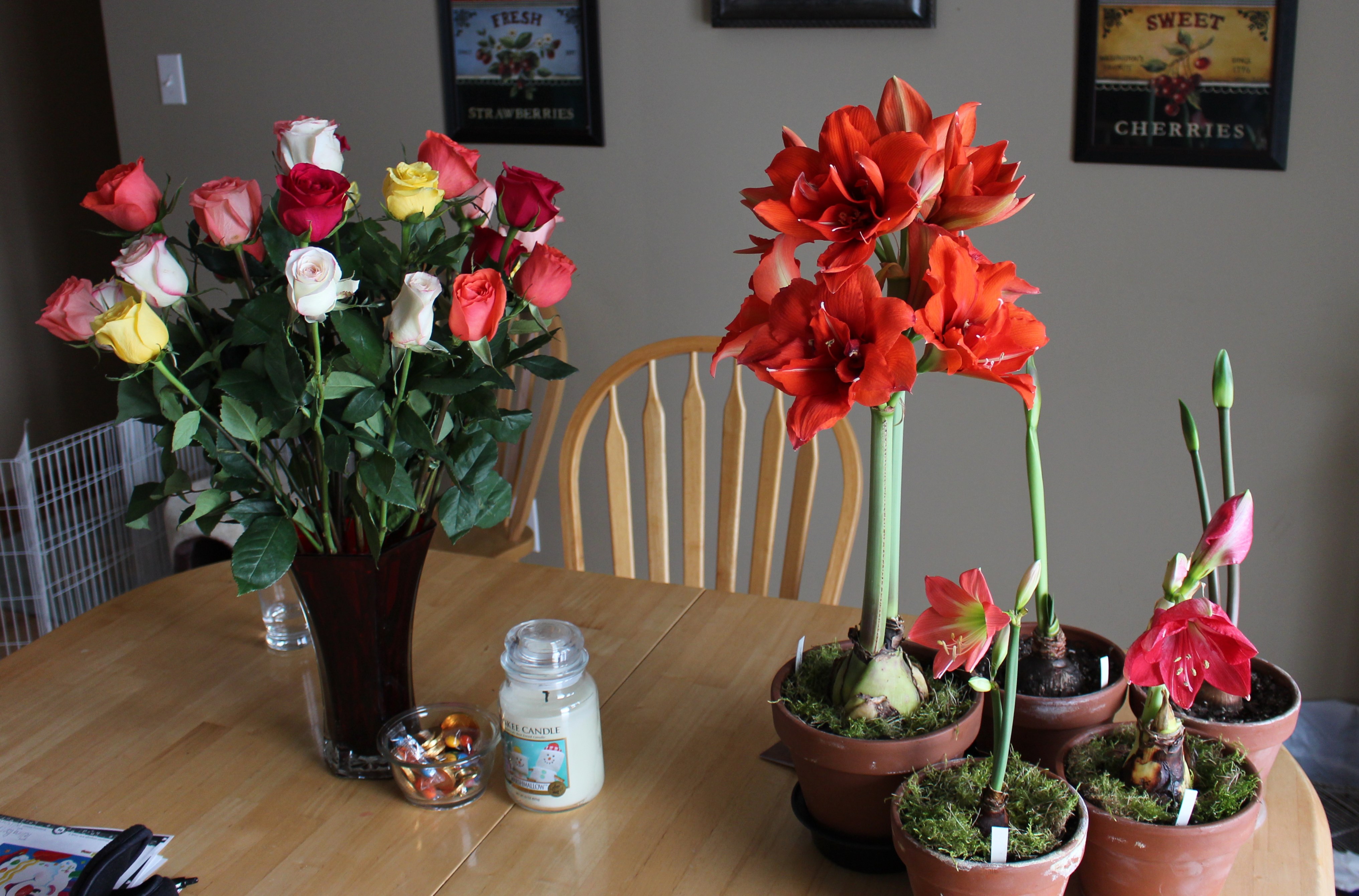
The new amaryllis are coming into bloom and between them and mommy’s valentine’s day roses  things are looking very festive around here.  I don’t mind one bit but it’s surprising to me that the dirty flower pots at the end of the table are being tolerated as well as they are.  Usually non-edible growing things are frowned upon in the dining area.

double amaryllis red peacock

The girl picked out some nice roses this year and although red is always a valentine’s day favorite, I and hopefully others love this blend of colors even more.  The timing on the double red amaryllis also couldn’t be better, I believe it’s ‘red peacock’.

During a weak moment this winter I came across a clearance sale for amaryllis (hippeastrum) and decided to treat myself.  Treating yourself is always a good idea in December and soon enough a few new amaryllis were sitting at my door.  Since I was already buying cheap bulbs of a flower which I really don’t need, I decided to try something new and picked a few doubles and miniatures.  So far so good!

Belladonna mini amaryllis

A miniature amaryllis ‘Belladonna’.  Even more mini due to the lack of roots and long storage before planting, but still putting on a nice show.  I impressed myself by pulling some moss out of the lawn and tucking it in around the bulbs for that little bit finished look 🙂

All the amaryllis were planted in nice new terracotta pots which I’m ashamed to say required more time and effort to find than any of the actual bulbs.  Apparently clay pots are not filling the shelves during the holiday shopping season…. or at least not filling the shelves at the first three places I tried… but persistence paid off.  Hopefully the bulbs will appreciate my struggle.

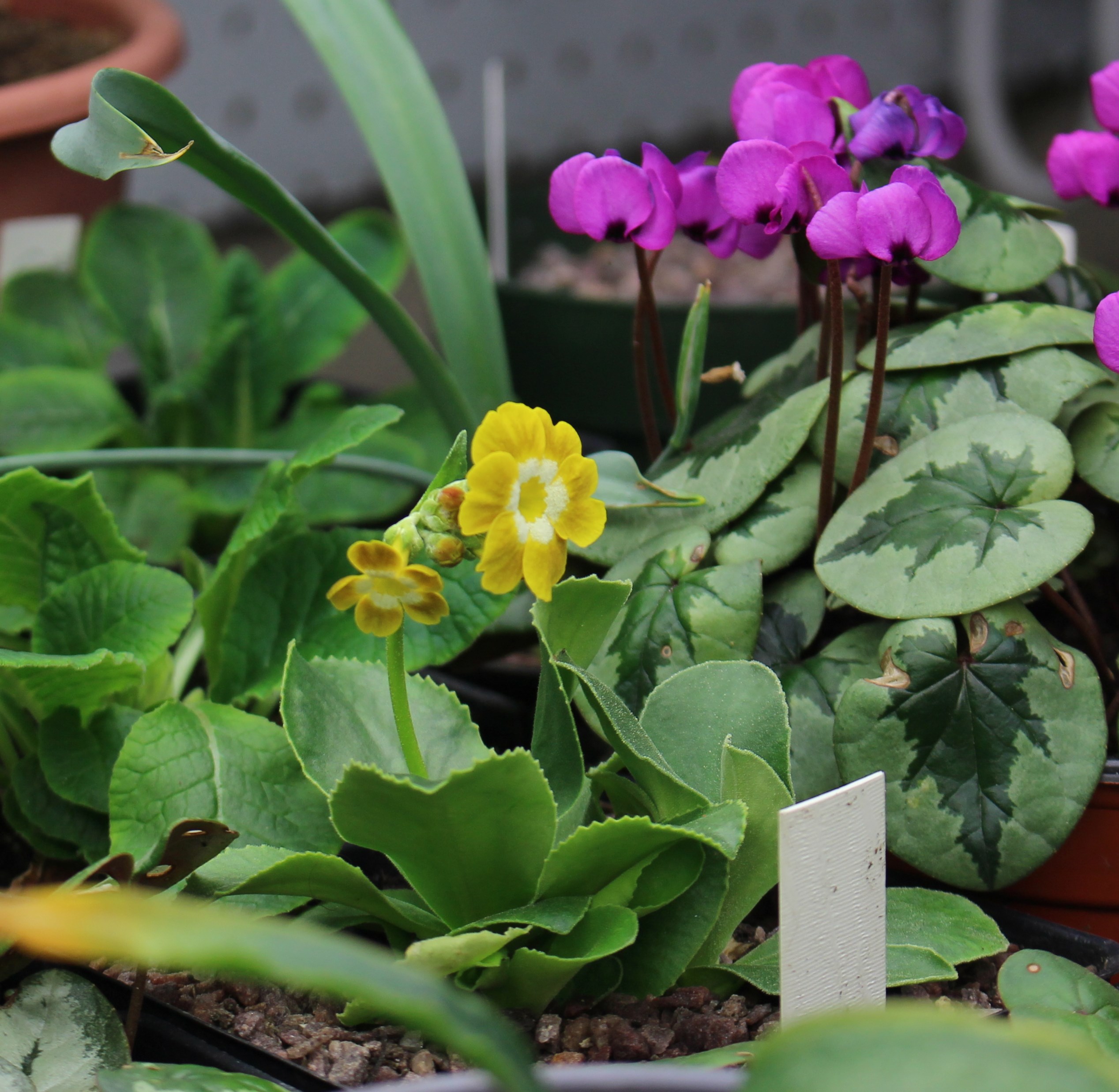
As the bulbs settle in and sprout there are more things coming into bloom in the garage.  I’m especially pleased to announce the opening of my little auricula primrose.  The color is a mustardy yellow which although very ‘refined’, wouldn’t be my first choice for a show stopping color.  I love it though and am looking forward to seeing a few more blooms opening over the next few days… and hopefully having the flower stem straighten out to get rid of some of the ‘nod’ it has!

auricula under grow lights

My lovely little auricula growing under lights.  I can’t seem to do a decent job photographing yellow, but hopefully you can still make out the mealy white center which makes these flowers so distinctive.

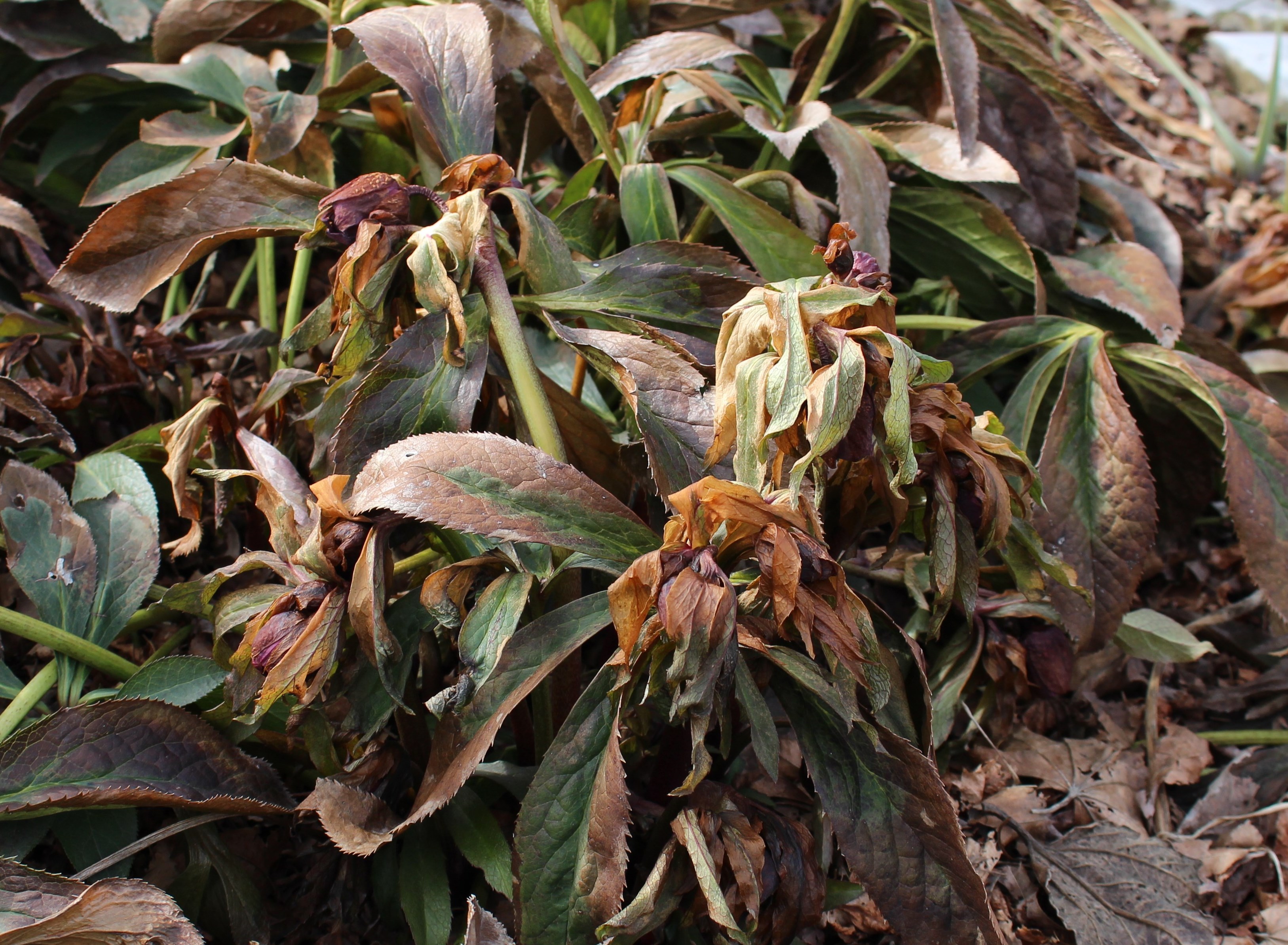
Outside is a different story, and it’s a mix of hope and optimism as well as worry.  We had enough warmth earlier in the winter to bring on a bunch of stuff way ahead of schedule, and some of those things paid a price for their eagerness when the bottom fell out of the thermometer.  The hellebores in particular are looking sad.

freeze damage hellebore

I don’t know if this hellebore will recover to bloom this year.  It won’t die, but the freeze damage doesn’t look good.

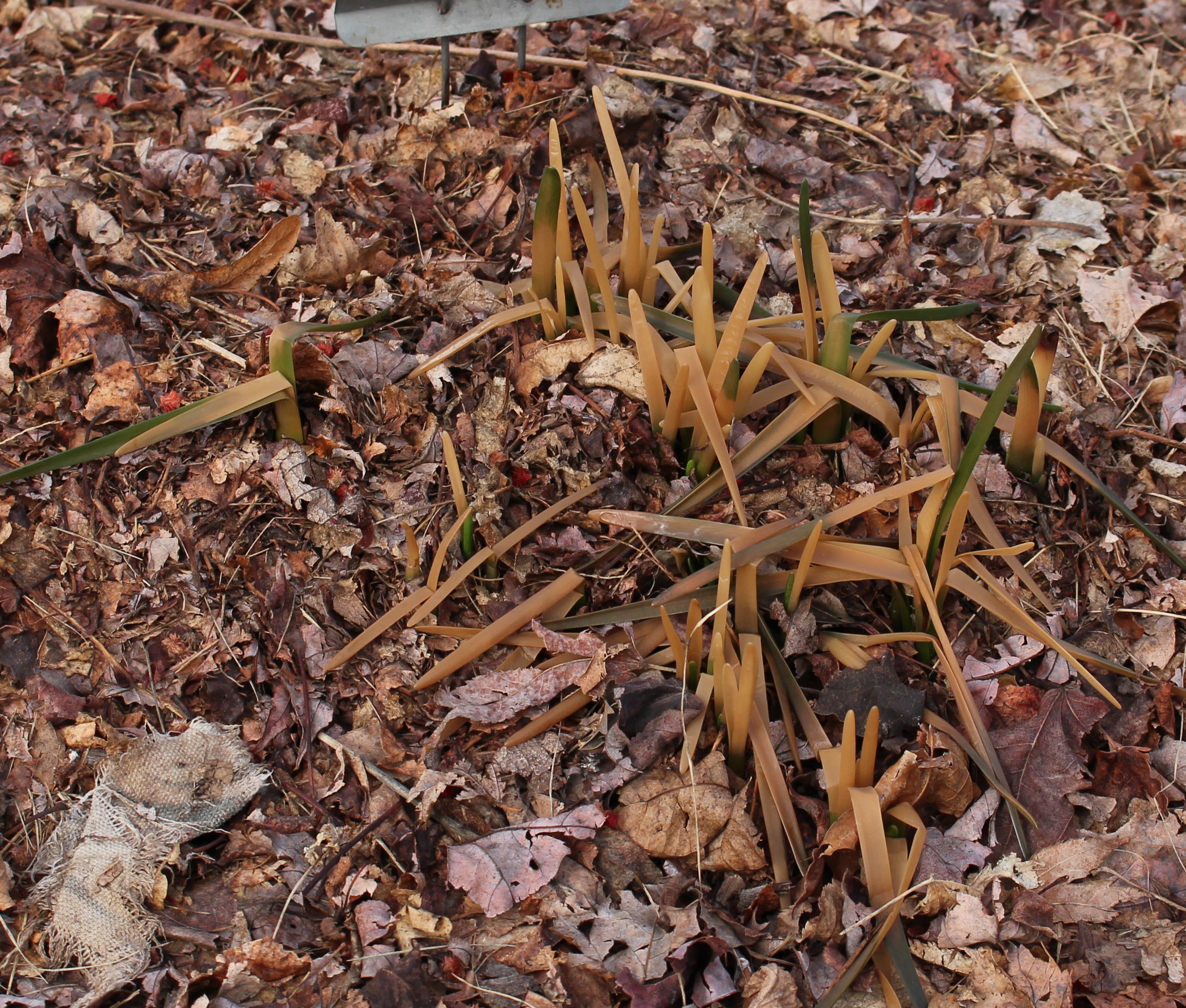
Also sad are a few of the daffodils.  Early risers such as anything with tazetta or jonquil blood (two of the many daffodil species crossed for the hybrids we have today) were mushed back to the ground.  Some will die, but most will carry on and just have browned tips to their leaves when the blooms come up.

freeze damaged daffodils

Freeze damage on early daffodil foliage.  In spite of the way they look I think they’ll be ok.  The buds and more leaf will continue to sprout once things warm again.

The bad news is that after a few spring-like days we and the rest of the East coast are having some of the coldest nights of the winter.  I would feel much better if a nice blanket of snow covered up last weekend’s early bloomers but just a dusting of snow accompanied the cold snap.  For now ignorance is bliss and I’ll again enjoy last week’s signs of spring as we slowly warm up from a blustery low of -8F (-22C) last weekend.

wendys gold Gerald parker galanthus

‘Wendy’s Gold’ and ‘Gerard Parker’ in bloom last week.  I loved the early glimpse of spring, but this week had to scrape traces of snow off the lawn in order to pile it over them for a little extra cold protection.

I should know later this week if there is any damage to my snowdrop treasures.  I remain optimistic, but sadly enough in years past I have had it that drops have died from a late season arctic blast, and these bloom are far along, and this cold snap is severe.  But what can you do?  Wendy and Gerard got a box over them but I’m not ready to go all over the yard covering things for each cold snap.  These bulbs will have to show their true colors.

galanthus magnet snowdrop

Galanthus ‘magnet’.  This one’s on his own so I’ve got my fingers crossed for these next few days.  If worse comes to worse I’ll be able to try ‘magnet’ again from a different source, since I’m not positive this one’s correctly labeled.

Wish my bulbs luck.  If they do survive I will never underestimate the hardiness of some of these earliest bloomers.

winter aconite

Last week’s show of the aptly named winter aconite (Eranthis hyemalis).  I love this pale version of the usual bright yellow.

As a backup plan I’ll start a few more seeds this week.  Empty ground is always a good reason for new plants, and if worse comes to worse there are always annuals 🙂

The garden of memory

I used to be a balcony gardener.  After a stint in Texas my next job took me back to the Northeast, and rather than commit to a house I opted for an apartment.  My choices were narrowed down to a roomy bachelor pad with an excellent nighttime view of the city lights or a smaller two bedroom apartment in a quiet residential area.  I chose the quiet life.  My choice was partly because it was half the rent, but mostly because of the small balcony which came off the kitchen and overlooked the side yard.  I knew I needed a spot in the sun but just wasn’t ready to buy and didn’t want the responsibility of taking care of someone else’s yard again.  Who would have thought my stay would last over three years, and who would have suspected I could fit so much more than just the grill and a few chairs.

balcony garden

Does a gardener live here?

By the third summer things were completely out of hand.  I tend to like fast growers and big leaves and none of those are a logical fit with a small balcony… but what the heck, I usually just grow things because I can and not for any well thought out plan or agenda.  A rooted cutting turns into a butterfly bush, a trip down south adds a banana, a clearance sale brings in a staghorn sumac.  Things add up quickly, but mercifully winter would usually wipe the slate clean.  Plants have a hard time overwintering on an exposed, second floor balcony.

pink caladium tropical plants

These caladiums went out for the summer and came in for the winter for three years straight without a problem.  Nine years since moving and I’ve killed more than I care to admit.

If there was any secret to how my garden grows it was the drip irrigation which snaked out from the laundry, slipped between sashes of the window, and clicked on every 8 hours and saved me from the boredom of daily watering.   With the automated watering my plants were also saved from the almost certain neglected death due to a weekend away at the shore, a week traveling for work, or that gardener’s nightmare of a two week midsummer vacation.  No returning home to fried and dead plants for me!

Strangely enough my landlord never questioned the green tsunami which overwhelmed my small balcony, and we all ended up becoming good friends.  Coincidence that he and his wife ran a landscaping business?  Who knows.

tropical container plants

One chair. I guess this did turn into my bachelor pad after all, and with just enough room for a seat this became my preferred spot for a summer book and a icy cold beverage.  There’s a grill in there as well, I guess it goes without saying that for a couple months each year it was out of service.

Eventually it became time to move on and the balcony garden was traded in for the next adventure.  There’s an actual yard involved in this one but as usual delusions of grandeur made for a bumpy road.  Live and learn I guess 🙂

Hope your winter is going well.  It’s set to get warmer again this weekend and with snow melting almost as fast as it came my spring fever will be worse than ever.  I’ve been sowing seeds again and a sensible person would have stopped this nonsense a few dozen packets ago.

The Winter Garden 2016

An actual greenhouse would be awesome.  To spend the winter nights out in the humid warmth… or even sweater-cool, as long as you can smell that healthy dampness of growing plants, would be a fantastic break from the dry static of central heating.  Since that’s not going to happen anytime soon I’ve got to make do somehow and to that end I have my little winter garden.  It’s two shop lights hung over a table in the small workshop behind the garage.  That’s the reality, but the magic is much more, and of course as with everything else I try to do there’s a story involved.

galanthus in containers

The first of the Cyclamen coum (a nice seedling flowering for the first time), a snowdrop dug from the garden (Galanthus elwesii), and the frilled leaves of a scented geranium are filling the space beneath the lights this year.

Santa brought the kids electric scooters this year, and that has nothing to do with winter gardens but they needed a spot cleared in the garage near an outlet for charging.  Space is tight in the garage so obviously I needed to clean the attached furnace room first.  A day later the furnace room was cleaned and I had room in there for a few bikes, but the cannas and dahlia roots in the furnace room needed a cooler spot.  They had to go into the workshop which had now become remarkably full and as a result also needed tidying up.  A day later with the workshop cleaned and the bulbs stashed away I made the observation that the workbench was really unacceptable as far as winter gardens go.  A few years before we bought this house a pipe burst in the workshop, all was soaked, and the pressboard workbench soaked, sagged, and warped.  It was time to replace the top so off to the DIY store for lumber and hardware.  A day later and the old top was off and a new one had been crafted, more than doubling the tabletop and practically calling for another light to be added, so of course another light was added.

potted amaryllis

Merry Christmas to me.  A ridiculous clearance sale on amaryllis bulbs left me with eight new ones and the repaired workbench is the perfect place to pot them up.  Don’t even ask me how hard it is to find terracotta pots during the holiday season….

So one more day for the stain and polyurethane to dry and then finally I was able to bring in a few things for under the lights.  Just in time since the Cyclamen coum were beginning to flower and I was tired of dragging them in and out of the garage with every frigid weather forecast.

growing bulbs under lights

Twice the growing space of years past and already nearly full.  Overwintering cuttings share space with cyclamen and various too-special-to-be-outside seedlings under the growlights.

I should have tackled this job on a pleasant summer weekend, but at that time the lawnchair was so much more inviting.  Had I been ready to go at the start of the season (or had I built that coldframe I wanted) then maybe these seedling pots of tulips and allium wouldn’t have started to sprout in the garage, and maybe I wouldn’t be the only person in NE Pennsylvania growing species tulips indoors under growlights in January….

bulbs from seed

Hellebore and cyclamen seedlings growing in the winter garden.  The small wisps in the other pots are tulips, allium, and a single fritillaria  seedling.  The economics of spending years nursing along seedlings which are available cheaply (100 blooming sized bulbs for $14 last time I checked) is something else we shouldn’t look at too closely.

To wrap up my ‘How I spent my Christmas vacation’ essay I’ll just add that on the last day I moved an air compressor and rabbit hutch onto a shelf and was able to plug in the scooters.  Don’t ask me how I didn’t see that a week earlier.

pale moonlight eranthis

After two rainy days of 55F (13C) weather the soil has thawed and the first winter aconites have broken the surface. I think they’re perfect and they should be fine even if winter does decide to come this year.

Now I’m all set.  Even though I spotted the first winter aconite (Eranthis hyemalis) breaking out of the earth this weekend I think winter will still make an attempt at cold before the robins can come home.  Today in between rain showers I put up the bird feeder, braced the pole against tipping out of the mucky quagmire of lawn it sits in, and drug a flat of primula seedlings into the workshop.  Now when the cold hits, repotting a flat of young primrose should be just the diversion for a dark winter evening.

Goodnight Cyclamen

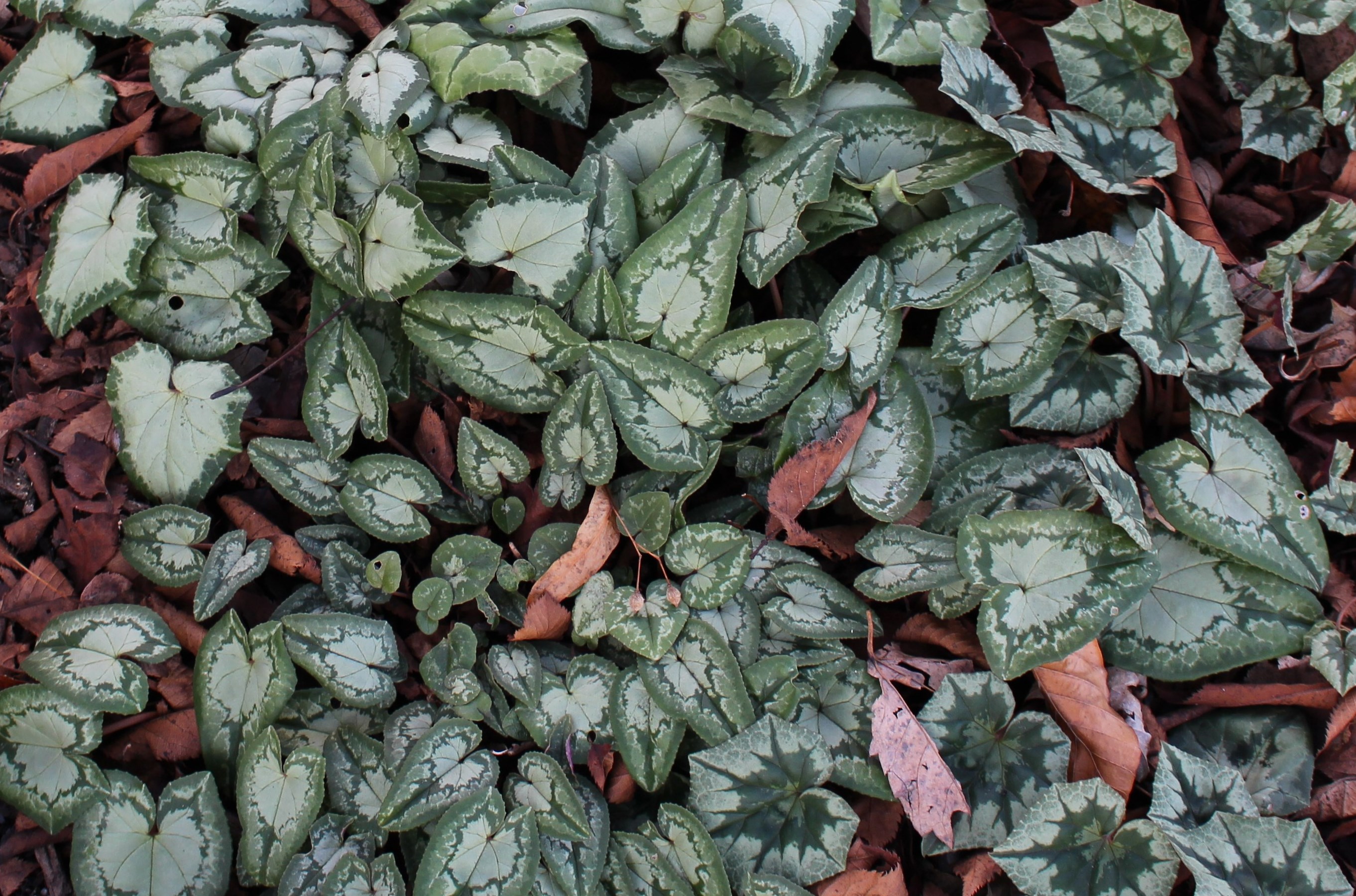
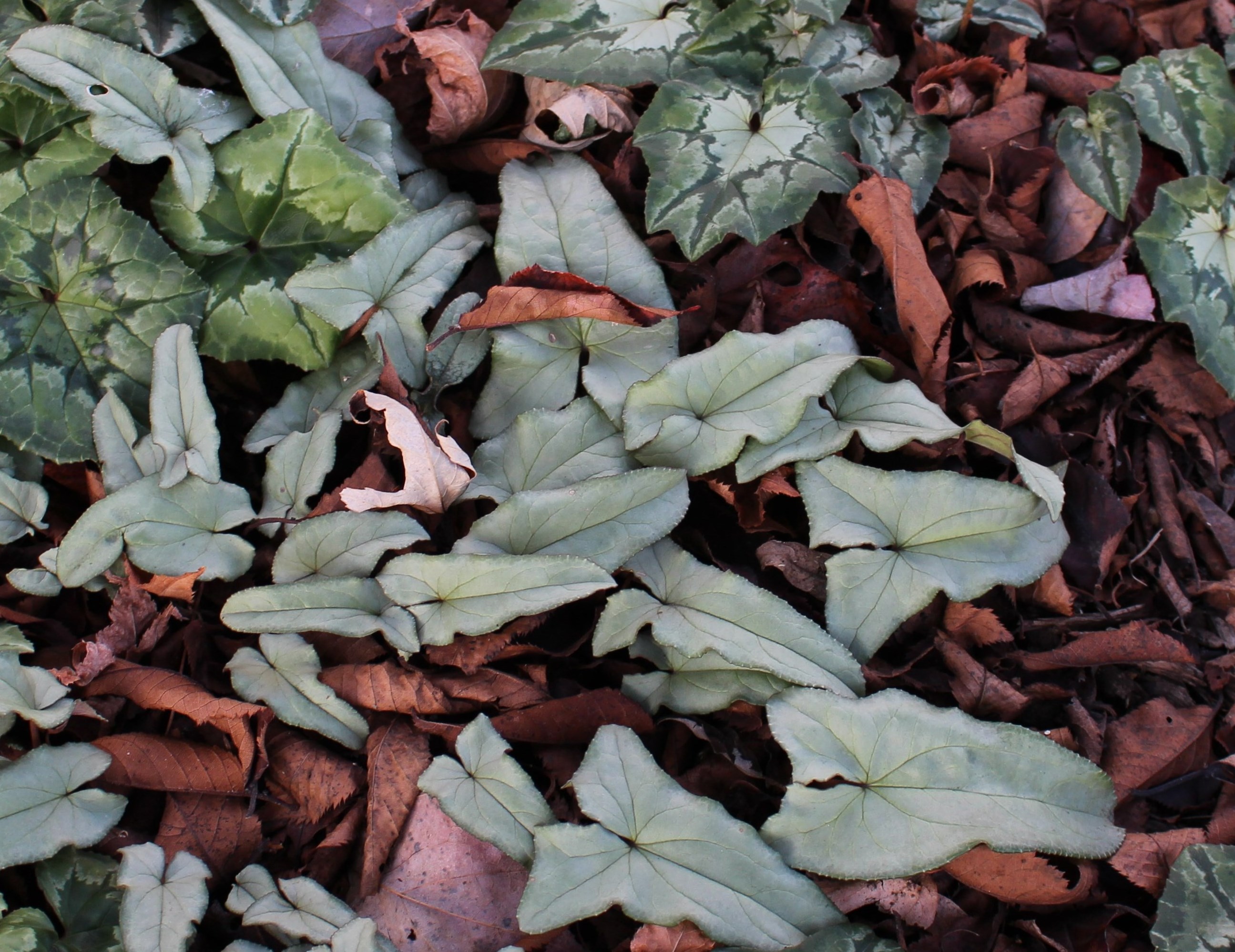
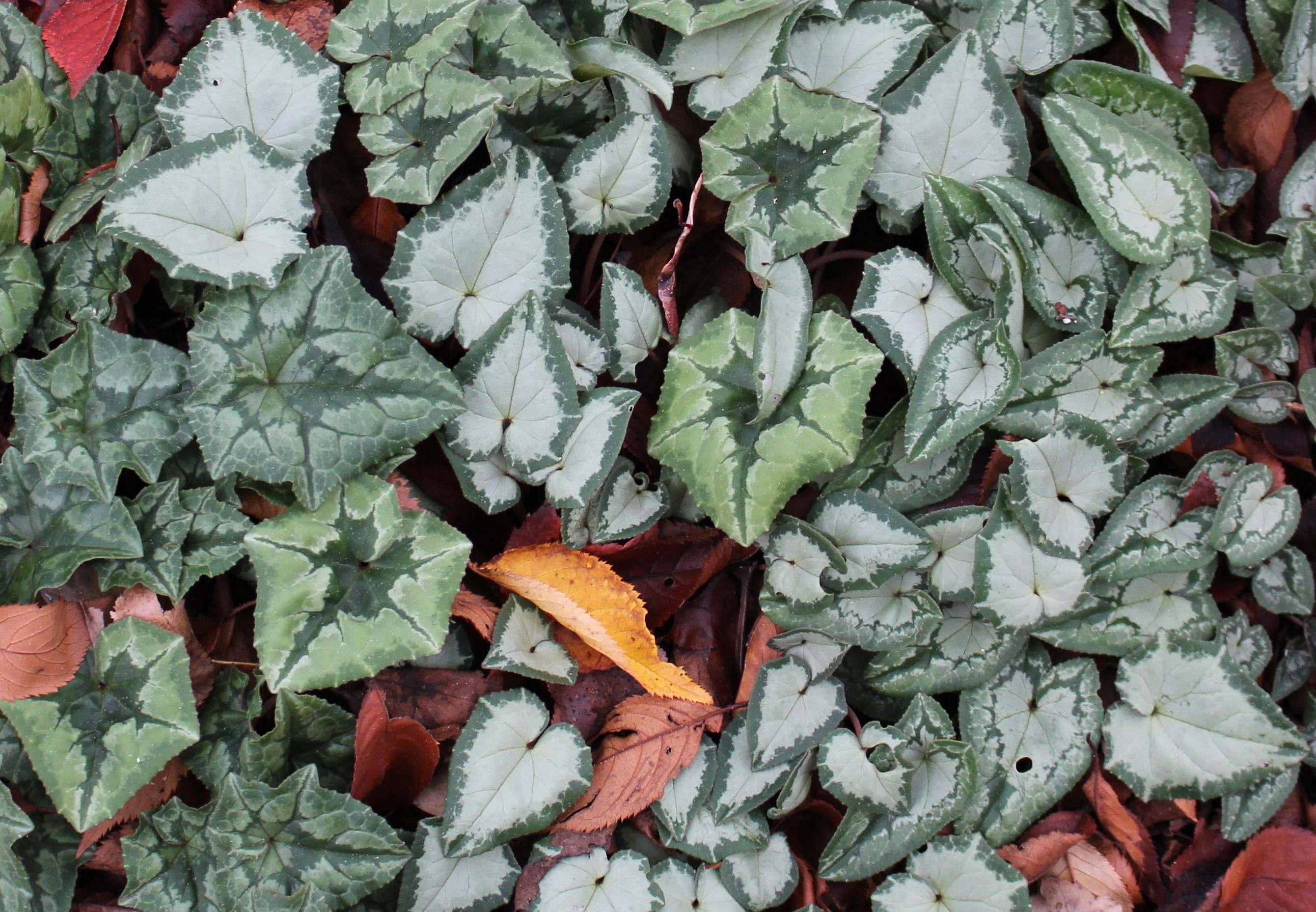
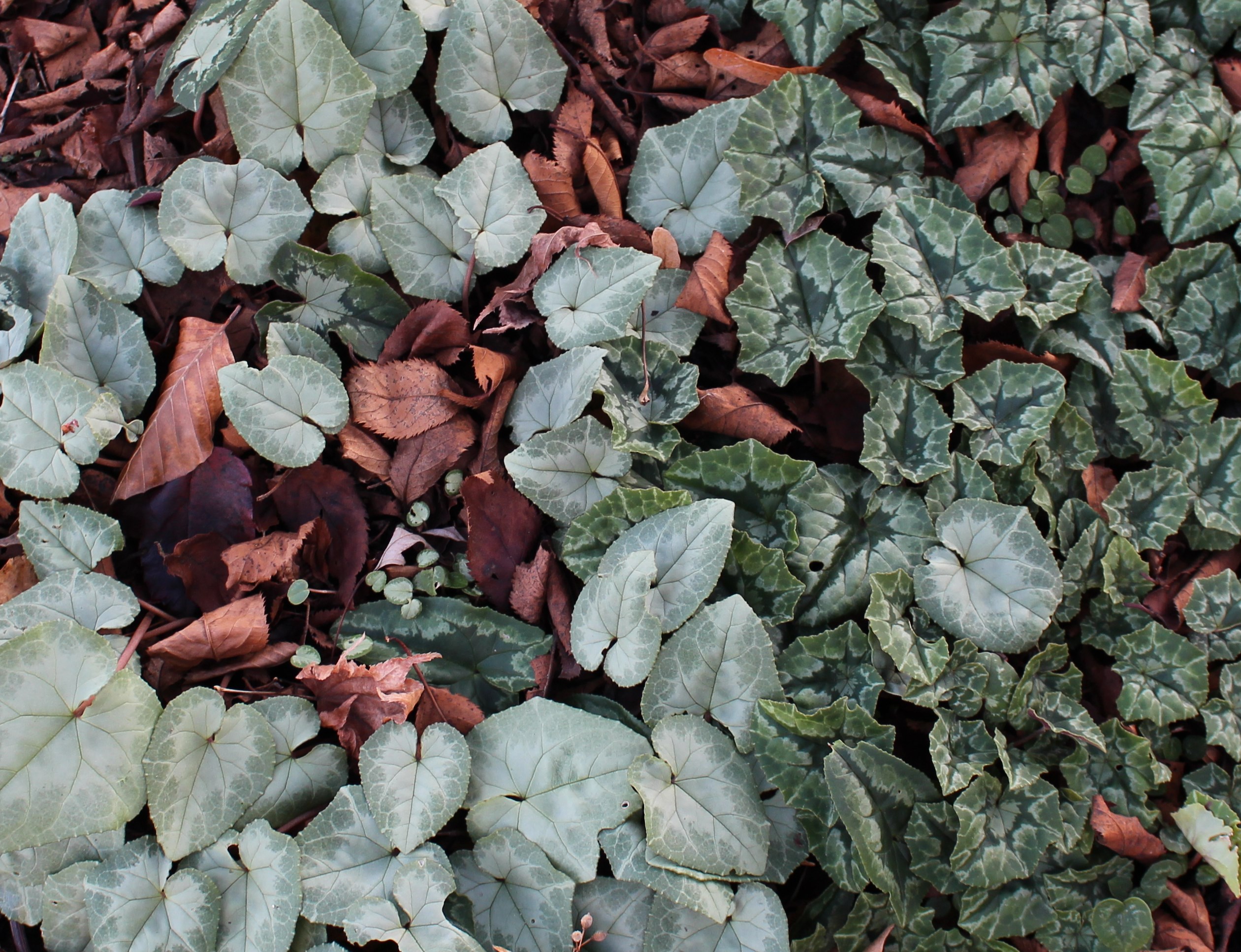
There’s royalty in some plants, and I’m pretty sure cyclamen carry these bloodlines.  Obviously (to me at least) the queen of the family is the tender greenhouse cyclamen (from the c. persicum line), with her bright fancy flowers and her holiday appropriate bright colors, but the other members of the family all deserve equally elite titles.  Lets start with the king who lives in my garden and goes by the name of Cyclamen hederifolium.  His crowning glory is the diversity of exotic patterns and varied shapes which his winter-hardy foliage takes on.

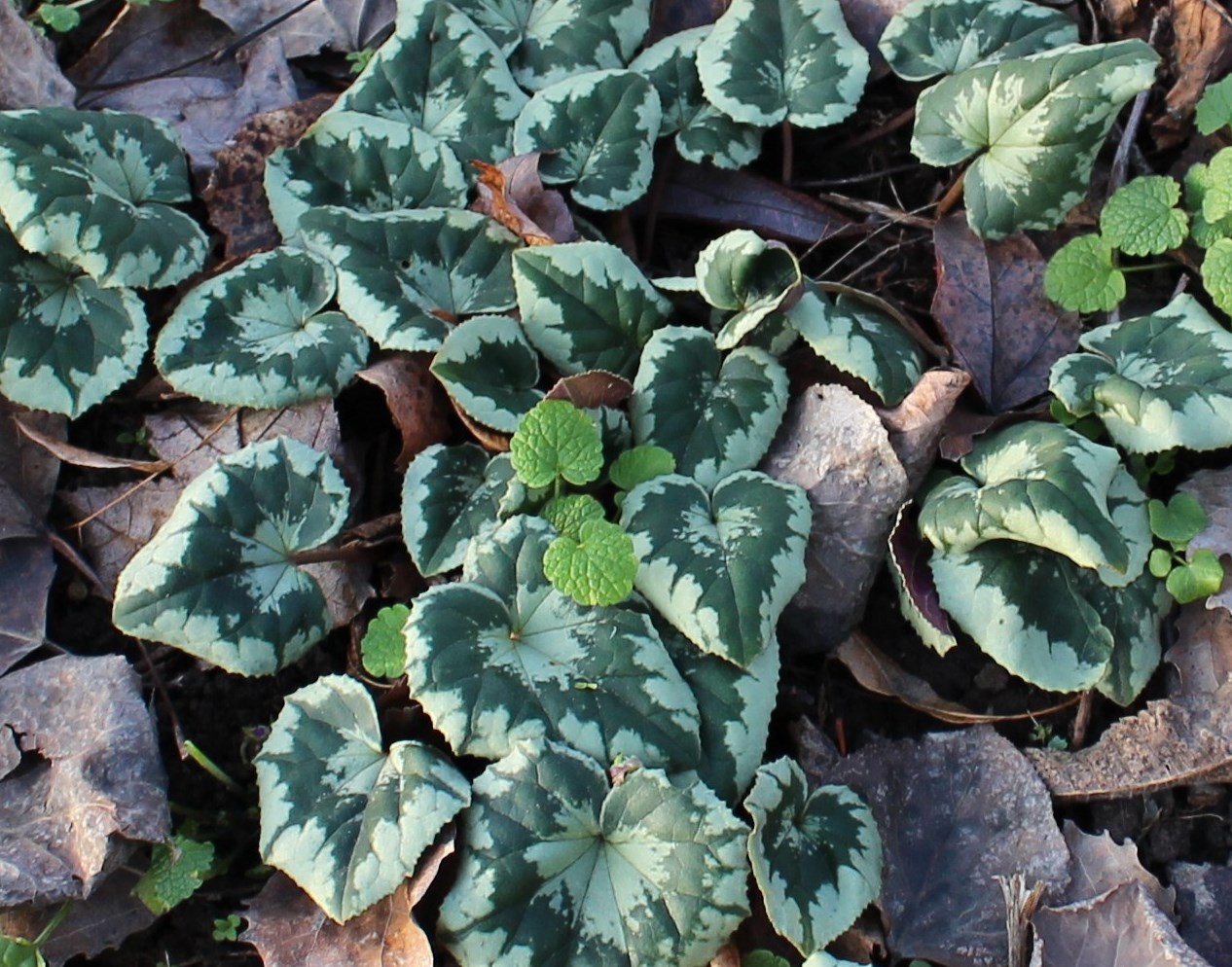
hardy cyclamen hederifolium foliage

A kaleidoscope of hardy Cyclamen hederifolium foliage.

The round corms of this plant sit dormant underground for most of the summer until about August when the first flowers start coming up to dapple the shaded bed where they grow.  The pink or white flowers are nice enough, but as soon as they fade the ground begins to grow a covering of the beautiful cyclamen leaves.  They love the cool temperatures of autumn and as the rest of the garden drops its leaves the cyclamen bed takes on its winter silver and green foliage blanket.

cyclamen hederifolium narrow silver foliage

Leaf shapes for the king vary from wide to narrow, rounded to more of an ivy (Hedera) leaf shape.  Here’s a nice narrow leaved silver form.

The leaves will stay for the winter, and with a good snow cover look as fresh as ever when the snow retreats.  It’s only in late spring that the leaves die back and the plant goes dormant again, and because of this it’s a plant I think is perfect for filling in those dark, boring mulch beds under deciduous trees who’s shade is too dark for anything else.

hardy cyclamen hederifolium foliage

hardy cyclamen hederifolium foliage

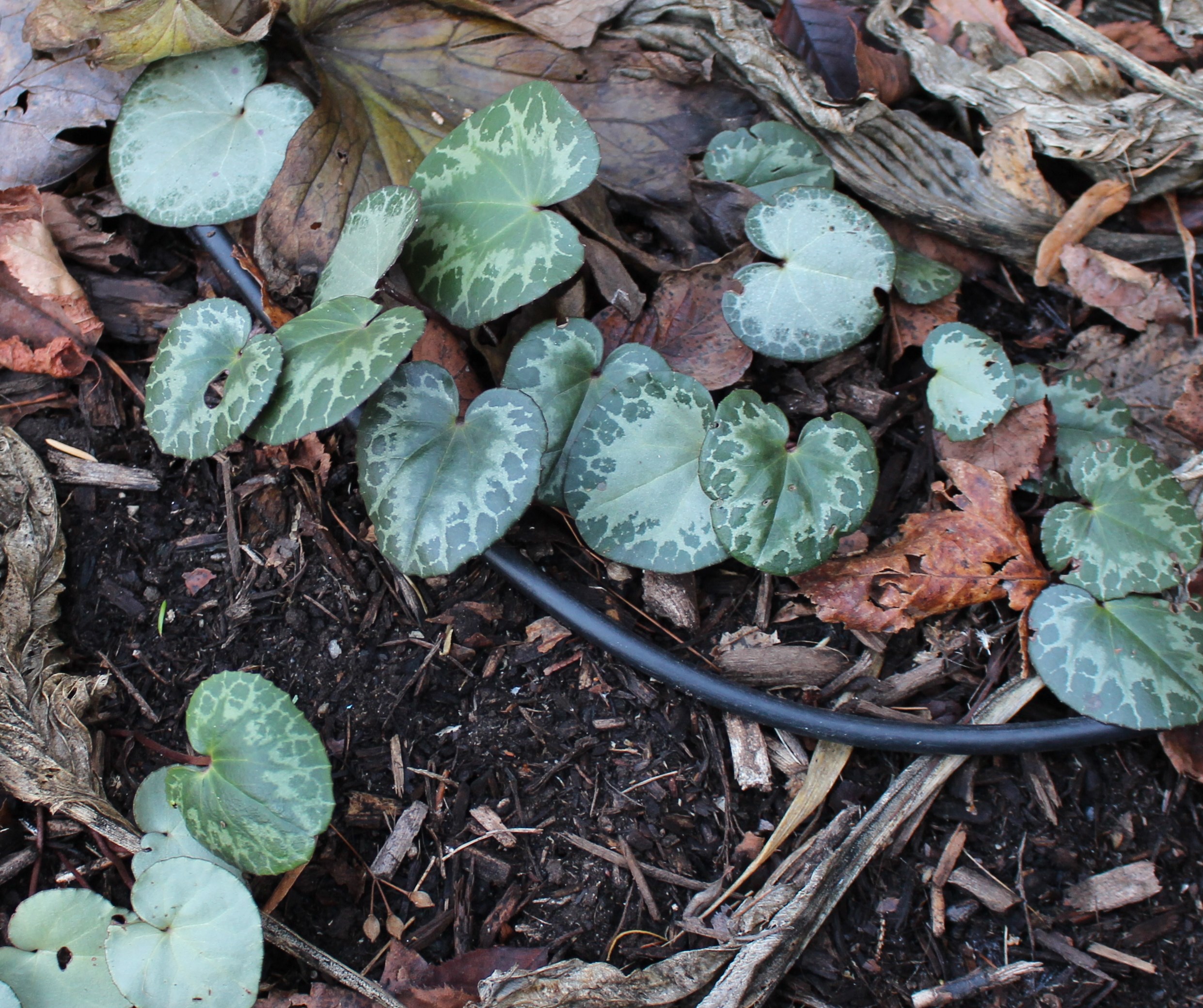
If the king likes the spot he’ll form a nice colony as seedlings fill in.  Any winter-vacant spot is fair game for a clump of C. hederifolium seedlings, and I’m beginning to see them come up in all sorts of spaces, even the lawn.

hardy cyclamen hederifolium silver foliage

The tiny leaves at the center of the clumps are new seedlings from last year’s flowering.  Even on the smallest seedling leaf the foliage patterns begin to show off.

I’d like to give different parts of the garden over to some of the more unique foliage patterns and see what shows up.  In the far back of the yard I have this white blooming, green and silver leafed form.

hardy cyclamen hederifolium foliage

This Cyclamen hederifolium has a brighter green color when compared to its relatives.  It’s always nice to have something a little different.

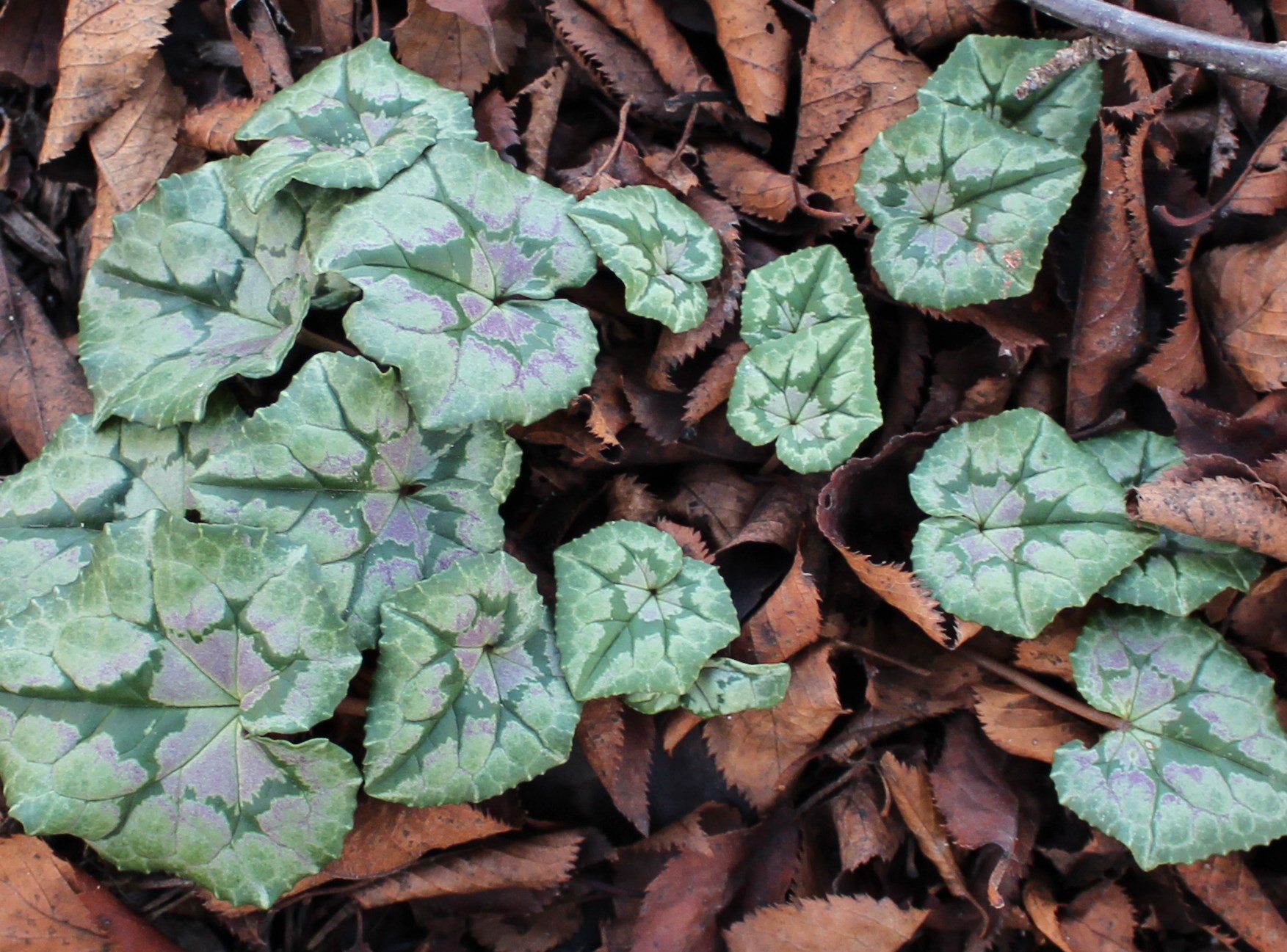
Another form which could be really interesting (and I think already is really interesting) is this purple tinted foliage form.  When fall temperatures drop, a purple wash bleeds through the foliage and the plant takes on an entirely new look.  I’ve only got a few weakly colored examples, but some I’ve seen have a bright pink and purple color which looks great.

cyclamen hederifolium purple tinted foliage

Pink highlights on Cyclamen hederifolium foliage.

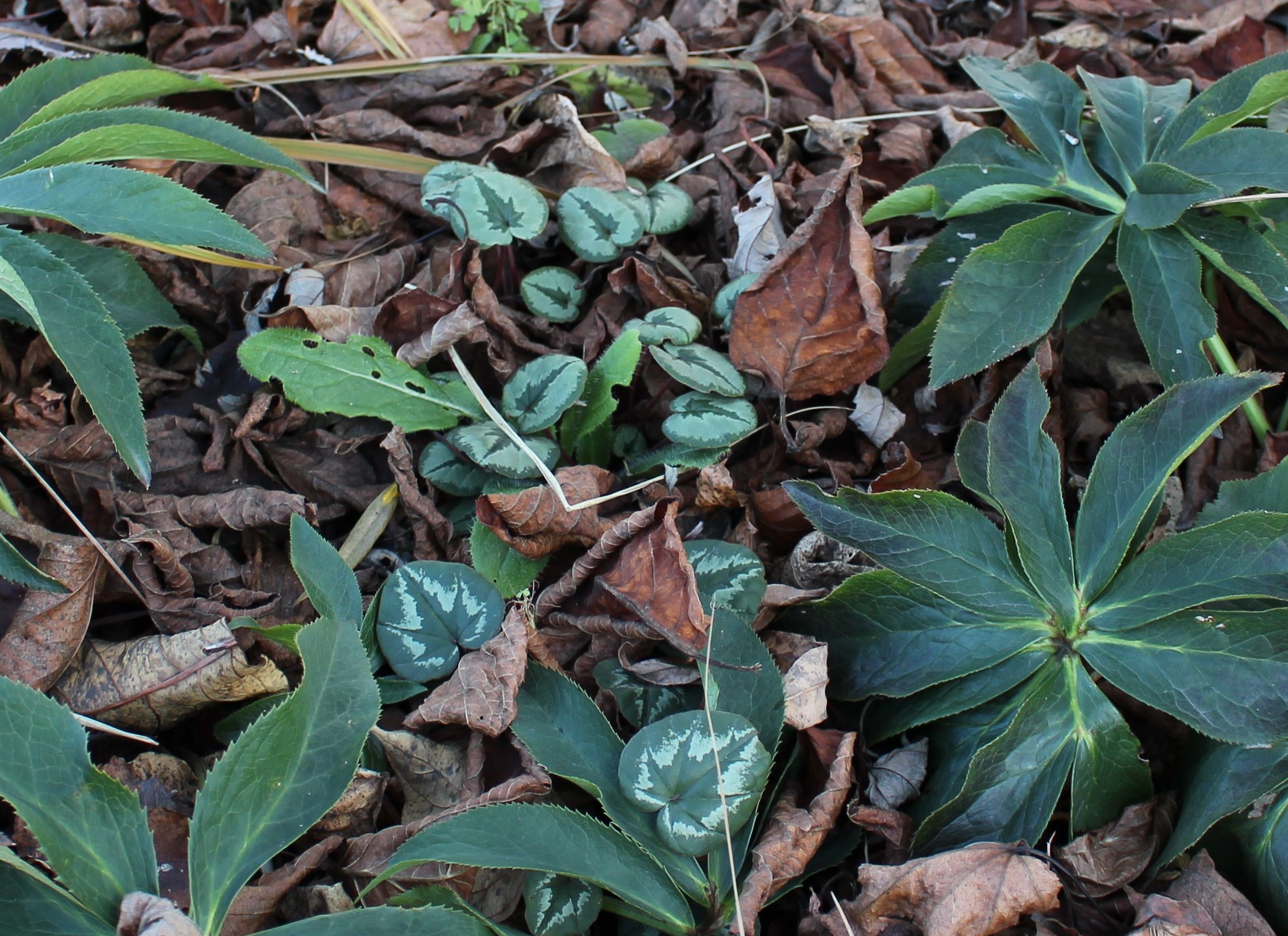
The bold C. hederifolium dominates the shade right now, but other hardy cyclamen also carry on the family name throughout the garden.  Princess coum will grow in the same beds as the king, but in the long run is crowded out be his overbearing ways.  Her waterlily shaped foliage is less intricate than the king’s but still shows off the silver marbling of the family and as is befitting of a princess she is covered with jewel like blooms as soon as the snow melts.

hardy cyclamen coum

Hardy cyclamen coum, a princess of the cyclamen family.

For the past two years as snowpocalypse has hit the east coast the delicate princess coum lost all her leaves and nearly all blooms, but has always bounced right back.  King hederifolium suffered a bit but mearly shrugged it off during the summer, but there’s a third family member in my garden who didn’t skip a beat.  Prince (or maybe Duke, I’m kind of losing my way here) purpurascens seems to be the hardiest of the bunch.  I’ve seen Cyclamen purpurascens listed as less hardy than the other two, but in my experience he’s never been bothered by low temperatures (although we usually have some snow cover) and although he’s the slowest of the bunch (even seeds take over a year to mature) C. purpurascens is reliable.  He doesn’t even lose his leaves in the summer.

hardy cyclamen purpurascens foliage

A sloppy planting of hardy Cyclamen purpurascens.  The leaves are similar to C. coum, yet slightly sturdier and have more of a veinier marbling.

This morning marks the last day of Christmas vacation and the first day in which temperatures have dropped low enough to freeze the top crust of soil.  Neither of these are something I look forward to but you get what you get, and even if that means a low of 8F (-13C) tomorrow nothing short of an early retirement and move down south will change things.  So today I say goodnight to my outdoor cyclamen as they slip under the blanket of their winter sleep.

The royal family will carry on though, and if you want a bigger and more diverse intro give Jon Lonsdale’s Edgewood Gardens a visit.  Besides growing and showing many of the other, less hardy members of the royal family, most of the plants are available for sale and I’m certain you won’t find a better selection elsewhere on the East coast.

Plant those bulbs deep

It might be optimism, it might be delusion, it might be weakness, but whatever it is around here there always seems to be an unreasonable amount of bulbs in need of planting….  or there might not be enough.  No one is ever really sure but one thing is definite.  I have never regretted planting too many bulbs, so until I do it’s always better to err on the side of caution and overdo it if possible.

planting spring bulbs

Last weekend I tried to put everything out in order to see exactly what still needs planting.  Tiny bulbs add up, and this innocent collection is well over 1,100 bulbs.

There’s no denying that I’m a bulboholic and I think if you keep up with this blog you already know that fact.  They’re my favorite plant type and for good reason.  Each spring they just explode into growth, bloom like there’s no tomorrow, and then politely fade away, all within a few weeks.  They’re like a spring fling which burns hot and then ends on good terms.

Somehow the bulbs just find me during the summer.  I dig a clump of daffodils to thin them, find a clump of tulips when moving something else, more daffodils come out when I move a bed… before you know it there are bulbs in saucers, bags, and boxes all over the garage, plus a few I pick up at the nursery.  This year an early clearance sale at Van Engelen’s added a few hundred more crocus and muscari.  You can’t overdo crocus and muscari, so obviously those needed to be purchased as well.  Since I don’t enjoy planting bulbs, 850 new crocus corms can border on autumn torture so I try to deal with them as efficiently and quickly as possible.  Here’s a trick I read online which I now love that really moves things along when planting larger numbers of small bulbs.

naturalizing crocus bulbs

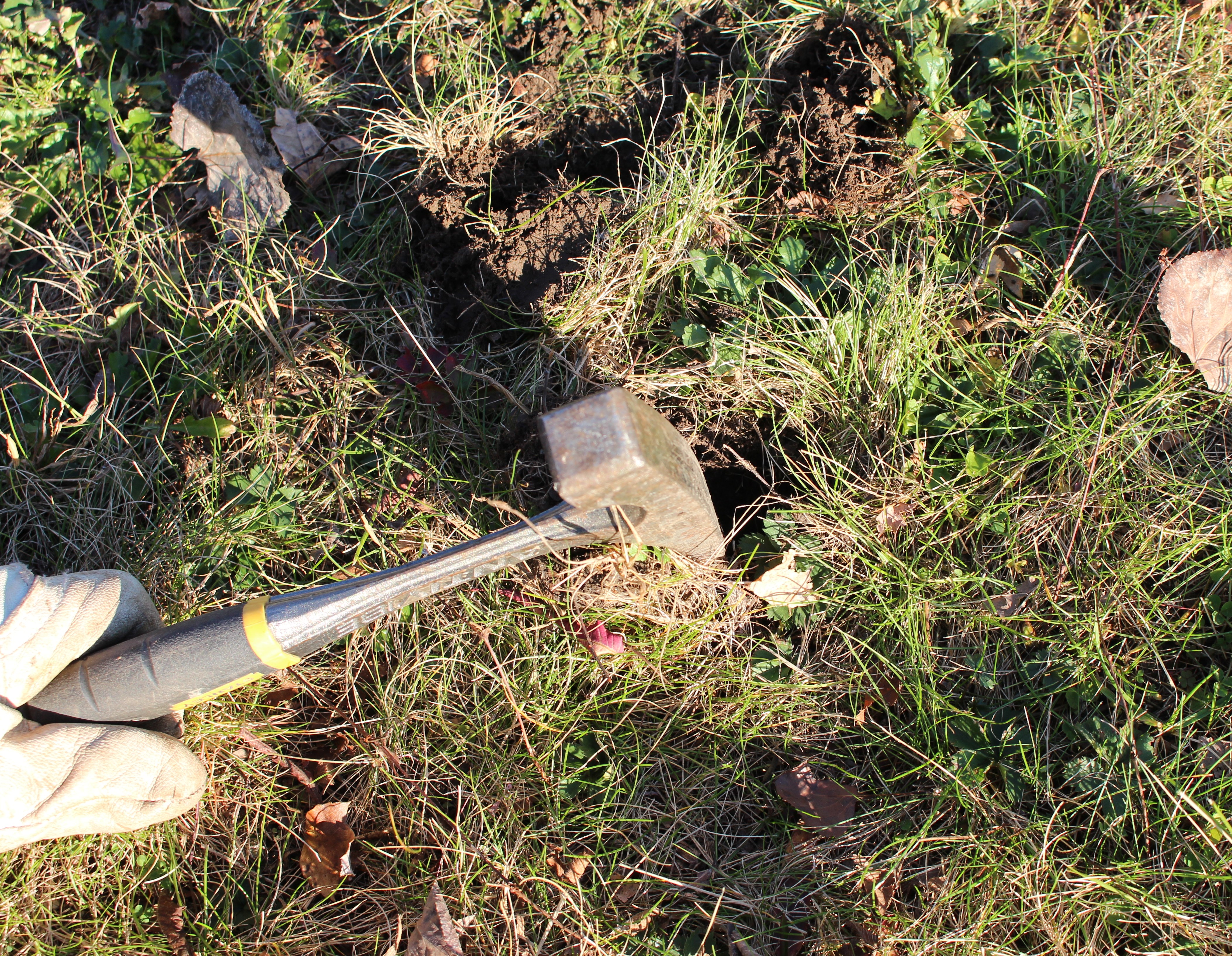
Tools of the trade for naturalizing larger numbers of small bulbs in turf.  Gloves, masonry hammer and small bucket stolen from the children.

A masonry hammer seemed necessary at some point for chipping stones and breaking cinderblocks, but it’s now become invaluable for planting small bulbs in the turf of the meadow garden.  Using a shovel is much more work than I’m willing to do and when you’re trying to naturalize bulbs, or make them look like they just seeded out into your lawn on their own, then digging large sections of turf up is just out of the question.  I find the hammer much easier to use.  One swing and it’s into the ground, a pivot back and you have just the hole you need for a tiny bulb or two.

naturalizing crocus and small bulbs

One down, 849 to go.

I start off carefully, trying to get the sprouting end up and the bulb gently eased down into the hole, but after the first 100 they’re getting dropped in and jammed down whichever way works.  A quick swipe with the hammer also closes the hole.  After about an hour and a half (including two 20 minute breaks to unlock my knees and back) all the bulbs were in.  People talk about the joys of gardening but for me I far prefer sitting back after the job’s done and visualizing the results.  I have plenty of other things which need doing in and out of the house, so the less time spent prepping cute little holes and overdoing a job the better.  If one had to sum up my entire bulb planting philosophy I think ‘shallow graves’ might not be the worst term to apply.  For larger tulips and daffodils I’m not above digging out a shovelful or two of dirt, throwing in a handful of bulbs and carelessly kicking the dirt back over them without bothering to prep the soil or put the bulbs right side up again.  In the vegetable garden some bulbs go into trenches so shallow that by the time the compost rots away from above them the tops of the bulbs are actually at the soil surface…. although this has just as much to do with thin soil and poor drainage as it does with a lack of enthusiasm for digging.

shallow tulip bulbs

These tulips might be on the shallow side. The original bulbs have split in two and both appear to be healthy blooming size bulbs, but if left uncovered mice and rabbits will likely find them and have a nibble.

I often read that in order to have bulbs such as tulips last longer and re-bloom reliably they should be planted as deep as possible, sometimes up to a foot deep.  This sounds like a lot of unnecessary work and I’m completely against it.  Perhaps a shallow bulb is more likely to split due to stress such as drought, but for the most part mine come back best when the spring is long and cool, tulips are deadheaded (daffs and hyacinths don’t seem to care), and tulips are either dug up for the summer or not watered in a spot which is nice and dry.  Planting depth, as long as it’s at least a couple inches down, doesn’t seem to factor in much at all and unless someone shows me actual research to prove otherwise I’m going to say deep planting is one of those often repeated bits of advice which don’t really do much here or there.

pink impression tulips

I planted these ‘Pink Impression’ tulips a few years ago and finally got around to getting more this fall. The new bulbs are from a good nursery and huge, so I know they’ll add to an even more awesome show next spring!

So we’ll see this spring if my lazy planting methods pay off again.  Good soil prep and proper planting depth are always a great thing, but I prefer to not overthink gardening.  If a squirrel can successfully plant sunflowers and oak trees throughout my flower beds, and the best iris can survive a year under the compost pile, I think I can pop a few bulbs into the ground without a PhD and still get good results.  I’m already looking forward to seeing the ‘bulked up’  meadow plantings next spring.

crocus lawn of dreams

The crocus plantings in the meadow garden began with approximately 500 bulbs,  this fall I’ve more than doubled that number 🙂

Two issues may still stand in my way.  Rabbits have huge appetites once they discover fresh crocus flowers, so I may have to do something about that come springtime.  The second worry is that the mixed crocus were irresistibly cheap when compared to the single color varieties I had been planting in the past.  Hopefully the Technicolor patches look as nice as the solid color patches I have now.  I did try to keep the single colors closer together and the mixed ones more spread out but who knows how this naturalizing theory will work out in the real garden.  If worse comes to worse the bunnies will make quick work of any mistakes.

Have a great weekend and I’d love to hear which bulbs have made the cut for you this year.  One request though,  please don’t rub it in too much that you’ve already completed your planting 🙂

A lull in the storm

I promise this is the last time I will complain about the brutal freeze which ended our growing season.  I’ll also not mention the weeks of warm weather which followed, and I won’t show a picture of the dahlias which are resprouting due to some misguided notion that winter came and went.  Instead I’ll focus on the mellow colors of autumn which are slowly winding the year down, and I’ll just enjoy the warm lull we’ve been having until winter returns again in earnest.

the front border in autumn

The front border is about as tidy as it will get prior to winter.  Whatever’s left will hopefully hold the snow nicely and keep things interesting until spring returns.  The golfinches approve of the leftover coneflower and sunflower stalks.  

Last weekend I finished up the last of the leaves and tried to wrap up the last of the fall planting and weeding.  I have to admit I like the way the gardens open up and empty out this time of year, and I love the way the fall rains have left a lush green lawn to set off the emptying flower beds.

Muhlenbergia capillaris pink backlight

Earlier in October the pink muhly grass (Muhlenbergia capillaris)  finally came through and put out the airy pink flowerheads which look so nice in the low autumn light.

Three years after transplanting, my pink muhly grass has finally bothered to bloom.  I’ve come to accept that I’m just too far North to enjoy this plant.  It looked pathetic until August, finally put out enough leaves to look alive by September, and then for 12 days in October it impressed with it’s pink seedheads…. and then was promptly browned out by the first freeze.  The effect is still nice enough, but I wouldn’t have minded a few more weeks of the pink.

pink muhly grass after a freeze

Pink muhly grass after a freeze.  Still nice, but not the amazing, glowing pink you look for in this plant.   

I’m going to give the cultivar ‘Fast Forward’ a try next year.  It’s supposed to be a good month or so earlier than the straight species and also shorter and more compact… although for me the larger size would have been preferable.  I’ve actually already got my hands on one but since it was a small plant and just planted last week I’m not too confident it will make it through the winter.  Fall is not the time to plant anything borderline hardy or more of a warm season grower…. speaking of probably not making it through the winter, my cardoon seedling is really starting to put out some nice leaves.  The freeze didn’t bother it, but as a zone 7 plant I’m really hoping for some serious El Nino luck in getting this thing through the winter.  Any protection suggestions are more than welcome!

young cardoon plant

If this cardoon plant makes it until next year I’ll be thrilled.  Bigger leaves with artichoke-like fluorescent purple flowers would be the highlight of 2016 I’m sure 🙂

Something which will have no problems this winter is the Virginia creeper.  This year brought on a good crop of the grape-like fruits, and I’m sure they’ll be sprouting up all over as a gift from the birds…. just like this plant was.

Parthenocissus quinquefolia berries Virginia creeper

Virginia creeper (Parthenocissus quinquefolia) minus it’s bright red fall color, but still interesting with its raisin like fruit.

The rest of the garden is clearing out.  Leaves are mulched, the vegetable garden is tucked in, and there’s already interest in spring flowers.  I love how good hellebores look at this time of year, they love the cool temperatures and extra moisture and if all goes well this spring I may have my best hellebore show yet.

hellebores ready for winter

Hellebore seedlings showing promise for next year.  Hopefully we’ll see a few blooms next year since these are supposedly yellow seedlings and haven’t yet shown their true colors.

Back towards the meadow garden things are just waiting for snow.  I’m glad I left a bunch of the little bluestem since it’s gone through such a nice color change from green to yellows to reds to tans now.  With the rest of the yard mowed, it keeps things somewhat interesting back there.  Something I’m not too glad I left is the littleleaf linden (Tilia cordata) seedling which showed up among the phlox.  I’ve been ignoring it for years, but at six feet I think it’s time to make a decision.  The mother plant is so popular with the bees and so fragrant I just hate to weed it out…. but a second linden is one more than this yard needs.

autumn cleanup in the vegetable garden

Mid November in the vegetable garden.  Yet again the phlox have not been divided, and there’s a huge linden tree weed, but at least I’m getting some mulched leaves down to save on next year’s bed prep.

There’s little chance of dealing with the linden this fall.  It would do fine with a transplant at this time of year, but with 14 pounds of crocus and daffodils sitting in the living room I have other things calling for my attention.  I should have no problem getting a few in tomorrow… unless I first deal with the dozens of daffodils and tulips which I already had from this summer’s bed renovation.

Whoever said November was a time for gardeners to kick back and relax obviously didn’t procrastinate planting spring bulbs nor succumb to early clearance sales.  Hopefully your autumn is much more relaxing 🙂