Tuesday View: The Tropics 8.2.16

Finally I’m back for a real visit with Kathy’s Tuesday View meme.  After two weeks away the tropics have taken off here and the heat (and now rain!) have really brought everything to life.

cannas and verbena bonariensis

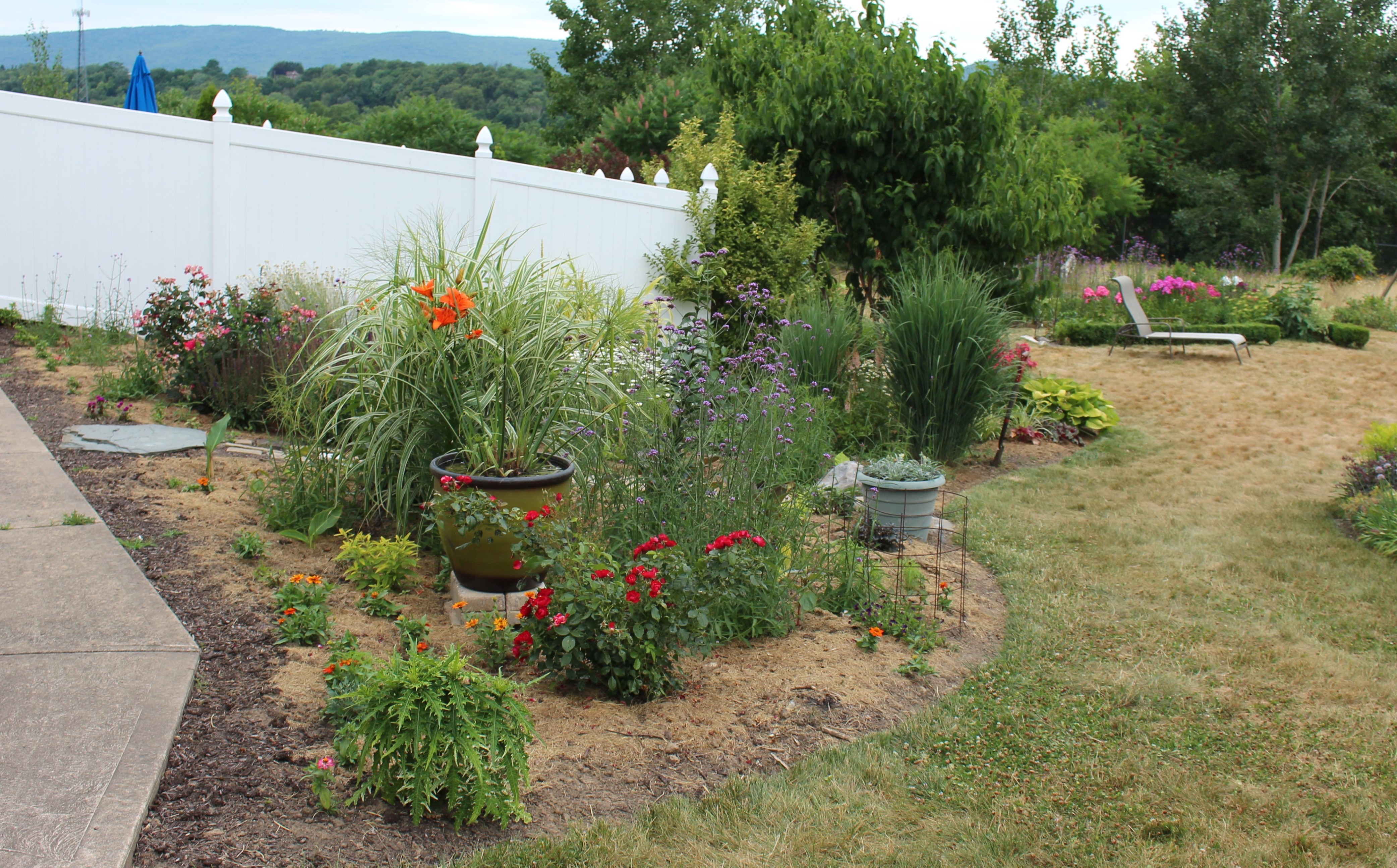
In the view today is damp soil, overcast skies and plenty of humidity.  The cannas have exploded along with just about everything else and exuberance is the word of the day.  How do you like the ferny green lump of kochia (summer cypress) just in front and to the left of the olive-green planter? I love it btw

My biggest fear when I left was that my new bananas and precious castor beans would just pine away waiting for rain, so two days before we left I added an extra line to the drip irrigation system and set up a few drip emitters to some of the most precious plants.  Good thing I did since this bed was the only part of the garden where lush greenery welcomed me back from our midsummer vacation.
castor bean carmencita

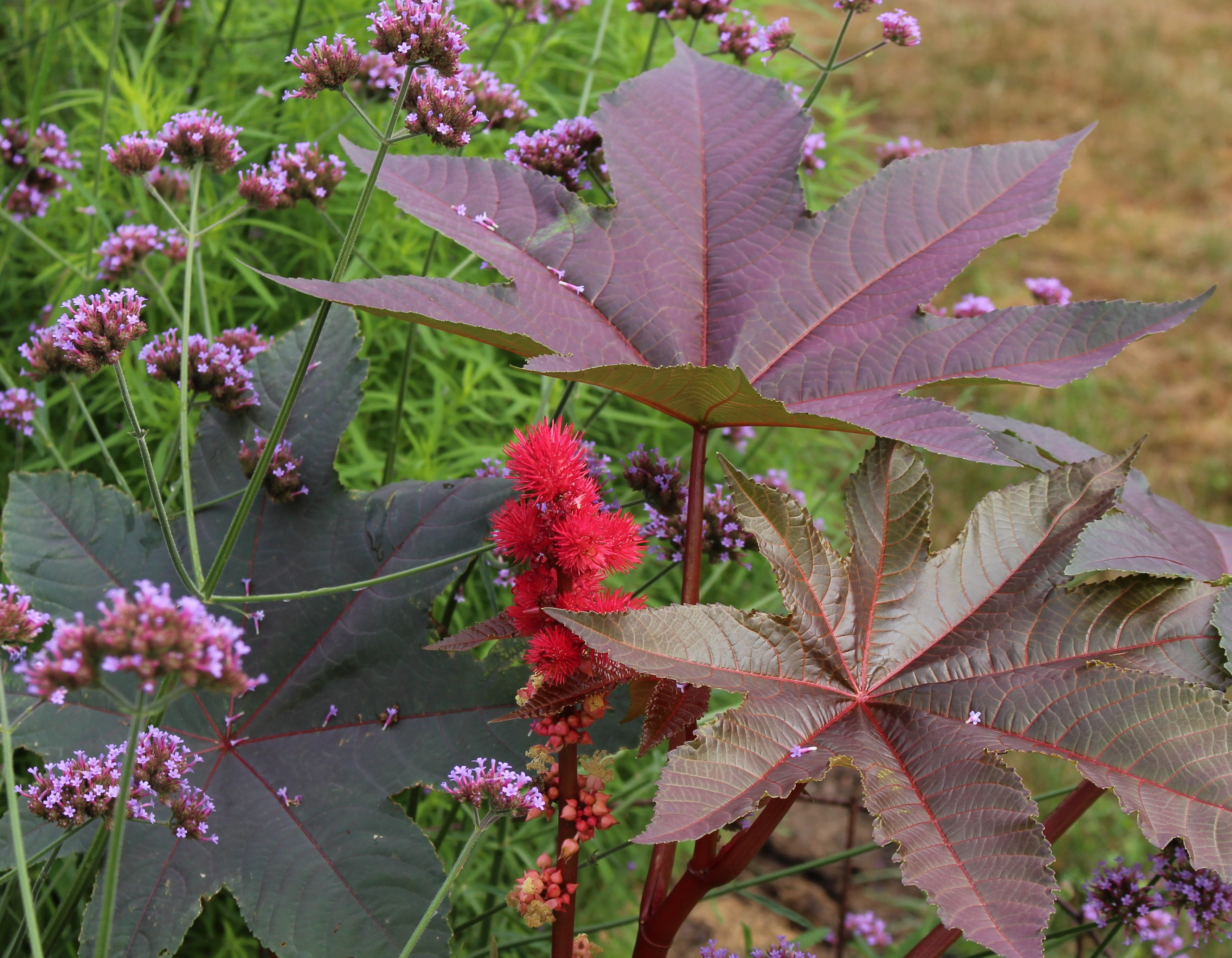
I have blooms on my ‘Carmencita’ castor bean plant.  I love the bright red seed pods and I hope they stay that way for a while… and the leaves aren’t too shabby either!

I’ll try not to go on too much about every single plant.  Here’s an overview of the farther side of the bed, beyond the path to grandma’s pool 🙂

cannas and verbena bonariensis

The purple of Verbena bonariensis has nearly taken over large swaths of the bed.  I’m fine with that but the old flower stalks on the salvia ‘Caradonna’ just irritate me to no end.  I’m sure no one but myself notices them, but there’s a good chance I snap this week and pull them all out!

The old red leaved cannas are nearly as tall as me now and will likely break the six foot mark by next week and I love that.  In no time this will be a garden you look up to 🙂

fennel with verbena bonariensis

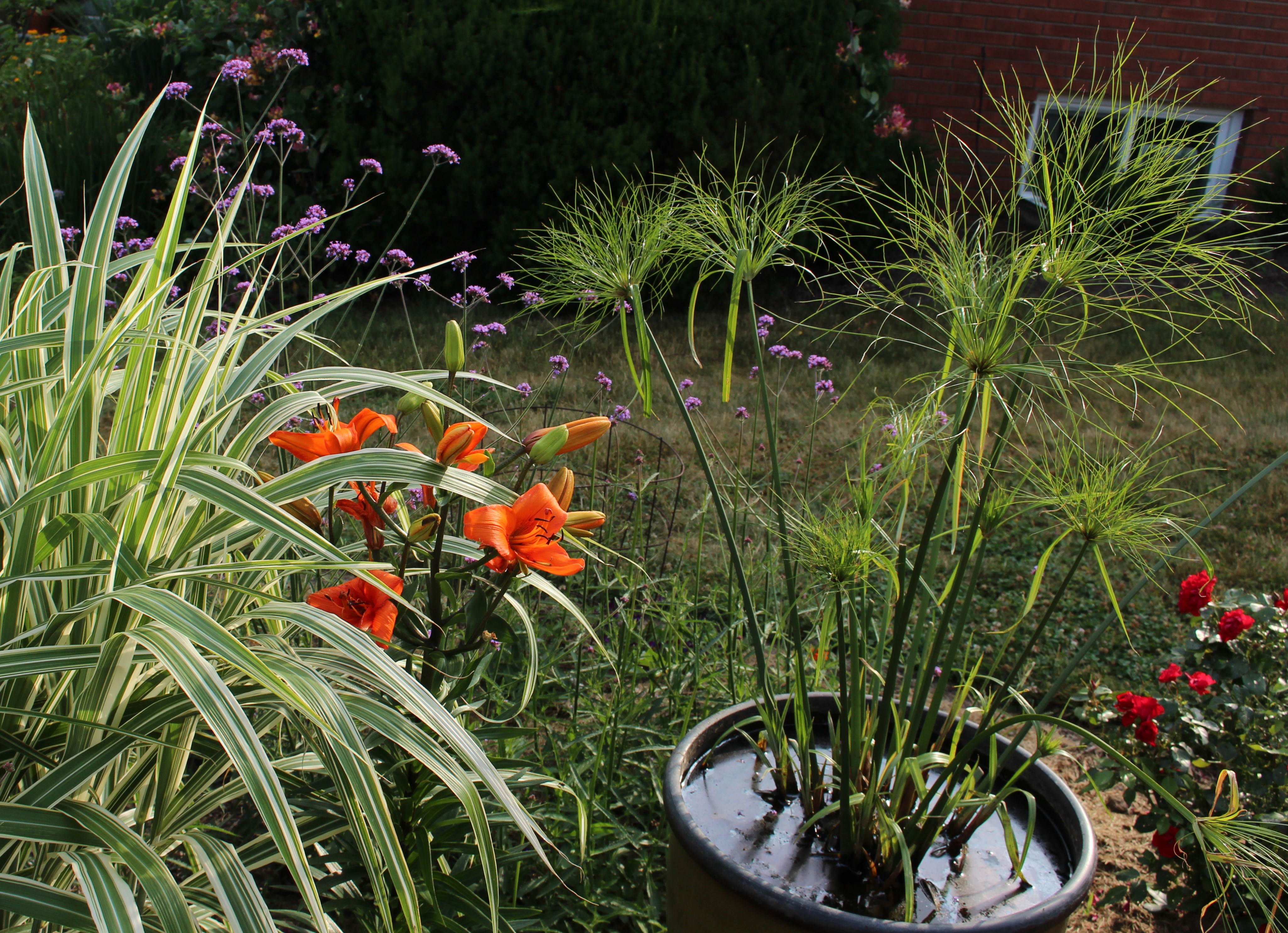
My poor planning skills are often saved by horticultural volunteers.  Here the chartreuse froth of blooming fennel mixes in with a pale green nicotina and of course more Verbena bonariensis.  You can’t even see the dahlias which are supposed to fill this space.

You may have noticed a few of the sunflowers which peek out of the far corners of the border.  After relentlessly weeding them out through the spring I finally let a few of the latest sprouts in the hard to reach spots go on with their lives.  I love them of course, and I’ve already seen the goldfinches stopping by to check on the seeds.

sunflower and long horned bee

Sunflower with a few long-horned bees making themselves at home.

New to me this year are the bees which can be found on each sunflower bloom.  I’m sure they’ve been there every year but after I found the long antenna interesting I realized they’re not the regular honeybees.  According to this face book group >click here< they are either a type of sunflower bee or most likely a type of long-horned bee, both of which belong to the solitary bee group which includes some of the hardest working and most effective pollinators out there.

sunflower and long horned bee

I’m leaning towards long-horned bee for these two, since they both share the almost comically long antenna, but I have no clue as to which species.  Apparently there are more than a few! 

Something new to me which I came across while investigating bees is that these solitary bees are much less aggressive than their colony-forming cousins due to the fact they have no hive to defend.  They only sting when handled roughly and are considered more docile… although I’m not sure who did this investigation of insect manhandling.  I’ll take their word for it though and skip starting my own investigative bee-bullying program.

Oh and one more thing.  Solitary bees are fine feeding on nectar from a wide range of flowers but the individual bee species is much more specific in where its pollen comes from.  It’s called oligolecty, and if you want to add that one to the vocab list it describes bees which specialize in collecting pollen from a limited palette of flowers, often only one species.

A usual I’m as surprised as to where this Tuesday view went but it’s been an interesting ride for me and I hope it’s at least been somewhat interesting to you as well.  If you’d like to expand on the visit stop over at Words and Herbs and check in with Cathy to see what the other Tuesday views are up to.  There’s always plenty to explore!
Tuesday View: The Tropics 7.26.16

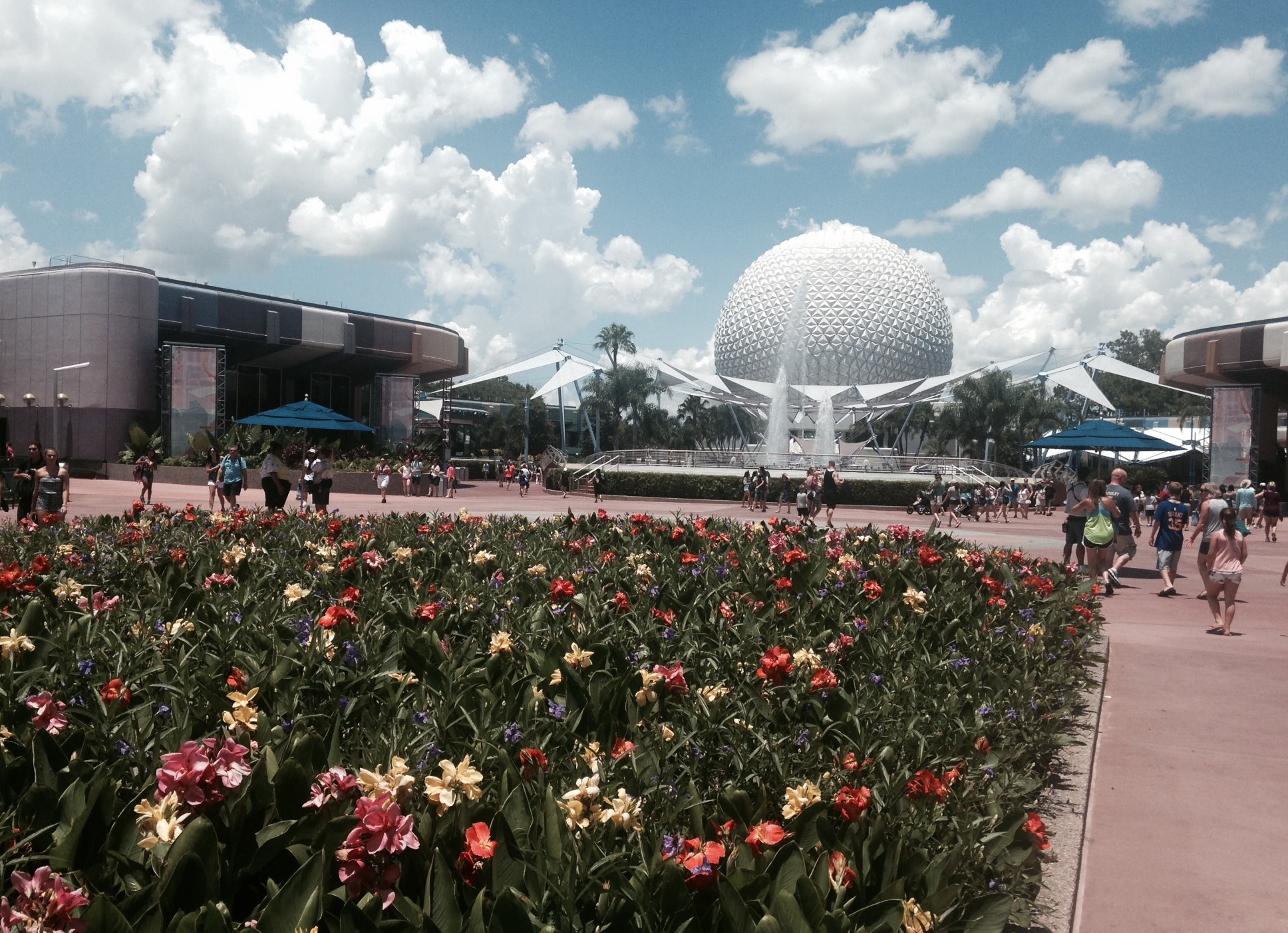
We returned from Florida this afternoon and were pleased to discover that the weather here was even hotter and drier than 1,200 miles South.   The few scattered thundershowers which should have given the garden some hope while we were gone just weren’t enough, and overall things look completely miserable.  Here’s a view from Florida since I’d rather not face Pennsylvania yet.

flowers at Epcot

At least in the tropics an afternoon downpour can give some relief.  Here in Epcot I liked the way these mixed cannas filled the bed, a little short of a plant for my taste, but I’m sure they’ll fill the area with color all summer.  

I hope to catch up a little tomorrow, but for now it’s ok to be back and we’ll see if I can scrape together enough care to bring the garden back from crispiness.  If I never post again I just want to say thanks for all the comments and friendship and I wish you all well.

Tuesday View: The Tropics 7.11.16

This week I was a little late in the day with my photo so it’s full of artsy backlighting.  A good effect for soft lighting, but not the best to see what’s going on in a Tuesday view.

tropicalismo

The tropical garden at about 7 in the afternoon.

One thing which you will likely notice is the pile of grass trimmings and the wheelbarrow.  It was a busy afternoon in the bed and much of this was the result of the bed’s new designation as the Tuesday view.  Who would have suspected joining in with this meme would be the motivation needed to buckle down and make some of the changes I’ve been thinking about for the past few years?

rose 'black forest'

Not exactly tropical, but the color of the rose ‘black forest’ is hot enough to fit right in.  This is already its second flush of bloom and other than a few holes chewed into the leaves (most likely from some annoying beetle) it’s almost perfect.  Last year this plant was potted on the deck, still great but much younger and smaller.

Change one: The variegated miscanthus ‘Cosmopolitan’ had too much of a head start on the new plantings so I went ahead and cut it down to about a foot high.  We will see how this works out since I’ve never tried it before, but it’s grass right?  I suspect just like a scalped lawn it will send up plenty of new shoots, and in the meantime the cannas and dahlias will be able to grow upwards in peace and lay claim to their own airspace.

newly planted musa basjoo

Change two:  A newly planted banana (Musa basjoo) has replaced the peony which was just taking up space here… and mildewing.  When sunflowers grew up and covered it in years past there was no reason for it to bother me, but now it does so out it went.  I’ve never composted a peony, it seems absolutely criminal and I’m not sure I should be confessing, but there you go.  I yanked a few salvia as well.

We were gone for four days last week and the garden nearly dried out and died due to the heat.  Rumor has it rain fell, but of course all the big storms avoided us.  When I returned to see the pathetic state of my plants I first cursed, then cursed some more, and then decided to mow everything down and give up for the year, but after watering that evening and then the next day visiting my favorite nursery (Perennial Point), things seemed less bleak.  They had awesome bananas and elephant ears and a bunch of other stuff and in my weakened state two new bananas came home with me (plus a new fern and red hot poker).

Kochia Scoparia

Kochia Scoparia is a new one for me.  The common names are burning bush and summer cypress and I suspect I will like it, but for now keep in mind it’s listed as a noxious weed in several Midwestern states.

I didn’t need the bananas, but I did need the bananas, especially after seeing how well they have done for my brother in his zone 7 LI, NY garden.  In case you’re wondering, Musa basjoo is likely the hardiest banana, and although I won’t get into all the logistics of me being the one to give him the plants in the first place, and him being completely deaf to all hints at how much I wanted one and which one could he spare… I now have one again and promise to mulch it well EVERY winter so it doesn’t die off again.

long term weed killer

The rest of the zinnias are doing well, but I suspect my MIL was again a little heavy-handed with the weed killer here since it’s a dead spot which seems to stunt all life.  She has an unexplained attraction to any herbicide which says ‘controls weeds for months’, and this in turn stunts and kills anything planted in the treated area or anything planted near the runoff area… for months.

So here we are again, all over the place on what should be a simple post.  I promise to get less wordy once we get through this planting and intro phase but for now I can’t help it.  Just be grateful you’re not stuck here on a visit and I’m really going on and on!

lythrum salicaria purple loosestrife

Now what do I do with this?  The flower stalks of a Lythrum salicaria (purple loosestrife) have appeared in the back part of this bed and I like it.  The problem is it’s a terrible invasive in this part of the country, but only in wetlands and my garden is far from being a wetland.

If you’d like to join in the Tuesday view, Cathy at Words and Herbs follows her own view each week and I’m sure she’d welcome the company.  It’s a great way to track changes through the season and apparently it can even motivate some of the less motivated gardeners into tackling a few things on the to-do list!

Tuesday View: The Tropics 7.5.16

Between you an me this is the Monday afternoon view, but to get anything online before Tuesday night I may have to cheat a little here and there 🙂

I started planting all the true tropicals and annuals about two weeks ago, and although they’re beginning to put on some weight it’s still the scattering of perennials which give all the color.  As you can guess from looking at the lawn we still haven’t had any decent rain.

annual flower bed

The tropical garden in the first week of July.  The red of the rose ‘Black Forest’ carries over from last week and the orange lily has opened up.

Water is not an issue for the papyrus though since it’s sitting submerged in a planter which lacks a drainage hole.  The green algae has passed its peak and the water looks much less stagnant.  I may even throw a few fish in this week to keep the mosquitos from breeding.

papyrus in pot

The orange lily ‘Liberty Hyde Bailey’ should have been fantastic this year, but I suspect my MIL may have hit it with a bit of stray weedkiller this spring.  The flowers don’t open properly, are a little on the small side, and look stunted in general.  Fortunately the bright color makes up for the stunted-ness.

You may have noticed the purple haze of Verbena bonariensis which is beginning to develop over the bed.  Because of the mild winter several plants of this borderline hardy perennial survived and are already beginning to put on an early show.

castor bean seedling

One of the castor bean seedlings (Ricinus communis) beginning to pick up speed.  If all goes well a few leaves should reach a foot or more across.

This isn’t the first year I’ve had a late start to planting the tropical bed.  There are so many other jobs to attend to before this reaches the top of the list, plus there’s always procrastination and general laziness on my part.  Fortunately I’m a quick learner and have picked up a few tricks along the way, one of which is “The lazy man’s canna and dahlia pre-starting method”.  Rather than potting roots and tubers up and getting them going in a greenhouse or other gardening luxury, I drag the storage tubs out onto the (full, hot-sun) driveway, open tubs and bags, try to orient growing point up, and spray a little water on them all.  Less water is better than too much, and over a week (or three) the shoots begin to grow and the break out of dormancy in a way which I feel is quicker than planting them straight into the cooler ground.  I’d show you pictures but the mess of trays and tubs and bags spread out in front of the garage is a bit embarrassing.

sprouting canna leaves

A few of the cannas are already over a foot tall just maybe ten days after planting.

While we wait for the tropicals, the perennials continue to have their moment.  The purple salvia ‘Caradonna’ is already fading, but there’s an interesting Verbascum showing off behind it.  Normally this would pass unnoticed as a sea of sunflower seedlings takes over this end of the bed and overwhelms everything in it, but this year I’ve manned up and stood up to the little thugs.  One by one I pulled sunflower seedlings out and although it was nearly sinful composting such healthy volunteer plants, it was also a bit cleansing.  I’m ready for something different here.

July perennial border

I was hard on the sunflowers but apparently still let a clump of daisies pass through… oh well.  A sharp eye can make out the yellow spikes of the Verbascum just slightly left of center in this photo.

I’m pretty sure it’s Verbascum nigrum, the black mullein.  It came here uninvited as a hitchhiker in the root ball of a red -stemmed dogwood.  The dogwood in turn was one of those gifts from a better gardener who heard me (how could you not) whining about how nice her dogwoods were, and how I can’t seem to find the same kind anywhere around here.  Sure enough on her next visit a bag came out of the car and inside were the roots of a nearly full sized division off her own plant.  That’s awesome, but even better was the clump of scilla and the healthy verbascum plant which also came up the next spring from the root ball.  I judge a gardener by the weeds they battle, and her scillas and verbascum almost embarrassed me when I thought of the crabgrass and bitter cress which probably followed her home.  Paula was smart to only accept bulbs…. they’re usually weed free 🙂

verbascum nigrum

A closeup of the flowers is an almost unnatural mix of yellow, orange pollen, and purple stamens (I think that’s what the part is called).   I almost wonder if the orange pollen tastes different, since it looks more like Cheetos dust than any kind of bee food…

So that’s where we are this week.  Both Kimberley at Cosmos and Cleome and Cathy at Words and Herbs are also following views each Tuesday and it’s a great way to follow the changes which happen throughout the season.  Give Cathy a visit to see what others are up to , and if you happen to join in please leave a link at Cathy’s blog so we can find you.  Have a great week!

Tuesday View: The Tropics 6.28.16

Two of my favorite bloggers are bringing back a meme which I’ve always enjoyed.  Cathy of Words and Herbs and Kimberley of Cosmos and Cleome both highlight a longer view each Tuesday and we get to see it develop and change as the year passes.  I’m no expert on the meme but I think Cathy sticks to a specific viewpoint and time while Kimberly varies the perspective and location depending on what’s going on in the garden.  Myself on the other hand am barely capable of getting any post up in a given week, so to keep it simple I’m going to follow Cathy’s lead and go with one view, same bed, same point each week and see if I can handle that.  Also since the tropical bed went in last week (about time since it’s already past the solstice and well into summer) I’m going to highlight this bed as my view, and (hopefully) watch as it grows up. 

Tropical garden

My fingers are crossed that over the next few weeks this bed will become an explosion of color and foliage and maybe bring a taste of the tropics to this end of NE Pennsylvania.

I’ll try to keep this short, since assuming things grow I want to save a little material for future posts, but besides the thrill of actually getting most of the plants in last week I always get a little excited checking this patch each day to see how quickly things progress.  All season bloomers which sit as a lump of color and put out the same old flowers each week bore me a little, and even though I can appreciate someone wanting low maintenance, neat color, I want something that sneaks up on you and then overwhelms you, like a horticultural tsunami!  Hence the tropical garden, and anything bright and big and leafy is more than welcome.

papyrus with black forest rose

The papyrus was not happy last year and I suspect it didn’t get nearly as much water as it wanted so instead of planting it in the ground again I placed it in a pot submerged in a second pot full of water.  Green water.  So far the reviews of this planting have not been 100% favorable.

You can’t really tell from the tiny sprigs, twigs, and tubers, but this year’s theme is orange and purple.  That’s not a solid theme, it’s more my mood when I’m out picking up annuals or choosing which dahlias to put here versus in other parts of the garden… or finding a flat of orange zinnias on sale and liking zinnias.  So until the oranges fill in, hot pink and purple will have to do for a theme.  Besides the annuals, perennials have a way of sneaking in everywhere, and although I pulled a wheelbarrow full of daisies and transplanted dozens of chrysanthemums, there are still a few things such as this knockout rose and purple ‘Caradonna’ salvia which are just too colorful to stand up to.  Maybe next year will be the year I follow through on my threats to remove the salvias.

knockout rose with caradonna salvia

The ultra rare and uncommon ‘Knockout’ rose tastefully complimented with orange zinnias at its feet and scavenged lawn clippings as mulch.  This Tuesday view already promises to reek of class each week 🙂

So there you have it.  By next week I hope to have a few cannas sprouting and a few more zinnias assaulting your color senses and overall I really hope things don’t end up requiring a rototiller and a fresh start by August.

Think about joining in with the view and if you do leave a link at either Cathy‘s or Kimberley’s blog so we can find you.  Not to put words in their mouths but I’m sure both will agree “the more the merrier” and I always enjoy watching another garden grow throughout the season… even if it does turn into a trashy mess of too much color and chaos!