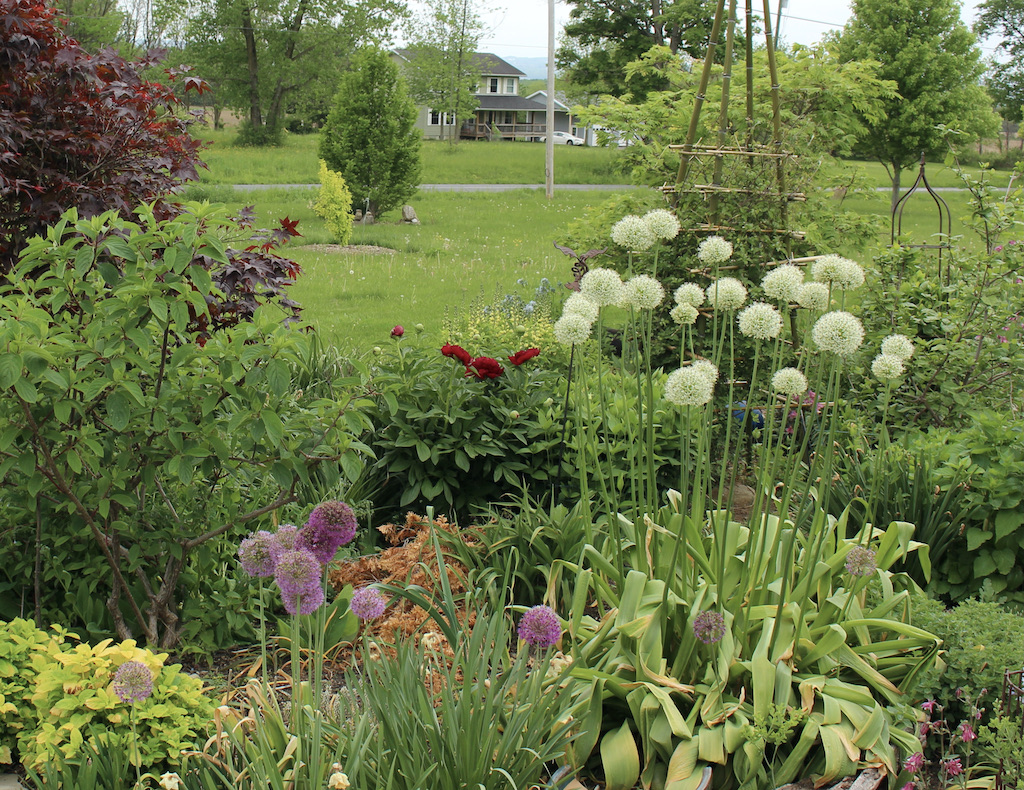
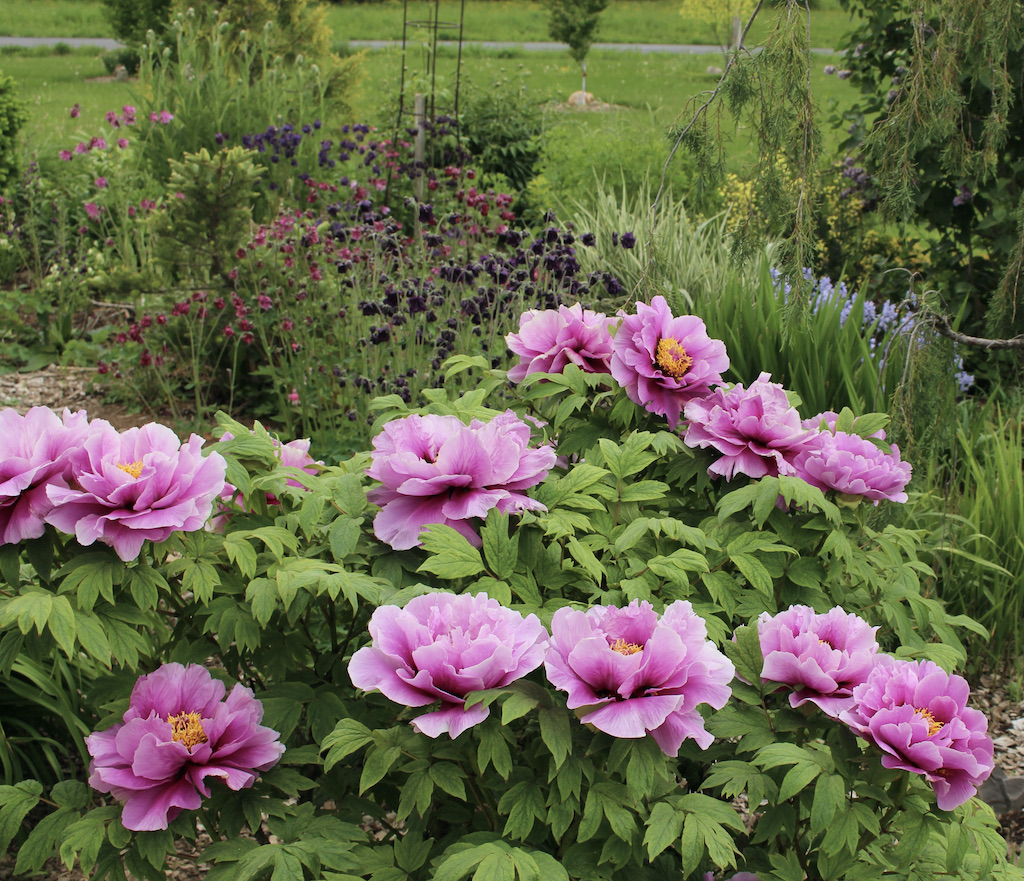
Spring is Quite Awesome

Okay.  So if this blog post goes up in the next day or two it’s just a three week gap and not four, and I guess that’s better, even if I’m forcing myself to sit here right now and get something done while my heart is saying do nothing, crawl into bed, find a blanket, play mindless phone games….

spring violas

The violas of spring look great, they love the cool weather and frequent rains, and for once I like the color mix in this pot.  Too often I impulsively buy a celebratory mess of spring shades and hope for the best, and then act confused when the colors still look like a mess when planted!

With this week’s chilly and damp weather a blanket is definitely required even though a couple days prior the air conditioning had to go on to fight the heat and humidity.  Those temperatures, alongside regular rains and then a little too many rains, has the garden bursting with growth and color and fortunately not with fugus and blight yet, and I hope it stays that way.  I grabbed a bunch of pictures last weekend during a gap in the rain, and my favorite subject was the lovely rose ‘Aicha’.  I love her soft shade of yellow, the simplicity of her single flowers, and the arching shape to the bush.  She has a light fragrance, and right now I can forgive the leaf spot and only a few here-and-there sparse reblooming flowers in late summer.

rose aicha

The yellow of ‘Aicha’ ushers in the yellow/blue/purple phase of the front garden.

I picked up ‘Aicha’ at Der Rosenmeister nursery on a spring trip to Ithaca NY one year, and each summer since it has been a rose dream to make it up to their open garden party (June 13th this year btw) which Leon hosts each year.  It’s a party with music and fun, plus hundreds of full-bloom, cold-hardy rambling and climbing roses massed across the grounds of his home.  I would make a wish list of course.  It took me days of contemplating to fit in just three, so a list would be trouble which I don’t need but where’s the fun in that?

variegated iris

Somewhat fitting into the yellow/blue/purple phase is the variegated Iris pallida ‘Aureo Variegata’ which I love for foliage as much as the lemony scented flowers.

It’s actually still early for roses so lets bask in the show of the bearded iris first.  The iris don’t like the rain right now, but last summer’s drought was just what they do like, and this spring they’re showing their appreciation of the previous year’s rot-free dry weather.  I probably said I wanted more last summer and then did nothing to accomplish that, so this year I have a plan.  I think they would do very well on the berm.  I’m at a point where I want to plant something appropriate on the berm, and as long as nobody complains too vigorously about weeds in the iris I think this summer I’ll give it try.  Younger me would  aim for weeding after planting, but I’m starting to understand my limits as I get a bit more experience, and I can warn everyone right now that the iris on the berm will be weedy and I apologize ahead of time.

iris sunol

‘Sunol’ is an oddly colored iris which would probably do better on a weedy berm rather than the garden since it’s just as crowded, but less sunny here.  I believe the “dwarf” blue spruce is squeezing it out faster than I wanted to imagine.

I guess you can’t talk about the May garden without mentioning weeds.  One of this year’s goals was to eliminate a few from the garden and mostly from the lawn, and when a friend saw that post they mentioned the idea of a wildflower section in a corner of the lawn as a a safe-zone to balance the weedless-lawn effort.  Upon hearing this excellent suggestion I realized that what I wrote was really a bunch of misleading nonsense.  Such is often the case for this blog but in this case it gives a totally different picture than intended.  I forgot that the lawn purists consider a lawn as a place for grass and only grass, and oh my gosh that’s not what I’m aiming for since in my opinion a grass-only lawn is about as boring as boring can be.  My weeds are narrowleaf plantain and creeping charlie.  I hate the plantain and have grown tired of the creeping charlie so they are now the two weeds who’s numbers I am trying to reduce.  Violets as well but I hesitate to mention that since they’re so beloved, but they seed everywhere and are nearly impossible to get out of flower beds, so enough is enough.  My biggest problem in spraying to control these three weeds is that the clover and dandelions are also killed if spray get on them, so I have to be careful and precise to miss them.  Hawkweed is also a treasure in my lawn, and to be honest I’ve transplanted plugs to get it into new spots… actually in the older parts of town I’ve seen a lawn or two with a few shades of yellow which I’d love in my own lawn, but I’m not quite ready to knock on doors asking for weed samples.  So just to be clear, for me a weed-free lawn is only grass-based, and the green is well spangled with the blooms of a carefully curated blend of colors, just with less plantain mostly because I just don’t like the stuff… unless it’s the wide-leaf form in purple which I guess I do like…

iris elsinore

Bearded iris are not weeds in any sense of the term.  This is ‘Elsinore’, one of my favorites.

So rest assured this garden is quite safe from a turf obsession.  To lose finches picking through dandelion seedheads, bunnies grazing the clover patches, and bees working the birds foot trefoil would be sad.  Actually I feel a little concerned when I see a vast expanse of fertilizer-hyped, weed-killer soaked turf and think of the hours wasted keeping it that way and the dollars which could have been spent on better pursuits.  Those people obviously never grew a snowdrop nor jealously eyed a patch of English daisies growing in a garden they visited last weekend and then thought of their own pot of English daisies and then spent the next three days staring out at a rainy garden wondering where a good spot would be to plant them in the lawn… Hmmm.  You may see why little actual work happens here when the gardener wastes hours thinking about where in the lawn to plant new weeds.

Glaucium corniculatum blackspot or red horned-poppy

The colchicum bed with a few not-colchicums filling in the gaps.  The orange poppies are red horned-poppies (Glaucium corniculatum) and love a dry, poor soil which doesn’t speak well of the soil in this bed.

Enough about weeds.  May here is about flowers and the enthusiastic growth of plants, and besides the iris here are a few odds and ends of treasures and tasks.

Robin's PlantainErigeron pulchellus 'Lynnhaven Carpet

Matt Bricker will often bring a few non-galanthus goodies to the Galanthus Gala, and one year a pot of Robin’s Plantain (Erigeron pulchellus ‘Lynnhaven Carpet’) came home with me.  It’s a nice low groundcover with soft leaves and cheerful daisies in spring and is about as easy to grow as anything.

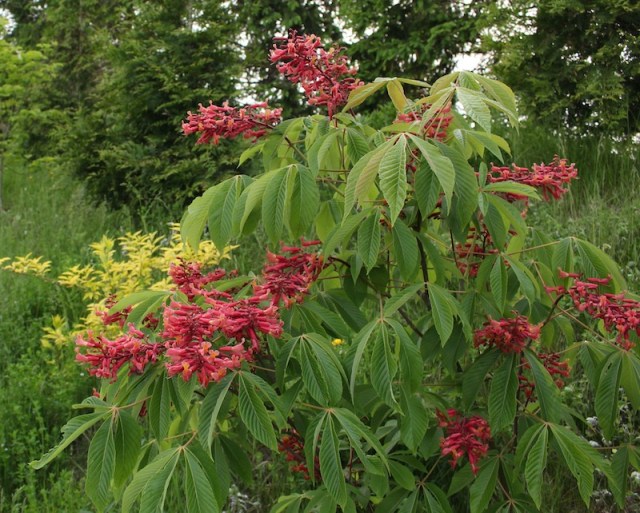
Not that I’m anything close to a purist but I just noticed the horned poppies and Robin’s Plantain (a daisy not to be confused with the previously mentioned plantain) are North American natives and to keep with a theme for more than a minute here’s one last shrubby, maybe someday small treeish native thing, the red buckeye (Aesculus pavia).  In a miserably hot and dry spot on the berm it carries on, growing inch by inch and blooming faithfully each spring.  It would like a better spot but carries on well enough with what it has, the show increasingly clashing with the pink and mauve rhododendrons which also suffer on the slope here.
Aesculus pavia red buckeye

Red buckeye (Aesculus pavia) is listed as a hummingbird magnet but as of yet… it’s just a pretty shrub on the berm.  I’m hiding buckeye seeds each year and maybe one day they’ll carpet the industrial park.

That was possibly a full minute of focus on how unfocused I am, but as I’m sure you know there are just so many other things going on it’s hard to stick to a task.  A gardener goes out with the ambition of transplanting a sedum but sees a branch to prune and a weed to pull and then gets lost looking for a trowel they remember using two days ago and before you know it the rain started again and you’re wondering why you spent twenty minutes deadheading hellebores instead of mucking leaves out of the pond.  There’s a mile long to-do list, which I’m sure is the same for every gardener (and if not and you are that rare exception please keep that an inside thought) and perhaps this weekend the list will get shorter before it gets even longer.  I don’t even know what my list says so here’s a guesstimate.  Most everything is out for the summer, most vegetables are coming along, a few new plants are here, but the summer bulbs and back porch have not yet been attended to.

bromeliads overwintering

The bromeliads are slightly pale but nearly as lush as when they came inside last fall.  They’re almost too easy and this gardener is only allowed to buy maybe one or (at most) two new ones this year since that’s ok and not a sign of addiction at all.

On a plus side the garage is still being used for vehicles rather than entering the annual contest to hold as many empty pots, wheelbarrows, boxes, bags of potting soil and tables full of drying bulbs and corms as possible, and to achieve that the driveway has stayed open enough to drive on.  It’s basic math since I am out numbered now.  Three out of the four drivers here agree that the driveway is better utilized for cars rather than as a makeshift summer nursery/pot ghetto/staging area for excessive plant additions to the garden, and now the gardener is forced to hide his compulsion just around the corner, alongside the garage 😉

golden ninebark seedling Physocarpus opulifolius

My friend Kathy Purdy warns that stray tree and shrub seedlings should be addressed when small and not allowed to sink their roots in and create a removal issue down the line, but… golden ninebark seedlings (Physocarpus opulifolius) are so cute and can’t possibly ever be in the wrong place… right?

That’s it from here.  It is now Saturday morning and once the last person asleep here wakes up we shall go to a coffee shop and the two children will make us breakfast… assuming we pay for it and tip them as well, and then after that I’m sure something will get done here even if your guess is as good as mine as to what it will be.  The lawn needs cutting, so I’ll probably head outside and start by planting petunias next door and then check the pool filter.  Maybe I’ll eventually find that trowel again, who knows, but in the meantime I hope you have a wonderful spring weekend!
Please Tiptoe

Oh my gosh, does this blog still even exist?   >insert excuses, apologies, delusional hopes for the future< Well I guess it does, and as you know spring moves fast and I don’t so here’s an update from last Saturday when I thought I could take a few photos and do a quick post before the sun sets on the Sunday… or Monday… or Wednesday…. or

perennial tulips

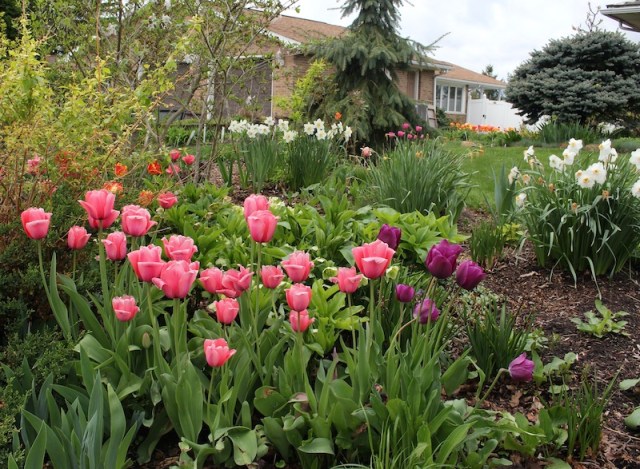
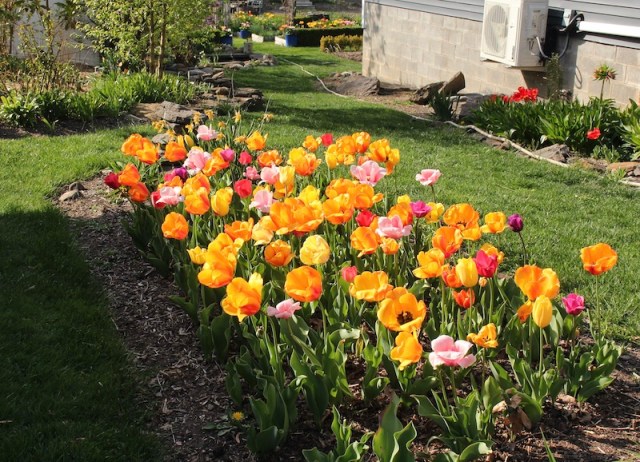
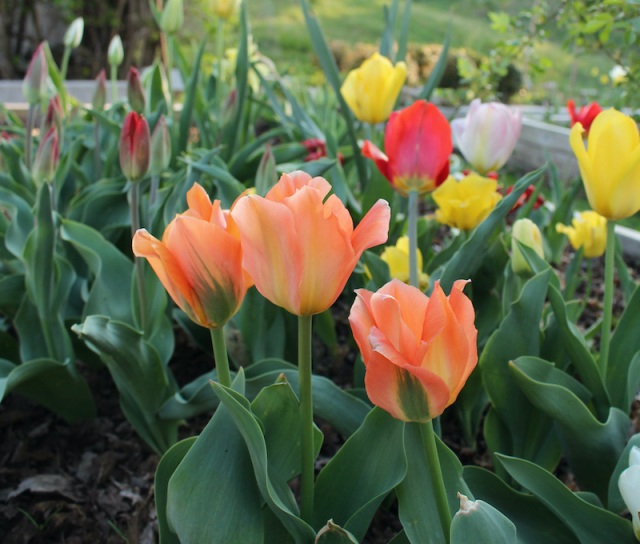
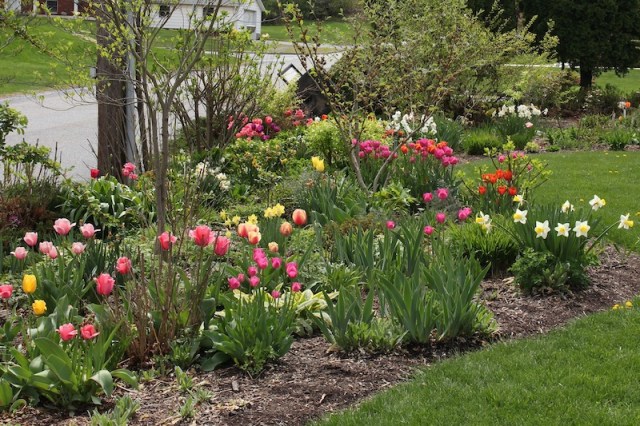
The front border was beautiful last weekend.  Individual blooms are a bit beat up, but from a distance nobody cares.

Believe it or not the gardener here has actually been somewhat useful, even if he’s not a good blogger.  The to-do list is still behind a few months and some things have already been quietly pushed onto the 2026 list, but overall there has been a mild sense of progress.  Hopefully it shows.  There’s a huge pile of branches and small tree trunks which shows less attractively than tulips but as always the garden is a work in progress.

perennial tulips

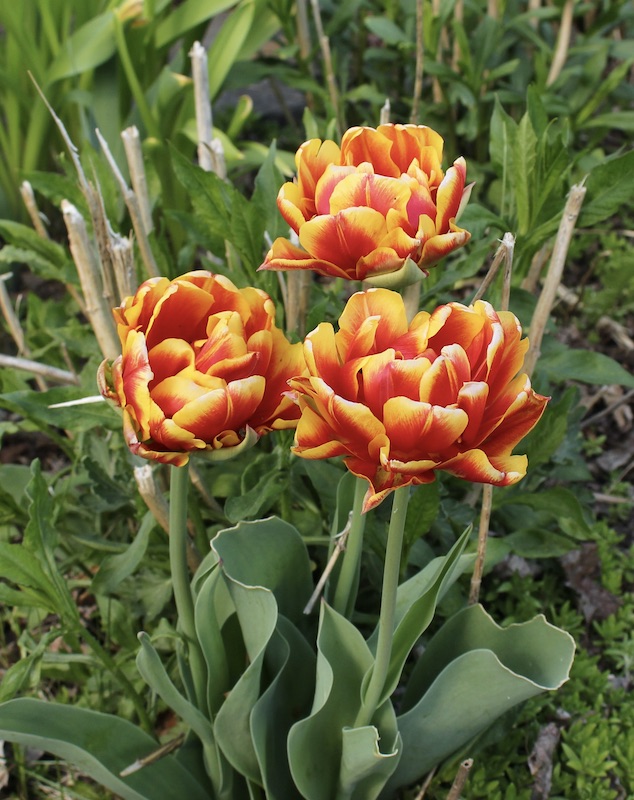
A double tulip from back in the day.  They were planted a decade or so ago yet still show up here and there depending on where a bulblet dropped or what other plant was moved or removed.

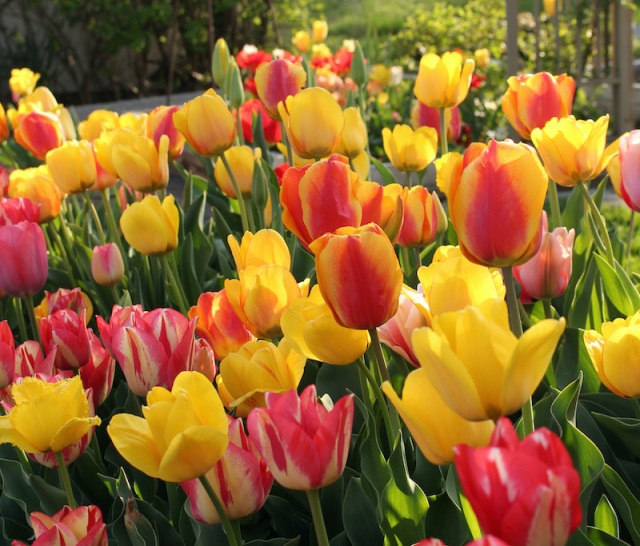
Maybe it’s best to just focus on the tulips.  For a week or so some hot weather brought them on too quickly and then wilted the edges, but then cool weather returned for the weekend and they were awesome.  Maybe not the best year but good enough, and even though many were missing you can’t complain too much during tulip season so lets focus on the good!

perennial tulips

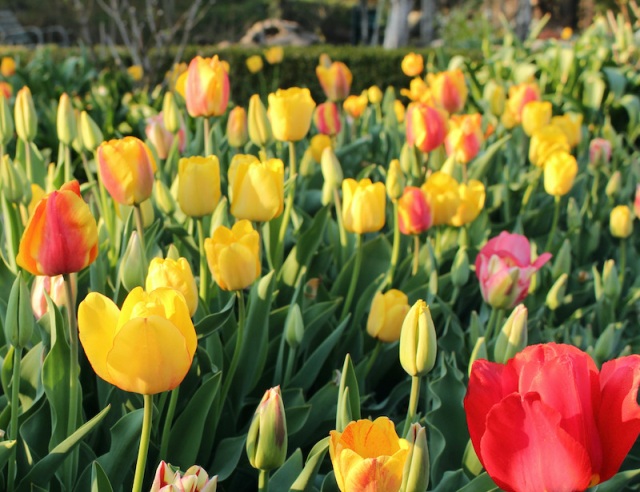
An exceptional crowd of ‘Pink Impression’ alongside some unknown purples.

Ok, maybe a clump of pink tulips is the bulk of the ‘good’.  The masses of flowers in the potager are missing this year and in spite of all the trouble and work they involve I really miss them.  I blame dry weather when they should have been growing last year, I blame too much wet when they should have been going dormant, and I blame a gardener who got discouraged and then let mice and squirrels have their way with the curing bulbs.  Whatever.  Gardener forgiven and let me say I really am enjoying the tulips this spring even if my mood this morning does not lend itself to expressing that emotion.

tulipa clusiana

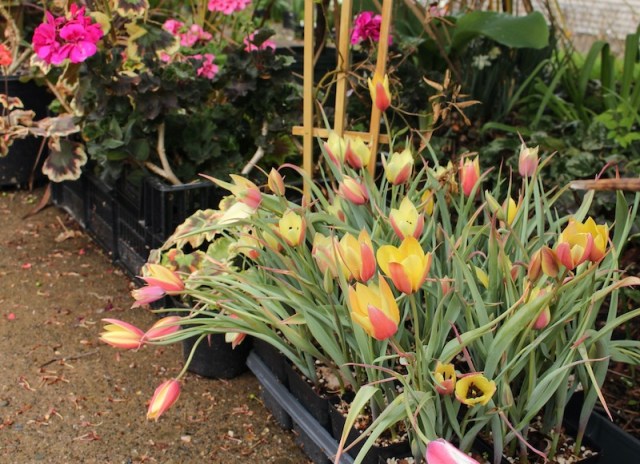
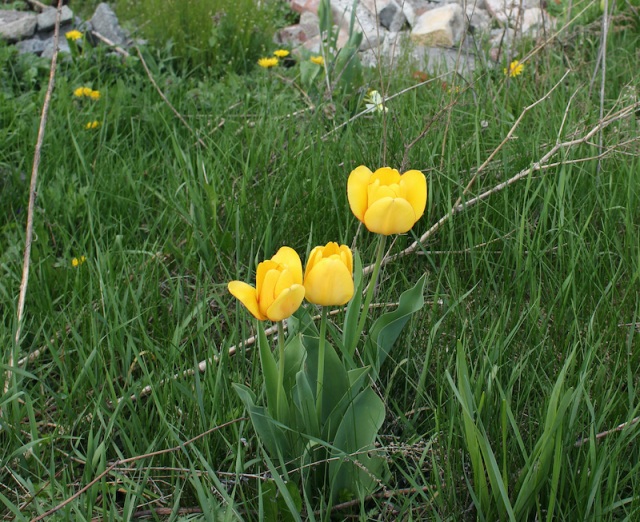
A tray of species tulips (Tulipa clusiana) which were meant to sell at the Gala but just weren’t looking like much that morning.  Two months later they’re highlighting the driveway and will be planted out once the blooms fade and I think they’ll do very well in a sunny spot.

Maybe I’m grumpy because I’m not attending the Sakonnet Plant Fair in Little Compton Rhode Island this morning.  Each year it grows into something even more tempting and each year I’m even more envious of all the plant nerds who are able to spend the day browsing.  Under the guiding hand of Ed and Taylor of the plant nursery Issima the event has grown and perhaps you’ll get an idea of the kind of treasures you’ll find at this sale if you take a look at their offerings.  These are exactly the kind of plants I like trying and buying, even if in my heart I know they won’t get the care they need in this garden to truly flourish.  But often times they do, and they turn into the “Oh!” plants which every gardener needs.

Not much ‘Oh!’, it’s sparse tulip year in the Potager.

Well look at that.  Just talking about the Fair has brightened my mood and I guess all I have to do now is promise to take better care of the spring bulbs and everything will be as it should 🙂

perennial tulips

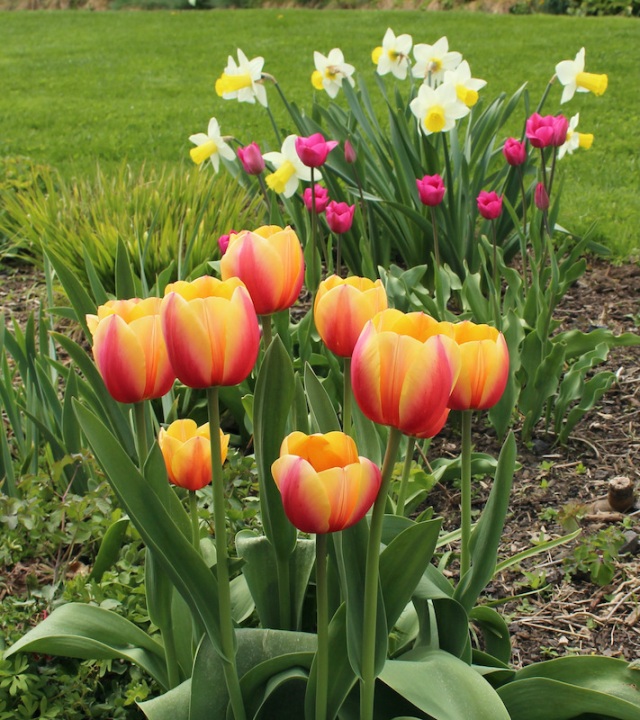
As another plus, the few tulips which have returned look exceptionally healthy this spring.  As long as there’s enough sun to dry them out after each rain I think they’ll make excellent bulbs for next season.

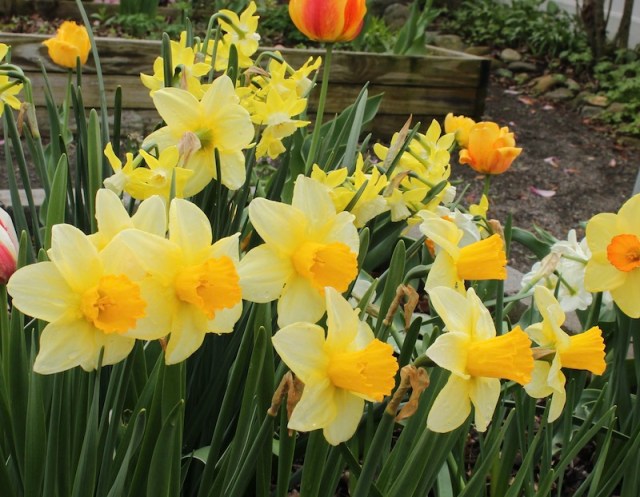
So does better care mean more bulbs?  Yeah probably, because although the tulips are still excellent I think the daffodil situation could use some work, and by more work I mean dividing and replanting and maybe a few new ones this summer.  I’ve been good.  I think I earned them.

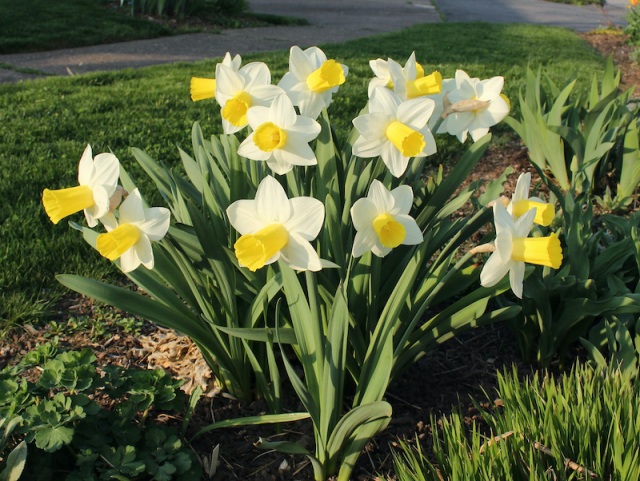
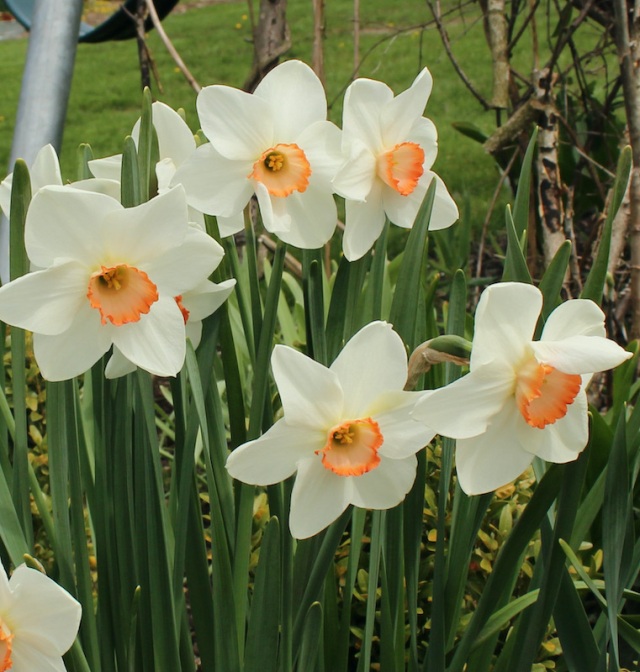
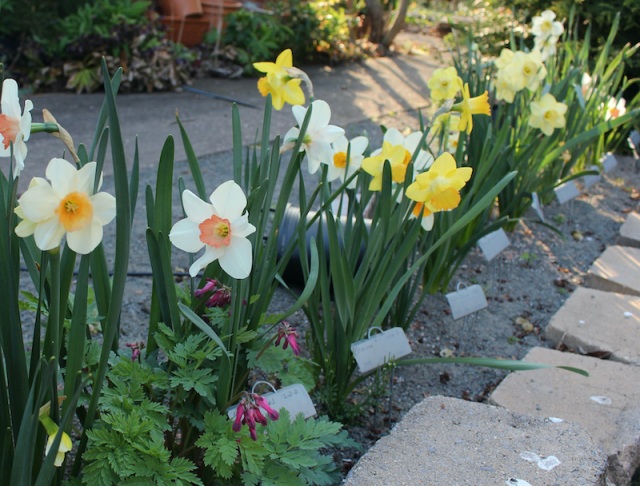
Many of the daffodils here are quite average but for whatever reason I love them more than I should. This is ‘Capitol Hill’ which is an absolute favorite even if it’s somewhat average, and too old to be new and too new to be old.

I still won’t buy more tulips though.  The species tulips didn’t count of course because they were for a sale, so with that out of the way I can still claim I haven’t bought any new tulips for a couple of years.  I don’t say this as something to be proud of, I just want to point out my restraint which to some people is a good thing.  Here’s my show of restraint in terms of the potager tulips, which are now in the daylily farm, which of course is not where they should be, and puts a bit of a damper on putting daylilies into the daylily farm.

perennial tulips

Somehow a couple hundred of the potager tulips went missing and these are all that’s left. They will multiply I’m sure, maybe not as fast as I’d like them to but that’s good since I still have to figure out how to grow daylilies and tulips and maybe cannas and dahlias all in the same daylily farm.

Enough about tulips and daffodils.  Let me just gloss over everything else so that I can claim to be up to date on this blog.

Syneilesis aconitifolia

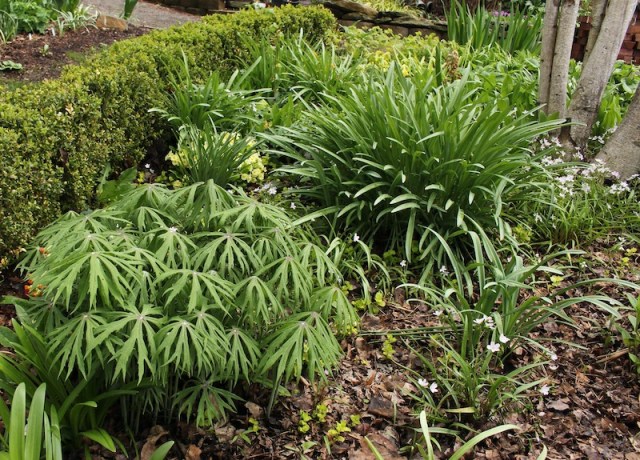
The woodland beds, aka snowdrop beds, are coming to life.  The shredded umbrella plant (Syneilesis aconitifolia) is cool and I wonder how much cooler a named form with variegation or a purple or yellow flush to the foliage would be.  Probably much much cooler.

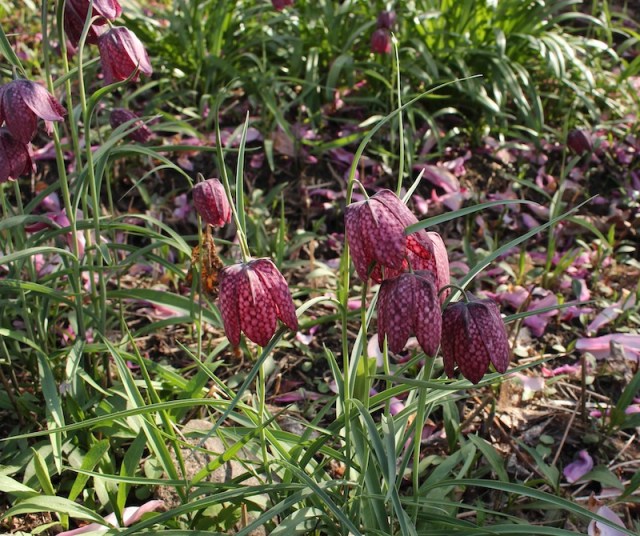
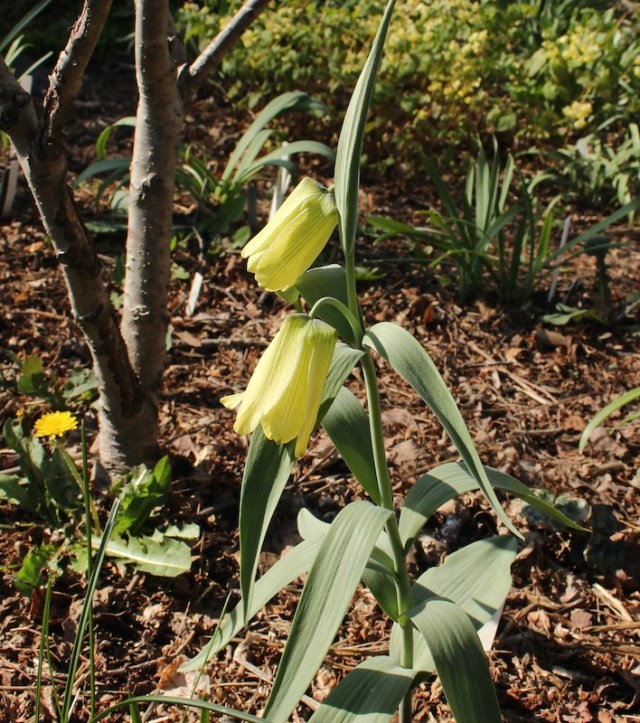
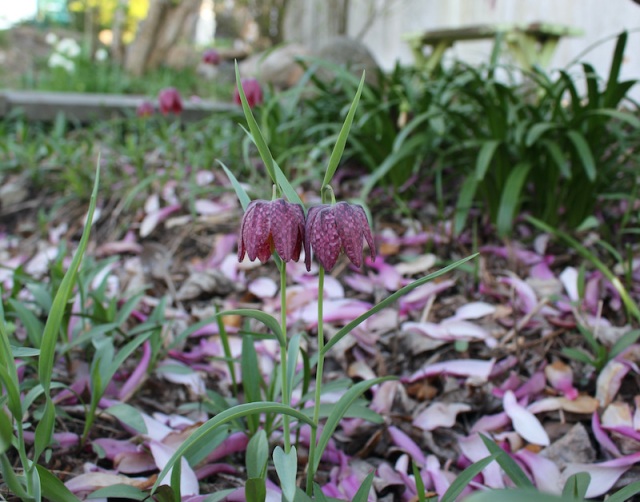
Fritillaria are one thing I do want to point out quickly.  They generally enjoy short lives here but two are at least trying and obviously I should show some appreciation for that effort.  Fritillaria mealegris likes the mucky side garden by the pond and is seeding around and clumping up and is ever so intricate with its checkered blooms and snake-head elegance.

fritillaria meleagris

Fritillaria meleagris (snake’s head fritillary) not showing up well amongst the fallen petals of a purple magnolia.

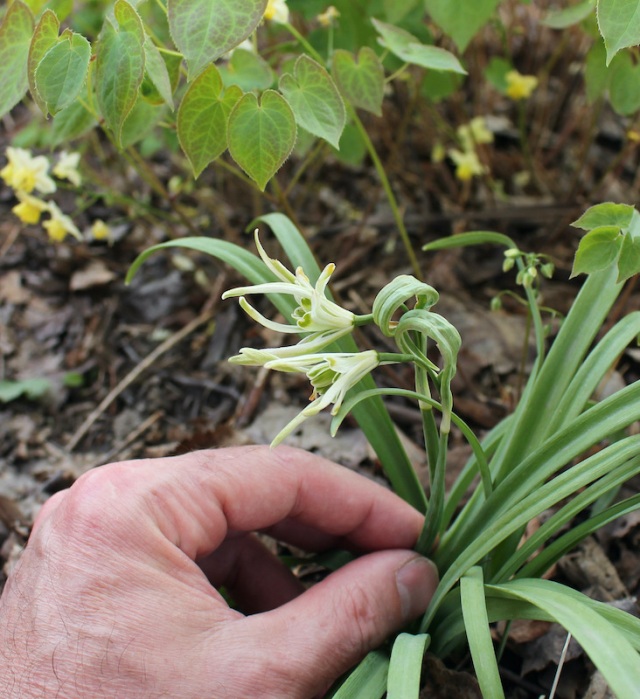
Fritillaria pallidiflora is the other frit which I’d like to mention, and in this case it really is to brag.  I grew it from seed you know, and it took years and even if you can buy 5 bulbs for like $5 online I think my years of patience in this one last seedling are a far better investment.  For reference, the week after I saw these first buds coming along a friend posted a photo of his ‘weedy’ clumps which seed all over the place, but I didn’t let that tarnish the joy of my two blooms at all.  Mine will come along I’m sure, even if it takes another 20 years.

fritillaria pallidiflora

Fritillaria pallidiflora in a shaded, woodlandy snowdrop bed.  It seems happy in this spot and I hope it stays that way.

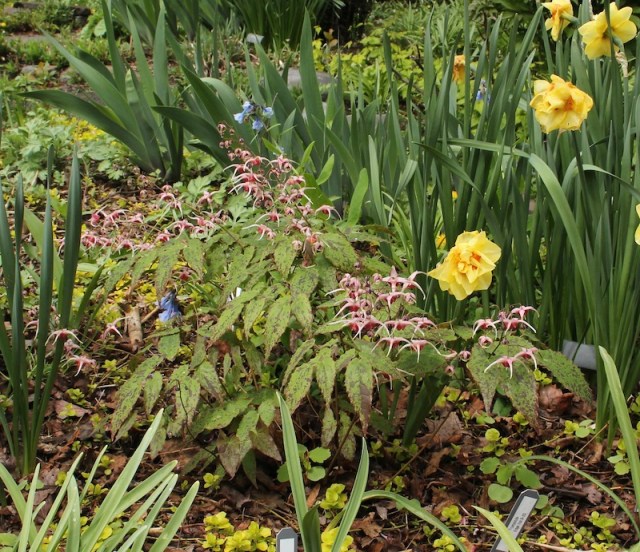
You know what doesn’t require much fuss?  Epimediums.  I’ve been trying to avoid collecting yet another plant but these are so tolerant of abuse and independent in the face of neglect that even a random one by one planting starts to build up.  A better gardener would keep track of their names just in case they started to accumulate like this, because of course people appreciate a name when you share a piece, but so far that’s been hit or miss and hopefully nobody asks about names on the ‘other ones’.  I’m sure it will be fine, right?

epimedium pink champagne

Epimedium ‘Pink Champagne’ is one which shows off more than a few of my others.  They’re all interesting things but not every one shows off at a distance greater than ten feet.

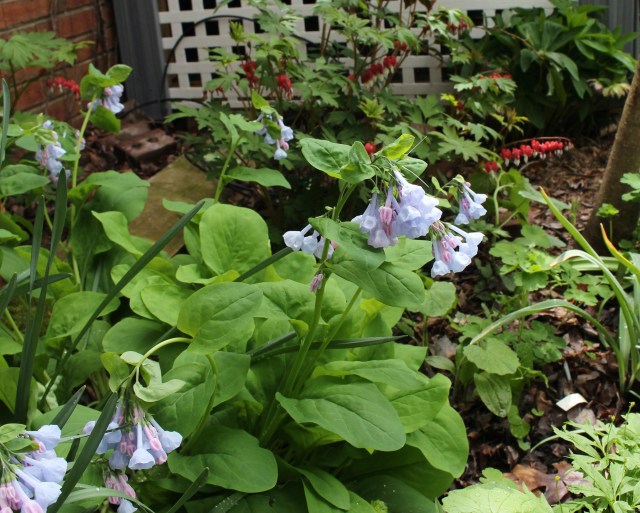
What else… The native Virginia bluebells are back and should be reseeding and slightly weedy even though they’re not.  I don’t think my garden is quite the fertile lowland woodland which they prefer and that’s fine I guess since a mass of them could be a floppy mess once they’re finished.

mertensia virginia bluebell

Mertensia virginica is a beautiful native bluebell which will go dormant once things get warm and it goes to seed.  This should fill a woodland, I should try convincing someone to do this in their garden since mine is a little too small for sheets of blue.

And that’s about it.  Besides chopping things down and just enjoying spring flowers there’s been an unusually suburban focus on the lawn this year.  I’m actually somewhat embarrassed to admit that the lawn was mowed twice this week to keep up with the rain and fertilizer and at one point I even sprayed for a few of the worst weeds.  Usually the lawn is a burden (and I’m not ruling that out come July) but so far this year I’m slightly obsessed.  Maybe this will give me a little more street credit in a way flowers and tiny bulbs do not and maybe that’s what I needed in my life even if I didn’t think it.  Never fear though.  Enough weeds remain that I am still safe from any Scott’s endorsements even if there might not be enough to keep the lawn haters satisfied.  Actually while I’m at it in confessing to untrendy things, I might as well mention the privet hedge I’m starting.  Yes, privet is invasive in the south so shouldn’t be planted, but here it’s been a standard for at least the last hundred years so I think I can sneak in under some kind of grandfather clause.  It’s not native, but neither am I, it’s overly formal to keep trimmed, but that’s what I want, it’s kind of boring and maybe a monoculture, but… we will see.  I have a weakness for formal hedging even though natural and native is more PC, so until this fever breaks we will see if a privet hedge was what I needed.

privet hedge planting

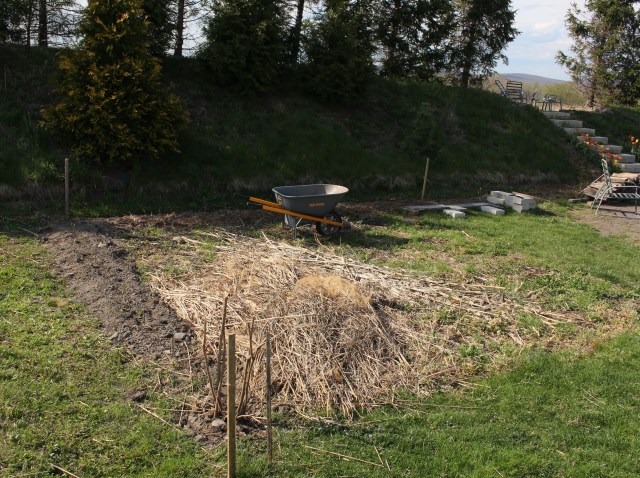
In the future a privet hedge will possibly surround last year’s pumpkin patch.  As with everything here it’s a work in progress.

In all honesty there’s a real strong chance this hedge thing will come to naught since when I say ‘planted a privet hedge’ I really mean I stuck in a few pieces of privet trimmings along a line where I’d like a hedge.  It’s probably too late in the year to do that.  I probably used the wrong pieces.  I did nothing to prep the soil or care for things afterwards.  Maybe it can’t even be done but I tried it anyway and in a nutshell this latest idea pretty much sums up how everything in this garden rolls.  Bad ideas, executed poorly and haphazardly and then put off for longer than they should be and then recognized as the work of an idiot but somehow enough things work out to make it all fun again.  At least it gives me something to ponder while sitting around, and in May a little sitting around is almost always a good thing.

I hope you can enjoy a little sitting around yourself, and that May is off to a good start.  Perhaps May is when this blog becomes more regular and this blogger rejoins friends in the blogging community but a reality check says August is probably more realistic.  The heat of summer has a way of rewriting and shortening the to do list and until that happens 😉


On the Eve of May

I hope no one is expecting the entertaining, witty narrative which usually accompanies these posts.  It’s been raining all day and the gloom has me drowsy, plus hours of inhaling varnish fumes this weekend probably killed off more brain cells than I can afford, so be prepared for a somewhat dull post.

darwin tulips

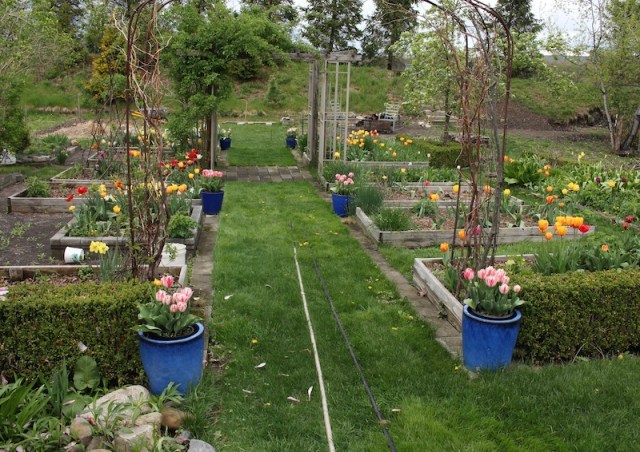
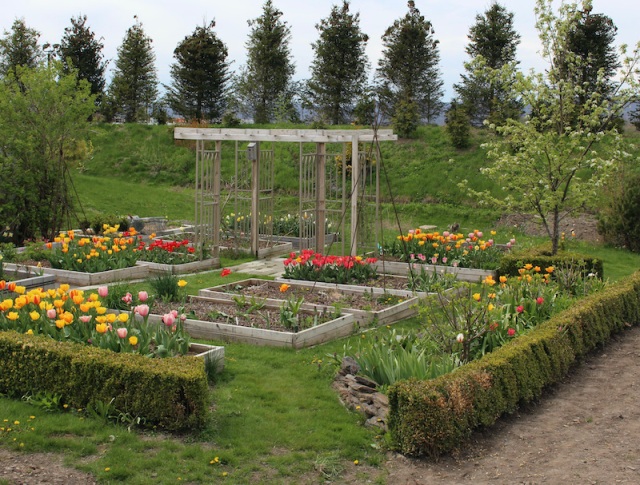
The potager last Friday.  The cool weather has been good to the tulips, but wind and rain is starting to take its toll.

As the first order of business I want to reassure everyone with the announcement that I have resolved my overabundance of yellow tulips problem.  They were looking a little tired Saturday so I just yanked a good amount of them and tossed them on the compost.  Sure they’ll probably show up everywhere now, as the compost will be contaminated by bulblets, but today I’m pleased with myself.  Never mind that it took me weeks to come up with this solution, despite the fact many people pull their tulips after bloom, but in this garden I celebrate where I can.

tulip tom pouce

My only 2022 tulip purchase, ‘Tom Pouce’.  Five bulbs purchased, one came up yellow, but I love the other four for their delicious yellow with pink frosted colors.

So in a moment of distraction I started wondering who Tom Pouce was, since there’s also a pink and yellow lily, and pink and yellow daffodil named after him, and to have three flowers carry your name must count for something impressive, so off to the library I went.

Or Google… and then Wikipedia… “A tompoes or tompouce is a pastry in the Netherlands and Belgium. It is the local variety of the mille-feuille or Napoleon, introduced by an Amsterdam pastry baker and named after Admiraal Tom Pouce, the stage name of the Frisian dwarf Jan Hannema”.  Apparently it’s a pastry taken seriously in the low countries.  Color may stray, the pink and yellow may change based on national holidays or serious sporting events,  but you don’t mess around with either shape or ingredients.  It sounds like a pastry I would enjoy getting to know, although there also seems to be a little bit of a quandary on how it should be correctly eaten.  I believe that discussion is outside the scope of this tulip post, so I’ll stop now and wonder about Frisian dwarves all on my own 😉

broken tulip insulade

Not named after a pastry, ‘Insulinde’ is an example of one of the virused ‘broken tulips’ which are a virus risk, but just amazing enough to try growing anyway.  This one dates back to 1915.

Soon the tulips will be a thing of the past, and just like snowdrops and daffodils it will be another 12 months before they return, but at this time of the year it barely matters.  There’s so much coming along that even on a miserably rainy and dark Sunday you can’t help be a little excited.  In the potager the wisteria is blooming again, and although it should only be a year since the last time, it’s really three since late freezes have done it in for a couple seasons.  The scent of the flowers fills the potager air, even stronger than lilacs and probably just as sweet.

tree wisteria

This wisteria only looks like it is supported by the pergola since I wouldn’t dare release it onto crushable aluminum supports and a frame of mere two by fours.  Once a week for the entire summer stray tentacles of vine are cut back to a leaf or two to keep it under control.  This plant is a beautiful monster.    

There’s more blooming and growing out there, but I’ll spare you all except this last peony. Paeonia daurica subsp. mlokosewitschii is a mouthful so most refer to this plant as ‘Molly the Witch’.  I did want the pure yellow version but when my seedling finally bloomed it showed to be a pale yellow with a pink tint, which is also within the range for this species.  I love the foliage but to me the bloom is relatively small and somewhat mild mannered.  Time will tell if it keeps a spot here in the garden, but even if it doesn’t I’m sure some gardening friend would take it in for me.

paeonia daurica subsp. mlokosewitschii

A nice pink tinted version of Paeonia daurica subsp. mlokosewitschii.

The rain is coming down strong again and it’s getting late.  There’s work tomorrow.  Ugh.  I think I need something sugary and fatty or just plain greasy, because I feel like Monday has already arrived and I’m not excited.  Enjoy your week at least!

Tulips

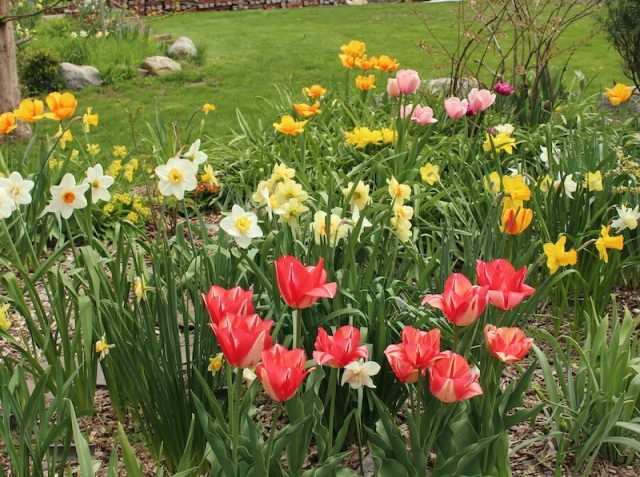
It was warmer than expected and most of the garden’s tulips opened for the weekend.  That sounds good but it was hotter than they like and a few fried up, and then the wind picked up and they took another beating… and then we had a downpour…so today they look a little tired, but the cooler weather in this week’s forecast will be perfect to keep them fresh looking for another week at least.  It’s not botanical garden glorious, but I’m quite pleased with it, and also grateful that a couple friends were able to stop by and take a look as well.

darwin tulips

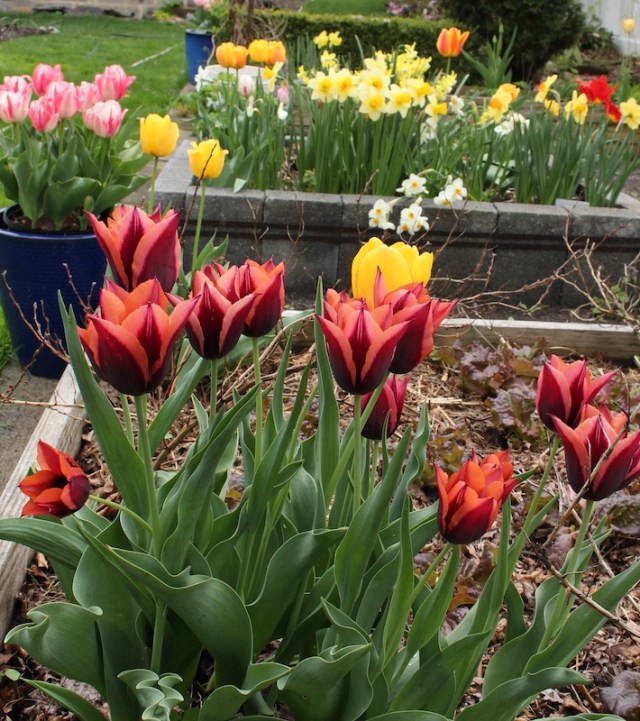
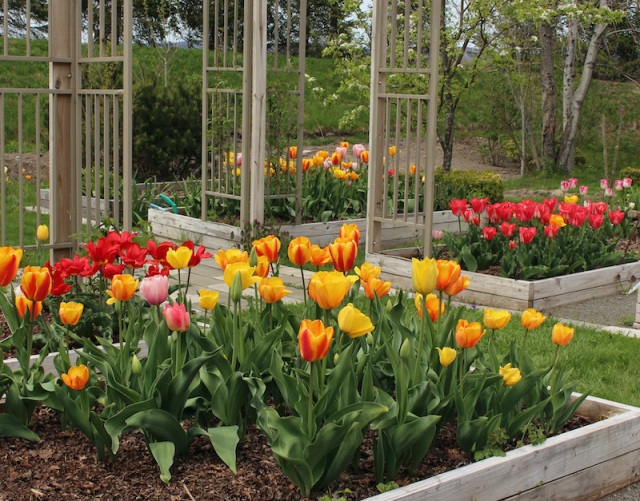
Mixed Darwin tulips in the vegetable garden beds.

tulip spryng break

Some ‘Spryng Break’ lined out with the others

darwin tulips

Another view of the potager beds

Honestly it looks much better in the closeups.  From a distance you can see all the “works in progress” around the yard and these beds look more like some maniac just stuffed too many flowers into a tin can vase, but again I’m pleased with it and wondering if I have enough beds of tulips yet 🙂

darwin tulips

Some of the tulips out front.  Like everything else they need dividing but with a gardener who just waddles around the beds smiling at each new bloom there’s only a slight chance that could happen.

Originally the mix came around when I collected stray tulips and wasn’t sure what they were, so just planted them all together.  There have only been a few times when I wasn’t happy with them all together, and when that happened I just pulled out the offenders and all was well, but this year I’m wondering if growing a few as separate color blocks might be fun.  I’m envisioning a Dutch bulb field look with rows of color, and since I think I have too many yellows anyway as long as I’m separating those out might as well separate a few other colors as well, right? -I can almost hear you saying obviously…

darwin tulips

I like them.  I think I need a few more still.  We all have our weaknesses.

Marking and sorting out tulips sounds like a lot of work.  I may have to plant them with some better spacing so they can sit where they are for two seasons rather than being dug each summer, and I think if I keep them along the edges of the beds there will be room for zucchini or whatever and hopefully the extra watering won’t bother the dormant bulbs.  I always miss a few anyway, and they do fine so in theory this should work.

darwin tulips

So much color

In any case I know I’ll have plenty more tulips next year.  These will likely double in number for next year and my friend Kimberly at Cosmos and Cleome will hopefully 🙂 offer me her leftovers again when she ejects her own tulip patch to make way for the season’s next show… I’ll gleefully add them somewhere here to grow on until they’re big enough to bloom again.

darwin tulips

An old bulb bed where a few tulips still come up through the grass and weeds.  Even with the potager beds packed and in full bloom, a trio of flowers in the weeds is still amazing.

Sorry this post is just the ramblings of a tulip maniac.  To make it somewhat useful I guess I should reveal all my secrets about growing tulips so here they are.  Wait until frost kills off whatever is in the vegetable bed and remove the dead vines and stakes.  Grab a shovel and dig a shallow grave.  Dump a reasonable amount of bulbs in and to make yourself feel like you’re putting in some effort, space them somewhat evenly and turn them pointy side up.  Fill the grave with the dirt and old tomatoes and rotten peppers and whatever else you were too lazy to cart off to the compost.  Cover the beds with a good inch or two of chopped leaves so that no one can see how poorly you prepared the bed.  Wait for spring.

I think my reputation is established enough that no one expected the “work” involved here to be anything special.  I have plenty of other jobs to kill myself with here so no sense letting the tulip planting have the upper hand, but it surely  helps that I love digging them up again to see how well they’ve grown.  Tulip flowers are nice enough, but sacks of tulip bulbs curing in the garage must really thrill the dormant prepper in me, and make me feel like I’m more than well prepared for any civilization crumbling tulip-shortage that could happen at any moment.  You never know.  It’s always good to be prepared.

April in Bloom

We had our earliest 90+ degree day ever last week (33C) and I was unimpressed.  Daffodils melted and hyacinths fried and the gardener turned on the air conditioning and did nothing in the shade.  Three days later he froze standing around at a track meet with a brisk 41F (5C) breeze and the occasional snow flurry.  Such are our springs.  As usual things are busy and people are probably relieved that photographing snowdrops had to take a back seat to work and trips and home repairs, but I did take a minute Sunday to photograph a few things.  Lets start at the end… the end of snowdrop season 😦

galanthus lp short

Here’s the double snowdrop ‘L.P. Short’ holding on to a last bloom while a sea of Spring Beauties (Claytonia virginica) bring on the next show.

galanthus narwhal

Galanthus ‘Narwhal’ is still hanging on in spite of all kinds of weather and me stepping on him at least once…  

Of course the end of snowdrop season is always a sad time, but at least there are plenty of distractions to ease the trauma.  Actually as things come on so fast and furious it will be at least another month or two before the reality sinks in, and by then I can start digging a few bulbs and buying a few new ones, and dreaming of next season 😉

epimedium purple

I might have added an Epimedium or two over the last few years.  Shade tolerant, drought resistant,  deer and rabbit resistant, nice all summer… I’ve been avoiding them for a while, but what’s the harm in adding another two or ten?  This is ‘Purple something’ since I lost the tag and possibly didn’t write the name down anywhere…

As trees grow, this full sun garden is becoming shady in spots and I kind of like the early flush of spring bloomers.

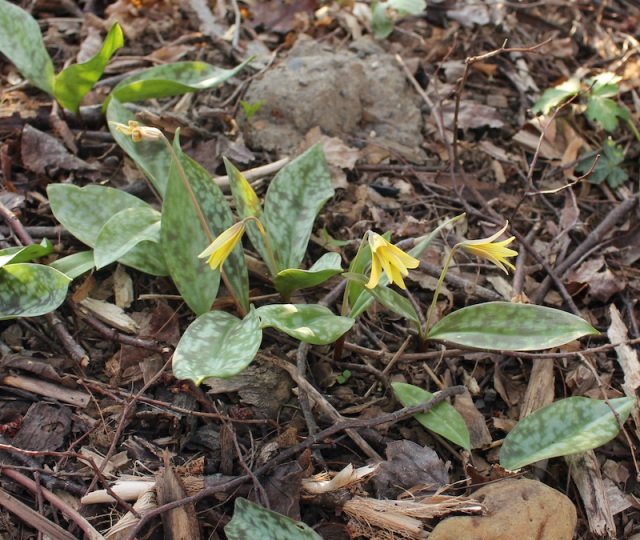
dogtooth violet, Erythronium americanum

Some dogtooth violets (Erythronium americanum) a friend gifted me a few years back.  I was shocked to see them blooming this year, I thought for sure the cool speckled foliage would be all I’d ever get in this crappy, rooty, dry as a bone all summer, growing location.

spring garden

From far enough away the somewhat-shaded part of the garden actually looks nice.  

Shade is nice, but full sun is still something I treasure most.  All kinds of bulbs are now filling in the beds and it’s awesome to see the return of color and growth, even if at times it seems to move along too fast.

muscari

The grape hyacinths are absolutely common, and somewhat weedy if not dead-headed, but the blue color is perfect and lasts a while.

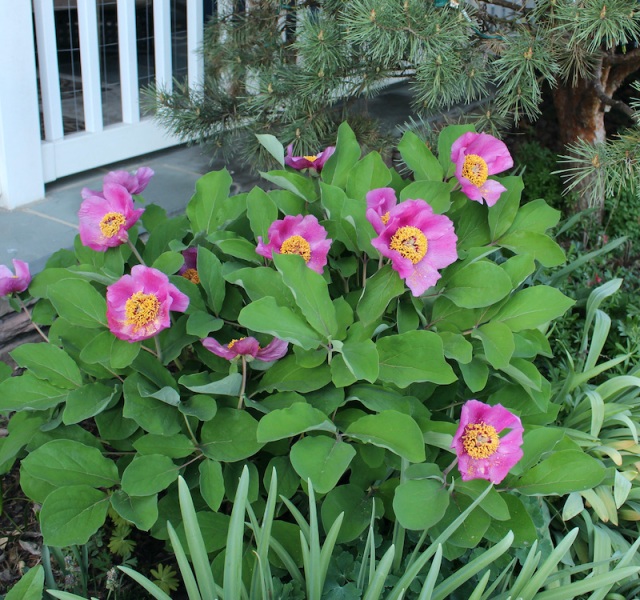
For all the treasures I see in the garden, most of the people coming and going from this house don’t mention a thing about the garden.  You can imagine my shock then when not one, but two people commented on the ‘pink tropical looking flower growing alongside the porch.   Species peonies are nice enough but two people?  Honestly I think they’re just messing with me, but when they immediately lost interest upon hearing the blooms only last a week or so, I knew they were authentically interested… even if it was only for a minute…

peonia daurica

Peonia daurica by the front porch.  

No one mentioned the dandelions, not even the fancy white Japanese version I’ve been pampering along in the front border.  I wish it would seed around a little, that would surely draw more attention.

Taraxacum albidium

It’s a favorite of the rabbits at least.  Taraxacum albidium must have a better flavor than the regular dandelions since I practically have to cage it to keep the bunnies off.

The daffodils might draw attention even if it’s never mentioned by anyone.  I need more, and I need to move a few bunches back into full sun since they’re sulking in the shady spots I tucked them into.  They’ll bounce back, but I was so proud of myself when I found all that room under the trees along the side of the yard.  I guess there was a reason for the empty spaces since apparently nothing really wants to be there including the daffodils.

narcissus bravoure

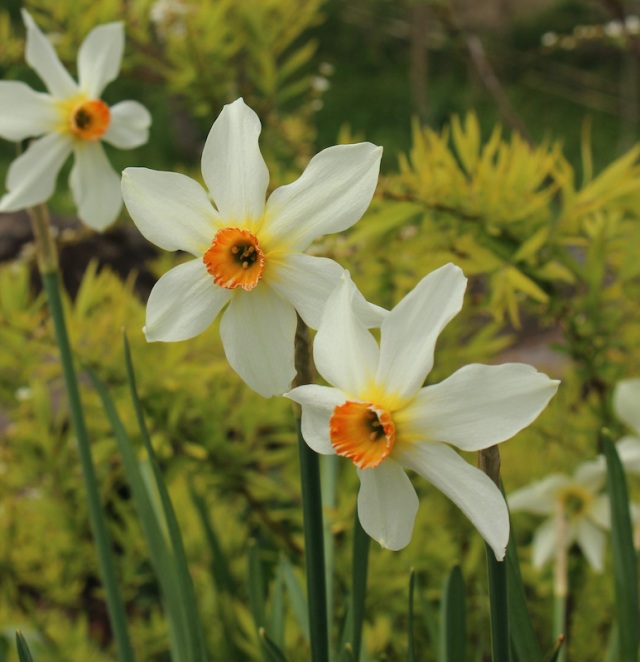
Narcissus ‘Bravoure’ front and center near the door.  It’s very nice and refined and I can’t find a single fault other than I’m not so crazy about it.  Maybe it’s too stiff.  I really shouldn’t try and find faults.

narcissus stella

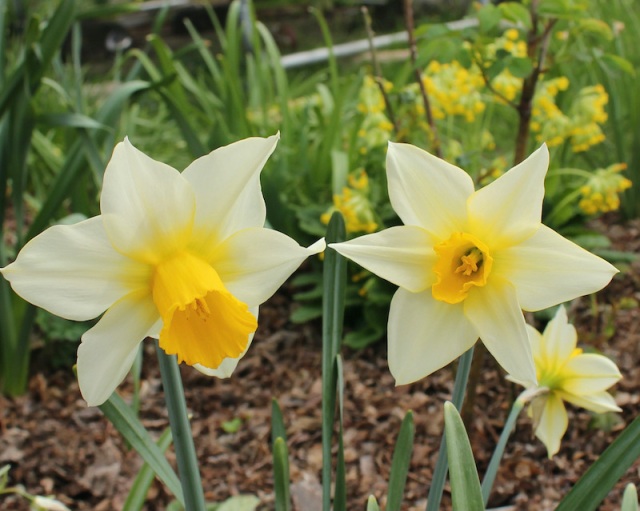
Narcissus ‘Stella’ aka Kathy’s Sweetheart is not too stiff.  She nods and sways and has joyfully twisted petals which fade from cream to white and I’m surprised how she’s grown on me.  I was trying to be a show-daff kind of person but I guess I’m not. 

narcissus noid

This one just showed up.  It doesn’t match anything which used to grow here yet I’m pretty sure it had a name at one time and I either never knew it or lost it.  It’s a keeper though, I like how the color of the trumpet bleeds into the petals… something which I believe show-daff people frown upon…

fancy daffodils

Newer, fancier daffs which are not doing as well in the ‘terrace’ as I thought they would.  It’s frightening to think how these should also be moved to a better spot.

fancy daffodils

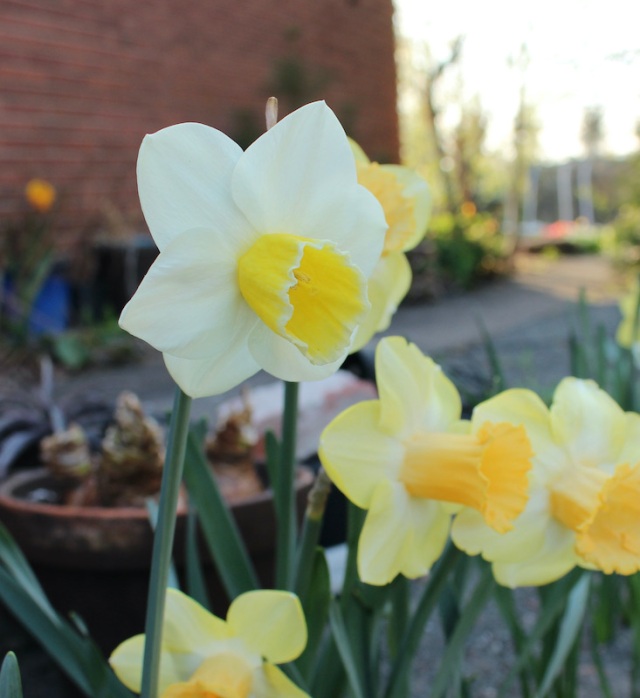
I don’t remember ‘White Collar’ from last year, but this year he’s living up to the name and I definitely approve.  Behind him is ‘Bronzewing’.  Bronzewing is again amazing.  

To be honest the shaded daffodils escaped the worst of the heat and are still somewhat nice when compared to the fried daffodils in the main beds.  But what fries the daffodils grows the tulips, and from here on it’s the tulips which will shine.

spring bulbs

Darwin tulips in the front border.  

tulip abba

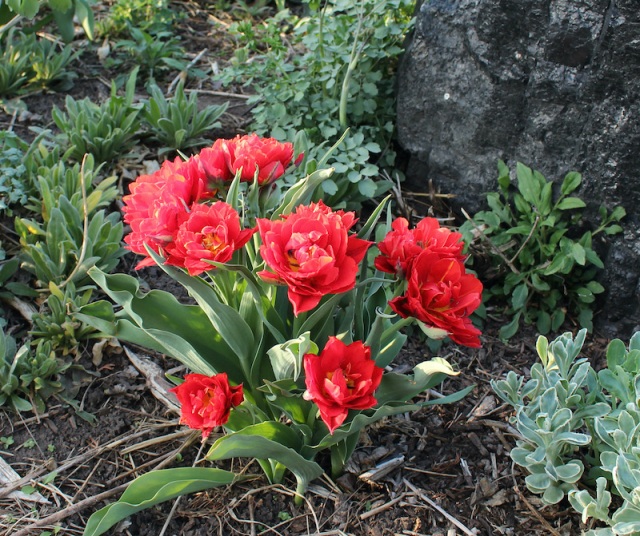
Years ago I took out the double tulips, but I must have missed one and over the years the one bulb has been clumping up nicely.  I suspect it’s the tulip ‘Abba’.

Most of the tulips here come and go as I add new ones or accidentally dig up and then divide old ones, but the potager is filled with the tulips I intentionally dig and divide each summer.  There are a couple hundred and although I planted them too thickly (entirely because I was too lazy to plant them properly), they still seem to be coming along nicely.  There’s no room for lettuce or onions but by the weekend all I’ll care about is how amazing it looks.

darwin tulips

More (mostly Darwin) tulips in the vegetable beds.  Another warm day and the main show will start.

Honestly the tulip show is nothing when compared to the big shows where bed after bed is filled with a curated display of color echoes and blends, but I like it, and on a beautifully sunny day all the color is just a celebration of spring.

orange emperor tulip

One day I’m telling my sister in law that this is one of the less-interesting, sloppy forms of tulip, and then two days later I think it’s one of the nicest in the garden.  ‘Orange Emperor’ has a delicious color and I like the touch of green on a few of the blooms.  Thanks Kimberley, I like it!

There is a little bit of a stink hanging over the display.  The pear tree is covered in blooms and without a freeze in the forecast I’m anticipating a good deal of pears this summer.  Fortunately this ‘Bartlett’ pear doesn’t seem to stink as much as the yucky stench of those Bradford pears planted all over the place.  This one only comes on as a wiff here and there, the Bradfords stink up your whole car if you drive by with the windows open.

bartlett pear

Plenty of pears to be.

While on the topic of flowering trees, the magnolias were amazing this year, but the heat pushed them over far too quickly.  I’ll have to get photos next year of two new ones but for now the new standard magnolia ‘Ann’ is still putting on a great show.  New flowers open for a while and the fruity fragrance always wins against the stink of a pear.

magnolia anne

‘Ann’ will never be more than a small tree, and that’s a perfect size for this side of the yard.

The side of the yard where ‘Ann’ is planted is somewhat mucky in spring when runoff works its way down from the yard next door and the front of this house, and for a while the spring muck followed by summer drought rejected pretty much everything I planted here, but finally two plantings are doing well.  Spring snowflakes (Leucojum vernum) and Snakeshead fritillaria (F. meleagris) rebel against good drainage and don’t mind sitting in water when water sits.  Both are actually happy enough to seed around.

fritillaria meleagris

Fritillaria meleagris seedlings are blooming here and there below the magnolia and my plan is coming together perfectly except for the fact you don’t notice the purple flowers under the purple magnolia.  Hmmm.  But at least they’re happy 😉

Plenty of things don’t work out to plan here, and plenty more things don’t work out without a plan so miss-colored fritillaria are one more thing which needs moving but will probably stay put for decades.  I’m fine with that.  The thing or two which do work out keep me happy enough and for the next couple weeks I’ll be swimming in tulips and that’s more than plenty.

darwin tulips

A mess of tulips

I hope your spring is also filled with plenty.  Have a great weekend!
Bragging Again

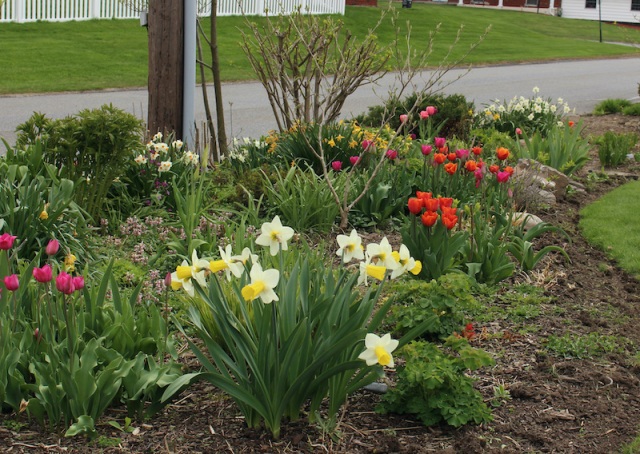
The weather has finally warmed up enough here to get things growing, and as usual it’s the tulips and daffodils which are my absolute favorites.  They’re not at all subtle and I think that’s needed in order to distract from the raw construction of other parts of the garden.

growing tulips

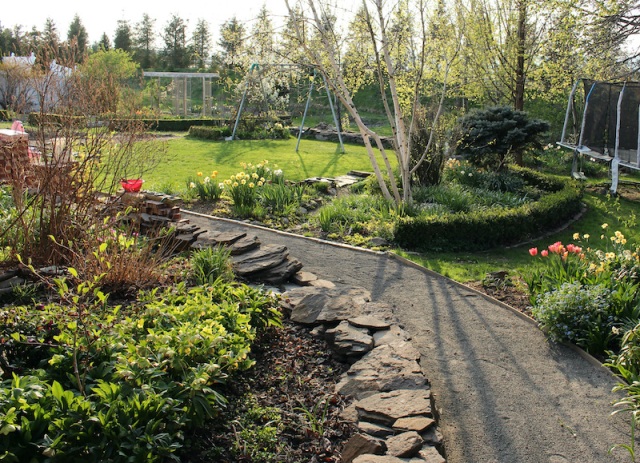
The border along the street is looking good with a nice show of returning tulips.  Some have been in place for over five years and are way overdue for dividing.

Tulips and daffodils are a weakness of mine and it may surprise some that I’ve been on a strict diet for the last two or three years and haven’t allowed myself to buy any new bulbs until I take better care of what’s here.  Crowded clumps need dividing in order to show off best and in the case of tulips a string of late freezes and excessively damp springs have brought on some serious plagues of tulip fire botrytis.  Fortunately it only takes a few nice flowers in order for me to completely ignore a thousand other issues!

tulip marit

‘Marit’ might be in the top five of favorite tulips.  The colors, shape, and size are just amazing to my eye. 

This year drier weather has also been helpful in keeping the botrytis down.  Between that and some Neem oil spraying last spring things are looking much improved this spring.  I’m also ruthlessly ripping out infected shoots and thinning the foliage on still overcrowded clumps.  We will see what ‘thinning the foliage’ does to next year’s flowers since obviously the bulbs need the foliage to grow new bulbs, but a few less bulbs might not be the worst thing either.

growing tulips

I’m not sure you can tell that these tulips have been thinned.  The one clump of orange was missed, but the others were all dug in late May(?) far earlier than they should have been, and immediately replanted after pulling off and tossing all the smaller bulbs.  I’m hoping the show next spring is again solid with color.

I’m pretty sure only the gardener will notice if there are a ‘few less’ bulbs next year.  Exponential growth means a hundred tulips can become three hundred in just a year, so better to revel in the luxury of me doing the thinning rather than disease or *gulp* deer or other vermin doing it for me.  Thank goodness the deer still avoid my garden.

growing tulips

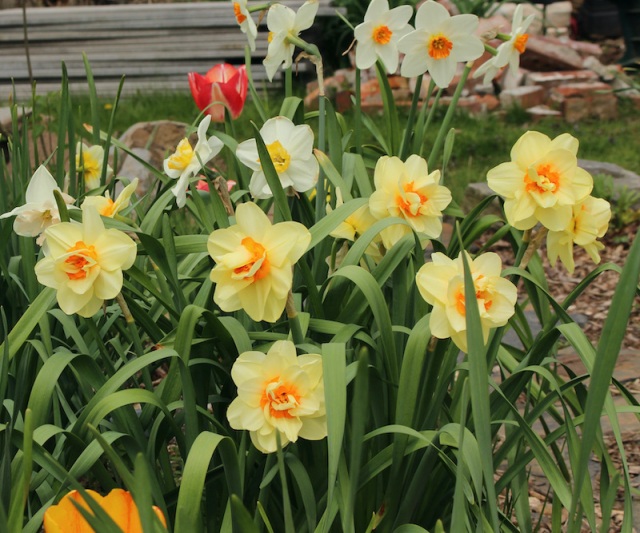
An overcrowded daffodil patch.  Sadly this is a newer replant where I thought I was leaving room, but really wasn’t as I tried to pack too many bulbs into too small a bed…

At least deer don’t eat daffodils.  Someday the backup plan might be daffodils and a fenced in potager if worse comes to worst.

narcissus firebird

An airy little ‘Firebird’.  

I don’t know if anyone remembers but ‘The Purge’ took place two springs ago, and daffodils were downsized to just under 150 varieties and that still sounds generous, but I miss them.

narcissus tahiti

‘Tahiti’ will never be downsized.  Even as a double in a garden where doubles are under-appreciated, it’s a favorite.

A new bed of daffodils would likely help.  I think it’s worth a shot at least 😉

narcissus coral light

‘Coral Light’ also made the cut and looks excellent with some room to show off.  If only I could do more of this planting-with-reasonable-spacing thing I think I’d be alright and things would look much better.

Where would this bed go?  Who knows but it would probably involve less lawn and that’s also a good thing… unless someone wants a badminton net strung up and doesn’t want to avoid jumping over daffodil clumps…

narcissus Mrs R O Backhouse

The bulbs of ‘Mrs R O Backhouse’ did not look great after the purge, and I was worried, but many of these older varieties bounce back quickly.

‘The Purge’ reached a highpoint two years ago during the potager rebuild, and a couple daffodil plantings had to make way for the construction of raised beds.  Sadly since then I’ve found that I don’t like the way the daffodils look in the raised beds, so that’s a new space problem, and even worse I love growing tulips in the raised beds.  The digging and replanting seems to really help with controlling the tulip fire botrytis and I can spend hours each week just going back and forth looking to see how much they’ve grown each day, and what new surprise has opened up.  Sometimes I really have to wonder where they come from when it’s a flower I don’t remember ever planting or it’s one I haven’t seen in years!

growing tulips

I tried to keep two beds open for tomatoes, beans, and zucchini plantings this month.  Next year all bets are off and the whole thing might be tulips.   

Actually here’s a confession.  Last fall I did add 10 new bulbs of ‘Shirley’ and ‘Pink Impression’, so this bulb diet I’m on isn’t all abstinence and cutting back.  Maybe it should have been though, since both varieties were mislabeled.

tulip not shirley

This is not the tulip ‘Shirley’ but still nice, and for a clearance bulb I can’t complain.  The real ‘Shirley’ has more of an inky purple stain that spreads down from the edges as the flower ages, and of course I still need to get that one again…  and keep this one now…

A friend with excellent taste in tulips pulls hers each year after bloom and usually I say no thanks, but this year I already put in a save request.  I’m also looking through bulb catalogs.  I’m also excited about how fat and vigorous this year’s crop of bulbs should be.  I fear ‘The Purge’ shall be followed by ‘The Splurge’ and tomatoes will end up in pots on the deck next year… and I’m 100% fine with that! -until someone else here overrules me 😉

growing tulips

The view from my in-potager seating area.  When the sun shines and the flowers open wide there’s not much getting done around here.

Usually the saved bulbs end up as mixes since it’s (1) easier and (2) it’s easier.  Plus the gardener always misses a bunch of bulbs when digging, stray bulbs get dropped and returned to the wrong box, and the gardener is a little disorganized in general.  He tries though.  A solid patch of his favorite is always worth marking and digging separately.

growing tulips

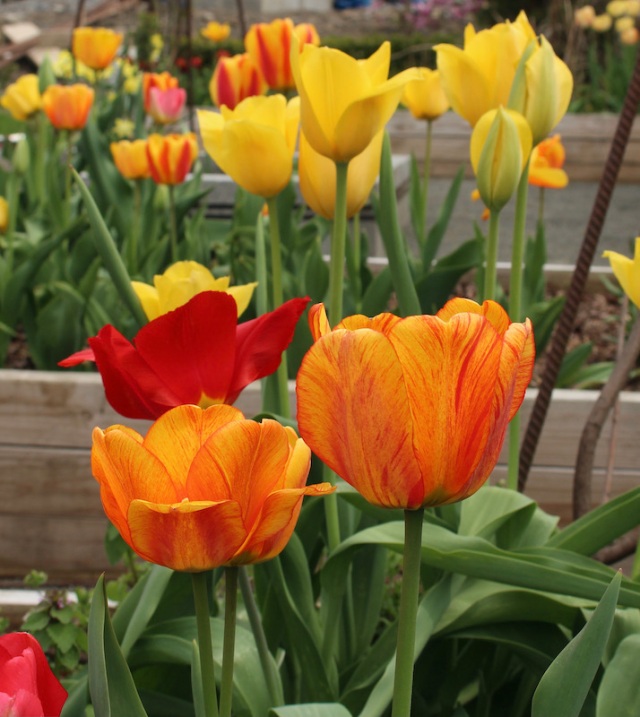
I think this streaked orange is ‘Beauty of Apeldoorn’ and I wouldn’t mind a solid bunch of it, as well as the yellow behind which might be ‘Big Smile’ which is plain and yellow, and I have plenty of yellow, but it’s also excellent and I love it.

Don’t worry, there’s a good chance none of that will ever happen.  Just getting the bulbs dug will be work enough and trust me the gardener isn’t one to go out looking for extra work.

growing tulips

Most of the tulips here come from generic Darwin Hybrid mixes, and often they turn out to be something else, but I believe the large reddish orange with yellow edges is the Darwin hybrid ‘Apledoorn Elite’ and it makes up a big part of the mix.  

I bet a few complementary perennials would also look nice, but all we’ve got is purple deadnettle and a few self-sown clumps of bleeding hearts.  There’s much to be said for careful weeding.

growing tulips

One year bleeding heart seed somehow ended up in the compost and they came up all over.  Works for me I said!
Enough with the tulips, just one last photo on how much they multiply.  I came across this picture from two years ago of all the ones which were dug and saved during the potager upheaval.

growing tulips

The potager tulips all descend from these few saved bunches.  A few of the reds were added later as leftovers from the planters out front, but the nerd in me sees the baby pictures of ‘Red Emperor’ and ‘Apledoorn Elite’ just waiting to go back into the ground and explode!
Ok, one last confession.  I may have mentioned I did buy a few new daffodils last fall since I had been so good during ‘The Purge’ and made so many adult decisions about how many was enough and how many was too much.  They were all one or two bulb purchases from either QDaffs or PHS daffs and were more meant to support small growers and importers, and entirely not because I really needed them… but that sham is now falling apart.  I was either sent more bulbs than I ordered or the quality was so obscenely excellent that one bulb really amounted to three normal bulbs, and now there are enough and they’re so awesome that more would be even better.  Oh the cruelty of it all.

narcissus bernardino hyperbole

An older variety, ‘Bernardino’ with a newer variety, ‘Hyperbole’ behind it.  Both are outstanding.

Fortunately I haven’t clicked on any new orders.  Actually I think it’s downright irresponsible to even allow us to order more daffs while it’s still peak season here, and I kind of feel like I’m being targeted for my weaknesses… but on second thought I may be just fine with that.

narcissus red passion rocoza

‘Red Passion’ in front with ‘Rocoza’ behind.  To a daffodilista that’s what red looks like, just like peach is often called pink, but whatever, I always enjoy the enthusiasm of the plant-obsessed.  

So we will see if anything new is ordered.  I’m leaning towards responsibility and frugality, and more adult decisions which consider available space and appropriate choices, but when you come home from work on a Friday excited for the weekend only to find it’s raining inside the bathroom nearly as much as outside, your resolve weakens.  Plus there’s always that gardening budget just bursting with revenue from the new plant tax.  Construction is still as expensive as ever but when this genius decided to put a plant tax on all building costs it’s been a huge windfall for my plant budget.  This must be how the big oil companies feel when gas prices surge and then stay there… except that’s also my money vanishing… and it’s surely not being spent on plants…

In any case have a great weekend.  It’s still raining here (although the extra shower in the bathroom has stopped) but at least the rain has kept me from staring at flowers all morning.  Enjoy!
A Day of Rock Gardening

Last weekend my friend Kathy of Cold Climate Gardening talked me into a plant sale.  No offense to her salesmanship, but it wasn’t the toughest sell considering I’ve been itching to get back to town ever since my first ‘Ithaca Spring Garden Fair and Plant Sale’ two years ago.  Covid you know… so I’ve been saying pass, but then Kathy told me about the spring plant sale of the Adirondack Chapter of the North American Rock Garden Society.  It’s a members only thing, just a few people donating, buying and selling, but it sounded perfect.  Big deal that I wasn’t a member(yet) and it’s an over two hour drive, plus it’s a whole Saturday away from a garden which I should be weeding… and I already had plenty of unplanted things… but you know as well as I do that once the gardening gauntlet is thrown down it must be accepted, so of course I said yes.

It was a beautiful morning and the drive was a perfect trip up the Susquehanna river valley and then across the rolling dairy hills East of Cayuga lake to the plant sale.  The sale was fun.  Members (which now included me) were given numbers and each person had a chance to visit the sale tables and pick up a favorite.  After a couple rounds of this the tables were opened to everyone, and one by one they emptied.  There was more of course.  While this was going on plant talk was every where, an auction was lined up, a free table was filled and cleaned out… members introduced their favorite plants which they thought ought to be selling better, and at one point someone just stood on a bench and invited everyone over to visit their garden afterwards 🙂 I like these people, and this also brings me to one of the big selling points for me doing the drive and joining the chapter.  Garden visits.  I had heard that a local rock gardener had offered to open their garden after the sale, for members to visit.  It’s a garden I had read about and seen pictures of, and I knew it was a must-see garden.  Wow, was that the truth!

ithaca rock garden

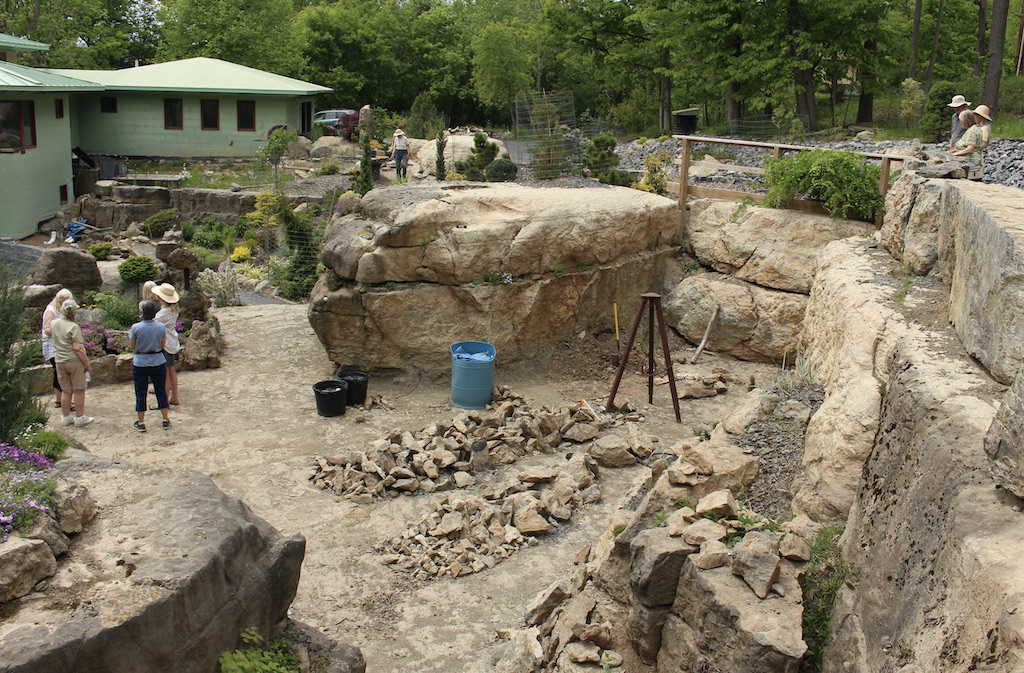
A hillside was being excavated to expose the bedrock

Some of the epic rock gardens of Europe are heaps of stone built up to create mini-Matterhorns out of flat cow pasture.  This garden is not that.  Here a pair of inspired gardeners found a plot of land where they knew they could carve the earth down to bedrock, and then build a rock garden up that follows the natural cut of the ravine.  It’s actually quite a crazy idea, but awesome to see.

ithaca rock garden

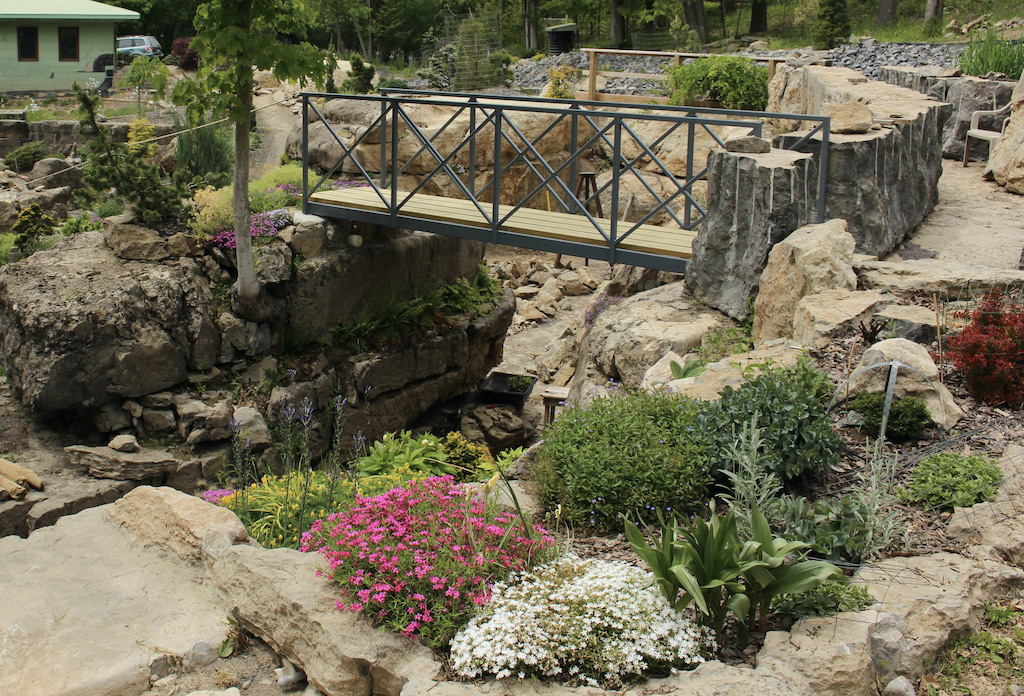
One of the newest additions, a bridge now spans the gap between rocky outcroppings.

Of course these pictures don’t do the scale of the garden justice.  Massive boulders were being moved and placed in a way which looked as if the glaciers did all the heavy lifting thousands of years back.  Unearthing the bedrock sounds easier with the help of heavy machinery, but then consider the care which has to be taken to not gouge the naturally weathered walls and boulders as they’re being uncovered.  All the fine uncovering had to be done with hand… and then moved by hand…

ithaca rock garden

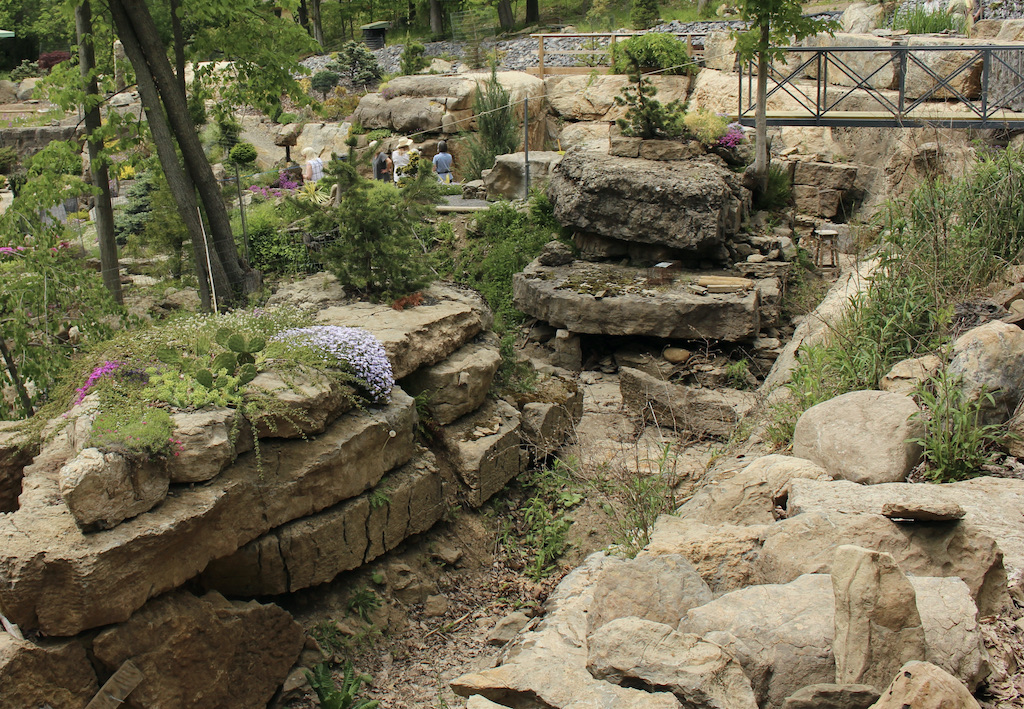
The earthworks from even further back.  All of this was uncovered, and much of it moved into a more effective place or position, even the larger slabs of stone.  Behind where this photo was taken there’s even more excavation.

One of the chapter members mentioned that the owners were back and forth about opening the garden.  ‘It’s not a garden, it’s a construction site’ is more or less what I got as the reasoning, but only half of that is true.  It’s an awesome construction site, but it’s also an amazing garden, and I think it’s even more amazing when you can see what went in to all the plantings.

ithaca rock garden

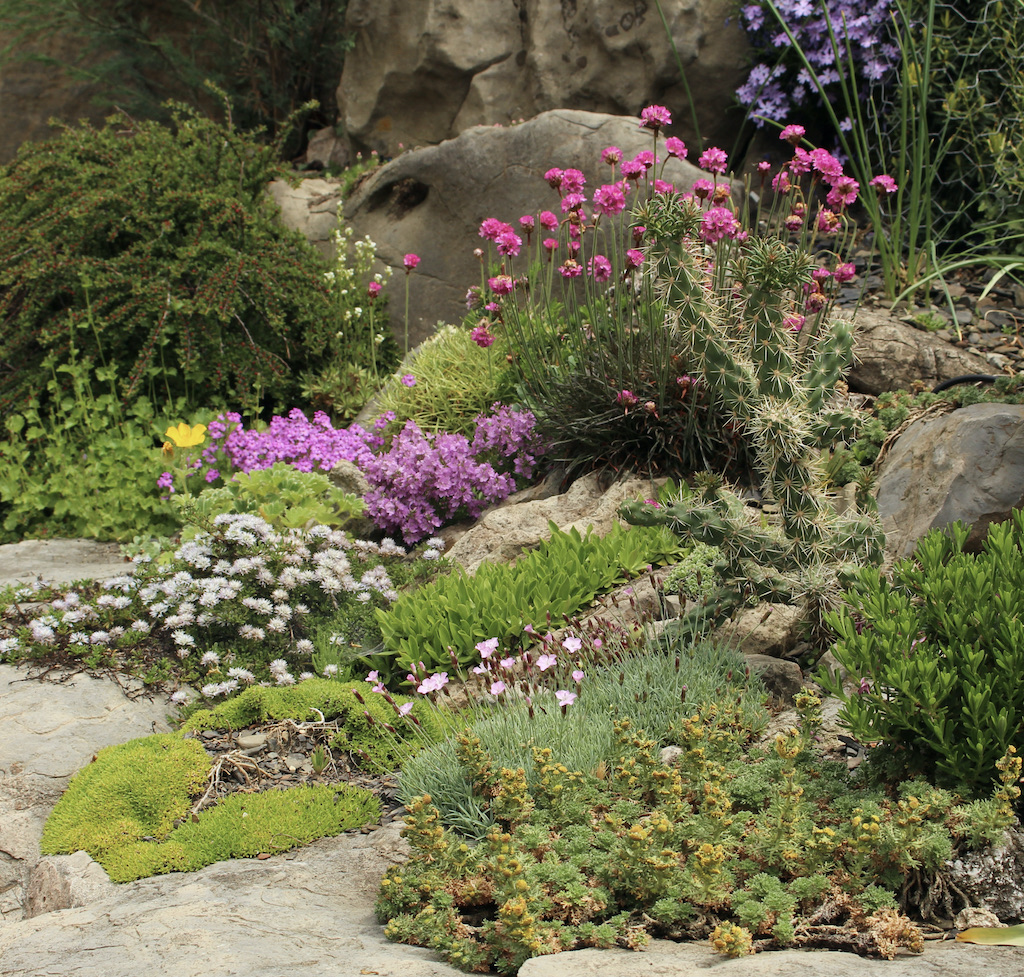
Plantings tumble down the slope, this one built up with tufa stone, a porous rock light and airy enough to allow plant roots to penetrate.

This is the first real rock garden I’ve ever visited so I can’t say much about the plants other than they looked perfectly happy.

ithaca rock garden

Rocks overhanging a small pool.  Tufa stone allows for plants to be ‘set’ directly into drilled holes.  Eventually the plants spread out on their own as the roots find their own paths into the rock.

ithaca rock garden

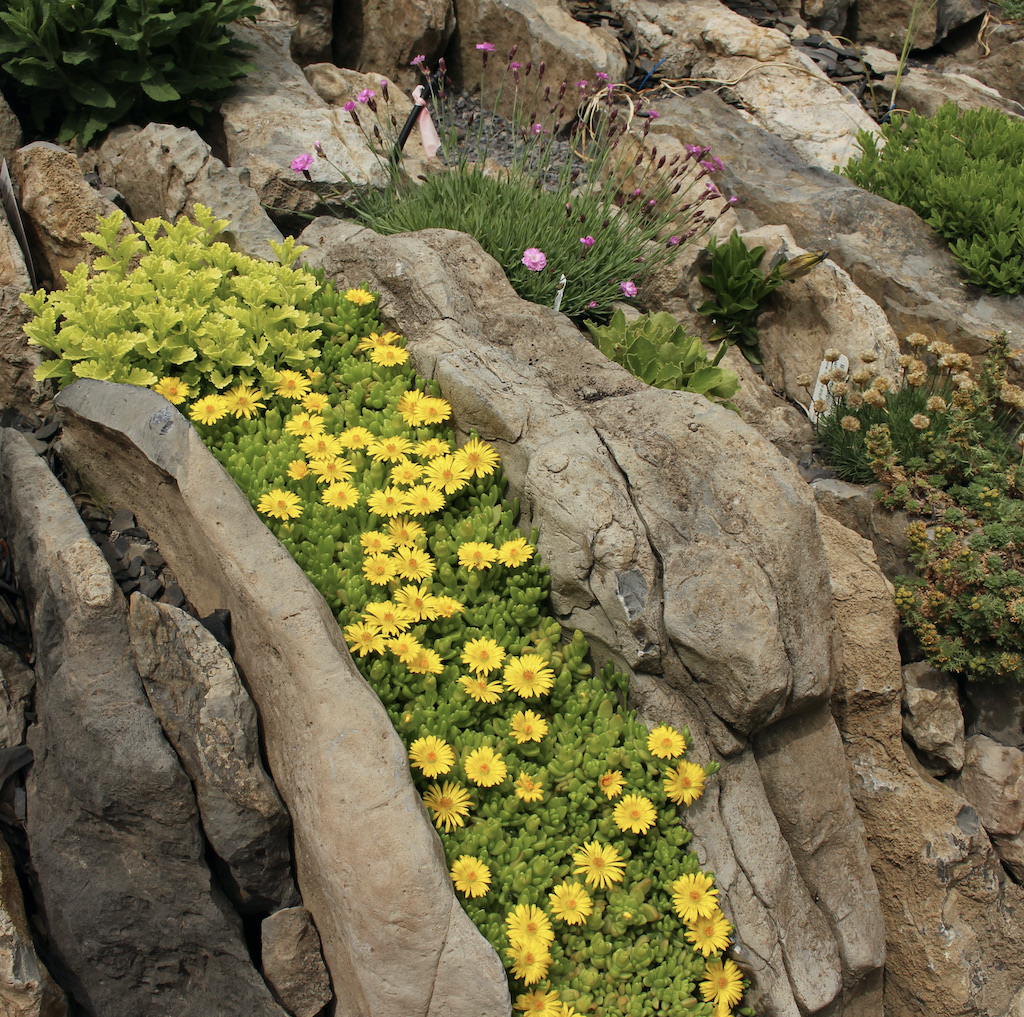
Oh, and just a big crevice garden for all those things which love a deep root run between stones.  Yellow delosperma and a yellow leaved teucrium (which I just happened to pick up at the plant sale!)

ithaca rock garden

Some of the plantings were really amazing

ithaca rock garden

Even a hosta!  -but I really love the yellow leaved saxifrage (maybe saxifraga ‘Cloth of Gold’?)

As I worked my way down the paths through the rock gardens, and headed closer to the house, I reached the patio area.  Here the garden hosts had set up a dining area with snacks and beverages and plenty of wine.  From what I hear this generosity was all part of a master plan to “loosen lips” and get the honest impressions of their visitors with an eye towards improvements and new ideas.  Sadly, I believe the wine was just wasted on me 🙂

ithaca rock garden

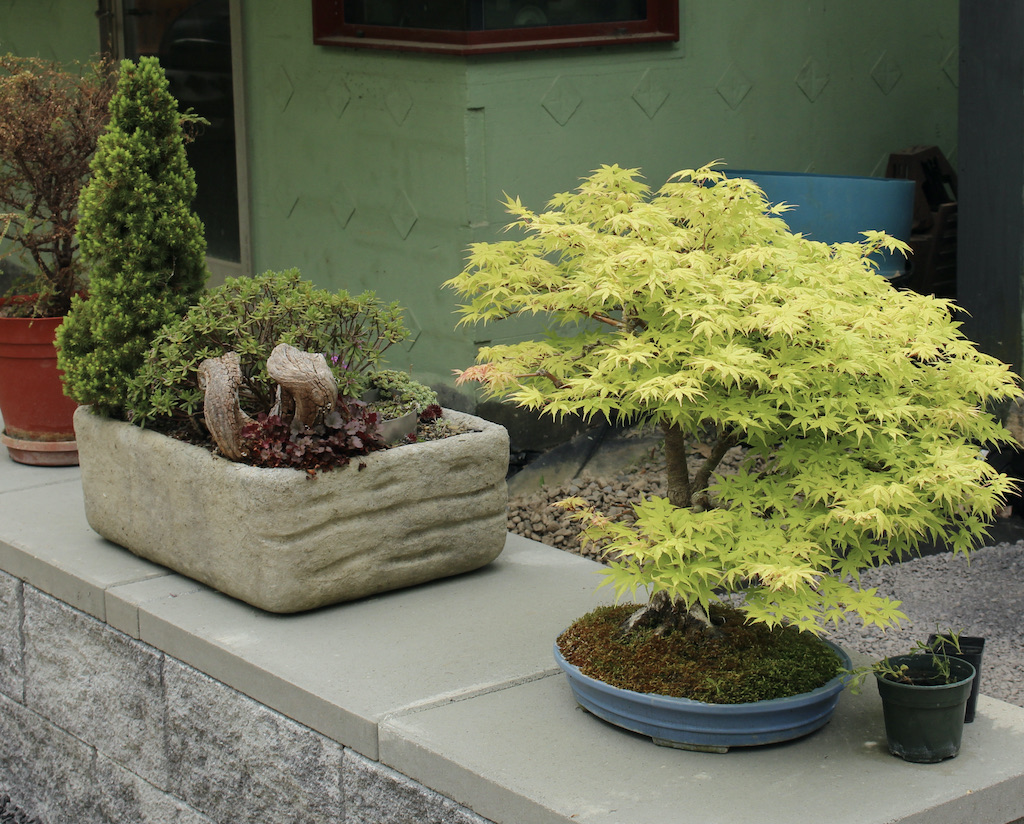
Bonsai and trough gardens.

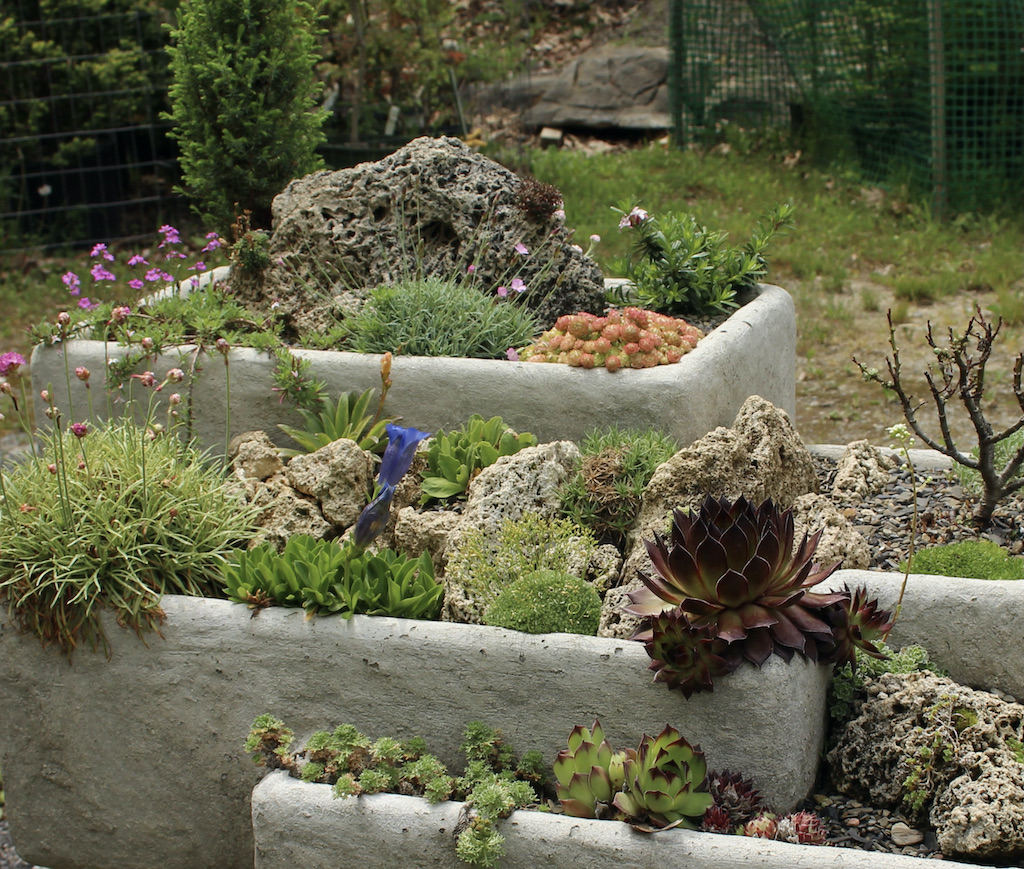
The trough gardens were particularly interesting, and not just because of the mini landscapes planted in them.  In the past these gardeners have hosted trough making workshops in the garden as well as publishing articles on the process, and I was excited to see that the troughs look excellent in person.  Excellent enough that I think I’ll give one a go this summer and see how it turns out!

ithaca rock garden

Some of the troughs were quite complex.

Wine and snacks have a way of gathering people, so at the patio I stopped and took in a few of the conversations.  Someone asked me how I liked the top part of the gardens and I said ‘Top?  There’s also a bottom?’ …and yes, there’s a whole other part to the garden.

ithaca rock garden

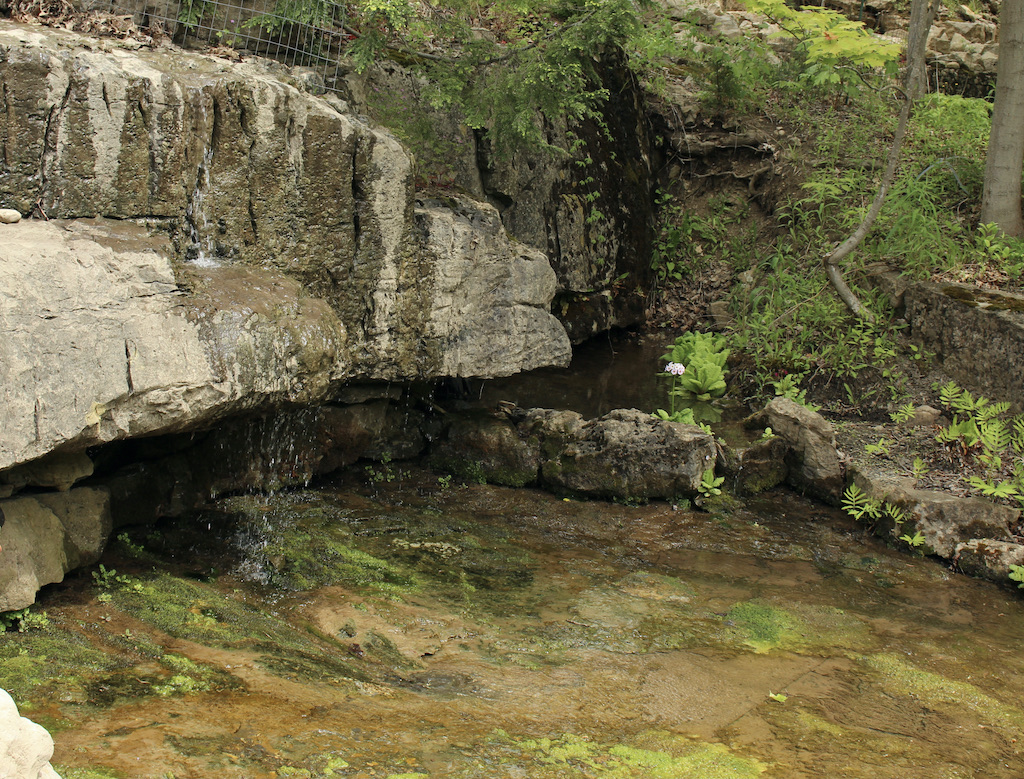
Below the rock garden a natural seep provides flowing water for the bottom part of the gardens.

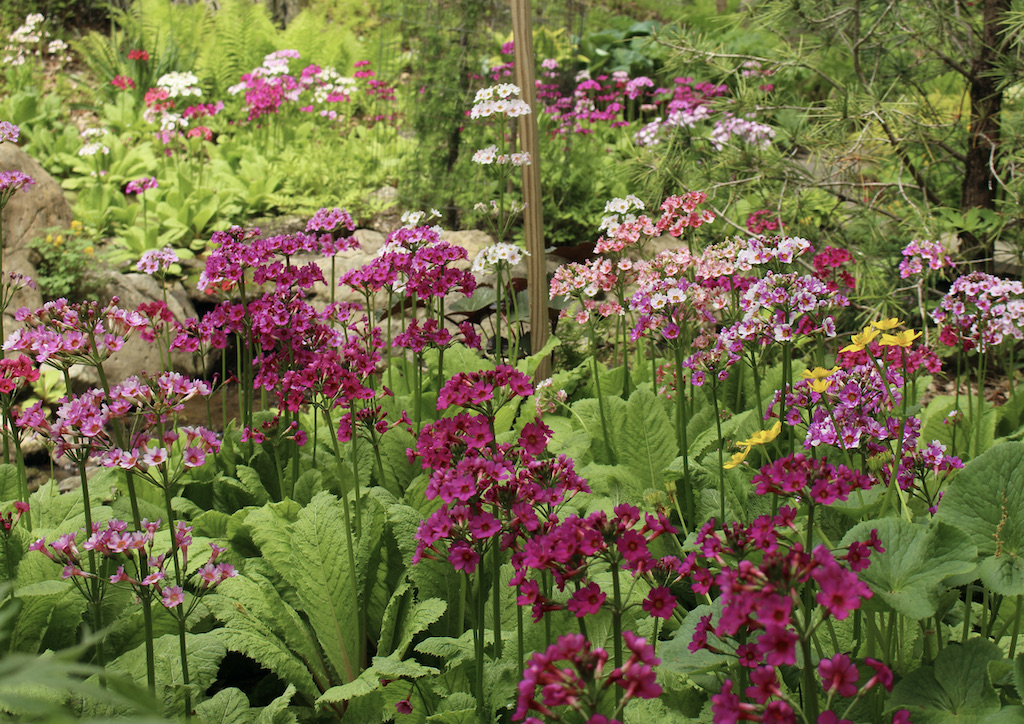
As you come around a few more boulders you find yourself at the bottom of the ravine, where a mass of Primula japonica fill the low spots.  They were just starting their peak bloom, it was excellent.

ithaca rock garden

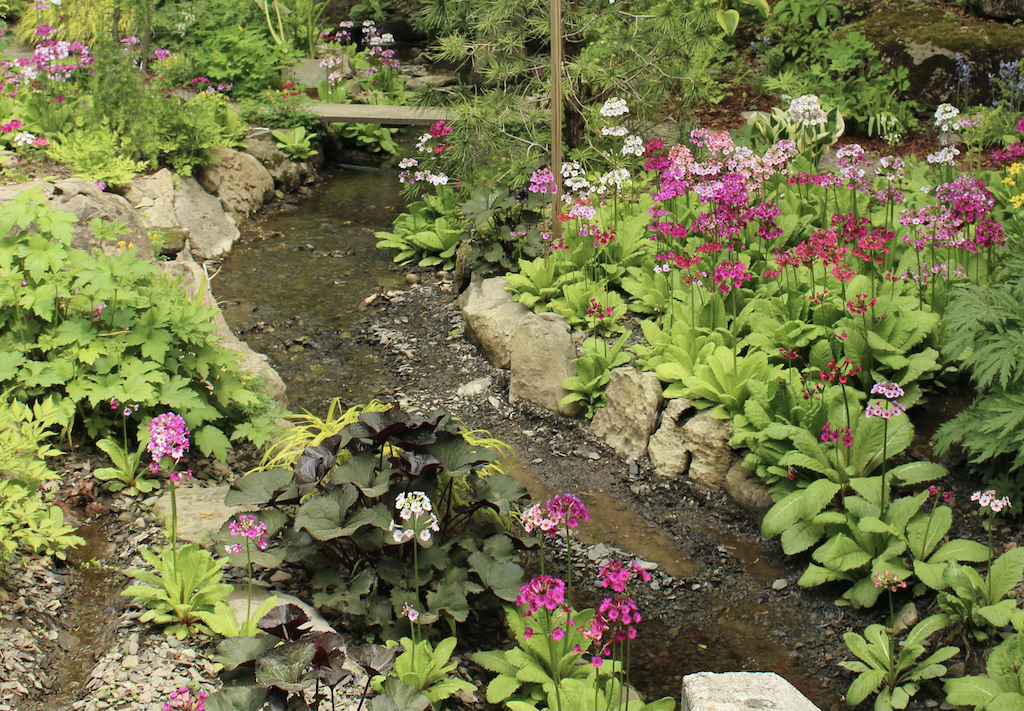
A path runs back and forth along the stream.

ithaca rock garden

Masses of Primula japonica

ithaca rock garden

The stream heads out to the lake.  You would never guess a downpour had this garden nearly flooded a few days prior to the opening.

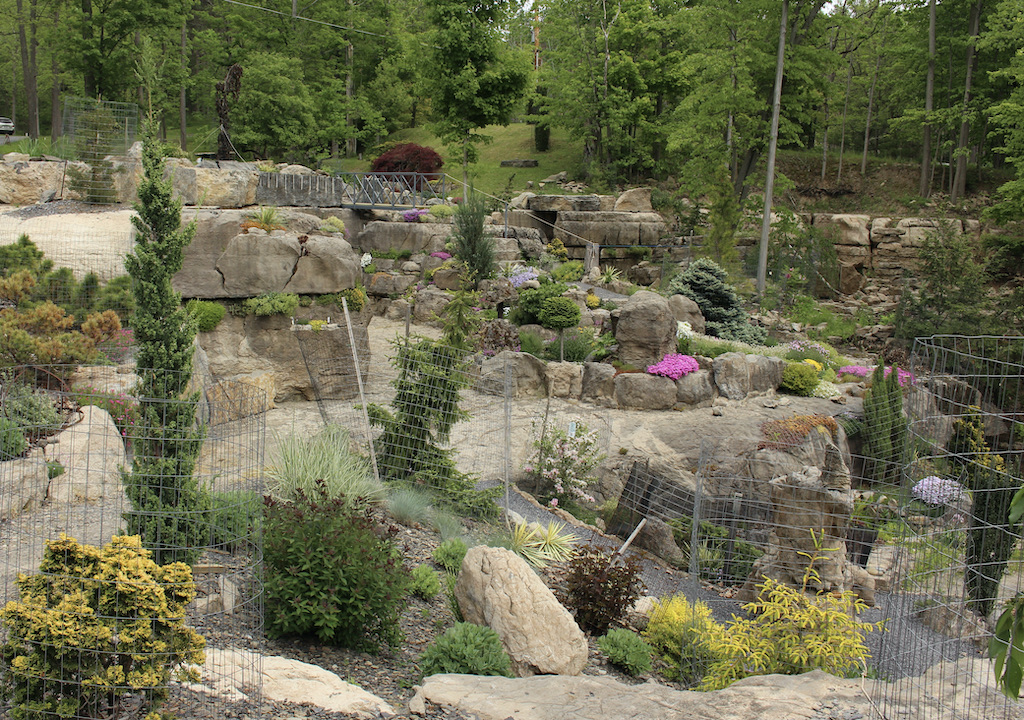
There were more woodland plants, azaleas, rhododendrons, and tree peonies but of course I can’t show everything, so I’ll leave off with one last overview of the upper garden as viewed from the house.  As you can see ‘dwarf’ conifers are also an interest.

ithaca rock garden

A view from the other side.  You can see some of the deer fencing, obviously the hooved beasts have no respect for such a special place.

So this garden was amazing, but who would I be if I turned down another garden tour invite?  I headed a few miles further to the impromptu open garden which had been announced at the sale, and here I was able to enjoy huge beds filled with lush perennials all grown to perfection.  I’m afraid I derailed plenty of my host’s Saturday afternoon gardening plans since it was already kind of late, but she still gave me the full tour!

ithaca rock garden

Tree peonies were at their moment of perfection.

There were cool plants everywhere, and they were all so well grown that I tried to avoid all honesty about my own garden when asked.  My big regret though is that I didn’t take more pictures.  It’s almost criminal that there are no photos of the red horse chestnut (Aesculus x carnea ‘Ft. McNair’) which was in full flower over one of the back beds.

ithaca rock garden

Alliums, Aquilegia, and peony were at their peak but I could see that the show had started months ago with spring bulbs, and will continue for months more with all the other later perennials.

ithaca rock garden

Wow.

So I’m also not even mentioning the shade gardens, the small arboretum of special trees, the field of dahlia tubers I was preventing her from planting… It was another fascinating garden and I have to say that the best thing about this day was meeting person after person who were so crazy about plants that it made me feel entirely sane.  What a group!

I rushed out of this stop with a new friend (and even more plants in my hands) and headed for my last stop.  It was already about dinnertime when I rolled into my friend Leon’s driveway but he didn’t seem too annoyed with me.  He knew I’d be late and still led me around the grounds of Der Rosenmeister Nursery and tolerated question after question.  I didn’t have time for a single picture.  I bought three roses.  I’m going back in a few weeks to see the hundreds of roses in full bloom, and it is guaranteed to be another great trip and I’m sure you’ll hear all about it 🙂

Hope you enjoyed this adventure !

Not too Early, Not too Late… Just Right?

Not this year.  I keep aiming to catch the local pink lady’s slippers (Cypripedium acaule) in peak bloom but it has yet to happen.  Last year I was too late and saw nothing but seed pods, and this year I was just a little too early.  But it was a nice Sunday morning out regardless, and I did catch a few in perfect condition.

pink ladys slipper Cypripedium acaule

One pristine bloom in a spot which caught the morning light.

The Lady’s slipper patch is found in a state park about 25 minutes from my house, and if I’m being honest it’s not always my favorite spot to visit.  It’s got a kind of creepy vibe going, and I don’t think it would be first on the list of places to take the kids hiking.  I’m sure it’s all in my head though, but until I get a little way into the woods I’m just a bit on edge.

pink ladys slipper Cypripedium acaule

A few more early birds

Pink lady’s slippers do not like the bacteria rich, worm infested, fertile soils of the typical garden plot and are notoriously difficult to cultivate on purpose, and instead are usually found in the undisturbed duff of native soils, high in acidity, high in fungus, and the places where decay takes years rather than a few day’s run through an earthworm’s belly.

***education alert -this post is loosely based on fact, I make most of this up as I go.  I am absolutely not a botanist or any thing close to a soil scientist***

pink ladys slipper Cypripedium acaule

More lady’s slippers just coming into bloom.

Oddly enough the park areas where these orchids seem to grow best are not pristine slices of pre-colonial North America, but rather ridges of mine tailings left undisturbed and unreclaimed for the past hundred years.  You could almost call it mine-scarred if not for the regenerated trees and return of native wildflowers, and I’m sure timing has everything to do with this.  Try this again today and I’m sure the only thing to sprout back would be a forest of Japanese knotweed mixed with crownvetch and barberry in the drier spots.

pink ladys slipper Cypripedium acaule

This will be a nice show in another week or two.  

I often think about weird things.  Many people love to repeat how incredibly well adapted natives are to one area or another, and I usually just nod but deep down inside don’t really buy it.  I think it has more to do with first come, first served.  An area is disturbed, a seed gets lucky, and if the plant gets lucky it fills the area before anyone else shows up.  If nothing else big happens that’s that, regardless of how perfect or not it is for the spot.

pink ladys slipper Cypripedium acaule

A patch of pink lady’s slippers with some hay scented ferns (Dennstaedtia punctiloba) creeping in.  In another 100 years I wonder if they’ll still both be living in harmony since around here the ferns can make a pretty dense carpet.

In any case I enjoyed the visit, and didn’t mind being early rather than having perfect timing.  Perfect timing would mean I’d have made my visit this upcoming weekend, and with the hot weather that’s rolled in I have no desire to take on any physical adventures… not until I get used to the change in weather at least.

Hope your week’s gone well.  Between track meets, gymnastics, and baseball practices, this week has flown by and there have been days when I didn’t even get my garden strolls in (*gasp*), but the schedule is changing and hopefully I can soon enjoy some of the big changes in the garden.  The heat has wilted the last tulips and dogwoods, and now the bearded iris and clematis are bursting open.  I need more of both of course, but have to plant a few other things before I’m allowed to buy anything new… unless it’s a rose…  I’m giving myself two (or three)rose permission slips, and it’s all part of a new adventure planned for the upcoming weekend 🙂

Enjoy!

A May Lull

A cool and rainy week with a busy schedule have kept me out of the garden for a few days.  By that I mean there were enough weather and work excuses to avoid any real work, since even a rainy day does not cancel the daily garden tour.  In other gardens the lilacs overhang azaleas, with dogwoods and redbuds shading the lawn, and banks of rhododendrons exploding in color… but I’ve only a few dogwoods and little of the others, so here the spring crescendo of tulips is followed by a slight lull of green.

foundation perennials

The blue camassia are a flash in the pan here and only seem to flower for a week or so.  It’s a nice show, but the blue columbine (Aquilegia vulgaris) is just as nice and lasts longer so I may (again) try and dig all the camassia to get rid of them.  This time I’ll try and get all the bulbs…

Right now there may be a lull in the flowering, but after several months of white and brown, green is still an excellent color, and with its various shades and shapes, and the surprise of variegation and chartreuse or purple tints, even a green lull makes for a nice show and it should really be enough.

aquilegia vulgaris

Blue columbine (Aquilegia vulgaris) was originally found in the woods behind the house, and rescued when the bulldozers came.  It’s not native and fancier colors and forms exist, but I like it well enough.

Most people can stick with well enough, but I admit to a short attention span and fickleness so of course I want other things to follow up as the tulips fade and the bearded iris are yet to come.  The columbine is good, and usually moneyplant (Lunaria annua) fills in with a nice purple, but I think I need more alliums.

perennial bed

Tulips and daffs have all been deadheaded and are disappearing under the next wave of growth but just the columbine and a few moneyplants  (it’s a down year for this biennial) are in bloom.  The blue is nice, but note the bold little ‘Candy Corn’ spirea in front.   I can’t believe I planted it, usually spirea disgust me, but this one is so offensively bright there was no resisting.

Back in the day the budget was much tighter, and a few flowering onions always seemed to be just too much when a big bag of tulips could be had for the same price.  Today it’s a different story.  A couple new alliums are just pennies once you’ve paid off the monthly gymnastics bill and bought a couple pricey snowdrops.

allium gladiator

Allium ‘Gladiator’ was my first big allium.  I was hoping for bigger, but tall is good too!  Over the last 15 years one bulb has become many.

So I will see what happens.  The problem is settling on just two or three rather than a dozen, and I of course will be looking for suggestions from my friends.  I already have a few leads 😉

allium gladiator

‘Gladiator’ is also doing well in the potager.  Phlox and other perennials are coming up just in time to (mostly)cover the allium’s yellowing leaves.

Yeah, the yellowing leaves.  Just as the flowers open and draw a little attention, the foliage starts dying back to compete with the show.  Trimming them back or hiding them in a border are two options for better gardeners.

allium gladiator

The green centers are cool.

The yellowing allium foliage can be a deal breaker for some, but here it barely registers.  I run a messy garden and fortunately some delusion of diamond in the rough or some bizarrely inflated ego syndrome allows me to still share photos online.  I should be embarrassed most of the time, but luckily it’s a rare day that I see some perfect garden photo and suddenly question my entire gardening hobby (as well as the public settings on this blog).

raised bed vegetable

The mountain of snowball bush (Viburnum opulus ‘Roseum’) is probably the only perfect thing about the potager right now.  It should be weeded.  And planted.  And tended.  One of these days…

Ah, whatever.  Let’s finish with a disclaimer on the potager.  The raised beds are excellent, the sand paths are perfect, the whole idea of the potager is much better than the usual mess, but it’s still just a mess.  “It’s not you, it’s me” I tell the garden and I suspect the garden understands.  My weaknesses is a love of interesting, and it’s just too interesting to see if the resprouting cabbage stumps from last year will form heads or if the missed potatoes from last year will amount to anything.  Good thing no one expects this garden to feed a family.

raised bed vegetable

A few parsley seedlings went into this bed, but I’m still working myself up to weeding out all the rest.  Besides obvious weeds there’s a nice clump of lettuce, many tomato seedlings… random hellebores…

So what did I do today?  Clear a bed and plant beans?  No, of course not.  I was working in the front border dividing tulip clumps.  Just for the record, it’s too early to divide tulips.  The foliage should be yellowing and it’s not but whatever.  Dig up a clump, shake and pick out the smaller bulbs, and replant.  No careful soil improvement, no watering in and I guess we will see what comes of it.  Smarter gardeners would have pulled them all and tossed them after flowering, it’s just a few dollars to replace them, but I don’t think it will surprise anyone if I admit my gardening is more of an ADD drifting through ideas rather than a focused plan with a to-do list.  Reinventing the wheel has always been a passion of mine.

Have a great week, and I hope it includes plenty of plant-time 🙂

The Perfect Lawn

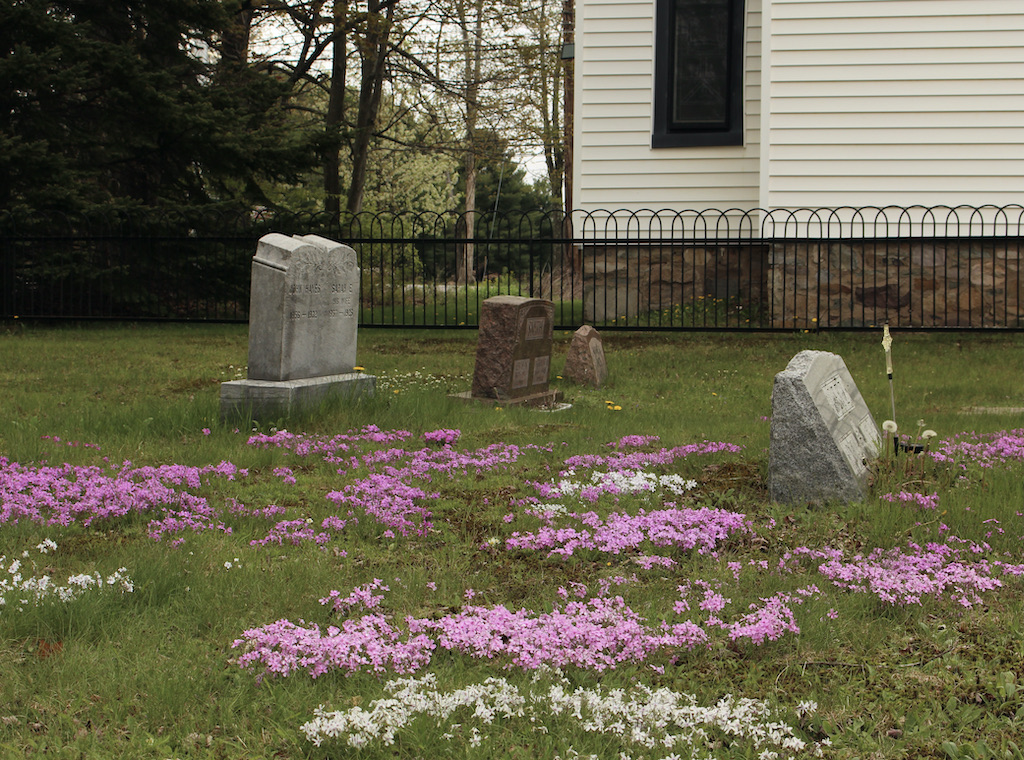
The rain outside is knocking the last petals off the tulips and surely bringing new life to weed seedlings all over, but I won’t let that bother me… yet… Instead I’d like to show you around a cemetery which I like to swing by on the way home from work.  Don’t be concerned, it’s not a fascination with death which brings me here, it’s the naturalized blanket of creeping phlox (Phlox subulata) which weaves through the grass and flowers at this time of year.

naturalized phlox subulata

Phlox subulata (I’m assuming) seeding and creeping through the cemetery grounds.

I have no idea if the phlox here were planted originally or came in on their own, but the church financed lawn care hasn’t been intense enough to wipe out the spread of wildflowers between the gravestones.  I also believe a kind soul is in charge of the mowing since I saw signs of a recent cut, but only a few patches of the thicker grass were mown and the best flower patches were spared the blade.

naturalized phlox subulata

I’m just guessing, but suspect the churchyard has been in place here for around 150 years.

Over the decades ‘mildly maintained’ graveyards have a way of picking up flowers and when I have the chance I often give them a looking over for spring flowers, iris plantings, and the occasional rose bush.  Someday I hope to find that snowdrop filled meadow, but so far…

naturalized phlox subulata

The phlox were probably planted originally, but since then have seeded about to form an interesting mix of colors and flower forms.

Phlox subulata is a plant native to the Northeastern part of this country, and occasionally I also see it growing in rocky outcroppings or gravely roadsides, but never as thickly as it does in graveyards.  It’s not a shade plant, so probably as the East coast has grown up in trees or been improved with bluegrass turf, cut and sprayed to golf course quality, this sun loving phlox has been squeezed out and into much smaller locales.

naturalized phlox subulata

A paler section of the colony.

Of course creeping phlox is still growing all over, in foundations plantings and mulch beds everywhere, and in my own childhood garden I’m pretty sure a big chunk of every summer was spent weeding grass blades out of my mother’s phlox planting.  As you know though, a grass-free planting of creeping phlox is pretty much impossible.

naturalized phlox subulata

Phlox mixing it up with pussytoes (Antennaria sp), another short wildflower which used to keep lawns everywhere from becoming yawns.

Why fight it then?  Just plant your phlox right in the grass 🙂

Easier said than done though.  Most lawns are too fertile and the grass and other more common weeds like creeping charlie, dandelions, and white clover will dominate.  *My own lawn is an excellent example of this…

naturalized phlox subulata

Phlox with a few bluet (Houstonia) alongside.  There were a couple more patches of bluets and various violets as well, but the phlox seemed much happier here.

I think more lawns used to be like this.  If you travel the older parts of town the lawns are often flecked with all kinds of flowers, both native and introduced, and I think it’s a much more interesting look than the hyped-up green swards which dominate suburbia.

naturalized phlox subulata

Naturalized Phlox subulata

So I hope this little trip to the churchyard was enjoyable.  Benign neglect can be a great thing and I may keep this in mind as I consider the ‘wildflowers’ which the rain has brought up throughout my own garden.

Have a great week, and a happy mother’s day to all the moms!