Colchicum Clear-up

My late colchicum shipment from Daffodils and More was well into bloom by the time I finished dragging my feet and placed an order.  I guess I didn’t elaborate enough on how these little guys work…. I thought everyone was obsessed with colchicums at this time of year!

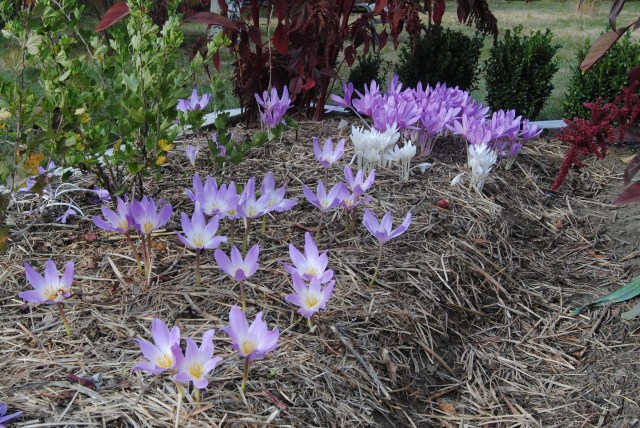
Colchicums are one of the “naked lady” bulbs that bloom in fall, they come up out of the dry autumn soil and surprise you with bare flowers minus the greenery.colchicum bed
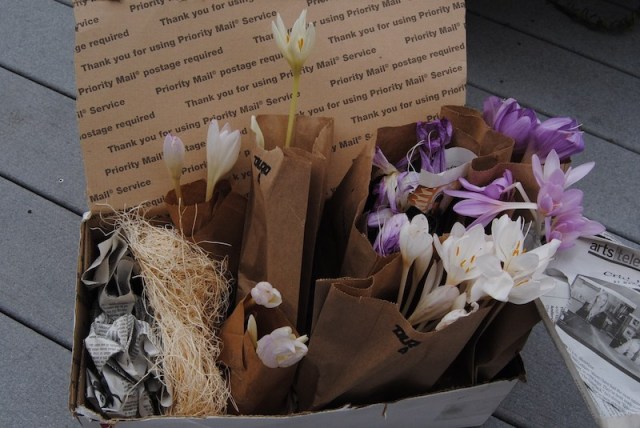
They grow their hosta-like leaves in the spring, just like other hardy bulbs, but the blooms wait till late summer before even thinking about showing up.  Colchicums are on their own schedule and if you’re a little late in getting them in the ground they’ll ignore your tardiness and go ahead and bloom anyway, soil or no soil.  No problem, since the fall rooting will just wait until the bulb returns to the damp earth before it kicks in.  This is how the bulbs looked coming out of their paper shipping bags.colchicum blooming without soil
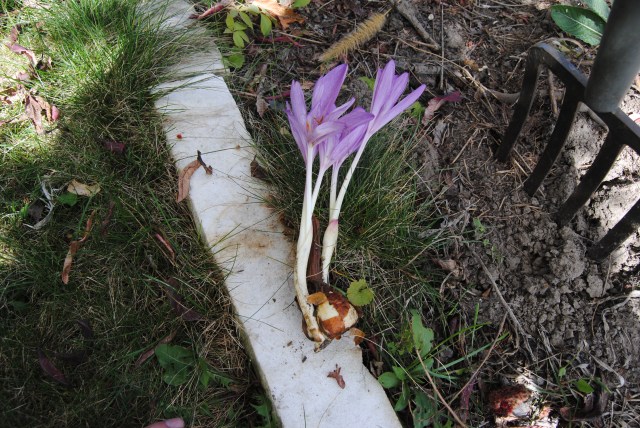
The bulbs I received were perfect, they had all been stored upright so that the floral tube came straight up and the separate blooms sprouted normally from within the tube.  If the bulbs are stored willy-nilly the blooms come out all over the place and are a pain to plant properly.  If grown normally a bulb forms a ‘heel’ where the roots sprout from, and a tube which brings the flowers to the surface.

This bulb was planted last week and you can just start to see tiny roots growing… Sorry Annette, I just had to dig one up again to take a look and a photo!colchicum bulb heel
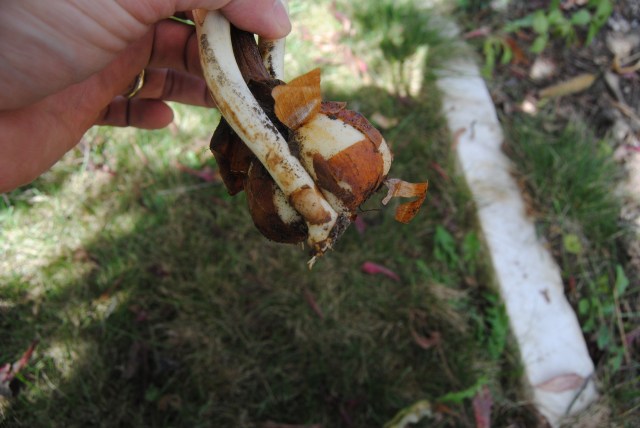
When you plant these already-in-growth bulbs, take care to keep the tip of the floral tube just above the soil surface.  When the leaves sprout in the spring they also come up the inside of this floral tube and use it as a path to the surface.  If planted too deeply or not facing up, the leaves cannot grow up, and as a result die underground.  This is a costly lesson to learn since colchicum bulbs aren’t all that cheap, and if a whole batch of late planted bulbs die you will feel guilty for at least three years, especially if you lose another batch the following year…. (ask me how I know this)

planting flowering colchicums

Once planted nothing much seems to bother colchicums.  The run of the mill garden types thrive in average soil and full sun to part shade and pests usually don’t bother them outside of slug attacks on the blooms.  Colchicums are in fact poisonous enough to cause a nasty end to gardener or gopher and the same compound that protects them from chewing rodents and grazing rabbits is also the original source of colchicine,  which is used to treat gout.  In the gardening world, colchicine is also the chemical treatment that will cause seeds to go into polyploidy (doubled and tripled sets of chromosomes) when the cells begin to divide.  Tetraploid daylilies are the best example I can think of, but a quick online search shows many others.  Maybe my colchicum obsession isn’t as much selfish plant lust as it is just plain old gratefulness to a bulb that keeps giving!

With the exception of a single recently dug bulb, my new colchicums are already settled into the colchicum bed.  One of their neighbors is colchicum speciosum, a vigorous, long blooming bulb.colchicum speciosum

The large speciosum (renamed as “Lilac Wonder” – Thanks Cathy!) dwarfs it’s tiny neighbor, the slightly off-white colchicum autumnale ‘Album’.   Both are very popular with the late season honeybees.  I’m going to hope the honey doesn’t take on any of the poisons!  (I’m sure it doesn’t)colchicum autumnale 'Album'

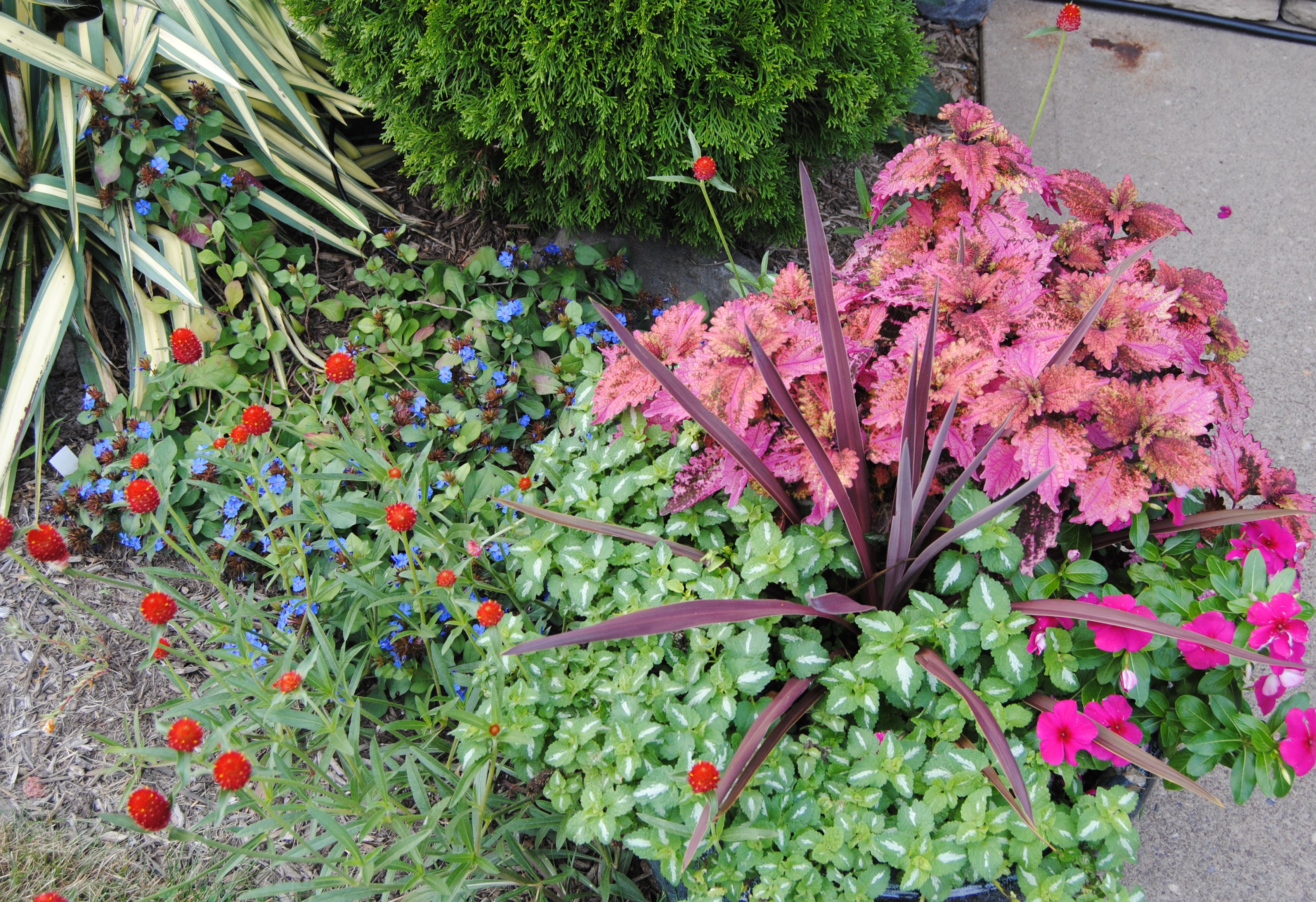
I’m thinking of giving the colchicum bed an overhaul.  The bulbs could use more elbow room and the display could use some background plantings a little more colorful than the drab mulch I threw on there this summer.  Susie over at pbmgarden got me thinking this summer about groundcovers and I think I have the perfect plan for at least a clump or two of the light pink colchicums.  I want to divide up the blue leadwort (Ceratostigma plumbaginoides) and spot a few colchicums into that.  Here’s where I have it right now in the front yard.  It makes a halfway decent groundcover with a long season of gentian-blue flowers and green foliage.  The leaves take on red tints with the cooler weather and the fact that it sprouts kind of late in the spring makes it an even better companion!  Ceratostigma plumbaginoides
So that’s the plan.

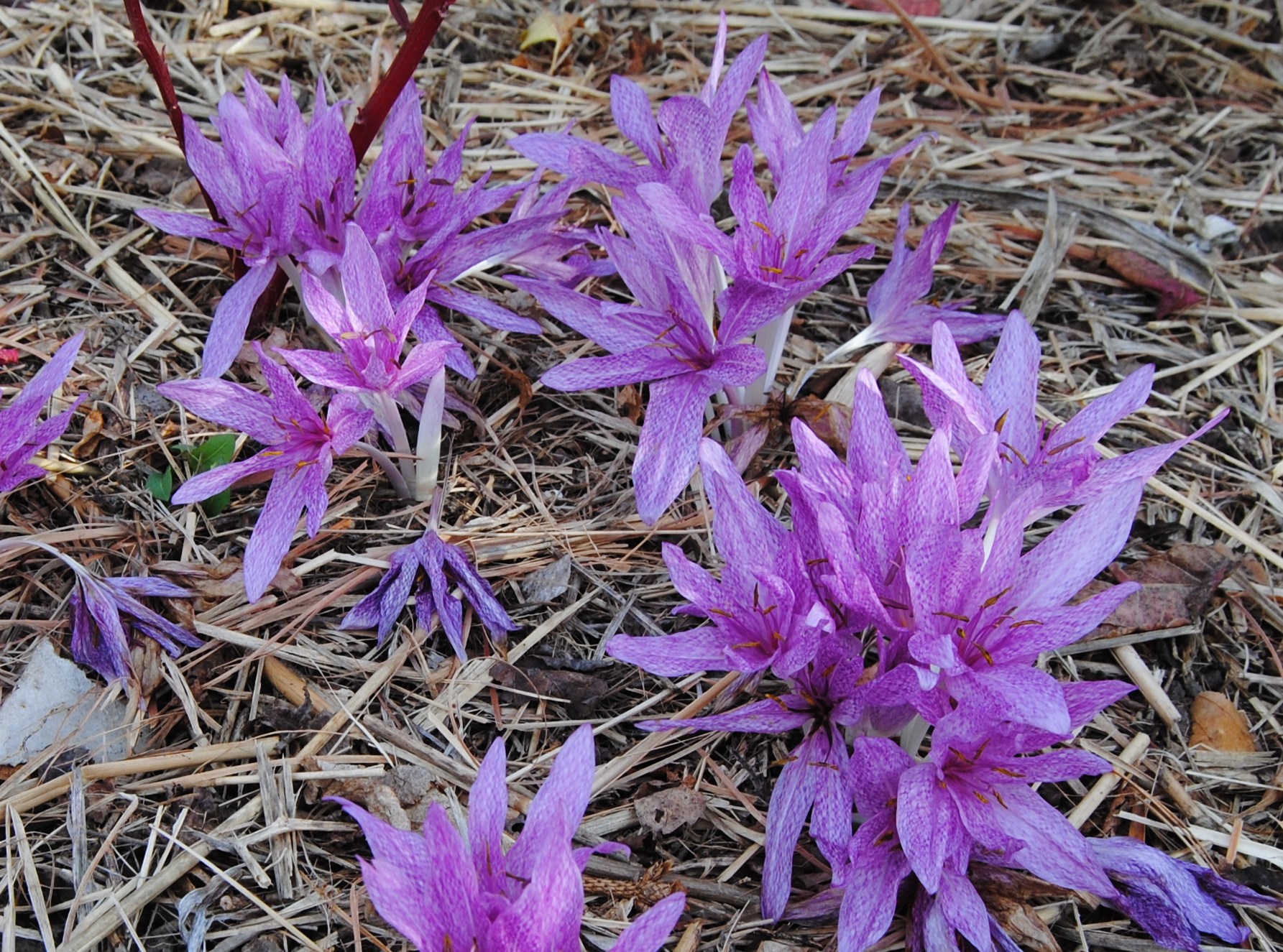
Just one more thing before I’m completely done with colchicums.  The word is ‘tesselation’ and it describes the geometric patterning some colchicums show.  Colchicum x agrippinum has plenty of this checkering and it’s one of my favorites.colchicum x agrippinum
Welcome to Fall

Now that autumn is here I have officially given up on watering the garden.  The cooler temperatures are not as deadly as the summertime heat, and the rain we had a week ago should be enough to keep things alive.  So things are on their own for a while.

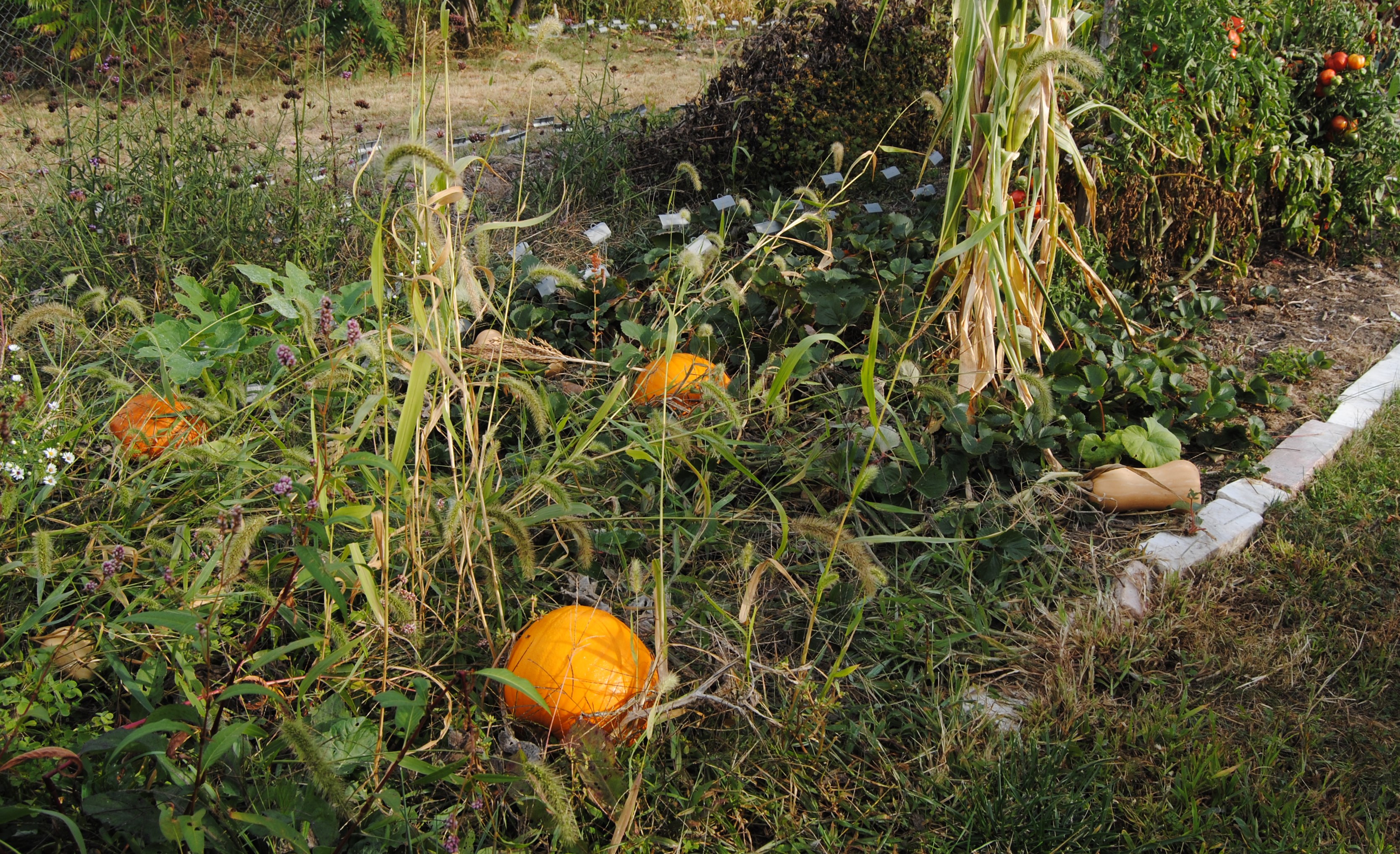
Most of the vegetable garden is done anyway.  Yesterday I let the kids pick the pumpkins and decorate the porch for Halloween.pumpkin patch

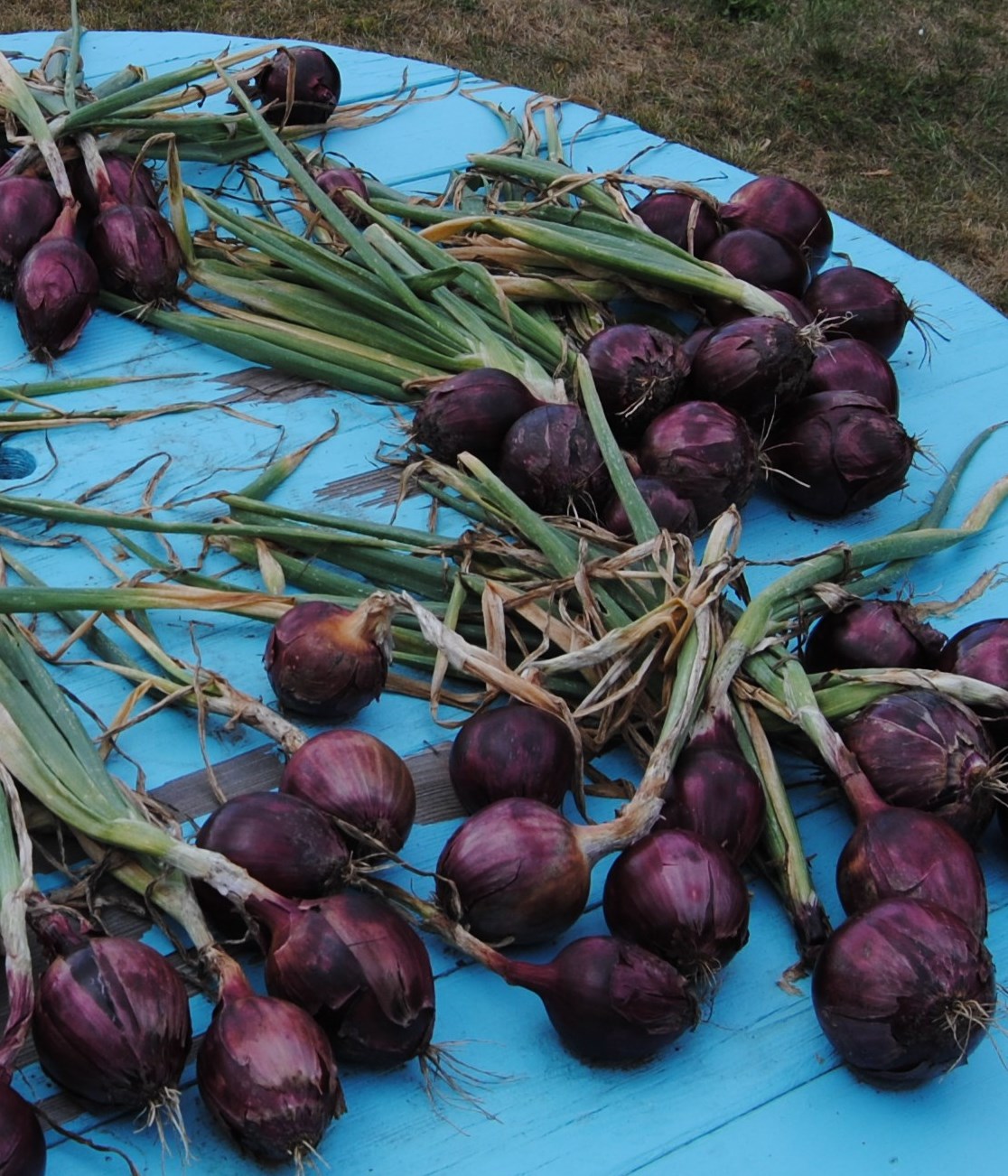
red wing onion harvestThe ‘Red Wing’ onions were also harvested as well as the last of the eggplant.  This pretty much finishes up the garden for the year (with the exception of a few peppers and a single brussel sprout plant).  It’s a shame the dry weather sapped all my enthusiasm for a fall planting, the idea of a fresh lettuce harvest right about now sounds very nice.

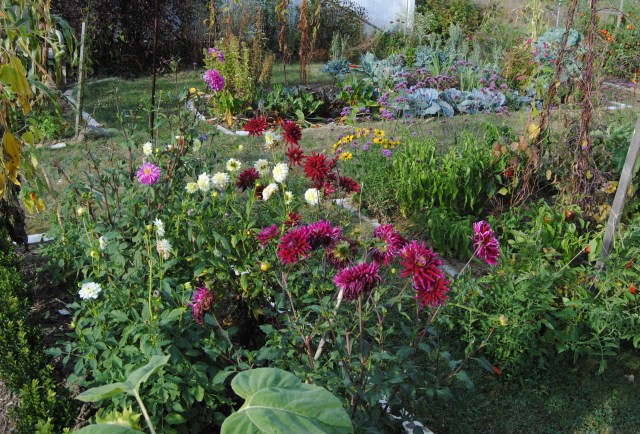
Despite the end of regular watering, the dahlias continue to put out flowers and carry on.  But they are beginning to look tired, and anytime the sun gets strong the leaves wilt.  Just about everything looks tired.dahlias in the vegetable garden

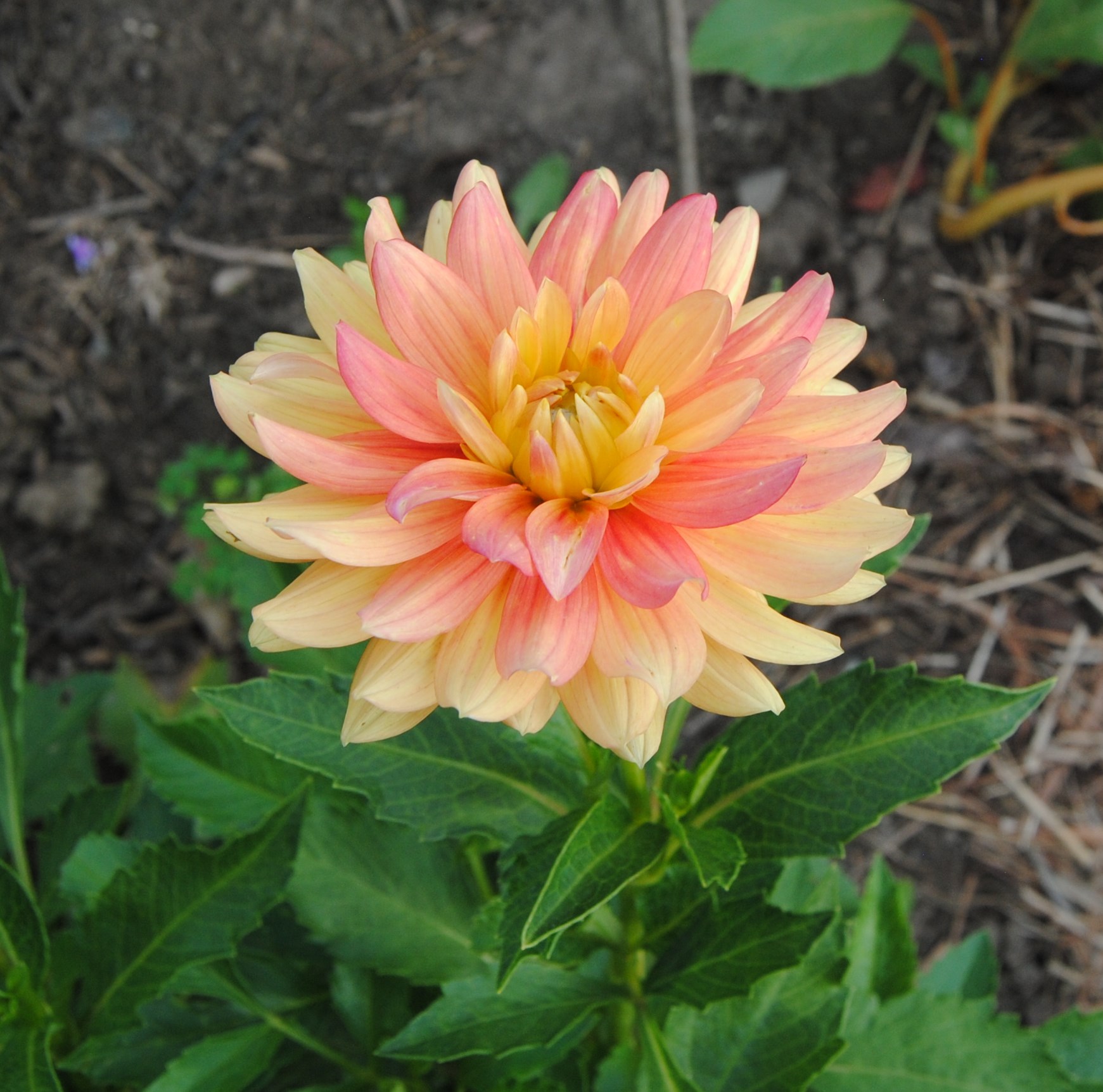
sunset colored dahliaThe only dahlia that actually looks better now is this one.  I need to look up the name, but the color that looked awful in July shines in autumn.

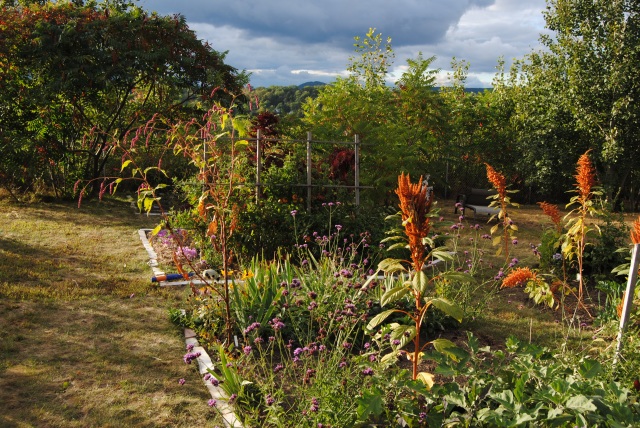
In case you haven’t already picked up on it, the vegetable garden tends to become a flower garden as the season progresses.  Any gap in the plantings quickly fills with self sown verbena, Persicaria orientalis, and amaranthus ‘hot biscuits’.  The amaranthus has a weedy look that not everyone appreciates, but I like it, and have been very generous with spreading the seedlings throughout the yard.  At this time the seedheads seem to glow in the autumn sun.the late summer vegetable garden

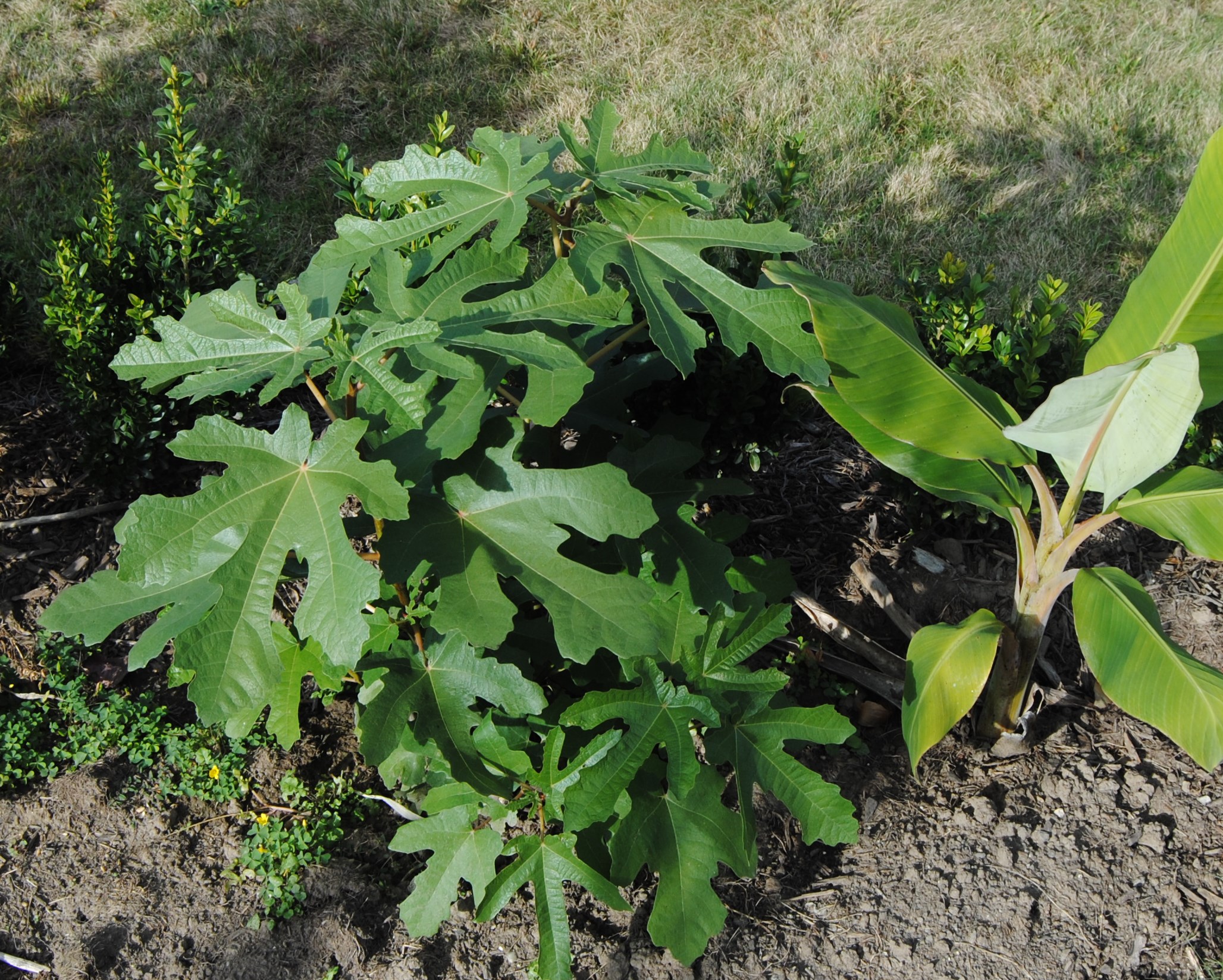
"phoenix" the fig returned from the ashesThe glow of autumn light is a signal to start thinking about protecting the tender plants for winter.  My fig has had a troubled season.  It spent the winter in the dark of the garage and began sprouting in January.  The sprouts dried off by March but then a few pots of water brought some new shoots for April.  By May I decided to use its pot for other, healthier looking plants, and while the fig waited for a new home (perched with rootball exposed on a spare saucer) it died again, this time I thought for good… on to the compost pile it went.  But like cats, apparently figs have several lives.  Around July I noticed a few sprouts coming up out of the compost and upon investigation found the fig root ball to be the source.  Finally it was given a decent home, and it’s grown this year without any resentment.  Now what to do this winter…..

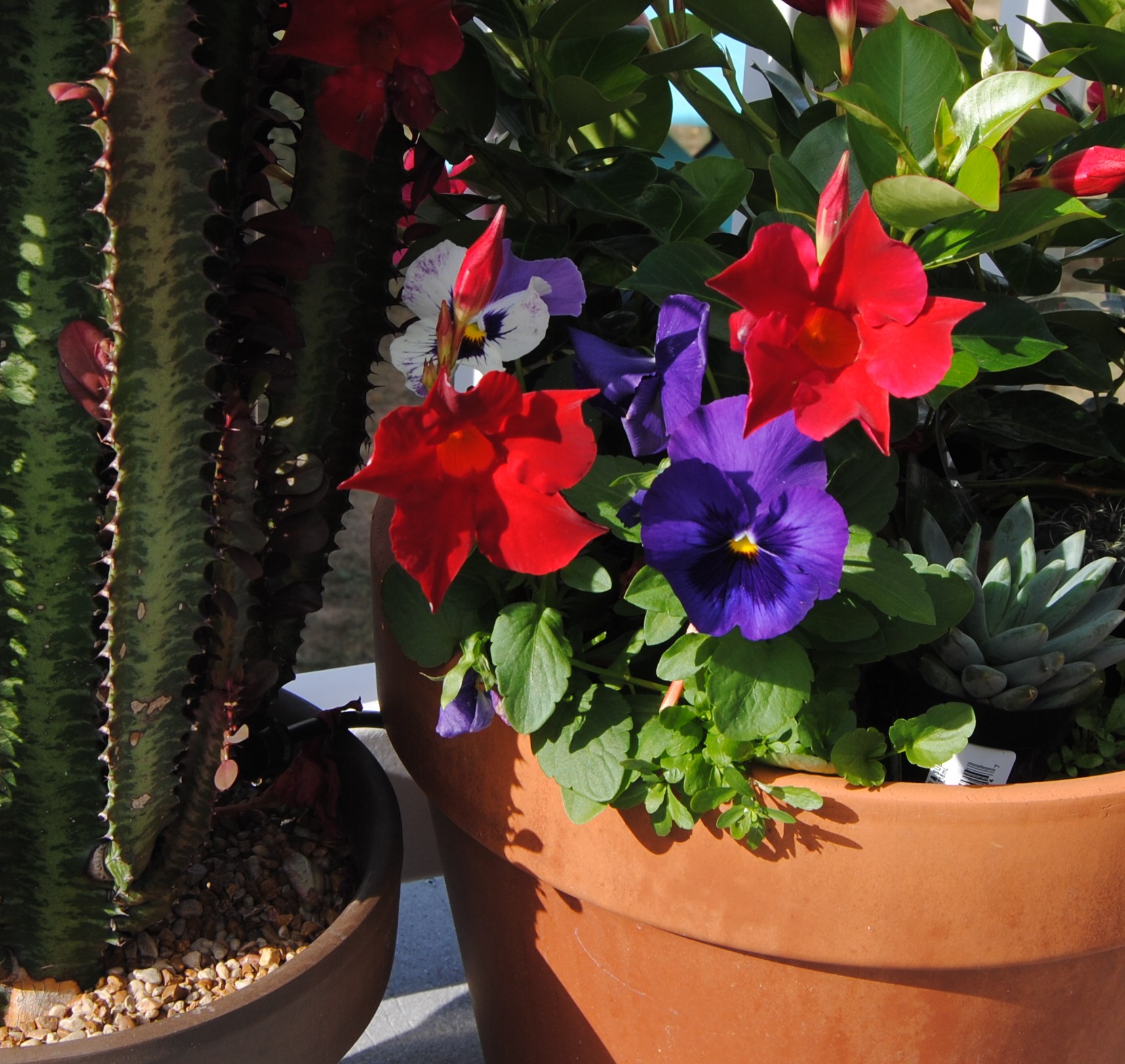
red Dipladenia with pansiesAlso needing a winter home are the tropicals on the deck.  Even though I only paid three dollars for this red dipladenia, I can’t let it die!  So either the dipladenia or the pansies will need to be repotted and brought in.  I would have never thought of this combo, but pansy seeds do their own thing.

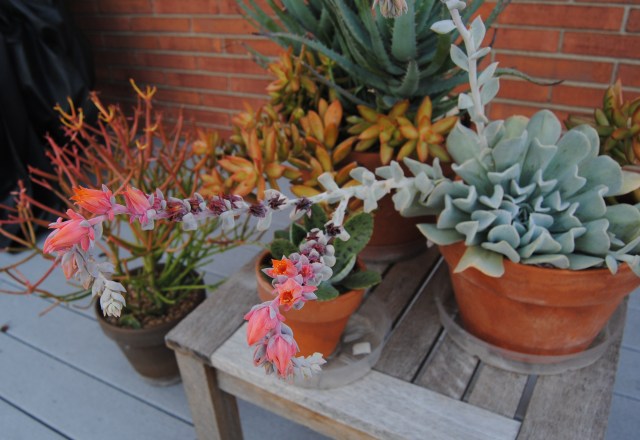
I don’t even want to think about the rest of the non-hardy deck plants.  They’re growing and blooming and doing well in general even though I never got around to any of the summertime repotting or transplanting I had planned.blooming succulents on deck

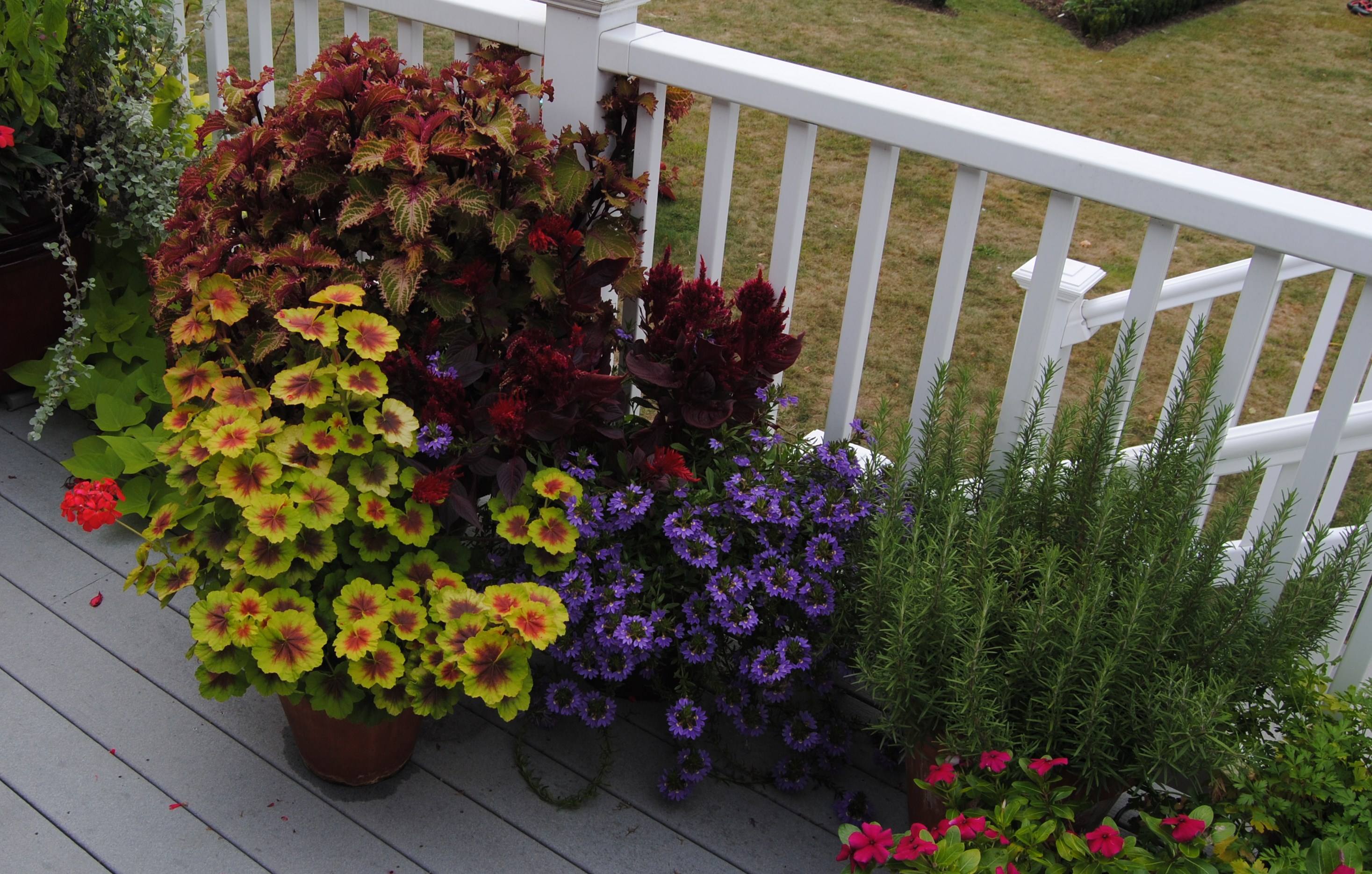
 The geranium should hang on in the dark of the garage, maybe the rosemary, but I’ll need someplace warmer for the coleus.early fall planters on the deck

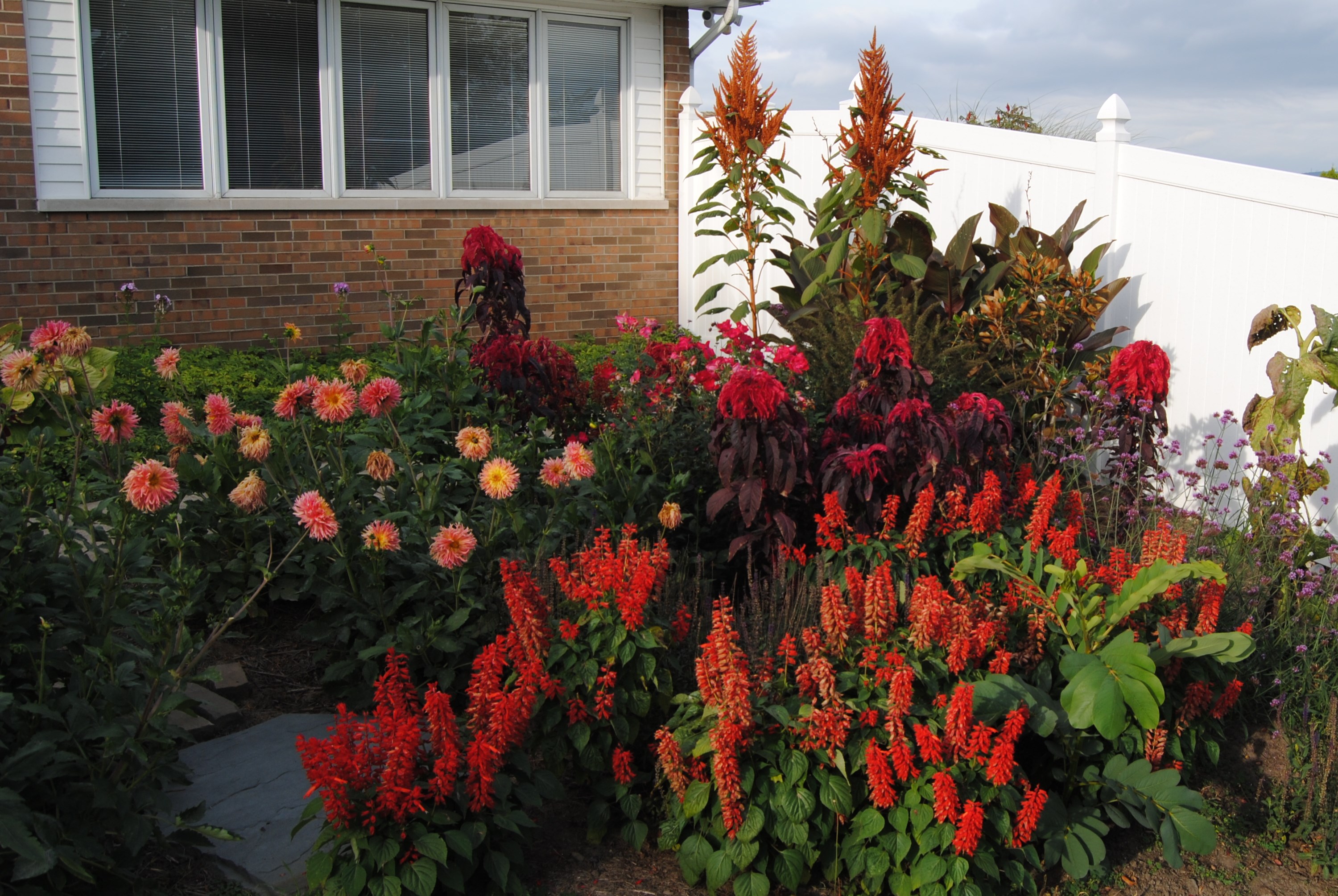
Fortunately the tropical garden survives the winter by seed or stored tuber.  No windowsills needed for this end of the garden.red themed tropical garden

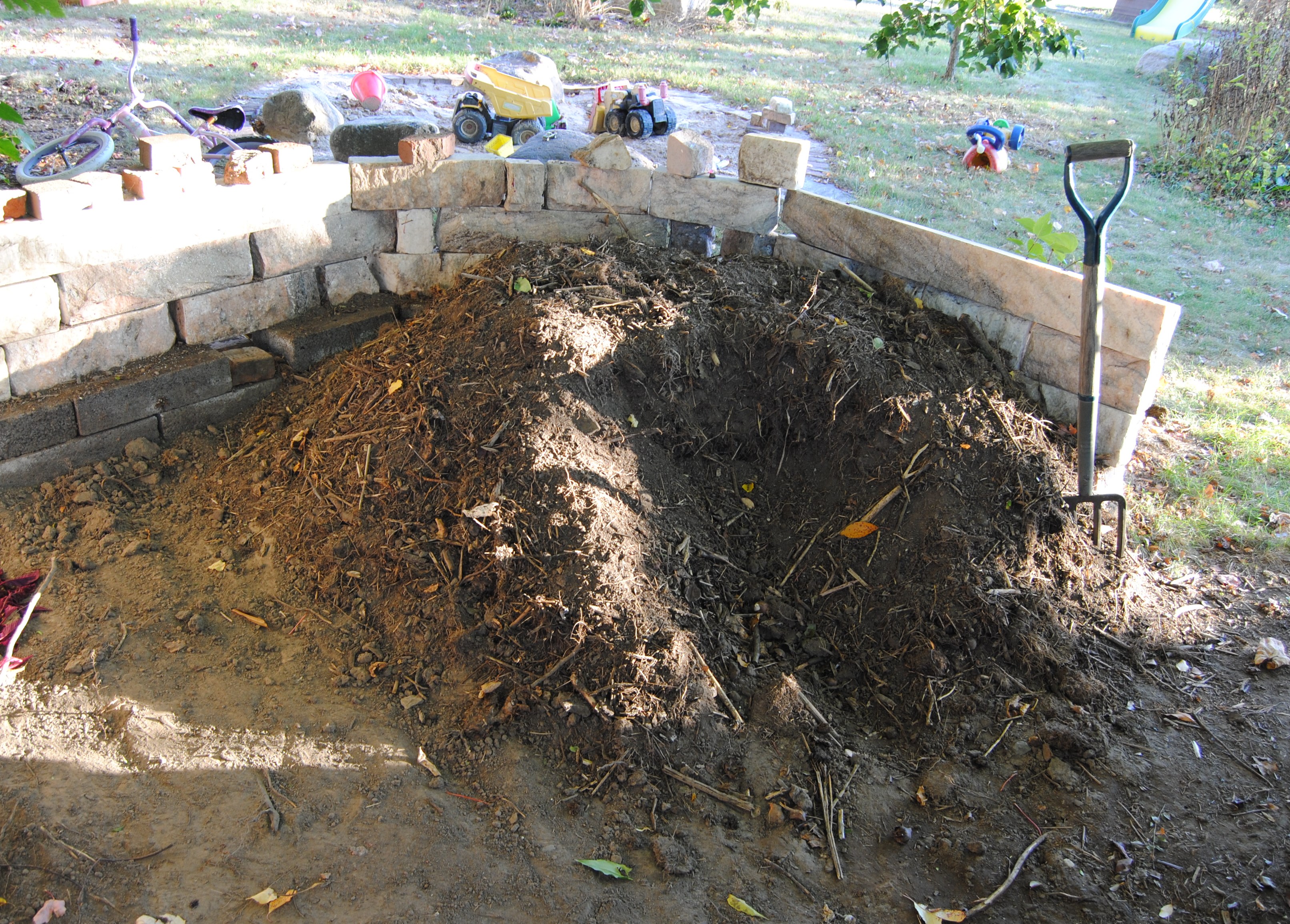
the freshly turned compost pile…and I’m finally getting some work done instead of just sipping drinks in the shade.  The compost pile was turned and a bonanza of “god enough” compost was found underneath.  It’s as dry as a bone in the pile, so I’m surprised there was any decay going on at all, but the plants will love it and I’m grateful for any scraps I find.  the question will be “who gets it?”

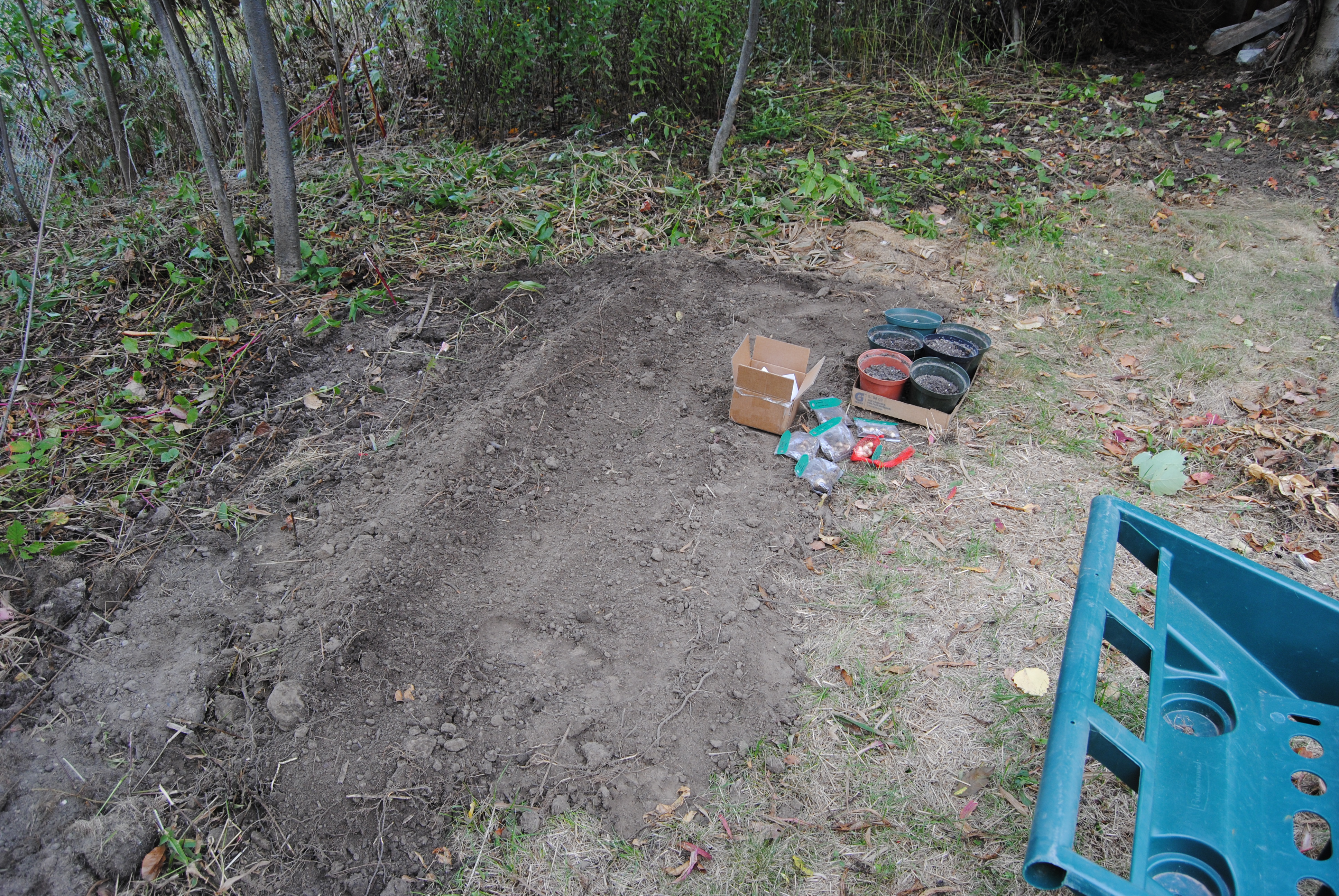
Actually there’s no question, my favorite new bulbs always get the scarce compost.  Here’s the newest bed in the back of the meadow.  A privet hedge (luckily privet isn’t invasive here) is planned for along the fence, and a snowdrop (galanthus) bed will get its start here.  I’ll bore you with the varieties next spring but for now here’s a picture of my usual low work (ie lazy) bed preparations.new bed for snowdrops (galanthus)A couple inches of topsoil from elsewhere in the garden is spread out, bulbs are pressed down into the raked surface, a few inches of compost is used to top off and cover.  The compost I used has a good amount of soil mixed in, but if it was more organic I’d cover the bulbs with a layer of garden soil too.  They should be just fine here, and I’ll give them a good mulch of chopped autumn leaves once they come down.

I celebrate fall with bulb planting, I love getting the bulbs nestled down into the earth for next spring, I just wish the soil wasn’t so unfriendly and dry.

Fall Lawn Care

The lawn maintenance contract for the yard next door was on the market this spring and guess who had the winning bid?  Yours truly!  The field of entries was stacked with lawn doctors and local landscaping companies and when the offers were reviewed my bid of zero dollars for time and labor rose to the top.  Last year I was already doing the mowing, but some chem-lawn was handling the other stuff… now it’s all me.

She did express some doubt in my laissez-faire approach to lawn maintenance but in the long run I think the economics won her over.  My own lawn is only now just reviving from the drought of summer.

Without boring you with the details (your welcome to ask for more info if interested) my lawn care consists of the following: use an (expensive) quality blend of grass seed (I don’t like rye grass, so the less of that the better), use the cheapest plain old fertilizer you can find (I usually go for the K-grow from that K-store), mow on the high side and if it doesn’t bother you leave the clippings on the lawn.  Forget everything else.

Because I don’t water, the lawn was completely dead from late July on, but as soon as rain and cooler temperatures arrive it comes back fast.  To get it prepared for this rebirth I gave the dead lawn a close haircut without a bag and left all that thatch wherever it fell.  I threw around some of the cheap fertilizer and waited for the fall to do its magic.  Two weeks later and two weak rain storms and it’s started to green up again…. although I did do a little supplemental watering for my MIL’s yard (we’re still 8″ short of normal for rain this year….)

The patchy spots will fill in over the next week or two as that grass comes back to life, but it’s real important to get the lawn nice and thick now so that it’s too dense for crabgrass seeds to sprout next spring.  Also never cover the whole lawn with grub killer.  Grub killer may kill grubs for a season, but it also kills off the earthworm population, and there’s nothing better than earthworms for free fertilizing, free aeration, and free thatch removal.

The down side to all this is that lawn mowing is back on the to-do list.  My lawn can still wait a week, but the extra water next door means mowing this weekend.  Oh well, the clippings will give the earthworms over there a well deserved end of summer snack!

Did I do that?

This box showed up on my doorstep Friday and it’s bursting at the seams with colchicum flowers!  The wise gardener orders these bulbs well in advance of autumn so that this scene takes place in the well prepared garden bed, but the procrastinating gardener takes the risk and begs via email for a late order and shipment.

I may have gone through this kind of poor planning before, so the bare-bulb blooms are no big surprise or worry, but the show would have been ten times better had the bulbs already been planted.  But this order was the result of panic.  A couple weeks ago I realized I didn’t have anywhere near as many colchicums as a self respecting colchicum lover should have, so I immediately went to Daffodils and More, David Burdick’s bulb website.  He dabbles in the colchicums, has an excellent selection, and after a couple emails back and forth I was able to convince him to part with a few, even though they were already headed into blooming stage (as you can see, they don’t need soil or planting in order to bloom!).  They arrived at my doorstep even before my check was cashed and I have to say they’re the best cared for colchicums I have ever received.  Instead of looking worse for their journey they’re already planted in the ground and settling in.

I was halfway tempted to keep them in the box and have them close enough to examine day or night while blooming, but better judgment won out and they were planted the next day.  I just need some groundcover ideas.  Some nice companion plantings would surely make this bed look even better as the bulbs clump up.

This info might be a little too late, but I noticed Brent and Becky’s bulbs just put their colchicums on sale for 50% off. It’s a great deal (and the source of many of my own bulbs) but most have already sold out…. but there are a couple left, and it’s not that I want to encourage any late season colchicum incidents in your own garden, but colchicum byzantinum and colchicum ‘giant’ are two of my favorites……

The cyclamen are back

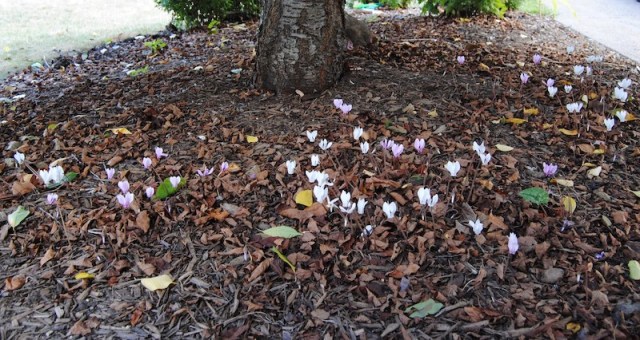
It’s raining this evening and I hope this finally takes us out of the summer long drought we’ve been limping through.  The rain will hopefully soften the rock hard soil and usher in a nice gentle season of planting and transplanting.  Somehow the cyclamen knew the calendar had turned to fall, in spite of the heat and drought they’ve been sprouting up amongst the dry, dead leaves and giving fresh hope for fall.

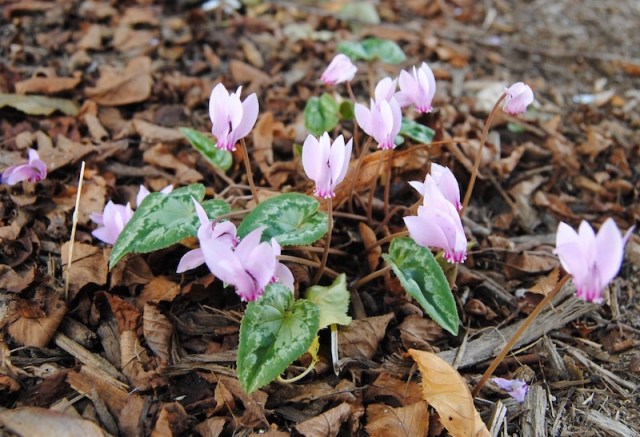
Nothing else grows in the dry shade of this weeping cherry, but the cyclamen don’t seem to mind.  The cyclamen hederifolium  normally come into bloom now, some years earlier, some later, but they always seem to know summer is winding down.  Usually the flowers come up before the leaves even show, but I like it when the two appear at the same time.

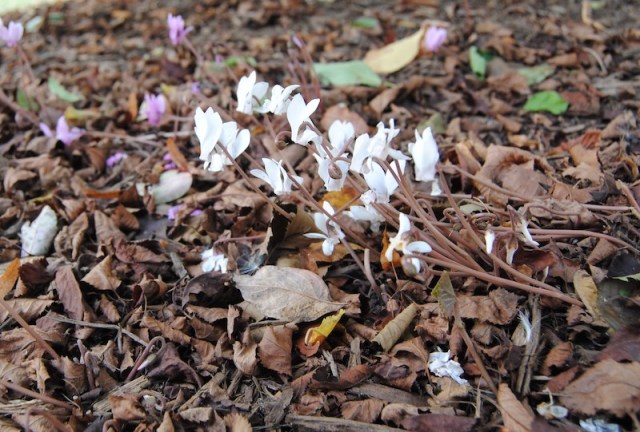
The colors range from white to dark purple and this planting was really starting to look good until some kind of basketball/wagon/quad/bicycle incident at dusk.

There might be some recovery but right now most are crushed or have a ‘windswept’ look.

All of these are from seed.  My introduction to these plants came from a friend who sent me a mixed packet to try out.  I planted them in the fall and was amazed to see them sprout during the winter on a cold windowsill and start showing off their fancy little leaves…. until I killed most of them when I left the pot out during a hard freeze.

But gardeners are nothing if not resilient, so next fall I planted a whole new batch of seeds from Green Ice Nursery in the Netherlands.  They were more than amazing.  I grew them under lights in the cool of the basement, repotted them for the next year, put them out for the summer and even enjoyed some flowers that fall.  Another winter indoors and I was starting to recover from the pain of killing off my first batch.

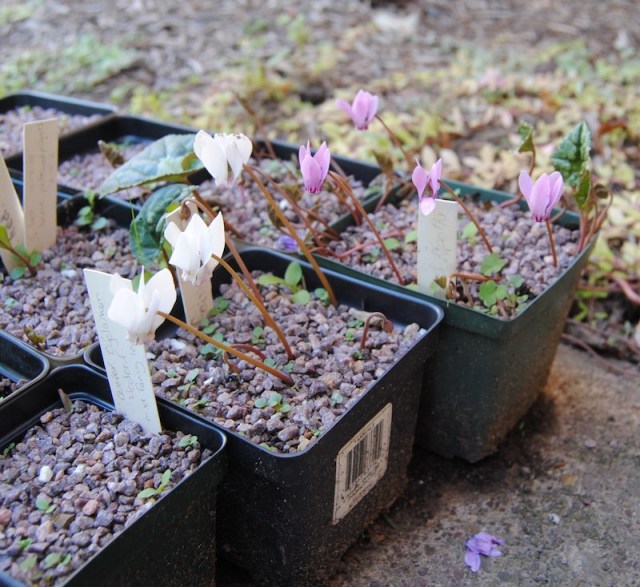
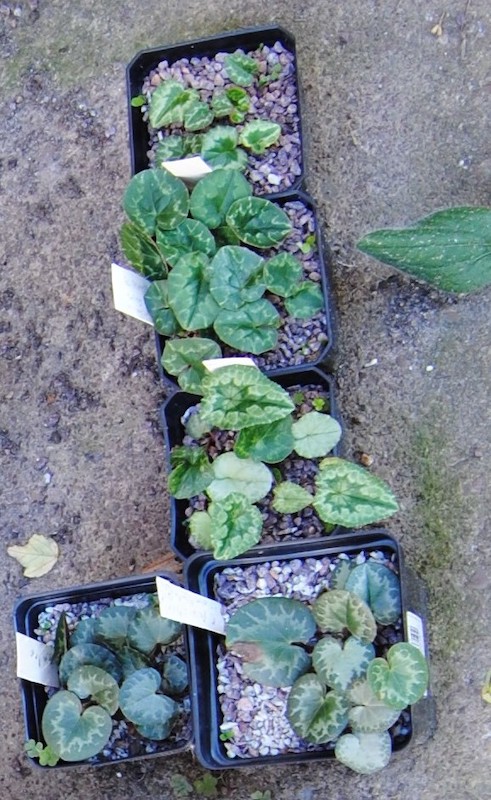
That summer I potted up the best looking ones into individual pots to really get the full effect.  I could admire the individual plants and their cool leaves this way.  (by the way, chicken grit -available at feed stores- makes the perfect pot topper for these guys)

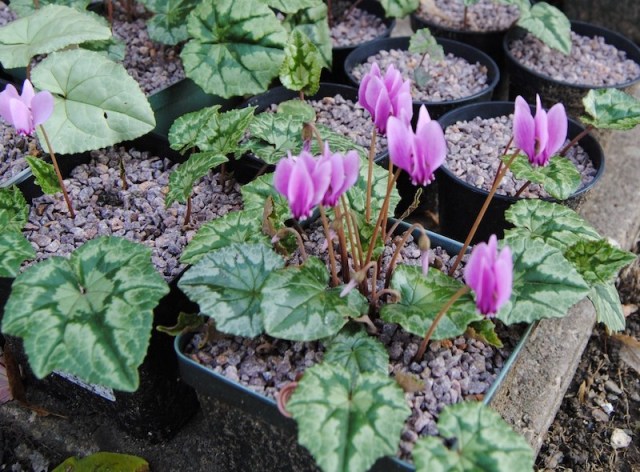
A few really stood out.  This one was a nicely colored, heavy bloomer that sent up plenty of foliage as a backdrop for the two toned flowers.

,

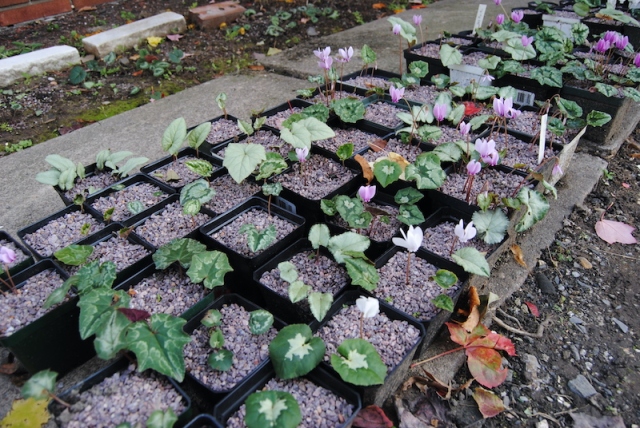
Things were going really well until it came time to move them in.  I couldn’t find enough room for what was now about 80 pots in all kinds of sizes.  So I crossed my fingers, dug them in for the winter in a sheltered spot, and hoped for the best.

While hope may spring eternal, its got to make it through winter first.  Between January and August I again lost most of my little cyclamen, and as of today this is what remains.  Maybe 15 of the original 80 plants still survive.

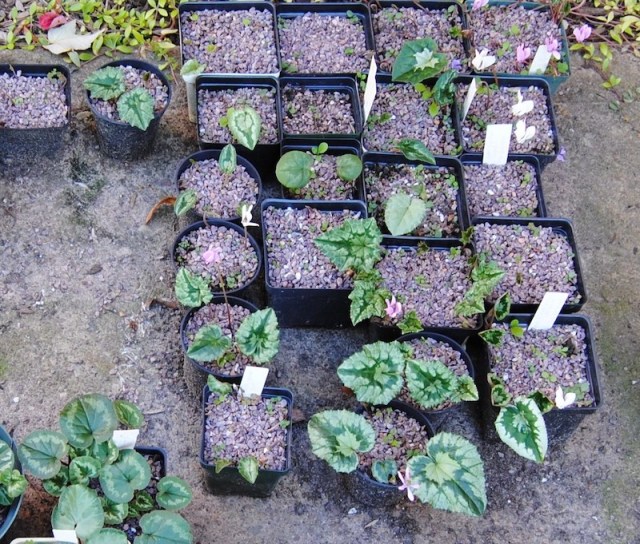
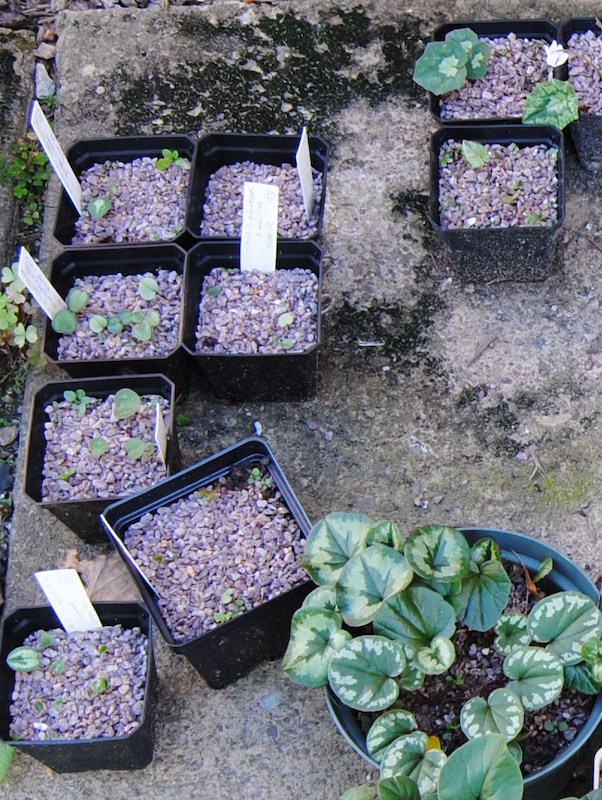
But never fear, any healthy new obsession involves overkill, and you can bet that even though I’ve lost so many there are also so many more coming along.  Here are last winter’s new seedlings growing happily.  They are courtesy the N. American Rock Gardens Society’s annual seed exchange.  Members donate seeds in the fall and other members such as myself reap the rewards during the winter exchange.  For a pittance to cover postage you can pick up all kinds of new and unusual plant seeds, many of which are just not available elsewhere.

Besides the exchange, there’s also the possibility I broke down last winter and ordered even more seeds from Green Ice.  Jan Bravenboer of Green Ice must have a great eye for cyclamen, so many of his strains seem to be one in a million plants picked out from here and there across Europe.  I had to get just a few more which are sprouting now, and I’m glad I did.  Changes in the inspection policies of the EU have made the certificates on small orders such as mine way too expensive for honest buyers/sellers.

The seeds in themselves are cool too.  When cyclamen blooms are pollinated, the flower stalk curls up and the growing seed pod is snuggled down into the mulch next to the plant.  There they sit safely tucked in until the seeds ripen.

There are other cyclamen that overwinter just fine (when planted properly) in my zone 5/6ish garden.  The patterned waterlily shaped leaves below belong to cyclamen coum, which is setting buds for Feb/March blooming, and the smaller silvery leaves bottom right belong to cyclamen purpurescens.

The summer blooming C. Purpurescens might be the hardiest of them all.  I’m having a little trouble making it happy but I think once established it will settle into a zone 4 garden without trouble, and you can enjoy the leaves all year as they don’t die back like many of the other types.

I’m afraid I’ve gone on too long again.  It’s Sunday morning and the rain is finished and the birds are all over the place.  Time to head out there and check things out.  I’ll bore you with many more cyclamen in the future, trust me.