Everything

It was the driest of times, it was the wettest of times, it was the age of motivation, it was the age of laziness, it was the epoch of brilliance, it was the epoch of more dumb ideas… it was just about everything and as usual you’ve got to take the good with the worse, so when the light was nice this week I got some photos, and now as rain and gray rule the day I’m posting.

red head coleus

The summer annuals are fading fast.  Even a week of non-fall-crisp air didn’t convince them summer had returned.  

Something about a tropical weather system escaping the tropics and taking a trip to Canada (which we couldn’t work in this year, so good for the storm) has us pulling in cold northern air with a swirl of tropic downpours, and I’m not thrilled to see cold and wet arrive for a holiday weekend.  This comes after an overly-warm week also gave an excuse to stay inside, so as you could guess the pace of work is close to an all-time low.

succulents under growlight

The succulents are starting to migrate into the winter garden to spend the next few months under lights.  It looks so innocent at first but by the time the last pots need to be crammed in here….

Other than the usual excuses I have brand new ones to add to my list, both of which caught me off guard!  Last Saturday, overly enthusiastic sandwich chewing left me with a nice bite to the tongue… nice enough that I didn’t eat for two days and was barely able to speak when Monday rolled around… and then an achy knee on Sunday turned into a limp and pain which only ramped up through the week as the mouth began to get better.  What a mess.  Fortunately I work with a nice group of kids this year, who reassured me it’s not my fault, it’s just that I’m so old and this was bound to happen sooner than later as I pick up speed on the downhill side of life.

dichondra hanging basket

In July all the hanging baskets of dichondra ‘Silver Falls’ were going to be overwintered and come back even stronger for 2024.  In October… well that’s a lot of baskets to overwinter…

So maybe the rain is a blessing.  I can slow the pace, rest up a little, maybe help clean inside??? -hahahaha, just kidding- there are a billion things to clean up in the garage and the winter garden is starting to fill up, and today is an excellent day to sort and put away the dozens of empty pots (which will likely fill again this winter), and make sure there is ample potting soil etc for the upcoming months.

suburban daylily farm

Before being sidelined for injuries, the daylily farm was tended and replanted for 2024.  Sometimes it looks big, other times it just looks like a silly example of why I need adult supervision, but in either case it should look nice in bloom. 

So some progress is happening as far as preparing for colder months, but I was most pleased to get the daylily farm in order.  I still have this delusion people would come if I opened the garden for a weekend or two, and I also have this idea that everyone would be super-nice and just as excited about plants as the farmer is…. until I have my doubts…  Then all of a sudden I’m wasting day after day wondering why no one is interested in a daylily or two, and I’m either making pity-sales to friends, or fielding ‘can you do better on the prices’ questions from someone who pulls up in an Escalade.  I guess it can’t be any worse than the garage sales we used to have, where a day in the driveway maybe cleared 10 or 12 glasses or purses or whatnot out of the basement.

new lawn seeded

Whatever happens, at least this side of the house looks somewhat presentable again.  New beds have been made, lawn has returned, and if you can ignore all the clutter, it almost looks garden-ish.

Even if the farm never works out, there’s still all that amazingness in the back yard.  Overgrown potagers, weedy and unmulched beds, and waste areas where weeds are actively going to seed highlight the garden once you pass beyond the curb appeal of the front yard.  I would swear that 90% of garden advice for maintaining a beautiful Eden of your own includes the statement ‘make sure you get your weeds before they go to seed’, and when I look around that’s all I see.  “Wildflowers” going to seed, grass going to seed, perennials and annuals going to seed, it’s all a seedy mess and if it weren’t for the constant back and forth of birds and other wildlife coming in and out of the yard I’d have reached for the string trimmer weeks ago.  I’ll accept the curse of future weeds in order to enjoy this.  One of the few apps on my phone is the ‘Merlin Bird ID’ from Cornell Labs, and what it does is pick up the bird sounds around you and runs a list of what species are calling.  Last Saturday morning I cracked open the back window and let it run for about ten minutes and it tallied up 21 different species of birds in the yard.  Birds are migrating through this month, and I see them in and out of the weeds, picking up their breakfast and now I have an idea of who is all there.  Just in the LBB group alone (Little Brown Birds) I have Song Sparrows, Chipping Sparrows, White-throated Sparrows, Field Sparrows, Lincoln’s Sparrows, and Swamp Sparrows.  Trust me that if left to my own, I’d barely recognize one of them, and even then I would have doubts!

weedy aster wildlife

Weedy asters (or whatever they have been renamed as) filling in wherever they can.  
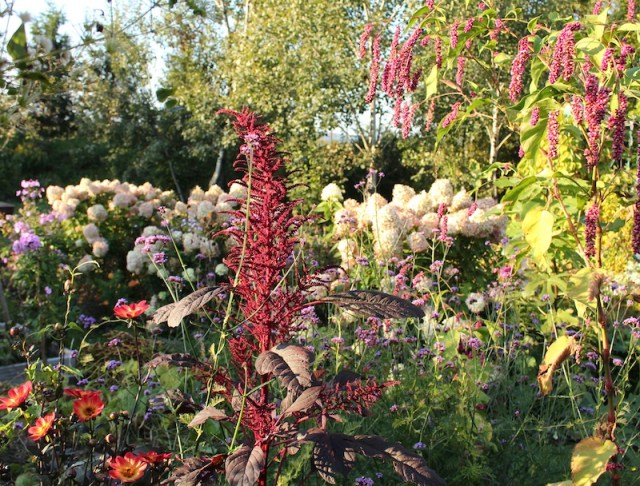
hopi dye amaranth

‘Hopi Red Dye’ amaranth alongside a bunch of other things blooming and seeding around the potager.

happy flame dahlia

‘Happy Flame’ dahlia looking excellent for the shorted days and cooler temperatures.  The orange marigolds are still going strong!

limelight hydrangea

The afternoon light on ‘Limelight’ is always a treat, especially this year when ample rain and cooler weather have brought on a pink flush rather than the usual end of summer tan.

Obviously I’m a few weeks too late in doing anything about the weeds, and that was never the plan anyway, but there are still plenty of other things to keep in mind.  If my knee and the weather cooperates, there are still a few colchicums in need of moving so that’s always a fun little project.  The colchicum have been nice this year, and I’m glad their flowers have brought me through the doldrums of September into the season of fall foliage and chrysanthemums.

the giant colchicum

A bunch of colchicum, an un-named kind from a friend which I call ‘Frau Becker’ because that’s a much better story than calling them ‘Probably The Giant’. 

The colchicums are still holding their own and a few of the fall snowdrops are beginning to peek out.  As would be expected, the most promising one, even though it’s a half cm sprout in the middle of a thicket inside a jungle, has been found, singled out and nipped off by a bunny or bird.  I would complain, but after years of this I’d be a little self conscious when the same people politely offer the same good advice of covering the sprouts when I first see them… so instead let’s just visit the waste area of the garden again.

waste area wildlife

The waste area from the side where its weediness shows off best.  More ‘Hopi Red Dye’ and a plethora of lambs quarters going to seed.  The birds love the lambs quarters but I always see it and think back to my allergy tests and how this weed showed up as a top culprit.  Hmmm.  Maybe not the wisest thing to leave…

Regardless of what is happening with the hard-core weeds, the verbena bonariensis taking over the lawn is still on the list of too-pretty to say a single bad thing about.  I was hoping this would pull in hordes of migrating Monarch butterflies as they pass through on their way to Mexico, but so far it’s only been dribs and drabs.  On a few occasions there have been three or four, but sadly never the dozens of years past.
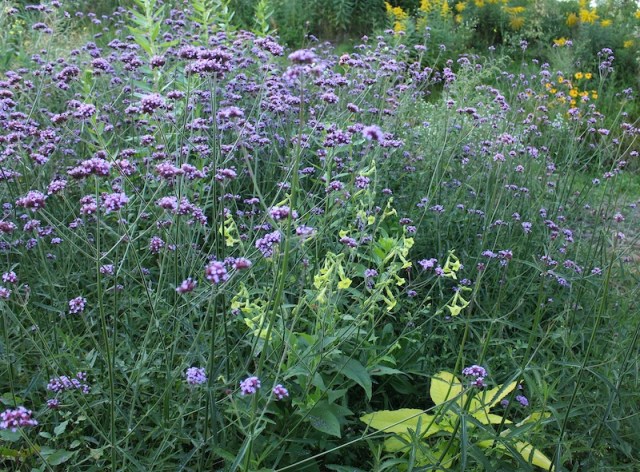
verbena bonariensis mass

A green nicotina is also a welcome weed.  This flower is the favorite of any hummingbirds which happen to pass through on their way South.

I’ll leave off on the October project.  Assuming my students are wrong and my injuries aren’t really the beginning of the end, the next thing on my Summer of Labor list will be a return to earth-moving.  There’s still a mound of excavated rock and dirt behind the new addition, and surprisingly the plan has always been to tackle this in October/November once the weather cools and the ground is wet and soft again.  Also surprising was a special treat which showed up and will hopefully make the job much more enjoyable.  Here’s the background to that…

What do you want for Christmas? “a new wheelbarrow but I guess these new work slacks are nice too”

What do you want for your birthday? “a new wheelbarrow but I guess all these socks and a sweater are nice too”

What do you want for Father’s day?  “a new wheelbarrow but I guess going out to the restaurant the kids love is nice too”

Random weekend when a hardware store closes?  “A new wheelbarrow!!? How did you know!?”

waste area wildlife

A waste area in the middle of the back yard?  I guess it isn’t the most aesthetic development of this spot, but I have enjoyed the progression of weedy flowers which have moved in.  Right now frost asters dominate with a forest of white, and I’ll feel slightly guilty ripping them out to level the area again.

Even in my decrepit state I am still a rich man.

Have a great weekend!

Fast Forward

I’m not quite sure what happened to August, but I just looked at a calendar and it’s practically over.  I like August, and I’m not thrilled at all with this time warp.

January has the same number of days, and January never seems to fly by as quickly… even though the days are so much shorter… so maybe some weird time continuum thing is what happened.  Or maybe it’s a simpler explanation like ‘time flies when you’re having fun’.  Maybe not out-all-night, the-neighbors-called-the-police fun, more like stretching morning coffee time on the porch or going in the pool before bed just because you can fun, but it’s still fun and I feel like these days are numbered.

rudbeckia prairie glow

By June nearly all the Rudbeckia triloba ‘Prairie Glow’ in the front border was dried up and dead, but in July and August a steady lifeline of rainstorms pulled them through.  I’m happy for that, they look great now.

Maybe August flew by because the pressure here really eases off in late summer.  Things are either done or they’re not and there’s much less to worry or even care about.  With ample rain things here look good, and most days I just wander about admiring plants like rudbeckias and hydrangeas.  The Hydrangea paniculatas are at their peak now, and they’re always kinda awesome.

hydrangea limelight seedling

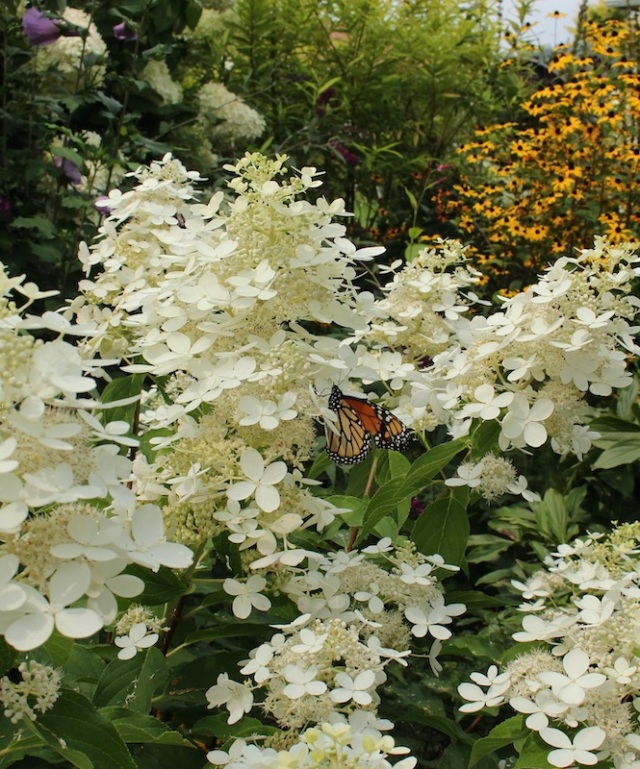
This lacier hydrangea was just buzzing with all the bumble bees and wasps, but even a Monarch butterfly stopped by for a drink.

In my opinion you can’t go wrong with one of these late season hydrangeas.  They’re hardy and always bloom here (unlike their blue cousins) and all they ask from me is a late winter pruning to thin out the stems and keep them from getting too out of hand.

hydrangea limelight seedling

A strong pruning in spring keeps the ones on the edge from getting too big, the ones further back are allowed a bit more freedom.

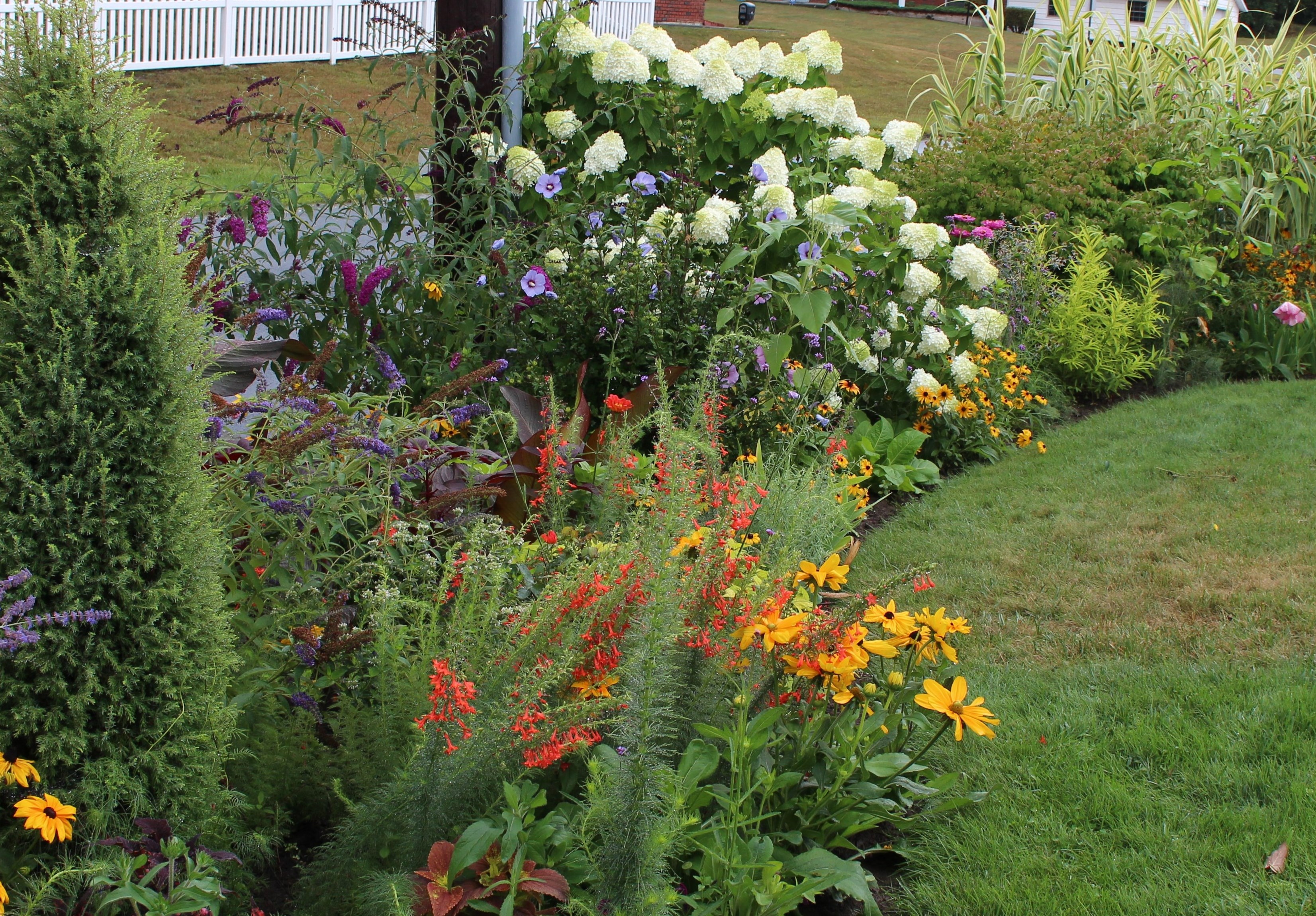
All these hydrangeas are either H. paniculata ‘Limelight’ or seedlings from her.  The seedlings have been remarkably nice, and I might try another batch just to have more of them since why not?  They’re all a little different and I enjoy the variations along the street border.  They’re all a little greenish to start, and I actually moved out my one pinkish ‘Vanilla Strawberry’ because it seemed too white and then too pink alongside all the limey tones.

hydrangea limelight seedling

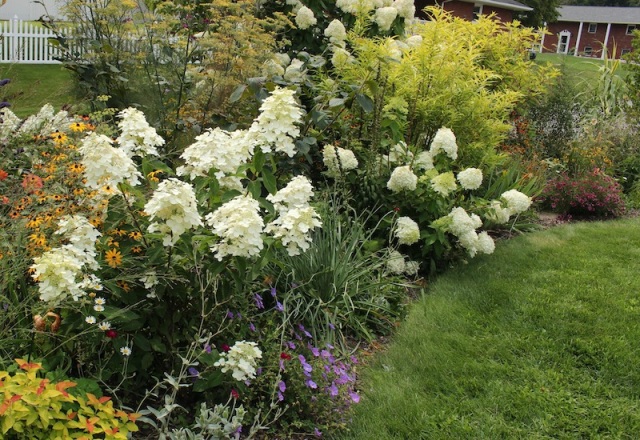
Seedlings of Hydrangea ‘Limelight’ carrying the front border through August.

I don’t think I’m kidding anyone when I talk about setting color themes and working out an organized display in this garden.  The history of this place is closer to planting whatever is at hand in whatever space is open and hope that something works out well.  I guess for late August these hydrangeas worked out well.

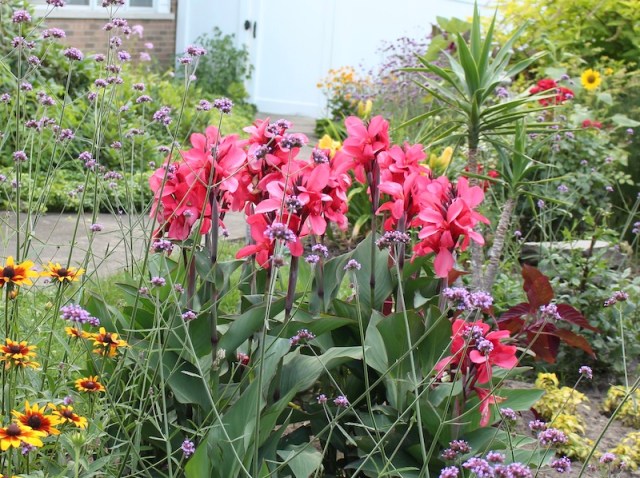
cannanova and verbena bonariensis

Cannas and Verbena bonariensis also work well.  The cannas were rudely dumped here and the verbena came up on its own.  Actually only the yucca on the left was planted here on purpose, and even that was a rescue from the trash.  Not bad, but I did weed out a bunch of less lovely things as well.

The rest of this post is just heres and theres and updates.  Less is more, right?  And based on how little I’ve been posting lately maybe it’s better to just get anything up rather than some overly wordy thing which gets tedious after a while, plus I’d like to get to bed early so that’s another incentive for brevity 🙂

dahlia matthew allen

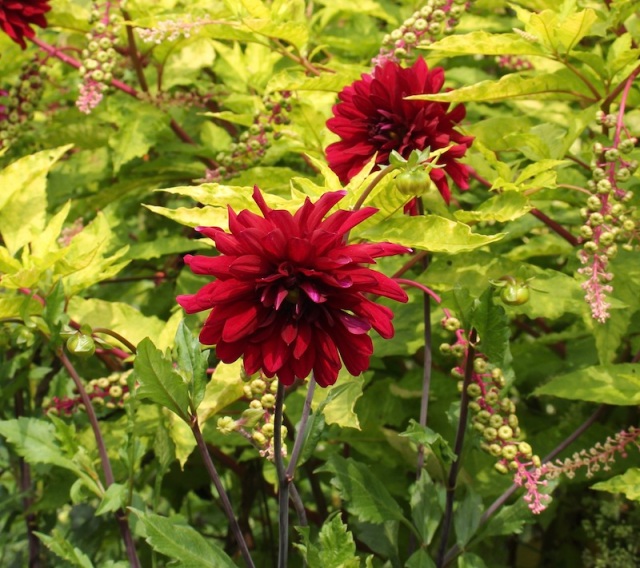
Dahlia ‘Matthew Allen’ amongst the pokeweed.

garden stone wall

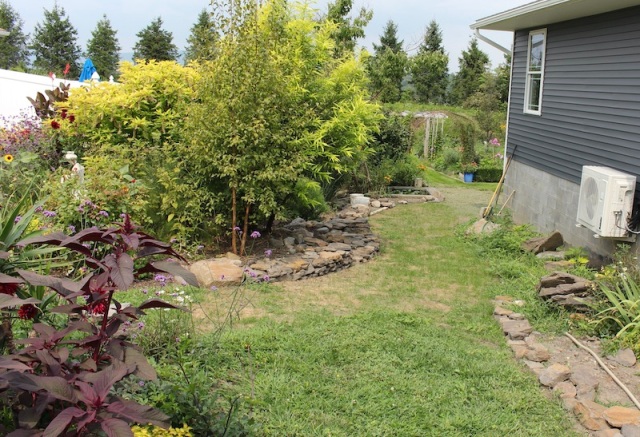
The stones are all “organized” along the slope and the grass seed is sprouting.  Finally it looks less like a excavating playground and more like a spot which just needs a little foundation work and a nice bed along the house with anything other than crabgrass.

As usual the potager is a mess of overgrown vegetables and aggressive vines.  Of course I like it, but I’ll have to confess that it only took two years for the 100% vegetable beds to turn into 25% vegetable beds plus bulbs, tree seedlings, shrub cuttings, small transplants, phlox beds, daylily beds…. a bare patch of soil is rarely planted to lettuce, coleus cuttings and canna seedlings are much more likely.

garden potager

At least the lawn is mowed.  Studies show that any disaster garden looks 78% better with a mowed and edged lawn area.

garden potager

Beans and a few diseased tomatoes are the only legitimate vegetables still growing here.  Now if I could only motivate myself to pick them.

lycoris sprengeri

Of course any decent potager has a few Lycoris in it.  This ‘magic lily’ from a mixed batch of Lycoris bulbs has produced some nicely colored blooms.  I’m guessing it’s a form of Lycoris sprengeri and I’m guessing it will now take three years off from blooming, just because…

A weedy vegetable garden is one thing, but a weedy waste area is an even better thing.  Here’s an Instagram-ready photo of the lovely waste area which is now filled with blooming canola, sunflowers, and a new lawn infested with Verbena bonariensis seedlings.  It’s an interesting place, and while I stopped mowing the newly seeded section of lawn so the Verbena can grow into a purple mass of flowers, it’s the cannola patch which demands the most attention.  Hundred of honeybees (and a few others) make this corner of the yard buzz on a still afternoon.  I can’t believe how many there are.

garden waste area

The ‘waste area’ where all the construction fill was dumped and leveled.  It’s a weed factory and probably my favorite part of the yard right now.

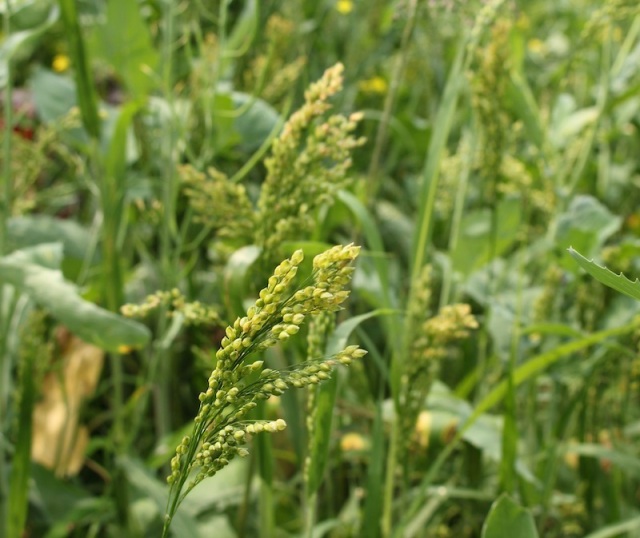
I’m still on the fence as to whether or not the birds will appreciate the cannola seed as much as the bees appreciate the flowers.  There will be plenty, but as of today I haven’t seen a single seed pod attacked for its contents.  That’s in stark contrast to the millet seed which is beginning to ripen in the shadow of the cannola.  Chipping sparrows and song sparrows attack the seedheads, and there are always a few in the area to entertain me.

millet bird seed

Millet seed heads beginning to ripen.

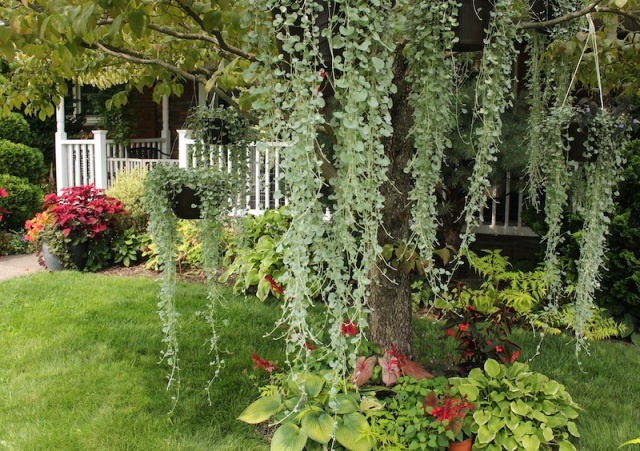
Besides an area of the yard dubbed ‘the waste area’ my garden also boast a slice of Savannah  this summer.  ‘The Old South’ is where all the hanging pots of Dichondra ‘Silver Falls’ ended up, and my boring old pink dogwood has been elevated to the role of sprawling live oak with the Dichondra playing tendrils of Spanish moss weeping down from the branches.  I’m entirely amazed with myself and smile at it every time I pass, even if the local review is closer to a polite ‘I don’t understand why’.

dichondra silver falls

It grows like a weed, and probably is a weed in warmer climates, but here Dichondra ‘Silver Falls’ is just a nice little plant which eats up the endless rain and humidity and turns it into curtains of gray.

Surprisingly the gardener has yet to smack his head on one of the hanging pots, and still smiles when he weaves through the pseudo-moss, not really moss but pseudo-bromeliad veil.

dichondra silver falls

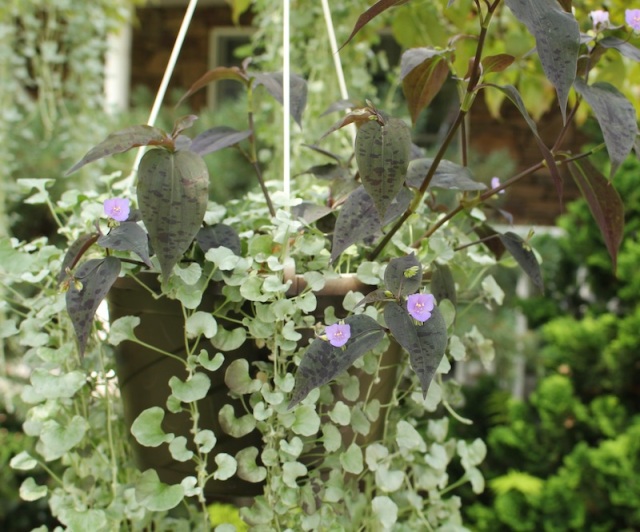
There are even a few nice surprise weeds (spotted widows tears, Tinantia pringlei) in the pots of intentionally planted weeds.

I’m just excited to think how much more this will develop over the next month, and of course this winter I’ll foolishly try and winter them all over and see how much bigger and thicker they can get next year.  Obviously I’ll need more caladiums underneath and honestly I think a few Boston ferns would only add to the effect.  Maybe I can wire the ferns onto the dogwood trunk and tuck a few more into the branch crooks and bends.  My whole next year can revolve around this silly idea and I’m sure sitting inside this winter stewing on it will only help 😉

dichondra silver falls

No one really says anything about the tree but I’m pretty sure they all think it’s amazing.  If only I could find one of those ‘Midnight in the Garden of Good and Evil’ statues to complete the theme.  That would probably be much more tasteful than trying to re-create some marble mausoleum or deep South cemetery vibe on my front lawn.

In the meantime as this design concept matures, I’ve gone ahead and given two more crape myrtles a chance at life (but more likely death) in this garden.  This will be attempt four, and usually three is a respectable place to stop, but I’m gambling on science and planting for an increasingly warm climate here.  I saw crape myrtles (Lagerstroemia) in bloom all over Long Island on my last visit, and it’s only been a few decades since they would regularly freeze to the ground or outright die over winter in my parent’s garden.  Not to be greedy, but I’d like a large tree in purple and one in a bright cherry or red, and I’ll be on the lookout for a cheap starter to experiment with.  In the meantime the ones I’ve added are two dwarf forms which should easily sprout from the roots and bloom even when frozen to the ground.  From tiny plants this spring, they’re both forming buds and blooming this summer.

crape myrtle barista series

From the Barista series of dwarf crape myrtles, this small plant will hopefully develop into a mound of dark foliage studded with brilliant blooms.

So there it is.  The closest I came to a vacation this summer, a trip to fake-Savannah with it’s fake moss and a little token Mc Crape myrtle.  I hope to do better next year, but in the meantime even the weediest waste areas of the garden are entertaining me at this time of year, and I’m hoping to ease into colchicum season without the usual whining about fall and autumnal gloom.  It’s all good 🙂

Welcome August

After a rough start to the year the garden is about where it’s usually at.  I’m glad for that since in June it looked like a year of brown lawn and wilted flowers was ahead, but now things are mostly ok.  I’d say totally ok, but when things dry out so much it takes a couple days straight of rain to really get into the soil, and in spite of frequent storms there are plenty of sloped and harder-soiled areas where things are back to wilting.  Regardless, things look good enough and I’m happy with that.

the front perennial border

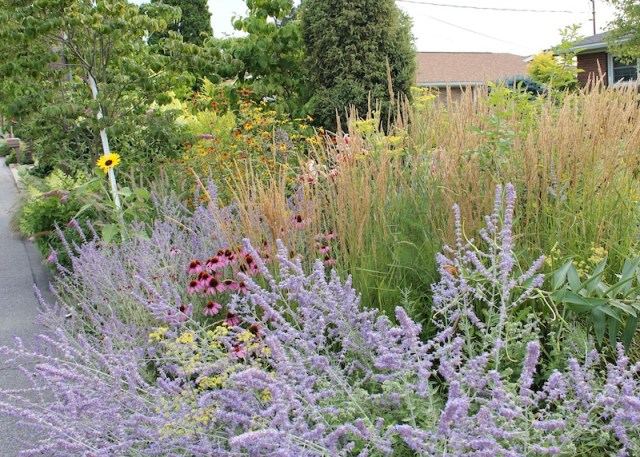
The front border along the street is reveling in a full-summer show of perovskia and coneflowers, but sunflowers haven’t seeded in like they normally do.  I blame the dry spring.

I’m also happy I put off planting annuals this spring.  First of all there’s barely any room in the front border where I normally plant them, and second of all even with the rain here and there I’d still be watering them.  One less job fits into my schedule perfectly!

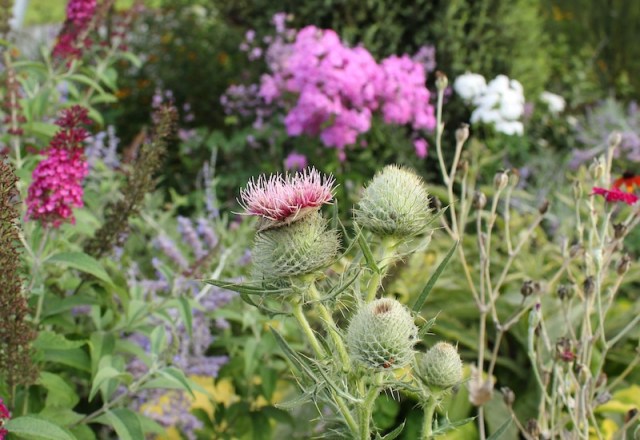
cirsium eriophorum woolly thistle

I do like a woolly thistle (Cirsium eriophorum) here and there in the garden.   Most visitors would accuse me of letting a weed grow, but I’m sure they’d understand when told it was planted here on purpose.

Maybe someone at some point said a dry summer would be the perfect time to ‘thin the flock’, create some space for mulch, spread some iris around, create a generally less cluttered and wild planting… but I think you know where that idea has landed.

klasea bulgarica

Klasea bulgarica suffering along in a less-fertile and less-watered spot in the border than it would like, but it’s still a cool thing, even at five feet rather than seven.

It would be fun to complain endlessly about jobs not done and tasked shelved for the future, but let me first share a somewhat finished photo of the former construction road alongside the house.  Something did get done this summer, and even with its lack of mulch (still hoping to get to that this fall), the emerging grass makes for a more inviting path than an uneven landscape of dumped concrete and roadside weeds.

garden entrance

I’m not sure anymore what the arc of stones was supposed to convey but it’s done and will likely stay this way for years, but at least the new grass makes sense, and will lead visitors up past the new daylily border, and allow them to oooh and ahhhh on their way to the daylily farm fields.

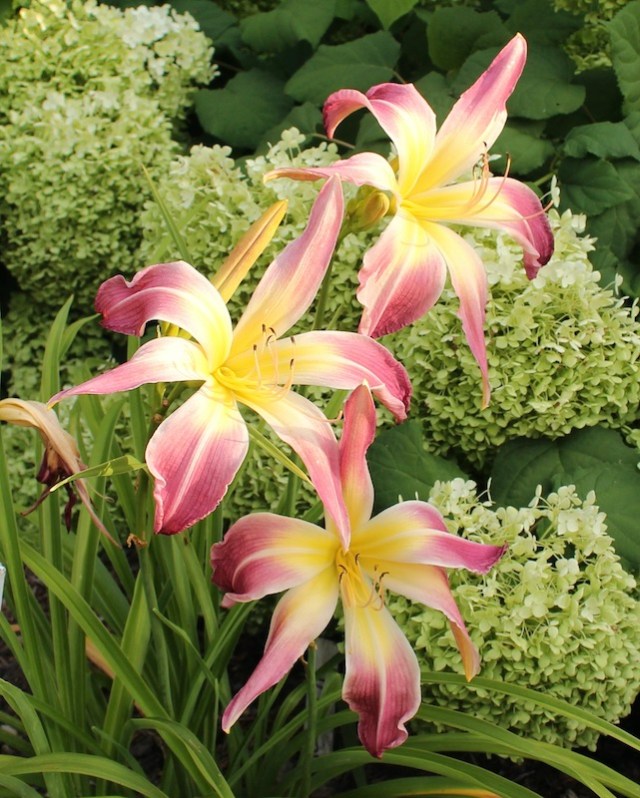
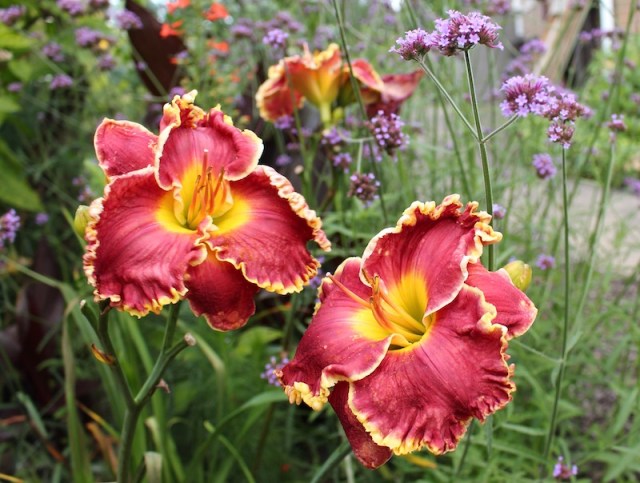
Since I think I heard someone ask why I wasn’t posting enough daylily photos, here are a few still in bloom this weekend.  Late bloomers and rebloomers is how it is since the bulk of them wrapped up the show a week or two ago.

daylily websters pink wonder

One of the nicest ones is this gift from my friend Paula.  In theory I should divide it for the farm, but ‘Websters Pink Wonder’ might be something I need to hold on to for “evaluation” until I have a huge, huge, huge clump of it!

daylily apricot peace

Also a gift, from another friend, is ‘Apricot Peace’.  As other parts of the garden look a little worn out from the summer, this flower is as refreshing and delicious as any sun-riped summer fruit.

Since daylilies aren’t everyone’s cup of tea, here’s a break to look at the tropical garden.  This end of the yard suffered through a lot of neglect as the gardener raced past this construction-ravaged part of the estate to go stick his head in the sand elsewhere, but after some time, rain, and lots of weeding, trimming, and rock-picking it’s at least less than a complete disaster.  Actually it was Verbena bonariensis which saved the day.  Its pollinator-filled haze of lavender-purple flowers covers up many of the sins of this season even if it does obscure the daylily flowers more than I’d like.

the tropical border

The tropical border.  You may notice that the huge mound of yellow pokeweed (Phytolacca americana ‘Sunny Side Up’) is way to big for its space and way too much yellow, but I just don’t have the heart to trim it.  You may also notice a lack of tropicals…

If I had to summarize for a sure-fire way of saving the late summer (full sun)garden, I’d say Verbena bonariensis, Hydrangea paniculata, and cannas.  The three of them just ask for a little water and maybe some fertilizer, and BAM you’re a gardening rock star.  Sadly I didn’t take a photo of the hydrangea this week, but how about this color from the cannas?

cannanova rose

‘Cannanova Rose’, one of the newer seed strains of cannas, is disease free and flowers all summer and into fall if you just keep snapping off the seed pods.  A plus for growing it in the North is the lack of canna roller caterpillars destroying the foliage, since they (and the cannas as well) can’t handle our winter cold.

What?  More daylilies?  You’ve got it.

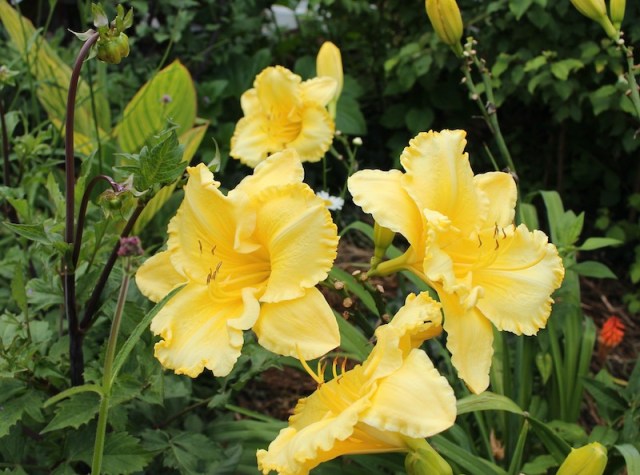
daylily chama

‘Chama’ is a later daylily with a long season and big flowers.  I’d say seek it out but with all the hundreds of other yellows out there I’m sure you could find something similar which is just as nice.

Brookside Beauty seedling

This Brookside Beauty seedling is not quite as average as a yellow.  I picked it up this summer at my new favorite local daylily farm, Garrett Hill Daylilies, and maybe it’s too much of a lot of things but I’m quite happy with it.

daylily hemerocallis altissima

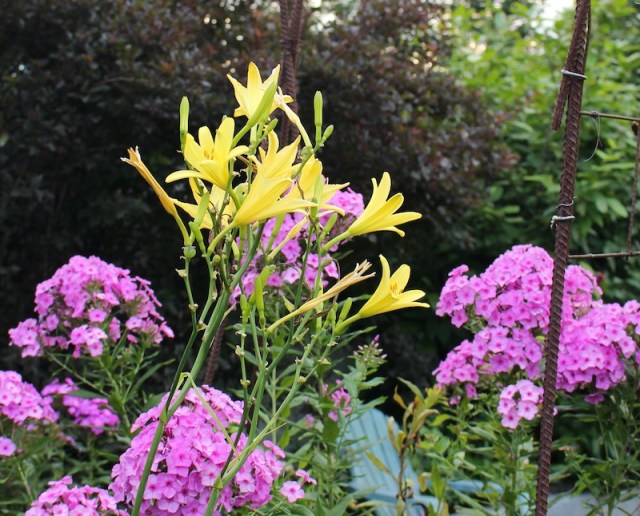
It’s not all rippled edges and intense color.  Here’s the more simple flower of a species daylily, Hemerocallis altissima (probably).  Fragrant, tall, elegant, opens in the evening and then closes for the heat of the day, this daylily has a lot to offer as well.

Ok, let’s keep moving.  The potager is beans, tomatoes and… daylilies now… I was fairly good for three years with my vegetables only policy (plus a few tulips), but that ship has left the pier.  The beds are now filling with things like witch hazels and marigolds, cannas and phlox, and quite a few daylilies as well.  It was a valiant fight but vegetables really are a lot of work, and the farm stand does it much, much better, so…. maybe we don’t need to grow our own cucumbers just in case we feel like eating a cucumber or twenty.

sunflower

One of the few sunflowers to seed out this year… and a little short and small… but I’ll take it, as will the goldfinches I’m sure.

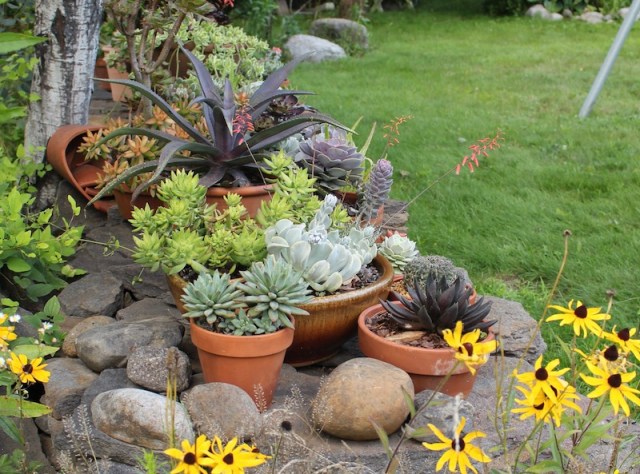
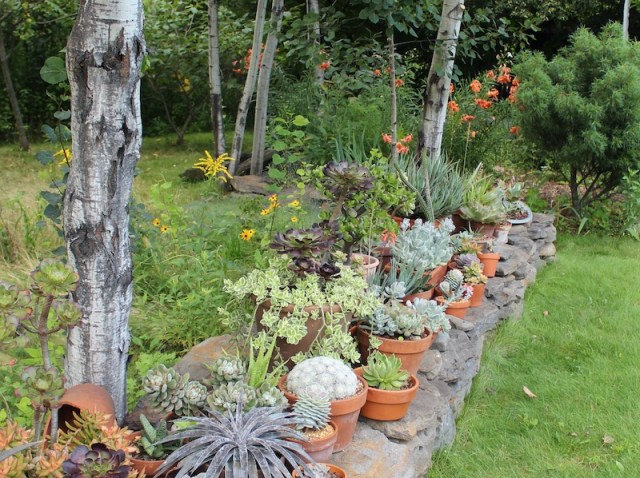
Right over the boxwood hedge of the potager is the stone wall which I went on and on about last year.  It’s still there and it’s still the summer home for a few succulents, except for as hard as I tried there seem to be even more this summer.  Someone will point out that I bought a few more .99 cent treasures on a summer plant trip, as well as a tiny box of cuttings and living stones last winter, but these aren’t even out there (they’re just too cool to put so far away), and all of these are just repots and divisions and cuttings.  Someone needs to stop this ‘let me just take a few cuttings’ thing, just like the rabbits stopped the living stones thing.  Had I known that the rabbits would consider the pots of living stones to be tasty little green jellybeans perfect for nibbling, I would have put them somewhere out of reach, but I didn’t and now they’re gone.  Hmmmm, come to think of it my last living stone was the victim of a chipmunk attack.  I guess they’re tasty little things and I should have known better.

succulent display

Some of the old standbys which are apparently less tasty than living stones (Lithops).

So I guess I killed off the living stones through my own mistake.  Actually the bunnies pulled a “propeller plant” off the wall and destroyed that, as well as a “lobster claw” which was also apparently too tasy to resist, so they’re not as cute and innocent as I like to think.  Maybe I’ll just accept that and reconsider my succulent vetting process to include ‘easy to overwinter’, ‘thrives on neglect’, and ‘is not yummy for bunnies’ and move on.  Trust me that any roadblock to the succulent collection growing is probably a good thing, especially when fall turns to winter and all those clay pots need lugging in.

succulent display

Further down the wall.  It doesn’t look too bad until you do a pot count, and it’s pretty much every last terracotta pot I own so another roadblock I set up is ‘no more terracotta pots’… unless it’s a really good sale… or they’re free… or it’s a really amazing pot…

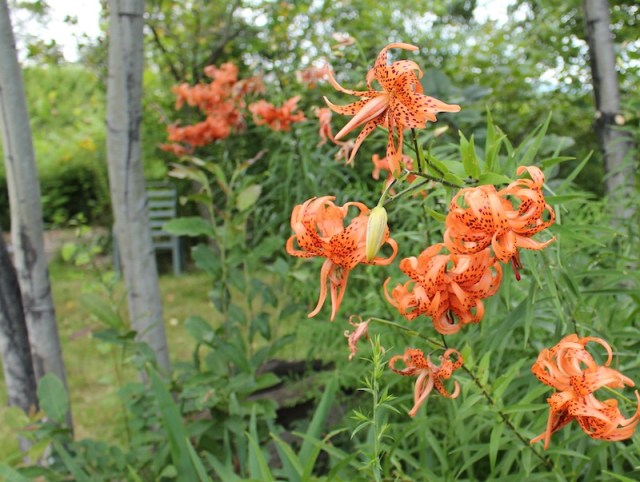
Maybe you noticed the tiger lilies back past the succulent wall?  They’re the double kind (Lilium lancifolium ‘Flore Pleno”) and I suppose I do like them in spite of their messiness, but what I don’t like is the arrival of those bright red lily beetles which eat more lily foliage than they should and produce entirely disgusting young who hide underneath a slimy, wet, bubble of poop as they also overeat their share of lily foliage.  Because of the lily beetles I’m phasing out some of the clumps and trying to figure out which ones I can’t live without, and so far it’s the Asiatics, Martagon, and a few of the Regal lilies… only because they don’t handle late freezes well  and have died back two of the last five years.

double tiger lily

Lilium lancifolium ‘Flore Pleno’ spreading quite well in spite of the beetles and a good amount of shade.

Speaking of supporting more wildlife than I’d like, our ‘Liberty’ apple tree has set a decent crop of fruit this year and just about everyone seems to want a taste.  When people ask questions like what to plant for wildlife I always think of things like apple trees, which seem to be under attack from every insect, disease, bird, mammal… it’s amazing they can survive from one year to the next.  I wanted to try one though, and in an effort towards compromise chose a variety which was supposed to give the gardener “Freedom” from endless fussing and spraying.  I guess nothing but bad taste will keep the animals away, but I think my photo does a good job at representing the cost of freedom.

freedom apple

Not spraying or putting in much effort at all does not produce the best foliage or fruit on an apple tree.  How do they say it?  Freedom does not come free?  Definitely true in the case of this tree, but I think I’m fine with a handful of wormy apples to cut up and eaten outside versus bushels of fruit to deal with.

With an image of a diseased, nearly leafless apple tree I guess it’s not a stretch to go back behind the potager into the waste area.  The grass which was seeded for new paths is coming up but only the weeds in the grass need mowing since for some reason the microgreens of the lawn are just one more thing which the rabbits cannot resist.  They mow down the grass and leave the weeds.  This isn’t how it was supposed to work but whatever, most of the weeds are Verbena seedlings and recent studies have shown there’s a 99.9% chance the gardener would rather have impassable paths of flowering verbena than neat grass.

the waste space

Entering the waste space.  Yeah that sunflower also came up where the path is supposed to be…

Change in plan is more the rule than the exception here, so besides grass paths turning into verbena fields you may recall there was a $3 box of canary seed thrown around back here in order to start a millet patch.  Apparently what looked like millet wasn’t actually all millet and when some cabbagey stuff started growing I did some investigating and found out canola is also a seed birds will eat… and if anyone actually read the label they’d see canola right there after millet.  So now there’s a millet and cannola patch in the waste space.  Two fun facts I discovered about canola when I did my after-the-fact investigating were that 1. ‘Canola’ is short for ‘Canada oil, low acid’, a relatively recent Canadian plant creation of low acid rapeseed which became suitable for edible oil uses rather than industrial, and 2. Canola greens are much sought after by deer… which does not help at all as far as making my yard less-deer friendly.

the waste space

The waste space has filled in quite quickly with weeds, canola, and millet, plus a bunch of barrow fulls of yard waste which were easier to dump here than on the compost pile.  I guess it’s all about bringing life to the sterile fill, and sometimes life is messy.

So here I am talking about growing weeds intentionally again when I really should focus on my garden-rebuilding.  Someday I’ll get it.  Maybe.  At least the waste area takes care of itself, which allows me to return to stone moving and construction repairs.  Finally the pond area has been cleaned out, the path behind it returned to passable, and all those stones picked out of the earth-moving process are being put to use… for better or worse…

garden stone wall construction

Shoddily stacked garbage stones line the arc of the curve which will take a grass path around the side of the new addition.  I think it looks good enough and hopefully the freeze and thaws of winter don’t rip it apart before it has a chance to settle.  More larger stones would have made it more weather-stable I think but you get what you get.

My fingertips are aching from all the stone grabbing and wedging and twisting and I’m glad to say the wall is as done as it’s going to get and only about ten stones remained as extras.   These walls soak up a lot of rock so hopefully I have enough left for a few more questionably interesting constructions around the yard 😉

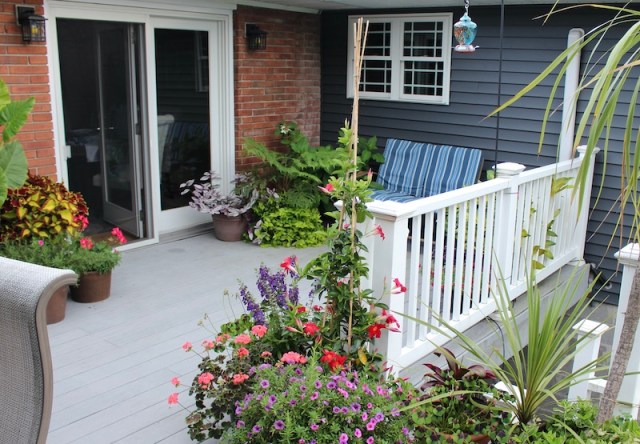
deck planters

The back deck refuge from it all.  I try to give the pots a little liquid feed once a week (and I never manage to keep to that schedule) but other than feeding, the drip lines and a timer take care of all the watering and leave me with nothing more to do than a little puttering when everything else seems like so much work.

I feel like I should be further along with everything but now that we’re into August I’m declaring a pause on projects and a rescheduling of fun.  A few gardens have been visited, children have enjoyed day-trips, some lazy pool days are scheduled, and tomorrow myself and my plant squad (or more officially the Plant Posse… a possibly eye-rolling name given by a member’s daughter) are off for a day at Longwood.  Severe weather alerts blanket our travel zone for the day but thoughts and prayers will guide us, and hopefully between the four of us the more reasonable will herd us out of the way of tornados, find shelter from strong winds, and a safe spot against hail, lightning , and thunder!  Any day with the Posse is usually an adventure 😉

Hope you have a great week with an aggressive scheduling of fun!

Of Waste Places

I remember seeing an exciting new bird the second summer after moving here.  It was an Indigo Bunting, and the all-blue plumage on a blackbird sized bird in the back of the yard was quite the sight in my young garden.  Surely this was a sign that all kinds of wonderful new things would be showing up as the garden grew and developed, and not just people but also wildlife would appreciate my masterpiece.  I rushed inside and grabbed my bird book (this would be 15 years ago when books and paper and such were still a thing), and when I found the entry for my new friend it was the phrase “of waste places” which really stood out.  Waste places!  It’s a good thing that wasn’t the day I named the gardens or this blog, because I’d probably reconsider or regret it some days, but it was a good reality check on my gardening ambitions.

perennial border

The rains have returned and the lawn is again in need of mowing, but the borders are still sparse owing to the dry May and the resulting lack of self-sown treasures or motivated planting.

In the between years the garden has filled in more but I have yet to see a second bunting, and that’s a relief as far as creating a ‘waste place’,  but somewhat sad since Indigo Buntings are quite cool.  In hindsight when it happened they had just recently bulldozed down the woodland and shalebanks behind us for the industrial park, and I suspect the acres of weedy and seedy re-growth had more to do with luring in new birds, but to this day I sometimes look around and think ‘what a waste place’.

crocosmia lucifer

Maybe a waste place, but at least a boldly colored one with the bright red of crocosmia ‘Lucifer’.

Actually it’s not that bad since the rains came back.  Things are growing again and since someone mentioned daylilies let me start with those 😉

daylily brookside sparkle

Daylily ‘Brookside Sparkle’, a souvenir from one of last summer’s daylily farm visits, and so much better than a t-shirt.

The daylily farm is doing well but ten out of ten people have suggested that I make it bigger, even if the suggestion was more of a nod when I said I was planning to make it bigger… and it was more like one person and not ten, but statistically that’s 100% of the people surveyed and why bother doing customer research if you’re going to ignore it?  To that end I have budgeted $60 to buy more daylilies this summer, and also as any wise investor will do I’ve taken inflation into consideration and will be willing to raise that limit to $75 if things go that way.  Now I just have to pickaxe a few new planting beds.

daylily flower bed

I’m committing to no more heavy equipment in the yard and will finally level and plant this access area by the street.  It needs to be lowered a few inches and dug up for compaction and rocks… and about 25 square feet of concrete I uncovered for which I’ll need to drag out the jackhammer again…

So dirt moving and daylilies.  That seems to be the theme for 2023 and I hope you can see a little progress in the next few photos.

newly seeded lawn

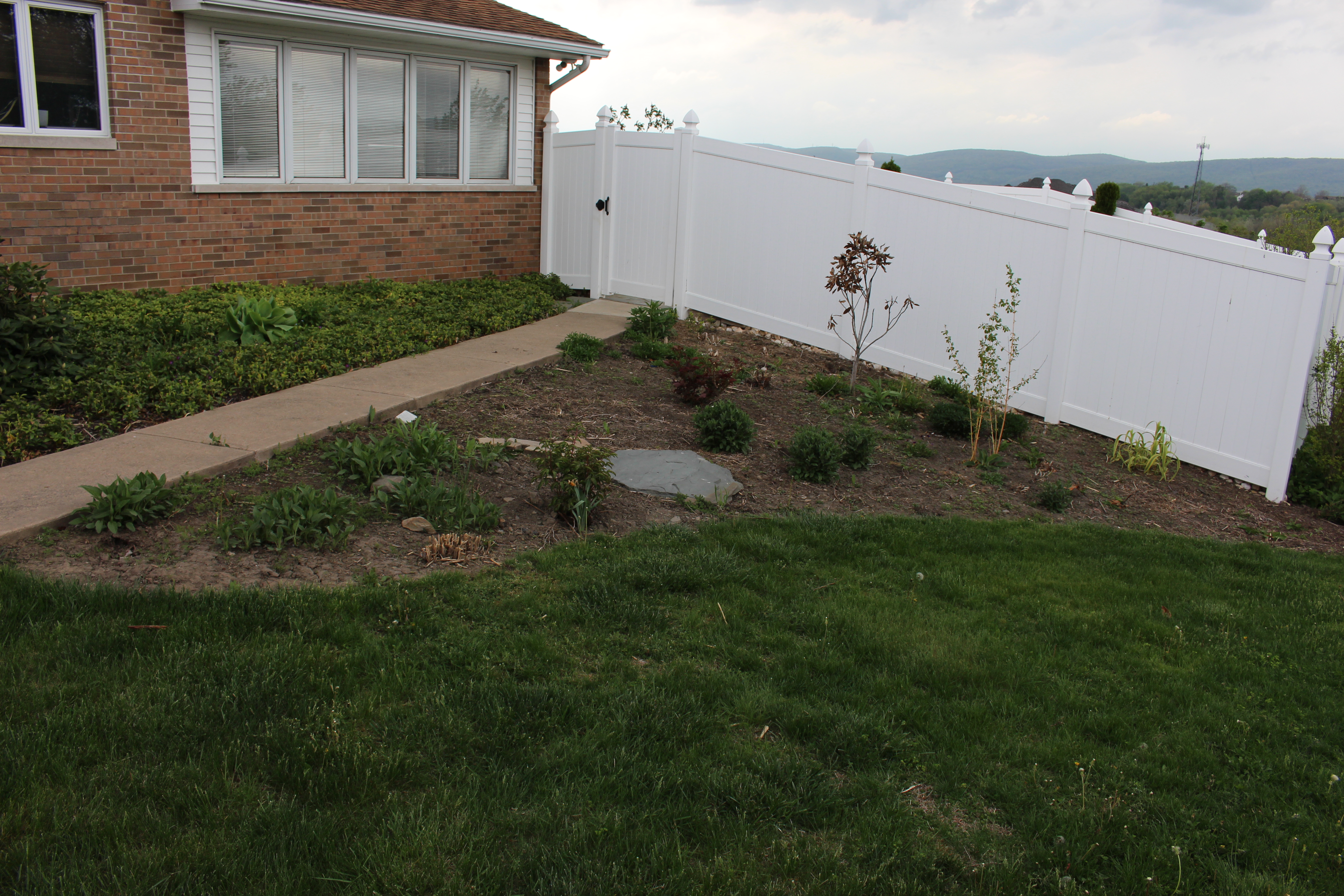
Along the side of the house the grade was brought down a few inches, leveled, rocks were dug and finally, now that it looks like rain might be a thing again, a grass path has been seeded between a new bed and the old cholchicum bed which runs alongside the house foundation.  The daylily farm is visible on the right… isn’t it beautiful?

Nearly all the tons of soil alongside the new addition have been wheel-barrowed to the low spots behind the potager in the back of the yard.  Many rocks have been uncovered, some barely movable but mostly small, and these will go into lining the path of grass which will be seeded and extend down to the back of the house.  As you can see the house foundation is still waiting for the masonary fund to mature, and might have to wait a year or two especially if the daylily fund keeps taking precedence.

new garden

Excavation piles are finally gone, and you can again see through to the pond and potager.  One last section of soil to move, and then it’s on to wall building, final grading, and then grass-path seeding.  The area in front is the already-seeded path which runs alongside the house.

Seeing the garden slowly uncover has been a relief, and each new section replanted has been one less weedy mess to ignore on the daily garden tours, but the real excitement has been seeing the level areas beyond the potager grow wider and wider each week.  There is grass coming up on the new paths and whenever I get a minute in my mind I’m planting and replanting the open sections of the new flatlands.  One day it’s filled with pumpkins, the next it’s daylilies, then tulips, then daffodils, then a new greenhouse, then a snowdrop farm… I think you get the idea, but right now it’s sterile, rocky, dries-like-concrete fill and even in my most optimistic minute I know I don’t have the time or energy to do anything with it this year, so I’ve decided it’s going to be my new waste place.

To shade and hold a bit of moisture in the “soil”  I’ve started throwing weeds down and any other trimmings and organic material that usually gets thrown in the compost.  I’m letting weeds come up.  I’ll probably let them go to seed and then regret it when I have even more weeds, but whatever.  I’m hoping the birds and other wildlife will like it, and to help that along I picked up a $3 box of finch and canary seed from the petstore to throw around.  It’s basically pure millet and I think the sparrows and doves will enjoy it if they mature into a seedy mess, and hopefully I don’t regret a millet field in the back of my yard…. and now with that in print I’m thinking I should have at least looked up what millet looks like or done any kind of research, but…

new garden bed

My better half asked what the plan is for this back area.  I thought it better to say ‘I’m not sure’ rather than explain how it was to become a ‘waste place’.

So we will see where this ends up.  The birds and rabbits seem quite pleased by the general weediness of the yard, and I’ve never seen quite the procession of baby rabbits coming out of the flower beds as I have this year, but there has been one uninvited guest who I do not appreciate.

deer tracks in garden

Deer tracks in some of the freshly leveled soil of the back 40

There is a single deer who has begun to make a habit of visiting the garden.  One deer who has walked through perhaps four times and I’m already nearly apoplectic over the damage and I can’t imaging people suffering through local deer herds in their neighborhood.  I thought our visitor was a large doe with a fawn hidden nearby, but Friday afternoon showed it to be a he as the nubs of developing antlers were visible when chasing him out of the yard.  Maybe I can convince one of my friends that begonias and geranium adds a special flavor to the sausage, and one of them will be willing to stake out my yard come November… assuming I can make it that long… but in the meantime a minefield of fencing seems to be entertaining him, even if not really slowing him down.

arisaema fargesii cobra lily

Something random.  My first flower on this cobra lily (Aarisaema fargesii) and it has a cool way to it, but I still think it’s the tropical foliage that impressed me more.

Typical.  He plants for wildlife and then gets upset when wildlife shows up.  Maybe all the digging is going to my head, as well as the heat and humidity, so today’s day of rest is probably a good thing.

Hope you have a great week.

A Week of Flowers-Day 5

I’m taking it easy on day five of Cathy’s Week of Flowers celebration.  I guess I don’t party like I used to.  Today with a single photo I’m celebrating the heat of late July and the entire month of August, and the hot red flowers of Lobelia cardinalis.  This moisture loving North American native plant finally settled in just off the back porch in a somewhat shaded and often damp corner of the house.  While the cardinal flowers are in bloom, hummingbirds run a near constant turf war with guards and hit and runs and and the constant chatter of chases and aerial combat.  A gardener who sits nearby to enjoy the shelter and shade is guaranteed a face-to-face barrage of insults from some tiny hovering pint-sized fighter pilot.  Hummingbirds seem so tiny and cute, but in reality they’re little flying honey badgers.

lobelia cardinalis

Cardinal flower filling the end of the shade garden.

Hope you are enjoying your weekend, it’s a beautifully sunny morning here and although it’s also on the cold side, the rest of the week looks tolerable… and by tolerable I mean good shipping weather for a little box of succulents…

Merry Christmas to me!

Thursday’s Feature: Cardinal Flower

It must be the week for scarlet since I see that Kimberley, our host for the Thursday Feature, has also featured something equally bright this week from her garden.  Her choice is bee balm (Monarda), but the cardinal flower (Lobelia cardinalis) also gives a bright punch of red to the late summer garden.

cardinal flower

My own slightly undernourished cardinal flower. 

Cardinal flower is a native North American wildflower and its color and flower shape are tailored to attracting hummingbirds.  Red is a color for bringing in these small winged pollinators, and one can see how its bee pollinated cousin, great lobelia (L. siphilicata),  would have shorter blooms and a more bee-friendly blue coloring.  Both are easy in the garden and thrive in a moist, fertile soil in either a sunny or part shade location.  If your garden is well suited to these beauties, the blue version has even been known to border on weedy with its self-seeding ways, but to be honest I can’t imagine them being any trouble at all to just remove.  Keep in mind though that the summers in my garden can usually fry and dry even some of the hardiest members of the plant kingdom so I might not be the best judge on if a moisture loving plant is weedy!

chanticleer red seat

Color coordinated seating alongside a nice patch of cardinal flower at Chanticleer.

The straight species of L cardinalis is an excellent flower even straight out of the forest, but over the years hybrids and selections have broadened the range of cardinal flower available to gardeners.  Darker foliage is always a popular look, as well as pink and purple hybrids with the great lobelia.  They’re all equally easy to grow when given the moisture they need but in my experience the hybrids are no where near as hardy as the straight species(zone 7 versus zone 3).  Still I showed no hesitation when I saw this maroon leaved plant for sale this spring.  Even as a likely annual it’s worth the money I spent on it… although honestly I expected the flowers to be denser.

cardinal flower

A dark foliaged Lobelia cardinalis in bloom on the deck.  I’m not totally sure I’ve ever seen the hummers on this one, and I wonder if some nectar production was opted out of when they selected for dark leaves.

I’d love to have a bunch of these scattered throughout the garden but there are only a few spots where I can keep an eye on them often enough to keep them from drying out completely.  That’s just me though, if you have a reliably damp spot or even poorly drained spot which kills off many other plants, I would jump on the chance to try out a few cardinal flowers.  They may even self-seed and you can imagine the show if that happens.

Give them a try and also give Kimberley a visit to see what other late bloomers are featured this week.  It’s the downside of the summer, and a fresh and new bloomer at this time of year is always welcome.


Thursday’s Feature: Standing Cypress

It’s Thursday and that means joining up with Kimberley of Cosmos and Cleome to take a closer look at something which caught your eye in the garden this week.  Hopefully you’re ready for color because his week the bright red of standing cypress (Ipomopsis rubra) is our subject.

Ipomopsis Rubra

Ipomopsis rubra close up.  Love the speckles and the intense scarlet color.  Bright red is what you need this time of year to stand up to the strong summer sun.

Standing cypress is a showy wildflower native to southeastern North America and just one of many garden-worthy Ipomopsis which can be found across the Americas (at least they look garden worthy, this is the only one I’ve ever grown).  These members of the phlox family are tough, drought resistant, and easy to grow and I’m surprised they’re not seen more often.  This is one plant which didn’t even blink when the rain stopped and its neighbors curled up into a drought induced fetal position.

Ipomopsis Rubra

Ipomopsis Rubra has a habit which I would call “lax”.  At anywhere from two to five feet tall they don’t typically flop, but they lean and stretch and carry so many blooms and seed pods that understandably it can get heavy for a little plant.

It took me years to finally find seed but admittedly I wasn’t out there every week trying to run down new sources.  I received my seed via the Mid Atlantic Hardy Plant Society seed exchange but now I’ve been seeing them more frequently sold in wildflower mixes or for hummingbird plantings.  The mix I planted was supposed to show a blend of red to oranges to yellows, but the speckled scarlet color is the only one I’ve seen come up.

Ipomopsis Rubra

The tubular flower shape and bright red color of these blooms has ‘hummingbird flower’ written all over it, and sure enough I often see hummers flying by for a meal.

It’s my suspicion that the natural variation across this species makes for different growing habits based on where one gets their seed from.  My plants which have been selfseeding around for several years now seem to be strictly annuals but from what I found they also grow as biennials and short lived perennials in areas across the United States as far up as zone 4.  Since mine have never overwintered I’m thinking it’s an annual form I’m growing.

Other confusing comments on this plant include it having a taproot (mine don’t) and it needing sandy or gravelly, well drained soil (mine tolerate heavier soil) in order to do well.  I suspect some of this is from people who’s knowledge is based less on experience and more on internet searches, but since I’m not a botanist either I’ll let you decide.

Ipomopsis Rubra

The ferny basal rosettes of standing cypress will pop up in any barren, neglected area which grows weeds well.  They do not compete against more perennial plantings, but in disturbed soil they can make a quick show before other opportunists jump in.

The hummingbirds and I will enjoy the blooms of this wildflower for several weeks now and when things slow down I’ll just trim off the upper end of the stalk and the smaller side shoots should carry on for a few more weeks.

Standing cypress.  Consider it.  If your garden can handle a shot of red I think you’ll enjoy it, and I also think you’ll enjoy giving Cosmos and Cleome a visit to see what Kimberley and others bloggers are featuring this week.  Enjoy!

And the clouds opened

For some reason my little valley has been missing all the rains again, and up until last week it’s just been dry, dry, dry…. until Tuesday.  The cold front came through and we enjoyed two days of on and off rain, and the garden just soaked it all up.  It reminded me of one of those nature specials out of the Serengeti.

heucheras in dry shade

You can’t even weed this rock hard “topsoil”. My new heucheras are toughing it out, but this bed sure won’t make it onto a postcard any time soon!

The grass dried up, the trees started dropping leaves, the waterhole pulled in all the wildlife, and animals were on the move.  Anything not within hose range shriveled up, but at least the temperatures were low.  Last year we had a hot baking which killed off the weak, this year I think everyone should recover.

asclepias tuberosa during drought

Asclepias tuberosa is a tough one. I planted these seedlings out last summer and after a few weeks they shriveled up and died due to neglect. Spring resurrected them and they are now trying so hard…. but they’re not cacti!

It looks horrible though.  The front yard had two sprinkler days and just looks dry, the back looks dead!  Here’s the director of cinematography following me around getting the shots that I missed.

lawn dead from drought

I would call this dormant. The weeds even gave up.

But just like in the nature specials, when the rains return the landscape springs back into life.  I took a couple pictures at the end of the two days and although a few things look a bit battered, even the dead back lawn is giving out a sigh of relief.

front border with hydrangea

The front street border starts to put on its best show at this time of year, and although polite people would refer to its plantings as “a riot of color” others would call it a mess. Suits me just fine though!

The front foundation bed is a much calmer mix this year.  No bright oranges or over-bright coleus, but all my good intentions from last year of removing the overgrown evergreen and NOT letting any sunflowers grow up kinda fell to the wayside.

foundation planting

I don’t think I can physically pull and compost a sunflower, it’s just unethical to me…. sunflowers and dogwood seedlings, can’t pull either one.

I spend way too much time admiring the “Limelight” hydrangea.  It’s just about at full bloom now and I love its green going into white phase and the way its heavy flower heads are held up on strong stems.  It’s the only white plant out there, and it does stick out, but each spring I look proudly at its buds and imagine how much bigger the show will be!

limelight hydrangea

“Limelight” hydrangea nearly overwhelming the border….More of a purple-yellow theme going on here, but none of my planting plans are ever set in stone.

For some reason prior to the rain the yard was overrun with birds.  Flocks of starlings, catbirds, sparrows, house finches, hummingbirds, goldfinches, cardinals, doves, robins and mockingbirds would swarm each morning.  A large cherry and staghorn sumac berries brought in the fruit eaters, but the others were just all milling about looking for what-nots.  With all those hungry eyes it’s no wonder I’ve seen so few butterflies.

holes in lawn from birds feeding

The day after the rain the back lawn was riddled with all these bill holes. I don’t know what they found in the freshly wetted grass, but there was a flock of around 50 who kept milling around going from lawn to cherry to sumac to lawn.

Strangely enough since the rains came there seem to be far fewer birds.  I need to get out there and explain why their straying from script is throwing off the documentary.  On TV the return of the rains always brings on the migrating hordes!

sunflowers, dahlias and cannas

The rains were just in time for the former tropical bed. Leaves were starting to wilt and I just didn’t have it in me to add another bed to the water-triage list.

So we are back in business.  I hate drought and I hate watering and between the two of them dry spells always get ugly.  Now if it can only get a little warmer again this could have the makings of a great end of summer rally.

Ipomoea quamoclit

Maybe the birds can stop pecking off the tips of the cypress vine (Ipomoea quamoclit) long enough for it to scale the arbor. It’s heading for the top but the birds are relentless. Good thing it’s not a bunny though, the other side for some reason is abused daily by our single resident baby bunny, and can’t even start climbing.

I should be thinking fall garden but I’m going to hide behind denial for a few more days.  The cool weather is supposed to warm up again and hopefully summer will stay strong for another couple weeks.  It’s hard to deny though as the cyclamen sprout and the corn ripens.  Go away autumn, I’m not a fall person!

The garden formerly known as tropical

There’s a spot in my yard (actually most of it inches over into my Mother in Law’s yard) where I like to indulge in a little of the tropics.  Last year it was full of cannas, sweet potatoes, and other warm weather friends, but this year it seems to have lost some of that bold tropical flair.  As usual it’s my own fault, and as usual it’s a long story, so I’ll try to keep it short.  It all begins in April when mulch was purchased for next door, and a willing volunteer was needed to spread it.  I foolishly agreed, but the deal was to add a couple tons of topsoil (I said I needed it to fill in along a sidewalk).  “I’ll spread all your mulch if you buy me even more stuff which needs spreading”.  Let me just say I run a hard bargain.

new flower bed

Look at that three inch drop from the sidewalk into the tropical bed. Clearly an ankle twisting lawsuit in the making!

So the mulch was spread, perennials divided, shrubs trimmed, weeds pulled…. the deal kept getting better and better it seems, but then it came down to the heap of topsoil sitting in the driveway.  I used a few wheelbarrows to raise the soil along the walk and was still left with plenty.  Finally my plan was coming together hah hah hah.  I’m pretty sure I mentioned I might use the topsoil to expand the bed a bit, so that’s what I went ahead and did 🙂

digging a new perennial bed

Line the edge with a hose, cut in and dig out the edge, smother the grass with about two inches of topsoil… wow did I hate mowing this sloped little patch of sickly grass!

No one said a word about the tripled in size, very empty bed.  I think people around here may be a little wary about asking questions for fear I will plant up a field of dandelions or something.  Some people have said I’m stubborn and criticism may tend to encourage me even more.  I like to think of it as proving a point 😉

fresh soil in flower bed

A huge empty garden bed in May. What could possibly make a gardener happier (other than a few loads of compost mixed in)?

The last bits of mulch made the bed a little more suburban-friendly and a few paver scraps thrown down along the center made an acceptable shortcut for the kids.  Then on to the real fun!  Canna and dahlia roots were lugged out and planted, and that was well enough, but then trouble started brewing.  A box filled with a dozen or so rooted chrysanthemum cuttings showed up at the door.  I can check on them constantly if they’re right along the edge of the new bed, so that’s where they went.  Don’t ask me why I needed a box of chrysanthemums, February is a tough month.

new flower bed

Somehow random perennials invaded the tropical border, that and chrysanthemums….

Then of course I tried to make the front yard more respectable by not having sunflowers all throughout the foundation plantings.  Out they came and into the new bed they went.  I have a serious problem in trying to show any kind of resolve against sunflower seedlings, they’re all summer and sunshine and it seems borderline criminal to pull them as weeds.

peony "do Tell"

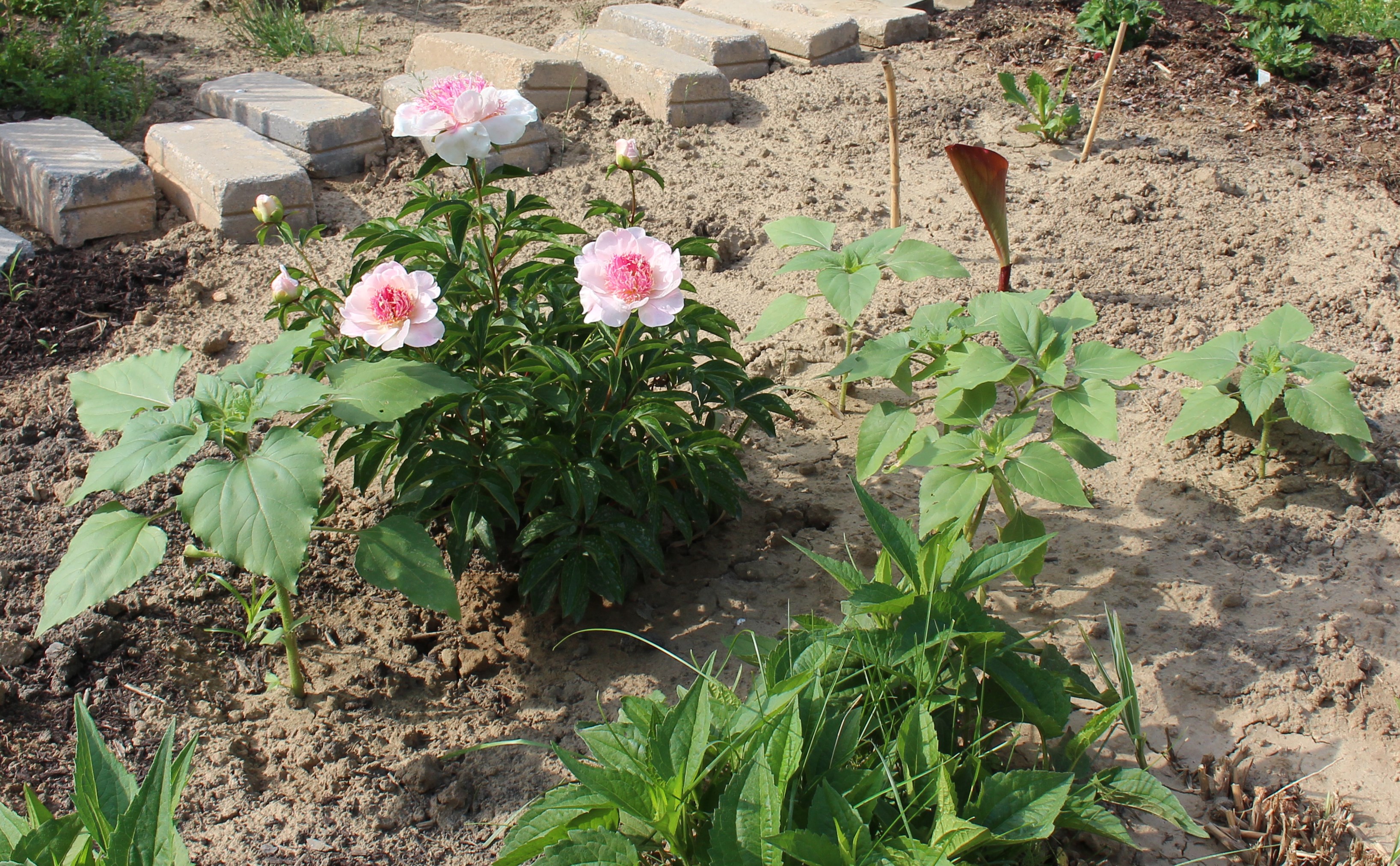
Peony “Do Tell” can’t seriously expect to be the only plant using this spot of sun all year. The sunflowers should take over by July and the peony will just hang out in their shade until next year…. that’s the theory at least.

Things still look awfully barren but until the heat of summer hits it’s all kind of just biding its time.  Looking over from my yard you can see the bit of slope which made me hate mowing this spot.  Plus I’m not all that crazy about lawn to begin with *yawn* ….. it’s only really good for walking around on while checking the plants out!

side view

Year two of “I should give the table another coat of pain” -June 10th

My grass just doesn’t have the strength to come up through the soil (southerners may have a different experience), and even without soil improvement the new plants are still doing well as they feed off the decaying lawn underneath.  A month later and things are looking better.  The cannas still give a tropical look, but all the sunflowers are giving more of a neglected-agriculture vibe!

cannas, grasses, and sunflowers

July 13th, about a month later and the cannas are up, the sunflowers are growing, and I still keep looking at the bare dirt wishing for some compost or mulch to cover it up with.

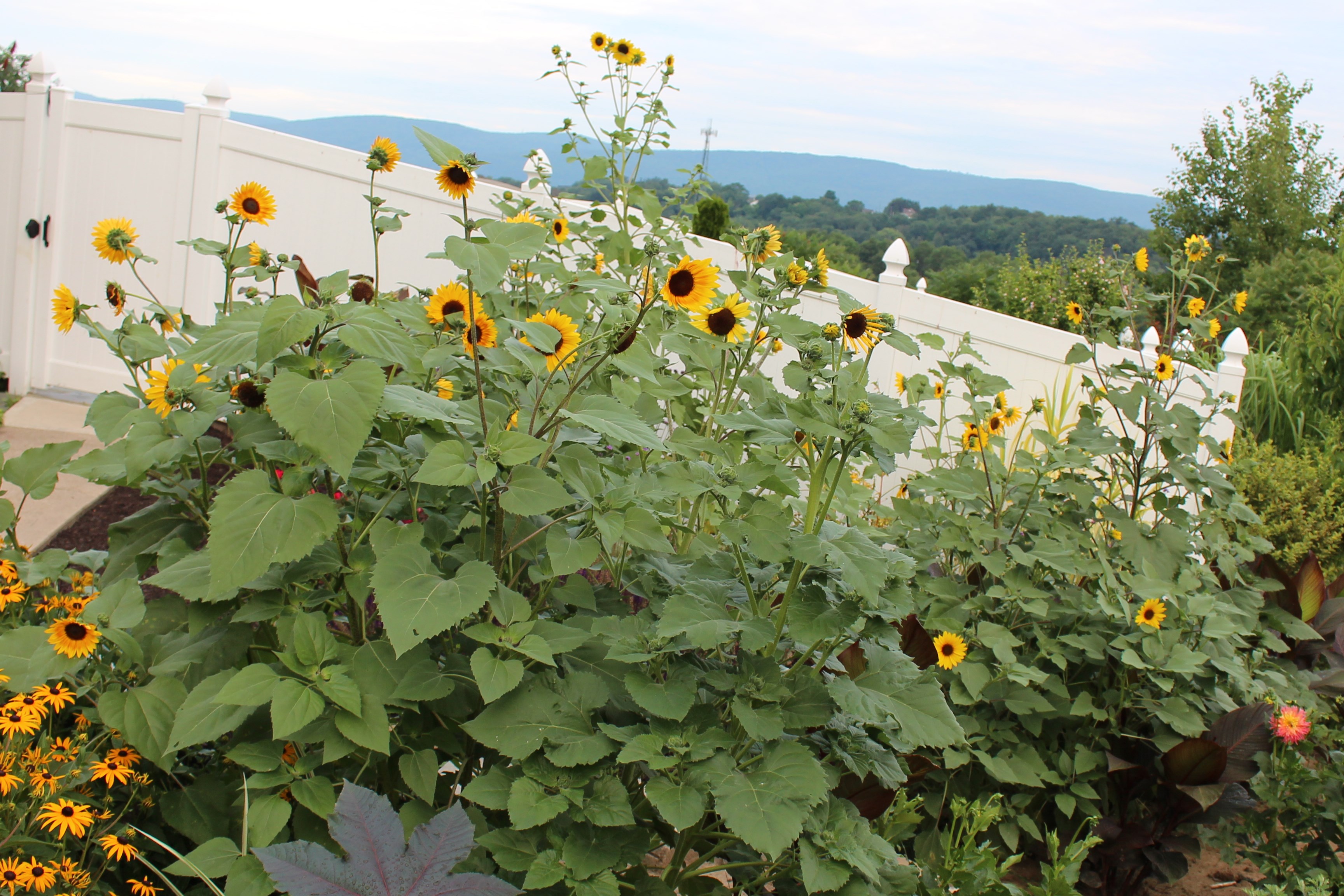
As the sunflowers come into bloom they’re pretty and cheerful… but they’re not the tropics.

sunflower bed

It looks lush and green, so I should be happy. Also it’s not the color disaster I grew here last year, another reason to be pleased!

Besides it being a non-tropical border, a few other problems are coming to light.  The first is that some of the chrysanthemums relentlessly insist on setting buds and blooming for summer instead of fall.  I think I failed to pinch them back enough when planting them out in the spring, but I just don’t have the heart to do it now.

mums blooming too early

Chrysanthemums blooming in July, hopefully they’ll be on the correct schedule next year…. but they’ll need dividing by then, so I have no idea where to put them all!

To me a more insidious problem is the sunflower blooms.  When the first flower opened I cringed.  They’re completely pollen free, and because of that they don’t offer much to pollinators, and even worse they don’t set seed as well as the normal types.  I thought for sure since they were selfsown from last year’s plants that they should be normal functioning sunflowers but that’s not the case.  These all appear to carry the pollen-free gene, a gene which I’m sure came from the birdfeed seed.  I’m not big on all the seed conspiracies, but this looks like a genetic insurance policy that keeps farmers coming back to the seed supplier each year, and keeps them from replanting their own crop.  Good for a seed seller but not so good for me and all my now genetically tainted sunflowers.

pollen free sunflower with bee

Not much here for the bees.

Luckily there’s a small patch of sunflowers out front which still grow normally.  Once these started blooming I noticed a few seeds starting to form in the other patch (I guess a little pollen goes a long way throughout the garden!).  I need to make sure I get my seedlings from this area next year.

wild sunflower

This sunflower looks like it’s full of tasty seeds, not full of empty husks like over in the other patch.

The sunflowers look pretty enough, but all I see are the black soulless eyes of the walking dead…. ok maybe not that bad, but they lack the busy bees and bugs that usually do laps around the big open pollen filled flowers.  The goldfinches have also been very insulting as they touch down to check on the seed supply and come up empty.  Hopefully pollen from the front yard will work it’s way back here to at least make the birds happy.  Just in case, I planted a patch of heirloom sunflowers in the now completely dug up daffodil patch.  They’ll be late, but they’ll have pollen, and I think they’ll still make it before frost.

selfsown sunflowers

Sunflowers coming on strong.

I’m still holding out for a few tropical effects.  One castor bean seed came up and is now taking off, and “tropicanna” canna is looking healthy.  Also if I have nothing better to do this week, a few coleus and sweet potato cuttings can fill in one or two of the still empty spots, and maybe by late August ‘tropicalismo’ will revisit this bed once again.

castor bean with tropicanna canna

Castor bean “carmencita” and a few over-fed “Tropicana” cannas. The cannas seem to get much brighter colors when grown on the lean side, or with just a little 10-10-10 fertilizer. This batch has a lot of green in them due to higher nitrogen, probably from some miracle grow.

I don’t know if they say tropical to everyone, but dahlias never fail to bring brightness.  This peachy pink with yellow cactus flower makes me think of some overdone tropical drink.  Yummy!

pink and yellow cactus dahlia

Unknown dahlia which I keep saving from year to year. This spring I tried to show some restraint with them since last season planting a dozen or so might have been overkill 🙂

One plant I still need to plant out more of is verbena bonariensis.  In almost all my other beds it can be counted on to show up and make a play for taking over any open spot, here in the new soil it hasn’t had a chance to seed in yet.  Any transplants made this time of year will shrug off the shock of moving quickly and should be blooming up a purple storm in no time at all so I better get moving.

arundo donax "gold chain"

The grassy tropicalish leaves of arundo donax “gold chain” make a great mix with the sunflowers and verbena. I might have to plant this combo on purpose next year to make sure it happens again!

The tall old fashioned red leaved cannas always make me happy.  They’re super easy to overwinter, never look ratty, and always grow as fast as the fertilizer and water will take them.  The small reddish blooms which come later in the season aren’t much to talk about, but the hummingbirds love them.

red russian canna

Maybe canna “red Russian”? We call them Polish cannas after the old Polish woman who years ago gave the first ones to a friend of mine.

So that’s the latest from the ex-tropical bed.   It may still heat up as the season progresses, but for now it’s decidedly temperate and might remain so for a while.  No amaranthus or salvia seedlings showed, and this spring was a bust as far as all the seeds I started, so many of the brightest colors from last year are hushed.  For now I’ll have to keep satisfied with my little bit of the tropics in containers.

tropicals in containers

A couple real tropicals planted in containers where I can best keep an eye on them.

Not to go on any longer than I already have, but those weak little pots of tropicalismo surrounded by weeds and dead grass aren’t just a bad planter arrangement.  To me they’re the accent on a new gavel terrace backed by a low stone wall.  Maybe a fire pit.  I think one of the reasons my garden looks the way it does is because I have a bit too much vision, but we’ll see.  I do tend to work backwards and always find the plants first…. who cares if the seating area is still a little “in development”?

Innocent until proven guilty

Last week the usual garden inspection turned up a massacre in the broccoli patch.  My luck had run out and the rabbits had finally found the tender lettuce and cole crops… just when they were finally settling in.  All the tender lush growth from the cool, damp weather has been nipped back, and I’m left with these leafless stalks.

deer damage on broccoli

The day before yesterday would have been the perfect time to fence off the vegetable garden….

What a setback!  Of course it’s my own fault since even with the local stray cats, rabbits are still in and out of the garden, but I like to think the bunnies won’t take advantage of me and a nibble here and there is no big deal….. so I didn’t bother with a fence.  That of course changed, and the fence is up again.

fence for vegetables

A little chicken wire to keep the bunnies out. Rabbits around here tend to be lazy, so a weak fence or even a few brushy twigs will keep them off my delicious ‘Matina Sweet’ lettuce.

Something was different though.  The onslaught of damage was pretty severe for a stray rabbit finding a tender bit of broccoli, and the lettuce and cauliflower were also sampled.  That’s a lot of nibbling for one or two rabbits on one or two nights.  I began to wonder if a groundhog had returned….. a little plant leveling, bulldozing, little garden pig, who eats everything in sight…. but no, the damage wasn’t that bad.

I found my answer the next morning.  Two young bucks were on the other side of the fence plotting their return.  I knew they were around -three weeks ago a doe bounded over the fence while the kids and I were playing back there- but now I know they’re moving in.  Deer are something I don’t want.  Where are all the hunters when you need them?

deer and the vegetable garden

Barbarians at the gate

Figures they would go straight for the broccoli and lettuce, they’re two of the only vegetables I actually eat.  Why couldn’t they start with the chard?

bright lights swiss chard

Rumor has it vegetables make for healthy eating. I like to think of these unpicked and uneaten ‘bright lights’ swiss chard as being good food for the soul.

We’re not exactly country around here, but we do have our share of wildlife drama.  Snakes and toads come and go, bugs abound, and all kinds of birds stop by to eat and drink and sometimes set up house.  I finally found the tiny field sparrow nest (or at least I think that’s what they are) in the small blue spruce by the sandbox.  Two chicks have hatched and it amuses me that they spring to life begging for food the second I tap the nest.

field sparrow nest

I’m not a good nest finder, and the only reason I found this one (after three tries -and the spruce is barely three feet around!) is that I noticed a female cowbird staking out the bush.  Cowbirds will sneak in and remove an egg from an unguarded nest and replace it with one of their own, and this is what they did here.  When I found the nest there were two white speckled eggs alongside the three blue speckled.  I may or may not have removed the cowbird eggs.

cowbird egg

Cowbirds are a native species and as such are protected under the Migratory Bird Act, so tampering with their eggs would be illegal…. but I also may at times roll through stop signs and push the speed limit, so I’m not sure where this puts me on the spectrum of criminal activity.  All I’ll add is that cowbird chicks will usually outgrow their nestmates and end up displacing them, so I’m glad these parents won’t be stuffing food into a chick which grows to be twice their size.

Another thing which borders on illegal is the number of weeds and out of control plantings in this wanna-be iris border.  It’s almost criminal how the campanula took over and the daisies moved in…. not to mention the clover.

iris with campanula and daisies

Still on the to-do list is the iris bed. I think it needs a complete overhaul to get rid of the beautiful purple campanula glomerata which has taken over. The only legitimate planting here is the yellow variegated iris which is still just barely hanging on.

The iris bed is just one of many yet-to-be-done projects.  I’m still getting the last of the seedling out from under the glow lights in the garage, and the overwintered geraniums are still sitting outside the garage, making quite the colorful accent on the driveway 🙂

overwintered geraniums and vegetable seedlings

All in due time they say, but I suspect due time might have passed along with the summer solstice.  Instead of humming along, the garden is still taking form.  Someday I hope to have things together but I suspect I just might not be that kind of gardener.  It would help if a simple planting up of the deck pots didn’t turn into a table refinishing, light fixture replacing, porch chair repainting, trim rebuilding… .kind of project, but such is life!

Enjoy the first days of summer 🙂