That wasn’t smart 6.0, 6.1, 6.2, and 6.3

Well I really racked them up this weekend.  My favorite nursery, Perennial Point, was having a customer appreciation weekend and all plants were on sale for 30% off.  A dead garden will make you weak in the face of temptation and I guess I blinked.

Not smart version 6.0:  The garden was bone dry and I couldn’t even take care of what I had.  Weeds are having a field day, the lawn is dead and other plants are dying left and right.  I just bought home several delicate, nursery-perfect plants which probably haven’t even broken a sweat their whole lives and I’m planning to throw them into this nightmare.

daylily bubblegum pie

Three big ticket items followed me home, ‘Plum Magic’ crape myrtle, hypericum ‘Red Fame’, and daylily ‘Bubblegum Pie’.

Not smart 6.1:  I don’t like daylilies, don’t ask me why I would buy one.  The leaves look horrible in late summer, the old blooms look like soggy tissue messes which need daily cleanup, and the name ‘Bubblegum Pie’ is insanely dumb.  The flower on this one is fat and fleshy and overdone with way too many ruffles.  There’s nothing graceful or elegant in the flower but I’ll plant it near the one daylily which came with the house (and resprouted after I thought I sent it to the compost pile) and the other species daylily which I grew from seed (Hemerocallis atissima, a tall and graceful night bloomer).  We will see how it does.

Hypericum inodorum 'Red Fame

Look at the fruits on Hypericum inodorum ‘Red Fame’!  I’ve seen these used in flower arrangements and never thought it might do well in the garden, so we’ll see if it does.  btw the crystalline glisten on the leaves is something called raindrops, yeah it took me a few minutes to recognize it as well, apparently we used to get a lot of it back in the day.

Not smart 6.2:  I bought a Hypericum ‘Red Fame’ which I think is cool with its juicy looking bright red fruits and according to what I’ve read may tolerate drought just fine, but I also bought a crape myrtle.  Crape myrtle are not hardy here and even at 30% off this one still wasn’t exactly cheap but somewhere deep down inside I seem to think someday a miracle will happen and one will survive.  Maybe fourth time’s the charm….

caladium

Three new caladiums and a new coleus.  Buy one get one free on annuals since no one bothers to buy annuals on the last weekend of July… no one except me apparently.

Not smart 6.3:  I bought more annuals.  Tomorrow is August 1st and the days for annuals are numbered and I should be focusing on limping through the summer and getting ready for fall gardening rather than wishing for another June and July.  Plus I seem to remember telling myself (you wouldn’t remember since Iwas talking solely to myself) that I had too many coleus last year and I should let some meet their maker when frost came.  Now I’m adding more?

caladium pink splash

Caladium ‘Pink Splash’ which I managed to overwinter from tubers purchased last year.  At least that was smart.  Also smart is the healthy, dark-leaved Eucomis (pineapple lily) grown from seed supplied by Nan Ondra.  I’m hoping it will be big enough to bloom next year!

Not smart 6.4:  I already have too many caladiums for a reasonable Pennsylvania garden, but if you hang on for another minute I’ll tell a quick caladium story.  It used to be I could overwinter them with ease and even had some survive for more than 5 years, but then my luck changed.  Dead tubers would greet me each spring and I wasn’t sure what was wrong.  Short story even shorter last winter I tried keeping them completely dry in their pots and in a warmer spot and lo and behold they made it through perfectly.  Logical next step is to take advantage of any good caladium deal which you come across and then be immensely disappointed when they go back to dying next winter…

caladium

White caladiums and a pot of mixed tubers which I found on clearance.  The spotted one is my absolute favorite.

Pristine white caladiums filling a terra cotta planter in the high shade of a southern garden is tasteful.  My mixed, gaudy plantings in reused plastic nursery pots are not.  But I digress, and will leave you with one last glimpse of my new daylily.

daylily bubblegum pie

The disgusting daylily ‘Bubblegum Pie’ with all its offensive frills and flounce.  It really is too much of everything and I’m positive this will be the one and only daylily I ever purchase for this garden.  Since I have it I might as well plant it, and I might as well even spare a few shovelfuls of my precious compost on it.  The pot has three fans already and I can only imagine three or four deliciously overdone stalks next year filled with more of these flowers!

Not that smart 6.5?  A few days ago I ordered some iris through the Historic Iris Preservation Society’s annual fund raiser.  That’s innocent enough, but now that the sale has wound down I noticed a posting on Facebook looking for volunteers to take in leftover rhizomes and grow them on for a year before sending them back for next year’s sale.  I’m wondering where I would put 10 or 20 more iris 🙂

It rained by the way.  An absolutely amazing soaking rain which stretched out for hours and got into many of the driest nooks and crannies of the garden.  I’m quite pleased and know it will be a good week and wish all the best for yours as well.

Tuesday View: The Tropics 7.11.16

This week I was a little late in the day with my photo so it’s full of artsy backlighting.  A good effect for soft lighting, but not the best to see what’s going on in a Tuesday view.

tropicalismo

The tropical garden at about 7 in the afternoon.

One thing which you will likely notice is the pile of grass trimmings and the wheelbarrow.  It was a busy afternoon in the bed and much of this was the result of the bed’s new designation as the Tuesday view.  Who would have suspected joining in with this meme would be the motivation needed to buckle down and make some of the changes I’ve been thinking about for the past few years?

rose 'black forest'

Not exactly tropical, but the color of the rose ‘black forest’ is hot enough to fit right in.  This is already its second flush of bloom and other than a few holes chewed into the leaves (most likely from some annoying beetle) it’s almost perfect.  Last year this plant was potted on the deck, still great but much younger and smaller.

Change one: The variegated miscanthus ‘Cosmopolitan’ had too much of a head start on the new plantings so I went ahead and cut it down to about a foot high.  We will see how this works out since I’ve never tried it before, but it’s grass right?  I suspect just like a scalped lawn it will send up plenty of new shoots, and in the meantime the cannas and dahlias will be able to grow upwards in peace and lay claim to their own airspace.

newly planted musa basjoo

Change two:  A newly planted banana (Musa basjoo) has replaced the peony which was just taking up space here… and mildewing.  When sunflowers grew up and covered it in years past there was no reason for it to bother me, but now it does so out it went.  I’ve never composted a peony, it seems absolutely criminal and I’m not sure I should be confessing, but there you go.  I yanked a few salvia as well.

We were gone for four days last week and the garden nearly dried out and died due to the heat.  Rumor has it rain fell, but of course all the big storms avoided us.  When I returned to see the pathetic state of my plants I first cursed, then cursed some more, and then decided to mow everything down and give up for the year, but after watering that evening and then the next day visiting my favorite nursery (Perennial Point), things seemed less bleak.  They had awesome bananas and elephant ears and a bunch of other stuff and in my weakened state two new bananas came home with me (plus a new fern and red hot poker).

Kochia Scoparia

Kochia Scoparia is a new one for me.  The common names are burning bush and summer cypress and I suspect I will like it, but for now keep in mind it’s listed as a noxious weed in several Midwestern states.

I didn’t need the bananas, but I did need the bananas, especially after seeing how well they have done for my brother in his zone 7 LI, NY garden.  In case you’re wondering, Musa basjoo is likely the hardiest banana, and although I won’t get into all the logistics of me being the one to give him the plants in the first place, and him being completely deaf to all hints at how much I wanted one and which one could he spare… I now have one again and promise to mulch it well EVERY winter so it doesn’t die off again.

long term weed killer

The rest of the zinnias are doing well, but I suspect my MIL was again a little heavy-handed with the weed killer here since it’s a dead spot which seems to stunt all life.  She has an unexplained attraction to any herbicide which says ‘controls weeds for months’, and this in turn stunts and kills anything planted in the treated area or anything planted near the runoff area… for months.

So here we are again, all over the place on what should be a simple post.  I promise to get less wordy once we get through this planting and intro phase but for now I can’t help it.  Just be grateful you’re not stuck here on a visit and I’m really going on and on!

lythrum salicaria purple loosestrife

Now what do I do with this?  The flower stalks of a Lythrum salicaria (purple loosestrife) have appeared in the back part of this bed and I like it.  The problem is it’s a terrible invasive in this part of the country, but only in wetlands and my garden is far from being a wetland.

If you’d like to join in the Tuesday view, Cathy at Words and Herbs follows her own view each week and I’m sure she’d welcome the company.  It’s a great way to track changes through the season and apparently it can even motivate some of the less motivated gardeners into tackling a few things on the to-do list!

Tuesday View: The Tropics 6.28.16

Two of my favorite bloggers are bringing back a meme which I’ve always enjoyed.  Cathy of Words and Herbs and Kimberley of Cosmos and Cleome both highlight a longer view each Tuesday and we get to see it develop and change as the year passes.  I’m no expert on the meme but I think Cathy sticks to a specific viewpoint and time while Kimberly varies the perspective and location depending on what’s going on in the garden.  Myself on the other hand am barely capable of getting any post up in a given week, so to keep it simple I’m going to follow Cathy’s lead and go with one view, same bed, same point each week and see if I can handle that.  Also since the tropical bed went in last week (about time since it’s already past the solstice and well into summer) I’m going to highlight this bed as my view, and (hopefully) watch as it grows up. 

Tropical garden

My fingers are crossed that over the next few weeks this bed will become an explosion of color and foliage and maybe bring a taste of the tropics to this end of NE Pennsylvania.

I’ll try to keep this short, since assuming things grow I want to save a little material for future posts, but besides the thrill of actually getting most of the plants in last week I always get a little excited checking this patch each day to see how quickly things progress.  All season bloomers which sit as a lump of color and put out the same old flowers each week bore me a little, and even though I can appreciate someone wanting low maintenance, neat color, I want something that sneaks up on you and then overwhelms you, like a horticultural tsunami!  Hence the tropical garden, and anything bright and big and leafy is more than welcome.

papyrus with black forest rose

The papyrus was not happy last year and I suspect it didn’t get nearly as much water as it wanted so instead of planting it in the ground again I placed it in a pot submerged in a second pot full of water.  Green water.  So far the reviews of this planting have not been 100% favorable.

You can’t really tell from the tiny sprigs, twigs, and tubers, but this year’s theme is orange and purple.  That’s not a solid theme, it’s more my mood when I’m out picking up annuals or choosing which dahlias to put here versus in other parts of the garden… or finding a flat of orange zinnias on sale and liking zinnias.  So until the oranges fill in, hot pink and purple will have to do for a theme.  Besides the annuals, perennials have a way of sneaking in everywhere, and although I pulled a wheelbarrow full of daisies and transplanted dozens of chrysanthemums, there are still a few things such as this knockout rose and purple ‘Caradonna’ salvia which are just too colorful to stand up to.  Maybe next year will be the year I follow through on my threats to remove the salvias.

knockout rose with caradonna salvia

The ultra rare and uncommon ‘Knockout’ rose tastefully complimented with orange zinnias at its feet and scavenged lawn clippings as mulch.  This Tuesday view already promises to reek of class each week 🙂

So there you have it.  By next week I hope to have a few cannas sprouting and a few more zinnias assaulting your color senses and overall I really hope things don’t end up requiring a rototiller and a fresh start by August.

Think about joining in with the view and if you do leave a link at either Cathy‘s or Kimberley’s blog so we can find you.  Not to put words in their mouths but I’m sure both will agree “the more the merrier” and I always enjoy watching another garden grow throughout the season… even if it does turn into a trashy mess of too much color and chaos!

The garden of memory

I used to be a balcony gardener.  After a stint in Texas my next job took me back to the Northeast, and rather than commit to a house I opted for an apartment.  My choices were narrowed down to a roomy bachelor pad with an excellent nighttime view of the city lights or a smaller two bedroom apartment in a quiet residential area.  I chose the quiet life.  My choice was partly because it was half the rent, but mostly because of the small balcony which came off the kitchen and overlooked the side yard.  I knew I needed a spot in the sun but just wasn’t ready to buy and didn’t want the responsibility of taking care of someone else’s yard again.  Who would have thought my stay would last over three years, and who would have suspected I could fit so much more than just the grill and a few chairs.

balcony garden

Does a gardener live here?

By the third summer things were completely out of hand.  I tend to like fast growers and big leaves and none of those are a logical fit with a small balcony… but what the heck, I usually just grow things because I can and not for any well thought out plan or agenda.  A rooted cutting turns into a butterfly bush, a trip down south adds a banana, a clearance sale brings in a staghorn sumac.  Things add up quickly, but mercifully winter would usually wipe the slate clean.  Plants have a hard time overwintering on an exposed, second floor balcony.

pink caladium tropical plants

These caladiums went out for the summer and came in for the winter for three years straight without a problem.  Nine years since moving and I’ve killed more than I care to admit.

If there was any secret to how my garden grows it was the drip irrigation which snaked out from the laundry, slipped between sashes of the window, and clicked on every 8 hours and saved me from the boredom of daily watering.   With the automated watering my plants were also saved from the almost certain neglected death due to a weekend away at the shore, a week traveling for work, or that gardener’s nightmare of a two week midsummer vacation.  No returning home to fried and dead plants for me!

Strangely enough my landlord never questioned the green tsunami which overwhelmed my small balcony, and we all ended up becoming good friends.  Coincidence that he and his wife ran a landscaping business?  Who knows.

tropical container plants

One chair. I guess this did turn into my bachelor pad after all, and with just enough room for a seat this became my preferred spot for a summer book and a icy cold beverage.  There’s a grill in there as well, I guess it goes without saying that for a couple months each year it was out of service.

Eventually it became time to move on and the balcony garden was traded in for the next adventure.  There’s an actual yard involved in this one but as usual delusions of grandeur made for a bumpy road.  Live and learn I guess 🙂

Hope your winter is going well.  It’s set to get warmer again this weekend and with snow melting almost as fast as it came my spring fever will be worse than ever.  I’ve been sowing seeds again and a sensible person would have stopped this nonsense a few dozen packets ago.

Plant of the Year 2015

I’ve been enjoying several year end reviews on other blogs and although I would love to do the same here I just don’t have the desire to go through 2015 again.  Don’t get the impression it was a bad year, it’s just that with the weather stuck in a late autumn holding pattern I’ve already spent way too much time browsing old photos, reliving old posts, and imagining what 2016 will bring.  The idea of doing it all again with a purpose sounds too much like work, and I think we all know how I feel about excess work 🙂

Instead of a review I’ll fill in one of those glaring gaps which has been haunting me since mid July… the naming of 2015’s Plant of the Year.  Nothing like waiting till the last minute.

Solanum pyracantha,  porcupine tomato

2015’s plant of the year: Solanum pyracantha, the porcupine tomato

It seems ungrateful to pass by all the old reliable sunflowers, snowdrops, and phlox which bring such joy every year but there can be only one, and this year the porcupine tomato wins that dubious honor.  It’s been a long time coming though, probably four or five years ago was when I first caught sight of this plant on Nan Ondra’s Hayefield blog.  Since then I’ve been on the search for one and finally last summer I came across a fruit laden plant during a garden tour.  With the blessings of the owner was able to pocket a few seeds, and six months later I had my own little seedlings.

Solanum pyracantha porcupine tomato

Like a cute little baby eggplant, the porcupine tomato starts off innocent enough… but then the spines start.

At first the seeds gave some trouble, but finally they got going.  My guess is that like other members of the tomato family the seeds often need a good molding up in order to break down the chemicals which keep the seeds from germinating inside the fruits.  My collected seed would only germinate after sitting between two damp paper towels for a few days, growing mold all over the seeds, being rubbed clean, and then sitting for a few more days between fresh damp paper towels.  This process isn’t all that different than the advice given for collecting tomato seed, which involves allowing the pulp and seed to ferment and mold over in a bowl for a few days before rinsing and drying.  You can bet that it takes a good amount of convincing and distracting to be allowed to keep a bowl of rotten tomato guts on the windowsill, especially once it begins to mold over and develop an odor 🙂

porcupine tomato pyracanthum

A little sparkle of dew gives the leaves a crunchy crystalline look.  Sort of like those sugared fruits or flowers used as cake or desert decorations, except this one comes with its own built in toothpicks.

Nan Ondra refers to this plant as an “anti-social” solanum and I’ll have to agree.  Everything about this plant from the orange spines and leaf veins, to the thick velvety foliage, to the yellow eyed purple blooms is set up to attract you over, but then one inadvertent run-in with the spines and you’re suddenly giving the plant an offended glare.  “After all I’ve done for you, this is how you repay me?”

solanum pyracanthum flower

Flowers on the porcupine tomato (Solanum pyracanthum) look innocent enough, but then again even the most unsocial flowering plant can’t go around offending bees.

But that’s often how things often go.  For as hard as you try someone always gets hurt and in the words of most every Taylor Swift song, sometime the high is worth the pain.

Happy New Year and all the best from suburbia, and if I can promise anything it’s that this will be the only time Taylor Swift is referenced in a blog post on porcupine tomatoes, 2015 or beyond!

Please don’t mention frost

The last few days have been cold, rainy, and damp.  Combine that with reports from the north of snow flurries and frost and I guess it’s time to face reality…. eventually.  Let’s make one more visit to the tropical garden while I sit indoors waiting for things to dry out.

peach salvia annaul planting

Seedlings of this peachy-pink salvia splendens have finally come into their own along with the grasses.   A garden which ends in a crescendo rather than sputtering out is my kind of garden!

Although autumn is never welcome around here I am grateful for the rain and the possibility of seeing green grass again.  I did break down and water the front around the middle of last month but my brief sprinkle just provides life support and doesn’t bring on a lush flush of green.  A green lawn does seem to set things off so much better…

Abelmoschus Manihot dahlia happy single flame

Second year’s a charm for this Abelmoschus Manihot.  It’s an annual for me and doesn’t appreciate the dry poor soil of most of the garden.  Although the size and color of the blooms is perfect, it shamefully begins to close up by the time I get home from work. 

Actually a green lawn just means more mowing so I guess I’ll embrace the summertime tan, but being that the autumn rains have returned, something green to set off the soon to be falling red maple leaves would be nice.

miscanthus cabaret

Miscanthus ‘cabaret’ in the tropical garden.  This one becomes massive so I’ll need to take a spade to it next spring to keep the clump size reasonable. 

But cool plants don’t really need much to set them off anyway.  This year time under the growlights and a little stay on the heating mat have given the swan plant seedlings just the head start they needed.  Gomphocarpus physocarpus is the official name but the plant goes by several other names, all more colorful than that of ‘swan plant’.

Gomphocarpus physocarpus flowers milkweed

Gomphocarpus physocarpus used to be an African member of the milkweed genus (Asclepias) but somewhere along the line got booted out.  Monarch butterflies disagree though and still feed on the foliage, while the flowers show off the family resemblance.

The tall graceful willow-like plants are attractive enough in their own right, but the real draw for this plant are the interesting seedpods.  Pufferfish milkweed and balloon plant are more common names describing this feature.

swan plant family jewels

Pods forming on the six foot tall plants of the sawn milkweed.  They always draw attention.

In case you haven’t noticed, the pods seem to form in pairs and the puffiness is joined by a vegetative hairiness which leads to several other descriptive names.  Since Tammy over at Casa Mariposa already broke the ice with her sure-to-make-you-smile plant support post on “All the Wobbly Bits“, I’m going to introduce the male version here, which also needs support on occasion.  Family jewels plant, Bishop’s balls, and hairy balls plant are additional common names which more worldy and less discrete eyes have given to this plant.

Gomphocarpus physocarpus seed pod hairy balls

Quite a set of seed pods growing on Gomphocarpus physocarpus.  A pair like this would make any gardener proud, and you could sow your seed far and wide once they’re ripe and released.

I’ve seen swan milkweed listed as a cutflower, but I’m not sure what bouquet they could find their way into (outside of a bachelorette, or bachelor-bachelor party favor).  I think my best bet is to leave them out there swaying in the breeze and not bring them inside, least of all feature them in one of Cathy’s Vase on Monday posts!

dahlia in mixed perennial border

Dahlias in the front border.  I need to re-focus on dahlias next year and give them the care they need.  They’re not really a fend for themselves kind of plant!

I’ll leave you with a more respectable showing of my most reliable unknown dahlia.  It’s sandwiched into the rough and tumble of the front border but I feel the color goes perfectly with the aged seedheads of ‘Karl Foerster’.  I guess there are some good things about the end of summer and maybe even I can finally let go.

Make way for Monarchs

The last few weeks are bringing the Monarch butterflies in.  They usually miss my plot on their springtime crawl North, but during their escape to the South they come right through.  It’s good timing too as it comes about four or five weeks after I’ve given up completely on the vegetable garden and the selfsown Verbena bonariensis have taken over.  Last week they were all over the place feeding and fluttering and during the one day of perfect conditions I counted at least 20 in there at one time.  They don’t stay long, but walking the paths and having the large orange butterflies lifting up and floating around you on a warm autumn day is a wonderful experience.

verbena bonariensis

An airy purple haze of Verbena bonariensis will spring up wherever I leave an unmulched spot of soil.

The verbena is clearly a favorite, but other flowers also fill the menu.  I don’t think of double dahlias as wildlife-friendly but maybe the color brings in even more dinner guests.  I at least think they look great.

dahlia sandra

Not a Monarch but still a welcome visitor, this fritillary is taking a break on dahlia ‘Sandra’.

My dahlias are not quite where I’d want them to be this year.  I’d blame the rains of July but in reality it’s the neglect of August and September which really did them in.  Fortunately with some good lighting and a few verbena screening and distracting they still look nice.

dahlias and verbena

Dahlias and verbena in the morning light.

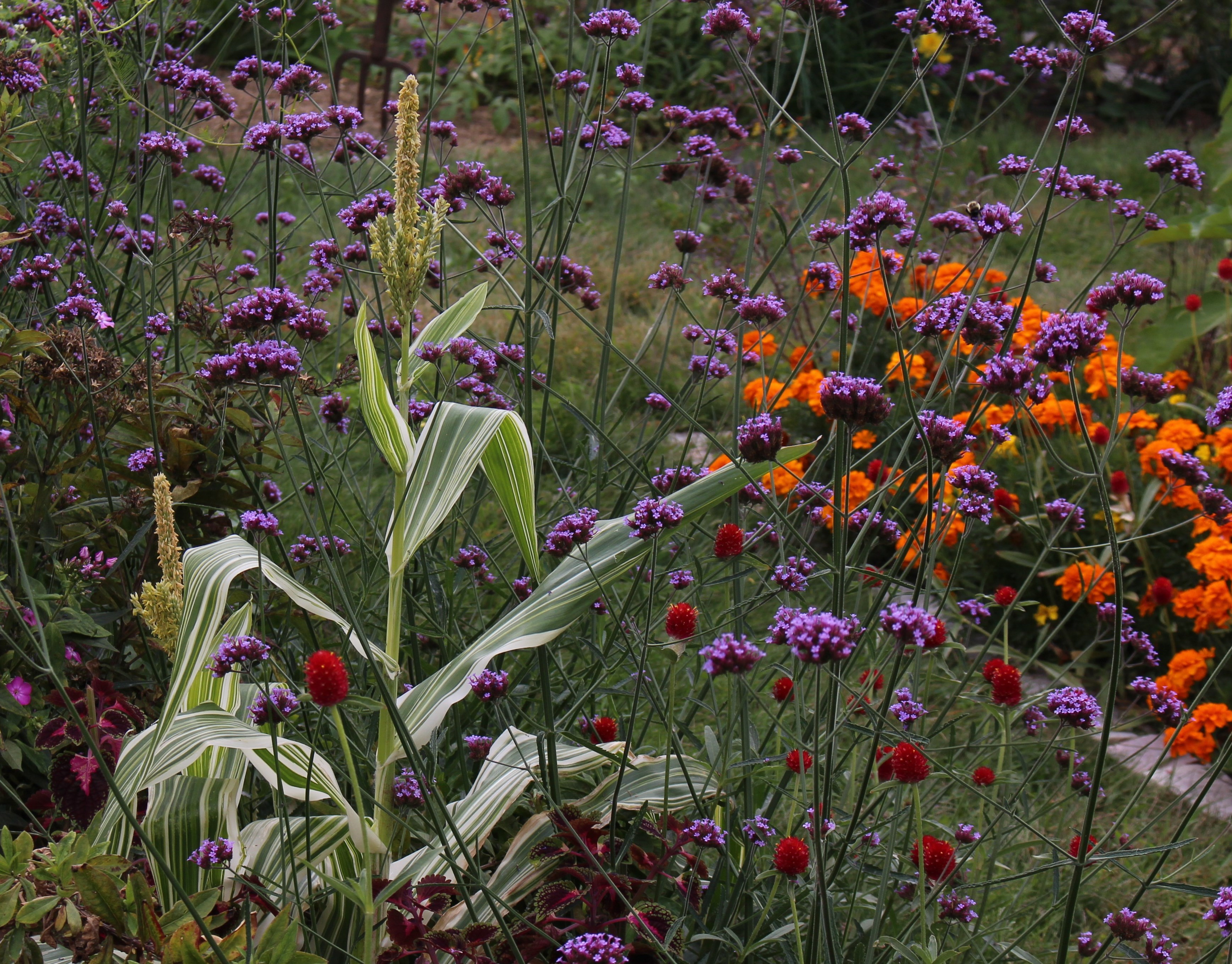
I like that the flowers take over in autumn, and I like that the combinations and players change each year as I gain or lose interest in one thing or another.  This year ‘Tiger cub’ corn is back.  The seed was a gift from Nan Ondra of Hayefield and I love the variegation but I’m afraid it won’t have time to ripen any seed this fall unless things stay warm late.  My fingers are crossed.  I love how the bright leaves of the corn go with the bright colors of the red gomphrena and orange marigolds.  Word is marigolds are supposed to be a no-no in classy gardens,  but I still love their carefree color and I like them even better knowing they’re another gifted plant, this time from Kimberley of  Cosmos and Cleome.

tiger cub ornamental corn

I did start out with cauliflower here in the spring, but then rather than replant with a fall crop I put in a few ‘QIS red’ gomphrena seedling, a few ‘Tiger cub’ corn kernels, and a few coleus for good measure.

I like this autumn mess.  Lettuce would be nice too but it’s just been too hot and dry and I just don’t have the ambition to start plants in a shaded spot for transplanting.  Plus I can always pick it up at the market… unlike butterflies, those I need the flowers for.

verbena bonariensis cypress vine Ipomoea quamoclit

In a few spots ‘love in a puff’ and the red blooms of cypress vine (Ipomoea quamoclit) thread their way through the verbena stems.  These little surprises make me smile.

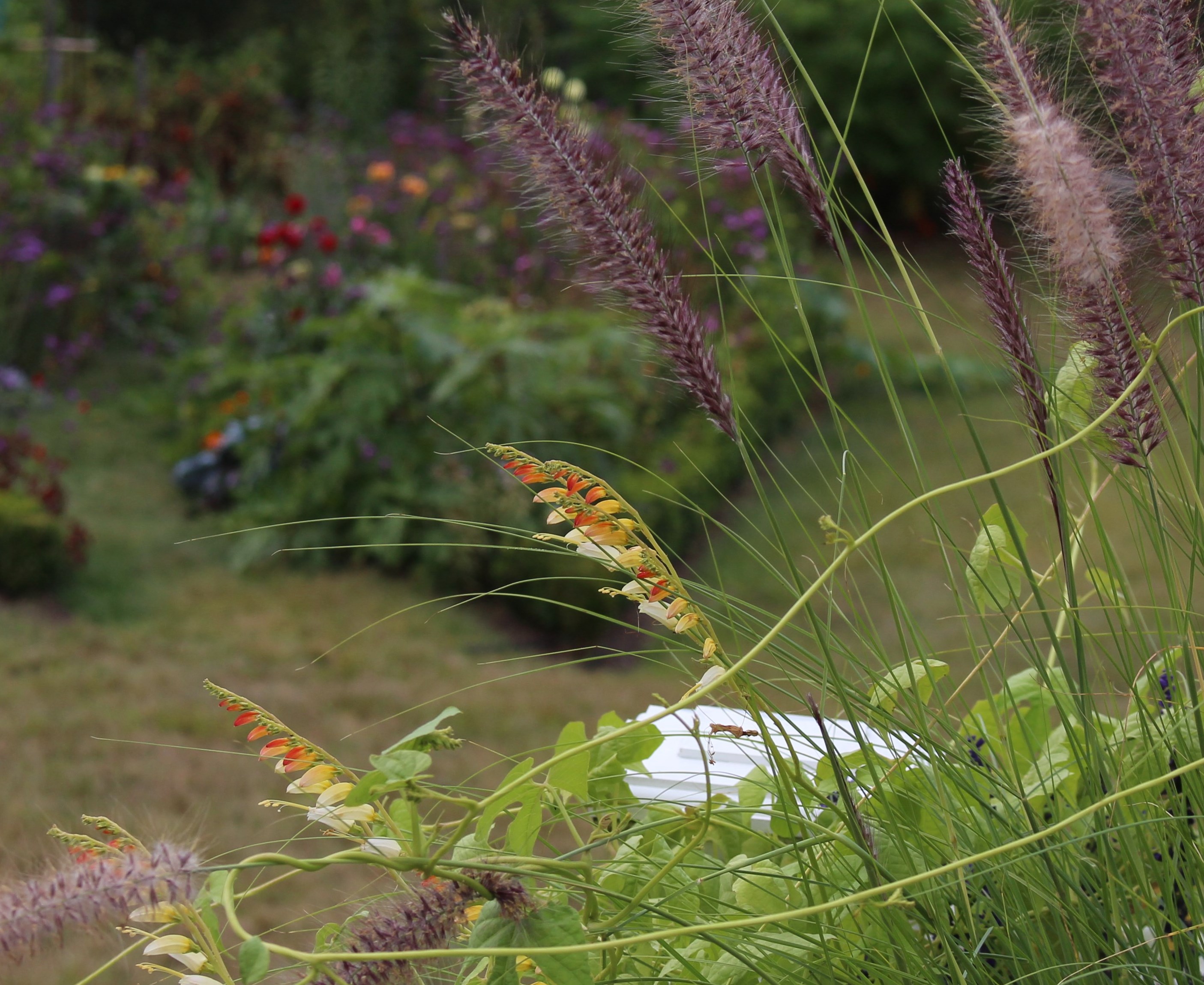
Here’s another little surprise which I could fill a whole photo album with.  This spring I finally seeded out a few Spanish flag vines (Ipomoea lobata), and although they never sprouted in their seedling pots, they did once I threw the leftover soil into the garden.  It’s a late bloomer and like many in the morning glory family it can be a little rambunctious, but in this spot it’s perfect.  The spent broccoli seed stalks (I suspect I’ll be weeding out tons of broccoli weedlings next spring)  and verbena stalks provide just enough support and when a bed to the left opened up after the potato harvest the vines moved right in.  I couldn’t have planned the color coordination with the chrysanthemums any better.

Ipomoea lobata Spanish flag

Ipomoea lobata (Spanish flag) vining through verbena stalks, broccoli stems, and some of my favorite orange chrysanthemums. 

The colors of this planting are the perfect match to my daughter’s favorite orange ice pops… please don’t question why she was eating this while the morning light was still so fresh.

Ipomoea lobata Spanish flag

Color echoes in an ice pop.

I’m not a pink and grey pastel kind of guy so this bold mix of orange and purple really tickles my color bone.  Throw in a few hot pink persicarias in front of the dark foliage of the ‘Coppertina’ ninebark (Physocarpus) and I’m more than happy.  I just regret that my photo skills weren’t enough to capture it all together in one shot.

Ipomoea lobata Spanish flag

More orange and purple in the fall garden.

Another thing I regret is that the flag vine planted on the deck has turned out to be a much less vibrantly colored plant from a more refined end of the gene pool.  When my seeds seemed destined to fail I snapped up a potful found at my favorite nursery.  It’s still a very nice thing, and I’ve even grown a paler yellow version before, but I can’t help wish they all had the darker stems and bolder orange of their more common cousin.

Ipomoea lobata Spanish flag

A paler version of Spanish flag grappling through some pennisetum on the deck.  The whiter blooms and lighter foliage are nice enough, but I need darker colors to hold up to the white railing.

Bold and less bold are still just fine and it really revs up the autumn season around here.  With temperatures finally cooling off and a good soaking rain last night fall is officially in full swing here and I guess I’m going to have to finally give up on my whining about the loss of summer.  It’s about time I’m sure, and to cheer myself up I think I’m going to get into chrysanthemums next post.  Have a great weekend 🙂

September GBFD: beauty in the details

It sounds a bit noble and refined to study the intricate details but in reality the big picture is just a little too ugly to show.  Autumn rains have yet to pan out and the bulk of the garden has that end of summer- waiting to die- air to it, so with a garden full of drought stricken, end-of-their-rope plants, close-ups are clearly the way to go.

best deck plants

A wider view of the watered deck plantings.  With only a few weeks left before frost I’m happy to see my newest banana nearly doubling in size since its August planting.  I love watching those new leaves unfurl!

The closeups will hopefully be a celebration of the late summer contributions foliage makes to the garden.  Yes, I know we’re into autumn now but Christina over at Creating my own garden of the Hesperides celebrates foliage day on the 22nd of each month, and since that date is still a summer number I’m going to use that excuse to hold onto summer for just a few days past the autumn equinox…. well maybe just until next week when the temperatures look as if they’ll drop.

pink splash caladium

Caladium ‘pink splash’ enjoying the unusually warm September weather.  Just foliage color here and although my choice might be suspect it really is an easy plant.  Best of all no dropped blossoms on the porch to clean up. 

Most of the focus right now is on the tropical plants and annuals which are blissfully putting out new leaves regardless of the impending frost-doom.  Let me give them their five minutes of fame before they get thrown in the dark garage for the winter again.  I think I’ve shown the scented geranium ‘Lady Plymouth’ before, but with a pleasant scent and fine variegation it really doesn’t hurt to show it again.  Plus, I am one of THOSE people who think variegation makes everything better, so here she is again 🙂

lady plymouth geranium

‘Lady Plymouth’ perlargonium brightening up the front entry with its finely cut, outlined foliage.

Matt over at Railway Parade House and Garden might give a little chuckle to see such a small specimen of eucalyptus, but here in Pennsylvania I’ve struggled to get it this far.  Last year it was a small floppy mess, this year it’s a bigger floppy mess.  Assuming I can bring it through another winter, my hope is it will show a little backbone and put on some height.  The reddish highlights on the silvery coin shaped leaves are completely unique here and I love it for that… even if the color disappears against the gray decking and white railing.

eucalyptus cinerea

Eucalyptus cinerea, the silver dollar gum.  It has a nice eucalyptus scent when you get close enough.

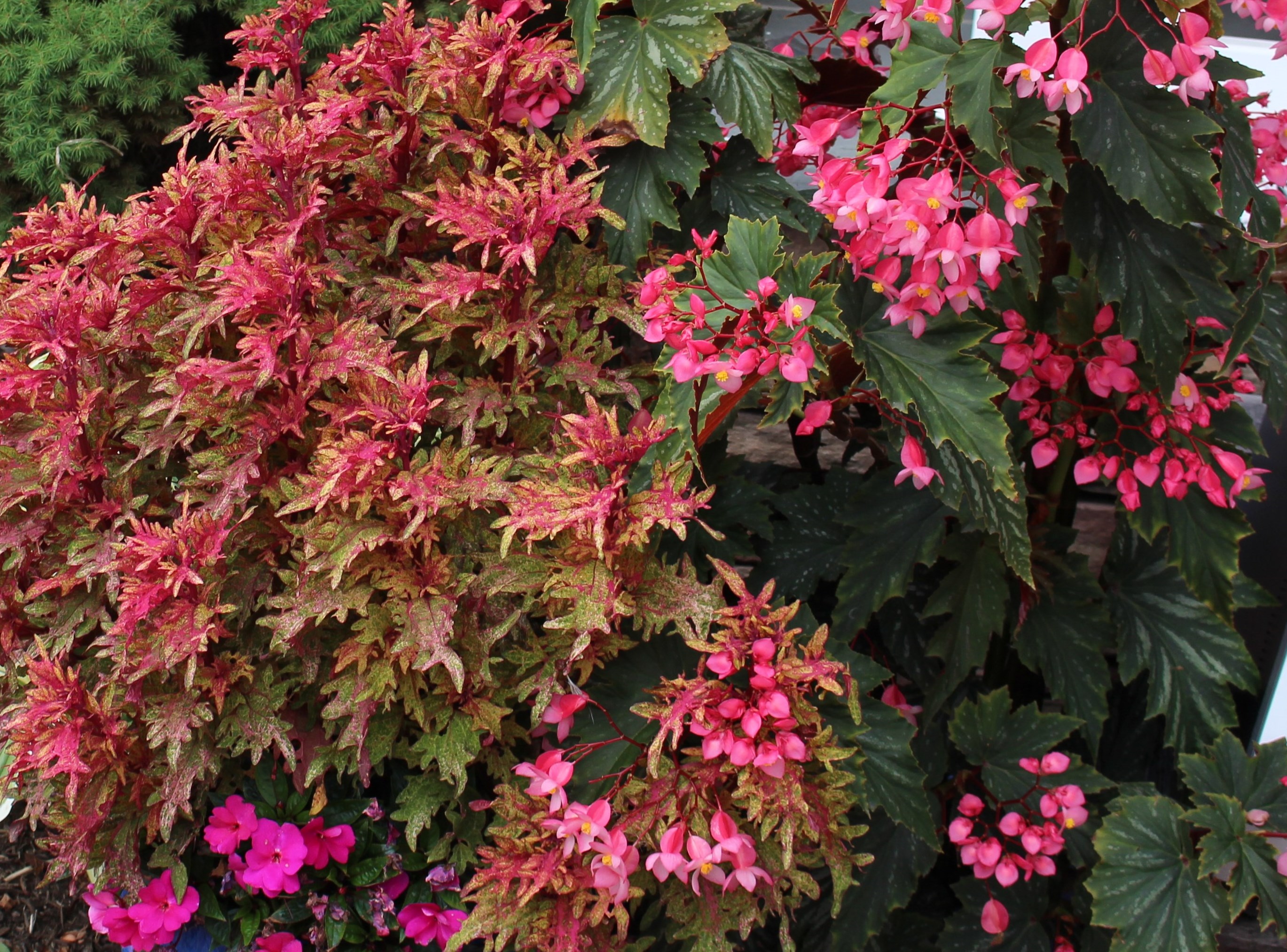
Something else which is starting to grow on me are the cane begonias.  They always look good, the foliage is cool, and for me they are completely foolproof to overwinter (in an above freezing spot with no water).  All the leaves fall off and they look terrible but come springtime and April showers they leaf out as if only a week has passed.  When I was younger and growing up on Long Island I couldn’t understand why the Coe’s of Planting Fields (now an arboretum) would devote an entire greenhouse to these boring plants.  Twenty five years later I’ve finally figured it out.

limon blush coleus with cane begonia

‘Limon blush’ coleus with a silver splattered cane begonia.  The silvering may be faded due to too much sun and the lateness of the season, but the flowers still keep coming on this tall (4+ feet) specimen.

I’ll finish up with a few more begonias.  September is a few days away from becoming the area’s hottest September on record and practically rainless at just over 1/4 inch for the month, so again the potted plants are helping me keep my sanity.

IMG_9027

Someday I hope to rediscover the tags which came with this plant, but for now the finely silvered foliage and discrete blooms earn it a home -even if I don’t have a name.

If I had more shade around here I would surely put these begonias to more use, but siting them is always an issue.  This pink speckled one never even made it out of the pot ghetto this year.  Every week it was another round of where-to-put-it and now I’ll just have to enjoy it as it is.

pink speckled cane begonia

Another unfussy cane begonia.  Most of it’s winter was spent bare root on a saucer in the back of the garage… which is not exactly what you’ll read in Fine Gardening but I like to test limits 🙂

Well that’s my take on September’s GBFD.  It may not be the perfect illustration of the contributions of foliage in the garden but it does show the contributions foliage has made to my sanity lately.  Give Christina’s blog a visit and see what others are doing in their own gardens with foliage this month.  It’s always a good show!

Stop it with the autumn talk

Many people enjoy and claim they welcome the coming of autumn.   I want to make it clear that I do not, and although the last few days have been a little too hot and dry for my taste, I would much prefer the relief of a summertime cloudburst rather than any farewell to summer eulogy.  So I guess what I want is just a few more days of denial before I’m forced to admit the season is breaking down.

hardy chrysanthemums

The tomatoes of summer are still going strong even with their new neighbors the fall chrysanthemums.

After a promising start to the summer August went dry and for the past forty days we’ve barely cracked the 1/4 inch mark for rainfall.  With high temperatures, thin soil, drying winds, and full sun the life was sucked out of a garden which had been almost carefree at the start of the summer.  With a nice rain today we’ll see how fast things bounce back.  My guess is it will be a much faster turnaround than the last two summers when things REALLY dried out to a crisp.
fall vegetable gardening

One patch of watered soil ready for fall planting. Hopefully cool weather will soon allow for a few broccoli and cauliflower transplants.

In spite of the heat a few things still look nice.  The tropical garden got a few minutes with the hose, and that seems to have been enough to keep it from death.  I love the colors right now with the purple verbena bonariensis, dark red dahlias, and peach colored salvia splendens filling the bed.

salvia splendens van houttei peach

A little orange from ‘Tropicanna’ canna goes a long way in brightening up the late summer salvia, verbena and dahlias.

With the grass dried up to a crispy beige the stronger reds, oranges, and purples really stand out.  I don’t think a bed full of lavenders, whites, and pale pinks would be as eye catching…. which I’m going to say is a good thing, since in this world of gray and tan I can use as much eye catching and hold-on-to-life color as I can get!

dahlia mathew alan

End of summer color from dahlia ‘Mathew Alan’.  As usual the dahlias could use some dead heading.

Even up front a little bold color is a nice thing.  The border along the house foundation has a few spots of color from the ‘Masquerade’ peppers I planted out this spring.  The true type has purple peppers changing to yellow, orange, and red while a few oddball plants started right off with pale yellow and are now going through the same sunset effect.

pepper masquerade

‘Masquerade’ peppers from seed with all the fescue clumps I divided up this spring.  I finally like this bed… but we’ll see how I can mess it up next year 🙂

Along the street is another story.  Even with a few emergency waterings things look end of summer tired.

dry perennial border

To water or not to water, that is the question.  Obviously I chose the latter, but the ‘Karl Forster’ feather reed grass, sedums, and perovskia are still holding on.

I did give the ‘Limelight’ hydrangea a little soaking, but a few water lovers such as the ‘Golden sunshine’ willow will need a good bit of water before they look anything close to happy again.

dry perennial border

I think this border will need a little trimming out of dead things once the rains soak in.  No big deal though, a little fall cleanup will carry it on through the next few months.

There are still a few bright spots.  Even in the harsh midday sun kniphofia ‘Ember Glow’ looks nice.  It could be a little taller but the size actually works well with the peppers and coleus (please ignore the dead rudbeckias and dying zinnias).

kniphofia

Red hot poker (Kniphofia) with peppers and a surprisingly sun and drought resistant coleus.  I wasn’t sure if the poker would ever bloom this year but I guess it’s a later cultivar. 

Until the garden bounces back the best thing to do is spend more time in the shade, seated with cold beverage in hand.  I can ignore the weeds and dead lawn quite successfully on the back deck.

summer planters on the deck

This is a late summer view, not autumn.  I’ll keep that delusion up until the first frosts threaten!

Even with a good soaking the lawnmower will still likely be on vacation for another week or two.  I’m ok with that.  I hope the soil takes in the rain, the plants come back, and I can finally use something other than a pickaxe to dig a hole.  Maybe then I’ll start thinking about things like fall while I’m taking care of a little late summer transplanting and bulb planting 🙂

A hot day in Philly

The calendar is beginning to insist that all things summer will soon come to an end, so when a free day presented itself I made my best to take advantage of the last weeks of warmth.  A quick call to a friend near Phillidelphia and I was on my way to one of my favorite gardens, Chanticleer.  As usual the visit did not disappoint, and despite a mental note to just enjoy the visit I did break down at the end and went a little camera happy.  Hopefully I can show some restraint with the length of this post even if I couldn’t with the camera.

chanticleer red border

Red and purple as you come around the house. Coleus ‘redhead’ and the awesome canna x ehemanii… rounded out with a few random bananas.

I like to stroll around pretending this is my own estate, and if by chance if I do win millions (I’ve given up on earning them through hard work, marriage, or genius) I feel like this is the kind of garden I’d create.

chanticleer container plantings

Many exotic and unusual container plants are scattered around the house and terraces. All appear perfectly grown and cared for.

The tropical plantings around the house are some of my favorite plantings, although even away from the house a random banana or elephant ear may turn up (Chanticleer refers to itself as a ‘pleasure garden’… so I guess anything goes!)

teacup garden chanticleer

This year’s teacup garden plantings. Fiddlehead figs and canna ‘Ermine?’, plus many others.

I’m guessing on almost all the IDs since the gardens are for enjoyment and inspirations and not so much for the down to earth realities of botanical labeling, but there are plant lists available both in the gardens and online.  I apologize for being too distracted to look while there and far too lazy now to look them up online.

papyrus chanticleer

Potted dwarf giant papyrus. I love the pot in pot planting with a ‘groundcover’ of duckweed, and I’d love to imitate, but… no pot and no dwarf giant papyrus.  Maybe the plain old giant papyrus will work,  at least that’s finally become easy to find in the spring.

I can feel the banana itch coming back.  I was given one and bought another this summer….

chanticleer tropicalismo

Canna x ehemanii, various bananas, red and purple dahlias, and a few tall salvia splendens varieties.

…and how can you not like dahlias at this time of year.

chanticleer mixed border

A respectable boxwood border holding back a wave of visitors from the south.

On a hot day the dry, full sun, gravel garden was not the place to linger… but we did, and while sweat beaded we enjoyed the waterwise plantings and the mix of dryland perennials and tropical cactus and succulents.

chanticleer gravel garden

I think the yucca rostrada (hardiest of the trunk forming yuccas) stays here year round, but I’m not sure of the agave.  I do know I wouldn’t want to be the one to lift it come autumn.

All the rain earlier in the year probably helped most things, but some I’m sure didn’t appreciate the reminder they were in Pennsylvania and not Southern California.

artichoke bloom

Artichoke blooms?  Not the best leaf-wise, but the color of the flowers almost glowed in the heat.

Or South Africa…

chanticleer kniphofia

Kniphofia (a species I’m guessing) along the dry slope.  I love this plant family, but never get decent flowers on the ones I’m growing.

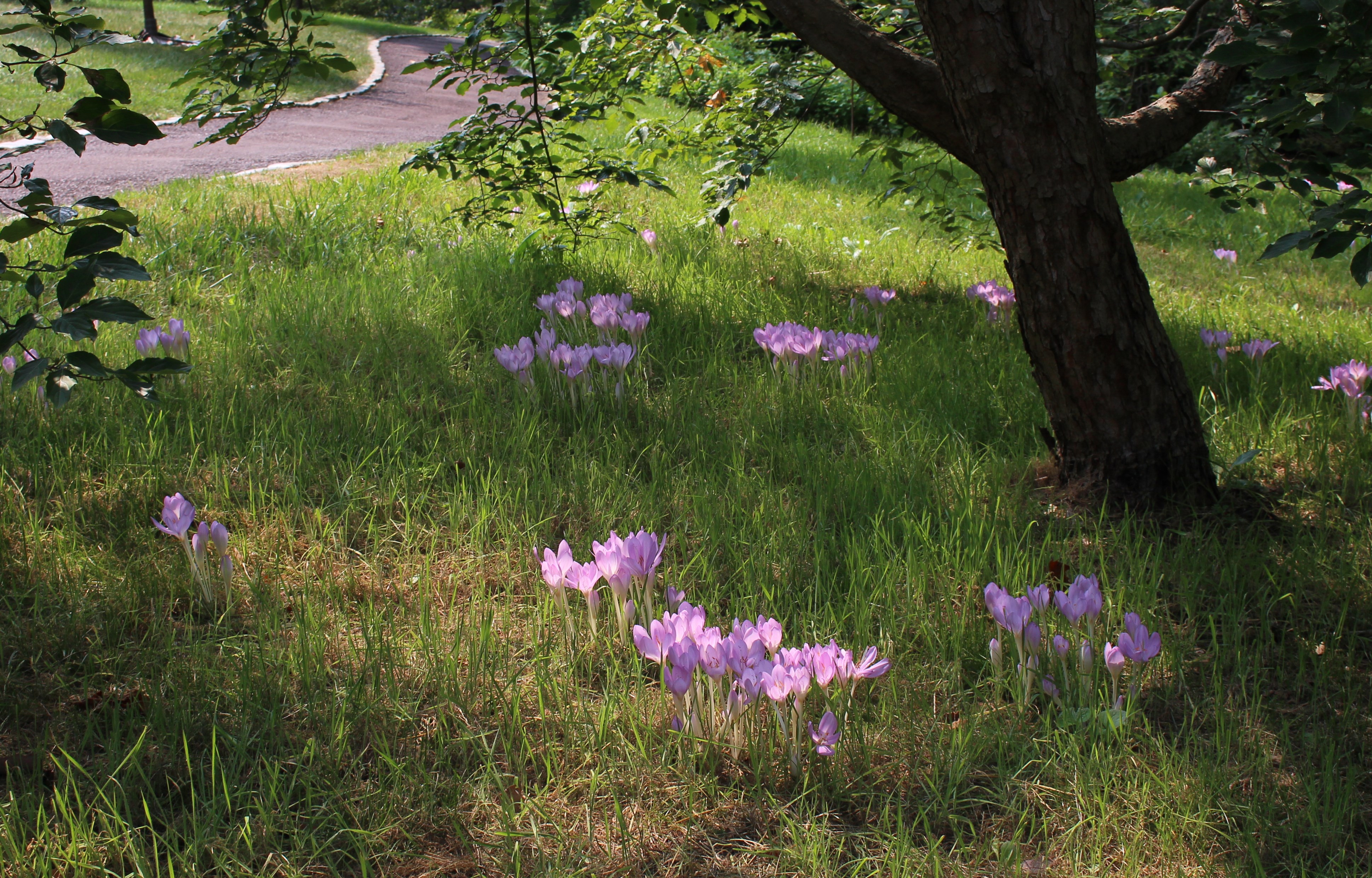
The bulk of the grounds around the house are open grass and trees, and this was the beginning of the colchicum season.

chanticleer naturalized colchicums

Some of the colchicums just beginning to bloom in the lawn at Chanticleer.  Form what I’ve heard there are many more to come.

And then there were the pond gardens…

chanticleer koi

Chanticleer koi

With lotus and water lilies.

chanticleer lotus bud

One of many lotus flowers.  My photos never do the blooms justice.

And then there was the cutting garden.  My favorite canna ‘Bengal Tiger’ (Pretoria) was the star, and in my opinion everything looks better when it’s next to this beauty.

chanticleer canna pretoria

The cutting garden.  Summer annuals, dahlias and cannas were at their peak.

It’s just pictures from here on.

chanticleer cosmos

Cosmos and dahlias with canna leaves.

chanticleer cutting garden

The beds threaten to swamp you in a tsunami of plants.  Still to come were all the hardy sunflowers and other native prairie plants which filled the inner portions of the bed.

dahlias chanticleer

Dahlia with gomphrena ‘fireworks’ (I think)

dahlias chanticleer

Dahlias again (it’s the season!) plus more awesome canna leaves. I think the ferny foliage belongs to the SE native dog fennel (Eupatorium capillifolium).

dahlias chanticleer

Nice right?

chanticleer summer flowers

Summer zinnas and cosmos. Who says fall is near?

I didn’t realize it’s been two years since I last visited (click here to see that very pintrest-popular post), and I’m glad to have had the chance to do it again.  The gardens are on a scale that really seems approachable, yet aren’t filled with how-to beds or dull bedding.  It’s really a place where you can enjoy the art of gardening,  and if you get the chance I would absolutely recommend a visit, but for those further afield there’s also hope.  September 23rd marks the release date for a new Timber Press book on the gardens and I for one am looking forward to it.  It has an excellent pedigree across publisher, author, and photographer and what I’m most looking forward to are the interviews with each area gardener.  I saw them at work during our visit but was a little too shy to bother them with an endless gushing of praise or question after question.  Hopefully the new book will pacify me. 🙂

Thanks for meeting me there Paula, and I wish everyone a great week!