Hola Spring

Spring arrived last week, and from the looks of it she’s in a rush.  A couple warm days, a gentle rain, and we’re off!

berm plantings

‘Just a bit’ of pruning on the seven sons tree (Heptacodium) turned into a few trunks being removed, but the real point of this is the finished berm and trees which now shield us from the Industrial park.

I had to quickly finish up the last of the cleanup -which turned into more of a leave in situ/ call it natural mulch/ kind of thing- but I did try to get in a few projects.  One of them was an attempt at addressing the cankers which always seem to show up on the Seven Sons tree (Heptacodium miconioides).  From what I’ve read this plant seems to be prone to them, and my options are (1)ignore them and hope they don’t completely girdle the branch (2)cut them out whenever they show up, or (3)get rid of the whole thing.  For those keeping track, I’ve moved on to option 2.
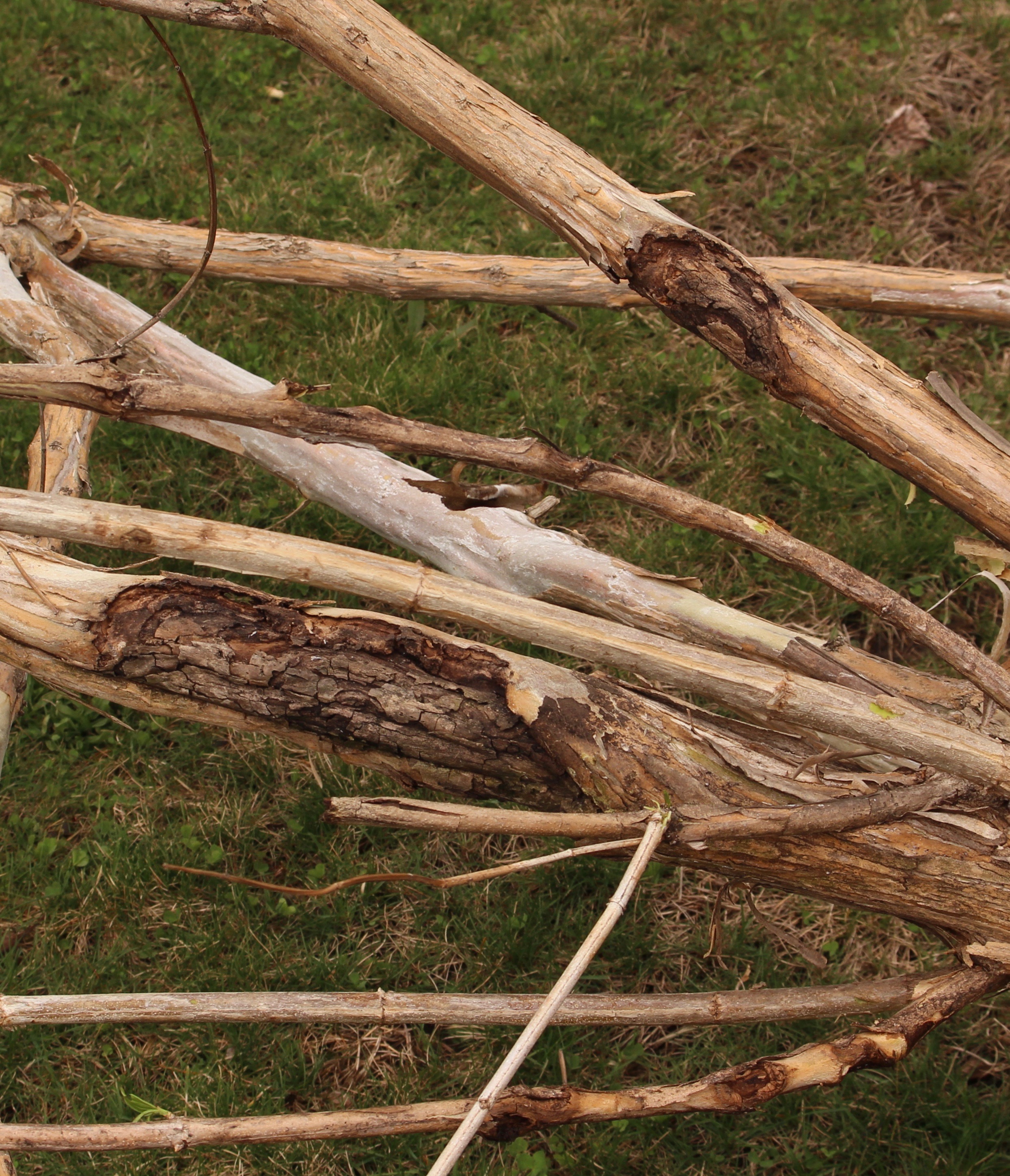
heptacodium canker seven sons

Eventually these canker infections will grow enough to encircle the entire branch, cutting off the flow of nutrients and the trunk will die off.  Hopefully cutting them out will help control them…

Fortunately my pruning activities are nothing compared to the curly willow my friend has to deal with.  The almost-bomb cyclone weather system which pummeled the midwest earlier in the week also brought fierce winds, rain, and hail to our little valley.

wind damage

I feel somewhat responsible.  About a dozen years ago I offered a potful of rooted cuttings which were graciously accepted.  Curly willow grows fast though.
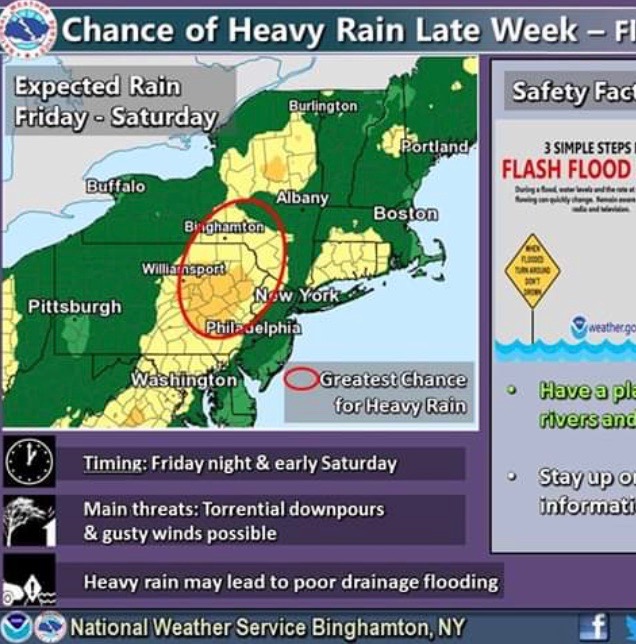
rain forecast

The weather forecast for this Easter weekend.

Not to dwell on the weather but any gardener worth his or her salt tends to dwell on the weather and I of course am no exception.  At the risk of appearing to complain I just want to point out that my holiday break perfectly matches the multi-day rain event which will be April-showering the Northeast this weekend.  Also if you are curious as to what part of the Northeast plays host to my garden, it’s just about dead center to the red outline which highlights this weekend’s heaviest rain forecasts.

Still, too much rain always beats drought, so I’ll just hope for the best and just enjoy the flowers which are coming up all over!
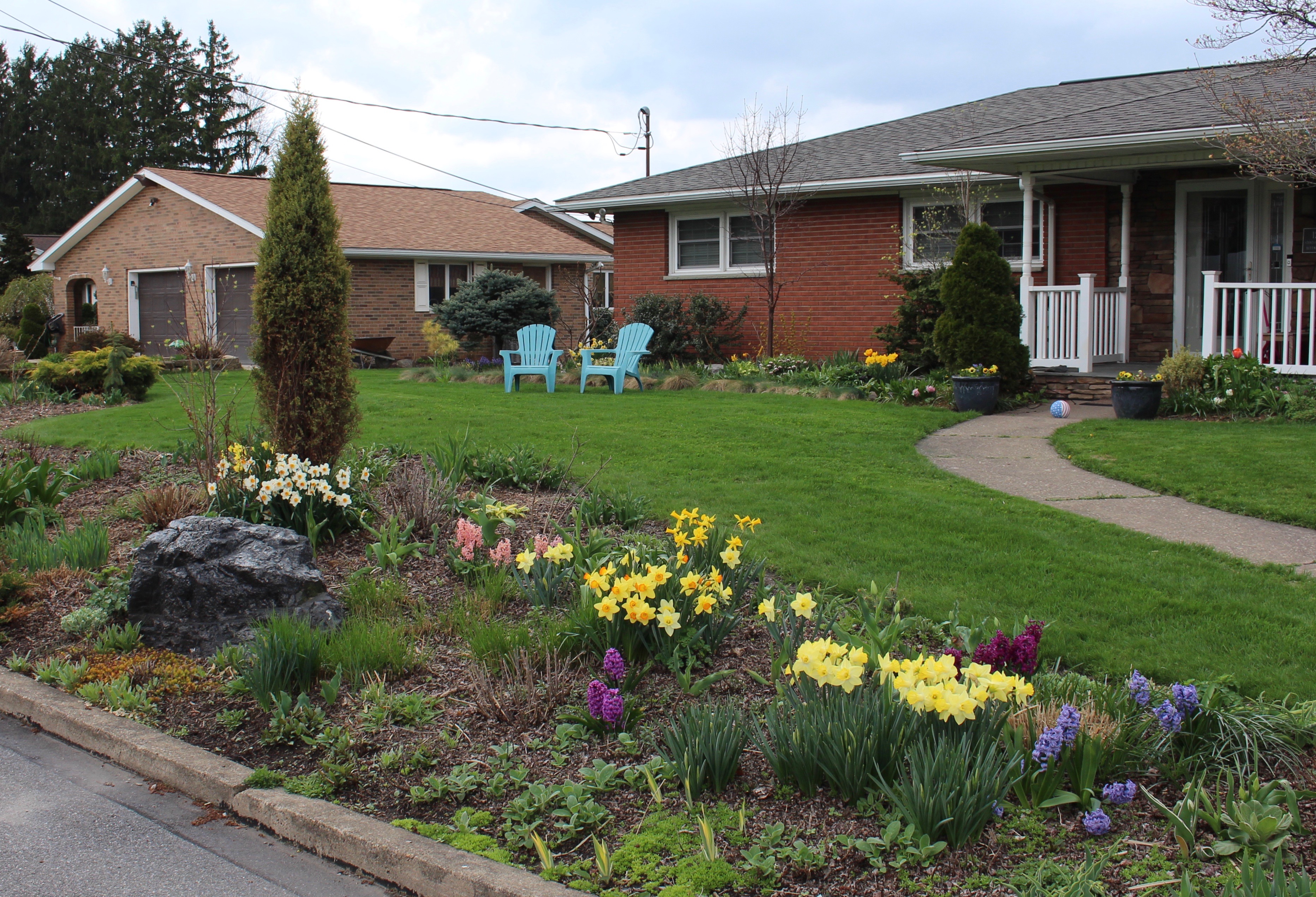
perennials and spring bulbs

A week ago it was corydalis, now the daffodils and hyacinth are taking center stage.  btw, Hyacinths don’t appreciate high winds so fortunately the ones here were only just coming up when the wind hit.

I can complain about a lot of things, but the spring bulbs along the street are not one of them.  All I do is cover up last year’s debris with a mulch of chopped leaves and then wait for things to come up.  It’s been a couple years since I last added new daffodils or hyacinths but I think this year a few can use some dividing.  Of course I’ll spread them out some more!

hyacinth woodstock

I think this is ‘Woodstock’.  I love those dark stems and saturated color.  Beetroot red is often used in descriptions, and I think that’s right on the mark.
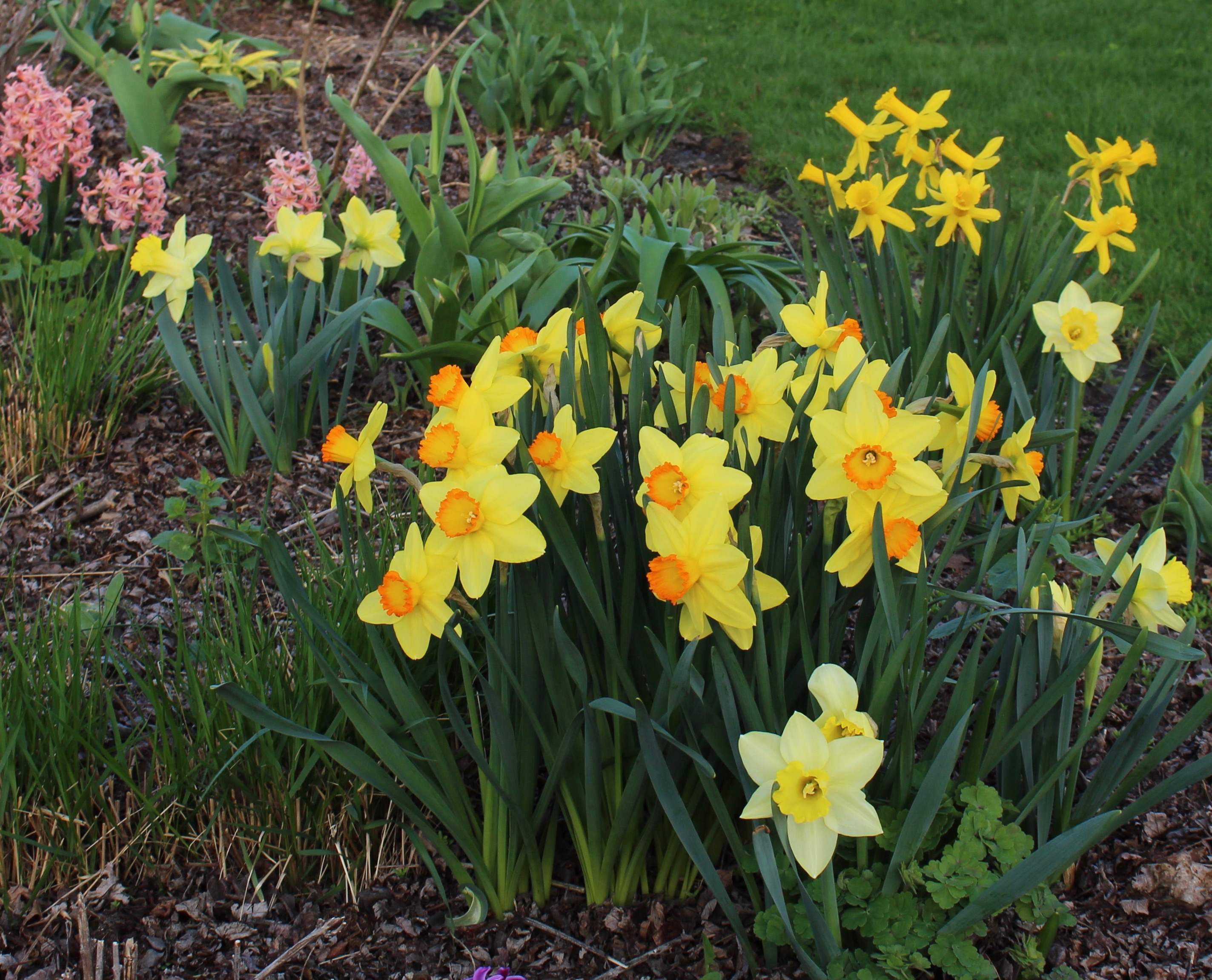
narcissus red devon

‘Red Devon’ (which is looking less washed out this year) with ‘Tweety Bird’ in back and a few pale ‘Pistachio’ here and there.  ‘Pistachio’ is an absolute favorite in case you’re wondering. 

narcissus barret browning

‘Barret Browning’ (pre-1945) is an oldie but goodie.  

I have a few grape hyacinths out there as well.  I avoid letting them go to seed, but of course when I saw seeds offered I had to try them.  Go figure.  I think they’re extra special of course, since I spent three years growing them on to blooming size, but I won’t be offended if you think they look just like any other muscari which you can buy for pennies a bulb.

muscari seedlings

Muscari seedlings along the front walk.  I believe these were planted as ‘Mt Hood’ but of course don’t show anything close to the icy blue color and pale tip of the parent.  

I see that the rain outside has stopped for a bit, so let me find my boots and take a slog around the garden.
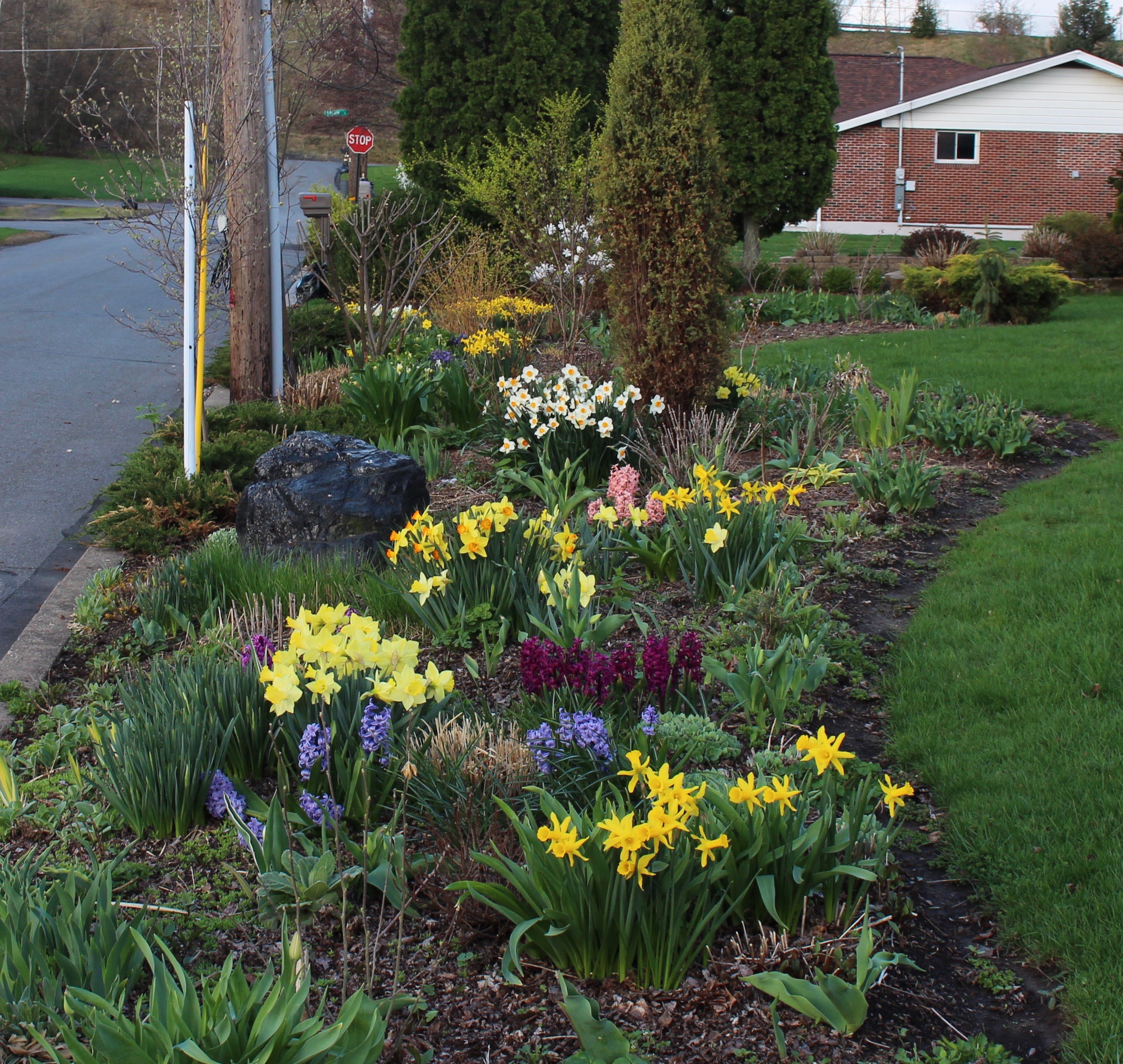
perennials and spring bulbs

A view down along the street border.  From the side and angled just perfectly it looks packed with spring color, and that’s the view I’d like to leave you with.

Enjoy your weekend and have a blessed Easter and Passover.

Corydalis and then Some

Warmer weather has finally reached NE Pennsylvania and within days buds are swelling, sprouts are showing, and the earliest spring bloomers are putting large swathes of color into beds which have spent the last few months exploring black and white themes.  Finally I can take those nice leisurely garden tours and not have to harass the same old snowdrop shoots every few hours, looking to see if they’ve changed at all.  New things are coming on faster than I can keep up with and all I can say is it’s great 🙂

corydalis solida

Sitting on the front porch step is my favorite way to take in the front garden.  Right next to the step is where I plant many of my smaller treasures, but in the past couple years the pinks and mauves of Corydalis solida seedlings have started to crowd out just about everything else.

Depending on what the thermometer does we’re just a few days away from bunches of hyacinths and the earliest masses of daffodils, but for the moment Corydalis solida dominates the front garden.

Corydalis solida ‘Beth Evans’ spreading out along the street border.  It’s a lot more pink than I prefer but after months of brown and snow who cares.

I’d have to look, but it’s only been a few years since I planted about 15 tubers each of pink ‘Beth Evans’ and redder ‘George Baker’, and from there on they’ve exploded across the garden.  They seem to enjoy the better-drained garden beds, in particular spots where other perennials will come up and cover them after they go dormant in a few weeks.  Restraint is not something I think of when these come up, and if you’re of the type who prefer a more ordered garden I would highly recommend avoiding them.  Corydalis solida does its own thing and if they’re happy in your soil you’ll have them showing up everywhere.

corydalis solida

A weak attempt at adding named varieties has left me with just one survivor… and possibly a bunch of just-as-good seedlings.  Keeping named plantings “pure” requires much more diligence than I chose to pursue so of course I just let them go.

In a few days all this color will fade away and the plants will quickly ripen seed and shrivel away to disappear underground for another 11 months.  If I’m on top of things (which has NOT been the case so far this year) I’ll dig a few of the more crowded clumps and tuck them in to all kinds of new territory… or just do it accidentally in August when I dig up a shovel full of the little round yellowish tubers.  In the meantime here are two other surprises from the earliest of spring garden.

primula denticulata drumstick

Drumstick primrose (Primula denticulata) were a steal off the late fall clearance rack.  I have no idea if they’ll last more than a year, but right now I’m thrilled by how early they are and lucky I was to find such well-grown plants. -Thanks Perennial Point!

Near the shelter of the house the hyacinth have started.  This wimpy, washed out pink is my most exciting hyacinth ever since it’s the first to flower of a bunch of seedlings off the clump to the left.  Six or seven years is all it took which sounds terrible but since I never did a thing for them other than leave them alone it hasn’t been bad at all.

hyacinth seedling

Pink.  My favorite color.  Still it’s my firstborn hyacinth and I love it, and look forward to seeing how it develops over the next few years.

So that’s it.  Spring is exploding so that’s really not even close to what’s going on, but like you I’d also rather be in the garden versus on the computer so off I go!  Hopefully after missing most of yesterday for all kinds of events, and today for more events (and plenty of rain in the afternoon), something valid gets done in the garden before the work week returns, but you never know.  I’m fine with just sitting around taking it all in.  Plus, as I discovered yesterday, parts of the compost pile are still frozen so I guess we’re still just starting.

I love the start.  Have a great week!

Planting Fields in March

I took a quick trip out to Long Island NY last weekend and since it was just me in the car it was a very brief back and forth before the decision was made to sneak in a garden visit.  Planting Fields Arboretum in Oyster Bay, NY was the choice.

florist cineraria pericallis bedding

I didn’t know florist cineraria (apparently called pericallis these days) would be hardy enough to go outside already, but they were and they looked great in front of the annex building to the main greenhouses.  Dark centered daisies are a favorite of mine btw.  

I used to work ten minutes from this NY historical state park and obviously because of the greenhouses, plant collections, hundreds of acres of open land, plus a manor house, you know it was a favorite pitstop along the way to and from work, but I had already been visiting for a few years before that.  Over the years the visits have settled in to follow a traditional path, and that path nearly always begins in the main greenhouse.

planting fields main greenhouse

The Main Greenhouse at Planting Fields.  

What shows up in the main greenhouse depends on the season or the year.  Sometimes the beds are filled with delphinium or foxgloves, poinsettias, chrysanthemum, orchids… wherever the mood of the planting staff has gone.  This March it was overwhelmingly tropical.

planting fields main greenhouse

When you follow the outer path your way is completely enclosed by tropical shrubs, palms, trees… oranges overhang and starfruit grow alongside bunches of bananas.  I believe in this photo we are looking up into a Bismarck palm. 

Radiating off the Main Greenhouse are several grow houses which back in the day served to supply the estate’s cut flower supply.

planting fields orchids phalaenopsis

Several greenhouses are devoted to orchids.  On this bench part of the phalaenopsis collection was still putting on their late winter show.

Back a few years ago, more of the greenhouses were accessible but today there are still at least six of the side greenhouses open for visitors, and you can always find plenty to see.

planting fields cactus

Agave are always cool.  Not so much fun to touch, but to see them growing in someone else’s warm, dry greenhouse just as we’re breaking out of winter… 🙂  

planting fields cactus

There’s always something special in the cactus house.

I seem to remember one of the greenhouses being a fern house.  Imagine my surprise when these bright, tropical rhododendron greeted me through the next doorway instead.

planting fields rhododendron vireya

A few vireya rhododendrons in peak bloom.

Vireya rhododendron represent a section of rhododendron which hail from the tropics of Southeast Asia.  As you can see, out of the couple hundred species there have been quite a few exceptionally showy selections and hybrids.

planting fields rhododendron vireya

Just a touch of golden yellow.  It’s so bright it almost overwhelms the smaller species to the right.  Also, in case you’re wondering, my nose detected no scent although some say they’re remarkably fragrant.

planting fields rhododendron vireya

The spring sunshine made everything even better, but notice the mossy root ball behind those extravagantly ruffled ivory flowers.  Many vireya are epiphytes, and grow up amongst the branches of the tropical canopy.   

Sorry but I thought the vireyas were exceptional 😉   Next on the agenda was a short stroll over to the camellia house.

planting fields camellia house

Side view of the Planting Fields Camellia House.  This used to be shaded and blocked by massive beech and pines, but disease and storms can take a toll.

The camellia house (1917) shelters the largest collection under glass in the Northeast.  I believe I once read that Mr. Coe got a really good deal on a bunch of imported camellias and only later discovered that they likely wouldn’t be hardy in his new garden.  Build a new glasshouse was the solution!  In any case, this year I managed to catch the tail end of the show.

planting fields camellia house

Camellia ‘Captain Rawes’.  A small arching tree which used to be matched by another equally large tree on the other side of the walk.  I wonder how long its partner has been missing, they were always my favorites. 

Here’s a little 1996 NY Times article on the camellia house.

planting fields clivia

Although many of the camellia were over, the clivia were coming on strong.

The camellia house is another place which comes and goes.  Some years it’s a thicket of bloom and bush, other years it’s recovering from the occasional massive pruning these big plants need.  I guess this year was somewhere in between, still excellent of course.

planting fields camellia house

Southerners would probably pass right by this one, but here in the cold north these huge flowers made me smile.  Plus the brickwork and greenhouse doors aren’t all that shabby either.

A brief run through the grounds was the next requirement.

planting fields pool

The mixed perennial borders surrounding the pool were still 100% sure spring had not yet arrived.

William Coe built Coe Hall as a residence, but his botanical collections and interest in horticulture had this former gold coast estate donated as a school of horticulture, and then preserved as an arboretum.  As such it’s filled with interesting things, and whether you’re just strolling or looking for specific plant goodies you can’t go wrong on a beautifully sunny March morning.

planting fields coe estate

Coe Hall beyond the branches of one of the remaining mature beech trees.  

I tried to get a quick visit in with all my favorites.  The giant sequoia trees were looking sad, as it appears fungus has finally caught up with them, but I was happy to see the odd monkey puzzle trees were still up to their usual monkey business.

planting fields monkey puzzle tree

Monkey puzzle tree (Araucaria araucana) in the sheltered high shade of the North rhododendron garden.  

The monkey puzzle is an exceptionally curious thing, and ranks as one of those living fossil trees which still keep chugging along as if the dinosaurs were still around to graze them.  Nowadays they’re confined to the Southern tip of South America but eons ago ranged across continents.

planting fields monkey puzzle tree

Spiny, sharp, and a puzzle for any monkey to climb, Araucaria araucana is not for everyone.  The foliage is cool though, and individual leaves can stay on the plant for decades.  Trees over 1,000 years old are not unknown.  

How can people not get excited about plants?  Beats me…

planting fields snowdrops

Of course I still found plenty of late season snowdrops.

So that was last weekend.  Maybe you can guess that in the week since I’ve been busy and/or lazy again, and if that’s a bad thing well at least on the good side it spares you from much of the rest of our snowdrop season.  It was an ok year in case you’re curious.  Too much wind, a lot of temperature ups and downs, and last year’s monsoons seemed to have been too much for many of the plantings, but hopefully the snowdrops which did come up  will be enough to last until next year.

We’ll see.  Have a great week regardless 🙂